It’s as simple as this – Chicken Is Good! Chickens Are Good!? Hmmm…I guess it’s a little more complex than I thought.
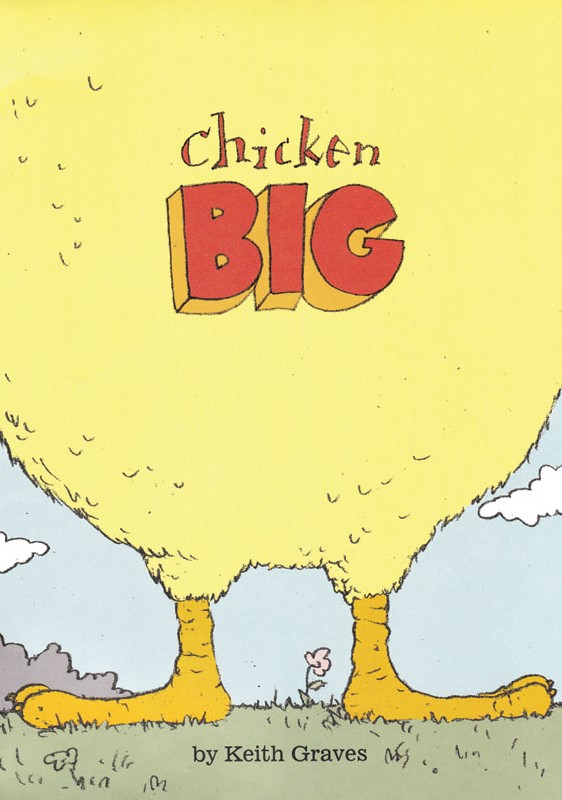
Chicken Big
By Keith Graves
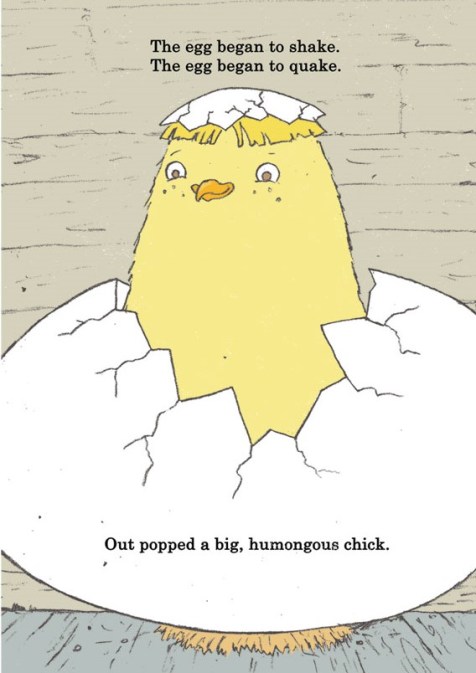
Something big is hatching at the teeny little farm. Not only big, but humongous! Chicks aren’t supposed to be that big, so what is it? The farm’s small chicken agrees that whatever it is, it’s big; the farm’s smaller chicken goes so far as to call it enormous; and the farm’s smallest chicken declares it’s an elephant, and warns that indoor elephants are dangerous! The chickens all agree on one thing—this creature is too big to stay in the itty-bitty coop. The newly hatched chick doesn’t feel like an elephant and wishes he were a chicken.
Image copyright Keith Graves, courtesy of keithgravesart.com
The next day an acorn conks the smallest chicken on the head, causing the familiar “the sky is falling” panic to hit the teeny farm. While the chickens are running around like chickens with…well, you know, the big chick discovers that acorns are tasty. Seeing the chick eating acorns convinces the smallest chicken that their new coopmate is indeed a…squirrel!
When the rains come, the big chick protects the others under his wing, so the smallest chicken decides this barnyard biggie is an….umbrella! It doesn’t take long for the smallest chicken to realize she is wrong, and that the yellow fellow with the chilly wind blocking skills is a…sweater!
Image copyright Keith Graves, courtesy of keithgravesart.com
When the chickens return to the coop for naptime and discover their eggs have been stolen, they boo hoo hoo into their feathers while the humongous chick scouts out the fox carrying the precious cargo into his den. With a hop and a jump the big chick spans the mile and peeps into the fox’s home just as he is about to fry up some lunch. Frightened by the “hippopotamus,” the fox scampers away.
Big chick brings back the eggs and is proclaimed a hero. Finally the big chick’s intelligence, kindness, and bravery convince the chickens that he is one of them, and they welcome him into the coop. There’s just one problem…he doesn’t quite fit. Showing compassion and uncharacteristic understanding, however, the smallest chicken is the first to say they’ll make room.
Image copyright Keith Graves, courtesy of keithgravesart.com
Keith Graves has hatched up a manic tale of mistaken identity that will keep kids giggling and groaning with delight as the possible aliases grow more and more ridiculous. The feather-brained chickens are drawn with comic masterstrokes as they frantically try to determine who or what has invaded their farmyard. The big chick is indeed big—dominating the page and towering over his coopmates. Incorporating comic-style conventions on some pages, such as speech bubbles and small panels, as well as mixed typefaces adds to the humor.
Ages 4 – 8
Chronicle Books, 2014 | ISBN 978-1452131467
Like the best children’s museums, Keith Grave‘s website is a colorful and crazy compendium of his work!
While I take some personal days over the next couple of weeks, I am re-blogging some earlier posts with updated interior art and links.
Chicken Month Activity
Hatch a Chick! Craft
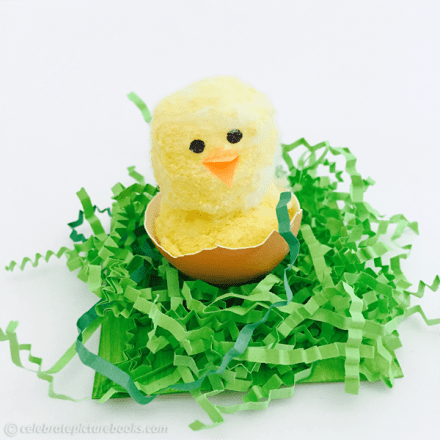
Chicks are so cute and fluffy—you just wish you could have one of your very own! Now you can! Hatch your own chick with this craft.
Supplies
Cotton balls or large pom-pom
Yellow chalk
Orange paper
Black paper
Egg shell
Paper grass
Cardboard or poster board
Cheese grater
Green paint
Glue
Scissors
Directions
To make the shell
Crack an egg and save the two halves
Soak the eggshells in soapy water or wash gently with soap
Dry eggshell
To make the chick
Grate the chalk with the cheese grater into a bowl
Roll the cotton balls in the chalk dust until they are covered
Make the beak from the orange paper by folding the paper and cutting a small triangle
Cut two small eyes from the black paper
Glue the beak and eyes to one cotton ball or pom-pom
Glue the head to the body
Set the chick into one of the eggshell halves
To make the stand
Cut a 3-inch by 3-inch square from the cardboard or poster board
Today’s holiday gives kids an opportunity to get into the kitchen and help prepare meals—or perhaps create the whole meal themselves. By being involved, kids learn about nutrition and healthy eating habits. Planning menus, shopping for ingredients, preparing the food, and presenting it can be a fun family activity and may inspire some kids to be regular participants in the kitchen. Today, invite your child or children to take some time out from their schedule to bake up some terrific treats!
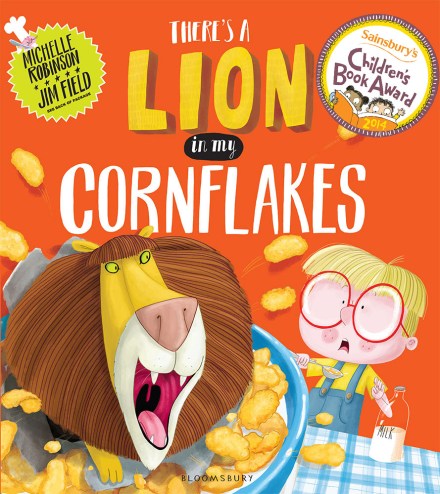
There’s a Lion in my Cornflakes
Written by Michelle Robinson | Illustrated by Jim Field
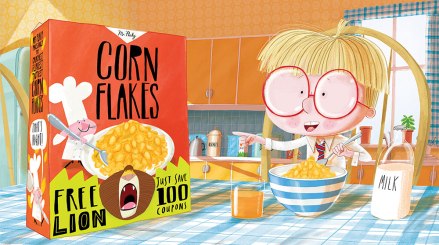
Who could resist clipping coupons to receive a free lion? Nobody, that’s who! I mean, it would be so cool, right? A lion to take on walks, ride to school, and open tin cans—awesome! So a little boy and his brother Dan take a year’s worth of their allowance, make “a million” trips to the grocery store, and start cutting.
Image copyright Jim Field, courtesy of jimfield.co.uk
But all those boxes of cereal squeeze out the other food on the pantry shelves, so Mom says the boys have to eat cornflakes for breakfast, lunch, and dinner until it’s gone—and, oh yeah, they don’t get an allowance until then either. It’s all worth it, though, because they’re going to get a real live lion.
There’s just one hitch—every other kid in town has the same idea, and while the brothers wait for their lion to arrive, everyone else is out playing with their new pet. Finally, the delivery truck pulls up in front of the house, and out walks…a grizzly bear?! That’s not right, and it’s even delivered to the wrong house. Well, the bear’s not too crazy about the situation either, and shows it. The kids and the bear have to clean up the neighbor’s yard and apologize.
Image copyright Jim Field, courtesy of jimfield.co.uk
A letter of complaint to the cereal company brings resolution in the form of…a crocodile?! The crocodile spends all its time in the bathroom, and the grizzly bear is still causing havoc. Dad calls the cereal company and to make up their mistake they send…a gorilla?! The gorilla stomps on Dad’s car and rips the door off, but the whole crew piles in so Dad can “give those cereal people a piece of my mind.”
The cereal people sure are sorry for the mix-up. They make amends by letting the family keep the grizzly bear, the crocodile, and the gorilla, AND the company gives them…a lifetime’s supply of cornflakes! But really, what good are they? The boys can’t walk them or ride them or even open cans with them.
You know what, though? Mom’s discovered the crocodile has some pretty sharp, can-opening chompers. The grizzly bear can walk forever and even wear a fanny pack. And the gorilla makes a very cool chauffeur. Why bother having a lion when everyone else has one?
But what are those cereal people offering now—a free tiger?! Hmmm….
Image copyright Jim Field, courtesy of jimfield.co.uk
Michelle Robinson has taken the lure of free stuff to its ridiculous best.With comical flair she aptly portrays the consternation on all sides, from the earnest kids to the flummoxed parents, that grounds this story in the recognizable while also providing hilarious suspense. The silly, over-the-top scenario of There’s a Lion in My Cornflakes serves up the benefits of individuality and drawbacks of consumerism that will have kids laughing at every page and escalation of the brothers’ problem.
Jim Field’s bold, vibrant illustrations are the perfect accompaniment to this boisterous tale. The boxes of cornflakes and clipped coupons are piled high, the boys are excited, nonplussed, shocked, and finally accepting as day after day brings new and unexpected results of their actions, and the parents are perfectly perplexed. Kids will love the funny details on every page that highlight the story.
Ages 3 – 7
Bloomsbury Children’s, 2015 | ISBN 978-0802738363
There are books, games, and coloring pages galore onMichelle Robinson‘s website!
Discover the vast array of work by Jim Field on his website!
While I take some personal days over the next couple of weeks, I am re-blogging some earlier posts with updated interior art and links.
There’s a Book Trailer in this Review!
Kids Take Over the Kitchen Day Activity
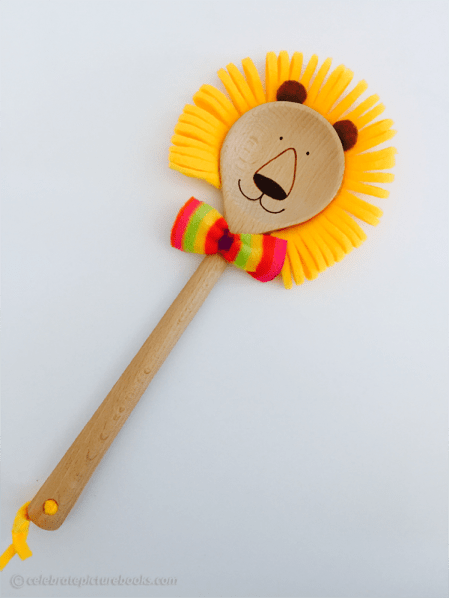
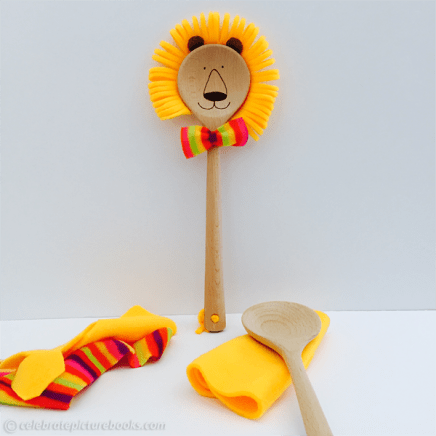
Spoon Lion Puppet
Spoons are just the thing for eating cereal! But with this craft you can make a ROARingly cute lion puppet!
Supplies
Wooden mixing spoon
Yellow Fleece
Brown felt
Colorful Fleece or felt
Fabric glue
Light brown marker
Dark brown marker
Hot glue gun or super glue
Directions
To make the lion’s face
Draw a nose, mouth, and eyes on the front/bowl of the spoon
To make the mane
Measure the rim of the spoon from one side of the handle to the other
Cut a strip of yellow fleece as long as rim measurement and 4 inches wide
Fold the piece of fleece in half long-ways
Glue the open edges of the fleece together
Along the folded side cut a fringe, leaving the loops intact
To make the ears
Cut round ears from the brown felt.
Assembling the lion
Glue the ears to the back of the spoon
Glue the mane to the back of the spoon
To make the bow
Cut a 3-inch x 1 ½-inch piece of colorful fleece or felt
Cut a long thin strip of fleece or felt
Pinch the bow in the middle and tie with the longer piece of cloth. Trim as necessary
Glue the bow to the handle
To make the tail
Cut three thin 4-inch-long strips of yellow fleece
With fabric glue, glue the tops of the strips together
Braid the strips
At the bottom, glue the strips together, leaving the ends free
Fold the top of the tail and push it into the hole in the handle of the spoon
Instituted in 2007 by the Encouragement Foundation at Harding University in Searcy, Arkansas, today’s holiday entreats us to cheer on our friends, coworkers, and even those we don’t know as they attempt to reach goals or start new endeavors. A pat on the back, a simple “you can do it!,” or a reassuring “great job!” boosts people’s self-confidence and makes the world a happier place.
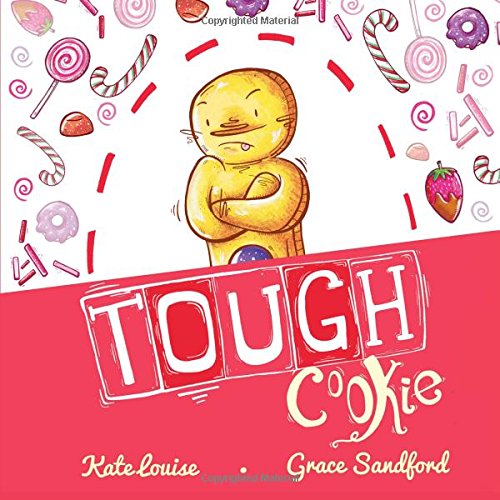
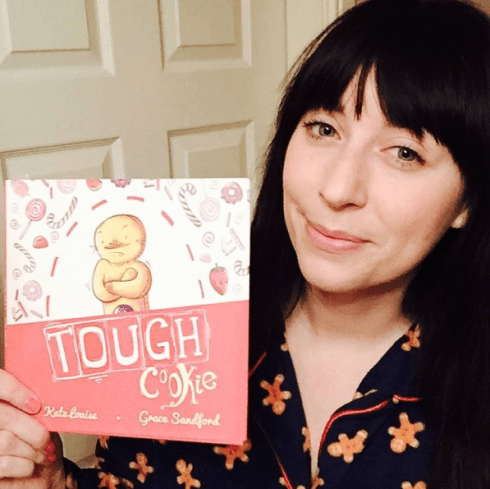
Tough Cookie
Written by Kate Louise | Illustrated by Grace Sandford
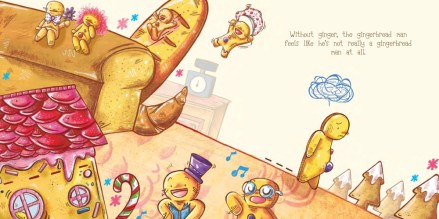
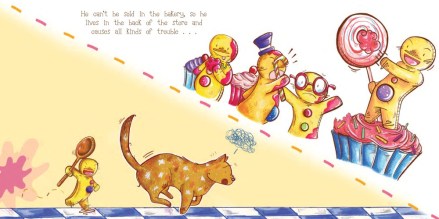
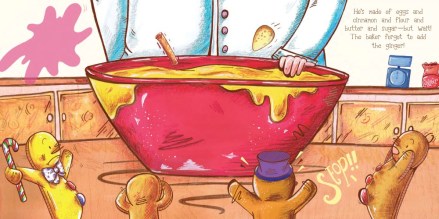
Although one gingerbread man in the bakery looks like all the others, there is one important difference. Yes, the batter had “eggs and cinnamon and flour and butter and sugar—but wait! The baker forgot to add the ginger!” Without this signature ingredient the gingerbread man just doesn’t feel like a gingerbread man at all. In fact his whole life has been turned upside down. He’s different from his friends, and what’s worse, he can’t be sold. Instead, he lives in the back of the bakery and in his sadness makes all kinds of mischief.
Image copyright Grace Sandford, text copyright Kate Louise, courtesy of Sky Pony Press
The gingerbread man chases the cat, splatters icing on other cookies, and squirts icing on the walls. “‘I need that for my cupcakes!’” the baker yells, but the gingerbread man just laughs. He moves on to the decorative candies, stuffing them in his mouth as fast as he can even though the baker needs them for his other treats and stands by tapping his foot. Next the gingerbread man scatters sprinkles all over the counter and slips and slides along on his belly—“‘woohoo!’” But the baker is not amused. “‘I need those for the donuts!’” he shouts.
Image copyright Grace Sandford, text copyright Kate Louise, courtesy of Sky Pony Press
Finally, the baker has had enough. Not only is the gingerbread man upsetting the other gingerbread men and women, he is ruining the business. The baker orders the gingerbread man to leave the store. But this is one gingerbread man that does not want to run away. “‘I don’t want to leave!’” he cries. The baker relents. He takes the little cookie in hand and teaches him that even though he is missing an ingredient he can still be kind. The baker shows him by being nice he can become one of the group.
Now, the little gingerbread man is happy. Instead of gobbling up all the candy, he helps create the other cookies. He no longer shoots icing on the walls or flings sprinkles around the kitchen. Rather, he helps the baker decorate the cupcakes and the donuts. He’s even learned how to sift flour and roll out dough, and he uses the cookie cutter to make new friends. And he never forgets to add the ginger!
Image copyright Grace Sandford, text copyright Kate Louise, courtesy of Sky Pony Press
In her sweet story, Kate Louise reminds readers that true happiness comes from within and that each person can decide for themselves how to perceive the world around them. While each of us is human, we all have different ingredients that make us unique. We can use those qualities to be kind and make positive changes in the world. Kids will recognize and giggle at the mischief the little gingerbread man makes with icing and sprinkles, but will also realize that friendships are built by using that same energy to help others. Sometimes tough cookies are actually softies at heart.
Grace Sandford’s bakery gleams with the golden hues of fresh-baked bread, the festive colors of sprinkles and icing, and the sparkle of sugar. Kids will love the vibrant pictures of cupcakes; lollypops; stacks of cakes, donuts, and candy; and decorated gingerbread houses surrounded by cookie forests. Her expressive gingerbread men and women register dismay at the wayward gingerbread man’s shenanigans and joy at his kindness. And the hero of the story? When he leaves behind his impish pranks he becomes a charming baker’s companion, sifting clouds of flour, running on the rolling pin to flatten dough, and passing out sugar-shiny gumdrop buttons to his new friends.
Young children will ask for this fun and funny read over and over. Tough Cookie makes an especially delicious accompaniment to an afternoon of baking or decorating gingerbread houses!
View the colorful world and signature style of Grace Sandford’s artwork on her website!
Gobble up this Tough Cookie book Trailer!
National Day of Encouragement Activity
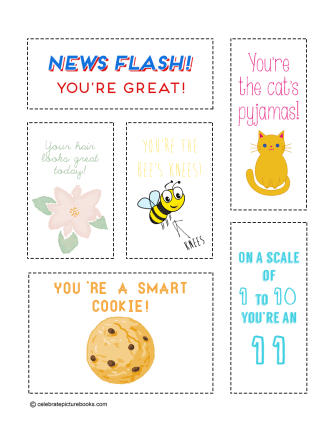
Kindness Cards
Encourage your friends – and even strangers with these printable Kindness Cards! You can hand them to people and tell them how much they mean to you or slip them into a lunch bag, locker, shelf, backpack or other place and let the person discover a secret day brightener!
Q&A with Author Kate Louise & Illustrator Grace Sandford
Today I am happy to include a double Q & A with both author Kate Louise and illustrator Grace Sandford in which they share their inspirations, their other work, and the joys of creating picture books as well as reveal a favorite place for tea and cake and a ghostly pastime!
Meet Kate Louise
What were some of the books you most enjoyed as a child?
I loved Funny Bones and Winnie the Witch! And I was a big fan of Roald Dahl (especially Matlida) – I still am!
What influenced you to write Tough Cookie?
I had the idea at Christmastime. I was measuring ingredients for a batch of gingerbread cookies and wondered what a cookie character without sugar would do because they’d be unable to fulfill their cookie purpose without an important ingredient! I later changed the missing sugar to missing ginger, which is the most important ingredient of all for a gingerbread man.
You write picture books as well as young adult novels. Which came first? What is the biggest challenge in writing each? What is the biggest joy?
When I started writing, I knew I wanted to write young-adult fiction. So that came first. Writing picture books kind of felt like starting over again. It was scary, but exciting, too. And I could learn a lot from both and apply new skills to different projects.
Both have their charms and their tough moments. Writing novels can be really hard going at times when I get the feeling that I’m never going to make it to the end, or if I get myself tangled up somewhere along the way. I don’t get that feeling quite as much with picture books, though I would say they’re harder to write! To tell a story with a much, much smaller word count and to get used to letting the illustrations tell it too.
The biggest joy for me is always seeing the finished work. After putting so much into each project, getting it back as something I can hold in my hands and feel proud of is a great feeling.
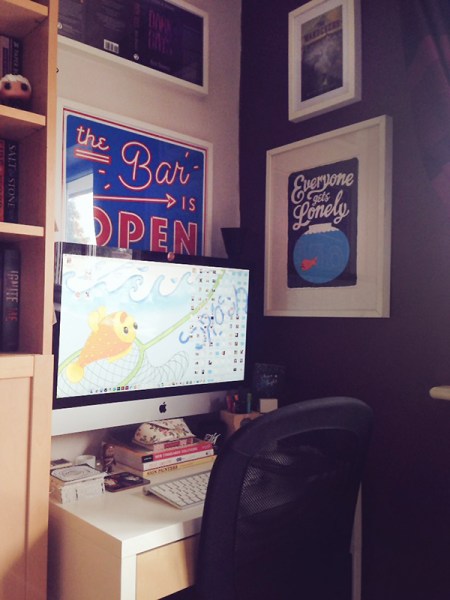
Can you describe your writing space a little?
I can answer with a photo! Though, it depends when you catch me and how busy I am. Sometimes it can be piled up with books or notepads or pieces of paper and mugs of tea! My screen desktop (as you can see) can get pretty hectic sometimes too.
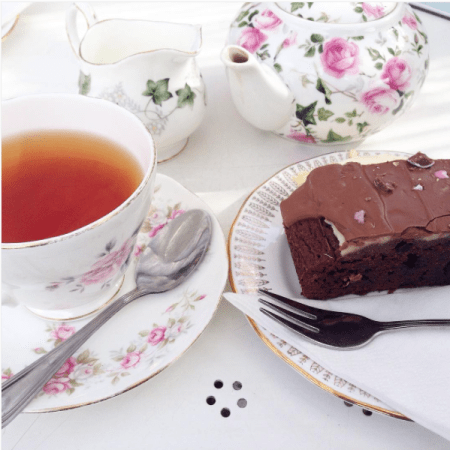
Since Tough Cookie is set in a bakery, I’m wondering if you have a favorite bakery and if so what is special about it?
Oh, nice question! My fave place to visit for tea and cake is a little farm shop tea room, where the cake is made by my friend Bethany at Picture Frame Puds and is seriously delicious! It has a lovely vibe and I can take my dog!
What are you working on next?
I’m working on The Pack, which is the sequel to my YA shape-shifter circus novel The Wanderers that came out last year.
Since this is a holiday-themed blog, I can’t let you get away without asking you a few holiday-related questions, so…
What is your favorite holiday?
It would have to be Christmas. But Halloween is a very close second.
Do you have an anecdote from any holiday you’d like to share?
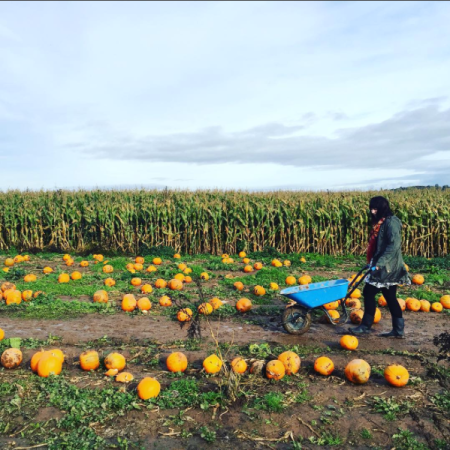
I like to make a big deal about Halloween with movies, decorating, pumpkin carving, and themed baking. We’ve just started going to a pumpkin farm to pick the pumpkins ourselves too. There’s a corn maze and little wheelbarrows and the field stretches on forever. It’s a new tradition and a fun extra activity for us at Halloween.
Meet Grace Sandford
What inspired you to become an illustrator and a picture book illustrator specifically?
Growing up, I loved drawing and creating characters from my imagination. I believe a lot of that stemmed from picture books and animated film and television. I love Disney and Pixar and as a teenager I was fascinated with the concept art from Pixar films. I always knew that I wanted a career in art of some form but it’s hard discovering what jobs are out there when you’re at school! I did some studying in Graphic Design and eventually went to university to study Illustration, which is where I got truly passionate about picture books. I always admired the art of picture books and they have been a huge part of my life but having a reason to dissect them and create your own really made me want to be a children’s illustrator.
What were some of the books and/or artists you liked most as a child?
The Very Hungry Caterpillar by Eric Carle, I am a Bunny illustrated by Richard Scarry and when I was 16 I stumbled across Catherine Rayner’s debut Augustus and his Smile. I think that book was a huge influence in wanting to be a children’s book illustrator, both the writing and illustrations are perfect!
Can you describe your process when illustrating a picture book?
It usually begins with the editor sending you the story/text. Then I start to do lots of sketches of the main character, the secondary characters and the environment around them. Pinterest is a godsend during this bit as you can flick through and look at photos of certain animals or buildings for reference to make sure you’re creating characters that will look believable (even if it is a walking, talking gingerbread man!)
Then I create roughs for each spread showing how the pages will look and which parts I have chosen to illustrate. This gives the editor a rough idea of how the final artwork is going to look and this is where most of the edits happen until it’s approved. Once all edits are approved I can create the final artwork which is my favourite part seeing all the hard work come together!
Can you describe your work space a little?
I now have a studio where I live, but when I worked on Tough Cookie I lived in a one bed apartment with my boyfriend straight after university and I had to work on the kitchen table! I’m so glad I have my own room to work in now (and I’m sure my boyfriend is too!)
My work space now involves a desk, my iMac, an A3 scanner, a windowsill with lots of pens and paints (and most importantly plants!) and I have a space that alternates between a lightbox and a graphics tablet. I also have a bad habit of putting all projects I’m working on into separate piles around the room until they are done!
You say in your bio that you like ghost hunting. How did you get involved in that? What is your favorite place to hunt ghosts?
Haha, this is the best question! I love Ghost Hunting although it’s been a while since I’ve been on a walk. It started off when I was a teenager living in a small village in England, being bored with friends and wandering around abandoned churches at night, hunting for things that go bump in the night, and it grew over time into a huge interest. When I went to University in Lincoln, a historical city, I got very interested in the social history of the place. Ghost stories are ultimately another fantastic way of storytelling. There are some very scary but interesting stories about Lincolnshire if you’re ever interested! Fun fact, Tom Hank’s bodyguard tripped over a phantom ghost head rolling down Steep Hill in Lincoln during a Professional Ghost Tour!
What are you working on next?
This year I’ve been working on a four book series based on Minecraft which has been a complete joy to be a part of! It’s been hard work as I knew very little about the franchise before this and knowing how loyal the fans are, I’ve wanted to draw everything right whilst staying faithful to my style! I just finished some more colouring books for a Spanish publisher and I have also been writing a picture book that I have a good feeling about (fingers crossed!)
What is your favorite holiday?
I personally love Christmas just because I get to spend time with my family and chill out but I love Mexico’s Day of the Dead holiday too. It is such a vibrant and beautiful celebration of something that we all sadly experience in life.
Do you have an anecdote from any holiday you’d like to share?
Every Christmas it’s become a tradition to be at home with my family playing Jigsaws, watching films and eating a little bit too much!
Thanks, Kate and Grace, for sharing about your work and your favorite places and pursuits! I wish you all the best with Tough Cookie and your other projects!
In the early 1970s Marion McQuade had the idea for a special day of the year when grandparents and grandchildren could show their love for one another. She further wanted it to be a day when grandparents could pass down the wisdom they had gained over their lifetime as well as share a bit of family history. Of course the same goes for grandparents learning the latest and greatest from the kids in their lives—from new technology to current fads. When all generations share their experiences, we’re all a lot smarter—and have closer relationships!
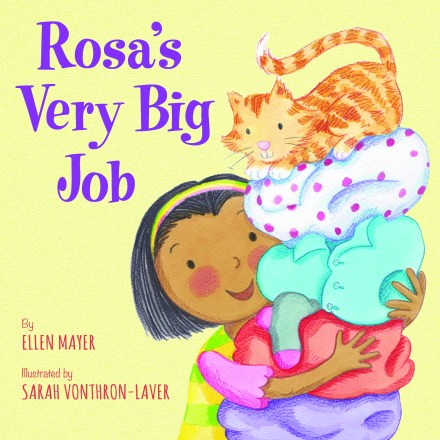
Rosa’s Very Big Job
Written by Ellen Mayer | Illustrated by Sarah Vonthron-Laver
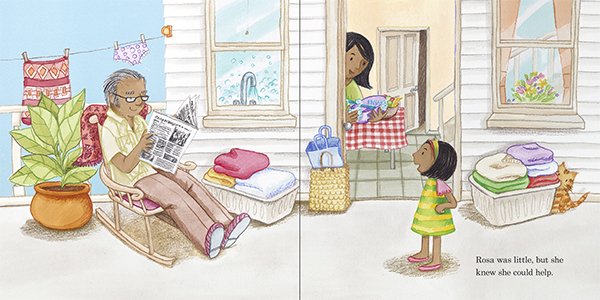
Rosa may be little, but she has big ideas about how to help. While Mama is out shopping for groceries for that night’s dinner, Rosa decides to surprise her by folding and putting away the laundry. The basket is piled high with fluffy dry clothes, sheets, and towels. Rosa watches her grandpa reading the newspaper. “‘Please help me, Grandpa!’” she says. She tugs on her grandpa’s hands, trying to pull him out of his chair. “‘Come on, Grandpa! Get up.”
Image copyright Sarah Vonthron-Laver, text copyright Ellen Mayer, courtesy of Star Bright Books, starbrightbooks.com
Grandpa seems to have a little trouble managing: “‘It’s difficult to carry these enormous piles,’” he sighs. But Rosa knows that smaller armloads work better. Grandpa’s clothes come unfolded as he puts them in the drawer. “‘Be neat. Like me,” Rosa says, showing him her tidy stack. Poor Grandpa! He has to keep hanging up the same jacket over and over. “‘It’s difficult to keep this jacket from sliding off the hanger,” he says. Rosa has the answer: “‘Zip it up,’” she explains. “‘Then it stays on.’”
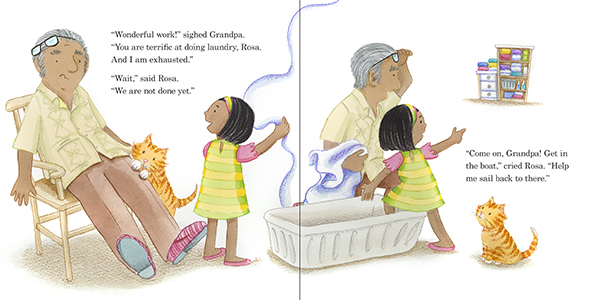
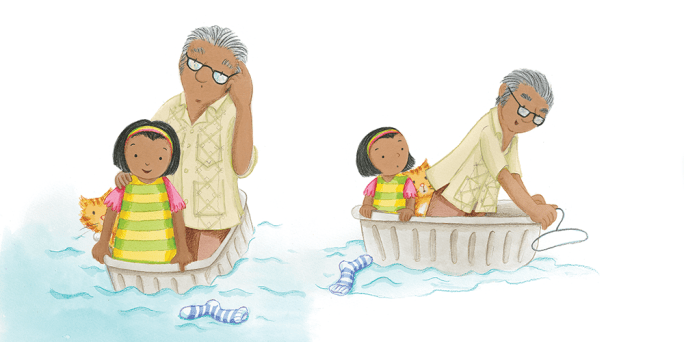
Grandpa sinks back into his chair. “‘You are terrific at doing laundry, Rosa. And I am exhausted,’” he says. But this is no time to quit—Rosa has big plans. As she steps into the now empty laundry basket, she exclaims, “‘Come on, Grandpa! Get in the boat. Help me sail back to there.’” Rosa points to the linen closet.
Image copyright Sarah Vonthron-Laver, text copyright Ellen Mayer, courtesy of Star Bright Books, starbrightbooks.com
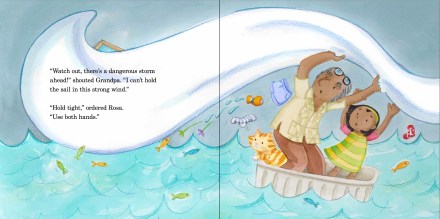
Suddenly, the floor swells with ocean waves teeming with fish. Grandpa channels his inner sailor as he holds aloft a sheet as a sail. As the wind billows and they come perilously close to the kitchen table, he says, “‘It’s difficult to sail around this enormous rock!’” Contemplating the rising sea, he exclaims, “‘It’s difficult to sail over this enormous wave!’”
There’s a dangerous storm ahead, warns Grandpa, “‘I can’t hold the sail in this strong wind.’” Rosa is there to help and grabs one side of the sheet. “‘Hold tight,’” she orders. “‘Use both hands.’” At last the seas die down and Grandpa is ready to steer the laundry basket back to port, but Rosa has a more entertaining thought. Spying a sock on the floor, Rosa wants to catch the “enormous fish.” Grandpa obliges and picks up a hangar for a fishing pole. He holds Rosa as she stretches out over the edge of the laundry basket to land her fish.
Image copyright Sarah Vonthron-Laver, text copyright Ellen Mayer, courtesy of Star Bright Books, starbrightbooks.com
Just as Rosa nabs the fish, Mama comes home with her bags of groceries. She’s surprised to see that the laundry is not in the basket. Rosa runs to her and proudly explains, “‘We put all the laundry away. It was a very big job. We carried enormous piles. Grandpa dropped things. And I picked them up. It was very difficult for Grandpa. He got exhausted. But not me. I am terrific at laundry!’” Mama agrees that Rosa is a terrific helper. Then Rosa leads her mother to see the most surprising thing of all—the fish she has caught for dinner!
In her series of Small Talk Books® Ellen Mayer presents exciting stories for preschoolers full of imagination and rich language learning. Rosa’s Very Big Job introduces Rosa, a sweet girl bubbling with enthusiasm and the desire to help. The close relationships between Rosa, her mother, and her grandpa promote cooperation as well as effective modeling of speech patterns and a way to introduce larger words in an organic manner through play and common chores. Rosa’s inventive idea to turn the laundry basket into a boat is delightfully enhanced by her grandpa’s willingness to share in the story and expand on it. Humor, cheerful banter, and the easy camaraderie between Rosa and Grandpa invite young readers to join in the fun as they build confidence in their language learning.
Sarah Vonthron-Laver depicts Rosa’s afternoon with her Grandpa with joy and the spirited energy young children bring to everything they do. Grandpa is happy to spend time with his granddaughter, yet shows honest feelings of tiredness and frustration that spur on the plot. The transition from doing laundry to using the basket as a boat is as seamless as a child’s imagination, and the way Rosa and her grandpa use household items to create “sails,” “rocks,” “fish,” and “fishing poles” will give readers great ideas for post-reading play. Bright colors, an adorable kitten, and familiar surroundings welcome young children into the world of reading and expanded vocabulary.
Rosa’s Very Big Job would be a welcome addition to a young child’s bookshelf, not only for its fun story that kids will want to hear again and again, but for its leap into imagination that kids will want to replicate.
Dr. Betty Bardige, an expert on young children’s language and literacy development, provides tips for parents, grandparents, and caregivers following the text.
Ages 2 – 6
Star Bright Books, 2016 | ISBN 978-1595727497
Discover more about Ellen Mayer and her books as well as book-related activities and literacy initiatives she’s involved with on her website!
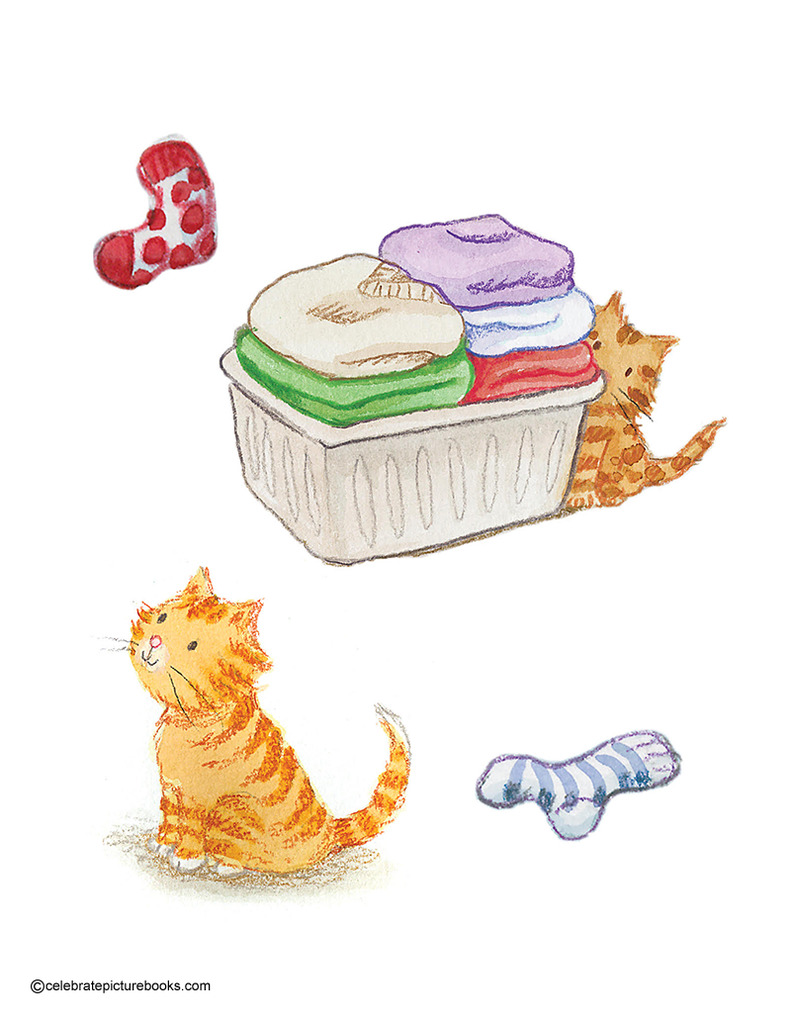
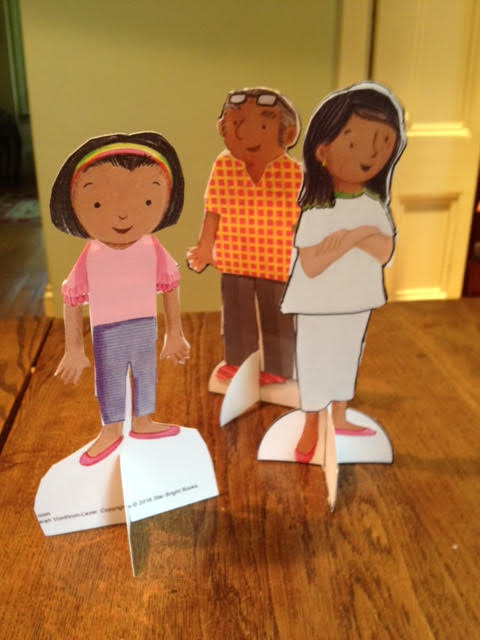
Rosa loves helping out at home. She’s terrific at doing laundry – folding and putting away the family’s clothes, socks, and linens. You are terrific at helping too! Can you help Rosa, Mama, and Grandpa get dressed and ready for the day with these printable paper dolls? You’ll even find a laundry basket, socks, and Rosa’s sweet kitty to play with!
Print dolls on regular paper or heavy stock paper. Dolls printed on heavy stock paper may stand on their own with the supplied stand cross piece. For dolls printed on regular paper, you can cut the supplied stand templates from poster board or card stock and glue the dolls to the backing.
Rosa’s kitty and the laundry basket can also be attached to the supplied template if needed
Print clothes for each figure
Color the blank clothes templates any way you’d like
Cut out clothes and extra items
Fit outfits onto dolls
Make up your own stories about Rosa, Mama, and Grandpa!
Interview with Author Ellen Mayer
Today, I’m happy to present a fascinating interview with Ellen Mayer, a writer and expert in early literacy, in which she discusses her involvement with various organizations and programs, her baby granddaughter, why Hug Your Cat Day is at the top of her list of holidays, and gives us a peek at a very special sugar egg.
I’m really interested in your work in the education and literacy fields. Could you talk a little bit about your job as an education researcher and an early literacy home visitor, and how you got into those fields?
I got into these fields after leaving a Sociology PhD program right near the end. I didn’t want to be an academic and teach, I wanted to do applied research – to solve practical problems out in the world and to make a difference in the lives of those who were struggling. At the Harvard Family Research Project at Harvard’s Graduate School of Education, I studied the ways that families from underserved communities were engaged in supporting their children’s learning and education, and created research-based materials for families and schools to promote effective engagement. One of these was the Family Involvement Storybook Corner—curated picture book selections with family engagement themes. That got me interested in early literacy and picture books.
After researching family engagement in children’s learning for many years, I decided I wanted to go out into the field and be a practitioner and work directly with families on this topic. I worked as an early literacy home visitor with diverse families with the Parent-Child Home Program, modeling ways to share stories with little ones to build early language. I actually got paid to read picture books and play with families in their homes!
At the same time, I was pitching my Small Talk Books®, a collection of playful stories about everyday activities that provide fun for kids and ideas for adults – Rosa’s Very Big Job is one. The adults in the stories are engaged with children’s learning, modeling conversational ways to build young children’s language.
I read that your book Red Socks, another of the Small Talk Books®, is being used in a program to turn wash time at Laundromats into talk time for literacy development. Could you discuss this early literacy initiative?
Yes! Wash Time/Talk Time is a terrific campaign led by Too Small To Fail, a joint initiative of the Clinton Foundation and the Opportunity Institute teaming up with a host of partners to turn Laundromats in underserved areas into venues for early literacy. This campaign distributes free books and information to families in Laundromats about building early language to help close what’s called the “word gap” by promoting parent conversation with babies and young children. Almost 60% of children in our country start kindergarten behind in their language development and this then sets them on a downward path and they get even further behind in school.
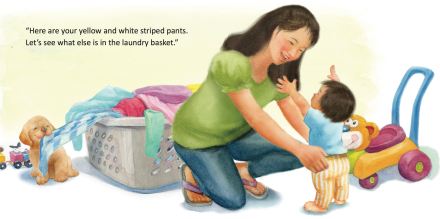
Red Socks was a natural fit for this program. In it a Mama narrates what she is doing for her little pre-verbal child as she folds the laundry and dresses the child—and as they search for a missing sock!
I have to say that it’s a dream come true that Too Small To Fail is using my book.
Wash Time/Talk Time is really reaching the families on the other side of the word gap who most need the ideas and inspiration in Red Socks. When I began writing the Small Talk Books® I wanted to include stories about doing laundry, as it’s something we all do as parents and provides lots of things to talk about with children. (Like the color of socks!) In fact, I used to sit in Laundromats and observe families when I was thinking up ideas for stories. I guess that’s the sociologist in me.
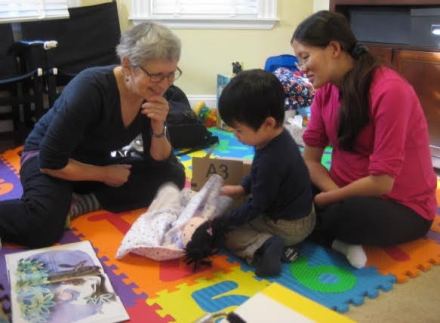
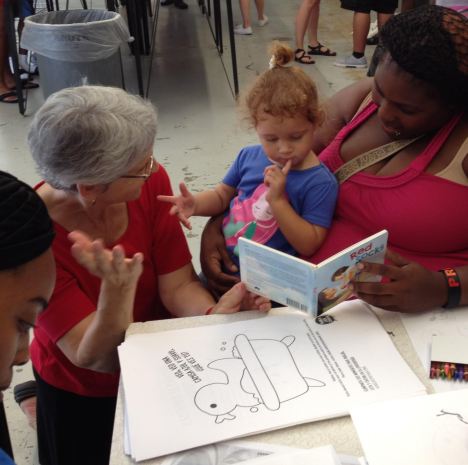
We just had the opportunity to visit one of the Laundromats in the campaign—at the Free Laundry Day in Tampa, FL hosted byThe Laundry Project—and share Red Socks with families. You can see some of the fun illustrator Ying-Hwa Hu and I had here:
What inspired you to begin writing picture books?
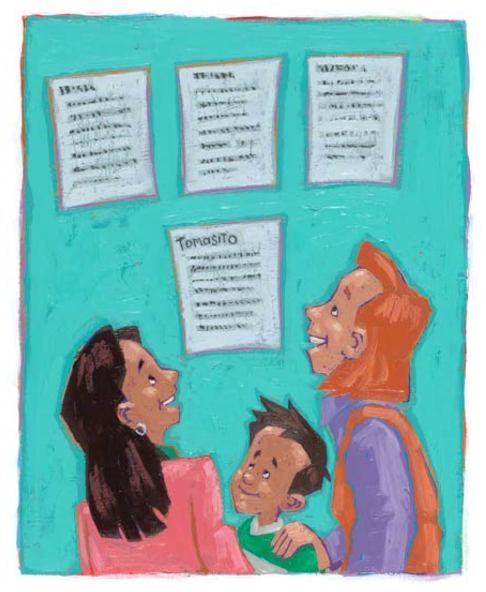
I came to picture book writing through a backdoor. When I was at Harvard Family Research Project, I was thinking about new ways to convey our ideas from research into practice for parents, and it occurred to me that a read-aloud picture book could address an audience of parents, as well as the primary one of children. My boss was enthusiastic about the idea, and so I enrolled in an adult ed class on writing for children. Then I turned one of our research case studies about challenges an immigrant Latino family had in communicating with their son’s teacher into a picture book,Tomasito’s Mother Comes to School/La mamá de Tomasito visita la escuela. Joe Cepeda did the art for it, and we made it downloadable for free.
Some new things! I have a fellowship with the Storytelling Math Project that’s funded by the Heising-Simons Foundation and coordinated by TERC, a not-for profit STEM research and development organization here in Cambridge, MA. I’ll be a member of a group that’s identifying, creating, and promoting math-infused storybooks for diverse young children and I hope to create a couple of Small Talk Books® along these lines—probably about supermarket shopping! I also was asked to help out the Highlights magazine editorial team that creates HELLO magazine for 0-2 years and be an outside reviewer for issues before they go to publication. And then I’ll be volunteering as a visiting children’s book author to the Somerville Family Learning Collaborative, the family engagement and early childhood hub of the Somerville, MA Public Schools, sharing my books with playgroups and new parent groups.
But mostly, I plan to write! I have a bunch of picture book manuscripts in various states, and ideas for new ones. These manuscripts are different from the Small Talk Books®; they don’t have a deliberate educational underpinning to them. They are fun, and just fun. One, for example, is called What To Do With Ruby-Lou and it’s about a baby who doesn’t laugh, no matter what her family does. Who is going to be able to get a laugh out of Lou? Well, it’s a surprise and it just might require some audience participation. I’ve had an agent in the past and hope to find a new one to rep me with these picture books.
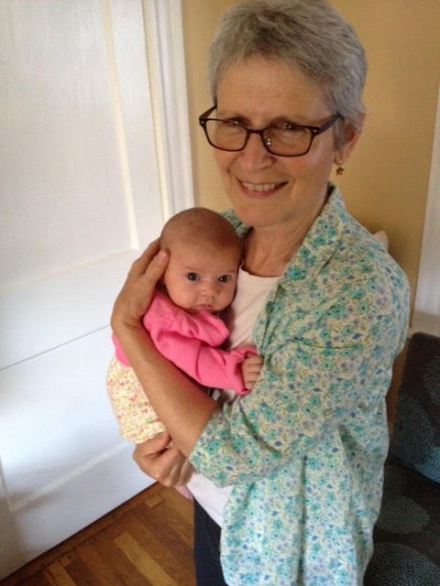
You recently became a grandmother. Can you tell me a little about your granddaughter?
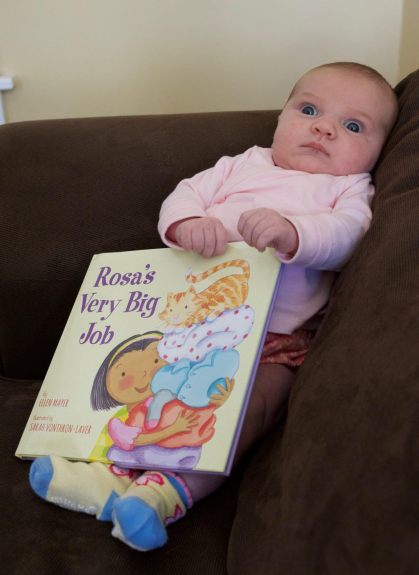
I thought our granddaughter was the most wonderful and expressive baby in the world when was she born – of course! She and my advance copy of the new Rosa book arrived into the world at just about the same time.
At three months now my granddaughter is a big reader and is riveted on the B&W hi-contrast board book genre, especially one board book about cars and trucks. She moves her head back and forth, from one end of the spread to the other, scanning the images on the page like a studious scholar of some ancient text.
What is the best part about being a grandmother?
For me the best part about being a grandmother is being able to simply enjoy my granddaughter and play with her and watch her develop, and not have to worry about taking care of her daily needs. I didn’t have to stress when she refused to take the bottle before starting full-day childcare. That wasn’t my job. (She did take it – of course!) They live nearby, and seeing her once or twice a week, I love noticing small changes on each visit. I also love seeing our daughter and son-in-law parent.
Have you given thought to what you’d like your granddaughter to call you?
Our daughter asked us ahead of time what we’d like to be called when we became grandparents. I thought it was a wise idea to be proactive and select a name immediately, to avoid being named by the grandchild something like “Grandma GA-GOO-GA.” My great aunt Jane is called “Nini” as a grandmother, and I’ve always loved that, but I didn’t want to steal it. So I chose “Mimi.”
It sounds as if Grandparents Day may be one of your top holidays! Do you have another favorite?
When I was little, I liked Easter a lot because it combined a lot of my favorite things: crafts, springtime, running around outside, candy. Also, we didn’t dress up much as kids, but I do remember Easter bonnets!
When our children were little, their birthdays became my favorite holiday celebrations. Now that they are grown, maybe I need to pick a new favorite holiday? I see that June 4th is Hug Your Cat Day. That might be just right: we have a rather large and ferocious cat and when she actually lets you hug her, well, it’s a cause for celebration.
Do you have an anecdote from any holiday that you’d like to share?
When I was six years old, I saw the Easter Bunny. I was staying at my Grandparents’ house, and I looked down the stairwell, and there he was, crossing the landing at the foot of the stairs. He was quite tall, wore a yellow slicker that was too small for him, and he was carrying a large Easter basket. I’m afraid I didn’t have my Brownie camera with me at the time to snap a photo.
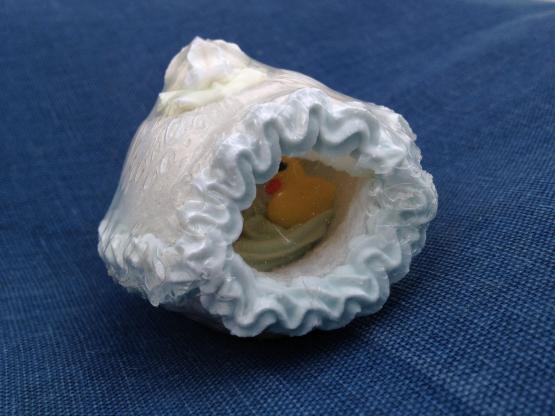
But I do have an unwrapped sugar Easter egg that I’ve saved from that era.
Thanks for sharing so much about your work and life, Ellen! I wish you all the best with Rosa’s Very Big Job, your other Small Talk Books®, and of all your other ventures!
Other Small Talk Books® available from Ellen Mayer and Star Bright Books include Cake Day, Red Socks, and A Fish to Feed and can also be found at the above booksellers.
September has been designated as National Courtesy Month to remind us that good manners and watching out for others, goes a long way toward making the world a more cooperative and happy place. Sometimes common courtesy is as black and white as directly following the rules…but sometimes…well, I’ll let you decide…
The Black and White Factory
Written by Eric Telchin | Illustrated by Diego Funck
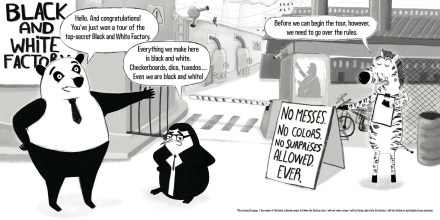
You are one lucky reader! You have won a tour of the Black and White Factory where the employees are hard at work making products like checkerboards, dice, tuxedos…you know the stuff. Even the bosses—a panda and a penguin—are in black and white. Before you start your tour, you’re met by a zebra foreman who goes over the rules of the factory. And they are these:
“No Messes, No Colors, No Surprises Allowed.” When? “Ever.”
As you proceed inside your first stop is the billiard ball machine—8 balls only, of course! It doesn’t take you long to be ushered into the “top-secret Experiment Room,” where innovative products are being developed. You may be the first ever to see “trick dominoes that are impossible to knock over” and new black-and-white-paint in either checkerboard or polka-dot. Another prototype displayed on a wall chart is “never-melting vanilla ice cream.” Also prominently displayed are the factory’s rules: “No Messes, No Colors, No Surprises Allowed. Ever.”
Image copyright Diego Funck, text copyright Eric Telchin, courtesy of simonandschuster.com
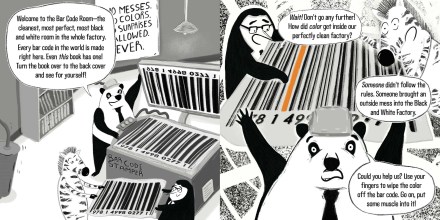
Moving on you push the button leading to the Animal Room. Housed here are white Dalmatians, dairy cows, and skunks who are being sprayed with their distinctive black marks. An elevator takes you to the Bar Code Room. While waiting for your car, you are exhorted to remember the rules: “No Messes, No Colors, No Surprises Allowed. Ever.” The Bar Code Room is “the cleanest, most perfect, most black and white room in the whole factory. Every bar code in the world is make right here.” Even the one for the book you’re reading! Turn it over and see!
Image copyright Diego Funck, text copyright Eric Telchin, courtesy of simonandschuster.com
“Wait!” Wait!! Turn the book back! A stripe of yellow has seeped into the factory! “Someone didn’t follow the rules. Someone brought an outside mess into the Black and White Factory.” The bosses need your help! Can you “use your fingers to wipe the color off the bar code?” Oh, no, no, no! That just made it worse—now it’s smudged yellow and orange! “Quick! Do something! Rub the colors with your sleeve. Or your elbow. Something.”
We interrupt this review to remind you of the RULES: “No Messes, No Colors, No Surprises Allowed. Ever.” Right, then, back to our dilemma. Now the colors are dripping! It’s such a mess! Suddenly, the zebra has an idea. He asks you to “hold the book upright and tilt it so the color drips down the bottom of the page.” Okay—phew!—great job!
Oh, no!! More colors are creeping in! “Swirl the book so the colors fly off the page,” the penguin orders. You are one strong swirler—the zebra, penguin, and panda are all topsy-turvy, and now the factory looks like an abstract painting! This definitely is not good. “What a mess! The Black and White Factory is ruined.” But the panda may have an idea. Everyone, “back to the top-secret Experiment Room.” There the panda, zebra, and penguin, splattered in paint, stand in front of the “Air-powered comprehensive cleaning contraption.” They just need your help in getting it started. Can you blow into the nozzle? Harder? Come on, put some oomph into it! All right!
Image copyright Diego Funck, text copyright Eric Telchin, courtesy of simonandschuster.com
The machine’s at 100% power! The machine shakes and whirrs with a color overload. It explodes with a rainbow of colors that covers everything in the factory. The panda, zebra, and penguin stand in the midst of it. “Everything is so…different,” says the panda. “It’s…colorful…,” adds the penguin. “And wonderful!” concludes the zebra. There’s just one problem…The RULES: “No Messes, No Colors, No Surprises Allowed. Ever.” Hmmmm….
How about: “No Messes, No Colors, No Surprises Allowed. ForEver.”
Yes! Much better! So “that concludes the Best. Tour. Ever!” Off you go—just don’t forget the rules: “Messes, Colors, Surprises Allowed. Forever.”
Eric Telchin’s The Black and White Factory will have kids tipping, tilting, swinging, and even reading this fun and funny interactive picture book. Directly addressing the reader, the three staid and rule-abiding managers of a very focused factory, play straight-man to the child’s laugh inducing and unintentional “mistakes” that lead to a brighter future. With the pacing of a favorite theme-park ride, the story has a suspenseful “Oh, no! What’s going to happen?” feeling as readers progress from page to page until the first tinge of yellow precipitates the humorous chaos to come.
Diego Funck’s sly illustrations riff on the black-and-white theme, as he designed a clever product line in line with “the rules.” Kids will want to linger over the pages to catch all the jokes and visual puns. The reactions of the three employees of The Black and White Factory will make readers laugh too as they endeavor to hang on to their beloved rules in the midst of their changing world. The bold colors of the transformed factory are as refreshing as the sun after a dark, rainy day.
The theme that creativity and expression come from making messes and allowing surprises to happen is a welcome idea and one that leads to innovation and personal freedom. The Black and White Factory is sure to be asked for again and again!
In 1966 UNESCO (United Nations Organization for Education, Science and Culture) established International Literacy Day on this date to “actively mobilize the international community to promote literacy as an instrument to empower individuals, communities, and societies.” Marking its 50th anniversary, International Literacy Day is this year celebrating the theme “Reading the Past, Writing the Future” to commemorate five decades of efforts to increase in literacy rates around the world and the progress made. “It also looks to innovative solutions to further boost literacy in the future.” With a focus on innovation, International Literacy Prizes are also awarded to people with outstanding solutions that can drive literacy towards achieving future goals.
The World Literacy Foundation also celebrates today’s holiday with the 2016 campaign “The Sky’s the Limit,” which aims to eliminate the digital divide for students in the developing world.
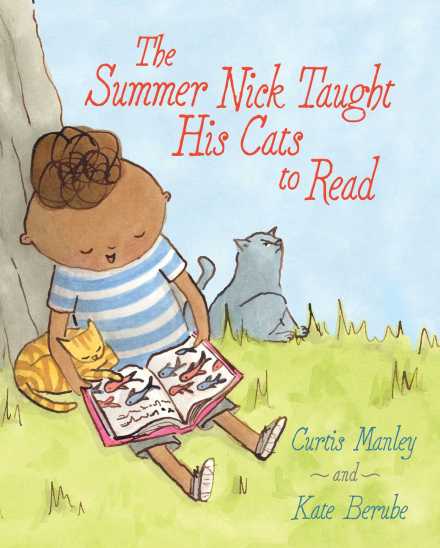
The Summer Nick Taught His Cats to Read
Written by Curtis Manley | Illustrated by Kate Berube
One summer Nick, Verne, and Stevenson did everything together. Nick is a little boy and Verne and Stevenson are two very different cats. Nick and Verne loved to spend time near the water—Stevenson tolerated it. Nick and Verne slept happily in a tent under the stars—Stevenson barely shut his eyes. While Nick rode his bike Verne eagerly sat in the front basket—Stevenson hunkered down in a box on the back. But when Nick sat down to read, both cats had their own ideas of fun—like lying on top of the book—and Nick could hardly read a sentence.
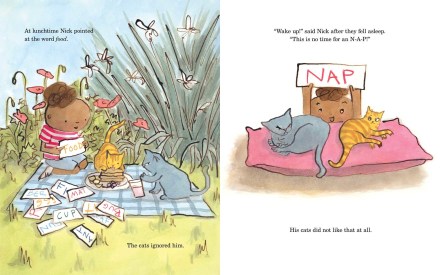
Image copyright Kate Berube, text copyright Curtis Manley, courtesy of simonandschuster.com
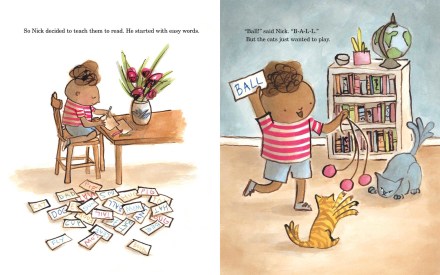
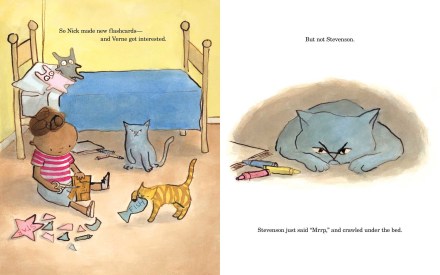
“So Nick decided to teach them how to read. He made flash cards and started with easy words” like “ball,” but Verne and Stevenson just wanted to play with the ball. While the three had a picnic on the lawn, “Nick pointed to the word food. The cats ignored him.” When the cats snoozed Nick woke them with a sign. “‘This is no time for an N-A-P!’” he said. Neither cat responded well, so Nick tried a new tactic. He made word-shaped flash cards. Verne took a nibble of “F-I-S-H,” but Stevenson hid under the bed.
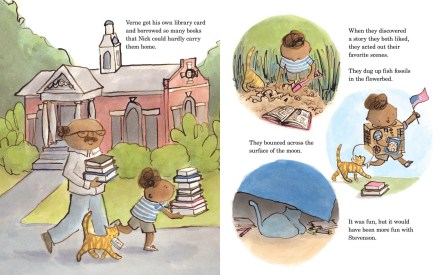
Nick began to see that Verne liked stories about cats and fish. “Verne loved fish. He followed along as Nick read, learning the sounds of the letters.” He even read by himself, discovering new stories, especially 2,000 Leagues Under the Sea. But Stevenson? When Nick spelled words for him, he merely ran under the porch, hissing. By this time Verne was reading so many books that he got his own library card and Nick needed help carrying all of his books home. Nick and Verne had fun acting out their favorite stories, but they missed Stevenson.
One day “Verne discovered a treasure under the bed—a great stack of Stevenson’s pirate drawings. “‘Wow!’” Nick whispered. “‘Stevenson drew a story.’” Nick and Verne put the pages together and began to write words to go with them. When the story was finished, Nick, Verne, and Stevenson “squeezed under the porch, gave Stevenson an eye patch, and read The Tale of One-Eyed Stevenson and the Pirate Gold. Stevenson listened and followed along. He didn’t run away. Or hiss. Not even once.”
Image copyright Kate Berube, text copyright Curtis Manley, courtesy of simonandschuster.com
Suddenly, Stevenson couldn’t get enough of books. Even before Nick woke up, Stevenson could be found with his nose in Treasure Island or another adventure book, and whenever Nick and Verne played pirates, Stevenson joined in. He helped bring down “scurvy mutineers” and found buried treasure. Now the three readers do everything together. They “hunt for dinosaurs in the lost world behind the garden…race around the yard in eighty seconds…and journey to the center of the basement.” And while they all like to read on their own, they also like it when someone reads to them. “Hmmm…,” Nick thinks, maybe next he could teach his cats to talk. “‘Meow,’ says Stevenson.”
Image copyright Kate Berube, text copyright Curtis Manley, courtesy of simonandschuster.com
Curtis Manley’s adorable tribute to reading and learning to read using cats, with their variety of personalities, is inspired. Just as some people respond more to the words while others are attracted by the pictures, Verne and Stevenson have their own relationships with books. The names of the cats and their preferred reading material are also reminders that books are personal, and disinterest in one type of story does not reflect disinterest in all stories. Manley’s text makes for a joyful read-aloud as his language and phrasing is evocative, lyrical, and imaginative.
In perfect accompaniment, Kate Berube brings this creative story to life, illustrating the tender relationship between Nick and his pets as well as emphasizing the humor and distinct personalities inherent in orange striped Verne and smoky gray Stevenson that influence their journeys to literacy. Depictions of the various books Verne and Stevenson are drawn to highlight the literary references in the trio’s further play. Readers will want to stop and peruse the page of library shelves, where such books as “Harry Picaroon and the Swashbuckler’s Stone”, “Harold and the Purple Canon”, “Millions of Rats”, and “Where the Wild Pirates Are” wait to be checked out in the Pirates section.
Kids will eagerly want to adopt The Summer Nick Taught His Cats to Read, and it will snuggle in nicely on children’s bookshelves.
Ages 4 – 8
Simon & Schuster Books for Young Readers, 2016 | ISBN 978-1481435697
Discover “the facts, fictions, poems, and numbers” of Curtis Manley on his website!
View a gallery of Kate Berube‘s art on her website!
International Literacy Day Activity
Feline Fine about Reading Bookmark
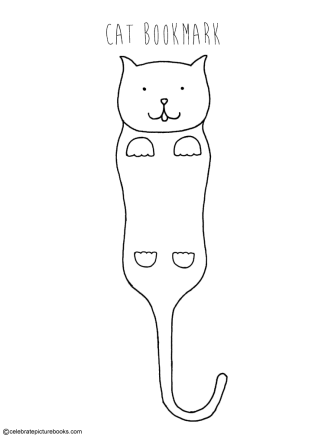
This want-to-be literary lion feels fine about reading! Let it hold your page while you’re away! Print your Feline Fine about Reading Bookmark and color it!
Established in 2012 Buy a Book Day promotes an appreciation for physical paperback and hardbound books. Whether you’re cracking open a brand new release or gently turning the pages in a well-worn volume, holding an actual book in your hands is an unforgettable connection between you, the author, and another world—real or imaginary. Today, drop into your local bookstore and peruse the shelves—you’ll be sure to find a fascinating book to buy.
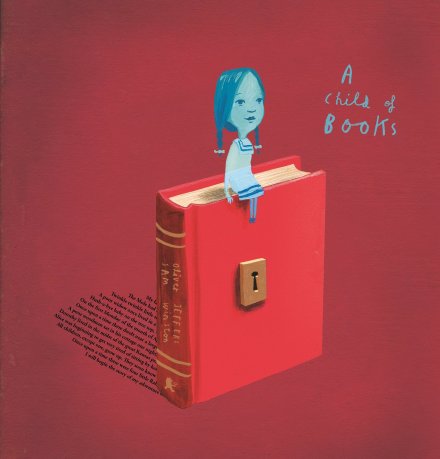
A Child of Books
By Oliver Jeffers and Sam Winston
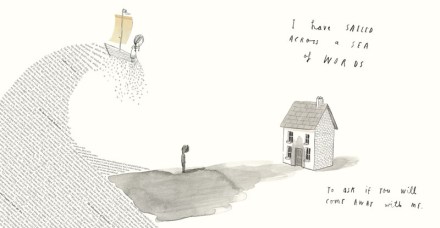
A little girl sits on a log raft with a parchment sail, dangling her feet into the water that swirls around her legs in an eddy made of words that read: “Once upon a time there was a child who loved to read…,” while the rest of the words disperse and float away. In fact, the girl is reading now—a book with a keyhole in the middle. “I am a child of books,” she reveals. “I come from a world of stories.” The wind catches the sail of her raft and the girl is off on an adventure, rising and dipping with the cresting letters that make up waves coming from the deeper sea of straight lines of excerpted text from classics including The Voyages of Doctor Doolittle, Robinson Crusoe, The Swiss Family Robinson, and Kidnapped.
Image copyrights Oliver Jeffers and Sam Winston, courtesy of oliverjeffers.com
The waves bring her to shore, where riding atop one she towers over a small boy. The girl asks if he will sail away with her. He peers into the window of his house where his father sits reading the newspaper. Headlines announce “Serious Stuff,” “Facts,” “Important Things,” and “Business.” And indeed just a glance at the articles will inform readers that “A group of serious people passed on concerns about a serious document that has been lost by a serious organization….”; that “Scientists have discovered a new fact. In one test, nearly half the subjects proved the fact, it was revealed….”; and that “an important company is to stop producing some important stuff by later this year. It said no one wanted this particular bit of important stuff.” The father’s glasses glint with numbers that rim the frames like tears.
The girl says that “some people have forgotten” where she lives, but that she can lead him on the way. The two follow a path of words from Alice in Wonderland, and the boy watches worriedly as the girl confidently climbs down a hole in the lines. There is more climbing to be done, however, and the girl, in her blue and white sailor dress, holds the boys hand as they traverse mountains made of Peter Pan that reach into the sky. By the time the friends row their dinghy into a dark cave created from the story of Treasure Island and discover a wooden chest, the boy is eager and excited for the journey.
Image copyrights Oliver Jeffers and Sam Winston, courtesy of oliverjeffers.com
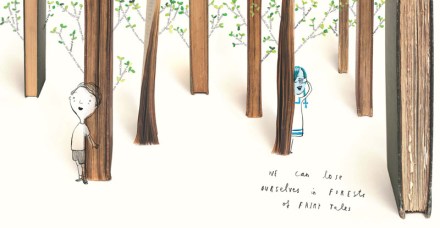
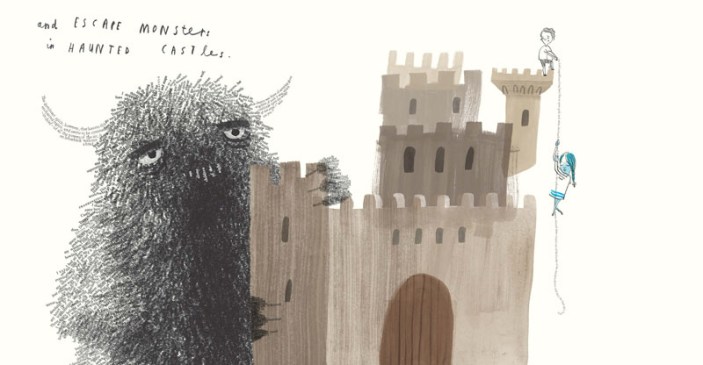
The girl and boy play hide-and-seek among tall trees made of books, where titles and lines of Hansel and Gretel, Little Red-Cap, The Golden Goose, Tom Thumb, and more jut out as leaf-covered branches. They leave the woods and come to a haunted castle that is being attacked by a monster made dark and hairy with the words of Frankenstein and Dracula. This time the boy holds a line of Rapunzel as the girl deftly shimmies to the top of a turret.
Tuckered out, the pair of friends ascend ladders to clouds of lullabies and drift into dreamland where they stand on the moon so they can “shout as loud as we like in space.” But perhaps it is not the moon but, instead, their own imaginary world made of color and characters, palaces and possibilities where stories may end but creativity lives on because “we’re made from stories…” and “our house is a home of invention.”
Image copyrights Oliver Jeffers and Sam Winston, courtesy of oliverjeffers.com
If any book invites readers to linger over the intricacies of its pages, A Child of Books is it. A perfect combination of Oliver Jeffers’ homage to the power of storytelling and Sam Winston’s artistry with typography, A Child of Books summons readers of all ages to leave the weariness of the “serious” world and enter the realm of the imagination.
The lilting lines of Oliver Jeffers’ prose poem flow with the stream of consciousness that allows thinkers to journey to nooks and crannies, participate in majestic vistas, and create the unknown of their own fancies. In Sam Winston’s hands sentences and paragraphs describing classic sea voyages swell into waves; lines from other classics crowd in upon each other, solidifying into a hidden inlet or forming a horned creature; and soft yellowed pages return to replicate the trees they once were. In the end a rainbow of characters spin out from a revolving globe, depicting our full color world.
Maps laid out by the storytellers of the past may show us routes to take but as A Child of Books reveals, there is so much white space yet to be discovered. For bibliophiles young and old, A Child of Books makes a beautiful gift and will be a welcome addition to personal library shelves.
Ages 4 and up
Candlewick Press, 2016 | ISBN 978-0763690779
Visit Oliver Jeffers’ website to view his wide-ranging work in picture books, paintings, film, and more. You can follow a paper airplane to fun games based on his picture books in Oliver Jeffers’ World.
To see the unique perspective of Sam Winston, view his books, projects, and archives on his website!
Watch the Child of Books book trailer!
Buy a Book Day Activity
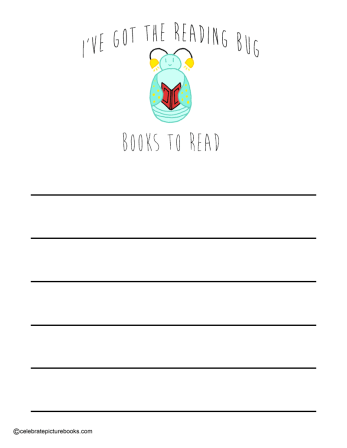
I’ve Got the Reading Bug! Books to Buy List
Do you love to read? Do you have a wish list of books you want to read next? Me too! Use this printable I’ve Got the Reading Bug! Books to Buy sheet to keep track of those great book ideas.

















 celebratepicturebooks.com