June 6 – Garden Exercise Day

celebrate-picture-books-picture-book-review-lola-plants-a-garden-cover

About the Holiday

Did you know that gardening is good exercise? Well, all that tilling and digging and bending and carrying adds up to quite a strenuous workout! Today’s holiday encourages couch potatoes (eye just couldn’t help myself) to get up and get out! In addition to exercise, gardening provides other health benefits, such as nutritious food, stress relief, and a sunny dose of vitamin D. So grab a planter or patch, some dirt, and some seeds and plot out (so sorry…) your garden!

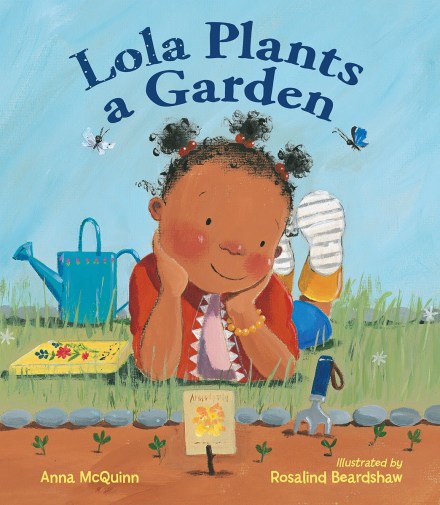
Lola Plants a Garden

Written by Anna McQuinn |Illustrated by Rosalind Beardshaw


Lola has a book of garden poems that she absolutely loves. Her favorite poem is: “Mary, Mary, quite contrary, / How does your garden grow? / With silver bells / and cockleshells / and pretty maids all in a row.” She likes that poem so much, in fact, that it has inspired her to plant her own garden. Lola’s “mommy says there is room near the vegetables.”

celebrate-picture-books-picture-book-review-lola-plants-a-garden-reading

Image copyright Rosalind Beardshaw, text copyright Anna McQuinn. Courtesy of Charlesbridge Publishing.

Lola checks out a stack of books about flowers from the library and with Mommy’s help makes a list of her favorites. “They go to the garden store to buy seeds.” At home Lola and Mommy dig in the dirt and drop in the seeds. Lola uses the “seed packets to mark where the flowers are planted.” Then Lola waits. While waiting she uses the time to create her own book about flowers. She cuts paper petals, stems and leaves and even adds a butterfly. “Mommy types the Mary Mary poem, and Lola glues it in.”

celebrate-picture-books-picture-book-review-lola-plants-a-garden-store

Image copyright Rosalind Beardshaw, text copyright Anna McQuinn. Courtesy of Charlesbridge Publishing.

After that, Lola threads some silver bells onto a string. She places several shells on her shelf and adds some beads as well. With wood, cloth, and yarn, Lola “even makes a little Mary Mary.” At last, Lola sees green shoots popping out of the ground. She carefully pulls up weeds around her plants. Day by day, her flowers grow taller and “open up to the sun.”

When the garden is in full bloom, Lola’s daddy helps her hang the string of bells above it. Mary Mary is given her own special spot too. When her little plot looks perfect, Lola invites her friends to see her garden. She and Mommy make cupcakes, and Lola wears a flowered shirt, flowers in her hair, and a beaded bracelet.

celebrate-picture-books-picture-book-review-lola-plants-a-garden-watching-shoots

Image copyright Rosalind Beardshaw, text copyright Anna McQuinn. Courtesy of Charlesbridge Publishing.

Lola’s friends love the garden. “They share the crunchy peas and sweet strawberries that Mommy grew.” While the four friends enjoy the cupcakes and juice, Lola entertains them with a story starring her Mary Mary doll. Already Lola is thinking about what garden she will plant next.

Little ones will be excited to meet Lola, whose love of flowers and the “Mary Mary” poem spurs her creativity in so many directions—from gardening to crafting to cooking to pretending. Anna McQuinn’s engaging story shows how reading can inspire action, and puts Lola in charge of making her vision come true. With simple yet lovely storytelling, McQuinn taps into children’s desires to reenact what they see and read and to share their successes with others. Through her work, Lola becomes the subject of her own “Lola Lola” poem, which closes the book.

celebrate-picture-books-picture-book-review-lola-plants-a-garden-weeding

Image copyright Rosalind Beardshaw, text copyright Anna McQuinn. Courtesy of Charlesbridge Publishing.

Rosalind Beardshaw’s Lola is an adorable and determined girl with an ever-present smile. Young readers will love being invited into Lola’s home, going along to the garden store, watching her flowers bloom into glorious colors, and joining her picnic with friends. Seeing the progression of all of Lola’s projects may motivate readers to copy her—which would make for a fun summer activity!

Lola Plants a Garden will captivate fans of Lola’s other adventures and make new readers want to discover them all. The book would make a great addition to home libraries as Lola will quickly become a friend children will want to visit with again and again. Lola Plants a Garden has recently been published in paperback in English and Spanish editions

Ages 2 – 5

Charlesbridge Publishing, 2017 (Paperback)| ISBN 978-1580896955 (English); 978-1580897860 (Spanish)

Discover more about Anna McQuinn, her books, and her work with children on her website!

Visit Rosalind Beardshaw’s website to learn more about her books and artwork!

You can join Lola in her adventures with these fun activities on the Alanna Books website!

Garden Exercise Day Activity

celebrate-picture-books-picture-book-review-garden-board-game

Grow a Vegetable Garden Board Game, copyright Celebrate Picture Books, 2017

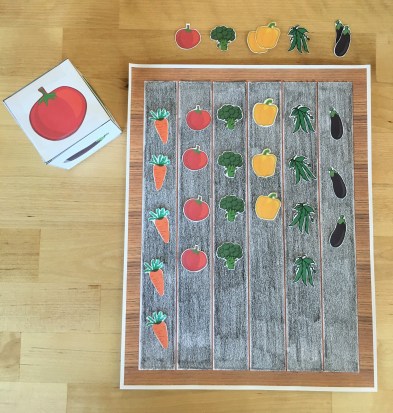
Grow a Vegetable Garden Board Game


With this fun game you and your family and friends can grow gardens inside! Roll the dice to see whose garden will fully ripen first!

Supplies

Directions

Object: The object of the game is for each player to fill their garden rows with vegetables. Depending on the ages of the players, the required winning number of rows to fill and the number of vegetables to “plant” in each row can be adjusted.

  1. Print one Game Board for each player
  2. Print one set of Playing Cards for each player (for sturdier playing items, print on card stock)
  3. Print one Vegetable Playing Die and assemble it (for a sturdier die, print on card stock)
  4. Cut the vegetables into their individual playing cards
  5. Color the “dirt” on the Garden Plot with the crayon (optional)
  6. Choose a player to go first
  7. The player rolls the die and then “plants” the facing rolled vegetable in a row on the game board
  8. Play moves to the person on the right
  9. Players continue rolling the die and “planting” vegetables until each of the determined number of rows have been filled with the determined number of vegetables.
  10. The first person to “grow” all of their veggies wins!

Picture Book Review

April 9 – National Inventor’s Month

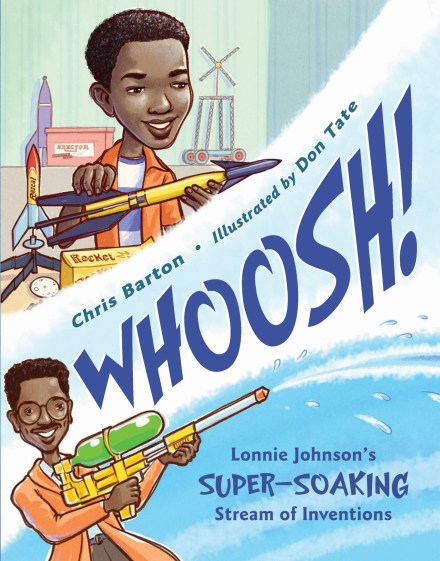
celebrate-picture-books-picture-book-review-whoosh!-lonnie-johnson's-super-soaking-stream-of-inventions-cover

About the Holiday

Today’s holiday was established by the United Inventors Association of the USA, the Academy of Applied Science, and Inventor’s Digest Magazine to promote awareness of and celebrate the achievements of those creative individuals who make our lives better—or, in some cases, at least interesting. Every day there are kids and adults, professionals and amateurs pondering solutions to problems and just “what ifs?” Would you like to join them? You can celebrate this month by acting on one of your great ideas and by learning more about inventors like the subject of today’s book!

WHOOSH! Lonnie Johnson’s Super-Soaking Stream of Inventions

Written by Chris Barton | Illustrated by Don Tate


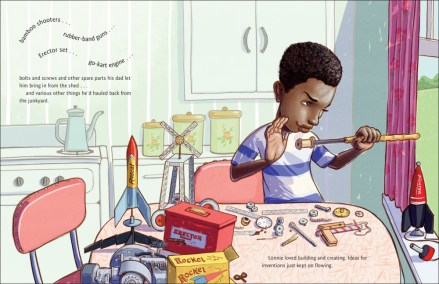
Lonnie Johnson had a way with stuff. In his hands bolts and screws, gears and springs, spools, clothespins, “spare parts his dad let him bring in from the shed, and various other things he’d hauled back from the junkyard” fueled Lonnie’s ideas for inventions and rocket ships. The kids at school loved to watch him launch the rockets he’d devised on the playground. Lonnie wanted to have a career as an engineer. Getting there took a lot of determination and courage. Once, the results of a standardized test said that he would not make a good engineer. Lonnie felt discouraged, but he knew that the person who had graded his test didn’t know him—or Linex.

celebrate-picture-books-picture-book-review-whoosh!-lonnie-johnson's-super-soaking-stream-of-inventions-young-lonnie-inventing

Image copyright Don Tate, courtesy of charlesbridge.com

Linex was the robot Lonnie had built from scrap metal. “Compressed–air cylinders and valves allowed Linex’s body to turn and its arms to move. The switches came from an old, broken jukebox. Lonnie used a tape recorder to program Linex, and as a bonus the reels looked like eyes.” Lonnie’s goal was to enter Linex in a science fair, but first he wanted to be able to program it. It took several years before he discovered how. Using his little sister’s walkie-talkie, Lonnie solved the problem and took Linex to the “1968 science fair at the University of Alabama—where only five years earlier, African American students hadn’t even been allowed.” Lonnie’s team won first place.

Lonnie went to college at Tuskegee Institute, where he realized his dream of becoming an engineer. His career “took him beyond Alabama—way beyond.”  He went to work for NASA. Before the orbiter Galileo could be sent to Jupiter, Lonnie developed a system that would ensure the craft would have a constant supply of power for its computer memory in case the main power was lost. Some fellow scientists doubted his idea would work, but it did. “As it photographed Jupiter and its moons, Galileo was supported by the power package that Lonnie designed.”

celebrate-picture-books-picture-book-review-whoosh!-lonnie-johnson's-super-soaking-stream-of-inventions-linex

Image copyright Don Tate, courtesy of charlesbridge.com

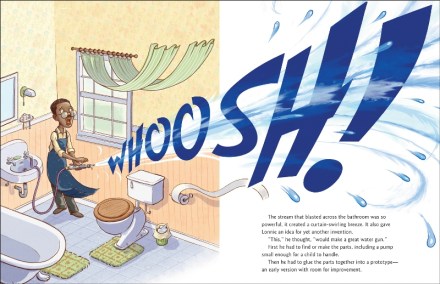
Even though Lonnie worked for NASA, he continued tinkering with his own ideas—in his own workshop. One problem he was trying to solve involved the need for the world’s refrigerators and air conditioners to have a cooling system that didn’t use the damaging chemical R-12. “He had an idea for using water and air pressure instead.” He built a prototype and experimented with it in his bathroom sink. When he turned his pump and nozzle on, though, he got a surprise as a stream of water blasted across the room.

Suddenly, Lonnie saw another use for his invention—as a water gun. He created a design small enough for children’s hands, and tested it at a picnic, where it was a hit. Lonnie took his idea to a toy company…and another…and another. Finally one company agreed to make his water gun. Spurred on by this success, Lonnie found investors to help him build other original inventions: “a water-propelled toy airplane, two kinds of engines, and his cooling system” that had led to the water gun. He even quit his day job to devote his time to inventing.

But things don’t always work out. Each project fell through—even the water gun. It was a scary time as he and his family had to move out of their house and into an apartment. But Lonnie believed in himself. He took his water gun to another toy company. In 1989 he found a toy company willing to take a look. Lonnie made the trip to Philadelphia and wowed the executives with his invention.

celebrate-picture-books-picture-book-review-whoosh!-lonnie-johnson's-super-soaking-stream-of-inventions-water-powered-nozzle

Image copyright Don Tate, courtesy of charlesbridge.com

Now kids everywhere enjoy the fun of the Super Soaker. Today, Lonnie can be found in his workshop doing what he loves: “facing challenges, solving problems and building things” because “his ideas just keep on flowing.”

Chris Barton’s biography of Lonnie Johnson is a fascinating look at a man who succeeds in turning “No” into “Yes” by the power of his intelligence, ideas, and determination. Kids will love hearing about how one of their favorite toys came to be and will be inspired to chase their own dreams despite challenges and setbacks. Barton’s detailed narration provides a full picture of Lonnie Johnson and his times, specifics that attract and inform like-minded kids. Including the results of Lonnie’s exam should encourage kids who think differently. The story is enhanced by the conversational tone that makes it accessible to kids of all ages.

Don Tate illuminates Lonnie Johnson’s life story with his bold, full-bleed paintings that follow Lonnie from his being a child with big ideas to becoming a man who has seen these ideas through to success. With an eyebrow raised in concentration, young Lonnie demonstrates confidence and skill as he works on an invention, and kids will love seeing the tools of his trade laid out on the kitchen table. With his eyes narrowed in frustration and disappointment, Lonnie reads the results of his childhood exam. As Lonnie grows older and designs systems for NASA, the illustrations depict the schematics of the Galileo power package and Lonnie’s surprise at the strength of the water stream in his prototype cooling design. As all kids know, the spurt of a Super Soaker is awesome, and this fact is demonstrated in a “Wowing” fold-out page.

WHOOSH! Lonnie Johnson’s Super-Soaking Stream of Inventions is a welcome biography of the man who designs systems for the greater world but has never lost his youthful enthusiasm to invent.

Ages 5 – 10

Charlesbridge, 2016 | ISBN 978-1580892971

Check out more fiction and nonfiction books by Chris Barton on his website!

Discover more books written and illustrated by Don Tate as well as a portfolio of his work and book-related activity guides on his website!

National Inventor’s Month Activity

celebrate-picture-books-picture-book-review-movie-computer-dot-to-dot

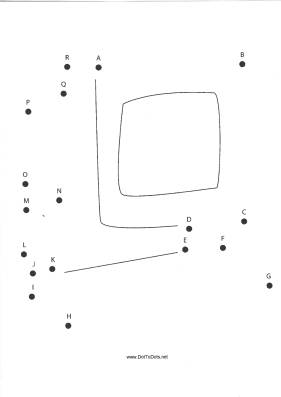
Invention Dot-to-Dot Puzzles


Many inventions have changed the world and continue to be used long after they were first created. Connect the dots on these printable puzzles to discover three remarkable inventions!

Invention Dot-to-Dot 1 | Invention Dot-to-Dot 2 | Invention Dot-to-Dot 3

Picture Book Review

March 12 – It’s Women’s History Month

celebrate-picture-books-picture-book-review-to-the-stars-cover

About the Holiday

From its beginning as a single-day observance in 1911 , the celebration of women’s achievements and contributions throughout history grew to a week-long event in 1982 and finally to encompass the entire month of March in 1988. During this month we remember the trail-blazing women of yesteryear who used their creativity, intelligence, and perseverance to promote rights for women while contributing their own innovations to science, art, social reform, medicine, and other disciplines as well as today’s pioneers who carry on their legacy and make our world a better place. 

To the Stars! The First American Woman to Walk in Space

Written by Carmella Van Vleet and Dr. Kathy Sullivan | Illustrated by Nicole Wong


As a child Kathy Sullivan loved to explore. Her father designed airplanes, and when he brought home blueprints, she carefully studied every line and curve. When she saw airplanes in the sky she wished she were on them, flying to exciting locations all over the world. Maps and foreign languages fascinated her. “Their strange symbols, exotic tales, and musical sounds made her feel like the world was waiting for her.” Kathy wanted to see that whole world and thought maybe she’d like to be a spy or a diplomat, but her friends and other adults told her those weren’t jobs for women.

celebrate-picture-books-picture-book-review-to-the-stars-blueprints

Image copyright Nicole Wong, courtesy of nicole-wong.com

But Kathy always followed her heart. She loved going fishing with her dad and brother and finishing the day with a swim. She “delighted in how her arms and legs moved in slow motion underwater.” Kathy was still a teenager when she learned how to pilot a plane. At first the busy instrument panel made her nervous, but she quickly learned how to manage all the “dials, buttons, and numbers.”

Kathy got a taste for the thrill of space when she bravely jumped at the opportunity to ride in a Breezy—an open air framework plane. Sitting at the very tip of the airplane, in front of the pilot, Kathy had a bird’s eye view. “The wind rushed past her face so fast it pushed her cheeks back. Higher! Faster! Young Kathy looked at the ground below her feet. She felt like she could see the whole world.”

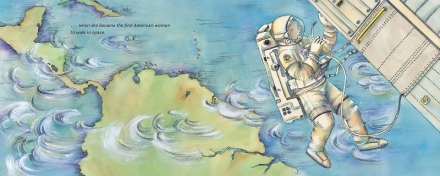
As an adult, Kathy put all of these experiences to good use as she studied complex science that would lead her to NASA. And when she became the first American woman to walk in space, she fulfilled her childhood dream to see the whole world!

celebrate-picture-books-picture-book-review-to-the-stars-spacewalk

Image copyright Nicole Wong, courtesy of charlesbridge.com

Carmella Van Vleet and Dr. Kathy Sullivan, have written a compelling biography of Dr. Sullivan that not only tells the story of her adult achievements, but also reveals the childhood and teenage motivations and influences that fostered her journey to the stars. As each event in Kathy’s young life is introduced, it is followed by an adult accomplishment: Kathy’s poring over her father’s aircraft blueprints leads to a spread of college-age Kathy studying charts in textbooks. Her enjoyment of swimming underwater is followed by an illustration showing her NASA training underwater. Her initial introduction to a plane’s instrument panel informs her later responsibilities inside the spacecraft. And the question she once asked herself as a child—what kind of job would allow her to see the whole world—is answered as the astronaut Kathy gazes down at Earth from space.

celebrate-picture-books-picture-book-review-to-the-stars-breezy

Image copyright Nicole Wong, courtesy of charlesbridge.com

Nicole Wong’s lovely, realistic watercolor and ink paintings clearly show readers Kathy Sullivan’s trajectory from curious girl to accomplished astronaut. The blueprints that Kathy studies are filled with schematics. The aqua water she swims in swirls and bubbles in the wake of her cannonball dive, and the crisscrossing fields lay like a mottled green quilt under the Breezy. Especially stunning and effective are the illustrations of Dr. Sullivan’s work with NASA. Kids will love the up-close view of the spacecraft’s instrument panel with its myriad buttons and dial. Likewise, they will find the gorgeous two-page spreads of the space shuttle’s launch, the view from the cockpit, and Kathy’s spacewalk particularly thrilling.

Following the text is a personal note from Kathy Sullivan to her young readers. More extensive biographical notes reveal how Dr. Sullivan discovered her love of science as well as information on the NASA missions she supported. Two more pages highlight the women of the first space-shuttle class, which included Kathy Sullivan, and other firsts by eight other women in space.

To the Stars is a wonderful book to teach children that following their own heart is the best path to future happiness and personal accomplishment. It’s a beautiful addition to any budding scientist’s or adventurer’s library!

Ages 5 – 9

Charlesbridge, 2016 | ISBN 978-1580896443

To find fun activities for To the Stars—including how to make space play dough—as well as other books by Carmella Van Vleet, visit her website!

To learn more about Nicole Wong and view a portfolio of her artwork, visit her website!

Women’s History Month Activity

celebrate-picture-books-picture-book-review-astronaut-coloring-page


Astronaut Coloring Page

Would you like to be an astronaut? Draw yourself in this spacesuit and then grab your crayons, pencils, or markers and have fun with this printable Astronaut Coloring Page!

Picture Book Review

February 26 – Personal Chef Day

celebrate-picture-books-picture-book-review-mountain-chef-cover

About the Holiday

Today we honor those chefs who create delectable dinners for individual clients or for special occasions. With dedication and hard work, tasty ingredients and imagination, these artists make life better for foodies from coast to coast.

Mountain Chef: How One Man Lost His Groceries, Changed His Plans, and Helped Cook Up the National Park Service

Written by Annette Bay Pimentel | Illustrated by Rich Lo


Tie Sing, born in Virginia City, Nevada, grew up during a time when “America was a tough place to be Chinese.” Most worked in restaurants or laundries and were paid less than white employees. Tie Sing had big plans, though. “He got a job cooking for mapmakers as they tramped through the mountains, naming peaks. With sky for his ceiling and sequoias for his walls, he stirred silky sauces, broiled succulent steaks, and tossed crisp salads.” He quickly became known as the best trail cook in California.

celebrate-picture-books-picture-book-review-mountain-chef-Tie-Sing

Image copyright Rich Lo, text copyright Annette Bay Pimentel. Courtesy of Rich Lo at greatsketch.com

In 1915 Steven Mather was trying to convince politicians to create a national park system even though many business people were against it. Mather invited journalists, tycoons, congressmen, and others to go camping for ten days to show them the wonder of America. He knew that the trip had to be perfect, so he hired Tie Sing as his chef. Tie Sing planned gourmet menus for breakfast, lunch, and dinner that would satisfy the 30 campers. Each day he rose before dawn, cooked eggs and sizzling steaks, and packed box lunches.

As the group hiked across beautiful scenery to the next site, Tie Sing and his assistant washed the dishes, put out the fires, packed the mules, and started the dinner’s sourdough bread. By the time Tie Sing arrived at the new campsite, it was time to begin cooking dinner. “He assembled sardine hors d’oeuvres, sliced juicy cantaloupe, and squeezed lemons to make tart-sweet lemonade. He grilled steaks and venison, fried fish and chicken, and baked sourdough rolls” as good as any fine restaurant. One morning Tie Sing was able to pack the mule early before he served breakfast. When he went back to the mule, however, he discovered it had wandered away—taking all of the best food with it.

celebrate-picture-books-picture-book-review-mountain-elegant-table

Image copyright Rich Lo, text copyright Annette Bay Pimentel. Courtesy of Rich Lo at greatsketch.com

Steven Mather shrugged it off as he left for the day’s hike, but Tie Sing was upset. All of his planning was ruined. That night the dinner wasn’t as fancy, but it was delicious and topped off with “all-American apple pie.” The campers, happily satisfied, talked late into the night about the possibilities of a national park service. The next day, Tie Sing carefully led the mules along a narrow ridge. As the stones crumbled underneath their feet, one mule strayed too close to the edge. He tumbled backward and down the cliff. Bags, boxes, and food went flying. The mule got up and shook itself off, but much of the food, utensils, and equipment was lost.

Hours later Tie Sing limped into camp with “the battered boxes and bent knives and bruised apples he’d salvaged.” The men were ravenous; Tie Sing had to think quickly. He knew just how to use those apples, and under the glow of paper lanterns, the crew enjoyed the most delicious applesauce they’d ever had. Tie Sing knew his job was to fill the party with delicious meals, but “Steven Mather wasn’t the only one who loved the mountains; Tie Sing had the Sierra singing in his blood. He too planned to fill the campers with memories.”

celebrate-picture-books-picture-book-review-mountain-chef-mule-falls

Image copyright Rich Lo, text copyright Annette Bay Pimentel. Courtesy of Rich Lo at greatsketch.com

As the pots bubbled on the camp stove, Tie Sing “bent over tiny slips of paper and wrote in English and Chinese.” Following dinner he handed out fortune cookies, each one holding a handwritten message: “Long may you search the mountains.” “Long may you build the paths through the mountains.” “Where but in the mountains would such a man become a spirit with the mountains?”

In the months following the trip, the members of the group “wrote magazine articles, published books, and made movies about America’s national parks.” Steven Mather’s and Tie Sing’s efforts worked. On August 25, 1916 Congress created the National Park Service. “Today, if you visit Yosemite National Park, you can hike to Sing Peak. It was named for Tie Sing, a mountain-loving American who knew how to plan.”

Three pages of back matter, complete with photographs of Steven Mather’s and Tie Sing’s actual 1915 trip, answer readers’ questions about Tie Sing, how he kept food fresh in the mountains, details of the trip, and short bios on the members of the mountain party.

celebrate-picture-books-picture-book-review-mountain-chef-bent-silverware

Image copyright Rich Lo, text copyright Annette Bay Pimentel. Courtesy of Rich Lo at greatsketch.com

Annette Bay Pimentel’s fascinating and timely story of the establishment of the National Park Service highlights the contributions of a Chinese American dreamer who had big plans for himself and the country he loved. Her detailed storytelling enhanced by lyrical phrasing (a linen tablecloth is washed in an icy snowmelt stream and spread “brighter than white-water foam” over a table) reveals the marvel of Tie Sing’s art. Readers will be awed by the dedication and careful planning it took for the gourmet meals and elegant table settings to come together in such rough surroundings. As food and supplies are lost along the way, children will be held in suspense, wondering if Steven Mather’s and Tie Sing’s strategy worked.

Rich Lo’s beautiful detailed and realistic watercolors transport readers to the mountains and trails of early 1900s California. With vivid imagery Lo lets children see the day-to-day preparations that went into Sing’s meals as well as the dangerous conditions he faced. Lo captures the hazy purple majesty of the mountain peaks, the glow of the campfire in the dark of night, and the vastness of the California environment. Kids may well wonder how Sing managed to create a five-star restaurant atmosphere and menu in the wild, and Lo shows them how it was accomplished.

Mountain Chef gives a unique perspective on an important historical moment—one that still resonates today—and is a compelling book for any classroom as well as for kids interested in history, culinary arts, and the environment and for those who just love a good story.

Ages 6 – 9

Charlesbridge, 2016 | ISBN 978-1580897112

Discover more about Annette Bay Pimentel and her work as well as a Teacher’s Guide on her website!

Learn more about Rich Lo and view a portfolio of his artwork on his website!

Personal Chef Day Activity

celebrate-picture-books-picture-book-review-chef-kids-coloring-page

Cook Up Something Tasty Coloring Page


These kids are making a special treat! Enjoy this printable Cook Up Something Tasty Coloring Page while you have a little treat too!

Picture Book Review

November 7 – Job Action Day

celebrate-picture-books-picture-book-review-a-crow-of-his-own-cover

About the Holiday

Instituted in 2008 and now sponsored by LiveCareer to empower employees and job seekers to assess their careers, make plans, and take action, Job Action Day gives people a chance to reflect on their true goals in life. Are you doing the job you’re passionate about? Are you bringing your passions to the job you are doing? If you are unhappy or dissatisfied with your position, step back and take another look, broaden your horizons. Discover the possibilities and opportunities that lie within your current job and pursue them. You never know where a particular job will lead you if you put all your creativity, knowledge, and—most importantly—unique personality—into it. Job Action Day brings together experts across the web and in participating companies to provide the latest in career advice.

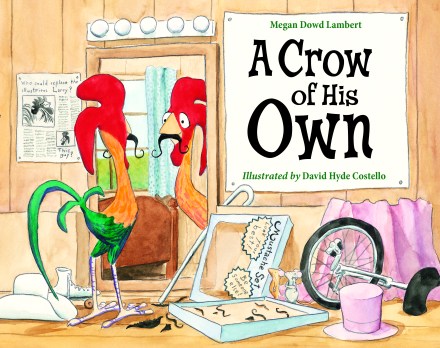
A Crow of His Own

Written by Megan Dowd Lambert | Illustrated by David Hyde Costello


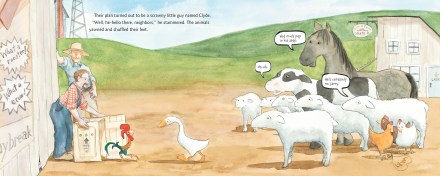
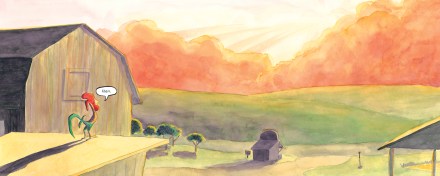
When fame and fortune came calling for Larry, the charismatic rooster of Sunrise Farm, the daily routine turned upside down. “The animals overslept and no one knew what to do.” But while the cow, horse, sheep, chickens, and goose fretted, Farmer Jay and Farmer Kevin had a plan. One day they gathered all the animals and introduced Clyde, the new rooster. Looking at the “scrawny little guy” as he stammered his hello, the cow, horse, and sheep expressed doubt in his abilities, already comparing him to their beloved Larry.

Roberta, the goose, stepped forward, however, and reassured him that “they just miss Larry.” When Clyde asked who Larry was, the animals gasped. “Only the best rooster ever,” claimed the sheep. “Take it straight from my mouth: he was more than that,” said the horse. “He was a genius,” the cow chimed in.” And the chickens? In the dirt they scratched a heart with Larry and XOX in the center.

celebrate-picture-books-picture-book-review-a-crow-of-his-own-clyde-joins-the-farm

Image copyright David Hyde Costello, text copyright Megan Dowd Lambert. Courtesy of Charlesbridge

Clyde was worried—how could he ever live up to Larry? Roberta tried to soothe him. “‘Larry wasn’t a genius…he just made quite a show of it.” Emboldened and with an inkling of what he needed to do, Clyde thanked Roberta and dashed off. “Clyde spent the whole day gathering props, designing his costume, and choreographing a sublime two-step.” As Clyde gave himself one last look in the mirror in his top hat and cloak, he had misgivings. “Could he put on a show of a crow?” He went to bed, but hardly slept at all.

In the morning…well…Clyde overslept. The animals were not happy. “Who ever heard of a rooster sleeping in?” baaad mouthed the sheep. “What a worthless chicken,” complained the horse. And the cow had issues of her own. Once again Roberta came to Clyde’s defense. With a wagon full of new props and material, Clyde rushed away to prepare for the next day. Up bright and early and balanced on a unicycle atop the coop while surrounded by promotional signs, Clyde “opened his beak, and…promptly fell to the ground with an undignified croak.”

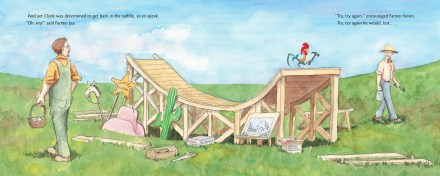
celebrate-picture-books-picture-book-review-a-crow-of-his-own-skating-ramp

Image copyright David Hyde Costello, text copyright Megan Dowd Lambert. Courtesy of Charlesbridge

Poor Clyde! Humiliated and hurt he once again had to endure the slights of the farmyard animals, but their comments only spurred him on. Vowing to go bigger and better, Clyde built himself a ramp, ordered roller skates for birds and a parachute, and designed a colorful Western-theme set. “‘Oh, my!’” remarked Farmer Jay as he walked by. “‘Try, try again,’ encouraged Farmer Kevin.” But in the morning Clyde’s spectacular trick left him hanging upside down from the chicken coop, and the animals more “disgruntled and dismayed” than before.

Clyde was distraught. “‘Forget about Larry.’” Roberta said. “‘Just crow your own crow.’” Clyde considered her advice. The next morning as the sky turned pink and orange with the rising sun, Clyde stood tall atop the chicken coop. He quietly cleared his throat and then—“COCK-A-DOODLE-DOO!” The newly awakened animals came running. Even Farmer Jay and Farmer Kevin came to see this new Clyde. The horse summed up their collective feeling: “It’s not so much like crowing, but crooning.” Roberta agreed. “‘Enough to give you goose bumps!’” she exclaimed. As an encore, “Clyde took a deep breath, gave a shake of his comb, and called out another crow of his own.”

celebrate-picture-books-picture-book-review-a-crow-of-his-own-sunrise

Image copyright David Hyde Costello, text copyright Megan Dowd Lambert. Courtesy of Charlesbridge

These days it’s nearly impossible for kids not to compare themselves or be compared to others—even those they’ve never met. All they need to do is jump on the Internet and discover that so-and-so has double, triple, or more friends and/or followers than they do; go to class and get their grade on that assignment they worked so hard on; or simply stand by their locker, go to lunch, or head out to gym and overhear the comments of other students. Avoidance isn’t the answer, but a good base of self-confidence and personal identity is. In A Crow of His Own Megan Dowd Lambert offers readers such a base in her entertaining and meaningful tribute to self-acceptance and love that hits all the right notes.

As soon as scrawny Clyde walks out of his crate to the scorn of his farm mates, kids will root for this underchicken. With a light touch and plenty of wordplay, Dowd deftly presents honest portrayals of the opposition Clyde is up against as well as Clyde’s distressed reactions. Clyde’s three attempts to act like Larry humorously demonstrate the difficulties of trying to be someone you’re not. When Clyde finally musters the courage to “crow his own crow” and is met with praise, readers will see that their own unique talents will find an appreciative audience.

David Hyde Costello knows how to put on a show! His Sunrise Farms is a gentle, bucolic spread still under the thrall of Larry. Humorous details, such as the valentines to Larry the chickens draw in the dirt, the movie house-style posters on the side of the barn, and the surprised and exasperated expressions of the animals, testify to Larry’s enduring legacy. But careful observers will notice that while Larry is a rather bland white rooster with some black tail feathers, Clyde is distinctively colorful from his comb to his feet. Kids will giggle at Clyde’s increasingly complex morning shenanigans even as they sympathize with his plight. When Clyde finally reveals his magnificent crow, readers will cheer.

A Crow of His Own is a winner on so many levels. It offers parents and children a way to discuss and begin building the strong sense of self so important to a happy and successful life. The book also presents a positive visual representation of diversity, and in Roberta and Farmer Jay and Farmer Kevin it shows that finding support helps. And it does all of this in a story that stands on its own as a funny, laugh-inducing romp. Because kids will want to hear this story over and over, A Crow of His Own would be a wonderful addition to libraries and home book collections.

Ages 4 – 9

Charlesbridge, 2015 | ISBN 978-1580894470

To learn more about Megan Dowd Lambert, her picture books, her Whole Book Approach to Reading, and more visit her website!

On David Hyde Costello‘s website you’ll find a gallery of artwork, a portfolio of picture books, videos, and more!

Job Action Day Activity

celebrate-picture-books-picture-book-review-chicken-craft

A Chicken to Crow About


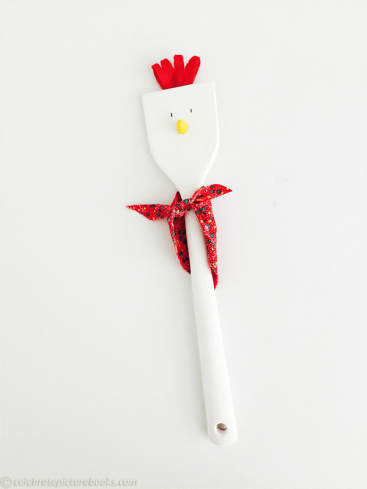
A long-handled wooden turner makes a plucky decoration for your room or kitchen—and a great reminder to bring your passions to every job! In a few simple steps, you’ll have a cute companion you’ll want to crow about!

Supplies

  • Printable Comb and Scarf Template
  • Long-handled wooded turner, available in kitchen supply stores
  • Red felt
  • Yellow bakable clay
  • Fabric, 12 inches square
  • A small piece of white felt or fleece (optional)
  • White paint (or any color you would like)
  • Black marker
  • Fabric glue
  • Glue gun
  • Paint brush

celebrate-picture-books-picture-book-review-chicken-craft

Directions

  1. Paint the wooden turner, let dry
  2. Cut the scarf from the piece of fabric
  3. Make a beak from the yellow clay and bake it according to package directions

To make the comb

  1. Cut out the comb from the red felt
  2. Fold the felt in half and glue the end together with the fabric glue
  3. Cut short strips from the folded top of the felt, about ½-inch to ¾ -inch in length
  4. Round the corners of the strips slightly

To make the scarf

  1. Fold the fabric in half
  2. With the long, straight edge of the scarf template along the fold, cut out the scarf
  3. With the fabric glue, glue the two sides of the scarf together so that you have two “right” sides
  4. Let dry

To assemble the chicken

  1. Pinch the bottom of the comb together so that the strips open and the felt pleats a little
  2. With the glue gun attach the comb to the back of the painted turner, keeping the bottom pinched together
  3. Attach the beak to the front of the turner
  4. Draw eyes on the chicken with the black marker
  5. Tie the scarf around the neck of the handle, hold in place with a drop of glue in the back if necessary
  6. To make tail feathers in a turner with a hole in the handle, pinch together a small folded piece of white felt or fleece and push it through the hole in the handle of the turner.
  7. Cut or arrange to look like feathers

Picture Book Review

August 19 – World Photography Day

celebrate-picture-books-picture-book-review-breaking-news-bear-alert-cover

About the Holiday

Photography is all about providing information through images. A picture really can be worth a thousand words in capturing a moment of surprise, joy, danger, or even sadness. Well-placed photographers, videographers, and cinematographers have given voice to some of society’s pivotal moments, allowing the whole world to witness change, sometimes as it happens. Today we celebrate photographers who often put themselves in danger to get the story as well as those who bring us much-needed lighter moments.

Breaking News: Bear Alert

By David Biedrzycki


Jean Louis, a television host on Our Furry Planet looks out from the screen at a little boy and his teddy bear watching from their family room. He’s brought the video camera into a bear’s den “somewhere in North America.” With a pointy stick he motions towards a sleeping bear as he explains the facts about hibernation. “Look,” he says, poking his stick into the bear’s nose, “even when prodded they don’t wake up. But spring is a busy time for brown bears. Soon they will emerge from their den, hungry for food, hungry for adven—AAAAAAAAAAH!!!” The bear grabs the reporter’s stick as the screen goes dark.

The Skycam 3 News Helicopter takes over as two bears escape into the wider community. They catch a ride on the top of the Our Furry Planet truck carrying the reporter who scans the area and is relieved to find they have outrun the bears. Close observers will notice a pair of suspicious-looking characters first seen out the boy’s window now riding a motorcycle with a sidecar.

The bears are next spotted by the Main Street traffic camera. In an inset the Our Furry driver describes his encounter with the bears as the cameraman stands disheveled behind him: “Well, that big ol’ bear came at us with his claws out like this. I told him to scoot and chased both of them away!” But is this bragging warranted? The reality may be more that the driver and cameraman ran away screaming while the bears peacefully took in the sights.

celebrate-picture-books-picture-book-review-breaking-news-bear-alert-interior-art-mom

Image copyright David Biedrzycki, courtesy of charlesbridge.com

The bears are later found on security video at Teddy’s Diner, where the sign specifically states that “No Bare Feet” are allowed. The diner’s owner and head chef, Teddy Bahr, reveals that he’ll “cook for anyone as long as they’re not barefoot and that the bears were barefoot.” According to the scrolling alert, the bears “demanded to be fed” and indeed are shown gulping down a bowl of porridge at the counter. The golden-haired waitress, Mrs. Locks exclaims for the camera, “I almost had a heart attack…Those bears had no manners, and they paid me with acorns.”

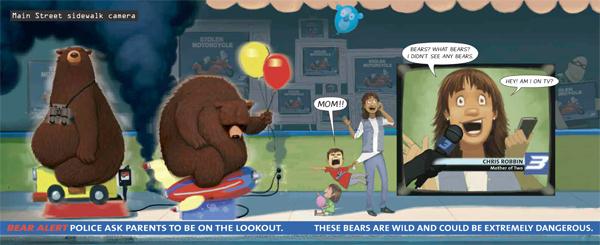
Hmmm…the diner’s TV is relating a story about cat burglars that seem awfully familiar. And is that them again entering an electronics store at Pooh Street and Main Street, where the bears have just turned the corner? A boy yells for his mom as the bears take over his kiddie ride, but she’s too busy on her phone and discovering she’s on TV to pay attention. The scrolling alert warns parents to be on the lookout as the bears “are wild and could be extremely dangerous.”

The bears continue their journey through town, dancing to street a performer while a “cat burglar” raids the band’s donation box, taking their pictures in a photo booth, and watching all the commotion as agents of Animal Control sprea through the streets. The Paddington Department Store spies the bears on the escalator, but does it also catch something—or someone—else at the jewelry department?

celebrate-picture-books-picture-book-review-breaking-news-bear-alert-interior-art-hero-bears

Image copyright David Biedrzycki, courtesy of charlesbridge.com

Suddenly, a police officer bursts out of the department store door to chase the robbers as the Breaking News report declares that there has been a burglary at the store. Skycam 3 spots the suspects fleeing on foot! And in a moment the perpetrators have been caught! Breaking News: “Bears nab burglars.” Once the scourge of the town, the bears are now heroes. The Breaking News reports “Crowd applauds departing bear heroes. We now return you to your regularly scheduled story.”

There’s so much going on in David Biedrzycki’s Breaking News: Bear Alert, that the minimal text doesn’t begin to hint at all the hidden surprises and silliness that kids will love on each page. Bear puns and other jokes abound on every page and in nearly every illustrated detail. Characters’ names, menu items, framed pictures, street names, and more offer up humorous allusions to other bear-related people, books, and entertainment for adults and kids.

Readers of all ages will want to linger over every vivid, full-bleed page to catch all the hilarious happenings and allusions, and especially to follow the subplot that is cleverly inserted along the way. The frame of an animal discovery television show is a sly wink at the genre and one that kids and adults will be familiar with and enjoy.

Bear in mind that kids may be clawing to read this book again and again, and not having Breaking News: Bear Alert on the shelf may pose a very hairy situation indeed!

Ages 4 – 10

Charlesbridge, 2014 | ISBN 978-1580896634

To learn more about David Biedrzycki and his books and to view a gallery of his artwork, visit his website!
Don’t hbernate! Watch this beary funny book trailer!

World Photography Day Activity

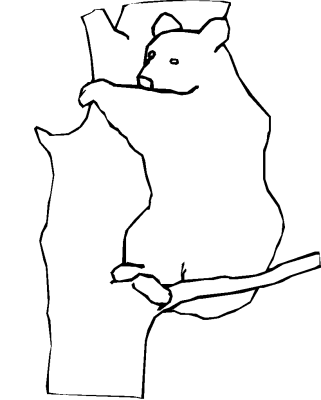
celebrate-picture-books-picture-book-review-bear-climbing-tree-coloring-page

Picture Perfect Bear Coloring Page


Imagine you’re taking a picture of this bear in a tree. What else do you see? Draw in the details and then color your printable Picture Perfect Bear Coloring Page.

August 15 – National Relaxation Day

celebrate-picture-books-picture-book-review-whoosh!-lonnie-johnson's-super-soaking-stream-of-inventions-cover

About the Holiday

Relaxation Day was founded in 1985 by then fourth-grader Sean Moeller, who already knew a thing or two about balance in life when he suggested that “cleaning and real work are not part of relaxation.” Today’s holiday gives you permission to kick back and enjoy yourself. The subject of today’s book invented a great way to take advantage of a day off—and also demonstrates that sometimes work and relaxation go hand-in-hand!
WHOOSH! Lonnie Johnson’s Super-Soaking Stream of Inventions

Written by Chris Barton | Illustrated by Don Tate


Lonnie Johnson had a way with stuff. In his hands bolts and screws, gears and springs, spools, clothespins, “spare parts his dad let him bring in from the shed, and various other things he’d hauled back from the junkyard” fueled Lonnie’s ideas for inventions and rocket ships. The kids at school loved to watch him launch the rockets he’d devised on the playground. Lonnie wanted to have a career as an engineer. Getting there took a lot of determination and courage. Once, the results of a standardized test said that he would not make a good engineer. Lonnie felt discouraged, but he knew that the person who had graded his test didn’t know him—or Linex.

celebrate-picture-books-picture-book-review-whoosh!-lonnie-johnson's-super-soaking-stream-of-inventions-young-lonnie-inventing

Image copyright Don Tate, courtesy of charlesbridge.com

Linex was the robot Lonnie had built from scrap metal. “Compressed –air cylinders and valves allowed Linex’s body to turn and its arms to move. The switches came from an old, broken jukebox. Lonnie used a tape recorder to program Linex, and as a bonus the reels looked like eyes.” Lonnie’s goal was to enter Linex in a science fair, but first he wanted to be able to program it. It took several years before he discovered how. Using his little sister’s walkie-talkie, Lonnie took Linex to the “1968 science fair at the University of Alabama—where only five years earlier, African American students hadn’t even been allowed.” Lonnie’s team won first place.

Lonnie went to college at Tuskegee Institute, where he realized his dream of becoming an engineer. His career “took him beyond Alabama—way beyond.”  He went to work for NASA. Before the orbiter Galileo could be sent to Jupiter, Lonnie developed a system that would ensure the craft would have a constant supply of power for its computer memory in case the main power was lost. Some fellow scientists doubted his idea would work, but it did. “As it photographed Jupiter and its moons, Galileo was supported by the power package that Lonnie designed.”

celebrate-picture-books-picture-book-review-whoosh!-lonnie-johnson's-super-soaking-stream-of-inventions-linex

Image copyright Don Tate, courtesy of charlesbridge.com

Even though Lonnie worked for NASA, he continued tinkering with his own ideas—in his own workshop. One problem he was trying to solve involved the need for the world’s refrigerators and air conditioners to have a cooling system that didn’t use the damaging chemical R-12. “He had an idea for using water and air pressure instead.” He built a prototype and experimented with it in his bathroom sink. When he turned his pump and nozzle on, a stream of water blasted across the room.

Suddenly, Lonnie saw another use for his invention—as a water gun. He created a design small enough for children’s hands, and tested it at a picnic, where it was a hit. Lonnie took his idea to a toy company…and another…and another. Finally one company agreed to make his water gun. Spurred on by this success, Lonnie found investors to help him build other original inventions: “a water-propelled toy airplane, two kinds of engines, and his cooling system” that had led to the water gun. He even quit his day job to devote his time to inventing.

But things don’t always work out. Each project fell through—even the water gun. It was a scary time as he and his family had to move out of their house and into an apartment. But Lonnie believed in himself. He took his water gun to another toy company. In 1989 he found a toy company willing to take a look. Lonnie made the trip to Philadelphia and wowed the executives with his invention.

celebrate-picture-books-picture-book-review-whoosh!-lonnie-johnson's-super-soaking-stream-of-inventions-water-powered-nozzle

Image copyright Don Tate, courtesy of charlesbridge.com

Now kids everywhere enjoy the fun of the Super Soaker. Today, Lonnie can be found in his workshop doing what he loves: “facing challenges, solving problems and building things” because “his ideas just keep on flowing.”

Chris Barton’s biography of Lonnie Johnson is a fascinating look at a man who succeeds in turning “No” into “Yes” by the power of his intelligence, ideas, and determination. Kids will love hearing about how one of their favorite toys came to be and will be inspired to chase their own dreams despite challenges and setbacks. Barton’s detailed narration provides a full picture of Lonnie Johnson and his times, specifics that attract and inform like-minded kids. Including the results of Lonnie’s exam should encourage kids who think differently. The story is enhanced by the conversational tone that makes it accessible to kids of all ages.

Don Tate illuminates Lonnie Johnson’s life story with his bold, full-bleed paintings that follow Lonnie from his being a child with big ideas to becoming a man who has seen these ideas through to success. With an eyebrow raised in concentration, young Lonnie demonstrates confidence and skill as he works on an invention, and kids will love seeing the tools of his trade laid out on the kitchen table. With his eyes narrowed in frustration and disappointment, Lonnie reads the results of his childhood exam. As Lonnie grows older and designs systems for NASA, the illustrations depict the schematics of the Galileo power package and Lonnie’s surprise at the strength of the water stream in his prototype cooling design. As all kids know, the spurt of a Super Soaker is awesome, and this fact is demonstrated in a “Wowing” fold-out page.

WHOOSH! Lonnie Johnson’s Super-Soaking Stream of Inventions is a welcome biography of the man who designs systems for the greater world but has never lost his youthful enthusiasm to invent.

Ages 5 – 10

Charlesbridge, 2016 | ISBN 978-1580892971

Check out more fiction and nonfiction books by Chris Barton on his website!

Discover more books written and illustrated by Don Tate as well as a portfolio of his work and book-related activity guides on his website!

National Relaxation Day Activity

celebrate-picture-books-picture-book-review-kids-in-pool-coloring-page

Dive In! Coloring Page


The Super Soaker is a great way to cool off! Another relaxing water activity is swimming in a pool! So dive in to this printable cool pool Dive In! Coloring Page!