October 5 – National Do Something Nice Day

celebrate-picture-books-picture-book-review-it's-hard-to-be-nice-cover

About the Holiday

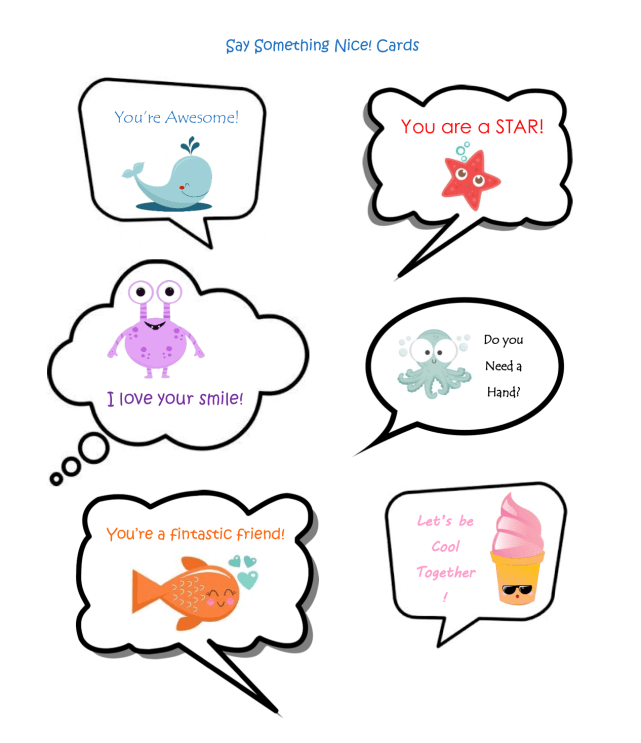
Similar to Random Acts of Kindness Day, National Do Something Nice Day encourages people to think of others and do nice things for them. These don’t have to be big or expensive; in fact, small gestures or thoughtful actions can make all the difference in the way a friend, family member, or stranger feels. These acts of kindness will make you feel good too! To celebrate today, keep an eye out for ways you can lend a hand, times you can share a smile or a conversation, or ways you can make a new friend. Kids may enjoy sharing the encouraging cards found below with friends, siblings, and teachers or by leaving them at school, the library, shops or anywhere that someone may find them.

Sometimes It’s Hard to Be Nice

Written by Maggie C. Rudd | Illustrated by Kelly O’Neill


It seems like being nice should be easy, but there are so many emotions that often surround that one little word that sometimes doing the considerate thing is really hard. How hard? Like smiling and saying “that’s okay” when “your mom says you have to share” your favorite toy with a friend, sibling, or cousin and they break it. Like sitting through your brother or sister’s boring performance, game, or recital when you’d rather be somewhere else—anywhere else. Or like eating your least favorite food and thanking the cook for the meal because you don’t want to hurt their feelings.
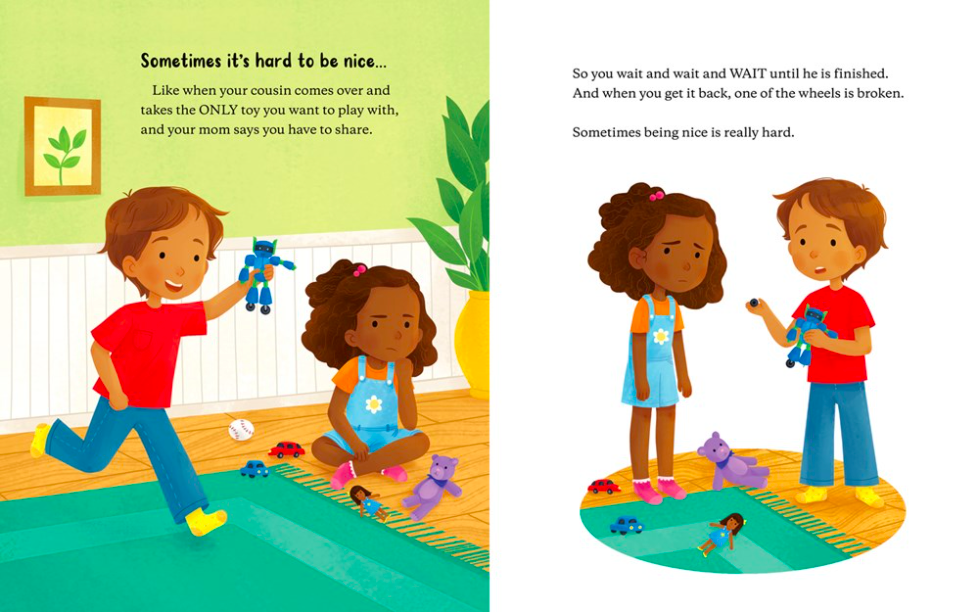
celebrate-picture-books-picture-book-review-it's-hard-to-be-nice-cousin

Image copyright Kelly O’Neill, 2021, text copyright Maggie C. Rudd, 2021. Courtesy of Albert Whitman & Company.

In fact, “sometimes being nice takes practice” like when a little brother or sister destroys your stuff and you yell at them, but then later you realize they didn’t really understand what they were doing. Or like when visiting someone you love in a nursing home or new place is scary and you hang back, not wanting to see them but then decide you won’t be scared next time you visit. And then there are times like these on the playground “when you have been waiting in line for the big slide, and a kid jumps in front of you because he didn’t see you standing there. And your mom says that the polite thing to do is to let him go first. But it’s your turn so you go anyway. Somehow it isn’t as fun. Next time you’ll let him go first.”
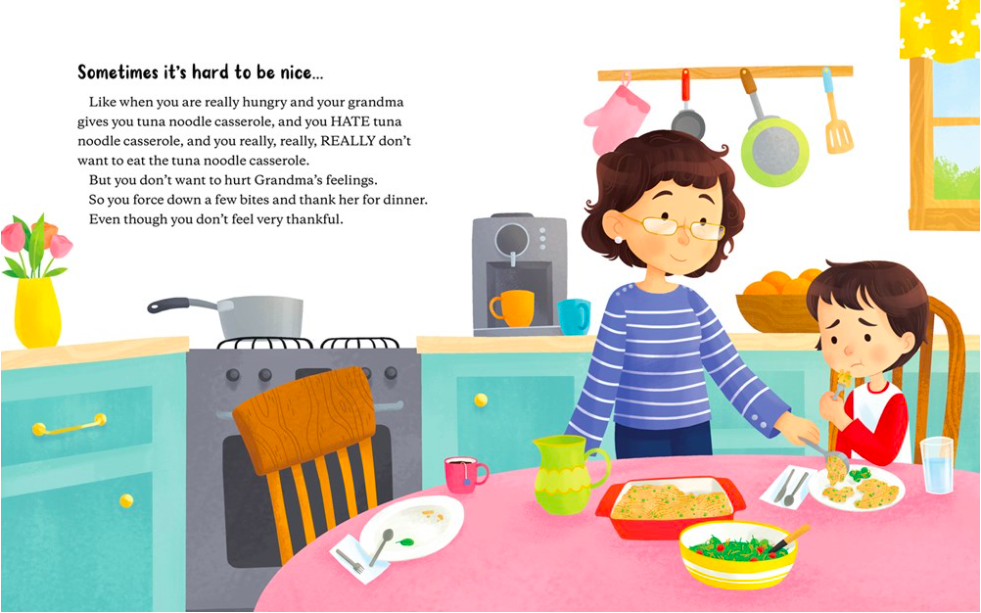
celebrate-picture-books-picture-book-review-it's-hard-to-be-nice-great-grandma

Image copyright Kelly O’Neill, 2021, text copyright Maggie C. Rudd, 2021. Courtesy of Albert Whitman & Company.

So what does all that practice lead to? The good feeling you get when you are nice. Like when you let your baby brother sit with you as you play a video game, “and he claps for you the whole time.” There’s also the great feeling you get when you’ve cleaned up after playing and your parents really appreciate it, or “when you’re late for soccer practice and your mom can’t find her keys, so you help her look for them . . . and find them in the doorknob! And your mom says she doesn’t know what she would do without you!”

While these examples may be hard because you feel slighted or tired or rushed or scared, there are times when being nice takes all your courage—like when you befriend the new kid or the kid everyone picks on and find out you have lots in common. Or when the bullies come around and you stand up for your new friend even though it’s scary and you end up in the principal’s office. So why would you want to be nice? Because “it’s worth it.”
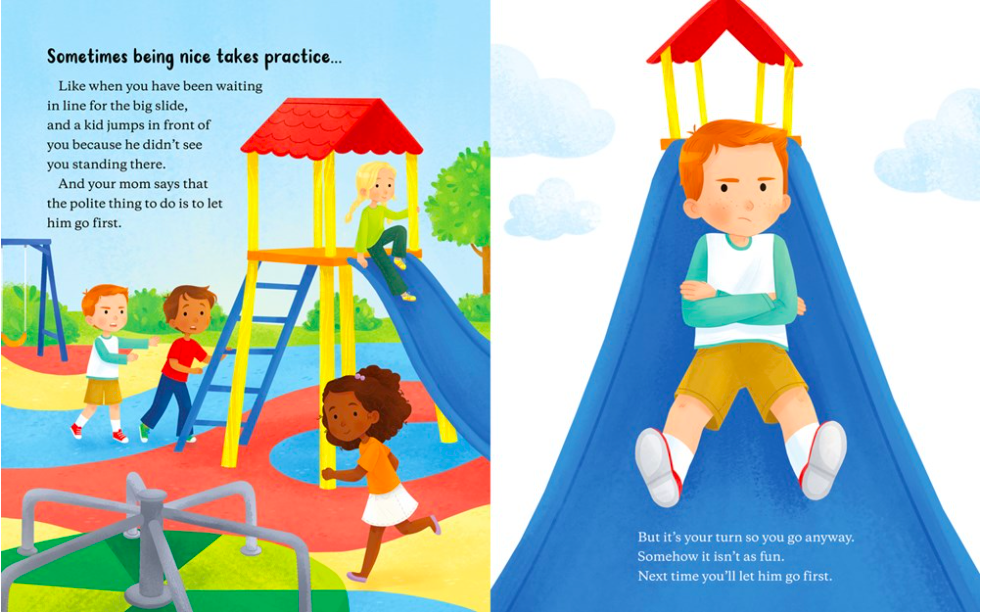
celebrate-picture-books-picture-book-review-it's-hard-to-be-nice-playground

Image copyright Kelly O’Neill, 2021, text copyright Maggie C. Rudd, 2021. Courtesy of Albert Whitman & Company.

Maggie C. Rudd’s excellent primer to the emotions and circumstances around being nice presents children with realistic scenarios involving family members and friends, favorite toys and activities, and common situations at school that often require extra effort to respond to in a positive way. Rudd’s conversational writing style directly engages the reader, and while every example may not be an exact match to the reader’s experience, many will be spot on and the others easily recognized and adaptable.

Rudd’s four-step progression acknowledges that showing kindness or even just good manners can be difficult, but that it can become easier—especially when a situation seems unfair or is disappointing—with practice and perspective. Rudd’s examples of when being nice feels good are sprinkled with humor and warm family feelings that will bring smiles that support her point. A thread involving a favorite Galactic Star Crusher action figure ties several of the vignettes together, adding a sense of relationship and connectedness among the characters.

Kelly O’Neill illustrates each example for readers with clearly depicted scenes involving kids like them playing video games, visiting with grandparents, playing on the playground, helping their parents, and standing up for another child. In every instance, the children’s emotions are easily understood, which opens up many opportunities for adults and kids to discuss the feelings and issues surrounding how one treats others from both a child’s and adult’s perspective and experience. O’Neill’s bright colors, familiar settings, and uncluttered, well-conceived pages put the focus on her engaging children and elegantly complement Rudd’s important message.

Sometimes It’s Hard to Be Nice is a superb read aloud for honestly addressing the complexities and rewards of showing kindness and being nice. It is a book that families, teachers, and caregivers will find themselves turning to again and again in helping children navigate and learn this important social skill. The book is a must addition to home, classroom, school, and public library collections.

Ages 4 – 8

Albert Whitman & Company | ISBN 978-0807575734

Discover more about Maggie C. Rudd and her books as well as an Activity Kit for educators and parents on her website.

To learn more about Kelly O’Neill, her books, and her art, visit her website.

National Do Something Nice Day Activity
celebrate-picture-books-picture-book-review-say-something-nice-cards

Say Something Nice! Cards


Do you want to give someone a nice surprise? Print out these cards and give one to a friend, to someone you’d like to know, or to anyone who looks like they need a pick-me-up! If you’d like to make your own cards, print out the blank template and write and/or draw your own message! You can also print these on adhesive paper and make your own stickers.

Say Something Nice! Cards | Say Something Nice! Cards Blank Template

celebrate-picture-books-picture-book-review-it's-hard-to-be-nice-cover

You can find Sometimes It’s Hard to Be Nice at these booksellers

Amazon | Barnes & Noble | Books-a-Million

To support your local independent bookstore, order from 

Bookshop | IndieBound

Picture Book Review
October 4 – World Habitat Day

celebrate-picture-books-picture-book-review-shipwreck-reefs-cover

About the Holiday

Today we have two special holidays to share: World Habitat Day and National Ship in a Bottle Day! World Habitat Day was created by the United Nations to emphasize the right for all to have access to a home, or a habitat. It is meant to teach more about both humanitarian and environmental issues, as well as their many intersections. This year’s theme is Accelerating Urban Action for a Carbon-free World. To learn more about World Habitat Day and the various activities happening this year to honor it, check out the United Nations World Habitat Day Page.

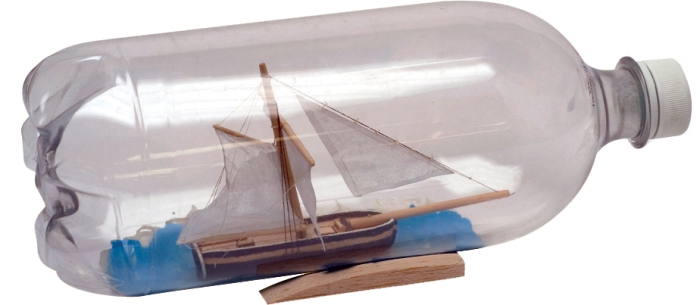
Today also marks National Ship in a Bottle Day, a holiday founded in 2013 on the birthday of Jack Hinkley, the founder of the Ship in Bottle Association of America. This holiday is meant to celebrate the magical craft of placing a tiny model ship within a glass bottle with a narrow opening. It is a tricky feat that takes a lot of preparation, skill, and careful execution.

You are probably now wondering what book could possibly bridge these two seemingly divergent holidays. The answer is Shipwreck Reefs— a nonfiction picture book from the Imagine This! series published by Albert Whitman & Company.

Thanks to Albert Whitman & Company for sharing a copy of Shipwreck Reefs for review consideration. All opinions are my own.

Review by Dorothy Levine

Shipwreck Reefs

Written by Aimée M. Bissonette | Illustrated by Adèle Leyris


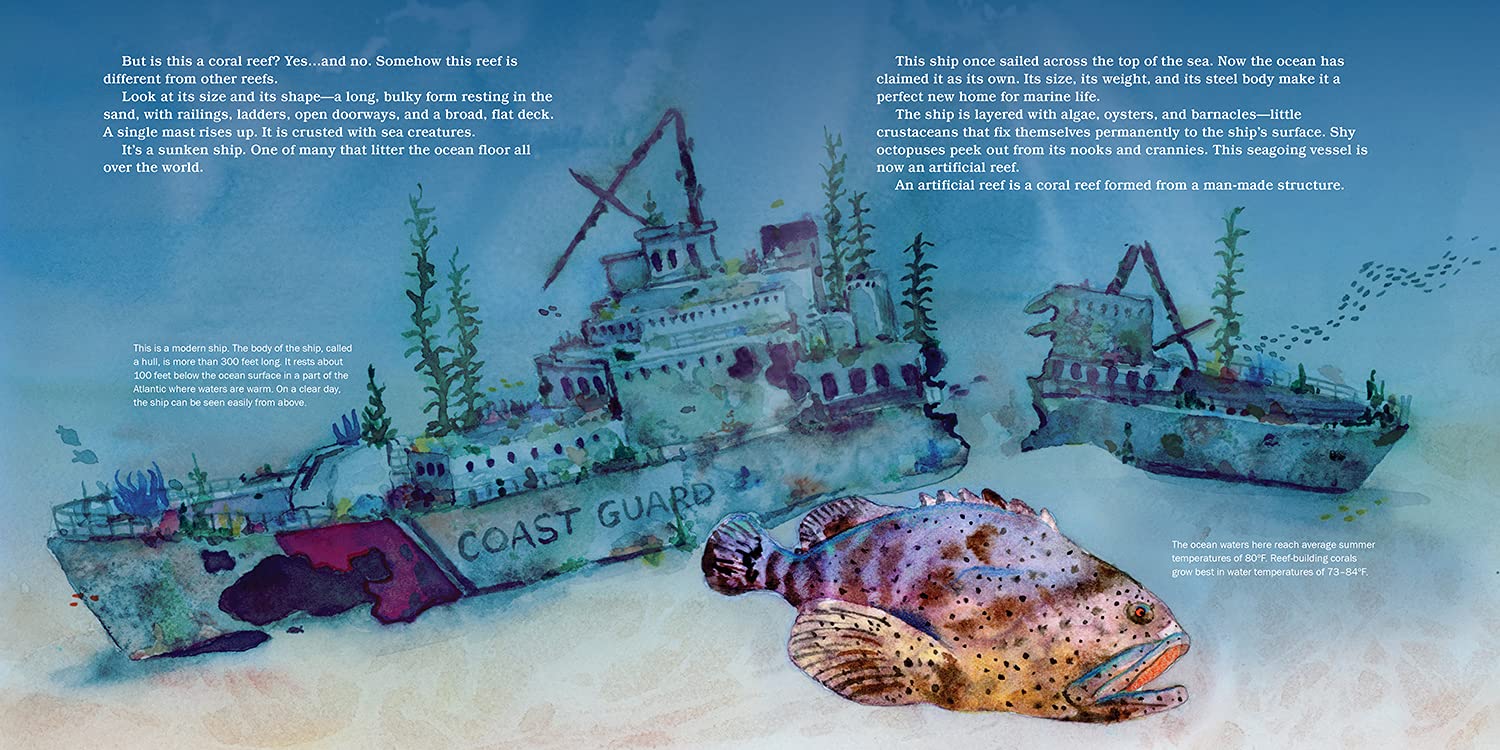
“Splash! Kick! Swim down into the deep.” Readers join scuba divers in learning about coral and reefs. However, not all of these reefs discussed are typical. They are sometimes born from sunken shipwrecks or other non-living, human-placed materials. The book begins with some background on coral reefs, and then readers flip the page to a sunken ship, inhabited by seagrass, algae, barnacles and colorful fish. “But is this a coral reef? Yes…and no.”

celebrate-picture-books-picture-book-review-shipwreck-reefs-coast-guard

Image copyright Adèle Leyris, 2021, text copyright Aimée M. Bissonette, 2021. Courtesy of Albert Whitman & Company.

Shipwrecks provide hard surfaces for small animals like baby corals and barnacles to attach onto and grow into colonies. Over time, sunken ships can become entire ecosystems as the corals grow, providing shelter and food for other animals. More specifically, readers will learn about silver bellied yellow jack, long spine squirrelfish, plankton, rainbow parrot fish, loggerhead sea turtles and more.

celebrate-picture-books-picture-book-review-shipwreck-reefs-turtle

Image copyright Adèle Leyris, 2021, text copyright Aimée M. Bissonette, 2021. Courtesy of Albert Whitman & Company.

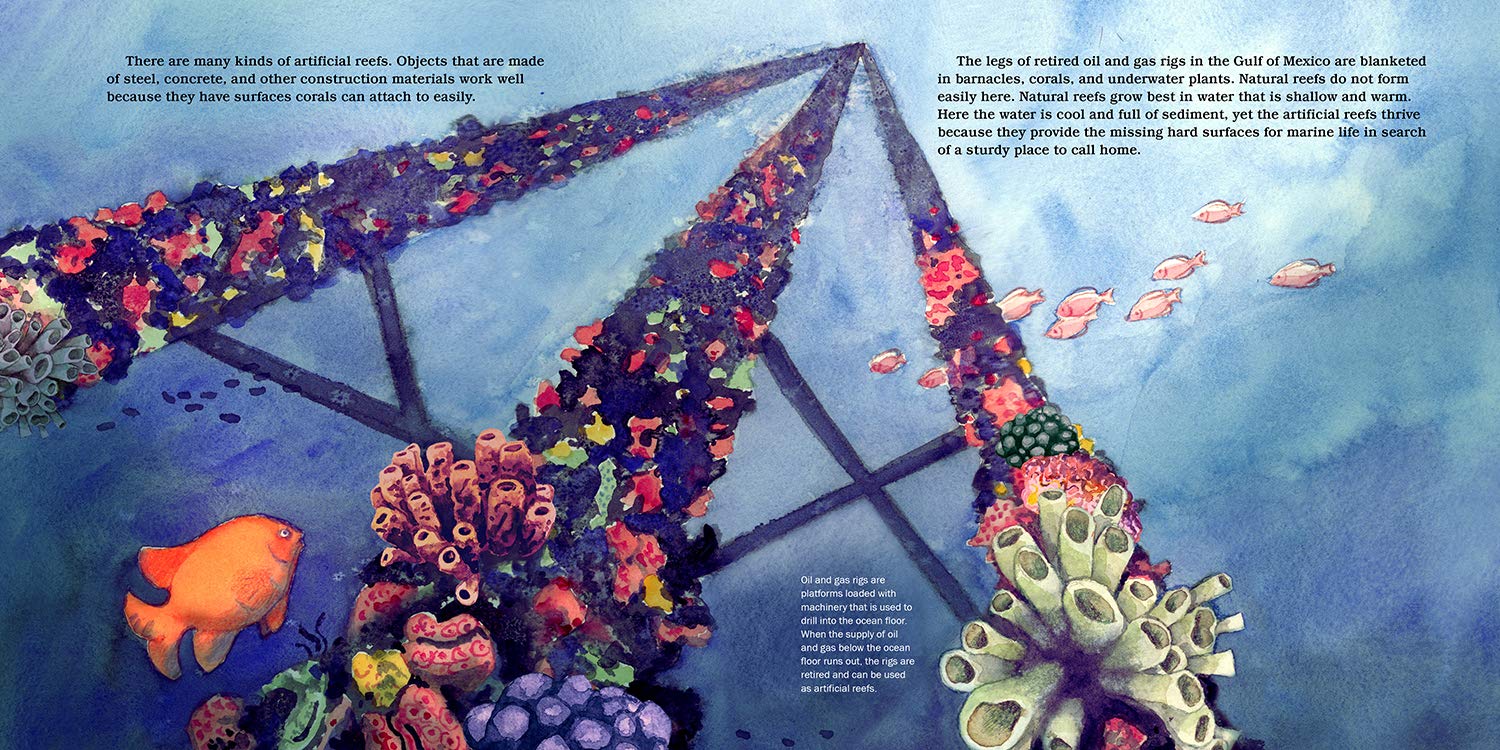
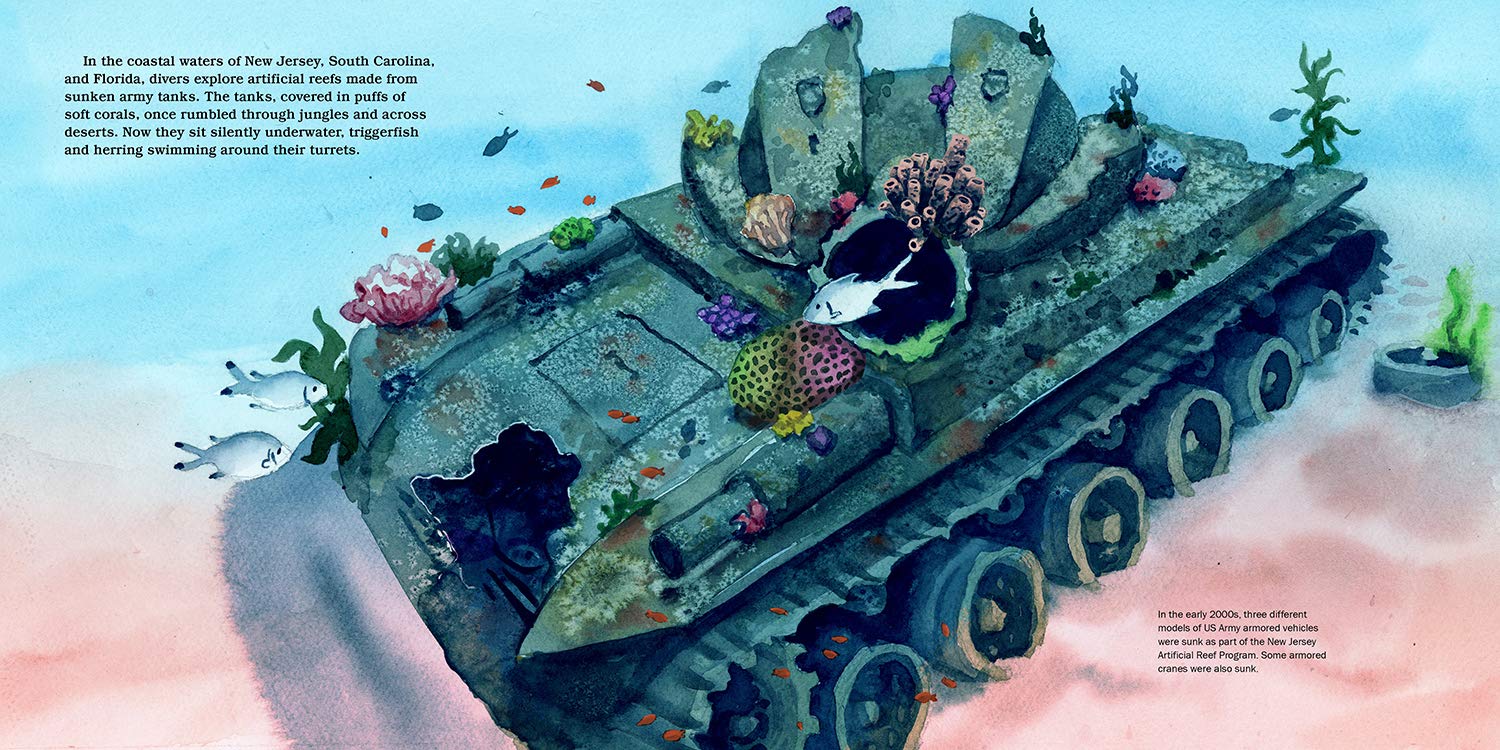
Artificial reefs have been around for ages. “In the 1830’s, ocean fishermen in South Carolina constructed artificial reefs out of logs.” Reefs can be constructed from many different materials, from wooden plants to scrap metal, old tanks to sunken ships. “Whether a subway car or oil rig, army tank or shipwreck, artificial reefs do many jobs.” Around the world, there are many reefs that function as both art installations and tourist attractions for deep-sea divers.

celebrate-picture-books-picture-book-review-shipwreck-reefs-oil-rig

Image copyright Adèle Leyris, 2021, text copyright Aimée M. Bissonette, 2021. Courtesy of Albert Whitman & Company.

The book also discusses how human-caused climate change, pollution from a wide range of contaminates, and the burning of carbon dioxide-producing fuels has caused changes to our oceans that have harmed coral and the other marine life that relies on them. Readers also learn how artificial reefs are beneficial to the ocean habitat. The story reveals: “Artificial reefs help ease the human activity at natural reefs by offering other locations for research, fishing, and diving. Artificial reefs can give natural reefs time to heal, which helps our ocean stay healthy.”

celebrate-picture-books-picture-book-review-shipwreck-reefs-tank

Image copyright Adèle Leyris, 2021, text copyright Aimée M. Bissonette, 2021. Courtesy of Albert Whitman & Company.

Aimée M. Bissonette follows the story with a page of further information on “Remarkable Resourceful Artificial Reefs,” specifically discussing the experimentation done with artificial reefs and the different creative types that exist. The storyline is interspersed with text in smaller print explaining terms such as ecosystems, scuttling, coral polyps, moray eels, and more for extra-curious readers. Bissonette’s writing is straightforward, and neatly compacts complex terms into simple explanations. The author explains climate change, CO2, and coral bleaching in comprehendible terms to teach young audiences to care about these pressing issues.

Adèle Leyris’s mesmerizing illustrations immerse readers in a deep-sea ecosystem with flashy colored fish, detailed coral, and water-colored blues. The scenes feel authentically underwater, exciting, and full of enticements for the audience to take an extra-long look. The scuba divers are depicted in darker shadows, with spots of light that radiate from the page. One page stands on its own with no text: a murky underwater subway car inhabited by a school of fish, with colorful corals wrapped around the pole. The beautiful illustrations will get readers inspired to learn more about reefs, marine life, and how they can help protect them.

Visually striking and loaded with information that will spur kids to learn more about both artificial and natural coral reefs as well as the sea creatures that rely on them, Shipwreck Reefs is a must for any budding naturalist, classroom science collection, or public library.

Ages 5 – 9 

Albert Whitman & Company, 2021 | ISBN 978-0807512876

Discover more about Aimée M. Bissonette and her books on her website.

To learn more about Adèle Leyris, her books, and her art, visit her website.

World Habitat Day and National Ship in a Bottle Day Activities


Exploring the Coral Reef Video


Watch this educational video to see some real-life coral reef ecosystems! 

Scout Life Ship in a Bottle Craft

Image courtesy of Scout Life (scoutlife.com)

Make Your Own Ship in a Bottle


To make your own ship (or artificial reef!) in a bottle, visit Scout Life for detailed instructions.

celebrate-picture-books-picture-book-review-shipwreck-reefs-cover

You can find Shipwreck Reefs at these booksellers

Amazon | Barnes & Noble | Books-a-Million

To support your local independent bookstore, order from

Bookshop | IndieBound

Picture Book Review
October 1 – International Raccoon Appreciation Day

celebrate-picture-books-picture-book-review-raccoon-and-the-hot-air-balloon-cover

About the Holiday

International Raccoon Appreciation Day was begun by a young girl in California to celebrate raccoons and all animals that are considered to be pests or “nuisance animals,” but who are actually an important part of their ecosystem. Raccoons help out by eating carrion, keeping the numbers of some other animals in check, and spreading seeds while foraging and eating berries and nuts. Raccoons live in diverse climates, and in rural, urban, and suburban areas. Despite habitat loss, their population has continued to increase in North America. One remarkable aspect of raccoons is their hand-like paws, which are almost as nimble as ours and from which they derive their name. “Raccoon” comes from the Powhatan word aroughcun, which means “animal that scratches with its hands.” The Aztecs named them mapachitli, which means “one who takes everything in its hands.” Today’s book stars a raccoon who makes good use of her hands while having a grand adventure.

Raccoon and the Hot Air Balloon

Written by Jill Atkins | Illustrated by Kristen Humphrey


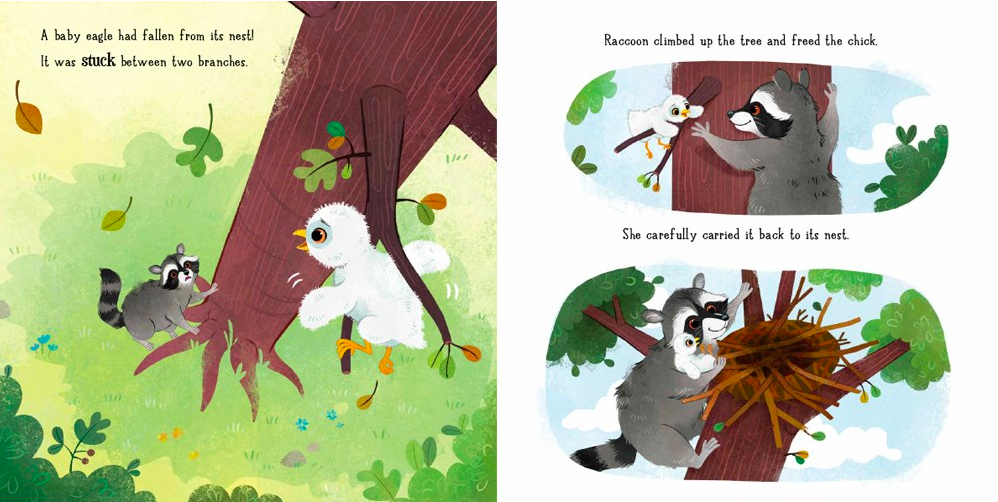
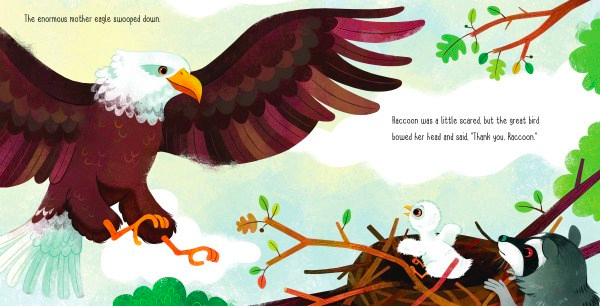
Even though Raccoon was happy living in the forest, she longed for adventure, so when she heard a screech, she went to investigate. What she found was a baby eagle that had fallen from her nest and become stuck between two branches. Raccoon easily climbed up the tree, rescued the chick, and returned it to its nest. Just then the chick’s mother swooped down, and Raccoon felt a pang of fear. But the eagle just wanted to thank her for helping her baby.

celebrate-picture-books-picture-book-review-raccoon-and-the-hot-air-balloon-eagle-chick

Image copyright Kristen Humphrey, 2021, text copyright Jill Atkins, 2021. Courtesy of Maverick Arts Publishing.

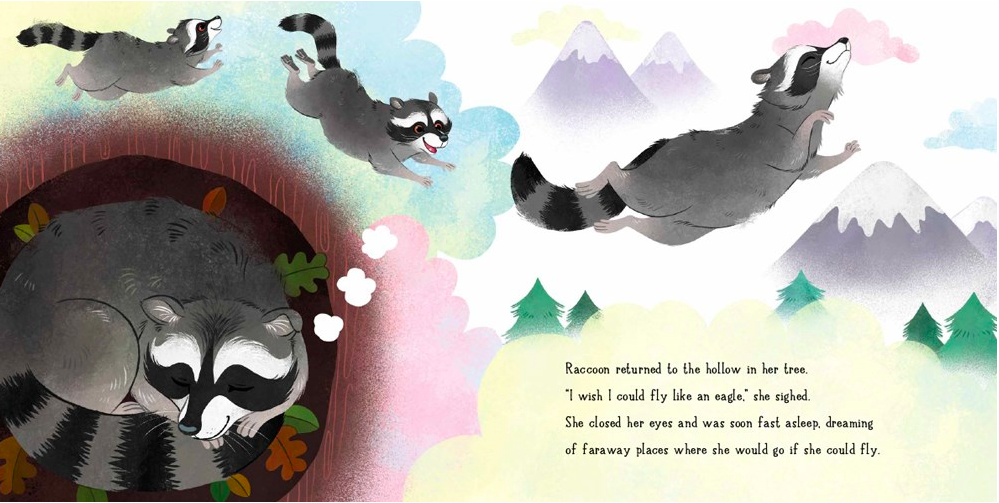
Raccoon went back to her tree, wishing that she could fly. As she napped, she dreamed “of faraway places where she would go if she could fly.” She was suddenly awakened by a loud roar. Looking up, she saw a hot air balloon soar by and land in the nearby field. Raccoon was astonished and decided that she would ride in it too. “‘It would be such a fantastic adventure!’” she told herself.

As the riders left their balloon, Raccoon hopped in and nibbled through the rope tethering it to the ground. “Up shot the hot air balloon! ‘Whee! I’m flying! It’s the beginning of my great adventure!’” Raccoon exclaimed. Seeing their balloon take to the air, the riders chased after it. The balloon continued to rise and rise. It soared over the eagle’s nest, rivers, forests, and fields.

celebrate-picture-books-picture-book-review-raccoon-and-the-hot-air-balloon-eagle

Image copyright Kristen Humphrey, 2021, text copyright Jill Atkins, 2021. Courtesy of Maverick Arts Publishing.

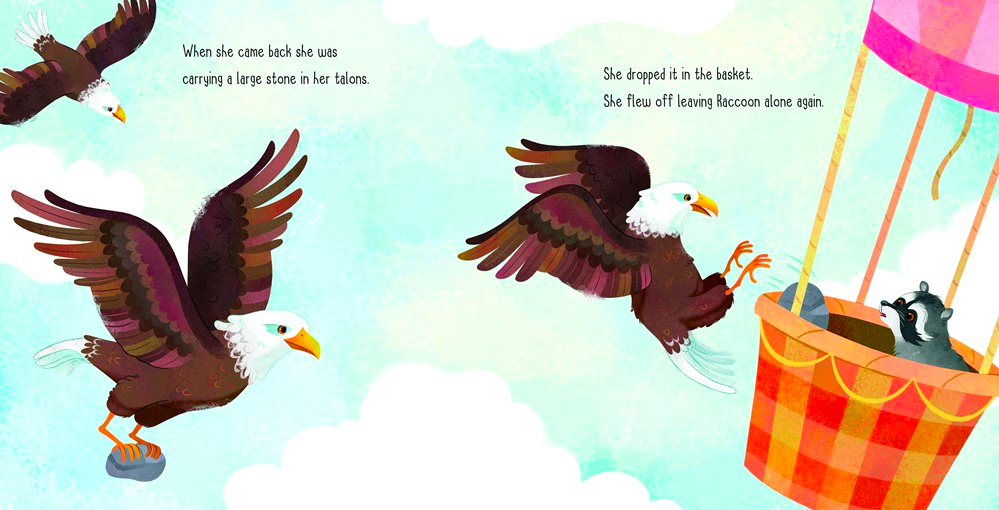
In a little while, Raccoon decided it was time for lunch. But how could she get the hot air balloon to go down? There was a red button in the basket, but pushing it did nothing. Raccoon tried pulling on the rope that hung from the balloon, but this just made the balloon go higher. “‘Help! I can’t get down!’ she shouted” as the ground appeared smaller and smaller. “At that moment, she heard a swoosh of wings. The mother eagle landed on the basket.” With the promise to help, the eagle flew away. Soon she was back grasping a big rock in her talons. “She dropped it in the basket” and took off again.

celebrate-picture-books-picture-book-review-raccoon-and-the-hot-air-balloon-dreaming

Image copyright Kristen Humphrey, 2021, text copyright Jill Atkins, 2021. Courtesy of Maverick Arts Publishing.

Suddenly, the sky filled with birds all carrying stones. One by one they dropped them in the hot air balloon’s basket. Slowly, the hot air balloon began to descend—right in her very own tree. Raccoon called out a relieved “‘thank you!’” to the eagle. She’d had a wonderful adventure, but she was happy to be home—until she saw the motor boat zooming by and decided “‘I think it’s time for another adventure!’”

celebrate-picture-books-picture-book-review-raccoon-and-the-hot-air-balloon-eagle-rock

Image copyright Kristen Humphrey, 2021, text copyright Jill Atkins, 2021. Courtesy of Maverick Arts Publishing.

Jill Atkins’ clever and accessible story about how good deeds are often repaid in kind offers young readers humor, excitement, and adventure along the way. Her engaging storytelling clearly shows kids the reciprocal friendship that grows between Raccoon and Eagle after Raccoon rescues her chick. Atkins also helps readers see that exploring new things leads to opportunities to meet new people, learn new skills, and discover parts of their neighborhood, state, or even the world that they’ve never seen before. Eagle’s rescue of Raccoon is an ingenious solution to his predicament and will also shows kids that many helping hands—including theirs—can make a big difference.

Kristen Humphrey’s bright illustrations of Raccoon’s forest, populated with deer, bears, owls, and other birds, mirrors Atkins’ evocative storytelling and will please kids. When Raccoon makes his dream to fly come true, readers can watch step-by-step as he takes his wild ride. Humphrey’s images provide excellent prompts for readers to predict what will happen to the hot air balloon and Raccoon. As Raccoon quickly recovers from his harrowing experience and decides to have another adventure, readers will knowingly laugh to see him at the wheel of a motorboat.

Raccoon and the Hot Air Balloon is a humorous and impactful title to share ideas of following ones dreams and the importance of helping our friends and neighbors near and far for all kids.

Ages 4 – 9 

Maverick Arts Publishing, 2021 | ISBN 978-1848867772

Discover more about Jill Atkins and her books on her website.

You can connect with Kristen Humphrey on Instagram.

National Raccoon Appreciation Day Activity

celebrate-picture-books-picture-book-review-raccoon-coloring-page-2

Raccoon Coloring Pages


If you like mischievous raccoons, you’ll enjoy these two printable coloring pages!

Raccoon in the Woods | Raccoon by the Shore

celebrate-picture-books-picture-book-review-raccoon-and-the-hot-air-balloon-cover

You can find Raccoon and the Hot Air Balloon at these booksellers

Amazon | Barnes & Noble | Books-a-Million

To support your local independent bookstore, order from

Bookshop | IndieBound

Picture Book Review
September 30 – It’s Read a New Book Month

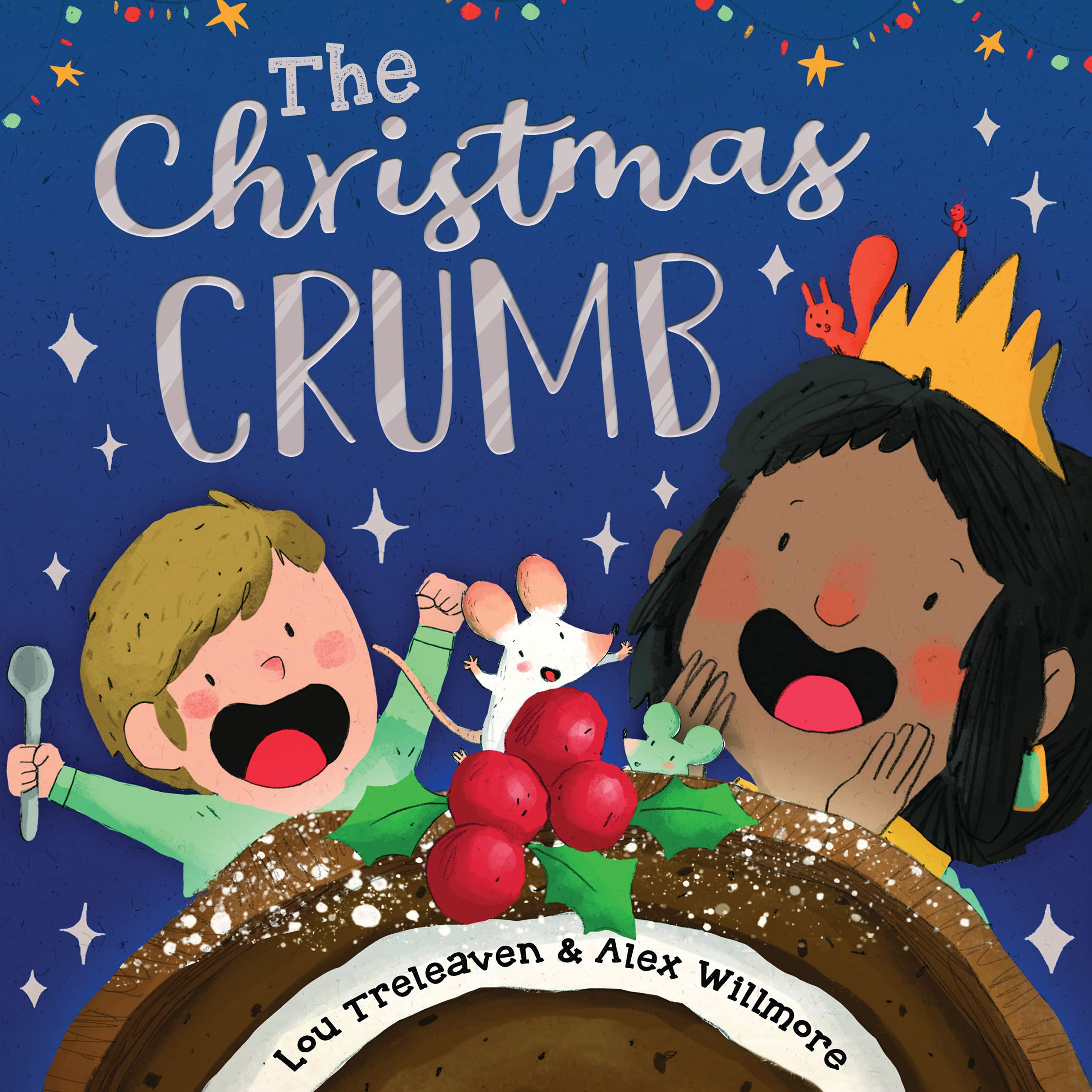
celebrate-picture-books-picture-book-review-the-christmas-crumb-cover

About the Holiday

You’ve heard the saying “Too Many Books, Too Little Time,” right? Well, this truism has spawned not only one, but two Read a New Book Month celebrations! Both September and December have been designated as times to make special plans to search out and read new books. These can be books that are newly published or books that are new to you. And if you find yourself putting a few old favorites in the pile, that’s okay too! Today’s book bridges both months because It’s never too early to think about adding books to those upcoming holiday gift lists!

The Christmas Crumb

Written by Lou Treleaven | Illustrated by Alex Willmore


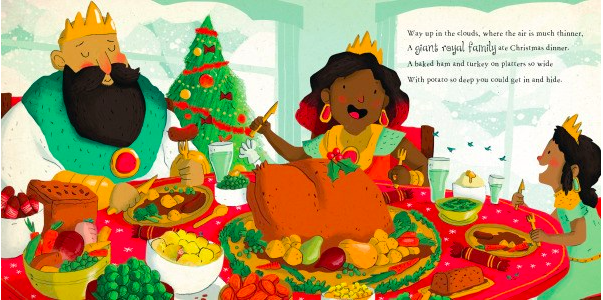
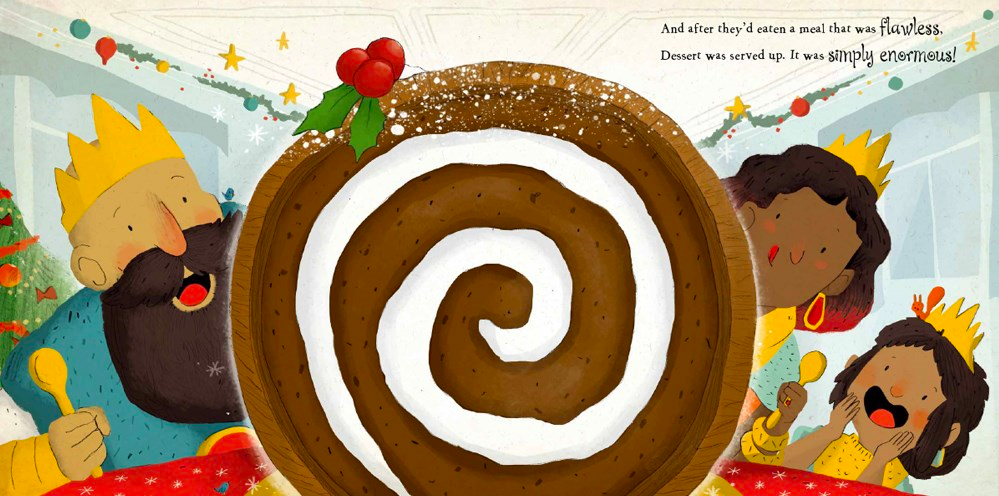
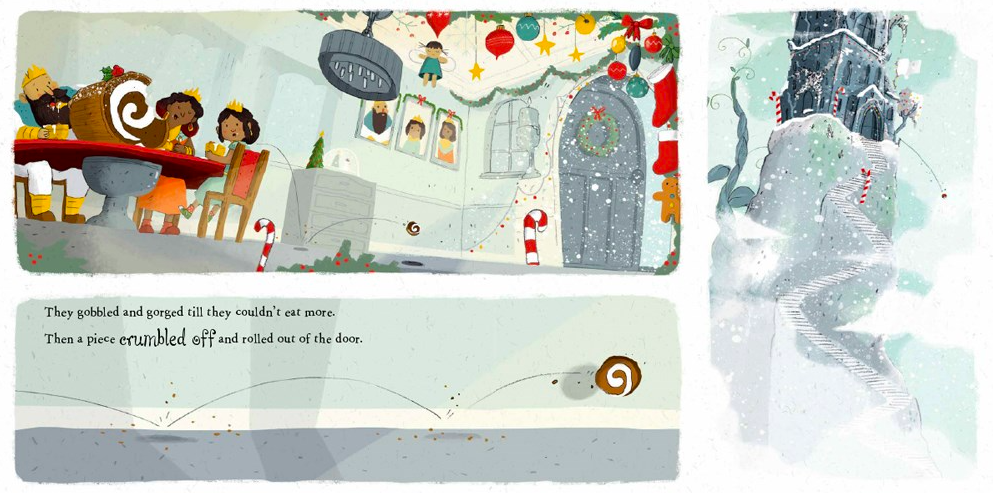
“Way up in the clouds, where the air is much thinner, / A giant royal family ate Christmas dinner.” The turkey and ham were simply enormous, and the bowl of potatoes so large and so deep that a child from Earth down below “could get in and hide.” But the most magnificent thing was the Yule log dessert that lay on the platter like, well, a freshly cut tree. As the giants gobbled their cake, one crumb fell to the floor. It bounced and it rolled right out the door.

celebrate-picture-books-picture-book-review-the-christmas-crumb-giants

Image copyright Alex Willmore, 2021, text copyright Lou Treleaven, 2021. Courtesy of Maverick Arts Publishing.

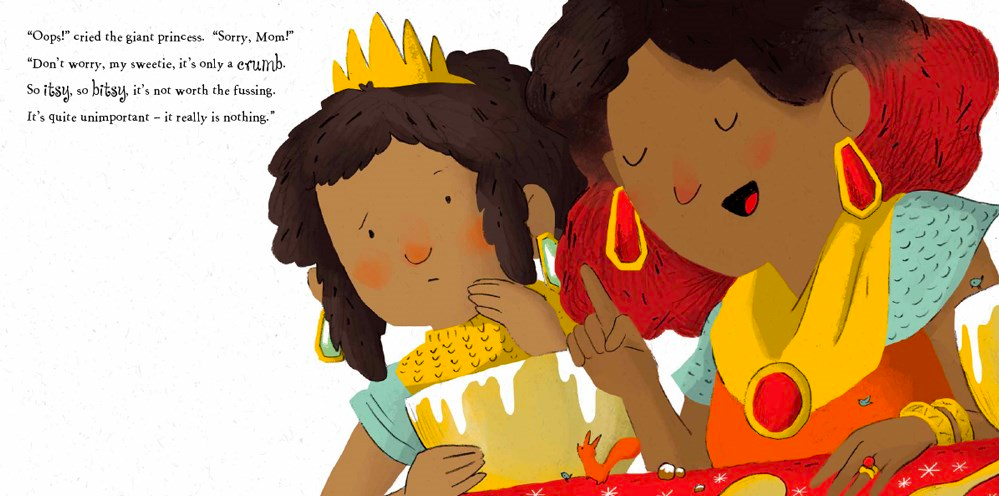
The giant princess apologized for losing the crumb, but her mother assured her that the crumb was so tiny no harm had been done. But the crumb had kept rolling, and it fell through the clouds then crashed through the door of a “tumbledown cottage” where “Pip sat with his mother. / They didn’t have much, but they did have each other.” Pip was ecstatic; this Christmas dessert could replace their “thin gruel.” He dug in with gusto, sending a smaller crumb flying.

celebrate-picture-books-picture-book-review-the-christmas-crumb-dessert

Image copyright Alex Willmore, 2021, text copyright Lou Treleaven, 2021. Courtesy of Maverick Arts Publishing.

Pip was upset that he’d lost even a morsel, but his mom reassured him that it was “‘only a crumb. / So dinky, so diddy, it’s not worth the fussing. / It’s inconsequential – it really is nothing.’” By now that tinier crumb had found a new home in a mouse hole where “a dozen mice pups / Were getting quite desperate for food to turn up.” They swarmed on that crumb—their great Christmas feast that would feed them for weeks.

celebrate-picture-books-picture-book-review-the-christmas-crumb-escape

Image copyright Alex Willmore, 2021, text copyright Lou Treleaven, 2021. Courtesy of Maverick Arts Publishing.

In all of the scarfing, a small crumb came loose. It rolled off the table and through a crack in the floor. A couple of bounces left it out in the snow, where a group of red ants was about to eat leaves. But they gave up the cuttings as quick as a wink when this surprising treat—“almost as big as [their] nest—fell into their midst. They hugged and they celebrated; they had food for the winter, they were “‘going to survive!’” They cheered, “‘This Christmas bonanza has just saved our lives.’” Was that it, then? All the sharing that first crumb could do? You might think what was left was too tiny, too wee, but one ant “passed his share down to an overjoyed flea.” So this Christmas (and all through the year) remember that what one person thinks small, someone else will hold dear.

celebrate-picture-books-picture-book-review-the-christmas-crumb-tiny

Image copyright Alex Willmore, 2021, text copyright Lou Treleaven, 2021. Courtesy of Maverick Arts Publishing.

Like the Christmas season itself, Lou Treleaven’s story of a treat that keeps on giving is full of charm, surprise, and cheer. Her set up of a royal giant family enjoying their holiday feast lends a magical plausibility to the idea of a crumb large enough to pass down and down and down again to feed multiple families—an idea that brings new delight each time a crumb escapes and finds a new home. Treleaven’s whimsical storyline soars on her jaunty rhyme scheme and her superb word choices that are humorous and heart-tugging at the same time.

Her deft messaging will appeal to children’s natural empathy as well as their awareness today of need in their communities as in each household the child apologizes for losing even a crumb. The adults’ repeated response, while providing a fun phrase for readers to join in on, can also lead to deeper discussions about the importance and rewards of giving.

Accompanying Lou Treleaven’s story are Alex Willmore’s hilarious and heartening illustrations that set the Christmas scene with fresh color tones and captivating details that show the impact the “crumb” has on each family. Spying a child hiding in the giants’ big bowl of potatoes will elicit giggles, and the characters’ facial expressions—from the princess’s delighted gasp at seeing the Yule log to the mother’s look of impending doom as the crumb barrels through her home—are priceless.

Willmore’s work with perspective is worthy of special note. Underlying Treleaven’s message that something’s worth is all in ones perspective, Willmore’s scenes employ close-up and distant views; commonly recognized items are juxtaposed to the giants, Pip and his mom, the mice, the ants, and finally the flea to show scale; and the runaway crumb becomes smaller and smaller but is always just the right size. Math-oriented kids will enjoy pointing these out, and some may like replicating scenes by physically arranging similar items. In a final spread, the princes, Pip, the mice, the ants, and even the barely perceptible flea line up with their crumbs in a meaningful demonstration of how something small to one person is big to another.

An utter delight from beginning to end, The Christmas Crumb offers a sweet message about giving and perspective that’s perfect for the holiday season and all year around. Adults and kids will love sharing this rollicking read aloud again and again. This is a book you’ll want to buy for your home, school, or public library shelves.

Ages 4 – 9

Maverick Arts, 2021 | ISBN 978-1848867765

Discover more about Lou Treleaven, her books, plays, and other work on her website. You’ll also find activities to print.

To learn more about Alex Willmore, his books, and his art, visit his website

Read a New Book Month Activity

celebrate-picture-books-picture-book-review-mini-book-craft-cover

Mini Accordion Book


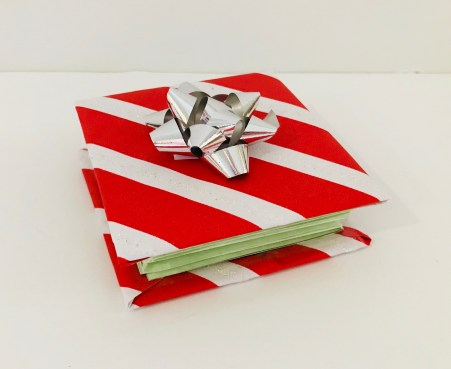
With this craft you can make a little book for your own writing, pictures, or stickers. With a holiday-themed cover, you can use it as an advent calendar or holiday wish list. This little book would also make a fun gift to make for your friends.

Supplies

  • 12-inch by 12-inch sheet of scrapbooking paper – single or double sided
  • Decorative scrapbooking paper, wrapping paper, or a page of the child’s own writing or drawing
  • Cardboard
  • Stickers, pictures
  • Scissors
  • Glue
  • Ruler
  • Pencil

celebrate-picture-books-picture-book-review-mini-book-pages

Directions

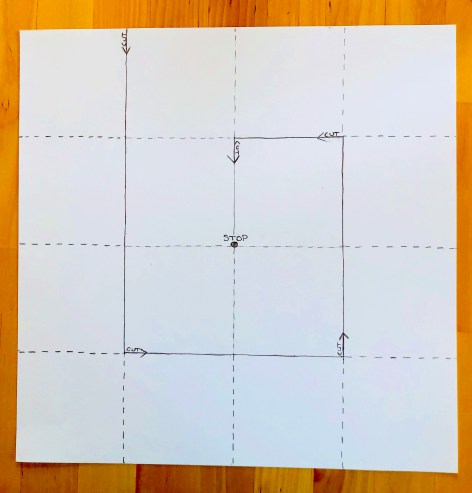
  1. Draw a 3-inch border around the edge of the 12-inch by 12-inch sheet of scrapbooking paper. This will make a 6-inch square in the center of the paper
  2. Draw a line from the top of the paper to meet the left edge of the 6-inch square. The line will be 3 inches from the left side of the paper.
  3. Draw a 3-inch line from the top center of the 6-inch square to the center of the square

IMG_7695

To Cut the Paper

  1. Beginning with the line at the top of the piece of paper, cut down the left edge of the 6-inch square.
  2. Cut across the bottom of the square.
  3. Cut up the right side of the square
  4. Cut across the top of the square to the line in the center.
  5. Cut down the 3-inch center line to the middle of the square

To Fold the Pages

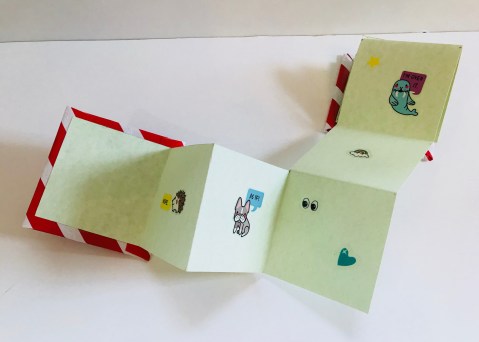
  1. Draw light or dotted lines every 3 inches along the strip of paper
  2. Starting at the top of the strip, fold the paper on the lines accordion style.
  3. Make the first fold by folding the first 3-inch section down towards you.
  4. Fold the second 3-inch section back away from you
  5. Continue folding the 3-inch sections down and back until the strip is entirely folded

To Make the Cover

  1. Cut two 3 ½ -inch squares from the cardboard
  2. Cut two 4 ½-inch squares of from the decorative paper, wrapping paper, or child’s writing or drawing
  3. Cover the cardboard with the paper, folding the excess paper over the edges and securing with glue

To Assemble the Book

  1. With the strip of paper completely folded, glue one cover to the top 3-inch square
  2. Glue the second cover to the end 3-inch square

Fill the book with writing, drawings, stickers, whatever!

celebrate-picture-books-picture-book-review-the-christmas-crumb-cover

You can find The Christmas Crumb at these booksellers

Amazon | Barnes & Noble | Books-a-Million

To support your local independent bookstore, order from

Bookshop | IndieBound

Picture Book Review
September 29 – It’s Intergeneration Month

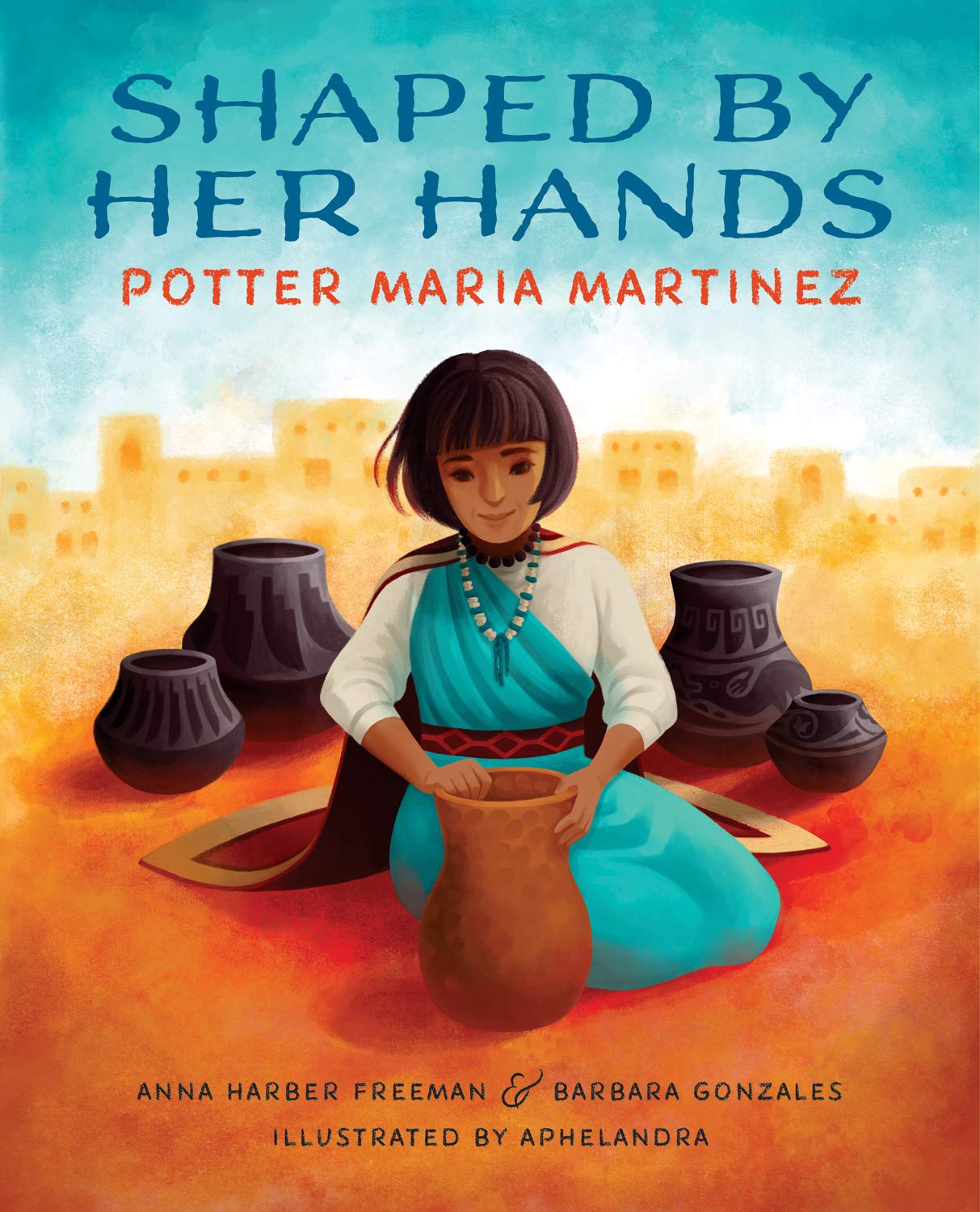
celebrate-picture-books-picture-book-review-shaped-by-her-hands-cover

About the Holiday

Cuddle ‘round for two loving holidays—Intergeneration Month and National Attend Your Grandchild’s Birth Day—which each encourage grandparents to be present figures in their grandchildren’s lives starting from birth! Already, many grandparents across the globe play active roles in caring for children. In the US alone, 4.8 million preschoolers were under the care of grandparents in 2011. Whether you are a grandchild, parent, or grandparent, it is important to support family and spread some love. Hug someone special today to celebrate this holiday. In honor of this day, we present a story about artist Maria Povika Martinez, co-written by her great-granddaughter. Her historical account teaches the importance of love, family, and the passing down of knowledge through generations.

Thanks to Albert Whitman & Company for sharing a copy of Shaped By Her Hands with me for review consideration. All opinions on the book are my own.

Review by Dorothy Levine

Shaped By Her Hands: Potter Maria Martinez (Part of the She Made History Series)

Written by Anna Harber Freeman and Barbara Gonzales | Illustrated by Aphelandra

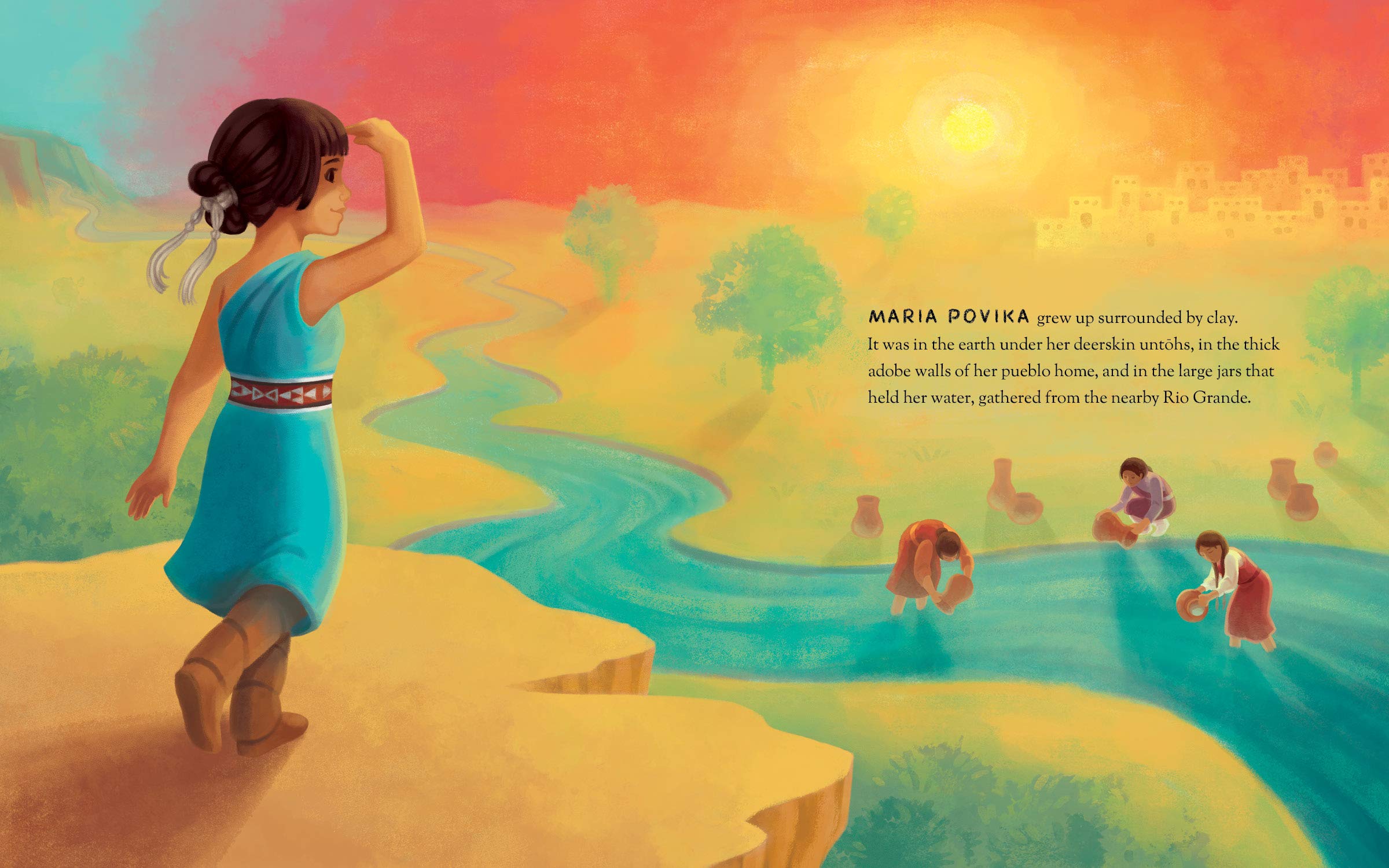
As a child growing up in the pueblo of San Ildefonso, New Mexico in the 1890s, Maria always loved clay. While her siblings played with straw dolls and her parents planted crops, Maria spent her time making clay pots. But, to her frustration, her pots would always crack when she set them out to dry in the sun. Maria’s aunt, or ko-ōo, Nicolasa offered to help and showed Maria “the centuries-old tradition of san-away.” Nicolasa still made clay pots using these traditional methods, even though more and more people were buying tin pots from stores. 

celebrate-picture-books-picture-book-review-shaped-by-her-hands-river

Image copyright Aphelandra, 2021, text copyright Anna Harber Freeman and Barbara Gonzales, 2021. Courtesy of Albert Whitman & Company.

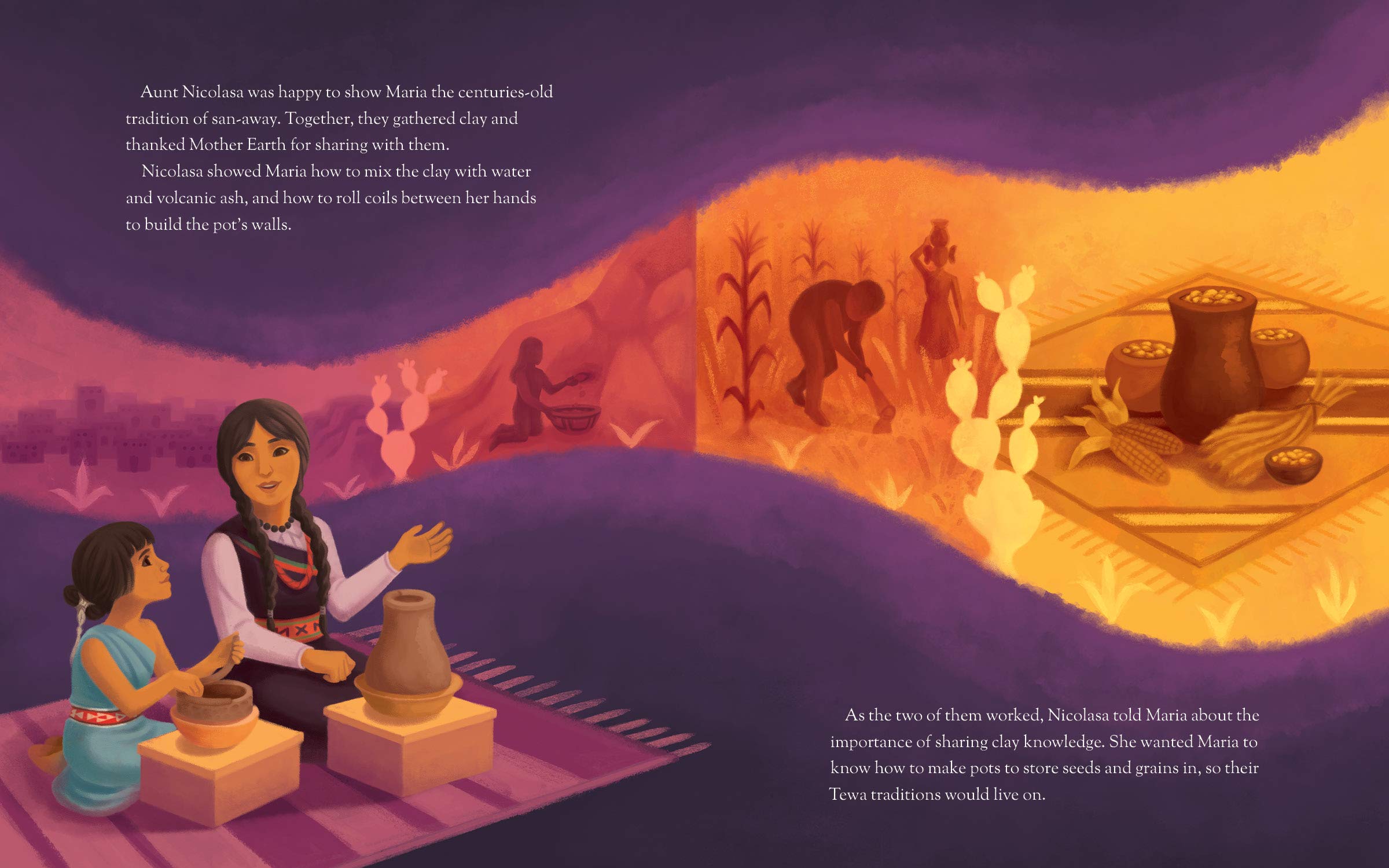
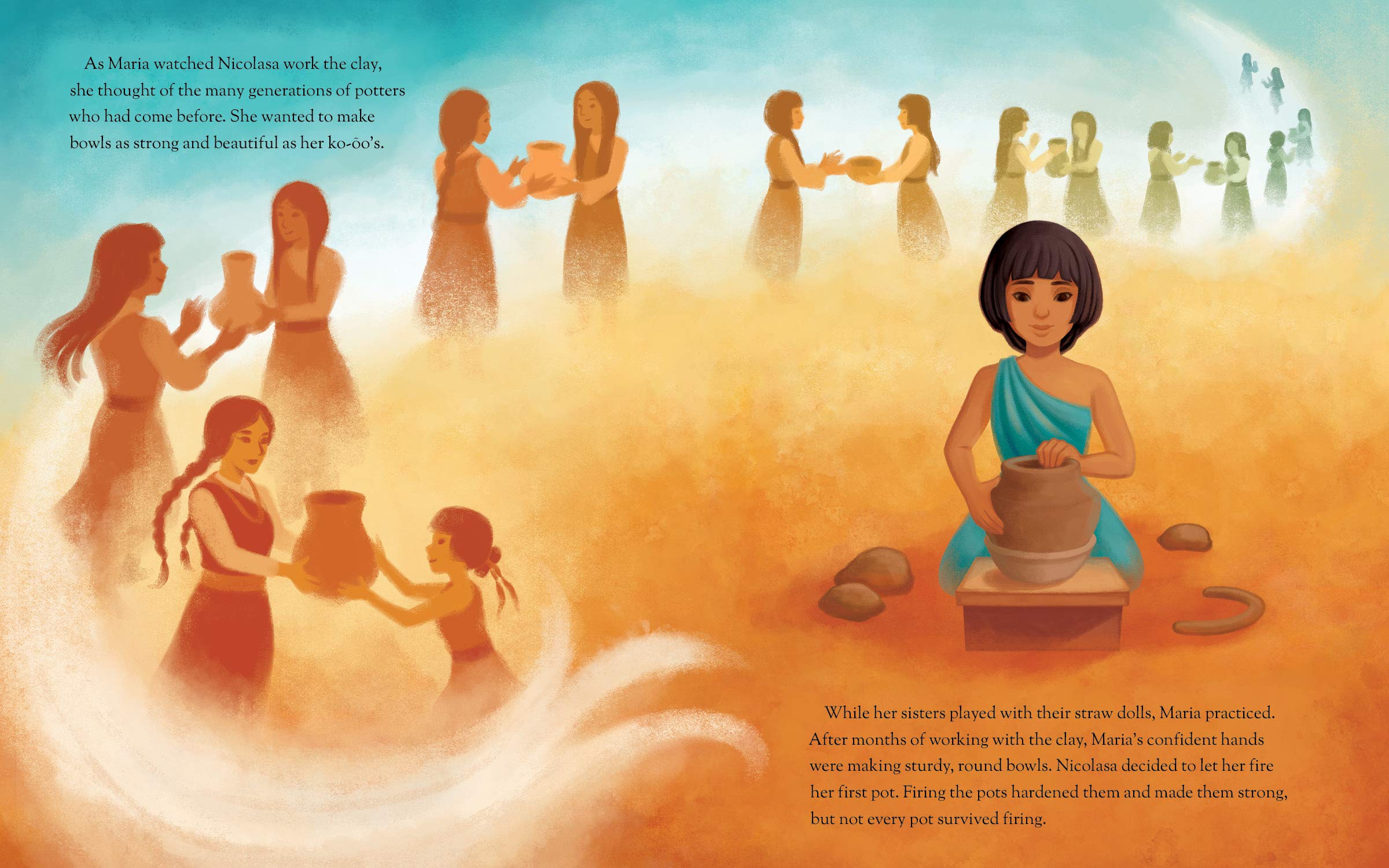
Nicolasa taught Maria how to coil the clay in circles and then lay the pots together on a fire to make them dry, solid, and strong. “As Maria watched Nicolasa work the clay, she thought of the many generations of potters who had come before. She wanted to make bowls as strong and beautiful as her ko-ōo’s.” Nicolasa and Maria thanked Mother Earth for the clay she shared with them. 

When Maria grew older, she continued to make pots and gained a reputation for her skilled work. One day in 1908, an archeologist named Edgar Lee Hewett came to visit Maria. He had discovered an old shard of black pottery in a dig nearby. Mr. Hewett wanted to know if Maria could recreate a pot in the similar style. She decided to take on the challenge.

celebrate-picture-books-picture-book-review-shaped-by-her-hands-Nicolasa

Image copyright Aphelandra, 2021, text copyright Anna Harber Freeman and Barbara Gonzales, 2021. Courtesy of Albert Whitman & Company.

After much experimentation, Maria and her husband, Julian Martinez, discovered a technique: “One afternoon, they tried smothering the fire to keep the smoke in. When they pulled out the pot, it was shiny, and black as a raven.” With this new method, Maria combined her own style with old traditions to create a new style of pottery that was marvelous. Mr. Hewitt took some of these pots Maria made. “He put one of the pots in the Museum of New Mexico, where he worked.” The others he took to shops in Santa Fe. To Maria’s surprise, they sold like crazy! Julian began to paint designs on the black shiny pots—decorations of serpents, feathers, and water—using a yucca-blade brush. 

As more and more pots sold, Maria and Julian taught the rest of her family and some friends to make the pots with them. They became so famous that many people across the country invited them to demonstrate their skills to others. When Maria’s husband died, she continued to make pots with her family. “First, her children came to paint the designs. Later, her grandchildren came to help with the painting and polishing. They made pots as a family, remembering to thank Mother Earth, and teaching new hands to form, polish, and design.” 

The story is followed by back matter that provides more information about Maria, the Tewa people, and the San Ildefonso Pueblo for readers. Both authors include a note about how they were influenced by Maria and why they believe it is important to share her story with young people today. 

celebrate-picture-books-picture-book-review-shaped-by-her-hands-generations

Image copyright Aphelandra, 2021, text copyright Anna Harber Freeman and Barbara Gonzales, 2021. Courtesy of Albert Whitman & Company.

The story is co-written by Barbara Gonzales, the great-grandchild of Maria, and Anna Harber Freeman, whose grandmother was a member of the Osage Nation and who is a lifelong fan of Maria’s work with degrees in multicultural education and art. Their biography of Maria Martinez shines with its lyrical, straightforward telling that reveals the deep history of the Tewa people as well as the meaning and uses of the pottery that Maria and her ko-ōo Nicolasa created by hand. The importance of passing down knowledge and traditions from one generation to another is organically woven throughout the story. Many readers will recognize Maria and Julian’s distinctive pottery and be inspired by the history behind it.

Aphelandra is a descendant of the Oneida Nation, and the daughter of a crafts artist and landscaper. She writes that she grew up surrounded by natural beauty and creativity, which can be seen in her illustrations. The illustrations in Shaped by Her Hands consist largely of soft yellow, green, and red hues. In the part of the story in which Maria is sent off to boarding school, the colorful tones found throughout the book are confined to a single window, depicting the feeling of entrapment and homesickness Maria felt. Aphelandra vividly weaves in the storytelling of past generations through her use of color, shadow and circular imagery. Her painted landscapes gorgeously depict the natural San Ildefonso scenery. 

This beautifully crafted tale shares the history of Maria Povika Martinez while introducing readers to Tewa people’s values of kindness, passing on of knowledge, and respect for elders and Mother Earth. An inspiring read for all children, especially those interested in artistic and creative endeavors, Shaped By Her Hands: Potter Maria Martinez is highly recommended for home bookshelves and a must for school and public library collections.

Ages 4 – 9 

Albert Whitman & Company, 2021 | ISBN 978-0807575994

Discover more about Anna Harber Freeman and her books on her website.

To learn more about Barbara Gonzales and her pottery and to view a video with Barbara and other artists discussing an exhibition of San Ildefonso Pueblo potters at the Museum of Indian Arts and Culture, visit the adobe gallery website.

You can learn more about Aphelandra, her books, and her artwork on her website.

Intergeneration Month Activity

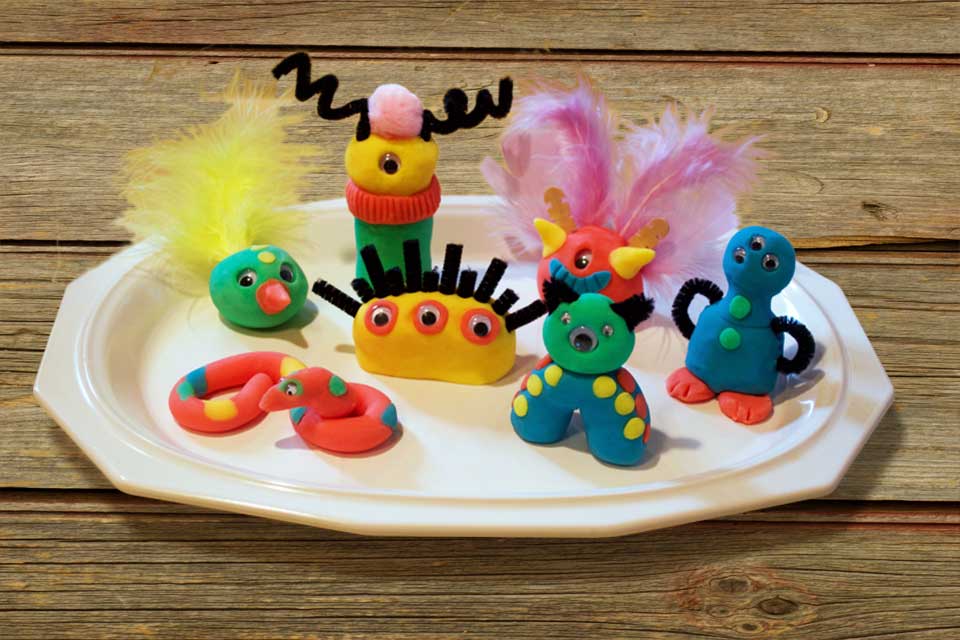
Highlights Kids Homemade Clay figures

Photo and craft sample by Madison McClain, courtesy of Highlights Kids (highlightskids.com)

This craft comes from Highlights Homemade Clay, by Marie E. Cecchini posted on April 12, 2016. You can find the post on the Highlights kids website.

Make your own homemade clay in honor of Maria’s art form then make your own pot or creation!

What you’ll need

  • 2 cups baking soda
  • 1 cup cornstarch
  • 1 ¼ cups water
  • Cooking pot
  • Food coloring (optional)
  • Wiggly eyes, chenille sticks, pompoms, feathers, etc. (optional)

What to do

Note: Food coloring can be added to the water before mixing in the other ingredients or can be added to the clay after it has cooled. Adding coloring later may be a little messier, but you can divide the clay and create different batches of various colors.

  1. Combine ingredients in the pot and cook mixture over medium heat, stirring until it thickens to a consistency like mashed potatoes.
  2. Let the clay cool
  3. Knead the clay until smooth.
  4. Make creations!
  5. Leave clay pieces in the sun to dry.

celebrate-picture-books-picture-book-review-shaped-by-her-hands-cover

You can find Shaped By Her Hands: Potter Maria Martinez at these booksellers

Amazon | Barnes & Noble | Books-a-Million

To support your local independent bookstore, order from

Bookshop | IndieBound

Picture Book Review

September 28 – Celebrating the Happy Cat Month Book Birthday of Miss Meow

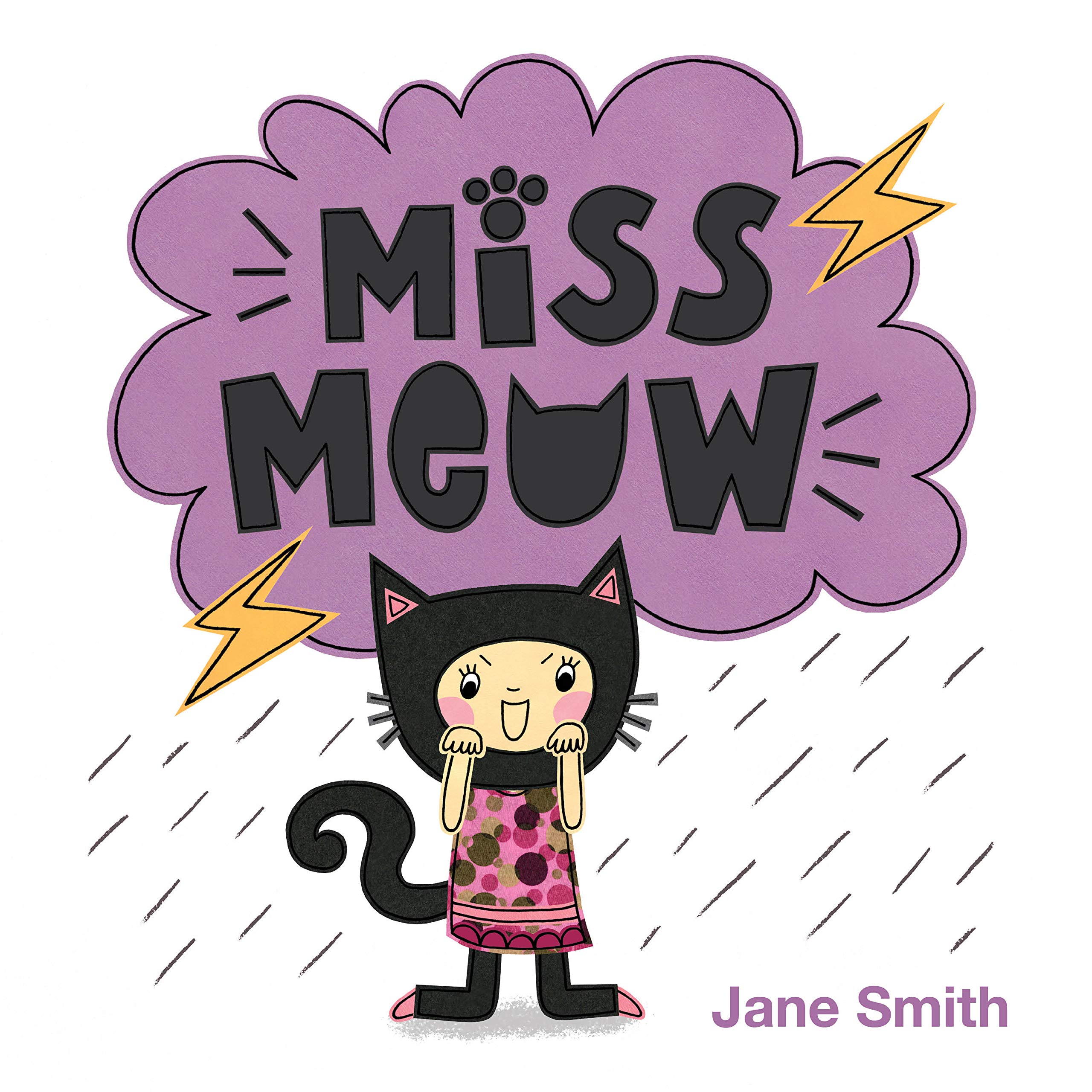
celebrate-picture-books-picture-book-review-miss-meow-cover

About the Holiday

It’s safe to say that when kitty is happy, everyone’s happy. Cats have a particular way of tugging at your heart with their meows, yowls, and emotion-filled mews. Of course, we want to make sure they have everything they need to feel good. That’s what this month’s holiday is all about. To celebrate, spend some extra time with your furry friend, make sure they’re up-to-date on their vaccinations, and surprise them with a new toy or extra treat or two.

Thanks to West Margin Press for sharing a digital copy of Miss Meow with me for review consideration. All opinions on the book are my own.

Miss Meow

By Jane Smith


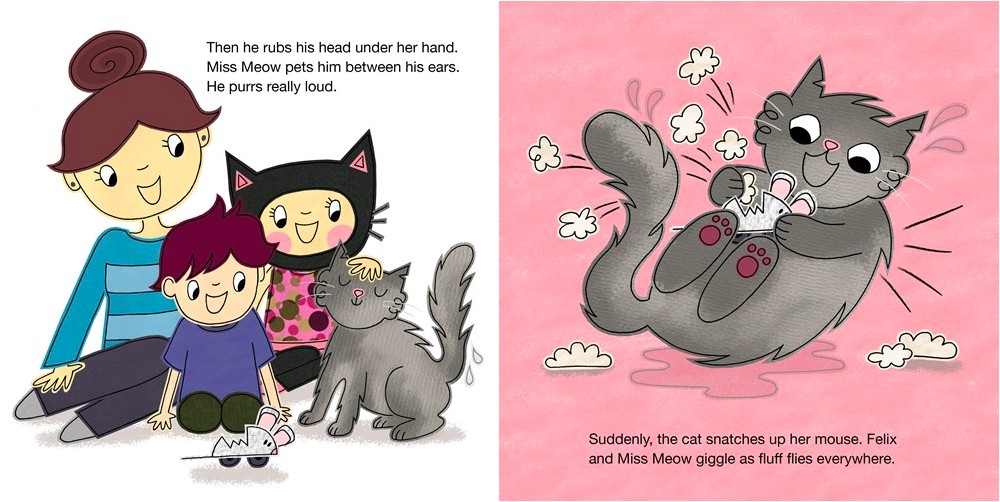
Miss Meow is a little girl who prefers being a cat. She has a soft head with two perky ears and a long tail. Things that make Miss Meow purr are getting scratched between the ears while reading with her mom and brother, Felix; chasing her toy mouse; napping in the sun; and lapping up water and snacks from her bowls. Things that make her hiss include taking a bath, having her snacks stolen, having her tail pulled, and having someone—like her little brother—intrude upon her territory.

celebrate-picture-books-picture-book-review-miss-meow-cuddle

Copyright Jane Smith, 2021, courtesy of West Margin Press.

One stormy night Miss Meow discovers her favorite mouse toy torn open in her room. The fluff inside was scattered across the floor. “Miss Meow’s fur stands straight up. Her ears flatten against her head. She knows who did this—who always does this!” She runs to her mom and complains about Felix. Then she “stalks toward her brother, pointing her claw.” Snack crackers crunch underfoot. Not only has Felix broken her toy, he’s upset her snack bowl.

celebrate-picture-books-picture-book-review-miss-meow-snacks

Copyright Jane Smith, 2021, courtesy of West Margin Press.

Miss Meow is caterwauling and stomping around when she slips in a puddle of water and falls to all fours—“Meee-ow!” But then Felix notices a “mysterious trail of wet paw prints” leading from the kitchen. Miss Meow, Felix, and Mom follow them to Miss Meow’s room, where they find . . . “a sopping wet intruder” asleep on Miss Meow’s pillow. Felix is thrilled to see the kitty, but Miss Meow is not. She chases the interloper through the house until she has him trapped in the kitchen.

But when Miss Meow sees that the stray is cold, shivering, and scared, her heart melts. “‘Here, kitty. It’s okay,’ she coos softly.” As the cat approaches, Miss Meow apologizes to her brother. The cat purrs as Miss Meow pets him between the ears then all three curl up on the pillow for a warm afternoon nap.

celebrate-picture-books-picture-book-review-miss-meow-cat

Copyright Jane Smith, 2021, courtesy of West Margin Press.

Young feline fanatics will purr with delight at Jane Smith’s tale of a little girl with a big imagination and an all-in love for cats. The uncanny similarity in behavior between cats and kids gives Smith full range to shine a humorous spotlight on bath time, naptime, territorial disputes, and sibling rivalry. But, as part cat, part human, Miss Meow’s natural empathy for her fellow cat and for her brother takes over when she sees how miserable the stray is and realizes that she owes Felix an apology. Smith’s use of present tense puts kids in the middle of the action, while her vivid and evocative illustrations clearly depict the characters’ emotions. Readers will love spying the first glimpse of the hidden stray, and Miss Meow’s mad-dash chase through the house leads to a sweet resolution.

Both a captivating story and an engaging way to talk to kids about their emotions and family relationships, Miss Meow is a purr-fect read aloud for all kids.

Ages 4 – 6

West Margin Press, 2021 | ISBN 978-1513289458

You can connect with Jane Smith on Twitter and linktree.

Happy Cat Month Activity

celebrate-picture-books-picture-book-review-wooden-bead-cat-craft

A Little Ball of Kitten


This happy little kitten is easy to make and can keep you company on your desk or shelf! Since every kitten is different, you can make yours to look just the way you want. Here’s how I made mine:

Supplies

  • Wooden ball with a flat bottom, available in craft stores and in different sizes
  • Craft paint in any color kitten you’d like (I used red and yellow and mixed it to make a mottled orange)
  • Craft paint in pink or white for the inner ear
  • Scrap of fleece for the ears. Fleece is easily shaped to the rounded ball, and when it’s painted it’s stiff enough to stand up on its own.
  • Thin, colored wire in several colors for the tail (string or twine, wrapped wire, fleece, stiff paper, and other materials could also be used)
  • Paint brush
  • Permanent marker for making the face
  • Hot glue gun or strong glue

Directions

  1. Paint the wooden ball and let dry
  2. Paint the scrap of fleece to match the wooden ball, let dry
  3. Cut out small triangular shapes for the ears. Round the bottom of the ears slightly so they fit the shape of the ball. Paint the inner ear.
  4. If making a tail from several colors of thin wire, twist them together, leaving one end untwisted
  5. With the glue gun or strong glue attach the ears to the top of the head
  6. With the glue gun attach the tail to the back of the wooden ball in the center near the base
  7. With the marker, draw eyes, nose, and mouth for the face and semicircles near the bottom for the paws

celebrate-picture-books-picture-book-review-miss-meow-cover

You can find Miss Meow at these booksellers

Amazon | Barnes & Noble | Books-a-Million

To support your local independent bookstore, order from

Bookshop | IndieBound

Picture Book Review
September 27 – Get Ready for Halloween

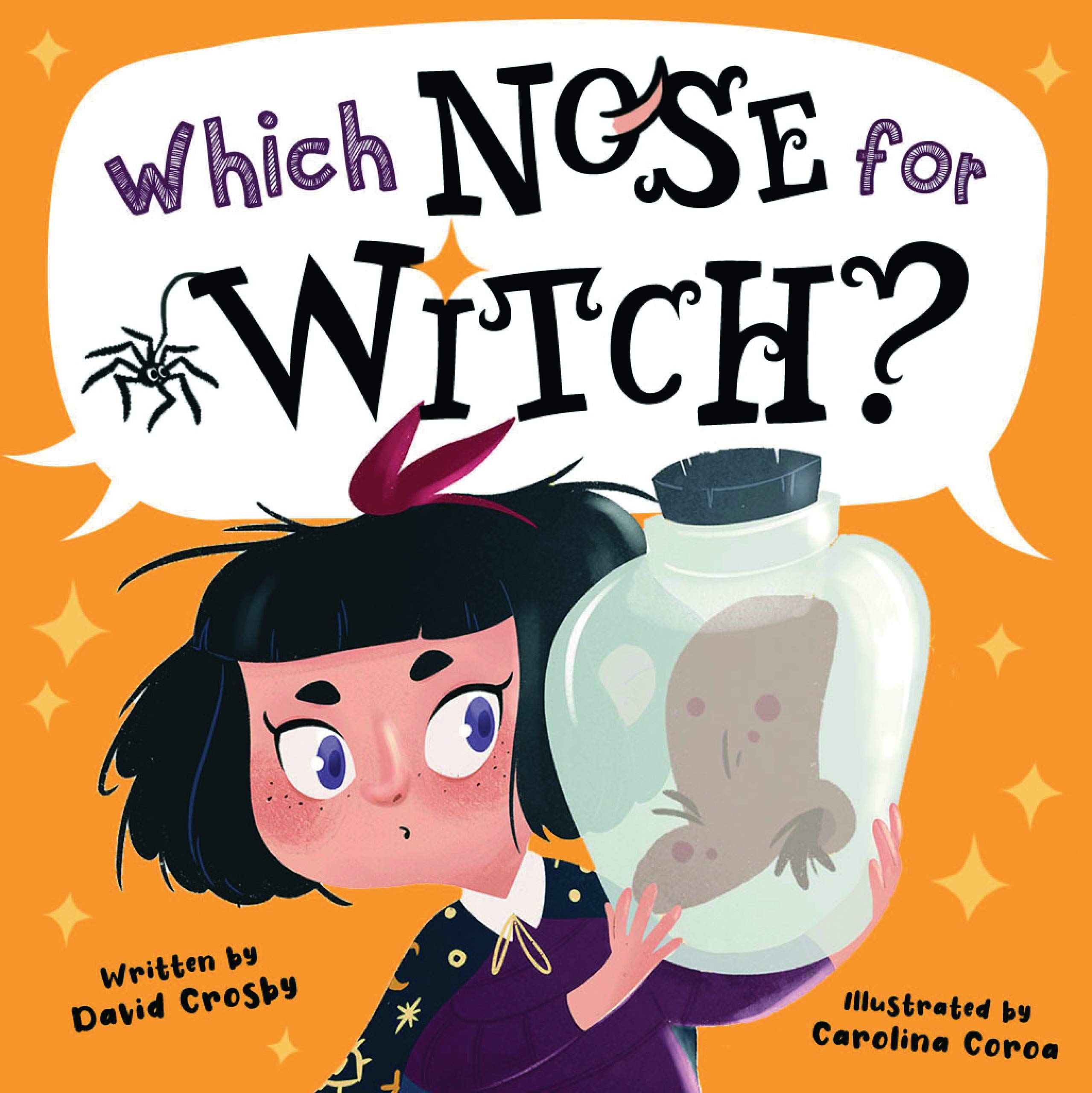
celebrate-picture-books-picture-book-review-which-nose-for-witch-cover

About the Holiday

With its invitation to dress up, free candy, and spooky fun, Halloween is a favorite holiday of kids and adults—even pets get in on the act! With September winding down, Halloween will be here before you know it. Celebrating all the spookiness of ghosts, goblins, and especially witches, with their ability to conjure magic with just a flick of their wands, with picture books is a big part of the fun. Today’s book is perfect for read alouds this month and all through the year! 

Thanks go to Maverick Arts for sharing a copy of Which Nose for Witch? with me for review consideration. All opinions about the book are my own.

Which Nose for Witch?

Written by David Crosby | Illustrated by Carolina Coroa


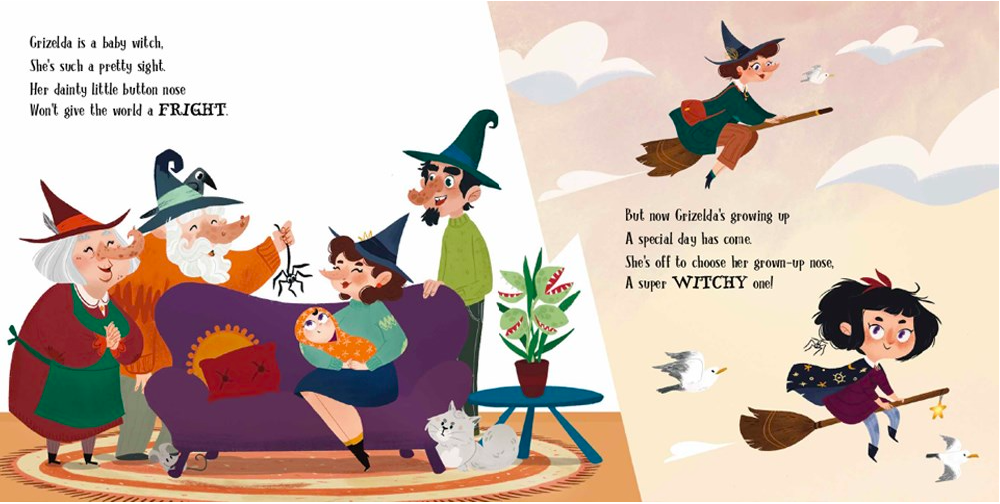
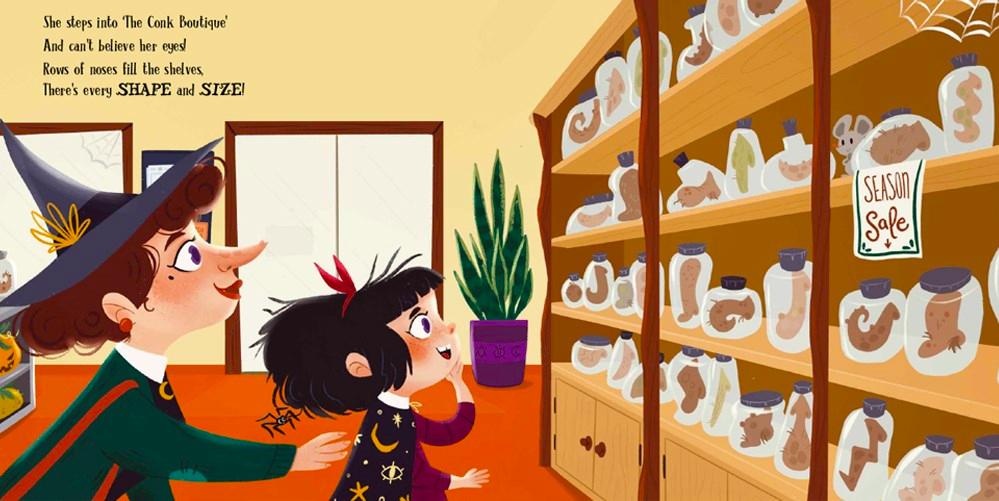
When Grizelda was born, she was a pretty little baby with a button nose, “but now Grizelda’s growing up / A special day has come. / She’s off to choose her grown-up nose, / A super WITCHY one!” Her mom takes her to “‘The Conk Boutique,’” where she has shelves and shelves of noses to choose from. But how will Grizelda see how they look on her? Her mom tells her that with just a wave of her wand, she can cast a “‘nose-swap spell / To try it on your face!’”

celebrate-picture-books-picture-book-review-which-nose-for-witch-family

Image copyright Carolina Coroa, 2021, text copyright David Crosby, 2021. Courtesy of Maverick Arts.

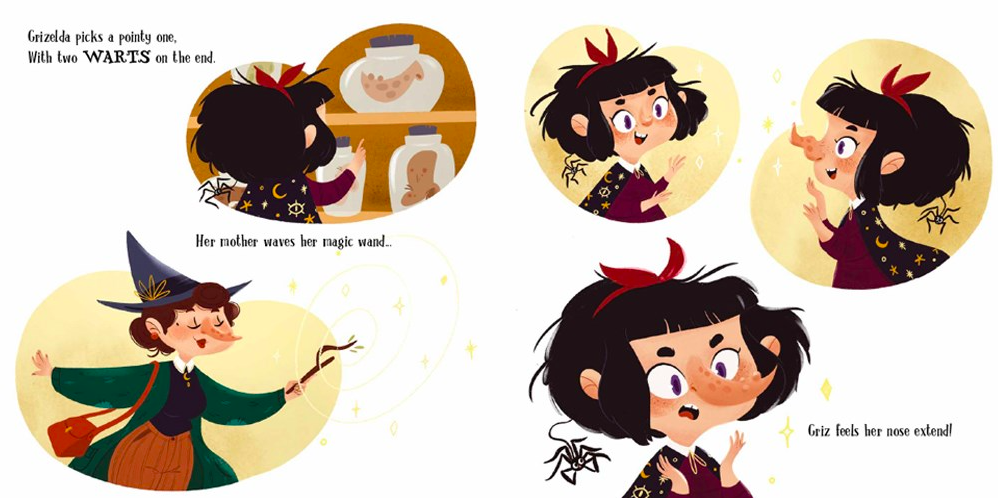
Griz picks out one that’s pointy with two warts on the tip and with a flick of her mother’s wand, she feels her nose growing. Her mom thinks Griz looks beautiful, but Griz imagines eating an ice-cream cone will not be easy. Next, she tries a hooked nose with bumps and bits of hair. Again her mom thinks Griz is gorgeous, she says, “‘You look COMPLETELY witchy!’” But “‘This nose feels really bad,’ says Griz. ‘It’s TINGLY and it’s ITCHY!’”

celebrate-picture-books-picture-book-review-which-nose-for-witch-shop

Image copyright Carolina Coroa, 2021, text copyright David Crosby, 2021. Courtesy of Maverick Arts.

She tried on nose after nose, drawing a crowd of onlookers, but none of them were right. Her mother marched her outside and laid down the law: she had “‘to choose a grown-up nose / To be a grown-up witch.’” Grizelda said, “‘Says who?’” and turned away. Then she saw something in the shop window and knew exactly which nose she wanted. It was perfect for eating ice cream and she knew it wouldn’t itch. Her mom was relieved and offered to “‘buy it right away.’” Griz called her mom over to the window to show her what she’d found.
Reflected in the glass was Griz’s own nose! “‘But NO witch keeps her baby nose,’” her mother said. “‘Oh Griz, this is the WORST.’” But Griz saw opportunities and nothing wrong with being first. So now while most witches still change their nose, “Griz feels grown-up and confident, / And LOVES her own reflection.”

celebrate-picture-books-picture-book-review-which-nose-for-witch-warts

Image copyright Carolina Coroa, 2021, text copyright David Crosby, 2021. Courtesy of Maverick Arts.

Just in time for Halloween, when kids’ thoughts turn to transforming themselves into all things witchy and scary, comes a humorous and bewitching story of confidence, self-love, and the courage to be yourself. David Crosby’s clever concept—that witches choose their own distinguishing facial feature as a rite of passage gives kids a lighthearted way to think about their own uniqueness in looks, personality, talents, thoughts, and other traits.

Along the way they can empathize with Grizelda as the noses she chooses just aren’t right for her. Grizelda’s pluck in resisting the pressure of the crowd and her mother’s scolding while realizing that she’s perfect just the way she is is a reassuring message for kids who might feel the undue burden of peer pressure or expectations.

Carolina Coroa’s charming illustrations of witches and warlocks sporting prominent noses include plenty of spooky details to keep kids enchanted. As a baby at home, Grizelda’s grandfather dangles a spider for her to play with while a crow sits on his shoulder and a Venus flytrap plant sits on a nearby table. Grown up and shopping for noses, Griz rides a broom, wears a spider in her hair, and completes her outfit with the requisite cape.

The shelves of noses, each in its own jar, will have readers stopping to choose their favorites—for themselves, their mom and dad, their siblings, and other family members and friends. Coroa’s image of Grizelda gazing into the shop window happy to have found the perfect nose is cunningly conceived to keep kids guessing until the surprise twist ending is revealed. The final illustration of a confident Grizelda taking her place in the sky with other grown-up witches will delight readers.

An enchanting and uplifting story to inspire kids to be true to themselves, Which Nose for Witch? is magical storytelling for the Halloween season and all year through for all kids on the path to growing up and self-discovery.

Ages 4 – 9 

Maverick Arts, 2021 | ISBN 978-1848867789

You can connect with David Crosby on Twitter.

To learn more about Carolina Coroa, her books, and her art, visit her website.

Get Ready for Halloween Activity

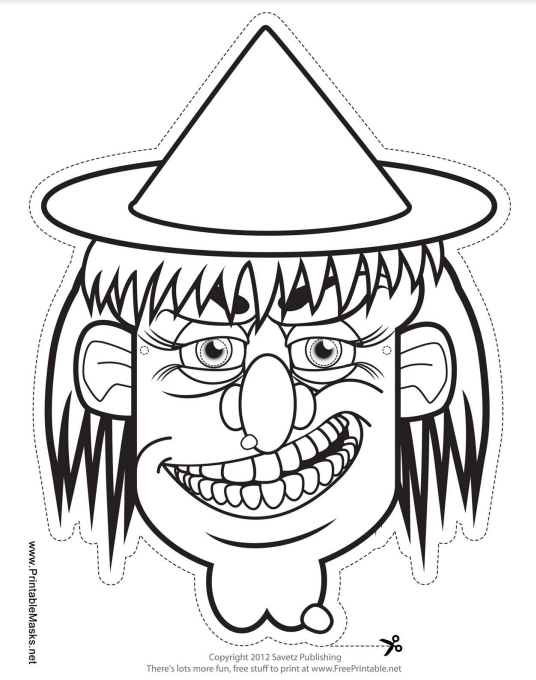
celebrate-picture-books-picture-book-review-witch-mask

Halloween  Masks and Coloring Pages


Discover how you’d look with a witch’s nose (and chin, hat, and all the rest) with this printable witch mask to color. Or maybe you’d rather be a robot! Why not try them both and then have fun with the two printable coloring pages.

Witch Mask | Robot Mask | Witch Coloring Page 1 | Witch Coloring Page 2

celebrate-picture-books-picture-book-review-which-nose-for-witch-cover

You can find Which Nose for Witch? at these booksellers

Amazon | Barnes & Noble | Books-a-Million

To support your local independent bookstore, order from

Bookshop | IndieBound

Picture Book Review