Potty training is a rite of passage for little tykes of a certain age. With so many (sometimes conflicting) offers of advice, online forums, and other resources, plus a sometimes-added time crunch, it can be difficult for parents to navigate this issue without feeling stressed. A regular routine, patience, and following a child’s lead can go a long way in making this time in life successful and positive for all.
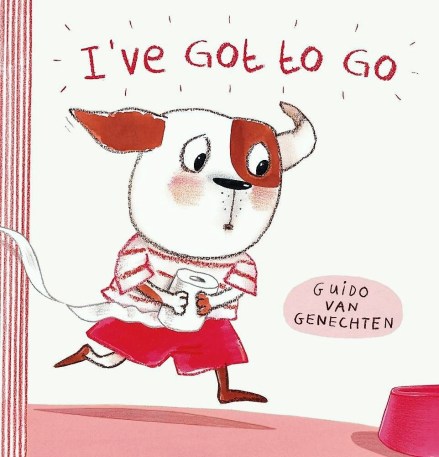
I’ve Got to Go
By Guido van Genechten
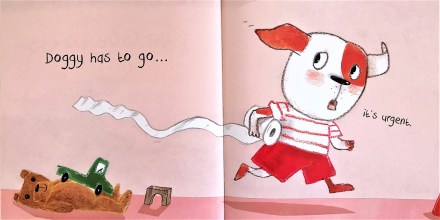
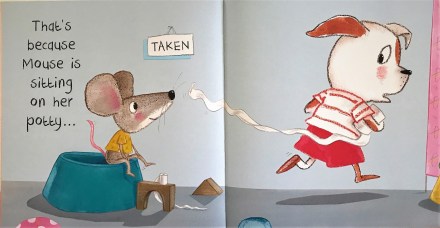
Doggy has an urgent problem. He needs to go to the bathroom, but his little sister is using his little plastic potty. He runs by, toilet paper roll clasped under his arm, to find his sister’s potty, but mouse is already sitting there. Doggy rushes on and sees why Mouse is in the wrong spot—“Frog is having a wee in Mouse’s potty…”
Copyright Guido van Genechten, 2017. Courtesy of Clavis Books.
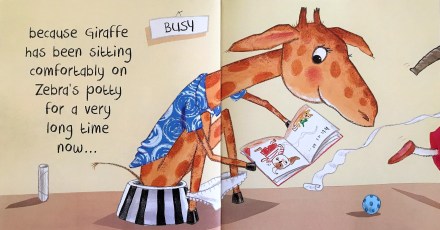
With a “pardon,” Doggy moves on. Hmmm…Zebra is using Frog’s potty—well mostly. Maybe it’s because “Giraffe has been sitting comfortably on Zebra’s potty for a very long time now….” All this running and waiting has made Doggy’s dilemma even more immediate. There’s only one place left, so “he runs—for the very first time!—to the big toilet.” Phew! It’s free.
Copyright Guido van Genechten, 2017. Courtesy of Clavis Books.
Doggy climbs up with the help of a little stool, and…ahh…that’s better! And it wasn’t hard at all! Doggy remembers to wipe his bottom, push the flusher, and then he washes his paws. He opens the bathroom and can’t wait to share his big news. “‘Sis!’” he then calls out, proud as a peacock. ‘You can keep my potty! I don’t need it anymore.’”
Copyright Guido van Genechten, 2017. Courtesy of Clavis Books.
Part race against time, part matching puzzle, and wholly fun, Guido van Genechten’s I’ve Got to Go will have preschoolers giggling as they follow Doggie past potty after potty in search of a place to go. The large-format book with van Genechten’s brightly colored portrayals of each adorable animal sitting on a potty is sure to engage kids. With time and options running out, Doggy’s “big boy” decision to try the regular toilet will intrigue little ones learning this skill themselves.
Young readers will also have fun matching the potty with the animal and enjoy learning some “big words” for when the bathroom is in use. Reenacting Doggie’s triumphant run with toys at home may just be the kind of silly but “Ah-ha” experience that puts all the teaching together for success.
Ages 2 and up
Clavis Publishing, 2017 | ISBN 978-1605373379
Potty Training Awareness Month Activity
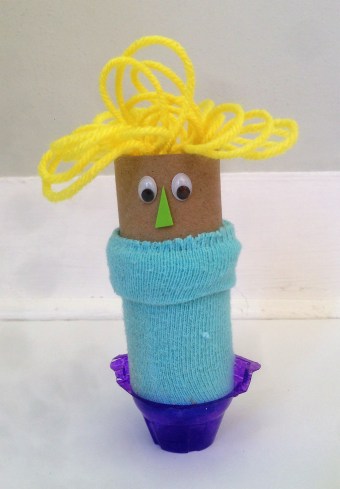
Potty Buddy
Sometimes a little encouragement from a friend can help kids try something new. This easy-to-make, kind-of-silly Potty Buddy can be designed by the trainee to be just the friend they want along as they make that first step toward independence.
Supplies
Toilet paper tube
Toddler size sock or cloth
Several feet of yarn
Googly eyes (optional)
Scrap of foam, colored paper, or cloth
Glue
Directions
Pull a toddler-size sock over the paper towel tube and fold down the top to make a collar. Alternately, wrap cloth around the toilet paper tube and glue in place.
Glue googly eyes on the tube
Cut a small triangle or other shape for a nose from the foam or colored paper
Loop the yarn about 20 times in a 5 – 6 inch length
Tie the yarn in the middle
Fold and glue into the top opening of the tube for hair.
It’s fun to go to an aquarium to see sea creatures from all over the world and hear interesting presentations, but it’s also a great experience to have an aquarium—or even just a bowl at home! Having a pet, whether it is large or small, offers wonderful opportunities for children to establish bonds of friendship and to learn about the natural world around them. To celebrate this month’s holiday, consider getting a home aquarium!
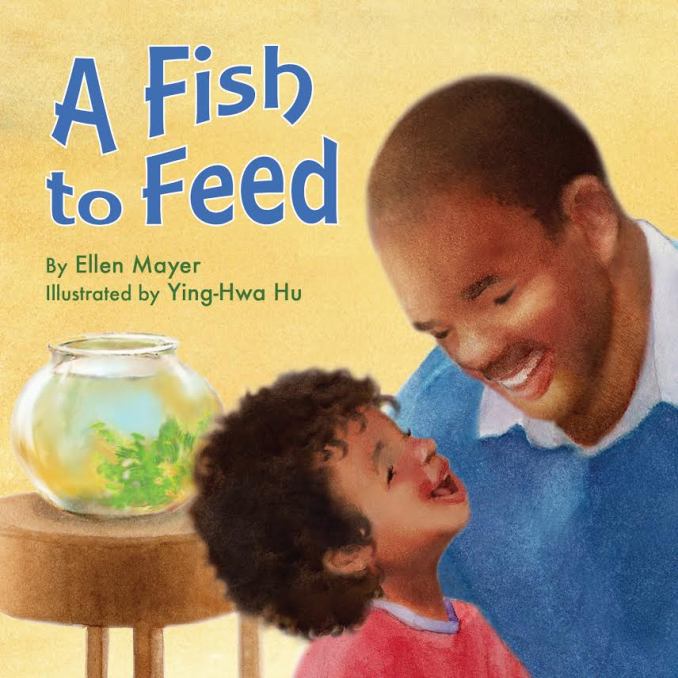
A Fish to Feed
Written by Ellen Mayer | Illustrated by Ying-Hwa Hu
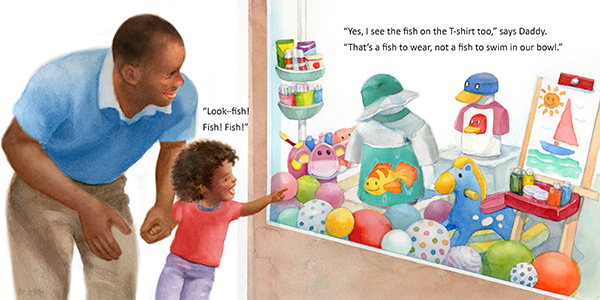
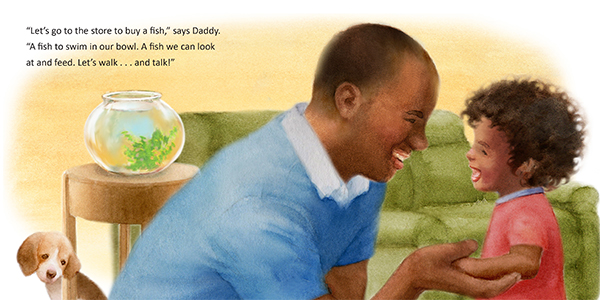
Dad plans a fun trip into town with his young child to buy a pet fish. He says, we will get “‘a fish to swim in our bowl. A fish we can look at and feed.’” The pair are excited to go together and have time to “‘walk…and talk.’” The two head out and soon pass a store. In the window the child sees a T-shirt with the picture of a fish on it and points. “‘Look—fish! Fish! Fish!’” Dad reinforces the observation—“‘Yes, I see the fish on the T-shirt too.’”—and further explains: “‘That’s a fish to wear, not a fish to swim in our bowl.’”
Image copyright Ying-Hwa Hu, text copyright Ellen Mayer, 2015. Courtesy of starbrightbooks.com
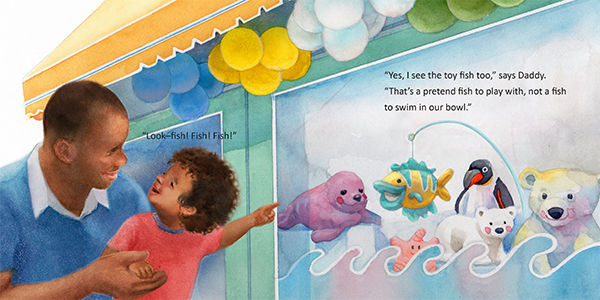
Going into the store, Dad and his youngster find another item with a fish on it. On a shelf is a backpack with a picture of a gold-and-yellow fish on the front pocket. This is a “‘fish to wear on your back,’” Dad says, before going in search of a “‘fish to feed.’” Next, the two come to a toy store. The child points to another fish—a fish on a mobile. “‘Look—fish! Fish! Fish!’” the toddler exclaims. Dad affirms his child’s remark and expands on it using complete sentences that model conversation and increase vocabulary. They linger in the shop, finding other examples of fish.
Image copyright Ying-Hwa Hu, text copyright Ellen Mayer, 2015. Courtesy of starbrightbooks.com
“‘Now let’s go find a fish to feed,’ says Daddy.” They head out of the store and continue down the street. As they come to the Pet Shop, the little one shouts, “‘Look—fish! Fish swim!’” Daddy echoes the excitement while praising his child. “‘You found a fish that swims!’” They take the goldfish home, where it swims happily in their bowl—a pet they “‘can love and feed.’”
A Fish to Feed contains die-cut holes in the pages that kids will love peering through as they shop along on this adventure to find a special pet.
Image copyright Ying-Hwa Hu, text copyright Ellen Mayer, 2015. Courtesy of starbrightbooks.com
Ellen Mayer’s story of a dad and his child out for an afternoon together as they look for a pet to love offers adults and children such a sweet way to spend time with one another. The story, set in the familiar environments of home and stores and revolving around a close parent-child relationship, will engage even the youngest readers. The back-and-forth conversation between Dad and his child as they shop models ways in which adults can follow a child’s lead while providing language and literacy development. The abscence of gender-specific pronouns makes this a universal story.
Ying-Hwa Hu’s illustrations are vibrant and joyful. When Dad bends down to be at eye-level with his toddler as they talk, the close bond between them is obvious in their smiling and laughing faces. The shops are full of colorful toys, clothes, backpacks, and other items that will capture kids’ attention. Spending time looking at each page allows adults and children to point at the various items, name them, and talk about them.
Ages Birth – 5
Star Bright Books, 2015 | ISBN 978-1595727077
To learn more aboutEllen Mayerand her Small Talk Books® (including other titles: Red Socks,Cake Day, and Rosa’s Very Big Job) as well as to find activities to accompany each book, visit her website!
Discover more aboutYing-Hwa Huand view a portfolio of her illustration work on her website!
About Small Talk Books®
Ellen Mayer’s Small Talk Books® feature young children and adults talking together while they have fun, do chores, shop, and bake together. The adults speak in full sentences as they share details of their adventures and respond to and reinforce their child’s words and actions. Their conversations model the kinds of excitement and close relationships that encourage learning and language advancement. Each Small Talk Book® includes a note from Dr. Betty Bardige, an expert on young children’s language and literacy development and the author of Talk to Me, Baby! How You Can Support Young Children’s Language Development. This inviting introduction for parents and caregivers discusses how little ones connect actions, words, and meaning as adults talk with them while doing particular jobs or actions.
Other titles in the Small Talk Books® series include Red Socks, Cake Day and Rosa’s Very Big Job. Each book makes a wonderful gift for baby showers, new parents, or anyone with young children in the family. They would be a welcome addition to any young child’s bookshelf as well as to libraries and preschool classrooms.
Zoo and Aquarium Month Activity
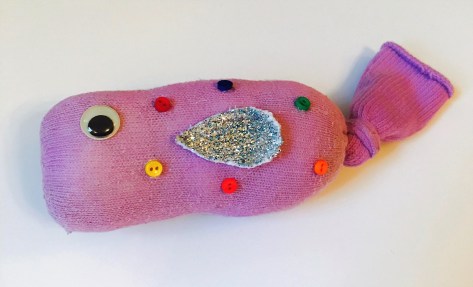
Swimmingly Sweet Sock Fish
A colorful sock can become a charming fish to decorate a child’s room with this easy craft.
Supplies
Child’s colored sock
Poly fiber fill
2 googly eyes
Small buttons or foam dots (optional). Do not use small items with young children as they pose a choking hazard
Fabric Markers or fabric paint (optional)
Needle and thread
Glue gun or strong glue
Directions
Stuff the child’s sock with fiber fill up to where the ankle cuff starts
Tie a knot in the ankle, letting the cuff free as the tail
Glue the googly eyes on the fish with the glue gun or strong glue
Glue the buttons or foam dots on the fish with the glue gun
To hang the fish, insert thread through the top of the fish and knot to make a hanger
Olympic Day is celebrated by millions of people in more than 160 countries to commemorate the birth of the modern Olympic Games in 1894. The mission of Olympic Day is to promote fitness, well-being, culture and education, while promoting the Olympic values of excellence, friendship and respect. The Olympic Day pillars – move, learn and discover – are promoted in every corner of the globe. To have Olympic-size fun today, why not get together with friends or family and host your own mini-Olympic games? For more ideas and to learn more about today’s observance visitteamusa.org!
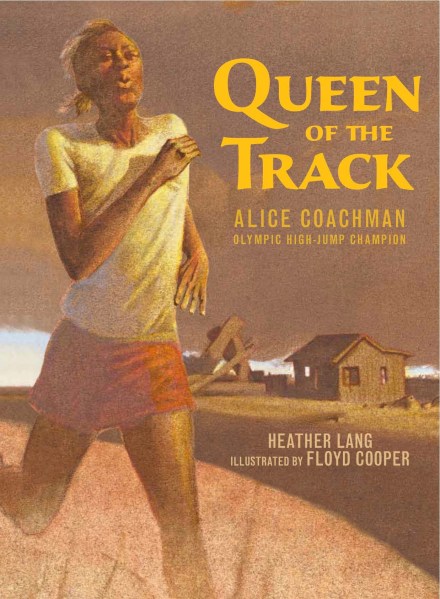
Queen of the Track: Alice Coachman, Olympic High-Jump Champion
Written by Heather Lang | Illustrated by Floyd Cooper
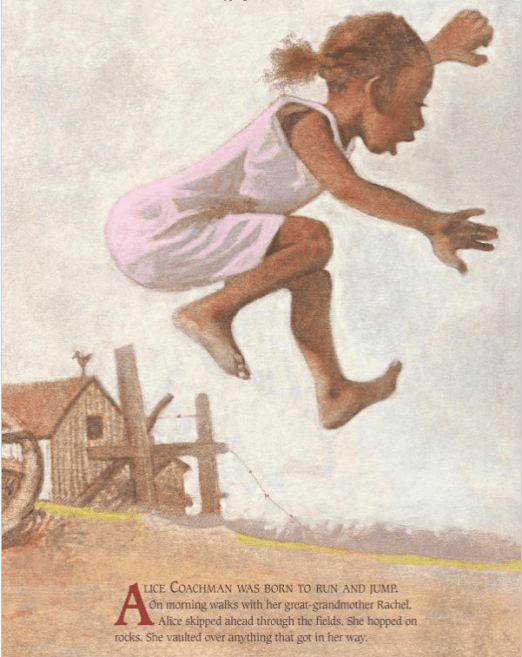
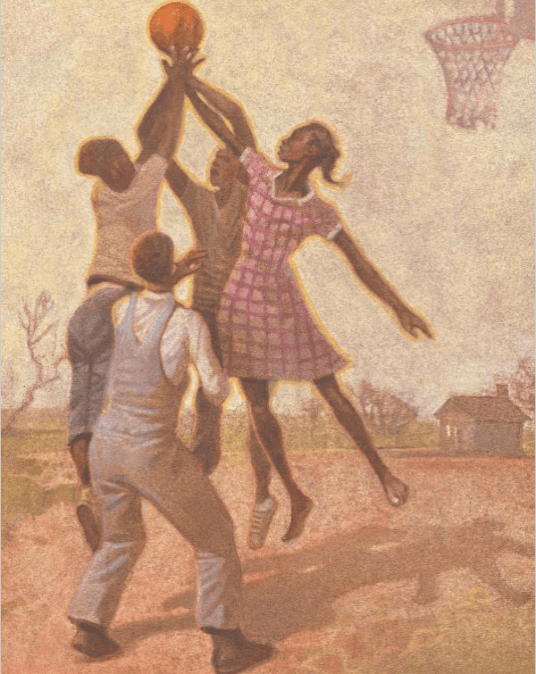
Alice Coachman was a born runner and jumper—skipping, hopping, and vaulting over every obstacle that came her way. As Alice grew older, however, the joy of running and jumping had to come a distant second to chores like cooking, laundry, picking cotton and peaches, and taking care of her younger siblings. Besides, her papa told her, “running and jumping weren’t considered ladylike.” Still, that was all Alice could think about, so after her chores were finished, she went out to play sports with the boys.
Image copyright Floyd Cooper, text copyright Heather Lang. Courtesy of Boyds Mills Press, 2012.
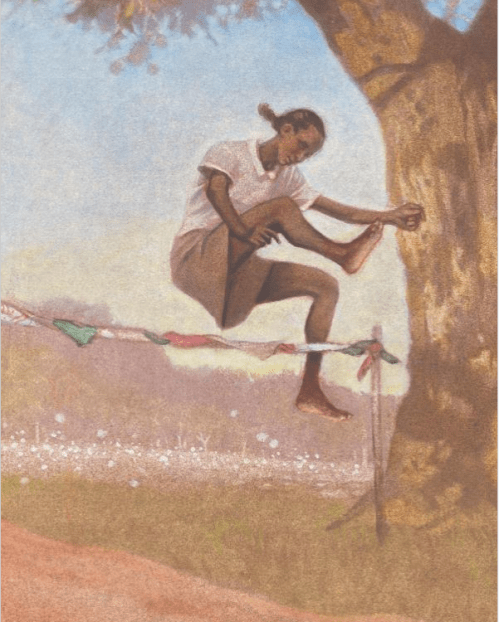
Living in the segregated South, Alice didn’t have the same rights as white people. She had nowhere to practice, but that didn’t stop her. Alice “ran barefoot on dirt roads. She collected sticks and tied rags together to make her own high jumps. Alice jumped so high, she soared like a bird above the cotton fields.” In seventh grade, Alice caught the attention of the high-school track coach. He arranged for her to join the track team at the Tuskegee Relays in Alabama, where the best black athletes from around the country competed. Alice had never worn track shoes or jumped over a real high-jump bar, she “won first place anyway, beating high-school and college girls.
Alice’s speed did more than win races. Once when a tornado ripped through Albany, she volunteered to deliver food to those in need. She ran so fast that the food stayed hot! Her talent won her a scholarship to finish high school at the Tuskegee Institute. Alice missed her family, and they didn’t have the money to really stay in touch. “One time she went home for a surprise visit, and her family had moved to a different house.”
Image copyright Floyd Cooper, courtesy of Boyds Mills Press, 2012
Alice competed on both the track-and-field and basketball teams. She won every event— the high jump, the 50-meter, the 100-meter, and the 400-meter relay—and led the basketball team to three straight championships. Alice was ready to compete in the Olympics. It was 1944, however, and the Olympic Games were canceled as the world was at war.
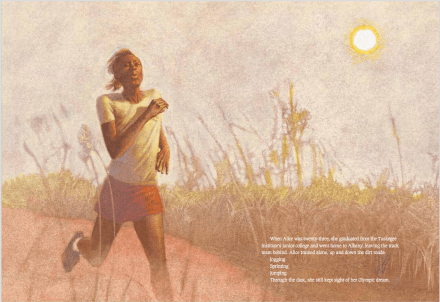
After graduating college from the Tuskegee Institute, Alice went home to continue practicing. Here, she trained alone on dirt roads. In 1948 with the war at an end, Alice qualified to compete in the London Olympics high jump. Even though years of hard training had weakened her back and made jumping painful, Alice pursued her dream. In London, the ravages of war were still visible, and “England faced serious food shortages. Alice and the other athletes were often hungry and thirsty.” The cold weather “pricked her like pins,” but here Alice and the other athletes—black and white—lived together, and Alice could sit anywhere she wanted on the buses as she toured the city.
Image copyright Floyd Cooper, text copyright Heather Lang. Courtesy of Boyds Mills Press, 2012.
As the Olympic Games opened with spectacular ceremonies, Alice marched into “Wembley Stadium to the applause of eighty-five thousand spectators.” Alice watched for eight days as her teammates lost event after event. Finally, it was Alice’s turn to compete. Her toughest opponent was Dorothy Tyler of Great Britain. “Inch by inch they battled it out—5 feet 3 2/5 inches, 5 feet 4 ½ inches. The sand in the landing pit was thinning out and the landings were tough on Alice’s back. 5 feet 5 1/3 inches.” The day was waning, and even though all of the other events were over, “the king and queen of England and thousands of spectators stayed to watch.”
The bar was placed at 5 feet 6 1/8 inches—as tall as Alice herself. She had never jumped so high before. “She sprinted, pumping her arms. She pushed off and flew…up…soaring…over the bar. Her leap set a new Olympic record!” But it was short lived. Dorothy also cleared the bar on her second attempt. The bar was placed at 5 feet 7 inches. Alice and Dorothy both jumped and missed. What would the judges decide? There are no ties allowed in the high jump.
Suddenly, Alice saw her name appear on the board! The judges awarded the medal to her because she “had made the record-breaking jump on her first try.” On that day—August 7, 1948—Alice Coachman stepped to the top of the podium and “became the first African American woman to win an Olympic gold medal.”
Image copyright Floyd Cooper, courtesy of Boyds Mills Press, 2012
Author’s Notes containing more information about Alice Coachman and the 1948 Olympics as well as lists of resources follow the text.
Heather Lang brings an athlete’s appreciation for the in-born talent and hard practicing that creates a world-class Olympian. Her story reveals not only the details of Alice’s physical training but also the social and economic hurdles she overcame in her quest to compete in the Olympics. Lang’s graceful and evocative prose carries readers down dirt roads and over obstacles, to the halls of the Tuskegee Institute, and into Wembley Stadium as they learn about the singular focus Alice Coachman dedicated to her sport. Children will feel as if they are sitting in the stands watching with suspense as the bar is raised again and again, pushing Coachman to a world record.
Floyd Cooper sets readers in the hot, dusty, sun-burned South, where Alice Coachman—as a little girl and then a teenager—runs barefoot on dirt roads, jumps over homemade bars, leaps to tip the basketball from her brothers’ hands, and delivers food to tornado victims. The golden-brown-hued illustrations catch Dorothy Taylor and Alice Coachman as they soar over the high bar in their fierce competition and capture Coachman’s hopes, dreams, and anticipation as she waits—hands clasped—to hear the judges’ final decision in the 1948 Olympic Games. Readers will cheer to see Coachman standing on the first-place podium, ready to receive her well-deserved gold medal.
A compelling and inspiring biography for children pursuing any talent, Queen of the Track: Alice Coachman, Olympic High Jump Champion would be a welcome addition to home, school, and public libraries.
Ages 5 and up
Boyds Mills Press, 2012 | ISBN 978-1590788509
Discover more about Heather Lang and her books plus videos, pictures, and fun activities that accompany each book on her website!
Learn more about Floyd Cooper, his books, and his artwork on his website!
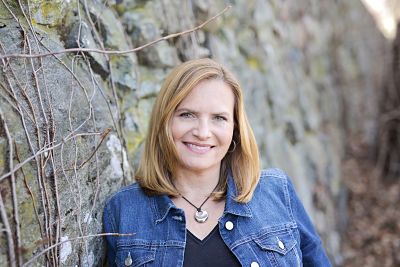
Today, I’m excited to talk with Heather Lang about her inspirations, her books, brave women, and writing and research lets her be a little like childhood heroine Nancy Drew!
How did you become a children’s writer?
As a child, I loved books and stories and creating things, but I struggled with writing. I was much better at math. I never thought I could become an author, because I wasn’t naturally good at writing. As an adult, with kids of my own, I rediscovered my love for picture books, and I kept thinking how fun it would be to create a picture book! By then I’d realized that the seemingly impossible could be possible with hard work and dedication. So I began writing. It took many years and many rejections, but with support from other writers and my critique group I’ve learned to embrace the process.
Why do you like to write books about brave women?
The women I write about inspire me every day to be brave and step outside of my comfort zone. It’s amazing the things you discover about life and yourself when you dream big, keep an open mind, and push yourself. My hope is that my books will do the same for kids.
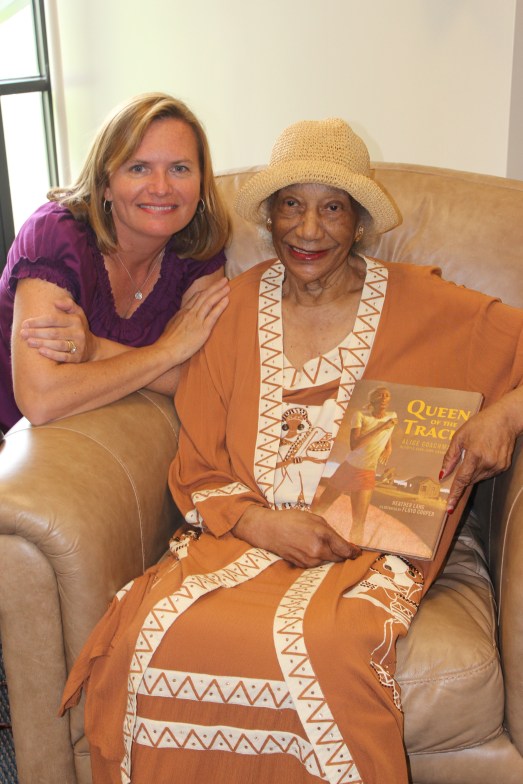
Heather meets Alice Coachman, the first African-American woman to win a gold medal at the Olympic Games.
What inspired you to write Queen of the Track?
After seven years of rejections on my fiction, I needed a little spark in my writing life to keep me going, so I decided to research and write a true story about an inspiring woman. Since I love sports, I looked for an athlete, and who better than the first black woman to win an Olympic gold medal? If Alice Coachman could overcome poverty and segregation and discrimination, surely I could overcome a few rejections. I kept one of Alice’s quotes on my desk: “When the going gets tough and you feel like throwing your hands in the air, listen to that voice that tells you, ‘Keep going. Hang in there.’ Guts and determination will pull you through.”
You seem to dig very deep when researching a book. What would you say is the biggest surprise you’ve discovered during your research?
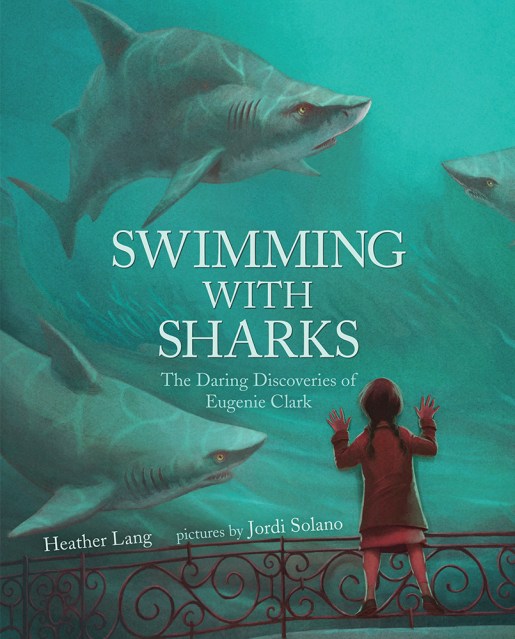
Every book is a treasure hunt, full of surprises and discoveries! My biggest surprise probably came with my most recent book Swimming with Sharks: The Daring Discoveries of Eugenie Clark. When I began my research journey, I was afraid of sharks and swimming in the ocean—terrified actually. As a child, I watched the movie Jaws and believed that sharks were swimming around looking for people to eat. That fear is what drew me to Eugenie Clark, an open-minded young scientist who never judged sharks based on rumors or appearance. I discovered that sharks are intelligent and important and that humans are NOT on the shark menu! I learned to scuba and snorkel, so I could experience Genie’s underwater world and swim with sharks myself. Writing that book transformed my fear of sharks into a passion for them!
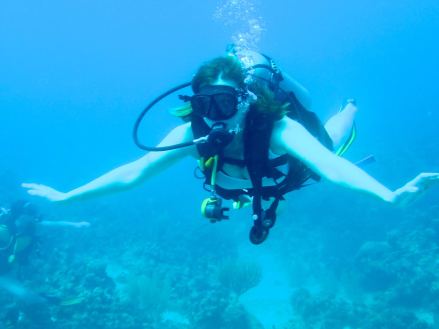
Heather learned to scuba dive while writing Swimming With Sharks: The Daring Discoveries of Eugenie Clark.
With the titles “Diving into Nonfiction and the World of Sharks,” “Got Grit?” and “Girls with Grit: Researching and Writing about Brave Girls,” your interactive presentations sound fascinating. Do you have any anecdotes from your speaking engagements you’d like to share?
I have so much fun visiting with kids and am always amazed at some of their questions. “How big are great white sharks?” “How big are their teeth?” “How big are their pups?” “How do they have pups?” I LOVE their raw curiosity! It inspires me and helps me develop my school visit programs. In reaction to the endless questions kids were asking me about sharks, I designed a program that includes hands-on activities that teach kids about shark anatomy and behavior, as well as the food chain and why sharks are important for a healthy ocean. And in the process, I’ve learned even more cool facts about sharks!
You’ve mentioned that you were inspired by Nancy Drew and once wanted to become a spy, which you compare to researching and writing children’s books. What was your favorite Nancy Drew book and why?
I remember two favorites that I owned: The Mystery at Lilac Inn and The Hidden Staircase. For several summers it was my mission to read every Nancy Drew book in the library. If I couldn’t get there, I’d reread the two that I owned. I never tired of them. I worshipped Nancy’s courage, resourcefulness, and willingness to push boundaries. More than anything I wanted to be a spy, just like her. And in a way, that dream has come true. I do lots of spy work for my books. Ideas and stories are all around us if we look, listen, and investigate. I think solid sleuthing is the backbone of an authentic story.
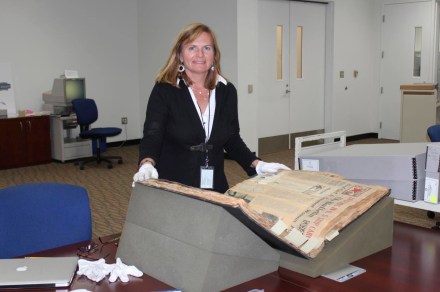
Heather researches Ruth Law’s Scrapbook while writing Fearless Flyer: Ruth Law and Her Flying Machine
If you have a particular place that you write, would you mind describing it a little?
I enjoy mixing it up, depending on what I am working on. When I was writing The Original Cowgirl: The Wild Adventures of Lucille Mulhall, I enjoyed writing on a picnic table at a local barn, surrounded by fields and horses. Sometimes I write in my office, but if the weather’s nice I head out to the screened porch. In the winter, my favorite place to write is by a roaring fire with my dog curled up next to me. And often ideas come to me when I’m in the car or on a walk or out to dinner—not the most convenient places to write. But when an idea strikes, I write it down and do a quick free write if possible, or poof the idea can vanish!
What’s the best thing about being a children’s writer?
My favorite part of being a writer is opening kids’ minds and hearts! I grow tremendously with every book I write, and nothing makes me happier than when my books do the same for kids. Whether a book inspires a child to dream big and be brave or it sparks a new interest in sharks or aviation, those moments are powerful.
What’s up next for you?
My next picture book biography, Anybody’s Game: The Story of the First Girl to Play Little League Baseball, comes out in March 2018. I am also working on a new book about sharks. And I’m so excited for an upcoming research trip to the Amazon for a book I’m writing about the rain forest!
What is your favorite holiday and why?
Christmas in our house is a creative holiday. My daughters and I try to make most of our gifts—anything from soap and candles to knitted hats, woven coasters, and jewelry. And we love to make handmade notecards and ornaments, especially when they involve GLITTER!
Do you have an anecdote from any holiday that you’d like to share?
Every year on Mother’s Day I get to choose exactly what I want to do! No—It’s not going to a spa or a fancy lunch. I choose to get my hands dirty with my husband and kids. It’s the day when we plan our garden, make a trip to the garden center, and plant our seeds and seedlings.
Thanks so much for chatting with me today, Heather! I wish you the best with all of your books!
You can find Queen of the Track and Heather’s other Books at these booksellers:
This month we celebrate the wondrously diverse life in the sea. A majority of the earth’s surface is covered in water and yet we know only a fraction of what the oceans have to show us. With new technology scientists are diving deeper and deeper, where some of the most unique creatures in the world are waiting to be discovered. To join in on this month’s holiday, visit a beach or aquarium, learn more about the animals and resources of the sea, and consider donating to the preservation of the world’s oceans.
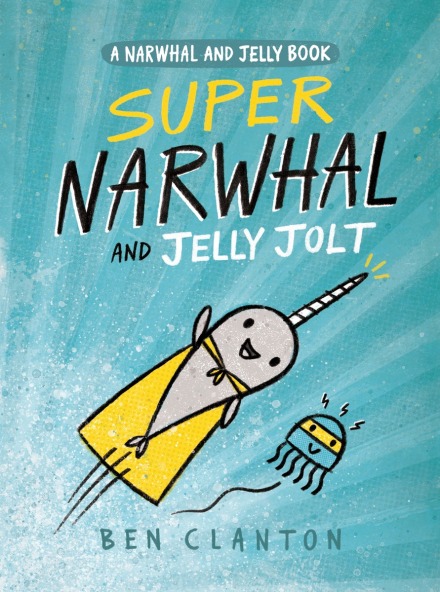
Super Narwhal and Jelly Jolt
By Ben Clanton
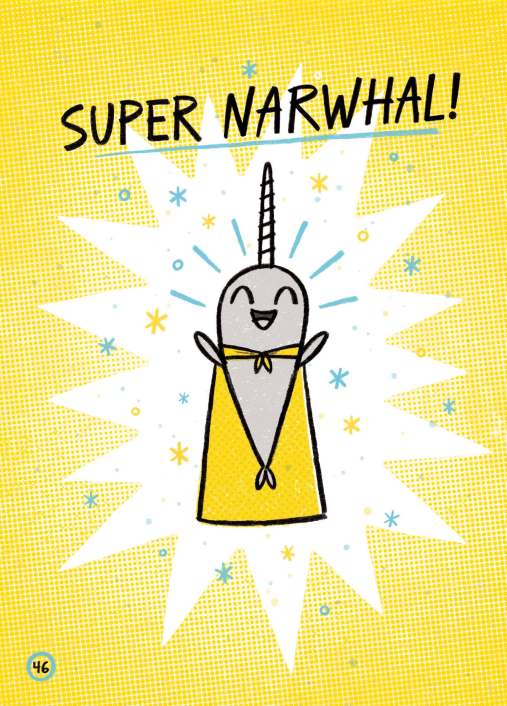
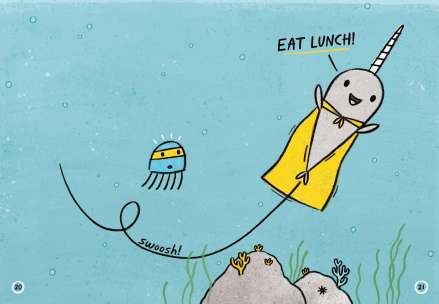
In A Super Start, Narwhal and Jelly are hanging out. Narwhal’s excited because after a swim and a waffle he’s “going to become a superhero!” Jelly is surprised that Narwhal thinks it would be so easy, after all there are the “super outfits” (Narwhal’s got that covered with a snazzy yellow cape); the “super names” (“Super Narwhal” sounds pretty super to Narwhal): and the secret identities (let me introduce you to the dapper mustachioed and bespectacled Clark Parker Wayne, wealthy and eccentric trillionaire).
Super Narwhal is also going to need a sidekick. Jelly kicks around a few names—Shark, Octopus, and Turtle—but Narwhal has someone else in mind. Jelly, of course! Jelly’s eyes widen with the possibilities. Sting or Blue Lightening might be cool monikers, but no!— “Jelly Jolt the Super Sidekick” has an electrifying ring to it. Suddenly, Jelly remembers they’ll need superpowers. Narwhal has trouble being invisible or strong, flying or breathing fire, but there’s something even more important than powers—lunch! Yum, yum! Jelly says, “I think waffles are my super weakness.”
In Narwhal, You’re a Superstar, Super Narwhal has come to the rescue of Star. While Star likes the ocean she thinks that maybe she belongs in the sky. “Maybe I am a real star, but I fell to earth and hit my head or something and now I don’t remember!” she says. Narwhal’s up for helping out, but without super strength he can only toss Star back into the sea. Even with Octopus’s cannon, Narwhal is no more successful. They think about building a rocket ship, but neither is exactly a rocket scientist. Then Narwhal has a super idea. Star wishes on…herself…and “Poof!” Star is back where she belongs.
Super Narwhal vs Blue Jelly a.k.a. the Super Superpower finds Clark Parker Wayne, wealthy and eccentric trillionaire discovering a very blue (as in sad) Jelly. In a jiff Super Narwhal appears to save the day! He asks Jelly “What’s wrong? Did someone steal your mustache?” But Jelly’s too blue to join in the repartee. Then Super Narwhal wonders if Jelly’s upset because he set his hair on fire. Jelly seems a bit perturbed at that suggestion—they are underwater, after all. But maybe Super Narwhal is onto something.
Maybe, just maybe, Jelly’s down because a bubble called him “a blue-footed booby,” or because a pirate pig poked him, or because he “got stuck in a tuba!” With a “hee” and a “heehee!” and a “heeheehee!” Jelly is beginning to smile. And when Super Narwhal puts them all together, Jelly can’t help but jiggle with a laugh at how ridiculous the whole thing is. But Super Narwhal is there to help—right? So he somberly asks “what is wrong?” By now, though, Jelly can’t remember.
Jelly gives his Super Friend a super hug. But then he does recall the problem. It seems crab was dissing his superhero outfit and calling him “Jelly Dolt.” “This is a job for Jelly Jolt and Super Narwhal!”, exclaims Narwhal. Jelly’s intrigued, but thinks they ought to leave crab alone. Guided by advice from his “great, great, great, great grandpa Nautilus,” which went something like “Do unto otters,” however, Narwhal reveals that they are off to make crab a superhero.
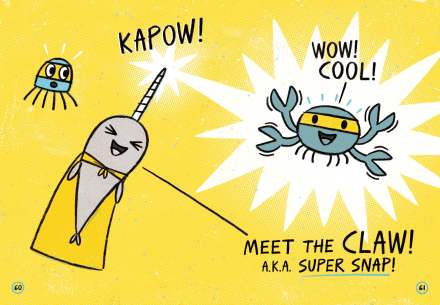
When they get their, though, Crab isn’t feeling it and lets off some steam, but Super Narwhal is undeterred. “Ahoy Crab! Prepare to be super-fied!” he announces. And with a KAPOW! Crab has become “The Claw! a.k.a. Super Snap!” At last, Super Narwhal has discovered his superpower—the ability to “bring out the super in others.” And with that, Super Narwhal, Jelly Jolt, and Super Snap swim off to Superfy the ocean.
Two more short and funny stories make an appearance between the continuing saga of Super Narwhal and Jelly Jolt. Super Sea Creatures is loaded with facts on several types of ocean creatures, and Super Waffle and Strawberry Sidekick is a delectable comic written by Narwhal and Jelly that’s full danger, heroics, and puns.
Ben Clanton’s adorable Super Narwhal and Jelly Jolt, the second in the Narwhal and Jelly series, is a sweet, laugh-inducing romp that is a marvelous take-off on the superhero genre and a perfect way to spend free time with two worthy ocean friends. Clanton fills his comics-style story with plenty of suspense, witty repartee, good advice, and even a bit of science to satisfy any young reader. Narwhal and Jelly, with their eager, inviting smiles, enthusiasm to tackle whatever obstacles get in their way and their ready inclusiveness, are truly superheroes to applauded
Super Narwhal and Jelly Jolt would make a sunny addition to summer reading and a splash on any child’s home bookshelf.
Ages 6 – 9
Tundra Books, 2017 | ISBN 978-1101918296
Discover more about Ben Clanton, his books, and his artwork on his website!
Make Music Day first rang out in 1982 in France as the Fête de la Musique. Celebrated by young and old, professional musicians and amateurs, the day invites all to make and share their music. People in more than 750 cities and towns in over 120 countries participate in this creative holiday.
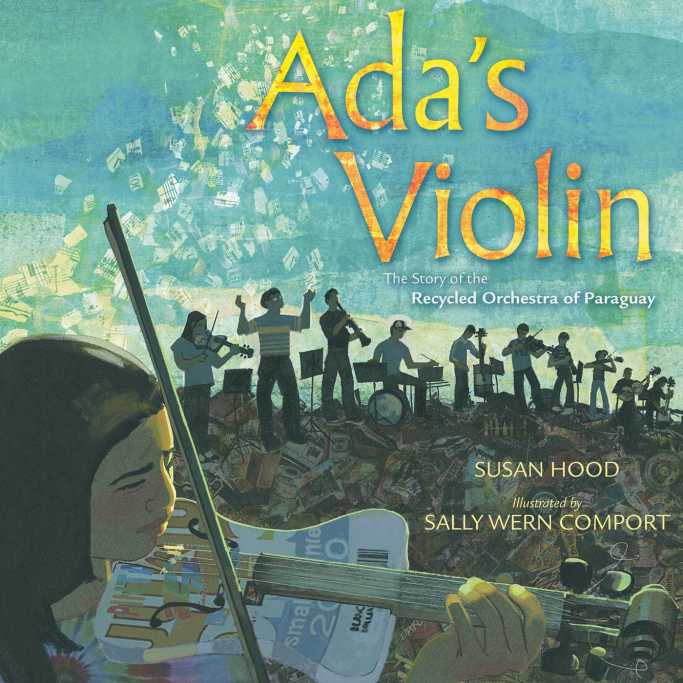
Ada’s Violin: The Story of the Recycled Orchestra of Paraguay
Written by Susan Hood | Illustrated by Sally Wern Comport
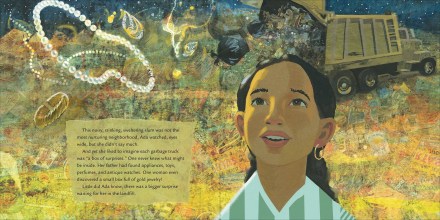
Ada Ríos is growing up in Cateura, a town built of trash as the main garbage dump for the capital city of Paraguay. Every morning the refuse trucks rumble into town to deposit their loads—1,500 tons of trash every day. The citizens of Cateura—gancheros or recyclers—go to work sifting through the mounds and tearing into bags looking for anything valuable enough to recycle or sell. Cardboard is worth 5 cents a pound, plastic 10 cents a pound.
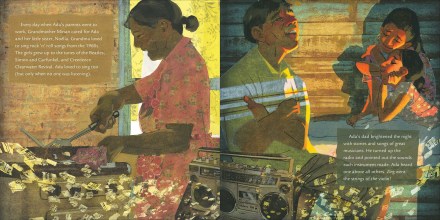
Ada knows the landfill can hold surprises—“Her father, a ganchero, had found appliances, toys, perfumes, and antique watches.”—but she can never imagine what it holds for her. When Ada and her sister were little, their grandmother watched them while their parents worked. They loved to listen to music, to sing, and to learn stories of musicians and the sounds of different instruments. Ada fell in love with the violin.
Image copyright Sally Wern Comport, text copyright Susan Hood. Courtesy of simonandschuster.com
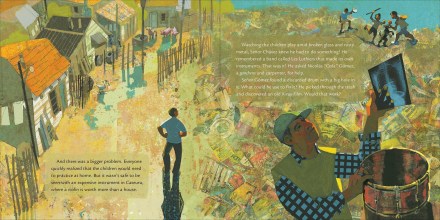
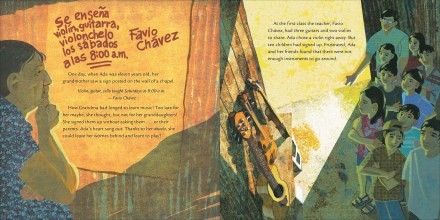
As the girls grow older and go to school, they venture farther into town, but there is little to fill their time. Many kids join gangs or get into fights. When Ada is 11 her grandmother signs her and her sister up for music lessons being offered by a new man in town named Favio Chávez. “Ada’s heart sang out” when she hears the news. On the first day ten children show up to play the five instruments available. But a bigger problem looms: the three guitars and two violins cannot be taken home for practicing as they are magnets for thieves. In Cateura a violin is worth more than a house.
But Favio Chávez has an idea. With help from Nicolás Gómez, a ganchero and carpenter, they pull bits and pieces from the landfill. An old broken drum and an X-ray film become a workable drum, water pipes become flutes, packing crates become guitars and violins, and oil drums become cellos. “Ada chose a violin made from an old paint can, an aluminum baking tray, a fork, and pieces of wooden crates. Worthless to thieves, it was invaluable to her. It was a violin of her very own.”
Image copyright Sally Wern Comport, text copyright Susan Hood. Courtesy of simonandschuster.com
The children practice tirelessly outside in 100-degree heat until the initial “screeches, twangs, and tweets hit all the right notes. Their class became ‘a small island’ where Chávez taught them to respect themselves and one another.” They become known as The Recycled Orchestra. Music now fills the air, adding a soundtrack of beauty to the grueling work. The orchestra is soon invited to play concerts in Cateura and the capital city of Asunción. When word spreads of their talent, the children receive offers to play from other cities and even other countries.
When Ada is 16 The Recycled Orchestra is invited to tour with a world-famous rock band. As Ada takes the stage in front of 35,000 people in Bogotá, Colombia, she is afraid, but the audience cheers for them and sings along as they play. On that night the children discover a new life. “Buried in the trash was music. And buried in themselves was something to be proud of.”
Image copyright Sally Wern Comport, text copyright Susan Hood. Courtesy of simonandschuster.com
An extensive author’s note plus a photograph of The Recycled Orchestra, lists of websites, videos and sources follow the text.
Ada’s Violin is also available in a Spanish edition—El violín de Ada: La Historia de la Orquesta de Instrumentos Reciclados del Paraguay.
Susan Hood has brought to light an incredible story of perseverance, hope, and the ability of music and other arts to provide opportunities and self-confidence that change lives. Told with unstinting honesty and sensitivity, Hood’s biography of Ada Ríos, Favio Chávez, and The Recycled Orchestra will inspire all who read it. The well-paced text offers revealing details on every page and flows with a lyrical quality that enhances the effect of the story and its impact. From the first sentence to the last, both children and adults will be riveted to The Recycled Orchestra.
Image copyright Sally Wern Comport, text copyright Susan Hood. Courtesy of simonandschuster.com
Sally Wern Comport’s paintings beautifully capture the human spirit that shines through and drives people to astonishing achievements even in the most adverse conditions. With intricately created collages of rich hues, Comport depicts the town of Cateura and the mountains of trash the citizens work and play on. Warm lighting illuminates faces full of dreams and love. Readers will linger over depictions of the instruments workshop and cheer along with the concert audience as the children receive recognition. The full-bleed, two-page spreads echo the expanded world music gave to the children in the orchestra and the adults who heard them as music score confetti flutters throughout.
Both school classrooms and home libraries will benefit from the stirring message of Ada’s Violin.
Ages 4 and up
Simon & Schuster Books for Young Readers, 2016 | ISBN 978-1481430951 (English edition); 978-1481466578 (Spanish edition)
Discover more aboutSusan Hoodand her books, plus fun activities for kids and information for teachers and parents on her website!
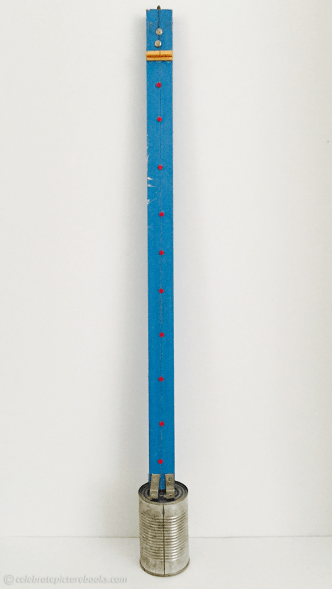
Inspiration for sound can come from almost any object! Look around your house or classroom and discover the music in boxes, cans, blocks of wood, plastic egg cartons or deli containers, and more. Add string or wire for plucking, sticks for drumming, or beans for shaking. With a little glue, tape, or hardware and some creativity, you’ll be making your own rhythms in no time!
Supplies for the stringed instrument shown in the picture above
Tin can
Two small L brackets
Piece of wooden molding, 2 1/2 feet by 1 1/2 inches by 3/4 inches
Five small strips of wood to raise the wire off the neck of the instrument. I used long wooden fireplace matches cut into 1 1/2″ sections
Thin wire
Small circular hook screw or regular screw
Two tacks
A nail, screw, or piece of wood that will fit horizontally in the mouth of the can
a small nail to make a hole in the can
Hammer
Strong Glue
Paint
Foam decorative dots
Directions
Paint the wood and let dry
Paint the small strips of wood and let dry
Decorate the can with paint, sticker, duct tape, or paper
With the hammer and small nail, make a hole in the center of the bottom of the can
Wrap one end of the wire around the nail and glue so it is firmly in place
Feed the other end of the wire through the hole in the bottom of the can
Screw or glue two L brackets to one end of the wood molding so that the bottom of the L is flush with the bottom of the wood molding and there is space between the brackets. This makes the neck of the instrument
Screw the circular or regular screw into the top, center of the wooden molding
When the wooden match strips are dry, glue three match strips side-by-side 3 inches from the top of the molding. Glue two more match strips, one on top of the other on the center strip.
When the L brackets are dry, glue them (and the neck of the instrument) to the can, making sure the brackets are on either side of the hole in the can. Make sure the wire is out of the hole.
When the brackets are firmly attached to the can, pull the wire to the top of the neck. Settle it in the center of the small pieces of wood, so that the wire is not touching the neck.
Wrap the wire around the screw at the top of the molding until it is firmly in place and the wire is taut.
On World Refugee Day, first celebrated in 2001, we commemorate the strength, courage, and perseverance of millions of refugees. The annual commemoration is marked by a variety of events in more than 100 countries, involving government officials, humanitarian aid workers, celebrities, civilians and the forcibly displaced themselves.
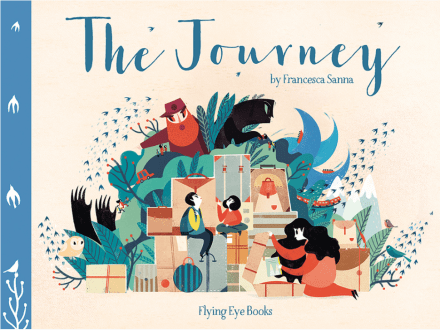
The Journey
By Francesca Sanna
A child begins the story with a place—the family’s home in a city by the sea. The family used to visit the beach often, but not anymore, “because last year our lives changed forever,” the child reveals. “The war began,” the narrator says, turning their once-peaceful life into “chaos.” Not only was their city torn apart, the family was also, as “one day the war took [their] father.”
Copyright Francesca Sanna, 2016. Courtesy of Flying Eye Books.
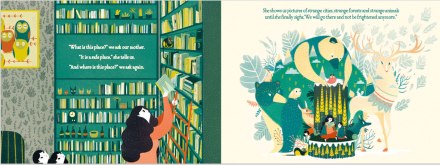
The child’s mother is afraid of the darkness that has descended on them. One of her friends told her that many people are leaving, escaping to another country with high mountains. The two children ask their mother where and what this place is. She answers that “‘it is a safe place’” an then shows them pictures that contain unfamiliar trees and animals. She sighs and tells her son and daughter, “‘We will go there and not be frightened anymore.’”
Copyright Francesca Sanna, 2016. Courtesy of Flying Eye Books.
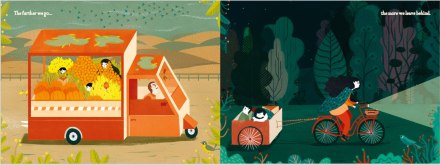
Even though the children don’t want to leave, they pack up all their belongings and say goodbye to their friends. They leave at night so they won’t be caught. They travel for many days, taking various modes of transportation. With each change the family must leave more and more of their things behind.
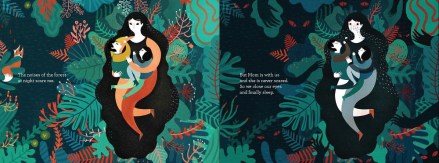
When they reach the border, they are met by an enormous wall that they must climb over. But before they can, a guard stops them and tells them they cannot cross, that they must go back. The family has nowhere else to go, however, and they are very tired. They find a spot in the woods to sleep, but the strange noises keep the children awake. Their mother tells them not to be afraid, and in her arms they finally fall asleep as she cries silent tears.
Copyright Francesca Sanna, 2016. Courtesy of Flying Eye Books.
Suddenly, they hear shouting and see that the guards are looking for them. They run and run until they meet a man who takes them over the border. They come to the shores of a huge body of water that stretches far into the distance. The family must cross this water to be safe. They board a ferry loaded with other families and sail for days. On the way, they tell stories of the creatures who lurk in the waters below, “ready to gobble [them] up if the boat capsizes.” Other times they tell stories about magic fairies who live in the land they are going to—ones who have “magic spells to end the war.”
Copyright Francesca Sanna, 2016. Courtesy of Flying Eye Books.
In the dawn light, the children and their mother finally see land. They are close to the place where they will be safe, the mother says, but it requires many more days of train travel across many more borders. On the journey the child watches birds migrating just as they are and hopes that one day, like the birds, they will find a new home where they “can be safe and begin our story again.”
Francesca Sanna’s moving compilation of true immigrant stories into a powerful narrative that speaks for so many provides a compelling and sensitive way to discuss the world’s refugee crisis with children. Sanna’s straightforward storytelling allows children to understand the cause and effect relationship of the war on those it displaces. Her focus on the length and difficulty of the family’s journey gives young children—for whom even short times and distances can seem long—a starting point for deeper comprehension. Sanna tempers frightening aspects of the story with her calm delivery and peppering of courage on the part of the mother and children along the way.
Copyright Francesca Sanna, 2016. Courtesy of Flying Eye Books.
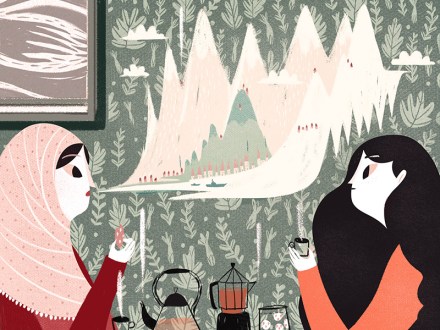
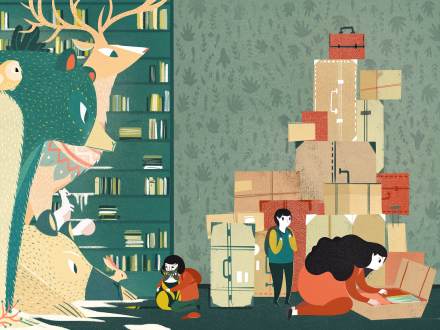
Sanna’s stunning and emotionally resonant artwork deftly presents the experiences of loss and love the story contains. Her use of the amorphous, seeping black images demonstrate the movement of the war and the ravages it imposes. Collage-like aspects to the illustrations gives readers much to talk about at varying age-appropriate levels. As the family’s journey begins, their suitcases and trunks filled with belongings are piled high, but as it continues, their luggage dwindles until only the most precious valuables remain—the two children and their mother. Sanna’s color pallet of oranges, reds, yellows, and greens are eye-catching and convey the urgency of the family’s plight. The final image of the mother, son, and daughter carried on the wind by a majestic bird offers the opportunity to talk about hope with young readers.
Ages 3 – 8
Flying Eye Books, 2016 | ISBN 978-1909263994
Learn more about Francesca Sanna and her work on her website!
World Refugee Day Activity
Learn to Say “Welcome” in Different Languages
With this printable Welcome sign, you can learn how to greet others in their native language!
This month’s observance pays tribute to the role of zoos and aquariums and the work they do for education, conservation, and research to protect the world’s animals. As zoos and aquariums build exhibits that more closely resemble the animals’ natural habitats and offer interactive and hands-on programs, more visitors can learn about the environments and science of each amazing creature. These institutions are also reaching out with personal and online visits to schools by zoologists and other experts, increasing the interest in biology and animal science to students. Nearly 175 million people—50 million of which are children—visit zoos and aquariums each year. To celebrate today, visit your local zoo or aquarium!
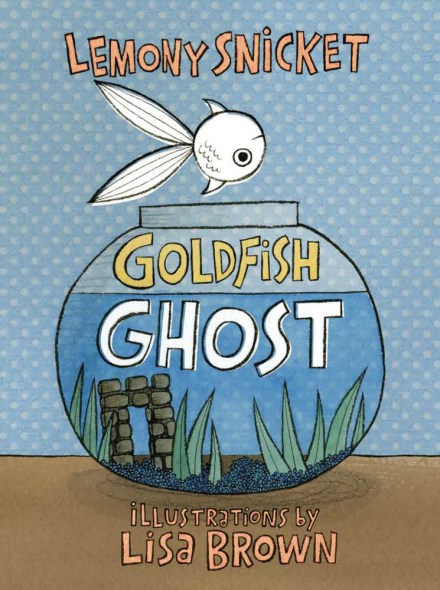
Goldfish Ghost
Written by Lemony Snicket | Illustrated by Lisa Brown
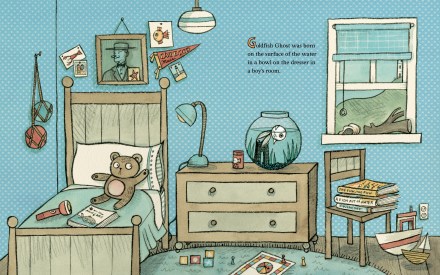
In a big round bowl in a certain boy’s room in a seaside town, “Goldfish Ghost was born.” For a while, Goldfish Ghost just hung out looking at the ceiling, but he got lonely, “so Goldfish Ghost floated out of the bowl and drifted toward the window to find some company.” He drifted over the compact little town nestled near the ocean and watched over by a lighthouse that “everyone said was haunted.”
Image copyright Lisa Brown, text copyright Lemony Snicket. Courtesy of us.macmillan.com.
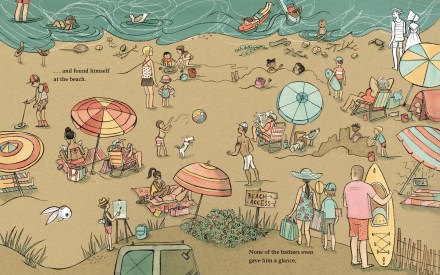
At the pier seagulls screeched, waiting for a snack. They weren’t interested in talking to Goldfish Ghost, so he caught the breeze into town. The sidewalks and shops were busy with locals and tourists “buying sweaters and postcards and pets and groceries, but everybody there was with somebody else, so no one was looking for company.” Goldfish Ghost kept drifting and soon reached the beach. No one there noticed him either.
Image copyright Lisa Brown, text copyright Lemony Snicket. Courtesy of us.macmillan.com.
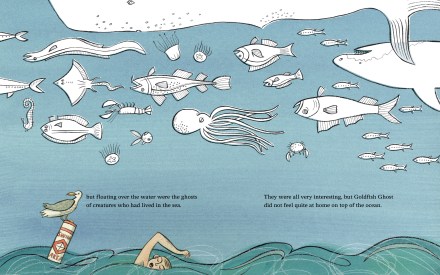
The swimmers and sunbathers also didn’t seem to notice the “ghosts of creatures who had lived in the sea” that were now floating in the air just above the surface of the ocean. Goldfish Ghost might have joined them, but he didn’t feel comfortable among these wild fish. “It can be hard to find the company you are looking for.” Goldfish Ghost stopped for a moment “atop a beach umbrella and wondered what to do.” Finally, he returned home to his bowl.
Image copyright Lisa Brown, text copyright Lemony Snicket. Courtesy of us.macmillan.com.
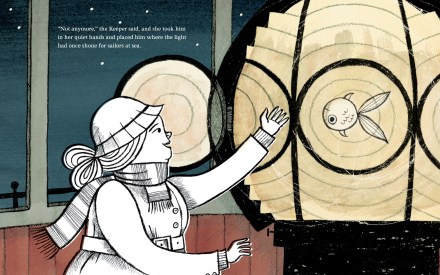
When he got there, however, he found a new goldfish swimming happily in the bowl. While she seemed okay, Goldfish Ghost thought they wouldn’t have much in common, so he continued his search for the right companion. In the still night air, he heard a voice say, “‘I’ve been looking for company.’” Goldfish Ghost followed the sound to the lighthouse, where he found the ghost of the old keeper. She was also lonely and looking for someone to talk to.
She held Goldfish ghost gently “and placed him where the light had once shone for sailors at sea.” Then in silent happiness, the two ghosts gazed out at the world together.
Image copyright Lisa Brown, text copyright Lemony Snicket. Courtesy of us.macmillan.com.
Lemony Snicket, most fortunately, interprets the world through a singular lens. In Goldfish Ghost he gives quirky, yet comforting, meaning to the sad reality of aquarium ownership while connecting Goldfish Ghost to the world’s natural lifecycle. Inherent in the story is also the idea of friendship and the idea that while some kids (and adults) may feel invisible to others at times, there is someone out there who will make a perfect companion, if you just keep looking.
Lisa Brown’s soft-hued, matte watercolor illustrations set a snug, soothing atmosphere as young readers follow Goldfish Ghost on his journey. From the little boy’s room and its seascape décor to the inviting lighthouse on the edge of the shore, Brown gives kids plenty to discover on every page. Alert readers will notice other ghosts on the pier and on the beach, find the little boy leaving the pet store holding a familiar plastic bag, and may want to name the ghostly creatures floating above the ocean. When Goldfish Ghost finally finds a friend in the lighthouse keeper (whose reading runs to the same interests as the little boy’s), kids will be cheered to see that he gets new “life” in the golden glow of the Fresnel lens.
With a splash of humor and a lot of heart, Goldfish Ghost makes a tender choice for story times as well as for children who have lost a pet or are navigating the world of friendships.
Ages 3 – 6
Roaring Brook Press, 2017 | ISBN 978-1626725072
You’ll discover the world of Lisa Brown, her books, comics, and illustrations, on her website!
National Zoo and Aquarium Month Activity
Fill a Fishbowl Coloring Page
With these printable pages you can color your favorite fish and fill a bowl to decorate your room!














 celebratepicturebooks.com