May 30 – It’s Get Caught Reading Month

celebrate-picture-books-picture-book-review-albie-newton-cover

About the Holiday

Get Caught Reading Month was established in 1999 by the Association of American Publishers to encourage people of all ages to read more. Authors, illustrators, celebrities, athletes, and others participate by sharing pictures of themselves reading an old favorite or new book on social media. Schools, libraries, bookstores, and community venues hold special programs throughout the month. For more information and to find resources, visit the Get Caught Reading website.

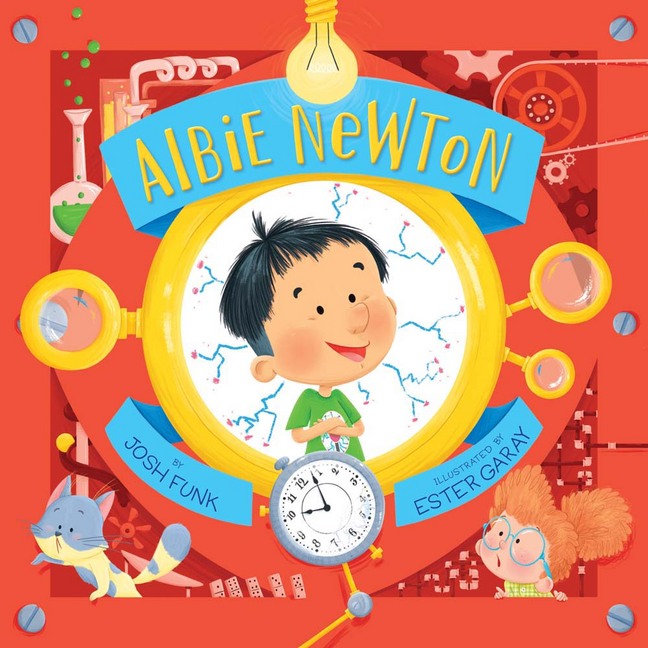
Albie Newton

Written by Josh Funk | Illustrated by Ester Garay


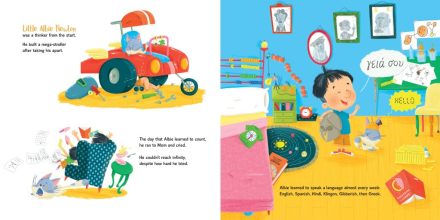
Albie Newton was something of a prodigy. As a tyke, he retrofitted his stroller into a racecar, tried counting to infinity, and “learned to speak a language almost every week: / English, Spanish, Hindi, Klingon, Gibberish, then Greek.” When he moves to a new town and a new school, his classmates are excited to meet him. Albie is also revved up to start making friends, and he has a plan he thinks the other kids will love.

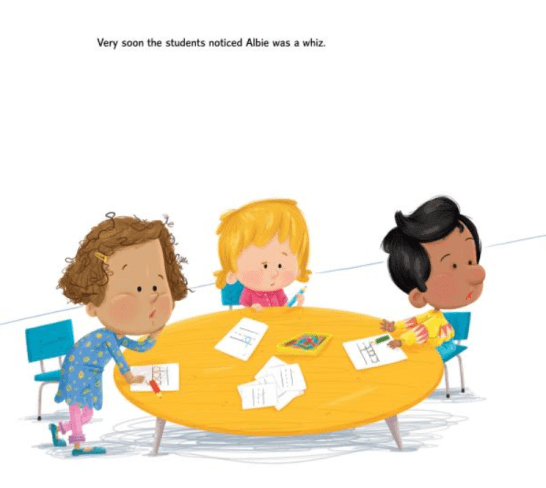
But as they all settle in to work, “the students noticed Albie was a whiz. / Albie wrote a sonnet while they took a spelling quiz.” During art class, the kids were likewise astounded (and a little dismayed) when, while they scribbled, drew swirls, and made handprints, Albie painted like Van Gogh. When free time rolled around, and some kids played dress up, Albie “sifted through the trash,” to build a science lab, leaving a mess for Arjun to clean up.
celebrate-picture-books-picture-book-review-albie-newton-toddler

Image copyright Ester Garay, 2018, text copyright Josh Funk, 2018. Courtesy of Sterling Children’s Books.

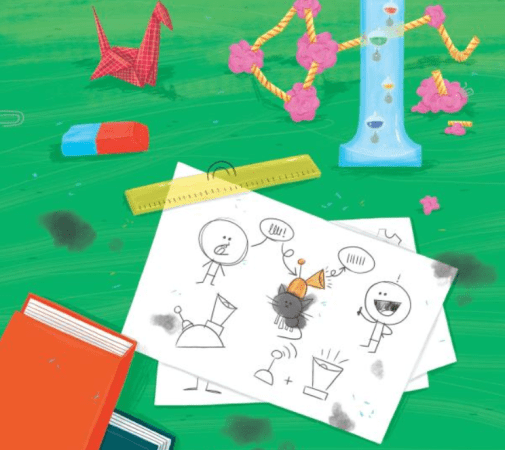
Then things began to disappear. “Hamilton the hamster tried to run but had no wheel. / Albie needed extra sprockets made of stainless steel.” While Sona and Shirley created paper masks, the glue went missing, and Albie “didn’t even ask.” The wings from Dave’s propeller plane were suddenly broken off, and reading time became impossible when “booming pandemonium descended on the school.” Albie, though, intent on his invention, didn’t notice the trouble he was causing or the crowd of angry kids rushing to complain.

Before they could reach Albie, though, Shirley stopped them, saying “‘maybe Albie didn’t know. Let’s look at what he made.’ Curious, the children headed straight to where he played.” When they say all the inventions Albie had made, they stopped and stared. Albie had made the class a gift—a spaceship, and with the push of a button, an amazing time machine!
celebrate-picture-books-picture-book-review-albie-newton-spelling

Image copyright Ester Garay, 2018, text copyright Josh Funk, 2018. Courtesy of Sterling Children’s Books.

With his inimitable style, Josh Funk creates a rambunctious tale of invention and creativity, but one that also has a deeper message about the way some kids see the world and communicate with peers and others. In the first pages, readers are introduced to the precocious Albie, who from birth has demonstrated a talent for learning and doing. When he enters a new school, however, his single focus doesn’t translate into the kinds of social interactions his classmates are used to. Albie gathers materials for his present unaware of the mayhem he’s causing, just as the other kids are unaware of Albie’s real goal. Only Shirley is sensitive to the idea that Albie may not be causing havoc on purpose but for a purpose. Her calming defense of Albie allows the other kids to see Albie in a new light and appreciate his gift—and his gifts.

While Funk’s rhyming verses are focusing on Albie and his actions, Ester Garay’s bright illustrations depict the other kids’ reactions to his talents and also his disruptions. A first hint at how Albie fits in with his new class comes as the kids welcome him with cheer and smiles. Instead of facing them to accept the welcome, Albie is faced away from them, happily imagining the gift he will make for them.
celebrate-picture-books-picture-book-review-albie-newton-drawings
Image copyright Ester Garay, 2018, text copyright Josh Funk, 2018. Courtesy of Sterling Children’s Books.

Throughout the day, Shirley follows Albie, and as she watches and wonders, her facial expressions demonstrate dismay at some of Albie’s antics but also a growing understanding and acceptance. Garay captures the close camaraderie of a preschool or kindergarten classroom, and her close-up view of Albie toiling away on his invention will have readers eager to see the result. The reveal of Albie’s spaceship time machine and the final spread of the kids frolicking on a distant planet with the likes of Freda Kahlo, William Shakespeare, Amelia Earhart, and a helpful dino, are sure to produce some oohs and ahhhs.

Albie Newton is a doubly impactful story that would be a welcome addition to home and, most especially, classroom bookshelves. It can be read as a boisterous story of innovation for lively story times, but it also provides adults and children an opportunity to discuss the ideas of social interaction and various personalities. Most children know someone like Albie who as naturally quiet, on the spectrum, or singularly focused on one area or another, communicates and socializes differently than others. Reading Albie Newton can help kids better understand different behaviors and, like Shirley, become more sensitive to all their classmates and friends.

Ages 5 – 9

Sterling Children’s Books, 2018 | ISBN 978-1454922582

Discover more about Josh Funk and his books as well as find fun activities and lots of resources on his website.

To learn more about Ester Garay, her books, and her art, visit her website.

Check out the Albie Newton book trailer!

Get Caught Reading Month Activity
celebrate-picture-books-picture-book-review-initial-bookend

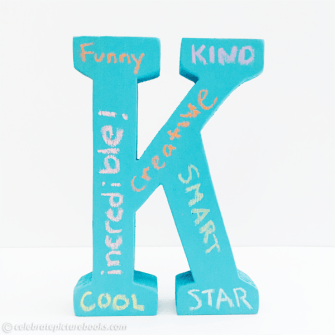
Initial Bookends


You can keep your books neat and tidy on the shelf with this easy-to-make bookend that displays your talents and personality!

Supplies

  • Wooden letter block in the child’s first initial or both initials
  • Chalkboard paint
  • Chalk
  • Paint brush

Directions

  1. Paint the wooden letter with the chalkboard paint, let dry
  2. With the chalk, write words that your think best describe you on the letter
  3. Display your letter on your bookshelf!

May 6 – National Nurses Day

celebrate-picture-books-picture-book-review-nurse-soldier-spy-the-story-of-sarah-edmonds-cover

About the Holiday

Today’s holiday kicks off National Nurses Week, which runs until May 12, the birthday of Florence Nightingale. Nightingale, born in 1820, was an English social reformer and the founder of modern nursing. She was well-known for her work tending wounded soldiers during the Crimean War and was called “the lady with the lamp,” because of the rounds she made of her patients during the night.

During National Nurses Day and Week, we honor and thank all of the nurses working in hospitals, private practices, and with charitable organizations around the world for their dedication to and compassion for the patients under their care.

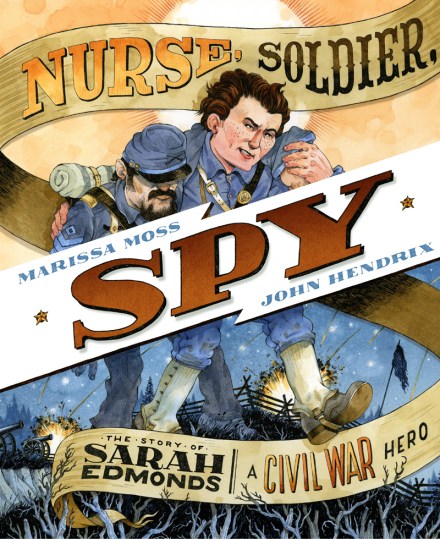
Nurse, Soldier, Spy: The Story of Sarah Edmonds, A Civil War Hero

Written by Marissa Moss | Illustrated by John Hendrix


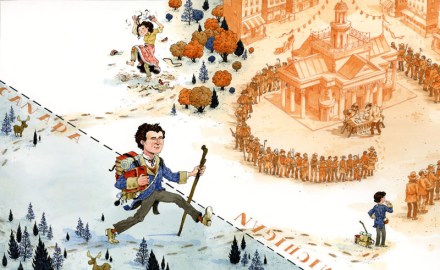
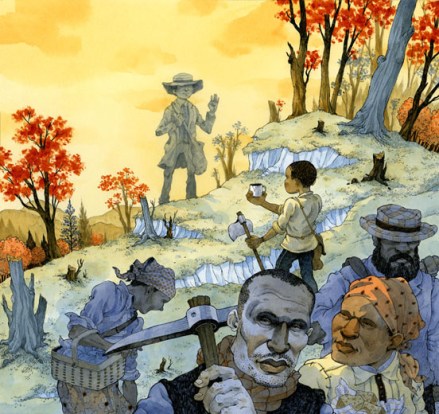
When President Abraham Lincoln called for young men to join the army fighting against the Southern states that wanted to secede from the Union, Frank Thompson signed up. One thing though, Frank wasn’t really a man but, instead, a 19-year-old woman named Sarah Edmonds. Sarah already knew the freedom that posing as a man could bring in her society. Three years earlier to escape a marriage arranged by her parents, Sarah cut her long hair, began wearing pants, and crossed “the border from Canada into the United States, trading a bridal gown for trousers, trading countries, without a single regret.”

celebrate-picture-books-picture-book-review-nurse-soldier-spy-the-story-of-sarah-edmonds-becoming-frank

Image copyright John Hendrix, courtesy of johnhendrix.com

Now, outside the Michigan courthouse, Sarah slowly moved her way along the line to the table where she could sign up to join the troops. When she finally stood in front of the recruiter, however, he stopped her. Sarah was mystified. How did he know she wasn’t a man? She had grown up on a farm, learning the work, copying the gestures, and even wearing the clothes of her brother. But the recruiter took one look at “Frank Thompson” and told her…she was too young to join the army. “He looked at her peachy cheeks free of any sign of a whisker. ‘We aren’t taking any sixteen-year-olds,’” he told her.

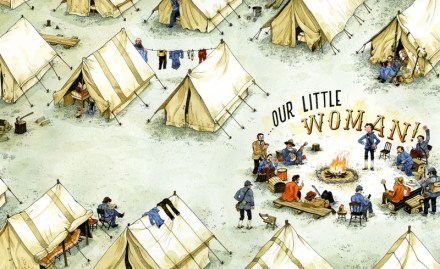
A month later, however, more men were needed, and Sarah was allowed to join up. Now a soldier, Frank was a valuable member of the corps. She was an expert at riding and shooting, and she felt at home among the men, enjoying the jokes, stories, and letters. Keeping her identity a secret was made easier by the fact that soldiers did not change clothes to go to sleep. Her small feet led the other soldiers to give her a nickname: “Our little woman.” A name Frank enjoyed immensely.

celebrate-picture-books-picture-book-review-nurse-soldier-spy-the-story-of-sarah-edmonds-union-camp

Image copyright John Hendrix, courtesy of johnhendrix.com

On the battlefield Frank trained to be a nurse, “which was something only men with the strongest stomachs did because of the long, draining hours and the horrors of surgery without anesthetic.” She fearlessly participated in the battles of Bull Run and Fair Oaks, risking her own life to rescue wounded soldiers. One night the regimental chaplain approached Frank. He wanted to recommend her for a very important—and very dangerous—job. The chaplain wanted to recommend to the generals that Frank become a spy for the North.

“Frank didn’t hesitate. ‘I’m your man!’” she said. Disguising herself as a freed slave, she infiltrated “a group of slaves bringing breakfast to the rebel pickets, the men who guarded the camp.” With so much work to do, the group quickly accepted her, but when the rest of the men, women, and children went off to their own assignments Frank hesitated, not knowing where to go next. Suddenly, a Confederate soldier caught Frank and ordered her to work on the fortifications. The work was backbreaking and left her hands blistered and bloody. The other workers helped when she had trouble.

celebrate-picture-books-picture-book-review-nurse-soldier-spy-the-story-of-sarah-edmonds-battlefield

Image copyright John Hendrix, courtesy of johnhendrix.com

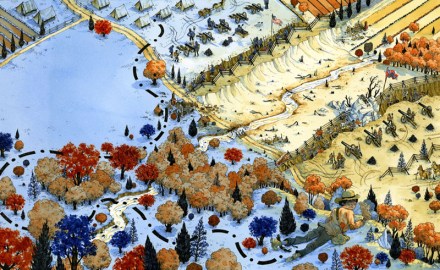
The work gave Frank an opportunity to count the number of guns the army had, sketch a layout of the fort, and notice that some cannons were fake—just logs painted to look like cannons. By switching jobs with the water boy, Frank was able to get closer to the troops, where she encountered another spy—one working for the Confederate army. When night fell, Frank returned to his Union battalion. Giving the password, Frank was let into camp and made her way to the general’s tent. “Freedom, she knew, wasn’t something to take for granted. It was something to fight for, to cherish. And so long as her heart was beating strong, that’s just what she would do.”

An extensive Author’s Note revealing more about Sarah Edmond’s life and an Artist’s Note on the creation of the illustrations follow the text.

Marissa Moss’s biography of Sarah Edmonds is a suspenseful, gripping, and enlightening story of a woman who broke molds, lived on her own terms, and paved the way for future generations of women. Her well-chosen vignettes from Edmonds’ time as a Union soldier demonstrate not only Edmonds’ bravery and abilities but also create a clear and exciting trajectory of her increasing responsibilities and the danger that went with them. Fascinating details of the Civil War period, the people and attitudes involved, and the duplicitous nature of warfare, add up to a rich account of Sarah Edmonds’ life as well as the Civil War era in general.

celebrate-picture-books-picture-book-review-nurse-soldier-spy-the-story-of-sarah-edmonds-as a spy

Image copyright John Hendrix, courtesy of johnhendrix.com

Meticulously researched and drawn, John Hendrix’s illustrations perfectly accompany and illuminate the text. Accurate depictions of Civil War-era buildings and clothing as well as Union and Confederate uniforms and weapons allow children to become fully immersed in the time period. Wide-view depictions of encampments and battlefields let readers peek into tents and scour trenches, and action abounds. In camp soldiers pick out tunes on banjos, write letters, and hang laundry; on the battlefield fires rage and ammunition explodes as soldiers follow the charge of their leaders; at the Confederate fortifications black workers steer wheelbarrows of rock; and in the medical tent Frank tends to wounded soldiers, the equipment used clearly visible. Scenes portrayed in both daylight and at night highlight the ongoing conflict and the dangerous, secretive work Sara Edmonds undertook.

Nurse, Soldier, Spy: the Story of Sarah Edmonds a Civil War Hero is historical and biographical work at its best. This fast-paced, fascinating look at one particular soldier informs readers about so many aspects of the Civil War era, including societal issues that shaped the United States and are still discussed today. The book is a must for school and public libraries and its in-depth, absorbing content makes it a welcome addition to home libraries for children who love history, art, biographies, and a well-told story.

Ages 5 – 12

Abrams Books for Young People, 2016 (Paperback edition) | ISBN 978-1419720659

Discover many more books, fun stuff, writing tips and more on Marissa Moss‘s website!

View a portfolio of picture book art, editorial illustration, a sketchbook, and more on John Hendrix‘s website!

National Nurses Day Activity

CPB - Doctors Clothespins

Nurse Clothespin Dolls


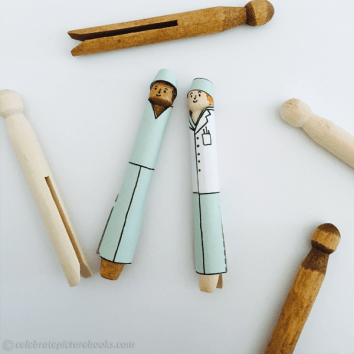
Make one of these clothespin figures that honors hard-working and compassionate emergency nurses!

Supplies

CPB - Doctors Clothespins on box

Directions

  1. Draw a face and hair on the clothespin
  2. Cut out the outfit you want your doctor to wear (color pants on your clothespin if you choose the lab coat)
  3. Wrap the coat or scrubs around the clothespin. The slit in the clothespin should be on the side.
  4. Tape the clothes together
  5. Wrap the cap around the head and tape it.
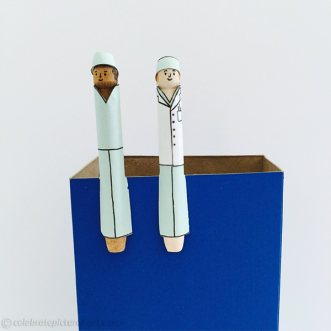
  6. If you’d like to display your clothespin doctor on a wire, string, or the edge of a box or other container, cut along the dotted lines of the clothes template.

Picture Book Review

May 3 – It’s Get Caught Reading Month and Interview with Author Jody Jensen Shaffer

celebrate-picture-books-picture-book-review-a-chip-off-the-old-block-cover

About the Holiday

Launched in 1999 by the Association of American Publishers and managed by Every Child a Reader, Get Caught Reading Month hopes to instill a love of reading in every child and encourages people of all ages to read more. Celebrities, authors, illustrators, and others participate by sharing pictures of themselves reading an old favorite or new book on social media. Special materials are available for and programs held in schools, libraries, bookstores, and community venues all month long. Why not join in by finding a new book to lovelike today’s book?! For more information and to find resources, visit the Get Caught Reading website.

Penguin Random House sent me a copy of A Chip Off the Old Block to check out. All opinions are my own. I’m partnering with Penguin Random House in a giving away a copy of A Chip Off the Old Block. See details below.

A Chip Off the Old Block

Written by Jody Jensen Shaffer | Illustrated by Daniel Miyares


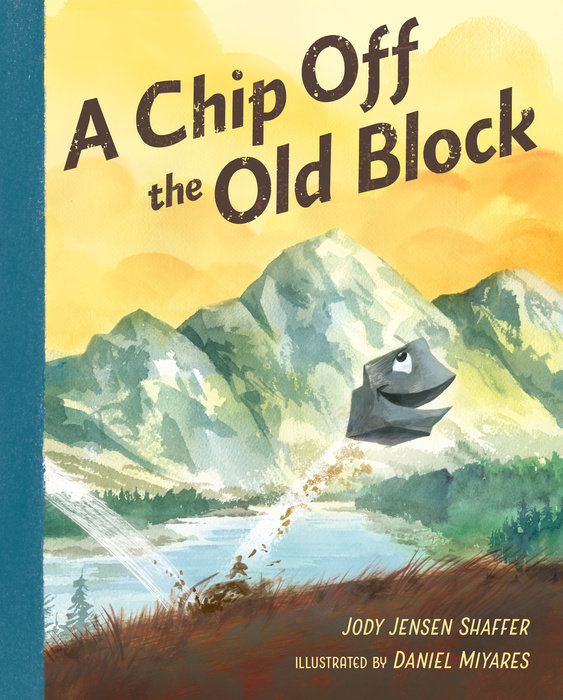
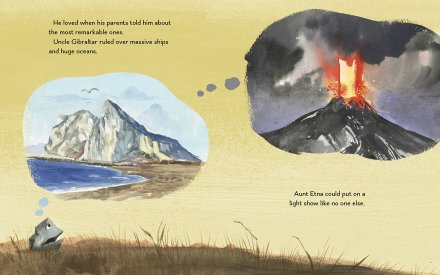
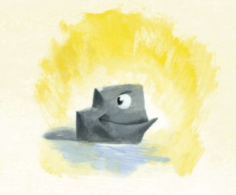
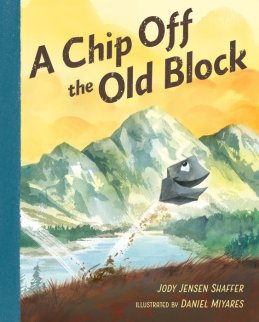
Rocky had an impressive family. There was Aunt Etna, Uncle Gibraltar, and his Great-Grandma Half Dome. His cousins were pretty well-known too. In fact, “tons of his relatives were rock stars.” Rocky loved hearing his parents’ stories about his family. Rocky wanted to be important too, but his parents thought he was too little. He may have been “just a chip off the old block” like his dad said, “but inside, Rocky was a boulder!”

celebrate-picture-books-picture-book-review-a-chip-off-the-old-block-aunt-etna

Image copyright Daniel Miyares, 2018. text copyright Jody Jensen Shaffer, 2018. Courtesy of Penguin Random House.

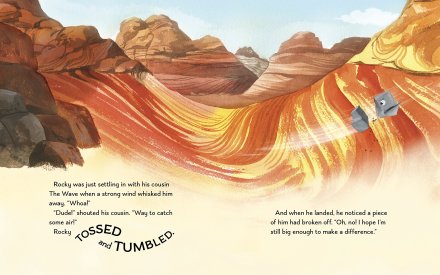
Rocky made a plan, and in the morning he hopped on a pickup truck headed for Arizona to join his cousin The Wave. As soon as he got there, though, a gust of wind blew him away. He landed hard and “noticed that a piece of him had broken off.” Undeterred, he caught a flight with an eagle out to Wyoming and another cousin, The Tower. Rocky was almost settled in when a rainstorm washed him over the side.

At the bottom of the long slide down, Rocky hitched a ride on a car bound for Texas. There, he thought he could watch over the sauropod tracks at Dinosaur Valley State Park. But it didn’t take long for an armadillo to dig him out and send him back on the road again. this time he was determined to go to South Dakota. When he arrived, tinier than when he’d begun his trip, he decided that he’d make a terrific souvenir of his cousin Rushmore.

celebrate-picture-books-picture-book-review-a-chip-off-the-old-block-the-wave

Image copyright Daniel Miyares, 2018. text copyright Jody Jensen Shaffer, 2018. Courtesy of Penguin Random House.

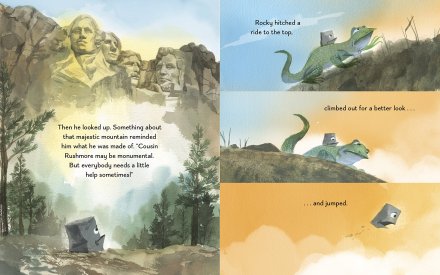
Just then he heard the news. The park was closing because a crack had been discovered in Abraham Lincoln’s nose. “Rocky was crushed.” His dreams of being important would never come true now. But looking up at his cousin, he realized that maybe he could help. A passing lizard gave him a ride to the top, and Rocky jumped. He tumbled down, down and right into the crack in Lincoln’s nose. “He was a perfect fit! I did it! I did something important! I saved Abraham Lincoln!” Rocky exaulted, excited and proud.

Down below, visitors and park employees cheered. Reporters relayed the news, and photographers took pictures. The park was saved, and it was “all thanks to Rocky, the little pebble that wouldn’t be taken for granite.”

A guide to igneous, metamorphic, and sedimentary rocks, illustrated descriptions of some of the world’s most majestic rock formations, and an Author’s Note about Mount Rushmore follow the story.

celebrate-picture-books-picture-book-review-a-chip-off-the-old-block-mount-rushmore

Image copyright Daniel Miyares, 2018. text copyright Jody Jensen Shaffer, 2018. Courtesy of Penguin Random House.

There’s so much to love about Jody Jensen Shaffer’s A Chip Off the Old Block! Part adventure, part educational travelogue, and completely inspirational—with lots of funny wordplay to boot—Shaffer’s story will charm kids. Little Rocky is a sweetie of a go-getter who has big dreams and sets out to achieve them. He overcomes obstacles, setbacks, and disappointments and adjusts to changes with optimism while never losing heart and building up his self-confidence. Kids will cheer when Rocky finally finds the place where he can make the most monumental difference.

celebrate-picture-books-picture-book-review-a-chip-off-the-old-block-rocky

Daniel Miyares’ gorgeous illustrations depict the splendor of Rocky’s magnificent cousins and the landscape they dominate while cleverly tracing his journey from state to state, carried along by a truck and a car, in a backpack, and with the help of some animal friends. Rocky is full of personality and childlike expressions that will endear him to readers. Miyares’ full-color, full-bleed pages will get kids excited to learn more about geology and each rock formation, and will no doubt inspire some vacation wish lists.

A Chip Off the Old Block is a smart and witty book that will excite a child’s imagination. It would be a terrific addition to home bookshelves and should be included in classroom libraries to accompany STEM, STEAM, and English Language Arts lessons and well as fun story times.

Ages 5 – 8

Nancy Paulsen Books, Penguin Random House, 2018 | ISBN 978-0399173882

Discover more about Jody Jensen Shaffer and her books and find teachers’ resources and activities on her website.

To learn more about Daniel Miyares, his books and his art, visit his website.

Meet Jody Jensen Shaffer

celebrate-picture-books-picture-book-review-Jody-Jensen-Shaffer-author-photo

I’m excited to talk with Jody Jensen Shaffer today about what she loves about writing poetry, fiction, and nonfiction, her favorite childhood memories, and her rescue dog, Sophie.

What was the spark for A Chip off the Old Block?

Hi Kathy! Thanks for having me on your blog. The spark for A Chip off the Old Block was the phrase, “Rocky loved his rock star relatives.” It came to me as I was brainstorming picture book ideas, and it felt like the first line of a story. I loved the word play of the line, so I created a story around it. I just had to discover who Rocky was and what his story would be.

A Chip off the Old Block combines terrific storytelling with science and history. What would you like for readers to take away from the book? How have children reacted to Chip?

Thanks! It was lots of fun to write. I hope readers take away from the book the idea that you’re never too small to matter and to never give up on your dreams. Bonus points if they learn a little about rocks, US landmarks, maps, and natural formations! I’ve been really happy with how Chip has been received by children and adults! One class even did a Google maps tour of the places Rocky visits in his travels.

You write across the spectrum of children’s literature from poetry to nonfiction to fiction. Can you briefly describe what you like about each?

I love writing poetry because of the challenge of the form. It’s like putting a puzzle together, and the pieces are brevity, beauty, meaning, and joy.

I love writing fiction because I can choose any characters I want, put them in any situations I want, and have fun with the language, voice, and story.

I love writing nonfiction because I love learning new things! And my interest in science comes to me naturally because of my dad’s influence. He was a college professor of biological sciences (and a great wordsmith).

You’ve said that you loved being a kid. What’s one of your favorite memories? How does being able to tap into that feeling of childhood influence your work?

I have so many great memories of my childhood: fishing with my family at local ponds, riding bikes to the swimming pool, visiting my dad’s lab at the college, even working our huge garden with my siblings (before we were allowed to ride our bikes to the swimming pool). I feel so blessed to have had the parents I had and the childhood they gave me. It’s easy to recall feelings of being loved and valued. I hope to send that same message to my readers through my writing.

You say you can remember the exact moment you learned to read. Can you talk about that a little?

It’s a very brief memory. I was reading an early chapter book and laboriously sounding out each syllable, index finger on page, when it occurred to me that if I just read “lighter,” the words might come to me more easily. I relaxed, I guess, and the words came. It was like a light switch turned on. From then on, I read fluently.

What’s the best part about being a children’s author? Do you have an anecdote from an author event that you’d like to share?

There are so many great things about writing for children, and I feel really blessed to be able to do it, but if I have to choose the best thing, I’d say it’s being able to play with words for a living. In terms of an anecdote, I was Skyping with a class for World Read Aloud Day recently, and a little guy stepped up to the screen and told me how much he liked one of my less well-known books. I felt his sincerity, and I appreciated him telling me.

In 2017, your book Prudence the Part-Time Cow was chosen to represent Missouri in the National Book Festival in Washington DC that is hosted by the Library of Congress. Can you talk about this honor a little? How was Prudence chosen and what did it mean for you as an author and for the book?

I was super excited to learn that the Missouri Center for the Book chose Prudence for that honor! At the National Book Festival, each state chooses a book to represent it. All the states’ books are displayed together in one room for festival-goers. I didn’t attend the event, but several people who did told me Prudence sold out several times!

You’re a dog lover and have a rescue dog named Sophie. I’d love to hear more about her!

How much time do you have? Just kidding. She’s part long-haired dachshund, part chihuahua, we think. Very friendly, a good walking companion, pretty, and a real cuddler. She sleeps under the sheets with us.

What’s up next for you?

In July 2018, just in time for back-to-school, Beach Lane will publish It’s Your First Day of School, Busy Bus! about a school bus’s first day of school. In 2019, Grosset & Dunlap will release my bobble-head biography, Who Is Jackie Chan? I’ve got more projects coming that have yet to be announced, so I better stop there. I’ll continue to publish poetry in great children’s magazines, too.

What’s your favorite holiday? Do you have an anecdote from any holiday you’d like to share?

I really like Earth Day and Arbor Day. I love helping take care of the earth.

Thanks, Jody! It’s been so great chatting with you! I wish you all the best with A Chip Off the Old Block and all of your books and projects!

celebrate-picture-books-picture-book-review-a-chip-off-the-old-block-cover

You can find A Chip Off the Old Block at these booksellers

Amazon | Barnes & Noble | Books-a-Million | IndieBound | Penguin Random House

(Leaving a review is one of the best ways to support authors and illustrators!)

You can connect with Jody Jensen Shaffer on

Her website | Twitter

Get Caught Reading Month Activity

celebrate-picture-books-picture-book-review-reading-bug-book-plate

Catch the Reading Bug Bookmark and Bookplate


If you love to read, show it with these printable Reading Bug book bling!

I’ve Got the Reading Bug Bookmark | I’ve Got the Reading Bug Bookplate

Picture Book Review

April 22 – Earth Day

celebrate-picture-books-picture-book-review-kate-who-tamed-the-wind-cover

About the Holiday

Earth Day, the largest global civic-focused day of action, is celebrated in 192 countries and aims to raise awareness of issues concerning the sustainability and protection of our earth. This year’s theme is End Plastic Pollution with the goal of eliminating single-use plastics while promoting global regulation for the disposal of plastics. Plastics are a danger on land, in our oceans, and in our food. 2018 begins a multi-year effort to bring about alternatives to fossil fuel-based materials, one hundred percent recycling of plastics, “corporate and government accountability,” and our own attitudes concerning plastics. Around the world people also celebrate Earth Day by picking up trash along roadways and waterways, recycling, making family and business plans for using less water and electricity, and by planting trees bushes, and flowers that benefit both humans and animals.  For more information on how to get involved, visit the Earth Day Network.

Kate, Who Tamed the Wind

Written by Liz Garton Scanlon | Illustrated by Lee White


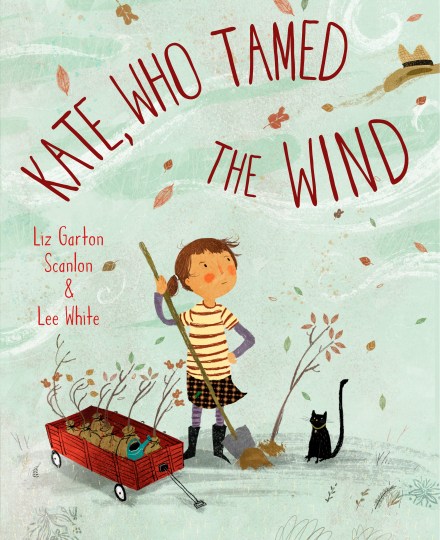
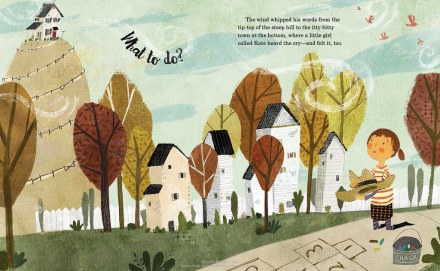
There once was a man who lived in a house on top of very tall, dusty hill. Being so high up, the man’s house captured breezes that set his curtains fluttering and his wind chimes tinkling. Sometimes the wind blew, rattling the shutters, sending the laundry flying from the line, and tearing boards from the house. Inside, the wind whipped, the “table tipped, and the tea spilled.” The man’s hat flew off and out the window, joining the birds who were leaving too.

celebrate-picture-books-picture-book-review-kate-who-tamed-the-wind-spilled-tea

Image copyright Lee White, 2018. text copyright Liz Garton Scanlon, 2018. Courtesy of Schwartz & Wade.

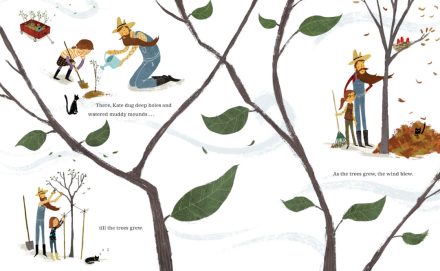
The man cried, “What to do?” Down on the sidewalk below, a little girl named Kate caught the man’s hat and the man’s cry too. Kate wanted to help. She “couldn’t stop the wind,” but she knew of something that could slow it down. When she returned the man’s hat, she also brought a wagon full of saplings. Kate and the man planted the trees, and they tended them as they grew—even while the wind blew.

celebrate-picture-books-picture-book-review-kate-who-tamed-the-wind-kate-catches-hat

Image copyright Lee White, 2018. text copyright Liz Garton Scanlon, 2018. Courtesy of Schwartz & Wade.

“The trees grew, the wind blew, and the time flew. The time flew as the trees grew…and grew…and Kate did too.” As the trees got bigger, taller, and stronger, the “leaves fluttered,” but the shutters quieted and the board stayed still. Inside, the tea brewed, the dust settled down, and the man’s hat stayed put. Even the birds came back. With the house ringed in trees, Kate and the man enjoyed a picnic in the yard, cooled just enough by the gentle breeze.

celebrate-picture-books-picture-book-review-kate-who-tamed-the-wind-planting-trees

Image copyright Lee White, 2018. text copyright Liz Garton Scanlon, 2018. Courtesy of Schwartz & Wade.

Readers will love getting carried away by Liz Garton Scanlon’s breezy lines that through alliteration and rhyme replicate a windy day as things bang, flap, whip, and go flying. As the trees that Kate and the man plant grow and begin to shelter the house from the wind, the rhythm of Scanlon’s text becomes more staccato and rooted. Little Kate is a terrific role model for young readers for her environmental know-how and her stick-to-itiveness as the trees grow from saplings to maturity. The long friendship between the man and Kate is also endearing.

Lee White’s softly hued pages swirl with swipes and swishes that whip curtains, steal laundry, and upend the table and tea. The man’s bewilderment serves as a foil to Kate’s determination and problem-solving, and the difference she makes in the man’s quality of life is evident as the trees grow, their friendship develops, and the wind is finally tamed. Kids will identify with this kind and intelligent child who grows up to be a caring adult.

Beautifully conceived and with lovely details, Kate, Who Tamed the Wind is an environmentally conscious story that will inspire young readers at home and in the classroom.

Ages 4 – 8

Schwartz & Wade, 2018 | ISBN 978-1101934791

Discover more about Liz Garton Scanlon and her books on her website

To learn more about Lee White, her books, and his art, visit his website.

Earth Day Activity

celebrate-picture-books-picture-book-review-paper-plate-tree-craft-2

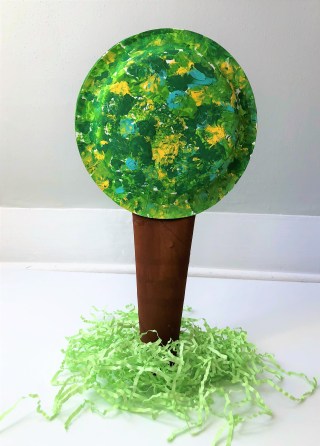
Paper Plate Tree


On Earth Day children love planting trees in their yard or as part of a community project. With this easy craft, they can also plant a tree on their wall or bulletin board.

Supplies

  • Two paper plates 
  • Paper towel tube
  • Brown craft paint
  • Green craft paint (using a variety of green paints adds interest)
  • Paintbrush, cork, or cut carrot can be used to apply paint
  • Glue or hot glue gun or stapler

Directions

  1. Paint the paper towel tube brown, let dry
  2. Paint the bottoms of the two paper plates with the green (or other color) paints, let dry
  3. Flatten about 4 inches of the paper towel tube 
  4. Glue or tape the flat part of the paper towel tube to the unpainted side of one paper plate
  5. Glue the edges of the two paper plates together, let dry.
  6. Straighten the tree so that it can stand up, or hang your tree on a wall, bulletin board, in a window

Picture Book Review


April 14 – National Look up at the Sky Day & Interview with Astronaut Clayton C. Anderson

celebrate-picture-books-picture-book-review-astronaut-clayton-anderson-photo

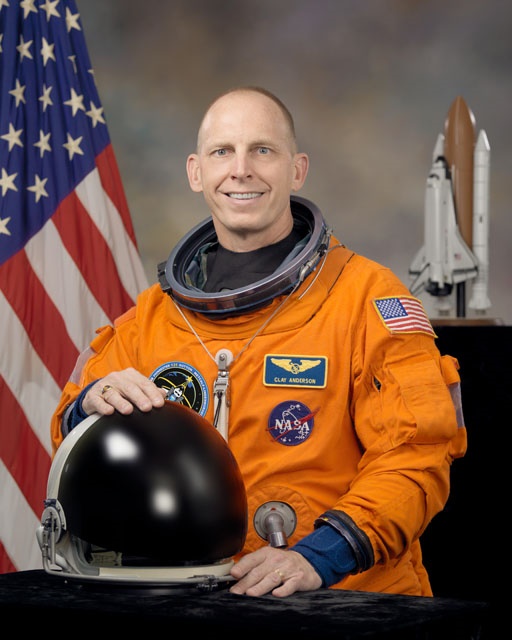
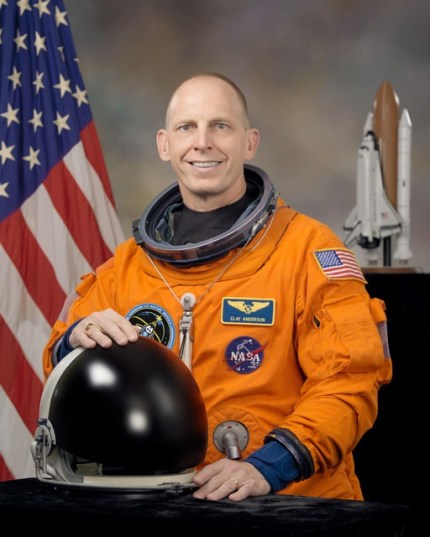
Today, I’m honored to speak with retired astronaut Clayton Anderson about a pivotal childhood moment that inspired his life’s work, the challenges of being an astronaut, and his most vivid memories from space.  

What inspired you to make the journey to become an astronaut?

It was Christmas Eve, 1968.  I was nine years old when my parents put my brother and sister and me on the floor in front of a black-and-white TV around midnight. We sat on an old throw-rug gifted from our grandmother to watch humans circumvent the moon for the first time in human history. As I watched the control center team and listened to the flight director bark out commands, I was enthralled. “I need a Go/NoGo for the trans-lunar injection burn… FIDO? GO!  Retro…? GO!  Surgeon…? GO!  GPO…? GO! The entire team was GO! The craft disappeared behind the moon, leaving me to enjoy the rapid-fire chatter no more. It was simple static on our TV… for about 15 minutes. Then, after a couple of non-answered calls from the Houston CAPCOM to the Apollo 8 crew, I heard the quindar tone (famous “space-beep” you hear on TV), and the first words from the Apollo 8 commander, Frank Borman: “Houston, Apollo 8. Please be informed there is a Santa Claus!” That’s all I needed. The bit was set in my mind that one day, I would become a United States Astronaut.

How did your perspectives change while on the International Space Station?

I am a man of faith. Seeing our earth from orbit did allow me to have the “orbital perspective” so many astronauts speak of. However, while I totally agree that this perspective changed my outlook and my willingness to do better with trying to protect and preserve our “spaceship earth,” it strengthened my faith in God much more. The earth and those of us privileged to be on it, is not random. There is a reason why Sir Isaac Newton discovered gravity and invented calculus. There is a reason why Albert Einstein was able to derive the Theory of Relativity. While I am unable to truly explain my rationale, I believe that there is a higher power. A power that created this universe and gave humans an adaptable brain. That incredible gift will continue to enable us to uncover the secrets of the universe, continuing to strengthen my faith.

What was a big challenge you faced during your career?

The dream of flying in space as an American astronaut was something I pursued for many years of my life. To have finally been selected and given that opportunity is incredible. Yet having the “best job in the universe” is not without difficulty. For me, it was family separation. I love my wife and kids more than anyone… on or off the planet.  To have to be separated from them for months at a time was extremely difficult, especially given their ages (6 and 2) when I began my training. It got easier as they grew older, but it didn’t assuage my guilt very much. While I lived my dream, they sacrificed greatly, and I will spend the rest of my life trying to repay them.

What is your best memory from being in space?

It must be my first spacewalk. Poised above the opened hatch, floating in my spacesuit while looking into the abyss of darkness created by the sun’s travel behind the Earth, I was calm. I watched ice crystals fly from behind my suit (they were created by my sublimator… or air conditioning unit) into the total black void of space. The slight pressure still available after the depressurization of the airlock was “pushing” the crystals into the vacuum of space. I was entranced just watching them sail by. When I finally came back to reality—buoyed by the Mission Control call to exit the airlock—I paused for just a moment to contemplate what was happening. The only thought going through my mind was that “…I was born to be here, right now, in this special place, doing this.”

Seeing my hometown from space…for the very first time, is a very, very close second. On that day, when I expected to excitedly capture photos of my Ashland, Nebraska, I had everything prepped and ready to go. Equipment was strategically placed around the U.S. Lab module’s earth-facing window, cameras were Velcroed securely to the wall, with timers set to remind me when to get into position. Finding my home on earth—without all the wonderfully placed lines, borders, squiggly river italics, and large stars designating capital cities—was tougher than I imagined. But when I finally found success, and saw Nebraska rolling into view by virtue of a big gray splotch known as Omaha (and a smaller gray splotch further southwest called Lincoln), the south bend of the Platte River was the last valid vision I had. When I saw my home, nestled there where the river bent, the place where I was raised and where many of my family and friends still reside, I took not a single photo. I simply broke down and cried. Overcome by the incredible emotions of floating weightlessly, as an American astronaut flying 225 miles above the exact spot where I was born and raised, having first dreamed of doing exactly that, was simply too much for me. So, I did what seemed to come to me naturally.  I wept.

Thank you so much for sharing your thoughts and memories of your incredible career. I wish you all the best with A is for Astronaut and all of your future endeavors as you inspire children and adults to always reach for the stars.

About Clayton C. Anderson

Retired Astronaut Clayton Anderson spent 167 days in outer space, having lived and worked on the International Space Station (ISS) for 152 days and participated in nearly 40 hours of space walks. With a strong belief in perseverance and the importance of STEAM as part of every child’s education, Astronaut Anderson brings his “out of this world” insight to issues faced by children, parents, and educators. 

You can connect with Clayton Anderson on:

His website: astroclay.com | Facebook | Instagram | Twitter. For speaking events and appearances visit www.AstronautClayAnderson.com

You can find A is for Astronaut at these booksellers:

Amazon | Barnes & Noble | Books-a-Million | IndieBound | Sleeping Bear Press

National Look up at the Sky Day Review

celebrate-picture-books-picture-book-review-a-is-for-astronaut-cover

About the Holiday

Today’s holiday hopes to inspire people to slow down and enjoy life’s simple pleasures—like gazing up at the sky and really seeing the beauty that’s there. Throughout the day and night, the sky presents an ever-changing world of color and motion, depth and light. It’s a work of art like no other.  Ever since the earliest times, people have been fascinated with the sky, directed by the stars, and questioning of what lies beyond. Today, we also celebrate those poets, mathematicians, scientists, and especially the astronauts who have explored the sky and brought all of its wonders a little closer.

Sleeping Bear Press sent me a copy of A is for Astronaut to check out. All opinions are my own. I’m also thrilled to be partnering with Sleeping Bear Press in a giveaway of a signed copy of A is for Astronaut and a tote bag. View details below.

A is for Astronaut: Blasting Through the Alphabet

Written by Astronaut Clayton Anderson | Illustrated by Scott Brundage


There are some books that just make you say “Wow!” when you open the cover. A is for Astronaut is one of these. Leafing through the pages is like stepping out into a clear, starry night, visiting a space museum, and letting your own dreams soar all rolled into one. When you settle in to read, you discover that each letter of the alphabet introduces both poetry and facts to enthrall space lovers.

celebrate-picture-books-picture-book-review-a-is-for-astronaut-letter-A

Image copyright Scott Brundage, 2018, text copyright Clayton C. Anderson, 2018. Courtesy of Sleeping Bear Press.

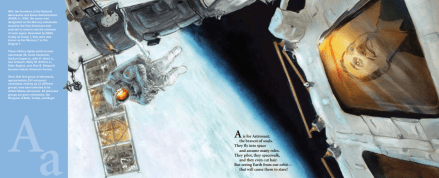
To get things started, “A is for Astronaut, / the bravest of souls. / They fly into space / and assume many roles. / They pilot, they spacewalk, / and they even cut hair. / But seeing Earth from our orbit— / that will cause them to stare!” A sidebar reveals more about astronauts—even astronaut nicknames!

“B is for Blastoff, a powerful thing! / When those engines are fired, it’ll make your ears ring.” And did you know that two and a half minutes after blastoff, the engines are cut off and everything begins to float? Pretty amazing! Blasting through the alphabet we come to G, where readers learn about our Galaxy that is “shaped like a spiral filled with billions of stars.”

celebrate-picture-books-picture-book-review-a-is-for-astronaut-letter-N

Image copyright Scott Brundage, 2018, text copyright Clayton C. Anderson, 2018. Courtesy of Sleeping Bear Press.

How are astronauts able to walk and work in space? “Space Helmets are crucial and H is their letter.” At K kids meet John F. Kennedy, who helped develop the space program, and L is for the Landing that brings astronauts back to Earth. M is for Meteors with their very long tails, and N, of course, is for NASA, which was formed in 1958 with a “goal to better understand our planet and solar system.”

How do astronauts do that? “Working outside in space is sure to impress. / We call it a Space Walk, and its letter is S. / Floating weightless, with tools and a bulky white suit, / we can fix and install things—it’s really a hoot!” And there’s also V for  “Voyager, two NASA space probes. / They are still sending data, / having long left our globe.”

At Z, time is up—that’s Zulu time and “our reference to England, when London’s clocks chime. / As we fly ‘round the Earth, folks must know our day’s plan, / so we all set our watches to match that time span.” 

celebrate-picture-books-picture-book-review-a-is-for-astronaut-letter-P

Image copyright Scott Brundage, 2018, text copyright Clayton C. Anderson, 2018. Courtesy of Sleeping Bear Press.

Both children and adults who have an affinity for space travel and all things related to astronomy will want to dip into A is for Astronaut again and again. With his wealth of knowledge and engaging voice, astronaut Clayton Anderson presents a book that will have readers starry-eyed and full of the kinds of facts and tidbits that answer questions and spur further discovery. A is for Astronaut can be read through from A to Z for its vivid poetry or explored in small chunks to absorb the fascinating facts included with each letter—or both. Expertly written for kids of all ages, Anderson’s A is for Astronaut is a stellar achievement.

Scott Brundage’s incredibly beautiful and detailed illustrations will thrill space buffs and serious scientists and engineers alike. Readers will love meeting astronauts tethered to their ship while working in space, experiencing the vibrant, mottled colors of a darkened sky or distant planet, and viewing the technological marvel that is the NASA control room. With the precision of a photograph and the illumination of true artistry, Brundage’s images put readers in the center of the action, where they can learn and understand more about this favorite science.

A is for Astronaut is a must for classroom, school, and public libraries and would be a favorite on home bookshelves for children (and adults) who love space, technology, math, science, and learning about our universe.

Ages 5 – 10

Sleeping Bear Press, 2018 | ISBN 978-1585363964

Discover more about retired astronaut Clayton Anderson and access resources on his website, or follow him on Facebook | Twitter | or Insta. For speaking events and appearances visit www.AstronautClayAnderson.com

To learn more about Scott Brundage and view a portfolio of his publishing and editorial work, visit his website.

Visit Sleeping Bear Press to learn more about A is for Astronaut

National Look up at the Sky Day Activity


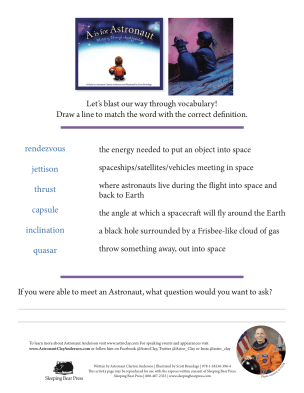
Show your excitement about all things space-related with these fun activity sheets from Astronaut Clayton C. Anderson and Sleeping Bear Press! 

celebrate-picture-books-picture-book-review-a-is-for-astronaut-fill-in-the-blanks-activity

A is for Astronaut Fill in the Blanks

celebrate-picture-books-picture-book-review-a-is-for-astronaut-vocabulary-activity

A is for Astronaut Vocabulary Sheet


Picture Book Review

March 31 – Bunsen Burner Day

celebrate-picture-books-picture-book-review-Marie-Curie-little-people-big-dreams-cover

About the Holiday

Today we celebrate the birthday of German chemist Robert Wilhelm Eberhard von Bunsen who in 1854 was instrumental in developing the Bunsen burner in 1854. At the time, burners used in chemistry labs were fueled with coal gas, which did not burn hot enough, was expensive, and left the beakers sooty. Bunsen and Peter Desaga devised a cleaner and hotter burner that was also easier to use. Now, the Bunsen burner is standard equipment in labs around the world.

Marie Curie (Little People, Big Dreams)

Marie: My First Marie Curie Board Book

Written by Isabel Sánchez Vegara | Illustrated by Frau Isa


From the time when Marie was a little girl, she knew she wanted to be a scientist. Marie was very smart. “At school, she won a gold medal for her studies, which she kept in her drawer like a treasure.” Because women were not allowed to go to college in her country, she moved to France to go to the university there. Even though French was not her first language, Marie was soon the top math and science student in Paris.

celebrate-picture-books-picture-book-review-Marie-Curie-little-people-big-dreams-dreaming

Copyright Frau Isa, 2018, courtesy of Frances Lincoln Children’s Books.

One day Marie met Pierre, who loved science as much as she did. They got married and worked together in their own laboratory, where they discovered radium and polonium. “It was such a thrilling moment for science!” Marie and Pierre even won the Nobel Prize. Marie was the first woman ever to be awarded this honor. When Pierre later had an accident, Marie was left alone to continue their work.

celebrate-picture-books-picture-book-review-Marie-Curie-little-people-big-dreams-marie-and-pierre

Copyright Frau Isa, 2018, courtesy of Frances Lincoln Children’s Books.

All her research and experiments paid off when she was awarded her second Nobel Prize. When war broke out, “Marie’s discoveries were used by doctors to help injured soldiers.” Marie inspired many girls who studied science at her own institute in Paris. Besides science, Marie taught her students that there was nothing to fear, “many things to learn, and many ways to help those in need.”

A timeline and brief yet detailed biography of her life follows the story.

celebrate-picture-books-picture-book-review-Marie-Curie-little-people-big-dreams-marie-with-noble-prize

Copyright Frau Isa, 2018, courtesy of Frances Lincoln Children’s Books.

With thrilling recognition that even in the youngest hearts beat future writers, artists, adventurers, designers, and scientists, the Little People, Big Dreams series introduces preschoolers to inspiring women role models. In Marie Curie: Little People, Big Dreams, Isabel Sánchez Vegara reveals the life and work of Marie Curie with straightforward storytelling that illuminates while affirming the intelligence of her young audience. Uplifting, life-determining personality traits that carried Marie over obstacles and to the top of her profession—such as not taking no for an answer, treasuring your accomplishments, working hard, and helping others—are highlighted for little ones to learn from.

Frau Isa’s stylish illustrations in a striking, subdued color palette will entice the youngest readers to listen and learn. While the spotlight is always on Marie, each page also focuses on one or two main images, such as Marie and Pierre’s lab table, a wounded soldier’s X-ray, and Marie holding her Nobel Prize, that help little ones see and understand the important aspects of the story.

Encapsulating both history and the timeless persistence that drives people to achieve their full potential, Marie Curie—available in both picture book and board book editions—is a must for preschool classrooms and would be a rousing addition to home bookshelves.

Ages 3 – 5

Frances Lincoln Children’s Books, 2018 | ISBN 978-1847809629 (Picture Book); 978-1786032539 (Board Book)

You can check out more about Isabel Sánchez Vegara on Instagram.

Discover more about Frau Isa and her art on her website.

Bunsen Burner Day Activity

celebrate-picture-books-picture-book-review-green=pennies-experiment

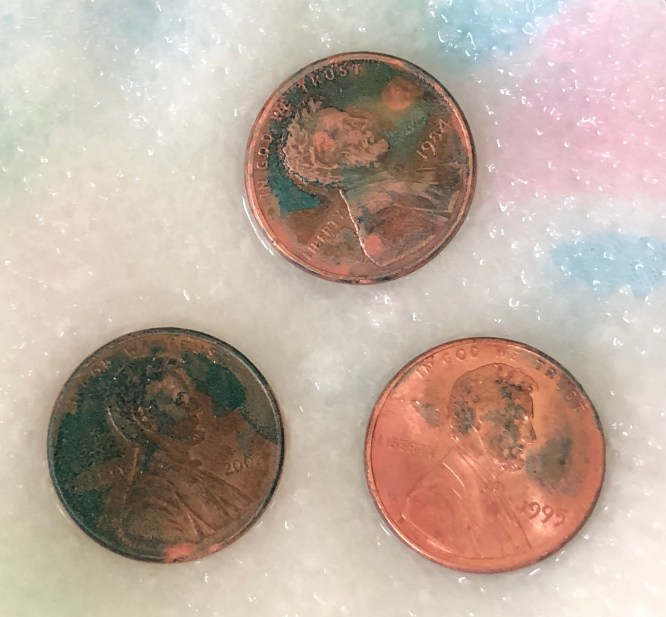
Green Pennies Chemistry Experiment


You know what color pennies are! They’re those brownish coins amid all the silver. But what if you could turn those pennies green—like dollar bills? You can with this easy and way cool chemistry experiment!

Supplies

  • 10 – 12 dull pennies
  • Vinegar
  • Lemon juice
  • Salt
  • 2 small bowls
  • ¼ cup measuring cup
  • 1 teaspoon
  • Paper towels

Directions

IMG_6569

Experiment 1

  1. Pour ¼ cup vinegar into a bowl
  2. Add 1 teaspoon salt
  3. Mix thoroughly until salt has dissolved
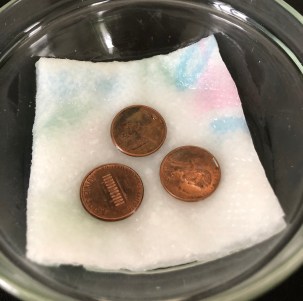
  4. Place a few pennies in the bowl and leave for five minutes.
  5. Take the pennies out and place them on the paper towel.
  6. Let the pennies dry and watch what happens. The reaction becomes more dramatic over time, so check on your pennies at different times throughout the day

Extra Observation:

  1. To see the chemical reaction at work, dip one penny half way into the vinegar/salt solution and wait a minute
  2. Lift the penny out of the solution and see the result

IMG_6588

Experiment 2

  1. Fold a paper towel to several thicknesses and place in bowl
  2. Place a few pennies on top of the paper towel
  3. Pour enough vinegar over the pennies to saturate the paper towel
  4. Wait two to three hours and see what happens
  5. You can leave the pennies in the bowl and continue to add vinegar as the paper towel dries. Flip the pennies over to create a chemical reaction on both sides

IMG_6590

Experiment with other acids, such as the lemon juice.

Why do the pennies turn green?

Pennies are made of copper. The vinegar and salt solution helps the copper react with oxygen in the air to form the blue-green patina of malachite on the surface of the penny. This chemical reaction is called oxidation. You can see the same green color on other things made of copper like plumbing pipes and many statues—even the Statue of Liberty!

If you’d like to record your observations of your pennies like a chemist does, download and print this lab sheet.

Picture Book Review

March 23 – National Near Miss Day and Interview with Astronaut Clayton C. Anderson

celebrate-picture-books-picture-book-review-a-is-for-astronaut-cover

About the Holiday

Today we remember a cosmic fly-by that occurred on March 23, 1989. On that day the 300-meter-wide asteroid 4581 Asclepius, named for the Greek god of medicine and healing, came within 430,000 miles of hitting Earth—actually passing through the exact position Earth had held only six hours earlier. This near miss wasn’t discovered until nine days later by astronomers Henry E. Holt and Norman G. Thomas. “On the cosmic scale of things, that was a close call,” Dr. Holt said at the time. To celebrate today, you can thank your lucky stars for this near miss or any others you’ve experienced recently or in your lifetime. Another stellar way to spend the day is to learn more about space and our universe!

Sleeping Bear Press sent me a copy of A is for Astronaut to check out. All opinions are my own. I’m also thrilled to be partnering with Sleeping Bear Press in a giveaway of a signed copy of A is for Astronaut and a tote bag. View details below.

A is for Astronaut: Blasting Through the Alphabet

Written by Astronaut Clayton Anderson | Illustrated by Scott Brundage


There are some books that just make you say “Wow!” when you open the cover. A is for Astronaut is one of these. Leafing through the pages is like stepping out into a clear, starry night, visiting a space museum, and letting your own dreams soar all rolled into one. When you settle in to read, you discover that each letter of the alphabet introduces both poetry and facts to enthrall space lovers.

celebrate-picture-books-picture-book-review-a-is-for-astronaut-letter-A

Image copyright Scott Brundage, 2018, text copyright Clayton C. Anderson, 2018. Courtesy of Sleeping Bear Press.

To get things started, “A is for Astronaut, / the bravest of souls. / They fly into space / and assume many roles. / They pilot, they spacewalk, / and they even cut hair. / But seeing Earth from our orbit— / that will cause them to stare!” A sidebar reveals more about astronauts—even astronaut nicknames!

“B is for Blastoff, a powerful thing! / When those engines are fired, it’ll make your ears ring.” And did you know that two and a half minutes after blastoff, the engines are cut off and everything begins to float? Pretty amazing! Blasting through the alphabet we come to G, where readers learn about our Galaxy that is “shaped like a spiral filled with billions of stars.”

celebrate-picture-books-picture-book-review-a-is-for-astronaut-letter-N

Image copyright Scott Brundage, 2018, text copyright Clayton C. Anderson, 2018. Courtesy of Sleeping Bear Press.

How are astronauts able to walk and work in space? “Space Helmets are crucial and H is their letter.” At K kids meet John F. Kennedy, who helped develop the space program, and L is for the Landing that brings astronauts back to Earth. M is for Meteors with their very long tails, and N, of course, is for NASA, which was formed in 1958 with a “goal to better understand our planet and solar system.”

How do astronauts do that? “Working outside in space is sure to impress. / We call it a Space Walk, and its letter is S. / Floating weightless, with tools and a bulky white suit, / we can fix and install things—it’s really a hoot!” And there’s also V for  “Voyager, two NASA space probes. / They are still sending data, / having long left our globe.”

At Z, time is up—that’s Zulu time and “our reference to England, when London’s clocks chime. / As we fly ‘round the Earth, folks must know our day’s plan, / so we all set our watches to match that time span.” 

celebrate-picture-books-picture-book-review-a-is-for-astronaut-letter-P

Image copyright Scott Brundage, 2018, text copyright Clayton C. Anderson, 2018. Courtesy of Sleeping Bear Press.

Both children and adults who have an affinity for space travel and all things related to astronomy will want to dip into A is for Astronaut again and again. With his wealth of knowledge and engaging voice, astronaut Clayton Anderson presents a book that will have readers starry-eyed and full of the kinds of facts and tidbits that answer questions and spur further discovery. A is for Astronaut can be read through from A to Z for its vivid poetry or explored in small chunks to absorb the fascinating facts included with each letter—or both. Expertly written for kids of all ages, Anderson’s A is for Astronaut is a stellar achievement.

Scott Brundage’s incredibly beautiful and detailed illustrations will thrill space buffs and serious scientists and engineers alike. Readers will love meeting astronauts tethered to their ship while working in space, experiencing the vibrant, mottled colors of a darkened sky or distant planet, and viewing the technological marvel that is the NASA control room. With the precision of a photograph and the illumination of true artistry, Brundage’s images put readers in the center of the action, where they can learn and understand more about this favorite science.

A is for Astronaut is a must for classroom, school, and public libraries and would be a favorite on home bookshelves for children (and adults) who love space, technology, math, science, and learning about our universe.

Ages 5 – 10

Sleeping Bear Press, 2018 | ISBN 978-1585363964

Discover more about retired astronaut Clayton Anderson and access resources on his website, or follow him on Facebook | Twitter | or InstaFor speaking events and appearances visit www.AstronautClayAnderson.com

To learn more about Scott Brundage and view a portfolio of his publishing and editorial work, visit his website.

Visit Sleeping Bear Press to learn more about A is for AstronautYou can download two A is for Astronaut Activity Sheets here:

A is for Astronaut Vocabulary Sheet | A is for Astronaut Fill in the Blanks

Meet Astronaut Clayton Anderson
celebrate-picture-books-picture-book-review-astronaut-clayton-anderson-photo

Today, I’m honored to speak with retired astronaut Clayton Anderson about a pivotal childhood moment that inspired his life’s work, the challenges of being an astronaut, and his most vivid memories from space.  

What inspired you to make the journey to become an astronaut?

It was Christmas Eve, 1968.  I was nine years old when my parents put my brother and sister and me on the floor in front of a black-and-white TV around midnight. We sat on an old throw-rug gifted from our grandmother to watch humans circumvent the moon for the first time in human history. As I watched the control center team and listened to the flight director bark out commands, I was enthralled. “I need a Go/NoGo for the trans-lunar injection burn… FIDO? GO!  Retro…? GO!  Surgeon…? GO!  GPO…? GO! The entire team was GO! The craft disappeared behind the moon, leaving me to enjoy the rapid-fire chatter no more. It was simple static on our TV… for about 15 minutes. Then, after a couple of non-answered calls from the Houston CAPCOM to the Apollo 8 crew, I heard the quindar tone (famous “space-beep” you hear on TV), and the first words from the Apollo 8 commander, Frank Borman: “Houston, Apollo 8. Please be informed there is a Santa Claus!” That’s all I needed. The bit was set in my mind that one day, I would become a United States Astronaut.

How did your perspectives change while on the International Space Station?

I am a man of faith. Seeing our earth from orbit did allow me to have the “orbital perspective” so many astronauts speak of. However, while I totally agree that this perspective changed my outlook and my willingness to do better with trying to protect and preserve our “spaceship earth,” it strengthened my faith in God much more. The earth and those of us privileged to be on it, is not random. There is a reason why Sir Isaac Newton discovered gravity and invented calculus. There is a reason why Albert Einstein was able to derive the Theory of Relativity. While I am unable to truly explain my rationale, I believe that there is a higher power. A power that created this universe and gave humans an adaptable brain. That incredible gift will continue to enable us to uncover the secrets of the universe, continuing to strengthen my faith.

What was a big challenge you faced during your career?

The dream of flying in space as an American astronaut was something I pursued for many years of my life. To have finally been selected and given that opportunity is incredible. Yet having the “best job in the universe” is not without difficulty. For me, it was family separation. I love my wife and kids more than anyone… on or off the planet.  To have to be separated from them for months at a time was extremely difficult, especially given their ages (6 and 2) when I began my training. It got easier as they grew older, but it didn’t assuage my guilt very much. While I lived my dream, they sacrificed greatly, and I will spend the rest of my life trying to repay them.

What is your best memory from being in space?

It must be my first spacewalk. Poised above the opened hatch, floating in my spacesuit while looking into the abyss of darkness created by the sun’s travel behind the Earth, I was calm. I watched ice crystals fly from behind my suit (they were created by my sublimator… or air conditioning unit) into the total black void of space. The slight pressure still available after the depressurization of the airlock was “pushing” the crystals into the vacuum of space. I was entranced just watching them sail by. When I finally came back to reality—buoyed by the Mission Control call to exit the airlock—I paused for just a moment to contemplate what was happening. The only thought going through my mind was that “…I was born to be here, right now, in this special place, doing this.”

Seeing my hometown from space…for the very first time, is a very, very close second. On that day, when I expected to excitedly capture photos of my Ashland, Nebraska, I had everything prepped and ready to go. Equipment was strategically placed around the U.S. Lab module’s earth-facing window, cameras were Velcroed securely to the wall, with timers set to remind me when to get into position. Finding my home on earth—without all the wonderfully placed lines, borders, squiggly river italics, and large stars designating capital cities—was tougher than I imagined. But when I finally found success, and saw Nebraska rolling into view by virtue of a big gray splotch known as Omaha (and a smaller gray splotch further southwest called Lincoln), the south bend of the Platte River was the last valid vision I had. When I saw my home, nestled there where the river bent, the place where I was raised and where many of my family and friends still reside, I took not a single photo. I simply broke down and cried. Overcome by the incredible emotions of floating weightlessly, as an American astronaut flying 225 miles above the exact spot where I was born and raised, having first dreamed of doing exactly that, was simply too much for me. So, I did what seemed to come to me naturally.  I wept.

Thank you so much for sharing your thoughts and memories of your incredible career. I wish you all the best with A is for Astronaut and all of your future endeavors as you inspire children and adults to always reach for the stars.

About Clayton Anderson

Retired Astronaut Clayton Anderson spent 167 days in outer space, having lived and worked on the International Space Station (ISS) for 152 days and participated in nearly 40 hours of space walks. With a strong belief in perseverance and the importance of STEAM as part of every child’s education, Astronaut Anderson brings his “out of this world” insight to issues faced by children, parents, and educators. 

You can connect with Clayton Anderson on:

His website: astroclay.com | Facebook | Instagram | TwitterFor speaking events and appearances visit www.AstronautClayAnderson.com

You can find A is for Astronaut at these booksellers:

Amazon | Barnes & Noble | Books-a-Million | IndieBound | Sleeping Bear Press

Near Miss Day Activity

 celebrate-picture-books-picture-book-review-rocket-to-the-moon-tic-tac-toe-game

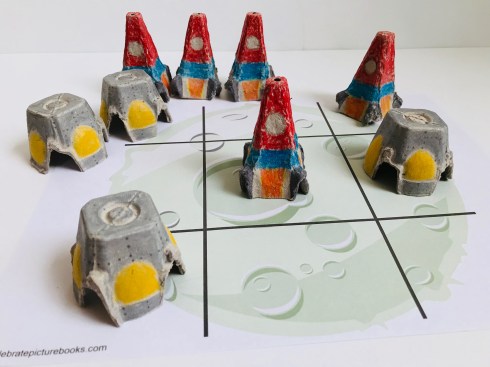
Rocket to the Moon! Tic-Tac-Toe Game


You can launch your own Tic-Tac-Toe Game with this set you make yourself! With just a couple of egg cartons, some crayons, and a printable game board, you’ll be off to the moon for some fun! Opposing players can be designated by rockets and capsules. Each player will need 5 playing pieces. 
Supplies

  • Printable Moon Tic-Tac-Toe Game Board
  • 2 cardboard egg cartons
  • Heavy stock paper or regular printer paper
  • Crayons
  • Black or gray fine-tip marker

Directions

To Make the Rockets

  1. Cut the tall center cones from the egg carton
  2. Trim the bottoms of each form so they stand steadily, leaving the arched corners intact
  3. Pencil in a circular window on one side near the top of the cone
  4. Color the rocket body any colors you like, going around the window and stopping where the arched corners begin
  5. With the marker color the arched corners of the form to make legs
  6. On the cardboard between the legs, color flames for blast off

To Make the Capsule

  1. Cut the egg cups from an egg carton
  2. Color the sides silver, leaving the curved section uncolored. (If your egg cup has no pre-pressed curve on the sides of the cup, draw one on each side.)
  3. Color the curved section yellow to make windows
  4. With the marker, dot “rivets” across the capsule

Print the Moon Game Board and play!

Picture Book Review