May 30 – Loomis Day

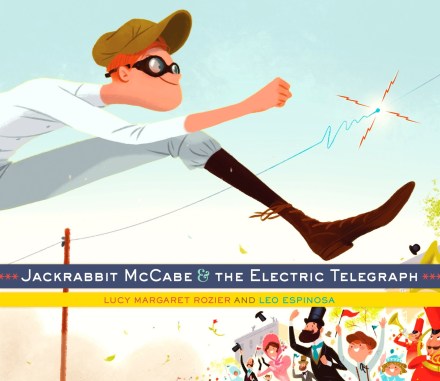
celebrate-picture-books-picture-book-review-jackrabbit-mccabe-&-the-electric-telegraph-cover

About the Holiday

On Loomis Day we remember Mahlon Loomis, a Washington DC dentist working in the mid-1800s who had a very inventive mind. Not only did he invent artificial teeth, he also had some revolutionary ideas on communication. He understood about the electrical properties of the atmosphere and experimented with sending signals long distances using kites flown many miles apart but at the same height. In July of 1872 he received a U. S. patent for “An Improvement in Telegraphing” on wireless telegraphy. Further research revealed that while his wireless telegraphic system worked, it did not work the way Loomis thought. His experiments, however, advanced the science at the time, leading to one of the world’s most transformative discoveries and an ongoing quest for better and faster communications.

Jackrabbit McCabe & the Electric Telegraph

Written by Lucy Margaret Rozier | Illustrated by Leo Espinosa


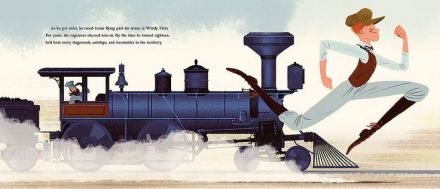
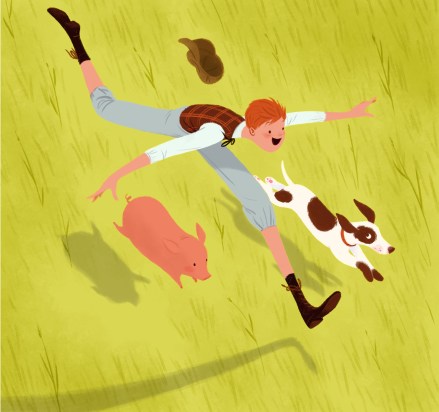
Anyone who looked at the baby with legs “so long they looped like a pretzel” and required a stroller with “an extra axle” knew that he’d been born to run. In fact, his legs grew so fast that if his mother dressed him in long pants in the morning, they were shorts by that evening. Little Jack McCabe used those legs to chase “whatever would run: hogs, dogs, even his own shadow” and “as he got older, he raced trains flying past his house in Windy Flats. By the time he turned eighteen, he’d beat every stagecoach, antelope, and locomotive in the territory.”

celebrate-picture-books-picture-book-review-jackrabbit-mccabe-&-the-electric-telegraph-racing-a-train

Image copyright Leo Espinosa, text copyright Lucy Margaret Rozier. Courtesy of Schwartz & Wade

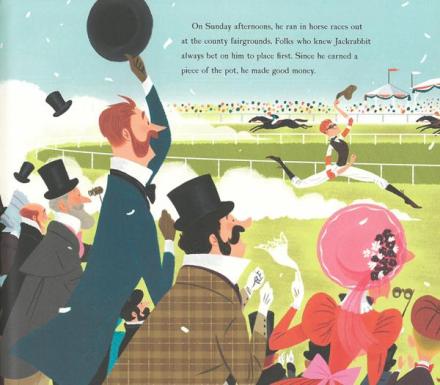
The people of Windy Flats called him Jackrabbit and relied on him to deliver messages that were urgent. On Sundays he joined the horses on the track, making money when people bet on him to come in first. One day, though, the electric telegraph came to Windy Flats. The poles and wires already crossed the eastern part of the country. Each connected city had “a telegraph and an operator who sent and received messages in Morse code, an alphabet of dots and dashes.”

The people of Windy Flats didn’t think this newfangled contraption could carry messages faster than Jackrabbit, so the telegraph man suggested, “‘How ‘bout a race between your fella and this here electric telegraph? Sandy Bluff’s just got themselves an operator, That’s pert near twenty-five miles, as the crow flies.’” Jackrabbit was all for it.

celebrate-picture-books-picture-book-review-jackrabbit-mccabe-&-the-electric-telegraph-racing-a-horse

Image copyright Leo Espinosa, text copyright Lucy Margaret Rozier. Courtesy of Schwartz & Wade

On the day of the race, the whole town of Windy Flats came out with flags, banners, and even a brass band. “The mayor carefully wrote down the same message on two slips of paper. He handed one to the telegraph man and the other to Jackrabbit.”  On the shout of “GO!” the telegraph man plunked his finger on the key sending the pulses through the wire while Jackrabbit took off down the road toward Sandy Bluff “like a tornado.”

The townspeople watched as in only a few moments “a reply came clattering back as that telegraph key jumped and smacked all on its own.” The telegraph man read the code and yelled, “‘Message received. Stop. Sandy Bluff Operator.’” But where was Jackrabbit McCabe? Although he made it to Sandy Bluff in only 9 ½ minutes, it was still too long to beat the telegraph. When he stopped short at the door of the depot, he was met by a telegram tacked to the door. Jackrabbit read it and then pulled the paper that contained the mayor’s message out of his pocket. The two were the same.

celebrate-picture-books-picture-book-review-jackrabbit-mccabe-&-the-electric-telegraph-racing-at-the-starting-line

Image copyright Leo Espinosa, text copyright Lucy Margaret Rozier. Courtesy of Schwartz & Wade

Riding home in a stagecoach, “Jackrabbit felt lower than a snake’s navel.” The mayor also felt pretty low, thinking of Jackrabbit, until he realized that if Jackrabbit’s fingers were as fast as his legs, he’d make an excellent telegraph operator. When Jackrabbit stepped out of the stagecoach and heard the mayor’s offer, he whooped with joy. It didn’t take long for Jackrabbit to learn the new code, and soon “his fingers flew like a banjo player’s strumming that telegraph key.” Every day he sent and received messages. He even “teamed up with the local typesetter, who printed the news that came over that wire, linking Windy Flats to the whole entire country,” and whenever a telegram or the newspaper needed to be delivered, Jackrabbit was there in a flash!

An Author’s Note outlining the pivotal event that sparked Samuel F. B. Morse’s interest in a quicker communication method and the history of the telegraph as well as a Morse code key and a riddle to translate follow the text.

celebrate-picture-books-picture-book-review-jackrabbit-mccabe-&-the-electric-telegraph-racing-hogs-and-dogs

Image copyright Leo Espinosa, courtesy of Schwartz & Wade

Lucy Margaret Rozier has written a funny and fact-based addition to the fine American tradition of tall tales with Jackrabbit McCabe & the Electric Telegraph. From her folksy delivery to her humorously exaggerated details, Rozier presents an engaging history of the telegraph through the story of one man affected by this new technology. Kids will love the fast-paced story full of crackling dialog and gripping suspense.

Leo Espinosa infuses his brightly colored, vintage-style illustrations with the charm and innocence of the mid-1800s while highlighting the humor of Rozier’s yarn. Jackrabbit’s looong legs take up a whole page—sometimes two—as he runs with dogs and hogs, sprints past steam trains, speeds off at the starting line, and wedges himself into the stagecoach, with one foot hanging out the window. The small town of Windy Flats and the townspeople are decked out in period details, and the enthusiasm of the time is infectious.

Jackrabbit McCabe & the Electric Telegraph will become a favorite read lightening quick. The book would make a fun addition to children’s bookshelves.

Ages 4 – 8

Schwartz & Wade Books, 2015 | ISBN 978-0385378437

Discover more about Lucy Margaret Rozier plus book-related resources on her website!

View a gallery of illustration work by Leo Espinosa on his website!

Loomis Day Activity

celebrate-picture-books-picture-book-review-morse-code-image

Morse Code Decoder


Sending secret messages in code is cool! Use this printable Morse Code Decoder to learn how to write your name and those notes you don’t want anyone else to read in this early method of communication.

Picture Book Review
May 29 – It’s National Smile Month

celebrate-picture-books-picture-book-review-tooth-by-tooth-cover

About the Holiday

Today we honor that happiest of expressions—the smile! Celebrating its 41st anniversary this year, National Smile Month was established as a weekly event in 1977 by the British Dental Health Foundation (now known as the Oral Health Foundation) to focus on good dental health practices. Over the years the initiative has grown in length and now includes countries worldwide. With the introduction of the Smiley—a bright smile on a stick—and the Smiley Photo campaign on social media in 2012, everyone now has an opportunity to join in the fun, spread the message, and become the face of National Smile Month. National Smile Month runs from May 15 to June 15. If you’d like to participate, visit nationalsmilemonth.org.

Tooth By Tooth: Comparing Fangs, Tusks, and Chompers

Written by Sara Levine | Illustrated by T. S. Spookytooth


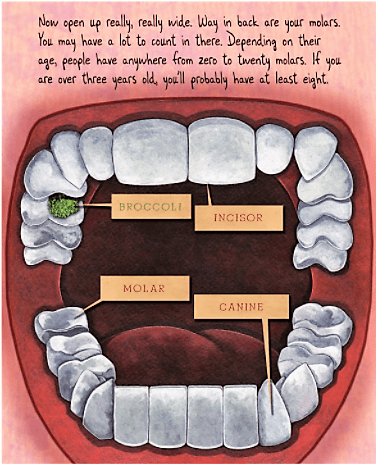
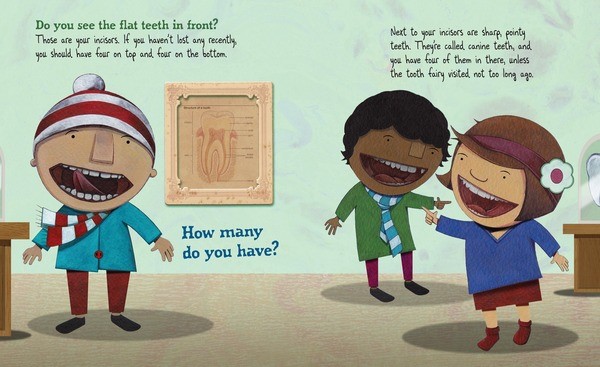
“Open wide!” a little girl with a good set of teeth herself encourages readers on the first page of this fun nonfiction book. “Look at all the chompers in there.” Mirror in hand she proceeds to reveal that human teeth are unusual because we are mammals, and mammal teeth come in different shapes and sizes. In fact there are three distinct types. A little boy takes over to describe them. Incisors are the four flat teeth in a person’s mouth—two on the top and two on the bottom right in front.

celebrate-picture-books-picture-book-review-tooth-by-tooth-human-mouth

Image copyright T. S. Spookytooth, text copyright Sara Levine. Courtesy of Lerner Books

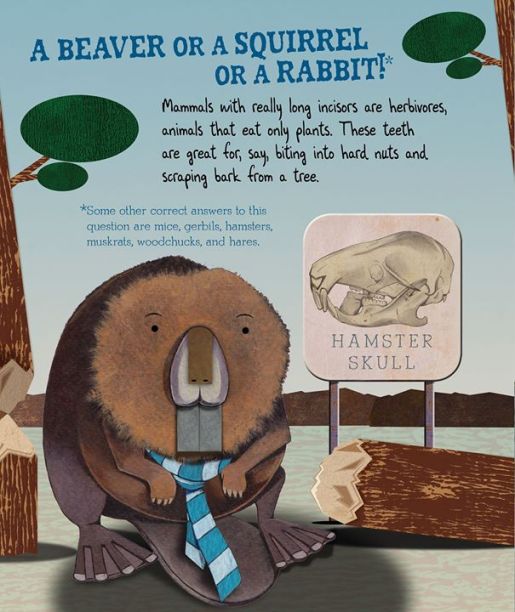
The four pointy teeth next to the incisors are canines, and the rest of the teeth are molars. Other mammals also have these teeth, and you can tell what an animal eats by which type is largest. For example, say your incisors were bigger than all your other teeth and they were so big they stuck out of your mouth even when it was closed, then you would be a beaver…or a squirrel…or a rabbit. These animals are herbivores and their oversized incisors help them break into nuts and scrape bark from trees.

celebrate-picture-books-picture-book-review-tooth-by-tooth-human-teeth

Image copyright T. S. Spookytooth, courtesy of Lerner Books

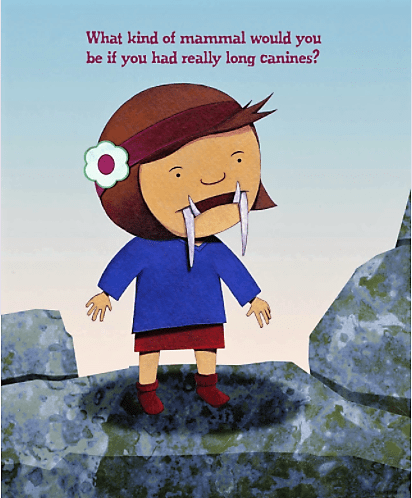
From here on Tooth by Tooth offers up amusing illustrations and “what kind of animal would you be if…” questions to spark kids’ powers of recognition. How about if your canines were so long they poked out of your mouth? Well, then you could be a “seal or a cat or a dog or a bear!” All these animals eat meat and need the sharp teeth to do it.

What if you had really tall molars? Then you’d be a “horse or a cow or a giraffe!” These guys use their molars to grind up grass. And if all your teeth were the same height? Come on…you know! You’d be you! Because humans eat plants and meat, we “need teeth that do many different jobs.”

But there are a lot more wacky teeth out there waiting for us to brush up on. So let’s get started. What if “two of your top incisors were so long that they grew out of your mouth and pointed to the sky? What if they were so long you could use them to carry your school bag?” You’ve probably guessed this one—you’d be an elephant. While an elephant’s tusks aren’t used for eating, they are used to procure the bark, roots, and other plant material that make up the elephant’s diet.

celebrate-picture-books-picture-book-review-tooth-by-tooth-beaver

Image copyright T. S. Spookytooth, text copyright Sara Levine. Courtesy of Lerner Books

What if you could almost trip over your canine teeth? Yep, you’d be a walrus, and you would use those sharp bad boys to poke holes in the ice to grab your favorite oysters and clams. But after eating they’re not done using their teeth. “After diving down for a meal, walruses can use their tusks to pull themselves back up onto the ice for a nap. Imagine if “your top and bottom canine teeth curled up out of your mouth so you had two pairs of tusks?” Or if your one upper canine grew through your upper lip and kept on growing?  Or if you had no teeth at all? Yikes! The remarkable answers are just a read away!

Fish, amphibians, and reptiles also have teeth of a sort, but because they are all the same shape and size, they don’t get special names—that doesn’t mean you can ignore them, though, because sharks are among this group, and you know what they can do!

celebrate-picture-books-picture-book-review-tooth-by-tooth-canines

Image copyright T. S. Spookytooth, text copyright Sara Levine. Courtesy of Lerner Books

More information about mammals, mammal teeth, a glossary, and a list of online and print references follow the text.

There’s nothing like the Wow! factor to capture kids’ attention, and Sara Levine uses it to humorous and fascinating effect in Tooth by Tooth: Comparing Fangs, Tusks, and Chompers. After giving a solid description of each kind of tooth and what it is used for in language that kids use and will relate to, Levine begins her guessing game that leads to even more discovery. We’ve all seen elephants and walruses with their mighty tusks, but how many know what they are really used for? And what about warthogs and narwhals? It’s all here in this creative nonfiction title.

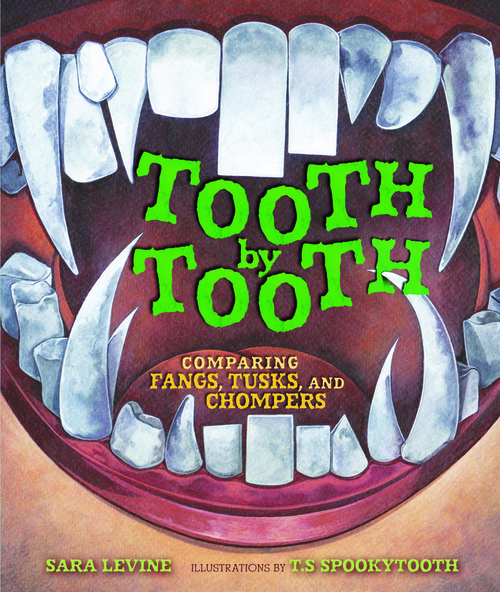
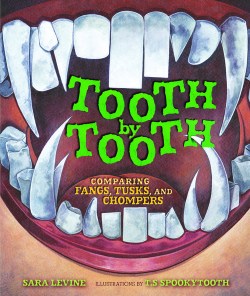
T. S. Spookytooth took a big bite out of the “how to make kids laugh” manual in illustrating each question and type of tooth. Pictures of girls and boys with enormous teeth jutting this way and that will make readers glad to be human. And while the animals that belong to each molar, incisor, or canine sport the scarf, bow, or head band of its human counterpart, they are clearly and scientifically drawn to provide full understanding. Animal skulls also demonstrate the placement of teeth. The cover, with its close-enough-to-eat-you view of a very scary mouth is a show stopper and will attract kids as soon as they see it.

Ages 5 – 9

Millbrook Press, Lerner Books, 2016 | ISBN 978-1467752152

Check out Sara Levine’s website for more books, stuff for kids, teachers’ resources, and more!

View a gallery of T. S. Spookytooth’s art and read his biography (?!) on his website!

National Smile Month Activity


celebrate-picture-books-picture-books-review-brush-up-on-your-smile-maze

Brush Up On Your Smile! Maze


These kids are practicing good dental heath! Can you bring them the toothbrush, toothpaste, and floss they need in this printable Brush Up On Your Smile! Maze? Here’s the Solution!

celebrate-picture-books-picture-book-review-tooth-by-tooth-cover

You can find Tooth by Tooth: Comparing Fangs, Tusks, and Chompers at these booksellers

Amazon | Barnes & Noble | Books-a-Million | IndieBound

Picture Book Review
May 18 – International Museum Day

CPB - How the Dinosaur Got to the Museum II

About the Holiday

Created in 1946, the International Council of Museums established International Museum Day in 1977 to institute an annual event highlighting museums as “important means of cultural exchange, enrichment of cultures and development of mutual understanding, cooperation, and peace among peoples.” The day also aims to unify “the creative aspirations and efforts of museums and draw the attention of the world public to their activity.” Each year a theme is chosen to spotlight a relevant issue. This year’s theme is “Museums and contested histories: saying the unspeakable in museums.” Museums around the world will take the opportunity to show how they “display and depict traumatic memories to encourage visitors to think beyond their own individual experiences” and promote peace and reconciliation for the future. To learn more visit the International Council of Museums website!

To celebrate today’s holiday show your support for museums by visiting and/or donating to your favorite museum!

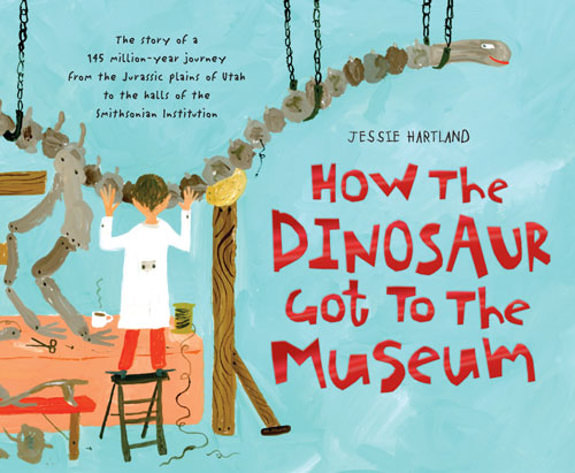
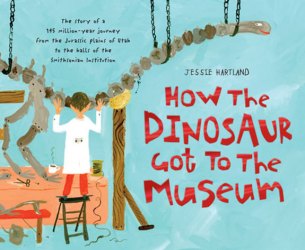
How the Dinosaur Got to the Museum

By Jessie Hartland


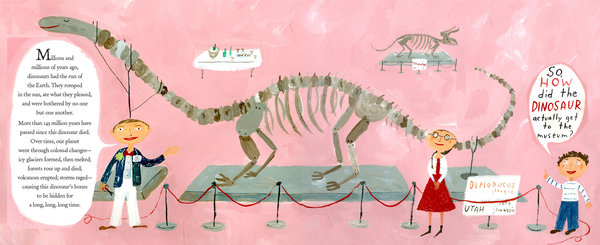
“So…” asks a little boy visiting the Smithsonian Museum of Natural History, “how did the dinosaur get to the museum?” Thus begins the tale—not of the dinosaur’s life, but of its journey from life to the museum exhibit hall.

celebrate-picture-books-picture-book-review-how-the-dinosaur-got-to-the-museum-talking-about-dinosaur

Image and text copyright Jesse Harland, 2011, courtesy of Blue Apple Books.

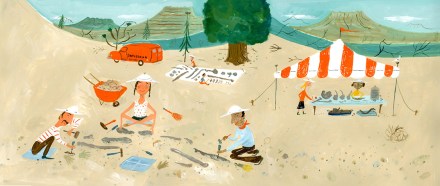
One hundred and forty-five million years ago, the dinosaur roamed the plains of what is now Utah. Overcome by weather and evolutionary events, the dino is buried. It is only much, much later that this prehistoric creature is once again exposed. A Dinosaur Hunter finds one large bone and believes it to be from a Diplodocus Longus. He calls in the Paleontologist who confirms it. A team of Excavators arrives and unearths the rest of the skeleton.

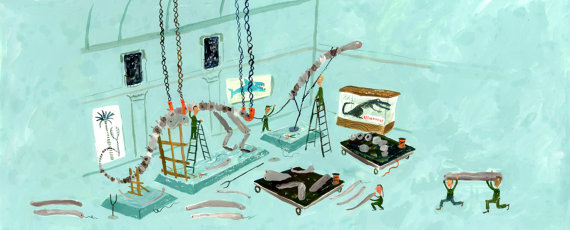
The Movers pack the skeleton that was found by the Dinosaur Hunter, confirmed by the Paleontologist, and dug up by the Excavators. They load it onto a train that transports it to the Smithsonian Museum of Natural History. Here, the bones are cleaned and preserved by the Preparators, who discover that the head and neck are missing!

celebrate-picture-books-picture-book-review-how-the-dinosaur-got-to-the-museum-digging

Image copyright Jesse Harland, 2011, courtesy of Blue Apple Books.

The Curator locates a plaster cast of a Diplodocus head at another museum, and work continues until the whole Diplodocus is assembled. That night while making his rounds in the dark, the Night Watchman trips over the skeleton’s tail and breaks it! In come the Welders to fix it. Finally, the Riggers can lift the dinosaur into the display.

The Exhibits Team creates an educational background for Diplodocus. Then with a final dusting, the Cleaners make the Diplodocus presentable. At long last, the Director invites the public into the museum. He gives a speech and makes a toast then opens the doors to the magnificent exhibit.

celebrate-picture-books-picture-book-review-how-the-dinosaur-got-to-the-museum-exhibit

Image copyright Jesse Harland, 2011, courtesy of Blue Apple Books.

Jessie Hartland’s highly entertaining and educational text will keep kids riveted to the process of creating a museum exhibit even as they giggle at the mishaps. As each page and step in the process build on each other, readers will enjoy reciting along. Hartland’s bold, colorful, folk-style illustrations allow kids to see the lengthy and meticulous journey the dinosaur skeleton makes from burial spot to museum exhibit. Along the way, they view the desert landscape where the skeleton was found, view the tools used to excavate and preserve it, get a tour of the back rooms where the dinosaur bones are reassembled, and are given a front-row look at the finished display. 

For children interested in dinosaurs, museums, history, and a fun story, How the Dinosaur Got to the Museum is a great take-along book for museum trips and a wonderful addition to a young armchair traveler’s library

Ages 5 – 9

Blue Apple Books, New Jersey, 2011 | ISBN 978-1609050900

Learn more about Jesse Hartland, her books, and her artwork on her website!

International Museum Day Activity

CPB - Cookie Jar Museum (2)

Create a Museum Exhibit


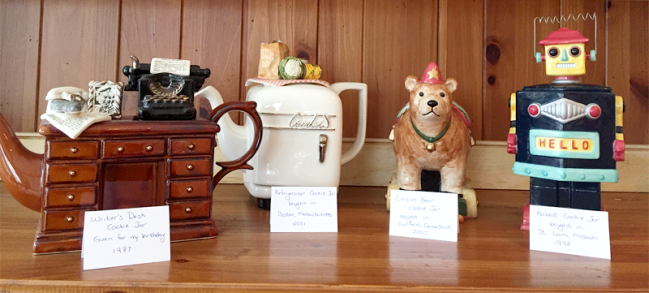
Every item has a story. Maybe there’s a funny anecdote behind that knick-knack on your shelf. Perhaps your favorite serving dish holds sentimental value. How about your child’s best-loved toy or a drawing or craft they’ve made? A fun and educational way for kids to learn family stories and interact with their own history is to create a museum exhibit of objects in your home.

For teachers this can be a fun classroom activity that incorporates writing, art, and speaking as well as categorizing skills. Students can use objects in the classroom or bring items from home to set up museum exhibits. This activity can be done as a whole-class project or by smaller groups, who then present their exhibit to the rest of the class.

Supplies

  • A number of household or classroom items
  • Paper or index cards
  • Markers
  • A table, shelf, or other area for display

Directions

  1. To get started help children gather a number of items from around the house to be the subjects of their exhibit. An exhibit can have a theme, such as Grandma’s China or Travel Souvenirs, or it can contain random items of your child’s choice, such as toys, plants, tools, even the furniture they see and use every day.
  2. Using the paper or cards and markers, children can create labels for their exhibit items. Older children will be able to write the labels themselves; younger children may need adult help.
  3. Spend a little time relating the story behind each object: where it came from, how long you’ve had it, when and how it was used in the past, and include any funny or touching memories attached to the item. Or let your child’s imagination run free, and let them create histories for the objects.
  4. When the labels are finished, arrange the items on a table, shelf, or in a room, and let your child lead family members or classmates on a tour. You can even share the exhibit with family and friends on social media.
  5. If extended family members live in your area, this is a wonderful way for your child to interact with them and learn about their heritage.

CPB - How the Dinosaur Got to the Museum II

You can find How the Dinosaur Got to the Museum at these booksellers

Amazon | Barnes & Noble | IndieBound

May 10 – Mother Ocean Day

celebrate-picture-books-picture-book-review-giant-squid-cover

About the Holiday

Established in 2013 by the South Florida Kayak Fishing Club, Mother Ocean Day honors the beauty and wonder of the oceans and the fascinating creatures that live in them. It’s estimated that nearly one quarter of the earth’s species live in the world’s five oceans. To join in the celebration take a break and visit a beach near you to swim, snorkel, surf, or go boating.

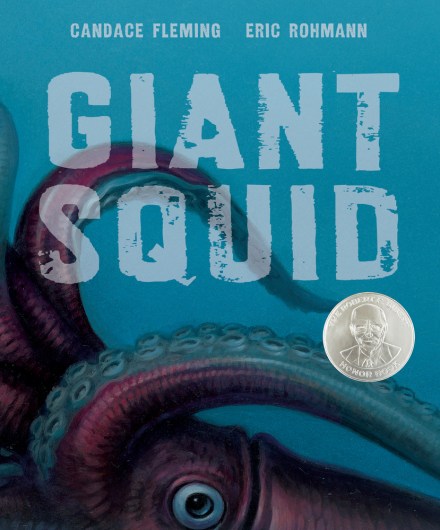
Giant Squid

Written by Candace Fleming | Illustrated by Eric Rohmann


“Down, down in the depths of the sunless sea, deep, deep in the cold, cold dark, creatures, strange and fearsome, lurk.” These mysteries of the ocean silently glide undetected, even though some are as “large as buses” and weigh a ton. They are known only from the quickest of glances or by parts washed up on shore. Many questions remain unanswered, but little by little scientists are learning more about the Giant Squid.

celebrate-picture-books-picture-book-review-giant-squid-waiting

Image copyright Eric Rohmann, text copyright Candance Fleming. Courtesy of Roaring Brook Press

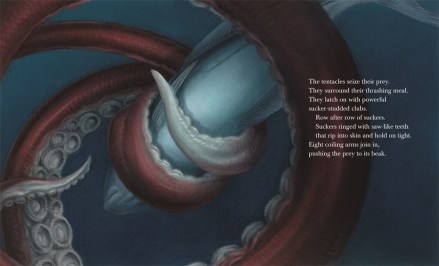
When a Giant Squid is hungry it reaches its two tentacles into the ocean waters “curling and twisting and thirty feet long, waiting for—a passing fish…another squid…anything swimming by.” When the Giant Squid grabs its prey, the tentacle’s “suckers ringed with saw-like teeth” immobilize it, and with the help of eight arms the meal is fed into the squid’s sharp beak.

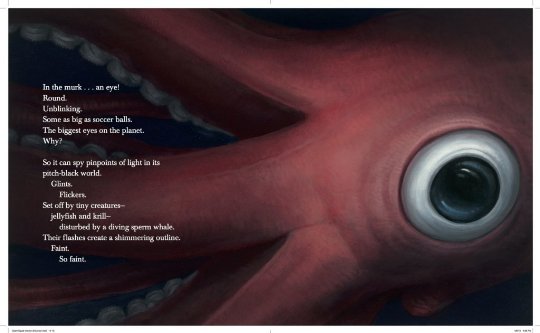
The parrot-like beak is just the beginning, for within the giant squid’s mouth lies a muscle “covered with sharp, tiny blades that slice…grind…file the food into a pasty sludge easy for giant squid to digest.” How does the giant squid see prey swimming by? It has the largest eyes on the planet—“some as big as soccer balls.” With these eyes the squid can see the tiniest flashes of light as sea creatures navigate the black depths. The squid’s gigantic eyes protect it, too, from whales or other predators on the hunt.

celebrate-picture-books-picture-book-review-giant-squid-tentacles

Image copyright Eric Rohmann, text copyright Candance Fleming. Courtesy of Roaring Brook Press

The giant squid is capable of changing colors, even patterns. Why? No one knows. Perhaps it enjoys changing its appearance “to impress a mate.” The birth cycle is also a mystery. Scientists have yet to discover where females lay their eggs or how long they take to hatch. But once they do, the baby squid are little—“just two inches long.” They have to scurry away from the barracuda wanting a snack, but in a flume of ink they vanish!

Before readers even turn to the first page, Candace Fleming sets a chilling, atmospheric tone that sinks them into the depths of the ocean on flat, black pages, where writhing arms and tentacles creep into view threatening the white, lyrical text. As the story opens and begins to describe the tentacles, beak, and other physical attributes of the giant squid, Eric Rohmann’s brilliant illustrations grow in size, giving readers close-up views of the brutal beauty of this eerie sea creature.

celebrate-picture-books-picture-book-review-giant-squid-big-eye

Image copyright Eric Rohmann, text copyright Candance Fleming. Courtesy of Roaring Brook Press

Working in perfect concert, Fleming and Rohmann take kids on a deep, deep ocean dive to witness firsthand what very few humans have ever seen. Fleming’s gripping rhythm will have children riveted to her thrilling vocabulary that describes the drama of the giant squid’s existence in unforgettable terms. Rohmann’s color palette consists of murky blues and blacks and raw pinks and reds. The squid’s tentacles loop and slither across the page divulging their serrated suckers; the enormous eye stares out questioningly at the reader; and the fearsome beak will make more than a few readers shrink back in awe. A double foldout spread reveals the immensity of the giant squid for a brief glimpse before it disappears back into its mysterious realm.

Following the text, readers can study an illustration of a giant squid that is clearly labeled with detailed descriptions of the various parts of its body, read more about the sea creature, and find resources for further investigations.

For kids fascinated by the ocean and its denizens, budding marine or environmental scientists, or those who love an exhilarating story, Giant Squid is nonfiction at its best. The book deserves prominent placement in public and school libraries and would be a terrific gift or addition to home bookshelves.

Ages 6 – 10

Roaring Brook Press, 2016 | ISBN 978-1596435995

Discover more about Candace Fleming and her books on her website!

Learn more about Eric Rohmann, his books, and his art on his website!

Mother Ocean Day Activity

celebrate-picture-books-picture-book-review-ocean-coloring-page

Beautiful Ocean Coloring Page


There are so many varied creatures in the earth’s oceans! Grab your pencils or crayons and make this printable Beautiful Ocean Coloring Page as vibrant as the sea!

Picture Book Review
April 25 – National DNA Day

celebrate-picture-books-picture-book-review-when-I-grow-up

About the Holiday

National DNA Day commemorates the completion of the Human Genome Project in April 2003 and the discovery of the double helix of DNA in 1953 that have led to advanced research in the medical, science, and other fields. As part of the observance, students in grades 9 through 12 can compete in an essay contest for monetary prizes and grants.

When I Grow Up

By Anita Bijsterbosch


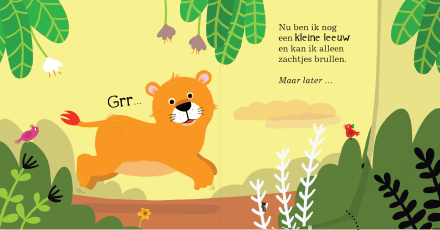
In Anita Bijsterbosch’s adorable and eye-catching animal kingdom book, little ones will identify with their counterparts in the wild who are also just starting out on their journey through life. Opening to the first page, children enter the jungle, where a lion cub romps among the foliage. He looks directly at the reader as he tells them, “Now I’m just a little lion and I can only growl softly. But someday….” This lead-in to the future invites kids to turn the half-cut page and discover the cub all grown up and able to “roar so loudly that all the animals can hear me!”

celebrate-picture-books-picture-book-review-when-I-Grow-Up-lion-cub

When I Grow Up is available in Dutch and English versions. Copyright Anita Bijsterbosch, courtesy of anitabijsterbosch.nl

Next, children visit the bayou, where a young crocodile can now only wade through puddles. On the next page, though he’s big enough to “jump into the deep water to swim with my friends!” Little Toucan is just learning how to fly. With a monkey, a lemur, and a bird looking on, he tells readers a secret: “I pretend to fly when I jump. But someday…I’ll be a big toucan and I’ll spread my winds. Then I’ll fly high in the sky!”

In the savanna, a baby giraffe lifts her head toward the treetops. She says, “Now I’m just a little giraffe and I can barely touch the leaves with my nose.” When she gets older, however, young readers can see that meals and snacks of tasty leaves will be within easy reach.

Curled around a thin branch, a little snake dreams of the day when he will be long enough to wrap around the whole tree—many times. Turning to the last page, Little Elephant happily splashes in the water and sprinkles her friends, but someday she knows that she will be big enough to use her trunk “to spray everything and everyone!”

celebrate-picture-books-picture-book-review-when-I-Grow-Up-lion-adult

When I Grow Up is available in Dutch and English versions. Copyright Anita Bijsterbosch, courtesy of anitabijsterbosch.nl

Toddlers and older youngsters beginning to learn about the vast world around them will delight in this early science book that combines the sturdiness of a board book and the sensory-stimulating interactivity of a lift-the-flap book. Anita Bijsterbosch’s vibrant illustrations engage little ones’ visual senses with bold images of the animals as well as smaller pictures of birds, insects, and flowers for them to discover. A tiny red bird with rakish green head feathers seems to be friends with all of the animals, and readers will love pointing him out on every page.

Little ones will recognize the animal traits spotlighted through Bijsterbosch’s straightforward and easy-to-understand language and will be reassured that they too will soon grow big enough and old enough to do what the “big kids” do.

With sweet illustrations and opportunities for multiple types of learning, When I Grow Up would make a great baby shower or new baby gift as well as a nice addition to a toddler’s growing home library.

Ages 2 – 5

Clavis Publishing, 2017 | ISBN 978-1605373348

You’ll find more books and artwork by Anita Bijsterbosch on her website!

National DNA Day Activity

celebrate-picture-books-picture-book-review-elephants-coloring-page

Mom and Baby Elephant Coloring Page


This mommy elephant and her baby are out for a walk. Give their world a little color with your crayons or pencils and this printable Mom and Baby Elephant Coloring Page!

Picture Book Review
April 9 – National Inventor’s Month

celebrate-picture-books-picture-book-review-whoosh!-lonnie-johnson's-super-soaking-stream-of-inventions-cover

About the Holiday

Today’s holiday was established by the United Inventors Association of the USA, the Academy of Applied Science, and Inventor’s Digest Magazine to promote awareness of and celebrate the achievements of those creative individuals who make our lives better—or, in some cases, at least interesting. Every day there are kids and adults, professionals and amateurs pondering solutions to problems and just “what ifs?” Would you like to join them? You can celebrate this month by acting on one of your great ideas and by learning more about inventors like the subject of today’s book!

WHOOSH! Lonnie Johnson’s Super-Soaking Stream of Inventions

Written by Chris Barton | Illustrated by Don Tate


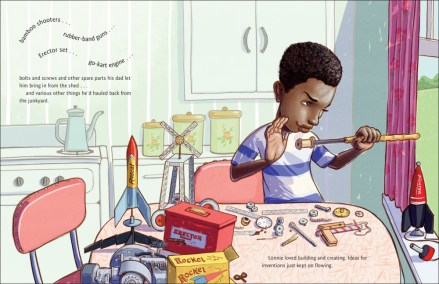
Lonnie Johnson had a way with stuff. In his hands bolts and screws, gears and springs, spools, clothespins, “spare parts his dad let him bring in from the shed, and various other things he’d hauled back from the junkyard” fueled Lonnie’s ideas for inventions and rocket ships. The kids at school loved to watch him launch the rockets he’d devised on the playground. Lonnie wanted to have a career as an engineer. Getting there took a lot of determination and courage. Once, the results of a standardized test said that he would not make a good engineer. Lonnie felt discouraged, but he knew that the person who had graded his test didn’t know him—or Linex.

celebrate-picture-books-picture-book-review-whoosh!-lonnie-johnson's-super-soaking-stream-of-inventions-young-lonnie-inventing

Image copyright Don Tate, courtesy of charlesbridge.com

Linex was the robot Lonnie had built from scrap metal. “Compressed–air cylinders and valves allowed Linex’s body to turn and its arms to move. The switches came from an old, broken jukebox. Lonnie used a tape recorder to program Linex, and as a bonus the reels looked like eyes.” Lonnie’s goal was to enter Linex in a science fair, but first he wanted to be able to program it. It took several years before he discovered how. Using his little sister’s walkie-talkie, Lonnie solved the problem and took Linex to the “1968 science fair at the University of Alabama—where only five years earlier, African American students hadn’t even been allowed.” Lonnie’s team won first place.

Lonnie went to college at Tuskegee Institute, where he realized his dream of becoming an engineer. His career “took him beyond Alabama—way beyond.”  He went to work for NASA. Before the orbiter Galileo could be sent to Jupiter, Lonnie developed a system that would ensure the craft would have a constant supply of power for its computer memory in case the main power was lost. Some fellow scientists doubted his idea would work, but it did. “As it photographed Jupiter and its moons, Galileo was supported by the power package that Lonnie designed.”

celebrate-picture-books-picture-book-review-whoosh!-lonnie-johnson's-super-soaking-stream-of-inventions-linex

Image copyright Don Tate, courtesy of charlesbridge.com

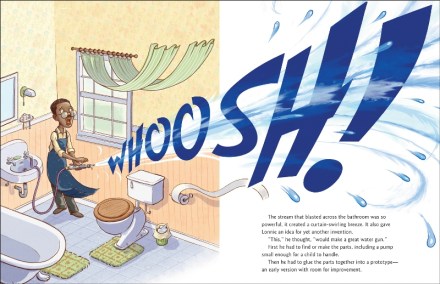
Even though Lonnie worked for NASA, he continued tinkering with his own ideas—in his own workshop. One problem he was trying to solve involved the need for the world’s refrigerators and air conditioners to have a cooling system that didn’t use the damaging chemical R-12. “He had an idea for using water and air pressure instead.” He built a prototype and experimented with it in his bathroom sink. When he turned his pump and nozzle on, though, he got a surprise as a stream of water blasted across the room.

Suddenly, Lonnie saw another use for his invention—as a water gun. He created a design small enough for children’s hands, and tested it at a picnic, where it was a hit. Lonnie took his idea to a toy company…and another…and another. Finally one company agreed to make his water gun. Spurred on by this success, Lonnie found investors to help him build other original inventions: “a water-propelled toy airplane, two kinds of engines, and his cooling system” that had led to the water gun. He even quit his day job to devote his time to inventing.

But things don’t always work out. Each project fell through—even the water gun. It was a scary time as he and his family had to move out of their house and into an apartment. But Lonnie believed in himself. He took his water gun to another toy company. In 1989 he found a toy company willing to take a look. Lonnie made the trip to Philadelphia and wowed the executives with his invention.

celebrate-picture-books-picture-book-review-whoosh!-lonnie-johnson's-super-soaking-stream-of-inventions-water-powered-nozzle

Image copyright Don Tate, courtesy of charlesbridge.com

Now kids everywhere enjoy the fun of the Super Soaker. Today, Lonnie can be found in his workshop doing what he loves: “facing challenges, solving problems and building things” because “his ideas just keep on flowing.”

Chris Barton’s biography of Lonnie Johnson is a fascinating look at a man who succeeds in turning “No” into “Yes” by the power of his intelligence, ideas, and determination. Kids will love hearing about how one of their favorite toys came to be and will be inspired to chase their own dreams despite challenges and setbacks. Barton’s detailed narration provides a full picture of Lonnie Johnson and his times, specifics that attract and inform like-minded kids. Including the results of Lonnie’s exam should encourage kids who think differently. The story is enhanced by the conversational tone that makes it accessible to kids of all ages.

Don Tate illuminates Lonnie Johnson’s life story with his bold, full-bleed paintings that follow Lonnie from his being a child with big ideas to becoming a man who has seen these ideas through to success. With an eyebrow raised in concentration, young Lonnie demonstrates confidence and skill as he works on an invention, and kids will love seeing the tools of his trade laid out on the kitchen table. With his eyes narrowed in frustration and disappointment, Lonnie reads the results of his childhood exam. As Lonnie grows older and designs systems for NASA, the illustrations depict the schematics of the Galileo power package and Lonnie’s surprise at the strength of the water stream in his prototype cooling design. As all kids know, the spurt of a Super Soaker is awesome, and this fact is demonstrated in a “Wowing” fold-out page.

WHOOSH! Lonnie Johnson’s Super-Soaking Stream of Inventions is a welcome biography of the man who designs systems for the greater world but has never lost his youthful enthusiasm to invent.

Ages 5 – 10

Charlesbridge, 2016 | ISBN 978-1580892971

Check out more fiction and nonfiction books by Chris Barton on his website!

Discover more books written and illustrated by Don Tate as well as a portfolio of his work and book-related activity guides on his website!

National Inventor’s Month Activity

celebrate-picture-books-picture-book-review-movie-computer-dot-to-dot

Invention Dot-to-Dot Puzzles


Many inventions have changed the world and continue to be used long after they were first created. Connect the dots on these printable puzzles to discover three remarkable inventions!

Invention Dot-to-Dot 1 | Invention Dot-to-Dot 2 | Invention Dot-to-Dot 3

Picture Book Review

April 7 – International Beaver Day

celebrate-picture-books-picture-book-review-the-skydiving-beavers-cover

About the Holiday

Two species of today’s honored animal are found across America, Canada, and Eurasia. Known primarily for building dams in rivers and streams, the beaver is a fascinating animal in many ways. Perhaps one of the greatest natural conservationists, beavers use all parts of the trees they fell. The buds, bark, and leaves are consumed as food, and the rest is gnawed into smaller bits to be used as building materials. The dams, themselves, are helpful in preventing droughts and floods, restoring wetlands, and keeping the water clean. The beaver population has seen a decline for several decades, and today’s holiday aims to promote awareness of this beneficial animal in order to protect it.

The Skydiving Beavers: A True Tale

Written by Susan Wood | Illustrated by Gijsbert van Frankenhuyzen


The time was post-World War II and families were eager to build homes and enjoy life again. In McCall, Idaho this meant that people moved to the shore of the beautiful lake, where they could fish, sail, waterski, and have fun. So roads were constructed, docks built, and land cleared. “Trouble was, that lakeside land had already been claimed. For decades—centuries, even—beavers had been the only ones doing the building there.”

Now, though, there was a turf war, of sorts. “Where the beavers once gathered wood for dams and food, now there were houses and people. And where the people tried to drive their cars, now water flooded the roads because of the dams.” Trees were also being “toppled left and right” by those busy beavers. Something needed to be done.

celebrate-picture-books-picture-book-review-the-skydiving-beavers-a-true-tale-water-skiing

Image copyright Gijsbert van Frankenhuyzen, text copyright Susan Wood. Courtesy of Sleeping Bear Press

Elmo Heter had an idea. Elmo had experience with beavers from his job with the Idaho Department of Fish and Game. He knew that beavers needed open areas with lots of trees, rivers, and creeks—and no people. There was a place just like this many miles away. The Chamberlain Basin would be perfect for the beavers, but there was a problem—how could he move all those beavers “to a place with no roads, no railway, no airport, and no bus station?”

Elmo thought about loading them into boxes carried by horses or mules, but the rough trip would be too hard on both the beavers and the pack animals. Then Elmo remembered that there were piles of parachutes left over from the war going unused. “What if he dropped the beavers from a plane? Skydiving beavers? Well, why not?” Elmo decided.

Elmo went to work to design a crate that could hold the beavers safely. His first idea was to build a box of woven willow branches. Once the boxes hit the ground, the beavers could gnaw their way out. But then Elmo feared that those champion chewers might escape before the box touched down. Next, he came up with the idea for a box that opened automatically when it hit the ground. After he created his box, Elmo found a beaver to test it.

celebrate-picture-books-picture-book-review-the-skydiving-beavers-a-true-tale-sunset

Image copyright Gijsbert van Frankenhuyzen, text copyright Susan Wood. Courtesy of Sleeping Bear Press

He found his daredevil and named him Geronimo. Geronimo, cozy in his box, was loaded onto a plane, and as the plane flew low over the test field the box was dropped. “The chute bloomed like a buttercup, then caught the breeze….The box fell as gently as a mountain snowflake, landing softly on the grass.” Just as it was designed to do, the box opened and Geronimo scrambled out.

Elmo wanted to make sure his invention would work every time, so he tested it again and again.  All this flying and skydiving seemed to agree with Geronimo. He soon began to treat it like a game, shuffling out of the box when the door opened and then crawling “right back in for another go.” Now that Elmo knew the plan would work, he gathered the beavers from McCall, put them in their special traveling crates, and headed for the Chamberlain Basin.

When they found the perfect spot, Elmo and his team prepared the chutes and let the beavers go. One by one the parachutes opened, and the beavers “wafted like falling leaves on the autumn wind to their new woodsy patch of paradise.” And who was the first pioneer? Why Geronimo, of course!

celebrate-picture-books-picture-book-review-the-skydiving-beavers-a-true-tale-plans

Image copyright Gijsbert van Frankenhuyzen, text copyright Susan Wood. Courtesy of Sleeping Bear Press

An Author’s Note following the text reveals more about this true story. It also discusses what scientists have since learned about the benefits of beavers to the environment and how communities now work with and around them. A list of interesting facts about beavers is also included.

Susan Wood’s story of a little-known event is a thought-provoking glimpse into early conservation efforts. Her conversational tone and lyrical phrasing enhance the tale, lending it suspense and personality that will draw readers in. Wood’s detailed descriptions allow children to understand the problems for the community as well as the concern for the animals that led to this historical event. 

Gorgeous paintings by Gijsbert van Frankenhuyzen uncover the beauty of Idaho’s backcountry with its sparkling lakes and tree-covered mountains. Glorious sunsets fill the two-page spreads, turning the rolling hills pink and gold as beavers scurry near the shore building their dams. Readers will be intrigued by the clear and close-up views of Elmo Heter as he works on his plans to relocate the beavers. A table strewn with publications and photographs from World War II, set children in the time period, and his schematics of the box he designs as well as his workshop are plainly displayed. Kids can ride along with Geronimo as he climbs into his crate, travels by plane over wide-open vistas, and floats into the Chamberlain Basin at the end of a parachute.

The Skydiving Beavers would be a fresh addition to classroom environmental units to spur discussions on past, present, and future conservation science and will delight young readers interested in the natural sciences.

Ages 6 – 9

Sleeping Bear Press, 2017 | ISBN 978-1585369942

Learn more about Susan Wood and her books on her website!

View a portfolio of artwork by Gijsbert van Frankenhuyzen on his website!

International Beaver Day Activity

CPB - Beaver craft picture (2)

Make a Spool Beaver


Do you have a gnawing need to have a beaver of your own? Make one with this Spool Beaver craft!

Supplies

  • Printable Ears and Nose Template
  • 2-inch wooden spool, available at craft stores
  • 1 6-inch long x ¾ inch wide craft stick
  • Small piece of foam board
  • Brown “chunky” yarn
  • Brown felt, small piece for ears and tail
  • Black felt, small piece for nose
  • Acorn top for hat (optional)
  • Brown craft paint
  • Black craft paint
  • Black marker
  • Strong glue
  • Paint brush
  • Scissors

CPB - Beaver craft picture with tail

Directions

  1. Print the Ears and Nose template
  2. Paint the spool with the brown paint, let dry
  3. Cut the ears from the brown felt
  4. Cut the nose from the black felt
  5. Cut a piece from the end of the craft stick
  6. Paint the craft stick brown or black, let dry
  7. Cut two small pieces from the foam board, ½-inch long x 3/8 inch wide
  8. When the spool is dry, glue the ears to the spool, leaving the ears sticking up over the rim of the spool
  9. Glue one end of the yarn to the spool
  10. Holding the spool horizontally, wind the rest of the yarn around the spool back and forth from front to back. Glue the end to the body of yarn. This will be the bottom of the beaver.
  11. Glue the nose over the hole in the spool
  12. Glue the teeth below the nose
  13. Glue the flat edge of the craft stick to the back of the spool to make the tail

Picture Book Review