March 23 – Near Miss Day

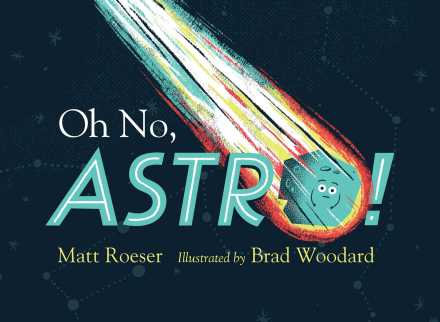
celebrate-picture-books-picture-book-review-oh-no-astro-cover

About the Holiday

Today’s holiday commemorates a most auspicious moment in history that never happened! On March 23, 1989 a huge asteroid missed hitting Earth by only 500,000 miles. Did you feel the breeze as it blew by? Yeah, me too! I think we can all remember exactly where we were when we happily escaped suffering the same fate as the dinosaurs. So drink a toast to serendipity and the gravity of natural forces.

Oh No, Astro!

Written by Matt Roeser | Illustrated by Brad Woodard


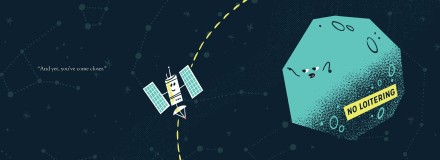
Astro was not a typical asteroid. Instead of zooming around crashing into obstacles, he believed in “personal outer space” and had for millions of years. One day when Astro spies an approaching satellite, he greets him cordially and lays down the rules: “please keep your distance” and “stay in your orbit.” But the satellite ignores him and comes closer and closer until…

celebrate-picture-books-picture-book-review-oh-no-astro-interior-art-satellite

Image copyright Brad Woodard, courtesy of Simon & Schuster

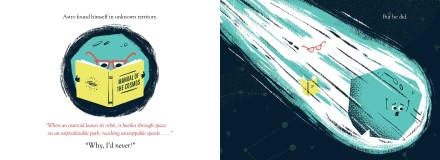
“‘Good gravity! You’ve struck me!” Astro exclaims. He’s just about to “point out to the satellite that it had done considerable damage to one of his favorite craters” when he discovers that he is spinning out of his orbit and out of control. How humiliating! The usually unflappable space rock suddenly finds himself hurtling past Mars. At the same time young astronomer, Nova, is “enjoying a quiet night of stargazing” through her telescope. She catches sight of Astro as he zips past an astronaut, rushes past the Moon, and finds himself on an inevitable collision course with Earth.

As he enters Earth’s atmosphere he begins to break apart, shedding bits of the past, as the universe watches. He lands on Earth with a SMASH! Reeling from the impact Astro slowly opens one eye and then the other. He finds that he’s smaller but in one piece. Standing by is Nova, waiting to welcome him to his new home. “‘My stars,’” he mutters. “‘Dare I say that was…FUN?!’”

And as Astro gazes at the night sky from a fresh perspective with Nova by his side, he asks, “‘What on Earth shall we do next?!’”

celebrate-picture-books-picture-book-review-oh-no-astro-hurtling

Image copyright Brad Woodard, courtesy of Simon & Schuster

For anyone stuck in the rut of their own orbit, Matt Roeser’s story of the unwitting space traveler is a humorous invitation to explore the universe around them. Roeser’s language—from calling asteroids “rambunctious” and the satellite a “celestial wanderer” to exclamations of “good gravity!” and “Pluto’s revenge!”—is an inspired treat. Kids and adults will laugh at Astro’s attempts to handle his undesirable predicament with dignity. Complacent Astro with his dry-as-space-dust wit and sparkling puns makes a stellar guide on this journey to more self-discovery and life enjoyment.

In the hands of Brad Woodard, deep space is a very cute and cool place! Rendered in flat tones of black, aqua, yellow, red, and white, Woodard’s illustrations give Oh No, Astro! a retro feel for a space-savvy audience. The oblivious satellite floats through Astro’s orbit with wide eyes and a sweet grin, while angular Astro with his stick arms, expressive face, and boldly displayed “No loitering” banner would be a welcome alien intruder in any back yard. Inquisitive and inclusive Nova, in her ponytails and Saturn-patterned dress, is the perfect companion to greet him! The night sky abounds with constellations, but Astro is the real star!

In the final pages, Astro leads readers in a “A Selection of Space Facts” from the  very Manual of the Cosmos, 2nd edition that he used to sort things out in  his own life. A short list of suggested reading is also included.

Kids would love to find Oh No, Astro! on their bookshelf for story times of cosmic fun!

Ages 4 – 8

Simon & Schuster Books for Young Readers, 2016 | ISBN 978-1481439763

Visit Matt Roeser’s Website to discover his gallery of book jacket designs!

You can learn more about design and illustration work by Brad Woodard at Brave the Woods!

Near Miss Day Activity

celebrate-picture-books-picture-book-review-name-that-asteroid-word-search-puzzle


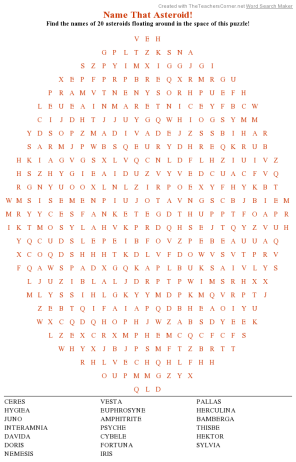
Name That Asteroid! Word Search


Can you find the names of 20 asteroids floating around in this printable Name That Asteroid! Word Search Puzzle? Here’s the Solution!

Picture Book Review

March 22 – World Water Day

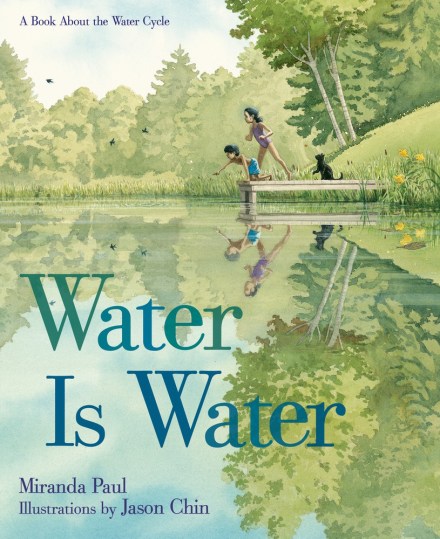
celebrate-picture-books-picture-book-review-water-is-water-cover

About the Holiday

March 22 was designated as World Water Day by the United Nations to bring awareness to the important issue of fresh water for the world’s citizens. Today, 1.8 billion people use sources of water that are contaminated, posing a constant risk of deadly diseases. The Sustainable Development Goals, instituted in 2015, have targeted a deadline of 2030 to provide access to clean water for everyone. This year’s theme is “Wastewater,” and revolves around the development of science and engineering solutions that would allow wastewater to be recycled and used in gardens, green spaces, cooling systems, and irrigation. Now more than ever, we all have a responsibility to keep the environment clean and safe. To celebrate today’s holiday find out how you can help!

Water Is Water: A Book About the Water Cycle

Written by Miranda Paul | Illustrated by Jason Chin


On a soaking rainy day a sister and brother run up to the house with a turtle they’ve caught in the pond out back. They drink glasses of water and offer a bowlful for the turtle too. “Drip. Sip. Pour me a cup.” Out on the porch Dad is ready with warm mugs of hot chocolate. The ghostly steam tickles their noses. “Whirl. Swirl. Watch it curl by. Steam is steam unless…it cools high.” As the kids return the turtle to the pond they watch a dragon and an eagle play across the sky. “Clouds are clouds unless…they form low.”

celebrate-picture-books-picture-book-review-water-is-water-rain-at-school

Image copyright Jason Chin, text copyright Miranda Paul. Courtesy of us.macmillan.com

Through the misty fog the school bus rumbles up the hill as a little garter snake wriggles in the fallen leaves at the end of the children’s driveway. By the time the bus drops the kids off at school the fog has turned to rain. It plinks on the sidewalks and pounds the earth, creating puddles just in time for recess. “Slosh in galoshes. Splash to your knees! Puddles are puddles unless…puddles freeze.”

celebrate-picture-books-picture-book-review-water-is-water-snowman

Image copyright Jason Chin, text copyright Miranda Paul. Courtesy of us.macmillan.com

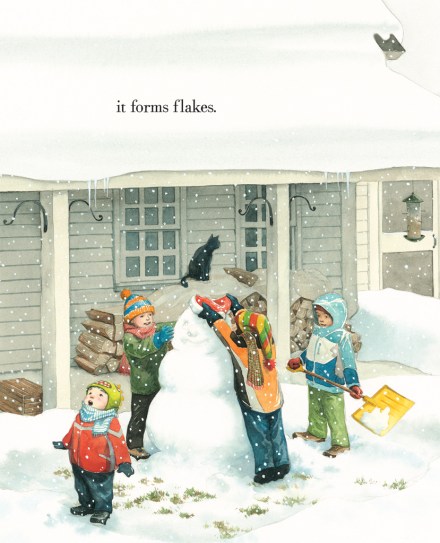
The turtle is hiding now that winter’s come, and a group of friends slip and speed across the pond, some playing hockey, some figure skating, and a couple just learning the ropes. Then suddenly it’s snowing! A brilliant red cardinal watches from the birdfeeder as three sneaky kids with snowballs spy on their friends who are building a snowman. With a “smack!” the snowball fight begins. Soon, however, spring is back with rushing streams and “Creep. Seep. Squish in your boots” mud. And that “mud is mud unless…there are roots.”

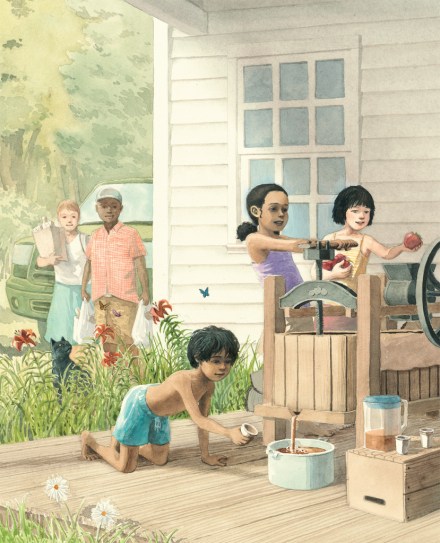
The apple trees in the backyard soak up the spring rains that feed the red, plump apples that are apples “unless…they get pressed. Drip. Sip. Pour me a cup. Cider is cider…until we drink it up!”

More information about water, including illustrated definitions of water-related terms, percentages of water in a variety of plants and creatures, and its importance to the world as well as suggestions for further reading, follow the text.

celebrate-picture-books-picture-book-review-water-is-water-making cider

Image copyright Jason Chin, courtesy of us.macmillan.com

Miranda Paul’s lyrical journey through a year of our interactions with water is a beautiful reminder of all the forms water takes. From life-filled ponds to pouring rains to glasses of refreshment, water sustains every creature and plant on earth. Paul’s transitional “unless…” elegantly introduces each transformation in the natural water cycle in a way that children recognize and appreciate. Her rich rhyming and rhythmical language is a joy to read and makes Water an active character in the story.

celebrate-picture-books-picture-book-review-water-is-water-drinking-cider

Image copyright Jason Chin, courtesy of us.macmillan.com

Jason Chin’s superb artwork is as lush and dynamic as the world around us. Each two-page spread is a masterpiece of atmosphere and details that bring not only water’s cycle to life but also that of the children, growing and playing in and around water throughout the year. As the children shelter from the rain at the beginning of the book, a bushel of apples sits snug against the cider press in the corner of the porch foreshadowing the final pages where fresh cider fuels summer fun. Chin’s children are real kids—joyful and playful, enthusiastically and humorously interacting with nature and each other with the kind of abandon that makes hearts sing. Young readers and adults will love lingering over each page.

Water is Water: A Story of the Water Cycle is the kind of book that can get kids excited about one of the quieter aspects of science—but one that is so important to our daily lives. It would make a wonderful accompaniment to elementary school lesson plans and a gorgeous addition to library and home bookshelves.

Ages 5 – 10

Roaring Brook Press, 2015 | ISBN 978-1596439849

Discover more about Miranda Paul and her books plus resources for teachers and writers on her website!

View a portfolio of artwork by Jason Chin and learn more about him and his books on his website!

World Water Day Activity

celebrate-picture-books-picture-book-review-water-words-word-search

A Sprinkling of Water Words Word Search


This tree grew tall and strong by soaking up water through its roots. Can you find the 20 water-related words that are hidden inside this printable tree-shaped A Sprinkling of Water Word Word Search Puzzle? Here’s the Solution.

Picture Book Review

March 12 – It’s Women’s History Month

celebrate-picture-books-picture-book-review-to-the-stars-cover

About the Holiday

From its beginning as a single-day observance in 1911 , the celebration of women’s achievements and contributions throughout history grew to a week-long event in 1982 and finally to encompass the entire month of March in 1988. During this month we remember the trail-blazing women of yesteryear who used their creativity, intelligence, and perseverance to promote rights for women while contributing their own innovations to science, art, social reform, medicine, and other disciplines as well as today’s pioneers who carry on their legacy and make our world a better place. 

To the Stars! The First American Woman to Walk in Space

Written by Carmella Van Vleet and Dr. Kathy Sullivan | Illustrated by Nicole Wong


As a child Kathy Sullivan loved to explore. Her father designed airplanes, and when he brought home blueprints, she carefully studied every line and curve. When she saw airplanes in the sky she wished she were on them, flying to exciting locations all over the world. Maps and foreign languages fascinated her. “Their strange symbols, exotic tales, and musical sounds made her feel like the world was waiting for her.” Kathy wanted to see that whole world and thought maybe she’d like to be a spy or a diplomat, but her friends and other adults told her those weren’t jobs for women.

celebrate-picture-books-picture-book-review-to-the-stars-blueprints

Image copyright Nicole Wong, courtesy of nicole-wong.com

But Kathy always followed her heart. She loved going fishing with her dad and brother and finishing the day with a swim. She “delighted in how her arms and legs moved in slow motion underwater.” Kathy was still a teenager when she learned how to pilot a plane. At first the busy instrument panel made her nervous, but she quickly learned how to manage all the “dials, buttons, and numbers.”

Kathy got a taste for the thrill of space when she bravely jumped at the opportunity to ride in a Breezy—an open air framework plane. Sitting at the very tip of the airplane, in front of the pilot, Kathy had a bird’s eye view. “The wind rushed past her face so fast it pushed her cheeks back. Higher! Faster! Young Kathy looked at the ground below her feet. She felt like she could see the whole world.”

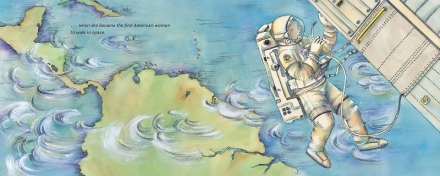
As an adult, Kathy put all of these experiences to good use as she studied complex science that would lead her to NASA. And when she became the first American woman to walk in space, she fulfilled her childhood dream to see the whole world!

celebrate-picture-books-picture-book-review-to-the-stars-spacewalk

Image copyright Nicole Wong, courtesy of charlesbridge.com

Carmella Van Vleet and Dr. Kathy Sullivan, have written a compelling biography of Dr. Sullivan that not only tells the story of her adult achievements, but also reveals the childhood and teenage motivations and influences that fostered her journey to the stars. As each event in Kathy’s young life is introduced, it is followed by an adult accomplishment: Kathy’s poring over her father’s aircraft blueprints leads to a spread of college-age Kathy studying charts in textbooks. Her enjoyment of swimming underwater is followed by an illustration showing her NASA training underwater. Her initial introduction to a plane’s instrument panel informs her later responsibilities inside the spacecraft. And the question she once asked herself as a child—what kind of job would allow her to see the whole world—is answered as the astronaut Kathy gazes down at Earth from space.

celebrate-picture-books-picture-book-review-to-the-stars-breezy

Image copyright Nicole Wong, courtesy of charlesbridge.com

Nicole Wong’s lovely, realistic watercolor and ink paintings clearly show readers Kathy Sullivan’s trajectory from curious girl to accomplished astronaut. The blueprints that Kathy studies are filled with schematics. The aqua water she swims in swirls and bubbles in the wake of her cannonball dive, and the crisscrossing fields lay like a mottled green quilt under the Breezy. Especially stunning and effective are the illustrations of Dr. Sullivan’s work with NASA. Kids will love the up-close view of the spacecraft’s instrument panel with its myriad buttons and dial. Likewise, they will find the gorgeous two-page spreads of the space shuttle’s launch, the view from the cockpit, and Kathy’s spacewalk particularly thrilling.

Following the text is a personal note from Kathy Sullivan to her young readers. More extensive biographical notes reveal how Dr. Sullivan discovered her love of science as well as information on the NASA missions she supported. Two more pages highlight the women of the first space-shuttle class, which included Kathy Sullivan, and other firsts by eight other women in space.

To the Stars is a wonderful book to teach children that following their own heart is the best path to future happiness and personal accomplishment. It’s a beautiful addition to any budding scientist’s or adventurer’s library!

Ages 5 – 9

Charlesbridge, 2016 | ISBN 978-1580896443

To find fun activities for To the Stars—including how to make space play dough—as well as other books by Carmella Van Vleet, visit her website!

To learn more about Nicole Wong and view a portfolio of her artwork, visit her website!

Women’s History Month Activity

celebrate-picture-books-picture-book-review-astronaut-coloring-page


Astronaut Coloring Page

Would you like to be an astronaut? Draw yourself in this spacesuit and then grab your crayons, pencils, or markers and have fun with this printable Astronaut Coloring Page!

Picture Book Review

March 8 – International Women’s Day

celebrate-picture-books-picture-book-review-swimming-with-sharks-cover

About the Holiday

The first International Women’s Day was celebrated in 1909 during a time of great change and increasing industrialization that saw more and more women demanding equality in working hours, pay, safety, voting rights and more with their male counterparts. Women across the globe are still fighting for these rights. This year’s theme is Be Bold For Change (#BeBoldForChange), and reminds us that we must always be vigilant in securing and keeping equal rights for all.

Swimming with Sharks: The Daring Discoveries of Eugenie Clark

Written by Heather Lang | Illustrated by Jordi Solano


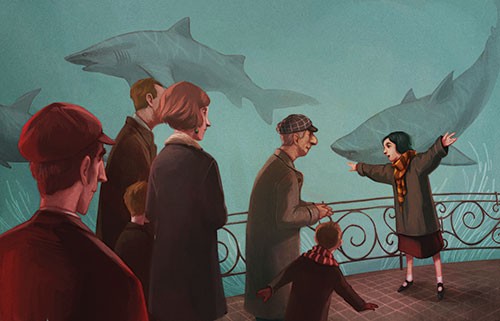
When young Eugenie Clark pressed her face against the aquarium window at the sharks swimming by, she did not see “piercing eyes…rows of sharp teeth…vicious, bloodthirsty killers.” Instead she saw “sleek, graceful fish” and dreamed of being inside the tank to swim among them. She loved to spend Saturdays at the New York Aquarium sharing her knowledge of fish with visitors. She wished there was more information available about sharks and hoped for a day when she could learn more about them.

celebrate-picture-books-picture-book-review-swimming-with-sharks-at-aquarium

Image copyright Jordi Solano, courtesy of plumpuddingillustration.com

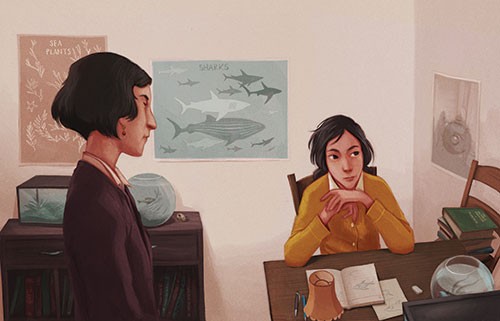
At home her mother bought Genie her own little fish tank, and soon the whole apartment was full of fish and reptiles. Genie kept careful notes on her pets as she tried to answer her many questions. William Beebe, a famous scientist who studied fish, was Genie’s hero. She too wished to explore the ocean like he did. But this was the 1930s and not many people “dared to study the depths of the sea, and none were women.” Eugenie’s mother suggested she study typing and try to become Beebe’s secretary. The life of a secretary was not what Genie had in mind.

Eugenie received a Master’s Degree in zoology, and when a well-known ichthyologist offered her a job as his research assistant and an opportunity to take oceanography classes, she moved to California. There she collected fish and water samples. The beauty of the underwater world astonished her. In the lab she was able to dissect a swell shark to learn “how and why it puffs up.” But Genie wanted to dive deeper—to swim with sharks.

celebrate-picture-books-picture-book-review-swimming-with-sharks-studying

Image copyright Jordi Solano, courtesy of plumpuddingillustration.com

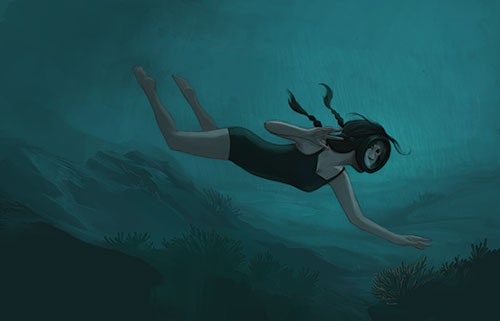
One day, Genie’s professor allowed her to try helmet diving. Wearing the heavy metal helmet, Genie was able to descend into the cold, murky deep where kelp forests waved with the current. “In 1949 the US Navy hired Genie to study poisonous fish in the South Seas. As she collected fish, she came face to face with a shark. The shark swam closer and closer then suddenly dove and disappeared out of sight. Genie was thrilled by the encounter.

In 1955 Eugenie moved to Florida and opened the Cape Haze Marine Laboratory, becoming the first to study sharks in their natural environment. The more she studied sharks, the more she realized that they were intelligent creatures, not stupid “eating machines” as most people thought. She wondered if sharks could be trained.

Eugenie set up an experiment in which a shark needed to press a white board to receive a reward a short swim away. Soon, the female shark of the pair realized that if the male shark pressed the board, she could swim to retrieve the reward. The pair remembered the exercise even after a ten-week break. Soon, scientists from around the world wanted to work with Genie. 

celebrate-picture-books-picture-book-review-swimming-with-sharks-swimming-under-water

Image copyright Jordi Solano, courtesy of plumpuddingillustration.com

Word reached her about “‘sleeping sharks,’” off the coast of Mexico. Instead of swimming around, these sharks stayed on the ocean floor. Eugenie was determined to learn how they breathed without moving. She dived deep into their territory, finding a requiem shark in an ocean cave. Here, she was face-to-face with one of the most feared fish in the sea. Genie swallowed any worry and watched as the fish opened and closed its mouth, providing itself with oxygen as a remora fish cleaned its gills.

Genie took water samples and completed other tests that revealed astonishing facts about the ocean caves and the habits of sharks. But while Genie was learning the facts about these mysterious sea creatures, most people still feared them and considered them with suspicion and superstition. As time went by, Genie began seeing fewer and fewer sharks on her dives. They were being killed out of fear, for their fins, and because people thought it would make beaches safer.

celebrate-picture-books-picture-book-review-swimming-with-sharks-sunset

Image copyright Jordi Solano, courtesy of plumpuddingillustration.com

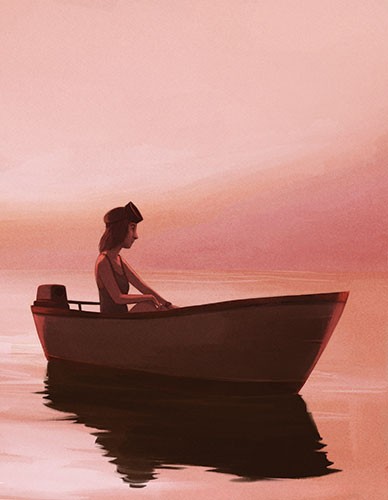
Genie began talking about her research, and people listened. “Dr. Eugenie Clark had become one of the most respected fish scientists in the world.” She taught people that there is always more to learn and “always more surprises.”

An extensive Author’s Note about the life and work of Eugenie Clark as well as more information on sharks follows the text.

Heather Lang delves into the life’s work of a woman who fearlessly challenged herself and the prevailing science to increase our knowledge of sharks and change people’s perspective on these beautiful creatures. Readers will love Lang’s comprehensive storytelling—beginning with young Genie’s fascination with fish and the sea—that reveals the pivotal events which led to her discoveries. Fascinating anecdotes from Eugenie’s research and personal encounters with sharks will enthrall children, and the idea that there is much more to discover will resonated with young scientists in the making.

celebrate-picture-books-picture-book-review-swimming-with-sharks-looking-at-shark

Image copyright Jordi Solano, courtesy of plumpuddingillustration.com

Jordi Solano takes readers to the depths of the ocean in his sea-green, atmospheric illustrations that beautifully mirror the world of sharks. Textured and layered images of marine plants and a variety of creatures give children an up-close view of Eugenie Clark’s work and the fish she encountered on her dives. Each type of shark is magnificently and realistically drawn, giving kids an idea of coloring, size, movement, and more. Children will also see Eugenie’s research facilities and the equipment she used in her studies.

For anyone interested in marine science, history, biographies, or the environment in general, Swimming with Sharks: The Daring Discoveries of Eugenie Clark is a can’t-miss book.

Ages 5 – 9

Albert Whitman & Company, 2016 | ISBN 978-0807521878

Discover more about Heather Lang and her books on her website!

View a gallery of artwork by Jordi Solano on Plum Pudding Illustration!

International Women’s Day Activity

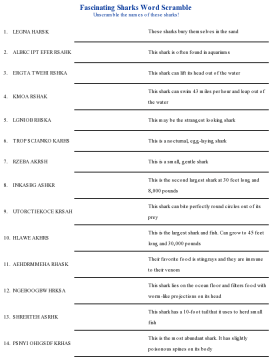
celebrate-picture-books-picture-book-review-fascinating-sharks-word-scramble

Fascinating Sharks Word Scramble


Read the clues and unscramble the names of 14 types of sharks in this printable Fascinating Sharks Word Scramble! Here’s the Solution!

Picture Book Review
February 28 – National Women Inventors Month

celebrate-picture-books-picture-book-review-look-up-henrietta-leavitt-cover

About the Holiday

This month we celebrate women inventors, both past and present, who have changed our lives and the world for the better through their intelligence, creativity, unique vision, and perseverance.

Look Up! Henrietta Leavitt, Pioneering Woman Astronomer

Written by Robert Burleigh | Illustrated by Raúl Colón       


Henrietta Leavitt loves the stars. Every night she sits on the front porch and asks herself what were—in the early 1900s—unanswerable questions. How high is the sky? How far away are the stars? She traces the form of the Big Dipper to the North Star and feels that the stars are trying to tell her something.

celebrate-picture-books-picture-book-review-look-up-henrietta-leavitt-student

Image copyright Raúl Colón, text copyright Robert Berleigh. Courtesy of simonandschuster.com

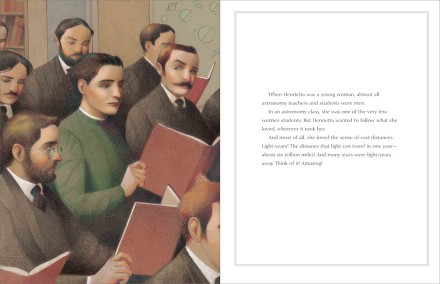
As a young woman she takes an astronomy class—one of the few women to do so. She learns about light years, planets, and the vast distances that fascinate her. After graduation she takes a job at an observatory, and while it houses a large telescope to study the sky, Henrietta is not allowed to use it. She and the other woman who work at the observatory are only there to record, measure, and calculate data, not to have new ideas.

celebrate-picture-books-picture-book-review-look-up-henrietta-leavitt-studies-star-map

Image copyright Raúl Colón, courtesy of Simon & Schuster

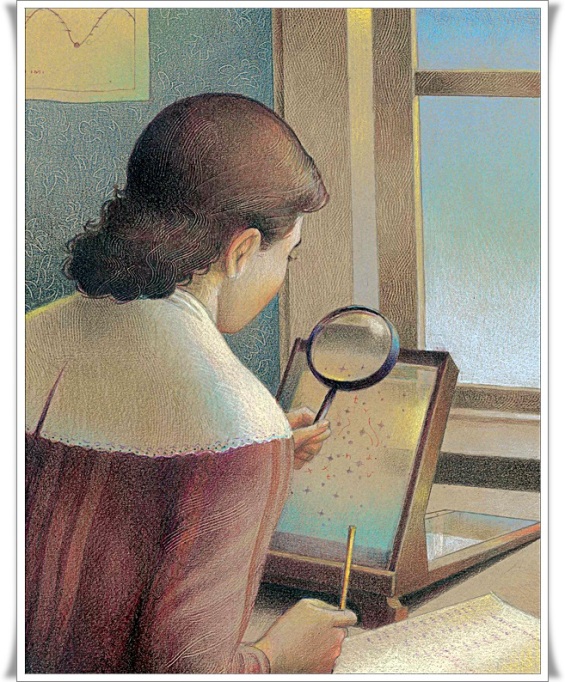
But in doing her job, Henrietta begins to notice a pattern in the brightness of certain stars. She discovers new “blinking” stars. Taking careful measurements, Henrietta finds that a star with a slower “blink” time—the time it takes for a star to go from dim to bright, or from off to on—contains more light power than stars with faster blink times. But what does this mean? After more study she realizes that the blink time can determine the true brightness of any blinking star, even those far, far away.

celebrate-picture-books-picture-book-review-look-up-henrietta-leavitt-makes-notes

Image copyright Raúl Colón, courtesy of Simon & Schuster

Henrietta has made a breakthrough in astronomy! By knowing the true brightness of a star, astronomers can figure out the star’s distance from Earth. Henrietta publishes her star chart in a magazine, and it helps other astronomers measure first the Milky Way and then galaxies they didn’t even know existed! Henrietta is an astronomer–one who advances her beloved science! Even as she grows older Henrietta continues to look to the sky, to ask questions and dream.

More information about Henrietta Leavitt and her discoveries, Internet and print resources on astronomy and other women astronomers, a glossary, and more are provided on the final pages.

celebrate-picture-books-picture-book-review-look-up-henrietta-leavitt-sees-stars-in-sleep

Instead of first presenting Henrietta Leavitt as an adult already working as an astronomer, Robert Burleigh chooses to introduce her as a child, when all she had were questions and dreams about the sky and the stars. It’s a fitting emphasis for a picture book aimed at children who themselves are only just discovering the questions that will guide their lives.  Burleigh’s style is simple and straightforward, revealing pertinent facts about the working conditions of a woman scientist in the early 1900s, but emphasizing Henrietta’s internal contemplations that led to her important discoveries. It’s good for children to see that one does not always need to be the “astronaut” rocketing to the Space Station to contribute— the life of the mind is just as noble and needed a pursuit.

Raúl Colón’s watercolor and ink illustrations echo the theme of dreams and contemplation with soft muted colors and antique, sepia tones. Brightness on the pages comes from the points of light that fill the skies and Henrietta’s mind. As a child and young woman, Henrietta sits and stands in the glow of the stars and, one can imagine, her own thoughts.

Ages 4 – 8

Simon & Schuster, 2013 | ISBN 978-1416958192

Discover more about Robert Burleigh and his many, many books in the categories of science, art, poetry, adventure, sports, and more for children and adults on his website!

National Women Inventors Month Activity

CPB - Star Coloring Page

Be the Star You Want to Be Coloring Page


Everyone has “stars in their eyes”—dreams and hopes for what they will accomplish in life. Decorate this printable Be the Star You Want to Be coloring page to show what’s in your imagination and in your heart.

February 19 – Plant the Seeds of Greatness Month

Who Says Women Can't Be Doctors by Tanya Lee Stone and Marjorie Priceman picture book review

About the Holiday

Plant the Seeds of Greatness Month was established to help people remove barriers to their success and make changes to better their lives. Whether you want to learn a new skill, take care of your health, meet new people, or pursue a job or profession you’ve always dreamed of, this month is a perfect time to get started!

Who Says Women Can’t be Doctors? The Story of Elizabeth Blackwell

Written by Tanya Lee Stone | Illustrated by Marjorie Priceman


Once upon a time there were no women doctors. Women weren’t even allowed to be doctors. Sounds like a fairy tale, doesn’t it? But it was the truth. Then Elizabeth Blackwell, came along. Elizabeth was not like other girls of the 1830s. She loved to explore and take on challenges. She could lift her brother over her head, and to toughen herself up she slept on the hard wood floor. To get a better look at the world she once climbed to the roof of her house and leaned waaaaay out with a spyglass. What did she see? Maybe she saw her future. But it wasn’t what she imagined at the time. Blood made her queasy, dissection was disgusting, and being sick just made her want to hide from all the fussing.

celebrate-picture-books-picture-book-review-who-says-women-can't-be-doctors-elizabeth-brave

Image copyright Marjorie Priceman, text copyright Tanya Lee Stone. Courtesy of Henry Holt.

A comment by a sick friend, however, puts a bee in Elizabeth’s bonnet. Mary Donaldson tells Elizabeth that she would much rather have been examined by a woman than her male doctor, and then says, “You should be a doctor, Elizabeth.” What a crazy notion, right? Well… Elizabeth can’t stop thinking about it. She asks around. Some people think it’s a good idea, but impossible; others simply think it’s impossible. They believe women aren’t strong enough or smart enough and they laugh at her. By this time, though, Elizabeth is determined.

celebrate-picture-books-picture-book-review-who-says-women-can't-be-doctors-no-women-doctors

Image copyright Marjorie Priceman, text copyright Tanya Lee Stone. Courtesy of Henry Holt.

She applies to 28 medical schools, and they all say, “No.” But one day a “Yes” arrives in the mail. Elizabeth packs her bags. As she nears the school, Elizabeth sees that the townspeople have all come out to see her. They aren’t there to welcome their new medical student, though; they just want to whisper and point and stare. Surely, Elizabeth thinks, her classmates will be happy to see her. 

celebrate-picture-books-picture-book-review-who-says-women-can't-be-doctors-everyone-says-no

Image copyright Marjorie Priceman, text copyright Tanya Lee Stone. Courtesy of Henry Holt.

But she receives the same reception on the college campus. In fact, she learns that the only reason she was accepted was because the men voted to let her in as a joke! Elizabeth knows how to handle it. She studies hard and gives her opinions, and soon she wins the respect of her fellow students—even if the townspeople still don’t accept her.

On January 23, 1849 Elizabeth Blackwell graduates from medical school with the highest grades in the class. She has become the first woman doctor in America! Many people hope that she will be the last. But as we know…she was Not!

celebrate-picture-books-picture-book-review-who-says-women-can't-be-doctors-elizabeth-does-well-in-school

Image copyright Marjorie Priceman, text copyright Tanya Lee Stone. Courtesy of Henry Holt.

Tanya Lee Stone magnificently imbues this short biography of Elizabeth Blackwell with enough mystery, conflict, and history for even the youngest readers to understand the type of girl and woman Elizabeth was as well as the challenges she faced. Stone has deftly included details of Blackwell’s life that  make her instantly recognizable and relatable to children. This biography is not only historical nonfiction, but a universal story for all generations. Blackwell may have started out as a reluctant dreamer, but once she dared to believe she accomplished more than she or anyone could have imagined. It is what we want for all our children.

Marjorie Priceman’s illustrations that swirl with words, are angled on the page, and float in white space are as topsy-turvy as the world Elizabeth Blackwell created with her courage and life’s work. Blackwell’s boldness is echoed in the rich colors and strong lines of Priceman’s gouache and India-ink paintings, and the emotions she stirred in others—from derision to horror to admiration—are cleverly and exceptionally drawn in a minimal style on the characters’ faces.

Ages 5 – 9

Henry Holt and Company, 2013 | ISBN 978-0805090482

Learn more about Tanya Lee Stone and her work—both fiction and nonfiction—for children and teens on her website!

You can connect with Marjorie Priceman on Facebook!

Plant the Seeds of Greatness Month Activity

CPB - Doctors Clothespins

Doctor Clothespin Figures


Elizabeth Blackwell believed in herself and became the doctor she wanted to be. With this craft you can make a doctor figure or color your own clothes to make your figure any profession you are dreaming of!

Supplies

CPB - Doctors Clothespins on box

Directions

  1. Draw a face and hair on the clothespin
  2. Cut out the outfit you want your doctor to wear (color pants on your clothespin if you choose the lab coat)
  3. Wrap the coat or scrubs around the clothespin. The slit in the clothespin should be on the side.
  4. Tape the clothes together
  5. Wrap the cap around the head and tape it.
  6. If you’d like to display your clothespin doctor on a wire, string, or the edge of a box or other container, cut along the dotted lines of the clothes template.

Picture Book Review


February 18 – Pluto Day

celebrate-picture-books-picture-book-review-pluto's-secret-cover

About the Holiday

Whether you believe Pluto should be considered a planet or not, it’s hard not to love that little celestial body. Today’s holiday celebrates the discovery of Pluto in 1930 and our continued fascination with this outlying neighbor.

Pluto’s Secret: An Icy World’s Tale of Discovery

Written by Margaret A. Weitekamp with David DeVorkin | Illustrated by Diane Kidd


From the beginning of the solar system, a little icy world circled the sun, far away from the other planets, and held “a secret—a clue about something that exists in the solar system and the universe.” It was a long time before science was able to see this little world, and so it’s secret remained…well…secret. That was okay with the celestial body because “it was busy dancing with its moons.” In the early 1900’s, though, Percival Lowell, thought that there must be another body pulling on the orbits of Uranus and Neptune. Astronomers used the Lowell Observatory that he had built in Arizona to search for a new planet.

celebrate-picture-books-picture-book-review-pluto's-secret-big-planet

Image copyright Diane Kidd, text copyright Margaret A. Weitekamp with David DeVorkin. Courtesy of Abrams Books for Young Readers

Lowell believed that scientists would find a giant planet disrupting the paths of the two planets. He decided to call it Planet X. But the icy world thought, “‘That’s not right. Wait until they see how lightly I dance with my moon Charon, the tiny tots Nix and Hydra, and the other little ones! Besides, I’m not bothering anyone!’” Astronomers looked and looked for Planet X. Even after Percival Lowell died in 1916, they kept on searching. Finally, in 1930 Clyde Tombaugh discovered what they had all been looking for with a powerful telescopic camera.

celebrate-picture-books-picture-book-review-pluto's-secret-names

Image copyright Diane Kidd, text copyright Margaret A. Weitekamp with David DeVorkin. Courtesy of Abrams Books for Young Readers

People from all over the world offered names to replace Planet X. Someone thought Minerva would be good. Others came up with Cronus, Zeus, Atlas, even Lowell. “‘Yuck, thought the little world.’” Yuck, thought the astronomers. Finally, an 11-year-old girl from England suggested the planet be named Pluto after the Roman god of the dark underworld because it was so far away from the sun. Everyone liked that idea.

But right from the start, Pluto was different from the other planets. As more powerful telescopes were invented, scientists could see that Pluto had friends that were more like it than were the other 8 planets. What’s more, these icy-world friends occupied the same area, which came to be called the Kuiper belt. Many astronomers began to talk among themselves and even wondered if Pluto “should even be called a planet.”

celebrate-picture-books-picture-book-review-pluto's-secret-pluto-demoted

Image copyright Diane Kidd, text copyright Margaret A. Weitekamp with David DeVorkin. Courtesy of Abrams Books for Young Readers

But what was a planet, really? “Amazingly, no one had ever set up rules about what a planet was—or was not.” The astronomers then decided on several criteria. Pluto met most of them—but it did not meet a very important one. Since Pluto did not fulfill all the requirements, the astronomers proclaimed that it was not a planet after all. Kids and people who had grown up thinking of Pluto as a planet were sad and protested this change. But Pluto didn’t mind. It thought, “‘I’m not a planet. I’m the first example of something new. I’m one of many icy worlds on the edge of the solar system.’”

Now that astronomers have gotten to know Pluto in a new way, they’ve found that other icy worlds exist around other stars. The discovery has opened up new possibilities for the future of space exploration.

celebrate-picture-books-picture-book-review-pluto's-secret-future

Image copyright Diane Kidd, text copyright Margaret A. Weitekamp with David DeVorkin. Courtesy of Abrams Books for Young Readers

Extensive back matter includes a discussion of the people and telescopes behind the discovery of Pluto, a who’s who of planets and astronomers, a glossary of terms, suggested resources for readers, and a note from the Smithsonian Museum.

Pluto, it seems, is a very garrulous little planet, and Margaret A. Weitekamp and David DeVorkin are privy to its thoughts, much to the benefit of young readers. In this delightful, conversational history of Pluto, kids learn about the people, ideas, and facts surrounding the icy world in language they understand peppered with humor and suspense. Pluto’s reactions to what it “sees” going on down on Earth is sure to make little scientists giggle and pique their interest in future space discoveries.

Diane Kidd’s bright, cartoon-inspired illustrations immediately form a bond with the book’s young audience. Little Pluto, dancing with its moons, giving raspberries to names it doesn’t like, and playing along a different orbit, is just one of the kids—happy to hang out with its other icy worlds instead of being a full-grown planet. Lots of action, clear portrayals of scientific concepts, and accessible layouts and typography, make this a book kids will love to learn from.

Ages 6 – 10

Harry N. Abrams, 2013 | ISBN 978-1419704239

Learn more about Margaret A. Weitekamp, her work for the Smithsonian’s National Air and Space Museum, and her books here!

Find out more about David DeVorkin and his work at the Smithsonian’s National Air and Space Museum here!

Discover more about Diane Kidd, her books, and her illustration work on her website!

Pluto Day Activity

celebrate-picture-books-picture-book-review-space-coloring-page

Out of This World Spaceship Coloring Page


Zoom across this printable Out of This World Spaceship Coloring Page and create the colors of space as you imagine them.

Picture Book Review