October 21 – Count Your Buttons Day

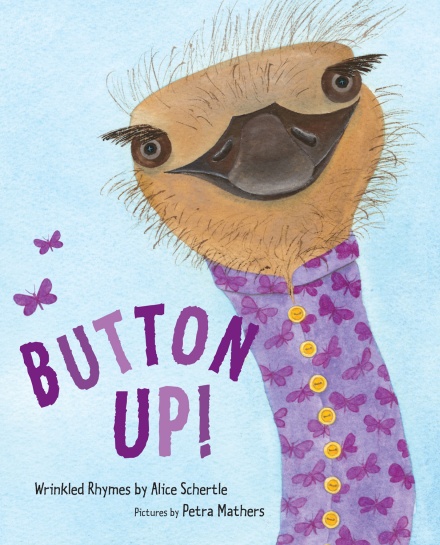
celebrate-picture-books-picture-book-review-button-up-wrinkled-rhymes-cover

About the Holiday

First designed in Germany in the 13th century, buttonholes revolutionized clothing, bags, and other objects that required closing and inspired a new art form. Designers and manufacturers took buttons to heart, making them not only functional but beautiful. Created from iridescent shells, sparkling glass, bone, and other materials, these little canvases were infused with paintings, intricate carvings, astonishing color, and more eye-catching features. Today, buttons still lend distinction and personality to outfits for all ages.

Button Up! Wrinkled Rhymes

Written by Alice Schertle | Illustrated by Petra Mathers


There may be no more outward demonstration of someone’s personality than the clothes they wear. In Button Up! Wrinkled Rhymes kids’ closets become the muse for Alice Schertle’s perky and humorous poems told from the unique perspective of shoelaces, t-shirts, pajamas, hats, and more garrulous garments.

In Bob’s Bicycle Helmet, this protective piece of equipment introduces itself: “Bob’s on his bike / and I’m on Bob. / I’m Bob’s helmet. / I’m on the job.” And even though “Bob skins his elbow. / Bob scrapes his knee. / Bob doesn’t hurt his head— / Bob’s got me.”

In Jennifer’s Shoes her new blue pair “…are learning the ways / of Jennifer’s world: / the way that Jennifer’s toes are curled, / the softness of carpet, / the steepness of stair, / the curve of the rung /  under Jennifer’s chair, / the hole in the heel / of Jennifer’s socks… / We are Jennifer’s shoes, we came home in a box.”

celebrate-picture-books-picture-book-review-button-up-wrinkled-rhymes-jennifer's-shoes

Image copyright Petra Mathers, courtesy of Houghton Mifflin Harcourt

Before bedtime Joshua’s Jammies are quite adamant about who they belong to: “We are the jammies that Joshua wears, / not jammies for penguins, / not jammies for bears, / not jammies for tigers with knots in their tails, / not jammies for whales…. / We don’t fit iguanas, / we’re not for the gnu, / we won’t suit the llamas / (they never wear blue)….”

Poor Tanya’s Old T-Shirt just doesn’t understand: “I live in a bucket shoved under the stair. / They call me a dust rag! / I don’t think it’s fair. / I’m still the same size as when I was new. / “I didn’t shrink— / it was Tanya who GREW…. / You’ll never, not ever / hear anyone say, / ‘She’s gotten too big, she’s just in the way, / let’s dust the piano with Tanya today.’”

While Rick’s Wool Sweater reveals that Rick wears a t-shirt underneath to be “warm on the OUTside / soft on the IN,”  it also takes a bit of pride in its particular talent: “To tell the truth it tickles me / to be a little prickly, / especially around his neck / and under his chin.”

Other poems reveal the inner thoughts of Bertie’s Shoelaces, Violet’s Hiking Hat, Harvey’s Golashes, Emily’s Undies, Wanda’s Swimsuit, Jack’s Soccer Jersey, Jamelia’s Dress-up Clothes, and a Hand-me-down Sweatshirt.

Just in time for Halloween Clyde’s Costume a gingham sheet is pleased to see that it makes a most distinguished ghost after being taken from the guest room bed and given eyes: “Now I’m ghastly and ghoulish and ghostly, / a will-o’-the-wispy fright. / Pardon my pride, but with Clyde inside, I’m the hit of Halloween night.”

Of course, we can’t forget that today is dedicated to buttons and to celebrate, Bill’s Blue Jacket is thrilled to be lifted off the hook: “Arm in the left sleeve, / arm in the right. / Button up! Button up! Button up / TIGHT! / Snap! Goes the collar / under Bill’s chin. / Everybody holler, / BILL’S ALL IN! / Everybody clap your hands, / everybody shout, / Bill’s got his jacket on, / LET’S GO OUT!
celebrate-picture-books-picture-book-review-button-up-wrinkled-rhymes-bertie's-shoelaces

Image copyright Petra Mathers, courtesy of Houghton Mifflin Harcourt

Alice Schertle brings a joyful buoyancy to the rhythms of her innovative poems, making each as distinctive as the article of clothing and the person who wears it. Her insights are surprising and will give kids a new perspective on their world and the secret life of the clothes they present to it.

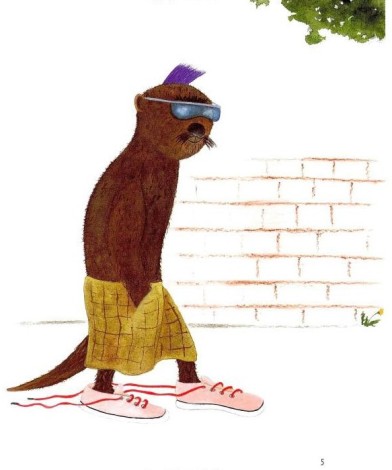
Petra Mathers’ exuberant and adorable pigs, moles, alligators, mice, dogs, one cool-dude otter, and one fuzzy-headed ostrich lend the perfect touch of humor and setting to depict the stars of Schertle’s poems. Harvey the pig exuberantly kicks up mud, Emily happily watches her vibrant and fancy undies flap on the breezy clothesline, a drowsy Joshua in his blue jammies says goodnight to his toys, and Tanya’s old pink t-shirt remembers better days while hanging on the edge of her green bucket. Mathers’ beautiful watercolors also portray a cloudy-day ocean, trick-or-treaters heading out at dusk, a refreshingly cold pool, and other landscapes.

Button Up! Wrinkled Rhymes makes a fun story-time read, a great companion at the laundromat, or an entertaining pre- or post-clothes-shopping pick-me-up.

Ages 4 – 7

Houghton Mifflin Harcourt, 2015 | ISBN 978-0544022690

Count Your Buttons Day Activity
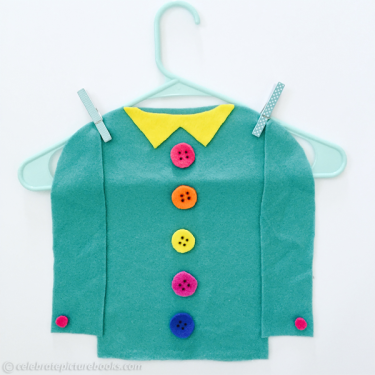
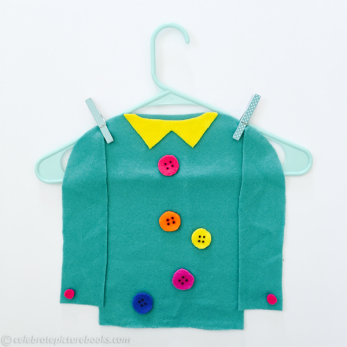
CPB - Button Coat

Pin the Button on the Coat Game


Pin the Button on the Coat is a fun game you can make yourself and play anytime! It’s great for a button-themed party or on any day that you’re holed up and wanting something to do! The game is played like “Pin the Tail on the Donkey,” and the object is to get the buttons lined up as close to the center of the coat as possible. Have fun!

Supplies

  • Fleece or felt of your choice of several favorite colors, 2 pieces of 8 ½” x 11” to make the coat and smaller pieces or scraps to make buttons
  • Fabric glue
  • Scissors
  • Black marker
  • Clothes hanger
  • Clothes pins

CPB - Button Coat II

Directions

  1. Cut out a coat shape from the fleece
  2. Cut out a collar from a different color fleece (optional)
  3. With the fabric glue, attach the sleeves to the edge of the coat, and the collar to the top of the coat.
  4. Let dry
  5. Cut circles to represent buttons from the other colors of fleece or felt, as many as you need
  6. With the marker make dots to represent holes in the “buttons”
  7. When the glue on the coat is dry, attach it to the clothes hanger with the clothespins
  8. Have fun playing!

Picture Book Review
 

October 16 – Dictionary Day

celebrate-picture-books-picture-book-review-w-is-for-webster-cover-image

About the Holiday

Dictionary Day honors Noah Webster, who wrote the first American dictionary. He was born in 1758 to a family that loved learning and knew the importance of a good education. Even as a boy Noah Webster loved words. He went on to become a lawyer, newspaper editor, Connecticut and Massachusetts legislator, and he helped found Amherst College in Massachusetts.

He is most well-known, however, for compiling the first American dictionary that is synonymous with his name and still the most popular dictionary in use. His work, first published in 1828, revolutionized the way language and words were presented and remains always current by every year adding new words that come into common use through new products, fads, and slang.

Wordsmiths the world over celebrate both the amazing accomplishment that is the dictionary, and I would imagine, their own well-thumbed and well-loved copies of this remarkable resource.

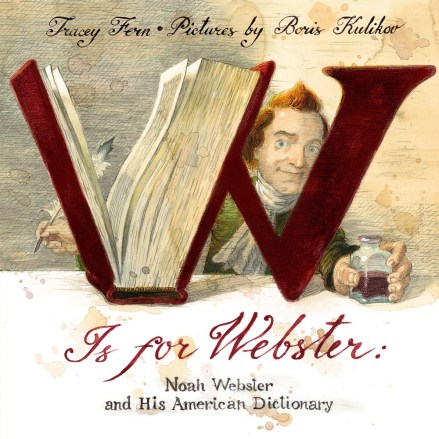
W is for Webster: Noah Webster and His American Dictionary

Witten by Tracey Fern | Illustrated by Boris Kulikov


Noah Webster was always different. Tall and thin with bright red hair, he liked to use big words when he spoke and wanted to do homework instead of goof around in school. Unfortunately for him school was in session for only a few months a year and goofing around seemed to be the major course of study. Of course, Noah didn’t call it “goofing around,” he called it “‘playing roguish tricks.’”

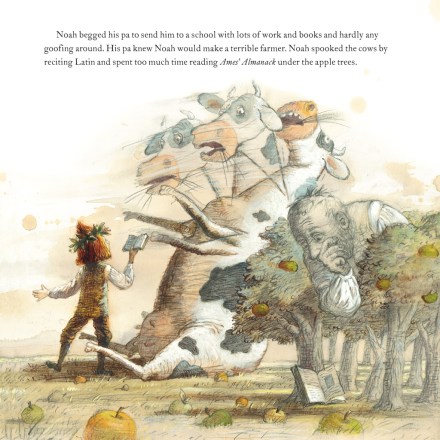
Noah begged to go to a harder school. “His pa knew Noah would make a terrible farmer. Noah spooked the cows by reciting Latin and spent too much time reading Ames’ Almanack under the apple trees.” His pa agreed, and in 1774 at the age of 16 Noah went off to study at nearby Yale College in New Haven, Connecticut. Yale had strict rules. Students had to rise at 5:30 a.m. and study for two hours before class. They were also fined “two shillings for making ‘tumult, noise, hallooing,’ or otherwise goofing around. Noah thought Yale was wonderful.”

celebrate-picture-books-picture-book-review-w-is-for-webster-spooking-horses

Image copyright Boris Kulikov, text copyright Tracey Fern. Courtesy of macmillan.com

Noah hadn’t been at Yale long before the American Revolutionary War broke out. Although Noah signed up to fight, he recognized that he was “‘ill able to bear the fatigues of a soldier,’” which was “Noah’s big way of saying he was a lousy soldier.” He returned to Yale and graduated in 1778, but he left the school with no job and no prospects. Even his pa told him to leave home to find work.

Noah became a teacher, but he found the British textbooks “‘defective and erroneous.’” He believed the students should have American textbooks that better reflected their diverse experiences. With the Revolutionary War at an end and America victorious, Noah wanted to help “hold his new, complicated nation together.” He believed that America needed a language different than the English spoked in Britain. “‘A national language is a national tie,’ Noah insisted to all who would listen, and to many who wouldn’t.”

celebrate-picture-books-picture-book-review-w-is-for-webster-teaching-school

Image copyright Boris Kulikov. Courtesy of macmillan.com

He began the work himself with a speller. Right from the start Noah’s speller was different than the British books. It included everyday words “like scab, grub, and mop.” He also simplified the spelling by taking out unpronounced letters or spelling words phonetically. He also added pictures to every page and presented lists of rhyming words. He also priced his book so almost anyone could afford it. Noah’s speller became a bestseller.

Still, Noah had bigger ideas. He wanted to write a patriotic dictionary with uniquely American words. He took his idea on the road to make money for the venture, lecturing wherever he could. But Noah’s know-it-all tone of delivery, his “prickly personality,” even his “‘porcupine hair’” put people off. And what’s more, they didn’t like the idea of his dictionary. People thought he was a “lunatic” for wanting to replace British words with American ones.

celebrate-picture-books-picture-book-review-w-is-for-webster-working-on-letter-a

Image copyright Boris Kulikov, text copyright Tracey Fern. Courtesy of macmillan.com

In 1806 Noah went ahead and published “A Compendious Dictionary of the English Language. It was a flop, but Noah wasn’t discouraged.” The next year he started working on a bigger dictionary. He copied words out of British dictionaries and added American words and he traced the roots of all the words and wrote definitions, sometimes including quotes from famous people to show differences in meaning. He figured the whole dictionary would take 5 years to finish—eight to ten, tops.

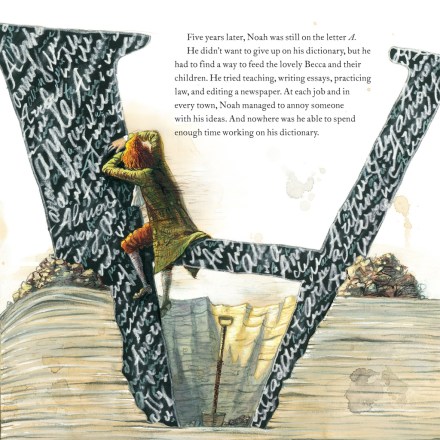
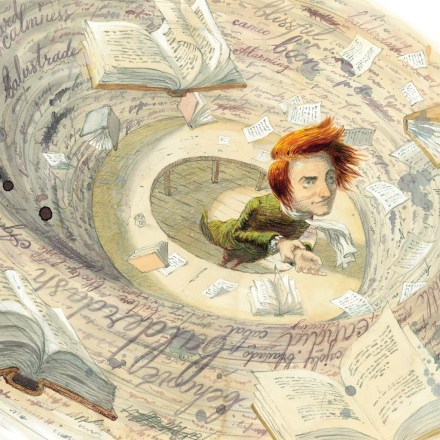
But five years later, Noah was still on the letter A. With no money coming in and a growing family, Noah took a variety of jobs, but he always seemed to rub someone the wrong way, and he lost job after job. He decided to sell his fancy house and bought a farm. Here he was able to gather books, books, and more books around his unusual donut-shaped desk. Standing inside the center of the desk, he spun around and around reading the books and finding words to include in his dictionary.

celebrate-picture-books-picture-book-review-w-is-for-webster-special-desk

Image copyright Boris Kulikov. Courtesy of macmillan.com

By 1822 Noah had exhausted all the books in his study. He took to traveling to other American libraries, moved his family to New Haven to use the Yale library, and in 1824 even sailed to Europe to explore books found in the National Library in Paris and at the University of Cambridge in England.

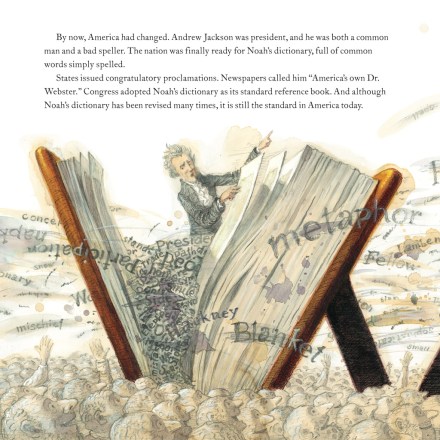
Finally, in 1825 Noah finished his dictionary.  With more than 70,000 words, An American Dictionary of the English Language was the largest English dictionary ever written. “Many people thought it was the best English dictionary ever written.” Why the change of heart? Well, one reason might have been that the President of the United States, Andrew Jackson, “was a common man and a bad speller.” Another might have been that the timing was just right.

celebrate-picture-books-picture-book-review-w-is-for-webster-finished-dictionary

Image copyright Boris Kulikov, text copyright Tracey Fern. Courtesy of macmillan.com

However it came to be, Noah was now lauded as a hero by states and newspapers. Congress even adopted the dictionary as its standard reference book. Noah had not only succeeded in writing an American dictionary, he had “created a new American language for a new American nation.” One that is still beloved today.

An Author’s note as well as a list of resources follow the text.

Webster’s dictionary is intrinsically woven into every American child’s life through language and vocabulary development. Tracey Fern’s captivating story reveals the charm and foibles of its author, a man with just the right temperament and perseverance to tackle and complete such an overwhelming task. Fern’s exceptional storytelling skills and deft turns of phrase allow for a comprehensive review of Webster’s life that is full of exhilaration, empathy, and a good dose of the “big” words Webster loved. Fern builds suspense and tension while offering an insightful look at early American history by including details of the staggering research required and the adverse reactions to Webster and his work.

Boris Kulikov’s expressive illustrations perfectly capture the complex personality of Noah Webster, late-1700s-to-early-1800s American society, and the obstacles Webster faced in writing his dictionary. Fittingly, words, books, or ink blots abound on every page, pouring from the air, sprouting from the ground, stacked like the skyscrapers that would come, and surrounding Noah Webster the way they must have swarmed through his brain. Kulikov infuses humor into his paintings, as when Noah tears at his hair wondering how he will support himself after college, shrugs nonplussed at his students’ shenanigans, and buys himself quiet work time by handing out sweets to his kids. Visual metaphors for the hard, backbreaking and mind bending work also enhance this beautiful biography.

Ages 5 – 10 (adult’s will also enjoy this biography)

Farrar Straus Giroux, 2015 | ISBN 978-0374382407

Visit Tracey Fern’s website to learn more about her and her books!

Discover a gallery of artwork by Boris Kulikov on his website!

Dictionary Day Activity

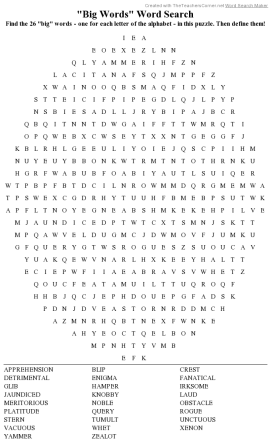
celebrate-picture-books-picture-book-review-big-words-vocabulary-word-search-puzzle

“Big Words” Word Search


Knowing and using a wide range of words allows you to express yourself in exact—and often—fun ways. Find the 26 “big” words—one for each letter of the alphabet—in this printable “Big Words” Word Search puzzle. Here’s the Solution!

Picture Book Review

October 13 – It’s National Popcorn Poppin’ Month

celebrate-picture-books-picture-book-review-the-popcorn-astronauts-cover

 About the Holiday

National Popcorn Poppin’ Month has been celebrated in October for more than 30 years and was made official in 1999 by then Secretary of Agriculture Dan Glickman. With its salty crunchiness and that enticing Pop Pop Pop rhythm, this snack is a favorite the world over. Its history goes back to the Aztecs and beyond. Early explorers of the 1500s wrote about native peoples roasting corn until it popped and described it as looking like a “white flower.” It was eaten and also strung for decoration.

Most people now eat popcorn with salt and butter, but can you imagine having it with milk? Way before Corn Flakes and Cheerios came on the scene people ate popcorn as cereal! And popcorn really became popular during the Great Depression, when it was one of the only treats people could afford. Why not pop up a batch and  read today’s reviewed  picture book. For more interesting popcorn facts and recipes visit www.popcorn.org.

The Popcorn Astronauts and Other Biteable Rhymes

Written by Deborah Ruddell | Illustrated by Joan Rankin


Each season has its much-anticipated delicacies and each food its particular fans. Winter offers hot drinks and cinnamony goodies; Spring ushers in fresh, juicy fruit; Summer requires icy-cold, refreshing treats; and Autumn settles in with warm, comforting meals and snacks. Year-round there are foods to delight the tummy and—in this fun collection of poems—the imagination. So let’s snuggle up on the couch and welcome The Arrival of the Popcorn Astronauts:

“The daring popcorn astronauts / are brave beyond compare— / they scramble into puffy suits / and hurtle through the air. / And when they land, we say hooray / and crowd around the spot / to salt the little astronauts / and eat them while they’re hot.”

Or perhaps those universally loved “Dazzlers of the Dinner Plate” and “Lunchroom Legends” that get their own tribute in Stand and Cheer for MAC and CHEESE! is just what you have in mind. When Winter drapes its icy blanket over the world, a special kind of steaming hot chocolate can always be found at The Cocoa Cabana where “On an ice-skating pond in the state of Montana, / there’s a little red tent called the Cocoa Cabana. Calling all skaters, the big and the small! / Marshmallow Peppermint Cocoa for all!

celebrate-picture-books-picture-book-review-the-popcorn-astronauts-strawberry-queen

Image copyright Joan Rankin, text copyright Deborah Ruddell. Courtesy of simonandschuster.com

Spring invites The Strawberry Queen and “You’ll know her the minute she enters the room / by the first little whiff of her spring time perfume / and her elegant suit—which is beaded and red— / and the leafy green crown on the top of her head. / Remember to bow and address her as Ma’am, but don’t say a word about strawberry jam.”

Thirsty? Then perhaps you would like A Smoothie Supreme with its very distinctive ingredients: “A whisper of pickle / is what I detect. / with glimmers of turnip / I didn’t expect”… “The mudpuddle splashes / are really delish, / and the finishing touch is that nubbin of fish!” Or maybe you’d like to learn How a Poet Orders a Shake, which goes in part: “‘A frosty cup of moonlight, please,’ / the poet murmurs, low. ‘As mushy as a mittenful / of slightly melted snow…’”

celebrate-picture-books-picture-book-review-the-popcorn-astronauts-smoothie-supreme

Image copyright Joan Rankin, text copyright Deborah Ruddell. Courtesy of simonandschuster.com

Imaginative verses also transform a slice of watermelon into a lake complete with “a little fleet of small black boats”, introduce peaches with their “…sunset of beautiful colors / on the flannelpajamaty skin”, follow the Voyage of the Great Baked Potato Canoes that “…oozed with steam and sour cream. / They were loaded with bacon and chives. / But silverware was everywhere— / and they barely escaped with their lives”, and wonder about who will eat The Last Brownie, which is “As hard and square and rugged as a brownie made of stone.”

celebrate-picture-books-picture-book-review-the-popcorn-astronauts-watermelon-lake

Image copyright Joan Rankin, text copyright Deborah Ruddell. Courtesy of simonandschuster.com

Deborah Ruddell has included so many more wonderfully delicious, fresh, and surprising poems with clever takes on the foods that flavor our days. The rhymes flow with a sweet, easy rhythm and are as fun to say as they are to hear.

Joan Rankin’s vivid watercolor illustrations bring each poem to life with adorable characters, humorous details, and plenty of action. Her “healthy” gingerbread house set among a broccoli forest is a beautiful departure from the well-known original, a dapper Dracula swoops down on an unsuspecting sleeper, a mouse wields an axe over a crusty brownie, and impressionistic trees hold ripe apples. Kids will love lingering over the pages as they listen to each poem to capture every nuance.

The Popcorn Astronauts and Other Biteable Rhymes makes a fun take-along book for picnics, trips to the farmers market or orchard, and playground—or anywhere that a quick nibble of food would taste better with a “Biteable Rhyme.”

Ages 4 – 8

Simon & Schuster, New York, 2015 | ISBN 978-1442465558

Discover more books by Deborah Ruddell plus fun activity guides on her website!

National Popcorn Poppin’ Month Activity

CPB - popcorn1

Popcorn Blast-Off Game


The popcorn is flying! Can you catch it? This is a fun game to celebrate this most delicious month! And if you keep the popcorn socks, it will make a great quick activity for those times when you want to get up and move but just don’t know what to do.

Supplies

  • 6 pairs of girls socks – white
  • A large bag of cotton balls
  • Towel or small blanket

Directions

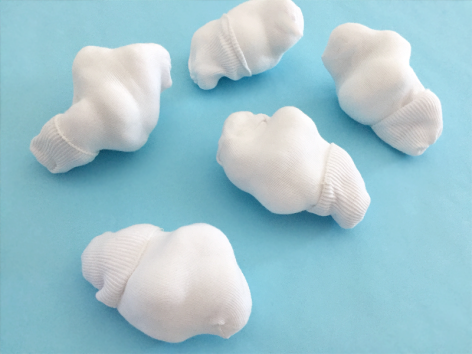
  1. Stuff the socks with a large handful of cotton balls (about 25)
  2. Knot the sock as you would a balloon and fold down the remaining ankle cuff
  3. Squish the sock to move the cotton balls until your sock looks like a piece of popcorn
  4. Players hold each end of the towel or side of the blanket so it sags
  5. Place popcorn in the middle of the towel or blanket
  6. On the count of 3, players pull tight on the towel or blanket
  7. Try to catch as many flying popcorn pieces in the towel or blanket as you can

Picture Book Review
October 10 – World Porridge Day

About the Holiday

Today’s holiday celebrates the history and origins of porridge, a food enjoyed around the world and Scotland’s national dish. Since 1996 the Scottish Highland Village of Carrbridge has hosted the World Porridge Making Championship, where culinary types from around the globe compete for the Golden Spurtle trophy and the honor of being named “World Porridge Making Champion.” In 2009 the championship event joined with Mary’s Meals, a charity based in Argyll Scotland that provides nutritional aid to children in developing countries. To celebrate today, why not mix up a batch of warm, delicious porridge. However you make it, a bowlful is just right!

Goldilocks and Just One Bear

By Leigh Hodgkinson


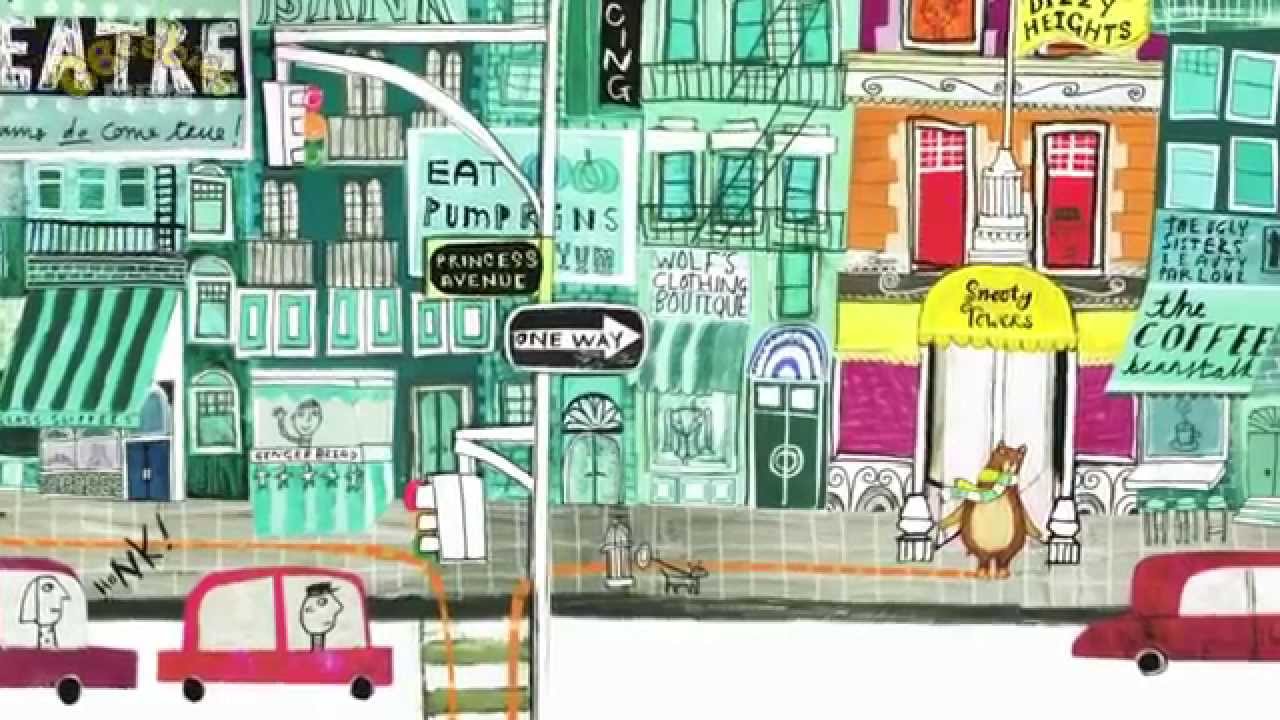
“Once upon a time there was this bear. One minute, he was strolling in the woods, all happy-go-lucky….The next minute, he didn’t have a crumb-of-a-clue where he was.” Somehow he, along with his tightly gripped spoon, had found his way to the big city. The bear didn’t like it: the lights were too bright, the streets were too noisy, and the bear’s legs had become too wobbly. He looked around at the “Wolf’s Clothing Boutique,” the “Three Little Piggies’ Bank, the “Gingerbread” stand, the “Glass Slippers” shoe store, and “The Ugly Sisters’ Beauty Parlor and decided to get away from it all. He took the elevator to the top floor of Snooty Towers, where he found a quiet place for a rest.

celebrate-picture-books-picture-book-review-goldilocks-and-just-one-bear-in-the-city

Image and text copyright 2012 Leigh Hodgkinson, courtesy of nosycrow.com

After “all that whooshy traveling,” the bear found that he was a mite hungry—hungry for porridge. He grabbed the first bowl he saw. “THIS porridge is too soggy,” he decided, slurping the water from the fish bowl. On the floor he found another bowl. “THIS porridge is too crunchy,” he said, spooning up a few cat nibbles. Next he tried the contents of a plate. “THIS porridge is a bit on the DRY side, but it’s better than nothing,” reasoned the bear.

celebrate-picture-books-picture-book-review-goldilocks-and-just-one-bear-porridge

Image and text copyright 2012 Leigh Hodgkinson, courtesy of nosycrow.com

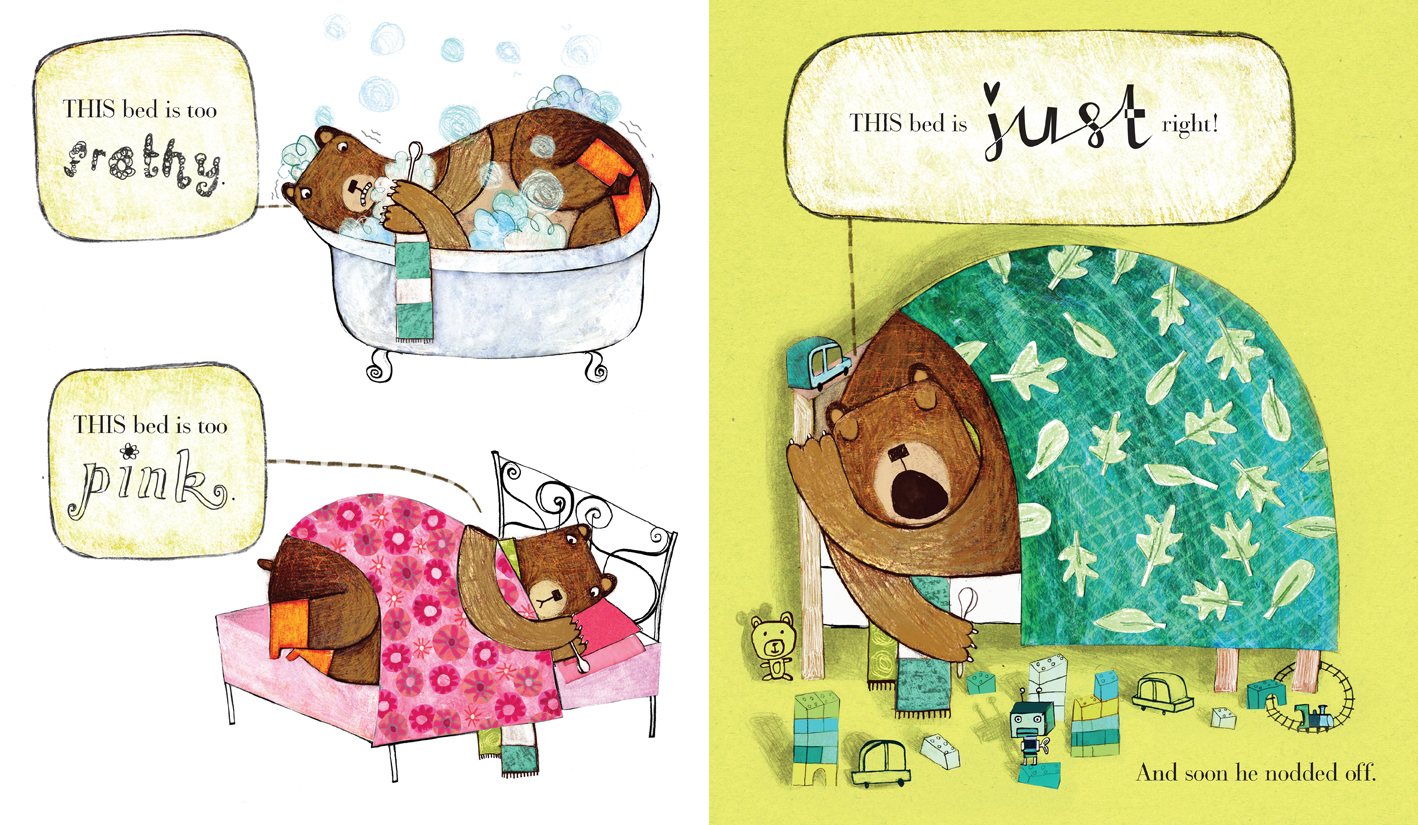
Nice and full, the bear went in search of a place to rest. He sat on something too “ouchy,” something too “noisy,” and something that exploded in a million Styrofoam beads but was “just right.” The short respite was nice, but not enough for such a tired bear. He sought out a place to take a proper nap. The bathtub was “too frothy”; the fancy bed was “too pink”; but the bed with the leaf-print comforter was “just right.”

While he slept the bear dreamed of his cozy house in the woods until he was unceremoniously wakened by a very, very loud “‘SOMEBODY has been eating from my fishbowl!’”; a very loud “‘Somebody has been eating my dear little Pumpkin’s kitty nibbles!’”; and a not-as-loud, but just-as-disturbing “‘And somebody has been eating my toast. And they’ve eaten it all up!’”

celebrate-picture-books-picture-book-review-goldilocks-and-just-one-bear-chair

Image and text copyright 2012 Leigh Hodgkinson, courtesy of nosycrow.com

The bear hid under the covers as the “daddy person” discovered his squished cactus, the “mommy person” comforted the cat, and the “little person” joyfully tossed Styrofoam peanuts in the air. It was only a matter of time before the daddy person laid eyes on the splashed about tub, the mommy person found her messy bed, and the little person pointed out the bear sleeping in her bed right that minute.

The bear took a look at the mommy person and thought she looked “slightly familiar.” At the same time the mommy person thought that three strikes in one house rang a bell. “‘Baby Bear?’” the mommy said. “‘Goldilocks?’” the bear gasped. Really, the reunion had been too long in coming! Goldilocks cooked up a big batch of porridge and the bear gobbled it down, because…well…you know! While the bear was glad to see that Goldilocks was “living so happily ever after,” he was just as glad to return home to the woods.

celebrate-picture-books-picture-book-review-goldilocks-and-just-one-bear-bed

Image and text copyright 2012 Leigh Hodgkinson, courtesy of nosycrow.com

Leigh Hodgkinson’s tale of Little Bear all grown up is a hilarious turn-about-is-fair-play take on the original Goldilocks story. The bear, out of his depth in the big city, makes a sweet and sympathetic character even as kids laugh at his misguided experiments in Goldilocks’ penthouse apartment. Hodgkinson’s story is full of wonderful, expressive language set off in animated type that enhances the look of the stylish pages.

Hodgkinson’s vibrant and airy mixed-media illustrations are visually stimulating—alive with the glitz and glamour of the city—and underscore the woodsy bear’s apprehension in his new surroundings. The signs and billboards along the busy thoroughfare allow Hodgkinson to include nods towards other favorite fairy tales, and the prints hanging on the wall of the Snooty Towers apartment hint at the identification of its owner.

Goldilocks and Just One Bear is a fun and funny fractured fairy tale, and one that kids will ask to have read over and over.

Ages 3 – 8

Nosy Crow Books, 2012 | ISBN 978-0763661724 (hardcover) | ISBN 978-1536234855 (paperback)

Discover more about Leigh Hodgkinson and her books on her website Wonky Button!

World Porridge Day Activity

bear-maze

It’s Just Right! Maze

Sometimes a bear—or a person—will go to any lengths for a bowl of porridge. Can you find your way through this printable bear-shaped It’s Just Right Maze?

You can purchase Goldilocks and Just One Bear at these booksellers

Amazon | Barnes & Noble | Bookshop (to support your local independent bookstore)

Picture Book Review

October 8 – World Octopus Day

celebrate-picture-books-picture-book-review-also-an-octopus-cover

About the Holiday

With fossils dating back 300 million years, the octopus is one of the world’s oldest and most fascinating creatures. It’s also one of the smartest as more than 500 million neurons fire information through an octopus’s brain and arms, allowing them to learn from experience and solve problems. Octopuses are versatile and are found in all the world’s oceans. While most prefer warmer waters and living along the ocean floor, some species swim in shallower, cooler waters. Octopuses have an excellent sense of touch and sense of vision—some even see in color. They fool predators by hiding or camouflaging themselves but can defend themselves by shooting an inky substance at their pursuers. To celebrate today’s holiday, plan a visit to an aquarium or other sea life center!

Also an Octopus

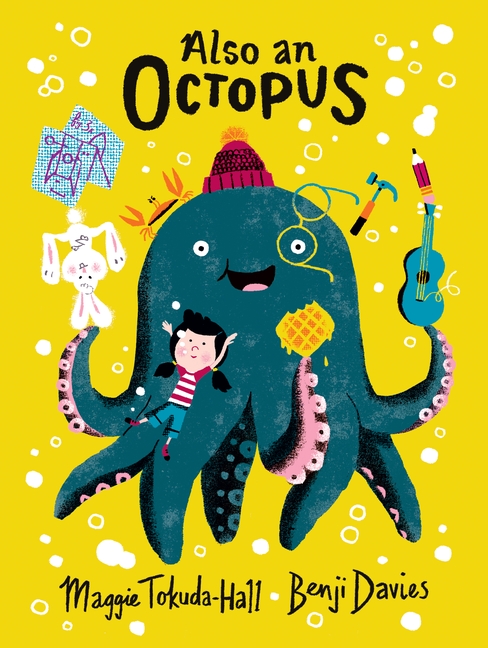
Written by Maggie Tokuda-Hall | Illustrated by Benji Davies


“Every story starts with nothing.” But as you think about your story, you imagine a character. This character can be anyone or anything—maybe a little girl, or a bunny, or an octopus. Maybe even an octopus that plays the ukulele. Yes! Now, by itself that seems kind of boring, so the octopus has to want something like a sandwich or a friend. Hey! Didn’t you think of a little girl? Maybe she could be the friend. But wait! How about if the octopus wants a “totally awesome shining purple spaceship capable of intergalactic travel?”

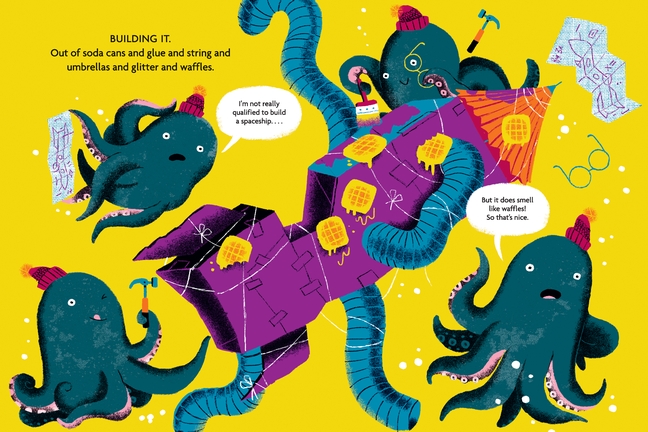
Now there’s a story! It’s not? Oh…too short? Too ehh? What if the octopus builds the rocket ship from stuff around the house? Easy-peasy! Oh dear, it doesn’t work. It can’t even get off the ground. Maybe that bunny from your earlier imagination can help. I’m sure that rabbit is great at building rockets—carroty ones anyway. Not exactly what the octopus had in mind though, huh? What’s an octopus to do beside feel “heartbroken”…beside feel “despondent?”

celebrate-picture-books-picture-book-review-also-an-octopus-homemade-rocket-ship

Image copyright Benji Davies, text copyright Maggie Takuda-Hall. Courtesy of candlewick.com

Maybe the octopus’s sorrows can be drowned in music. A few strums on the ukulele might be soothing. Not a bad idea! Doing this changes things completely! “People come to listen to the ukulele-playing octopus.” What a turn of events! Some of the people are rocket scientists who can help construct a spaceship and who “also play the saxophone, tambourine, trumpet, and lute!” Now this is getting interesting! “So what happens next?” Well, that is up to you!

But you say “I’ve got nothing”? That’s all you need—“because every story starts with the same thing: just a little bit of nothing.”

In Also an Octopus Maggie Tokuda-Hall encourages budding writers and other creative kids to trust their imaginations and let the ideas fly. With humor Tokuda-Hall demonstrates how characters, needs or wants, setting, plot, conflict, and resolution come together to make a whole story. Readers will see how one randomly chosen element can spark an entire work of art—one that is unique to its creator. Tokuda-Hall’s Octopus is a sweet, appealing character who just wants a spaceship (and a story) to take them wherever their heart desires.

Benji Davies’s adorable Octopus, sporting a red knit cap, immediately forms a bond with readers with sweet smiles, a determined work ethic, and a sad, dejected ukulele performance on a lonely curb. Davies’ vibrant purple, yellow, and orange palette highlights the gray octopus, making this would-be astronaut the star of each page. The rocket scientists who come to listen to, jam with, and help Octopus are a welcome diverse group of adults, and the final spreads show kids that with any object or idea, the sky’s the limit.

Ages 3 – 8

Candlewick Press, 2016 | ISBN 978-0763670849

Learn more about Maggie Tokuda-Hall and her work on her website!

You’ll discover a colorful world of illustration and kids books on Benji Davies’ website!

World Octopus Day Activity

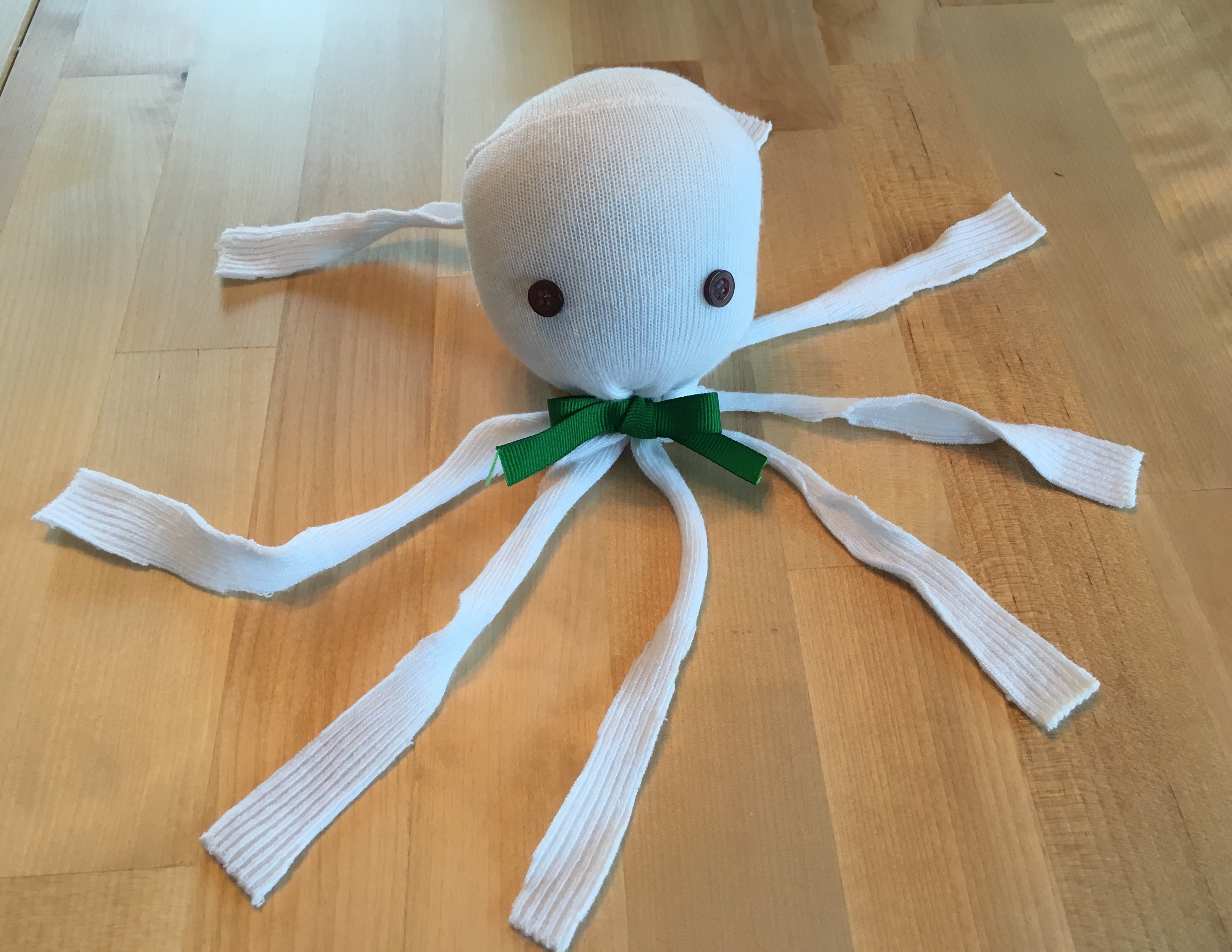
celebrate-picture-books-picture-book-review-sock-octopus-craft

Cute Sock Octopus Craft


Who wouldn’t like to have a cute octopus for a pet? With this fast and easy craft you can make your own little cephalopod to hang out on your bed, your shelves, or on your desk!

Supplies

  • Child’s medium or large size sock, white or colored
  • Polyfiber fill, available at craft and sewing stores
  • Ribbon
  • 2 Small buttons
  • Scissors
  • Hot glue or strong glue

Directions

  1. Fill the toe of the sock with a handful of polyfiber fill
  2. Tie the ribbon tightly around the sock underneath the fiber fill to separate the head from the legs
  3. Tie the ribbon into a bow tie
  4. With the scissor cut up both sides of the sock almost to the ribbon
  5. Cut these two sections in half almost to the ribbon
  6. Cut the four sections in half almost to the ribbon
  7. Glue the eyes to the lower part of the head
  8. To display, set the octopus down and arrange the legs in a circle around the head

celebrate-picture-books-picture-book-review-also-an-octopus-cover

You can find Also an Octopus at these booksellers

Amazon | Barnes & Noble | Books-a-Million | IndieBound

Picture Book Review

October 7 – Random Acts of Poetry Day

When Green Becomes Tomatoes by Julie Fogliano and Julie Morstad

About the Holiday

Today is the day to unleash your inner poet – without thinking twice about it. What are the words in your heart or in your imagination? Write them down! You don’t have to be Shakespeare for your words, lines, thoughts, jottings – your poems – to have meaning and value. Then share them with family, friends, or even strangers. To celebrate today’s holiday you can also attend a poetry reading or enjoy a volume of verse – like today’s book!

When Green Becomes Tomatoes: Poems for All Seasons

Written by Julie Fogliano | Illustrated by Julie Morstad


Sometimes you wish for just the right words to express a moment in time, a skip of the heart, or a glimpse of color that truly captures the elation, sadness, or awe you feel. Those words live on every page of When Green Becomes Tomatoes: Poems for All Seasons. Each month of the year is represented by three to five dated poems that expose a nugget of inspiration or a spark of recognition about the natural world and our place in it.

Spring begins its reawakening in the poem dated march 20, on which “from a snow covered tree / one bird singing / each tweet poking / a tiny hole / through the edge of winter / and landing carefully / balancing gently / on the tip of spring.”

celebrate-picture-books-picture-book-review-when-green-becomes-tomatoes-spring

Image copyright Julie Morstad, text copyright Julie Fogliano. Courtesy of us.mcmillan.com

Spring is slow in shaking off its winter coat, however, and march 22 finds “just like a tiny, blue hello / a crocus / blooming in the snow” Even though the days continue to dawn chilly and rainy, early flowers long to see the sun. On march 26: “shivering and huddled close / the forever rushing daffodils / wished they had waited.”

With the onset of April and no reprieve from the weather, everyone it seems is tired of the persistence of winter, which sticks around like a party guest who doesn’t know when to go home. On april 3 “today / the sky was too busy sulking to rain / and the sun was exhausted from trying / and everyone / it seemed / had decided / to wear their sadness / on the outside / and even the birds / and all their singing / sounded brokenhearted / inside of all that gray.”

celebrate-picture-books-picture-book-review-when-green-becomes-tomatoes-summer

Image copyright Julie Morstad, text copyright Julie Fogliano. Courtesy of us.mcmillan.com

At last summer comes and on june 15 “you can taste the sunshine / and the buzzing / and the breeze / while eating berries off the bush / on berry hands / and berry knees.” The warm days also bring swimming holes and fireflies, and by july 10 “when green becomes tomatoes / there will be sky / and sun / and possibly a cloud or two…” and summer bursts with all the wonder that makes it such a yearned for season. 

Then as summer wanes and the nights grow dark, september 10 makes you look into that deep vast space and think “a star is someone else’s sun / more flicker glow than blinding / a speck of light too far for bright / and too small to make a morning”

celebrate-picture-books-picture-book-review-when-green-becomes-tomatoes-fall

Image copyright Julie Morstad, text copyright Julie Fogliano. Courtesy of us.mcmillan.com

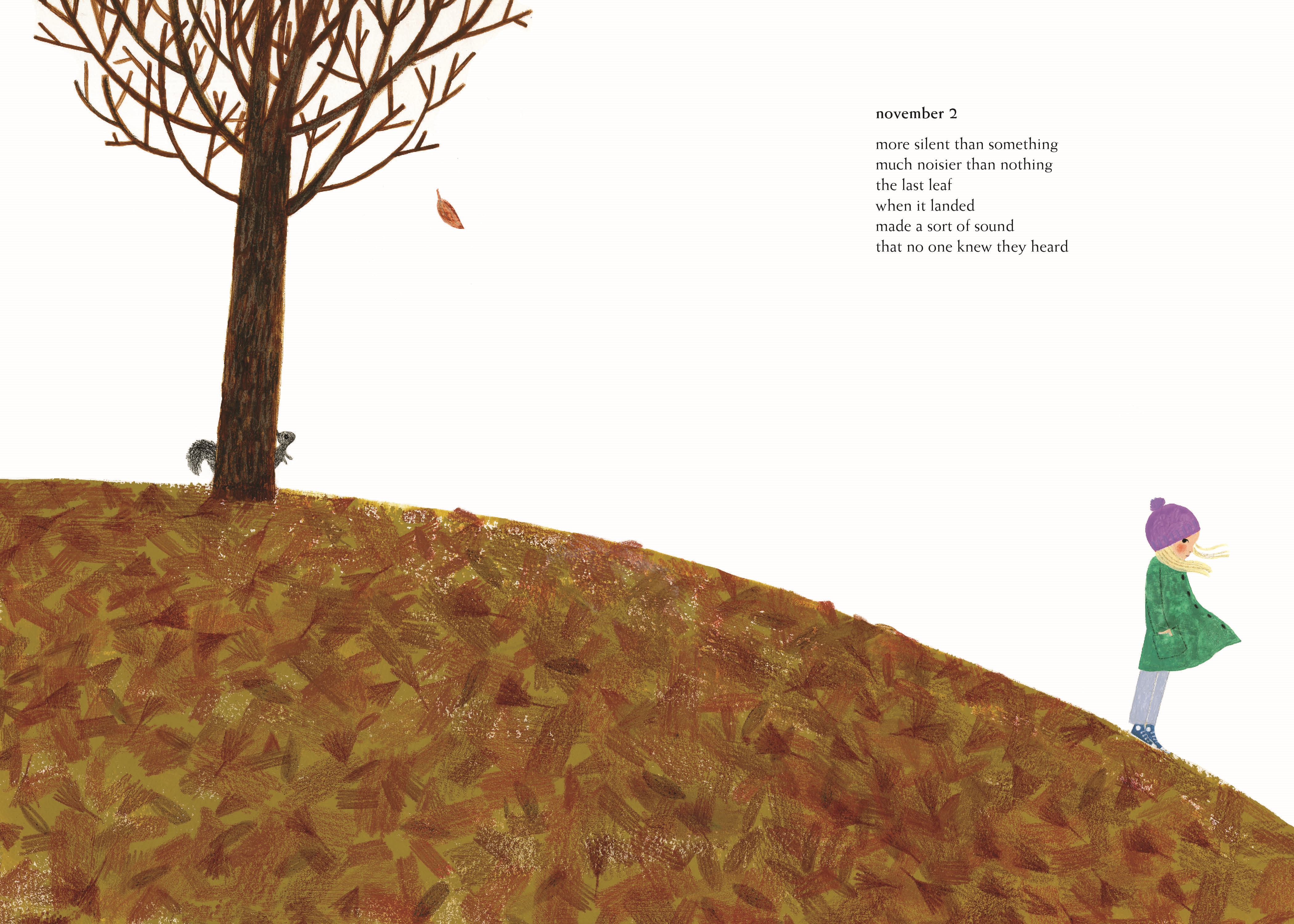
A nip in the air means Fall has come around again. It’s time for sweaters and pumpkins, and for the trees to rest. If you listen carefully, you may hear on november 2 “more silent than something / much noisier than nothing / the last leaf / when it landed / made a sort of sound / that no one knew they heard.”

Then on december 21 “as if one day, the mountain decides / to put on its white furry hat / and call it winter” the season has changed, bringing with it crackling, cozy fires and snow, snow, snow. But this too offers its own enchantment on december 29: “and i woke / to a morning / that was quiet / and white / the first snow / (just like magic) came / on tiptoes / overnight.”

celebrate-picture-books-picture-book-review-when-green-becomes-tomatoes-winter

Image copyright Julie Morstad, text copyright Julie Fogliano. Courtesy of us.mcmillan.com

When Green Becomes Tomatoes begins and ends with a poem dated the same day—March 20, the vernal equinox—giving this book a cyclical form that echoes the passing of time. Julie Fogliano’s delicate and gentle poems are a perfect tonic for the busy, non-stop days the year becomes. Instead of letting the surprising, profound, or beautiful moments pass us by Fogliano gives readers a reason and a way to stop and fully enjoy them.  

In Julie Morstad’s gorgeous watercolors of nature and the changing seasons, readers can almost feel the warm sunshine that feeds the vivid spring and summer blooms, the icy breeze that loosens the last leaf of autumn, and the fluffy blanket winter tucks around the earth. The multiethnic children in Morstad’s paintings are thoughtful, charming, and enchanted with the world around them, actively experiencing the marvels of each changing day. 

When Green Becomes Tomatoes contains such lovely verses that readers will want to revisit them over and over – the way the seasons recur and we are always glad to welcome each one back. This volume of poetry would make a wonderful gift and a terrific addition to anyone’s bookshelf.

Ages 6 and up (adults will enjoy these poems too)

Roaring Brook Press, 2016 | ISBN 978-1596438521

You can connect with Julie Fogliano on Facebook!

You’ll find a gallery of picture books, prints, and other illustrations on Julie Morstad‘s website!

Random Acts of Poetry Day Activity

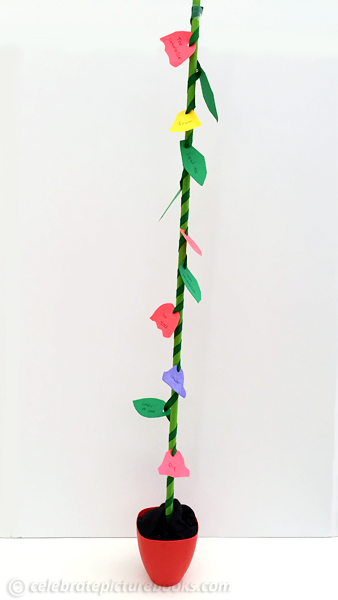
CPB - Plant Poem


Grow a Poem Craft


A poem often grows in your imagination like a beautiful plant—starting from the seed of an idea, breaking through your consciousness, and growing and blooming into full form. With this craft you can create a unique poem that is also an art piece!

Supplies

  • Printable Leaves Template, available here and on the blog post
  • Printable Flower Template, available here and on the blog post
  • Wooden dowel, ½-inch diameter, available in craft or hardware stores
  • Green ribbon
  • Green craft paint
  • Green paper if leaves will be preprinted
  • Colored paper if flowers will be preprinted
  • Flower pot or box
  • Oasis, clay, or dirt
  • Hole punch
  • Glue
  • Markers or pens for writing words
  • Crayons or colored pencils if children are to color leaves and flowers

Directions

  1. Paint the dowel green, let dry
  2. Print the leaves and flower templates
  3. Cut out the leaves and flowers
  4. Punch a hole in the bottom of the leaves or flowers
  5. Write words, phrases, or full sentences of your poem on the leaves and flowers (you can also write the poem after you have strung the leaves and flowers)
  6. String the leaves and flowers onto the green ribbon (if you want the poem to read from top to bottom string the words onto the ribbon in order from first to last)
  7. Attach the ribbon to the bottom of the pole with glue or tape
  8. Wrap the ribbon around the pole, leaving spaces between the ribbon
  9. Gently arrange the leaves and flowers so they stick out from the pole or look the way you want them to.
  10. Put oasis or clay in the flower pot or box
  11. Stick your poem pole in the pot
  12. Display your poem!

Picture Book Review
October 5 – World Teachers Day

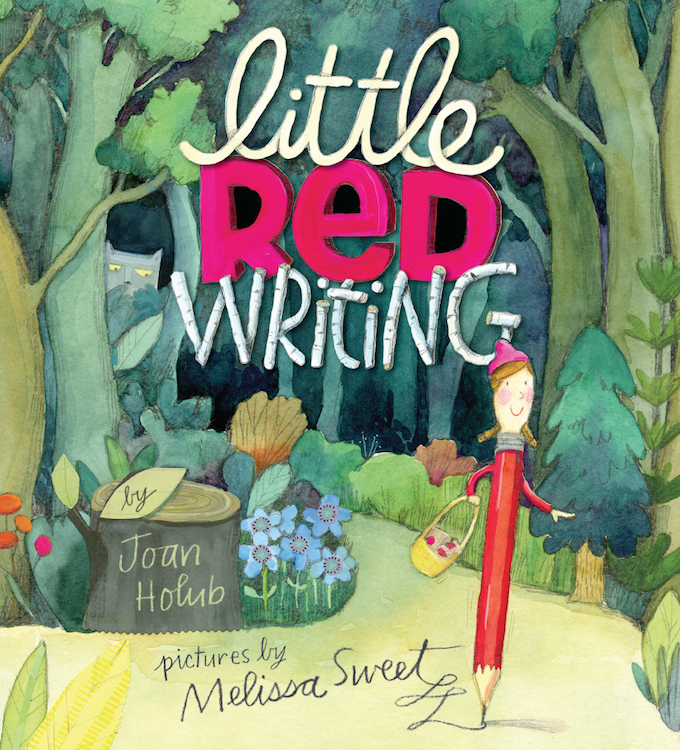
celebrate-picture-books-picture-book-review-little-red-writing-cover

About the Holiday

Teachers are amazing! They dedicate their lives to connecting students to the wider world and opening doors to opportunities for a bright future. Today’s holiday celebrates all the work, thought, and planning that teachers put into every day’s lessons as well as the care and concern they have for every one of their students. Wherever you are, thank your teacher or teachers for everything they do to help you write your own story and ultimately your own ticket—like the sharp heroine of today’s book!

Little Red Writing

Written by Joan Holub | Illustrated by Melissa Sweet

One day in pencil school Ms. 2, the teacher, tells her class that they are going to write a story. Her students are excited, and each one has an idea of what to write. The birthday pencil, wearing a bright pink cone-shaped hat, yells “‘Yippee! I want to write a happy story!’” The state pencil, sporting a map of Pencilvania on its eraser end, wants to tell a nonfiction tale about its state, and the basketball pencil with a small replica basketball topper imagines writing a sports story.

celebrate-picture-books-picture-book-review-little-red-writing-classroom

Image copyright Melissa Sweet, text copyright Joan Holub, courtesy of chroniclebooks.com

Little Red, looking sharp in her shiny scarlet coat of paint chooses to “write a story about bravery because red is the color of courage. But what would a brave pencil do?” she wonders. She decides to go in search of unusual characters that will give her a chance to fight evil and save the day. Ms. 2 gives “Little Red a basket of 15 red words to use in case she ran into trouble” and reminds her that “it’s ok to wander a little, but stick to your basic story path so you don’t get lost.”

Little Red takes her basket full of nouns and sets off. In her notebook she begins to describe her journey. “As she walked along…” she writes and then stops. “Walking is boring,” she decides. To discover some action she heads for the gym, where other pencils are twisting, throwing, catching, swinging, and jumping. Little Red bounces and boogies and cartwheels “right off the page into a deep, dark, descriptive forest.”

celebrate-picture-books-picture-book-review-little-red-writing-descriptive-forest

Image copyright Melissa Sweet, text copyright Joan Holub, courtesy of chroniclebooks.com

The adjectives lay thick on the gnarled, flowery, shadowy path. The towering trees smell piney and their verdant, russet leaves hide squirrelly creatures. The forest is beautiful, but suddenly Little Red feels “bogged down, hindered, lost!” Remembering her basket, she reaches in and pulls out scissors. They help her “cut through all this description and stick to the story path.” Back on the straight and narrower, Little Red encounters a bottle of “conjunction glue” with just the right kinds of words to help her. She gives the bottle a squeeze, but now finds that her sentences go on and on without saying anything important. All seems lost until “Suddenly” arrives.

“Suddenly,” she hears a throaty roar that begins to chase her. Little Red runs without stopping, throwing out any word she can grab from her basket until she can escape to the next page. Here, however, she discovers a “long, tangly tail” and decides to investigate. The tail winds all along the school corridors, passing the cafeteria, the music room, the art room, and the auditorium. It even meanders by the math room and the after school clubs room into the principal’s office.

celebrate-picture-books-picture-book-review-little-red-writing-wolf-3000-chases-little-red

Image copyright Melissa Sweet, text copyright Joan Holub, courtesy of chroniclebooks.com

Little Red knocks on the door. Inside, Principal Granny, her long tail tangled behind her, roars her greetings. Little Red is suspicious, but she continues to explain the growly voice she heard. In fact, she says, “It sounded kind of like yours.” “The betterrr to be hearrrd on the school interrrcom,” the principal states. Little Red also reports the tangly tail, to which the principal answers, “the betterrr to get charrrged up for my school duties when my batteries are rrrunning low. All at once Red notices the principal’s big sharp teeth. “The betterrr to chomp little pencils like you and grrrind them up!”

With that Little Red realizes that this isn’t Principal Granny but the “Wolf 3000: the grumpiest, growliest, grindingest pencil sharpener ever made!” The Wolf 3000 begins to chase Little Red around the office, and just when there seems no hope, in walks Mr. Woodcutter, the janitor—who immediately faints. There is only one thing left to do. Little Red grabs her last word and hurls it at the Wolf 3000. “KABLOOEY” goes the dynamite, reducing the Wolf 3000 to a pile of parts.

Principal Granny emerges from the rubble shortened but okay and declares Little Red a hero. Little Red rushes back to her classroom in time to hear the other pencils’ stories and to share her own brave adventure.

celebrate-picture-books-picture-book-review-little-red-writing-dynamite

Image copyright Melissa Sweet, text copyright Joan Holub, courtesy of chroniclebooks.com

Joan Holub’s delightfully clever tribute to writing draws on the Little Red Riding Hood story to get kids excited about using the various parts of speech that make writing so fun and reading so enjoyable. The metaphorical “story path” that Little Red traverses brings her into contact with characters that provide immediate understanding of the concepts. When Little Red squeezes the bottle of conjunction glue, out squirt the words so, but, and, although, yet, and or, which are incorporated into the illustrations on the page. Readers’ familiarity with the original fairy tale increases suspense in this fractured version. The Wolf 3000 electric pencil sharpener makes a perfect nemesis, and the fainting janitor leaves Little Red to sharpen her wits and defeat the beast. Dynamite—at least the word itself—truly is mightier than the sword.

Holub’s nimble talent with puns and wordplay elevates Little Red Writing from simply a book about the subject of grammar and writing to a captivating story kids will love to hear again and again.

Grammar has never looked as enticing as in Melissa Sweet’s vivacious illustrations of adorable Little Red on the story path to prove her bravery. Sweet’s pages, combining pencil drawings, watercolor, and collage, burst with animated typography, scraps of vivid red nouns, and expressive characters in a detailed and fully realized pencil school. Little Red’s final battle with the Wolf 3000 gives full range to Sweet’s rousing visual humor in a highly satisfying climax to the story.

For kids who love reading, writing, and a really good story, Little Red Writing would be a welcome addition to their bookshelves. Teachers will find the story enhances any unit on writing, grammar, and literature.

Ages 5 – 9

Chronicle Books, 2013 | ISBN 978-1452152097

You will find children’s books for all ages as well as fun videos, activities, and teachers’ resources on Joan Holub‘s website!

Discover books, things to make, and lots of fun on Melissa Sweet‘s website!

World Teachers Day Activity

CPB - Pencil Maze

Pencil It In Maze

Writing a story is like completing a maze – you must stay on the right path from the beginning to the end to write a satisfying tale. Find your way through intricacies of this printable Pencil It In Maze

Picture Book Review