By 1970 awareness was growing worldwide about the damage that industrialization, pollution, and pesticides were causing people and the environment. On April 22, 1970—the date of the first Earth Day—millions of people demonstrated for change. In response, in July of 1970, Republican President Richard Nixon and the U.S. Congress created the Environmental Protection Agency. Between 1970 and 1973 they also enacted laws such as the Clean Air Act, the Clean Water Act, and the Endangered Species Act and more. Earth Day is now celebrated around the globe as a day for political action and civic participation.
Today, it’s more important than ever for citizens to participate in protecting the environment and speaking up against the policies of the current Republican president and administration so they do not reverse the progress and advancements we’ve made. This year the theme of Earth Day is Our Power, Our Planet and calls for people to unite around renewable energy. To learn more about this year’s theme, and discover ways that you and your kids can make a difference, visit earthday.org.
Thanks go to Terry Pierce and the Yosemite Conservancy for sending me a copy of We Leave No Trace! for review.
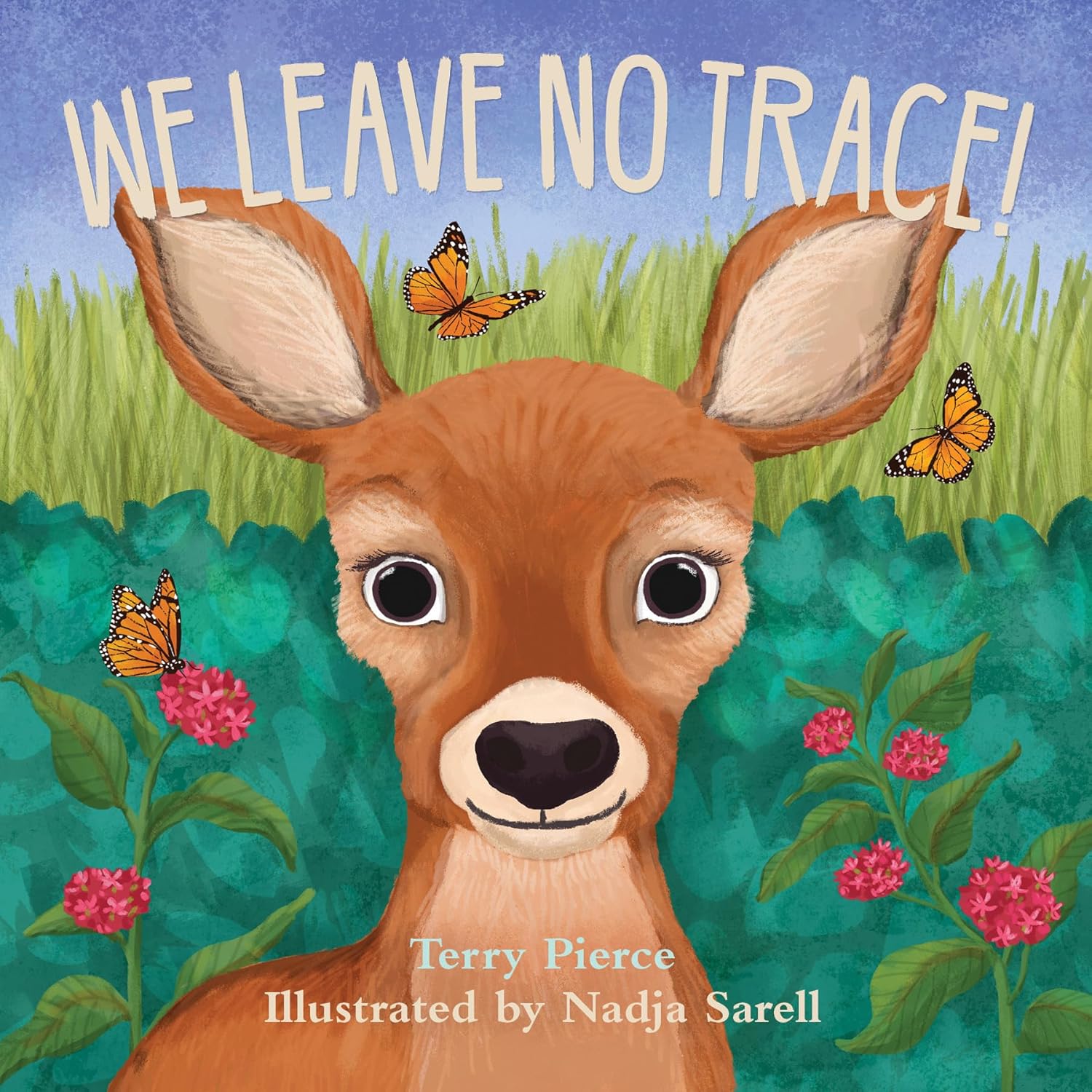
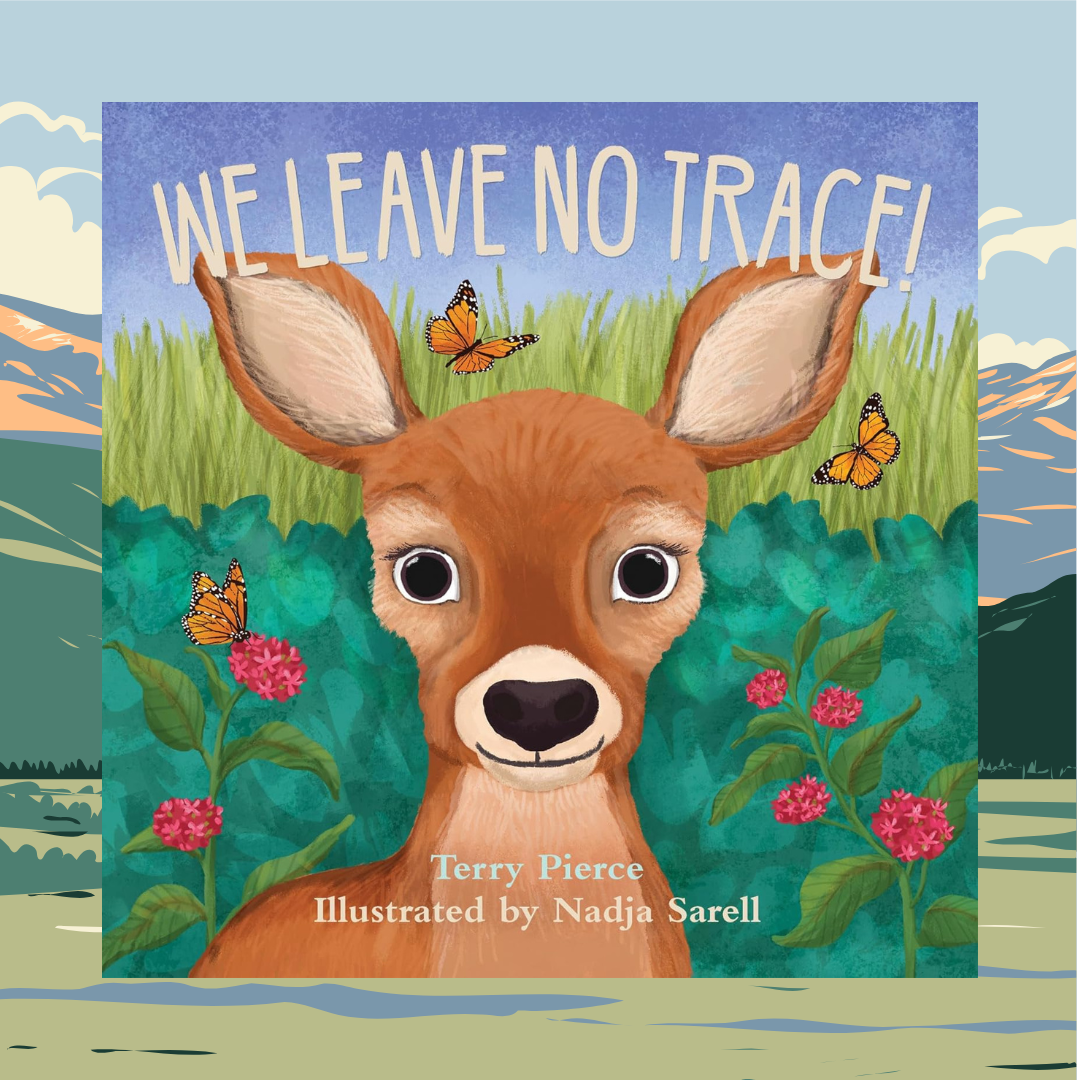
We Leave No Trace!
Written by Terri Pierce | Illustrated by Nadja Sarell
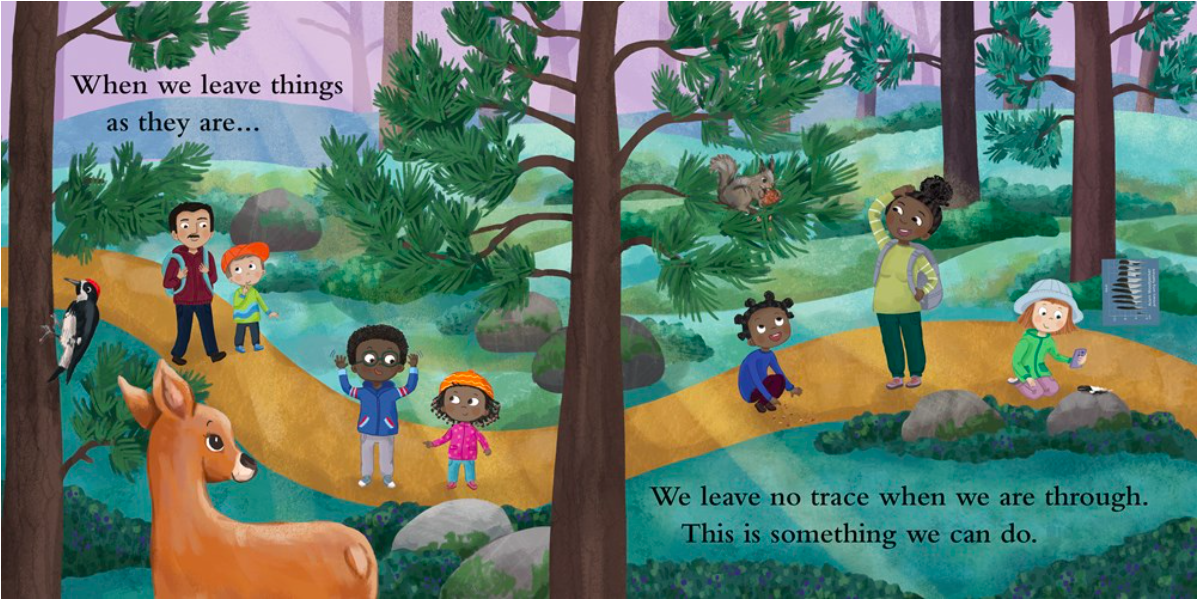
In her gentle invitation for the youngest children and their families to enjoy the outdoors while also treating its flora and fauna with kindness, Terry Pierce models the “leave no trace” principles that ensure harmony between people and nature. Pierce touches on such ideas as not collecting natural “souvenirs,” maintaining a small footprint, and always throwing away trash in verses that encourage adults and children to talk about how they, particularly, can be good stewards of the earth as they hike, camp, picnic, or just enjoy a walk together.
While each page spread introduces a different way that kids can pitch in to help nature, Pierce has also included a repeated rhyming couplet that reinforces a child’s pride in supporting a cleaner, healthier environment for all while also having fun. This lively phrase can turn any read-aloud story time into an enjoyable interactive read-along for little ones.
Kids will love hiking through Nadja Sarell’s vibrant landscapes that transports them to a mountain-side lake where various nature-lovers are boating, picnicking, and walking all within sight of a doe and her fawn and a bird that’s flying in low for its closeup; a forested trail in which a girl, instead of taking home a woodpecker’s feather, is snapping a picture of it; a park where ducks swim among lily pads as kids look on from a stone bridge while others play nearby; and more lovely locales. Each page spread also offers lots of opportunities for young readers to point out animals and other elements of nature as well as kid-favorite treats and activities.
We Leave No Trace! is a delightful adventure through nature that provides youngest children with easy and mindful reminders of how they can protect the environment now and for the future. Jaunty rhymes, repeated phrasing, and vivid illustrations that welcome discussion and interaction make this board book perfect for taking along on trips to playgrounds, parks, and other outdoor spots and a top choice for home and library collections.
Ages Baby – 3
Yosemite Conservancy, 2025 | ISBN 978-1951179373
About the Author
Terry Pierce is the author of more than twenty-five books for children, including We Leave No Trace!, Hello Meadow!, and Eat Up Bear! (Yosemite Conservancy), Love Can Come in Many Ways (Chronicle), Soccer Time! (Random House), Mama Loves You So (Little Simon) and My Busy Green Garden (Tilbury House). She is an outdoor enthusiast, enjoying backpacking, hiking, and rock climbing near her home in Mammoth Lakes, California.
About the Illustrator
Nadja Sarell is an illustrator living in Helsinki, Finland. She is the illustrator of We Leave No Trace!, Eat Up Bear! and Hello, Meadow! (Yosemite Conservancy), the Frankie Sparks, Third Grade Inventor series (Aladdin), and The One and Only Wolfgang (Zonderkidz). Nadja graduated with MA in dance from Theatre Academy Helsinki and graduated from North Wales School of Art and Design with BA in illustration for children’s publishing in 2004. Since then she has worked as a freelance illustrator in Finland and abroad. She loves to teach art, illustration, and dance for both children and adults.
We Leave No Trace! joins these two previous books in the Yosemite Conservancy’s “stewardship” board book series by Terry Pierce and Nadja Sarell
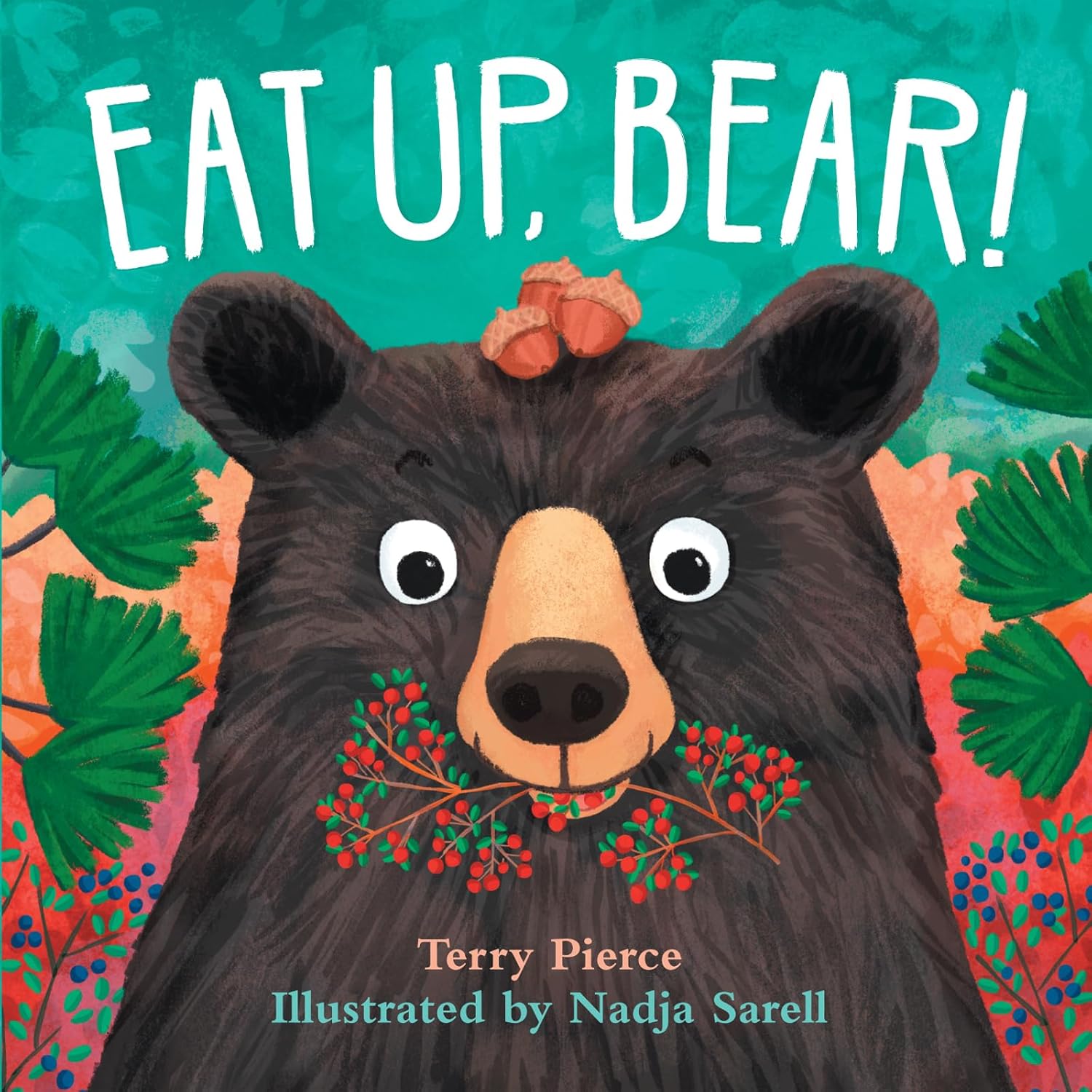
Eat Up, Bear!
Curious, hungry black bears just want to eat! Juicy berries, crunchy nuts, tender grubs, sticky honey—that’s good bear food. But if little park visitors and their families don’t watch out, their food will be bear food, too! The bouncy rhyming text and vibrant pictures in this board book show how people of all ages can help keep bears safe and thriving. Perfect for first-time and seasoned campers alike.
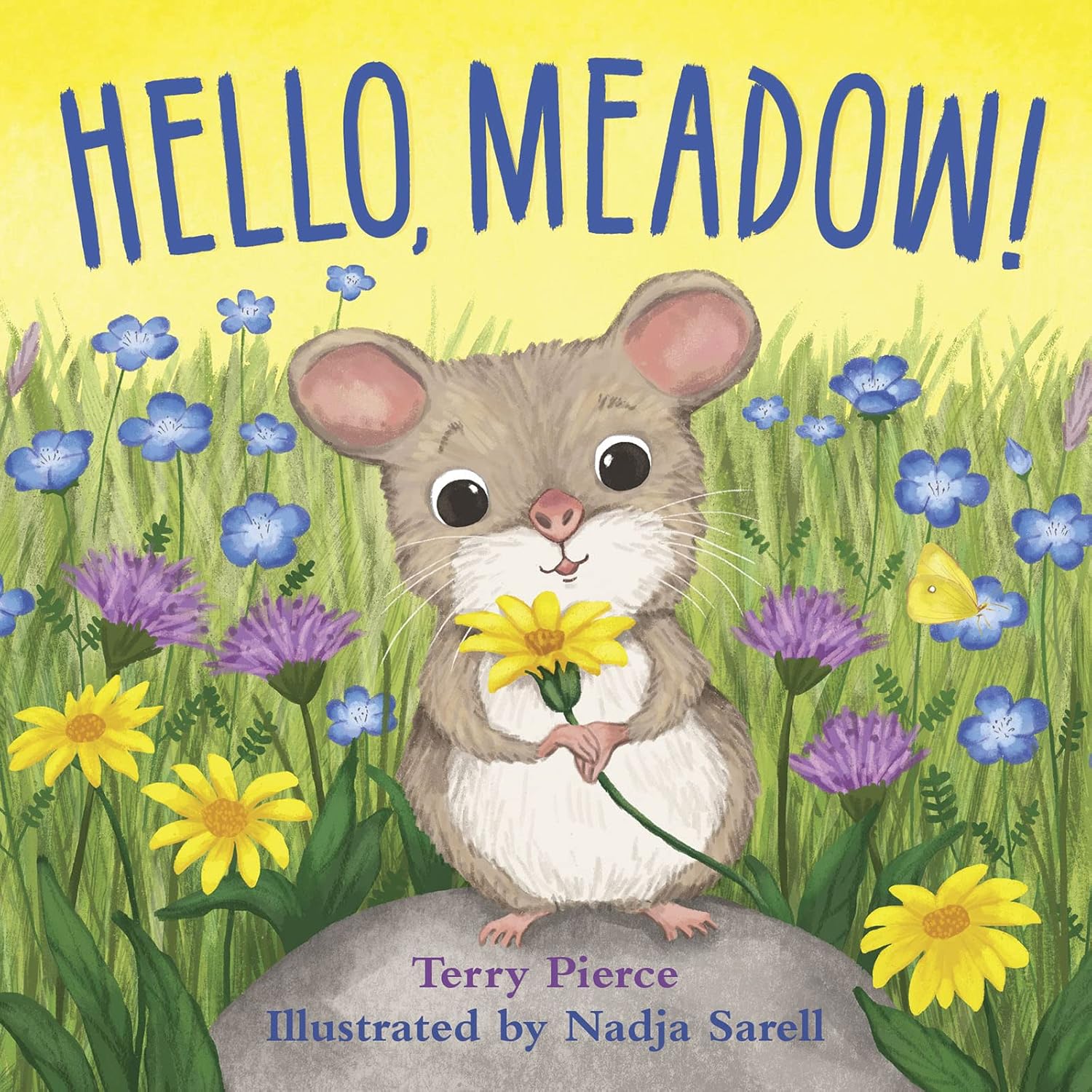
Hello, Meadow!
Grassy, flower-filled meadows are really pretty! It’s oh-so tempting to hike and skip right through them. But meadows are actually fragile, and human footsteps and picnics can cause them harm—then they cannot do their important work of providing a habitat for creatures and plants, filtering water, and even storing carbon. The lively text and beautiful illustrations in this sturdy board book show little nature lovers how to easily protect meadows while enjoying one of Earth’s loveliest features.
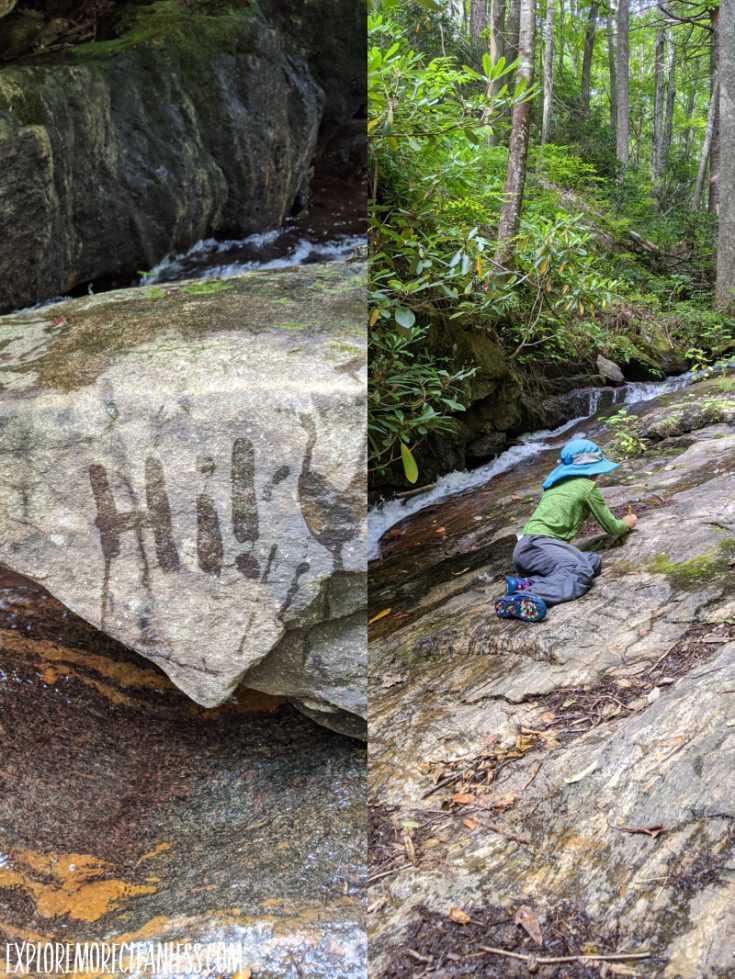
Earth Day Activity
Image courtesy of Explore More, Clean Less
Paint with Water
It’s fun to get creative with activities you can do outdoors that will leave no trace. Painting with water on boulders or river rocks or on areas of paved park trails or playground sidewalks with paint brushes or your fingers lets you explore your artistic side while being gentle with nature. You can find many more ways for kids to learn about and interact with the environment at Explore More, Clean Less!
You can purchase We Leave No Trace! from these booksellers
National Wildlife Week, dating back to 1938, is the National Wildlife Federation’s longest-running education program. The celebration was designed to connect budding conservationists of all ages to the awesome wonders of wildlife. Each year, we pick a theme and provide fun educational materials and activities for educators and caregivers to use with kids. This year’s theme is Keep an Eye on the Wild. Conservationists and animal lovers are keeping a lookout for wildlife in the most unexpected places as we learn how we can keep their habitats safe and live in harmony with our incredible wild neighbors. Whether you keep your eyes out for the wildlife living near you with a “critter cam” or by walking around and paying attention to your backyard, neighborhood, and wider area, being aware of the creatures around you can help them survive for generations to come. To learn more about National Wildlife Week and find fun activities aimed at connecting kids with wildlife, visit the National Wildlife Week Kids Page!
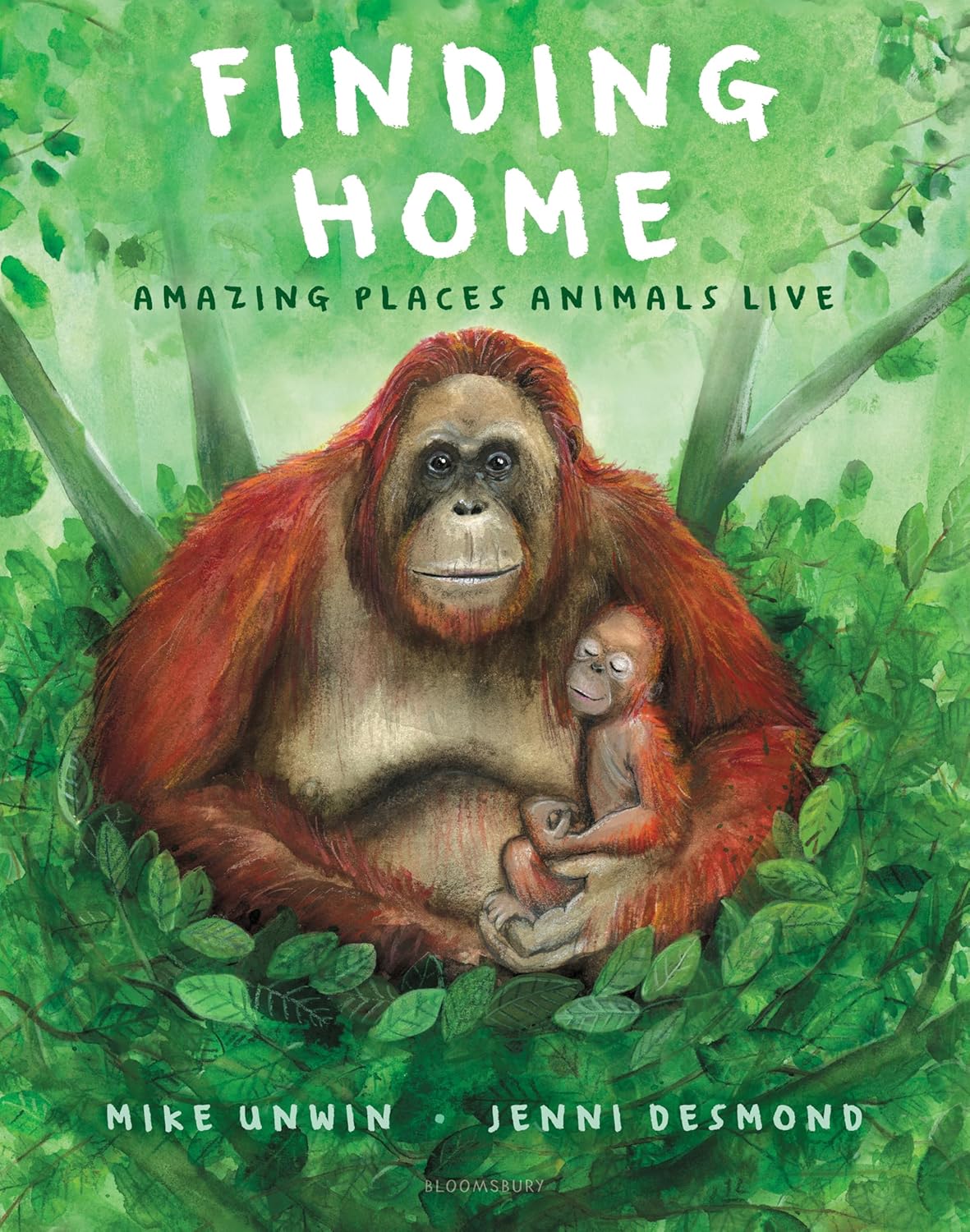
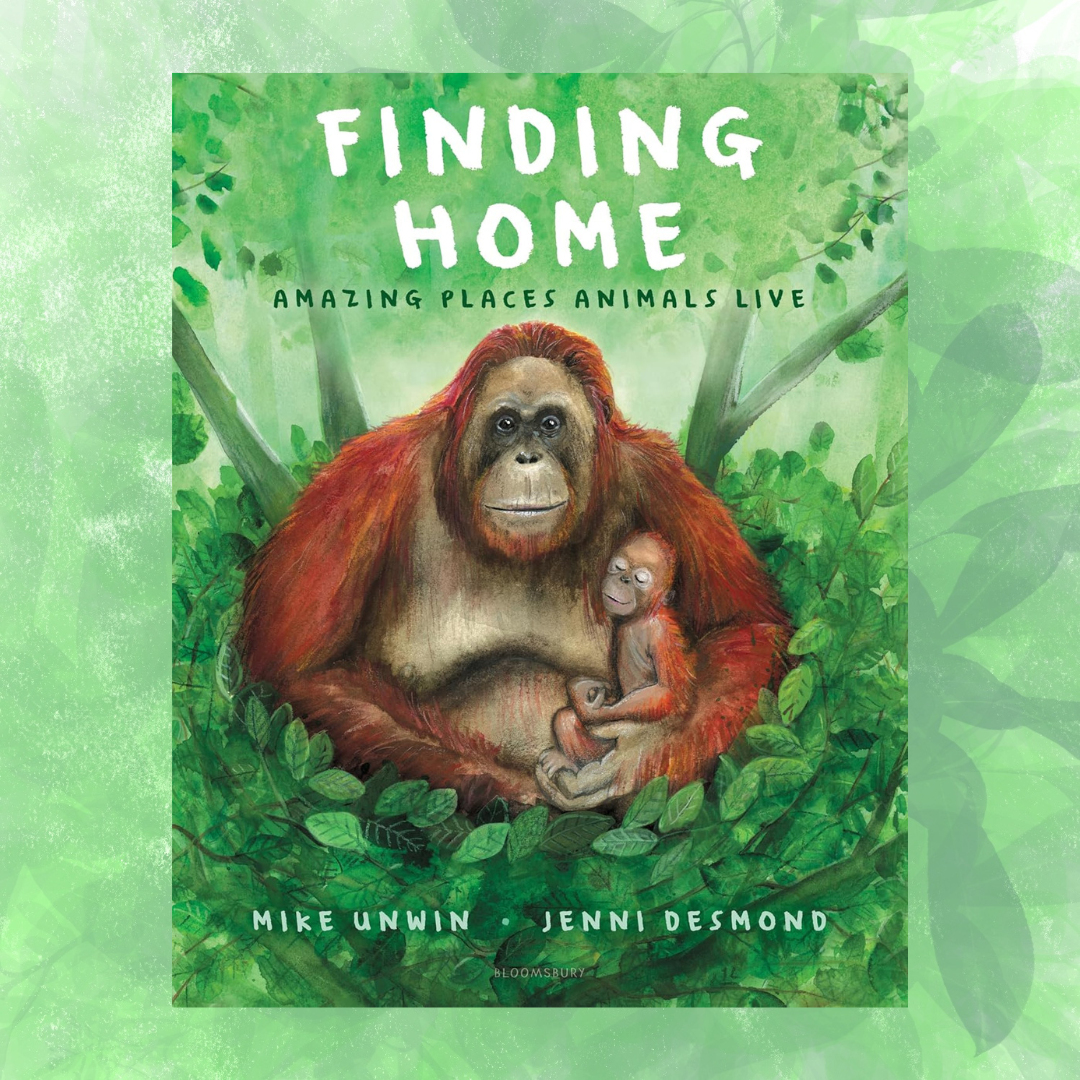
Finding Home: Amazing Places Animals Live
Written by Mike Unwin | Illustrated by Jenni Desmond
Finding Home begins: “Our planet is home to a mind-boggling number of different animals: at least 6,500 species of mammal, 10,000 species of reptile, 11,000 species of bird, and literally millions of insects. Every single one has its own home.” Just think of it! As your eye sweeps across any vista; as you walk across your yard, local playground, or favorite park, beach, or mountain trail, an untold number of creatures’ homes are within sight or underfoot. We know their names: Den. Nest. Burrow. Taxi (wait, what?). You’ll see, because in their astounding and gorgeous book, Mike Unwin and Jenni Desmond reveal that there is no such thing as a generic animal home.
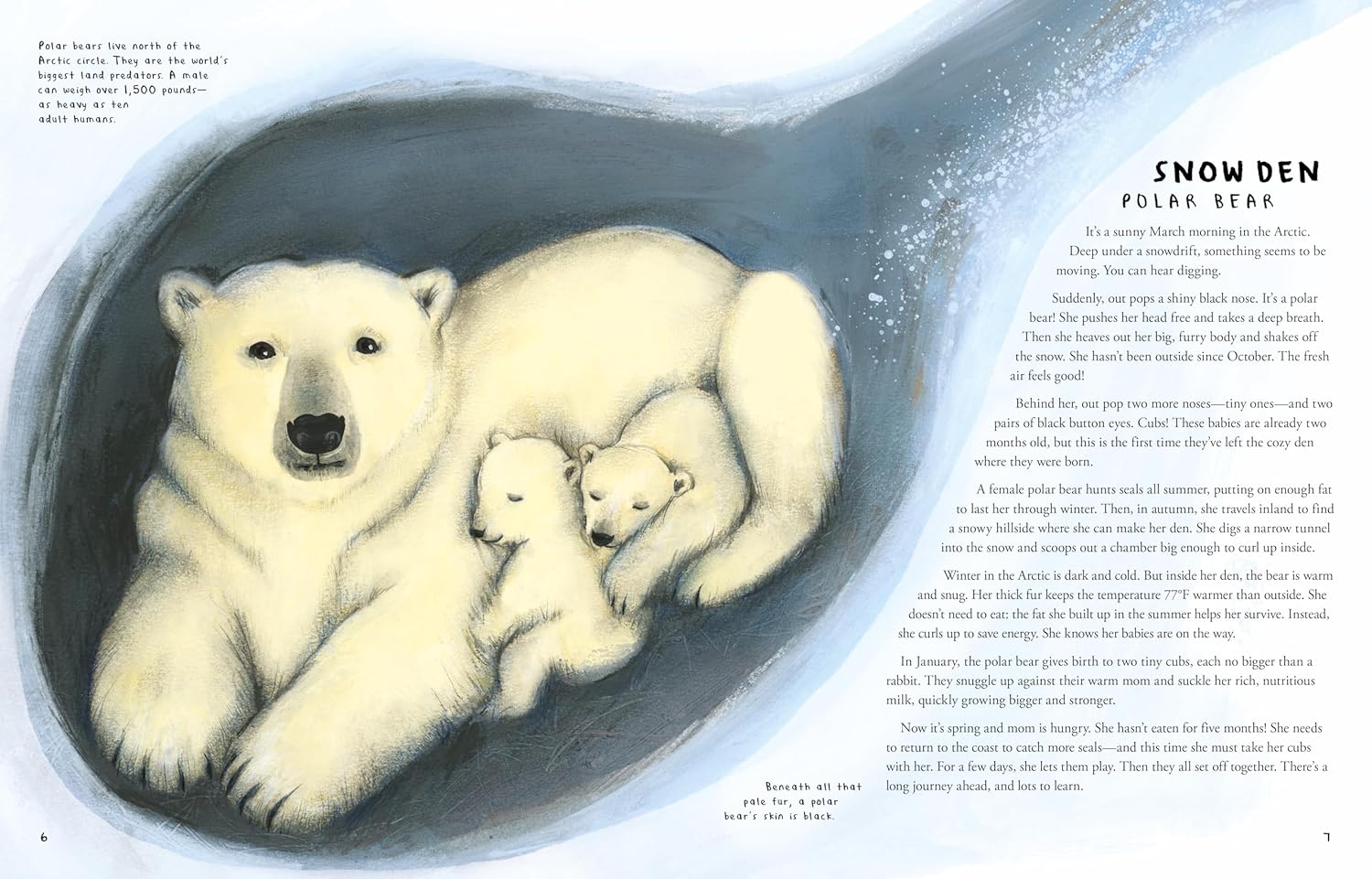
Take “den,” for instance—a polar bear’s snow den. Unwin and Desmond take you right inside this winter home, where a mother polar bear and her two cubs (born here in the cold of January) welcome you. As you squeeze inside, don’t worry about being cold. The polar bear’s “thick fur keeps the temperature 77°F warmer than outside.”
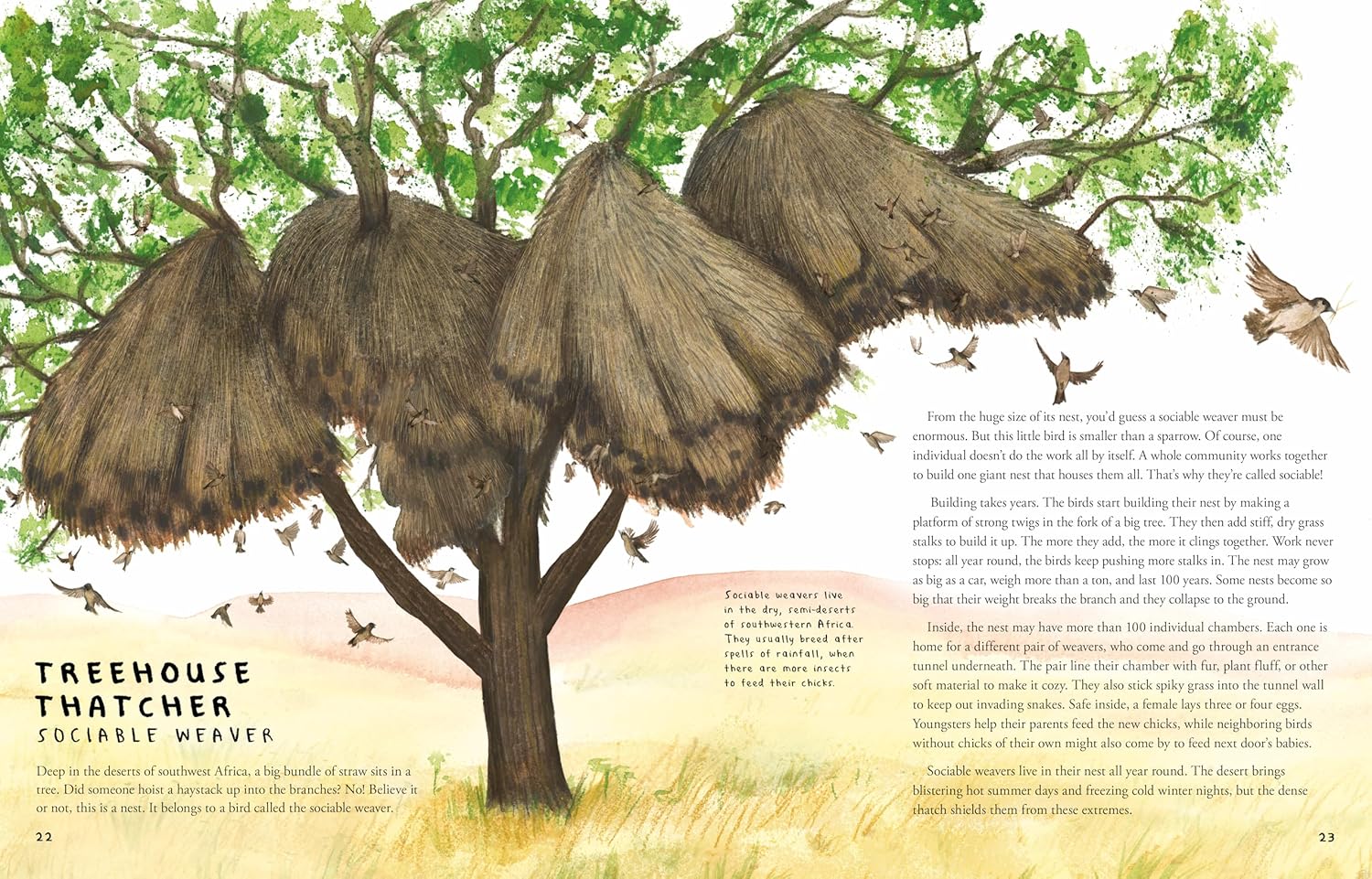
Next up is “nest.” These are bowls made from twigs, straw, and fluff and, sometimes, found objects like bits of paper or cloth, right? Well, yes—for some birds. But you won’t believe your eyes when you see what appears to be several haystacks lodged within a tree’s branches. This nest, constructed by a whole community of birds smaller than sparrows, can “grow as big as a car, weigh more than a ton, and last 100 years.” Like humans’ apartment buildings, the bird pairs that inhabit this nest look out for each other and help their neighbors. Kids will also be amazed by another type of bird that literally sews leaves together with “plant fiber and spider silk” to create their soft, deep nests.
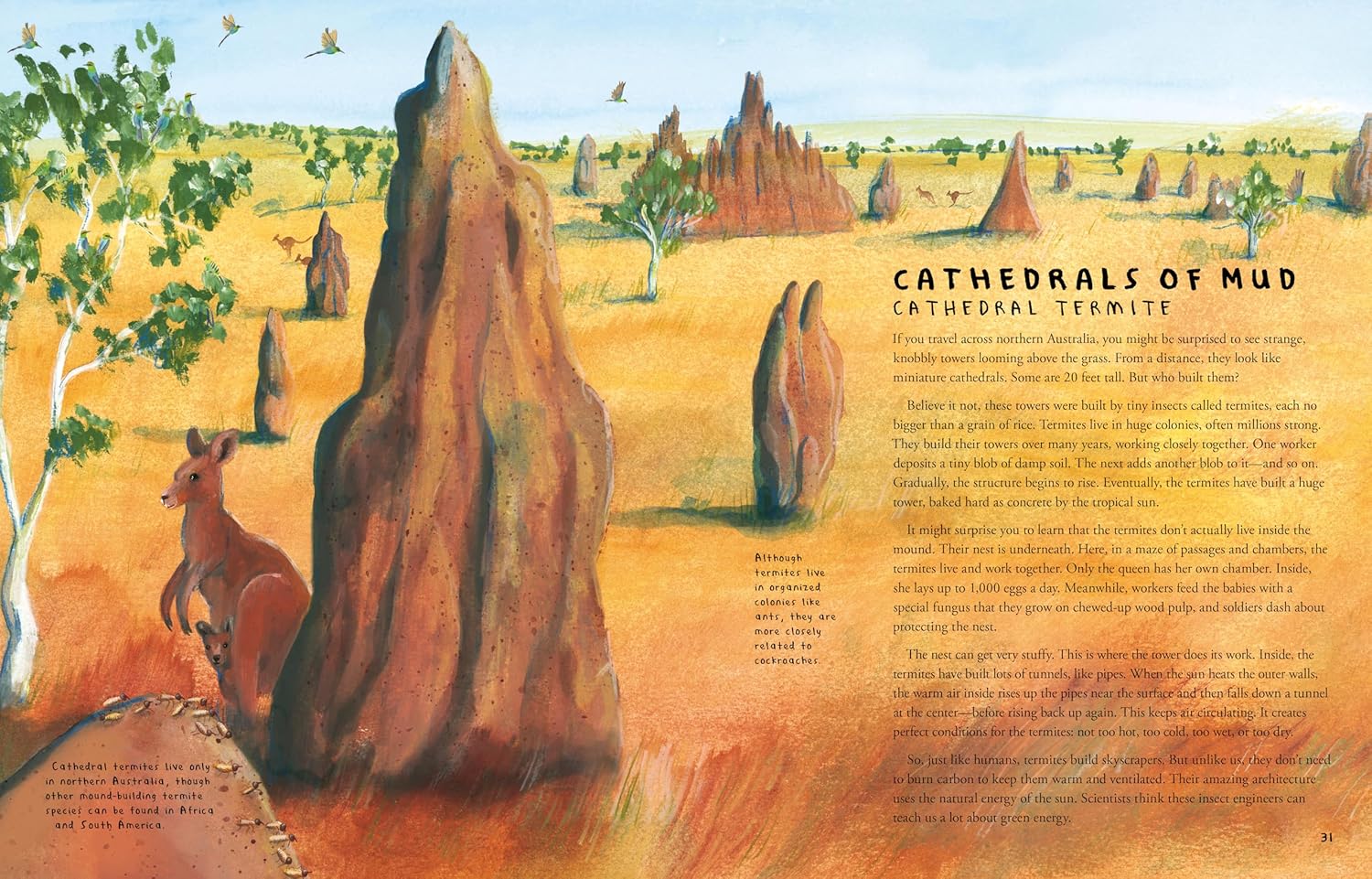
And how about “burrows?” Yep, Unwin and Desmond showcase a couple of pretty spectacular burrows too. Take the aardvark’s home. You won’t see an aardvark during the day. While the sun is up, they stay below ground, sleeping and tending to their young. It’s only after sunset that these unusual, ant-eating animals (including two-week-old babies) make an appearance topside. This is when they do what they do best: sniff out anthills and termite mounds, dig them up, and have dinner. It takes a hearty meal to satisfy an aardvark: “One aardvark can eat an amazing 50,000 ants and termites in a single night!”
Now, about that “taxi.” Children will be wowed by two, very different types of animals who prefer moving from one area to another by hitching a ride on another creature, from whom they can get food and other necessities of life while helping their hosts as well. Of course, the variety of animal homes don’t stop at these four. Every page transports readers to a different part of the globe to witness creatures of the air, sea, and land living in the home of their choice.
Unwin ends this fascinating travelogue with a map showing different ways some of the animals in the book tend to the environment, protecting it and keeping it growing for themselves and humans. He also includes a caution, reminding readers that “all these habitats . . . fit together like jigsaw pieces to make up planet Earth. And just like a jigsaw needs all its pieces, a healthy planet needs all its animals and their habitats.” Sadly, humans have not been good stewards of Earth’s bounty. “Today, scientists and conservationists are working hard to put things right.” But everyone is needed to make sure our environment is cared for the way we care for our own families. “Only then will planet Earth truly be home, sweet home.”
Mike Unwin draws readers in with engaging storytelling that allows kids to easily understand how each animal goes about building their home and why it’s perfect for their lifestyle. Children also learn just as much about the animals as the homes they build, giving them deep and well-rounded knowledge of some of the most unusual birds, fish, mammals, and insects on our planet and how many of them benefit humankind. Unwin’s phrasing, vocabulary and conversational lilt make Finding Home a highly satisfying nonfiction read aloud for younger kids. Independent readers will eagerly dip into the book again and again to meet these intriguing creatures.
With the impact of a museum exhibit, Jenni Desmond’s rich, full-bleed illustrations will take your breath away with their stunning realism and personality. Some animals peek out at the reader, while others busily go about their work oblivious to outside interest. From grassy hillsides to treetop canopies to sunny Africa and the snowy Himalayas, Desmond takes readers on an around the world tour like no other.
Gorgeous, educational, and nature nonfiction at its best, Finding Home: Amazing Places Animals Live is a must for all classroom, school, and public libraries as well as for nature- and animal-loving kids and families.
Ages 5 – 8+
Bloomsbury Children’s Books, 2025 | ISBN 978-1547615100
About the Author
Mike Unwin has written more than 30 books for both adults and children, including the Encyclopedia of Birds and Migration. He is also a regular contributor to publications such as BBC Wildlife and RSPB Nature’s Home. In 2013 Mike was voted UK Travel Writer of the Year by the British Guild of Travel Writers. Follow Mike on Instagram @mikeunwin.wildtravel.
About the Illustrator
Jenni Desmond is the illustrator of more than 20 books, including Migration, The Wolves of Yellowstone, and The Blue Whale. Her books have been translated into over a dozen languages. In 2016 she was made a Maurice Sendak Fellow and her book The Polar Bear became a New York Times Best Illustrated Children’s Book of the Year. When Jenni is not in her studio, you’ll find her cooking, cycling and looking for adventure. Visit her at jennidesmond.com and follow her on Instagram @jennidesmond.
National Wildlife Week Activity
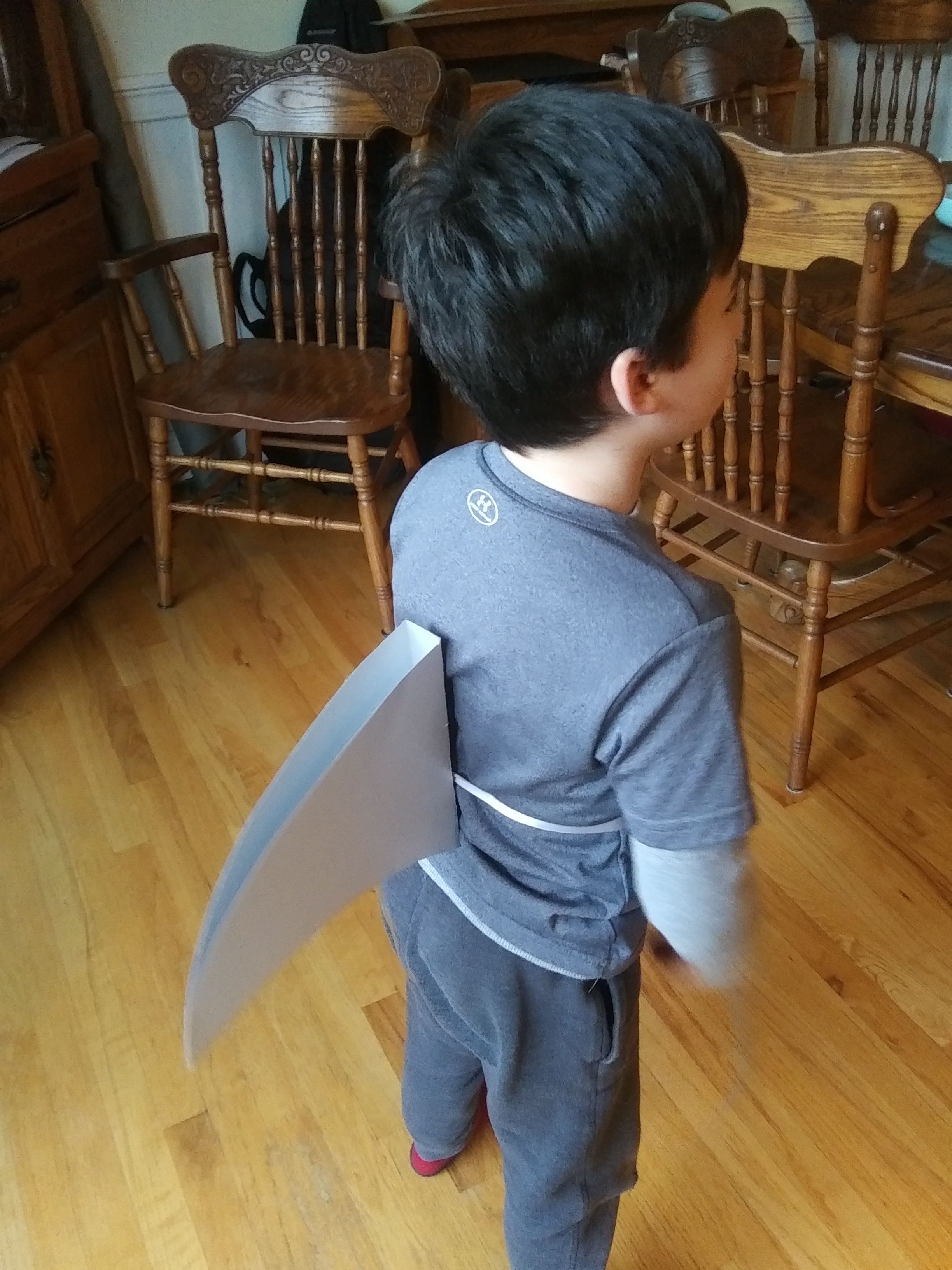
Fintastic Shark Fun
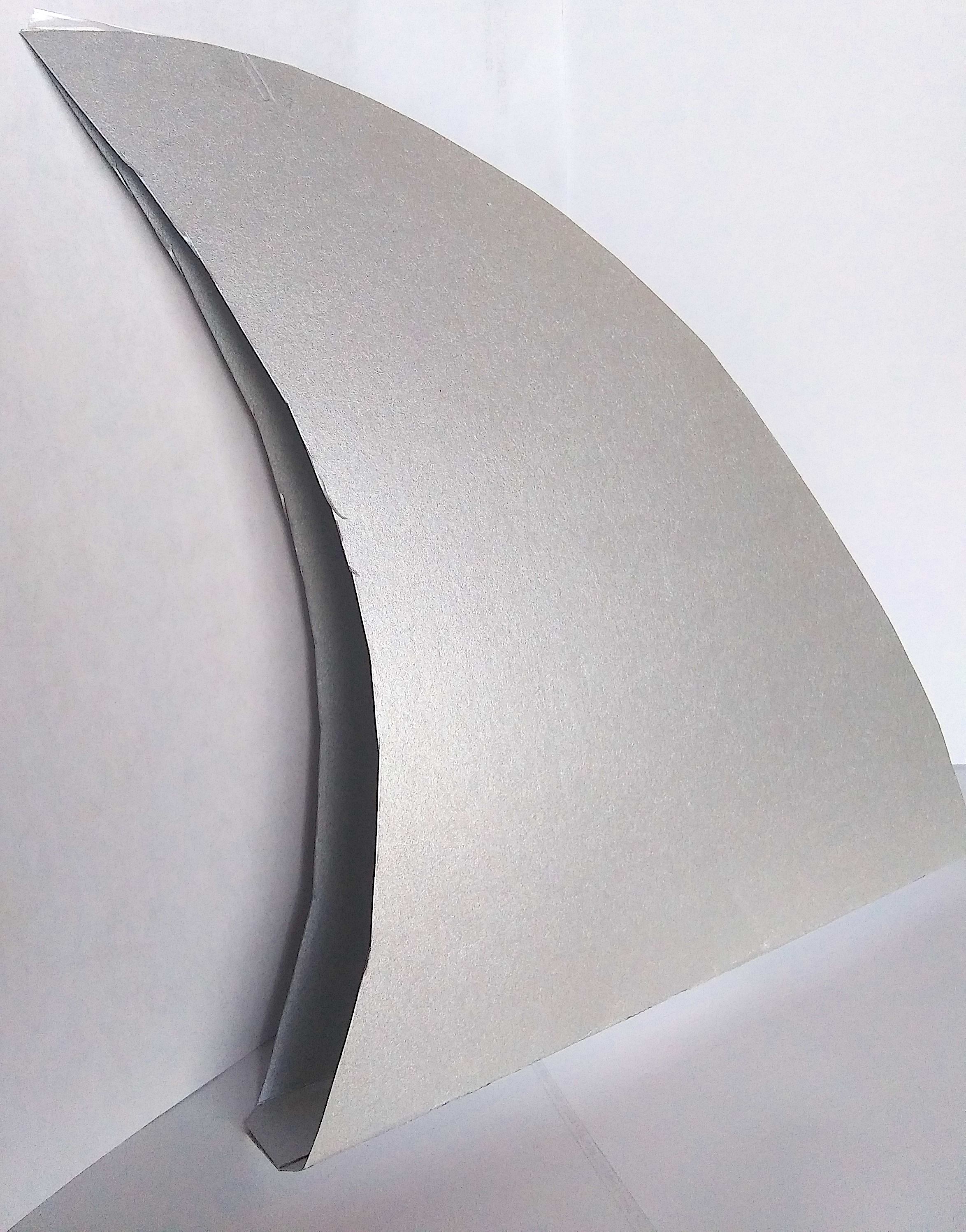
Sharks are awesome creatures and even feature as a home to another animal in today’s book! Follow the directions below and to make your own shark fin.
Supplies
2 pieces of 8.5 x 11 gray cardstock paper
Ribbon
Tape
Scissors
Pencil
Directions
Tape the top of the two pieces of paper together
Fold them back together
Measure an inch up from the bottom of the papers (the un-taped side) and trace a straight line across both papers
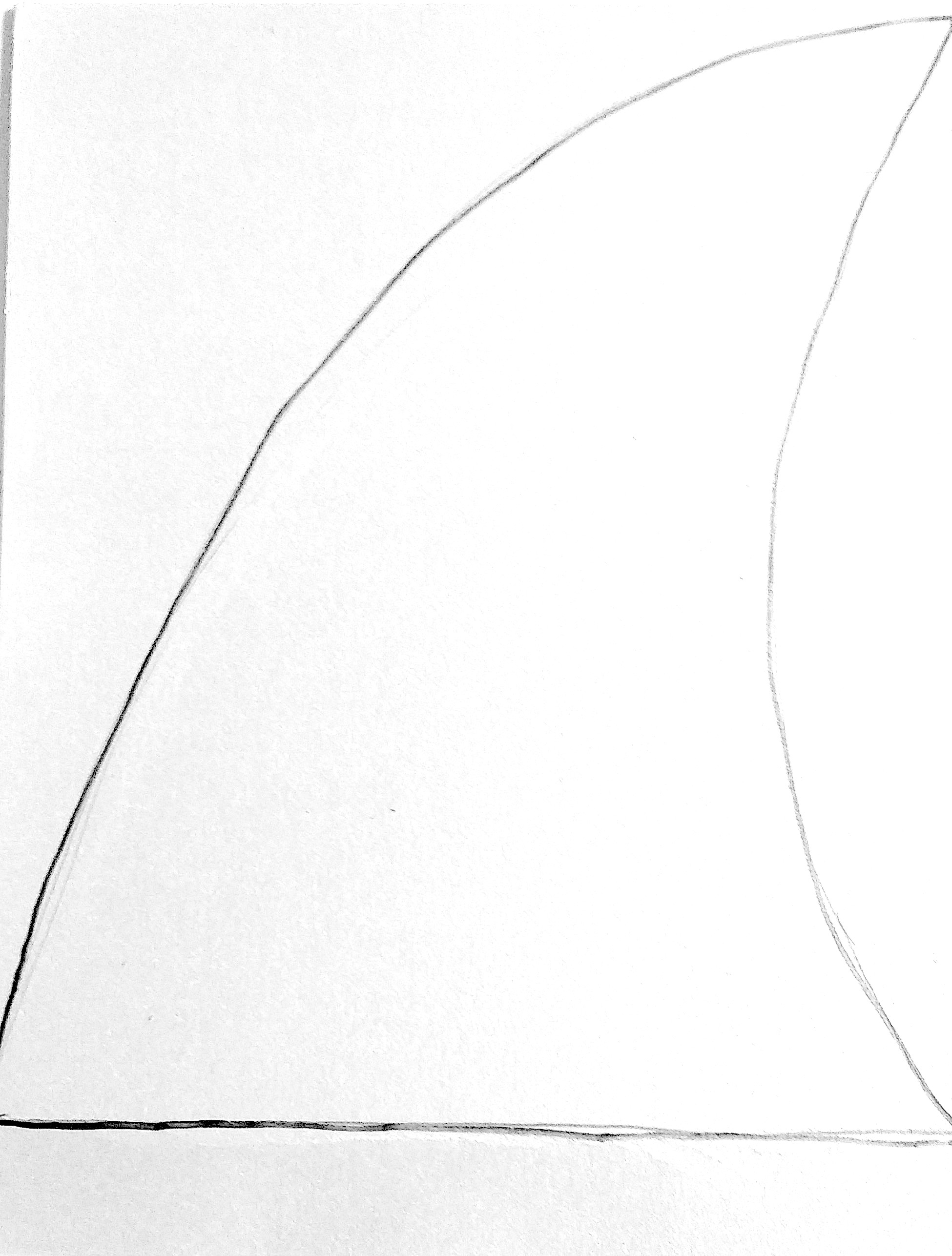
Trace a shark fin outline onto your paper. The shark outline should stop an inch above the bottom
Cut out the fin on both pieces of paper. If you should cut through the tape, re-tape the tops together
Fold along the lines of both papers so the folds face towards each other.
Tape the folds so the fin becomes a triangle
Cut two slits parallel to the folded lines
Thread ribbon through slits
You can purchase Finding Home: Amazing Places Animals Live from these booksellers
Expanding Girls’ Horizons in Science and Engineering Month was established in 2020 by the Expanding Your Horizons (EYH) Network. Founded in 1974 as a series of conferences aimed at promoting STEM careers to middle and high school girls, EYH provides hands-on activities, mentoring, and contact with role models as well as information about science and engineering fields.
Women still make up only 28% of the science and engineering workforce. With this month-long observance, the EYH Network hopes to make a significant impact on girls’ perceptions and career choices, encouraging them to explore and embrace STEM subjects.
Thank you to Heyday and Barbara Fisch at Blue Slip Media for sharing a copy of I Love Salmon and Lampreys: A Native Story of Resilience with me!
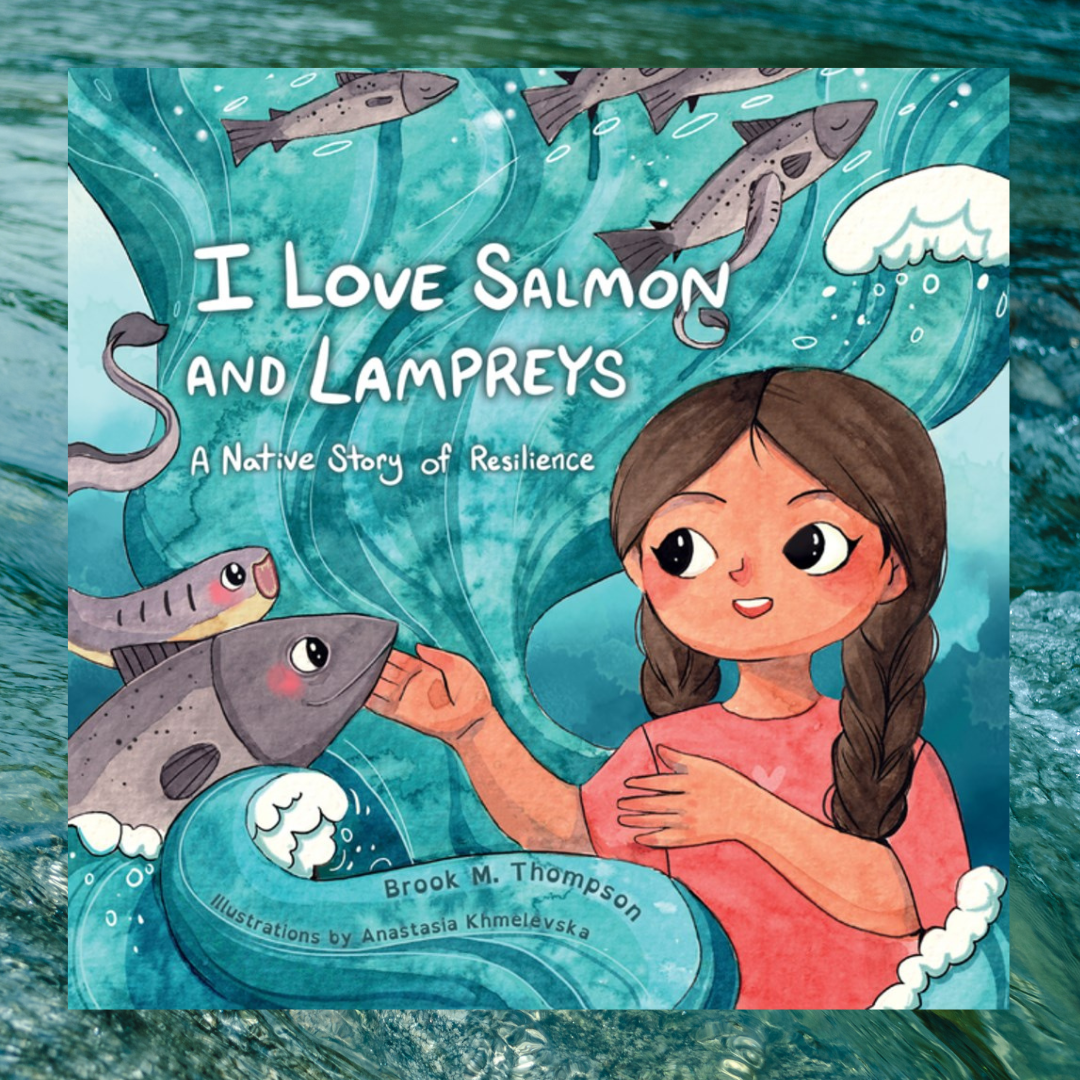
I Love Salmon and Lampreys: A Native Story of Resilience
Written by Brook M. Thompson | Illustrated by Anastasia Khmelevska
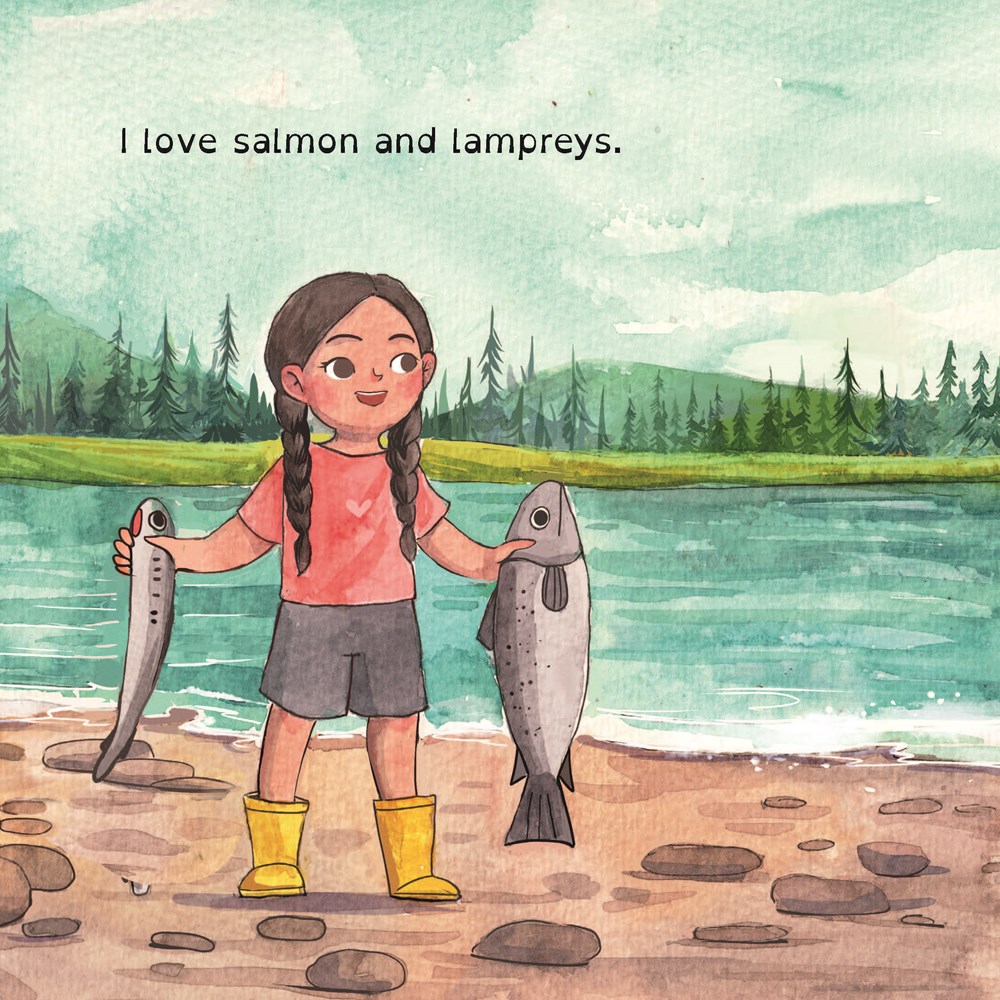
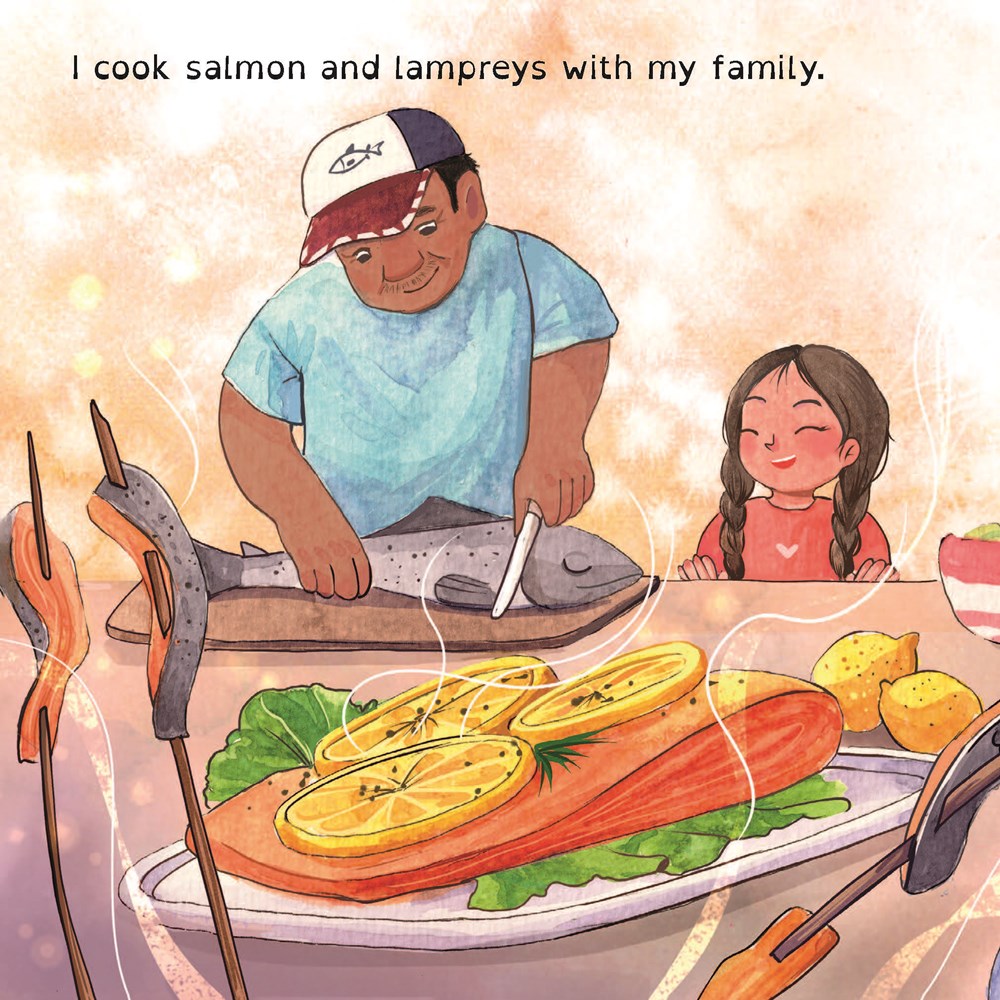
In her powerful autobiographical story, Brook Thompson, a member of the Yurok and Karuk Tribes, warmly invites readers to join her on her journey from childhood to the present day to experience her intense love for her tribes’ traditions and the fish that sustain them. Readers are first taken out on Brook’s family’s fishing boat, where her father and her grandfather tell stories of their own childhoods as they check the nets in their designated fishing spots along the Klamath River in Northern California. Then it’s back home to learn how Brook helps cook the fish (lampreys in the winter and salmon the rest of the year) in a wide variety of delicious ways.
Salmon and lampreys are more than just food to Brook, however. They are creatures of the earth to be admired and honored. She tells readers about their life and spawning cycles, how they predate the dinosaurs, and even about their fascinating symbiotic relationship. For Brook, this love she feels is shared. She says, “I feel loved by salmon because years ago my ancestors took care of the salmon for their future family” and reveals that the fish in the river now “are the great-great-great-great-great-great-grandkids of the salmon who had a relationship with my great-grandparents.”
In 2002, when Brook was still young, over 60,000 salmon perished from a parasite which spread when the water level of the river became too low and the temperature too hot due to the six dams erected on the river. She explains how dams “block the salmon’s way home” and how the warming water promotes the growth of toxic green algae, which affects the fishes’ breathing and spreads disease.
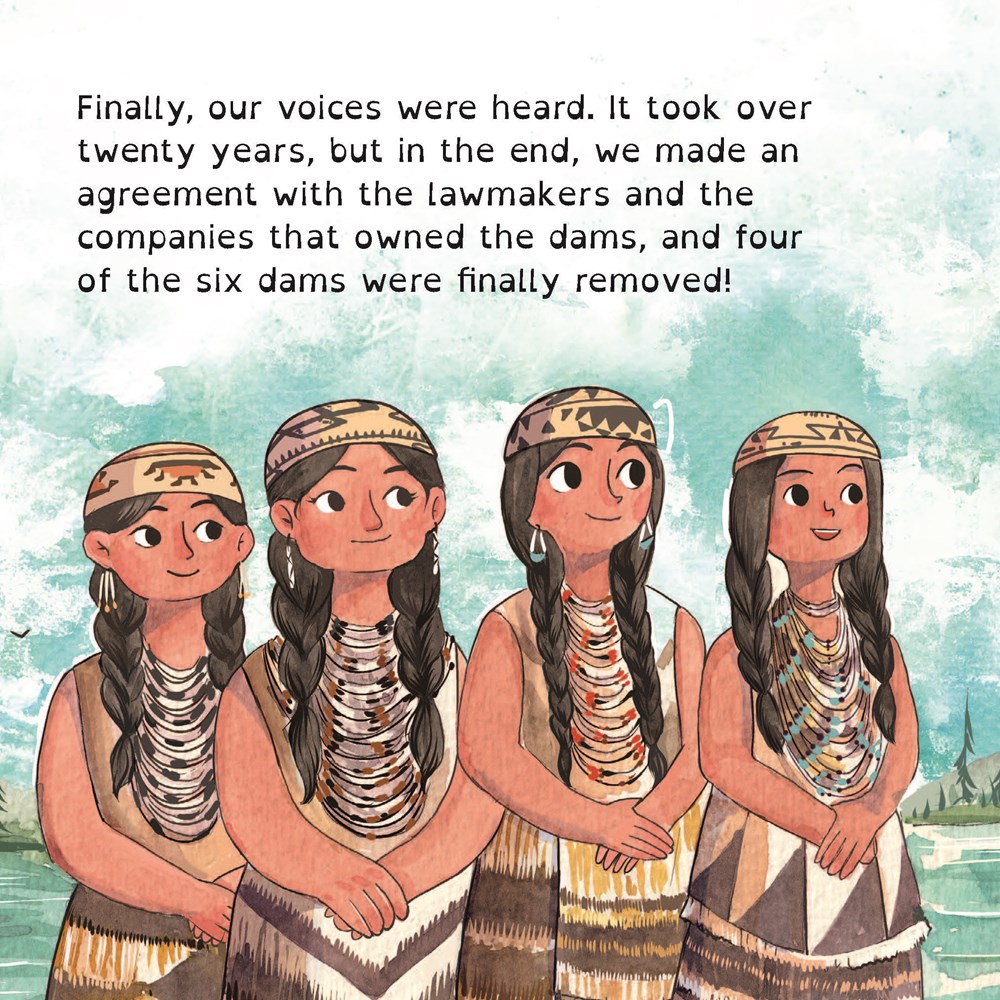
Brook joined protests by the tribal people and others, while scientists did research and local politicians lobbied for change. More than 20 years later agreements with the politicians and the companies that owned the dams were signed, and four of the six dams along the Klamath River were removed.
As she grew into adulthood and inspired by her experiences, Brook set her eyes on higher education. She “went to college to learn about dams and about how to protect salmon in the future.” She became an engineer and a scientist who studies the interconnectedness of “water, nature, people, animals, and buildings” and returned home to the Klamath River, where she continues the legacy of her ancestors in caring for the salmon, lampreys, and the environment.
Back matter includes Fun Facts about lampreys and salmon; photographs of Brook with salmon and at Iron Gate Dam, which was removed in 2024; a map of the Klamath River Watershed area; a note about the inspiration behind the book as well as the book’s font, OpenDyslexic, which makes it easier for those with dyslexia, like Brook, to read; and notes about the author and illustrator.
Brook Thompson, in her compelling autobiographical story, will captivate children and touch their hearts. Thompson’s eloquent and straightforward storytelling immediately immerses readers in the Native relationship with nature and will inspire both young and adult readers to think deeply about how the earth sustains us and how we can show our appreciation in return. The theme of environmental justice and how citizens can and do make a difference is made personal through Thompson’s clear explanations of how the dams affected the salmon population and the long-term steps people took to reverse their damage. Thompson’s dedication—even from childhood—to her tribes, family, and future generations will impress readers. Children will also develop an understanding of how issues of interest to them now can inform their future endeavors.
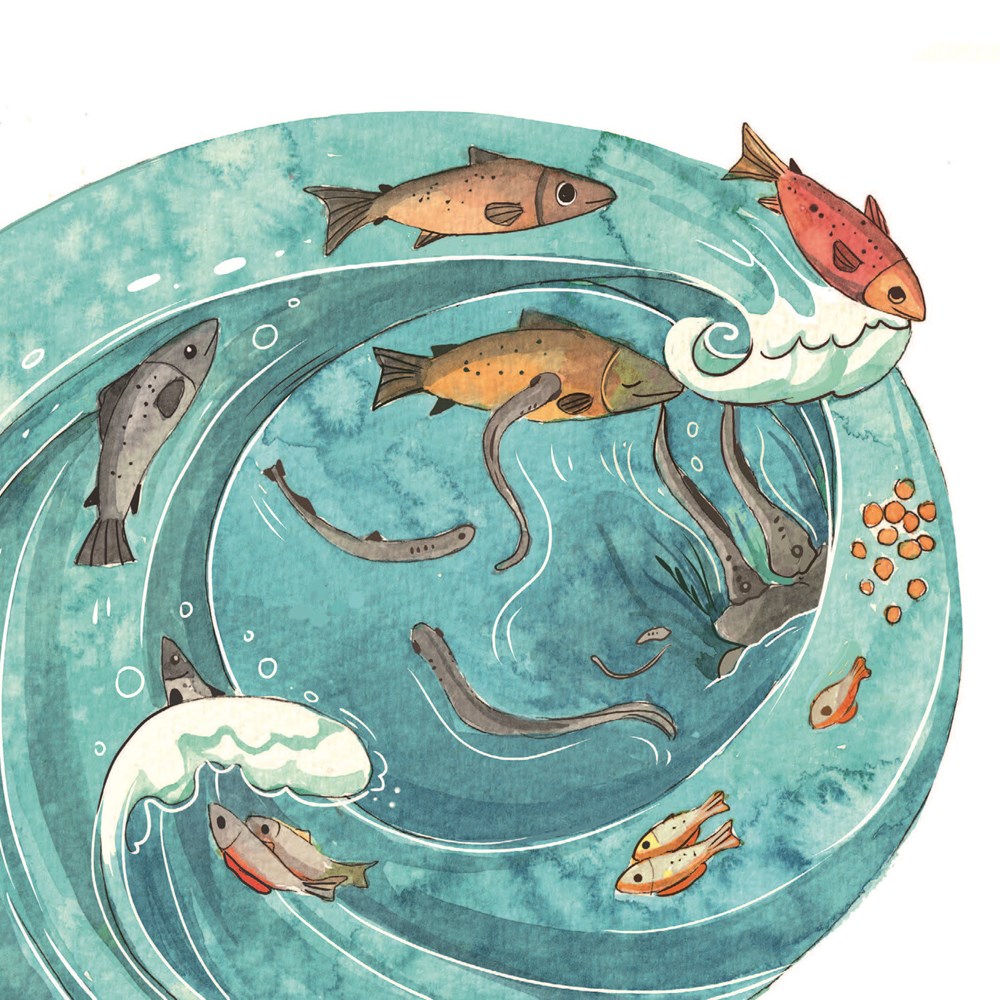
Anastasia Khmelevska’s vibrant earth tone illustrations endear Brook to children through her evident passion for family, fishing, and the salmon and lampreys that have been a constant in her tribes’ lives. Her pacing and realistic depictions of people and events help children clearly understand the importance of each element of Thompson’s story from how the cyclical lives of salmon and lampreys are demonstrated in a swirling wave to the stunning landscapes highlight of the Pacific Northwest. These images make her depiction of the salmon die-off all the more impactful. Her final portrait of Brook Thompson coming home after earning her university degrees links her life to the salmon she loves so well.
The combination of Native culture and environmental awareness makes I Love Salmon and Lampreys: A Native Story of Resilience a must addition to school and public libraries. The book offers extensive value and research opportunities for science and social studies classes. For families who care about the environment, sustainability, activism, and the future of our planet, I Love Salmon and Lampreys would be a much-loved choice.
Ages 4 – 8
Heyday, 2025 | ISBN 978-1597146685
About the Author
Brook M. Thompson is a part of the Yurok and Karuk Tribes. She is a neurodivergent and Two-Spirit author with dyslexia. She has a BS in civil engineering from Portland State University and an MS in environmental engineering from Stanford University, and she will soon have a PhD in environmental studies from University of California, Santa Cruz, where she studies water, politics, restoration, and salmon. You can find out more about her at brookmthompson.com.
About the Illustrator
Anastasia Khmelevska is an illustrator based in Lviv, Ukraine. She has illustrated several children’s books, including My Invisible Zoo, Marella the Mermaid, and Anything Helps. Follow her on Instagram @cute_miuu.
Expanding Girls’ Horizons in Science and Engineering Month Activities
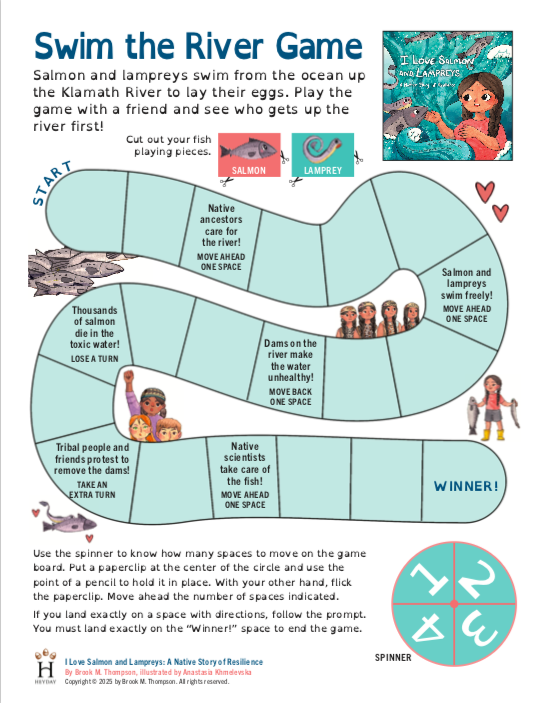
Play a printable board game, write about your dreams for the future, and learn fun facts about salmon and lampreys with these three I Love Salmon and Lampreys Activity Pages!
Chinook and Coho Salmon Coloring Pages
Coho and Chinook Salmon are vital to the Pacific Northwest. You can learn more about California salmon at caltrout.org. Enjoy these coloring pages of coho and chinook salmon. Colored images are included for your reference.
Established in the early 2000s by the Children’s Book Council, this month-long holiday encourages people to read books about gardening, nature, and ecology to foster a deeper connection with the environment and appreciation for our planet, encouraging more people to adopt sustainable practices in their daily lives.
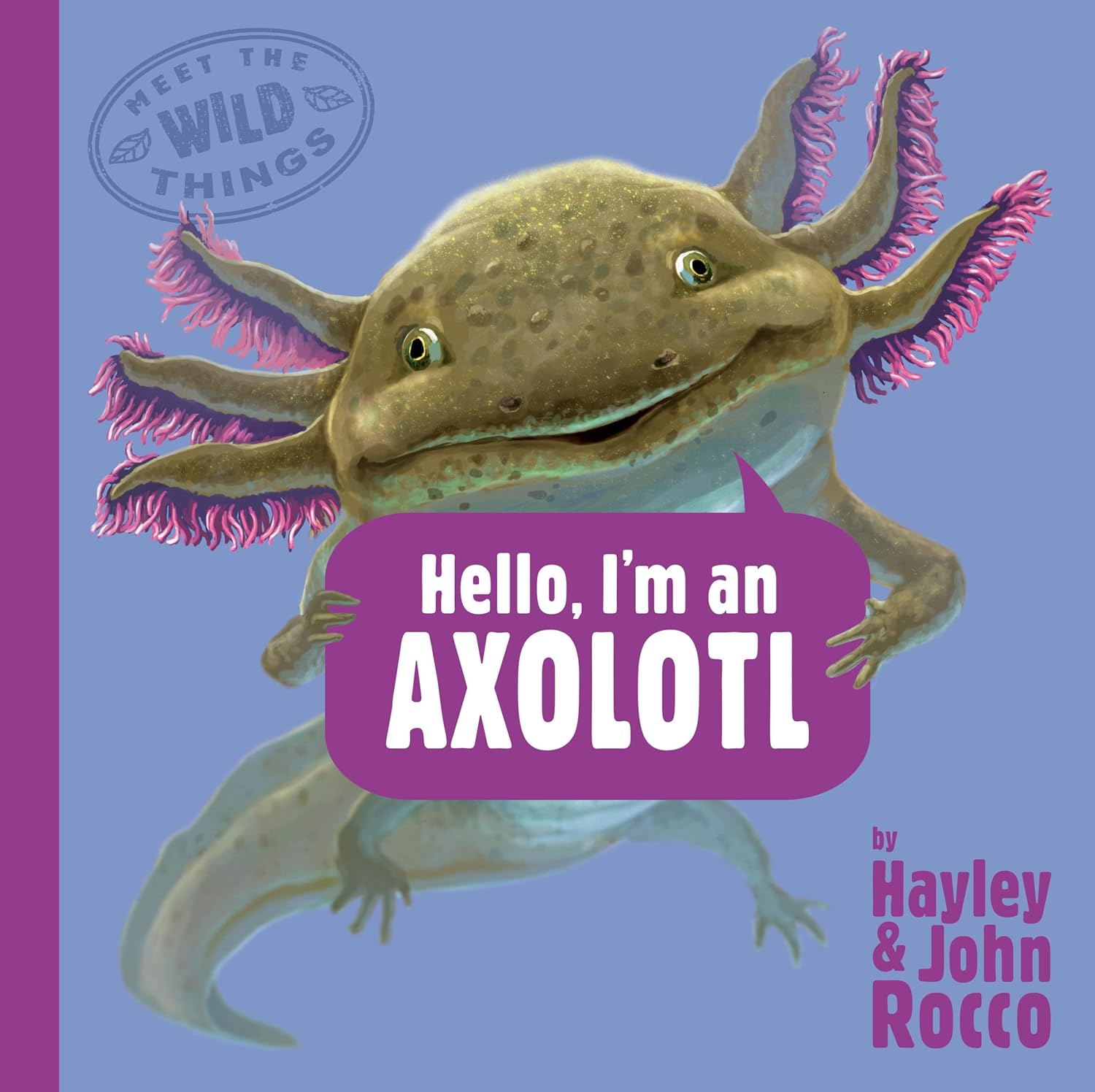
I’d like to thank G.P. Putnam’s Sons Books for Young Readers for sharing a digital copy of Hello, I’m an Axolotl with me for review.
Hello, I’m an Axolotl
Written by Haley Rocco | Illustrated by John Rocco
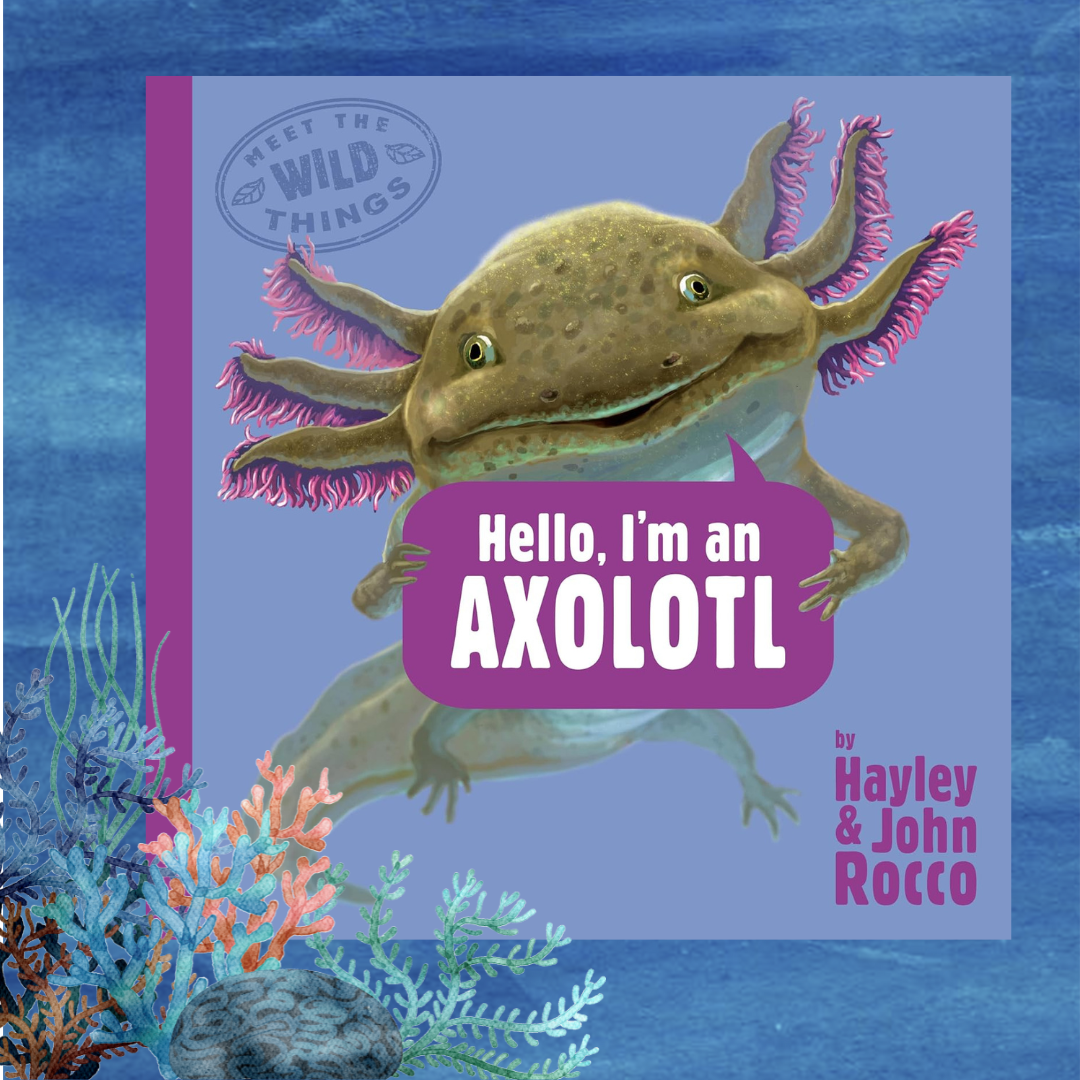
Swimming into the popular Meet the Wild Things series that introduces kids to unusual and endangered animals is Hello, I’m an Axolotl and its spirited narrator who wastes no time in telling readers “I am A-M-A-Z-I-N-G!” And it’s not kidding!
First off, it’s named after a super hero-sounding Aztec god and then we learn that even though axolotl’s are related to salamanders, they’re a bit like an underwater Peter Pan because they “never really grow up,” which actually gives axolotls another superpower: the ability to breathe in two ways.
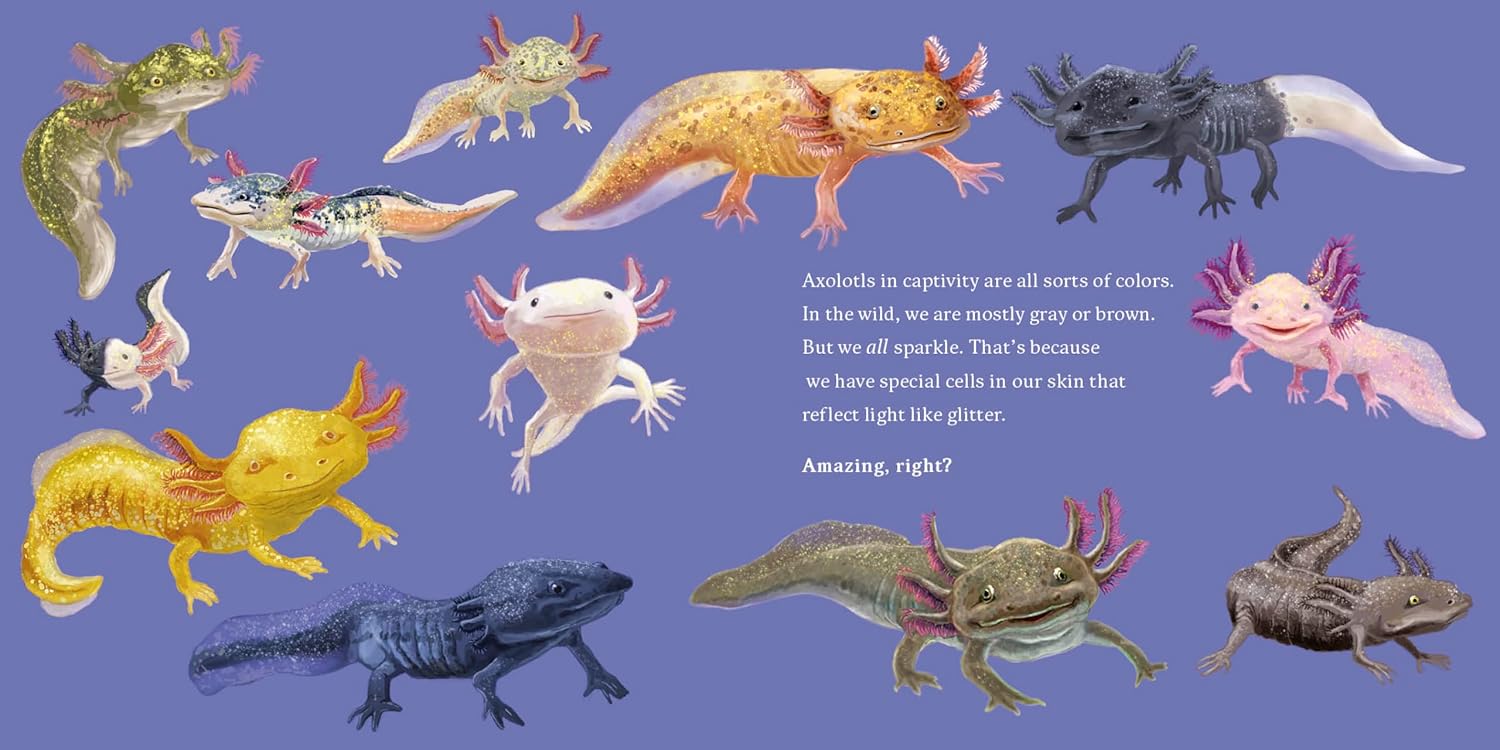
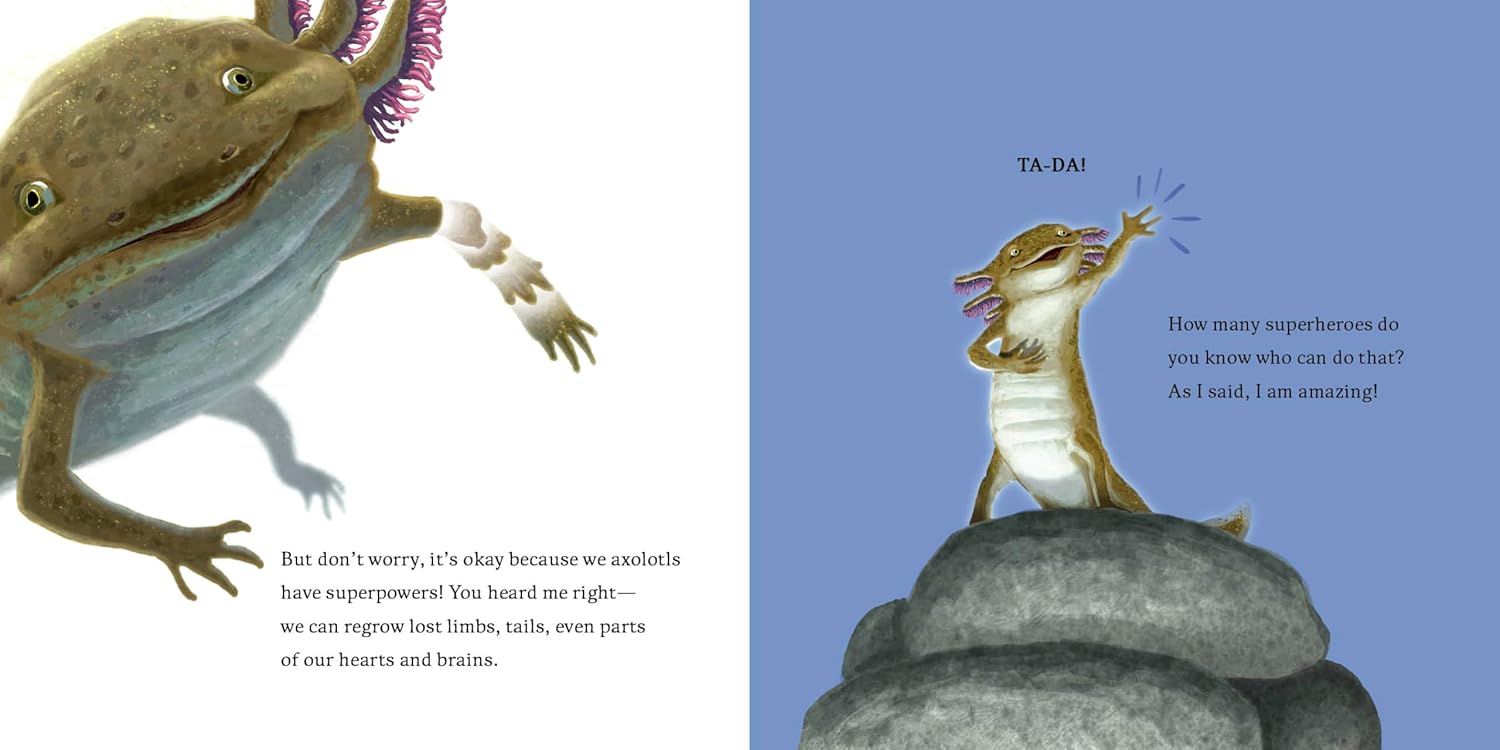
And if that doesn’t convince you that these little cuties are special, the fact that their skin sparkles like glitter certainly will! The book’s host then reveals how that’s possible. Pretty neat, huh? Still not convinced that the axolotl is one of the most fascinating animals on the planet? How about if you knew they can regrow “lost limbs, tails, even parts of [their] hearts and brains?!” This comes in handy, especially if one of their 1,000 siblings has mistaken them for a snack. Scientists are even studying how they do it with hopes of applying what they learn to humans one day.
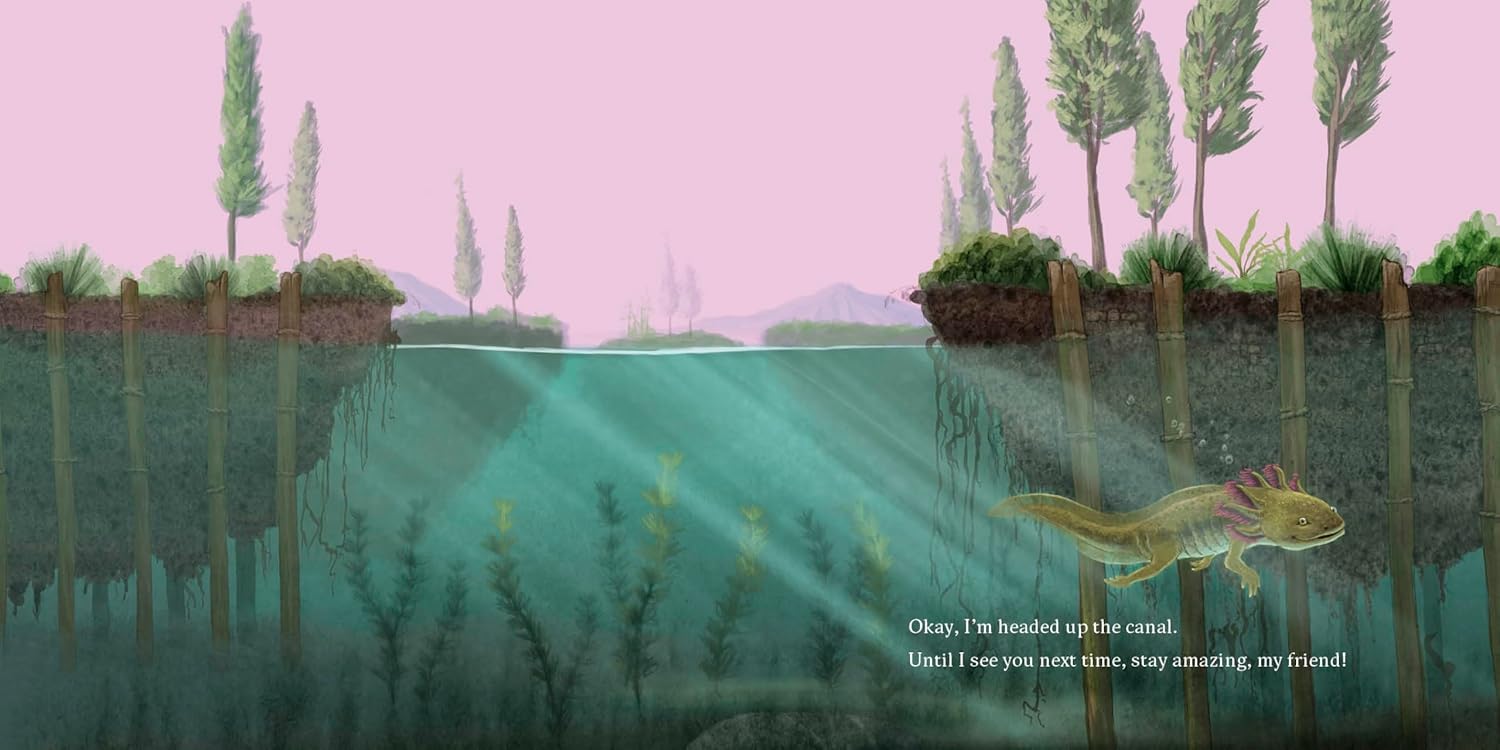
But everything isn’t rosy for axolotls. While “there about a million axolotls all over the world living in tanks and aquariums,” there are fewer than 500 living in the wild—and these are only found in one “lake and some canals outside Mexico City.” You’ll be able to see why when you compare an illustration of Lake Xochimilco from the 1500s to one from current times.
There is hope, however, as conservationists are reintroducing “an ancient Aztec farming method” that provides conditions axolotls need to survive. World-wide notoriety that shines a light on the plight of these A-M-A-Z-I-N-G creatures helps too.
Back matter expands on the facts presented in the text, including short paragraphs on the Aztec people, the origins of all axolotls in captivity today, the science behind their sparkly skin, why axolotls are endangered, and much more.
Haley Rocco’s superpower is introducing incredible animals in a witty, personal voice that immediately endears them to kids. In Hello, I’m an Axalotl, her charming first-person narration rivets readers to the fascinating facts about axolotls, providing plenty of eye-opening and “awww”-inspiring moments as well as heartfelt concern about the future of these one-of-a-kind creatures and how they can help.
John Rocco’s stunning mixed media illustrations put kids eye-to-eye with the feisty and adorable axolotl narrator as it takes kids on a tour of its home, a lab where scientists are studying the regenerative abilities of axolotls, and to ancient and modern Lake Xochimilco. Readers of all ages will be intrigued by the image of the Aztec farming method making a comeback to protect axolotls. There’s even an “actual size” depiction of an axolotl that will captivate kids.
Unforgettable learning at its best, Hello,I’m an Axolotl is a must addition for school and public library collections and would make a perfect choice for families with children who love animals and care about the environment.
Ages 3 – 7
G.P. Putnam’s Sons Books for Young Readers, 2025 | ISBN 978-0593618219
Discover all the books in the “Meet the Wild Things” series!
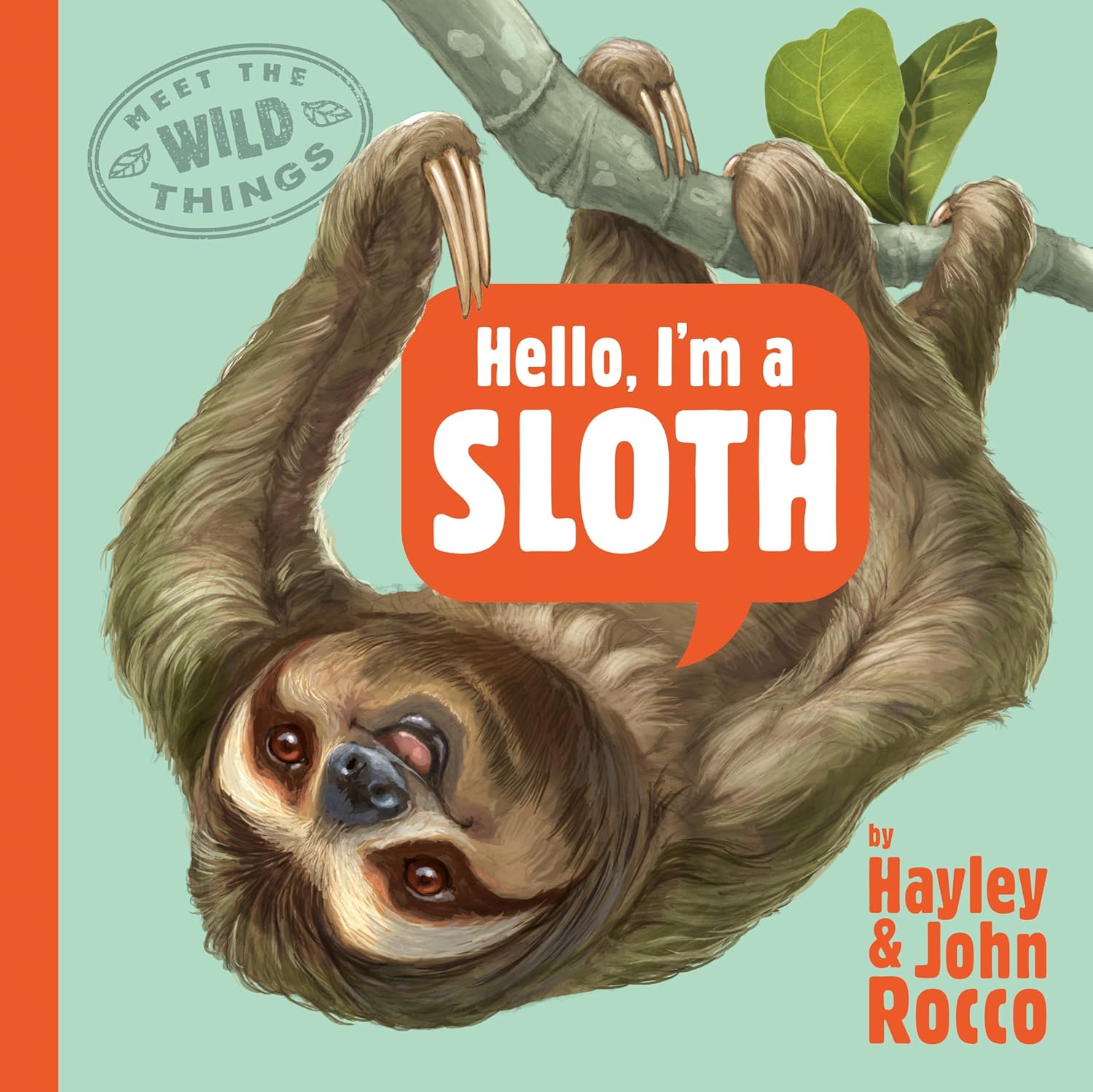
Hello, I’m a Sloth
Say hello to a sloth! Did you know sloths only poop once a week and can fall up to 100 feet without getting hurt? They also have hundreds of bugs living on them, including a species of moth that only lives on sloths! And they move so slowly that algae grows on their fur, which can actually help sloths camouflage!
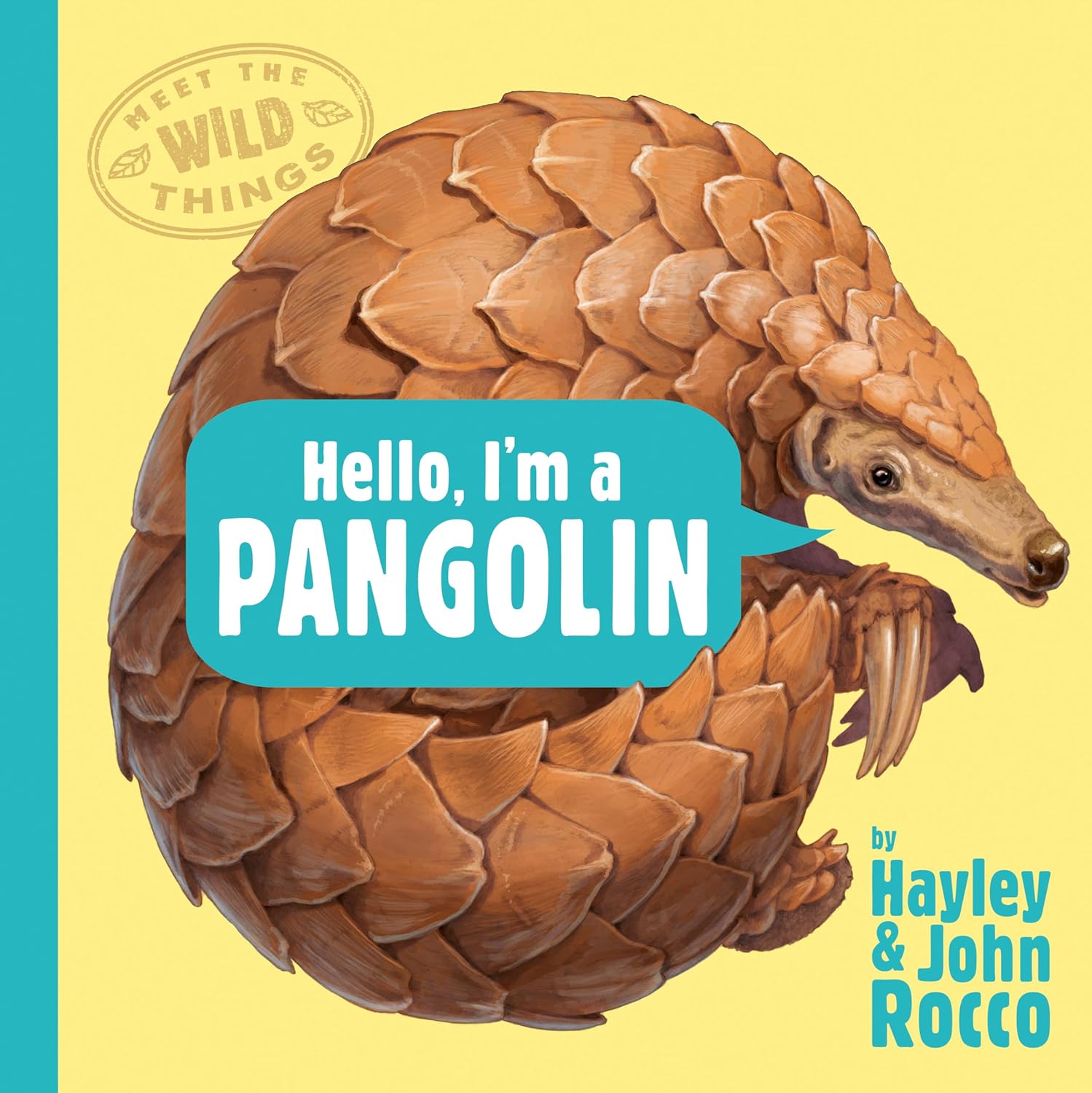
Hello, I’m a Pangolin
Say hello to a pangolin! Did you know pangolins are the only mammals with scales? And did you know pangolins have a super-sticky tongue as long as their entire body (the better to eat 20,000 bugs a day with!)?
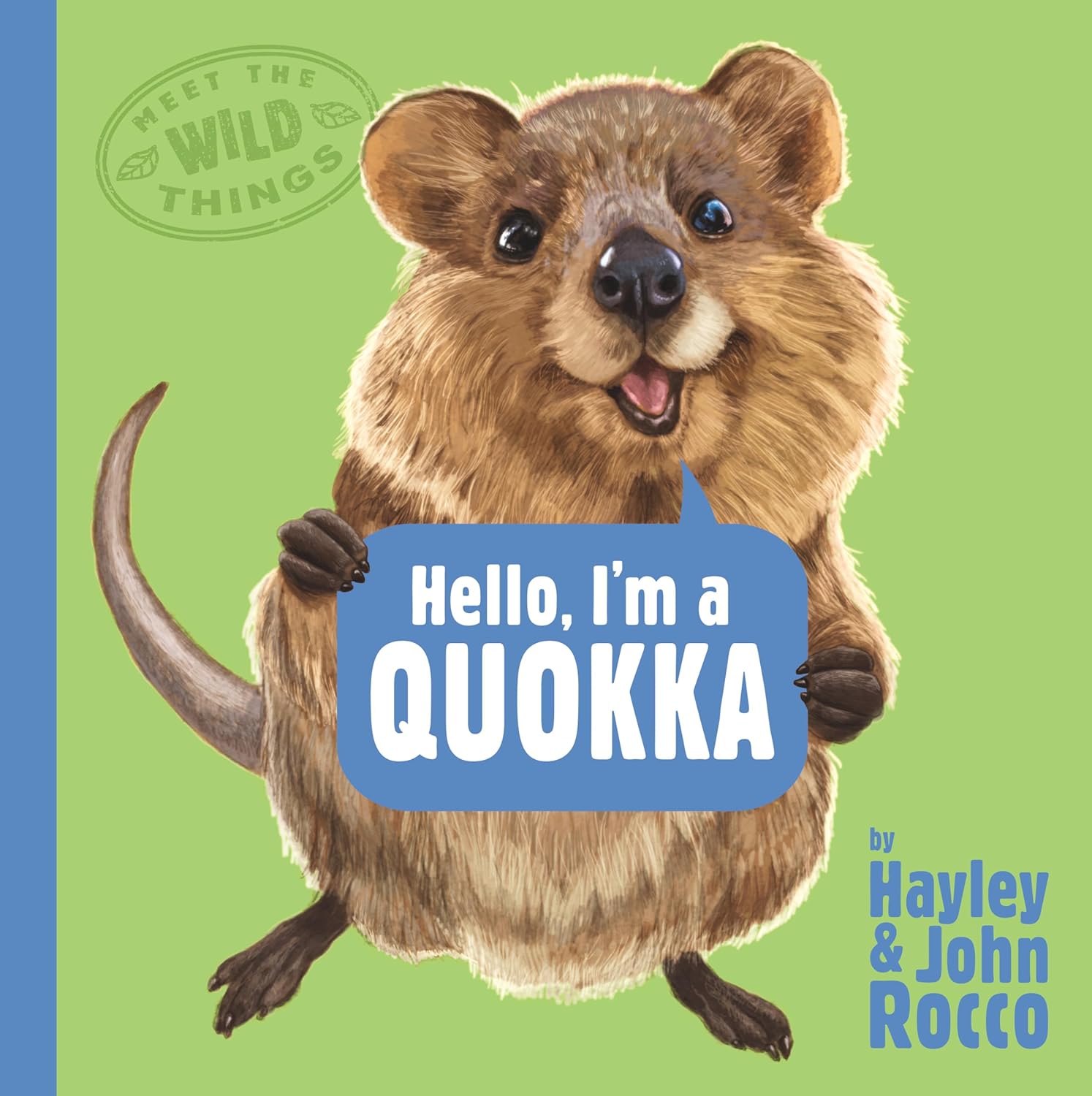
Hello, I’m a Quokka
Say hello to a quokka. Most of them live on a tiny island off of Western Australia. Like their relatives kangaroos and wallabies, they hop to get around and carry their babies in pouches. People say they are the happiest animal in the world. That’s because they’re very friendly, and their faces look like they are built for smiling—perfect for taking selfies with!
Hello, I’m a Toucan — Coming June 24!
Did you know a toucan’s bill is four times the size of its head? But you might be surprised by how lightweight and strong it is. And did you know that toucans use their bills to keep cool when it’s hot outside, by increasing blood flow from the rest of their body to maintain the perfect temperature? You can’t get much cooler than that.
About the Author
Hayley Rocco is the author of Wild Places: The Life of Naturalist David Attenborough, How to Send a Hug, and the Meet the Wild Things series, all in collaboration with her husband, John Rocco. Before dedicating herself to writing for children full-time, Hayley worked as a publicist at several major publishers. Visit Hayley at hayleyrocco.com and follow her on Instagram @hayleyroccobooks.
About the Illustrator
John Rocco is the #1 New York Times bestselling author and illustrator of many acclaimed books for children, including Blackout, the recipient of a Caldecott Honor, and How We Got to the Moon, which received a Sibert Honor and was longlisted for the National Book Award. John and Hayley live in Rhode Island in an old house tucked in the woods near the sea. Visit John at roccoart.com and follow him on Instagram @roccoart.
National Women’s History Month is all about celebrating women who broke barriers with their intelligence, creativity, courage, persistence, and unwavering confidence in their abilities. In every discipline, women have brought and continue to bring new perspectives, experiences, and talents to make contributions toward a better world. The theme for Women’s History Month 2024 celebrates “’Women Who Advocate for Equity, Diversity and Inclusion.’ This theme recognizes women who understand the need to eliminate bias and discrimination from individuals’ lives and institutions.”
Today’s book celebrates a visionary woman who made it her life’s work to protect a unique ecosystem, educate people on the importance of the environment and conservation, and provide the US with one of its most stunning national parks.
I’d like to thank Calkins Creek/Astra Books for sharing a copy of Cactus Queen” Minerva Hoyt Establishes Joshua Tree National Park with me for review consideration. All opinions on the book are mt own.
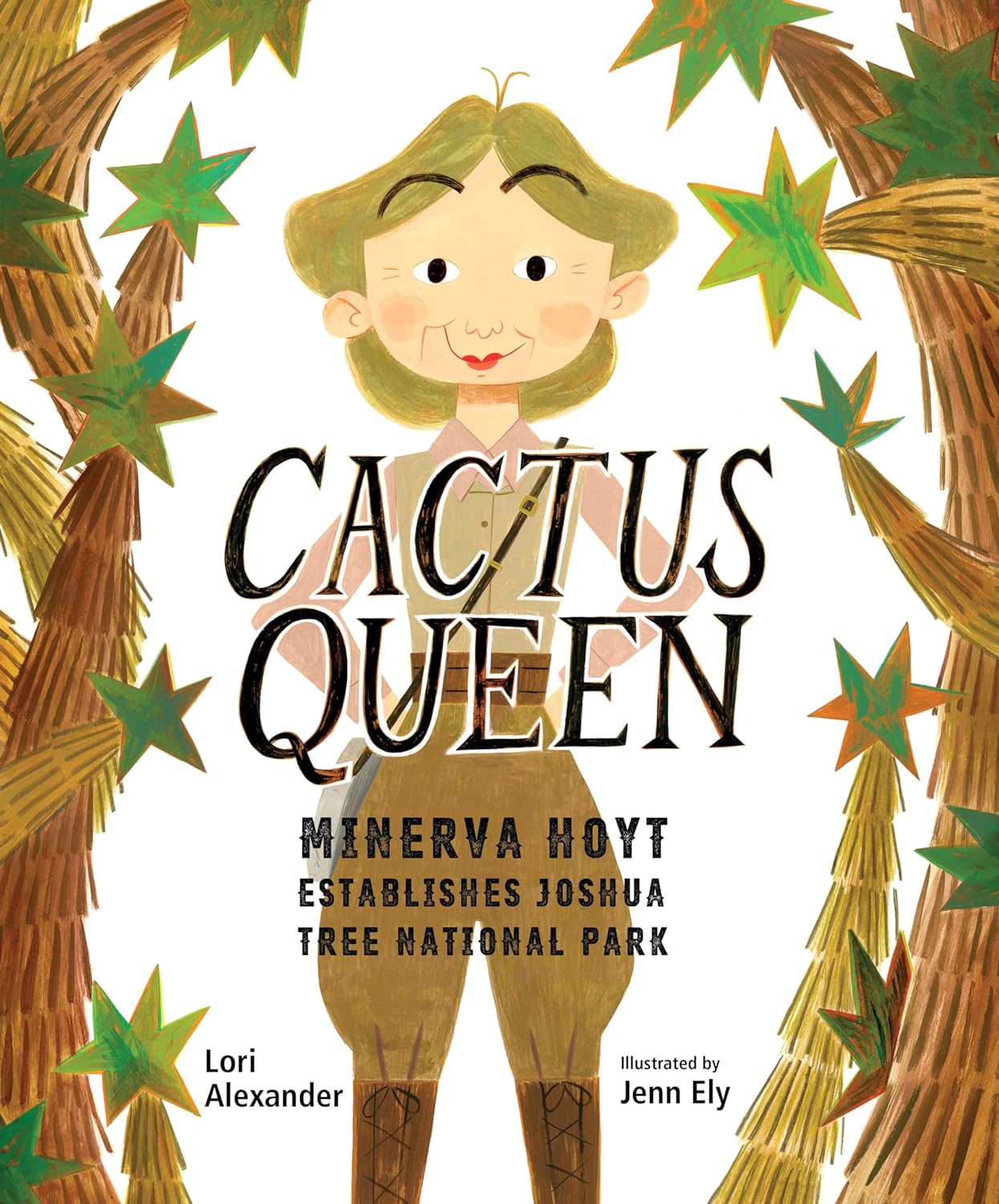
Cactus Queen: Minerva Hoyt Establishes Joshua Tree National Park
Written by Lori Alexander | Illustrated by Jenn Ely
Even as a child, Minerva loved the outdoors, was eager to share her thoughts and opinions, and enjoyed “long chats with friends.” When she grew up she married Dr. Albert Hoyt. In 1897 Minerva and her husband moved from Mississippi to Pasadena, California, close to Los Angeles. To meet new friends, Minerva hosted a backyard party, complete with games, food, and, of course, long chats.
Settled into her new city, Minerva took to making trips to the Mojave Desert. She was awed by the Joshua trees, which grew nowhere else but here. After the death of her husband in 1918, Minerva spent more time in the desert, even camping out while “the wind whistled through the Joshua trees,” and “bright constellations swirled overhead.”
Illustration copyright Jenn Ely, 2024, text copyright Lori Alexander, 2024. Courtesy of Calkins Creek, Astra Books for Young Readers.
As Los Angeles grew and grew, with more buildings, more cars, and more noise, people began to visit the desert frequently. They didn’t just visit, though, they wanted to take it home. People dug up the “… fuzzy cholla, spiky yucca, and barrel cacti to keep in their backyards.” They even dug up Joshua trees and carted them away. Many of these desert plants didn’t survive their new city surroundings. The Joshua trees were also cut down for construction materials, and motorists lost in the desert set them afire to communicate with other drivers.
By the late 1920s little remained of Minerva’s beloved desert. She wanted to save it . . . but how? Suddenly, “Minerva had a wild idea.” She would show the rest of the country just how special the desert was. With help from garden clubs, artists, taxidermists, and friends, she gathered samples of desert flora and fauna and took them east—by train.
Illustration copyright Jenn Ely, 2024, text copyright Lori Alexander, 2024. Courtesy of Calkins Creek, Astra Books for Young Readers.
At the 1928 International Flower Show in New York City, Minerva erected a display of the desert. Crowds were thrilled to discover this “strange landscape,” and reporters took pictures for magazines and newspapers. Minerva won a gold medal for her exhibit, The Spirit of the Desert. Minerva also won awards in Boston and London for exhibits there. But more important than these accolades was that people were really listening to her and beginning to love the desert. When she donated her exhibits to museums, more people became interested in the desert.
By 1933, Minerva was ready to move on to the next stage in her plan. She wanted 1,000,000 acres of the desert to be declared a national park, protected by federal laws. Minerva garnered an audience with President Franklin D. Roosevelt and brought photographs to show him. She convinced the President—now it was up to Roger W. Toll, superintendent of Yellowstone National Park, to inspect Minerva’s desert and agree.
Illustration copyright Jenn Ely, 2024. Courtesy of Calkins Creek, Astra Books for Young Readers.
As Roger Toll stood in the middle of the desert on a rainswept day, he asked, “where are the lush trees, the waterfalls, and lakes?” When he later filed his report, he rejected the desert for National Park status. Minerva was disappointed but did not give up. She began a letter-writing campaign, convincing “scientists, teachers, politicians, and friends” to write to the National Park Service. Letters poured in—enough to convince the Service to send out a new inspector.
This time Assistant Director Harold C. Bryant, who lived in California, was sent. “He knew all about desert plants and animals.” When he arrived, Minerva and more than one hundred supporters greeted him. After touring the desert for three days, Bryant announced his decision: Yes! “Minerva’s desert was worth saving.”
Illustration copyright Jenn Ely, 2024, text copyright Lori Alexander, 2024. Courtesy of Calkins Creek, Astra Books for Young Readers.
Extensive backmatter, accompanied by photographs, offers more biographical information about Minerva, points about wildlife in Joshua Tree National Park, facts about other national parks in the United States, tips for how young people can help the environment through easy-to-implement actions, and a bibliography. In Lori Alexander’s Author’s Note, she relates the dangers and destruction that the fragile environment of Joshua Tree National Park and the surrounding desert continues to suffer from “vandalism, urban development, and the effects of climate change,” a report that demonstrates the need for continued education and care taking of our natural resources.
In Cactus Queen, Lori Alexander has created a compelling biography of a remarkable woman as well as a call to action for readers to stand up for the environmental or other causes that are important to them. Alexander highlights Minerva Hoyt’s love of the desert, her dedication, and her unflagging determination to overcome setbacks. Hoyt’s creativity, pragmatism, and lifelong focus serves as an inspirational roadmap for accomplishing goals for children, teens, and even the adults who read with them.
The first thing readers may notice upon opening Cactus Queen is Jenn Ely’s beautiful color palette that mirrors the unique hues of the desert. Her stunning images of the desert and Minerva’s ingenious ways of rallying the country and the President to her cause transport children from Hoyt’s earliest days through her long-fought success. Ely’s charming illustrations reveal not only the special plants and creatures of the Mojave Desert but Minerva’s distress at its destruction and her tenacity to enact change to protect it.
Both a fascinating biography of Minerva Hoyt and an in-depth look at the multifaceted workings of conservation efforts, Cactus Queen: Minerva Hoyt Establishes Joshua Tree National Park will inspire readers to advocate for causes that are important to them. For educators the book would make an excellent addition to science and language arts curriculum. Cactus Queen would also be an engaging accompaniment to museum visits or field trips for families and teachers.
Cactus Queen is a top pick for classrooms, public and school libraries, museum shops, and families.
Ages 7 – 10
Calkins Creek, 2024 | ISBN 978-1662680212
About the Author
Lori Alexander is the award-winning author of several children’s books, including All in a Drop: How Antony van Leeuwenhoek Discovered an Invisible World, which won a Robert F. Sibert Honor, and A Sporting Chance: How Ludwig Guttmann Created the Paralympic Games, an NCSS Notable Book. Her work has received several starred reviews from Kirkus, School Library Journal, and Horn Book Magazine, has made the NSTA Outstanding Science Trade Book list, and has been selected by the Junior Library Guild. Visit Lori Alexander at lorialexanderbooks.com.
About the Illustrator
Jenn Ely is an artist and animator, who has worked on the movies The Boxtrollsand Guillermo Del Toro’s Pinocchio. In her recent foray into children’s books, she illustrated The Gardener of Alcatrazand If You Were a Kid Building a Pyramid. Visit Jenn Ely at jennely.com.
Women’s History Month Activity
Become a Joshua Tree National Park Junior Ranger
How would you like to become a Joshua Tree National Park Junior Ranger? You can your badge with this online program full of fun and educational activities for all ages! You can learn how to draw a Joshua Tree, create your own constellation, learn all about desert tortoises, create your own rock formation, learn about adaptable plants and design your own, and more.
To earn your badge kids ages 5 – 7 are asked to complete 2 activities; kids ages 8 – 10 are asked to complete 3 activities; and kids ages 10 and above are asked to complete 4 or more. After finishing projects, you just need to send images of your work to receive your badge in the mail!
Simply visit the official Joshua Tree National Park website and learn more about their Junior Ranger program! Learn more about the park and view lots of pictures and videos here.
Joshua Tree National Park Coloring Page
Enjoy this activity page by filling it with all the colors of the desert.
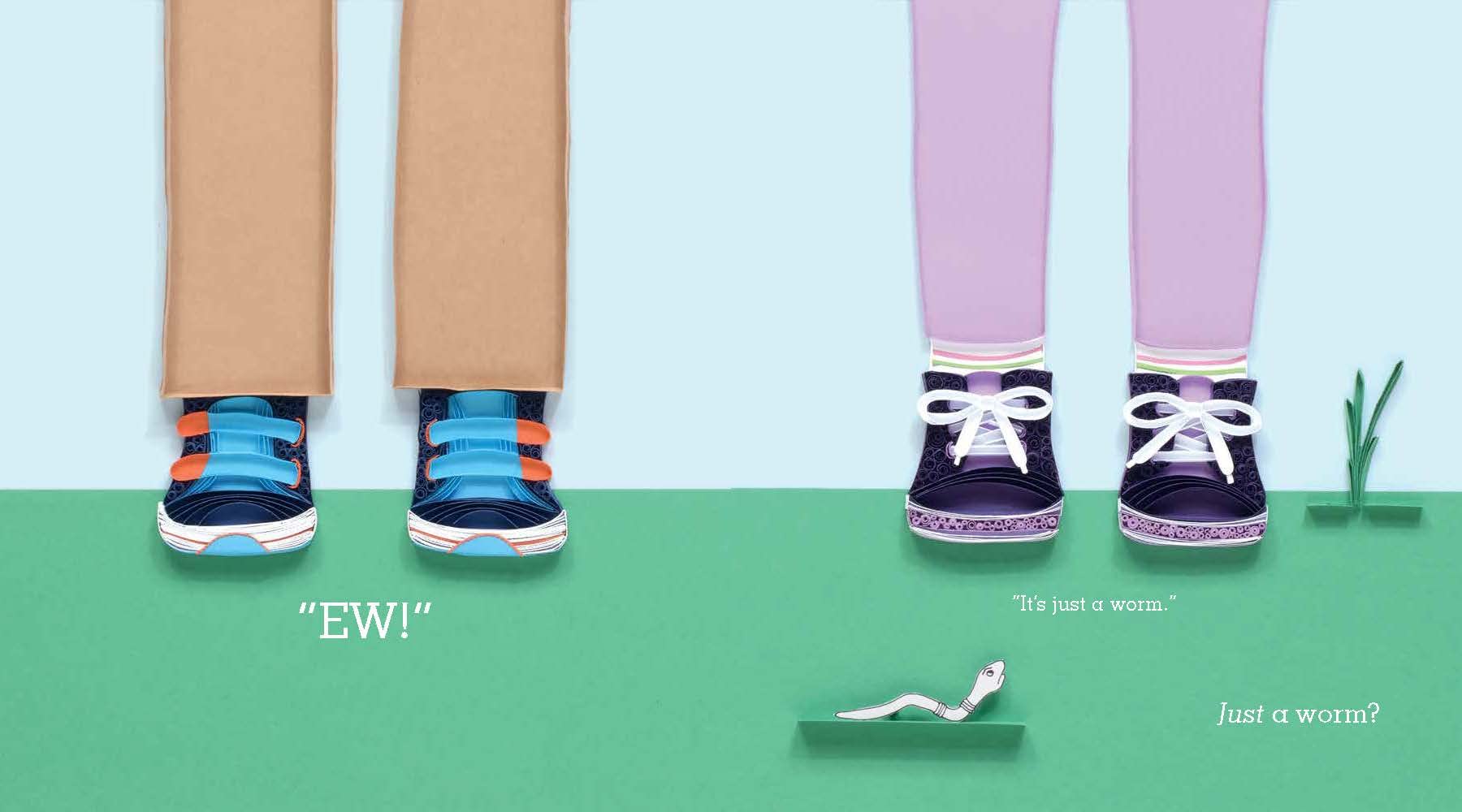
Worm is inching along on a beautiful summer day singing a happy little ditty: “La la la la… Slop, slip, wiggle. / I’m taking a little twirl. / Dop, dip, squiggle. / I’m off to see the world.” And so he was! But on his way he passed two kids who just didn’t see worm the way he saw himself and made him wonder…. Worm bolstered his self-confidence, telling himself that there were a lot of things he could do.
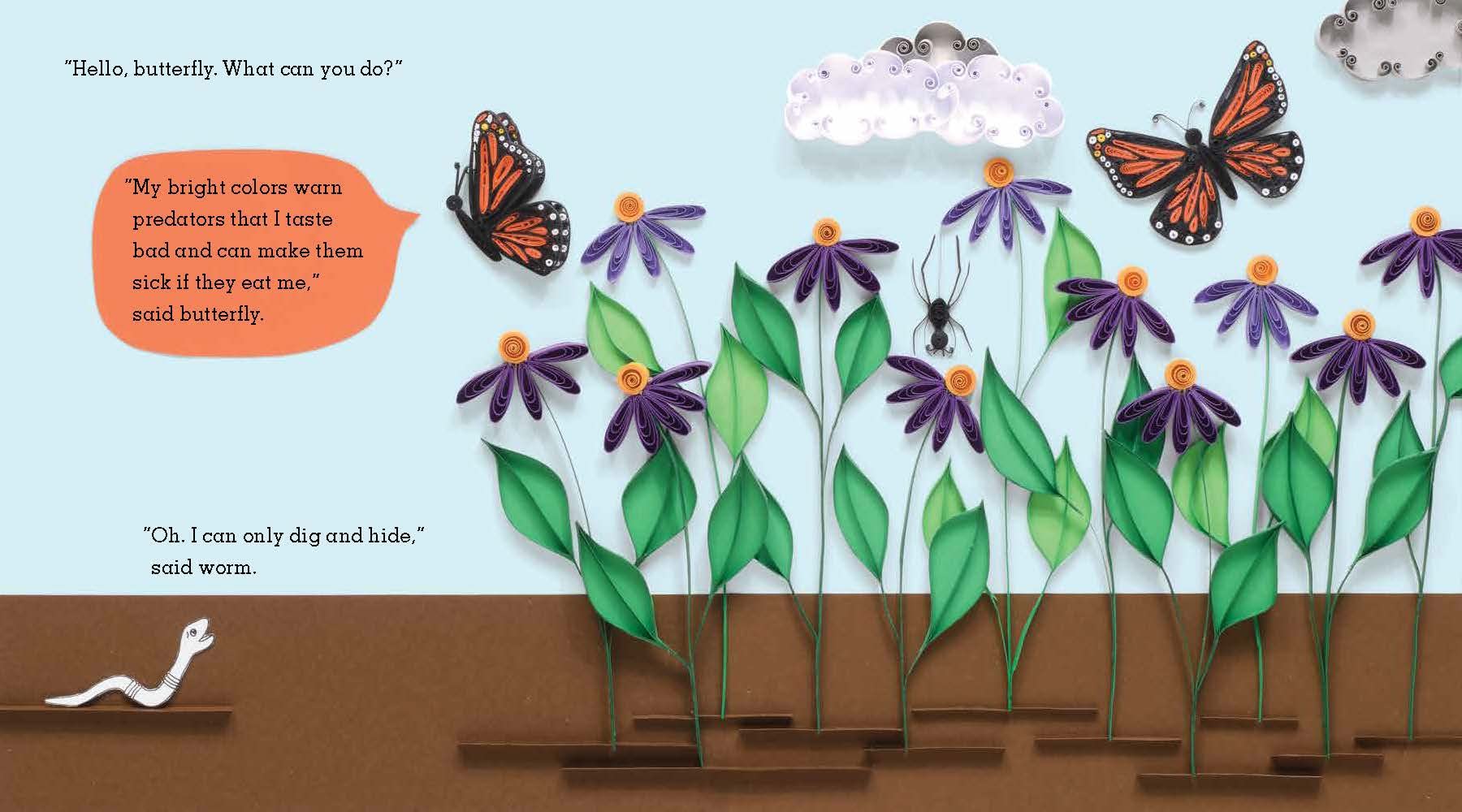
Just then he wiggled up to a row of brilliant purple flowers, where caterpillars, a chrysalis, and a butterfly were hanging out. Just out of curiosity, worm asked one of the caterpillars what she could do, and—Wow!—when he learned about making a chrysalis and metamorphosis, and becoming a butterfly, he was impressed. And maybe a bit intimidated.
Copyright Marie Boyd, 2023, courtesy of Greenwillow Books.
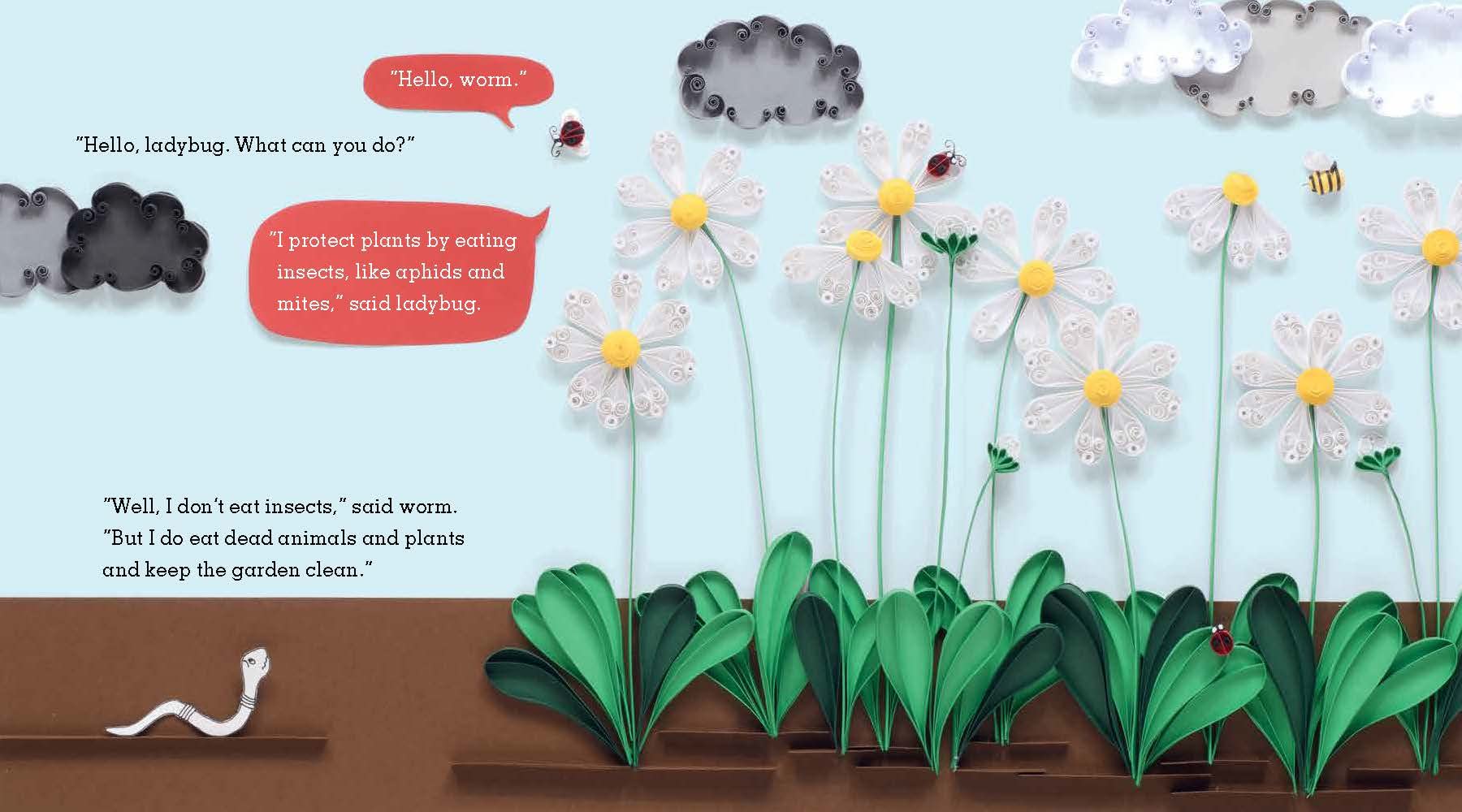
Butterfly also seemed to have multiple talents as did Spider and Dragonfly, who informed worm that he’d never be able to fly because he was “‘just a worm.'” Worm seemed resigned to his fate when he came upon ladybug and asked what she could do. Ladybug said, “‘I protect plants by eating insects, like aphids.'” This reminded worm that he did have a talent. “‘I eat dead animals and plants and keep the garden clean,'” he said with growing confidence.
Copyright Marie Boyd, 2023, courtesy of Greenwillow Books.
By the time worm meets bee, he’s ready to advocate for his own contribution to the garden. Then when snail crawls by and tells worm about the slime that protects him, worm realizes he’s found a friend he can relate to because worm makes slime too! Snail thinks that’s pretty cool, and worm agrees! In fact, worm understands that he can do a lot of things and that many of them benefit the garden. He even lists them all for snail, and as he looks around at the beautiful flowers and luscious berries, he takes some credit for growing “all of this” and proudly states “I’m a WORM!”
Copyright Marie Boyd, 2023, courtesy of Greenwillow Books.
Marie Boyd’s clever story combines salient information about a variety of insects with worm’s confidence-boosting journey from feeling inferior to the other garden dwellers to realizing his own role and importance in the plants’ growth and vibrancy. From page to page, readers can sense worm’s developing appreciation for his talents, and when he shakes off his misgivings and gives ladybug a small list of his accomplishments, kids will be right there to cheer him on. Readers may be surprised to discover just how much worms do contribute to a healthy garden ecosystem even as they come to understand that there is no such thing as “just a worm” in nature. Worm’s personal growth will also resonate with children, who are trying out new things and beginning to find their place in the world.
Boyd’s beautiful and original illustrations, created with intricate paper quilling are wonderfully detailed, textured, and expressive of the uniqueness and interconnectivity of nature. She also weaves in metaphorical clouds, which at worm’s lowest point, turn grey and black as they build overhead. But with his newfound confidence, they dissipate to be replaced with white, fluffy clouds that also blow away to reveal a clear, blue sky.
A multilayered story that delivers two important life lessons in a unique and charming way, Just a Worm will become a quick favorite for home, school, and public library story times. The book would be especially fun to pair with home gardening or planting activities for classrooms, libraries, and extracurricular organizations.
Ages 4 – 8
Greenwillow Books, 2023 | ISBN 978-0063212565
About Marie Boyd
Marie Boyd is a law professor, author, illustrator, and self-taught quilling artist. Her author and illustrator debut, Just a Worm (Greenwillow Books 2023), follows worm through the garden as he learns about his neighbors and how he helps keep the garden healthy. Originally from Salt Lake City, Marie lives in Columbia, South Carolina with her husband and two young children. You can find her at marieboyd.com and on Instagram.
Just a Worm Book Birthday Activity
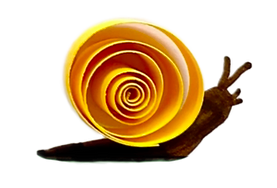
Make a Quilled Snail
Author/illustrator Marie Boyd built worm’s gorgeous garden world with quilled paper, and now you can make worm’s friend snail for yourself with this tutorial on her website!
If your motto is “So many books, so little time” then you’ll be happy to know that January is Book Blitz Month! During this month book lovers are given the green light to read as many books as possible! For kids, Book Blitz Month can be particularly exciting as they discover new fiction and nonfiction that captivates their imagination. To celebrate, take your kids to a local bookstore and the library to find new and favorite books to binge on all month long. If you don’t have a dedicated space for your children’s books, this month is also a great time to create a home library for your child so that they have a shelf, a crate, or even a whole bookcase of stories they can enjoy again and again!
I’d like to thank Lydia Lukidis for sharing a digital copy of Deep, Deep Down: The Secret Underwater Poetry of the Mariana Trench with me for review consideration. All opinions on the book are my own. You can read my interview with Lydia below.
Deep, Deep Down: The Secret Underwater Poetry of the Mariana Trench
Written by Lydia Lukidis | Illustrated by Juan Calle
Imagine being invited to visit a mysterious place where only a few have ever been; where only they have truly seen the creatures that inhabit it; and where it’s murky depths are accessible by only one type of vehicle. Would you dare to go? Lydia Lukidis and Juan Calle extend just such an invitation, but no notes for missing school, packing a suitcase, or plucking of courage need to be considered, for through their phenomenal book, readers find a seat in the incredible submersible that will transport them to “…the deepest underwater valley in the world”: the Mariana Trench.
Image copyright Juan Calle, 2022, text copyright Lydia Lukidis, 2022. Courtesy of Capstone Editions.
The submersible plunges deeper and deeper to where the sun doesn’t penetrate. Here, in the darkness, “food is scarce, and a bone-chilling cold blasts through the water. Earthquakes shake the ocean floor, and the water pressure, like a thick, heavy blanket with a thousand hands, presses down, / down, / down.” What flashes by the porthole window? A monster? No—a fish with a long and slender tail perfectly suited for its austere home, where it can survive for months without eating if necessary. “Diving deeper, a long, thin body slinks and sways, ever so slowly. The cutthroat eel is not fearsome, some rather, mesmerizing.”
The light beam of the submersible also reveals feathery crinoids “twirling and whirling like an underwater acrobat,” and a curious snailfish “dances, ghost-like, to the rhythms of the ocean” as it comes to take its own peek in the window from the other side. Snailfish aren’t affected by the heavy water pressure because “they can swim deeper than any other fish in the world. That’s because their bodies contain RMAO. This special substance protects the fish from high pressure, making sure their bodies aren’t crushed.”
Image copyright Juan Calle, 2022, text copyright Lydia Lukidis, 2022. Courtesy of Capstone Editions.
It might seem impossible to sink still lower, but the submersible plummets into water populated by tiny creatures, almost insect-like with their multiple pairs of legs and long antennae that propel them and help them find food. But explorers are not at the very bottom of the Mariana Trench even yet. The submersible floats slowly down to the bottom—“the very deepest spot on Earth. Look out the window . . . and witness a world of surprises.” Extraordinary creatures, some small, soft, and translucent and others—neither plant nor animal—large and with protective shells, and all adapted to thrive in their formidable surroundings will amaze you.
At last it’s time for the submersible to return to the surface. Slowly, it makes its way through the darkness to lighter seas, where it passes by more familiar fish and other creatures on its way to “SPLASH!” surfacing once again and “leaving the marvels of the Mariana Trench far below” still waiting to be explored again.
Insets of scientific information on diet, anatomical adaptations, and other aspects that make them suited to their environment also accompany the introduction of each sea creature.
Back matter includes an illustrated cutaway of the ocean above and descending into the Mariana Trench with various sea creatures labeled and oriented to the level in which they are found; “Did You Know?” facts about the water pressure in the Trench, its creation, and how many people have visited; why the Mariana Trench matters; an author’s note; and a glossary.
Image copyright Juan Calle, 2022, text copyright Lydia Lukidis, 2022. Courtesy of Capstone Editions.
When undertaking an excursion into unknown territory—especially through words and pictures—explorers need guides who can truly immerse them not only in the sights and sounds of an area but also the rhythms and almost intangible aura that makes it so uniquely compelling. Readers of all ages find that quality in Deep, Deep Down. Lydia Lukidis’s lithe and lyrical language is at once straightforward—answering questions any reader might have—and evocative—capturing the enigmatic and secret world at the bottom of the Earth as it flashes into view or slowly reveals itself and retreats again. Her vocabulary, rich with active verbs, ensures that readers appreciate the Mariana Trench as teeming with life and alive with wonders more amazing than we can even imagine.
Don’t be surprised if you find yourself forgetting that you’re looking at illustrations of a vampire squid, anglerfish, rattail fish, cutthroat eels, crinoids, and even the rocky and sandy ocean floor instead of photographs as you inspect Juan Calle’s magnificent pages. As the submersible—seen from many angles—plunges into darker and darker water, bioluminescent fish begin to appear alongside their grayer sea mates (children will enjoy pointing out the dark shapes that lurk in the shadows of the submersible and the stony outcroppings.)
As a rattail drifts into view, each rose-gold scale is visible, shimmering in the beam of light thrown from the submersible; it’s blue eye seemingly as curious about readers as they are about this unusual fish. Calle mesmerizes with careful details, shading, and perspective that portrays each creature in all of their weird and wonderful floating, creeping, or stock-still spectacle.
Deep, Deep Down: The Secret Underwater Poetry of the Mariana Trench will thrill ocean and nature lovers and will spur increased interest and research into this unique, nearly untouched habitat that we are only now beginning to discover. The book is a must for any environmental science enthusiast at home and for all classroom, school, and public library collections.
Ages 7 – 10
Capstone Editions, 2022 | ISBN 978-1684466153
About the Illustrator
Juan Calle is a former biologist turned science illustrator, trained on the Science Illustration program at UC Monterrey Bay. He worked early on his illustrator career for field guides of plants and animals of his country of origin, Colombia, and now owns and works in his art studio, LIBERUM DONUM in Bogota, Columbia, creating concept art, storyboarding and his passion: comic books. You can connect with Juan onInstagram.
Take a plunge into Deep, Deep Down with this book trailer!
Meet Lydia Lukidis
Lydia Lukidis is the author of 50+ trade and educational books for children. Her titles include DANCING THROUGH SPACE: Dr. Mae Jemison Soars to New Heights (Albert Whitman, 2024), DEEP, DEEP, DOWN: The Secret Underwater Poetry of the Mariana Trench (Capstone, 2023), THE BROKEN BEES’ NEST (Kane Press, 2019) which was nominated for a Cybils Award, and NO BEARS ALLOWED (Clear Fork Media, 2019). A science enthusiast from a young age, she now incorporates her studies in science and her everlasting curiosity into her books.
Lydia is an active member of SCBWI, CANSCAIP, 12 x 12, and The Authors Guild. She’s very involved in the kidlit community and also volunteers as a judge on Rate your Story. Another passion of hers is fostering love for children’s literacy through the writing workshops she regularly offers in elementary schools. Lydia is represented by literary agent Miranda Paul from the Erin Murphy Literary Agency.
Hi Lydia! I’m really thrilled to have the chance to talk to you about this gorgeous book, how it all came together, and your other work as a writer.
You have degrees in Pure and Applied Science as well as English Literature. After graduating from college did you work in the science field? If so, can you talk about your work a little? How has your science background influenced your writing?
When I was younger, I was drawn to both science and the arts. I once saw them as mutually exclusive but then came to realize how connected these disciplines are. Upon graduating university, I did something completely out of left field but that satiated my artistic desires. I started my own jewelry line! After that, I became a puppeteer, writing plays for children. That brought me back to my love of writing, and here I am writing kidlit. I often focus on STEM topics so it’s full circle. I feel like this is truly where I belong.
What drew you to write about the Mariana Trench for children? What kind of research did you do in creating this book?
In 2019, I read an article about how scientists found a plastic bag floating in the Mariana Trench. They also discovered plastic in the belly of various marine animals. My heart sank. I wondered how we human beings managed to start damaging one of the most remote places on the planet.
At that point, I didn’t know that much about the Mariana Trench and my curiosity grew. I began my research on the internet and then came to realize most of that information was false. The book really came together once I interviewed a slew of experts (7 in total) who’ve devoted their lives to studying the deep sea, the hadal zone, and geology. They also helped me find the right books and articles to read for updated information.
What was the most surprising thing you learned during your research? Do you have a favorite creature or one that you’d like to learn more about?
The most surprising thing was that despite the hostile conditions in the trench (no sunlight, scarcity of food, and crushing pressure), life still thrives deep, deep down. Though, the creatures are not what you would expect. There aren’t any sharks, for example, or any large creatures for that matter. My favorite has to be the sea cucumber. I must have watched hours and hours of them oscillating and floating, like underwater ballet. I was love struck!
Your storytelling in Deep, Deep Down is so fluid and as mesmerizing as the Mariana Trench itself. Can you talk about your writing process for this book and how you achieved such a visceral experience for readers?
Wow, what a compliment! Writing this book was nothing short of magical. I’m normally very hard on myself and many books don’t even make it to my agent. Other books take years to figure out. With nonfiction, finding the right structure is crucial. But somehow, with DEEP, DEEP DOWN, I didn’t have my usual “tormented writing struggle.” The writing was fluid and literally flowed out, and never changed in structure. There was a lot of editing, to be sure, I had to rewrite the manuscripts over 55 times to get the facts right, but the vision never changed. Will that always be the case? No! The next book I tried to write crashed and burned (maybe to be resurrected one day), so I’m grateful for this experience.
As a biologist who turned to illustration and who studied at the University of California at Monterrey Bay, Juan Calle must have been a dream match for Deep, Deep Down. Can you talk about how was he paired with your manuscript? When during the publication process did you begin to see his work? What emotions did his interpretations of your words stir in you?
Yes! It was Capstone who wisely suggested Juan. When I saw the proofs, I think my jaw hit the floor. He did SUCH a great job at getting all the details right (and believe me, it was tough—I had made a 20-page document with reference photos and notes vetted by Dr. Gerringer, my main consultant.) Although we never met, spoke, or even corresponded via email, Juan was able to follow my direction and bring his own flavor to the table. I think I first started seeing artwork about 8 months ago, so it was a speedy process. His work was stunning and scientifically accurate, although we couldn’t always draw everything to scale. It was also infused with magic.
What do you hope children will take away from Deep, Deep Down?
My goal in writing this book was twofold: firstly, to educate children on the deepest ocean of our world and debunk the myth that “scary” creatures live within its depths, and, secondly, to talk about ocean conservation and the importance of this fascinating ecosystem.
Kids may think the Trench is so far removed from their lives and that their actions don’t matter, or that what happens in the Trench doesn’t affect them. But that’s simply not true. Everything is connected, and I’d like to remind them that our actions affect our planet, even in its deepest spots.
You’ve written over 50 books for children and are very active in the writing community. What do you love best about being an author? What do you find rewarding about helping other writers succeed?
Thank you for the sweet words! I got my start with work-for-hire and most of my published books are for the educational market. DEEP, DEEP DOWN is my first trade nonfiction book, so it feels like a big accomplishment.
What do I love about writing? Everything. That said, it’s also a tough profession and every year, I usually have a moment when I reassess why I keep choosing this craft.
I also love supporting the kidlit community; it comes deep from the heart. I know what it is to struggle as a writer, and I see so many others struggling, hustling, working so hard. I like to support and acknowledge their efforts. Every little achievement is a milestone and should be celebrated!
What’s up next for you?
I’m excited to have just announced my second trade nonfiction book, DANCING THROUGH SPACE: Dr. Mae Jemison Soars to New Heights (Albert Whitman, 2024). I actually wrote this in 2015, and it’s a very long and convoluted story about how it got acquired. I did think long and hard whether or not I should tell this story and I ultimately decided to follow my heart because I felt so connected to the hook of the story. I invested in a sensitivity reader and will do so again once we start the editing process at Albert Whitman. They also chose a fantastic illustrator, Sawyer Cloud.
Other than that, I’m knee deep in other WIPs, some of them fiction. I wanted to try to stay in one lane as an author but it’s just not happening—it seems there are different stories of different genres inside me that need to come out. I’m always following the flow of my inspiration, which is often not linear!
Thanks again, Lydia, for sharing so much about your writing life! I know readers are going to love Deep, Deep Down and will be looking forward to Dancing Through Space!
Book Blitz Month Activity
Creatures of the Mariana Trench Word Search
The Mariana Trench is home to so many amazing creatures! Can you find the names of seventeen in this printable word search puzzle?






 Hello, I’m a Quokka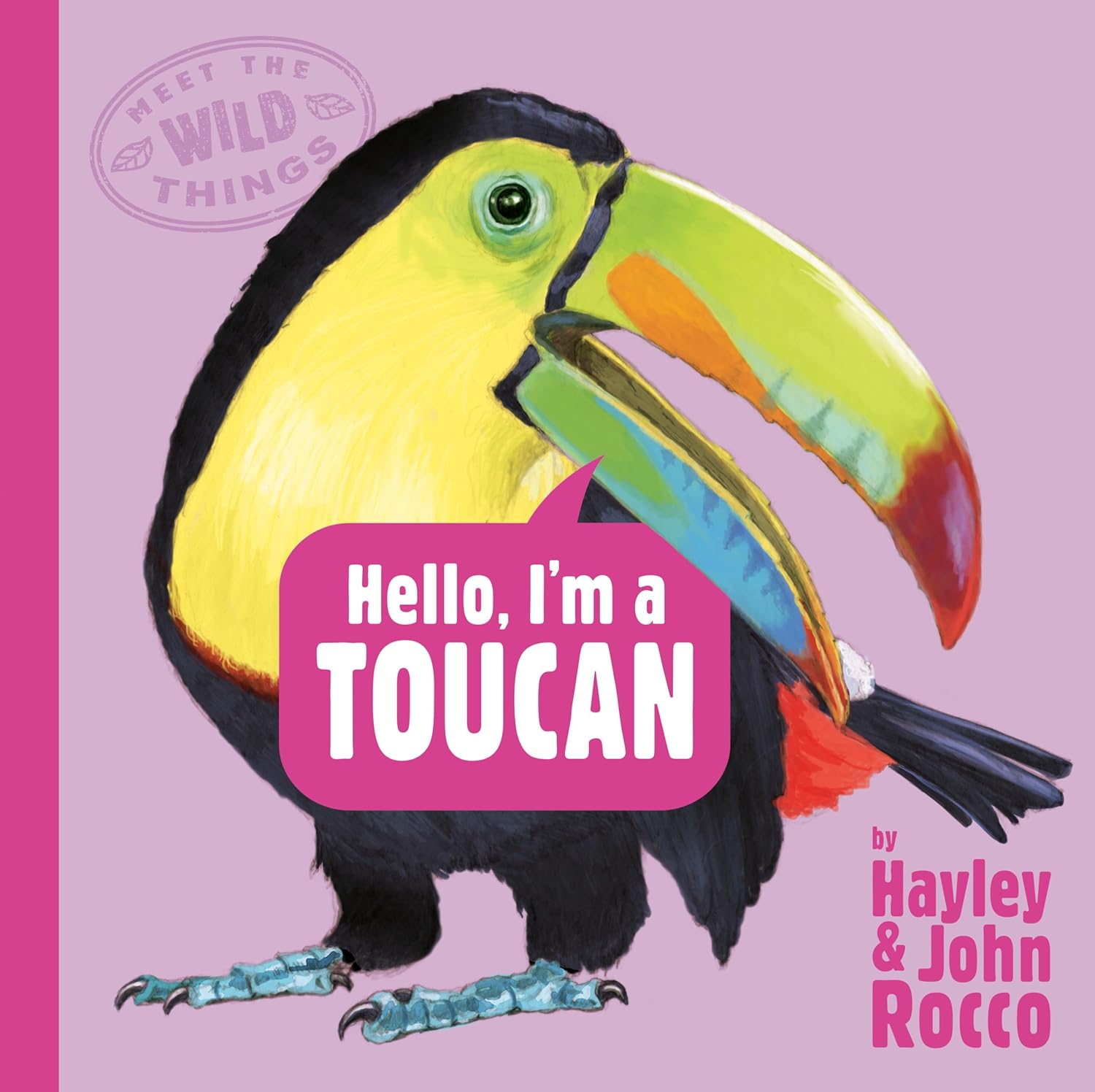









 celebratepicturebooks.com