This month we celebrate all things creative! There are so many ways to be creative, from the arts to how you organize and manage your life at home and at work. Sometimes, special events, unusual problems, or particular people inspire—or necessitate—creative thinking. Today’s sweet story is one example!
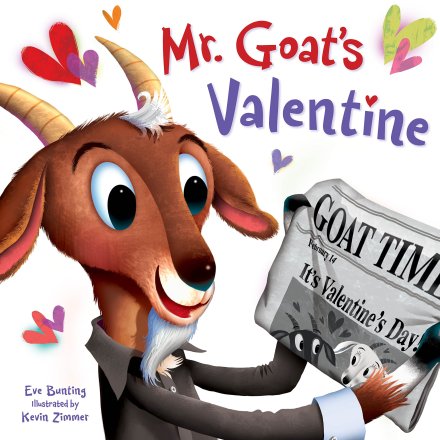
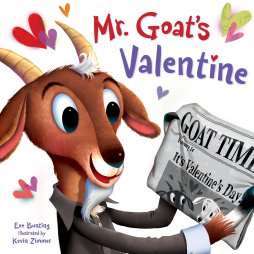
Mr. Goat’s Valentine
Written by Eve Bunting | Illustrated by Kevin Zimmer
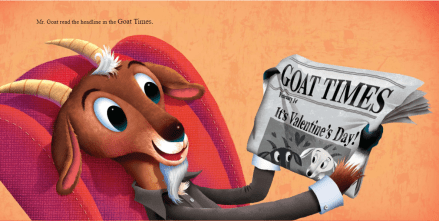
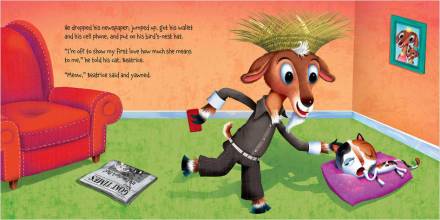
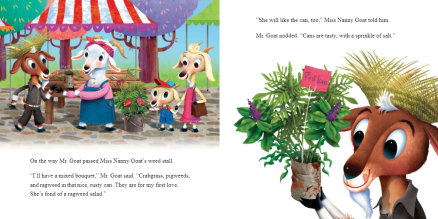
When Mr. Goat read in the newspaper that it was Valentine’s Day, he jumped up, grabbed his phone and favorite hat, and headed out, determined to show his first love how much she meant to him. On the way he stopped off at Miss Nanny Goat’s weed stall and bought a “mixed bouquet” of “crabgrass, pigweeds, and ragweed” beautifully arranged in a “nice, rusty can.” Mr. Goat knew his first love liked ragweed salad, and Miss Nanny Goat assured him that she would like the can too. Mr. Goat agreed. There was nothing like a rusty can with a pinch of salt.
Image copyright Kevin Zimmer, 2018, text copyright Eve Bunting, 2018. Courtesy of Sleeping Bear Press.
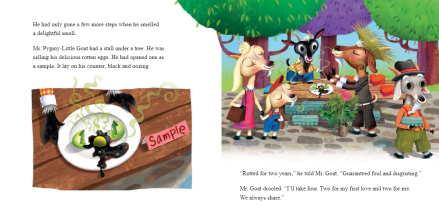
The aroma from Mr. Pygmy-Little Goat’s stand enticed Mr. Goat to stop and look over his treats. The sample rotten egg looked so yummy—black and oozing on the plate—that Mr. Goat bought four. They have been “rotted for two years” and are “guaranteed foul and disgusting,” Mr. Pygmy-Little Goat boasted as he placed the four eggs carefully into a red, heart-shaped box and tied it up with a red ribbon. Not only would the eggs make the perfect dinner, the red bow would be a delicious dessert.
Image copyright Kevin Zimmer, 2018, text copyright Eve Bunting, 2018. Courtesy of Sleeping Bear Press.
Mr. Goat walked on, passing up the fruit and vegetable stand with its fresh oranges, apples, and pears, but made time to talk to Miss Skunk when she approached him with her Eau de Skunk perfume cart. As she spritzed Mr. Goat with a sample of her special perfume, she reminded him that a Valentine’s card would be just right for his first love.
Image copyright Kevin Zimmer, 2018, text copyright Eve Bunting, 2018. Courtesy of Sleeping Bear Press.
Mr. Goat continued on with just the faintest alluring reek and thought about what Miss Skunk had said. He didn’t have a card, but, he decided he could “‘compose a song and serenade her.’” It didn’t take long for Mr. Goat to write his ditty. He hurried on to his first love’s house. Standing at the door, he “burst into song. When I was a little kid / It didn’t matter what I did. / If I climbed too high and fell / You’d kiss the hurt and make it well. / You have loved me from the start / I love you with all my heart!”
Suddenly, the door opened, and Mr. Goat’s first love smiled at him. Mr. Goat handed her the bouquet and red box and exclaimed, “‘Happy Valentine’s Day, Mother!’”
Image copyright Kevin Zimmer, 2018, text copyright Eve Bunting, 2018. Courtesy of Sleeping Bear Press.
Eve Bunting’s exceptional flair for engaging children is on full display in her funny, ewww-ful tribute to Valentine’s Day. The hearts of little ones swell with love around this holiday, and Bunting taps into their enthusiasm to get just the right gift for Mom. Readers will laugh at what might seem unusual gifts while also appreciating Mr. Goat’s thoughtfulness. Young children may wonder who Mr. Goat’s “first love” is as he shops from stall to stall, but as he makes up his song, most will figure it out and be happy to be in on the twist ending.
Kevin Zimmer’s cheery digital art showcases the sweet emotions that Mr. Goat has for his first love. His eyes grow wide at the delectable weed bouquet and rotten eggs, he contemplates the perfect words for his song, and smiles adorably when his mom opens the door. The less-than-fresh take on the idea of a Farmers Market will delight kids familiar with these types of stands. The other goats out shopping on this Valentine’s Day are equally as cute as Mr. Goat and provide camaraderie among this community that likes things a little bit rotten. As the door opens in the final spread, revealing Mr. Goat’s first love, children will be happy to know that the love between parent and child continues even when a “kid” is no longer a kid.
Mr. Goat’s Valentine is a sweet, original story for Valentine’s Day and throughout the year that is perfect for humorous home, classroom, and library story times.
Ages 4 – 7
Sleeping Bear Press, 2018 | ISBN 978-1585369447
Learn more about Kevin Zimmer and his art on his website.
Creativity Month Activity
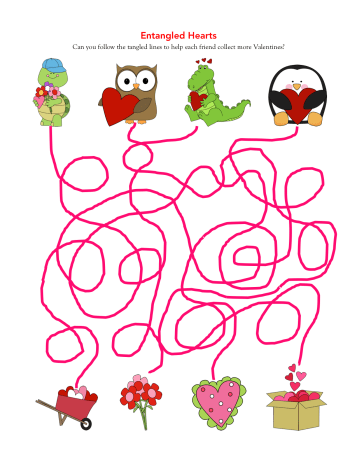
Entangled Hearts Matching Puzzle
These friends are collecting valentines! Can you help them follow the paths to find more in this printable puzzle?
Today, we recognize Florida—the 27th state to enter the Union. Did you know that Florida is home to the oldest established city in the country? Founded by Spanish explorers in 1565, St. Augustine remains a fascinating city that combines an intriguing history of religious settlements, pirate treasure hunters, and a tug of war over ownership among Britain, Spain, and France with the modern beauty of a thriving community. Of course, Florida is well-known as an international tourist destination for its theme parks, wide open beaches, and warm weather. The state is also home to animals, insects, and reptiles unseen in the rest of the United States—a fact that today’s book riffs on.
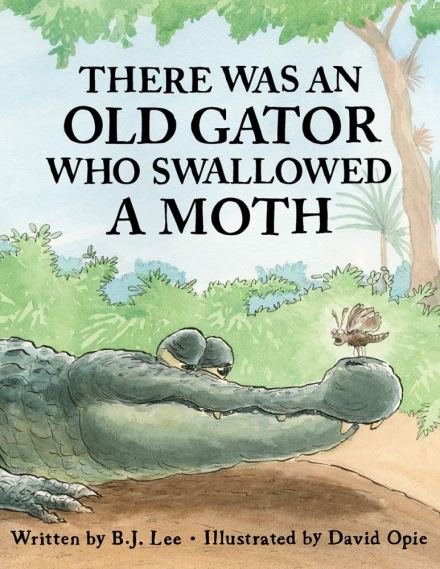
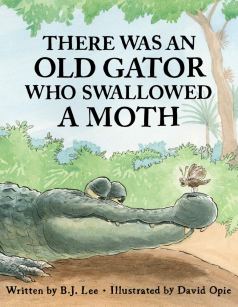
There Was an Old Gator Who Swallowed a Moth
Written by B.J. Lee | Illustrated by David Opie
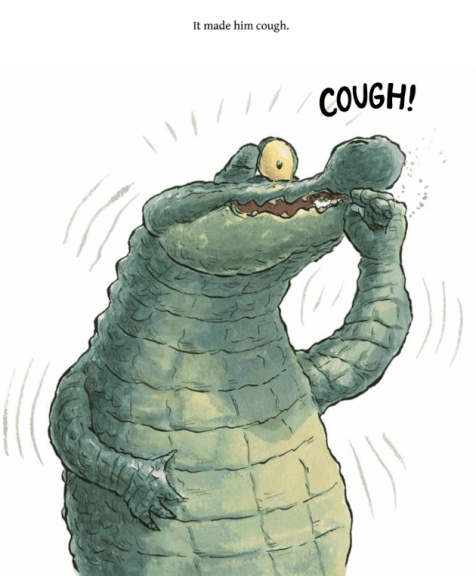
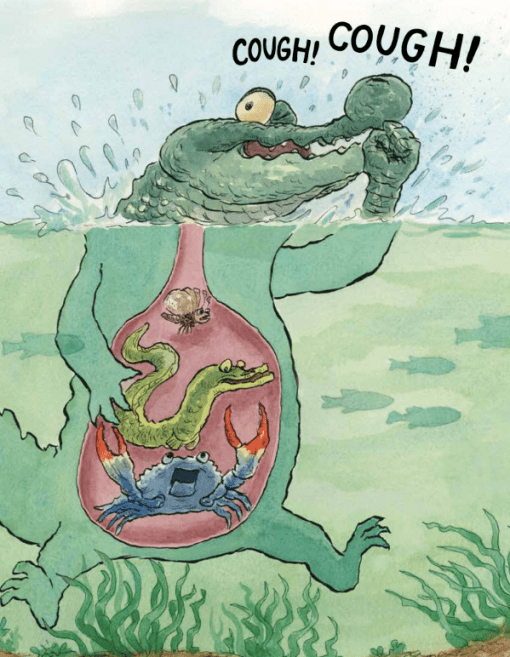
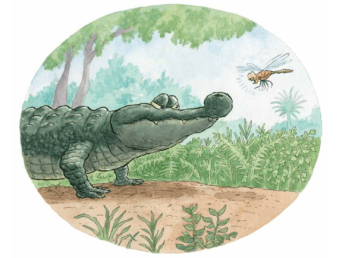
“There was an old gator who swallowed a moth. I don’t know why he swallowed the moth. It made him cough.” And with this culinary choice, readers are off on a wild jaunt full of suspense, humor, and big, sharp teeth. To catch that moth, the gator gobbled down a crab, but that scuttling bugger just filled his tummy with pain. To “nab the crab” the gator decided to “swallow an eel. / Quite an ordeal to swallow an eel!”
Image copyright David Opie, 2019, text copyright B.J. Lee, 2019. Courtesy of Pelican Publishing Company.
But the eel didn’t help, and the cough persisted. What could the old gator do? He swallowed creature after creature to resolve a cascading number of problems until “he swallowed a manatee.” It was clear “he lost his sanity to swallow a manatee!” Because now that old gator’s stomach was getting pretty cramped. There wasn’t a lot of nabbing or catching going on in there, and there was still that moth to take care of. The distressed gator then spied just the enforcer that might get the job done and gulped it down too.
Image copyright David Opie, 2019, text copyright B.J. Lee, 2019. Courtesy of Pelican Publishing Company.
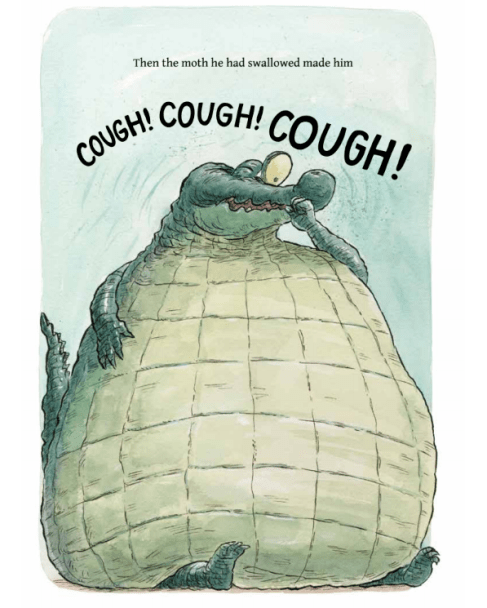
After such a big meal, the gator needed a bit of a drink, and the lagoon looked so refreshing! Just then, when that old gator was fully…well…full, that pesky moth fluttered its wings and made the poor guy “cough! Cough! Cough!” And what did that one little last cough do? Well, let’s just say the story has a splashing…I mean smashing…ending!
Image copyright David Opie, 2019, text copyright B.J. Lee, 2019. Courtesy of Pelican Publishing Company.
B.J. Lee gives the favorite cumulative rhyming There Was an Old Lady story a reptilian remodeling that kids will find irresistible as the old gator guzzles down a host of Florida denizens with hilarious results. Lee, an award-winning poet, has an engaging way with words and phrasing that creates surprising rhymes and rib-tickling rhythms. Clever alliteration and action-packed verbs move the story along at a clip that mirrors an alligator’s voracious appetite and will keep young readers on the edge of their seat to see which animal becomes the gator’s next snack. Kids may even enjoy trying to come up with their own rhyming line to add to the story.
David Opie’s illustrations of the anguished alligator and his unsuspecting “remedies” are a hoot. Opie accomplishes just the right combination of suspense and humor with his juxtaposition between realistic depictions of the coastal animals and gut-busting portrayals of these creatures crammed into the gator’s belly. As the gator grows rounder and rounder, readers will be wondering how it will all end. The final spreads of the tormented gator are sure to elicit an “Oh!” or “Ew!” or two and plenty of guffaws.
There Was an Old Gator Who Swallowed a Moth is a fun and funny choice for story time, and its comical repetition will prompt enthusiastic read-alongs. The book would be a sunny choice for home, classroom, and public libraries.
Ages 5 and up
Pelican Publishing Company, 2019 | ISBN 978-1455624416
Discover more about B.J. Lee, her books, and her poetry on her website.
To learn more about David Opie, his books, and his art, visit his website.
Meet Author B. J. Lee
Thank you, Kathryn, for having me on your blog! There Was an Old Gator Who Swallowed a Moth is getting a lot of love and I appreciate that! I also appreciate that you asked me about my poetry since, even in my picture books, I try to incorporate some aspect of poetry, such as lyrical language, rhyme and, in the case of Gator, cumulative rhyme.
There Was an Old Gator Who Swallowed a Moth is your debut picture book. What drew you to creating a Florida-themed version of this well-known classic?
It wasn’t so much that I set out to write a Florida themed version of There Was an Old Lady Who Swallowed a Fly, it was more that I had a gator character in mind and he pretty much chose this classical structure.
Have you always loved to write? When did you publish your first poem? Can you tell readers a bit about your journey to becoming a published writer?
Yes, I have always enjoyed writing. My sixth-grade teacher encouraged me to write plays! But I didn’t really realize I was a writer until, as an adult, I started writing a novel, which I never finished because my health intervened. In 2006 I had a shoulder operation which left me with severe bicep tendinitis, and for two years I couldn’t write, couldn’t even hold a pencil. My husband said “Write something shorter. Write poetry.” But I didn’t know how to write poetry. He had planted something in my mind, though. I started studying poetry and then began to write it. My first poem was published in the SCBWI Bulletin in 2010. And so, I became a poet quite by accident. In a way I’m almost grateful for the bicep tendinitis, because I would not have become a poet without that hiccup in my journey. And I’ve picked up the novel again, resurrecting it as a verse novel.
I wasn’t surprised when I saw that you worked as a librarian at the Boston Conservatory at Berklee and play the piano since your poetry has such a musical quality to it. Did you ever consider becoming a musician or songwriter? How does your musical background influence your poetry?
Thank you for saying that my poetry has a musical quality. I have heard that before but I am unaware of trying to incorporate any musicality into my poetry. I am a pianist, jazz singer, and even enjoyed a brief stint as lead singer in a local rock ‘n’ roll band. Recently, I have written some songs for a current work in progress in which the main character is a singer-songwriter.
What is your favorite form of poetry to write and why? Do you write poetry for adults as well as children? What do you find satisfying about both?
I enjoy writing many forms of poetry but I guess I like the challenge of writing in repeating forms, such as the villanelle, the triolet, the pantoum and the roundel. I blog at Today’s Little Ditty, where I am an authority on poetic forms.
However, I am continually challenging myself to write new forms of poetry, like free verse and performance poetry such as rap. I have written poetry for adults; however, since I am a children’s author, I try to stick with children’s poetry, including work for very young children through young adult and have over 100 poems published in anthologies and magazines.
The breadth of subjects you’ve written about—from sea glass to termites to naughty poodles and so many more—is truly inspiring! Can you talk about how and why certain subjects spark your creativity and how you follow that to a completed poem?
As far as subject matter, I’m very interested in the natural world and animals, so those subjects often show up in my work. Sometimes I write to prompts from anthologists. Once I have a subject that begs a poem, I simply try to find the best form to present it. Sometimes the poem may not work at all, and I’ll have to select a new form. Sometimes poems just start in my head and I have to be very quick to capture them.
Your poetry appears in children’s magazines, including Highlights and Spider, in publications for schools and many others, and in anthologies such as those published by National Geographic and Wordsong. Do you ever hear from young readers about your work? Do you have an anecdote from a letter or reading event that you’d like to share?
Yes, I do hear from young readers, which is very gratifying. In one case a Vietnamese teacher contacted me telling me that her phonics students are using my poem, A Garden Prayer, to learn English. That was when I realized that my poetry has gone around the world.
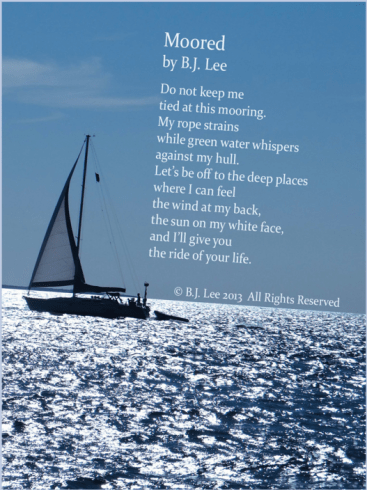
In another case, a woman contacted me from St. John’s, Nova Scotia, to ask me if they could use my poem, Moored, on a sculpture in Bannerman Park for a woman who died at a young age and who had always loved sailing. Of course I said yes! The proposed sculptor is Luben Boikov.
I’ve read some of your very clever poems that have been finalists—and winners!—in the Think, Kid, Think! Madness Poetry Tournament held in April on thinkkidthink.com. Can you talk a little about the tournament and being an authlete?
Yes, the Think Kids Think March Madness poetry tournament is a wonderful event for children’s poets. I loved being an authlete and competing but it’s very difficult to write a quality poem in a short amount of time. It was like pulling college all-nighters!
Do you have any advice for aspiring poets—children or adults?
My advice for aspiring poets, both children and adults, is: find the metaphor.
What’s up next for you?
I’m currently writing a verse novel as well as picture books and poetry collections.
What is your favorite holiday and why?
My favorite holiday is Valentine’s Day because: love.
Can you talk about one of your poems that incorporates a holiday theme?
I’ve written a few holiday poems including “Groundhognostication,” which appears in National Geographic’s Poetry of US.
Thanks for this wonderful chat, B.J.! I’ve loved learning more about your poetry and other work. I wish you all the best with There Was an Old Gator Who Swallowed a Moth!
Celebrated in schools across the country, National Reading Day was established to encourage students in PreK through 3rd grade to develop a love of reading, which is the basis for becoming a lifelong learner. Schools, libraries, organizations, bookstores, and parents provide activities to connect young readers with books they’ll love.
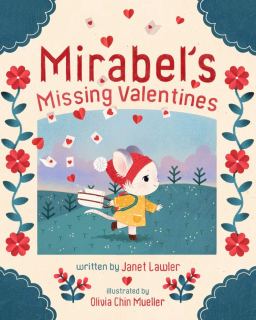
Sterling Children’s Books sent me a copy of Mirabel’s Missing Valentines to check out. All opinions are my own.
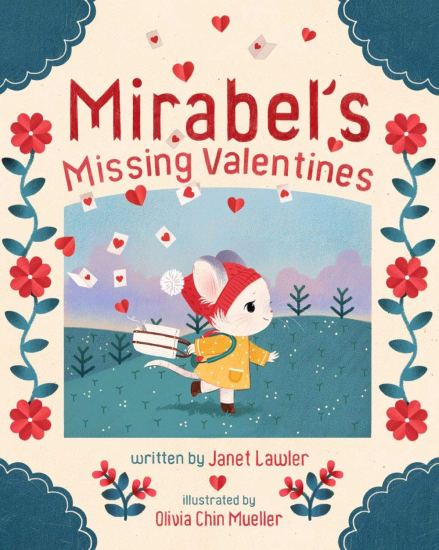
Mirabel’s Missing Valentines
Written by Janet Lawler | Illustrated by Olivia Chin Mueller
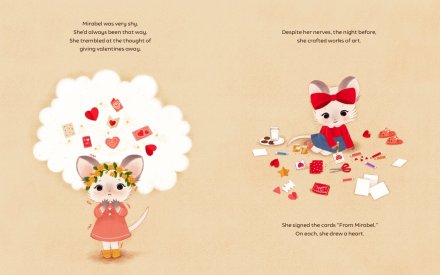
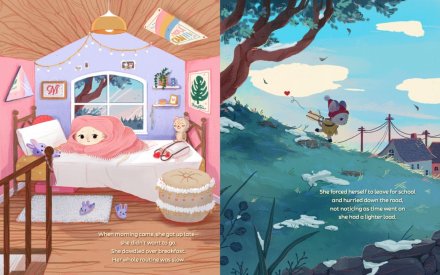
Mirabel had always been very shy, and as Valentine’s Day approached she was nervous about giving cards away at school. Still, “despite her nerves, the night before, she crafted works of art.” When she was finished, she signed them and drew a heart. In the morning, though, she was reluctant to go to school, and ended up leaving late. In her hurry to get to school, she didn’t notice that her bag was getting lighter and lighter.
Image copyright Olivia Chin Mueller, 2018, text copyright Janet Lawler, 2018. Courtesy of Sterling Children’s Books.
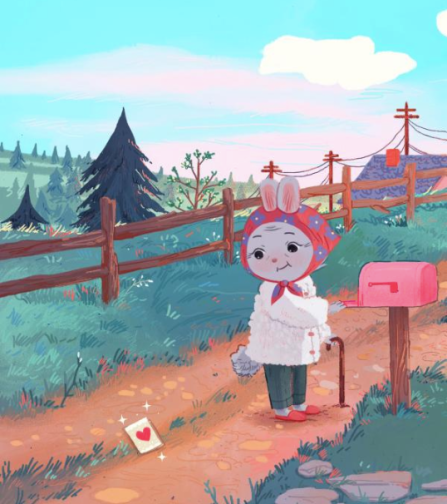
Mirabel rushed past a lonely lady who was checking her mailbox—and then checking it again just in case. But as Mirabel hurried down the road, the lady turned and saw a valentine lying next to her. “She smiled and thought, How nice!” As Mirabel turned a corner, “construction workers sweating / as they dug around a pole / laughed to find a sweet surprise / half-buried in the hole.”
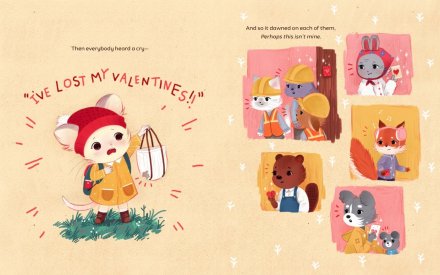
A baby found a valentine that had floated into their stroller, and for a jogger who’d just stepped in gum, the sparkly card on the ground made her day better. Others, too, found valentines that made them smile. Suddenly, though, the neighbors all heard a cry: “‘I’ve lost my valentines!’” Mirabel had discovered a hole in her bag and that all of her cards were gone. Everyone realized what had happened. They rushed to find Mirabel and return the valentines. “‘Your cards have made us smile! / Thanks for sharing them with us, / if only for a while,’” they told her.
Image copyright Olivia Chin Mueller, 2018, text copyright Janet Lawler, 2018. Courtesy of Sterling Children’s Books.
Seeing all of their happy faces cheered Mirabel and made her feel braver. She waved goodbye to her new friends and followed the other students into school. Later, she joined in her class party and was excited to share the valentines she’d made. On the way home from school, Mirabel didn’t notice the jogger, dad, construction workers, and others slip valentines into her bag as she passed by. But when she got home, she discovered that her bag was overflowing with love.
Image copyright Olivia Chin Mueller, 2018, text copyright Janet Lawler, 2018. Courtesy of Sterling Children’s Books.
Janet Lawler’s endearing story of a little mouse who is nervous about Valentine’s Day will resonate with little ones and adult readers as well. Sharing one’s feelings and talents—as Mirabel does with her homemade cards—can be daunting, but Lawler shows that friendship shared is often returned in kind. Little ones will find much to admire in Mirabel’s bravery to go to school even though she is apprehensive about what the day will bring. The reminder that children occupy a special place in the heart of many people, including family, friends, teachers, librarians, and others that they interact with, will cheer them and inspire them to reach out and accept the love offered on Valentine’s Day and every other day.
Image copyright Olivia Chin Mueller, 2018, text copyright Janet Lawler, 2018. Courtesy of Sterling Children’s Books.
Olivia Chin Mueller’s Mirabel is an adorable friend for little readers. As she cowers under a blanket, contemplating going to school, kids will send her encouraging thoughts and be happy to see her change her mind and hurry along to join her classmates. As the valentines begin to fly out of Mirabel’s bag, readers will wonder who will find each card and will look forward to each page turn. The smiles on the faces of those treated to the surprise gift are heartening as readers see what a positive impact little Mirabel has on those around her. As Mirabel hands out her valentines to her classmates, hearts abound, demonstrating along with the students’ smiles and surprised expressions the warm feelings of friendship that are contained not only in each unique card but in Mirabel’s kind spirit. The final image of Mirabel clasping her bag full of valentines is endearing.
Ages 3 – 7
Sterling Children’s Books, 2018 | ISBN 978-1454927396
Discover more about Janet Lawler and her books on her website.
To learn more about Olivia Chin Mueller, her books, and her art on her website.
National Reading Day Activity
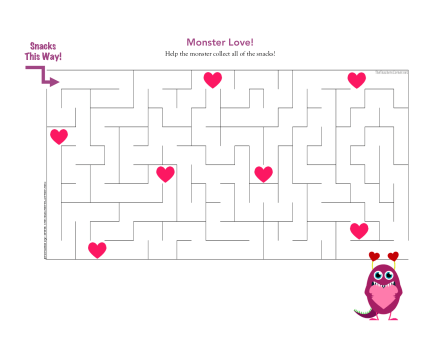
Monster Love! Maze
Help the love monster gobble up all the Valentine’s Day candy snacks in this printable maze!
Today, I’m posting a review for Multicultural Children’s Book Day, a literary event that takes place every January and, this year, culminates on January 25 with a huge online celebration. Throughout the month bloggers, reviewers, and individuals post reviews of children’s books that offer multicultural themes, characters, and stories to inspire young readers and introduce them to their peers around the world as well as to global celebrations, ideas, and conditions. The mission of Multicultural Children’s Book Day is twofold: to raise awareness of children’s books that celebrate diversity, and to get more of those books into classrooms and libraries. To learn more about Multicultural Children’s Book Day and discover downloadable resources for teachers and individuals as well as a list of all the books reviewed during the month, visit the Multicultural Children’s Book Day Website.
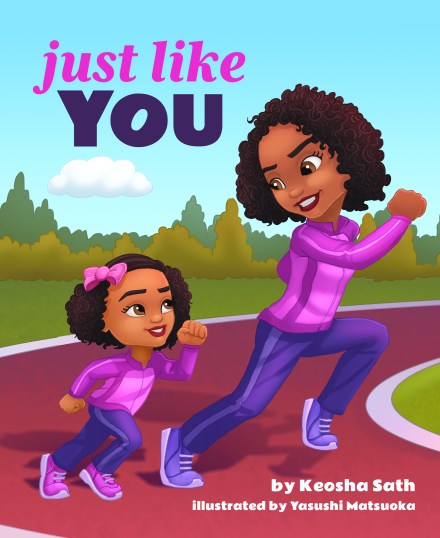
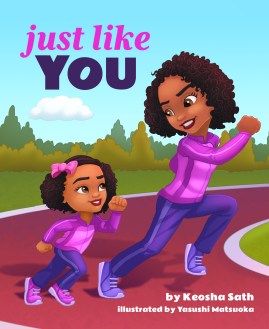
Just Like You
Written by Keosha Sath | Illustrated by Yashushi Matsuoka
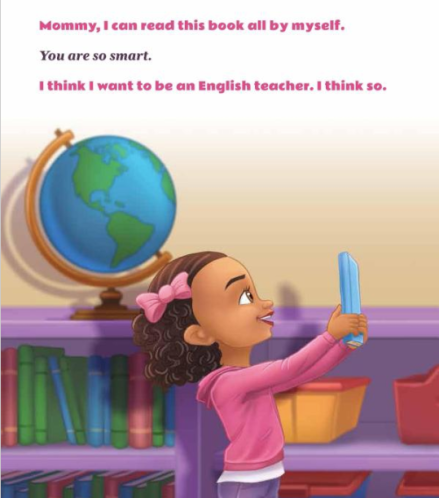
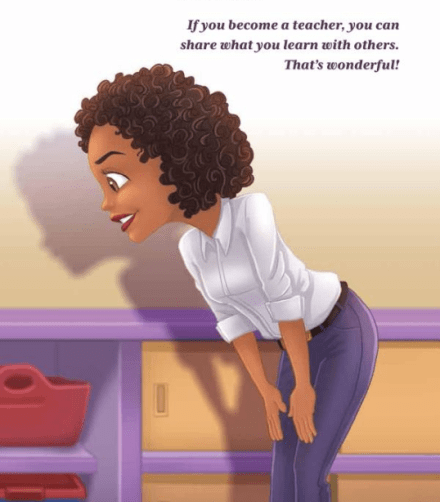
A little wide-eyed girl has lots of questions and big plans, but first she wants to know why she has to go to school. Her mom tells her “so that you can be whatever you want to be when you grow up.” It’s sage advice because this young girl sees possibilities all around her. When she reads a book all by herself, her mom encourages her, and the girl thinks that maybe she’d like to be an English teacher when she grows up.
Image copyright Yasushi Matsuoka , 2018, text copyright Keosha Sath, 2018. Courtesy of Mascot Books.
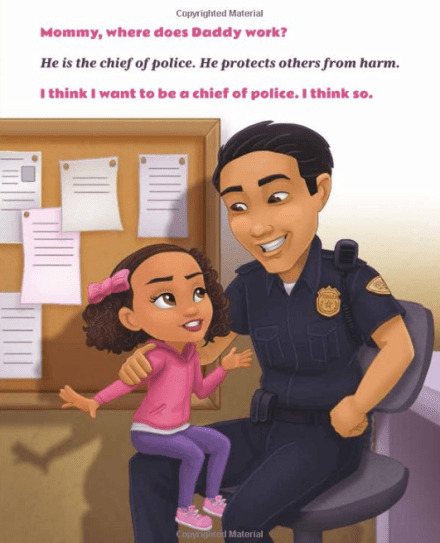
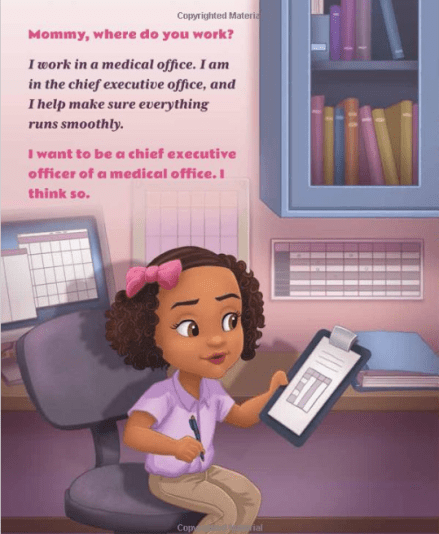
Thinking about jobs makes her wonder where her mom works. Mom explains that she works in a medical office as the chief executive and makes sure that everything runs smoothly. Her daughter decides that sounds pretty cool and says, “I want to be a chief executive officer of a medical office. I think so.” But not so fast! Her dad is the chief of police, and she thinks that maybe she’d like to do that. The little girl tells her mom that her throat hurts. After a trip to the doctor, the girl says, “I think I want to be a pediatrician. I think so.”
Image copyright Yasushi Matsuoka , 2018, text copyright Keosha Sath, 2018. Courtesy of Mascot Books.
A trip to the veterinarian convinces this bright child that she wants to help animals stay healthy, after going to the bank, being an accountant looks like a good option, and a discussion on voting inspires her to aim at being the President. But she also loves honey and wants to know where it comes from. Her mom tells her, “It comes from bees. Bees store honey inside their hives, and beekeepers sometimes protect the bees.” Fascinated, the girl determines, “I think I want to be a lead beekeeper. I think so.”
Image copyright Yasushi Matsuoka , 2018, text copyright Keosha Sath, 2018. Courtesy of Mascot Books.
Cooking, using math, going on adventures, and running also spark a desire to try being a head chef, mathematics professor, cartographer, and engineer. After all the encouragement her mom has given her, the little girl has made up her mind about just what she wants to be. She gives her mom a hug and says, “Mommy, I know what I want to be when I grow up! It isn’t an astronaut, a mathematician, or an engineer. I want to be a great mommy, just like you!”
Image copyright Yasushi Matsuoka , 2018, text copyright Keosha Sath, 2018. Courtesy of Mascot Books.
Keosha Sath opens up a world of possible professions in her sweet conversation between mother and daughter. The little girl is brimming with enthusiasm and curiosity about the jobs and workers she encounters. Her strong self-confidence and interest in all types of professions will inspire readers to see themselves in positions of leadership and to use their talents to reach for the stars. The girl’s decision to be a mom like her own reinforces the importance of the job parents do while demonstrating that children do notice and appreciate all the support parents give.
Yasushi Matsuoka’s vivid illustrations portray a happy, inquisitive, curly haired young girl imagining herself as a CEO, walking the moon as an astronaut, examining a puppy as a veterinarian, removing a full honeycomb as a beekeeper, and performing other jobs that attract her. Her supportive mom and dad are nearby to nurture her natural curiosity, and the final image of a family hug is endearing.
Just Like You is a charming way to foster discussions about talents, activities, and favorite subjects as well as a fun story for family bonding at story time.
Learn More about Multicultural Children’s Book Day
Multicultural Children’s Book Day 2019 (1/25/19) is in its 6th year and was founded by Valarie Budayr from Jump Into A Book and Mia Wenjen from PragmaticMom. Our mission is to raise awareness of the ongoing need to include kids’ books that celebrate diversity in homes and school bookshelves while also working diligently to get more of these types of books into the hands of young readers, parents and educators.
MCBD 2019 is honored to have the following Medallion Sponsors on board!
We’d like to also give a shout-out to MCBD’s impressive CoHost Team who not only hosts the book review link-up on celebration day, but who also works tirelessly to spread the word of this event. View our CoHosts HERE.
TWITTER PARTY Sponsored by Make A Way Media: MCBD’s super-popular (and crazy-fun) annual @McChildsBookDay Twitter Party will be held 1/25/19 at 9:00pm.E.S.T. TONS of prizes and book bundles will be given away during the party ( a prize every 5 minutes!). GO HERE for more details.
Today we celebrate that most marvelous, stupendous, spectacular, cool, awe-inspiring, remarkableand—one from my early youth—groovy book, the thesaurus! Without its incredible cross-referenced lists of synonyms and antonyms, the world would be much more boring, dull, lackluster, monotonous place. Today, spice up your speech and writing with the perfect word to express all the nuances of life!
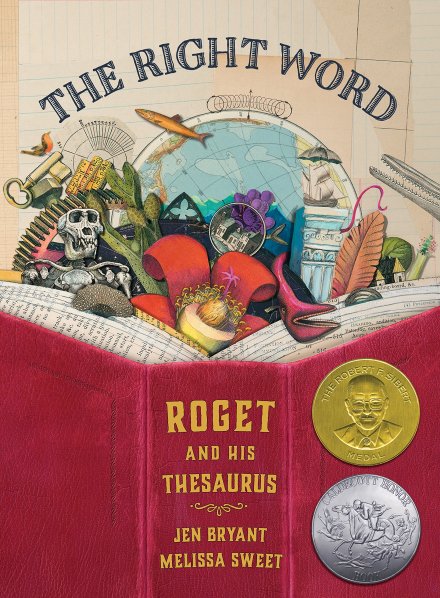
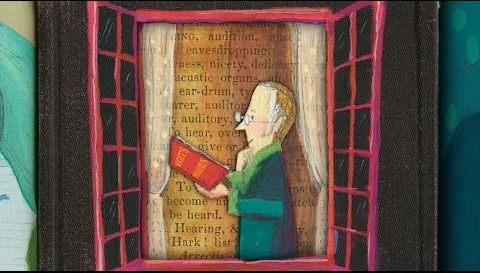
The Right Word: Roget and His Thesaurus
Written by Jen Bryant | Illustrated by Melissa Sweet
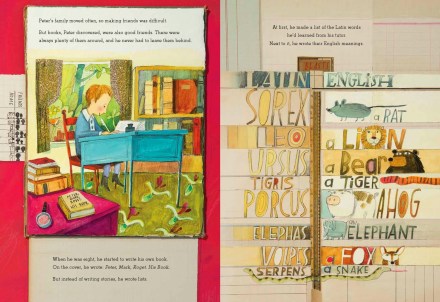
While just a young child, Peter, along with his mother, his uncle, and his baby sister Annette, travel to their new home following the death of his father. It would not be his first move, and in the absence of long-time friends, Peter found companionship in books. When he was eight years old, he began writing his own book titled: Peter, Mark, Roget. His Book. But this was not a book of stories or even one story; it was a book of lists. The first list was divided in two. On one side were the Latin words he knew; on the other were their definitions.
Image copyright Melissa Sweet, 2014, text copyright Jen Bryant, 2014. Courtesy of Eerdmans Books for Young Readers.
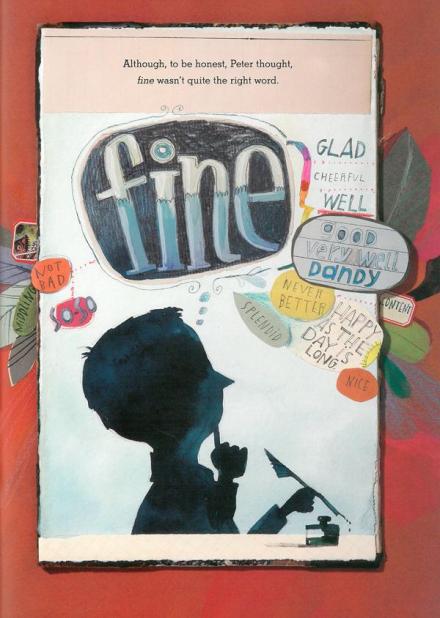
Peter’s mother hovered and worried over her son, and he always told her he was “fine.” “Although, to be honest, Peter thought, fine wasn’t quite the right word.” As the years went by, Peter added lists to his book, prompting his mother to complain about his constant “scribbling.” But Peter looked at his lists differently. “Words, Peter learned, were powerful things. And when he put them in long, neat rows, he felt as if the world itself clicked into order.”
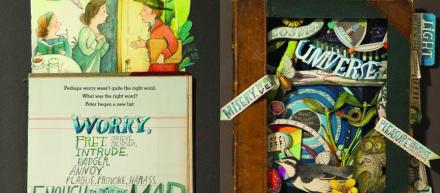
As a teenager Peter was shy, preferring to wander the London gardens alone, “making lists of all the plants and insects,” as in one of his favorite science books by Linnaeus. His “mother didn’t approve, and Peter told her not to worry—but “perhaps worry wasn’t quite the right word. What was the right word? Peter began a new list: Worry, fret, grieve, despair, intrude, badger, annoy, plague, provoke, harass. Enough to drive one mad. How wonderful it felt to find just the right word.”
Image copyright Melissa Sweet, 2014, text copyright Jen Bryant, 2014. Courtesy of Eerdmans Books for Young Readers.
An idea crept into Peter’s mind for a book where “all the ideas in the world could be found in one place,” and people could “find the best word, the one that really fit.” When Peter was 14 he entered medical school in Edinburgh, Scotland. Upon graduation at 19, his uncle told him that patients would be wary of a doctor so young. To gain a bit of experience and maturity, Peter became a tutor to two teenage boys.
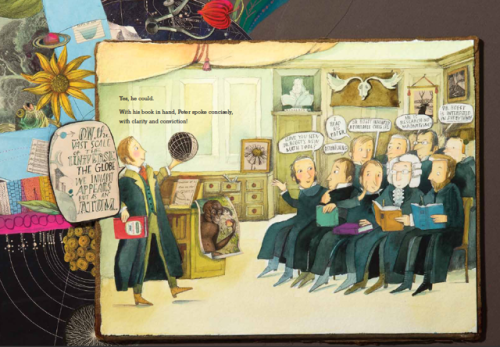
At last Peter set up his medical practice in Manchester, England, where he took care of the factory workers, who “were poor and often sick.” At night Peter worked on his book of lists, and in 1805 he declared it finished. “It had about one hundred pages, one thousand ideas, and listed more than fifteen thousand words!” Eventually, Peter moved back to London where he joined science societies and attended lectures. “Before long, he was asked to give lectures too,” and once-shy Peter astonished his audiences with his knowledge of math, magnetism, and other scientific subjects. He even invented a portable chess set.
Image copyright Melissa Sweet, 2014, text copyright Jen Bryant, 2014. Courtesy of Eerdmans Books for Young Readers.
When Peter was 45 years old, he married Mary Hobson, and they had two children, Kate and John. As he grew older, he visited fewer patients, but he continued to take walks and work on his lists. While some other writers had published their own word lists to help people “to speak and to write more politely,” Kate and John “thought their father’s book was much better. Peter agreed.” For three years he rewrote his book. “He made it larger, more organized, and easier to use. Long ago Peter had discovered the power of words. Now he believed that everyone should have this power—everyone should be able to find the right word whenever they needed it.”
Image copyright Melissa Sweet, 2014, text copyright Jen Bryant, 2014. Courtesy of Eerdmans Books for Young Readers.
“In 1852, Roget published his Thesaurus, a word that means ‘treasure house’ in Greek.” It was an instant best seller, and Peter became a popular author. But he never stopped making lists.
Following the text, a timeline of principal events in Peter’s life as well as world events allow readers to better understand the historical period in which Peter worked. Extensive Author’s and Illustrator’ Notes also expand on Roget’s biography, and resources for further reading and research are included.
Jen Bryant’s biography of a brilliant boy who grew up to give the world its most fascinating and comprehensive collection of word lists, is a spritely telling of Roget’s life and revelation into his personality, which was perfectly suited to his scientific and written accomplishments. Children will appreciate Roget’s reactions to his mother’s worries as well as the message in his well-rounded pursuit of science and writing. Through Bryant’s captivating and lyrical storytelling, children will be inspired by Roget’s journey from shy child to much-accomplished adult.
Image copyright Melissa Sweet, 2014, courtesy of Eerdmans Books for Young Readers.
Melissa Sweet beguiles readers with her mixed media, collage, and watercolor illustrations that are as jam-packed with ideas, images, portraits, and typography as Roget’s thesaurus is full of words. In the early pages describing Peter’s childhood, the pages contain simple framed pictures of Roget and his family. As he grows, however, his lists of words are transformed into vibrant artwork that jostles for position from corner to corner of the pages. In the midst of these, delicate watercolors portray Peter as he strolls through a garden, takes his young charges to Paris, treats his patients, lectures, marries, and finally publishes his thesaurus. A special mention must be made of the typography, which at times in the text runs down the center of the page in one- or two-word lines, mirroring Roget’s love of lists, and in the illustrations presents the myriad synonyms in a mixture of colorful block letters, fine print, and calligraphy.
For bibliophiles, wordsmiths, scientists, and history buffs, The Right Word: Roget and His Thesaurus is just the right book for home libraries.
Ages 6 – 18
Eerdmans Books for Young Readers, 2014 | ISBN 978-0802853851
Discover more about Jen Bryant and her books as well as news, contests, and events, visit her website!
Learn more about Melissa Sweet and her books and have fun with the downloadable activities you’ll find on her website!
Watch this The Right Word: Roget and His Thesaurus book trailer!
Thesaurus Day Activity
Word Words Word Search Puzzle
When you’re looking for just the right word, where do you go? To the thesaurus of course! Can you find the 25 synonyms for “Word” in this printable Word Words Word Search Puzzle? Here’s the Solution!
You can find The Right Word: Roget and His Thesaurus at these booksellers
Appreciate a Dragon Day was established in 2004 by author Danita K. Paul to celebrate the publication of her novel DragonSpell, the first book in her Dragon Keepers Chronicles series. The holiday now encourages all readers to get involved with reading through fun activities—dragon-themed, of course! Teachers, librarians, and all those who love reading can find lots of suggestions for creative ideas that encompass art, crafts, displays, drama, and many other mediums on Danita K. Paul’s website. So, round up your favorite dragon books and breathe some fire into your reading today!
The Book Dragon
Written by Kell Andrews | Illustrated by Éva Chatelain
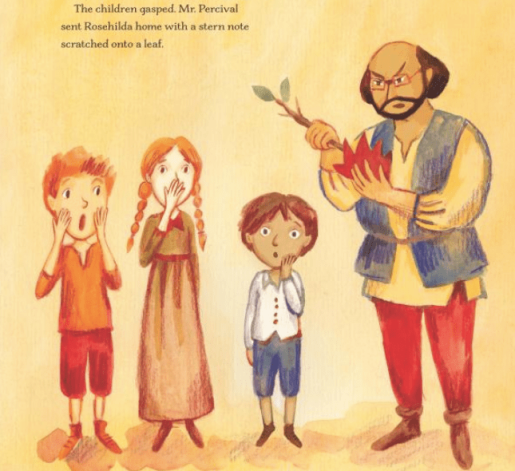
In Lesser Scrump, reading was a chore. To teach the alphabet, the schoolmaster, Mr. Percival, drew on tree trunks with bits of charcoal, scratched on slate with a rock, or drew in the dirt of the schoolyard. One day, Rosehilda said that “‘reading would be more fun if the letters and words were written as stories.’” She even suggested writing them with ink on papers that could be put together. The students were shocked and “Mr. Percival sent Rosehilda home with a stern note scratched onto a leaf.”
Image copyright Éva Chatelain, 2018, text copyright Kell Andrews, 2018. Courtesy of Sterling Children’s Books.
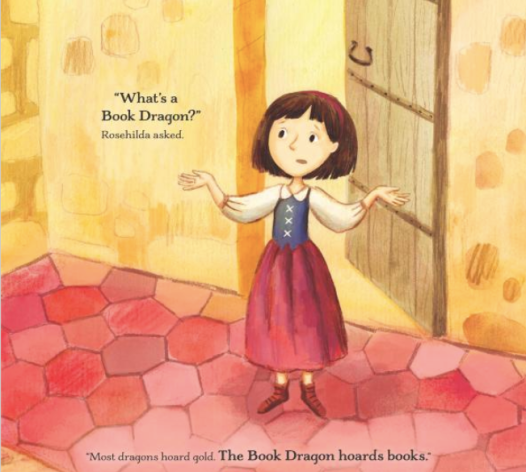
When Rosehilda got home she asked her grandfather what all the fuss was about. He told her about the Book Dragon, who instead of hoarding gold, collected books. Rosehilda had never heard of a book, and her grandfather explained that it was “letters and words written on papers that are attached together.” He pointed out the window to Scrump Mountain and told Rosehilda that the Book Dragon lived deep inside and stole any book brought into the village.
The next day at school, Rosehilda declared that the school needed books and that she was not afraid of the Book Dragon. Mr. Percival explained that after the dragon snatched a book, she terrorized the villagers the next night, and he sent her home again with another note etched into a candle stub. On the way home, Rosehilda met a peddler who had a book in her pile of wares. She gave it to Rosehilda in exchange for the candle stub.
Image copyright Éva Chatelain, 2018, text copyright Kell Andrews, 2018. Courtesy of Sterling Children’s Books.
That night Rosehilda read a story about a brave knight who defeated a dragon and won its hoard of gold. “For the first time, reading wasn’t tiresome. It was amazing!” In the morning, the book was gone. Rosehilda’s grandfather told her that they and all the villagers would have to lock their windows that night. Rosehilda felt guilty. “She vowed to challenge the dragon and win her book back.”
She went to the top of Srump Mountain and peered into the dragon’s cave. The Book Dragon was lying atop an immense pile of books. She looked surprised to see Rosehilda standing there. Rosehilda summoned her courage and demanded that the dragon return her book. The Book Dragon apologized and explained that because she was too big to live in the village, books were the only friends she had.
Image copyright Éva Chatelain, 2018, text copyright Kell Andrews, 2018. Courtesy of Sterling Children’s Books.
Rosehilda scolded the dragon for stealing so many books. The dragon said she only meant to borrow them, but when she tried to return them, the windows were locked and people screamed when she knocked. The dragon agreed to give Rosehilda her book back, but Rosehilda had a hard time finding it among so many books.
While searching for it, Rosehilda and the Book Dragon began stacking the books “by subject and author.” At the end of the day, they had plenty of piles and more books to sort, and Rosehilda hadn’t found her book. The Book Dragon suggested she borrow a different one. She read late into the night, and the next day she went back to the dragon’s cave to help sort books. She left with another book. This went on all week.
Image copyright Éva Chatelain, 2018, text copyright Kell Andrews, 2018. Courtesy of Sterling Children’s Books.
Finally, all the books were sorted and Rosehilda found her book. She was excited that she wouldn’t have to come back, but the Book Dragon looked sad and suggested that she “borrow another book…and come back tomorrow.” That gave Rosehilda an idea. The next day at school, Mr. Percival and the other students were horrified to see the dragon outside their window, but Rosehilda explained that she was just returning their books. Now the Book Dragon oversees the “Official Village Library of Lesser Scrump,” and everyone reads as much as they want!
Image copyright Éva Chatelain, 2018, text copyright Kell Andrews, 2018. Courtesy of Sterling Children’s Books.
Kell Andrew’s clever story will delight book lovers of all scales with its mix of fantasy, mystery, courage, and friendship. Fearless Rosehilda is a plucky role model for all kids, and the Book Dragon’s desire for company will melt readers’ hearts faster than a breath of fire. Andrew’s storytelling reflects the best of fairy tale lore for a modern audience, with touches of humor, mistaken motives, and a creative resolution.
Éva Chatelain bridges the medieval and the familiar in her bright illustrations that draw on the rich yellows, reds, and greens of leather-bound books, piles of gold, fiery emotions, and woodland villages. Chatelain introduces brave Rosehilda as she challenges her teacher and buys a book, but she also reveals the trepidation Rosehilda overcomes to confront the Book Dragon, showing readers that even the most courageous people can feel fear too. As Rosehilda reads her treasured book, kids’ suspense will quicken to see the silhouette of the dragon outside her window. The stacks of books that Rosehilda and the Book Dragon build are cunning references to library stacks, and the final images of a happy town and a happy (dragon) librarian will charm readers.
An enchanting story for book buffs, dragon devotees, and fairy tale fans, The Book Dragon would be a favorite addition to story times and home, classroom, and public libraries.
Ages 3 – 7
Sterling Children’s Books, 2018 | ISBN 978-1454926856
Discover more about Kell Andrews and her books on her website.
To learn more about Éva Chatelain, her books, and her art, visit her website.
Appreciate a Dragon Day Activity
Darling Dragon Matching Puzzle
In this group of darling dragons, each dragon has a twin. Can you help them find each other in this printable puzzle?
Hats are always stylish, and during this time of year they can be a necessity for keeping warm! No matter if you make your own hat or buy it in a shop, whether you like stocking hats, felt hats, hats with earflaps, or hats that just hide a bad hairdo, this is the perfect season to indulge your fashion fancies!
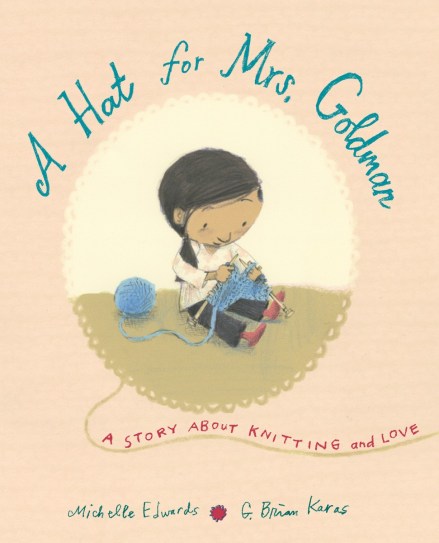
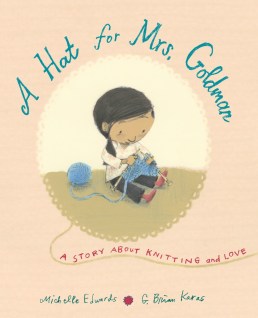
A Hat for Mrs. Goldman: A Story about Knitting and Love
Written by Michelle Edwards | Illustrated by G. Brian Karas
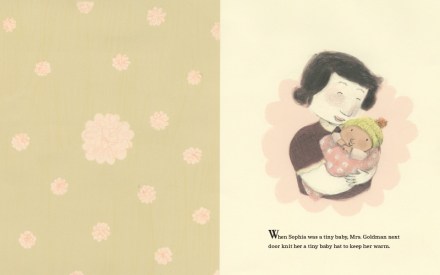
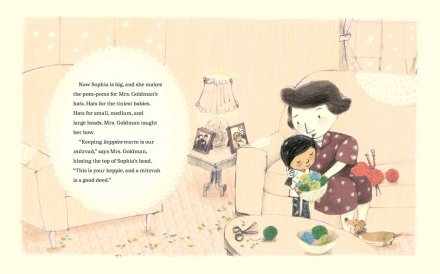
One of the first gifts Sophia received when she was a baby was a knitted hat from her neighbor Mrs. Goldman. Now that Sophia is more grown up, she helps Mrs. Goldman make pom-poms for the hats she knits for other babies, friends, and neighbors. “‘Keeping keppies warm is our mitzvah,’ says Mrs. Goldman, kissing the top of Sophia’s head. ‘This is your keppie, and a mitzvah is a good deed.’”
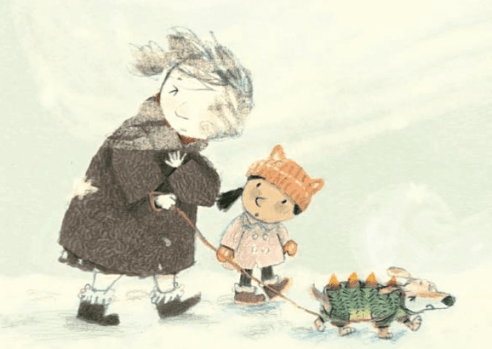
One day in late autumn Sophia and Mrs. Goldman walk Mrs. Goldman’s dog Fifi. While Fifi is kept warm in a dinosaur sweater and Sophia is cozy in the fuzzy kitten hat and mittens that Mrs. Goldman made them, Mrs. Goldman’s head and ears are unprotected in the icy wind. When Sophia asks her friend why she doesn’t have a hat, Mrs. Goldman tells her “‘I gave it to Mrs. Chen.’”
Image copyright G. Brian Karas, 2016, text copyright Michelle Edwards, 2016. Courtesy of Schwartz & Wade.
Sophia begins to worry about Mrs. Goldman. Who will knit a hat for her? “Not Mrs. Goldman. She’s too busy knitting for everyone else.’” Last year Mrs. Goldman had tried to teach Sophia to knit, but it was too hard and took too long, so she decided to stick with making pom-poms. But Sophia thinks maybe it’s time to try again. She goes to her knitting bag and pulls out the hat they had started together. “The stiches are straight and even. The soft wool smells like Mrs. Goldman’s chicken soup.”
Image copyright G. Brian Karas, 2016, text copyright Michelle Edwards, 2016. Courtesy of Schwartz & Wade.
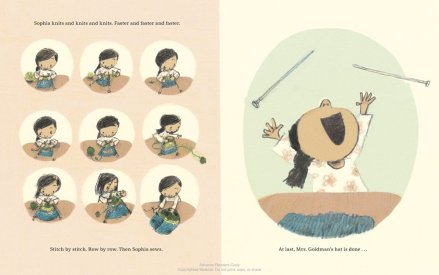
Holding the needles, Sophia thinks about what she was taught. Even though she drops stitches, she continues to knit. “She wants to make Mrs. Goldman the most special hat in the world.” The next day snow falls on Mrs. Goldman’s head as they walk Fifi. Sophia frets, and at home she begins knitting morning, noon, and night to finish her hat. Winter has set in and one day when the pair walk Fifi, “Mrs. Goldman wraps Mr. Goldman’s scarf around her head like she’s a mummy.” But the wind grabs it and rips it away. Sophia catches it, but shivers at the thought of how cold Mrs. Goldman must be.
Image copyright G. Brian Karas, 2016, text copyright Michelle Edwards, 2016. Courtesy of Schwartz & Wade.
At home Sophia knits in a frenzy, adding row after row of stitches until the hat is finished. When Sophia looks at it, though, she finds holes where they shouldn’t be and lumpy and bumpy areas. She thinks what she has made looks more like a monster than a hat. Sophia takes out the box containing all the hats Mrs. Goldman has made for her, but they are much too small for Mrs. Goldman to wear. While Sophia’s mama and papa have hats made by Mrs. Goldman, she knows she can’t give those away.
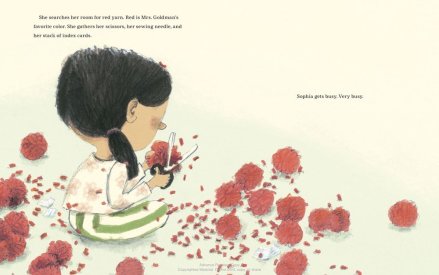
Sophia imagines all the hats she makes with her neighbor and how Mrs. Goldman always tells her that her pom-poms add beauty, and that “‘that’s a mitzvah too.’” Sophia’s heart swells. She finds red yarn—Mrs. Goldman’s favorite color—and her pom-pom making supplies and goes to work. When she is finished and the pom-poms are attached, “Mrs. Goldman’s hat is the most special hat in the world.”
Image copyright G. Brian Karas, 2016, text copyright Michelle Edwards, 2016. Courtesy of Schwartz & Wade.
Sophia runs next door and surprises Mrs. Goldman with her gift. Mrs. Goldman hugs Sophia and tears come to her eyes. “‘Don’t you like it?’” Sophia asks, but she needn’t worry. “‘I more than like it, I love it,’ declares Mrs. Goldman. ‘Gorgeous. Like Mr. Goldman’s rosebushes. And you know how I love his roses.’” With a kiss for Sophia, Mrs. Goldman begins counting the twenty pom-poms on her hat—“each one made with love.” Mrs. Goldman slips the hat on her head. Now when she and Sophia take Fifi for a walk, Fifi wears her dinosaur sweater, Sophia wears her kitty hat and mittens, and “Mrs. Goldman wears her Sophia hat. Her keppie is toasty warm. And that’s a mitzvah.”
Image copyright G. Brian Karas, 2016, text copyright Michelle Edwards, 2016. Courtesy of Schwartz & Wade.
Michelle Edwards’ heartwarming story of a little girl who sees that her friend is in need and determines to help draws on children’s natural generosity and shows readers that their efforts are recognized and appreciated. Edward’s gentle and well-paced storytelling allows readers to understand the events and thoughts that bring Sophia to once again attempt knitting. Sophia’s solution to use the pom-poms she knows she makes well (and with love) to cover the holes demonstrates not only the ingenious creativity of kids, but also the idea that love can fill the voids in life.
Image copyright G. Brian Karas, 2016, courtesy of Schwartz & Wade.
Brian Karas imbues the story of Sophia and Mrs. Goldman with a magical wonder that floats from page to page like the fluffy snowflakes that are the catalyst for Sophia’s mitzvah. A combination of full-page illustrations and snapshot images show days spent with Mrs. Goldman as well as the moments, hours, and days that adorable Sophia spends knitting her special hat. Sophia, tongue sticking out in determination, wields her knitting needs; she ponders her holey hat while imagining a frightened Fifi; and scraps of red yarn dot the floor and even sit atop Sophia’s head as she creates pom-pom after pom-pom. When Mrs. Goldman pulls the hat over her own head, kids will feel cheered, while adults may feel a small lump in their throat.
A Hat for Mrs. Goldman: A Story about Knitting and Love is a gem. Its tender portrayal of kindness, love, and close personal relationships makes it an outstanding choice for any child’s home library.
Ages 4 – 8
Schwartz & Wade, 2016 | ISBN 978-0553497106
Discover more about Michelle Edwards and her books, plus activities, recipes, and information on knitting on her website!
Enter a gallery of books, sketches, blog essays, and more by G. Brian Karas on his website!
National Hat Day Activity
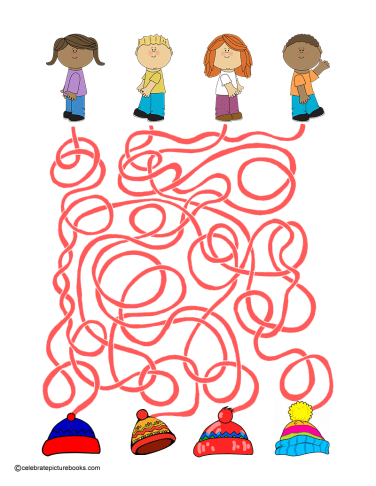
Winter Hat Match Puzzle
These kids have all lost their hats! Can you follow the paths in this printable Winter Hat Match Puzzle to reunite each child with the right hat?
You can find A Hat for Mrs. Goldman: A Story about Knitting and Love at these booksellers