Instituted in 2007 by the Encouragement Foundation at Harding University in Searcy, Arkansas, today’s holiday entreats us to cheer on our friends, coworkers, and even those we don’t know as they attempt to reach goals or start new endeavors. A pat on the back, a simple “you can do it!,” or a reassuring “great job!” boosts people’s self-confidence and makes the world a happier place.
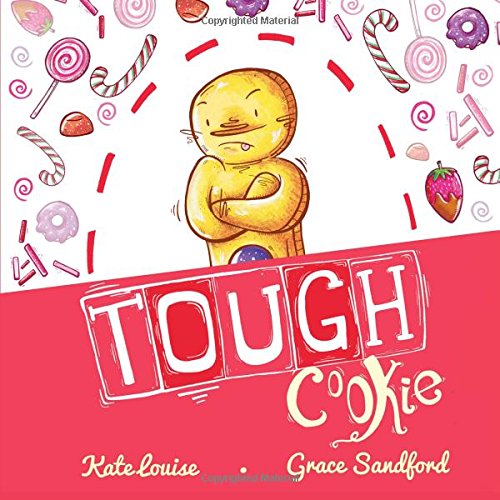
Tough Cookie
Written by Kate Louise | Illustrated by Grace Sandford
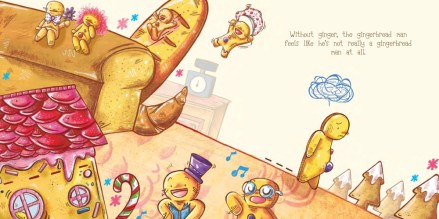
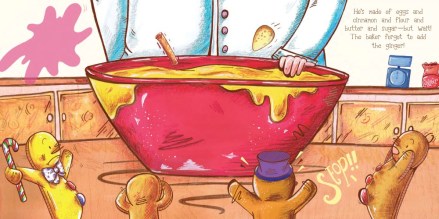
Although one gingerbread man in the bakery looks like all the others, there is one important difference. Yes, the batter had “eggs and cinnamon and flour and butter and sugar—but wait! The baker forgot to add the ginger!” Without this signature ingredient the gingerbread man just doesn’t feel like a gingerbread man at all. In fact his whole life has been turned upside down. He’s different from his friends, and what’s worse, he can’t be sold. Instead, he lives in the back of the bakery and in his sadness makes all kinds of mischief.
Image copyright Grace Sandford, text copyright Kate Louise, courtesy of Sky Pony Press
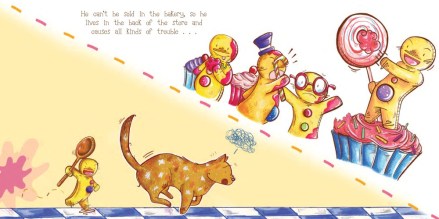
The gingerbread man chases the cat, splatters icing on other cookies, and squirts icing on the walls. “‘I need that for my cupcakes!’” the baker yells, but the gingerbread man just laughs. He moves on to the decorative candies, stuffing them in his mouth as fast as he can even though the baker needs them for his other treats and stands by tapping his foot. Next the gingerbread man scatters sprinkles all over the counter and slips and slides along on his belly—“‘woohoo!’” But the baker is not amused. “‘I need those for the donuts!’” he shouts.
Image copyright Grace Sandford, text copyright Kate Louise, courtesy of Sky Pony Press
Finally, the baker has had enough. Not only is the gingerbread man upsetting the other gingerbread men and women, he is ruining the business. The baker orders the gingerbread man to leave the store. But this is one gingerbread man that does not want to run away. “‘I don’t want to leave!’” he cries. The baker relents. He takes the little cookie in hand and teaches him that even though he is missing an ingredient he can still be kind. The baker shows him by being nice he can become one of the group.
Now, the little gingerbread man is happy. Instead of gobbling up all the candy, he helps create the other cookies. He no longer shoots icing on the walls or flings sprinkles around the kitchen. Rather, he helps the baker decorate the cupcakes and the donuts. He’s even learned how to sift flour and roll out dough, and he uses the cookie cutter to make new friends. And he never forgets to add the ginger!
Image copyright Grace Sandford, text copyright Kate Louise, courtesy of Sky Pony Press
Grace Sandford’s bakery gleams with the golden hues of fresh-baked bread, the festive colors of sprinkles and icing, and the sparkle of sugar. Kids will love the vibrant pictures of cupcakes; lollypops; stacks of cakes, donuts, and candy; and decorated gingerbread houses surrounded by cookie forests. Her expressive gingerbread men and women register dismay at the wayward gingerbread man’s shenanigans and joy at his kindness. And the hero of the story? When he leaves behind his impish pranks he becomes a charming baker’s companion, sifting clouds of flour, running on the rolling pin to flatten dough, and passing out sugar-shiny gumdrop buttons to his new friends.
Young children will ask for this fun and funny read over and over. Tough Cookie makes an especially delicious accompaniment to an afternoon of baking or decorating gingerbread houses!
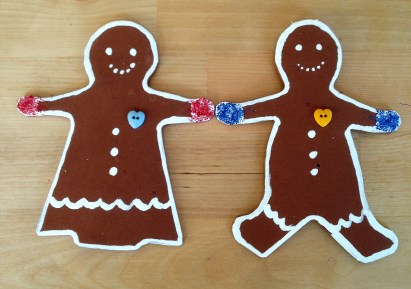
Way back in the past when gingerbread was new it was creatively iced and used to decorate windows. You can make decorations for your home or room with this easy craft!
Today’s observance was established in 1994 to promote family and community involvement in teaching and supporting children to read more. Family members can make reading a priority at home by sitting down together every day with a wide range of books and other reading material. By taking trips to the library and bookstores, children will also naturally pick up a love of reading. But families can’t do it alone. Kids acquire a drive to read when they see connections between books and their wider world. Fun book-related activities at schools, libraries, science centers, museums, and other places capture children’s attention and make them curious about reading more. Whether children are attracted by fiction or nonfiction, picture books or chapter books, novels or graphic novels, they should be encouraged to read. Universal literacy is a goal that can be accomplished.
About Small Talk Books®
Ellen Mayer’s Small Talk Books® feature young children and adults conversing (or adults speaking to children who are not talking yet) while they have fun, do chores, shop, and bake together. Their conversations demonstrate the kind of excitement and close relationships that encourage learning and language advancement. Each Small Talk Book® includes an accompanying note from Dr. Betty Bardige, an expert on young children’s language and literacy development and the author of Talk to Me, Baby! How You Can Support Young Children’s Language Development. The introduction discusses how children connect actions, words, and meaning as adults speak to them while doing particular jobs or actions.
Other titles in the Small Talk Books® series include Cake Day and Rosa’s Very Big Job. Each book makes a wonderful gift for baby showers, new parents, or anyone with young children in the family. They would be a welcome addition to any young child’s bookshelf as well as libraries and preschool classrooms.
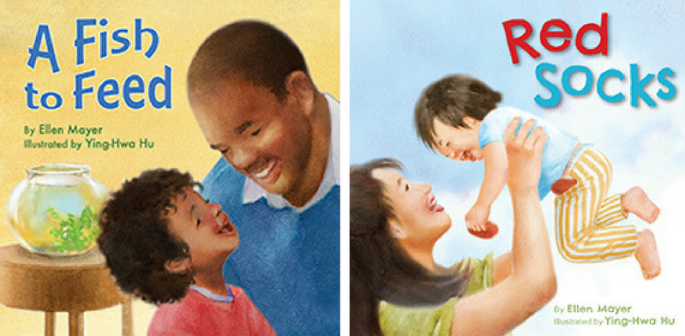
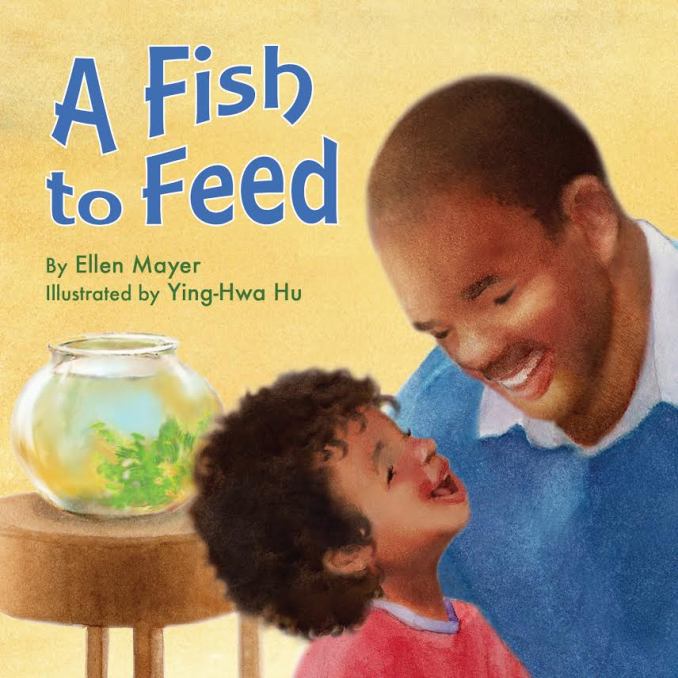
A Fish to Feed
Written by Ellen Mayer | Illustrated by Ying-Hwa Hu
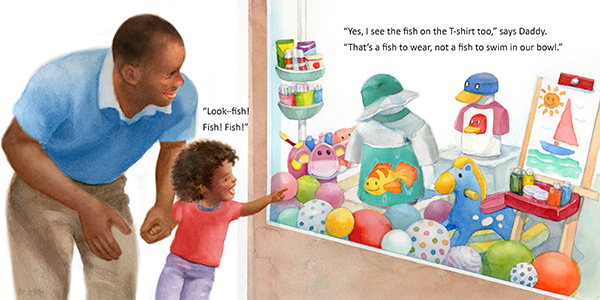
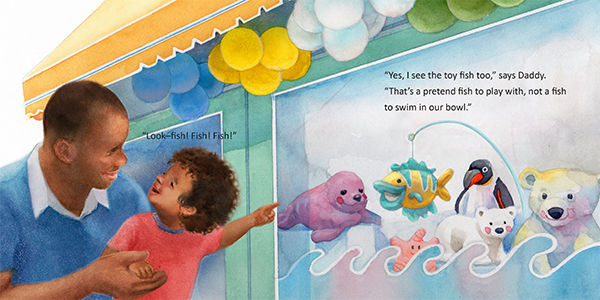
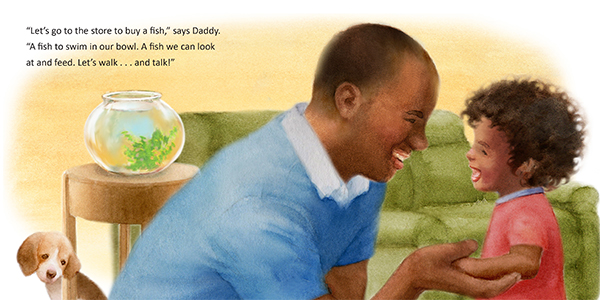
Dad plans a fun trip into town with his young child to buy a pet fish. He says, we will get “a fish to swim in our bowl. A fish we can look at and feed.” The pair are excited to go together and have time to “walk…and talk.” The two head out and soon pass a store. In the window the child sees a T-shirt with the picture of a fish on it and points. “Look—fish! Fish! Fish!” Dad reinforces the observation—“Yes, I see the fish on the T-shirt too.”—and further explains: “That’s a fish to wear, not a fish to swim in our bowl.”
Image copyright Ying-Hwa Hu, text copyright Ellen Mayer. Courtesy of starbrightbooks.com
Going into the store, Dad and his youngster find another item with a fish on it. On a shelf is a backpack with a picture of a gold-and-yellow fish on the front pocket. This is a “fish to wear on your back,” Dad says, before going in search of a “fish to feed.” Next, the two come to a toy store. The child points to another fish—a fish on a mobile. “Look—fish! Fish! Fish!” the toddler exclaims. Dad affirms his child’s remark and expands on it using complete sentences that model conversation and increase vocabulary. They linger in the shop, finding other examples of fish.
Image copyright Ying-Hwa Hu, text copyright Ellen Mayer. Courtesy of starbrightbooks.com
“‘Now let’s go find a fish to feed,’ says Daddy.” They head out of the store and continue down the street. As they come to the Pet Shop, the little one shouts, “‘Look—fish! Fish swim!” Daddy echoes the excitement while praising his child. “‘You found a fish that swims!’” They take the goldfish home, where it swims happily in their bowl—a pet they “can love and feed.”
A Fish to Feed contains die-cut holes in the pages that kids will love peering through as they shop along on this adventure to find a special pet.
Image copyright Ying-Hwa Hu, text copyright Ellen Mayer. Courtesy of starbrightbooks.com
Ellen Mayer’s story of a dad and his child out for an afternoon together as they look for a pet to love offers adults and children such a sweet way to spend time with one another. The story, set in the familiar environments of home and stores and revolving around a close parent-child relationship, will engage even the youngest readers. The back-and-forth conversation between Dad and his child as they shop models ways in which adults can follow a child’s lead while providing language and literacy development. The abscence of gender-specific pronouns makes this a universal story.
Ying-Hwa Hu’s illustrations are vibrant and joyful. When Dad bends down to be at eye-level with his toddler as they talk, the close bond between them is obvious in their smiling and laughing faces. The shops are full of colorful toys, clothes, backpacks, and other items that will capture kids’ attention. Spending time looking at each page allows adults and children to point at the various items, name them, and talk about them.
Ages Birth – 5
Star Bright Books, 2015 | ISBN 978-1595727077
Red Socks
Written by Ellen Mayer | Illustrated by Ying-Hwa Hu
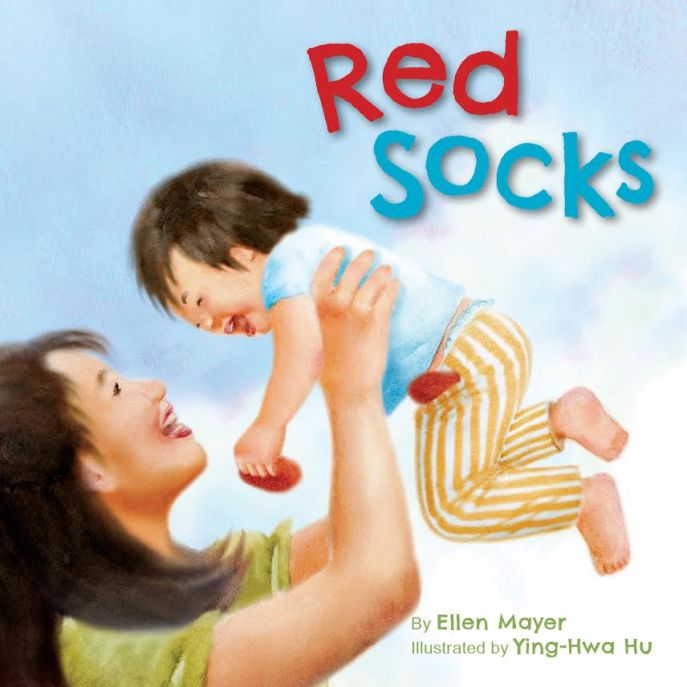
It’s laundry day and the clothes are all dried and soft and ready to wear. “‘Here is your blue shirt, with the goldfish on it,’” Mama says, pulling the top out of the basket and bending down to eye level to show it to her baby. Next, Mama describes the “yellow and white striped pants” she puts on her child. “‘Let’s see what else is in the laundry basket,’” she says.
Image copyright Ying-Hwa Hu, text copyright Ellen Mayer. Courtesy of starbrightbooks.com
Mama pulls a tiny red sock from the basket, but—“UH-OH!—where is the other red sock?’” Now it’s the baby’s turn to help. With a look down, the toddler shows Mama where the sock is. “‘You found the other red sock. Yay!’” she says, giving words to the baby’s action. She continues explaining while pointing to the sock poking out of the baby’s pocket: “‘It was hiding in your pants pocket!” Once the laundry is folded, Mama tells her child exactly what they will do next while she playfully slips the other red sock on the baby’s wiggling feet. “‘Let’s put that other sock on your foot. Then we can go play outside.’” As the baby flies in the swing outside, the red socks are brilliant dots against the blue sky.
Image copyright Ying-Hwa Hu, text copyright Ellen Mayer. Courtesy of starbrightbooks.com
Ellen Mayer’s simple and charming story of a particular moment in a mother and child’s day will immediately appeal to even the youngest reader. Familiar words coupled with clear, vivid illustrations will engage toddlers who are pre-talking and just learning language and concept development. The mother’s use of complete sentences as well as step-by-step descriptions of the activities the child sees and is involved in demonstrates how adults can converse with their babies and young children to encourage strong language and literacy skills. Free of gender-specific pronouns, Red Socks is a universal story.
Ying-Hwa Hu’s illustrations show a mother and child interacting on a typical day while they complete common chores and go outside to play. The mother and child portray a range of emotions and gestures, giving further depth to the understanding of the ideas and conversation presented. Kids will giggle at the adorable puppy who causes a bit of mischief on each page.
Ages Birth – 5
Star Bright Books, 2015 | ISBN 978-1595727060
To learn more about Ellen Mayer and her Small Talk Books® (including other titles: Cake Day and Rosa’s Very Big Job) as well as to find activities to accompany each book, visit her website!
Discover more about Ying-Hwa Hu and view a portfolio of her illustration work on her website!
Red Socks and Too Small to Fail
Red Socks was chosen by Too Small to Fail, an early literacy initiative of The Clinton Foundation to feature in their Wash Time is Talk Time project. Wash Time is Talk Time serves underserved communities and provides resources to turn time spent at the laundromat into an opportunity for families to talk together, read together, and learn together. Language-rich literacy resources will be delivered to more than 5,000 laundromats across the country.
Here’s a video from one fun afternoon with families, Ellen Mayer, and Ying-Hwa Hu during wash time!
National Family Literacy Month Activity
Child’s Sensory Board
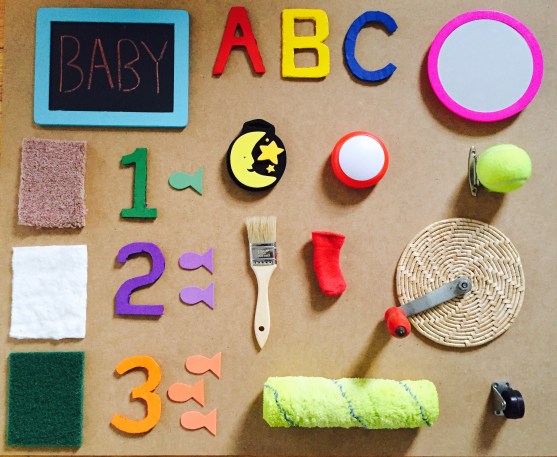
Toys or objects that provide many opportunities for sensory experimentation and observation stimulate a baby and young child to learn while having fun. You can make a sensory board for your own child using household items and that have a variety of textures, sizes, shapes, and movement. When you create your own sensory board, you can personalize it for your child by adding their name, pictures of family members, and other special items. While you play with your child, take time to talk about all of the objects on the board, what they do, and how they work. Count the objects. If you include words or your child’s name, spell them outloud and say them. There are so many ways to use a sensory board. Even if children can’t yet talk, they are listening and soaking in the rich language learning you are providing!
**When making your board always ensure that you use items that are not a choking hazard or can catch tiny fingers. Make sure that items are firmly attached to the board. Never leave a baby unattended while playing.**
Supplies
A board large enough to hold the items you want to attach. Boards that can be used include: those found at hardware stores or craft stores; large cutting boards; shelves; old table tops; etc.
Sample items for your sensory board can be age appropriate and include:
Large swatches of various textured material. (I used fur, a scrubbing sheet, and a piece of carpeting)
Wooden or thick cardboard letters and numbers, painted in a variety of colors. Letters can be used to add a child’s name to the board.
Figures cut from sheets of foam or wooden figures found at craft stores in a variety of numbers that you can count with your child (I used sets of 1, 2, and 3 fish cut from foam to go along with the numbers 1, 2, and 3)
Mirror
Push button light
Chalk board to write on
Castor or other wheel
Door latches
Door knockers
Mop heads
Paint rollers
Cranks
Drawer handles
Hinges (I attached a tennis ball to a hinge that children can push back and forth)
Pulleys
Paint in various bright colors
Paint brushes
Scissors
Screws
Nuts and bolts
Velcro
Super glue
Directions
Assemble your items
Paint wooden or cardboard items
Arrange item on the board so that your baby or child can easily reach or manipulate each one
Attach items with screws, nuts and bolts, or super glue
Push button lights or other objects that take batteries can be attached with strong Velcro. Ensure items attached with Velcro are large and not a choking hazard.
Set up board where you and your baby or child can enjoy playing with it together
French toast is special breakfast treat that has been enjoyed at least as far back as the 4th century, and according to an ancient Latin recipe has always been made in the same way. While the recipe—bread dipped in egg and fried, then topped with syrup, fruit, or (my particular favorite) cinnamon sugar—may have stayed the same, this delicious concoction has gone by many names. Whether you call it French toast, eggy bread, poor knight’s pudding, German toast, Bombay toast, or pain perdu, though, you know what to do on today’s holiday!
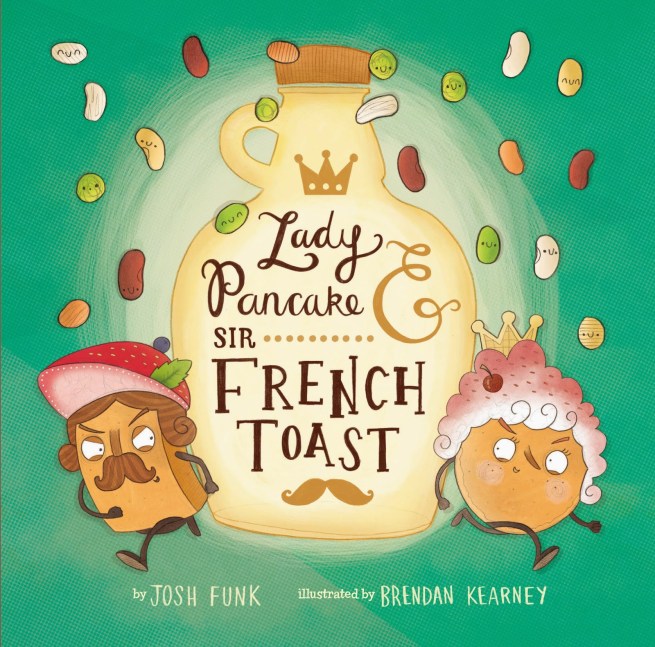
Lady Pancake and Sir French Toast
Written by Josh Funk | Illustrated by Brendan Kearney
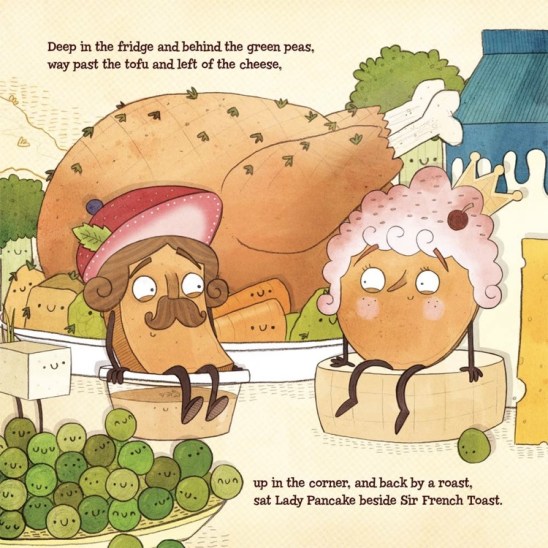
You know those strange noises you sometimes hear coming from your refrigerator? And how you could have sworn the leftovers were on the top shelf? Well, Josh Funk’s Lady Pancake and Sir French Toast may solve those mysteries and more in this rambunctious tale about what happens when relationships grow frosty.
Image copyright Brendan Kearney, text copyright Josh Funk. Courtesy of Sterling Children’s Books
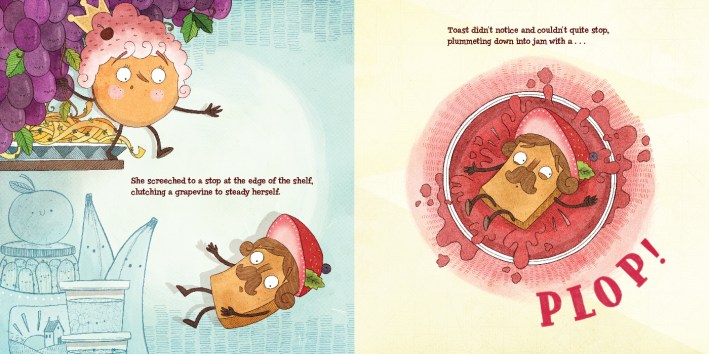
One day Lady Pancake and Sir French Toast are hanging out at the back of the fridge when they learn the syrup is almost gone. Lady Pancake claims it as her own, but Sir French Toast replies, “Not if I get there first!” And so off they race! “Through Broccoli Forest, past Orange Juice Fountain, they climbed to the top of Potato Mash Mountain.” But the race takes a turn as the two meet obstacles that are no fun at all: at the edge of a shelf “Toast couldn’t quite stop, plummeting down into jam with a plop.” And “Chili Lagoon slathered Pancake in muck and then at a fork in the road she got stuck.”
Image copyright Brendan Kearney, text copyright Josh Funk. Courtesy of Sterling Children’s Books
The one-time friends call each other names and taunt each other with boasts of being the best breakfast food. As their competition upends the peace of the whole refrigerator from shelf to shelf, Lady Pancake and Sir French Toast find their energy wilting, and by the time they reach that sweet sought-after prize, they are “battered and soggy, exhausted and crumbling, too tired to push, they were limping and stumbling.”
With the bottle in sight, they are shocked to discover that the last drop of syrup is already gone. Who could have done this dastardly deed? None other than the sneaky Baron Von Waffle! With nothing to gain, Lady Pancake and Sir French Toast no longer have a reason to fight. In fact they realize that they lost out on the syrup because they were fighting. When they see that there is a little butter left, they decide to use the lesson they learned and share it.
Image copyright Brendan Kearney, courtesy of Sterling Children’s Books
There are so many fantastic rhymes in this book that kids will want to hear again and again. One of my favorites comes as Sir French Toast catches up to Lady Pancake: “He scraped himself off and yelled up, / ‘You’re a meanie!’ / as Pancake rappelled / down a rope of linguini.” With such laugh-inducing verses, kids may never look at food the same way again. Josh Funk has created a tale about friendship that is both boisterous and unique and sure to quickly become a favorite.
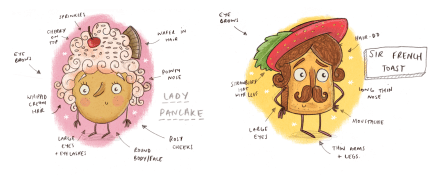
The refrigerator world as envisioned by Brendan Kearney is as colorful as the food rainbow and as active as a playground in summer. It’s also stacked with the cutest array of legumes, yogurt, cake, juices, fruit, and veggies you’ll find anywhere. The final fold-down page of the entire refrigerator is a delight that kids of all ages will want to linger over even after the story of The Great Race between Lady Pancake and Sir French Toast is over.
Ages 5 and up
Sterling Children’s Books, 2015 | ISBN 978-1454914044
Visit Josh Funk’s Website to download a free Lady Pancake and Sir French Toast Activity Kit and to learn about more upcoming titles!
Discover more art and books byBrendan Kearneyon his website!
Watch the trailer for this amazing race – you’ll be singing the Lady Pancake & Sir French Toast theme song in no time!
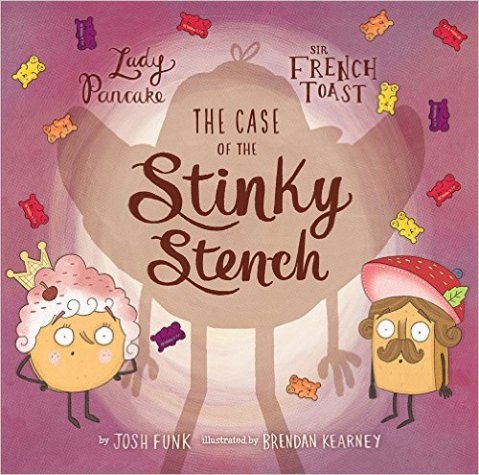
Love Lady Pancake and Sir French Toast? You butter get ready for more fun with their next adventure: The Case of the Stinky Stench, coming in May 2017!
National French Toast Day Activity
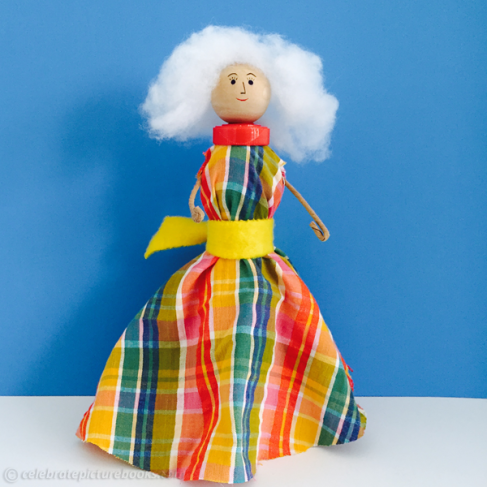
Sweet as Syrup Figure
Fun shouldn’t be kept bottled up! Well…maybe just this once. Make your own figure to display or play with from a syrup bottle with this craft. It’s sure to be as sweet as you are!
Supplies
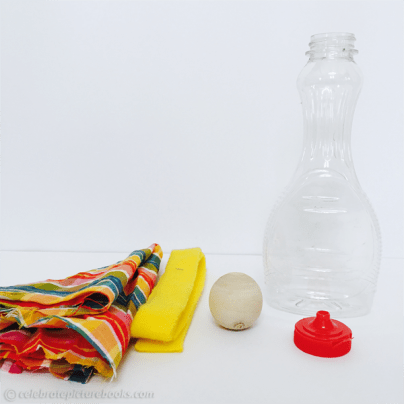
Small plastic syrup bottle with a narrow squeeze fliptop and without a handle, empty
1 ½-inch wooden ball with ½-inch hole in bottom
16-inch to 18-inch square piece of cloth
Ribbon or strip of material
12 to 14-inch long medium-gauge craft wire
Gel pens, black, blue, brown, red (Gel pens work well on the wood as the ink doesn’t bleed into the wood and are easy to control)
Poly fill or needle-felting wool
Scissors
Strong glue
Directions
To prepare the bottle
Remove labels from syrup bottle
Cut the flip top in half, keeping the narrow nozzle part
To make the head
Holding the wooden ball with the hole at the bottom, draw a face on the wooden ball with the gel pens
Glue a small handful of poly fill or needle-felting wool to the top of the wooden ball for hair. You can make the hair has long, short, or poofy as you wish.
To make the dress
Cut a 16-inch diameter circle from the material
To assemble the figure
To make the arms, wrap the wire around the neck of the syrup bottle, crossing it in the back and pulling tight
Center the material over the opening of the syrup bottle
Cut tiny slits in the material at the location of the wire on each side of the bottle, and pull the arms through the material
Bend the ends of the wire into a small loop to form hands
Screw the cap with the narrow nozzle over the material
Tie the ribbon or strip of material around the narrow part of the bottle to make the figure’s waist
Place the hole in the wooden ball over the nozzle in the cap and glue into place
This week we celebrate families. Yes, those people you may just have seen at the Thanksgiving dinner table—those people that you love even as you sometimes wonder if you’re really related. National Family Week was established in 1968 by Sam Wiley, a former teacher and administrator from Indianapolis, Indiana. In 1970 Wiley partnered with the Alliance for Strong Families and Communities. The aim of the Alliance and this designated holiday is to “build community connections and honor those who strengthen families.” Today, tell your family members how much they mean to you and plan some fun activities that include all!
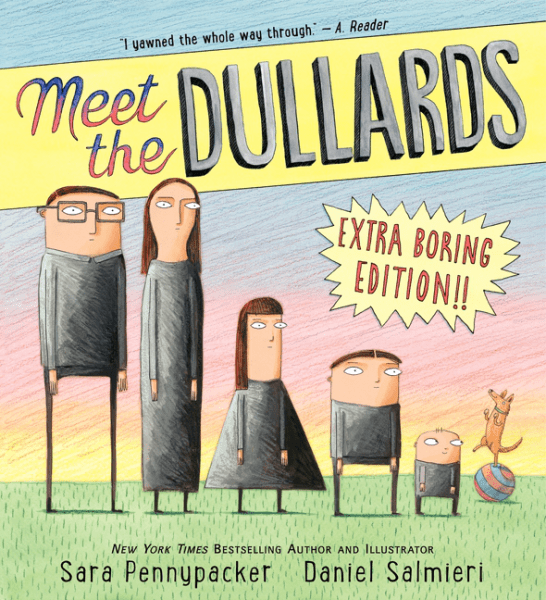
Meet the Dullards
Written by Sara Pennypacker | Illustrated by Daniel Salmieri
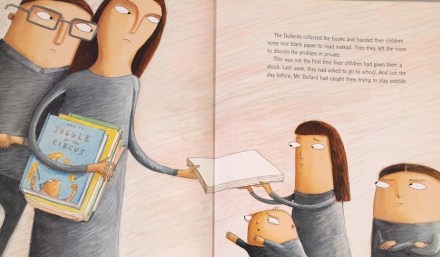
Gray—that’s what the Dullards are. Gray and happily extra boring. Their life is going on in its monotonous way until one day when Mr. and Mrs. Dullard happen upon a most disturbing sight. Their three children are reading—and not only that, they are reading books about befriending lions, juggling, and walking a tightrope. The elder Dullards do what any self-respecting dullard would do. They retrieve the books and hand their children blank pieces of paper to read instead.
Image copyright Daniel Salmieri, text copyright Sara Pennypacker. Courtesy of danielsalmieri.com
The children are definitely becoming a problem. They want to go to school and have been playing outside. It’s not our fault, bemoan the parents; it must be the town, where last fall some leaves actually turned color and there’s that unruly snail in the driveway. In fact the whole atmosphere is like a circus! There’s only one thing to do. The Dullards pack up their house and Blanda, Borely, and Little Dud and move away.
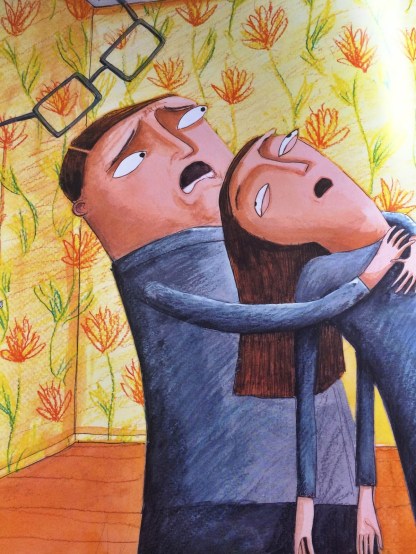
Immediately upon moving into their new home, they are bombarded by the neighbor lady bringing exclamation marks and chunky applesauce cake into their perfectly dull new home. The kids are sent to watch the (unplugged) TV, but instead their eyes are drawn to the window. While unpacking Mr. and Mrs. Dullard discover a sight so shocking that Mrs. Dullard faints into the arms of her distressed husband. It’s yellow flowered wallpaper. (An exclamation mark would be appropriate here, but you know…)
Image copyright Daniel Salmieri, courtesy of harpercollins.com
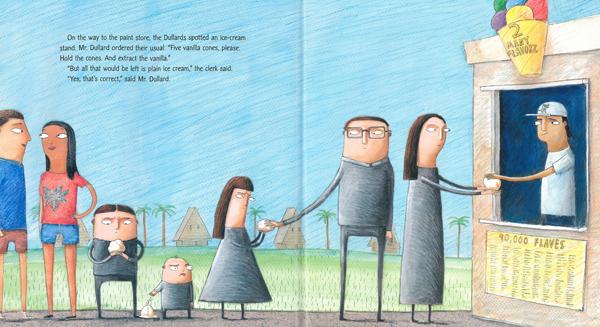
On the way to the paint store the family stops to get ice-cream cones, and with 90,000 flavors to choose from they pick vanilla. Plain cone or sugar cone? No cone, of course. At the paint store Mr. Dullard suggests medium gray, but Mrs. Dullard deems it too risky. Its similarity to highways could make the kids think of travel. Beige? Mrs. Dullard counters. Too much like clay, says Mr. Dullard which can be used to create stuff. They come to a compromise and go home to—you’ve got it—watch the paint dry.
Image copyright Daniel Salmieri, text copyright Sara Pennypacker. Courtesy of harpercollins.com
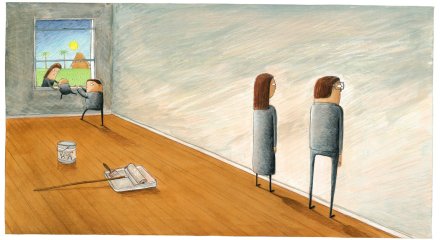
While their parents are mesmerized the kids sneak away and out the window that so enthralled them before. The sight of Blanda, Borely, and Little Dud juggling, teaching a dog tricks, and somersaulting on the clothesline, ushers in another move—back to where they came from just in time for the kids to join the circus.
Image copyright Daniel Salmieri, courtesy of harpercollins.com
With dry wit and laugh-out-loud dialogue Sara Pennypacker delivers a spot-on family story. While seen through the eyes of Mr. and Mrs. Dullard, this funny tale is all about the kids. What kids don’t think their parents are dull and conventional? And can parents really understand what’s going on in those little minds? Both children and adults will love the Dullards, and after reading you may be inspired to go out for vanilla chocolate ice-cream (ok, you can still hold the cone!).
Daniel Salmieri’s Dullards are comic genius! With their oval bodies and gray attire they blend with their oatmeal-hued walls to perfect effect. Identical square houses give way to identical triangular houses as the Dullards move to avoid catastrophic enthusiasm. The kids’ facial expressions as they adhere to booorring rules are priceless, as are the parents’ reactions to the slightest excitement. Details such as a yellow snail in the driveway, the elder Dullards’ looks of horror when discovering the bright wallpaper, the signs on the ice-cream kiosk, and the name of the moving van provide humorous jokes on each page.
Ages 4 – 8
Balzer + Bray, Harper Collins, 2015 | ISBN 978-0062198563
Visit Sara Pennypacker‘s virtual studio to learn more about her, her books, and her thoughts on writing and literacy.
View a portfolio of Daniel Salmieri‘s artwork for picture books and other illustrations on his website!
National Family Week Activity
Paint Strip Inspiration
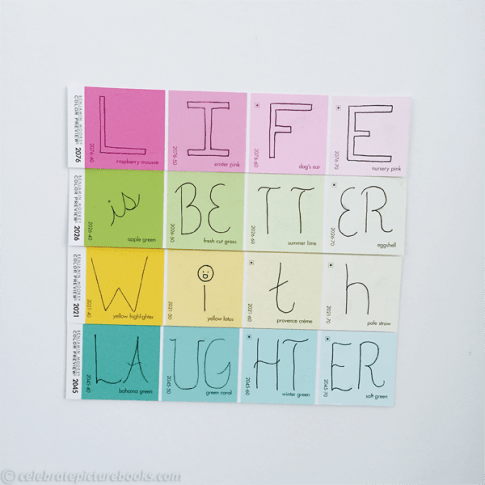
Do you like to laugh? Do you like to watch paint dry? It is kind of cool how it changes color a bit as it dries….Oh, sorry! Where was I? Oh yeah—this craft. Paint sample strips make brilliant backdrops to your thoughts about love, life, laughter, family—anything! You can mix and match your favorite colors and arrange them any way you like to decorate your wall. Frame them for a more put-together look!
Supplies
4 -5 paint strips from a hardware store OR You could also make your own color stips with poster board and craft paint
Poster board
Craft paint
Paint brush
Markers or adhesive letters
Scissors
Mounting squares
Frame (optional)
Directions
Choose an inspirational or funny quotation or make up your own phrase
Decide how you would like the words displayed on the paint strips
Count how many paint strips you will need
If you are using paint strips from a paint or hardware store, choose the number of color strips that you need and write the letters and/or words of your phrase into the individual squares. You can print one letter per square or multiple letters or even whole words. Mix styles of print to give it your own unique look.
If you are making your own paint strip, cut poster board into strips 9 inches long by 2 inches wide, or to desired size
Paint squares of color to fill the strip, leaving a 1/8-inch-wide stripe between colors
Think of a phrase that expresses your thoughts on life and laughter OR use a favorite quotation
Print the words on the squares of color OR use adhesive letters. You can print one letter per square or multiple letters or even whole words. Mix styles of print to give it your own unique look.
Picture Book Month is an international literacy inititive put together by a group of authors and illustrators to raise awareness of the importance of print picture books. Througout the world libraries, schools, booksellers, authors, illustrators, and those who love picture books celebrate the wonder of this art form enjoyed by children and adults. The complexity of picture books is astounding. They contain some of the most beautiful art and compelling stories being created today. To learn more about the importance of the picture book visit Picture Book Month: A Celebration! to find daily posts by authors, illustrators, and experts in the field as well as fun activities!
The Whisper
By Pamela Zagarenski
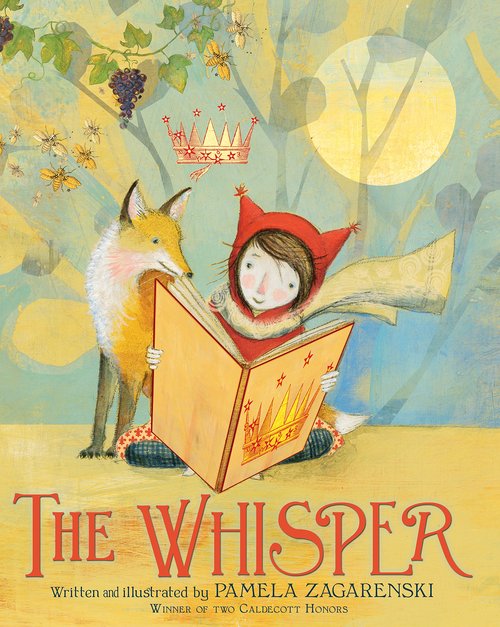
A little girl loves stories and the magical realms they can take her to. One day while waiting for school to be dismissed, she spies a book on a shelf. Her teacher allows her to take it home with her, and the little girl happily runs off with it when the clock strikes 3:00. On the way home, she doesn’t notice that all the letters are escaping from the book or that a wily fox is catching them in a net.
At home she secludes herself in her room, excited to read the mysterious book. She turns the pages, awed by the beautiful pictures. But by the time she has finished, she has tears in her eyes. “Where were the words? Where were the stories?” The girl flips through the book again, but this time she hears a small whisper: “Dear little girl, don’t be disappointed. You can imagine the words. You can imagine the stories.”
Copyright Pamela Zagarenski, courtesy of Houghton Mifflin Harcourt
The whisper seems so knowing that the girl does at it suggests. She turns to the first page where a blue bear followed by a beekeeper walks under a honeycomb sun toward a brown bear. The girl stares at the picture and thinks of a title: Blue Bear’s Visit. Her story begins: “Blue Bear arrived on the first day of spring. He promised…”
Warming to the idea of creating stories, the girl examines the second picture. She notices the same white rabbit that was in the first picture. In the foreground a “magnificent ox” is listening to a man whispering into its large, soft ear. The Secret, the little girl titles this story, which starts: “Mr. Ox, you must please promise not to tell anyone, but we need your help. Last week…”
Copyright Pamela Zagarenski, courtesy of Houghton Mifflin Harcourt
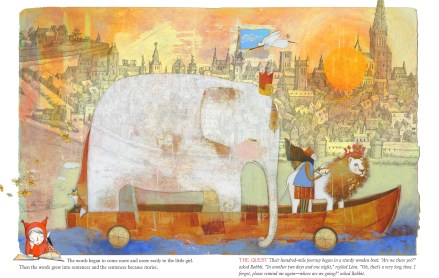
With the third picture the words tumble out more easily, forming sentences that give life to the massive white elephant, regal lion, and that rabbit again who are traveling the sea in a long, open boat. The Quest, she calls it. In Tigers Prayer, preparations are being made: tea is brewing, a clown with a pointed hat plays his accordion, a windhorse jumps through hoops, and the rabbit rides a golden ring as a lion hears what Tiger has to say. A Birthday Party comes next, and it seems Pan has planned a very secret party. An owl perches in the crook of a tree asking for the password with a “Hoo, Who?” which is answered quickly because the vanilla cake with raspberry filling and vanilla cream frosting holding 6 candles must be delivered.
Copyright Pamela Zagarenski, courtesy of Houghton Mifflin Harcourt
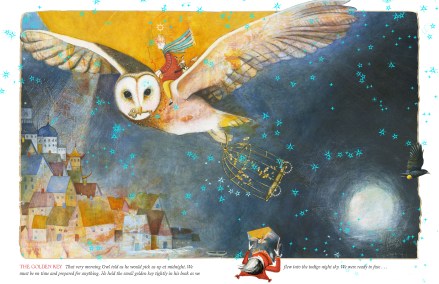
The Magical Cloak sees the little girl’s imagination truly take flight as she decides the man in the “elaborate coat” is a wizard or magician whose bubbles come to life once released from the blower. Enormous whales now fill the harbor. They are beautiful, but something must be done….Next, hurry to meet the owl! He is picking up passengers at midnight. But what does the golden key in his beak open? Only the story The Golden Key locked in the little girl’s mind will tell.
Hours go by as the little girl creates tales for each picture in the book. As the night grows late, she sleeps, carried into slumber on dreams woven from the pictures and stories she imagined. When she wakes up, the girl wishes to spend more time with her new friends, but it’s time for school so she gathers up the book and hurries away.
On the path to school she meets a fox who is carrying a bag. “Excuse me, little girl,” says the fox. “I believe I have the words to your book.” The fox then explains how he caught the words as they spilled from the pages the day before. The fox gives her his parcel, but asks for a favor. The girl is happy to oblige and lets the fox stand on her shoulders to reach a bunch of grapes dangling from a nearby vine.
Copyright Pamela Zagarenski, courtesy of Houghton Mifflin Harcourt
The girl rushes into school and apologizes for being late. She relates the story of the fox and the words and the magical night she has spent making up tales for the pictures in the book. “I have so many stories to tell you,” says the girl to her teacher. “‘I can’t want to hear,’” the teacher replies with a smile.”
Opening a book by Pamela Zagarenski is to fall into an alternate realm of such beauty and imagination that you forget the real world exists. Her paintings are composed of rich, regal hues swirling with images and designs that overlap and float to create the kind of experience only the deepest, most complex dreams allow. The characters and details follow page to page uniting the pictures and, subtly, the stories the little girl discovers in them: The teapot, once introduced, waits under a tree on the next page and rides the waves of the whale-filled sea in the next. The bees and the rabbit are constant companions on each spread, and the animals will fill the reader with awe.
The little girl’s imagined stories are tantalizing with just the right mix of the mysterious and the tangible to entice readers to add more. The frame of the Aesop Fable The Fox and the Grapes is inspired and could lead to a conversation about how “life is what you make it.”
The Whisper is a book readers will want to linger over and dip into again and again, and would be especially fun on those days when there’s “nothing” to do. It makes a beautiful gift for any occasion and would be a welcome addition to any home library.
Ages 4 – 9 (this book would also appeal to adults)
Houghton Mifflin Harcourt, 2015 | ISBN 978-0544416864
Picture Book Month Activity
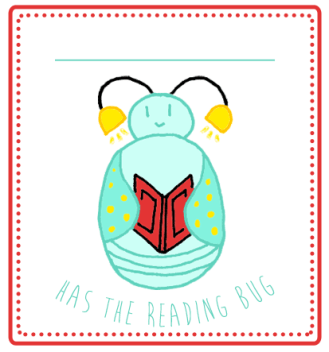
I Have the Reading Bug Book Plate
Do you want to let everyone know which books are yours? Or just declare your love of books? Then display this printable I Have the Reading Bug Book Plate in your books. on your wall, or in your locker!
The American Hiking Society established today’s holiday to encourage families, friends, groups, and individuals to get outside and experience the fun and relaxation of discovering new paths and new places. Even if you’re only able to take a short walk during lunchtime or after work, getting out in nature gives you new perspectives and clears the mind—it’s great exercise too! So gather some friends or your family and head out the door for a short (or a long) hike today!
Harriet Can Carry It
Written by Kirk Jay Mueller | Illustrated by Sarah Vonthron-Laver
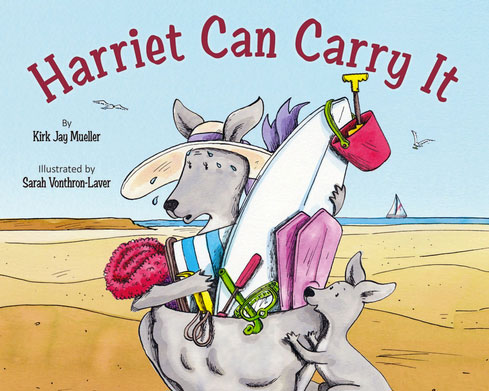
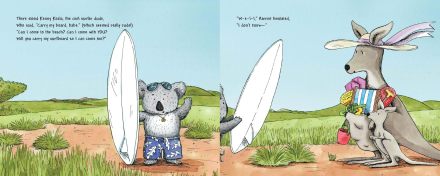
Harriet Huff is a kangaroo who every day carries the mail in her pouch, delivering it all over town. Her job has left her “feeling quite frail,” She decides to take a day off and hike to the beach with her Joey where they can “relax and be free.” The next morning they wake up and prepare for a fun day. Harriet gathers their beach towels, Joey, and his favorite toy and tucks them gently into her pouch. She gets no further than the bottom of her porch, however, before she hears “someone yell, ‘HEY!’”
Image copyright Sarah Vonthron-Laver, text copyright Kirk Jay Mueller. Courtesy of starbrightbooks.com
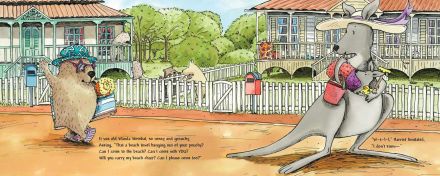
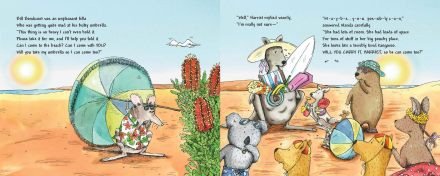
“It was old Wanda Wombat, so nosey and grouchy, / Asking, ‘That a beach towel hanging out of your pouchy? / Can I come to the beach? Can I come with YOU? / Will you carry my beach chair? Can I please come too?’” Harriet stammers, “W-e-l-l…” as she considers her plans to relax, but before she can properly answer, Wanda invites herself along, telling Harriet that she has room in her pouch “for tons of stuff.” “‘YOU CAN CARRY IT, HARRIET, so I can come too.’”
They walk up a hill together, Harriet sweating a bit with the effort of carrying the beach chair that has replaced Joey in her pouch. Suddenly, they hear someone shout, “‘STOP!’” It’s Wallaby Wendy who is also on her way to the beach. She asks Harriet if she will carry her swim fins. Harriet hesitates. “‘W-e-l-l, I’m not sure…’” she says. But Wanda is there with the answer. “‘She has lots of room. She has loads of space / For tones of stuff in her big pouchy place. She is an incredibly kind kangaroo. HARRIET CAN CARRY IT, so you can come too.’”
Image copyright Sarah Vonthron-Laver, text copyright Kirk Jay Mueller. Courtesy of starbrightbooks.com
They start up again all in a row and it isn’t too long before someone says “‘WHOA!’” It was Kenny Koala, who in his own surfer-dude way asks Harriet if she can carry his board so he can come with them too. Harriet takes a moment to think—but it’s a moment Wanda has no problem filling, and so Harriet acquires Kenny’s surfboard too. “AHOY!” beckons Marcie, a marsupial mouse, “Who’d made the mistake of leaving her house / With a huge heavy kayak strapped to her back. / Her long plastic paddle poked out of its sack.” Wanda assures her, too, that Harriet can carry it, and with the kayak stowed in front, the group takes off again.
Image copyright Sarah Vonthron-Laver, text copyright Kirk Jay Mueller. Courtesy of starbrightbooks.com
Next they happen upon the Dingo twins who need help with their flying ring—an easy addition to Harriet’s pouch according to Wanda. A little farther down the path they encounter Bill Bandicoot who can no longer hold his beach umbrella. Wanda takes a look at Harriet and for the first time sees that she looks tired and that her pouch is nearly bursting. This time Wanda asks, “‘WILL YOU CARRY IT, HARRIET, so he can come too?”
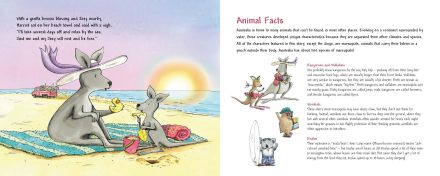
The usual hesitant Harriet has had enough, and she answers “‘NO!’” In fact, she removes everyone’s equipment and tosses it on the sand. “‘I won’t carry your stuff,’” she says. “‘I just QUIT!’” Just then Paddy O’Possum comes along in his pickup truck and offers to take everyone and their gear to the beach. “Now Harriet felt cheerful, thankful, and calm, / And Joey was happy that she was his mom.” With her baby snuggled into her pouch, Harriet finds a perfect spot where they can unwind and “relax by the sea.”
Following the story are two pages of intriguing facts on the various Australian animals depicted in Harriet Can Carry It.
Kirk Jay Mueller’s funny story of a too-nice kangaroo whose relaxing beach vacation is hijacked by a meddlesome neighbor will have kids laughing out loud as Harriet acquires more and bigger belongings on her hike to the shore. Mueller’s rhymed verses wonderfully escalate the plot just as Harriet’s pouch grows as the requests mushroom. As each beach-goer hails Harriet in a new way, kids will wonder what could possibly come next and will delight in the repeated phrases that invite participation on their part. The story can also lead to discussions on how to say “No” when needed and also how to resolve issues before they may cause hurt feelings.
Sarah Vonthron-Laver’s vibrant illustrations of Harriet’s neighborhood and the Australian landscape put the focus on kind-hearted Harriet and the animals she meets and enhances the story’s humor. Wanda the Wombat in her star-shaped sunglasses and flowery flip-flops marches ahead, pointing the way, oblivious to Harriet’s woes. The other animals—accurate cartoon representations of their real counterparts—are equally unaware as they hand Harriet their gear. Harriet’s pouch bulges with the beach items as Harriet finds clever ways to accommodate it all.
Harriet Can Carry It makes for a fun story time read and a perfect take-along book for beach outings or any hike.
Ages 4 – 7
Star Bright Books, 2014 | ISBN 978-1595726766
To learn more about Kirk Jay Mueller, his books, and his music—plus to listen to a song about Harriet—visit his website!
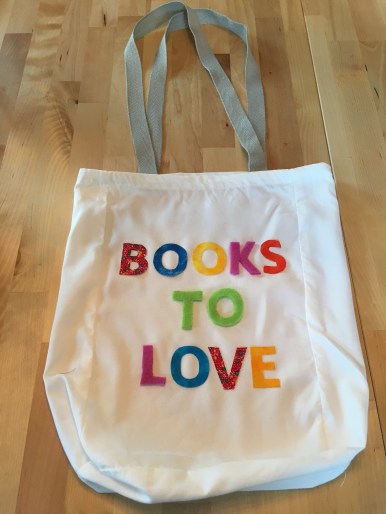
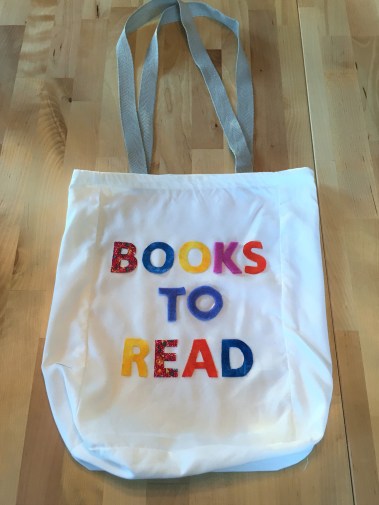
True booklovers can’t go anywhere without a book (or two or three) to read along the way. With this easy craft you can turn a cloth bag into a kid-size book bag!
Small cloth bag, available from craft or sewing stores—Recyclable Idea: I used the bag that sheet sets now come in
Cloth trim or strong ribbon, available from craft or sewing stores—Recyclable Idea: I used the cloth handles from shopping bags provided from some clothing stores
Scraps of different colored and patterned cloth. Or use quilting squares, available at craft and sewing stores
Pen or pencil for tracing letters onto cloth
Scissors
Small sharp scissors (or cuticle scissors) for cutting out the center of the letters
Fabric glue
Thread (optional)
Needle (optional)
Directions
Print the sayings and cut out the letters
Trace letters onto different kinds of cloth
Cut out cloth letters
Iron cloth bag if necessary
Attach words “Books to Read” to one side of bag with fabric glue
Attach words “Books to Love” to other side of bag with fabric glue
Cut cloth trim or ribbon to desired length to create handles
I Love to Write Day was created by Delaware-based author John Riddle in 2002. He wanted to share his passion for writing with others and encourage them to pick up a pen or sit down at the computer and compose a poem, a short story, a journal entry, or whatever kind of written expression stirs their hearts. It’s fitting that today’s holiday comes in the middle of NaNoWriMo or National Novel Writing Month, when novelists and would-be novelists strive to begin and finish a complete novel (well, at least a first draft) in one month. If you hold ambitions to write, why not start today? As today’s book shows, you’ll be part of a very honored, long-standing tradition!
I Am a Story
By Dan Yaccarino
Sometimes it seems that from nothing and out of nowhere a story comes. And yet storytelling also seems to be an inborn trait, passed down from generation to generation and discovered in daydreams, alternate realities, those “what if?” moments. In Dan Yaccarino’s book, a story relates its history, beginning with our oldest ancestors. “I am a story,” the narrator states. “I was told around a campfire. Then painted on cave walls.” The story travels over years and across miles, changing the way it is told but not its impact.
Image copyright Dan Yaccarino, courtesy of harpercollins.com
Men inscribed words on papyrus; women used woodblocks, brushes, and ink to bring them to life. Tales were stitched into legend on beautiful tapestries that brightened dank castle walls, and they were transcribed in gilded lettering “into big books to illuminate minds.” Then a man discovered how to print the story so many people could read it, which led to the story being “acted out onstage.”
Image copyright Dan Yaccarino, courtesy of harpercollins.com
Stories were bound into books and families began to collect them, creating “vast private libraries.” Then public libraries opened, and now stories are available for everyone—even in places so remote that the books are brought on donkeys, by camel, or even atop elephants. There are tiny libraries—not much bigger than a birdhouse; vending machines that dispense stories; and old telephone booths that have been transformed with shelves of books.
The story reveals its power to make “people frightened, excited, sad, and happy.” Some have felt and still feel that the story is dangerous, so they have “censored, banned, and burned” it. But the story “did not die.” Millions of people all over the world are inspired by the story every day. “I can go with you everywhere,” the story says, “and will live forever. I am a story.”
Image copyright Dan Yaccarino, courtesy of harpercollins.com
Bibliophiles young and old will love the simply told and expressively illustrated timeline of the story from early oral traditions until today. Between the first page where ancient peoples interpreted the constellations and the last where a family of today tells stories around a campfire under the starry sky, the various forms that stories take are described with vivid, full-bleed pages of people toiling over manuscripts, inventing methods of mass production, and building collections all to ensure that the words continue no matter what changes occur.
Kids will love lingering over the details on each page, and every page could lead to a fun afternoon of discovering more about each stage in the story’s development. For teachers and homeschoolers I Am a Story is a wonderful jumping off book for an English or History unit, and it makes a beautiful addition to any library.
Ages 4 – 8
HarperCollins, 2016 | ISBN 978-0062411068
You know Dan Yaccarino from his TV shows The Backyardigans, Oswald and others as well as his many, many books. You can learn more about him and his work on his website!
Enjoy this I Am a Story book trailer!
I Love to Write Day Activity
The History of the Story Bookmark
From cave paintings and hieroglyphics to the printing press and the computer, people have ensured that their thoughts were not forgotten. Here’s a printable The History of the Story Bookmark plus a blank one for you to fill in. Use them to mark your favorite stories!