October 11 – National Coming Out Day

celebrate-picture-books-picture-book-review-this-little-rainbow-cover

About the Holiday

The establishment of National Coming Out Day was inspired by the October 11, 1987 March on Washington for Lesbian and Gay Rights, which drew 500,000 people and generated momentum for the movement for four months after the march had ended. During this time, more than one hundred LGBTQ+ identifying individuals gathered outside of Washington, DC. Rob Eichberg, who founded a personal growth workshop and Jean O’Leary, the head of National Gay Rights Advocates, proposed a national day to celebrate coming out and it was decided to create a National Coming Out Day that would officially begin on the 1st anniversary of their historic march. The holiday is now celebrated around the world. The day offers support and encouragement to those who are struggling with telling someone about their sexuality while urging family members, friends, educators, and others to listen with an open, loving, and welcoming heart.

Thanks to Joan Holub for sending me a copy of This Little Rainbow for review consideration. All opinions on the book are my own. I’m thrilled to be teaming with Joan in an exciting giveaway of this book and more. See details below.

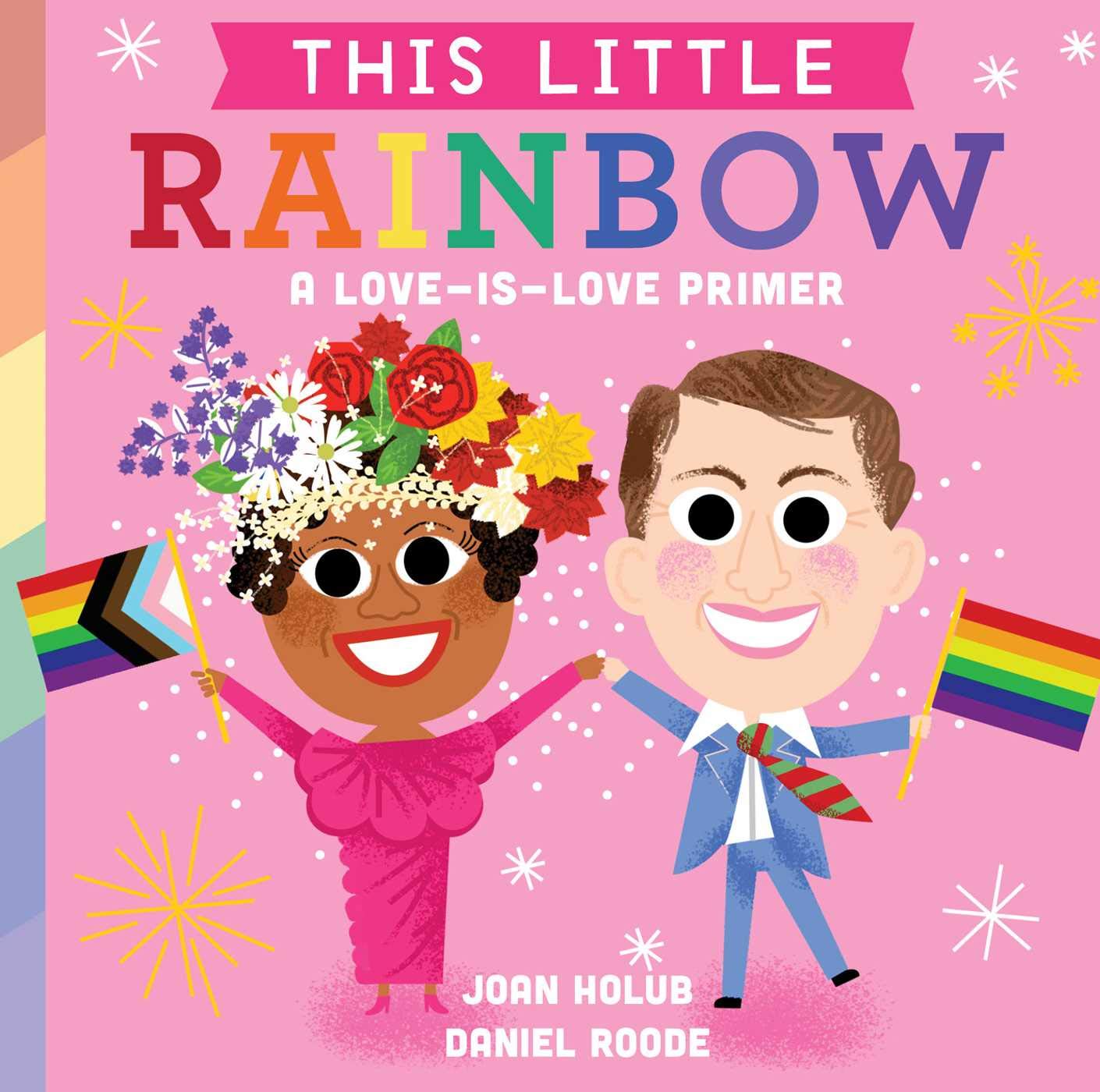
This Little Rainbow: A Love-is-Love Primer


Written by Joan Holub | Illustrated by Daniel Roode


Joan Holub’s latest book in her THIS LITTLE series introduces preschoolers to eleven influential artists, scientists, sports figures, soldiers, activists, and politicians who are or were members of the LGBTQIA+ community. From the 1400s to today, these role models have been admired for their talents, opinions, and groundbreaking success in their chosen fields. Their courage has also contributed to a more open and appreciative society for all.

celebrate-picture-books-picture-book-review-this-little-rainbow-josephine-baker

Image copyright Daniel Roode, 2021, text copyright Joan Holub, 2021. Courtesy of Little Simon, Simon & Schuster.

Each featured profile is presented on a two-page spread. On the left side a rhyming couplet describes what the person is most known for, while on the right children learn a couple of facts about them in two or three short sentences. The book leads off with one of the most prominent painters, inventors, and scientists to have ever lived—Leonardo da Vinci. Readers learn: “This little rainbow / was a genius long ago. / He was a great artist / and an engineering pro.” They then discover that “Leonardo da Vinci painted the famous Mona Lisa and The Last Supper, and could paint with his left or right hand. He was also a scientist, inventor, and architect, who designed a flying machine!”

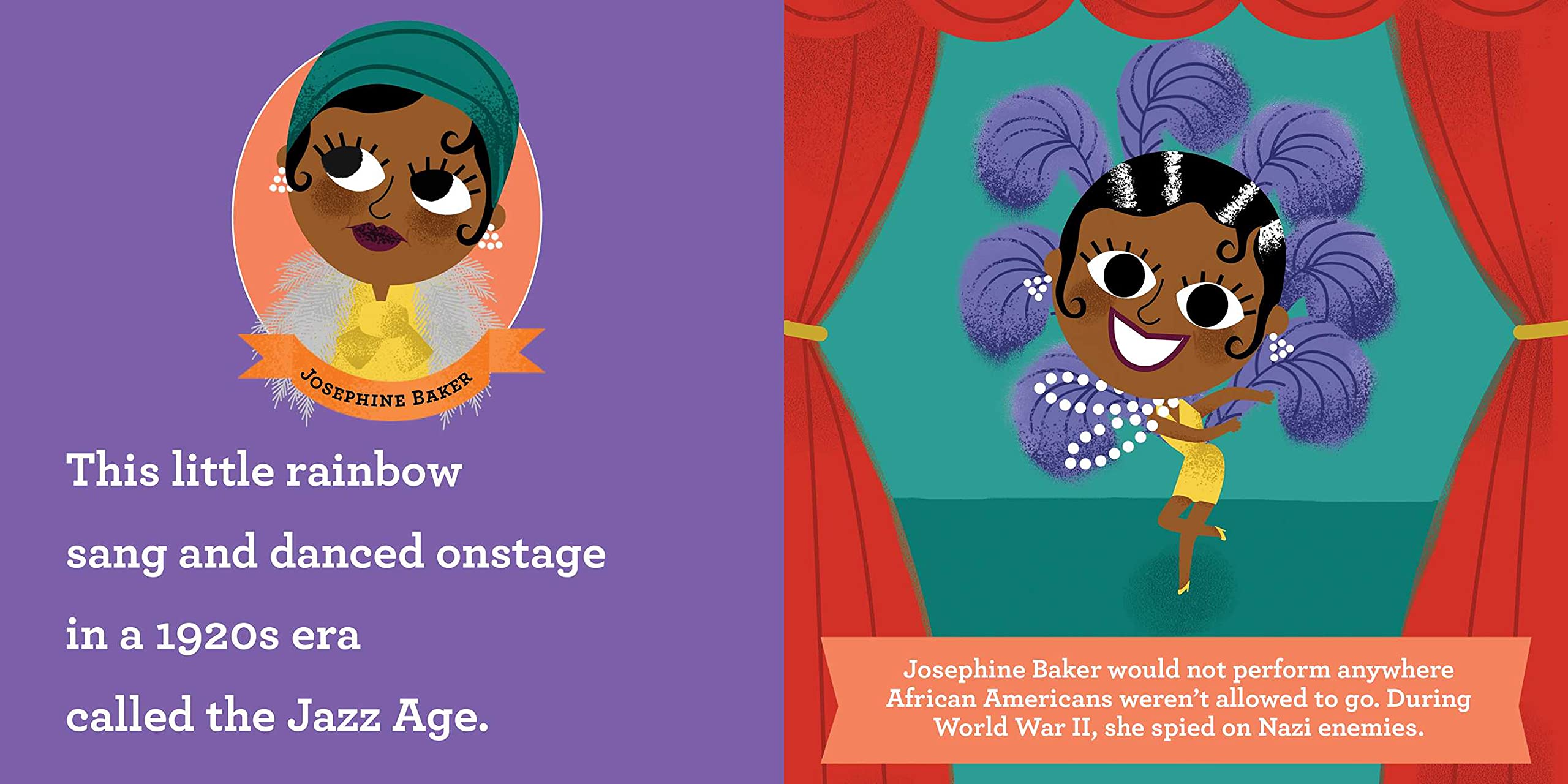
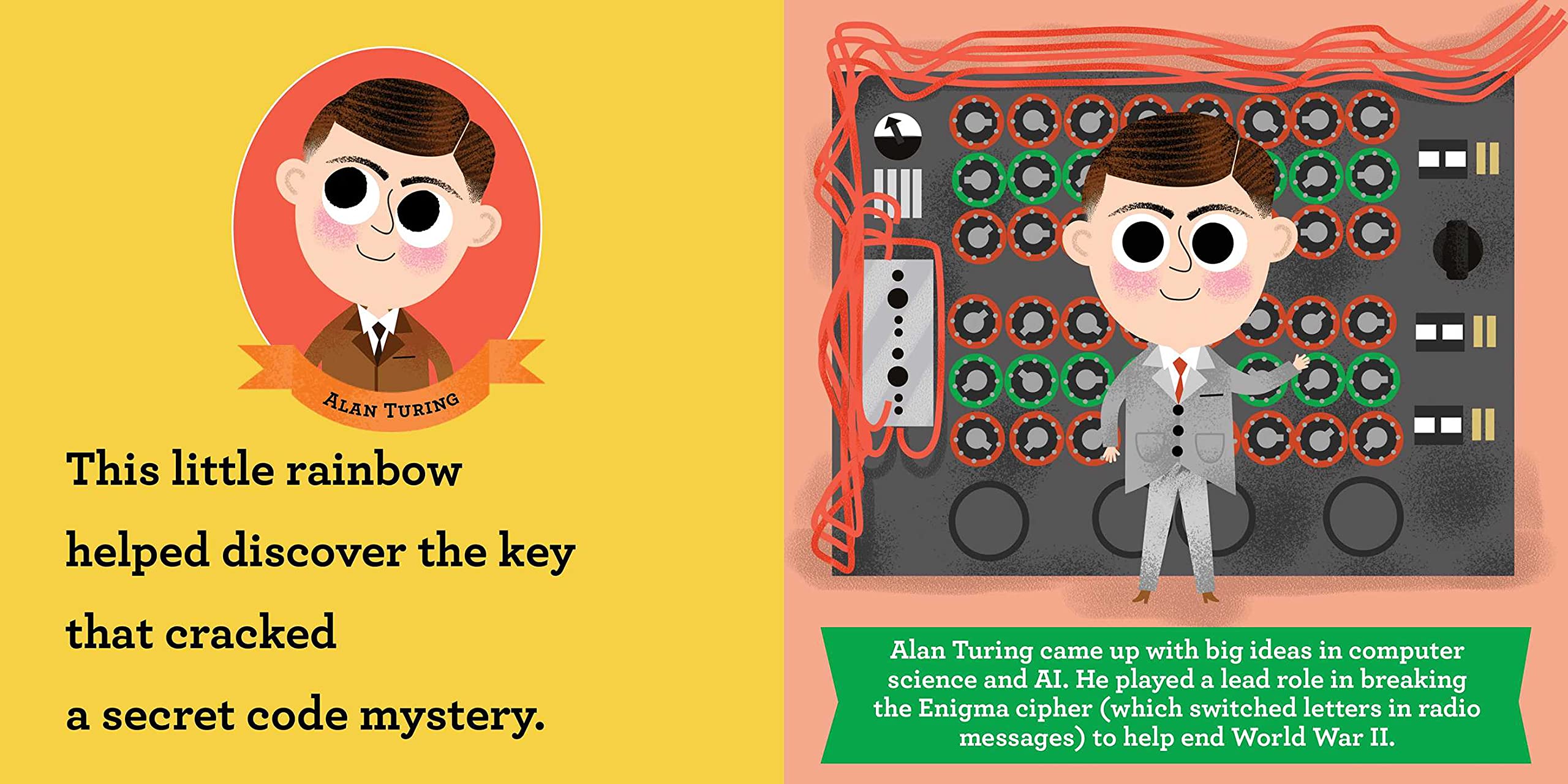
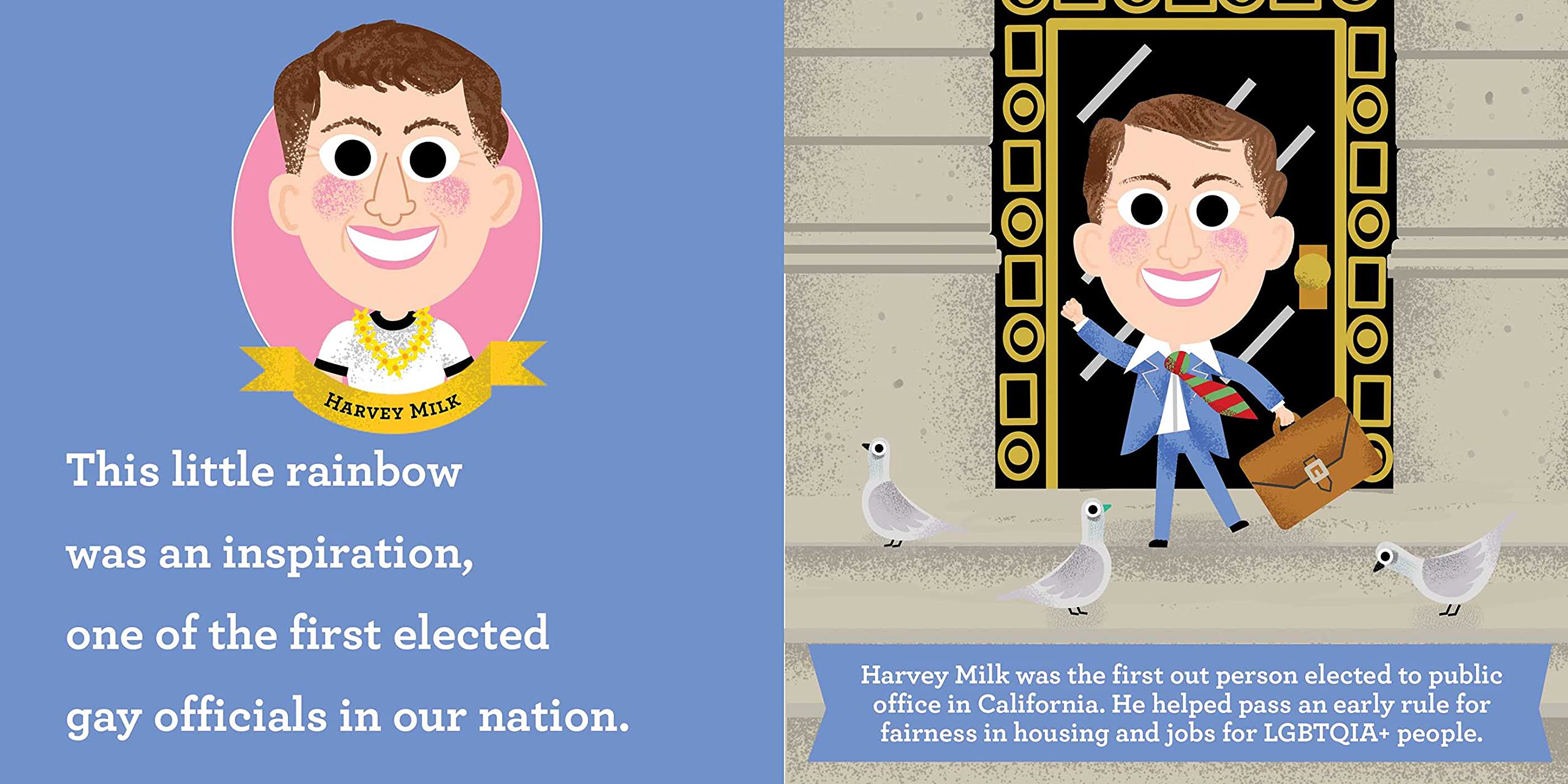
Moving on to the Jazz Age, little ones learn about Josephine Baker, “who sang and danced onstage,” refused to perform where African Americans weren’t allowed in, and spied on Nazis during World War II. Kids also meet computer scientist and code breaker Alan Turing; Harvey Milk, the first out politician “elected to public office in California. He helped pass an early rule for fairness in housing and jobs for LGBTQIA+ people.”

celebrate-picture-books-picture-book-review-this-little-rainbow-alan-turner

Image copyright Daniel Roode, 2021, text copyright Joan Holub, 2021. Courtesy of Little Simon, Simon & Schuster.

Children will also be introduced to Sally Ride: “This little rainbow / launched a satellite / as the first female astronaut / on a US space flight.” Kids then learn that “Sally Ride helped design a big robotic art and then used it to launch communications satellites from the Space Shuttle Challenger in 1983.” Marsha P. Johnson, a transgender woman who, with Sylvia Rivera, “created a group called STAR to help homeless trans people,”

Singer Freddie Mercury, Gilbert Baker and Daniel Quasar, who designed today’s rainbow flags; tennis pro Martina Navratilova; and Shane Ortega, who “was the first person to openly transition during active duty” and “now speaks out for fair rules for all people,” are also represented in these pages.

Following these profiles, a two-page spread provides portraits and information on fifteen other LGBTQIA+ leaders from around the world as well as a glossary of twelve “rainbow terms.”

celebrate-picture-books-picture-book-review-this-little-rainbow-harvey-milk

Image copyright Daniel Roode, 2021, text copyright Joan Holub, 2021. Courtesy of Little Simon, Simon & Schuster.

Joan Holub’s inclusive introduction to people in the LGBTQIA+ community gives parents, educators, and other caregivers a meaningful way to share the work and lives of people who reflect perhaps their own family or a member of their family, their neighbors, friends, teachers, celebrities, and others. In positive, uplifting language, Holub provides a short history on the struggles, recognition, progress, and contributions of those who identified or identify as part of the LGBTQIA+ community while instilling pride and hope in the future for today’s children.

Daniel Roode’s well-recognized illustrations for the THIS LITTLE series offer vibrant imagery of each person backed by a bold, easily identified setting that informs young readers about their work and personality. Each of the eleven featured portraits as well as the fifteen that follow give adults and children a great place to start learning more about these inspiring people.

This Little Rainbow, a Love-Is-Love Primer is a terrific addition to the THIS LITTLE series for all home, classroom, school, and public library collections.

Ages 3 – 5

Little Simon, 2021 | ISBN 978-1534475601

Discover more about Joan Holub and her books on her website.

You can connect with Daniel Roode on Instagram.

One Question with Joan Holub

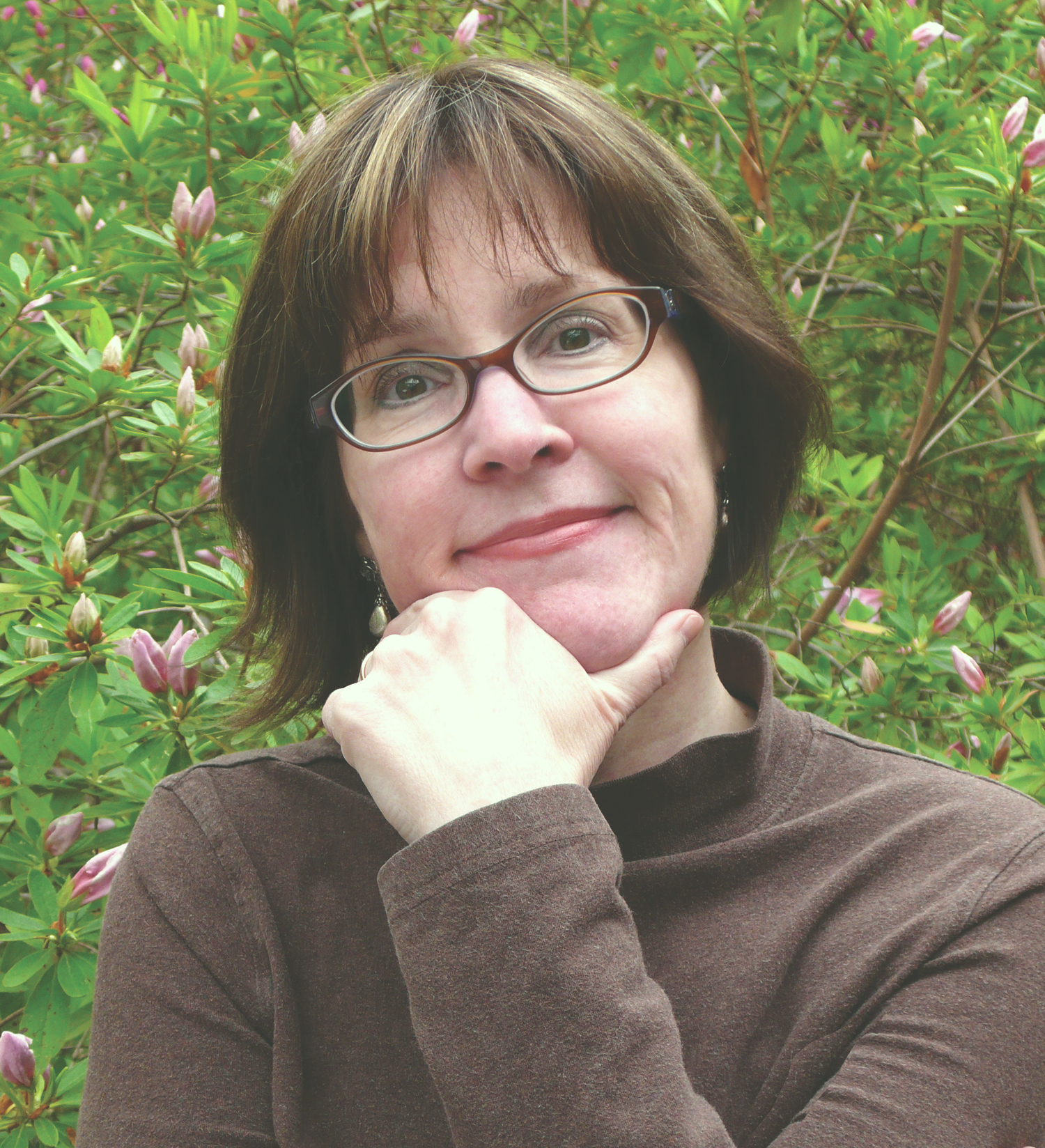
celebrate-picture-books-picture-book-review-joan-holub-headshot

Joan Holub has authored and/or illustrated over 140 children’s books, including the Goddess Girls series, the Heroes in Training series, the New York Times bestselling picture book Mighty Dads (illustrated by James Dean), and Little Red Writing (illustrated by Melissa Sweet). She lives in North Carolina.

You can connect with Joan Holub on her Website and Twitter

Hi Joan! It’s wonderful to have this little chat with you! Your list of published books is truly incredible and inspirational for its length and breadth of topics. I can only imagine that you’ve always been an avid reader. Did you have a favorite place to read as a child? Do you still seek out a favorite comfortable place to read now?

When I was a girl, there was a willow tree in our backyard, and I loved how cozy and hidden I felt sitting beneath it, with its green canopy draped around me. It was my favorite hideout and place to read. My family had read a book called A Good Place to Hide, which featured a child hiding under a willow tree, and that fostered in me the idea of me doing the same. My favorite reading spot now is our back deck, which looks out onto trees, with a glass of iced tea beside me.

celebrate-picture-books-picture-book-review-this-little-rainbow-cover

You can find This Little Rainbow: A Love-is-Love Primer at these booksellers

Amazon | Barnes & Noble | Books-a-Million

To support your local independent bookstore, order from 

Bookshop | IndieBound

Picture Book Review


October 7 – It’s National Book Month

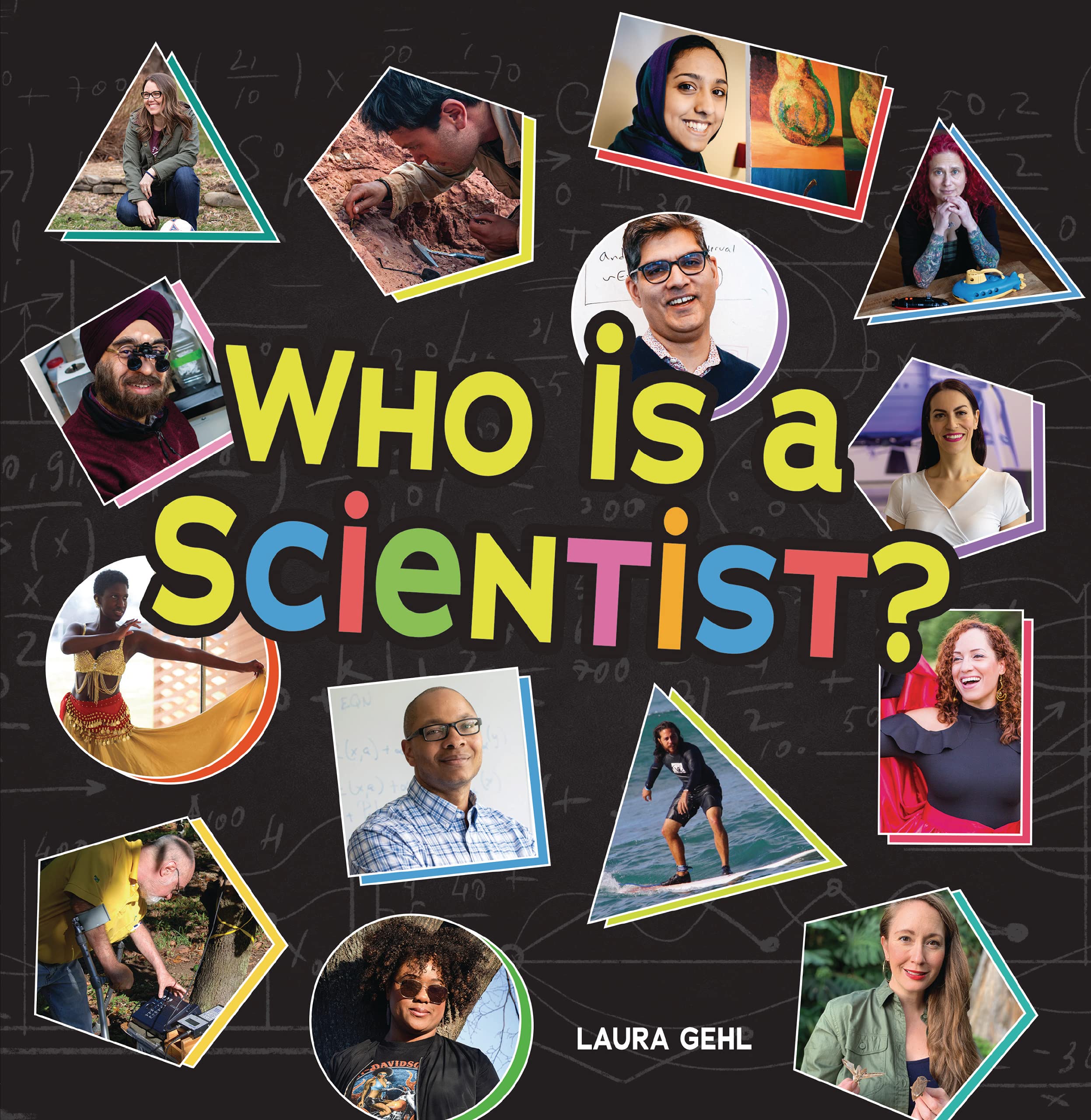
celebrate-picture-books-picture-book-review-who-is-a-scientist-cover

About the Holiday

This month-long holiday was established to get families excited about reading. As the weather turns cooler and activities turn indoors, reading together is a wonderful way to spend time laughing, learning, and making memories. Small children love being read to—and so do older kids! Sharing board books, picture books, and chapter books with younger readers opens up new worlds of imagination, feelings, and discovery. Taking the journey of a novel, graphic novel, or biography together with tweens and teens can provide inspiring, emotional, funny, and bonding moments that last a lifetime.

Thanks to Millbrook Press and Barbara Fisch at Blue Slip Media for sharing a copy of Who Is a Scientist? for review consideration. All opinions on the book are my own.

Who Is a Scientist?

By Laura Gehl


Do you love science and think that maybe you’d like to be a scientist when you grow up? But do you also love to dance or surf to paint or bake? Maybe you like to play soccer or ride a motorcycle or you’re considering getting a tattoo like your mom or dad and you think that none of those are things a scientist would do. Maybe you think of scientists as a little bit stuffy with their white coats and endless graphs. Well, think again!

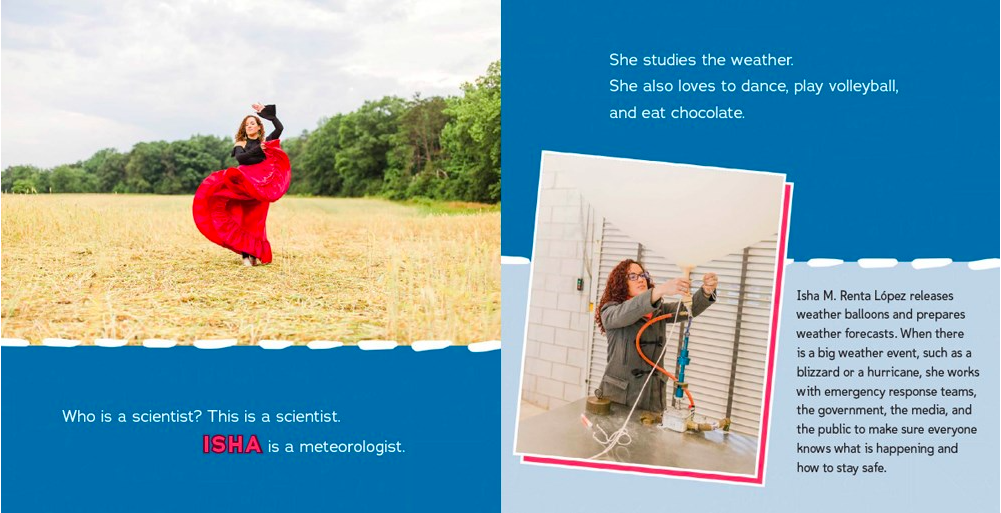
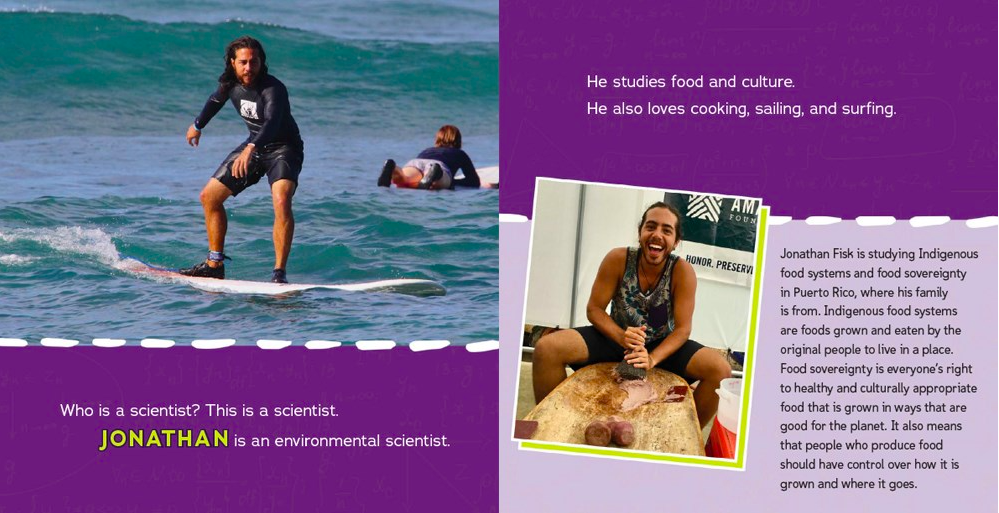
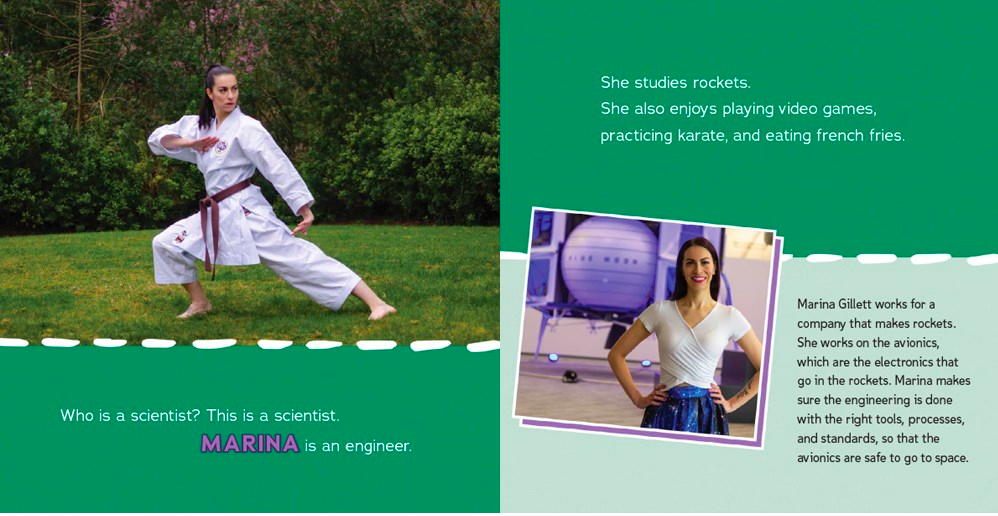
In Who Is a Scientist? Laura Gehl introduces you to fourteen scientists who smash those ideas. And what’s more they’re involved in some pretty fascinating and life-changing sciences and projects that you may never have heard about before but that may inspire you. For example, you’ll meet Isha M. Renata López who works as a meteorologist but “also loves to dance, play volleyball, and eat chocolate.” What’s great about her job? She alerts people to changes in the weather, and when a big storm, blizzard, hurricane, or tornado is coming, she works with emergency crews, the media, and the local government to make sure everyone knows so they can stay safe.

celebrate-picture-books-picture-book-review-who-is-a-scientist-meteorologist

“Jagmeet Kanwal studies bats and zebrafish to help figure out how the human brain makes decisions.” He’s also working to discover “how our brains allow us to hear different types of sounds.” He’s hoping to be able to “help people with depression, Parkinson’s disease, and memory loss.” What else does Jagmeet like to do? He’s also a painter and nature photographer.

If you like math, you may want to become a mathematician like Mark Lewis, who studies operations research during work hours and enjoys playing basketball in his off time. This kind of science “uses math to help business make good decisions” that affect consumer, such as how long people wait in line, how much items cost, and how transportation can move faster.

celebrate-picture-books-picture-book-review-who-is-a-scientist-environmental-scientist

Perhaps you’re interested in health and medical research like Tishina Okegbe whose work makes sure that mothers, babies, and children in Africa and Asia “have access to high-quality health-care services. In her free time, Tishina likes “visiting new places, belly dancing, and eating pizza and ice cream.”

Whether you’re interested in food systems and farming, how the brain works, the environment, space, dinosaurs, or computers, the scientists will inspire you to enjoy all of your passions. In fact, the extracurricular activities you enjoy the most may just lead you to a career you’ll love. The definition of who and what a scientist is broad and exciting as you’ll see when you meet these men and women who are changing the world while being themselves.

Back matter includes a QR code that readers can scan to view a video in which each profiled scientist introduces themselves. There’s also a flow chart that can lead kids to the type of scientist they might want to be or at least research further based on their interests.

celebrate-picture-books-picture-book-review-who-is-a-scientist-environmental-engineer

Laura Gehl’s engaging and inspiring look at a variety of scientists and their disciplines will get all kids excited about the wide range of work going on around them and the people who make it happen. Her profiles of these thinkers, activists, and active members of their communities show kids that they don’t need to be defined only by their career and that scientists—who are needed now more than ever—are a diverse group and welcoming to all. Each profile is accompanied by photographs of the scientist in their lab or other work environment as well as action shots of them enjoying their off time in their favorite pursuits.

A smart, inviting, and educational introduction to the people who are helping to make the world a better place through science and other STEM-related fields, Who Is a Scientist? is sure to inform readers on the wide-range of specialized work that falls under the umbrella of science and spark their interest in learning where they may fit in. The book is highly recommended for home bookshelves and is a must for classroom, school, and public libraries.

Ages 4 – 9

Millbrook Press, 2021 | ISBN 978-1728441085

Meet the scientists in this Who Is a Scientist? Book Trailer!

One Question with Laura Gehl

celebrate-picture-books-picture-book-review-laura-gehl-headshot

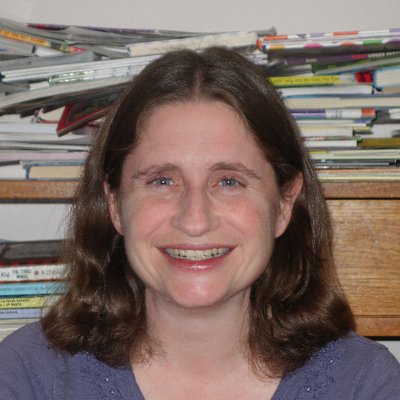
Laura Gehl is the author of more than a dozen books for children, including One Big Pair of Underwear, Except When They Don’t, the Peep and Egg series, and the Baby Scientist and Brilliant Baby board books. In addition to being an author, Dr. Gehl has a PhD in neuroscience and is the mother of four children. She lives with her family in Maryland. 

You can connect with Laura on her Website | Facebook | Instagram | Twitter

Hi Laura! I loved reading your book and getting to know some of the scientists working today. I also enjoyed seeing how some of their other interests are reflected in their work while others are great ways to relax and play—definitely something kids can relate to!

I was wondering if or how a previous job (or jobs) has influenced your writing and the kinds of books you write. 

I used to work in a neurobiology lab, and I also used to teach science. Both of those jobs made me want to write books about science and scientists! When I taught science, I realized that very few kids had met a real scientist or had read about any scientists more recent than Albert Einstein or Marie Curie. Flash forward twenty years and my new photo-illustrated picture book Who Is a Scientist? features fourteen real scientists working today in different fields from astronomy to entomology to paleontology. While the book talks about the fascinating work these scientists are doing, it also talks about the other things the scientists love…like dancing, soccer, junk food, watching movies, and playing with their pets. I hope this book helps kids realize that scientists are just like them—curious people with lots of different passions who like to ask and answer interesting questions.

Thanks, Laura! Through your books you’ve found a perfect way to share your love and knowledge of science with kids! I wish you all the best with Who Is a Scientist?!

You can find a Teacher’s Guide to Who Is a Scientist? and her other books on Laura Gehl’s website here.

National Book Month Activity

celebrate-picture-books-picture-book-review-silly-balloons

Static Electricity Experiment!


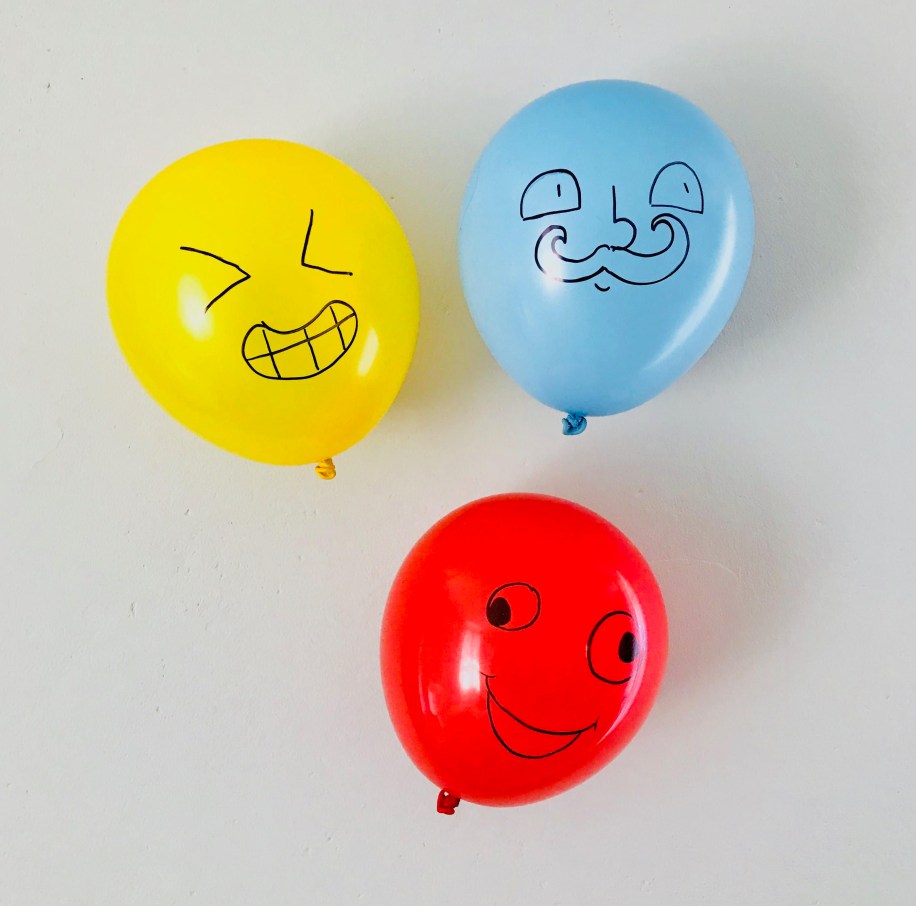
We all know that cooler weather means shock season will soon be here. But you don’t have to wait until the fuzzy socks and fleecy blankets come out to have some fun exploring the science of static electricity. Using a blown-up balloon can be a dramatic way to show kids what’s going on with the electrons that are at the center of this phenomenon.

Babies and young children should be supervised by an adult while playing with balloons.

How does it work? Static electricity is generated when there is an excess of electrons on one object giving it an electric charge. These electrons are attracted to an object with fewer electrons and will jump to it when placed close by.

How do you produce static electricity? Just rub the blown-up balloon on your shirt, on your hair, on a blanket or other surface. Then try these experiments!

CRAZY HAIR

Generate static electricity on a blown-up balloon then hold it near your hair and watch it go a little crazy!

HANG A BALLOON

Generate static electricity on a blown-up balloon and gently place it on the wall and watch it hang all by itself.

BEND WATER

This bit of balloon magic will amaze you! Generate static electricity on a blown-up balloon. Turn on a faucet to a thin stream of water. Hold the balloon near the stream of water and watch it bend toward the balloon. 

celebrate-picture-books-picture-book-review-who-is-a-scientist-cover

You can find Who Is a Scientist? at these booksellers. Due to shipping delays, preorders are now being taken.

Amazon | Books-a-Million | IndieBound

Picture Book Review


September 29 – It’s Intergeneration Month

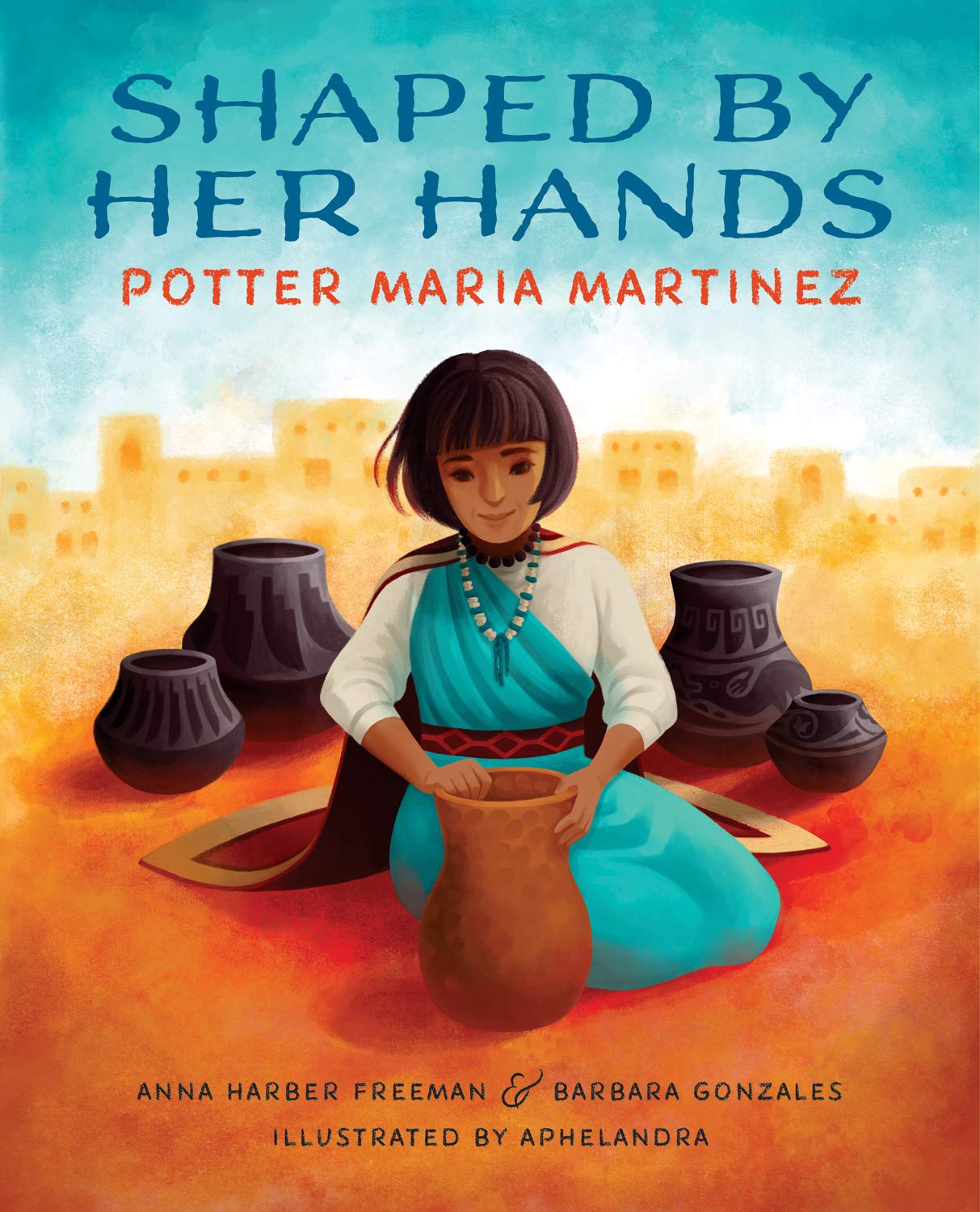
celebrate-picture-books-picture-book-review-shaped-by-her-hands-cover

About the Holiday

Cuddle ‘round for two loving holidays—Intergeneration Month and National Attend Your Grandchild’s Birth Day—which each encourage grandparents to be present figures in their grandchildren’s lives starting from birth! Already, many grandparents across the globe play active roles in caring for children. In the US alone, 4.8 million preschoolers were under the care of grandparents in 2011. Whether you are a grandchild, parent, or grandparent, it is important to support family and spread some love. Hug someone special today to celebrate this holiday. In honor of this day, we present a story about artist Maria Povika Martinez, co-written by her great-granddaughter. Her historical account teaches the importance of love, family, and the passing down of knowledge through generations.

Thanks to Albert Whitman & Company for sharing a copy of Shaped By Her Hands with me for review consideration. All opinions on the book are my own.

Review by Dorothy Levine

Shaped By Her Hands: Potter Maria Martinez (Part of the She Made History Series)

Written by Anna Harber Freeman and Barbara Gonzales | Illustrated by Aphelandra

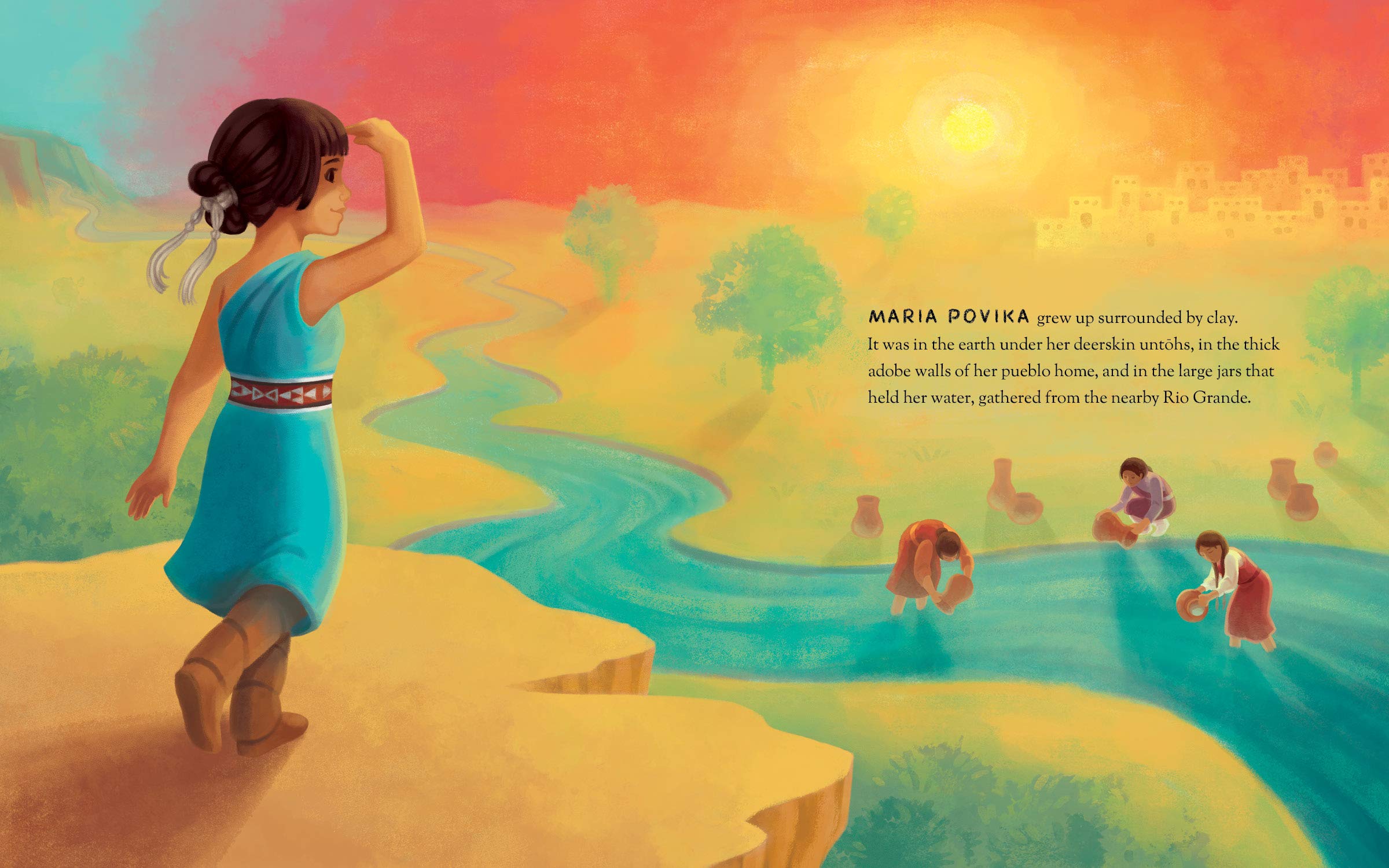
As a child growing up in the pueblo of San Ildefonso, New Mexico in the 1890s, Maria always loved clay. While her siblings played with straw dolls and her parents planted crops, Maria spent her time making clay pots. But, to her frustration, her pots would always crack when she set them out to dry in the sun. Maria’s aunt, or ko-ōo, Nicolasa offered to help and showed Maria “the centuries-old tradition of san-away.” Nicolasa still made clay pots using these traditional methods, even though more and more people were buying tin pots from stores. 

celebrate-picture-books-picture-book-review-shaped-by-her-hands-river

Image copyright Aphelandra, 2021, text copyright Anna Harber Freeman and Barbara Gonzales, 2021. Courtesy of Albert Whitman & Company.

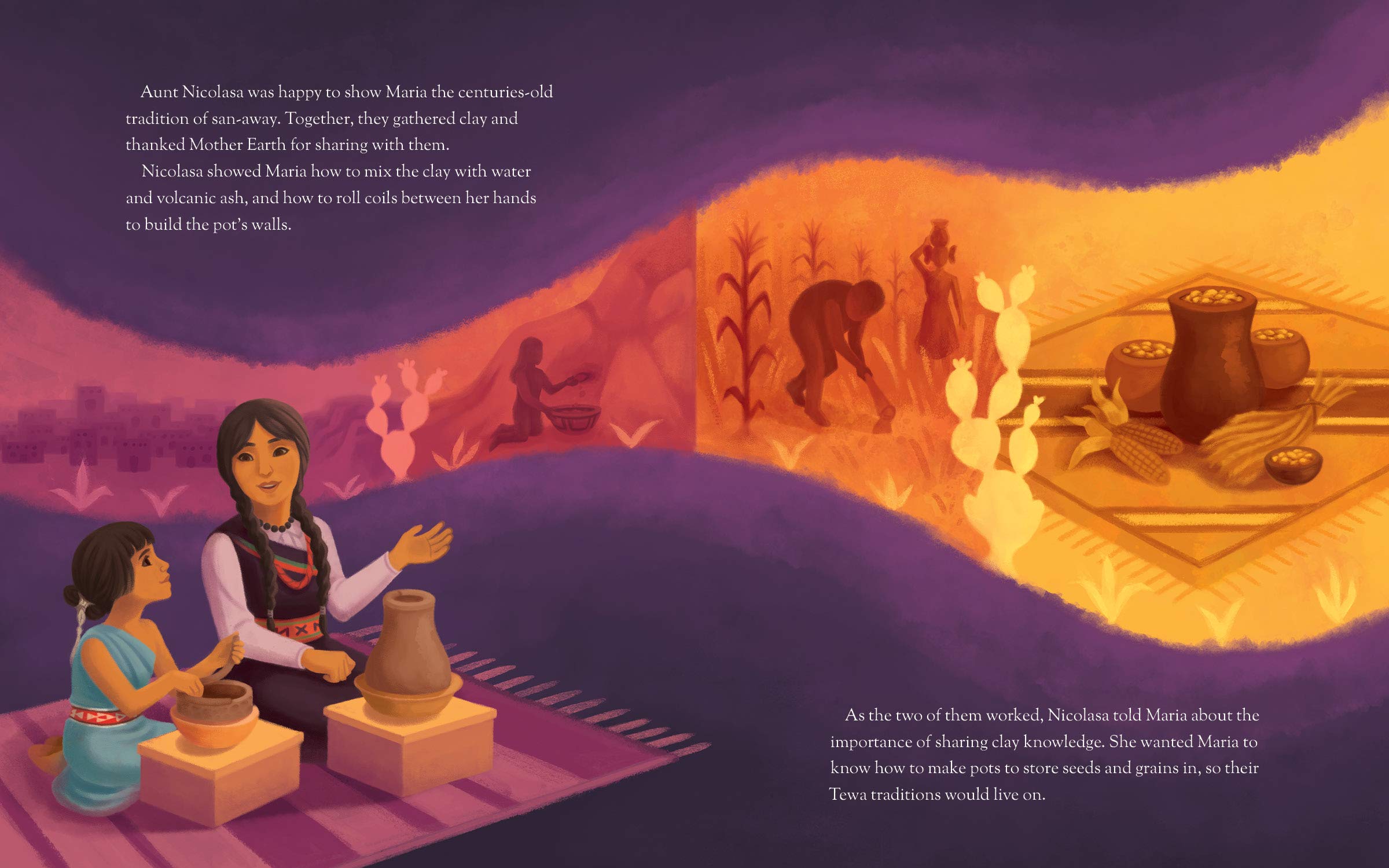
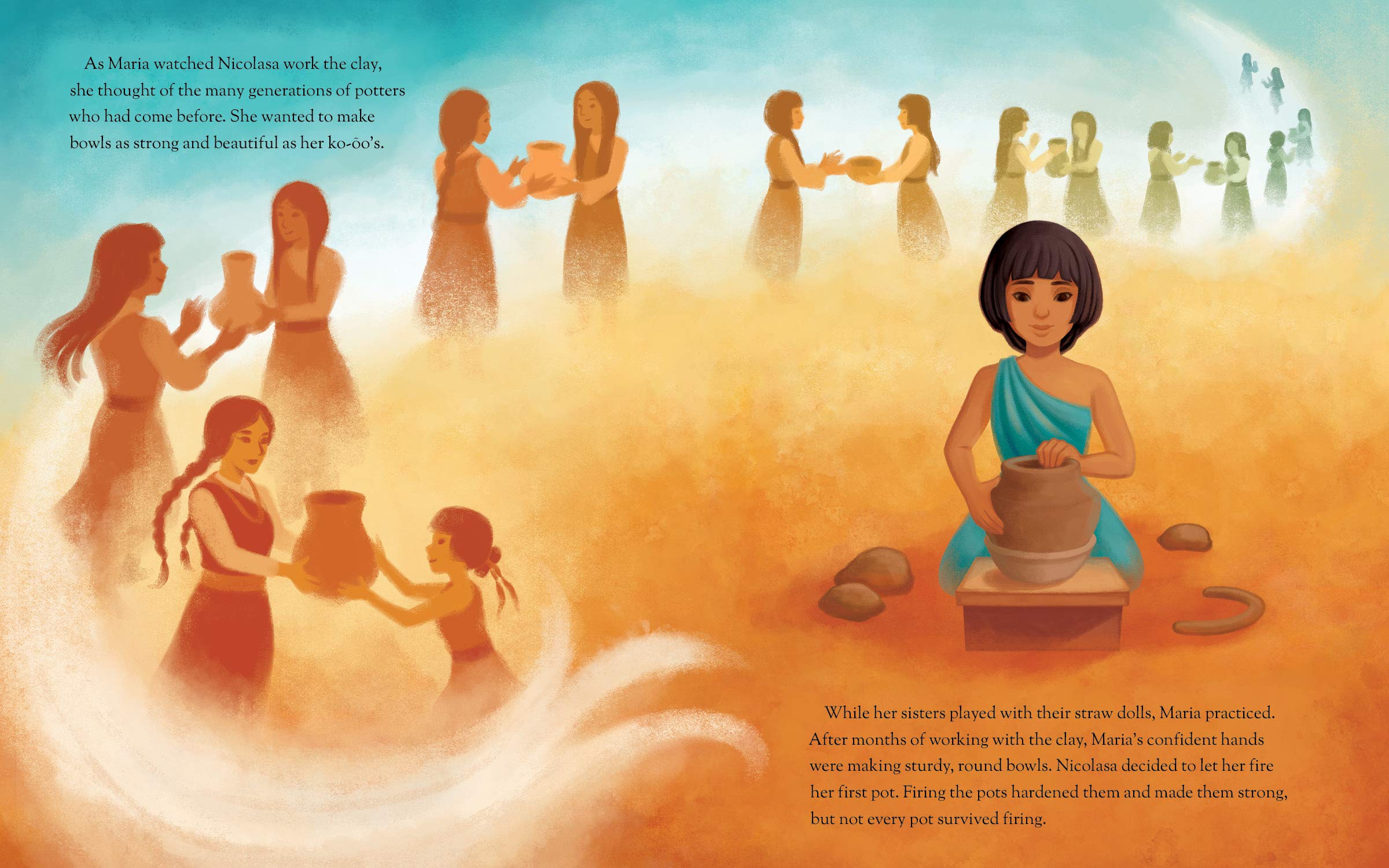
Nicolasa taught Maria how to coil the clay in circles and then lay the pots together on a fire to make them dry, solid, and strong. “As Maria watched Nicolasa work the clay, she thought of the many generations of potters who had come before. She wanted to make bowls as strong and beautiful as her ko-ōo’s.” Nicolasa and Maria thanked Mother Earth for the clay she shared with them. 

When Maria grew older, she continued to make pots and gained a reputation for her skilled work. One day in 1908, an archeologist named Edgar Lee Hewett came to visit Maria. He had discovered an old shard of black pottery in a dig nearby. Mr. Hewett wanted to know if Maria could recreate a pot in the similar style. She decided to take on the challenge.

celebrate-picture-books-picture-book-review-shaped-by-her-hands-Nicolasa

Image copyright Aphelandra, 2021, text copyright Anna Harber Freeman and Barbara Gonzales, 2021. Courtesy of Albert Whitman & Company.

After much experimentation, Maria and her husband, Julian Martinez, discovered a technique: “One afternoon, they tried smothering the fire to keep the smoke in. When they pulled out the pot, it was shiny, and black as a raven.” With this new method, Maria combined her own style with old traditions to create a new style of pottery that was marvelous. Mr. Hewitt took some of these pots Maria made. “He put one of the pots in the Museum of New Mexico, where he worked.” The others he took to shops in Santa Fe. To Maria’s surprise, they sold like crazy! Julian began to paint designs on the black shiny pots—decorations of serpents, feathers, and water—using a yucca-blade brush. 

As more and more pots sold, Maria and Julian taught the rest of her family and some friends to make the pots with them. They became so famous that many people across the country invited them to demonstrate their skills to others. When Maria’s husband died, she continued to make pots with her family. “First, her children came to paint the designs. Later, her grandchildren came to help with the painting and polishing. They made pots as a family, remembering to thank Mother Earth, and teaching new hands to form, polish, and design.” 

The story is followed by back matter that provides more information about Maria, the Tewa people, and the San Ildefonso Pueblo for readers. Both authors include a note about how they were influenced by Maria and why they believe it is important to share her story with young people today. 

celebrate-picture-books-picture-book-review-shaped-by-her-hands-generations

Image copyright Aphelandra, 2021, text copyright Anna Harber Freeman and Barbara Gonzales, 2021. Courtesy of Albert Whitman & Company.

The story is co-written by Barbara Gonzales, the great-grandchild of Maria, and Anna Harber Freeman, whose grandmother was a member of the Osage Nation and who is a lifelong fan of Maria’s work with degrees in multicultural education and art. Their biography of Maria Martinez shines with its lyrical, straightforward telling that reveals the deep history of the Tewa people as well as the meaning and uses of the pottery that Maria and her ko-ōo Nicolasa created by hand. The importance of passing down knowledge and traditions from one generation to another is organically woven throughout the story. Many readers will recognize Maria and Julian’s distinctive pottery and be inspired by the history behind it.

Aphelandra is a descendant of the Oneida Nation, and the daughter of a crafts artist and landscaper. She writes that she grew up surrounded by natural beauty and creativity, which can be seen in her illustrations. The illustrations in Shaped by Her Hands consist largely of soft yellow, green, and red hues. In the part of the story in which Maria is sent off to boarding school, the colorful tones found throughout the book are confined to a single window, depicting the feeling of entrapment and homesickness Maria felt. Aphelandra vividly weaves in the storytelling of past generations through her use of color, shadow and circular imagery. Her painted landscapes gorgeously depict the natural San Ildefonso scenery. 

This beautifully crafted tale shares the history of Maria Povika Martinez while introducing readers to Tewa people’s values of kindness, passing on of knowledge, and respect for elders and Mother Earth. An inspiring read for all children, especially those interested in artistic and creative endeavors, Shaped By Her Hands: Potter Maria Martinez is highly recommended for home bookshelves and a must for school and public library collections.

Ages 4 – 9 

Albert Whitman & Company, 2021 | ISBN 978-0807575994

Discover more about Anna Harber Freeman and her books on her website.

To learn more about Barbara Gonzales and her pottery and to view a video with Barbara and other artists discussing an exhibition of San Ildefonso Pueblo potters at the Museum of Indian Arts and Culture, visit the adobe gallery website.

You can learn more about Aphelandra, her books, and her artwork on her website.

Intergeneration Month Activity

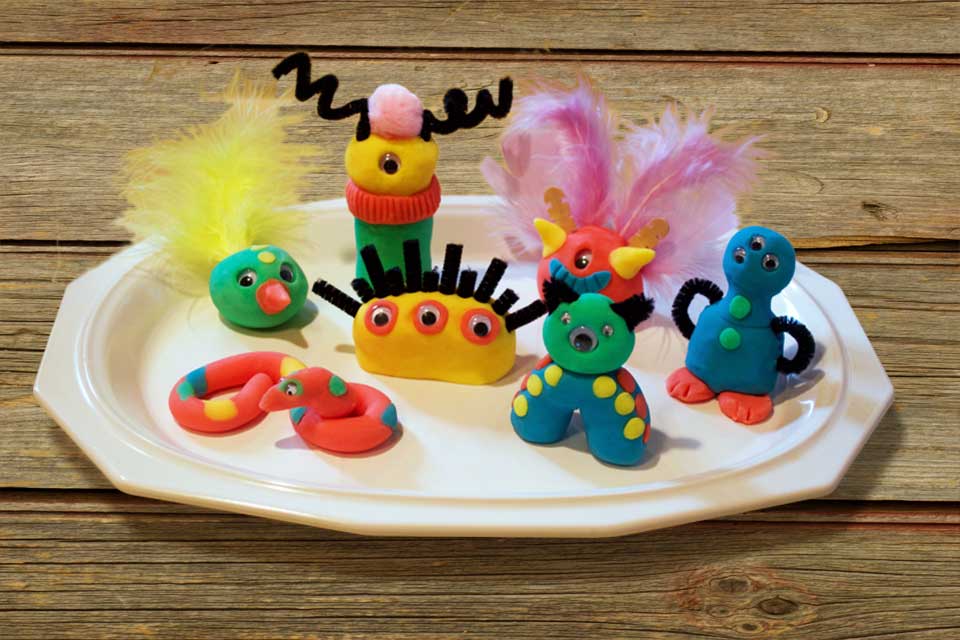
Highlights Kids Homemade Clay figures

Photo and craft sample by Madison McClain, courtesy of Highlights Kids (highlightskids.com)

This craft comes from Highlights Homemade Clay, by Marie E. Cecchini posted on April 12, 2016. You can find the post on the Highlights kids website.

Make your own homemade clay in honor of Maria’s art form then make your own pot or creation!

What you’ll need

  • 2 cups baking soda
  • 1 cup cornstarch
  • 1 ¼ cups water
  • Cooking pot
  • Food coloring (optional)
  • Wiggly eyes, chenille sticks, pompoms, feathers, etc. (optional)

What to do

Note: Food coloring can be added to the water before mixing in the other ingredients or can be added to the clay after it has cooled. Adding coloring later may be a little messier, but you can divide the clay and create different batches of various colors.

  1. Combine ingredients in the pot and cook mixture over medium heat, stirring until it thickens to a consistency like mashed potatoes.
  2. Let the clay cool
  3. Knead the clay until smooth.
  4. Make creations!
  5. Leave clay pieces in the sun to dry.

celebrate-picture-books-picture-book-review-shaped-by-her-hands-cover

You can find Shaped By Her Hands: Potter Maria Martinez at these booksellers

Amazon | Barnes & Noble | Books-a-Million

To support your local independent bookstore, order from

Bookshop | IndieBound

Picture Book Review

August 25 – National Park Service Day

celebrate-picture-books-picture-book-review-headstrong-hallie-cover

About the Holiday

On August 25, 1916, President Woodrow Willson signed what is now called the Organic Act, establishing the National Park Service. In the 105 years since that historic signing, 400 areas in each of the 50 states, U.S. territories, and the District of Columbia, totaling 84 million acres, have been designated as national parks. Today we honor the park rangers who conserve and preserve these natural wonders and educate visitors. This year’s theme – Park Scrapbooks – encourages park visitors to take pictures, buy postcards, and record memories for family and future generations. To discover the national parks near you and the stories behind them as well as to learn more about how you can help out all year round, visit the National Park Foundation website and the National Park Service website.

Headstrong Hallie! The Story of Hallie Morse Daggett, the First Female “Fire Guard”

Written by Aimée Bissonette | Illustrated by David Hohn


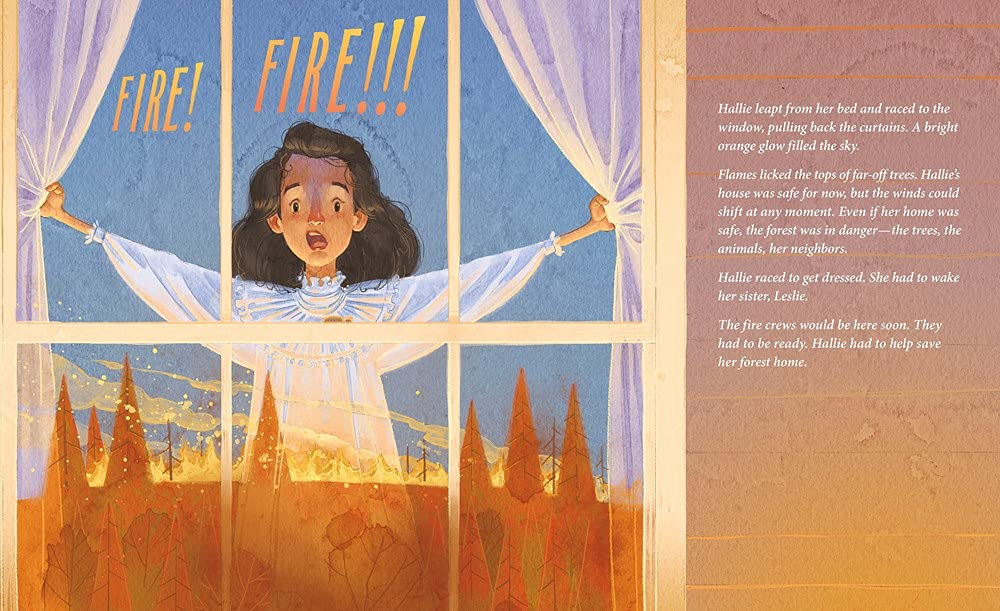
Hallie Morse Daggett loved the forest near her home. She had no fear as she “hiked among the tall trees of California’s Siskiyou Mountains, listened for the calls of familiar birds, and looked for signs of wildlife.” She fished in the Salmon River and was an excellent hunter. The only thing Hallie feared about the forest was fire, especially the summer fire season. “Hallie had seen the horrible power of fire race through the trees, leaving them scorched and leafless. She had seen the animals of the forest scatter and flee from racing flames…. And she had seen those flames come dangerously close to her family’s home.”

celebrate-picture-books-picture-book-review-headstrong-hallie-window

Image copyright David Hohn, 2021, text copyright Aimée Bissonette, 2021. Courtesy of Sleeping Bear Press.

Whenever fire did come to the forest, though, Hallie and her sister Leslie were among the first to help the US Forest Service by stamping out flames and bringing them food and supplies. But Hallie wanted to do more. She vowed to word for the Forest Service when she grew up. As soon as she finished boarding school in San Francisco, Hallie wanted to get bac to the forest she loved. She began sending letters to the US Forest Service, asking for a job. But she always received “no” for an answer.

celebrate-picture-books-picture-book-review-headstrong-hallie-fire

Image copyright David Hohn, 2021, text copyright Aimée Bissonette, 2021. Courtesy of Sleeping Bear Press.

After the devastating Great Fire of 1910, which “burned millions of acres of forest in Washington, Idaho, and Montana, Hallie was more determined than ever. But the response to her letters was always “no.” “The Forest Service didn’t hire women.” But then in 1913, when the fire lookout at the Eddy Gulch Lookout Station quit, Hallie saw her chance. She wrote a heartfelt letter and this time she got the job!

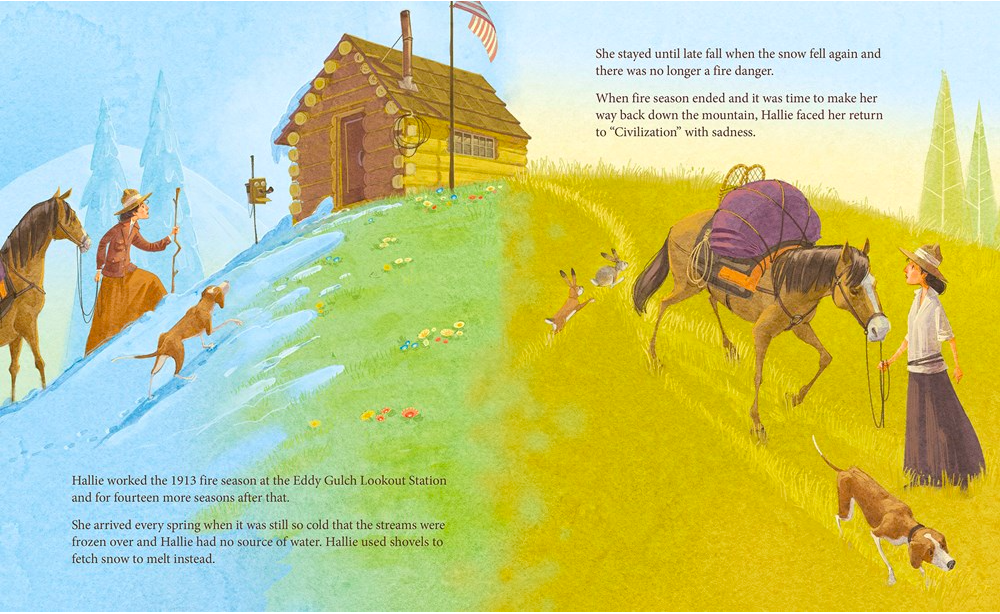
When the news spread, some of the Fire Service men thought the conditions would make her quit in a couple of days. “They didn’t know Hallie.” She loved the tiny lookout cabin and the breathtaking view. Hallie lived surrounded by wildlife—and a few animals even invited themselves in to stay. Sometimes she had visitors, and Leslie came every week to bring her supplies, letters, and newspapers.

celebrate-picture-books-picture-book-review-headstrong-hallie-horse

Image copyright David Hohn, 2021, text copyright Aimée Bissonette, 2021. Courtesy of Sleeping Bear Press.

Her days were spent searching the woods for fire or smoke through her binoculars. At night she watched for the glow of fire, “which she described as ‘red stars in the blue-black background of moonless nights.’” In her first season, Hallie’s eagle eye and quick response to forty fires kept the acres burned to less than five. In all Hallie worked for fifteen seasons—early spring to late fall—as the Eddy Gulch lookout.

In 1927, the tiny Eddy Gulch lookout cabin was replaced with a new building with wraparound windows and catwalk. But this building didn’t feel like a home to Hallie. She remained in her position for one more season and then retired, happy that she had found her place and lived her life in the way she wanted.

An Author’s Note following the text reveals more about Hallie Morse Daggett and her work as a lookout, complete with photographs.

celebrate-picture-books-picture-book-review-headstrong-hallie-cabin

Image copyright David Hohn, 2021, text copyright Aimée Bissonette, 2021. Courtesy of Sleeping Bear Press.

Aimée Bissonette’s inspiring biography of the first woman to work as a Fire Guard for the US Forest Service emphasizes the kind of grit, self-awareness, and perseverance that empowers girls and boys to stay true to themselves while pursuing the kind of life and lifestyle that is most meaningful to them. Bissonette’s straightforward storytelling is fast-paced and focused on Hallie’s unwavering self-confidence, fearlessness, and love of her job. For children who are happiest in contemplation and working alone, Hallie’s story will come as encouragement and validation for a life lived differently.

David Hohn’s color-saturated illustrations of the forest fires Hallie lived through and helped prevent crackle with the golds, reds, and flying embers of these powerful events. Contrasting these images are illustrations of the peaceful, sun-drenched mountains and woodlands that Hallie called home. While bears, bobcats, and smaller wildlife stalk nearby, Hallie, as a young girl, is shown easily traversing the rocky hills, confident and unfearful. Readers will enjoy seeing Hallie scanning the forest with her binoculars, calling for firefighters at the first sight of flames, and relaxing in the rustic cabin she lived in during the long fire season.

A well-told story about a woman determined to make a difference while living her authentic life, Headstrong Hallie! will inspire kids and is a standout choice for nature lovers and others looking for unique opportunities to put their stamp on the world.

Ages 6 – 9

Sleeping Bear Press, 2021 | ISBN 978-1534110618

Discover more about Aimée Bissonette and her books on her website.

To learn more about David Hohn, his books, and his art, visit his website.

National Park Service Day Activity

celebrate-picture-books-picture-book-review-if-I-were-a-park-ranger-mesa-verde-coloring-page

Majestic Parks Coloring Pages


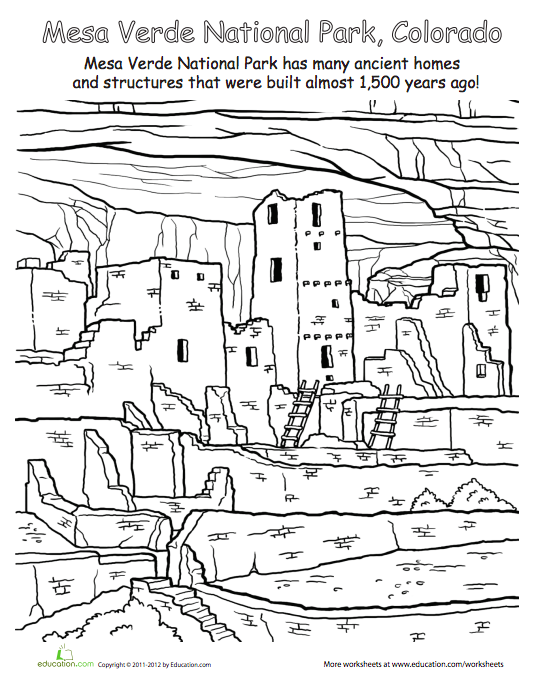
You may not be able to visit all of these parks, but you can still enjoy their beauty with these printable coloring pages!

Mesa Verde National Park | Gates of the Arctic National Park | Hawaii Volcanoes National Park | Biscayne National Park | 

celebrate-picture-books-picture-book-review-headstrong-hallie-cover

You can find Headstrong Hallie! The Story of Hallie Morse Daggett, the First Female “Fire Guard” at these booksellers

Amazon | Barnes & Noble | Books-a-Million

To support your local independent bookstore, order from

Bookshop | IndieBound

Picture Book Review

August 19 – World Photography Day

celebrate-picture-books-picture-book-review-dorothea's-eyes-cover

About the Holiday

Photography is all about providing information and emotion through images. A picture really can be worth a thousand words in capturing a moment of surprise, joy, danger, or sadness. Well-placed photographers, videographers, and cinematographers have given voice to some of society’s pivotal moments, allowing the whole world to witness change, often as it is happening. Today we celebrate the “art, craft, science, and history of photography,” as well as those photographers who often put themselves in danger to get the story and those who bring us much-needed lighter moments. To learn more visit the World Photography Day website.

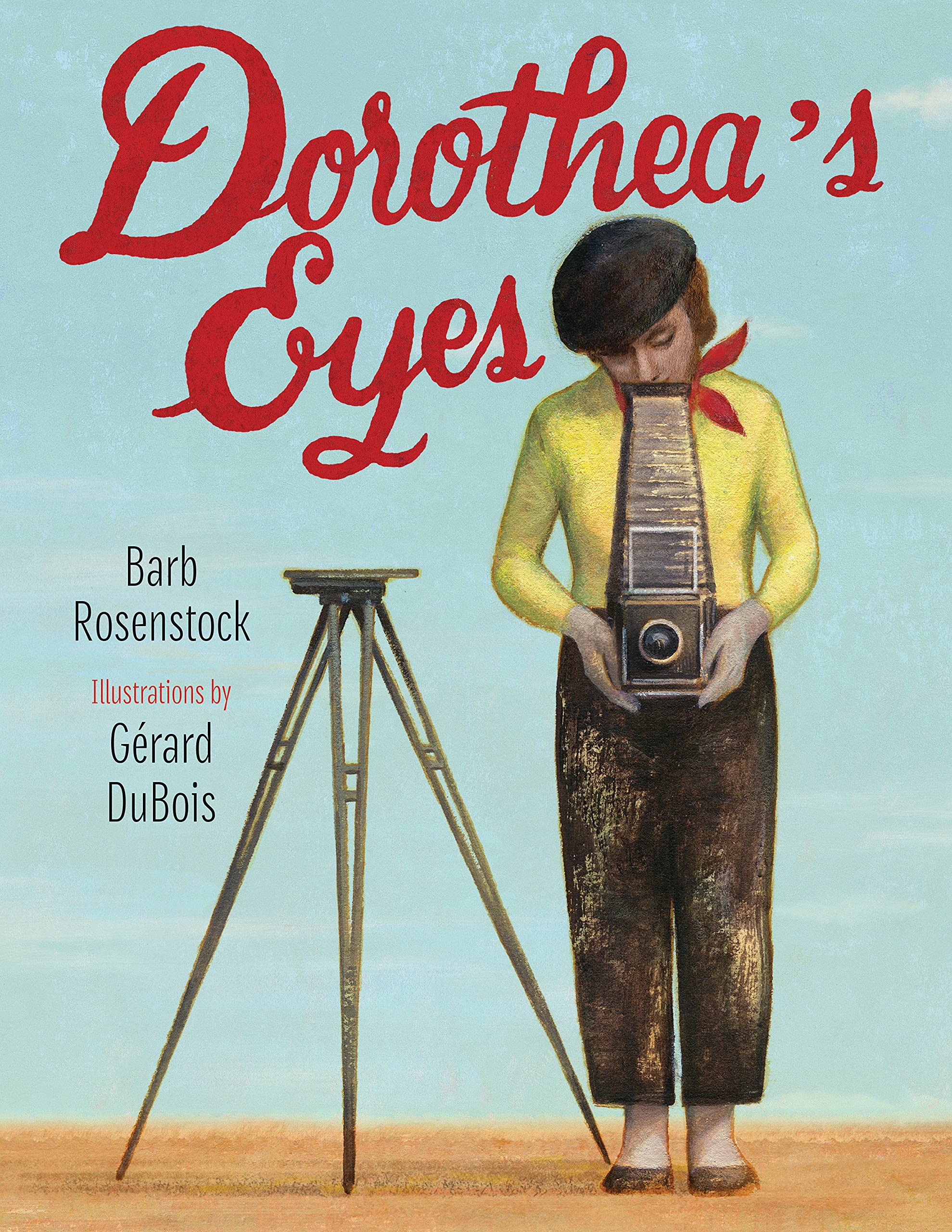
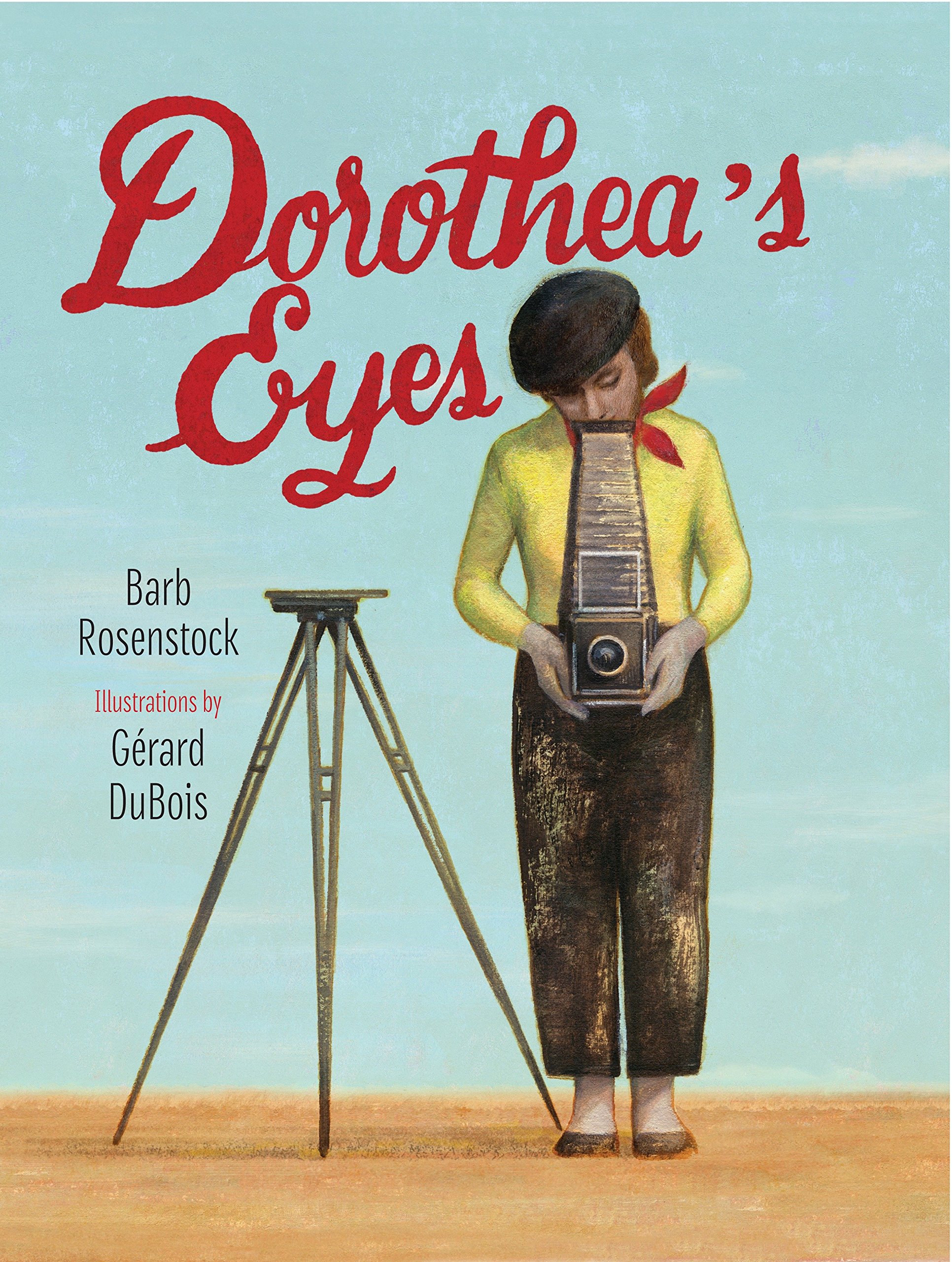
Dorothea’s Eyes: Dorothea Lange Photographs the Truth

Written by Barb Rosenstock | Illustrated by Gérard DuBois


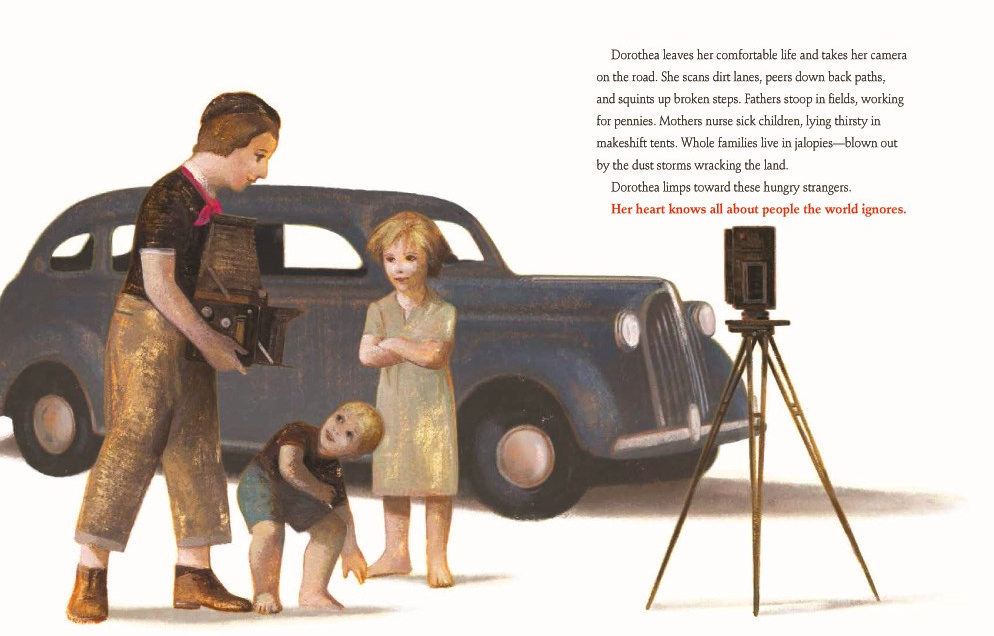
When Dorothea Lange opens her green eyes, she sees things others miss. In the shadows, in patterns within the grain of wooden tables, in the repeated shapes of windows on a wall, and most especially in people’s faces. “Dorothea loves faces! When Dorothea looks at faces, it’s like she’s hugging the world.”

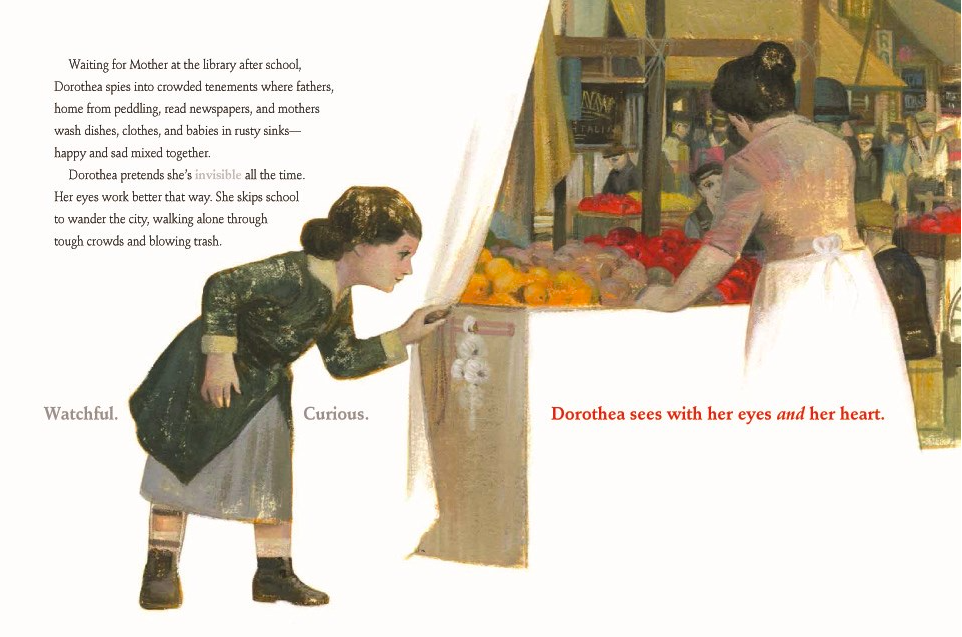
At seven years old Dorothea contracts polio, which withered her right leg and left her with a permanent limp. Other kids tease her and make her want to hide, and although her mother encourages her Dorothea pretends to be invisible. When her father leaves his family, her mother gets a job in New York and Dorothea goes to a new school. Because she is different, she feels lonely.

celebrate-picture-books-picture-book-review-dorothea's-eyes-great-market

Image copyright Gérard DuBois, 2016, text copyright Barb Rosenstock, 2016. Courtesy of Calkins Creek.

As Dorothea waits for her mother to finish work, she looks around her, spying “into crowded tenements where fathers, home from peddling, read newspapers, and mothers wash dishes, clothes, and babies in rusty sinks—happy and sad mixed together.” She begins to skip school to wander the city, gazing at it with her curious eyes and heart.

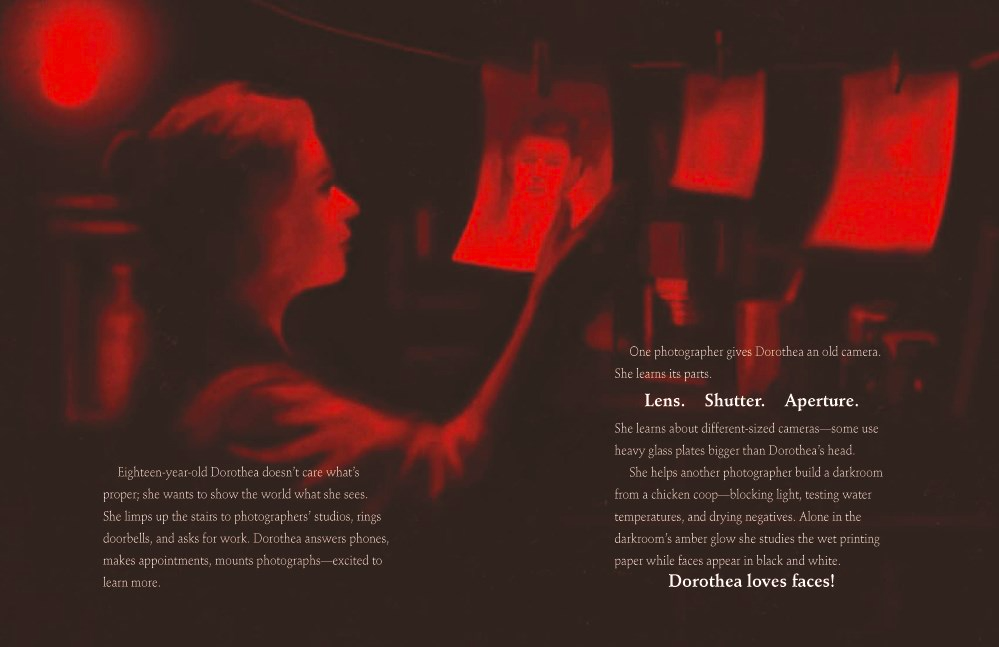
When Dorothea grows up she decides to become a photographer. Her family is surprised because it’s not a ladylike profession. She’s determined, thought, and works any job she can find in the photography industry, learning about cameras, darkrooms, negatives, and the printing process. “Alone in the darkroom’s amber glow, she studies the wet printing paper while faces appear in black and white. Dorothea loves faces!”

celebrate-picture-books-picture-book-review-dorothea's-eyes-great-dark-room

Image copyright Gérard DuBois, 2016, text copyright Barb Rosenstock, 2016. Courtesy of Calkins Creek.

As a young woman Dorothea travels west to San Francisco. There, her money is stolen, so she stays, gets a job, and starts her own portrait studio. Her work makes her famous and the richest families in California seek her out to take their photos. She makes money, gains friends, gets married, and starts a family of her own. But she always wonders, “Am I using my eyes and my heart?”

celebrate-picture-books-picture-book-review-dorothea's-eyes-great-depression

Image copyright Gérard DuBois, 2016, text copyright Barb Rosenstock, 2016. Courtesy of Calkins Creek.

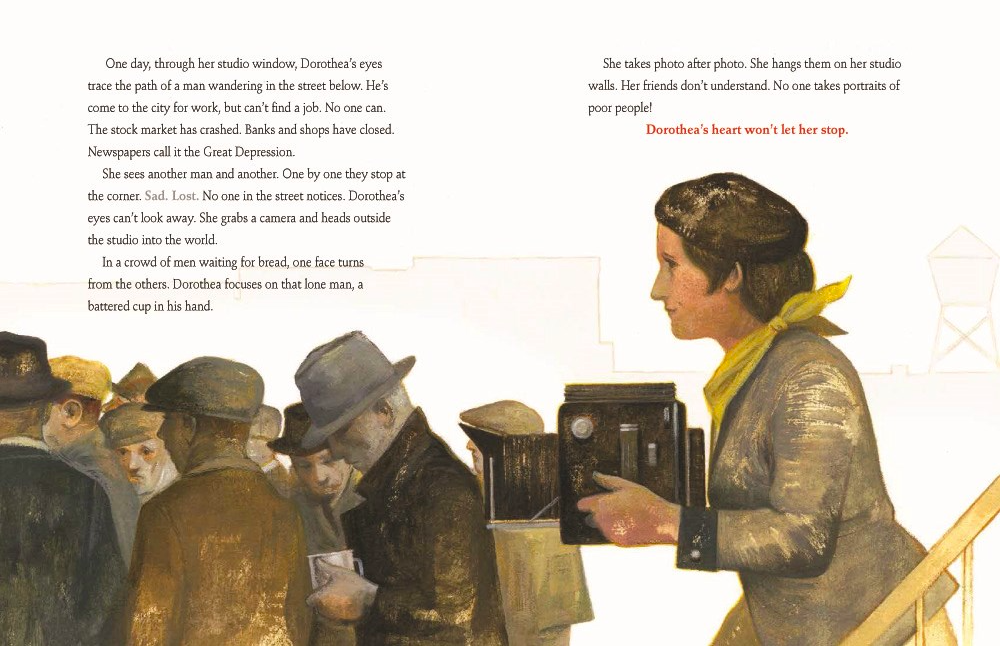
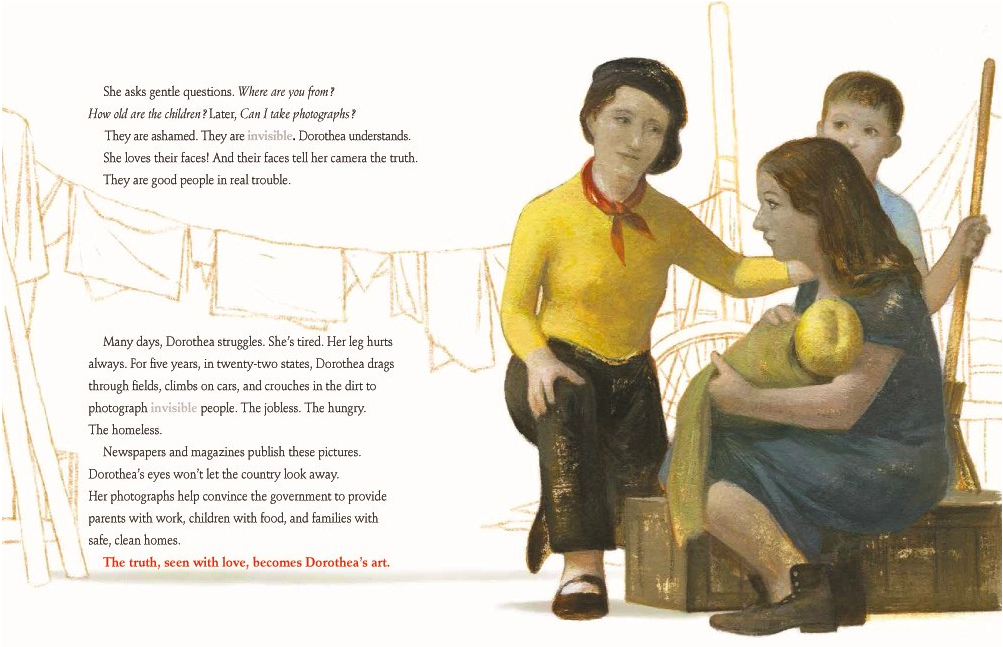
When the stock market crashes and the Great Depression sweeps the country, Dorothea focuses her camera on the desperate and the downtrodden. Her friends don’t understand, but Dorothea sees into these poor people’s hearts. She “knows all about people the world ignores.” For five years she goes out into the fields, peers into tents, documents families living in their cars, crouches in the dirt to reveal the stories of the people struggling with the devastation wrought by the Dust Bowl.

celebrate-picture-books-picture-book-review-dorothea's-eyes-kids

Image copyright Gérard DuBois, 2016, text copyright Barb Rosenstock, 2016. Courtesy of Calkins Creek.

Newspapers and magazines publish her pictures. “Her photographs help convince the government to provide parents with work, children with food, and families with safe, clean homes. “The truth, seen with love, becomes Dorothea’s art.” Dorothea’s photographs are still known today. Their subjects continue to help us see others with our hearts.

Backmatter includes six of Dorothea Lange’s most famous and recognizable photographs—ones that are still as riveting today as they were in the 1930s. Further information on her life and work is provided as well as sources where her photographs can be viewed, resources for further study, and a timeline of her life.

celebrate-picture-books-picture-book-review-dorothea's-eyes-san-francisco

Image copyright Gérard DuBois, 2016, text copyright Barb Rosenstock, 2016. Courtesy of Calkins Creek.

Barb Rosenstock brings Dorothea Lange’s vision to the page with love, honesty, and understanding in this excellent biography of a woman whose photographs defined the Great Depression and Dust Bowl era. Lange’s life-long connection to the poor and often overlooked people of the world is beautifully described and explained in a gentle, compassionate way that will resonate with children. Rosenstock’s language is lyrical with staccato sentences that echo the clicks of Lange’s shutter capturing life’s reality with her eyes and her heart.

Gérard DuBois’s illustrations are arresting and set Dorothea Lange’s story firmly in its historical and emotional landscape. Rendered in acrylic and digital imagery, they feature the muted colors and style of book illustrations from long ago. By placing the images of Dorothea, her family, and her photography subjects against white backgrounds, DuBois emphasizes Lange’s focus on the people she met and faces that inspired her. Distressed textures accentuate the troubled times and the anguish of both Dorothea and her subjects.

Ages 7 – 12

Calkins Creek, 2016 | ISBN 978-1629792088 (Hardcover, 2018) | ISBN 978-1635925630 (Paperback, 2022)

Paperback edition will be released on February 1, 2022. The book is available for preorder now.

Discover all the amazing books by Barb Rosenstock on her website!

View a portfolio of art and book illustration by Gérard DuBois on his website!

Enjoy a snapshot of Dorothea’s Eyes!

World Photography Day Activity

CPB - New Professionals Picture

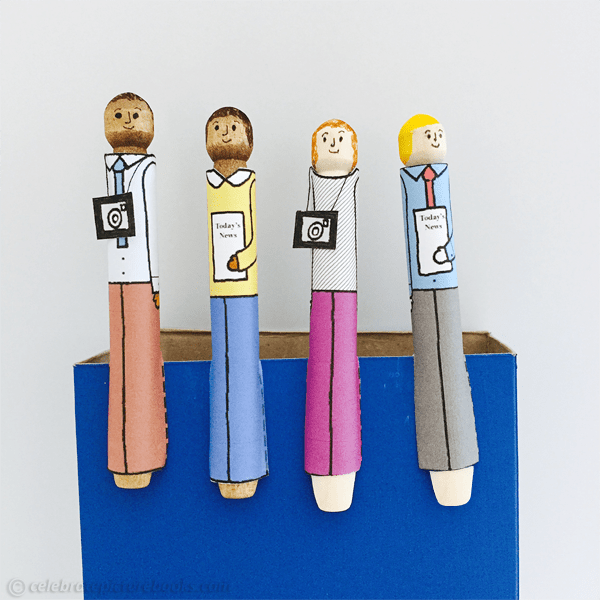
News Professionals Clothespin Figures


Make one of these clothespin figures that honors the men and women photographers and writers who work to keep the world informed.

Supplies

Directions

  1. Draw a face and hair on the clothespin
  2. Cut out the clothes you want your journalist or photographer to wear
  3. Wrap the clothes around the clothespin. The slit in the clothespin should be on the side.
  4. Tape the clothes together
  5. Cut out the camera
  6. Tape one end of a short length of thread to the right top corner of the camera and the other end of the thread to the left corner. Now you can hang the camera around the figure’s neck.

Idea for displaying the figures

  • Attach a wire or string to the wall and pin the figure to it
  • Pin it to your bulletin board or on the rim of a desk organizer

celebrate-picture-books-picture-book-review-dorothea's-eyes-cover

You can find Dorothea’s Eyes: Dorothea Lange Photographs the Truth at these booksellers

Amazon | Barnes & Noble | Books-a-Million

To support your local independent bookstore, order from

Bookshop | IndieBound

Picture Book Review

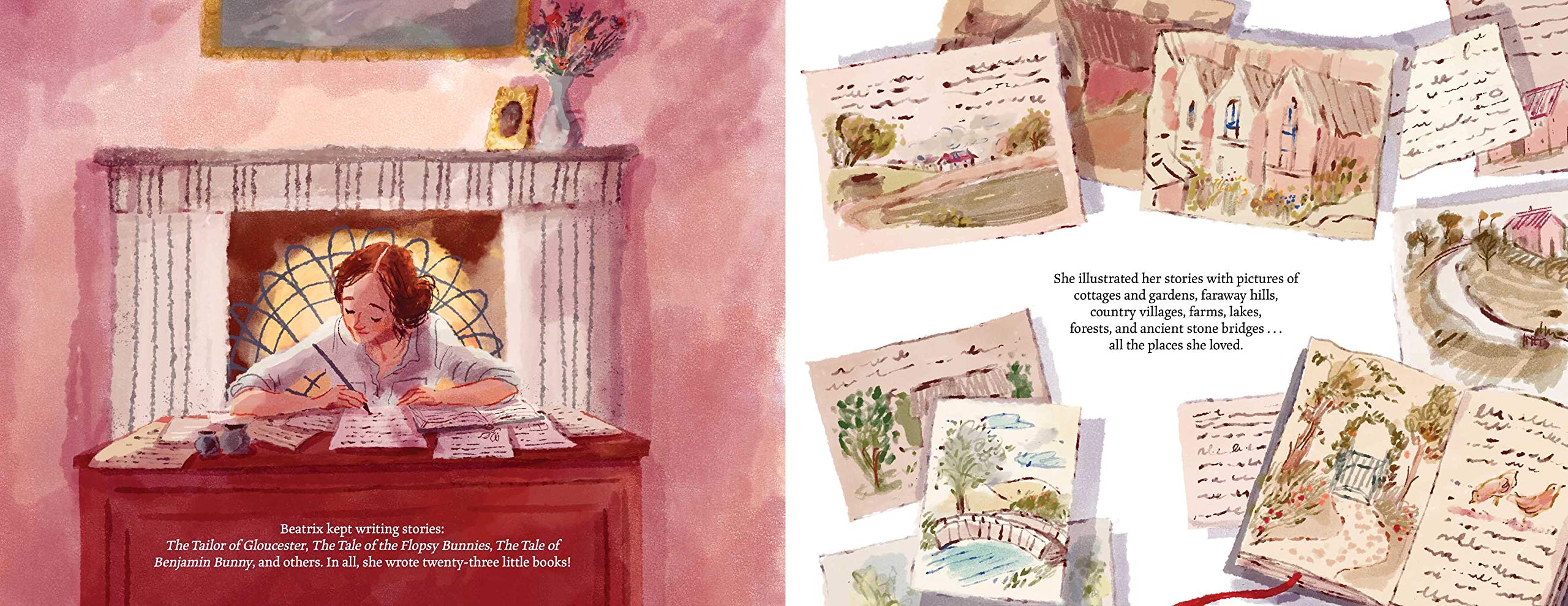
July 28 – Beatrix Potter Day

celebrate-picture-books-picture-book-review-saving-the-countryside-cover

About the Holiday

On this date in 1866, one of the world’s most beloved children’s authors was born – Beatrix Potter. Her twenty-three books about Peter Rabbit and his friends have enchanted children for generations, and the tale of how The Tale of Peter Rabbit came to be is as full of twists and turns as any good story – as you’ll see in today’s book. To celebrate today, why not go to your bookstore, library, or maybe even your own bookshelf at home and enjoy spending some time in the garden with Peter.

Saving the Countryside: The Story of Beatrix Potter and Peter Rabbit

Written by Linda Elovitz Marshall | Illustrated by Ilaria Urbinati


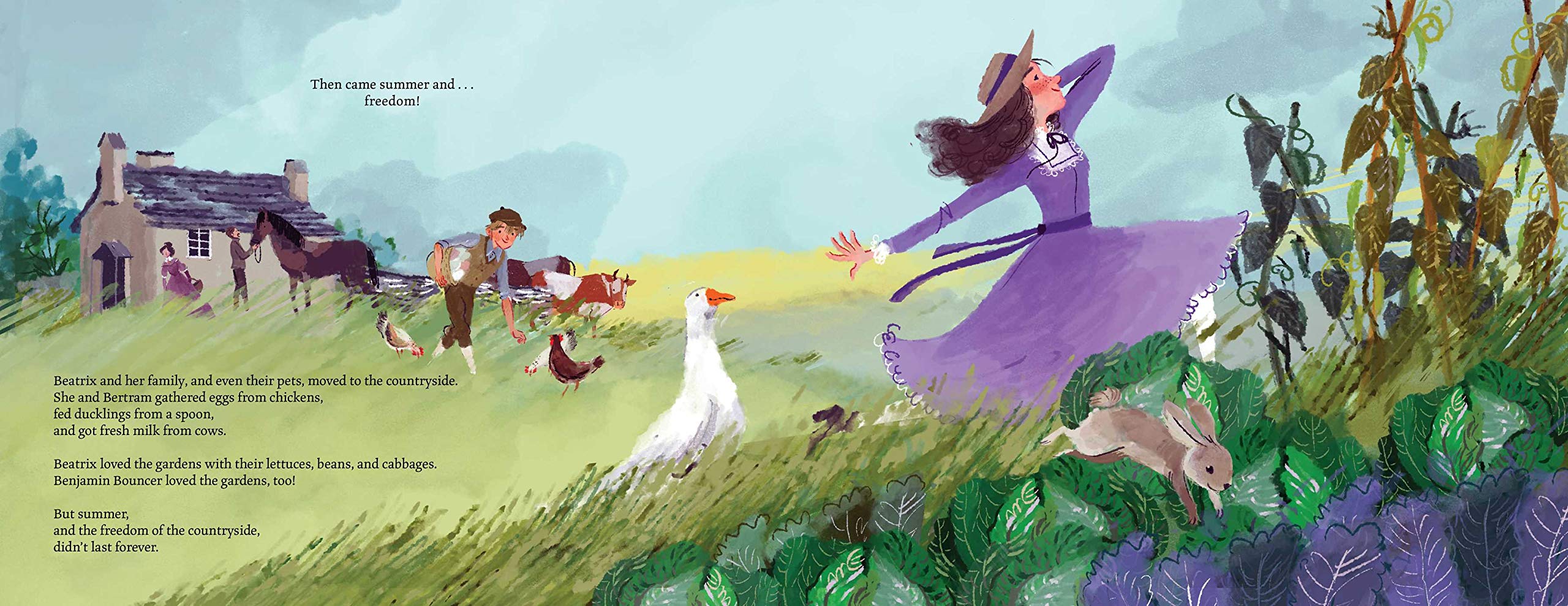
At home in London, young Beatrix Potter loved drawing and painting pictures of her pet rabbit, Benjamin Bouncer and other woodland creatures. Beatrix and her brother didn’t go to school but were taught at home under a strict daily timeline. “Then came summer and … freedom! During the summer, Beatrix’s whole household—pets included—moved to a country house where there were ducks, chickens, cows, and a garden.

celebrate-picture-books-picture-book-review-saving-the-countryside-summer

Image copyright Ilaria Urbinati, 2020, text copyright Linda Elovitz Marshall, 2020. Courtesy of little bee books.

When Beatrix’s brother grew a little older, however, he went away to a boarding school while Beatrix had to stay home. “But Beatrix wanted to do something important, something that mattered. She often helped her father with his hobby, photography.” She visited artists’ studios and museums. She learned about art and how to make her drawings better.

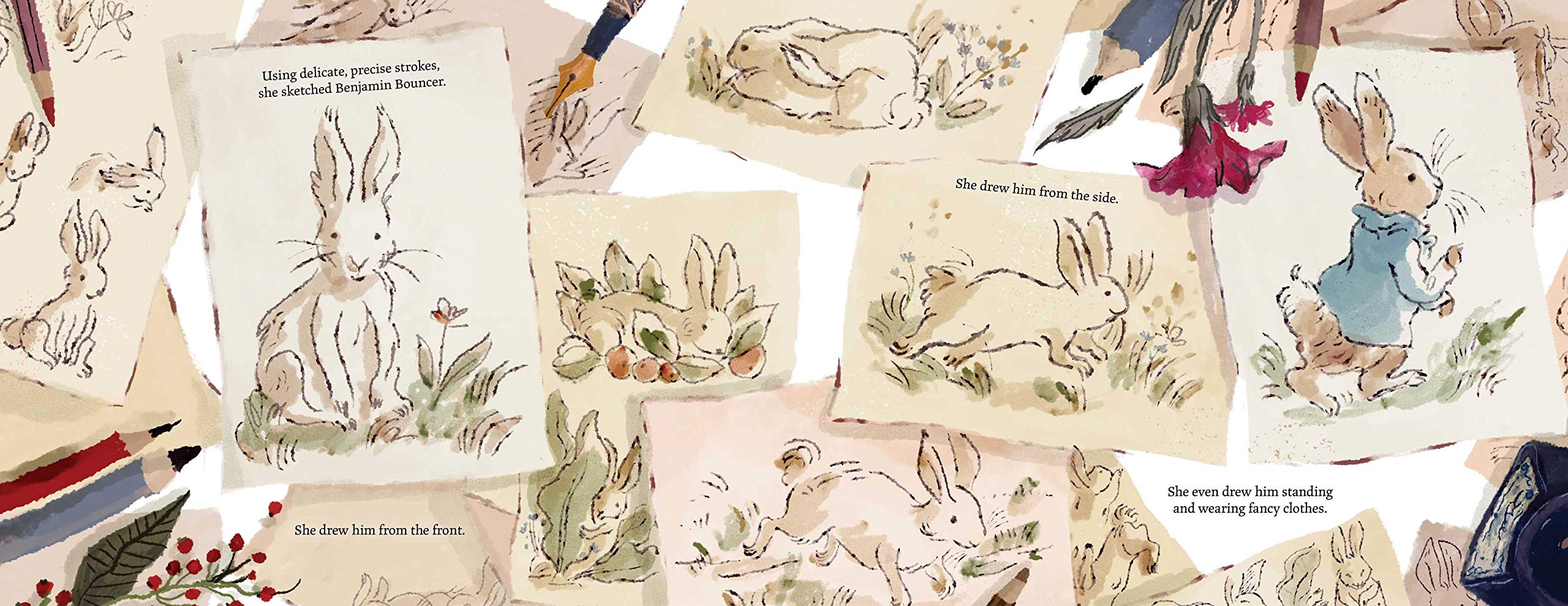
She made more pictures of Benjamin Bouncer and sent them to publishers. One publisher put her drawings on the front of greeting cards, and Beatrix began making money from her work. But Beatrix was also interested in the science of nature. She even wrote a paper about mushrooms and hoped to have it printed in a scientific journal, but it was rejected. Beatrix was disappointed but went back to drawing.

celebrate-picture-books-picture-book-review-saving-the-countryside-writing

Image copyright Ilaria Urbinati, 2020, text copyright Linda Elovitz Marshall, 2020. Courtesy of little bee books.

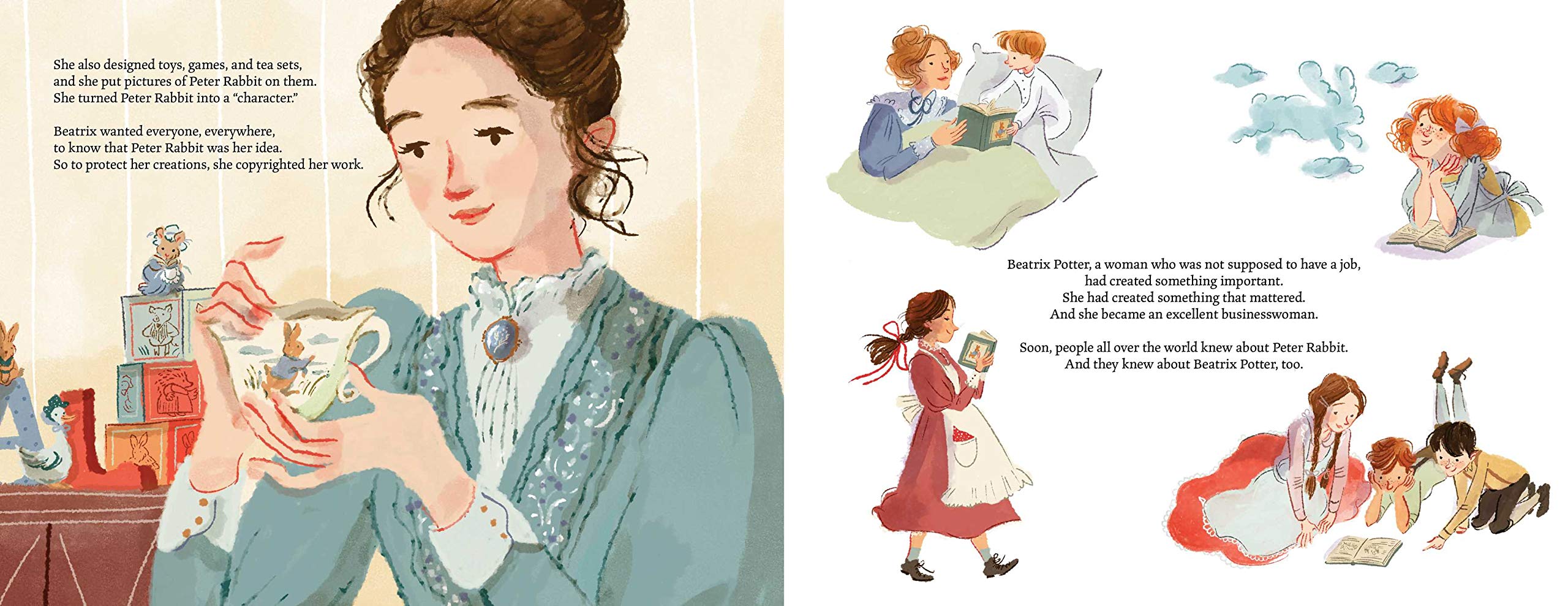
Then one day, to cheer up a sick child, Beatrix wrote and illustrated a story about Peter Rabbit. Later, she submitted it to publishers. When they told her they weren’t interested, she had books printed herself. She sold every copy—the second batch too. Finally, a publisher agreed to print her books. Beatrix went on to write more and more stories. At last she had fulfilled her dreams of creating something important. She was also an excellent marketer and self-promoter, and “soon people all over the world knew about Peter Rabbit, and they knew about Beatrix Potter too.”

celebrate-picture-books-picture-book-review-saving-the-countryside-toys

Image copyright Ilaria Urbinati, 2020, text copyright Linda Elovitz Marshall, 2020. Courtesy of little bee books.

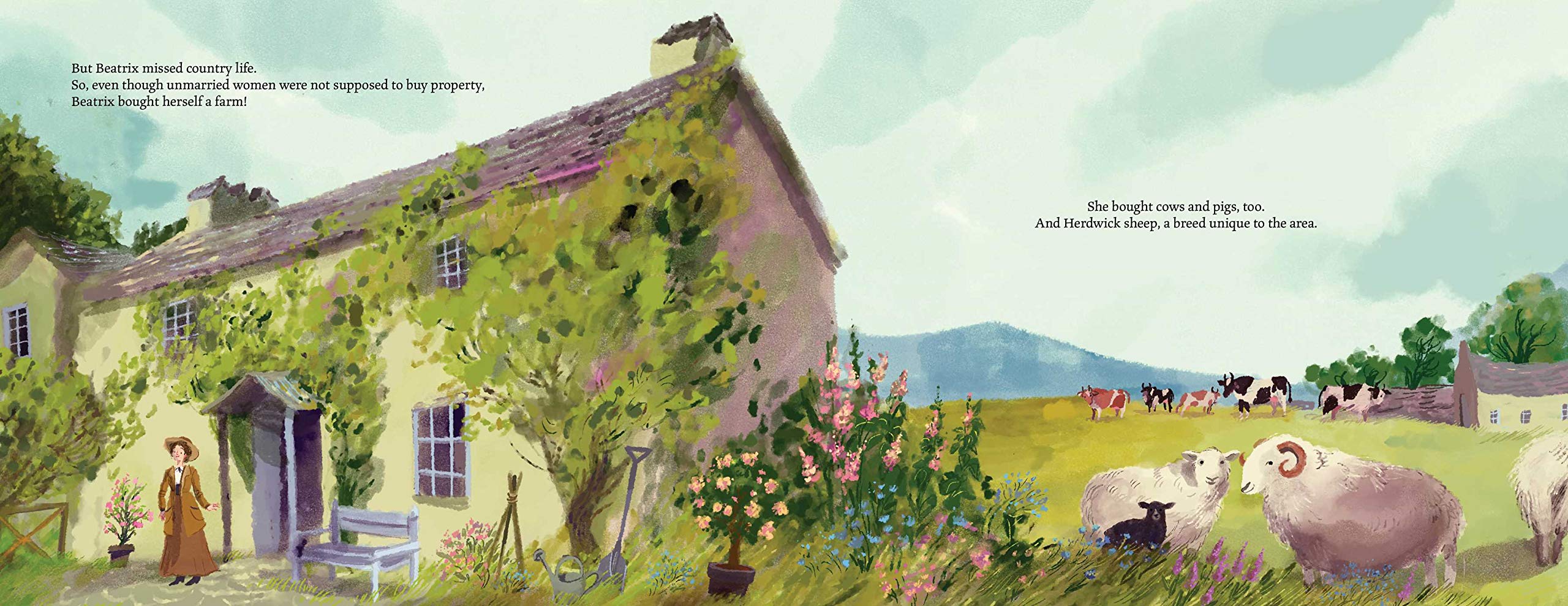
As Beatrix grew older, she couldn’t draw in the way she had, but that didn’t mean she left the countryside behind. She wanted to protect the farmland she loved. She helped farms and families, paying for needed veterinary care for animals when the farmers couldn’t afford it and for a nurse when the flu hit. Beatrix Potter’s life was made up of so many things that mattered. Not only did she give the world the beloved Peter Rabbit and his friends, but through donations of farms and acreage she “made sure the land would be cared for, protected, and cherished. Forever.”

An Author’s Note about how she came to write this book and more information on Beatrix Potter’s legacy follows the story.

celebrate-picture-books-picture-book-review-saving-the-countryside-farm

Image copyright Ilaria Urbinati, 2020, text copyright Linda Elovitz Marshall, 2020. Courtesy of little bee books.

Linda Elovitz Marshall’s delightful and surprising biography of Beatrix Potter delves into the depths of her desire to make a difference with her life. A woman far ahead of her time, Beatrix Potter remains an inspiration for each new generation of readers not only for her well-loved stories but for her community work and foresight. Marshall’s thorough and well-paced story will captivate today’s children, who have the same hopes as Beatrix to influence the world with their talents and opinions. Marshall’s descriptions of Beatrix’s later largesse swell the heart and readers’ admiration for this exceptional woman.

celebrate-picture-books-picture-book-review-saving-the-countryside-artwork

Image copyright Ilaria Urbinati, 2020, text copyright Linda Elovitz Marshall, 2020. Courtesy of little bee books.

Linda Marshall’s words are set among Ilaria Urbinati’s exquisite illustrations that take children inside Beatrix Potter’s world at home in London and out to the countryside she adored. Her delicate and detailed renderings of young Beatrix drawing with her pet Benjamin Bunny by her side, the farm where she spent summers, her scientific explorations, and her later successes immerse readers in the late 1800s to mid-1900s, allowing them to experience the environments that created one of the world’s most beloved authors. Urbinati’s glorious panoramas of the lake district farms that Beatrix saved are breathtaking and inspiring in their beauty.

For fans of Peter Rabbit and any lover of children’s literature, Saving the Countryside: The Story of Beatrix Potter and Peter Rabbit is a must. Stirring on so many levels, the book will inspire multiple readings as well as the discovery or rediscovery of Beatrix Potter’s tales. Perfect for home, school, and public library collections for story times and to enhance language arts lessons and even nature science studies.

Ages 4 – 8

little bee books, 2020 | ISBN 978-1499809602

Discover more about Linda Elovitz Marshall and her books on her website.

To learn more about Ilaria Urbinati, her books, and her art, visit her website.

Great Outdoors Month Activity

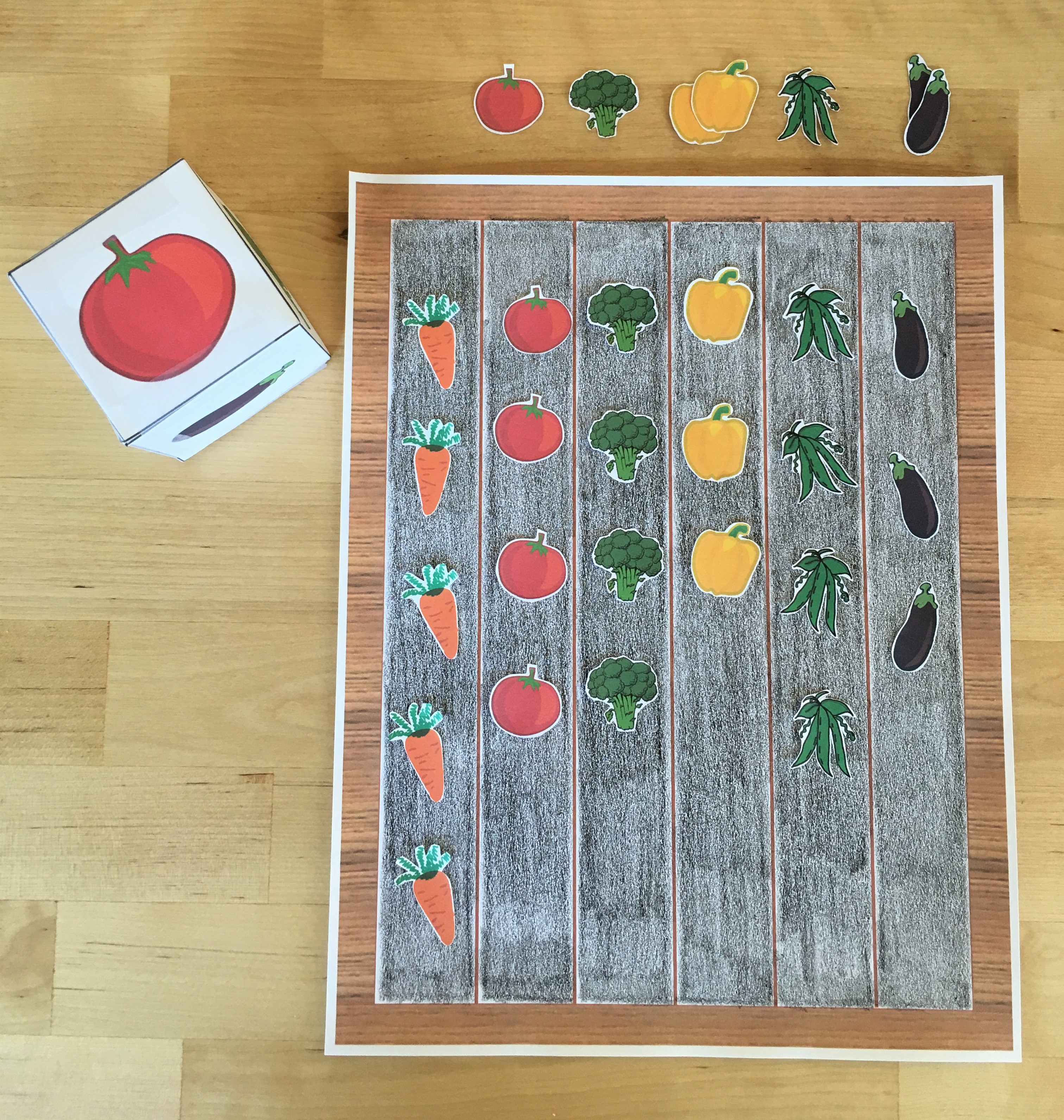
celebrate-picture-books-picture-book-review-garden-board-game-1

Grow a Vegetable Garden Board Game


As all readers know, Peter Rabbit loved vegetable gardens. With this fun game you and your family can grow your own gardens inside! Roll the dice to see whose garden will fully ripen first!

Supplies

Directions

Object: The object of the game is for each player to fill their garden rows with vegetables. Depending on the ages of the players, the required winning number of rows to fill and the number of vegetables to “plant” in each row can be adjusted.

  1. Print one Game Board for each player
  2. Print one set of Playing Cards for each player (for sturdier playing items, print on card stock)
  3. Print one Vegetable Playing Die and assemble it (for a sturdier die, print on card stock)
  4. Cut the vegetables into their individual playing cards
  5. Color the “dirt” on the Garden Plot with the crayon (optional)
  6. Choose a player to go first
  7. The player rolls the die and then “plants” the facing vegetable in a row on the game board
  8. Play moves to the person on the right
  9. Players continue rolling the die and “planting” vegetables until each of the number of determined rows have been filled with the determined number of vegetables.
  10. The first person to “grow” all of their veggies wins!

celebrate-picture-books-picture-book-review-saving-the-countryside-cover

You can find Saving the Countryside: The Story of Beatrix Potter and Peter Rabbit at these booksellers

Amazon | Barnes & Noble | Books-a-Million

To support your local independent bookstore, order from 

Bookshop | IndieBound

Picture Book Review

June 29 – International Day of the Tropics

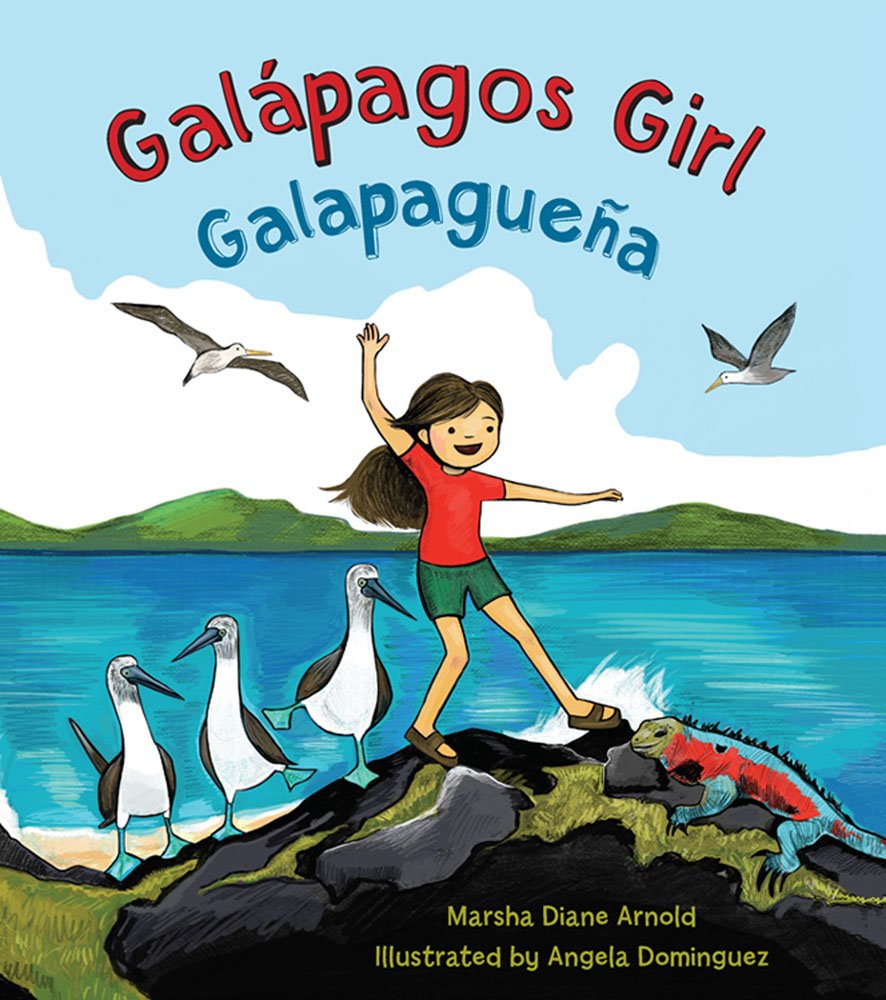
celebrate-picture-books-picture-book-review-galapagos-girl-cover

About the Holiday

The International Day of the Tropics is a United Nations–sponsored holiday that celebrates the extraordinary diversity of the tropics while putting a spotlight on the unique challenges and opportunities the nations of the Tropics face. The Tropics are a region roughly defined as the area between the tropic of Cancer and the tropic of Capricorn and have in common a warm and typically unvaried seasonal temperature fluctuations and the prevalence of rain  determined by a region’s proximity to the equator. While it is projected that by 2050, the Tropics will be home to most of the world’s population and two-thirds of its children, the area faces challenges due to climate change, deforestation, logging, urbanization, and demographic shifts.  Today’s observance provides individuals, organizations, and governments an opportunity to take stock of progress across the tropics, to share stories and expertise, and to acknowledge the diversity and potential of the region. Today’s book tell the true story of one woman who is working to make a difference.

Thanks to Lee & Low Books for sending me a copy of Galápagos Girl/ Galápagueña for review consideration. All opinions about the book are my own. 

Galápagos Girl / Galapagueña

Written by Marsha Diane Arnold | Illustrated by Angela Dominguez | Translated by Adriana Dominguez


On the day when baby Valentina joined Mamá, Papá, and eleven brothers and sisters, even the sea lions, blue-footed boobies, and iguanas seemed to welcome her to the “island formed by fire.” Valentina loved growing up on the Galápagos Island of Floreana. She explored the lava rocks, where Sally Lightfoot crabs scuttled back and forth. She swam with dolphins and manta rays, and even played with penguins.
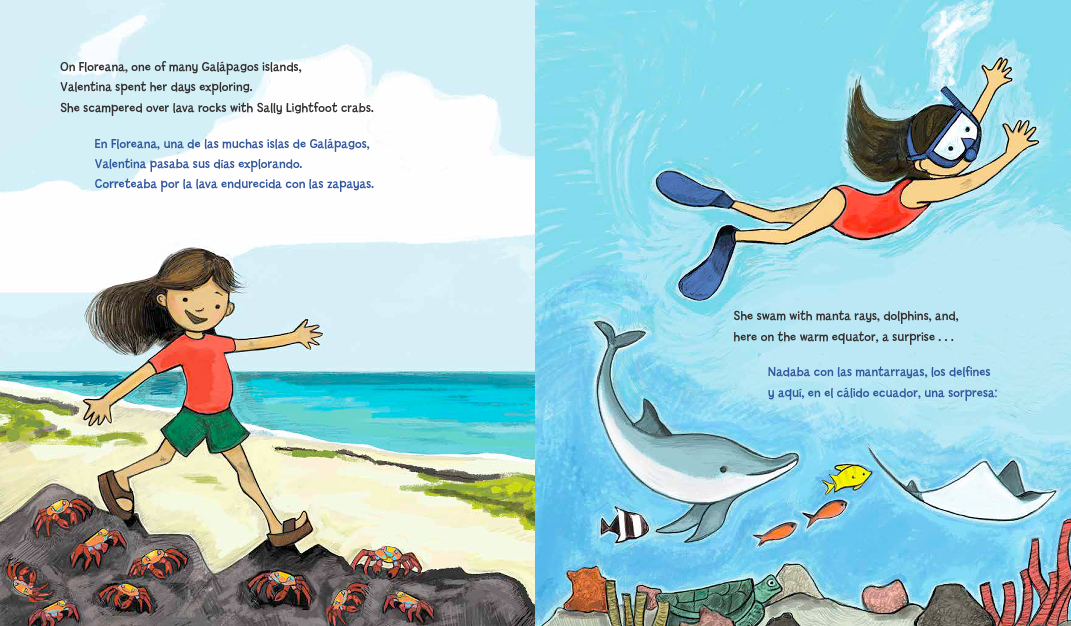
celebrate-picture-books-picture-book-review-Galápagos-Girl-crabscelebrate-picture-books-picture-book-review-Galápagos-Girl-crabs

Image copyright Angela Dominguez, 2018, text copyright Marsha Diane Arnold, 2018. Courtesy of Lee & Low Books.

“Valentina watched pink flamingoes wading near mangroves. Blue butterflies fluttering on the breeze. Red-and-green iguanas sneezing salt like tiny geysers.” The crashing waves, albatross, and finches created a symphony as Valentina stopped to rest on a grassy cliff overlooking the ocean. The lava lizards, blue-footed boobies, and twirling sea lions provided young Valentina with a variety of dance partners.
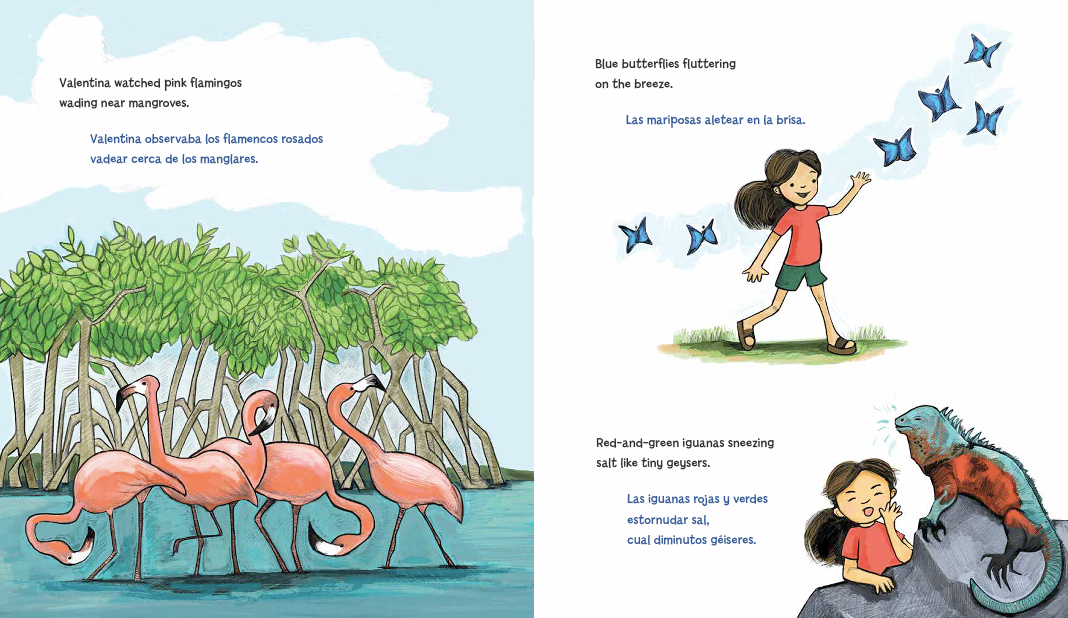
celebrate-picture-books-picture-book-review-Galápagos-Girl-iguana

Image copyright Angela Dominguez, 2018, text copyright Marsha Diane Arnold, 2018. Courtesy of Lee & Low Books.

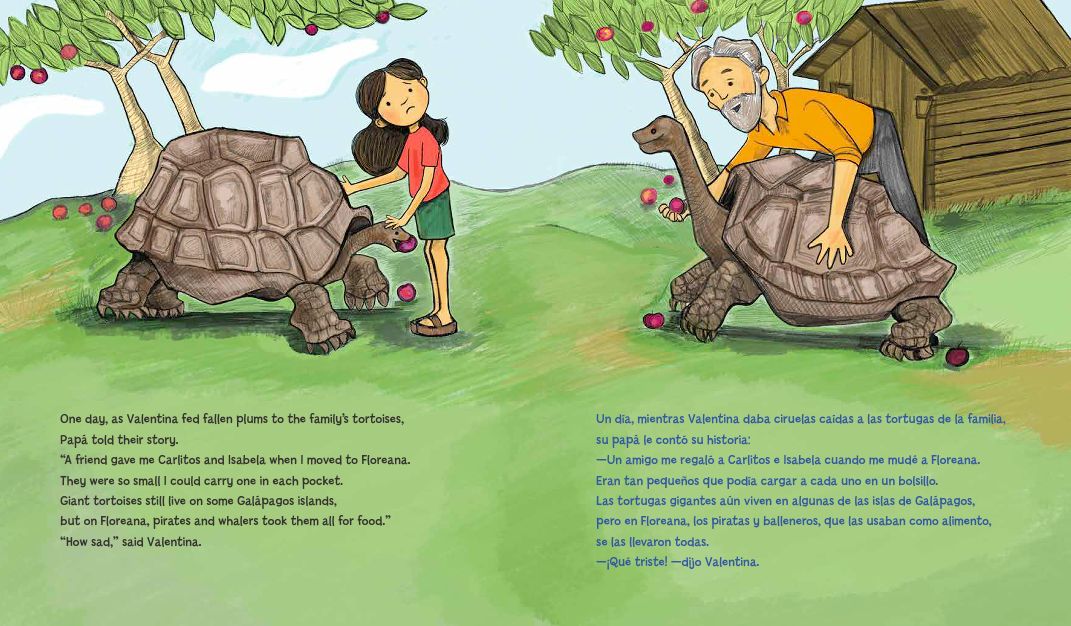
At home, Valentina’s family shared their home with two giant tortoises—Carlitos and Isabella. One day Papá told Valentina their story as they fed the tortoises plums that had fallen from their backyard trees. Papá had gotten Carlitos and Isabella from a friend when he first moved to Floreana. Although it was nearly impossible to imagine now that the tortoises were grown, at the time they were so small that they fit into Papá’s pockets.
celebrate-picture-books-picture-book-review-Galápagos-Girl-tortoises

Image copyright Angela Dominguez, 2018, text copyright Marsha Diane Arnold, 2018. Courtesy of Lee & Low Books.

There was also a sad note to Papá’s story. He said that while giant tortoises still lived on other Galápagos islands, pirates and whalers had wiped out the population on Floreana. Papá went on to tell Valentina that many Galápagos animals were in danger. They were “threatened by other animals that don’t belong here. Threatened by people who don’t understand how to care for our islands.” Valentina promised that she would always protect them.

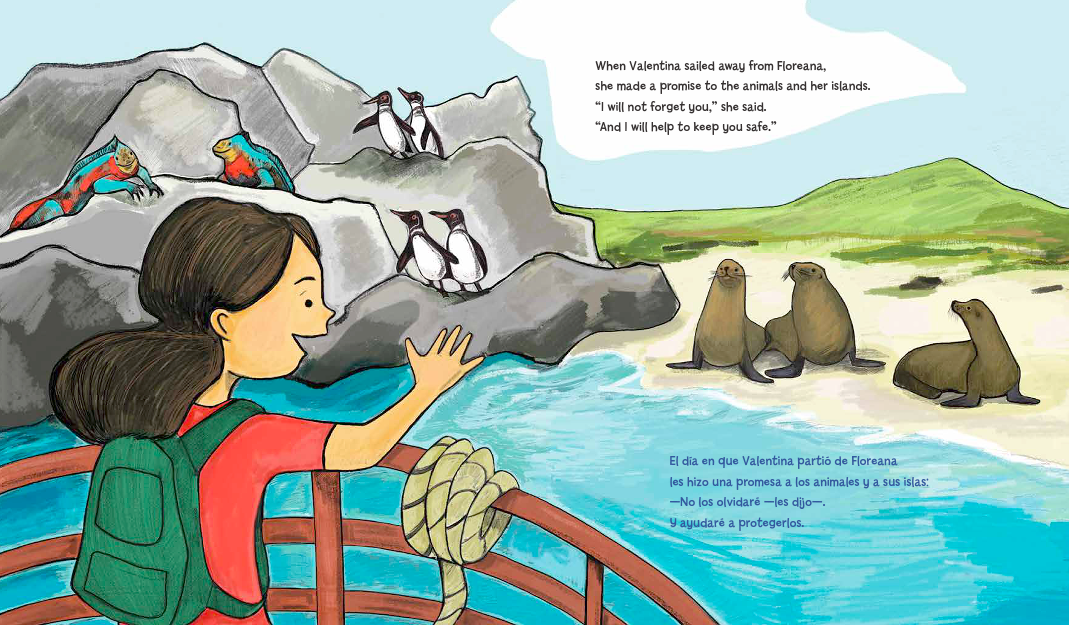
When she was older, Valentina left the island to go to school. She didn’t want to leave her beautiful home, but Mamá told her that she was “ready to learn about the world beyond.” And Papá reminded her that “like our islands, you have a heart full of fire.” On school vacations, Valentina always came back to study the wildlife on the Galápagos islands. She had not forgotten her promise to keep them safe.
celebrate-picture-books-picture-book-review-Galápagos-Girl-going-to-school

Image copyright Angela Dominguez, 2018, text copyright Marsha Diane Arnold, 2018. Courtesy of Lee & Low Books.

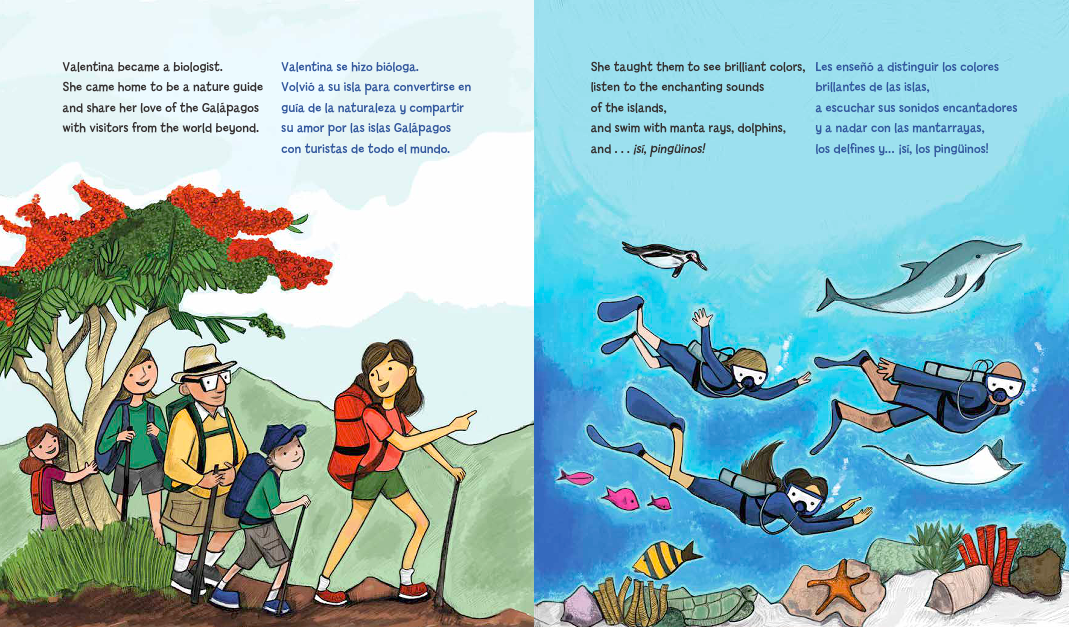
After she graduated with a degree in biology, Valentina returned to the islands as a nature guide to teach visitors about the beauty and uniqueness of the Galápagos. Some visitors were even lucky enough to meet Carlitos and Isabella when the plums dropped from the trees and the two old tortoises returned from exploring Floreana to eat them. Because of Valentina’s commitment to the Galápagos, her visitors also made a promise to always remember and protect them.

Extensive backmatter includes an Author’s Note about Valentina Cruz, the tortoises Carlitos and Isabella, and the history of tortoises on Floreana. There is also information on the Galápagos as well as fun facts about all of the animals in the story. A bibliography of sources invites readers to learn more.

Each two-page spread presents the text in English and translated into Spanish by Adriana Dominguez.
celebrate-picture-books-picture-book-review-Galápagos-Girl-guiding-visitors

Image copyright Angela Dominguez, 2018, text copyright Marsha Diane Arnold, 2018. Courtesy of Lee & Low Books.

Marsha Diane Arnold’s lyrical and buoyant passages sing with the carefree joy Valentina felt as a girl exploring her beloved Galápagos and which brought her back home as a biologist to protect them. After seeing Valentina playing and swimming with the native animals and feeding Carlitos and Isabella, readers will also feel Valentina’s sadness at the dangers they face and want to make a positive difference to the environment and the world around them. Arnold’s dialogue-rich storytelling highlights the personal nature of the subject and will draw children into Valentina’s world.celebrate-picture-books-picture-book-review-Galápagos-Girl-blue-footed-booby
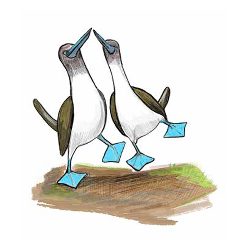
Saturated with glorious color, each of Angela Dominguez’s illustrations is a celebration of the splendor of the Galápagos. Playful sea lions, high-stepping blue-footed boobies, scampering crabs, and even a sneezing iguana will captivate young readers and inspire them to learn more about these creatures and the islands. Images of Valentina camping out to study the animals during school breaks will excite environmentally conscious kids, and pictures of Carlitos and Isabella happily munching on plums will generate smiles and “awwws.”

Galápagos Girl / Galapagueña will excite kids to learn more not only about the Galápagos region but about their own local environment, and the call to action will spark an enthusiasm for protecting the earth’s animals. The book would make an inspiring addition to home bookshelves and an excellent way to begin classroom discussions on environmental issues and science lessons. The engaging Spanish translation will delight Spanish-speaking and bilingual families.

Ages 4 – 8

Lee & Low Books, 2018 | ISBN 978-0892394135

Discover more about Marsha Diane Arnold and her books on her website. You can also download activity sheets and teachers’ guides for most of her books here as well.

To learn more about Angela Dominguez, her books, and her art, visit her website.

Welcome Marsha Diane Arnold
celebrate-picture-books-picture-book-review-marsha-diane-arnold

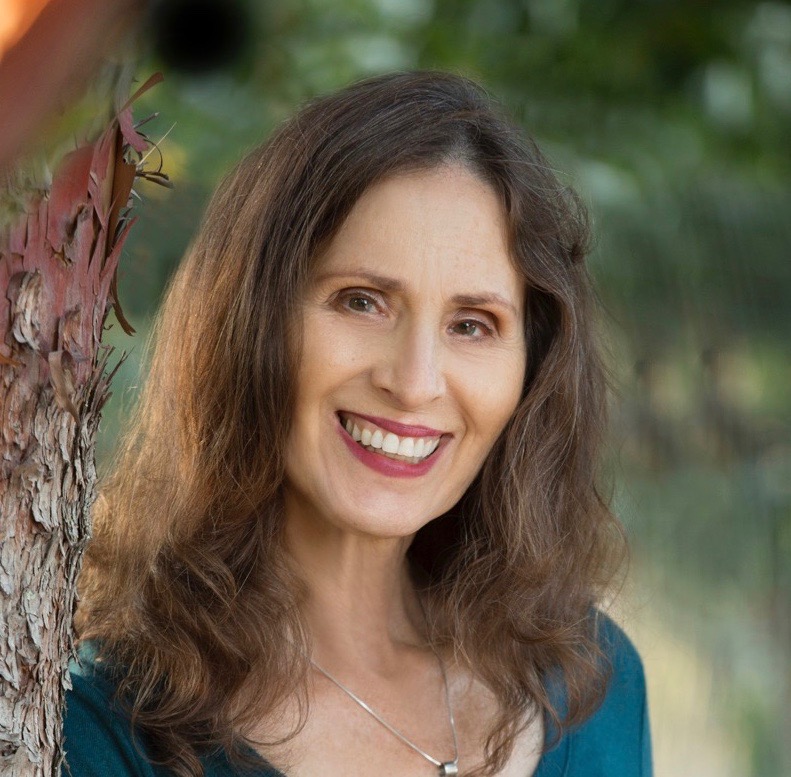
In 2018, I was thrilled to talk with award-winning picture book author Marsha Diane Arnold about the backstory of Galápagos Girl / Galápagueña. Her interview, originally for National Wildlife Day, is just as timely today. Marsha was inspired to write this story after traveling to the Galápagos Islands, where she met Valentina Cruz and had the opportunity to swim with sea lions and dolphins.

Marsha Diane Arnold is an award-winning picture book author whose books have sold over one million copies. Her 21st book, Lights Out, was published in the fall of 2020. Arnold’s other books include Badger’s Perfect Garden, May I Come In? and Mine. Yours. Among Marsha’s honors are the Ridgeway Award for Best First Book, state Children’s Choice awards, IRA Distinguished Book, and Smithsonian Notable Book. Her bilingual book Galápagos Girl was selected as a 2019 Bank Street Best Books of the Year, a Campoy-Ada honor book, and a 2019 Green Prize in Sustainable Literature. The media has referred to her as, “a born storyteller.” Educators have called her a “true literary artist” whose books show “warmth and respect for one’s self.”  She lives with her family in Alva, Florida.

Thank you, Kathryn, for inviting me to celebrate Galápagos Girl / Galápagueña, along with conservation of wild places and animals!

As a child, would you have enjoyed swimming with sea lions? Feeding plums to giant tortoises by hand? Having warblers fly through your house? That was the life of Valentina Cruz. Galápagos Girl is based on her idyllic life on remote Floreana island in the Galápagos Islands, a volcanic archipelago west of Ecuador.
celebrate-picture-books-picture-book-review-galapagos-girl-blue-footed-booby

celebrate-picture-books-picture-book-review-galapagos-girl-marine-iguana

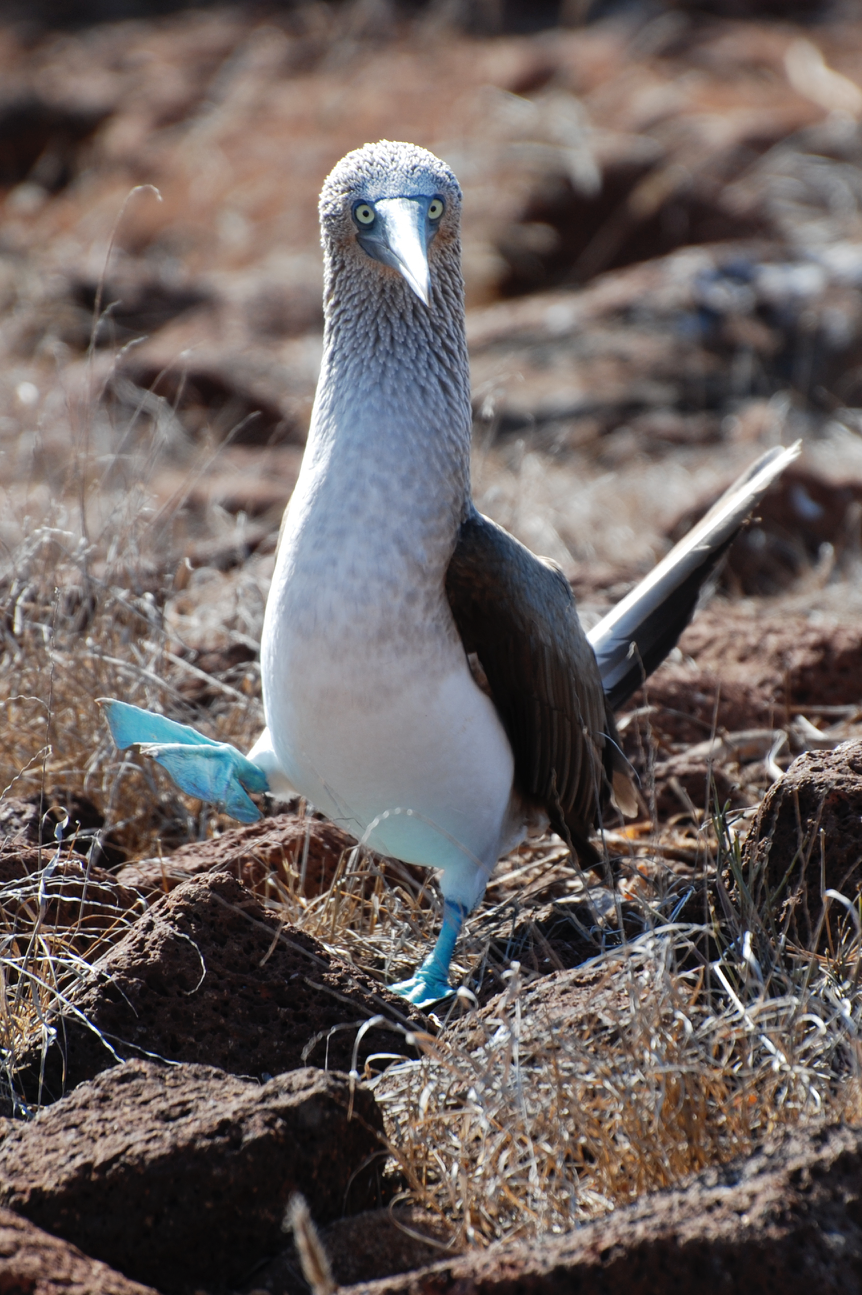
My photos of actual blue-footed booby and Galápagos marine iguana.

Valentina grew up surrounded by nature, but perhaps more accurately, she grew up in nature. I think when a child grows up seeing wild wonders every day, they grow up respecting and protecting nature and wildlife. Valentina and her siblings certainly did. She grew up to be a biologist and naturalist guide. One brother, Eliecer Cruz, was director of the Galápagos National Park and, later, director of the Galápagos branch of the World Wildlife Fund. Another brother, Felipe, worked on many projects with the Charles Darwin Research Station, including studying the challenges that face the Galápagos petrel. Her sister, Marilyn, is director of Galápagos Biosecurity Agency, which helps control and prevent invasive species in the islands.

In some ways, Valentina’s childhood was similar to mine. She was surrounded by a loving family—her parents and eleven brothers and sisters. I only had one brother, but along with my parents, cousins, aunts, and uncles, we gathered on many Sunday afternoons at my grandmother’s house. Valentina and I both delighted in nature, though hers was a more exotic nature—the distant Galápagos Islands, where Charles Darwin discovered those famous finches and came up with his theory of natural selection. Mine was a small farm on the Kansas plains—I didn’t see the ocean until I was an adult. Valentina had Galápagos tortoises as pets and swam with sea lions. (Of course, keeping tortoises as pets is not allowed today.) I played with my neighbor’s pet raccoon (also, not allowed today) and listened to the meadowlark’s song from the roof of my house.

Valentina loves nature, home, and family, but has the soul of an adventurer. I’m much the same. When I grew up I yearned to see as much of the world as possible. When my long-time traveling buddy, Jean Gallagher, asked me to travel with her to the Galápagos, one of my long-time dreams came true.
celebrate-picture-books-picture-book-review-galapagos-girl-blue-marsha-and-friends

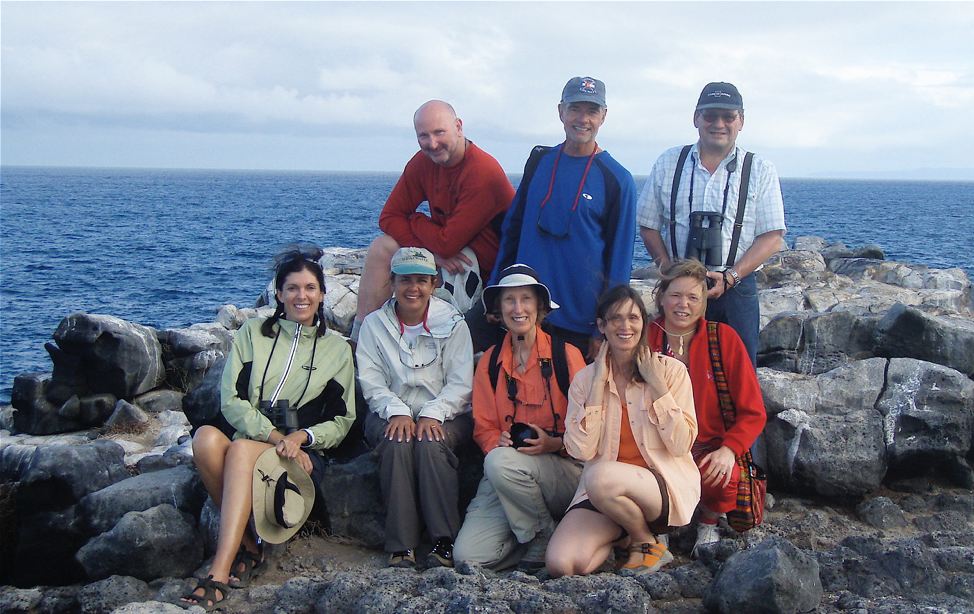
The Galápagos Gang – fellow travelers to a far-off land. Jean is 3rd to right in front. I am 4th.

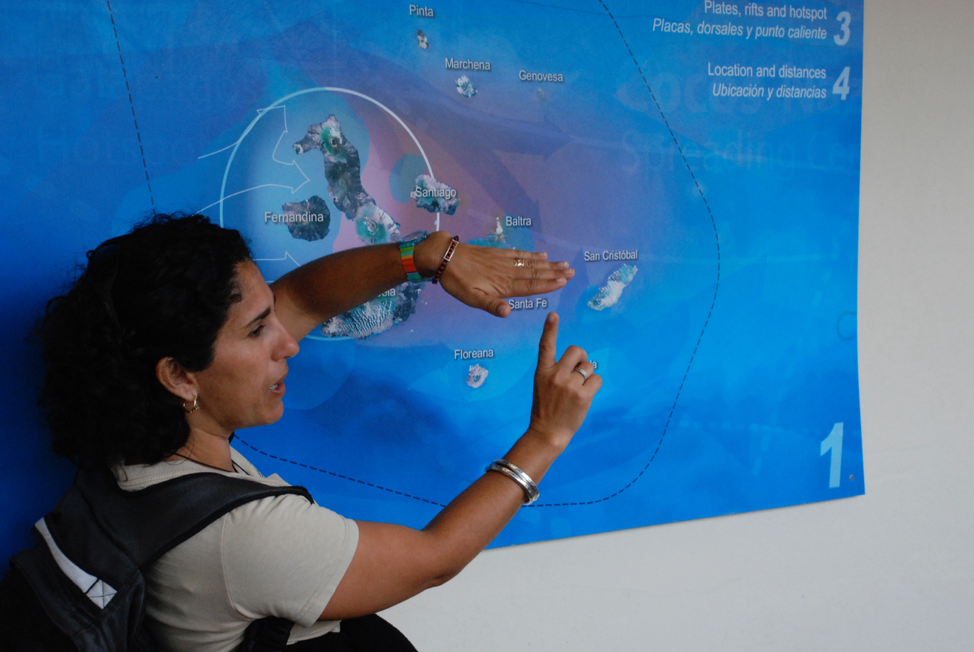
It was on that 2007 trip that I met Valentina, one of our naturalist guides. With her, we visited Floreana and saw the home where she grew up. I was enamored. I thought how wonderful a book about the islands and their unique wildlife, woven together with Valentina’s childhood, would be. Yet it wasn’t until April 2009 that I emailed Valentina and told her of my dream to write a picture book based on her life. Over months and years, Valentina generously shared her stories with me.
celebrate-picture-books-picture-book-review-galapagos-girl-valentina-showing-lay-of-land

Valentina showing us the lay of the land.

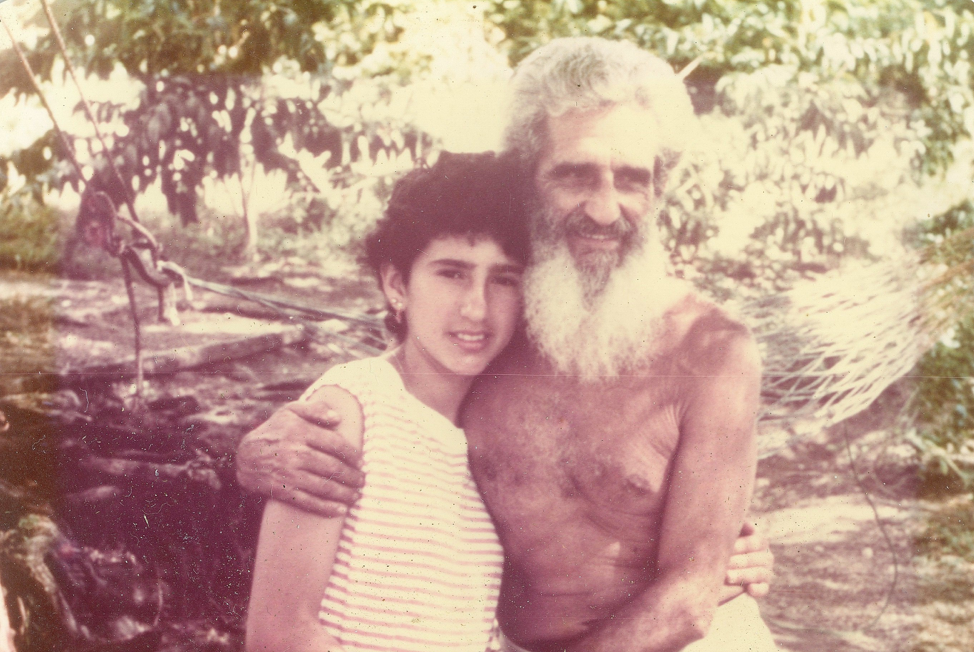
Valentina got her sense of adventure and love of nature from her father, Eliecer Cruz Cevallos, who first arrived in the Galápagos in 1939. He was one of only 100 people living in the Galápagos at that time!

Eliecer returned to Ecuador and married Valentina’s mother, Emma Bedon. She made him promise they would never live in the Galápagos. Who can blame her? They’d have almost no human neighbors! But in 1944, she changed her mind. Emma sailed to Floreana with Eliecer to build a life together. Valentina told me that even living in the wild, her mother taught her children “to keep all the rules of a city so we do not grow up wild.”
celebrate-picture-books-picture-book-review-galapagos-girl-valentina-and-father

Valentina and her father on Floreana

celebrate-picture-books-picture-book-review-galapagos-girl-valentina-mother-and-sister

Valentina, her mother, and her sister

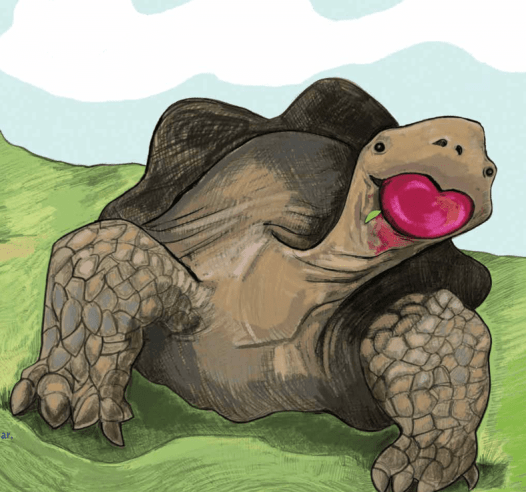
Two Galápagos tortoises were a big part of Valentina’s childhood, so I had to include them in Galápagos Girl. Floreana tortoise had long been extinct (or so it was thought).  So when Eliecer moved to Floreana, his friend gave him young tortoises from other islands. Eventually, the family released the tortoises to roam free. One of the most exciting things that happened to Valentina as a child was seeing the tortoises return to their farm that first year after their release. The main reason was the tasty plums dropping from the trees. Every year after that, when the plums ripened, the family waited for the tortoises to return. They always did!
celebrate-picture-books-picture-book-review-galapagos-girl-isabella-eating-plum

An illustration of one of the family’s tortoises eating a plum treat by Angela Dominguez

The tortoise story changed several times during the writing of my book due to Valentina’s remembering more over time, checking facts with her family, and a discovery near Wolf Volcano on Isabela, another Galápagos Island. What’s in my book isn’t exactly the way things were, but it’s close to the real story. As Valentina wisely shared: “Each of us remember things in different ways. Our memory is like pictures of what impresses us in that specific moment, so everything can be true and everything can be fiction.”
celebrate-picture-books-picture-book-review-galapagos-girl-galapagos-tortoise

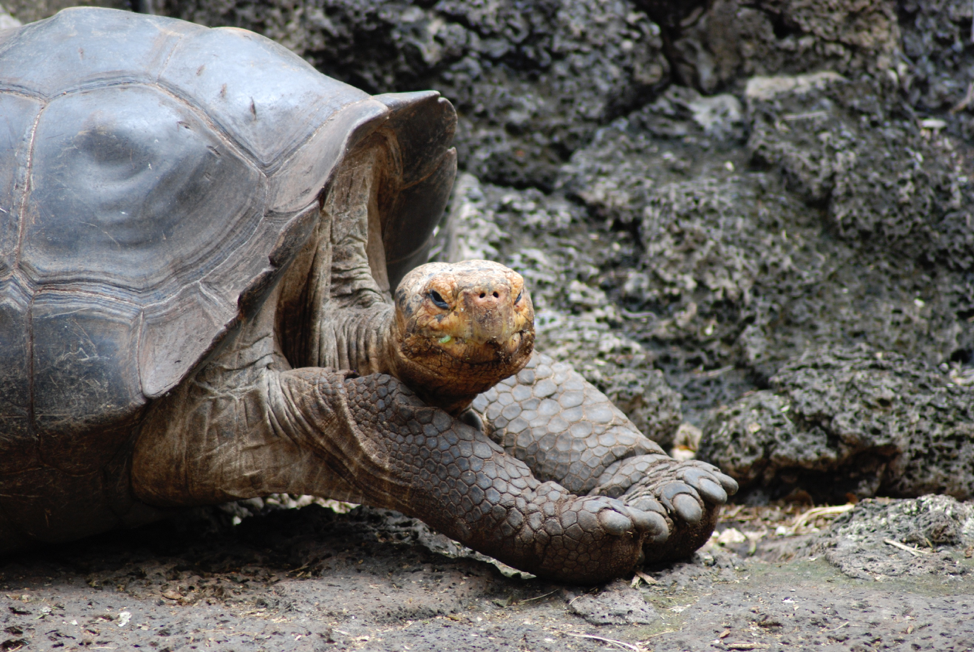
One of eleven species of Galápagos tortoise

Regarding the exciting discovery on Wolf Volcano, scientists recently found tortoises there that carry some of the Floreana tortoise genes! There is a project now to bring these tortoises back to Floreana. Wouldn’t it be wonderful to have partial Floreana tortoises wandering freely, restoring the ecology of Floreana?

You may ask, “How did Floreana tortoises get on Isabela Island?” That’s one more fascinating question about the Galápagos. If I visit your school, you can ask me and I’ll share more.

Thanks so much, Marsha, for sharing the fascinating story behind Galápagos Girl / Galápagueña!

You can connect with Marsha Diane Arnold on

Her Website | Earth’s Voices | Facebook

International Day of the Tropics Activity

celebrate-picture-books-picture-book-review-animals-of-the-galapagos-match-up-puzzle

Animals of the Galápagos Match Up Puzzle


There are so many fascinating animals that live in the Galápagos! Can you match the picture of each animal to its description in this printable Animals of the Galápagos Match Up Puzzle? You can find and download the activity sheet from the Lee & Low Books website:
Animals of the Galápagos Match Up Puzzle

celebrate-picture-books-picture-book-review-galapagos-girl-cover

You can find Galápagos Girl / Galapagueña at these booksellers

Amazon | Barnes & Noble | Books-a-Million

To support your local independent bookstore, order from

Bookshop | IndieBound

Picture Book Review