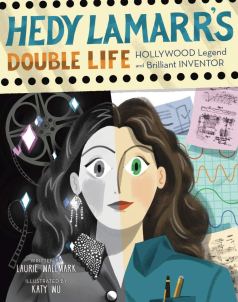
March 14 – It’s National Women’s History Month

celebrate-picture-books-picture-book-review-hedy-lamarr's-double-life-cover

About the Holiday

National Woman’s History Month was established by the United States Congress in 1987 to recognize and celebrate the achievements of American women in the past and today. This year’s theme is “Balance for Better,” which encourages true gender equity in the workplace, in government, and at home. Only when all people are heard and treated equally will communities thrive. There’s no better time than now to get involved to ensure that all have the same rights and standing in all areas of their lives.

I received a copy of Hedy Lamarr’s Double Life for review consideration. All opinions are my own. I’m excited to be partnering with Sterling in a giveaway of the book. See details below.

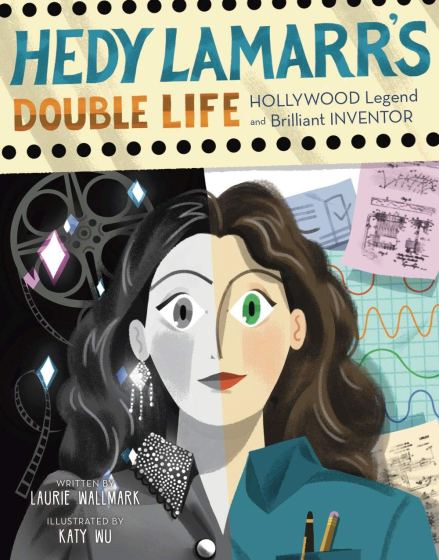
Hedy Lamarr’s Double Life: Hollywood Legend and Brilliant Inventor

Written by Laurie Wallmark | Illustrated by Katy Wu


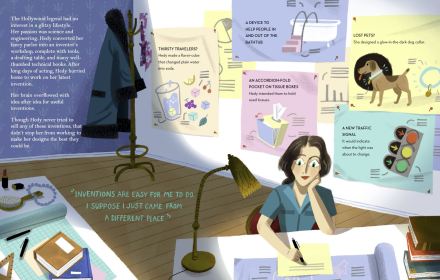
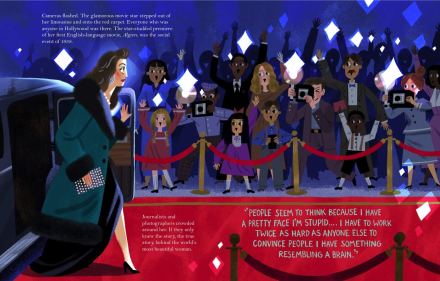
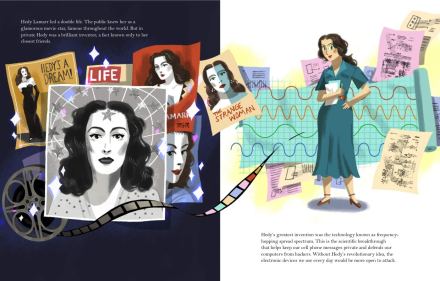
In 1938 people were lining up to see Hedy Lamarr in her first English-language movie Algiers. Hedy was the talk of Hollywood, and journalists and photographers captured her every move—almost. What movie-goers and the press didn’t know was that Hedy Lamarr was also a brilliant inventor. Instead of attending fancy celebrity parties, after a long day on the set, “Hedy hurried home to work on her latest invention. Her brain overflowed with idea after idea for useful inventions.” While she never tried to sell her ideas—like the collar to help find lost pets or the “flavor cube that changed plain water into soda”—she designed and redesigned them to perfection.

celebrate-picture-books-picture-book-review-hedy-lamarr's-double-life-magazines

Image copyright Katy Wu, 2019, text copyright Laurie Wallmark, 2019. Courtesy of Sterling Children’s Books.

But how did Hedy get her start? She was born in Austria and as a child took apart mechanical objects just to see how they worked. Hedy’s father also loved science, and he encouraged his daughter to hold onto her dreams. In addition to science, Hedy loved movies and would use her dolls to reenact the scenes she saw.

When she got older, Hedy got a job as a script girl and then worked as an extra in a movie. She loved acting and once said, “‘I acted all the time…. I was a little living copybook. I wrote people down on me.’” While playing the lead in a stage play, the Hollywood producer Louis B. Mayer saw her and offered her movie contract. Hedy moved to America. It only took her six months to land a starring role in Algiers. After that she starred in many movies with some of the most famous actors and actresses. 

By now, the world was at war. One day, Hedy met George Antheil, a former weapons inspector who now composed music. Hedy remembered a “discussion she had overheard back in Europe about a problem with the guidance system for torpedoes. The guidance system couldn’t prevent the enemy from jamming the weapon’s radio signals” and sending it off course. She learned from George Antheil that the US Navy had the same problem.

They decided to team up to see if they could figure out a solution. Hedy was also an accomplished pianist, and she and George often played musical games on the piano. Once, while they played the same song in different octaves, Hedy had a brainstorm for building “a secure torpedo guidance system.” At the time, torpedo guidance systems only worked if the ship launching a torpedo and the torpedo were on the same frequency.

celebrate-picture-books-picture-book-review-hedy-lamarr's-double-life-home

Image copyright Katy Wu, 2019, text copyright Laurie Wallmark, 2019. Courtesy of Sterling Children’s Books.

Hedy thought that if the ship and the torpedo could switch between a series of different frequencies, the enemy would be foiled. “Hedy called her discovery ‘the hopping of frequencies.” Working together, she and George devised a way to implement Hedy’s idea. When they presented their idea to the National Inventors Council, they were told the “idea had ‘great potential value.’”

There were still some issues to overcome to make the system automated, but Hedy and George answered those too. They applied for a patent, and a year later on August 11, 1942 it was granted. When they gave the idea to the United States Navy, “Hedy was proud her frequency-hopping idea might help America win the war.” But embroiled in the middle of the conflict, the Navy didn’t have “the time or money to implement a new system….”

Hedy, who still wanted to help America defeat the Nazis, was undaunted. She helped raise 25 million dollars by selling war bonds and volunteered at the Hollywood Canteen, where servicemen soon to be deployed gathered. Hedy went on to make more than twenty movies and continued to work on her inventions.

In the 1980s, the US Navy declassified Hedy’s frequency-hopping technology, meaning anyone could use it. Because the patent had long-ago expired, no one needed to give Hedy and George credit for the idea. “Companies raced to include frequency hopping in their own devices.” In 1997, Hedy and George were finally recognized when they “received the Pioneer Award from the Electronic Frontier Foundation for their significant contribution to computers.”

A timeline of Hedy Lamarr’s life, a description of how Hedy and George’s frequency-hopping technology worked, additional resources for further reading, and a list of Hedy’s movies follow the text.

celebrate-picture-books-picture-book-review-hedy-lamarr's-double-life-red-carpet

Image copyright Katy Wu, 2019, text copyright Laurie Wallmark, 2019. Courtesy of Sterling Children’s Books.

Laurie Wallmark knows how to weave a riveting tale that draws readers in to the lives of fascinating and scientifically minded women throughout history. Her detailed biography of Hedy Lamarr will wow kids with the twists and turns of how a vital feature of the electronics they use every day came to be. A history not only of this famous woman but of the times and policies that denied Hedy Lamarr the recognition and profits she deserved, the story is sure to spark plenty of discussion. The inclusion of a few of Hedy’s ingenious ideas as well as quotes on acting, inventing, and her views on life give children a glimpse into the mind of this unique woman.

Katy Wu takes readers back to the 1940s with her stylish illustrations reminiscent of magazine images of the time that depict both Hedy’s glamourous and inventive sides. Even as Hedy steps out of a limo to the glare of flashbulbs, acts under stage lights, and watches movies thrown by a projector’s beam, she’s dreaming of going home to work on her inventions in the light of a desk lamp. When the story turns to Hedy’s frequency-hopping idea, Wu clearly portrays the problems with the torpedo guidance system and the way single-frequency and multiple-frequency communications work. The way player pianos were controlled and how Hedy and George Antheil used this idea is also well portrayed. The final images of people using Hedy’s technology today lets kids fully understand the impact that Hedy Lamarr has had on their lives.

An important story about an extraordinary woman, Hedy Lamarr’s Double Life: Hollywood Legend and Brilliant Inventor will inspire children to follow and accomplish all of their dreams. The book will spur creative thought across subject matter and would be a motivational addition to home, classroom, and public libraries.

Ages 5 and up

Sterling Children’s Books, 2019 | ISBN 978-1454926917

Discover more about Laurie Wallmark and her books on her website.

To learn more about Katy Wu, and view a gallery of her book and art, visit her tumblr.

Hedy Lamarr’s Double Life Giveaway

I’m excited to partner with Sterling Children’s Books in a Twitter giveaway of:

  • One (1) copy of Hedy Lamarr’s Double Life: Hollywood Legend and Brilliant Inventor written by Laurie Wallmark | illustrated by Katy Wu

This giveaway is open from March 14 through March 20 and ends at 8:00 p.m. EST.

A winner will be chosen on March 21.

Prizing provided by Sterling Children’s Books

Giveaway open to U.S. addresses only. | No Giveaway Accounts 

National Women’s History Month Activity

celebrate-picture-books-picture-book-review-women-in-stem-coloring-book

Women in STEM Coloring Book


Discover five women who broke barriers  and made important contributions to the science, technology, engineering, and math fields in this printable  Women in STEM Coloring Book created by the United States Department of Energy.

celebrate-picture-books-picture-book-review-hedy-lamarr's-double-life-cover

You can find Hedy Lamarr’s Double Life: Hollywood Legend and Brilliant Inventor at these booksellers

Amazon | Barnes & Noble | Books-a-Million | IndieBound

Picture Book Review

March 8 – International Women’s Day

celebrate-picture-books-picture-book-review-born-to-ride-cover

About the Holiday

Instituted in 1911 and celebrated in Austria, Denmark, Germany, and Switzerland, International Women’s Day was recognized by the United Nations in 1975. In 1996, honoring the holiday under a united theme was established and this tradition has been followed ever since. During the 100th anniversary of International Woman’s Day in 2011, President Barak Obama proclaimed March to be National Women’s Month. Both International Women’s Day and National Women’s Month recognize the accomplishments and contributions of women throughout history and today. This year’s theme is Balance for Better and raises awareness of the need for gender equity across the spectrum of education, business, government, media coverage, rights, wealth, and more. The outreach and influence of International Women’s Day continues throughout the year. To learn more and get involved, visit the International Women’s Day website.

Abrams Books for Young Readers sent me a copy of Born to Ride to check out. All opinions are my own. 

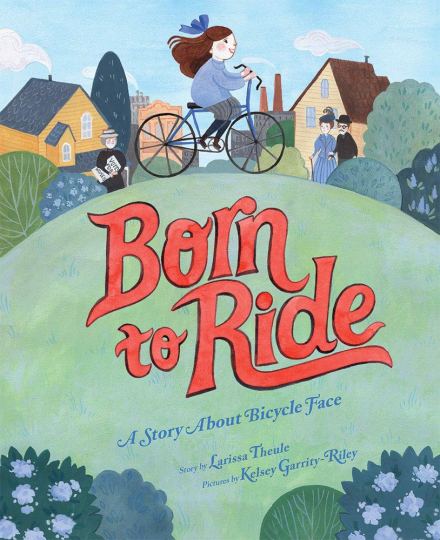
Born to Ride: A Story about Bicycle Face

Written by Larissa Theule | Illustrated by Kelsey Garrity-Riley


Open the cover of this remarkable picture book to a two-page illustration and you might notice something unusual—for our time. What is it? Read on and see…

As Louisa Belinda Bellflower gazed out her window at a man riding a bicycle in Rochester, New York, in 1896, she wished that she could ride one too. But girls and women weren’t allowed to ride bicycles, just as they weren’t allowed to vote or wear pants. Louisa’s brother, Joe, had a brand-new bike, and “riding it looked like a whole lot of fun.”

celebrate-picture-books-picture-book-review-born-to-ride-falling

Image copyright Kelsey Garrity-Riley, 2019, text copyright Larissa Theule, 2019. Courtesy of Abrams Books for Young People.

One day, Louisa took off her frilly skirt and put on her brother’s pants and asked him to teach her how to ride. There were, however, a couple of concerns. One was what would their mother say? Another was the horrible medical condition, bicycle face. Everyone knew about it, and Doctor Brown was strict on this matter. He said, “‘girls aren’t strong enough to balance, that your eyes will bulge, and your jaw will close up from the strain of trying—maybe FOREVER.’”

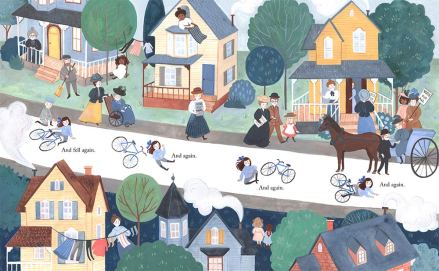
Louisa considered this fate, but Joe didn’t have any of these symptoms. Even though she was a little nervous, she tried it anyway. Louisa fell again and again, but when Joe asked her if she wanted to quit, she continued. She began peddling again and soon had the knack for it. “With some alarm, she felt her eyes bulge, and her mouth widen—into a gigantic, joyous smile.”

celebrate-picture-books-picture-book-review-born-to-ride-tea

Image copyright Kelsey Garrity-Riley, 2019, text copyright Larissa Theule, 2019. Courtesy of Abrams Books for Young People.

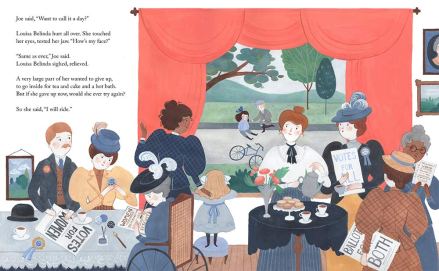
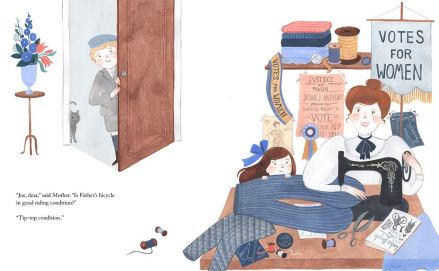
She rode back and forth down the path and when she got home, her mother said, “‘those pants look quite practical, Louisa Belinda,’” And Louisa turned a somersault just to show her she was right. Then Louisa’s mother asked Joe if Father’s bike was in good shape. Joe said it was, and their mother set about converting her skirt into a pair of pants. When they were finished, Louisa and her mother wheeled the bikes out side-by-side and took off. “‘Mother,’” Louisa said, “‘what will your bicycle face be, I wonder!’”

You only need to turn the page to see. Louisa’s mother is smiling and that original two-page spread has been transformed with lots of women and girls riding the roads that lead to the Votes for Women rally in the town green.

An extensive Author’s Note follows the text and explains the origin of “bicycle face” and other such imagined bicycle-related maladies as well as the opposition to women’s riding bicycles. Also included is a discussion on the women’s suffrage movement.

celebrate-picture-books-picture-book-review-born-to-ride-sewing

Image copyright Kelsey Garrity-Riley, 2019, text copyright Larissa Theule, 2019. Courtesy of Abrams Books for Young People.

Both children and adult readers will be astounded at Larissa Theule’s eye-opening story that reveals just one of the many obstacles women have had to overcome in their quest for equal rights. Theule’s story, told through the eyes of a girl with pluck and self-confidence, is well targeted to her young audience with an engaging undercurrent of humor at the nonsensical reasoning behind the ban on women’s bicycle riding and even the constricting clothing of the time for girls and boys. As Louisa falls again and again while learning to ride, Theule infuses her story with the idea that perseverance wins out—a concept she not only applies to learning a new skill, but to the parallel story of women’s suffrage that runs throughout the illustrations.

Kelsey Garrity-Riley’s charming illustrations evoke the late 1800s, giving kids a view of history with Victorian-style houses; skirts, bloomers, and pinafores for girls and short-pant suits for boys; and an old-fashioned sewing machine. Adding depth and context to the story, Garrity-Riley follows Louisa and Joe’s mother as she paints “Votes for Women” and “Ballots for Both” signs and later hosts a women’s suffrage tea attended by white and dark-skinned women, a woman in a wheelchair, and one progressive man. Garrity-Riley cleverly combines images of Louisa’s indomitable spirit with these depictions of protest to reinforce the theme and lesson of the story.

To  jumpstart discussions about equal rights for all, Born to Ride: A Story about Bicycle Face is a unique and fascinating addition to home, school, and public libraries.

Ages 4 – 8

Abrams Books for Young Readers, 2019 | ISBN 978-1419734120

Discover more about Larissa Theule and her books on her website.

To learn more about Kelsey Garrity-Riley, her books, and her art, visit her website.

International Women’s Day Activity

celebrate-picture-books-picture-book-review-bicycle-maze 2

Ride with Me! Maze


Two girls want to ride bikes together. Can you help them find each other in this printable maze?

Ride with Me! Puzzle | Ride with Me! Puzzle Solution

celebrate-picture-books-picture-book-review-born-to-ride-cover

You can find Born to Ride: A Story about Bicycle Face at these booksellers

Amazon | Barnes & Noble | Books-a-Million | IndieBound

Picture Book Review
February 3 – National Women Physicians Day

Who Says Women Can't Be Doctors by Tanya Lee Stone and Marjorie Priceman picture book review

About the Holiday

Today, we celebrate the birthday of Elizabeth Blackwell, who in 1849 became the first woman to earn a medical degree in the United States. Her courage in the face of much opposition paved the way for other women to pursue careers in the medical field. National Women Physicians Day also honors the achievements and contributions of all women physicians around the world. 

Who Says Women Can’t be Doctors? The Story of Elizabeth Blackwell

Written by Tanya Lee Stone | Illustrated by Marjorie Priceman


Once upon a time there were no women doctors. Women weren’t even allowed to be doctors. Sounds like a fairy tale, doesn’t it? But it was the truth. Then Elizabeth Blackwell, came along. Elizabeth was not like other girls of the 1830s. She loved to explore and take on challenges. She could lift her brother over her head, and to toughen herself up she slept on the hard wood floor. To get a better look at the world she once climbed to the roof of her house and leaned waaaaay out with a spyglass. What did she see? Maybe she saw her future. But it wasn’t what she imagined at the time. Blood made her queasy, dissection was disgusting, and being sick just made her want to hide from all the fussing.

celebrate-picture-books-picture-book-review-who-says-women-can't-be-doctors-elizabeth-brave

Image copyright Marjorie Priceman, 2013, text copyright Tanya Lee Stone, 2013. Courtesy of Henry Holt and Company.

A comment by a sick friend, however, puts a bee in Elizabeth’s bonnet. Mary Donaldson tells Elizabeth that she would much rather have been examined by a woman than her male doctor, and then says, “You should be a doctor, Elizabeth.” What a crazy notion, right? Well… Elizabeth can’t stop thinking about it. She asks around. Some people think it’s a good idea, but impossible; others simply think it’s impossible. They believe women aren’t strong enough or smart enough and they laugh at her. By this time, though, Elizabeth is determined.

celebrate-picture-books-picture-book-review-who-says-women-can't-be-doctors-no-women-doctors

Image copyright Marjorie Priceman, 2013, text copyright Tanya Lee Stone, 2013. Courtesy of Henry Holt and Company.

She applies to 28 medical schools, and they all say, “No.” But one day a “Yes” arrives in the mail. Elizabeth packs her bags. As she nears the school, Elizabeth sees that the townspeople have all come out to see her. They aren’t there to welcome their new medical student, though; they just want to whisper and point and stare. Surely, Elizabeth thinks, her classmates will be happy to see her. 

celebrate-picture-books-picture-book-review-who-says-women-can't-be-doctors-everyone-says-no

Image copyright Marjorie Priceman, 2013, text copyright Tanya Lee Stone, 2013. Courtesy of Henry Holt and Company.

But she receives the same reception on the college campus. In fact, she learns that the only reason she was accepted was because the men voted to let her in as a joke! Elizabeth knows how to handle it. She studies hard and gives her opinions, and soon she wins the respect of her fellow students—even if the townspeople still don’t accept her.

On January 23, 1849 Elizabeth Blackwell graduates from medical school with the highest grades in the class. She has become the first woman doctor in America! Many people hope that she will be the last. But as we know…she was Not!

celebrate-picture-books-picture-book-review-who-says-women-can't-be-doctors-elizabeth-does-well-in-school

Image copyright Marjorie Priceman, 2013, text copyright Tanya Lee Stone, 2013. Courtesy of Henry Holt and Company.

Tanya Lee Stone magnificently imbues this short biography of Elizabeth Blackwell with enough mystery, conflict, and history for even the youngest readers to understand the type of girl and woman Elizabeth was as well as the challenges she faced. Stone has deftly included details of Blackwell’s life that  make her instantly recognizable and relatable to children. This biography is not only historical nonfiction, but a universal story for all generations. Blackwell may have started out as a reluctant dreamer, but once she dared to believe she accomplished more than she or anyone could have imagined. It is what we want for all our children.

Marjorie Priceman’s illustrations that swirl with words, are angled on the page, and float in white space are as topsy-turvy as the world Elizabeth Blackwell created with her courage and life’s work. Blackwell’s boldness is echoed in the rich colors and strong lines of Priceman’s gouache and India-ink paintings, and the emotions she stirred in others—from derision to horror to admiration—are cleverly and exceptionally drawn in a minimal style on the characters’ faces.

Ages 5 – 9

Henry Holt and Company, 2013 | ISBN 978-0805090482 (Hardcover) | ISNB 978-1250183392 (Paperback)

Learn more about Tanya Lee Stone and her work—both fiction and nonfiction—for children and teens on her website!

You can connect with Marjorie Priceman on Facebook!

National Women Physicians Day Activity

CPB - Doctors Clothespins

Doctor Clothespin Figures


Elizabeth Blackwell believed in herself and became the doctor she wanted to be. With this craft you can make a doctor figure or color your own clothes to make your figure any profession you are dreaming of!

Supplies

CPB - Doctors Clothespins on box

Directions

  1. Draw a face and hair on the clothespin
  2. Cut out the outfit you want your doctor to wear (color pants on your clothespin if you choose the lab coat)
  3. Wrap the coat or scrubs around the clothespin. The slit in the clothespin should be on the side.
  4. Tape the clothes together
  5. Wrap the cap around the head and tape it
  6. If you’d like to display your clothespin doctor on a wire, string, or the edge of a box or other container, cut along the dotted lines of the clothes template

Who Says Women Can't Be Doctors by Tanya Lee Stone and Marjorie Priceman picture book review

You can find Who Says Women Can’t be Doctors? at these booksellers

Amazon | Barnes & Noble | Books-a-Million | IndieBound

Picture Book Review
 

February 1 – National Freedom Day

celebrate-picture-books-picture-book-review-lift-every-voice-and-sing-cover

About the Holiday

National Freedom Day commemorates February 1, 1865, the day President Abraham Lincoln signed a joint U.S. House of Representatives and Senate resolution that outlawed slavery. This resolution became the 13th Amendment to the Constitution on December 6, 1865. Major Richard Robert Wright Sr., a former slave, founded the National Freedom Day Association and was instrumental in creating a formal national day of remembrance. The first celebration of National Freedom Day took place in 1942, and in 1947, a year after Wright’s death, the U.S. Congress passed a bill marking February 1 as National Freedom Day. The proclamation was signed into law on June 30, 1948 by President Harry S Truman. The holiday led to Black History Day, which was later expanded to Black History Month.

Lift Every Voice and Sing: A Celebration of the African American National Anthem

Written by James Weldon Johnson | Illustrated by Elizabeth Catlett


It has been more than 120 years since James Weldon Johnson, a principal at Stanton Elementary School in Jacksonville, Florida, wrote a poem to be used in the school’s commemoration ceremony of Abraham Lincoln’s birthday. His brother, composer John Rosamond Johnson, set the poem to music. On February 12, 1900, five hundred students performed the song. From that celebration, the song spread, gaining in popularity throughout the South and then throughout the country.

In 1949 the National Association for the Advancement of Colored People adopted Lift Ev’ry Voice and Sing as the official African American anthem. The song continues to inspire as it is sung and heard in churches and schools and during times of celebration and protest.

This new edition of Lift Every Voice and Sing brings together Johnson’s stirring poem with stunning black-and-white linocuts by Harlem Renaissance artist Elizabeth Catlett, who created them in the 1940s as part of a series of artworks focusing on black women.

celebrate-picture-books-picture-book-review-lift-every-voice-and-sing-guitar

Image copyright Elizabeth Catlett, 1993, text by John Weldon Johnson. Courtesy of Bloomsbury Children’s Books.

The book opens with these joyful lines punctuated with powerful images. On the first page a woman strums a guitar while beside her there is the image—perhaps it’s a memory or the subject of her song—of a black man being attacked by a klansman while a cross burns nearby. On the second page is a picture of Sojourner Truth with her left hand on a lectern that holds a Bible and her right, index finger extended, pointing skyward. In her eyes there is sadness and confidence and knowledge. “Lift ev’ry voice and sing / Till earth and heaven ring, / Ring with the harmonies of Liberty; // Let our rejoicing rise / High as the listening skies, / Let it resound loud as the rolling sea.”

The poem continues with the exhortation to sing with the faith and hope learned from the past and present. A linocut of black women sitting on a bus behind the “colored only” sign, created by Catlett in 1946, is compelling for its truth and foresight, especially when paired with these lines. But knowing there was still much to do, Johnson encouraged his listeners: “Facing the rising sun of our new day begun / Let us march on till victory is won.” On the left-hand page Harriett Tubman points the way to freedom for escaping slaves—one couple carrying their belongings and their baby—along the Underground Railroad.

celebrate-picture-books-picture-book-review-lift-every-voice-and-sing-bus

Image copyright Elizabeth Catlett, 1993, text by John Weldon Johnson. Courtesy of Bloomsbury Children’s Books.

The song remembers the “stony road” and the “chastening rod” and also the “steady beat…” of “weary feet” that have brought them to a place for which their forefathers died. Johnson sees a brighter future, and Catlett’s linocut of Phyllis Wheatley, a child when she became a slave, writing one of her poems while three women chained together step into the light that her example demonstrates. Catlett’s original caption for this piece read: “I’m Phyllis Wheatley. I proved intellectual equality in the midst of slavery.”

The poem then goes on to appeal to God, “who has brought us thus far on the way” to keep them in the right path and in His hand so that “…may we forever stand. True to our GOD, True to our native land.”

Author/illustrator Ashley Bryan—a Newbery Honor and Coretta Scott King Award winner for Freedom Over Me—provides a poignant Foreword. Following the text are a short description of the project Elizabeth Catlett undertook after winning a Julius Rosenwald Foundation grant; her original captions for each linocut included in the book, and the music for Lift Ev’ry Voice and Sing.

An emotionally moving presentation of James Weldon Johnson and John Rosamond Johnson’s poem and song, Lift Every Voice and Sing: A Celebration of the African American National Anthem would make a beautiful thought-provoking and inspirational addition to school, home, and public library collections.

Ages 6 – 12 and up

Bloomsbury Children’s Books, 2019 | ISBN 978-1681199559

You can learn more about James Weldon Johnson and read several of his poems on the Poetry Foundation website.

To learn more about Elizabeth Catlett and view some of her artwork, visit the Artnet website.

Discover more about Ashley Bryan, his art, and his writing, visit the Ashley Bryan Center website.

National Freedom Day Activity

celebrate-picture-books-picture-book-review-chalk-garden-st

Freedom Stone


Freedom is a precious right—one that can be represented in different ways by each person. For today’s activity use a brick, paving stone, large stone, or molded plaster of Paris and decorate it with a picture or design that means freedom to you. Then put it in a special place—in a garden, near your front or back door, in your room, or in another spot—where it will remind you of freedom’s gifts.

Supplies

  • Brick, paving stone, large stone, plaster of Paris
  • Paint
  • Plastic gems, bead, or other small objects
  • Strong glue or other adhesive
  • Paint brush

Directions

  1. Create a design that shows what freedom means to you or an object that represents freedom to you
  2. Paint your stone with the design, let dry
  3. Add gems, beads, or other objects
  4. Display your Freedom Stone

celebrate-picture-books-picture-book-review-lift-every-voice-and-sing-cover

You can find Lift Every Voice and Sing at these booksellers

Amazon | Bloomsbury | Books-a-Million | IndieBound

Picture Book Review

January 4 – World Hypnotism Day

celebrate-picture-books-picture-book-reviews-mesmerized-cover

About the Holiday

Today’s holiday was established in 2006 to honor Dr. Jack Gibson, an Irish hypnotherapist who used hypnosis extensively in his practice. Its purpose is to dispel the myths surrounding hypnosis as “mind control,” which is a popular misconception perpetuated by movies and other types of entertainment. To celebrate, learn more about hypnotism and check out local special events, including free hypnotherapy sessions.

Mesmerized: How Ben Franklin Solved a Mystery that Baffled All of France

Written by Mara Rockliff | Illustrated by Iacopo Bruno


During the colonists’ war with England, the rag-tag American army needed France’s help. Who better to send than Benjamin Franklin, the charming and experienced statesman? Ben hoped to convince King Louis the Sixteenth and Queen Marie Antoinette to send money and soldiers to America, “but it turned out that they needed Ben’s help too….” At the time, Paris was enthralled by Science. This “new” discipline was introducing new materials, new inventions, and new ideas into society.

One of these notions was Ben Franklin’s own—and when the people of Paris saw him “they went absolutely gaga over the American in the peculiar fur hat. Because everyone had heard about Ben Franklin’s famous kite experiment, which showed that lightning was the same as electricity.” Soon, however, even Ben couldn’t hold a candle to Dr. Mesmer—the “elegant and mysterious” man who wielded “an astonishing new force.” “Dr. Mesmer said this force streamed from the stars and flowed into his wand. When he stared into his patients’ eyes and waved the wand, things happened. Women swooned. Men sobbed. Children fell down in fits.”

celebrate-picture-books-picture-book-reviews-mesmerized-science

Image copyright Iacopo Bruno, 2015, text copyright Mara Rockliff, 2015. Courtesy Candlewick Press

Dr. Mesmer seemed to do the impossible. He could make the same glass of water taste like strawberries or vinegar just by telling his patient what to taste. He said he could use this force to help people who were sick, and indeed, after a session with Dr. Mesmer “in a room hidden behind heavy drapes covered with signs and symbols” many people emerged saying they had been cured. Those rich enough paid 100 gold louis to learn his secrets, and everyone considered Dr. Mesmer’s force the “most remarkable thing that science had discovered yet!”

Everyone that is, except the city’s doctors, who “griped, and groused, and fussed, and fumed” because their patients only wanted to be treated by Dr. Mesmer. The doctors went to the King to complain. They even suggested that Dr. Mesmer’s force didn’t exist at all. Louis didn’t know what to think, but he did know who to consult—Ben Franklin! Ben wanted to observe this force in action for himself. As he watched, Dr. Mesmer’s helper, Charles, made a group of patients gasp, groan, twitch, and tremble. Some even fainted.

celebrate-picture-books-picture-book-reviews-mesmerized-ben-franklin

Image copyright Iacopo Bruno, 2015, text copyright Mara Rockliff, 2015. Courtesy Candlewick Press

When it came time for Ben Franklin’s turn, “He didn’t gasp and groan or twitch and tremble. And he didn’t faint. In fact…he didn’t feel a thing.” Dr. Mesmer said that Ben must be “special” and that’s why the force didn’t work on him. Ben hypothesized a different reason. He said that instead of the force being “in Dr. Mesmer’s wand…it was in the patient’s mind.” They acted and felt the way they did because they expected to.

To test his theory, Ben had Charles wave his fingers near a woman’s face. She screamed and “said she felt a burning flame.” Next Ben told Charles to perform the same routine, but with the woman blindfolded. This time when Charles waved his fingers near her stomach, “she said she felt the heat—IN HER EAR. When he “moved behind her back, the woman shrieked that she felt burning—IN HER LEG!” Ben brought in another patient, blindfolded him, and told him he was being mesmerized. He said he could feel it—even though “Charles was not even in the room.” When Charles came back and waved his fingers and wand, the patient felt nothing.

“Ben tested patient after patient, but it was always the same. If the patient believed something would happen, something did—even without the force! If the patient did not expect anything to happen, nothing did—even with the force!” He revealed his observations to the king, and soon all of Paris was talking—and laughing. And Dr. Mesmer? He took his wand and ran. Ben Franklin soon returned to America—with the help from France he had sought and to his scientific work.

celebrate-picture-books-picture-book-reviews-mesmerized-blind-test

Image copyright Iacopo Bruno, 2015, text copyright Mara Rockliff, 2015. Courtesy Candlewick Press

The world benefited greatly from the meeting between Ben Franklin and Dr. Mesmer. Ben’s blind test is still used today when new medicines are being developed, and Dr. Mesmer’s force brought to light what we call the placebo effect and also the state of hypnosis, two powerful abilities of the brain that scientists are still studying.

Throughout Mesmerized Ben Franklin studies Dr. Mesmer and his force, using the scientific method. As Franklin observes, hypothesizes, tests, and finds his theory supported, each particular step of the scientific method applied appears highlighted and explained on the page. An extensive Author’s Note about the events of the story also follows the text

Mara Rockliff’s—dare I say it?—mesmerizing true tale of a meeting between two of the most fascinating figures of the late 1770s is the type of nonfiction that can get kids excited about science and history. Intrigue, mystery, charismatic personalities, wit, and a familiar topic are blended together to reveal the uses and steps of the scientific method and to highlight one event in time that still resonates today. Rockliff’s story crackles with fabulous vocbulary—doctors gripe, grouse, fume, are peeved; the king is in a quandary; patients twitch and tremble; plain Ben Franklin is an “apple pie” while elegant Dr. Mesmer a “layered torte.” Rockliff’s story flows at an enthralling pace, keeping readers riveted to discover Dr. Mesmer’s secret.

Iacopo Bruno’s sumptuous illustrations are nothing short of astounding. If the Oscars gave out awards to books, Bruno would certainly win for best costume and set. Every page is gilded with the opulence of the French court as gold buttons, collars, candle sticks, and drawing rooms glint with a polished sheen. Period dress is depicted in the women’s full flowing gowns of red, purple, and green, and in men’s top coats, breeches, lace cuffs, and high buckle shoes. Powdered wigs curl at men’s ears and climb high above women’s heads, festooned with flowers, ribbons, and pearls while Ben’s white, wavy locks fall naturally on his shoulders. In addition to setting the historical scene, Bruno depicts the effects of Dr. Mesmer’s force and the scientific methods Franklin used to debunk it with just the right amount of humor to entice kids and allow them to fully understand and appreciate Dr. Mesmer’s impact on society.

Ages 6 – 10

Candlewick, 2015 | ISBN 978-0763663513

To learn more about Mara Rockliff and her books, visit her website!

View a gallery of book jacket and other illustration work by Iacopo Bruno on his blog!

World Hypnotism Day Activity

celebrate-picture-books-picture-book-review-hypnosis-maze


You Are Getting Sleeeepy Maze


The roundabout pattern of this printable You’re Getting Sleeeepy Maze may make you feel as if you’re in a trance, but don’t zone out before you solve it! Quick! Here’s the Solution!

celebrate-picture-books-picture-book-reviews-mesmerized-cover

You can find Mesmerized: How Ben Franklin Solved a Mystery that Baffled all of France at these booksellers

Amazon | Barnes & Noble | Books-a-Million | IndieBound

Picture Book Review
December 20 – Go Caroling Day

celebrate-picture-books-picture-book-review-write-on-irving-berlin-cover

About the Holiday

Caroling is a long-standing tradition of the holidays. Gathering with friends and neighbors as part of a professional singing group or just as amateurs and singing Christmas songs door to door, at nursing homes, and other community venues brings joy and cheer to all. Both hearing and singing favorite songs that only come around once a year makes caroling a much-anticipated activity. Today’s holiday celebrates the love of caroling and encourages people to raise their voices and join in. It’s also a perfect day to highlight the life of the man who wrote one of our most beloved carols—White Christmas—with today’s book!

Write On, Irving Berlin!

Written by Leslie Kimmelman | Illustrated by David C. Gardner


In September of 1893 Moses and Lena Baline and their six children, including 5-year-old Israel, sailed into New York Harbor hoping “to start a new life in a new country.” They came from Russia, where their home had been burned down by “gangs of angry men” who “rode from village to village in pogroms, destroying Jewish homes and hurting the people who lived in them.” In America, the Balines had a small apartment, little money, and little food. But they did have freedom.

celebrate-picture-books-picture-book-review-write-on-irving-berlin-immigrating

Image copyright David C. Gardner, 2018, text copyright Leslie Kimmelman, 2018. Courtesy of Sleeping Bear Press.

At school, Izzy—as Israel was nicknamed—paid less attention to his schoolwork than to the music in his head. When Izzy was only thirteen, his father died. Izzy knew that money was tight, so he moved out and made his own living singing in saloons, in the chorus line of New York shows, and even as he waited tables.  Irving as Izzy now called himself, became a professional song writer when he was paid 37 cents for his first song.

Irving continued to write the tunes that filled his head. When Ragtime was all the rage during the early 1900s, Irving tried this new, jazzy kind of music, and his “‘Alexander’s Ragtime Band’ was a smash.”  Irving married, but his wife died only a few months after their wedding. Irving consoled himself by writing. He became an American citizen, and when he was drafted into the US Army during WWI, he wrote songs to encourage his fellow soldiers. When he married again, he was inspired to write a song called “Always” about a love that lasts forever.

celebrate-picture-books-picture-book-review-write-on-irving-berlin-school

Image copyright David C. Gardner, 2018, text copyright Leslie Kimmelman, 2018. Courtesy of Sleeping Bear Press.

Irving never seemed to be without a tune in his head. He “wrote music for plays, for movies, for friends, for strangers. He scribbled ideas on napkins and on the sleeves of his shirt. He wrote songs in elevators and in taxicabs. He wrote songs in the bathtub.” During World War II, one of his older songs—“‘God Bless America’ became a HUGE hit.” In the winter of 1942, Irving wrote what he considered not only his best song, but the best song anyone had ever written: “White Christmas.” It’s sentimental words and catchy tune inspired the American soldiers engaged in battles around the world and helped them “remember all the things they were fighting for.”

Since Irving was too old to fight in the war, he developed a show called “This is the Army” that he took around the world to entertain the troops. His “cast was completely integrated—black and white soldiers lived, ate, and traveled together, which was rare in those days.” Even after the war ended, Irving continued to write songs that people still love today.

An Author’s Note about Irving Berlin and his songs as well as books for further reading follow the text.

celebrate-picture-books-picture-book-review-write-on-irving-berlin-thirteen

Image copyright David C. Gardner, 2018, text copyright Leslie Kimmelman, 2018. Courtesy of Sleeping Bear Press.

Leslie Kimmelman brings to life the story of one of America’s most prolific and beloved song writers with enthusiasm and wit and the kinds of details that capture kids’ attention and inspire them to learn more. Timely for this year’s 100th anniversary of the writing of “God Bless America” and the 80th anniversary of its public appearance, Write On, Irving Berlin would make an excellent centerpiece of school music units when paired with Berlin’s songs, many of which kids will recognize. Berlin’s success, as revealed in Kimmelman’s well-paced, upbeat, and conversational storytelling is a powerful motivator for any child with big dreams.

David C. Gardner’s beautiful, softly-washed and detailed paintings take readers from the New York neighborhoods, restaurants, and dance halls of the early 1900s to the battlefields of World Wars I and II to the bright lights of Broadway, where his last musical, “Annie Get Your Gun” is advertised on the marquee. Along the way, kids see Irving as a child, a young man, and an older professional, always with a pencil and paper in hand. Images of the Statue of Liberty seen throughout the book tie together the theme of the immigrant’s experience, Berlin’s love of America, and one of his most famous works, “God Bless America.”

Write On, Irving Berlin! is an excellent biography that should find a home in classroom, school, and public libraries as well as on home bookshelves for children who love history, music, and biographies and who have big ideas of their own.

Ages 6 – 9

Sleeping Bear Press, 2018 | ISBN 978-1585363803

Discover more about Leslie Kimmelman and her books on her website.

To learn more about David C. Gardner, his books, and his art, visit his website.

Go Caroling Day Activity

celebrate-picture-books-picture-book-review-mice-caroling

Musical Mice Coloring Page


Grab your crayons or pencils and have fun with this printable Musical Mice Coloring Page!

Musical Mice Coloring Page

celebrate-picture-books-picture-book-review-write-on-irving-berlin-cover

You can find Write On, Irving Berlin! at these booksellers

Amazon | Barnes & Noble | Books-a-Million | IndieBound

Picture Book Review
 

December 10 – Nobel Prize Day

celebrate-picture-books-picture-book-the-house-that-jane-built-cover

About the Holiday

When Alfred Nobel’s will was read after his death on December 10, 1896, his heirs were taken by surprise. Nobel had signed a new will the year before, leaving most of his wealth to create prizes recognizing those who had done their best to benefit mankind in the fields of physics, chemistry,  medicine, literature, and peace. Opposition to this will on the part of the family and those Nobel had chosen to award the prize delayed Nobel’s wishes until 1901. Today, the awards include a prize for economics and are announced in early October. The awards are presented on December 10 in Stockholm, Sweden, except for the Nobel Peace Prize, which is awarded in Oslo, Norway.

Jane Addams Day falls on the same date to commemorate her achievement in being the first American woman to win the Nobel Peace Prize in 1931 for her work to bring about social change, equality, and peace. Each year the Jane Addams Peace Association presents awards to outstanding children’s books that promote peace and justice. To learn more about Jane Addams and the Jane Addams Peace Association, visit janeaddamspeace.org.

The House that Jane Built: A Story about Jane Addams

Written by Tanya Lee Stone | Illustrated by Kathryn Brown


On a busy street stands a very special house where anyone is welcome and some find a home. In 1889 Jane Addams, a wealthy young woman, bought an elegant house in one of Chicago’s poorest neighborhoods. Why? At just six years old on a trip with her father, Jane “noticed that not everyone lived like her family did.” Right then she vowed that when she grew older, she would live in a poor community and “find a way to fix the world.”

celebrate-picture-books-picture-book-the-house-that-jane-built-trip-with-father

Image copyright Kathryn Brown, 2015, text copyright Tanya Lee Stone. Courtesy of us.macmillan.com.

Jane was brave and strong. Sometimes she and her stepbrother George would “sneak away at night to explore in nearby caves.” Jane was also smart and “read and read her father’s book collection,” which also served as the town library. Unlike most women at the time, Jane went to college. She attended Rockford Female Seminary and “graduated at the top of her class.”

celebrate-picture-books-picture-book-the-house-that-jane-built-exploring-with-George

Image copyright Kathryn Brown, 2015, text copyright Tanya Lee Stone. Courtesy of us.macmillan.com.

After graduation, she didn’t know what she wanted to do, and when her father died that same summer, “Jane felt lost.” Two years later some friends invited her to travel to Europe with them. Although they went to the opera, museums, and many beautiful places, it was an experience in London that stuck with her. There she saw many “people in ragged clothes with outstretched hands, begging a cart vendor to buy his rotten fruits and vegetables that hadn’t sold at the market.” 

celebrate-picture-books-picture-book-the-house-that-jane-built-London-settlement-house

Image copyright Kathryn Brown, 2015. Courtesy of us.macmillan.com.

When Jane returned home, the question of how she could help nagged at her. She returned to London to learn about Toynbee Hall, where poor and wealthy people lived together and learned from each other. Here, skills, such as cooking, were taught to provide people with the education to find jobs. Toynbee Hall was called a settlement house, because the rich people who worked there lived there as well.

celebrate-picture-books-picture-book-the-house-that-jane-built-Chicago-neighborhood

Image copyright Kathryn Brown, 2015, text copyright Tanya Lee Stone. Courtesy of us.macmillan.com.

Jane now knew what she wanted to do. In 1889 Chicago was a diverse city with a large immigrant population. Many didn’t speak English, which made it hard for them to find jobs. “Large families were crammed into ramshackle houses with no running water.” Garbage lay in the street, and tough kids ran wild with nothing else to do.

Jane found a large house in the middle of one of these areas that had once belonged to Charles J. Hull and upon his death had been given to his cousin, Helen Culver.  When Helen discovered what Jane wanted to do, she donated the house for free. Jane left the house unlocked, letting people know that they could come there whenever they needed. In time, people did find their way to Hull House when they were hungry or out of work. Jane also had her own way of dealing with unruly children or those who didn’t understand her generosity. Once when a man broke into Hull House twice because he had no job and no money, Jane gave him a job.

celebrate-picture-books-picture-book-the-house-that-jane-built-feeding-hungry

Image copyright Kathryn Brown, 2015, text copyright Tanya Lee Stone. Courtesy of us.macmillan.com.

Jane helped the neighborhood in other ways too. She built a public bath so that people could stay clean and avoid illness. She convinced “public officials to build more public baths.” Because children had nowhere to play, Jane convinced a neighbor to give her his unused lot near Hull House. She tore down the buildings and built Chicago’s first playground. For kids whose parents worked long hours, she started a morning kindergarten and after school clubs. She also began offering evening classes for children who worked during the day.

celebrate-picture-books-picture-book-the-house-that-jane-built-kindergarten

Image copyright Kathryn Brown, 2015. Courtesy of us.macmillan.com.

Jane had help with her endeavors. Her friend “Ellen Gates Starr was her partner from the start.” Many other people also helped. They moved into Hull House and “taught literature, art, English, math, science, and cooking.” Hull House continued to grow, and by 1907 Jane oversaw thirteen buildings, including “a gymnasium, coffee house, theater, music school, community kitchen, and an art gallery.”

By the early 1920’s more than 9,000 people visited Hull House every week. Jane’s work “changed a bad neighborhood into a great and strong community.” Today, you can still see Jane Addams’ commitment to others in the community centers that bring people together in nearly every city and town.

An Author’s Note with more information on Jane Addams follows the text.

celebrate-picture-books-picture-book-the-house-that-jane-built-playground

Image copyright Kathryn Brown, 2015, text copyright Tanya Lee Stone. Courtesy of us.macmillan.com.

Tanya Lee Stone brings the story of Jane Addams’ work in Chicago to children in a compelling biography that gives readers a fully developed portrait of this most amazing woman. Stone’s active and evocative language puts children in the Hull House neighborhood, allowing them to get a feeling for and understanding of the issues of the time. Stone’s excellent examples of how Jane Addams responded to a variety of problems facing her community and even Hull House itself, demonstrate how generosity, empathy, and kindness can make positive changes in people’s lives. Depictions of Jane’s early compassion and commitment give children a sense that they too can make a difference in areas that are important to them.

celebrate-picture-books-picture-book-the-house-that-jane-built-front-door

Image copyright Kathryn Brown, 2015. Courtesy of us.macmillan.com.

Kathryn Brown’s riveting illustrations capture Jane’s early moments of concern for others, bravery, and study that informed her adult life; times of decision and cooperation that led to the establishment of Hull House; scenes of poverty, upheaval, and need that touched Jane’s heart; and images of her successes in Chicago that inspired others around the country. Brown’s softly hued watercolors are beautifully infused with realistic period details and honest emotion that provide readers with a strong foundation for understanding and appreciating the life of Jane Addams.

The House that Jane Built: A Story about Jane Addams is an inspiring choice for children with a philanthropic heart and to open discussions on how one person can make a difference. The book would be a welcome addition to home and classroom libraries.

Ages 6 – 10

Henry Holt and Co. Books for Young Readers, 2015 | ISBN 978-0805090499

To learn more about Tanya Lee Stone and her books, visit her website.

You can view a gallery of illustration work by Kathryn Brown on her website
Nobel Prize Day Activity

celebrate-picture-books-picture-book-jane-addams-coloring-page

Jane Addams Coloring Page Poster


Jane Addams is an inspiration to all! Print this Jane Addams Coloring Page and hang it in your room or locker to inspire you to make a difference and be a positive influence in your community!

celebrate-picture-books-picture-book-the-house-that-jane-built-cover

You can find The House that Jane Built: A Story about Jane Addams at these booksellers

Amazon | Barnes & Noble | Books-a-Million | IndieBound

Picture Book Review