May 10 – National Train Day

About the Holiday

You just have to love the train. With its storied past and iconic whistle, train travel is imprinted in our minds as a fun, efficient way to get from here to there and back again. Today’s holiday was established in 2008 to commemorate all the mystery and romance of train travel while also remembering the history of the railroad, especially the the May, 1869 completion of the transcontinental railroad, and its importance to the development of the United States. Suddenly, distances didn’t seem as far, and those seeking a new life out West or wanting to visit family back East had a safe, quick way of spanning the miles.

Thank you to Marsha Diane Arnold and Sleeping Bear Press for sharing a digital copy of today’s book with me!

Big Boy 4014 and the Steam Team: The World’s Largest Steam Engine Roars Back to Life!

Written by Marsha Diane Arnold | Illustrated by Adam Gustavson


In 2013, Big Boy 4014, the largest steam train in the world, sat stranded in an outdoor museum in Pomona, California, her work carrying heavy freight across the Wasatch Mountains and her indispensable role in transporting American soldiers and military equipment across the western prairies only a memory (Arnold makes note that trains were referred to as “she” by engineers and crew). She had thrilled museum visitors for more than fifty years, but “cold ashes lay in her firebox / Cobwebs wove through her wheels. / Rust crept into her cab.”

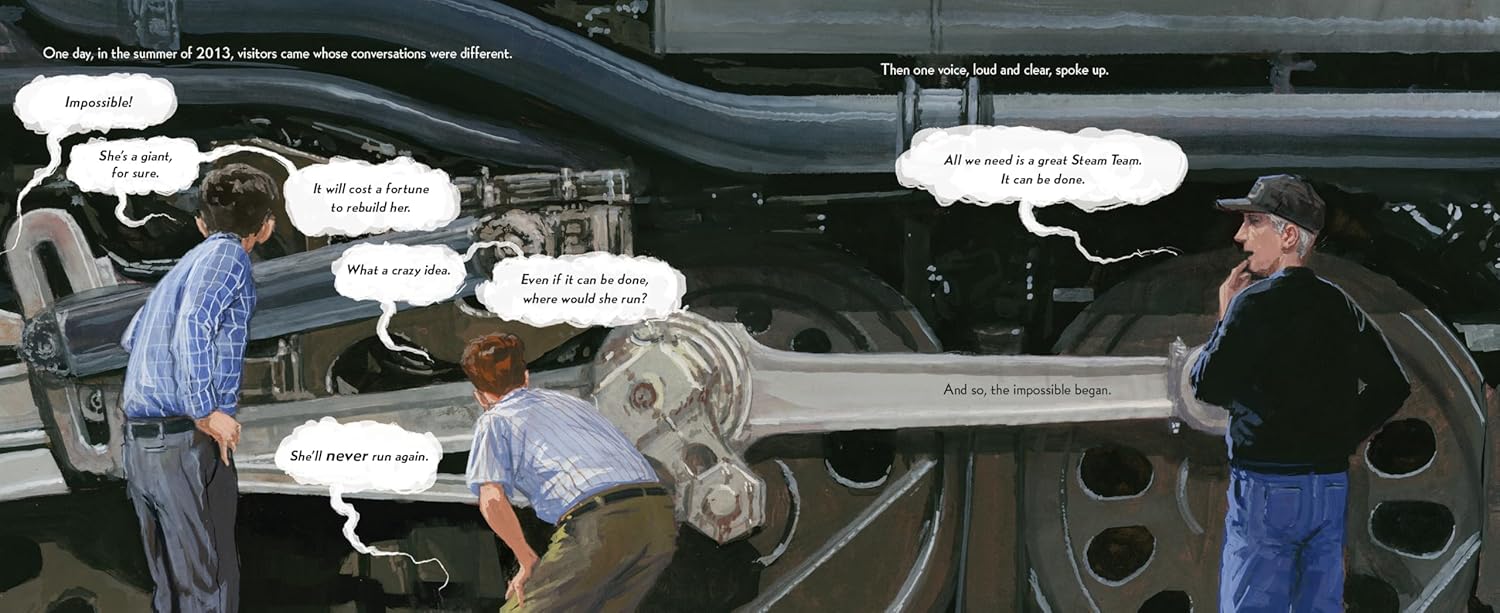
Then one day men came to visit her. As they inspected her, most decided that restoring her would be too expensive, too crazy, impossible. But one voice disagreed, saying “All we need is a great steam team. It can be done.” Nine men signed onto the Steam Team, with the aim to restore Big Boy for the Golden Spike Celebration in 2019 that would commemorate the finishing of the transcontinental railroad—the first railroad to stretch all across the America from East to West.

illustration © 2025 by Adam Gustavson, text © 2025 by Marsha Diane Arnold. Courtesy of Sleeping Bear Books.

To move Big Boy from the museum to the tracks a mile away, temporary tracks were laid and a bulldozer slowly pulled her along inch by inch. She was then pulled and pushed 1,300 miles to Wyoming, where the work on her would be done. There, Big Boy underwent intensive scrutiny, getting new parts, being made to look like new. Years went by, the Golden Spike Celebration was months away, then days away. It was “time to test her out.” 

“Double-headed with the ‘Living Legend,’ locomotive 884,” Big Boy, pulling train cars behind her, chugged “to Ogden, Utah, for the celebration.” All along the route, people came out to watch, “to feel the rumble under their feet as Big Boy passed, to see the steam cloud billowing above her, to hear her whistle, loud and clear.” At the ceremony, Big Boy 4014 and Locomotive 884 faced each other, just as two steam engines had 150 years before, when a set of tracks moving east-to-west and another running west-to-east were united with a golden spike.

illustration © 2025 by Adam Gustavson, text © 2025 by Marsha Diane Arnold. Courtesy of Sleeping Bear Books.

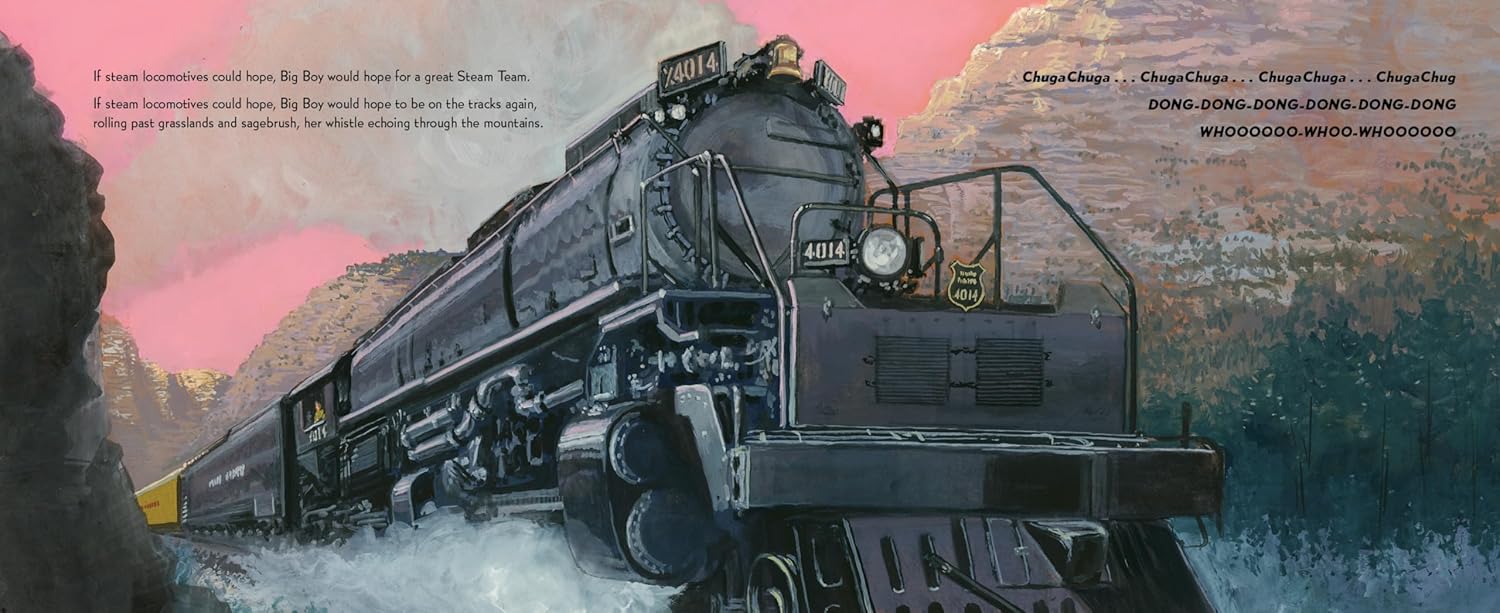
Following the Golden Spike Celebration, Big Boy 4014 took another trip, a tour of more than 8,000 miles “past grasslands and sagebrush. / Past farmlands and rivers. / Past fields and cities and towns.” Whether it was raining or snowing or blisteringly hot, people came out to cheer Big Boy on and feel that awesome rumble as she passed by. No longer is her time only a memory from long ago. With more tours planned, “if steam locomotives could talk, Big Boy would say . . . “I’m ringing my bell and sounding my whistle.” DONG-DONG-DONG-DONG-DONG-DONG WHOOOOOO-WHOO-WHOOOOOO / “I’m chugging up the Wasatch Mountains at top speed, feeling the warmth of the oil in my firebox, as powerful as 7,000 horses.”

An in-depth discussion about the origins of the twenty-five Big Boy steam locomotives; the incredible engineering feat of designing and building them; how a steam engine works, How Big Boy 4014 was chosen for restoration; short profiles of the men instrumental in Big Boy’s restoration; a brief history of the building of the transcontinental railroad; and the research involved in making tours of Big Boy 4014 possible.

illustration © 2025 by Adam Gustavson, text © 2025 by Marsha Diane Arnold. Courtesy of Sleeping Bear Books.

Combining imaginative lyrical text with compelling nonfiction storytelling, Marsha Diane Arnold weaves an immersive tale of the restoration and triumphant comeback of the steam locomotive Big Boy 4014. Where once 25 of these behemoth machines conquered mountains and rough terrain to move freight and people across the country and contributed to our success in World War II, they have been relegated to history as diesel and electric trains took prominence.

Arnold recalls the importance of these storied locomotives for young readers and train enthusiasts of all ages, bookending her story with wistful “If steam locomotives could dream/talk” re-imaginings of Big Boy 4014’s glory days of leaving a station, sounding her bell and whistle, and “chugging up mountains” with the “power of 7,000 horses.” Readers will be wowed by the dedicated and painstaking work that went into moving and restoring Big Boy 4014, a recounting Arnold accomplishes with a deft hand for details that don’t overwhelm. She leaves readers with a new appreciation for steam locomotives and a hope that they too will be able to witness a tour of this earth-rumbling beauty.

Adam Gustavson’s stunning realistic paintings depict Big Boy 4014 from various perspectives, giving readers a sense of her scale compared to the adults and children, the mountainous landscapes she traversed, and the crowds who came out to celebrate her. Up-close renderings allow train lovers to get a glimpse into the steam-powered mechanics that propelled her while also seeing how run-down she had become over her nearly 60 years of disuse. Each page spread is a showstopper to linger and marvel over as readers gain insight and admiration for these trains and those who created them.

For train enthusiasts, history buffs, and those who simply love a story masterfully told, Big Boy 4014 and the Steam Team: the World’s Largest Steam Engine Roars Back to Life! is a book you won’t want to miss. The book is an exciting must-addition for all school and public library collections.

Ages 6 – 9+

Sleeping Bear Press, 2025 | ISBN 978-1534113145

About the Author

Marsha Diane Arnold is a multiple-award–winning author whose books have sold over one million copies. Called a “born storyteller” by the media, Marsha’s works include Badger’s Perfect Garden (Florida Book Awards Bronze Medal), the bilingual Galápagos Girl/Galapagueña (Bank Street Best Book and Campoy-Ada honor book), and Lights Out (Golden Kite finalist). Among her many pastimes, Marsha especially enjoys reading to her grandchildren and visiting schools to talk about writing and books. Born in rural Kansas, Marsha now lives with her husband and dog Sailor in Alva, Florida. Visit her at marshadianearnold.com.

About the Illustrator

Adam Gustavson’s illustrations have appeared in over thirty books for children. He is a teaching professor of art at Rowan University, and lives in a quirky little house in New Jersey with his lovely wife, their two sons, and two rather small dogs.

National Train Day Activity

Steam Engine Coloring Page


Steam locomotives once carried passengers and freight. Enjoy this coloring page of a steam train from days gone by from Monday Mandala!

You can purchase Big Boy 4014 and the Steam Team: the World’s Largest Steam Engine Roars Back to Life! from these booksellers

Amazon | Barnes & Noble | Bookshop

Picture Book Review

March 14 – It’s Expanding Girls’ Horizons in Science and Engineering Month

About the Holiday

Expanding Girls’ Horizons in Science and Engineering Month was established in 2020 by the Expanding Your Horizons (EYH) Network. Founded in 1974 as a series of conferences aimed at promoting STEM careers to middle and high school girls, EYH provides hands-on activities, mentoring, and contact with role models as well as information about science and engineering fields.

Women still make up only 28% of the science and engineering workforce. With this month-long observance, the EYH Network hopes to make a significant impact on girls’ perceptions and career choices, encouraging them to explore and embrace STEM subjects​.

Thank you to Heyday and Barbara Fisch at Blue Slip Media for sharing a copy of I Love Salmon and Lampreys: A Native Story of Resilience with me!

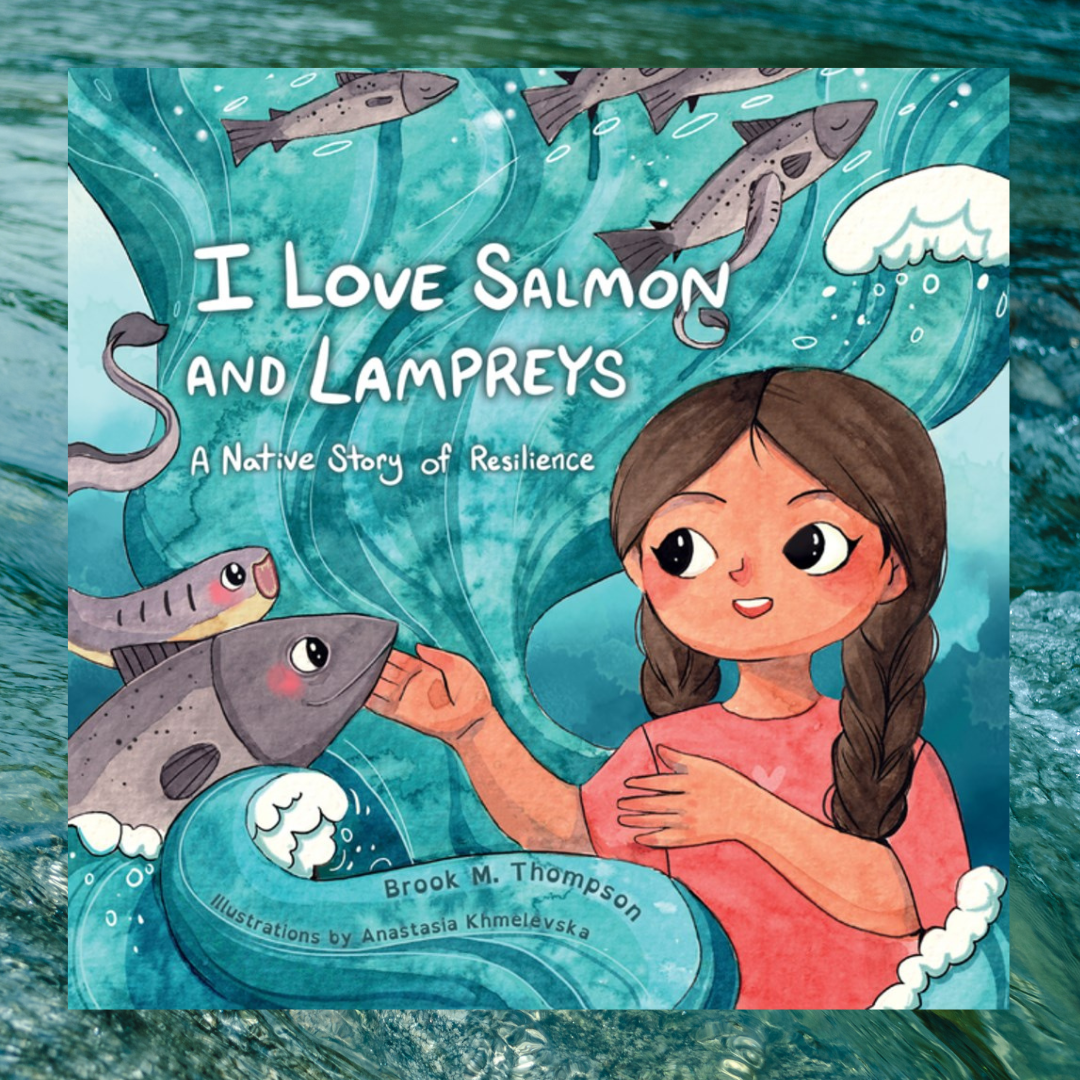
I Love Salmon and Lampreys: A Native Story of Resilience

Written by Brook M. Thompson | Illustrated by Anastasia Khmelevska


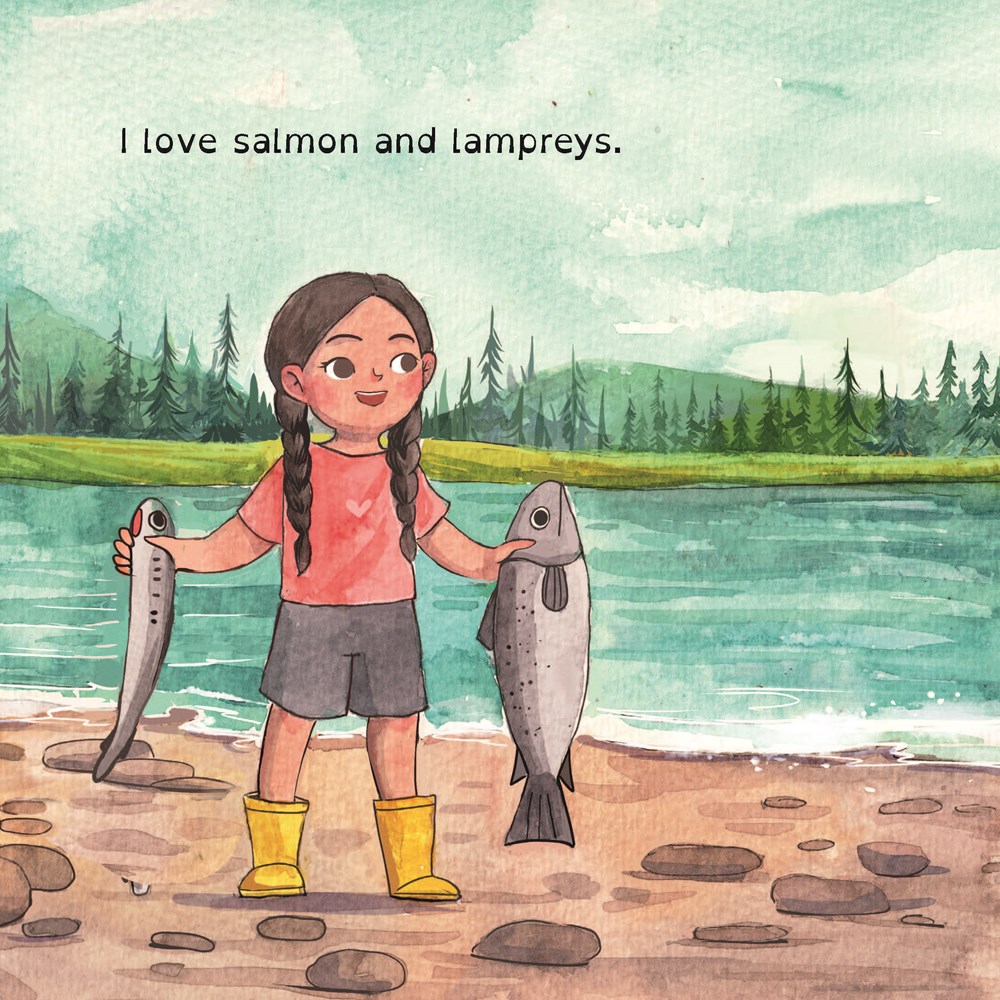
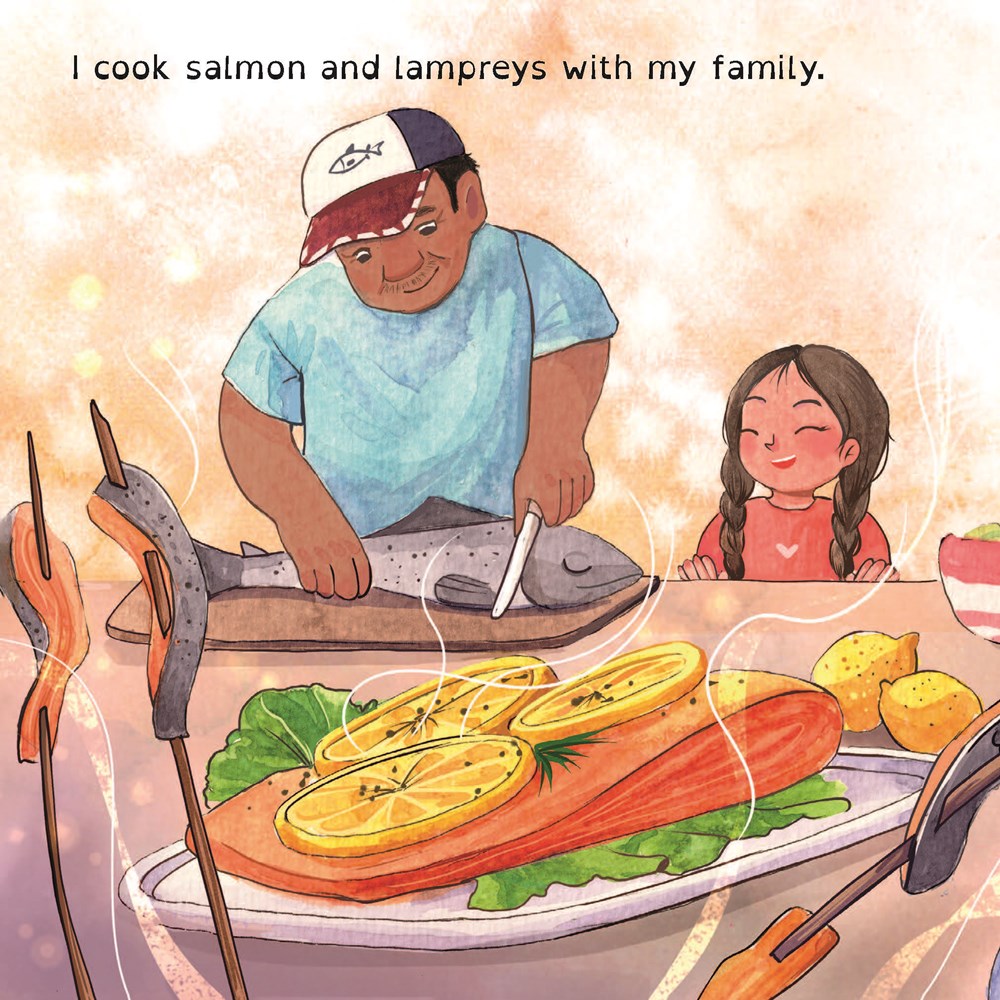
In her powerful autobiographical story, Brook Thompson, a member of the Yurok and Karuk Tribes, warmly invites readers to join her on her journey from childhood to the present day to experience her intense love for her tribes’ traditions and the fish that sustain them. Readers are first taken out on Brook’s family’s fishing boat, where her father and her grandfather tell stories of their own childhoods as they check the nets in their designated fishing spots along the Klamath River in Northern California. Then it’s back home to learn how Brook helps cook the fish (lampreys in the winter and salmon the rest of the year) in a wide variety of delicious ways.

Illustration © 2025 by Anastasia Khmelevska, text © 2025 by Brook M. Thompson. Courtesy of Heyday.

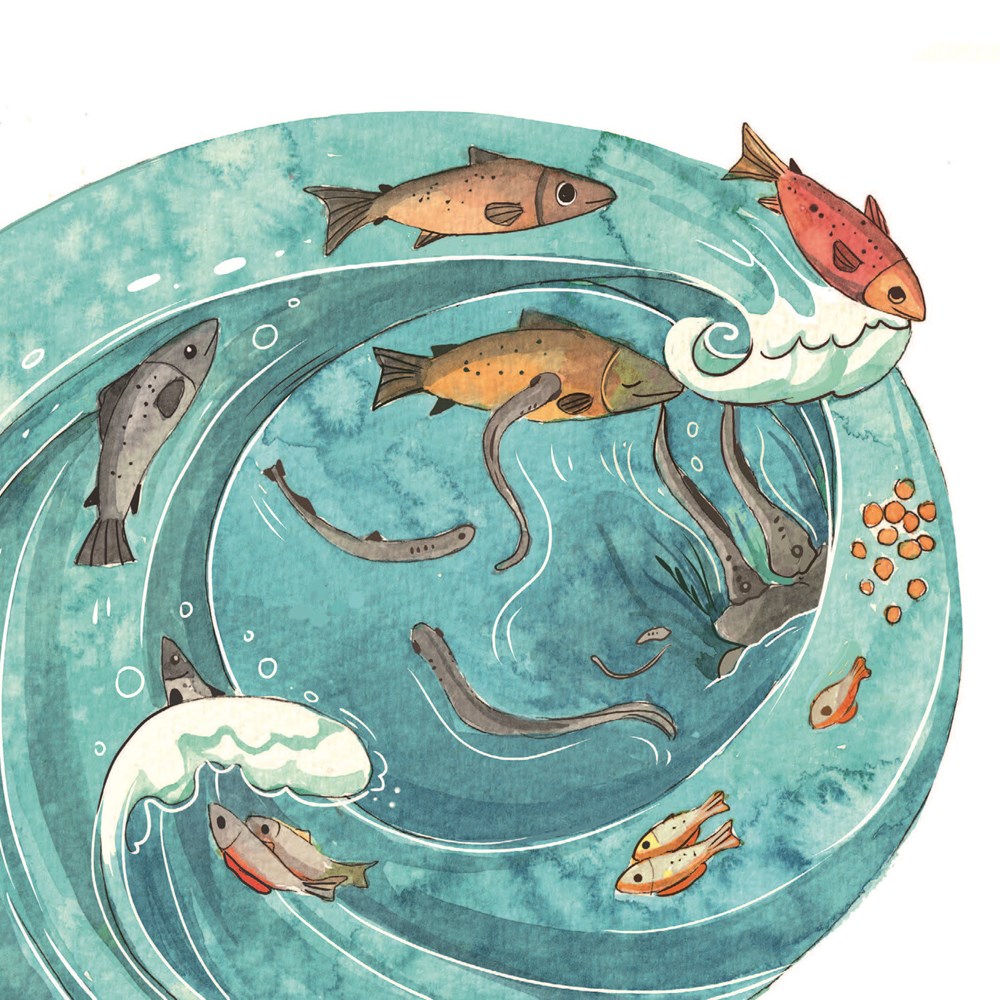
Salmon and lampreys are more than just food to Brook, however. They are creatures of the earth to be admired and honored. She tells readers about their life and spawning cycles, how they predate the dinosaurs, and even about their fascinating symbiotic relationship. For Brook, this love she feels is shared. She says, “I feel loved by salmon because years ago my ancestors took care of the salmon for their future family” and reveals that the fish in the river now “are the great-great-great-great-great-great-grandkids of the salmon who had a relationship with my great-grandparents.”

Illustration © 2025 by Anastasia Khmelevska, text © 2025 by Brook M. Thompson. Courtesy of Heyday.

In 2002, when Brook was still young, over 60,000 salmon perished from a parasite which spread when the water level of the river became too low and the temperature too hot due to the six dams erected on the river. She explains how dams “block the salmon’s way home” and how the warming water promotes the growth of toxic green algae, which affects the fishes’ breathing and spreads disease. 

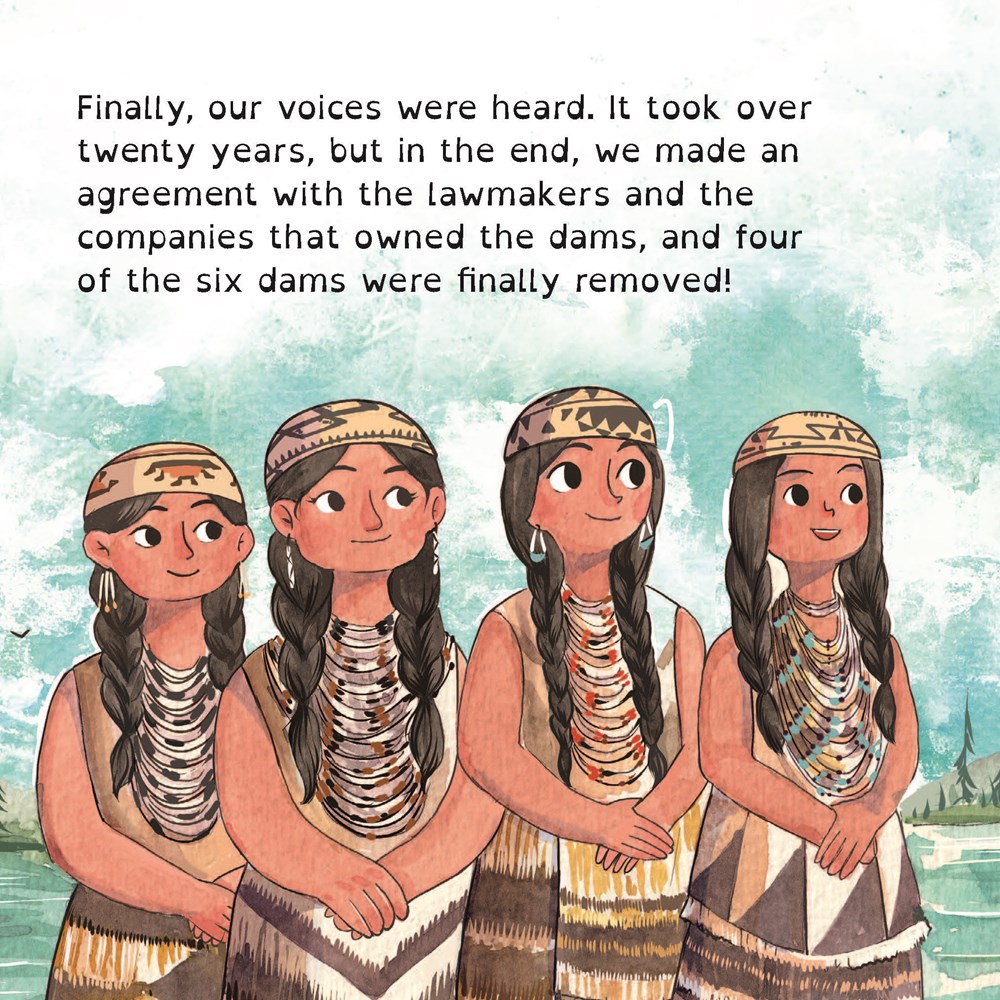
Brook joined protests by the tribal people and others, while scientists did research and local politicians lobbied for change. More than 20 years later agreements with the politicians and the companies that owned the dams were signed, and four of the six dams along the Klamath River were removed.

Illustration © 2025 by Anastasia Khmelevska, text © 2025 by Brook M. Thompson. Courtesy of Heyday.

As she grew into adulthood and inspired by her experiences, Brook set her eyes on higher education. She “went to college to learn about dams and about how to protect salmon in the future.” She became an engineer and a scientist who studies the interconnectedness of  “water, nature, people, animals, and buildings” and returned home to the Klamath River, where she continues the legacy of her ancestors in caring for the salmon, lampreys, and the environment.

Back matter includes Fun Facts about lampreys and salmon; photographs of Brook with salmon and at Iron Gate Dam, which was removed in 2024; a map of the Klamath River Watershed area; a note about the inspiration behind the book as well as the book’s font, OpenDyslexic, which makes it easier for those with dyslexia, like Brook, to read; and notes about the author and illustrator.

Illustration © 2025 by Anastasia Khmelevska, text © 2025 by Brook M. Thompson. Courtesy of Heyday.

Brook Thompson, in her compelling autobiographical story, will captivate children and touch their hearts. Thompson’s eloquent and straightforward storytelling immediately immerses readers in the Native relationship with nature and will inspire both young and adult readers to think deeply about how the earth sustains us and how we can show our appreciation in return. The theme of environmental justice and how citizens can and do make a difference is made personal through Thompson’s clear explanations of how the dams affected the salmon population and the long-term steps people took to reverse their damage. Thompson’s dedication—even from childhood—to her tribes, family, and future generations will impress readers. Children will also develop an understanding of how issues of interest to them now can inform their future endeavors.

Anastasia Khmelevska’s vibrant earth tone illustrations endear Brook to children through her evident passion for family, fishing, and the salmon and lampreys that have been a constant in her tribes’ lives. Her pacing and realistic depictions of people and events help children clearly understand the importance of each element of Thompson’s story from how the cyclical lives of salmon and lampreys are demonstrated in a swirling wave to the stunning landscapes highlight of the Pacific Northwest. These images make her depiction of the salmon die-off all the more impactful. Her final portrait of Brook Thompson coming home after earning her university degrees links her life to the salmon she loves so well. 

The combination of Native culture and environmental awareness makes I Love Salmon and Lampreys: A Native Story of Resilience a must addition to school and public libraries. The book offers extensive value and research opportunities for science and social studies classes. For families who care about the environment, sustainability, activism, and the future of our planet, I Love Salmon and Lampreys would be a much-loved choice.

Ages 4 – 8

Heyday, 2025 | ISBN 978-1597146685

About the Author

Brook M. Thompson is a part of the Yurok and Karuk Tribes. She is a neurodivergent and Two-Spirit author with dyslexia. She has a BS in civil engineering from Portland State University and an MS in environmental engineering from Stanford University, and she will soon have a PhD in environmental studies from University of California, Santa Cruz, where she studies water, politics, restoration, and salmon. You can find out more about her at brookmthompson.com.

About the Illustrator

Anastasia Khmelevska is an illustrator based in Lviv, Ukraine. She has illustrated several children’s books, including My Invisible Zoo, Marella the Mermaid, and Anything Helps. Follow her on Instagram @cute_miuu.

Expanding Girls’ Horizons in Science and Engineering Month Activities

Illustration © 2025 by Anastasia Khmelevska, text © 2025 by Brook M. Thompson. Courtesy of Heyday.

I Love Salmon and Lampreys Activity Pages

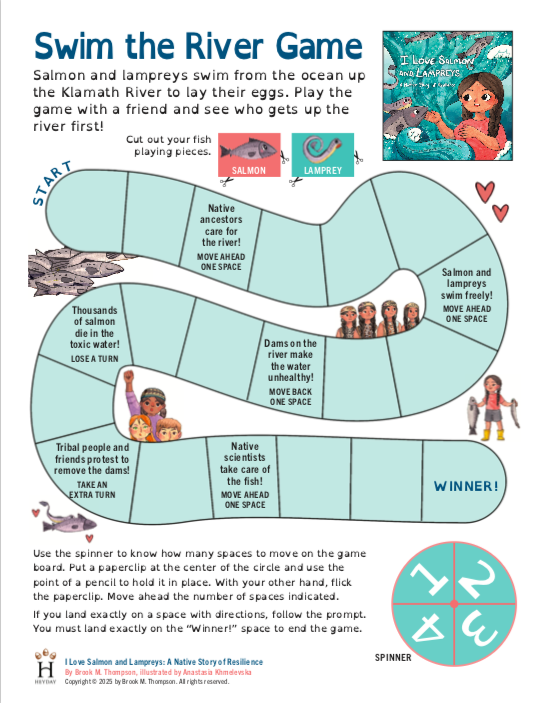
Play a printable board game, write about your dreams for the future, and learn fun facts about salmon and lampreys with these three I Love Salmon and Lampreys Activity Pages!

Chinook and Coho Salmon Coloring Pages

Coho and Chinook Salmon are vital to the Pacific Northwest. You can learn more about California salmon at caltrout.org. Enjoy these coloring pages of coho and chinook salmon. Colored images are included for your reference.

Chinook Salmon Coloring Page | Colored Image of Chinook Salmon

Coho Salmon Coloring Page | Colored Image of Coho Salmon

You can purchase I Love Salmon and Lampreys: A Native Story of Resilience at these bookstores

Amazon | Barnes & Noble | Bookshop

Picture Book Review

March 12 – Get Ready for Passover

About the Holiday

Passover, or Pesach in Hebrew, is one of the most sacred Jewish holidays and celebrates the Jews’ liberation from slavery in Egypt and their freedom as a nation under Moses. The holiday begins on the fourteenth day of the Hebrew month Nisan and continues for seven days in Israel or eight days outside of Israell. The holiday begins with a seder meal, for which family and friends gather to remember their history, have symbolic dishes, and celebrate the joy of freedom. Games for children, a reading of the Exodus story, and other meaningful traditions also mark the holiday.

Thank you to Random House Books for Children and Barbara Fisch at Blue Slip Media for gifting me a copy of Next Year in the White House for review.

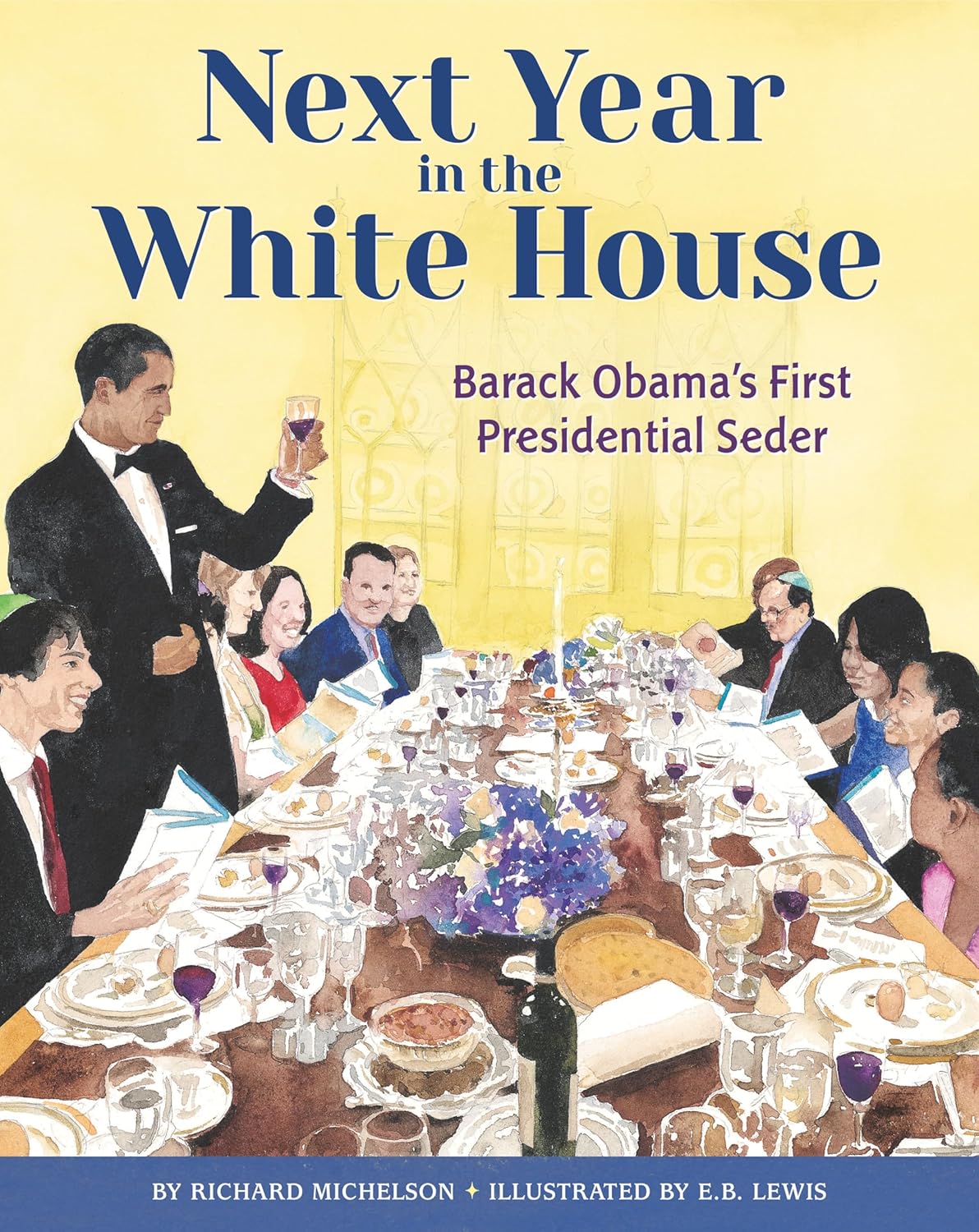
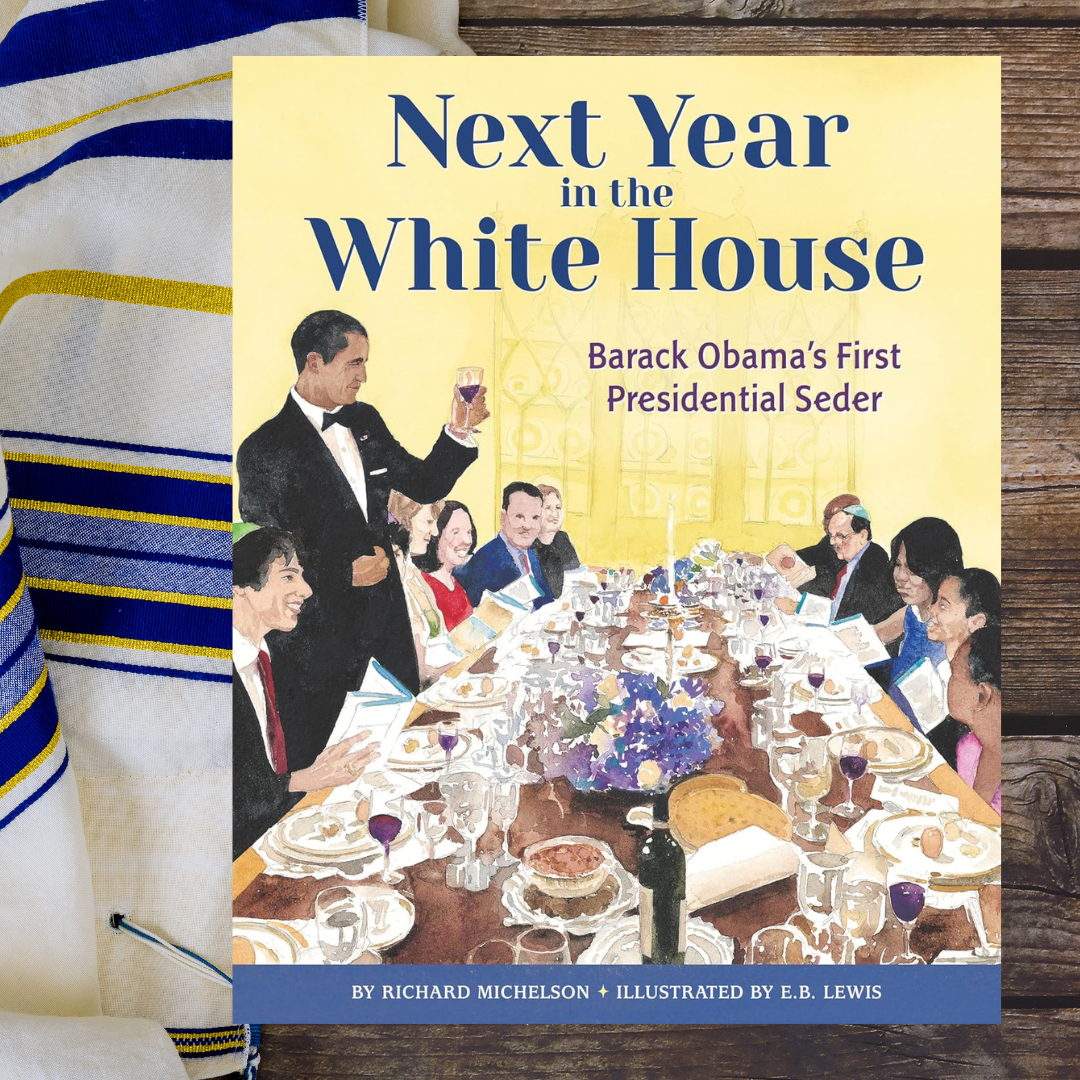
Next Year in the White House: Barack Obama’s First Presidential Seder

By Richard Michelson | Illustrated by E.B. Lewis


Review by Dorothy Levine


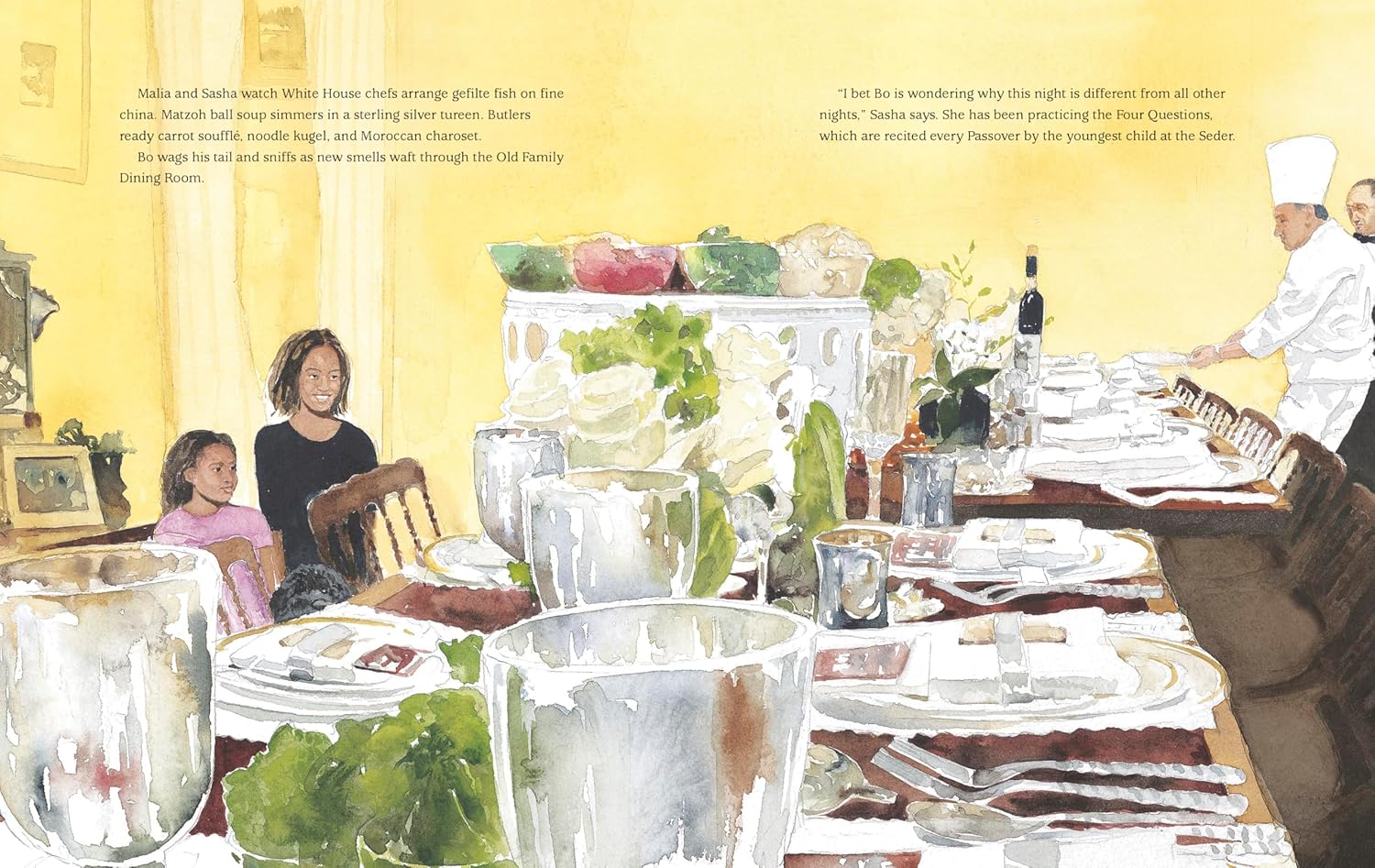
“Malia and Sasha watch White House chefs arrange gefilte fish on fine china. Matzoh ball soup simmers in a sterling silver tureen…Bo wags his tail and sniffs as new smells waft through the Old Family Dining Room.”

Michelson’s story begins right in the action, with everyone preparing for the White House Seder. Barack Obama’s daughter Sasha says, “I bet Bo is wondering why this night is different from all other nights.” She is jokingly referencing the four questions recited by the youngest child in a Passover seder. And why is this night different, you may be wondering? Read on to find out! 

Illustration © 2025 by E.B. Lewis, text © 2025 by Richard Michelson. Courtesy of Random House Children’s Books.

When Eric, Arun, and Herbie set out on the campaign trail with Senator Obama as he ran for president in 2008, they did not expect to find themselves seated in the White House celebrating Passover for the next eight years. These young men joined the campaign trail in hopes that “they could help [Obama] make America a place where all people—regardless of their race, gender or religion—would have an equal opportunity to succeed.” But, “helping others doesn’t mean you don’t get homesick, or hungry, or tired.”

Holidays are especially a time when homesickness can hit for folks far from home. And this was the case for Eric, Arun, and Herbie. When Passover came around, they decided to have their own Passover ceremony, or Seder, in the basement of the hotel where they were staying. The trio managed to snag some matzoh, macaroons and Manishewitz wine along with Haggadahs (booklets of the prayers, songs and story of Passover) to tell the story of Passover—the exodus of enslaved Jews in Egypt who escaped through a parting sea to freedom, one of many miracles that ensured their eventual getaway. “Tonight, they would celebrate the sweet taste of freedom and pledge not to rest until all people are free.”

Illustration © 2025 by E.B. Lewis, text © 2025 by Richard Michelson. Courtesy of Random House Children’s Books.

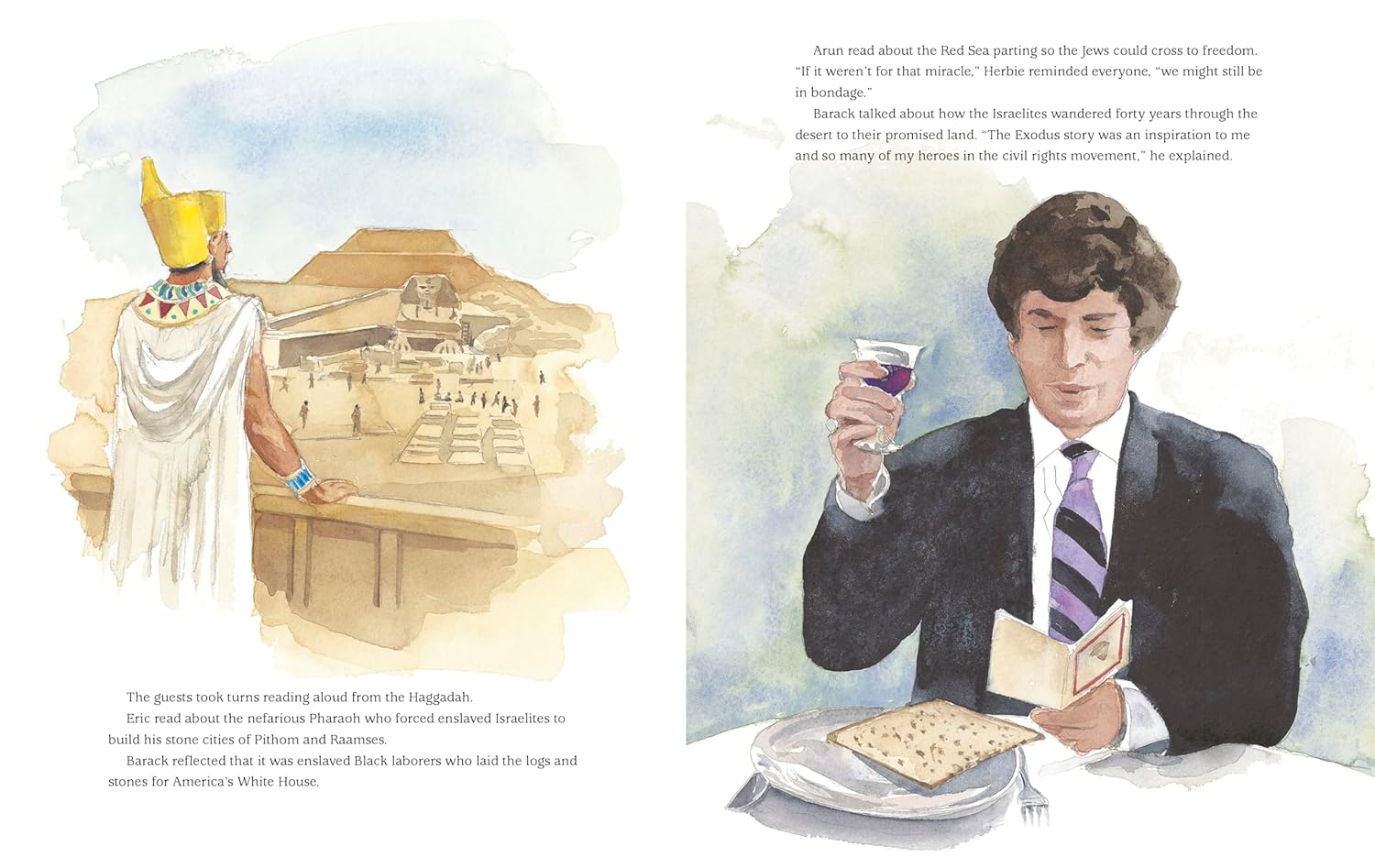
When the three young men rose for the tradition of letting the prophet, Elijah, in through the door they were surprised to find Barack Obama on the other side, requesting to join the gathering. Obama brought to the table connections between the Passover freedom tale and the civil rights movement—how activists throughout time have drawn from the Passover pilgrimage in their protests and speeches. He told of how enslaved Black laborers were the ones who carried the first building blocks for the White House, like how the ancient Pharaoh had made the enslaved Israelites build his stone cities. When Eric called out a traditional Passover expression “Next year in Jerusalem,” a phrase that has come to signify hope for a better tomorrow, Barack replied, “Next year in the White House!”

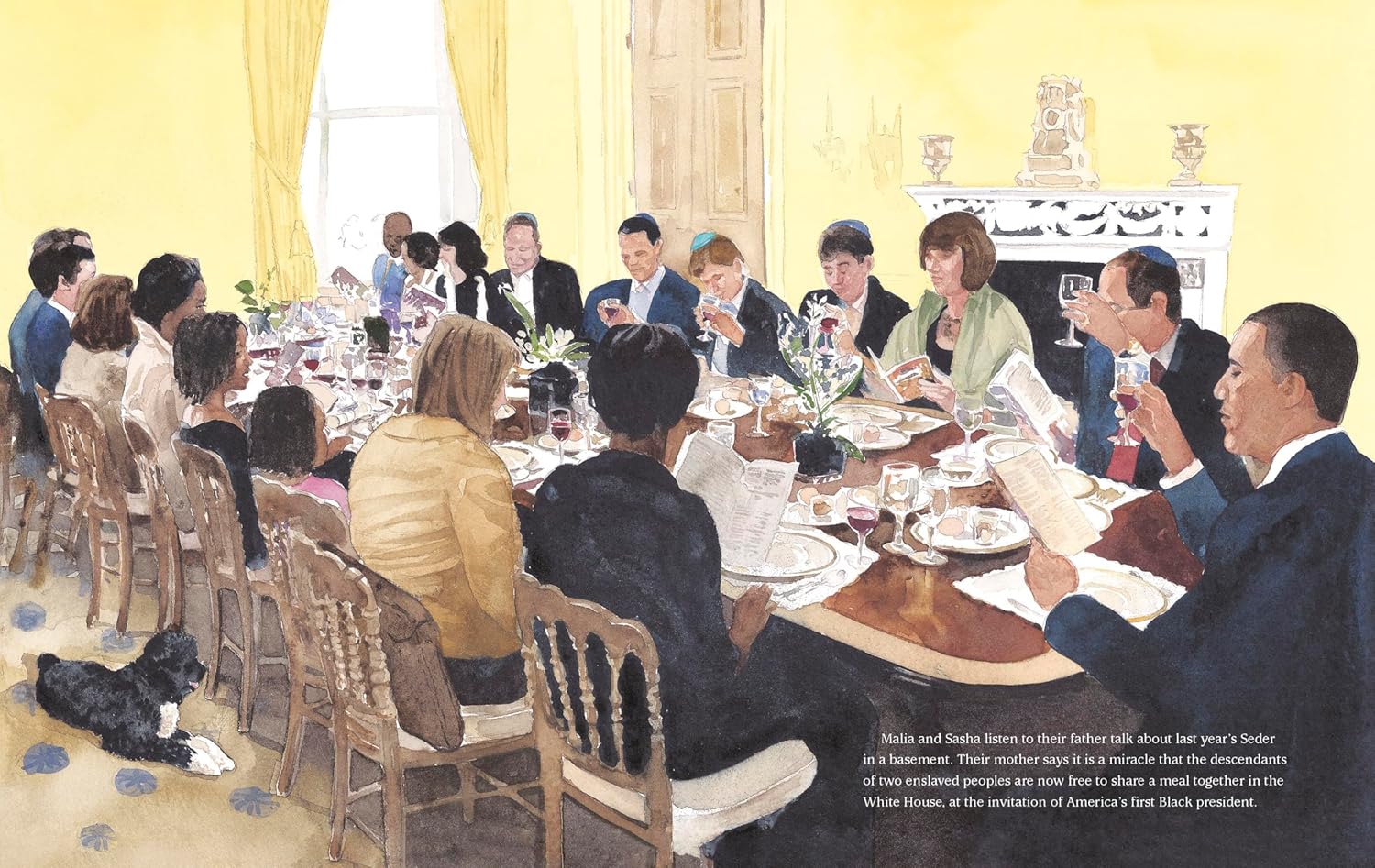
In the following pages, we return to the prologue scene of the book—a description of the first White House Seder, performed in 2009, hundreds of years after both the first White House Christmas and Easter ceremonies. We read of two previously enslaved peoples joining together in resistance and solidarity, to celebrate in the historic White House, where neither group would have been invited years ago. We learn about the traditional Passover foods and games for children—such as piping hot matzoh ball soup and the race to find the afikomen, a hidden piece of matzoh wrapped in a special cloth. And we’re invited in as dozens of people gather to celebrate and cherish the holiday’s call of freedom. When the prize for finding the hidden afikomen is a dog toy for Bo, Sasha remarks, “Now Bo definitely knows why this night is different from all other nights.”

Illustration © 2025 by E.B. Lewis, text © 2025 by Richard Michelson. Courtesy of Random House Children’s Books.

Richard Michelson’s writing is thought provoking, lively and packed with themes of hope and resilience interspersed with knowledge of the Passover traditions. The story contains many references to Passover phrases and themes, such as the call for the homesick, tired, and hungry to come eat and the four questions, which are both part of Passover prayers and motifs shared in Michelson’s story.

Michelson adds a prologue scene to draw readers in, as well as extensive back matter including: a note from Herbie Ziskend, Eric Lesser, and Arum Chaudhary; an annotated page of the Haggadah used at the first White House Seder; more information about the attendees and connections between Black History and Passover; a detailed explanation of Passover traditions; and a special Passover dessert recipe from Arun. His writing instills a sense of social justice, with undertones of the importance of intersectional empowerment and unity.

E.B. Lewis’s signature watercolor spreads bring the book to life with distinctly recognizable characters displaying detailed facial expressions and richly colored backgrounds. Readers will feel immersed in the comradery of the dinner table scenes and the crowds at protests and campaign speeches. The illustrative masterpiece depicting the parting of the sea in the background when Eric, Arun, and Herbie retell the Passover story will inspire awe and mystery. Close-ups of each of the characters also intersperse text and larger detailed scenes. When Arun, Herbie, and Eric are introduced, they each receive their own small illustrative snapshot, as these three unlikely characters become center stage for a Passover miracle story.

Next Year in the White House brings a unique and important historical moment to light and a new story to the table to re-read time and time again, as is tradition with the Passover tale. 

Ages 4 – 8+

Crown Books for Young Readers, 2025 | ISBN 978-0593711583

About the Author

Richard Michelson is a poet, children’s book author, and art dealer whose children’s books have been listed among the 10 Best Books of the Year by The New York Times, Publishers Weekly, and The New Yorker; and among the 12 Best Books of the Decade by Amazon.com. He has been a finalist for the Massachusetts Book Award, the Harlem Book Fest Wheatley Award, and the National Jewish Book Award, as well as receiving two Skipping Stones Multicultural Book Awards, a National Parenting Publication Gold Medal and an International Reading Association Teacher’s Choice Award. In 2009 Michelson received both a Sydney Taylor Gold and Silver Medal from the Association of Jewish Librarians, the only author so honored in AJL’s 50 year history. Michelson received his 2nd Silver Medal in 2017 and his 2nd Gold Medal in 2018. Additionally, Michelson won the 2017 National Jewish Book Award. Michelson is the owner of R. Michelson Galleries, the host of Northampton Poetry Radio, and the current Poet Laureate of Northampton. Massachusetts. You can learn more by visiting him at richardmichelson.com and on Facebook.

About the Illustrator

E.B. Lewis has illustrated over seventy books for children, including the New York Times Best Illustrated Book Award, Kirkus Best Illustrated Book Award, and the Golden Kite Honor Award winner Jabari Asim’s Preaching to the Chickens as well as the Caldecott Honor Award Winner, Jacqueline Woodson’s Coming on Home SoonHe is also a five-time Coretta Scott King winner.
Presently, Lewis teaches at the Pennsylvania Academy of Fine Arts. He is also a member of The Society of Illustrators in New York City, and an artist member of Salamagundi Art Club of New York. Learn more about E.B. Lewis and his work at eblewis.com.

Get Ready for Passover Activity

8 Days of Activity Plans from 18 Doors


Celebrate Passover with your family and these Activity Plan Ideas from 18 Doors! For each of the 8 Days you’ll find a song or video, a craft, and a recipe to help you have a fun Passover!

You can purchase Next Year at the White House from these booksellers

Amazon | Barnes & Noble | Bookshop (to support your local independent bookstore)

Picture Book Review

January 20 – Martin Luther King, Jr. Day and Interview with Dean Robbins

celebrate-picture-books-picture-book-review-you-are-a-star-martin-luther-king-jr-cover

About the Holiday

Martin Luther King Jr. Day celebrates the life and legacy of the man who dedicated his life and work to teaching—as Coretta Scott King once stated—“the values of courage, truth, justice, compassion, dignity, humility and service” and who led a non-violent Civil Rights movement to enact racial equality and justice through state and federal laws. President Ronald Reagan created the national holiday in 1983, setting it on the third Monday of January to coincide with Martin Luther King Jr.’s birthday on January 15. To commemorate the holiday, learn more about the life and work of Martin Luther King Jr. We still have a long way to go before there is true justice and equality for all, and it’s more important now than ever to look for ways to offer help and hope.

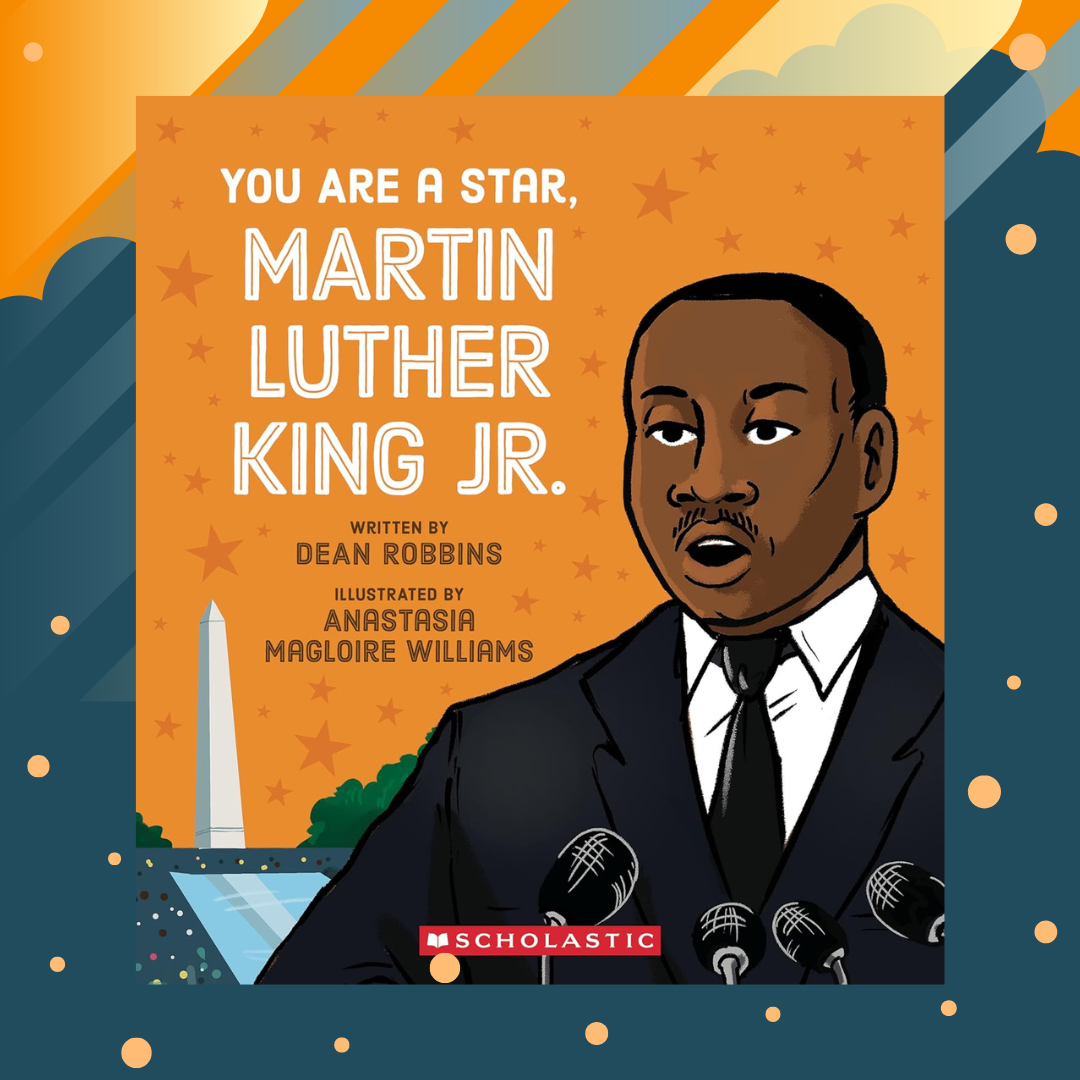
Thank you to Scholastic Press for sharing a copy of You Are a Star, Martin Luther King, Jr. with me. All opinions on the book are my own.

You Are a Star, Martin Luther King, Jr.

Written by Dean Robbins | Illustrated by Anastasia Magloire Williams

Opening the cover to this visually engaging biography, readers are first introduced to Martin Luther King, Jr. as he stands at a podium on August 28, 1963 ready to address the throngs of people who had joined the March on Washington and now filled the National Mall. He wonders if he’s prepared the right words to offer hope for a better future. His thoughts take him back to when he first experienced discrimination, and readers follow along, learning about segregation in schools, restaurants, recreation areas, even at drinking fountains.

Kids learn that even when Martin Luther King, Jr. was their age he was already thinking that “someone had to change these unfair rules” and deciding “Why not me?” Through the book’s first-person narration, children gain a close portrait of Martin Luther King, Jr. as a committed intellectual, believer in the foundations of America, and outspoken advocate for equal rights. They learn of his life as a minister, his work with Rosa Parks and others to end discrimination on public busses, and his adoption of nonviolent protests to affect change. 
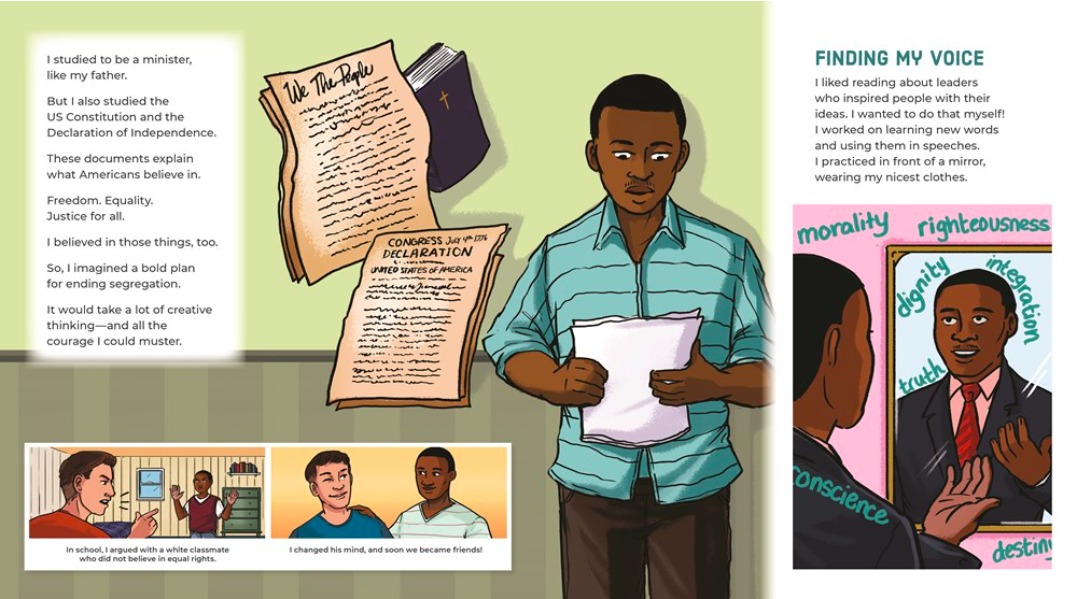
celebrate-picture-books-picture-book-review-you-are-a-star-martin-luther-king-jr-finds-voice

Image copyright Anastasia Magloire Williams, 2025, text copyright Dean Robbins, 2025. courtesy of Scholastic Press.

Readers come to understand how success in Montgomery spurred Martin Luther King, Jr. and others to work toward ending segregation in other places—like stores and restaurants—and even to “challenge American leaders to make a national law against segregation.” They learn how Martin Luther King, Jr. ended up in jail in Birmingham, Alabama, after a peaceful protest and wrote a letter to the world about oppression. Kids also hear about the Children’s March, which took place at the same time and during which more than 2,000 children were also arrested. 

Returning to the March on Washington, Dr. King decides to abandon his written speech and talk from his heart. The result is his now-famous “I have a dream” speech. Following this gathering of 250,000 people and more calls for a national law against segregation from around the country, Dr. King reveals that “In 1964, Congress passed the Civil Rights act.” But even then Dr. King says, “I knew we had more work to do. Many places still had rules to keep Black people from voting.” 
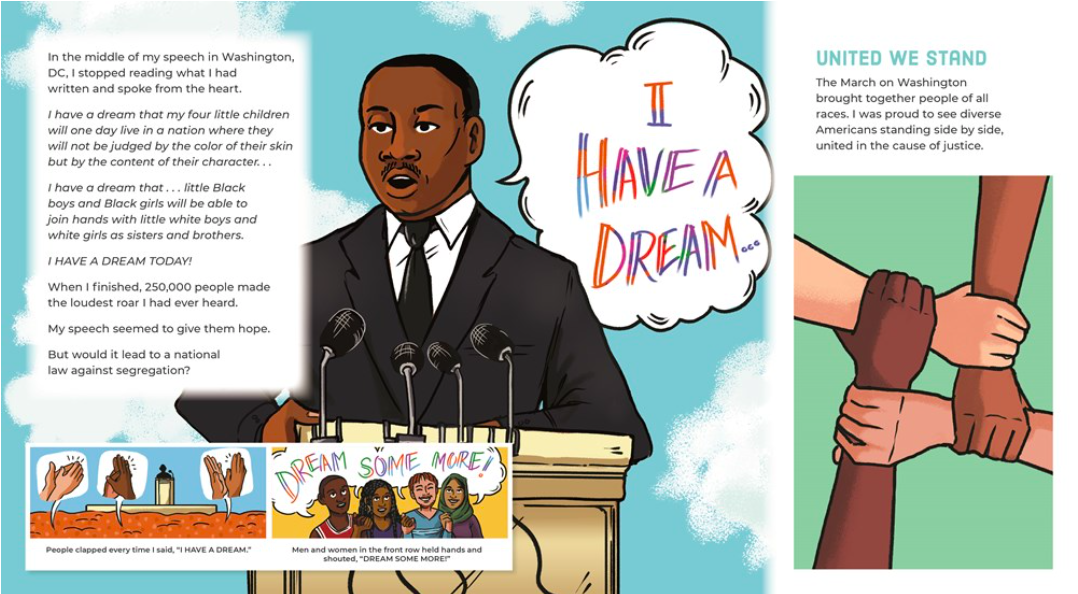
celebrate-picture-books-picture-book-review-you-are-a-star-martin-luther-king-jr-I-have-a-dream-speech

Image copyright Anastasia Magloire Williams, 2025, text copyright Dean Robbins, 2025. courtesy of Scholastic Press.

Another peaceful march was planned for Selma, Alabama, with a 50-mile march to Montgomery. This time, however, Alabama’s governor send troops to attack the marchers. The participants were not intimidated, though, and even invited more Americans to join them. Thousands answered the call. “Maids, students, and movie stars. Parents pushing baby carriages. People on canes and crutches.” Five days later, they reached Montgomery. “The Selma protest was our movement’s greatest victory,” Dr. King tells readers. “It led to a national voting rights law!”

Martin Luther King, Jr. reminds readers, though, that there’s still more to do to “see the good in one another,” “live with each other in peace,” “join together and change the world with love,” and “make my dream come true.”

Beneath the narration of Dr. King’s story, a comic-style panel highlights a single talking point, event, or fact—such as during the Montgomery bus boycott, one man “rode to work on a mule”—often with a light-hearted approach. On the righthand page, Robbins defines concepts such as nonviolent protests, boycotts, freedom of speech, protest songs, the Children’s March, polling place intimidation, and the Voting Rights Act of 1965 in easily understood language. 

Extensive back matter includes an Author’s Note, how children can “Be Like Martin,” notable quotations by Martin Luther King, Jr., four types of Nonviolent civil rights protests, a brief timeline of Dr. King’s life from his birth on January 15, 1929 to 2011, when the Martin Luther King, Jr. Memorial was dedicated in Washington, DC. Also included are a glossary of important terms and a list of resources.
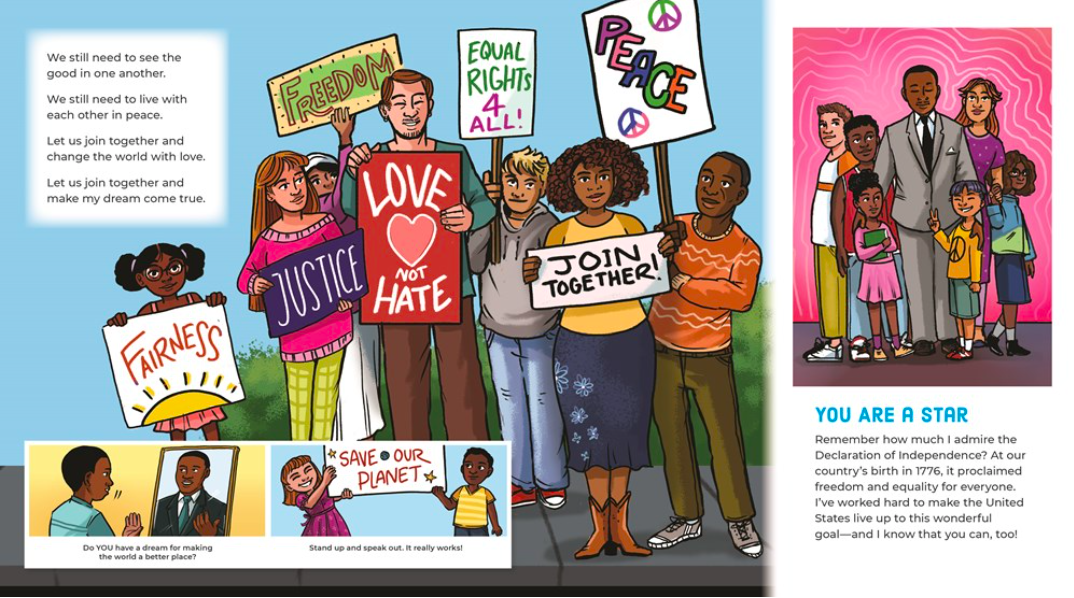
celebrate-picture-books-picture-book-review-you-are-a-star-martin-luther-king-jr-more-to-do

Image copyright Anastasia Magloire Williams, 2025, text copyright Dean Robbins, 2025. courtesy of Scholastic Press.

Dean Robbins’ immediately welcoming and dynamic first-person narration style not only draws young readers into Martin Luther King’s life and the history of the Civil Rights Movement, but makes children feel that they have a personal connection with Dr. King’s legacy. Robbin’s clear, factual writing, is presented in short, separated sentences. These make it easy for children to digest and understand King’s nonviolent approach to protest as well as the social and legal issues of the time and how, unfortunately, vigilance is still needed today. Robbins ends on a note of hope and an invitation to readers to join others and use their talents to help make Martin Luther King, Jr.’s dream come true.

Accompanying Robbins’ text are Anastasia Magloire Williams’ compelling illustrations that are at once realistic and accessible for today’s visual learners. Her stirring depiction of Martin Luther King, Jr. speaking at the 1963 March on Washington sets the tone for children to discover the impact King has had on people’s hearts, minds, and actions for more than 60 years. Through Williams’ expressive portraits, children see Martin Luther King, Jr.’s commitment to studying, practice, and rallying support as well as the effects of segregation, the determination of protestors during the Montgomery, Alabama, bus boycott, and how people from all parts of society working together created—and can still bring about—much-needed change.

With its graphic-style illustrations and well-researched content, You Are a Star, Martin Luther King, Jr. is vibrant and captivating. The book offers exhilarating learning opportunities for individuals, classrooms, and homeschoolers and may spark extended study or activism for a favorite cause. It is highly recommended for home bookshelves and a must for school and library collections.

Ages 5 – 7 and up

Scholastic Press, 2025 | ISBN 978-1338895100

Meet Dean Robbins

celebrate-picture-books-picture-book-review-dean-robbins

Photo credit David Giroux

Dean Robbins is a journalist and the author of the children’s picture books Two Friends: Susan B. Anthony and Frederick Douglass, Margaret and the Moon: How Margaret Hamilton Saved the First Lunar Landing, and Miss Paul and the President: The Creative Campaign for Women’s Right to Vote. His award-winning books have received starred reviews in Publishers Weekly and Kirkus Reviews and have been praised in the New York Times and USA Today. Dean grew up idolizing Apollo astronauts and loved working with Alan Bean on The Astronaut Who Painted the Moon. Learn more at deanrobbins.net.

Hi Dean! I’m thrilled to be talking with you today about your latest book, the impact heroes have always had on your life, and the importance of having heroes for children.

This biography about Martin Luther King, Jr. joins your You Are a Star series that began in 2022 with the story of Supreme Court Justice Ruth Bader Ginsburg. Other inspirational figures in the series are Jane Goodall and Malala Yousafzai. Can you discuss a little about how this series came to be and how you choose the subjects?

My passion is writing about my personal heroes, some of whom are relatively unknown and whose stories I can share with children for the first time. But then there are those like Jane Goodall, Ruth Bader Ginsburg, and Malala Yousafzai who are widely admired and frequently represented in children’s books. I developed the You Are a Star series with Scholastic to present such iconic figures in a new way for young readers, striving to combine emotional storytelling and humor. Each title tells an exciting life story from the subject’s point of view, including anecdotes and quirky details that don’t appear in other picture-book biographies. I hope this approach makes Jane, Ruth, and Malala feel like human beings that kids can relate to rather than like distant statues on Mount Rushmore.           

In You Are a Star, Martin Luther King, Jr., you so clearly present and connect the pivotal moments in King’s life as well as the Civil Rights Movement so children can understand and even feel as if they know Martin Luther King, Jr. How did you approach writing this biography? What kind of research did you do? What was the most meaningful part of the research and writing for you?

It’s a challenging subject to write about for elementary school students—that is, to write about both clearly and entertainingly. I tried to explain such important ideas as desegregation, free speech, and civil disobedience while also telling a page-turning story that, while concise, does justice to Dr. King’s life and work. I’m so glad you think I pulled it off! As a journalist, I love to do research, so the best part was immersing myself in the extensive literature on the civil rights movement to find material that might surprise and delight young readers.

As a library assistant in the children’s department of my local library, I see how excited kids are to read graphic novels. I love the way the format of the You Are a Star series bridges traditional picture books with that of the graphic style. Can you talk about the design of this striking series, and especially about Anastasia Magloire Williams’ dynamic illustrations in this book?

The format is what allows me to have so much fun with You Are a Star. It features a main story that flows throughout the book, supplemented by a two-panel comic and an essential-fact sidebar on each spread. The comics and sidebars offer the chance to introduce key concepts and funny details without bogging down the narrative.

As you noted, the format also provides a showcase for Anastasia’s brilliant illustrations. She artfully combines poignant and playful images, making Dr. King and his movement come alive on the page. She also has a genius for visualizing abstract ideas so that kids can understand them and feel their power. In one of the sidebars, for example, I introduce Dr. King’s comment that “the arc of the moral universe is long, but it bends toward justice.” How on earth do you illustrate such a thing? Anastasia’s creative solution was to show Black and white hands building a wall together, with bricks marked “Justice,” “Equality,” “Unity,” “Change,” “Love,” “Peace,” and “Freedom.” What a lovely way to help children grasp Dr. King’s humane vision.

You’ve talked about the wide range of heroes you had as a child, from sports stars to early social and political reformers. Some of these are represented in the books you’ve written, but could you name some others? What do you think it was about them and yourself that drew you to these specific people?

Ever since I read Superman and Wonder Woman comics as a child, I’ve been attracted to those who overcome seemingly insurmountable obstacles to make the world a better place. And how thrilling is it that our world has real-life analogues to Superman and Wonder Woman? I hope I live long enough to publish a children’s book about every heroic figure whose picture hangs on my office wall, ranging from Jackie Robinson to Emily Dickinson to Louis Armstrong. 

Why do you think it’s important for children to have heroes?

Someone has to demonstrate the best that human beings are capable of, right? Especially when we’re so often confronted with the worst. The more kids who grow up to be like Dr. King, the better our world will be. In the back matter of You Are a Star, Martin Luther King, Jr. is a list of tips titled “Be Like Martin,” which I hope will facilitate this process!

I’ve read that you relish traveling to historical sites. Which place is your favorite or made the biggest impact on you and why?

One of the most stirring places I’ve seen is Susan B. Anthony’s house in Rochester, New York. On my tour of this national historic landmark, the guide pointed out the parlor where Susan would have tea with her neighbor and fellow activist Frederick Douglass. It was news to me that Anthony and Douglass socialized in this way, and I was moved by the idea of two titanic reformers humbly sipping tea while sharing their hopes and dreams. The experience inspired me to write my Scholastic picture book Two Friends: Susan B. Anthony and Frederick Douglass.

Not only has your life included careers as a K–12 school teacher, a journalist, and an author, but you also present fascinating pieces about famous people—from Houdini to Theodore Roosevelt to Harrison Ford to a full stadium’s worth of musicians and sports stars—and their connection to Wisconsin on Public Radio. How did this collaboration come about? Could you take readers through a bit of your process in writing and recording the segments?

It’s yet another way to spread the word about my heroes, and I like doing so in a different medium—one with sound effects! I’ve included some of these pieces in a book of essays that will be published in April by the Wisconsin Historical Society Press. Wisconsin Idols: 100 Heroes Who Changed the State, the World, and Me offers my perspective on heroic figures with often surprising connections to Wisconsin, including Oprah Winfrey, Duke Ellington, and Georgia O’Keeffe. It makes the case for Wisconsin as a notably influential place: a crossroads for people who transformed the world.

What do you enjoy most about being a children’s author?

 When kids tell me that one of my heroes has now become one of their heroes. I can’t begin to describe how gratifying that is.

As a former teacher, you must love going to schools for presentations. From the photos on your website, it looks like you and the kids have a fantastic time! Could you describe what your presentations are like?

My own child has inspired much of my writing but is now 28 years old, so these days I visit schools to hang out with my favorite demographic. With their curiosity and enthusiasm, elementary school kids never fail to restore my hope for the world. The presentations are geared toward maximum interaction so we can get to know each other. I joke, read, ask questions, and give them lots of chances to clap and shout things out. I tell them about my favorite heroes, and they tell me about theirs.

What’s up next for you?   

Next year, Scholastic will publish a book about another one of my heroes: Albert Einstein. The Genius Next Door is based on a little-known true story that, I hope, will make Einstein seem relatable and math seem fun!

Thanks so much for sharing your insight and some background on your wonderful You Are a Star series. I wish you all the best with this book and am looking forward The Genius Next Door.

Look for the rest of the books in the You Are a Star series!

You can visit Dean Robbins on his website at deanrobbins.net | Instagram | X

Martin Luther King, Jr. Day Activity

Students and kids at home will enjoy spending time with these fun and thought-provoking printable activities about Martin Luther King, Jr. from A Day in Our Shoes.

Martin Luther King, Jr. Activity Pack
You can purchase You Are a Star, Martin Luther King, Jr. at these booksellers

Mystery to Me (Dean Robbins’ hometown independent bookstore)

Amazon | Barnes & Noble | Bookshop (to support your local independent bookstore)

Picture Book Review

March 22 – It’s Women’s History Month

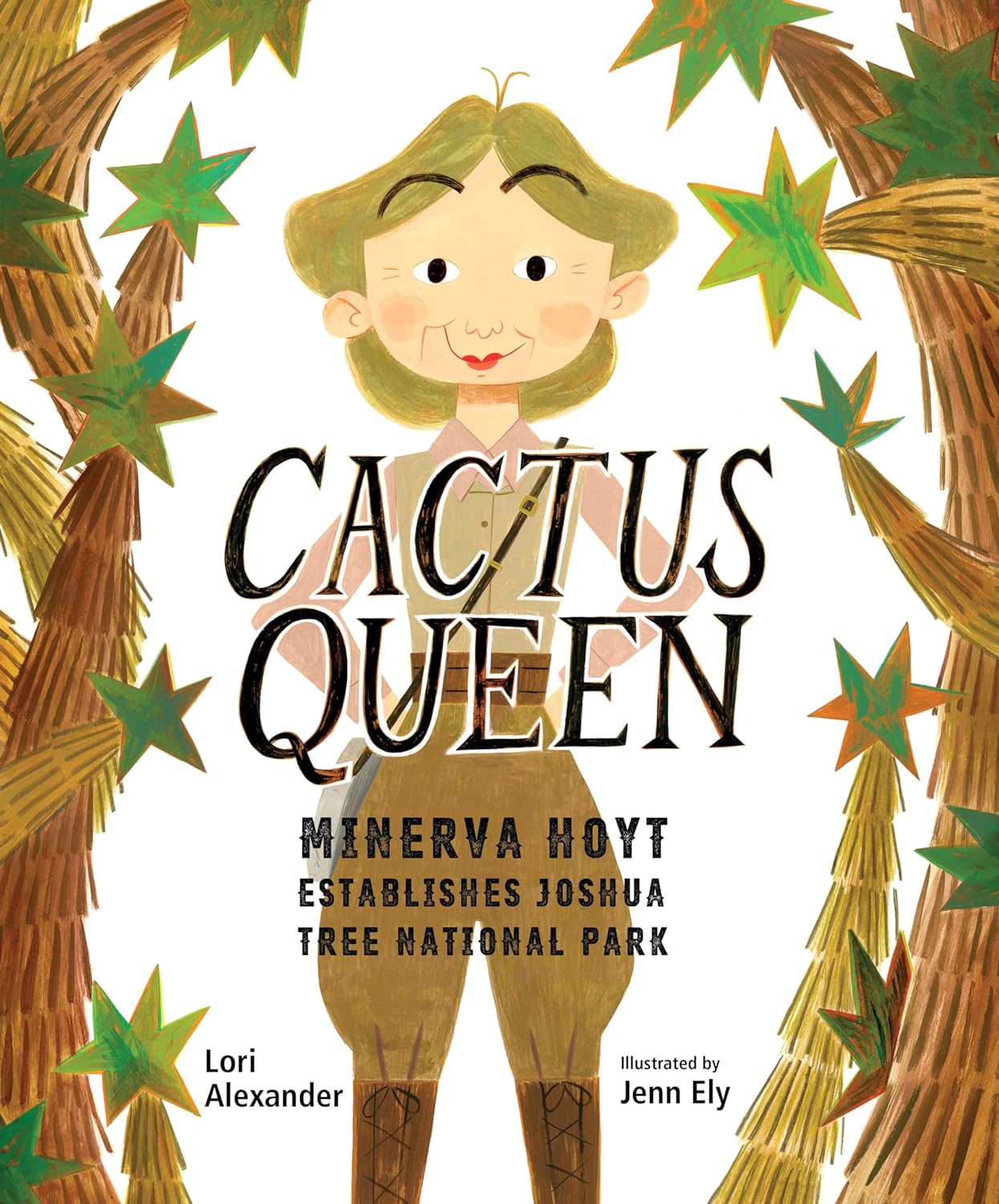
celebrate-picture-books-picture-book-review-cactus-queen-cover

About the Holiday

National Women’s History Month is all about celebrating women who broke barriers with their intelligence, creativity, courage, persistence, and unwavering confidence in their abilities. In every discipline, women have brought and continue to bring new perspectives, experiences, and talents to make contributions toward a better world. The theme for Women’s History Month 2024 celebrates “’Women Who Advocate for Equity, Diversity and Inclusion.’ This theme recognizes women who understand the need to eliminate bias and discrimination from individuals’ lives and institutions.”

Today’s book celebrates a visionary woman who made it her life’s work to protect a unique ecosystem, educate people on the importance of the environment and conservation, and provide the US with one of its most stunning national parks. 

I’d like to thank Calkins Creek/Astra Books for sharing a copy of Cactus Queen” Minerva Hoyt Establishes Joshua Tree National Park with me for review consideration. All opinions on the book are mt own.

Cactus Queen: Minerva Hoyt Establishes Joshua Tree National Park

Written by Lori Alexander | Illustrated by Jenn Ely


Even as a child, Minerva loved the outdoors, was eager to share her thoughts and opinions, and enjoyed “long chats with friends.” When she grew up she married Dr. Albert Hoyt. In 1897 Minerva and her husband moved from Mississippi to Pasadena, California, close to Los Angeles. To meet new friends, Minerva hosted a backyard party, complete with games, food, and, of course, long chats.

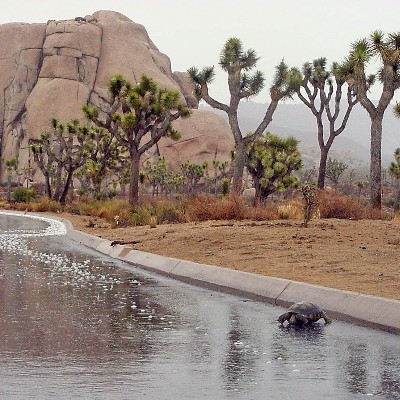
Settled into her new city, Minerva took to making trips to the Mojave Desert. She was awed by the Joshua trees, which grew nowhere else but here. After the death of her husband in 1918, Minerva spent more time in the desert, even camping out while “the wind whistled through the Joshua trees,” and “bright constellations swirled overhead.”

celebrate-picture-books-picture-book-review-cactus-queen-garden-party

Illustration copyright Jenn Ely, 2024, text copyright Lori Alexander, 2024. Courtesy of Calkins Creek, Astra Books for Young Readers.

As Los Angeles grew and grew, with more buildings, more cars, and more noise, people began to visit the desert frequently. They didn’t just visit, though, they wanted to take it home. People dug up the “… fuzzy cholla, spiky yucca, and barrel cacti to keep in their backyards.” They even dug up Joshua trees and carted them away. Many of these desert plants didn’t survive their new city surroundings. The Joshua trees were also cut down for construction materials, and motorists lost in the desert set them afire to communicate with other drivers.

By the late 1920s little remained of Minerva’s beloved desert. She wanted to save it . . . but how? Suddenly, “Minerva had a wild idea.” She would show the rest of the country just how special the desert was. With help from garden clubs, artists, taxidermists, and friends, she gathered samples of desert flora and fauna and took them east—by train.

celebrate-picture-books-picture-book-review-cactus-queen-camping

Illustration copyright Jenn Ely, 2024, text copyright Lori Alexander, 2024. Courtesy of Calkins Creek, Astra Books for Young Readers.

At the 1928 International Flower Show in New York City, Minerva erected a display of the desert. Crowds were thrilled to discover this “strange landscape,” and reporters took pictures for magazines and newspapers. Minerva won a gold medal for her exhibit, The Spirit of the Desert. Minerva also won awards in Boston and London for exhibits there. But more important than these accolades was that people were really listening to her and beginning to love the desert. When she donated her exhibits to museums, more people became interested in the desert.

By 1933, Minerva was ready to move on to the next stage in her plan. She wanted 1,000,000 acres of the desert to be declared a national park, protected by federal laws. Minerva garnered an audience with President Franklin D. Roosevelt and brought photographs to show him. She convinced the President—now it was up to Roger W. Toll, superintendent of Yellowstone National Park, to inspect Minerva’s desert and agree.

celebrate-picture-books-picture-book-review-cactus-queen-museum-exhibit

Illustration copyright Jenn Ely, 2024. Courtesy of Calkins Creek, Astra Books for Young Readers.

As Roger Toll stood in the middle of the desert on a rainswept day, he asked, “where are the lush trees, the waterfalls, and lakes?” When he later filed his report, he rejected the desert for National Park status. Minerva was disappointed but did not give up. She began a letter-writing campaign, convincing “scientists, teachers, politicians, and friends” to write to the National Park Service. Letters poured in—enough to convince the Service to send out a new inspector.

This time Assistant Director Harold C. Bryant, who lived in California, was sent. “He knew all about desert plants and animals.” When he arrived, Minerva and more than one hundred supporters greeted him. After touring the desert for three days, Bryant announced his decision: Yes! “Minerva’s desert was worth saving.”

celebrate-picture-books-picture-book-review-cactus-queen-park

Illustration copyright Jenn Ely, 2024, text copyright Lori Alexander, 2024. Courtesy of Calkins Creek, Astra Books for Young Readers.

Extensive backmatter, accompanied by photographs, offers more biographical information about Minerva, points about wildlife in Joshua Tree National Park, facts about other national parks in the United States, tips for how young people can help the environment through easy-to-implement actions, and a bibliography. In Lori Alexander’s Author’s Note, she relates the dangers and destruction that the fragile environment of Joshua Tree National Park and the surrounding desert continues to suffer from “vandalism, urban development, and the effects of climate change,” a report that demonstrates the need for continued education and care taking of our natural resources.

In Cactus Queen, Lori Alexander has created a compelling biography of a remarkable woman as well as a call to action for readers to stand up for the environmental or other causes that are important to them. Alexander highlights Minerva Hoyt’s love of the desert, her dedication, and her unflagging determination to overcome setbacks. Hoyt’s creativity, pragmatism, and lifelong focus serves as an inspirational roadmap for accomplishing goals for children, teens, and even the adults who read with them.

The first thing readers may notice upon opening Cactus Queen is Jenn Ely’s beautiful color palette that mirrors the unique hues of the desert. Her stunning images of the desert and Minerva’s ingenious ways of rallying the country and the President to her cause transport children from Hoyt’s earliest days through her long-fought success. Ely’s charming illustrations reveal not only the special plants and creatures of the Mojave Desert but Minerva’s distress at its destruction and her tenacity to enact change to protect it. 

Both a fascinating biography of Minerva Hoyt and an in-depth look at the multifaceted workings of conservation efforts, Cactus Queen: Minerva Hoyt Establishes Joshua Tree National Park will inspire readers to advocate for causes that are important to them. For educators the book would make an excellent addition to science and language arts curriculum. Cactus Queen would also be an engaging accompaniment to museum visits or field trips for families and teachers.

Cactus Queen is a top pick for classrooms, public and school libraries, museum shops, and families.

Ages 7 – 10

Calkins Creek, 2024 | ISBN 978-1662680212

About the Author

Lori Alexander is the award-winning author of several children’s books, including All in a Drop: How Antony van Leeuwenhoek Discovered an Invisible World, which won a Robert F. Sibert Honor, and A Sporting Chance: How Ludwig Guttmann Created the Paralympic Games, an NCSS Notable Book. Her work has received several starred reviews from KirkusSchool Library Journal, and Horn Book Magazine, has made the NSTA Outstanding Science Trade Book list, and has been selected by the Junior Library Guild. Visit Lori Alexander at lorialexanderbooks.com.

About the Illustrator

Jenn Ely is an artist and animator, who has worked on the movies The Boxtrolls and Guillermo Del Toro’s Pinocchio. In her recent foray into children’s books, she illustrated The Gardener of Alcatraz and If You Were a Kid Building a Pyramid. Visit Jenn Ely at jennely.com.

Women’s History Month Activity

celebrate-picture-books-picture-book-review-joshua-tree-national-park-wildlife

Become a Joshua Tree National Park Junior Ranger

How would you like to become a Joshua Tree National Park Junior Ranger? You can your badge with this online program full of fun and educational activities for all ages! You can learn how to draw a Joshua Tree, create your own constellation, learn all about desert tortoises, create your own rock formation, learn about adaptable plants and design your own, and more.

To earn your badge kids ages 5 – 7 are asked to complete 2 activities; kids ages 8 – 10 are asked to complete 3 activities; and kids ages 10 and above are asked to complete 4 or more. After finishing projects, you just need to send images of your work to receive your badge in the mail!

Simply visit the official Joshua Tree National Park website and learn more about their Junior Ranger program! Learn more about the park and view lots of pictures and videos here.

Joshua Tree National Park Coloring Page

celebrate-picture-books-picure-book-review-joshua-tree-national-park-coloring-page

Enjoy this activity page by filling it with all the colors of the desert.

Joshua Tree National Park Coloring Page

celebrate-picture-books-picture-book-review-cactus-queen-cover

Order from Bookshop to support your local independent bookstore.

You can also find Cactus Queen: Minerva Hoyt Establishes Joshua Tree National Park at these booksellers

Amazon | Barnes & Noble | Books-a-Million

Picture Book Review
February 1 – World Read Aloud Day

celebrate-picture-books-picture-book-review-love-is-loud-cover

About the Holiday

Now in its 14th year World Read Aloud Day, founded by global non-profit LitWorld, encourages adults to read aloud to children not only today but every day. Reading aloud to children from birth is one of the best ways to promote language development, improve literacy, and enjoy bonding time together. Millions of people celebrate today’s holiday all across the United States and in more than one hundred countries around the world. Special events are held in schools, libraries, bookstores, homes, and communities, and authors and illustrators hold readings and visit classrooms in person and virtually. To learn more about World Read Aloud Day, visit LitWorld and check out their Activity Hub to find live events, virtual read alouds, downloadable bookmarks, posters, games, and more!

I would like to thank Simon & Schuster and Barbara Fisch at Blue Slip Media for sharing a copy of Love Is Loud with me for review consideration. All opinions on the book are my own.

Love Is Loud: How Diane Nash Led the Civil Rights Movement

Written by Sandra Neil Wallace | Illustrated by Bryan Collier


Raised on Chicago’s South Side, Diane Nash is sheltered by her parents from the segregation of the South that they had grown up in. During the Second World War, Diane is taken care of by her grandmother while her father joins the army and her mother takes a job. Her Grandmother Bolton is from Tennessee and showers her with love. “You are ‘more precious than all the diamonds in the world,'” she told Diane, and growing “up in the rhythm and glow of her love” Diane knew “it must be true.”

celebrate-picture-books-picture-book-review-love-is-loud-baby

Image copyright Bryan Collier, 2023, text copyright Sandra Neil Wallace, 2023. Courtesy of Simon & Schuster/Paula Wiseman Books.

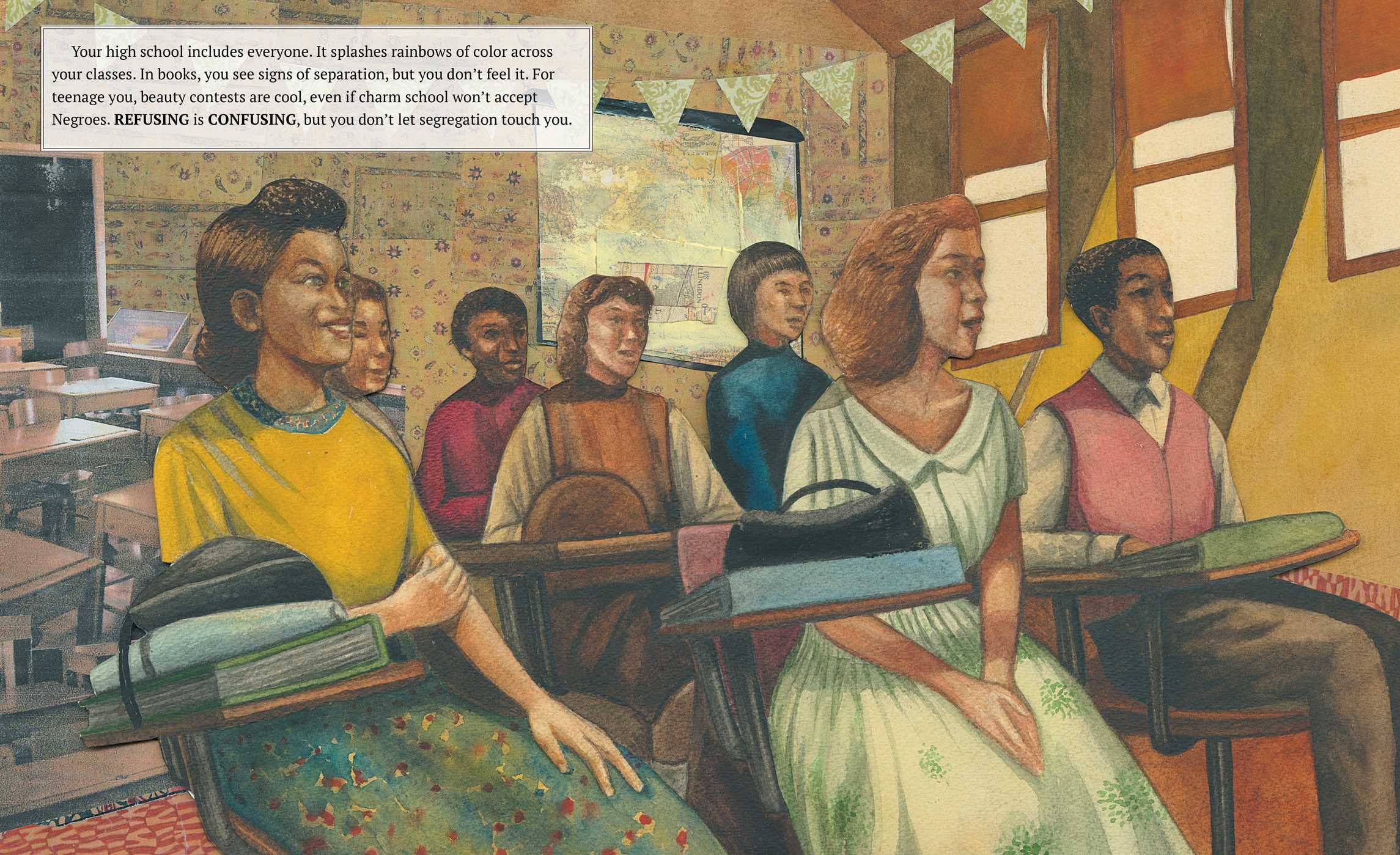
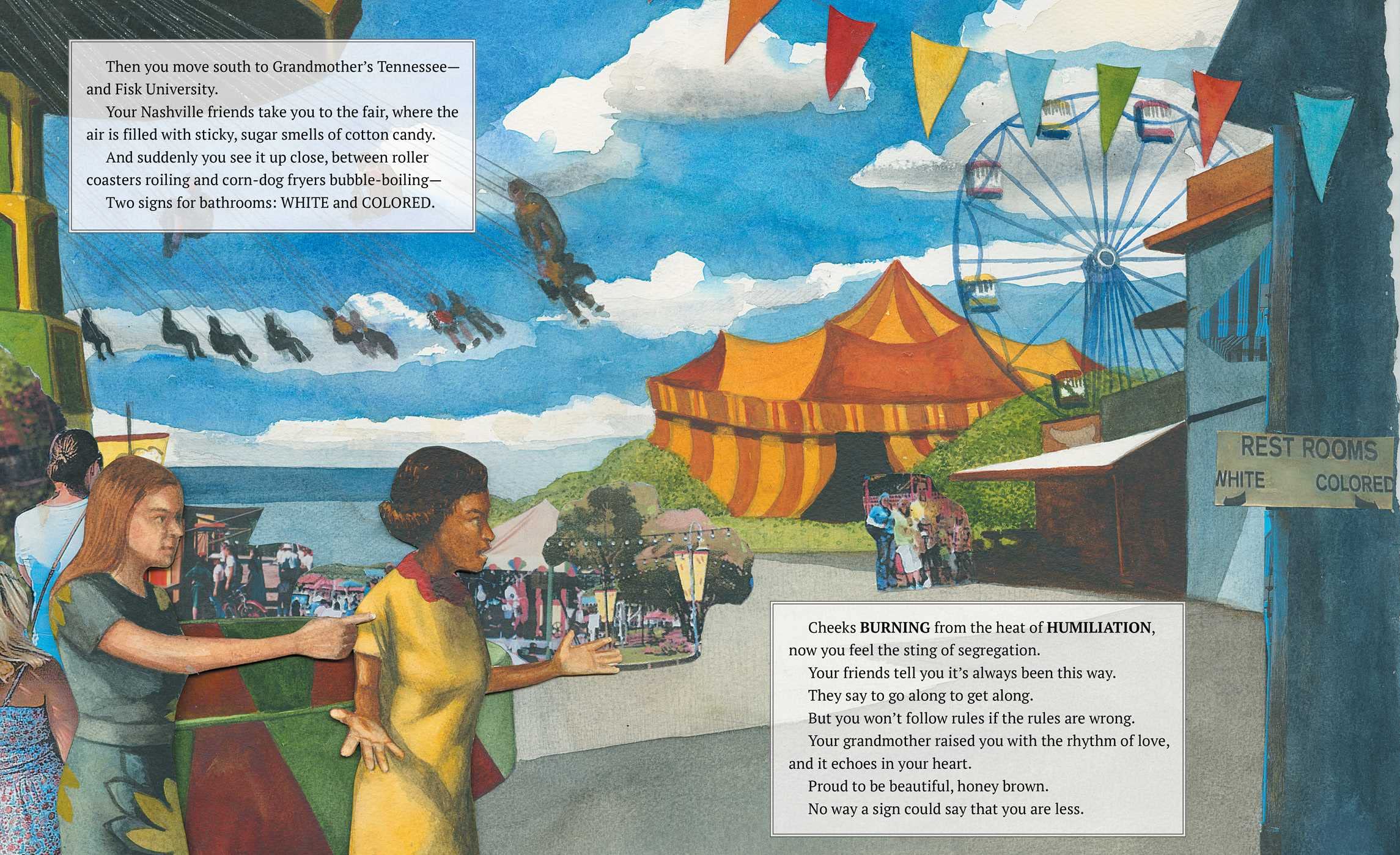
In high school kids of all colors learn together. Diane reads about segregation in textbooks, but it didn’t really touch her. Then she moves to Tennessee to attend Fisk University. Here, when her friends take her to a fair, Diane is confronted with the “sting of segregation” when she sees there are two restrooms: one labeled WHITE and the other COLORED. Her friends have grown up in this system; they tell her “to go along to get along,” but Diane “won’t follow rules if the rules are wrong.” The rhythms of her grandmother’s love and her pride in being “beautiful, honey brown” will not allow her to feel less than others.

In Nashville, Diane experiences the full indignation of segregation that demands separate water fountains and schools, back-of-the-bus seating, and—the worst for Diane—no eating at the lunch counter. She doesn’t want to be arrested for eating at a lunch counter, but neither does she want to let it go. Before each day of college classes, Diane and other students “pray and learn about change in a peaceful way.” They practice calmly sitting and ordering at a lunch counter, knowing that people may be rude, may push them off their stool, may throw sugar in their hair.

celebrate-picture-books-picture-book-review-love-is-loud-school

Image copyright Bryan Collier, 2023, text copyright Sandra Neil Wallace, 2023. Courtesy of Simon & Schuster/Paula Wiseman Books.

In February of 1960, Diane, now at twenty-one years old, leads a group of students to a lunch counter in Nashville. Their presence shocks the cooks and waitress, who drops plate after plate from her shaking hands. “Inside [Diane shakes] too. Hands sweating, never forgetting the danger, the fear of being arrested for ordering a sandwich.” Bravely, despite coffee burns and thrown sugar, Diane and the students hold sit ins at lunch counters across the city. And when Diane is arrested, there are hundreds of others to fill her seat.

After a bombing in April Diane, “quietly walking, without any talking… silently leads six-thousand marching feet to the beat of love” to meet the mayor, who at first says there is nothing he can do. Looking him in the eye, Diane asks him questions he cannot deny, and he admits that prejudice and segregation are wrong—even at the lunch counter. “At that moment, love scores. It soars as six thousand loving hands roar with applause.” And in May—Diane has just turned twenty-two—Nashville’s lunch counters are fully integrated. Martin Luther King Jr. congratulates her on her peaceful victory as she moves on to change the rules of bus travel with Freedom Rides, to uphold the “law of the land [that] says everyone is free to sit or stand together in a bus traveling across America.”

celebrate-picture-books-picture-book-review-love-is-loud-fair

Image copyright Bryan Collier, 2023, text copyright Sandra Neil Wallace, 2023. Courtesy of Simon & Schuster/Paula Wiseman Books.

While the movement makes progress, even attracting the attention of the president, a Mississippi judge charges Diane “with putting Freedom Riders on a bus.” Before her trial, Diane, pregnant with her first child, writes a letter heard around the world that said “‘I believe that if I go to jail now, … it may help hasten that day when my child and all children will be free.'” Her case rivets the world as she chooses to go to jail instead of paying bail. 

After she is released, Diane turns her attention to the issue of voting rights and the state of Alabama, where four young girls are killed in a bombing in a Birmingham church and “where Black people are denied the right to vote.” Following Diane’s example, thousands of adults and children choose jail over bail in protest of the injustice until the Civil Rights Act is signed by President Johnson in 1964 and a year after that when he “signs the 1965 Voting Rights Act to legally end racial discrimination that prevented Black people from voting.” But Diane Nash doesn’t stop there. She takes her message of peace and peaceful change across the country for fifty years, teaching young people “how love creates change.”

Image copyright Bryan Collier, 2023, text copyright Sandra Neil Wallace, 2023. Courtesy of Simon & Schuster/Paula Wiseman Books.

Image copyright Bryan Collier, 2023, text copyright Sandra Neil Wallace, 2023. Courtesy of Simon & Schuster/Paula Wiseman Books.

Extensive back matter includes an Author’s Note and an Illustrator’s Note about the work of Diane Nash; a detailed timeline from her birth to 2022, when she was awarded the Presidential Medal of Freedom; a list of video interviews with Diane Nash, four other books for young readers; sources for quotes found in the story; and a selected bibliography. A photograph of Nash and three other students integrating a lunch counter in Nashville and another of Nash leading demonstrators to meet the mayor of Nashville are also included.

celebrate-picture-books-picture-book-review-love-is-loud-love

Image copyright Bryan Collier, 2023, text copyright Sandra Neil Wallace, 2023. Courtesy of Simon & Schuster/Paula Wiseman Books.

Compelling and moving, Sandra Neil Wallace’s lyrical storytelling about the life and work of Diane Nash rivets readers to this young woman’s courage, confidence, and conviction to overturn the injustice of segregation and inequality for Blacks. Punctuated with often-rhyming phrases, and sharp, short sentences Wallace’s text flows with a rhythm of urgency that perfectly conveys not only Nash’s resolve, but the stakes for the peaceful demonstrators and the atmosphere of the times.

Written in the third person, the story directly addresses Nash, but the repeated “you” also builds a chorus that reverberates in each reader’s heart, telling them that they are brave, that they are strong, and that they too can change the world with love. This format poignantly culminates on the last page. Here, Wallace changes the dynamic with a subtle turn of phrase that now directly embraces each reader, letting them know that Diane Nash worked for freedom “because she loved you even before you were born” and reminding them that “Love is fierce. Love is strong. Love is loud!”

Bryan Collier’s rich watercolor-and-collage illustrations draw readers in with their realistic depictions of Diane Nash as a baby and young girl cherished by her family, as a high school and university student, at the fair that changed the trajectory of her life,  leading peaceful demonstrations at lunch counters and across the South, and crossing the country to bring her message to young people. Nash’s self-assurance, courage, and determination are evocatively expressed, and a full-page portrait of Diane looking out at the reader mirrors Wallace’s invitation for them to look into her eyes and see her love there.

Scraps of photographs are sprinkled here and there among the pages, providing a spark of recognition of the time and places depicted. But it is the cut paper elements that make certain images of people and objects jump off the page, working powerfully with Wallace’s text to make readers feel that they too are at the fair, at the lunch counter, joining the throng of marchers. Each page is a masterpiece of history and story that invites study, thoughtful contemplation, and action.

Absorbing, eloquent, and impactful, Love Is Loud: How Diane Nash Led the Civil Rights Movement is biography at its best: a moving tribute Diane Nash set amid a far-reaching immersion in the time period. Love Is Loud belongs in every home, classroom, school, and public library collection to teach children about the contributions of Diane Nash as well as to remind them that vigilance and the work for freedom is an ever-ongoing pursuit.

Ages 4 – 8 

Simon & Schuster | Paula Wiseman Books, 2022 | ISBN 978-1534451032

About the Author

Sandra Neil Wallace writes about people who break barriers and change the world. She is the author of several award-winning books for children, including Between the Lines: How Ernie Barnes Went from the Football Field to the Art Gallery, illustrated by Bryan Collier, which received the Orbis Pictus Book Award and was an ALA Notable Book. A former ESPN reporter and the first woman to host an NHL broadcast, she is the recipient of the Outstanding Women of New Hampshire Award and creates change as cofounder of The Daily Good, a nonprofit bringing twenty thousand free, culturally diverse foods to college students each year through its Global Foods Pantries. Visit Sandra at SandraNeilWallace.com.

About the Illustrator

Bryan Collier is a beloved illustrator known for his unique style combining watercolor and detailed collage. He is a four-time Caldecott Honor recipient for Trombone ShortyDave the PotterMartin’s Big Words, and Rosa. His books have won many other awards as well, including six Coretta Scott King Illustrator Awards. His recent books include By and By, ThurgoodThe Five O’Clock Band, and Between the Lines. He lives in New York with his family. Visit him at BryanCollier.com.

Watch the Book Trailer for Love Is Loud!

World Read Aloud Day Activities 

2022 Presidential Medal of Freedom Ceremony


Watch as Diane Nash is awarded the Presidential Medal of Freedom in this White House video from July 7, 2022. You can find President Joe Biden’s remarks about Diane Nash at the 5:50 mark, and see her receive her medal at the 41:29 mark.

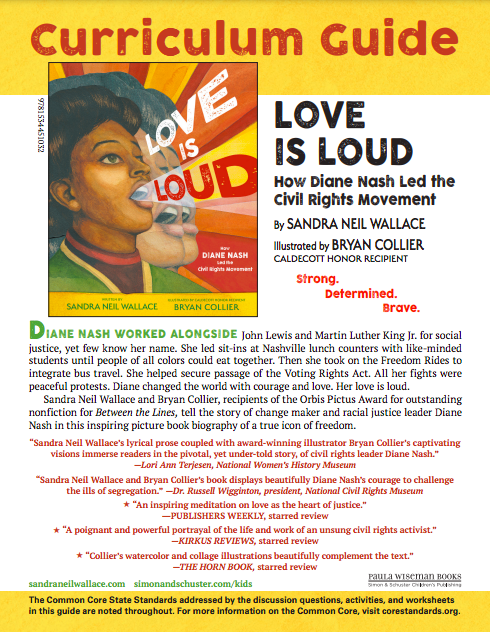
celebrate-picture-books-picture-book-review-love-is-loud-curriculum-guide-cover

Love Is Loud Curriculum Guide


Teachers, educators, and homeschoolers can download an in-depth, 6-page Curriculum Guide for Love Is Loud full of a variety of ways for students to connect with the book and history from Sandra Neil Wallace’s website here.

celebrate-picture-books-picture-book-review-love-is-loud-cover

You can find Love Is Loud: How Diane Nash Led the Civil Rights Movement at these booksellers

Amazon | Barnes & Noble | Books-a-Million

To support your local independent bookstore, order from

Bookshop | IndieBound

Picture Book Review

May 18 – International Museum Day

celebrate-picture-books-picture-book-review-the-ultimate-art-museum-cover

About the Holiday

International Museum day was created in 1977 by the International Council of Museums to raise awareness that “museums are an important means of cultural exchange, enrichment of cultures and development of mutual understanding, cooperation and peace among peoples.” The theme for this year is “The Power of Museums.” Museums are not just repositories of the past. They are vital and active members of the communities they serve and as such can be leaders in tackling some of society’s biggest issues. This year the International Council of Museums aimsto “explore the potential of museums to bring about positive change in their communities through three lenses: the power of achieving sustainability, the power of innovating digitalization and accessibility, and the power of community building through education. To learn more about these initiatives, visit the ICOM website. Celebrate International Museum Day by visiting a museum near you – or visit many world-famous museums through today’s book.

The Ultimate Art Museum

By Ferren Gipson

A blurb on the cover of this astounding book sums up the lofty goals it achieves: “40,000 years of the world’s most amazing art in one dream museum!” Indeed, once readers open the cover and accept the “ticket” offered, they can peruse the museum map that lays out the three wings, 18 galleries, and 128 rooms, plus a cafe and garden, that await them. An note from author Ferren Gipson introduces readers to the range of ways art can influence and reflect their times and the people who lived during different eras.

Gipson’s conversational style follows visitors to this unique museum from page to page, prompting them to look, consider, understand, and make connections. On some pages, a question or comment marked by an eye sends readers to another gallery or room to compare artworks, subjects, or themes across time and cultures. Some of these give a page number to consult, while others allow readers to study a room or gallery to find the artwork referred to.

celebrate-picture-books-picture-book-review-the-ultimate-art-museum-galleries

Copyright Ferren Gipson, 2021, courtesy of Phaidon.

Wing 1, appropriately, presents “treasures from the world’s earliest civilizations and the earliest art ever made.” Here, children and adults will find cave art; figurines carved from ivory, bone, and stone; treasures from ancient empires, carved reliefs, the painted, sculpted, and gilded wonders of ancient Egypt, Greece, and Rome. The intricate art of the Byzantine, early Islamic, and Medieval worlds demonstrate important aspects of these cultures as do works from ancient East Asia well as South and Southeast Asia. Readers then cross the Atlantic Ocean to discover the pottery, sculptures, and fabrics created by Native societies of North and South America. Each artwork is accompanied by a paragraph that will draw children in with clear, concise, and fascinating descriptions of the artwork, what it means, and, sometimes, even secrets that it holds.

Time for a break? Turn the page and enter the Café, where the “menu,” consisting of “Snacks, Mains, and Dessert” offers delectable choices depicted in paintings and sculpture. Refreshed, readers can step into Wing 2, where the galleries hold treasures from the 1200s to the 1800s created in Asia, including book illustrations, a palepai cloth, a puppet, scholar paintings, porceline, folding screens, carpets, and even the Taj Mahal.

The Renaissance comes to Europe with an impressive display of curiosity and learning that resulted in many changes to society and art. “Artists came up with better ways to mix oil paints and began to paint on canvas for the first time. And what scientists learned about the human body helped them paint and sculpt people who looked very real.” The subjects of artworks expanded too to include “portraits, mythology, and everyday life.” Dragon lovers can take up the challenge to compare two dragons – one created by an Italian master and the other found on a Chinese vase from the Yuan Dynasty.

celebrate-picture-books-picture-book-review-the-ultimate-art-museum-miniatures

Copyright Ferren Gipson, 2021, courtesy of Phaidon.

From 1600 – 1850, dramatic and lifelike paintings became popular. Dark shadows and highlighted areas gave paintings an atmospheric feel that invited viewers to look closely. In one of Diego Velázquez’s famous Las Meninas painting, all of the people portrayed seem to be looking out from the canvas at you. But who are they really looking at? The answer can be found reflected in a mirror on the back wall. In addition to realistic family and town life, landscapes also became popular during this time.

Moving to another room, readers will find that the art of the Pacific Islands is distinctively different in its depictions of “images of gods, spirits, and ancestors of the people who lived there.” Those works created from stone and wood have survived through the ages while “others, such as objects made from delicate spider webs or flowers, have disappeared.” Art from the continent of Africa is up next. With its many unique kingdoms and communities, Africa has produced unique artworks that “celebrate leaders and tell the stories of Africa’s great empires and civilizations.” Clay, wood, metal, ivory, and cloth have been used to “create art with spiritual and practical purposes.”

Ah! Time for a walk through the garden. Which path will you take? The one past Georgia O’Keefe’s “Red Poppy” or one where you can see a moth and a caterpillar on the branch of a citrus tree? Perhaps you’d like to stroll through a hurricane with a tiger on your trail with Henri Rousseau’s “Tiger in a Tropical Storm (Surprised)” or maybe you’d like a fragrant walk through Gustav Klimt’s “Flower Garden.”

 
celebrate-picture-books-picture-book-review-the-ultimate-art-museum-neo-classical

Copyright Ferren Gipson, 2021, courtesy of Phaidon.

Wing 3 takes readers to modern times, when “almost anything is possible in art!” In this wing, visitors will see “art that does not have a set purpose.” Instead, the artists represented here “created works that were experimental and personal. They used unusual materials and tried exciting techniques.” In these rooms, readers will encounter the Impressionists, who were interested in capturing a moment in time,  and Post-Impressionists, who experimented with color, techniques, and subject matter. Readers will no doubt recognize paintings by Mary Cassatt, Vincent Van Gogh, and Georges Seurat.

American realist painters took city scenes, sports events, tender moments between family members, and many other topics. The Cubist period began when some artists experimented in showing their subject from a variety of angles at one time. Paul Cézanne, Pablo Picasso, and Georges Braque are just a few of the famous artists who “chopped up and rearranged images” to make a new style of art.

celebrate-picture-books-picture-book-review-the-ultimate-art-museum-map

Copyright Ferren Gipson, 2021, courtesy of Phaidon.

Visitors will also learn about the Dada movement, Expressionism, and American Regionalism. Photography took center stage as cameras became lighter and easier to use. The art of the Harlem Renaissance by Black Americans is reflected in a painting of Harriet Tubman by William H. Johnson, a bronze bust of a boy by Augusta Savage, and a quilt by Harriet Powers – one of only two that still exist.

After visiting a room of modern works from India and Mexico, readers enter the dizzying world of the Surrealists. Surrealism “shows real objects but in a completely fantastical way. It explores how dreams, imaginations, and the inner workings of the mind can be shown in art.” A train emerging from the “tunnel” of a fireplace, a fur teacup, saucer, and spoon, and Salvador Dali’s “drooping” clocks are a few of the works you’ll find here.

celebrate-picture-books-picture-book-review-the-ultimate-art-museum-cubism

Copyright Ferren Gipson, 2021, courtesy of Phaidon.

In Wing 3, readers will also learn about Collages, Abstract Expressionism, Minimalism, Conceptual art, and Op art that boggle the eyes and mind with their optical illusions. Pop art, Installations, contemporary sculptures large and small as well as Alexander Calder’s mobiles and artwork created from light stand side-by-side with Christo and Jeanne-Claude’s outdoor wrapping installations, Aboriginal Australian art, Feminist art, Chicanx art, performance art, video art, contemporary art, and so much more. If you’re a fan of selfies, you’ll want to stop at the Hall of Selfies and see how four artists anticipated and/or reflect this very modern art form.

Helpful maps accompany each wing and gallery change to show readers where the art in that gallery comes from or its influence. A smaller map inset often orients readers to where the region represented is situated in the world at large.

Back matter includes an Author’s Note, a map of 54 major museums around the world, a glossary of terms found in the text, and an index.

celebrate-picture-books-picture-book-review-the-ultimate-art-museum-selfies

Copyright Ferren Gipson, 2021, courtesy of Phaidon.

Ferren Gipson is the “cool” docent every visitor wants as their tour leader on a trip to a museum. Full of enthusiasm for art and its impact, gifted with a wealth of knowledge, and quick with a fun fact, a humorous aside, or an intriguing nugget of perspective, Gipson will wow kids and adults alike with her love of all kinds of art. Open The Ultimate Art Museum to any page and readers will immediately be absorbed by whatever style of art or time in history they’ve hit upon and will eagerly wander from gallery to gallery, room to room, page to page to learn more.

The Ultimate Art Museum has applications for strong cross-curricular study for teachers and homeschoolers, expertly connecting history, art, changing societies, and more visually and textually. Gipson’s entertaining and thorough treatment of her topic will get kids excited about visiting museums of all kinds, and arm-chair travelers will wile away many happy hours wandering its pages. 

The Ultimate Art Museum is a must for classrooms and school and public libraries and would be a much-loved addition to home bookshelves or coffee tables.  

Ages 8 and up

Phaidon, 2021 | ISBN 978-1838663780

Discover more about Ferren Gipson, her books, work, and podcast “Art Matters” on her website.

International Museum Day Activity

CPB - Cookie Jar Museum (2)

Create a Museum Exhibit

Every item has a story. Maybe there’s a funny anecdote behind that knick-knack on your shelf. Perhaps your favorite serving dish holds sentimental value. How about your child’s best-loved toy or a drawing or craft they’ve made? A fun and educational way for kids to learn family stories and interact with their own history is to create a museum exhibit of objects in your home.

For teachers this can be a fun classroom activity that incorporates writing, art, and speaking as well as categorizing skills. Students can use objects in the classroom or bring items from home to set up museum exhibits. This activity can be done as a whole-class project or by smaller groups, who then present their exhibit to the rest of the class.

Supplies

  • A number of household or classroom items
  • Paper or index cards
  • Markers
  • A table, shelf, or other area for display

Directions

  1. To get started help children gather a number of items from around the house to be the subjects of their exhibit. An exhibit can have a theme, such as Grandma’s China or Travel Souvenirs, or it can contain random items of your child’s choice, such as toys, plants, tools, even the furniture they see and use every day.
  2. Using the paper or cards and markers, children can create labels for their exhibit items. Older children will be able to write the labels themselves; younger children may need adult help.
  3. Spend a little time relating the story behind each object: where it came from, how long you’ve had it, when and how it was used in the past, and include any funny or touching memories attached to the item. Or let your child’s imagination run free, and let them create histories for the objects.
  4. When the labels are finished, arrange the items on a table, shelf, or in a room, and let your child lead family members or classmates on a tour. You can even share the exhibit with family and friends on social media.
  5. If extended family members live in your area, this is a wonderful way for your child to interact with them and learn about their heritage.

celebrate-picture-books-picture-book-review-the-ultimate-art-museum-cover

You can find The Ultimate Art Museum at these booksellers

Amazon | Barnes & Noble | Books-a-Million

To support your local independent bookstore, order from

Bookshop | IndieBound

Picture Book Review