June 21 – National Seashell Day

celebrate-picture-books-picture-book-review-sora's-seashells-cover

About the Holiday

Seashells are natural wonders! Curved and fluted, bleached and delicately hued, shells provide homes, create pearls, house culinary delicacies, inspire crafts—and if you hold a conch shell to your ear, you can hear the ocean’s song.  National Seashell Day was established in 2016 by the beaches of Fort Myers and Sanibel in southwest Florida to commemorate the amazing presence of seashells in the area. But you don’t have to live in Florida to find or appreciate beautiful shells or celebrate the holiday. If you live near a beach, take a trip to walk along the shore and find some treasures. And anyone can become a armchair beachcomber by checking out some books or websites about seashells. Today’s book reveals just what a gift seashells—and children—are.

Thanks to Candlewick and Barbara Fisch at Blue Slip Media for sharing Sora’s Seashells with me for review consideration. All opinions on the book are my own.

Sora’s Seashells: A Name is a Gift to be Treasured

Written by Helena Ku Rhee | Illustrated by Stella Lim and Ji-Hyuk Kim


Every summer, Sora’s grandmother came to visit. The first thing Sora and Halmoni did together was go to the beach to look for seashells. They found all types and sizes of shells, but “Halmoni chose the prettiest shell and tucked it into her pocket.” Then as they left the beach, Halmoni left the shell on a bench. When Sora asked why they couldn’t take it home, Halmoni told her, “‘It’s a gift for anyone who sees its beauty.'” Sora wanted to take the shell, but she got on the bus without it.

When they went to the beach the next day, Sora was sad to see that “their” shell was gone. But Halmoni reminded Sora that it didn’t belong to them, that it was a gift. As she and Halmoni combed the beach for shells, Sora hid pretty shells in her pocket, and when she got home she put them in a jar. By the time Halmoni’s visit was over, Sora’s jar was full.

celebrate-picture-books-picture-book-review-sora's-seashells-Halmom

Image copyright Stella Lim with Ji-Hyuk Kim, 2023; text copyright Helena Ku Rhee, 2023. Courtesy of Candlewick.

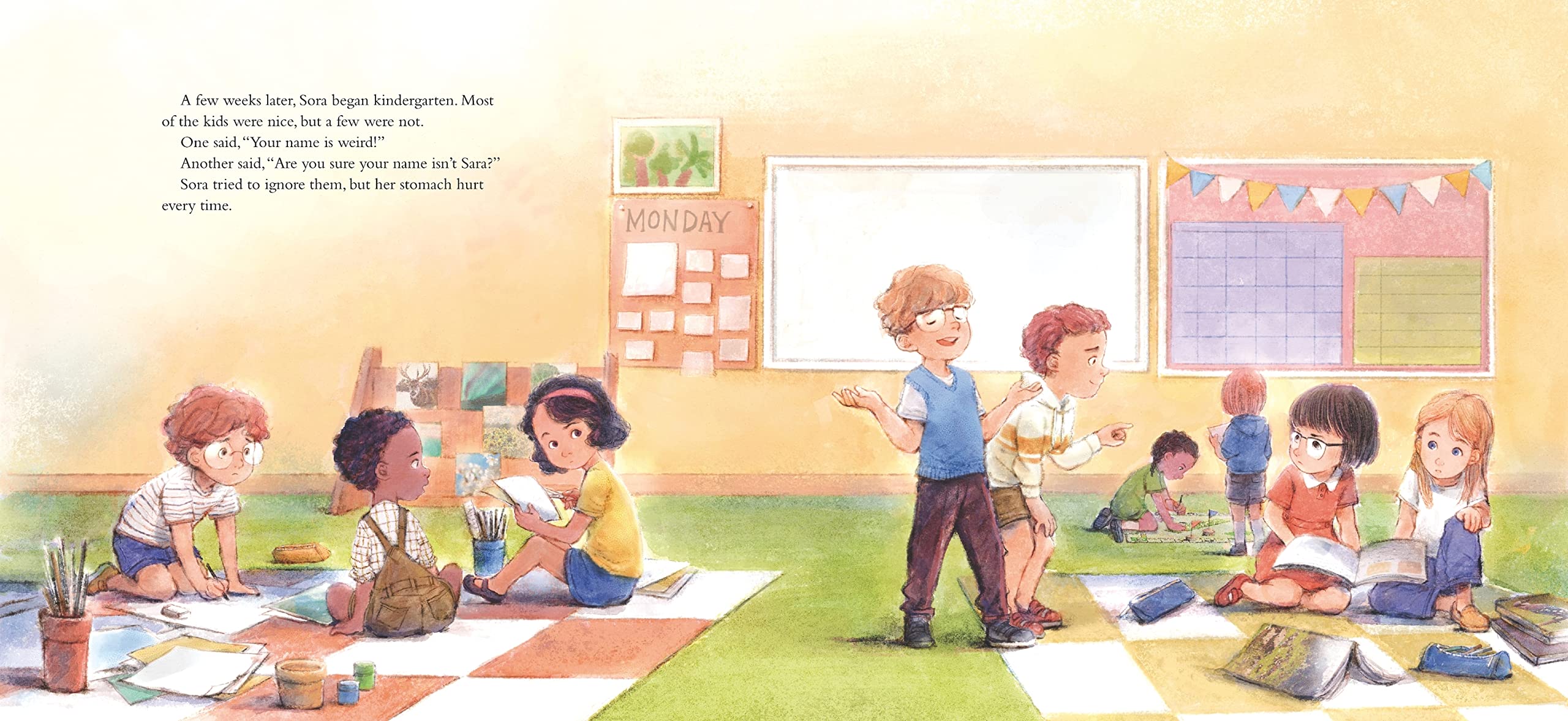
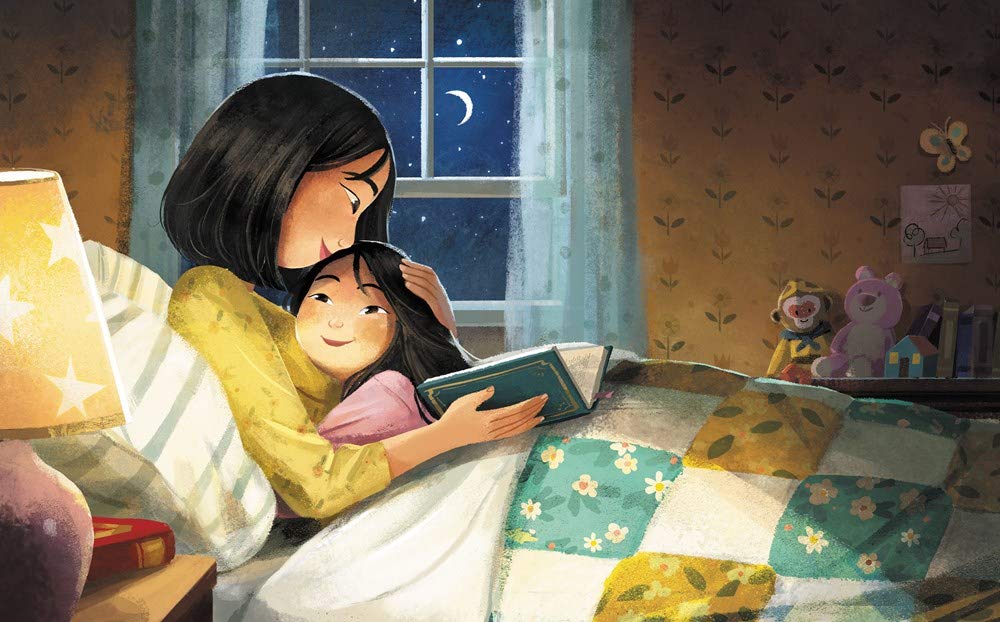
At the end of summer, Sora began kindergarten. While most of the kids were nice, a few made fun of her name. They called it “weird” and asked if it wasn’t really “Sara.” Their taunting gave her a stomachache. Sora never told her parents, and the teasing continued. Then one day the family got news that Halmoni had died. As Sora’s parents told her, she “thought of all the summers ahead without her grandmother” and how “she would say her name, with a soft s and a gently rolled r.” Suddenly all of Sora’s pent up emotions flowed out. Crying, Sora said, “‘I want to see Halmoni. And I hate my name. I want to be Sara!”

To take comfort Sora and her parents drove out to the beach. As they walked along the shore, Sora’s mother picked up a beautiful pink shell—just the type that Sora loved—and held it in her hands. She told her daughter that “‘Sora means “seashell” in Korean'” and repeated Halmoni’s belief that “‘finding a perfect shell is like receiving a wonderful gift.'” It was Halmoni who had suggested the name Sora. Then Sora’s parents hugged her and said, “‘You’re our greatest gift, Sora.'”
celebrate-picture-books-picture-book-review-sora's-seashells-kindergarten

Image copyright Stella Lim with Ji-Hyuk Kim, 2023; text copyright Helena Ku Rhee, 2023. Courtesy of Candlewick.

The next week for show-and-tell, Sora brought her jar of seashells and told the class the meaning of her name. She then handed a shell to her teacher and to her friends. Then she came to the kids who teased her. She gave each of them a shell too. One boy said her name made sense now; another told her Sora sounded like a superhero. Sora was surprised. She smiled and said, “‘Thanks.'” When she returned to her seat, she felt like she was soaring. 

After school, Sora went back to the beach with her parents. She had one shell left in her jar. She took it out and placed it on the bench—a “gift for anyone who could see its beauty.”

celebrate-picture-books-picture-book-review-sora's-seashells-bench

Image copyright Stella Lim with Ji-Hyuk Kim, 2023; text copyright Helena Ku Rhee, 2023. Courtesy of Candlewick.

Helena Ku Rhee’s heartwarming, multilayered story introduces readers to themes of family, kindness, loss, belonging, and the power of looking for beauty in the people and things around us as her gentle and straightforward storytelling wraps readers in the love Halmoni and Sora share. Sora’s journey throughout the story is profound, condensing what can be a lifetime of experiences and lessons into an impactful message on kindness and a simple truth that everyone and everything contains beauty waiting to be discovered. Ku Rhee also reminds children and adults alike that open communication is the key to understanding and appreciating others.

Stella Lim’s watercolor and digital illustrations, based on sketches by Ji-Hyuk Kim, set the tone of Sora and Halmoni’s tender relationship with soft colors, wide ocean vistas, and quiet scenes at home. In contrast, the school room’s yellow walls and lime green rug, scattered play areas and supplies, and teasing boys seems to mirror the turmoil in Sora’s mind and heart. After she presents her show-and-tell, however, the greens and yellows are more muted, the children calm. Likewise, elsewhere in the story, Lim employs shadowing and light and dark shades to represent Sora’s emotions. 

A standout story that will resonate with readers—children and adults—and provide many opportunities for discussion, Sora’s Seashells is highly recommended for home bookshelves and is a must for all classroom, school, and public library collections. 

Ages 4 – 8

Candlewick, 2023 | ISBN 978-1536209938

About the Author

Helena Ku Rhee grew up in Los Angeles and has lived in various parts of the United States, Asia, and Europe. She is the author of the picture books Rosa’s Song and The Paper Kingdom, both illustrated by Pascal Campion, and The Turtle Ship, illustrated by Colleen Kong-Savage. Helena Ku Rhee currently lives in Los Angeles.

About the Illustrators

Stella Lim studied fine art and graduated from Kingston University. She based her work for Sora’s Seashells on sketches from Ji-Hyuk Kim. Stella Lim lives with her family in Seoul, South Korea.

Ji-Hyuk Kim is the illustrator of the New York Times bestseller Through Your Eyes: My Child’s Gift to Me by Ainsley Earhardt as well as many book jackets and covers. Ji-Hyuk Kim lives in South Korea.

National Seashell Day Activities

Celebrate Picture Books Seashell Beach Combing Game

Gather Seashells Board Game


Beachcombers love to find different kinds of shells! You don’t need to take a trip to the shore to fill this game board beach with shells! Grab your friends, siblings, or the whole family and start collecting!

Supplies

Directions

  • Print Seashell Game Cards
  • Cut the shells from the cards so they will fit on the Beach Game Board
  • Assign a roll of the dice (2 through 8) to each shell, ex. Roll a 6 and pick up the sand dollar 
  • Choose someone to go first and take turns rolling the die to collect shells for your Beach Scene Game Board
  • The first person to fill their beach with shells is the winner

Celebrate Picture Books Seashell Matching Game Playing Cards

Seashell Matching Game


With this game you can match two, three, or even more shells to test your memory!

Directions

  • Print two or more Seashell Game Card sheets
  • Cut the cards apart
  • Place them face down on the table and shuffle
  • Turn one card over then choose another to try to find a match. If unsuccessful turn them both over and try again until you’ve found matches for all the shells


celebrate-picture-books-picture-book-review-sora's-seashells-cover

You can find Sora’s Seashells at these booksellers

Amazon | Barnes & Noble | Books-a-Million

To support your local independent bookstore, order from

Bookshop

Picture Book Review
October 21 – My Name Is Not Ed Tug Book Tour Stop

celebrate-picture-books-picture-book-review-my-name-is-not-ed-tug-cover

I’d like to thank The Children’s Book Review and Amy Nielander for sharing a digital copy of My Name Is Not Ed Tug with me. 

My Name Is Not Ed Tug

By Amy Nielander


Edimorwhitimormiligimmus Tug knew where he came from and just where he fit into his family. After all, “he was named after his Grandpa Edimor,” who helped him learn how to spell his name with a tall tower of blocks; “his Great Uncle Whitimor,” who taught him how to play the accordion; his Aunt Mili,” who ran a butterfly farm; “and his Granny Gimmus,” who filled his tummy with warm, homemade soup.” Anyone hearing his name might think it was gibberish, but Edimorwhitimormiligimmus thought “it was perfect.”

celebrate-picture-books-picture-book-review-my-name-is-not-ed-tug-edimor

Copyright Amy Nielander, 2022, courtesy of West Margin Press.

School, of course, was a challenge since the other kids had a hard time spelling or even remembering his name. And his teacher, Ms. Mell, found that her mouth grew “quite tired” just trying to pronounce it. But one Monday, Ms. Mell announced that a new student, Ty, would be joining their class. Mrs. Mell had made name tags for each student to make it easier for Ty to remember their names, and she slapped one on Edimorwhitimormiligimmus’s shirt. When he looked, Edimorwhitimormiligimmus saw that the tag simply read “Ed.” He gazed at the tag with sadness. “Edimorwhitimormiligimmus Tug was shocked. He was perplexed. He felt like his heart had been stung by a giant bee. Twice.”

celebrate-picture-books-picture-book-review-my-name-is-not-ed-tug-Granny-Gimmas

Copyright Amy Nielander, 2022, courtesy of West Margin Press.

After school, Edimorwhitimormiligimmus went straight to his room and stayed there, thinking. When he emerged, he had a plan (and a very perfectly sized name tag taped to his sweater). The next day, he approached Ty, who was playing with puzzle blocks. He stood proudly, displaying his sweater, and introduced himself—his whole self. He slowly said each part of his name and, miraculously, Ty repeated it. Edimorwhitimormiligimmus “was so happy his curls bounced.” Then as he and Ty constructed a tall bridge with the blocks, he explained how he and his Grandpa Edimor “love to build things together”—and had even invented those blocks.

celebrate-picture-books-picture-book-review-my-name-is-not-ed-ty

Copyright Amy Nielander, 2022, courtesy of West Margin Press.

At lunch he did the same thing with the kids at his table, and they also repeated his name. To explain how important his Uncle Whitimor was to him, Edimorwhitimormiligimmus, he played his uncle’s favorite song on the accordion. When the class went out for recess, he told more kids about his Aunt Mili and pointed out, and they too learned his name.

On Tuesday, Mrs. Mell was out sick, and Edimorwhitimormiligimmus saw an opportunity to be kind and explain about his name. He and Ty delivered a steaming pot of Granny Gimmus’s soup to her doorstep and told her all about cooking with his granny. “The delicious soup warmed her heart.” Edimorwhitimormiligimmus’s plan worked. Now everyone, including Ms. Mell, knew—and used—Edimorwhitimormiligimmus’s full name.

celebrate-picture-books-picture-book-review-my-name-is-not-ed-soup-for-ms-mell

Copyright Amy Nielander, 2022, courtesy of West Margin Press.

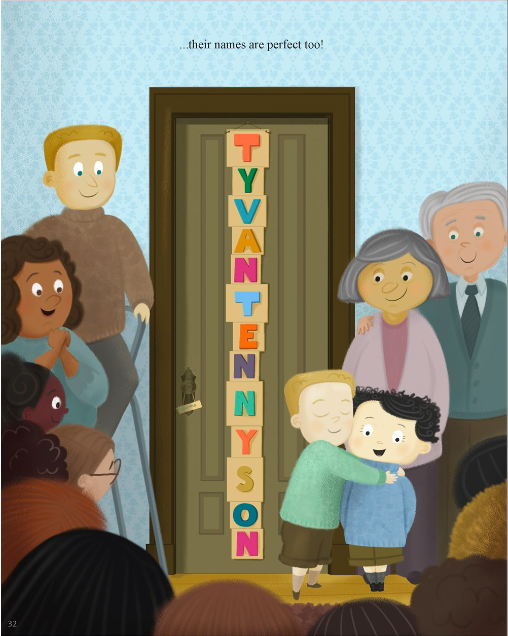
The experience prompted Edimorwhitimormiligimmus to come up with a new plan, a project to ensure all of his friends knew their names were just as perfect for them as Edimorwhitimormiligimmus was for him. And he and his classmates got started with the gift they made for Tyvantennyson to give him at his birthday party.

celebrate-picture-books-picture-book-review-my-name-is-not-ed-tyvantennyson-sign

Copyright Amy Nielander, 2022, courtesy of West Margin Press.

Amy Nielander’s heartwarming and affirming story will captivate kids from the first recitation of “Edimorwhitimormiligimmus Tug”—a name that initially elicits giggles but soon rolls smoothly off the tongue. As they learn how each piece of Edimorwhitimormiligimmus’s name reflects not only the family member he’s named for but also the special things they do together, readers will empathize with the pride he feels in his name and his disappointment when they can’t get it right.

While Nielander’s clever story revolves around one child’s name, there are many other important lessons for both kids and adults woven throughout. Children will understand that their names, personalities, heritage, talents, and dreams are perfect for them just the way they are. For adults, Ms. Mell’s dismissive mangling and shortening of Edimorwhitimormiligimmus’s name to “make it easier for all of us” reminds us that every child deserves to be really seen and accepted for who and everything they are.

Nielander’s illustrations are full of warmth and love, charm and humor as she introduces the unique talents of each member of Edimorwhitimormiligimmus’s inclusive and close-knit family. As Edimorwhitimormiligimmus puts his plan to teach each classmate and Ms. Mell his name into action, the children’s sweet faces and palpable excitement are infectious and will draw readers into this universal hug of a story. The surprise reveal of Ty’s full name and the collective gift the class makes him—with the promise of the same for each child—will delight readers and is sure to spur them to create name signs for themselves.

An engaging, multi-layered story about acceptance, self-esteem, family, and friendship, My Name is Not Ed Tug is a story kids will want to hear again and again. The book is highly recommended for home bookshelves and is a must for classroom, school, and public libraries.

Ages 4 – 8

West Margin Press, 2022 | ISBN 978-1513134871

Discover more about Amy Nielander, her books, and her art on her website.

Take a peek at the book trailer for My Name Is Not Ed Tug!


celebrate-picture-books-picture-book-review-my-name-is-not-ed-tug-cover

You can purchase My Name Is Not Ed Tug at these booksellers

Amazon | Barnes & Noble | Bookshop 

Picture Book Review
 

September 6 – It’s Friendship Month

celebrate-picture-books-picture-book-review-big-bear-and-little-fish-cover

About the Holiday

Friendship Month was established by the Oddfellows (shortened from The Grand United Order of Oddfellows Friendly Society (GUOOFS)), an international fraternity that dates back to 1730s England with the hope of encouraging people to make friends. Now dedicated to philanthropy and charity, the Oddfellows still promote Friendship Month each September to urge people to spend more time with their friends, get in touch with those they haven’t seen or talked to in a while, and, especially, to reach out to others who are alone or need a friend. As school gets underway, there are plenty of opportunities for kids to meet new people and form friendships – some of which may last a lifetime.

I’d like to thank Carolrhoda Books and Blue Slip Media for sharing a copy of Big Bear and Little Fish with me for review consideration. All opinions on the book are my own.

Big Bear and Little Fish

Written by Sandra Nickel | Illustrated by Il Sung Na


At the fair, Bear approached the basketball game booth, where the grand prize was a huge teddy bear. It was almost as big as Bear, herself. But Bear took away the consolation prize: a goldfish. “It was small. It was very small. It was so small it lived in a bowl.” Bear peered into the bowl, but when Fish woke up and said “‘Hello, Bear. Is this my new home?'”, Bear only nodded, afraid her big voice would scare little Fish.

celebrate-picture-books-picture-book-review-big-bear-and-little-fish-teddy-bear

Image copyright Il Sung Na, 2022, text copyright Sandra Nickel, 2022. Courtesy of Carolrhoda Books.

When lunchtime came, Bear made herself a sandwich with syrup that was as gold as she was. Bear didn’t know what to feed Fish, who was orange and probably liked “carrot muffins … or tangerines and pumpkins.” After lunch, Bear always measured herself. Today, she was over nine feet big! Bear didn’t know how she could measure Fish, so she left home for her regular afternoon walk, wishing – and not for the first time – that Fish was a teddy bear.”

While walking, Bear contemplated how inconvenient Fish might find the outdoors. Things could fall into her bowl and get caught in her tail. If she had a teddy bear Bear thought again, she wouldn’t have to worry about such things as tails. Bear began to regret ever bring Fish home from the fair. When Bear got home again, Fish greeted her with a “‘Hello” and a comment on how much she liked their porch.

celebrate-picture-books-picture-book-review-big-bear-and-little-fish-bowl

Image copyright Il Sung Na, 2022, text copyright Sandra Nickel, 2022. Courtesy of Carolrhoda Books.

In response, Bear gave Fish the bad news that she couldn’t stay. When Fish asked why, Bear laid out her reasons: Fish was orange and ate orange foods; Fish had a tail that made it impossible for her to go on walks with Bear; and finally that Fish was too small. Fish was undaunted. She pointed out that Bear was orange too, and when Bear inspected her belly, she agreed that it “was an orangey sort of gold” kind of “like a carrot muffin.” Fish then added that Bear had a tail, and when Bear looked over her shoulder, she saw a tiny tuft. As to the assertion that she is “small,” Fish was surprised. 

celebrate-picture-books-picture-book-review-big-bear-and-little-fish-hello

Image copyright Il Sung Na, 2022, text copyright Sandra Nickel, 2022. Courtesy of Carolrhoda Books.

“Am I?” she asked then welcomed being measured. She stretched herself out, and Bear measured her: three inches long. Fish was happy with this result; she wasn’t so small after all. “‘I am not one inch. I am not two inches. I am three inches,'” she said proudly. Still, Bear couldn’t get over the idea that Fish was so tiny she had to live in a bowl. 

But Fish was philosophical. “‘Don’t you live in a bowl too?'” she asked. Bear had never thought of it that way before, and as she looked around at the big, blue sky, she suddenly felt small too. Fish reassured her and offered another perspective on physical size compared to how big one could feel inside. Bear considered this and then decided she’d like to take another walk – this time accompanied by Fish. And so they set off in search of a very big carrot muffin.

celebrate-picture-books-picture-book-review-big-bear-and-little-fish-sandwich

Image copyright Il Sung Na, 2022, text copyright Sandra Nickel, 2022. Courtesy of Carolrhoda Books.

In her seemingly odd “fellows” friendship story, Sandra Nickel presents a multi-layered look at what it means to be a true friend. She cleverly offers readers a variety of lenses for them to engage in perspective, from the character’s viewpoints to their own. Bear, alone at home and on her walks, focuses only on herself. At the fair, she wants to win a teddy bear that is a twin to herself but for which she would not need to be responsible in any real sense.

Fish, however, immediately wants to interact with Bear. She talks to him and asks questions. At first, it may seem that Bear will simply ignore Fish, but the idea of her has begun to make Bear think and even worry (here, Nickel creates a complex mix of emotions that invites discussion). Equally thought-provoking are Fish’s counter arguments when Bear tells her she can’t stay. While promoting how similar they are, Fish prompts Bear to reevaluate her view of herself and the world she lives in. Once Bear realizes that she, too, can be considered small and that the full measure of a person (or Fish or Bear) is found inside oneself, she embraces Fish – responsibilities, friendship, muffins, and all.

Il Sung Na plays with perspective and color to subtly guide readers through the stages of this endearing friendship. As Bear walks home from the fair, dejectedly carrying Fish in her bowl, the hilly landscape is washed in shades of blue and the twiggy, leafy, mushroomy vegetation replicates an ocean bottom. This evocative effect continues throughout the book, prompting kids to find other similarities between Bear and Fish and their environments. Readers will also enjoy pointing out examples and comparisons of big and small.

An endearing and thought-provoking story that boosts self-confidence while promoting friendship, empathy, and new perspectives, Big Bear and Little Fish will become a quick favorite on home bookshelves, a go-to book for classrooms, and a must for school and public library collections.

Ages 4 – 8

Carolrhoda Books, 2022 | ISBN 978-1728417172

Discover more about Sandra Nickel and her books on her website.

To learn more about Il Sung Na, her books, and her art on her website.

Dive in to this book trailer for Big Bear and Little Fish!

Friendship Month Activity

celebrate-picture-books-picture-book-review-beanstalk-craft-with-top


Measuring Stick Craft


Bear and Fish loved getting measured. If you’re looking for a unique way to measure how big you are, here’s a craft for you! This nature-inspired measuring stick can keep track of your big and small growth spurts whenever you sprout up. You can even add leaves to record thoughts, favorite things, and other ideas as you age! 

Supplies

  • 50-inch wooden stake, available at craft stores
  • Dark and light green foam sheets or 45 – 50 small wooden leaves, available at craft stores
  • Green paint, light and dark
  • Black marker
  • Paint brush
  • Strong glue
  • Flower pot
  • Oasis or clay
  • Ruler
  • Pencil

celebrate-picture-books-picture-book-review-beanstalk-craft-closeup

Directions

  1. Paint the wooden stake with the green paint, let dry
  2. With the ruler mark the stake in 1-inch increments along the edge of the stake

How to Make the Leaves

  1. If using wooden leaves, paint half light green and half dark green
  2. If using foam, cut 1 3/4-inch-long tear-drop shaped leaves (half from light green foam, half from dark green foam), 45 – 50 or as needed
  3. Cut two larger leaves, one from each color to decorate the top of the stake
  4. Draw a line down the center of each leaf

For Measuring Growth: Write the inch 1 through 45 or higher on each leaf with the black marker, alternating colors

For Recording Ideas: You can write favorite ideas, hobbies, or hopes on the leaves too and measure your growth that way!

How to Attach the Leaves

  1. Glue the leaves to the stake, attaching the odd-numbered inch leaves to the left side of the stake and the even-numbered leaves to the right side of the stake.
  2. Attach half of the leaf to the stake, letting the tip stick out from the side
  3. Glue the two larger leaves to the top of the stake

How to Store Your Yardstick

  1. Put the oasis or clay in the flower pot
  2. Stick the stake into the flower pot to keep it handy

celebrate-picture-books-picture-book-review-big-bear-and-little-fish-cover

To get a copy of Big Bear and Little Fish personalized by Sandra Nickel

Visit Watermark Books to request a signed and personalized copy. When ordering, simply note your desired dedication in the Comments section. Sandra will sign on September 24, 2022, so be sure to order in plenty of time.

You can also find Big Bear and Little Fish at these booksellers

Amazon | Barnes & Noble | Books-a-Million

To support your local independent bookstore, order from

Bookshop | IndieBound

Picture Book Review

January 3 – It’s International Quality of Life Month

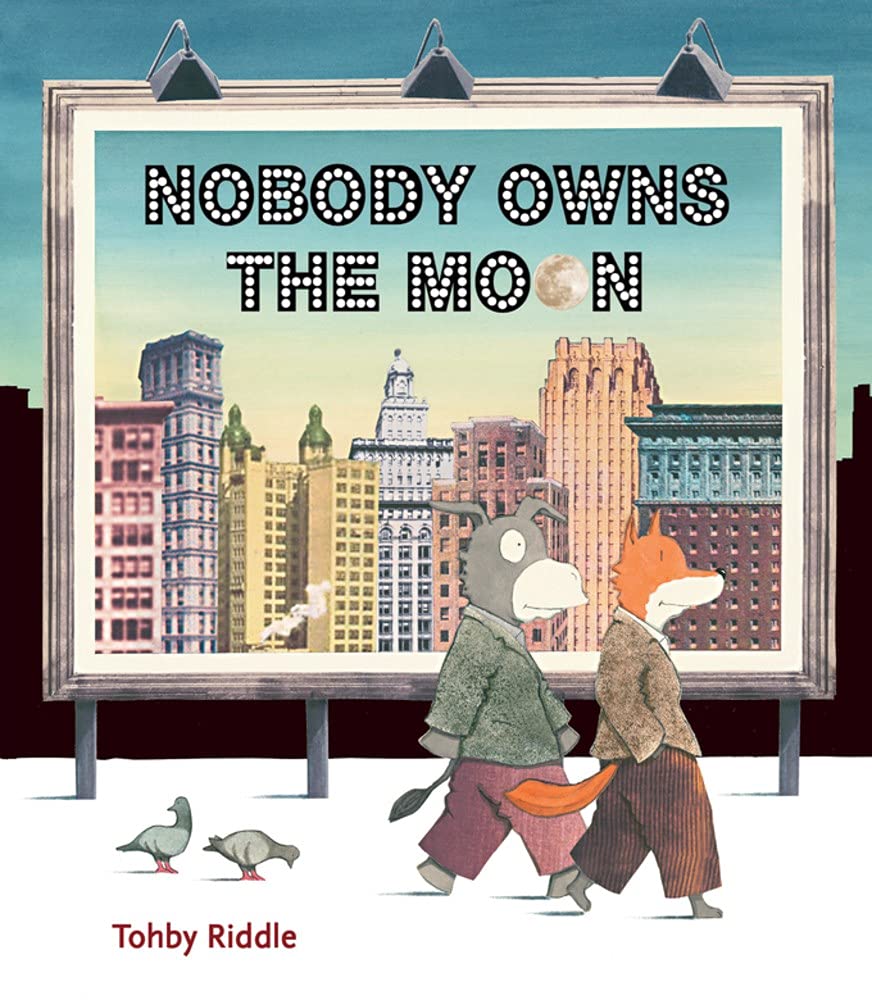
celebrate-picture-books-picture-book-review-nobody-owns-the-moon-cover

About the Holiday

How one achieves their definition of a good quality of life may differ for every person, but in general it encompasses being happy and satisfied with one’s relationships, work, living conditions, and self. Whether you find happiness and quality of life in outdoor or indoor pursuits, with others or alone, at work or at home, this month’s holiday gives you time to get in touch with your inner quiet place and reflect on changes or improvements to bring you more peace and happiness in life.

I’d like to thank Berbay Publishing for sharing a copy of Nobody Owns the Moon with me for review consideration. All opinions on the book are my own.

Special Note: As I have been asked to take on extra shifts as a staff member at my local public library due to personnel shortages, I will be taking a break from posting daily reviews over the next coming months. In between new reviews, I invite you to explore all of the holidays, author and illustrator interviews, activities, and, of course, the wonderful books featured on Celebrate Picture Books.

Nobody Owns the Moon

By Tohby Riddle


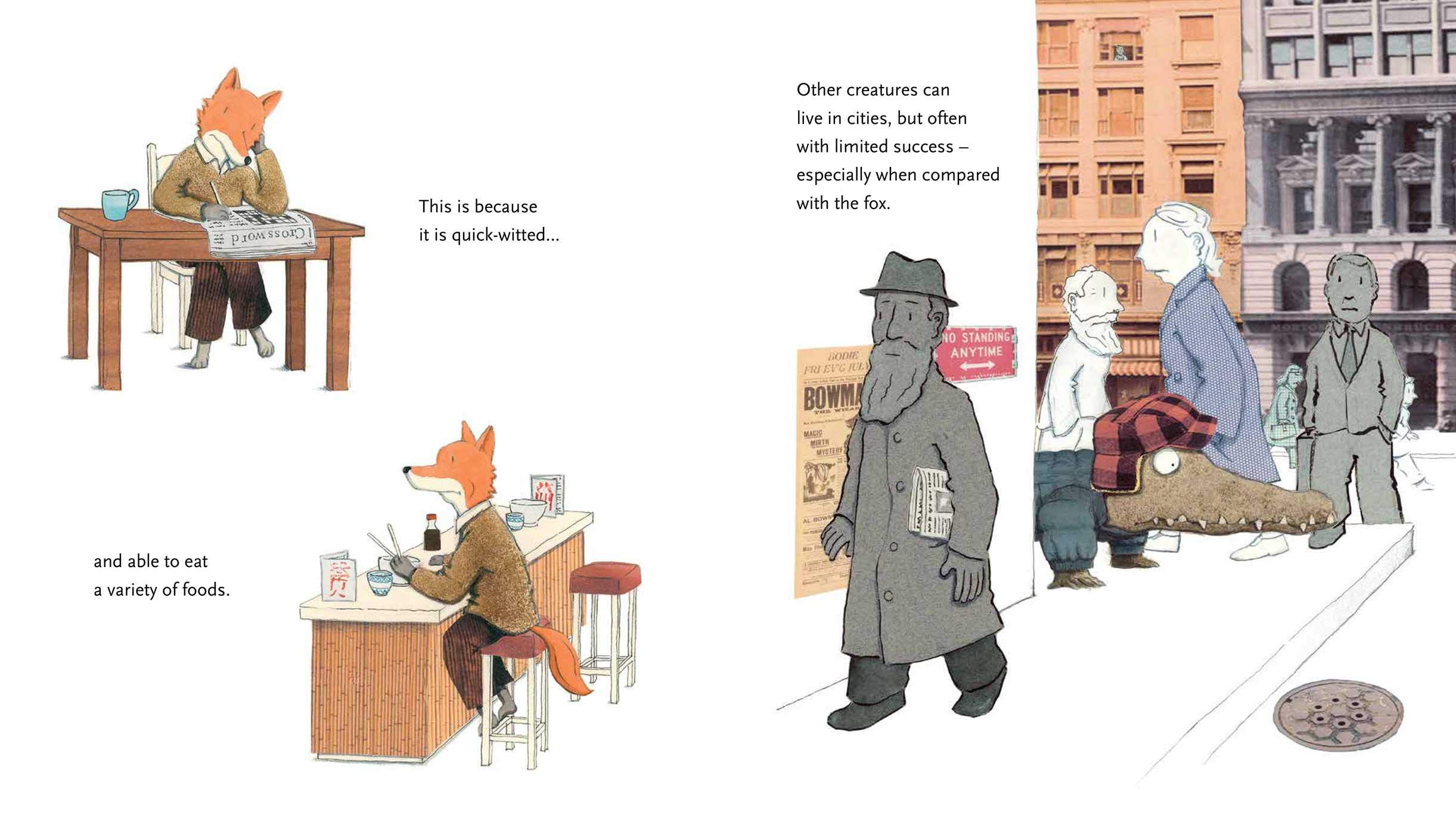
Upon the opening pages readers are treated to an engaging treatise on the success (or not so) of certain animals trying to “make a life for itself in cities.” The fox, we learn, is especially adept because it is “quick-witted and able to eat a variety of foods.” We are then introduced to one such city-dweller, Clive Prendergast – a self-named fox because his real name “can only be pronounced by foxes.”

celebrate-picture-books-picture-book-review-nobody-owns-the-moon-fox

Copyright Tohby Riddle, 2021, courtesy of Berbay Publishing.

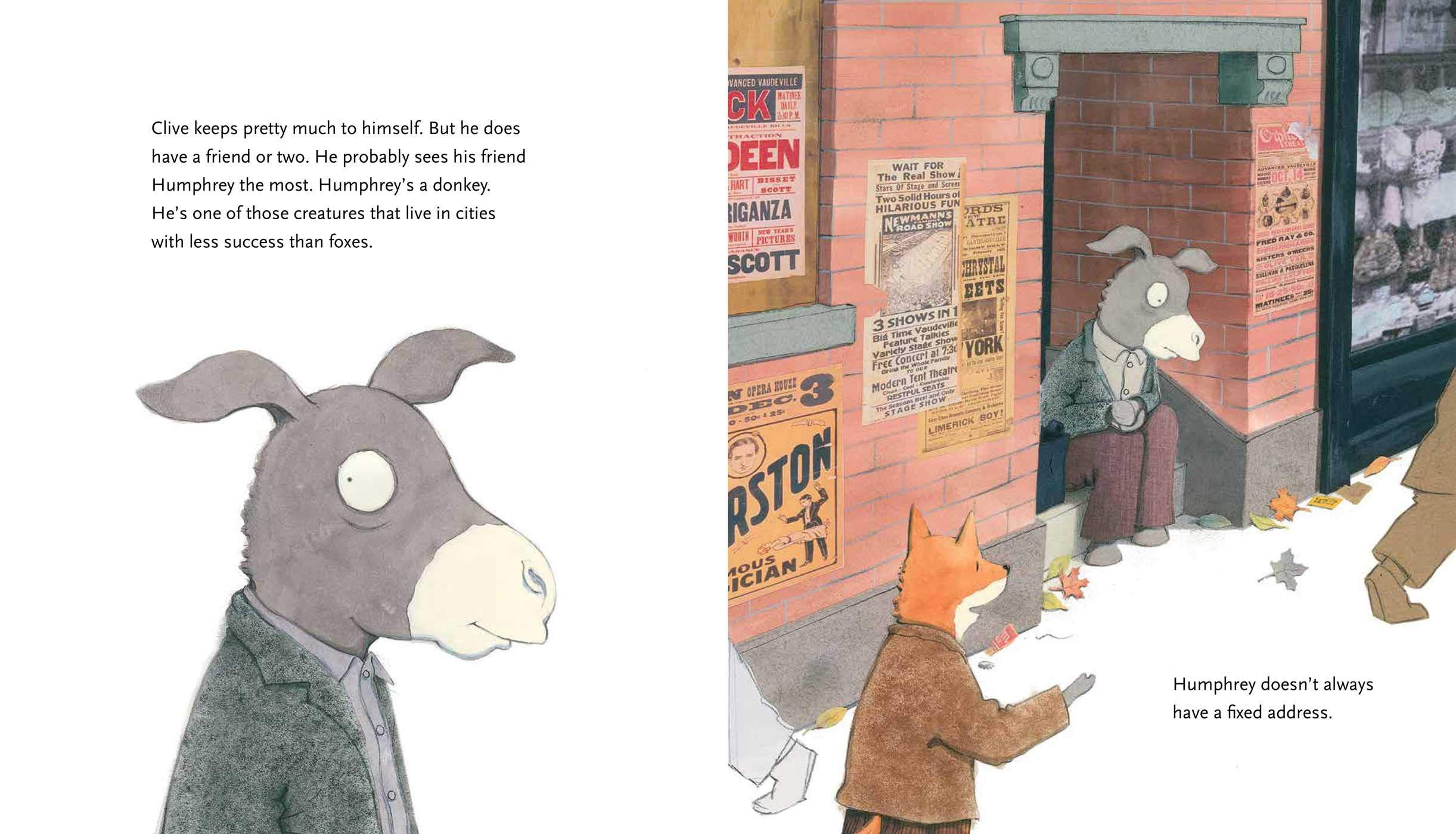
Clive lives in a small apartment and works on a factory production line. At night he takes to the streets, visiting food stalls and watching the interesting goings-on. Clive has a few friends, but the one he sees the most is Humphrey, a donkey who is “one of those creatures that live in cities with less success than foxes” and “doesn’t always have a fixed address.” While Humphrey has had jobs, he has trouble keeping them. Right now he’s working as a piano removalist.

One day Clive saw Humphrey sitting on the stone steps of “a statue of a great conqueror.” Clive thought he looked tired and underfed. Then he noticed a blue envelop sticking out of Humphrey’s tote bag. It turned out that Humphrey had found it in the street and planned on eating it, but thinking Clive was also hungry he offered it to him without a second thought. When Clive opened the envelope, he found two tickets to that night’s performance at the theatre. They should go, he said.

celebrate-picture-books-picture-book-review-nobody-owns-the-moon-humphrey

Copyright Tohby Riddle, 2021, courtesy of Berbay Publishing.

“That night Humphrey and Clive attended the premier of Nobody Owns the Moon – the latest play by the city’s most celebrated playwright. Before the show, ticket-holders were treated to hors d’ oeuvres and punch. Then they were shown to their front-row balcony seats. The play was wonderful, full of humor and poignancy. Tears filled Humphrey’s eyes at the show’s “bittersweet ending” and again as they enjoyed a beverage and “large slice of cake in the theatre’s elegant restaurant.”

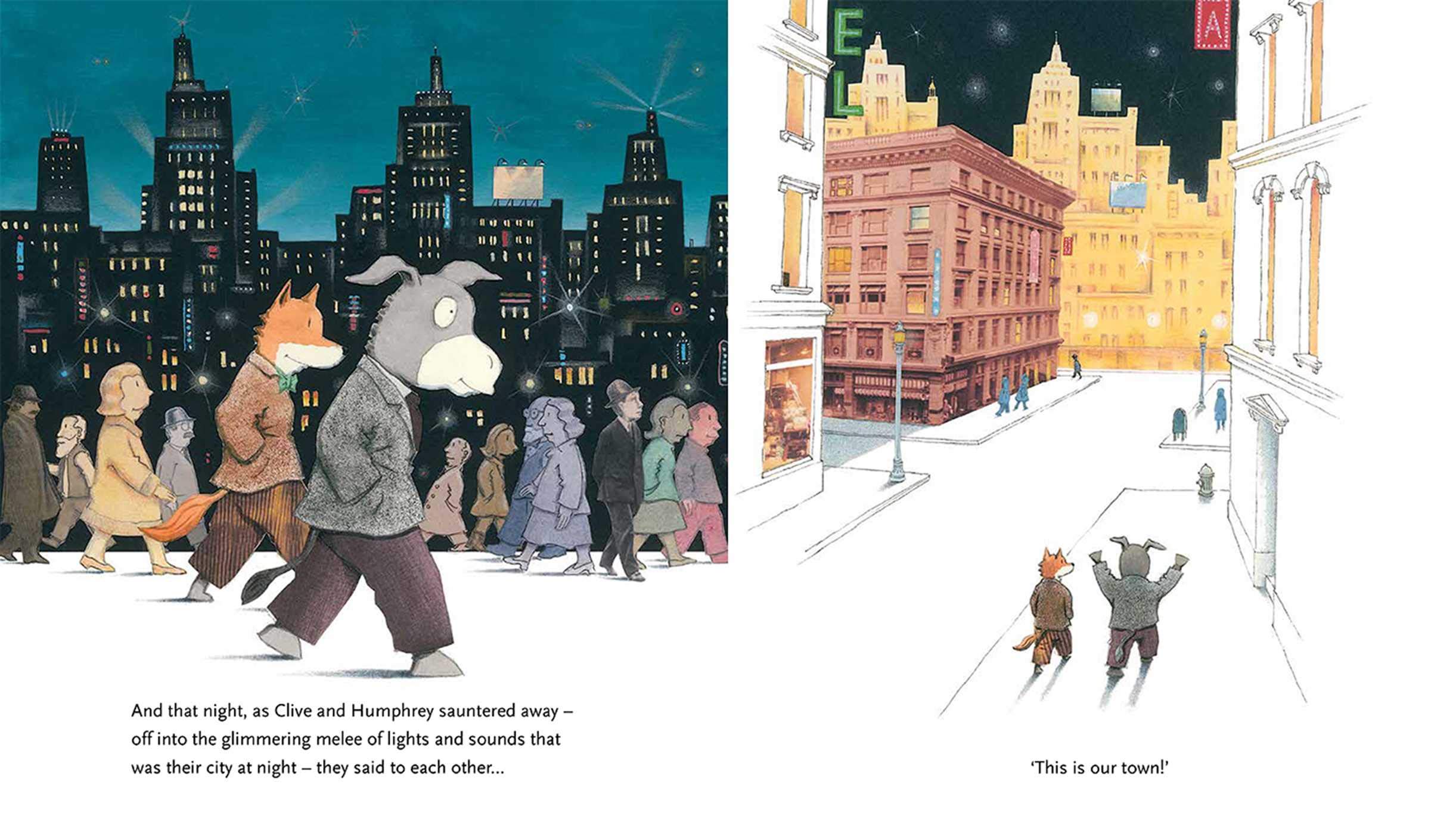
Filled with the wonder of the evening, Clive and Humphrey headed out into the “glimmering melee of lights and sounds that was their city at night. “‘This is our town!'” they exclaimed to each other, and before they went “their separate ways, Humphrey gave Clive a big hug goodnight.”

celebrate-picture-books-picture-book-review-nobody-owns-the-moon-city

Copyright Tohby Riddle, 2021, courtesy of Berbay Publishing.

Immersive and openhearted, Tohby Riddle’s poignant friendship tale is as surprising and inclusive as the invitation Humphrey finds. Opening with lines that could come straight from a nature documentary, the story quickly becomes interwoven with an air of mystery and anticipation as Clive Prendergast and Humphrey are introduced. Riddle’s inclusion of smart details, such as Clive’s fox name being unpronounceable to humans and Humphrey’s job that takes advantage of a donkey’s strong back, adds a verisimilitude that will delight readers. The emotional core of the story comes with Clive’s and Humphrey’s friendship, which is equitable and caring and full of generosity. The discovery and use of the theater invitation ushers in sumptuous scenes of a glittering theater, delicious food, and a life-affirming performance while also touching on the importance of satisfying the body and the soul, however one defines this.

Equally captivating are Riddle’s collage-style illustrations, which incorporate sly humor and thought-provoking perspectives. The book opens with an illustration of Clive Prendergast lounging in a comfortable armchair between Vincent van Gogh’s painting “A Wheatfield, with Cypresses” and a window which frames a view of the city that cleverly mirrors the famous artwork. Clive’s position suggests his comfort in both environments. Humphrey’s difficulties fitting in, on the other hand, are depicted in an Italian restaurant where, distracted for a moment, the plates of spaghetti and meatballs he’s carrying tip precariously over a customer sitting under a photograph of the Leaning Tower of Pisa. Other images that contribute to the depth and atmosphere of this book are theater posters advertising Vaudeville and magic acts, Russian nesting dolls and fresh foods for sale in Clive’s multicultural neighborhood, and the copy of Walt Whitman’s Leaves of Grass next to a view-master in Humphrey’s tote bag.

The city’s human inhabitants are all depicted in flat grays and browns while the animals – pigeons, a crocodile, a dancing bear – are portrayed in textured full color. This dichotomy begins to fade at the theater, where a waiter in formal dress offers Humphrey hors d’ oeuvres, in the balcony row where Clive and Humphrey sit, and in the restaurant after the show, a change that offers opportunities for readers to talk about acceptance and how we look at others. The moving ending is eloquent in it’s simple embrace of individuality and acceptance.

A touching, multi-level story that will enchant and impact readers, Nobody Owns the Moon will become a favorite and is a must for home, classroom, school, and public library collections.

Ages 4 – 8

Berbay Publishing, 2021 | ISBN 978-0994384195

Discover more about Tohby Riddle, his books, and his art on his website.

International Quality of Life Activity

celebrate-picture-books-picture-book-review-smile-cards-craft

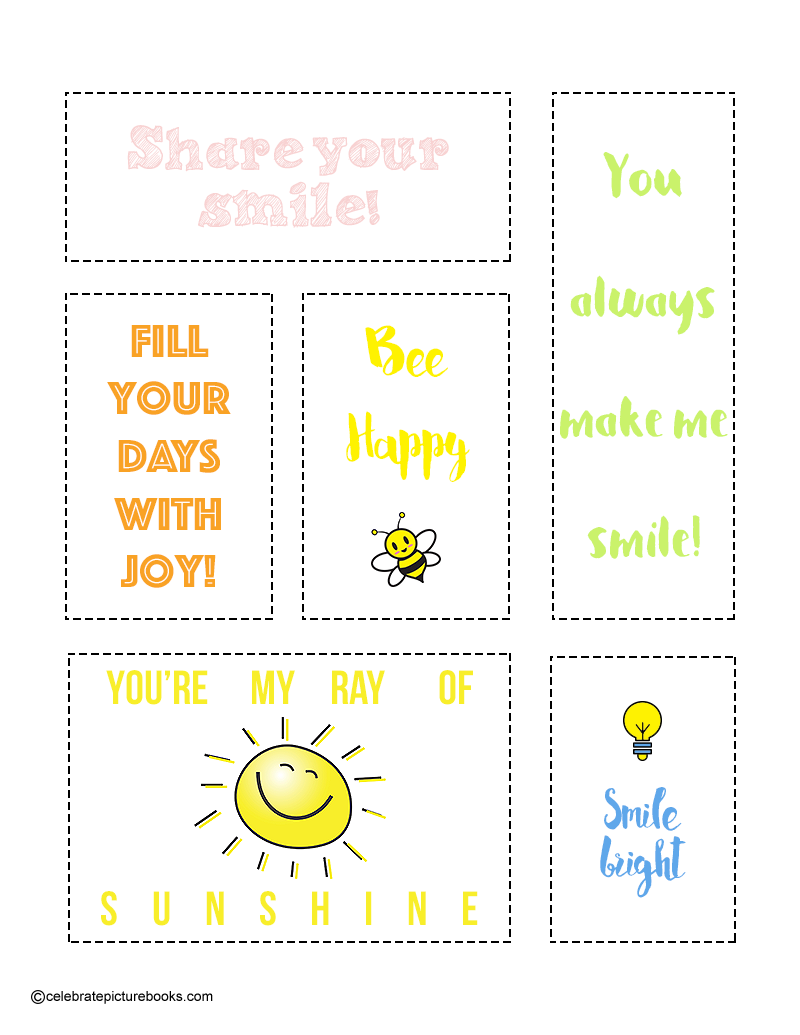
Share a Smile Cards


Life is better when you share smiles with those you know—and those you don’t! Try it! When you’re out today at school or other places, give someone a smile. You can be sure that you will have made their day and your day better! These cards are another way you can share a smile. Why not slip one into your dad’s pocket or your mom’s purse, put one in your friend’s backpack, or sneak one onto your teacher’s desk? You can even leave one somewhere for a stranger to find! Have fun sharing your smiles, and see how much better you and the others around you feel!

Click here to print your Share a Smile Cards.

celebrate-picture-books-picture-book-review-nobody-owns-the-moon-cover

You can find Nobody Owns the Moon at these booksellers

Amazon | Barnes & Noble | Books-a-Million

To support your local independent bookstore, order from

Bookshop | IndieBound

Picture Book Review
October 11 – National Coming Out Day

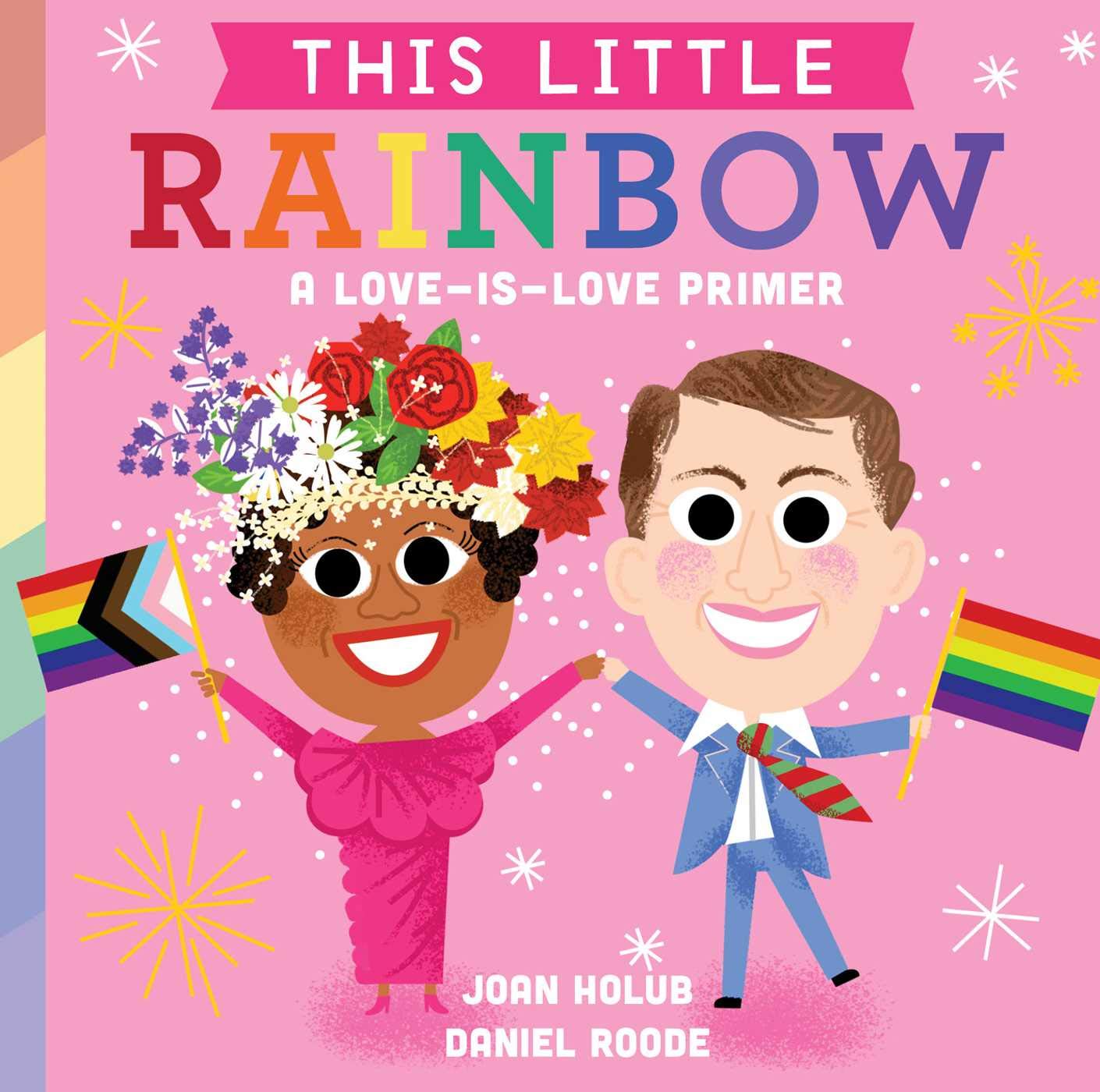
celebrate-picture-books-picture-book-review-this-little-rainbow-cover

About the Holiday

The establishment of National Coming Out Day was inspired by the October 11, 1987 March on Washington for Lesbian and Gay Rights, which drew 500,000 people and generated momentum for the movement for four months after the march had ended. During this time, more than one hundred LGBTQ+ identifying individuals gathered outside of Washington, DC. Rob Eichberg, who founded a personal growth workshop and Jean O’Leary, the head of National Gay Rights Advocates, proposed a national day to celebrate coming out and it was decided to create a National Coming Out Day that would officially begin on the 1st anniversary of their historic march. The holiday is now celebrated around the world. The day offers support and encouragement to those who are struggling with telling someone about their sexuality while urging family members, friends, educators, and others to listen with an open, loving, and welcoming heart.

Thanks to Joan Holub for sending me a copy of This Little Rainbow for review consideration. All opinions on the book are my own. I’m thrilled to be teaming with Joan in an exciting giveaway of this book and more. See details below.

This Little Rainbow: A Love-is-Love Primer


Written by Joan Holub | Illustrated by Daniel Roode


Joan Holub’s latest book in her THIS LITTLE series introduces preschoolers to eleven influential artists, scientists, sports figures, soldiers, activists, and politicians who are or were members of the LGBTQIA+ community. From the 1400s to today, these role models have been admired for their talents, opinions, and groundbreaking success in their chosen fields. Their courage has also contributed to a more open and appreciative society for all.

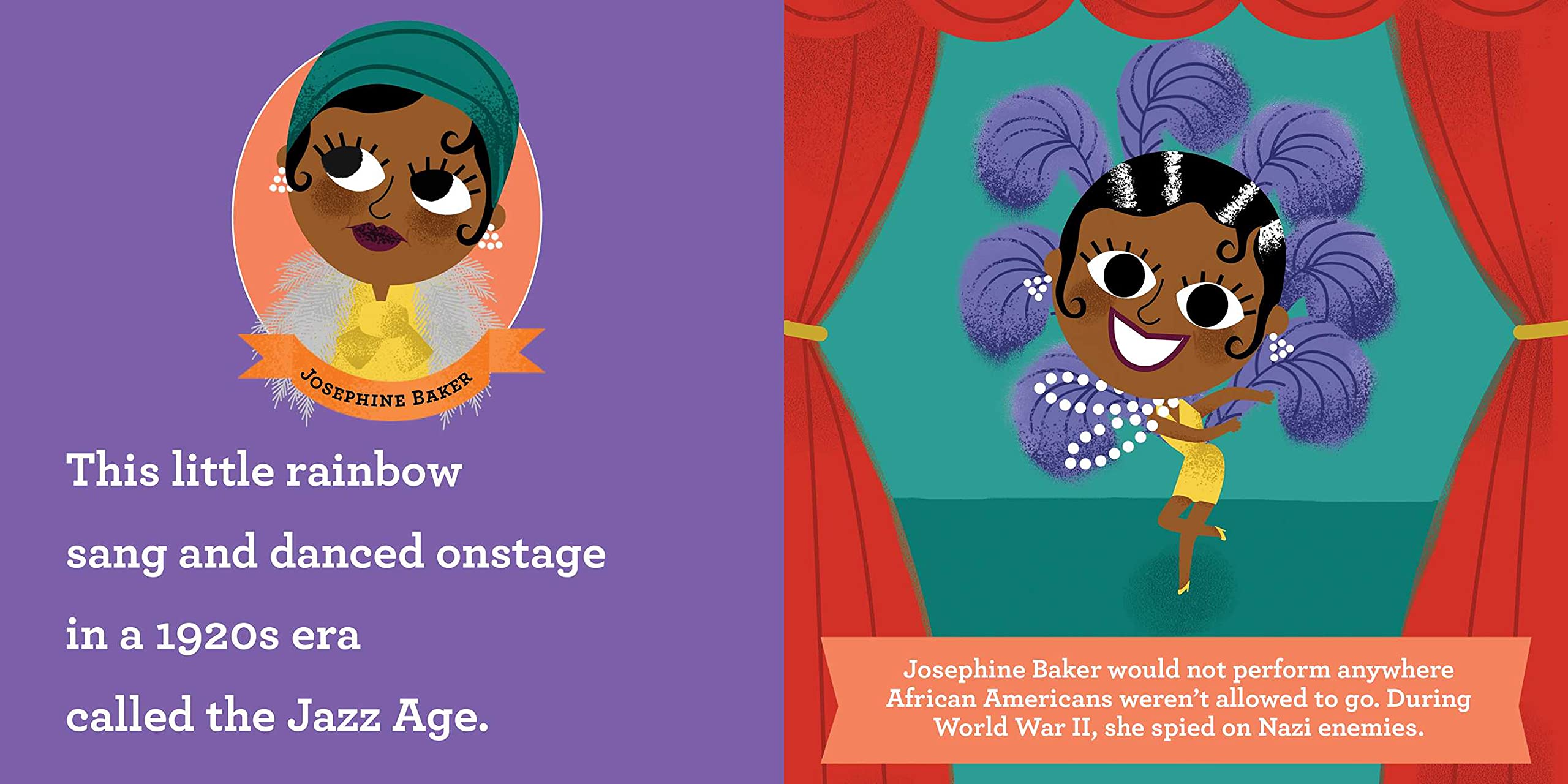
celebrate-picture-books-picture-book-review-this-little-rainbow-josephine-baker

Image copyright Daniel Roode, 2021, text copyright Joan Holub, 2021. Courtesy of Little Simon, Simon & Schuster.

Each featured profile is presented on a two-page spread. On the left side a rhyming couplet describes what the person is most known for, while on the right children learn a couple of facts about them in two or three short sentences. The book leads off with one of the most prominent painters, inventors, and scientists to have ever lived—Leonardo da Vinci. Readers learn: “This little rainbow / was a genius long ago. / He was a great artist / and an engineering pro.” They then discover that “Leonardo da Vinci painted the famous Mona Lisa and The Last Supper, and could paint with his left or right hand. He was also a scientist, inventor, and architect, who designed a flying machine!”

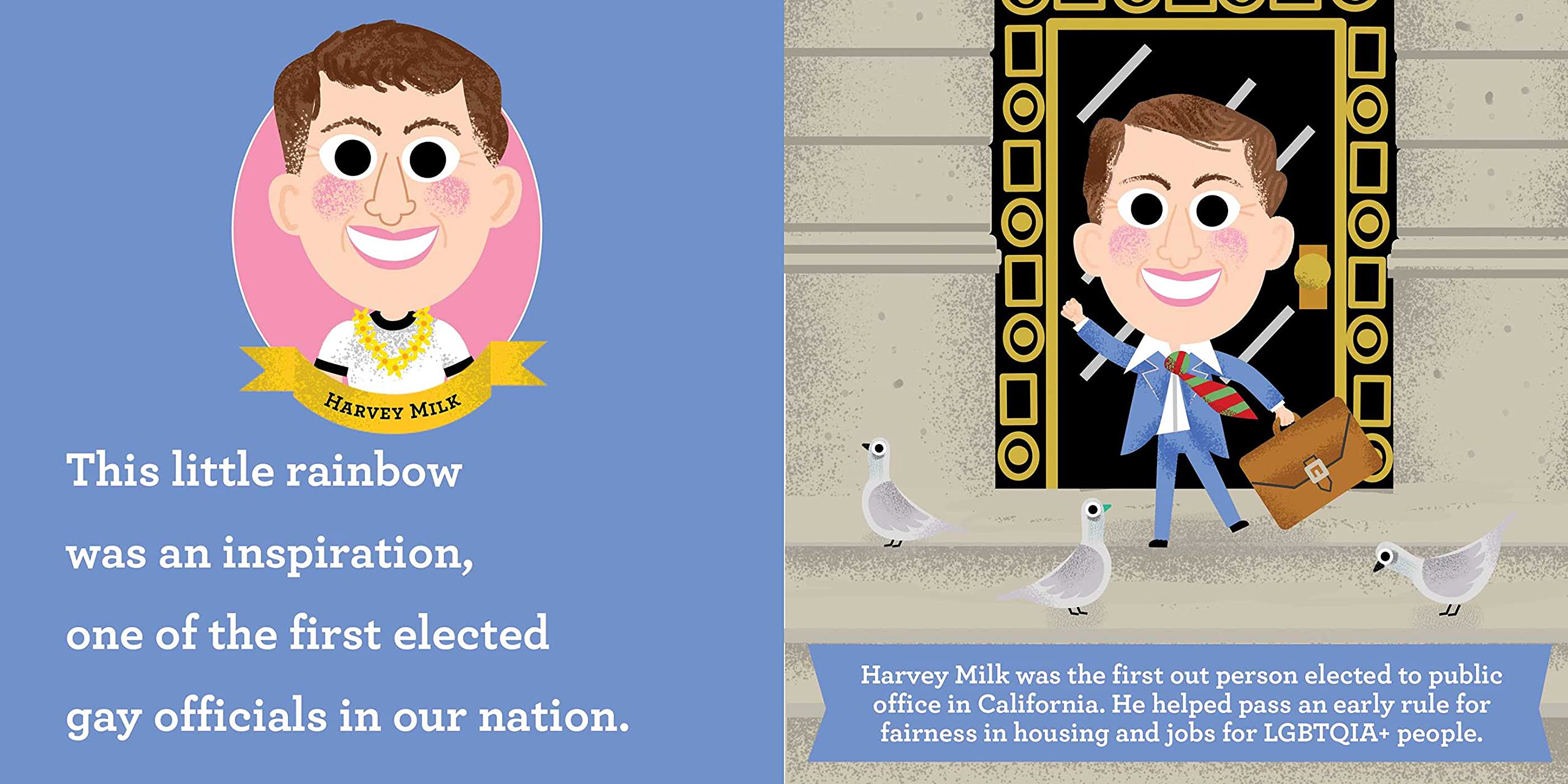
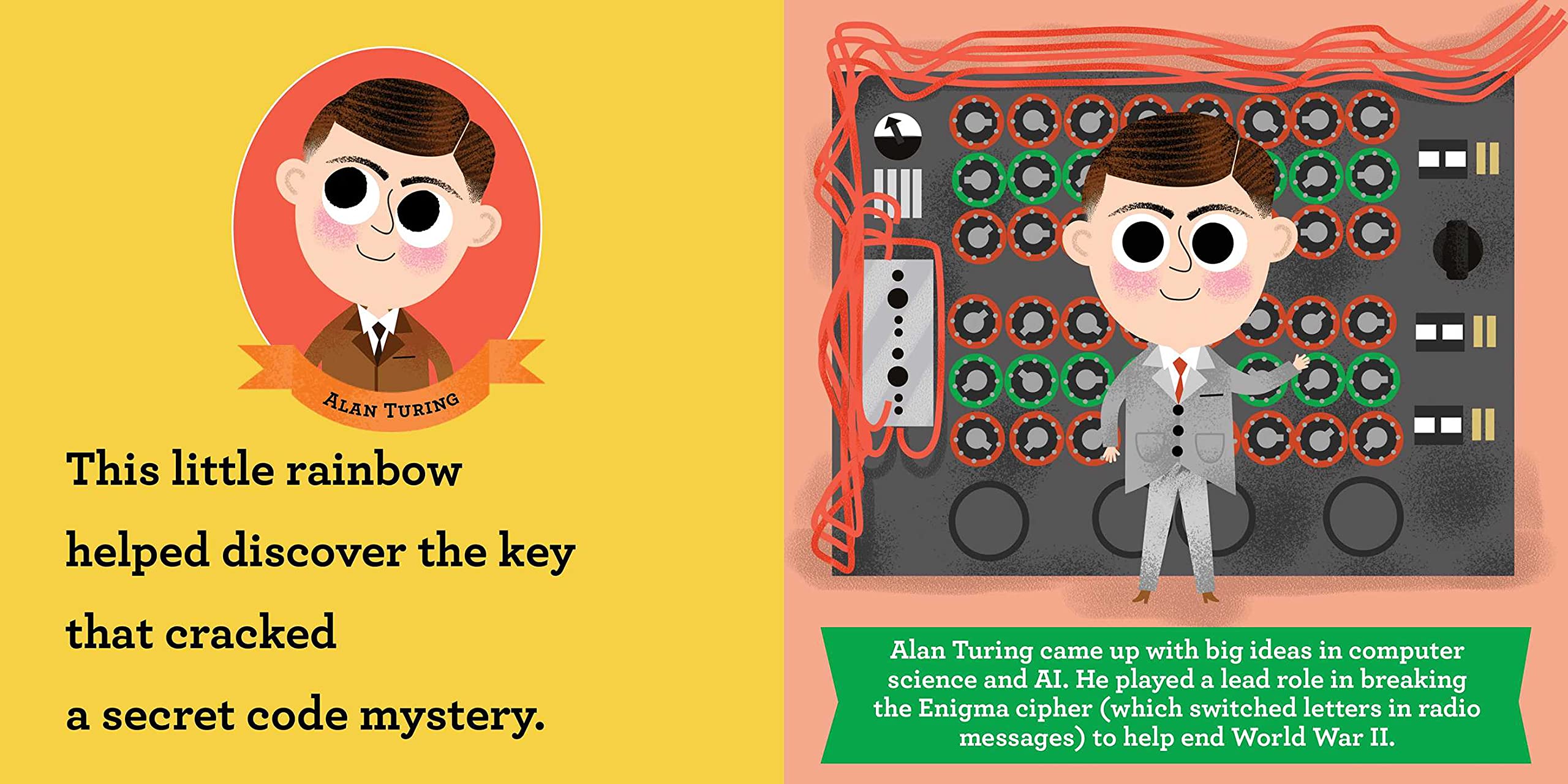
Moving on to the Jazz Age, little ones learn about Josephine Baker, “who sang and danced onstage,” refused to perform where African Americans weren’t allowed in, and spied on Nazis during World War II. Kids also meet computer scientist and code breaker Alan Turing; Harvey Milk, the first out politician “elected to public office in California. He helped pass an early rule for fairness in housing and jobs for LGBTQIA+ people.”

celebrate-picture-books-picture-book-review-this-little-rainbow-alan-turner

Image copyright Daniel Roode, 2021, text copyright Joan Holub, 2021. Courtesy of Little Simon, Simon & Schuster.

Children will also be introduced to Sally Ride: “This little rainbow / launched a satellite / as the first female astronaut / on a US space flight.” Kids then learn that “Sally Ride helped design a big robotic art and then used it to launch communications satellites from the Space Shuttle Challenger in 1983.” Marsha P. Johnson, a transgender woman who, with Sylvia Rivera, “created a group called STAR to help homeless trans people,”

Singer Freddie Mercury, Gilbert Baker and Daniel Quasar, who designed today’s rainbow flags; tennis pro Martina Navratilova; and Shane Ortega, who “was the first person to openly transition during active duty” and “now speaks out for fair rules for all people,” are also represented in these pages.

Following these profiles, a two-page spread provides portraits and information on fifteen other LGBTQIA+ leaders from around the world as well as a glossary of twelve “rainbow terms.”

celebrate-picture-books-picture-book-review-this-little-rainbow-harvey-milk

Image copyright Daniel Roode, 2021, text copyright Joan Holub, 2021. Courtesy of Little Simon, Simon & Schuster.

Joan Holub’s inclusive introduction to people in the LGBTQIA+ community gives parents, educators, and other caregivers a meaningful way to share the work and lives of people who reflect perhaps their own family or a member of their family, their neighbors, friends, teachers, celebrities, and others. In positive, uplifting language, Holub provides a short history on the struggles, recognition, progress, and contributions of those who identified or identify as part of the LGBTQIA+ community while instilling pride and hope in the future for today’s children.

Daniel Roode’s well-recognized illustrations for the THIS LITTLE series offer vibrant imagery of each person backed by a bold, easily identified setting that informs young readers about their work and personality. Each of the eleven featured portraits as well as the fifteen that follow give adults and children a great place to start learning more about these inspiring people.

This Little Rainbow, a Love-Is-Love Primer is a terrific addition to the THIS LITTLE series for all home, classroom, school, and public library collections.

Ages 3 – 5

Little Simon, 2021 | ISBN 978-1534475601

Discover more about Joan Holub and her books on her website.

You can connect with Daniel Roode on Instagram.

One Question with Joan Holub

celebrate-picture-books-picture-book-review-joan-holub-headshot

Joan Holub has authored and/or illustrated over 140 children’s books, including the Goddess Girls series, the Heroes in Training series, the New York Times bestselling picture book Mighty Dads (illustrated by James Dean), and Little Red Writing (illustrated by Melissa Sweet). She lives in North Carolina.

You can connect with Joan Holub on her Website and Twitter. 

Hi Joan! It’s wonderful to have this little chat with you! Your list of published books is truly incredible and inspirational for its length and breadth of topics. I can only imagine that you’ve always been an avid reader. Did you have a favorite place to read as a child? Do you still seek out a favorite comfortable place to read now?

When I was a girl, there was a willow tree in our backyard, and I loved how cozy and hidden I felt sitting beneath it, with its green canopy draped around me. It was my favorite hideout and place to read. My family had read a book called A Good Place to Hide, which featured a child hiding under a willow tree, and that fostered in me the idea of me doing the same. My favorite reading spot now is our back deck, which looks out onto trees, with a glass of iced tea beside me.

celebrate-picture-books-picture-book-review-this-little-rainbow-cover

You can find This Little Rainbow: A Love-is-Love Primer at these booksellers

Amazon | Barnes & Noble | Books-a-Million

To support your local independent bookstore, order from 

Bookshop | IndieBound

Picture Book Review
 

June 23 – It’s National Homeownership Month

celebrate-picture-books-picture-book-review-mr-mole-moves-in-cover

About the Holiday

Owning a home is a major goal for many people, and while home ownership provides security for individuals and families, it’s also good for cities and towns, offering stability, economic benefits, and community cohesion. To that end, today’s holiday was established as a week-long observance in 1995 by then-President Bill Clinton as a way to increase homeownership by helping people negotiate the sometimes confusing elements of finding and purchasing a home. In 2002, President George Bush extended the holiday to a full month. A home is so much more than just a building, and each person has their own idea about what makes a home—or a neighborhood—perfect. Sometimes you can’t really put your finger on it—it’s just a feeling. Today’s sweet book shows how one community welcomed its newest member.

Thanks to Tundra Books for sending me a copy of Mr. Mole Moves In for review consideration. All opinions on the book are my own.

Mr. Mole Moves In

By Lesley-Anne Green


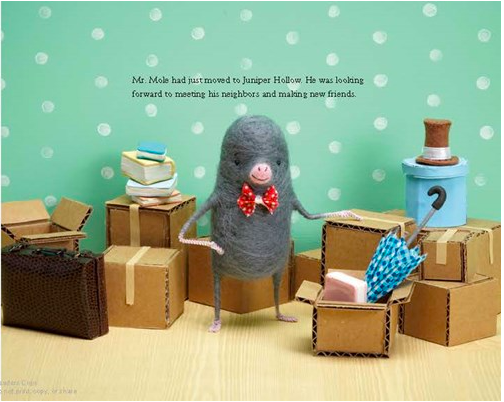
Mr. Mole was new to Juniper Hollow and couldn’t wait to meet his neighbors. “Now, Juniper Hollow doesn’t get too many new residents, so when they do, boy oh boy, do these critters get excited!” In fact, Raccoon had been playing close to Mr. Mole’s house, just waiting for him to come outside. When he did, Raccoon ran over, introduced himself, and stuck out his paw. Mr. Mole was happy to meet Raccoon, but instead of shaking Raccoon’s hand, he grabbed a branch from the bush next to him and gave “it a good shake.” Although a bit confused, Raccoon took it in stride and figured that’s just how things were done in Mole Town.

celebrate-picture-books-picture-book-review-mr-mole-moves-in-boxes

Copyright Lesley-Anne Green, 2021, courtesy of Tundra Books.

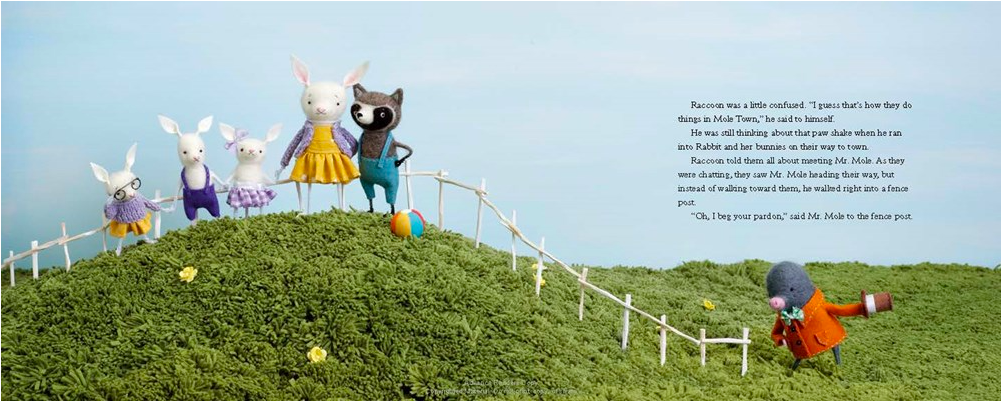
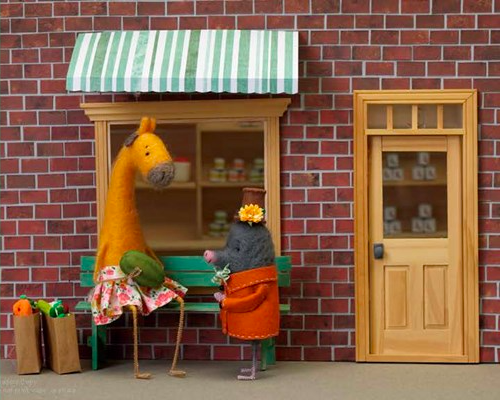
While Raccoon was relating this story to the Rabbit family, Mr. Mole ran into a fence post and apologized to it. Rabbit was impressed with Mr. Mole’s manners and hurried after him to introduce herself and her bunnies. They caught up with him at the general store, where he was talking to Giraffe. “‘What a beautiful baby!’ Mr. Mole said, looking sweetly at the watermelon Giraffe was holding.” When Mr. Mole went inside the store, Giraffe and Rabbit discussed what had happened. They decided that watermelons must be very prized in Mole Town. Inside the store, Cat and Chicken were talking about Mr. Mole too.

Mr. Mole stocked up on cans of worms and approached the counter, where Rabbit introduced herself and her bunnies. He was so thrilled to meet them that he immediately reached for a jar on the counter. “‘Bear, I will also take three of these candies for the little ones,’” Mr. Mole said as he handed them around. The bunnies looked at the erasers in their paws and decided to keep them for later.

celebrate-picture-books-picture-book-review-mr-mole-moves-in-fence

Copyright Lesley-Anne Green, 2021, courtesy of Tundra Books.

Watching all of this, Cat and Chicken decided that they would plan some kind of special event to welcome their wonderful new neighbor to Juniper Hollow. Everyone wanted to help. The next day they all went to visit Mr. Mole, and called out that they wanted to welcome him to town. A little nervously, Mr. Mole went out onto his front porch. All the critters had made him a welcome basket of all his favorite things.

Then “the littlest bunny hopped over to Mr. Mole and handed him her extra pair of glasses.” Mr. Mole was surprised and thanked her profusely. He had lost his glassed while moving, he told them, and couldn’t “‘see a THING without them.’” After the get-together, Mr. Mole took his basket inside and found—along with a handknit sweater and a pie—branches, erasers, and watermelon. Hmmm… he thought. “‘I guess that’s just how they do things in Juniper Hollow.’”

celebrate-picture-books-picture-book-review-mr-mole-moves-in-watermelon

Copyright Lesley-Anne Green, 2021, courtesy of Tundra Books.

Lesley-Anne Green’s story of friendship and acceptance charms with humor, clever misunderstandings, neighborliness, and one particularly sweet and empathetic bunny. Green’s enchanting storytelling immerses readers in the world of Juniper Hollow, a gentle, easy-going community that welcomes readers with the same warmth it extends to Mr. Mole. Kids will be especially pleased to see that the littlest bunny understands Mr. Mole’s plight and knows just how to help. Green’s adorable needle-felted critters, decked out in dapper outfits, shine with personality, conveying the critters’ confusion as well as their enthusiasm to embrace their newest resident and desire to make him feel at home. Her handmade backgrounds will also captivate readers with their rustic appeal, and readers will want to spend some time in the General Store exploring its well-stocked shelves.

The second book in Lesley-Anne Green’s Juniper Hollow series, Mr. Mole Moves In is a story with depth and charm and inspiring illustrations that will be asked for again and again. The book is a top choice for home, school, and public library bookshelves. You’ll also want to check out Fox and Raccoon, the first Juniper Hollow book.

Ages 3 – 7

Tundra, 2021 | ISBN 978-1101918029

You can connect with Lesley-Anne Green on Instagram.

You can watch Lesley-Anne Green talk about her work and create an adorable critter on Tundra Illustrator Studio.

National Homeownership Month Activity

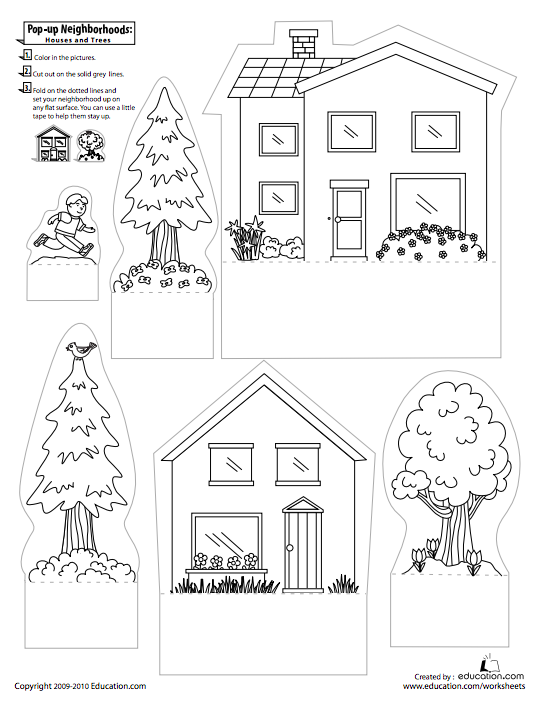
celebrate-picture-books-picture-book-review-pop-up-houses-coloring-page

Pop Up Houses Play Set


You can own your own home with this printable Pop Up Play Set thanks to Education.com. It has a house for you and one for a friend! Give your houses some color, plant the trees and move in! Print on heavy paper to make the figures sturdier.

Pop Up Houses Play Set

celebrate-picture-books-picture-book-review-mr-mole-moves-in-cover

You can find Mr. Mole Moves In at these booksellers

Amazon | Barnes & Noble | Books-a-Million

To support your local independent bookstore, order from

Bookshop | IndieBound

Picture Book Review
April 2 – International Children’s Book Day

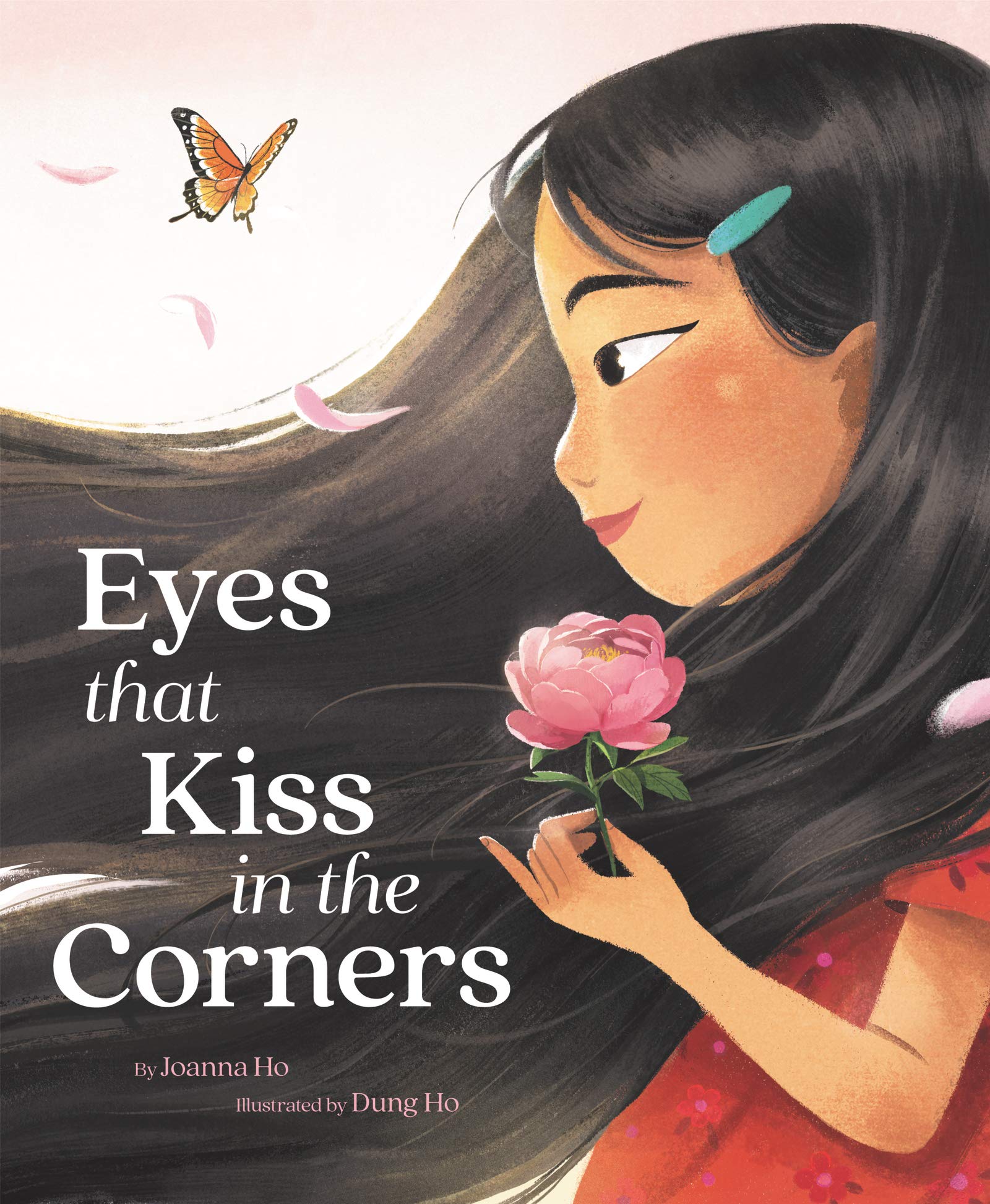
celebrate-picture-books-picture-book-review-eyes-that-kiss-in-the-corners-cover

About the Holiday

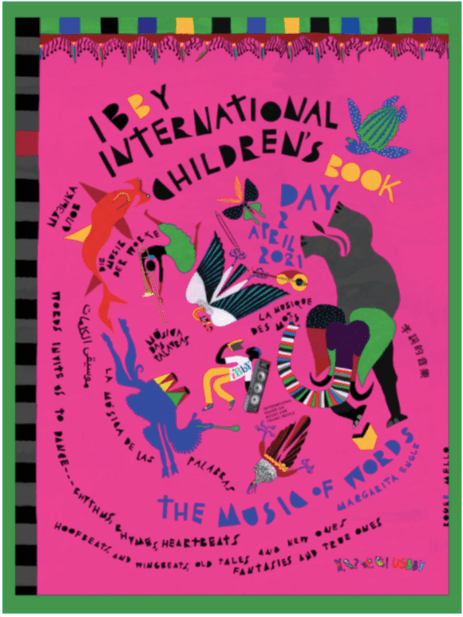
Readers, writers and book lovers everywhere will love today’s holiday. International Children’s Book Day! What a time to visit Celebrate Picture Books! International Children’s Book Day was created in 1967 to celebrate young readers and children’s books across the globe. The holiday falls on April 2nd to commemorate the birthday of Hans Christian Anderson, the writer of many of the classic fairy tales. Each year a different country’s Board on Books for Young People is chosen to create a theme for a holiday. Currently there are 75 different countries involved. An author and illustrator are also elected to write an inspirational message for young readers and to design a poster to celebrate.

This year, the United States Board on Books for Young People (USBBY) is sponsoring the holiday. The theme this year is “The Music of Words.” The poster was created by Hans Christian Andersen Award recipient, Brazilian illustrator Roger Mello, and contains a beautiful message on the music of words, written by Award-winning Cuban American author, Margarita Engle. How might you celebrate this fantastic holiday? You already are! Visiting Celebrate Picture Books blog is a wonderful way to honor the day. Additionally, spend some time reading some of your favorite picture books to young readers and discover new stories that highlight diversity and the music of words. Eyes that Kiss in the Corners is a perfect book to celebrate young readers globally.You can view and download this year’s International Children’s Book Day Poster here. Read “The Music of Words” here.

To find more spectacular books to share all through the month, check out USBBY’s 2021 Outstanding International Books List posted on the USBBY’s webpage.

Thank you to HarperCollins for providing a digital copy of Eyes That Kiss in the Corners for review consideration. All opinions on the book are my own.
Reviewed by Dorothy Levine

Eyes that Kiss in the Corners

Written by Joanna Ho | Illustrated by Dung Ho


On her way out of the house, a girl stops in front of the hall mirror to take a look. At school, the girl waves to two friends, their eyes wide and bright as they wave back. “Some people have eyes like sapphire lagoons with lashes like lace trim on ballgowns, sweeping their cheeks as they twirl. Big eyes, long lashes. Not me,” the girl says. She turns to face the reader head on; her black hair cascading past her shoulders. “I have eyes that kiss in the corners and glow like warm tea.”

celebrate-picture-books-picture-book-review-eyes-that-kiss-in-the-corners-reading

Image copyright Dung Ho, 2021, text copyright Joanna Ho, 2021. Courtesy of HarperCollins.

With this comparison, the young Asian girl embarks on a journey of observation, self-love, and family wisdom. She reflects on the beauty of her own, unique eyes and how they resemble those of her family members. Eyes are not just for seeing the tangible, our narrator explains: “When Mama tucks me in at night, her eyes tell me I’m a miracle. In those moments when she’s all mine, flecks of dancing gold tell me I’m hers too.” 

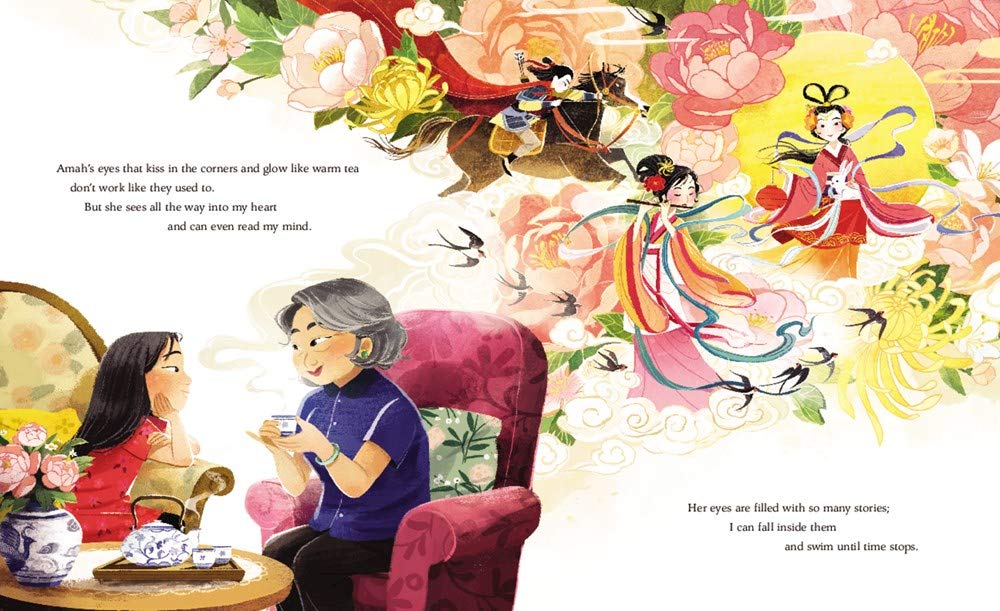
The girl considers how her eyes connect her to other generations of her family, specifically her grandmother, her amah. When her amah tells her stories of Chinese folklore, the girl can see “Guanyin with the Monkey King sitting on a lotus” and other traditional characters as well as lychee trees, mountains, and lotus blossoms—all within her grandmother’s eyes. “Her eyes are filled with so many stories; I can fall inside them and swim until time stops.”  

celebrate-picture-books-picture-book-review-eyes-that-kiss-in-the-corners-amah

Image copyright Dung Ho, 2021, text copyright Joanna Ho, 2021. Courtesy of HarperCollins.

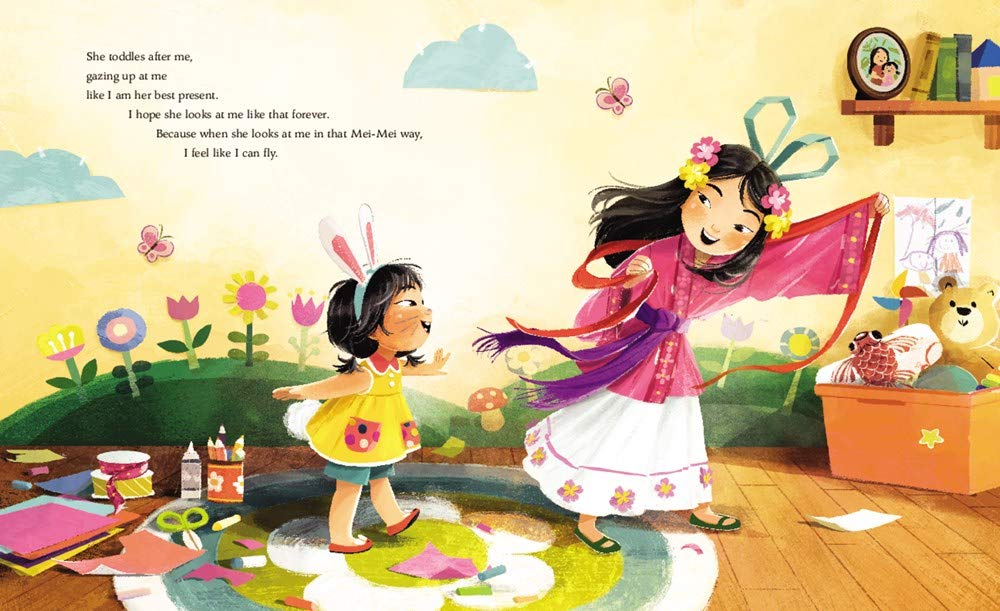
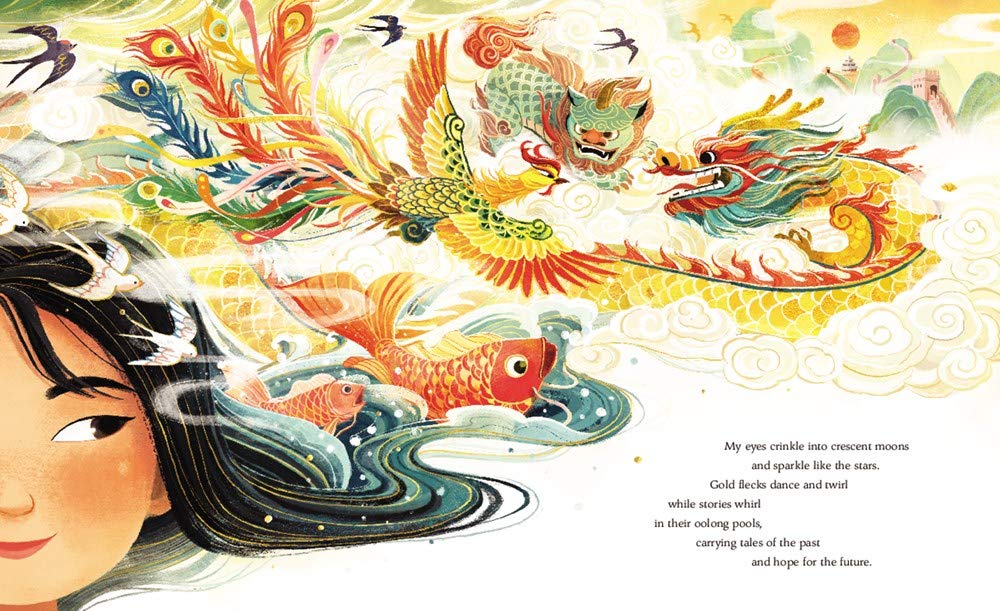
The narrator then cheerfully describes her younger sister Mei-Mei who watches patiently for her to return home from school. “…when she looks at me in that Mei-Mei way, I feel like I can fly,” she says. Following her reflection on her sister, our protagonist is featured close up with beautiful swirls of clouds, swallows, fish, and dragon together; her hair elegantly turns into a river for koi fish to swim in while a Chinese phoenix and dragon fly above her. The creatures, mythological and real follow her hair in a harmonious flow, merging the past and hope for the future.

celebrate-picture-books-picture-book-review-eyes-that-kiss-in-the-corners-mei-mei

Image copyright Dung Ho, 2021, text copyright Joanna Ho, 2021. Courtesy of HarperCollins.

She is then pictured powerfully standing on top of a lush green mountain, fists balled, ready for her eyes to “find mountains that rise ahead and look up when others shut down.” The narrator is confident, strong, aware of her beauty, and kind towards others. “My eyes that kiss in the corners and glow like warm tea are a revolution. / They are Mama and Amah and Mei-Mei. They are me. And they are beautiful,” she states—a perfect role model for all young people.

celebrate-picture-books-picture-book-review-eyes-that-kiss-in-the-corners-phoenix

Image copyright Dung Ho, 2021, text copyright Joanna Ho, 2021. Courtesy of HarperCollins.

Eyes that Kiss in the Corners teaches young readers to love themselves and all their uniqueness. Author Joanna Ho’s writing is lyrical and poetic, a joy to read for book lovers of all ages. The writing is simple but conveys infinitely deep messages; celebrating one’s culture and beauty, even when they are not always highlighted by mainstream society, fighting stigmas and finding strength in family connections are some of the many themes that can be found in this beautiful tale. Joanna Ho provides a much-needed story of radical love, joy, and connection. The gorgeous, poetic lines of this book may even bring tears to readers’ eyes.

Illustrator Dung Ho adds many beautiful details that liven up the story beyond the words. All of the spreads with the protagonist’s family feature meaningful eye contact and smiles so bright, one can’t help but smile along with the characters. Bursts of blossoms, lotus flowers, and butterflies adorn almost every page, symbols of natural beauty. Inside the family’s home, elements of childhood like stuffed animals, crafts, and playing dress-up, sit side-by-side with objects of their heritage, including Chinese porcelain vases and tea sets, guardian lion statues, and a koi kite. Sunbeams, dragons, and birds weave in and out of the pages in a harmonious stream with swirls of feathers, reds, yellows, and lush greens. The colors and intricate illustrative details fill the book with life, wonder, and affection.

Eyes that Kiss in the Corners is a perfect book for children examining their own features and embracing their identities. Books that celebrate diversity are invaluably important, especially in times of political polarization and racism. The lesson of self-love is one that is important for all young children to read about and learn to embrace. The book is a must for home, school, and public library collections.

Ages 4 – 8

HarperCollins, 2021 | ISBN 978-0062915627

Discover more about Joanna Ho and her books on her website.

You can connect with Dung Ho on Instagram.

Watch the gorgeous Eyes that Kiss in the Corners book trailer!

International Children’s Book Day Activities

Screen Shot 2021-04-01 at 12.31.30 PM

Coloring Pages, Word Search, and More!


Hans Christian Andersen Coloring Pages

You can color pictures from many of your favorite Hans Christian Andersen’s fairy tales online at HelloKids. 

To download and print coloring pages from Hans Christian Andersen’s The Ugly Duckling, visit Animations A2Z.

“The Music of Words” Word Search

Find 21 words in this word search from Margarita Engle’s message “The Music of Words,” written to celebrate the International Children’s Book Day of 2021!

International Children’s Book Day Word Search

Read “The Music of Words” Message

You can view the 2021 International Children’s Book Message from Margarita Engle in five different languages here.
For adults

Check out these organizations that are actively working to fight anti-Asian racism and consider donating

Stop APPI Hate | CAAAV Organizing Asian Communities

celebrate-picture-books-picture-book-review-eyes-that-kiss-in-the-corners-cover

You can find Eyes that Kiss in the Corners at these booksellers

Amazon | Barnes & Noble | Books-a-Million

To support your local independent bookstore, order from

Bookshop | IndieBound

Picture Book Review