February 22 – Museum Advocacy Day

CPB - How the Dinosaur Got to the Museum II

About the Holiday

Today is a day when we can show our museum curators and representatives in government how much we value museums. Without these grand (and sometimes small) buildings dedicated to preserving and teaching about our historical, scientific, and cultural achievements, our lives would be much poorer. Show your support for museum funding by visiting and/or donating to your favorite museum!

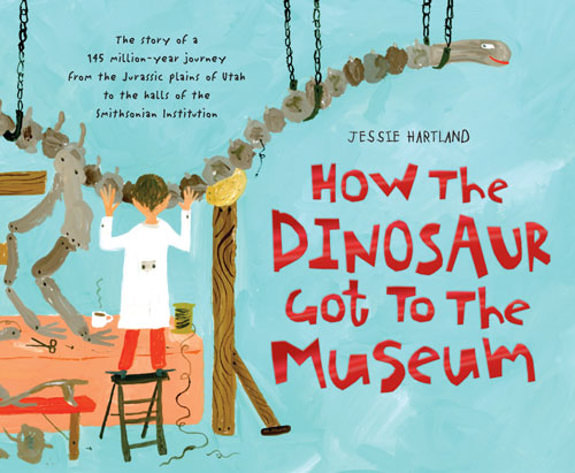
Another wonderful way to celebrate our custodians of history, science, art, and life is by reading the clever How the Dinosaur Got to the Museum / How the Sphinx Got to the Museum / How the Meteorite Got to the Museum series by author-illustrator Jessie Hartland.

How the Dinosaur Got to the Museum

By Jessie Hartland


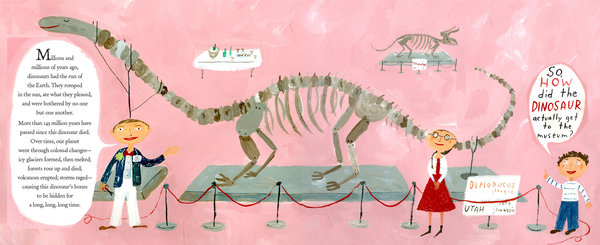
“So…” asks a little boy visiting the Smithsonian Museum of Natural History, “how did the dinosaur get to the museum?” Thus begins the tale—not of the dinosaur’s life, but of its journey from life to the museum exhibit hall.
celebrate-picture-books-picture-book-review-how-the-dinosaur-got-to-the-museum-talking-about-dinosaur

Image and text copyright Jesse Harland, courtesy of Blue Apple Books

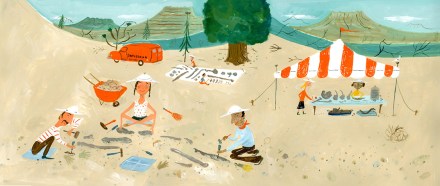
One hundred and forty-five million years ago, the dinosaur roamed the plains of what is now Utah, Overcome by weather and evolutionary events, the dino is buried and much, much later once again exposed. A Dinosaur Hunter finds one large bone and believes it to be from a Diplodocus Longus. He calls in the Paleontologist who confirms it. A team of Excavators arrives and unearths the rest of the skeleton.

The Movers pack the skeleton which was found by the Dinosaur Hunter, confirmed by the Paleontologist, and dug up by the Excavators and load it on a train that transports it to the Smithsonian. Here, the bones are cleaned and preserved by the Preparators, who discover that the head and neck are missing!
celebrate-picture-books-picture-book-review-how-the-dinosaur-got-to-the-museum-digging

Image copyright Jesse Harland, courtesy of Blue Apple Books

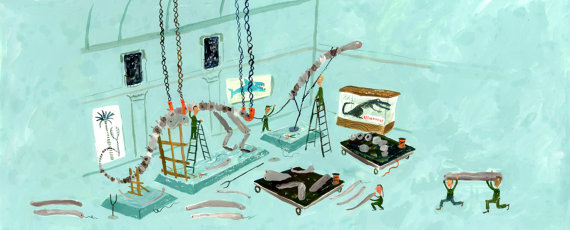
The Curator locates a plaster cast at another museum and work continues. The Diplodocus is assembled, but in the darkness the Night Watchman trips over its tail and breaks it! In come the Welders to fix it, and finally the Riggers can display the skeleton.

The Exhibits Team creates a background, lighting, and signs for Diplodocus, and the Cleaners give it a final dusting before the Director invites the public to view the magnificent exhibit with a speech and a toast.
celebrate-picture-books-picture-book-review-how-the-dinosaur-got-to-the-museum-exhibit

Image copyright Jesse Harland, courtesy of Blue Apple Books

Jessie Hartland’s bold, colorful illustrations offer a child’s-view perspective on the behind-the-scenes working of a museum, while her highly entertaining and educational text will keep kids giggling and reciting along as each page builds on the next to reveal the story of the men, women, and processes engaged in creating a museum exhibit.

Ages 5 – 9

Blue Apple Books, New Jersey, 2011 | ISBN 978-1609050900

Museum Advocacy Day Activity
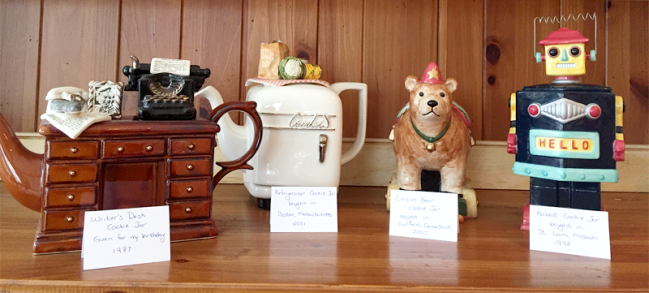
CPB - Cookie Jar Museum (2)

Create a Museum Exhibit

Every item has a story. Is there a funny anecdote behind that knick-knack on the shelf? Does your favorite serving dish hold sentimental value? A fun and educational way for kids to learn family stories and interact with their own history is to create a museum exhibit of objects in your home.

For teachers this can be a fun classroom activity that incorporates writing, art, and speaking, and categorizing skills. Students can use objects in the classroom or bring items from home to set up museum exhibits. This activity can be done as a whole-class project or by smaller groups, who then present their exhibit to the rest of the class.

Supplies

  • A number of household or classroom items
  • Paper or index cards
  • Markers
  • A table, shelf, or other area for display

Directions

  1. To get started have children gather a number of items from around the house to be the subjects of their exhibit. An exhibit can have a theme, such as Grandma’s China or Travel Souvenirs, or it can contain random items of your child’s choice, such as toys, plants, tools, even the furniture they see and use every day.
  2. Using the paper or cards and markers, children can create labels for their exhibit items. Older children will be able to write the labels themselves; younger children may need adult help.
  3. Spend a little time relating the story behind each object: where it came from, how long you’ve had it, when and how it was used in the past, and include any funny or touching memories attached to the item. Or let your child’s imagination run free, and let them create histories for the objects.
  4. When the labels are finished, arrange the items on a table, shelf, or in a room, and let your child lead family members or classmates on a tour. You can even share the exhibit with family and friends on social media.
  5. If extended family members live in your area, this is a wonderful way for your child to interact with them and learn about their heritage.

February 21 – International Mother Language Day

CPB - The Little Rabbit Who Liked to Say Moo

About the Holiday

Established in 1999 by UNESCO, Mother Language Day celebrates cultural diversity and promotes the protection of endangered languages. Events include multicultural festivals where all voices are heard and social cohesion, cultural awareness, and tolerance are honored.

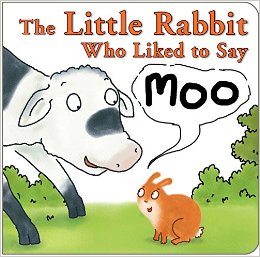
The Little Rabbit Who Liked to Say Moo

By Jonathan Allen


Little Rabbit sits in the farmer’s field listening to the animals talk and learning their languages. “Moo,” Little Rabbit repeats, “Moo.” A calf responds and questions Little Rabbit. It turns out that Little Rabbit knows and likes many languages. Calf joins Rabbit in the fun. “Baa,” they say together, which summons Lamb. The three friends decide to try “Oink.” With each new noise, the group expands and enthusiastically continues their linguistic experiment. Finally, after a rousing chorus of “Quack,” Duckling asks if quack is their favorite animal sound. Each animal then reveals with pride that, while they like other noises, they prefer their own. But what about Little Rabbit, who doesn’t “have a big noise?” Will Rabbit’s answer begin the game again?

The wide-eyed, smiling animals in this adorable picture book by author-illustrator Jonathan Allen perfectly captures the joyous camaraderie of good friends discovering the world together. The book is a wonderful introduction for young children to the ideas of inclusiveness and self-esteem. Kids will love the repetition as each new animal joins the group, and will have as much fun saying each sound as Little Rabbit and the other farmyard friends.

Ages 2 – 6

Boxer Books Limited, 2008  ISBN 978-1910126257

International Mother Language Day Activity

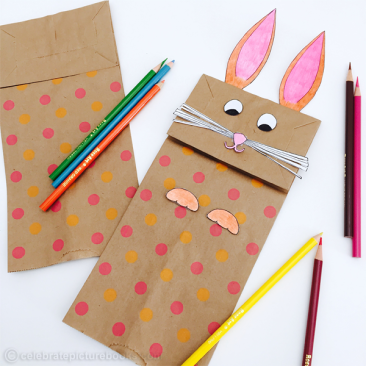
CPB - Rabbit Puppet made

Make a Rabbit Puppet

Supplies

  • Rabbit Puppet Template
  • A paper lunch bag
  • Markers, crayons, or colored pencils
  • Cotton Ball
  • Scissors
  • Glue or tape

Directions

  1. Print the Rabbit Puppet template.
  2. Color the parts of the rabbit and cut them out.
  3. Place the flat paper bag on a table with the bottom flap facing you. Glue or tape the eyes, and the nose and whiskers to the bottom flap. Attach the ears, placing the tabs behind the top of the bottom flap. Attach the paws to the body below the bottom flap. Attach the cotton ball tail to the opposite side of the bag.  
  4. When it’s dry, use your puppet to read The Little Rabbit Who Liked to Say Moo again and play along. Let your Little Rabbit try saying “Hi” in the languages below.

Learn to Say “Hello” in Other Languages

  • Spanish: Hola (oh-la)
  • French: Bonjour (bon zhur)
  • German: Hallo (hă-lo)
  • Chinese: Nin Hao (nee hah)
  • Filipino: Kamusta (ka-muh-stah)
  • Italian: Ciao (chi-ow)
  • Japanese: Kon’nichiwa (ko-nee-chee-wah)
  • Turkish: Merhaba (mĕr-hah-bah)


February 20 – National Cherry Pie Day

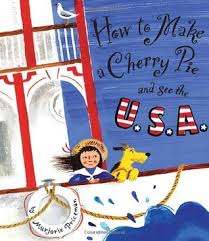
How to Make a Cherry Pie and See the U.S.A. picture book review

About the Holiday

Today we celebrate a most delicious day! It’s hard not to love pie with its flaky crust and sweet filling. Pies have been served since ancient days, originating with the Romans who, like our own English and American ancestors, discarded the crust before eating it (didn’t they know what they were missing?).

Here are a few rather surprising facts about pie

  • Early pies were mostly made of meat, poultry in particular. The legs of the bird were often left to hang over the side of the dish and used as handles (is this what’s called “getting a leg up”?).
  • Fruit pies probably originated in England in the 1500s.
  • We have the bakers for Queen Elizabeth I to thanks for the first cherry pie.
  • Pie was introduced to America by the first English settlers. It was baked in long narrow pans that the settlers called “coffyns” after pie crusts in their native country.
  • During the American Revolution the term coffyn was changed to “crust” (“Those pesky Redcoats! We don’t want our words to be like theirs!”)

To celebrate today’s holiday, enjoy a slice of cherry pie, read this book, and have fun with the puzzle!

How to Make a Cherry Pie and See the U.S.A.

By Marjorie Priceman


In this clever recipe/travelogue combination, Marjorie Priceman takes children on a tour of the United States as they gather the materials to make the tools needed to bake a cherry pie. Sure, it’s easy to buy the bowls, spoons, pie pan, baking sheet, pot holders, and other items required, but where do these things really come from?

With each page kids will vicariously travel across the country with the young baker as she visits Pennsylvania and Ohio for coal to make baking sheets, Mississippi for the cotton needed to sew pot holders, New Mexico for potting clay, and Washington, Hawaii, New Hampshire, Texas, and other states in her pursuit of materials. Along the way, they will learn fun facts about the states and what makes each one special.

The girl joins people playing and working at all kinds of job as she journeys by boat, plane, car, and bus in Priceman’s vibrant and engaging illustrations. Each state is depicted with its unique characteristics, and Priceman has included so many details that kids will love lingering over each page. Curious kids may want to explore more about the subjects they discover in this creative picture book.

Ages 5 – 8

Dragonfly Books, 2013 | ISBN 978-0385752930

Cherry Pie Day Activity

CPB - Cherry Pie Match

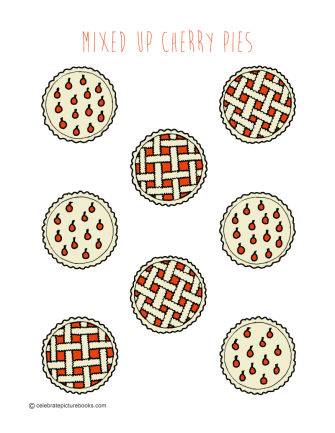
Mixed Up Cherry Pies Matching Game

You baked 8 cherry pies for the Cherry Pie Day Festival – 2 of each crust pattern. But they got mixed up! Can you connect the matching cherry pies? Print the Mixed Up Cherry Pies Matching Game Template and draw a line between the matching pies. 

February 19 – Bird Feeding Day

National Geographic Kids Bird Guide of North America picture book review

About the Holiday

Today we take time to remember our feathered friends who may have a difficult time finding food during the winter months. Hanging a bird feeder in your yard can bring many hours of entertainment and enjoyment as you get to know the birds in your area and see many of the same birds come back again and again—often with their little ones during the spring!

National Geographic Kids Bird Guide of North America

By Jonathan Alderfer


If you’re looking for a book to learn about the birds in your own backyard or across the country, it’s hard to beat the National Geographic Kids Bird Guide! The prominent birds from 10 habitats in North America are discussed in detail, with amazing close-up action photographs from some of the top nature photographers in the country. Major profiles of the most common birds in a region include information on basic facts, a map and the environment in which they’re found, the sounds they make, food they eat, body parts and what they are used for, nesting behavior, and fun trivia. Mini profiles highlight other birds seen in each area.

The Guide also includes instructions on many how-tos, such as making a bird feeder, making a bird bath, bird watching, building a nest, drawing birds, protecting birds and their environment, and more. There is also a glossary and a list of print and website resources for budding birders.

Ages 7 – 10

National Geographic Kids Books, 2013 | ISBN 978-1426310942

Bird Feeding Day Activity

CPB - Bird Feeder I (2)

Pinecone Birdfeeder


Making a pinecone bird feeder is a quick, fun way to nourish your backyard friends! Here are some simple directions for making your own!

Supplies

  • Large pinecone
  • Vegetable shortening
  • Birdseed
  • String
  • Knife or popsicle stick
  • Spoon
  • 2 Bowls

Directions

  1. Tie a length of string around one of the top layers of pinecone leaves and knot it to make a loop for hanging.
  2. Spoon about 1/3 cup of vegetable shorting into a bowl
  3. With the knife spread the shortening over the leaves of the pinecone, covering it completely.
  4. Pour birdseed into a bowl
  5. Roll the pinecone in the bowl of birdseed, patting seed into the crevices and around the sides.
  6. Hang your pinecone birdfeeder on a branch or pole and watch the birds enjoy it!

February 18 – National Battery Day

Using Batteries Picture Book review

About the Holiday

While not an official holiday, National Battery Day is a great time to think about how these small, ubiquitous power cells have changed and improved our lives, allowing us to take our gadgets and our necessities wherever we go. Batteries themselves may be relatively new, but the idea may have been around for 2,000 years. In 1936 archaeologist Wilhelm Konig unearthed a clay jar from a Parthian tomb that held an iron rod encased in copper that may have been used to electroplate gold onto silver.

It was Benjamin Franklin (of course it was!) who coined the term “battery” in 1748 to describe an array of charged glass plates. The word “volt” or a battery’s electric potential comes from Alessandro Volta, who in 1800 generated electrical current by layering silver, a material soaked in salt or acid, and zinc. William Cruickshank, an English chemist, advanced this method, and in 1802 created a battery for mass production. The first commercially available battery was introduced in 1896 by the company now known as Eveready, and we were off and charging!

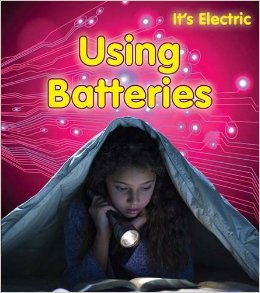
It’s Electric Series: Using Batteries

By Chris Oxlade

Batteries—those things that make our our cars run, our TV remotes change channels, our little book lights glow, and so much more—are part of our lives from the very beginning, when they’re required (but not included) for our favorite toys. But how many of us really know how they work? This little book explains to children in simple and easily understood language how batteries store and use electricity to fuel many of the world’s machines and gadgets.

Large photographs accompany the text and clearly demonstrate the concepts. Children will learn about using batteries, how batteries work in circuits, the different battery shapes and sizes, battery materials, rechargeable batteries, battery safety, portable power, and more!

For kids interested in electricity – and batteries in particular – theIt’s Electric series of books is a great place to start learning!

Battery Day Activity

Connect the Battery Puzzle

CPB - Battery Day maze

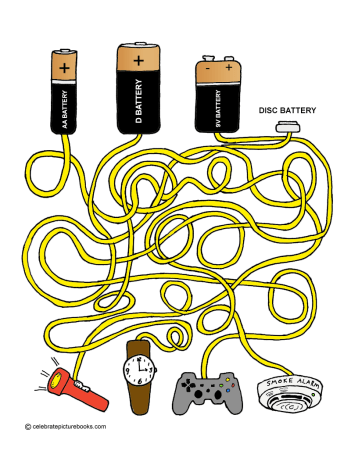
Hmmm…The flashlight, watch, video game controller, and smoke detector are all broken! Can you find which battery goes into which object to make them work again? Print out the Connect the Battery puzzle here.

February 17 – Random Acts of Kindness Day

celebrate-picture-books-picture-book-review-ordinary-mary's-extraordinary-deed-covers

About the Holiday

Random Acts of Kindness Day originated in New Zealand, where the holiday is celebrated nation wide every September 1st. In the U.S. the popularity of this day continues to grow, as people discover the pleasure of doing nice things for friends and strangers alike. Connecting with others and paying forward kind deeds can be infectious, making the world a better place for all!

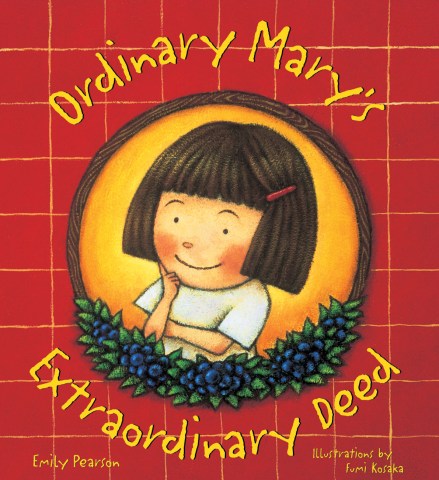
Ordinary Mary’s Extraordinary Deed

Written by Emily Pearson | Illustrated by Fumi Kosaka

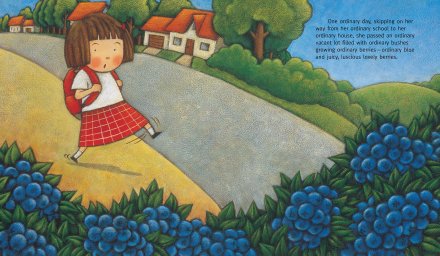
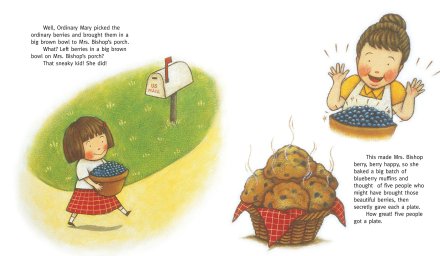
One day an ordinary girl named Mary begins her ordinary day. On her way home she spies ordinary blueberries in a field and picks them. She knows Mrs. Bishop would like them, so Mary leaves them in an ordinary bowl on her porch. Mrs. Bishop is so happy with the berries that she uses them to make blueberry muffins. But who gave her the blueberries? Mrs. Bishop can think of five people who might have, and she divides the muffins between them.

celebrate-picture-books-picture-book-review-Ordinary-Mary's-Extraordinary-Day-blueberries

Image copyright Fumi Kosaka, 2002, text copyright Emily Pearson, 2002. Courtesy of Gibbs Smith.

One of the five is Mrs. Bishop’s paperboy. He is so delighted with the muffins that he kindly hand delivers the newspapers to the next five people on his route. One of these is Mr. Stevens, who is so happy he spends the next 10 hours smiling on an airplane and helps five people lift heavy bags.

celebrate-picture-books-picture-book-review-Ordinary-Mary's-Extraordinary-Day-mrs-bishop

Image copyright Fumi Kosaka, 2002, text copyright Emily Pearson, 2002. Courtesy of Gibbs Smith.

One of these is Maria, who later does nice things for five other people. One of these cheers up the next five people she sees, who in turn brightens the day of five people. By now these random acts of kindness have spread through town and farther. People everywhere are watching out for others, being generous, smiling, becoming friends, and more! And in a surprising happenchance, ordinary Mary’s original act of kindness comes back to her!

celebrate-picture-books-picture-book-review-Ordinary-Mary's-Extraordinary-Day-joseph

Image copyright Fumi Kosaka, 2002, text copyright Emily Pearson, 2002. Courtesy of Gibbs Smith.

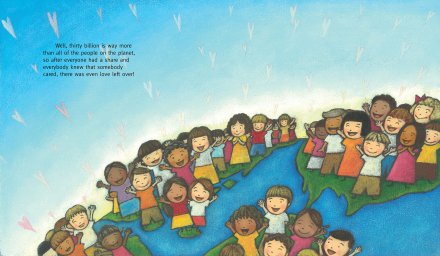
What Mary doesn’t know, though, is that her extraordinary deed actually changes the whole world for the better—because each person touched by kindness shares it with five others, who share it with five more until the one act of leaving blueberries on Mrs. Bishop’s porch multiplies to 6 billion other people!

celebrate-picture-books-picture-book-review-Ordinary-Mary's-Extraordinary-Day-world

Image copyright Fumi Kosaka, 2002, text copyright Emily Pearson, 2002. Courtesy of Gibbs Smith.

Emily Pearson’s story is a delightful tale of how one person can make a positive difference in the lives of others. The thread of simple deeds shared from one character to the next demonstrates to young and old alike how just a smile, a compliment, or an unexpected act can transform another person’s day and even the way they view themselves and the world. This is a perfect book for spurring random acts of kindness, and its straightforward treatment of the way random acts build on each other makes it a great reminder for all ages.

Fumi Kosaka has populated Mary’s world and beyond with people whose wide smiles and twinkling eyes make you want to share the excitement of giving right along with them. Her simple, colorful drawings focus on the people affected and highlight the simple acts that bring them so much pleasure.

Ages 4 and up

Gibbs Smith Publishers, Reprint edition, 2017 | ISBN 978-1423648871 Paperback

Random Acts of Kindness Day Activity

CPB - Random Acts of Kindness cards

Random Acts of Kindness Cards to Share

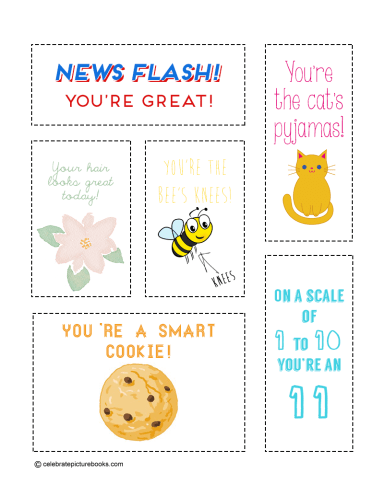
It’s fun to surprise someone with an unexpected gift or compliment! It makes the other person and you feel happier! Here are some printable Random Acts of Kindness Cards that you can give to anyone you meet today—or any day. If you’d like to write your own, here is a set of Blank Cards. You can give one to your teacher, librarian, favorite store clerk, your postal worker, your neighbors and friends, the person next to you on the bus or train. Or why not brighten someone’s day by leaving a note where they might find it—in a book at the library or bookstore, in a friend’s lunchbox, in your mailbox, on a store shelf, or anywhere you go!

Picture Book Review

February 16 – Innovation Day

CPB - Girls Think of Everything Innovation Day

About the Holiday

Today we celebrate all those people who look at a problem and design a solution, or who just ask, “What if…?” and search for answers. So put on your thinking cap, look around you, and do something new, novel, and completely unexpected. Who knows…you may be the next great inventor!

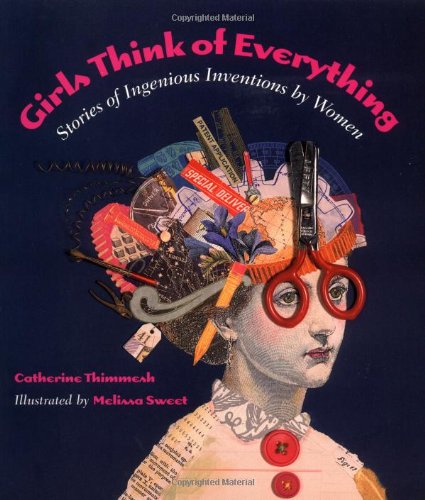
Girls Think of Everything: Stories of Ingenious Inventions by Women

Written by Catherine Thimmesh | Illustrated by Melissa Sweet


Throughout history women have invented new and clever ways of doing things—necessity is the Mother of invention, after all. In her fascinating picture book, Catherine Thimmesh highlights ten women and two girls whose creativity has changed the world.

Here, you’ll learn the intriguing stories behind each invention, the struggles for recognition, and the ultimate victory of innovation. Did you know that the original recipe for chocolate chip cookies was just a time-saver? Or that people once thought windshield wipers weren’t necessary? You’ll also discover how liquid paper, flat-bottomed paper bags, and the Glo-sheet came to be. Women in science have contributed Kevlar, Scotchgard, the COBOL computer language, and the space shields that protect the International Space Station, satellites, and more.

Catherine Thimmesh is an excellent storyteller, drawing you into the actions and minds of these women innovators and the situations or environments that fostered their talents. Melissa Sweet accompanies each profile with portraits of the inventor and colorful collage illustrations that build on the text and tell stories of their own.

Ages 7 – 12

Houghton Mifflin Company, Boston, 2000 | ISBN 978-0618195633

Innovation Day Activity

CPB - Invention Word Scramble

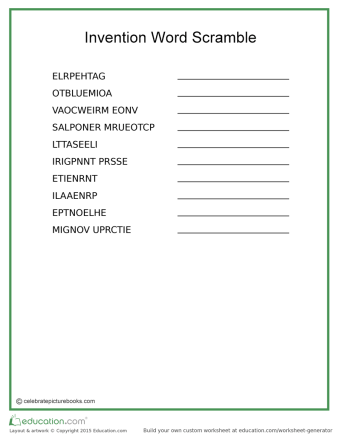
Invention Word Scramble


Every invention started out as a jumble of ideas in someone’s head. In this Invention Word Scramble you can unscramble the letters of some of the world’s greatest creations. Solutionincluded. Odog cklu!