June 25 – National Day of Joy

About the Holiday

Established by Comfort Keepers, who offer uplifting in-home care for seniors, The National Day of Joy encourages everyone to look for simple moments and expressions of happiness in daily life. Cheerful smiles and greetings, random acts of kindness, upbeat moods, and general positivity can affect not only immediate interactions but can change our moods and improve our health. To honor the day and the idea, find ways to start each morning with a positive attitude for the day to come. Need ideas for how to get started? Say “Hello” to those you meet, listen to and encourage others, happily help out where needed, send a surprise letter, card, or text to a friend or family member far away. And, of course, doing something fun with your kids always makes the day better. Oh! And don’t forget to treat yourself too! When you feel good, those around you will respond in kind!  

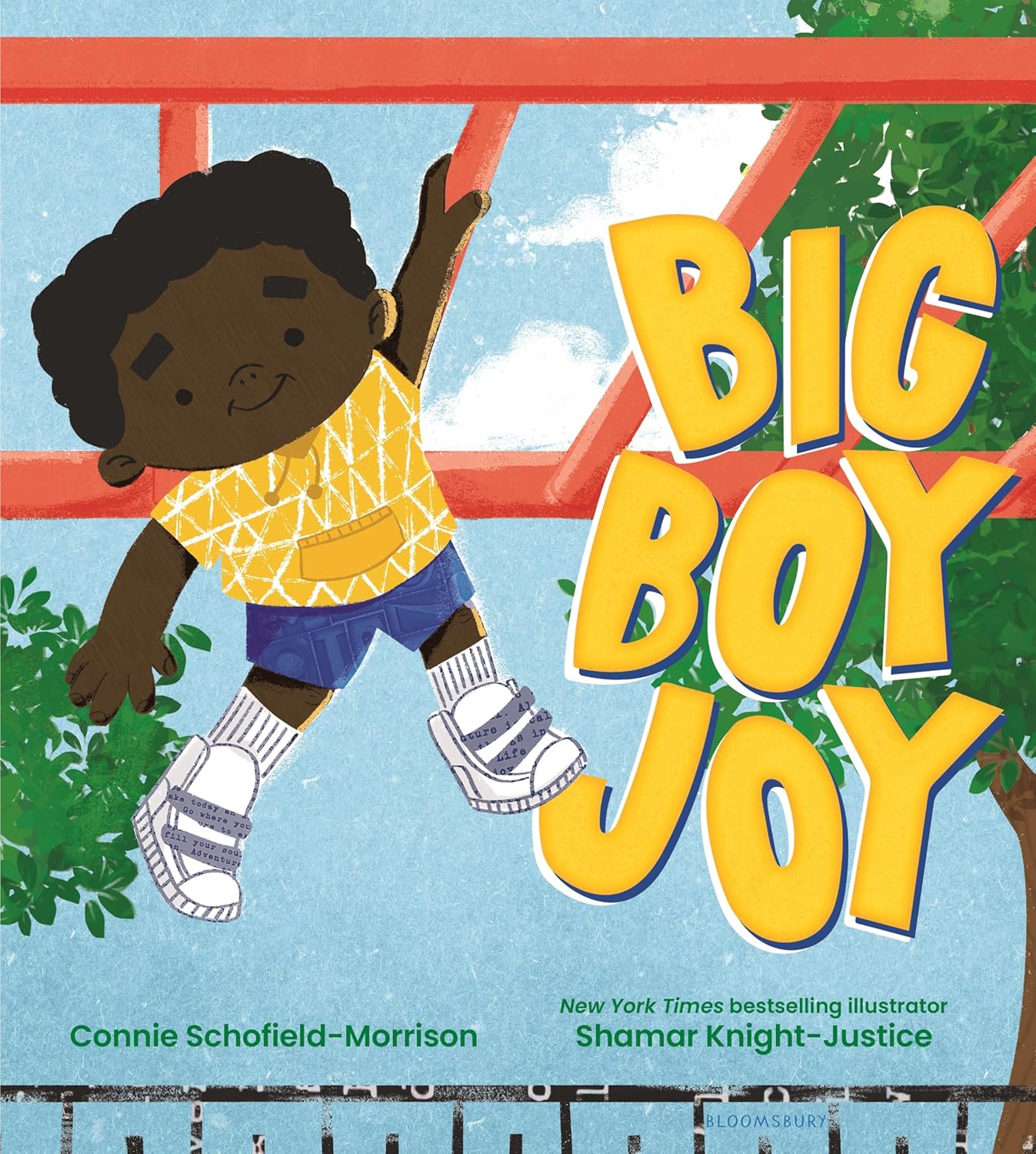
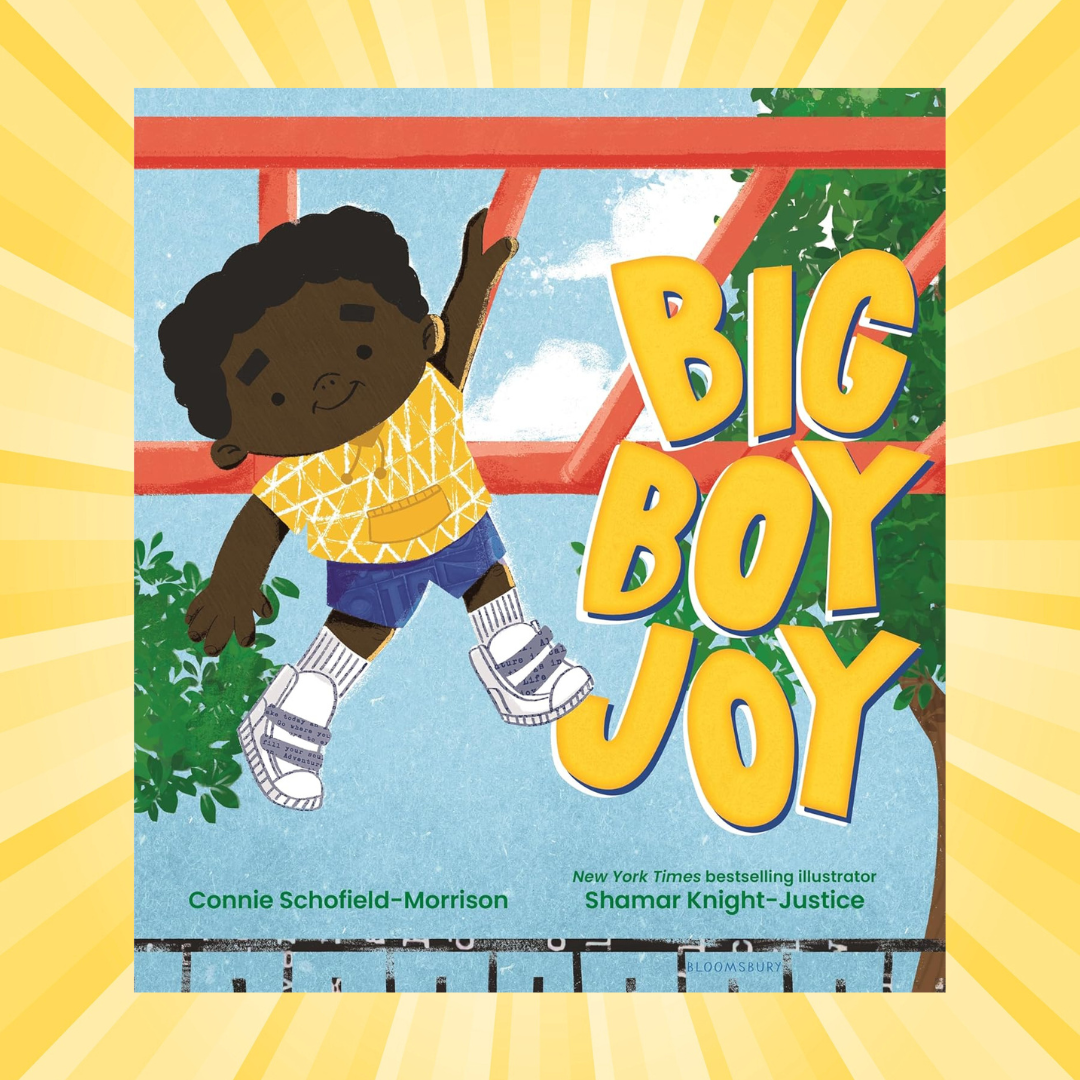
Big Boy Joy

Written by Connie Schofield-Morrison | Illustrated by Shamar Knight-Justice


It’s playground time, and the little boy who’s about to conquer the slide and the swings, unexpectedly make a new friend, and use his skills introduces himself: “I am a BIG boy.” As he tears down the sidewalk, he demonstrates—”I can run FAST. I can walk SLOW. I can climb HIGH! I can Go! Go! GO!”  Slipping down the slide, too fast to stop, he crashes into another boy walking by with a basket of dinosaurs. They both go tumbling, the dinos spilling out. 
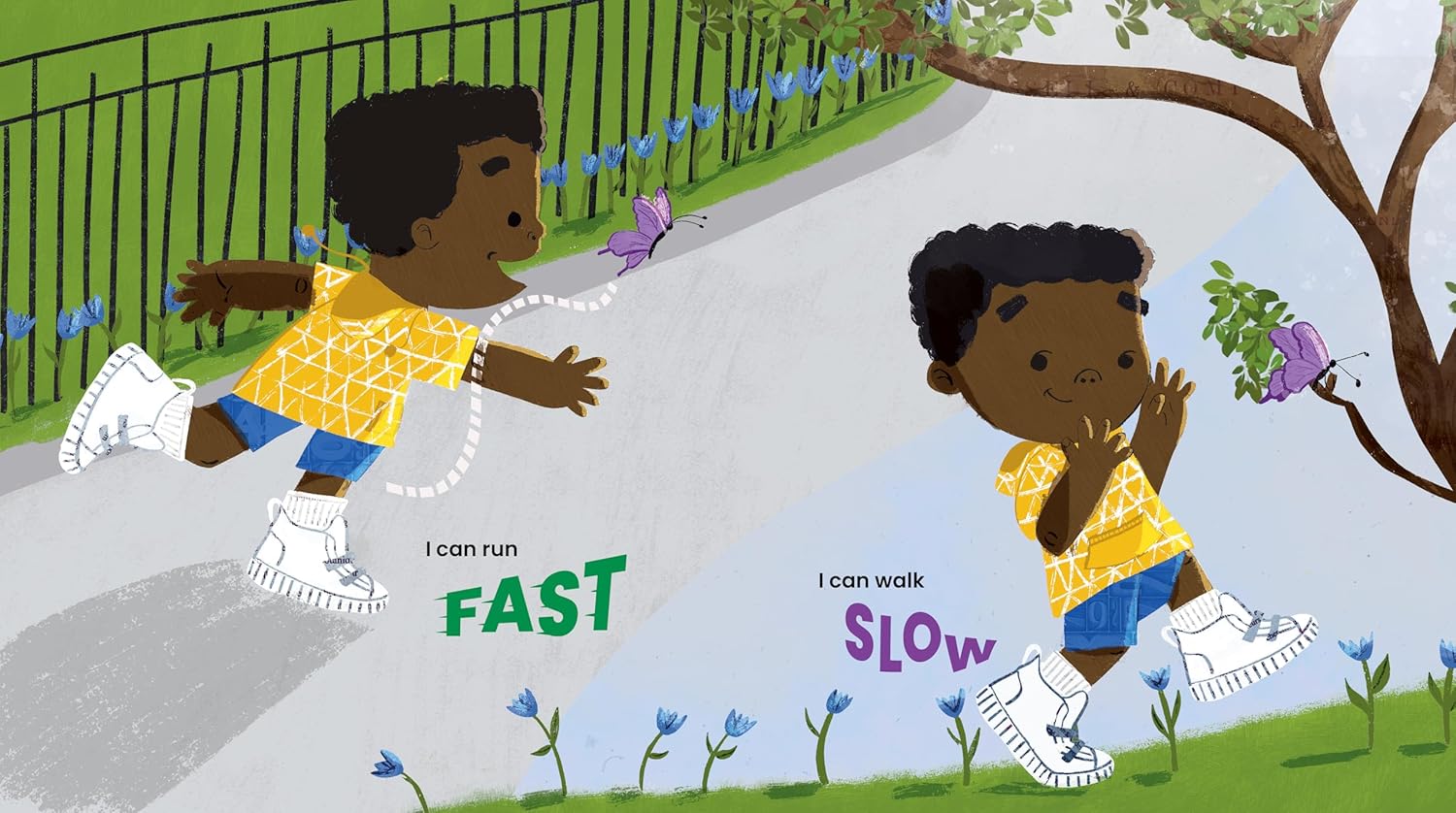
Illustration © 2025 by Shamar Knight-Justice, text © 2025 by Connie Schofield-Morrison. Courtesy of Bloomsbury Children’s Books.

The boy cries, but he’s also a big-enough boy to apologize and turn the accident into an opportunity to make a new friend. The two play—”RAWR, RAWR”—with the toys, they “STOMP and CLOMP.” The two move to the sandbox for a “CRASH and SMASH” demolition derby with their trucks, and when a wheel comes off: “I can fix. TWIST and TURN TA-DA!”

But the day’s not over, these fast friends share snacks, play chase, and swing “right into space!” Dad waves. It’s time to leave, with a high five between the boys and a promise to play again. 
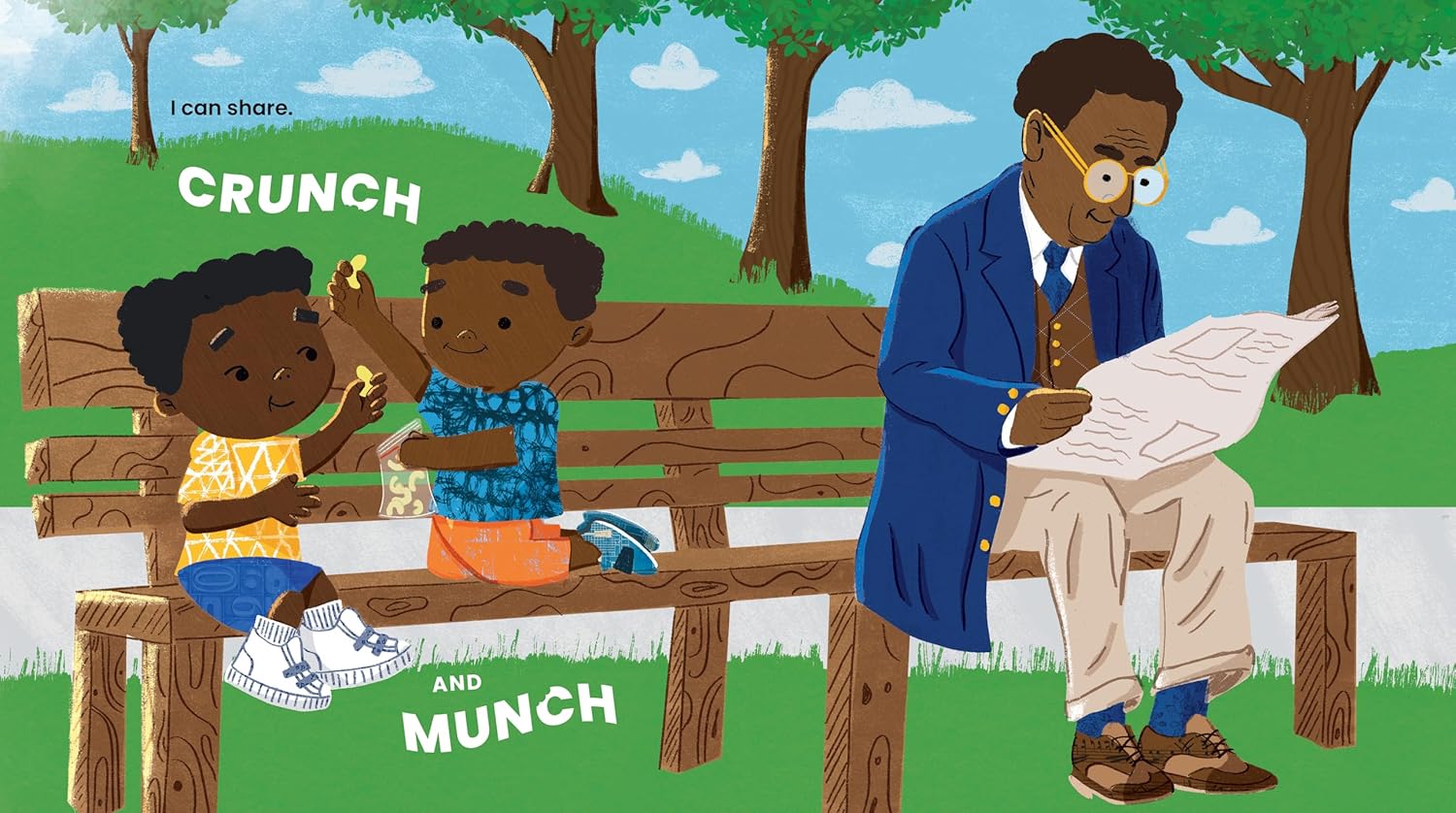
Illustration © 2025 by Shamar Knight-Justice, text © 2025 by Connie Schofield-Morrison. Courtesy of Bloomsbury Children’s Books.

Connie Schofield-Morrison infectious ode to boyhood and unfettered play is a joyous read aloud, with vivacious rhymes full of personality and pride in what the narrator can do. From releasing all that big-boy energy to turning a crash-bang mishap into friendship to exhibiting ingenuity and manners, Schofield-Morrison’s young child shows just what it means to be a “big boy.”

Emerging and new readers will love being able to read the story on their own, and younger children will quickly catch on to chiming in on all of the high-spirited onomatopoeic words. The story is also perfect for acting out for rambunctious story times.

Shamar Knight-Justice’s young child brims with happiness and excitement as he tackles the playground; shows an awareness of others and their feelings; and races, chases, tumbles, and climbs a slide ladder so tall you have to turn the book sideways! Vivid primary colors, dynamic typefaces, all the big-kid equipment that makes a playground so enticing, and two boys who know how to roar, stomp, kerplunk, share, and have fun together shine from the pages.

Big Boy Joy is a lively read aloud that will capture the hearts of kids and adults alike and will quickly become a much-asked-for favorite for home bookshelves and library collections. 

Ages 3 – 5 (and up for newly independent and emerging readers)

Bloomsbury Children’s Books, 2025 | ISBN 978-1547611515

About the Author

Connie Schofield-Morrison captured the rhythm of the neighborhood in her first picture book, I Got the Rhythm, and again in I Got the Christmas Spirit and I Got the School Spirit. She is also the author of the picture book biography Stitch by Stitch: Elizabeth Hobbs Keckly Sews Her Way to Freedom. Connie has been writing since she was a young girl and is inspired every day by the big sounds and bright colors of the world around her. She lives in Atlanta, Georgia. Visit her on Instagram.

About the Illustrator

Shamar Knight-Justice is an illustrator based in Atlanta, Georgia. He grew up with a crayon in his hand and a love for patterns. He currently serves as the principal of an elementary school in Southwest Atlanta, where his scholars’ stories and personalities inspire him to create illustrations that honor their identities. When not drawing, Shamar loves to spend time hoarding collage materials, going on long walks with his family, and devouring the nearest pancake. Visit him at shamarknightjustice.com.

National Day of Joy Activity
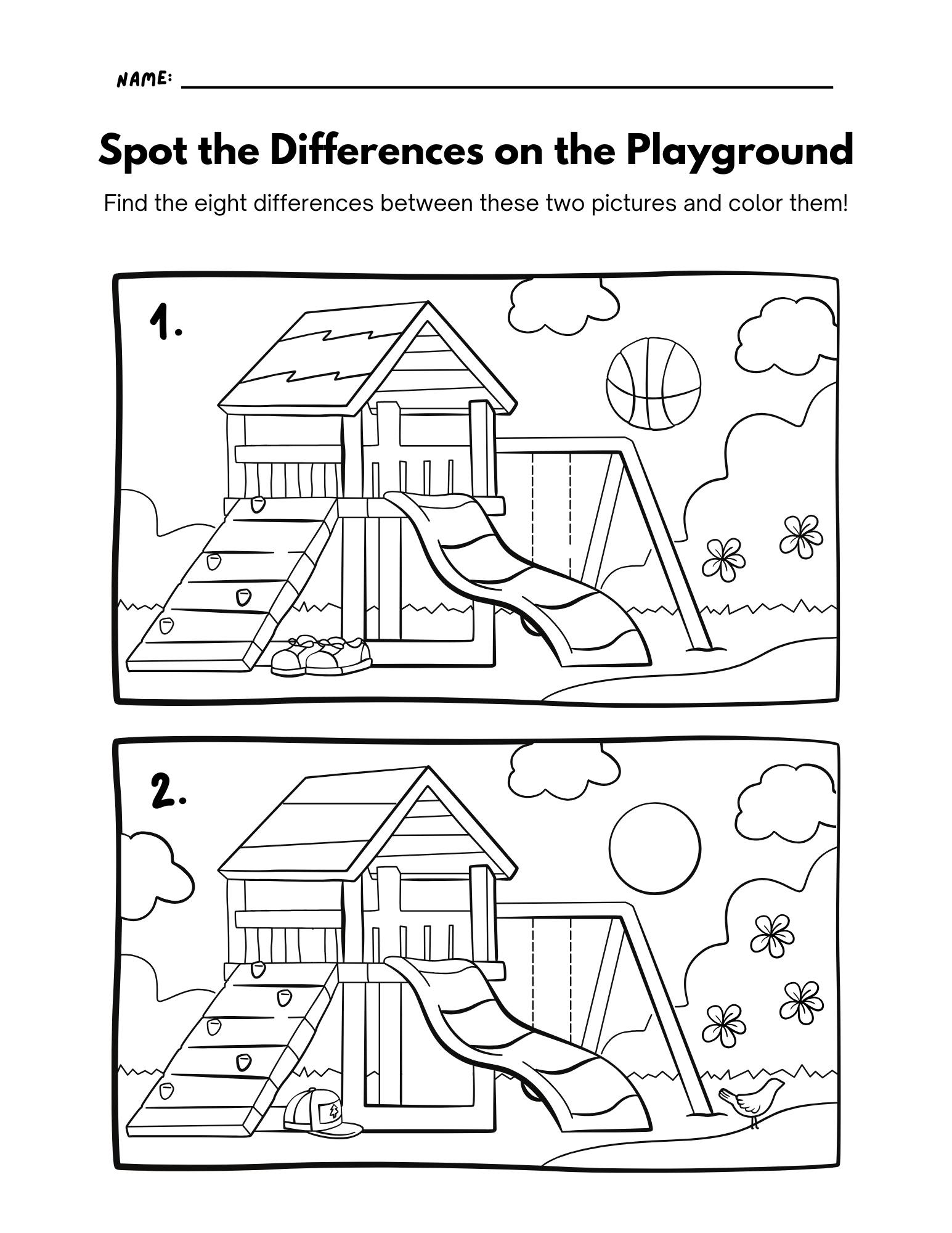
Playground Spot-the-Differences Coloring Page


Search for all of the differences between these two pictures then color the scenes!

Playground Spot-the-Differences Coloring Page
You can purchase Big Boy Joy from these booksellers

Amazon | Barnes & Noble | Bookshop (discounted books and support for your local independent bookstore)

Picture Book Review

April 25 – Disability Book Week

About the Holiday

Disability Book Week encourages individuals all over the world to become more inclusive with what they read by reading a book that features characters with disabilities. It’s easy to participate! Individuals and families can pick up a disability-inclusive book to read. Libraries, schools, and bookstores can create a display of inclusive books. Hosting an author, illustrator, or disabled community member to do a reading is also a great idea. Other ways to help are to leave a review of books you’ve read and to talk about disability inclusion with your family or others. These ideas can all go a long way in raising awareness of how we think about disabilities and interact with people who are disabled.

To learn more about Disability Book Week and find lists of books for kids, teens, and adults as well as resources such as display signs to download, visit disabilitybookweek.org.

Thanks go to Beach Lane Books and Barb Fisch at Blue Slip Media for sharing a copy of this book with me.

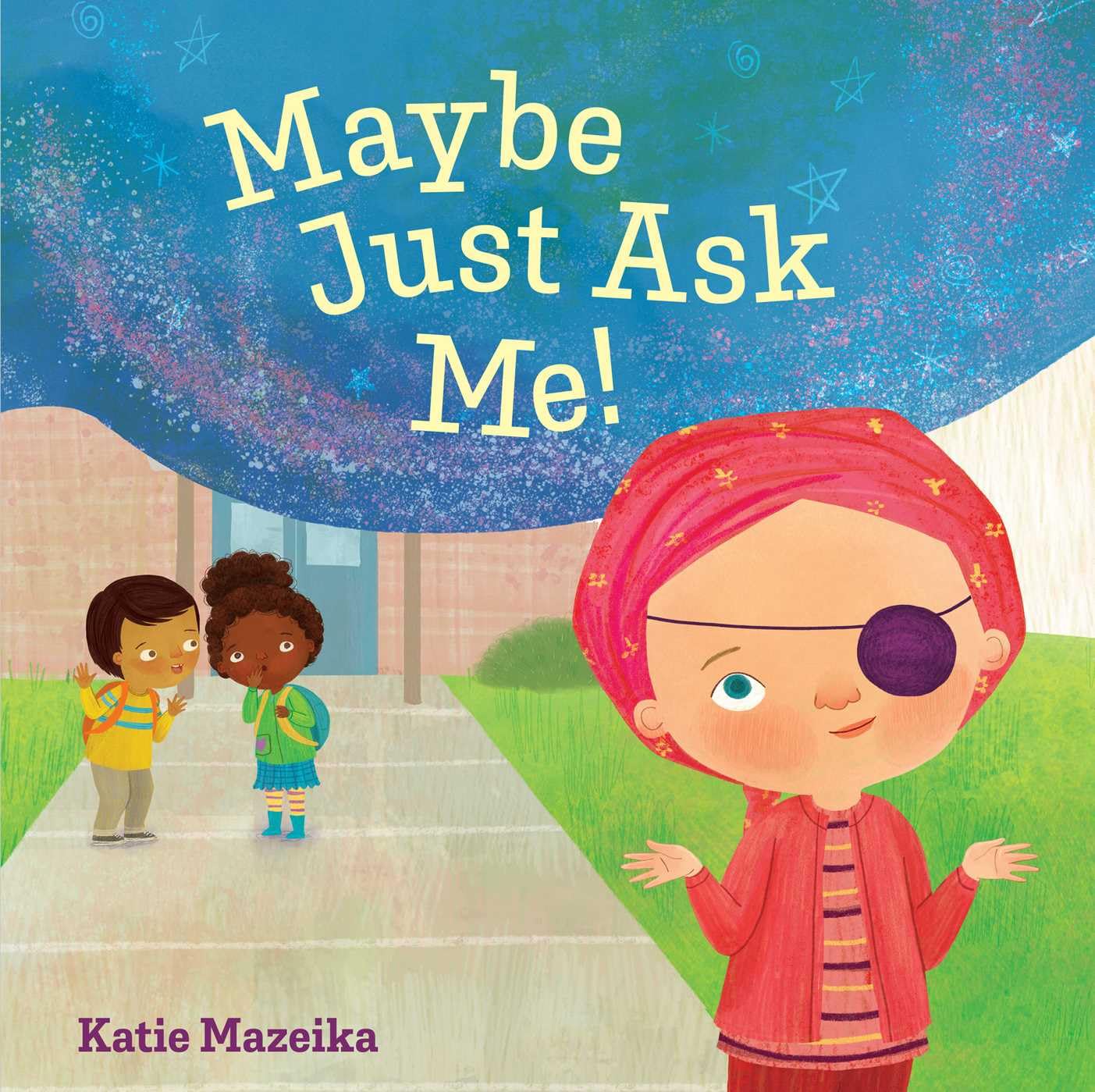
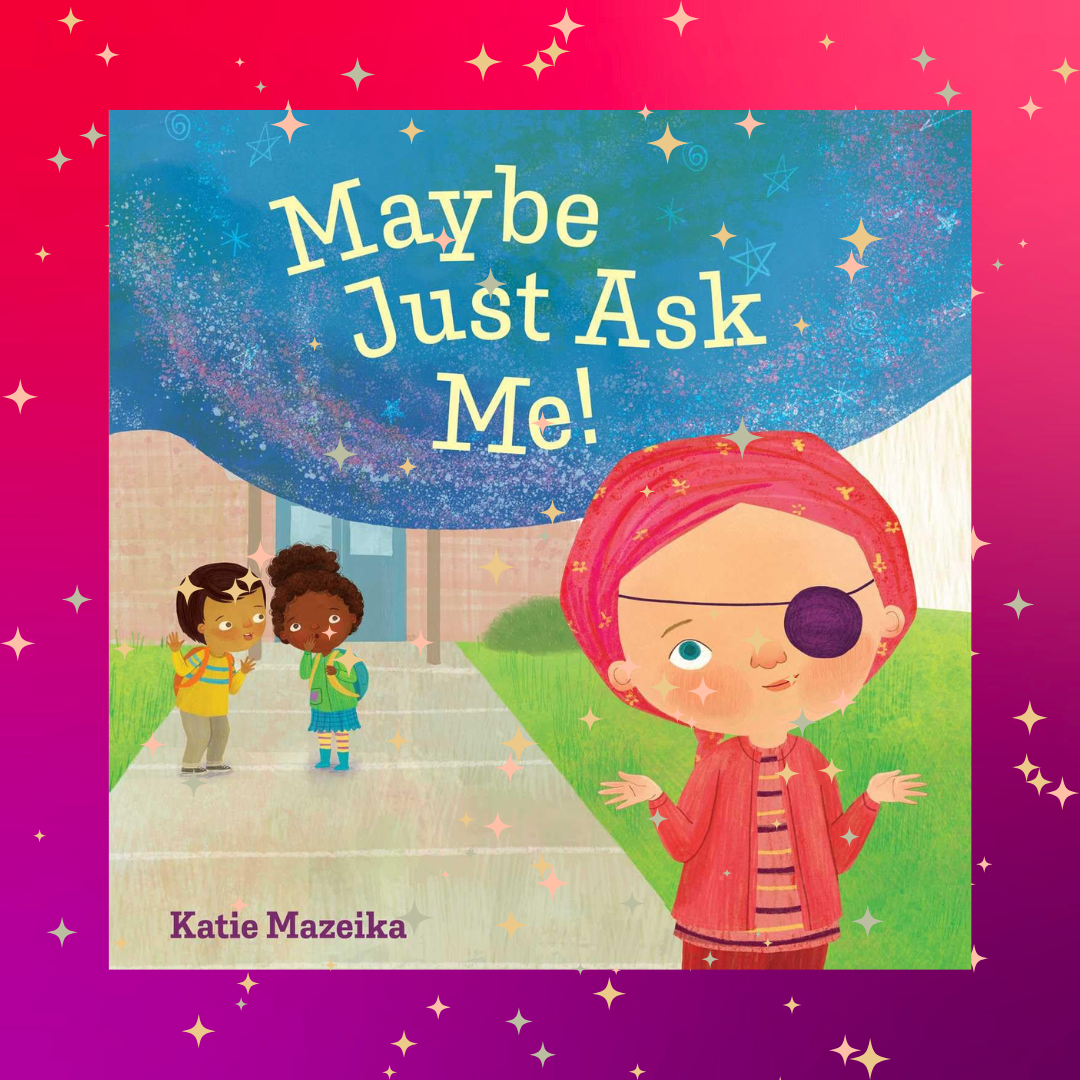
Maybe Just Ask Me!

By Katie Mazeika


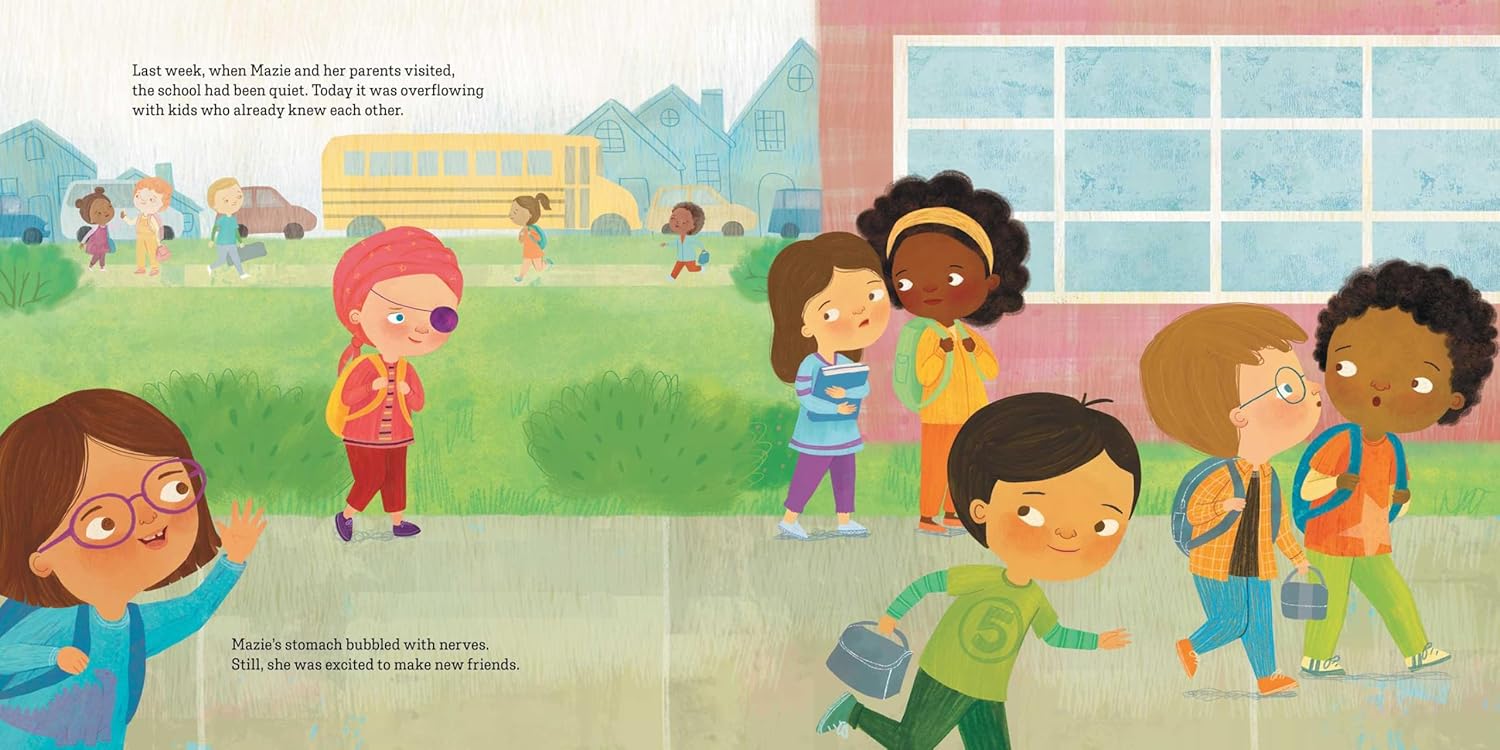
Mazie was starting at a new school, so she “put on her favorite scarf and wore her prettiest eye patch.” As she waved goodbye to her mom and walked into the building with other students, she was happy she’d be able to make new friends. But when she stood in front of her class to introduce herself, the kids’ questioning faces sent her hurrying back to her seat.

Text and illustration © 2025 by Katie Mazeika. Courtesy of Beach Lane Books.

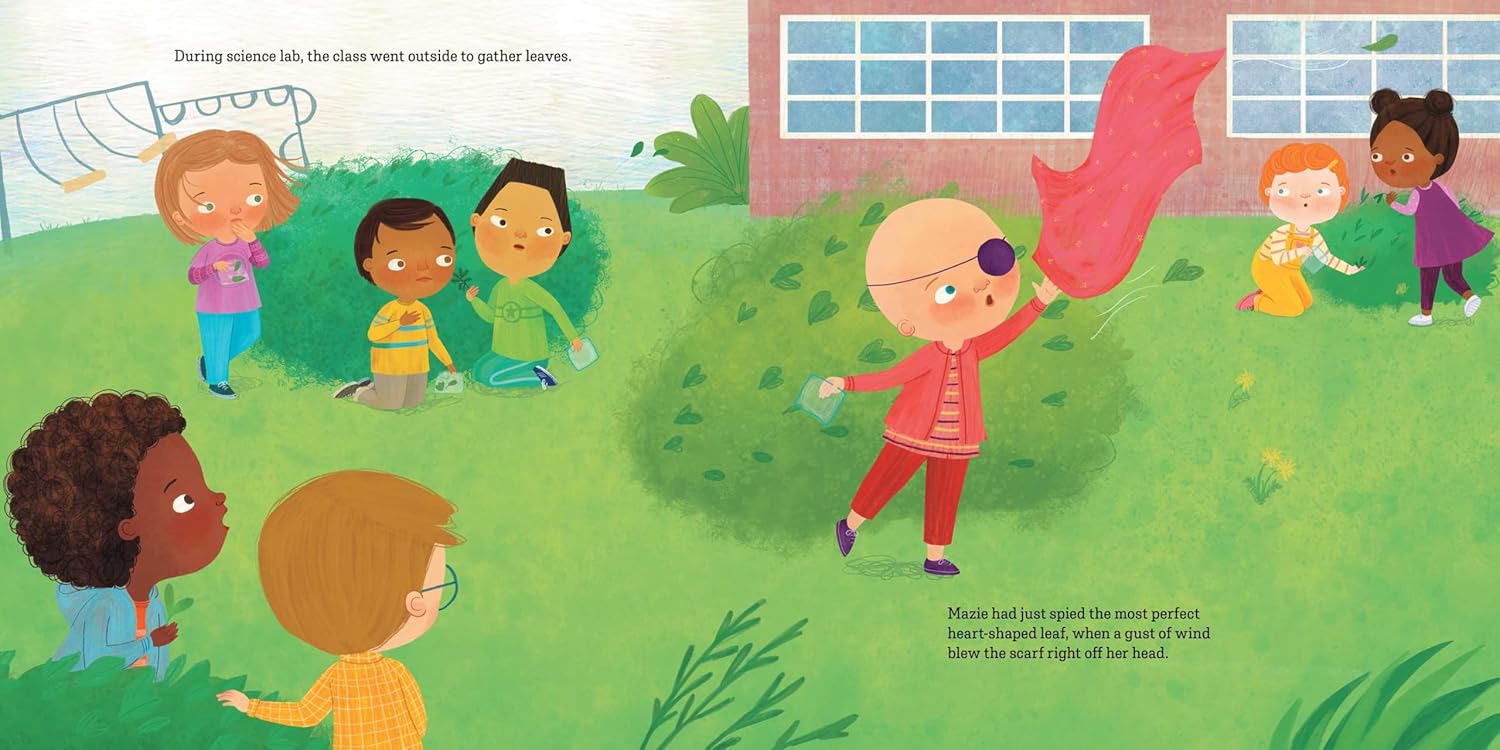
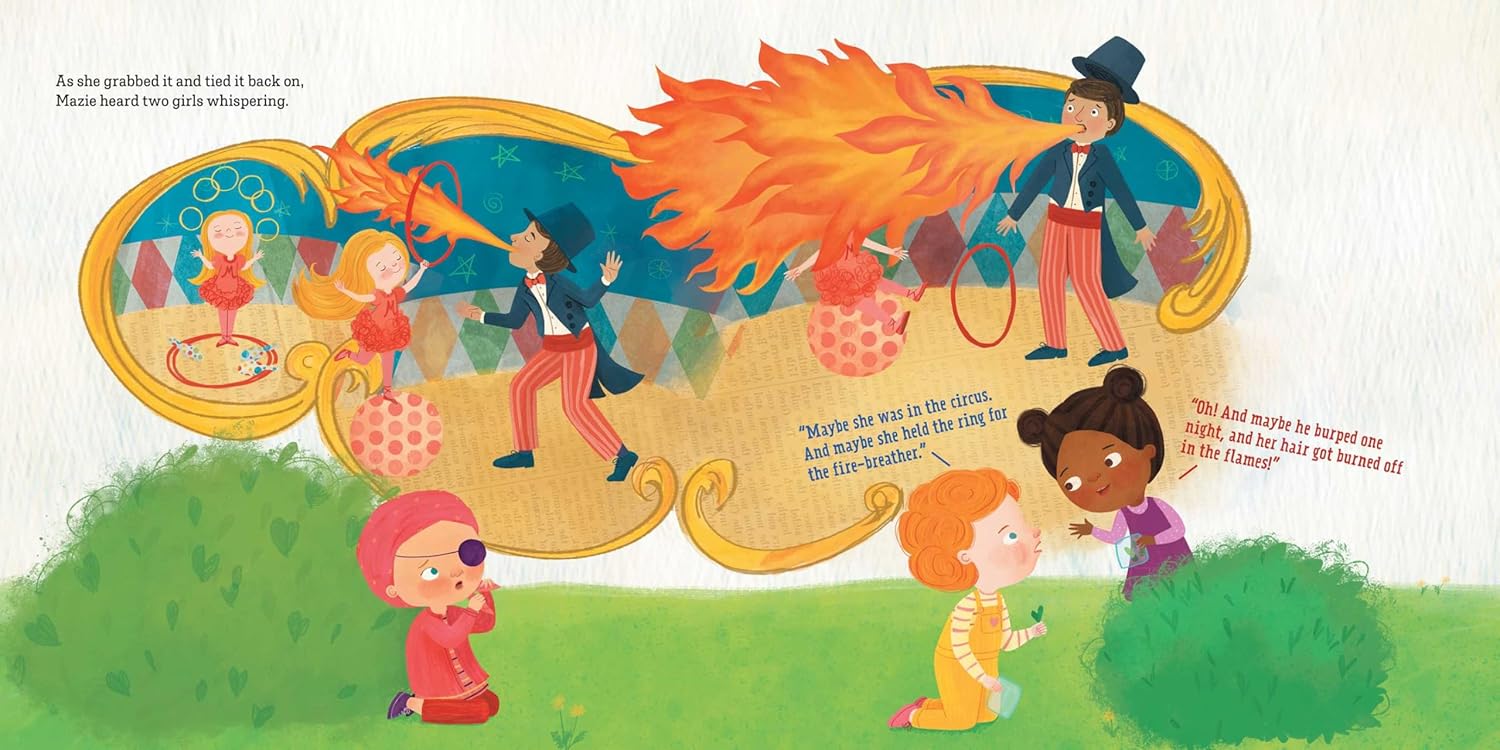
During a science lesson outside, the wind caught Mazie’s scarf and sent it flying, exposing her bald head. While she tied it back on, she heard two of her classmates concocting a fantastical story as to how she’d lost her hair involving a circus and a fire-breathing performer. Before Mazie could say hi, they ran off. Mazie remembered that her dad “had said it might take a few tries.”

So while in line to wash her hands, Mazie tried again, but the boys in front of her were excitedly discussing the possibility that maybe Mazie had joined a “‘pirate crew, and that’s why she wears an eye patch.'” When they finally saw Mazie, they were embarrassed and wouldn’t look at her. At lunch, Mazie felt intimidated to break into the already-established group, especially because they were debating the pirate and circus ideas while creating yet another outlandish story. In fact, everyone had their own theories about what had happened to Mazie. 

Text and illustration © 2025 by Katie Mazeika. Courtesy of Beach Lane Bo

Mazie began to think that no one would ever talk to her, but then she “remembered what she had learned last year” about being brave and not losing hope. So when the class went to the gym for P.E., she talked to the teacher then blew her whistle. When the kids all stopped to look, Mazie took to the bleachers to announce that she’d heard their stories and while she was “as daring as any circus girl” and “fiercer than a pirate,” if they really wanted to know the truth then “‘Maybe just ask me!'”

And the kids did want to know. They sat around her on the bleachers as she told them she’d been sick but that they had “‘never lost hope.'” Her classmates listened and realized that while their ideas had been way off, their new friend Mazie was “pretty brave. And a very good storyteller, too.”

Back matter includes Katie Mazeika’s own story of her experience with cancer at age three, during which she lost her right eye, as well as a discussion encouraging people to ask questions and engage in conversations with those with disabilities that show interest, concern, and kindness. Mazeika says, “. . . when we pretend not to see people with disabilities, we make them feel invisible” and “curiosity, with kindness, should always be allowed.” She also includes a list of how people can be supportive of those with disabilities.

Text and illustration © 2025 by Katie Mazeika. Courtesy of Beach Lane Bo

In her heartfelt autobiographical story about her childhood experience with cancer, Katie Mazeika reveals to readers that not only is it okay to ask someone about their disability, it is welcomed. As Mazie’s classmates in her new school make up elaborate scenarios to explain her bald head and eye patch instead of asking what happened, they unwittingly isolate her from the group. When Mazie is finally able to make her voice heard, however, both Mazie and the class discover that honest dialogue paves the way to long-lasting friendships.

Mazeika’s colorful, textured illustrations are infused with emotion, imagination, and gentle humor that make the story immediately accessible to children. Young readers will feel empathy for Mazie as she bravely walks into a new school, knowing most eyes are on her, and becomes flustered at the front of the puzzled class. Mazeika depicts the kids’ theories in vibrantly detailed scenes, while also showing the impact they have on Mazie. When Mazie gets the chance to tell the real story, her battle with cancer is portrayed in a simple but powerful illustration of her and her doctor facing and dispelling a fire-breathing dragon. The final spread of Mazie surrounded by her new friends is uplifting.

Emphasizing hope, bravery, and empathy Maybe Just Ask Me! is a unique story and a must addition to all school and public library collections, pediatrician offices, and hospital gift shops.

Ages 4 – 8

Beach Lane Books, 2025 | ISBN 978-1665949897

Katie Mazeika is an author and illustrator with a BFA from the Columbus College of Art and Design. When she isn’t in the studio, she likes to spend time at the theater, in her garden, or getting lost in a good book. She is the creator of picture book biographies including Annette Feels Free and Beulah Has a Hunch!. She lives in Ohio with her family and two dogs. To learn more, and download a free curriculum guide, visit her website at katiemazeika.com. You can also find her on Instagram, Facebook, and Bluesky.

Disability Book Week Activity

Text and illustration © 2025 by Katie Mazeika. Courtesy of Beach Lane Books.


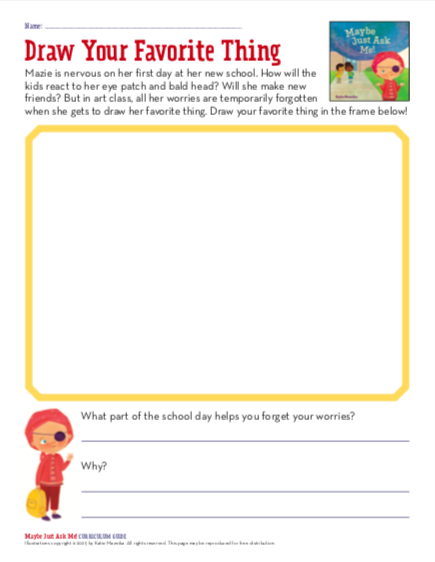
Maybe Just Ask Me! Favorite Thing Activity


This Curriculum Guide for Maybe Just Ask Me! is full of ideas and activities for teachers, librarians and families to interact with the book and engage in some thoughtful drawing and writing about their own lives as well.

You can connect with Beach Lane/Simon & Schuster Kids on Facebook and on their website @simonkids

You can find Blue Slip Media on Bluesky, Facebook, and Instagram. To learn more visit their website @blue_slip_media 
 

You can purchase Maybe Just Ask Me! from these booksellers

Amazon | Barnes & Noble | Bookshop (discounted books and support for your local independent bookstore.

Picture Book Review

January 27 – It’s Celebration of Life Month

celebrate-picture-books-picture-book-review-a-beginners-guide-to-being-human-cover

About the Holiday

Today’s holiday was established by Food for Health International to encourage people to take a holistic approach to taking care of themselves, not only their physical health but their emotional health as well. Celebrating all that life has to offer while taking time to enjoy family and friends and be mindful of others through mutual respect, inclusion, empathy, and gratitude goes a long way towards greater happiness and health. Sharing today’s book with your kids is a wonderful way to celebrate this month-long holiday all year around.

A Beginner’s Guide to Being Human

Written by Matt Forrest Esenwine | Illustrated by André Ceolin


“Welcome to Humanity! You’re really going to enjoy it.” With this expansive greeting, Matt Forrest Esenwine invites kids in to learn what they need to know “… to get the most out of [their] human experience….” First up is family—that group of people who spend so much time with you and “care about you the most.” But what does a family do? “Families love each other, disappoint each other, support each other, and get angry with each other, over and over—sometimes all in the same day. Weird, right?” But you can be sure that the “…whole ‘caring about you’ part never stops.

celebrate-picture-books-picture-book-review-a-beginners-guide-to-being-human-sidewalk

Image copyright André Ceolin, 2022, text copyright Matt Forrest Esenwine, 2022. Courtesy of Beaming Books.

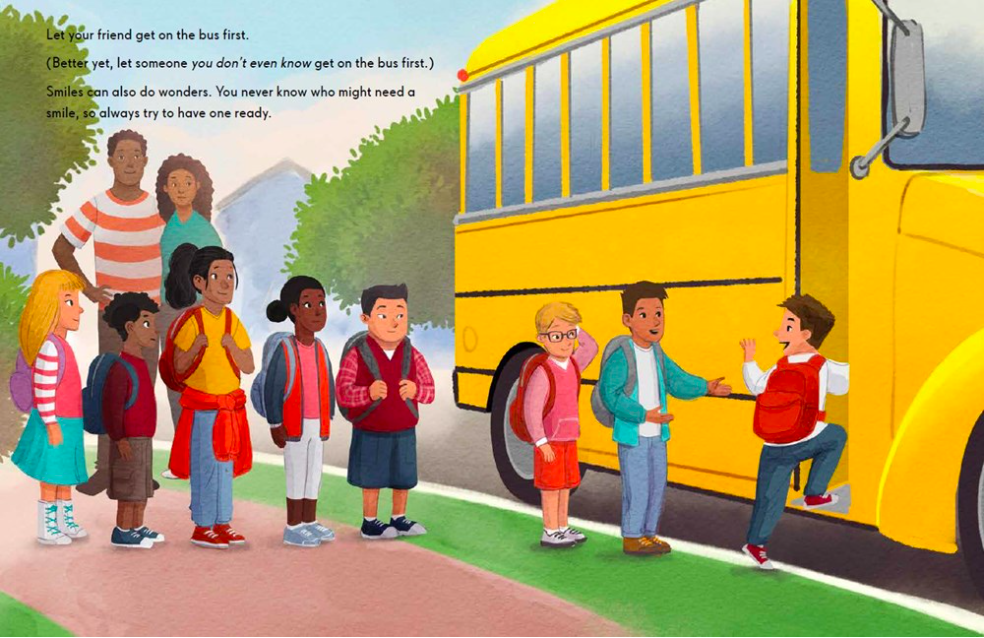
So what do you do with all of that caring that comes your way? You can share it! How? Well, by being kind. Sure, we hear that word all the time, but what does “being kind” really look like? Esenwine and André Ceolin give some easy-to-emulate examples that don’t take any money or super strength or extra time. In fact, everybody carries one of the easiest—maybe even the most meaningful—way to show kindness right on their face: their smile.

celebrate-picture-books-picture-book-review-a-beginners-guide-to-being-human-school-bus

Image copyright André Ceolin, 2022, text copyright Matt Forrest Esenwine, 2022. Courtesy of Beaming Books.

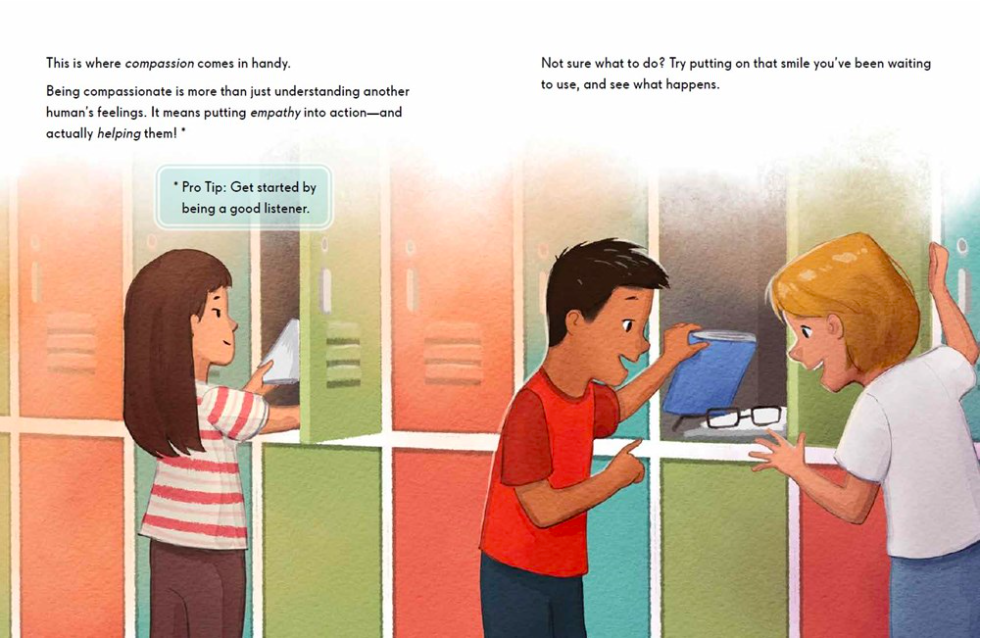
Once kids have kindness down, Esenwine moves on to empathy and urges kids to imagine why others may act the way they do, to think about what else may be going on with someone at home, in school, or elsewhere. Using empathy leads to compassion. What does compassion mean and how does it work? Esenwine and Ceolin show readers a few examples as well as reminding them that “we humans are quite good at ending up in the same situations again and again. Whatever another person is feeling, chances are, you’ll feel the same way at some point too” with a gallery of portraits of kids depicting emotions we all experience from time to time—and, often, every day.

One way of thinking about and reacting to situations that “has produced excellent results for over two thousand years,” Esenwine reveals, is the Golden Rule. He then shows kids how to apply this thoughtful idea to a range of situations to create better communication and understanding than getting angry or pushy or impatient.

celebrate-picture-books-picture-book-review-a-beginners-guide-to-being-human-school-locker

Image copyright André Ceolin, 2022, text copyright Matt Forrest Esenwine, 2022. Courtesy of Beaming Books.

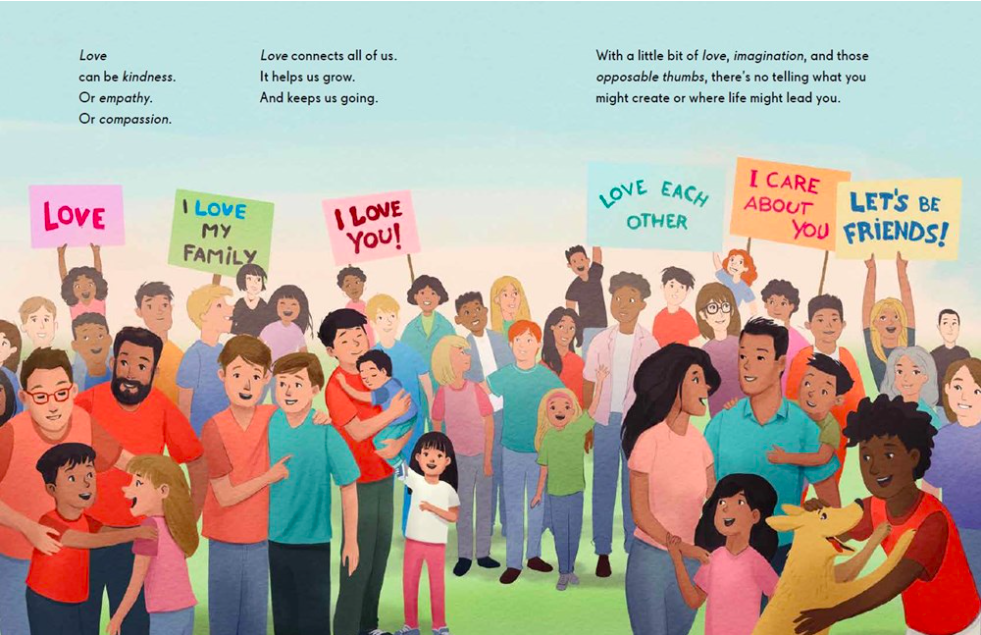
Esenwine acknowledges that there will be bad days among the good, but these too can be handled with honesty, apologies, and forgiveness. Yes, “being human can sometimes be messy,” but that’s where family and friends can help. And, of course, they’re there to celebrate the good times too. So what does all of this kindness and compassion and empathy come down to? The thing that connects us all: Love. “So, welcome to Humanity!” Esenwine emphasizes, “We hope you enjoy your humanness. And we love that you’re here.”

Sprinkled throughout the text are brief “Pro Tips” that in one sentence expand on an idea and give kids confidence in understanding and/or applying the values in their own life.

celebrate-picture-books-picture-book-review-a-beginners-guide-to-being-human-love

Image copyright André Ceolin, 2022, text copyright Matt Forrest Esenwine, 2022. Courtesy of Beaming Books.

Matt Forrest Esenwine has created a book about treating others according to the Golden Rule that goes to the heart not only of how to do that but, so importantly, when and why. Sometimes the need for kindness and empathy can be apparent, as when a child or adult is sad, alone, or has a disappointment or obvious mishap. But what about when someone’s behavior seems to be a personal slight, disrespectful, or just going against the rules?

That’s were Esenwine’s gentle, straightforward, and honest storytelling invites readers to stop and really consider every person and situation individually, to dig deep into one’s own memory and experiences for better understanding and supportive responses. He also addresses the importance of apologizing and forgiveness. And he does all of this with humor and examples that will resonate with kids. Moreover, these elements provide a spark for further conversations among children and adults about specific incidents in a child’s life, possible reasons behind them, and how the child can respond in a kind, empathetic, and compassionate way.

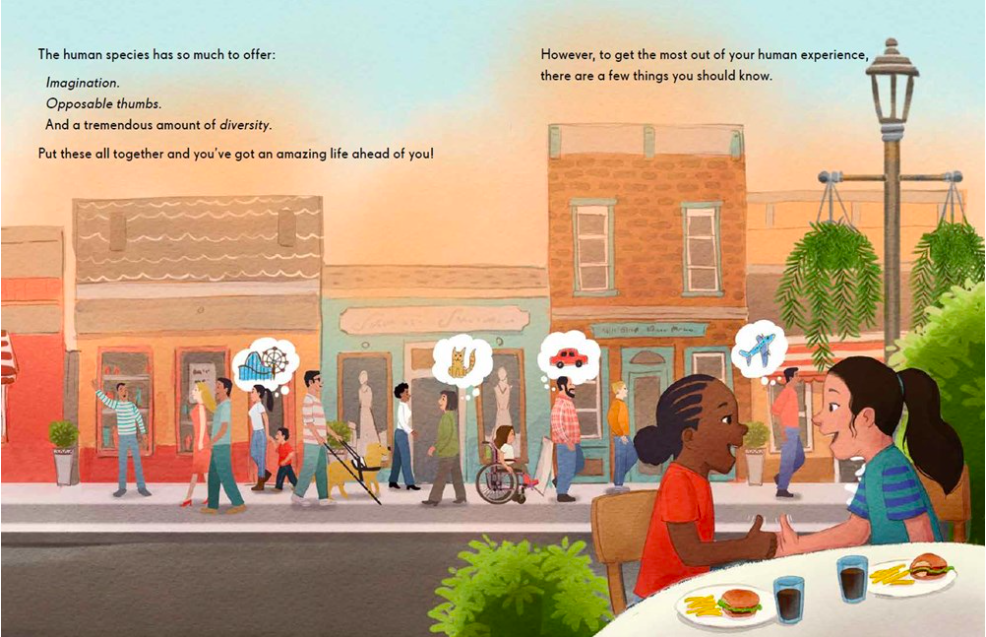
From the first spread, which shows a sidewalk busy with people all thinking their own thoughts (some of whom reappear elsewhere), André Ceolin engages readers in looking closely and thinking about how the people may be feeling, what they are doing, and why they might be behaving in a certain way. He depicts the characters in detailed places and situations familiar to kids that will spark recognition and lead to meaningful discussions and understanding. Ceolin’s images on each page, as well as a portrait gallery of universal emotions, provide excellent social emotional learning tools for adults to share with children when talking about recognizing and reading others’ feelings through facial expressions. Bookending the text, Ceolin emphasizes the support and enduring love of family and good friends.

A well-conceived, heartfelt, and impactful book you’ll want to share again and again, A Beginner’s Guide to Being Human reminds readers that we’re all in this—school, work, sports, clubs: life—together and is a timely must-have addition to home, school, classroom, and public library collections.

Ages 4 – 8

Beaming Books, 2022 | ISBN 978-1506481739

About the Author

Matt Forrest Esenwine is an author and poet from Warner, New Hampshire. His debut picture book, Flashlight Night (Boyds Mills Press, 2017), was selected by the New York Public Library as one of the Best Picture Books for Kids of 2017. His poetry can be found in numerous anthologies, including The National Geographic Book of Nature Poetry (National Geographic Children’s Books, 2015), I Am Someone Else (Charlesbridge, 2019), and Highlights for Children. You can visit him at mattforrest.com and connect with him on Facebook | Instagram | Twitter | YouTube.

About the Illustrator

André Ceolin studied at the School of Visual Arts in New York City. He has illustrated over twenty books for children. André lives in Brazil with his family. You can visit him at andreceolin.com and on Instagram.

Celebration of Life Month Activity

CPB - Random Acts of Kindness cards

Kindness Cards


Here are some cheery cards that are sure to make the recipient’s day happier! Give them to a friend, a family member, your teacher, or your bus driver to show them that you care and that they mean a lot to you!

Random Acts of Kindness Cards Sheet 1 |  Sheet 2 | Sheet 3

celebrate-picture-books-picture-book-review-a-beginners-guide-to-being-human-cover

You can find A Beginner’s Guide to Being Human at these booksellers

Amazon | Barnes & Noble | Books-a-Million

To support your local independent bookstore, order from

Bookshop | IndieBound

Picture Book Review

November 8 – Young Readers Day

celebrate-picture-books-picture-book-review-count-on-us-cover

About the Holiday

Falling each year on the first Tuesday in November, Young Readers Day highlights all of the benefits that babies, kids, tweens, and teenagers reap by reading and being read to. The holiday celebrates parents, teachers, and other caregivers who make sure that children are connected with books that capture their minds and hearts and lead to a lifetime love of reading. People are also encouraged to stop by their local bookstore and let their kids pick out a new book to enjoy.  Today is also National STEM/STEAM Day, which aims to get kids exploring the fields of science technology, engineering, art, and math – subjects that are the backbone of discovery and the type of innovation needed to design a better future for us all. Today’s book incorporates both of these holidays! 

Count on Us! Climate Activists from One to a Billion

Written by Gabi Snyder | Illustrated by Sarah Walsh


In her book aimed at inspiring children to discover what they can do to help protect and care for the environment, Gabi Snyder invites them to count the ways they can help and travel through the alphabet, beginning with “1 Action. One small person taking one small step towards Big changes.” But that one action and one person don’t need to stand alone. Snyder shows kids how a single expression of caring for the environment can influence a growing number of people to engage with conservation in diverse ways.

Counting from one to ten, Snyder demonstrates how small groups of people of varying generations can start to come together to “grow a movement” and come up with “inspiring ideas” while also introducing “5 Environmentalists” who are working around the world “to protect nature from being harmed by human’s waste and pollution” and “8 Healthy Habitats” from mountains to jungles to the ocean, and more.

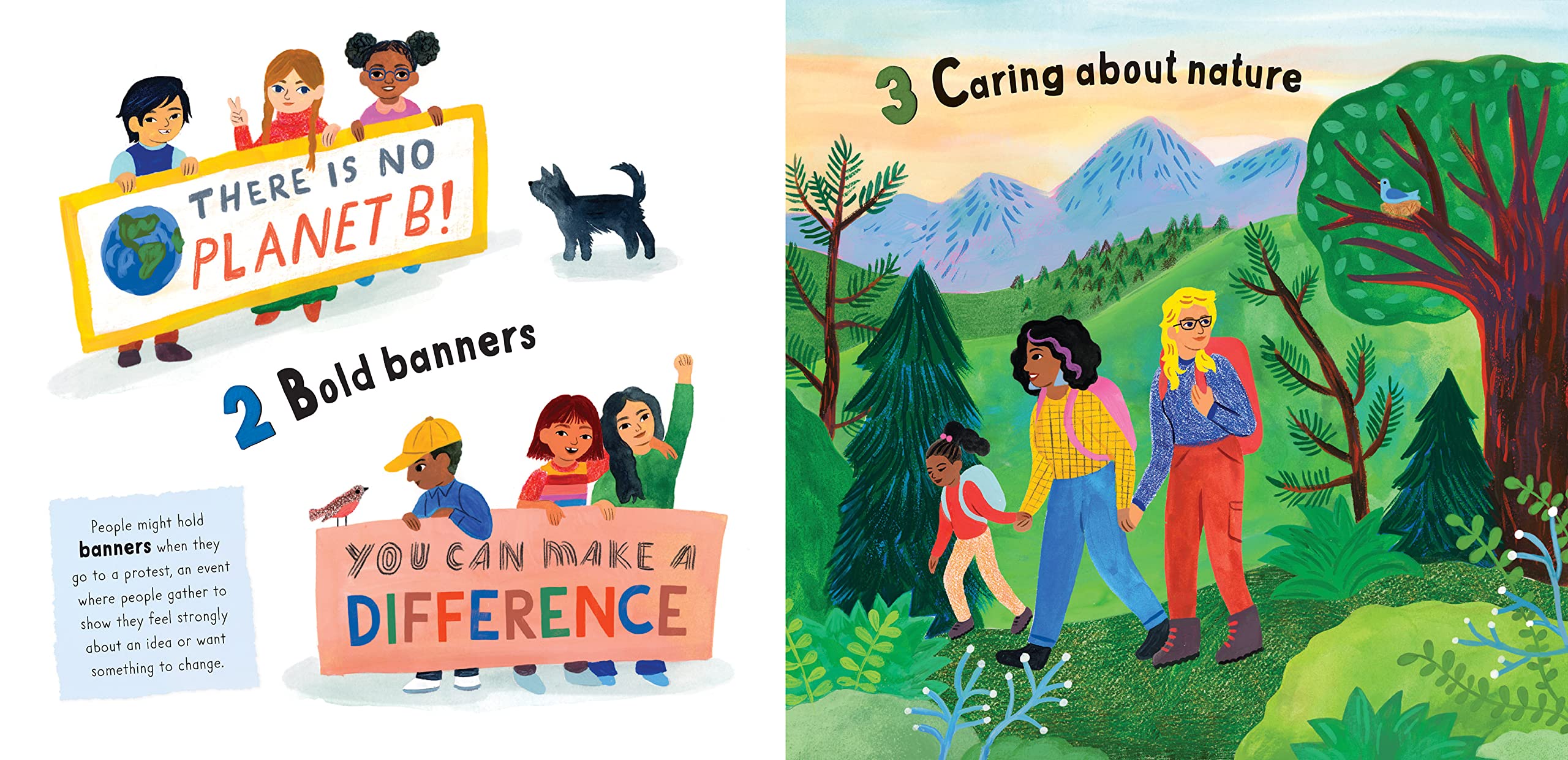
celebrate-picture-books-picture-book-review-count-on-us-2-bold-banners

Image copyright Sarah Walsh, 2022, text copyright Gabi Snyder, 2022. Courtesy of Barefoot Books.

After the number 10 is reached, Snyder begins counting by tens, and readers see how quickly the environmental movement can grow. Now “20 Kids for conservation” are planting gardens, picking up litter, riding bikes, and rescuing animals harmed by pollution, while 30 light bulbs have been replaced by energy-saving LED bulbs. And remember those 20 kids? They’re now part of “40 Mighty Marchers” carrying the banners made at number 2.

The “5 environmentalists” and “8 habitats” have spawned dozens of places and species that are being protected as well as products that can be recycled or repurposed and ways science can help. From 100, the number of those involved explodes exponentially to 1,000… 10,000…100,000… all the way to one billion with all those people doing what they can, described from T through Z, to make the world a cleaner, safer, and healthier place for all.

celebrate-picture-books-picture-book-review-count-on-us-10-joining-generations

Image copyright Sarah Walsh, 2022, text copyright Gabi Snyder, 2022. Courtesy of Barefoot Books.

Four pages of back matter discuss in more depth the definition of Activism and why it’s so important for people to come together to voice their opinions on climate change and protecting our planet. Snyder provides two examples of young activists who are making a difference in different ways that are most meaningful to them. She then invites readers to do some thinking about what issues they care most about.

Snyder also provides short bios of the five environmentalists she introduced earlier in the story. At number 9 Snyder mentions “Inspiring Ideas,” and here she goes into more depth on each one that is pictured on the page. She finishes up by giving kids and adults a week’s worth of thoughtful ideas on how they can make an impact in their own home and community.

celebrate-picture-books-picture-book-review-count-on-us-90-reducing

Image copyright Sarah Walsh, 2022, text copyright Gabi Snyder, 2022. Courtesy of Barefoot Books.

Gabi Snyder’s eye-opening book gives kids an idea of how important individual as well as group actions are in the movement to protect the earth from climate change while empowering them with specific examples of good ideas for combating the dangers our planet faces. Sharing Count On Us! with kids offers teachers, homeschoolers, clubs, and other organizations many opportunities for discussion, research, and the type of activism required to make a difference.

Sarah Walsh’s striking illustrations will capture children’s attention with depictions of friendship, cooperation, and the kind of growing enthusiasm that fuels real change. As the pages become more and more crowded with activists, readers will understand that not only are increasing numbers of people needed, but also more ideas and more helping hands. Adults can use Walsh’s images as jumping off points to get children talking about and/or drawing the various habitats, native plants and animals, and threats to the environment in their area and even devising solutions or inventions to help.

Count on Us! Climate Activism from One to a Billion would be a welcome addition to home, school, and public libraries to inspire and energize environmental involvement and change.

Ages 4 – 9 

Barefoot Books, 2022 | ISBN 978-1646866243

Discover more about Gabi Snyder, her books, and where to   on her website.

To learn more about Sarah Walsh, her books, and her art on her website.

Young Reader’s Day Activity

celebrate-picture-books-picture-book-review-we-love-to-read-maze

We Love to Read! Maze


Help the kids pick up books and find their way through the library in this printable maze.

We Love to Read! Maze Puzzle | We Love to Read! Maze Solution

celebrate-picture-books-picture-book-review-count-on-us-cover

You can find Count on Us! Climate Activists from One to a Billion at these booksellers

Amazon | Barnes & Noble | Books-a-Million

To support you local independent bookstore, order from

Bookshop | IndieBound

Picture Book Review

October 21 – My Name Is Not Ed Tug Book Tour Stop

celebrate-picture-books-picture-book-review-my-name-is-not-ed-tug-cover

I’d like to thank The Children’s Book Review and Amy Nielander for sharing a digital copy of My Name Is Not Ed Tug with me. 

My Name Is Not Ed Tug

By Amy Nielander


Edimorwhitimormiligimmus Tug knew where he came from and just where he fit into his family. After all, “he was named after his Grandpa Edimor,” who helped him learn how to spell his name with a tall tower of blocks; “his Great Uncle Whitimor,” who taught him how to play the accordion; his Aunt Mili,” who ran a butterfly farm; “and his Granny Gimmus,” who filled his tummy with warm, homemade soup.” Anyone hearing his name might think it was gibberish, but Edimorwhitimormiligimmus thought “it was perfect.”

celebrate-picture-books-picture-book-review-my-name-is-not-ed-tug-edimor

Copyright Amy Nielander, 2022, courtesy of West Margin Press.

School, of course, was a challenge since the other kids had a hard time spelling or even remembering his name. And his teacher, Ms. Mell, found that her mouth grew “quite tired” just trying to pronounce it. But one Monday, Ms. Mell announced that a new student, Ty, would be joining their class. Mrs. Mell had made name tags for each student to make it easier for Ty to remember their names, and she slapped one on Edimorwhitimormiligimmus’s shirt. When he looked, Edimorwhitimormiligimmus saw that the tag simply read “Ed.” He gazed at the tag with sadness. “Edimorwhitimormiligimmus Tug was shocked. He was perplexed. He felt like his heart had been stung by a giant bee. Twice.”

celebrate-picture-books-picture-book-review-my-name-is-not-ed-tug-Granny-Gimmas

Copyright Amy Nielander, 2022, courtesy of West Margin Press.

After school, Edimorwhitimormiligimmus went straight to his room and stayed there, thinking. When he emerged, he had a plan (and a very perfectly sized name tag taped to his sweater). The next day, he approached Ty, who was playing with puzzle blocks. He stood proudly, displaying his sweater, and introduced himself—his whole self. He slowly said each part of his name and, miraculously, Ty repeated it. Edimorwhitimormiligimmus “was so happy his curls bounced.” Then as he and Ty constructed a tall bridge with the blocks, he explained how he and his Grandpa Edimor “love to build things together”—and had even invented those blocks.

celebrate-picture-books-picture-book-review-my-name-is-not-ed-ty

Copyright Amy Nielander, 2022, courtesy of West Margin Press.

At lunch he did the same thing with the kids at his table, and they also repeated his name. To explain how important his Uncle Whitimor was to him, Edimorwhitimormiligimmus, he played his uncle’s favorite song on the accordion. When the class went out for recess, he told more kids about his Aunt Mili and pointed out, and they too learned his name.

On Tuesday, Mrs. Mell was out sick, and Edimorwhitimormiligimmus saw an opportunity to be kind and explain about his name. He and Ty delivered a steaming pot of Granny Gimmus’s soup to her doorstep and told her all about cooking with his granny. “The delicious soup warmed her heart.” Edimorwhitimormiligimmus’s plan worked. Now everyone, including Ms. Mell, knew—and used—Edimorwhitimormiligimmus’s full name.

celebrate-picture-books-picture-book-review-my-name-is-not-ed-soup-for-ms-mell

Copyright Amy Nielander, 2022, courtesy of West Margin Press.

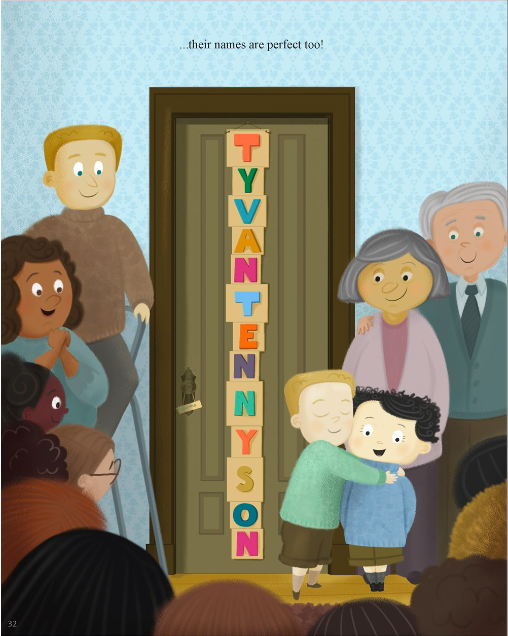
The experience prompted Edimorwhitimormiligimmus to come up with a new plan, a project to ensure all of his friends knew their names were just as perfect for them as Edimorwhitimormiligimmus was for him. And he and his classmates got started with the gift they made for Tyvantennyson to give him at his birthday party.

celebrate-picture-books-picture-book-review-my-name-is-not-ed-tyvantennyson-sign

Copyright Amy Nielander, 2022, courtesy of West Margin Press.

Amy Nielander’s heartwarming and affirming story will captivate kids from the first recitation of “Edimorwhitimormiligimmus Tug”—a name that initially elicits giggles but soon rolls smoothly off the tongue. As they learn how each piece of Edimorwhitimormiligimmus’s name reflects not only the family member he’s named for but also the special things they do together, readers will empathize with the pride he feels in his name and his disappointment when they can’t get it right.

While Nielander’s clever story revolves around one child’s name, there are many other important lessons for both kids and adults woven throughout. Children will understand that their names, personalities, heritage, talents, and dreams are perfect for them just the way they are. For adults, Ms. Mell’s dismissive mangling and shortening of Edimorwhitimormiligimmus’s name to “make it easier for all of us” reminds us that every child deserves to be really seen and accepted for who and everything they are.

Nielander’s illustrations are full of warmth and love, charm and humor as she introduces the unique talents of each member of Edimorwhitimormiligimmus’s inclusive and close-knit family. As Edimorwhitimormiligimmus puts his plan to teach each classmate and Ms. Mell his name into action, the children’s sweet faces and palpable excitement are infectious and will draw readers into this universal hug of a story. The surprise reveal of Ty’s full name and the collective gift the class makes him—with the promise of the same for each child—will delight readers and is sure to spur them to create name signs for themselves.

An engaging, multi-layered story about acceptance, self-esteem, family, and friendship, My Name is Not Ed Tug is a story kids will want to hear again and again. The book is highly recommended for home bookshelves and is a must for classroom, school, and public libraries.

Ages 4 – 8

West Margin Press, 2022 | ISBN 978-1513134871

Discover more about Amy Nielander, her books, and her art on her website.

Take a peek at the book trailer for My Name Is Not Ed Tug!


celebrate-picture-books-picture-book-review-my-name-is-not-ed-tug-cover

You can purchase My Name Is Not Ed Tug at these booksellers

Amazon | Barnes & NobleBookshop 

Picture Book Review


January 18 – World Day of the Snowman

celebrate-picture-books-picture-book-review-making-a-friend-cover

About the Holiday

Today we celebrate snowmen, those winter sculptures that roll to a stop on front lawns, welcome customers to friendly business, and enjoy a day or two (or more if the weather cooperates) in parks and town greens wherever snow falls. Why today? Because the clever founder of the holiday looked at the 18 and decided it looked enough like the rounded body of a snowman and requisite handle of a broomstick to honor our winter friends. Speaking of friends, did you know that tomorrow is one of the three times during the year that we celebrate New Friends Day? The other two dates are October 19 and July 19! If you’re looking for a story to share for both World Day of the Snowman and New Friends Day, you’ll want to pick up today’s book!

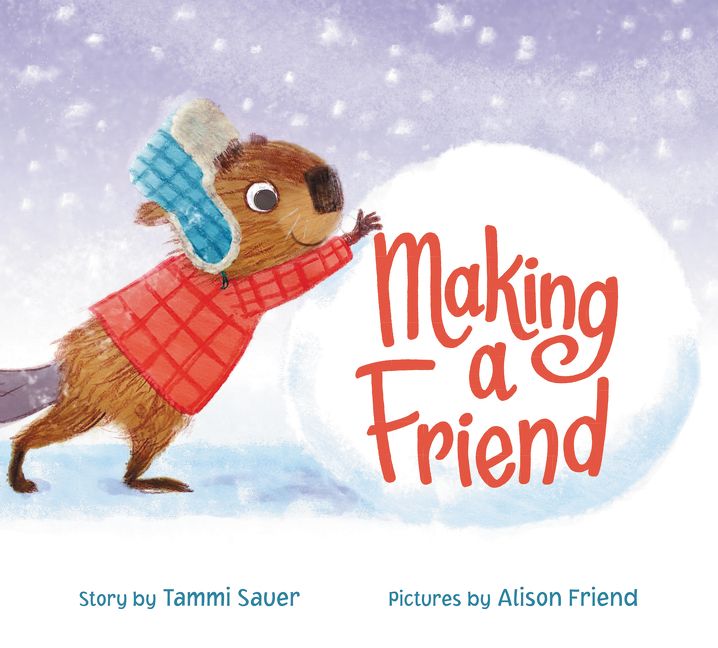
Making a Friend

Written by Tammi Sauer | Illustrated by Alison Friend


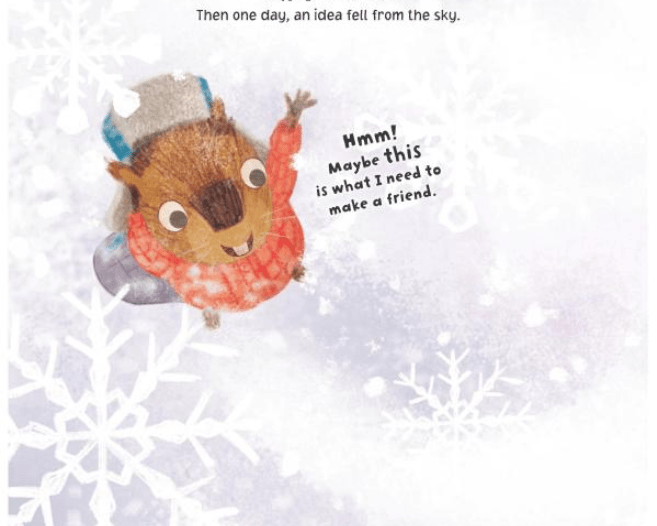
“Beaver was good at making lots of things.” He could build, he could knit, and he knew a bit about engineering. But he was not so good at making friends. He tried hard to do nice things, but something always seemed to go wrong. Then, one day, the snowflakes falling from the sky gave Beaver an idea. “Hmm! Maybe this is what I need to make a friend,” he thought.

celebrate-picture-books-picture-book-review-making-a-friend-water-slide

Image copyright Alison Friend, 2018, text copyright Tammi Sauer, 2018. Courtesy of HarperCollins.

He began rolling a huge snowball. While he was working, Raccoon came by to watch. When Beaver told him that he was making a friend, Raccoon said that it “takes two to make a friend.” Beaver was a bit disappointed until Raccoon did some math and showed him that Raccoon plus Beaver made two.

Working together Beaver and Raccoon made a cute snow friend. They added eyes, a nose, a smile, and two stick arms. But something was still missing. Raccoon said that thing was “pizzazz.” So they added a hat, a boa, some socks, and even a swim mask until their friend looked just right. But their friend just stared back at them. “This friend was not much of a friend at all. In fact, he seemed rather cold.”

celebrate-picture-books-picture-book-review-making-a-friend-water-snow

Image copyright Alison Friend, 2018, text copyright Tammi Sauer, 2018. Courtesy of HarperCollins.

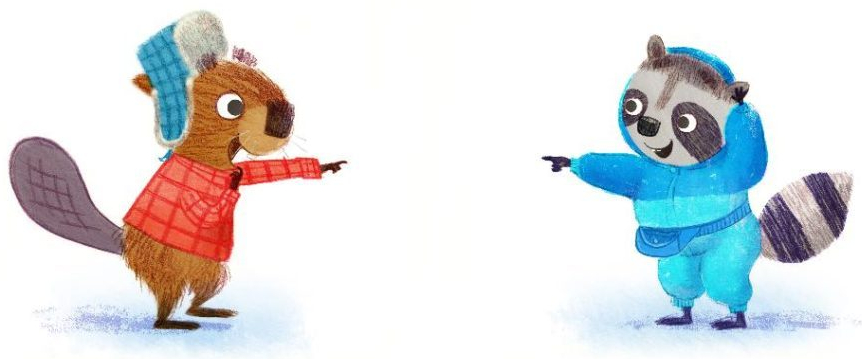
Then Beaver and Raccoon looked at each other. They talked about what fun they’d had building the snow friend together. And they realized that they had become friends. Now they make lots of things to share, but they agree—“the best thing they made was a friend.”

celebrate-picture-books-picture-book-review-making-a-friend-friends

Image copyright Alison Friend, 2018, courtesy of HarperCollins

Tammi Sauer unlocks the secret to friendship in her clever story in which making a friend leads to making a true friend. While Beaver tries to extend the hand of friendship and do nice things for others in the forest, his efforts miss the mark. But when he meets Raccoon, their personalities, talents, and ideas of fun click and they build a real friendship. Young readers will understand Beaver’s feelings of disappointment and confusion when his overtures of friendship are not reciprocated and see that collaborating with someone—either in play or toward a common goal—often brings friends together naturally.

celebrate-picture-books-picture-book-review-making-a-friend-pointing

Image copyright Alison Friend, 2018, courtesy of HarperCollins.

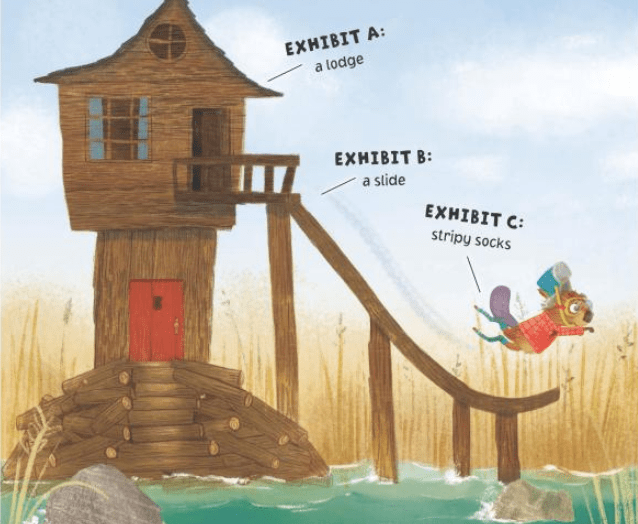
Little readers will fall in love with Alison Friend’s adorable Beaver who’s so good at creating a playhouse complete with water slide but has trouble making friends. Cheerful and enthusiastic, Beaver is a sweetheart as he begins rolling the snow into a ball. When Raccoon comes by, Beaver quickly shares the fun. Kids will enjoy seeing and learn from the images of companionship and give-and-take as Beaver learns a little math and a new word from Raccoon and Raccoon discovers that he likes the raisons Beaver offers him on their way to creating their snowman.  Full of color, smiles, and endearing moments, Friend’s pages are sure to delight kids.

Making a Friend is a charming read aloud, a celebration of creativity, and a gentle lesson on friendship all rolled into one. To share with children learning to navigate new friendships and those who love doing everything with their best buddy, the book makes a sweet addition to home, classroom, and public library bookshelves.

Ages 4 – 8

HarperCollins, 2018 | ISBN 978-0062278937

Discover more about Tammi Sauer and her books on her website.

You can connect with Alison Friend on Instagram.

World Day of the Snowman Activity

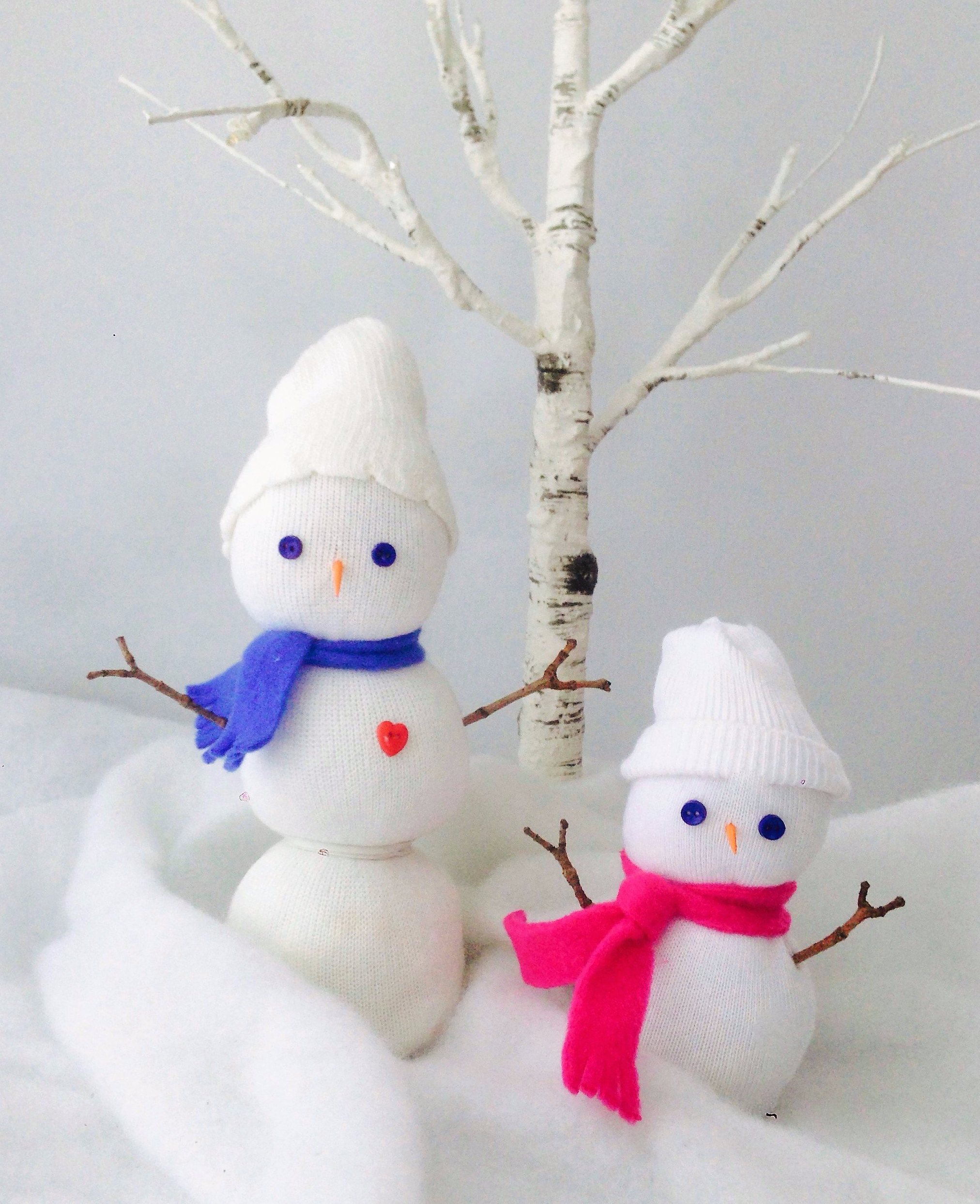
celebrate-picture-books-picture-book-review-sock-snowman-craft

Snow Buddies


This is a great craft for kids to share with a friend. Grab a pair of socks and have fun making these snow buddies! 

Supplies

  • White dress ankle socks
  • Polyester Fiber Fill
  • Tiny buttons
  • Fleece or ribbon, enough for a little scarf
  • Toothpicks
  • Twigs
  • Orange craft paint
  • Cardboard
  • White rubber bands, one or two depending on the size of the snowman
  • Fabric or craft glue
  • Small hair band (optional)

Directions

To Make the Snowman

  1. Cut a circle from the cardboard about 2 inches in diameter for the base
  2. Place the cardboard circle in the bottom of the sock
  3. Fill the sock with fiber fill about ¾ full or to where the ribbed ankle cuff begins. Pack tightly while making a sausage shape. You can make your snowman different shapes with the amount of fill you use.
  4. Stretch out the cuff of the sock and tie it off near the top of the fill either with a loop knot or with the hairband.
  5. Fold the cuff down around the top of the filled sock to make the hat.
  6. Wrap a rubber band around the middle of the sock to make a two-snowball snowman. For a three-snowball snowman, use two rubber bands. Adjust the rubber bands to make the “snowballs” different sizes.

To Make the Scarf

  1. Cut a strip of fleece or ribbon 8 to 10 inches long by ½ inch wide
  2. Tie the fleece or ribbon around the neck of the snowman
  3. To Make the Nose
  4. Dip one end of the toothpick into orange paint, let dry
  5. Cut the toothpick in half
  6. Stick the toothpick into the head or top portion of the snowman

To Make the Arms

  1. Insert small twigs into each side of the body of the snowman
  2. You can also use wire or cardboard to make the arms
  3. Attach two mini-buttons to the face for eyes with the fabric or craft glue
  4. Display your Snow Buddy

celebrate-picture-books-picture-book-review-making-a-friend-cover

You can find Making a Friend at these booksellers

Amazon | Barnes & Noble | Books-a-Million

To support your local independent bookstore, order from

Bookshop | IndieBound

Picture Book Review

October 5 – National Do Something Nice Day

celebrate-picture-books-picture-book-review-it's-hard-to-be-nice-cover

About the Holiday

Similar to Random Acts of Kindness Day, National Do Something Nice Day encourages people to think of others and do nice things for them. These don’t have to be big or expensive; in fact, small gestures or thoughtful actions can make all the difference in the way a friend, family member, or stranger feels. These acts of kindness will make you feel good too! To celebrate today, keep an eye out for ways you can lend a hand, times you can share a smile or a conversation, or ways you can make a new friend. Kids may enjoy sharing the encouraging cards found below with friends, siblings, and teachers or by leaving them at school, the library, shops or anywhere that someone may find them.
Sometimes It’s Hard to Be Nice

Written by Maggie C. Rudd | Illustrated by Kelly O’Neill


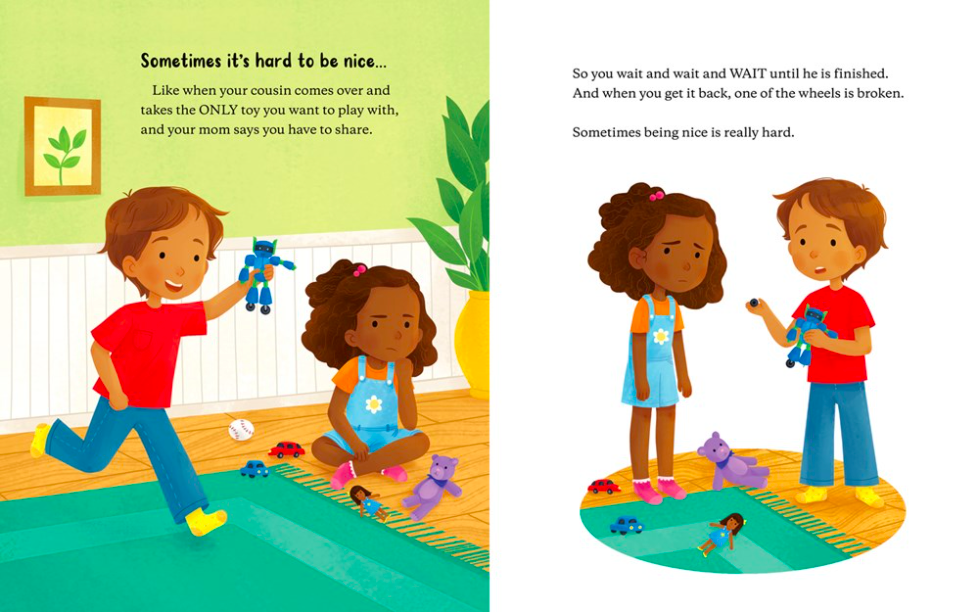
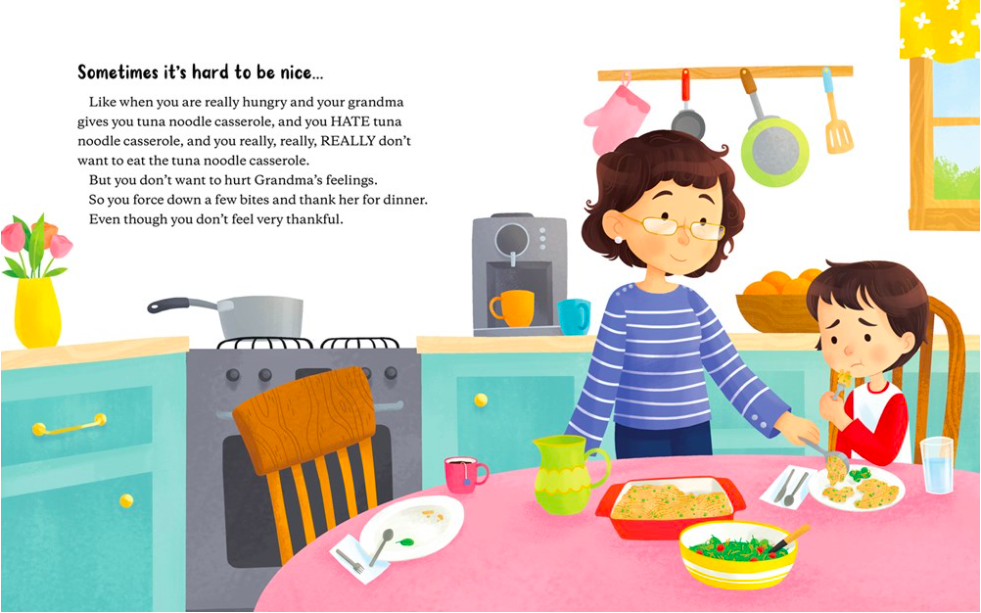
It seems like being nice should be easy, but there are so many emotions that often surround that one little word that sometimes doing the considerate thing is really hard. How hard? Like smiling and saying “that’s okay” when “your mom says you have to share” your favorite toy with a friend, sibling, or cousin and they break it. Like sitting through your brother or sister’s boring performance, game, or recital when you’d rather be somewhere else—anywhere else. Or like eating your least favorite food and thanking the cook for the meal because you don’t want to hurt their feelings.

celebrate-picture-books-picture-book-review-it's-hard-to-be-nice-cousin

Image copyright Kelly O’Neill, 2021, text copyright Maggie C. Rudd, 2021. Courtesy of Albert Whitman & Company.

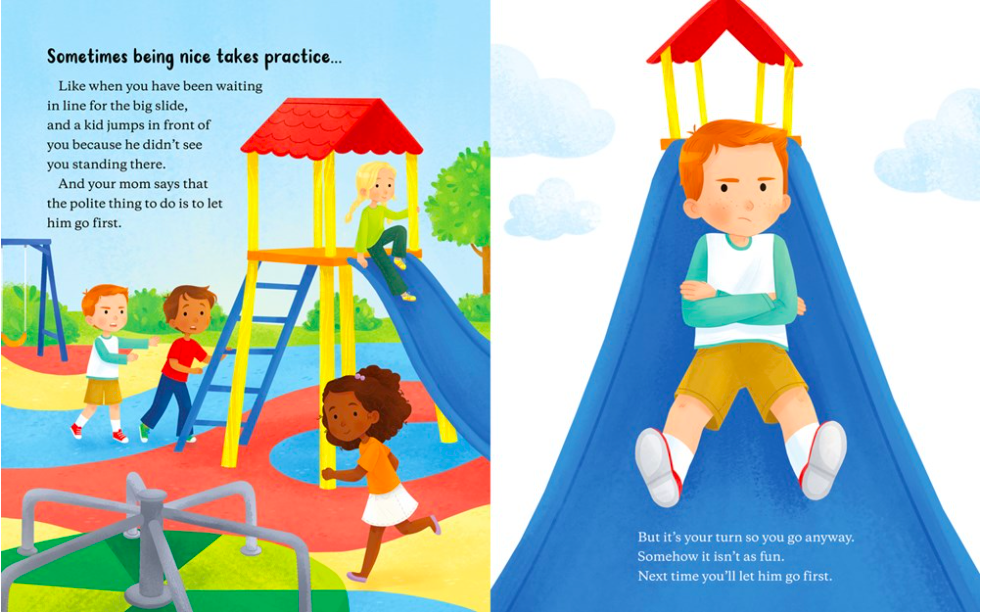
In fact, “sometimes being nice takes practice” like when a little brother or sister destroys your stuff and you yell at them, but then later you realize they didn’t really understand what they were doing. Or like when visiting someone you love in a nursing home or new place is scary and you hang back, not wanting to see them but then decide you won’t be scared next time you visit. And then there are times like these on the playground “when you have been waiting in line for the big slide, and a kid jumps in front of you because he didn’t see you standing there. And your mom says that the polite thing to do is to let him go first. But it’s your turn so you go anyway. Somehow it isn’t as fun. Next time you’ll let him go first.”

celebrate-picture-books-picture-book-review-it's-hard-to-be-nice-great-grandma

Image copyright Kelly O’Neill, 2021, text copyright Maggie C. Rudd, 2021. Courtesy of Albert Whitman & Company.

So what does all that practice lead to? The good feeling you get when you are nice. Like when you let your baby brother sit with you as you play a video game, “and he claps for you the whole time.” There’s also the great feeling you get when you’ve cleaned up after playing and your parents really appreciate it, or “when you’re late for soccer practice and your mom can’t find her keys, so you help her look for them . . . and find them in the doorknob! And your mom says she doesn’t know what she would do without you!”

While these examples may be hard because you feel slighted or tired or rushed or scared, there are times when being nice takes all your courage—like when you befriend the new kid or the kid everyone picks on and find out you have lots in common. Or when the bullies come around and you stand up for your new friend even though it’s scary and you end up in the principal’s office. So why would you want to be nice? Because “it’s worth it.”

celebrate-picture-books-picture-book-review-it's-hard-to-be-nice-playground

Image copyright Kelly O’Neill, 2021, text copyright Maggie C. Rudd, 2021. Courtesy of Albert Whitman & Company.

Maggie C. Rudd’s excellent primer to the emotions and circumstances around being nice presents children with realistic scenarios involving family members and friends, favorite toys and activities, and common situations at school that often require extra effort to respond to in a positive way. Rudd’s conversational writing style directly engages the reader, and while every example may not be an exact match to the reader’s experience, many will be spot on and the others easily recognized and adaptable.

Rudd’s four-step progression acknowledges that showing kindness or even just good manners can be difficult, but that it can become easier—especially when a situation seems unfair or is disappointing—with practice and perspective. Rudd’s examples of when being nice feels good are sprinkled with humor and warm family feelings that will bring smiles that support her point. A thread involving a favorite Galactic Star Crusher action figure ties several of the vignettes together, adding a sense of relationship and connectedness among the characters.

Kelly O’Neill illustrates each example for readers with clearly depicted scenes involving kids like them playing video games, visiting with grandparents, playing on the playground, helping their parents, and standing up for another child. In every instance, the children’s emotions are easily understood, which opens up many opportunities for adults and kids to discuss the feelings and issues surrounding how one treats others from both a child’s and adult’s perspective and experience. O’Neill’s bright colors, familiar settings, and uncluttered, well-conceived pages put the focus on her engaging children and elegantly complement Rudd’s important message.

Sometimes It’s Hard to Be Nice is a superb read aloud for honestly addressing the complexities and rewards of showing kindness and being nice. It is a book that families, teachers, and caregivers will find themselves turning to again and again in helping children navigate and learn this important social skill. The book is a must addition to home, classroom, school, and public library collections.

Ages 4 – 8

Albert Whitman & Company | ISBN 978-0807575734

Discover more about Maggie C. Rudd and her books as well as an Activity Kit for educators and parents on her website.

To learn more about Kelly O’Neill, her books, and her art, visit her website.

National Do Something Nice Day Activity

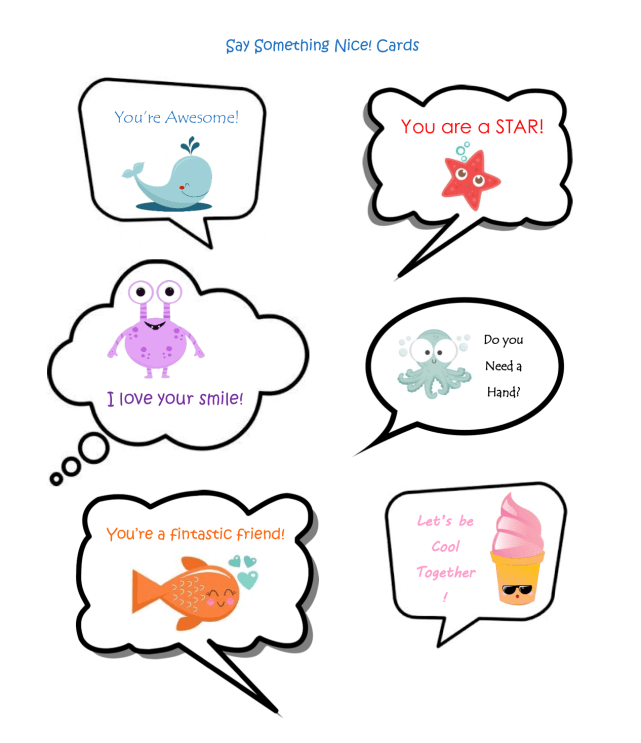
celebrate-picture-books-picture-book-review-say-something-nice-cards

Say Something Nice! Cards


Do you want to give someone a nice surprise? Print out these cards and give one to a friend, to someone you’d like to know, or to anyone who looks like they need a pick-me-up! If you’d like to make your own cards, print out the blank template and write and/or draw your own message! You can also print these on adhesive paper and make your own stickers.

Say Something Nice! Cards | Say Something Nice! Cards Blank Template

celebrate-picture-books-picture-book-review-it's-hard-to-be-nice-cover

You can find Sometimes It’s Hard to Be Nice at these booksellers

Amazon | Barnes & Noble | Books-a-Million

To support your local independent bookstore, order from 

Bookshop | IndieBound

Picture Book Review