Do you feel like you’ve been on a diet forever? Have you been denying yourself a favorite treat because maybe it’s not the best thing you can eat? Or do you find yourself always making meals to suit everyone else’s taste when what you really want is just a grilled cheese sandwich? If so, today’s holiday gives you carte blanche to enjoy the foods you want without feeling guilty. It also seems like a fitting day to learn about the rather unusual (at least to us) diet of many creatures in the animal kingdom—and that’s where today’s book come in!
Poop for Breakfast: Why Some Animals Eat It
Written by Sara Levine | Illustrated by Florence Weiser
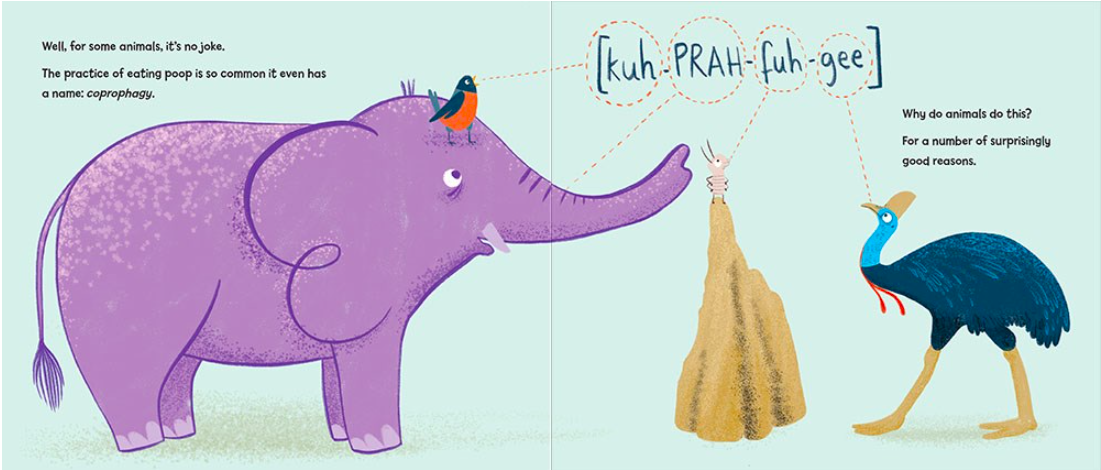
So, you wake up starving for a delicious meal. You’ve been dreaming of pancakes, maybe, or a plate of eggs and bacon. But when you get to the table, there’s a bowl of poop waiting for you?! Come on! While you might sulk (and probably hold your nose), there are plenty of creatures who’d be thinking “Bring it on!” Who are these critters? They’re animals that practice coprophagy, and they do it “for a number of surprisingly good reasons,” Sara Levine reveals.
Image copyright Florence Weiser, 2023, text copyright Sara Levine, 2023. Courtesy of Millbrook Press.
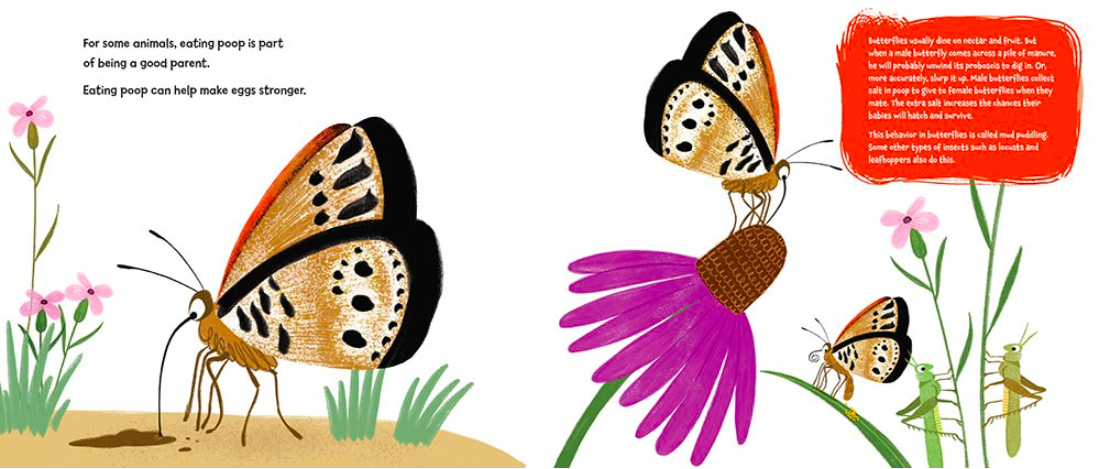
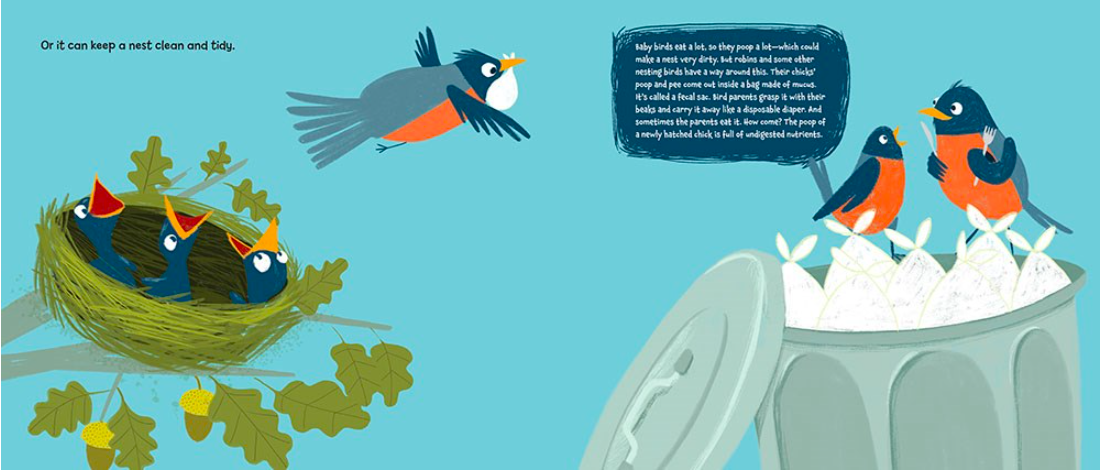
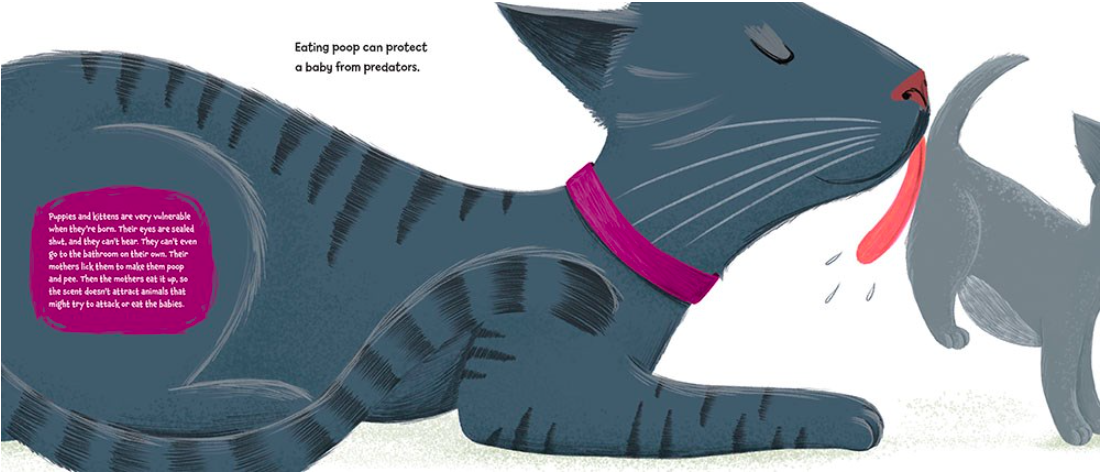
For some animals eating poop is just part of being a Number 1 (or maybe Number 2 is better in this case) parent. Butterflies, cats, and dogs as well as robins and other birds all have specific reasons for dining on doo-doo, from making eggs strong to protecting their babies from predators to keeping “a nest clean and tidy.” Birds have a particularly fascinating way to do this. Since baby birds eat a lot, they poop a lot. Keeping up with that level of cleaning could be daunting. Amazingly, though, these “chicks’ poop and pee come out inside a bag made of mucus. It’s called a fecal sac. Bird parents grasp it with their beaks and carry it away like a disposable diaper. And sometimes the parents eat it. How come? The poop of a newly hatched chick is full of undigested nutrients.”
Image copyright Florence Weiser, 2023, text copyright Sara Levine, 2023. Courtesy of Millbrook Press.
While these animals eat poop for external or aesthetic reasons, others engage in coprophagy to keep their digestive system working well. Still others, because of the length or shape of their digestive tract, require that food travels through their body twice to extract all of the nutrients. If you have a rabbit, hamster, guinea pig, or other small rodent as a pet, you know that their poop looks like little round balls or small pellets. As Levine tells readers, “this is the poop that has been through their digestive tract a second time. The first poop comes out soft, sticky, and full of nutrients. It’s called a cecotrope (SEE-ca-trope),” and these animals “gobble it up at night when it comes out. That’s why you don’t see it” in the cage.
Image copyright Florence Weiser, 2023, text copyright Sara Levine, 2023. Courtesy of Millbrook Press.
Since there are so many creatures who do eat poop, why don’t humans? Levine has included a whole list of reasons (and, yes, the frowny- crinkled-nose-face you’re making right now is one of them) for why we don’t—and don’t need to. She’s also provided back matter that includes “The Scoop on Poop”—an explanation of what poop and pee are, how they’re created in the body, and how they’re eliminated through the anus and the urethra as well as a paragraph about creatures that have a single cloaca instead of two openings. Kids will also have fun becoming “poop detectives” with the help of Levine’s and illustrator Florence Weiser’s guide to the sizes and shapes of poop from common pets and wildlife and playing a silly synonym game.
Image copyright Florence Weiser, 2023, text copyright Sara Levine, 2023. Courtesy of Millbrook Press.
Sara Levine is exceptional at presenting fascinating nature science topics in humorous and accessible ways for young audiences, and her latest book is no exception, Leaning into the “Ewww!” factor, Levine dishes up short, take-away reasons certain animals, birds, and insects practice coprophagy followed up with longer passages that explain the science and/or behavior behind them in easy-to-understand language sprinkled with humor that will keep readers riveted to this already high-interest subject.
Florence Weiser’s colorful illustrations perfectly bridge the humorous and the scientific nature of Levine’s text. Readers’ skeptical view of this “gross” habit is amusingly juxtaposed with creatures’ excited anticipation of a delicious meal through the characters’ facial expressions while the anatomical reasons for or against coprophagy are clearly depicted in images of human and various animals’ digestive systems.
Anatomy and nature science education at its best, Poop for Breakfast: Why Some Animals Eat It will keep kids enthralled as each page turn brings on a new round of giggles and avid learning. The book would enhance any home STEM collection and is a must for classroom, school, and public library bookshelves.
Ages 5 – 10
Millbrook Press, 2023 | ISBN 978-1728457963
About the Author
Sara Levine is an author, educator, and veterinarian. Her science books for children include the Animal by Animal series, Germs Up Close, and A Peek at Beaks: Tools Birds Use. Her books have received a number of awards including AAAS/Subaru SB&F Prize, Utah Beehive Book Award, Cook Prize finalist, Monarch Award master list, and Bank Street College Best Children’s Book of the Year.
About the Illustrator
Florence Weiser is a French illustrator currently based in beautiful, rainy Belgium. While growing up in Luxembourg, she always knew she wanted to draw and draw. She lives and works surrounded by nature, from which she gathers most of her inspiration.
You can find Poop for Breakfast: Why Some Animals Eat It at these booksellers
Small things are amazing—and surprising! We all know good things come in small packages, and just look at the wisdom, humor, and capacity for love of children. The same goes for haiku—the smallest form of poetry in size but never in impact. Coming mid-way through National Poetry Month, today’s holiday shines a spotlight on the haiku. The simple 5-7-5 rule that we all learn in school doesn’t begin to define the complexity of these three-line beauties that distill the world into little nuggets that make readers see life in amazing and surprising ways.
Peek-a-Boo Haiku
Written by Danna Smith | Illustrated by Teagan White
In this beautiful board book, little ones are taken through an auditory and visual wonderland from winter through spring, summer, and fall as two mice visit woodland, meadow, garden, and aquatic creatures to play, discover, and celebrate the changing seasons.
Children will enjoy predicting what animals are hiding behind the log and boulder. Image copyright Teagan White, 2023, text copyright Danna Smith, 2023. Courtesy of Little Simon.
Each of Danna Smith’s haiku verses surprises, sparkling with lovely alliteration and evocative language that invites young readers to anticipate and predict who will appear when the flaps on the facing page are lifted. Smith’s giggly humor and exceptional imagination elevate readers’ experience as she deftly uses games and experiences familiar to children (hide-and-seek, confetti, splashing in water, and lullabies to name a few) in ways that will spark creative thinking and bond them to the natural world. As late fall with its nighttime frost appears in the last spread, Smith’s gentle, sleepy verse welcomes little ones to drift off to dream along with the two snuggled up mice.
When the rabbits are revealed, Smith’s verse encourages readers to talk about “long ears” and “short ears.” Image copyright Teagan White, 2023, text copyright Danna Smith, 2023. Courtesy of Little Simon.
Any book illustrated by Teagan White is a treasure, and in Peek-a-Boo Haiku, she populates Smith’s various habitats with adorable, yet realistic animals that will charm little readers and adults alike. White’s glorious colors add breathtaking beauty to her gorgeously detailed pages. Each spread is a tiny masterpiece that gives children and adults much to discover and talk about as they move through the seasons. The final spread, washed in somnolent shades of twilight, puts little ones in the mind for sleep, just as the owl snugged into its tree-trunk nest. Kids will enjoy finding the mice (appearing alone or together, allowing the youngest children to engage with the idea of one and/or two) in each spread, and the variety of creatures, plants, and environments provide a wealth of learning, from vocabulary to math to science, for a wide-range of ages and development.
When the colorful bird is revealed behind stems of flowers, Danna Smith invites readers to talk about what she has in her beak, where it came from, and what she will do with it. Image copyright Teagan White, 2023, text copyright Danna Smith, 2023. Courtesy of Little Simon.
Exquisite in every way, Peek-a-Boo Haiku is a book adults and children will love to share again and again and is a perfect choice as a gift for special occasions, baby showers, new siblings, or simply to add to a child’s bookshelf. This superlative board book also belongs in all preschool and kindergarten classrooms as well as school and library collections.
Ages Birth to 5
Little Simon, 2023 | ISBN 978-1665926461
About the Author
Danna Smith is a poet and award-winning author of numerous books for children, including One Blue Gnu; Rooftop Garden; Wake Up, Freight Train!; and several Little Golden Books. Her nonfiction picture book, The Hawk of the Castle: A Story of Medieval Falconry, received two starred reviews and is a Junior Library Guild Selection and a Bank Street College of Education Best Children’s Books of the Year. Danna currently lives in northern California, where she is hard at work on her next book. For more information about her books and teaching activities, visit her website at DannaSmithBooks.com.
About the Illustrator
Teagan White is an artist and author who creates playful watercolor scenes of the natural world and the friendly creatures who inhabit it. Teagan lives in Oregon, enjoys visiting seagulls at the beach, and has illustrated nine picture books. Find out more at TinyMothStudios.com.
Take a Peek at this Peek-a-Boo Haiku Book Trailer!
National Haiku Day Activities
Woodland animals love to play hide-and-seek in trees, behind logs and rocks, under bushes, and in all sorts of places. This Peek-a-Boo Haiku Memory Game lets little ones find matching pairs of animals while building observation skills and having lots of fun!
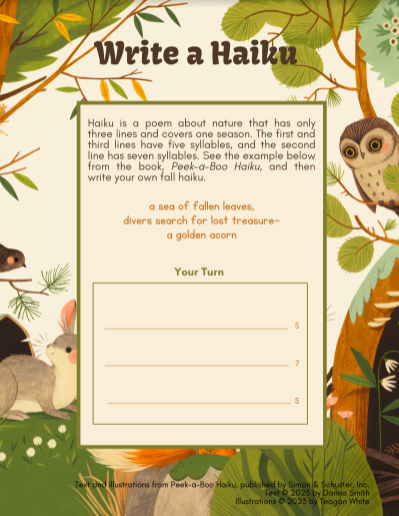
Young children will enjoy writing their own haiku from what they see in nature with this adorable Write a Haiku Page that gets them thinking and using their imagination.
You can find Peek-a-Boo Haiku at these booksellers
Sing with Your Child Month was established 15 years ago by Music Together LLC and its founder Kenneth K. Guilmartin. The organization chose March and its ushering in of Spring and rebirth as a reminder of our most precious resource: our children. When parents, grandparents, teachers, and other caregivers sing and make music together with children, they form everlasting bonds, helping children to feel secure and putting them on the road to success. Research shows that early music education and participation has a large impact not only on musical growth but also on academic skill development and achievement. Singing with children boosts their language development and their reading and math learning.
But engaging in singing together isn’t all about education. It provides for times of fun and much-needed relaxation too! You don’t have to be a great vocalist to sing with kids, either! Just share favorite songs, silly songs, those old campfire songs, and songs kids learn in school and discover a whole new way to enjoy time together. Today’s book with its story and singalong audio and video included is a terrific place to start! To learn more about the benefits of singing with children, visit the National Association for the Education of Young Children website.
Thanks to Barefoot Books and Danna Smith for sharing a digital copy of Rooftop Garden with me for review consideration. All opinions on the book are my own.
Rooftop Garden
Written by Danna Smith | Illustrated by Pati Aguilera | Sung by Holly Turton
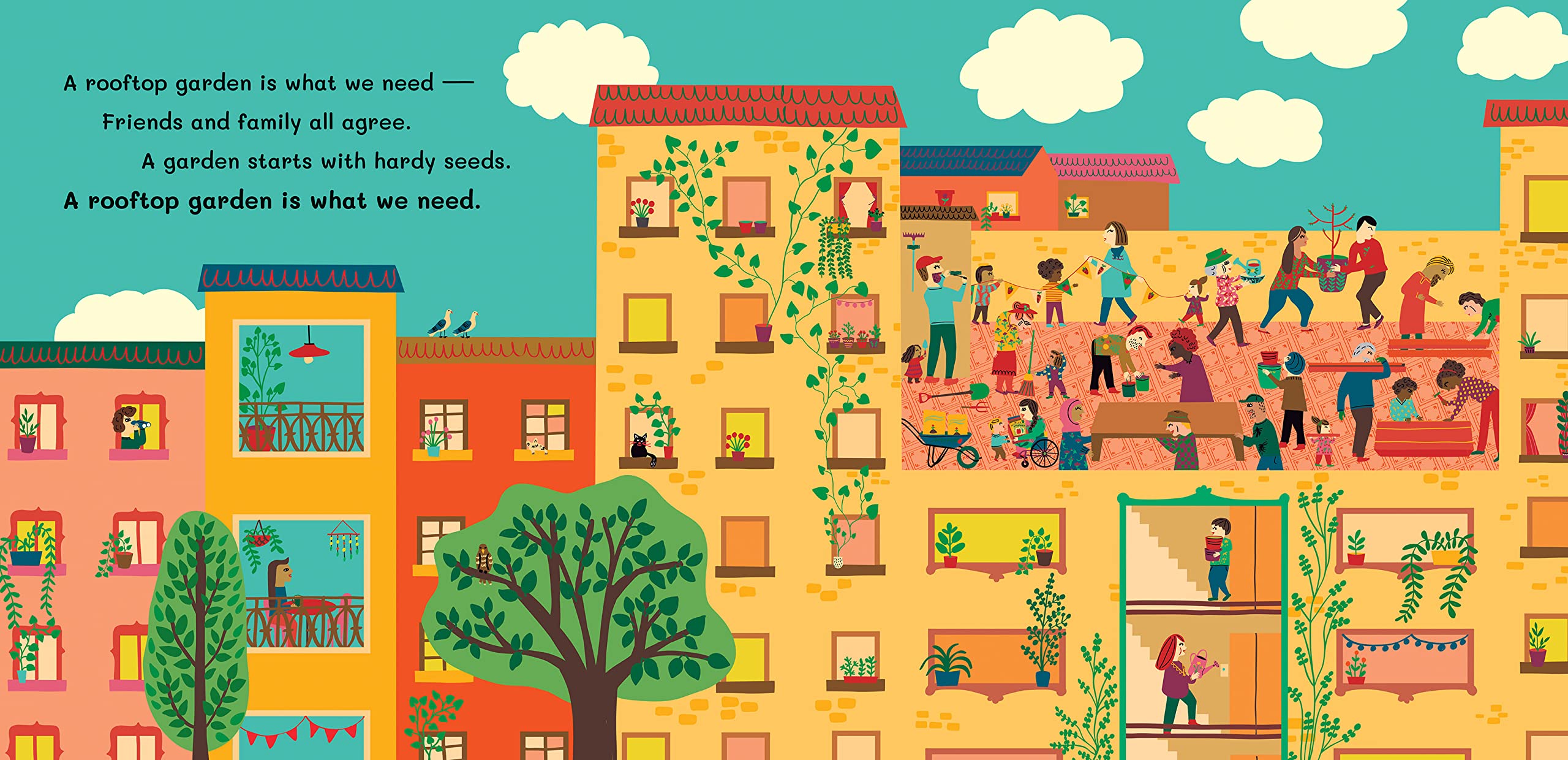
On a spacious apartment building rooftop, tenants, adults and kids alike, are busy building raised planting beds, bringing up pots and tools and watering cans, opening bags of dirt, and installing a sturdy work bench. A group of kids is even hanging a banner to celebrate their new community garden. One bed is all ready for planting, and a cadre of neighbors have gathered around, knowing just what to do: “Dig a hole and in they go. / Sow the seeds with a shovel and hoe. / Plant them, pat them, row by row. / Dig a hole and in they go.” And when all the rows are full, everyone joins in with a chant of encouragement: “Grow, garden! Grow, garden! Grow, garden! Grow, grow, grow!”
Image copyright Pati Aguilera, 2022, text copyright Danna Smith, 2022. Courtesy of Barefoot Books.
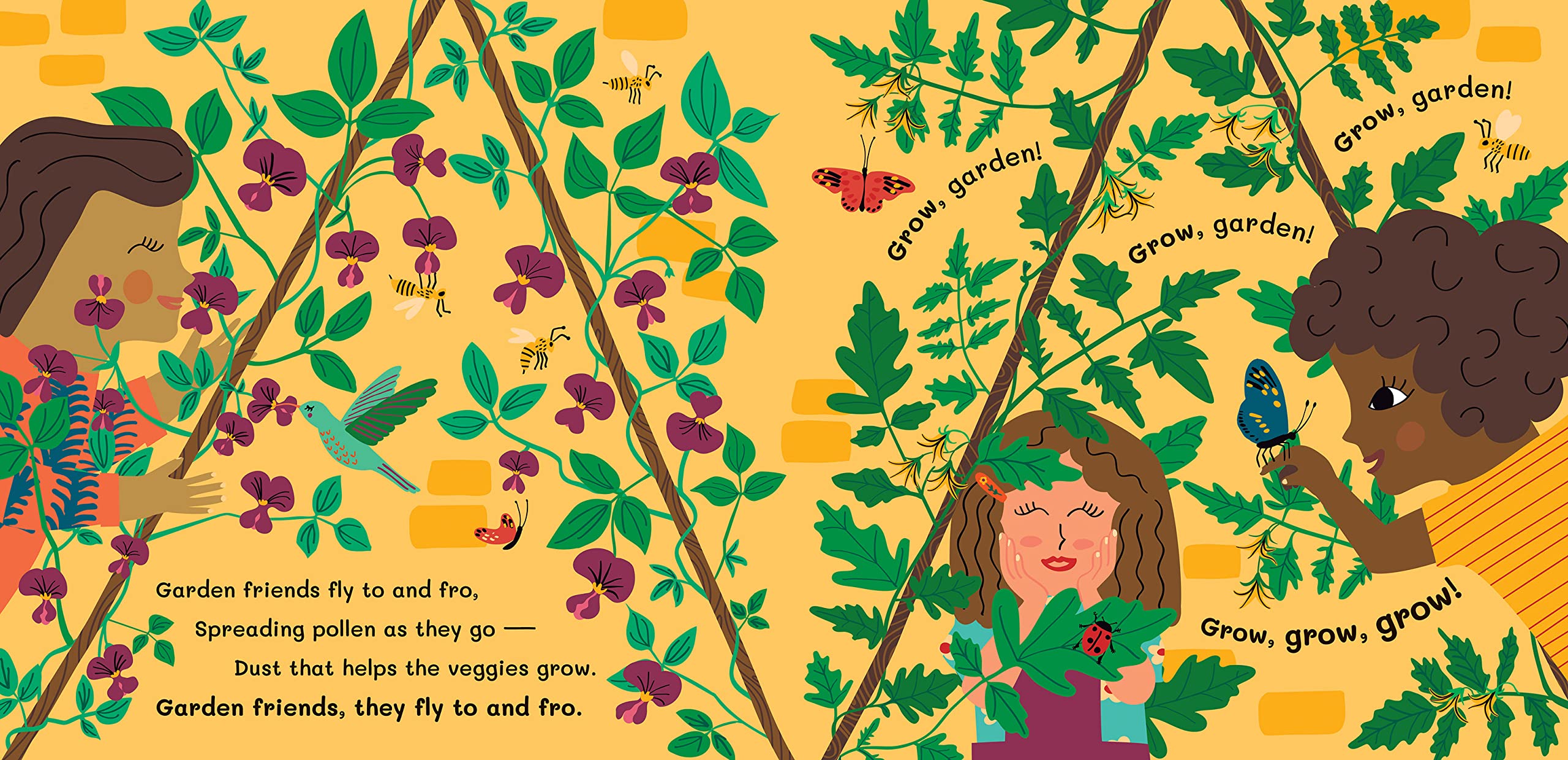
Signs go in to mark where the lettuce, carrots, mint, and sage are planted, and then the waiting begins. Regular watering, sun, and shade spur those seeds to sprout and send tiny shoots reaching for the sun. But that’s not all these tender plants need because in among them hide “pesky weeds” that keep the neighbors working to pick them and pull them before they grow back. The plants are thriving, climbing trestles, crowding pots and garden beds all due to the diligence of the birds, butterflies, and bees who “…fly to and fro, / Spreading pollen as they go— / Dust that helps the veggies grow.” At last it’s time to harvest the “rooftop crop. / Pick and pull and twist—don’t stop! / Fill the baskets to the top.”
Image copyright Pati Aguilera, 2022, text copyright Danna Smith, 2022. Courtesy of Barefoot Books.
And what is the reward for the spring and summer’s attentive work? “A garden feast,” of course! Now, on that same rooftop where the food was grown, all the neighbors sit around a long table and while talking, laughing and, congratulating each other, enjoy a delicious homegrown meal. “A garden feast! Oh, what a treat. Yum, garden! Yum, garden! Yum, garden! Yum, yum, yum!”
Back matter includes a graphic depicting Eight Steps for Growing a Garden, an illustrated guide to Six Stages of Plant Growth, and the musical score to the Rooftop Garden song. The book also includes a QR code that lets readers access a toe-tapping singalong audio with Holly Turton and vibrant video animation of the story.
Image copyright Pati Aguilera, 2022, text copyright Danna Smith, 2022. Courtesy of Barefoot Books.
Danna Smith plants bountiful seeds of joy for gardening, friends, neighbors, and community in her jaunty story. Through her lively and rhythmically vivacious quatrains, in which the first line repeats as the last line, Smith takes kids through a complete growing season, highlighting the preparatory stage, planting, watering, weeding, encouraging pollinators and discouraging pests, harvesting, and finally enjoying a garden feast. The refrain cheering the garden on to grow, grow, grow will be a favorite for kids to chime in on, and the final celebration after a successful season of farming is sure to spur kids to try some gardening of their own. Yum! Yum! Yum!
Kids will love the vivid colors, easy smiles, and action-packed details in Pati Aguilera’s fresh and fabulous illustrations of this singular apartment building. Along with following the progress of the rooftop garden, children will enjoy lingering over the pages to find kids having fun spritzing each other with misting bottles, see bees and butterflies visiting blossoms, watch little ones getting wheelbarrow rides, and name the fruit and vegetables that have grown in the planting beds and pots. Camaraderie, crops, and caring for the earth all on a rooftop—what could be better?!
The rollicking, “follow-the-ball” singalong with Holly Turton, who lends country charm to her enthusiastic rendition, and delightful animation of the story will entertain kids and adults alike, and both will eagerly put this enchanting song on repeat.
Rooftop Garden is a wonderfully conceived book, singalong, and video collaboration that will entertain all ages and is a top pick for home, classroom, school, and public library collections. The book would also make a favorite choice for extracurricular club and group meetings or outings.
Ages 3 – 7
Barefoot Books, 2022 | ISBN 978-1646864966
Raise your voice and tap your toes with this irresistibly catchy singalong version of Rooftop Garden!
About the Author
Danna Smith is a poet and an award-winning author of numerous books for children. Her nonfiction picture book, The Hawk of the Castle: A Story of Medieval Falconry, received two starred reviews, is a Junior Library Guild Selection, and the recipient of Bank Street College of Education Best Children’s Books of the year. Danna is currently living and writing in northern California. For more information about her books, upcoming releases, and teaching activities, visit her website at dannasmithbooks.com.
About the Illustrator
When Pati Aguilera was a child, she liked to do all kinds of crafts, draw, and spend a lot of time sorting and looking at her pencils. She is Chilean, and has lived a large part of her life in the city of Santiago, where she studied design and became a book illustrator. Today she lives in the countryside with her partner and two daughters, and is building her biggest craft project of her life: her own house! Pati creates her artwork digitally so she can change the composition and palette until she achieves the desired balance and harmony. To view a portfolio of her work, visit her website at patiaguilera.com.
About Holly Turton
Holly Turton is a British vocalist with roots in blues, funk and soul music. When she’s not recording, teaching, singing in schools, or performing live, you can find Holly in her garden potting plants and vegetables for the upcoming season. She currently lives on the beautiful Cornish coast of England. You can visit her at hollyturton.co.uk.
Sing with Your Child Month Activities
Rooftop Garden Seed Spheres Activity
Kids can get ready to grow their own fabulous garden with this fun activity that makes it easy to plant seeds just where you want them. These Seed Spheres make gifts for garden-loving friends and family members, too!
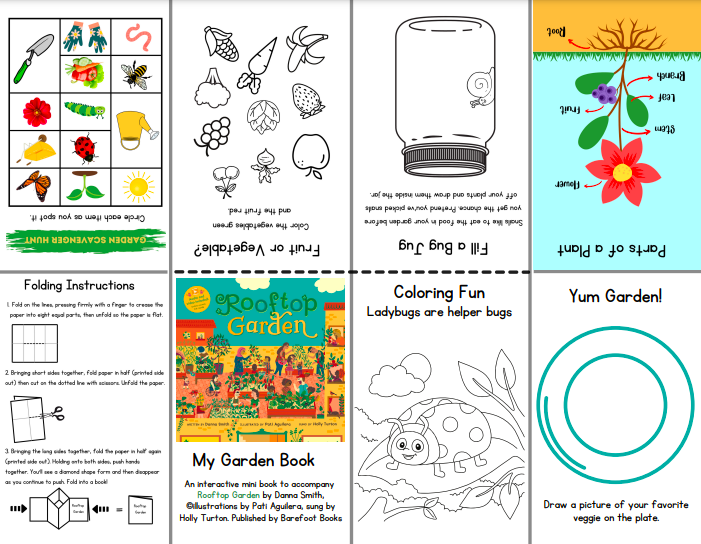
Here’s a little book of fun activities kids can fold and tuck away in a purse, bag, or pocket to take all the fun of gardening along to the park, the farmers market, or anywhere they’ll have waiting time or down time.
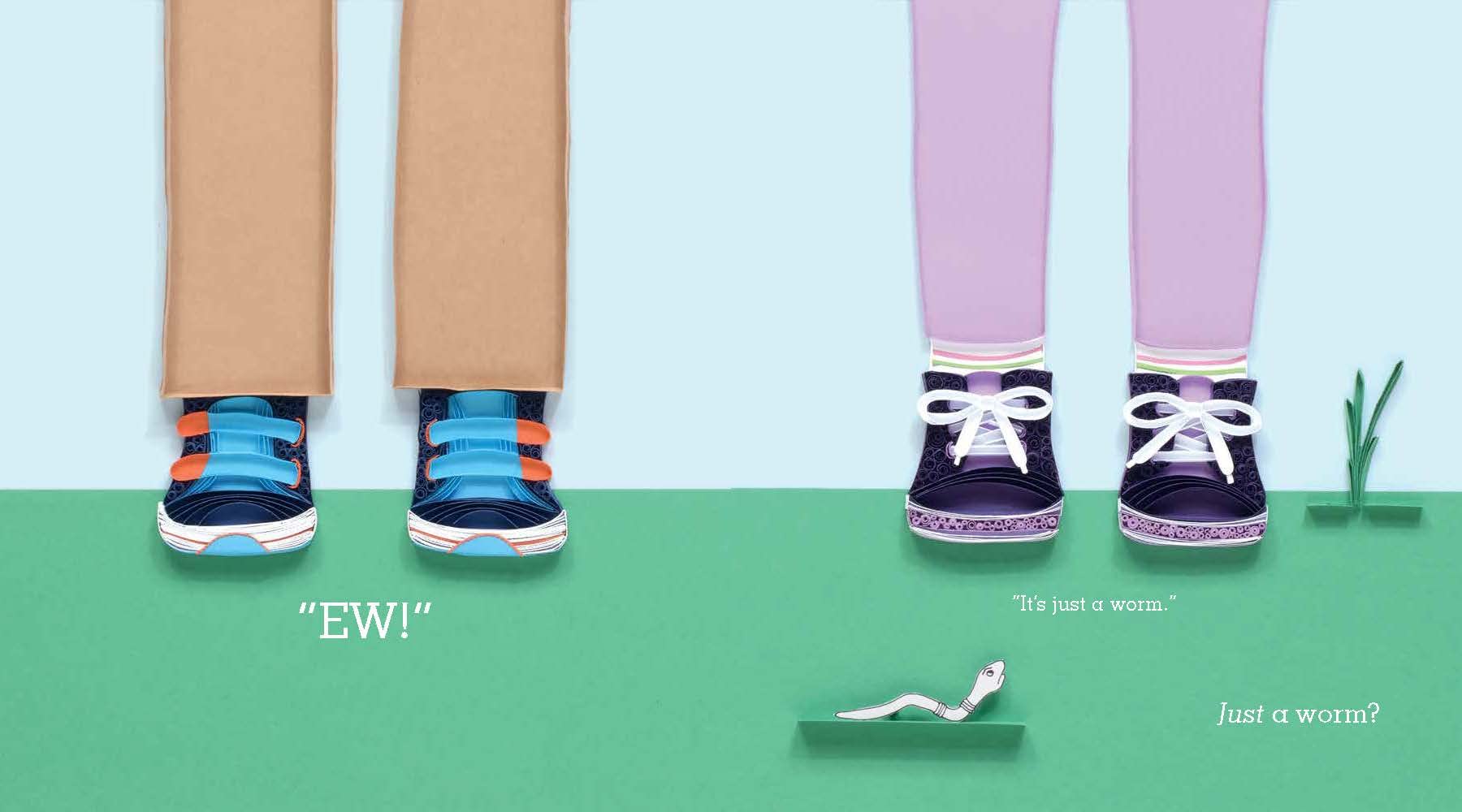
Worm is inching along on a beautiful summer day singing a happy little ditty: “La la la la… Slop, slip, wiggle. / I’m taking a little twirl. / Dop, dip, squiggle. / I’m off to see the world.” And so he was! But on his way he passed two kids who just didn’t see worm the way he saw himself and made him wonder…. Worm bolstered his self-confidence, telling himself that there were a lot of things he could do.
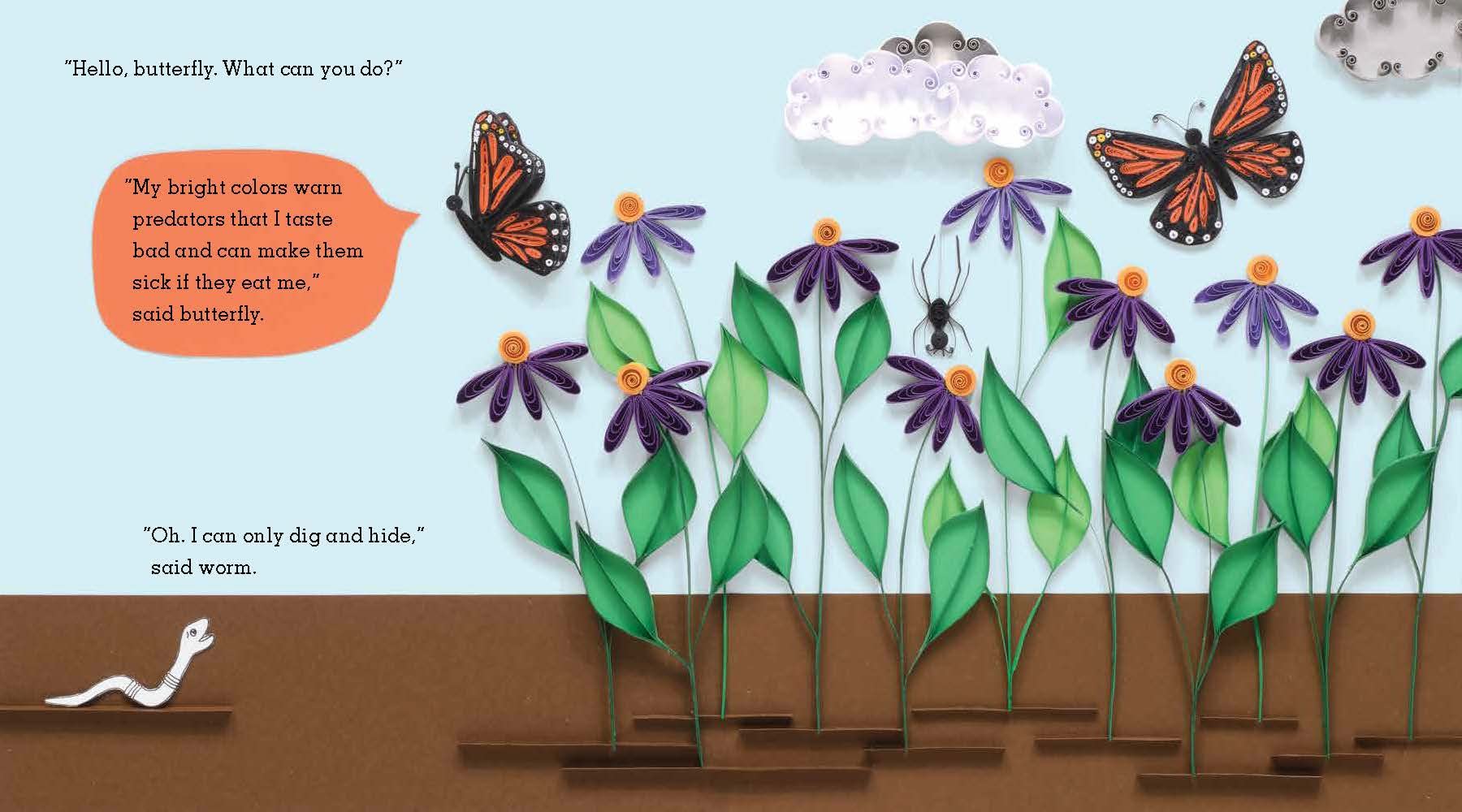
Just then he wiggled up to a row of brilliant purple flowers, where caterpillars, a chrysalis, and a butterfly were hanging out. Just out of curiosity, worm asked one of the caterpillars what she could do, and—Wow!—when he learned about making a chrysalis and metamorphosis, and becoming a butterfly, he was impressed. And maybe a bit intimidated.
Copyright Marie Boyd, 2023, courtesy of Greenwillow Books.
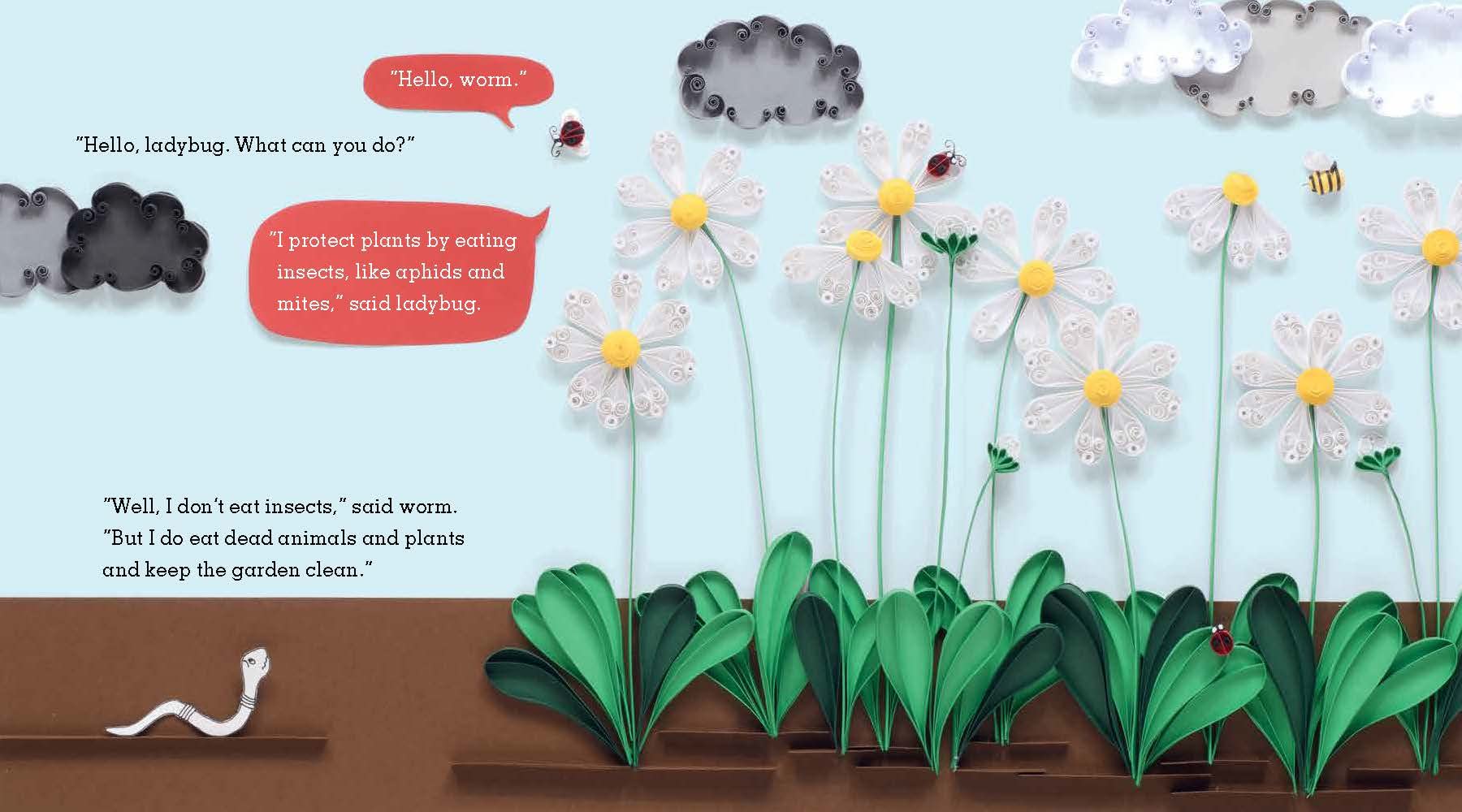
Butterfly also seemed to have multiple talents as did Spider and Dragonfly, who informed worm that he’d never be able to fly because he was “‘just a worm.'” Worm seemed resigned to his fate when he came upon ladybug and asked what she could do. Ladybug said, “‘I protect plants by eating insects, like aphids.'” This reminded worm that he did have a talent. “‘I eat dead animals and plants and keep the garden clean,'” he said with growing confidence.
Copyright Marie Boyd, 2023, courtesy of Greenwillow Books.
By the time worm meets bee, he’s ready to advocate for his own contribution to the garden. Then when snail crawls by and tells worm about the slime that protects him, worm realizes he’s found a friend he can relate to because worm makes slime too! Snail thinks that’s pretty cool, and worm agrees! In fact, worm understands that he can do a lot of things and that many of them benefit the garden. He even lists them all for snail, and as he looks around at the beautiful flowers and luscious berries, he takes some credit for growing “all of this” and proudly states “I’m a WORM!”
Copyright Marie Boyd, 2023, courtesy of Greenwillow Books.
Marie Boyd’s clever story combines salient information about a variety of insects with worm’s confidence-boosting journey from feeling inferior to the other garden dwellers to realizing his own role and importance in the plants’ growth and vibrancy. From page to page, readers can sense worm’s developing appreciation for his talents, and when he shakes off his misgivings and gives ladybug a small list of his accomplishments, kids will be right there to cheer him on. Readers may be surprised to discover just how much worms do contribute to a healthy garden ecosystem even as they come to understand that there is no such thing as “just a worm” in nature. Worm’s personal growth will also resonate with children, who are trying out new things and beginning to find their place in the world.
Boyd’s beautiful and original illustrations, created with intricate paper quilling are wonderfully detailed, textured, and expressive of the uniqueness and interconnectivity of nature. She also weaves in metaphorical clouds, which at worm’s lowest point, turn grey and black as they build overhead. But with his newfound confidence, they dissipate to be replaced with white, fluffy clouds that also blow away to reveal a clear, blue sky.
A multilayered story that delivers two important life lessons in a unique and charming way, Just a Worm will become a quick favorite for home, school, and public library story times. The book would be especially fun to pair with home gardening or planting activities for classrooms, libraries, and extracurricular organizations.
Ages 4 – 8
Greenwillow Books, 2023 | ISBN 978-0063212565
About Marie Boyd
Marie Boyd is a law professor, author, illustrator, and self-taught quilling artist. Her author and illustrator debut, Just a Worm (Greenwillow Books 2023), follows worm through the garden as he learns about his neighbors and how he helps keep the garden healthy. Originally from Salt Lake City, Marie lives in Columbia, South Carolina with her husband and two young children. You can find her at marieboyd.com and on Instagram.
Just a Worm Book Birthday Activity
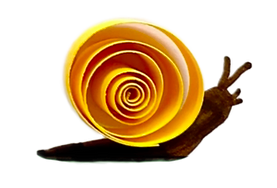
Make a Quilled Snail
Author/illustrator Marie Boyd built worm’s gorgeous garden world with quilled paper, and now you can make worm’s friend snail for yourself with this tutorial on her website!
Missing the green leaves and colorful flowers of spring and summer? Maybe it’s time to recreate the sights of warmer days inside with houseplants! Placed in a sunny window, some plants will continue blooming all winter long, making you feel happier. Houseplants also provide health benefits as they produce oxygen, release moisture into that dry winter air, and improve air quality. Add a few herb plants and even cooking will take on new life. Whether you add just one plant or create an indoor garden, today’s the perfect day to get started.
Luna’s Green Pet
Written by Kristen Pendreigh | Illustrated by Carmen Mok
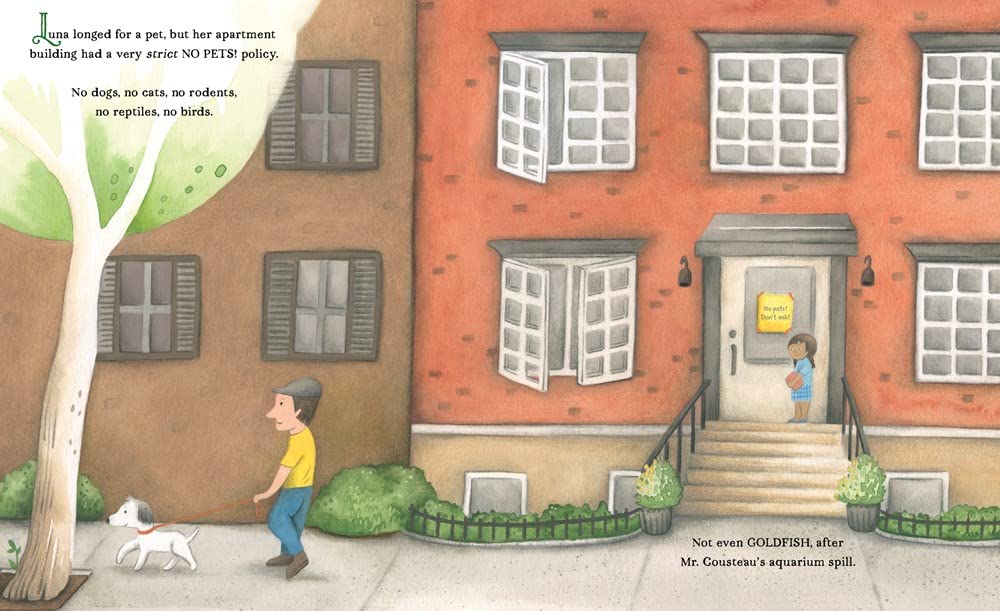
When Luna saw people on her block walking their dogs and playing with their pets, she wished she could have one. “But her apartment building had a very strict NO PETS! policy.” Luna’s friends tried to help out by suggesting other types of pets, including a pet rock, an expensive dog-shaped purse, and an ant farm, but none of these were quite what Luna was looking for. Then one day, she found a small discarded plant in a trash can. She decided it would be the perfect pet.
Image copyright Carmen Mok, 2022, text copyright Kirsten Pendreigh, 2022. Courtesy of Sleeping Bear Press.
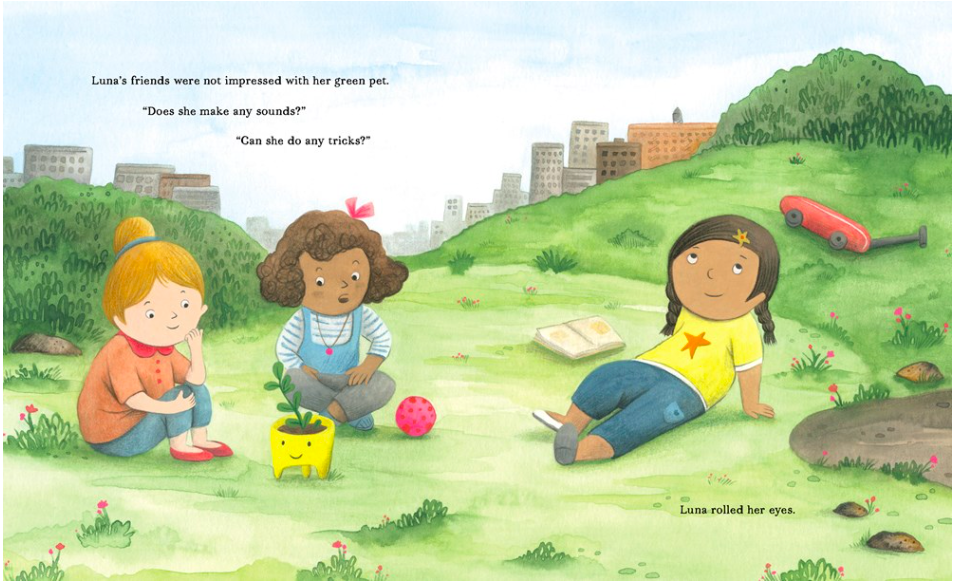
Luna took it home. The plant’s tag read Stephanotis Floribunda, which Luna shortened to Stephanie. Luna gave her pet a “bigger crate, new bedding, and fresh water.” Stephanie took to her new home right away. At night Luna read to her; every morning she took her to the park. Luna’s friends “were not impressed.”
Image copyright Carmen Mok, 2022, text copyright Kirsten Pendreigh, 2022. Courtesy of Sleeping Bear Press.
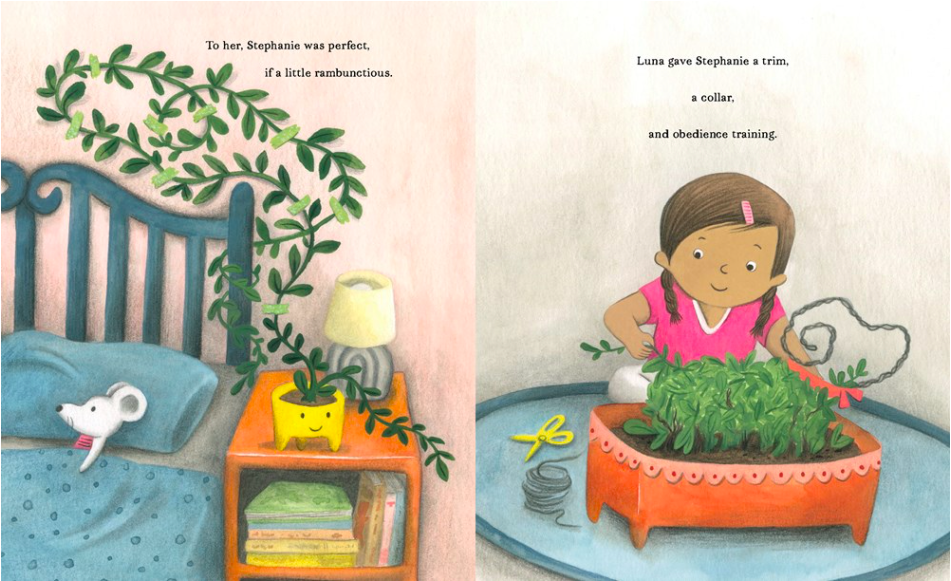
Stephanie turned out to be more “rambunctious” than she appeared, climbing the walls and wrapping herself around the headboard of Luna’s bed. Luna trimmed her and got her into shape with “obedience training” and a collar. One day unusual white “clumps of bumps appeared” among Stephanie’s leaves. As the bumps grew, Luna tried washing and hugging Stephanie, but the bumps only got bigger.
Image copyright Carmen Mok, 2022, text copyright Kirsten Pendreigh, 2022. Courtesy of Sleeping Bear Press.
Luna decided she’d take Stephanie to the botanist the next day to see what was wrong. During the night under a full moon, though, “the bumps burst open!” Then a “powerful perfume woke Luna.” Luna couldn’t believe her eyes—or her nose. The sweet scent floated out the window and soon attracted bees, hummingbirds, and butterflies during the day and moths at night.
Image copyright Carmen Mok, 2022, text copyright Kirsten Pendreigh, 2022. Courtesy of Sleeping Bear Press.
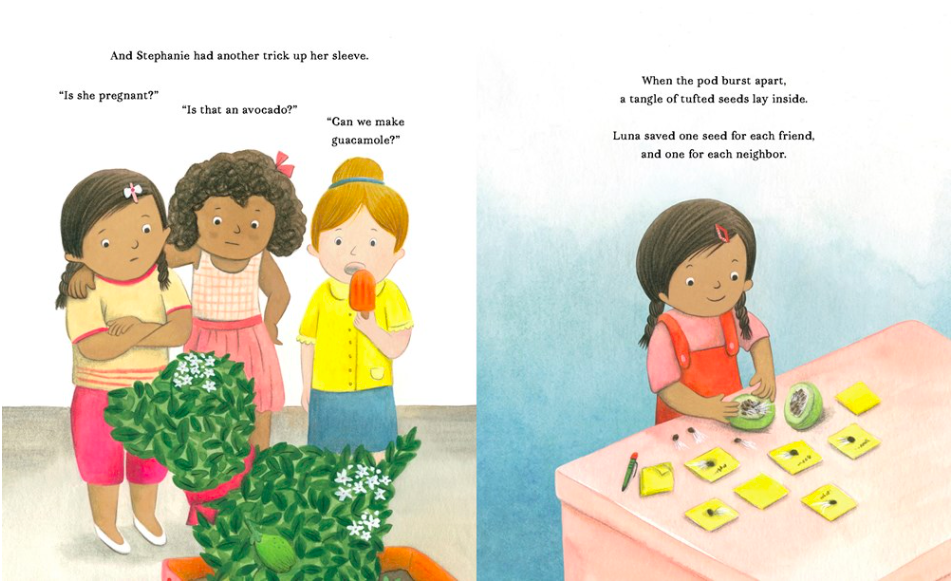
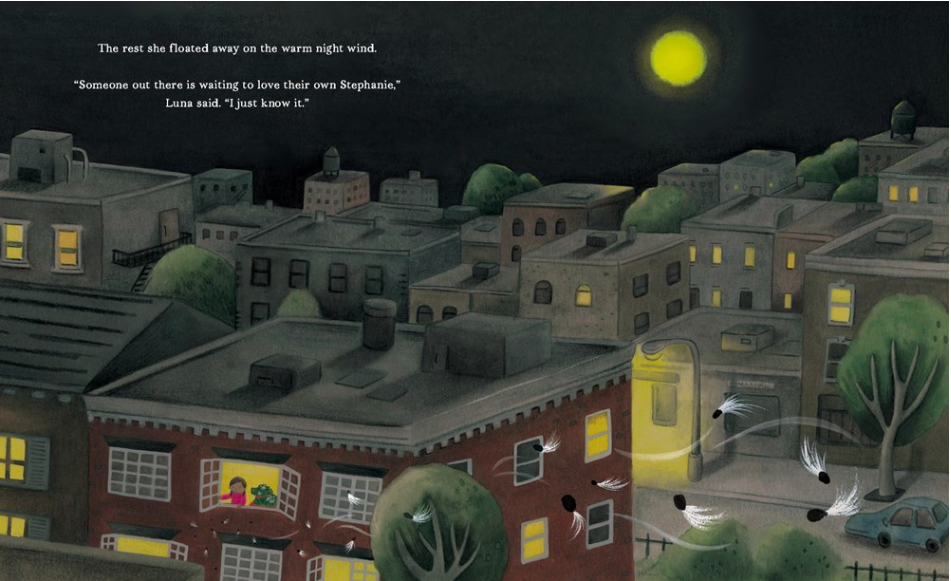
When Luna entered Stephanie in the neighborhood pet parade, she even “won a special prize—Best in Scent.” But Stephanie wasn’t finished with her tricks. A green fruit grew from her branches, and when it burst open Luna found that “a tangle of tufted seeds lay inside.” Carefully, Luna took out one seed for each of her friends and neighbors so they could grow their own Stephanotis Floribunda. And the rest, she let fly away on the “warm night wind” to find new homes where they would be loved as much as Stephanie.
Detailed back matter includes ways in which plants make great pets, a list of ten houseplants that are easy to grow, more information on Stephanotis Floribunda and how to care for it as a houseplant or in a garden.
Image copyright Carmen Mok, 2022, text copyright Kirsten Pendreigh, 2022. Courtesy of Sleeping Bear Press.
Kirsten Pendreigh’s gentle and creative story will charm kids who have a natural tendency to anthropomorphize plants, toys, furniture, and anything they love, imbuing these inanimate objects with personalities all their own. As Luna repots her plant, cares for it, and reigns in its wandering tendrils, Pendreigh enhances her pet imagery by using terms commonly associated with pets, a detail that will also enchant kids. With Luna’s sharing of Stephanie’s seeds, Pendreigh sparks wider ideas of generosity, friendship, and nurturing the environment.
Carmen Mok’s soft-hued, yet vivid illustrations have a quiet grace that allow readers to identify with Lulu’s creative thinking and caring nature. During Lulu’s serendipitous discovery of Stephanie in a trash can, Mok emphasizes Lulu’s personality with a kitty purse, shirt decorated with hearts, and gentle way she examines the plant’s wilted leaves. Kids will love seeing tiny Stephanie grow from a straggly stem into a lush, dog-shaped shrub with the help of some topiary framing.
Any child who has raised plants from seeds or seedlings will understand Lulu’s love for Stephanie and her surprise when Stephanie blooms unexpectedly. Mok’s lovely nighttime spreads spotlight the starlike beauty of the Stephanotis Floribunda flowers and the heady scent that calls out to pollinators. With the appearance of Stephanie’s seedpod, Mok realistically depicts its size, the tufted seeds inside the pod, and how those tufts carry the seeds to new far-flung growing spots.
Unique and heartwarming, Luna’s Green Pet will enchant kids who love pets, plants, a well-told story, or all three and will become a quick favorite to be heard again and again. The book is sure to inspire young botanists and would be a creative way to introduce lessons on plants in school classrooms or for homeschoolers, to spark projects for extracurricular clubs or library programs, and to get kids excited about gardening as well as planting a pollinator space at home. Luna’s Green Pet will enhance any home, school, or public library collection and is highly recommended.
Ages 4 – 8
Sleeping Bear Press, 2022 | ISBN 978-1534111615
Discover more about Kirsten Pendreigh, her poetry her debut book on her website.
To learn more about Carmen Mok, her books, and her art, visit her website.
World Pet Day Activity
Flip-Flop Plant Holder
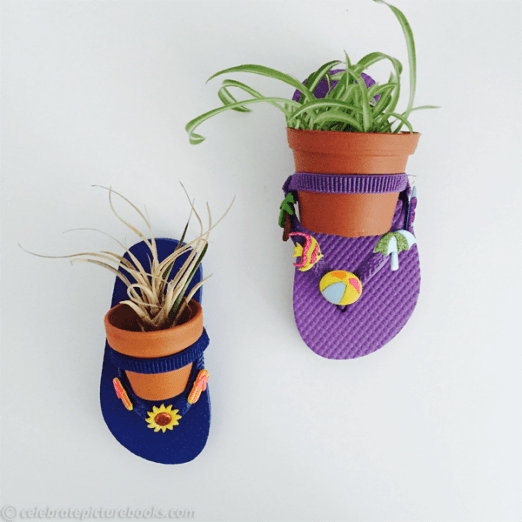
Have you outgrown your flip-flops or sandals this summer? Well, you can repurpose them with this easy craft that turns summer shoes into a creative way to hang small plants on walls or even windows!
Supplies
Child’s flip-flops with elastic heel straps
Buttons or charms
Small plastic solid-bottom pot
Small plant
Dirt
Hot glue gun
Heavy duty mounting strips
Small shovel or spoon
Directions
Place the flip-flop toe down on your work surface. With the hot glue gun, attach the buttons to the plastic toe straps of the flip-flops.
Add dirt to the pot
Add plant to the pot
Slip the pot into the elastic strap and gently push down so it is also supported by the plastic toe straps
To hang, use appropriate-weight mountable strips.
To make an interesting and attractive arrangement, use various sizes of flip-flops
You can find Luna’s Green Pet at these booksellers
If your motto is “So many books, so little time” then you’ll be happy to know that January is Book Blitz Month! During this month book lovers are given the green light to read as many books as possible! For kids, Book Blitz Month can be particularly exciting as they discover new fiction and nonfiction that captivates their imagination. To celebrate, take your kids to a local bookstore and the library to find new and favorite books to binge on all month long. If you don’t have a dedicated space for your children’s books, this month is also a great time to create a home library for your child so that they have a shelf, a crate, or even a whole bookcase of stories they can enjoy again and again!
I’d like to thank Lydia Lukidis for sharing a digital copy of Deep, Deep Down: The Secret Underwater Poetry of the Mariana Trench with me for review consideration. All opinions on the book are my own. You can read my interview with Lydia below.
Deep, Deep Down: The Secret Underwater Poetry of the Mariana Trench
Written by Lydia Lukidis | Illustrated by Juan Calle
Imagine being invited to visit a mysterious place where only a few have ever been; where only they have truly seen the creatures that inhabit it; and where it’s murky depths are accessible by only one type of vehicle. Would you dare to go? Lydia Lukidis and Juan Calle extend just such an invitation, but no notes for missing school, packing a suitcase, or plucking of courage need to be considered, for through their phenomenal book, readers find a seat in the incredible submersible that will transport them to “…the deepest underwater valley in the world”: the Mariana Trench.
Image copyright Juan Calle, 2022, text copyright Lydia Lukidis, 2022. Courtesy of Capstone Editions.
The submersible plunges deeper and deeper to where the sun doesn’t penetrate. Here, in the darkness, “food is scarce, and a bone-chilling cold blasts through the water. Earthquakes shake the ocean floor, and the water pressure, like a thick, heavy blanket with a thousand hands, presses down, / down, / down.” What flashes by the porthole window? A monster? No—a fish with a long and slender tail perfectly suited for its austere home, where it can survive for months without eating if necessary. “Diving deeper, a long, thin body slinks and sways, ever so slowly. The cutthroat eel is not fearsome, some rather, mesmerizing.”
The light beam of the submersible also reveals feathery crinoids “twirling and whirling like an underwater acrobat,” and a curious snailfish “dances, ghost-like, to the rhythms of the ocean” as it comes to take its own peek in the window from the other side. Snailfish aren’t affected by the heavy water pressure because “they can swim deeper than any other fish in the world. That’s because their bodies contain RMAO. This special substance protects the fish from high pressure, making sure their bodies aren’t crushed.”
Image copyright Juan Calle, 2022, text copyright Lydia Lukidis, 2022. Courtesy of Capstone Editions.
It might seem impossible to sink still lower, but the submersible plummets into water populated by tiny creatures, almost insect-like with their multiple pairs of legs and long antennae that propel them and help them find food. But explorers are not at the very bottom of the Mariana Trench even yet. The submersible floats slowly down to the bottom—“the very deepest spot on Earth. Look out the window . . . and witness a world of surprises.” Extraordinary creatures, some small, soft, and translucent and others—neither plant nor animal—large and with protective shells, and all adapted to thrive in their formidable surroundings will amaze you.
At last it’s time for the submersible to return to the surface. Slowly, it makes its way through the darkness to lighter seas, where it passes by more familiar fish and other creatures on its way to “SPLASH!” surfacing once again and “leaving the marvels of the Mariana Trench far below” still waiting to be explored again.
Insets of scientific information on diet, anatomical adaptations, and other aspects that make them suited to their environment also accompany the introduction of each sea creature.
Back matter includes an illustrated cutaway of the ocean above and descending into the Mariana Trench with various sea creatures labeled and oriented to the level in which they are found; “Did You Know?” facts about the water pressure in the Trench, its creation, and how many people have visited; why the Mariana Trench matters; an author’s note; and a glossary.
Image copyright Juan Calle, 2022, text copyright Lydia Lukidis, 2022. Courtesy of Capstone Editions.
When undertaking an excursion into unknown territory—especially through words and pictures—explorers need guides who can truly immerse them not only in the sights and sounds of an area but also the rhythms and almost intangible aura that makes it so uniquely compelling. Readers of all ages find that quality in Deep, Deep Down. Lydia Lukidis’s lithe and lyrical language is at once straightforward—answering questions any reader might have—and evocative—capturing the enigmatic and secret world at the bottom of the Earth as it flashes into view or slowly reveals itself and retreats again. Her vocabulary, rich with active verbs, ensures that readers appreciate the Mariana Trench as teeming with life and alive with wonders more amazing than we can even imagine.
Don’t be surprised if you find yourself forgetting that you’re looking at illustrations of a vampire squid, anglerfish, rattail fish, cutthroat eels, crinoids, and even the rocky and sandy ocean floor instead of photographs as you inspect Juan Calle’s magnificent pages. As the submersible—seen from many angles—plunges into darker and darker water, bioluminescent fish begin to appear alongside their grayer sea mates (children will enjoy pointing out the dark shapes that lurk in the shadows of the submersible and the stony outcroppings.)
As a rattail drifts into view, each rose-gold scale is visible, shimmering in the beam of light thrown from the submersible; it’s blue eye seemingly as curious about readers as they are about this unusual fish. Calle mesmerizes with careful details, shading, and perspective that portrays each creature in all of their weird and wonderful floating, creeping, or stock-still spectacle.
Deep, Deep Down: The Secret Underwater Poetry of the Mariana Trench will thrill ocean and nature lovers and will spur increased interest and research into this unique, nearly untouched habitat that we are only now beginning to discover. The book is a must for any environmental science enthusiast at home and for all classroom, school, and public library collections.
Ages 7 – 10
Capstone Editions, 2022 | ISBN 978-1684466153
About the Illustrator
Juan Calle is a former biologist turned science illustrator, trained on the Science Illustration program at UC Monterrey Bay. He worked early on his illustrator career for field guides of plants and animals of his country of origin, Colombia, and now owns and works in his art studio, LIBERUM DONUM in Bogota, Columbia, creating concept art, storyboarding and his passion: comic books. You can connect with Juan onInstagram.
Take a plunge into Deep, Deep Down with this book trailer!
Meet Lydia Lukidis
Lydia Lukidis is the author of 50+ trade and educational books for children. Her titles include DANCING THROUGH SPACE: Dr. Mae Jemison Soars to New Heights (Albert Whitman, 2024), DEEP, DEEP, DOWN: The Secret Underwater Poetry of the Mariana Trench (Capstone, 2023), THE BROKEN BEES’ NEST (Kane Press, 2019) which was nominated for a Cybils Award, and NO BEARS ALLOWED (Clear Fork Media, 2019). A science enthusiast from a young age, she now incorporates her studies in science and her everlasting curiosity into her books.
Lydia is an active member of SCBWI, CANSCAIP, 12 x 12, and The Authors Guild. She’s very involved in the kidlit community and also volunteers as a judge on Rate your Story. Another passion of hers is fostering love for children’s literacy through the writing workshops she regularly offers in elementary schools. Lydia is represented by literary agent Miranda Paul from the Erin Murphy Literary Agency.
Hi Lydia! I’m really thrilled to have the chance to talk to you about this gorgeous book, how it all came together, and your other work as a writer.
You have degrees in Pure and Applied Science as well as English Literature. After graduating from college did you work in the science field? If so, can you talk about your work a little? How has your science background influenced your writing?
When I was younger, I was drawn to both science and the arts. I once saw them as mutually exclusive but then came to realize how connected these disciplines are. Upon graduating university, I did something completely out of left field but that satiated my artistic desires. I started my own jewelry line! After that, I became a puppeteer, writing plays for children. That brought me back to my love of writing, and here I am writing kidlit. I often focus on STEM topics so it’s full circle. I feel like this is truly where I belong.
What drew you to write about the Mariana Trench for children? What kind of research did you do in creating this book?
In 2019, I read an article about how scientists found a plastic bag floating in the Mariana Trench. They also discovered plastic in the belly of various marine animals. My heart sank. I wondered how we human beings managed to start damaging one of the most remote places on the planet.
At that point, I didn’t know that much about the Mariana Trench and my curiosity grew. I began my research on the internet and then came to realize most of that information was false. The book really came together once I interviewed a slew of experts (7 in total) who’ve devoted their lives to studying the deep sea, the hadal zone, and geology. They also helped me find the right books and articles to read for updated information.
What was the most surprising thing you learned during your research? Do you have a favorite creature or one that you’d like to learn more about?
The most surprising thing was that despite the hostile conditions in the trench (no sunlight, scarcity of food, and crushing pressure), life still thrives deep, deep down. Though, the creatures are not what you would expect. There aren’t any sharks, for example, or any large creatures for that matter. My favorite has to be the sea cucumber. I must have watched hours and hours of them oscillating and floating, like underwater ballet. I was love struck!
Your storytelling in Deep, Deep Down is so fluid and as mesmerizing as the Mariana Trench itself. Can you talk about your writing process for this book and how you achieved such a visceral experience for readers?
Wow, what a compliment! Writing this book was nothing short of magical. I’m normally very hard on myself and many books don’t even make it to my agent. Other books take years to figure out. With nonfiction, finding the right structure is crucial. But somehow, with DEEP, DEEP DOWN, I didn’t have my usual “tormented writing struggle.” The writing was fluid and literally flowed out, and never changed in structure. There was a lot of editing, to be sure, I had to rewrite the manuscripts over 55 times to get the facts right, but the vision never changed. Will that always be the case? No! The next book I tried to write crashed and burned (maybe to be resurrected one day), so I’m grateful for this experience.
As a biologist who turned to illustration and who studied at the University of California at Monterrey Bay, Juan Calle must have been a dream match for Deep, Deep Down. Can you talk about how was he paired with your manuscript? When during the publication process did you begin to see his work? What emotions did his interpretations of your words stir in you?
Yes! It was Capstone who wisely suggested Juan. When I saw the proofs, I think my jaw hit the floor. He did SUCH a great job at getting all the details right (and believe me, it was tough—I had made a 20-page document with reference photos and notes vetted by Dr. Gerringer, my main consultant.) Although we never met, spoke, or even corresponded via email, Juan was able to follow my direction and bring his own flavor to the table. I think I first started seeing artwork about 8 months ago, so it was a speedy process. His work was stunning and scientifically accurate, although we couldn’t always draw everything to scale. It was also infused with magic.
What do you hope children will take away from Deep, Deep Down?
My goal in writing this book was twofold: firstly, to educate children on the deepest ocean of our world and debunk the myth that “scary” creatures live within its depths, and, secondly, to talk about ocean conservation and the importance of this fascinating ecosystem.
Kids may think the Trench is so far removed from their lives and that their actions don’t matter, or that what happens in the Trench doesn’t affect them. But that’s simply not true. Everything is connected, and I’d like to remind them that our actions affect our planet, even in its deepest spots.
You’ve written over 50 books for children and are very active in the writing community. What do you love best about being an author? What do you find rewarding about helping other writers succeed?
Thank you for the sweet words! I got my start with work-for-hire and most of my published books are for the educational market. DEEP, DEEP DOWN is my first trade nonfiction book, so it feels like a big accomplishment.
What do I love about writing? Everything. That said, it’s also a tough profession and every year, I usually have a moment when I reassess why I keep choosing this craft.
I also love supporting the kidlit community; it comes deep from the heart. I know what it is to struggle as a writer, and I see so many others struggling, hustling, working so hard. I like to support and acknowledge their efforts. Every little achievement is a milestone and should be celebrated!
What’s up next for you?
I’m excited to have just announced my second trade nonfiction book, DANCING THROUGH SPACE: Dr. Mae Jemison Soars to New Heights (Albert Whitman, 2024). I actually wrote this in 2015, and it’s a very long and convoluted story about how it got acquired. I did think long and hard whether or not I should tell this story and I ultimately decided to follow my heart because I felt so connected to the hook of the story. I invested in a sensitivity reader and will do so again once we start the editing process at Albert Whitman. They also chose a fantastic illustrator, Sawyer Cloud.
Other than that, I’m knee deep in other WIPs, some of them fiction. I wanted to try to stay in one lane as an author but it’s just not happening—it seems there are different stories of different genres inside me that need to come out. I’m always following the flow of my inspiration, which is often not linear!
Thanks again, Lydia, for sharing so much about your writing life! I know readers are going to love Deep, Deep Down and will be looking forward to Dancing Through Space!
Book Blitz Month Activity
Creatures of the Mariana Trench Word Search
The Mariana Trench is home to so many amazing creatures! Can you find the names of seventeen in this printable word search puzzle?
Read a New Book Month couldn’t come at a better time than during the gift-giving season. Books make gifts that have long-lasting appeal and can seem “new” with every reading or provide comfort, laughs, and joy that never gets old. Today I review two pop-up books for the younger set that adults will enjoy sharing as much as the kids will love hearing—and seeing—them.
I’d like to thank Twirl Books and Barbara Fisch at Blue Slip Media for sharing Dinosaurs and Other Prehistoric Creatures and The Pop-Up Guide: Animals with me for review consideration. All opinions on the books are my own.
Dinosaurs and Other Prehistoric Creatures
Written by Arnaud Roi | Illustrated by Charlotte Molas
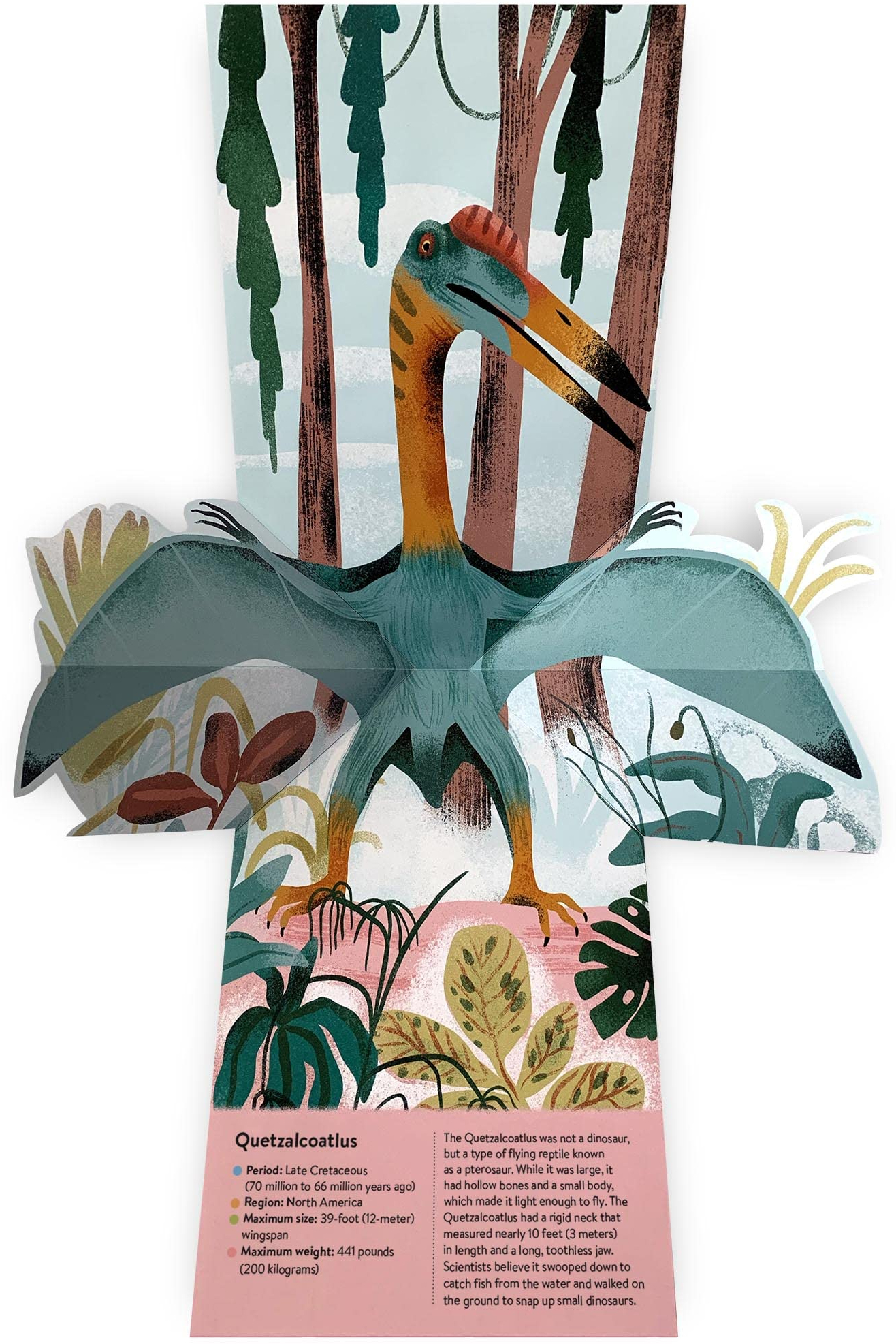
If you’d like to see your child’s eyes pop open in delight each time they open a particular book and you have a child who loves dinosaurs, then Dinosaurs and Other Prehistoric Creatures is the book for them! This easy-to-hold book opens upward to provide “Wow!”-inducing reactions to seven awesome dinosaurs three reptiles that kids may recognize as early ancestors to some of today’s land and ocean-dwelling animals—fierce and not so.
With the lift of the first page, kids come face to face with a giant Argentinosaurus who’s foraging among the foliage to satisfy its daily 880-pound dietary requirement. How did these herbivores digest all of those leaves, ferns, grasses, and other plants? They “also swallowed rocks, which helped grind up the food in its stomach.” Readers also discover the period during which these dinosaurs lived, the region they were found in, their maximum size and their maximum weight. All measurements are given in feet and pounds as well as meters and kilograms.
Image copyright Charlotte Molas, 2022, text copyright Arnaud Roi, 2022. Courtesy of Twirl.
Other dinosaurs that come out to meet young paleontologists include the Spinosaurus—who, at “over 49 feet (15 meters) long and 13 feet (4 meters) tall” with a maximum weight of 20,000 pounds (9,000 kilograms) “was the largest known carnivore on land. The most distinctive feature of this popular dino was the sail on its back, which measured “almost 7 feet (2.1 meters) tall” in itself! Kids will also enjoy saying hello to the baby Triceratops that appears to be walking right off the page! Standing nearby is a watchful mom or dad ready to protect their little one. Readers will learn that “Triceratops lived in herds” and when threatened “they would form a circle around their young and face the predator with their horns.”
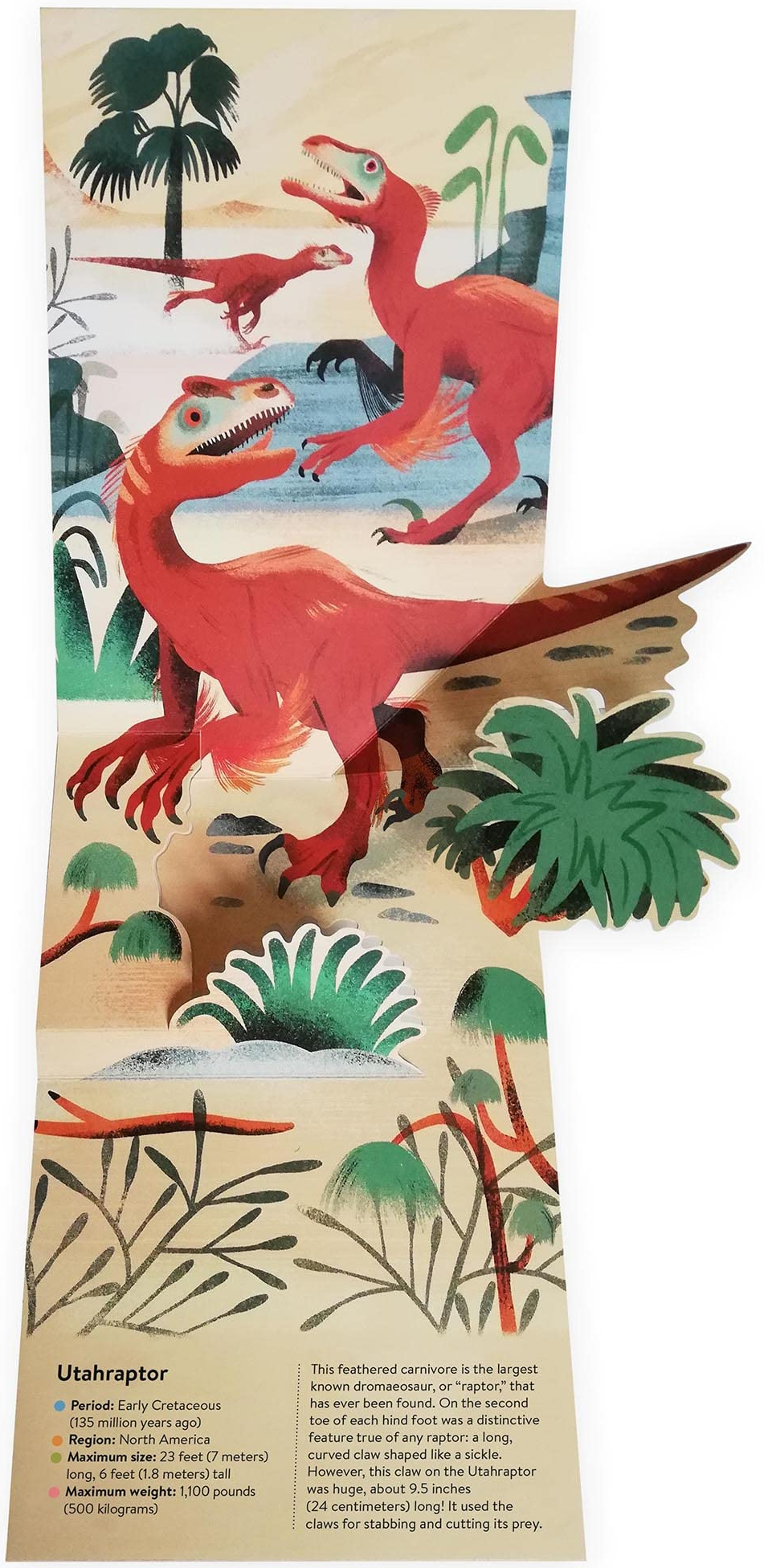
Of course, the Tyrannosaurus pops up to eat and greet with his fierce “banana-shaped teeth that could grow up to 12 inches (30 centimeters) long.” This 20,000-pound behemoth may have roamed North America 68 million years ago, but it had a surprising connection to today’s crocodiles. Kids will also learn about two herbivores— one with claws more than 3 feet (1 meter) long, and one with a very tiny brain but very intimidating spikes to keep predators at bay—and the largest raptor ever found. The prehistoric reptiles represented here plied the land, sea, and air and were no less impressive than the dinosaurs they shared the earth with.
Image copyright Charlotte Molas, 2022, text copyright Arnaud Roi, 2022. Courtesy of Twirl.
Arnaud Roi describes each dinosaur and prehistoric creature in engaging language accessible for even the youngest reader and sprinkles in the kinds of facts about the animals’ anatomy, preferred habitat, diet, and physical prowess that make kids’ eyes widen and spur them to learn more. Roi brings the same enthusiasm and feeling of amazement to his subject that kids feel themselves, making this a book readers will really connect with.
In her three-dimensional illustrations, Charlotte Molas puts the dinosaurs front and center while including images of the environments they called home. You can bet kids will love opening, closing, and reopening the pages to interact with the dinosaurs and prehistoric creatures, complete with roars, stomps, chomps, and shrieks.
With a thick padded board cover and sturdy pages, plus eye-popping illustrations and text that’s just right for young learners, Dinosaurs and Other Prehistoric Creatures is a top choice for dinosaur and science lovers. The book would make a terrific gift and take-along and is highly recommended for home, school, and public library collections.
Ages 3 – 5
Twirl, 2022 | ISBN 978-2408037512
You can find Dinosaurs and Other Prehistoric Creatures at these booksellers
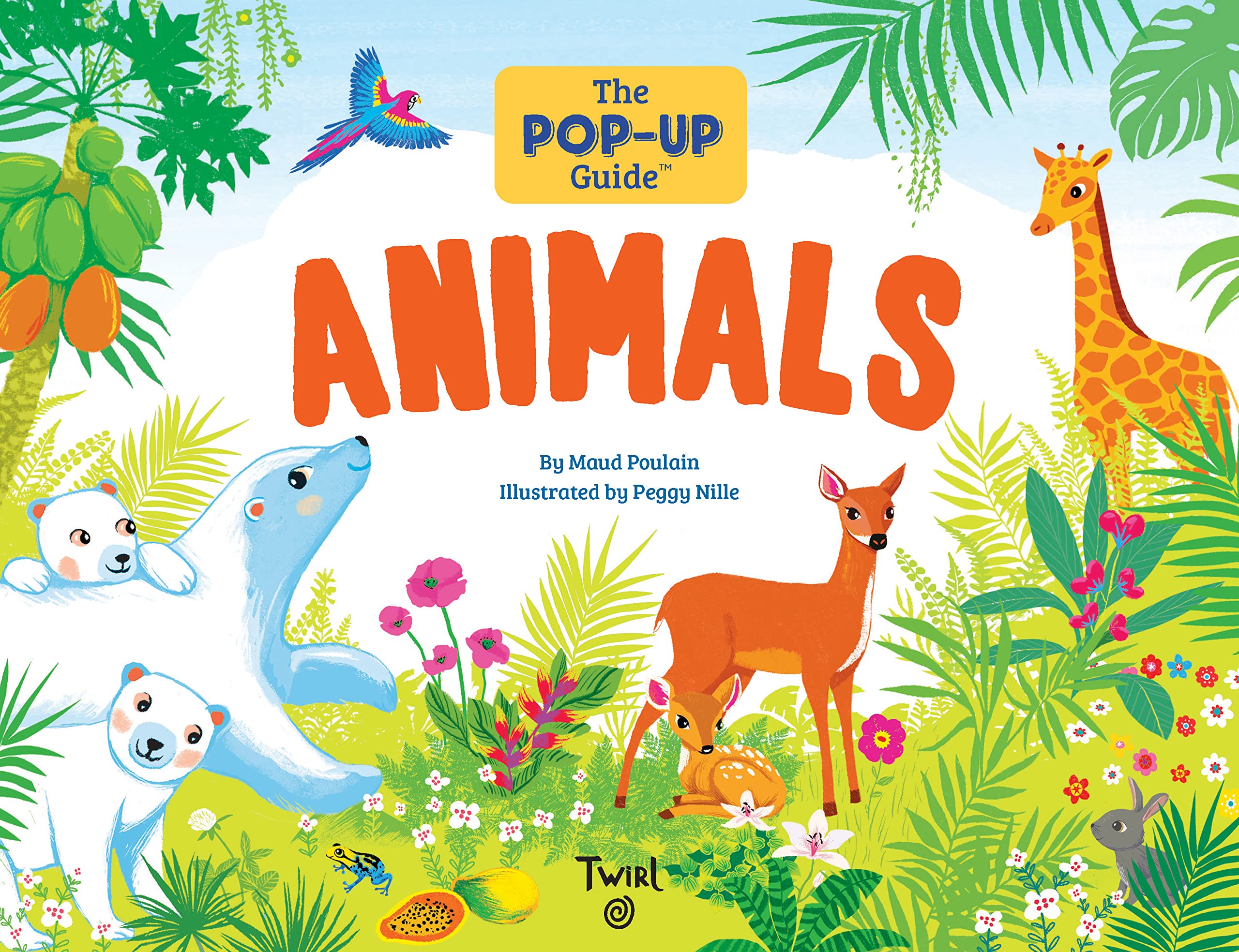
Written by Maud Poulain | Illustrated by Peggy Nille
The fourth book in this well-conceived series that includes Pop-Up Guides to Space, Vehicles, and Natural Wonders takes children around the world to meet the animals that live in ten different environments. Upon opening the book kids find themselves in the African Savanna, where a hippopotamus, three flamingos, and three lions have gathered for a drink. A crocodile suns itself on the bank, while another pokes its head above the water. A cheetah, lounging on a tree branch, also pops out to say hello. Behind them, a zebra, giraffes, gazelle, and mother and baby elephants roam and find food.
In her short paragraph, Maud Poulain tells readers about the African Savanna while also setting up talking points about the illustration: “It stays warm all year round here, with just two seasons: wet and dry. During the wet season, the animals have fresh grass and plenty of water to drink at the watering holes. In the dry season, many creatures may have to travel in search of food and water.” In addition to enjoying the vibrant illustration, adults and kids can talk about which time of year it is and how they know to identifying all of the animals and their particular attributes. Each animal is also labeled on the page.
Image copyright Peggy Nille, 2022, text copyright Maud Poulain, 2022. Courtesy of Twirl.
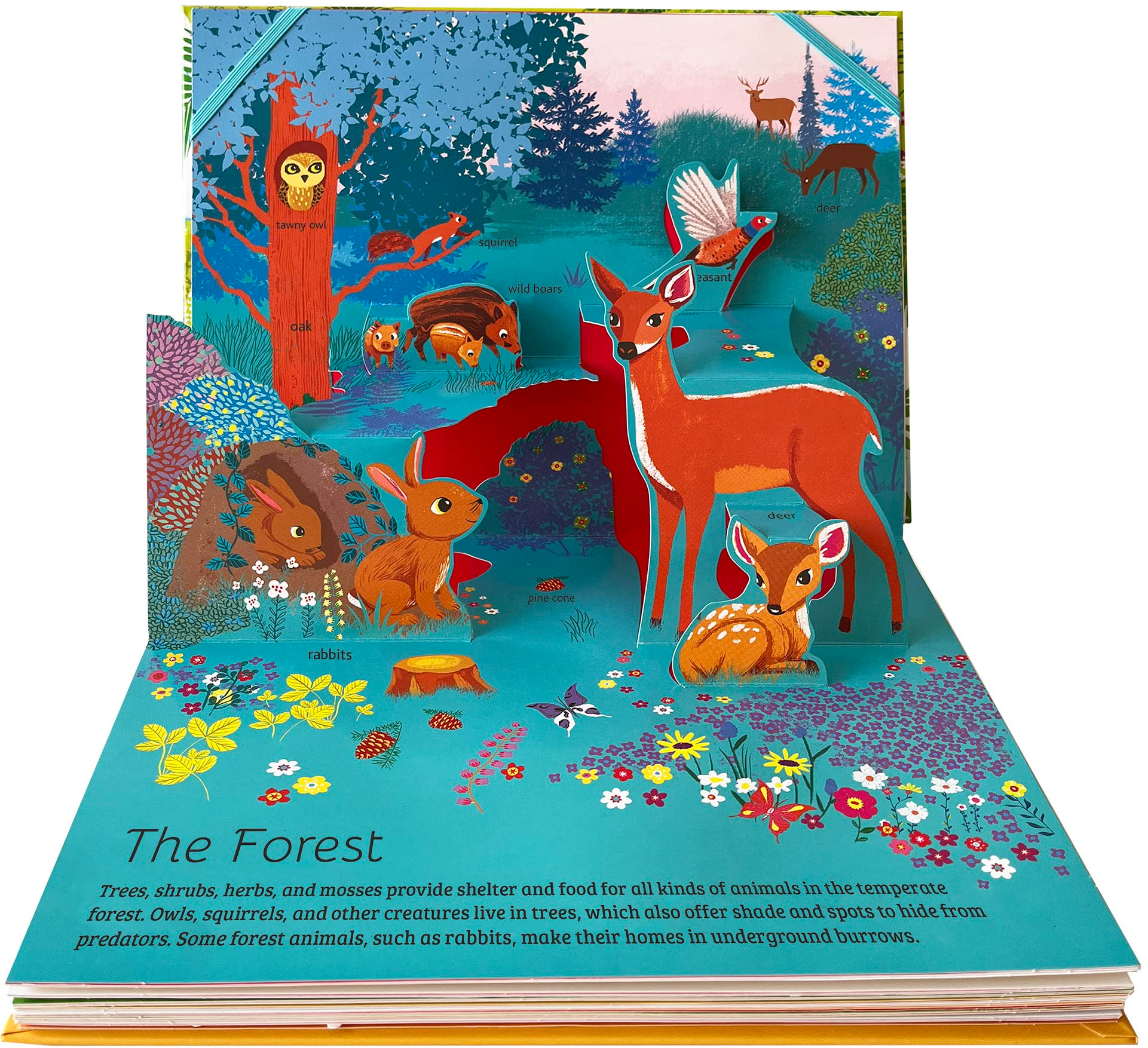
With the lift of the page, children then enter the temperate Forest, where “trees, shrubs, herbs, and mosses provide shelter and food for all kinds of animals.” Little ones will be “aww!” struck by the cute rabbits, fawn and mother deer, and baby wild boars greet them. A pheasant takes to the air, while a tawny owl and a squirrel hang out in an oak tree. Colorful butterflies flit among flowers, and a pinecone lies hidden, just waiting to be discovered.
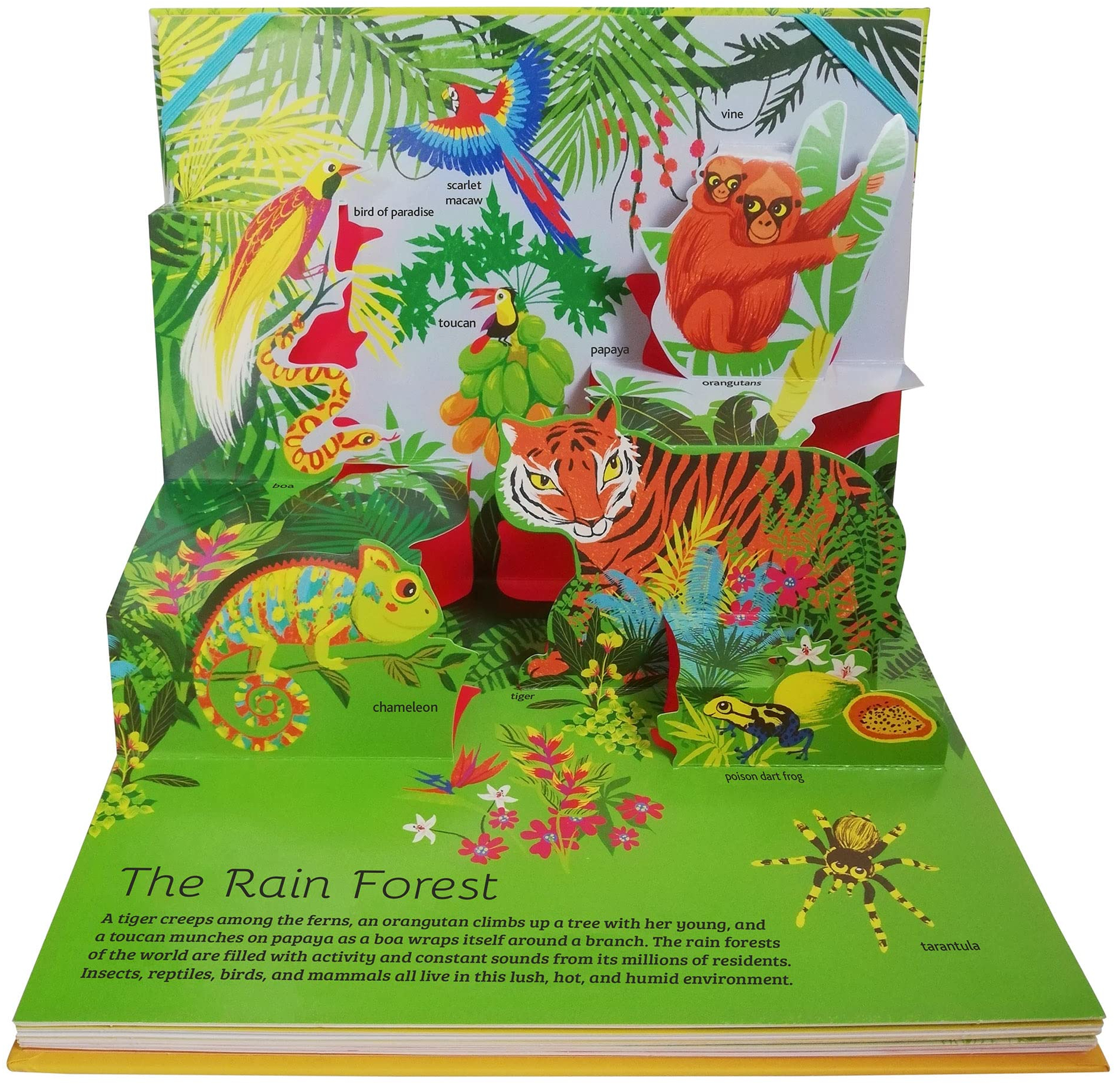
The vast expanse of snowy white meets readers next, along with the polar bears, little auks, ringed seals, caribou, orcas, and snowy owls that live in the Far North. There’s even someone riding a sled pulled by sled dogs making their way over the hills. Leaving the glittering snow, readers enter the eye-popping lushness of the Rain Forest, where vivid blues, oranges, greens, yellows, and reds are on display on the birds, chameleon, poison dart frog, tiger, boa, orangutans, and the thick vegetation will wow kids.
Image copyright Peggy Nille, 2022, text copyright Maud Poulain, 2022. Courtesy of Twirl.
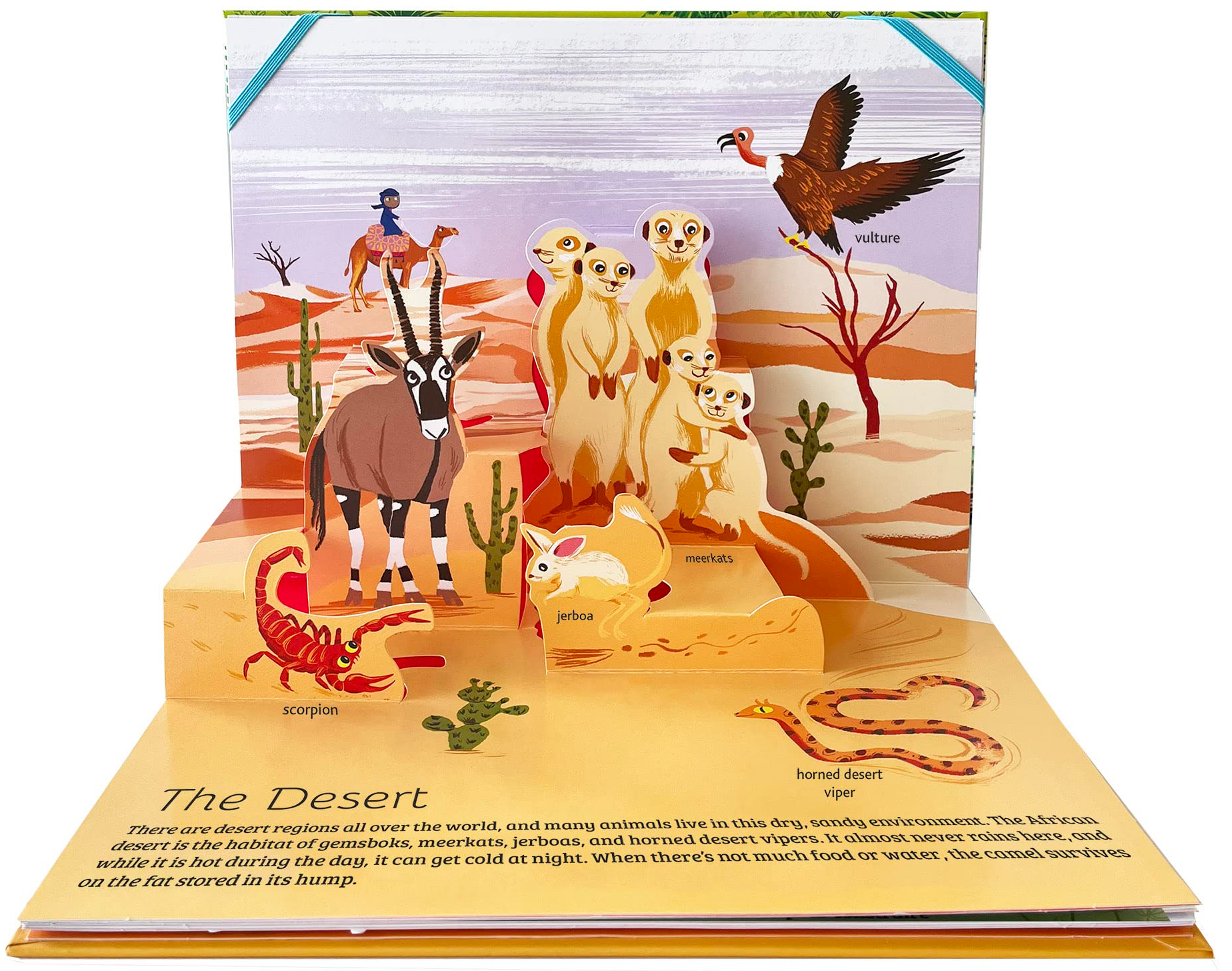
The fish, rays, mammals, and coral of the Ocean swim by up close for kids, and then it’s off to the driest areas of the world—the Desert. In the African desert, “it almost never rains…and while it is hot during the day, it can get cold at night. From there, readers get to know the birds, animals, and amphibians that call Freshwater Rivers home, then it’s back up into the mountains, which are warm and welcoming during spring and summer but can be snow-covered in late fall and winter. How do the animals and birds survive these opposing environments? Readers witness the ptarmigan, “whose fur and feathers change from brown to white” in snowy conditions in transition, while the snowshoe hare nearby has already become fully white.
Readers finish their tour of the world’s various environments with a dive into the Tropical Seas, where they can see a large array of creatures—from a clown fish, seahorse, and sea turtle to a porcupine fish, sea urchin, sea star, and more—all in bright colors and on the move in their warm-water paradise. But nature’s bounty is not reserved just for these magnificent habitats. The simple backyard also teems with life, and kids get to spend some time with a little girl and her cat as they sit on the porch as life hums around her.
Image copyright Peggy Nille, 2022, text copyright Maud Poulain, 2022. Courtesy of Twirl.
In her informative paragraphs—which are written in easy-to-understand language and are the perfect length for young children—Maud Poulain introduces readers to an impressive array of the world’s animals while also imparting facts and tidbits about their habits, anatomy, diet, and other attributes that make them well-adapted to their environment. She also reveals details about the plants and weather conditions of each unique region. Every animal is labeled on the page, allowing kids to play and “I-spy” game as the adult reads the text.
Peggy Nille realistically depicts each animal while giving them personalities that will charm young readers and draw them into learning about their lives and habitats. Eye-catching colors and beautifully detailed dioramas make each pop-out page one that kids will want to linger over. Their time will be rewarded with enchanting finds tucked here and there and plenty of nature’s gifts to talk about.
This well-constructed book has a thick cardboard cover with elastic bands on the top corners that can be placed around each page as the book is read to keep it upright for easy viewing or wrapped around the back cover to keep the book closed. The pop-ups, made from sturdy card stock, provide a depth of perspective that enhances the reading experience.
For young readers who are just learning about animals and for those who are ready to discover more about the world’s habitats and the animals that live in each, The Pop-Up Guide: Animals is a book they’ll want to read again and again. It would enhance any child’s home library and is highly recommended for school and public library collections.
Ages 3 – 5
Twirl, 2022 | ISBN 979-1036345166
You can find The Pop-Up Guide: Animals at these booksellers


















 celebratepicturebooks.com