November 16 – It’s Global Entrepreneurship Week

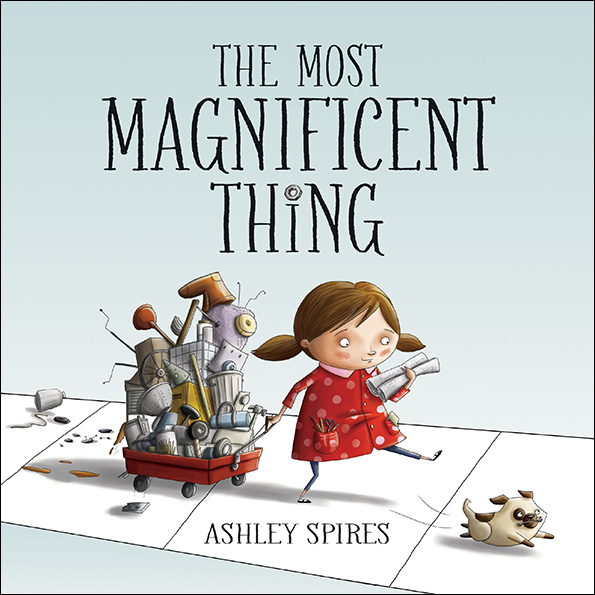
The Most Magnificent Thing by Ashley Spires picture book review

About the Holiday

Do you have a great idea to make the world a better place, a job easier, or life just a little more fun? Then this week is for you! All over the world inventors, thinkers, mentors, universities, and investors collaborate at events, conferences, and competitions to discover new products, creative ideas, and alternate ways of doing things. World leaders from 160 countries and more than 150,000 global organizations work together during this week to improve the lives of all.

The Most Magnificent Thing

By Ashley Spires


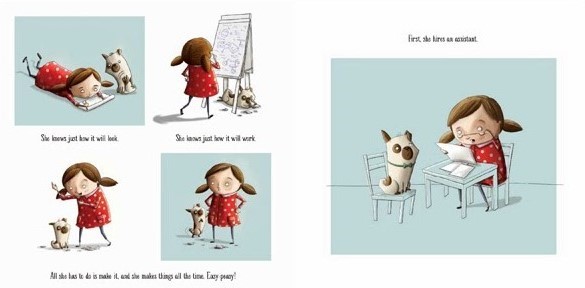
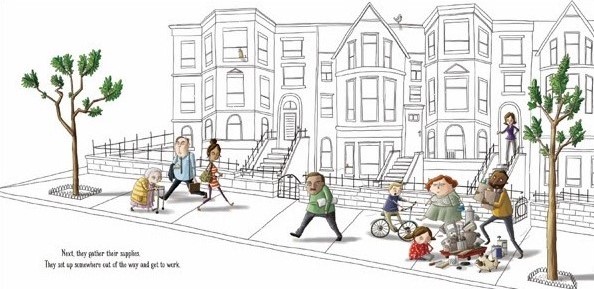
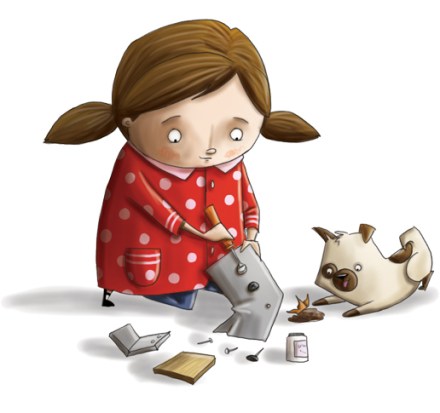
A little pony-tailed girl and her puppy do everything together. They race, eat, explore, and relax. When she makes things, her best friend unmakes them. One day the girl has a brilliant idea—she is going to make “the most MAGNIFICENT thing!” In her mind it’s going to be “easy-peasy.” She knows exactly how it will look and how it will work. With her faithful assistant following at her heels, the girl gathers materials and goes to work on the sidewalk outside her home.

celebrate-picture-books-picture-book-review-the-most-magnificent-thing-easy-peasy

Image and text copyright Ashley Spires, courtesy of Kids Can Press

The girl “tinkers and hammers and measures” while her assistant “pounces and growls and chews.” When the little invention is finished, they stand back to examine it. Hmmm…it doesn’t look quite right. It doesn’t feel quite right either. In fact it is all wrong! The girl tries again. She “smooths and wrenches and fiddles” while her assistant “circles and tugs and wags.” It still turns out wrong. Determined to make her vision reality, she gives it another go…and another…and another. She makes her invention different shapes, gives it various textures, measures out assorted sizes. One attempt even smells like stinky cheese! But none of these creations are MAGNIFICENT.

celebrate-picture-books-picture-book-review-the-most-magnificent-thing-neighbors-come-by

Image and text copyright Ashley Spires, courtesy of Kids Can Press

People stop by and offer encouraging—even admiring—remarks, but the little girl just gets mad. Can’t they see how wrong her invention is? In her anger the little girl works at a fevered pitch, shoving parts together, her brain fogged by “all the not-right things.” In her haste she hurts her finger. This is the last straw. She explodes and declares that she QUITS!

celebrate=picture-books-picture-book-review-magnificent-thing-not-magnificent

Image and text copyright Ashley Spires, courtesy of Kids Can Press

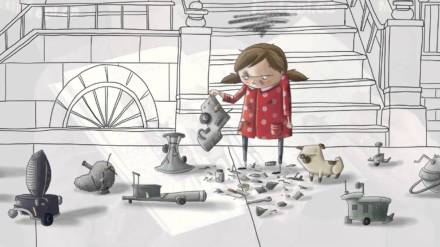
The ever-watchful assistant suggests a bit of fresh air. The girl takes her puppy for a walk and at first her feelings of defeat stay with her. Little by little, though, she pays attention to the world around her and her mind clears. Coming home, she encounters all the wrong things she has made lined up on the sidewalk. Her disappointment threatens to return, but then she notices something surprising—there are parts of each iteration that she likes!

celebrate-picture-books-picture-book-review-the-most-magnificent-thing-tinkering

Image and text copyright Ashley Spires, courtesy of Kids Can Press

After studying each earlier attempt, she knows just what to do! Slowly and carefully she once more begins to tinker. At the end of the day she and her assistant stand back to look. The machine may lean a bit, and be a little heavy, and it may need a coat of paint…but as the girl and her puppy climb aboard, they both agree that “it really is THE MOST MAGNIFICENT THING!”

You are never too young or too old for Ashley Spires’ inspiring and inspired story. The journey from idea to realization—so often fraught with disaster (or apparent disaster)—is depicted here honestly and with humor as the on-going process it is. Step-by-step the little girl thinks, gathers materials, tinkers, discovers, tinkers some more, and triumphs. It is this last step that is so “magnificently” presented—it’s only by not giving up that success can be achieved.

celebrate-picture-books-picture-book-review-the-most-magnificent-thing-the-girl-and-her-dog

Image and text copyright Ashley Spires, courtesy of Kids Can Press

Spires’ tale is a delight of language—the girl “smooths, wrenches, fiddles, twists, tweaks, and fastens, pummels, jams, and smashes.” Likewise, her illustrations wonderfully depict the changing emotions of this thoughtful, steely-eyed, shocked, and ultimately thrilled young inventor. Her faithful puppy is a charming companion and foil, and kids will love examining the early inventions that lead up to the final product.

The Most Magnificent Thing is a fabulous book to keep on any child’s or adult’s bookshelf for those times when inspiration hits but achievement seems elusive.

Ages 3 – 7 and up 

Kids Can Press, 2014 | ISBN 978-155453704

Discover more books by Ashley Spires on her website!

Global Entrepreneurship Week Activity

CPB - Inventor's Tool Kit II (2)

Entrepreneur’s Tool Kit


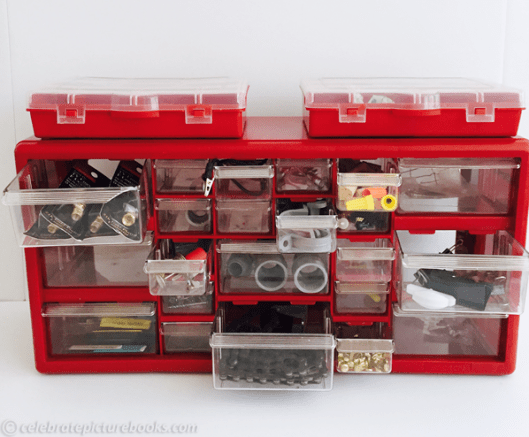
Every idea begins as a jumble of seemingly unrelated parts. Gathering whatever types of material inspires you and keeping it in a box ready to go when inspiration hits is a great way to support innovation and spark experimentation.

Supplies

  • Small parts organizer with drawers or compartments, available at hardware stores and craft stores
  • A variety of parts or craft materials that can be combined, built with, or built on
  • Some hardware ideas—pulleys, wheels, small to medium pieces of wood, wire, nuts, bolts, screws, hooks, knobs, hinges, recyclable materials
  • Some craft ideas—clay, beads, wooden pieces, sticks, paints, pipe cleaners, string, spools, buttons, glitter, scraps of material, recyclable materials

Directions

  1. Fill the organizer with the materials of your choice
  2. Let your imagination go to work! Build something cool, crazy, silly, useful—Amazing!

Picture Book Review

November 15 – I Love to Write Day

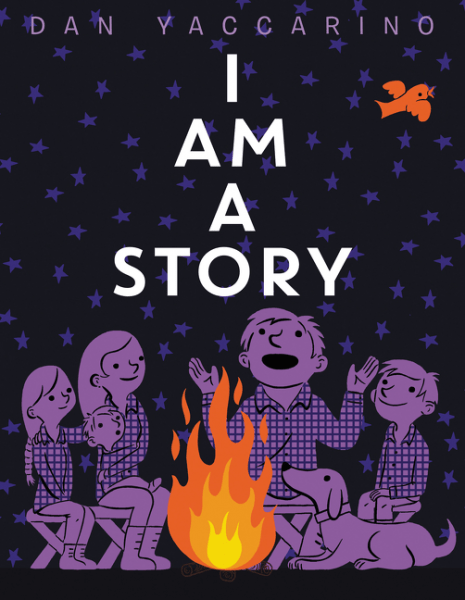
celebrate-picture-books-picture-book-review-i-am-a-story-cover

About the Holiday

I Love to Write Day was created by Delaware-based author John Riddle in 2002. He wanted to share his passion for writing with others and encourage them to pick up a pen or sit down at the computer and compose a poem, a short story, a journal entry, or whatever kind of written expression stirs their hearts. It’s fitting that today’s holiday comes in the middle of NaNoWriMo or National Novel Writing Month, when novelists and would-be novelists strive to begin and finish a complete novel (well, at least a first draft) in one month. If you hold ambitions to write, why not start today? As today’s book shows, you’ll be part of a very honored, long-standing tradition!

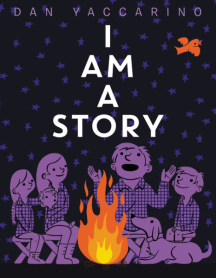
I Am a Story

By Dan Yaccarino


Sometimes it seems that from nothing and out of nowhere a story comes. And yet storytelling also seems to be an inborn trait, passed down from generation to generation and discovered in daydreams, alternate realities, those “what if?” moments. In Dan Yaccarino’s book, a story relates its history, beginning with our oldest ancestors. “I am a story,” the narrator states. “I was told around a campfire. Then painted on cave walls.” The story travels over years and across miles, changing the way it is told but not its impact.

celebrate-picture-books-picture-book-review-i-am-a-story-oral-storytellers

Image copyright Dan Yaccarino, courtesy of harpercollins.com

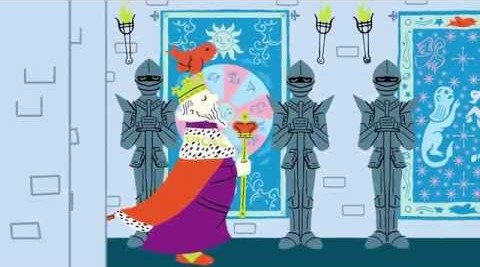
Men inscribed words on papyrus; women used woodblocks, brushes, and ink to bring them to life. Tales were stitched into legend on beautiful tapestries that brightened dank castle walls, and they were transcribed in gilded lettering “into big books to illuminate minds.” Then a man discovered how to print the story so many people could read it, which led to the story being “acted out onstage.”

celebrate-picture-books-picture-book-review-i-am-a-story-tapestry

Image copyright Dan Yaccarino, courtesy of harpercollins.com

Stories were bound into books and families began to collect them, creating “vast private libraries.” Then public libraries opened, and now stories are available for everyone—even in places so remote that the books are brought on donkeys, by camel, or even atop elephants. There are tiny libraries—not much bigger than a birdhouse; vending machines that dispense stories; and old telephone booths that have been transformed with shelves of books.

The story reveals its power to make “people frightened, excited, sad, and happy.” Some have felt and still feel that the story is dangerous, so they have “censored, banned, and burned” it. But the story “did not die.” Millions of people all over the world are inspired by the story every day. “I can go with you everywhere,” the story says, “and will live forever. I am a story.”

celebrate-picture-books-picture-book-review-i-am-a-story-printing-press

Image copyright Dan Yaccarino, courtesy of harpercollins.com

Bibliophiles young and old will love the simply told and expressively illustrated timeline of the story from early oral traditions until today. Between the first page where ancient peoples interpreted the constellations and the last where a family of today tells stories around a campfire under the starry sky, the various forms that stories take are described with vivid, full-bleed pages of people toiling over manuscripts, inventing methods of mass production, and building collections all to ensure that the words continue no matter what changes occur.

Kids will love lingering over the details on each page, and every page could lead to a fun afternoon of discovering more about each stage in the story’s development. For teachers and homeschoolers I Am a Story is a wonderful jumping off book for an English or History unit, and it makes a beautiful addition to any library.

Ages 4 – 8

HarperCollins, 2016 | ISBN 978-0062411068

You know Dan Yaccarino from his TV shows The Backyardigans, Oswald and others as well as his many, many books. You can learn more about him and his work on his website!

Enjoy this I Am a Story book trailer!

I Love to Write Day Activity

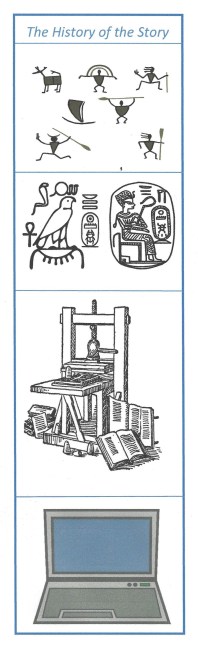
celebrate-picture-books-picture-book-review-the-history-of-the-story-bookmark

The History of the Story Bookmark


From cave paintings and hieroglyphics to the printing press and the computer, people have ensured that their thoughts were not forgotten. Here’s a printable The History of the Story Bookmark plus a blank one for you to fill in. Use them to mark your favorite stories!

celebrate-picture-books-picture-book-review-i-am-a-story-cover

You can find I Am a Story at these booksellers

Amazon | Barnes & Noble | Books-a-Million | IndieBound

Picture Book Review

Picture Book Review

November 12 – Fancy Rat and Mouse Day

celebrate-picture-books-picture-book-review-the-mouse-and-the moon

About the Holiday

Today gives us a chance to take another look at rats and mice. I’m not talking about the kind of mouse I’ve seen scurrying around in my garage or the kind of rat that…well, honestly, I hope is nowhere near my garage. The guys  we’re celebrating today are fancy, which means they are bred to make good pets. Despite their bad rap, mice and rats are smart, loyal, and clean. They don’t require as much care as a dog or cat, and they can be fun to play with. The American Fancy Rat and Mouse Association holds events around the country to introduce people to these alternative pets. Today, you may want to check one out.

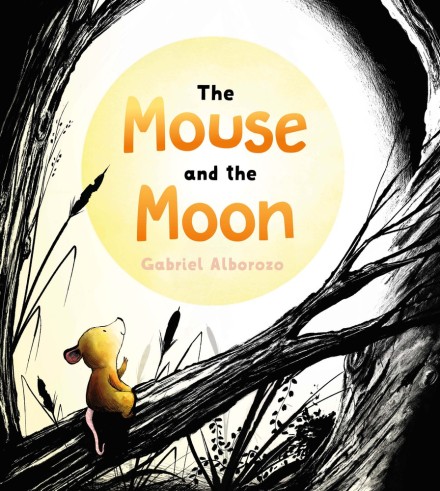
The Mouse and the Moon

By Gabriel Alborozo


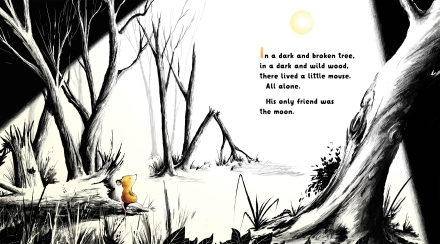
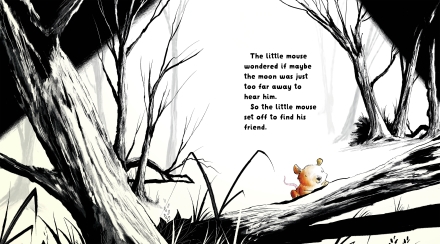
“In a dark and broken tree, in a dark and wild wood, there lived a little mouse. All alone. His only friend was the moon.” The little mouse waited each night for the moon to appear so that he could talk about his day and his hopes, dreams, and fears. The moon always listened silently. The little mouse began to think that the moon was just too far away to hear him, so he went in search of his friend.

celebrate-picture-books-picture-book-review-the-mouse-and-the moon-mouse-lives-alone

Image and text copyright Gabriel Alborozo, courtesy us.macmillan.com

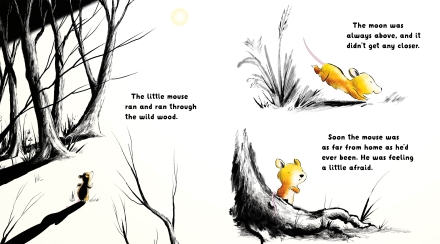
The mouse scampered through the woods, but no matter how far he went, the moon never seemed any closer. Pretty soon the mouse was far from home and “was feeling a little afraid.” When he stopped to rest, the mouse looked into the night sky, but could no longer see the moon. Suddenly, he heard a whispered “‘Hello?’” The mouse cautiously looked around and replied, “‘Hello?’” “And there, floating in a small, still pool, was the moon.” The mouse was excited to have found his friend at last.

celebrate-picture-books-picture-book-review-the-mouse-and-the moon-mouse-goes-to-find-moon

Image and text copyright Gabriel Alborozo, courtesy us.macmillan.com

But what he didn’t see was the tiny fish “hidden from sight, beneath the moon’s reflection.” The little fish was equally glad to finally hear from his friend the moon. “‘I’ve been waiting so long to talk to you!’ bubbled the tiny fish.” The two spent the night telling each other everything. As the sun rose, the moon began to fade. The mouse and the fish both pleaded for the moon to stay. The mouse crept as close to the edge of the pool as he could, and the fish swam close to the surface of the water.

When the moon’s reflection finally vanished in full daylight, “the two new friends saw each other for the first time….Both together and both happy.”

celebrate-picture-books-picture-book-review-the-mouse-and-the moon-mouse-runs-through-woods

Image and text copyright Gabriel Alborozo, courtesy us.macmillan.com

Gabriel Alborozo’s sweet, gentle story of friendship found is a beautiful tribute to perseverance, bravery, and discovery. After spending time telling the moon all about their lives with no response, the fish and the mouse, instead of giving up, go in search of their friend. For the mouse this means leaving his comfort zone and facing on his own some of the fears that he has shared with the moon. The fish, meanwhile, continues calling out until he receives an answer back. While both believe they are talking to their long-held confidant, when the moon disappears, the fish and the mouse happily embrace each other as new friends. Alborozo’s lines are simple and tranquil, with alliteration that flows as smoothly as the ripples on a pond.

Alborozo’s striking black-and-white illustrations, punctuated in the early pages only by the adorable golden-haired mouse, well represent the mouse’s loneliness of the heart. Similarly, the golden-scaled fish lives in a black-and-white world until he and the mouse see each other. As the moon vanishes, the pool and pond grasses are transformed by yellow, green, violet, blue, and orange hues into a sunny, happy landscape echoed in the smiles of the new best friends.

The Mouse and the Moon is a lovely quiet story time or bedtime book, and its comforting charm will make it a favorite with many children. This book would be a nice addition to home bookshelves.

Ages 2 – 7

Henry Holt, 2016 | ISBN 978-1627792240

To discover more picture books as well as a gallery of “bits not in books” by Gabriel Alborozo, visit his website!

Fancy Rat and Mouse Day Activity

celebrate-picture-books-picture-book-review-mouse-coloring-page

Cute Mice Coloring Pages


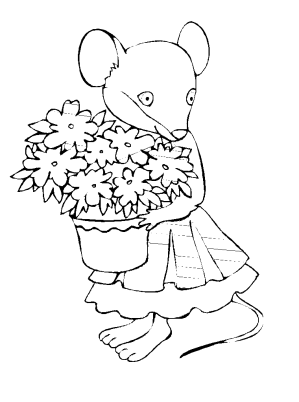
Here are a couple of fancy mice – one just hanging out and one all dressed up in her finest clothes – for you to color. After you’ve colored these pages, why not write a short story about them!

Cute Mouse Coloring Page | Dressed-up Mouse Coloring Page

Picture Book Review

November 11 – Veterans Day

celebrate-picture-books-picture-book-review-anna-and-natalie-cover

About the Holiday

Veterans Day is observed each year on this date to honor and thank all members of the military who are currently serving or have served in the United States Armed Forces. The official ceremony begins at 11:00 a.m. with a wreath laying at the Tomb of the Unknowns and then continues inside the Memorial Amphitheater with a parade of colors by veterans’ organizations and comments by dignitaries. While an official government holiday, some schools remain in session, holding special ceremonies of their own and inviting veterans to relate their experiences.

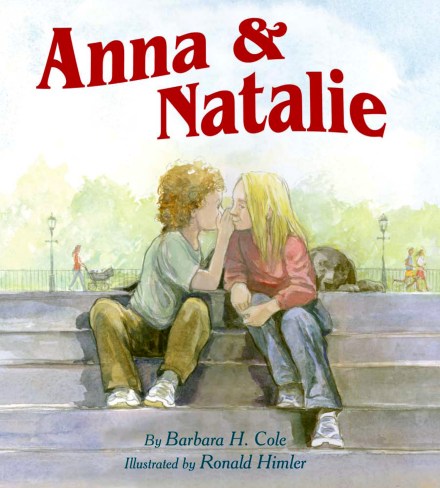
Anna & Natalie

Written by Barbara H. Cole | Illustrated by Ronald Himler


Every year Mrs. Randall’s third-grade class attends the Wreath-laying ceremony at the Tomb of the Unknown Soldier at Arlington National Cemetery. What’s more every year four students are chosen from her class to carry the wreath. This year everyone wonders who those lucky four will be. Students who want to be in the running to be selected, Mrs. Randall, says, must write a letter telling her why they should be chosen. Hearing that Freddie and Tommy drop out immediately, while Nancy says her letter will be the best.

Anna dreams of being chosen too, but experience tells her she will not. She’s never chosen for the basketball or softball team, the cheerleading squad, or the lines of Red Rover. “Sure, someone always chose her for the spelling team, but the others—the fun ones—never.” But this time seems different. All day—even though Mrs. Randall’s eagle eyes catch it—Anna daydreams and makes plans. When the bus drops her and her sister off, they hurry home to start work.

celebrate-picture-books-picture-book-review-anna-and-natalie-school-bus

Image copyright Ronald Himler, text copyright Barbara H. Cole. Courtesy of Star Bright Books

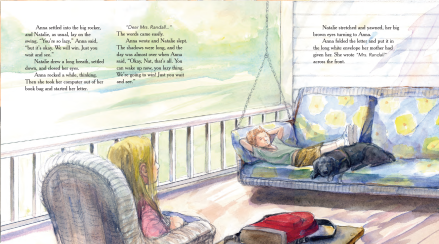
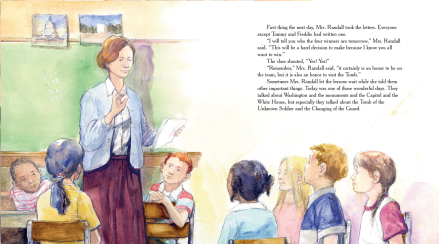
There Anna makes a secret call to her grandpa and then she and Natalie go to the front porch, and while Nat naps on the swing Anna pulls out her computer and begins writing her letter to Mrs. Randall. The next day Mrs. Randall collects the letters with the promise to choose the team by tomorrow and a reminder for those who will not be picked: “‘Remember,’” she says, “‘it certainly is an honor to be on the team, but it is also an honor to visit the Tomb.’” Then “they talked about Washington and the monuments and the Capitol and the White House, but especially they talked about the Tomb of the Unknown Soldier and the Changing of the Guard.”

celebrate-picture-books-picture-book-review-anna-and-natalie-on-the-porch

Image copyright Ronald Himler, text copyright Barbara H. Cole. Courtesy of Star Bright Books

At school the next day, Mrs. Randall says that while she received four excellent letters, one stood out. She begins to read it to the class: “‘I want to be on the team, not for myself, but for many others who have not been honored or remembered….They worked long and hard and saved many lives….And sometimes they were heroes bigger than the strongest men around. Sometimes they carried medicine and food to dangerous places to save the wounded soldiers. My own great-great-grandfather was in this special service and saved lives. I would like to be on the team to say thank you to those forgotten heroes of World War II. Yours truly…’ Mrs. Randall’s voice cracked and choked, and then she read, ‘From Natalie (with help from Anna)’”

The class starts whooping and cheering, but Mrs. Randall interrupts their celebration to read one more line: “P.S.—Would you please let Anna walk with me so I will not be alone and she won’t be either?” The class begins chanting “Yeah, Anna! Yeah, Anna!,” and Anna can’t believe that her dream of being on the team has come true. When Anna gets home from school and tells her family, they proudly make plans to travel with their “two girls” to the ceremony.

celebrate-picture-books-picture-book-review-anna-and-natalie-anna-and-natalie

Image copyright Ronald Himler, text copyright Barbara H. Cole. Courtesy of Star Bright Books

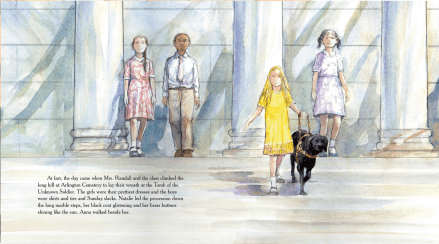
Finally, the day of the Wreath-Laying Ceremony arrives. The students are dressed in their best clothes, and as the four team members prepare to accept the wreath, “Natalie led the procession down the long marble steps, her black coat glistening and her brass buttons shining like the sun. Anna walked beside her.” As the soldier hands the children the wreath fashioned from “dogwood flowers, magnolias, and decorative red birds,” he loudly announces, “The students of Willow Run School and Natalie, a seeing-eye dog, will lay this wreath to honor the men who served in World War II and the dogs who helped them. ATTENTION!”

celebrate-picture-books-picture-book-review-anna-and-natalie-tomb-of-the-unknowns

Image copyright Ronald Himler, text copyright Barbara H. Cole. Courtesy of Star Bright Books

The clear notes of Taps rang across Arlington National Cemetery as Anna and the three other children lay the wreath in front of the Tomb of the Unknown Soldier. Afterward, Anna’s grandfather and parents took pictures of Anna and Natalie to remember “this shining moment of Anna, and of Natalie, who saw the world that Anna could not see.”

An Author’s Note revealing the use of dogs during wartime—from ancient history to today—follows the text.

Barbara H. Cole’s story of Anna and Natalie is compelling in many ways. First, it presents a look at what Veterans Day means to children from their point of view. Second, the story honors not only the brave soldiers who protect our country but also the canine corps which has served our military from our country’s earliest history. Third, in Anna, Cole has created a character who is part of a military family through her great-great-grandfather and also has a personal connection to service dogs through Natalie, her seeing-eye dog. The portrayal of Anna as a child with a disability is honest and inclusive, and while the fact of Anna’s blindness is contained in a surprise ending, this serves to present Anna as just another student in the class—a girl who is an excellent writer, enthusiastic about her dreams to be part of the team, and a good friend.

celebrate-picture-books-picture-book-review-anna-and-natalie-classroom

Image copyright Ronald Himler, text copyright Barbara H. Cole. Courtesy of Star Bright Books

Cole’s straight narration of a school day and a special assignment—complete with asides from students—as well as Anna’s family life creates an environment that will be familiar to readers and carries the story in a natural arc.

Ronald Himler’s realistic illustrations of Anna’s Willow Run School, her home, and Arlington Cemetery beautifully represent this moving story. His pages are full of diverse, real kids, smiling, laughing, getting off the school bus, enjoying a family dinner, and solemnly performing their job at the Tomb of the Unknown Soldier. A hint to Natalie’s true identity is subtly inserted into various scenes, making the final reveal a satisfying moment.

Anna & Natalie is a wonderful choice for all kids observing Veterans Day, Memorial Day, and other patriotic holidays.

Ages 5 – 10

Star Bright Books, 2010 | ISBN 978-1595722119

To learn more about Anna & Natalie and download a Curriculum Guide, visit Star Bright Books!

To view a gallery of artwork and picturebook illustration by Ronald Himler, visit his website!

Veterans Day Activity

celebrate-picture-books-picture-book-review-american-flag-and-wreath

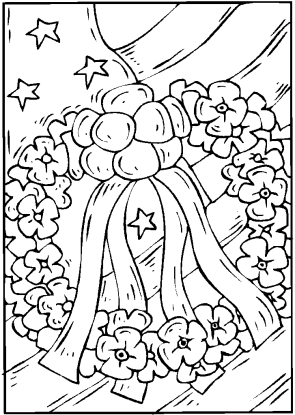
Wreath and American Flag Coloring Page


Remember everything our members of the Armed Forces do to keep our country safe as you color this printable Wreath and American Flag.

Picture Book Review

November 10 – World Science Day for Peace and Development

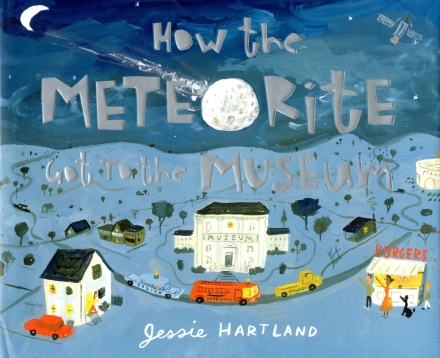
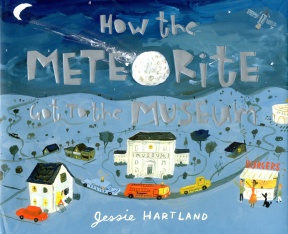
celebrate-picture-books-picture-book-review-how-the-meteorite-got-to-the-museum-cover

About the Holiday

This annual, internationally observed day highlights the importance of science in and for society and is sponsored by the United Nations. Its aim is to promote education and awareness of scientific issues that affect the world and its sustainability as well as to underscore the role that scientists play in improving our lives and developing solutions for the future. This year the theme is “Celebrating Science Centers and Science Museums.” To celebrate, grab the kids (or go alone!) and head out to your local science center!

How the Meteorite Got to the Museum

By Jessie Hartland


A science teacher leading her students through a science museum stops at the display for the Peekskill Meteorite that fell to Earth in New York state on October 9, 1992. As she explains a bit about meteorites, one student raises his hand and asks, “But how did the meteorite get here—to the museum?” With that question the students—as well as readers—are off and running on an adventure of astro-nomical proportions as the teacher begins: “Hundreds of mllions of miles from Earth, in deep, dark, cold outer space, there are vast fields of space debris flying around.” The smaller rocks are called meteors, and a meteor that falls to Earth is called a meteorite.

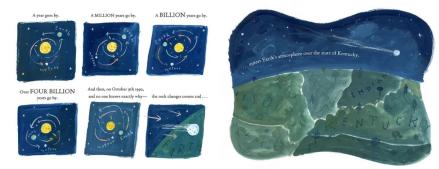
celebrate-picture-books-picture-book-review-how-the-meteorite-got-to-the-museum-meteors

Image copyright Jessie Hartland, 2013, courtesy of Blue Apple Books.

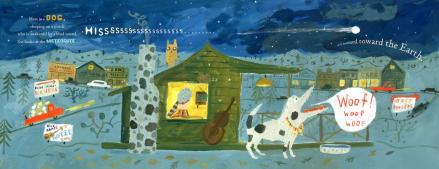
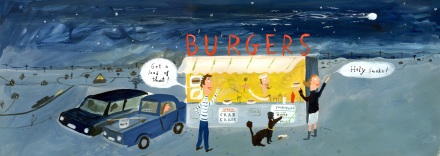
The teacher sets the scene: “Here in outer space is a meteor…flying around and around and around”—for over four billion years! Then for some unknown reason the meteor changed direction and entered “Earth’s atmosphere over the state of Kentucky.” With a Hissssss and a Crack! the zipping meteor alerts a sleeping dog, who begins to bark at it. The space rock, trailing a fiery tail, zooms over a burger stand in Virginia, attracting the attention of some late-night snackers.

In Pennsylvania, a few seconds later, a high school football game suddenly turns historic as the meteorite, hissing and crackling through the sky attracts the attention of video cameras throughout the stands. Yes, this is the same celestial body “which was spotted by the Virginians, and yelped at by the dog as it zipped toward the Earth.”

celebrate-picture-books-picture-book-review-how-the-meteorite-got-to-the-museum-dog-barks

Image copyright Jessie Hartland, 2013, courtesy of Blue Apple Books.

With a Crash, Bang, Boom, the rock hurtles downward. “Here is the teenager, who had been watching late-night TV at her house in Peekskill, NY, when she heard a tremendous CRASSHHH! She has rushed outside and discovered a huge dent in the trunk of her car and a smoking ‘rock’ nearby.” Wanting to discover the culprit of this vandalism, the teenager calls the police who summon firefighters to cool down the “rock.”

After hosing down the ‘rock’ the firefighters “start to suspect that the rock may really be a meteorite.” A geologist is called from Columbia University to examine the rock. “He confirms that what smashed the car is, indeed, a meteorite, which was cooled by Firefighters, investigated by Police, found by the Teenager, gawked at by Sports fans, buzzed about by Virginians, and arfed at by a dog as it raced toward the Earth.”

celebrate-picture-books-picture-book-review-how-the-meteorite-got-to-the-museum-burger-joint

Image copyright Jessie Hartland, 2013, courtesy of Blue Apple Books.

Next, the Curator of Meteorites from the Museum of Natural History in New York City visits the geologist, hoping to obtain this special specimen for the museum. Soon, a Cosmologist develops a program about the meteorite that she presents at a museum symposium, explaining how this 26-pound meteorite crossed over 400-500 miles in just 40 seconds and collided with a car—a-one-in-a-billion chance. The Museum of Natural History secures the meteorite for its collection, and the Exhibits Team designs the “lighting, signage, and diorama for their newest acquisition.”

Which brings us back to the Ross Hall of Meteorites at the museum and the complete story of “the Peekskill Meteorite, which was…barked at tby the Dog, witnessed by Virginians, filmed by Sports Fans, found by a Teenager, poked at by Police, sprayed with water by Firefighters, validated by the Geologist, obtained by the Curator of Meteorites, summed up by the Cosmologist, presented by the Exhibits Team, and explained by the Science Teacher who says: ‘…and that’s how the meteorite got to the museum.’”

An Author’s Note following the text explains more about meteors and introduces Dr. Mark Anders, the Geologist mentioned in the book. A photograph of the car hit by the meteorite offers fascinating viewing.

In her entertaining and informative telescoping text, Jessie Hartland reveals in easy-to-understand steps the people and actions involved in bringing together a museum exhibit for a meteorite. The repetition of the important characters in this true, history-making drama combined with Hartland’s deft command of a vast array of synonyms makes reading each page a joy. Suspense grows as each stage of the meteorite’s trajectory from space rock to “star” exhibit builds on the previous one, exciting kids not only for the tale of the meteorite, but also for the displays they see when visiting a museum.

celebrate-picture-books-picture-book-review-how-the-meteorite-got-to-the-museum-meteorite

Image copyright Jessie Hartland, 2013, courtesy of Blue Apple Books.

Hartland’s folksy two-page spreads are a perfect match for the rhythmic text—both humorous and educational in their details. The meteor—zipping through the dark blue night sky dotted with stars, over a small town, above an out-of-the-way burger joint, and through the cheering sounds of a football game—leads readers on a page-turning chase until it crash lands on the bumper of the teenager’s car. Here, as the police write up their investigation on the left-hand page, the firetruck can be seen hurrying to the scene, siren blaring, on the right, even as raccoons and a cat take the opportunity of the distraction to make mischief.

Hartland’s depictions of the geologist’s office as well as the American Natural History Museum give readers a peek behind the scenes at the tools and displays used by scientists and museum workers. For kids who love museums, science, and fun wordplay, How the Meteor Got to the Museum is an absorbing addition to home bookshelves as well as school, classroom, and other libraries. Jessie Hartland’s other titles in this series—How the Dinosaur Got to the Museum and How the Sphynx Got to the Museum—are also highly recommended.

Ages 4 – 9

Blue Apple Books, 2013 | ISBN 978-1609052522

Discover many more books by Jessie Hartland as well as other artwork on her website!

World Science Day for Peace and Development Activity

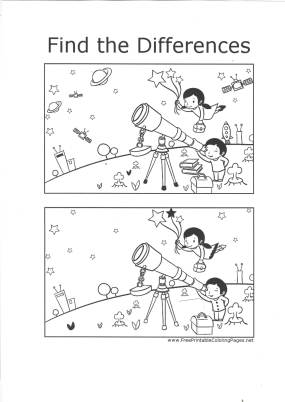
celebrate-picture-books-picture-book-review-astronomy-find-the-differences

Astronomy Buffs Find the Differences Puzzle


These kids are looking for stars and planets, but can you find the 15 differences between the two pictures in this printable Astronomy Buffs Puzzle?

celebrate-picture-books-picture-book-review-how-the-meteorite-got-to-the-museum-cover

You can find How the Meteorite Got to the Museum at these booksellers

Amazon | Barnes & Noble | IndieBound

Picture Book Review


November 9 – National Aviation History Month

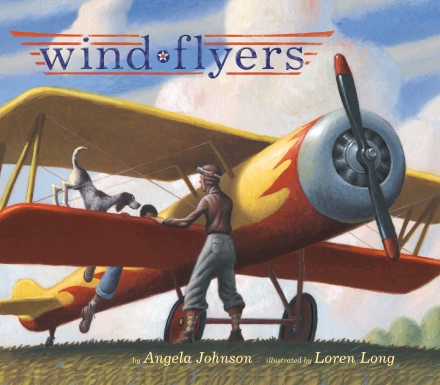
celebrate-picture-books-picture-book-review-wind-fliers-cover

About the Holiday

If you look back in history you see that people have always been fascinated with flight. The first kite was invented in 1000 BCE in China; around 400 BCE Archytas of Tarentum developed a steam-powered pigeon; and most people are familiar with the designs of flying machines that Leonardo de Vinci created in the late 1400s. An important discovery that led inventors in the right direction came in 1680 when an Italian mathematician determined that human muscles were incompatible with flight.

Zip ahead about 100 years and the first hot-air balloon flight was undertaken, which led to more and more complex technology, resulting in Wilbur and Orville Wright’s flight in 1903. From there, it seemed, the sky was the limit. Amelia Earhart became the first woman to complete a trans-Atlantic Ocean solo flight in 1932, and in 1947 Charles Yeager broke the sound barrier. But it’s astounding to think that from that modest 12-second first flight by the Wright Brothers to the first man in space—Soviet cosmonaut Yuri Gagarin—it took only 58 years! Today astronauts from countries around the world live and work in the International Space Station, and spacecraft are traversing deep space.

Wind Flyers

Written by Angela Johnson | Illustrated by Loren Long

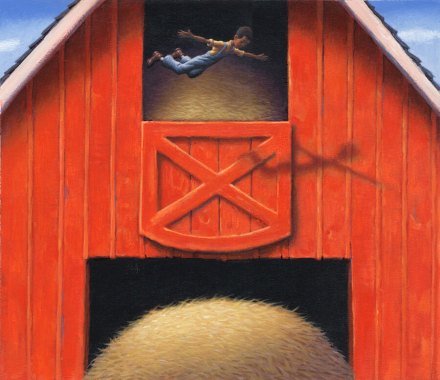
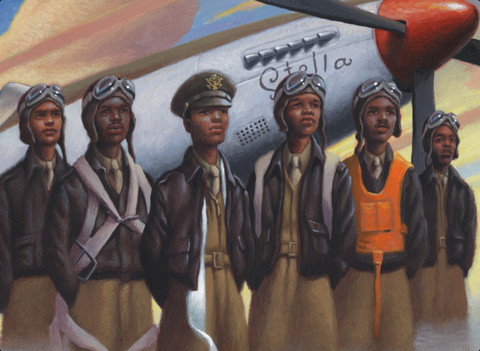
With pride a young African-American boy tells the story of his great-great-uncle who was a Tuskegee Airman in World War II. His uncle was “a smooth wind flyer. A Tuskegee wind flyer…,” the boy says. He knows well his uncle’s history—how like a bird, his uncle believed he was born to fly. “With his arms flapping, he jumped off a chicken coop at the age of five,” and when he was only seven he soared from a lofty barn into a pile of hay. His first real flight came at the age of eleven, when he paid 75 cents to be a passenger with a barnstormer.

celebrate-picture-books-picture-book-review-wind-fliers-jumping-from-hayloft

Image copyright Loren Long, courtesy of Simon & Schuster

Flying over lakes and fields, his uncle felt as if he were in Heaven, among clouds “like soft blankets, saying, ‘Come on in, get warm. Stay awhile and be a wind flyer too.’” The experience changed him forever. In fact he “cried when they landed because then he knew what it was like to go into the wind, against the wind, beyond the wind.” As a young adult his uncle contributed his dream and his skills to the World War II effort, becoming a Tuskegee Airman, one of the first black pilots in the United States military.

celebrate-picture-books-picture-book-review-wind-fliers-tuskegee-arimen

Image copyright Loren Long, courtesy of Simon & Schuster

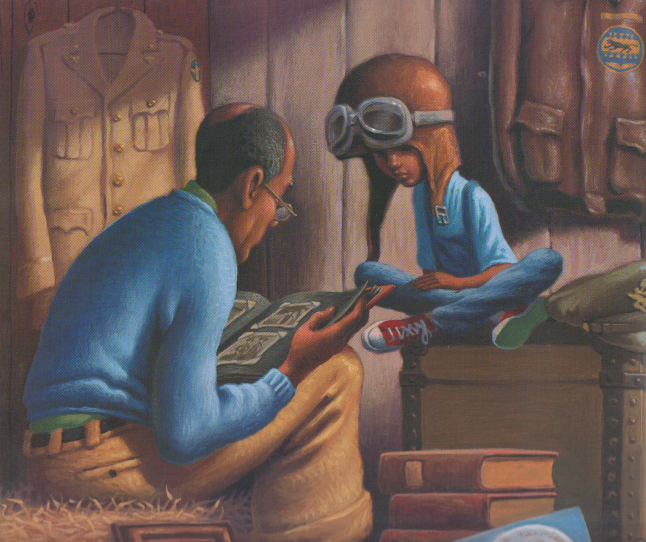
As the pair sit in the uncle’s barn, surrounded by his military uniform, leather jacket, and other memories of his flying career—after the war to continue flying he became a crop duster—the pair look through old photographs, seeing once more those young and brave pilots—the Tuskegee wind flyers. Planes are different now, Uncle says, but the clouds remain the same. The boy and his uncle climb to the highest point of the uncle’s barn to watch the jets—and in those moments they once more become the smooth wind flyers, flying into the wind and beyond.

celebrate-picture-books-picture-book-review-wind-fliers-grandfather-and-grandson

Image copyright Loren Long, courtesy of Simon & Schuster

In her soaring, rhythmic language, Angela Johnson captures the dreams and yearning of a young boy whose greatest desire is to fly among the clouds. Her combination of straight narration with lyrical lines as he joins the Tuskegee Airman in World War II enhances the sense of achievement and pride the young pilots felt. The structure of the story is well chosen, as relating the uncle’s life from childhood through old age through the eyes of his nephew strengthens the themes of strong familial relationships as well as shared dreams across generations.

Loren Long gives Wind Flyers additional power with his strong, vibrant paintings. Two-page spreads provide a sense of the vastness of the skies that so enticed the young would-be pilot. Even the clouds echo the emotion of the page—fluffy, floating, and alive in the flight scenes while linear, flat, and stationary when the plane and the uncle are earthbound. Realistic portrayals of the boy, his uncle, and the other Tuskegee Airmen are reminiscent of the WPA murals of the 1940s while still setting this book firmly in today for a new generation.

Wind Flyers is a wonderful book to share with aviation buffs, budding historians, and dreamers of all types and would make a welcome thoughtful book for quiet story times.

Ages 4 – 9

Simon & Schuster Books for Young People, 2007 | ISBN 978-0689848797

To learn more about Angela Johnson‘s books for all ages, visit her website!

View a gallery of artwork for picture books and other media by Loren Long, visit his website!

National Aviation History Month Activity

CPB - Biplane side

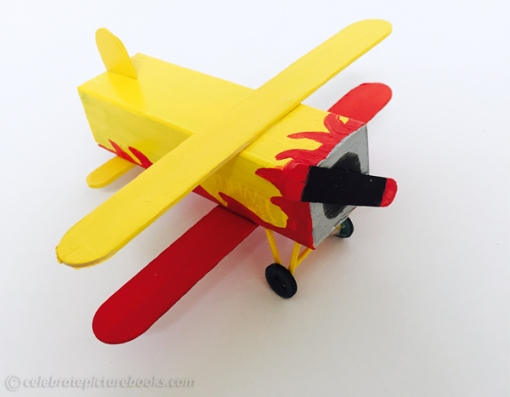
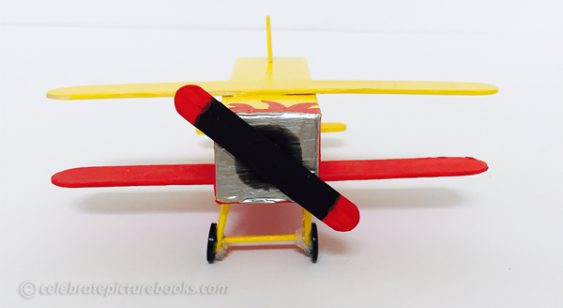
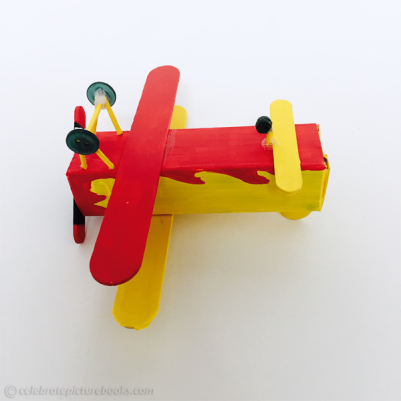
Head in the Clouds Box Biplane

If you love airplanes and flying, you’ll have fun making your own plane from recycled materials! Use your creativity to decorate your plane while you imagine yourself flying through the clouds on a beautiful day. Younger children will have fun sharing this activity with an adult or older sibling too!

Supplies

  • Travel-size toothpaste box
  • 3 6-inch x 1/2-inch craft sticks
  • 2  2 1/2-inch x 7/8-inch mini craft sticks
  • 5 Round toothpicks, with points cut off
  • Paint in whatever colors you like for your design
  • 4 small buttons 
  • 2 mini buttons
  • Paint brushes
  • Strong glue or glue gun

CPB - Biplane front

Directions

  1. Empty toothpaste box
  2. Paint toothpaste box and decorate it
  3. Paint the craft sticks and 5 toothpicks
  4. Paint one small craft stick to be the propeller
  5. Let all objects dry

To assemble the biplane

  1. For the Bottom Wing – Glue one 6-inch-long craft stick to the bottom of the plane about 1 inch from the end of the box that is the front of the plane
  2. For the Top Wing – Glue the other 6-inch-long craft stick to the top of the plane about 1 inch from the front of the plane
  3. For the Tail – Glue one mini craft stick to the bottom of the box about ¾ inches from the end that is the back of the plane
  4. For the Vertical Rudder – Cut the end from one of the painted 6-inch-long craft sticks, glue this to the back of the box, placing it perpendicular against the edge and half-way between each side

CPB - Biplane bottom

To assemble the front wheels

  1. Cut 4 painted toothpicks to a length of ¾-inches long
  2. Cut one painted toothpick to a length of 1-inch long
  3. Glue 2 of the 3/4-inch toothpicks to the back of 1 button, the ends of the toothpicks on the button should be touching and the other end apart so the toothpicks form a V
  4. Repeat the above step for the other wheel
  5. Let the glue dry
  6. Glue the 1-inch long toothpick between the wheels at the center of each wheel to keep them together and give them stability. Let dry

To make the back wheel

  1. Cut two ¼-inch lengths of painted toothpick and glue them together. Let dry
  2. Glue two mini buttons together to form the back wheel. Let dry
  3. Glue the ¼-inch toothpicks to the mini buttons. Let dry
  4. Glue these to the bottom of the plane in the center of the box directly in front of and touching the tail

Display your biplane!

Picture Book Review

Picture Book Review

November 8 – X-Ray Day and Q & A with Author Sara Levine

celebrate-picture-books-picture-book-review-bone-by-bone-cover

About the Holiday

In 1895 while Wilhelm Conrad Rontgen was experimenting with cathode rays and glass, he noticed a glow coming from a nearby chemically coated screen. This led him to make an astounding discovery. He found that the electromagnetic energy that caused the glow—which he named X-rays—could penetrate human flesh, but not bone, thus allowing bone to be photographed. For the first time doctors could see inside the body without surgery. X-rays were first used during the Balkan War in 1897 to find bullets, shrapnel, and broken bones in soldiers. While X-rays were an amazing advancement for medical research and patient care, their danger was not readily understood. The novelty of this new technology was used by shoe stores as a fitting device in the 1930s through 50s until the harmful properties of radiation were better appreciated. Today, X-rays and the technology they led to are instrumental in diagnosing injuries and diseases and in targeting a medical response.

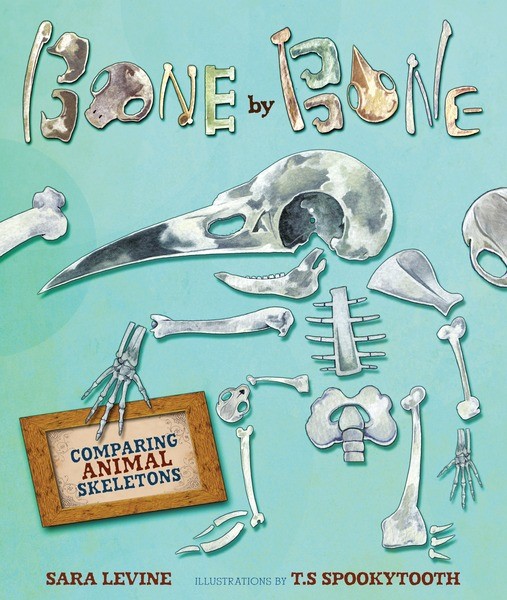
Bone by Bone: Comparing Animal Skeletons

Written by Sara Levine | Illustrated by T.S Spookytooth


Can you imagine if we sloshed through life like soup without a bowl? What would we set our hats on? Where would we carry our phones? How could we sit in class or the office or perform our favorite activities? And what would happen to our organs, our hair, our homes? It’s all a little disturbing! Fortunately, we don’t have to worry about that scenario because “we’re vertebrates, animals with bones. Our bones hold us up.” Phew!

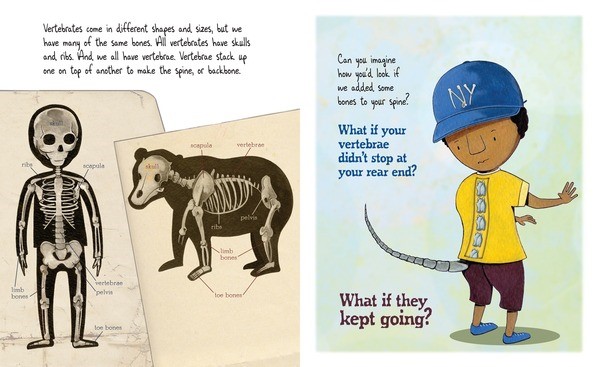
There are different kinds of vertebrates—mammals, reptiles, fish, and more—but many of our bones are similar. For example, “all vertebrates have skulls and ribs. And we all have vertebrae. Vertebrae stack up one on top of another to make the spine, or backbone.” Humans have vertebrae that end…well…you know where, but imagine for a minute if your vertebra kept on going. What if they poked a hole right through your shorts? Yes! You’re right—you’d have a tail. Tails are pretty helpful for some animals. They help them swim, communicate, even keep their balance.
celebrate-picture-books-picture-book-review-bone-by-bone-tailbone

Image copyright T. S Spookytooth, text copyright Sara Levine. Courtesy of Lerner Publishing

Good job! Let’s try again…how about if you only had a skull, vertebrae, and ribs. No arm bones; no leg bones. You’ve got it! A slithery snake! Nah…really…you’d look great! Okay, maybe you’d prefer if you had a skull, vertebrae, and arm bones—but no leg bones—and your nose was transferred to the top of your head. Sounds fishy? Maybe, but not quite. Oh! Did I give it away? Yep, you’d be a whale or a dolphin, and you’d use those powerful vertebrae to propel yourself to the ocean’s surface to grab a breath.

Imagine what kind of gloves and shoes you’d need if your “middle fingers and middle toes were so thick that they supported your whole body.” Hey, you’re good at this! It was a trick question. You wouldn’t need gloves, but you’d wear horse shoes (or no shoes if you’re a less domesticated animal like a zebra). Now, let’s take a trip through a room full of fun-house mirrors. What kind of animal would you be if your neck was reeeaally long and each vertebrae was “as big as your head?” Or if your legs were muuuuuch longer than your arms? Or your “finger bones grew so long that they reached your feet? Seeing those transformations is definitely worth the price of admission, right?

celebrate-picture-books-picture-book-review-bone-by-bone-bat

Image copyright T. S Spookytooth, text copyright Sara Levine. Courtesy of Lerner Publishing

But getting back to the bowl of soup: “Could you be an animal if you didn’t have any bones at all?” Sure! Some insects and sea creatures “have their hard parts on the outside,” and some are just “mushy.” Think of worms, slugs, and jellyfish, just to name a few. But bones make life more fun, don’t ya think? So if all vertebrates have bones, what makes humans different? Well, for one thing we (as well as some apes and monkeys) have opposable thumbs, which means that “we can move our thumbs in a special way that allows us to do many things, including turning the pages of a book,” using tools, and picking up objects. “Did you get that one? If so, give yourself a thumbs-up!”

An Author’s Note including more about bones, the types of vertebrates, a glossary, and resources for further reading follow the text.

With humor and a kid’s sensibility of the bizarre, Sara Levine presents an anatomy lesson that young readers will respond to. Juxtaposing individual bony features of humans and animals is a brilliant idea to give children perspective on the differences in animal skeletons and the uses of each unique trait. Levine’s quiz-like format engages readers, encouraging independent thought and active participation as well as building suspense for what transformation comes next. Kids will laugh and learn and be on the lookout for other ways human and animal skeletons differ as they become more aware of the natural world around them.

With illustrations of tailbones sticking out of pants, empty socks, two fingered hands and two toed feet, a neck that needs two scarves, and more, T. S Spookytooth illuminates what it means to be human in an animal world or an animal in a human world. Kids will laugh imagining themselves as Spookytooth depicts them with animal features and “Ewww” when their portrayal dissolves into a muddy mess. The accurate drawings of human and animal skeletons educate readers on the names and placement of particular bones.

The unique approach to the study of human and animal skeletons, the wide range of animals presented, and the enticing writing and illustrations make Bone by Bone: Comparing Animal Skeletons a wonderful choice for libraries and home bookshelves of budding scientists and nature lovers.

Ages 5 – 10

Millbrook Press, 2014 | ISBN 978-0761384649

To learn more about Sara Levine and her books, visit her website! You’ll also discover fun Bone by Bone activities to enhance your reading!

View a gallery of artwork by T. S Spookytooth, plus videos and more on his website!

X-Ray Day Activity

celebrate-picture-books-picture-book-review-x-ray-craft-dog-paw

Dog Paw and Human Hand X-Ray Craft


X-rays are cool to look at, but they always stay at the doctor’s office! With this craft you can simulate an X-ray of a dog’s paw and a human hand!

Supplies

  • Printable skeleton templates: Human Hand Template | Dog Paw Template
  • Black chalkboard drawing paper, 8 ½ inches by 11 inches
  • White colored pencil
  • White chalk
  • Clear Plastic Report Sheet Protectors
  • Magnetic clip to hang your x-ray on the refrigerator or other metal surface (optional) OR
  • String or wire, adhesive squares, and clothes pins to hang x-ray on the wall (optional)
  • Scissors

Directions

  1. Print the Human Hand and Dog Paw Templates (you may want to print two—one to cut and one to follow when transferring the bones to the black paper)
  2. Cut the bones apart
  3. Lay the bones on the black chalkboard paper
  4. Trace the bones with the white colored pencil
  5. Color in the bones with the white chalk
  6. Slip the black paper into the plastic report sheet protector
  7. If desired, hang the x-ray on the refrigerator with the magnetic clip or on the wall using string, adhesive squares and clothespins


Q & A with Author Sara Levine

celebrate-picture-books-picture-book-review-author-sara-levine

Today, I’m thrilled to talk to Sara Levine about her writing as well as to learn about her early experiences with animals and to discover a kid’s-eye-view of women in science.

Your writing for kids is so infused with humor that really captures their attention. What were some of the books that you liked best as a child?

When I was younger, one of my favorite picture books was Katerine and the Box by Patricia Lee Gauch. I’ve noticed that this book has gone back into print; I was so happy to find it online. It’s basically about creativity. A girl and her friend keep finding new uses for a large cardboard box—a house, a car, a dance platform. I can still recall my feeling of excitement when hearing it read to me—it made me want to go make something. It’s actually a feeling very similar to what I have today when I think of a new idea for a book. There was also a book called Wisher, which was about difference—about a cat who dreamt he was really a fish. I remember that the illustrations were beautiful and somewhat scary—just done in blues, browns and yellows.  As an older child, I loved Charlotte’s Web by E.B White, Lizard Music by Daniel Pinkwater and pretty much everything by Judy Blume.

I don’t suppose any of these books are like the books I write. I used to tell people that I liked my science and my books separate. I just wanted to go outside to learn about science. But, I wanted stories in my books. I don’t think there were any of the sorts of books I write about science out for kids when I was young. At least I didn’t find them. But if I had, I think I would have enjoyed them—the fact that they were funny and interactive. But here’s a picture book I LOVE that I found as an adult that is certainly infused with humor and captures a kid’s (and a grown-up’s) attention: Bark, George, by Jules Feiffer. I think this is currently my favorite picture book.

You grew up on a farm in Guilford, Connecticut. Can you tell me a little about the farm and how or if it influenced your current work?

Calling it a “farm” might be a bit of a stretch. My parents were two kids who grew up in Brooklyn and then moved to CT and decided to get some animals, cheered on by their enthusiastic offspring. First there was a goat, who got lonely. So then there was another goat. And they had a baby. And there was a chicken at school who needed a place to go for the summer. And then never went back to school… And so on. We ended up having over 100 named animals—a horse, a cow, peacocks, geese, a donkey and more. I loved taking care of the animals, with my siblings. It was a wonderful experience, one that I’m very grateful for. But it wasn’t at all lucrative. I think the only money made was by my brother who would sell extra eggs to his teachers.

How did it influence my current work? I’m not sure. Certainly my interest in animals is a lifelong one. I think the stories about the animals actually show up more in my writing for adults than in my picture books. The ideas for the books for children come more from teaching ideas that I think will translate well into a picture book format.

You have a doctorate in veterinary medicine and a masters in fine art. When and how did the two merge into your work as an author?

What a great question. I have always had this science side and this humanities side. A lot of my life, I’ve been struggling with how to balance and feed both sides of myself. It’s taken me a long time to find a way to merge the two interests, and it’s been very satisfying to do so in writing about science, especially for kids.

You offer four different school and library programs, all of which sound fascinating. Do you have any anecdotes from a presentation you’d like to share?

In one of my workshops, the one for Bone by Bone: Comparing Animal Skeletons, I bring in an articulated skeleton for the kids to see and a disarticulated skeleton in a box. The kids learn the bones, and I then hand them each a bone which they take up to the standing skeleton to figure out which bone it is, and then work together to put together the second skeleton on the floor. Inevitably, someone asks if the skeletons are real. They are. I literally found them in the closets, when I started my teaching at Wheelock. There are all sorts of questions about that, generated by the kids, and then, often, someone will ask if the skeletons are “boys or girls.” Recently, at a school near Boston, I was explaining to a group of second graders that both were female, that we could tell by the shape of the hips, and I heard one girl, going, “YES!” and pumping her arm up and down, in victory. The boy next to her says, “Why are you so happy? That means a girl died.” To which she responds, “That’s true. But it also means one more girl in science!”

celebrate-picture-books-picture-book-review-bone-by-bone-workshop

Sara Levine leads a workshop at Cold Spring School

What’s the best thing about writing for kids?

I enjoy trying to think of engaging and interactive ways to teach something that hasn’t been taught before. I like the creativity involved. And, of course, reading it to the kids when I’m done and seeing them respond!

celebrate-picture-books-picture-book-review-bone-by-bone-students-at-al-hamra-school

Students at Al Hamra Academy examine a skeleton

You also write articles for adults and were nominated for a Pushcart Prize in 2007. Can you tell me more about your writing for adults?

I write science related essays for adults. The writing comes more from my own experiences.  I do have a handful of essays published. I think the one that was nominated for the Pushcart, “What Hands Can Do” is still available to read online. Here’s a link to it on Fictionaut. It’s about spaying a dog. And more, of course. I think my most successful essay is “The Body of a Cow” which originally appeared in the Massachusetts Review. It’s also on Fictionaut, if anyone wants to have a look. Eventually, I hope to work the essays into a memoir for adults.

What’s up next for you?

I have a book on dinosaur bones which will be published by Lerner next year. I also have three children’s books written which I’m trying to find homes for at the moment—one on animal classification (but interactive, written like a “do your own adventure” story), one on how plants communicate with animals, and one very funny one (if I can say so myself) called “Breakfast at the Omnivore Café,” which is about what animals eat. This one might never get published because it falls into the cracks between nonfiction and narrative fiction, but I haven’t given up on it yet. The book I’m currently working on is an attempt to explain climate change through stories of the carbon cycle. Doesn’t sound very interesting when put that way, but it’s written as an interactive story, and is also actually quite funny in parts, so I think kids will like it.

Since Celebrate Picture Books is a holiday-themed blog, I can’t let you get away without asking you what your favorite holiday is…

Passover. You get to tell a story to children in a way that is interactive and engaging for kids, AND it involves food. What could be better?

Thanks so much for chatting and sharing your unique perspective on the natural world, Sara! I, for one, would love to read Breakfast at the Omnivore Café—that would be one interesting menu, I bet! I wish you the best with all of your books!

You can connect with Sara Levine on:

Her Website | Facebook | Twitter

About Sara Levine

Sara Levine is an assistant professor of biology at Wheelock College and a veterinarian.  Her science books for children include Bone by Bone: Comparing Animal Skeletons (2013) and Tooth by Tooth: Comparing Fangs, Tusks and Chompers (2016).  Her third book, Fossil by Fossil: Comparing Dinosaur Bones will be published in 2018.  Bone by Bone: Comparing Animal Skeletons has received much recognition, including the Utah Beehive Book Award, selection as a Bank Street College Best Children’s Book of the Year, and finalist for the Cook Prize for best STEM picture book.

Sara also writes science-related essays for adults, one of which was nominated for a Pushcart Prize in 2007.  Her writing has appeared in the Boston Globe, the Massachusetts Review, Bayou, and in the anthology And Baby Makes More. In addition to teaching college students, she has taught children’s environmental education classes for the Massachusetts Audubon Society and other nature centers in Massachusetts and Connecticut for over 15 years. 

Sara holds a doctorate in veterinary medicine (DVM) from Tufts University, a master of fine arts degree (MFA) in creative nonfiction writing from Lesley University and a bachelor of arts degree (BA) in English from Haverford College.  She is a native New Englander and lives with her daughter and their dogs and cat in Cambridge, Massachusetts.  
celebrate-picture-books-picture-book-review-bone-by-bone-cover

Bone by Bone: Comparing Animal Skeletons and Sara’s other books can be found at:

Amazon | Barnes & Noble | Books-a-Million | IndieBound | Lerner Publishing

Picture Book Review