March 10 – International Day of Awesomeness

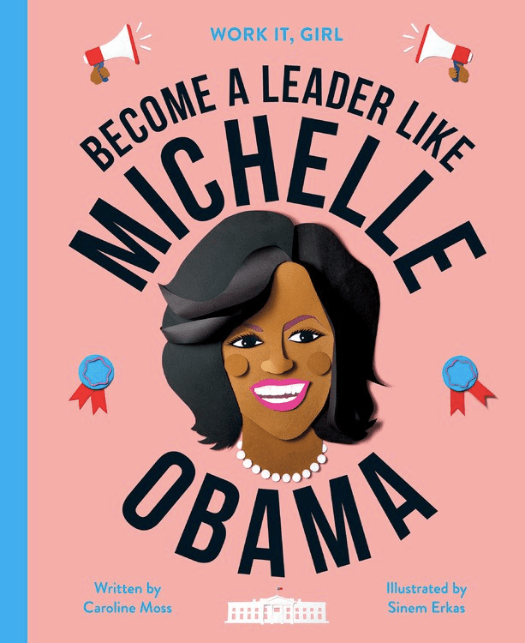
celebrate-picture-books-picture-book-review-become-a-leader-like-michelle-obama-cover

About the Holiday

Today we celebrate awesomeness, and in particular the fact that you are awesome! Begun as an inside joke among coworkers, International Day of Awesomeness continues to grow, attracting more and more awesome individuals around the world. To celebrate get creative and perform feats of awesomeness—whatever that might mean to you. You can also read about awesome people and their accomplishments to get you fired up to do awesome things of your own all through the year. Why not start with today’s book?!

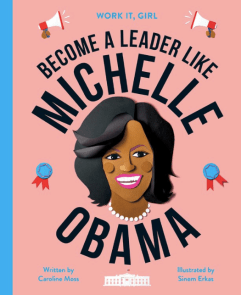
Become a Leader Like Michelle Obama (Work It, Girl Series)

Written by Caroline Moss | Illustrated by Sinem Erkas


Encouraging, supportive, and always smiling, Michelle Obama inspired millions of kids across the country during her eight years as First Lady and continues to motivate children to be and become the best version of themselves. Through her fast-paced, engrossing biography, Caroline Moss creates a reading experience that gives children the opportunity to get to know their idol the way friends do: by talking together. In ten short, but information-packed chapters, Moss captures Michelle’s voice and spirit through snapshots of formative events that influenced and changed her life, all told in a conversational style with plenty of dialogue and fascinating details.

Accompanying this personal narrative are Sinem Erkas’s stunning 3-D cut paper artwork. Bold colors, stirring imagery, and portraits that follow Michelle through times of happiness, sadness, and change reveal to readers Michelle’s intelligence, spark, hard work, and enthusiasm for life that fuels her vision and success.

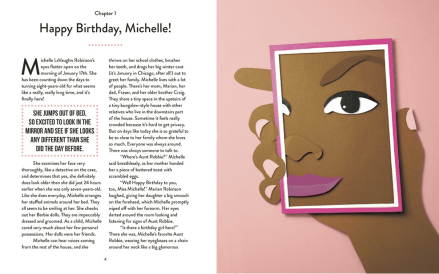
celebrate-picture-books-picture-book-review-become-a-leader-like-michelle-obama-chapter-1

Image copyright Sinem Erkas, 2020, text copyright Caroline Moss, 2020. Courtesy of Frances Lincoln Children’s Books.

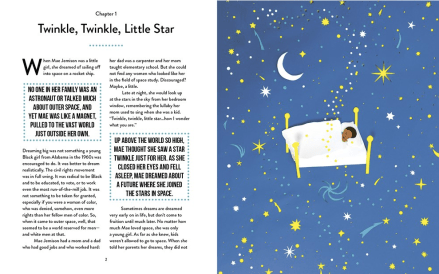
In Chapter 1, readers are invited in to Michelle’s home on her 8th birthday. They learn about her family, the house they share with relatives, including her favorite aunt, Aunt Robbie, and the loving atmosphere that formed her values and sense of community that “would inspire her to go on and change communities across the US – and beyond.”

Chapter 2 takes readers into Michelle’s second-grade classroom, where “she loved reading, making up stories in her head and on the page, and creating art” and was frustrated by the inattention of the other kids who always seemed to be “bouncing off the walls.” Here they also discover certain events on her road from that classroom to high school graduation that helped Michelle develop her strength and self-confidence.

In Chapter 3 Michelle enters Princeton University, the college of her dreams. She makes friends, gets a job that “helped her think about a world outside her own,” and had a small, but life-changing experience that made her realize that “she did not have to blend into the background” or always “take the easy route. She started to imagine herself as a helper and an influential voice in her community, as a smart mind with ideas to share with the world.”

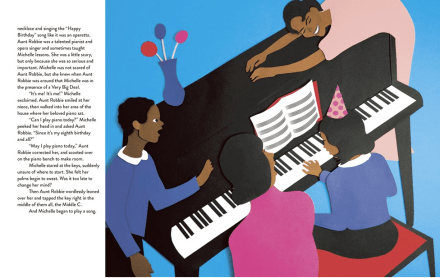
celebrate-picture-books-picture-book-review-become-a-leader-like-michelle-obama-piano

Image copyright Sinem Erkas, 2020, text copyright Caroline Moss, 2020. Courtesy of Frances Lincoln Children’s Books.

By Chapter 5 Michelle has graduated from Harvard Law School and taken a job at a Chicago law firm. But while she loved her job, she was struggling with medical challenges faced by her father and her best friend. “Michelle had a lot to juggle, but she was becoming pretty awesome at taking on lots of different tasks with a smile.” When does Michelle meet Barak? That comes in Chapter 6, when he got a job at the same law firm Michelle worked for. Readers get to hear about his first day on the job and the impression he made on her, how she came to think of him as her best friend at work, and about their first date.

Chapter 7 begins as Michelle is thinking about the course she wants her life to take. She realizes that she didn’t want to be a lawyer. “But what did she want to be; who did she want to be? Michelle had no idea, but she knew she wanted to change the world around her and leave it better than she found it.” She soon found herself working at Chicago City Hall. Her enthusiasm and success there led her to be hired by an organization that “found inspiring young people who showed promise in making a difference” and who would go on to “take leadership jobs in their communities.” It was also during this time that Barak proposed and took a new job helping to register first-time voters.

In Chapter 8, the Obamas’ lives take a big leap toward their future as Michelle gets a new job with the University of Chicago, where she was to “create a sustainable program that would help connect the university with its community.” During these years Malia and Sasha are born and Barack runs for and wins a seat in the US Senate, going on to become President. What did Michelle think about all of these changes? Young readers will discover her conflicting feelings: wariness, excitement, pride, and the belief that “one person could make a difference.”

celebrate-picture-books-picture-book-review-become-a-leader-like-michelle-obama-mountains

Image copyright Sinem Erkas, 2020, text copyright Caroline Moss, 2020. Courtesy of Frances Lincoln Children’s Books.

As Chapter 9 opens, Michelle and Barack and their family have moved into the White House. For Michelle that meant developing an “‘official initiative’ for her time in the White House.” Readers learn how she designed her ‘Let’s Move!’ program, aimed at keeping “kids healthy through education and learning good habits.” In Chapter 10, the Obamas leave the White House, “but Michelle knew her story had just begun.” She wrote a book sharing her stories and her life. Now new adventures await her and it will “only be a matter of time before she [sets] out to change the world once more.”

Sprinkled throughout the text are inspirational quotes from Michelle Obama that are called out in eye-catching blocks and soaring illustrations. Back matter includes ten key lessons from Michelle Obama’s life on how to become a leader, questions to prompt kids to think about what is important to them, and resources for further reading and exploration.

Emphasizing family, community, self-confidence, and the importance of seizing opportunities to make a difference, Become a Leader Like Michelle Obama is highly recommended for home, school, and public libraries to hearten and embolden young readers to listen to their inner voices and take action for what they believe in.

Ages 8 – 12 and up

Frances Lincoln Children’s Books, 2020 | ISBN 978-0711245181

Discover more about Caroline Moss and her books on her website.

To learn more about Sinem Erkas, her books, and her art, visit her website.

International Day of Awesomeness Activity

celebrate-picture-books-picture-book-review-awesomeness-cards

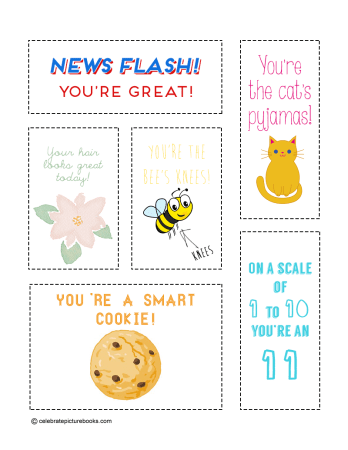
Awesomeness Cards


Do you have some awesome people in your life? Give them one of these printable Awesomeness Cards and watch them smile!

celebrate-picture-books-picture-book-review-become-a-leader-like-michelle-obama-cover

You can find Become a Leader Like Michelle Obama at these booksellers

Amazon | Barnes & Noble | Books-a-Million | IndieBound

Picture Book Review

February 26 – It’s Black History Month

celebrate-picture-books-picture-book-review-what-do-you-do-with-a-voice-like-that-cover

About the Holiday

Black History Month is a celebration of the achievements of African Americans and the contributions they have made to the United States History. Appropriately for this election year, the theme for 2020 is “African Americans and the Vote,” which recognizes the struggle for both black men as well as women throughout American history. This year marks the 150th anniversary of the Fifteenth Amendment, which was ratified in 1870 and gave black men the right to vote after the Civil War. It has also been one hundred years since women gained the right to vote. For more information about Black History Month, visit the ASALH website and africanamericanhistorymonth.gov.

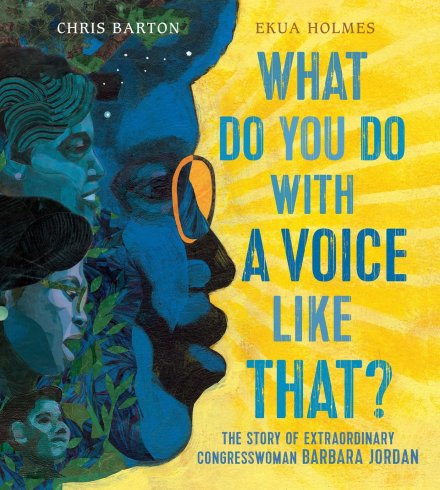
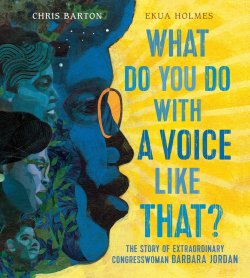
What Do You Do with a Voice Like That? The Story of Extraordinary Congresswoman Barbara Jordan

Written by Chris Barton | Illustrated by Ekua Holmes


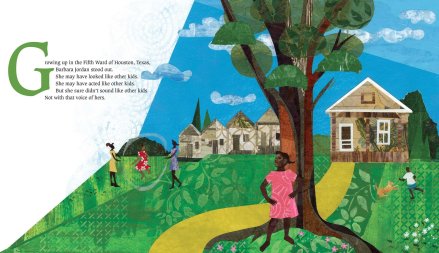
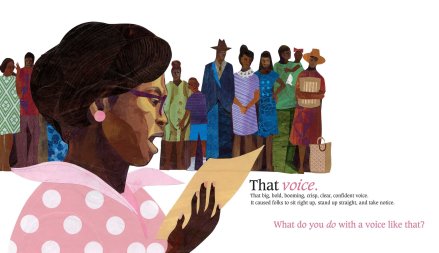
As a child growing up in the Fifth Ward of Houston, Texas, Barbara Jordan was known for her distinctive voice. “That voice. That big, bold, booming, crisp, clear, confident voice. It caused folks to sit right up, stand up straight, and take notice. What do you do with a voice like that?” Barbara recited poetry, gave speeches, and in 1952 won an oratory contest with a trip to Chicago as the prize. She was proud of herself and where her voice was leading her. But where would that be?

celebrate-picture-books-picture-book-review-what-do-you-do-with-a-voice-like-that-child

Image copyright Ekua Holmes, 2018, text copyright Chris Barton, 2018. Courtesy of Beach Lane Books.

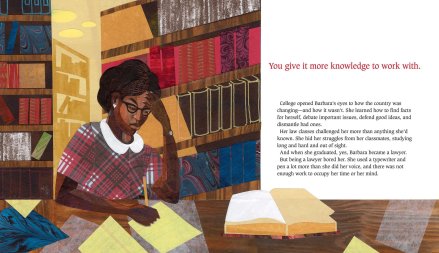
She considered becoming a preacher, a teacher, and a lawyer. When a black woman lawyer gave a speech at Barbara’s high school, Barbara thought she had found her calling. She attended college where she “learned how to find facts for herself, debate important issues, defend good ideas, and dismantle bad ones.” She graduated with a law degree, but practicing law became boring. She wrote more than she spoke, and the work was not demanding enough.

celebrate-picture-books-picture-book-review-what-do-you-do-with-a-voice-like-that-studying

Image copyright Ekua Holmes, 2018, text copyright Chris Barton, 2018. Courtesy of Beach Lane Books.

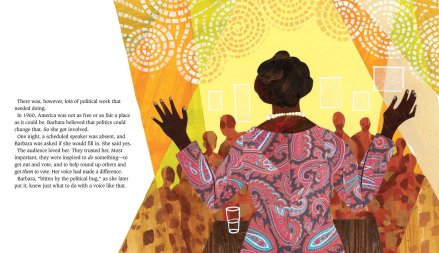
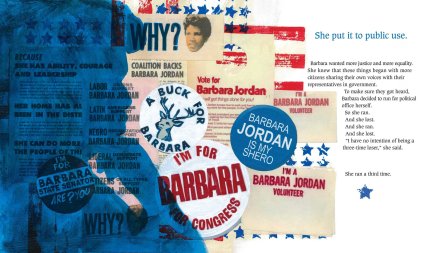
It was 1960, and Barbara decided to lend her voice to causes she believed in. She became involved in politics, and on one pivotal night, she filled in for a speaker who was absent. “The audience loved her. They trusted her. Most important they were inspired to do something—to get out and vote” and to persuade others to vote. Barbara decided to run for office. She lost her first two elections, but the third one she won.

Barbara Jordan was now a Texas state senator, representing the people she grew up with. She believed in making changes from within the political system through debating issues on the Senate floor. She also got to know her colleagues outside of work, and they got to know her. They listened to each other, and positive changes were the result. In 1972, Barbara ran for Congress and won a seat in the U.S. House of Representatives in Washington DC.

celebrate-picture-books-picture-book-review-what-do-you-do-with-a-voice-like-that-politics

Image copyright Ekua Holmes, 2018, text copyright Chris Barton, 2018. Courtesy of Beach Lane Books.

In 1973, the Watergate scandal broke. “President Nixon, it seemed, had broken the law, and Congress had to decide what to do about it.” Once again, as a member of the House Judiciary Committee, Barbara used her voice to remind Congress and the American people that “the Constitution is the document governing all the laws in the United States and applies to all of its people.” Then “in her big, bold, booming, crisp, clear, confident tone” she said, “‘My faith in the Constitution is whole…. And I am not going to sit here and be an idle spectator to the diminution, the subversion, the destruction of the Constitution.’” Barbara said that the president must go. President Nixon resigned in 1974.

celebrate-picture-books-picture-book-review-what-do-you-do-with-a-voice-like-that-campaign

Image copyright Ekua Holmes, 2018, text copyright Chris Barton, 2018. Courtesy of Beach Lane Books.

Barbara became a star, shining “like a bright light in a dark place.” She became the voice for those battling discrimination, for those “who had less power…who possessed quieter strengths than her own…who did not want to be limited by their weaknesses.” People talked about Barbara becoming a Senator, a Supreme Court Justice, or possibly Vice President.

But Barbara, unknown even to herself, had been struggling with multiple sclerosis, and now her inner voice told her that the place she belonged was home. Back in Texas, she became a college professor, where she taught her students not only to “do something, but to do the right thing.” Her students are still working today, striving to make the world a better place and to inspire everyone to make their voices heard.

An Author’s Note, a detailed timeline of Barbara Jordan’s life, and other recommended resources follows the text.

celebrate-picture-books-picture-book-review-what-do-you-do-with-a-voice-like-that-speaking

Image copyright Ekua Holmes, 2018, text copyright Chris Barton, 2018. Courtesy of Beach Lane Books.

Chris Barton’s stirring biography of Barbara Jordan introduces children to a woman whose voice is just as relevant today as it was when she was a state senator, US representative, and professor. Barton clearly and lyrically depicts Jordan’s trajectory while showing readers what it takes to succeed: practice, perseverance, learning, and wisdom. For young readers Barton briefly but cogently outlines the core of the case against Richard Nixon then allows readers to hear, in her own words, Jordan’s rousing defense of the Constitution. His inclusion of Jordan’s seventeen years of teaching after her diagnosis of MS is a poignant reminder that her influence is still heard through her students and admirers, and Barton’s final exhortation to readers to speak out honors Barbara Jordan’s life and will impel both children and adults to follow her lead.

Ekua Holmes stunning mixed-media illustrations will set readers’ hearts soaring in this over-sized picture book that beautifully reflects Barbara Jordan’s influence in politics and beyond. Holmes’ collages, rendered in lush colors and textured with intricate patterns and images from nature, take children on Jordan’s journey from sun-drenched Texas to law school to Washington DC, giving them a glimpse of her childhood and her growing stature as a stateswoman. Today’s savvy readers will be interested in the examples of campaign materials and images of Jordan’s building relationships with diverse voters and her fellow senators and representatives. Several photographs of Jordan from her graduation, campaigns, and televised appearances during the Watergate hearings join Holmes’ realistic portraits and will inspire readers to learn more about this influential and unforgettable woman.

What Do You Do with a Voice Like That? is a stirring and empowering biography that belongs in every home, school, and public library collection.

Ages 4 – 8 and up

Beach Lane Books, 2018 | ISBN 978-1481465618

Discover more about Chris Barton and his books on his website.

To learn more about Ekua Holmes, her books, and her art, visit her website.

Black History Month Activity

celebrate-picture-books-picture-book-review-barbara-jordan-activity

Barbara Jordan Inspirational Poster


If you have ideas about how to make the world better, print this poster of Barbara Jordan and write how you would like to use your voice on the back. This can be through speech, writing, art, community involvement, or any way that uses your talents.

celebrate-picture-books-picture-book-review-what-do-you-do-with-a-voice-like-that-cover

You can find What Do You Do with a Voice Like That? at these booksellers

Amazon | Barnes & Noble | Books-a-Million | IndieBound

Picture Book Review


February 25 – Honoring Katherine Johnson

celebrate-picture-books-picture-book-review-counting-on-katherine-cover

About Katherine Johnson

Katherine Johnson passed away yesterday at the age of 101. Recognized from an early age for her brilliance, Katherine went on to become a pivotal mathematician for NASA as the space race led to the first manned missions and lunar landings. She continued working for NASA on the space shuttle and other technological advancements. Fearless in asking the kinds of probing questions that fueled her imagination and precise calculations and in standing up for her rights, Katherine was a trail-blazer for women and people of color. She was awarded the Presidential Medal of Freedom in 2015. Her influence and inspiration continue to shine, especially for children, through books like Counting on Katherine.

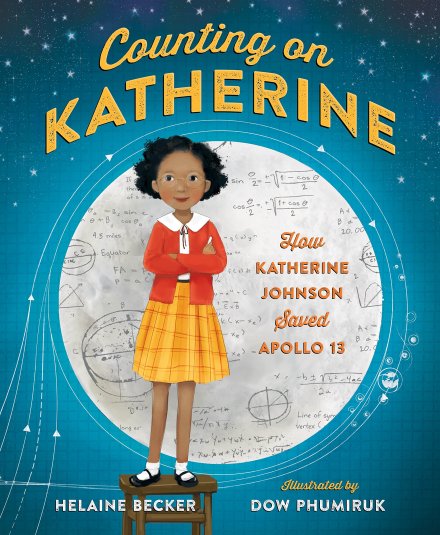
Counting on Katherine: How Katherine Johnson Saved Apollo 13

Written by Helaine Becker | Illustrated by Dow Phumiruk


Katherine may have been born counting. She counted every step she took and every step she climbed. She counted the dishes and silverware as she washed them, and although she may have wanted to count all the stars in the sky, she knew that was beyond anyone’s ability. “Even so, the stars sparked her imagination…. Katherine yearned to know as much as she could about numbers, about the universe—about everything!”

celebrate-picture-books-picture-book-review-counting-on-katherine-school

Image copyright Dow Phumiruk, 2018, text copyright Helaine Becker, 2018. Courtesy of Henry Holt and Company.

Katherine was so smart that she skipped three grades, even passing up her older brother. Katherine graduated from elementary school when she was 10 and was ready for high school, but “her town’s high school didn’t admit black students—of any age. Her father, though, said, “‘Count on me.’” He worked until the family could afford to move to another town where she could attend a black high school.

In high school, Katherine loved all of her classes, but her favorite subject was math. She wanted to become a research mathematician, “making discoveries about the number patterns that are the foundations of our universe.” But there were no jobs like that for women, so Katherine taught elementary school.

celebrate-picture-books-picture-book-review-counting-on-katherine-calculations

Image copyright Dow Phumiruk, 2018, text copyright Helaine Becker, 2018. Courtesy of Henry Holt and Company.

Then in the 1950s, the National Advisory Committee on Aeronautics began hiring new employees. When Katherine applied all the positions had been filled, but the next year she got a job. A few years later when NASA was formed, Katherine became what was known as a human “‘computer.’” She and the other computers––all of whom were women––calculated long series of numbers, contributing to the “space race.”

Katherine asked lots of questions about how high the rocket ship would go and how fast it would travel before beginning her calculations. Her job was to make sure that the earth and the rocket were in the same place when the rocket needed to land. Katherine’s calculations were so precise and her leadership so inspiring that she was promoted to Project Mercury, “a new program designed to send the first American astronauts into space.

celebrate-picture-books-picture-book-review-counting-on-katherine-trajectory

Image copyright Dow Phumiruk, 2018, text copyright Helaine Becker, 2018. Courtesy of Henry Holt and Company.

The engineers and astronauts knew that the missions were going to be dangerous, and John Glenn, distrusting the computer-generated numbers, refused to fly until Katherine approved the numbers. “‘You can count on me,’” she told him. Glenn’s mission was successful and Katherine earned another promotion. Her new job was to “calculate the flight paths for Project Apollo—the first flight to the moon.” She calculated the trajectories that took Apollo 11 and Apollo 12 to the moon and back in 1969. But as Apollo 13 soared through space on its way to the moon, there was an explosion. There were questions about whether the spaceship could reach the moon or make it back to Earth.

celebrate-picture-books-picture-book-review-counting-on-katherine-explosions

Image copyright Dow Phumiruk, 2018, text copyright Helaine Becker, 2018. Courtesy of Henry Holt and Company.

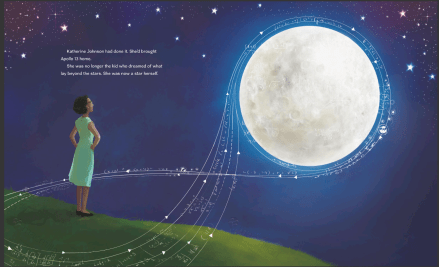
Katherine was again called to make new calculations. In only a few hours, Katherine had a new flight plan that “would take the ship around the far side of the moon. From there, the moon’s gravity would act like a slingshot to zing the ship back to Earth.” But for the plan to work, the astronauts had to follow it exactly. There was no room for a mistake. Katherine and all of the NASA engineers waited nervously to find out if the plan would succeed. Finally, the astronauts reported that they were back on track. “Katherine Johnson had done it…. She was no longer the kid who dreamed of what lay beyond the stars. She was now a star herself.”

An Author’s Note following the text tells more about Katherine Johnson’s life and work, which went on to impact the space shuttle program and satellite projects.

celebrate-picture-books-picture-book-review-counting-on-katherine-moon

Image copyright Dow Phumiruk, 2018, text copyright Helaine Becker, 2018. Courtesy of Henry Holt and Company.

Helaine Becker’s captivating storytelling captures Katherine Johnson’s genius for math and talent for applying it to even the most complex problems in a ground-breaking field. Her self-confidence, curiosity, and love of learning as well as her trajectory at NASA will impress readers, many of whom may also be dreaming of making a mark in new ways. A highlight of Becker’s text is her clear explanations of how Katherine’s calculations for NASA were used and what was at stake when her help was needed most. Becker’s repeated phrase “You can count on me” and her stirring ending weave together the numerical and lyrical aspects of Katherine’s life to inspire a new generation of thinkers.

celebrate-picture-books-picture-book-review-counting-on-katherine-skips-dreaming

Image copyright Dow Phumiruk, 2018, text copyright Helaine Becker, 2018. Courtesy of Henry Holt and Company.

From the first page, readers can see Katherine’s intelligence and inquisitiveness that shined whether she was walking to school, doing chores, or, later, making sure our astronauts made it to the moon and back safely. Dow Phumiruk’s artwork is always thrilling, and here blackboards covered in formulas as Katherine stands on tiptoe as a child and on a ladder as an adult to complete them will leave readers awestruck with her understanding of and abilities with numbers. Illustrations of school rooms and offices give children a realistic view of the times, and her imagery pairs perfectly with Becker’s text in demonstrating the concepts of sending a rocket ship into space and bringing it home again. Phumiruk’s lovely images of space are uplifting reminders that dreams do come true.

A stellar biography that will enthrall children and inspire them to keep their eyes on their goals and achieve their dreams, Counting on Katherine: How Katherine Johnson Saved Apollo 13 is highly recommended for home bookshelves and is a must for school and public library collections.

Ages 5 – 9

Henry Holt and Company, 2018 | ISBN 978-1250137524

Discover more about Helaine Becker and her books on her website.

To learn more about Dow Phumiruk, her books, and her art, visit her website.

Watch the Counting on Katherine book trailer!

celebrate-picture-books-picture-book-review-counting-on-katherine-cover

You can find Counting on Katherine: How Katherine Johnson Saved Apollo 13 at these booksellers

Amazon | Barnes & Noble | Books-a-Million | IndieBound

Picture Book Review

February 12 – Abraham Lincoln’s Birthday

celebrate-picture-books-picture-book-review-honey-the-dog-who-saved-lincoln-cover

About the Holiday

Today, we celebrate the birthday of Abraham Lincoln, who was born February 12, 1809. He was elected president in 1861, shortly before the beginning of the Civil War, and went on to become one of the most beloved presidents in the nation’s history. In 1863, Lincoln signed the Emancipation Proclamation, which freed all slaves in rebel states and led to the abolition of slavery across the country. Lincoln’s birthday is celebrated in various ways throughout the United States. Organizations and institutions dedicated to teaching and preserving Lincoln’s legacy often hold large-scale events. A wreath-laying ceremony and reading of the Gettysburg Address is traditionally held at the Lincoln Memorial in Washington DC. Take some time today and on Presidents Day, which is observed on February 17 and commemorates the birthdays of George Washington and Abraham Lincoln, while remembering all those who have served as president.

I received a copy of Honey, the Dog Who Saved Abe Lincoln from Katherine Tegan Books for review consideration. All opinions are my own. I’m happy to be partnering with HarperCollins. 

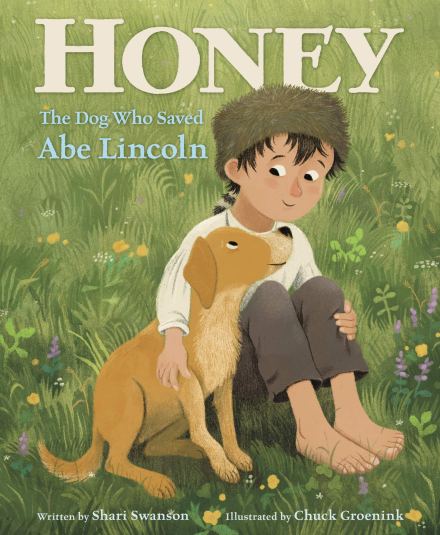
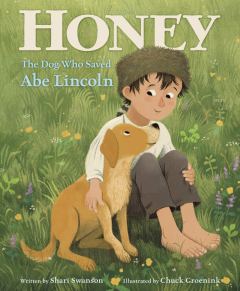
Honey, the Dog Who Saved Abe Lincoln

Written by Shari Swanson | Illustrated by Chuck Groenink


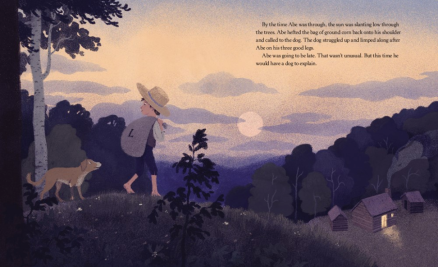
Young Abe Lincoln was deep in the forest when he heard the whistle that told him the corn he’d brought to the mill was ready. He knew he’d be late, but it was worth it to have saved a frog from the jaws of a snake. When Abe got back to the mill, John Hodgen, the miller, wondered what it had been this time that had kept Abe so long. “‘I just can’t move along fast like some boys, Mr. John, because I see so many little foolish things that make me stop. I can’t help it to save my life,“‘ Abe answered.

celebrate-picture-books-picture-book-review-honey-the-dog-who-saved-lincoln-late

Image copyright Chuck Groenink, 2020, text copyright Shari Swanson, 2020. Courtesy of Kathrerine Tegen Books.

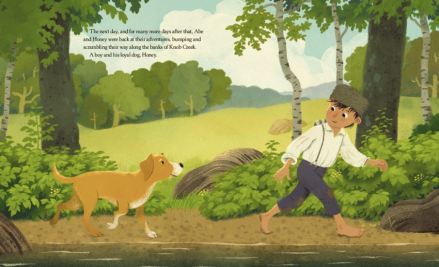
On his way home, he heard rustling in the bushes. At the bottom of a cliff, Abe found a dog with a broken leg. Although he “was only seven years old, Abe had spent his whole life on a Kentucky farm and knew how to tend to animals.” He cut a small branch to make a splint and peeled bark from a pawpaw bush to use as a bandage. He tied it all together with rawhide from his belt. It was already dark when Abe and the dog reached home.

Even though his mother knew he was prone to lateness, she’d been worried, but Abe told her about the “‘honey of a dog’” he’d found and begged her to let him keep it. “‘He’ll do lots of good things for me,’ he told her. ‘You just watch and see.’” Abe’s mother relented and soon Honey was on the mend. Even though, once healed, Honey’s foot was curved, he was able to keep up with Abe on his adventures.

celebrate-picture-books-picture-book-review-honey-the-dog-who-saved-lincoln-cave

Image copyright Chuck Groenink, 2020, text copyright Shari Swanson, 2020. Courtesy of Kathrerine Tegen Books.

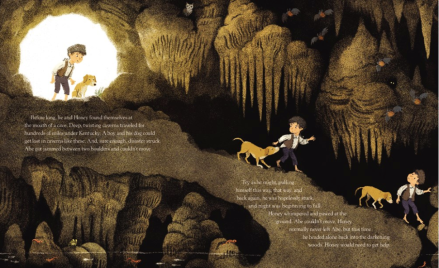
On another day, after Abe had dropped off his grain at the mill, he grew tired of waiting and wandered into the woods, where they found the mouth of a cave. “Deep, twisting caverns traveled for hundreds of miles under Kentucky. A boy and his dog could get lost in caverns like these.” Abe and Honey made their way down into the rocky darkness. Abe was too busy looking around at the stalactites, bats, and other creatures who lurked in the shadows to notice the gap between two boulders. In a moment he was stuck tight. “Honey normally never left Abe, but this time he headed alone back into the darkening woods” to get help.

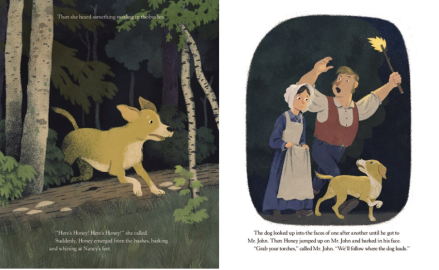
Meanwhile, everyone in town had gathered to look for Abe. Abe’s mother was at least relieved to know that Honey was with her son to protect him. As the search party began to look, Abe’s mother heard a noise in the bushes. Then she saw Honey dashing toward her. He barked and whined, but when he saw Mr. John, Honey “jumped up…and barked in his face.” Mr. John called for everyone to follow Honey.

celebrate-picture-books-picture-book-review-honey-the-dog-who-saved-lincoln-rescue

Image copyright Chuck Groenink, 2020, text copyright Shari Swanson, 2020. Courtesy of Kathrerine Tegen Books.

Honey led them through the forest to the cave’s entrance. Mr. John blew on his whistle, and Abe answered. Mr. John crept in and found Abe. There was no room for him to swing a sledge hammer to break the rock, so he pulled him out “even though it meant leaving some of the boy’s hide behind.” Once outside, Abe’s mother rushed to hug him and Honey. Abe had been right about Honey doing great things. And for many more years, Honey and Abe enjoyed adventures together.

Back matter includes a timeline recounting Abraham Lincoln’s major life events as well as his adventures with animals throughout his life.

celebrate-picture-books-picture-book-review-honey-the-dog-who-saved-lincoln-more-adventures

Image copyright Chuck Groenink, 2020, text copyright Shari Swanson, 2020. Courtesy of Kathrerine Tegen Books.

In her enchanting story, Shari Swanson introduces young readers to the boy who would grow up to be the 16th president of the United States. Children meet this beloved man as a peer, discovering that his kindness, self-deprecation, sense of humor, and big heart were always part of his personality and guided him throughout his life, during good times and times of turmoil. Abraham Lincoln’s voice drives Swanson’s storytelling, which is charming and uplifting and gives a feel for the community that raised a president. Children may be awed by the responsibility Abe took on as a mere seven-year-old but will also recognize and appreciate his knowledge, competence, and confidence. Abe’s relationship with Honey is heartwarming, demonstrating that love and loyalty are repaid in many ways.

Chuck Groenink’s digital illustrations shine with sun-dappled Kentucky forest scenes and raise the stakes with foreboding and atmospheric images of the darkened cavern. His double-page spreads give readers close-up views of the action in the story as well as places they may not be familiar with, such as the mill and the Lincoln family’s log cabin. Images of Abe setting Honey’s broken paw, sneaking table scraps to Honey, and rescuing a variety of animals will delight kids. Torchlit scenes of the nighttime search party and dramatic rescue will have readers on the edge of their seats but knowing that Honey is watching out for Abe, they will be as certain of the triumphant ending.

A charming and compelling story for teaching young children about Abraham Lincoln and the lessons his life exhibits, Honey, the Dog Who Saved Abe Lincoln would be a first-rate addition to home, school, and public library collections.

Ages 4 – 8

Katherine Tegen Books, an imprint of HarperCollins, 2020 | ISBN 978-0062699008

Discover more about Shari Swanson and her books on her website. You’ll also find an educators’ curriculum guide and a child’s activity kit to download on her website. or here:

Educators’ Curriculum Guide | Activity Kit for Kids

To learn more about Chuck Groenink, his books, and his art, visit his website.

Abraham Lincoln’s Birthday Activity

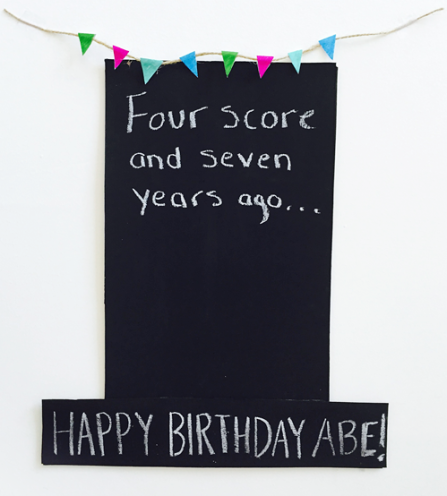
CPB - Abe Lincoln's Top Hat chalkboard (2)

Abe Lincoln’s Top Hat Chalkboard


Abraham Lincoln was known for the black top hat he wore – and for his inspiring words In this activity you can learn how to make a top hat chalkboard to use for your own drawings or inspiring words!

Supplies

  • Cereal Box (I used a large sized cereal box), cardboard or poster board
  • Chalkboard Paint (black)
  • Paint brush
  • Hot Glue Gun or extra-strength glue
  • Removable mounting squares
  • Chalk

Directions

  1. If you are using cardboard or poster board: cut a rectangle at least 8 inches wide by 12 inches long for the hat and 12 inches long by 2 inches wide for the brim (but your top hat can be any size you’d like!)
  2. If you are using a Cereal Box: open the seams of the Cereal Box
  3. Cut the panels of the cereal box apart
  4. Take one face panel and one side panel
  5. With the chalkboard paint, paint both panels
  6. Let the panels dry
  7. Attach the side panel to the bottom of the face panel to create the shape of Lincoln’s top hat
  8. Hang Abe Lincoln’s Top Hat Chalkboard 

celebrate-picture-books-picture-book-review-honey-the-dog-who-saved-lincoln-cover

You can find Honey, the Dog Who Saved Abe Lincoln at these booksellers

Amazon | Barnes & Noble | Books-a-Million | IndieBound

Picture Book Review

January 31 – Inspire Your Heart with Art Day

celebrate-picture-books-picture-book-review-nature's-friend-cover-2

About the Holiday

Today we celebrate the feeling you get inside when you create or experience art. Art can inspire, gladden, sadden, anger, teach, and compel action. It can also provide joy and inspiration when you need it most. Celebrate today’s holiday by visiting a museum, bookstore, library, concert, or gallery.

Nature’s Friend: The Gwen Frostic Story

Written by Lindsey McDivitt | Illustrated by Eileen Ryan Ewen


“Gwen followed her brothers and sisters everywhere, like a small fawn follows its herd.” Even though an illness in babyhood had left her hands and one foot weak and her speech slurred, Gwen grew up confident that she could do anything. Born in 1906, Gwen, as a child with disabilities, would normally have stayed home instead of attending school. But her mother had been a teacher, so she sent her to school and “pushed her to learn.”

celebrate-picture-books-picture-book-review-nature's-friend-the-gwen-frostic-story-young-gwen

Image copyright Eileen Ryan Ewen, 2018, text copyright Lindsey McDivitt, 2018. Courtesy of Sleeping Bear Press.

The other kids giggled and whispered behind her back, and while she wanted to hide, she instead “gathered up knowledge like a bird builds a nest.” Her teachers thought she would never be able to write. To strengthen her hands, her mother encouraged her to draw, keeping a drawer full of supplies within reach. As Gwen sketched, her grip grew firmer.”

While making friends was difficult, Gwen found companionship in nature. She loved to spend time outdoors watching the unfurling ferns and frogs that “lapped up bugs with long, quick tongues.” From nature, Gwen learned, “‘all things are vital to the universe…all are equal…and at one…different.’”

celebrate-picture-books-picture-book-review-nature's-friend-the-gwen-frostic-story-school

Image copyright Eileen Ryan Ewen, 2018, text copyright Lindsey McDivitt, 2018. Courtesy of Sleeping Bear Press.

A move to Detroit when she was twelve introduced Gwen to the buildings and people of a big city. In high school, Gwen, now stronger, took mechanical drawing and shop class. Later, in art school, Gwen was introduced to linoleum, in which she carved intricate images for printmaking. Gwen’s dream was to be an artist, but she also knew she needed to earn money to pay expenses.

She started a business making objects from hammered metal. Word of her art spread quickly. It was bought by leading Detroit families, and Gwen was invited to exhibit her art at the 1939 World’s Fair in New York. When World War II broke out, Gwen went to work building bombers. She even designed tools for building the planes. Contributing to the war effort was important, but Gwen still “longed to create art.” She bought a printing press and opened “Presscraft Papers stationery company.”

celebrate-picture-books-picture-book-review-nature's-friend-the-gwen-frostic-story-gwen-in-nature

Image copyright Eileen Ryan Ewen, 2018, text copyright Lindsey McDivitt, 2018. Courtesy of Sleeping Bear Press.

Gwen began to miss the nature she loved so much, so she packed up and moved back to Michigan. There, “she walked deep into the wetlands” and began carving linoleum blocks, recreating nature as she saw it. “She wanted others to see nature as she did, to recognize the value of plants, trees, and animals.” She made prints from her linoleum blocks and created greeting cards on her press. Her beautiful artwork reminded people of nature’s bounty at a time when the environment was threatened with pollution. People came from all over to her shop in the Michigan woods to buy her art that spoke to them: “‘Love this earth, / Love it’s waters… / Care enough to keep it clear.’”

An Author’s Note reveals more about Gwen Frostic’s life and provides a sketching craft for readers.

celebrate-picture-books-picture-book-review-nature's-friend-the-gwen-frostic-story-drawing

Image copyright Eileen Ryan Ewen, 2018, text copyright Lindsey McDivitt, 2018. Courtesy of Sleeping Bear Press.

Lindsey McDivitt’s superb biography of Gwen Frostic—an artist, inspiration, and pioneer for career women and the disabled—introduces children to a woman who, through persistence and confidence, lived life on her own terms. McDivitt’s lyrical prose infuses the story with the poetry of nature that Gwen internalized and translated into the art that people continue to admire and seek out. McDivitt’s thorough storytelling and excellent pacing allow for a full understanding of Gwen Frostic’s achievements. Young readers will be fascinated by the life work of this talented and determined artist.

Screen Shot 2018-08-21 at 6.54.39 PM

Eileen Ryan Ewen captures Gwen Frostic’s strength of character, can-do attitude, and love of nature in her stunning artwork. Full-page illustrations follow Gwen from her beloved Michigan woodlands to Detroit to art school and through her life as an artist and business woman. Images of Gwen carving a linoleum block, sketching designs for new tools as she sits next to a fighter plane and the woman installing rivets, working an old printing press, and greeting visitors at her shop broaden readers’ understanding of the times and Gwen’s work.

An exceptional picture book that provides encouragement and inspiration, Nature’s Friend: The Gwen Frostic Story is a must for classroom libraries and would make a positive impact on young readers as part of their home library.

Ages 6 – 10

Sleeping Bear Press, 2018 | ISBN 978-1585364053

Discover more about Lindsey McDivitt and her books on her website.

To learn more about Eileen Ryan Ewen, her art, and her books, visit her website.

American Artist Appreciation Month

celebrate-picture-books-picture-book-review-nature-coloring-page

Nature Coloring Pages


If you love nature like Gwen Frostic did, you’ll enjoy these printable Nature Coloring Pages.

Meadow Coloring PageOcean Coloring Page

celebrate-picture-books-picture-book-review-nature's-friend-cover-2

You can find Nature’s Friend: The Gwen Frostic Story at these booksellers

Amazon | Barnes & Noble | Books-a-Million | IndieBound

Picture Book Review


January 13 – It’s International Creativity Month

celebrate-picture-books-picture-book-review-hedy-lamarr's-double-life-cover

About the Holiday

Are you an artist, a writer, a decorator, a chef? How about a floral arranger, a woodworker, a fashion designer, or a gardener? Inside almost every heart lies a desire to create. Whether you use your ingenuity in your job or as an escape from the routine, this month celebrates all that is innovative. Sometimes this comes not only in making something you can see or touch but in a new thought or a novel way of solving a problem—as seen in today’s book!

I received a copy of Hedy Lamarr’s Double Life for review consideration. All opinions are my own.

Hedy Lamarr’s Double Life: Hollywood Legend and Brilliant Inventor

Written by Laurie Wallmark | Illustrated by Katy Wu


In 1938 people were lining up to see Hedy Lamarr in her first English-language movie Algiers. Hedy was the talk of Hollywood, and journalists and photographers captured her every move—almost. What movie-goers and the press didn’t know was that Hedy Lamarr was also a brilliant inventor. Instead of attending fancy celebrity parties, after a long day on the set, “Hedy hurried home to work on her latest invention. Her brain overflowed with idea after idea for useful inventions.” While she never tried to sell her ideas—like the collar to help find lost pets or the “flavor cube that changed plain water into soda”—she designed and redesigned them to perfection.

celebrate-picture-books-picture-book-review-hedy-lamarr's-double-life-magazines

Image copyright Katy Wu, 2019, text copyright Laurie Wallmark, 2019. Courtesy of Sterling Children’s Books.

But how did Hedy get her start? She was born in Austria and as a child took apart mechanical objects just to see how they worked. Hedy’s father also loved science, and he encouraged his daughter to hold onto her dreams. In addition to science, Hedy loved movies and would use her dolls to reenact the scenes she saw.

When she got older, Hedy got a job as a script girl and then worked as an extra in a movie. She loved acting and once said, “‘I acted all the time…. I was a little living copybook. I wrote people down on me.’” While playing the lead in a stage play, the Hollywood producer Louis B. Mayer saw her and offered her movie contract. Hedy moved to America. It only took her six months to land a starring role in Algiers. After that she starred in many movies with some of the most famous actors and actresses. 

By now, the world was at war. One day, Hedy met George Antheil, a former weapons inspector who now composed music. Hedy remembered a “discussion she had overheard back in Europe about a problem with the guidance system for torpedoes. The guidance system couldn’t prevent the enemy from jamming the weapon’s radio signals” and sending it off course. She learned from George Antheil that the US Navy had the same problem.

They decided to team up to see if they could figure out a solution. Hedy was also an accomplished pianist, and she and George often played musical games on the piano. Once, while they played the same song in different octaves, Hedy had a brainstorm for building “a secure torpedo guidance system.” At the time, torpedo guidance systems only worked if the ship launching a torpedo and the torpedo were on the same frequency.

celebrate-picture-books-picture-book-review-hedy-lamarr's-double-life-home

Image copyright Katy Wu, 2019, text copyright Laurie Wallmark, 2019. Courtesy of Sterling Children’s Books.

Hedy thought that if the ship and the torpedo could switch between a series of different frequencies, the enemy would be foiled. “Hedy called her discovery ‘the hopping of frequencies.” Working together, she and George devised a way to implement Hedy’s idea. When they presented their idea to the National Inventors Council, they were told the “idea had ‘great potential value.’”

There were still some issues to overcome to make the system automated, but Hedy and George answered those too. They applied for a patent, and a year later on August 11, 1942 it was granted. When they gave the idea to the United States Navy, “Hedy was proud her frequency-hopping idea might help America win the war.” But embroiled in the middle of the conflict, the Navy didn’t have “the time or money to implement a new system….”

Hedy, who still wanted to help America defeat the Nazis, was undaunted. She helped raise 25 million dollars by selling war bonds and volunteered at the Hollywood Canteen, where servicemen soon to be deployed gathered. Hedy went on to make more than twenty movies and continued to work on her inventions.

In the 1980s, the US Navy declassified Hedy’s frequency-hopping technology, meaning anyone could use it. Because the patent had long-ago expired, no one needed to give Hedy and George credit for the idea. “Companies raced to include frequency hopping in their own devices.” In 1997, Hedy and George were finally recognized when they “received the Pioneer Award from the Electronic Frontier Foundation for their significant contribution to computers.”

A timeline of Hedy Lamarr’s life, a description of how Hedy and George’s frequency-hopping technology worked, additional resources for further reading, and a list of Hedy’s movies follow the text.

celebrate-picture-books-picture-book-review-hedy-lamarr's-double-life-red-carpet

Image copyright Katy Wu, 2019, text copyright Laurie Wallmark, 2019. Courtesy of Sterling Children’s Books.

Laurie Wallmark knows how to weave a riveting tale that draws readers in to the lives of fascinating and scientifically minded women throughout history. Her detailed biography of Hedy Lamarr will wow kids with the twists and turns of how a vital feature of the electronics they use every day came to be. A history not only of this famous woman but of the times and policies that denied Hedy Lamarr the recognition and profits she deserved, the story is sure to spark plenty of discussion. The inclusion of a few of Hedy’s ingenious ideas as well as quotes on acting, inventing, and her views on life give children a glimpse into the mind of this unique woman.

Katy Wu takes readers back to the 1940s with her stylish illustrations reminiscent of magazine images of the time that depict both Hedy’s glamourous and inventive sides. Even as Hedy steps out of a limo to the glare of flashbulbs, acts under stage lights, and watches movies thrown by a projector’s beam, she’s dreaming of going home to work on her inventions in the light of a desk lamp. When the story turns to Hedy’s frequency-hopping idea, Wu clearly portrays the problems with the torpedo guidance system and the way single-frequency and multiple-frequency communications work. The way player pianos were controlled and how Hedy and George Antheil used this idea is also well portrayed. The final images of people using Hedy’s technology today lets kids fully understand the impact that Hedy Lamarr has had on their lives.

An important story about an extraordinary woman, Hedy Lamarr’s Double Life: Hollywood Legend and Brilliant Inventor will inspire children to follow and accomplish all of their dreams. The book will spur creative thought across subject matter and would be a motivational addition to home, classroom, and public libraries.

Ages 5 and up

Sterling Children’s Books, 2019 | ISBN 978-1454926917

Discover more about Laurie Wallmark and her books on her website.

To learn more about Katy Wu, and view a gallery of her book and art, visit her tumblr.

International Creativity Month Activity

celebrate-picture-books-picture-book-review-national-archives-coloring-book-of-patents

National Archives Coloring Book of Patents


The people at the National Archives of the United States in Washington DC chose some of their favorite patents from the past to share with you as a coloring book. As you have fun coloring these pages full of ideas, let yours fly too!

Click here to get your printable National Archives Coloring Book of Patents

celebrate-picture-books-picture-book-review-hedy-lamarr's-double-life-cover

You can find Hedy Lamarr’s Double Life: Hollywood Legend and Brilliant Inventor at these booksellers

Amazon | Barnes & Noble | Books-a-Million | IndieBound

Picture Book Review
December 17 – Celebrating Read a New Book Month with Art

celebrate-picture-books-picture-book-review-frank-lloyd-wright-cover

About the Holiday

Today, I’m featuring another interactive book that will get young readers excited about learning more about art—or in this case—architecture. A great book can help kids find role models from the past or today that they can connect with philosophically and creatively. A book that touches on, validates, and encourages a child’s talent or dream is a gift that lasts a lifetime.

Meet the Architect! Frank Lloyd Wright

By Patricia Geis


Artists can be endlessly fascinating not only for their work but for their lives, which influence where they get their ideas, how they create each piece, and what made them an artist in the first place. In Meet the Architect! Frank Lloyd Wright, readers get an opportunity to discover the backstory, the influences, the three architectural rules, the clients, and, of course, the buildings of this master architect, whose mother predicted his profession before he was even born and “surrounded his crib with drawings of cathedrals.” This deep dive into Frank Lloyd Wright’s life is accomplished not only through text, but with little fold-outs that are themselves illustrated booklets, 3D popups, illustrated panels that extent the pages, tabs, a portfolio of postcards, and more.

celebrate-picture-books-picture-book-review-frank-lloyd-wright-getting-started

Copyright Patricia Geis, 2019, courtesy of Princeton Architectural Press.

But let’s get started! Young readers may wonder what Frank was like as a kid. Learning that his grandfather, Richard Lloyd Jones, a Welsh milliner who made “‘black cone-shaped hats that ended in a point, worn as much by witches when they flew on their broomsticks as by other Welshmen,” will only whet their appetite to know more, and they won’t be disappointed. In addition to the text that briefly outlines Wright’s ancestry and earliest work experiences and defines what an architect is, a child asks a few questions.

celebrate-picture-books-picture-book-review-frank-lloyd-wright-getting-started-2

Copyright Patricia Geis, 2019, courtesy of Princeton Architectural Press.

The first speech bubble asks, “How was he as a kid?” Readers open it up to see a photograph of Frank at age 10 accompanying a description of the books he read, the activities he and his best friend did, the newspaper he created, and even why “he called himself Aladdin” for a while. Readers next meet him at 16 in a photo of his very large extended family, and they also get to see his Uncle James’ house where he spent eight summers working on the farm. The exterior photo of the house Wright made for his family. Two other speech bubbles introduce children to the house Wright designed and built for his family and a discussion of his favorite color, complete with full-color photographs.

celebrate-picture-books-picture-book-review-frank-lloyd-wright-getting-started-3

Copyright Patricia Geis, 2019, courtesy of Princeton Architectural Press.

No artist is created in a vacuum, so author Patricia Geis includes a discussion of Friedrich Froebel, the creator of kindergarten and designer of twenty games that engaged children in geometry, creating dimensional shapes, building, and crafts and were influential in Wright’s development as well as in that of many well-known “artists, philosophers, and architects who would invent the abstract language of modern art.” A popup on the page replicates one of Froebel’s games.

celebrate-picture-books-picture-book-review-frank-lloyd-wright-the-unit-2

Copyright Patricia Geis, 2019, courtesy of Princeton Architectural Press.

Wright’s father was also influential in his son’s education. He taught him to love music and “see the composer as a builder. For Wright, music and architecture were constructed by means of a system of units: the notes in music and the bricks in a house.” Just as notes are written on a staff, an architectural drawing is created on a grid. A detailed popup of Unity Temple built in 1908 in Oak Park, Illinois demonstrates how the building is positioned on a grid while a fold-out panel presents images of a floor plan, a cross section, a perspective drawing, and two photographs—one of the exterior and one of the interior of this beautiful temple.

celebrate-picture-books-picture-book-review-frank-lloyd-wright-the-unit

Copyright Patricia Geis, 2019, courtesy of Princeton Architectural Press.

Wright is well-known for setting his buildings in harmony with their surroundings. In her chapter “The Landscape,” Geis explains that Wright believed all buildings should adhere to “‘organic architecture,’” which meant they should “be in harmony with the landscape, respect the materials of construction, and respond to the need of the client.” She goes on to talk about Taliesin, the house, studio, and farm where he opened a school of architecture in 1932,, and Taliesin West in Arizona. These two landmarks are presented first with small framed photos (which cleverly mirror pictures on an art gallery wall) that open up to show how the buildings blend in with the environment and second with foldouts that include interior and exterior photographs as well as accompanying text.

celebrate-picture-books-picture-book-review-frank-lloyd-wright-the-grid

Copyright Patricia Geis, 2019, courtesy of Princeton Architectural Press.

Fallingwater, built in 1936, is one of Wright’s most famous designs, and with the pull of a tab, readers can transform the waterfall that hosts this house into the showstopper it became. More photographs and text present Wright’s philosophy about the house and land as well as the level of detail that went into building it—even to his choice to paint “the upper part the same color as the underside of a rhododendron leaf.”

celebrate-picture-books-picture-book-review-frank-lloyd-wright-the-grid-2

Copyright Patricia Geis, 2019, courtesy of Princeton Architectural Press.

“Wright believed that every house should fit its inhabitants, like a made-to-measure suit.” To see just how he accomplished creating one-of-a-kind houses, readers can flip through a portfolio of five postcards, each of which presents a color photograph of the exterior of the house on the front and a description and interior photographs on the back. Visitors to the Guggenheim Museum in New York have experienced how Wright brought “the forms of nature to the city.” Shaped with the spiral of a snail’s shell, the museum showcases the art collection of Solomon r. Guggenheim, who bought “the works of such avant-garde artists as Kandinsky, Klee, Picasso, and Mondrian. Perhaps Wright’s connection with some of these artists through their common adoption of Froebel’s games early in their development is one reason the museum and the art work so well together.

A natural teacher, Wright would no doubt invite readers of this book to do some architectural exploration of their own, and so Geis has included sheets of card stock blocks, shapes, cubes to build, and other elements as well as a grid for children to play with.

celebrate-picture-books-picture-book-review-frank-lloyd-wright-postcards

Copyright Patricia Geis, 2019, courtesy of Princeton Architectural Press.

Patricia Geis is an engaging and compelling tour guide on this absorbing survey of Frank Lloyd Wright’s life that spanned from 1867 to 1959 taking in Reconstruction, “the Industrial Revolution, the coming of electricity, two world wars, and the invention of television.” Her clear and straightforward storytelling draws readers in with intriguing details, information about his childhood, and sprinkled-in direct appeals for them to look closer at or notice something in the photographs. Geis does an excellent job of connecting Wright’s early influences to his later work and his architectural philosophies to his finished projects. Each two-page spread creates a chapter of sorts, making it easy for kids and adults to dip into the book as they wish or to read it all in one sitting. Charming illustrations of wanna-be architects on various pages invite kids along on this beautiful and beautifully done journey of discovery.

A stunning book that any child—or adult—would cherish, Meet the Architect! Frank Lloyd Wright is highly recommended for anyone interested in architecture or any of the arts. I would also encourage readers to check out the other books in this series, including Meet the Artist! books about Henri Matisse, Pablo Picasso, Alexander Calder, Vincent van Gogh, and Leonardo da Vinci. If you are looking for a unique gift for a teacher or someone on your list, you can’t go wrong with this book.

Ages 7 – 12 and up

Princeton Architectural Press, 2019 | ISBN 978-1616895938

You can learn more about Patricia Geis, her books, and her art here.

celebrate-picture-books-picture-book-review-frank-lloyd-wright-cover

You can find Meet the Architect! Frank Lloyd Wright at these booksellers

Amazon | Barnes & Noble | Books-a-Million | IndieBound

Picture Book Review