March 7 – Unique Names Day

The Name Jar by Yangsook Choi Picture Book Review

About the Holiday

Established in 1997 as part of Celebrate Your Name Week, Unique Names Day celebrates uncommon or uncommonly spelled names and encourages those with unique names to always take pride in their name. One way to celebrate is to find out more about your name and how or why your parents chose it.

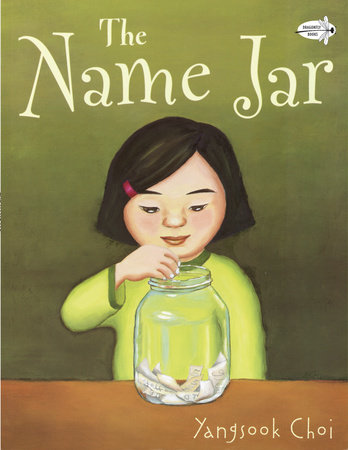
The Name Jar

By Yangsook Choi


Unhei has recently moved to the United States from Korea. Although Unhei is excited about the first day of school, on the bus ride she misses her former home and looks at the wooden name stamp her grandmother gave her. A boy sitting behind Unhei notices the unfamiliar object and asks about it. Then other kids notice Unhei. They ask what her name is and when she answers, they mispronounce it, laughing and making jokes.
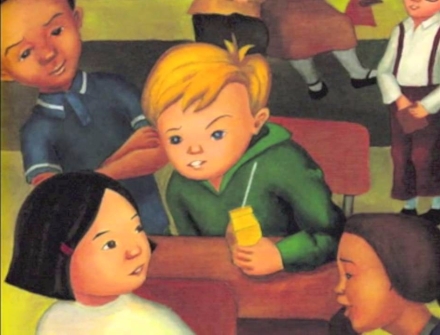
celebrate-picture-books-picture-book-review-the-name-jar-on-the-bus

Image copyright Yangsook Choi, courtesy of Random House

Unhei is embarrassed and glad that when the bus drops them off that those kids head to a different classroom than hers. As Unhei enters her own room, her classmates smile and greet her—it is obvious that their teacher has prepared them for a new student, and they are excited.

Of course, they first question her about her name, and remembering the experience on the bus, Unhei is reluctant to answer. She quickly says that she hasn’t picked a name yet, but will tell them next week. When she gets home, Unhei tells her mother that she wants an American name, a name that is easy to pronounce.

Her mother is dismayed; Unhei’s name was chosen by a master so that it would describe her uniqueness. But Unhei doesn’t want to be different, she just wants to fit in. Later while she and her mother are at a Korean grocery store, she introduces herself to the owner, who exclaims that her name is beautiful and means “grace” in English. 

celebrate-picture-books-picture-book-review-the-name-jar-mom

Image copyright Yangsook Choi, courtesy of Random House

That evening Unhei tries out American names in front of the mirror—Amanda, Laura, Susie—but they don’t feel or sound right. The next day at school Unhei finds a jar on her desk with pieces of paper in it. On each piece of paper is a name—suggestions from each of her classmates. Her new friends have chosen these names thoughtfully. Daisy is the nickname of one girl’s baby sister; Tamela is a smart and brave heroine from a story; and Wensday is the day Unhei joined their class.

At the end of the school day, a classmate named Joey comes to her. He knows she actually does have a name, and Unhei, while not wanting to say it out loud, shows him the characters on her wooden stamp. Joey thinks it is beautiful and asks to keep the paper. Day by day the glass jar fills up with names. Unhei will have to choose soon.

One Saturday Unhei returns to the Korean grocery store. When Mr. Kim calls her by name, the one other customer turns around. It’s Joey! Carefully and slowly he says Unheis name until he gets it right. On Monday when Unhei enters the classroom, she discovers that the jar is missing. It’s all right, though, Unhei has chosen her name.

celebrate-picture-books-picture-book-review-the-name-jar-friend

Image copyright Yangsook Choi, courtesy of Random House

She walks to the chalkboard and writes her real name in English and Korean. She tells the class that her name means “grace.” Other kids reveal the meaning of their names, and they all practice saying Unhei’s name. That evening Joey comes to visit. He explains that he took the jar because he wanted Unhei to keep her original name. He suggests putting Korean nicknames into the jar for their classmates to pick. He has already chosen his Korean name with the help of Mr. Kim. It is the prefect nickname: Chinku, which means “friend.”

Ages 3 – 8

Random House, Dragonfly Books, 2003 | ISBN  978-0440417996

Discover more about Yangsook Choi, her books, and her art on her website!

Yangsook Choi’s The Name Jar is as timely now as when it was first written. Through compelling and detailed storytelling, Choi explores the themes of identity, empathy, family, friendship, and more  with sometimes heartbreaking honesty. Unhei’s varied experiences at school, at home, and at the market provide an opportunity for adults and children to discuss and embrace the diversity of our multicultural world. Choi’s warm-toned illustrations reveal the conflicts that Unhei encounters and her growing confidence as she makes friends with Mr. Kim and Joey who accepts her as she is. 

Unique Names Day Activity
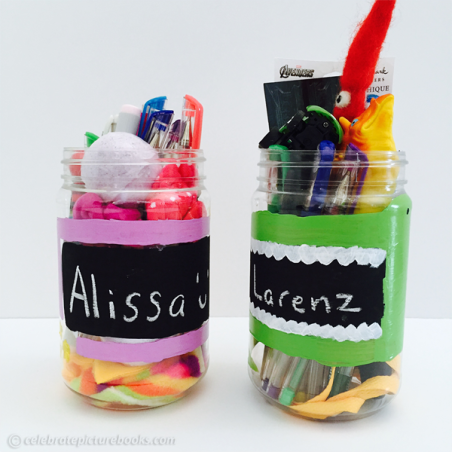
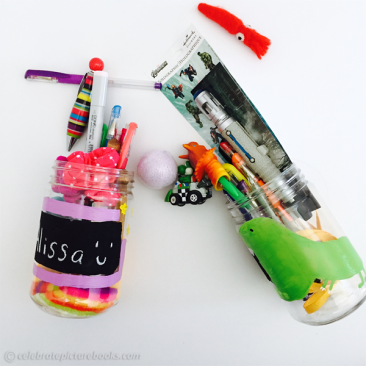
CPB - Name Jars standing

Love Your Name Organizer Jar


Everyone needs a place to store their special stuff! Here’s a way to recycle a plastic jar and make a cool organizer jar with your name on it. This organizer jar also makes a great gift for your friends!

Supplies

  • A large plastic jar, such as a peanut butter jar or mayonnaise jar, cleaned out and with the label removed
  • Acrylic multi-surface paint or markers
  • Chalkboard paint
  • Paint brush
  • Chalk

CPB - Name Jars on sides

Directions

  1. Paint a rectangle on the front of the jar with chalkboard paint
  2. Decorate the rest of the jar with paint, markers, or paper just the way you want! My green jar sports a friendly dinosaur!

Picture Book Review

March 3 – World Wildlife Day

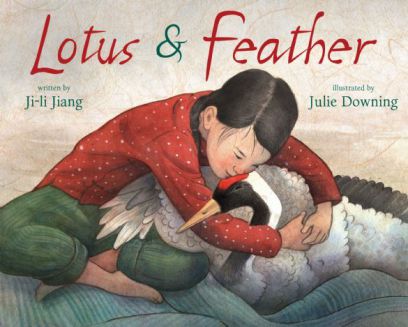
celebrate-picture-books-picture-book-review-lotus-and-feathers-cover

About the Holiday

In December of 2013 the United Nations General Assembly proclaimed March 3rd as World Wildlife Day to promote awareness of our environment and the dangers to it. This year’s theme is “Listen to the Young Voices.” Nearly one-quarter of the world’s population is between the ages of 10 and 24. With a crucial stake in the preservation of the world’s animals and plants and their habitats, more and more young people are getting involved in the preservation of the environment. Today, find a way to get involved in your community or donate to a wildlife cause. A clean, healthy, and protective environment benefits all.

Lotus & Feather

Written by Ji-li Jiang | Illustrated by Julie Downing

Lotus was lonely since her winter illness had left her without a voice. The children at school “treated her like a strange creature,” and she was left without playmates or someone to keep her company on the walk home. She lived with her grandfather who made reed baskets and found solace when he took her to ride in his boat on the nearby lake. As he poled the boat through the still water, Lotus’ grandfather sadly pointed out how the lake had changed. No longer did the lotus flowers, fish, birds, or animals thrive. Instead, the landscape had “‘been ruined by greedy fishermen and hunters, and by ignorant people who took over the land where animals once lived.’”

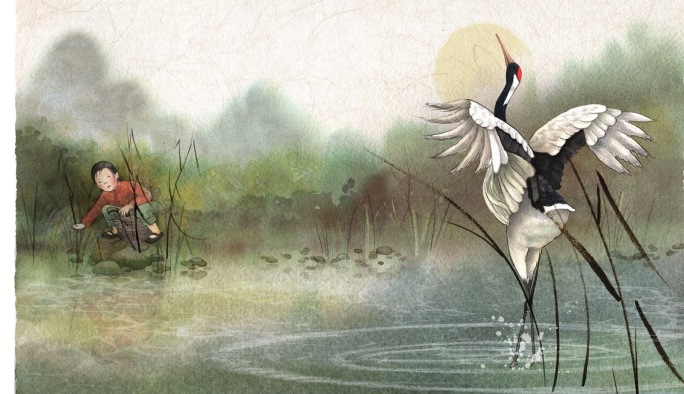
celebrate-picture-books-picture-book-review-lotus-and-feather-lotus-meets-feathers

Image copyright Julie Downing, courtesy of Disney Hyperion

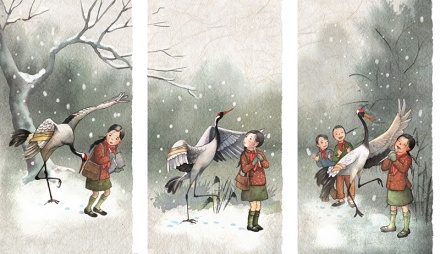
One morning while Lotus was out collecting reeds for her grandfather she spied a rare crane. It’s wide white “wings were edged with black feathers, like lace on a dress”…and “its head was crowned with a red top like a dazzling ruby.” As she watched a gunshot rang out. Unable to alert the hunter by shouting, Lotus banged on her bucket, frightening him away. Lotus rushed toward the wounded bird, picked it up and carefully brought it home to Grandpa.

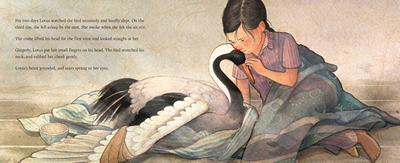
Grandpa tended to the crane’s injury and fed him rice soup while Lotus stroked the soft head. For two days, Lotus hardly slept as she took care of the crane. On the third day she fell asleep next to the crane, waking when he stirred and nestled her cheek. “Lotus’s heart pounded, and tears sprang to her eyes.” Lotus named the crane Feather. As it grew stronger she gathered food for it, and on the day Feather took his first steps, “Lotus jumped and swirled and hugged Grandpa blissfully.”

celebrate-picture-books-picture-book-review-lotus-and-feather-lotus-comforts-feather

Image copyright Julie Downing, courtesy of Disney Hyperion

Soon Feather was following Lotus everywhere—even to school. After class Lotus would blow her whistle and Feather would come running and dance as Lotus played. The other children joined in, dancing and playing along every day. One night Lotus heard Feather crowing and woke to find that the village was flooded. Poling his boat through the streets, Grandpa shouted, Lotus banged her pail, and Feather crowed to alert the neighbors. “Over three hundred villagers were saved. Feather was the hero.” He became famous, and people wanted to hear his story again and again.

celebrate-picture-books-picture-book-review-lotus-and-feather-lotus-dancing

Image copyright Julie Downing, courtesy of Disney Hyperion

When Spring arrived Feather was still too weak to fly but he looked longingly at the birds migrating north. Lotus was frightened that her friend might want to leave them, but she “knew she would never separate him from his home and family.” One day Feather spread his wings and leaped into the air. Lotus realized that he had healed and knew it was time for him to leave. Grandpa and Lotus took Feather to the lake. Grandpa tossed Feather into the air, but he returned again and again. Grandpa gave Feather to Lotus. Lotus hugged Feather one more time and threw him into the sky.  

celebrate-picture-books-picture-book-review-lotus-and-feather-lotus-lets-feather-go

Image copyright Julie Downing, courtesy of Disney Hyperion

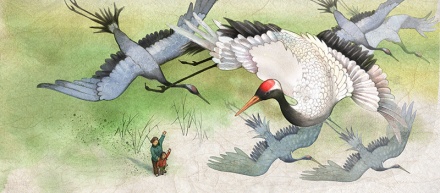
Holding back tears, Lotus watched as “Feather flapped his big wings and soared north, disappearing into the horizon.” Lotus and the other children missed Feather. They gathered together listening to Lotus play her whistle, imagining that Feather could hear them. One autumn morning, Lotus heard a familiar crow and rushed outside. There stood Feather with his family. Then Lotus gasped. The sky was filled with hundreds of cranes coming to the lake. Lotus blew her whistle, and the notes, “accompanied by the birds’ singing, echoed far, far away in the golden sky.”

celebrate-picture-books-picture-book-review-lotus-and-feather-lotus-waves-goodbye

Image copyright Julie Downing, courtesy of Disney Hyperion

Ji-li-Jiang’s tender story resonates on every page with love and friendship. The relationship revealed in Jiang’s tale exists not only between Lotus and Feather, but between readers and their environment. Beautifully interwoven throughout the plot, the idea of responsibility between friends, to the earth, and to ourselves makes Lotus & Feather a compelling book to read and discuss. Through lyrical passages and detailed storytelling, Jiang develops a deep, emotional bond between Lotus and Feather that readers will respond to. The heartwarming connection between Lotus and her grandfather brings comforting and another level of family commitment to the story.

Julie Downing’s stunning illustrations allow readers to walk, sit, worry, and cheer with Lotus as she finds and cares for Feather. Her sadness is palpable as she walks home from school past a group of classmates playing ball; in the corner of the dark lake, children will find bottles, cans, and other debris floating among the reeds; and Feather makes his debut with a graceful ballet. Readers will love watching the progression of Feather’s healing and Lotus’ reintegration into her circle of friends and will applaud when Feather and his family and friends return to the lake.

Lotus & Feather is a multi-layered story that will captivate readers. It is a must for public and school libraries and would make a beautiful addition to home libraries as well.

Ages 5 – 9

Disney Hyperion, 2016 | ISBN 978-1423127543

Discover more about Ji-li Jiang and her books on her website!

View a portfolio of artwork as well as other books by Julie Downing on her website!

World Wildlife Day Activity

celebrate-picture-books-picture-book-review-world-wildlife-day-word-scramble

Endangered Species Word Scramble

Can you find the names of 15 animals in this printable Endangered Species Word Scramble? Here’s the Solution.

Picture Book Review

March 2 – Read Across America Day

celebrate-picture-books-picture-book-review-the-unexpected-love-story-of-alfred-fiddleducling-cover

About the Holiday

Today marks the 20th anniversary of Read Across America Day, which is sponsored by the National Education Association and promotes the joy and discovery that reading provides. Not only is reading fun, studies show that reading to a child from birth improves literacy and language development and leads to a lifelong love for books. Today, visit your local bookstore or library and find some new books to share—or grab some favorites off your shelf and enjoy them again!

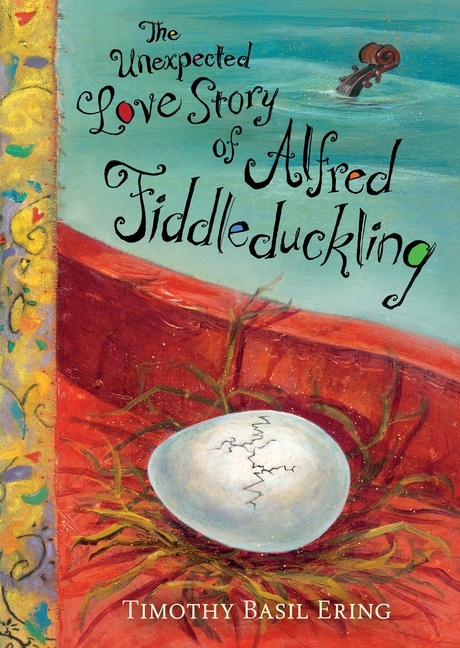
The Unexpected Love Story of Alfred Fiddleduckling

By Timothy Basil Ering


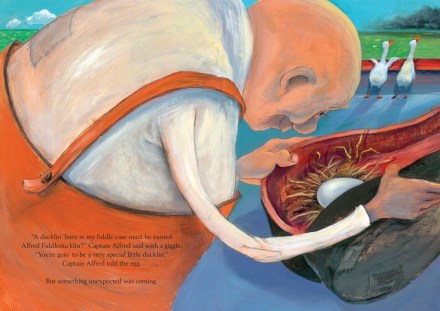
Captain Alfred was sailing home with his boat filled with ducks for his farm. “Nestled safe inside his fiddle case” was one nearly ready-to-hatch egg—a surprise present for his wife. Captain Alfred already had a name picked out for the little one—Alfred Fiddleduckling—and he knew this baby would be very special. But suddenly a “mighty gale whipped the seas into a raging fury” and tossed the little boat and its occupants to and fro. When the storm had blown itself out, a thick, impenetrable fog descended over the ocean.

celebrate-picture-books-picture-book-review-the-unexpected-love-story-of-alfred-fiddleducling-egg

Image and text copyright Timothy Basil Ering, courtesy of Candlewick Press

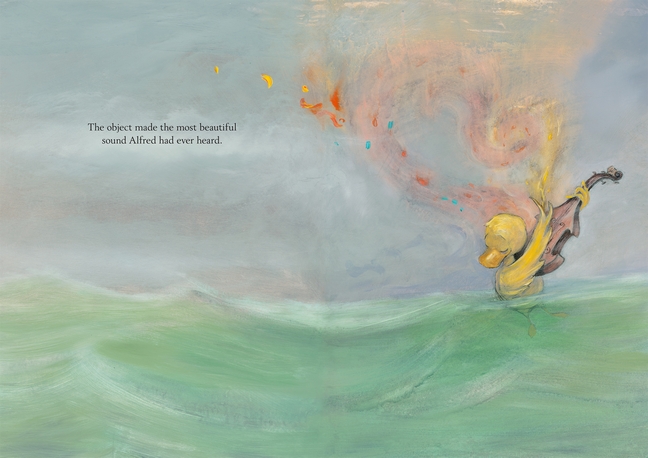
From the porch of a small cottage on the shore’s edge, a woman looked out to sea as “tears of worry dropped from her cheeks, into the mist.” Baby Alfred, however, unaware of these events and hidden by the fog, hatched as the fiddle case floated on the now-calm water. The little duckling looked around and saw something in the water nearby. He paddled out to it and even though it took no notice of him, Alfred “embraced the object with all of his heart.” He “caressed it so that it would not feel as lonely as he did ” and was surprised to hear a most beautiful and unexpected sound.

Alfred immediately fell in love—and imagined that his love was reciprocated. The two drifted along, buoyed by the waves until Alfred’s feet touched ground in a spooky swamp. In a moment, however, the comforting music began again. The sounds, so unexpected in this mist-shrouded swamp, reached the ears of “a beast that was lurking in the tall grasses.” The Beast bounded in the direction of the sound and found Alfred and his love. With drool dripping from its jaws, the beast came closer. Alfred shook, and in his fear “his music became fast and wild!”

celebrate-picture-books-picture-book-review-the-unexpected-love-story-of-alfred-fiddleducling-finds-fiddle

Image and text copyright Timothy Basil Ering, courtesy of Candlewick Press

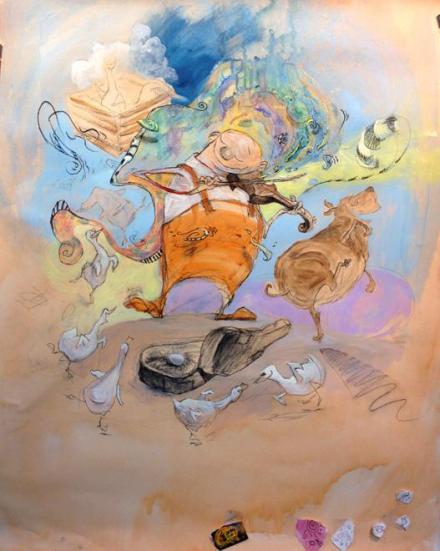
The beast stood on his hind two legs, rising high and menacing above tiny Alfred and…began to dance. The dog had missed his master’s fiddle playing and he now found a best friend in Alfred. The two trekked through the swamp, searching for home and becoming cold, wet, and helpless as the hours stretched on. The fiddle quivered with music that was as sad and helpless as the two wanderers.

But someone heard those quiet strains—the woman on the porch of the little cottage. “She ran through the fog, straight toward the sound of Alfred’s fiddle. She wrapped her arms around her dog and marveled at the special duckling and his music. “‘Don’t ever stop playing your wonderful music,’” she told Alfred. Alfred played with abandon, pouring out all the happiness in his heart. Out on the sea a raft of ducks and one very surprised captain heard the music…and you can guess what happened next!

celebrate-picture-books-picture-book-review-the-unexpected-love-story-of-alfred-fiddleducling-captain-plays-fiddle

Image copyright Timothy Basil Ering, courtesy of Candlewick Press

Timothy Basil Ering’s wonderfully unique tale of a ship-wrecked duckling and a fiddle who together make beautiful music that reunites a family is captivating. The story holds just the right amount of surprise, suspense, and heart to keep young children riveted to what happens next. Ering’s lyrical phrasing is music to readers’ ears and conveys the various melodies—sweet, quivering, poignant, tempestuous, and finally joyful—that carry the story from one event to another.

Ering’s full-bleed illustrations begin with bright vibrancy that gives way to gauzy grays as the fog rolls in. Despite the weather or ominous surroundings, Alfred remains a bright spot, his yellow fuzz and the multi-colored notes a glowing beacon in the dark. Little readers will love following the confetti notes of Alfred’s playing and guessing the next twist in the plot. The star of the story, plucky little Alfred, is a cutie as  with empathy he embraces the fiddle and bravely ventures through sea and swamp to find home.

The Unexpected Love Story of Alfred Fiddleduckling is joyful, mysterious, and humorous tribute to friendship, love, and the unexpected that would make a great gift and an often-read addition to children’s home libraries.

Ages 2 – 6

Candlewick Press, 2017 | ISBN 978-0763664329

Read Across America Day Activity

celebrate-picture-books-picture-book-review-mug-cookie

Snuggle-in Mug Cookie Treat


Snuggling up and reading is made even better with a quick and tasty treat! Make this warm mug cookie that takes only minutes to put together and then settle in for some favorite or new stories! Here’s a delicious recipe from Food.com for you to try!

Ingredients

  • 2 Tablespoons butter
  • 2 Tablespoons milk
  • ½ Teaspoon vanilla extract
  • 3 Tablespoons brown sugar
  • 4 Tablespoons flour
  • 2 Tablespoons dark or milk chocolate chips
  • 1 Pinch salt

Directions

  1. Place butter and milk in a microwavable mug. Microwave for 30 seconds to melt the butter and warm the milk.
  2. Stir in the brown sugar and vanilla extract.
  3. Mix in flour, chocolate chips, and salt.
  4. Microwave for about 1 minute on High. (Cooking time is based on the texture of cookie you like)
  5. Cool for 5 minutes before serving
  6. Add toppings such as ice cream, whipped cream, or hot fudge or chocolate sauce

Picture Book Review

February 22 – It’s International Boost Your Self-Esteem Month

celebrate-picture-books-picture-book-review-toby-and-Tutter-therapy-dogs-cover

About the Holiday

February, on the horizon of sunny spring, is a great time to reflect on your emotional health. A strong sense of self-esteem – what a person thinks of themselves inside – is important for leading a happy life. With all of the pressures of work, school, and other activities, it’s easy to feel overwhelmed and anxious. Finding the positive in every day as well as understanding and appreciating one’s strengths and weaknesses can lead to a more peaceful and fulfilling life. One way both kids and adults find acceptance and a boost in self-esteem is by playing with pets or spending time with therapy dogs, like the canine helpers in today’s book.

Toby and Tutter: Therapy Dogs

Written by Kirsten DeBear | Photographs by Laura Dwight


Ten years ago Toby, a mixed breed dog, was adopted from a shelter when he was only six months old and trained to be a therapy dog. He works with his mother, an occupational therapist, helping children learn and play. Like some of the kids themsselves, Toby has a little brother. His name is Tutter and he was adopted when he was four months old. Toby admits that it took awhile to get used to having Tutter around. Tutter is smaller and captures a lot of the children’s attention. He even wiggles in between Toby and the kids “stealing all the affection.”

celebrate-picture-books-picture-book-review-toby-and-Tutter-therapy-dogs-toby

Photography copyright Laura Dwight, text copyright Kirsten DeBears, courtesy of Toby and Tutter Publishing

Toby explains that when he was young, he “went to school…to study how to behave around children and how to follow directions.” He learned how to work with many different kids. Tutter wants to be a therapy dog too, but Toby is skeptical. He’s not sure that Tutter has the courage or patience it requires. Their mother, though, thinks that with enough training, he will be able to do it.

celebrate-picture-books-picture-book-review-toby-and-Tutter-therapy-dogs-swing

Photography copyright Laura Dwight, text copyright Kirsten DeBears, courtesy of Toby and Tutter Publishing

Tutter is an Italian greyhound, and while Toby may think he “looks goofy,” Tutter is proud that the kids call him “cute.” Tutter just wants to be like his big brother and help children even if he is small and often afraid. He follows Toby and tries to do what he does,but it’s hard  While Toby is good at lying down and letting the kids pet his fluffy fur, Tutter is just “learning to stay still. If the children sit quietly I will go to them and cuddle up on their laps. But if they’re wild I run away!” says Tutter. Toby likes to play ball with the kids. They throw it to him and Toby gives it back. Tutter doesn’t really like to share his toys. Toby likes to play on the equipment, such as the slide, balance beam, swing, and tunnel, but Tutter is afraid to use them. He prefers the hammock with its gentle motion.

celebrate-picture-books-picture-book-review-toby-and-Tutter-therapy-dogs-playing

Photography copyright Laura Dwight, text copyright Kirsten DeBears, courtesy of Toby and Tutter Publishing

While Tutter and Toby may seem very different, they are similar is some ways. Tutter likes to wear the necklaces the kids make, so he’s learning to sit still just like Toby while the children put them over his head. Tutter can also play peek-a-boo like Toby; and he tries to encourage the children by letting them know “that doing your best is all that you can do.”

Every day Tutter feels that he’s getting braver, and he knows that he has special talents that Toby doesn’t. Tutter is allowed in the ball pit with the kids, he can pretend to be in a greyhound race, and he can be carried in a bag. He’s also good at teaching the kids to be gentle and quiet and not to be afraid of dogs. Tutter is happy to be who he is and is proud of what he can do; Toby is proud of Tutter too for trying new things even if they are scary. Tutter and Toby are happy to be a team!

celebrate-picture-books-picture-book-review-toby-and-Tutter-therapy-dogs-playing

Photography copyright Laura Dwight, text copyright Kirsten DeBears, courtesy of Toby and Tutter Publishing

Children will love this story of two therapy dogs helping out at school. Kirsten DeBear’s engaging story of these brothers encompasses the emotions family members often feel, including the sibling rivalry and deep affection of brothers and sisters that readers will recognize. The alternating thoughts of the two dogs—one more mature and easy-going and for whom learning comes easily and the other younger and more hesitant who struggles with some tasks—echo the diversity of children found in any social situation. Toby and Tutter demonstrate that everyone can be proud of their abilities and accomplishments and have much to offer. DeBear’s honest and accessible language will resonate with kids who will be charmed by sweet Tutter and friendly Toby.

Laura Dwight captures the interactions of children playing and learning with Toby and Tutter in colorful photographs full of action and personality. Kids will love seeing how these two brothers perform their jobs by modeling actions, offering comfort, and being ready playmates. The obvious love the children show for their furry friends will make readers smile and wish they were part of the group.

Toby and Tutter: Therapy Dogs is a wonderful choice for opening discussions on empathy and social-emotional topics as well as the work of specially trained companion animals with children. 

Ages 4 – 8

Toby and Tutter Publishing, 2016; Paperback 978-0984781218 | Hardcover 978-0984781201 | Available on Amazon

To learn  more about Kirsten DeBear, her programs, and her work with disabled children and children with Down syndrome, visit her website.

Discover more about Laura Dwight and her photography for children’s books, textbooks, nonprofit agencies, and more on her website.

International Boost Self-Esteem Month Activity

celebrate-picture-boos-picture-books-review-I-love-dogs-word-search

I Love Dogs Word Search


Dogs of all types make great friends and companions and bring joy to life. Can you find the names of all the dogs in this printable I Love Dogs Word Search?

Picture Book Review

February 21 – It’s Love the Bus Month

celebrate-picture-books-picture-book-review-last-stop-on-market-street-cover

About the Holiday

Love the Bus Month, sponsored  by the American School Bus Council, promotes awareness of and offers appreciation to the thousands of school bus drivers across the country who safely transport students every day to and from school, to field trips and to sporting events. To join the celebration, write a note to your bus driver and thank them for all they do for you!

Last Stop on Market Street

Written by Matt de la Peña | Illustrated by Christian Robinson


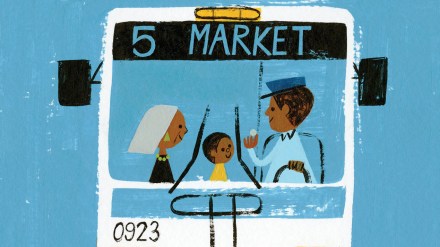
CJ, fresh from church, skips out into the sprinkling rain. He and his nana wait for the bus under her umbrella. From the bus stop CJ watches as his friend climbs into a warm, dry car and asks, “‘Nana, how come we don’t got a car?’” Nana was just telling CJ that they didn’t need a car when “the bus creaked to a stop in front of them. It sighed and sagged and the doors swung open.’”  As they stepped aboard, Mr. Dennis, the bus driver, pulled a quarter from behind CJ’s ear, making him giggle.

celebrate-picture-books-picture-book-review-last-stop-on-market-street-at-bus-stop

Image copyright Christian Robinson, text copyright Matt de da Peña, 2015. Courtesy of G. P. Putnam and Sons Books for Young Readers.

CJ and Nana found seats up front across from a man with a guitar and an old woman with a jar of butterflies on her lap. Nana said hello to everyone and “made sure CJ did the same.” As the bus pulled away from the curb, Nana began to knit and CJ looked out the window feeling sorry that he couldn’t just go home after church like his friends. Nana said she felt “‘sorry for those boys….They’ll never get a chance to meet Bobo or the Sunglass Man.’”

celebrate-picture-books-picture-book-review-last-stop-on-market-street-getting-on-bus

Image copyright Christian Robinson, text copyright Matt de da Peña, 2015. Courtesy of G. P. Putnam and Sons Books for Young Readers.

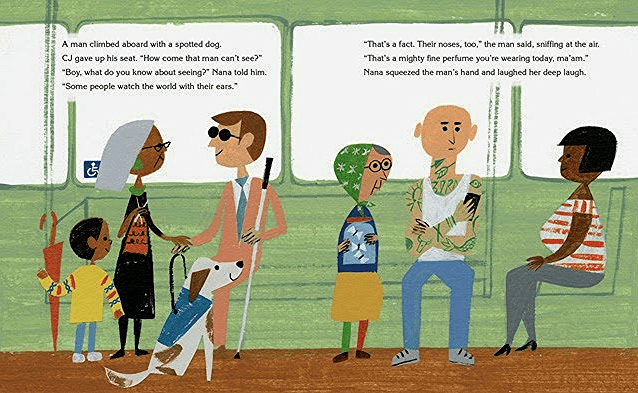
At the next stop a blind man and his dog got on. CJ gave him his seat, but asked Nana why he couldn’t see. “‘Some people watch the world with their ears.’” Nana told him. When the bus stopped again, two older boys stepped on. CJ wished he could listen to music on a phone like they were, but Nana pointed to the man with the guitar, who began to pluck the strings and sing. CJ closed his eyes and let the music transport him out of the city. In his mind he saw waves and colors, hawks and butterflies. “CJ’s chest grew full and he was lost in the sound and the sound gave him the feeling of magic.”

celebrate-picture-books-picture-book-review-last-stop-on-market-street-blind-man

Image copyright Christian Robinson, text copyright Matt de da Peña, 2015. Courtesy of G. P. Putnam and Sons Books for Young Readers.

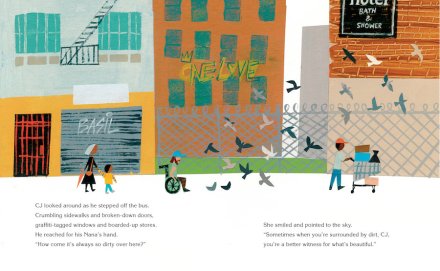
When the man finished his song everyone clapped, and CJ dropped his quarter into the man’s hat. Finally, the bus came to the last stop on Market Street. CJ and his nana stepped off into a neighborhood of “crumbling sidewalks and broken-down doors, graffiti-tagged windows and boarded-up stores.” CJ wondered why it was always so dirty there, but Nana pointed to the beauty of the sky above them. CJ looked up and saw a rainbow arching over the soup kitchen. Then CJ saw familiar faces at the window and felt glad they had come. “‘Me too,’” Nana agreed as she and CJ took up their posts and began ladling soup into bowls.

celebrate-picture-books-picture-book-review-last-stop-on-market-street-soup-kitchen

Image copyright Christian Robinson, text copyright Matt de da Peña, 2015. Courtesy of G. P. Putnam and Sons Books for Young Readers.

Matt de da Peña’s gentle nudging to look on the bright side and appreciate the beauty and wonder around you is made all the more poignant for readers by the story’s young protagonist. Through realistic dialogue and honestly expressed feelings, CJ and Nana engage in one of life’s most important lessons—connecting empathetically with others. CJ’s rich experiences on the bus and at the soup kitchen—microcosms of our larger world—broadens his view and enlivens his imagination. Last Stop on Market Street reminds readers that to truly enjoy a meaningful life they must be aware of and appreciate the diversity of people and events around them.

Christian Robinson’s acrylic and collage illustrations are smart, captivating snapshots of CJ’s day as he watches and interacts with a variety of people on the bus and at the soup kitchen. The visual camaraderie of the passengers—old and young, tattooed, talented, and disabled—as they talk together and smile at one another will cheer readers. The color scheme of bright and pastel colors shared from page to page enhances the book’s themes of interconnectedness and cohesion, and the clean, unadorned images reflect the idea that often the simple things in life really are the best.

Last Stop of Market Street, winner of the 2016 Newberry award and a Caldecott Honor book as well as the winner of many other awards, is a superb book to add to any child’s home library.

Ages 3 – 6

G. P. Putnam Suns Books for Young Readers, 2015 | ISBN 978-0399257742

Learn more about Matt De La Peña, his books, and more on his website!

Discover more about Christian Robinson and view a gallery of his work on his website!

Get on board this Last Stop on Market Street book trailer!

Love the Bus Month Activity

celebrate-picture-books-picture-book-review-school-bus-coloring-page

Where Are You Going? Coloring Page


Do you love riding the bus? It’s a great way to sightsee while getting where you want to go. Grab your colored pencils, markers, or crayons and enjoy this Where Are You Going? Coloring Page!

Picture Book Review

February 17 – International Friendship Month

celebrate-picture-books-picture-book-review-here-to-there-and-me-to-you-cover

About the Holiday

Our love for friends near and far radiates across the month of February, bringing us closer. To celebrate International Friendship Month get together with old friends and reach out to others you’d like to get to know better. This month would also be a perfect time to find a penpal, write to a member of the military, or send a card to an old friend you haven’t seen lately. As today’s book shows, friendship is the world’s strongest bridge.

Here to There and Me to You

Written by Cheryl Keely | Illustrated by Celia Krampien


“Bridges do more than connect one place to another. They bring the whole world together.” There are so many types of bridges—each just right for their place or function. Some of the most charming bridges are wooden-covered, like Canada’s Hartland-to-Somerville span in New Brunswick, which is the longest covered bridge in the world at 1282 feet (as long as 32 school buses end to end). Some are colorful like the Golden Gate Bridge in San Francisco, California, which is distinctively orange, a beautiful beacon against the blue sky and sea.

celebrate-picture-books-picture-book-review-here-to-there-and-me-to-you-bridges-connect

Image copyright Celia Krampien, courtesy of sleepingbearpress.com

In London the bridge isn’t really falling down even though that makes for a fun game! The London Bridge, which crosses the River Thames, was the first stone multi-arch bridge built in Britain.” Over the years the bridge has been renovated many times, and it’s now made of concrete and steel. Drawbridges might be the coolest kind of bridge! It’s fun to watch them split in the middle and rise up, up, up before coming back down after a ship passes. These bridges “date to medieval times when knights in armor—and dragons?!—fought for their castles.”

celebrate-picture-books-picture-book-review-here-to-there-and-me-to-you-golden-gate-bridge

Image copyright Celia Krampien, courtesy of sleepingbearpress.com

Sometimes bridges don’t have to be fancy to work. Some “bridges can be as simple as a few stones placed across a shallow stream” that give crossers a place to step all along the way. This is known as a clapper bridge. People aren’t the only ones who use bridges either. Places that are home to roaming wildlife—like Banff National Park in Canada—build bridges so animals “such as bears, wolves, moose, and lynx” can cross roads and highways safely.

Trains can also “use bridges to clickity-clack along, carrying people to people. Family together again.” But what if you want to travel from country to country? There are even bridges for that, and they make “a big world seem smaller.” While these types of bridges are strong and sturdy, there are other spans made only of rope and boards that are “rickety, ratchety, swinging and swaying their way to beautiful hid away places.”

celebrate-picture-books-picture-book-review-here-to-there-and-me-to-you-covered-bridge

Image copyright Celia Krampien, courtesy of sleepingbearpress.com

People can become bridges too! Just try bending backward to touch the ground. Or if you don’t like feeling upside down, there is a simple way that “isn’t so grand. It connects me to you and you to me…through the simple holding of hands.”

Cheryl Keely’s enchanting tour of some of the world’s most beautiful and unusual bridges is sure to engage readers who love architecture, travel, and transportation—or who just have the wanderlust. Keely’s story, punctuated with facts and trivia about different types of bridges, is a lyrical frame for her theme of interconnectedness and friendship, making this a book that resonates on many levels and is a treat to dip into again and again.

celebrate-picture-books-picture-book-review-here-to-there-and-me-to-you-edge-of-golden-gate-bridge

Image copyright Celia Krampien, courtesy of sleepingbearpress.com

Celia Krampien’s charming artwork takes readers to the towns and cities, the shores and cliffs that host the world’s bridges. Her realistic depictions show the grandeur of the majestic spans millions of people use every day as well as the rustic simplicity of rope and clapper bridges. Kids will love picking out details of the scenery surrounding each structure as well as recognizing familiar settings they have learned about or, perhaps, traveled to.

Here to There and Me to You is a fresh, uplifting story that will appeal to fiction as well as nonfiction lovers. In addition to being a great addition to any story time, the book has many cross-curricular applications for classrooms and libraries, and would be a welcome find on any bookshelf.

Ages 5 – 8

Sleeping Bear Press, 2017 | ISBN 978-1585369966

To learn more about Cheryl Keely and her work as well as to find a fun bridge game, visit her website!

Find a portfolio of illustration by Celia Krampien on her website!

International Friendship Month Activity

celebrate-picture-books-picture-book-review-holding-hands-puzzle

Holding Hands Interchangeable Puzzle


Reaching out to others is a wonderful way to bridge distances and make friends. In this printable puzzle,  all the animals are ready to connect with others—no matter how you put the pieces together! Here is a colored version of the puzzle and one you can color yourself!

Supplies

Directions

  1. Print the puzzle
  2. Cut the pieces apart
  3. Reassemble the pieces in any order to have the animals make new friends

Picture Book Review

February 12 – It’s Black History Month

celebrate-picture-books-picture-book-review-words-set-me-free-cover

About the Holiday

Black History Month, also known as National African American History Month celebrates the achievements and contributions of African Americans in United States History. Originally a week-long observance commemorating the birthdays of Abraham Lincoln on February 12 and Frederick Douglass on February 14,  Black History Month was officially established in 1976 by then president Gerald Ford.

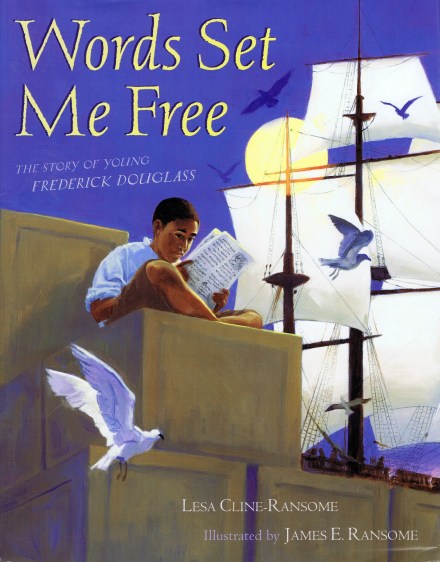
Words Set Me Free

Written by Lesa Cline-Ransome | Illustrated by James E. Ransome


Born into slavery and separated from his mother in infancy, Frederick Bailey is raised by his Grandmama while his mother works on a separate plantation. When she is able Harriet Bailey walks the 12 miles between plantations to spend a few short hours with her son, watching him sleep before making the long journey back. While Frederick is still a very young child, his mother falls ill and dies. Douglass recalls never seeing his mother’s face in daylight.
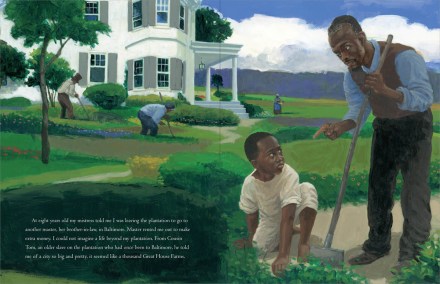
celebrate-picture-books-picture-book-review-words-set-me-free-the-story-of-young-frederick-douglas-plantation

Image copyright James E. Ransome, text copyright Carole Boston Weatherford. Courtesy of Simon & Schuster.

At the age of six, Frederick is moved from his Grandmama’s cabin to the plantation house. At eight, he is sent to the master’s brother in Baltimore, Maryland. Here, the master’s wife, Sophia Auld, treats Frederick more like a paid servant then as a slave. When Frederick says he wants to learn how to read and write, she immediately begins teaching him the alphabet. Frederick is always mindful, however, that he may be punished for these lessons, and he has only memorized the letters and a few words before his master puts an end to his education. Angrily, the master explains to his wife, “If you teach him how to read…it would forever unfit him to be a slave.”
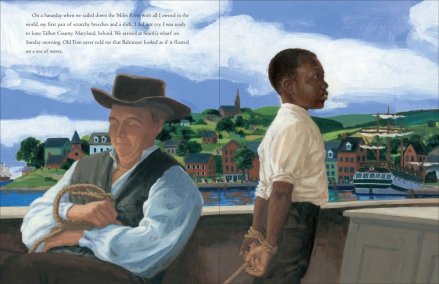
celebrate-picture-books-picture-book-review-words-set-me-free-the-story-of-young-frederick-douglas-smith's-wharf

These words are perhaps Frederick’s greatest lesson. He never forgets them, and they fuel his resolve to pursue an education. He makes clever use of the few resources he has and slowly learns to read and write. From the newspapers he discovers that the North offers freedom, and Frederick decides to escape. It’s many long years, however, before he can fulfill his dreams. At last, he sees an opportunity to leave the South behind, and using his talent for writing makes his escape a reality.

celebrate-picture-books-picture-book-review-words-set-me-free-the-story-of-young-frederick-douglas-tall-ship

Image copyright James E. Ransome, courtesy of Simon & Schuster.

Lesa Cline-Ransome has written a compelling biography of Frederick Douglass for children in Words Set Me Free. In straightforward language and through first-person point of view, Cline-Ransome reveals the brutal truth of Douglass’s life as a slave and his fight against injustice. As the title suggests, the book focuses on Frederick’s desire to become educated and the obstacles he overcame to succeed. This universally important message continues the work Douglass engaged in long ago.

James Ransome’s stirring paintings realistically highlight pivotal scenes of Frederick’s life, beginning with the tender moments he spends with his mother as a very young child. With an unstinting eye Ransome reveals the hardship and cruelty Frederick endured as a slave. His moving illustrations also demonstrate hope as Frederick, with blossoming intellect, resolves to educate himself and find a means of escape.

Ages 5 and up                                                                                                            

Simon & Schuster, New York, 2012 | ISBN 978-1416959038

Learn more about Lesa Cline-Ransome and her books on her website!

Find a gallery of illustration, paintings, drawings, videos, and more on James E. Ransome‘s website!

Black History Month Activity

celebrate-picture-books-picture-book-review-frederick-douglass-word-search-puzzle


Frederick Douglass Word Search


Words were so important to Frederick Douglass that he risked everything to learn how to read and write. In this printable Frederick Douglass Word Search Puzzle you will find words about the subject of today’s book. Here’s the Solution