I must confess that this may be my favorite holiday. There’s nothing better than waking up with a well-steeped cup of tea, writing with a favorite mug brimming with hot tea with honey sitting nearby, enjoying scones with clotted cream and jam and a hot cuppa…well…you get the picture. People have drunk tea since earliest times for its soothing and medicinal properties. Mellower than coffee and available in endless varieties and tastes, hot tea is just the thing for relaxing moments. Today, enjoy your favorite tea or try a new kind!
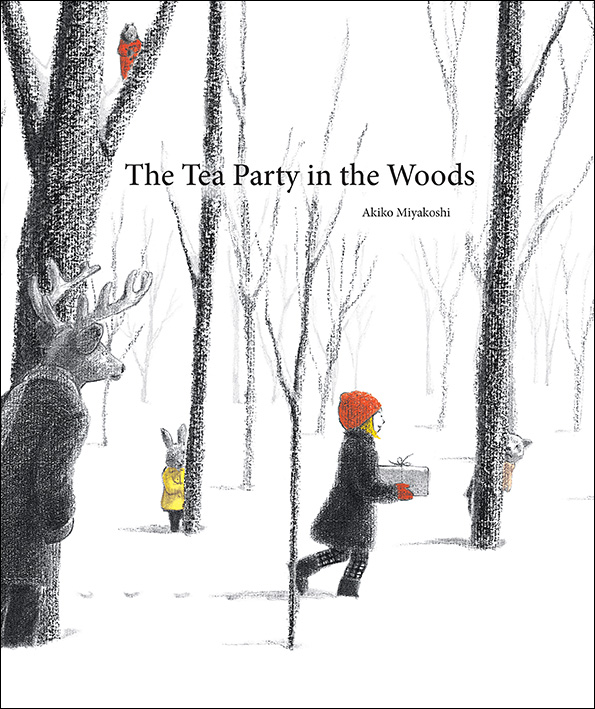
The Tea Party in the Woods
By Akiko Miyakoshi
Because snow had fallen overnight Kikko’s father was off to her grandmother’s house to shovel the walk. After he left, Kikko noticed that he had forgotten to take the pie her mother had made for Grandma. “‘I can still catch up to him,’” said Kikko. Carefully, carrying the boxed pie, Kikko followed “her father’s tracks in the fresh snow. The woods were very still. And so quiet. Kikko’s footsteps were the only sound.”
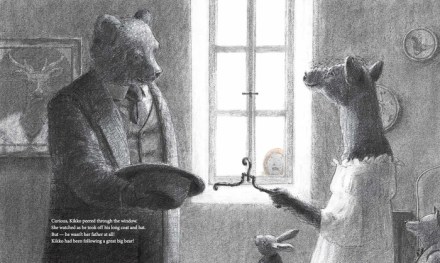
Spying a coated figure in the distance, Kikko began to run, but she fell in the deep snow, crushing the pie. Still, she picked up the box and hurried on. She watched as her father entered a strange house. “Has it always been here? Kikko wondered. She couldn’t remember having seen it before.” Kikko crept to the window and peered inside, just as her father took off his hat and coat. But—he wasn’t her father at all!” He was a bear!
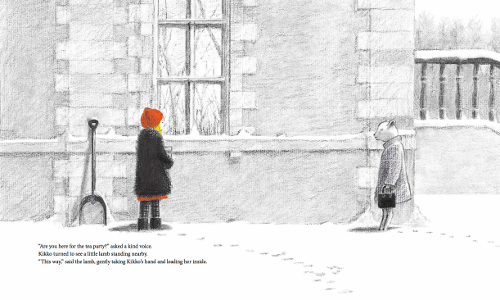
A little lamb approaching the house found Kikko looking through the window and asked if she were there for the tea party. Taking Kikko’s hand, the lamb led her into the house. When Kikko saw all of the animals gathered there, she couldn’t believe it. The animals cheered and welcomed Kikko enthusiastically. “‘We’re about to serve the tea,’ said the rabbit. ‘You’re just in time.’” After the animals seated themselves around a long table, a doe stood, thanked everyone for coming, and asked Kikko to introduce herself.
She told then her name and why she was in the forest. The animals thought she was very brave, and Kikko began to feel braver herself. When the animals learned that Kikko’s pie had been ruined, they all contributed a piece of their own pie from the party. “Slice by slice they assembled a new pie on a pretty plate. Each piece had a different filling of seeds and nuts and fruit and other delicious things gathered from the woods.” They found a new box, placed the plate inside, and tied it with a red ribbon.
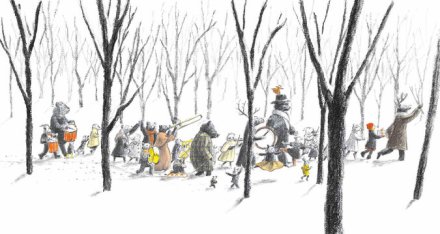
Kikko was so excited to bring her Grandma this gift that she wanted to leave right away. The animals said they would come too. The woods rang with music, talking, laughing, and singing as the group “paraded to Grandma’s house.” When they reached Grandma’s house, the animals encouraged Kikko to go to the door. Grandma and Kikko’s father were surprised to see her. “‘My dear, did you come all this way on your own?’ asked Grandma, stepping inside.” Kikko could not see the animals anywhere. “‘You’re never alone in the woods,’” Kikko answered, smiling. She was sure her new friends were listening.”
Akiko Miyakoshi’s reassuring story about a little girl venturing out into strange territory on her own for the first time is a delight. The straightforward narrative offers just the right amount of familiarity for young readers to allow them to be fully charmed by the magical elements that provide surprise and suspense. Little ones will be entranced by the warm welcome Kikko receives at the splendid and well-attended tea party. They will also find comfort in realizing that even when travels become hard, they can still discover wondrous things and that friends and help are always available – sometimes where they least expect it.
Miyakoshi’s stunning black-and-white drawings, done in charcoal and pencil, are gorgeous in their portrayal of the woodland animals and their tea party. The long table they crowd around is laden with pies, bowls of fruit, vases of flowers, and of course teapots and teacups. At first Kikko offers the only color on the pages with her red cap and skirt and yellow hair. Later, however, when the animals suggest sharing their pie, the plate dazzles with mouthwatering brilliance, and hints of red and yellow brighten the next page. As the parade marches through the woods, the animals’ red and yellow clothes and musical instruments make a festive party. But as Kikko goes on to her Grandma’s house alone, the color fades from the animals, highlighting her achievement.
Ages 3 – 7
Kids Can Press, 2015 | ISBN 978-177138107
Discover more about Akiko Miyakoshi and a portfolio of her work on her website!
Tea Month Activity
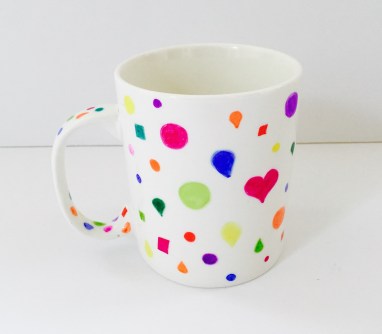
Decorate Your Own Mug
It’s fun to drink tea (or hot chocolate—shhh!) from a mug you’ve designed yourself. Personalized mugs also make fantastic presents for friends and family.
Supplies
Plain ceramic mug
Bakeable markers or paint
Directions
Design and color your mug
Follow directions on the markers or paint to properly bake on your decoration and make it permanent.
As the cooler days of December turn into the colder days of January, Cuddle Up Day reminds us that snuggling up with someone you love warms us and warms our hearts. Children especially love the comfort and security that close hugs bring. Today, get your comfy clothes on, pour a mug of hot chocolate or tea, and cuddle up together with a good book!
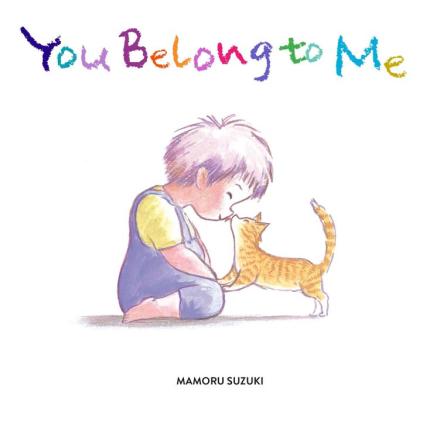
You Belong to Me
By Mamoru Suzuki
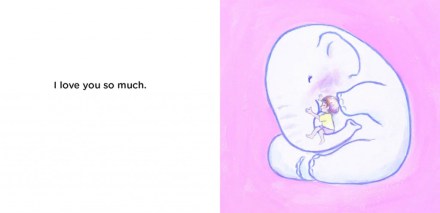
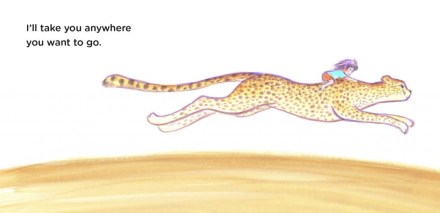
The emotions of parents and other caregivers of children escape from the heart on the very first page of this gentle, spoken lullaby: “I love you so much.” On the second page, listeners discover why: “You are my favorite person in the whole world.” As the pages flow, the reader continues to reassure the child of the constancy of their love. Devotion is shown when the adult spends time with their child, watches out for them, and takes them to activities, play dates, and even, perhaps on flights of fancy.
Image and text copyright Mamoru Suzuki, courtesy of Museyon Press
Through the words on the pages, the reader encourages the child to “come to me whenever you are lonely” or “whenever you can’t sleep” and promises that “I’ll hug you when you are sad.” Comfort comes in many forms—from drying tears to stroking hair—and from the many people who love the child.
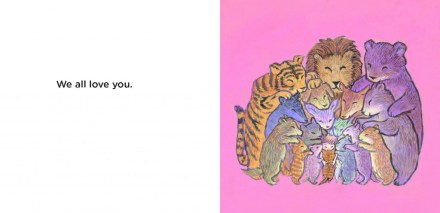
In fact, all of the people in the child’s life agree that “we all love you” and that they will be there “whenever,” “wherever,” and “however” the child needs them. But the deepest love of all is found in the heart of the reader who confirms “I love you most of all, because…you belong to me.”
Mamoru Suzuki’s sweet hug of a book gives parents and caregivers the tender words that overflow in their hearts coupled with endearing illustrations of various animals nuzzling, snuggling, protecting, and comforting a small child. The mellow colors and chiffon texture of the images are at once soothing and stirring, wonderfully mirroring the mixture of emotions that make love for a child so profound.
You Belong to Me is a cuddle to keep on your child’s bookshelf for those times when you want to tell them how much you love them.
Ages birth – 5
Museyon, 2016 | ISBN 978-1940842127
Cuddle Up Day Activity
Snuggle Buddy Craft
It’s easy to make your own snuggle buddy with a few pieces of fleece, some fiber fill, and a needle and thread or fabric glue. The great thing about creating your own friend is you can personalize your pal anyway you want!
Supplies
1 8-inch by 11-inch piece of fleece in the color or your choice for the body (or scraps if you have some from an earlier project). A larger piece of fleece can be used to make a larger buddy
1 5-inch by 8-inch piece of fleece in the color or your choice for the hair (or scraps if you have some from an earlier project)
1 small piece of fleece or other material for a pocket, clothes, or blanket
Small scraps of fleece or other material for the face
Fiber Fill
Thread and sewing needle OR fabric glue
Scissors
Directions
To Make the Body
Fold the large piece of fleece in half lengthwise and sew along the open side and along the bottom. Alternatively, if using a larger size piece of fleece, fold upward and sew or glue the two sides closed.
Turn the form inside out
To Make the Hair
Cut a piece of fleece as wide as your buddy and about 7 – 8 inches long
Fold the fleece lengthwise
Insert both ends of the fleece into the opening at the top of the body
Sew or glue the opening shut, securing the hair
Cut strips about ¼-inch wide from the top of the hair to close to where the hair is sown into the body
To Make a Pocket or Clothes
Cut a piece of fleece in the shape of a pocket, shirt, pants, diaper, or blanket
Sew or glue the pocket or clothes to the buddy
To Make the Face
Cut eyes, a nose, and a mouth in whatever way you would like your buddy to look. (My buddy is sleeping.)
At exactly 5:44 a.m. today winter arrives in the Northern Hemisphere. This also means that today offers those living there the least amount of sunshine—only 9 hours, 15 minutes, and 6 seconds. While the earth’s tilt in relation to the sun at this time of year brings cold and snowy weather to the World’s northern half, the Southern Hemisphere is basking in longer days and warm temperatures. For those of us just beginning to enjoy another winter’s chill, the onset of snow brings special beauty, outdoor adventure, and the fun explored in today’s book!
If Snowflakes Tasted Like Fruitcake
By Stacey Previn
Snowflakes gently fluttering down from a gray winter sky seem to tease “catch me if you can!” Perhaps it’s their similarity to coconut shavings or confectioners’ sugar sifted over a delicious cake that inspires us to stick our tongues out to taste those little white flakes. But what do they really taste like? And what if they tasted like other yummy foods? Stacey Previn explores that idea, starting with a winter favorite—“If snowflakes tasted like sugar plums…they’d be dancing in my head.” Or perhaps they are better for breakfast—“If snowflakes tasted like oatmeal…they would get me out of bed.”
Image and text copyright Stacey Previn, courtesy of simonandschuster.com
Maybe snowflakes would be better in a mug—“If snowflakes tasted like cocoa…they would warm me to my toes” Or if they came in whipped cream dollops, “they would tickle me on my nose.” Imagine “if snowflakes tasted like apples…” you could “bake them in a pie.” And “if snowflakes tasted like peppermint…” we’d “wish more fell from the sky.”
Image and text copyright Stacey Previn, courtesy of simonandschuster.com
Sometimes snowflakes twinkle like diamonds, but what if they were as shiny as gumdrops? Or imagine if they were as warm and soothing as noodle soup. Still, there is that title question: what “if snowflakes tasted like fruitcake?” Well, then, I’m afraid we “would give them all away.” So what is that special flavor that makes us stick out our tongues? “Winter,” of course!
Image and text copyright Stacey Previn, courtesy of simonandschuster.com
Stacey Previn offers up a whimsical, culinary menu of various taste sensations that might entice readers to eat up winter’s delicate, white morsels, including those above as well as honey, figs, chestnuts, gingerbread, popcorn, and marshmallows. Accompanying each verse are richly colored and wood-grain-textured folk-art illustrations that enhance the homey nature of the book. From verse to verse, a red-snowsuited child, joyful to wake to falling snow, imagines shaking snowflakes from tree branches, building a snowman and a snow choir, roasting snowflakes in a pan, catching snowflakes in a spoon, a net, a ladle, and more.
Kids who love playing in the snow—and for whom snowflakes are a delicacy—will delight in curling up with cup of hot chocolate and enjoying the sweet ideas and fanciful humor in this cozy wintertime book. Its sure to inspire kids to think up their own taste comparisons.
Ages 3 – 8
little bee books, 2016 | ISBN 978-1499801804
Discover more about Stacey Previn and her books on her website!
Winter Solstice Activity
Snowy Day Mind Jar
You can capture the beauty of a glittering snowfall in this easy craft—that also makes a special gift for a friend!
Supplies
Small to medium mason jar or other decorative jar with a tight lid
White glitter glue,
Light blue glitter glue,
Fine white and/or blue glitter
Large white and/or blue glitter
Warm water
Directions
1.For every 1/2 cup of warm water add:
1 1/2 teaspoons white glitter glue
1/2 teaspoon blue glitter glue
2 teaspoons fine glitter glue
1/2 teaspoon large glitter
2. Close lid tight
3. Shake
4. As glue dissolves, the liquid will become clearer and the glitter will remain suspended in it
Pancakes and waffles are great, but they’re even more delicious with maple syrup! That sweet, golden slooow-pouring topping that makes for a perfect breakfast (and breakfast-for-dinner meal) deserves its own holiday! Before you get out into the hustle and bustle of the weekend, why not celebrate a little with a tall stack and lots of maple syrup?!
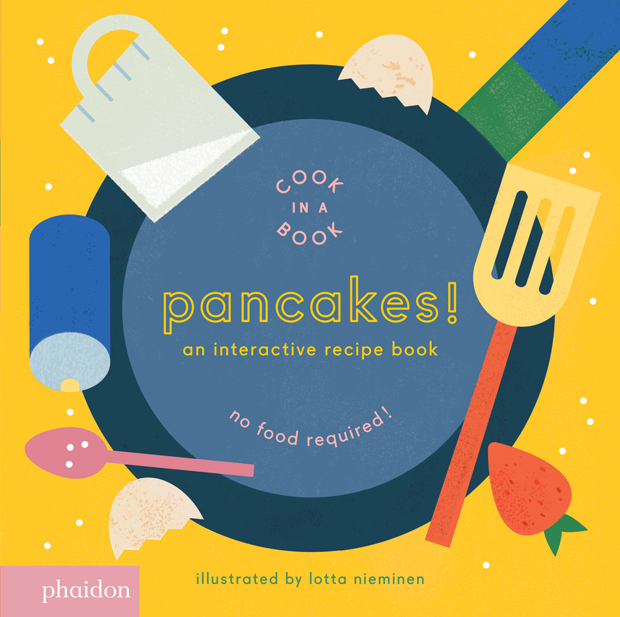
Pancakes! An Interactive Recipe Book
Illustrated by Lotta Nieminen
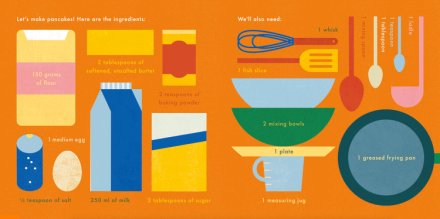
Sometimes a novelty book comes along that transcends the “kid” category and provides fun and “Ooooh!’ moments for readers of all ages. Pancakes! An Interactive Recipe Book offers just this kind of delicious excitement. Opening the cover is like walking into a cozy kitchen, finding your favorite recipe and gathering all the necessary ingredients. The first two-page spread presents in visuals and words the recipe and the utensils and other cooking items needed to make pancakes.
Image copyright Lotta Neiminen, courtesy of phaidon.com
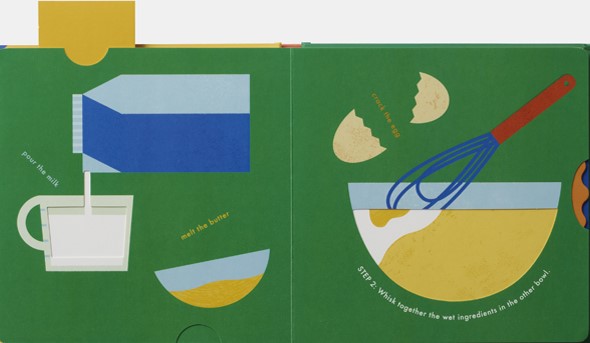
With the second two-page spread, cooking begins! A scoop of baking powder, two tablespoons of sugar, and half a teaspoon of salt are added to the bowl. But what about the cup of flour? Readers get to add that themselves with a pull tab that simulates the flour joining the other ingredients in the green mixing bowl. The clever cut of the opening and the mottled and powdery appearance of the illustrated flour gives the sensation of actual pouring.
Image copyright Lotta Neiminen, courtesy of phaidon.com
Next readers get to measure out the cup of milk with the help of a pull tab that gives kids control over the amount being served. Four marks on the side of the measuring cup provide an opportunity to talk about fractions and the ¼, ½, and ¾ lines that are also incorporated into real glass measuring cups or the separate cups that come as part of a set. Once the milk is ready, it goes into the mixing bowl with the melted butter and the egg.
Grab your whisk and get stirring! A wheel on the side of the page lets kids “combine” these wet ingredients from their individual parts into a cohesive yellow batter. Now that the batter is ready, it’s time for “STEP 4: Ladle the batter into separate circles in the hot, buttered frying pan.” Readers will love pulling the tab that releases the batter into the pan—leaving just a drop of batter to sizzle on its own (and you know how good those crispy drops can be!)
Image copyright Lotta Neiminen, courtesy of phaidon.com
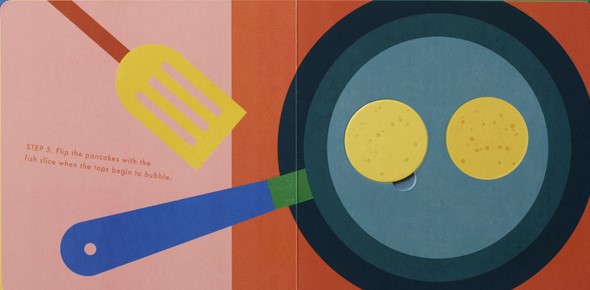
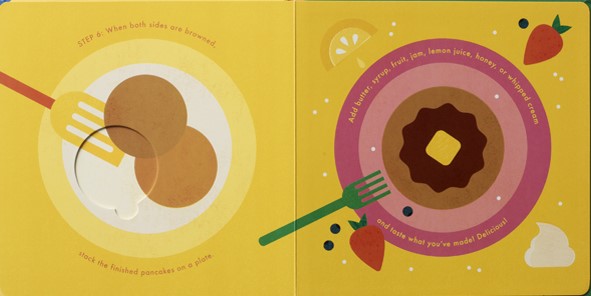
The batter is bubbling—which means it’s time to flip the flap jacks! As the spatula appears from the top of the page, kids can lift one of the little round yellow pancakes from the fry pan and turn it over. Ingeniously, the reverse side is delectably browned. A turn of the page invites by-now-hungry readers to follow “STEP 6: When both sides are browned, stack the finished pancakes on a plate.”
Image copyright Lotta Neiminen, courtesy of phaidon.com
A pancake-sized round indentation on the plate just begs to be filled with the browned pancake from the previous page. Adding the pancake to the sunny plate, kids will feel as if they are holding the spatula and carefully slipping it atop a stack ready to be eaten. The last page encourages readers to “add butter, syrup, fruit, jam, lemon juice, honey, or whipped cream and taste what you’ve made! Delicious!”
Lotta Nieminen’s Pancakes! is so wonderfully conceived in its bold vibrant images and simple recitation of a pancake recipe. The crisp lines and absence of labels on the ingredients packages, puts the focus on the shapes, providing a chance for discussion of concepts such as rectangle, circle, half-circle, cylinder, oval, and triangle; flat and round; and bigger and smaller. Ideas such as hot and cold, measuring, pouring, mixing, stacking and others can also be introduced. The brilliant interactive elements invite kids and adults alike to play with this book over and over.
The sturdy board pages and convenient size make this a perfect take-along for trips to the market, picnics, appointments, sibilings’ activities, or other outings where waiting is required. For kids and adults who like to help out in the kitchen, love to cook, or are attracted by all things culinary, Pancakes! An Interactive Recipe Book makes a terrific gift and must have for home bookshelves.
Ages 2 and up
Phaidon Press, 2016 | ISBN 978-0714872834
To view a gallery of graphic design and illustration work by Lotta Nieminen, visit her website!
Maple Syrup Day Activity
Pancake Flip-Out
Pancakes are served in a stack because they’re so delicious each one doesn’t last long! This game gives you the chance to see how many pancakes you can flip onto a plate! You can play this game several ways:
To Play Pancake Toss
Give each player the same number of pancakes and see how many they can toss onto the plate during their turn
Make a target with the plate in the middle and draw 3 concentric circles around it. Hitting the target can earn you 20 points. Getting your pancake in the first circle around the plate earns you 15 point, the second circle is worth 10 points, and the third is worth 5 points. Rotate through the players as many times as you like and add up the points at the end. The player with the most points wins!
Instead of tossing the pancakes with your hands, try throwing them with a spatula!
Make up your own rules—and have fun!
To Play With Dice
Choose a number of pancakes that each player must add to their plate—say, maybe, a baker’s dozen.
Take turns rolling the dice and adding the number of pancakes rolled to the plate. The first player to reach the agreed-upon number is the winner.
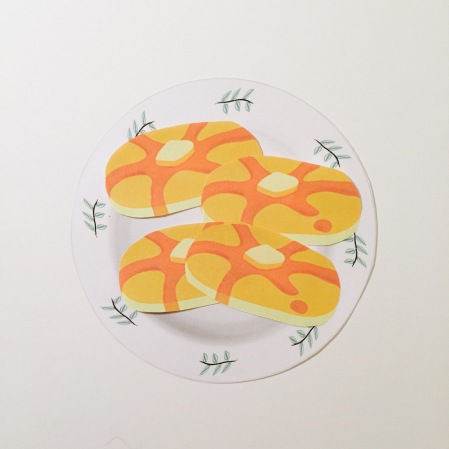
Print enough copies of the Pancakes and Breakfast Plates for the game you choose and cut them out. Playing pieces can be printed on card stock or on paper.
If printing on paper, you can glue the pancakes and plate to poster board, cardboard, or foam to give the pancakes more weight for throwing and the plate more support
Seems particularly specific, doesn’t it? But I have to admit that lemon cupcakes—especially the ones my daughter makes—are my favorite too. Of course, today’s holiday gives you license to enjoy any kind of cupcake you like! Looking for a little cupcake history? Here it is! The first mention of cupcakes was in 1796 in Amelia Simmons’ first American cookbook titled American Cookery. She recommended using small cups to create a small, light cake. The first published mention of “cupcakes” came in 1828 in Seventy-five Receipts for Pastry, Cakes and Sweetmeats by Eliza Leslie. We all know that cupcakes have long been a snack and party favorite and how they have exploded in popularity over the past few years. To celebrate, whip up a batch of your favorite cupcakes!
Peanut Butter & Cupcake
By Terry Border
Peanut Butter bread got a soccer ball for his birthday—there was just one problem. While he could balance the ball on his head, he was pretty bad at kicking it. Besides, it “wasn’t much fun playing with a ball all by himself.” Peanut Butter was new in town and hadn’t made friends yet, so he asked his mom if she’d play with him. But she was busy with the laundry and suggested he go outside and find someone to play with.
Image and text copyright Terry Border, courtesy of Philomel Books
Off Peanut Butter went, and “it wasn’t long before he found a someone.” Peanut Butter enthusiastically went right up to this someone who was walking his Hot Dogs, and gave him a winning appeal. “‘Hello. I’m new here and I’d like to play. / Maybe now, maybe later—or even all day. / I’ll make you chuckle deep down in your belly. / And we’ll go together like Peanut Butter and…Hamburger.’” Hamburger was flattered but too busy with his dogs to play. Peanut Butter thanked him anyway, and kept on walking.
Image and text copyright Terry Border, courtesy of Philomel Books
Soon Peanut Butter noticed Cupcake playing by herself with her pail and shovel in the nonpareil box. “He thought she looked sweet, and might make a good friend.” He launched into his spiel and finished up, “‘And we’ll go together like Peanut Butter and…Cupcake!’” Cupcake had some stern words for Peanut Butter. She was building sprinkle castles, she told him, and if he knocked them down with the ball, she’d be mad. Not wanting to upset Cupcake, Peanut Butter moved on.
Next Peanut Butter met Egg rolling along on his unicycle. He started his rhyme and finished with a flourish, “‘And we’ll go together like Peanut Butter and…Egg!’” Egg thought this was funny. “‘You’re cracking me up!’ Egg laughed. And then he really did crack.” Peanut Butter was afraid to make Egg laugh anymore, so he went on his way.
Image copyright Terry Border, courtesy of Philomel Books
Farther down the path Peanut Butter found Meatball jumping a strand of spaghetti. He got through his welcome only to be shushed by Meatball because he was interrupting his counting. Finding a friend was proving harder than Peanut Butter had thought. He was getting tired and wanted to sit down. Under a tree he found French Fries. After hearing Peanut Butter’s request, however, French Fries begged off, saying that he was late in helping “‘Hamburger with his Hot Dogs’” and now needed to “‘catch up.’”
Image and text copyright Terry Border, courtesy of Philomel Books
Ever persevering Peanut Butter saw Alphabet Soup standing nearby and approached, but before he could even get a word out, Soup dipped in his spoon and came out with “two letters, an ‘N’ and an ‘O.’” Feeling dejected Peanut Butter sat on a bench and thought about giving up. But then he saw a new kid coming his way. “‘Hello,’” the kid said. Peanut Butter brought out his poem one more time. “‘Um…Hello. I’m new here and I’d like to play. Maybe now, maybe later—or even all day. I’ll make you chuckle deep down in your belly. And we’ll go together like Peanut Butter and…Jelly!’”
Jelly thought this sounded great—there was just one thing. While she was good at kicking a ball, she wasn’t good at balancing it on her head. So the two new friends taught each other their special talents and “made each other chuckle deep down in their bellies.” All this laughter attracted the other kids, who came over to play together!
Image copyright Terry Border, courtesy of Philomel Books
Terry Border has mixed the culinary and the cute to create this one-of-a-kind recipe for friendship. Peanut Butter’s endearing self-introduction establishes his sweet personality, and its rhyme scheme ensures that kids will be held in suspense waiting for Peanut Butter to meet Jelly. With visual wit and plenty of puns, Border serves up a unique picture book that offers surprises and laughs on every page. Kids will also empathize with Peanut Butter’s dilemma and cheer when he finally makes a friend.
Border’s vibrant photographic illustrations are the perfect accompaniment to his story. Peanut Butter, slathered on bread and sporting wire arms and legs, is an immediately loveable hero. The other kids he meets, especially hamburger walking his two Hot Dogs and Soup, are inspired characters, and the background props make playful use of kid-favorite items.
Peanut Butter & Cupcake is a wonderful addition to kids’ bookshelves for story time, playtime, or any time a laugh or the inspiration of creative art is needed.
Ages 3 – 7
Philomel Books, 2014 | ISBN 978-0399167737
Discover the very original world of Terry Border on his website!
Lemon Cupcake Day Activity
Cupcake Wrapper Tree
Today’s paper cupcake cups are so pretty that it’s a shame they just get thrown away. Here’s a way to use cupcake liners to make an attractive winter decoration. You can use various sizes of cones to create a multi-tree decoration.
Supplies
Styrofoam or cardboard cone, available from craft stores
Cupcake wrappers with a winter or favorite design
Straight pins (for Styrofoam cones), glue dots, or small clear mounting squares (for either Styrofoam or cardboard cones)
Scissors
Glue
Directions
Cut the bottoms out of the cupcake wrappers
Using the ribbed sides of the cupcake wrappers, start from the bottom of the cone and attach the cup to the cone with the straight pins, glue dots, or mounting squares, putting them along the top rim of the wrapper
You may need to use two or more wrappers to cover the cone. Fill in gaps by overlapping with smaller cuts from the cupcake wrappers
Overlap the first row of cupcake papers a bit with the second row of cupcake papers. Attach at the top rim
Continue moving up the cone, overlapping and attaching cupcake wrappers
At the top, overlap the sides of the wrapper to cover the tip of the cone and make a sharp point. Glue seam together if needed
Attach the top wrapper to the layer below near the bottom of the wrapper
Instituted in 2007 by the Encouragement Foundation at Harding University in Searcy, Arkansas, today’s holiday entreats us to cheer on our friends, coworkers, and even those we don’t know as they attempt to reach goals or start new endeavors. A pat on the back, a simple “you can do it!,” or a reassuring “great job!” boosts people’s self-confidence and makes the world a happier place.
Tough Cookie
Written by Kate Louise | Illustrated by Grace Sandford
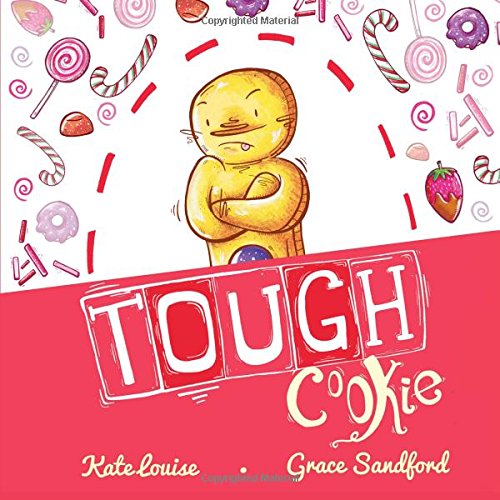
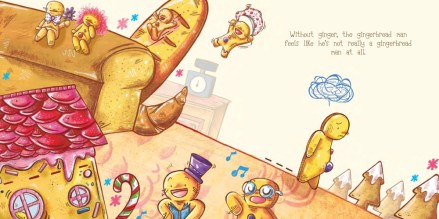
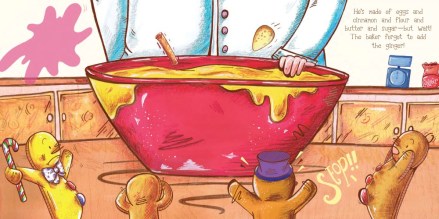
Although one gingerbread man in the bakery looks like all the others, there is one important difference. Yes, the batter had “eggs and cinnamon and flour and butter and sugar—but wait! The baker forgot to add the ginger!” Without this signature ingredient the gingerbread man just doesn’t feel like a gingerbread man at all. In fact his whole life has been turned upside down. He’s different from his friends, and what’s worse, he can’t be sold. Instead, he lives in the back of the bakery and in his sadness makes all kinds of mischief.
Image copyright Grace Sandford, text copyright Kate Louise, courtesy of Sky Pony Press
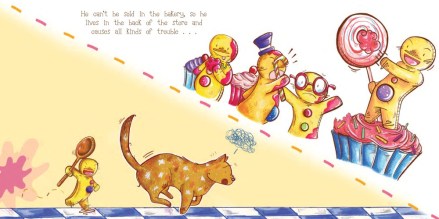
The gingerbread man chases the cat, splatters icing on other cookies, and squirts icing on the walls. “‘I need that for my cupcakes!’” the baker yells, but the gingerbread man just laughs. He moves on to the decorative candies, stuffing them in his mouth as fast as he can even though the baker needs them for his other treats and stands by tapping his foot. Next the gingerbread man scatters sprinkles all over the counter and slips and slides along on his belly—“‘woohoo!’” But the baker is not amused. “‘I need those for the donuts!’” he shouts.
Image copyright Grace Sandford, text copyright Kate Louise, courtesy of Sky Pony Press
Finally, the baker has had enough. Not only is the gingerbread man upsetting the other gingerbread men and women, he is ruining the business. The baker orders the gingerbread man to leave the store. But this is one gingerbread man that does not want to run away. “‘I don’t want to leave!’” he cries. The baker relents. He takes the little cookie in hand and teaches him that even though he is missing an ingredient he can still be kind. The baker shows him by being nice he can become one of the group.
Now, the little gingerbread man is happy. Instead of gobbling up all the candy, he helps create the other cookies. He no longer shoots icing on the walls or flings sprinkles around the kitchen. Rather, he helps the baker decorate the cupcakes and the donuts. He’s even learned how to sift flour and roll out dough, and he uses the cookie cutter to make new friends. And he never forgets to add the ginger!
Image copyright Grace Sandford, text copyright Kate Louise, courtesy of Sky Pony Press
Grace Sandford’s bakery gleams with the golden hues of fresh-baked bread, the festive colors of sprinkles and icing, and the sparkle of sugar. Kids will love the vibrant pictures of cupcakes; lollypops; stacks of cakes, donuts, and candy; and decorated gingerbread houses surrounded by cookie forests. Her expressive gingerbread men and women register dismay at the wayward gingerbread man’s shenanigans and joy at his kindness. And the hero of the story? When he leaves behind his impish pranks he becomes a charming baker’s companion, sifting clouds of flour, running on the rolling pin to flatten dough, and passing out sugar-shiny gumdrop buttons to his new friends.
Young children will ask for this fun and funny read over and over. Tough Cookie makes an especially delicious accompaniment to an afternoon of baking or decorating gingerbread houses!
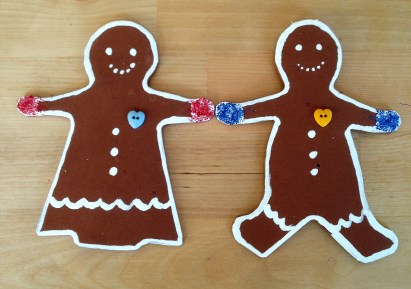
Way back in the past when gingerbread was new it was creatively iced and used to decorate windows. You can make decorations for your home or room with this easy craft!
Today’s observance was established in 1994 to promote family and community involvement in teaching and supporting children to read more. Family members can make reading a priority at home by sitting down together every day with a wide range of books and other reading material. By taking trips to the library and bookstores, children will also naturally pick up a love of reading. But families can’t do it alone. Kids acquire a drive to read when they see connections between books and their wider world. Fun book-related activities at schools, libraries, science centers, museums, and other places capture children’s attention and make them curious about reading more. Whether children are attracted by fiction or nonfiction, picture books or chapter books, novels or graphic novels, they should be encouraged to read. Universal literacy is a goal that can be accomplished.
About Small Talk Books®
Ellen Mayer’s Small Talk Books® feature young children and adults conversing (or adults speaking to children who are not talking yet) while they have fun, do chores, shop, and bake together. Their conversations demonstrate the kind of excitement and close relationships that encourage learning and language advancement. Each Small Talk Book® includes an accompanying note from Dr. Betty Bardige, an expert on young children’s language and literacy development and the author of Talk to Me, Baby! How You Can Support Young Children’s Language Development. The introduction discusses how children connect actions, words, and meaning as adults speak to them while doing particular jobs or actions.
Other titles in the Small Talk Books® series include Cake Day and Rosa’s Very Big Job. Each book makes a wonderful gift for baby showers, new parents, or anyone with young children in the family. They would be a welcome addition to any young child’s bookshelf as well as libraries and preschool classrooms.
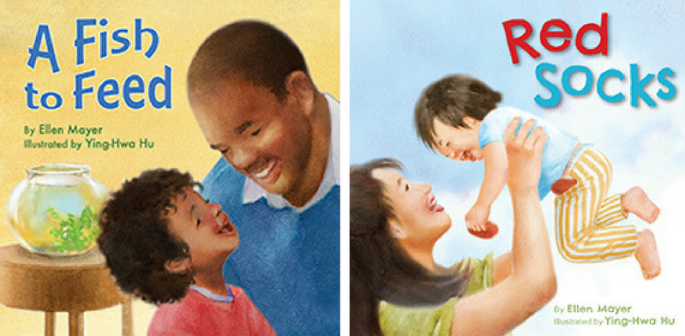
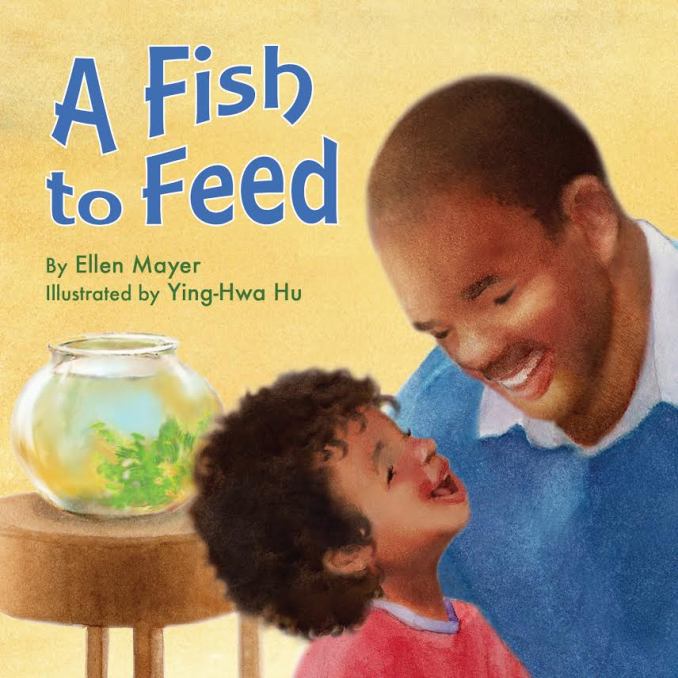
A Fish to Feed
Written by Ellen Mayer | Illustrated by Ying-Hwa Hu
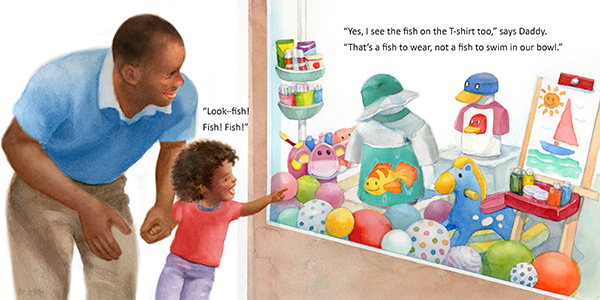
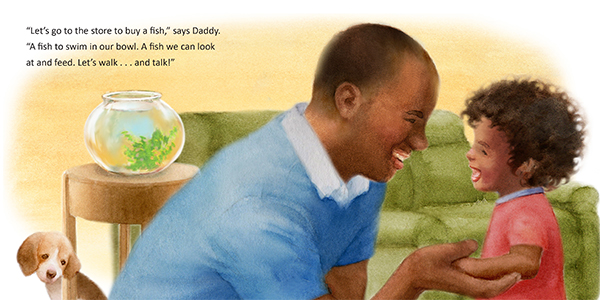
Dad plans a fun trip into town with his young child to buy a pet fish. He says, we will get “a fish to swim in our bowl. A fish we can look at and feed.” The pair are excited to go together and have time to “walk…and talk.” The two head out and soon pass a store. In the window the child sees a T-shirt with the picture of a fish on it and points. “Look—fish! Fish! Fish!” Dad reinforces the observation—“Yes, I see the fish on the T-shirt too.”—and further explains: “That’s a fish to wear, not a fish to swim in our bowl.”
Image copyright Ying-Hwa Hu, text copyright Ellen Mayer. Courtesy of starbrightbooks.com
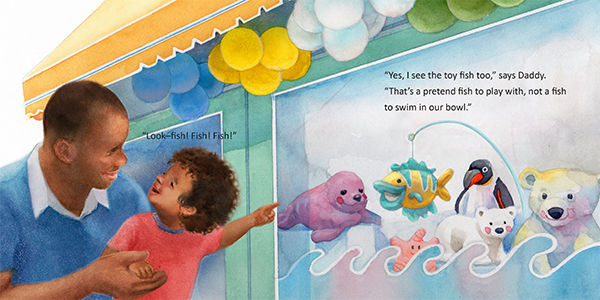
Going into the store, Dad and his youngster find another item with a fish on it. On a shelf is a backpack with a picture of a gold-and-yellow fish on the front pocket. This is a “fish to wear on your back,” Dad says, before going in search of a “fish to feed.” Next, the two come to a toy store. The child points to another fish—a fish on a mobile. “Look—fish! Fish! Fish!” the toddler exclaims. Dad affirms his child’s remark and expands on it using complete sentences that model conversation and increase vocabulary. They linger in the shop, finding other examples of fish.
Image copyright Ying-Hwa Hu, text copyright Ellen Mayer. Courtesy of starbrightbooks.com
“‘Now let’s go find a fish to feed,’ says Daddy.” They head out of the store and continue down the street. As they come to the Pet Shop, the little one shouts, “‘Look—fish! Fish swim!” Daddy echoes the excitement while praising his child. “‘You found a fish that swims!’” They take the goldfish home, where it swims happily in their bowl—a pet they “can love and feed.”
A Fish to Feed contains die-cut holes in the pages that kids will love peering through as they shop along on this adventure to find a special pet.
Image copyright Ying-Hwa Hu, text copyright Ellen Mayer. Courtesy of starbrightbooks.com
Ellen Mayer’s story of a dad and his child out for an afternoon together as they look for a pet to love offers adults and children such a sweet way to spend time with one another. The story, set in the familiar environments of home and stores and revolving around a close parent-child relationship, will engage even the youngest readers. The back-and-forth conversation between Dad and his child as they shop models ways in which adults can follow a child’s lead while providing language and literacy development. The abscence of gender-specific pronouns makes this a universal story.
Ying-Hwa Hu’s illustrations are vibrant and joyful. When Dad bends down to be at eye-level with his toddler as they talk, the close bond between them is obvious in their smiling and laughing faces. The shops are full of colorful toys, clothes, backpacks, and other items that will capture kids’ attention. Spending time looking at each page allows adults and children to point at the various items, name them, and talk about them.
Ages Birth – 5
Star Bright Books, 2015 | ISBN 978-1595727077
Red Socks
Written by Ellen Mayer | Illustrated by Ying-Hwa Hu
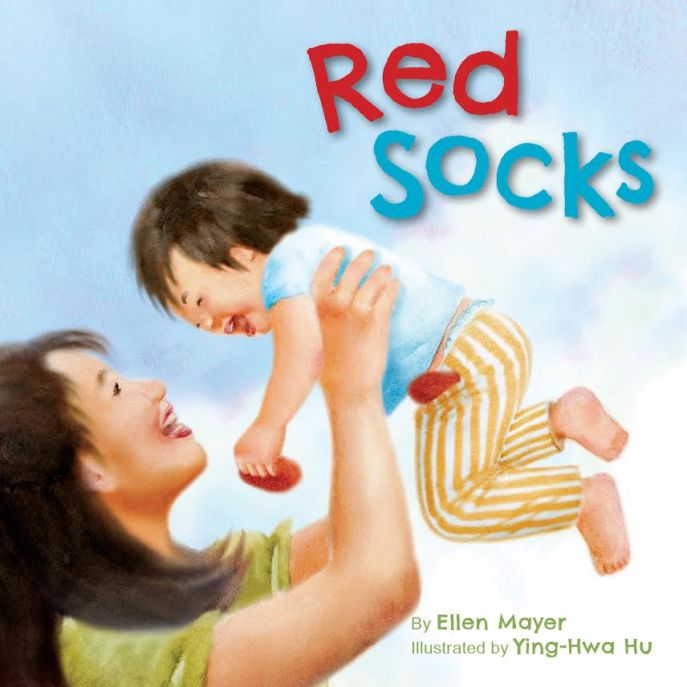
It’s laundry day and the clothes are all dried and soft and ready to wear. “‘Here is your blue shirt, with the goldfish on it,’” Mama says, pulling the top out of the basket and bending down to eye level to show it to her baby. Next, Mama describes the “yellow and white striped pants” she puts on her child. “‘Let’s see what else is in the laundry basket,’” she says.
Image copyright Ying-Hwa Hu, text copyright Ellen Mayer. Courtesy of starbrightbooks.com
Mama pulls a tiny red sock from the basket, but—“UH-OH!—where is the other red sock?’” Now it’s the baby’s turn to help. With a look down, the toddler shows Mama where the sock is. “‘You found the other red sock. Yay!’” she says, giving words to the baby’s action. She continues explaining while pointing to the sock poking out of the baby’s pocket: “‘It was hiding in your pants pocket!” Once the laundry is folded, Mama tells her child exactly what they will do next while she playfully slips the other red sock on the baby’s wiggling feet. “‘Let’s put that other sock on your foot. Then we can go play outside.’” As the baby flies in the swing outside, the red socks are brilliant dots against the blue sky.
Image copyright Ying-Hwa Hu, text copyright Ellen Mayer. Courtesy of starbrightbooks.com
Ellen Mayer’s simple and charming story of a particular moment in a mother and child’s day will immediately appeal to even the youngest reader. Familiar words coupled with clear, vivid illustrations will engage toddlers who are pre-talking and just learning language and concept development. The mother’s use of complete sentences as well as step-by-step descriptions of the activities the child sees and is involved in demonstrates how adults can converse with their babies and young children to encourage strong language and literacy skills. Free of gender-specific pronouns, Red Socks is a universal story.
Ying-Hwa Hu’s illustrations show a mother and child interacting on a typical day while they complete common chores and go outside to play. The mother and child portray a range of emotions and gestures, giving further depth to the understanding of the ideas and conversation presented. Kids will giggle at the adorable puppy who causes a bit of mischief on each page.
Ages Birth – 5
Star Bright Books, 2015 | ISBN 978-1595727060
To learn more about Ellen Mayer and her Small Talk Books® (including other titles: Cake Day and Rosa’s Very Big Job) as well as to find activities to accompany each book, visit her website!
Discover more about Ying-Hwa Hu and view a portfolio of her illustration work on her website!
Red Socks and Too Small to Fail
Red Socks was chosen by Too Small to Fail, an early literacy initiative of The Clinton Foundation to feature in their Wash Time is Talk Time project. Wash Time is Talk Time serves underserved communities and provides resources to turn time spent at the laundromat into an opportunity for families to talk together, read together, and learn together. Language-rich literacy resources will be delivered to more than 5,000 laundromats across the country.
Here’s a video from one fun afternoon with families, Ellen Mayer, and Ying-Hwa Hu during wash time!
National Family Literacy Month Activity
Child’s Sensory Board
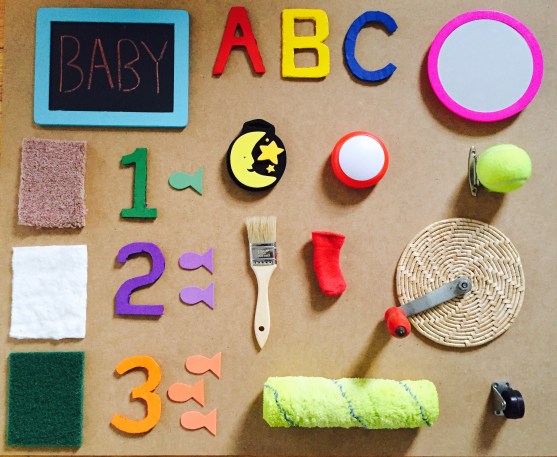
Toys or objects that provide many opportunities for sensory experimentation and observation stimulate a baby and young child to learn while having fun. You can make a sensory board for your own child using household items and that have a variety of textures, sizes, shapes, and movement. When you create your own sensory board, you can personalize it for your child by adding their name, pictures of family members, and other special items. While you play with your child, take time to talk about all of the objects on the board, what they do, and how they work. Count the objects. If you include words or your child’s name, spell them outloud and say them. There are so many ways to use a sensory board. Even if children can’t yet talk, they are listening and soaking in the rich language learning you are providing!
**When making your board always ensure that you use items that are not a choking hazard or can catch tiny fingers. Make sure that items are firmly attached to the board. Never leave a baby unattended while playing.**
Supplies
A board large enough to hold the items you want to attach. Boards that can be used include: those found at hardware stores or craft stores; large cutting boards; shelves; old table tops; etc.
Sample items for your sensory board can be age appropriate and include:
Large swatches of various textured material. (I used fur, a scrubbing sheet, and a piece of carpeting)
Wooden or thick cardboard letters and numbers, painted in a variety of colors. Letters can be used to add a child’s name to the board.
Figures cut from sheets of foam or wooden figures found at craft stores in a variety of numbers that you can count with your child (I used sets of 1, 2, and 3 fish cut from foam to go along with the numbers 1, 2, and 3)
Mirror
Push button light
Chalk board to write on
Castor or other wheel
Door latches
Door knockers
Mop heads
Paint rollers
Cranks
Drawer handles
Hinges (I attached a tennis ball to a hinge that children can push back and forth)
Pulleys
Paint in various bright colors
Paint brushes
Scissors
Screws
Nuts and bolts
Velcro
Super glue
Directions
Assemble your items
Paint wooden or cardboard items
Arrange item on the board so that your baby or child can easily reach or manipulate each one
Attach items with screws, nuts and bolts, or super glue
Push button lights or other objects that take batteries can be attached with strong Velcro. Ensure items attached with Velcro are large and not a choking hazard.
Set up board where you and your baby or child can enjoy playing with it together











 celebratepicturebooks.com