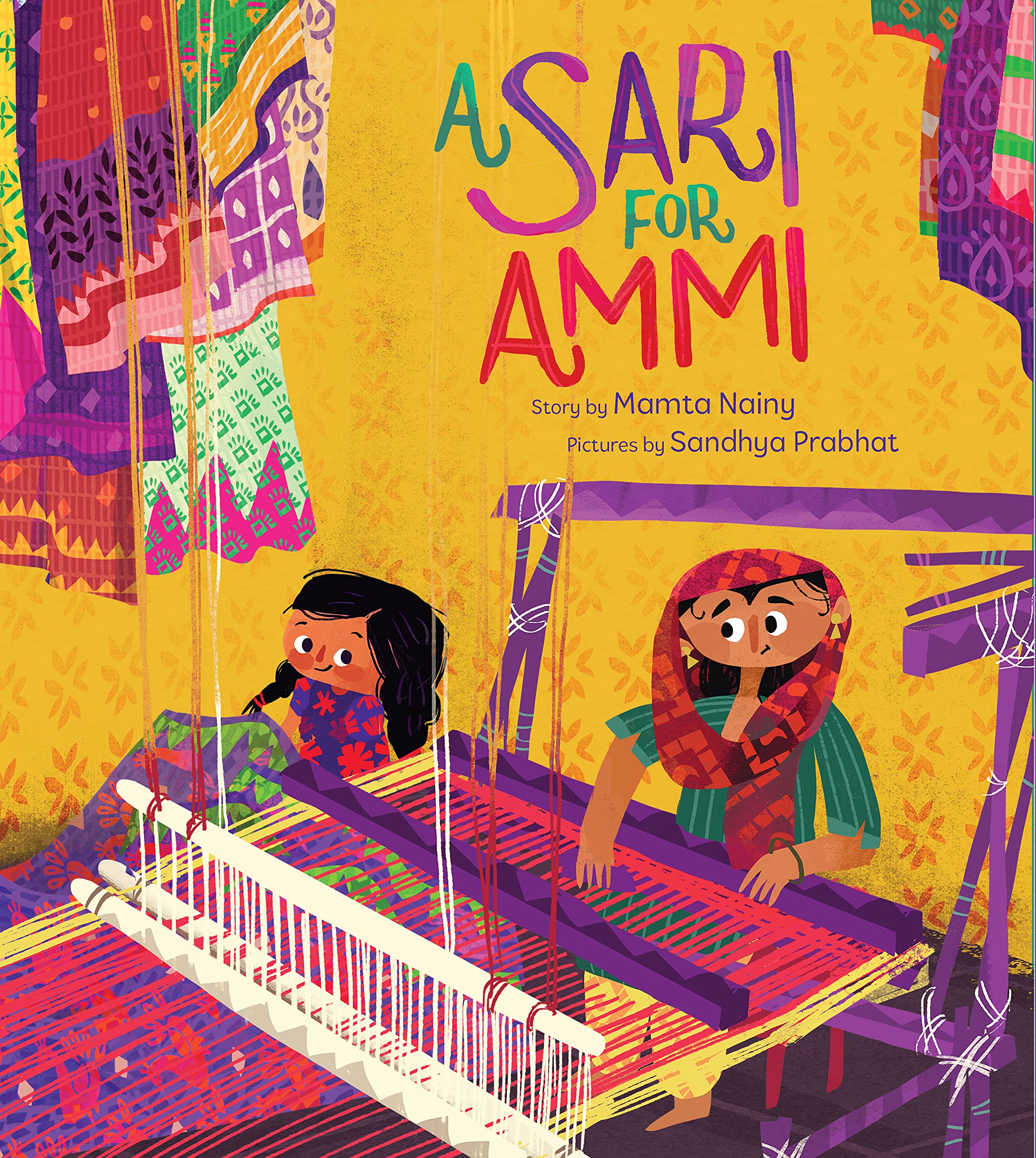
November 9 – Happy Book Birthday to A Sari for Ammi

celebrate-picture-books-picture-book-review-a-sari-for-ammi-cover

About the Holiday

November is Picture Book Month and Family Stories Month! Taken together, I couldn’t wish for a better time to introduce today’s sweet and uplifting book about a loving family to readers! So gather ’round – today may be A Sari for Ammi‘s book birthday, but this lovely story is a gift for you!

Thanks go to Amazon Crossing Books and Barbara Fisch at Blue Slip Media for sharing a copy of A Sari for Ammi with me for review consideration. All opinions of the book are my own.

A Sari for Ammi

Written by Mamta Nainy | Illustrated by Sandhya Prabhat


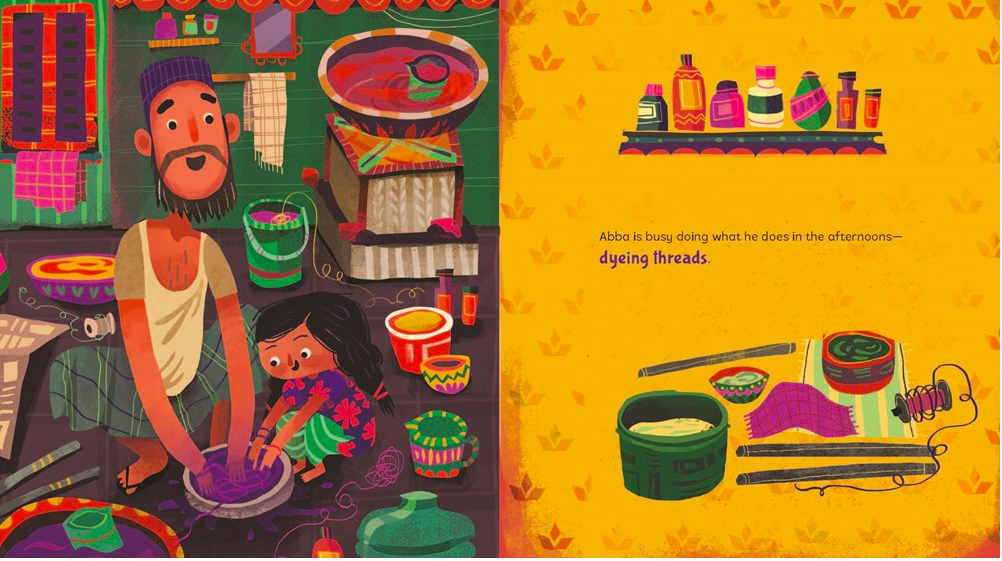
It’s afternoon and a little girl tiptoes past her sister, Sadaf, who’s dozing on the front porch, and the buffalo, who are napping after their “good wash in the village pond.” She’s on her way to help her dad, her Abba, dye threads for the saris that her Ammi, her mom, weaves. After the threads are dyed, the girl visits Ammi at her loom. “Ammi weaves the most wonderful saris in the world, in pinks and yellows and greens, with prints of mangoes, peacocks, birds, leaves, and flowers,” she says.
celebrate-picture-books-picture-book-review-a-sari-for-ammi-abba

Image copyright Sandhya Prabhat, 2021, text copyright Mamta Nainy, 2021. Courtesy of Amazon Crossing Kids.

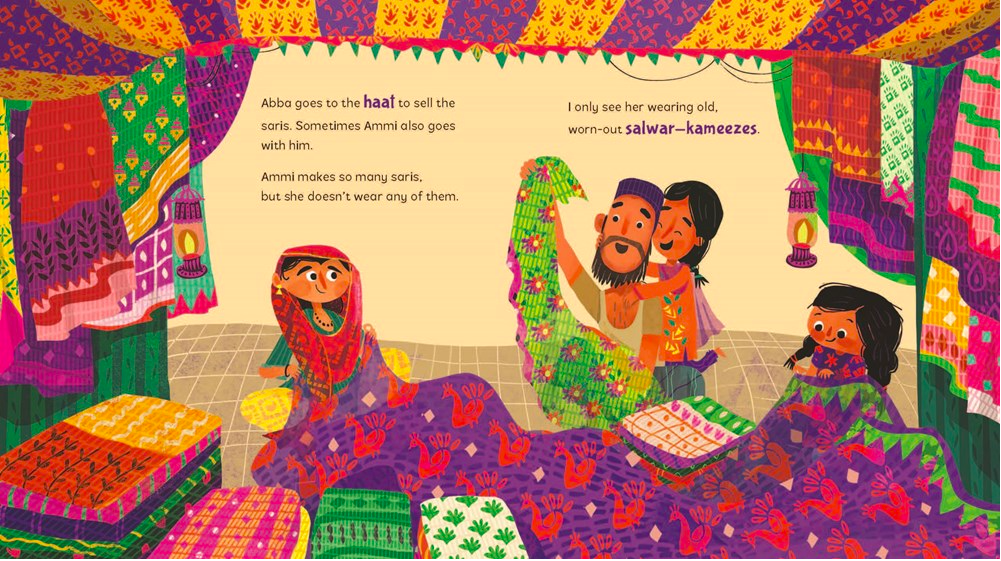
Making saris has been a family business going back to her great-great grandparents. Now, she and Sadaf, Abba and Ammi work on the saris – some even take months to create. Abba takes Ammi’s finished saris to the haat, the market, to sell. The little girl feels sad that Ammi never gets to wear one of the beautiful sari’s herself. Instead Ammi always wears “old, worn-out salwar-kameezes” – traditional pants and tunics.

One day, the girl asks Ammi to keep a particularly beautiful sari for herself, but Ammi says it is to sell. “‘If we keep the saris, how will we eat?'” she says. The girl doesn’t quite understand, but she wants Ammi to be able to wear a sari that she makes, but to do that, she and Sadaf would have to buy her one. Then she thinks about her and Sadaf’s bank. “‘Let’s break our gullak!'” she tells Sadaf. “‘We can use the money to buy Ammi a sari.'”
celebrate-picture-books-picture-book-review-a-sari-for-ammi-haal

Image copyright Sandhya Prabhat, 2021, text copyright Mamta Nainy, 2021. Courtesy of Amazon Crossing Kids.

Sadaf about the list of things she and her sister have been saving for, but her little sister asks “‘What matters more to you: Ammi or ‘the things’?…Sadaf makes a face and mumbles, ‘Ammi.'” But when they break the gullak and count their change, it’s only enough to buy a towel. What can they do? Sadaf has the idea to sell all of their old junk to Jhammu Kaka, who owns the scrap shop. When they do that they have more money, but only enough for a dupatta, a head scarf.
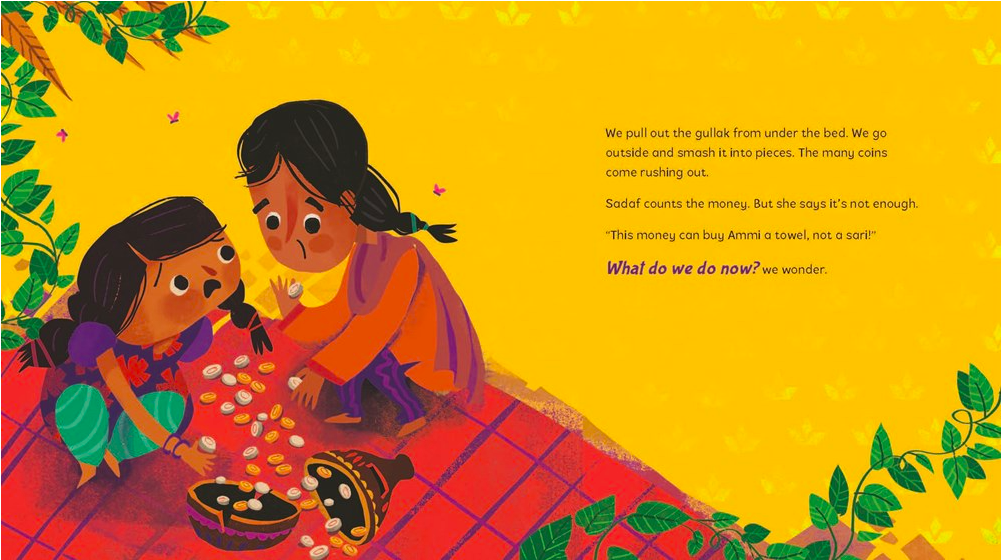
celebrate-picture-books-picture-book-review-a-sari-for-ammi-money

Image copyright Sandhya Prabhat, 2021, text copyright Mamta Nainy, 2021. Courtesy of Amazon Crossing Kids.

On the way home, the little girl thinks of another way to earn money. They go to their neighbor’s house and help her dye threads for the saris she makes. When she gives them money for their help, Sadaf counts it. Her sister is ready for disappointment, but instead she hears, “‘This money is… just enough to buy Ammi a sari!'” They run to the haat and look at all the saris before picking one. What, they wonder, will Ammi say when they give it to her. But they don’t have “to wait long to find out.” They rush home and with big hugs and the sari in hand, they “bring the biggest smile to Ammi’s face!”

Back matter includes a discussion about the saris of Kaithoon, where the story is set, the history of this town in India as a center for the weaving of saris made from a special fabric called “‘kota doria'” and the women of the Muslim Ansari community who create these works of art. A Glossary also defines words found throughout the story.
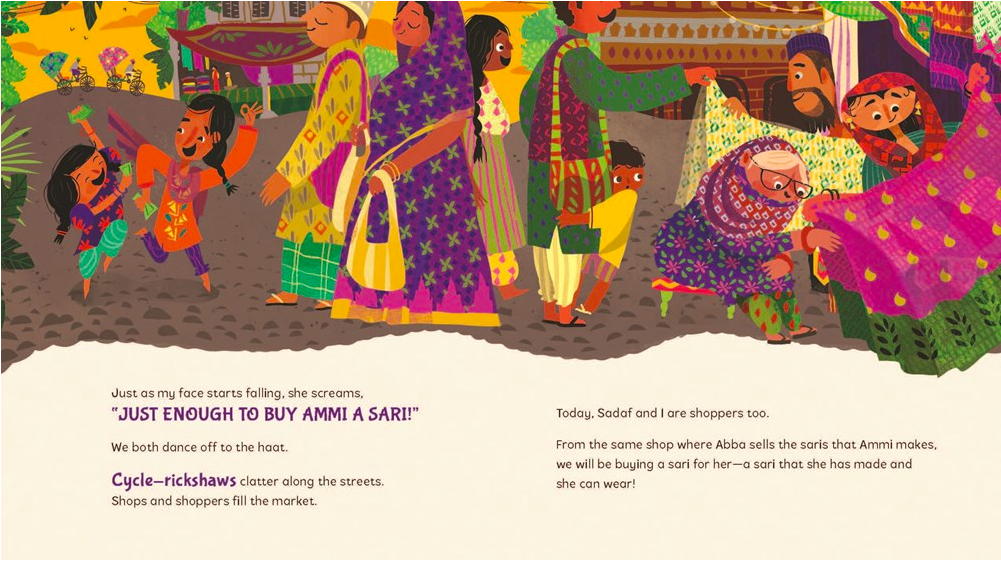
celebrate-picture-books-picture-book-review-a-sari-for-ammi-shopping

Image copyright Sandhya Prabhat, 2021, text copyright Mamta Nainy, 2021. Courtesy of Amazon Crossing Kids.

Mamta Nainy’s heartening story charms with a close-knit family and two sisters who want their mother to enjoy the saris she works so hard to create. As they pool their resources and think up other ways to make money to buy a sari, the girls show a kind of love for family and excitement for giving that will resonate with readers. Nainy’s flowing and detailed storytelling seamlessly educates and enchants with humor, emotion, and the tender enthusiasm of the young narrator’s voice. The final spread in which the two girls give Ammi the sari they’ve chosen is sure to bring a smile – and maybe a tear – to adults and kids alike.

Sandhya Prabhat fills her pages with glorious color and warm tones that bring the beauty of the kota doria saris alive for readers. Kids and adults will see traditional methods of dyeing threads, the setup of a loom on which these treasures are created, and the intricate patterns and vibrant hues that grace these sought-after saris. Just as compelling are images of the family happily working together to make the cloth and stock their market stall as well as illustrations of the narrator and her sister selflessly giving up their money and devising ways to make more. A two-page spread showing the haat is a showstopper that will entice readers to choose their own favorite sari. 

A moving, feel-good family story with deep roots, both culturally and in the heart, A Sari for Ammi is a story that adults and kids will love sharing again and again. The book is highly recommended as a gift or an addition to home, school, and public library collections.

Ages 4 – 8 

Amazon Crossing Kids, 2021 | ISBN 978-1542035071

You can connect with Mamta Nainy on Instagram.

To learn more about Sandhya Prabhat, her books, and her art, visit her website.

A Sari for Ammi Book Birthday Activity


You can watch one of these beautiful saris being woven and hear more about them with this video!

You can view a longer video, in which the women weavers talk about and demonstrate their art, here


celebrate-picture-books-picture-book-review-a-sari-for-ammi-cover

You can find A Sari for Ammi at these booksellers

Amazon | Barnes & Noble | Books-a-Million

To support your local independent bookstore, order from

Bookshop | IndieBound

Picture Book Review
November 5 – It’s Family Stories Month

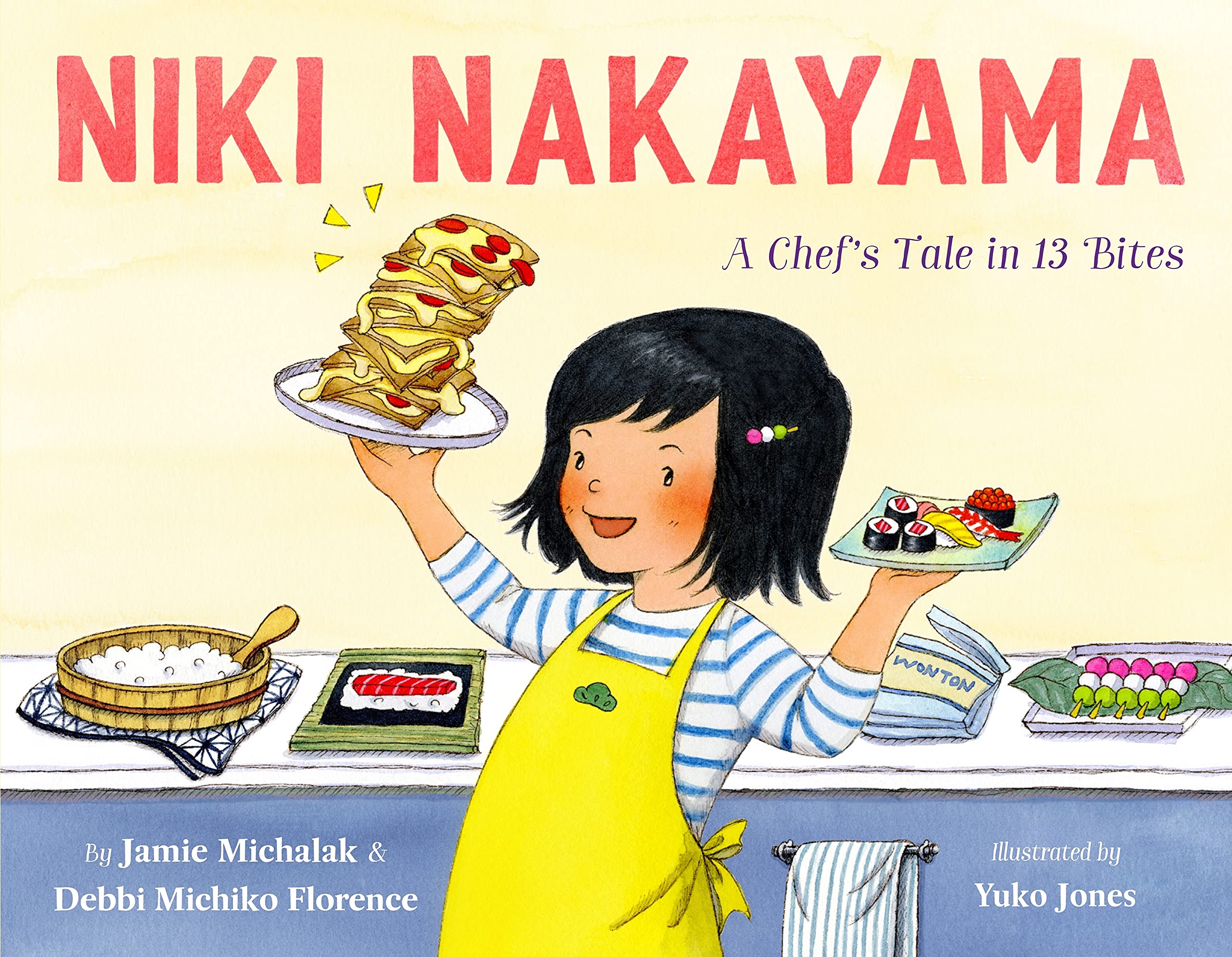
celebrate-picture-books-picture-book-review-niki-nakayama-a-chef's-tale-in-13-bites-cover

About the Holiday

Children benefit in many ways from close relationships to grandparents, aunts, uncles, cousins, and other extended family members. This month and next, as family gathers together for special holiday events, it’s a terrific time for adults to share family history and their own stories of growing up with the younger generation. Letting kids know how much they’re loved by everyone in the family helps them develop a sense of belonging, a good self-image, and confidence. Reading together is a perfect way to spend time together and get conversations started. 

Niki Nakayama: A Chef’s Tale in 13 Bites

Written by Jamie Michalak and Debbi Michiko Florence | Illustrated by Yuko Jones


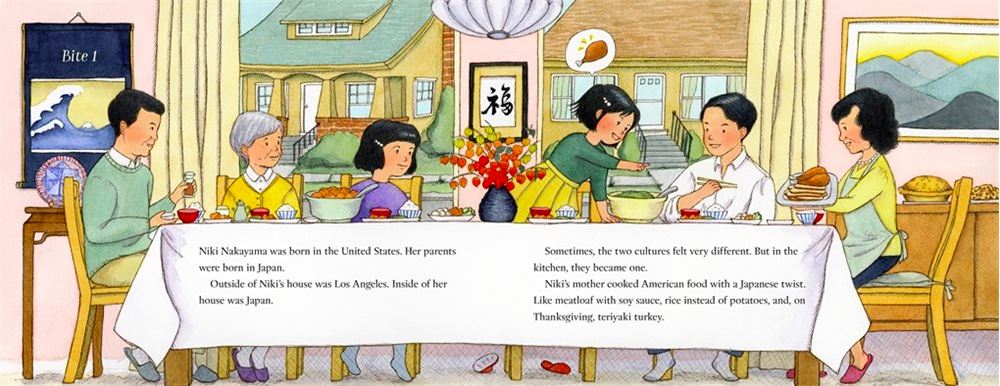
This true story opens with an invitation to listen as Niki Nakayama talks about her journey to becoming a chef in thirteen bites. “Come. Sit. Taste…” Bite 1: Niki was born in California but her parents were born in Japan. “Outside of Niki’s house was Los Angeles. Inside of her house was Japan.” While the two cultures often felt disparate, in Niki’s family’s kitchen “they became one.” Niki’s mother always put a Japanese twist on American dishes, with soy sauce or rice or teriyaki.

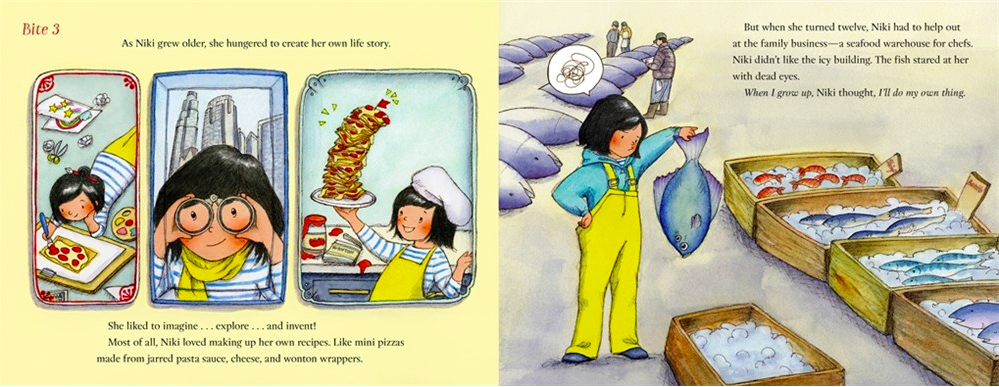
Bite 2: Close to New Year’s Eve, Niki’s grandmother took her to the grocery store to shop for the holiday dinner. Niki was excited. She loved buying all the ingredients for the feast to come: an opportunity to share “a table of love and laughter” in addition to the food. As Niki grew older, she created her own recipes and determined that she would get away from her family’s seafood-selling business and do her own thing.

celebrate-picture-books-picture-book-review-niki-nakayama-a-chef's-tale-in-13-bites-family-table

Image copyright Yuko Jones, 2021, text copyright Jamie Michalak and Debbi Michiko Florence, 2021. Courtesy of Farrar Straus Giroux.

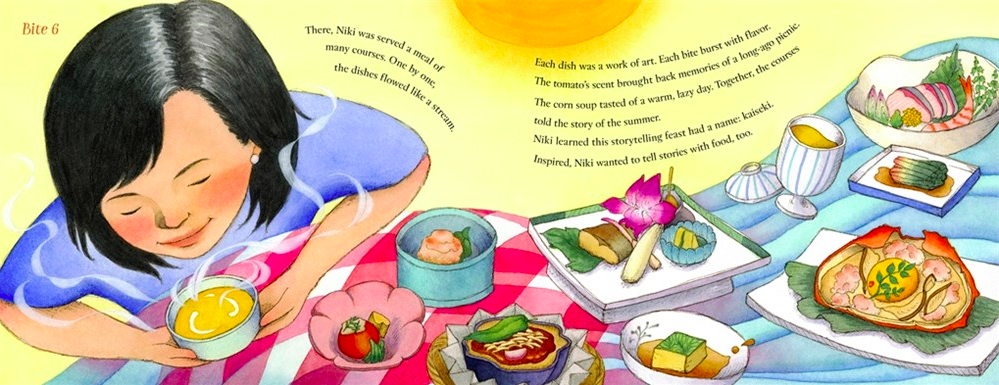
Niki’s dreams seemed to get little attention from her parents, who doted on their son and encouraged his success. But Niki new she could be successful too. “Kuyashii! Niki thought. ‘I’ll show them!’” After high school, Niki traveled to Tokyo, Japan, tasting all the delicious food on offer. Later she took the train to where her cousins owned an inn. There she was served a meal comprised of many dishes, each “a work of art” and each with a delicious memory attached or story to tell. “Niki learned this storytelling feast had a name: kaiseki.”

When Niki returned home, she told her mother she wanted to go to school to become a chef. Her mother discouraged her, but Niki went anyway. “She began to see food as art—a carrot as a mountain.” And while her family thought her cooking was just a hobby, Niki thought “Kuyashii! ‘I’ll show them!’” Niki got a job at a sushi restaurant. “Female sushi chefs were rare,” and the head chef didn’t think she could handle the work. “‘You’re just playing chef,’ he joked.” But Niki told him she wasn’t playing.

celebrate-picture-books-picture-book-review-niki-nakayama-a-chef's-tale-in-13-bites-fish-market

Image copyright Yuko Jones, 2021, text copyright Jamie Michalak and Debbi Michiko Florence, 2021. Courtesy of Farrar Straus Giroux.

After working there and learning all she could, Niki decided to travel back to her cousins’ inn to study kaiseki. But there was a big obstacle. “As far as she knew, female kaiseki chefs didn’t exist. In Japan recipes and training was only handed down to males. People told Niki her dream was impossible, but she thought she could do it. Niki studied for three years and then returned to Los Angeles to open a sushi restaurant of her own.

Instead of being happy for her, her family was dismissive. At last she convinced them to give her a loan—but it came with the stipulation that “if the restaurant failed, she would have to close it and say goodbye to her dream forever.” Instead of the kaiseki dishes she wanted to serve, her mother thought sushi would be a better choice. Against her own wishes, she agreed. In a year, customers were lining up for her food. But making sushi was not what she really wanted to do.

celebrate-picture-books-picture-book-review-niki-nakayama-a-chef's-tale-in-13-bites-bite-6

Image copyright Yuko Jones, 2021, text copyright Jamie Michalak and Debbi Michiko Florence, 2021. Courtesy of Farrar Straus Giroux.

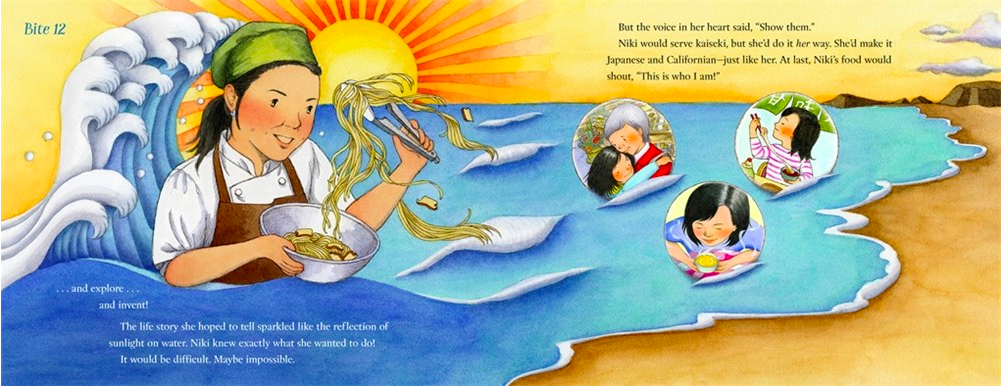
She closed her restaurant and wondered what to do next. Then, after much thought and exploration, she had her answer. She wanted to serve kaiseki that told her story—both Japanese and Californian. “Niki called her new restaurant n/naka. Naka means ‘inside’ in Japanese. Finally, Niki was inside her dream.” Through thirteen courses she told her stories—never serving customers the same meal twice. Now, every night tables are full of love and laughter, and Niki showed everyone that she could be a master chef.

Back matter includes a timeline of Niki Nakayama’s life from her birth in Los Angeles in 1974 to the awarding of two Michelin stars for her restaurant n/naka in 2019; a discussion of the words kuyashii and kaiseki; and a recipe for wonton pizza.

celebrate-picture-books-picture-book-review-niki-nakayama-a-chef's-tale-in-13-bites-kaiseki

Image copyright Yuko Jones, 2021, text copyright Jamie Michalak and Debbi Michiko Florence, 2021. Courtesy of Farrar Straus Giroux.

Jamie Michalak and Debbi Michiko Florence’s biography of Niki Nakayama is an enthralling story of self-confidence, obstacles overcome, and success that will inspire readers to stay true to the voice inside themselves. Telling Nakayama’s story through thirteen bite-sized vignettes that reveal formative moments in her life that informed her journey is a captivating and effective way to show Niki’s growth as a chef as well as to explain the meaning and experience of kaiseki.

Readers will respond to Michalak’s and Florence’s straightforward text and the details of the hurdles placed in her way. One take-away for adult readers is the importance of recognizing, encouraging, and supporting their children’s dreams and talents—an awareness that can lead to ongoing discussions with kids as they grow, learn, and get involved in activities.

Yuko Jones’ lovely illustrations take readers into Niki Nakayama’s home to see her interacting with her family and the foods that so inspired her life’s work. Jones’ images of Japanese delicacies are particularly beautiful, giving kids a strong understanding of the courses served during a kaiseki meal. Niki’s self-assurance in the face of her family’s protests and her male-dominated culinary school class as well as the rarity of female sushi chefs is stirring for all readers. Jones’ final page spreads reveal the gorgeous dishes Niki serves and the inviting atmosphere at her restaurant n/naka.

A captivating and impactful biography of a contemporary chef and role model, Niki Nakayama: A Chef’s Tale in 13 Bites is a must for home, classroom, school, and public library collections to inspire all kids who are contemplating their place in the world now and in the future.

Ages 4 – 10

Farrar, Straus, and Giroux, 2021 | ISBN 978-0374313876

Discover more about Jamie Michalak and her books on her website.

You can learn more about Debbi Michiko Florence and her books on her website.

To learn more about Yuko Jones and see a portfolio of her work, visit her website.

You can learn more about n/naka and view a gallery of Niki Nakayama’s spectacular dishes on the n/naka website.

Family Stories Month Activity

celebrate-picture-books-picture-book-review-niki-nakayama-a-chef's-tale-in-13-bites-coloring-page

Niki Nakayama: A Chef’s Tale in 13 Bites Activity Kit


Educators and families can find an extensive Activity Kit and coloring pages to accompany classroom or homeschool lessons or just for fun on Jamie Michalak’s website and Debbi Michiko Florence’s website.

celebrate-picture-books-picture-book-review-niki-nakayama-a-chef's-tale-in-13-bites-cover

You can find Niki Nakayama: A Chef’s Tale in 13 Bites at these booksellers

Amazon | Barnes & Noble | Books-a-Million

To support your local independent bookstore, order from

Bookshop | IndieBound

Picture Book Review

November 2 – It’s Historic Bridge Month

celebrate-picture-books-picture-book-review-sonny-rollins-plays-the-bridge-cover

About the Holiday

Bridges can do so much more than just take vehicles and people over waterways or highways. Many are beautiful structures that enhance the skyline or environment in which they’re found. Covered bridges, stone bridges, and soaring steel and cable bridges all have their own stories to tell and inspire awe in their own way. Unfortunately, many older bridges are slated for destruction or replacement. To honor this month’s holiday, visit a historic bridge in your area or research famous bridges of the past and present. On November 6, we also celebrate National Saxophone Day! To get in the swing of this holiday, why not listen to music by Sonny Rollins? You can find his jazz classics on YouTube. To get started, you can listen to The Bridge here.

Thanks go to Nancy Paulsen Books for sharing a copy of Sonny Rollins Plays the Bridge with me for review consideration. All opinions on the book are my own.

Sonny Rollins Plays the Bridge

Written by Gary Golio | Illustrated by James Ransome


“The Bridge / leaps / spreads its wings / joyfully / joining shore to shore”

“Steel towers / standing tall / reaching high / touching / sky” as people – walking and riding bikes – and cars and trucks move above “the River / stretched out below / a shiny / endless / song”

celebrate-picture-books-picture-book-review-sonny-rollins-plays-the-bridge-apartment-building

Image copyright James Ransome, 2021, text copyright Gary Golio, 2021. Courtesy of Nancy Paulsen Books, Penguin.

In another part of New York City, Sonny Rollins, already a jazz great, is trying to find a place to play his saxophone – to become a better musician and a better person. The neighbors in his apartment building complain from their windows as he practices on the fire escape, so he takes to the sidewalks to find a more accommodating spot. He wanders the busy streets until he sees, towering above the tall buildings, the Williamsburg Bridge and wonders…. He listens to “that / small voice / inside / which says / you need to do this

celebrate-picture-books-picture-book-review-sonny-rollins-plays-the-bridge-city

Image copyright James Ransome, 2021, text copyright Gary Golio, 2021. Courtesy of Nancy Paulsen Books, Penguin.

He climbs the stairs to the walkway high above the noisy, busy city and takes his saxophone from its case. Here, alone, Sonny finds the place where he can play as loud as he wants. But he’s not really alone. Around him the “clanking clanging” subway trains lend rhythm to his music, and the “tugboats / blowing bass notes / back / and forth” are answered “note-for-note / with / low moans” from Sonny’s sax while seagulls are “echoing / Sonny’s funny / squeaks / & / squawks.”

Here, this jazz great “can play / anything / EVERYTHING / that comes into his mind.” With his “mind opened wide,” Sonny finds the sound he’s been looking for and “the Bridge / leaps / spreads its wings / just like / Sonny.”

celebrate-picture-books-picture-book-review-sonny-rollins-plays-the-bridge-playing

Image copyright James Ransome, 2021, text copyright Gary Golio, 2021. Courtesy of Nancy Paulsen Books, Penguin.

Back matter includes more about the life and career of Sonny Rollins; a history of the Williamsburg Bridge and The Bridge – a series of songs inspired by his experience, recorded in 1962; and Sonny’s words about how he lives his life and what he thinks is important. Sonny’s website and recommended songs found on YouTube round out these informative pages.

Gary Golio’s story floats on the jazz rhythms of his poetic verses, enveloping readers in the musicality of Sonny Rollins’s life and the sounds of the city. In addition to relaying the facts of this seminal period in Rollin’s career, Golio emphasizes Rollin’s belief in the importance of listening to your own internal voice on the road to self-discovery. Lyrical descriptions of the impromptu “band” that accompanied Rollins on the bridge are both beautifully evocative and inspirational reminders for readers that they too can shine while working with or playing off of others. 

James Ransome’s glorious watercolor and collage paintings give readers a sense of the time period as well as the scale of the bridge as it soars above the high-rise buildings, providing a practice room and stage for Sonny Rollins’ talent. Textured and patterned details along with a variety of perspectives echo Golio’s lyrical verses. Gold accents on each page mirror Rollins’ shiny saxophone and visually represent the notes that rise and float away over the city.

A gorgeous and jazz-infused snapshot of a stirring and influential time in Sonny Rollins’ life,  Sonny Rollins Plays the Bridge will delight any music lover and inspire all readers to search for the best in themselves. The book is highly recommended for home, school, and public library collections.

Ages 4 – 8

Nancy Paulsen Books, Penguin Random House, 2021 | ISBN 978-1984813664

Discover more about Gary Golio and his books on his website.

To learn more about James Ransome, his books, and his art, visit his website.

Historic Bridge Awareness Month Activity

celebrate-picture-books-picture-book-review-spaghetti-box-bridge-craft

Build a Remarkable Recycled Bridge


You don’t need fancy blocks and construction materials to build a bridge! Little ones will be fascinated to put together a bridge made out of items you already have at home or that may even be slated for the recycle bin. Spaghetti boxes make great roadways, and cut-up egg cartons can be used as supports.

Want to build a whole town? Cereal boxes and pasta boxes make skyscrapers, apartment buildings, fire stations, and more. Need a farm silo? Grab a peanut butter jar, oatmeal container, or aluminum can. You can use them as is or—if your kids are sticklers for a little more detail—add some paint and details! So look around, use your imagination, and get creative!

celebrate-picture-books-picture-book-review-sonny-rollins-plays-the-bridge-cover

You can find Sonny Rollins Plays the Bridge at these booksellers

Amazon | Barnes & Noble | Books-a-Million 

To support your local independent bookstore, order from

Bookshop | IndieBound

Picture Book Review

November 1 – National Author’s Day

celebrate-picture-books-picture-book-review-The-ABCs-of-Black-History-cover

About the Holiday

There may be no better month to celebrate Author’s Day than in November. Not only is it Picture Book Month, but thousands of people set aside their usual routine to take part in NaNoWriMo or National Novel Writing Month, when writers try to complete at least a first draft of a novel in one month. The holiday was instituted in 1928 by Nellie Verne Burt McPherson, president of the Bement, Illinois Women’s Club. An avid reader, she established Author’s Day to thank writer Irving Bacheller who sent her an autographed story in response to her fan letter. The day was officially recognized in 1949 by the United States Department of Commerce. McPherson’s granddaughter, Sue Cole, promoted the holiday after Nellie’s death in 1968. To celebrate, people are encouraged to write a note of appreciation to their favorite author.

Thanks go to Workman Publishing and Big Honcho Media for sharing a copy of The ABCs of Black History with me for review consideration. All opinions on the book are my own.

The ABCs of Black History

Written by Rio Cortez | Illustrated by Lauren Semmer


This stunning compendium of lyrical verses defies easy categorization as it bridges the genres of alphabet books, encyclopedias, history books, biographies, and more for young readers. The book opens with words from James Baldwin, in which he says “History is not the past. It is the present. We carry our history with us. We are our history,” and within its pages children discover not only specific events and well-known people, but the emotions, philosophies, and traits that have carried and sustained African Americans.

celebrate-picture-books-picture-book-review-The-ABCs-of-Black-History-banner

Image copyright Lauren Semmer, 2020, text copyright Rio Cortez, 2020. Courtesy of Workman Publishing Company.

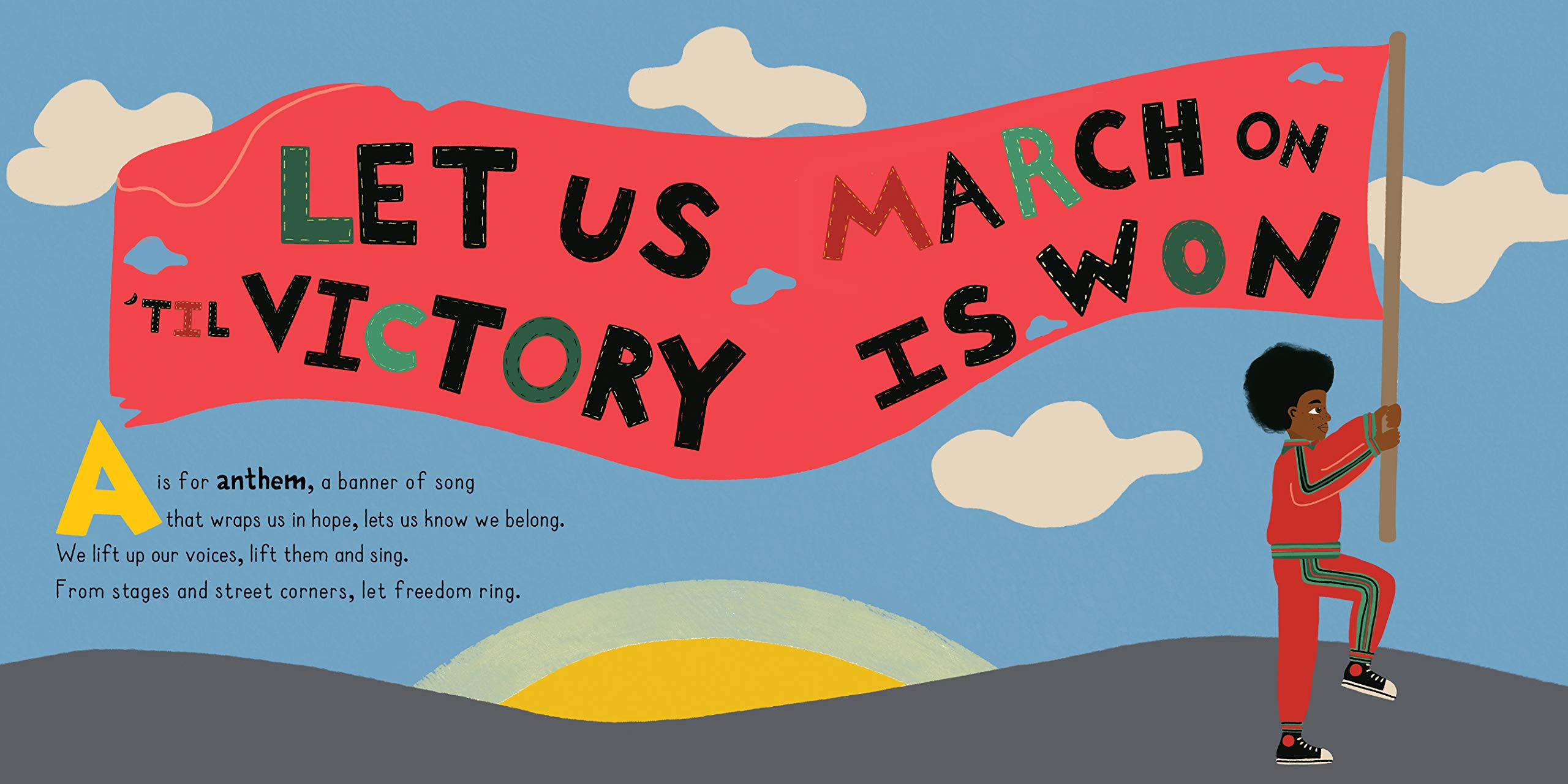
This inspiring alphabetic journey begins with “A is for anthem, a banner of song / that wraps us in hope, lets us know we belong. / We lift up our voices, lift them and sing. / From stages and street corners, let freedom ring.” From there kids come to B, which is for “beautiful…brave…bright…and bold.” It also describes “brotherhood” and “believing in grace.” At E children meet Explorers Matthew Henson and Mae Jemison as well as some of those who fought to make Education open to all, such as Ruby Bridges, Linda Brown, and the Little Rock Nine.

celebrate-picture-books-picture-book-review-The-ABCs-of-Black-History-Explore

Image copyright Lauren Semmer, 2020, text copyright Rio Cortez, 2020. Courtesy of Workman Publishing Company.

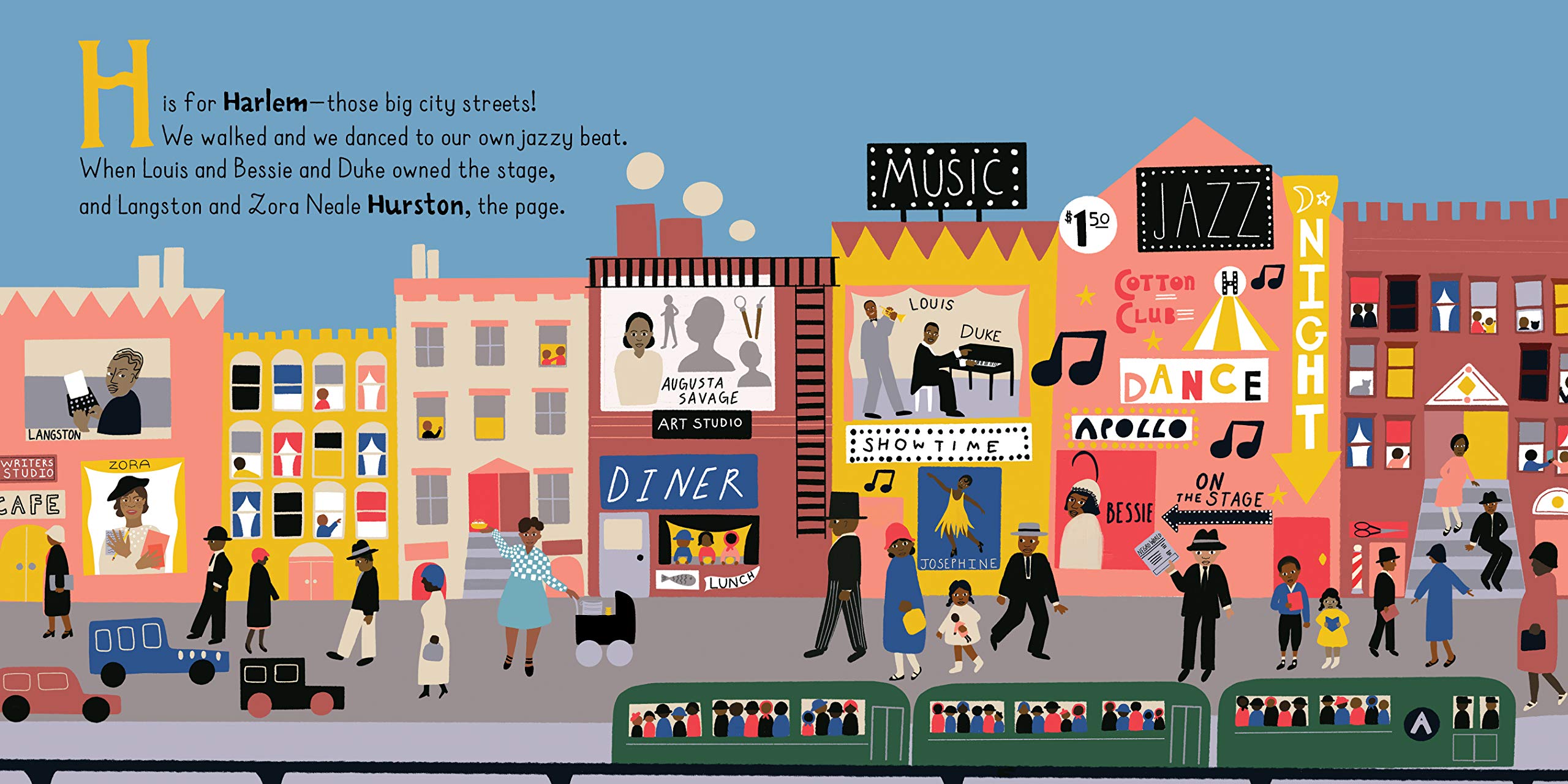
G and the Great Migration follow Black Americans from farmland to cities to “Harlem – those big city streets! / We walked and we danced to our own jazzy beat.” “Imagine, invent, innovative” define letter I, where readers find Alvin Ailey, Jean-Michel Basquiat, Gwendolyn Brooks, Madam C. J. Walker, George Washington Carver, and DJ Kool Herc.

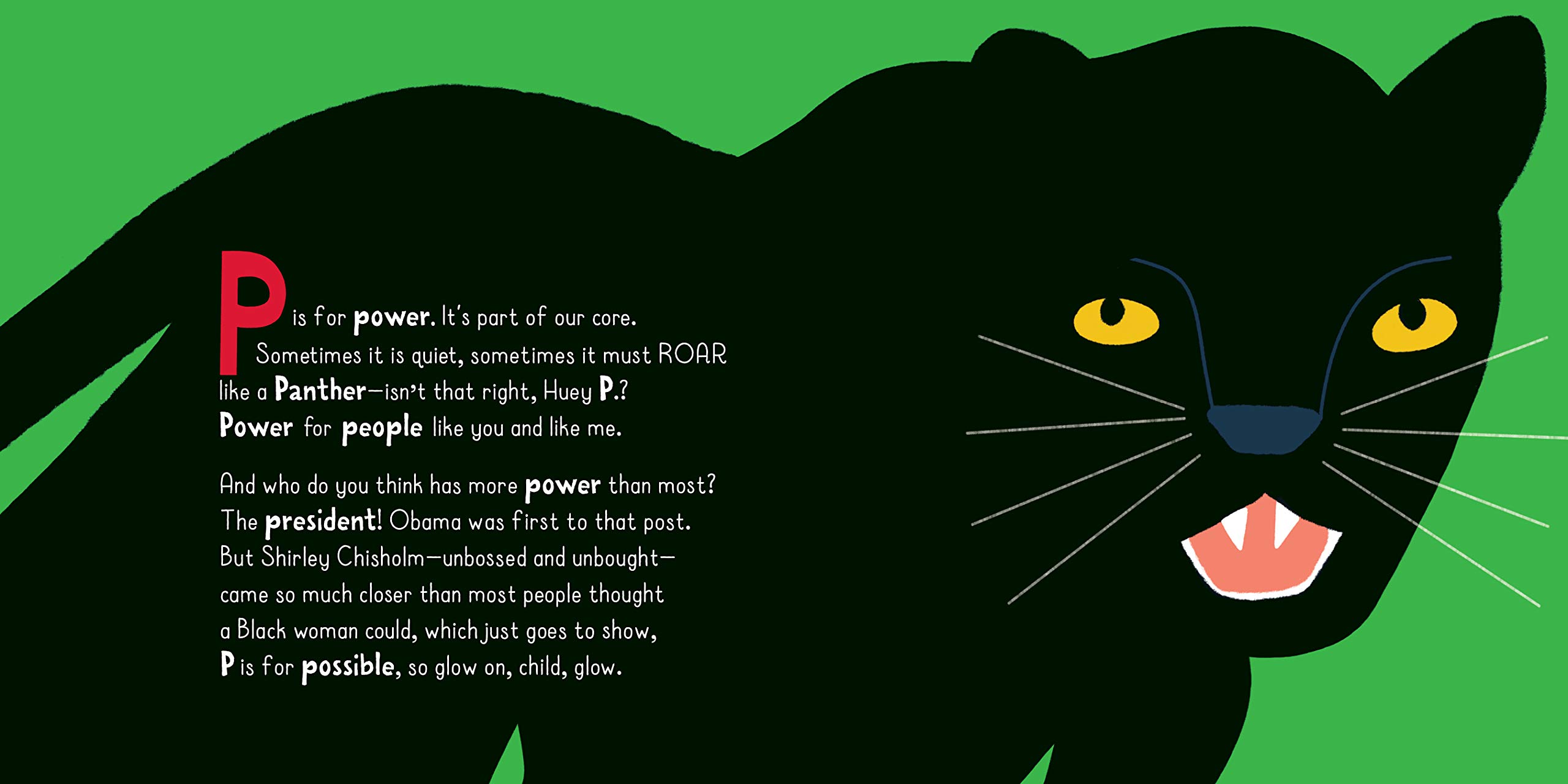
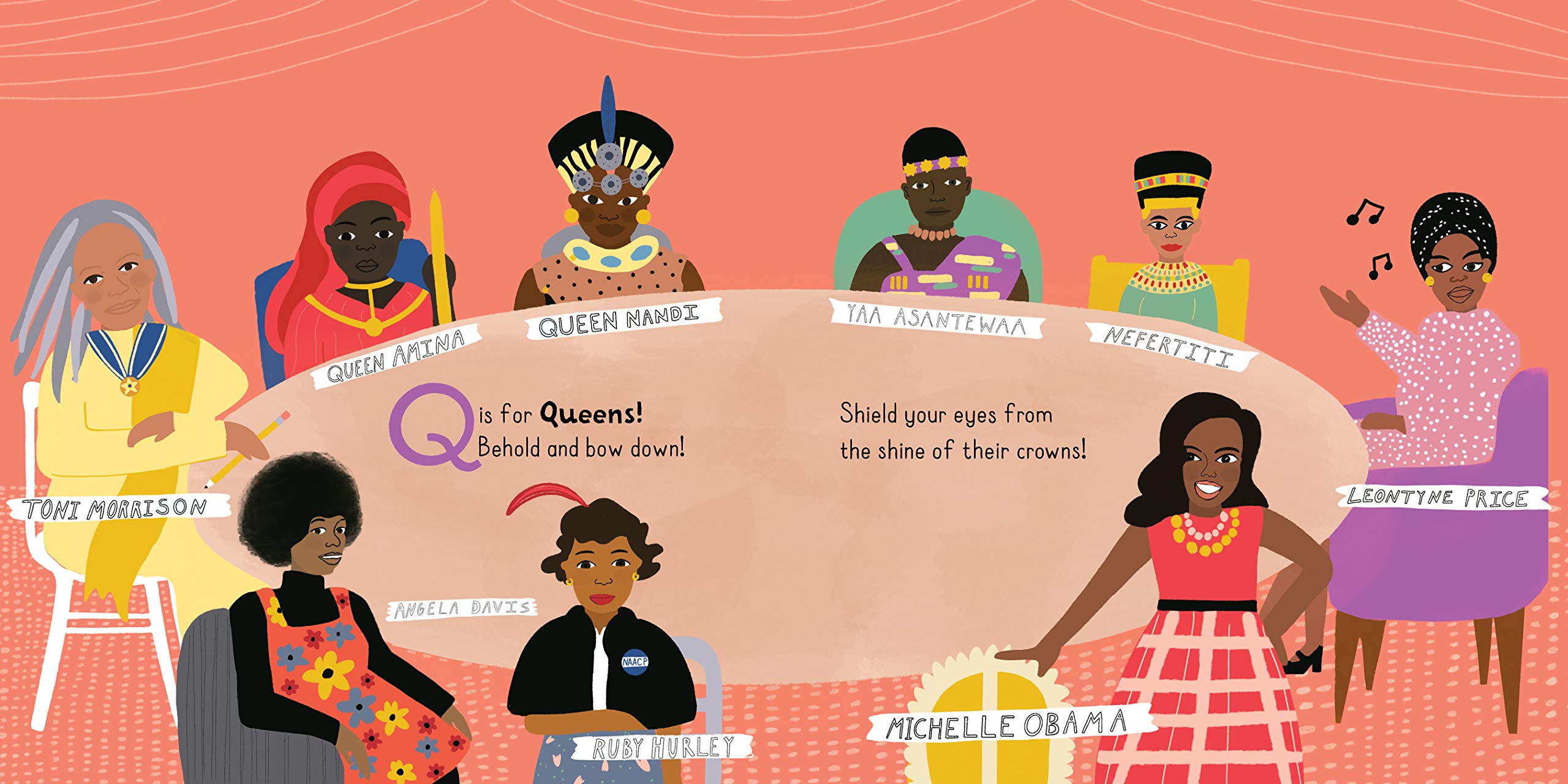
The drive to move forward, to aspire, and succeed is eloquently traced from the past: “M is for march, for lifting our feet, / taking the movement, the cause to the street” to today: “Black lives matter. Every breath, every dream – / Every thought, each idea, each impossible scheme.” From sit-ins to their organizers, from African queens to today’s women leaders, from award-winning athletes to scientists to singers of soul, Black achievement is highlighted across the alphabet.

celebrate-picture-books-picture-book-review-The-ABCs-of-Black-History-Harlem

Image copyright Lauren Semmer, 2020, text copyright Rio Cortez, 2020. Courtesy of Workman Publishing Company.

At U children and adults arrive at poignant verses that should prompt deeper discussions: “U is for United States – this story is tough. / The birth of a nation was deadly for us. / We the people? In the land of the free? / No one who was enslaved would agree.” A second and third verse take in the Civil War and the “unbroken, unshaken, unbound, / like Harriet Tubman, who went underground,” and the battle for freedom and rights that continued after the war’s end. But the pages end on a note of hope, revealing that U is also “for unfinished, this American tale. / With courage and strength, we will prevail!” 

celebrate-picture-books-picture-book-review-The-ABCs-of-Black-History-panther

Image copyright Lauren Semmer, 2020, text copyright Rio Cortez, 2020. Courtesy of Workman Publishing Company.

As this is National Author’s Day, I must mention that “W is for writers whose wisdom and words / bring to life worlds where our voices are heard. / Rappers adn poets and songwriters, too, / all those who spin from our point of view.” And how does this collection of events, holidays, personalities, hopes, and dreams end? At Z for zenith – “The top of that mountain King said we would reach” to which “we march on, / rising, rising, like the sun with the dawn.”

Back matter includes further elucidation of each letter of the alphabet and it’s accompanying concept. These are detailed entries that also lend themselves to further study. Resources also include websites to organizations and museums and suggestions for books and poetry to read.

celebrate-picture-books-picture-book-review-The-ABCs-of-Black-History-queens

Image copyright Lauren Semmer, 2020, text copyright Rio Cortez, 2020. Courtesy of Workman Publishing Company.

Rio Cortez’s poetry soars on optimism, achievement, hope, and a palpable pride in Black history and the future. Musical and conversational, the verses flow off the tongue, creating an exciting and meaningful read-aloud experience for adults and children. The breadth of information that Cortez imparts is stirring, adding up to an impactful look at history and a rousing celebration of Black culture. Every page offers many, many opportunities for further learning, listening, viewing, and research.

Lauren Semmer’s vivid illustrations – opening with an uplifting group shot of young, happy, and hopeful black and brown faces that welcome their young peers – will enthrall readers with their action, energy, and colors. Portraits of famous figures and unsung heroes will inspire children to get involved in their communities and causes they believe in, while reaching for their dreams.

The ABCs of Black History is an exhilarating picture book for family reading times, a superb cross-curricular resource for homeschoolers and classrooms from elementary school to high school, and a must for all school and public library collections.

Ages 5 and up

Workman Publishing Company, 2020 | ISBN 978-1523507498

Discover more about Rio Cortez and her books on her website.

To learn more about Lauren Semmer, her books, and her art, visit her website.

National Author’s Day Activity

celebrate-picture-books-picture-book-review-Black-History-Month-Coloring-Pages-Maya-Angelou

Black Leaders Coloring Pages


Whether you’re interested in law and politics, science, sports, or the arts, you can find a role model in the people in the printable coloring pages below. You’ll find more coloring pages of Black leaders to print at Scribble Fun.

  Maya Angelou  | Louis Armstrong | Dr. Mae Jemison | Garrett Morgan | Barack H. Obama |  Rosa Parks | Jackie Robinson 

celebrate-picture-books-picture-book-review-The-ABCs-of-Black-History-cover

You can find The ABCs of Black History at these booksellers

Amazon | Barnes & Noble | Books-a-Million

To support your local independent bookstore, order from

Bookshop | IndieBound

Picture Book Review
October 14 – It’s Hispanic Heritage Month

celebrate-picture-books-picture-book-review-without-separation-cover

About the Holiday

From September 15th through October 15th National Hispanic Heritage Month celebrates the contributions of those who come from or whose ancestors immigrated from Spain, Mexico, the Caribbean, Central America, and South America. Each year the holiday adopts a particular theme. This year’s theme is “Esperanza: A Celebration of Hispanic Heritage and Hope.” From business and industry to culture, sports, and entertainment, Hispanic and Latinx Americans have made an important and indelible imprint on our country. You can learn more about the holiday and find cross-curricular resources for classrooms and homeschooling, videos, exhibitions, and much more from the Smithsonian, the Library of Congress, the National Park Service, the National Gallery of Art, the Nationla Archives and more to use not only this month but throughout the year on the official Hispanic Heritage Month website.

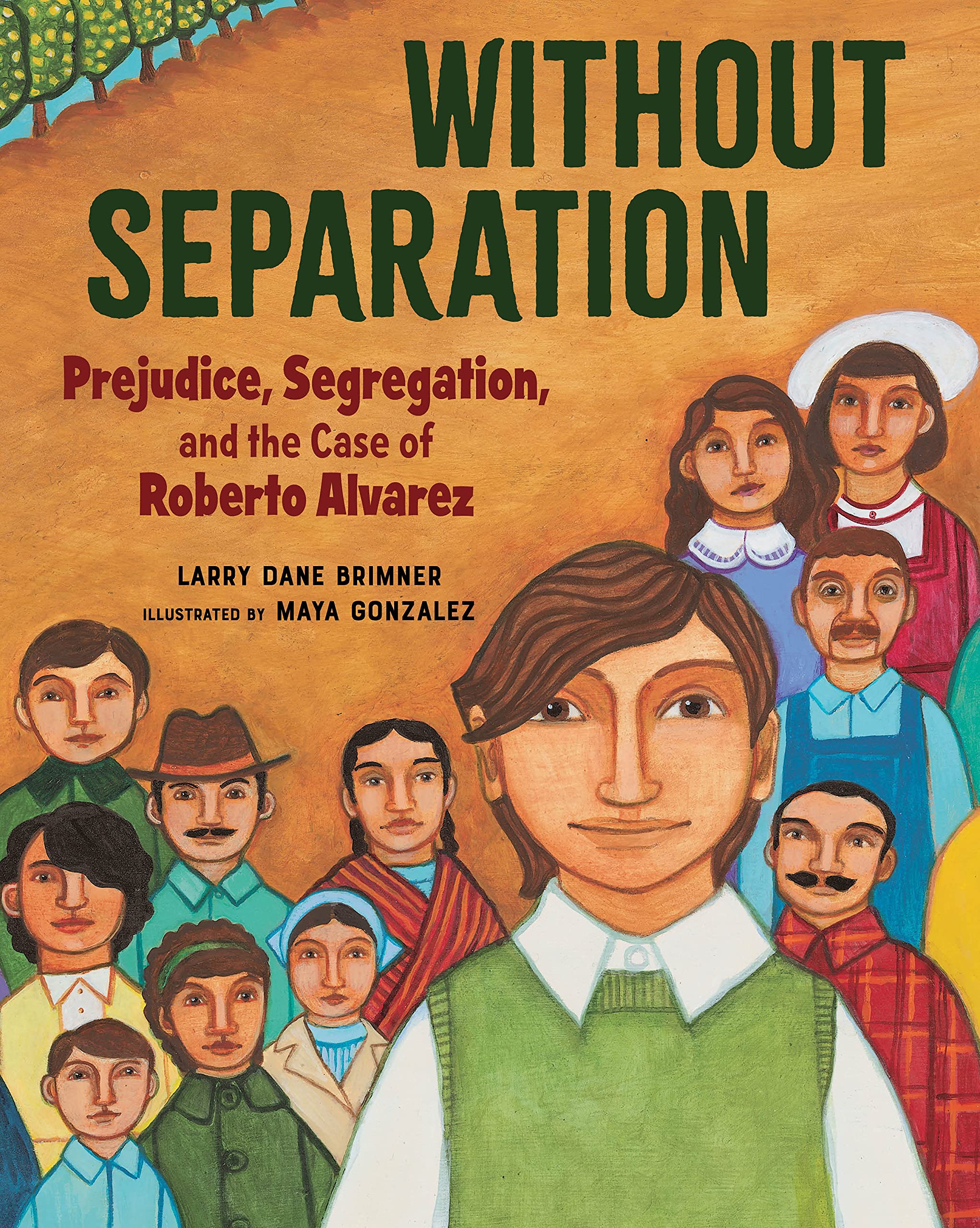
Without Separation: Prejudice, Segregation, and the Case of Roberto Alvarez

Written by Larry Dane Brimmer | Illustrated by Maya Gonzalez

On January 5, 1931 twelve-year-old Roberto Alvarez was happy to be going back to Lemon Grove Grammar School after the Christmas vacation. But when he got there “the principal told Roberto and the other Mexican and Mexican American children that they did not belong there.” He told them to go to the new Mexican school on Olive Street, and when they arrived, their teachers and desks were already waiting for them.

This had all come about stealthily after the school district’s board of trustees received a letter from the parent-teacher association complaining that “the Mexican children didn’t understand English,” which “held back the white students.” The letter also said that the “Mexican children were unclean and endangered the health of every other student in the school.” The board decided to construct a separate school—but without telling the Mexican parents, fearing “trouble.”

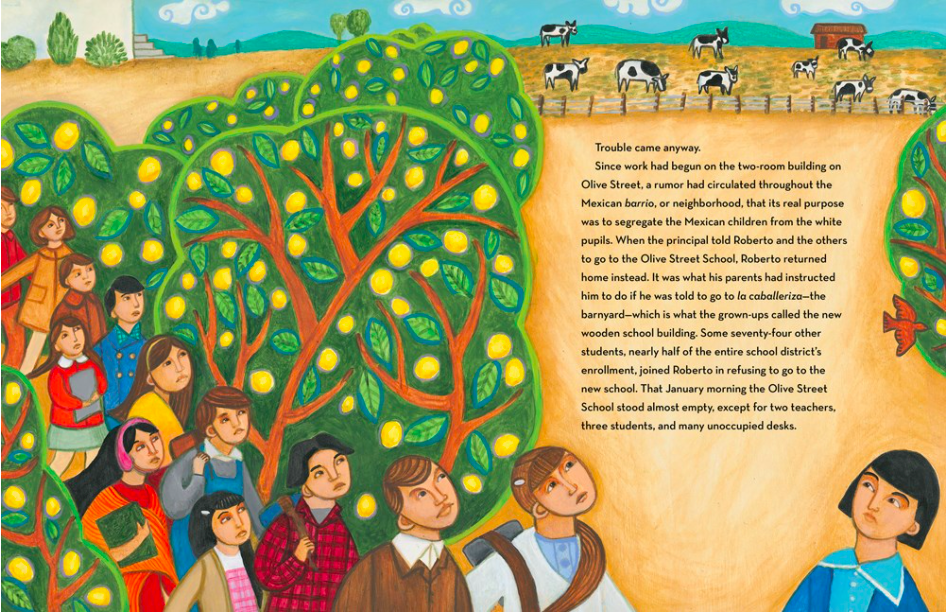
But as the Olive Street school was being built, Mexican parents understood it true purpose of segregation and instructed their children not to attend, but to come home. Most of the kids, including Roberto did as their parents told them. “That January morning the Olive Street School stood almost empty, except for two teachers, three students, and many unoccupied desks.” Roberto believed he didn’t need a different school. While his parents had come from Mexico, he had been born in California and spoke English as well as any of the white students.

celebrate-picture-books-picture-book-review-without-separation-trouble

Image copyright Maya Gonzalez, 2021, text copyright Larry Dane Brimmer, 2021. Courtesy of Calkins Creek.

The Mexican parents formed the “Comité de Vecinos de Lemon Grove—the Lemon Grove Neighbors Committee”—to talk about the situation. They knew the new school had not been built to “help their students learn the English language and American customs, as the school board and newspapers claimed.” The only deciding factor of which school a child attended was the color of their skin.

The Comité de Vecinos acquired two lawyers, and on February 13, 1931 “Roberto brought the situation in Lemon Grove to the attention of the California Superior Court in San Diego” by filing a law suit against the Lemon Grove School board of trustees. His lawsuit asked that the school district stop discriminating against the Mexican students and allow them to return to the Lemon Grove School. The school board falsely stated that the students’ strike was “organized by Mexico or by groups in Mexico,” and the president told a reporter he knew that the district attorney of San Diego was on the school’s side.

In fact the San Diego district attorney represented the school board in its dealings with the court, saying that the Olive Street School was for “‘better instruction,’” a claim that was different from the minutes from the school board’s summer meetings. He then went on to say that having a school in their own neighborhood was safer since they didn’t have to cross the railroad tracks. But Roberto wanted to go to school with all of his friends—”brown and white.”

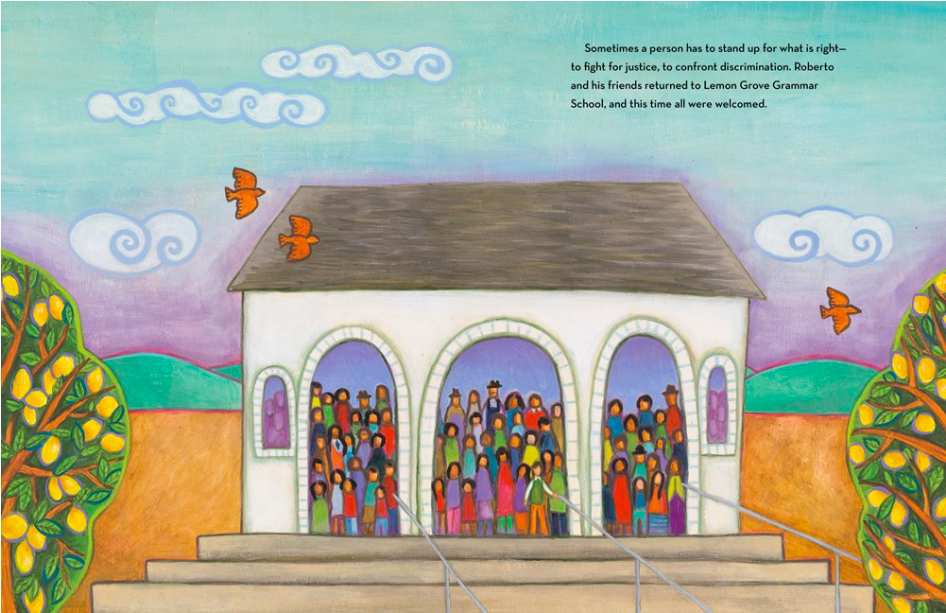
celebrate-picture-books-picture-book-review-without-separation-roberto

Image copyright Maya Gonzalez, 2021, text copyright Larry Dane Brimmer, 2021. Courtesy of Calkins Creek.

The trial began on March 10, 1931 in San Diego. The lawyers for the school board insisted that the new school was to “benefit the Mexican pupils…not to separate” them. Roberto’s lawyers countered this with the minutes from the board’s summer meetings.

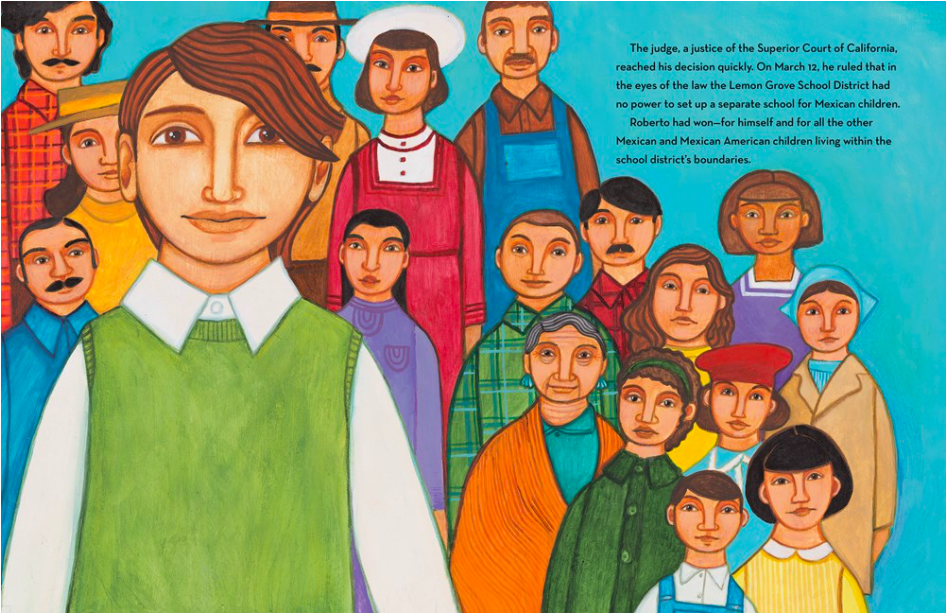
The trial ended the next day, and the decision was handed over to the judge. Two days later, the judge handed down his ruling. He stated that “in the eyes of the law the Lemon Grove School District had no power to set up a separate school for Mexican children.” On April 16, 1931, the judge’s ruling became official and the school board was ordered to immediately admit Roberto Alvarez and all of the other Mexican students “‘without separation or segregation.’” Roberto knew he had to stand up for what was right, and as he and the other Mexican students returned to school, “this time all were welcomed.”

An extensive Author’s Note, complete with photographs of Roberto Alvarez, his third- and fourth-grade classmates in 1928, Roberto’s mother, Lemon Grove Grammar School and its principal, and Roberto in 1999, reveals more about this historical event, the people involved, and the political and social atmosphere in the US at the time. Larry Dane Brimmer also discusses other cases of school segregation and follows up with the consequences for Lemon Grove principal Jerome Green and the successful career enjoyed by Roberto Alvarez as an entrepreneur. Resources used in researching the book are also included.

celebrate-picture-books-picture-book-review-without-separation-school

Image copyright Maya Gonzalez, 2021, text copyright Larry Dane Brimmer, 2021. Courtesy of Calkins Creek.

Larry Dane Brimmer’s compelling history of this landmark case and biography of Roberto Alvarez and all of the students and their parents who stood up for equal access to schooling is instructive and empowering. The fact that this issue and similar others continue to roil schools, workplaces, and communities, makes Without Separation a vital resource to educate children and adults on system racism and how it spreads.

Brimmer highlights the courage, intelligence, and acceptance that children display and inspires them to lend their voices to change injustice wherever they find it. Brimmer’s clear and precise storytelling allows children to understand the actions and discussions involved in the school board meetings, neighborhood committee meetings, and the trial without losing any of the story’s emotional impact.

Maya Gonzalez’s lovely folk-art illustrations present stylized-yet-realistic depictions of the citrus groves, the school, and the courtroom. Fashions and décor set the time period while also appearing appropriate today. Another portrayal of universality is accomplished in Gonzalez’s two-page spread of the board of trustees’ meeting, in which she pictures the members sitting at a table with only their feet and upper body showing. Not only is this group representative of the 1930 school board, but of the “faceless” masses and committees that often drive policy today. Many images of the Mexican community supporting each other shows readers what can be accomplished when people work together.

An important book that will resonate with its target audience, Without Separation: Prejudice, Segregation, and the Case of Roberto Alvarez is a must-addition to any home, classroom, school, and public library.

Ages 7 – 10 and up

Calkins Creek, 2021 | ISBN 978-1684371952

Discover more about Larry Dane Brimmer and his books on his website.

To learn more about Maya Gonzalez, her books, and her art, visit her website.

celebrate-picture-books-picture-book-review-without-separation-cover

You can find Without Separation: Prejudice, Segregation, and the Case of Roberto Alvarez at these booksellers

Amazon | Barnes & Noble | Books-a-Million

To support your local independent bookstore, order from

Bookshop | IndieBound

Picture Book Review
October 7 – It’s National Book Month

celebrate-picture-books-picture-book-review-who-is-a-scientist-cover

About the Holiday

This month-long holiday was established to get families excited about reading. As the weather turns cooler and activities turn indoors, reading together is a wonderful way to spend time laughing, learning, and making memories. Small children love being read to—and so do older kids! Sharing board books, picture books, and chapter books with younger readers opens up new worlds of imagination, feelings, and discovery. Taking the journey of a novel, graphic novel, or biography together with tweens and teens can provide inspiring, emotional, funny, and bonding moments that last a lifetime.

Thanks to Millbrook Press and Barbara Fisch at Blue Slip Media for sharing a copy of Who Is a Scientist? for review consideration. All opinions on the book are my own.

Who Is a Scientist?

By Laura Gehl


Do you love science and think that maybe you’d like to be a scientist when you grow up? But do you also love to dance or surf to paint or bake? Maybe you like to play soccer or ride a motorcycle or you’re considering getting a tattoo like your mom or dad and you think that none of those are things a scientist would do. Maybe you think of scientists as a little bit stuffy with their white coats and endless graphs. Well, think again!

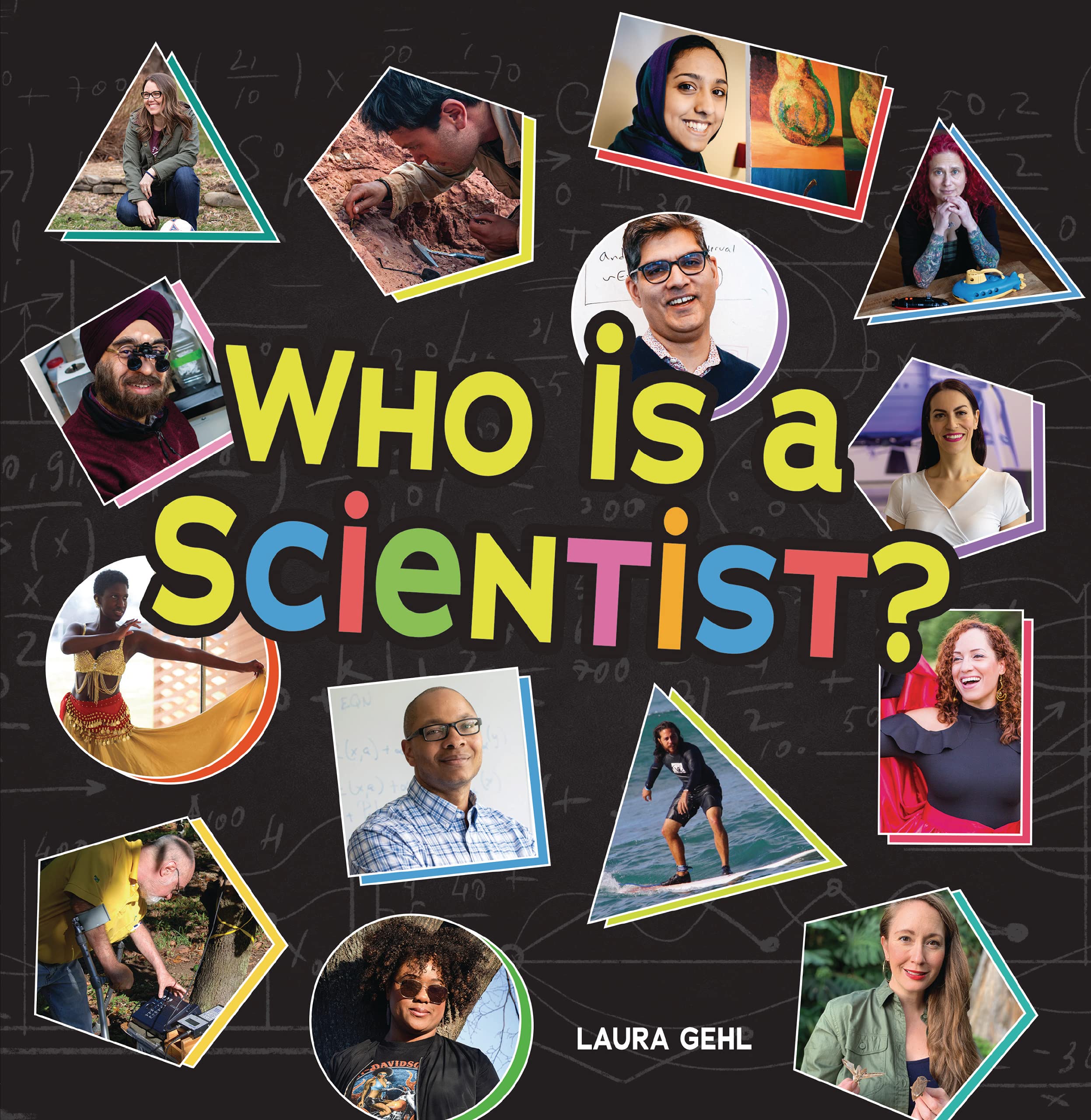
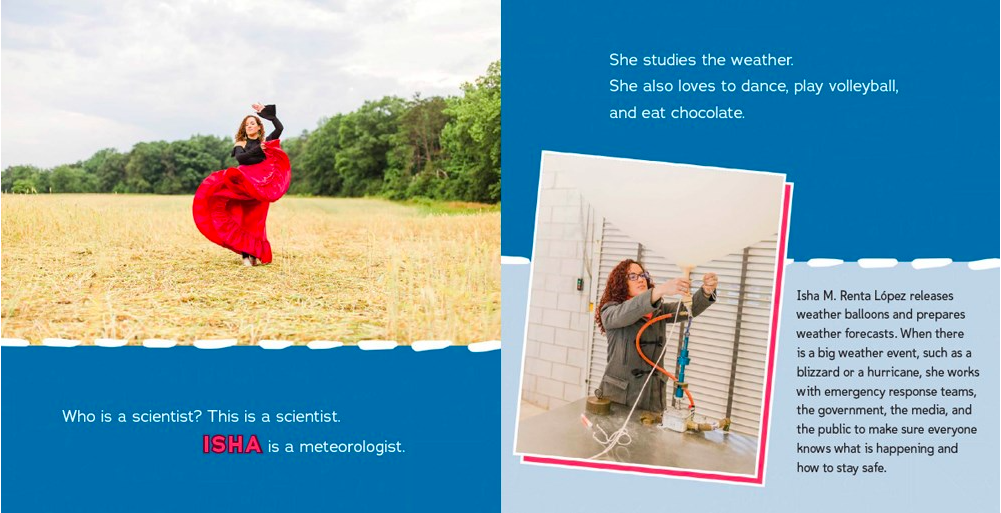
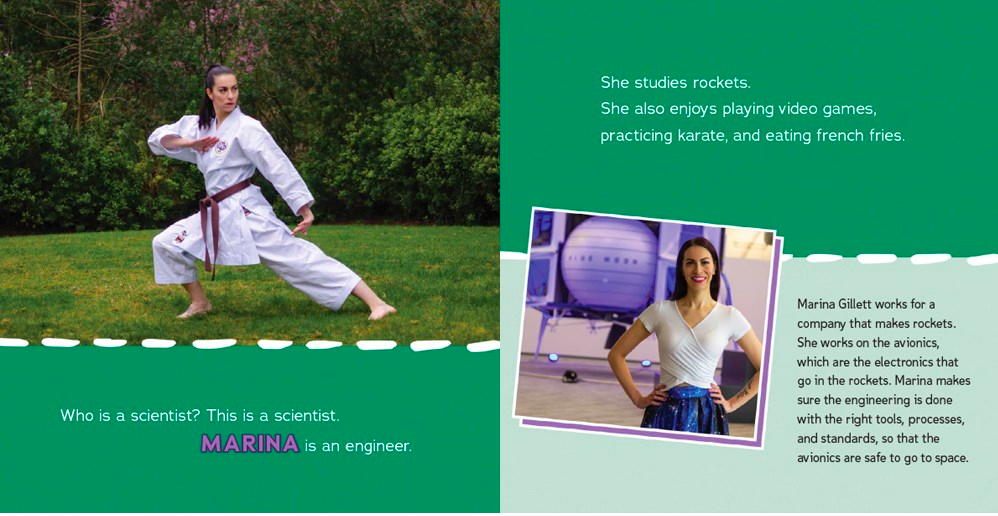
In Who Is a Scientist? Laura Gehl introduces you to fourteen scientists who smash those ideas. And what’s more they’re involved in some pretty fascinating and life-changing sciences and projects that you may never have heard about before but that may inspire you. For example, you’ll meet Isha M. Renata López who works as a meteorologist but “also loves to dance, play volleyball, and eat chocolate.” What’s great about her job? She alerts people to changes in the weather, and when a big storm, blizzard, hurricane, or tornado is coming, she works with emergency crews, the media, and the local government to make sure everyone knows so they can stay safe.

celebrate-picture-books-picture-book-review-who-is-a-scientist-meteorologist

“Jagmeet Kanwal studies bats and zebrafish to help figure out how the human brain makes decisions.” He’s also working to discover “how our brains allow us to hear different types of sounds.” He’s hoping to be able to “help people with depression, Parkinson’s disease, and memory loss.” What else does Jagmeet like to do? He’s also a painter and nature photographer.

If you like math, you may want to become a mathematician like Mark Lewis, who studies operations research during work hours and enjoys playing basketball in his off time. This kind of science “uses math to help business make good decisions” that affect consumer, such as how long people wait in line, how much items cost, and how transportation can move faster.

celebrate-picture-books-picture-book-review-who-is-a-scientist-environmental-scientist

Perhaps you’re interested in health and medical research like Tishina Okegbe whose work makes sure that mothers, babies, and children in Africa and Asia “have access to high-quality health-care services. In her free time, Tishina likes “visiting new places, belly dancing, and eating pizza and ice cream.”

Whether you’re interested in food systems and farming, how the brain works, the environment, space, dinosaurs, or computers, the scientists will inspire you to enjoy all of your passions. In fact, the extracurricular activities you enjoy the most may just lead you to a career you’ll love. The definition of who and what a scientist is broad and exciting as you’ll see when you meet these men and women who are changing the world while being themselves.

Back matter includes a QR code that readers can scan to view a video in which each profiled scientist introduces themselves. There’s also a flow chart that can lead kids to the type of scientist they might want to be or at least research further based on their interests.

celebrate-picture-books-picture-book-review-who-is-a-scientist-environmental-engineer

Laura Gehl’s engaging and inspiring look at a variety of scientists and their disciplines will get all kids excited about the wide range of work going on around them and the people who make it happen. Her profiles of these thinkers, activists, and active members of their communities show kids that they don’t need to be defined only by their career and that scientists—who are needed now more than ever—are a diverse group and welcoming to all. Each profile is accompanied by photographs of the scientist in their lab or other work environment as well as action shots of them enjoying their off time in their favorite pursuits.

A smart, inviting, and educational introduction to the people who are helping to make the world a better place through science and other STEM-related fields, Who Is a Scientist? is sure to inform readers on the wide-range of specialized work that falls under the umbrella of science and spark their interest in learning where they may fit in. The book is highly recommended for home bookshelves and is a must for classroom, school, and public libraries.

Ages 4 – 9

Millbrook Press, 2021 | ISBN 978-1728441085

Meet the scientists in this Who Is a Scientist? Book Trailer!

One Question with Laura Gehl

celebrate-picture-books-picture-book-review-laura-gehl-headshot

Laura Gehl is the author of more than a dozen books for children, including One Big Pair of Underwear, Except When They Don’t, the Peep and Egg series, and the Baby Scientist and Brilliant Baby board books. In addition to being an author, Dr. Gehl has a PhD in neuroscience and is the mother of four children. She lives with her family in Maryland. 

You can connect with Laura on her Website | Facebook | Instagram | Twitter

Hi Laura! I loved reading your book and getting to know some of the scientists working today. I also enjoyed seeing how some of their other interests are reflected in their work while others are great ways to relax and play—definitely something kids can relate to!

I was wondering if or how a previous job (or jobs) has influenced your writing and the kinds of books you write. 

I used to work in a neurobiology lab, and I also used to teach science. Both of those jobs made me want to write books about science and scientists! When I taught science, I realized that very few kids had met a real scientist or had read about any scientists more recent than Albert Einstein or Marie Curie. Flash forward twenty years and my new photo-illustrated picture book Who Is a Scientist? features fourteen real scientists working today in different fields from astronomy to entomology to paleontology. While the book talks about the fascinating work these scientists are doing, it also talks about the other things the scientists love…like dancing, soccer, junk food, watching movies, and playing with their pets. I hope this book helps kids realize that scientists are just like them—curious people with lots of different passions who like to ask and answer interesting questions.

Thanks, Laura! Through your books you’ve found a perfect way to share your love and knowledge of science with kids! I wish you all the best with Who Is a Scientist?!

You can find a Teacher’s Guide to Who Is a Scientist? and her other books on Laura Gehl’s website here.

National Book Month Activity

celebrate-picture-books-picture-book-review-silly-balloons

Static Electricity Experiment!


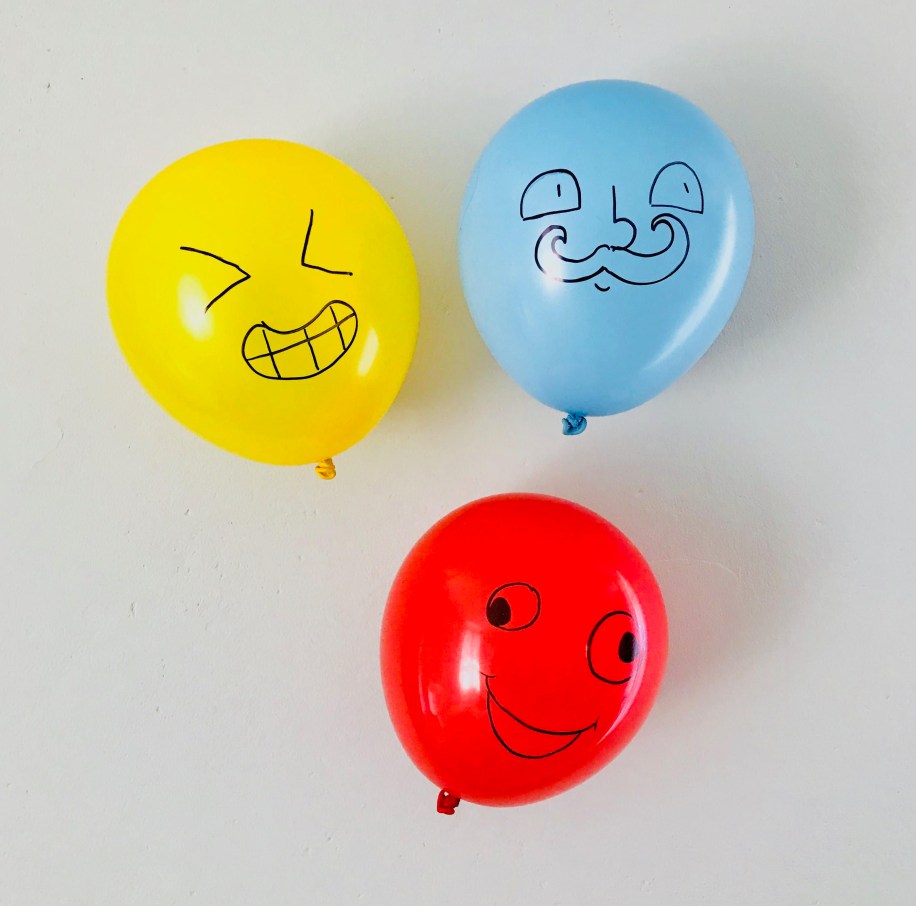
We all know that cooler weather means shock season will soon be here. But you don’t have to wait until the fuzzy socks and fleecy blankets come out to have some fun exploring the science of static electricity. Using a blown-up balloon can be a dramatic way to show kids what’s going on with the electrons that are at the center of this phenomenon.

Babies and young children should be supervised by an adult while playing with balloons.

How does it work? Static electricity is generated when there is an excess of electrons on one object giving it an electric charge. These electrons are attracted to an object with fewer electrons and will jump to it when placed close by.

How do you produce static electricity? Just rub the blown-up balloon on your shirt, on your hair, on a blanket or other surface. Then try these experiments!

CRAZY HAIR

Generate static electricity on a blown-up balloon then hold it near your hair and watch it go a little crazy!

HANG A BALLOON

Generate static electricity on a blown-up balloon and gently place it on the wall and watch it hang all by itself.

BEND WATER

This bit of balloon magic will amaze you! Generate static electricity on a blown-up balloon. Turn on a faucet to a thin stream of water. Hold the balloon near the stream of water and watch it bend toward the balloon. 

celebrate-picture-books-picture-book-review-who-is-a-scientist-cover

You can find Who Is a Scientist? at these booksellers. Due to shipping delays, preorders are now being taken.

Amazon | Books-a-Million | IndieBound

Picture Book Review
 

September 9 – It’s Family Meals Month

celebrate-picture-books-picture-book-review-the-whole-world-inside-nans-soup-cover

About the Holiday

This month-long holiday got its start in 2015 and was designed as a way to support families in enjoying more meals made with fresh ingredients together. Over the years National Family Meals Month™ has gained recognition and grown into a social movement that promotes family bonding and education. Studies show that children who eat meals as a family are happier, less likely to get into trouble, and do better in school. To learn more about the Family Meals Movement and how you can celebrate this month and all year around, visit the Family Meals Movement website.

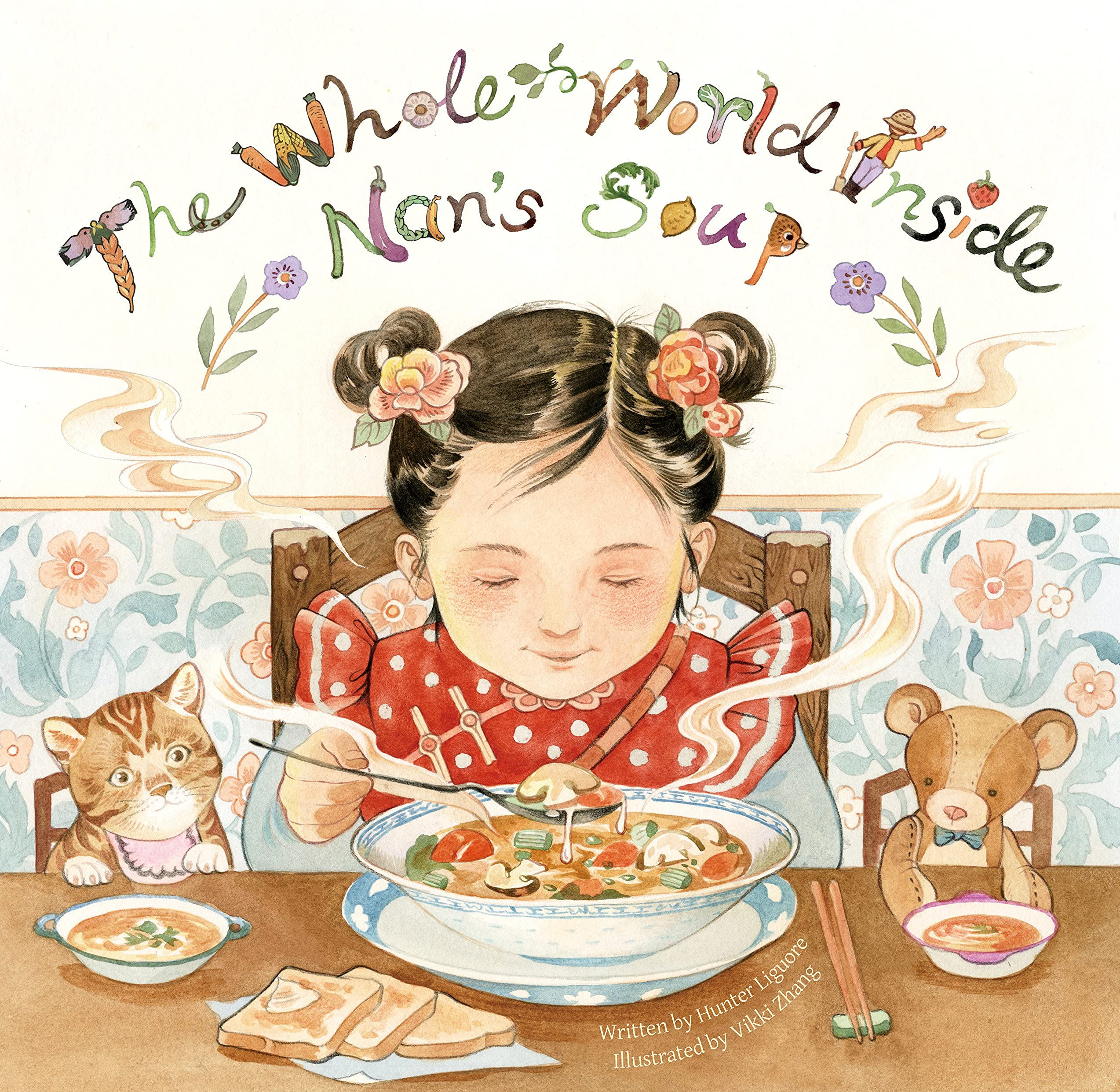
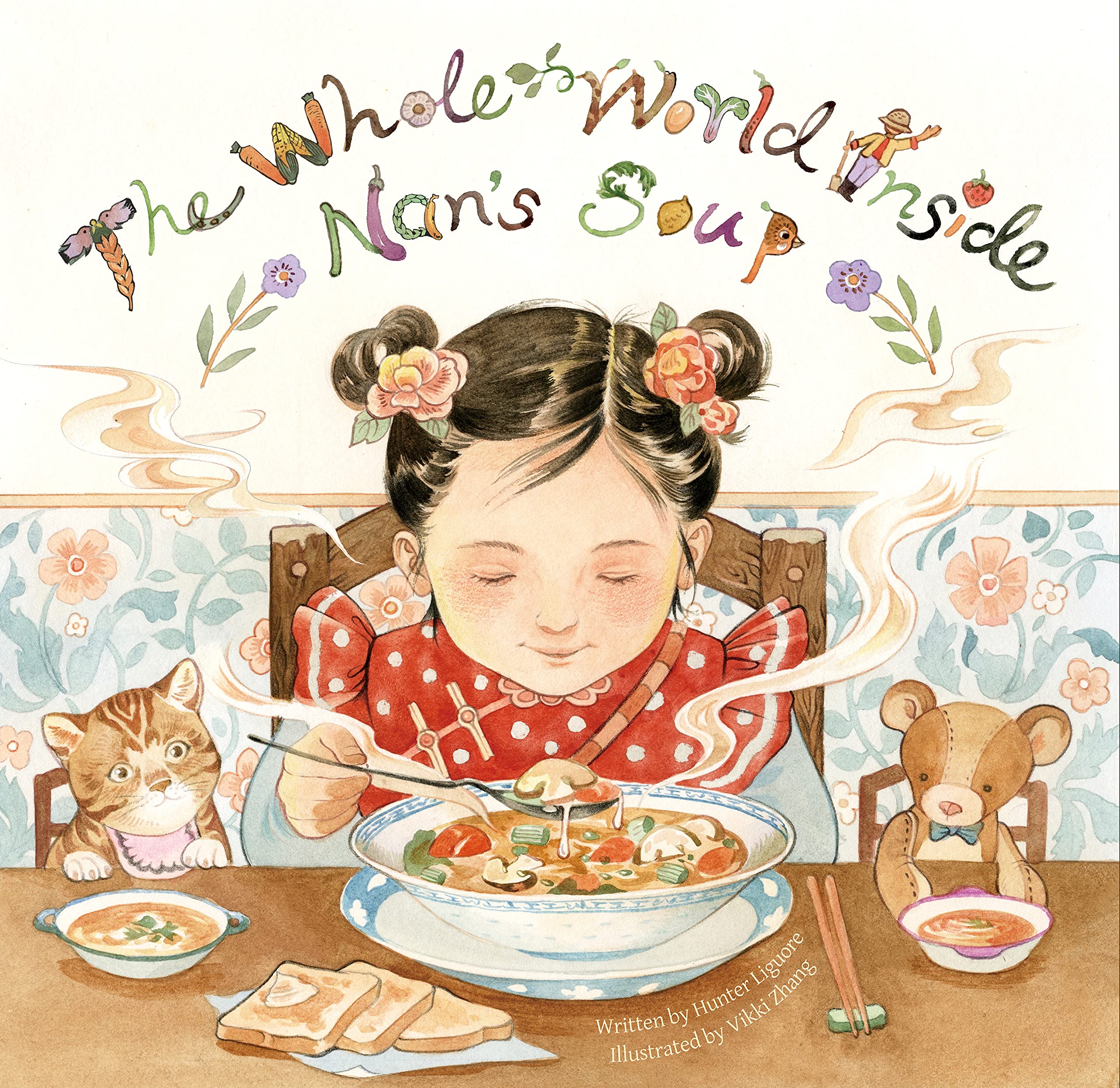
The Whole World Inside Nan’s Soup

Written by Hunter Liguore | Illustrated by Vikki Zhang


A little girl stands at the stove watching her Nanni stir a big metal pot. She asks her Nanni what’s in the pot and learns that there are seeds inside. How can that be? She wonders. They are the “‘seeds that grew up to vegetables,’” Nanni tells her and then reveals that “‘there are also gardeners in the pot.’” That seems impossible the girl thinks. How can that be? So her grandmother tells her about the gardeners that raised the vegetables, the soil and rain, and the sun, the moon, and the stars that are also in the pot.

celebrate-picture-books-picture-book-review-the-whole-world-inside-nans-soup-kitchen

Image copyright Vikki Zhang, 2021, text copyright Hunter Liguore, 2021. Courtesy of Yeehoo Press.

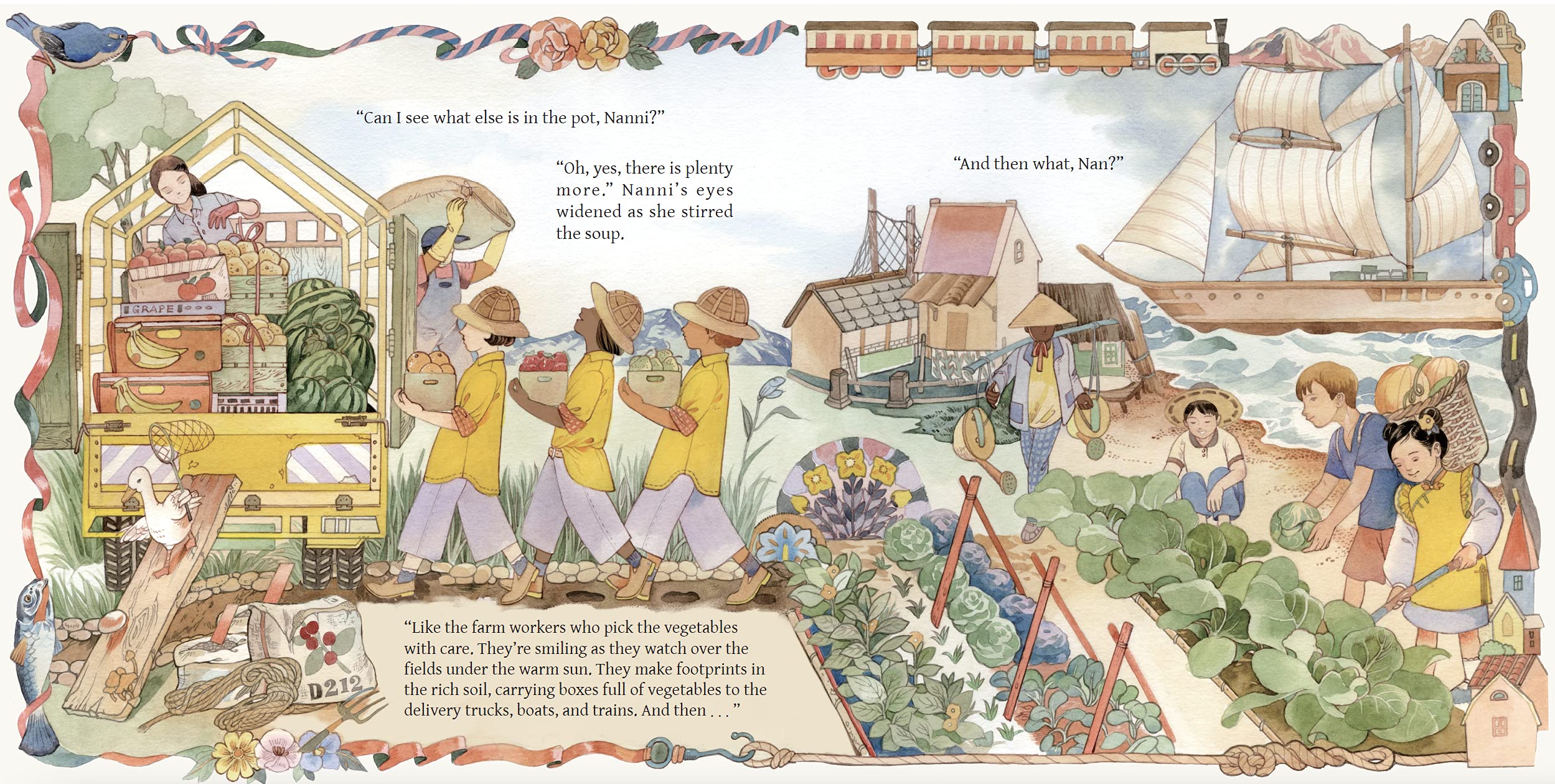
The little girl is catching on. She sees them all too and can hear the buzz of the bees that “pollinate the flowers, that grow up to be vegetables, planted by the gardeners, with their gentle hands.” She stands on tiptoe to see what else is in the pot. It swirls with the farm workers who “make footprints in the rich soil, carrying boxes full of vegetables to the, delivery trucks, boats, and trains.”

You might think that’s all the pot can hold, but there’s more. There are the merchants who “work in teams to bring the baskets of farm vegetables to the market” and the onlookers, “‘curious to see what they bought.’” The little girl thinks that must be everything, but Nanni takes another look and discovers a bus inside the pot. “‘A BUS, Nan! How can there be a bus inside the pot?’”

celebrate-picture-books-picture-book-review-the-whole-world-inside-nans-soup-farm-workers

Image copyright Vikki Zhang, 2021, text copyright Hunter Liguore, 2021. Courtesy of Yeehoo Press.

This is the bus Nanni took to the market. And what’s more, the bus driver, all the passengers, and everything they passed in all the neighborhoods they drove through on their way to the market are inside the pot too. “‘Wow, Nan!’” the girl exclaims. Could there be anything else? Nanni thinks and then a beaming smile crosses her face. Her granddaughter catches her excitement and asks “‘What, Nanni? What else did you see inside the pot?’”

“‘Love,’” Nan answers. The love of all the grandmothers and mothers who passed the recipe down through the generations just so she could make the soup for her own granddaughter. The little girl wants to learn the recipe too. But Nan tells her she must be able to remember everything that goes into the pot. I do know, the girl assures her. “‘The whole world.’”

celebrate-picture-books-picture-book-review-the-whole-world-inside-nans-soup-photos

Image copyright Vikki Zhang, 2021, text copyright Hunter Liguore, 2021. Courtesy of Yeehoo Press.

Little ones will listen wide-eyed to Hunter Liguore’s whimsical tale that gently educates while building page upon page to a tender climax with plenty of humor along the way. The sweet and playful relationship between the girl and her Nanni will charm children and the idea of how the world is connected will resonate with kids beyond the soup pot and inform their view of the world. Liguore’s dialogue-rich text that reflects the cadences of real conversations with kids makes the story a perfect read aloud.
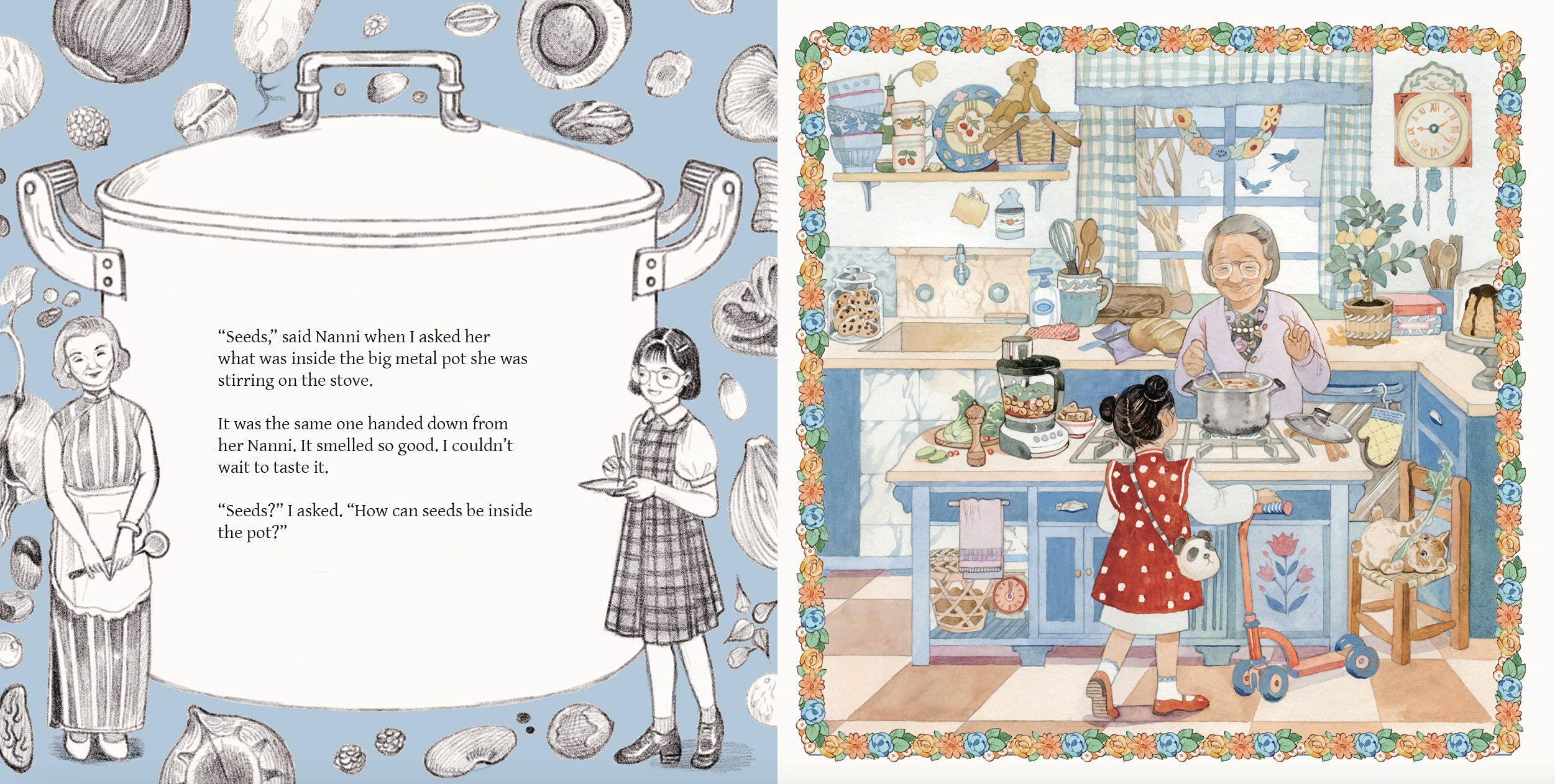
Juxtaposing illustrations with a retro vibe next to lovely fanciful drawings, Vikki Zhang mirrors the intergenerational theme of the story while more than satisfying readers curiosity about all of the quirky ingredients in Nanni’s soup. Kids are first invited into Nanni’s kitchen, a wonder that combines both old world and modern touches. In three clever illustrations, Zhang imagines the gardeners and a café inhabiting stylized cooking pots, and other “ingredients,” such as farm workers, modes of transportation, and nearby neighborhoods are presented in intricately detailed fantastical watercolors that kids and adults will want to linger over. A final image of Nan and the little girl’s heritage told through photographs, fine china, and jewelry is a loving look at all of the Nan’s, mothers, and daughters who have left a lasting legacy in their recipe.

A beautiful and fun book for adults—and especially grandparents—to share with children, The Whole World Inside Nan’s Soup would make a meaningful gift and a welcome addition to home, school, and public libraries.

Ages 4 – 7

Yeehoo Press, 2021 | ISBN 978-1953458063

Discover more about Hunter Liguore and her books on her website. You can find a Teaching Guide and Lesson Plan Activity Kit for teachers, homeschoolers, or just to enjoy at home on Hunter’s site here.

To learn more about Vikki Zhang, her books, and her art, visit her website.

Family Meals Month Activity

celebrate-picture-books-picture-book-review-souper-maze

Souper Maze!


You can’t eat soup without a spoon! Can you help the spoon get through the maze to the bowl in this printable puzzle?

Souper Maze Puzzle  | Souper Maze Solution!

celebrate-picture-books-picture-book-review-the-whole-world-inside-nans-soup-cover

You can find The Whole World Inside Nan’s Soup at these booksellers

Amazon | Barnes & Noble | Books-a-Million

To support your local independent bookstore, order from

Bookshop | IndieBound

Picture Book Review