Bacon has been around since ancient times. In early French it was known as Bako, in German as Bakko, and in Teutonic as Backe. In Middle English it was called Bacoun, but all these words simply meant “back,” as in the back meat of pigs. Preserved and flavored, bacon is a favorite the world over and has seen an explosion of uses in the past few years, from enhancing cupcakes, apple pie, and chocolate chip cookies to spicing up peanut butter sandwiches, lasagna, and French toast. There’s nothing like waking up to the sizzling aroma of bacon, and today’s holiday gives you the okay to indulge!
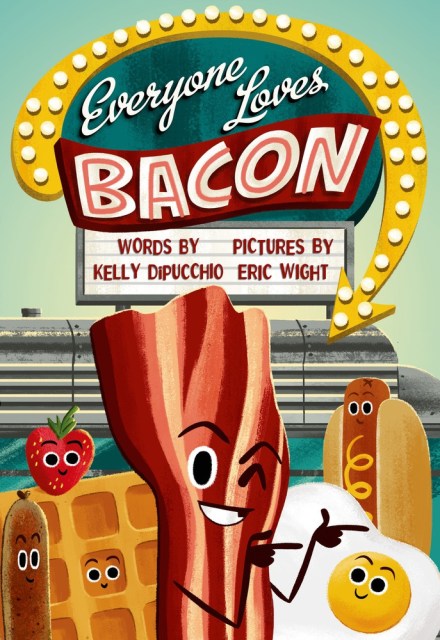
Everyone Loves Bacon
Written by Kelly Dipucchio | Illustrated by Eric Wight
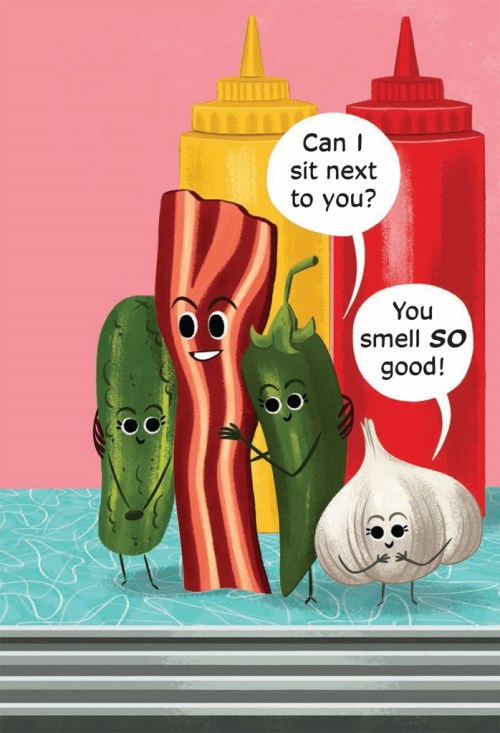
From Egg to Waffle to Pancake, there was no one who didn’t love Bacon—even Bacon himself. Well…maybe French Toast was an exception, but he “doesn’t like anyone.” Bacon loved all the attention the other foods gave him. Jalapeño wanted to sit next to him, and Garlic thought he smelled so good! He made the fruit and vegetables laugh with his “charming stories and funny jokes,” and, boy, could he play the ukulele!
Image copyright Eric Wight, courtesy of us.macmillan.com
Ham, sausage link, and sausage patty were jealous, “but Bacon didn’t care about them. Not one bit.” After all, “He was becoming a real celebrity. His picture appeared on t-shirts. And billboards. And buses.” Bacon was so enthralled with himself that he began to forget his friends. Sometimes he even “pretended not to know some of his old friends.” Bacon had fans, and that was enough for him.
Bacon began to live the high life of sports cars, designer clothes, and the latest fads. He was even the star of the breakfast pastry parade. “Indeed Bacon was the toast of the town. Until….” Well…we did warn you that “everyone loves Bacon.”
Image copyright Eric Wight, courtesy of us.macmillan.com
Kelly Dipucchio’s witty cautionary tale about a piece of bacon that gets too big for his broiler sizzles with snappy sentences and the perils of celebrity. She chooses words and experiences that are recognizable to any child navigating the world of school, siblings, and friends, and with sly winks to popular culture shows that mistaking fans for friends ends badly and that there is always someone “bigger” than you.
Image copyright Eric Wight, courtesy of us.macmillan.com
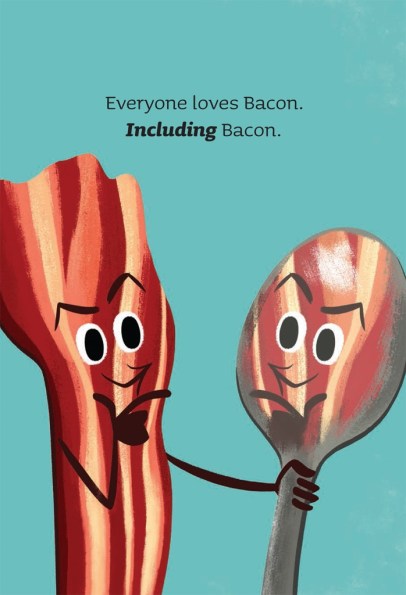
Even if readers don’t like the taste of bacon, they won’t be able to resist Eric Wight’s adorable slice who becomes the star of a 1950s-era diner. From the first page where Bacon admires himself in the back of a spoon, kids will giggle as Bacon takes pictures with equally cute Hotdog, Chicken Leg, Pickle, Garlic, and Jalapeño, leads a citrus parade complete with paper cocktail umbrellas, and plays the ukulele for swooning tater tots, French fries, and curly fries. But as the other foods grow sad and disgruntled with Bacon’s attitude—even brandishing fancy toothpicks—kids will understand and empathize with these forgotten friends. When Bacon meets his fate on the last page, readers are sure to fork over a howl of surprise.
Ages 3 – 6
Farrar, Straus & Giroux, 2015 | ISBN 978-0374300524
To learn more about Kelly Dipucchio and her books, visit her website!
Bacon Day Activity
Amazin’ Bacon Maze
There’s some tasty bacon sizzling in the center of this frying pan-shaped maze. Can you find your way through this printable Amazin’ Bacon Maze to eat it up? Here’s the Solution!
The Thursday before December 25 has been designated as National Regifting Day, owing to the number of office and other parties that hold gift exchanges. There is a certain art to regifting that requires special attention. Always remember to only regift quality, unopened or new items, be mindful of the person you are giving to, and do not return a present to its original giver! If you’re participating in today’s holiday, be creative and have fun!
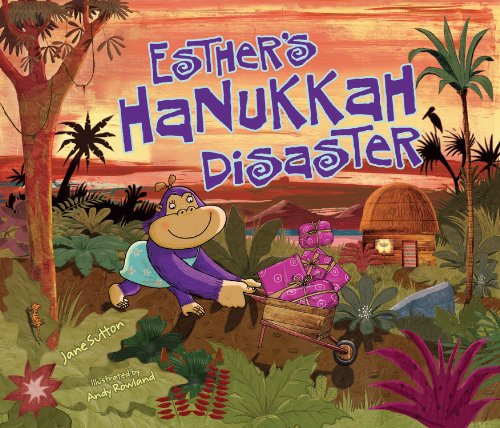
Esther’s Hanukkah Disaster
Written by Jane Sutton | Illustrated by Andy Rowland
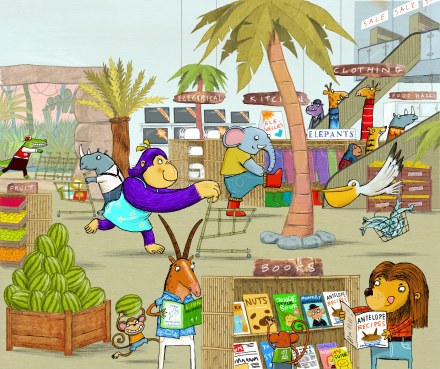
While enjoying a breakfast of Gorilla Flakes and bananas, Esther viewed her calendar. Time had crept up on her, and she realized with a shock that Hanukkah was only one day away and she hadn’t bought her friends any presents. She hurried out to the Jungle Store and hit the clothing department. There she found a pair of striped and a pair of argyle socks for her friend Sarah. “Then she spotted a bright red turtleneck. ‘I’ll surprise my friend Zack with this,’ she decided.”
Image copyright Andrew Rowland, courtesy of Andrew Rowland
In the sports department Esther spied a jogging suit. It was even on sale—“marked down from $13.00 to only $12.99.” Esther quickly put it in her cart for her friend Josephine. She also discovered a make-your-own jungle gym that would be perfect for Hal, and it wouldn’t even take that long to build. “Just 10 minutes…or 10 days at the most!” the directions on the box said. “In the book department, Esther picked up a paperback called 100 Jokes About Elephants.” The jokes were so funny that she bought it for her pal Oscar. Back home, Esther wrapped her gifts.
The next night “Esther placed two candles in her menorah. She lit the shamash candle and said the special blessing. Then she lit the candle for the first night of Hanukkah and said the other two blessings. She remembered the story of the Maccabees and the little jug of oil that lasted eight days.” Soon it was time for her to deliver her presents.
She was happy to stop first at Sarah’s house. Esther was sure she would love the socks she had gotten her. But when the little monkey opened her gift she burst out laughing and said, “‘These socks are big enough for an elephant!’” but added that the gifts were not the most important part of Hanukkah. Sarah’s gift for Esther was Gorilla-Vanilla perfume, which was the perfect thing to make Esther smell nice.
Image copyright Andrew Rowland, courtesy of Andrew Rowland
Next, Esther headed over to Zack’s house. When the zebra unwrapped the red sweater Esther had chosen for him, he frowned. “‘I never, ever wear red clothing,’” he said, citing “‘that terrible riddle.’” When Zack related the riddle, ending with “an embarrassed zebra,” Esther laughed and agreed that red was probably not the best clothing choice. Zebra’s gift to Esther was membership in the Coconut of the Month Club—a perfect, yummy gift. Esther was beginning to feel bad about the gifts she was giving
At Josephine’s house Esther learned that the jogging suit she had picked for her turtle friend missed the mark, while the princess costume Josephine gave her fulfilled her dream of dressing up like a human. A little later when Oscar the Elephant opened the joke book, he gently told Esther that he thought “the book was in very poor taste” and that “there should be a law against elephant jokes.” Poor “Esther wasn’t laughing anymore. In fact she felt more like crying. ‘I’m sorry I hurt your feelings,’ she said.” She felt even worse when she opened Oscar’s thoughtful cookbook 1001 Ways to Serve Bananas.
With one gift left to deliver, Esther was sure there would be something wrong with it too, and when she reached Hal’s house she discovered what that was. “‘Hyenas can’t climb jungle gyms like monkeys can,’” he told her as he handed her two tickets to The Gorilla Theater. As Esther trudged away, she felt miserable, but at home with a cup of tea she had an idea. She sat down and wrote out invitations for all of her friends to join her on the Eighth Night of Hanukkah. “‘Make sure to bring the gift I gave you!’” she added.
Image copyright Andrew Rowland, courtesy of Andrew Rowland
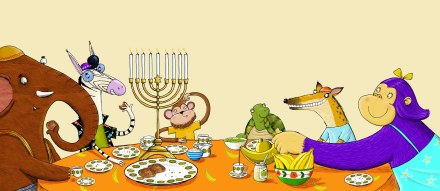
When her friends arrived, they lit the shamash candle, said the blessings, and sat down to a delicious dinner. Afterward, Esther admitted, “‘I know that my gifts to you were a total disaster, but now you can trade!’” She looked at Sarah. “‘The two pairs of socks I bought you would fit an elephant,’ she said. Sarah smiled and handed the socks to Oscar. Hal’s jungle gym turned out to be just right for Sarah. Zack Zebra was thrilled to get Josephine’s jogging suit, and Hal laughed like the hyena he was at 100 Jokes About Elephants. And that red turtleneck was the exact thing for their turtle friend, Josephine.
After her friends left, Esther thought that her gifts had not been so bad. After all, they brought everyone together for a perfect Hanukkah celebration.
Jane Sutton brings humor and meaning to her Hanukkah story that reveals the true nature of the holiday and friendship. With clever gift choices and a sweet plot twist, Sutton’s Esther’s Hanukkah Disaster will have kids giggling and empathizing as Esther’s plans go awry. Her easy-going delivery invites kids along on Esther’s shopping trip and sets up the jokes and final swap in a natural and engaging way. Sutton’s inclusion of Esther’s and her friend’s honest reactions to the gifts encourages discussion of how to choose gifts, how to make up for mistakes, how to graciously accept gifts, and more topics surrounding gift-giving.
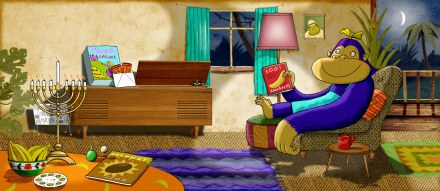
Andy Rowland’s purple gorilla Esther is sweetly expressive even as she is a bit oblivious to the needs of her friends and clearly disgruntled when her gifts don’t work out. Kids will love the brightly colored illustrations loaded with details appropriate to Esther’s world, especially the bowls, drawers, and hangers of bananas, banana cookbooks, banana-decorated table cloth and even a banana-shaped teapot in her kitchen. The Jungle Store is a riff on big-box stores with multiple departments where shoppers finding everything from fish for a pelican to a book of Antelope Recipes for a lion to Ele-Wellie boots for an elephant.
Esther’s nighttime neighborhood is likewise beautifully drawn with lush foliage; hanging lanterns; wood, bamboo, and stone homes; and even a waterfall. The window of each friend’s home frames a menorah.
With its humorous take on a common mishap and loveable characters, Esther’s Hanukkah Disaster is a book kids will enjoy no matter what the gift-giving occasion is!
Ages 4 – 7
Kar-Ben Publishing, 2013 | ISBN 978-0761390435
Discover more about Jane Sutton and her books as well as book-related activities on her website!
Become wrapped up in this swinging Esther’s Hanukkah Disaster book trailer!
Regifting Day Activity
Whimsical Gift Tags
Every present needs a tag! With these printable Whimsical Gift Tags you can present your present in style! Just color them and add the names!
Established in 2004, today’s observance encourages people to remember the importance of horses to American history, culture, and character. Both wild and domesticated horses need our care and compassion. To celebrate consider volunteering at a facility that cares for horses, for an organization that uses horses in therapy programs for children or adults, or donating to the protection of wild horses.
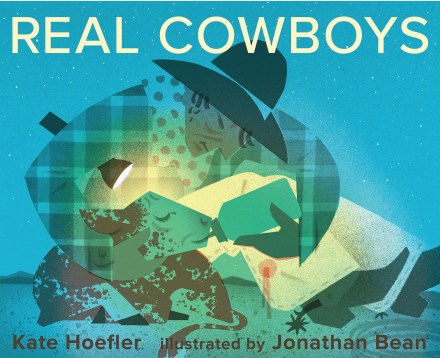
Real Cowboys
Written by Kate Hoefler | Illustrated by Jonathan Bean
Real cowboys wake with the dawn’s light and are careful not to make too much noise for the people still sleeping in the “little houses in the hollow, and up the mountains, and at the edge of fields in the distance.” It is natural for the cowboys to think of others. Their job is to care for the herd; to help a stranded calf and their dog who is trying to lure it to safety; to soothe the herd when thunder rumbles overhead.
Image copyright Jonathan Bean, courtesy of Houghton Mifflin Harcourt
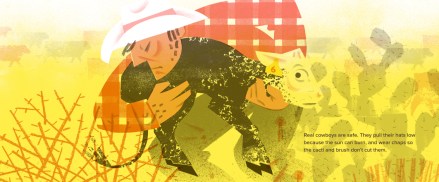
Real cowboys sing soft, slow songs to their cows to encourage them to continue moving when the path is narrow and dangerous and to sleep when coyotes howl in the night. Cowboys are good listeners—heeding the advice and warnings of the trail boss and other cowhands. “Sometimes they listen for trucks, and wolves, and rushing water. And sometimes they just listen to the big wide world and its grass song.” Along the way cowboys keep themselves safe with their wide-brimmed hats and leather chaps.
Image copyright Jonathan Bean, text copyright Kate Hoefler. Courtesy of Houghton Mifflin Harcourt
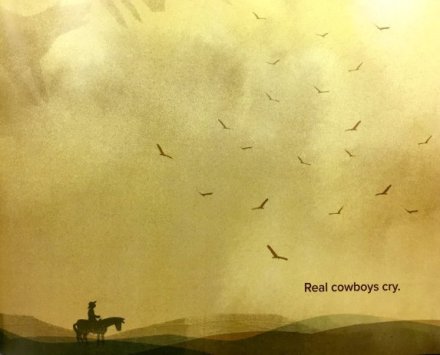
Because the cattle drive is long—lasting “for hours, or days, or weeks”—cowboys learn to be patient. “Even on a fast horse, they have to move with the slow rhythm of a herd….” When they need help, real cowboys don’t hesitate to ask, using hand and hat signals to alert other cowhands. “Real cowboys want peace. They don’t want stampedes, where all the cattle spook, and thunder over the earth, and scatter in dust storms.” Sometimes, however, this happens, and sometimes a few cattle and dogs are lost. Thinking of them when times are quiet, “real cowboys cry.”
Image copyright Jonathan Bean, text copyright Kate Hoefler. Courtesy of Houghton Mifflin Harcourt
At night cowboys take turns eating and sleeping so there is always someone to watch over the herd. When they pack up camp and move on, real cowboys are mindful of the earth, and when they are far from home, inside themselves they can feel homesick, even if they look tough on the outside. “Real cowboys are as many different colors as the earth. Real cowboys are girls too.” In their hearts “real cowboys are artists,” creating stories that are bigger than the wide open prairie. “They wonder what’s past the horizon. And one day, when their work is done, real cowboys find out.”
Kate Hoefler’s moving tribute to cowboys and cowgirls demonstrates the qualities of kindness, thoughtfulness, and mindfulness that we want to share with our children. With lyrical language she follows cowboys on a cattle drive, where they experience the joys and sorrows that life entails for all. Hoefler’s pacing echoes the day-to-day movement of the herd as well as readers’ daily life. Delving into the responsibilities and characteristics of these men and women is a unique way to open the world to children and promote discussions about the traits of caring individuals.
Image copyright Jonathan Bean, courtesy of Houghton Mifflin Harcourt
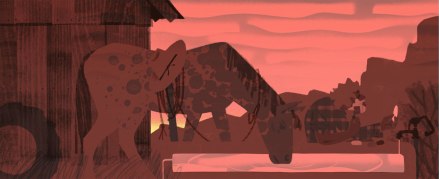
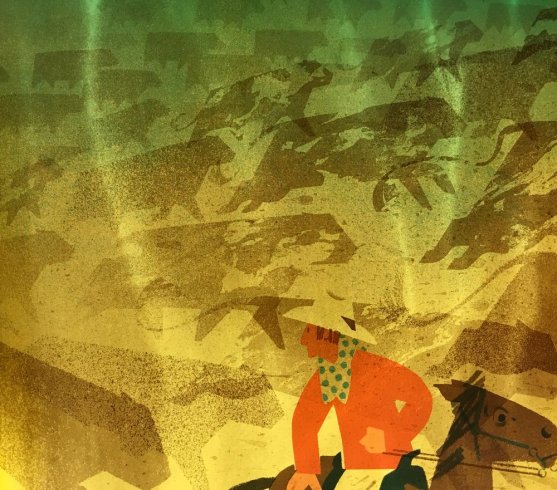
Jonathan Bean’s hand-stenciled illustrations printed in four Pantone colors are particularly effective in portraying the life of the cowboys and cowgirls entrusted with herds of cattle. Early morning dawns to rose skies that color even the horses and reflect in the drinking trough. Cattle, obscured by dust raised on the trail, form the backdrop to a cowboy worriedly watching his dog coax a calf from a cliff, and afternoon turns to night in a two-page spread where a cow nuzzles her calf as it sleeps. Depictions of the enormity of the herd traveling from one place to another amid sweltering days, rain storms, and blizzards are beautifully rendered, and the emotions of the cowboys are clearly discernable and touching.
Real Cowboys is stunning in both language and illustrations. For quiet story times, bedtime, or times for reflection and inspiration, this book would make an excellent addition to children’s bookshelves.
Ages 4 – 7
Houghton Mifflin Harcourt, 2016 | ISBN 978-0544148925
To view a gallery of illustration by Jonathan Bean, visit his website!
National Day of the Horse Activity
Galloping Horse Coloring Page
A horse running at top speed is a beautiful sight! Enjoy this printable Galloping Horse Coloring Page—would you be riding?
Mountains are majestic! Towering over the landscape, they leave us awestruck with their beauty and mystery. Supporting unique wildlife, providing challenging personal achievement, and inspiring countless works of art, the mountains of the world received their own United Nations-sponsored holiday in 2003. Established so that we remember and honor the importance of mountains to the environment and cultures in which they’re found and to the world at large, International Mountain Day is a celebration we can all support.
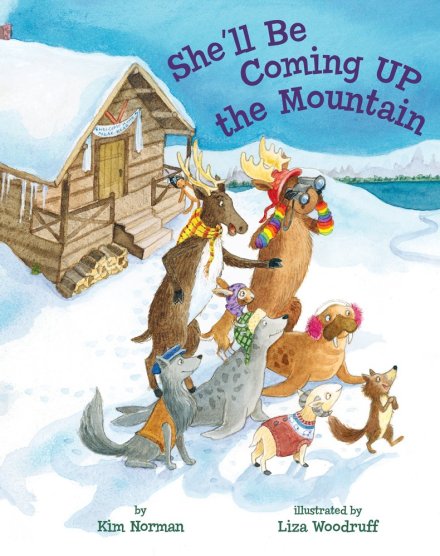
She’ll Be Coming UP the Mountain
Written by Kim Norman | Illustrated by Liza Woodruff
Moose and her pals are sprucing up the place in anticipation of Polar Bear’s return home. They know that “she’ll be coming up the mountain when she comes,” and are sure “She’ll enjoy our frozen fountain when she comes.” In addition to sweeping and dusting, the crew are planning a special welcome, and can’t wait for her arrival because “when she gets here she’ll discover / just how much we really love her / in a banner strung along the cabin wall.”
It seems that even though Polar Bear was away for a long time, no one forgot her. During her absence her friends sent her poems and hand-knitted sweaters, and now that she is coming back even the narwhals and gulls will come to cheer. Even if their “teeth begin to chatter / not a bit of it will matter when she comes.” Then they’ll throw “an arctic party when she comes. / We’ll play music, tapping icicles and drums. / Everybody will be clapping / while the caribou is rapping. / Not a creature will be napping when she comes.”
And, boy, do these guys know how to plan a homecoming! Out in the bay the kayakers will be paddling in formation, the whales will be spouting, and everyone else will be shouting when they see Polar Bear. There will be gifts galore, “high ones, twos, and fives,” a daring ski-slope salute, and plenty of “cheesy” pictures to document it all. As the moment arrives the anxious friends send out a message to which Polar Bear instantly sends an intriguing reply that they that they won’t believe their eyes. Before the waiting group can decide whether to “send our fastest skier, / who will be the first to see her, / and can tell us what will be her big surprise?,” they hear snuffling in the snow. Then suddenly over a snowbank they see her! They cheer and run to meet her and then they all tumble into the house—Polar Bear and her cubs!
Kim Norman has taken the buoyant song “She’ll Be Coming ‘round the Mountain When She Comes” and turned it into a joyful tribute to friendship that will have kids tapping their toes and bouncing along. The sweet story, strict rhythm, and well-known rhyme scheme allow for a mountain of laughs as the welcome-home party grows for the return of a favorite friend. Norman infuses her story with so many details and such enthusiasm that readers can’t help but get excited too. The final revelation that Polar Bear is bringing a surprise will have kids cheering along when they discover Polar Bear has new cubs.
Liza Woodruff’s vibrant illustrations exuberantly depict the preparations and plans the friends have for Polar Bear’s return. Kids will love lingering over Woodruff’s brightly colored and action-packed pages to catch all the details of the coming party. The animals’ camaraderie as they clean together, help deer knit a sweater, practice their welcome activities and especially imagine being together again is heartfelt and infectious. Readers will be glad they too are standing on the front porch looking for the first sight of Polar Bear and are invited inside the cozy cabin for the surprise party.
She’ll Be Coming UP the Mountain is a book full of fun that you’ll probably find yourself singing instead of reading—much to everyone’s delight! For boisterous story times, as a take-along on vacations, or for any time when happiness is the order of the day, this book is a perfect addition to kids’ bookshelves.
Ages 3 – 8
Sterling Children’s Books, 2016 | ISBN 978-1454916109
To learn more about Kim Norman and her other books as well as find fun activities, visit her website!
Discover a portfolio of artwork by Liza Woodruff on her website!
Instituted in 2007 by the Encouragement Foundation at Harding University in Searcy, Arkansas, today’s holiday entreats us to cheer on our friends, coworkers, and even those we don’t know as they attempt to reach goals or start new endeavors. A pat on the back, a simple “you can do it!,” or a reassuring “great job!” boosts people’s self-confidence and makes the world a happier place.
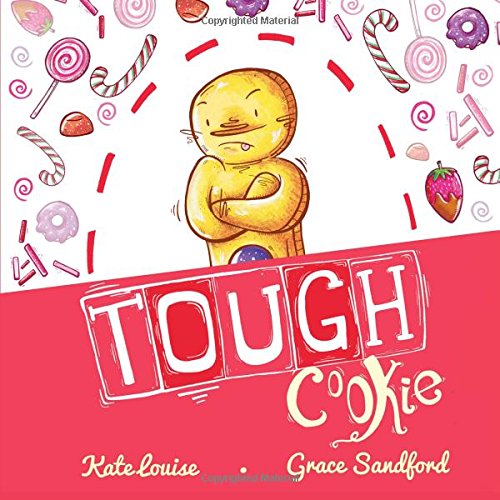
Tough Cookie
Written by Kate Louise | Illustrated by Grace Sandford
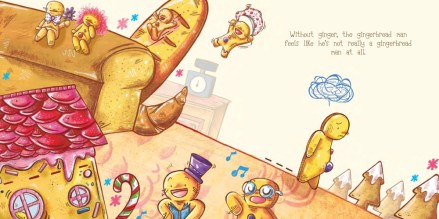
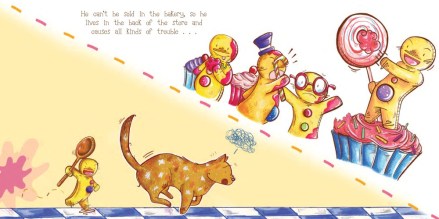
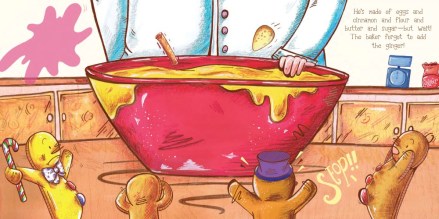
Although one gingerbread man in the bakery looks like all the others, there is one important difference. Yes, the batter had “eggs and cinnamon and flour and butter and sugar—but wait! The baker forgot to add the ginger!” Without this signature ingredient the gingerbread man just doesn’t feel like a gingerbread man at all. In fact his whole life has been turned upside down. He’s different from his friends, and what’s worse, he can’t be sold. Instead, he lives in the back of the bakery and in his sadness makes all kinds of mischief.
Image copyright Grace Sandford, text copyright Kate Louise, courtesy of Sky Pony Press
The gingerbread man chases the cat, splatters icing on other cookies, and squirts icing on the walls. “‘I need that for my cupcakes!’” the baker yells, but the gingerbread man just laughs. He moves on to the decorative candies, stuffing them in his mouth as fast as he can even though the baker needs them for his other treats and stands by tapping his foot. Next the gingerbread man scatters sprinkles all over the counter and slips and slides along on his belly—“‘woohoo!’” But the baker is not amused. “‘I need those for the donuts!’” he shouts.
Image copyright Grace Sandford, text copyright Kate Louise, courtesy of Sky Pony Press
Finally, the baker has had enough. Not only is the gingerbread man upsetting the other gingerbread men and women, he is ruining the business. The baker orders the gingerbread man to leave the store. But this is one gingerbread man that does not want to run away. “‘I don’t want to leave!’” he cries. The baker relents. He takes the little cookie in hand and teaches him that even though he is missing an ingredient he can still be kind. The baker shows him by being nice he can become one of the group.
Now, the little gingerbread man is happy. Instead of gobbling up all the candy, he helps create the other cookies. He no longer shoots icing on the walls or flings sprinkles around the kitchen. Rather, he helps the baker decorate the cupcakes and the donuts. He’s even learned how to sift flour and roll out dough, and he uses the cookie cutter to make new friends. And he never forgets to add the ginger!
Image copyright Grace Sandford, text copyright Kate Louise, courtesy of Sky Pony Press
Grace Sandford’s bakery gleams with the golden hues of fresh-baked bread, the festive colors of sprinkles and icing, and the sparkle of sugar. Kids will love the vibrant pictures of cupcakes; lollypops; stacks of cakes, donuts, and candy; and decorated gingerbread houses surrounded by cookie forests. Her expressive gingerbread men and women register dismay at the wayward gingerbread man’s shenanigans and joy at his kindness. And the hero of the story? When he leaves behind his impish pranks he becomes a charming baker’s companion, sifting clouds of flour, running on the rolling pin to flatten dough, and passing out sugar-shiny gumdrop buttons to his new friends.
Young children will ask for this fun and funny read over and over. Tough Cookie makes an especially delicious accompaniment to an afternoon of baking or decorating gingerbread houses!
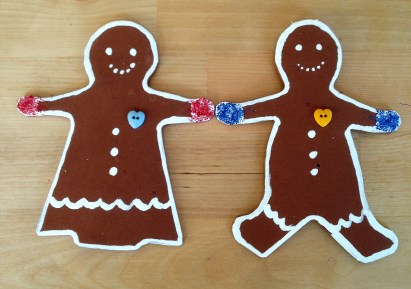
Way back in the past when gingerbread was new it was creatively iced and used to decorate windows. You can make decorations for your home or room with this easy craft!
The feel of a cozy mitten on freezing fingers is one of the luxuries of wintertime. But where did mittens come from? You might be surprised to discover that the word “mitten” comes from the French word mitaine, which was an old nickname for a cat, because early mittens were typically made of animal fur. The earliest mittens, dating to around 1000 AD, were used as sheaths for gloves, adding extra protection for cold hands. Today, I’m pleased to review the book in which Mitten Tree Day is said to have its origins! Although originally published in 1997, the story has endured and sparked programs in schools, libraries, and other places around the country.
The Mitten Tree
Written by Candace Christiansen | Illustrated by Elaine Greenstein
In a small house at the end of a lane Sarah lives all alone. Her own children have grown and moved away, but as she watches the kids gather at the blue spruce tree to wait for the school bus she remembers all the years that she walked her son and daughter to this same spot. As she makes her way down the lane to her mailbox, she wishes the children will wave and smile, but they never seem to notice her. Still, it makes Sarah smile to see them.
Image copyright Elaine Greenstein, courtesy of Fulcrum Publishing
One winter morning Sarah notices all the kids throwing snowballs and making snowmen—all except one little boy dressed all in blue who lacks the mittens needed to join his friends. All day Sarah worries about the boy with no mittens. As the sun goes down Sarah digs “through the basket of yarn scraps she had saved for many years.” She finds her needles and four shades of blue wool. Then Sarah begins to knit.
With the rising sun Sarah hurries to the bus stop and hangs the new blue mittens on the spruce tree. Then she hides behind a hedge to watch. The little boy in blue is the first to arrive at the bus stop. When he sees the mittens hanging there, he tries them on and finds that they fit perfectly. With a big smile he makes “a perfect snowball” and throws “it high into the winter sky.” Soon Sarah sees a little girl with mismatched mittens. That night she finds the perfect color of wool and knits a pair to match the girl’s red coat.
Image copyright Elaine Greenstein, text copyright Candace Christiansen. Courtesy of Fulcrum Publishing
Every morning Sarah watches the children, looking for any who have no mittens. During the day her needles are busy making gifts for these children. The next morning before anyone else is up she rushes to the spruce tree and adorns it with the mittens she has knitted. The children have warmed to the “game,” and each day search “under every branch and bough for another pair of mittens.” Once or twice Sarah thinks the boy with her blue mittens sees her, but his eyes don’t linger.
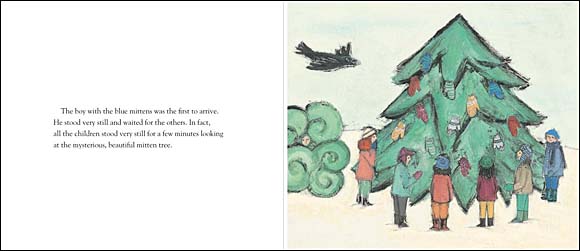
On the day before the school’s winter break Sarah fills her knitting basket with the latest mittens she’s knit. She heads out the door and down the lane. When she reaches the blue spruce, she hangs “mittens on every branch.” When the children arrive, they stand “very still for a few minutes looking at the mysterious, beautiful mitten tree.” As they board the bus, each child is wearing a new pair of mittens. Sarah sees them appear one by one in the bus windows, but none see Sarah.
Image copyright Elaine Greenstein, text copyright Candace Christiansen. Courtesy of Fulcrum Publishing
Sarah goes home feeling happy and with her heart as full as it was “when the sounds of her own children had filled her house.” But what awaits Sarah? As she climbs the stairs to her porch, she notices a “basket woven with thick brown vines and decorated with a large white bow.” She’s surprised to see that it is filled to the brim with balls of colorful yarn. Even today Sarah knits new mittens for all the children in town, and “every time her basket is empty, a new full one appears.” Sarah doesn’t know who brings the basket, just as the children don’t know who supplies the mittens. “But someone must….”
Candace Christiansen’s heartwarming story of kindness given and reciprocated will inspire kids to see that anyone can make a difference in the lives of others by using their talents to fill a need. This gentle, quiet tale offers suspense that will pique readers’ curiosity from page to page, and the mystery surrounding the never-empty basket of wool provides a satisfying and moving ending that also reassures kids that deeds of thoughtfulness and compassion are noticed. The grandmotherly Sarah and familiar school bus stop setting and winter activities will resonate with readers.
Elaine Greenstein’s softly colored, folk-style illustrations give the story a cozy feeling—perfect for cold-weather reading, The variety of intricately knitted mittens, with their hearts, stripes, snowflakes and cables, are charming, and the enchanting image of the blue spruce decorated with mittens makes it easy to see how The Mitten Tree continues to inspire so many acts of kindness and charity.
Ages 3 – 7
Fulcrum Publishing, 2009 (paperback) | ISBN 978-1555917333
Mitten Tree Day Activity
Mitten Match & Coloring Page
Mittens often get lost or mismatched in the fun of winter activities. Find the pairs in this printable Mitten Match & Coloring Page and then decorate them!
The American Hiking Society established today’s holiday to encourage families, friends, groups, and individuals to get outside and experience the fun and relaxation of discovering new paths and new places. Even if you’re only able to take a short walk during lunchtime or after work, getting out in nature gives you new perspectives and clears the mind—it’s great exercise too! So gather some friends or your family and head out the door for a short (or a long) hike today!
Harriet Can Carry It
Written by Kirk Jay Mueller | Illustrated by Sarah Vonthron-Laver
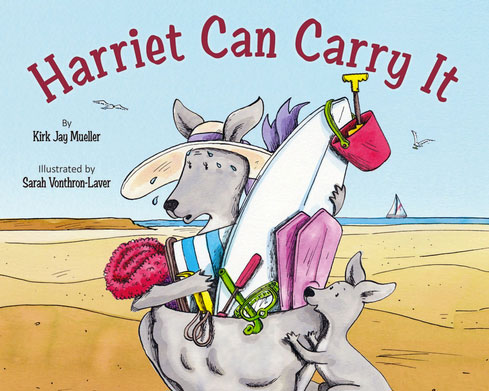
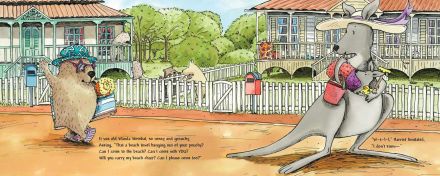
Harriet Huff is a kangaroo who every day carries the mail in her pouch, delivering it all over town. Her job has left her “feeling quite frail,” She decides to take a day off and hike to the beach with her Joey where they can “relax and be free.” The next morning they wake up and prepare for a fun day. Harriet gathers their beach towels, Joey, and his favorite toy and tucks them gently into her pouch. She gets no further than the bottom of her porch, however, before she hears “someone yell, ‘HEY!’”
Image copyright Sarah Vonthron-Laver, text copyright Kirk Jay Mueller. Courtesy of starbrightbooks.com
“It was old Wanda Wombat, so nosey and grouchy, / Asking, ‘That a beach towel hanging out of your pouchy? / Can I come to the beach? Can I come with YOU? / Will you carry my beach chair? Can I please come too?’” Harriet stammers, “W-e-l-l…” as she considers her plans to relax, but before she can properly answer, Wanda invites herself along, telling Harriet that she has room in her pouch “for tons of stuff.” “‘YOU CAN CARRY IT, HARRIET, so I can come too.’”
They walk up a hill together, Harriet sweating a bit with the effort of carrying the beach chair that has replaced Joey in her pouch. Suddenly, they hear someone shout, “‘STOP!’” It’s Wallaby Wendy who is also on her way to the beach. She asks Harriet if she will carry her swim fins. Harriet hesitates. “‘W-e-l-l, I’m not sure…’” she says. But Wanda is there with the answer. “‘She has lots of room. She has loads of space / For tones of stuff in her big pouchy place. She is an incredibly kind kangaroo. HARRIET CAN CARRY IT, so you can come too.’”
Image copyright Sarah Vonthron-Laver, text copyright Kirk Jay Mueller. Courtesy of starbrightbooks.com
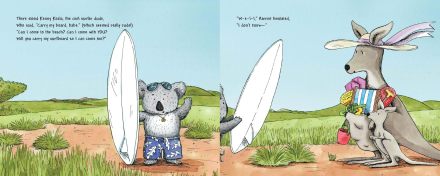
They start up again all in a row and it isn’t too long before someone says “‘WHOA!’” It was Kenny Koala, who in his own surfer-dude way asks Harriet if she can carry his board so he can come with them too. Harriet takes a moment to think—but it’s a moment Wanda has no problem filling, and so Harriet acquires Kenny’s surfboard too. “AHOY!” beckons Marcie, a marsupial mouse, “Who’d made the mistake of leaving her house / With a huge heavy kayak strapped to her back. / Her long plastic paddle poked out of its sack.” Wanda assures her, too, that Harriet can carry it, and with the kayak stowed in front, the group takes off again.
Image copyright Sarah Vonthron-Laver, text copyright Kirk Jay Mueller. Courtesy of starbrightbooks.com
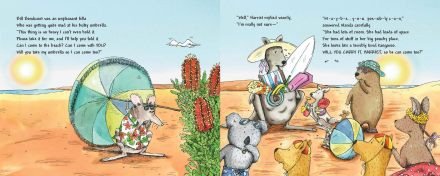
Next they happen upon the Dingo twins who need help with their flying ring—an easy addition to Harriet’s pouch according to Wanda. A little farther down the path they encounter Bill Bandicoot who can no longer hold his beach umbrella. Wanda takes a look at Harriet and for the first time sees that she looks tired and that her pouch is nearly bursting. This time Wanda asks, “‘WILL YOU CARRY IT, HARRIET, so he can come too?”
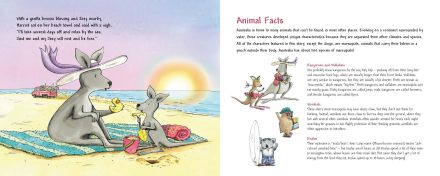
The usual hesitant Harriet has had enough, and she answers “‘NO!’” In fact, she removes everyone’s equipment and tosses it on the sand. “‘I won’t carry your stuff,’” she says. “‘I just QUIT!’” Just then Paddy O’Possum comes along in his pickup truck and offers to take everyone and their gear to the beach. “Now Harriet felt cheerful, thankful, and calm, / And Joey was happy that she was his mom.” With her baby snuggled into her pouch, Harriet finds a perfect spot where they can unwind and “relax by the sea.”
Following the story are two pages of intriguing facts on the various Australian animals depicted in Harriet Can Carry It.
Kirk Jay Mueller’s funny story of a too-nice kangaroo whose relaxing beach vacation is hijacked by a meddlesome neighbor will have kids laughing out loud as Harriet acquires more and bigger belongings on her hike to the shore. Mueller’s rhymed verses wonderfully escalate the plot just as Harriet’s pouch grows as the requests mushroom. As each beach-goer hails Harriet in a new way, kids will wonder what could possibly come next and will delight in the repeated phrases that invite participation on their part. The story can also lead to discussions on how to say “No” when needed and also how to resolve issues before they may cause hurt feelings.
Sarah Vonthron-Laver’s vibrant illustrations of Harriet’s neighborhood and the Australian landscape put the focus on kind-hearted Harriet and the animals she meets and enhances the story’s humor. Wanda the Wombat in her star-shaped sunglasses and flowery flip-flops marches ahead, pointing the way, oblivious to Harriet’s woes. The other animals—accurate cartoon representations of their real counterparts—are equally unaware as they hand Harriet their gear. Harriet’s pouch bulges with the beach items as Harriet finds clever ways to accommodate it all.
Harriet Can Carry It makes for a fun story time read and a perfect take-along book for beach outings or any hike.
Ages 4 – 7
Star Bright Books, 2014 | ISBN 978-1595726766
To learn more about Kirk Jay Mueller, his books, and his music—plus to listen to a song about Harriet—visit his website!
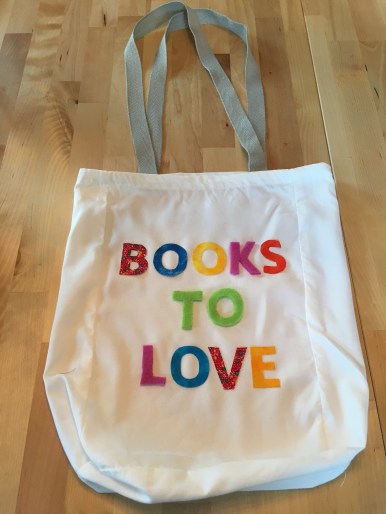
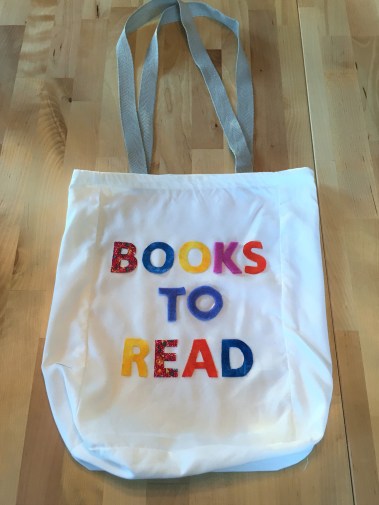
True booklovers can’t go anywhere without a book (or two or three) to read along the way. With this easy craft you can turn a cloth bag into a kid-size book bag!
Small cloth bag, available from craft or sewing stores—Recyclable Idea: I used the bag that sheet sets now come in
Cloth trim or strong ribbon, available from craft or sewing stores—Recyclable Idea: I used the cloth handles from shopping bags provided from some clothing stores
Scraps of different colored and patterned cloth. Or use quilting squares, available at craft and sewing stores
Pen or pencil for tracing letters onto cloth
Scissors
Small sharp scissors (or cuticle scissors) for cutting out the center of the letters
Fabric glue
Thread (optional)
Needle (optional)
Directions
Print the sayings and cut out the letters
Trace letters onto different kinds of cloth
Cut out cloth letters
Iron cloth bag if necessary
Attach words “Books to Read” to one side of bag with fabric glue
Attach words “Books to Love” to other side of bag with fabric glue
Cut cloth trim or ribbon to desired length to create handles















 celebratepicturebooks.com