
About the Holiday
As summer activities transition into going-back-to-school prep and starting a new year of learning, there’s still time to enjoy fun with the family. Whether you plan special events at home, take trips to local attractions, or take a faraway excursion, your shared experiences as a family will make lifelong memories!
Thanks to Bloomsbury Children’s Books for sharing a copy of The Quest for a Tangram Dragon with me for review consideration.
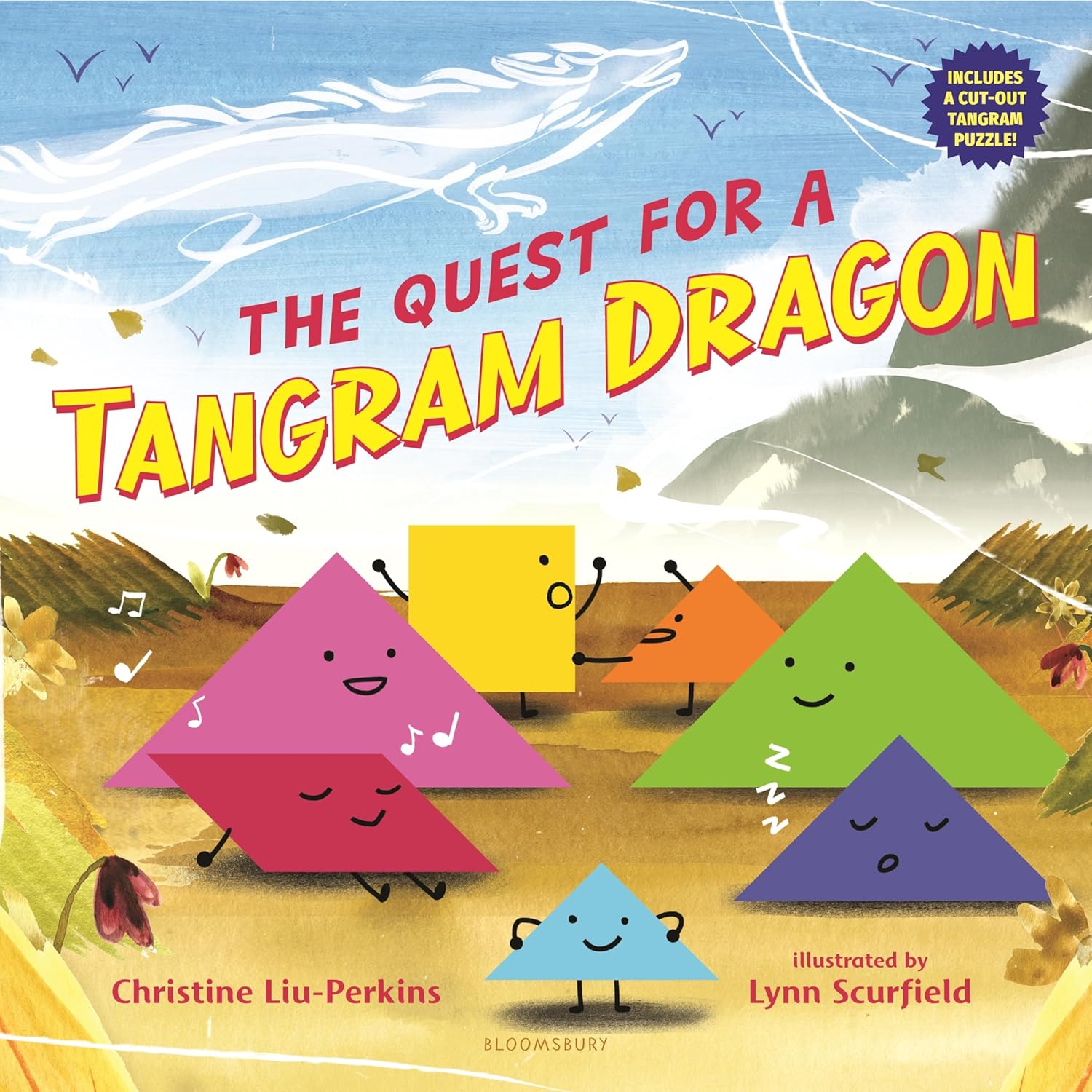
The Quest for a Tangram Dragon
Written by Christine Liu-Perkins | Illustrated by Lynn Scurfield
Little Triangle, tired of waiting for rain to quench the thirst of the brown grass and wilted leaves of the countryside, “decided to search for a good, kind dragon.” Along the way, it played around with all of the things it could make and do, but then it fell point over point down a hill and right into another small triangle. “Nǐ hǎo! Hello!” Little Triangle said in greeting. They talked like old friends, and Second Little Triangle agreed to join Little Triangle’s search for a dragon. They needed to cross a vast meadow, so they flipped and flopped and made three shapes: a bigger triangle, a square, and a parallelogram. None of these shapes would help them, though. But when they “bumped heads, they turned into a butterfly” and soared into the sky.
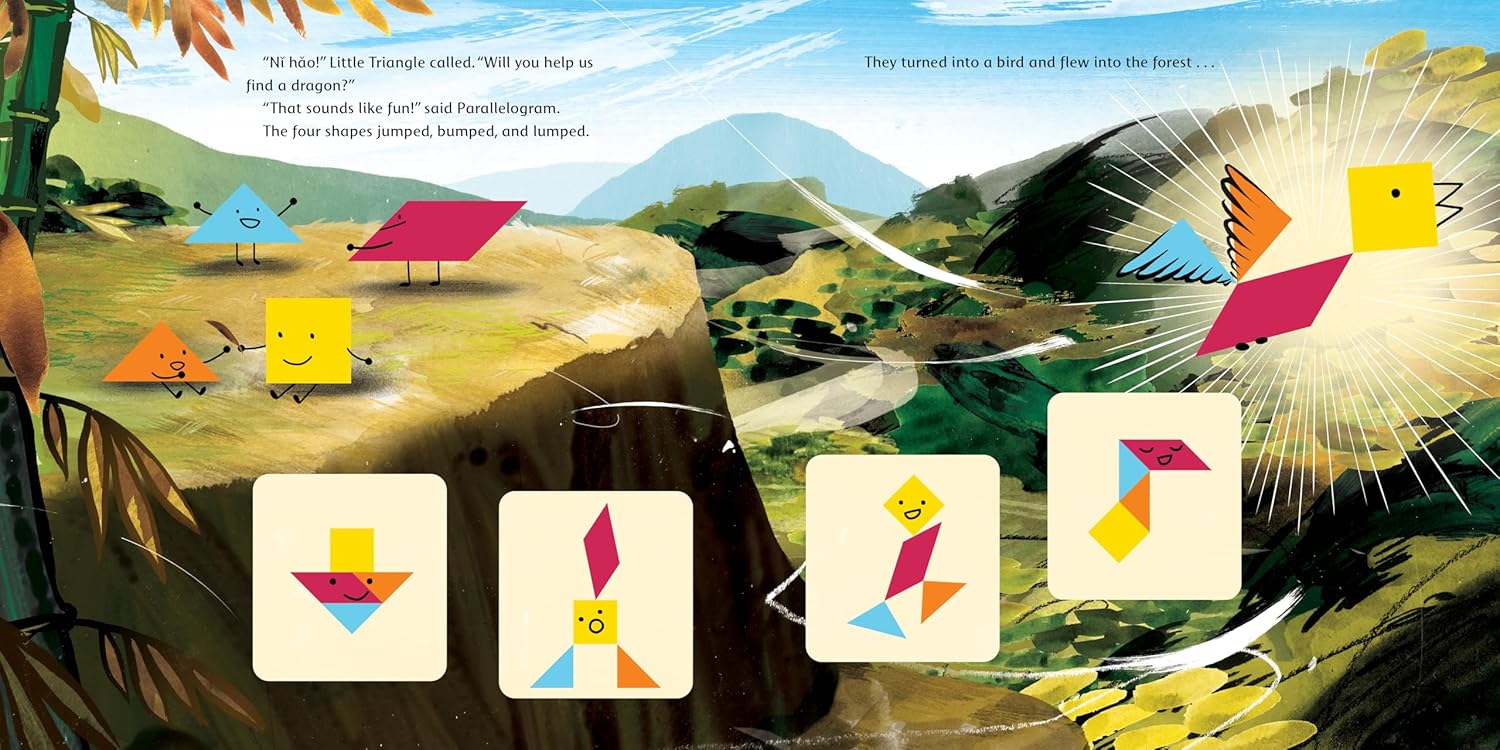
Illustration copyright Lynn Scurfield, 2024. Text copyright Christine Liu-Perkins, 2024. Courtesy of Bloomsbury Children’s Books.
They didn’t find a dragon, but they did see a square. Square was happy to help them on their quest, but how? The three new friends “switched, swapped, and swiveled. Soon they hit on just the right configuration and “turned into a bat.” They listened carefully, but instead of a dragon, they heard another shape singing and dancing and found Parallelogram. It didn’t take long for the four shapes to be off again on their adventure.
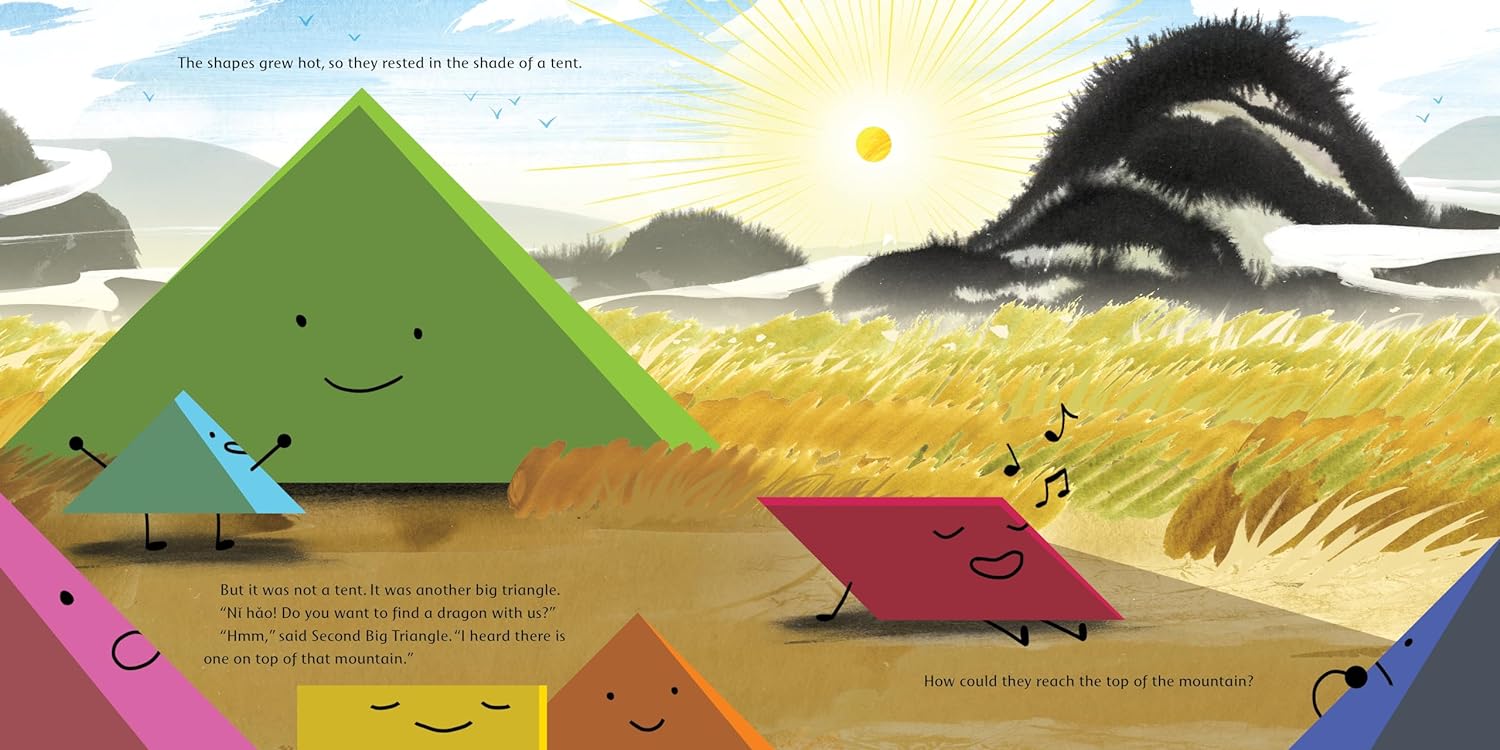
Illustration copyright Lynn Scurfield, 2024. Text copyright Christine Liu-Perkins, 2024. Courtesy of Bloomsbury Children’s Books.
While their search resulted in no dragon sightings, they did meet Medium Triangle, Big Triangle and Second Big Triangle. The group continued shape shifting and looked high and low, but they never spotted a dragon. At last, weary and dejected, the shapes were ready to give up their quest, but Little Triangle convinced them to try one more time.
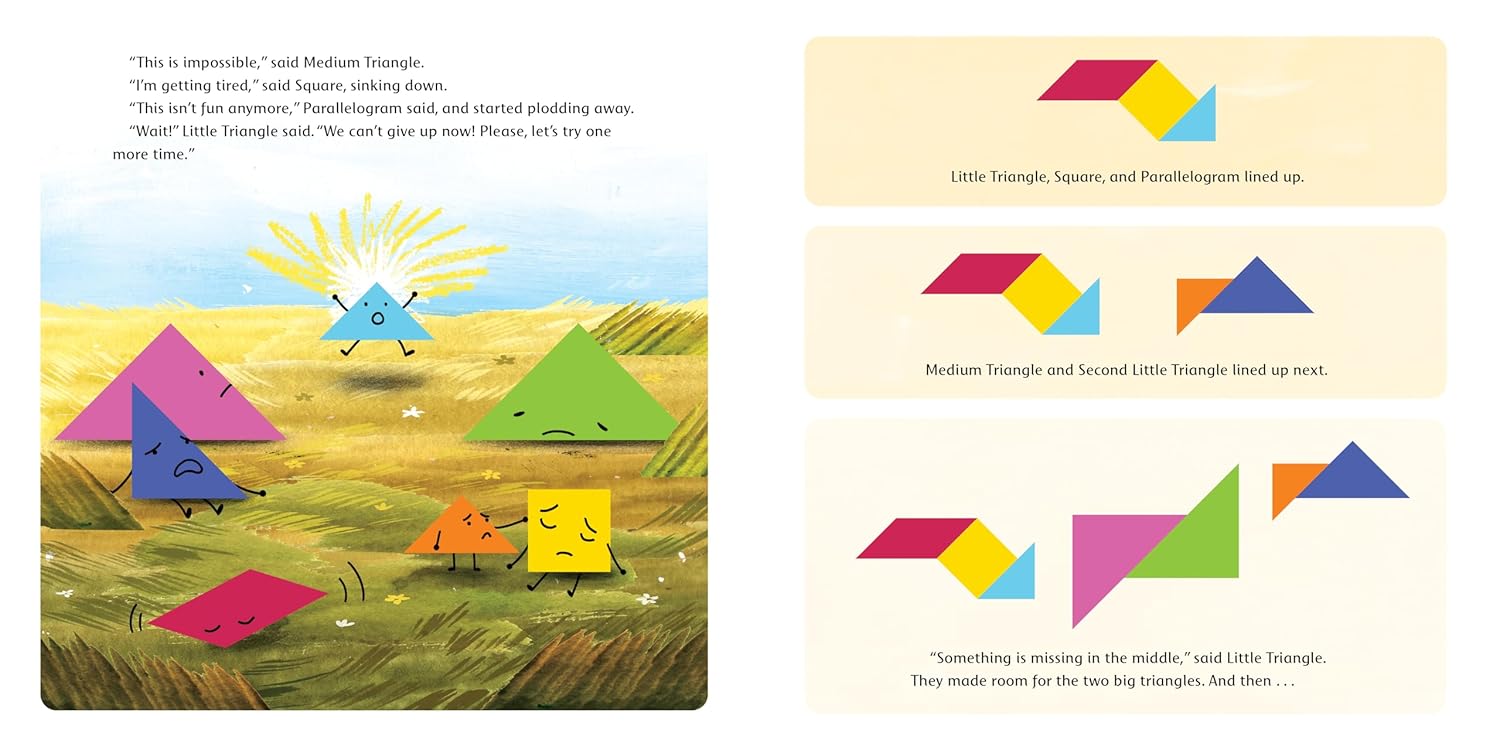
Illustration copyright Lynn Scurfield, 2024. Text copyright Christine Liu-Perkins, 2024. Courtesy of Bloomsbury Children’s Books.
The shapes chose partners and lined up: Little Triangle, Square, and Parallelogram; Medium Triangle and Second Little Triangle; and Big Triangle and Second Big Triangle. Then they got in position and . . . discovered something amazing! They didn’t need to search for a dragon any longer—they were a dragon! “Triumphant, they soared into the sky, breathing out clouds that showered rain over the thirsty land.”
In an Author’s Note following the story, Christine Liu-Perkins explains how to use tans to create geographical configurations, noting that while traditionally all seven tans are used to make a tangram, with her book she wants to encourage young beginners to experiment with fewer tans while building skills. She also reveals the positive meanings of the animals created throughout her story in Chinese culture. She goes on to explain the history of tangrams as well as their value in teaching problem-solving skills, logical thinking, and a vast array of mathematical concepts.
A colorful set of the seven tans found in the story are included for readers to cut out from a flap on the book’s jacket.
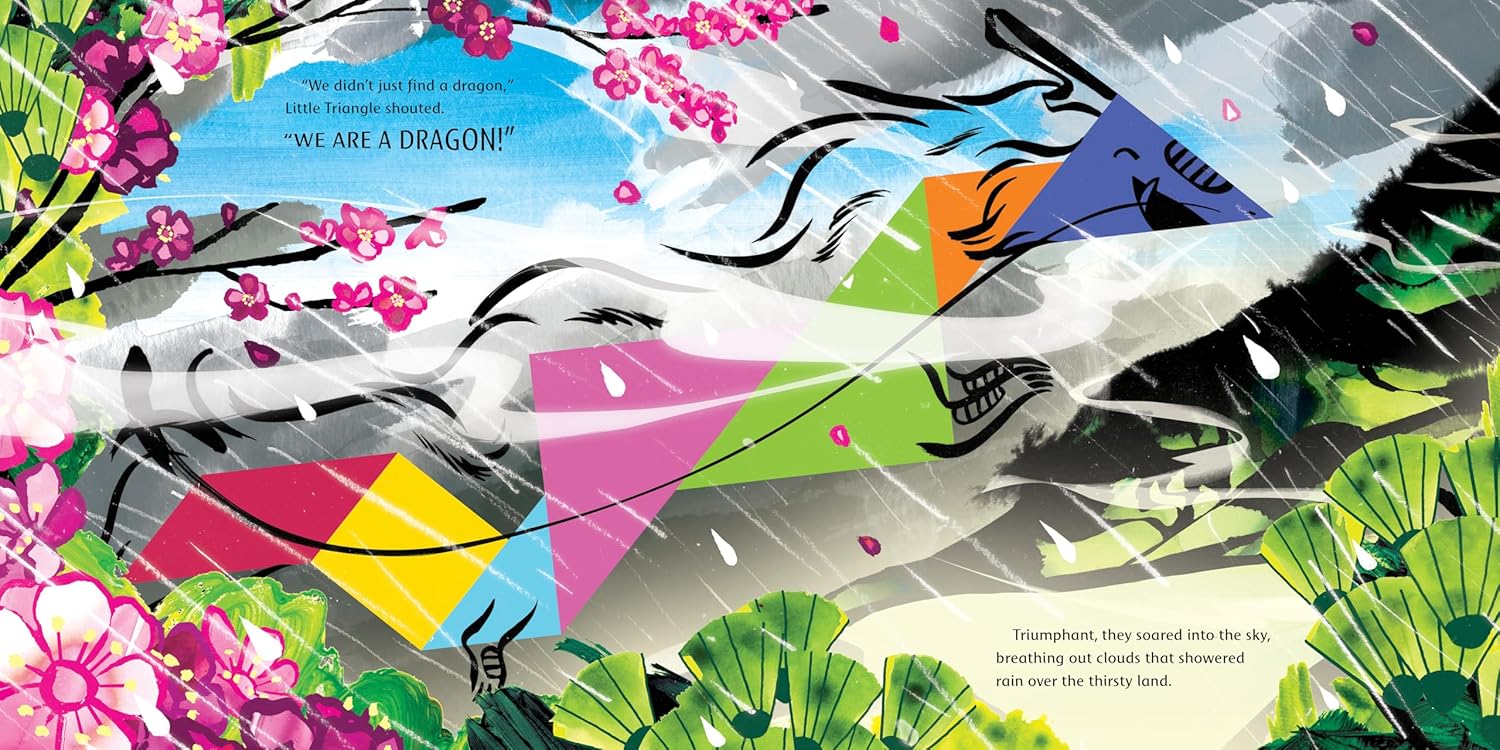
Illustration copyright Lynn Scurfield, 2024. Text copyright Christine Liu-Perkins, 2024. Courtesy of Bloomsbury Children’s Books.
Christine Liu-Perkins’ story will excite kids with an engaging and friendship-filled adventure while introducing them to the fun and creative power of tangrams. As the group grows with the addition of tans, Liu-Perkins uses consonance and rhyming to mirror the way tans can be flipped and swiveled to fit together to create different shapes. The mystery of which creatures or objects the friends will experiment with while seeking just the right one to extend their search will keep readers eagerly turning the pages.
Liu-Perkins layers her story with a series of obstacles the tans need to overcome in order to reach their goal. These include physical barriers, accidental mishaps, and even their own disappointment and exhaustion. As the tans work through these obstacles, kids see how cooperation, understanding, and communication build friendships and contribute to the success of any undertaking. Their final discovery of the dragon is a pleasure.
Set against lush natural backgrounds in Lynn Scurfield’s mixed-media illustrations, the colorful tans create a vivid focal point for kids to easily see what shapes they will make next. Simple lines and brushstrokes added to the tans convey emotion and flesh out distinguishing features of wings, ears, tails, and more for each animal created. The end papers and a two-page spread within the story provide plenty more tangram fun and inspiration.
The Quest for a Tangram Dragon offers simple, creative, and challenging fun that families can enjoy on a game night, relaxing afternoon, or even during a spontaneous break between chores or other activities. The book also makes a terrific addition to classrooms across grade levels to enhance math, problem solving, art, and social studies lessons. School and public libraries will also want to add The Quest for a Tangram Dragon to their collections. The book is especially suited for library interactive story times, combined with magnetic tangram tiles in play areas, and for circulating book and toy kits. For gift-giving occasions, you can’t go wrong coupling this book with a set of tangram tiles.
Ages 5 – 8
Bloomsbury Children’s Books, 2024 | ISBN 978-1547608058
About the Author
Christine Liu-Perkins is a writer and researcher who specializes in Chinese history and culture. Her book At Home in Her Tomb: Lady Dai and the Ancient Chinese Treasures of Mawangdui unearths one of China’s top archaeological finds of the last century. She has a Ph.D. in educational psychology. Born in Boston and raised near Kansas City, Christine now lives in Colorado. Visit her at christineliuperkins.com.
About the Illustrator
Lynn Scurfield is a mixed media illustrator based just outside of Toronto, Canada, who has worked on a variety of projects in newspapers, magazines, comics, and children’s publishing. Her books include Friends Are Friends, Forever and Hold That Thought! Visit her at lynnscurfield.com.
Family Fun Month Activity
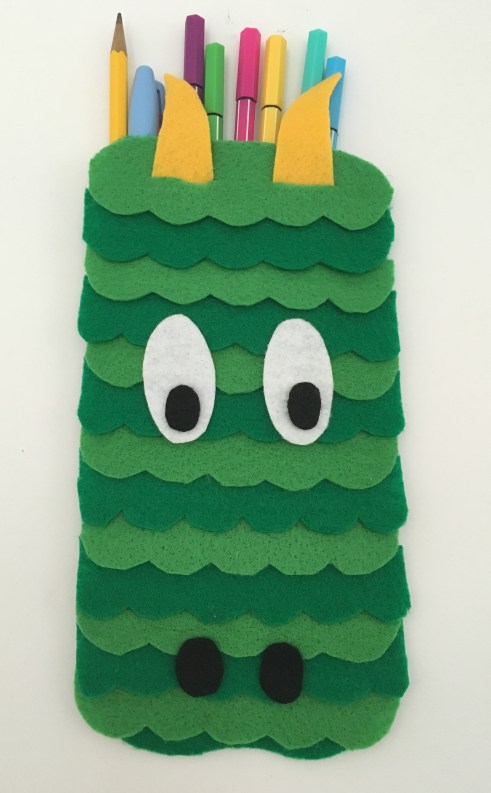
Dependable Dragon Pencil Case
You can always depend on a dragon to help out when needed! With this Dependable Dragon Pencil Case you’ll know just where your pencils, pens, markers, and other creative tools are when inspiration hits!
Supplies
- Printable Dragon Pencil Case Templates – Wings | Face
- Sheets of felt, 8 ½-inch by 11-inch (foam & heavy stock paper could work too)
- 2 Dark green (or color of your choice)
- 1 Light green (or color of your choice)
- 1 white
- 1 black
- 1 yellow (or color of your choice)
- 1 purple (or color of your choice)
- Fabric Glue
- Scissors
- Velcro (optional)
- Green Thread and needle (if you would like to sew instead of glue your case)
- Glitter glue (optional)
Directions
- Print the Dragon Templates
- Cut out alternating 7 rows of scales from the dark green felt and 7 rows of light green felt (One row of the template scales is longer so you can tile them as shown on double row of scales the template. You will trim them later.)
- To make the top of the head, cut a rounded top (instead of straight across—see picture).
- Cut the eyes from the white felt, pupils and nostrils from the black felt, horns from the yellow felt, and wings from the purple felt. Set aside.
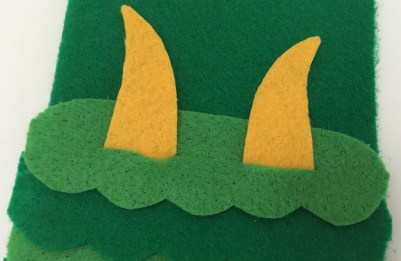
To make the head
- Fold one dark piece of felt in half lengthwise to make the pocket for your supplies
- Cut a wavy line along the bottom of the felt to make lips (see picture)
- Glue or sew the open side and bottom together, leaving the top open
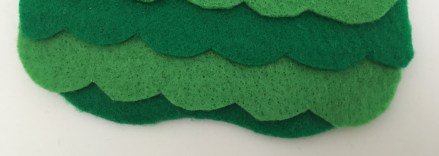
To add the scales
- Starting at the bottom, lay one row of scales a little above the wavy bottom. Glue the top of the row to the folded pocket base.
- Overlap an alternating green row of scales on the first row, glue the top to the folded pocket base
- Continue alternating dark and light green scales until you reach 9 inches on the folded pocked base
- Use the rounded row of scales for the top of the head. See how to insert horns below before attaching the top of head.
To insert the horns
- On the rounded row of scales, mark where you want the horns to be
- Cut two small slits in the felt where the horns will go
- Insert the bottoms of the horns into the slits
To finish the head
- Glue the top of the head with horns to the folded pocket base
- Trim any longer rows of scales to meet the edges of the folded pocket base
- Add the eyes and nostrils to the face
To make a Velcro closure for the case
- Cut the base following the line of the rounded row of scales
- Glue or sew strips of Velcro along the inside edges
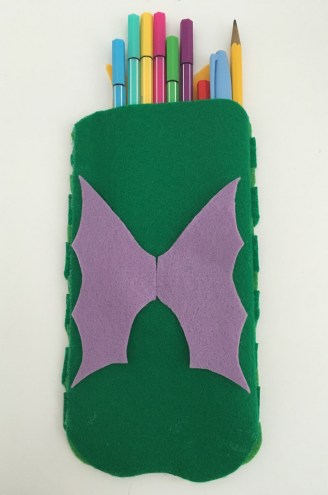
To attach the wings
- Turn the dragon case to the back
- Glue or sew the wings to the center of the back, attaching them at the center edge
- Outline or sprinkle the wings with glitter glue (optional)
You can purchase The Quest for a Tangram Dragon at these booksellers
Amazon | Barnes & Noble | Bookshop (to support your local independent bookstore)
Picture Book Review

























 celebratepicturebooks.com