December 4 – Wildlife Conservation Day

celebrate-picture-books-picture-book-review-over-and-under-the-rainforest-cover

About the Holiday

Established in 2012 by former Secretary of State Hillary Clinton, Wildlife Conservation Day aims to raise awareness of the importance of preserving and protecting the natural world and its inhabitants. The day also brings attention to the disastrous effects of wildlife crime – including illegal poaching and smuggling of animals or animal parts, such as tusks or horns – on animal populations. People are also asked to support the Endangered Species Act, which was signed into law in 1973 by President Richard Nixon. In 2019 the Act was substantially weakened when President Trump reduced regulations, putting many more animals at risk. Today, Wildlife Conservation Day is celebrated around the world by organizations and individuals dedicated to protecting and preserving our natural inheritance – unique places and creatures like those explored in today’s book.

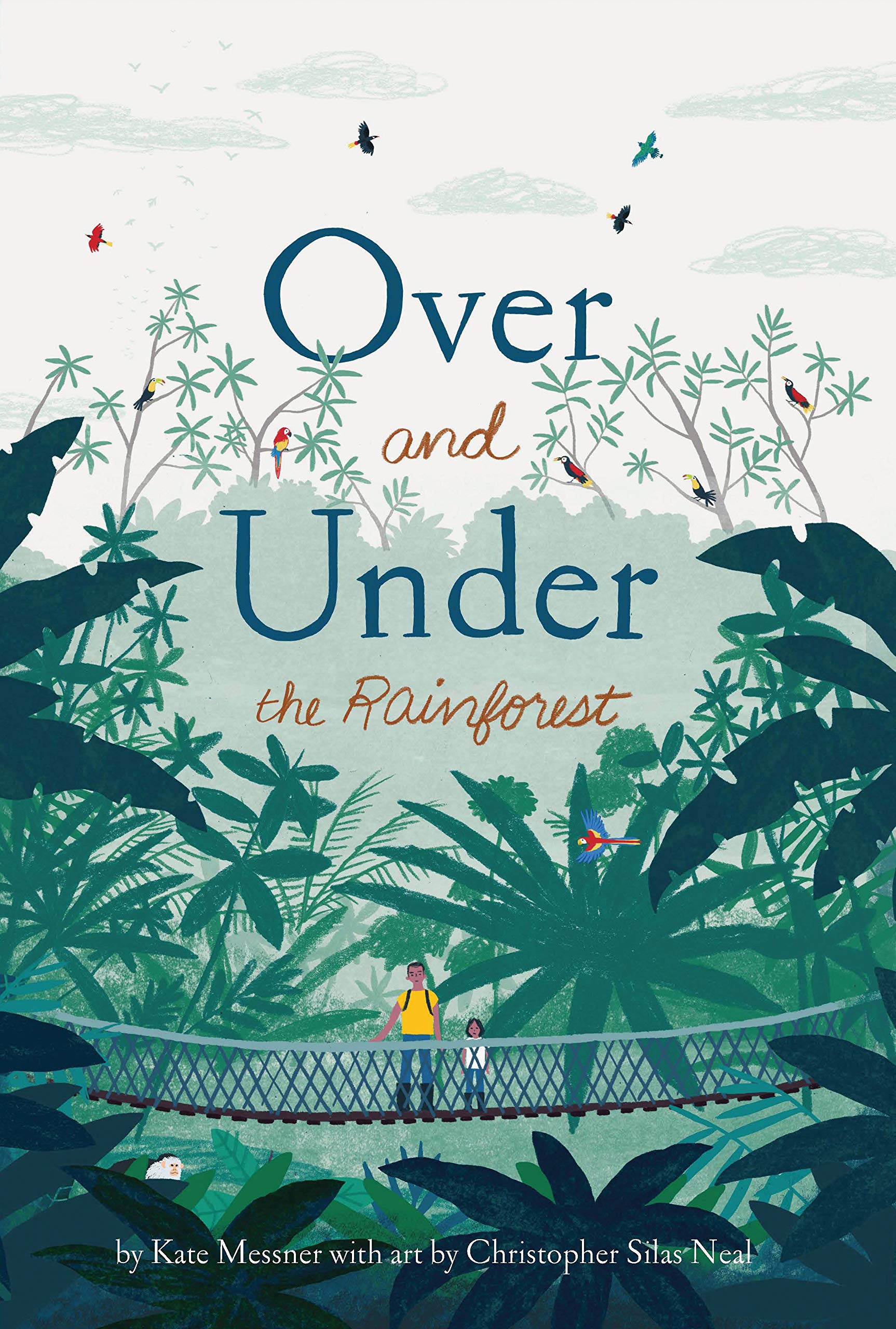
Over and Under the Rainforest

Written by Kate Messner | Illustrated by Christopher Silas Neal


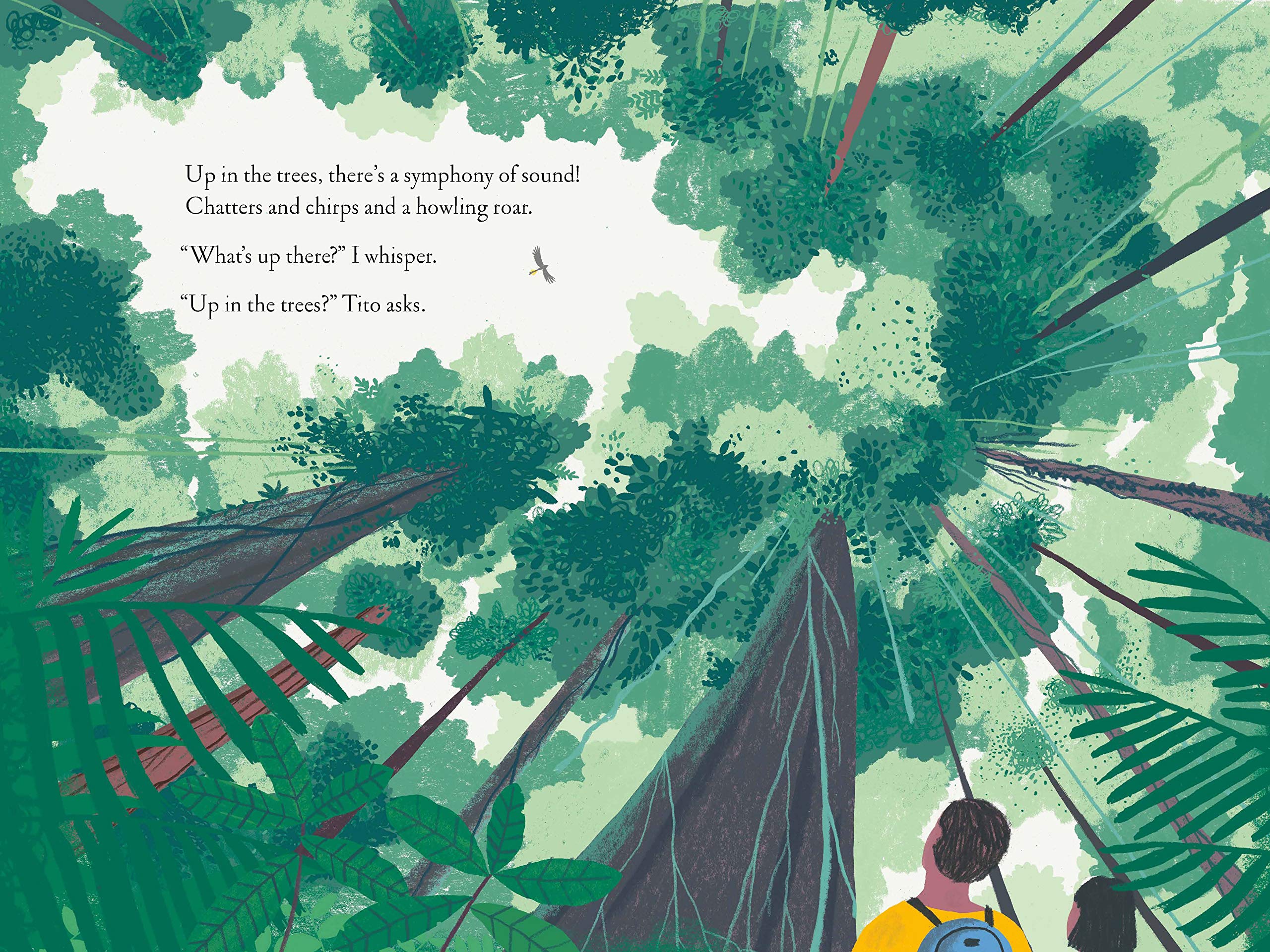
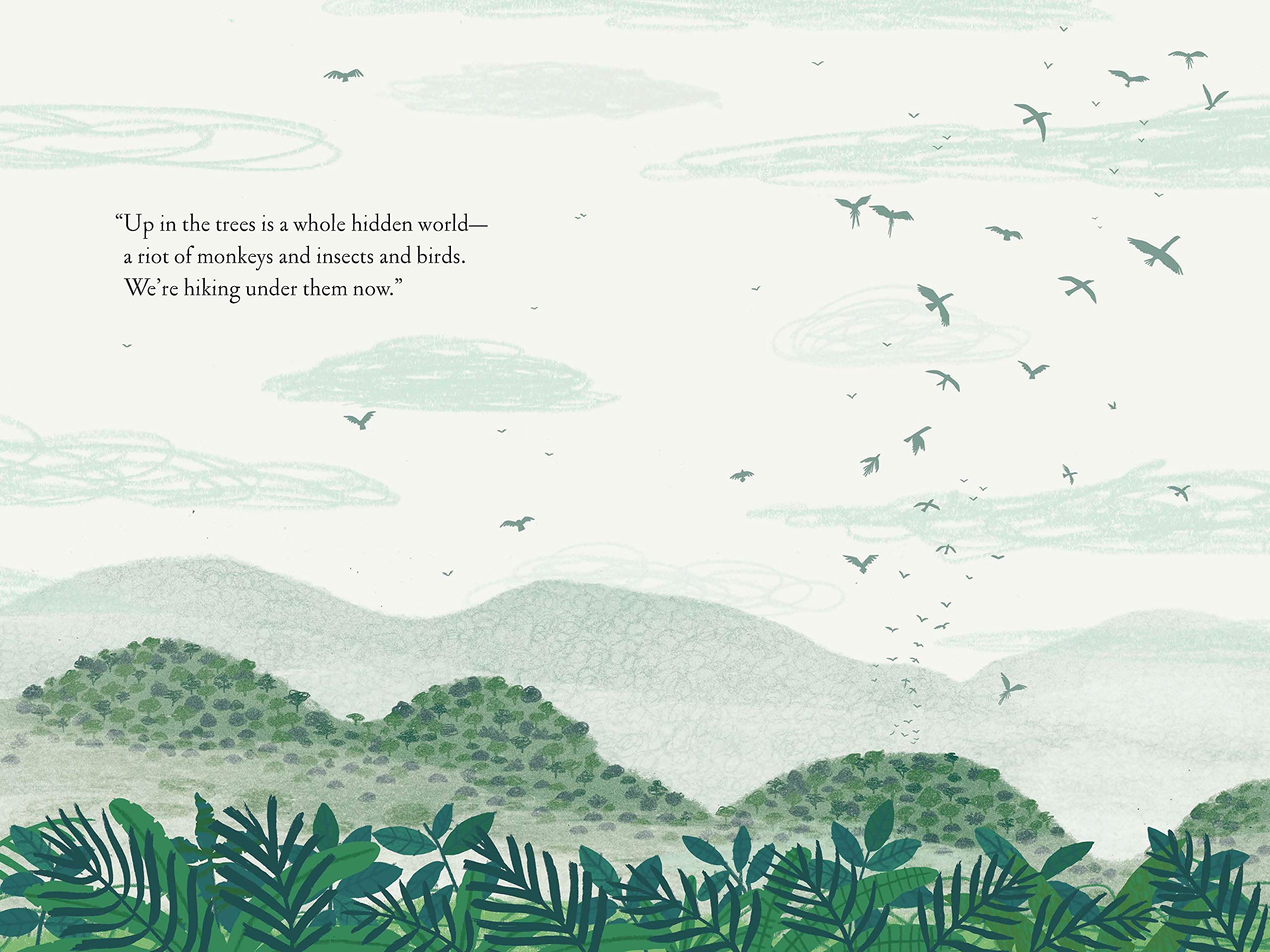
A child narrator enters the rainforest with Tito, who is, perhaps, an older brother, an uncle, or a cousin. The sun filters in, glistening on the raindrop-jeweled leaves. Looking up into the treetops and the clear sky from where “chatters and chirps and a howling roars.” The child wants to know what’s above them, and Tito answers that there is a “whole hidden world” that they are hiking under. They hear the “gurgle” of red, black, and yellow oropendolas in their bag-like nests and the “croak” of toucans.

celebrate-picture-books-picture-book-review-over-and-under-the-rainforest-treetops

Image copyright Christoper Silas Neal, 2020, text copyright Kate Messner, 2020. Courtesy of Chronicle Books.

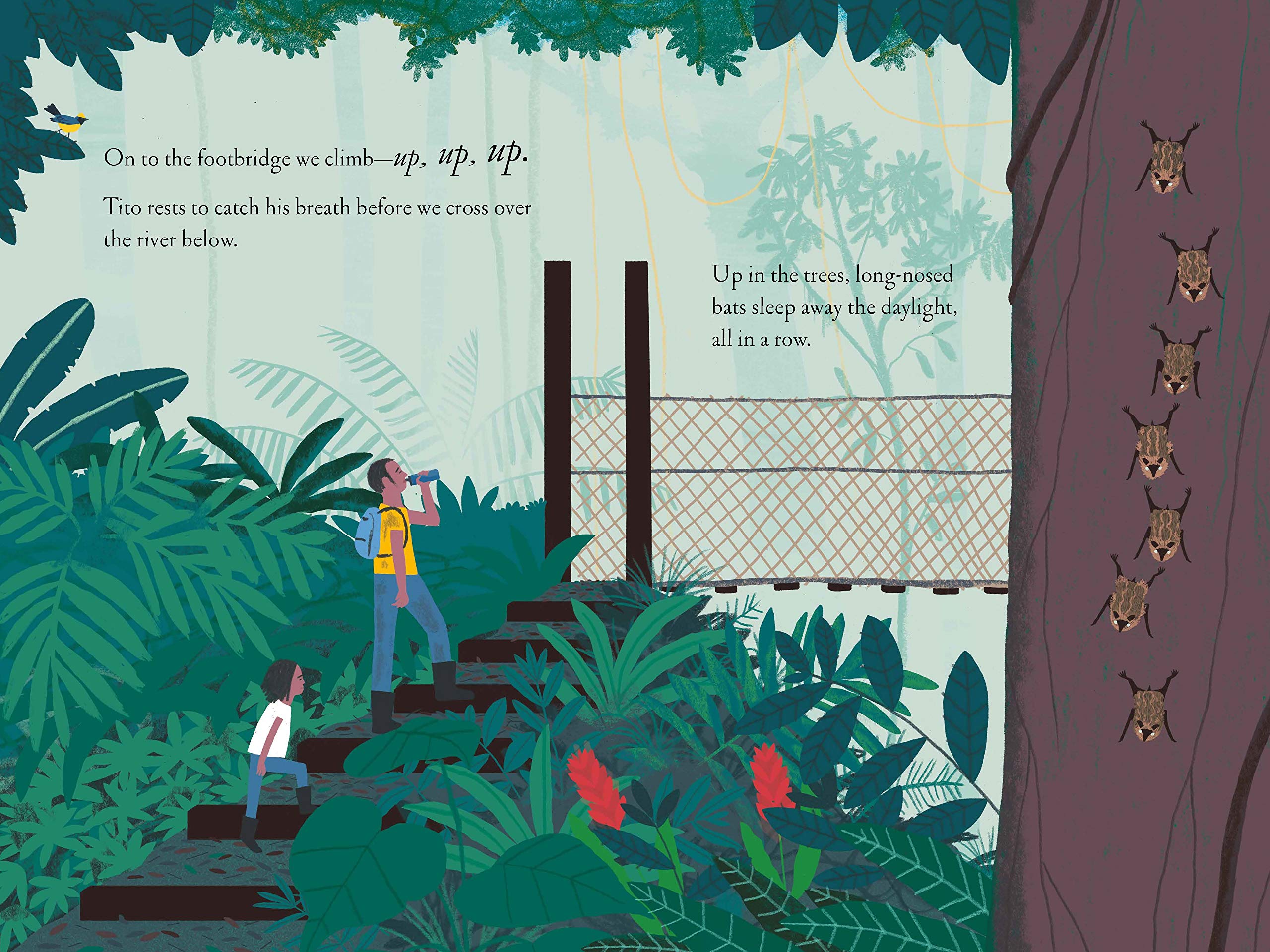
They stop on the bridge that crosses a river and look down at the crocodiles napping on the banks. An emerald basilisk has no time to rest, though, and runs across the river, his feet “barely skimming the river’s surface.” The bridge takes them up, into the trees, where capuchin monkeys swing from branch to branch. While having a snack, the child and Tito watch an anteater hunt for a snack of his own below among fallen leaves.

celebrate-picture-books-picture-book-review-over-and-under-the-rainforest-birds

Image copyright Christoper Silas Neal, 2020, text copyright Kate Messner, 2020. Courtesy of Chronicle Books.

The afternoon brings expected rain, which begins as a “pitter-soft drumming on the leaves up above” but “swells to a strong, rushing pour” that soaks a “soggy mother sloth and her baby” while a blue morpho butterfly “folds up her wings and tucks away on a tree trunk.” They walk deeper into the forest, where silent snakes slither and curl around branches. Spying a dark shape in a treetop, Tito, with a roar, unleashes “a thunder of howler monkeys” concealed from sight.

celebrate-picture-books-picture-book-review-over-and-under-the-rainforest-toucans

Image copyright Christoper Silas Neal, 2020, text copyright Kate Messner, 2020. Courtesy of Chronicle Books.

Dusk comes and then the curtain of night. Tito and the child head for home, spying animals and insects who are just beginning their day along the way. But suddenly a “sharp snap” in the undergrowth stops the child. Could it be a jaguar? They hurry across the last bridge and see the lights from Abuelita’s house. They know a dinner of arroz con pollo is waiting as the birds return to their homes too and another chorus begins—“a night song of darkness and water and life—over us, under us, and all around.”

Exciting back matter includes an Author’s Note about the inspiration for this book as well as illustrated paragraphs about the twenty birds, animals, and insects mentioned in the story.

celebrate-picture-books-picture-book-review-over-and-under-the-rainforest-bridge

Image copyright Christoper Silas Neal, 2020, text copyright Kate Messner, 2020. Courtesy of Chronicle Books.

Lyrical and evocative, Kate Messener’s hike through a Costa Rican rainforest envelopes readers in the sights, sounds, and atmosphere of this mysterious ecosystem. Her well-loved Over and Under series serves as a perfect guide to a place where life in all its forms teems in the lush landscape. Messner’s tranquil and graceful storytelling makes for a lovely read aloud that will captivate readers, and her first-person point of view invites each listener to imagine themselves taking this transformative walk.

Christopher Silas Neal’s soft-yet-vivid matte illustrations capture the mystery and wonder of the rainforest from the first page, where Tito and the narrator head into the forest through a dark entryway that seems to slowly reveal itself as a series of steps leading into the trees. Just as kids would be prone to do, upon entering the forest, the narrator and Tito look up into the towering treetops, focusing the readers’ eyes there too. Neal’s use of a variety of perspectives gives readers an experience similar to the book’s characters and allows them to feel the vastness of the environment. The number of unusual animals, birds, and insects they encounter in this forest will wow kids, and they’ll enjoy searching the leaves, branches, and undergrowth to find what is hidden there. This nighttime scene provides a thrill as bright eyes shine from the trees—the only evidence of the shadowy creatures lurking there.

A beautiful book for any nature lover or child fascinated by the wonders of the world, Over and Under the Rainforest is a must. The book would be a treasured addition to home, school, and public library collections.

Ages 5 – 8

Chronicle Books, 2020 | ISBN 978-1452169408

Discover more about Kate Messner and her books on her website.

To learn more about Christopher Silas Neal, his books, and his art, visit his website.

Wildlife Conservation Day Activity

celebrate-picture-books-picture-book-review-wonderful-wildlife-board-game

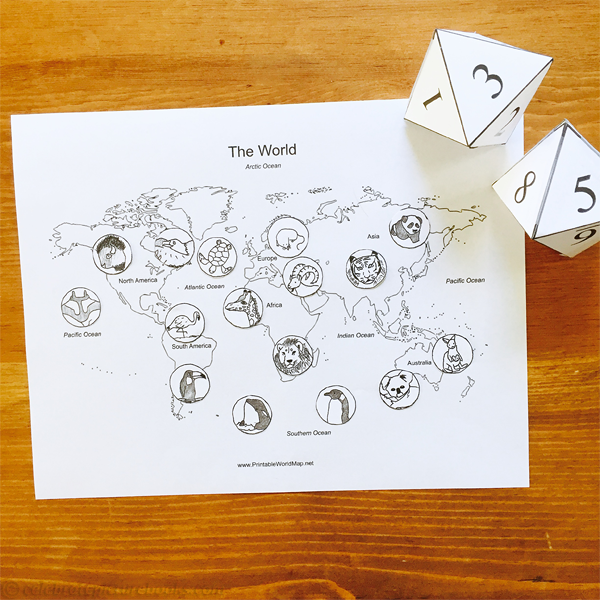
Fascinating animals are found in every part of the world. Play this fun printable Wonderful Wildlife Board Game to match each animal to the area where it lives.

Supplies

Directions

  1. Print a World Map for each player
  2. Print one set of 16 Wildlife Tokens for each player
  3. Print two copies of the 8-sided die, fold, and tape together
  4. If you would like, color the map and tokens
  5. Choose a player to go first
  6. Each player rolls both dice and places an animal on their map according to these corresponding sums of the dice as shown on printable guide
  7. The first player to fill their map is the winner!

celebrate-picture-books-picture-book-review-over-and-under-the-rainforest-cover

You can find Over and Under the Rainforest at these booksellers

Amazon | Barnes & Noble | Books-a-Million

To support your local independent bookstore, order from

Bookshop | IndieBound

Picture Book Review


November 14 – It’s Geography Awareness Week

celebrate-picture-books-picture-book-review-into-the-forest-cover

About the Holiday

Today’s holiday was instituted in 1994 by National Geographic to get people excited about geography and its importance to education and everyday life. As defined by National Geographic, geography is “the study of places and the relationships between people and their environments.” This discipline includes how humans interact with the environment and the impact of location on people. These important questions affect a wide range of issues. More than 100,000 people across the country participate in Geography Awareness Week through special events, focused lessons and activities in classrooms, and attention by government and business policy-makers. To learn more about the week and discover resources for further education, visit the National Geographic website.

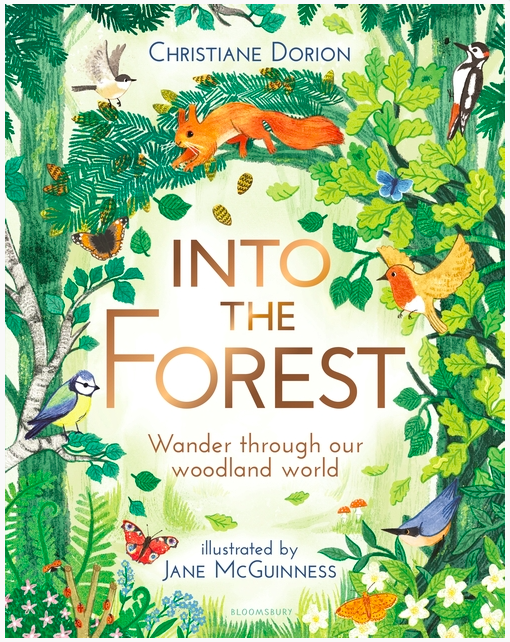
Into the Forest: Wander through Our Woodland World

Written by Christiane Dorion | Illustrated by Jane McGuinness


Forests, with their stands of ancient, towering trees capped with leafy canopies and thin saplings reaching for their bit of sun are mysterious, awe inspiring, and home to some of the world’s most fascinating creatures. In Into the Forest Christiane Dorion and Jane McGuinness take readers through coniferous forests, deciduous forests, and tropical rainforests around the world to introduce readers to the life found there.

Readers first learn how a single tree grows from a seed to a full-grown beauty and see how the tree is nurtured and how it nurtures insects and animals in return. But a single tree does not make a forest. Children discover the ways in which many trees work together to create a forest and how the creatures attracted to the forest interact as well.

celebrate-picture-books-picture-book-review-into-the-forest-winter

Image copyright Jane McGuinness, 2020, text copyright Christiane Dorion, 2020. Courtesy of Bloomsbury Children’s Books.

“Deciduous forests are found in places where there is plenty of rain and four distinct seasons through the year.” Animals roost in the trees’ trunks, root systems, and branches. “On the forest floor, small creatures snuffle, crawl, or hop under the thick carpet of fallen leaves in search of food and a safe place to shelter.” These trees have distinctive leaves and undergo changes as the seasons change. Like the trees, the animals that live in a deciduous forest also adapt to the weather, the abundance or scarcity of food, and sheltering needs. Readers learn fascinating facts about the ingenuity of the forest’s insects and animals.

After learning about the deciduous forest, readers will want to discover them for themselves. Through lyrical descriptions and charming, realistic illustrations, Dorion and McGuinness show children and adults how and where to look and listen to find the treasures the forest holds. But there can be so many different trees in a forest—or even in a backyard or neighborhood. How do you know which is which? Dorion and McGuinness provide an illustrated guide to the names, shape, size, and type of leaf of twenty deciduous trees.

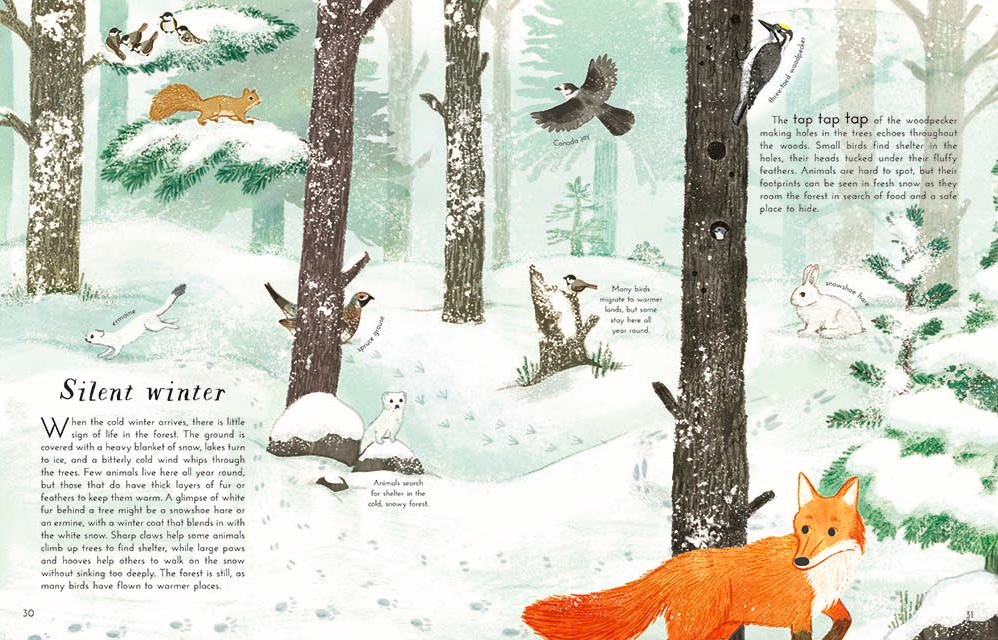
Across the northern hemisphere, coniferous forests stand tall and stalwart against bitterly cold winters while attracting some of the most majestic creatures in the animal kingdom. “Most trees in the coniferous forest are evergreens with needle-like leaves” that stay green and shed little-by-little all year round. Instead of flowers, coniferous trees produce their seeds in cones. Squirrels and birds, who can use their sharp beaks and acrobatic flying and hanging skills, find food in these cones during long winters.

celebrate-picture-books-picture-book-review-into-the-forest-redwoods

Image copyright Jane McGuinness, 2020, text copyright Christiane Dorion, 2020. Courtesy of Bloomsbury Children’s Books.

In coniferous forests, the floor is dark, wet, and can be rocky or even frozen year-round. Moss, fungi, lichen, and carnivorous plants are some of the vegetation found here. Readers learn how these plants grow, what they look like, and the animals that thrive on them. How do the forest animals survive the harsh winter conditions? Dorion and McGuinness follow ermine, grouse, a snowshoe hare, bats, chipmunks, bears, and other birds and animals as they navigate their cold home. They then take kids to the west coast to look up, up, up at the mammoth redwoods, some of which “have lived for more than two thousand years.”

There is a wide variety of coniferous trees, and again Dorion and McGuinness present a guide to the size, shape, and type of needles and cones of fourteen trees. And why are evergreens shaped like a triangle? The clever answer to that question is here too.

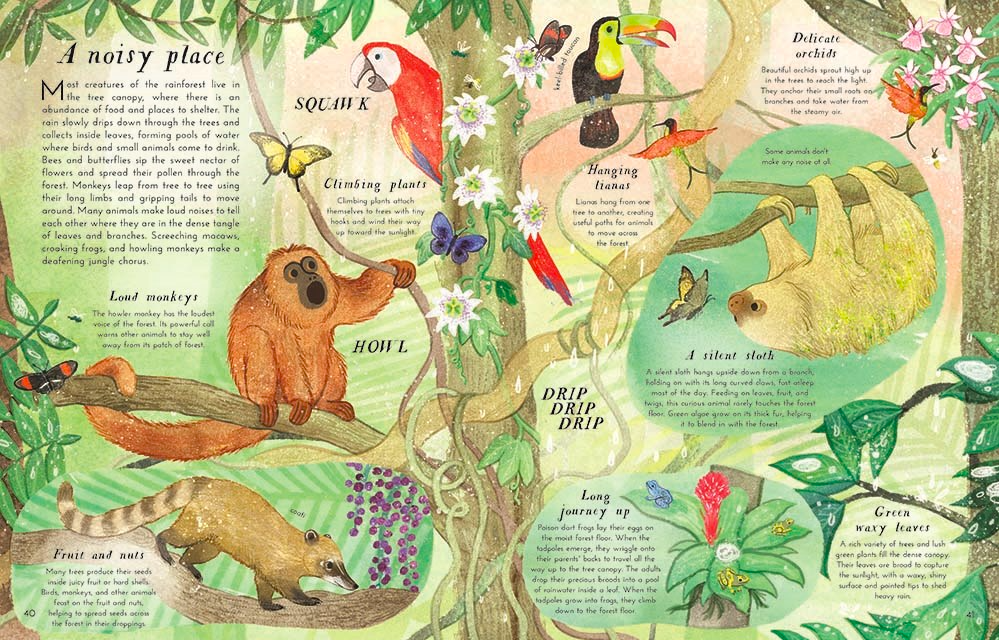
When you think of colorful birds and animals, you think about tropical rainforests. Dorion and McGuinness. Found near the equator, rainforests are home to “more than half of the know plants and animals in the world” and “more are yet to be discovered.” In a glorious riot of color, climbing vines, vibrant flowers and fruit, Dorion and McGuinness introduce readers to the denizens of these forests, where rain and warm weather provide plenty of food and water; “monkeys leap from tree to tree using their long limbs and gripping tails to move around;” and “screeching macaws, croaking frogs, and howling monkeys make a deafening jungle chorus” to “tell each other where they are in the dense tangle of leaves and branches.”

celebrate-picture-books-picture-book-review-into-the-forest-rainforest

Image copyright Jane McGuinness, 2020, text copyright Christiane Dorion, 2020. Courtesy of Bloomsbury Children’s Books.

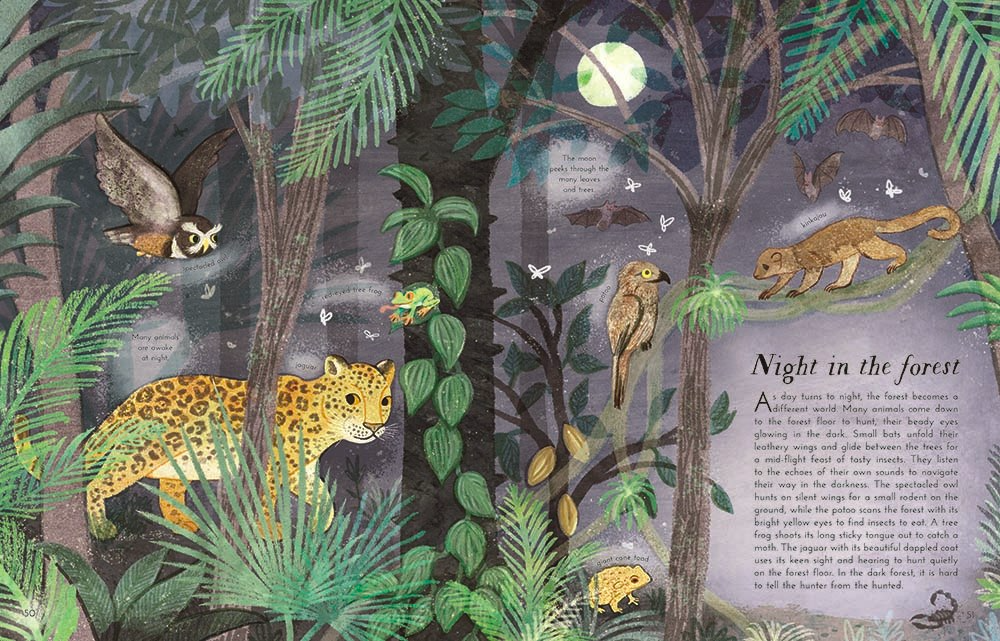
Readers will meet animals including the howler monkey, coati, toucan, parrot, poison dart frog, and sloth. Kids also learn about hanging lianas, orchids, and why plants have waxy leaves. All of that vegetation above means that the forest floor is dark and damp, making it the perfect place for some of the world’s most unusual—and feared—creatures, including snakes, spiders, jaguars, the giant centipede, and the Hercules beetle.

Frequent rain is the lifeblood of these tropical forests, and Dorion and McGuinness describe and depict their unique atmosphere as well as the ingenious adaptations some animals use to hide in plain sight and fool predators and the way nighttime transforms the forest into a feeding ground for nocturnal animals. The guide to fourteen tropical trees introduces readers to a wide variety from palm trees to fruit trees, like mango and avocado, to trees that produce nuts, cinnamon, cacao, and chicle for gum.

Dorion and McGuinness close out their book with discussions on how plants, insects, and animals work together to ensure the growth and heath of a forest; the ways in which a forest benefits the planet; and how to plant a tree so that it will thrive. Readers will love the illustrated prompt to find twenty-seven creatures within the pages of the book, giving them an exciting way to turn back to discover all the gems included in the text.

A glossary defines twenty-two terms found in the text, and a list of organizations and links to their websites complete the back matter.

celebrate-picture-books-picture-book-review-into-the-forest-night

Image copyright Jane McGuinness, 2020, text copyright Christiane Dorion, 2020. Courtesy of Bloomsbury Children’s Books.

Christiane Dorion’s beautiful language and richly detailed narration take children into the three types of forests to see and hear how these natural communities of trees, plants, animals, birds, insects, and even weather patterns work together to maintain what are indispensable parts of our earth. The facts Dorion chooses to present will captivate young learners, telling them enough about each subject to educate while sparking a desire to know more. Perfectly paced, her text creates a lovely flow and visual accompaniment to Jane McGuinness’s gorgeous illustrations.

McGuinness astounds on every page with lush images of the various types of forests in warm weather and the coldest of conditions, during daylight and nighttime, during quiet periods and busy times. Her realistically portrayed intense textures, vivid colors, unique shapes, and furtive or carefree movements of nature invite readers into the depths of the forests to truly see what is there.

Lingering over the pages rewards readers with hidden delights, such as tiny animals peeking from the knot hole of a tree, little caterpillars inching their way across leaves, a nest with three eggs secured within the branches of a spring-green tree, and masters of camouflage motionless and nearly undetectable. Spotlighted facts and the intermittent detailed guides to specific trees, creatures, and the science of forests not only teach readers about these particular features but reinforce how nature collaborates to survive and grow.

Superbly conceived, Into the Forest is a must for home, classroom, and public library collections for nature lovers, school and homeschool lessons, and anyone who would like to learn more about our planet.

Ages 7 – 15

Bloomsbury Children’s Books, 2020 | ISBN 978-1526600707

Discover more about Christiane Dorion and her books on her website.

To learn more about Jane McGuinness, her books, and her art, visit her website.

Geography Awareness Week Activity

celebrate-picture-books-picture-book-review-wonderful-wildlife-board-game

Wonderful Wildlife Board Game


Fascinating animals are found in every part of the world. Play this fun printable Wonderful Wildlife Board Game to match each animal to the area where it lives.

Supplies

Directions

  1. Print a World Map for each player
  2. Print one set of 16 Wildlife Tokens for each player
  3. Print two copies of the 8-sided die, fold, and tape together
  4. If you would like, color the map and tokens
  5. Choose a player to go first
  6. Each player rolls both dice and places an animal on their map according to these corresponding sums of the dice below
  7. The first player to fill their map is the winner!
  • 1 = Flamingo – South America
  • 2 = Emperor Penguin – Antarctica (Southern Ocean)
  • 3 = Giraffe – Africa
  • 4 = Bald Eagle – North America
  • 5 = Ibex – Europe
  • 6 = Kangaroo – Australia
  • 7 = Panda – Asia
  • 8 = Orca – Antarctica (Southern Ocean)
  • 9 = Toucan – South America
  • 10 = Buffalo – North America
  • 11 = Koala – Australia
  • 12 = Lion – Africa
  • 13 = Etruscan Shrew – Europe
  • 14 = Manta Ray – Pacific Ocean
  • 15 = Sea Turtle – Atlantic Ocean
  • 16 = Tiger – Asia

celebrate-picture-books-picture-book-review-into-the-forest-cover

You can find Into the Forest at these booksellers

Amazon | Barnes & Noble | Books-a-Million

To support your local independent bookstore, order from

Bookshop | IndieBound

Picture Book Review
 

November 7 – National Bison Day

celebrate-picture-books-picture-book-review-my-bison-cover

About the Holiday

Beginning in 2012, a movement grew to name the bison as America’s national mammal and declare the first Saturday of November as National Bison Day to bring together bison supporters, including Native Americans, bison producers, conservationists, sportsmen, and educators to celebrate the significance of Bison. On May 9, 2016, President Barak Obama signed into law the proclamation naming the bison our national mammal.

The bison, also known as the American buffalo are considered a historical symbol of the United States and were integrally linked with the economic and spiritual lives of many Native American tribes through trade and sacred ceremonies. Bison also play an important role in improving soil and creating beneficial habitat whilst holding significant economic value for private producers and rural communities. Hunted to near extinction, bison now reside in all 50 states in national parks, refuges, tribal, and private lands.

My Bison

By Gaya Wisniewski


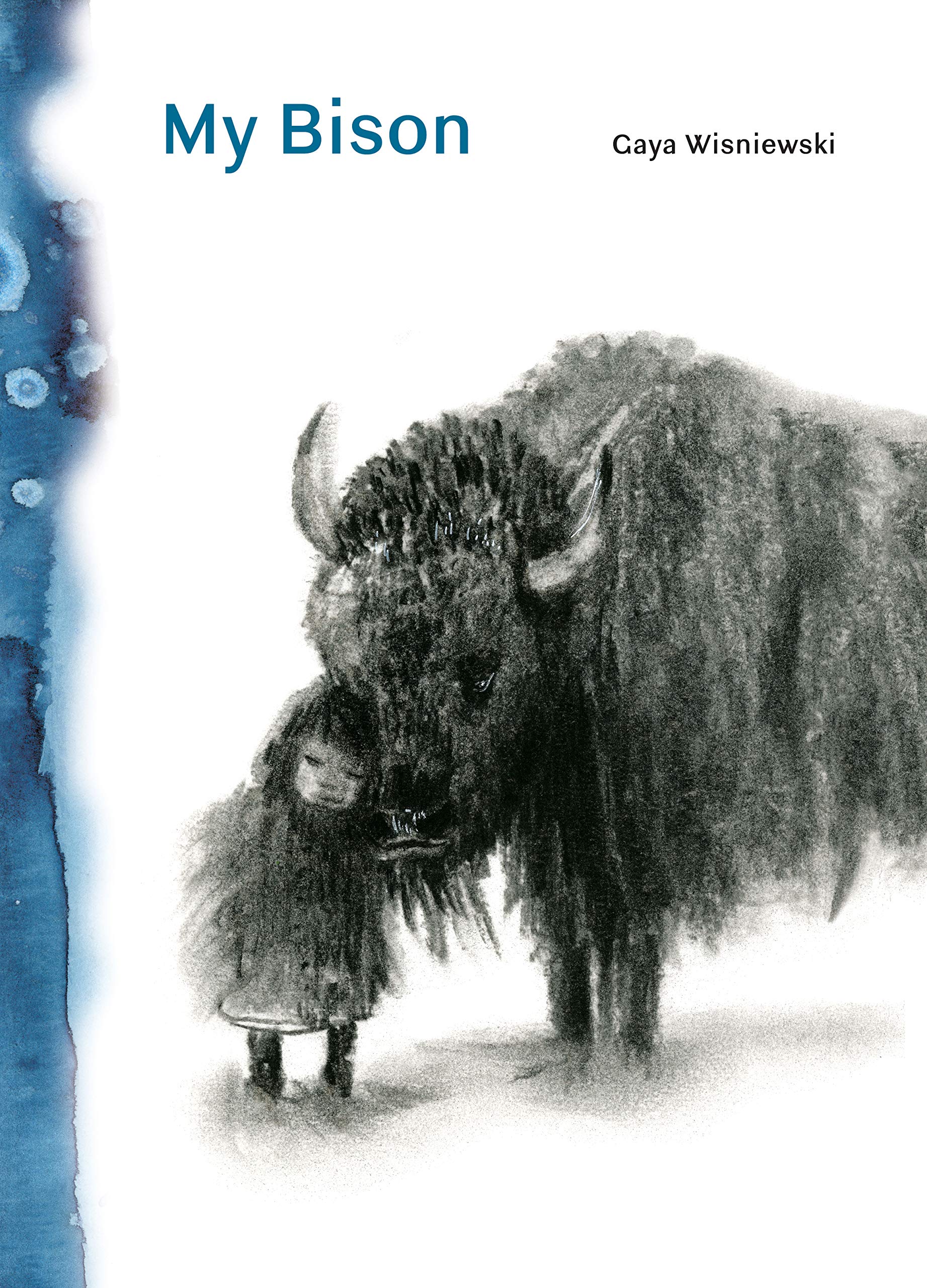
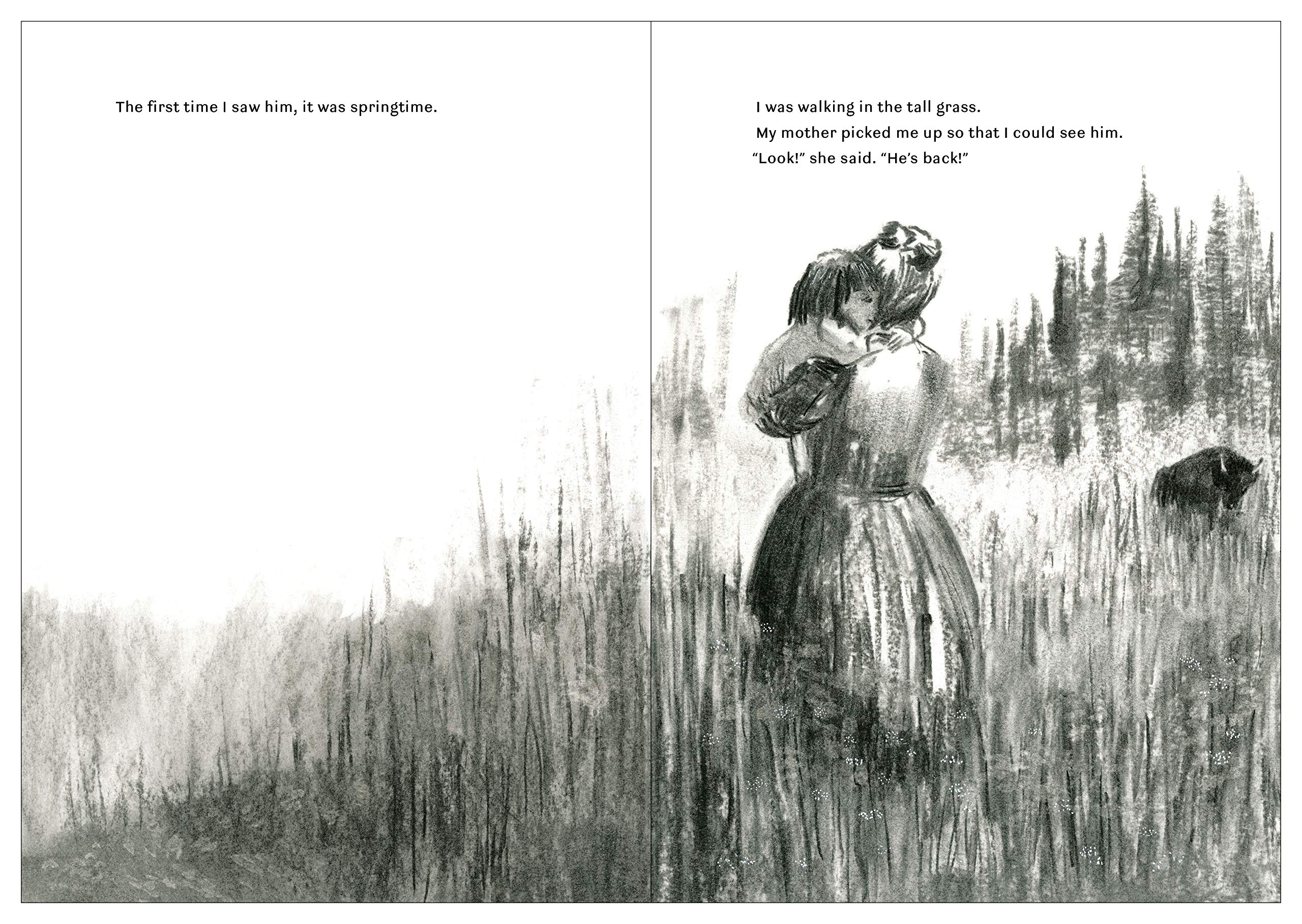
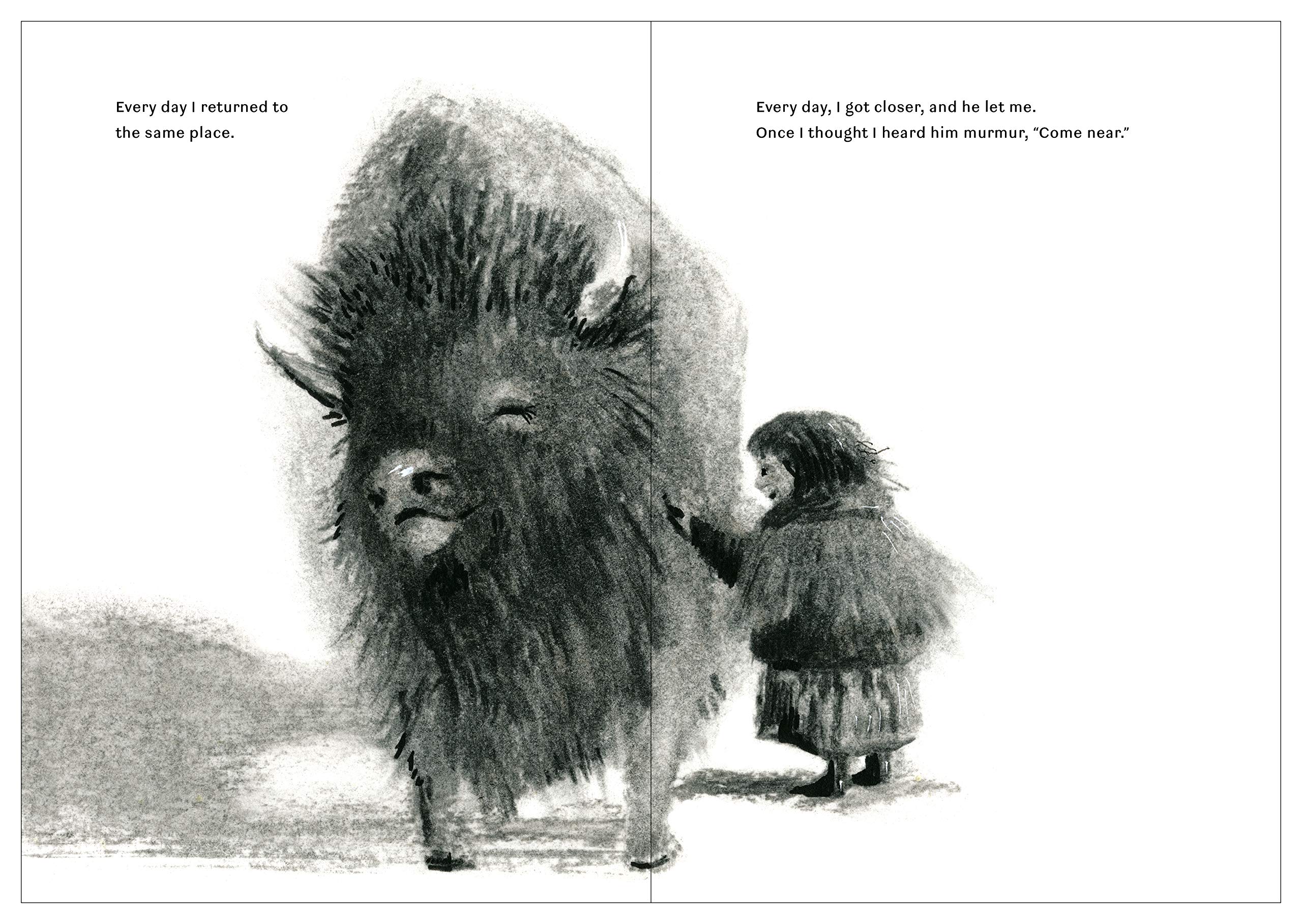
The first time a little girl meets the bison she was walking with her mother through a field of tall grass. “‘Look!’” her mother said. “‘He’s back!’” Every day after that the girl went out into the field to see the bison, coming a little closer each time until she was able to pet him. Once, she even thought she heard him whisper an invitation to come closer.

celebrate-picture-books-picture-book-review-my-bison-first-time

Image copyright Gaya Wisniewski, 2020, courtesy of Princeton Architectural Press.

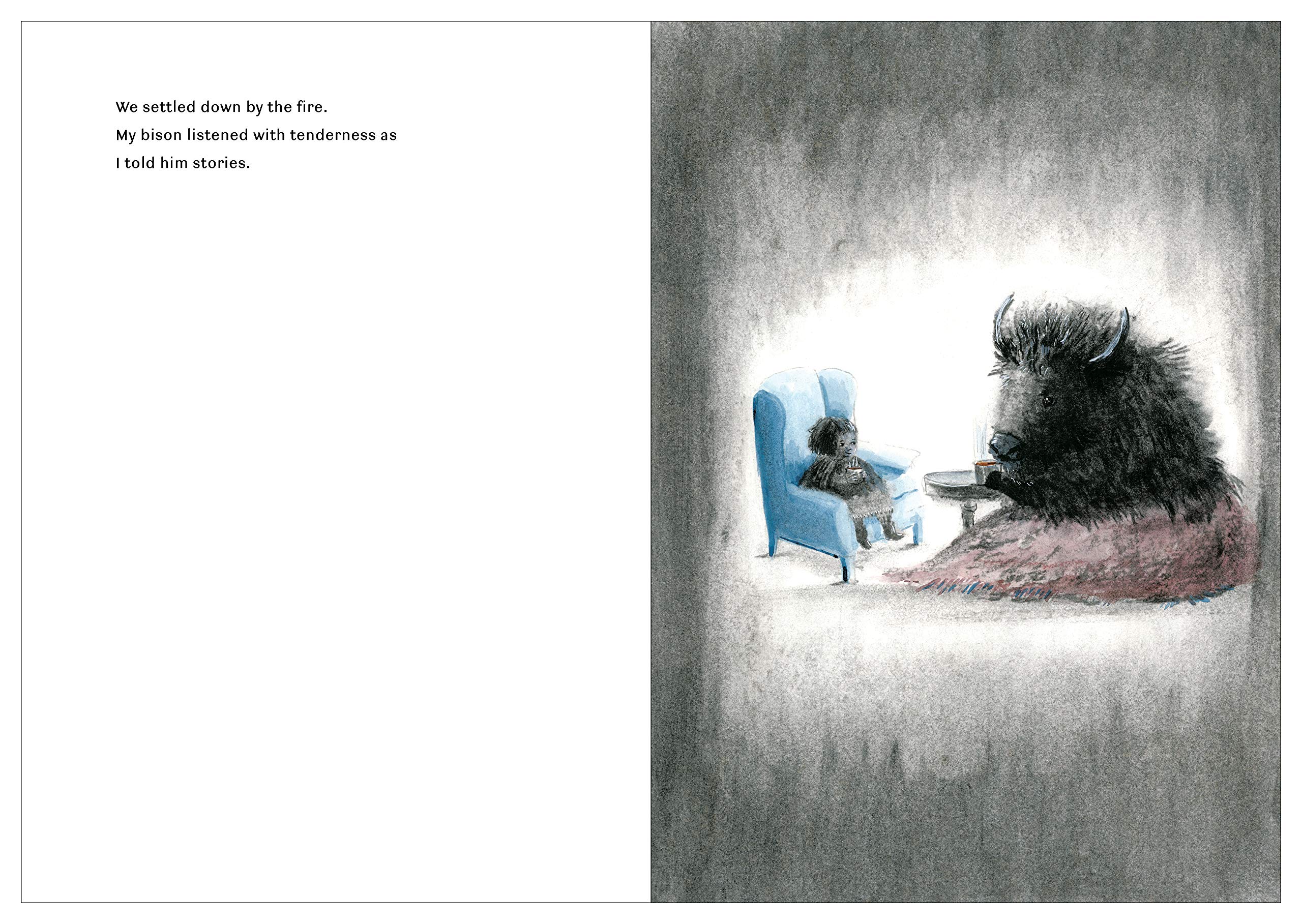
The little girl began to feed him food she’d made herself. Sometimes he didn’t like it, but he always tried it and that made her happy. One day it was time for him to move on with the rest of the herd. The girl walked with him as far as she could. When she said goodbye, the bison gave her a long look and she “knew he’d be back when snow covered the ground again.” The girl was lonely without him, but when winter returned she knew he had too without even seeing him. Now, seated together near the fire, the girl told him stories about the forest and what she’d done over the year while he, silent, “listened with tenderness.” She loved everything about him and loved him with her whole heart.

celebrate-picture-books-picture-book-review-my-bison-come-near

Image copyright Gaya Wisniewski, 2020, courtesy of Princeton Architectural Press.

The girl and the bison grew old together, winter to winter, never feeling the cold of the snow. Once, they talked all night about their mothers. The girl remembering the first time her mother had shown her the bison, how she had comforted her and taught her the lessons of nature. She missed her mother so much, she told him, and imagined he missed his mother too.

celebrate-picture-books-picture-book-review-my-bison-tea

Image copyright Gaya Wisniewski, 2020, courtesy of Princeton Architectural Press.

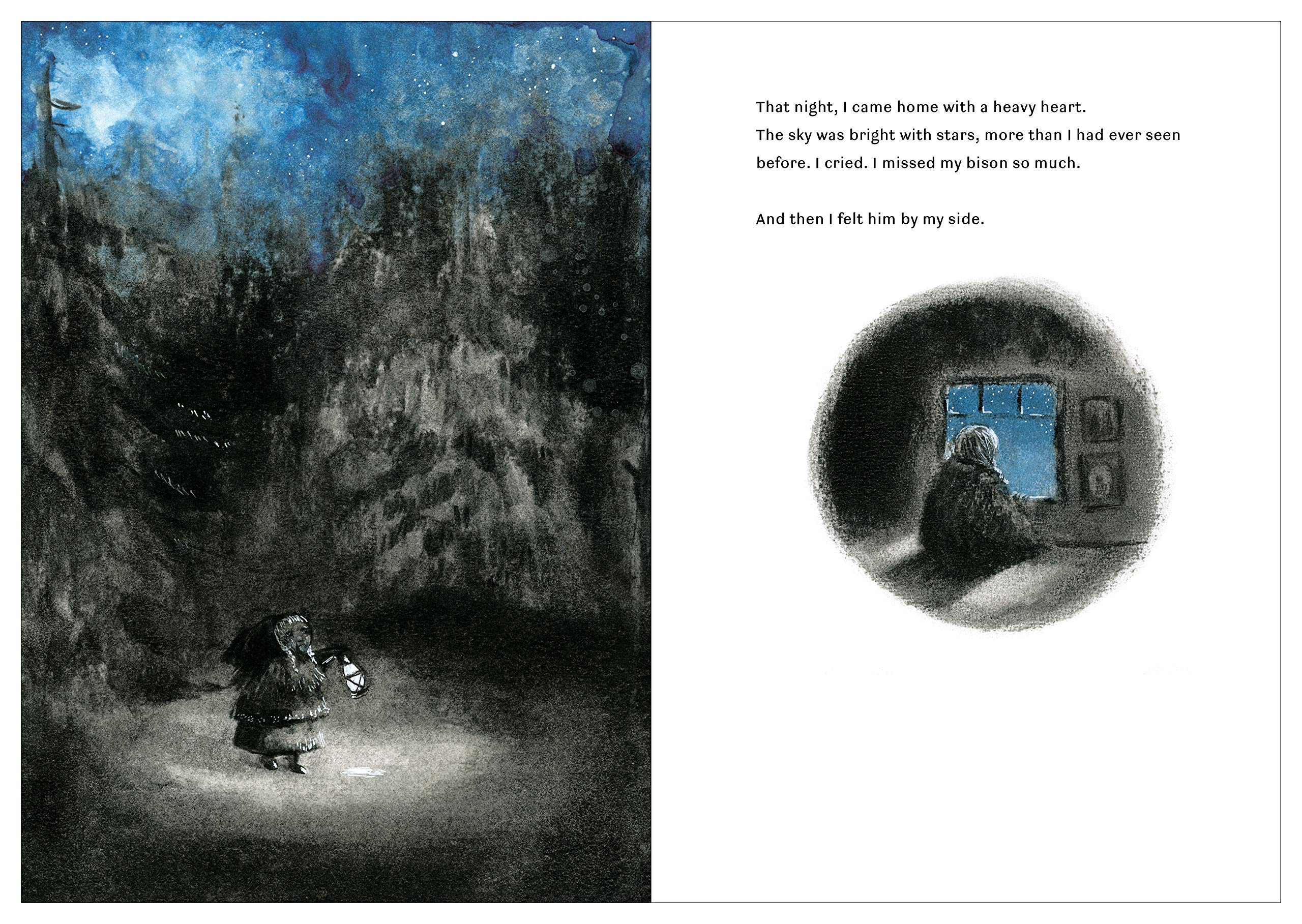
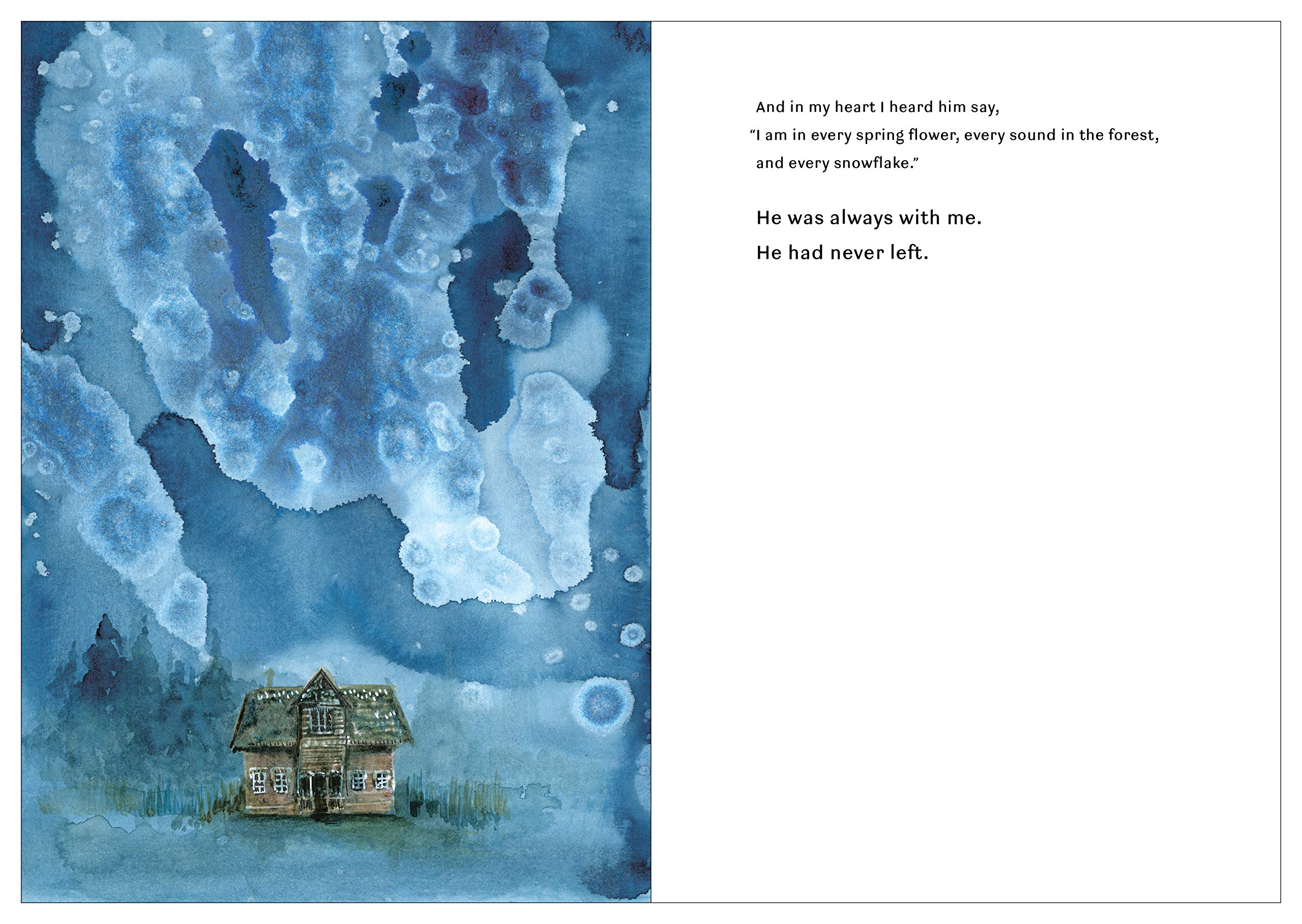
One winter the bison didn’t return and no amount of looking could find him. The girl, now an old woman, went home. She cried with missing him. And then just as in those winters so long ago when she felt his presence without seeing him, she knew he was with her. In her heart she “heard him say, ‘I am in every spring flower, every sound in the forest, and every snowflake.’” And she knew he was with her always.

celebrate-picture-books-picture-book-review-my-bison-night

Image copyright Gaya Wisniewski, 2020, courtesy of Princeton Architectural Press.

Gaya Wisniewski’s stunning and gorgeous story about a friendship between a little girl and a bison is deeply moving, it’s straightforward and metaphorical meanings blending in harmony to settle in a reader’s heart. The girl’s and bison’s relationship is one of mutual respect and trust, and they are in many ways alike. With her shaggy coat and tousled hair, the girl looks like a miniature bison, while the bison is perfectly comfortable sitting at the table near the fire sipping hot chocolate or snoozing in the cozy built-in bed  in the girl’s home. The girl loves the bison the way children love their pets, and the way she takes care of him replicates a mother’s tender affection and attention.

Here the text and images take on deeper meanings as the little girl offers the bison homemade food, holding her long-handled spoon to his mouth the way mothers the world over do for their babies. She walks with him to the edge of the clearing as he leaves in the spring, waving goodbye but with the promise of his return like a mother taking her child to the bus stop, seeing them off to college, or watching them move away.

celebrate-picture-books-picture-book-review-my-bison-sky

Image copyright Gaya Wisniewski, 2020, courtesy of Princeton Architectural Press.

At other times the bison seems to take on the role of the mother. In the endearing illustration of the bison and the girl talking over cups of hot chocolate, the girl relates how the bison would listen to her stories. Later, readers learn that her mother made her hot chocolate when she couldn’t sleep, letting them imagine how the little girl might have told her mother about her day, about the things keeping her awake. The china cup also holds the bison’s memory of cuddling with his mother, their fur smudged and merging with the steam rising from the hot drink. This blending of roles subtly demonstrates the cycles of life and the reciprocal nature of love.

Readers don’t know when the girl lost her mother; but a snapshot of the girl playing Ring around the Rosie with her and her teddy bear, in which only the mother’s arms are visible at the side of the page and the circle of light highlighting this scene is surrounded by darkness, hints at the loss. As the bison and the girl grow old together and there comes the winter when the bison does not return readers discover that any great love is always with them.

Wisniewski’s charcoal and ink illustrations, punctuated with blue create a mystical, dreamlike atmosphere where the forest and the mountains, the girl and the bison reach out to embrace the reader and invite them into this world of a love like no other.

A tender story to share all types of unending love with children, My Bison would be a poignant addition to home, school, and public library collections.

Ages 4 – 7

Princeton Architectural Press, 2020 | ISBN 978-1616898861

To learn more about Gaya Wisniewski, her books, and her art, visit her website.

National Bison Day Activity

celebrate-picture-books-picture-book-review-bison-coloring-page

Bison Coloring Page


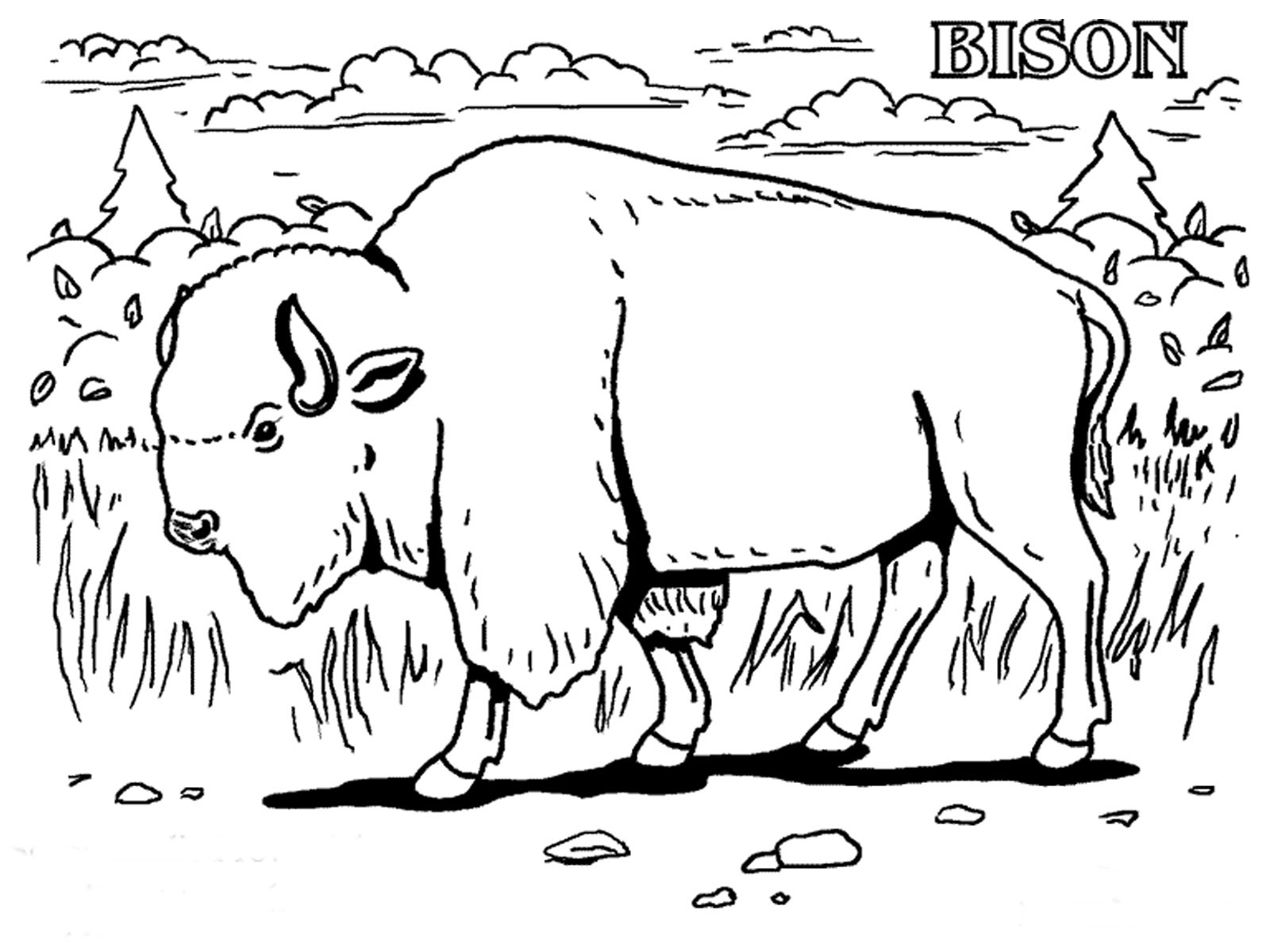
Bison are majestic creatures. Enjoy this coloring page of a bison roaming Yellowstone National Park.

Bison Coloring Page

celebrate-picture-books-picture-book-review-my-bison-cover

You can find My Bison at these booksellers

Amazon | Barnes & Noble | Books-a-Million

To support your local independent bookstore, order from

Bookshop | IndieBound

Picture Book Review


October 29 – It’s National Book Month

celebrate-picture-books-picture-book-review-the-animals-would-not-sleep-cover

About the Holiday

For readers every month is National Book Month, but October is especially set aside to highlight books and the love of reading. Fall is a book bonanza as publishers release new books in all categories and the holiday gift-giving season beckons. Books, of course, make superb gifts for all ages! So whether you’re looking for a new or new-to-you book to read right now, or new titles to give to all the family and friends who will be on your list, this month is a perfect time to check out your local bookstore to see what wonderful books are on the shelves! This month is also a perfect time to discover books that get kids excited about math and science in a whole new way – like today’s book!

Thank you to Charlesbridge for sending me a copy of  The Animals Would Not Sleep! for review consideration. All opinions about the books are my own.

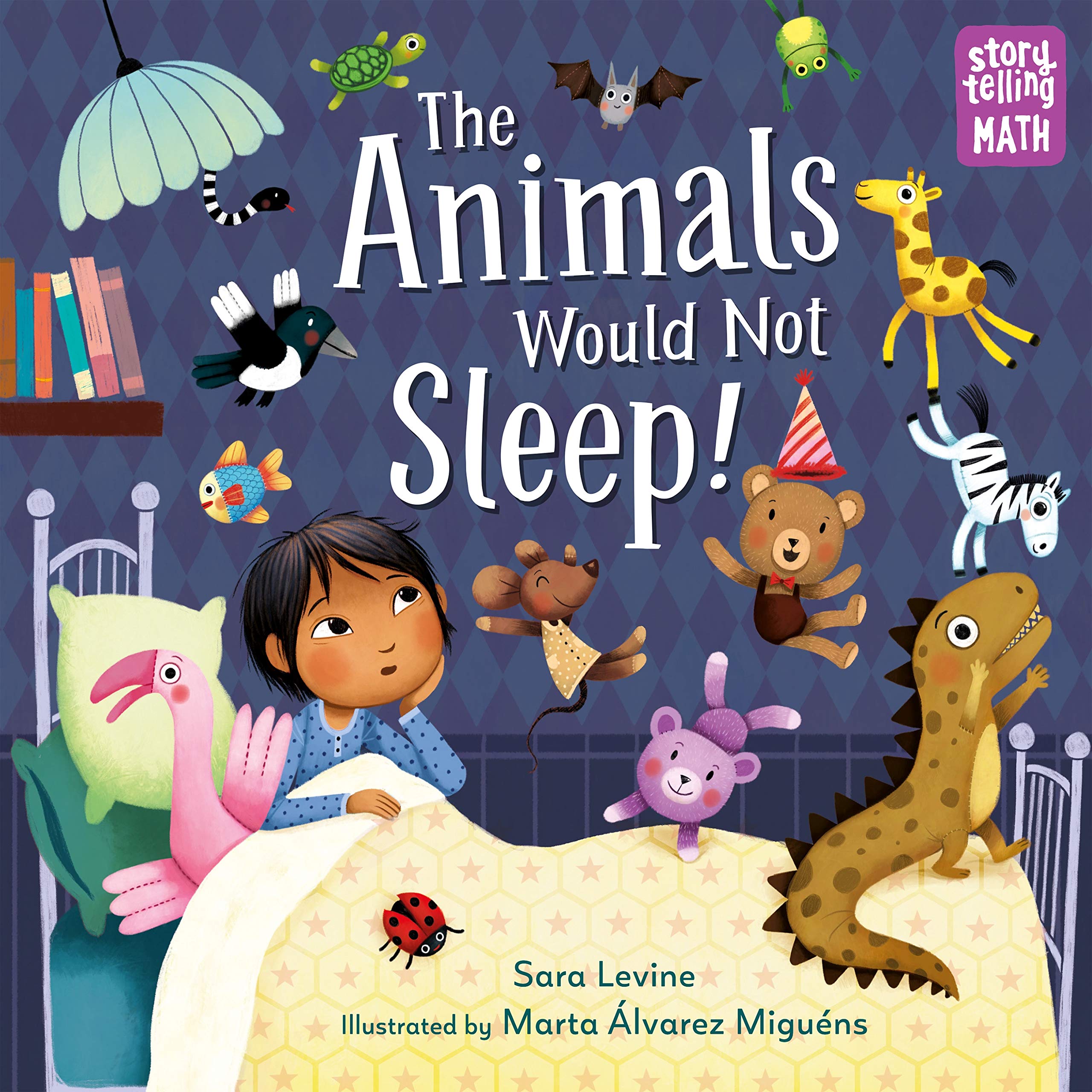
The Animals Would Not Sleep!

Written by Sara Levine | Illustrated by Marta Álvarez Miguéns


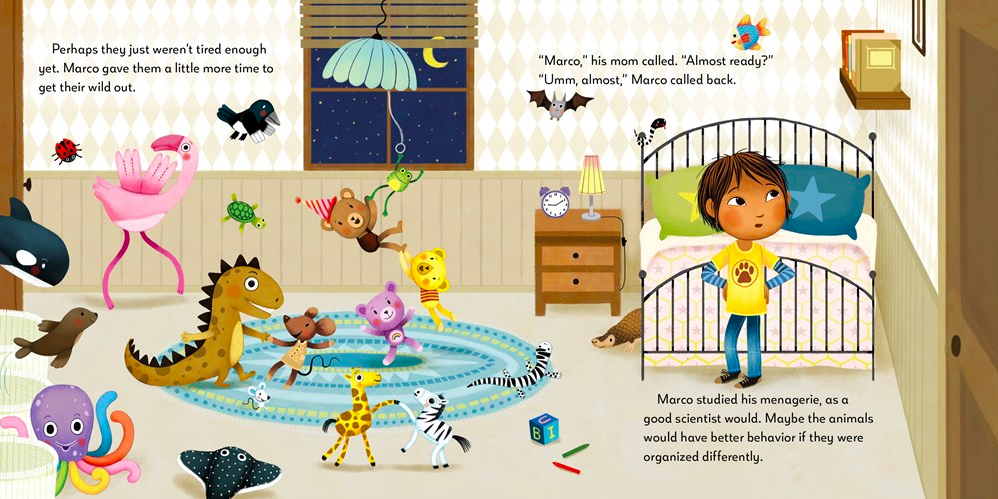
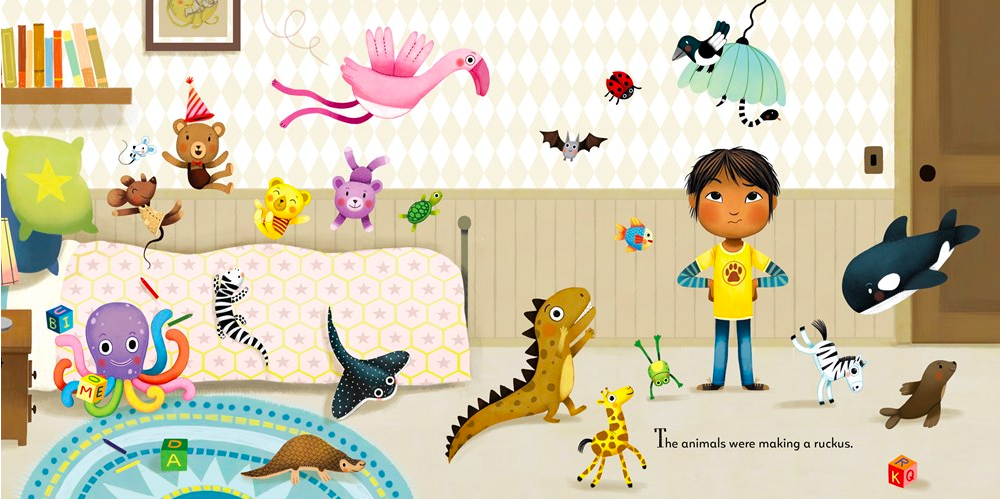
All of Marco’s stuffed “animals were making a ruckus” when his mom told him it was time to get cleaned up and ready for bed. She wanted to see all the toys put away, so Marco, who thought like a scientist, got to work. He wanted to sort his animals like a scientist would, so he got out three baskets and made signs for Flying Animals, Swimming Animals, and Animals That Move on Land. Then he picked up his dancing flamingo, bird, bat, and ladybug and put them in the first basket. He placed his octopus, stingray, frog, fish, whale, and seal in the second basket, and his dinosaur, giraffe, bears, snake, pangolin, gecko, mice, and zebra in the third basket.

But the animals were still wide awake, and “they egged one another on until not one remained in its container.” Marco thought they would settle down, but when his mom called the second time, he reconsidered his strategy. This time he made signs that sorted the animals by color, but zebra started to cry. He was afraid being in such close quarters with snake and stingray, plus he missed his friend giraffe.

celebrate-picture-books-picture-book-review-the-animals-would-not-sleep-ruckus

Image copyright Marta Álvarez Miguéns, 2020, text copyright Sara Levine, 2020. Courtesy of Charlesbridge.

Marco decided to try again. He took all of his animals out and made signs that read Small, Medium, and Large. Things seemed quiet and Marco began to put on his pajamas. But then he heard some kind of moaning or groaning coming from the Large basket. When he went to check, Dinosaur and Dancing Flamingo complained about being too cramped. Plus, Dancing Flamingo missed Rainbow Bear. Then he heard noises from the Small basket. Those animals weren’t happy either.

Marco’s mom gave him two minutes to get it all sorted out. Fortunately for Marco, “being a scientist, he was used to coming up with ideas and thinking outside the box.” The animals were getting tired and Yellow Bear had just burst into tears for no apparent reason. Like a good scientist, Marco cared about his animals and wanted them to be happy. He had one more sorting idea. With the large animals, medium-sized animals, and small animals all tucked in with plenty of room, friends nearby, and cozy warmth on Marco’s bed, Marco got under the covers and got a goodnight kiss from Mom. Then they all fell happily to sleep.

Back matter includes an illustrated Author’s Note about the way scientists sort, or classify, animals by characteristics and a discussion that explores the math in the story as well as Try This! tips for adults to engage children in sorting by Karen Economopoulos, co-director of the Investigations Center for Curriculum and Professional Development at TERC.

celebrate-picture-books-picture-book-review-the-animals-would-not-sleep-marco

Image copyright Marta Álvarez Miguéns, 2020, text copyright Sara Levine, 2020. Courtesy of Charlesbridge.

Perfectly capturing the way young children interact with their toys, Sara Levine combines imagination and scientific thinking in her inventive story, part of the Storytelling Math series from Charlesbridge. In Marco, who’s proud of his scientific thinking, Levine shows readers that they too already have this ability. Marco’s empathy for his animals’ when they are unhappy will engage children in thinking, along with Marco, about classification and the various ways the animals can be sorted, getting them excited about how math is used every day. Levine’s use of realistic dialogue that echoes bedtime routines in many homes and gives each character—human and animal—distinct personalities will draw kids in to this charming story that is organically infused with strong math lessons. Levine gives Marco a sweet final solution to his problem that will please kids and have them wanting to think like a scientist too.

Marta Álvarez Miguéns opens the story with an enchantingly wild two-page spread of Marco standing in the middle of his room as his toys bounce on the bed, climb blocks, juggle, fly, and cause a ruckus. Turn the page and, as Mom peeks into the room, these animals now lie motionless around the room. When Marco sorts his animals into the baskets, readers can clearly see which animals go where and why. Kids will knowingly giggle when the just-sorted animals spring from their resting places to prolong bedtime. Miguéns also plainly depicts Marco’s and the animals’ facial expressions from happy and playful to sad and crying to peaceful and satisfied. These images give adults and children an opportunity to discuss emotions and how to recognize various clues in faces, a skill important for social-emotional learning. Vivid colors, adorable animals, details such as alphabet blocks that stack or are turned to spell words, and kid-appealing décor will have kids wanting to come back again and again.

A book that’s sure to become a favorite at bedtime or to enhance classroom or homeschooling curriculum, The Animals Would Not Sleep! will spark mathematical and scientific thinking and recognition in all young learners. The book offers an irresistible invitation to experiment and interact with math and science and is a must for home, school, and public library collections.

Ages 3 – 6

Charlesbridge, 2020 | ISBN 978-1623541286 (Hardcover) | ISBN 978-1623541972 (Paperback) 

Discover more about Sara Levine and her books on her website.

To learn more about Marta Álvarez Miguéns, her books, and her art, visit her website.

About Storytelling Math

Storytelling Math offers books that celebrate children using math in their daily lives as they play, build, collaborate, compromise, and discover the world around them. Each story features characters of color who are empowered to solve problems, enjoy activities, and help out using their knowledge of and experimenting with math. Free downloadable hands-on activity kits are available for each book on the Charlesbridge website. Sharing these joyful stories with your littlest ones and older kids will make them eager to explore, use, and learn more about math every day. You can learn more about Storytelling Math on the Charlesbridge website

Storytelling Math: Math, Diversity, and the Power of Story was developed with Marlene Kliman at TERC—a nonprofit dedicated to STEM education—under a grant from the Heising-Simons Foundation.

Enjoy this The Animals Would Not Sleep! trailer with Author Sara Levine!

National Book Month Activity

celebrate-picture-books-picture-book-review-the-animals-would-not-sleep-activity-logo

The Animals Would Not Sleep! Activity Kit


You can have fun sorting and exploring math with your class or family with the Activity Kit for The Animals Would Not Sleep on the Charlesbridge website. Download it here!

The Animals Would Not Sleep Activity Kit

celebrate-picture-books-picture-book-review-the-animals-would-not-sleep-cover

You can find The Animals Would Not Sleep! at these booksellers

Amazon | Barnes & Noble | Books-a-Million

To support your local independent bookstore, order from

Bookshop | IndieBound

Picture Book Review
October 24 – Photographer Appreciation Month

celebrate-picture-books-picture-book-review-operation-photobomb-cover

About the Holiday

National Photographer Appreciation Month is for all photographers, professional and amateur. The month-long holiday gives people an opportunity to really look at the photographs they see in newspapers, books, online, and even in their own home and truly appreciate the artistry that goes into capturing a moment, a place, or a personality to tell a bigger story. October is also a great month to go through your own family photographs and relive or rediscover favorite memories. To celebrate, consider having a professional portrait taken of yourself, your kids, or your whole family to decorate your home, give as gifts, or send as a holiday card. There are also many galleries displaying photographic work to explore. 

Operation Photobomb

Written by Tara Luebbe and Becky Cattie | Illustrated by Matthew Rivera


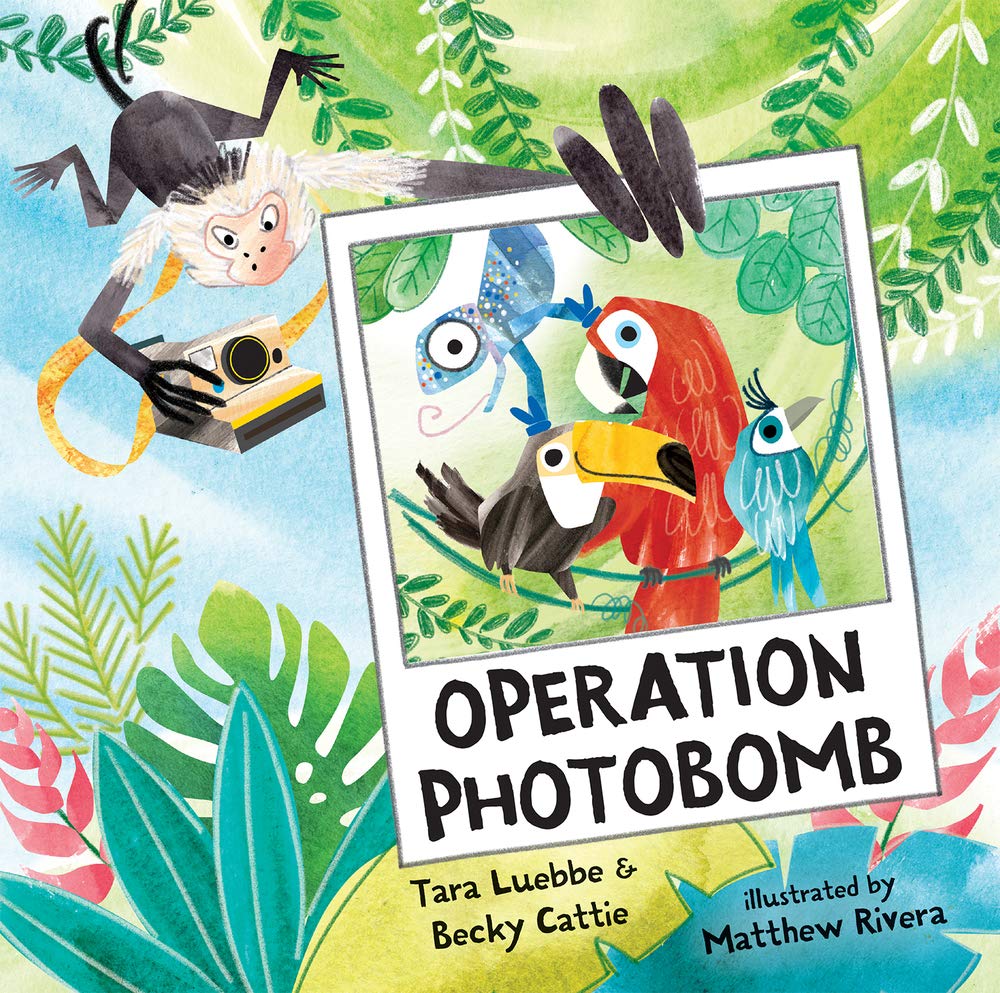
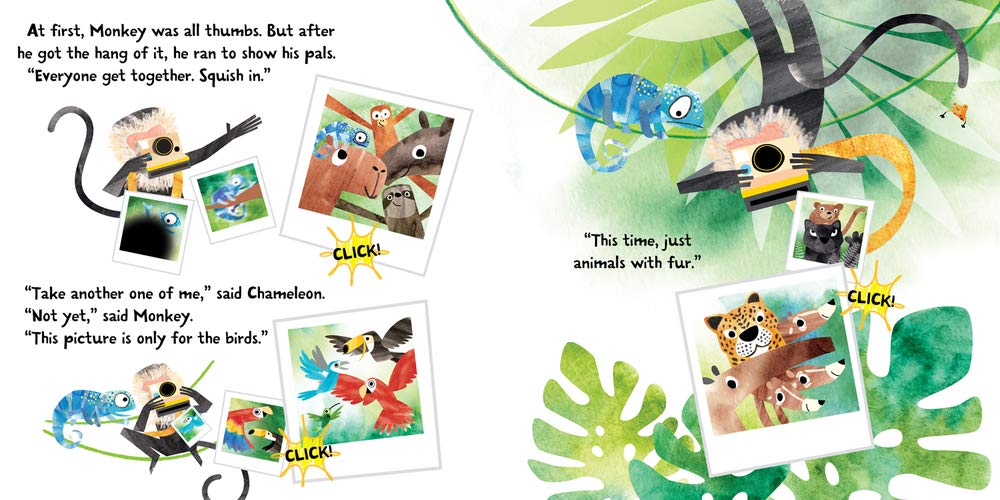
Monkey and Chameleon loved scavenging stuff from tours that came through their neck of the jungle. One lucky day when they raided a backpack, Monkey discovered a polaroid camera while Chameleon came away with a roll of toilet paper. Monkey had a bit of a learning curve to get the hang of taking great shots, but soon he was snapping stylish pics of all his friends.

Monkey got so good that he started taking themed pictures. He took some that were “only for the birds” and others of “just animals with fur.” Chameleon was beginning to feel left out, so just as Monkey was going to click the button on a cute-as-a-button shot of two frogs on a branch, Chameleon swung in on a vine, shouting, “‘Photobomb!’”

celebrate-picture-books-picture-book-review-operation-photobomb-camera

Image copyright Matthew Rivera, 2019, text copyright Tara Luebbe and Becky Cattie, 2019. Courtesy of Albert Whitman & Company.

“‘Chameleon, please don’t do that!’” Monkey said. “But Chameleon was just getting started.” The Capybara family suddenly had a new member in their portrait; Sloth’s new baby was joined by a chameleon-y brother; and as Monkey was about to capture Grandma Macaw blowing out her 76th birthday candles, Chameleon photobombed in, sending the cake splat all over her and her guests.

“‘Help me stop him from wrecking all the pictures!’ Monkey howled.” Toucan did a song and dance routine to distract him, Jaguar tried to fling him away, and the tapirs attempted to form an impenetrable line, but he was always able to sneak in. Monkey shrieked at him, and the other animals complained that he had ruined their once-in-a lifetime pictures. Chameleon blushed pink and red and said, “‘Fine. You won’t see me in any more pictures.’”

celebrate-picture-books-picture-book-review-operation-photobomb-pictures

Image copyright Matthew Rivera, 2019, text copyright Tara Luebbe and Becky Cattie, 2019. Courtesy of Albert Whitman & Company.

So Monkey went back to work. But the animals took a close look at their shots and noticed a phantom-like Chameleon blending in with them or their surroundings. “CHAMELEON!” they shouted. The animals huddled together to find a solution. Monkey had an idea, and they whispered and plotted until they had the perfect plan. “Operation Photobomb was a go.” Monkey called Chameleon over and arranged him in a perfect pose. Then he aimed his camera and counted down. When he reached “three” the Macaws yelled “‘Bombs away!’” and pelted him with juicy fruit. “Click!” Monkey took the shot.

Chameleon was covered in sticky pulp and juice. The animals laughed. But Chameleon didn’t think it was so funny. “‘You ruined my pic…Ohhhhh!’” he said. Monkey handed him the roll of toilet tissue and offered a truce. Chameleon agreed to both. Although it was hard, Chameleon stayed out of Monkey’s pictures from then on. But then he had an idea that was “picture-perfect.” He knew just the people who “loved a good photobomb.”

celebrate-picture-books-picture-book-review-operation-photobomb-chameleon

Image copyright Matthew Rivera, 2019, text copyright Tara Luebbe and Becky Cattie, 2019. Courtesy of Albert Whitman & Company.

Tara Luebbe and Becky Cattie’s funny take on the photobomb phenomenon will have kids laughing and joining in with shouts of “photobomb!” as Chameleon inserts himself into all of the animals’ precious shots. When Chameleon ignores the animals’ complaints and requests to stop and instead uses his camouflage to trick them (a shrewdly worded hints at this), Monkey’s idea to give him a bit of his own medicine teaches him a valuable lesson. Chameleon also discovers a clever, more productive, and welcome way to enjoy his favorite activity. Through their fast-paced and humorous storytelling sprinkled with puns, Luebbe and Cattie reveal several truths about friendship, respect for others, and appropriate timing. Their surprise ending will satisfy and delight kids. It offers opportunities for discussion on social skills, putting others first, and finding the right time and place to engage in certain activities and behaviors.

Matthew Rivera’s tropical, sun-kissed illustrations will enchant readers. Chameleon, a mottled vibrant blue in most spreads, shows his enthusiastic prankster side popping up at the last moment to join the animals’ photos. Readers will love pointing him out in the polaroid squares scattered throughout the book. They’ll especially enjoy finding him when he camouflages himself against various backdrops. As he discovers his “picture-perfect” audience, kids will see that here he can show all his colors.

Operation Photobomb is a lively and original way to introduce children to ideas of respect for others and proper conduct. The humor and familiar activity will resonate with kids and makes this a book that will be a favorite for thoughtful as well as spirited story times at home, in the classroom, and for public libraries.

Ages 3 – 5

Albert Whitman & Company, 2019 | ISBN 978-0807561300

Discover more about Tara Luebbe and Becky Cattie and their books on their website, BeckyTaraBooks.

To view a portfolio of work by Matthew Rivera and learn more about him, visit his website.

Photographer Appreciation Month Activity

celebrate-picture-books-picture-book-review-threads-of-friendship-photo-holder

Spool Photo Holder


With this easy craft you can make a personalized photo holder for your favorite pictures of friends and family!

Supplies

  • Wooden spool with hole through the middle, top to bottom. (A spool without a hole also works if you make a hole in the top with a hammer and nail), 1 ½ -inch or larger, available at craft stores
  • Colorful twine or light-gauge yarn, 3 to 4 yards
  • Alternatively: you can buy a wooden spool of colorful twine at some discount stores
  • 3 pieces of light-gauge wire 12 to 15-inches long
  • Clay or play dough
  • Needle-nose pliers
  • Glue

Directions

  1. Fill hole in spool with clay or play dough, pushing it well in to provide a base for the wire
  2. Wrap the twine or yarn around the spool to desired thickness
  3. Glue down the end of the twine to keep it from unraveling
  4. With the needle-nose pliers, roll down one end of the wire to create a small coil
  5. Repeat with two other lengths of wire
  6. Cut the three wires to different lengths to provide room for all three photographs
  7. Fit the three wires into the center hole on the top of the spool
  8. Push the wires into the clay until they are held securely
  9. Clip photographs into the coils
  10. Display your pictures!

celebrate-picture-books-picture-book-review-operation-photobomb-cover

You can find Operation Photobomb at these booksellers

Amazon | Barnes & Noble | Books-a-Million

To support your local independent bookstore, order from

Bookshop | IndieBound

October 21 – It’s Squirrel Awareness Month

celebrate-picture-books-picture-book-review-girl-versus-squirrel-cover

About the Holiday

Squirrels elicit emotions on both sides of the spectrum. On one hand you can’t help but say “Awww!” when you see their tiny little paws and crafty antics. On the other hand their voracious appetites at bird feeders and penchant for darting into traffic is more likely to make you say “Arrgghhh!” This month is set aside, however, for enjoying the squirrels in your yard, park, or city. And really, don’t they make life just a little more fun?

Girl Versus Squirrel

Written by Hayley Barrett | Illustrated by Renée Andriani


Pearl built three birdhouses and put them in and near the tree in her backyard. One was shaped like a house, one was a tube, and the other was a tea cup atop a tall stand. After filling the house with suet, the tube with seeds, and the teacup with peanuts, Pearl settled in with her binoculars to wait. Soon cardinals, flickers, finches, and chickadees swooped in. But none of them wet for the peanuts.

celebrate-picture-books-picture-book-review-girl-versus-squirrel-bird-feeders

Image copyright Renée Andriani, 2020, text copyright Hayley Barrett, 2020. Courtesy of Margaret Ferguson Books, Holiday House.

Happily sitting next to the teacup was a squirrel with a peanut in its paws. Pearl scared the squirrel away and then went to work to win this contest of wits. She used her hockey stick to raise the teacup’s stand higher and “watched, breathless with anticipated success, but was soon disappointed” as the squirrel easily climbed to the top. Pearl added a mop to make the pole even higher.

But still the squirrel had no trouble getting to the top. “The squirrel stared at Pearl and seized an especially plump peanut.” Just then the “pole began to teeter and totter until…It toppled to the ground,” breaking the handle off the teacup. As the squirrel dashed up a nearby oak tree, Pearl shouted, “‘You’re a bird-feeder-crashing, teacup-smashing, peanut-poaching pest!’” A pest Pearl was not about to lose out to.

celebrate-picture-books-picture-book-review-girl-versus-squirrel-bird-garage

Image copyright Renée Andriani, 2020, text copyright Hayley Barrett, 2020. Courtesy of Margaret Ferguson Books, Holiday House.

While Pearl fixed her teacup, she devised a plan. She gathered supplies and started creating. Soon, a “network of obstacles emerged, each more squirrel-challenging than the last.” The squirrel may have been fast and determined, but the course ensured that “teacup triumph will require nerves of squirrely steel,” Pearl fixed her binoculars on the squirrel and waited.

It didn’t take long before the squirrel was headed in the right direction. He scampered over the rope, spun around the big spool, leaped to the swing, and scrambled through the rest of the course. Until… “CRUNCH!” Pearl was astounded. Then she saw the squirrel head for a nest in the oak tree with three baby kits in it. That’s when Pearl realized the squirrel was a mother. “‘I proclaim your victory,’ cheered Pearl, ‘ and I salute you, fearless, fluffy sister!’” Immediately, Pearl wanted to help this family grow and learn. Now her backyard is a birds’… and squirrels’… and contraption-lovers’ paradise.

“Some Squirrely Facts” about our favorite nature nemesis follows the story.

celebrate-picture-books-picture-book-review-girl-versus-squirrel-obstacle-course

Image copyright Renée Andriani, 2020, text copyright Hayley Barrett, 2020. Courtesy of Margaret Ferguson Books, Holiday House.

For anyone who has done battle with a squirrel at their birdfeeder, Hayley Barrett’s story is a delight. Her nimble alliterative phrasing and fun-to-read action verbs will make any story time a joy. Add in Pearl’s can-do attitude and the squirrel’s unstoppable energy and you have the makings of an epic battle—one that readers are sure to want to replicate in their own yards. Barrett nails the experimental nature of children’s building projects, a detail that kids will appreciate and that will endear Pearl to them.  Barrett’s nod to girl power provides a strong, uplifting ending. Factual information about birds, bird food and squirrel behavior is interwoven organically throughout the story. That and the fascinating back matter make this a terrific book to pair with classroom lessons.

Renée Andriani’s vibrant, action-packed illustrations will wow kids and have them on the edge of their seats for each page turn. Realistic depictions of the cardinals, finches, chickadees, and flickers that swarm Pearl’s bird feeders will entice readers to learn more about these birds. When Pearl raises her teacup feeder higher and higher, Andriani presents clear images of how Pearl tapes the stand, stick, and mop together as well as the crashing result when the squirrel hops on. As Pearl gathers items from her garage and begins building her obstacle course, readers will be in suspense, waiting to see the final result.

Presented in a wild, two-page spread, Andriani’s portrayal of Pearl’s obstacle course rewards readers with bold, expressive typography and images of the squirrel making her way from station to station with style. The final two-page spread of Pearl’s backyard, is a riot of color as feeders, birds, and mama and baby squirrels nosh to their hearts’ content. Kids will want to linger to catch every detail.

Imaginative, humorous, and educational, Girl Versus Squirrel will become a favorite and will inspire kids to create their own obstacle course. The book would also be a high-interest accompaniment to STEM lessons in the classroom and at home. It would make a terrific addition to home, school, and public library collections.

Ages 4 – 8

Margaret Ferguson Books, Holiday House, 2020 | ISBN 978-0823442515

Discover more about Hayley Barrett and her books on her website.

To learn more about Renée Andriani, her books, and her art, visit her website.

Squirrel Awareness Month Activity

celebrate-picture-books-picture-book-review-squirrel-community-coloring-page

Squirrely Activity Pages


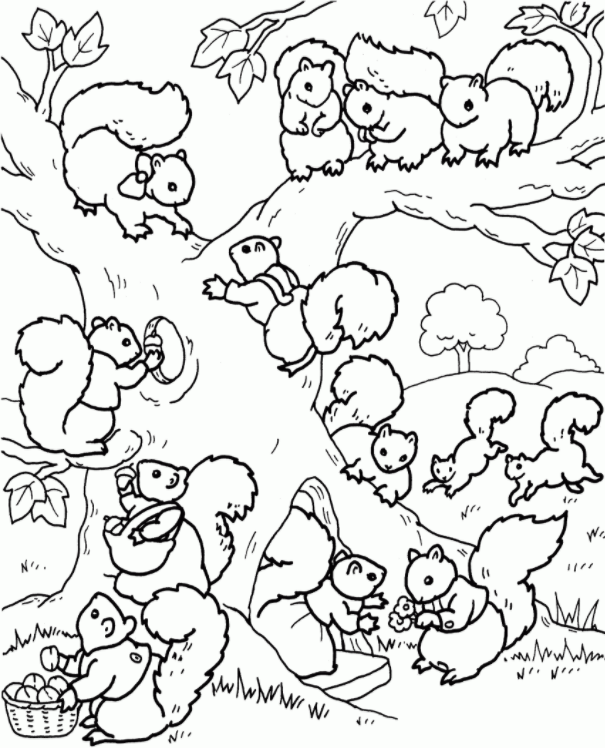
You can join a girl who’s watching squirrels, find a whole squirrel community to color, see a squirrel enjoying a snack, and follow the numbers to discover… with these printable Squirrely Activity Pages

Girl Watching Squirrel Coloring Page | Squirrel Community Coloring PageDot-to-Dot Coloring Page | Squirrel with Nut Coloring Page

celebrate-picture-books-picture-book-review-girl-versus-squirrel-cover

You can find Girl Versus Squirrel at these booksellers

Amazon | Barnes & Noble | Books-a-Million

To support your local independent bookstore, order from

Bookshop | IndieBound

Picture Book Review
 

October 20 – Celebrating the Book Birthday of Love Can Come in Many Ways

celebrate-picture-books-picture-book-review-love-can-come-in-many-ways-cover

About the Holiday

Today I’m celebrating the book birthday of a tender board book that when shared between an adult and a child can help build strong loving bonds that can lead little ones to become happy and self-confident children. These are qualities that are also honored today during National Youth Confidence Day, which encourages us to connect with and inspire today’s youth to succeed tomorrow. National Youth Confidence Day celebrates the energy, spirit, and potential of young people. The day is an acknowledgment of all they will accomplish, and kids can accomplish anything when they know they’re loved.

Thanks go to Chronicle Books for sending me a copy of Love Can Come in Many Ways for review consideration. All opinions about the book are my own. I’m excited to be teaming with Chronicle in a giveaway of the book. See details below.

Love Can Come in Many Ways

Written by Terry Pierce | Illustrated by Suzy Ultman


How do you share your love for your little one; young grandchild, niece, nephew, or cousin; student; or other child of your heart? With a kiss, a hug, a smile? Or maybe you have a secret signal that only the two of you know. In this adorable board book, animal families of all kinds reveal that “nose to nose or gaze to gaze. / Love can come in many ways.”

celebrate-picture-books-picture-book-review-love-can-come-in-many-ways-elephants

Image copyright Suzy Ultman, 2020, text copyright Terry Pierce, 2020. Courtesy of Chronicle.

Elephants snuggle their kids behind an ear or hug them with their trunk. Swans hold them close with their wings, and froggies feel love “through lively songs that Mama sings.”  Whether their held tight in paws or jaws, panda cubs know their loved. Some babies ride on Mama’s back or within her furry coat. While penguin chicks are warmed with love “atop a papa’s sturdy feet.”

Each animal—and person—has a special way to say that “you are loved.” But no matter if it’s a “helpful hand” or “a gentle squeeze. / Love is kindness, comfort, peace.”

celebrate-picture-books-picture-book-review-love-can-come-in-many-ways-leaf

Image copyright Suzy Ultman, 2020, text copyright Terry Pierce, 2020. Courtesy of Chronicle.

Terry Pierce’s lilting verses, as gentle as a lullaby, will warm a little one’s heart as they cuddle up with an adult to hear—and see—how various animals embrace their own babies. Pierce wraps readers in cozy, comforting words and a soothing rhythm that are perfect for naptime, bedtime, or when a little extra snuggle is needed. Little ones will be surprised, delighted, and full of giggles as they learn about the ingenuity of nature.

With stylish flair and softly rounded shapes, Suzy Ultman creates original and eye-catching pages that will charm little readers and adults. Whimsical touches, such as jaunty hats, round eyeglasses, and potted plants, go hand-in-paw with Ultman’s lovely color palette to make pages that are as adorable as they are enchanting. And no little fingers will be able to resist lifting the vibrant felt flaps to take a peek at the sweet baby animals snuggling with their mom or dad.

Endearing to the max, Love Can Come in Many Ways is a board book will be a treasured gift for baby showers and new babies, and is a must for home, school, and public libraries.
Ages Birth – 3

Chronicle Books, 2020 | ISBN 978-1452172606

Discover more about Terry Pierce and her books on her website.

To learn more about Suzy Ultman, her books, and her art, visit her website.

Love Comes in Many Ways Giveaway

I’m thrilled to be teaming up with Chronicle Books in a giveaway for two lucky winners. Each winner will win

  • One (1) copy of Love Can Come in Many Ways, written by Terry Pierce | illustrated by Suzy Ultman

To enter:

  • Follow Celebrate Picture Books
  • Retweet a giveaway tweet
  • Bonus: Reply with your child’s favorite animal for extra entry. Each reply earns you one extra entry

This giveaway is open from October 20 to October 26 and ends at 8:00 p.m. EST.

A winner will be chosen on October 27. 

Giveaway open to U.S. addresses only. | Prizing provided by Chronicle Books

Love Can Come in Many Ways Book Birthday Activity

celebrate-picture-books-picture-book-review-hand-print-elephants-craft

Elephant Handprint Painting


This easy craft is fun for adults and kids to do together and can make a nice decoration for a child’s room and reminder of a parent’s, grandparent’s, or caregiver’s love.

Supplies

  • Craft paint in two colors of the children’s choice
  • Yellow craft paint
  • Black fin-tip marker
  • Crayons, markers, or colored pencils to make a background
  • Paper
  • Paint brush

Directions

  1. Paint one child’s hand and press it on the paper. The thumb is the truck and the fingers the legs.
  2. Paint the second child’s hand and press it on the paper near the other “elephant.” A couple of examples are: the elephants standing trunk to trunk or trunk to tail 
  3. After the paint has dried, draw on ears and an eye
  4. Add a sun with the yellow paint
  5. Add grass, trees, or other background features

celebrate-picture-books-picture-book-review-love-can-come-in-many-ways-cover

You can find Love Can Come in Many Ways at these booksellers

Amazon | Barnes & Noble | Books-a-Million

To support your local independent bookstore, order from

Bookshop | IndieBound

Picture Book Review