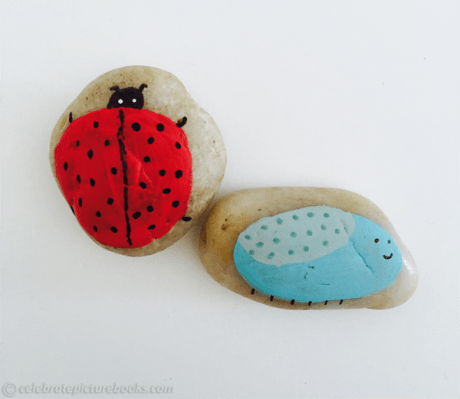
December 9 – It’s Read a New Book Month

celebrate-picture-books-picture-book-review-octopuses-have-zero-bones-cover

About the Holiday

The month of December is a gift-giver’s delight, and there’s no better gift for everyone on your list than a book (or two or…). With so many new books hitting bookstore shelves, there really is a perfect one to fit everyone’s taste. Young children, especially, benefit from reading a wide range of picture books from laugh-out-loud or touching stories to nonfiction that introduces them to influential people, science, history, nature, math—like today’s book. If you’re looking for gifts to give, it’s not too late to head to your local bookstore to find books that will make your child’s eyes light up.

I’d like to thank Tra Publishing for sending me a copy of Octopuses Have Zero Bones for review consideration. All opinions on the book are my own.

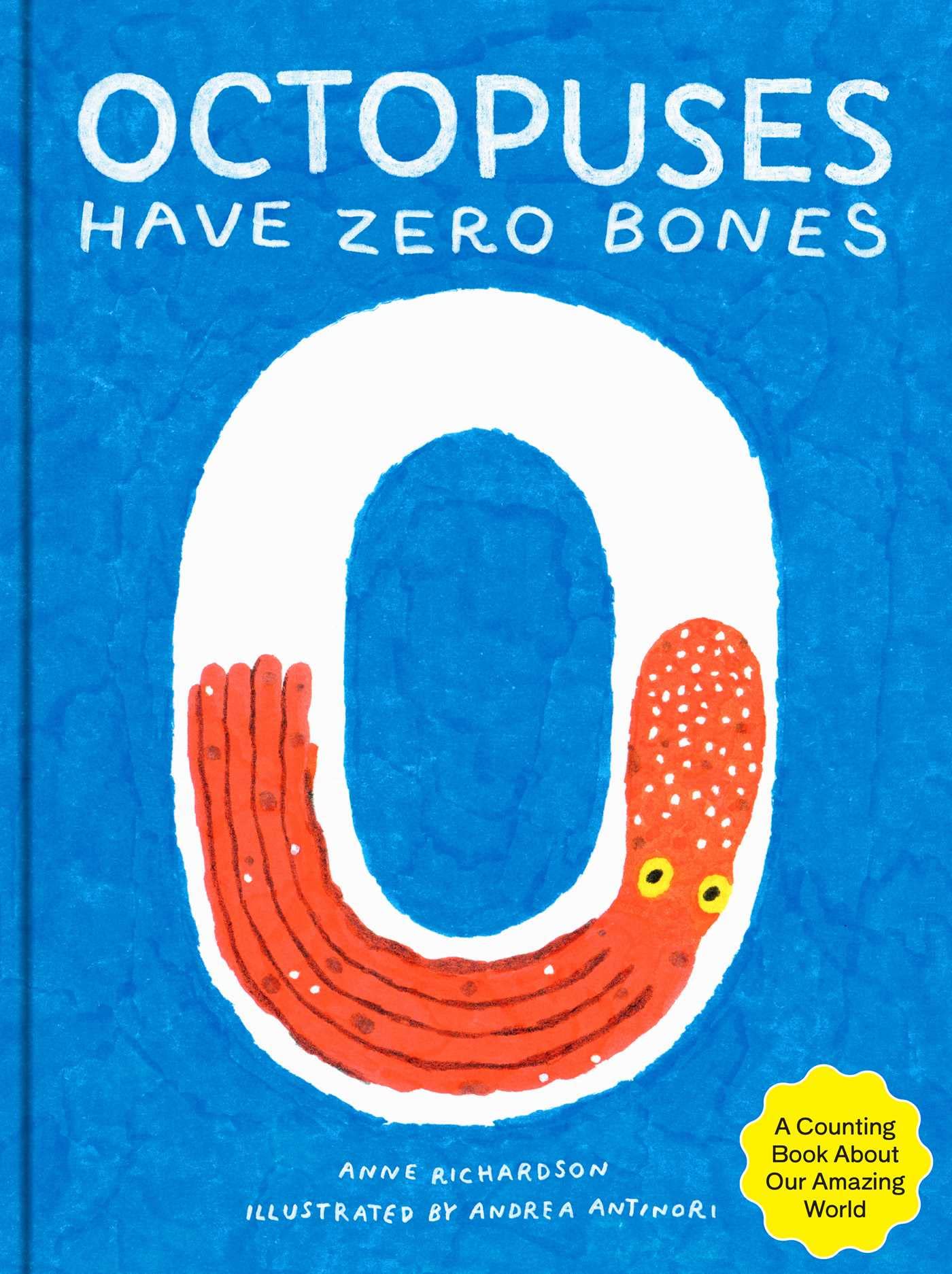
Octopuses Have Zero Bones: A Counting Book about Our Amazing World

Written by Anne Richardson | Illustrated by Andrea Antinori


If you’re looking for a book that opens kids’ eyes and mind to new ways to interact with numbers and fall in love with everything they have to tell about us and the world around us, then you’ll want to wrap your arms around Octopuses Have Zero Bones. This multilayered and eye-opening romp through the ability of numbers to describe, explain, provide perspective, and amaze celebrates the numbers from zero to nine and the power of numbers ten to nine billion.

Kids at all levels will find accessible ways to explore the math concepts that enliven every page, from basic counting to higher-level ideas that include measurement, extrapolation, and estimation as well as complex scientific facts. And how does all of this learning begin? With 0 and simple statement and probing question: “ZERO, all by itself, is nothing. Can you imagine nothing?” It might be hard for kids to think about how “nothing” can be important or have an effect. But Anne Richardson, with illustrative help from Andrea Antinori, reveals that because “octopuses have ZERO bones…” they “can squeeze through very small places.” And, if that doesn’t surprise you, she also presents this fascinating tidbit: “Dry Valleys, Antarctica, gets ZERO rain or snow.” In fact “there’s been no precipitation for two million years.” Two million! That’s nearly as impressive as zero!
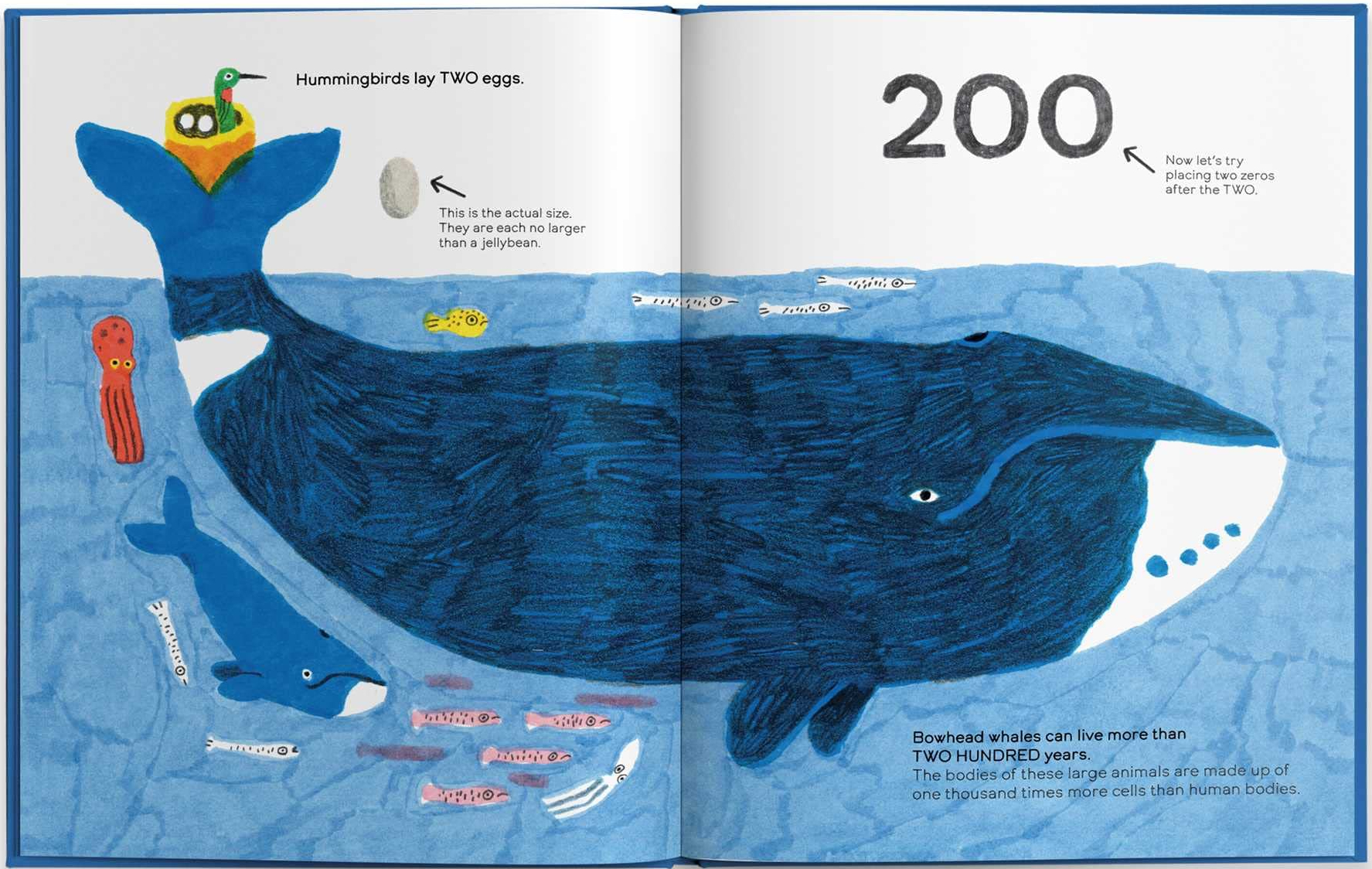
celebrate-picture-books-picture-book-review-octopuses-have-zero-bones-whale

Image copyright Andrea Antinori, 2022, text copyright Anne Richardson, 2022. Courtesy of Tra Publishing.

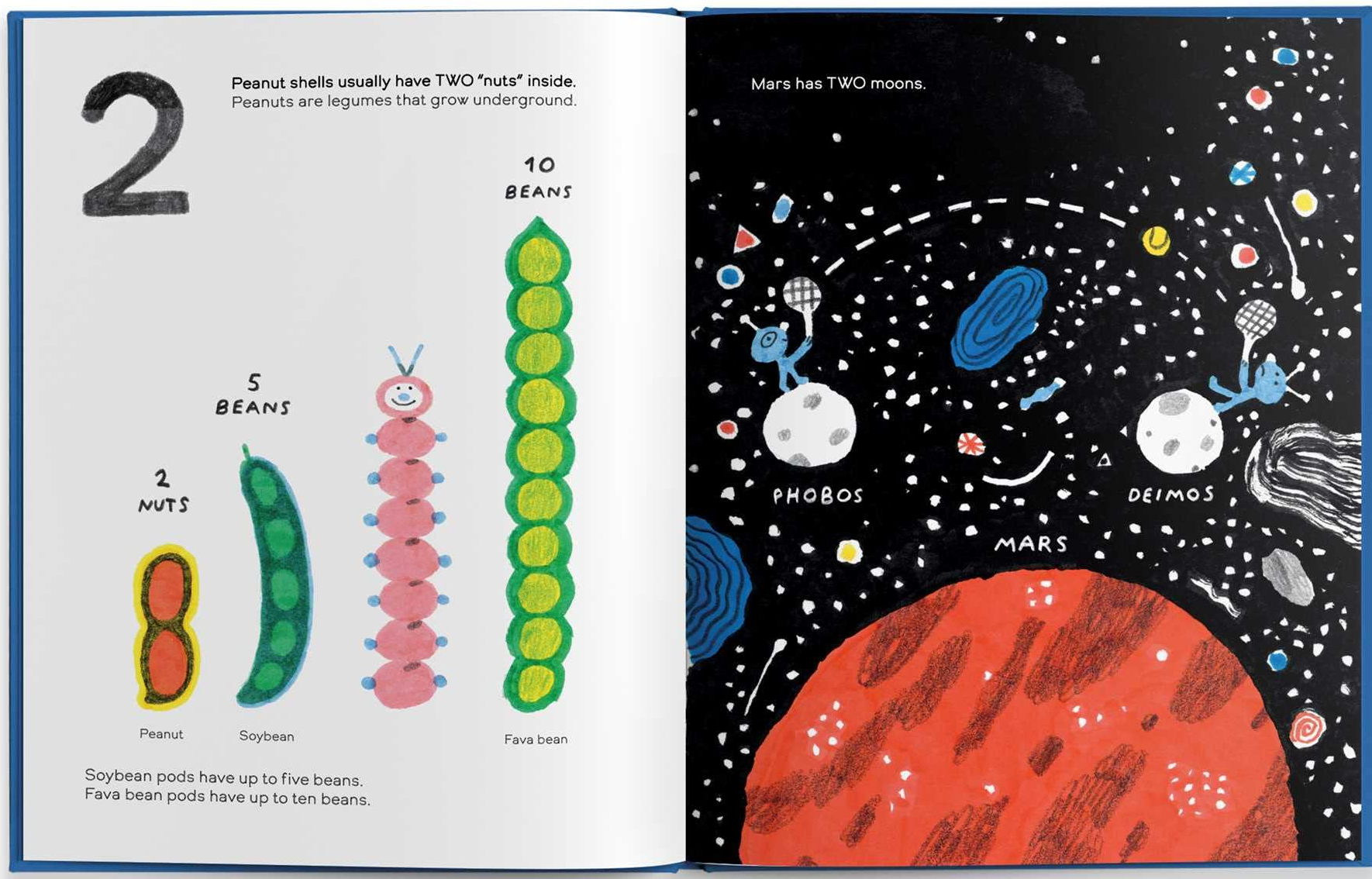
But that’s not all! There are more examples, and then Richardson shows how that simple digit 0 can make a single whole number explode into 100, 1,000, 100,000 and so on. She moves from there to tackle the numbers 1 through 9, by themselves and then attached to one 0. Readers next learn about 10—10 decibels, a creature with 10 legs, 10 fingers, and 10 toes. Those familiar with counting know that 2 comes after 1, and Richardson and Antinori help kids visualize this number with peanut shells that contain two individual nuts, the 2 moons of Mars, and more. Here, readers are shown what happens when two zeros are attached to the number two, and, of course, they’re given a few intriguing examples of 200.

This pattern is continued throughout the pages from 3 and 3,000 to 9 and 9,000,000,000. Along the way, children learn about the different types of clouds, how many times a bear’s heart beats per hour, how many chambers the human heart has, how many grains are in a two-pound bag of rice, and the astounding number of leaves you’d find on a typical mature oak tree. Ever wonder how many gallons of water flow over Niagara Falls every ninety seconds? You’ll find out here—along with the ph of water (7), what that means, and the ph number of other common liquids.
celebrate-picture-books-picture-book-review-octopuses-have-zero-bones-two

Image copyright Andrea Antinori, 2022, text copyright Anne Richardson, 2022. Courtesy of Tra Publishing.

Have you ever tried to measure a raindrop? It’s okay! Richardson shows kids just how big the biggest raindrop can be and reveals what happens if one happens to exceed this limit. Kids fascinated by space will want to check out the pages about the number 8, and future biologists will find interesting facts there too. Entomologists may want to flip to the discussions of the numbers 4, 6, and 9 before settling in to start again at the beginning. The number 9 is pretty awesome, especially if you like narwhals and bananas, and you’ll discover that no matter how antsy you might get while waiting for what seems like for. ev. er, you’ll never, ever be able to jiggle as many times as a cesium atom.

While Octopuses Have Zero Bones ends at nine billion, Richardson reminds readers that while “NINE BILLION is a big number…it’s not the biggest. You can keep counting forever.” Even into the trillions and beyond. In her Author’s Note that follows the text, she reveals the event that sparked the idea for this book and encourages children to “go out into the world and count or measure something, anything”; to do this short-term and long-term; to “be astonished, take a closer look” and “discover many wonderful things.”
celebrate-picture-books-picture-book-review-octopuses-have-zero-bones-six-million

Image copyright Andrea Antinori, 2022, text copyright Anne Richardson, 2022. Courtesy of Tra Publishing.

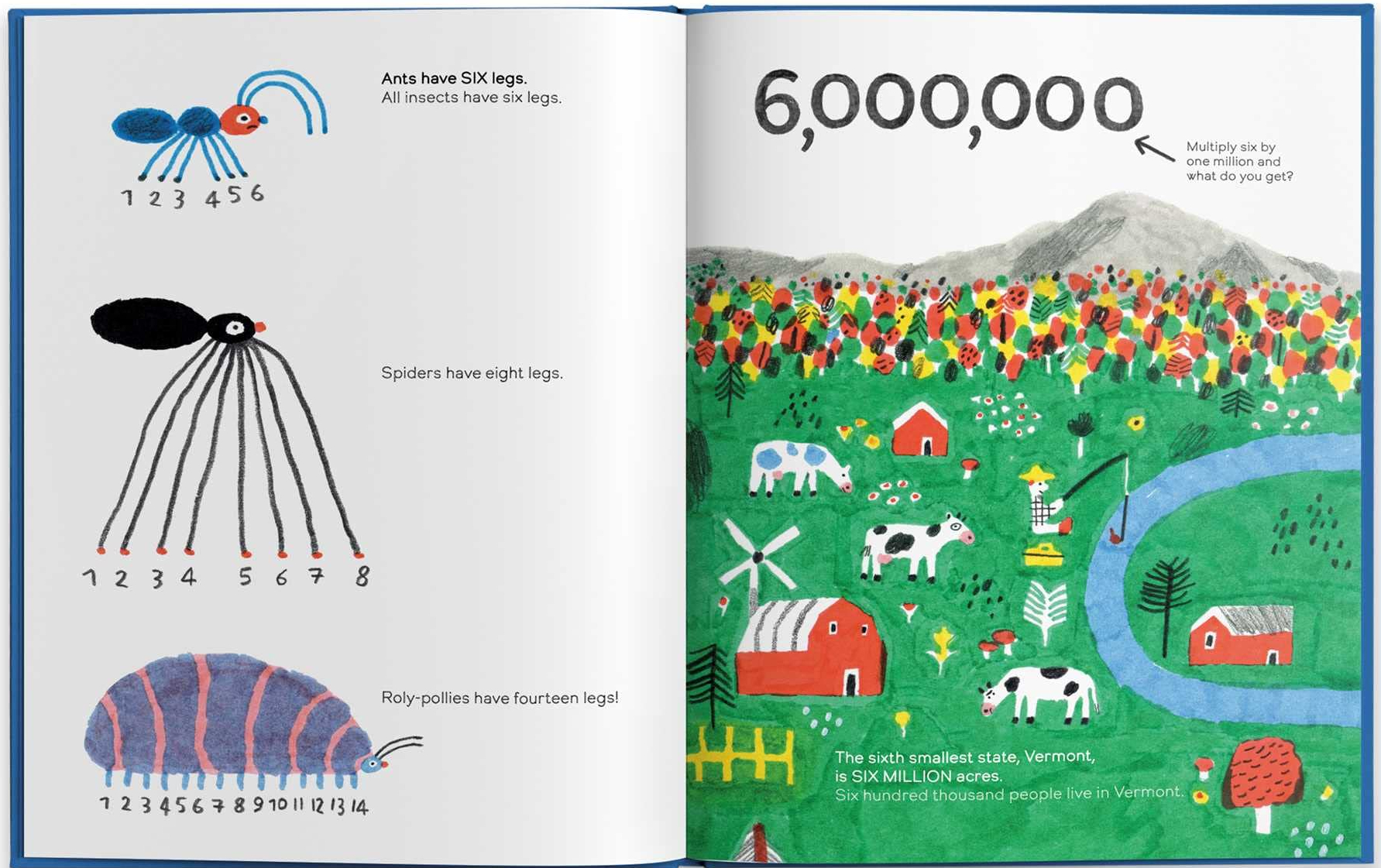
Andrea Antinori depicts each concept with whimsical illustrations that exude humor and personality while pointing readers to examples of the featured number or numbers. But her pages do much, much more as well. Take two page spreads that portray the number 1 for example. There is an image of our one sun as is mentioned in the text, and there is an image of a man with one heart as mentioned in the text. But this heart is a tattoo, which leads kids to notice that the man has other tattoos—all single images.

He is raising one arm, but at the end of that arm is a hand with five fingers just waiting to be counted. And—oh yeah—next to him is the adorable red octopus from the page about zero, who is also waving at the reader with one arm, but there’s a line of suckers on it (some singular, some in pairs) that also invite counting. And that’s just to get kids started. There are clouds, birds, and a sea full of dots to check out too. Now multiply that kind of clever detail and recurring characters by 30 pages and kids have almost innumerable ways to learn from and engage with this book.

Octopuses Have Zero Bones is a book that readers can page through from beginning to end or dip into whenever curiosity hits. It’s the perfect boredom buster because, as Anne Richardson notes, kids can jump off from any randomly chosen page into their own discovery and research at home, in their neighborhood, or on the Internet.

This book would be a much-used reference on home and bookshelves and is a must for classroom, school, and library collections.

Ages 5 – 9 and up

Tra Publishing, 2022 | ISBN 978-1735311524

You can find a Kids Activity Guide, Teacher’s Guide, and Posters for Octopuses Have Zero Bones to download on the Tra Publishing website.

About the Author

Anne Richardson is an author of experiences that kindle your curiosity. In her work, everything in the world is astonishing and worthy of our attention, from a drop of rain to the way we figure things out together. She is the senior director of Global Collaborations at the Exploratorium, San Francisco, where she works with partners worldwide to imagine and create new science centers and other extraordinary learning experiences. Richardson holds a PhD and an MS in environmental studies from Antioch University New England, and a BA in art history from Northwestern University. She lives in the San Francisco Bay Area with her family, including two little explorers. Visit her at her website.

About the Illustrator

Andrea Antinori is an award-winning illustrator based in Bologna, Italy. Since he was a child, he has loved animals and he has loved to draw them. His favorite animal changes all the time. He likes octopuses very much, but right now, lemurs are the creatures he loves most. He wrote and illustrated the book On the Lives of Lemurs: A Short Treatise on Natural History. Other books he has illustrated include A Book about Whales and The Great Battle, the latter of which has received major international awards including: Best International Illustrated Book — China Shanghai International Children’s Book Fair, Premio Andersen — Best book 6-9 years olds, Selected illustrator for exhibition of Bologna Children’s Book Fair 2017, Italian illustrator in IBBY Honor List 2016. You can learn more about her books and her art on her website and connect with her on Instagram.

Read a New Book Month Activity
celebrate-picture-books-picture-book-review-sock-octopus-craft

Cute Sock Octopus Craft


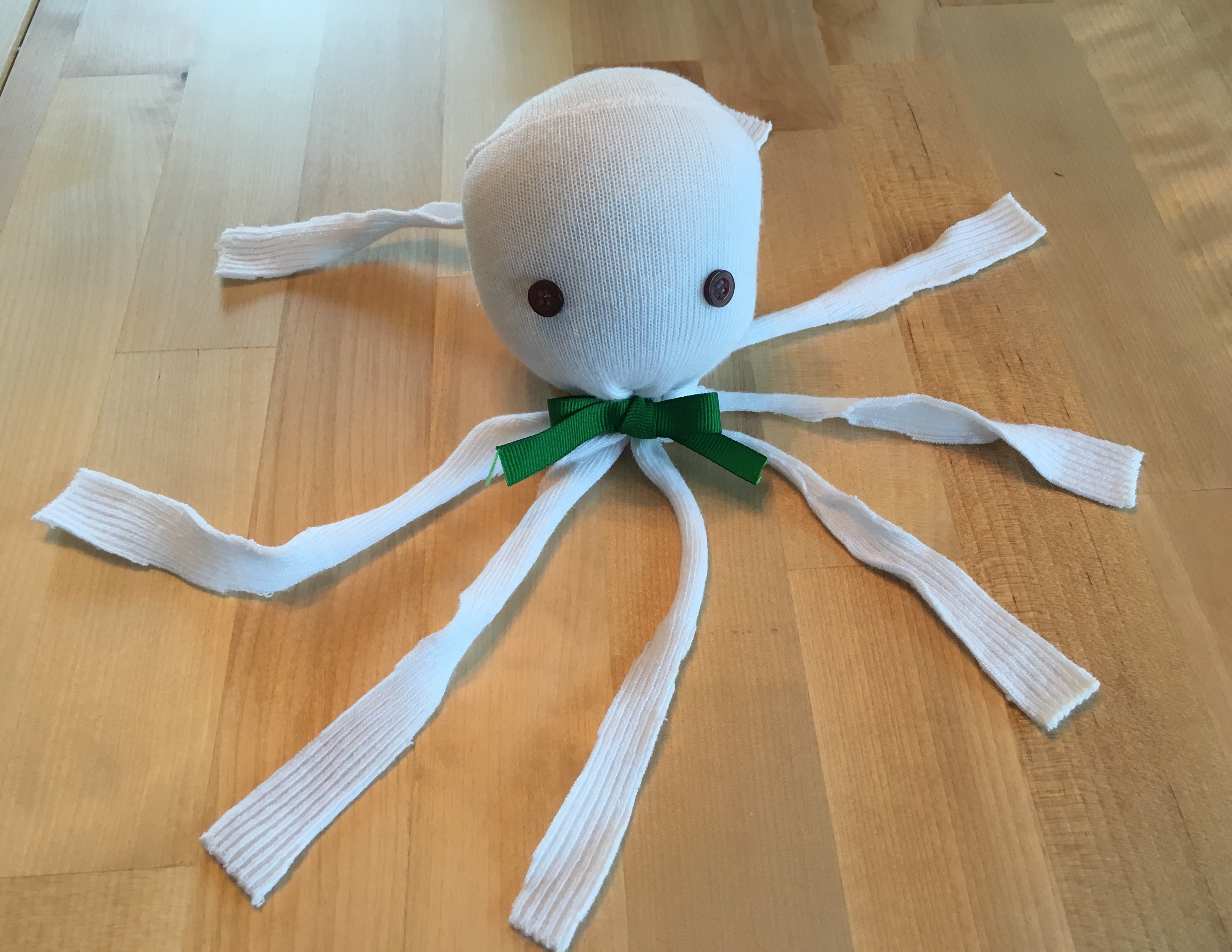
Octopuses may have zero bones but they sure do have a lot of arms! With this fast and easy craft you can make your own little octopus to count on to keep you company on your bed, your shelves, or on your desk!

Supplies

  • Child’s medium or large size sock, in any color
  • Polyfill, available at craft and sewing stores
  • Ribbon
  • 2 Small buttons
  • Scissors
  • Hot glue or strong glue

Directions

  1. Fill the toe of the sock with a handful of polyfiber fill
  2. Tie the ribbon tightly around the sock underneath the fiber fill to separate the head from the legs
  3. Tie the ribbon into a bow tie
  4. With the scissor cut up both sides of the sock almost to the ribbon
  5. Cut these two sections in half almost to the ribbon
  6. Cut the four sections in half almost to the ribbon
  7. Glue the eyes to the lower part of the head

celebrate-picture-books-picture-book-review-octopuses-have-zero-bones-cover

Buy a Book, Plant a Tree

If you purchase Octopuses Have Zero Bones from the Tra Publishing website, they, in partnership with One Tree Planted, plant one tree for every book purchased. At checkout, you have the opportunity to make an additional donation.

Purchase from the Tra Publishing website

You can find Octopuses Have Zero Bones at these booksellers

Amazon | Barnes & Noble | Books-a-Million

To support your local independent bookstore, order from

Bookshop | IndieBound

Picture Book Review
August 27 – It’s National Inventors Month

celebrate-picture-books-picture-book-review-how-was-that-built-cover

About the Holiday

While dates for this holiday may vary – some say May while others celebrate in August, National Inventors Month was established in 1998 by the United Inventors Association of the USA, the Academy of Applied Science, and Inventors’ Digest magazine. This month-long holiday recognizes the imagination and talent of individuals who dare to think differently to create new products, services, and ways of doing things that make a positive contribution to the world. Today, I’m sharing a book that highlights those who reach for the sky, dive under the sea, and look for opportunities to better help and connect people through the structures we use and live in. If you harbor dreams of being an inventor—on a large or small scale—look for opportunities to share your ideas!

How Was that Built?

Written by Roma Agrawal | Illustrated by Katie Hickey


They seem to have sprung from the ground, they soar into the clouds, they cross vast waterways—over and under the ripples and waves, and they come in all shapes and sizes. What are they? Buildings! For lovers of architecture, engineering, and just the marvels that people can construct, Roma Agrawal’s compendium of some of the world’s most incredible buildings will leave them enthralled—and much more knowledgeable on how these structures came to be.

In fifteen chapters, Agrawal reveals all the nuts and bolts about how buildings are secured on difficult sites (such as on sinking ground, in the sea, underground, and on ice); constructed to be tall, long, or able to move; and made to serve civic purposes. In addition to detailed explanations of the conditions architects and engineers must take into consideration when designing and constructing a building, bridge, or other structure, Agrawal clearly describes the materials used, how they are made, and why each is chosen for a particular job.

celebrate-picture-books-picture-book-review-how-was-that-built-emily-warren

Image copyright Katie Hickey, 2022, text copyright Roma Agrawal, 2022. Courtesy of Bloomsbury Children’s Books.

Rounding out each chapter, Agrawal goes in depth on one world building that demonstrates her topic. For example, In the first chapter she introduces readers to the Metropolitan Cathedral in Mexico City, which was built on top of an old Aztec pyramid in the middle of a filled-in lake. When it began sinking and tilting, engineers in the 1990s devised an intriguing way to save it. If you’re a fan of skyscrapers and wonder just how they’re built, a chapter on The Shard in London, which “is over 1,000 feet tall…and has 11,000 glass panels” (and for which Roma Agrawal worked as an engineer) reveals the secrets of a strong core and the incredible machinery that allows workers to keep going up and up.

Readers who love bridges will find two chapters on these beautiful and intricate structures. One reveals the fascinating story of how the construction of the Brooklyn Bridge overcame many challenges under the direction of Emily Warren, a woman who broke barrios for women in the engineering field. Another describes six different types of bridges as well as where they are used and why.

Readers also learn about concrete and how arches and domes work. They then explore the Pantheon and discover how it has stood for nearly 2,000 years. Other concrete structures from around the world are also discussed. You may not think too much about sewers, but imagine living without them! You’ll get a good (and stinky) idea about the conditions in London hundreds of years ago before Joseph Bazalgette designed and built the first sewer system. How did he do it? Agrawal breaks it down and then talks about today’s modern sewers.

celebrate-picture-books-picture-book-review-how-was-that-built-the-shard

Image copyright Katie Hickey, 2022, text copyright Roma Agrawal, 2022. Courtesy of Bloomsbury Children’s Books.

You’ll also find chapters on dams, tunnels, and buildings with moveable parts—or buildings like the Halley VI research station in Antarctica that can be moved easily in their entirety to avoid snow or ice that may crack beneath them. Then there are the challenges of building under the sea and in outer space. While astronauts now rely on the International Space Station, “some engineers and scientists are studying how to build structures on the Moon! Then researchers could live there for a long time to carry out their experiments and learn more about outer space.” What considerations must engineers take into account and what materials will they use? Agrawal fills readers in. She then closes her book with a look toward the future and talks about new materials and methods of building that may transform our world.

Sprinkled throughout the book are “Try It At Home” prompts for experiments that readers can easily do at home to visually interact with the concepts Agrawal lays out, such as using malted milk balls and raisins to understand “how carbon atoms make steel stronger” and making a pneumatic caisson with just a few household items.

Back matter includes a glossary of terms found in the book and brief biographies of ten influential engineers from the past and present.

celebrate-picture-books-picture-book-review-how-was-that-built-outer-space

Image copyright Katie Hickey, 2022, text copyright Roma Agrawal, 2022. Courtesy of Bloomsbury Children’s Books.

Readers of all ages will be engrossed by Roma Agrawal’s guide through the architecture and engineering that go into housing, moving, connecting, and supporting the world’s population. Every page contains fascinating details and interesting tidbits culled from Agrawal’s extensive experience as an engineer. These go far beyond an introduction to landmark buildings to show readers exactly how each type of building works. Relayed in a simple-to-understand, conversational style, her text is also broken up into short paragraphs that are easily digestible and invite further research, making this a superb resource for schools, homeschooling, and enthusiasts of all things engineering and architectural. Agrawal’s inclusion of structures from the past reveal the ingenuity of our ancestors and how they still influence today’s engineers and architects. Kids who love geography, archaeology, astronomy, and learning about all the intricate workings of the world will be enthralled with this book.

Katie Hickey gives readers an insider’s view of these phenomenal buildings with her stylish and incredibly detailed illustrations. Cityscapes allow children to understand the scale of skyscrapers from around the world and the beauty and breadth of New York City’s Brooklyn Bridge. Hickey whisks readers off to London to see The Shard; to New Zealand to view Te matau ā pohe, a bascule bridge whose shape was inspired by a fish hook; to Japan, where the Sapporo Dome accommodates soccer and baseball games with a moveable field of natural turf; and to Africa to stand on the edge of the Katse Dam and look 600 feet down into its reservoir. Along with this world tour, Hickey helps readers visualize the intricate working parts of certain buildings and bridges with interior views and small insets that demonstrate the physics of each design. Images of various types of cranes, pulleys, and other machinery also reveal the science behind building each structure.

A rich and comprehensive resource on the intricate engineering that goes into designing and building complex structures while also sharing the stories behind them, How Was that Built? will captivate readers of all ages. The book is a must for any STEM, science, art, or archaeology lover and belongs in all school and public library collections. 

Ages 6 and up

Bloomsbury Children’s Books, 2022 | ISBN 978-1547609291

Roma Agrawal is a structural engineer who builds big. From footbridges and sculptures, to train stations and skyscrapers – including The Shard – she has left an indelible mark on London’s landscape. She is a tireless promoter of engineering and technical careers to young people, particularly under-represented groups such as women. She has advised policymakers and governments on science education, and has given talks to thousands around the world at universities, schools and organizations, including two for TEDx. Roma has been awarded international awards for her technical prowess and success in promoting the profession, including the prestigious Royal Academy of Engineering’s Rooke Award. 

Discover more about Roma Agrawal and her work on her website, and connect with her on Instagram | Twitter. You can read an interview with Roma Agrawal in Publishers Weekly here.

To view a portfolio of work by Katie Hickey, visit Pickled Ink. You can connect with Katie Hickey on Instagram | Twitter 

National Inventors Month Activity

celebrate-picture-books-picture-book-review-spaghetti-box-bridge-craft

Build a Remarkable Recycled Bridge


You don’t need fancy blocks and construction materials to build a bridge! Little ones will be fascinated to put together a bridge made out of items you already have at home or that may even be slated for the recycle bin. Spaghetti boxes make great roadways, and cut-up egg cartons can be used as supports.

Build a Whole Town

Want to give your bridge a town with a river to span – or maybe two towns to connect? Cereal boxes and pasta boxes make great skyscrapers, apartment buildings, fire stations, and more. Need a farm silo? Grab a peanut butter jar, oatmeal container, or aluminum can. Cut a meandering river for your bridge to span from paper or cardboard. You can use them as is or—if your kids are sticklers for a little more detail—add some paint and details! So look around at the raw materials around you, use your imagination, and get creative!

celebrate-picture-books-picture-book-review-how-was-that-built-cover

You can find How Was that Built? at these booksellers

Amazon | Barnes & Noble | Books-a-Million

To support your local independent bookstore, order from

Bookshop | IndieBound

Picture Book Review
August 12 – Cover Reveal of Leaves to My Knees plus Interview with Ellen Mayer and Nicole Tadgell

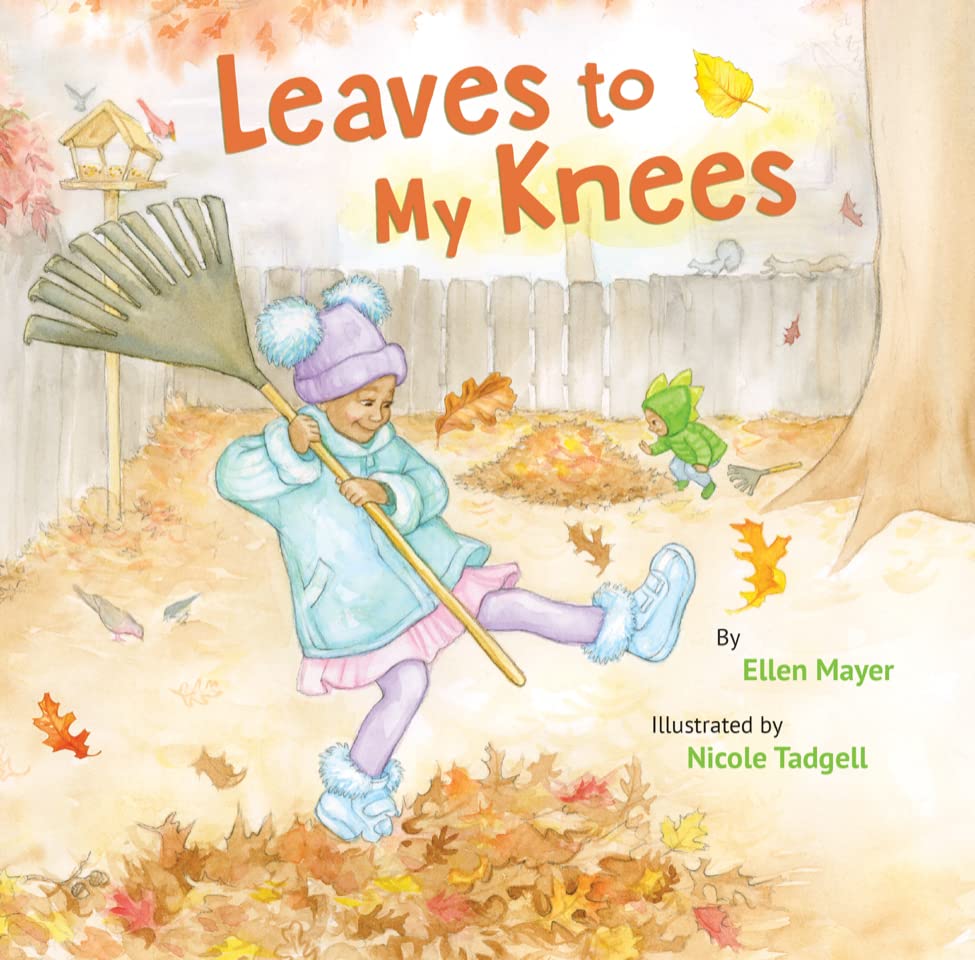
  • celebrate-picture-books-picture-book-review-leaves-to-my-knees-cover
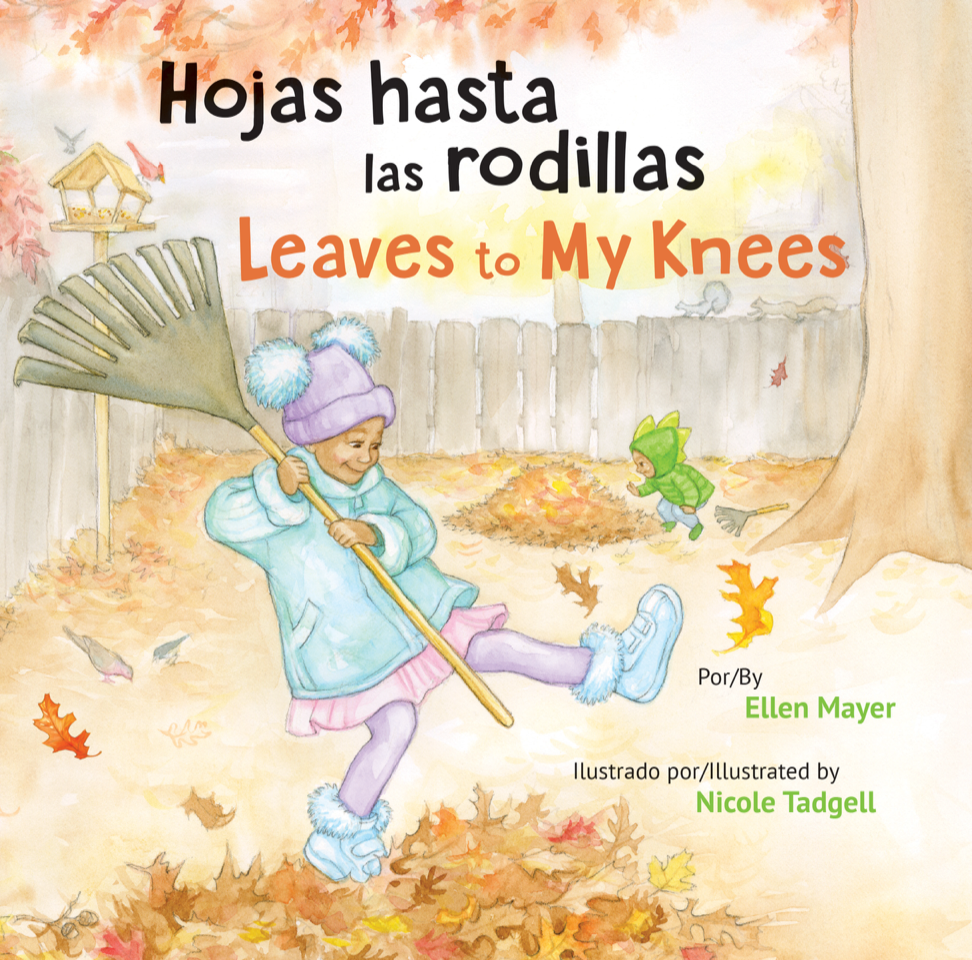
  • celebrate-picture-books-picture-book-review-leaves-to-my-knees-spanish-english-cover

Leaves to My Knees 

Hojas hasta las rodillas/Leaves to My Knees

Written by Ellen Mayer | Illustrated by Nicole Tadgell


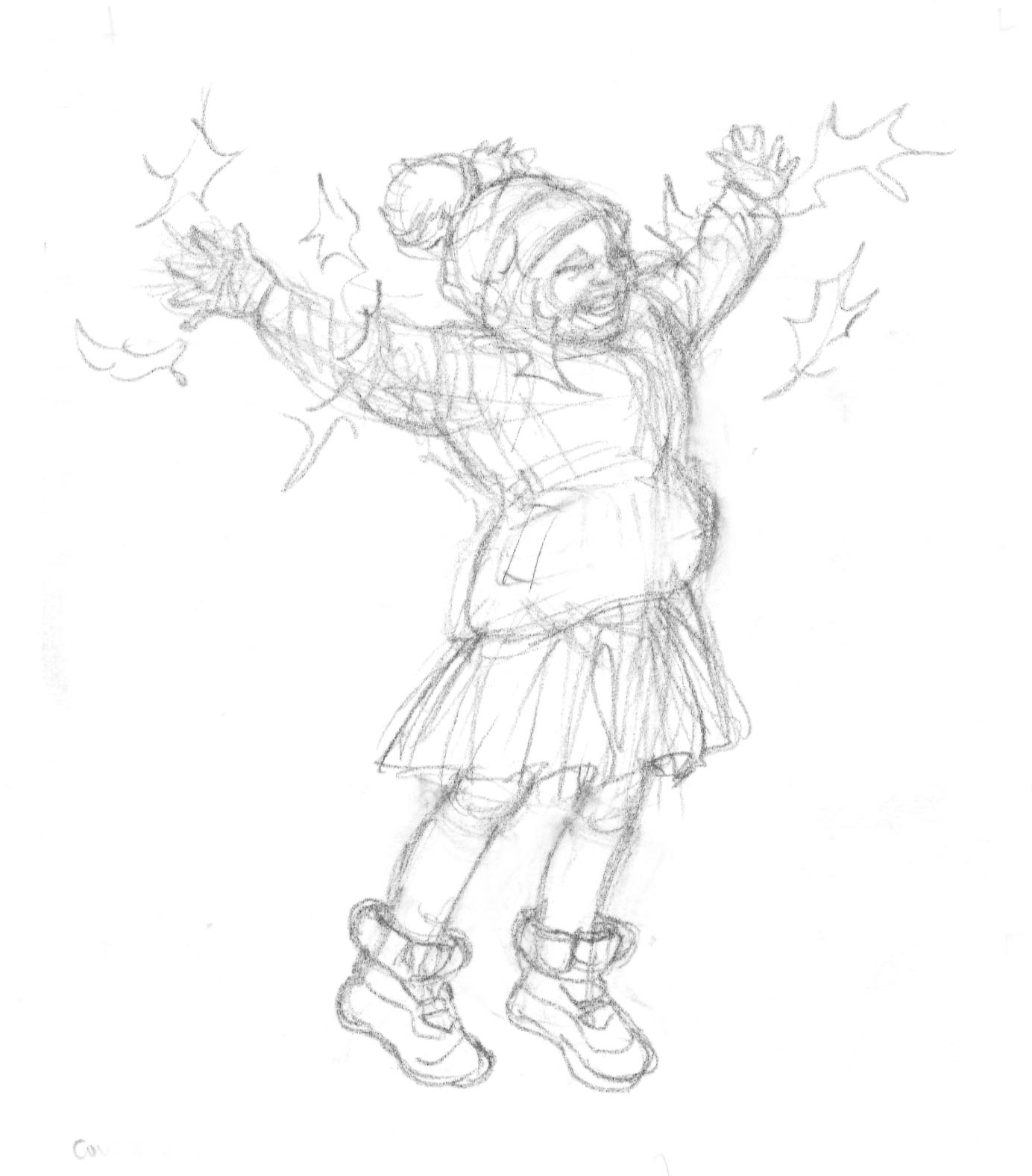
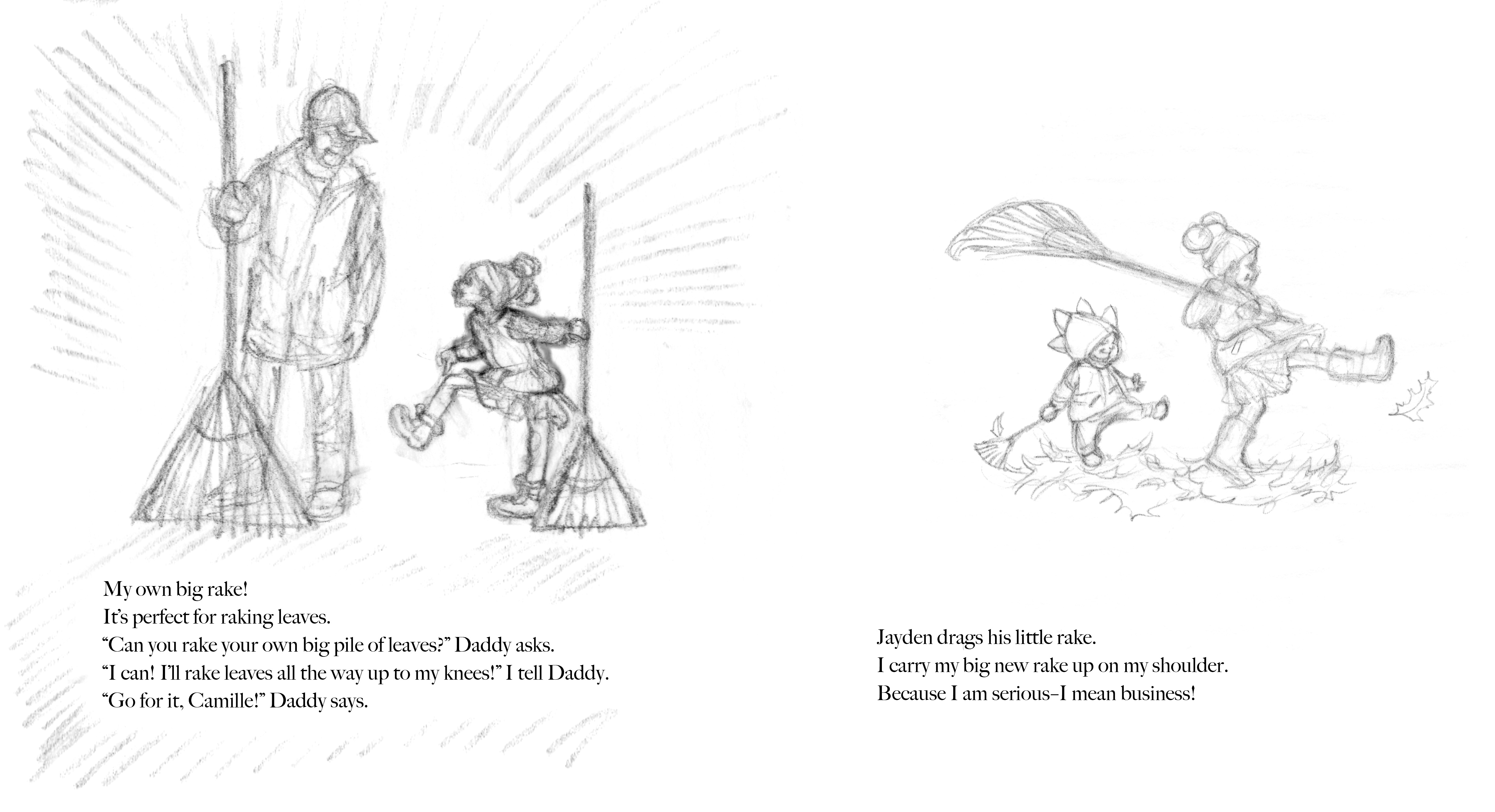
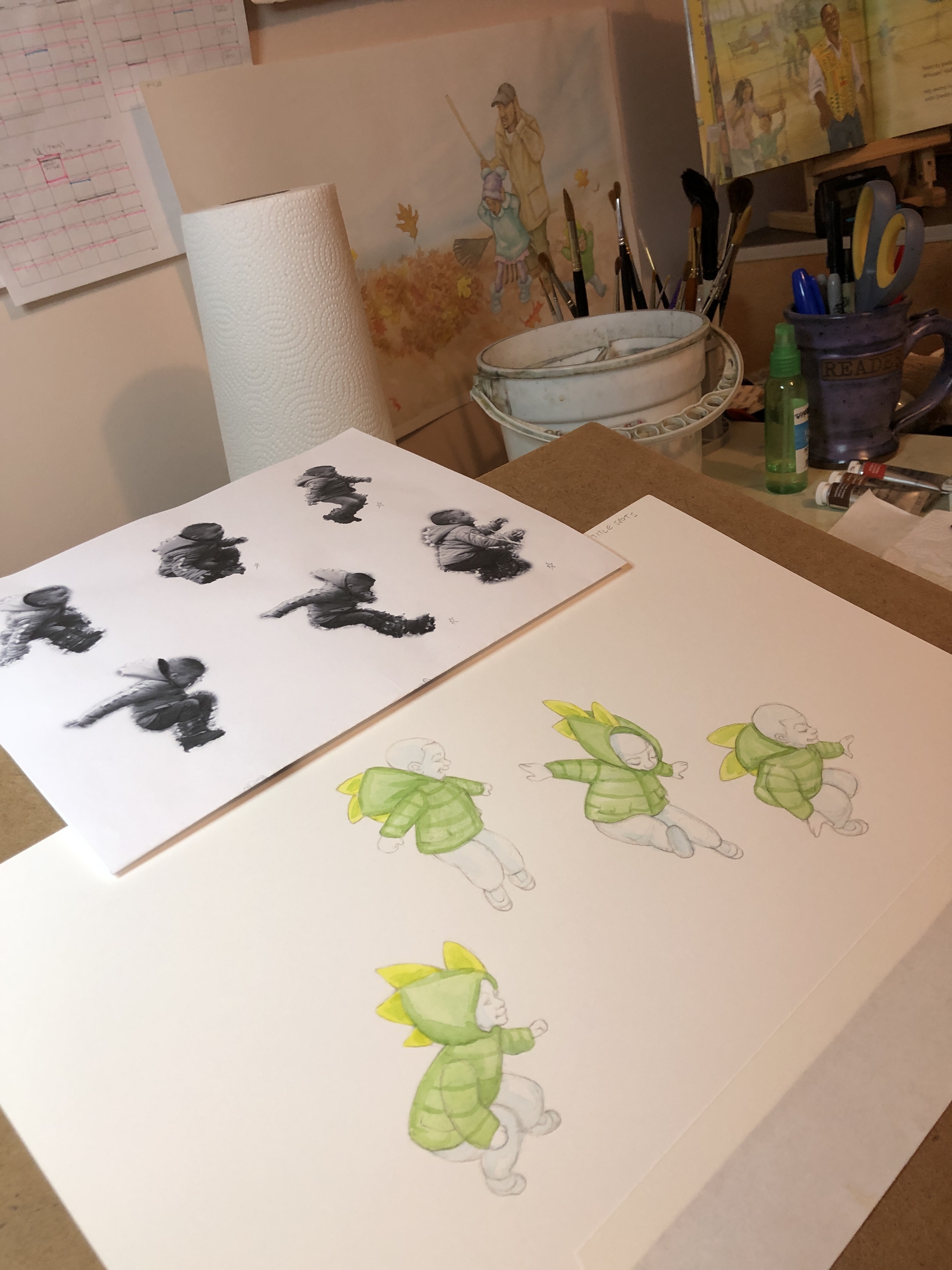
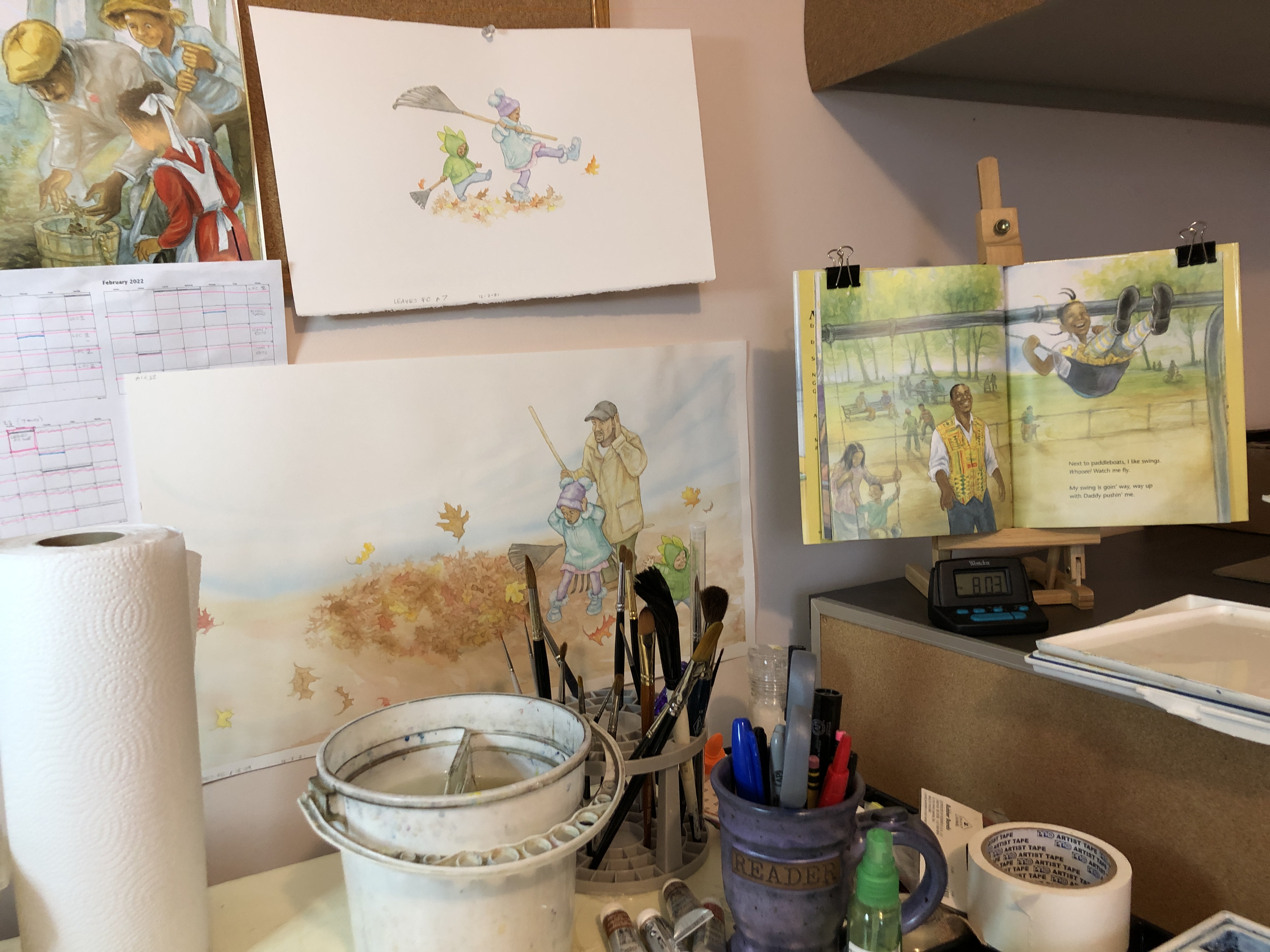
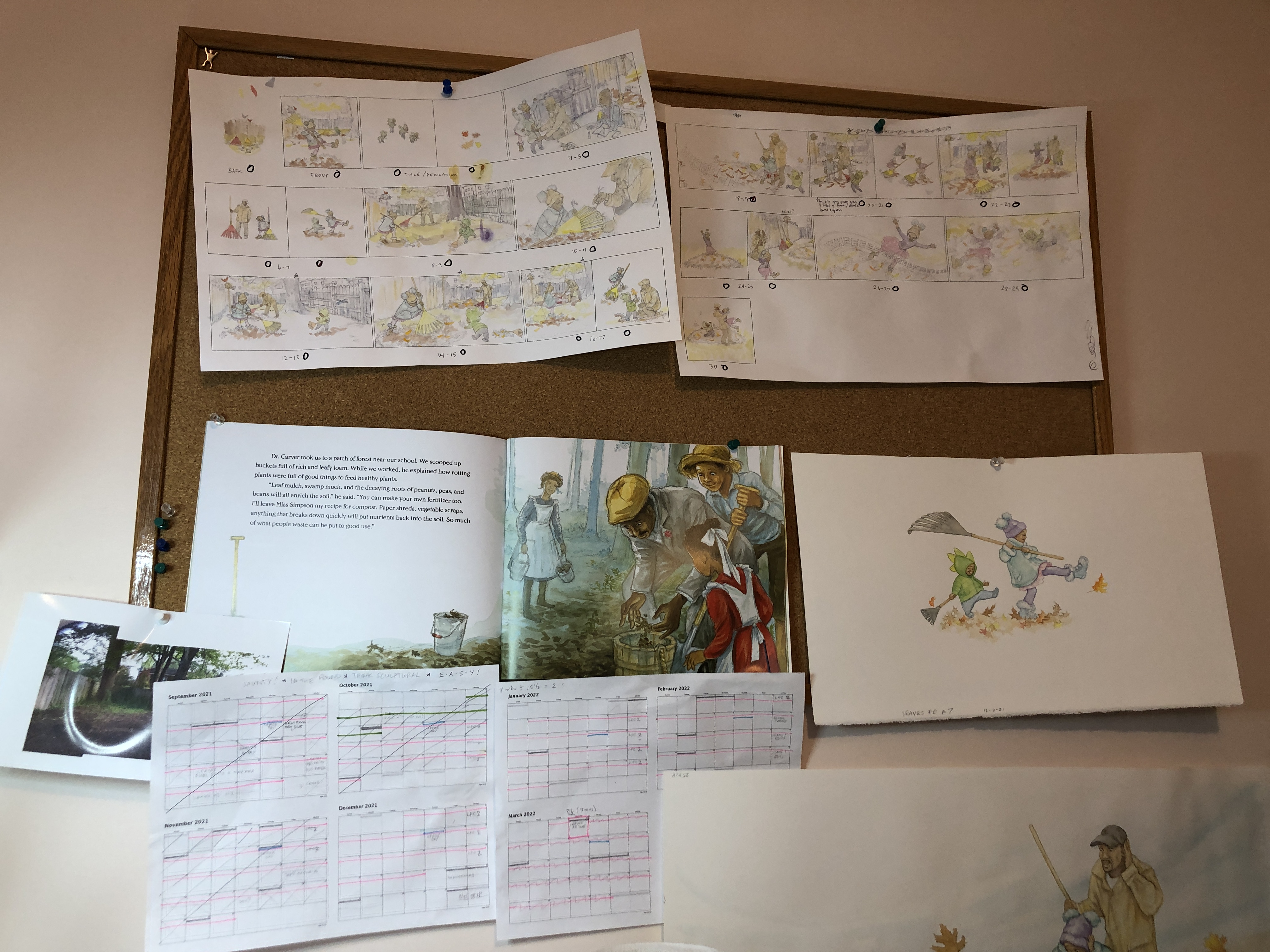
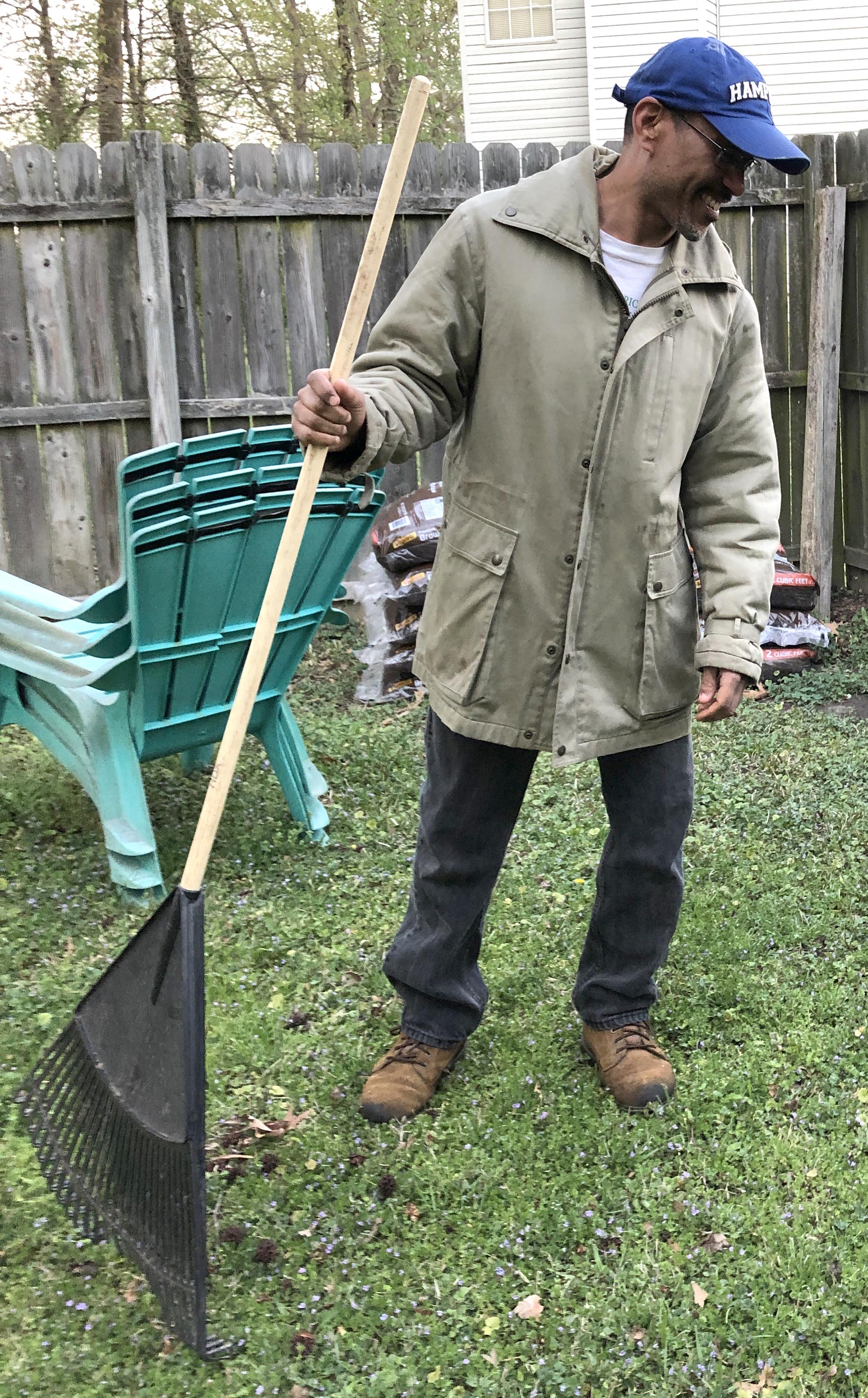
Camille is determined to rake her own pile of leaves―all the way up to her knees! She swishes leaves to and fro, watching her pile grow bigger alongside the piles made by Daddy and her little brother, Jayden. WHOOSH! After raking leaves to the top of her boots, a giant breeze blows the pile back down to her ankles. But Camille won’t be stopped until she gets the job done––a knee-high pile, the perfect size for… jumping in!

Leaves to My Knees and Spanish/English bilingual Hojas hasta las rodillas/Leaves to My Knees are playful introductions to the early math concepts of size comparison and measurement. A note by researcher and mathematics learning expert Marlene Kliman explains how parents and caregivers can use the book to help young children explore different sizes and measurement in everyday environments.

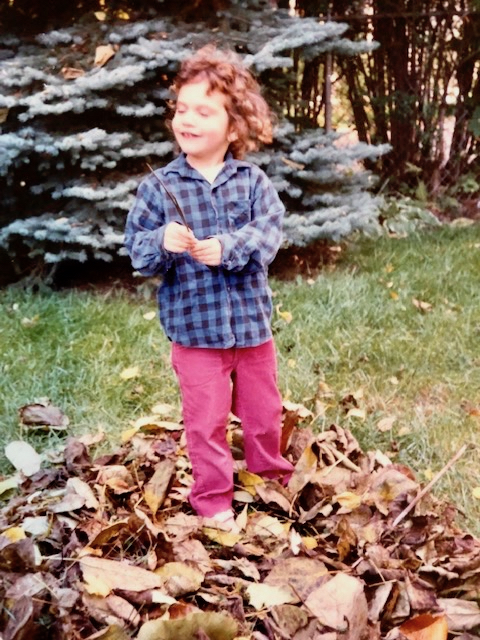
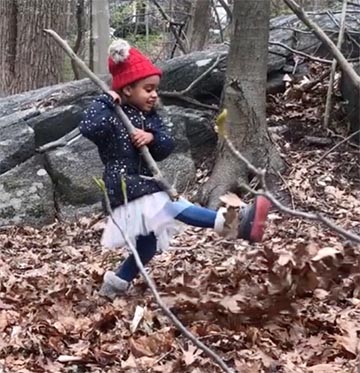
I’m thrilled to be talking with Ellen Mayer and Nicole Tadgell today about this gorgeous cover and their adorable—and educational—book that will be available this fall, just in time for leaf-raking season!

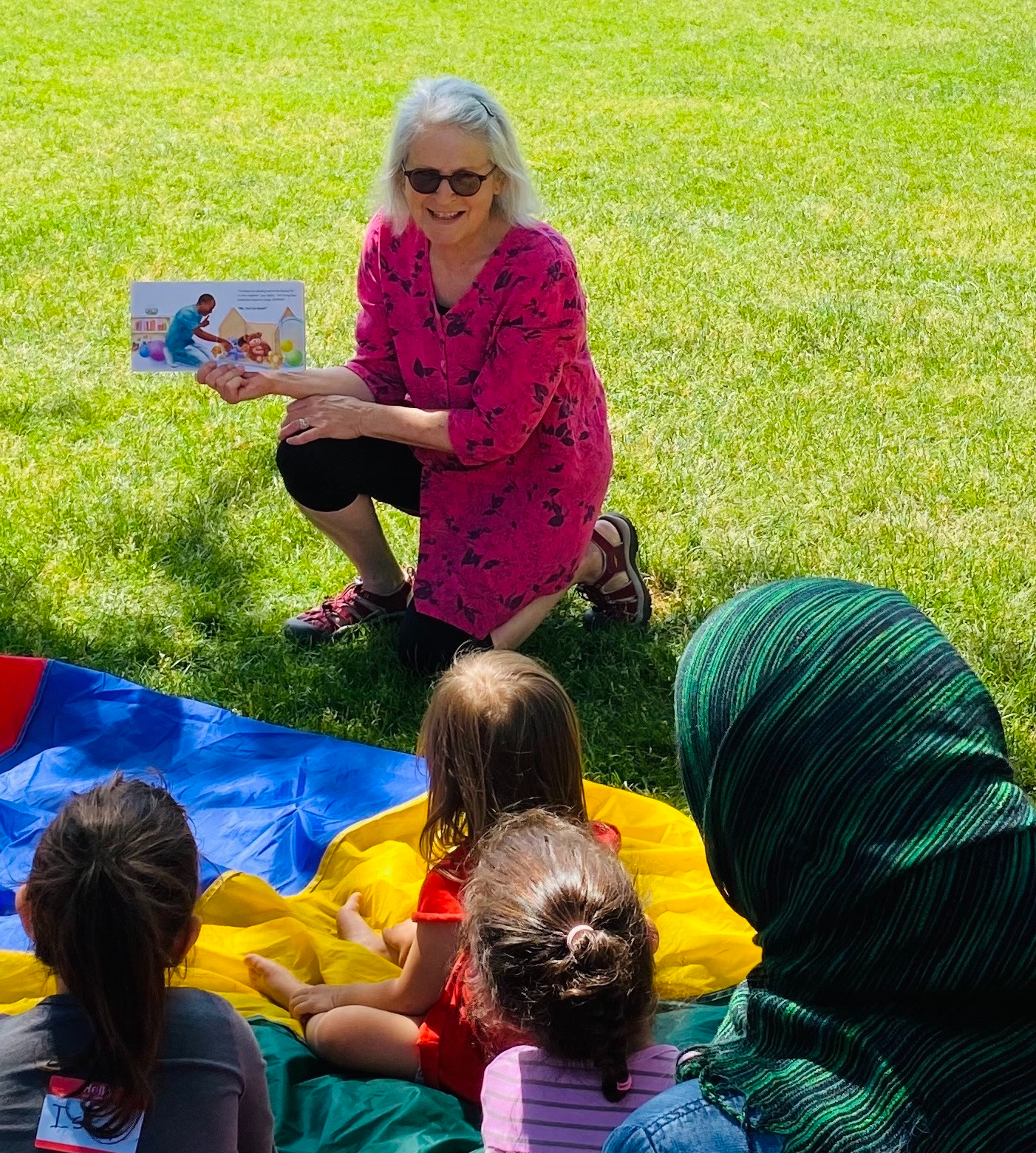
Meet Ellen Mayer

celebrate-picture-books-picture-book-review-ellen-mayer-reading-headshot

To preorder from Amazon

Leaves to My Knees: Hardcover | Paperback

 Hojas hasta las rodillas/Leaves to My Knees

To order from Star Bright Books and be notified when the books become available click here: 

Leaves to My Knees: Hardcover | Paperback

Hojas hasta las rodillas/Leaves to My Knees 

Picture Book Review
June 1 – National Dinosaur Day

celebrate-picture-books-picture-book-review-jack-horner-dinosaur-hunter-cover

About the Holiday

Today, we celebrate dinosaurs—those beasts that, although they are of a distant past, remain ever present in our hearts. Their size, diversity, and shear awesomeness make them a favorite of kids, and ongoing discoveries continue to fascinate adults as well. To celebrate, visit a national history museum, watch your favorite dinosaur movies or TV shows, join your kids in playing with their dinos (you know you want to!), and pick up today’s book!

Jack Horner, Dinosaur Hunter!

Written by Sophia Gholz | Illustrated by Dave Shephard


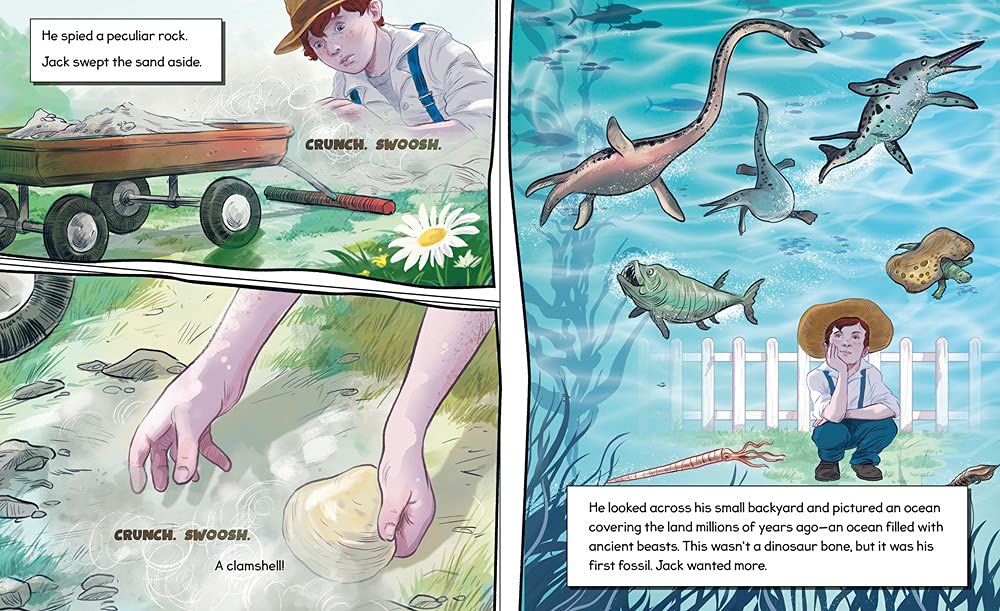
Growing up in Montana, Jack Horner was lulled to sleep by the “crunch, swoosh. Crunch, swoosh” of his father’s gravel business, and as soon as he was big enough to hold a shovel, he began digging. He loved being outdoors, searching for dinosaur bones. He dreamed of being a paleontologist when he grew up. His digging usually only produced rocks, sticks, and dirt, but once he “spied a peculiar rock” and when he had carefully swept the sand aside, he discovered a clamshell. His first fossil find made him look at his backyard differently – as “an ocean covering the land millions of years ago–an ocean filled with ancient beasts.” Jack wanted to find more fossils.

celebrate-picture-books-picture-book-review-jack-horner-dinosaur-hunter-clamshell

Image copyright Dave Shephard, 2021, text copyright Sophia Gholz, 2021. Courtesy of Sleeping Bear Press.

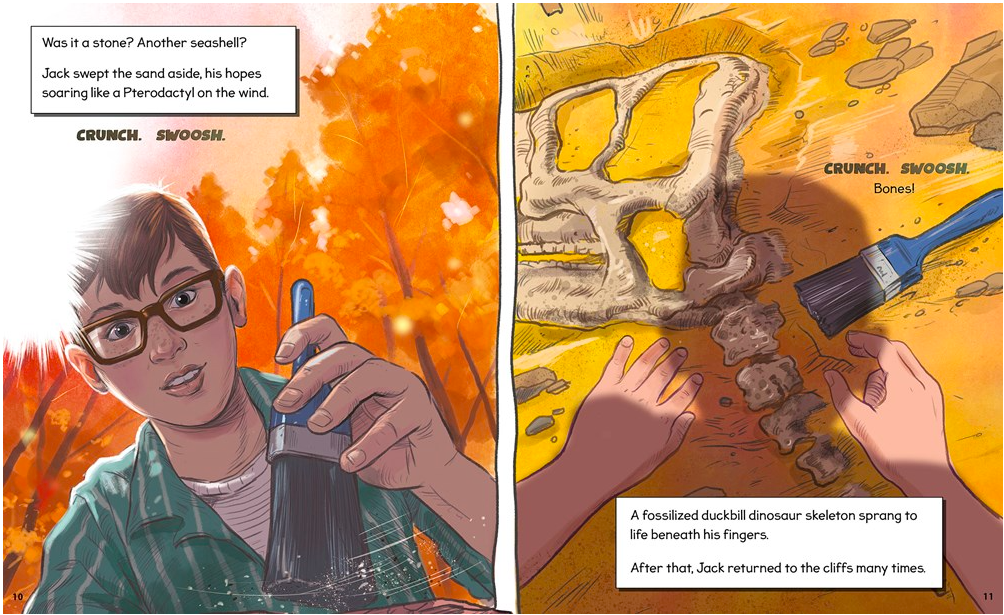
Jack taught himself how to “search for clues among the rocks: irregular textures, colors, and shapes.” He found lots of fossilized shells, but he really wanted to find a dinosaur. He went fossil hunting “in the woods and near the mountains.” Then one day while hiking up a cliff, Jack saw “an odd rock nestled in the ground.” With his tools he brushed the sand aside and uncovered the skeleton of a duck-billed dinosaur. 

celebrate-picture-books-picture-book-review-jack-horner-dinosaur-hunter-duckbill-fossil

Image copyright Dave Shephard, 2021, text copyright Sophia Gholz, 2021. Courtesy of Sleeping Bear Press.

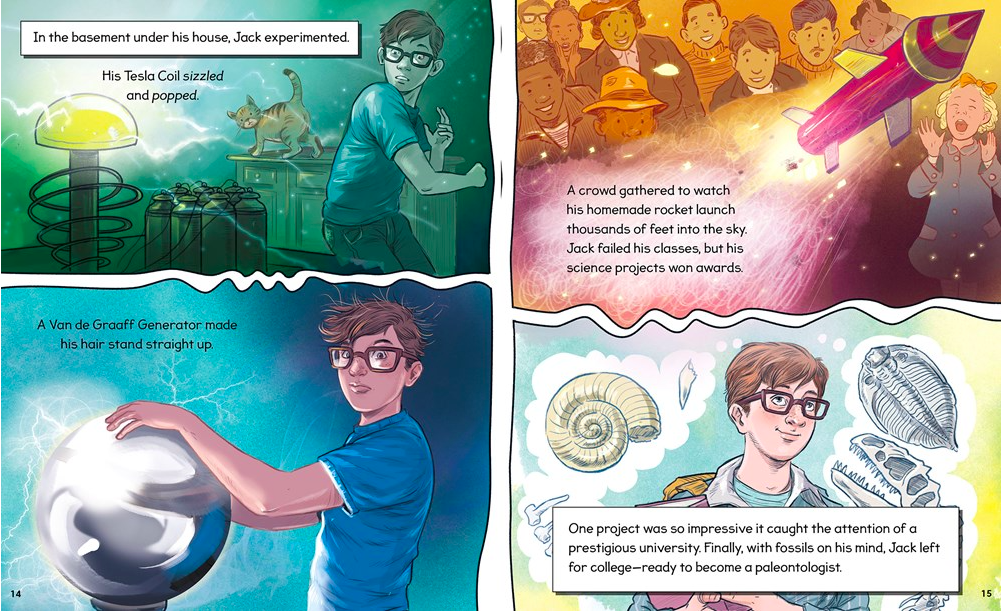
While Jack was quickly becoming an expert on fossils and the landscapes that hid them, he struggled with reading in school.  His teachers told him that if his grades didn’t improve, he’d never be able to become a paleontologist. He took to experimenting in his basement, winning awards for his science projects even as he was failing his classes. One prestigious university, however, did admit Jack on the strength of one impressive project, but just as before Jack was unable to keep up in class. He dropped out and was drafted soon after to join the Vietnam War. 

celebrate-picture-books-picture-book-review-jack-horner-dinosaur-hunter-science-projects

Image copyright Dave Shephard, 2021, text copyright Sophia Gholz, 2021. Courtesy of Sleeping Bear Press.

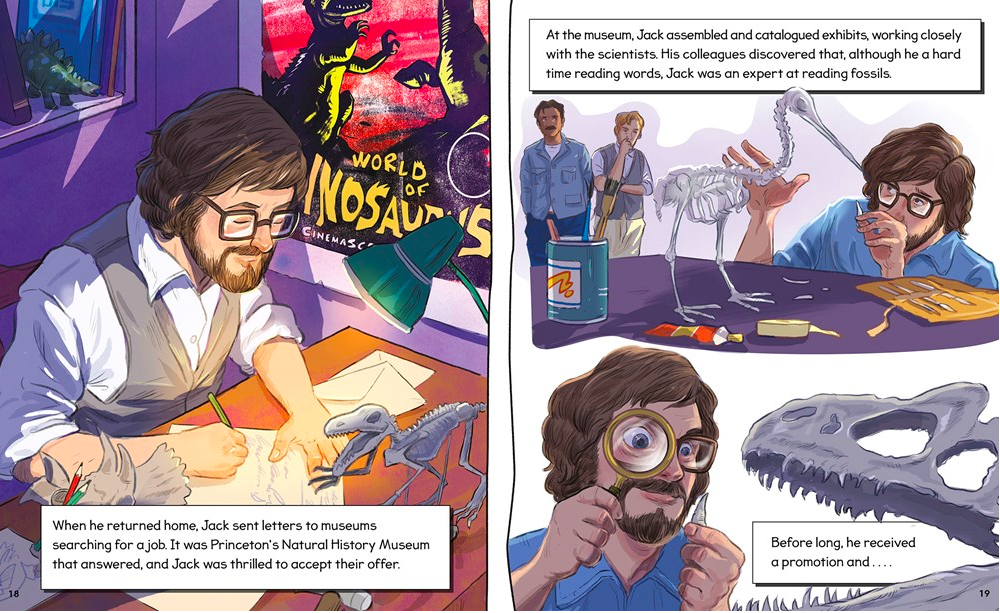
Here, he decided that when he got home, he would try to work closely with paleontologists, if he couldn’t actually be one himself. He was hired by Princeton University’s natural history museum, where he “assembled and cataloged exhibit, working closely with scientists.” His colleagues recognized that Jack was an “expert at reading fossils.” He got a promotion that allowed him to work in the field. 

celebrate-picture-books-picture-book-review-jack-horner-dinosaur-hunter-museum-job

Image copyright Dave Shephard, 2021, text copyright Sophia Gholz, 2021. Courtesy of Sleeping Bear Press.

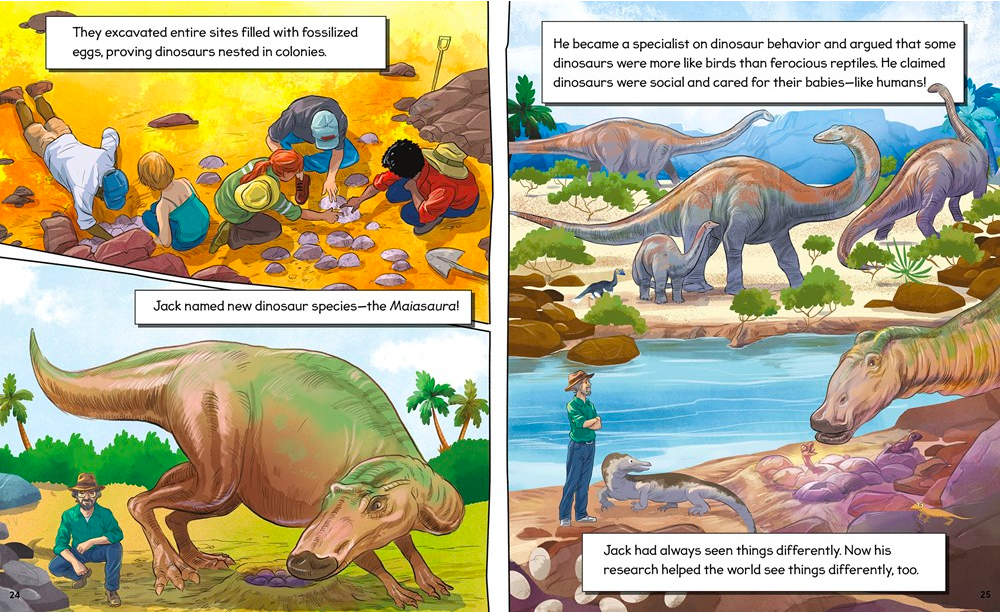
It was during one of these trips into cliffs that Jack “spied something odd. Heart thumping like the tail of an Ankylosaurus, he leapt into action.” When Jack swept the sand away, he and his team discovered a nest of fossilized dinosaur eggs – the first such find in North America. Jack went on to find more fossilized eggs, “proving dinosaurs nested in colonies;” name a new dinosaur species; and become an expert on dinosaur behavior and social structure. He even shared his special expertise when a famous movie producer filmed one of his great blockbusters. Jack had succeeded in his dream to be a “world-famous paleontologist.”

Back matter includes an Author’s Note, more about Jack Horner’s life, and a Dino Lab, that invites readers to design their own dinosaur and provides mix-and-match Greek and Latin words to help kids name their dino.

celebrate-picture-books-picture-book-review-jack-horner-dinosaur-hunter-specialist

Image copyright Dave Shephard, 2021, text copyright Sophia Gholz, 2021. Courtesy of Sleeping Bear Press.

Dinosaur lovers and anyone with dino-sized dreams will be instantly hooked by Sophia Gholz’s immersive biography of Jack Horner, who forged his own path to becoming one of the world’s most influential paleontologists. His self-confidence, unstoppable drive, and ultimate success will inspire all readers to define themselves by what they can do – not by what they may struggle with – and to trust their instincts on the way to achieving their goals. Gholz tells Jack’s story clearly and with the kind of repeated phrasing that builds suspense while also replicating the types of life experiences that create expertise. 

Dave Shephard’s bold illustrations will enthrall kids as they join Jack in the cliffs of Montana to brush away the sand from a duck-billed dinosaur fossil, see the underground strata where fossils lurk, and discover the nest of fossilized eggs. Shephard also depicts Jack’s struggles in school, where his undiagnosed dyslexia causes words and equations to become a jumbled stumbling block to his education. The vibrant format with clear typography will appeal to fans of graphic novels as well as to reluctant readers.

Jack Horner, Dinosaur Hunter! is an exceptional biography of a boy and man who never gave up on finding a way to accomplish his goal. The book will captivate children on its own or as an introduction to a wide range of classroom lessons and is highly recommended for all home, classroom, and public library collections.

Ages 6 – 9

Sleeping Bear Press, 2021 | ISBN 978-1534111196

Discover more about Sophia Gholz and her books on her website.

To learn more about Dave Shephard, his books, and his art, visit his website.

National Dinosaur Day Activity

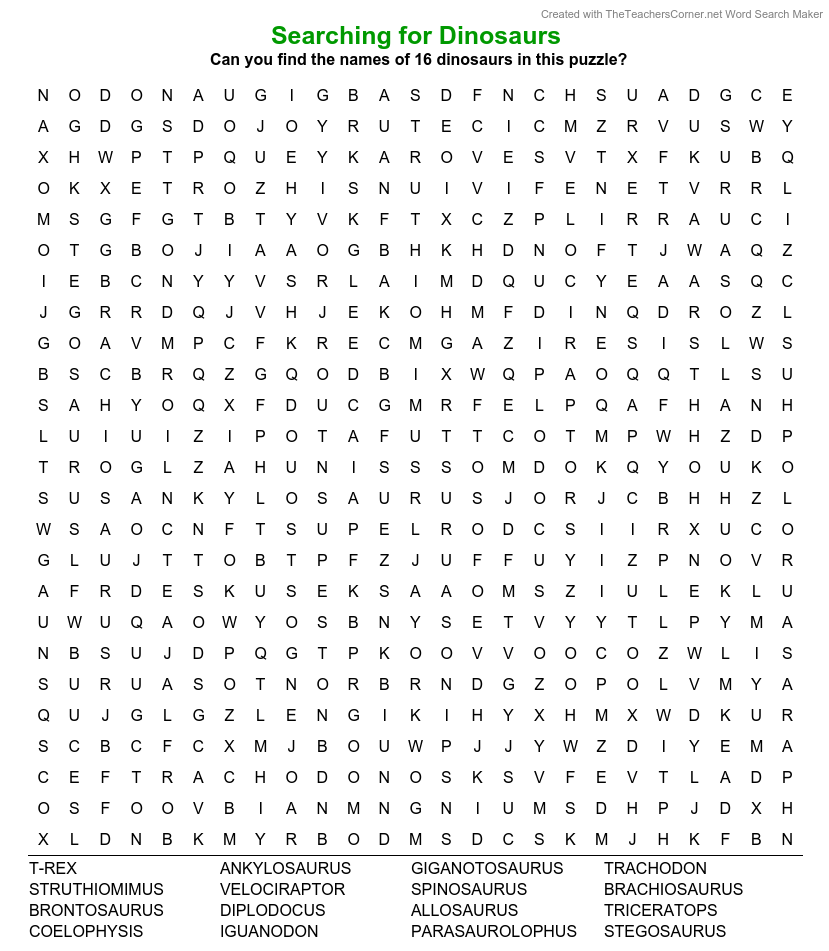
celebrate-picture-books-picture-book-review-dinosaur-word-search-puzzle

Searching for Dinosaurs Puzzle


Hunt for 16 types of dinosaurs in this printable puzzle!

Searching for Dinosaurs Puzzle | Searching for Dinosaurs Solution

celebrate-picture-books-picture-book-review-jack-horner-dinosaur-hunter-cover

You can find Jack Horner, Dinosaur Hunter! at these booksellers

Amazon | Barnes & Noble | Books-a-Million

To support your local independent bookstore, order from

Bookshop | IndieBound

Picture Book Review

June 1 – National Dinosaur Day

celebrate-picture-books-picture-book-review-everything-awesome-about-dinosaurs-cover

About the Holiday

Today, we celebrate dinosaurs—those beasts that, even though they are from the distant past, remain ever present in our hearts. Their size, diversity, and shear awesomeness make them a favorite of kids, and ongoing discoveries continue to fascinate adults as well. Dinosaurs, in fact, are so huge that Dinosaur Day takes place twice—today and on June 1. To celebrate, visit a national history museum, watch your favorite dinosaur movies or TV shows, join your kids in playing with their dinos (you know you want to!), and pick up today’s book!

Everything Awesome about Dinosaurs and Other Prehistoric Beasts!

By Mike Lowery


If there’s one thing kids can’t get enough of, it’s dinosaurs. And if there’s one thing Mike Lowery knows, it’s how to wow kids. The mash-up of the two has resulted in a wild and wacky book “that’s totally loaded with info, weird facts, and jokes that you will dig!” There are even dinos at the ready to point out these awesome puns. And these facts aren’t just presented like some old, dried-up report, the whole book—every page—is full of eye-popping illustrations and cool typography that will keep kids reading and reading and learning (and, oh yeah, having T-rex size fun).

celebrate-picture-books-picture-book-review-everything-awesome-about-dinosaurs-mammoth

Copyright Mike Lowery, 2019, courtesy of Orchard Books.

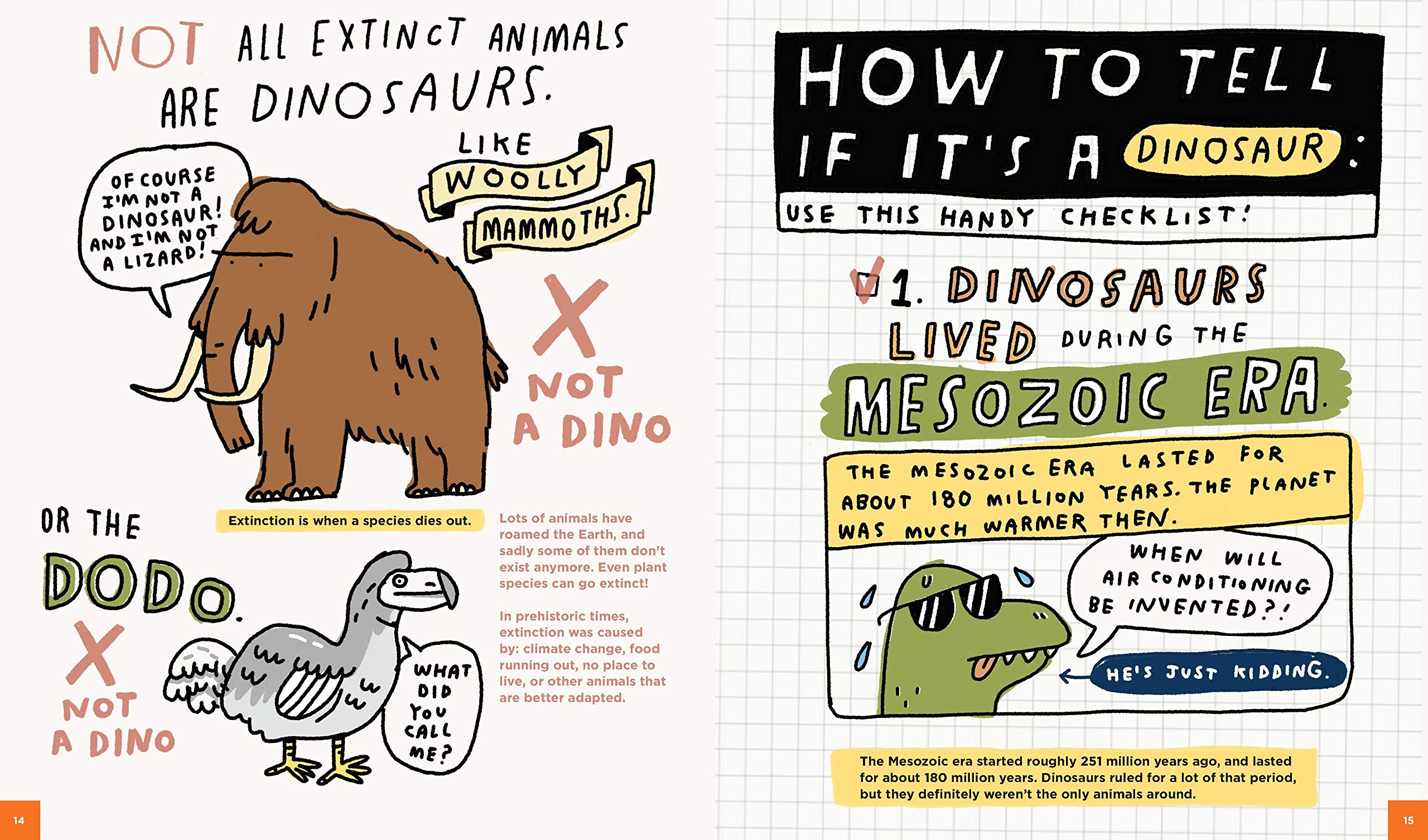
What kinds of things will kids learn? First, there’s a completely captivating prehistoric timeline that lays out the different eras and depicts some of the creatures and vegetation that existed in each. Like jellyfish during the Paleozoic Era, horsetails plants and dicynodonts during the Triassic, stegosaurus and cycads in the Jurassic; bees, birds, and flowering plants along with velociraptors in the Cretaceous; and finally, woolly mammoths and us during the Age of Mammals. Along the way there were also several extinction events. And this all comes even before the Table of Contents!

While kids chew on the fact that “some giant dinos ate up to 12,000 pounds a day,” they can dip into Part One—What Is a Dinosaur? Here, they’ll learn stuff like where the word “dinosaur” came, who coined it, what “prehistoric” means, and who “were some of the first people to keep written records.” They’ll also get to know some animals that weren’t dinosaurs and how dinosaurs are defined. Of course, there are some dino jokes to keep kids chuckling while they read.

celebrate-picture-books-picture-book-review-everything-awesome-about-dinosaurs-backbones

Copyright Mike Lowery, 2019, courtesy of Orchard Books.

Part Two reveals a short history of the earth as well as lots and lots about each era and representative creatures. After learning just how old Earth is, kids will be interested in a Quick Fact about one Jeremy Harper who counted to one million live on the internet. How long did it take him? Longer than you might think. Have you ever tried smooshing the whole history of the earth into just 24 hours? Mike Lowery did and it’s fascinating! Kids will also discover how Earth formed and about early signs of life.

What was going on in the Paleozoic Era? The haikouichthys (one of the first animals to have a skull), tiktaalik (a land and sea creature), and the meganeura (a giant dragonfly) can tell them. It was also the time of the Permian Period, when some pretty weird reptiles roamed the earth and some way-unusual marine life swam the seas. Then came “the Great Permian Extinction” that led into the Mesozoic Era, “aka the age of reptiles.”

celebrate-picture-books-picture-book-review-everything-awesome-about-dinosaurs-sauropods

Copyright Mike Lowery, 2019, courtesy of Orchard Books.

Here, kids learn about the development of dinosaurs, non-dino animals, and bugs. If you think a few stormy days are bad, imagine living during the Triassic Period, when “it once rained for two million years.” What do you wear in weather like that? A “Jurassic parka,” of course. Next up is the Jurassic and then the Cretaceous periods and their gigantic creatures of the land, ocean, and sky.

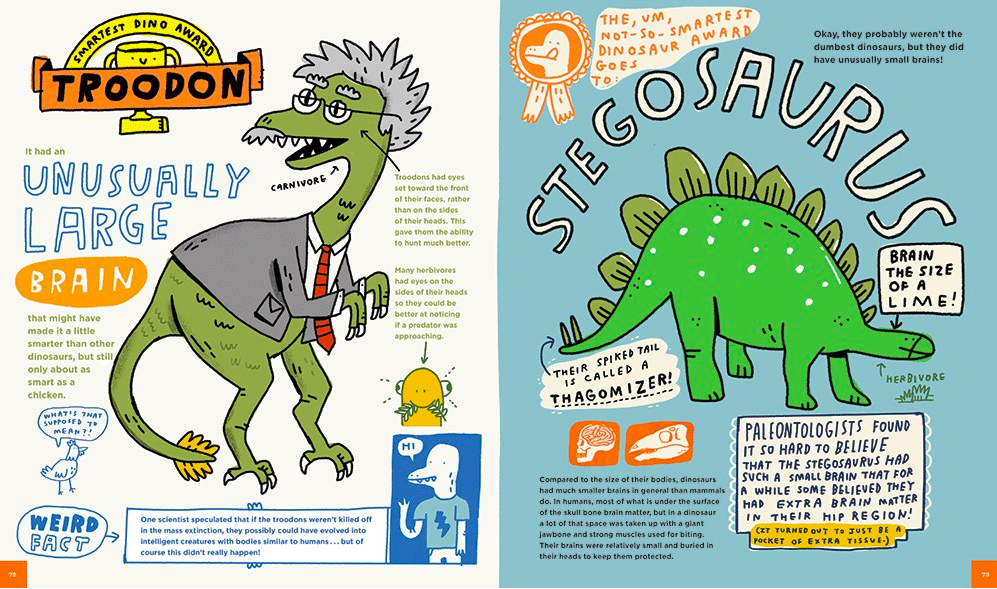
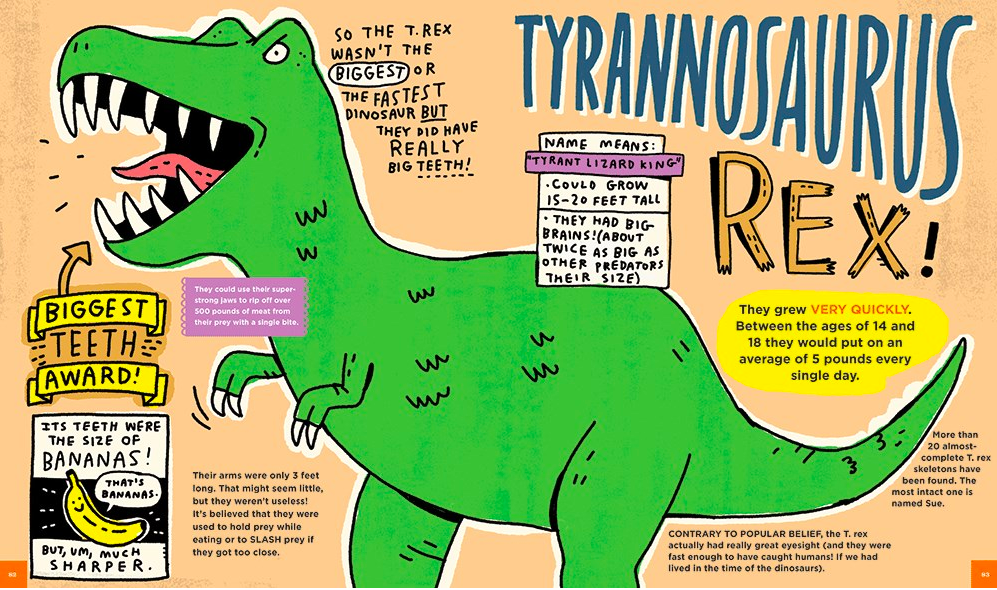
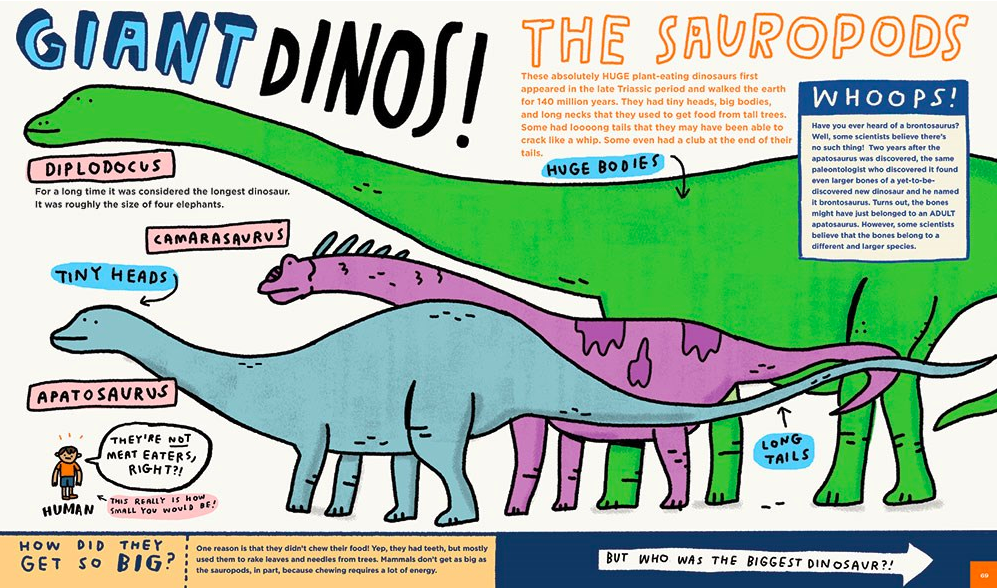
In Part Three readers get to meet the dinosaurs up close and personal (well, not too close). They’ll learn what dinos really ate, how they really sounded, and this delectable fact: “More time passed between stegosaurus and T. rex than the time between velociraptor and microwavable pizza!” And while kids are digesting that, they’ll want to watch out for the gigantic sauropods (who grew that big partly because “they didn’t chew their food…. Mammals don’t get as big as the sauropods, in part, because chewing requires a lot of energy.” Kids will see who won the “smartest dino award” and who was unfortunate enough to win “the, um, not-so-smartest dinosaur award.” They’ll also learn about horned dinos, armored dinos, fast dinos, and “the weirdest lookin’ dino.”

celebrate-picture-books-picture-book-review-everything-awesome-about-dinosaurs-troodon

Copyright Mike Lowery, 2019, courtesy of Orchard Books.

Part Four talks about the Cretaceous-Paleogene extinction event and various theories that have been floated throughout the years. Part Five takes kids on a hunt for bones and other fossils and reveals how paleontologists study them. Part Six offers a tour of post-dinosaur beasts, and Part Seven invites kids to learn how to draw dinosaurs. That’s followed up by a Dino Field Guide, an illustrated list of dinos organized by time periods, and to round it all up, Lowery includes a few more irresistible dinosaur jokes.

celebrate-picture-books-picture-book-review-everything-awesome-about-dinosaurs-t-rex

Copyright Mike Lowery, 2019, courtesy of Orchard Books.

Mike Lowery’s free-wheeling sense of humor, on exhibit in both his text and illustrations, will have kids laughing and learning billions of years’ worth of scientific facts. Funny asides by dinosaurs who just want in on the action put a spotlight on major events and conditions on Earth. Boxed and highlighted facts reveal the science of paleontology and provide explanations of dinosaur and prehistoric animal behavior and comparisons on size that will resonate with kids. Lowery imbues each of his creatures with personality while staying true to their nature and body type. Simply said, if there’s something you want to know about prehistoric creatures, dinosaurs, and the times they lived in, it’s in this book.

A must for home, classroom, and public library collections, you’ll want to put Everything Awesome about Dinosaurs and Other Prehistoric Beasts! on your shopping list for kids, teachers, and anyone who loves science, dinosaurs, and entertaining ways to learn or teach.

Ages 7 – 10 and up

Orchard Books, 2019 | ISBN 978-1338359725

Discover more about Mike Lowery, his books, and his art on his website.

National Dinosaur Day Activity

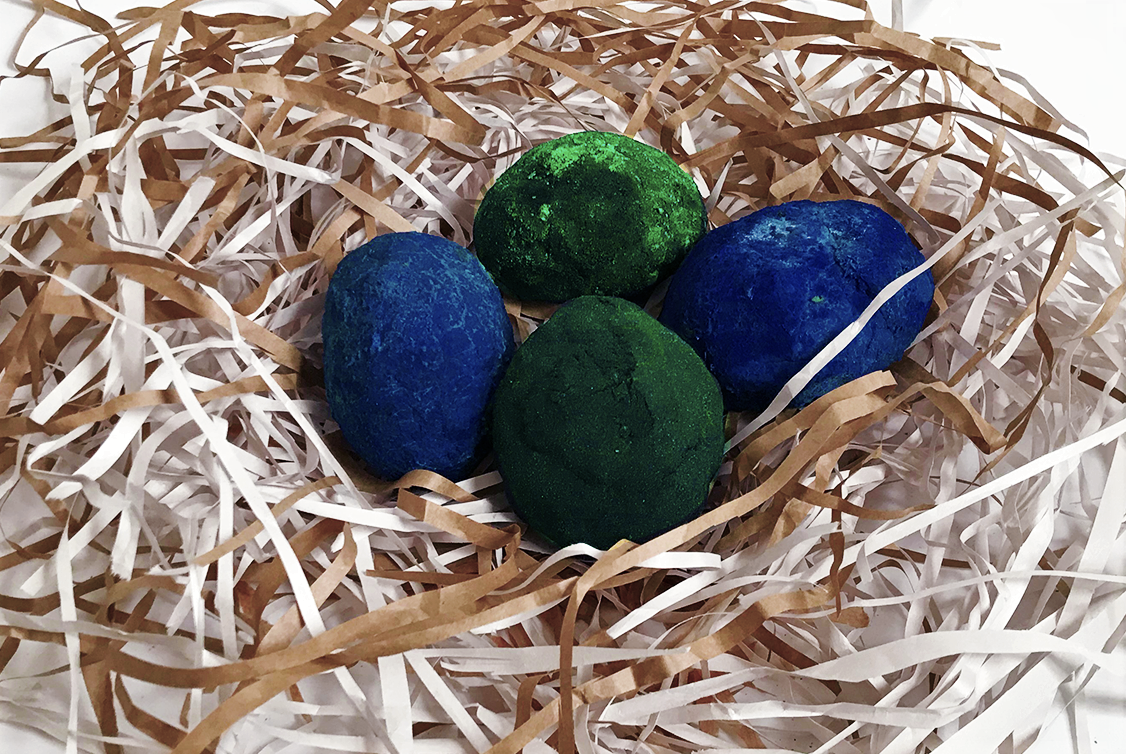
celebrate-picture-books-picture-book-review-dinosaur-eggs-craft-nest

Hatch Your Own Dinosaur Eggs


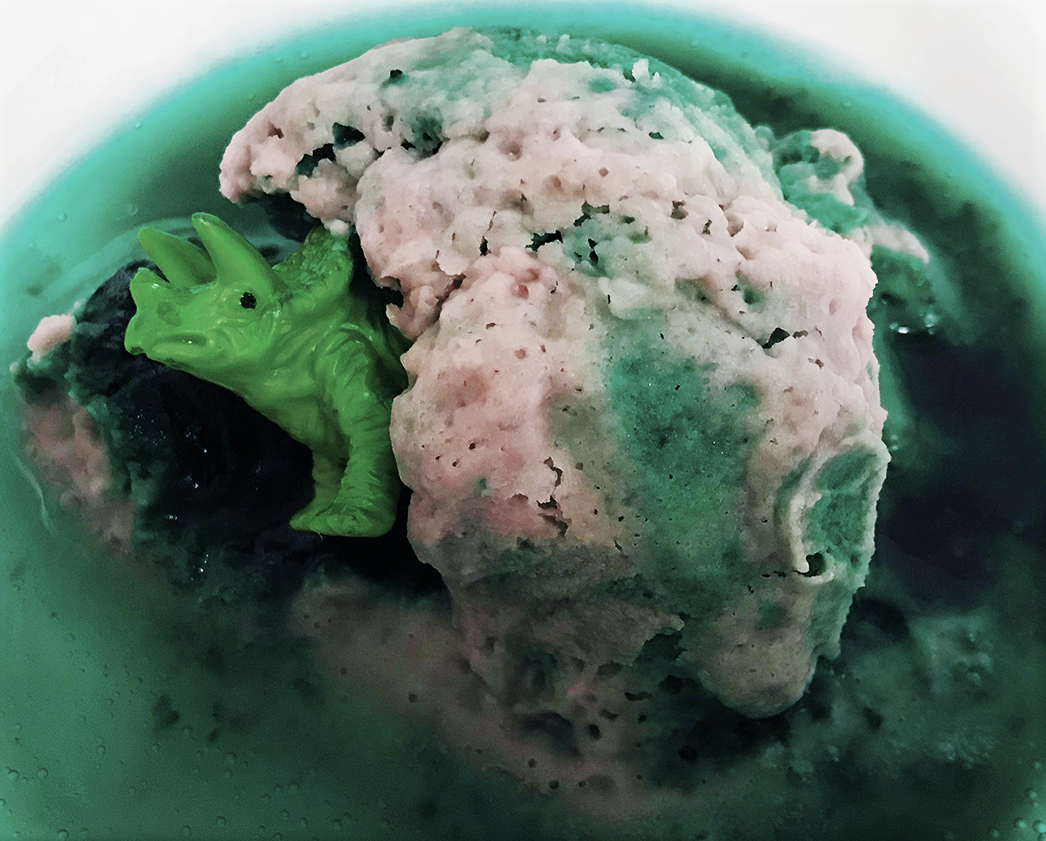
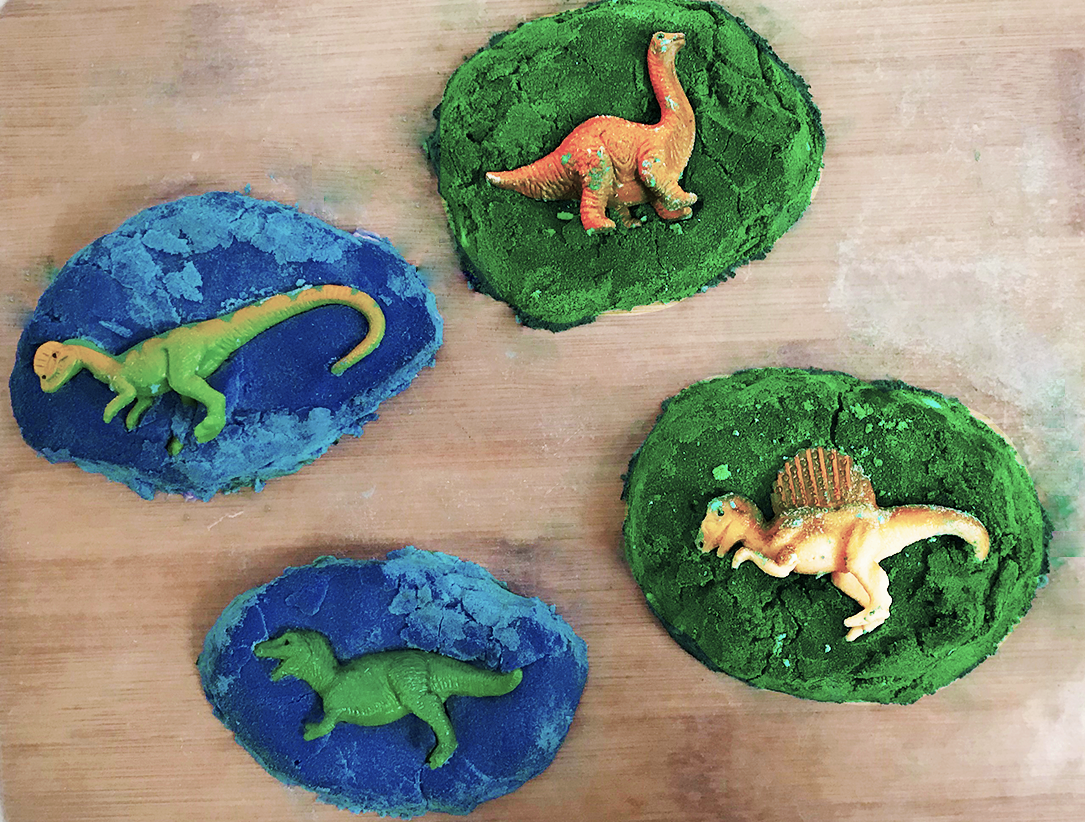
Think there are no more dinosaur eggs to be found? Think again! You can make your own with this easy craft that will have you hatching some T.-rex-size fun! All you need are a few simple ingredients – and don’t forget to wear an apron or old clothes!

celebrate-picture-books-picture-book-review-dinosaur-eggs-craft-open-eggs

Supplies

  • Old clothes or apron
  • Large box of baking soda (makes between 6 and 8 eggs)
  • Food coloring
  • Water
  • Plastic dinosaur toys
  • Bowl
  • Fork
  • Spoon
  • Wax paper
  • Baking sheet
  • Foil
  • Vinegar
  • Spray bottle (optional)
  • Plastic or metal spoon, stick, popsicle stick, or other implement to chisel with
celebrate-picture-books-picture-book-review-dinosaur-eggs-craft-vinegar-egg-open-darker

Spray the egg with vinegar to hatch your dinosaur

Directions

  1. Wear old clothes or an apron
  2. Cover work surface with wax paper, parchment paper, newspaper, or other protection. Food coloring can stain some surfaces
  3. Pour baking soda into the bowl
  4. Add drops of food coloring in whatever color you’d like your eggs to be. The eggs will darken when baked.
  5. Mix in the food coloring with the fork. You may want to use your hands, too
  6. When the baking soda is the color you want it, begin adding water a little at a time
  7. Add water until the baking soda holds together when you squeeze it in your hand
  8. When the baking soda is the right consistency, spoon some out into your hand or onto wax paper
  9. Push one plastic dinosaur into the middle
  10. Cover the dinosaur with more of the baking soda mixture
  11. Carefully form it into an egg shape
  12. Repeat with other dinosaurs
celebrate-picture-books-picture-book-review-dinosaur-eggs-craft-chiseled -darker

Chisel the egg open to hatch your dinosaur

To Bake the Eggs

  1. Set the oven or toaster oven to 200 to 225 degrees
  2. Set the eggs on a baking sheet lined with foil
  3. Bake the eggs for 15 minutes, check
  4. Turn the eggs over and bake for 10 to 15 more minutes
  5. Remove from oven and let cool

To Hatch the Eggs

  1. Eggs can be hatched by chiseling them with a spoon, stick, or other implement
  2. Eggs can also be hatched by spraying or sprinkling them with vinegar

celebrate-picture-books-picture-book-review-everything-awesome-about-dinosaurs-cover

You can find Everything Awesome about Dinosaurs and Other Prehistoric Beasts! at these booksellers

Amazon | Barnes & Noble | Books-a-Million

To support your local independent bookstore, order from

Bookshop | IndieBound

Picture Book Review

February 24 – Introduce a Girl to Engineering Day

celebrate-picture-books-picture-book-review-goldilocks-and-the-three-engineers-cover

About the Holiday

All this week, we celebrate Engineers and Engineering! Founded by the National Society of Professional Engineers (NSPA) in 1951, Engineering Week focuses on increasing an understanding of and interest in engineering and other technical careers to ensure a diverse and well-educated engineering workforce for the future. More than seventy engineering, education, and cultural societies and more than fifty corporations and government agencies cooperate to raise public awareness of engineers’ contributions to our quality of life. Throughout the week they work to foster a recognition in parents, teachers, and students of the importance of a technical education as well as a high level of math, science, and technology literacy. By reaching out to schools, businesses, and community organizations across the country, they hope to motivate young people to pursue engineering careers. For Introduce a Girl to Engineering, or Girl Day, educators, engineers, volunteers, and others demonstrate engineering activities, show girls how engineers change our world, and provide mentors to guide tomorrow’s engineers. To learn more about Engineering Week and today’s holiday in particular, visit the NSPA website.

Goldilocks and the Three Engineers

Written by Sue Fliess | Illustrated by Petros Bouloubasis


“In a tiny bungalow, / there lived a clever thinker. / Young Goldilocks invented things. She’d make and craft and tinker.” Goldilocks made lots of useful things, like machines to help you tie your shoes, to a self-zipping zipper to a hat outfitted with a flashlight, magnifying glass, and itty-bitty satellite dish to help you find the things you’ve lost. But one day, Goldilocks found that she had “inventor’s block,” so she decided to take a walk.

celebrate-picture-books-picture-book-review-goldilocks-and-the-three-engineers-bears

Image copyright Petros Bouloubasis, 2021, text copyright Sue Fleiss, 2021. Courtesy of Albert Whitman & Company.

At the same time, the Bear family was out gathering nuts and berries for their pre-hibernation celebration. Baby Bear had a nifty contraption that knocked fruit and nuts into a basket with a tennis racquet. Papa Bear had an ingenious wheelbarrow with mechanical arms and hands that picked berries one by one and deposited them in the cart—but only after tossing them through a tiny basketball hoop. Swish! And Mama Bear’s handy vacuum sucked fruit right off the bushes and collected them in a tank.

Their next stop was the beehive at the top of a hill. After they’d eaten all their goodies, Baby Bear spied a little bungalow. The Bears thought it was just the place to spend the winter. When they went inside, they found “the room was full of strange devices, / widgets, tools, and more!” Looking more closely, Papa Bear found a chair that was perfect for Baby Bear. He marveled that “it feeds you and it wipes your mouth, / and reads you stories, too!” Meanwhile, Mama Bear had discovered a bowl that stirred porridge and a bed that automatically rocked you to sleep.

celebrate-picture-books-picture-book-review-goldilocks-and-the-three-engineers-workshop

Image copyright Petros Bouloubasis, 2021, text copyright Sue Fleiss, 2021. Courtesy of Albert Whitman & Company.

Baby Bear loved the chair but wished for one more innovation that would make it just right. Papa Bear found parts and tools and fixed the chair to Baby Bear’s specifications. Mama Bear tasted the porridge and found it lacking one ingredient, so Papa Bear created a porridge-stirrer accessory to add it drop by drop. By now it was dark, and even though Papa Bear thought it wasn’t right to stay, Baby Bear convinced him that one night would be okay.

But when they crawled into bed and turned it on, it rocked so much that it tipped the Bears right onto the floor. There was only one thing to do: “Baby fixed the engine block. / Replace the gears that burned. / Soon the bears were fast asleep… / Then Goldilocks returned.” She saw the chair, tasted the porridge, and then… “heard snoring sounds.” Wide awake now, the bears began to explain. But Goldilocks was not upset. Instead she said, “‘You’ve improved my projects here, / and made them much more fun. / Proving that four brains, by far, / are better than just one!’”

Excited to be inventing again with the bears on board to lend their smart innovations, Goldilocks sends the family off amid promises to “‘…meet up in the spring’” when they will “‘…make the next big thing!’”

celebrate-picture-books-picture-book-review-goldilocks-and-the-three-engineers-bed

Image copyright Petros Bouloubasis, 2021, text copyright Sue Fleiss, 2021. Courtesy of Albert Whitman & Company.

With her fun flip on the Goldilocks story, Sue Fleiss invites kids to indulge their inner inventor with wacky contraptions that can make getting dressed, cooking, going to bed, and chores more exciting. Fleiss’s clever takes on the well-known “just right” chair, porridge, and bed get readers thinking creatively—perhaps even about their own household appliances. While the original story ends with the interloper being chased away, Fleiss’s version shines with the benefits of cooperation, collaboration, and being open to new ideas.

With so many cool inventions to discover on every page, readers will love taking extra time to find and talk about them all. Any young maker would swoon over Petros Bouloubasis’s well-stocked workbench, and readers would have a blast drawing their own gadgets using the tools and supplies depicted. Quirky, abstract landscapes add to the kid-centric ambiance, and just like the Bear family, who drives away in a new vehicle with their full wheelbarrow in tow, readers will look forward to returning to Goldilocks’ little bungalow again and again.

Imagination, creativity, teamwork, and friendship all wrapped up in a clever fractured fairytale—what could be better?! Goldilocks and the Three Engineers is one to add to home, classroom, and public library bookshelves.

Ages 4 – 8

Albert Whitman & Company, 2021 | ISBN 978-0807529973

Discover more about Sue Fleiss and her books on her website.

To learn more about Petros Bouloubasis, his books, and his art, visit his website.

Introduce a Girl to Engineering Day Activity

celebrate-picture-books-picture-book-review-spaghetti-box-bridge-craft

Build a Remarkable Recycled Bridge


Engineers are at the core of so many things that make our homes and neighborhoods what they are. Kids will have fun building a bridge from Using items you already have at home or that may even be slated for the recycle bin, kids will have fun making the bridge above and maybe even a whole town! Spaghetti boxes make great roadways, and cut-up egg cartons can be used as supports. Cereal boxes and pasta boxes make skyscrapers, apartment buildings, fire stations, and more. Need a farm silo? Grab a peanut butter jar, aluminum can, or bread crumb container. You can use them as is or—if your kids are sticklers for a little more detail—turn the boxes inside out, tape, and add paint and details! So look around, use your imagination, and get creative!

celebrate-picture-books-picture-book-review-goldilocks-and-the-three-engineers-cover

You can find Goldilocks and the Three Engineers at these booksellers

Amazon | Barnes & Noble | Books-a-Million

To support your local independent bookstore, order from

Bookshop | IndieBound

Picture Book Review
January 7 – Old Rock Day

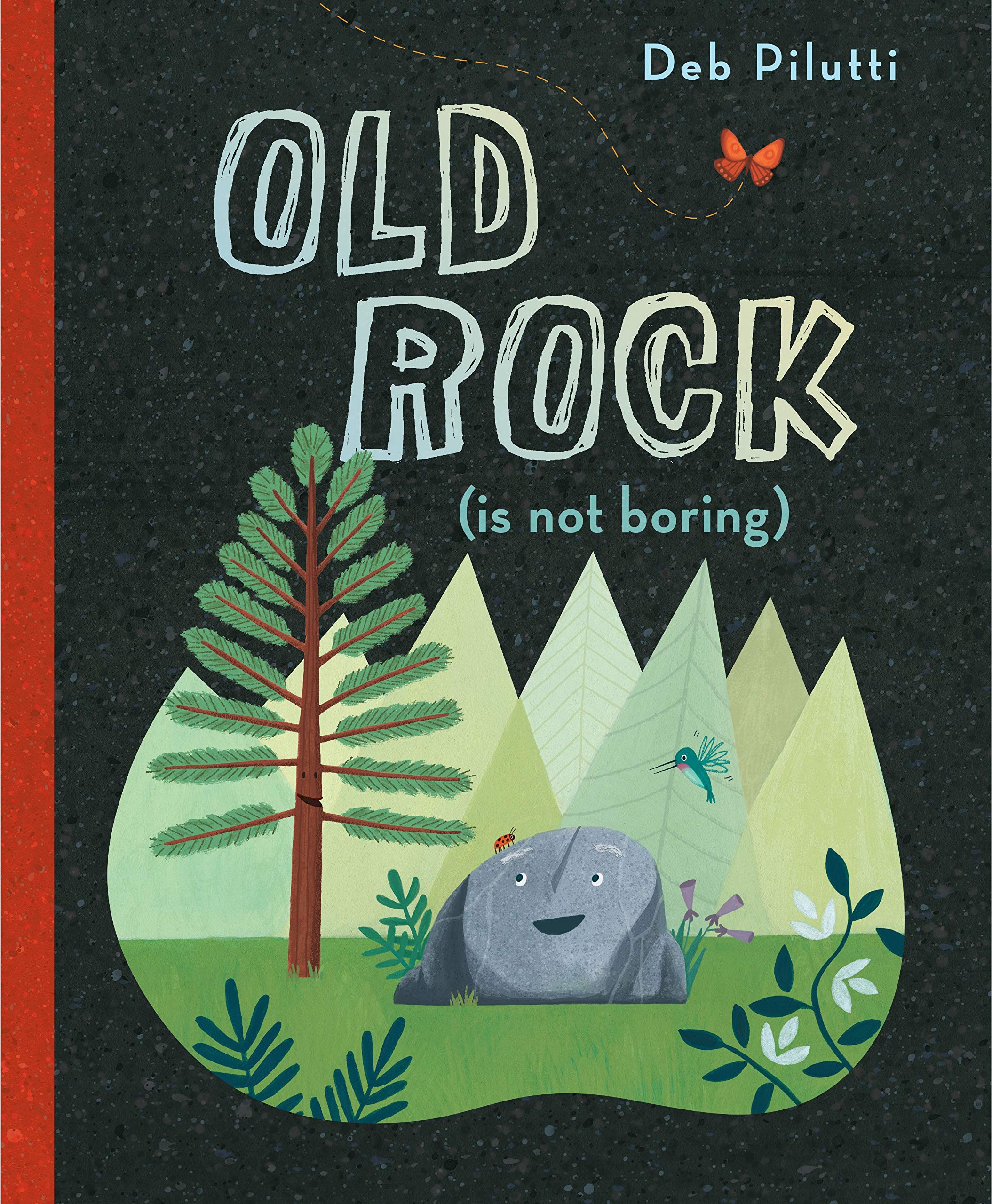
celebrate-picture-books-picture-book-review-old-rock-is-not-boring-cover

About the Holiday

Do you love rocks—the history they tell, their versatility, intricate patterns, and glorious colors? Today’s holiday celebrates these wonders of nature and encourages geologists—both professionals and amateurs—to indulge their passion. You can learn a bit more about the history of the study of rocks, the first use of the term “geology,” and on to more modern times at NationalToday. To celebrate today’s holiday, take a walk in your backyard or neighborhood, pick up a few rocks, and research a little more about them. Then have fun with today’s craft.

Thank you to G. P. Putnam’s Sons for sharing a copy of Old Rock (is not boring) with me for review consideration. All opinions on the book are my own.
Old Rock (is not boring)

By Deb Pilutti


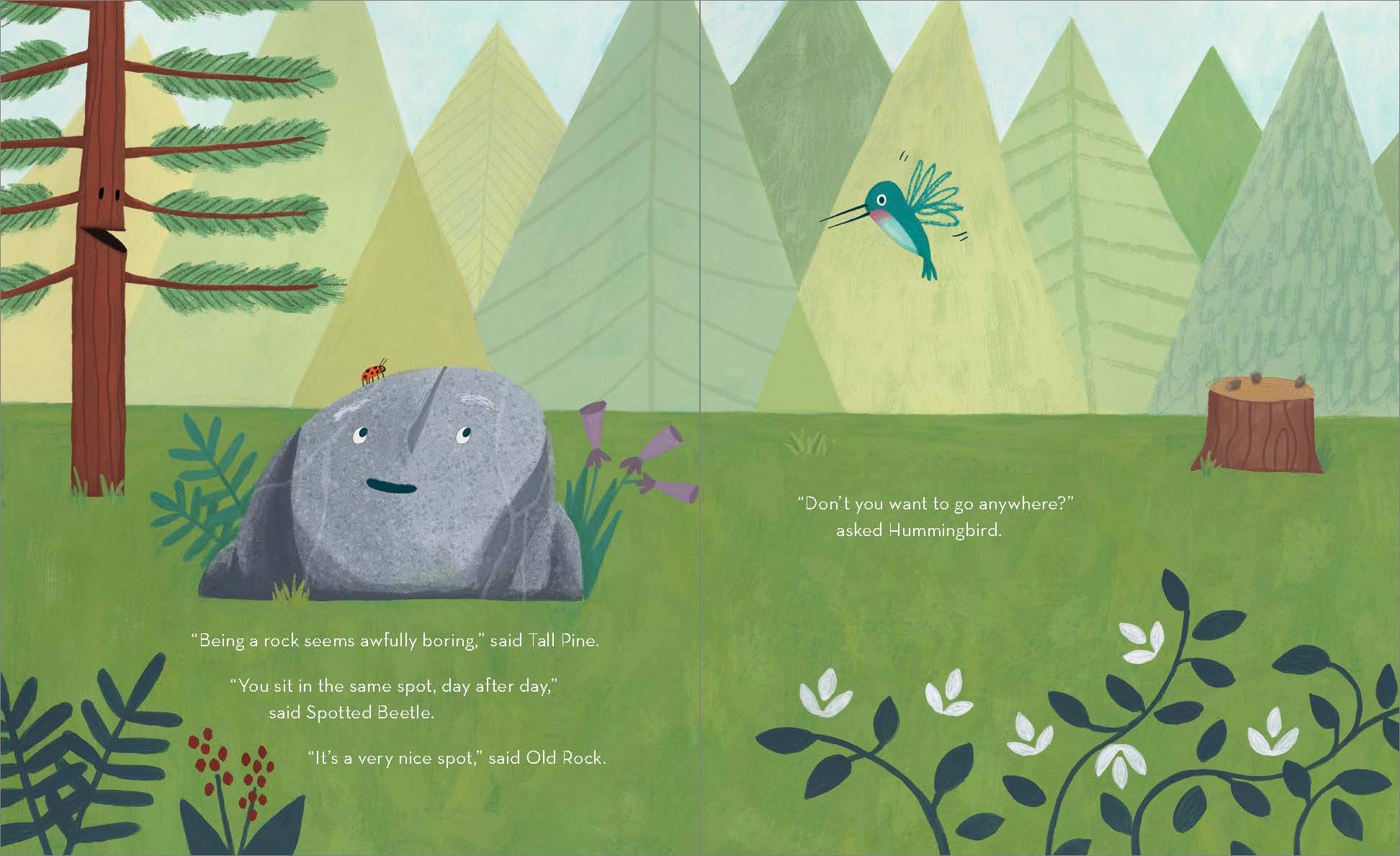
It seemed that Old Rock had been sitting in the same spot forever. Tall Pine and Spotted Beetle thought being a rock must be pretty boring. Hummingbird wondered, “‘Don’t you ever want to go anywhere?’” She knew she would be if she couldn’t fly all over the world and taste exotic nectars. But Old Rock had flown once, and he began to tell his story.
celebrate-picture-books-picture-book-review-old-rock-is-not-boring-hummingbird

Copyright Deb Pilutti, 2020, courtesy of G. P. Putnam’s Sons Books for Young Readers.

It was during the time when he was surrounded by darkness, but then the volcano erupted and Old Rock “‘soared through a fiery sky into the bright light of a new world.’” Tall Pine, Spotted Beetle, and Hummingbird weren’t very impressed. They still thought Old Rock must be bored. Spotted Beetle told him how much he might see if he climbed to Tall Pine’s very highest branch.
celebrate-picture-books-picture-book-review-old-rock-is-not-boring-volcano

Copyright Deb Pilutti, 2020, courtesy of G. P. Putnam’s Sons Books for Young Readers.

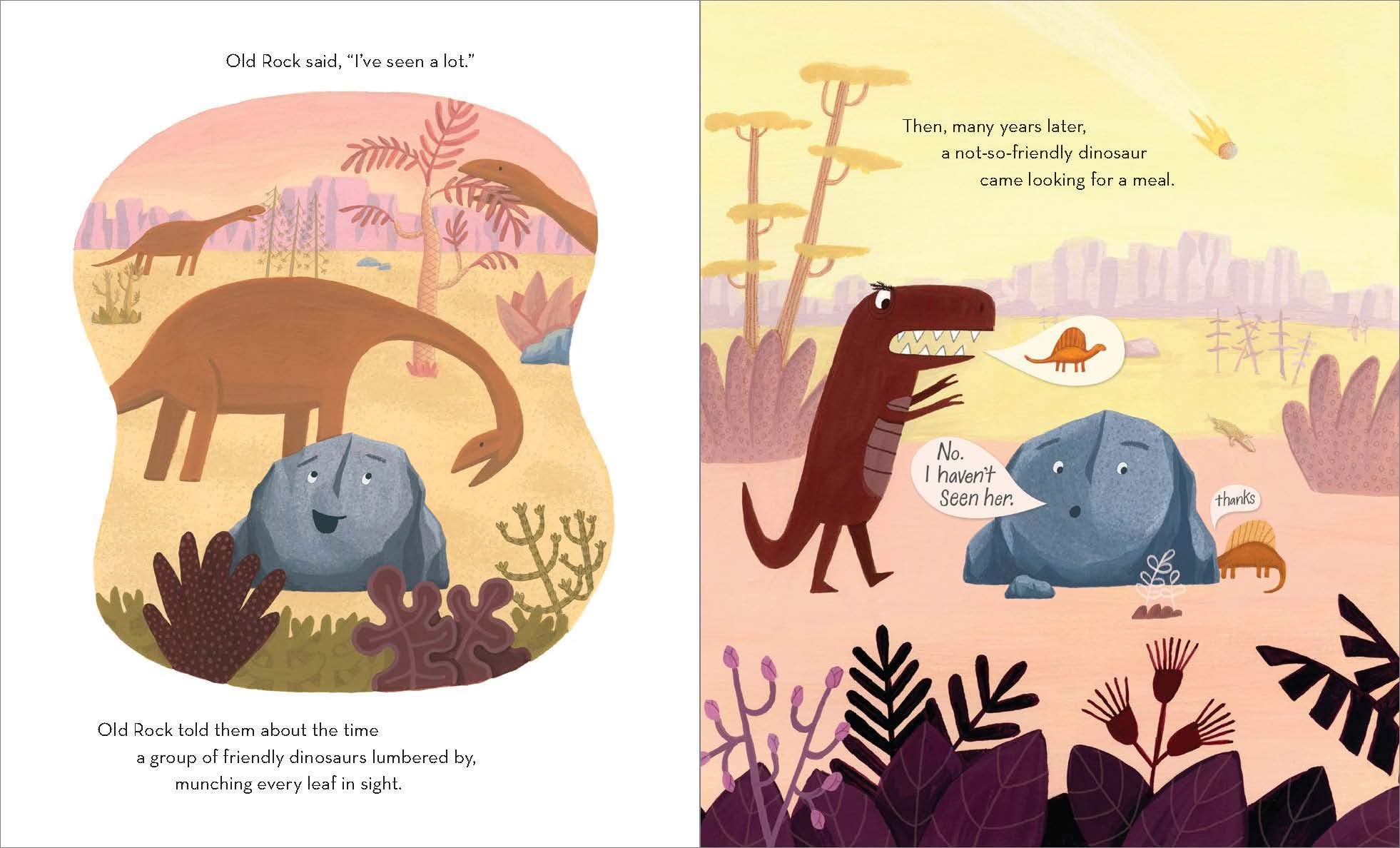
Old Rock countered that he had seen a lot. He’d watched dinosaurs pass by and had even hidden a spinosaurus from a hungry T. rex. He’d traveled in a glacier and been left teetering on a ridge overlooking a vast desert, where he “could see the place where the sky touches the earth.” Spotted Beetle and Hummingbird were intrigued, but Tall Pine dismissed these experiences as “ages ago.” He wanted to know about now. Didn’t Old Rock feel like moving? Tall Pine showed Old Rock how his limbs could dance in the wind.

celebrate-picture-books-picture-book-review-old-rock-is-not-boring-dinosaurs

Copyright Deb Pilutti, 2020, courtesy of G. P. Putnam’s Sons Books for Young Readers.

While Old Rock couldn’t dance, he did recall how he’d turned somersaults off the ridge, landing in a prairie where mastodons grazed near a lake. Tall Pine, Spotted Beetle, and Hummingbird were mesmerized by Old Rock’s story and wanted to know what had happened next. Out of the prairie, sprang a pine forest, Old Rock revealed. And from one of the pine trees a pinecone fell and a seed was released. That seed grew “to be the tall pine who dances in the wind and keeps me company.” Sometimes, he continued, a spotted beetle and a hummingbird meander by. Old Rock was very pleased with his spot, and the others had to agree that it was “very nice” and “not boring at all.”

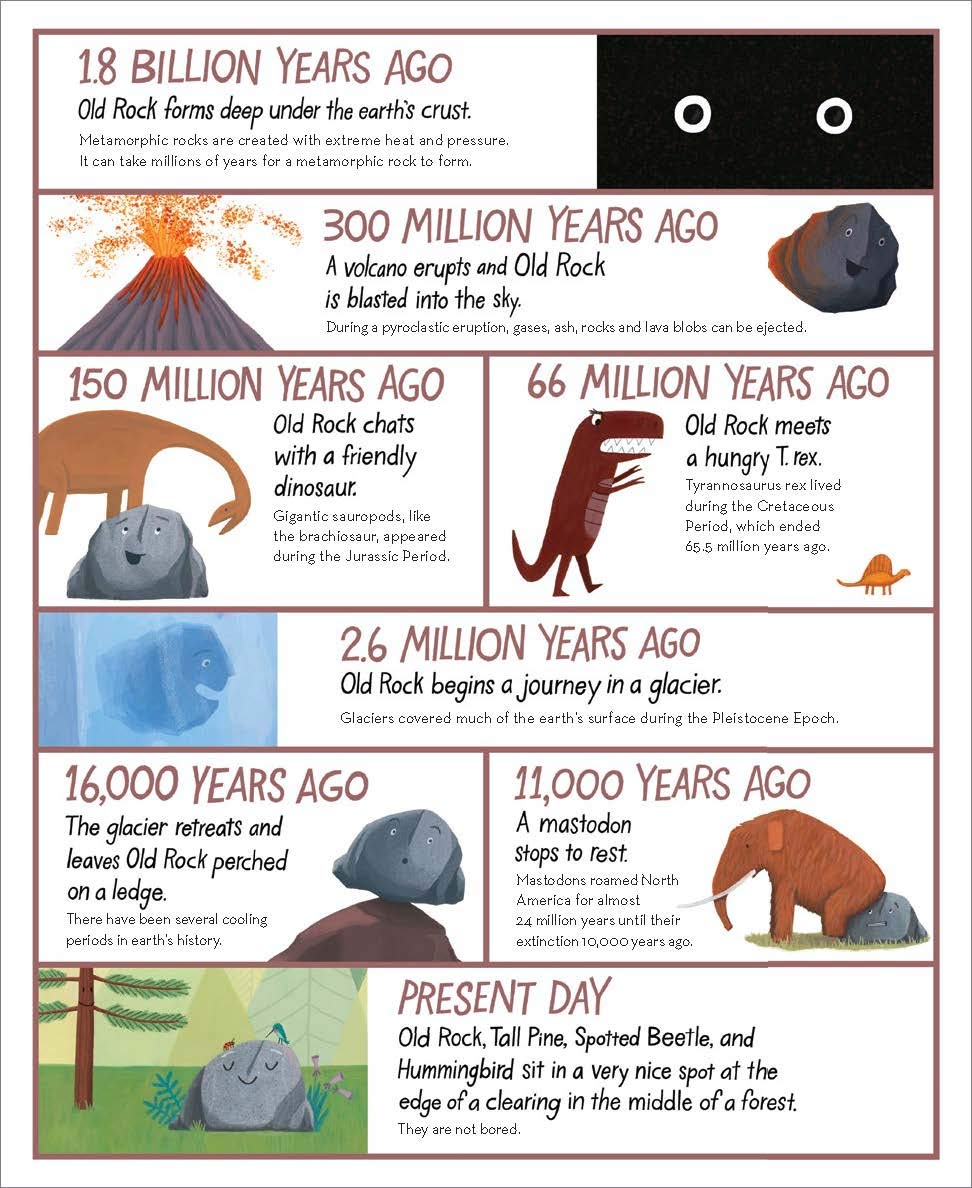
An illustrated timeline of Old Rock’s life from 18 billion years ago to the present day follows the text.

celebrate-picture-books-picture-book-review-old-rock-is-not-boring-time-line

Copyright Deb Pilutti, 2020, courtesy of G. P. Putnam’s Sons Books for Young Readers.

So much clever thought went into Deb Pilutti’s Old Rock as she reveals to kids what a fascinating and active life the rocks and boulders we see every day have had. Tall Pine, Spotted Beetle, and Hummingbird’s skepticism keeps the suspense building as Old Rock rolls out stories of his various travels and talents. Once he has them hooked, they—like young readers—want to hear more, leading to the just-right ending that sweetly encompasses shared history, happiness with one’s place in life, and friendship. The trio’s questions to Old Rock and their related experiences also engage children to think about issues and opinions from a variety of perspectives.

Pilutti’s mixed-media illustrations are nicely textured to bring out Old Rock’s grainy surface while highlighting nature’s vivid colors. Her vignettes from the dinosaur eras, the ice age (where the skeletons of dinosaurs are also swept up and away in the same glacier as Old Rock), and beyond impress upon readers the long time-frame involved, how the earth has changed, and even the fascinating science of the fossil record.

A multi-layered story, perfect for general story times or as a lead in to science lessons and to promote discussion and research in the classroom, Old Rock (is not boring) would be an original and exciting addition to home, classroom, and public library collections.

Ages 4 – 8

G. P. Putnam’s Sons Books for Young Readers, 2020 | ISBN 978-0525518181

To learn more about Deb Pilutti, her books, and her art, visit her website.

Old Rock Day Activity

CPB - Nasty Bugs magnet II (2)

Rock This Craft!


Smooth stones can give you a natural canvas for your creativity! With a little bit of paint, pins or magnets, and some imagination, you can make refrigerator magnets, jewelry, paper weights, and more!

Supplies

  • Smooth stones in various sizes
  • Paint or markers
  • Small magnets, available at craft stores
  • Jewelry pins, available at craft stores
  • Paint brush
  • Strong glue

Directions

To make magnets

  1. Design and paint an image on a light-weight stone
  2. Attach a magnet to the back with strong glue, let dry
  3. Use to hang pictures, notes, or other bits of important stuff on your refrigerator or magnetic board

To make jewelry

  1. Using a smaller, flatter stone, design and paint an image on the stone
  2. Attach a jewelry pin to the back with the strong glue, let dry
  3. Wear your pin proudly

CPB - rock painting craft

To make a paper weight or kindness stone

  1. Using a large stone, design and paint an image on the stone, let dry
  2. Display and use on your desk to keep those papers in place or find a spot around town to leave your rock for someone to find and enjoy

celebrate-picture-books-picture-book-review-old-rock-is-not-boring-cover

You can find Old Rock (is not boring) at these booksellers

Amazon | Barnes & Noble | Books-a-Million

To support your local independent bookstore, order from

BookshopIndieBound

Picture Book Review