Today’s holiday began with a bit of serendipity in 2012, when some people online noticed a connection with the abbreviated date notation 12/12/12 with the well-known phrase “check one two, one two” that musicians, speakers, and sound engineers use when testing microphones before a live event. This recognition grew over time to celebrate not only the suspense inherent in those momentary sound checks, but the importance of this preparation to performers and audiences alike as well as to all the creative professionals behind this technology. Likewise, today’s book sweeps readers away on a wave of sound.
Thank you to Eerdmans Books for Young Readers for sharing this book with me for review!
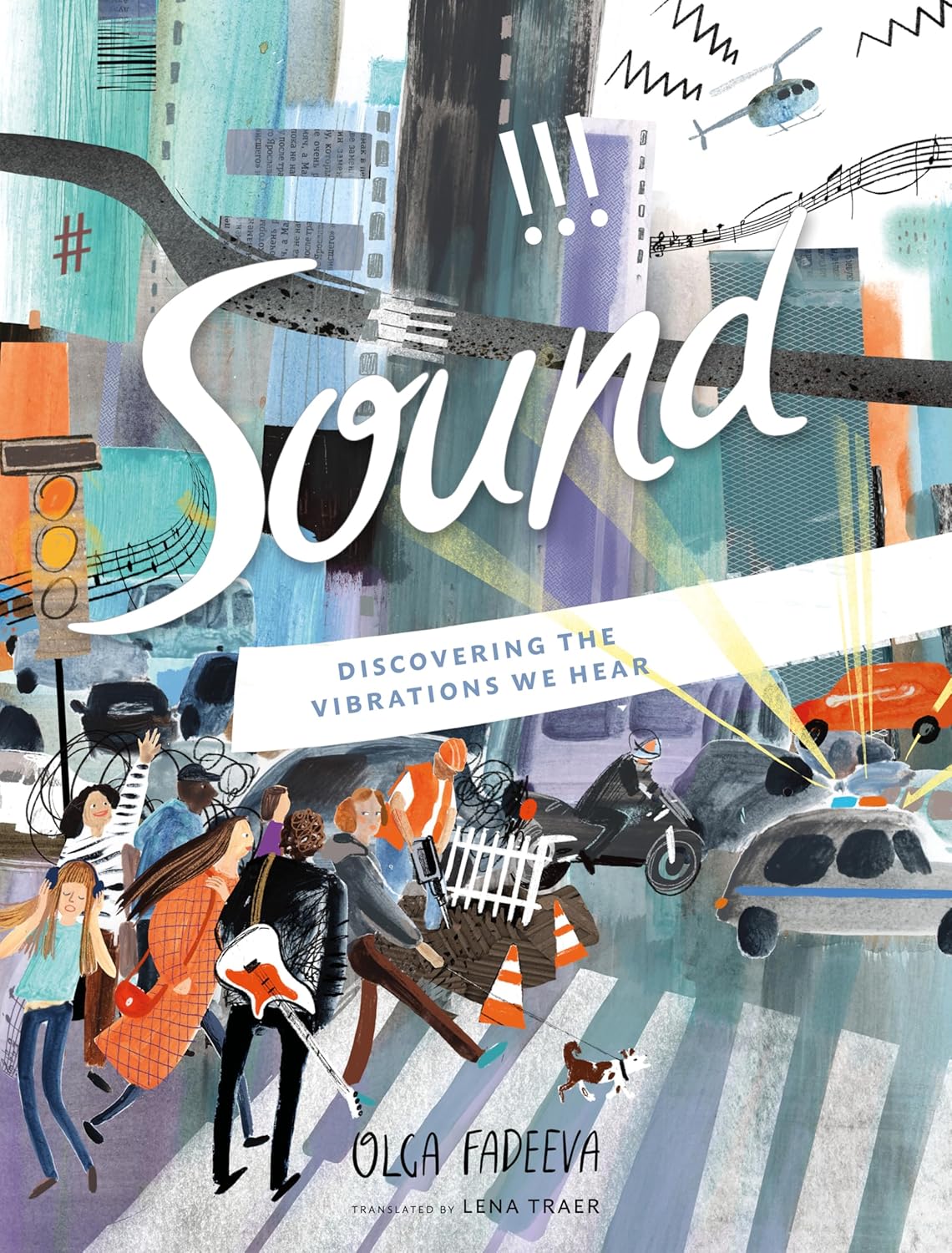
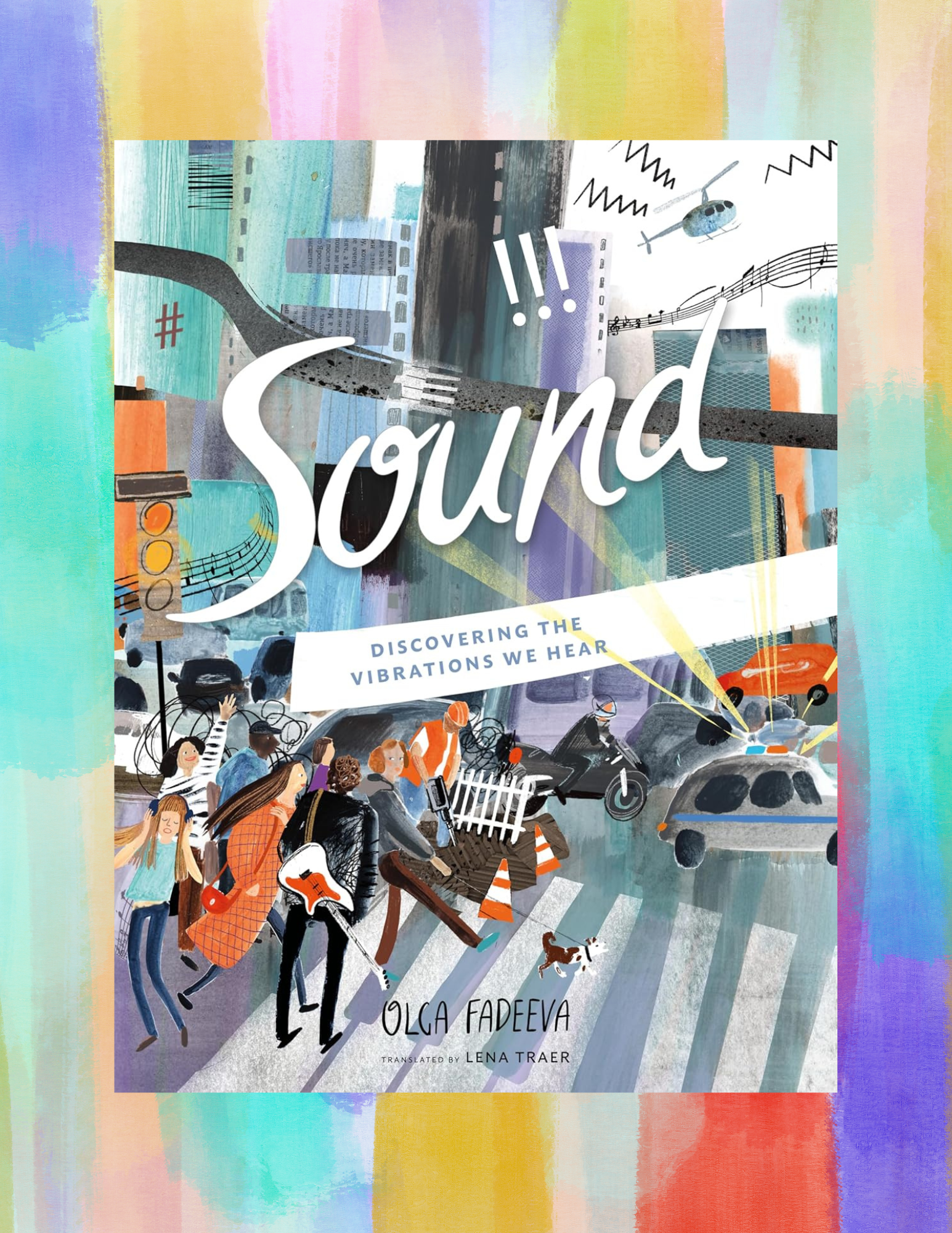
Sound: Discovering the Vibrations We Hear
By Olga Fadeeva | Translated by Lena Traer
If you have a child who loves sound—making it and listening to it—and who often asks, “Didja hear that?” then they’re sure to love today’s book. Olga Fadeeva begins her fascinating deep dive into sound with a quick discussion that pings from the most simple definition (sound is “what we perceive with our ears”) to how physics describes it as a “wave that creates a vibration that passes from molecule to molecule through almost any medium,” to a visual representation using the way a stone dropped into water creates waves, plus a couple of other interesting tidbits to boot.
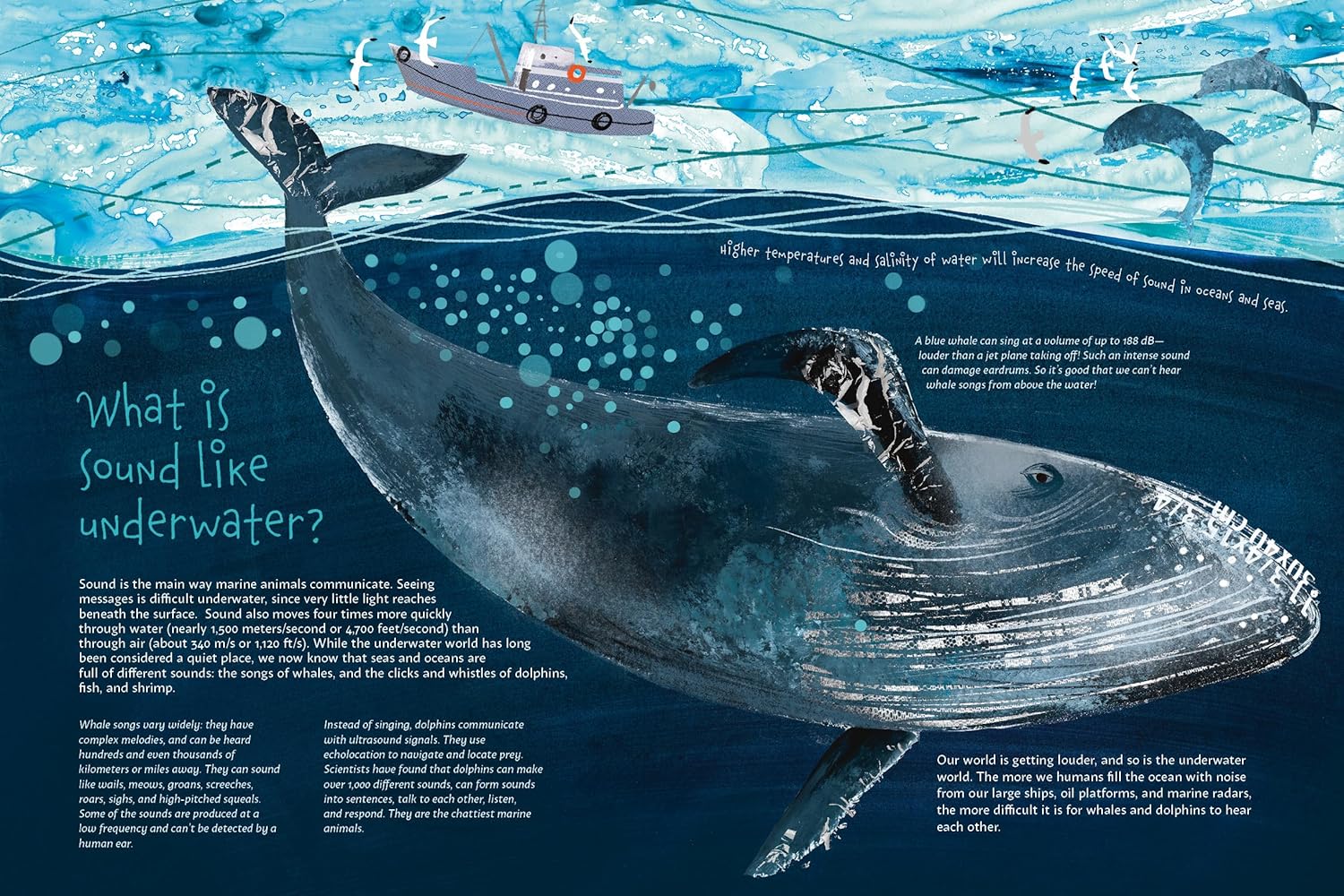
Fadeeva addresses how humans produce sounds and how we hear them, reveals what an echo and echolocation are (as well as the longest recorded echo), and swoops into the world of birds to break down the “two different types of birdsong: songs and calls.” She talks about how birds learn their particular songs and how they adapt to humans’ noise so they can be heard. Fadeeva then wings her way from birds to the sounds that animals and undersea creatures make.
Next, Fadeeva touches on the 7,000 world languages as well as sign language and hearing aids before taking readers on a marvelous time-traveling odyssey. With the turn of a page, children find themselves in the prehistoric world, listening for “the hack of a stone ace, the murmur of the wind, the crackling of a fire, the distant roar of wild animals.” Fadeeva imagines how these sounds and the peoples’ natural clapping, stomping, and vocalizations became music accompanied by the first percussion instruments—”drums, mallets, and rattles made from dried gourds filled with seeds or stones”—and wind instruments—”pipes and flutes made from reeds, bones, animal horns, and seashells.”
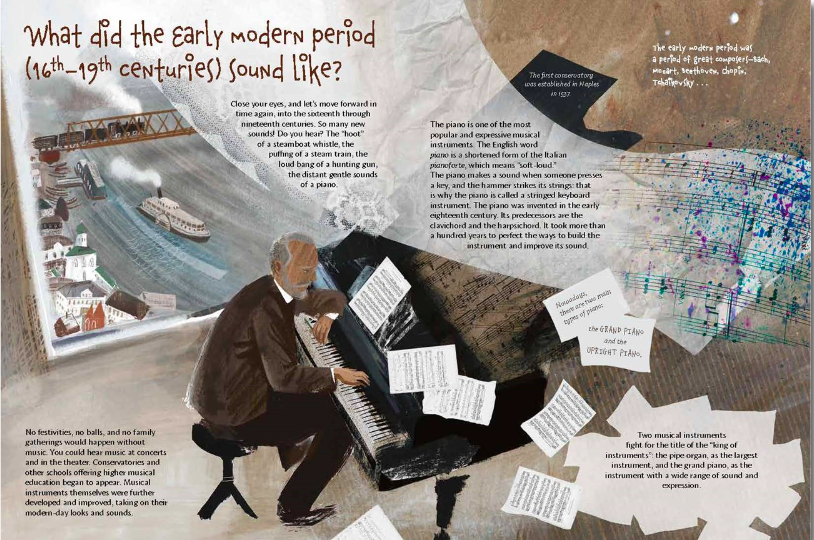
From prehistoric times, readers move on to the Ancient World with its innovation and astounding amphitheaters and actors’ face masks, both created to amplify sound from dramatic performances in an age well before microphones. Kids also drop into the Middle Ages; the early Modern Period of the 16th to 19th centuries, during which the “‘hoot’ of a steamboat whistle, the puffing of a steam train . . . [and] the sounds of a piano” first filled the air; and today’s Modern Age, where so many disparate sounds meet our ears while the music scene has exploded with innovation and experimentation.
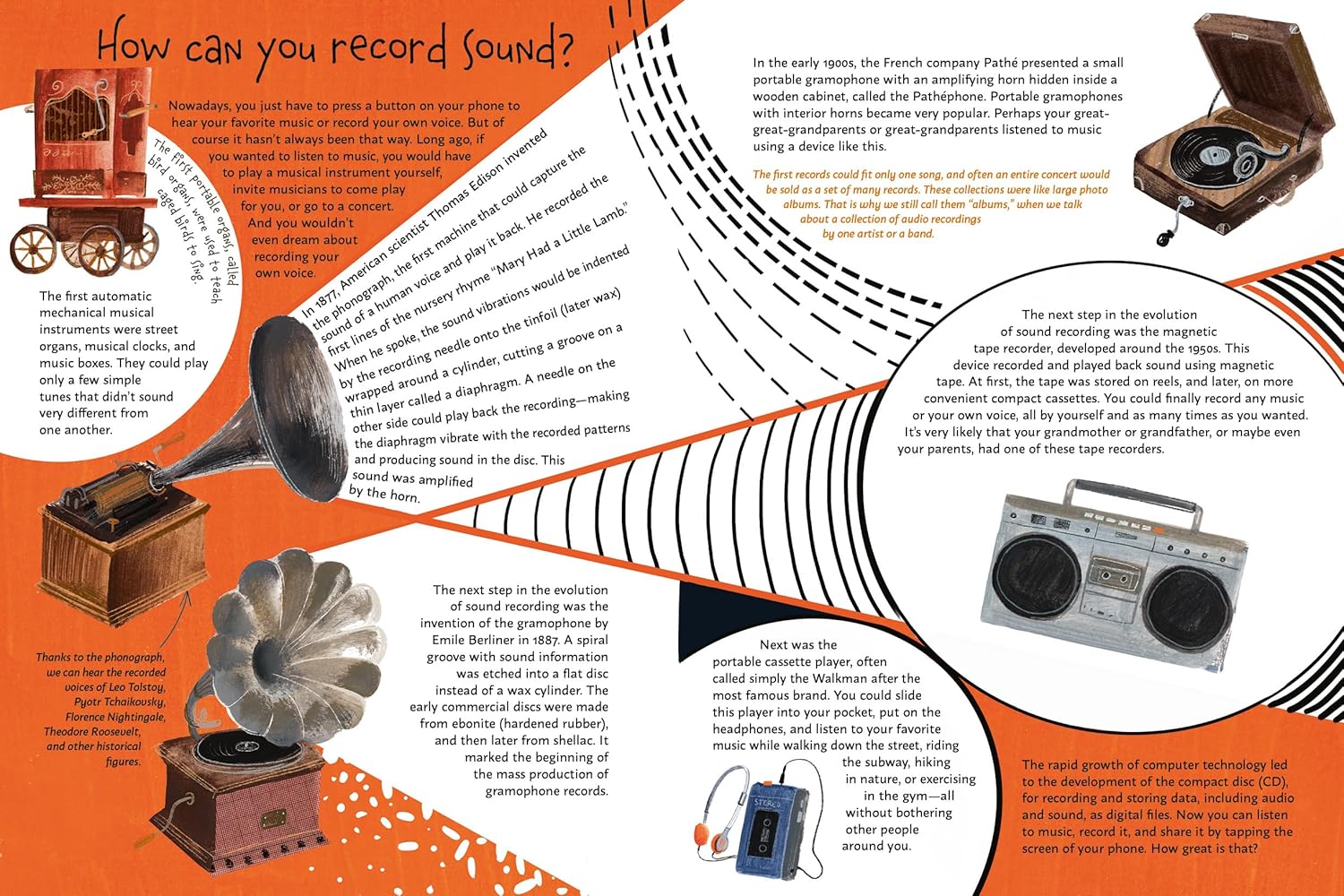
Fadeeva’s coda to her absorbing work includes information on musical notation, orchestras, and various recording devices. Young readers will also be entranced by the different ways people interpret animal sounds around the world and how music can affect how we feel. Even the endpapers offer trivia and experiments to try. Sprinkled throughout the pages are fun “Try It!” activities that engage readers in experimentation.
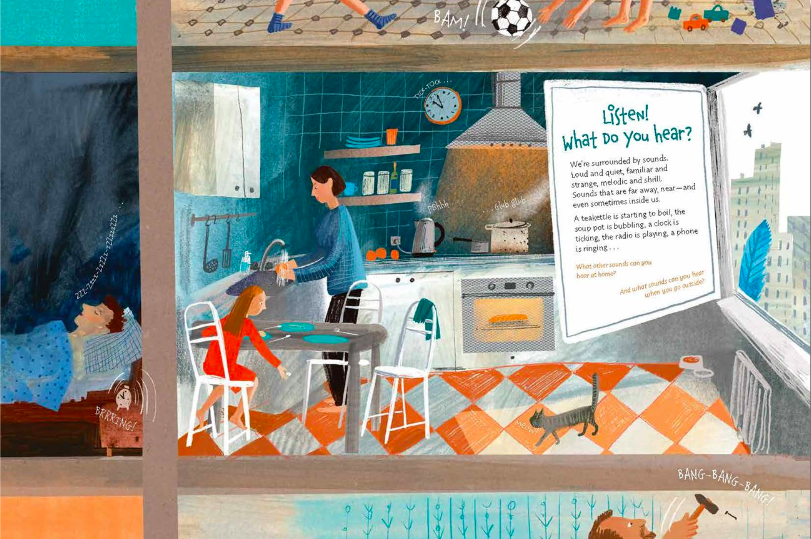
Fadeeva’s text is dynamically accompanied by her enthralling acrylic-and-water illustrations that bring sound, history, the animal kingdom, cities, and the world of music vibrantly alive for young readers.
Lena Traer’s smooth and captivating translation of the text from Russian creates an engrossing and rewarding reading experience. She has also translated Olga Fadeeva’s Water: Discovering the Precious Resource All Around Us (2024) and Wind: Discovering Air in Motion (2023).
Part of the Spectacular STEAM for Curious Readers series, Olga Fadeeva’s scintillating Sound: Discovering the Vibrations We Hear synthesizes all types of aural experiences and devices, inviting young readers to engage their sense of hearing and imagination as she introduces them to the mechanics, history, and impact of sound. The book is a must addition to any library collection as well as for media specialists and teachers looking for an exciting cross-curricular way to engage their students, music educators, and children who respond to sound or have music flowing through their veins.
Ages 8 – 14
Eerdmans Books for Young Readers, 2025 | ISBN 978-0802856487
Olga Fadeeva is the author and illustrator of Water: Discovering the Precious Resource All Around Us, Wind: Discovering Air in Motion(Eerdmans), and many other books for children. Windearned a starred reviews from Kirkus and was named a USSBY Outstanding International Book, and Waterearned starred reviews from Booklist and School Library Journal. Olga’s art has been honored in Italy, China, and her home country of Russia. Follow Olga on Instagram @olgafadeeva_illustrations.
Lena Traer is a Russian- and English-language translator with a focus on books for children and young adults. She has translated Wind: Discovering Air in Motion, Water: Discovering the Precious Resource All Around Us, and On the Edge of the World (all Eerdmans) into English and has also translated a variety of picture books and scientific materials into Russian. Born and raised in Siberia, Russia, Lena now lives in San Francisco.
International Sound Check Day Activity
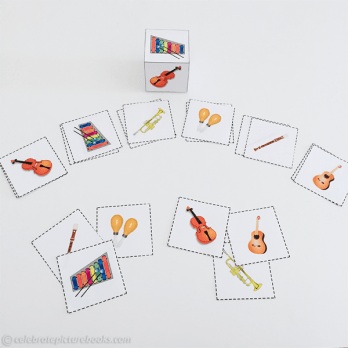
It’s Instrumental! Game
Roll the dice in this fun game to gather all the instruments you need to create a music group. The first person to collect all 6 instrument cards is the winner!
International Country Music Day was established in 2003 with September 17th chosen to honor Hank Williams, one of country music’s most influential artists. The day was created to bring together country music artists and fans from all over the world to celebrate their favorite music genre. To celebrate today, listen to your favorite artists from the past and today! And don’t forget to honor the Grand Ole Opry by adding today’s book to your family’s country music collection!
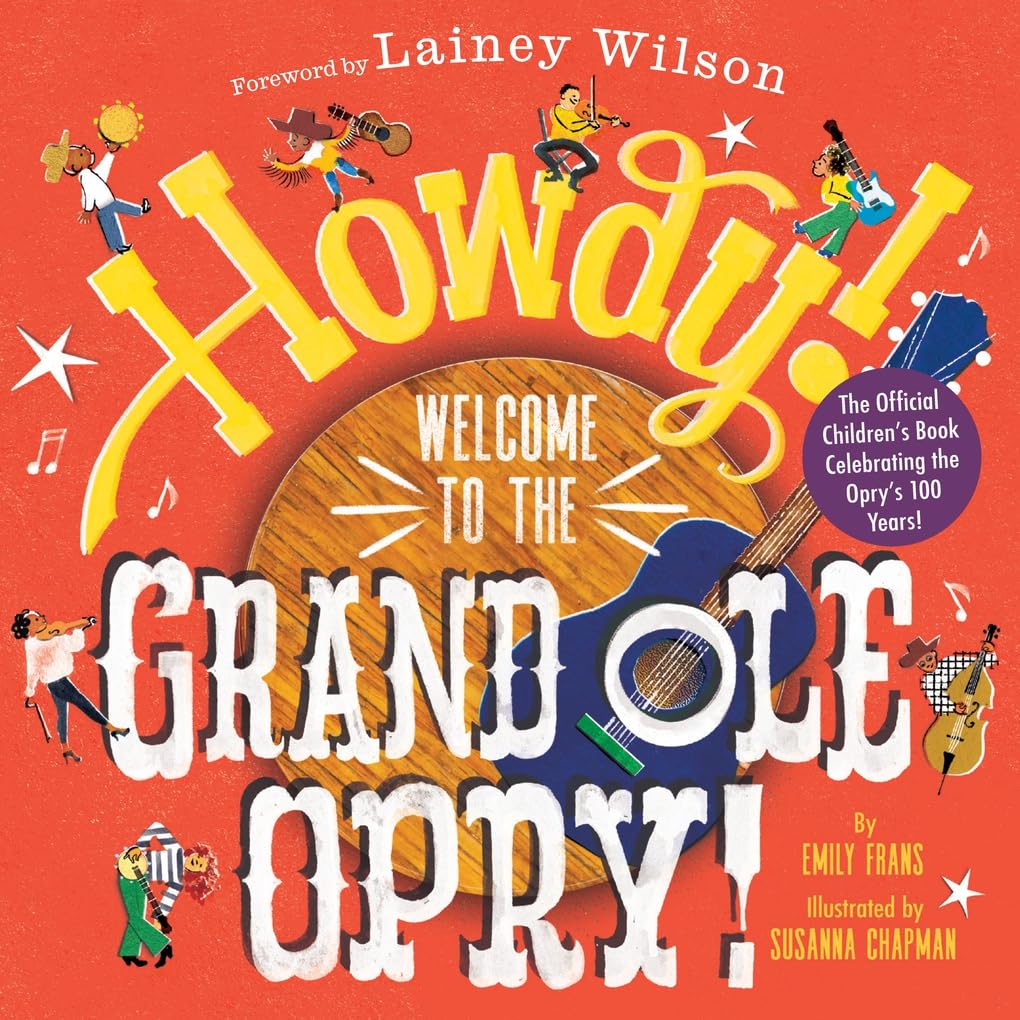
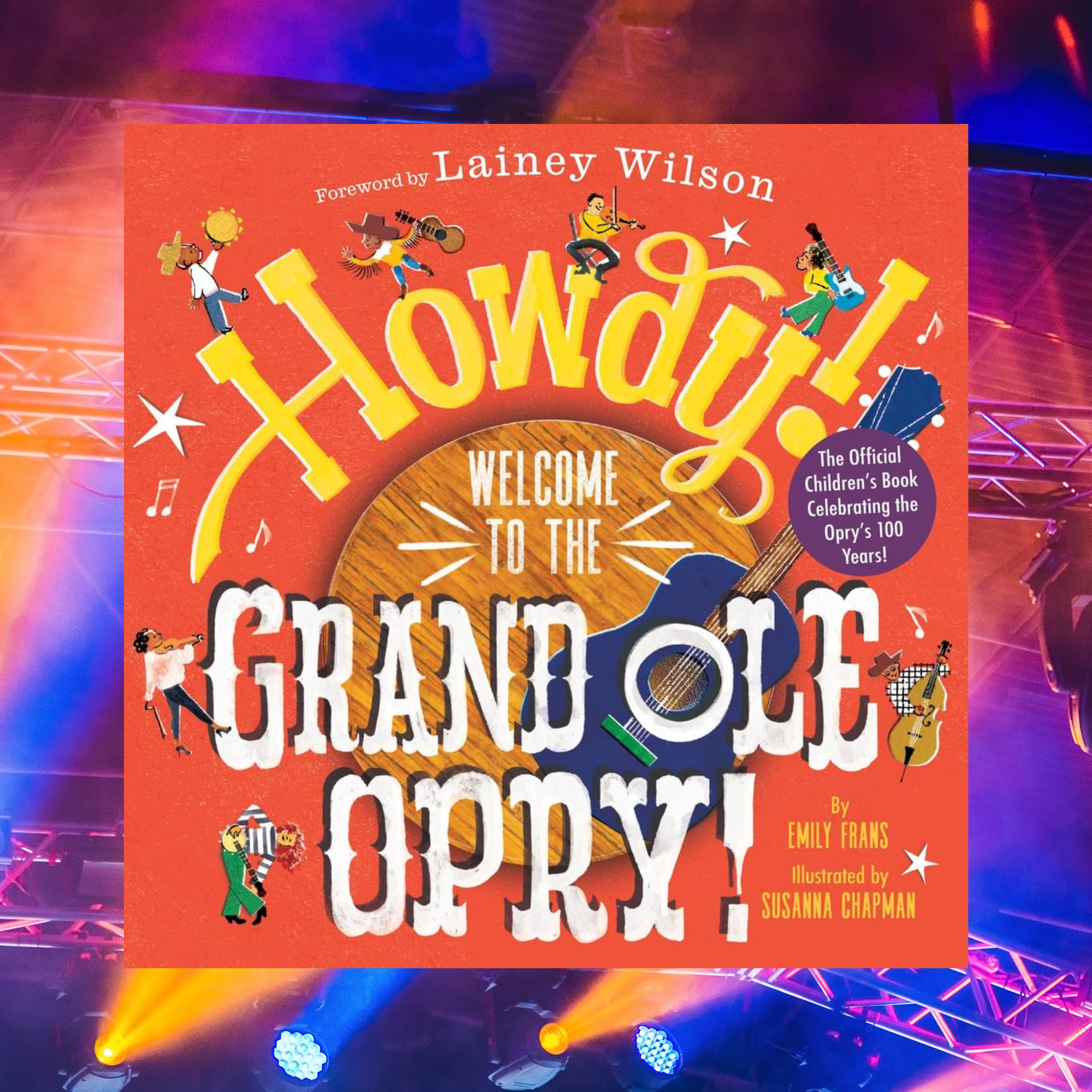
Howdy! Welcome to the Grand Ole Opry!
Written by Emily Frans | Illustrated by Susanna Chapman | Foreword by Lainey Wilson
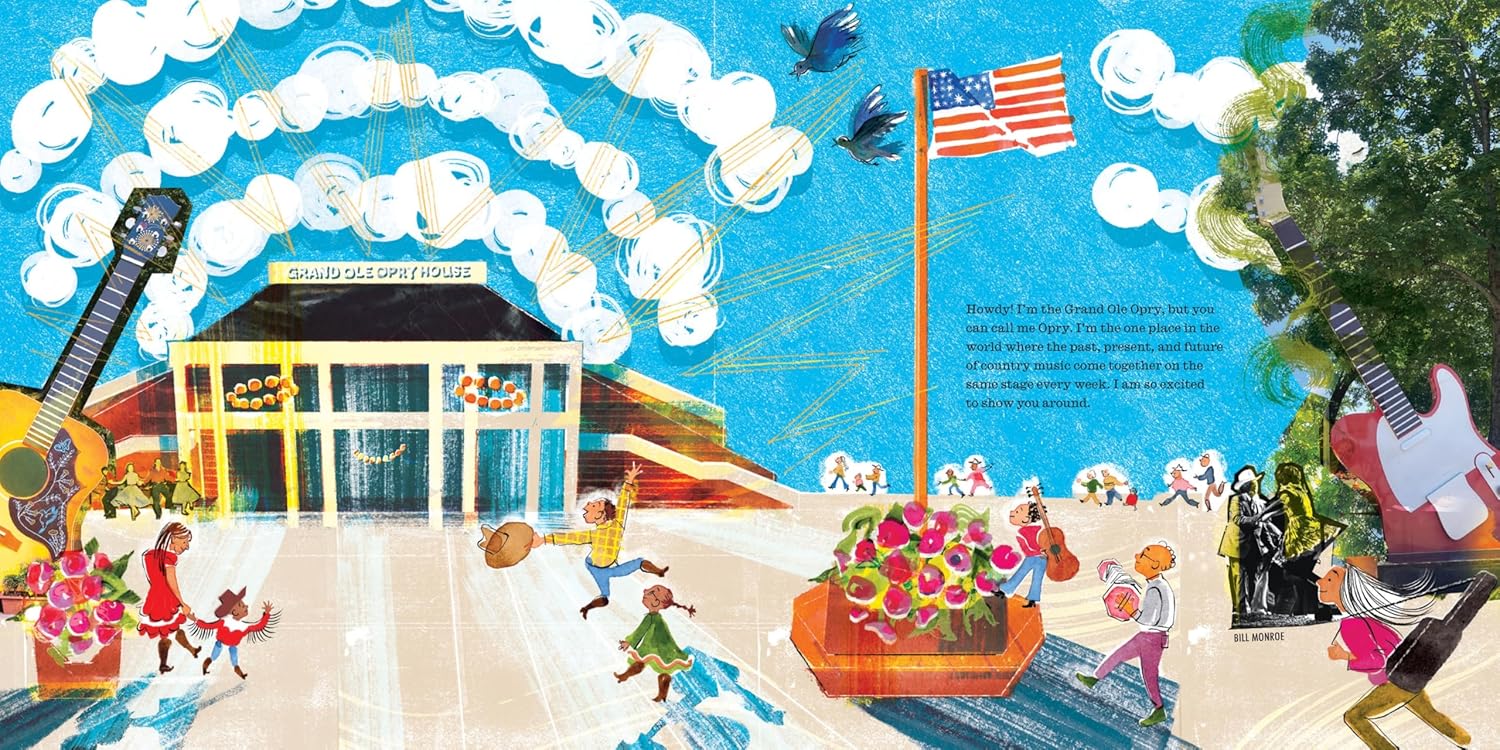
Celebrating its 100th anniversary with a buoyant “Howdy!”, the Grand Ole Opry (Opry for short) welcomes readers in for a personal tour of the beloved home of country music, where “history is made and stars are born.” Following their knowledgeable guide through the performers’ entrance, kids first check in with the security guard to get their backstage pass and dressing room number. Passes in hand, kids continue backstage, where they feel the excitement in the air and view pictures of past stars who graced the stage. “Did you know my show started way back in 1925?” The Grand Ole Opry asks.
While looking for their dressing room, children find themselves in the midst of today’s hottest stars all warming up or jamming together before the show. Prepped for their performance, kids stop by the Family Room to wait for their turn on stage. They’re in good company as photos of the “Opry family” surround them, and tonight’s other performers are hanging out there too.
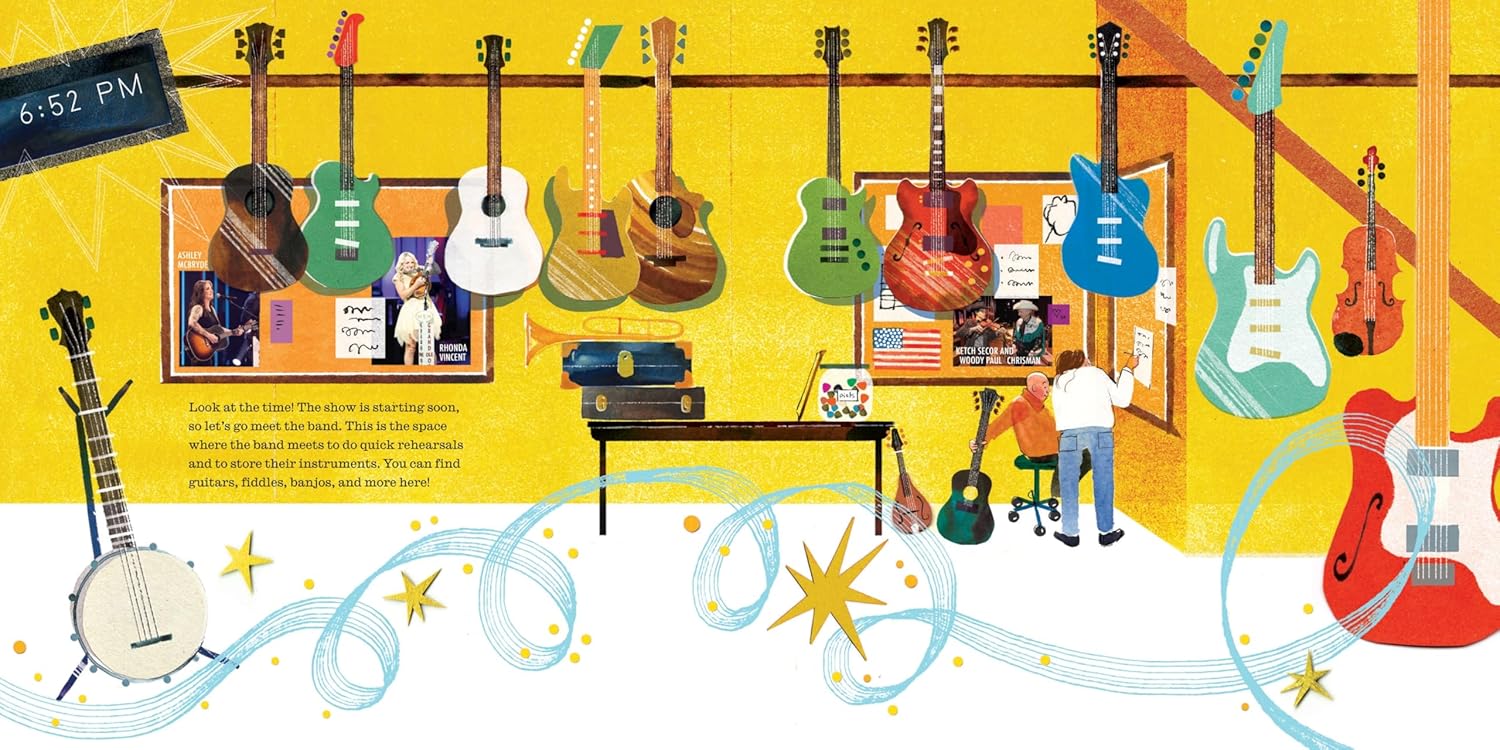
At seven minutes to showtime, kids meet the band in the rehearsal space. Five minutes to showtime, and kids are heading for the stage, where the crew is making last-minute adjustments. Nearby, “musicians and performers stand by waiting for their cue to walk on stage” while the Opry Square Dancers warm up on the sidelines.
Thirty seconds to showtime! Almost time for readers to stand center stage in the storied circle of wood cut from the Ryman Auditorium, country music’s original home. The countdown begins, and the Opry is there with encouragement. “10, 9, 8 . . . Take a deep breath . . . 7, 6, 5 . . . Don’t be nervous, you’ve got this! . . . 4, 3, 2, 1 . . . The curtain is coming up and the band is kicking off your song! Here we go!”
The reader is met with thunderous applause as the drums beat and the bass thrums. Energy and love surround them! The Opry is full of congratulations—”You did it! You made your Opry debut!” And encouragement: “Wasn’t it fun imagining what it would be like to perform on country music’s most famous stage? If you work hard and dream big enough, anything is possible!”
A brief history of the Grand Ole Opry, plus memories from Lauren Alaina, Kelsea Ballerini, Scotty McCreery, and Dolly Parton about their Opry debut follow the story.
The excitement inside the Grand Ole Opry is palpable in Emily Frans’ welcoming introduction to this historic venue, beloved by country music fans everywhere. Whether readers simply adore listening to country music or have the big stage in their sights, they’ll be enthralled with Frans’ personal, direct-address storytelling that makes them feel like one of the Opry family.
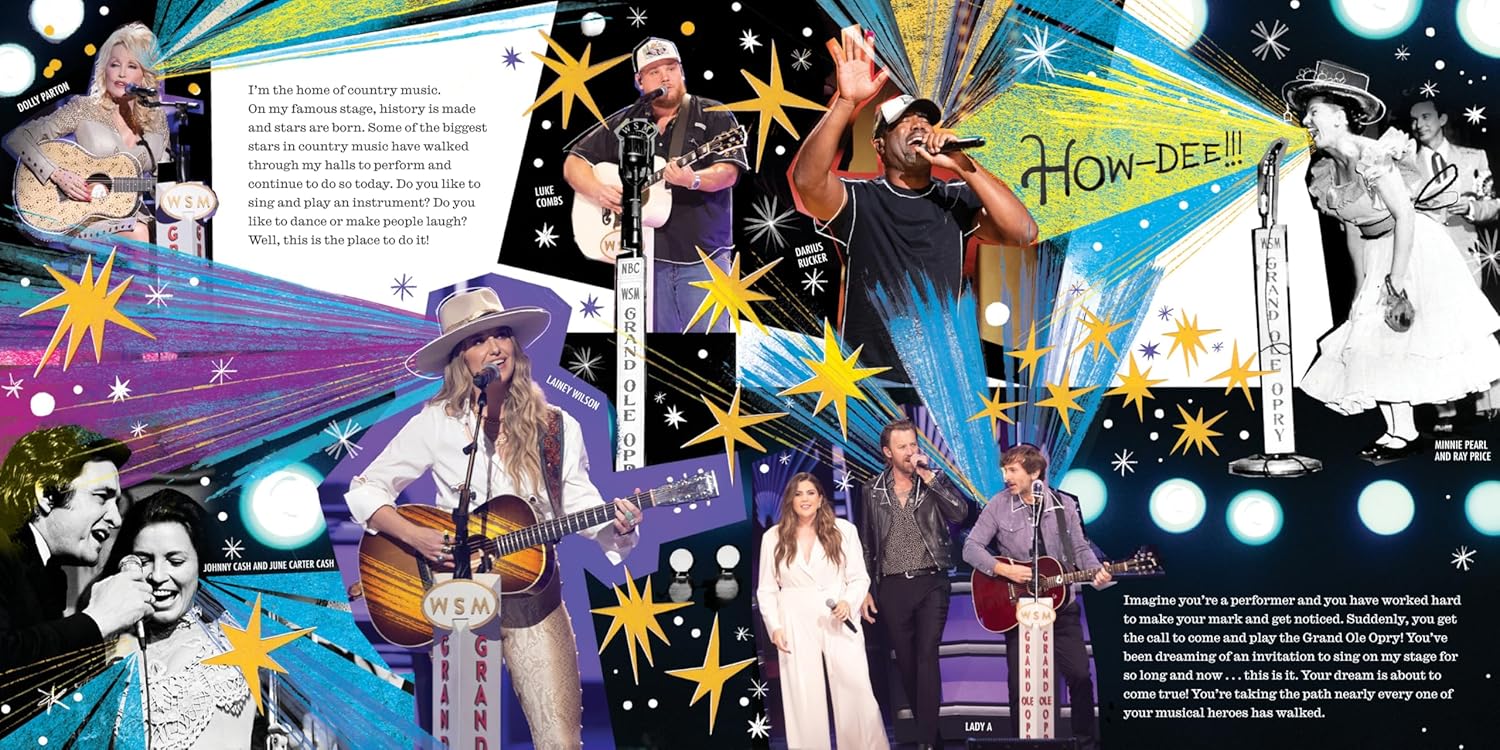
As raucous and inviting as the Grand Ole Opry itself, Susanna Chapman’s visually remarkable and whimsical collage-style illustrations are sure to have children and adults starstruck with the abundance of photographs of their favorite performers playing and singing. Fans of a certain age will be cheered to once again see Minnie Pearl with her signature “How-Dee!!!”, Johnny Cash and June Carter Cash, Roy Acuff, Charlie Pride, Little Jimmy Dickens, Patsy Cline, and Deford Bailey, among others. Reba McEntire, Vince Gill, Blake Shelton, Darius Rucker, Loretta Lynn, and others are also here, while the younger generation will be wowed by Lainey Wilson, Luke Combs, Lady A, Carrie Underwood, Scotty McCreery, Chapel Hart, Post Malone, and more. And, of course, the ageless Dolly Parton is celebrated throughout.
Inspiration and aspiration meet history and tradition in Howdy! Welcome to the Grand Ole Opry!, an extraordinary tribute to this one-of-a-kind music venue and it’s stars on its 100th anniversary. The book is a must for country music fans as well as for all library collections.
Abrams Books for Young Readers, 2025 | ISBN 978-1419774249
About the Illustrator
Susanna Chapman is an illustrator, muralist, and designer. Her illustrated picture books include Covered in Color: Christo and Jeanne-Claude’s Fabrics of Freedom; Elizabeth Warren’s Big, Bold Plans; The Girl Who Ran; and Ada and the Galaxies. She lives in Nashville, Tennessee. Visit her at susannachapman.com.
You can purchase Howdy! Welcome to the Grand Ole Opry! from these booksellers
Jazz Appreciation Month (nicknamed JAM) got its start at the Smithsonian National Museum of American History in 2001. The aim was to celebrate and educate people on the history of and continuing love for jazz. The holiday encourages people of all ages to become familiar with jazz music and the musicians of the past who created this original sound and those today who keep innovating jazz for new audiences. This year’s theme is “Latin Jazz and the Spirit of Cachao López.” Celebrations will revolve around “exploring the cross-pollination of Afro-Caribbean music and jazz that led to the formation of Latin jazz as well as the work of one of the iconic figures in the Afro-Caribbean music tradition – bandleader, composer, and co-creator of mambo, Israel “Cachao” López. To learn more about the month’s events, featured artist, and ways to celebrate, visit the Smithsonian’s Jazz Appreciation website. To celebrate the spirit of jazz with your kids, listen to the rhythms of life inside your heart and in the natural world and make your own music. A great way to start is with today’s book!
First Notes of Spring
Written by Jessica Kulekjian | Illustrated by Jennifer Bower
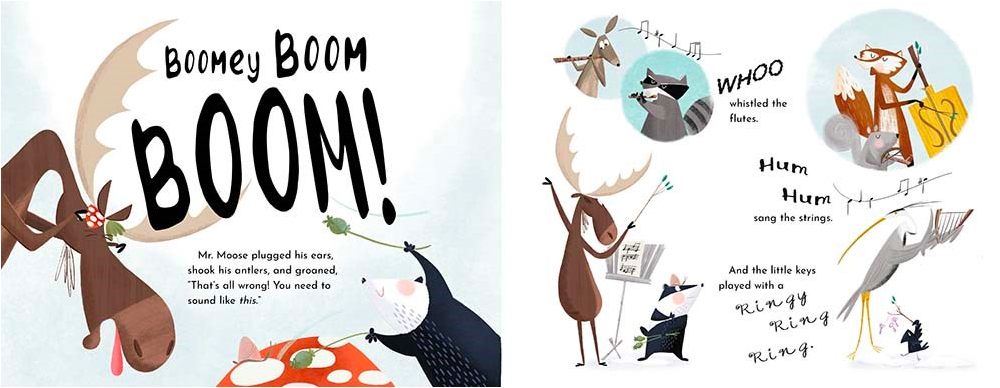
It’s time for a change of seasons, and the First Notes of Spring musicians are gearing up to melt “winter away with their melodies.” Auditions are being held bright and early at 6:00 a.m. to put the orchestra together. Juniper the badger was eager to join. She brought her instrument – a toadstool drum and two strong sticks – and took her turn playing for Mr. Moose, the conductor. “BOOMEY BOOM BOOM!” she banged away while Mr. Moose covered his ears and said, “‘You’re doing it all wrong!'”
Image copyright Jennifer Bower, 2022, text copyright Jessica Kulekjian, 2022. Courtesy of Bloomsbury Children’s Books.
Then he told Juniper to listen to the gentle “WHOO” of the flutes, the soft “HUM HUM” of the strings, and the delicated “Ringy Ring Ring” of the shaken keys. Juniper was sure she could play along, but as the other animals played their instruments, her “BOOMEY BOOMEY! BOOM BOOM! BOOMEY BOOM BOOM!” interrupted the dulcet flow.
Image copyright Jennifer Bower, 2022, text copyright Jessica Kulekjian, 2022. Courtesy of Bloomsbury Children’s Books.
Mr. Moose was beside himself. It was all ‘”Too WILD!'” for him and he added that “‘Spring will not bloom to such a ruckus!'” Then he cancelled the auditions. As Juniper dejectedly headed home through, she heard a random “tap-a-tap” and walked closer. She found Holly the woodpecker “drumming on a tree” looking for insects. Juniper wanted to join in with her “fun sound” and added her “BOOMEY BOOM BOOM!” to Holly’s “tap-a-tap.”
In a bit they heard “clap-a-clap and found… Darby slapping the ice” with his tail. He was fixing his fort, the beaver told them. Juniper and Holly thought Darby’s clapping was just the addition they needed to play louder. The little band made their way through the forest and discovered Dash, a rabbit, thumping the ground. With Dash’s “thumpity thumping,” the band could play louder and wilder, and as they paraded through the forest, sleeping animals awoke, snow fell from the trees, and Spring sprang up all around them.
Image copyright Jennifer Bower, 2022, text copyright Jessica Kulekjian, 2022. Courtesy of Bloomsbury Children’s Books.
Mr. Moose was surprised – and then sorry that he’d never known “‘Spring could wake up with such a bang!'” Still, the delicate flowers were still dozing. Juniper suggested that some “whoos, hums, and rings” could help rouse them. So while Juniper led Holly, Darby, and Dash in the beats, Mr. Moose led the squirrel, raccoon, deer, fox, and crow in the notes, and all of the forest blossomed into Spring.
Back matter includes an engaging discussion of the sounds heard during different seasons that will have kids and adults getting outside to listen to the loud and delicate music that orchestrate each magical time of the year.
Image copyright Jennifer Bower, 2022, text copyright Jessica Kulekjian, 2022. Courtesy of Bloomsbury Children’s Books.
Jessica Kulekjian’s imaginative take on the waking of spring employs alliteration and onomatopoeia that will entice kids to whistle, hum, clap, stomp, drum – and read! – along as winter transitions into spring. But the new season isn’t the only one who awakens, Mr. Moose also makes an eye-opening discovery as Juniper’s belief in herself and her music makes his traditional concert inclusive for everyone.
As Jennifer Bower’s delicate icy blues and pale greens of winter give way to the lush vibrancy of spring, kids will enjoy pointing out all of the small animals, insects, and blossoms that begin to populate the pages as they are awakened by Juniper’s novel alarm clock. Two split-page cutaways give readers a glimpse into Juniper’s underground den and a rabbit warren, where a mom, wearing curlers in her ears and bunny slippers on her feet, is just preparing breakfast for her still-sleeping brood. The final two-page spread of The First Notes (and Beats) of Spring musicians is a true celebration of the beauty and rhythms of spring.
Fast-paced and sure to inspire enthusiastic participation, First Notes of Spring is an enchanting read aloud and would be a perfect addition to music class time for students of varying ages, from preschool to the lower grades. The book would also be an exciting introduction for an outdoor activity to listen and look for signs of spring.
Ages 3 – 6
Bloomsbury Children’s Books, 2022 | ISBN 978-1547604739
Bridges can do so much more than just take vehicles and people over waterways or highways. Many are beautiful structures that enhance the skyline or environment in which they’re found. Covered bridges, stone bridges, and soaring steel and cable bridges all have their own stories to tell and inspire awe in their own way. Unfortunately, many older bridges are slated for destruction or replacement. To honor this month’s holiday, visit a historic bridge in your area or research famous bridges of the past and present. On November 6, we also celebrate National Saxophone Day! To get in the swing of this holiday, why not listen to music by Sonny Rollins? You can find his jazz classics on YouTube. To get started, you can listen to The Bridgehere.
Thanks go to Nancy Paulsen Books for sharing a copy of Sonny Rollins Plays the Bridge with me for review consideration. All opinions on the book are my own.
Sonny Rollins Plays the Bridge
Written by Gary Golio | Illustrated by James Ransome
“The Bridge / leaps / spreads its wings / joyfully / joining shore to shore”
“Steel towers / standing tall / reaching high / touching / sky” as people – walking and riding bikes – and cars and trucks move above “the River / stretched out below / a shiny / endless / song”
Image copyright James Ransome, 2021, text copyright Gary Golio, 2021. Courtesy of Nancy Paulsen Books, Penguin.
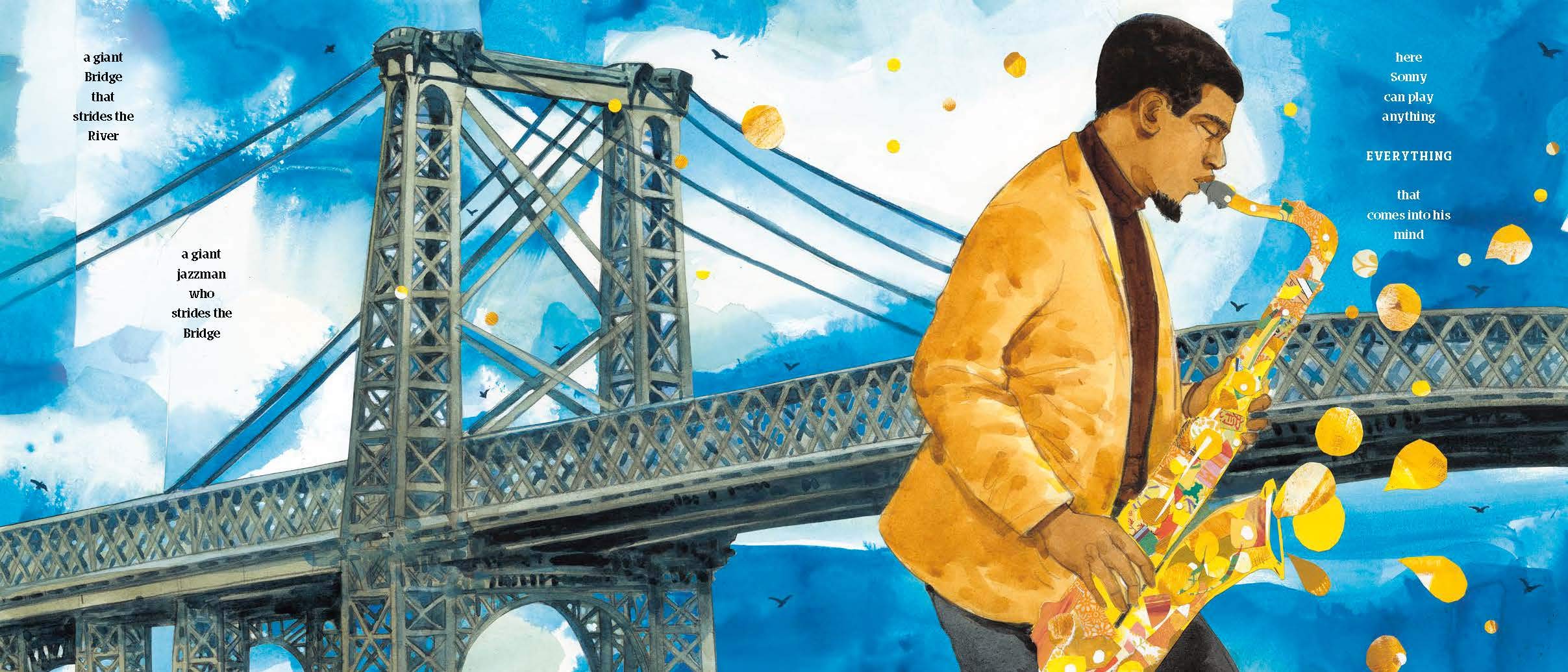
In another part of New York City, Sonny Rollins, already a jazz great, is trying to find a place to play his saxophone – to become a better musician and a better person. The neighbors in his apartment building complain from their windows as he practices on the fire escape, so he takes to the sidewalks to find a more accommodating spot. He wanders the busy streets until he sees, towering above the tall buildings, the Williamsburg Bridge and wonders…. He listens to “that / small voice / inside / which says / you need to do this“
Image copyright James Ransome, 2021, text copyright Gary Golio, 2021. Courtesy of Nancy Paulsen Books, Penguin.
He climbs the stairs to the walkway high above the noisy, busy city and takes his saxophone from its case. Here, alone, Sonny finds the place where he can play as loud as he wants. But he’s not really alone. Around him the “clanking clanging” subway trains lend rhythm to his music, and the “tugboats / blowing bass notes / back / and forth” are answered “note-for-note / with / low moans” from Sonny’s sax while seagulls are “echoing / Sonny’s funny / squeaks / & / squawks.”
Here, this jazz great “can play / anything / EVERYTHING / that comes into his mind.” With his “mind opened wide,” Sonny finds the sound he’s been looking for and “the Bridge / leaps / spreads its wings / just like / Sonny.”
Image copyright James Ransome, 2021, text copyright Gary Golio, 2021. Courtesy of Nancy Paulsen Books, Penguin.
Back matter includes more about the life and career of Sonny Rollins; a history of the Williamsburg Bridge and The Bridge – a series of songs inspired by his experience, recorded in 1962; and Sonny’s words about how he lives his life and what he thinks is important. Sonny’s website and recommended songs found on YouTube round out these informative pages.
Gary Golio’s story floats on the jazz rhythms of his poetic verses, enveloping readers in the musicality of Sonny Rollins’s life and the sounds of the city. In addition to relaying the facts of this seminal period in Rollin’s career, Golio emphasizes Rollin’s belief in the importance of listening to your own internal voice on the road to self-discovery. Lyrical descriptions of the impromptu “band” that accompanied Rollins on the bridge are both beautifully evocative and inspirational reminders for readers that they too can shine while working with or playing off of others.
James Ransome’s glorious watercolor and collage paintings give readers a sense of the time period as well as the scale of the bridge as it soars above the high-rise buildings, providing a practice room and stage for Sonny Rollins’ talent. Textured and patterned details along with a variety of perspectives echo Golio’s lyrical verses. Gold accents on each page mirror Rollins’ shiny saxophone and visually represent the notes that rise and float away over the city.
A gorgeous and jazz-infused snapshot of a stirring and influential time in Sonny Rollins’ life, Sonny Rollins Plays the Bridge will delight any music lover and inspire all readers to search for the best in themselves. The book is highly recommended for home, school, and public library collections.
Ages 4 – 8
Nancy Paulsen Books, Penguin Random House, 2021 | ISBN 978-1984813664
Discover more about Gary Golio and his books on his website.
To learn more about James Ransome, his books, and his art, visit his website.
Historic Bridge Awareness Month Activity
Build a Remarkable Recycled Bridge
You don’t need fancy blocks and construction materials to build a bridge! Little ones will be fascinated to put together a bridge made out of items you already have at home or that may even be slated for the recycle bin. Spaghetti boxes make great roadways, and cut-up egg cartons can be used as supports.
Want to build a whole town? Cereal boxes and pasta boxes make skyscrapers, apartment buildings, fire stations, and more. Need a farm silo? Grab a peanut butter jar, oatmeal container, or aluminum can. You can use them as is or—if your kids are sticklers for a little more detail—add some paint and details! So look around, use your imagination, and get creative!
You can find Sonny Rollins Plays the Bridge at these booksellers
November is all about picture books thanks to Picture Book Month founder author and storyteller Dianne de Las Casas and co-founders author/illustrators Katie Davis, Elizabeth O. Dulemba, Wendy Martin, and author Tara Lazar. This month-long international literacy initiative celebrates print picture books and all that they offer to young (and even older) readers. With gorgeous artwork and compelling stories, picture books open the world to children in surprising ways. They entertain, explain, excite, and help children learn empathy and understanding. If you want to learn more about the holiday and read engaging daily posts about why picture books are important by your favorite authors, illustrators, and others in the children’s publishing industry, visitpicturebookmonth.com.
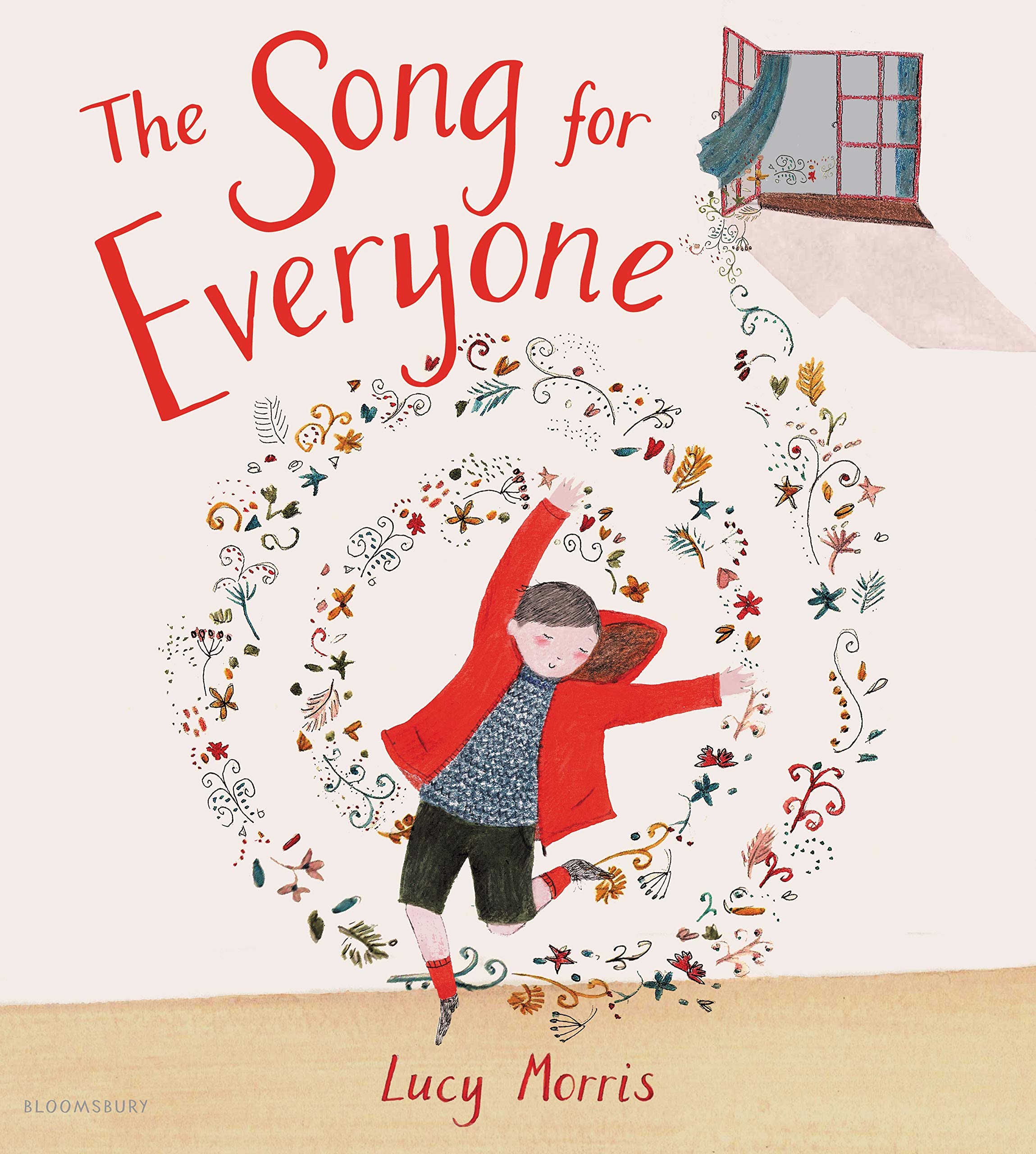
The Song for Everyone
By Lucy Morris
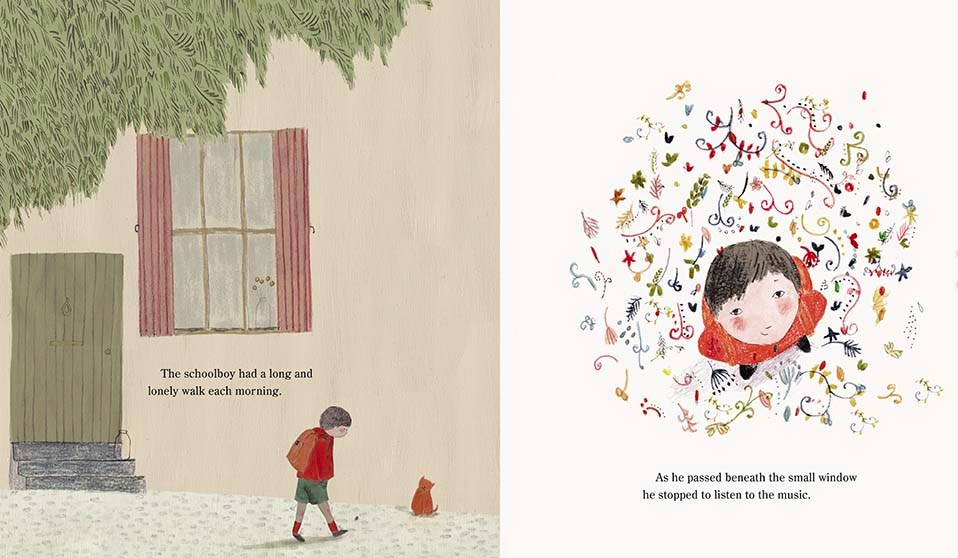
There was a tiny window “too high in the eaves to be noticed from below and too small to let in much daylight.” But one day a “delicate tune” wafted from it’s open panes and floated along the street. A boy trudging to school alone heard it and stopped to listen. As the music swirled around him, he felt happy and he skipped along on his way. Soon an old woman, slow and bent with age, walked by on her way to the market. As she passed under the window, “the sound flowed down and wrapped itself around her weary body.” Suddenly, she felt strong and joyful. A homeless cat followed stray notes from this tantalizing music and was led to two children “who longed for a cat of their own.”
Copyright Lucy Morris, 2020, courtesy of Bloomsbury Children’s Books.
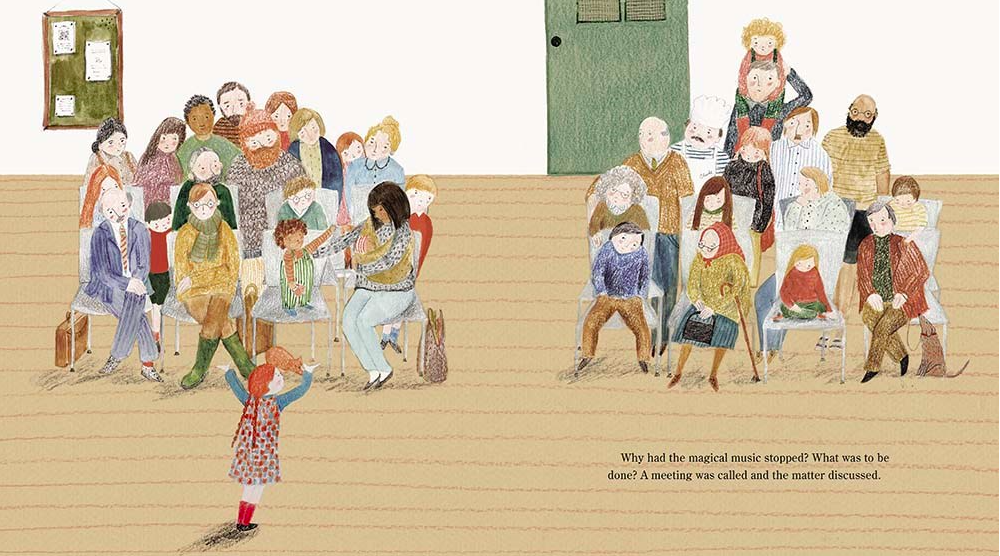
The music continued to float from the open window, always seeming to know who needed to hear it and making the townspeople begin to care for and connect with each other in new ways. The town grew content and peaceful. But then one morning, the music stopped. The town seemed gray and lifeless, and the people felt sad, lonely, and weary. The people held a meeting and decided to see what was behind the open window. The little boy who’d first heard the music climbed up the ladder of townspeople and clambered inside.
Copyright Lucy Morris, 2020, courtesy of Bloomsbury Children’s Books.
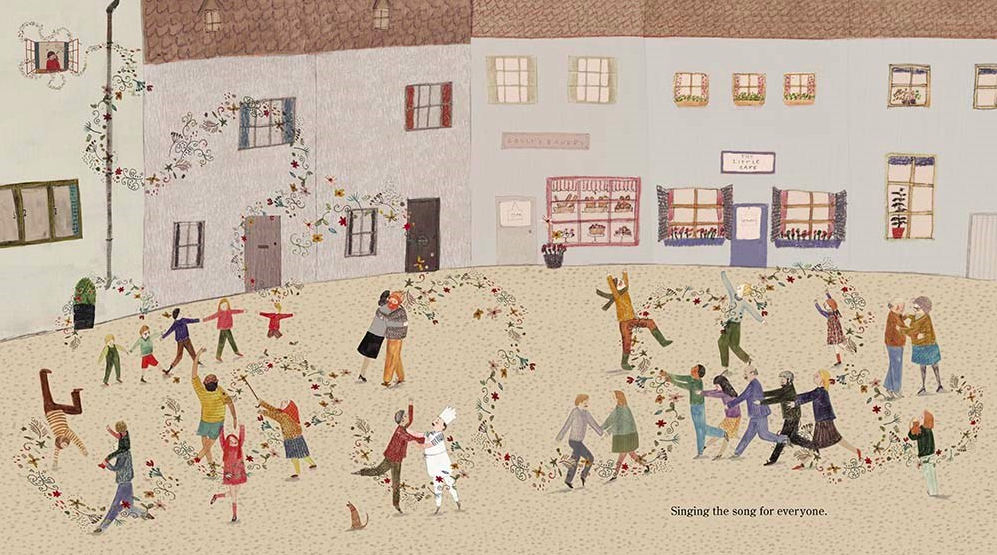
There he found a little wren. She was tired and hungry and her song had left her. The boy promised to help her and he yelled down to the people gathered below. They gathered food and provisions and sent them up to the window in a basket. Two days passed, but the wren stayed silent. But then early one morning…! “A melody, a song. A sound so sweet” once again floated into the air and through the streets. Everyone rushed from their homes and crowded together under the window. There they saw “the boy and the wren making music together. Singing the song for everyone.” A they listened, the central square came alive with dancing, twirling, and playing.
Copyright Lucy Morris, 2020, courtesy of Bloomsbury Children’s Books.
Lucy Morris’s lovely story—in both words and pictures—reveals the power of one person’s voice and/or actions to transform lives. The wren, singing from a darkened window offers her song, a melody that brings happiness and makes passersby realize they are not alone. Readers can imagine the cheered schoolboy, old woman, and new cat owners sharing their new-found joy with classmates, store clerks, other shoppers, parents, and friends, who also pass their sudden optimism to others until this small community embraces each other as never before. But one wren (or person) cannot sustain it alone. As the townspeople in Morris’s story discovers, it takes a group effort, and it is that coming together that truly creates change.
Morris’s beautiful, lyrical language is as light and buoyant as the wren’s song. Her word choices evocatively describe both the angst, weariness, and world view of the townspeople before the wren’s appearance and the joy, peace, and hopefulness they acquire after accepting her song.
Copyright Lucy Morris, 2020, courtesy of Bloomsbury Children’s Books.
Morris’s charming illustrations, rendered in a serene color palette portrays a town where, despite the close proximity of the homes and buildings, the people are apparently distanced from each other. The wren’s music is depicted as a garland of flowers that once released into the air do not scatter, but remain strongly together to fill the streets, wrap around the needy, lead the lost, shelter the cold, and lift up those who need a boost.
While the loss of the wren’s song brings sadness, readers will also see that the wren has already accomplished much. Instead of returning to their solitary lives, the townspeople now gather together to discuss a solution. As a little girl addresses the group, kids will understand that their voice is important too. Images of the townspeople each contributing to the wellbeing of the wren and then celebrating her recovery reinforces Morris’ message of community.
A moving and triumphant story that will touch all readers and encourage them to use their individual talents to benefit others, The Song for Everyone will become a thoughtful favorite and is highly recommended for home, school, and public library collections.
Ages 3 – 8
Bloomsbury Children’s Books, 2020 | ISBN 978-1547602865
To learn more about Lucy Morris, her books, and her art, visit her website
Picture Book Month Activity
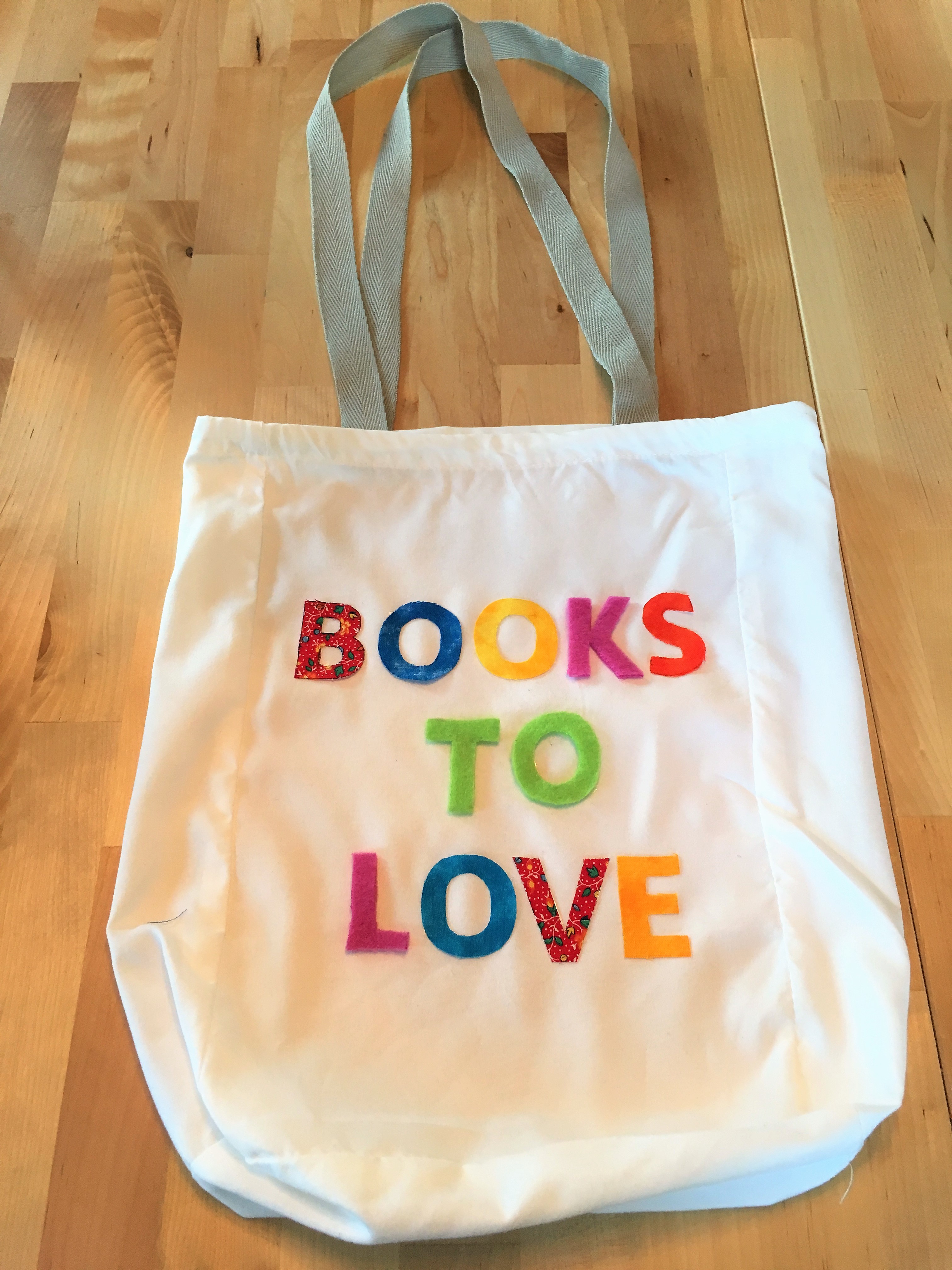
Books to Love, Books to Read Book Bag
True book lovers can’t go anywhere without a book (or two or three) to read along the way. With this easy craft you can turn a cloth bag into a kid-size book bag!
Small cloth bag, available from craft or sewing stores—Recyclable Idea: I used the bag that sheet sets now come in
Cloth trim or strong ribbon, available from craft or sewing stores—Recyclable Idea: I used the cloth handles from shopping bags provided from some clothing stores
Scraps of different colored and patterned cloth. Or use quilting squares, available at craft and sewing stores
Pen or pencil for tracing letters onto cloth
Scissors
Small sharp scissors (or cuticle scissors) for cutting out the center of the letters
Fabric glue
Thread (optional)
Needle (optional)
Directions
Print the sayings and cut out the letters
Trace letters onto different kinds of cloth
Cut out cloth letters
Iron cloth bag if necessary
Attach words “Books to Read” to one side of bag with fabric glue
Attach words “Books to Love” to other side of bag with fabric glue
Cut cloth trim or ribbon to desired length to create handles
Glue (or sew) handles onto the inside edge of bag
You can find The Song for Everyone at these booksellers
International Music Day was established in 1975 by Lord Yehudi Menuhin, an American-born violinist and conductor – widely considered to be one of the great violinists of the 20th century – to promote the art of music across all segments of society and to apply the UNESCO ideals of peace and friendship among all people, with an exchange of experiences and mutual appreciation of all cultures and their aesthetic values. To celebrate today’s holiday, listen to your favorite music and take some time to discover a new style – it might just become a favorite too!
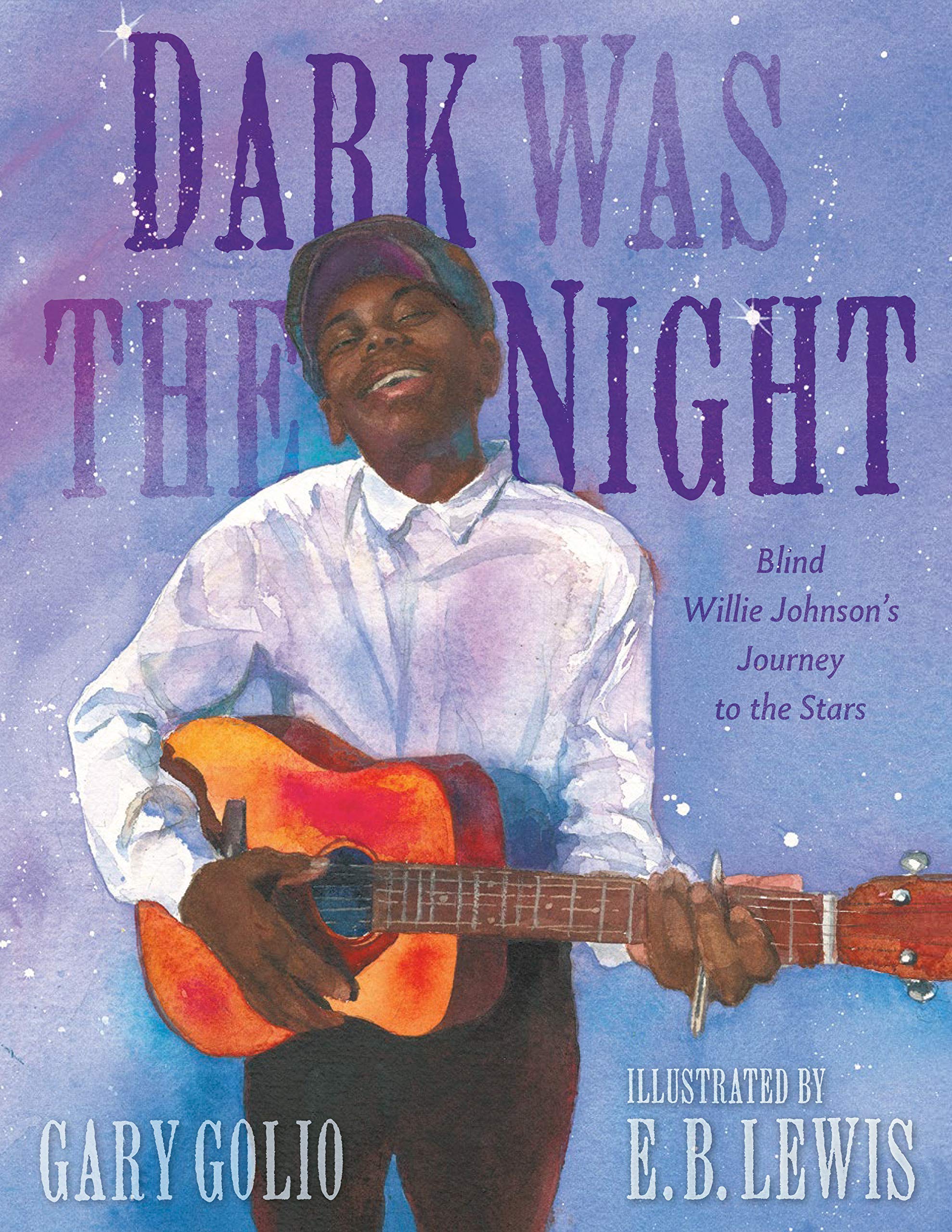
Dark Was the Night: Blind Willie Johnson’s Journey to the Stars
Written by Gary Golio | Illustrated by E.B. Lewis
As readers open the cover to Dark Was the Night, they discover a date: 1977. In this year Voyager I was shot into space carrying “a precious Golden Record, a message to the Universe from Planet Earth.” The record contained pictures of the people and things that make up our life, sounds we hear every day, music from Navajo chants and West African drumming to Beethoven and Chuck Berry. There was also one “ghostly song, about loneliness and the night….a tune of light and hope” from a blind man named Willie Johnson.
Image copyright E.B. Lewis, 2020, text copyright Gary Golio, 2020. Courtesy of Nancy Paulsen Books.
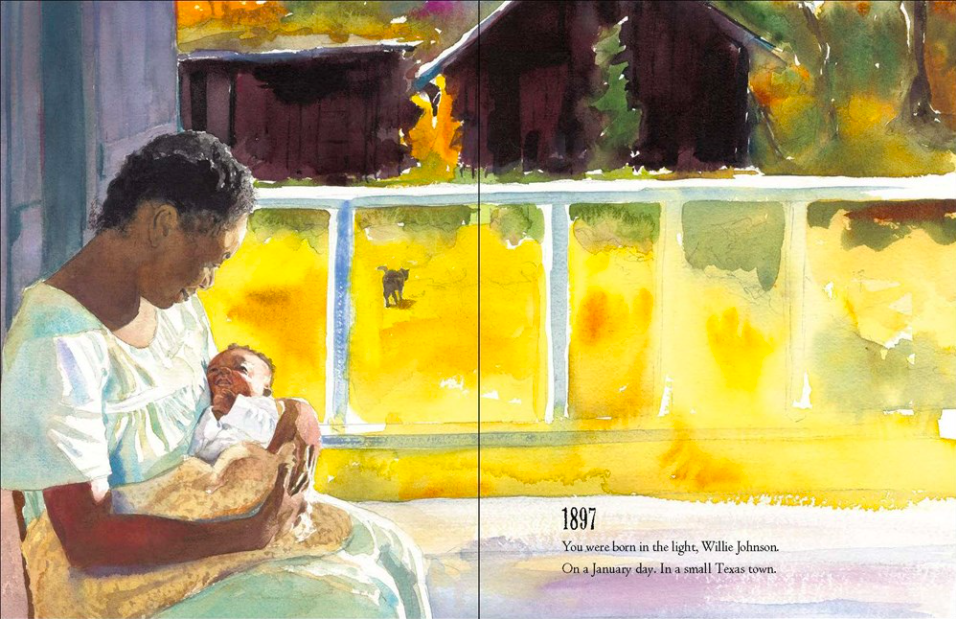
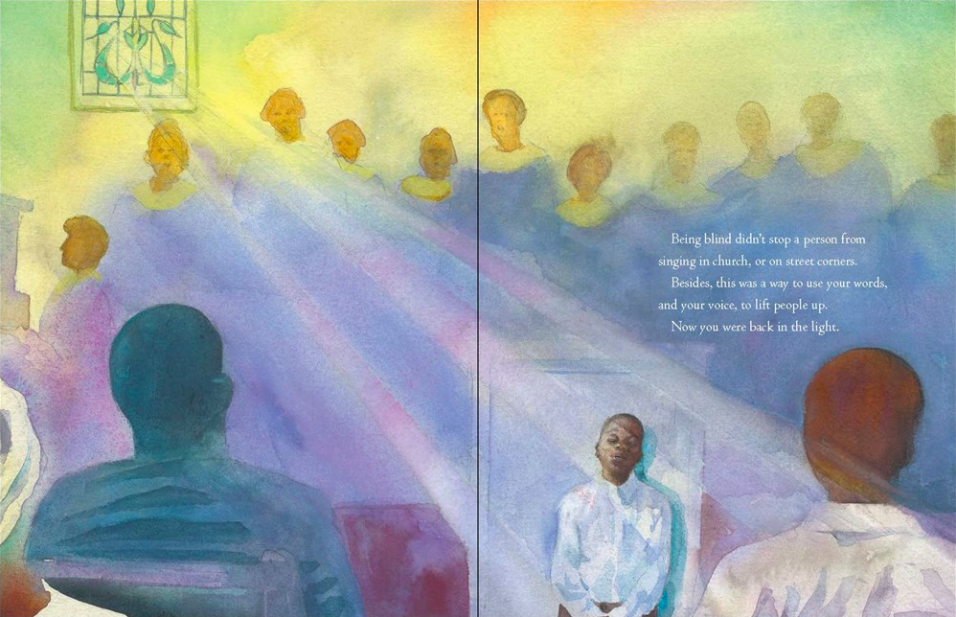
Who was Willie Johnson? In 1897, he was a newborn baby in a small Texas town wrapped in his mother’s love. narrator picks up the thread of Willie’s story when he’s become a small boy who “loved to sing” and play the cigar box guitar his father made him. But that joy was interrupted when “your mama died, and some light went out of your life.” Then at seven or eight, Willie became blind, “and that’s when things got darker still.” But Willie rose above these hurdles. His blindness didn’t keep him “from singing in church, or on street corners.” Using his voice to uplift people brought him “back in the light.”
Image copyright E.B. Lewis, 2020, text copyright Gary Golio, 2020. Courtesy of Nancy Paulsen Books.
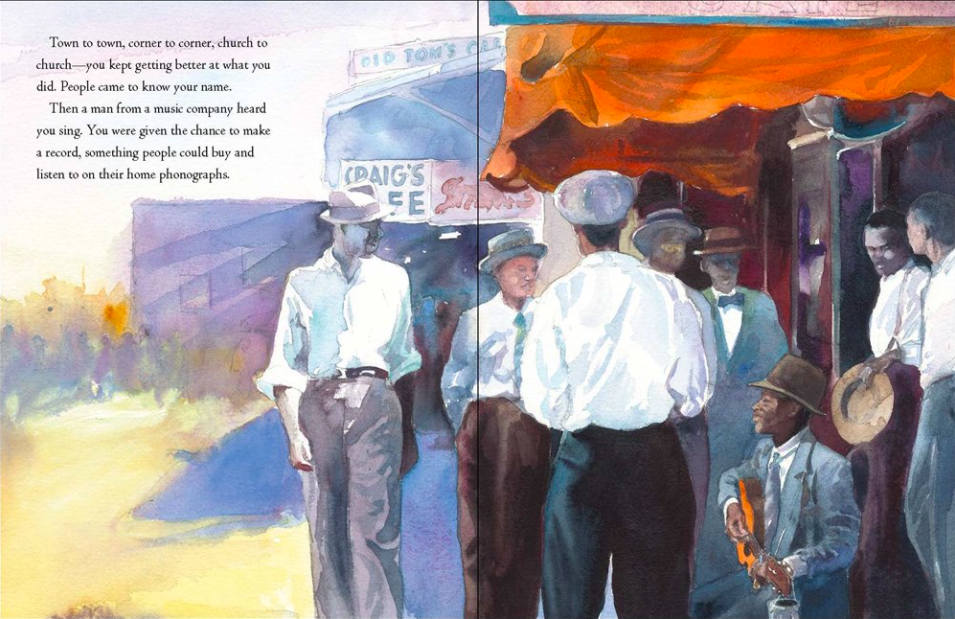
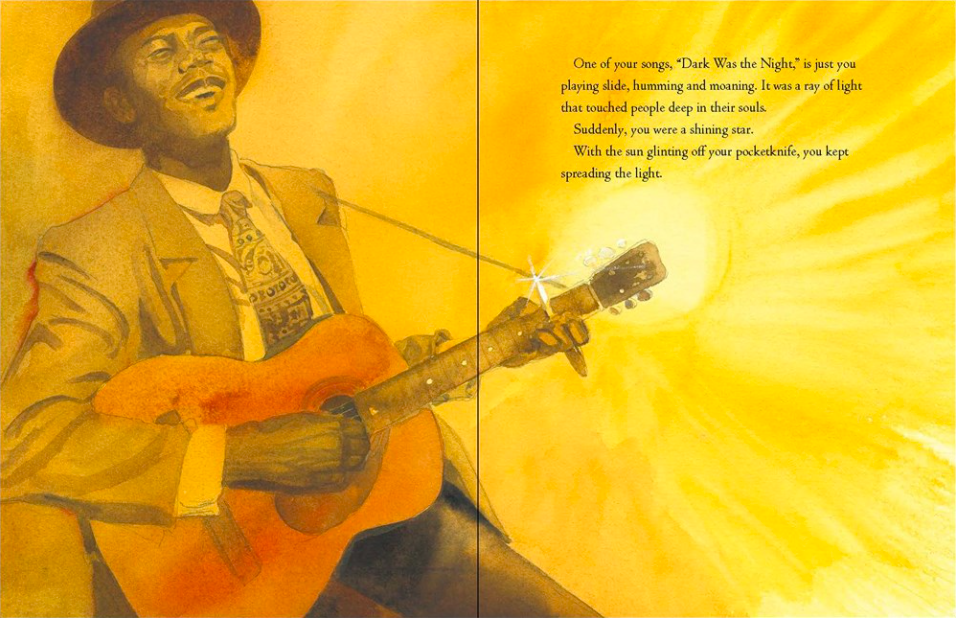
He sang blues and learned how to play a slide by running the edge of a pocketknife along the steel strings of his guitar. “This made a sound like someone laughing or crying, as if the guitar had a voice of its own.” He traveled from town to town in Texas, wherever farmers came to socialize and shop, setting up on street corners and collecting the coins people tossed into his tin cup. Little by little, people grew to know his name. “Then a man from a music company heard you sing. You were given the chance to make a record….”
Image copyright E.B. Lewis, 2020, text copyright Gary Golio, 2020. Courtesy of Nancy Paulsen Books.
On that record listeners heard “the sound of one human being reaching out to all the others, telling them not to be afraid of the dark.” That first record was a hit, lauded for its unique sound. One song in particular, “Dark Was the Night,” “touched people deep in their souls” and made Willie “a shining star.” The light Willie brought to people has never dimmed; in fact it continues to shine through the darkness on Earth and through Space.
Back matter includes a discussion on what is known about Blind Willie Johnson and what still remains a mystery as well more information about Voyager I and why Johnson’s song Dark Was the Night was chosen for inclusion on the Golden Record. A link to NASA’s Jet Propulsion Laboratory website, where readers can access Voyager I—The Golden Record is also included.
Image copyright E.B. Lewis, 2020, text copyright Gary Golio, 2020. Courtesy of Nancy Paulsen Books.
Gary Golio’s ethereal tale of the life of Blind Willie Johnson and his song, which has touched and continues to move so many people, is a stirring tribute to a unique artist and the power of music to change lives. Golio’s use of the second person creates a poignant personal bond between the story and reader, which allows children to put themselves in Willie’s shoes and believe that they, too, can inspire others with their talent and life. Golio’s lyrical storytelling flows with the cadence of the blues, and his evocative vocabulary brings Willie Johnson’s voice and times fully to life for young readers.
E.B. Lewis transports readers to early 1900s Texas in his stunning watercolor paintings rendered in soft washes of grays, blues, and greens punctuated with yellows that reflect the hope and light that spurred Willie on and flowed from his music. As his mother holds him in her arms as a baby, the landscape outside the window blazes with gold that reflects on Willie’s and his mother’s face. As children learn about Willie’s blindness, the page turns dark, except for a swatch of light across Willie’s eyes, representational, perhaps, of his inner sight that sustained him.
Among the realistic depictions of his farm home, the outskirts of a Texas town seen from a train, and a bustling city, where Johnson plays on a street corner to an appreciative audience, his tin cup hanging from a tuner on his guitar, are transcendent images of Willie performing, his face always lifted to the light. As people gather around a radio listening to Blind Willie Johnson, light once again streams into the shop, and as Golio describes how “Dark Was the Night” becomes a hit, Willie is bathed in a golden glow, his face euphoric with the joy of singing.
At once sensitive, rousing, and inspirational, Dark Was the Night is a beautiful book about one man’s talent and dream that will resonate with all readers. The book is highly recommended for home libraries and is a must for school and public library collections.
Ages 5 – 8
Nancy Paulsen Books, 2020 | ISBN 978-1524738884
Discover more about Gary Golio and his books on his website.
To learn more about E.B. Lewis, his books, and his art, visit his website.
Listen to Blind Willie Johnson’s “Dark Was the Night.”
Meet Gary Golio
Gary Golio is the author of the New York Times bestseller JIMI: Sounds Like a Rainbow – A Story of the Young Jimi Hendrix, winner of a Coretta Scott King Illustrator Award; Bird & Diz and Strange Fruit – Billie Holiday and the Power of a Protest Song, both ALA Notables; and other books about legendary artists. A writer and musician, Golio has been featured on NPR’s “Weekend Edition”, CBS-TV’s “Sunday Morning News,”and on radio stations nationwide. He lives in the Hudson Valley with his wife, children’s book author Susanna Reich.
Today, I’m thrilled to talk with the multi-talented Gary Golio about Dark Was the Night, his love for writing and art, his father’s influence in his life, and the power of music.
Welcome, Gary! To start off, can you tell readers about your journey with this Dark Was the Night from idea to publication?
A few years back I was listening to some early blues songs, and came upon Willie Johnson’s “Dark Was the Night.” The song stunned me—and gave me the chills. I knew of Willie’s connection with the Voyager I space probe, but had no idea that blues aficionados and amateur music sleuths were devotedly digging for details of his life through the decades. So much mystery surrounded this man—revered by Jimmy Paige, Eric Clapton, and Lucinda Williams—but what intrigued me the most was that, after dying in poverty and being forgotten, Willie and his work enjoyed a revival of interest during the 1960s Folk Movement. Then, in 1978, “Dark Was the Night” ended up on Voyager‘s Golden Record, hurtling through space. And what that said to me is, you never know how a life, and its effect on others, will play out. It’s a hopeful message that inspired me to write the book.
Your father was an artist and you have worked as a fine-artist since you were a teenager. Can you talk about what inspired you to begin writing picture books? Did you always like to write?
My father is an ongoing inspiration in my life. He was a talented amateur artist who provided me with a real-life example of the Art Spirit by how he thought and created. Most importantly, he was a skilled improviser, and didn’t allow himself to be limited by what he didn’t have, something that’s always meant a lot to me. As for writing picture books, I mostly read comics as a boy, and I think it was that combination of pictures and text that really struck a chord. For me, the picture book is a modern descendant of cave painting, Egyptian wall art (images + hieoroglyphs), and Etruscan/Pompeian murals: using words and pictures to tell a story.
In your Author’s Note you talk about the dearth of knowledge about Willie Johnson’s life. Can you share one thing you learned about Willie that didn’t make it into the book?
Willie has a unique voice that somehow manages to balance the rough and the tender. There’s raw power there, but also delicacy, which is very rare. So Willie was in New Orleans at one point—during a recording session there in 1928—and the story goes that he began singing “If I Had My Way I’d Tear this Building Down” in front of the Customs House. A crowd had gathered, listening to him, and a police officer reportedly became so worried—thinking Willie was instigating a riot—that he considered arresting the man. That’s the power of music—to rouse, protest, and stir up human souls—and it’s easy to see why it threatens authority and institutions.
Dark Was the Night is your eighth biography of a musician or entertainer for children. Could you discuss what drew you to write about these musicians?
While there are no actual musicians in my family-of-origin, my parents, grandmother, and maternal aunt all had strong musical interests. Each exposed me to very specific genres and musical tastes—from Frank Sinatra and Bing Crosby to Count Basie, Louis Armstrong, Ella Fitzgerald, Nat King Cole (whom I adore), Willie Nelson, and Elvis Presley. Many of these people were Black, and many were strongly influenced by blues and jazz, and I have vivid memories of watching them on TV with my beloved grandmother, even at five and six years old. That openness to all kinds of music really shaped me, and growing up I looked for clues, in the lives of artists, that would help me find my own path and direction. So my books often focus on the early years of an artist’s/musician’s life, highlighting the roots of their artistry—what inspired and shaped them—to provide young readers with roadmaps, of sorts, to a life in the arts.
In addition to being an artist and writer, you also admit to being “a pretty good musician” – something you share with kids on school visits that sound awesome. Which instruments do you play and how do you incorporate music into your book events?
I play acoustic and electric guitar, mandolin, banjo, and very simple piano, but love above all to improvise. Since my first book on Jimi Hendrix came out, I’ve used the guitar (both electric and acoustic) to demonstrate a wide range of effects and possibilities (Hendrix and Santana), but also to accompany singalongs I did for my Bob Dylan/Woody Guthrie book. At one school visit, the entire fifth grade and I sang “This Land is Your Land” in Spanish, which was both meaningful and fun.
Each of your books has such distinctive illustrations from incredible illustrators. Can you talk a little about E.B. Lewis’s gorgeous illustrations in Dark Was the Night and how he captured your story and Willie’s personality?
E.B. is truly a master of illustration, and specifically of the watercolor medium. His real superpower, however, lies in his ability to convey humanfeeling, to mysteriously imbue a person or setting with mood and life. That’s remarkable—reminiscent of watching my father draw an American Indian on horseback, straight out of his head—and it’s what lends E.B.’s work both its power and subtlety. Not surprisingly, he has a real love for human beings, a quality fed by his passion for traveling and teaching all over the world. Though we only met at a bookstore panel five years ago, Earl and I have become close friends, and spend a lot of time on the phone collaborating about the joining of text and image. He’s a pleasure to work with, and his art for Dark Was the Night is truly sublime. This book also gave him the chance to bring his use of color (in his own words) to another level, something that will be obvious to anyone who knows his artwork and sees the new images.
From your bio on your website, you sound as if you were a pretty inventive kid – creating all sorts of cool electronic devices. And I love your story about being “shocked” to find books with Van Gogh’s paintings in them as a child and how formative that was. Could you discuss the importance of nonfiction, and biographies in particular, to children?
My father could fix most anything, and it was that spirit of improvisation and inventiveness that led me to create little electronic gadgets a la James Bond and The Man from Uncle. For a time, I wanted to be an inventor or electrical engineer, but Art won out. As for van Gogh, watching Lust for Life with my dad had a HUGE impact on me, and seeing a book in the middle school library with all those paintings reproduced made it clear to me—even at 10 years old—that there was gold in reading about the lives of artists.
While I love fantasy, myth, and good stories, the thing about nonfiction is that you’re reading about real people—with all their talents and troubles—and so it’s easier to believe that if someone else muddled through to achieve something, you can also. That’s why I don’t shy away from talking about a person’s “faults” and failures (particularly in my books about John Coltrane and Billie Holiday), because I want kids to see that great people and artists are just as human as everyone else.
What’s up next for you?
Author-wise, I’ve a book coming out next year on the revered jazz saxophonist Sonny Rollins (based on many phone conversations we’ve shared), to be illustrated by the great James Ransome. I’ve also sold, just this year, two new picture book texts: one on Roy DeCarava—a gifted artist who photographed the people of Harlem in all their humanity—and another on Walt Whitman, focused on his remarkable and moving nursing experience during the Civil War. After that, who knows where Destiny will lead me?
International Music Day Activity
I Love Music! Word Search Puzzle
International Music Day celebrates all types of music and instruments. Can you find the eighteen different instruments in this printable word search puzzle?
Gary Freiberg chose the day in 1877 that Thomas Edison invented the phonograph to encourage people to enjoy music on vinyl records. Whether you grew up listening to records or are a recent convert to this art form that has had lasting appeal even in this technological age, today’s holiday gives music lovers an excuse to enjoy their favorite artists – and, of course, the subject of today’s book should be among them!
Elvis Is King
Written by Jonah Winter | Illustrated by Red Nose Studio
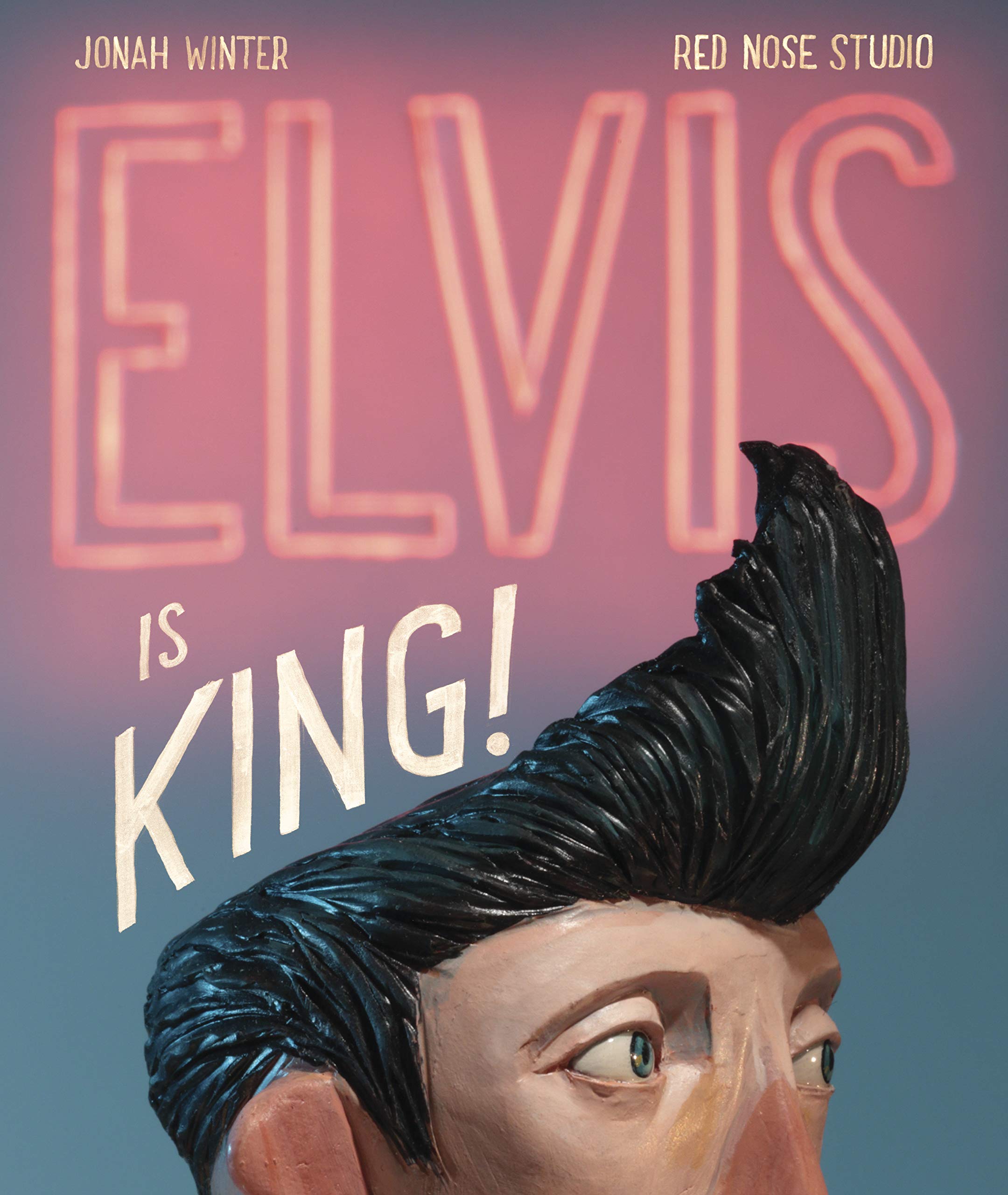
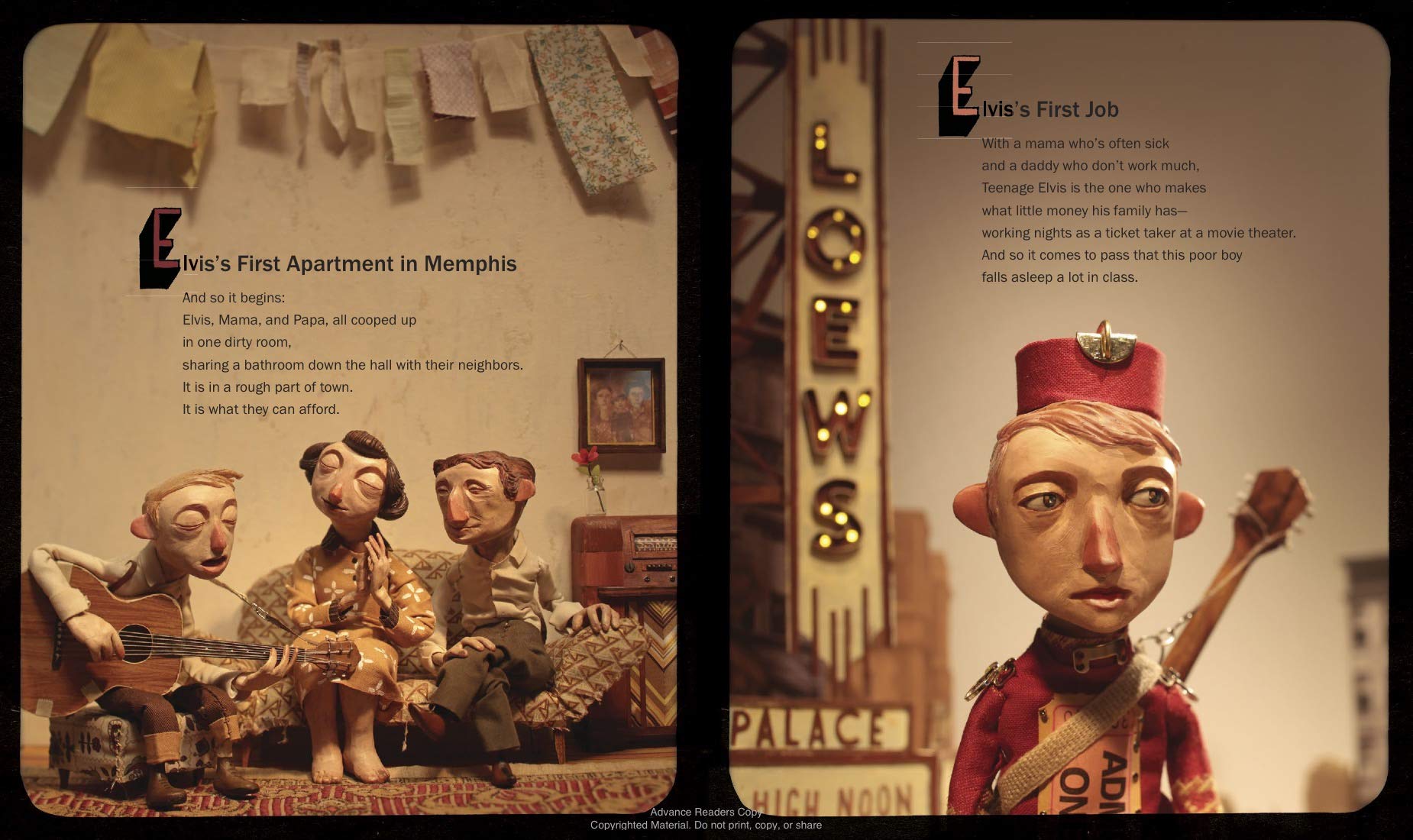
Elvis is King by Jonah Winter and Chris Sickels’ Red Nose Studio is an eye-popping wonder for fans of The King of Rock ‘n’ Roll wanting to share their love for Elvis with their kids. In short, lyrical chapters with dramatic titles that are cleverly reminiscent of the sensational headlines Elvis generated throughout his life (and even after), Winter peels back Elvis’s rags-to-riches story, encapsulating the depth of poverty, talent, and ambition that fueled his life. It’s all here—his birth “in a humble shack / on the wrong side of the railroad tracks, / the side where the poorest of the poor people live…;” his reason for being: singing; and the county fair talent show, where ten-year-old Elvis got his first taste of adoration and a “Fifth Prize!” award.
Image copyright Red Nose Studio, 2019, text copyright Jonah Winter, 2019. Courtesy of Schwartz & Wade.
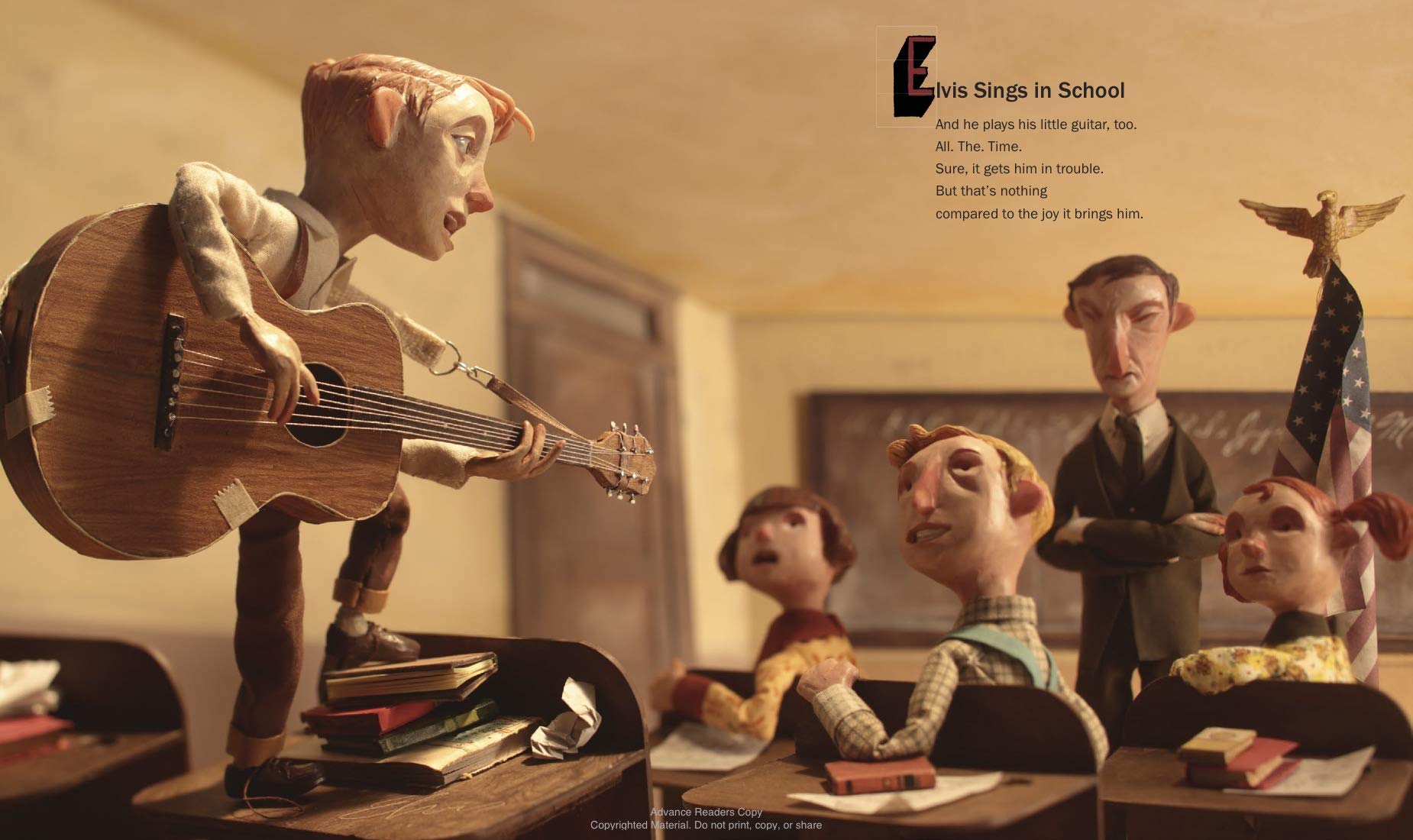
Kids walk into the hardware store with Elvis’s barefoot mama, who “with pennies she saved…/ buys her eleven-year-old birthday boy / the most important gift he will ever receive. / It will be the key to his salvation.” Elvis plays that guitar everywhere, “All. The. Time.” There’s the moment Elvis overheard gospel singing coming from the African American Church and “The First Cheeseburger Ever Eaten by Elvis.” And that question: Why peanut butter and banana sandwiches? The answer’s here too.
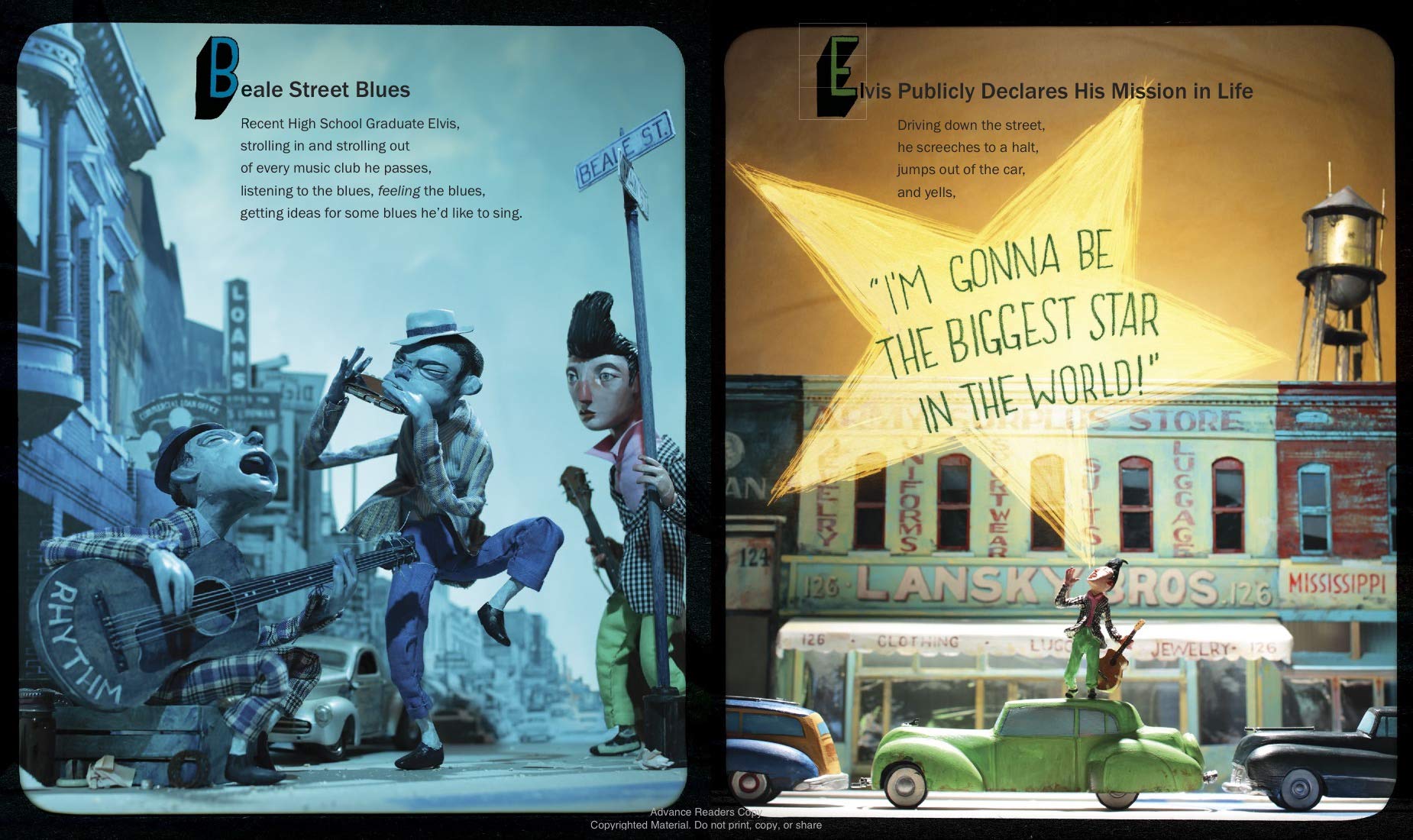
When the family moves to Memphis, it’s up to teenage Elvis to make the money by “working nights as a ticket taker at a movie theater.” Then, suddenly during those years, Elvis finds the “Weird Teenage Elvis” inside him. He dyes his blond hair black and waxes it into a wave. At a thrift shop he buys green pants, a pink shirt, and a checkered jacket. Then at the high school talent show, he “KNOCKS ‘EM DEAD with his song.” And not only that “something happens, something big, when he’s up there: / He is no longer shy! / He can be whatever he wants to be—let loose, go crazy!”
Image copyright Red Nose Studio, 2019, text copyright Jonah Winter, 2019. Courtesy of Schwartz & Wade.
Along the way he falls in love, graduates from high school, and soaks up the sounds of the blues on Beale Street. For his mama’s birthday, he goes to Sun Studios, where anyone can record themselves singing. “(It also makes *real* records of big-time singers— / and Sly Elvis knows this.)” Elvis has his first recorded song for just $3.98. A bit later he gets the call he’s been hoping for from Sun Studios and discovers his signature sound and moves. The song—”That’s All Right”—plays on the radio, and where’s Elvis? Hiding out. Will people like it? Five thousand requests and fifteen replays in one night say Yes!
And when Elvis walks on stage for the first time to sing his song, he’s met with an “AVALANCHE of screaming—in a good way!” Goggle-eyed girls just want to be near him, and it’s the same no matter where he travels. This “Good-Lookin’ Heartthrob Elvis” is soon to lose his “One True Love, / his little darlin’, Dixie Locke. He uses that feeling, though, in a song—”Heartbreak Hotel” that “rises to number 1 on the pop charts.” So “What Is This Crazy Music, Anyway?” It’s not exactly country and it’s not exactly rhythm and blues. “It’s… / ROCK ‘N’ ROLL, baby. / And Elvis is its KING…!”
Image copyright Red Nose Studio, 2019, text copyright Jonah Winter, 2019. Courtesy of Schwartz & Wade.
Jonah Winter’s biography is in every way a loving tribute to Elvis Presley that also winks at his larger-than-life persona and the world’s obsession with him. Well-chosen adjectives presented in initial caps and attached to Elvis’s name, give titles to the phases of Elvis’s life and present an evocative way to show what and where he grew from and left behind on his rise to fame. Sprinkled with southern vernacular and touched with the cadence of a slow, considered southern drawl, Winter’s ingenious verses mirror song lyrics and echo themes that not only make up the country and blues standards that influenced Elvis’s music but that applied to his life.
As always Chris Sickels’ Red Nose Studio artwork is nothing short of astounding. Each illustration is composed as a 3-D set handcrafted from polymer clay, wood, wire, fabric, and found objects. The intricate details and moving emotions, demonstrated in a look, by a gesture, and through perspective, give the illustrations a realism that goes beyond a photographic depiction to illuminate the heart of Elvis Presley’s story. Readers will want to linger over every page to absorb the cultural landscape and life-affirming moments that created The King of Rock ‘n’ Roll.
A joy to read aloud, Elvis Is King is an inspirational story for anyone with a dream, big or small. The personal, yet universal, story and phenomenal art make the book a stirring addition for home, school, and public libraries.
Ages 4 – 8
Schwartz & Wade, 2019 | ISBN 978-0399554704
Discover more about Jonah Winter and his books on his website.
To learn more about the work of Chris Sickels and Red Nose Studio, visit his website.
National Vinyl Record Day Activity
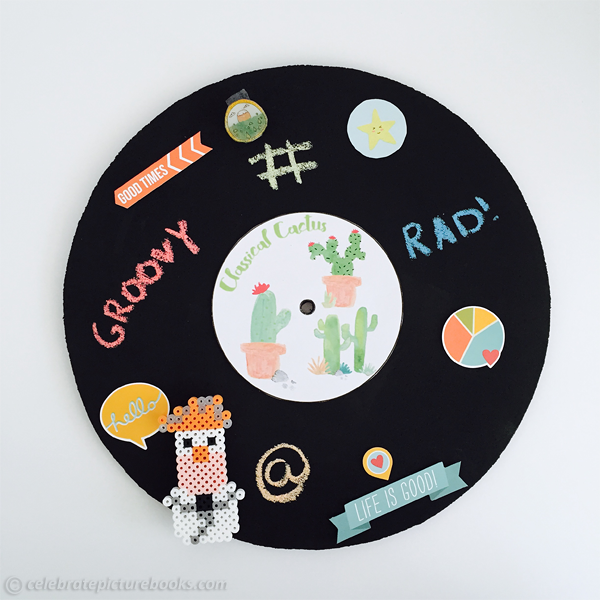
Make a Record Chalkboard Bulletin Board
Would you love to make a record some day? Why wait? In this fun craft you can create your own record bulletin board—and even create your own label art! While this record may not spin on turntables around the world, it will drop in a more important place—your very own room!
















 celebratepicturebooks.com