On February 15, 1965 the national flag of Canada was raised for the first time on Parliament Hill. National Flag Day of Canada was officially established in 1996. As Canadians celebrate the 53rd anniversary of their flag this year, they can take special pride as they watch their Olympic team strive for glory in Pyeongchang, South Korea under their distinctive maple-leaf flag. All across the country today, Canadians are cheering their athletes and their flag.
Carson Crosses Canada
Written by Linda Bailey | Illustrated by Kass Reich
Annie Magruder and her little dog, Carson, had a pretty great life living along the shore of the Pacific Ocean. One day a letter arrived for Annie from her sister Elsie. Elsie was sick and needed cheering up so Annie packed her bags, loaded up her camping gear, and “filled a cooler with baloney sandwiches.” For Carson she brought along dog food and of course Squeaky Chicken. They pulled away from their house and headed east.
“All morning they drove in the rattlebang car.” Were they there yet? Carson wanted to know. But they were on a loooong trip—all across Canada, Annie told him. She also said there’d be a surprise for him at the end. “Carson loved surprises. Squeaky Chicken had been a surprise. Every time Carson chewed, he got a brand-new noise. Skreeeee! Wheeeee! Iiiiiy!”
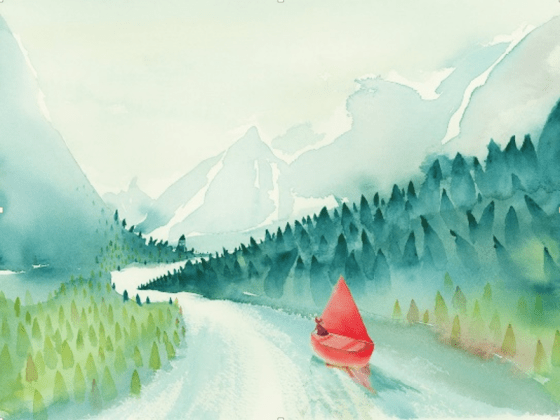
Twisty roads took them into the Rocky Mountains, where Annie pitched her tent for the night. Carson stood guard, watching for bears. The next day they rolled into dinosaur country. Carson could hardly control his excitement at seeing the enormous bones. Could this be his surprise? But Carson didn’t get to take a single bite—not even a little lick.
On day three they came to flat farmland, where “grain grew in carpets—yellow, blue, gold.” While Annie admired the wide-open sky during a picnic lunch, Carson chased after grasshoppers, finally snatching one for his dessert. On the next day, the sun was so hot that as Annie and Carson drove past Lake Winnipeg, they stopped to take a dip.
After that there were more days and even more days spent in the car passing forests of trees and boulders. Carson passed the time barking and wondering about his surprise. At night, when he and Annie camped, they listened to the loons calling, “Ooo-wooooo. Ooo-hoo-hoo.” When they reached Niagara Falls, they stopped to watch the thundering water and got soaked with its spray.
In Quebec City, Annie and Carson enjoyed French delights, including a pork pie called tourtière, which Carson gobbled up in two bites. Was this their destination? Oh, no—they still had a ways to go! Once, while Carson was napping, he heard Annie shout, “‘Look! The Atlantic Ocean!’” Carson was so thrilled to see an ocean once more that he ran to the edge and rolled in the mud until he was covered.
The next day brought “an island of red and green” as pretty as a postcard plus lobster rolls for two. Here, Annie told Carson, they were getting close. There was still one night’s stop, however. “In the campground that night, there was fiddle music—so friendly and fast, it made everyone dance. Annie clapped and jigged. Carson chased his tail.” With the promise of “‘tomorrow’” whispered in his ear, Carson fell asleep.
A ferry ride took them to Elsie’s. Her “house stood waiting beside the ocean. It was red like the house back home. Out came a woman who looked like Annie. Her steps were slow, but her smile was as wide as the sea.” Annie and her sister hugged for a long time until Carson yipped, looking for his surprise. Bounding toward him came a dog that looked “so much like Carson, it was like looking into a mirror.” It was his brother, Digby! They hadn’t seen each other since they were puppies. Spending time with Annie and Carson was just what Elsie needed. The four “loved the salt air. They loved the red house. And they loved their sweet time together.”
For young armchair travelers, Linda Bailey has crafted a wonderful story that combines the best of sightseeing with an emotional tug that is warm and uplifting. The love between Annie and Carson is evident from the first page and swells as they reunite with Elsie and Digby, taking readers along for the rewarding ride. Bailey’s lyrical and humorous view of Canada’s expansive beauty through the eyes of both Annie and Carson will delight kids and leave them wanting to learn more. The reaffirmation that family stays strong even across many miles will cheer children and adult readers alike.
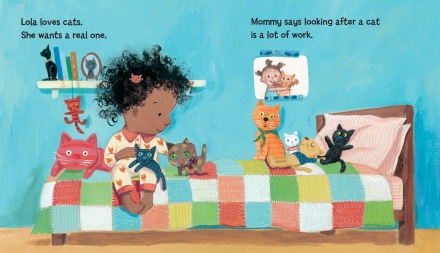
Kass Reich’s gorgeous hand-painted gouache illustrations put children in the back seat of the little, well-packed “rattlebang” car with sweet Carson on a tour of Canada. They’ll view awesome redwood trees, majestic mountains, the bone yards of Dinosaur Provincial Park, Quebec City, fields, lakes, and clear nights. Reich’s vivid colors and rich details invite kids to linger over the pages and learn even more about Canada. Little ones will also like pointing out Squeaky Chicken, who is happily enjoying the trip as well.
The book’s endpapers provide a colorful map of Canada with Carson and Annie’s route clearly marked along with their sightseeing stops.
Carson Crosses Canada is a sweet, beautiful book that kids will want to read again and again. It would be a wonderful addition to home and library bookshelves.
Ages 4 – 8
Tundra Books, 2017 | ISBN 978-1101918838
Discover more about Linda Bailey and her books on her website!
You can learn more about Kass Reich and her books as well as view a portfolio of her illustration work on her website!
National Flag Day of Canada Day Activity
Make Me a Moose! Headband
Moose love calling Canada home! With this easy craft you can turn your hand prints into cute antlers to wear!
Supplies
Stiff brown paper
Brown hair band
Pencil
Scissors
Tape
Directions
Trace your hands with fingers spread on the brown paper. Leave a 1 – 2 inch tab on the end of the wrist for wrapping around the head band
Cut out the hand prints
Place one hand print on the right side of the headband with the thumb of the hand pointing up.
Wrap the tab around the headband and secure with tape
Place the second hand print on the left side of the headband with the thumb pointing up.
Wrap the tab around the headband and secure with tape
Enjoy being a Canadian Moose!
You can find Carson Crosses Canada at these booksellers
February 14th is all about love! Sharing Valentines, sharing hugs, candy, and fun, and… sharing books! There’s no better way to show a child how much they mean to you than by giving them a book. Unfortunately, many children don’t have access to or own books. International Book Giving Day was established to encourage people to buy, share, and donate books so that the children in their lives and communities can know the pleasure and educational benefits of reading. To learn more about today’s holiday and to find some tips on easy ways to get involved, visit the official International Book Giving Day website.
A Different Pond
Written by Bao Phi | Illustrated by Thi Bui
A little boy yawns and rubs the sleep from his eyes as his dad wakes him even before the sun has risen. His dad has already made sandwiches and packed the car for their fishing trip. As they drive out of town, the streets are silent and a chill tinges the air. The little boy’s father entertains him with stories. As he listens, the boy thinks of the kid at school who says his dad’s “English sounds like a thick, dirty river.” To him, though, his father’s “English sounds like gentle rain.”
Image copyright Thi Bui, 2017, text copyright Bao Phi, 2017. Courtesy of Capstone Young Readers.
Even at this early hour the bait shop is open while the Mexican restaurant next door is dark. The bait man comments that the pair are earlier than usual, and the boy’s father explains that he has to work at his second job later that morning even though it’s Saturday. The little boy carefully carries the bag of minnows, feeling them “swim like silver arrows in my hands.” They stop the car along the road, climb over the guard rail, and gingerly make their way “through the tangle and scrub” to the pond.
As the boy holds his father’s calloused hand, he wonders why they still need to fish for food if his father has a second job, and his dad answers that “everything in America costs a lot of money.” Sometimes, they meet other men fishing at the pond, but today they are alone under the stars that look “like freckles.” While his father sets up their equipment, the boy gathers sticks and rocks and makes a small fire ring to provide warmth.
Image copyright Thi Bui, 2017, text copyright Bao Phi, 2017. Courtesy of Capstone Young Readers.
The little boy wants to help with the fishing, but he can’t bring himself to put the minnow on the hook. His father smiles, understanding how he feels. For breakfast they eat the bologna sandwiches the father made. “‘I used to fish by a pond like this one when I was a boy in Vietnam,’” the dad tells his son. The boy looks into his father’s face and asks if he fished with his brother. His father “nods, then looks away.” The boy knows that his father and uncle fought in the war side by side until the day when his dad’s “brother didn’t come home.”
When the bobber dips, the boy’s father pulls in a crappy and soon after, another. This time the boy holds the fish between his hands “to help guide the fish into the bucket. The fish feels slimy and rough at the same time,” and the boy makes a face that makes his dad laugh. His father is happy because they caught “a few fish and he knows [they] will eat tonight.”
Image copyright Thi Bui, 2017, text copyright Bao Phi, 2017. Courtesy of Capstone Young Readers.
As they walk back to the car, the boy wonders “what the trees look like at that other pond in the country [his] dad comes from.” The sky is just brightening as they reach home and show Mom the fish they’ve caught. She smiles, even though she’s tired, and asks her son to help with the fish before she too goes to work. Their praise for his help in catching that night’s dinner, makes the boy feel that he is growing up.
The little boy waves to his mom as she bicycles away to her job comforted by the knowledge that he, his brothers and sisters, and his mom and dad will all be together again that night around the dinner table. They’ll share crispy fried fish, rice, and funny stories. Then later they will go to sleep and “dream of fish in faraway ponds.”
Image copyright Thi Bui, 2017, text copyright Bao Phi, 2017. Courtesy of Capstone Young Readers.
As deep and quietly moving as a fishing pond, Bao Phi’s tribute to family, parental sacrifice, and the profound understanding of children wrenches your heart with its beautiful and honest language and touching details. Phi uses the fishing trip—which at first seems to be simply a fun outing for father and son, but is in fact an act of survival—to relate one family’s relationship with their adopted country while also delving into the universal bond between children and parents or other adults. Taken before sunup, the trip provides moments—both spoken and unspoken—for the little boy to learn and internalize the stories, feelings, and history of his heritage at a time when his own identity is dawning. The camaraderie at the dinner table is one more time to connect with and be connected to family and traditions old and new.
Image copyright Thi Bui, 2017, text copyright Bao Phi, 2017. Courtesy of Capstone Young Readers.
Thi Bui’s detailed illustrations are washed in the mysterious and hopeful blues and grays of early morning sprinkled with stars and lit with the glow of streetlamps. The pond shimmers with moonlight—a unifying link to that other pond so far away. A No Trespassing Keep Out sign that marks the place where the little boy and his father pull over to access the pond offers an opportunity for readers to reflect on wider immigration and refugee issues. Bui’s captures the nuanced expressions passed between the loving parents who are doing everything they can to provide a better life for their children, and their equally loving children who are dreaming of and learning what that life is.
Extensive notes from Bao Phi and Thi Bui follow the text.
A Different Pond is an exquisite story with wisdom and insight that will impact readers during quiet story times at home and in the classroom. The book would be a warm and welcome addition to home, school, and public library bookshelves.
Ages 6 – 9
Capstone Young Readers, 2017 | ISBN 978-1623708030
Discover more about Bao Phi and his books on his website.
Learn more about Thi Bui, her books, and her art on her website.
You’re invited to go fishing in this A Different Pond book trailer!
International Book Giving Day Activity
International Book Giving Day Bookmark and Bookplate
Get the official bookmark and bookplate of today’s holiday! With this energetic little character in your books, you’ll always have a fun reading buddy nearby! Poke around the website and find more great bookmarks and bookplates from previous years available for download too!
With Valentine’s Day on the 14th, February is known as a month of love. Add to that its designation as National Weddings Month, and you might say February is the most romantic month of the year. While more people get married during the summer months, February has a few distinctions that set it apart. As you might imagine, Valentine’s Day is one of the most popular days to get married, but did you know that many people with a hearty sense of humor choose February 29th —in those leap years when it occurs! Couples planning a wedding often start during February. It takes time to make all the arrangements, find a venue, and pick out just the right clothes to wear—as you’ll see in today’s book!
Green Pants
By Kenneth Kraegal
Jameson loved green pants—in fact, they were the only kinds of pants he wore. “When he wore green pants, he could do anything.” He flew to the basketball hoop for spectacular dunks; made Olympic gold-medal-deserving dives; and he could dance.” Sometimes Jameson’s mom and dad gave him different colored pants to wear, but somehow they ended up hanging from trees or flying from flagpoles, or even clothing neighborhood dogs.
Copyright Kenneth Kraegel, 2017, courtesy of kennethkraegel.com
One day Jameson’s cousin Armando and his fiancée Jo dropped by with a very important question. Jameson loved Jo. She “had the nicest smile Jameson had ever seen, and her eyes seemed to sparkle like the autumn sun shining upon a running river.” And when she asked if Jameson would like to be in their wedding, Jameson said, “‘Absolutely.’” Later, Jameson’s mom sat him down and explained the requirements: lots of standing, smiling nicely for photographs, using his best manners. “‘No problem,’” Jameson replied. “‘And one more thing,’ his mother said slowly. ‘You will have to wear a tuxedo.’” That sounded okay to Jameson too, until he learned the pants would be black. Jameson gasped.
Copyright Kenneth Kraegel, 2017, courtesy of candlewick.com
At the tuxedo fitting, Jameson tried on pair after pair of black pants, but none were as handsome as his own green pants. His mother put down her foot, though. If he wanted to be in the wedding, he had to wear black pants. On the day of the wedding, Jameson still didn’t know what to do. Even moments before the ceremony was to begin, Jameson had not made up his mind. His mother kissed him on the forehead and left him to figure it out.
“Jameson sank in despair. ‘But how? HOW? How do I make such a decision? AAAAAAAAAAARGH!!!’” At that moment Jo poked her head out the door. “Her hair played happily in the sunny breeze, her eyes shone like the summer stars, and her smile warmed his very soul. ‘Hey,, Jameson! I’m so glad you’re here! I’ll see you inside!’” she said and then she was gone. Suddenly, Jameson’s decision was made.
Copyright Kenneth Kraegel, 2017, courtesy of kennethkraegel.com
Following the bridesmaids down the aisle, Jameson looked “quite dashing in his tuxedo!” He remembered all of his mother’s words, too. He stood still, smiled for the camera, and used his best manners. But then the music began. With a leap, a flip, and a whoosh, Jameson’s black pants came off to reveal his green pants underneath, “and Jameson danced like no one has ever danced before.”
Kenneth Kraegel’s at-once funny and sweet story of obsessive love will resonate with young readers and adults as well. Kids often go through stages where one outfit, food, drink, or activity becomes synonymous with their identity and only that thing will fit the bill. Kraegel’s straightforward and tender storytelling wonderfully portrays opportunities for Jameson’s independent thought while showing how love overcame and became personal preference when it mattered. The dialogue among the characters rings true and is inspirational modeling. Jameson’s ultimate solution to his dilemma is all-kid and will make his reading peers nod in appreciation.
Copyright Kenneth Kraegel, 2017, courtesy of kennethkraegel.com
Jameson, with a shock of curly hair and his ever-present green pants, is an adorable protagonist. Ready with a smile for Jo or when accomplishing daring feats, he also registers amusing alarm at the idea of wearing black pants. Children will laugh to see where Jamison’s non-green pants end up and will empathize with his agonizing indecision—and they may just want to try some of his pretty sweet dance moves too!
Ages 3 – 8 (great as a read-aloud for younger kids and also as an independent book for early and transitional readers)
Candlewick, 2017 | ISBN 978-0763688400
You’ll find books, art, coloring pages, and more by Kenneth Kraegel on his website!
Dance with Green Pants in this toe-tapping book trailer!
National Weddings Month Activity
Love,,,and Cake!
Weddings are all about love…and then comes the cake! So get your pencil and do this printable LOVE maze, then grab your crayons or markers and decorate the layers of this wedding cake just the way you’d like it.
Do you live in a place where winter means cold temperatures, snow, and sleet? Then you know how much comfort a cozy sweater can provide! But have you ever thought that sweaters can lower your heat bill? Today’s holiday reminds us that when we put on a sweater, we can turn down the thermostat, saving on fuel, which is beneficial for the environment. Knowing that you’re making a difference as you pull on your favorite sweater and lower that thermostat (even one degree can make a big difference) will make you feel warm inside and out!
Extra Yarn
Written by Mac Barnett | Illustrated by Jon Klassen
In the dulled world of winter, “Annabelle found a box filled with yarn of every color.” With it she knit herself a sweater, and because she had not run out of yarn, she knit a sweater for her dog, Mars, too. Afterwards, the two went for a walk, and Annabelle carried her box of yarn with her. They happened on Nate and his dog—dreary smudges against the monochrome landscape. “‘You two look ridiculous,’” Nate taunted. “‘You’re just jealous,’ said Annabelle.” Nate denied it, but after Annabelle knit him and his dog their own sweaters, they discovered she was right.
Image copyright Jon Klassen, 2012, text copyright Mac Barnett, 2012. Courtesy of harpercollinschildrens.com
These four sweaters hardly put a dent in the yarn in the box, so Annabelle took it to school. There, the kids in their dark, winter clothes couldn’t stop staring at and whispering about Annabelle. Their teacher, Mr. Norman, shouted for quiet. “‘Annabelle, that sweater of yours is a terrible distraction. I cannot teach with everyone turning around to look at you!’” Annabelle knew just what to do. The class—and even Mr. Norman—looked brighter with their new sweaters. “And when she was done, Annabelle still had extra yarn.”
Image copyright Jon Klassen, 2012, text copyright Mac Barnett, 2012. Courtesy of harpercollinschildrens.com
She began knitting sweaters for everyone in town. Mr. Crabtree was the only exception. Since he wore shorts and a t-shirt in even the snowiest weather, Annabelle knit him a cap to keep his bald head warm. When all the people were snug, Annabelle fashioned sweaters for all the animals—from the tiniest birds to the biggest bears. “Soon, people thought, soon Annabelle will run out of yarn. But she didn’t. So Annabelle made sweaters for things that didn’t even wear sweaters.” Suddenly, the town was no longer drab and lifeless.
Image copyright Jon Klassen, 2012, text copyright Mac Barnett, 2012. Courtesy of harpercollinschildrens.com
Word spread about Annabelle and her endless box of yarn. People came from all over to meet her and see her sweaters. The news even reached a clotheshorse of an archduke, who sailed his ship into port and demanded to see Annabelle. He offered her one million dollars for her box of yarn, but Annabelle turned him down. He raised his offer to two million, but Annabelle shook her head. “‘Ten million!’ shouted the archduke. ‘Take it or leave it!’” “‘Leave it,’ said Annabelle. ‘I won’t sell the yarn.’”
That night the archduke sent robbers to steal Annabelle’s box of yarn, and when they had it, the archduke sailed away under the dark cover of night. In his shadowy castle, the shady archduke opened the box. It was empty. In a fit of rage, he flung the box out the window into the sea, cursing Annabelle with eternal unhappiness. But the box found its way onto an ice floe, and it rode the current back to Annabelle, who was forever after happy.
Image copyright Jon Klassen, 2012, courtesy of harpercollinschildrens.com
Mac Barnett’s extraordinary story of a box of yarn and a little girl that keeps giving despite teasing, challenges, and attempts to strip her of her gift is an uplifting reminder that even the simplest of gestures can create profound change. With the lilt of a fairy tale but the anchors of reality, Barnett’s tale offers a universal lesson that children and adults can use their individual talents to improve their own lives and those of others. The title of the book may be Extra Yarn, but the question remains: is it the yarn or Annabelle who is special? The final scene proves that goodness and kindness always win out and will find its way back to the giver.
Jon Klassen’s brown, stolid town seems poised to suck readers in to its close, silent emptiness until Annabelle discovers the box of yarn and knits herself a rainbow to wear. With Mars similarly outfitted, they return to the somber outside. Annabelle, at first the only bright spot in the town and school, quickly transforms her classmates and neighbors into colorful individuals with sweaters as unique as they are. After the homes, buildings, mailboxes, and birdhouses acquire their own cozies, the town looks open and inviting. Once the archduke arrives on the scene, the pages turn dusky and gray, but there is one point of light: in the black, nighttime sea the little box floats on an icy raft that shines in the full moonlight.
Image copyright Jon Klassen, 2012, courtesy of macbarnett.com
Klassen adds plenty of visual humor here too, as when Mars tangles his yarn leash around a grove of trees, and the archduke demonstrates a penchant for monogramming all of his possessions. Kids will be delighted to see some of their favorite Klassen characters so dandily dressed, and the images of the students and townspeople connected by a leading thread of yarn may help them see that Annabelle not only knit them sweaters but made them a much closer-knit community as well.
Want to see what other books Mac Barnett has written? Visit his website and find out!
You can find a gallery of picture books and other artwork by Jon Klassen on tumblr!
National Sweater Day Activity
Design Your Own Sweater
If you could design your own sweater, what would it look like? Would it have stripes? Polka dots? A picture of a puppy, kitten, train, truck, or the logo of your favorite sports team? Use this printable Design Your Own Sweater template and have a bit of fashionable fun!
Kids are born creative, that’s for sure! With their huge imaginations and love for pretending, almost anything goes! Parents trying to keep up with their little charges need to stay on their toes and be inventive too. Answering all the “what,” “why,” and “how” questions takes some ingenuity, managing sibling rivalry takes finesse, and introducing new foods, getting a room cleaned, or making sure homework’s done? Well, “innovative” doesn’t begin to describe the brainstorms that (sometimes) lead to success. But at the end of the day (literally and figuratively) adults are inspired by their kids and wouldn’t trade their role for a minute. Yes, it’s great being a mom, grandmother, grandfather, teacher, dad—as you’ll see in today’s book!
It’s Great Being a Dad
Written by Dan Bar-el | Illustrated by Gina Perry
A lovely pink unicorn with a sparkling rainbow horn clip-clops over a grassy hill, a golden castle and a candy forest in the background. The playful animal believes it’s “great being a unicorn. Who wouldn’t want to be a unicorn?” What makes them so special? Well…as she says, “We’re terrific at prancing and we’re very pretty and, best of all, we have an adorable horn just above our eyebrows.” It’s hard to argue with those reasons!
Image copyright Gina Perry, 2017, text copyright Dan Bar-el, 2017. Courtesy of Tundra Books.
But it seems there are some downsides to this whole unicorn thing. Grazing might be at the top of the list. That shiny horn just always seems to get in the way. There’s no way for teeth to touch the ground, and trying to grab a snack off a table just results in the table being stuck on the “adorable horn.”
Image copyright Gina Perry, 2017, text copyright Dan Bar-el, 2017. Courtesy of Tundra Books.
How about Bigfoot? What’s it like for him? Let’s ask—here comes Bigfoot now! “It’s great being Bigfoot. I love being Bigfoot. Who wouldn’t want to be Bigfoot?” What’s so great about being…you know…? Well…he’s warm in his furry coat, he’s well camouflaged among the trees, and his super strength “can help unicorns get tables off their heads.” Sounds great! What could go wrong? Hmmm…. It seems those big feet get themselves into some sticky situations—like ending up with a tree trunk lodged around your leg.
Image copyright Gina Perry, 2017, text copyright Dan Bar-el, 2017. Courtesy of Tundra Books.
Maybe being a Robot is better. Indeed! In fact, Robot says, “If I had feelings, I would love being a robot.” Pretty compelling stuff there. Robot is very flashy and has lots of memory and has an arm that can convert into a saw just in time to help “unicorns and Bigfoot with their wood problems.” So what’s not to like? Rain can really mess with the mo(tor)-jo.
Poor Loch Ness Monster! She’s not even going to try being positive. It kind of stinks being a monster—especially when you don’t feel like one. But maybe things aren’t all bad. Unicorn, Bigfoot, and Robot hitch a ride on Nessie’s back across the lake to the hospital. There they meet a “fairy queen ballerina doctor” who loves being a fairy queen ballerina doctor. Who wouldn’t?
Image copyright Gina Perry, 2017, text copyright Dan Bar-el, 2017. Courtesy of Tundra Books.
This Jill-of-all-trades can prescribe medicine for the sick, “perform a happy dance” for the sad, and wave her magic wand “if you have trouble with your saw arm…or your head horn or your big foot.” Sounds perfect…until a “sneaky flying alligator pirate” swoops in and swipes the magic wand just as the fairy queen ballerina doctor is about the save the day. “Dad!”
Ha! Ha! Here’s a little guy who’s super excited to be a sneaky flying alligator pirate. “I’m sneaky, so you never see me coming. I can fly, so you can never catch me. And… And…that’s enough reasons. So what’s not to like about being a sneaky flying alligator pirate?” Ooof! “Dads, that’s what!”
Image copyright Gina Perry, 2017, text copyright Dan Bar-el, 2017. Courtesy of Tundra Books.
But how does Dad feel about being a dad? Let’s see: “It’s great being a dad. I love being a dad.” It does look pretty fun! Dad gets to remove pizza box “tables” from hobby horse unicorns; remove stepped-on drums from a brown-fuzzy-hoodied-and-hiking-booted Bigfoot; fix cardboard-saw arms; give medals to super swimmers; and “return magic wands to… to… ‘Fairy queen ballerina doctors. I told you a million times already.’ Right. What she said.” Plus Dad can help little brothers play nicely.
So you must be wondering… “what’s not to like about being a dad? Sudden makeovers, that’s what.”
Image copyright Gina Perry, 2017, text copyright Dan Bar-el, 2017. Courtesy of Tundra Books.
Dan Bar-el’s laugh-out-loud romp through an afternoon of play hits the perfect tone to entertain kids and adults as well. Bar-el’s wry delivery and repetition of the appealing—and not-so—traits of each fantasy character will have readers giggling and eagerly anticipating the next page. The revelation that the characters are kids with big imaginations offers multiple payouts in creativity, personalities, friendship, and family.
Gina Perry’s vibrant, whimsical illustrations riff on all the fantasy clichés to ramp up the humor in this vivacious story. When happily-ever-after turns into happily-never-after for each character, Perry amusingly depicts their dismay, but the next page finds them cheerfully adjusted to their new circumstance and weaving it into a revised storyline. As the story wraps up, readers will enjoy pointing out aspects of the kids’ interests and the parts of the backyard that spurred their imagination in earlier pages. The diverse group of friends is welcome, and good-natured Dad doesn’t really seem to mind his impromptu makeover.
It’s Great Being a Dad is a fantastically fun read-aloud that would be an often-asked-for addition to home and school bookshelves.
Ages 4 – 8
Tundra Books, 2017 | ISBN 978-1770496057
Discover more about Dan Bar-el and his books on his website!
You find a gallery of illustration work and books by Gina Perry on her website!
Creativity Month Activity
Family Charades
Getting together to play charades is a fun way to spend family time with a little bit of thought, a little bit of action, and lots of laughs. You can find lots of charades cards, ideas, and rules at funstufftodo.com.
Today’s holiday is all about celebrating the children and grandchildren in our lives and what makes each one truly unique. When you watch your own children or those in your care grow and develop their own personalities, talents, and dreams, you realize that each one is an individual with a bright future ahead of them. Take the opportunity of this special holiday to encourage your children, support them, and—most of all—tell them how much you love them every day.
I Love You for Miles and Miles
Written by Alison Goldberg | Illustrated by Mike Yamada
Love—like air—is one of those things that everyone needs. People wonder about it, write about it, and talk about it. But, like air, love can’t been seen—how do you measure it? How do you weigh it? How do you let kids see it? I Love You for Miles and Miles shows you! Opening the cover, you read “My love for you is / Longer than the longest train / Linking engine to caboose, / Winding for miles and miles.”
Image copyright Mike Yamada, 2017, text copyright Alison Goldberg, 2017. Courtesy of us.macmillan.com.
If love is long, can it be wide? Sure! How wide? “It is wider than the widest big rig” on the highway. When you hug your child with all your might, they know that your love for them is continuous and “stronger than the strongest excavator / Scooping heap after heap….” Such strong love runs “deeper than the deepest drill / digging down, down, down, uncovering mysteries.”
Image copyright Mike Yamada, 2017, text copyright Alison Goldberg, 2017. Courtesy of us.macmillan.com.
Since love burrows deep, it makes sense that it can soar as well. How high? Look up at cranes on a construction site and imagine a love that goes beyond higher, a love that “reaches toward the sun.” While some days may hold hardships, you can assure your child that your love always remains “smoother than the smoothest sailboat” navigating the waves and changing winds.
When your child needs a hug, a kiss, or some special attention now, you can reassure them that you will be there “faster than the fastest fire truck / Hurrying faster, faster, / Rushing to you, anywhere you are.” If your child wonders if love can handle anything that comes along, remind them of the tractor, “planting crop after crop, / Helping through mud and muck.”
Image copyright Mike Yamada, 2017, text copyright Alison Goldberg, 2017. Courtesy of us.macmillan.com.
The obstacles that life throws our way are manageable, you can tell your child, because like the biggest dump truck, you can help remove them and fly “above all the rain” like an airplane. And at the end of the day, your love guides them “home, day or night” with the steadiness of a tugboat.
And for the days and years ahead, when your child sees that long, long train, they will understand when you say that is “my love for you… / Riding from station to station, / Traveling with you always.”
Image copyright Mike Yamada, 2017, text copyright Alison Goldberg, 2017. Courtesy of us.macmillan.com.
In her sweet tribute to a parent’s or caregiver’s love, Alison Goldberg gives concrete shape and weight to that feeling of love which can be so hard to describe. Little ones awed by the size and power of vehicles and machines, will readily recognize and understand the comparisons and be excited to share their own abundant love. Goldberg’s short verses are composed of words most young readers know, and by using comparative and superlative forms of the adjectives, she fosters a deeper comprehension of how love transcends even the biggest, longest, strongest, or toughest things a child can imagine. The first-person perspective allows not only the adults reading to express their love but also the children listening to say, “yes, I feel this way too.”
Image copyright Mike Yamada, 2017, text copyright Alison Goldberg, 2017. Courtesy of us.macmillan.com.
Mike Yamada’s stunning two-page spread illustrations, full of vivid color and dramatic perspectives, will delight little readers. A cub and adult are at the controls of each vehicle, the little one driving or guiding when possible, or being helped if needed. Young readers will love lingering over each page to view all of the realistic elements on every vehicle or machine. The sweet, happy looks between adult and cub reinforce the strong bond between them. Gender-neutral clothing and first-person point of view makes this a universal book.
I Love You for Miles and Miles is an adorable and meaningful book for adults and children to share and would make a great addition to home and classroom libraries. Besides fun at bedtime, it would make a terrific take-along book for car trips or waiting times, and the theme can easily be extended to an “I-Spy” type of activity while out driving or walking around the neighborhood and beyond.
Ages 2 – 6
Farrar, Straus and Giroux Books for Young Readers, 2017 | ISBN 978-0374304430
Discover more about Alison Goldberg and her work on her website
Learn more about Mike Yamada and view a gallery of his artwork on his website.
Enjoy this I Love You for Miles and Miles book trailer!
Celebration of Life Day Activity
Tugboat Bathtub Toy Craft
Tugboats are always there when a ship needs help or guidance—just like a parent or caregiver. With a few recycled materials, adults and children can have fun making this Tugboat Bathtub Toy that you’ll love to play with in the tub or pool.
One 16-ounce cream cheese container with lid (or other such container)
Paper towel tube
Cardboard (can use a cereal box)
Foam sheet in whatever color you would like the deck to be. (optional, see To Make the Deck options)
Two colors of paint in whatever colors you would like your cabin and deck (if painting it) to be
Paint brush
Glue gun
Tape
Directions
To Make the Deck
Trace the deck template on the cardboard, cut out and trim if necessary.
Trace the deck template on the foam sheet, cut out and trim if necessary. The foam sheet gives waterproofing to the cardboard deck.
To Make the Boat
Wash and dry rotisserie chicken container. The curved part of the container will be the front of the boat.
Set the cardboard into the rim of the rotisserie chicken container. If needed glue with hot glue gun.
Set the foam sheet on top of the cardboard
To Make the Cabin
Print and cut out the windows, life ring, and deck template
Wash and dry cream cheese container
Paint the cream cheese container in the color chosen, let dry
Put the lid on the cream cheese container to make the roof of the cabin
Glue or tape the windows to one curved side of the cream cheese container
Glue or tape the life ring to the opposite side of the cream cheese container
With the glue gun attach the bottom of the cream cheese container to the deck, a little forward of half-way
To Make the Steam Pipe
Cut a 5-inch section from the paper towel tube
Paint alternating stripes of the deck color and the cabin color, let dry
With the glue gun, attach the steam pipe to the deck close behind, but not touching, the cabin
Enjoy floating your tugboat in the bathtub or pool!
Meet Alison Goldberg
Today, I’m excited to be talking with Alison Goldberg about how her children inspired her book, her collaborative blog M is for Movement, and what kind of vehicle she would most like to be.
What inspired you to write I Love You for Miles and Miles?
When my children were in preschool, they adored trucks and trains. In addition to setting up long and windy train tracks in our living room each day, we planned many family outings with vehicles in mind: train rides, a tractor parade, a visit to a friend’s construction business. My son was so obsessed with trucks that the teachers from an older classroom at his preschool invited him to present to their class as a “guest expert” on the topic.
At bedtime, the “How much do you love me?” game turned into a comparison of our love to the size, strength, length, and other characteristics of all things that go. After many nights of coming up with these examples for my own children, I thought this could be a fun take on a love book.
What was your favorite picture book when you were a child?
One of my favorite picture books as a child was Alexander and the Wind-Up Mouse by Leo Lionni. I’ve always been a rock collector and the magic in this story depends on Alexander finding a purple pebble. The collage is gorgeous—I love multimedia art. Rereading it as an adult, I’m still drawn to the story’s theme of empathy.
Before writing for children, your work centered on economic justice. You’ve lived on the Northern Cheyenne Reservation in Montana and the eastern region of Ghana, Can you talk a little about your work?
For several years I worked for non-profit organizations focused on social and economic justice. In the Northern Cheyenne Reservation, I learned from strong community leaders who expanded out-of-school-time opportunities for kids. In Ghana, I met remarkable organizers who built community infrastructure, improving access to clean water, nutrition, and schools. And in a variety of communities in the United States, I’ve been inspired by amazing activists who are challenging inequality through a variety of strategies.
Have these experiences influenced your writing for children?
When my daughter was born, I sought out books that would help to educate her about the problems of inequality and injustice. I knew I wanted to start early conversations about the history of social movements and the potential we all have to create change. Picture books felt like an important part of framing this. I found a small number of powerful books that helped guide our discussions and also inspired me to write manuscripts along these lines. So from the start, my work on social and economic justice issues has been at the center of my motivation for writing for children. And while I Love You for Miles and Miles is not focused on these issues, a portion of the proceeds from the book will support the Campaign to End Childhood Hunger.
You began blogging about activism in children’s literature in 2012 and in 2017 established M is for Movement, a website that presents authors and illustrators blogging about a variety of social issues. Can you talk about this work briefly? What kinds of changes have you seen in the years since you began and today?
In 2012 when I first started writing for kids, blogging about books with activism themes was a way to dive into the literature and interview like-minded children’s book creators. I learned so much from these conversations, and though I wasn’t able to blog consistently, I always hoped that someday it could grow into something more.
Then in 2017, through conversations with Innosanto Nagara (A is for Activist), Janine Macbeth (Oh, Oh, Baby Boy!), and other collaborators, together we decided it was time to start a group blog on this topic. Certainly the events of the past year underscored why it’s so important for kids to learn about social justice issues and how they have agency to create change. M is for Movement launched in October. We’ve been grateful to connect with a number of other children’s book creators and librarians who are creating content, and hope that the blog will be a space for a variety of articles, interviews, and reviews. We recently did a roundup of some recommended 2017 activist kids’ books and it was powerful to see how many books with this theme were published. I don’t know if there’s been an increase in recent years or not, but my hope is that those who want to explore these topics in their writing will find a community of children’s book creators to help support that work.
If you were one of the vehicles in I Love You for Miles and Miles, which one would you be and why?
If I could choose to be one of the vehicles, I think I’d go with the crane (“My love for you is/Taller than the tallest crane/Rising up, up, up,/Reaching toward the sun.”). I enjoy rock climbing and mountaintop views so I’d be curious to see things from the perspective of a crane.
Do you have a favorite place you like to write?
I usually write at home, but once in a while I travel about a half hour away to a magical library in Concord, Massachusetts for a mini writing retreat.
As a New England coastal resident, I couldn’t help but notice that you have an ocean theme to your website—a beautiful image of a whale on your Homepage and a collection of shells on your About page. Do you have a special affinity for the sea? If so, do you connect the sea to your work?
Thank you! I love the ocean, and in addition to rocks I’ve collected many shells and other found objects over the years. The ocean-related images are all connected to the middle grade novel I’m working on. Since I started that story I’ve photographed, drawn, and collaged my characters in a variety of materials.
What’s up next for you?
More picture manuscripts and draft #4 of my middle grade novel.
Since Celebrate Picture Books is a holiday-themed blog, I can’t let you go without asking a couple of holiday-related questions, so…
What is your favorite holiday?
A new favorite holiday of mine is Valentine’s Day. This is not only because I’m sharing my new picture book about a parent’s or grandparent’s love for a child, but also because my kids and I took part in an event last year that expanded my idea of the holiday. Students from a nearby school organized a Valentine’s Day “Love March” to take a public stand opposing discriminatory policies and express what love means to kids. They carried signs about inclusiveness, respect, kindness, and solidarity. I found this to be a meaningful way to celebrate the holiday and I hope to join their march again this year.
Thanks so much Alison! It’s been terrific getting to know more about you and your work. I wish you all the best with I Love You for Miles and Miles and your future projects!
You can find I Love You for Miles and Miles at these booksellers
Enjoying a good quality of life means being happy where you live and in your relationships, your job, and your situation in general. Finding the right balance can be hard, but with perseverance and support from friends and family, you can discover and attain the best lifestyle for you.
Cowboy Car
Written by Jeanie Franz Ransom | Illustrated by Ovi Nedelcu
“Ever since he was knee-high to his daddy’s hubcaps, Little Car wanted to be a cowboy.” He watched cowboy movies on the TV in his city garage and loved everything about cowboy life. Little Car lived in the city, squeezed in between lanes and lanes of cars and unable to see the sky for the soaring skyscrapers. He dreamed of sleeping under the stars and roaming the wide open plains. But everyone told Little Car, “‘Cars Can’t Be Cowboys.’”
Little Car’s dad wanted him to be a city taxi, like him; his mom hoped he’d be “a family car and settle down in a garage close to home.” Neither of those futures, however, offered the excitement of “herding cattle by day” and the camaraderie of “circling up around the campfire at night,” so when Little Car grew up he headed out West. First, he needed to look the part, but where would he find a hat big enough? He pulled up at a cowboy supply depot, and there on the roof sat the perfect 50-gallon hat!
Image copyright Ovi Nedelcu, text copyright Jeanie Franz Ransom. Courtesy of Two Lions.
With the hat settled firmly on his roof, Little Car drove on to the Circle R. Ranch. There he met Dusty, who listened to Little Car’s dream of being a cowboy and gave him a bit of bad news: “‘Cars can’t be cowboys. They can’t ride horses!’” Little Car was disappointed, and so was Dusty—the ranch really needed extra help. Little Car wanted to prove his mettle, so Dusty agreed to let him try a few cowboy tests. The next morning, Little Car “zoomed around the barrels in no time. He was used to making quick turns around tight corners in the city.” He was also strong enough to carry heavy loads and move bales of hay. He could even round up li’l doggies in the dark in the beam of his headlights.
The next day Dusty promised to take Little Car to the rodeo. When they got there, though, Little Car was told he couldn’t participate because he didn’t ride a horse. Still, he was excited to watch Dusty ride Double Trouble, the biggest, meanest bull on the circuit. With Dusty hanging on tight, Double Trouble bucked and snorted and leaped. In a minute Dusty was thrown to the ground, and Double Trouble was headed straight toward him.
“With tires squealing, horn honking, and the radio blasting, Little Car got everyone’s attention—including the bulls.” He zipped right and left, “swerved, stopped, backed up, and drove around and around until the bull’s snorts turned into snores.” Afterward, a news reporter wanted to know if he was a cowboy at the Circle R. Ranch. “‘He sure is,’ Dusty said. ‘In fact, he’s my pardner!’”
Watching the report on the garage TV, Little Car’s mom and dad proudly exclaimed, “‘That’s our cowboy!’” And “Little Car drove off into the sunset, home on the range at last.”
Image copyright Ovi Nedelcu, text copyright Jeanie Franz Ransom. Courtesy of Two Lions.
Li’l pardners enamored of the cowboy life will be charmed by Little Car and his dreams to leave the big city for the freedom of cowboy life. With clever turns of phrase and a sprinkling of puns, Jeanie Franz Ransom takes readers on an endearing ride through the ups and downs, disappointments and successes of navigating life on one’s own. When Little Car uses his city experience, smarts, and courage to save Dusty and earn a spot at the ranch, despite not being able to ride a horse, kids will see that they too can overcome obstacles and accomplish their goals.
Children will love adorable Little Car as he snuggles next to his mom and taxicab dad in the garage. With wide headlight eyes and a grill with an ever-present grin, Little Car makes his way out West, where kids will giggle at the 50-gallon hat atop an old general store, whoop as Little Car completes his cowboy tests, and cheer when he outwits Double Trouble to save the day. As Little Car drives off into the sunset, readers will know that he—and they—have a bright future ahead.
Car and cowboy or cowgirl enthusiasts, as well as kids new to school and other activities will find a friend in Little Car and ask to hear his story again and again. Cowboy Car would make a sweet addition to story time and bedtime reading.
You’ll find a portfolio of books and illustration work byOvi Nedelcuon his website!
International Quality of Life Month Activity
Follow the Open Road Maze
These four kids are ready to head out and enjoy the day! Match each child to the right car in this printable Follow the Open Road Maze to get them on their way!