International Country Music Day was established in 2003 with September 17th chosen to honor Hank Williams, one of country music’s most influential artists. The day was created to bring together country music artists and fans from all over the world to celebrate their favorite music genre. To celebrate today, listen to your favorite artists from the past and today! And don’t forget to honor the Grand Ole Opry by adding today’s book to your family’s country music collection!
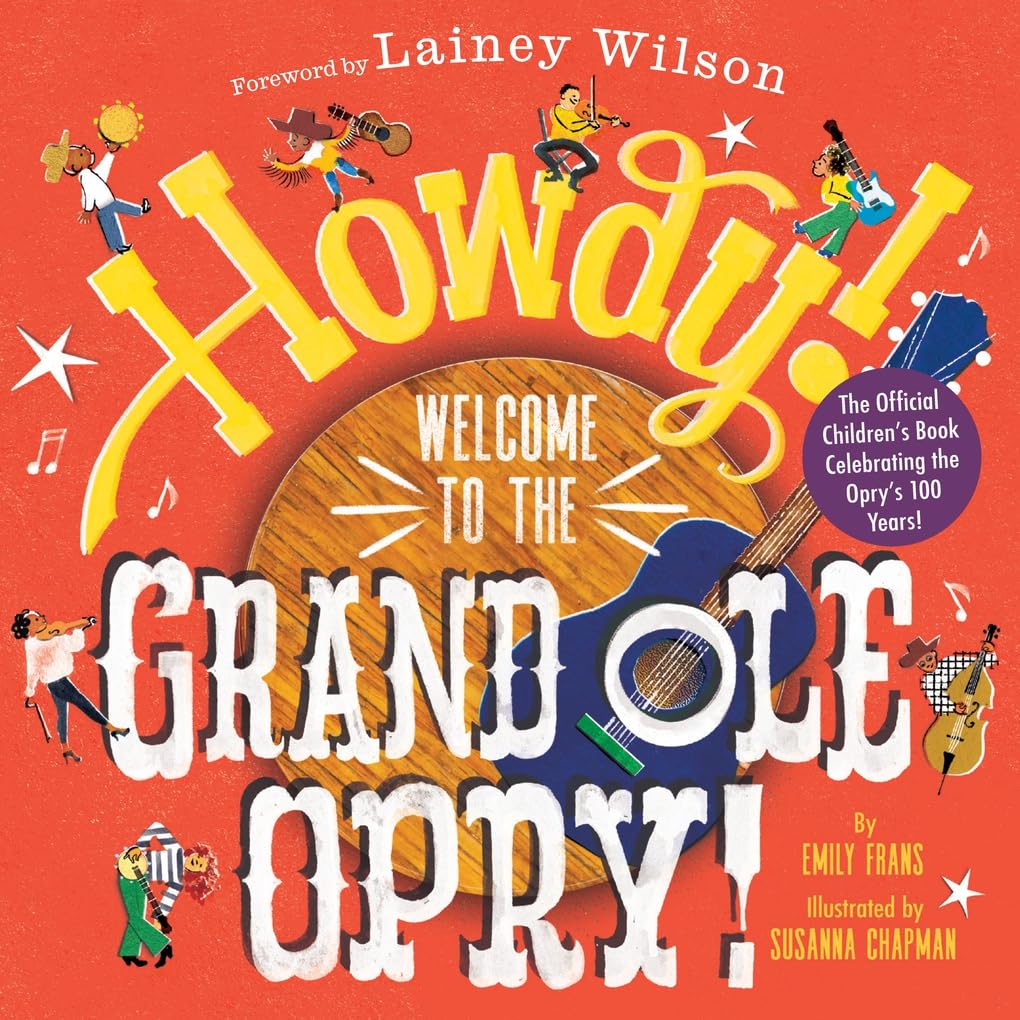
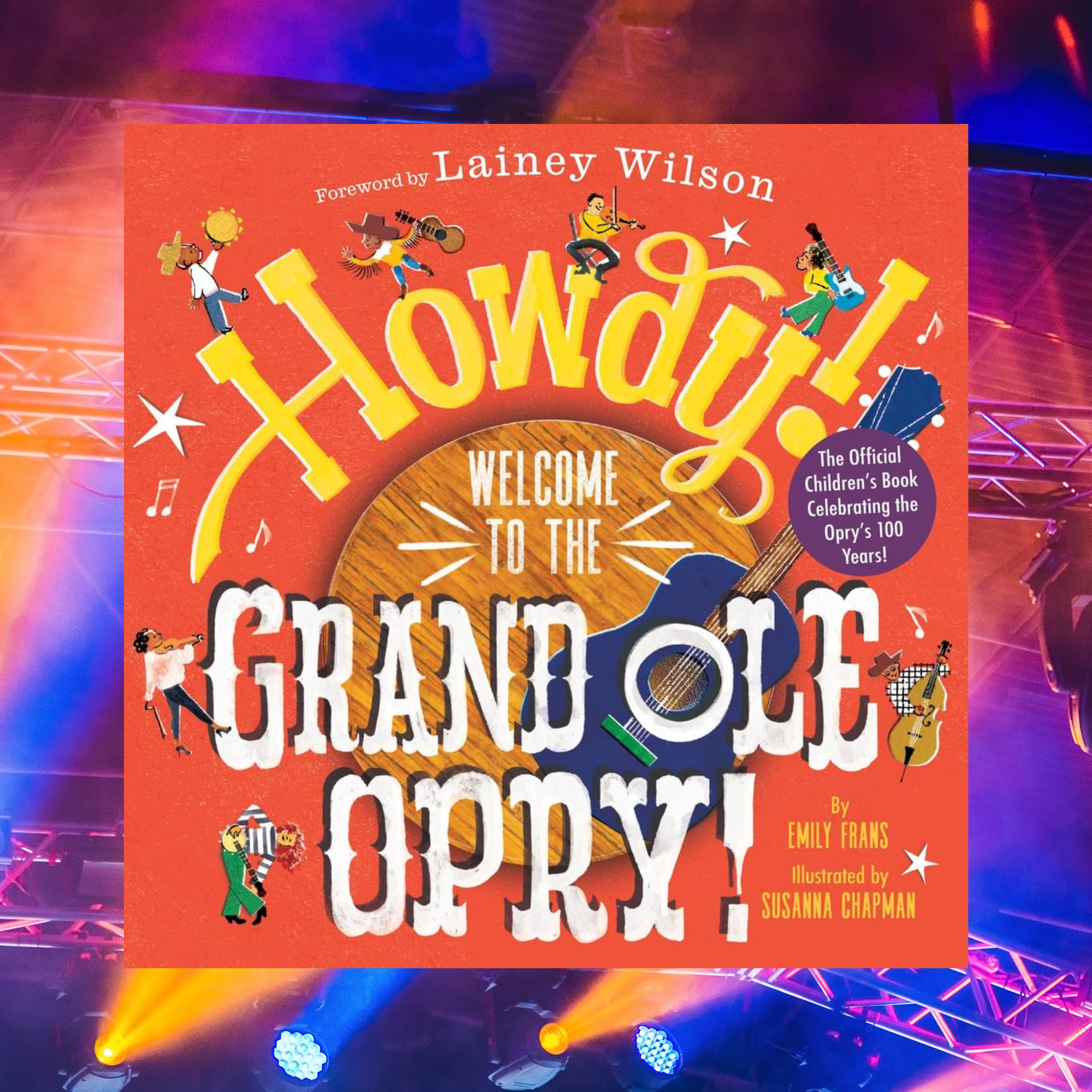
Howdy! Welcome to the Grand Ole Opry!
Written by Emily Frans | Illustrated by Susanna Chapman | Foreword by Lainey Wilson
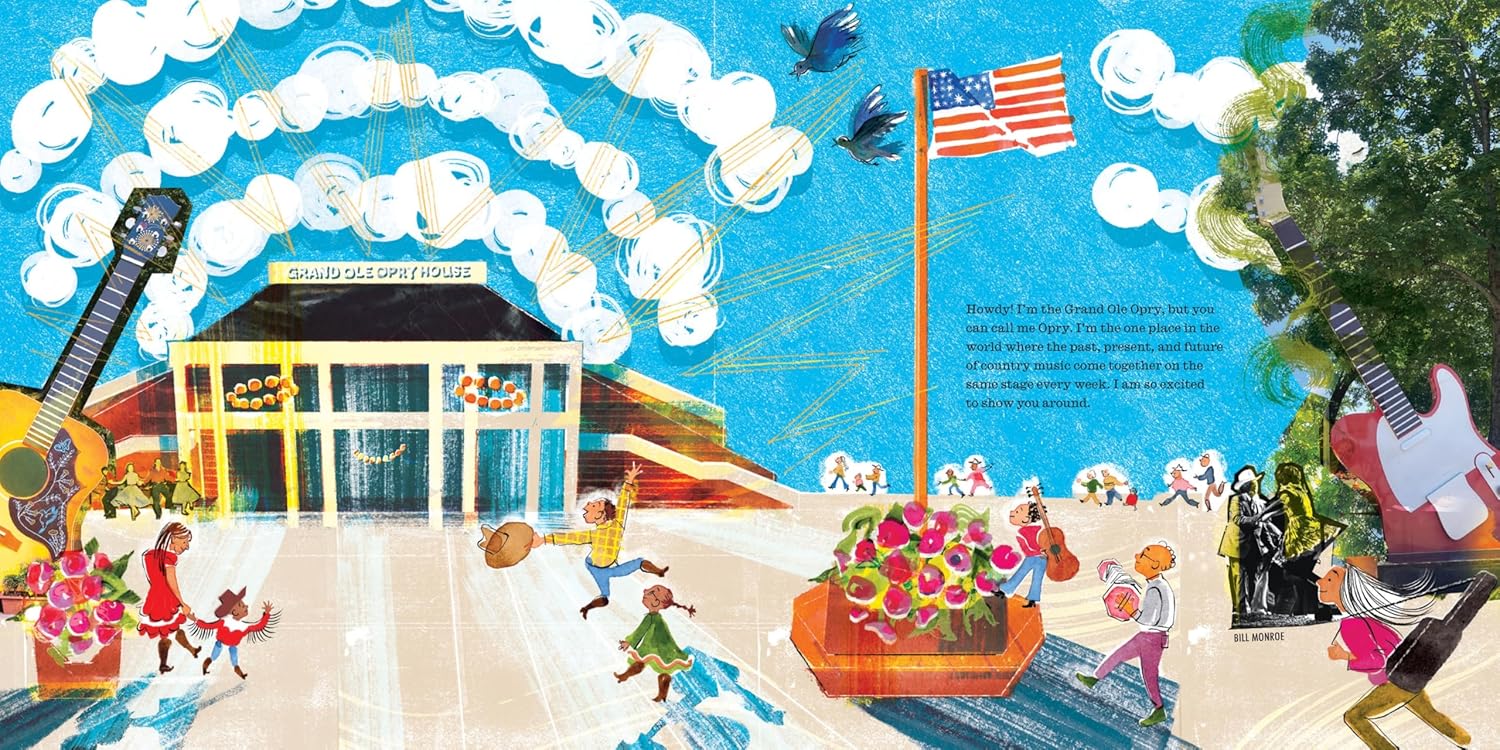
Celebrating its 100th anniversary with a buoyant “Howdy!”, the Grand Ole Opry (Opry for short) welcomes readers in for a personal tour of the beloved home of country music, where “history is made and stars are born.” Following their knowledgeable guide through the performers’ entrance, kids first check in with the security guard to get their backstage pass and dressing room number. Passes in hand, kids continue backstage, where they feel the excitement in the air and view pictures of past stars who graced the stage. “Did you know my show started way back in 1925?” The Grand Ole Opry asks.
While looking for their dressing room, children find themselves in the midst of today’s hottest stars all warming up or jamming together before the show. Prepped for their performance, kids stop by the Family Room to wait for their turn on stage. They’re in good company as photos of the “Opry family” surround them, and tonight’s other performers are hanging out there too.
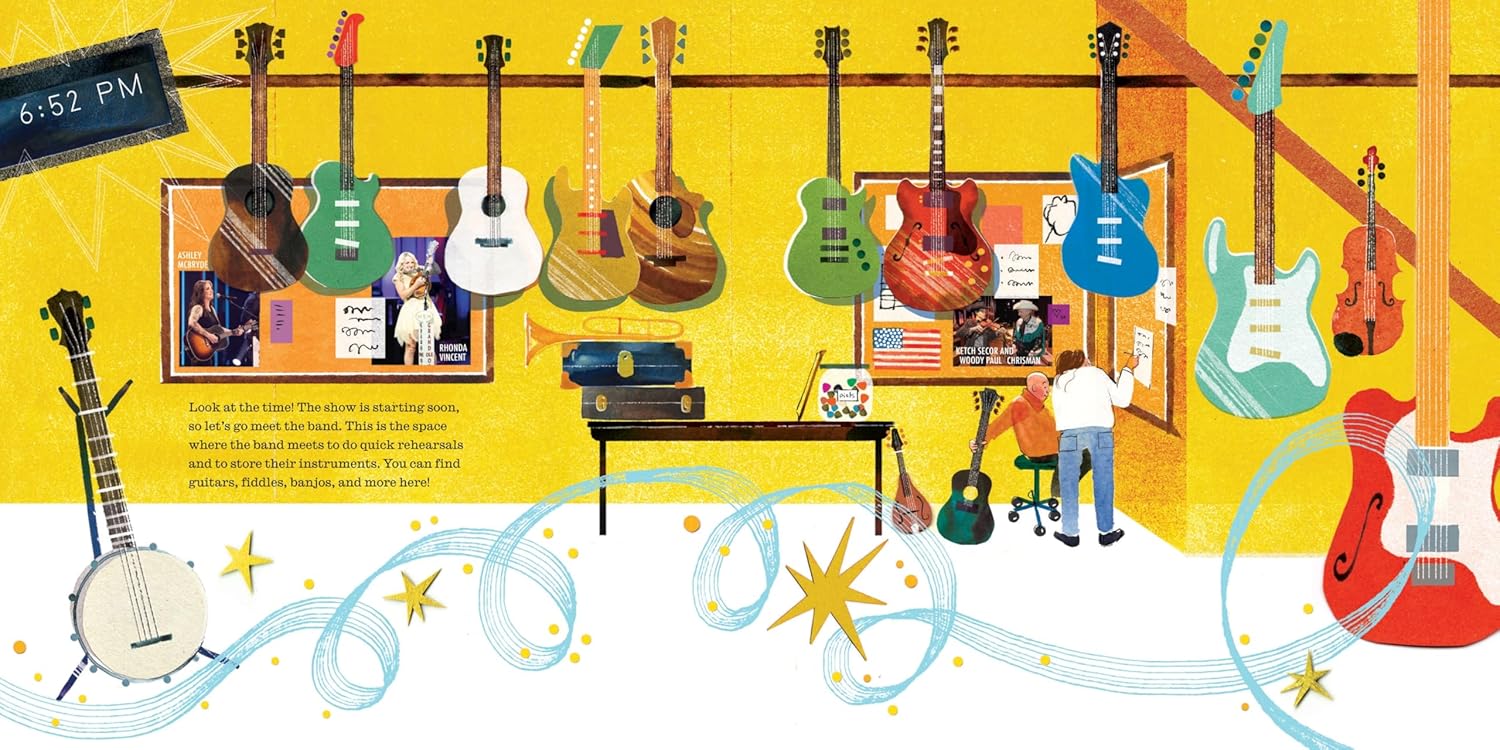
At seven minutes to showtime, kids meet the band in the rehearsal space. Five minutes to showtime, and kids are heading for the stage, where the crew is making last-minute adjustments. Nearby, “musicians and performers stand by waiting for their cue to walk on stage” while the Opry Square Dancers warm up on the sidelines.
Thirty seconds to showtime! Almost time for readers to stand center stage in the storied circle of wood cut from the Ryman Auditorium, country music’s original home. The countdown begins, and the Opry is there with encouragement. “10, 9, 8 . . . Take a deep breath . . . 7, 6, 5 . . . Don’t be nervous, you’ve got this! . . . 4, 3, 2, 1 . . . The curtain is coming up and the band is kicking off your song! Here we go!”
The reader is met with thunderous applause as the drums beat and the bass thrums. Energy and love surround them! The Opry is full of congratulations—”You did it! You made your Opry debut!” And encouragement: “Wasn’t it fun imagining what it would be like to perform on country music’s most famous stage? If you work hard and dream big enough, anything is possible!”
A brief history of the Grand Ole Opry, plus memories from Lauren Alaina, Kelsea Ballerini, Scotty McCreery, and Dolly Parton about their Opry debut follow the story.
The excitement inside the Grand Ole Opry is palpable in Emily Frans’ welcoming introduction to this historic venue, beloved by country music fans everywhere. Whether readers simply adore listening to country music or have the big stage in their sights, they’ll be enthralled with Frans’ personal, direct-address storytelling that makes them feel like one of the Opry family.
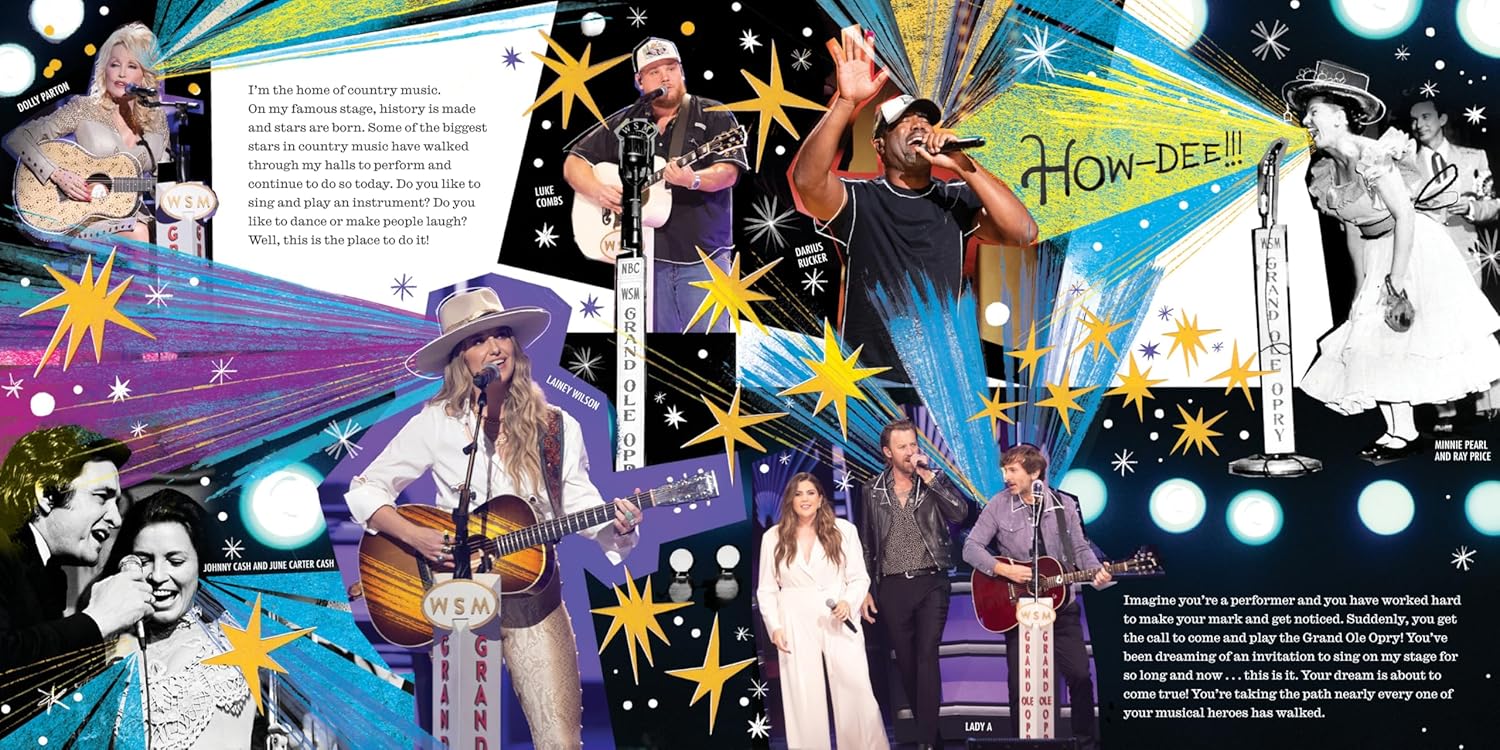
As raucous and inviting as the Grand Ole Opry itself, Susanna Chapman’s visually remarkable and whimsical collage-style illustrations are sure to have children and adults starstruck with the abundance of photographs of their favorite performers playing and singing. Fans of a certain age will be cheered to once again see Minnie Pearl with her signature “How-Dee!!!”, Johnny Cash and June Carter Cash, Roy Acuff, Charlie Pride, Little Jimmy Dickens, Patsy Cline, and Deford Bailey, among others. Reba McEntire, Vince Gill, Blake Shelton, Darius Rucker, Loretta Lynn, and others are also here, while the younger generation will be wowed by Lainey Wilson, Luke Combs, Lady A, Carrie Underwood, Scotty McCreery, Chapel Hart, Post Malone, and more. And, of course, the ageless Dolly Parton is celebrated throughout.
Inspiration and aspiration meet history and tradition in Howdy! Welcome to the Grand Ole Opry!, an extraordinary tribute to this one-of-a-kind music venue and it’s stars on its 100th anniversary. The book is a must for country music fans as well as for all library collections.
Abrams Books for Young Readers, 2025 | ISBN 978-1419774249
About the Illustrator
Susanna Chapman is an illustrator, muralist, and designer. Her illustrated picture books include Covered in Color: Christo and Jeanne-Claude’s Fabrics of Freedom; Elizabeth Warren’s Big, Bold Plans; The Girl Who Ran; and Ada and the Galaxies. She lives in Nashville, Tennessee. Visit her at susannachapman.com.
You can purchase Howdy! Welcome to the Grand Ole Opry! from these booksellers
If you live in the Northern Hemisphere, fall has arrived! If you live in the Southern Hemisphere, welcome to spring! Today, the hours of daytime and nighttime will be equal, ushering in a changing of the seasons. For some that means cooler weather, shorter days, and preparation in nature for the long winter, which leads to our seeing the brilliant reds, yellows, and oranges in the leaves of certain trees. Watching the leaves fall, swirl in the breeze, and pile up in backyards can only mean that a favorite autumn activity is just a leap away!
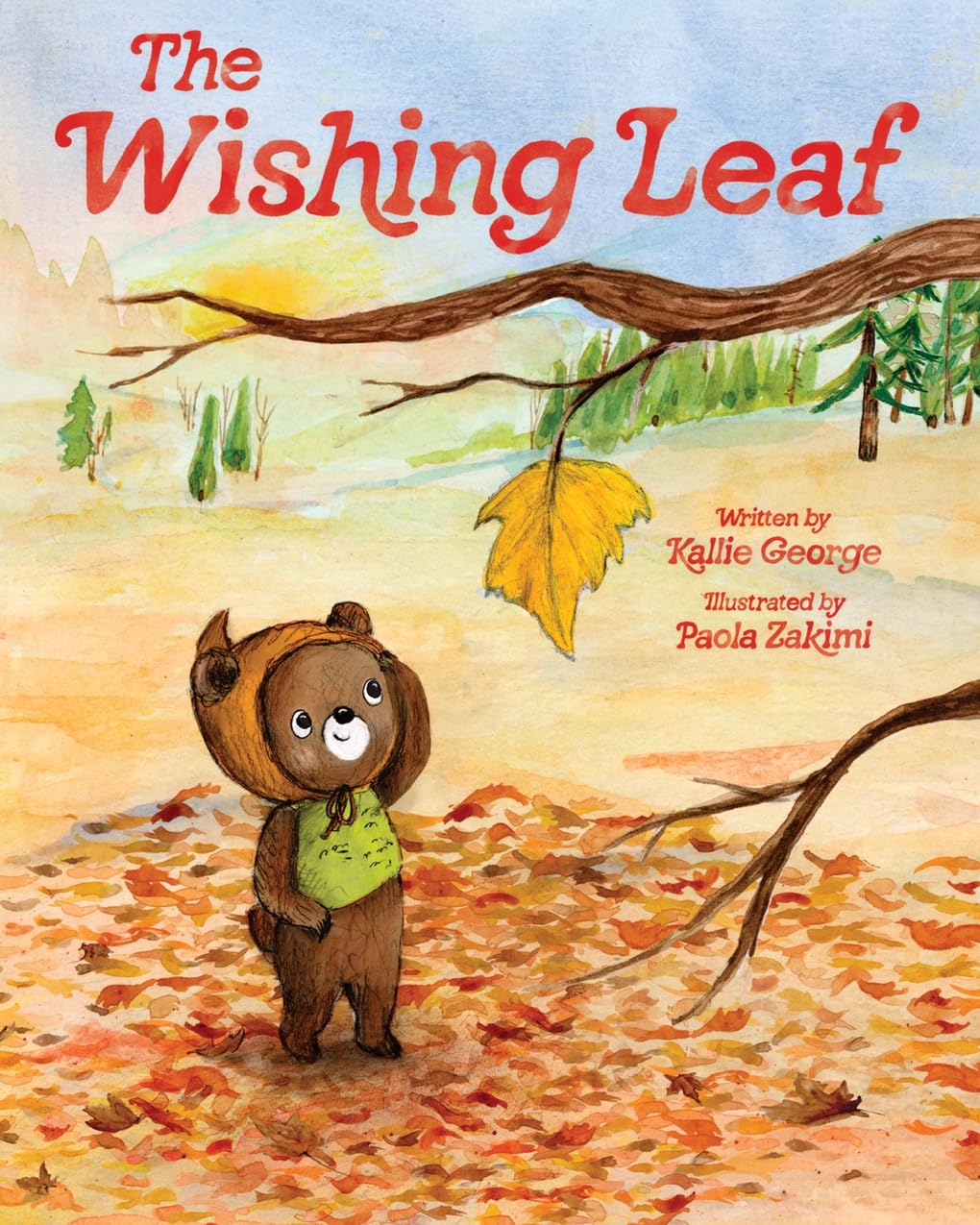
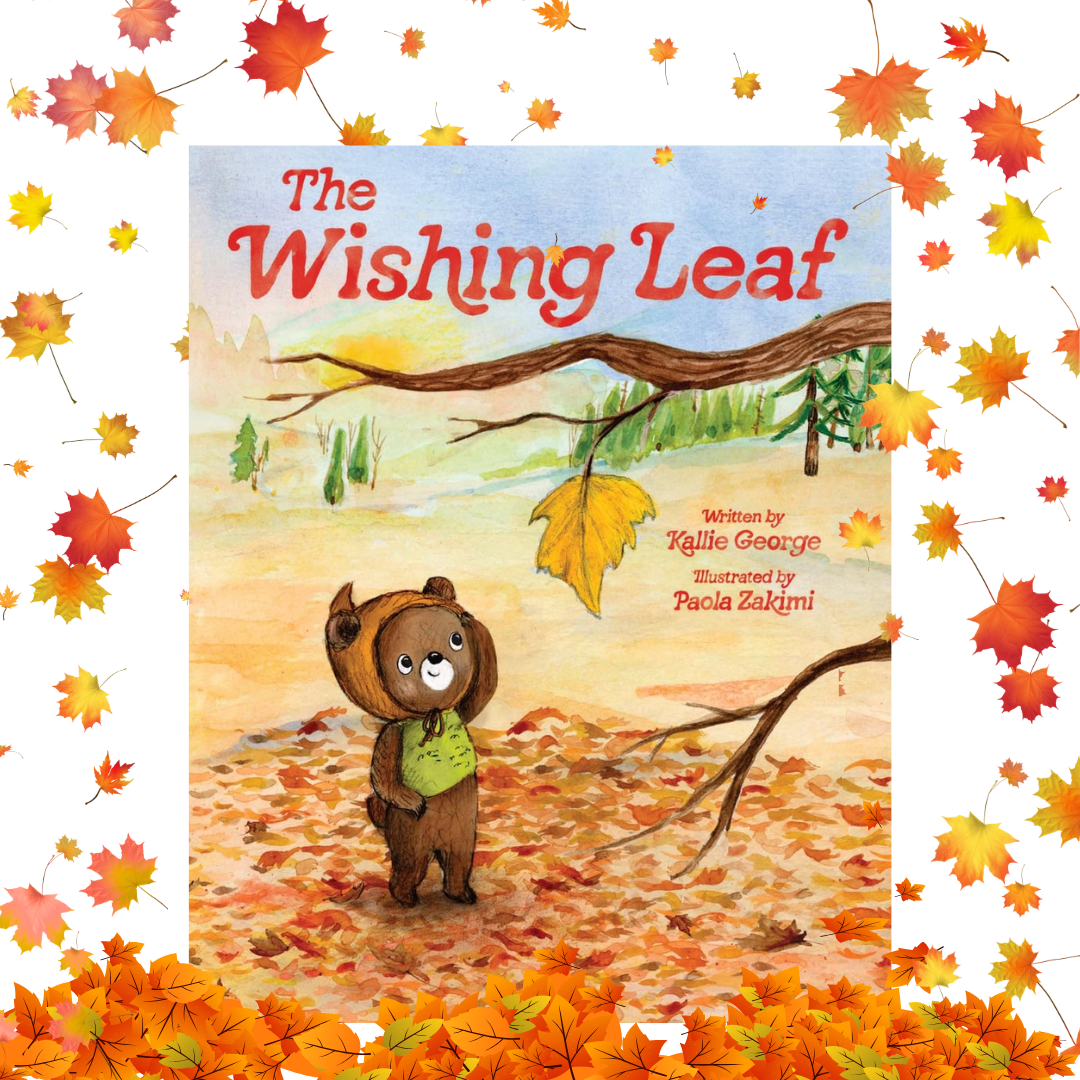
The Wishing Leaf
Written by Kallie George | Illustrated by Paola Zakimi
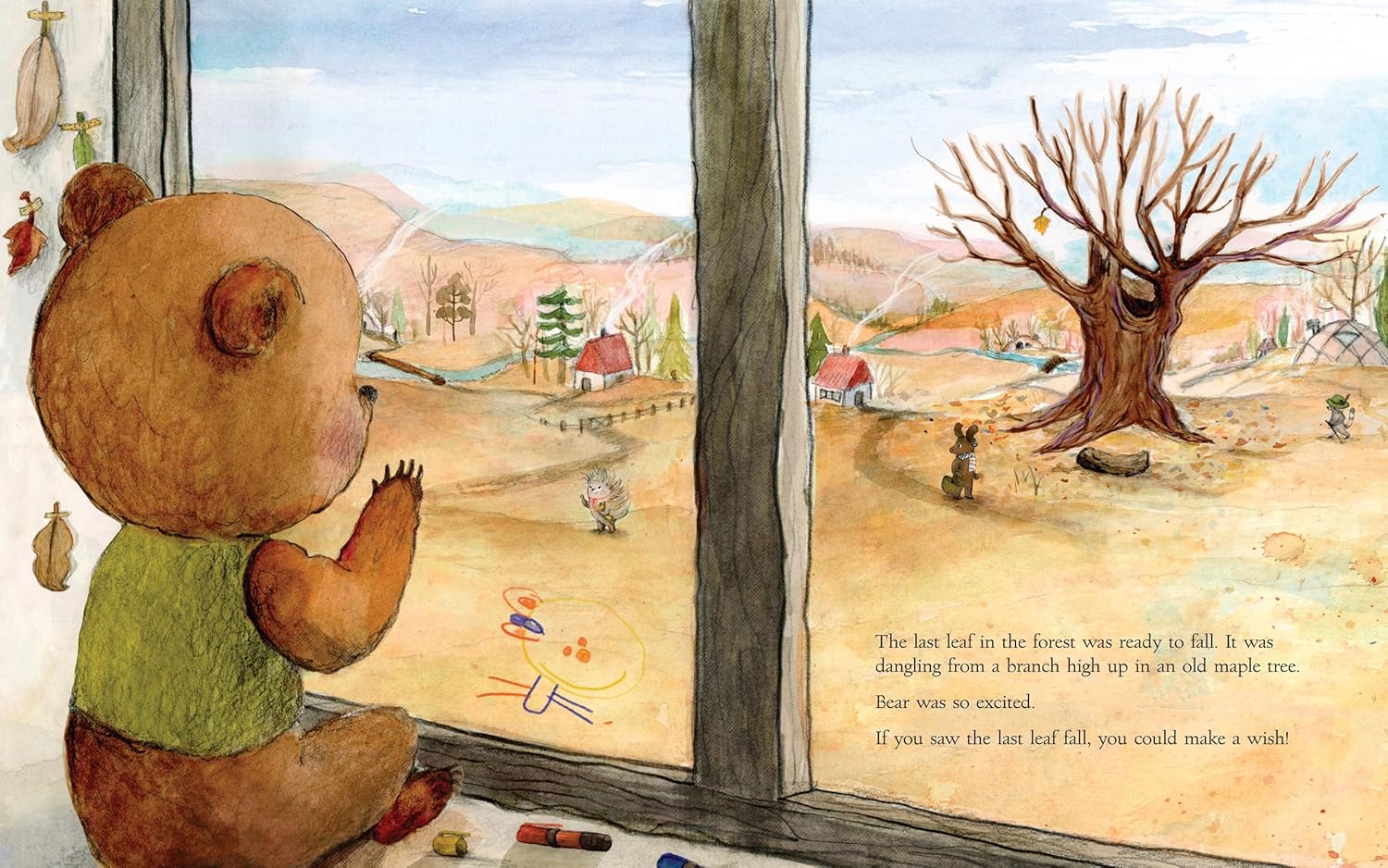
From his window, little Bear could see the very last leaf in the forest clinging to the old maple tree. He wanted to be sure to watch the leaf fall because he wanted to make a wish. When his mama told him it was time to go to sleep, Bear protested, and Mama relented with a kindly sigh.
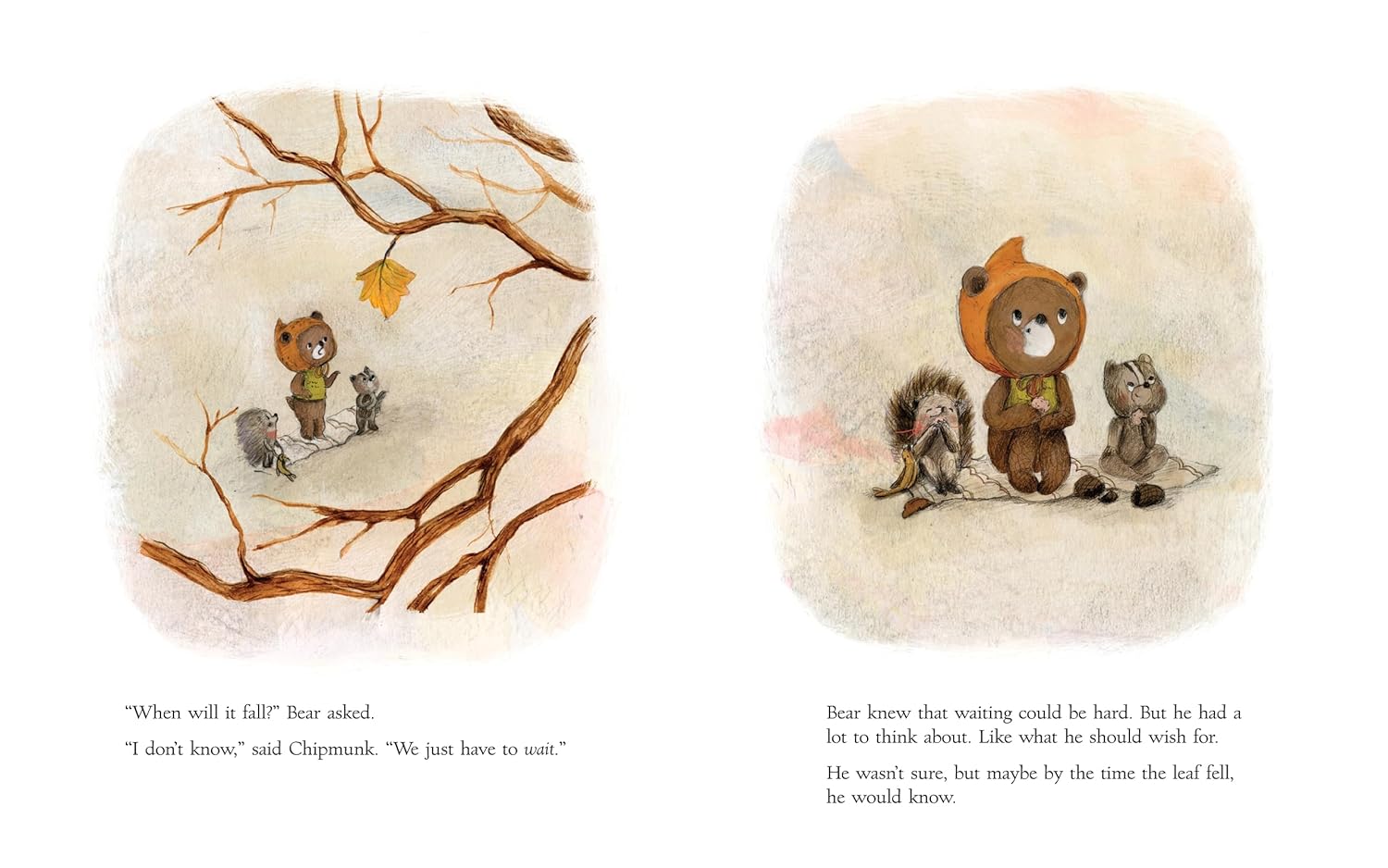
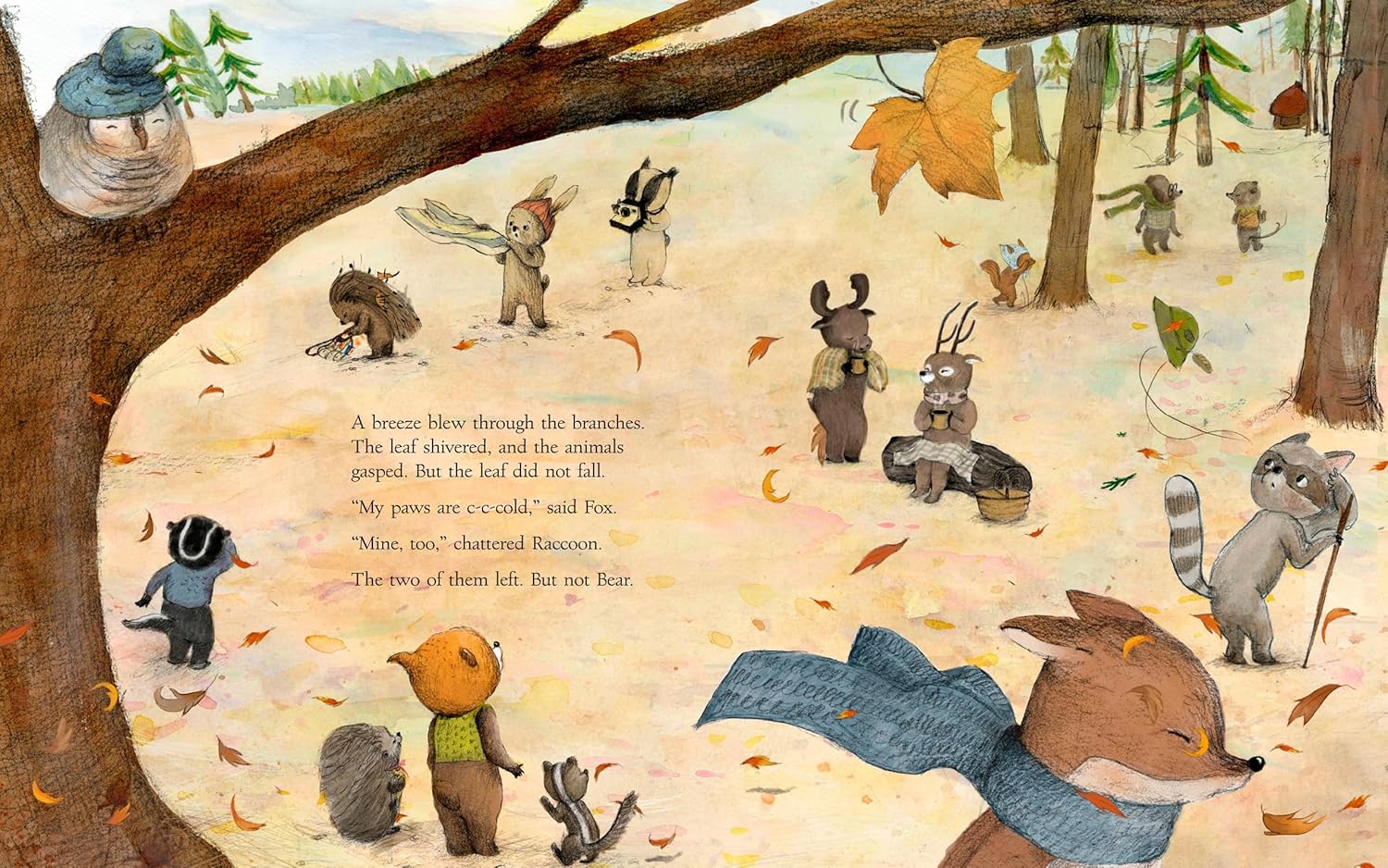
Bear joined his friends, who were standing or sitting under the maple tree, gazing up. Some had brought snacks, Porcupine had binoculars, and Raccoon had brought a camera. “The leaf was bright and golden like a star.” Bear sat on a blanket with Hedgehog and Chipmunk and started to wait. He passed the time thinking about what he should wish for.
Soon, the air turned cold and while the leaf fluttered in the breeze, it still did not fall. Some shivering animals went home. When the sky darkened, more animals packed up and left. Snowflakes even began to fall and stick. Little by little the rest of the animals went home, even Chipmunk and Hedgehog, who wondered what she would have wished for if only she’d been able to see the leaf fall.
Only Bear was left, and he was growing sleepy too. He thought he might hear Mama calling him. “Bear yawned—a big, little bear yawn.” And just then “the leaf twisted . . . and tumbled, falling down, down, down, like a shooting star.” Bear “knew just what to wish for,” and his heart swelled as he imagined his wish coming true throughout the forest. When he turned to go home, Mama was there with a lantern and a snuggly hug. Back in his room, Bear was tucked into bed and drifted off to sleep.
Kallie George is a master at writing endearing children’s stories that remain always within your heart. Her characters are always adorable, caring, and imbued with childhood wonder. In The Wishing Leaf, George amplifies the feelings of giving that define fall and early winter with her story of a young bear whose first thoughts are for his friends. Readers will be charmed by little Bear’s wishEquating the golden leaf to a shooting star is a touching reminder that the magical can be found wherever you look. George’s sweet phrasing and charming dialog create a cozy read aloud that adults and children will want to share time and time again.
Paola Zakimi’s darling characters inhabit a lovely countryside, in which white smoke drifts from the chimneys of snug cottages, the hills and flowing river speak to the peaceful community, and the large, old maple tree stands waiting as patiently for its final leaf to fall as does little Bear sitting on his window seat, gazing out. Zakimi’s soft pencil and watercolor illustrations are adorably expressive, and her renderings of the warm relationship between Mama and little Bear as well as images of community members will inspire plenty of “Awwws.”
A perfect book for snuggly story times that also would make a much-loved gift, The Wishing Leaf is a must for home and library collections.
Ages 4 – 8
Abrams Books for Young Readers, 2025 | ISBN 978-1419772467
About the Author
Kallie George is an author, editor, and creative writing teacher living in Vancouver, British Columbia. She has written acclaimed books for children, including The Lost Gift; Secrets I Know; Duck, Duck, Dinosaur, and The Melancholic Mermaid, as well as The Magical Animal Adoption Agency series and The Heartwood Hotel series. She has also taught writing workshops for children and adults across Canada, as well as in South Korea, and she currently teaches at Emily Carr University. Visit her at kalliegeorge.com.
About the Illustrator
Paola Zakimi spent her childhood in cold Patagonia, Argentina. She studied arts and graphic design in Buenos Aires before moving to Villa Giardino, Cordoba, where she resides today. She is the illustrator of Estelle Laure’s Before the World Wakes, Meg Fleming’s Here Comes Ocean, Jacqueline Veissid’s Ruby’s Sword, as well as Newbery Medalist Cynthia Voigt’s Teddy & Co., among other picture books. Visit her at paolazakimi.com.
First Day of Autumn Activity
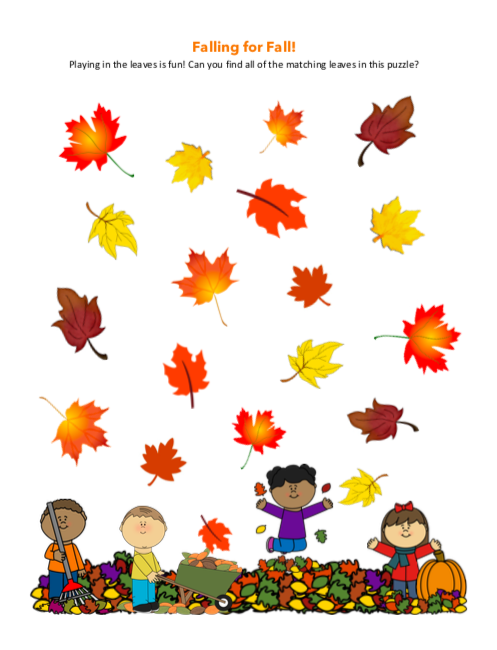
Falling for Fall Matching Puzzle
These kids are having fun in the leaves. Can you find the matching leaves in this printable Falling for Fall Puzzle?
You can purchase The Wishing Leaf from these booksellers
I know, I know . . . it can’t be time to go back to school already! Maybe not quite, but all over the country, teachers, administrators, parents, and…yes, kids…are preparing for the day when school opens again for another year. Now’s the time to find a new backpack, buy some new clothes, and decide that this year is going to be the best year yet! Reading books about beginning a new school year can also help!
Thank you to Abrams Books for Young Readers for sending me a copy of this book to me for review!
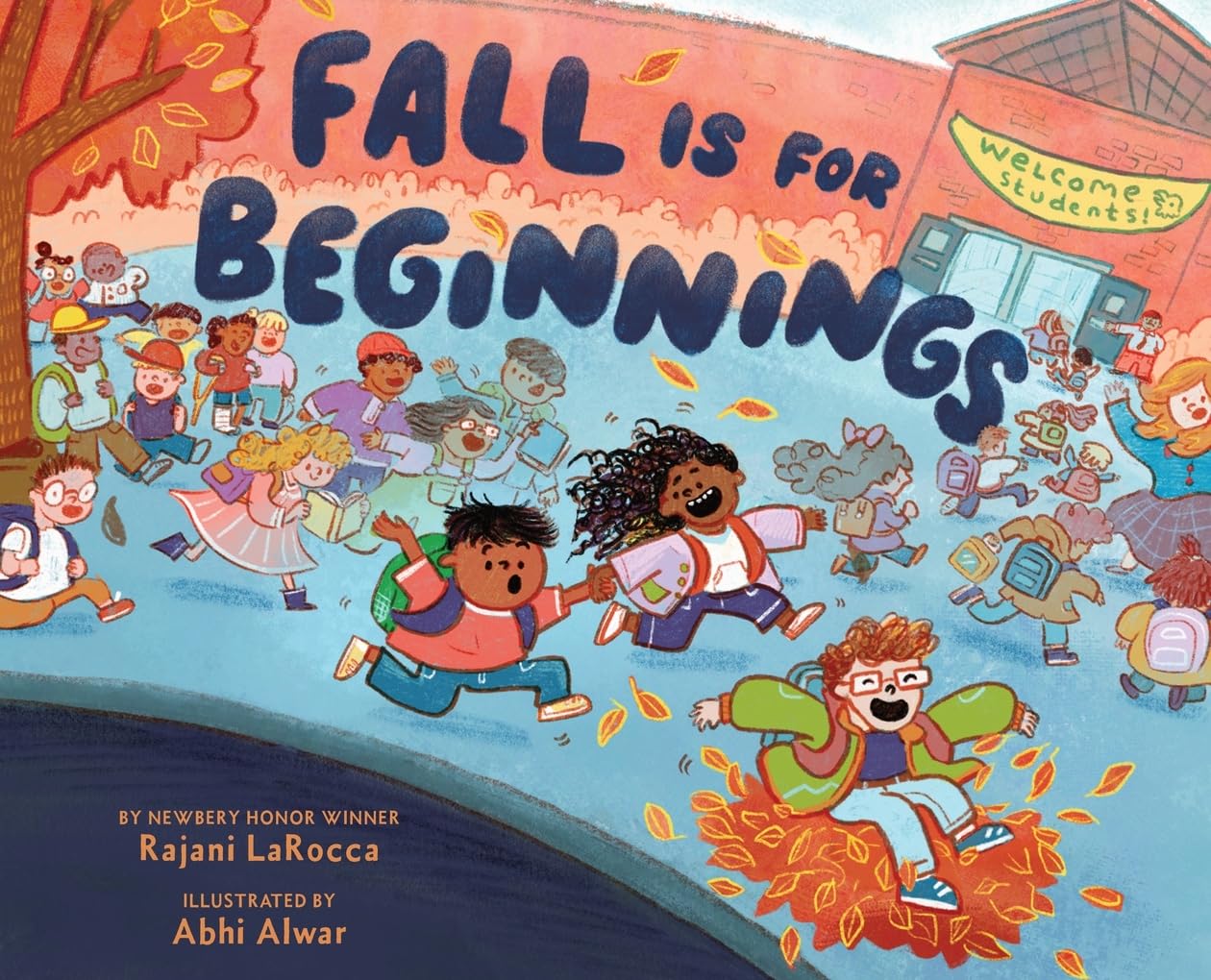
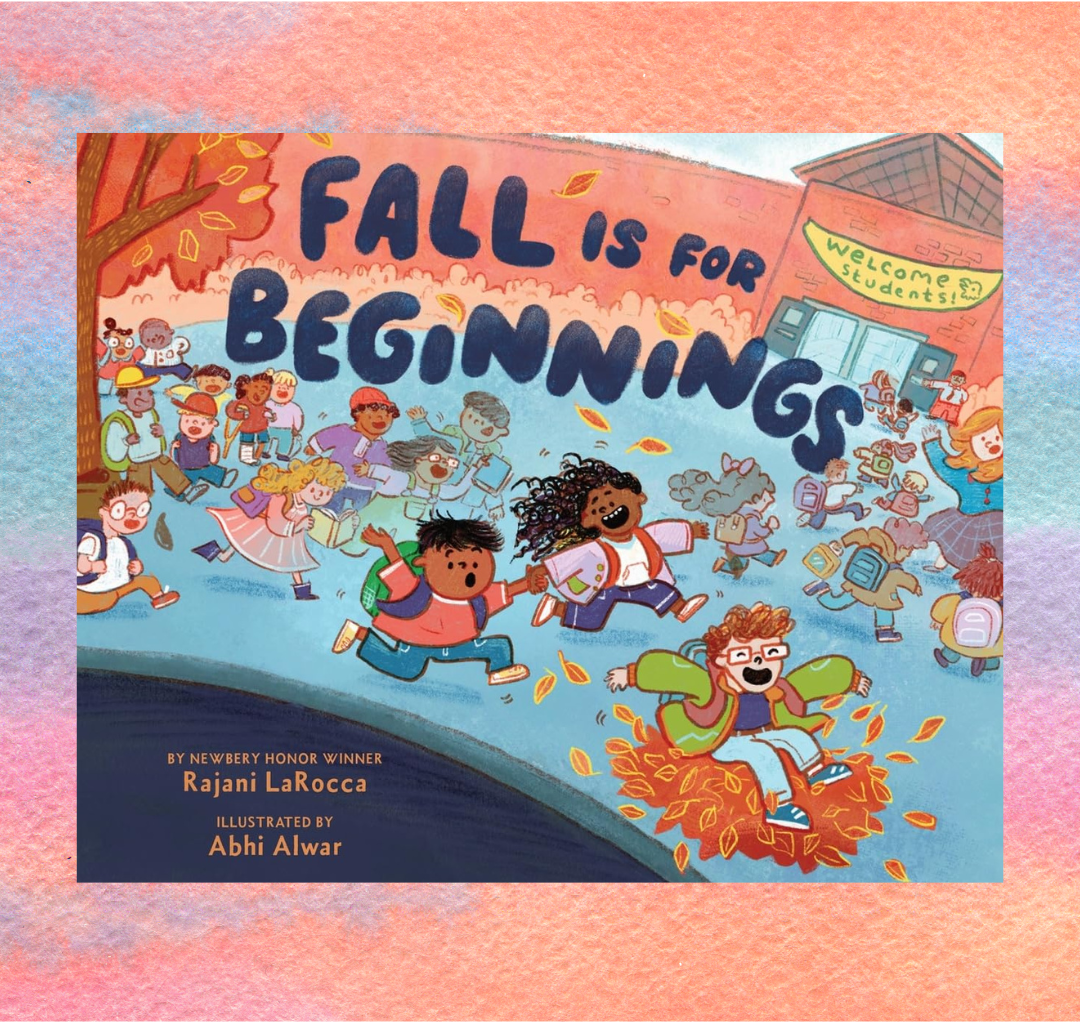
Fall Is for Beginnings
Written by Rajani LaRocca | Illustrated by Abhi Alwar
While Ravi is sad to see summer vacation end, he’s excited to be starting school and seeing his friends, especially his best friend, Joe. They “share jokes, secrets, and sometimes lunch,” at recess they always play together, and—best of all—this year they’ll be in the same classroom.
Ravi and Joe find desks next to each other. Then a new girl, Ellie, sits in the seat next to Ravi. She’s eager and enthusiastic. “‘I just know we’re going to be best friends!'” she tells him. Ravi is taken aback and doesn’t reply. He listens as his teacher explains a project the students will do to celebrate their new accomplishments throughout the year by adding leaves then snowflakes then flowers to a tree of their own.
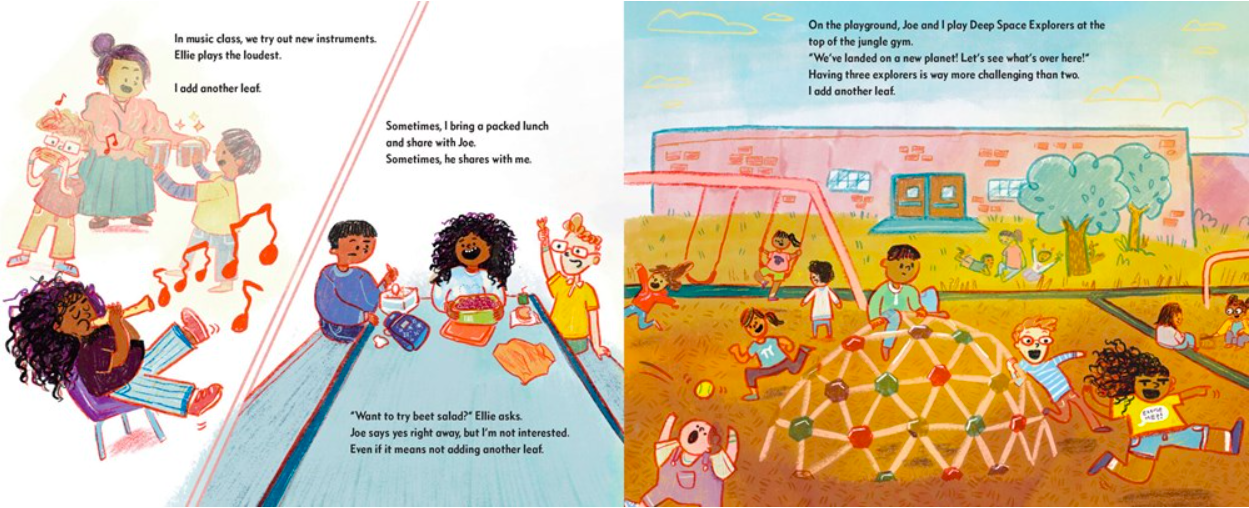
In music class, at lunch, and on the playground, Ellie always joins Ravi and Joe. When they get new instruments, Ellie plays the loudest, she offers tastes of her beet salad (which Joe tries right away, but Ravi does not), and her new suggestions for Ravi and Joe’s Deep Space Explorers playground game make it much more challenging. For some of these new experiences Ravi adds a leaf to his tree.
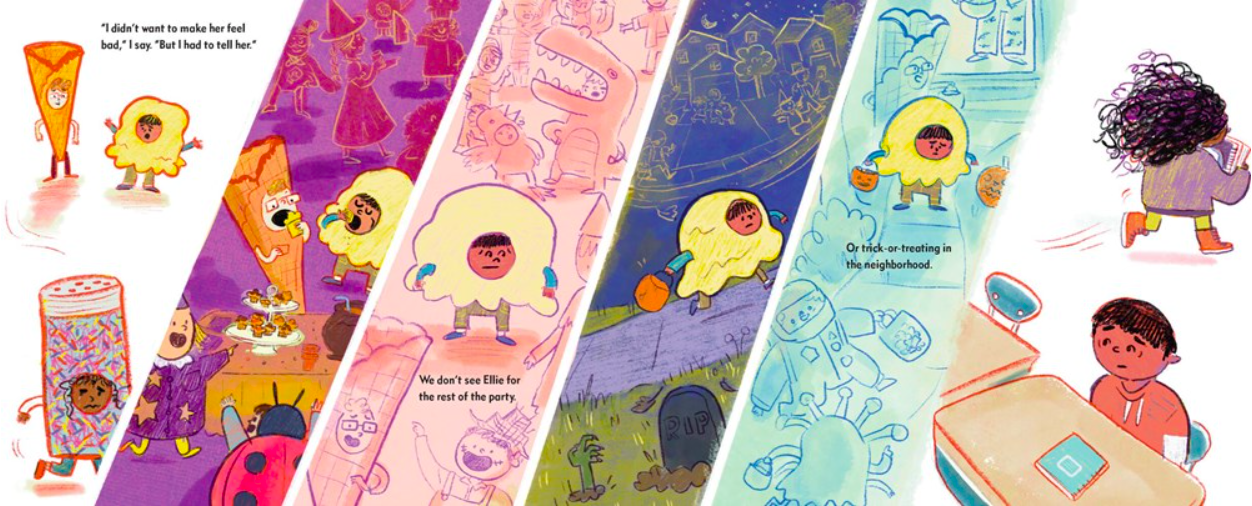
“Every day, Ellie says, ‘I told you we’d be best friends!'” When Ravi whispers a reassuring “‘But I’m best friends with you'” to Joe, Joe simply shrugs. Every day, Ellie is right in the middle of Ravi and Joe’s favorite fall activities. At the school Halloween party, Ravi dresses as a scoop of ice cream, and Joe is a cone. When Ellie runs up dressed as a bottle of sprinkles because they’re “best friends,” Ravi loses his temper, crying, “‘You are NOT my best friend!'”
Surprised and hurt, Ellie runs off. She avoids Ravi and Joe during the rest of the party and during trick-or-treating in the neighborhood and moves to another desk in the back of the classroom. At home, Ravi mopes on the couch about how much things have changed since Ellie came. When his older sister hears his complaint, she runs off to get the family photo album. Page by page, she shows Ravi how great it was for her before he was born and how she found him so annoying when he was a baby. But, she says, when she got to know him, “‘Things were even more fun than before.'”
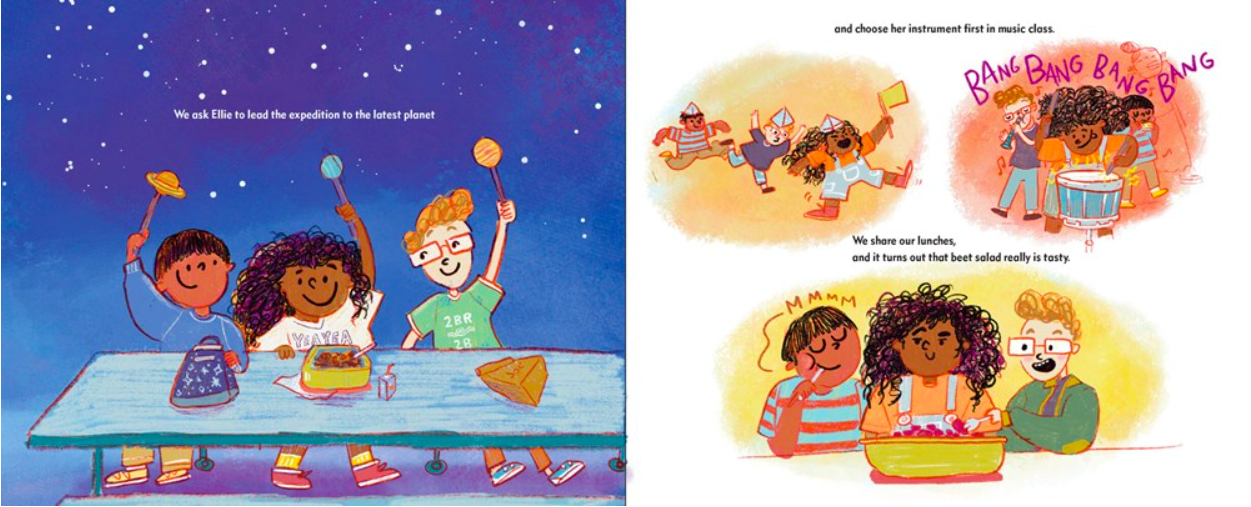
Ravi reconsiders his relationship with Ellie amid all the things they do together. Perhaps, he thinks, “Ellie is already my friend?” The next day at school, he shows a change of heart and lets Ellie take the lead. He has fun on the playground and in music class and discovers that beet salad is delicious. Ravi’s tree is filling with leaves representing all of his new experiences, and he feels proud “because fall is for beginnings and friendship.”
Rajani LaRocca shines a light on an important aspect of new school years, old friendships, and the natural changes that occur as children grow up, meet new people, and venture into the unfamiliar. Candid and relatable, LaRocca’s storytelling gives voice to emotions children may feel (and feel badly about) but are unable to express. Reading and discussing the stages Ravi goes through before finally losing his temper and then afterward can give kids an opportunity to talk about their own experiences as well as their ideas for and what to say when assimilating new friends into an established duo or group. Joe’s early nonchalance about Ellie’s proclamations of friendship reveals how the idea of “best friends” can vary from person to person and change over time.
Abhi Alwar’s vivacious, autumn-hued illustrations depict an active classroom in which even amid the usual raucousness, Ellie stands out with her spunky personality. Always in motion, Ellie kicks her feet, runs and leaps and roars, gives her new besties gifts and tastes from her lunch, and in the process overwhelms Ravi, whose apprehension, eventual anger, and regret show in his expressions. Alwar’s combination of chalky line drawings and full color sketches allow her to emphasize certain important moments while presenting dynamic scenes that kids will have fun exploring.
An impactful book to share with children just starting school or as they move through the grades, Fall is for Beginnings celebrates new friends and experiences, while providing a map through some of the trickier bits. The book is highly recommended for home bookshelves and is a must for classroom and library collections.
Ages 4 – 8
Harry N. Abrams, 2025 | ISBN 978-1419777400
About the Author
Rajani LaRocca is a physician and an author of books for young readers including Summer Is for Cousins, Where Three Oceans Meet, and Red, White, and Whole, which won a Newbery Honor. She was born in Bangalore, India, and immigrated to the United States when she was very young. She now lives in eastern Massachusetts with her family. You can find her online at rajanilarocca.com.
About the Illustrator
Abhi Alwar is an Indian American illustrator and designer based in New York City. She is the illustrator of a number of books for young readers, including Summer Is for Cousins by Rajani LaRocca and the graphic novel series Super Pancake, written by Megan Wagner Lloyd. Visit her at abhialwar.com.
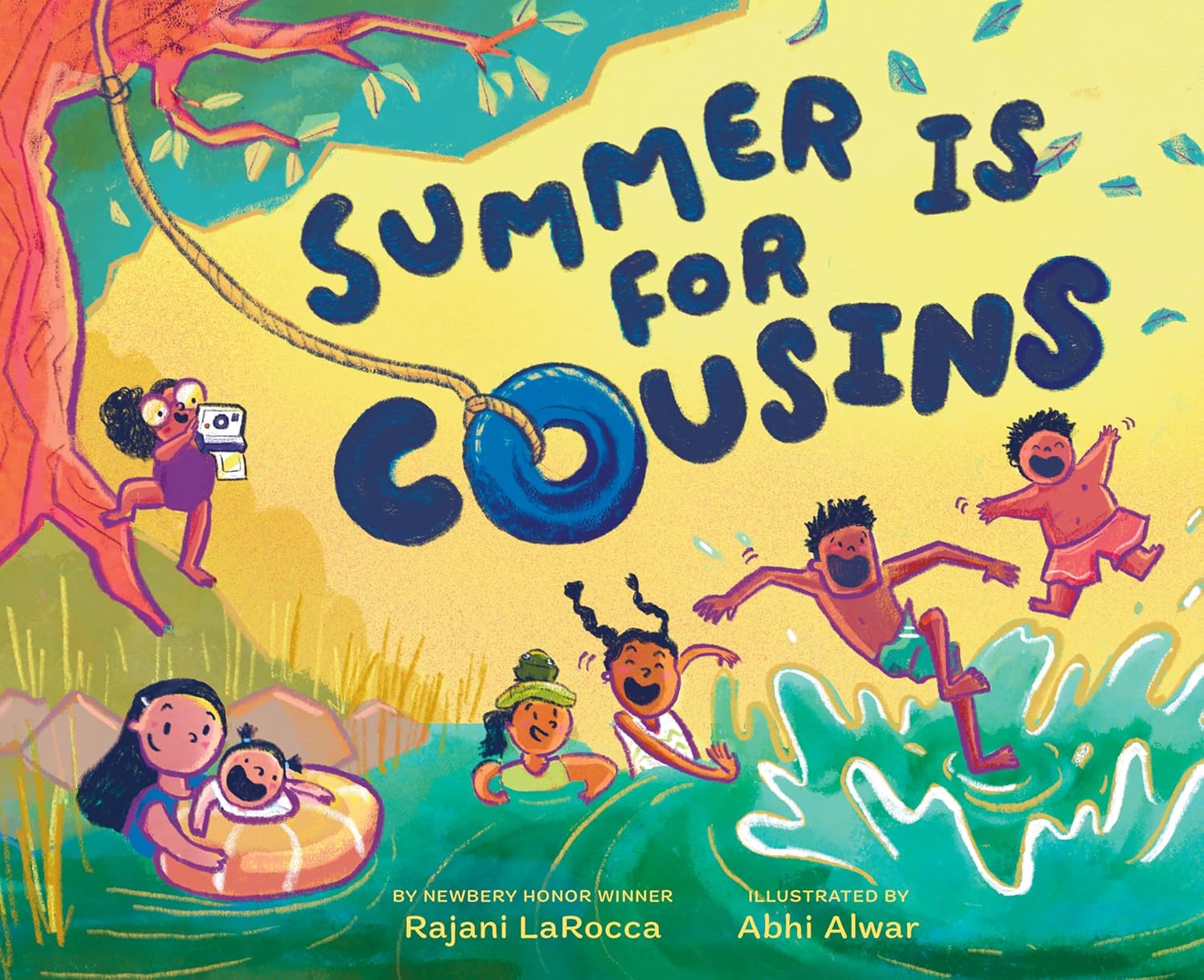
You can see what Ravi’s up to during the summer in Summer Is for Cousins, the first volume of the Seasons Are for Everything series from Rajani LaRocca and Abhi Alwar.
Back to School Month Activity
Make Your Own School Bus Craft
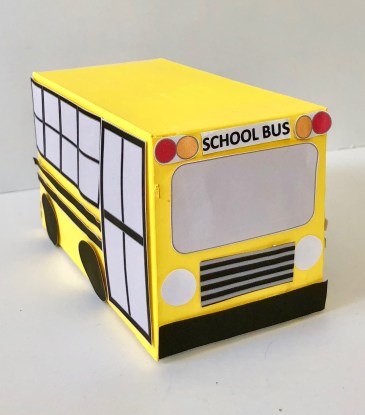
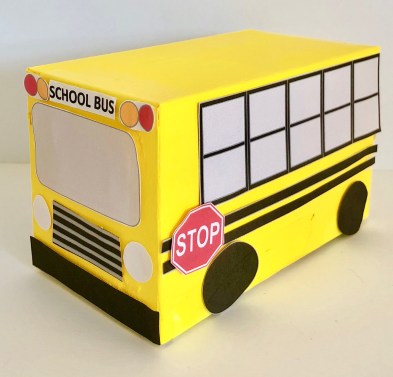
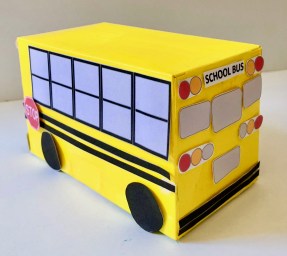
With a small tea box or other box, some paint, and the printable template, kids can have fun making a model school bus to play with or display. The bus can be made as detailed or simple as they’d like. Maybe they’d even like to draw themselves and their friends in the windows!
Thanks to Abrams Books for Young Readers for sending me a copy of A Case of the Zaps for review consideration. All opinions on the book are my own.
A Case of the Zaps
Written by Alex Boniella and April Lavalle | Illustrated by James Kwan
On Robot-Earth there lived a robot named 3.14159… (“or Pi, for short”). Pi liked doing things most young robots did, like “playing music, walking their dog, and hanging out with their Parental Units and friends. Pi also liked sports, science, camping, and exploring, and their favorite food was DW-40. One day at school, their teacher announced that in a month the class would be going on a field trip to Olde Silicon Valley.
Image copyright James Kwan, 2022, text copyright Alex Boniello and April Lavalle, 2022. Courtesy of Abrams Books for Young Readers.
All of Pi’s classmates were excited about the trip, and “Pi felt their circuit board BUZZ with anticipation.” Pi couldn’t stop thinking about the trip. But along with all the fun things they would do, thoughts about what could go wrong crept into his consciousness. And then, unexpectedly, while walking home from school with their friends, Pi experienced a tingle in their arms and then their “defense mechanisms JOLTED on.” Pi’s friends asked if they were all right.
Image copyright James Kwan, 2022, text copyright Alex Boniello and April Lavalle, 2022. Courtesy of Abrams Books for Young Readers.
Pi wasn’t sure and took off for home, “feeling zaps all around. Feeling afraid for reasons they didn’t quite understand.” The intrusive thoughts kept Pi awake that night, and during the next few days, even though Pi tried to act calm, they felt anything but. Trying not to think about the field trip just made things worse. One night they couldn’t even eat their DW-40, and then… ZAP!
Pi ran to their room and shut the door. Pi’s “Mother-Board and Father-Board followed their robo-kid upstairs. When they asked through the door what was wrong, Pi admitted that they didn’t want to go on the field trip anymore. They they explained that “something feels wrong” and how all their gears and sensors seemed to be in overdrive. Pi confessed “‘I’m scared I might be . . . broken.'”
Image copyright James Kwan, 2022, text copyright Alex Boniello and April Lavalle, 2022. Courtesy of Abrams Books for Young Readers.
Pi was surprised to find that just telling their parents made them feel better. Pi’s Father-Board told them that they had had the zaps when he started his new job and that “‘cousin Cosine Tangent has had them for years.'” Pi was surprised because Cosine Tangent had recently won a major science award. Mother-Board suggested that they visit the doctor the next day.
Doctor Bleep Bloop was very friendly and welcoming. The doctor explained to Pi that the Zaps can happen to anyone and at any time and acknowledged that they can be scary. When Pi asked if there was any cure for the Zaps, Doctor Bleep Bloop was honest and told them “‘There isn’t a simple cure.'” The doctor went on to say, though, that there were ways of managing the Zaps and that they could work together to find strategies to help Pi.
Image copyright James Kwan, 2022, text copyright Alex Boniello and April Lavalle, 2022. Courtesy of Abrams Books for Young Readers.
By the time the field trip to Olde Silicone Valley came around, Pi was ready to go, and they had a lot of fun. Even after the trip, Pi sometimes felt the Zaps. “When that happened, Pi used the tools that Dr. Bleep Bloop had shared with them, and then the Zaps didn’t feel quite so scary.”
Back matter includes an Authors Note explaining how both Alex and April have experienced anxiety in their lives as well as online resources where parents and caregivers can find more information and help from professionals in the areas of anxiety, depression, and other mental health issues.
Image copyright James Kwan, 2022, text copyright Alex Boniello and April Lavalle, 2022. Courtesy of Abrams Books for Young Readers.
Experiencing anxiety can be scary and confusing, and without the language to describe what is happening to them, children can feel isolated and alone. Alex Boniello and April Lavalle’s A Case of the Zaps provides kids and adults with a straightforward way to comfortably talk about anxiety while offering reassurance and a road map to discovering coping strategies that can help. Descriptions of the physical and mental effects of anxiety on Pi give kids direct examples to point to when talking about their own emotions and experiences with their parents, caregivers, or doctors. Pi’s parents’ suggestion to visit the doctor gives adults a starting point on the journey to helping their children.
James Kwan’s vibrant illustrations, incorporating elements of comics and graphic novels, will enchant kids as they learn about Pi’s hobbies, family life, and excitement to visit Olde Silicone Valley. As Pi’s enthusiasm for the field trip turns to trepidation, kids can watch the robot’s expressive face change from happy to worried and fearful. They also see that anxiety causes physical effects, sleeplessness, depleted energy, and the body’s fight-or-flight mechanism to kick in. After the family’s visit with Dr. Bleep Bloop, Kwan’s depictions of calming activities Pi does with their mother-board and father-board, friends, and the doctor show readers that therapy can be found in many places from play to sports to yoga and more.
Honest, accessible, sprinkled with humor, and written in partnership with Child Mind Institute to ensure that the book can serve as a social-emotional tool, A Case of the Zaps is an outstanding book for talking about anxiety with any child. The book is highly recommended for home libraries and a must for classroom, school, and public library collections.
Ages 4 – 8
Abrams Books for Young Readers, 2022 | ISBN 978-1419756726
You can connect with writer, actor, musician, singer, and Tony award-winning producer Alex Boniella on Twitter and Instagram.
Connect with writer, comedian, actor, and Tony award-winning producer April Lavalle on her website and Twitter.
Gender equality around the world has always been a core issue for the United Nations. As such, on December 22, 2015 the United Nations General Assembly established an International Day to recognize the critical role women and girls play in science and technology. This year’s theme is “Equity, Diversity, and Inclusion: Water Unites Us.” As described in UN reports, by 2030 “billions of people around the world will be unable to access safely managed household drinking water, sanitation, and hygiene services unless access progress rates quadruple. Rising demand, poor management, and failure to conserve water resources, compounded by climate change, represent key challenges, urgently requiring a new sustainable holistic approach to support aligning strategies on water.”
Today’s celebration will bring together women in science and experts from around the world and government officials as well as representatives of international organizations and the private sector to discuss the importance of water in achieving the three pillars of sustainable development – economic prosperity, social justice, and environmental integrity. The program will also feature, for the first time, a unique Ebru Water Art Performance to celebrate the 7th Anniversary of the #February11 Global Movement. To access the virtual assembly, visit womeninscienceday.org. To learn more about today’s initiative as well as videos about past observances, visit the UN website.
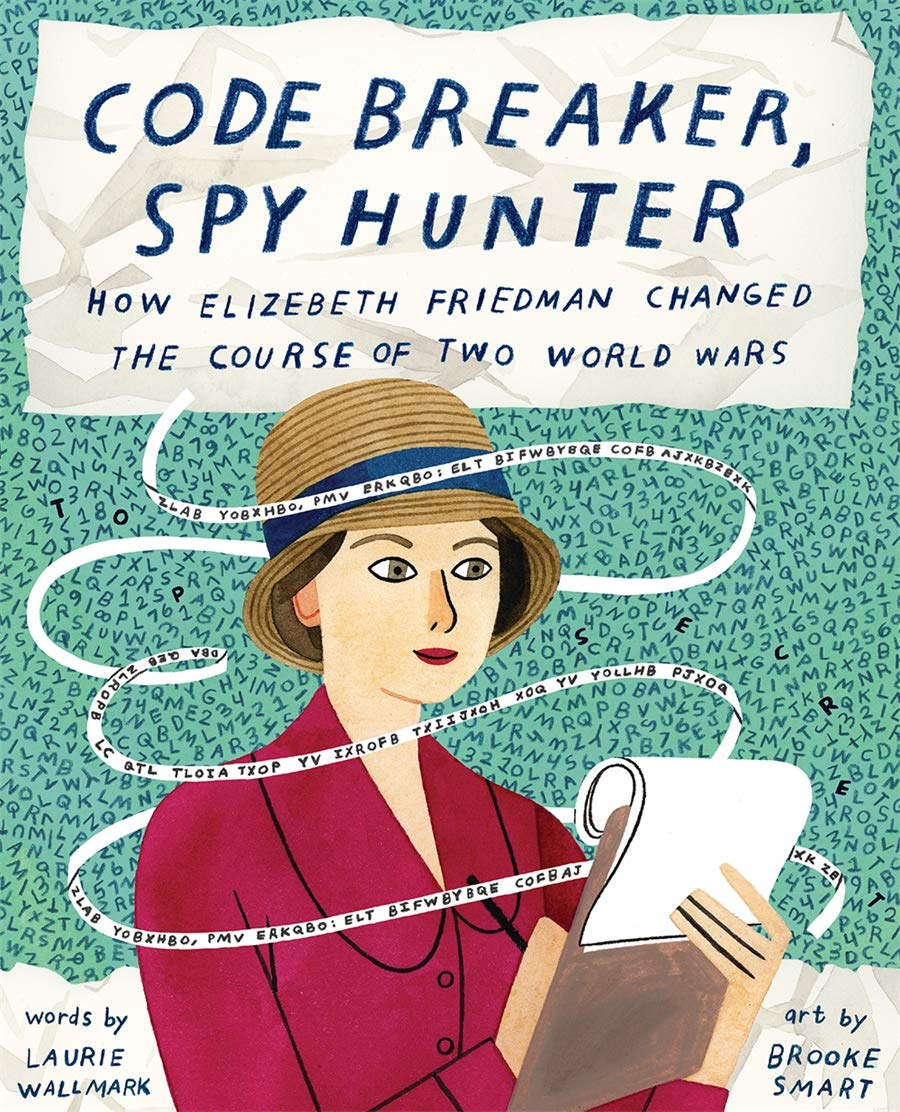
Thanks to Abrams Books for Young Readers and Blue Slip Media for sending me a copy of Code Breaker, Spy Hunter for review consideration. All opinions of the book are my own. I’m excited to be teaming with them for a giveaway of the book. See details below.
Code Breaker, Spy Hunter: How Elizebeth Friedman Changed the Course of Two World Wars
Written by Laurie Wallmark | Illustrated by Brooke Smart
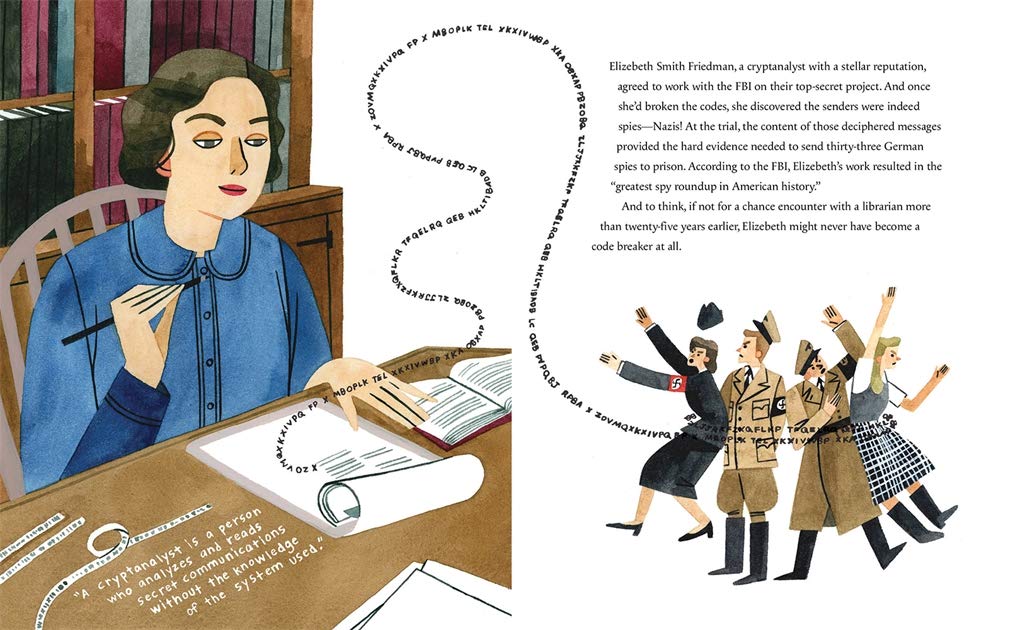
In Code Breaker, Spy Hunter, readers open the cover to an intriguing question: “Could it be? Had enemy spies sneaked into the United States?” World War II was raging, but the United States had not yet joined the effort. And yet the “FBI had intercepted hundreds of coded messages from a secret base in New York.” The problem was no one could read them. Who did the FBI turn to? Elizebeth Smith Friedman, who broke the codes, discovered a cadre of Nazi spies, and provided the evidence “to send thirty-three German spies to prison.” Who was Elizebeth Friedman? Children are about to find out!
Image copyright Brooke Smart, 2021, text copyright Laurie Wallmark, 2021. Courtesy of Abrams Books for Young Readers.
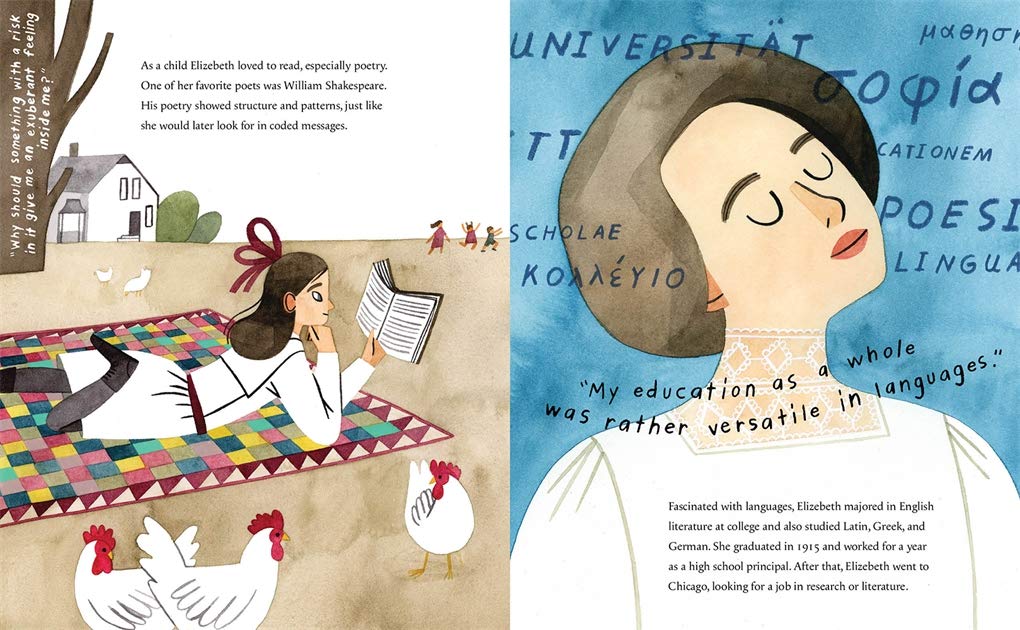
As a child, Elizebeth loved poetry and especially the work of William Shakespeare, with its structure and patterns. In college, she studied English literature, Latin, Greek, and German. While looking for a job in Chicago in 1916, she met the eccentric George Fabyan, who was trying to prove that Francis Bacon was the true writer of Shakespeare’s plays. He hired Elizebeth to “find secret messages Bacon had supposedly hidden in the plays. But the more she explored the plays, the more convinced she became that there were no hidden messages.”
Elizebeth shared her thoughts with a friend, William Friedman, who also loved puzzles and secret codes. Over a year’s time, their discussions resulted in a stronger friendship and finally marriage. In 1917, the US entered World War I and Fabyan asked Elizebeth and William to establish “the country’s first code-breaking unit, the Riverbank Department of Cyphers…. Their methods are now considered the basis for the modern science of cryptology, the study of secret codes.”
Image copyright Brooke Smart, 2021, text copyright Laurie Wallmark, 2021. Courtesy of Abrams Books for Young Readers.
In 1921, Elizebeth and William moved to Washington D.C., where they worked as code breakers for the Army. At the time, the Army used a large, cumbersome machine to convert messages into code, which precluded soldiers in the field from sending intelligence back. Elizebeth and William invented a complex code that used “only pencil and paper.” After the war, Elizebeth settled down to write books and raise a family, but still the entreaties came to decode messages for court cases sometimes thousands of miles away.
In 1925 with Prohibition the law of the land, smugglers were running rampant. The Coast Guard summoned her, and within three months Elizebeth had cracked “two years of backlogged messages.” Her work and court testimony that helped to convict smugglers made Elizebeth a recognized expert in the new field of cryptology, and when the work became overwhelming for just two people, she created the Coast Guard’s first code-breaking unit.
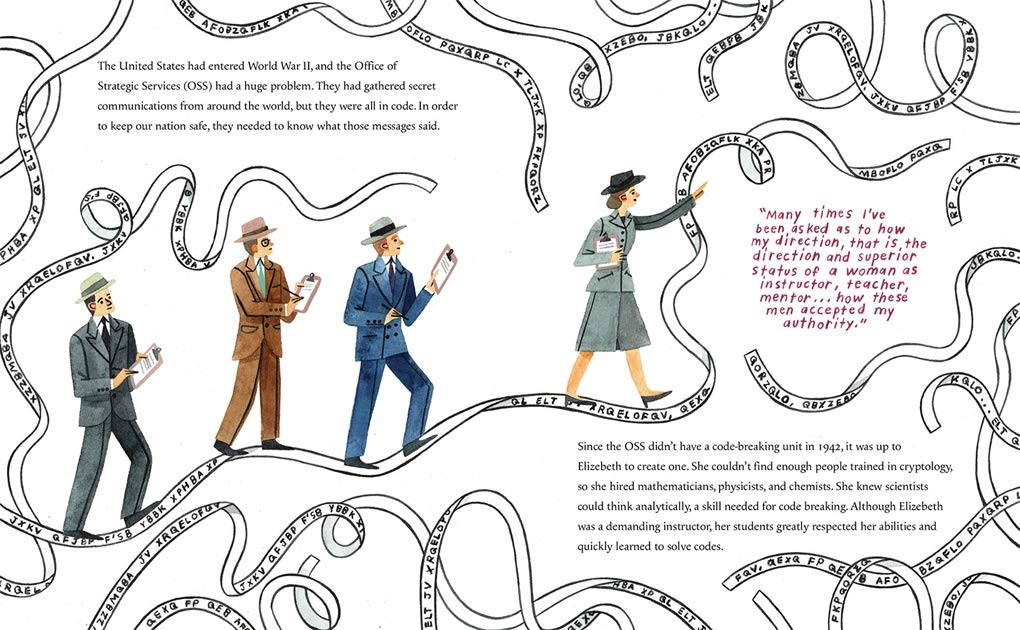
With the entry of the US in World War II, Elizebeth’s expertise was once again needed. Again, she needed to create a code-breaking unit, and in 1942 she hired and taught “mathematicians, physicists, and chemists” the skills of cryptology. Now, Elizebeth’s team was learning important war information about the Nazi’s movements and plans. When the FBI director wanted to nab the spies, Elizebeth recommended waiting “until the military could learn more of the enemy’s secrets.” But he disagreed and raided their hiding place. The spies that escaped quickly changed their codes, making their communications harder to decipher. The FBI director took all the credit for breaking the codes and catching the spies.
Image copyright Brooke Smart, 2021, text copyright Laurie Wallmark, 2021. Courtesy of Abrams Books for Young Readers.
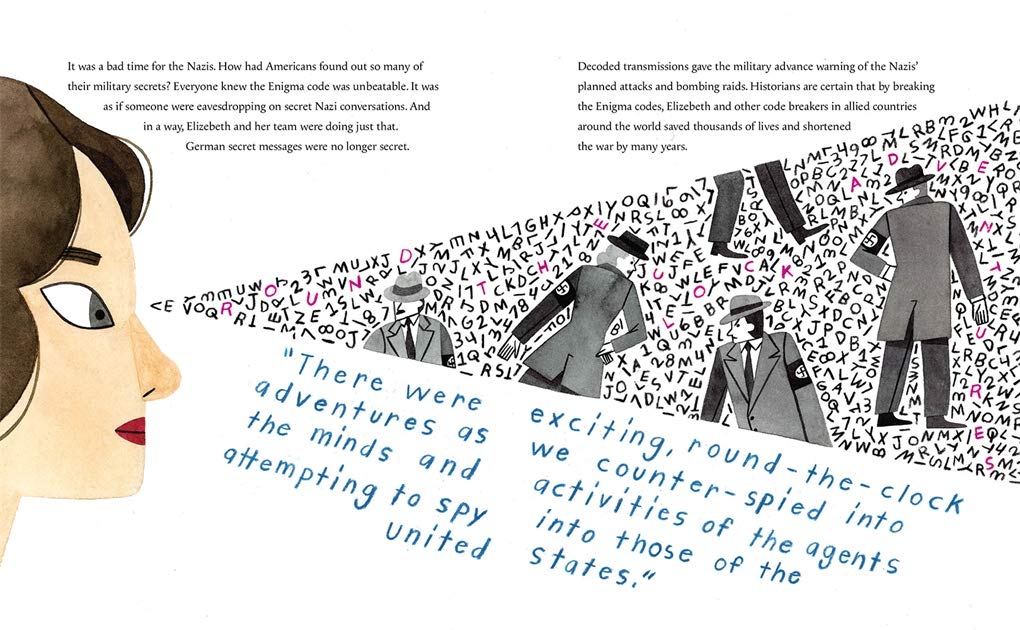
As the war progressed, Elizebeth helped capture an American spy working for the Japanese, and when the Germans developed Enigma, a powerful code-making machine that could “create billions of different cipher alphabets, it was Elizebeth’s team that broke the code for the United States. In Allied countries around the world, other cryptologists were also decrypting Enigma messages. The Nazis were now at a disadvantage, their planned attacks thwarted. Historians believe the work of these code breakers “saved thousands of lives and shortened the war by many years.”
Throughout her life Elizebeth could not speak a word about her work, even to her family. It was classified as Top Secret Ultra by the government and kept locked in the National Archives. At last, in 2015, Elizebeth’s work was declassified. “She is now considered one of the most gifted and influential code breakers of all time.”
Image copyright Brooke Smart, 2021, text copyright Laurie Wallmark, 2021. Courtesy of Abrams Books for Young Readers.
Compelling and wonderfully detailed, Laurie Wallmark’s biography of Elizebeth Friedman immerses children in the world of war-time spies, where cracking codes equaled saved lives and battles won. Wallmark’s storytelling of Elizabeth’s trajectory from Shakespeare scholar to ultra-secret code cracker reads like a thriller and is sprinkled throughout with quotes from Elizebeth that give kids a sense of her personality and the demands of her career. By including several cases Elizebeth was instrumental in solving, Wallmark provides readers with historical context on the broad range of nefarious activity that relied on secret codes to inform their knowledge of today’s uses of encryption as well as international spy networks. Each page is a celebration of Elizebeth’s talent, intelligence, and accomplishments, and her incredible story will enthrall readers.
Brooke Smart’s watercolor and gouache illustrations offer enticing glimpses into the past while following Elizebeth as she meets George Fabyon who shows her around his museum-like house while carrying a small monkey on his shoulder, establishes the United States’ first code-breaking unit, testifies in court, and thwarts the Nazis’ war plans. Interspersed with Smart’s realistic depictions of Elizebeth’s life are images in which lines of coded messages snake across the page, giving readers a look at the kinds of unreadable text Elizebeth and her teams cracked. In addition to presenting a visual representation of the tangled communications that eventually nabbed our enemies, two of these clever illustrations contain messages of their own.
A superlative biography that would enhance any history, social studies, language arts, or STEM curriculum as well as captivate kids who love spy, military, and detective stories, Code Breaker, Spy Hunter: How Elizebeth Friedman Changed the Course of Two World Wars is highly recommended for home bookshelves and is a must for school and library collections.
Ages 7 – 11
Abrams Books for Young Readers, 2021 | ISBN 978-1419739637
Discover more about Laurie Wallmark and her books on her website.
To learn more about Brooke Smart, her books, and her art, visit her website.
International Women and Girls in Science Day Activity
Send a Secret Message
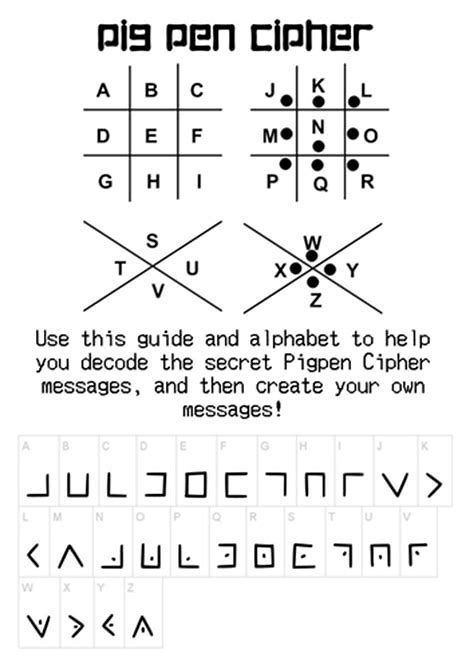
Would you like to be a code breaker – or a spy? Get started with this Pigpen Cipher that makes sending secret messages to friends, siblings, and other family easy and fun. This ancient code is called the Pigpen Cipher because each letter is in its own “pen.” Use it as originally developed then try mixing the letters and pens to create new codes.
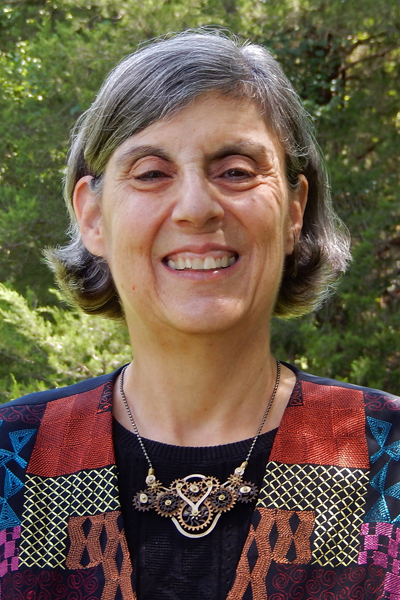
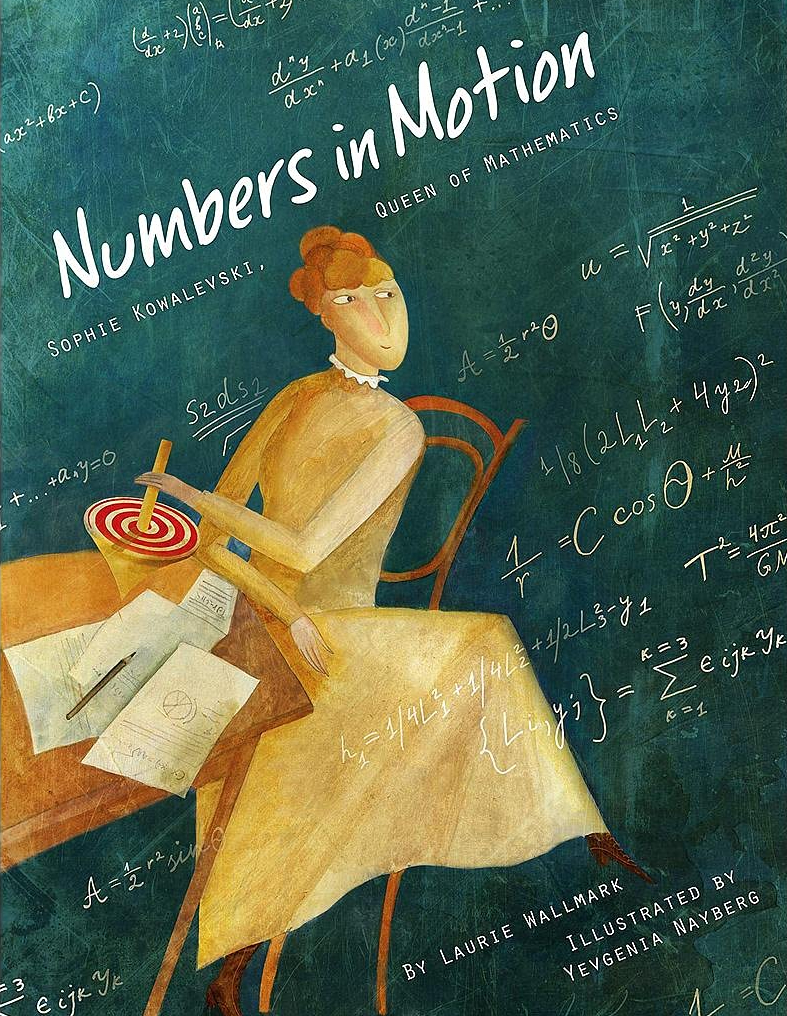
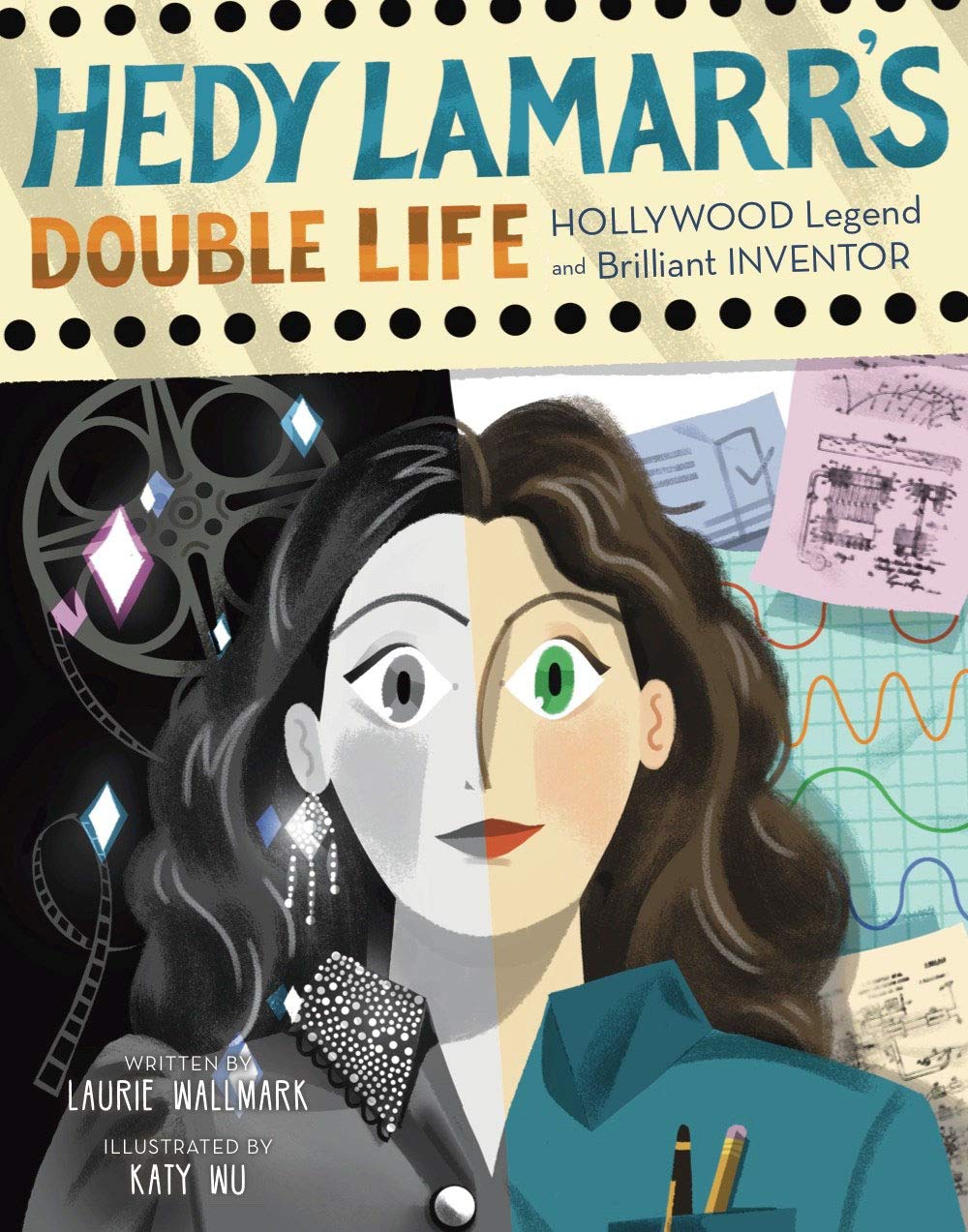
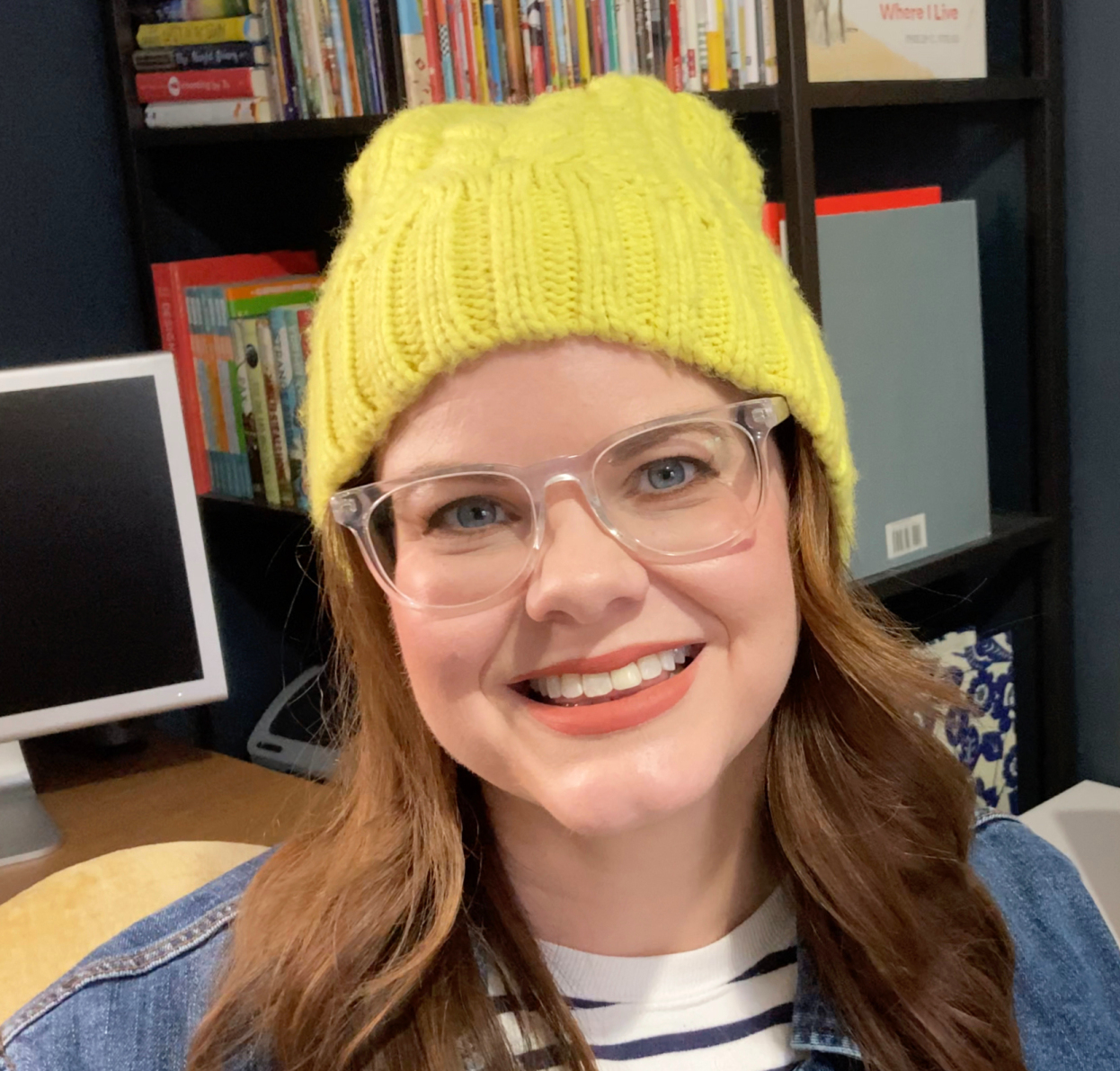
Award-winning author Laurie Wallmark has written picture-book biographies of women in STEM fields ranging from computer science to mathematics, astronomy to code breaking. Her books have earned multiple starred reviews, been chosen as Junior Library Guild Selections, and received awards such as Outstanding Science Trade Book, Cook Prize Honor, and Parents’; Choice Gold Medal. She is a former software engineer and computer science professor. She lives in Ringoes, New Jersey. (Photo credit Jeanne Balsam)
Thanks so much, Laurie, for stopping by to celebrate Inventors Month with me! Since this holiday recognizes innovators of the past and present, it seems a perfect fit for your books that teach kids about amazing women whose inventions or inventive ways of thinking have changed our understanding of math, computers, communications, and even secret codes.
Your love for these subjects and depth of research lead to compelling biographies. Reading them, I’ve often wondered whether a previous job has influenced your writing and the kinds of books you write.
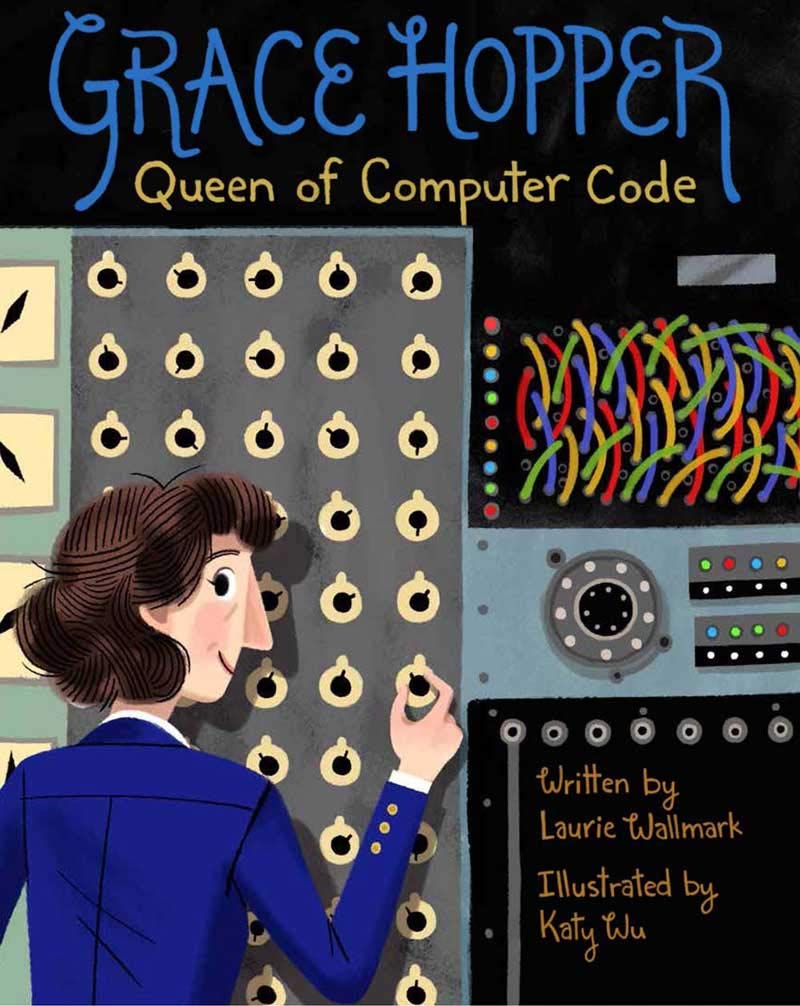
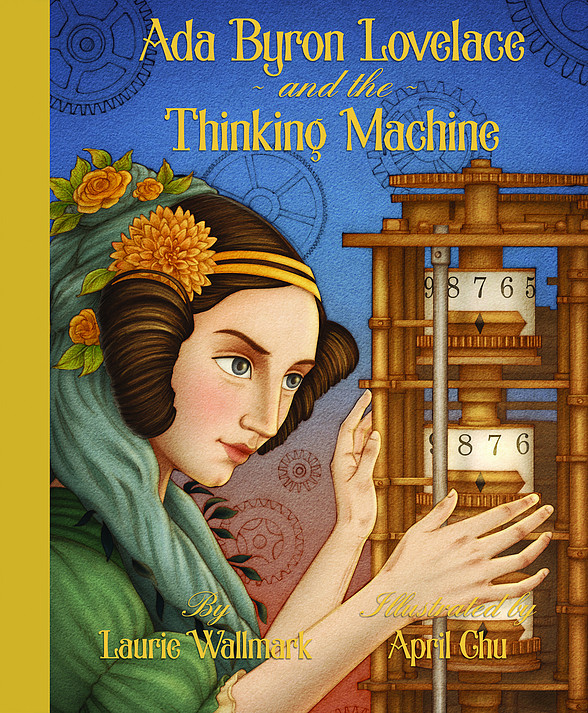
For many years I was a software engineer and, after that, a computer science professor. Not surprisingly, my first two women in STEM (science, technology, engineering, math) picture book biographies were about computer scientists, Ada Lovelace and Grace Hopper.
The same love of math and science that led me to these careers also led me to want to encourage children’s interest in these fields. And what better way to do this than through books? I now have three more picture book biographies of women mathematicians and scientists out, the latest being Code Breaker, Spy Hunter: How Elizebeth Friedman Changed the Course of Two World Wars, with two more on the way.
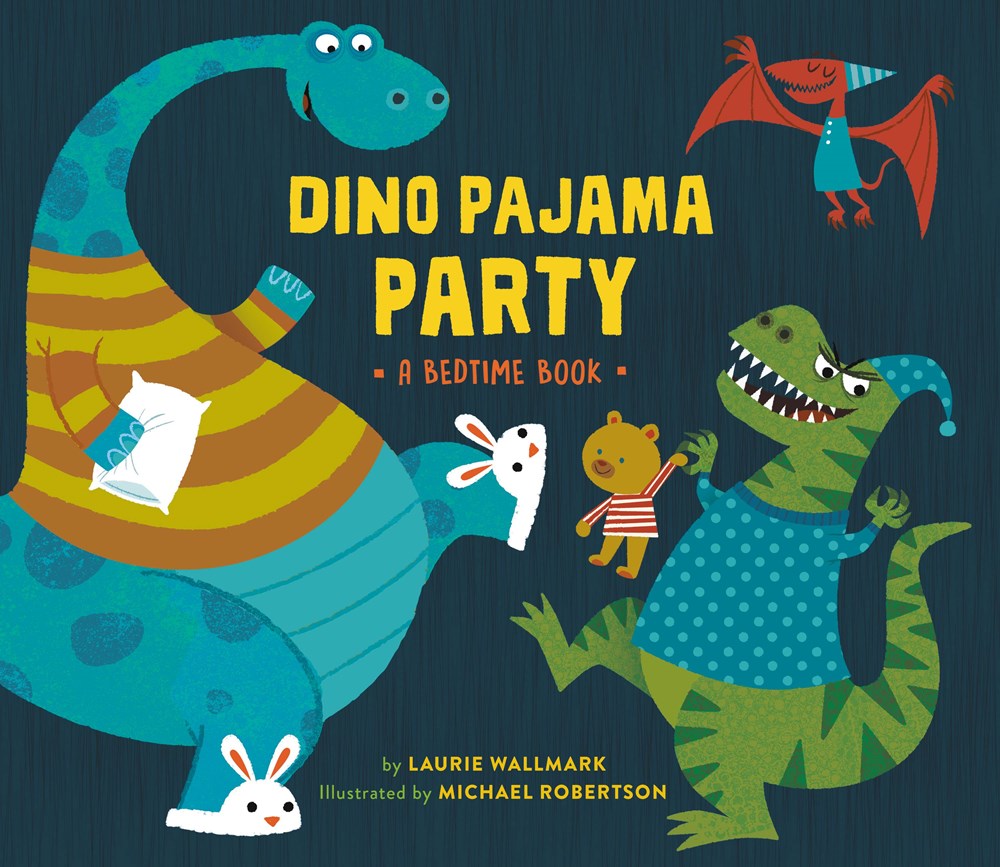
But it’s important not to fall into a rut in your writing, so my next title, coming out in October, is Dino Pajama Party. Because of my interest in STEM, people have asked me if it’s nonfiction. Um, no. But who knows? Maybe reading a fun, rhyming picture book about dinosaurs will encourage a child to grow up to be paleontologist.
I’m sure readers are as thrilled as I am to hear that you have two more STEM-related books coming out! I’m really looking forward to seeing who they’re about! And what could be better than dinosaurs partying in pajamas?! What a terrific way to send little one’s off to bed.
The Latest Books from Laurie Wallmark
I’m excited to share a little bit about Code Breaker, Spy Hunter: How Elizebeth Friedman Changed the Course of Two World Wars and Dino Pajama Party.
Code Breaker, Spy Hunter: How Elizebeth Friedman Changed the Course of Two World Wars
Written by Laurie Wallmark | Illustrated by Brooke Smart
In Code Breaker, Spy Hunter: How Elizebeth Friedman Changed the Course of Two World Wars, readers open the cover to an intriguing question: “Could it be? Had enemy spies sneaked into the United States?” World War II was raging, but the United States had not yet joined the effort. And yet the “FBI had intercepted hundreds of coded messages from a secret base in New York.” The problem was no one could read them. Who did the FBI turn to? Elizebeth Smith Friedman, who broke the codes, discovered a cadre of Nazi spies, and provided the evidence “to send thirty-three German spies to prison.”
Image copyright Brooke Smart, 2021, text copyright Laurie Wallmark, 2021. Courtesy of Abrams Books for Young Readers.
Elizabeth’s career in code breaking began in an unusual way: through her love of Shakespeare. In 1916, she met the eccentric George Fabyan, who was trying to prove that Francis Bacon was the true writer of Shakespeare’s plays. He hired Elizebeth to “find secret messages Bacon had supposedly hidden in the plays. But the more she explored the plays, the more convinced she became that there were no hidden messages.” In 1917, with the US involved in World War I, Fabyan asked Elizebeth and her now-husband William Friedman, who was also an expert at secret codes, to establish “the country’s first code-breaking unit, the Riverbank Department of Cyphers….”
In 1921, they helped soldiers send sensitive intelligence from the field by devising a complex code that would use only pencil and paper instead of the Army’s cumbersome machine. During Prohibition, they helped stop smugglers and Elizabeth created the Coast Guard’s first code-breaking unit. With America’s entry into World War II, it was Elizabeth who figured out how to defeat the Germans’ powerful code-making machine, Enigma, which “saved thousands of lives and shortened the war by many years.”
Image copyright Brooke Smart, 2021, text copyright Laurie Wallmark, 2021. Courtesy of Abrams Books for Young Readers.
Compelling and wonderfully detailed, Laurie Wallmark’s biography of Elizebeth Friedman immerses children in the world of war-time spies, where cracking codes equaled saved lives and battles won. Wallmark’s storytelling reads like a thriller and is sprinkled throughout with quotes from Elizebeth that give kids a sense of her personality and the demands of her career. By including several cases Elizebeth was instrumental in solving, Wallmark provides readers with historical context on the broad range of nefarious activity that relied on secret codes. This informs children’s knowledge of today’s uses of encryption as well as of international spy networks. Each page is a celebration of Elizebeth’s talent, intelligence, and accomplishments, and her incredible story will enthrall readers.
Brooke Smart’s watercolor and gouache illustrations offer enticing glimpses into the past while following Elizebeth as she meets George Fabyon who shows her around his museum-like house while carrying a small monkey on his shoulder, establishes the United States’ first code-breaking unit, testifies in court, and thwarts the Nazis’ war plans. Interspersed with Smart’s realistic depictions of Elizebeth’s life are images in which lines of coded messages snake across the page, giving readers a look at the kinds of unreadable text Elizebeth and her teams cracked.
Ages 7 – 11
Abrams Books for Young Readers, 2021 | ISBN 978-1419739637
Discover more about Laurie Wallmark and her books on her website.
To learn more about Brooke Smart, her books, and her art, visit her website.
Inventor’s Day Activity
Code Breaker, Spy Hunter Activity Kit
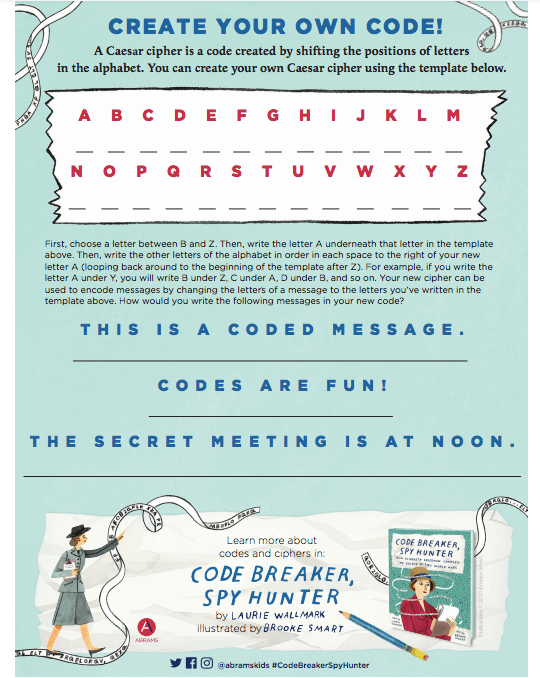
Secret fun is at your fingertips with the Code Breaker, Spy Hunter Activity Kit, which is full of codes kids will love learning, using, and sending! It’s available for download from the Abrams Books website here:
Written by Laurie Wallmark | Illustrated by Michael Robinson
Jazzy dinos have a fun day singing, dancing, and making music, boogying to a funky beat. But once the sun goes down, bedtime calls! Perfect for story time or bedtime, this playful read aloud goes from rollicking to restful.
Image copyright Michael Robertson, 2021, text copyright Laurie Wallmark, 2021. Courtesy of Running Press Kids.
Laurie Wallmark’s infectious rhymes will have kids stomping, jiving, and roaring along with Michael Robinson’s colorful, pajama-clad dinosaurs that shake their claws, strum guitars and toot horns, and show their pointy white teeth through big grins. As nighttime falls and the dinos trudge home, tired and yawning, readers will find themselves yawning and ready for bed too.
Ages 4 – 8
Running Press Kids, 2021 | ISBN 978-0762497751
To learn more about Michael Robertson, his books, and his art, visit his website.
Dino Pajama Party Activity Kit
Have dino-sized fun with the Dino Pajama Party Activity Kit available for download from Laurie Wallmark’s website here:
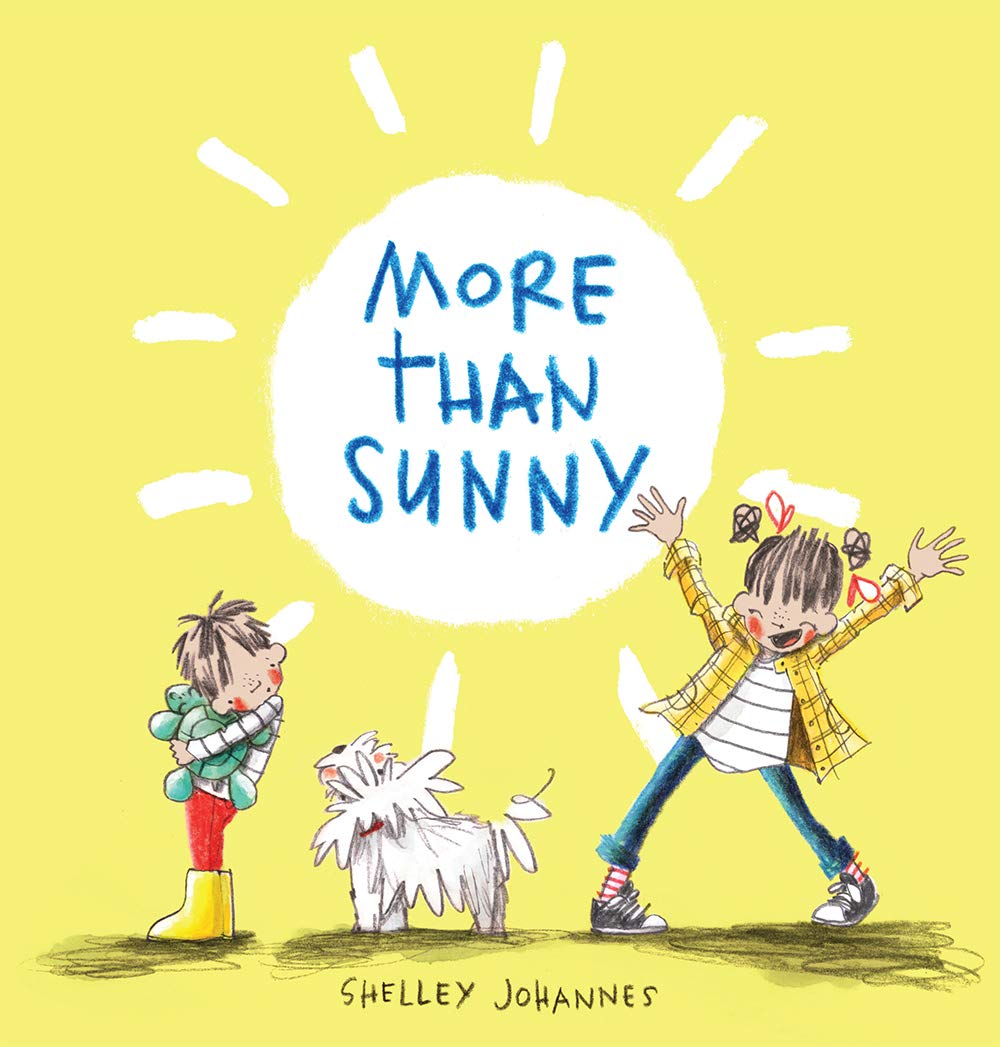
Shelley Johannes is the author-illustrator of the Beatrice Zinker, Upside Down Thinker chapter-book series. A former architectural designer, she has a fondness for tracing paper, process, and accidental discoveries. She and her family live in Michigan with two feathered friends, Max and Alex, who make every day sunny and birdy. More Than Sunny is her debut picture book.
Hi Shelley! I love how you describe all sorts of weather days in your new picture book More than Sunny, so I just couldn’t pass up a chance to share Rain Day with you! Rainy days have their own special fun, and you certainly celebrate that in your book! Of course, when the sun comes out, rainy days also bring rainbows – those beautiful symbols of optimism, something we can all use every day and which shines on every page ofMore than Sunny. Can you talk about what inspired the story?
Thank you, Kathy! And thank you so much for having me here today. Optimism is always in season, but metaphorical sunshine definitely feels even more precious these days.
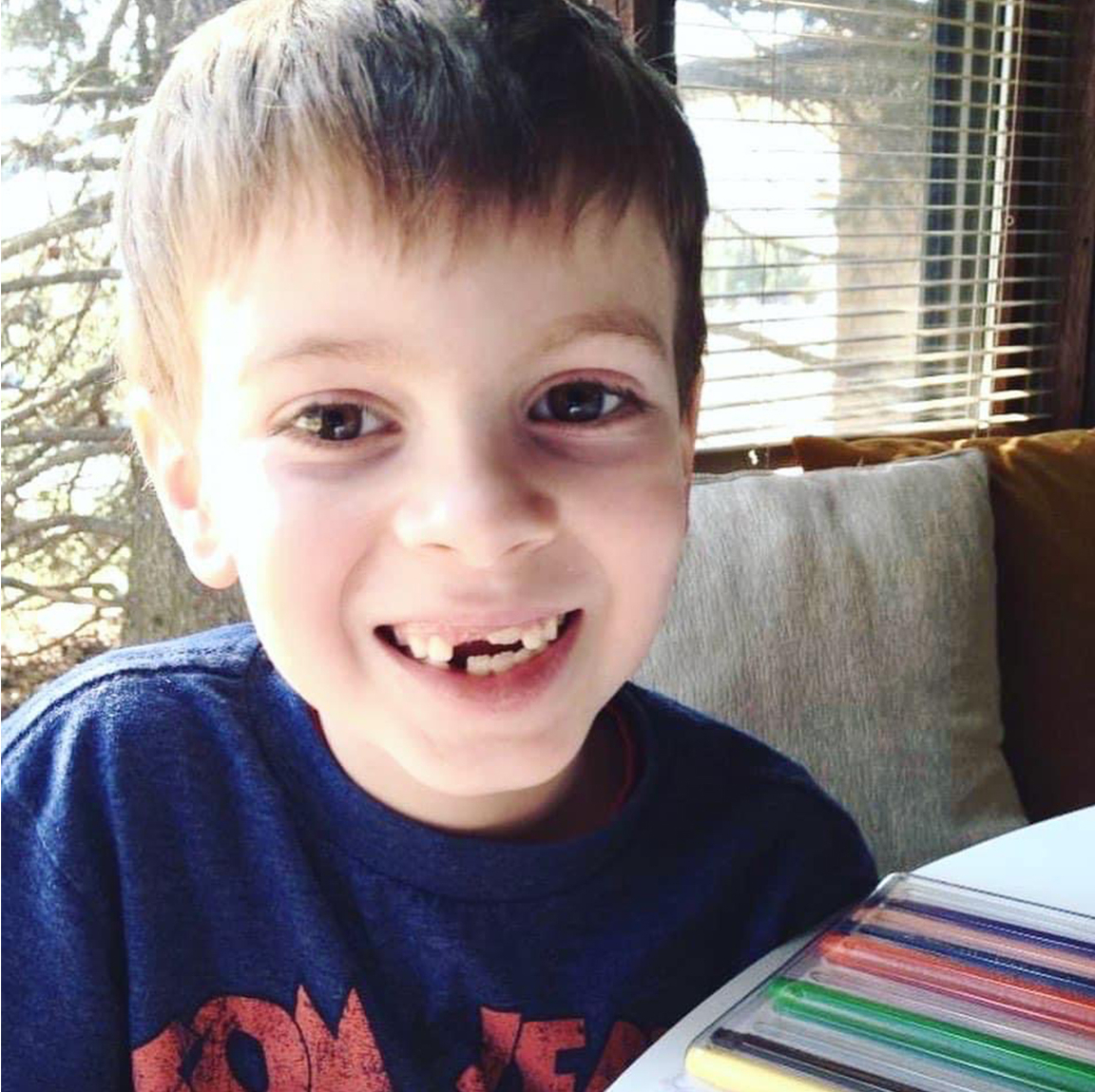
Matthew Johannes
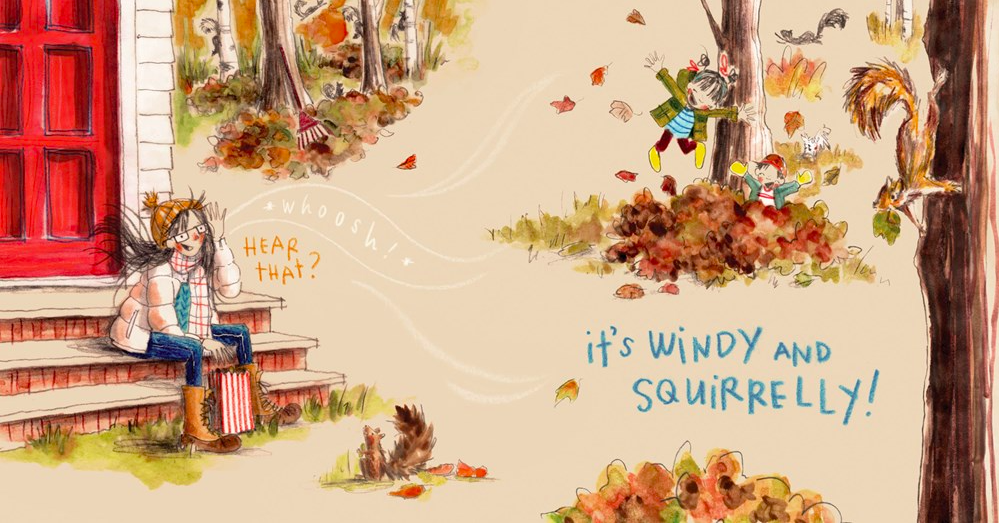
More Than Sunny was inspired by my son Matthew and a first-grade weather project. I’d viewed his daily weather chart—the kind with columns for sunny, cloudy, rainy, windy, snowy—as a mundane task to check off our list, but on the first day, he looked outside and enthusiastically declared, “It’s sunny and birdy today!” When he called the next day “windy and squirrelly”, I knew it had to become a book someday. He turned a routine assignment into something fresh and exciting, and made me pay attention to the beauty I’d forgotten to see. That’s always book-worthy.
In More than Sunny, you describe days with nuances that delight in everything a day can possess. Using your story structure, what would your favorite day have been as a child? How about now as an adult?
I love this question! As a kid, I loved rainy days, and any excuse to curl up with my dog and our special Rainy Day Art Book. So maybe I’d say . . . Dreary and Doggy were my favorite kind of days back then. Rain is so relaxing.
As an adult, it’s a tough call between Springy and Birdy (because May is the most cheerful month, and we are huge bird nerds around here) and Autumn and Squirrelly (because the crisp, colorfulness of fall makes me happy, and we’re huge squirrel nerds too!).
Before writing children’s books, you worked as an architect. Can you talk about that a little? Do you think being an architect influences your writing and art in any way? If so, how?
There was a time I felt bad about my winding path to making books. I felt bad that I didn’t have the guts to go after my dreams sooner. But these days, I’m so grateful for each part of my life and how it shaped me into the person I am today. My years in architecture helped me find my voice and gain the courage to use it. I also learned so much about my love for creative process and collaboration, and the type of people who inspire me. The desire to create, and to make something meaningful, is the motivational underpinning of both fields, so the transition to books felt very natural. The process of designing a building and building a story are surprisingly similar.
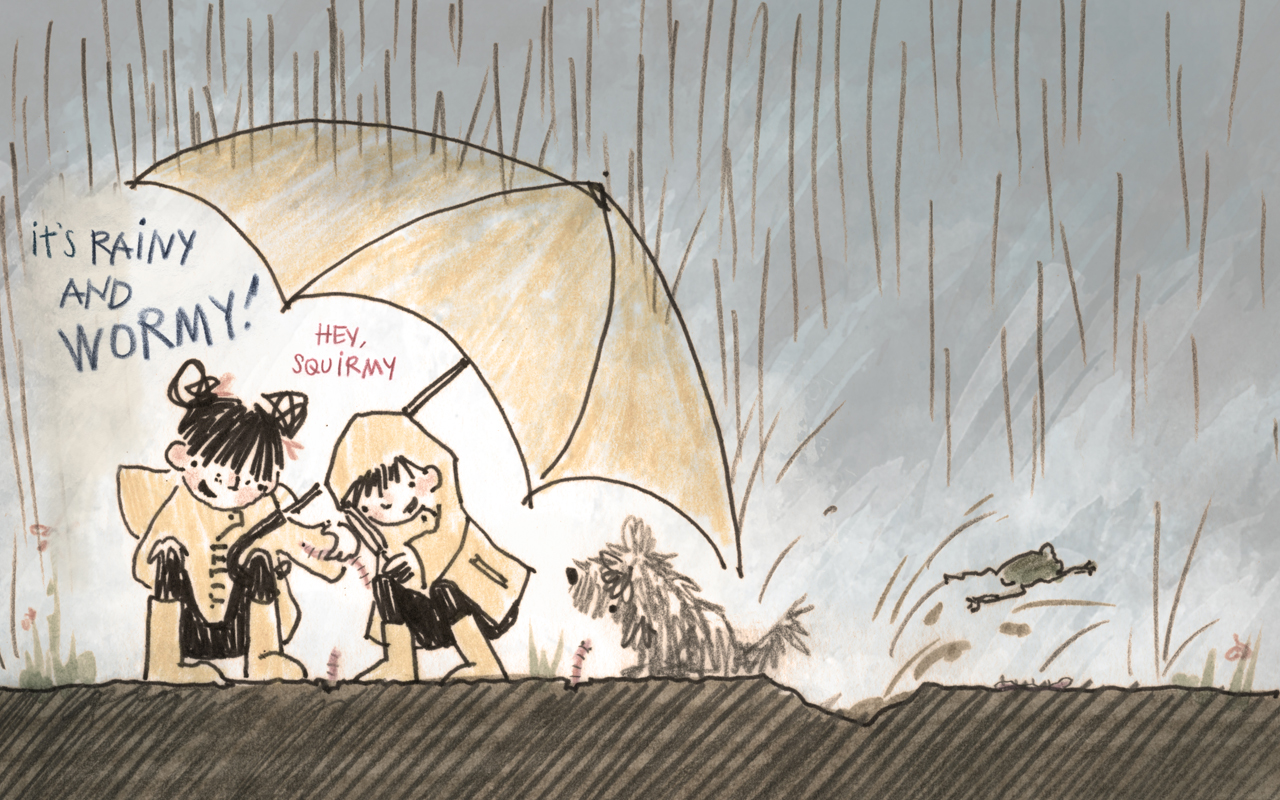
A rainy and wormy day from More than Sunny by Shelley Johannes, 2021, courtesy of Harry N. Abrams.
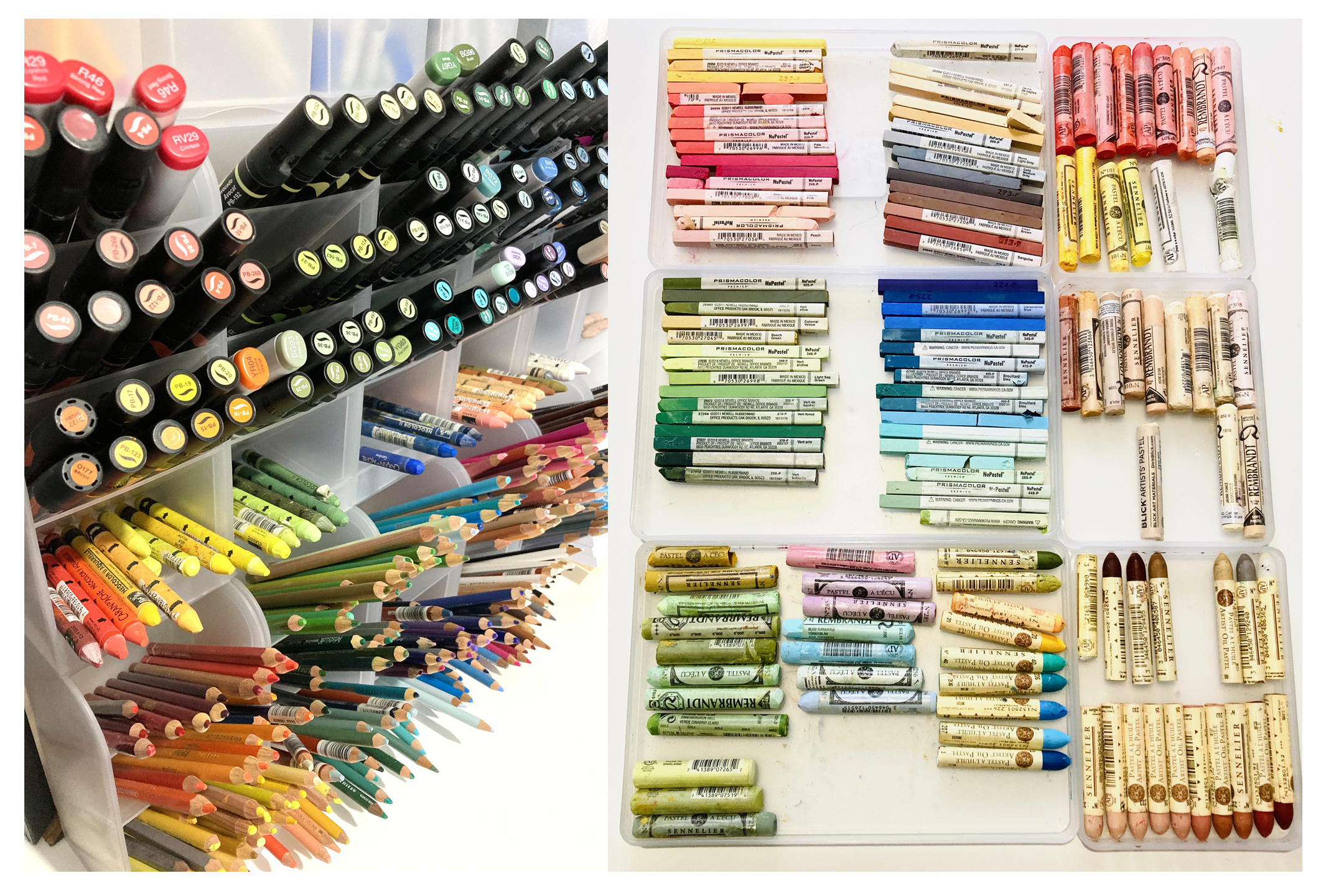
There’s also a direct connection in the way I work. I fell in love with tracing paper and felt-tip pens in my early days in architecture, and I’ve only fallen more in love as time passes. I’ve always loved how a loose sketch or a stray line can capture an idea on paper, and that wonder continues to bring me joy in new ways.
Your son Nolan narrates your wonderful book trailer and his pride and love for you and the More than Sunny really shine through. How great is it to share your writing journey with your kids?
Aw, thank you! We loved making that trailer together! And it was so special to capture his sweet voice just before it shifts into a grown-up one. It’s been so wonderful to share each step of the journey with my kids. I first realized I wanted to make picture books while reading to them as toddlers. They’ve been there for all the ups and downs and in-betweens of the creative process ever since, and enjoyed LOTS of celebratory pizza along the way! So much of each them—and they joy they bring into my life— is woven into everything I make. They inspire so many book moments, and are my most treasured critics and art buddies. I hope being part of this process empowers them to go after all the things they dream of doing, too!
What was your favorite place to read (or write or draw) as a child? What is your favorite place now and why?
As a kid, I loved to read and draw in the quiet privacy of my room, because it was personal and I was shy. These days, I like to mix things up. I write best in a crowded place, with headphones on and music blaring, because it’s easier for me to concentrate when I’m surrounded by stimuli and happy hustle-and-bustle. I also enjoy writing on the go as ideas randomly come to me, and use my Notes app like it’s another piece of my brain. I read anywhere and everywhere, and love listening to audiobooks while riding my bike around my neighborhood!
Though I doodle in sketchbooks all over my house, my studio is still my favorite place to make art. Having a place that’s dedicated to being creative, and filled with my favorite things, makes getting into the zone a bit easier.
What is your favorite season and seasonal activity?
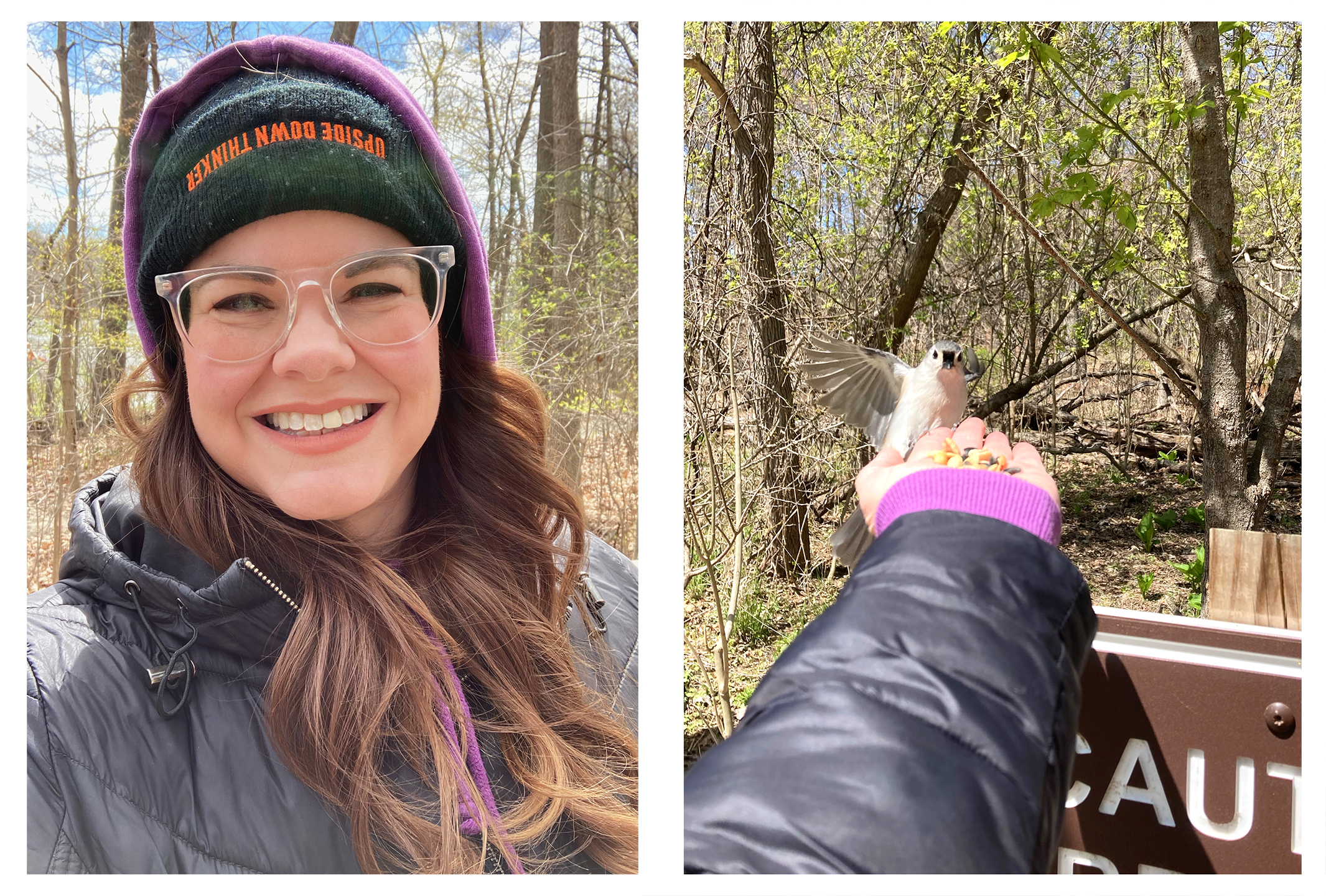
I’m torn between Fall and Spring. It’s hard to beat a cider mill on a crisp Autumn day, especially here in Michigan. Fresh donuts. Crisp apples. Bubbling steam running through the colorful trees. It’s pretty perfect. But then this Spring, we found a nature trail at a local park where wild birds fly down and eat out of your hands, and now we’re addicted to the wonder of that experience too.
Will you be doing any book events this summer that you’d like to tell readers about?
It’ll be a fairly quiet summer (see the answer to the next question!), but I’m doing a virtual event with wonderful Belmont Books on August 26th at 6:30pm ET, and I’d love for everyone to join us! We also had an amazing virtual launch event for More Than Sunny as part of Literati Bookstore’s At Home with Literati series. Jarrett Lerner and I talked about creative process, seeing the world with fresh eyes, and the making of the book. You can watch our conversation here anytime:
What’s up next for you?
This week I am starting the final artwork for my second picture book! I can’t wait to start experimenting with materials and see where it leads me!
Thanks for this wonderful chat and for sharing so many insights. I wish you all the best with More than Sunny and am really looking forward to your next book!
National Rain Day Review
About the Holiday
Today, we celebrate rainy days—but not just any rainy days. Rain Day commemorates an odds-busting record that began in 1874 in Waynesburg, Pennsylvania when one resident remarked to William Allison, the pharmacist at JT Rogers & Co drug store, that it always rained on his birthday—July 29. After that, Allison began keeping an annual record, and all eyes have been on Waynesburg to see if the remarkable run—115 years out of 147—continues. Now weather reporters around the country keep track of this remarkable statistic and broadcast “yes” or “no” to their audiences. As for the people of Waynesburg, they celebrate their notoriety with a huge festival that includes live musical entertainment, arts and crafts and food booths, kids’ games, and, of course, an umbrella-decorating contest. To learn more visit the Rain Day Website. And don’t forget to watch the skies!
More than Sunny
By Shelley Johannes
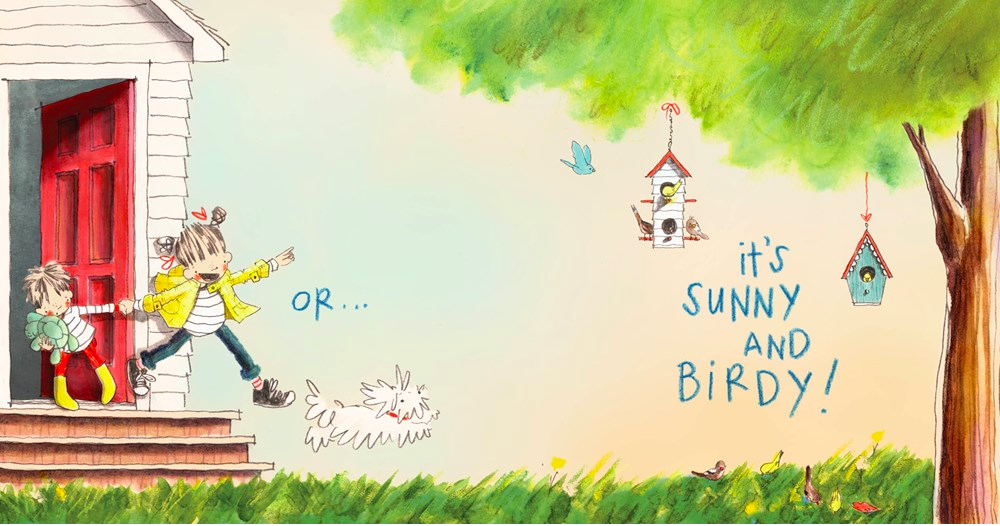
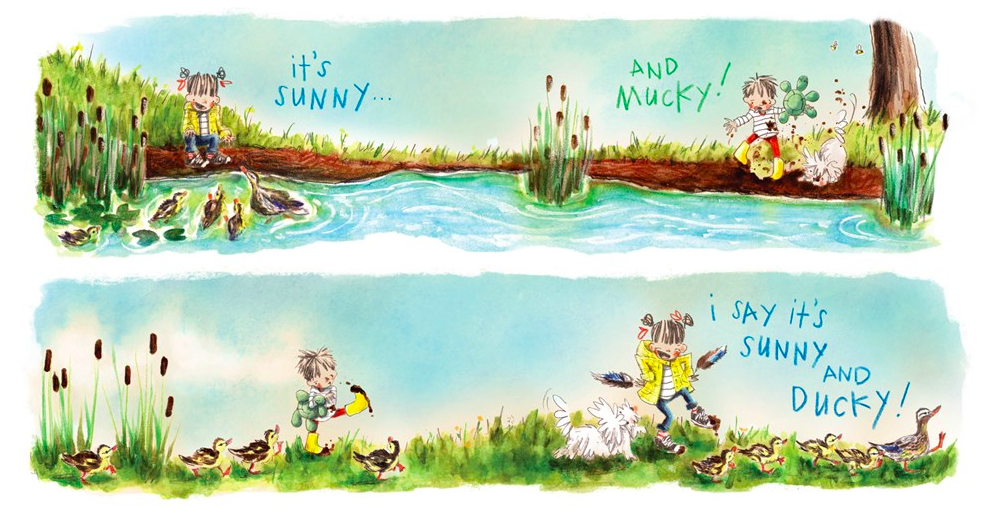
A girl knocks on her brother’s door and, before he’s even fully awake, she bursts in and announces with exuberance that this spring day is “sunny.” Yawning and rubbing his eyes, her brother adds “and early.” But his big sis pulls him outside to show him all the birds at the feeder and birdhouse. It’s not only sunny, she tells him “it’s sunny and birdy!” They head down to the pond, where the siblings have different ideas of what the day’s like. Little brother finds the day “sunny…and mucky!” But his sister, with feathers in her “wings,” states, “I say it’s sunny and ducky!”
Copyright by Shelley Johannes, 2021, courtesy of Harry N. Abrams.
On another day, these two compatible siblings head outside to discover what summer brings besides heat. The sunny day takes them to a field, a tree, and a dock, where they explore, relax, and use their imaginations. But not all summer days are sunny, and that’s okay because being inside when it’s “stormy” these kids make it cozy. And when the storm tapers off a bit, they grab their raincoats and big umbrella and go outdoors, where the girl exclaims, “it’s rainy and wormy!” and her brother inspects the mud and greets a small worm, “Hello squirmy.” The rainy day brings lots of fun with Mom and their dog too.
Copyright by Shelley Johannes, 2021, courtesy of Harry N. Abrams.
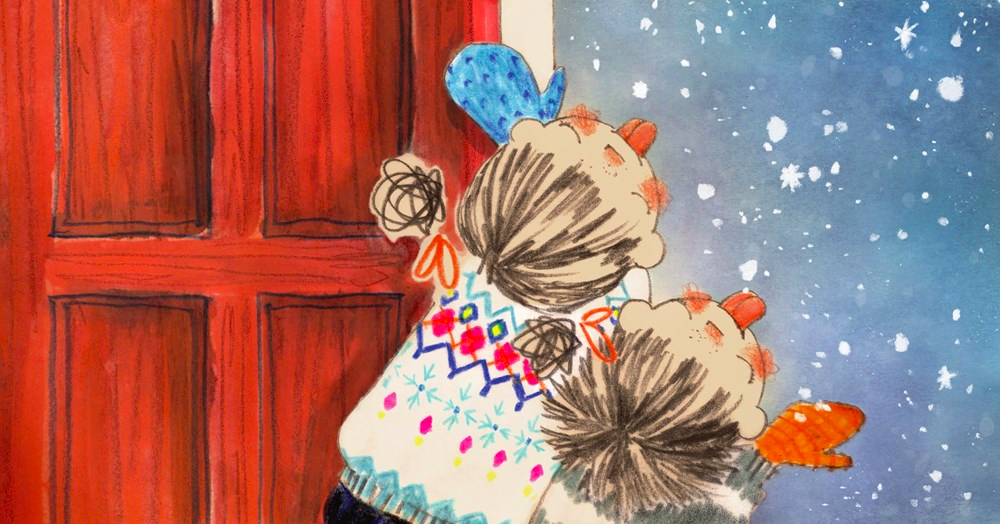
But summer days turn into autumn days with wind and squirrels and piles of leaves to jump in. The kids read and make paper snowflakes, waiting for winter to come. And, finally, the flakes fall. They taste so good. “Can we? Can we?” the siblings ask, eager to be out in the snow. “But I’m warm and socksy,” says Mom. But her kids, tiptoeing and playing, lure her out with “Let’s be snowy and foxy!”
Copyright by Shelley Johannes, 2021, courtesy of Harry N. Abrams.
They take a walk in the woods and, while sledding, see Daddy coming home. “Are you ready and sleddy?!” they ask, but there’s shoveling to be done. That’s all right; there are other ways to have fun in the snow. Tired out and chilly, the family goes inside for bedtime. Now there’s a knock at the sister’s door. Yawning and rubbing her eyes, she goes to see who it is. It’s her brother, and he has something magical to show her.
Copyright by Shelley Johannes, 2021, courtesy of Harry N. Abrams.
Shelley Johannes’s exuberant call to play and explore is a perfect jumping off place for kids to look at and interact with their surroundings with new eyes, imagination, and creativity. Hopping from season to season, Johannes touches on moments of freedom and wonder and those happy discoveries so formative in childhood. Her playful rhymes and bouncy rhythm echo kids’ delighted banter, and her sprightly adjectives invite readers to come up with their own descriptions of their day.
Johannes’s bright, energetic, and cheery illustrations dazzle with lively depictions of the siblings playing outside in all weather. Her smile-inducing portrayals of the siblings mirror real kids and each page is loaded with details readers will love lingering over. Mom and Dad make warm cameos to create a book the whole family will enjoy.
More than Sunny is a generously sized picture book that kids and adults will find themselves joyfully sharing throughout the year. For teachers and homeschoolers, Johannes’s storytelling provides a spark for writing prompts, grammar lessons, and observational skills. Sure to become a quick favorite, More than Sunny is highly recommended for home, classroom, and public library collections.
Ages 4 – 8
Harry N. Abrams, 2021 | ISBN 978-1419741814
Discover more about Shelley Johannes and her books on her website.
One of the best simple pleasures is looking up at the clouds and imagining what shapes you see. Bring those fluffy, white clouds into your room with this craft!
Supplies
White girls’ dress bobby socks in various sizes
Fiber fill, 20-ounce bag
Fishing line, different lengths
Needle
Clear adhesive mountable hooks or clips
Directions
Stuff the socks with fiber fill, pushing it far into the sock and adding more here and there to make various lumps and give it a rounded, cloud-like shape
When the sock is full, tuck the end of the sock in to close it
Cut lengths of fishing line. The lengths will depend on how and where you will hang the clouds
With the needle or by hand, feed one end of the fishing line into the top of the sock and out to attach the line for hanging.
Knot the fishing line
Attach the mountable hooks or clips to the ceiling