July 1 – National Watercolor Month

About the Holiday

Today, I’m celebrating World Watercolor Month with a biography of a woman artist born in 1861 who not only worked in watercolors but brought the delicately blended beauty of the art form to the solid medium of glass as the creator of iconic Tiffany designs. World Watercolor Month was begun in 2016 by Charlie O’Shields, the creator of Doodlewash®, host of the Sketching Stuff podcast, and founder of a social artist movement dedicated to promoting and connecting watercolor artists from all over the world. The holiday also raises awareness of the global importance of art and creativity. Everyone from amateurs to professionals are welcome to participate—and if you’ve never painted with watercolors before, now’s a great time to try! If you’d like prompts to inspire your work and other ways to enjoy the month and take your love of watercolor painting into next month and beyond, visit Doodlewash.

Thank you to Peachtree and Barbara Fisch of Blue Slip Media for sending me a copy of this book for review!

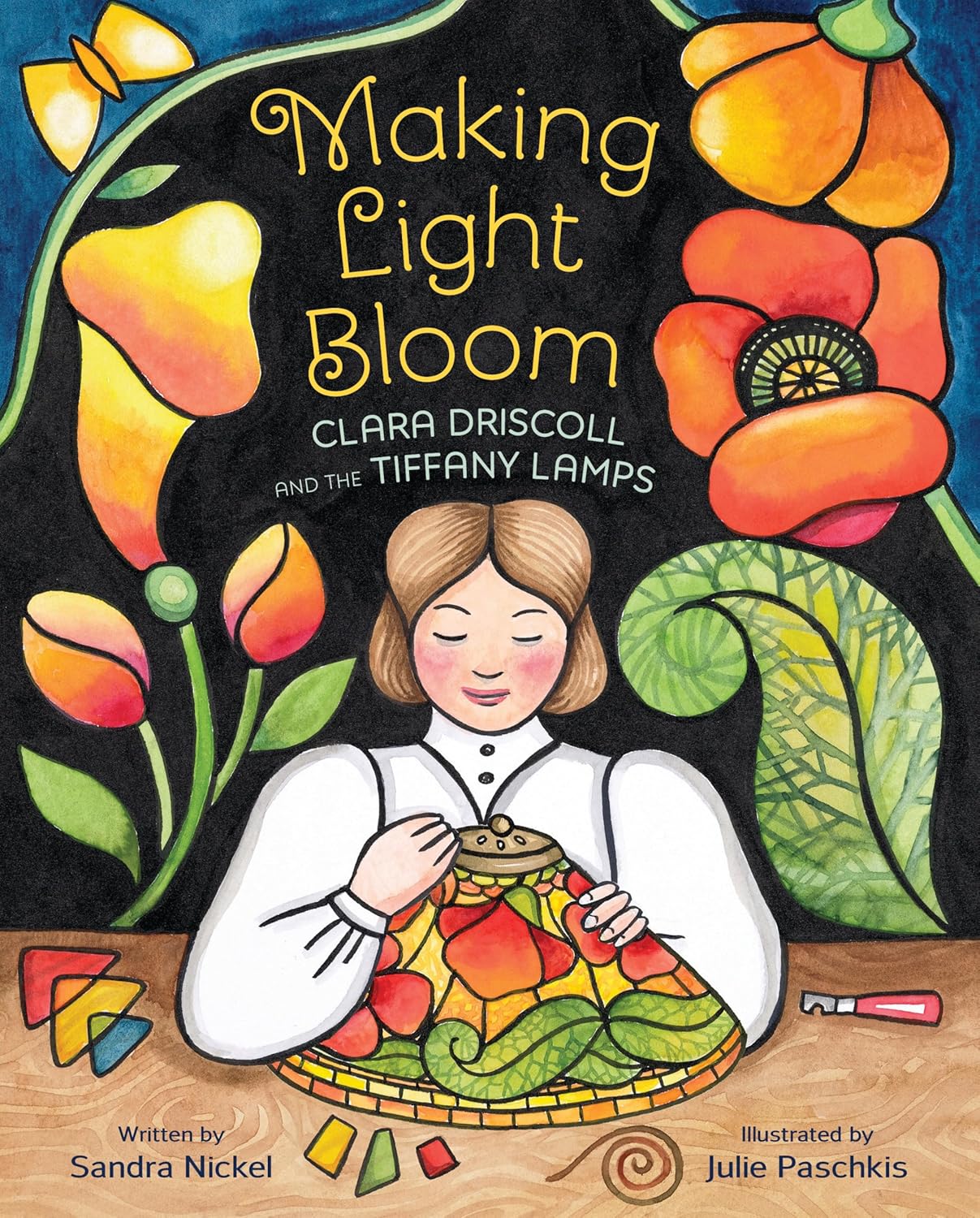
Making Light Bloom: Clara Driscoll and the Tiffany Lamps

Written by Sandra Nickel | Illustrated by Julie Paschkis


As a young girl, Clara Driscoll grew up surrounded by glorious gardens blooming with morning glories, apple blossoms, and wildflowers and shimmering with the dragon flies they attracted. Clara often sketched the gardens, and when she grew older, she enrolled in art school, hoping to turn her talent for drawing into a job that could help her financially struggling family. After graduation, Clara moved to New York City and took a job working for glassmaker Louis C. Tiffany.

Clara’s task was to choose and cut pieces of glass for the craftsmen to join together with metal ridges to make beautiful stained glass windows. She used her creative eye to “‘paint’ robes, halos, and great wings of angels” with “dappled and streaked, shaded and shimmering” glass. It didn’t take long for Louis to recognize Clara’s talent, and soon she was overseeing her own group of women known as Tiffany Girls. Missing her gardens back home, Clara had the idea to make a lamp from the delicate glass that would bring the beauty of a garden inside.
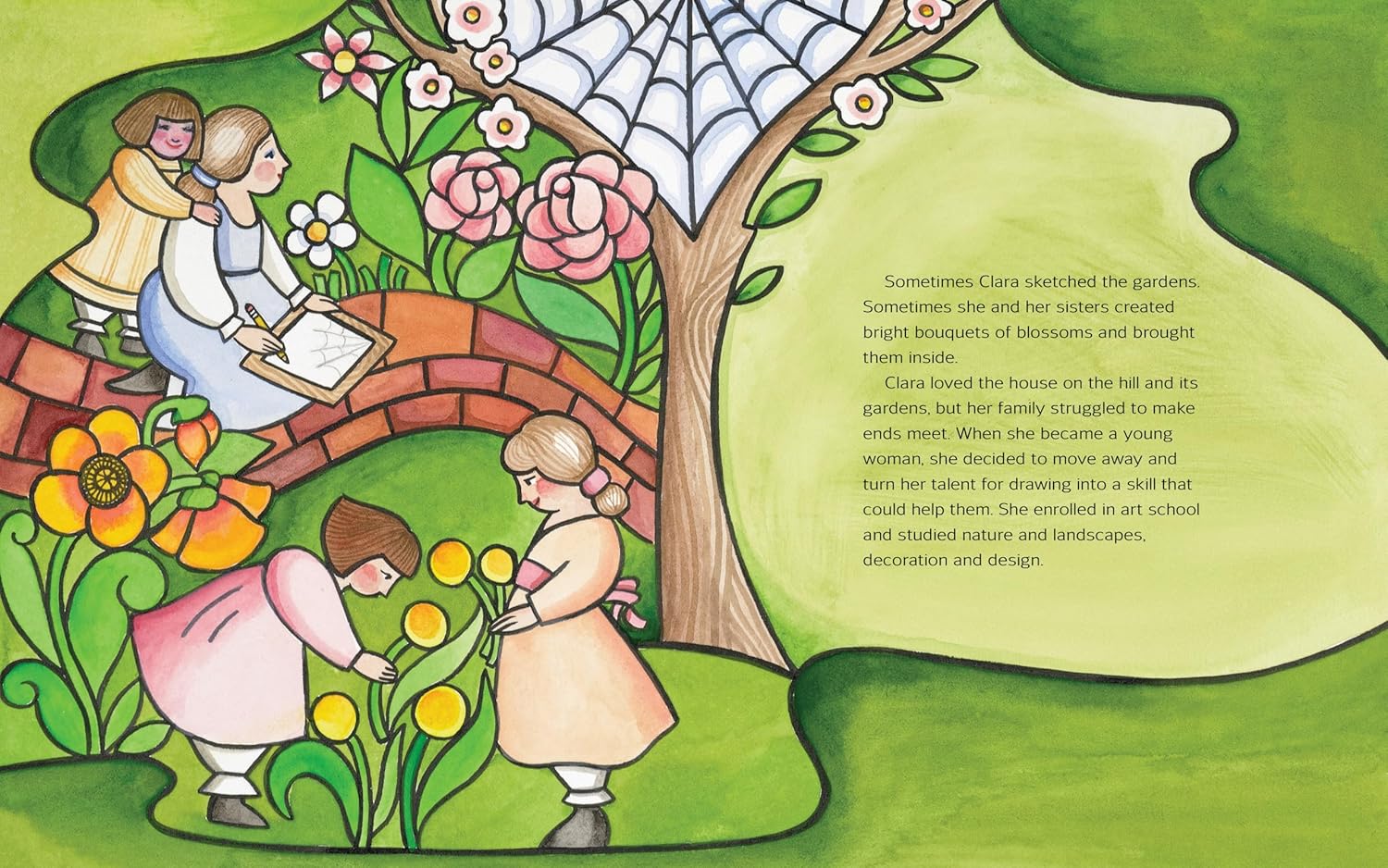
Illustration © 2025 by Julie Paschkis, text © 2025 by Sandra Nickel. Courtesy of Peachtree.

She and the Tiffany Girls cut small pieces of glass to make butterfly wings, and then “together with the craftsmen, she formed the butterfly wings into a lampshade.” Once the kerosene wick was lit, “light bloomed as never before.” Next, Clara wanted to bring the brilliance of dragonflies to her new creation. But cutting and forming the glass into the intricate wings of a dragonfly was time consuming, and one of the managers said that “she could never make another.”

That, however, was before Louis Tiffany saw the lamp and asked Clara “to make another to display at the World’s Fair in Paris.” At the fair, Clara’s lamp won the bronze medal. The lamp’s success “astounded” Louis. He put Clara and the Tiffany Girls in charge of making lamps and windows representing the beauty of natural landscapes.

Feeling shut out, the craftsmen announced a strike unless Louis fired the women. But Louis knew the value of Clara’s imagination and work, so he compromised with the men: Clara’s workshop would not get bigger, but “Clara would be in charge of lamp-making from that day forward.”
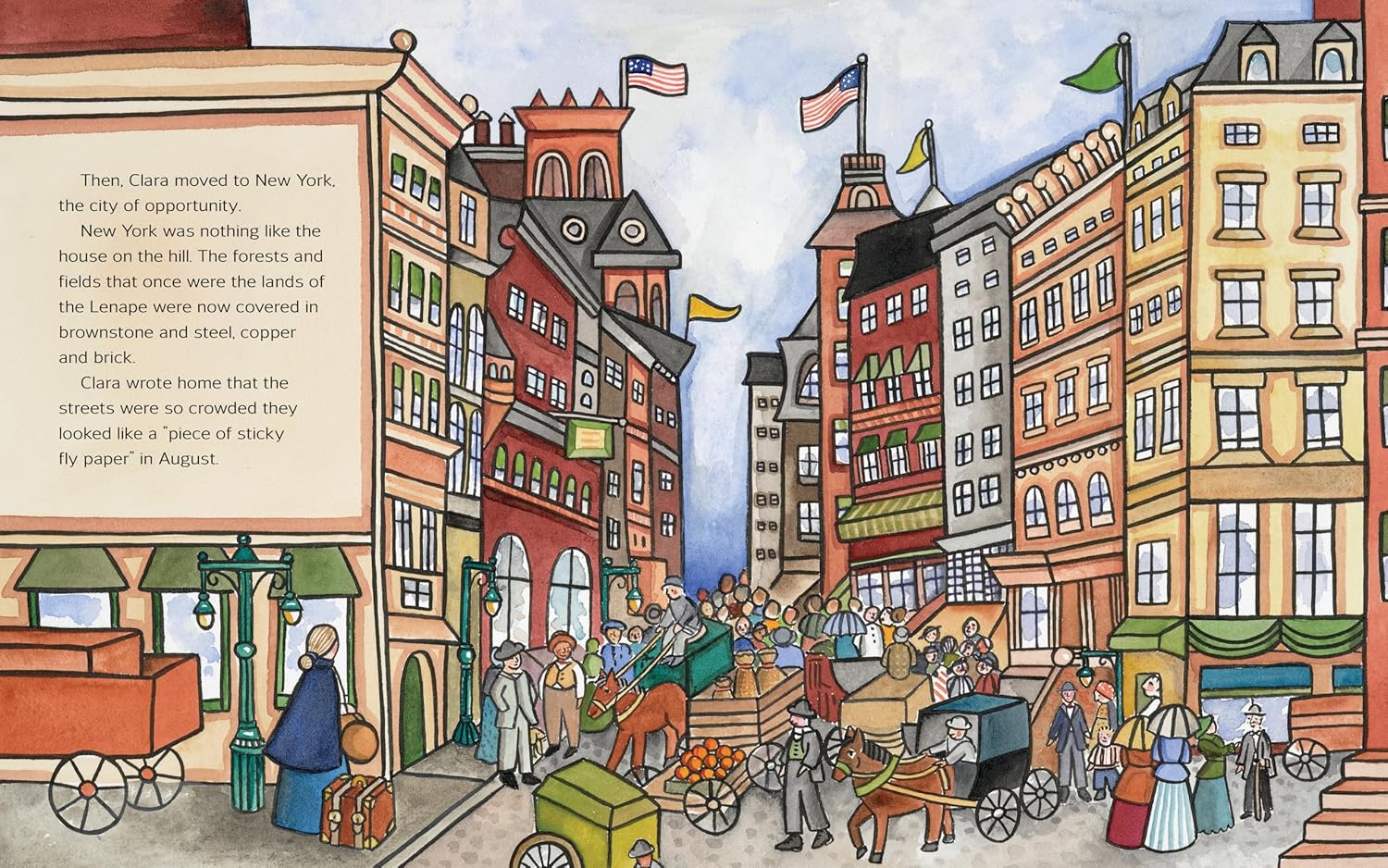
Illustration © 2025 by Julie Paschkis, text © 2025 by Sandra Nickel. Courtesy of Peachtree.

Elated, Clara began creating new designs inspired by the gardens she’d sketched at home as well as  nature she found within the city, all informed by her meticulous research. In the basement storage room, she searched for pieces of glass that were just the right hues to bring to life each petal, flower, leaf, and stem. In one astonishing design, she recreated wisteria with 2,000 tiny petals.

While Clara’s work was recognized inside the studio, because her lamps were only known as “Tiffany lamps,” no one else knew they were Clara’s creation. It was only after both Louis and Clara passed away and Clara’s letters to her sisters were discovered that people learned the truth about how Clara made light bloom “throughout the world.”

Back matter includes an Author’s Note that goes into more detail about Clara’s letters home, Louis C. Tiffany’s reaction to her initial idea, and Clara’s long, intricate process for designing each lamp; a list of museums where you can see Tiffany Lamps; and the names of two archives where Clara’s letters can be read; a bibliography; and dates and quotes for references found in the book.
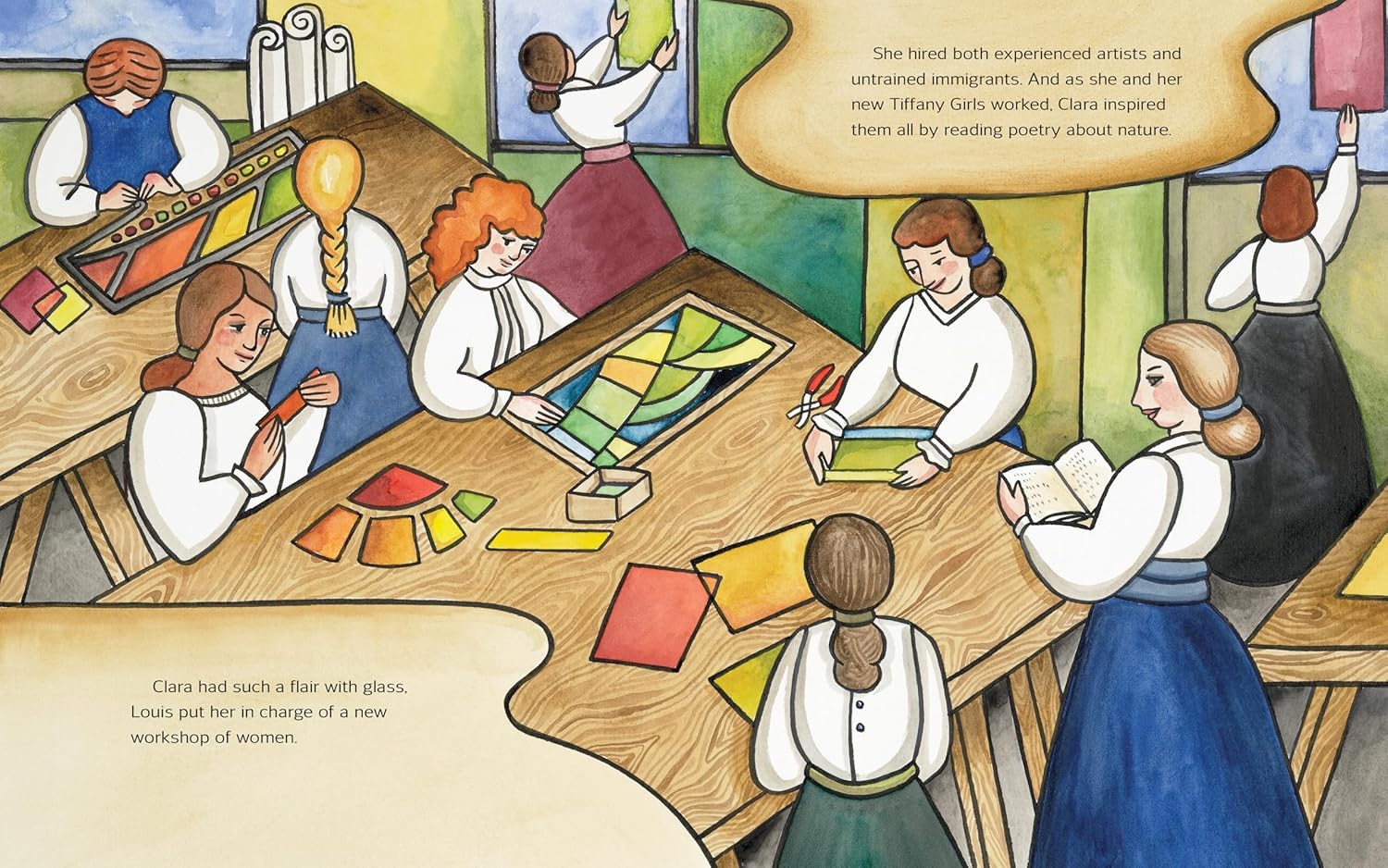
Illustration © 2025 by Julie Paschkis, text © 2025 by Sandra Nickel. Courtesy of Peachtree.

Sandra Nickel’s fascinating and eye-opening story about Clara Driscoll, one of the world’s most innovative artists, is both inspirational and uplifting. Nickel’s heartfelt, straightforward storytelling about Clara’s early years allows readers to see how youthful experiences and interests can influence their later endeavors—creative and otherwise. Nickel also emphasizes Clara’s remarkable vision for ways to expand the use of stained glass in the 1890s as well as her advocacy for herself and her ideas, making her an excellent role model for all children. And while Clara was not recognized for her work during her lifetime, art lovers can be grateful that Louis C. Tiffany knew brilliance when he saw it and valued her contributions—another aspect of Clara’s story to celebrate. 

Julie Paschkis’s dazzling, folk-style illustrations bring the intricate and delicate beauty of stained glass to the page, telling Clara’s story visually in a way similar to the windows she often worked on. Taking kids into the Tiffany studio, Paschkis demonstrates how Clara, the Tiffany Girls, and the craftsmen chose, cut, and pieced together to create complex scenes that glow with life still today. Paschkis faithfully recreates Clara’s iconic dragonfly lamp, an image that will wow kids. 

A vibrant biography of a visionary artist, Making Light Bloom: Clara Driscoll and the Tiffany Lamps is an inspiring book to share with creatives of all types at home, in the classroom, and for art and crafts programs. The book is a must addition to any library collection.

Ages 7 – 10

Peachtree, 2025 | ISBN 978-1682636091

About the Author

Sandra Nickel is an award-winning author of picture books and has two new books out this Spring: Seven, A Most Remarkable Pigeon, an uplifting tale that celebrates differences, and Making Light Bloom, Clara Driscoll and the Tiffany Lamps, in which Sandra continues her mission to celebrate extraordinary individuals who have been nearly forgotten by history. She is honored to be the winner of a Christopher Award, the winner of the Society of Children’s Book Writers & Illustrators Crystal Kite Award, a finalist for the Golden Kite Award for Nonfiction for Younger Readers, a Junior Library Guild Gold Selection honoree, and a Charlotte Huck Award Recommended author. She holds a Master of Fine Arts in Writing for Children and Young Adults and has presented workshops on writing for children and young adults throughout the United States and Europe. Visit her at sandranickel.com. You’ll also find her on Bluesky, Facebook, Instagram, and Twitter/X

About the Illustrator

Julie Paschkis is an award-winning illustrator of more than 25 books for children. A graduate of Cornell University and the School for American Craftsmen at Rochester Institute of Technology, she taught art to grade school children for a number of years before turning her full attention to painting, textile design, and creating illustrations for her books. Visit her at juliepaschkis.com to see more of her work and download whimsical and nature-inspired coloring pages for kids and adults. You’ll also find her on Facebook.

World Watercolor Month Activity
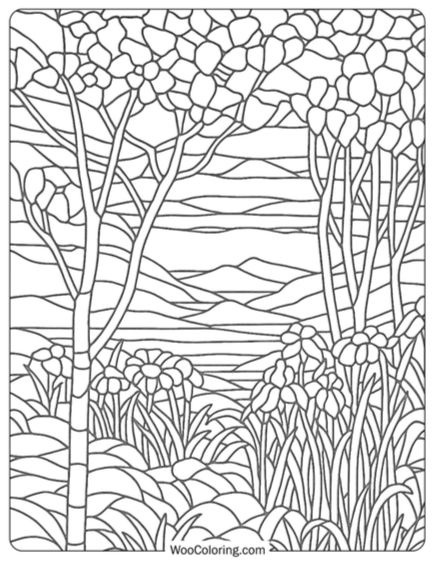
Tiffany Window Coloring Page


Create your own brilliant vision with this Tiffany Window Coloring Page!
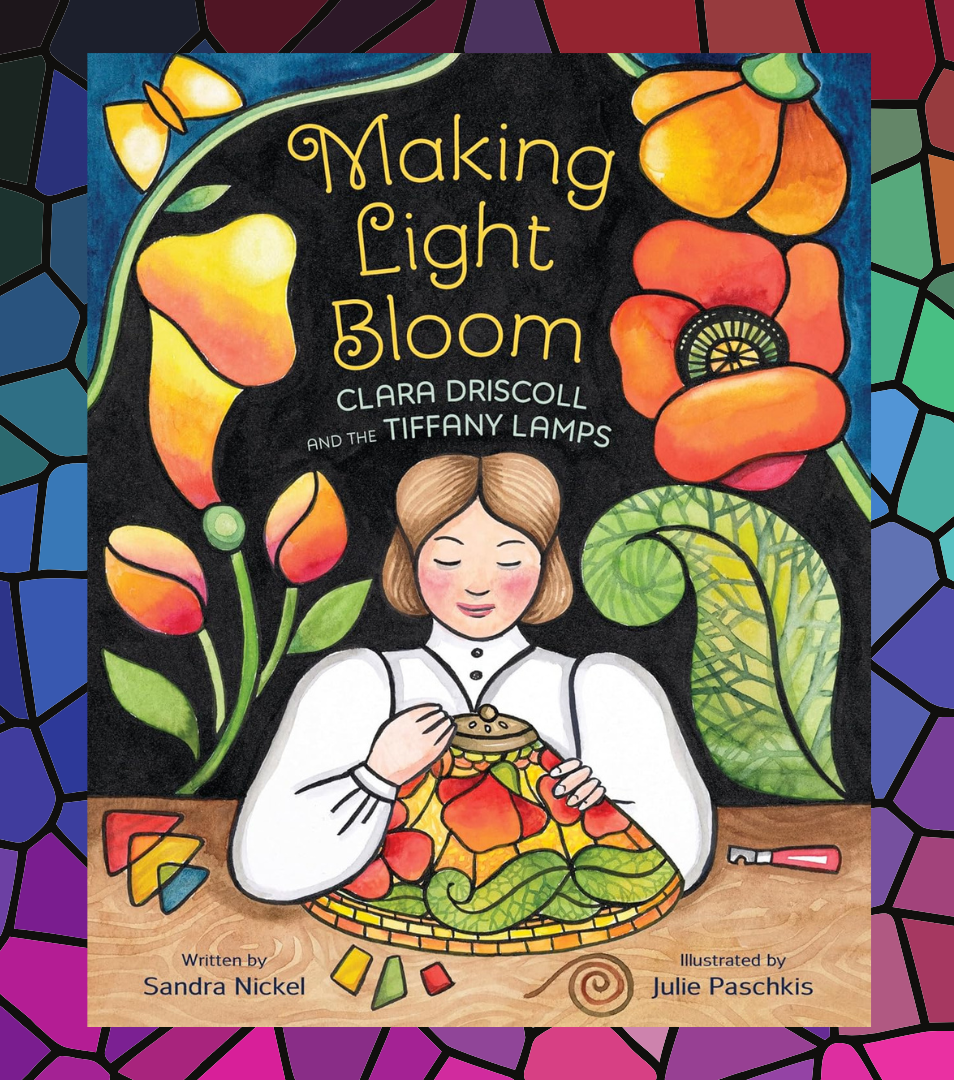
You can purchase Making Light Bloom: Clara Driscoll and the Tiffany Lamps from these booksellers.

Amazon | Barnes & Noble | Bookshop

Picture Book Review

September 23 – It’s National Sewing Month

celebrate-picture-books-picture-book-review-dressing-up-the-stars-cover

About the Holiday

Sewing is one of the most popular hobbies around and has historically been one of the most important industries in this country and around the world. National Sewing Month was established in 1982 to encourage people to learn more about this craft and to try their hand at picking up a needle or sitting down at a sewing machine. To celebrate read up on the history of sewing and the textile industry and consider taking a sewing class or learning on your own. Sewing can be a fun and rewarding activity for adults and children. Who knows? It may even become a career that can send you to the Oscars, as you’ll see in today’s book!

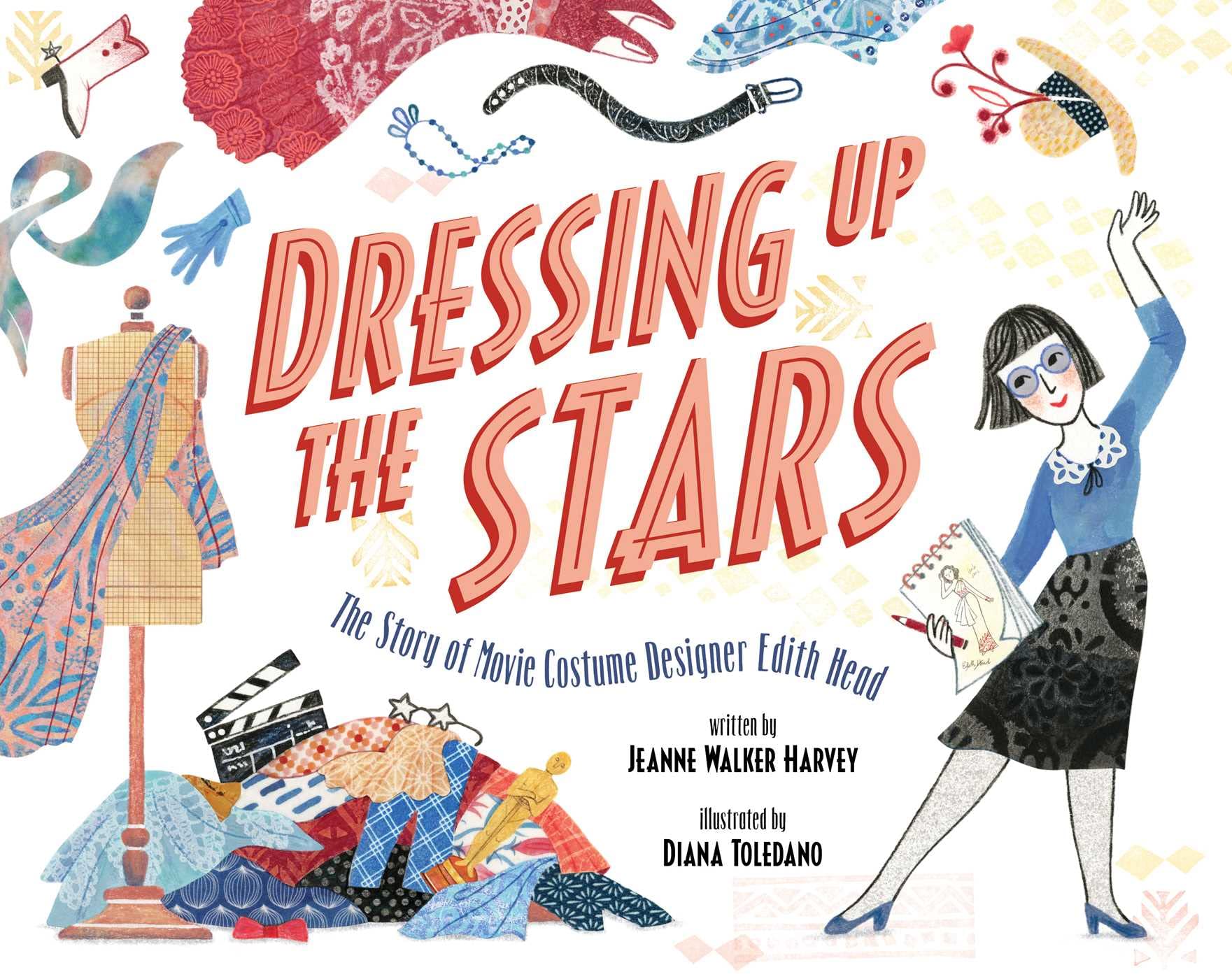
Dressing Up the Stars: The Story of Movie Costume Designer Edith Head

Written by Jeanne Walker Harvey | Illustrated by Diana Toledano


As a child, living in a dry, barren mining town, Edith felt like she didn’t belong. She dreamed of living “in a place full of people and sounds and dazzling lights.” She liked hosting pretend tea parties with colorful china and sweet treats for her stuffed animals and imaginary guests. She also dressed up her pet cat, dog, rabbit, horned toad, and two mules in scarves, clothes, and fancy hats that she made just for them.

celebrate-picture-books-picture-book-review-dressing-up-the-stars-doll-house

Image copyright Diana Toledano, 2022, text copyright Jeanne Walker Harvey, 2022. Courtesy of Beach Lane Books.

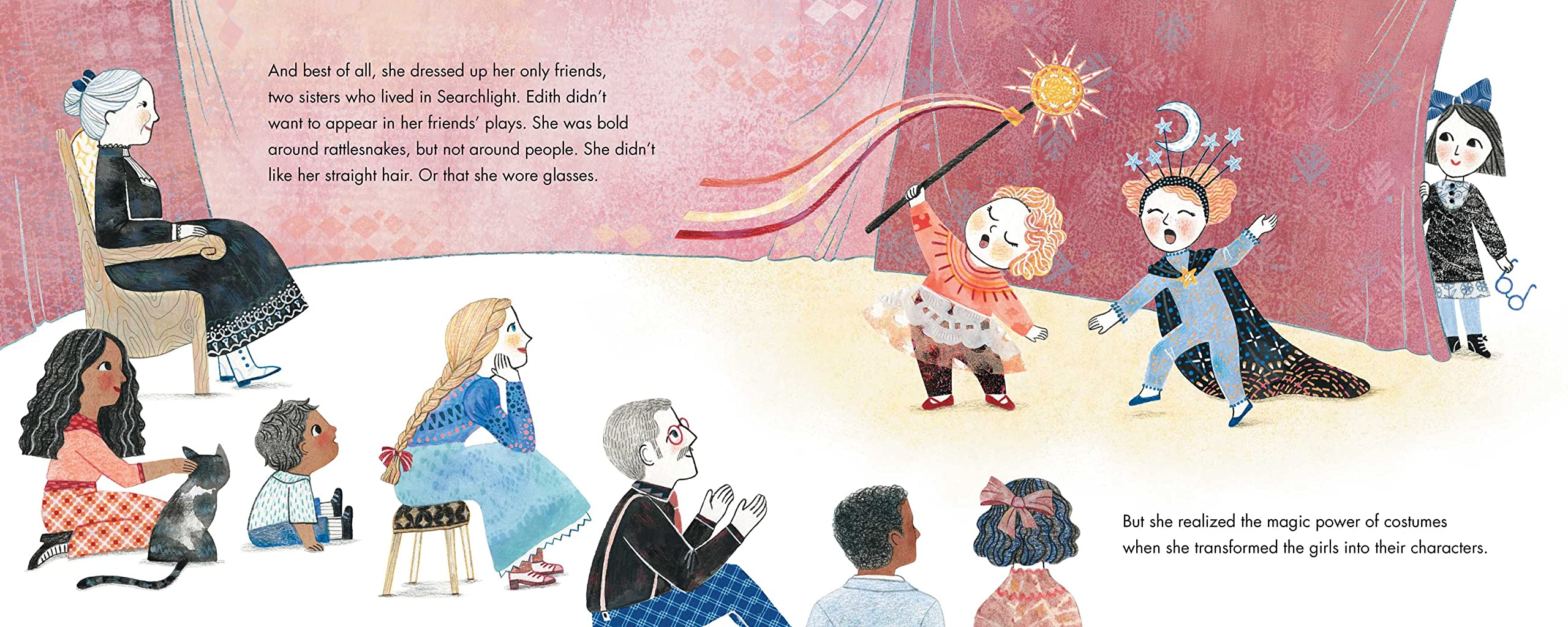
“Edith’s greatest treasure was her bag of fabric scraps,” which she added to by going door to door collecting cloth whenever she and her family visited Searchlight, Nevada, a few miles away. With these scraps she made furniture, rugs, and tablecloths for her dollhouse and clothes for her little dolls. But her favorite thing to do was make costumes for her two friends, who liked to perform and make up plays for their families and friends. Edith preferred staying behind the curtain, self-conscious about her straight hair and gasses.

celebrate-picture-books-picture-book-review-dressing-up-the-stars-friends

Image copyright Diana Toledano, 2022, text copyright Jeanne Walker Harvey, 2022. Courtesy of Beach Lane Books.

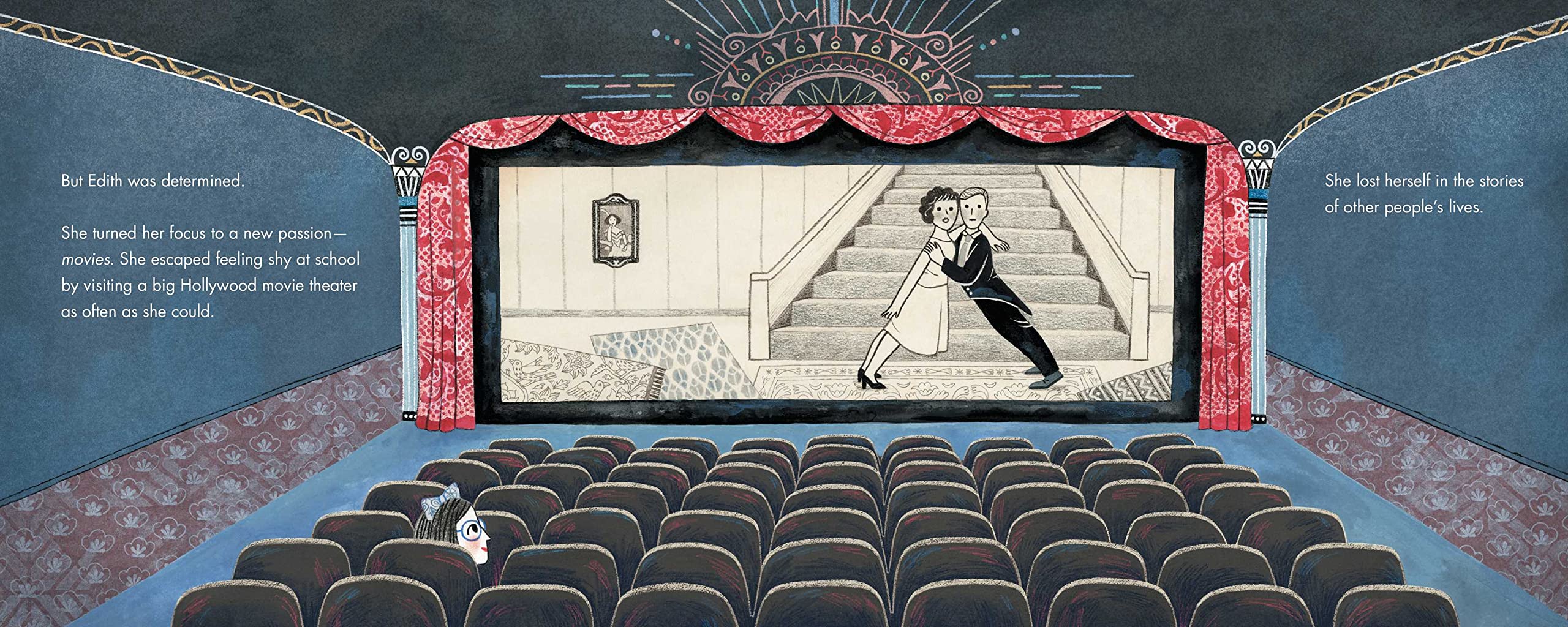
Every night, Edith wished on the stars that she could move away and transform her life. Her chance came when her mother enrolled her in high school in Los Angeles. Here, Edith set about trying to figure out what kind of career she would pursue. She tried piano and gymnastics, but finally found her passion at the movie theater. Watching actors on the screen, Edith was able to escape “feeling shy at school.”

celebrate-picture-books-picture-book-review-dressing-up-the-stars-movies

Image copyright Diana Toledano, 2022, text copyright Jeanne Walker Harvey, 2022. Courtesy of Beach Lane Books.

While Edith initially chose to become a teacher, after a few years “the allure of movies drew her back.” Without any formal art training, she found “a job as a sketch artist in a costume department of a movie studio.” When her boss discovered her lack of training, instead of firing her, he began teaching her how to draw costumes himself.

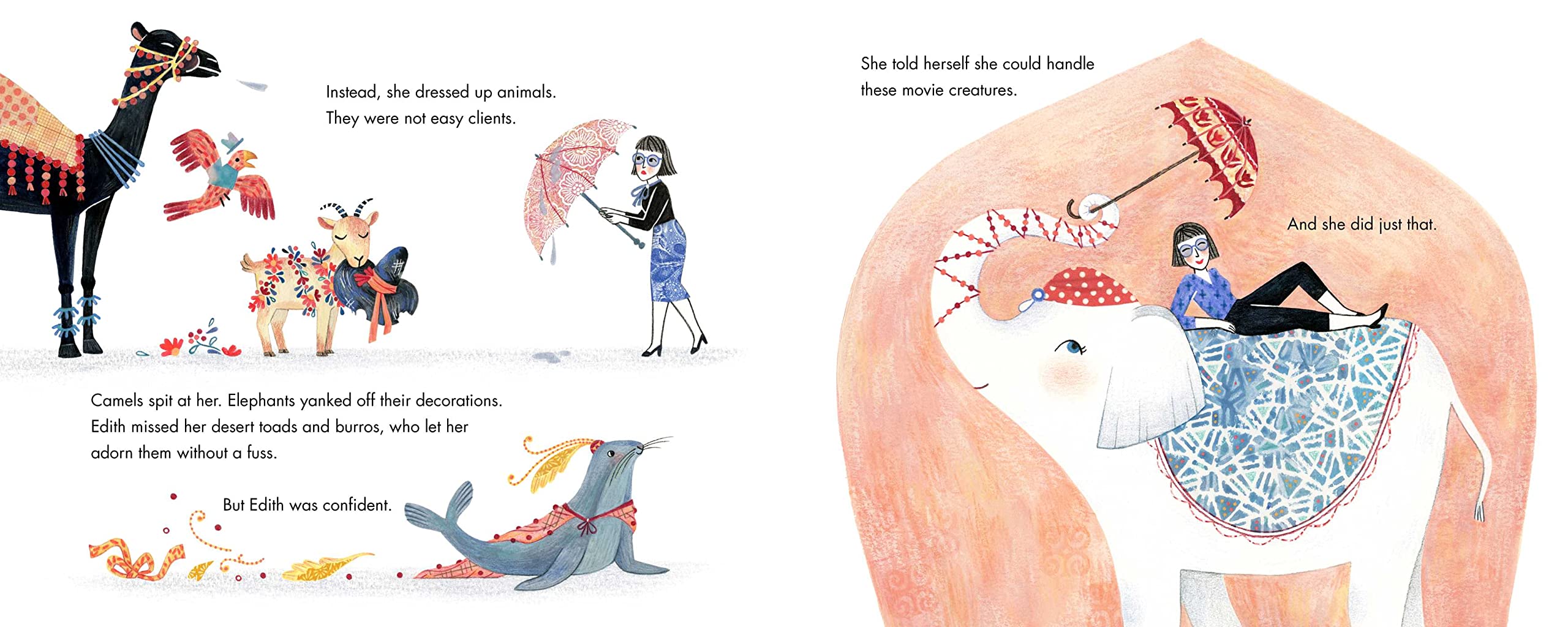
It took time and many rejections of her designs until Edith was finally entrusted with making costumes. But these weren’t for actors. “Instead, she dressed up animals. They were not easy clients.” But Edith was determined and soon she had a shot at dressing dancers as candy, but her designs, while creative, melted, cracked, and . . . flopped. But Edith got another chance.

celebrate-picture-books-picture-book-review-dressing-up-the-stars-animals

Image copyright Diana Toledano, 2022, text copyright Jeanne Walker Harvey, 2022. Courtesy of Beach Lane Books.

She worked hard for many years, gained experience, and was finally asked to “design costumes for famous movie stars.” Edith came to work on hundreds of movies, transforming actors into their characters and becoming famous herself. Then one night at the Oscars, Edith sat listening to the presenter announce the name of the winner for Best Costume Design. She was thrilled to hear her name, and “she climbed the stairs to the stage to accept her award” wearing a gown she’d designed herself.

Back matter includes an extended biography of Edith’s life, teaching, and work in Hollywood and includes photographs of Edith at work at her easel and dressing Dorothy Lamour in 1938 as well as a sketch for a costume worn by Grace Kelly in To Catch a Thief.

celebrate-picture-books-picture-book-review-dressing-up-the-stars-red-carpet

Image copyright Diana Toledano, 2022, text copyright Jeanne Walker Harvey, 2022. Courtesy of Beach Lane Books.

Jeanne Walker Harvey’s biography of Edith Head highlights this famous behind-the-scenes creator’s early life and dreams, her perseverance, and the self-confidence that spurred her on despite setbacks. Young readers will be interested to see how Edith’s childhood love for imaginary play, creating clothes for her pets and toys, and collecting cloth ultimately led to her career as a movie costume designer even though she pursued other jobs before recognizing her true passion. As she becomes involved in the movie industry, Edith’s receptiveness to learning and to learning from her mistakes provides a valuable lesson for all children. 

Diana Toledano’s charming illustrations show Edith at her creative and courageous best as she holds a tea party for her toys, dresses her bevy of unusual pets, and strikes out into the desert to play. Depictions of the small town of Searchlight, Nevada, Edith’s enchanting dollhouse, and a Los Angeles street orient readers to the time period, while the ornate movie theater and black-and-white film Edith watches show how the movies offered Edith escape from her shyness. Toledano’s textured images follow Edith as she practices, fails, practices some more, and finally achieves her goals. The final illustrations showing Edith at the Academy Awards ceremony, walking the red carpet and winning an Oscar shows kids that dreams really can come true.

An inspirational biography of a woman who broke barriers in Hollywood, Dressing Up the Stars will appeal to kids who are interested in the movies and all creative endeavors and encourage them to pursue their true passions.

Ages 3 – 8

Beach Lane Books, 2022 | ISBN 978-1534451056

Discover more about Jeanne Walker Harvey and her books on her website.

To learn more about Diana Toledana, her books, and her art, visit her website.

National Sewing Month Activity

celebrate-picture-books-picture-book-review-Dressing-Up-the-Stars-activity-kit-dressing-animals celebrate-picture-books-picture-book-review-Dressing-Up-the-Stars-activity-kit-paper-doll

Dressing Up the Stars Activity Kit


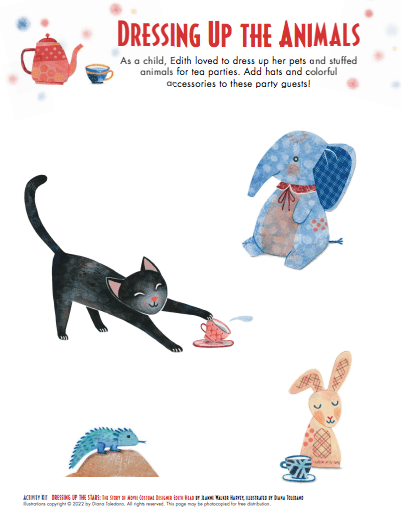
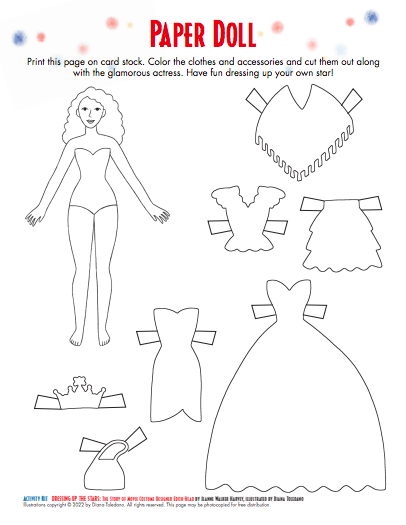
With this Dressing Up the Stars Activity Kit, kids can create their own costumes for Edith’s pets, a paper doll, and a character dressed as candy! They can even write the acceptance speech they’d give if they won an Oscar for their work on a movie!

celebrate-picture-books-picture-book-review-dressing-up-the-stars-cover

You can find Dressing Up the Stars: The Story of Movie Costume Designer Edith Head at these booksellers

Amazon | Barnes & Noble | Books-a-Million

To support your local independent bookstore, order from

Bookshop | IndieBound

Picture Book Review
September 14 – Live Creative Day

celebrate-picture-books-picture-book-review-ANNETTE-FEELS-FREE-cover

About the Holiday

National Live Creative Day was established to encourage people to embrace their innovative side. There are so many ways to be creative from the arts to science to sports to how you express yourself. Kids seem to know this inherently as they go about exploring and interacting with all the new things they see, hear, and do every day. Introducing kids to all kinds of hobbies, subjects, and professions expands their definition of creativity and their outlook on the future. Encouraging them to use their particular talents, helps them build confidence and find their place in the world. Reading today’s book with them is a great way to start! To celebrate today, take time to share your talents with others. You may be surprised at how creative you really are!

Thanks go to Beach Lane Books and Blue Slip Media for sharing a copy of Annette Feels Free with me for review consideration. All opinions on the book are my own.

Annette Feels Free: The True Story of Annette Kellerman, World-Class Swimmer, Fashion Pioneer, and Real-Life Mermaid

Written by Katie Mazeika


It was early 1900 and teenage Annette Kellerman was making a splash at Australia’s Melbourne Aquarium. She “was a real-life mermaid swimming and dancing with the fish…” to entertain visitors. The newspapers wrote about her, and people flocked to watch. Annette had always loved the freedom she felt while dancing, but when she was six, her legs became too weak for her to dance or to run or even to walk without braces. Sitting at home, Annette was no longer the happy little girl she had been.

Then one day, her father took Annette to swim in Lavender Bay. “She laughed and danced in the waves, kicking her legs. Splash, splash!” Annette swam so much that “she became the strongest swimmer in New South Wales” and no longer needed her leg braces. In addition to performing, Annette raced and soon she had broken all of Australia’s long-distance swimming records. She then moved to London and thrilled audiences there.

celebrate-picture-books-picture-book-review-ANNETTE-FEELS-FREE-aquarium

Copyright Katie Mazeika, 2022, courtesy of Beach Lane Books.

Annette and her father then traveled throughout Europe and America, where Annette performed her water dancing and raced against other swimmers—men included—and won. But there was one thing that was holding her back from even greater success—her swim costume. “Because she was a woman, she still had to perform and compete in a full skirt and pantaloons.” Why, she thought, did she have to wear something different and so cumbersome?

Annette decided to sew her own swim costume. Her new one-piece suit with short legs was so liberating. She felt as she had as a girl first learning to swim and dance in Lavender Bay. But not everyone saw her swimsuit in the same light. When she wore it to the beach in Boston, the crowd was shocked, and she was even arrested for “not wearing enough clothing!” Arguing her case in front of a judge, Annette showed the court the difference in men’s and women’s swimwear and stated that she should have the same freedom as men. The judge agreed, but with a caveat: she had to remain covered up all the way to the water’s edge. Her new swimwear became a hit with other women, who even called it the Annette Kellerman.

celebrate-picture-books-picture-book-review-ANNETTE-FEELS-FREE-dancing

Copyright Katie Mazeika, 2022, courtesy of Beach Lane Books.

Annette’s career continued to take her all over the world and even made her a movie star! She trained other women in “ornamental swimming”, which later became known as “synchronized swimming.” Now called “artistic swimming”, Annette Kellerman’s revolutionary style is a recognized sport at the Summer Olympics.

Back Matter includes an expanded biography of Annette Kellerman, complete with photographs, and an Author’s Note about Katie Mazeika’s own experiences with a physical disability and how these life-changing occurrences shape who someone is and the careers they pursue.

celebrate-picture-books-picture-book-review-ANNETTE-FEELS-FREE-diving

Copyright Katie Mazeika, 2022, courtesy of Beach Lane Books.

A comprehensive and compelling biography of a woman who broke barriers while advocating for women and changing fashion mores forever, Annette Feels Free is historical storytelling at its best. Katie Mazeika clearly links Annette’s early disability, her perseverance, and her recovery to her recognition of her unique talent. Mazeika’s conversational narrative draws readers into Annette’s emotions and passion for swimming. Historical points of interest—women’s swim costumes, hot cocoa sipped mid-swim across the English Channel, Annette’s success in court, and her continued influence on swimming, for example—will amaze children and spark a desire to investigate more about Annette Kellerman and her times.

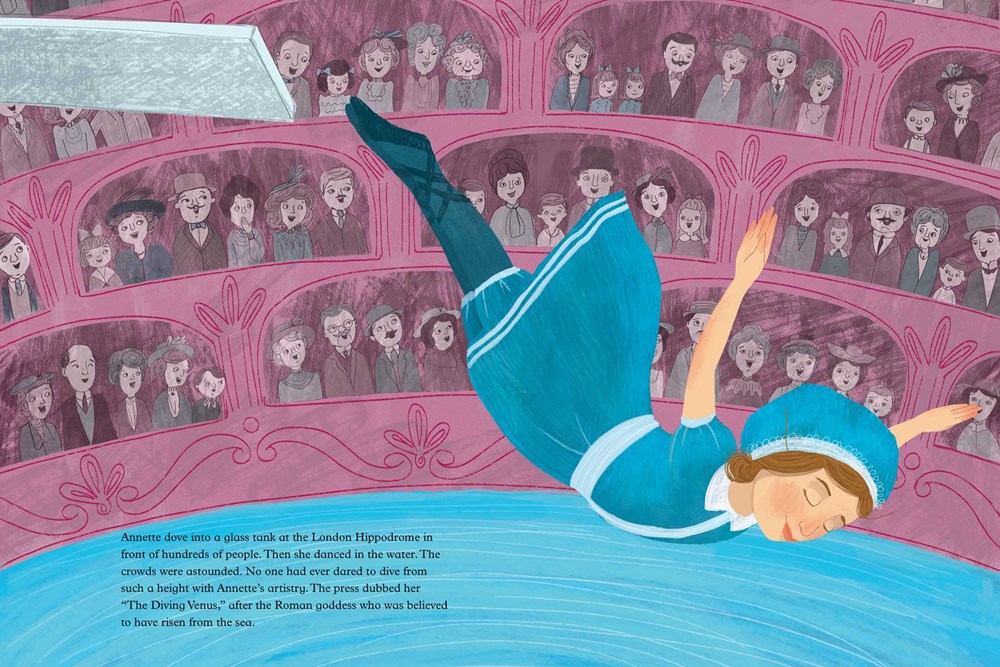
Mazeika’s full-bleed illustrations in this slightly oversized book lend grandeur to the pages, bringing readers into the aquarium’s fish tank to watch spectators’ reactions as Annette becomes “the original mermaid”; depicting her early love of dancing and distress at her braced legs; and falling with her as she thrills London audiences with graceful dives. Children will be particularly fascinated by images of Annette swimming, diving, and dancing in the proscribed swimming costume for women that included a cap and dress trimmed in lace, pantaloons, tights, and ballet-flat type shoes tied to her ankles. Her self-confidence and indomitable spirit grace each spread and are sure to inspire readers. 

For young readers, Annette Kellerman’s long, prolific, and creative career has the power to inspire their own creative endeavors. Annette Feels Free offers multilevel opportunities for lessons in history, the arts, and even math and science (how much did that swim costume weigh, anyway?). The book is highly recommended for home, school, and public libraries.

Ages 4 – 8

Beach Lane Books, 2022 | ISBN 978-1665903431

Katherine Mazeika is an author and illustrator with a BFA from the Columbus College of Art and Design. When she isn’t in the studio, she likes to spend time at the theater, in her garden, or getting lost in a good book. She lives in Ohio with her husband, two kids (Lillian and Jack), and two dogs.

celebrate-picture-books-picture-book-review-ANNETTE-FEELS-FREE-curriculum-guide-cover

To learn more, and download a free curriculum guide, visit her website at katiemazeika.com. You can connect with Katie on Facebook: Katie Mazeika Illustration | Instagram: @kdmazart | Twitter: @kdmaz

Live Creative Day Activity


Video of Annette Kellerman’s “Ornamental Swimming”


Watch Annette Kellerman swim her water ballet in this rare footage from MermaidFX.

Million Dollar Mermaid Movie Scene


Now watch a thrilling scene from the movie Million Dollar Mermaid, the 1952 biopic about Annette Kellerman’s life starring Esther Williams, whose career was inspired by Kellerman.

celebrate-picture-books-picture-book-review-ANNETTE-FEELS-FREE-cover

You can find Annette Feels Free at these booksellers at

Amazon | Barnes & Noble | Books-a-Million

To support your local independent bookstore, order from

Bookshop | IndieBound

Picture Book Review
November 5 – It’s Family Stories Month

celebrate-picture-books-picture-book-review-niki-nakayama-a-chef's-tale-in-13-bites-cover

About the Holiday

Children benefit in many ways from close relationships to grandparents, aunts, uncles, cousins, and other extended family members. This month and next, as family gathers together for special holiday events, it’s a terrific time for adults to share family history and their own stories of growing up with the younger generation. Letting kids know how much they’re loved by everyone in the family helps them develop a sense of belonging, a good self-image, and confidence. Reading together is a perfect way to spend time together and get conversations started. 

Niki Nakayama: A Chef’s Tale in 13 Bites

Written by Jamie Michalak and Debbi Michiko Florence | Illustrated by Yuko Jones


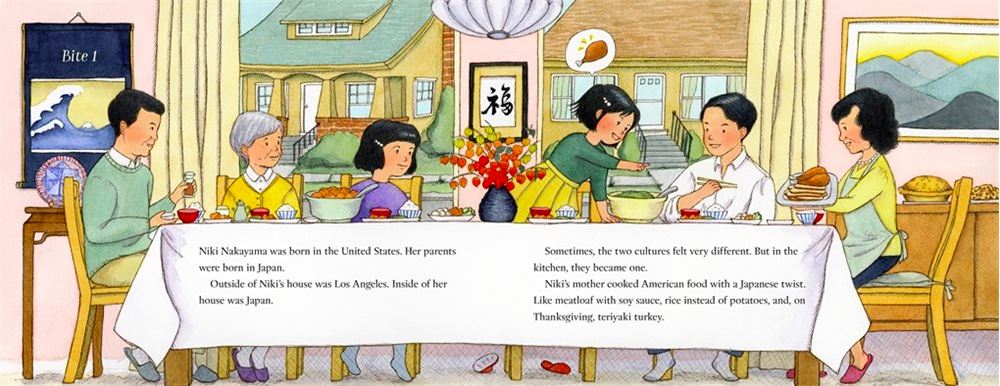
This true story opens with an invitation to listen as Niki Nakayama talks about her journey to becoming a chef in thirteen bites. “Come. Sit. Taste…” Bite 1: Niki was born in California but her parents were born in Japan. “Outside of Niki’s house was Los Angeles. Inside of her house was Japan.” While the two cultures often felt disparate, in Niki’s family’s kitchen “they became one.” Niki’s mother always put a Japanese twist on American dishes, with soy sauce or rice or teriyaki.

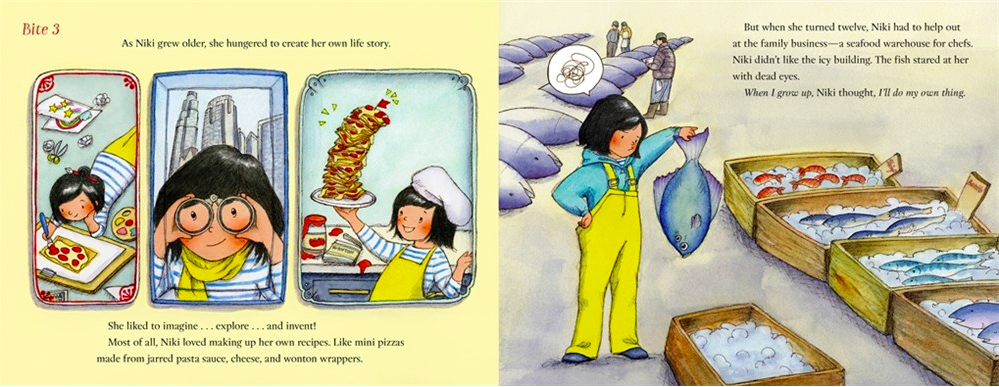
Bite 2: Close to New Year’s Eve, Niki’s grandmother took her to the grocery store to shop for the holiday dinner. Niki was excited. She loved buying all the ingredients for the feast to come: an opportunity to share “a table of love and laughter” in addition to the food. As Niki grew older, she created her own recipes and determined that she would get away from her family’s seafood-selling business and do her own thing.

celebrate-picture-books-picture-book-review-niki-nakayama-a-chef's-tale-in-13-bites-family-table

Image copyright Yuko Jones, 2021, text copyright Jamie Michalak and Debbi Michiko Florence, 2021. Courtesy of Farrar Straus Giroux.

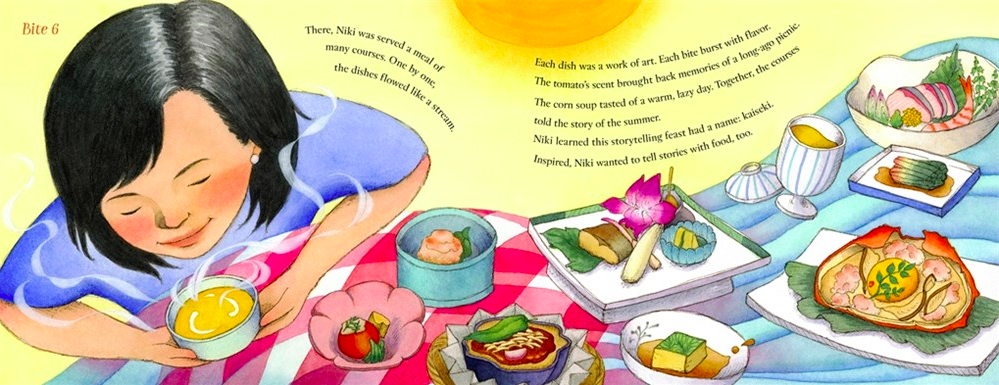
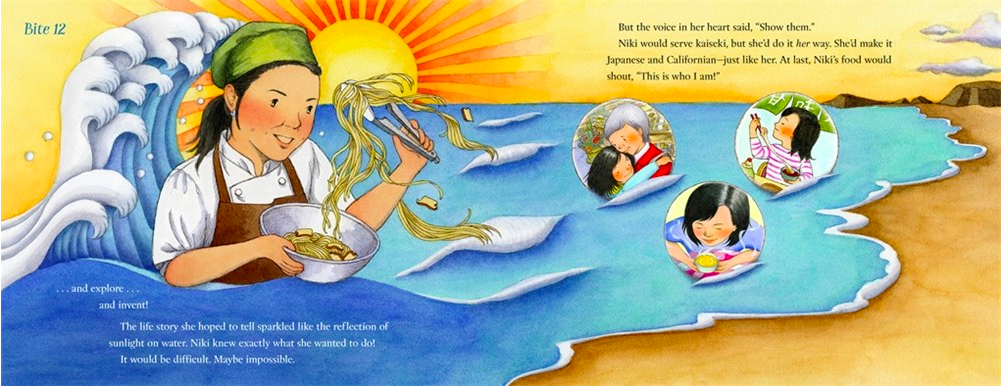
Niki’s dreams seemed to get little attention from her parents, who doted on their son and encouraged his success. But Niki new she could be successful too. “Kuyashii! Niki thought. ‘I’ll show them!’” After high school, Niki traveled to Tokyo, Japan, tasting all the delicious food on offer. Later she took the train to where her cousins owned an inn. There she was served a meal comprised of many dishes, each “a work of art” and each with a delicious memory attached or story to tell. “Niki learned this storytelling feast had a name: kaiseki.”

When Niki returned home, she told her mother she wanted to go to school to become a chef. Her mother discouraged her, but Niki went anyway. “She began to see food as art—a carrot as a mountain.” And while her family thought her cooking was just a hobby, Niki thought “Kuyashii! ‘I’ll show them!’” Niki got a job at a sushi restaurant. “Female sushi chefs were rare,” and the head chef didn’t think she could handle the work. “‘You’re just playing chef,’ he joked.” But Niki told him she wasn’t playing.

celebrate-picture-books-picture-book-review-niki-nakayama-a-chef's-tale-in-13-bites-fish-market

Image copyright Yuko Jones, 2021, text copyright Jamie Michalak and Debbi Michiko Florence, 2021. Courtesy of Farrar Straus Giroux.

After working there and learning all she could, Niki decided to travel back to her cousins’ inn to study kaiseki. But there was a big obstacle. “As far as she knew, female kaiseki chefs didn’t exist. In Japan recipes and training was only handed down to males. People told Niki her dream was impossible, but she thought she could do it. Niki studied for three years and then returned to Los Angeles to open a sushi restaurant of her own.

Instead of being happy for her, her family was dismissive. At last she convinced them to give her a loan—but it came with the stipulation that “if the restaurant failed, she would have to close it and say goodbye to her dream forever.” Instead of the kaiseki dishes she wanted to serve, her mother thought sushi would be a better choice. Against her own wishes, she agreed. In a year, customers were lining up for her food. But making sushi was not what she really wanted to do.

celebrate-picture-books-picture-book-review-niki-nakayama-a-chef's-tale-in-13-bites-bite-6

Image copyright Yuko Jones, 2021, text copyright Jamie Michalak and Debbi Michiko Florence, 2021. Courtesy of Farrar Straus Giroux.

She closed her restaurant and wondered what to do next. Then, after much thought and exploration, she had her answer. She wanted to serve kaiseki that told her story—both Japanese and Californian. “Niki called her new restaurant n/naka. Naka means ‘inside’ in Japanese. Finally, Niki was inside her dream.” Through thirteen courses she told her stories—never serving customers the same meal twice. Now, every night tables are full of love and laughter, and Niki showed everyone that she could be a master chef.

Back matter includes a timeline of Niki Nakayama’s life from her birth in Los Angeles in 1974 to the awarding of two Michelin stars for her restaurant n/naka in 2019; a discussion of the words kuyashii and kaiseki; and a recipe for wonton pizza.

celebrate-picture-books-picture-book-review-niki-nakayama-a-chef's-tale-in-13-bites-kaiseki

Image copyright Yuko Jones, 2021, text copyright Jamie Michalak and Debbi Michiko Florence, 2021. Courtesy of Farrar Straus Giroux.

Jamie Michalak and Debbi Michiko Florence’s biography of Niki Nakayama is an enthralling story of self-confidence, obstacles overcome, and success that will inspire readers to stay true to the voice inside themselves. Telling Nakayama’s story through thirteen bite-sized vignettes that reveal formative moments in her life that informed her journey is a captivating and effective way to show Niki’s growth as a chef as well as to explain the meaning and experience of kaiseki.

Readers will respond to Michalak’s and Florence’s straightforward text and the details of the hurdles placed in her way. One take-away for adult readers is the importance of recognizing, encouraging, and supporting their children’s dreams and talents—an awareness that can lead to ongoing discussions with kids as they grow, learn, and get involved in activities.

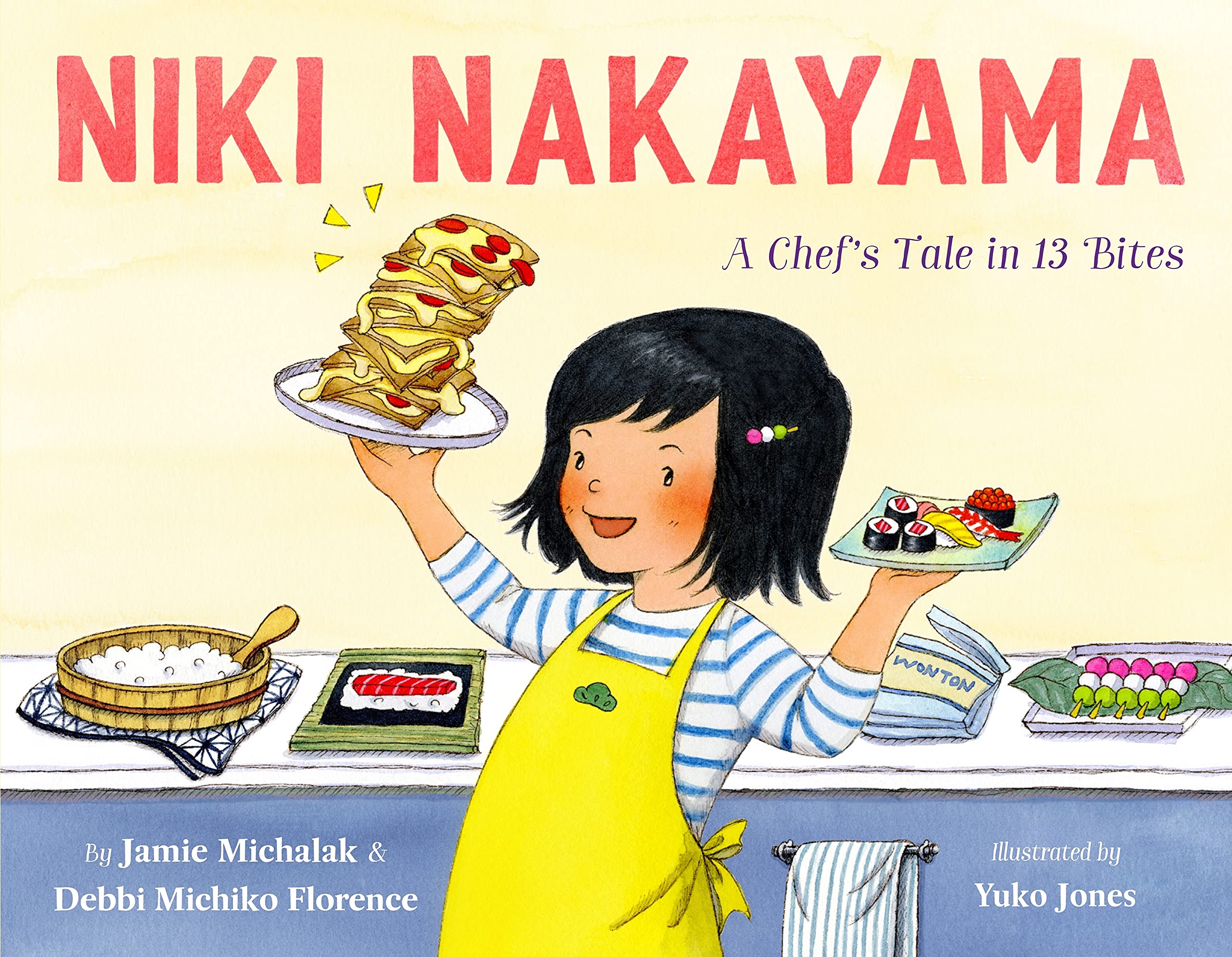
Yuko Jones’ lovely illustrations take readers into Niki Nakayama’s home to see her interacting with her family and the foods that so inspired her life’s work. Jones’ images of Japanese delicacies are particularly beautiful, giving kids a strong understanding of the courses served during a kaiseki meal. Niki’s self-assurance in the face of her family’s protests and her male-dominated culinary school class as well as the rarity of female sushi chefs is stirring for all readers. Jones’ final page spreads reveal the gorgeous dishes Niki serves and the inviting atmosphere at her restaurant n/naka.

A captivating and impactful biography of a contemporary chef and role model, Niki Nakayama: A Chef’s Tale in 13 Bites is a must for home, classroom, school, and public library collections to inspire all kids who are contemplating their place in the world now and in the future.

Ages 4 – 10

Farrar, Straus, and Giroux, 2021 | ISBN 978-0374313876

Discover more about Jamie Michalak and her books on her website.

You can learn more about Debbi Michiko Florence and her books on her website.

To learn more about Yuko Jones and see a portfolio of her work, visit her website.

You can learn more about n/naka and view a gallery of Niki Nakayama’s spectacular dishes on the n/naka website.

Family Stories Month Activity

celebrate-picture-books-picture-book-review-niki-nakayama-a-chef's-tale-in-13-bites-coloring-page

Niki Nakayama: A Chef’s Tale in 13 Bites Activity Kit


Educators and families can find an extensive Activity Kit and coloring pages to accompany classroom or homeschool lessons or just for fun on Jamie Michalak’s website and Debbi Michiko Florence’s website.

celebrate-picture-books-picture-book-review-niki-nakayama-a-chef's-tale-in-13-bites-cover

You can find Niki Nakayama: A Chef’s Tale in 13 Bites at these booksellers

Amazon | Barnes & Noble | Books-a-Million

To support your local independent bookstore, order from

Bookshop | IndieBound

Picture Book Review
September 29 – It’s Intergeneration Month

celebrate-picture-books-picture-book-review-shaped-by-her-hands-cover

About the Holiday

Cuddle ‘round for two loving holidays—Intergeneration Month and National Attend Your Grandchild’s Birth Day—which each encourage grandparents to be present figures in their grandchildren’s lives starting from birth! Already, many grandparents across the globe play active roles in caring for children. In the US alone, 4.8 million preschoolers were under the care of grandparents in 2011. Whether you are a grandchild, parent, or grandparent, it is important to support family and spread some love. Hug someone special today to celebrate this holiday. In honor of this day, we present a story about artist Maria Povika Martinez, co-written by her great-granddaughter. Her historical account teaches the importance of love, family, and the passing down of knowledge through generations.

Thanks to Albert Whitman & Company for sharing a copy of Shaped By Her Hands with me for review consideration. All opinions on the book are my own.

Review by Dorothy Levine

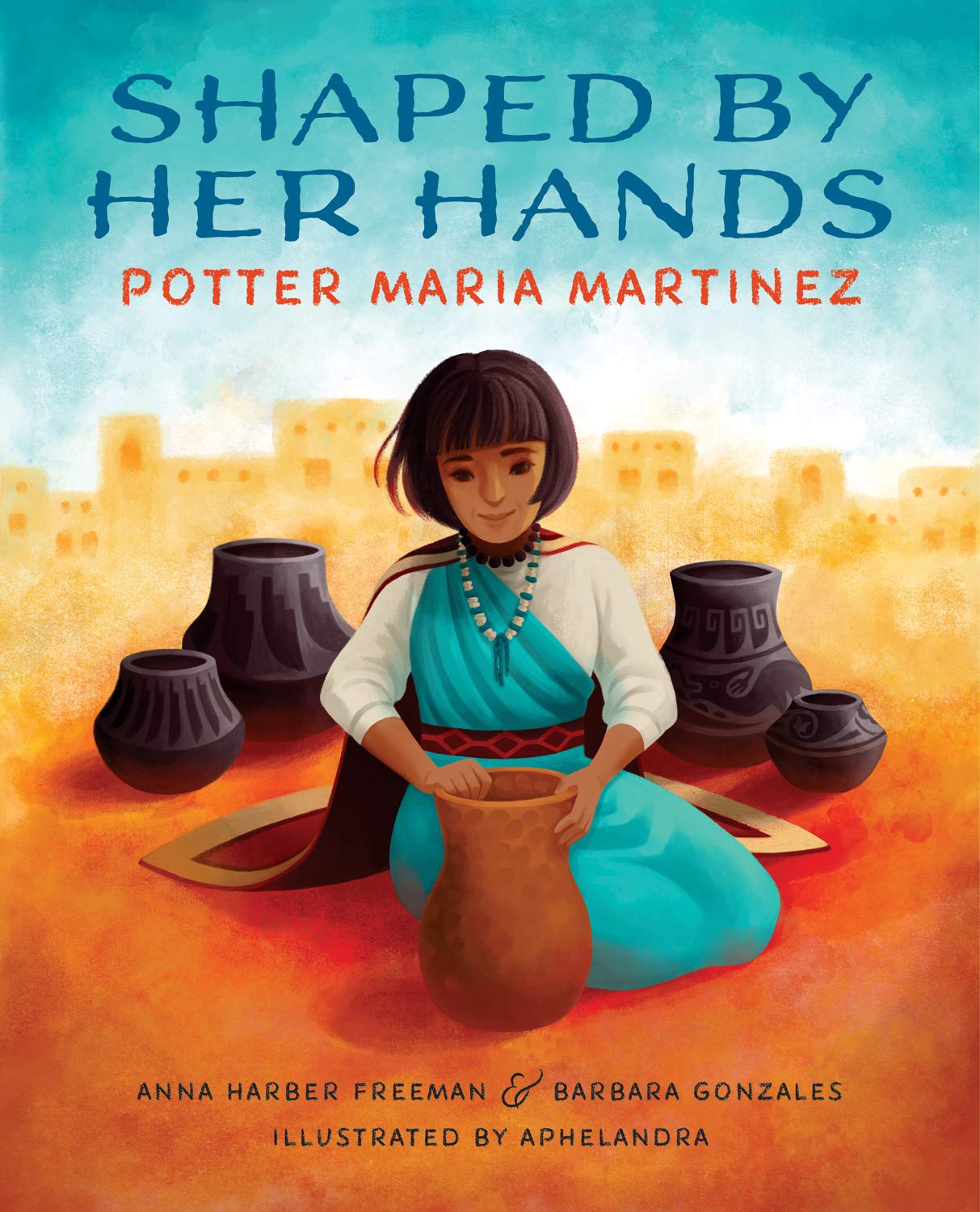
Shaped By Her Hands: Potter Maria Martinez (Part of the She Made History Series)

Written by Anna Harber Freeman and Barbara Gonzales | Illustrated by Aphelandra

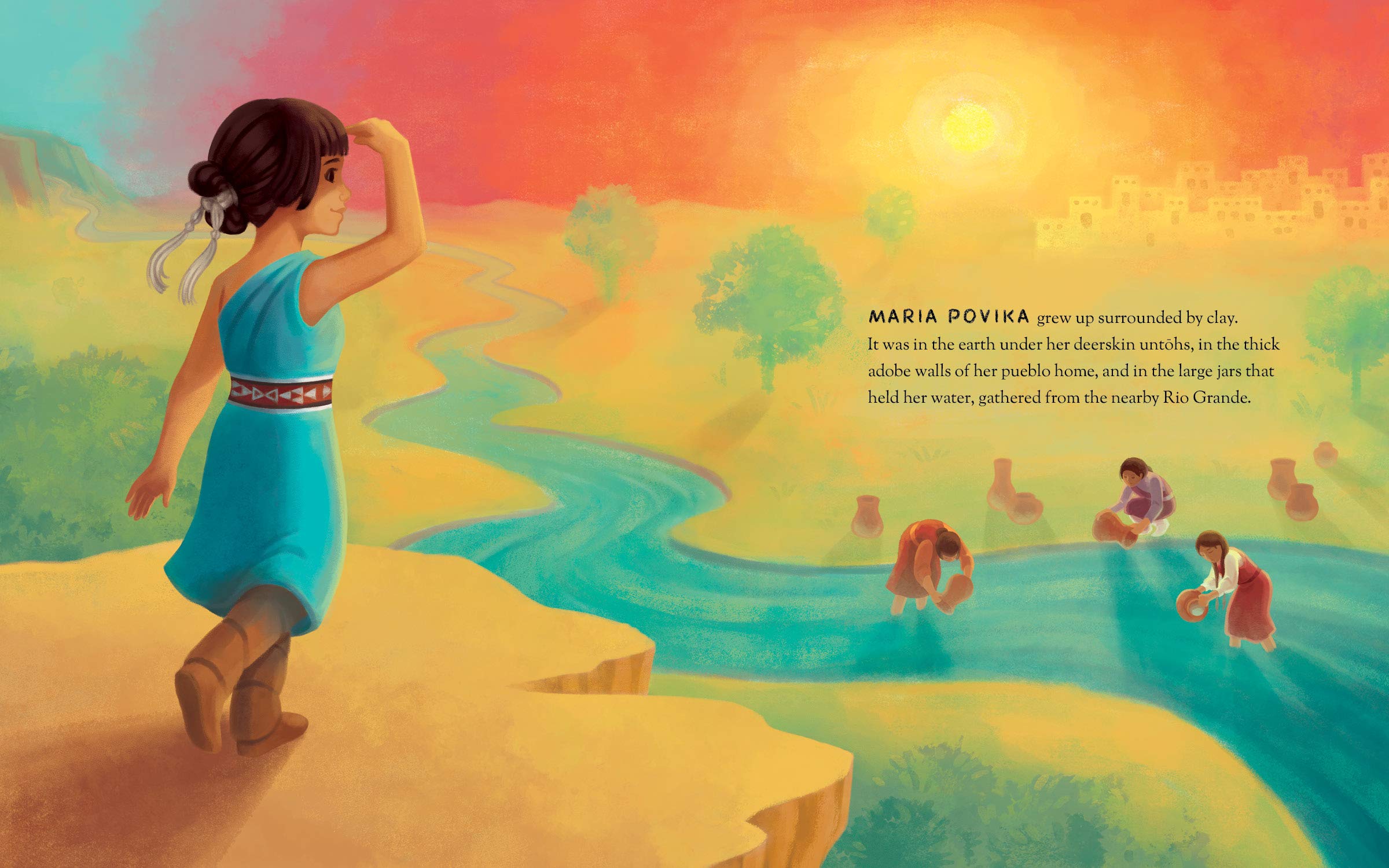
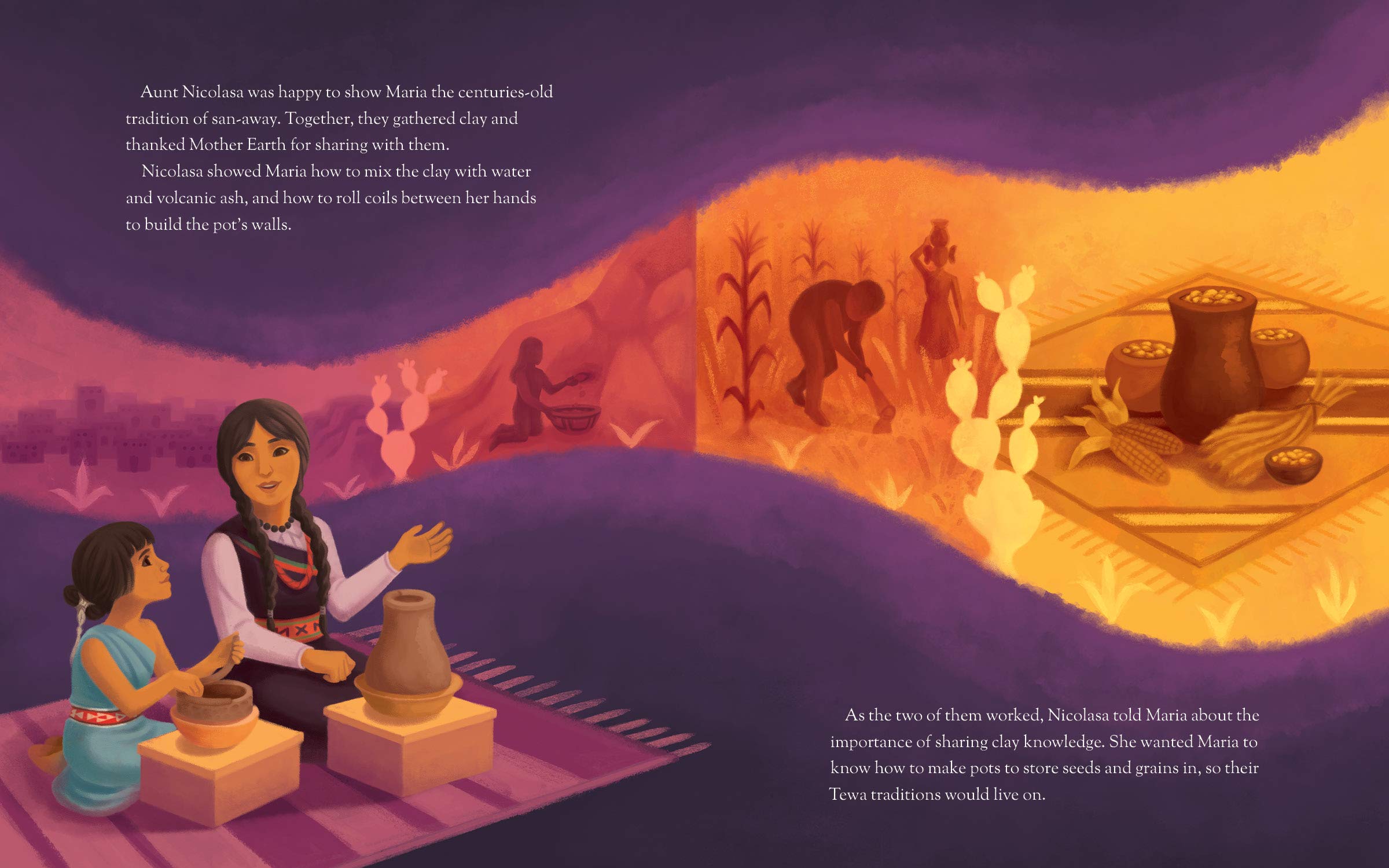
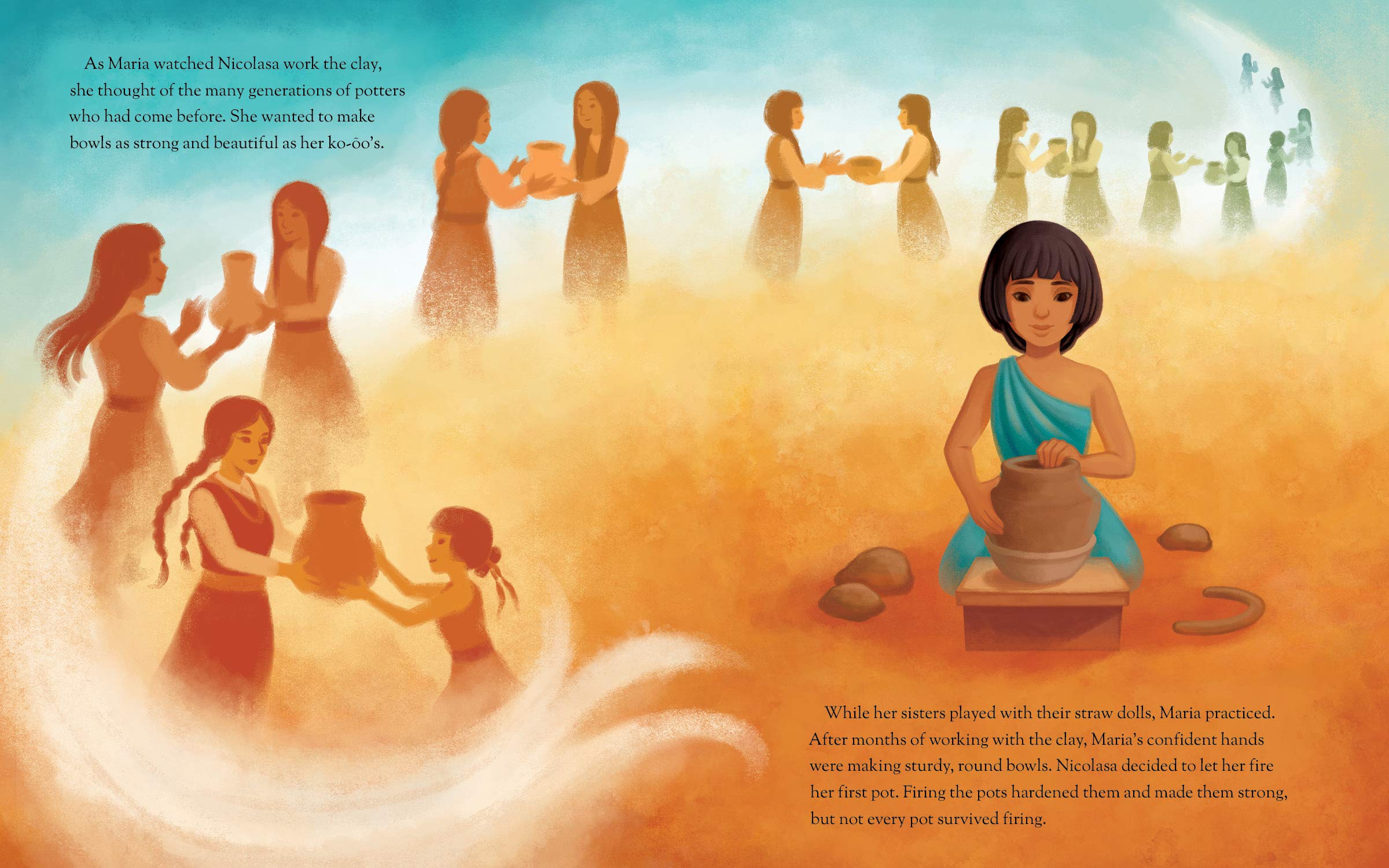
As a child growing up in the pueblo of San Ildefonso, New Mexico in the 1890s, Maria always loved clay. While her siblings played with straw dolls and her parents planted crops, Maria spent her time making clay pots. But, to her frustration, her pots would always crack when she set them out to dry in the sun. Maria’s aunt, or ko-ōo, Nicolasa offered to help and showed Maria “the centuries-old tradition of san-away.” Nicolasa still made clay pots using these traditional methods, even though more and more people were buying tin pots from stores. 

celebrate-picture-books-picture-book-review-shaped-by-her-hands-river

Image copyright Aphelandra, 2021, text copyright Anna Harber Freeman and Barbara Gonzales, 2021. Courtesy of Albert Whitman & Company.

Nicolasa taught Maria how to coil the clay in circles and then lay the pots together on a fire to make them dry, solid, and strong. “As Maria watched Nicolasa work the clay, she thought of the many generations of potters who had come before. She wanted to make bowls as strong and beautiful as her ko-ōo’s.” Nicolasa and Maria thanked Mother Earth for the clay she shared with them. 

When Maria grew older, she continued to make pots and gained a reputation for her skilled work. One day in 1908, an archeologist named Edgar Lee Hewett came to visit Maria. He had discovered an old shard of black pottery in a dig nearby. Mr. Hewett wanted to know if Maria could recreate a pot in the similar style. She decided to take on the challenge.

celebrate-picture-books-picture-book-review-shaped-by-her-hands-Nicolasa

Image copyright Aphelandra, 2021, text copyright Anna Harber Freeman and Barbara Gonzales, 2021. Courtesy of Albert Whitman & Company.

After much experimentation, Maria and her husband, Julian Martinez, discovered a technique: “One afternoon, they tried smothering the fire to keep the smoke in. When they pulled out the pot, it was shiny, and black as a raven.” With this new method, Maria combined her own style with old traditions to create a new style of pottery that was marvelous. Mr. Hewitt took some of these pots Maria made. “He put one of the pots in the Museum of New Mexico, where he worked.” The others he took to shops in Santa Fe. To Maria’s surprise, they sold like crazy! Julian began to paint designs on the black shiny pots—decorations of serpents, feathers, and water—using a yucca-blade brush. 

As more and more pots sold, Maria and Julian taught the rest of her family and some friends to make the pots with them. They became so famous that many people across the country invited them to demonstrate their skills to others. When Maria’s husband died, she continued to make pots with her family. “First, her children came to paint the designs. Later, her grandchildren came to help with the painting and polishing. They made pots as a family, remembering to thank Mother Earth, and teaching new hands to form, polish, and design.” 

The story is followed by back matter that provides more information about Maria, the Tewa people, and the San Ildefonso Pueblo for readers. Both authors include a note about how they were influenced by Maria and why they believe it is important to share her story with young people today. 

celebrate-picture-books-picture-book-review-shaped-by-her-hands-generations

Image copyright Aphelandra, 2021, text copyright Anna Harber Freeman and Barbara Gonzales, 2021. Courtesy of Albert Whitman & Company.

The story is co-written by Barbara Gonzales, the great-grandchild of Maria, and Anna Harber Freeman, whose grandmother was a member of the Osage Nation and who is a lifelong fan of Maria’s work with degrees in multicultural education and art. Their biography of Maria Martinez shines with its lyrical, straightforward telling that reveals the deep history of the Tewa people as well as the meaning and uses of the pottery that Maria and her ko-ōo Nicolasa created by hand. The importance of passing down knowledge and traditions from one generation to another is organically woven throughout the story. Many readers will recognize Maria and Julian’s distinctive pottery and be inspired by the history behind it.

Aphelandra is a descendant of the Oneida Nation, and the daughter of a crafts artist and landscaper. She writes that she grew up surrounded by natural beauty and creativity, which can be seen in her illustrations. The illustrations in Shaped by Her Hands consist largely of soft yellow, green, and red hues. In the part of the story in which Maria is sent off to boarding school, the colorful tones found throughout the book are confined to a single window, depicting the feeling of entrapment and homesickness Maria felt. Aphelandra vividly weaves in the storytelling of past generations through her use of color, shadow and circular imagery. Her painted landscapes gorgeously depict the natural San Ildefonso scenery. 

This beautifully crafted tale shares the history of Maria Povika Martinez while introducing readers to Tewa people’s values of kindness, passing on of knowledge, and respect for elders and Mother Earth. An inspiring read for all children, especially those interested in artistic and creative endeavors, Shaped By Her Hands: Potter Maria Martinez is highly recommended for home bookshelves and a must for school and public library collections.

Ages 4 – 9 

Albert Whitman & Company, 2021 | ISBN 978-0807575994

Discover more about Anna Harber Freeman and her books on her website.

To learn more about Barbara Gonzales and her pottery and to view a video with Barbara and other artists discussing an exhibition of San Ildefonso Pueblo potters at the Museum of Indian Arts and Culture, visit the adobe gallery website.

You can learn more about Aphelandra, her books, and her artwork on her website.

Intergeneration Month Activity

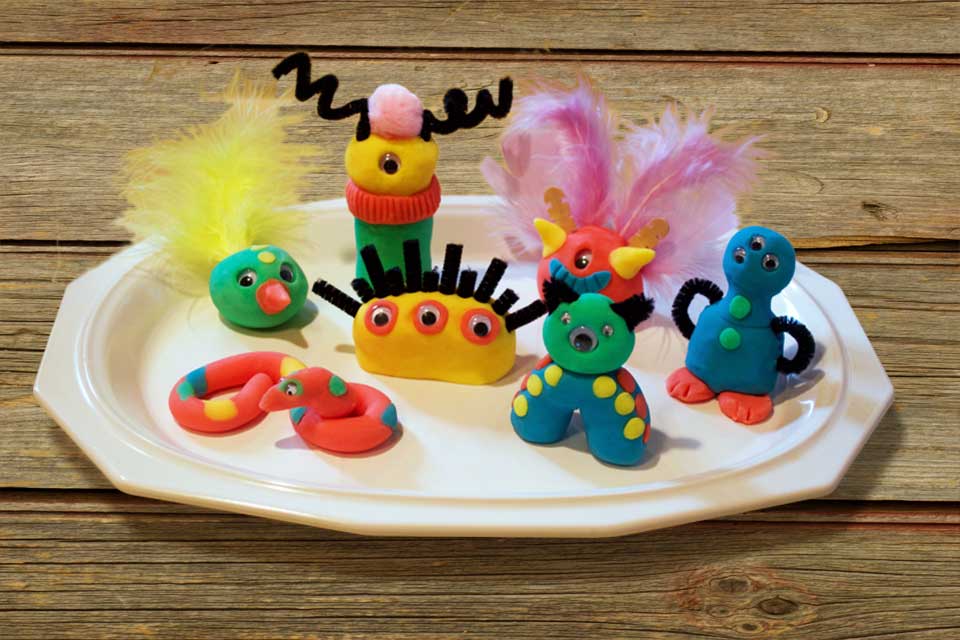
Highlights Kids Homemade Clay figures

Photo and craft sample by Madison McClain, courtesy of Highlights Kids (highlightskids.com)

This craft comes from Highlights Homemade Clay, by Marie E. Cecchini posted on April 12, 2016. You can find the post on the Highlights kids website.

Make your own homemade clay in honor of Maria’s art form then make your own pot or creation!

What you’ll need

  • 2 cups baking soda
  • 1 cup cornstarch
  • 1 ¼ cups water
  • Cooking pot
  • Food coloring (optional)
  • Wiggly eyes, chenille sticks, pompoms, feathers, etc. (optional)

What to do

Note: Food coloring can be added to the water before mixing in the other ingredients or can be added to the clay after it has cooled. Adding coloring later may be a little messier, but you can divide the clay and create different batches of various colors.

  1. Combine ingredients in the pot and cook mixture over medium heat, stirring until it thickens to a consistency like mashed potatoes.
  2. Let the clay cool
  3. Knead the clay until smooth.
  4. Make creations!
  5. Leave clay pieces in the sun to dry.

celebrate-picture-books-picture-book-review-shaped-by-her-hands-cover

You can find Shaped By Her Hands: Potter Maria Martinez at these booksellers

Amazon | Barnes & Noble | Books-a-Million

To support your local independent bookstore, order from

Bookshop | IndieBound

Picture Book Review

August 19 – World Photography Day

celebrate-picture-books-picture-book-review-dorothea's-eyes-cover

About the Holiday

Photography is all about providing information and emotion through images. A picture really can be worth a thousand words in capturing a moment of surprise, joy, danger, or sadness. Well-placed photographers, videographers, and cinematographers have given voice to some of society’s pivotal moments, allowing the whole world to witness change, often as it is happening. Today we celebrate the “art, craft, science, and history of photography,” as well as those photographers who often put themselves in danger to get the story and those who bring us much-needed lighter moments. To learn more visit the World Photography Day website.

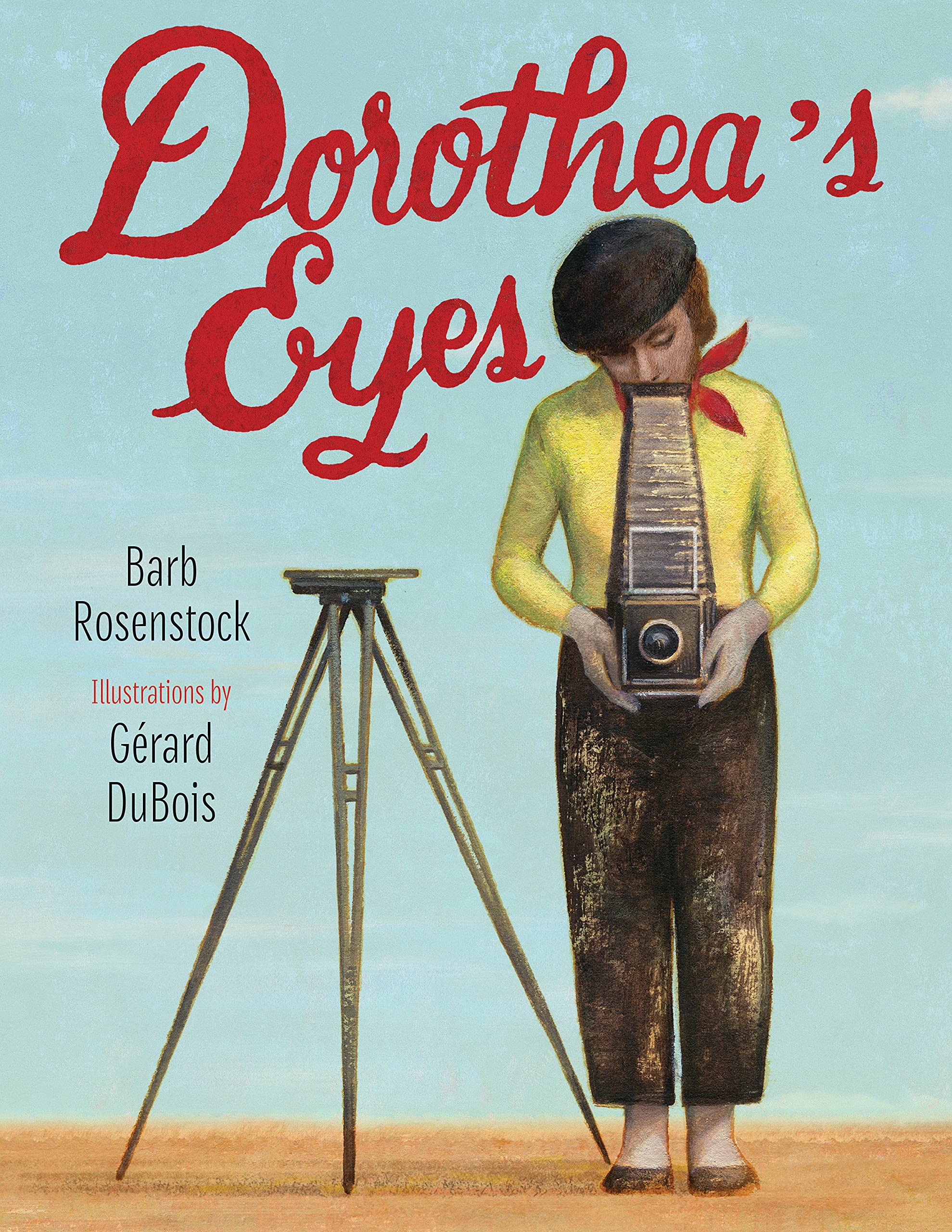
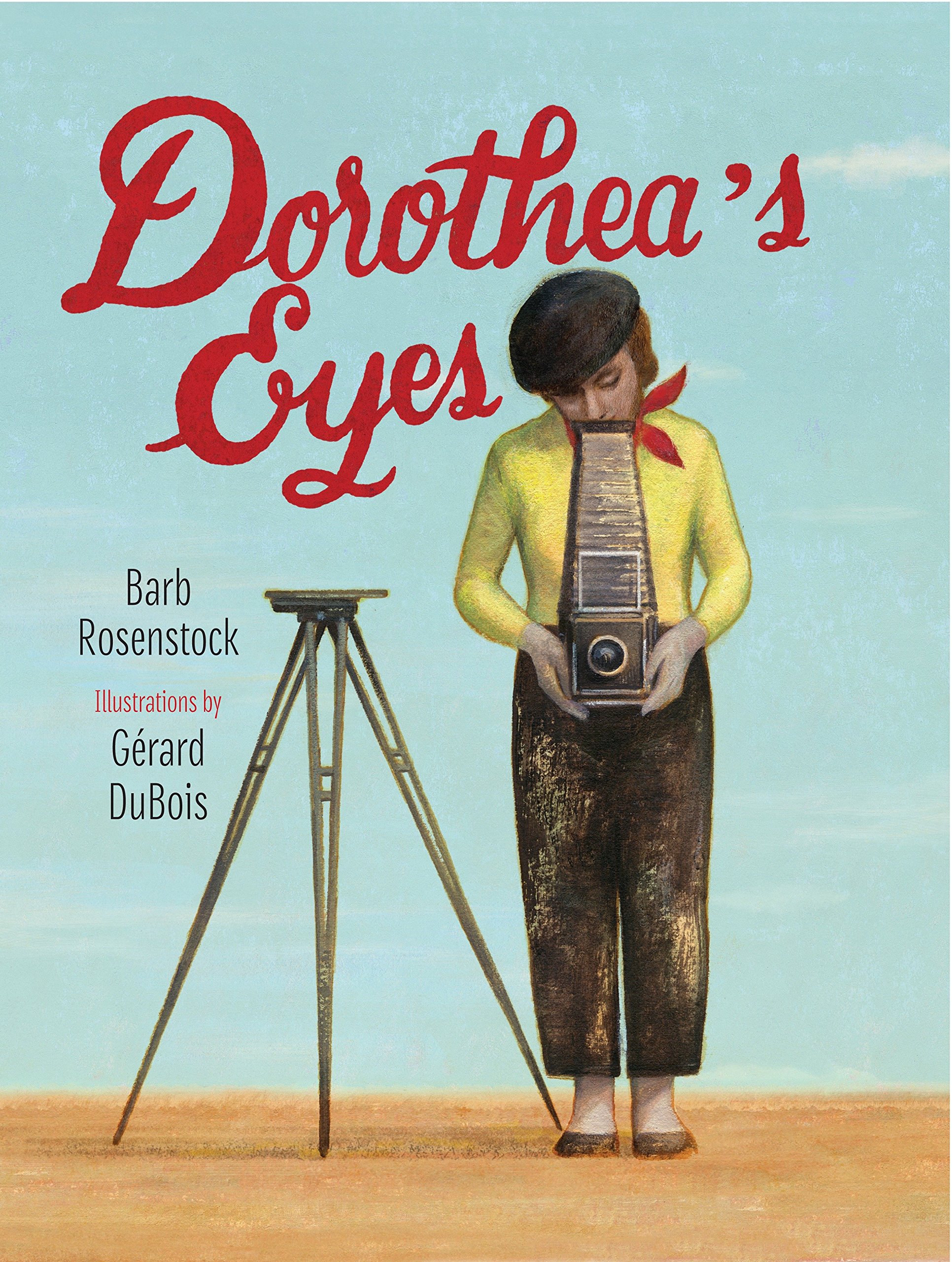
Dorothea’s Eyes: Dorothea Lange Photographs the Truth

Written by Barb Rosenstock | Illustrated by Gérard DuBois


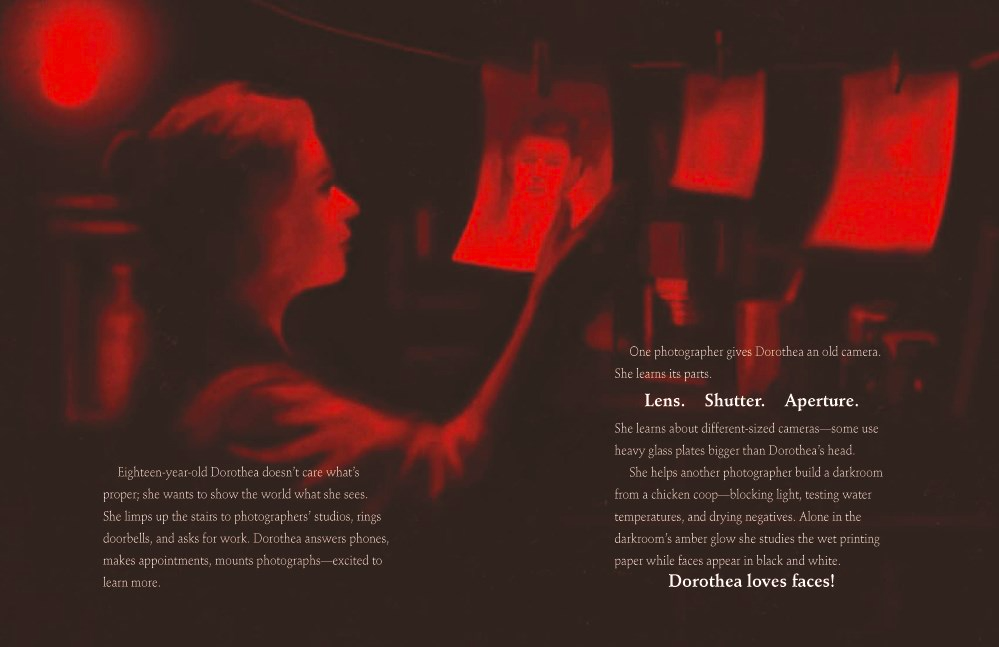
When Dorothea Lange opens her green eyes, she sees things others miss. In the shadows, in patterns within the grain of wooden tables, in the repeated shapes of windows on a wall, and most especially in people’s faces. “Dorothea loves faces! When Dorothea looks at faces, it’s like she’s hugging the world.”

At seven years old Dorothea contracts polio, which withered her right leg and left her with a permanent limp. Other kids tease her and make her want to hide, and although her mother encourages her Dorothea pretends to be invisible. When her father leaves his family, her mother gets a job in New York and Dorothea goes to a new school. Because she is different, she feels lonely.

celebrate-picture-books-picture-book-review-dorothea's-eyes-great-market

Image copyright Gérard DuBois, 2016, text copyright Barb Rosenstock, 2016. Courtesy of Calkins Creek.

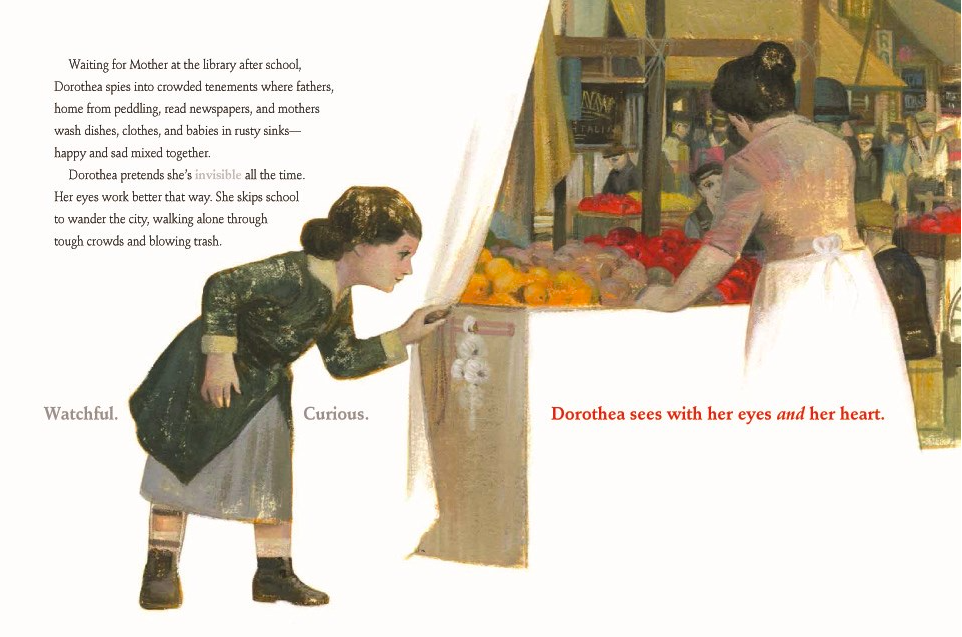
As Dorothea waits for her mother to finish work, she looks around her, spying “into crowded tenements where fathers, home from peddling, read newspapers, and mothers wash dishes, clothes, and babies in rusty sinks—happy and sad mixed together.” She begins to skip school to wander the city, gazing at it with her curious eyes and heart.

When Dorothea grows up she decides to become a photographer. Her family is surprised because it’s not a ladylike profession. She’s determined, thought, and works any job she can find in the photography industry, learning about cameras, darkrooms, negatives, and the printing process. “Alone in the darkroom’s amber glow, she studies the wet printing paper while faces appear in black and white. Dorothea loves faces!”

celebrate-picture-books-picture-book-review-dorothea's-eyes-great-dark-room

Image copyright Gérard DuBois, 2016, text copyright Barb Rosenstock, 2016. Courtesy of Calkins Creek.

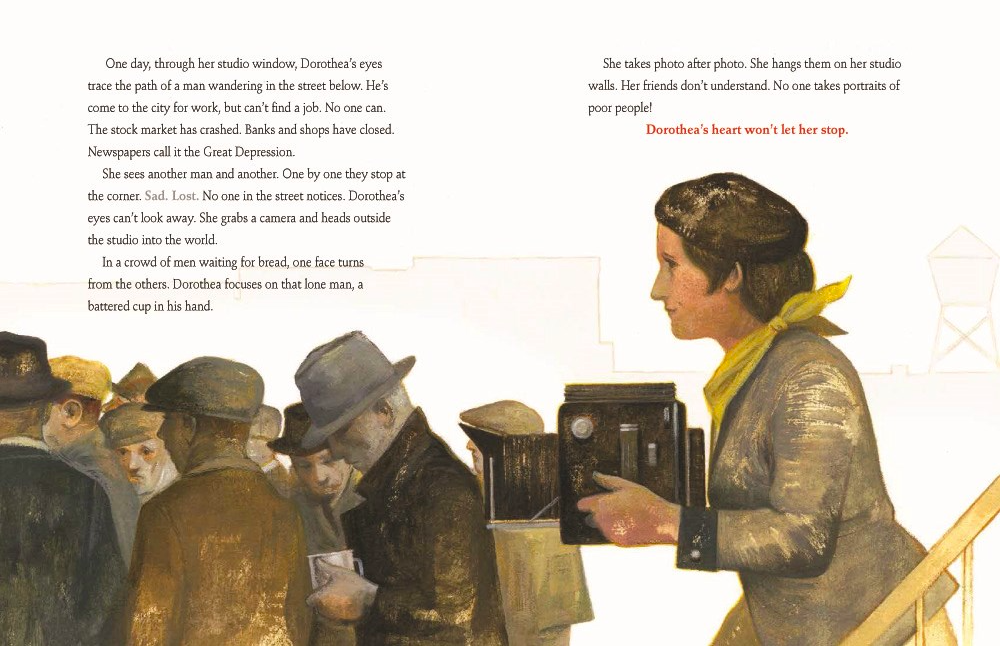
As a young woman Dorothea travels west to San Francisco. There, her money is stolen, so she stays, gets a job, and starts her own portrait studio. Her work makes her famous and the richest families in California seek her out to take their photos. She makes money, gains friends, gets married, and starts a family of her own. But she always wonders, “Am I using my eyes and my heart?”

celebrate-picture-books-picture-book-review-dorothea's-eyes-great-depression

Image copyright Gérard DuBois, 2016, text copyright Barb Rosenstock, 2016. Courtesy of Calkins Creek.

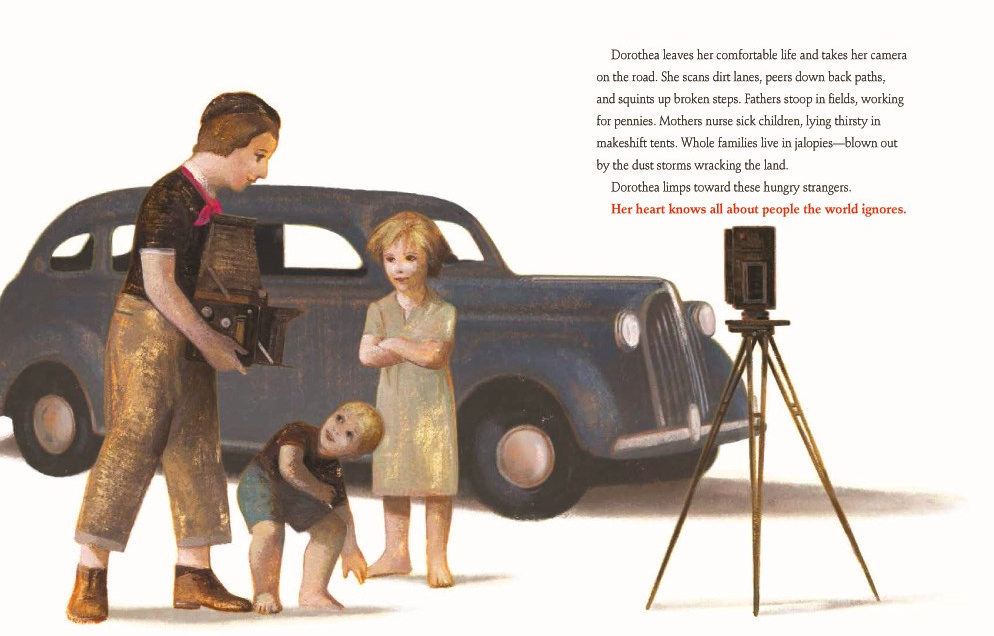
When the stock market crashes and the Great Depression sweeps the country, Dorothea focuses her camera on the desperate and the downtrodden. Her friends don’t understand, but Dorothea sees into these poor people’s hearts. She “knows all about people the world ignores.” For five years she goes out into the fields, peers into tents, documents families living in their cars, crouches in the dirt to reveal the stories of the people struggling with the devastation wrought by the Dust Bowl.

celebrate-picture-books-picture-book-review-dorothea's-eyes-kids

Image copyright Gérard DuBois, 2016, text copyright Barb Rosenstock, 2016. Courtesy of Calkins Creek.

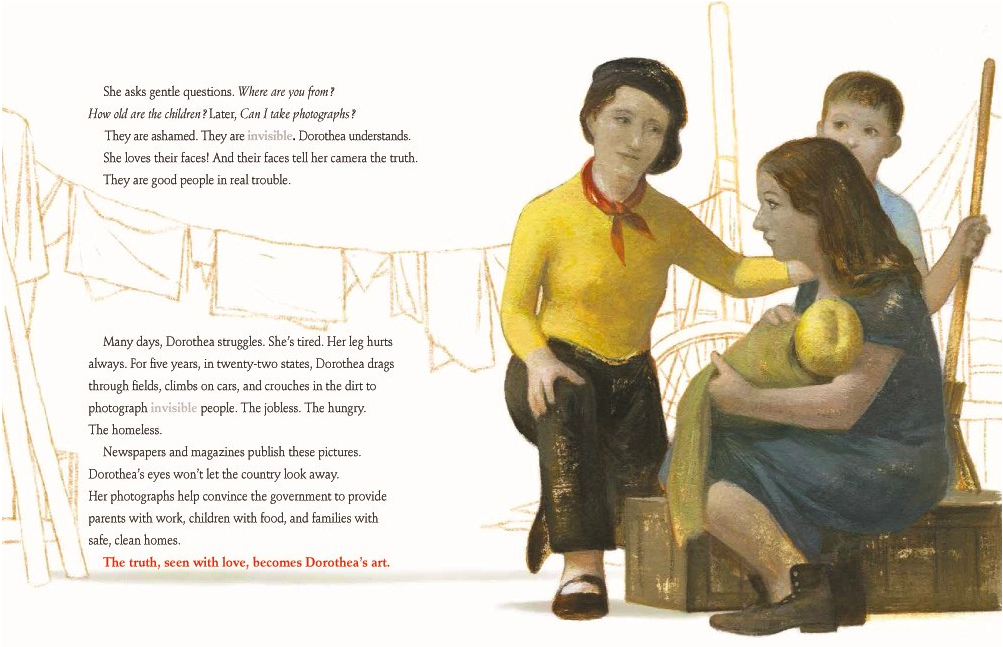
Newspapers and magazines publish her pictures. “Her photographs help convince the government to provide parents with work, children with food, and families with safe, clean homes. “The truth, seen with love, becomes Dorothea’s art.” Dorothea’s photographs are still known today. Their subjects continue to help us see others with our hearts.

Backmatter includes six of Dorothea Lange’s most famous and recognizable photographs—ones that are still as riveting today as they were in the 1930s. Further information on her life and work is provided as well as sources where her photographs can be viewed, resources for further study, and a timeline of her life.

celebrate-picture-books-picture-book-review-dorothea's-eyes-san-francisco

Image copyright Gérard DuBois, 2016, text copyright Barb Rosenstock, 2016. Courtesy of Calkins Creek.

Barb Rosenstock brings Dorothea Lange’s vision to the page with love, honesty, and understanding in this excellent biography of a woman whose photographs defined the Great Depression and Dust Bowl era. Lange’s life-long connection to the poor and often overlooked people of the world is beautifully described and explained in a gentle, compassionate way that will resonate with children. Rosenstock’s language is lyrical with staccato sentences that echo the clicks of Lange’s shutter capturing life’s reality with her eyes and her heart.

Gérard DuBois’s illustrations are arresting and set Dorothea Lange’s story firmly in its historical and emotional landscape. Rendered in acrylic and digital imagery, they feature the muted colors and style of book illustrations from long ago. By placing the images of Dorothea, her family, and her photography subjects against white backgrounds, DuBois emphasizes Lange’s focus on the people she met and faces that inspired her. Distressed textures accentuate the troubled times and the anguish of both Dorothea and her subjects.

Ages 7 – 12

Calkins Creek, 2016 | ISBN 978-1629792088 (Hardcover, 2018) | ISBN 978-1635925630 (Paperback, 2022)

Paperback edition will be released on February 1, 2022. The book is available for preorder now.

Discover all the amazing books by Barb Rosenstock on her website!

View a portfolio of art and book illustration by Gérard DuBois on his website!

Enjoy a snapshot of Dorothea’s Eyes!

World Photography Day Activity

CPB - New Professionals Picture

News Professionals Clothespin Figures


Make one of these clothespin figures that honors the men and women photographers and writers who work to keep the world informed.

Supplies

Directions

  1. Draw a face and hair on the clothespin
  2. Cut out the clothes you want your journalist or photographer to wear
  3. Wrap the clothes around the clothespin. The slit in the clothespin should be on the side.
  4. Tape the clothes together
  5. Cut out the camera
  6. Tape one end of a short length of thread to the right top corner of the camera and the other end of the thread to the left corner. Now you can hang the camera around the figure’s neck.

Idea for displaying the figures

  • Attach a wire or string to the wall and pin the figure to it
  • Pin it to your bulletin board or on the rim of a desk organizer

celebrate-picture-books-picture-book-review-dorothea's-eyes-cover

You can find Dorothea’s Eyes: Dorothea Lange Photographs the Truth at these booksellers

Amazon | Barnes & Noble | Books-a-Million

To support your local independent bookstore, order from

Bookshop | IndieBound

Picture Book Review
March 30 – It’s Women’s History Month

celebrate-picture-books-picture-book-review-a-most-clever-girl-cover

About the Holiday

National Women’s History Month is all about celebrating women who broke barriers with their intelligence, creativity, courage, persistence, and unwavering confidence in their abilities. In every discipline, women have brought and continue to bring new perspectives, experiences, and talents to make contributions toward a better world. Today’s book celebrates a writer who broadened readers’ understanding of women and their lives through her complex and compelling novels. 

A Most Clever Girl: How Jane Austen Discovered Her Voice

Written by Jasmine A. Stirling | Illustrated by Vesper Stamper


While Jane loved stories, there were some she couldn’t abide. These were stories about women who fainted at the slightest thing, stories about orphans with dark secrets, and stories about couples who fell in love at first sight. To Jane these books were boring, unbelievable, and predictable. But they were all the rage. Instead, Jane like the ridiculous, and she made up her own stories that “poked fun” at the popular literature of the day. When she read her “stories to her family,… they couldn’t stop laughing.”

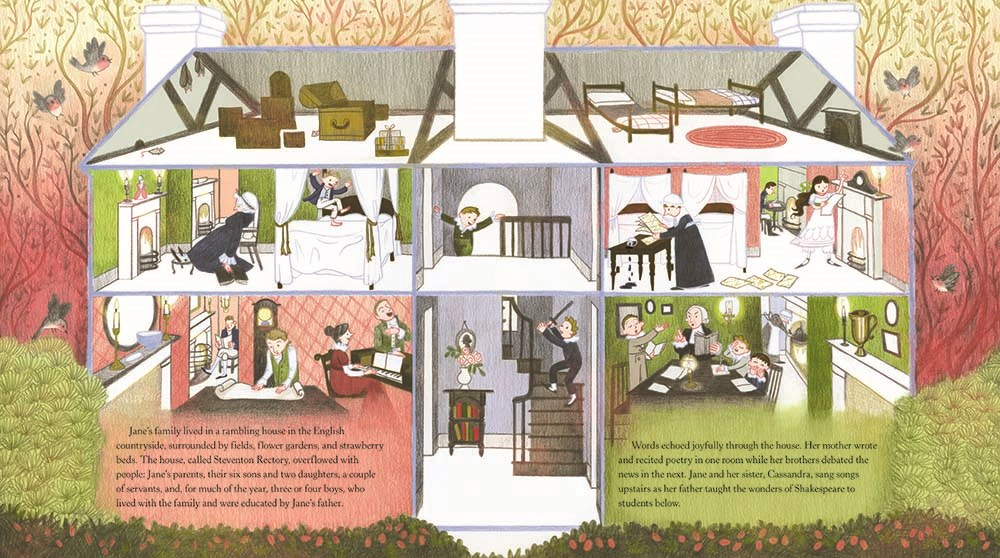
Jane lived in a large house in the English countryside. It was always full of people, fun, and learning. Jane’s father was the village rector of Steventon in Hampshire, England, and her mother wrote poetry. Sometimes Jane’s family (mother, father, six sons, and two daughters) staged plays in the barn. They made their own sets and costumes and played all the roles. When there was quiet time, Jane wrote and wrote in the study her father had created just for her and her sister.

celebrate-picture-books-picture-book-review-a-most-clever-girl-rectory

Image copyright Vesper Stamper, 2021, text copyright Jasmine A. Stirling, 2021. Courtesy of Bloomsbury Children’s Books.

Jane loved the satires she wrote, but “she stared to dream about writing stories that mattered to her. They would come from her own voice—a style that was uniquely hers.” She began to pay attention to tiny personal details, particular conversations, and the way her family, friends, and neighbors interacted. She found it all fascinating. Jane’s father encouraged her writing, saving up to buy her the best pens, blank books, and even a “portable mahogany writing desk.”

Jane had an idea about a story involving “three or four families in a country village,” and soon the characters came to life in her imagination, even when she wasn’t writing. She “wrote three novels before she turned twenty-four. Jane’s voice was clever and real… But something was still missing.”

Over the years as Jane’s brothers left home, the big house grew quiet. When her father stopped teaching, money grew short and Jane’s parents decided to move to a small house in another town, Bath. They sold their possessions, even the books in her father’s library, and left the neighbors and friends they’d known so well. Jane wondered if she would feel at home anywhere else. When they moved into their new home, Jane put away her writing things. Time passed, but “Jane persisted in a very determined, though very silent, disinclination for Bath.” Years passed and Jane spent her time in “busy nothings.”

celebrate-picture-books-picture-book-review-a-most-clever-girl-characters

Image copyright Vesper Stamper, 2021, text copyright Jasmine A. Stirling, 2021. Courtesy of Bloomsbury Children’s Books.

When her father died, Jane, her sister, and their mother had to move into a cheap apartment, and then when they could no longer afford that, they moved in with her brother Frank in a rough-and-tumble town. “The weight of Jane’s losses threatened to drown her,” and she still couldn’t write. Four years later, her brother Edward gave her, her sister, and their mother a small cottage near their childhood home. Here she found her way to happiness.

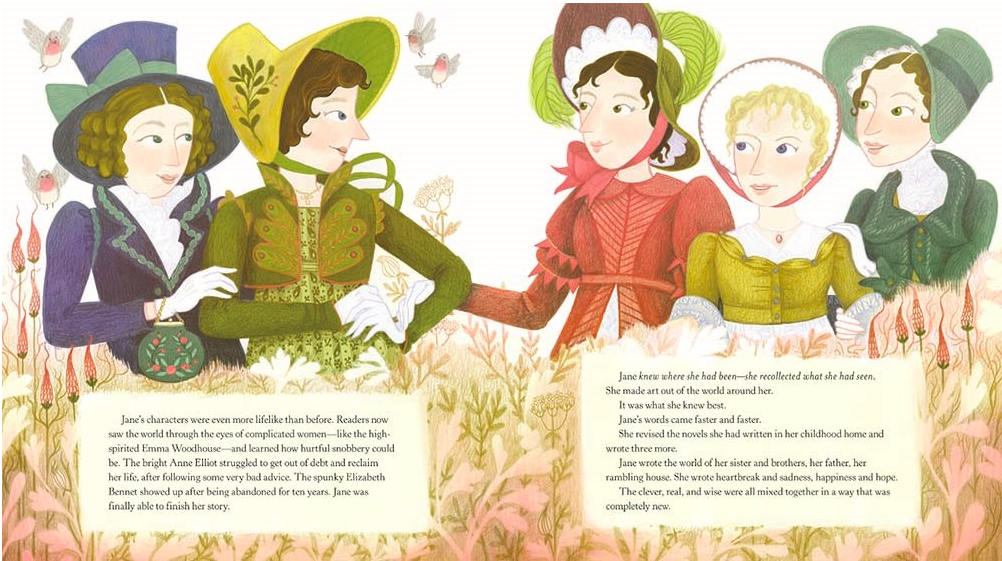
At last she brought out her pens, paper, and writing desk and began to write. Her voice was still clever and “filled with real people, but grief and loss had added something new. Jane’s voice was wise.” Her characters were even more realistic and complicated. She wrote about happiness and wealth, but also about heartbreak and sadness “mixed together in a way that was completely new.”

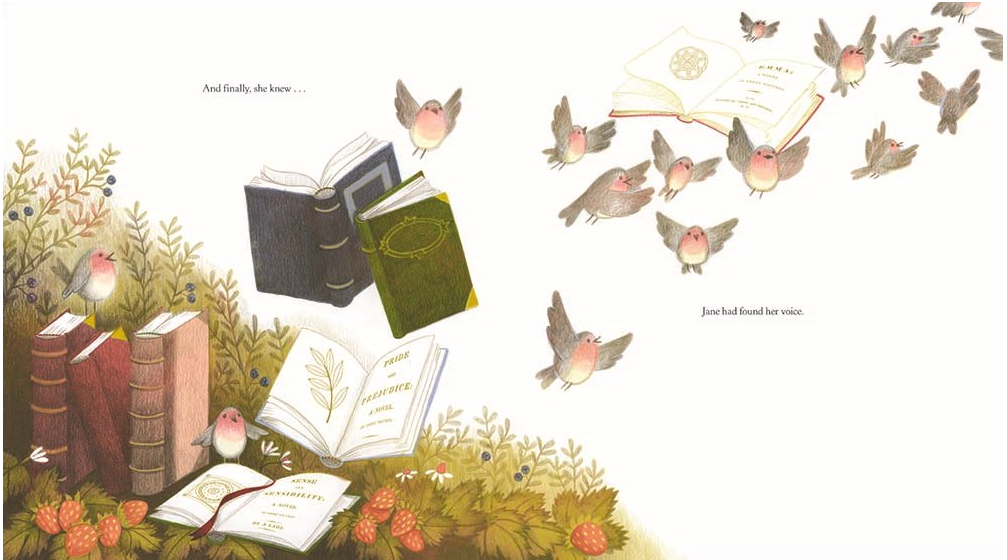
Jane’s novels were a hit—even with the future king of England. George IV loved them so much that his librarian wrote to Jane and asked her to write one of those “love-at-first-sight” stories she hated. Jane wrote back and told him that she could not unless her life depended on it, that she must remain true to her own style. At long last, “Jane had found her voice.”

Extensive backmatter includes a list of quotes from Jane Austen’s novels that are used in the story, more about Jane Austen’s life, Notes from the Author and Illustrator, a list of Austen’s novels, further resources for young readers, and a bibliography.

celebrate-picture-books-picture-book-review-a-most-clever-girl-novels

Image copyright Vesper Stamper, 2021, text copyright Jasmine A. Stirling, 2021. Courtesy of Bloomsbury Children’s Books.

Jasmine A. Stirling’s in-depth biography of Jane Austen shines with specific details about her and her family’s life, their happy times and tribulations that informed her writing and made it so distinctive for its time and beloved even now. Stirling’s engaging and lively storytelling invites children to share the joys and heartaches that molded Jane Austen’s personality and writing. Quotations from Austen’s novels sprinkled throughout the story give young readers a taste of Jane’s writing and the truths and understanding her novels embody.

Dazzlingly lovely, Vesper Stamper’s expressive illustrations draw readers into Jane Austen’s world and give them a glimpse into her childhood and adult experiences as well as the society of the time. Cleverly designed images allow kids to understand how much Jane loved to read, to laugh along with her as she reads the sentimental and gothic stories she satirized, and to see at a glance all the shenanigans, work, and entertaining that went on in her beloved home. The elegance of these surroundings and the dinner parties that enlightened Jane’s writing are realistically reproduced and her characters come to life on the page. A moving metaphorical image shows Jane riding away from the home she loved while pages of her novels fly out of the writing desk strapped to the back of the carriage. Jane’s sadness is depicted on pages sketched in gray, but her vibrancy returns with her brother’s generosity and the novels that finally take wing.

A superb biography of a beloved and influential writer that will spark enthusiasm for Jane Austen’s novels as well as literature and writing in general, A Most Clever Girl: How Jane Austen Discovered Her Voice is a must for students of all ages as well as for those who simply love reading and writing stories. The book would make an exceptional addition to lesson plans for readers from elementary school to high school and is highly recommended for home, school, and public library collections.

Ages 5 – 12 and up

Bloomsbury Children’s Books, 2021 | ISBN 978-1547601103

Discover more about Jasmine A. Stirling and her books on her website.

To learn more about Vesper Stamper, her books, and her art, visit her website.

Women’s History Month Activity

celebrate-picture-books-picture-book-review-jane-austen-coloring-page

Jane Austen Coloring Page


Enjoy this printable coloring page of Jane Austen as you learn more about this clever writer.

Jane Austen Coloring Page

celebrate-picture-books-picture-book-review-a-most-clever-girl-cover

You can find A Most Clever Girl: How Jane Austen Discovered Her Voice at these booksellers

Amazon | Barnes & Noble | Books-a-Million

To support your local independent bookstore, order from

Bookshop | IndieBound

Picture Book Review