January 16 – Martin Luther King Jr. Day

celebrate-picture-books-picture-book-review-i-am-martin-luther-king-jr-cover.png

About the Holiday

Martin Luther King Jr. Day celebrates the life and legacy of the man who dedicated his life and work to teaching—as Coretta Scott King stated—“the values of courage, truth, justice, compassion, dignity, humility and service” and led a non-violent Civil Rights movement to enact racial equality and justice throughout state and federal law. President Ronald Reagan signed the holiday into law in 1983, setting it on the third Monday of January to coincide with Martin Luther King, Jr.’s birthday on January 15. The holiday was officially observed in all 50 states in 2000. Today, learn more about the life and work of Martin Luther King and how you can help promote justice and equality for all. Consider volunteering in your community where help is needed.

I am Martin Luther King, Jr.

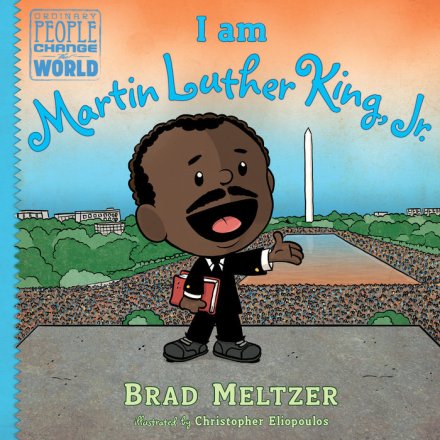
Written by Brad Meltzer | Illustrated by Christopher Eliopoulos


Standing inside a church, Martin Luther King, Jr. introduces himself with two anecdotes from his childhood that demonstrate his world outlook. “When I was little,” he says, “I used to get into a lot of accidents.” He was hit in the head by a baseball bat, knocked down by cars and once even “tumbled over our banister, then bounced through an open door into the basement.” While these incidents could have made him cautious, Martin instead was determined to keep “getting back up.” His second influence were the books in which he could find “big words.” Even as a child Martin recognized that “there is power in words.”
celebrate-picture-books-picture-book-review-i-am-martin-luther-king-jr-as-a-child

Image copyright Christopher Eliopoulos, text copyright Brad Meltzer. Courtesty of Dial Books for Young Readers

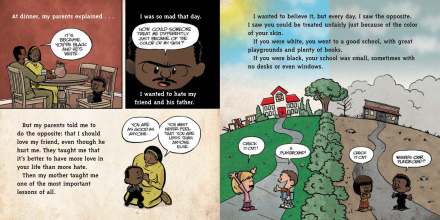
Before he went to school, Martin relates, his best friend was a white boy whose father owned a nearby store. They did everything together until school started. Then Martin went to a school with only black students while his friend went to a white-students-only school. Soon, Martin’s friend told him his father didn’t want them to play together anymore. Martin was confused. When his parents told him the reason was that they had different colored skin, Martin felt angry. He wanted to hate his friend and his father, but Martin’s parents taught him to love his friend, and his mother told him, “you must never feel that you are less than anyone else.”

It was a difficult lesson when all around him he saw inequality. White schools had better equipment, there were different elevators, bathrooms, water fountains, and other facilities for black people and white people, on buses black riders had to give up their seats to white riders. Everywhere black people and white people were segregated.

celebrate-picture-books-picture-book-review-i-am-martin-luther-king-jr-ice-cream

Image copyright Christopher Eliopoulos, text copyright Brad Meltzer. Courtesty of Dial Books for Young Readers

When Martin was only 15 he was admitted to college. At 19 he entered the seminary where he learned about civil disobedience and nonviolent resistance—ways to use “love and peaceful methods to change unfair things in society.” These were lessons Martin wanted to share with others. His chance to put his thoughts into action came when Rosa Parks was arrested for refusing to relinquish her seat to a white man. Martin advocated a peaceful protest—a boycott of public buses. He reasoned that without the money from black riders, the bus companies would change their policies.

As the boycott began working, Martin gave a speech in Montgomery, Alabama, motivating people to continue their peaceful protest. Martin was put in jail and his house was bombed, but the boycott continued for more than a year. Eventually, the bus companies changed their rules. Other peaceful protests began to take place in restaurants and other public places.

One protest took place in Birmingham, Alabama.  Martin was again put in prison, where he wrote one of his most famous speeches. Children also took part in the Birmingham protest. The Children’s Crusade attracted more than 1,000 kids. On the first day 900 of them were arrested, but that only inspired the children more. On the second day 2,500 children showed up. They stood firm while they were sprayed with water hoses and attacked by police dogs. People—both black and white—watching the news reports were aghast. Three months later the rules began to change.
celebrate-picture-books-picture-book-review-i-am-martin-luther-king-jr-i-have-a-dream-speech

Image copyright Christopher Eliopoulos, text copyright Brad Meltzer. Courtesty of Dial Books for Young Readers

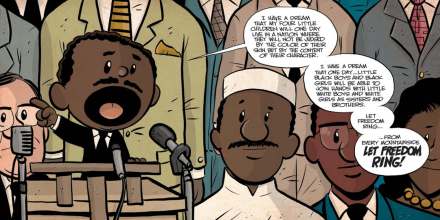
“By the summer of 1963, an estimated one million Americans held their own protests in cities across the country.” Then A. Philip Randolph suggested a single huge march to convince “Congress and the president to pass laws so that no one in America can treat people differently based on skin color.” On August 28, 1963 the March on Washington for Jobs and Freedom took place. Martin gave what may now be considered his most famous speech in which he talked about his dreams for the country, for the people, and for their children.

Although Congress began passing new laws, the ability and right to vote in elections still eluded black people. To change the voting rules another march was organized to walk 54 miles from Selma to Montgomery Alabama. The 600 walkers were met by police who stopped them. Two days later 2,500 activists tried again but could not get through. On the third try 8,000 marchers showed up. This time, with the world watching on television, the activists made it to Montgomery, protected by troops sent by President Johnson.

celebrate-picture-books-picture-book-review-i-am-martin-luther-king-jr-montgomery-march

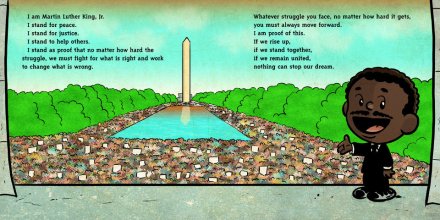
Martin continued to speak out, relating his philosophy and dreams for the nation. “To reach our goals, we must walk the path of peace,” he said. “We must lock arms with our brothers and sisters. We must march together. When we do…Our voices will be heard, and freedom will ring.” The lessons Martin Luther King taught still resonate today. He stands “as proof that no matter how hard the struggle, we must fight for what is right and work to change what is wrong.…if we stand together, if we remain united, nothing can stop our dream.”
celebrate-picture-books-picture-book-review-i-am-martin-luther-king-jr

Brad Meltzer’s Ordinary People Change the World: I am… series of biographies are well-known for showing young readers that they can achieve their dreams and make a difference no matter what those hopes may be. In his biography of Martin Luther King, Jr., Meltzer depicts several incidents from King’s childhood and early adulthood that influenced his future work. These help readers understand not only the types of prejudice King and other African Americans experienced, but also the people who inspired his philosophy of peace.

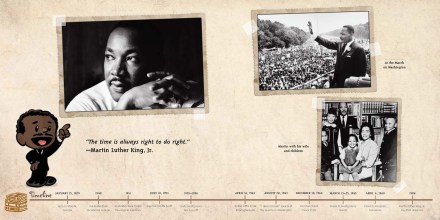
Meltzer’s inclusion of King’s imprisonments and the violence that met the peaceful protesters deepens the understanding of the dangers King and other protesters faced, and provides an opportunity to open a discussion between adults and children about those times and what they now see in the news. Meltzer’s description of the Children’s Crusade will inspire readers, making them proud of children in the past and stirring them to actions of their own. Sections from King’s Letter from Birmingham Jail and his most famous speeches are presented in speech bubbles. The text is followed by photographs of Martin Luther King, Jr. with his family and at the March on Washington as well as a timeline of his life. Sources and resources for further reading are also included.
celebrate-picture-books-picture-book-review-i-am-martin-luther-king-jr-timeline

In keeping with the style of all of Meltzer’s and Christopher Eliopoulos’s Ordinary People Change the World: I am… biographies, the illustrations are vibrant and cartoon-inspired. Martin Luther King, Jr. is depicted with the size of a child but the features of an adult, reinforcing the idea contained in the text of the dual nature of the future adult residing in the child and the ideals of the child remaining in the adult that appeals to ambitious young readers. Speech bubbles highlight text that carry emotional dialogue. Settings, including churches, Birmingham jail, Washington DC, the Edmund Pettus Bridge in Alabama, and the Martin Luther King, Jr. monument give children a look at the cities and places described in the text.

For young readers, I am Martin Luther King, Jr. offers a comprehensive biography of the man who was a national and world leader in the fight for equal rights for all people and makes an excellent starting place for classroom lessons and personal discussions.

Ages 5 – 8

Dial Books for Young Readers, 2016 | ISBN 978-0525428527

Discover more about Brad Meltzer and his books for adults and children as well as other goodies on his website!

Learn more about Christopher Eliopoulos, his books, and his comics on his website!

Martin Luther King Jr. Day Activity

celebrate-picture-books-picture-book-review-martin-luther-king-jr-coloring-page

Martin Luther King, Jr. Portrait


Color this printable Martin Luther King, Jr. Portrait and then hang it in your room or locker to inspire you!

Picture Book Review

January 4 – World Hypnotism Day

celebrate-picture-books-picture-book-reviews-mesmerized-cover

About the Holiday

Today’s holiday was established in 2006 to honor Dr. Jack Gibson, an Irish hypnotherapist who used hypnosis extensively in his practice. Its purpose is to dispel the myths surrounding hypnosis as “mind control,” which is a popular misconception perpetuated by movies and other types of entertainment. To celebrate, learn more about hypnotism and check out local special events, including free hypnotherapy sessions.

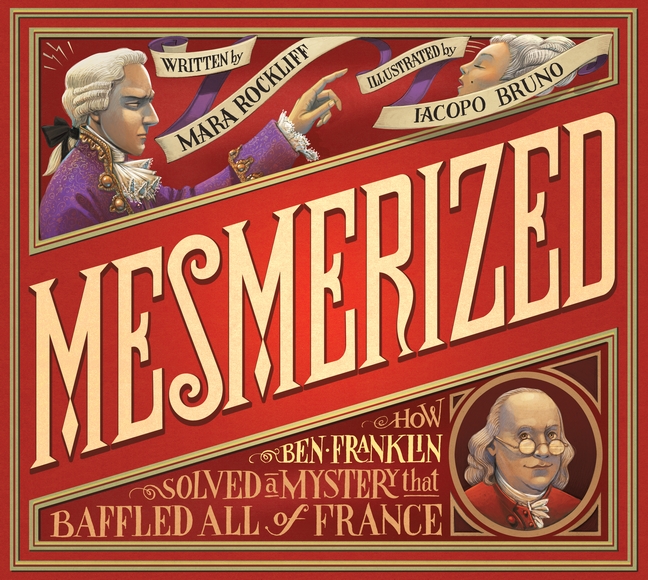
Mesmerized: How Ben Franklin Solved a Mystery that Baffled All of France

Written by Mara Rockliff | Illustrated by Iacopo Bruno


During the colonists’ war with England, the rag-tag American army needed France’s help. Who better to send than Benjamin Franklin, the charming and experienced statesman? Ben hoped to convince King Louis the Sixteenth and Queen Marie Antoinette to send money and soldiers to America, “but it turned out that they needed Ben’s help too….” At the time, Paris was enthralled by Science. This “new” discipline was introducing new materials, new inventions, and new ideas into society.

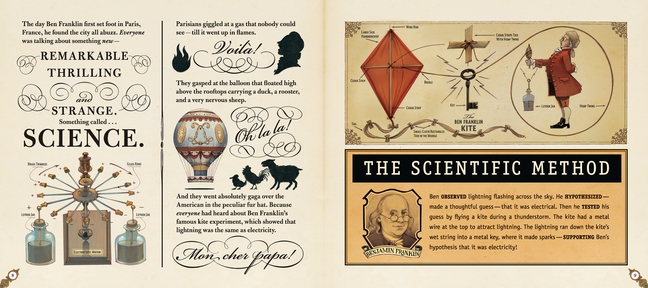
One of these notions was Ben Franklin’s own—and when the people of Paris saw him “they went absolutely gaga over the American in the peculiar fur hat. Because everyone had heard about Ben Franklin’s famous kite experiment, which showed that lightning was the same as electricity.” Soon, however, even Ben couldn’t hold a candle to Dr. Mesmer—the “elegant and mysterious” man who wielded “an astonishing new force.” “Dr. Mesmer said this force streamed from the stars and flowed into his wand. When he stared into his patients’ eyes and waved the wand, things happened. Women swooned. Men sobbed. Children fell down in fits.”

celebrate-picture-books-picture-book-reviews-mesmerized-science

Image copyright Iacopo Bruno, text copyright Mara Rockliff. Courtesy Candlewick Press

Dr. Mesmer seemed to do the impossible. He could make the same glass of water taste like strawberries or vinegar just by telling his patient what to taste. He said he could use this force to help people who were sick, and indeed, after a session with Dr. Mesmer “in a room hidden behind heavy drapes covered with signs and symbols” many people emerged saying they had been cured. Those rich enough paid 100 gold louis to learn his secrets, and everyone considered Dr. Mesmer’s force the “most remarkable thing that science had discovered yet!”

Everyone that is, except the city’s doctors, who “griped, and groused, and fussed, and fumed” because their patients only wanted to be treated by Dr. Mesmer. The doctors went to the King to complain. They even suggested that Dr. Mesmer’s force didn’t exist at all. Louis didn’t know what to think, but he did know who to consult—Ben Franklin! Ben wanted to observe this force in action for himself. As he watched, Dr. Mesmer’s helper, Charles, made a group of patients gasp, groan, twitch, and tremble. Some even fainted.

celebrate-picture-books-picture-book-reviews-mesmerized-ben-franklin

Image copyright Iacopo Bruno, text copyright Mara Rockliff. Courtesy Candlewick Press

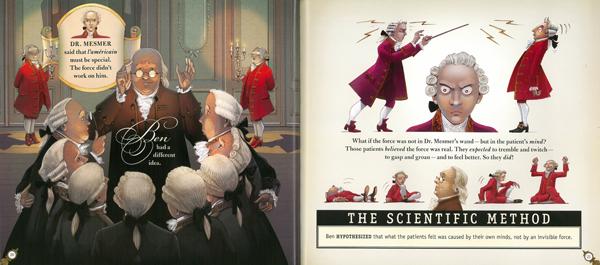
When it came time for Ben Franklin’s turn, “He didn’t gasp and groan or twitch and tremble. And he didn’t faint. In fact…he didn’t feel a thing.” Dr. Mesmer said that Ben must be “special” and that’s why the force didn’t work on him. Ben hypothesized a different reason. He said that instead of the force being “in Dr. Mesmer’s wand…it was in the patient’s mind.” They acted and felt the way they did because they expected to.

To test his theory, Ben had Charles wave his fingers near a woman’s face. She screamed and “said she felt a burning flame.” Next Ben told Charles to perform the same routine, but with the woman blindfolded. This time when Charles waved his fingers near her stomach, “she said she felt the heat—IN HER EAR. When he “moved behind her back, the woman shrieked that she felt burning—IN HER LEG!” Ben brought in another patient, blindfolded him, and told him he was being mesmerized. He said he could feel it—even though “Charles was not even in the room.” When Charles came back and waved his fingers and wand, the patient felt nothing.

“Ben tested patient after patient, but it was always the same. If the patient believed something would happen, something did—even without the force! If the patient did not expect anything to happen, nothing did—even with the force!” He revealed his observations to the king, and soon all of Paris was talking—and laughing. And Dr. Mesmer? He took his wand and ran. Ben Franklin soon returned to America—with the help from France he had sought and to his scientific work.

celebrate-picture-books-picture-book-reviews-mesmerized-blind-test

Image copyright Iacopo Bruno, text copyright Mara Rockliff. Courtesy Candlewick Press

The world benefited greatly from the meeting between Ben Franklin and Dr. Mesmer. Ben’s blind test is still used today when new medicines are being developed, and Dr. Mesmer’s force brought to light what we call the placebo effect and also the state of hypnosis, two powerful abilities of the brain that scientists are still studying.

Throughout Mesmerized Ben Franklin studies Dr. Mesmer and his force, using the scientific method. As Franklin observes, hypothesizes, tests, and finds his theory supported, each particular step of the scientific method applied appears highlighted and explained on the page. An extensive Author’s Note about the events of the story also follows the text

Mara Rockliff’s—dare I say it?—mesmerizing true tale of a meeting between two of the most fascinating figures of the late 1770s is the type of nonfiction that can get kids excited about science and history. Intrigue, mystery, charismatic personalities, wit, and a familiar topic are blended together to reveal the uses and steps of the scientific method and to highlight one event in time that still resonates today. Rockliff’s story crackles with fabulous vocbulary—doctors gripe, grouse, fume, are peeved; the king is in a quandary; patients twitch and tremble; plain Ben Franklin is an “apple pie” while elegant Dr. Mesmer a “layered torte.” Rockliff’s story flows at an enthralling pace, keeping readers riveted to discover Dr. Mesmer’s secret.

Iacopo Bruno’s sumptuous illustrations are nothing short of astounding. If the Oscars gave out awards to books, Bruno would certainly win for best costume and set. Every page is gilded with the opulence of the French court as gold buttons, collars, candle sticks, and drawing rooms glint with a polished sheen. Period dress is depicted in the women’s full flowing gowns of red, purple, and green, and in men’s top coats, breeches, lace cuffs, and high buckle shoes. Powdered wigs curl at men’s ears and climb high above women’s heads, festooned with flowers, ribbons, and pearls while Ben’s white, wavy locks fall naturally on his shoulders. In addition to setting the historical scene, Bruno depicts the effects of Dr. Mesmer’s force and the scientific methods Franklin used to debunk it with just the right amount of humor to entice kids and allow them to fully understand and appreciate Dr. Mesmer’s impact on society.

Ages 6 – 10

Candlewick, 2015 | ISBN 978-0763663513

To learn more about Mara Rockliff and her books, visit her website!

View a gallery of book jacket and other illustration work by Iacopo Bruno on his blog!

World Hypnotism Day Activity

celebrate-picture-books-picture-book-review-hypnosis-maze


You Are Getting Sleeeepy Maze


The roundabout pattern of this printable You’re Getting Sleeeepy Maze may make you feel as if you’re in a trance, but don’t zone out before you solve it! Quick! Here’s the Solution!

celebrate-picture-books-picture-book-reviews-mesmerized-cover

You can find Mesmerized: How Ben Franklin Solved a Mystery that Baffled all of France at these booksellers

Amazon | Barnes & Noble | Books-a-Million | IndieBound

Picture Book Review

January 2 – Motivation and Inspiration Day

celebrate-picture-books-picture-book-review-radiant-child-cover

About the Holiday

While Motivation and Inspiration Day was instituted in reaction to the 9/11 attacks, the holiday’s influence and meaning has grown and now includes world-wide participation. Falling on the second day of the year, it encourages us to reflect on our lives—where we are and where we want to go. Take some time to consider what motivates and inspires you and follow those inner and external voices to help you achieve your dreams.

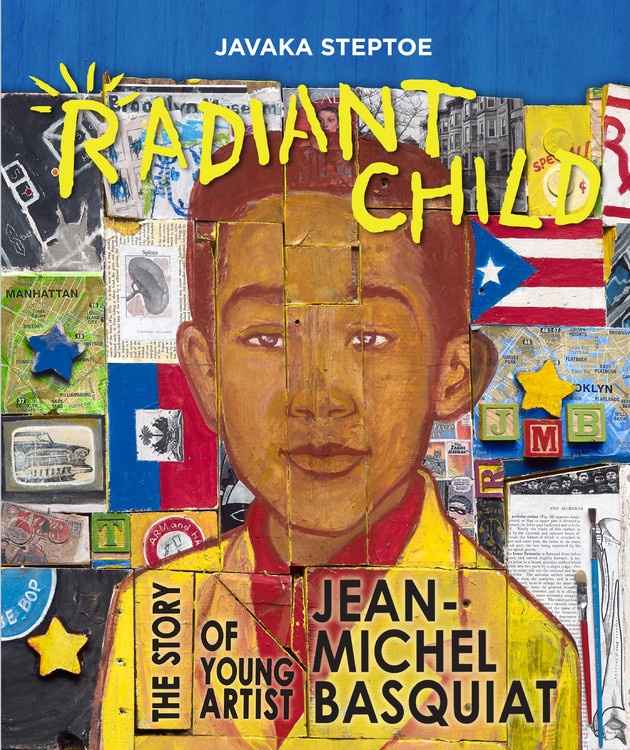
Radiant Child: The Story of Young Artist Jean-Michel Basquiat

By Javaka Steptoe


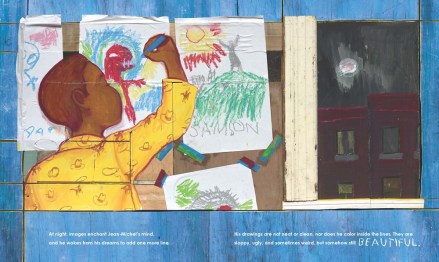
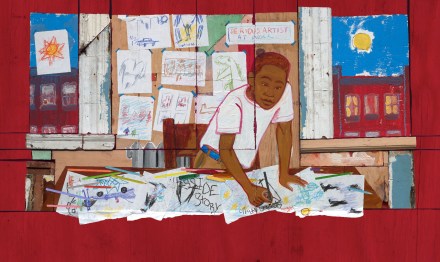
“Somewhere in Brooklyn, between hearts that thump, double Dutch, and hopscotch / and salty mouths that slurp sweet ice, a little boy dreams of being a famous artist.” All day Jean-Michel sits surrounded by colored pencils and “a storm of papers” and draws. As he sleeps his dreams swirl with images. When he wakes he adds to his drawings, scribbling away. What he creates is “sloppy, ugly, and sometimes weird, but somehow still beautiful.”

celebrate-picture-books-picture-book-review-radiant-child-beautiful-art

Image and text copyright Javaka Steptoe, courtesy of Little, Brown Books for Young People

Jean-Michel’s talent comes from his Puerto Rican mother, who has a natural sense of style and design and who always makes time to draw with her son, lying on the floor next to him. She takes Jean-Michel to art museums and theaters and reads poetry to him, but she also shows him the art of the city—its sounds, sights, style, and “patchwork” colors. Jean-Michel loves to visit the museum and read about the artwork and the artists. From these stories he “learns what it means to be a famous artist.”

When Jean-Michel is seriously injured in a car accident, his world seems scary and confusing. He mother gives him an anatomy book, which he memorizes. It erases his fears and becomes influential in his work. After returning home his life changes when his mother suffers a breakdown and can no longer live at home. “He tries drawing the terrible out of his blues, but things are not the same.” Jean-Michel visits his mother when he can, “always bringing his artwork to show, telling her that one day it will be in a museum, ‘when I am a famous artist.’”

celebrate-picture-books-picture-book-review-radiant-child-drawing

Image and text copyright Javaka Steptoe, courtesy of Little, Brown Books for Young People

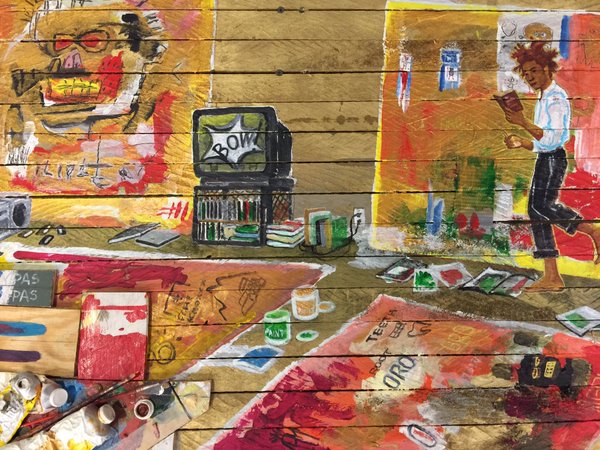
As a teenager, Jean-Michel follows his dream, moving from Brooklyn to New York City. There he stays with friends, painting, creating collages, and writing poems on paper strewn about him. At night he paints on city walls, trash cans, and other urban canvases. His art, signed ‘Samoo,’ attracts attention. People wonder, “‘Who is Samoo?’”

Soon his art can be found in art galleries and hanging in the homes of the people who buy his work. Jean-Michel continues to create, listening to “a sound track that is all his own.” Through talent, inspiration, and his mother’s loving influence, Jean-Michel Basquiat conquered the art world, becoming a king among artists, and fulfilling his desire to be a famous artist.

An extensive Author’s Note about Jean-Michel Basquait’s life, including his struggles with addiction and his death in 1988, the motifs and symbolism in his work that now is displayed in museums around the world and sells for millions of dollars, and a personal comment on the impact Basquait’s art had on the author follow the text.

celebrate-picture-books-picture-book-review-radiant-child-studio

Image and text copyright Javaka Steptoe, courtesy of Little, Brown Books for Young People

Javaka Steptoe’s compelling biography of this complex, brilliant artist who people called “radiant, wild, a genius child” beautifully brings to life the inspirations and motivations that fueled his unique and intense talent. Steptoe delivers the story in staccato and flowing sentences, using consonance, assonance, repetition, the rhythms of a poet. Taking the reader from Jean-Michel’s childhood to adulthood to show how maintaining his focused determination, self-confidence, and persistence over many years led to his ultimately becoming a famous artist demonstrates that success is not a matter of luck, but of belief in oneself despite obstacles. Steptoe sensitively addresses the serious injury Basquiat suffered, his mother’s mental illness and Basquiat’s continued love for her, and his unsettled teenage years to complete this far-reaching life story.

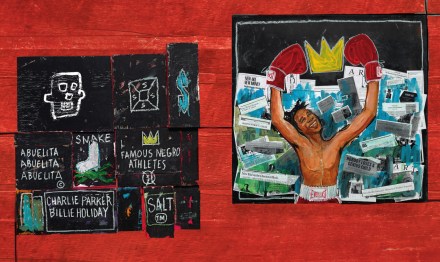
celebrate-picture-books-picture-book-review-radiant-child-boxing-image

Image and text copyright Javaka Steptoe, courtesy of Little, Brown Books for Young People

Steptoe’s mixed-media paintings were created on found wood from neighborhoods across New York City. While Steptoe does not reproduce any of Basquiat’s work, he states that readers will find “original pieces that were inspired by him and my interpretations of his paintings and designs.” As befitting his subject, Steptoe offers pages that burst with vibrant color and intricate details and beat with the pulse of the city, the people, the dreams, and the imagination that Basquiat transcribed onto paper, walls, and canvas. Part collage, part fine art, Steptoe’s illustrations will fascinate children and entice them to linger to take in all the emotion and meaning in each. The final spread, a crowd scene made up of photographs, sets Basquiat in the midst of people whom he and his art continue to inspire.

Radiant Child: The Story of Young Artist Jean-Michel Basquiat offers children an inspirational model of creativity, compassion, and confidence no matter where their talents lie. The book is an excellent choice for school, public, and home libraries.

Ages 6 – 10

Little, Brown Books for Young Readers, 2016 | ISBN 978-0316213882

Learn more about Javaka Steptoe, his books, art exhibitions, and life on his website!

Motivation and Inspiration Day Activity

celebrate-picture-books-picture-book-review-motivation-and-inspiration-day-craft

Found-Item Crafts


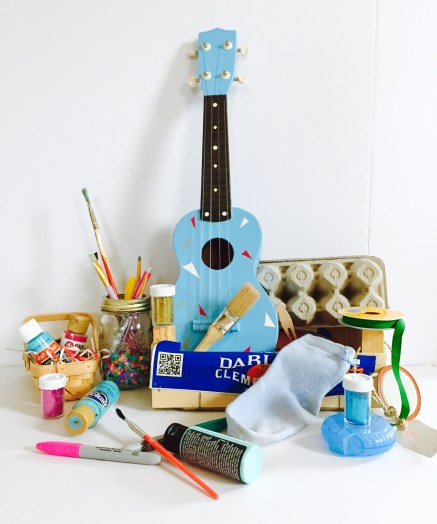
Each person finds motivation and inspiration in different things, places, and people. Today, try to create something new from the materials around you. Boxes, bottles, wire, magazines, cloth, wood, sponges—almost anything—can be transformed with some imagination. With those old socks, corks, flower pots, candle stubs, bits of ribbon, clementine crate, paint, glitter, beads, and more, you can make something useful, a decoration for your room, or even a gift for a friend!

Picture Book Review
December 29 – Tick Tock Day

celebrate-picture-books-picture-book-review-ticktock-banneker's-clock-cover

About the Holiday

As the year winds down Tick Tock Day reminds us of the passage of time and encourages us to examine our life and find opportunities to accomplish the things we really want to. While the day only has 24 hours, a little creative scheduling, letting go of those tasks that aren’t so important, and even saying “no,” can help us achieve the things that matter.

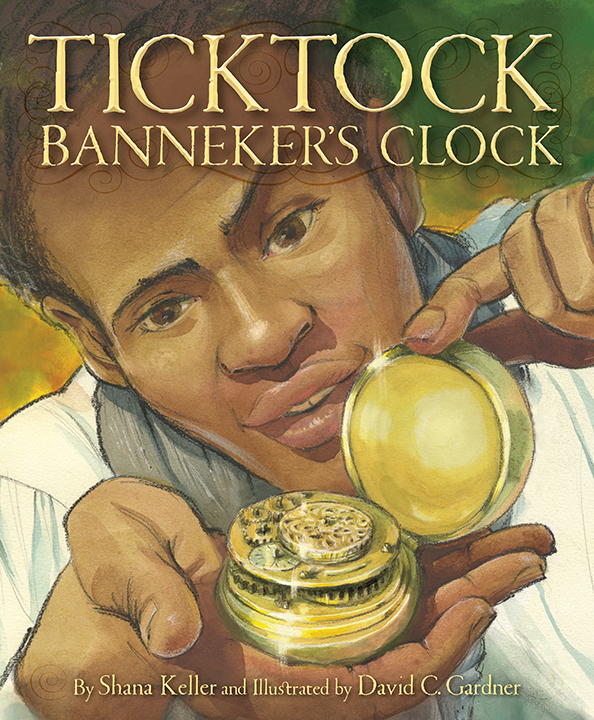
Ticktock Banneker’s Clock

Written by Shana Keller | Illustrated by David C. Gardner


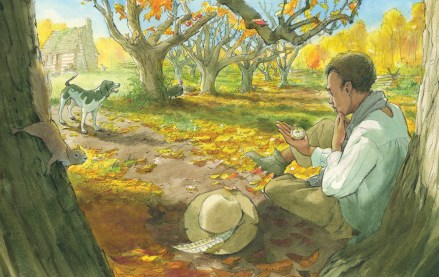
With winter approaching Benjamin Banneker has finished up his autumn chores and is looking forward to time to indulge his creative dreams. He finds his favorite spot under the chestnut tree—the place where during the summer he plays his violin and flute, “blending his soft music with the bird’s songs”—and pulls out a pocket watch he has borrowed from a gentleman. Benjamin is fascinated by the ticking and the movement of the small hands. He carefully opens the back of the watch and discovers “a world of wonderful whirls. There were gears of all shapes and sizes. Such a tiny maze!”

celebrate-picture-books-picture-book-review-ticktock-banneker's-clock-studying-pocket-watch

Image copyright David C. Gardner, courtesy of flyingdogstudio.com

The miniature timepiece is mesmerizing, but Benjamin’s mind holds a challenge—a big challenge. He envisions a large clock, one that chimes to tell the time. Remembering his math skills, Benjamin mulls over the scale needed to turn “something small into something big.” As the snow falls, Benjamin goes to work. First, he dismantles the pocket watch and draws careful diagrams of the gears and workings. Then he begins transposing these into larger drawings.

celebrate-picture-books-picture-book-review-ticktock-banneker's-clock-flute

Image copyright David C. Gardner, courtesy of flyingdogstudio.com

With the coming of spring and his drawings finished, Benjamin plans how he will build his clock. While the little pocket watch is made of metal, that material is much too expensive for a large version. As he ponders the problem under his favorite tree, Benjamin looks around him. Suddenly he knows! The answer is “right in front of him, even in his hands! The very instrument he played was made of wood!” There is a forest of trees on his farm, and this material is free.

During the summer between farm chores, Benjamin uses “every spare moment he had to find the perfect pieces of wood.” Once he has enough he begins to convert his drawings into carvings, whittling the gears and other pieces he will need. Soon, however, he becomes discouraged. The wood begins to split and come apart. Benjamin thinks about how his family cures tobacco leaves—drying them out until all the moisture evaporates. Perhaps, he thinks, he can do the same with wood to make it stronger. The process would take months, but Benjamin is patient.

celebrate-picture-books-picture-book-review-ticktock-banneker's-clock-carving

Image copyright David C. Gardner, courtesy of flyingdogstudio.com

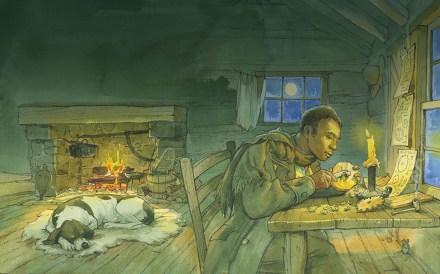
Winter has come around again, and the wood is finally ready. In his warm house Benjamin sets about carving again. During the day he carves near the sunny window, and at night he works by candlelight. At last he has all the parts he needs to build his clock. Gears, wheels, tiny pins, and the boards that will become the case are scattered across Benjamin’s work table. There is only one piece missing. A piece that cannot be made of wood—the bell!

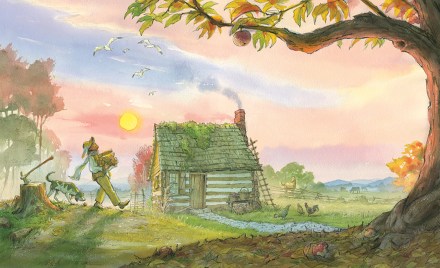
Benjamin buys a bell from a metalsmith, and back home begins to build his clock. With his drawings to guide him, he fits the gears together and then sets the hands to “match up perfectly with the second, minute, and hour of each day. It took more than one try, but Benjamin had learned to be patient.” Using the sun to determine the correct time, Benjamin positions the hands and steps back. His clock works! “The little iron bell chimed every hour, on the dot, for the next forty years.” Benjamin becomes famous, and neighbors from near and far come “to see his amazing invention.”  

An Author’s Note expanding on Benjamin Banneker’s life and work follows the text.

celebrate-picture-books-picture-book-review-ticktock-banneker's-clock-winter

Image copyright David C. Gardner, courtesy of flyingdogstudio.com

With lyrical language that glides as smoothly as a well-oiled timepiece, Shana Keller reveals the remarkable story of Benjamin Banneker, born free during the time of slavery, who possessed exceptional math and scientific skills and used them to help his friends and neighbors and to make real his vision of a striking clock. Keller’s detailed and descriptive storytelling animates this life story, allowing readers to take the journey with Banneker as he experiences excitement, setbacks, and ultimately success. Banneker, embodying determination, persistence, and creativity, is an excellent role model for kids with big dreams of their own.

celebrate-picture-books-picture-book-review-ticktock-banneker's-clock-studying-fall-chores

Image copyright David C. Gardner, courtesy of flyingdogstudio.com

David C. Gardner’s lovely full-page and two-page-spread illustrations gloriously portray Benjamin Banneker’s farm and home as well as his dedicated commitment to building a striking clock despite—or perhaps spurred on by—the challenges he faced. Gardner’s detailed images set the biography firmly in its time period, letting children experience farm and home life in the 1750s. Banneker carries wooden buckets to feed the animals, tobacco leaves hang in a dry shed, a fire blazes in a large, open fireplace, and a candle flickers as Banneker whittles wheels and gears with his pocket knife. The realistic paintings that depict Banneker’s emotions as he imagines creating a large clock, overcomes obstacles, and studiously works on his drawings and carvings will inspire readers to attempt their own inventions—whatever they may be.

For any would-be inventors, history lovers, tinkerers, and science buffs, Ticktock Banneker’s Clock is a stirring biography that would make an inspirational addition to home, school and public libraries.

Ages 6 – 10

Sleeping Bear Press, 2016 | ISBN 978-1585369560

Learn more about Shana Keller and her work on her website!

Discover a portfolio of picture book art, fine art, animation, and videos by David C. Gardner on his website!

Tick Tock Day Activity

celebrate-picture-books-picture-book-review-cuckoo-clock-coloring-page

Cuckoo Clock Coloring Page


The chirp of a cuckoo clock keeps you on time—or at least aware of the passing of time! Here’s a printable Cuckoo Clock Coloring Page for you to enjoy!

Picture Book Review

December 4 – It’s Universal Human Rights Month

celebrate-picture-books-picture-book-review-for-the-right-to-learn-malala-yousafzai's-story-cover

About the Holiday

In the aftermath of World War II the Four Freedoms that had guided the Allies—Freedom of Speech, Freedom of Religion, Freedom from Want, and Freedom from Fear—did not go far enough in defining the areas that need to be covered. In December 1948 the United Nations General Assembly put forth 30 articles to further delineate the freedoms and rights of the world’s citizens, including the freedom of education, thought, health, opinion, and expression as well as the right to take part in government, have a free choice of employment, and more. To honor today’s observance, speak out when you see inequality and work to bring freedom in all it’s forms to everyone.

For the Right to Learn: Malala Yousafzai’s Story

Written by Rebecca Langston-George | Illustrated by Janna Bock


Malala Yousafzai lived in the Swat Valley of Pakistan, where her father, Ziauddin, ran a school in the town of Mingora. Malala loved school and even when she was tiny visited classes with her father often. Not all Pakistani children could go to school—some families couldn’t afford it and some believed girls should stay home to clean, cook, and keep house. But Malala’s father believed his daughter had the same right to an education as his sons. Malala thrived at school. She learned multiple languages and won many academic awards.

“But Taliban leaders who controlled the area were against letting girls go to school. They declared that females should be separated from males. They wanted to outlaw education for girls.” The Taliban leaders even tried to intimidate Malala’s father. “One ordered Ziauddin to close his school because girls and boys used the same entrance.” Ziauddin refused.

celebrate-picture-books-picture-book-review-for-the-right-to-learn-malala-yousafzai's-story-writing

Image copyright Janna Bock, courtesy of Capstone Press

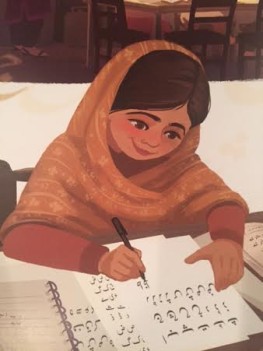
While her father was worried, Malala’s determination grew stronger. She studied harder at school, and during the school holidays instead of covering her hands with henna flowers and vines as most Pakistani women did, Malala painted science formulas on hers. The Taliban continued to exert a tight grip on the Swat Valley, and instituted new rules: men could not shave, women had to cover their faces, movies were banned. And the radio “crackled with the sound of the Taliban preaching: No education for girls! Girls who attend school bring shame to their families!”

The Taliban frightened many, and empty seats in school classrooms began to be more frequent. Ziauddan and Malala appeared on TV to express the importance of education. In response the Taliban threatened Ziauddan and his school. Despite the threats Malala and her father continued to speak and write, “demanding equal education for girls.” The Taliban began patrolling the streets, perpetrating violence and destruction on anyone who didn’t obey their rules.

In December 2008, the Taliban announced that all girls’ schools would close by January 15. “Even before the deadline, bombs started to rain down on nearby schools as warnings.” The British Broadcasting Corporation wanted to reveal to the world what was happening. They wanted a girl to write a blog about her experience and “how it felt to be denied an education. Malala volunteered.

celebrate-picture-books-picture-book-review-for-the-right-to-learn-malala-yousafzai's-story-sneaking-to-school

Image copyright Janna Bock, courtesy of Capstone Press

She took the pen name Gul Makai and related her blog by phone to a reporter who typed and published her words for two months. The first post appeared on January 3, 2009. On January 14 Malala wrote: “‘They can stop us from going to school, but they can’t stop us learning!’” Because activists were growing angry, the Taliban let girls ages 10 and younger go to school. Malala and her friends were 11. They began dressing to look younger and hid school books in their clothes. If they had been caught lying about their ages, they and their teachers could have been beaten or executed.

In May 2009 the Pakistani army began battling the Taliban and ordered everyone to evacuate. Malala and her family had to pack their belongings and leave. Malala wanted to take her books along, but there wasn’t room. She could only hope that they—and her home—would survive the fighting. Three months later, the people of Mingora were allowed to come home, but the town was not the same as they had left it. Shops and buildings were destroyed, burned frames of cars were strewn across the roads. The school’s walls were riddle with bullet holes. But the Taliban was gone. Ziauddin reopened his school for boys and girls.

While Malala returned to school, her life was not the same. Because of her blog, speeches, and interviews, she was internationally famous. Everyone wanted to hear what she had to say—everyone but the Taliban. “Talban leaders began to threaten her on the Internet. Saying she was working for the West, they announced Malala was on their hit list. The police warned the Yousafzai family to leave, but Malala refused to hide. She refused to be silenced.”

Because of the danger, Malala’s mother wanted her to ride the bus to school instead of walk. On October 9, 2012 as Malala and her classmates rode the bus home after school, the bus was stopped and a man boarded, demanding to know which girl was Malala. While no one spoke, the girls couldn’t stop their eyes from flashing quickly toward Malala. That was all the man needed. He “pointed a gun at Malala. Three shots shattered the silence.”

The bus driver rushed Malala and two of her friends to the hospital. Word spread quickly about the shooting through the town and around the world. Malala lay unconscious for days as the Taliban threatened her again should she live. As determinedly as Malala fought for equal education, she fought for survival. Finally, she was flown to a hospital in England for more surgery and to keep her safe. Gifts and wished poured in from all over the world. Malala stayed in the hospital for three months and underwent many procedures to correct the damage done by the Taliban’s bullets.

When she had recovered, Malala returned to her family and to her place on the world stage where she continues to speak out for the rights of all. On July 12, 2013 in a speech at the United Nations, Malala “declared, ‘One child, one teacher, one book, and one pen can change the world.’” On December 10, 2014 Malala became the youngest recipient of the Nobel Peace Prize for her “strength, power, and courage” to “lift her voice for children everywhere.”

celebrate-picture-books-picture-book-review-for-the-right-to-learn-malala-yousafzai's-story-speaking-to-the-UN

Image copyright Janna Bock, courtesy of Capstone Press

Malala. Those three syllables have become synonymous with bravery, freedom, and education. Rebecca Langston-George tells Malala’s remarkable story with the same unstinting vision that fuels Malala’s mission. Told sensitively, but candidly, this compelling biography reveals the harrowing evolution of the Taliban’s reach that, far from intimidating young Malala, only served to make her more determined. Langston-George’s excellent command over her well-chosen details and gripping pacing enhances the power of this important true story. Readers should come away inspired—not only by Malala’s life, but the fact that they too can make a difference.

Janna Bock depicts the changing landscape of Malala’s hometown both physically and philosophically with illustrations that help readers clearly envision and understand Malala’s life and environment. The faces of the townspeople and the Yousefzai family register distress and fear, but also determination, courage, and optimism as schools close, Mingora comes under fire, and the citizens become refugees. Malala’s shooting, and recovery are portrayed with thoughtful consideration of the readers, and the ending takes children inside the United Nations to witness Malala’s ultimate triumph.

An Author’s Note detailing more about Malala’s story then and now as well as a glossary and index follow the text.

For the Right to Learn: Malala Yousafzai’s Story is an important biography of current events and people shaping the world and our children’s future and is a must read for all.

Ages 8 – 12

Capstone Press, 2016 | ISBN 978-1623704261

Discover more fascinating books by Rebecca Langston-George on her website!

View a gallery of art by Janna Bock on Tumblr!

Universal Human Rights Month Activity

celebrate-picture-books-picture-book-review-friends-of-the-world-coloring-page

Friends of the World Coloring Page


Love and understanding for others makes the world a smaller—and better—place. Have fun coloring this Friends of the World Coloring Page!

Picture Book Review
November 29 – It’s National Family Literacy Month

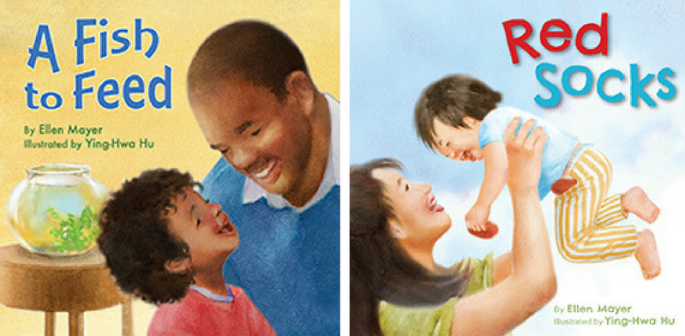
celebrate-picture-books-picture-book-review-a-fish-to-feed-red-socks-covers-image

About the Holiday

Today’s observance was established in 1994 to promote family and community involvement in teaching and supporting children to read more. Family members can make reading a priority at home by sitting down together every day with a wide range of books and other reading material. By taking trips to the library and bookstores, children will also naturally pick up a love of reading. But families can’t do it alone. Kids acquire a drive to read when they see connections between books and their wider world. Fun book-related activities at schools, libraries, science centers, museums, and other places capture children’s attention and make them curious about reading more. Whether children are attracted by fiction or nonfiction, picture books or chapter books, novels or graphic novels, they should be encouraged to read. Universal literacy is a goal that can be accomplished.

About Small Talk Books®

Ellen Mayer’s Small Talk Books® feature young children and adults conversing (or adults speaking to children who are not talking yet) while they have fun, do chores, shop, and bake together. Their conversations demonstrate the kind of excitement and close relationships that encourage learning and language advancement. Each Small Talk Book® includes an accompanying note from Dr. Betty Bardige, an expert on young children’s language and literacy development and the author of Talk to Me, Baby! How You Can Support Young Children’s Language Development. The introduction discusses how children connect actions, words, and meaning as adults speak to them while doing particular jobs or actions.

Other titles in the Small Talk Books® series include Cake Day and Rosa’s Very Big Job. Each book makes a wonderful gift for baby showers, new parents, or anyone with young children in the family. They would be a welcome addition to any young child’s bookshelf as well as libraries and preschool classrooms.

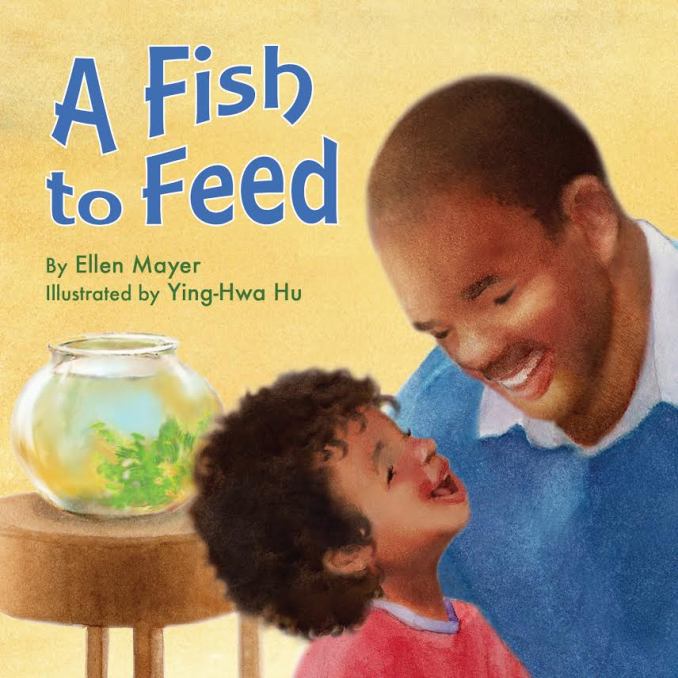
celebrate-picture-books-picture-book-review-a-fish-to-feed-coverA Fish to Feed

Written by Ellen Mayer | Illustrated by Ying-Hwa Hu


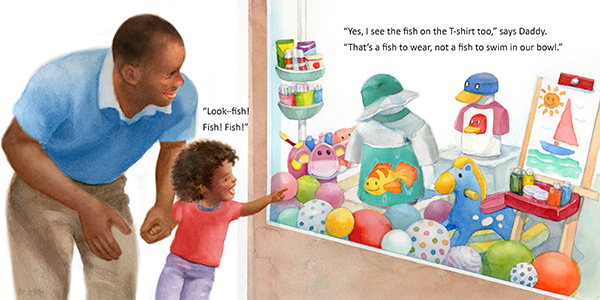
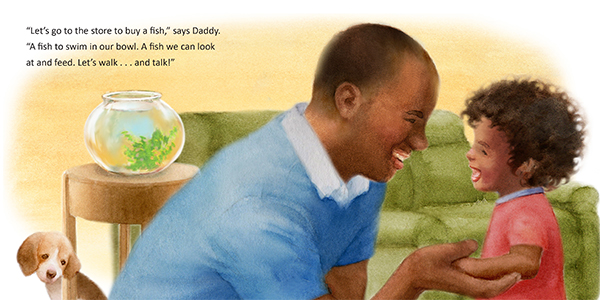
Dad plans a fun trip into town with his young child to buy a pet fish. He says, we will get “a fish to swim in our bowl. A fish we can look at and feed.” The pair are excited to go together and have time to “walk…and talk.” The two head out and soon pass a store. In the window the child sees a T-shirt with the picture of a fish on it and points. “Look—fish! Fish! Fish!” Dad reinforces the observation—“Yes, I see the fish on the T-shirt too.”—and further explains: “That’s a fish to wear, not a fish to swim in our bowl.”

celebrate-picture-books-picture-book-review-a-fish-to-feed-t-shirt

Image copyright Ying-Hwa Hu, text copyright Ellen Mayer. Courtesy of starbrightbooks.com

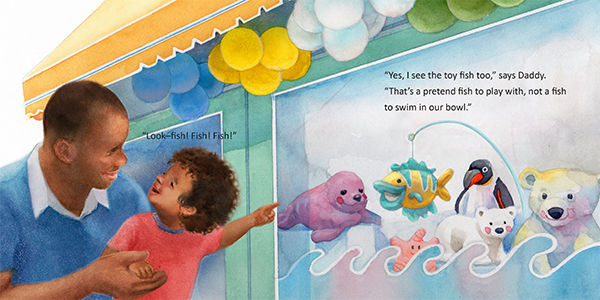
Going into the store, Dad and his youngster find another item with a fish on it. On a shelf is a backpack with a picture of a gold-and-yellow fish on the front pocket. This is a “fish to wear on your back,” Dad says, before going in search of a “fish to feed.” Next, the two come to a toy store. The child points to another fish—a fish on a mobile. “Look—fish! Fish! Fish!” the toddler exclaims. Dad affirms his child’s remark and expands on it using complete sentences that model conversation and increase vocabulary. They linger in the shop, finding other examples of fish.

celebrate-picture-books-picture-book-review-a-fish-to-feed-mobile

Image copyright Ying-Hwa Hu, text copyright Ellen Mayer. Courtesy of starbrightbooks.com

“‘Now let’s go find a fish to feed,’ says Daddy.” They head out of the store and continue down the street. As they come to the Pet Shop, the little one shouts, “‘Look—fish! Fish swim!” Daddy echoes the excitement while praising his child. “‘You found a fish that swims!’” They take the goldfish home, where it swims happily in their bowl—a pet they “can love and feed.”

A Fish to Feed contains die-cut holes in the pages that kids will love peering through as they shop along on this adventure to find a special pet.

celebrate-picture-books-picture-book-review-a-fish-to-feed-dad-and-child

Image copyright Ying-Hwa Hu, text copyright Ellen Mayer. Courtesy of starbrightbooks.com

Ellen Mayer’s story of a dad and his child out for an afternoon together as they look for a pet to love offers adults and children such a sweet way to spend time with one another. The story, set in the familiar environments of home and stores and revolving around a close parent-child relationship, will engage even the youngest readers. The back-and-forth conversation between Dad and his child as they shop models ways in which adults can follow a child’s lead while providing language and literacy development. The abscence of gender-specific pronouns makes this a universal story.

Ying-Hwa Hu’s illustrations are vibrant and joyful. When Dad bends down to be at eye-level with his toddler as they talk, the close bond between them is obvious in their smiling and laughing faces. The shops are full of colorful toys, clothes, backpacks, and other items that will capture kids’ attention. Spending time looking at each page allows adults and children to point at the various items, name them, and talk about them.

Ages Birth – 5

Star Bright Books, 2015 | ISBN 978-1595727077

celebrate-picture-books-picture-book-review-red-socks-coverRed Socks

Written by Ellen Mayer | Illustrated by Ying-Hwa Hu


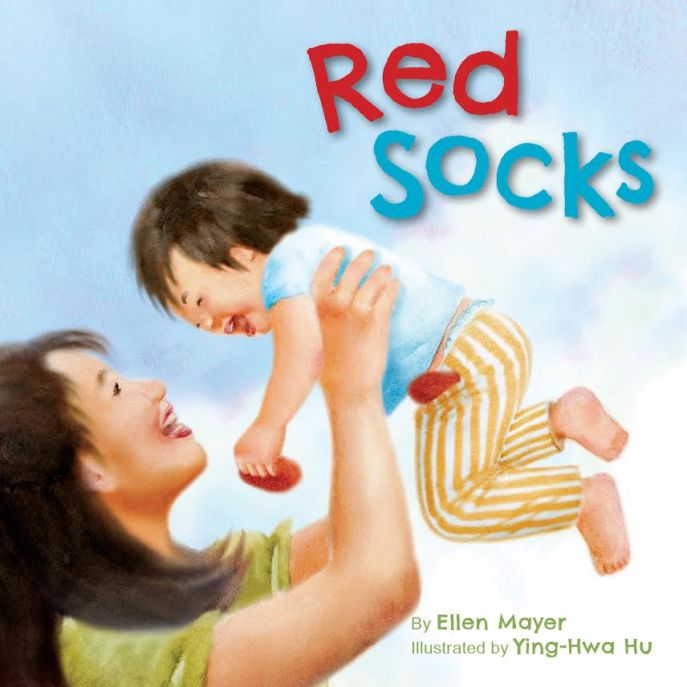
It’s laundry day and the clothes are all dried and soft and ready to wear. “‘Here is your blue shirt, with the goldfish on it,’” Mama says, pulling the top out of the basket and bending down to eye level to show it to her baby. Next, Mama describes the “yellow and white striped pants” she puts on her child. “‘Let’s see what else is in the laundry basket,’” she says.

celebrate-picture-books-picture-book-review-red-socks-shirt

Image copyright Ying-Hwa Hu, text copyright Ellen Mayer. Courtesy of starbrightbooks.com

Mama pulls a tiny red sock from the basket, but—“UH-OH!—where is the other red sock?’” Now it’s the baby’s turn to help. With a look down, the toddler shows Mama where the sock is. “‘You found the other red sock. Yay!’” she says, giving words to the baby’s action. She continues explaining while pointing to the sock poking out of the baby’s pocket: “‘It was hiding in your pants pocket!” Once the laundry is folded, Mama tells her child exactly what they will do next while she playfully slips the other red sock on the baby’s wiggling feet. “‘Let’s put that other sock on your foot. Then we can go play outside.’” As the baby flies in the swing outside, the red socks are brilliant dots against the blue sky.

celebrate-picture-books-picture-book-review-red-socks-pants

Image copyright Ying-Hwa Hu, text copyright Ellen Mayer. Courtesy of starbrightbooks.com

Ellen Mayer’s simple and charming story of a particular moment in a mother and child’s day will immediately appeal to even the youngest reader. Familiar words coupled with clear, vivid illustrations will engage toddlers who are pre-talking and just learning language and concept development. The mother’s use of complete sentences as well as step-by-step descriptions of the activities the child sees and is involved in demonstrates how adults can converse with their babies and young children to encourage strong language and literacy skills. Free of gender-specific pronouns, Red Socks is a universal story.

Ying-Hwa Hu’s illustrations show a mother and child interacting on a typical day while they complete common chores and go outside to play. The mother and child portray a range of emotions and gestures, giving further depth to the understanding of the ideas and conversation presented. Kids will giggle at the adorable puppy who causes a bit of mischief on each page.

Ages Birth – 5

Star Bright Books, 2015 | ISBN 978-1595727060

To learn more about Ellen Mayer and her Small Talk Books® (including other titles: Cake Day and Rosa’s Very Big Job) as well as to find activities to accompany each book, visit her website!

Discover more about Ying-Hwa Hu and view a portfolio of her illustration work on her website!

Red Socks and Too Small to Fail

Red Socks was chosen by Too Small to Fail, an early literacy initiative of The Clinton Foundation to feature in their Wash Time is Talk Time project. Wash Time is Talk Time serves underserved communities and provides resources to turn time spent at the laundromat into an opportunity for families to talk together, read together, and learn together. Language-rich literacy resources will be delivered to more than 5,000 laundromats across the country.

Here’s a video from one fun afternoon with families,  Ellen Mayer, and Ying-Hwa Hu during wash time!

National Family Literacy Month Activity

celebrate-picture-books-picture-book-review-sensory-board

Child’s Sensory Board


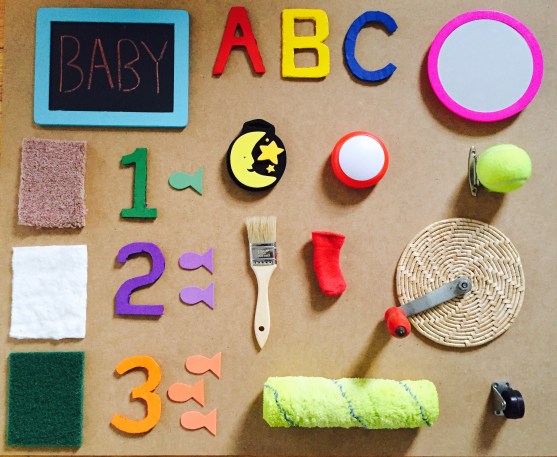
Toys or objects that provide many opportunities for sensory experimentation and observation stimulate a baby and young child to learn while having fun. You can make a sensory board for your own child using household items and that have a variety of textures, sizes, shapes, and movement. When you create your own sensory board, you can personalize it for your child by adding their name, pictures of family members, and other special items. While you play with your child, take time to talk about all of the objects on the board, what they do, and how they work. Count the objects. If you include words or your child’s name, spell them outloud and say them. There are so many ways to use a sensory board. Even if children can’t yet talk, they are listening and soaking in the rich language learning you are providing!

**When making your board always ensure that you use items that are not a choking hazard or can catch tiny fingers. Make sure that items are firmly attached to the board. Never leave a baby unattended while playing.**

Supplies

  • A board large enough to hold the items you want to attach. Boards that can be used include: those found at hardware stores or craft stores; large cutting boards; shelves; old table tops; etc.

Sample items for your sensory board can be age appropriate and include:

  • Large swatches of various textured material. (I used fur, a scrubbing sheet, and a piece of carpeting)
  • Wooden or thick cardboard letters and numbers, painted in a variety of colors. Letters can be used to add a child’s name to the board.
  • Figures cut from sheets of foam or wooden figures found at craft stores in a variety of numbers that you can count with your child (I used sets of 1, 2, and 3 fish cut from foam to go along with the numbers 1, 2, and 3)
  • Mirror
  • Push button light
  • Chalk board to write on
  • Castor or other wheel
  • Door latches
  • Door knockers
  • Mop heads
  • Paint rollers
  • Cranks
  • Drawer handles
  • Hinges (I attached a tennis ball to a hinge that children can push back and forth)
  • Pulleys
  • Paint in various bright colors
  • Paint brushes
  • Scissors
  • Screws
  • Nuts and bolts
  • Velcro
  • Super glue

Directions

  1. Assemble your items
  2. Paint wooden or cardboard items
  3. Arrange item on the board so that your baby or child can easily reach or manipulate each one
  4. Attach items with screws, nuts and bolts, or super glue
  5. Push button lights or other objects that take batteries can be attached with strong Velcro. Ensure items attached with Velcro are large and not a choking hazard.
  6. Set up board where you and your baby or child can enjoy playing with it together

Picture Book Review

November 23 – Fibonacci Day

celebrate-picture-books-picture-book-review-blockhead-the-life-of-fibonacci-cover

About the Holiday

Today’s holiday is dedicated to the man—Leonardo of Pisa, today known as Fibonacci—who promoted awareness throughtout Europe of the number sequence that now bears his name. First appearing in Indian mathematics and linked to the golden triangle and the golden ratio, the number pattern states that each consecutive number in the series is the sum of the two preceding numbers: 1, 2, 3, 5, 8, 13, 21, 34…. This sequence is found again and again in nature in such arrangements as leaves on a flower stem, seeds in a sunflower, the tapering of a pinecone, the swirl of a seashell, and manys. These precise compositions allow each leaf to get enough sunlight, make room for the correct number of petals, or squeeze in as many seeds as possible. To celebrate, learn more about this sequence and then observe patterns in nature. A good place to start is with today’s book!

Blockhead: The Life of Fibonacci

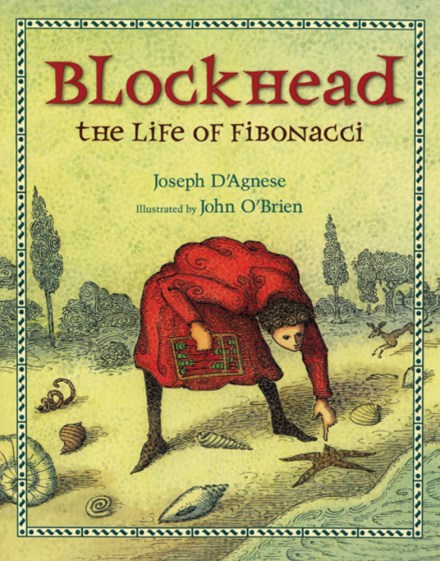
Written by Joseph D’Agnese | Illustrated by John O’Brien


Leonardo Fibonacci introduces himself this way: “You can call be blockhead. Everyone else does.” He goes on to reveal that he acquired that nickname because he loved to think about numbers. Once when his teacher gave the class ten minutes to solve a math problem, he knew the answer in two seconds. At home he counted everything he saw. When he was bored his mind pondered the patterns he saw. For instance, on that school day while his classmates worked on the problem, Leonardo spent the time gazing out the window. H e noticed 12 birds sitting in a tree. How many eyes was that? How many legs? “And if each bird sang for two seconds, one bird after the other, how long would it take all of them to sing?” He was counting these answers in his head when his teacher yelled, “‘How dare you daydream in my class!’” He told Leonardo there would “‘be no thinking in this classroom—only working! You’re nothing but an absent-minded, lazy dreamer, you…you BLOCKHEAD!’”
celebrate-picture-books-picture-book-review-blockhead-the-life-of-fibonacci-story-starts

Image copyright John O’Brien, courtesy of Henry Holt and Company

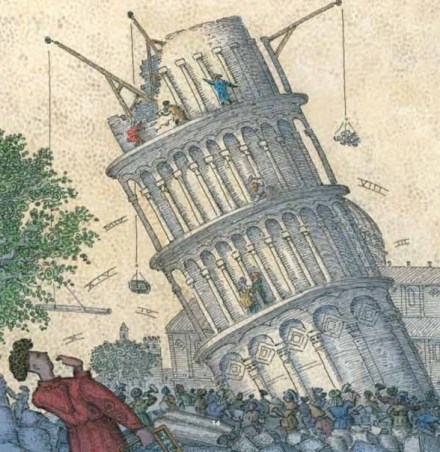
Leonardo ran from the room into the city he loved—Pisa, one of the greatest cities in 1178 Italy. A new tower was being constructed—although the builders were having trouble with their math and the tower stood at an angle. He was so enthralled with the math he saw all around him that he nearly walked into danger. “‘What are you, a blockhead?’” a woman shouted. Leonardo’s father was angry and embarrassed by his son’s reputation in town. He wanted Leonardo to become a merchant, and took him to northern Africa to learn the business.

celebrate-picture-books-picture-book-review-blockhead-the-life-of-fibonacci-tower-of-pisa

Image copyright John O’Brien, courtesy of Henry Holt and Company

In Africa Leonardo learned a new number system. Instead of Roman numerals, the people used numbers “they had borrowed from the Hindu people of India.” In this system XVIII became the much easier 18. During the day Leonardo handled his father’s business accounts, but at night Alfredo, his father’s advisor and Leonardo’s champion, accompanied him as he learned the new number system. As Leonardo grew older, his father sent him on trips to other countries to conduct business. In each Leonardo learned new mathematics concepts. In Egypt he learned about fractions. In Turkey and Syria he discovered methods of measurement. In Greece he learned geometry, and in Sicily he used division and subtraction.

celebrate-picture-books-picture-book-review-blockhead-the-life-of-fibonacci-kitchen

Image copyright John O’Brien, courtesy of Henry Holt and Company

One day Leonardo “began to write a book about Hindu-Arabic numerals” and included riddles to demonstrate the ideas. One was about a pair of rabbits. Leonardo asked Alfredo to tell him how many baby rabbits would be born within one year if it took a baby one month to grow old enough to have babies of its own and one more month to have a pair of babies. Alfredo tried to solve it but couldn’t. As Leonardo explained the sequence of adult pairs and baby pairs of rabbits to Alfredo, he noticed a pattern. At the end of month two, there would be 1 grown-up pair of rabbits and 1 baby pair; at the end of month three there would be 2 grown-up pairs and 1 baby pair; at the end of month 4 there would be 3 grown-up pairs and 2 baby pairs…. Leonardo saw that by adding “any two consecutive numbers in the pattern,” you’d get the next correct number. This discovery made solving the problem even easier.

celebrate-picture-books-picture-book-review-blockhead-the-life-of-fibonacci-sea-shells

Image copyright John O’Brien, courtesy of Henry Holt and Company

Leonardo’s work with math soon spread across Europe. Frederick II, the ruler of the Holy Roman Empire invited Leonardo to visit. There Frederick’s wise men challenged him with math problems that were no match for Leonardo’s quick brain. Frederick II didn’t call Leonardo a blockhead, instead he said he was “‘one smart cookie.’” When Leonardo went home, however, the people of Pisa grumbled and complained. They thought the old Roman numerals were good enough.

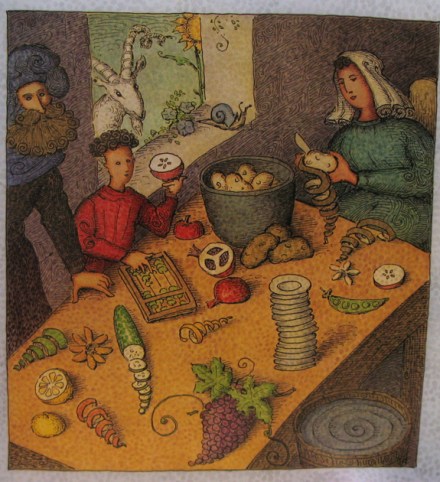
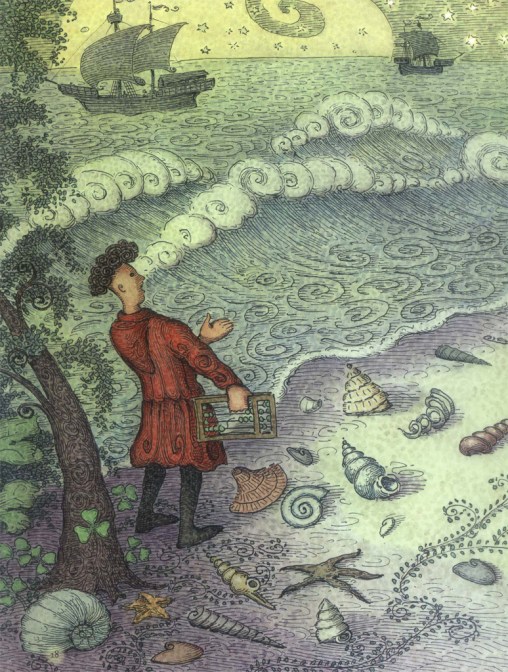
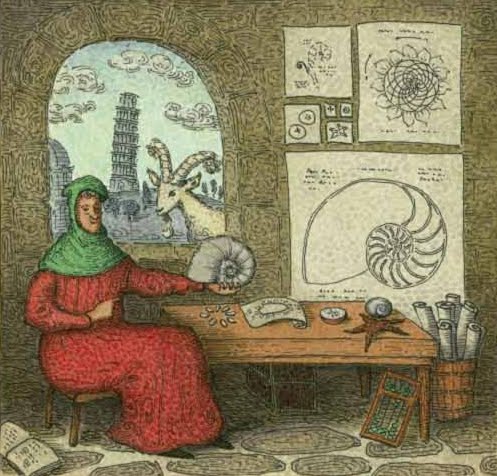
Leonardo set out to prove how valuable Hindu-Arabic numerals were. He began observing nature, and everywhere, from the petals of a flower to the arms of a starfish to the seeds in an apple, Leonardo discovered the same numbers—the sequence he had discovered in the rabbit riddle. He realized that these numbers could be used in different ways—to draw a spiral; the same type of spiral found within pinecones and the center of a sunflower.

celebrate-picture-books-picture-book-review-blockhead-the-life-of-fibonacci-old-man

Image copyright John O’Brien, courtesy of Henry Holt and Company

Leonardo finishes his story by relating that even though he is now old, numbers still delight him, as does the secret Mother Nature cleverly uses to organize the world and even the universe. He invites readers to look again through his story and find the places where his Fibonacci sequence appears.

More biographical information about Leonardo of Pisa plus a discussion of where readers can find Fibonacci number patterns in nature and a scavenger hunt through the book follow the text.

Blockhead: The Life of Fibonacci is an engaging, accessible biography that describes this mathematical scholar’s life and theory in a clear and entertaining way, whether their thing is math and science or English, history, and art. Joseph D’Agnese immediately entices kids into the story with the revelation of how Leonardo acquired the nickname that gives the book its title. Using anecdotes such as the birds in the trees and the rabbit riddle, he invites readers to think like Fibonacci, leading to a better understanding and enjoyment of his life story and the mathematical concept. The idea of using your talents and passions wherever you are—as Leonardo does in his work for his father—is a valuable lesson on its own.

John O’Brien’s wonderfully detailed illustrations take children back to early Italy and the Mediterranean with his depictions of Leonardo’s school and town, as well as the under-construction Tower of Pisa and the influential cultures of other countries he visited. Cleverly inserted into each page are examples of the Fibonacci sequence at work—in whorls of wood grain, the spirals of women’s hats, the web of a spider and horns on a passing goat, and so many more. The rabbit riddle is neatly portrayed for a visual representation of the math involved, and the way nature uses the pattern is also organically portrayed. Children will love searching for and counting the various ways Fibonacci’s seuqence is used throughout the illustrations.

Blockhead: The Life of Fibonacci is a fantastic book to share with all children, especially as they begin to learn mathematical problem solving, the value of math, how it is used, and how it occurs naturally in the world. The book makes a marvelous teaching resource and addition to classroom libraries and also a great addition to home bookshelves.

Ages 5 – 9

Henry Holt and Company, 2010 | ISBN 978-0805063059

To discover more books by Joseph D’Agnese for children and adults visit his website!

Find a vast portfolio of cartoon and illustration work by John O’Brien for kids and adults on his website!

Watch the Blockhead: The Life of Fibonacci book trailer!

Fibonacci Day Activity

celebrate-picture-books-picture-book-review-spiral-coloring-page

Spiral Coloring Page


Have fun coloring this printable Spiral Coloring Page that is inspired by Leonardo Fibonacci’s work.

Picture Book Review