January 29 – It’s Book Blitz Month

celebrate-picture-books-picture-book-review-fossil-by-fossil-cover-II

About the Holiday

Is your motto “So many books, so little time?” Is every shelf, nook, and cupboard in your house filled with books? Is your library card the first one on your ring? If so, you’ll love Book Blitz Month! During this month book lovers are given the green light to read, read, read as many books as possible! Or if there’s a tome you’ve always wanted to tackle, crack the cover and let yourself become immersed in someone else’s story. For kids, Book Blitz Month can be particularly exciting. Sit down with your child or students and make a stack of books they’d like to read. Find time every day to read one, two, or a few of the books in the pile. Seeing the stack shrink gives kids a sense of accomplishment, and they might even want to build it up again! Mix reading with fun activities to encourage a new generation of avid readers!

Fossil by Fossil: Comparing Dinosaur Bones

Written by Sara Levine | Written by T.S Spookytooth


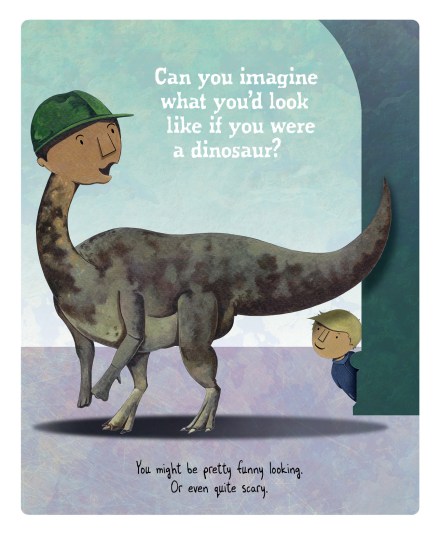
You like dinosaurs, right? I mean, who doesn’t? Of course, I’m not talking about those folks with outdated ideas or that old clunker in the garage that you just can’t part with. I’m talking about the big, huge carnivores and herbivores that roamed the earth millions of years ago—parasaurolophus, diplodocus, apatosaurus, brontosaurus, t-rex, and all the rest that have fun-to-say names. You might think that having those guys and gals around now would be fun, but how would you feel if you, yourself, were a dinosaur?
celebrate-picture-books-picture-book-review-fossil-by-fossil-funny-and-scary

Image copyright T.S Spookytooth, 2018, text copyright Sara Levine, 2018. Courtesy of Millbrook Press.

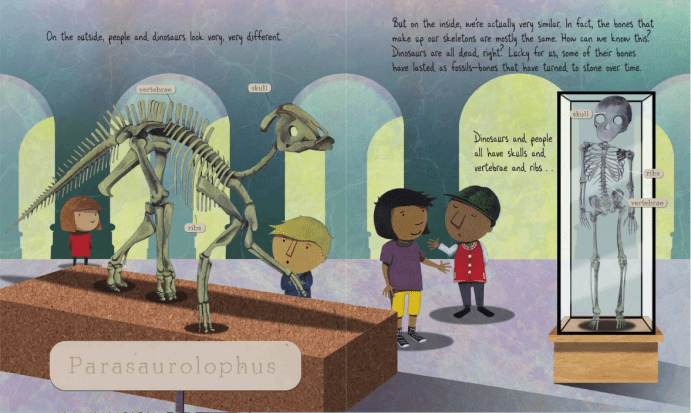
Does that thought make you laugh or maybe shudder a little? Well, if you were a dinosaur “you might be pretty funny looking. Or even quite scary.” If you think it’s totally impossible that you could be a dinosaur, you might want to reconsider: Sure, “on the outside, people and dinosaurs look very, very different. But on the inside, we’re actually very similar.” Compare some dinosaur fossils and a human skeleton, and you’ll see!
celebrate-picture-books-picture-book-review-fossil-by-fossil-parasaurolophus

Image copyright T.S Spookytooth, 2018, text copyright Sara Levine, 2018. Courtesy of Millbrook Press.

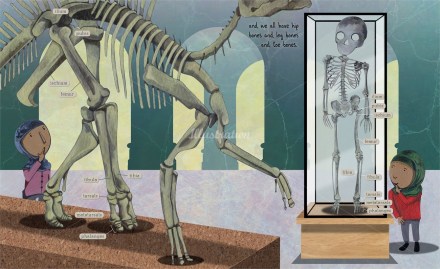
Dinos have skulls, and—yep—you’ve got one too! Vertebrae and ribs? Dinosaur, check; you, check. How about scapula, humerus, ulna, radius, metacarpals, and phalanges? Yes, yes, yes, yes, yes, and yes! And that’s just in our arms and in a dinosaur’s front legs! We both have “hip bones and leg bones and toe bones” too! So why aren’t we dinosaurs? And why aren’t dinosaurs people?

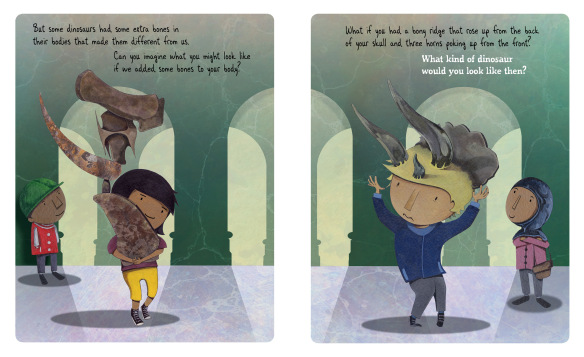
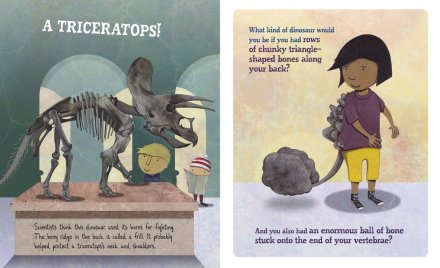
That’s because “dinosaurs had some extra bones in their bodies that made them different from us.” Would you like to try some of these on for size? Imagine having a bony ridge jutting out from the back of your head and two big horns and one littler one jutting out the front? “What kind of dinosaur would you look like then?” You got it! A triceratops! Nowadays all those enhancements would just make it hard to wear a hoodie, but back in the Cretaceous Period? “Scientists think this dinosaur used its horns for fighting.” The frill in the back “probably helped protect a triceratops’s neck and shoulders.”
celebrate-picture-books-picture-book-review-fossil-by-fossil-stack-of-bones

Image copyright T.S Spookytooth, 2018, text copyright Sara Levine, 2018. Courtesy of Millbrook Press.

This is fun! Let’s try another one…How about if you had “rows of chunky triangle-shaped bones along your back and…an enormous ball of bone stuck onto the end of your vertebrae?” Well, you wouldn’t be a world-class runner and dunking a basketball would probably be out of the question. Why? Because you’d be an ankylosaurus, and the “bones on the end of this dinosaur’s tail weighed more than 60 pounds (27 kg).” You would be a pretty awesome competitor, though—even for the likes of T-rex!

What if those bones along your back ranged from small to huge and ran from your head to the end of your long tail, which, by the way, ended with a few knife-sharp spikes? Then, you’d be a stegosaurus! And what would you do with those plates on your back? Good question! Maybe they’d gather sun like solar panels and keep you warm, or maybe you’d just flash them around to impress your friends.
celebrate-picture-books-picture-book-review-fossil-by-fossil-triceratops

Image copyright T.S Spookytooth, 2018, text copyright Sara Levine, 2018. Courtesy of Millbrook Press.

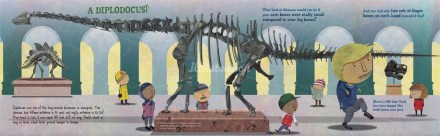
Is having more of something ever a bad thing? You might think so if you looked like our next dinosaur. “What if we added lots and lots of extra vertebrae in your neck? And what if your vertebrae didn’t stop at your rear end but kept going and going and going? What kind of dinosaur would you be then?” Here’s a hint: a picture of you wouldn’t even fit on a regular two-page spread in a book! That’s right—it takes four pages to fit you in because you would be a diplodocus! You’d be so long it would take three school buses to get you to class!

From large we move onto small—small arms that is and only two fingers on each hand instead of five. Any ideas? What if I added that “you’d also have dagger-like teeth lining your jaw?” Yeah, you know it! A tyrannosaurus rex! And what did t-rex use those small arms for? “Scientists think it might have used its puny front legs to help it get up after lying down for a rest.”
celebrate-picture-books-picture-book-review-fossil-by-fossil-diplodocus

Image copyright T.S Spookytooth, 2018, text copyright Sara Levine, 2018. Courtesy of Millbrook Press.

Okay, so those are just some of the dinosaurs that lived on land. But there were other ones in the sea and in the air. Imagine if your nostrils were on the top of your head, your skull was long and pointy, and your arms and legs were more like paddles. What would you be good at? Exactly! You’d be an excellent swimmer—which would make you an ichthyosaur!

Let’s do one more! What would you be able to do if your “pinky bones grew really, really long and a membrane of skin was attached to these bones?” Sure! You’d be able to fly, and as a pterosaur, you’d be the first animal with bones to accomplish that amazing feat.

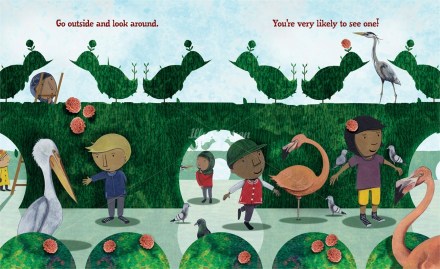
Now, you may have seen dinosaur skeletons in a museum and felt a little sad that you’d never see these creatures in person, but did you know that “you may have even seen one already today? What kind of animal would you be if you were a dinosaur living on Earth right now?” You’ll want to look skyward for this answer. “Scientists now consider birds to be dinosaurs,” and that they “use their first three fingers” to fly. “So if you want to find a dinosaur…Go outside and look around. You’re very likely to see one!”

Backmatter includes a discussion on birds as dinosaurs, a list of dinosaur groups, a glossary, a pronunciation guide, and resources for further study.
celebrate-picture-books-picture-book-review-fossil-by-fossil-birds

Image copyright T.S Spookytooth, 2018, text copyright Sara Levine, 2018. Courtesy of Millbrook Press.

Sara Levine draws on kids’ love of dinosaurs and their growing knowledge of human anatomy to create this mashup of science and laughs that teaches as much as it delights. By revealing on the first two pages that kid and dinosaur skeletons have many of the same kinds of bones, Levine immediately taps that “Wow!” factor that keeps children engaged in a topic.

Add on the funny “what if…” descriptions and illustrations of children sporting bony projections, long tails and necks, noses and fingers, and you’ve got a science book that readers can’t put down. Along the way, budding archaeologists and paleontologists learn facts about each dinosaur and the purpose of their particular anatomical feature or features. Levine’s conversational tone directly addresses her readers and makes learning as fun as going on a field trip with your best friend—how cool is that?
celebrate-picture-books-picture-book-review-fossil-by-fossil-skeletons

Image copyright T.S Spookytooth, 2018, text copyright Sara Levine, 2018. Courtesy of Millbrook Press.

Readers needn’t worry if they can’t quite imagine having horns sticking out of their head, being eighty feet long, or having pinky fingers long enough to roast marshmallows on. T.S Spookytooth has it all covered. As the diverse group of kids visit a museum of natural history, they suddenly find themselves sporting prehistoric traits that confound, surprise, and—as it is with kids—amuse them. Each dinosaur’s skeleton (as well as a human skeleton) is drawn clearly and with realistically.

The double gate-fold illustration of the diplodocus is a show-stopper, and you can bet that children will want to count the vertebrae! Spookytooth’s color palette and imagery beautifully represents the interior of a museum and shows the dinosaurs off to best advantage. The final two-page spread of the children interacting with today’s dinosaurs is whimsical, will inspire kids to look at birds differently, and holds a question—is there an imposter among them?

Fossil by Fossil: Comparing Dinosaur Skeletons would be a favorite addition to home bookshelves as well as classroom, school, and public libraries to spur enthusiastic learning.

Ages 5 – 10

Millbrook Press, 2018 | ISBN 978-1467794893

Discover more about Sara Levine and her books on her website

Learn more about T.S Spookytooth and his illustration work on his website

Book Blitz Month Activity
celebrate-picture-books-picture-book-review-dinosaur-eggs-craft-nest

Hatch Your Own Dinosaur Eggs

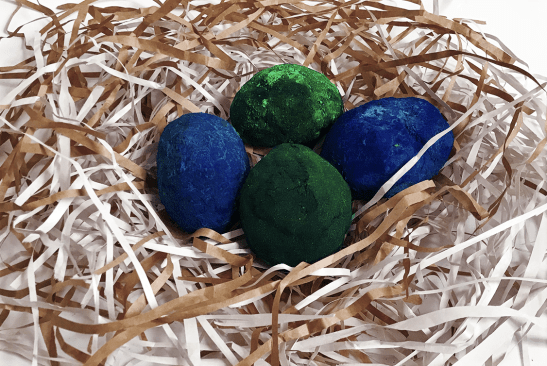
Think there are no more dinosaur eggs? Think again! You can make your own with this easy craft that will have you hatching some t-rex-size fun! All you need are a few simple ingredients!
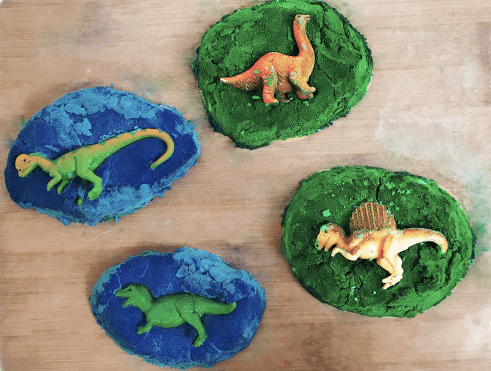
celebrate-picture-books-picture-book-review-dinosaur-eggs-craft-open-eggs

Supplies

  • Old clothes or apron
  • Large box of baking soda (makes between 6 and 8 eggs)
  • Food coloring
  • Water
  • Plastic dinosaur toys
  • Bowl
  • Fork
  • Spoon
  • Wax paper
  • Baking sheet
  • Foil
  • Vinegar
  • Spray bottle (optional)
  • Plastic or metal spoon, stick, popsicle stick, or other implement to chisel with
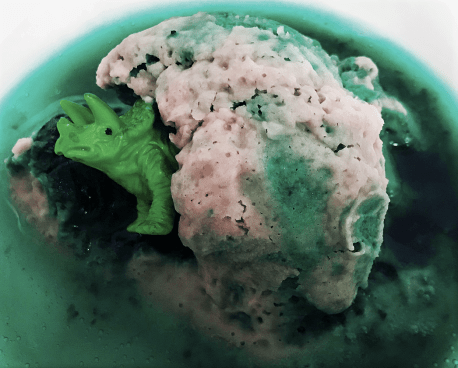
celebrate-picture-books-picture-book-review-dinosaur-eggs-craft-vinegar-egg-open-darker

Spray the egg with vinegar to hatch your dinosaur

Directions

  1. Wear old clothes or an apron
  2. Cover work surface with wax paper, parchment paper, newspaper, or other protection. Food coloring can stain some surfaces
  3. Pour baking soda into the bowl
  4. Add drops of food coloring in whatever color you’d like your eggs to be. The eggs will darken when baked.
  5. Mix in the food coloring with the fork. You may want to use your hands, too
  6. When the baking soda is the color you want it, begin adding water a little at a time
  7. Add water until the baking soda holds together when you squeeze it in your hand
  8. When the baking soda is the right consistency, spoon some out into your hand or onto wax paper
  9. Push one plastic dinosaur into the middle
  10. Cover the dinosaur with more of the baking soda mixture
  11. Carefully form it into an egg shape
  12. Repeat with other dinosaurs
celebrate-picture-books-picture-book-review-dinosaur-eggs-craft-chiseled -darker

Chisel the egg open to hatch your dinosaur

To Bake the Eggs

  1. Set the oven or toaster oven to 200 to 225 degrees
  2. Set the eggs on a baking sheet lined with foil
  3. Bake the eggs for 15 minutes, check
  4. Turn the eggs over and bake for 10 to 15 more minutes
  5. Remove from oven and let cool

To Hatch the Eggs

  1. Eggs can be hatched by chiseling them with a spoon, stick, or other implement
  2. Eggs can also be hatched by spraying or sprinkling them with vinegar
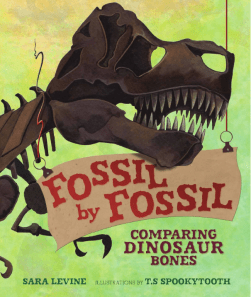
celebrate-picture-books-picture-book-review-fossil-by-fossil-cover-II

You can find Fossil by Fossil: Comparing Dinosaur Bones at these booksellers

Amazon | Barnes & Noble | Books-a-Million | Indiebound

Picture Book Review


October 8 – It’s World Space Week

celebrate-picture-books-picture-book-review-to-the-stars-cover

About the Holiday

First declared by the United Nations in 1999, World Space Week has grown to be the largest public space-related event in the world. The week celebrates the advancement and contributions of space technology and exploration. This year’s theme is “Exploring New Worlds in Space” and aims to encourage and inspire new experimentation, discovery and participation in advancing ways to explore the cosmos beyond earth.

To the Stars! The First American Woman to Walk in Space

Written by Carmella Van Vleet and Dr. Kathy Sullivan | Illustrated by Nicole Wong


As a child Kathy Sullivan loved to explore. Her father designed airplanes, and when he brought home blueprints, she carefully studied every line and curve. When she saw airplanes in the sky she wished she were on them, flying to exciting locations all over the world. Maps and foreign languages fascinated her. “Their strange symbols, exotic tales, and musical sounds made her feel like the world was waiting for her.” Kathy wanted to see that whole world and thought maybe she’d like to be a spy or a diplomat, but her friends and other adults told her those weren’t jobs for women.

celebrate-picture-books-picture-book-review-to-the-stars-blueprints

Image copyright Nicole Wong, courtesy of nicole-wong.com

But Kathy always followed her heart. She loved going fishing with her dad and brother and finishing the day with a swim. She “delighted in how her arms and legs moved in slow motion underwater.” Kathy was still a teenager when she learned how to pilot a plane. At first the busy instrument panel made her nervous, but she quickly learned how to manage all the “dials, buttons, and numbers.”

Kathy got a taste for the thrill of space when she bravely jumped at the opportunity to ride in a Breezy—an open-air-framework plane. Sitting at the very tip of the airplane, in front of the pilot, Kathy had a bird’s eye view. “The wind rushed past her face so fast it pushed her cheeks back. Higher! Faster! Young Kathy looked at the ground below her feet. She felt like she could see the whole world.”

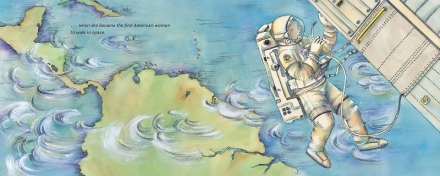
As an adult, Kathy put all of these experiences to good use as she studied complex science that would lead her to NASA. And when she became the first American woman to walk in space, she fulfilled her childhood dream to see the whole world!

celebrate-picture-books-picture-book-review-to-the-stars-spacewalk

Image copyright Nicole Wong, courtesy of charlesbridge.com

Carmella Van Vleet and Dr. Kathy Sullivan, have written a compelling biography of Dr. Sullivan that not only tells the story of her adult achievements, but also reveals the childhood and teenage motivations and influences that fostered her journey to the stars. As each event in Kathy’s young life is introduced, it is followed by an adult accomplishment: Kathy’s poring over her father’s aircraft blueprints leads to a spread of college-age Kathy studying charts in textbooks. Her enjoyment of swimming underwater is followed by an illustration showing her NASA training underwater. Her initial introduction to a plane’s instrument panel informs her later responsibilities inside the spacecraft. And the question she once asked herself as a child—what kind of job would allow her to see the whole world—is answered as the astronaut Kathy gazes down at Earth from space.

celebrate-picture-books-picture-book-review-to-the-stars-breezy

Image copyright Nicole Wong, courtesy of charlesbridge.com

Nicole Wong’s lovely, realistic watercolor and ink paintings clearly show readers Kathy Sullivan’s trajectory from curious girl to accomplished astronaut. The blueprints that Kathy studies are filled with schematics. The aqua water she swims in swirls and bubbles in the wake of her cannonball dive, and the crisscrossing fields lay like a mottled green quilt under the Breezy. Especially stunning and effective are the illustrations of Dr. Sullivan’s work with NASA. Kids will love the up-close view of the spacecraft’s instrument panel with its myriad buttons and dials. Likewise, they will find the gorgeous two-page spreads of the space shuttle’s launch, the view from the cockpit, and Kathy’s spacewalk particularly thrilling.

Following the text is a personal note from Kathy Sullivan to her young readers. More extensive biographical notes reveal how Dr. Sullivan discovered her love of science as well as information on the NASA missions she supported. Two more pages highlight the women of the first space-shuttle class, which included Kathy Sullivan, and other firsts by eight other women in space.

To the Stars is a wonderful book to teach children that following their own heart is the best path to future happiness and personal accomplishment. It’s a beautiful addition to any budding scientist’s or adventurer’s library!

Ages 5 – 9

Charlesbridge, 2016 | ISBN 978-1580896443

To find fun activities for To the Stars—including how to make space play dough—as well as other books by Carmella Van Vleet, visit her website!

To learn more about Nicole Wong and view a portfolio of her artwork, visit her website!

World Space Week Activity

celebrate-picture-books-picture-book-review-astronaut-coloring-page


Astronaut Coloring Page


Would you like to be an astronaut? Draw yourself in this spacesuit and then grab your crayons, pencils, or markers and have fun with this printable Astronaut Coloring Page!

Picture Book Review

September 7 – Buy a Book Day and Interview with Sara Levine

celebrate-picture-books-picture-book-review-bone-by-bone-cover

About the Holiday

Today is one of the best days of the year! Anyone who loves books will want to take the opportunity of the holiday to visit their favorite bookstore and buy one of those books you’ve been hearing and reading about. And why stop at just one? Winter is coming—that time when there’s nothing more cozy than snuggling in with a cup of tea or hot chocolate and reading late into the night. As the school year begins, children benefit from having new books in their home libraries that reflect their changing interests and maturing thoughts. Take a little time to look through the children’s or tween sections of the bookstore and let your kids pick out some new favorites! Yes, today is a wonderful day, no bones about it! 

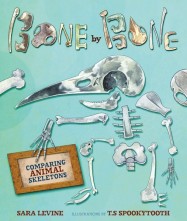
Bone by Bone: Comparing Animal Skeletons

Written by Sara Levine | Illustrated by T.S Spookytooth


Can you imagine if we sloshed through life like soup without a bowl? What would we set our hats on? Where would we carry our phones? How could we sit in class or the office or perform our favorite activities? And what would happen to our organs, our hair, our homes? It’s all a little disturbing! Fortunately, we don’t have to worry about that scenario because “we’re vertebrates, animals with bones. Our bones hold us up.” Phew!

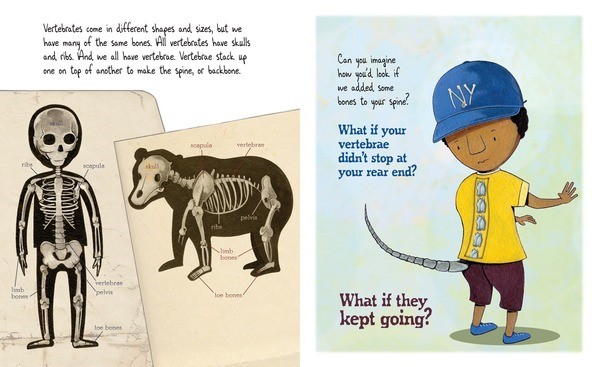
There are different kinds of vertebrates—mammals, reptiles, fish, and more—but many of our bones are similar. For example, “all vertebrates have skulls and ribs. And we all have vertebrae. Vertebrae stack up one on top of another to make the spine, or backbone.” Humans have vertebrae that end…well…you know where, but imagine for a minute if your vertebra kept on going. What if they poked a hole right through your shorts? Yes! You’re right—you’d have a tail. Tails are pretty helpful for some animals. They help them swim, communicate, even keep their balance.

celebrate-picture-books-picture-book-review-bone-by-bone-tailbone

Image copyright T. S Spookytooth, text copyright Sara Levine. Courtesy of Lerner Publishing

Good job! Let’s try again…how about if you only had a skull, vertebrae, and ribs. No arm bones; no leg bones. You’ve got it! A slithery snake! Nah…really…you’d look great! Okay, maybe you’d prefer if you had a skull, vertebrae, and arm bones—but no leg bones—and your nose was transferred to the top of your head. Sounds fishy? Maybe, but not quite. Oh! Did I give it away? Yep, you’d be a whale or a dolphin, and you’d use those powerful vertebrae to propel yourself to the ocean’s surface to grab a breath.

Imagine what kind of gloves and shoes you’d need if your “middle fingers and middle toes were so thick that they supported your whole body.” Hey, you’re good at this! It was a trick question. You wouldn’t need gloves, but you’d wear horse shoes (or no shoes if you’re a less domesticated animal like a zebra). Now, let’s take a trip through a room full of fun-house mirrors. What kind of animal would you be if your neck was reeeaally long and each vertebrae was “as big as your head?” Or if your legs were muuuuuch longer than your arms? Or your “finger bones grew so long that they reached your feet? Seeing those transformations is definitely worth the price of admission, right?

celebrate-picture-books-picture-book-review-bone-by-bone-bat

Image copyright T. S Spookytooth, text copyright Sara Levine. Courtesy of Lerner Publishing

But getting back to the bowl of soup: “Could you be an animal if you didn’t have any bones at all?” Sure! Some insects and sea creatures “have their hard parts on the outside,” and some are just “mushy.” Think of worms, slugs, and jellyfish, just to name a few. But bones make life more fun, don’t ya think? So if all vertebrates have bones, what makes humans different? Well, for one thing we (as well as some apes and monkeys) have opposable thumbs, which means that “we can move our thumbs in a special way that allows us to do many things, including turning the pages of a book,” using tools, and picking up objects. “Did you get that one? If so, give yourself a thumbs-up!”

An Author’s Note including more about bones, the types of vertebrates, a glossary, and resources for further reading follow the text.

With humor and a kid’s sensibility of the bizarre, Sara Levine presents an anatomy lesson that young readers will respond to. Juxtaposing individual bony features of humans and animals is a brilliant idea to give children perspective on the differences in animal skeletons and the uses of each unique trait. Levine’s quiz-like format engages readers, encouraging independent thought and active participation as well as building suspense for what transformation comes next. Kids will laugh and learn and be on the lookout for other ways human and animal skeletons differ as they become more aware of the natural world around them.

With illustrations of tailbones sticking out of pants, empty socks, two fingered hands and two toed feet, a neck that needs two scarves, and more, T. S Spookytooth illuminates what it means to be human in an animal world or an animal in a human world. Kids will laugh imagining themselves as Spookytooth depicts them with animal features and “Ewww” when their portrayal dissolves into a muddy mess. The accurate drawings of human and animal skeletons educate readers on the names and placement of particular bones.

The unique approach to the study of human and animal skeletons, the wide range of animals presented, and the enticing writing and illustrations make Bone by Bone: Comparing Animal Skeletons a wonderful choice for libraries and home bookshelves of budding scientists and nature lovers.

Ages 5 – 10

Millbrook Press, 2014 | ISBN 978-0761384649

To learn more about Sara Levine and her books, visit her website! You’ll also discover fun Bone by Bone activities to enhance your reading!

View a gallery of artwork by T. S Spookytooth, plus videos and more on his website!

Buy a Book Day Activity

celebrate-picture-books-picture-book-review-x-ray-craft-dog-paw

Dog Paw and Human Hand X-Ray Craft


X-rays are cool to look at, but they always stay at the doctor’s office! With this craft you can simulate an X-ray of a dog’s paw and a human hand!

Supplies

  • Printable skeleton templates: Human Hand Template | Dog Paw Template
  • Black chalkboard drawing paper, 8 ½ inches by 11 inches
  • White colored pencil
  • White chalk
  • Clear Plastic Report Sheet Protectors
  • Magnetic clip to hang your x-ray on the refrigerator or other metal surface (optional) OR
  • String or wire, adhesive squares, and clothes pins to hang x-ray on the wall (optional)
  • Scissors

Directions

  1. Print the Human Hand and Dog Paw Templates (you may want to print two—one to cut and one to follow when transferring the bones to the black paper)
  2. Cut the bones apart
  3. Lay the bones on the black chalkboard paper
  4. Trace the bones with the white colored pencil
  5. Color in the bones with the white chalk
  6. Slip the black paper into the plastic report sheet protector
  7. If desired, hang the x-ray on the refrigerator with the magnetic clip or on the wall using string, adhesive squares and clothespins


Q & A with Author Sara Levine

celebrate-picture-books-picture-book-review-author-sara-levine

Today, I’m thrilled to talk to Sara Levine about her writing as well as to learn about her early experiences with animals and to discover a kid’s-eye-view of women in science.

Your writing for kids is so infused with humor that really captures their attention. What were some of the books that you liked best as a child?

When I was younger, one of my favorite picture books was Katerine and the Box by Patricia Lee Gauch. I’ve noticed that this book has gone back into print; I was so happy to find it online. It’s basically about creativity. A girl and her friend keep finding new uses for a large cardboard box—a house, a car, a dance platform. I can still recall my feeling of excitement when hearing it read to me—it made me want to go make something. It’s actually a feeling very similar to what I have today when I think of a new idea for a book. There was also a book called Wisher, which was about difference—about a cat who dreamt he was really a fish. I remember that the illustrations were beautiful and somewhat scary—just done in blues, browns and yellows.  As an older child, I loved Charlotte’s Web by E.B White, Lizard Music by Daniel Pinkwater and pretty much everything by Judy Blume.

I don’t suppose any of these books are like the books I write. I used to tell people that I liked my science and my books separate. I just wanted to go outside to learn about science. But, I wanted stories in my books. I don’t think there were any of the sorts of books I write about science out for kids when I was young. At least I didn’t find them. But if I had, I think I would have enjoyed them—the fact that they were funny and interactive. But here’s a picture book I LOVE that I found as an adult that is certainly infused with humor and captures a kid’s (and a grown-up’s) attention: Bark, George, by Jules Feiffer. I think this is currently my favorite picture book.

You grew up on a farm in Guilford, Connecticut. Can you tell me a little about the farm and how or if it influenced your current work?

Calling it a “farm” might be a bit of a stretch. My parents were two kids who grew up in Brooklyn and then moved to CT and decided to get some animals, cheered on by their enthusiastic offspring. First there was a goat, who got lonely. So then there was another goat. And they had a baby. And there was a chicken at school who needed a place to go for the summer. And then never went back to school… And so on. We ended up having over 100 named animals—a horse, a cow, peacocks, geese, a donkey and more. I loved taking care of the animals, with my siblings. It was a wonderful experience, one that I’m very grateful for. But it wasn’t at all lucrative. I think the only money made was by my brother who would sell extra eggs to his teachers.

How did it influence my current work? I’m not sure. Certainly my interest in animals is a lifelong one. I think the stories about the animals actually show up more in my writing for adults than in my picture books. The ideas for the books for children come more from teaching ideas that I think will translate well into a picture book format.

You have a doctorate in veterinary medicine and a masters in fine art. When and how did the two merge into your work as an author?

What a great question. I have always had this science side and this humanities side. A lot of my life, I’ve been struggling with how to balance and feed both sides of myself. It’s taken me a long time to find a way to merge the two interests, and it’s been very satisfying to do so in writing about science, especially for kids.

You offer four different school and library programs, all of which sound fascinating. Do you have any anecdotes from a presentation you’d like to share?

In one of my workshops, the one for Bone by Bone: Comparing Animal Skeletons, I bring in an articulated skeleton for the kids to see and a disarticulated skeleton in a box. The kids learn the bones, and I then hand them each a bone which they take up to the standing skeleton to figure out which bone it is, and then work together to put together the second skeleton on the floor. Inevitably, someone asks if the skeletons are real. They are. I literally found them in the closets, when I started my teaching at Wheelock. There are all sorts of questions about that, generated by the kids, and then, often, someone will ask if the skeletons are “boys or girls.” Recently, at a school near Boston, I was explaining to a group of second graders that both were female, that we could tell by the shape of the hips, and I heard one girl, going, “YES!” and pumping her arm up and down, in victory. The boy next to her says, “Why are you so happy? That means a girl died.” To which she responds, “That’s true. But it also means one more girl in science!”

celebrate-picture-books-picture-book-review-bone-by-bone-workshop

Sara Levine leads a workshop at Cold Spring School

What’s the best thing about writing for kids?

I enjoy trying to think of engaging and interactive ways to teach something that hasn’t been taught before. I like the creativity involved. And, of course, reading it to the kids when I’m done and seeing them respond!

celebrate-picture-books-picture-book-review-bone-by-bone-students-at-al-hamra-school

Students at Al Hamra Academy examine a skeleton

You also write articles for adults and were nominated for a Pushcart Prize in 2007. Can you tell me more about your writing for adults?

I write science related essays for adults. The writing comes more from my own experiences.  I do have a handful of essays published. I think the one that was nominated for the Pushcart, “What Hands Can Do” is still available to read online. Here’s a link to it on Fictionaut. It’s about spaying a dog. And more, of course. I think my most successful essay is “The Body of a Cow” which originally appeared in the Massachusetts Review. It’s also on Fictionaut, if anyone wants to have a look. Eventually, I hope to work the essays into a memoir for adults.

What’s up next for you?

I have a book on dinosaur bones which will be published by Lerner next year. I also have three children’s books written which I’m trying to find homes for at the moment—one on animal classification (but interactive, written like a “do your own adventure” story), one on how plants communicate with animals, and one very funny one (if I can say so myself) called “Breakfast at the Omnivore Café,” which is about what animals eat. This one might never get published because it falls into the cracks between nonfiction and narrative fiction, but I haven’t given up on it yet. The book I’m currently working on is an attempt to explain climate change through stories of the carbon cycle. Doesn’t sound very interesting when put that way, but it’s written as an interactive story, and is also actually quite funny in parts, so I think kids will like it.

Since Celebrate Picture Books is a holiday-themed blog, I can’t let you get away without asking you what your favorite holiday is…

Passover. You get to tell a story to children in a way that is interactive and engaging for kids, AND it involves food. What could be better?

Thanks so much for chatting and sharing your unique perspective on the natural world, Sara! I, for one, would love to read Breakfast at the Omnivore Café—that would be one interesting menu, I bet! I wish you the best with all of your books!

You can connect with Sara Levine on:

Her Website | Facebook | Twitter

celebrate-picture-books-picture-book-review-bone-by-bone-cover

Bone by Bone: Comparing Animal Skeletons and Sara’s other books can be found at:

Amazon | Barnes & Noble | Books-a-Million | Lerner Publishing

About Sara Levine

Sara Levine is an assistant professor of biology at Wheelock College and a veterinarian.  Her science books for children include Bone by Bone: Comparing Animal Skeletons (2013) and Tooth by Tooth: Comparing Fangs, Tusks and Chompers (2016).  Her third book, Fossil by Fossil: Comparing Dinosaur Bones will be published in 2018.  Bone by Bone: Comparing Animal Skeletons has received much recognition, including the Utah Beehive Book Award, selection as a Bank Street College Best Children’s Book of the Year, and finalist for the Cook Prize for best STEM picture book.

Sara also writes science-related essays for adults, one of which was nominated for a Pushcart Prize in 2007.  Her writing has appeared in the Boston Globe, the Massachusetts Review, Bayou, and in the anthology And Baby Makes More. In addition to teaching college students, she has taught children’s environmental education classes for the Massachusetts Audubon Society and other nature centers in Massachusetts and Connecticut for over 15 years. 

Sara holds a doctorate in veterinary medicine (DVM) from Tufts University, a master of fine arts degree (MFA) in creative nonfiction writing from Lesley University and a bachelor of arts degree (BA) in English from Haverford College.  She is a native New Englander and lives with her daughter and their dogs and cat in Cambridge, Massachusetts.  

Picture Book Review

July 8 – Savor the Comic, Unplug the Drama Day

celebrate-picture-books-picture-book-review-7-ate-9-the-untold-story-cover

About the Holiday

With so much going on in our lives—at work and at home—it’s good to take a break for a laugh and a bit of relaxation. Savor the Comic, Unplug the Drama Day encourages people to get off the treadmill and treat themselves to their favorite fun activity!

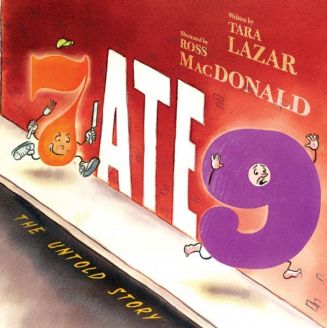
7 Ate 9: The Untold Story

Written by Tara Lazar | Illustrated by Ross MacDonald


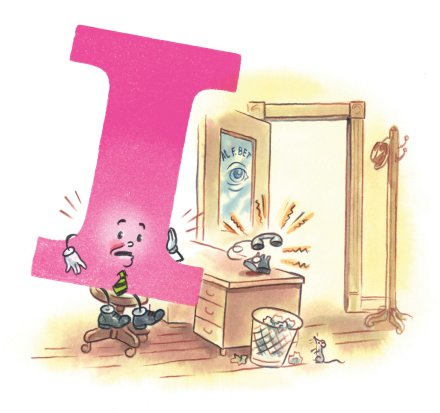
Private I was snoozing at his desk when 6 burst in saying he was being threatened by 7. Private I knew all about numbers—they were “always stuck in a problem.” He also knew that 7 was odd, so he asked 6 what was up. 6 said he’d heard 7 ate 9 and was now after him. The PI tried to explain about the usual order, but 6 wouldn’t hear it. Private I promised to “get to the root” of the story.

celebrate-picture-books-picture-book-review-7-ate-9-the-untold-story-private-i

Image copyright Ross MacDonald, courtesy of rossmacdonald.com

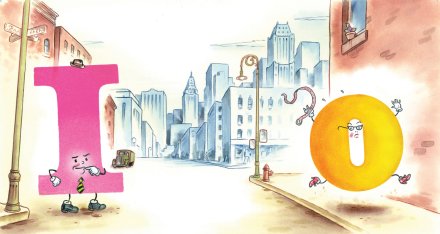
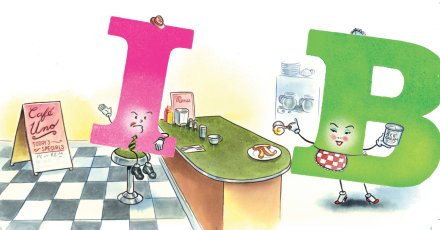
First on his list of witnesses was 8. She knew nothing, but fearing she was next in line, she took off her belt and fled the scene disguised as 0. PI wanted to think things through, so he went to Café Uno for a piece of Pi. The waitress, B, had heard the rumors that 7 ate 9 and confirmed that 9 hadn’t been seen in a while.

celebrate-picture-books-picture-book-review-7-ate-9-the-untold-story-8-takes-off-belt

Image copyright Ross MacDonald, courtesy of rossmacdonald.com

Next, the detective tracked down 11, 7’s best bud. 11 said 7 had to be innocent since he was on vacation. The whole case was not adding up. “If 7 was gone, where was 9?” On his way back to the office, Private I saw 6 crossing the street. Suddenly, he knew the score. He rushed back to the office where his client was “taking forty winks.” He grabbed 6 and turned him…upside down.” It was true—“6 was really 9!”

celebrate-picture-books-picture-book-review-7-ate-9-the-untold-story-cafe-uno

Image copyright Ross MacDonald, courtesy of rossmacdonald.com

What was with all the deception? Why did 9 make up a story about 7? “‘Because 7 gets all the attention!” 9 wailed. “‘Lucky 7! Seven Wonders of the World! Snow White and the Seven Dwarfs!’” 9 also had plenty to say about 10, who thought he was so perfect. But Private I reminded his client that he had one of the best advantages around—nine lives! 9 saw the detective’s point.

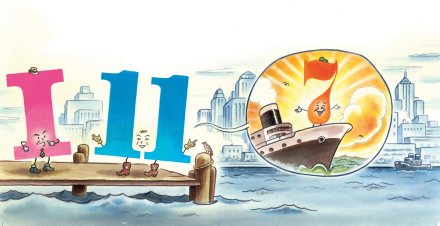
Just then 7 showed up and, with no hard feelings, accepted 9’s apology. Still Private I wondered how he could be so happy after being framed. 7 said he was in seventh heaven from sailing the seven seas, and he shared his vacation photos with everyone. At last the case was solved, and Private I could return to the letter cases he preferred. Except for that call from 2…

celebrate-picture-books-picture-book-review-7-ate-9-the-untold-story-dock

Image copyright Ross MacDonald, courtesy of rossmacdonald.com

Tara Lazar’s hilarious mathematical mystery adds up to a perfect reading experience for kids who love clever word play, puns, and, of course, numbers! Lazar takes a classic joke and develops it into an ingenious story with twists and turns, red herrings, mistaken identities, and surprising revelations that will keep kids laughing from beginning to end.

Ross MacDonald’s personified numbers and visual jokes will entertain both young and adult readers. From the name on the detective agency’s door—Al F. Bet—to the “x”-shaped street sign at the corner of 2nd and 4th where 8 is found to the piece of Pi at Café Uno, MacDonald has filled the pages with riffs on language and mathematics that will delight kids. The bright colors and vintage-style illustrations recall the age of the classic hard-boiled detective, giving the book a distinctive personality.

7 Ate 9: The Untold Story is witty and wild and would make a wonderful addition to any child’s home library.

Ages 4 – 9

Disney-Hyperion, 2017 | ISBN 978-1484717790

Discover more about Tara Lazar and her books on her website!

Check out Ross MacDonald, his books, movie props, letterpress, and comics on his website!

You can count on loving this 7 Ate 9: The Untold Story book trailer!

Savor the Comic, Unplug the Drama Day Activity

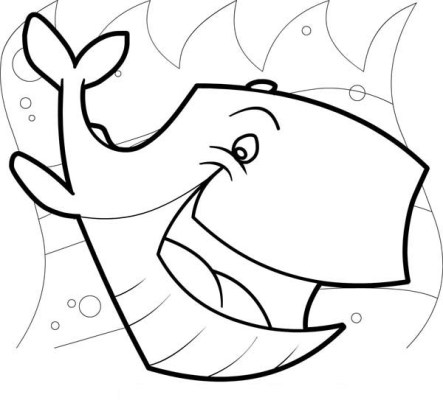
celebrate-picture-books-picture-book-review-whale-of-a-laugh-coloring-page

Whale of a Laugh Coloring Page


Today is a perfect day to have some fun! Grab your pencils or markers and enjoy this printable Whale of a Laugh Coloring Page.

Picture Book Review

May 30 – Loomis Day

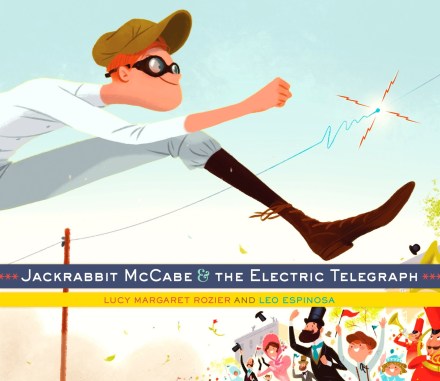
celebrate-picture-books-picture-book-review-jackrabbit-mccabe-&-the-electric-telegraph-cover

About the Holiday

On Loomis Day we remember Mahlon Loomis, a Washington DC dentist working in the mid-1800s who had a very inventive mind. Not only did he invent artificial teeth, he also had some revolutionary ideas on communication. He understood about the electrical properties of the atmosphere and experimented with sending signals long distances using kites flown many miles apart but at the same height. In July of 1872 he received a U. S. patent for “An Improvement in Telegraphing” on wireless telegraphy. Further research revealed that while his wireless telegraphic system worked, it did not work the way Loomis thought. His experiments, however, advanced the science at the time, leading to one of the world’s most transformative discoveries and an ongoing quest for better and faster communications.

Jackrabbit McCabe & the Electric Telegraph

Written by Lucy Margaret Rozier | Illustrated by Leo Espinosa


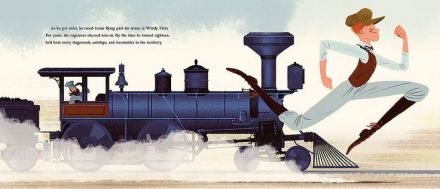
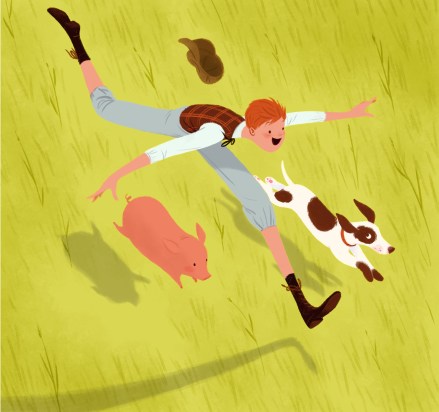
Anyone who looked at the baby with legs “so long they looped like a pretzel” and required a stroller with “an extra axle” knew that he’d been born to run. In fact, his legs grew so fast that if his mother dressed him in long pants in the morning, they were shorts by that evening. Little Jack McCabe used those legs to chase “whatever would run: hogs, dogs, even his own shadow” and “as he got older, he raced trains flying past his house in Windy Flats. By the time he turned eighteen, he’d beat every stagecoach, antelope, and locomotive in the territory.”

celebrate-picture-books-picture-book-review-jackrabbit-mccabe-&-the-electric-telegraph-racing-a-train

Image copyright Leo Espinosa, text copyright Lucy Margaret Rozier. Courtesy of Schwartz & Wade

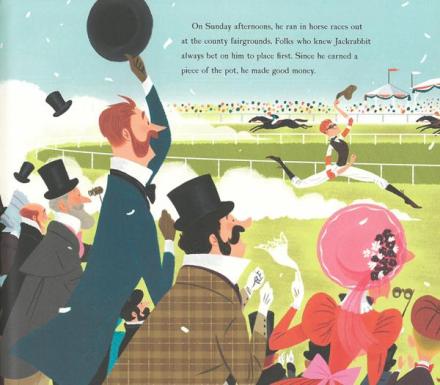
The people of Windy Flats called him Jackrabbit and relied on him to deliver messages that were urgent. On Sundays he joined the horses on the track, making money when people bet on him to come in first. One day, though, the electric telegraph came to Windy Flats. The poles and wires already crossed the eastern part of the country. Each connected city had “a telegraph and an operator who sent and received messages in Morse code, an alphabet of dots and dashes.”

The people of Windy Flats didn’t think this newfangled contraption could carry messages faster than Jackrabbit, so the telegraph man suggested, “‘How ‘bout a race between your fella and this here electric telegraph? Sandy Bluff’s just got themselves an operator, That’s pert near twenty-five miles, as the crow flies.’” Jackrabbit was all for it.

celebrate-picture-books-picture-book-review-jackrabbit-mccabe-&-the-electric-telegraph-racing-a-horse

Image copyright Leo Espinosa, text copyright Lucy Margaret Rozier. Courtesy of Schwartz & Wade

On the day of the race, the whole town of Windy Flats came out with flags, banners, and even a brass band. “The mayor carefully wrote down the same message on two slips of paper. He handed one to the telegraph man and the other to Jackrabbit.”  On the shout of “GO!” the telegraph man plunked his finger on the key sending the pulses through the wire while Jackrabbit took off down the road toward Sandy Bluff “like a tornado.”

The townspeople watched as in only a few moments “a reply came clattering back as that telegraph key jumped and smacked all on its own.” The telegraph man read the code and yelled, “‘Message received. Stop. Sandy Bluff Operator.’” But where was Jackrabbit McCabe? Although he made it to Sandy Bluff in only 9 ½ minutes, it was still too long to beat the telegraph. When he stopped short at the door of the depot, he was met by a telegram tacked to the door. Jackrabbit read it and then pulled the paper that contained the mayor’s message out of his pocket. The two were the same.

celebrate-picture-books-picture-book-review-jackrabbit-mccabe-&-the-electric-telegraph-racing-at-the-starting-line

Image copyright Leo Espinosa, text copyright Lucy Margaret Rozier. Courtesy of Schwartz & Wade

Riding home in a stagecoach, “Jackrabbit felt lower than a snake’s navel.” The mayor also felt pretty low, thinking of Jackrabbit, until he realized that if Jackrabbit’s fingers were as fast as his legs, he’d make an excellent telegraph operator. When Jackrabbit stepped out of the stagecoach and heard the mayor’s offer, he whooped with joy. It didn’t take long for Jackrabbit to learn the new code, and soon “his fingers flew like a banjo player’s strumming that telegraph key.” Every day he sent and received messages. He even “teamed up with the local typesetter, who printed the news that came over that wire, linking Windy Flats to the whole entire country,” and whenever a telegram or the newspaper needed to be delivered, Jackrabbit was there in a flash!

An Author’s Note outlining the pivotal event that sparked Samuel F. B. Morse’s interest in a quicker communication method and the history of the telegraph as well as a Morse code key and a riddle to translate follow the text.

celebrate-picture-books-picture-book-review-jackrabbit-mccabe-&-the-electric-telegraph-racing-hogs-and-dogs

Image copyright Leo Espinosa, courtesy of Schwartz & Wade

Lucy Margaret Rozier has written a funny and fact-based addition to the fine American tradition of tall tales with Jackrabbit McCabe & the Electric Telegraph. From her folksy delivery to her humorously exaggerated details, Rozier presents an engaging history of the telegraph through the story of one man affected by this new technology. Kids will love the fast-paced story full of crackling dialog and gripping suspense.

Leo Espinosa infuses his brightly colored, vintage-style illustrations with the charm and innocence of the mid-1800s while highlighting the humor of Rozier’s yarn. Jackrabbit’s looong legs take up a whole page—sometimes two—as he runs with dogs and hogs, sprints past steam trains, speeds off at the starting line, and wedges himself into the stagecoach, with one foot hanging out the window. The small town of Windy Flats and the townspeople are decked out in period details, and the enthusiasm of the time is infectious.

Jackrabbit McCabe & the Electric Telegraph will become a favorite read lightening quick. The book would make a fun addition to children’s bookshelves.

Ages 4 – 8

Schwartz & Wade Books, 2015 | ISBN 978-0385378437

Discover more about Lucy Margaret Rozier plus book-related resources on her website!

View a gallery of illustration work by Leo Espinosa on his website!

Loomis Day Activity

celebrate-picture-books-picture-book-review-morse-code-image

Morse Code Decoder


Sending secret messages in code is cool! Use this printable Morse Code Decoder to learn how to write your name and those notes you don’t want anyone else to read in this early method of communication.

Picture Book Review

May 29 – It’s National Smile Month

celebrate-picture-books-picture-book-review-tooth-by-tooth-cover

About the Holiday

Today we honor that happiest of expressions—the smile! Celebrating its 41st anniversary this year, National Smile Month was established as a weekly event in 1977 by the British Dental Health Foundation (now known as the Oral Health Foundation) to focus on good dental health practices. Over the years the initiative has grown in length and now includes countries worldwide. With the introduction of the Smiley—a bright smile on a stick—and the Smiley Photo campaign on social media in 2012, everyone now has an opportunity to join in the fun, spread the message, and become the face of National Smile Month. National Smile Month runs from May 15 to June 15. If you’d like to participate, visit nationalsmilemonth.org.

Tooth By Tooth: Comparing Fangs, Tusks, and Chompers

Written by Sara Levine | Illustrated by T. S. Spookytooth


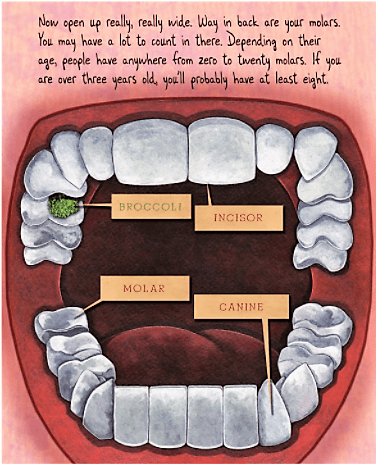
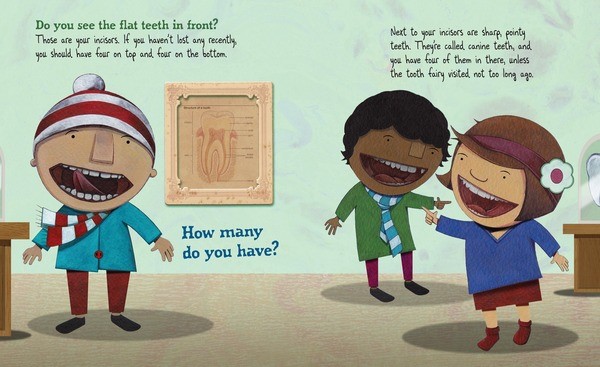
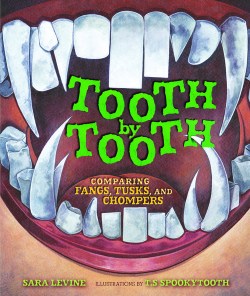
“Open wide!” a little girl with a good set of teeth herself encourages readers on the first page of this fun nonfiction book. “Look at all the chompers in there.” Mirror in hand she proceeds to reveal that human teeth are unusual because we are mammals, and mammal teeth come in different shapes and sizes. In fact there are three distinct types. A little boy takes over to describe them. Incisors are the four flat teeth in a person’s mouth—two on the top and two on the bottom right in front.

celebrate-picture-books-picture-book-review-tooth-by-tooth-human-mouth

Image copyright T. S. Spookytooth, text copyright Sara Levine. Courtesy of Lerner Books

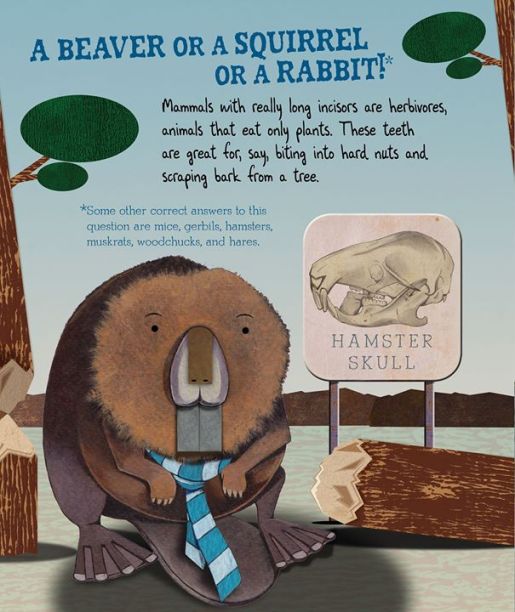
The four pointy teeth next to the incisors are canines, and the rest of the teeth are molars. Other mammals also have these teeth, and you can tell what an animal eats by which type is largest. For example, say your incisors were bigger than all your other teeth and they were so big they stuck out of your mouth even when it was closed, then you would be a beaver…or a squirrel…or a rabbit. These animals are herbivores and their oversized incisors help them break into nuts and scrape bark from trees.

celebrate-picture-books-picture-book-review-tooth-by-tooth-human-teeth

Image copyright T. S. Spookytooth, courtesy of Lerner Books

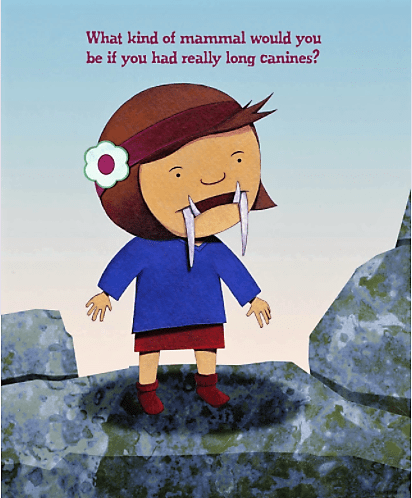
From here on Tooth by Tooth offers up amusing illustrations and “what kind of animal would you be if…” questions to spark kids’ powers of recognition. How about if your canines were so long they poked out of your mouth? Well, then you could be a “seal or a cat or a dog or a bear!” All these animals eat meat and need the sharp teeth to do it.

What if you had really tall molars? Then you’d be a “horse or a cow or a giraffe!” These guys use their molars to grind up grass. And if all your teeth were the same height? Come on…you know! You’d be you! Because humans eat plants and meat, we “need teeth that do many different jobs.”

But there are a lot more wacky teeth out there waiting for us to brush up on. So let’s get started. What if “two of your top incisors were so long that they grew out of your mouth and pointed to the sky? What if they were so long you could use them to carry your school bag?” You’ve probably guessed this one—you’d be an elephant. While an elephant’s tusks aren’t used for eating, they are used to procure the bark, roots, and other plant material that make up the elephant’s diet.

celebrate-picture-books-picture-book-review-tooth-by-tooth-beaver

Image copyright T. S. Spookytooth, text copyright Sara Levine. Courtesy of Lerner Books

What if you could almost trip over your canine teeth? Yep, you’d be a walrus, and you would use those sharp bad boys to poke holes in the ice to grab your favorite oysters and clams. But after eating they’re not done using their teeth. “After diving down for a meal, walruses can use their tusks to pull themselves back up onto the ice for a nap. Imagine if “your top and bottom canine teeth curled up out of your mouth so you had two pairs of tusks?” Or if your one upper canine grew through your upper lip and kept on growing?  Or if you had no teeth at all? Yikes! The remarkable answers are just a read away!

Fish, amphibians, and reptiles also have teeth of a sort, but because they are all the same shape and size, they don’t get special names—that doesn’t mean you can ignore them, though, because sharks are among this group, and you know what they can do!

celebrate-picture-books-picture-book-review-tooth-by-tooth-canines

Image copyright T. S. Spookytooth, text copyright Sara Levine. Courtesy of Lerner Books

More information about mammals, mammal teeth, a glossary, and a list of online and print references follow the text.

There’s nothing like the Wow! factor to capture kids’ attention, and Sara Levine uses it to humorous and fascinating effect in Tooth by Tooth: Comparing Fangs, Tusks, and Chompers. After giving a solid description of each kind of tooth and what it is used for in language that kids use and will relate to, Levine begins her guessing game that leads to even more discovery. We’ve all seen elephants and walruses with their mighty tusks, but how many know what they are really used for? And what about warthogs and narwhals? It’s all here in this creative nonfiction title.

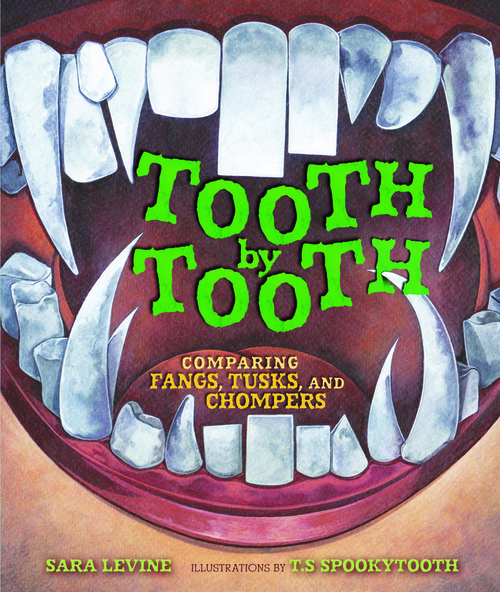
T. S. Spookytooth took a big bite out of the “how to make kids laugh” manual in illustrating each question and type of tooth. Pictures of girls and boys with enormous teeth jutting this way and that will make readers glad to be human. And while the animals that belong to each molar, incisor, or canine sport the scarf, bow, or head band of its human counterpart, they are clearly and scientifically drawn to provide full understanding. Animal skulls also demonstrate the placement of teeth. The cover, with its close-enough-to-eat-you view of a very scary mouth is a show stopper and will attract kids as soon as they see it.

Ages 5 – 9

Millbrook Press, Lerner Books, 2016 | ISBN 978-1467752152

Check out Sara Levine’s website for more books, stuff for kids, teachers’ resources, and more!

View a gallery of T. S. Spookytooth’s art and read his biography (?!) on his website!

National Smile Month Activity


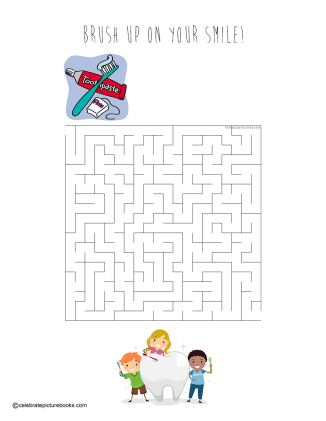
celebrate-picture-books-picture-books-review-brush-up-on-your-smile-maze

Brush Up On Your Smile! Maze


These kids are practicing good dental heath! Can you bring them the toothbrush, toothpaste, and floss they need in this printable Brush Up On Your Smile! Maze? Here’s the Solution!

celebrate-picture-books-picture-book-review-tooth-by-tooth-cover

You can find Tooth by Tooth: Comparing Fangs, Tusks, and Chompers at these booksellers

Amazon | Barnes & Noble | Books-a-Million | IndieBound

Picture Book Review

May 18 – International Museum Day

CPB - How the Dinosaur Got to the Museum II

About the Holiday

Created in 1946, the International Council of Museums established International Museum Day in 1977 to institute an annual event highlighting museums as “important means of cultural exchange, enrichment of cultures and development of mutual understanding, cooperation, and peace among peoples.” The day also aims to unify “the creative aspirations and efforts of museums and draw the attention of the world public to their activity.” Each year a theme is chosen to spotlight a relevant issue. This year’s theme is “Museums and contested histories: saying the unspeakable in museums.” Museums around the world will take the opportunity to show how they “display and depict traumatic memories to encourage visitors to think beyond their own individual experiences” and promote peace and reconciliation for the future. To learn more visit the International Council of Museums website!

To celebrate today’s holiday show your support for museums by visiting and/or donating to your favorite museum!

How the Dinosaur Got to the Museum

By Jessie Hartland


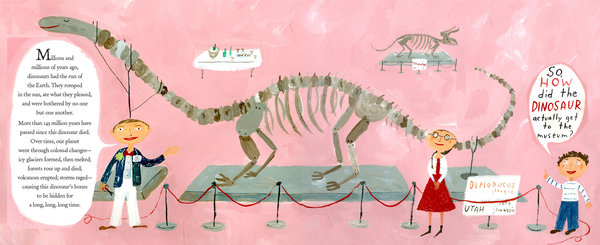
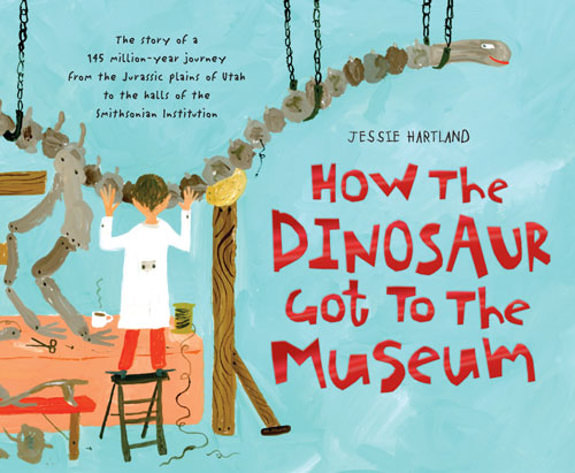
“So…” asks a little boy visiting the Smithsonian Museum of Natural History, “how did the dinosaur get to the museum?” Thus begins the tale—not of the dinosaur’s life, but of its journey from life to the museum exhibit hall.

celebrate-picture-books-picture-book-review-how-the-dinosaur-got-to-the-museum-talking-about-dinosaur

Image and text copyright Jesse Harland, 2011, courtesy of Blue Apple Books.

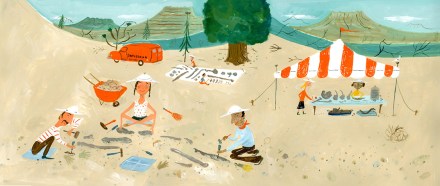
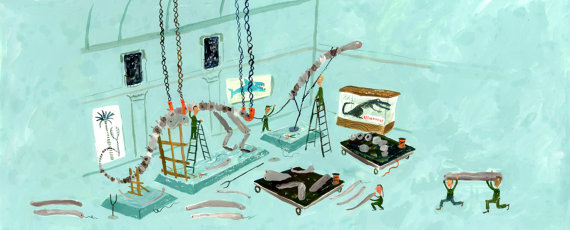
One hundred and forty-five million years ago, the dinosaur roamed the plains of what is now Utah. Overcome by weather and evolutionary events, the dino is buried. It is only much, much later that this prehistoric creature is once again exposed. A Dinosaur Hunter finds one large bone and believes it to be from a Diplodocus Longus. He calls in the Paleontologist who confirms it. A team of Excavators arrives and unearths the rest of the skeleton.

The Movers pack the skeleton that was found by the Dinosaur Hunter, confirmed by the Paleontologist, and dug up by the Excavators. They load it onto a train that transports it to the Smithsonian Museum of Natural History. Here, the bones are cleaned and preserved by the Preparators, who discover that the head and neck are missing!

celebrate-picture-books-picture-book-review-how-the-dinosaur-got-to-the-museum-digging

Image copyright Jesse Harland, 2011, courtesy of Blue Apple Books.

The Curator locates a plaster cast of a Diplodocus head at another museum, and work continues until the whole Diplodocus is assembled. That night while making his rounds in the dark, the Night Watchman trips over the skeleton’s tail and breaks it! In come the Welders to fix it. Finally, the Riggers can lift the dinosaur into the display.

The Exhibits Team creates an educational background for Diplodocus. Then with a final dusting, the Cleaners make the Diplodocus presentable. At long last, the Director invites the public into the museum. He gives a speech and makes a toast then opens the doors to the magnificent exhibit.

celebrate-picture-books-picture-book-review-how-the-dinosaur-got-to-the-museum-exhibit

Image copyright Jesse Harland, 2011, courtesy of Blue Apple Books.

Jessie Hartland’s highly entertaining and educational text will keep kids riveted to the process of creating a museum exhibit even as they giggle at the mishaps. As each page and step in the process build on each other, readers will enjoy reciting along. Hartland’s bold, colorful, folk-style illustrations allow kids to see the lengthy and meticulous journey the dinosaur skeleton makes from burial spot to museum exhibit. Along the way, they view the desert landscape where the skeleton was found, view the tools used to excavate and preserve it, get a tour of the back rooms where the dinosaur bones are reassembled, and are given a front-row look at the finished display. 
For children interested in dinosaurs, museums, history, and a fun story, How the Dinosaur Got to the Museum is a great take-along book for museum trips and a wonderful addition to a young armchair traveler’s library

Ages 5 – 9

Blue Apple Books, New Jersey, 2011 | ISBN 978-1609050900

Learn more about Jesse Hartland, her books, and her artwork on her website!

International Museum Day Activity

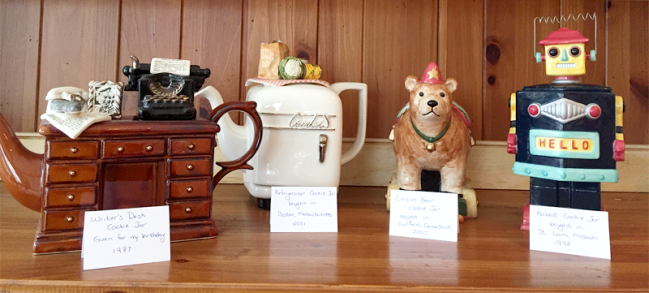
CPB - Cookie Jar Museum (2)

Create a Museum Exhibit


Every item has a story. Maybe there’s a funny anecdote behind that knick-knack on your shelf. Perhaps your favorite serving dish holds sentimental value. How about your child’s best-loved toy or a drawing or craft they’ve made? A fun and educational way for kids to learn family stories and interact with their own history is to create a museum exhibit of objects in your home.
For teachers this can be a fun classroom activity that incorporates writing, art, and speaking as well as categorizing skills. Students can use objects in the classroom or bring items from home to set up museum exhibits. This activity can be done as a whole-class project or by smaller groups, who then present their exhibit to the rest of the class.

Supplies

  • A number of household or classroom items
  • Paper or index cards
  • Markers
  • A table, shelf, or other area for display

Directions

  1. To get started help children gather a number of items from around the house to be the subjects of their exhibit. An exhibit can have a theme, such as Grandma’s China or Travel Souvenirs, or it can contain random items of your child’s choice, such as toys, plants, tools, even the furniture they see and use every day.
  2. Using the paper or cards and markers, children can create labels for their exhibit items. Older children will be able to write the labels themselves; younger children may need adult help.
  3. Spend a little time relating the story behind each object: where it came from, how long you’ve had it, when and how it was used in the past, and include any funny or touching memories attached to the item. Or let your child’s imagination run free, and let them create histories for the objects.
  4. When the labels are finished, arrange the items on a table, shelf, or in a room, and let your child lead family members or classmates on a tour. You can even share the exhibit with family and friends on social media.
  5. If extended family members live in your area, this is a wonderful way for your child to interact with them and learn about their heritage.

CPB - How the Dinosaur Got to the Museum II

You can find How the Dinosaur Got to the Museum at these booksellers

Amazon | Barnes & Noble | IndieBound