December 3 – Chester Greenwood Day

celebrate-picture-books-picture-book-review-earmuffs-for-everyone-cover

About the Holiday

On March 13, 1877 Chester Greenwood—a 19-year-old inventor—received a patent for “improvements in ear-mufflers” and forever sealed his place in history—as well as making winter more comfortable for millions of freezing ears! Today we honor Chester and his invention that brought attention to Farmington, Maine and jobs for many people in the area. 2016 marks the 40th anniversary of Chester Greenwood Day, and the people of Farmington are pulling out all the stops. With a theme of Holiday Celebrations around the World, the day will include a parade, gingerbread contest, chili contest, craft fairs, historical open houses, Polarbear Dip, 5K race, Festival of Trees and more. If you live nearby, why not plan to attend? If not, and you live in an area where the cold winds are blowing, wear your earmuffs with pride!

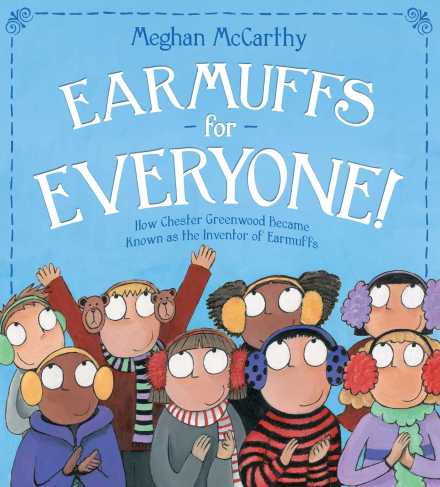
Earmuffs for Everyone! How Chester Greenwood Became Known as the Inventor of Earmuffs

By Meghan McCarthy


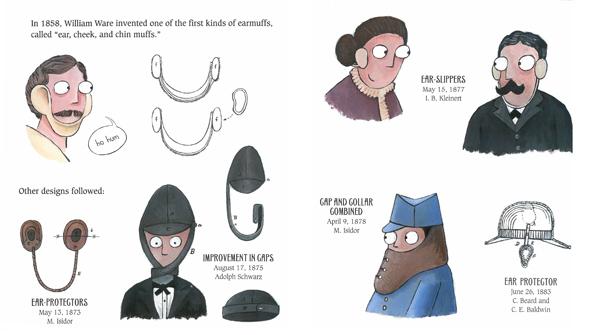
In the mid-1800s inventors were trying to solve the problem of winter’s chill effects on tender ears. William Ware designed an “ear, cheek, and chin muff” that one wore somewhat like a false beard. Ear protecting hats, ear “slippers,” high collars, and other designs followed. But it wasn’t until Chester Greenwood and his sensitive protruding ears came along that earmuffs became practical. While the exact steps Chester took in creating his earmuffs aren’t known, he eventually perfected his invention and received a government patent on March 13, 1877—when he was only 19 years old!
celebrate-picture-books-picture-book-review-earmuffs-for-everyone-patents

Copyright Meghan McCarthy, courtesy of Simon & Schuster

Chester was no one-invention wonder, though. Always on the lookout for clever ways to make money, he went on to improve other products. He applied his foresight to the tea kettle, rounding the edges of the bottom to reduce wear; constructed an interchangeable-tooth rake; and built a collapsible, if cumbersome, tent.

His inventions brought him a comfortable life that he shared with others—a beautiful house for his family in Maine, the first steam car in his town, and a bicycle shop on the bottom floor of his workshop. His wife, also a progressive thinker, worked for women’s suffrage and inspired her husband to hire women in his workshops.

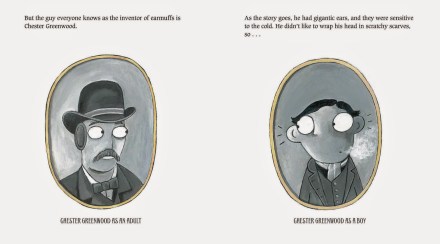
After Chester passed away, some people, most notably Mickey Maguire, thought he deserved more acclaim—even a day dedicated as Chester Greenwood Day. Maguire was so excited about this that he became a kind of inventor himself—an inventor of tall tales. Over time he told some whoppers about Chester which were repeated in the press, making it hard to separate fact from myth. But even without the made-up stories, it’s easy to say that Chester Greenwood had a very remarkable life
celebrate-picture-books-picture-book-review-earmuffs-for-everyone-portraits

Copyright Meghan McCarthy, courtesy of Simon & Schuster

Earmuffs for Everyone! goes beyond the story of Chester Greenwood to include other inventors, a discussion of the patent system (using products well-known to today’s kids), and an explanation of how an inventor’s legacy grows. Meghan McCarthy writes with verve and humor, making the story of Greenwood’s invention as well as others’ creations inviting, accessible, and fun. Her illustrations of early attempts at creating earmuffs as well as other products from the 1800s are sure to delight kids and make them curious about the time period.

In her author’s note following the text, McCarthy expands on the story of Chester Greenwood and the process of applying for and earning a patent.

Ages 4 – 8

Simon & Schuster/Paula Wiseman Books, 2015 | ISBN 978-1481406376 

Discover more about Meghan McCarthy and her books plus fun activities, videos,  artwork, advice for writers and artists and more visit her website!

National Earmuff Day Activity

CPB - Earmuff Maze.png

Here’s to Warm Ears! Maze


One muff on each side of the head—Genius! But it took inventors a lot of trial and error to make the perfect warming headgear. Use your own creative thinking on this Here’s to Warm Ears!earmuff-shaped maze. Solution included.

Picture Book Review

November 23 – Fibonacci Day

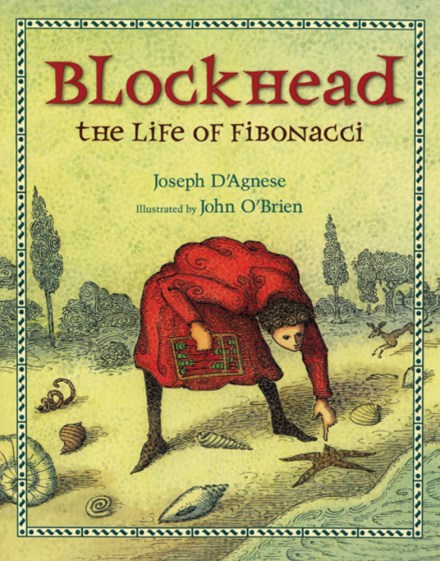
celebrate-picture-books-picture-book-review-blockhead-the-life-of-fibonacci-cover

About the Holiday

Today’s holiday is dedicated to the man—Leonardo of Pisa, today known as Fibonacci—who promoted awareness throughtout Europe of the number sequence that now bears his name. First appearing in Indian mathematics and linked to the golden triangle and the golden ratio, the number pattern states that each consecutive number in the series is the sum of the two preceding numbers: 1, 2, 3, 5, 8, 13, 21, 34…. This sequence is found again and again in nature in such arrangements as leaves on a flower stem, seeds in a sunflower, the tapering of a pinecone, the swirl of a seashell, and manys. These precise compositions allow each leaf to get enough sunlight, make room for the correct number of petals, or squeeze in as many seeds as possible. To celebrate, learn more about this sequence and then observe patterns in nature. A good place to start is with today’s book!

Blockhead: The Life of Fibonacci

Written by Joseph D’Agnese | Illustrated by John O’Brien


Leonardo Fibonacci introduces himself this way: “You can call be blockhead. Everyone else does.” He goes on to reveal that he acquired that nickname because he loved to think about numbers. Once when his teacher gave the class ten minutes to solve a math problem, he knew the answer in two seconds. At home he counted everything he saw. When he was bored his mind pondered the patterns he saw. For instance, on that school day while his classmates worked on the problem, Leonardo spent the time gazing out the window. H e noticed 12 birds sitting in a tree. How many eyes was that? How many legs? “And if each bird sang for two seconds, one bird after the other, how long would it take all of them to sing?” He was counting these answers in his head when his teacher yelled, “‘How dare you daydream in my class!’” He told Leonardo there would “‘be no thinking in this classroom—only working! You’re nothing but an absent-minded, lazy dreamer, you…you BLOCKHEAD!’”

celebrate-picture-books-picture-book-review-blockhead-the-life-of-fibonacci-story-starts

Image copyright John O’Brien, courtesy of Henry Holt and Company

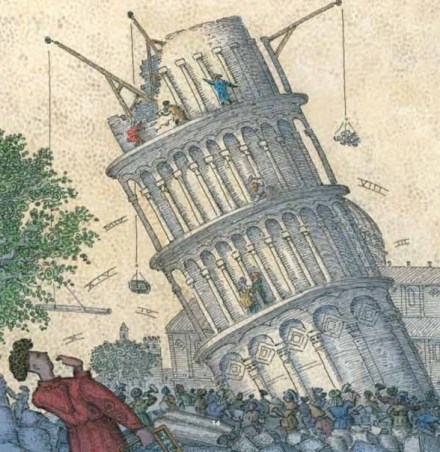
Leonardo ran from the room into the city he loved—Pisa, one of the greatest cities in 1178 Italy. A new tower was being constructed—although the builders were having trouble with their math and the tower stood at an angle. He was so enthralled with the math he saw all around him that he nearly walked into danger. “‘What are you, a blockhead?’” a woman shouted. Leonardo’s father was angry and embarrassed by his son’s reputation in town. He wanted Leonardo to become a merchant, and took him to northern Africa to learn the business.

celebrate-picture-books-picture-book-review-blockhead-the-life-of-fibonacci-tower-of-pisa

Image copyright John O’Brien, courtesy of Henry Holt and Company

In Africa Leonardo learned a new number system. Instead of Roman numerals, the people used numbers “they had borrowed from the Hindu people of India.” In this system XVIII became the much easier 18. During the day Leonardo handled his father’s business accounts, but at night Alfredo, his father’s advisor and Leonardo’s champion, accompanied him as he learned the new number system. As Leonardo grew older, his father sent him on trips to other countries to conduct business. In each Leonardo learned new mathematics concepts. In Egypt he learned about fractions. In Turkey and Syria he discovered methods of measurement. In Greece he learned geometry, and in Sicily he used division and subtraction.

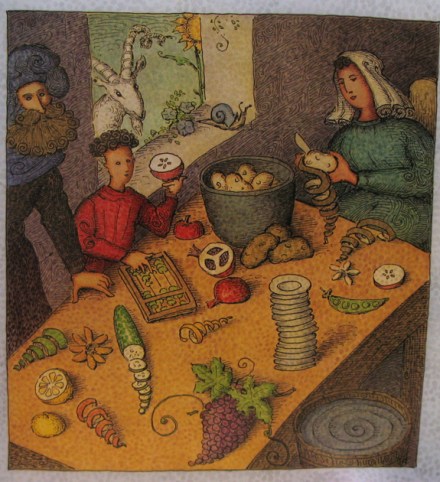
celebrate-picture-books-picture-book-review-blockhead-the-life-of-fibonacci-kitchen

Image copyright John O’Brien, courtesy of Henry Holt and Company

One day Leonardo “began to write a book about Hindu-Arabic numerals” and included riddles to demonstrate the ideas. One was about a pair of rabbits. Leonardo asked Alfredo to tell him how many baby rabbits would be born within one year if it took a baby one month to grow old enough to have babies of its own and one more month to have a pair of babies. Alfredo tried to solve it but couldn’t. As Leonardo explained the sequence of adult pairs and baby pairs of rabbits to Alfredo, he noticed a pattern. At the end of month two, there would be 1 grown-up pair of rabbits and 1 baby pair; at the end of month three there would be 2 grown-up pairs and 1 baby pair; at the end of month 4 there would be 3 grown-up pairs and 2 baby pairs…. Leonardo saw that by adding “any two consecutive numbers in the pattern,” you’d get the next correct number. This discovery made solving the problem even easier.

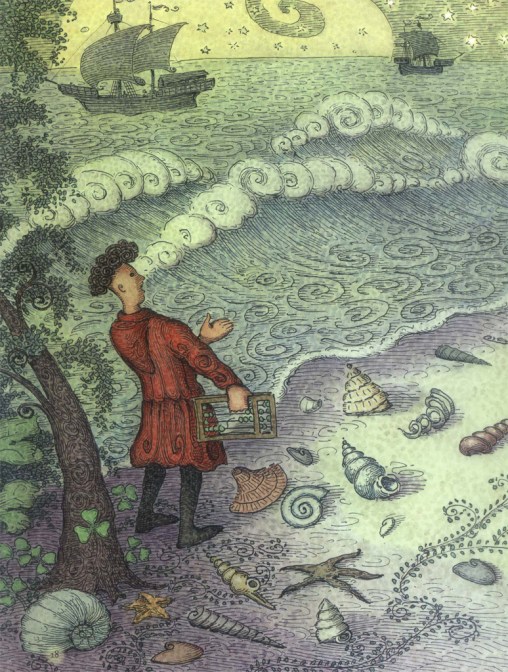
celebrate-picture-books-picture-book-review-blockhead-the-life-of-fibonacci-sea-shells

Image copyright John O’Brien, courtesy of Henry Holt and Company

Leonardo’s work with math soon spread across Europe. Frederick II, the ruler of the Holy Roman Empire invited Leonardo to visit. There Frederick’s wise men challenged him with math problems that were no match for Leonardo’s quick brain. Frederick II didn’t call Leonardo a blockhead, instead he said he was “‘one smart cookie.’” When Leonardo went home, however, the people of Pisa grumbled and complained. They thought the old Roman numerals were good enough.

Leonardo set out to prove how valuable Hindu-Arabic numerals were. He began observing nature, and everywhere, from the petals of a flower to the arms of a starfish to the seeds in an apple, Leonardo discovered the same numbers—the sequence he had discovered in the rabbit riddle. He realized that these numbers could be used in different ways—to draw a spiral; the same type of spiral found within pinecones and the center of a sunflower.

celebrate-picture-books-picture-book-review-blockhead-the-life-of-fibonacci-old-man

Image copyright John O’Brien, courtesy of Henry Holt and Company

Leonardo finishes his story by relating that even though he is now old, numbers still delight him, as does the secret Mother Nature cleverly uses to organize the world and even the universe. He invites readers to look again through his story and find the places where his Fibonacci sequence appears.

More biographical information about Leonardo of Pisa plus a discussion of where readers can find Fibonacci number patterns in nature and a scavenger hunt through the book follow the text.

Blockhead: The Life of Fibonacci is an engaging, accessible biography that describes this mathematical scholar’s life and theory in a clear and entertaining way, whether their thing is math and science or English, history, and art. Joseph D’Agnese immediately entices kids into the story with the revelation of how Leonardo acquired the nickname that gives the book its title. Using anecdotes such as the birds in the trees and the rabbit riddle, he invites readers to think like Fibonacci, leading to a better understanding and enjoyment of his life story and the mathematical concept. The idea of using your talents and passions wherever you are—as Leonardo does in his work for his father—is a valuable lesson on its own.

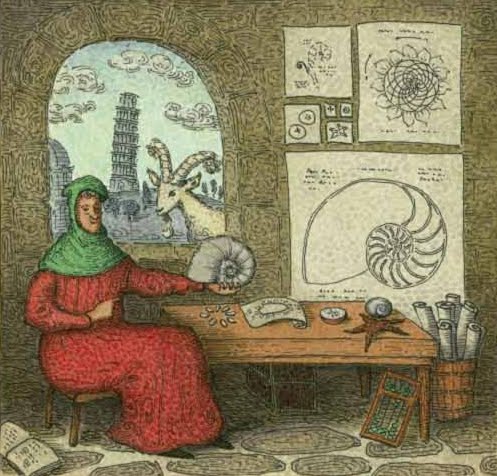
John O’Brien’s wonderfully detailed illustrations take children back to early Italy and the Mediterranean with his depictions of Leonardo’s school and town, as well as the under-construction Tower of Pisa and the influential cultures of other countries he visited. Cleverly inserted into each page are examples of the Fibonacci sequence at work—in whorls of wood grain, the spirals of women’s hats, the web of a spider and horns on a passing goat, and so many more. The rabbit riddle is neatly portrayed for a visual representation of the math involved, and the way nature uses the pattern is also organically portrayed. Children will love searching for and counting the various ways Fibonacci’s seuqence is used throughout the illustrations.

Blockhead: The Life of Fibonacci is a fantastic book to share with all children, especially as they begin to learn mathematical problem solving, the value of math, how it is used, and how it occurs naturally in the world. The book makes a marvelous teaching resource and addition to classroom libraries and also a great addition to home bookshelves.

Ages 5 – 9

Henry Holt and Company, 2010 | ISBN 978-0805063059

To discover more books by Joseph D’Agnese for children and adults visit his website!

Find a vast portfolio of cartoon and illustration work by John O’Brien for kids and adults on his website!

Watch the Blockhead: The Life of Fibonacci book trailer!

Fibonacci Day Activity

celebrate-picture-books-picture-book-review-spiral-coloring-page

Spiral Coloring Page


Have fun coloring this printable Spiral Coloring Page that is inspired by Leonardo Fibonacci’s work.

Picture Book Review
November 2 – Look for Circles Day

celebrate-picture-books-picture-book-review-squares-and-other-shapes-with-josef-albers-cover

About the Holiday

Today is one of those days that gets you really observing the world in a new way. As you go about your day at the office, at school, at shops, or just while driving here and there, be aware of all the different circles you see. Sure, there are the obvious ones—the tires on your car, the signals on a stoplight, the lid of your water bottle or coffee cup…but how about all the less-seen circles? Knots on trees, a lemon slice, the center of a flower, the ripple of a raindrop or pebble dropped in a puddle… Whether you look for circles through the eye of geometry or they eye of art, be fully aware of the shapes around you!

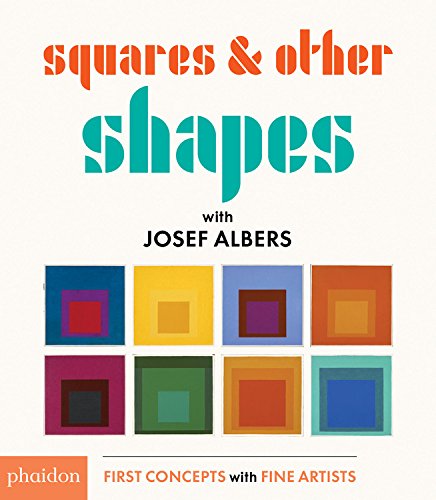
Squares & Other Shapes: with Josef Albers (First Concepts with Fine Artists)

Paintings by Josef Albers


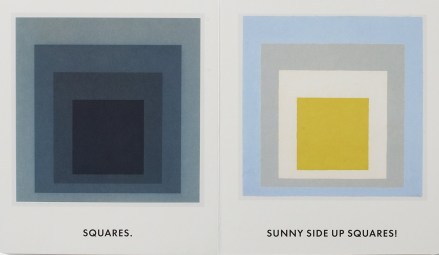
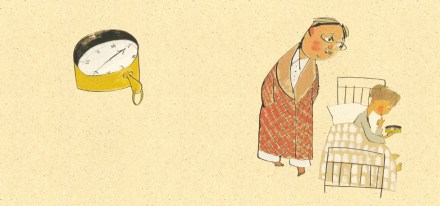
Opening Squares & Other Shapes, readers encounter a vibrant magenta square nesting in an autumn maple leaf-hued square which floats in a square of clear, winter-sky blue. On the next page two orange squares beckon you to follow into the glowing, yellow center square. Could it be a doorway or window leading somewhere?

In another painting, a bold yellow rectangle and an equally bold blue rectangle host guests: “two little rectangles lying down for a nap.” But the calm is shattered on the next page as stacks of red and blue rectangles shake and tumble: “Watch Out! It’s raining rectangles!”

celebrate-picture-books-picture-book-review-squares-and-other-shapes-with-josef-albers-circle-circle-stop

Image courtesy of phaidon.com

Now circles want a turn, and they want to have fun! In a large black rectangle a white circle and a red circle play stoplight: “Circle, Circle, Stop!” while on the next page blue, black and spirally circles jump and frolic—“Bounce, Circles, Bounce!” Turn the page—can you count all of the little circles in the rectangle or all of the baby circles in the rectangle on the right-hand page? Some of the babies are leaping away—or are they just joining the group? What do you think?

celebrate-picture-books-picture-book-review-squares-and-other-shapes-with-josef-albers-hey-circles

Image courtesy of phaidon.com

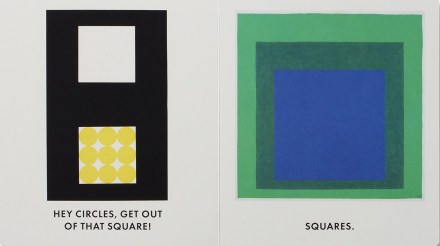
Next the black rectangle is back, but this time with two white squares inside. Wait a minute—how did those little yellow circles get into the bottom square? “Hey circles, get out of that square!” Of course triangles don’t want to be left out. Dusky triangles in many sizes connected tip to tip enjoy their light, white background, but on the next page they’re left in shadow—“Hey triangles, who turned out the lights?”

celebrate-picture-books-picture-book-review-squares-and-other-shapes-with-josef-albers-sharp-triangles

Image courtesy of phaidon.com

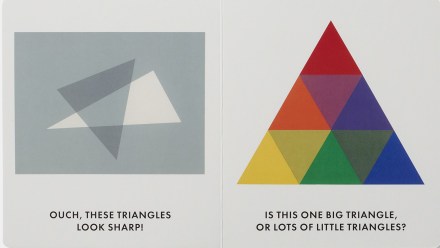
Be careful turning the page to look at the two intersecting triangles: “Ouch, these triangles look sharp!” Maybe it’s better to move on to the big, vivid triangle on the right. Oooh, so many colors! Nine, in fact! Hmmm… “Is this one big triangle, or lots of little triangles?” These paintings are getting more complex! Now there are “blue squares in pink squares, pink squares in blue squares; rectangles in rectangles, circles in circles, and more triangles in triangles. But here’s a different painting: the rectangles are perfect rectangles, but the squares are a little off, and what kinds of shapes do those curved lines make?—“Funny shapes in funny shapes!” And the last painting? Back to squares. Red, purple, and blue squares. “Beautiful squares.”

Following the paintings, the last page provides a captivating biography about Josef Albers’ life and work aimed at the book’s young audience.

celebrate-picture-books-picture-book-review-squares-and-other-shapes-with-josef-albers-sunny-side-up-squares

Image courtesy of phaidon.com

Imagine being able to own a stunning collection of famous paintings by a world-renowned artist and educator to teach your child about shapes, color, and art. With Squares & Other Shapes by Josef Albers you can! The second in the First Concepts with Fine Artists series, Squares & Other Shapes presents readers with more than 30 painting by Josef Albers, one of the most influential artists of the 20th century. Most well-known for his Homage to the Square paintings, Albers worked with color and shapes to challenge perceptions and promote creative thinking.

Shapes are one of the earliest concepts introduced to babies and young children. Even the youngest readers will be riveted by the beautifully reproduced paintings in this large board book that present squares, circles, rectangles, and trianges in clear but creative ways. The easily understood labels, repetition, and recognizable patterns offer key strategies that are known to build strong reading and comprehension skills. Kids will love the humorous text that brings the paintings to life, helping them to also see that art is not static, but active and open to interpretation by each viewer.

Squares & Other Shapes with Josef Albers is a wonderfully conceived concept book that can grow with children as it offers readers enjoyment and education on so many levels. The book would be an often-sought-out addition to home and library bookshelves and also makes a perfect present for baby showers and other gift-giving holidays.

Ages birth – 5 (and up)

Phaidon Press, 2016 | ISBN 978-0714872568

Look for Circles Day Activity

celebrate-picture-books-picture-book-review-circle-puzzle

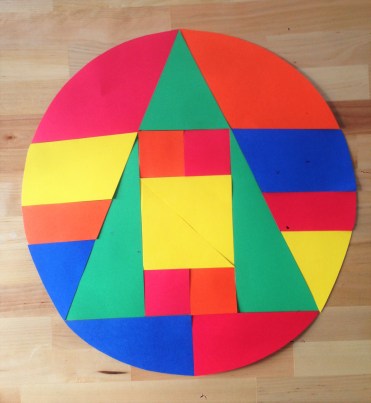
Circle of Shapes Puzzle


Build a circle from different shapes with this puzzle that grows as you add pieces! You can also use these shapes to create your own art!

Supplies

Directions

  1. Print the shape templates
  2. Cut out the shapes
  3. Trace shapes onto different colored paper
  4. Cut out the colorful shapes
  5. Build the puzzle from the central square to the edges of the circle (It may be easier to keep the puzzle in place by sticking the pieces down with a little tape applied to the back of the pieces)

You can also use the shapes to create your own art!

Picture Book Review
 

October 22 – Smart is Cool Day

celebrate-picture-books-picture-book-review-on-a-beam-of-light-cover

About the Holiday

There are many ways to be smart—and they are all very cool! The world needs people who can think differently about all issues to solve problems, create art and literature that reflects our times and present alternate viewpoints, and just to make life funnier, more poignant, more beautiful,more  livable. Today, celebrate your particular way of being smart and share it with others!

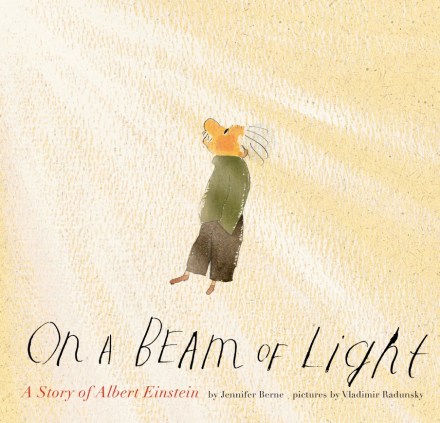
On a Beam of Light: A Story of Albert Einstein

Written by Jennifer Berne | Illustrated by Vladimir Radunsky


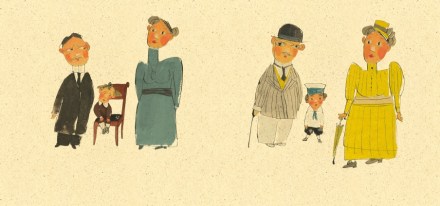
More than 100 years ago on a windy March day, a baby boy was born—Albert was his name. Albert turned one without saying a word. When Albert had his second birthday, he still hadn’t said a word. By the age of three Albert had only said a few words. “He just looked around with his big, curious eyes. Looked and wondered. Looked and wondered.” Albert’s parents were a bit worried because he was so different from other kids. But “they loved him…no matter what.”

celebrate-picture-books-picture-book-review-on-a-beam-of-light-albert-as-child

Image copyright Vladimir Radunsky, courtesy of chroniclebooks.com

Once when Albert was sick, his father brought him a compass. As he watched the needle automatically spin to point north, “Albert was so amazed his body trembled. Suddenly he knew there were mysteries in the world—hidden and silent, unknown and unseen.” Albert began asking questions wherever he went. His teachers told him he was a “distraction” and that “he would never amount to anything if he didn’t behave like all the other students.” But Albert didn’t want to be like other kids.

celebrate-picture-books-picture-book-review-on-a-beam-of-light-albert-gets-compass

Image copyright Vladimir Radunsky, courtesy of chroniclebooks.com

While on his bicycle one afternoon, Albert wondered what it would be like to ride a beam of sunlight. He was excited by this idea and it filled him with questions. He began to study light and sound, heat, magnetism, and gravity. He also read about numbers, which to him were like a secret language. Still, Albert had many more questions. After college he wanted to teach the subjects he loved, but he couldn’t find a job.

Instead, he went to work for the government. His job left him a lot of time to ponder his questions. He watched sugar dissolve in tea and smoke disperse in the air and wondered how that happened. Albert realized that everything is made of tiny particles. While many people didn’t believe it, Albert’s work helped prove the existence of atoms.

celebrate-picture-books-picture-book-review-on-a-beam-of-light-albert-at-school

Image copyright Vladimir Radunsky, courtesy of chroniclebooks.com

Next Albert considered motion and how everything is always moving. “Even sound asleep we’re moving, as our planet circles the sun, and our lives travel into the future. Albert saw time and space as no one ever had before.” He wrote about his theories and sent the articles to magazines that published them all. Scientists asked him to join their research and teach with them. People began to call Albert a genius. Now he could spend all his time thinking, wondering, and imagining—doing what he loved.

His ideas took in huge things—like planets—and infinitesimal things—like the particles inside atoms. To help him think, Albert sailed his little boat and played his violin. Even the kinds of clothes he wore—or didn’t wear—affected his thinking. He loved baggy pants, over-sized sweaters, and NO socks! He was easily recognized around town by his long, white hair.

celebrate-picture-books-picture-book-review-on-a-beam-of-light-albert-riding-bike

Image copyright Vladimir Radunsky, courtesy of chroniclebooks.com

During all these years Albert never forgot about that beam of light he once wanted to ride. He “figured out that no person, no thing, could ever zoom through space as fast as a beam of light.” If that could occur “crazy things” would happen. While only minutes would pass for the traveler, years would go by for those left on earth. This sounded like a ridiculous idea, but since then it has been proven true.

Albert Einstein continued reflecting on the world until the day he died. He asked and answered many questions that had never been posed before. But he also left many, many questions for other generations—maybe even you!—to discover and solve.

Jennifer Berne’s engaging biography of Albert Einstein is a charming and absorbing look at one of the most unique thinkers in history. Her uplifting, conversational storytelling and well-chosen anecdotes from Albert’s childhood and adulthood will keep kids riveted to the story and show them that while Albert Einstein’s ideas may have been out of this world, he was also very much down to earth. On a Beam of Light introduces readers to this fascinating scientist and will also inspire them to find the genius inside themselves.

celebrate-picture-books-picture-book-review-on-a-beam-of-light-atoms

Image copyright Vladimir Radunsky, courtesy of chroniclebooks.com

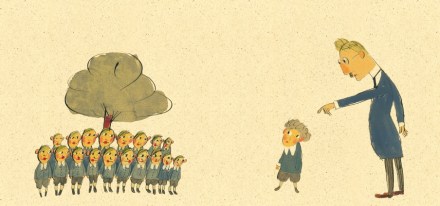
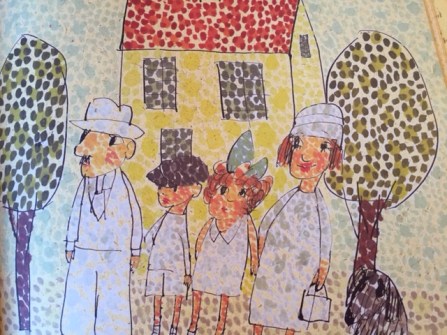
The childlike, offbeat goache, pen, and ink illustrations of Vladimir Radunsky lend the right amount of lightness and movement to each page, depicting not only Albert and his surroundings but also the endless musings that filled his mind and his days. As Albert grows from a baby to a child, his loving and understanding parents stand by and encourage his gifts; he and his bicycle rocket off on a beam of light; and numbers swirl through the air as Albert rests his head on a stack of books. In a restaurant other patrons are portrayed as simple line drawings, putting the focus on Albert as he ponders a dissolving sugar cube, a device that is used to also depict Albert’s thoughts and scientists of the future who have proven his theories correct. When Albert discovers atoms, he and a family portrait are rendered in dots. The muted colors, mottled paper, and period details allow readers to fully appreciate Albert’s Einstein’s story and contributions.

An Author’s Note and further paragraphs about Einstein’s thought experiments, playful nature, pacifism, and most famous equation, as well as a list of resources follow the text.

On a Beam of Light is a wonderful addition to home libraries for children interested in science, math, ideas, history, and creativity in general. Jennifer Berne’s emphasis on the support Albert received from his parents and his ultimate acceptance within the science community is also welcome comfort for kids who do think differently.

Ages 4 – 9

Chronicle Books, 2016 (paperback) | ISBN 978-1452152110

To view more books by Jennifer Berne, plus pictures by her readers and more, go to her website!

Visit Vladimir Radunsky’s website to see a gallery of his books with pictures!

Smart is Cool Day Activity

celebrate-picture-books-picture-book-review-smart-is-cool-writing-template

I’m Smart Because…


In what way are you smart? Draw a picture or write about your special talent on this printable I’m Smart Because…page.

Picture Book Review

September 9 – It’s National Courtesy Month

celebrate-picture-books-picture-book-review-the-black-and-white-factory-cover

About the Holiday

September has been designated as National Courtesy Month to remind us that good manners and watching out for others, goes a long way toward making the world a more cooperative and happy place. Sometimes common courtesy is as black and white as directly following the rules…but sometimes…well, I’ll let you decide…

The Black and White Factory

Written by Eric Telchin | Illustrated by Diego Funck


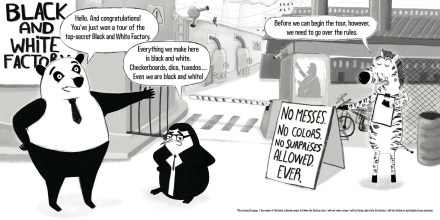
You are one lucky reader! You have won a tour of the Black and White Factory where the employees are hard at work making products like checkerboards, dice, tuxedos…you know the stuff. Even the bosses—a panda and a penguin—are in black and white. Before you start your tour, you’re met by a zebra foreman who goes over the rules of the factory. And they are these:

“No Messes, No Colors, No Surprises Allowed.” When? “Ever.”

As you proceed inside your first stop is the billiard ball machine—8 balls only, of course! It doesn’t take you long to be ushered into the “top-secret Experiment Room,” where innovative products are being developed. You may be the first ever to see “trick dominoes that are impossible to knock over” and new black-and-white-paint in either checkerboard or polka-dot. Another prototype displayed on a wall chart is “never-melting vanilla ice cream.” Also prominently displayed are the factory’s rules: “No Messes, No Colors, No Surprises Allowed. Ever.”

celebrate-picture-books-picture-book-review-the-black-and-white-factory-outside-factory

Image copyright Diego Funck, text copyright Eric Telchin, courtesy of simonandschuster.com

Moving on you push the button leading to the Animal Room. Housed here are white Dalmatians, dairy cows, and skunks who are being sprayed with their distinctive black marks. An elevator takes you to the Bar Code Room. While waiting for your car, you are exhorted to remember the rules: “No Messes, No Colors, No Surprises Allowed. Ever.” The Bar Code Room is “the cleanest, most perfect, most black and white room in the whole factory. Every bar code in the world is make right here.” Even the one for the book you’re reading! Turn it over and see!

celebrate-picture-books-picture-book-review-the-black-and-white-factory-factory-floor

Image copyright Diego Funck, text copyright Eric Telchin, courtesy of simonandschuster.com

“Wait!” Wait!! Turn the book back! A stripe of yellow has seeped into the factory! “Someone didn’t follow the rules. Someone brought an outside mess into the Black and White Factory.” The bosses need your help! Can you “use your fingers to wipe the color off the bar code?” Oh, no, no, no! That just made it worse—now it’s smudged yellow and orange! “Quick! Do something! Rub the colors with your sleeve. Or your elbow. Something.”

We interrupt this review to remind you of the RULES: “No Messes, No Colors, No Surprises Allowed. Ever.” Right, then, back to our dilemma. Now the colors are dripping! It’s such a mess! Suddenly, the zebra has an idea. He asks you to “hold the book upright and tilt it so the color drips down the bottom of the page.” Okay—phew!—great job!

Oh, no!! More colors are creeping in! “Swirl the book so the colors fly off the page,” the penguin orders. You are one strong swirler—the zebra, penguin, and panda are all topsy-turvy, and now the factory looks like an abstract painting! This definitely is not good. “What a mess! The Black and White Factory is ruined.” But the panda may have an idea. Everyone, “back to the top-secret Experiment Room.” There the panda, zebra, and penguin, splattered in paint, stand in front of the “Air-powered comprehensive cleaning contraption.” They just need your help in getting it started. Can you blow into the nozzle? Harder? Come on, put some oomph into it! All right!

celebrate-picture-books-picture-book-review-the-black-and-white-factory-bar-code-room

Image copyright Diego Funck, text copyright Eric Telchin, courtesy of simonandschuster.com

The machine’s at 100% power! The machine shakes and whirrs with a color overload. It explodes with a rainbow of colors that covers everything in the factory. The panda, zebra, and penguin stand in the midst of it. “Everything is so…different,” says the panda. “It’s…colorful…,” adds the penguin. “And wonderful!” concludes the zebra. There’s just one problem…The RULES: “No Messes, No Colors, No Surprises Allowed. Ever.” Hmmmm….

How about: “No Messes, No Colors, No Surprises Allowed. ForEver.”

Yes! Much better! So “that concludes the Best. Tour. Ever!” Off you go—just don’t forget the rules: “Messes, Colors, Surprises Allowed. Forever.”

Eric Telchin’s The Black and White Factory will have kids tipping, tilting, swinging, and even reading this fun and funny interactive picture book. Directly addressing the reader, the three staid and rule-abiding managers of a very focused factory, play straight-man to the child’s laugh inducing and unintentional “mistakes” that lead to a brighter future. With the pacing of a favorite theme-park ride, the story has a suspenseful “Oh, no! What’s going to happen?” feeling as readers progress from page to page until the first tinge of yellow precipitates the humorous chaos to come.

Diego Funck’s sly illustrations riff on the black-and-white theme, as he designed a clever product line in line with “the rules.” Kids will want to linger over the pages to catch all the jokes and visual puns. The reactions of the three employees of The Black and White Factory will make readers laugh too as they endeavor to hang on to their beloved rules in the midst of their changing world. The bold colors of the transformed factory are as refreshing as the sun after a dark, rainy day.

The theme that creativity and expression come from making messes and allowing surprises to happen is a welcome idea and one that leads to innovation and personal freedom. The Black and White Factory is sure to be asked for again and again!

Ages 4 – 7

little bee books, 2016 | ISBN 978-1499802771

Learn more about Eric Telchin on his websites – erictelchin.com and boyseeshearts.com

To view a portfolio of Diego Funck’s artwork, visit his website!

National Courtesy Month Activity

celebrate-picture-books-picture-book-review-black-and-color-crayon-craft-boat

Let Your Colors Shine Through! Craft


With this easy-to-make craft you can show your colors and your creativity!

Supplies

  • Heavy stock paper
  • Crayons, a variety of colors and black

celebrate-picture-books-picture-book-review-black-and-color-crayon-craft-colors

celebrate-picture-books-picture-book-review-black-and-color-crayon-craft-black-crayon

Directions

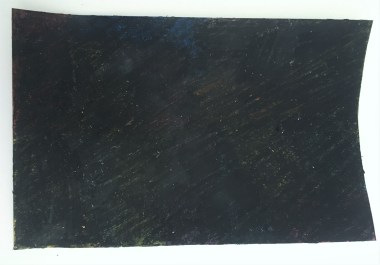
  1. Color the paper with blocks, stripes, or splotches of color
  2. Cover the colored paper entirely with the black crayon
  3. Scrape a design in the black crayon, exposing the colors beneath

Picture Book Review
September 6 – Read a Book Day

celebrate-picture-books-picture-book-review-six-dots-a-story-of-young-louis-braille-cover

About the Holiday

Avid readers, rejoice! Today is your day – a whole 24 hours dedicated to the fine pursuit of perusing an old favorite or a newly discovered book! To celebrate visit a local bookstore or library then find a cozy nook or shady spot and settle in for a good, long read.

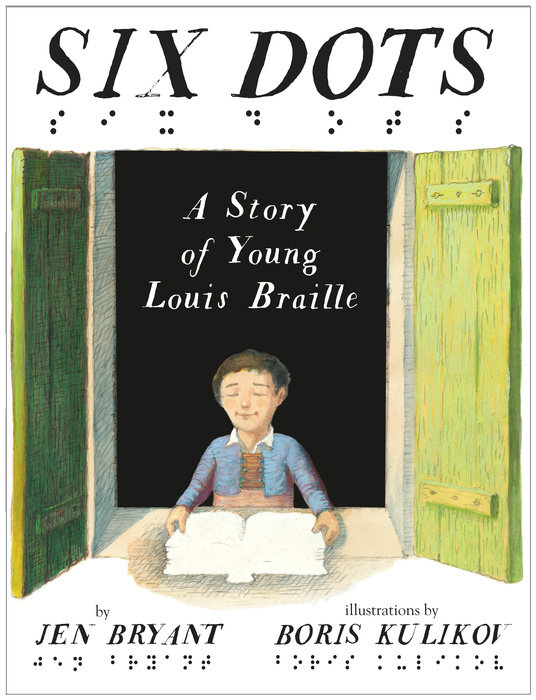
Six Dots: A Story of Young Louis Braille

Written by Jen Bryant | Illustrated by Boris Kulikov


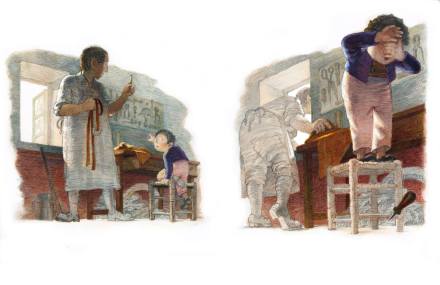
When Louis Braille was born he was so small that no one in town expected him to live. But he did! Louis thrived and with his curious eyes took in everything around him. Louis was smart, too, with a prodigious memory for names and stories. His father worked with leather, making harnesses and bridles. Louis wanted to be just like him and often reached for the sharp tools on the workbench, but his father always warned him away.

One terrible day, however, when Louis’ father glanced away, Louis grabbed an awl and tried to work it into the smooth leather, but it slipped. Louis’ damaged eye was bandaged and he was told not to touch it. But when the bandage began to itch, young Louis couldn’t help himself and spread the infection to his other eye. By the age of five, Louis was left in darkness, unable to see the faces of those he loved or the attractions of home.

celebrate-picture-books-picture-book-review-six-dots-a-story-of-young-louis-braille-accident

Image copyright Boris Kulikov, courtesy Alfred A. Knopf

Louis learned the sounds of the world. He discovered the number of steps around his house, to the outbuildings, and eventually to the shops and businesses in town. His brother taught him how to whistle and use the reverberations to avoid obstacles. He also learned to feel the shapes of letters made of straw, leather, or nailed replicas made by his family. He played dominoes by feeling the dots with his fingers.

While Louis listened to others read to him, he longed to be able to read on his own. Whenever he asked if there were books for blind people, however, the answer was always, “No.” A noblewoman who lived nearby heard of Louis and invited him to study at the Royal School for the Blind in Paris. At the age of 10 he moved to the boarding school.

The Royal School was anything but sumptuous. Louis’ room was crowded, damp, and dark. His uniform itched, and meals were meager and cold. He so wanted to return home, but the promise of books for the blind kept him there. Those books were reserved for the best students, and Louis vowed to be one. Finally, Louis was led to the library. A book thudded onto the table in front of him. “‘Voila! There it is,’” the guide said.

Louis opened the book. To read it he had to feel the raised letters, but the letters were huge and a page only held a few sentences. To make matters worse, the book consisted of only a few pages. “‘Is that all?’” Louis asked. The guide told him there were others but that they were all the same. More than ever Louis wanted to go home.

celebrate-picture-books-picture-book-review-six-dots-a-story-of-young-louis-braille-dreams

Image copyright Boris Kulikov, courtesy Alfred A. Knopf

In the morning Louis was shaken awake; the headmaster had an important announcement.  It seemed that a French army captain had devised a secret code read by touch instead of sight. This code could be used at the school, the headmaster said. The code consisted of raised dots set in patterns that represented various sounds. The boys learned the new code then learned how to write it, using an awl-like implement that punched dots into paper.

While the code was a breakthrough, it was hard to learn and all the other boys in the school had given up—but not Louis. Still, reading the code was not like reading a book with letters, words, and sentences. Louis asked the headmaster if the army captain would work with him to improve the code, but when the headmaster asked, the answer was “No.”

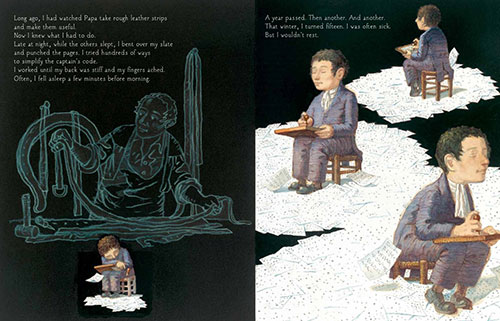
Louis knew what he had to do. Night after night he punched dots into paper with the awl-like tool—just as he had watched his father do with leather. He tried “hundreds of ways to simplify the captain’s code.” Three years passed, and Louis turned 15. Finally, he had a workable solution. He asked the headmaster to read to him a book he had never heard. As the headmaster read, Louis copied his words, punching letters onto paper. Louis’ “new code used just six dots, arranged in two columns, like dominoes. Each dot pattern stood for a letter of the alphabet.”

celebrate-picture-books-picture-book-review-six-dots-a-story-of-young-louis-braille-inventing

Image copyright Boris Kulikov, courtesy Alfred A. Knopf

When the headmaster finished reading chapter 1, Louis turned his pages over and “reading by touch, recited the entire chapter.” After that “word spread quickly. The other students rushed to try it. Si facile! ‘So easy!’ Et si vite! ‘And so fast!’ ‘We can read words and write letters like everyone else,’” the other boys exclaimed.

As Louis watched his friends read he remembered watching his “Papa in his shop, bent over rough strips of leather, making them useful. I had become like him, after all,” Louis thought.

An Author’s Note, more fascinating biographical information about Louis Braille’s life and other inventions, resources, and the Braille alphabet follow the text.

In her Author’s Note Jen Bryant says she wanted to express what it felt like to be Louis Braille. In Six Dots she succeeds in bringing the story of this very young inventor and genius to life with details of his accidental blindness, family support, school experiences, and ultimate victory. Told from Louis Braille’s point of view, the story has an immediacy that presents Braille’s frustrations, challenges, and achievements sensitively and honestly. His perseverance against all odds will inspire readers and give them a new perspective on the unique person Braille was, the importance of books for all, and what children not much older than the readers of Six Dots can accomplish.

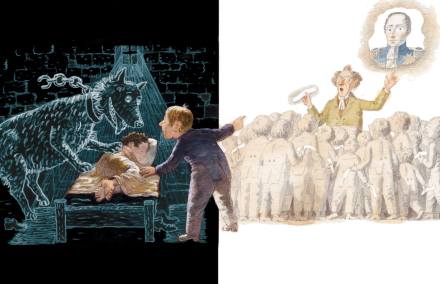
Boris Kulikov’s mixed media illustrations take readers back to the France of the early 1800s, depicting with soft colors and period details the town, people, and influences in Louis Braille’s life. Braille’s initial accident is treated with thoughtful consideration of the book’s audience, and his blindness and dreams are portrayed with transparent outlines on a black background. Readers will be interested to see how Louis’s family and friends supported and helped him (an unusual occurrence of the time). As Louis grows, readers discover his other talents for music and sewing, and the tools Louis used to produce his Braille pages are clearly shown.

Ages 4 – 9

Alfred A. Knopf, 2016 | ISBN 978-0449813379

View Jen Bryant’s website for activities, videos, and links related to Six Dots—you’ll also discover more of her books too!

To see a gallery of images by Boris Kulikov for books and other illustration work, visit his website!

Read a Book Day Activity

celebrate-picture-books-picture-book-review-library-coloring-page

I Love the Library! Coloring Page


Today is a perfect day to visit your library and check out some awesome books! Here’s a printable I Love the Library! Coloring Page for you to enjoy too!

August 15 – National Relaxation Day

celebrate-picture-books-picture-book-review-whoosh!-lonnie-johnson's-super-soaking-stream-of-inventions-cover

About the Holiday

Relaxation Day was founded in 1985 by then fourth-grader Sean Moeller, who already knew a thing or two about balance in life when he suggested that “cleaning and real work are not part of relaxation.” Today’s holiday gives you permission to kick back and enjoy yourself. The subject of today’s book invented a great way to take advantage of a day off—and also demonstrates that sometimes work and relaxation go hand-in-hand!

WHOOSH! Lonnie Johnson’s Super-Soaking Stream of Inventions

Written by Chris Barton | Illustrated by Don Tate


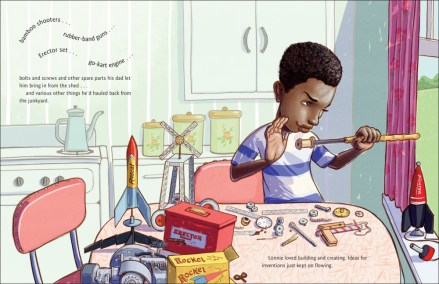
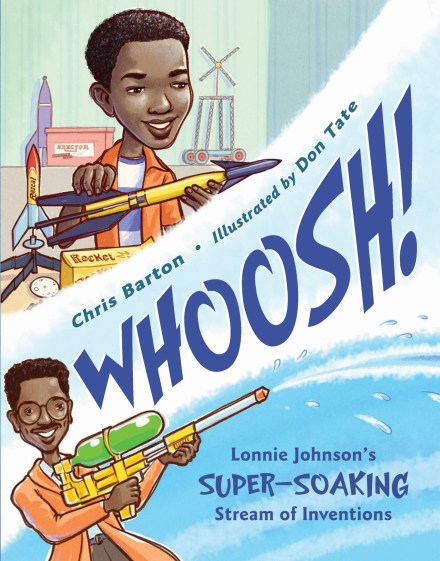
Lonnie Johnson had a way with stuff. In his hands bolts and screws, gears and springs, spools, clothespins, “spare parts his dad let him bring in from the shed, and various other things he’d hauled back from the junkyard” fueled Lonnie’s ideas for inventions and rocket ships. The kids at school loved to watch him launch the rockets he’d devised on the playground. Lonnie wanted to have a career as an engineer. Getting there took a lot of determination and courage. Once, the results of a standardized test said that he would not make a good engineer. Lonnie felt discouraged, but he knew that the person who had graded his test didn’t know him—or Linex.
celebrate-picture-books-picture-book-review-whoosh!-lonnie-johnson's-super-soaking-stream-of-inventions-young-lonnie-inventing

Image copyright Don Tate, courtesy of charlesbridge.com

Linex was the robot Lonnie had built from scrap metal. “Compressed –air cylinders and valves allowed Linex’s body to turn and its arms to move. The switches came from an old, broken jukebox. Lonnie used a tape recorder to program Linex, and as a bonus the reels looked like eyes.” Lonnie’s goal was to enter Linex in a science fair, but first he wanted to be able to program it. It took several years before he discovered how. Using his little sister’s walkie-talkie, Lonnie took Linex to the “1968 science fair at the University of Alabama—where only five years earlier, African American students hadn’t even been allowed.” Lonnie’s team won first place.

Lonnie went to college at Tuskegee Institute, where he realized his dream of becoming an engineer. His career “took him beyond Alabama—way beyond.”  He went to work for NASA. Before the orbiter Galileo could be sent to Jupiter, Lonnie developed a system that would ensure the craft would have a constant supply of power for its computer memory in case the main power was lost. Some fellow scientists doubted his idea would work, but it did. “As it photographed Jupiter and its moons, Galileo was supported by the power package that Lonnie designed.”

celebrate-picture-books-picture-book-review-whoosh!-lonnie-johnson's-super-soaking-stream-of-inventions-linex

Image copyright Don Tate, courtesy of charlesbridge.com

Even though Lonnie worked for NASA, he continued tinkering with his own ideas—in his own workshop. One problem he was trying to solve involved the need for the world’s refrigerators and air conditioners to have a cooling system that didn’t use the damaging chemical R-12. “He had an idea for using water and air pressure instead.” He built a prototype and experimented with it in his bathroom sink. When he turned his pump and nozzle on, a stream of water blasted across the room.

Suddenly, Lonnie saw another use for his invention—as a water gun. He created a design small enough for children’s hands, and tested it at a picnic, where it was a hit. Lonnie took his idea to a toy company…and another…and another. Finally one company agreed to make his water gun. Spurred on by this success, Lonnie found investors to help him build other original inventions: “a water-propelled toy airplane, two kinds of engines, and his cooling system” that had led to the water gun. He even quit his day job to devote his time to inventing.

But things don’t always work out. Each project fell through—even the water gun. It was a scary time as he and his family had to move out of their house and into an apartment. But Lonnie believed in himself. He took his water gun to another toy company. In 1989 he found a toy company willing to take a look. Lonnie made the trip to Philadelphia and wowed the executives with his invention.

celebrate-picture-books-picture-book-review-whoosh!-lonnie-johnson's-super-soaking-stream-of-inventions-water-powered-nozzle

Image copyright Don Tate, courtesy of charlesbridge.com

Now kids everywhere enjoy the fun of the Super Soaker. Today, Lonnie can be found in his workshop doing what he loves: “facing challenges, solving problems and building things” because “his ideas just keep on flowing.”

Chris Barton’s biography of Lonnie Johnson is a fascinating look at a man who succeeds in turning “No” into “Yes” by the power of his intelligence, ideas, and determination. Kids will love hearing about how one of their favorite toys came to be and will be inspired to chase their own dreams despite challenges and setbacks. Barton’s detailed narration provides a full picture of Lonnie Johnson and his times, specifics that attract and inform like-minded kids. Including the results of Lonnie’s exam should encourage kids who think differently. The story is enhanced by the conversational tone that makes it accessible to kids of all ages.

Don Tate illuminates Lonnie Johnson’s life story with his bold, full-bleed paintings that follow Lonnie from his being a child with big ideas to becoming a man who has seen these ideas through to success. With an eyebrow raised in concentration, young Lonnie demonstrates confidence and skill as he works on an invention, and kids will love seeing the tools of his trade laid out on the kitchen table. With his eyes narrowed in frustration and disappointment, Lonnie reads the results of his childhood exam. As Lonnie grows older and designs systems for NASA, the illustrations depict the schematics of the Galileo power package and Lonnie’s surprise at the strength of the water stream in his prototype cooling design. As all kids know, the spurt of a Super Soaker is awesome, and this fact is demonstrated in a “Wowing” fold-out page.

WHOOSH! Lonnie Johnson’s Super-Soaking Stream of Inventions is a welcome biography of the man who designs systems for the greater world but has never lost his youthful enthusiasm to invent.

Ages 5 – 10

Charlesbridge, 2016 | ISBN 978-1580892971

Check out more fiction and nonfiction books by Chris Barton on his website!

Discover more books written and illustrated by Don Tate as well as a portfolio of his work and book-related activity guides on his website!

National Relaxation Day Activity

celebrate-picture-books-picture-book-review-kids-in-pool-coloring-page

Dive In! Coloring Page


The Super Soaker is a great way to cool off! Another relaxing water activity is swimming in a pool! So dive in to this printable cool pool Dive In! Coloring Page!