March 11 – Johnny Appleseed Day

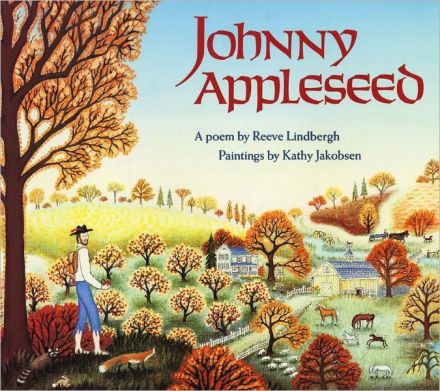
celebrate-picture-books-picture-book-review-johnny-appleseed-cover

About the Holiday

If you love apples, apple pie, applesauce, and all things apple, you probably have John Chapman to thank. John Chapman was a remarkable man who lived his values of kindness and generosity as he journeyed across the newly opened American frontier in the early 1800s. He is most commonly known as Johnny Appleseed for the apple seeds he planted and nurseries he founded across the country. Apples were a welcome crop—easily grown and stored for consumption throughout the year. He was well loved by the people he met on his travels, respected by the Native Americans, and gentle with all animals. Today we remember his contributions to the growth of America and his inclusive beliefs.

Johnny Appleseed

Written by Reeve Lindbergh | Illustrated by Kathy Jakobsen


As the poem opens, John Chapman approaches the simple Goodwin cabin in the woods. “Young Hannah Goodwin saw him first, / A stranger lean and lorn, / His face was thin, his feet were bare, / His clothing old and worn.”

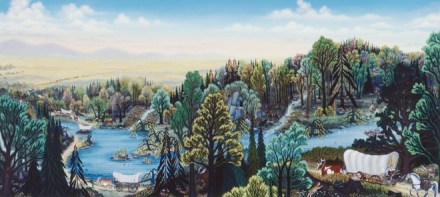
Hannah first meets Johnny Appleseed when she is a little girl and he accepts the family’s invitation to dinner. He is an engaging source of entertainment, news, and stories about the American frontier, but he cannot stay long as he must continue his mission to plant apple trees across the country. Although John Chapman’s work takes him far away, Young Hannah heard the tales of him / All through her growing years / As he brought apples, sharp and sweet, / To other pioneers.
celebrate-picture-books-picture-book-review-johnny-appleseed-kathy-jakobsen-across-the-wild-frontier

Image copyright Kathy Jakobsen, courtesy of kathyjakobsen.com

The stories are exciting and comforting. Johnny Appleseed walks through any weather, is trusted by Native Americans, and lives peacefully with all animals, all the while scattering seeds along his path.

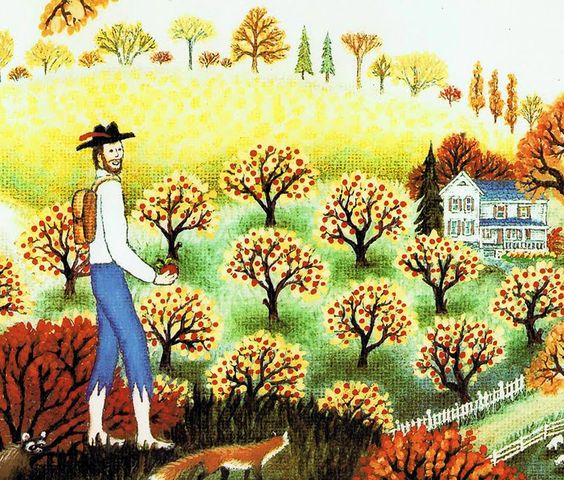
As an old man John Chapman returns to the Goodwin house, now nestled among a mature apple orchard. “Old Hannah Goodwin saw him last / when many years had gone. / He came in by the orchard gate / A quiet hour past dawn.”

Again, he regales Hannah with stories of his adventures and how the trees he had planted helped families thrive and make America strong. “There was spicy apple cider now / Out on the western plain. / There was applesauce in Iowa / and apple pie in Maine.

Although Hannah never sees John Chapman again, she passes down his legacy to her children, just as we still do today.
celebrate-picture-books-picture-book-review-johnny-appleseed-kathy-jakobsen-in-an-apple-orchard

Image copyright Kathy Jakobsen, courtesy of kathyjakobsen.com

The format of Reeve Lindbergh’s rhythmic and rhyming poem is a fitting tribute to the life of Johnny Appleseed. The lyrical lines flow as smoothly as the reader might imagine John Chapman tread across the Midwest plains and rugged West. With evocative language and a straightforward delivery, Lindbergh echoes the philosophy of simplicity and steadfastness that guided John Chapman’s life.

Kathy Jakobsen, one of America’s premiere folk artists, has embraced the story of Johnny Appleseed in stunning paintings of an America at her beginning. Depictions of rolling hills dotted with farms and trees, stone mills, horse-drawn carts loaded with apples, families at home and on the move in Conestoga wagons, as well as lush scenes of John Chapman interacting with nature and Native Americans portray the grandeur of America and the singularity of Johnny Appleseed. A quilt of small paneled scenes surround the text on each left-hand page, while the right page is fully dedicated to Jakobsen’s work.

Ages 5 – 8

Little Brown Books for Young Readers, 1998 | ISBN 978-0316526340

Johnny Appleseed Day Activity
CPB - Cinnamon Apples (2)

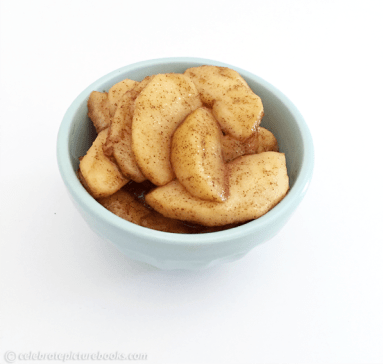
Cinnamon Apples Recipe


Cinnamon apples are a delicious side dish to any meal! This tasty recipe is fun for kids and adults to make together.

Ingredients

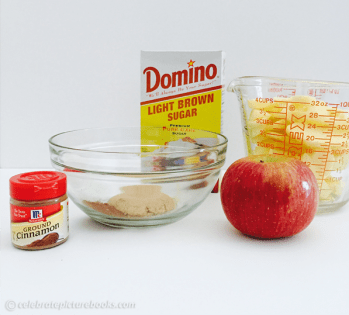
  • 4 cups of apples, Macintosh or Granny Smith apples are good choices
  • 2 tablespoons brown sugar
  • 1 teaspoon cinnamon
  • 1/4 teaspoon lemon juice

CPB - Cinnamon Apples ingredients (2)

Directions

  1. Mix brown sugar and cinnamon
  2. Peel and core 2 large apples
  3. Thinly slice apples
  4. Combine apples and cinnamon sugar/brown sugar mixture
  5. Stir until well combined
  6. Drizzle with lemon juice and stir again
  7. Cook apples on the stove at medium heat for 8 to 10 minutes or until desired texture


March 10 – National Pack Your Lunch Day

Lunch Money and Other Poems About School by Carol Diggory Shields and Paul Meisel picture book review

About the Holiday

When you pack your own lunch, you can’t wait for the clock to strike lunchtime! Today is a day to celebrate the joy of a midday meal featuring your favorite foods and snacks. So if you usually just eat what the cafeteria offers, think outside the tray and create a lunch that’s delicious, nutritious, and even fun!

Lunch Money and Other Poems About School

Written by Carol Diggory Shields | Illustrated by Paul Meisel


Ask a kid what their favorite part of school is and they’re likely to say, “Lunch!” So it’s appropriate that this poetry collection about the fun and foibles of school contains several poems scrutinizing that special half hour out of the classroom. In “Decisions” a boy contemplates the school menu stuck to the refrigerator. Tacos, pizza, burger, nachos? Buy it! Beef stew, baked beans, tuna-cabbage crunch, mushroom-chicken bake? Bag it!

“Lunch Money” finds a boy asking first Dad, then Grandma, and finally Mom for cash. But who can he rely on? Only his own piggy bank. “Swap” is a rollicking round robin rhyme of traded sandwiches, swapped fruit, bought and sold drinks, bartered cookies, exchanged bagels, and great deals made. But does the result on the plate look oddly familiar?

Lunch isn’t the only subject in this delightful collection, though. In “Eight-Oh-Three” a boy “Legs pumping, heart thumping, / Running down the drive,” and late for the bus—“A moaning-growning, blinking-winking / Yellow dinosaur”—asks the ironic question: “How come I have to run so fast / To catch a bus so slow?”

“Code” is medical code for “cold” in a short poem about the linguistic acrobatics of a stuffy nose. “And the Answer Is…?” offers an impassioned debate between one student who likes to answer the teacher’s questions and another who just wants to hide under the table. And “Whew!” is a delight in which a student who isn’t prepared for the day finds a substitute standing at the front of the class. Other topics that make an appearance are the school mischief maker, the class pet, recess rules, homework, recess, and the inevitable school nightmare that follows you into adulthood.

Carol Diggory Shields understands school—the moments of camaraderie, embarrassment, mayhem, wishful thinking, and more—that make up each day. Her flowing, easy-to-read rhythms and humorous twists makes this poetry collection enchanting and an excellent addition to any home library.

Paul Meisel’s illustrations are populated with all kinds of kids you’d want to meet. With curly hair or straight, pony tails or bows, wearing stripes or polka dots, shorts or pants, each child is given his or her own personality as they romp through the scenario of their accompanying poem. Whether the kids are in a classroom or at home or on the playground, the details of their environment are richly drawn. The counters are lined with science projects, the clock moves so slowly a spider has spun a web on its hands, and the kindergarten play as well as the lunch room are humorously chaotic. There is so much to see on each page that kids will recognize, but experience anew.

Ages 4 – 8

Puffin Books, 1998 | ISBN 978-0140558906

National Pack Your Lunch Day Activity

CPB - Bento Box (2)

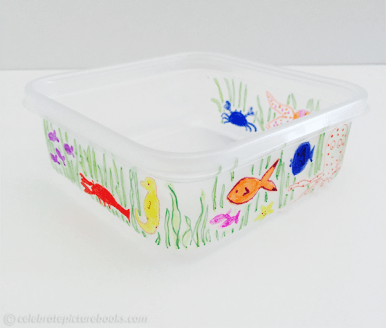
Decorated Sandwich or Snack Container


Who says your snack or sandwich container has to be boring? Take your lunch to school in a container you decorate yourself! It’s easy with a few colored markers and your imagination!

Supplies

  • Disposable plastic food containers with lids
  • Colorful markers

Directions

  1. Decorate sandwich or snack size containers with your favorite designs or characters

March 7 – National Cereal Day

There's a Lion in My Cornflakes by Michelle Robinson and Jim Field picture book review

About the Holiday

Did you know that breakfast in a bowl actually began with an experiment that went wrong? Or just maybe it was right! John Harvey Kellogg and his brother Will Keith Kellogg were experimenting with boiled wheat in 1877 when they left some out overnight. In the morning the wheat was stale. The brothers decided to roll it out instead of throwing it away, and they found that each wheat berry created a flake. Boiled corn worked the same way, and from this process the Kellogg brothers invented Corn Flakes, the first dry cereal!

Today’s holiday celebrates all the varieties of your favorite cereal—whether it’s made of corn, wheat, bran, rice, or a mixture of flakes, fruit, and nuts. So pour yourself a big bowlful and enjoy!

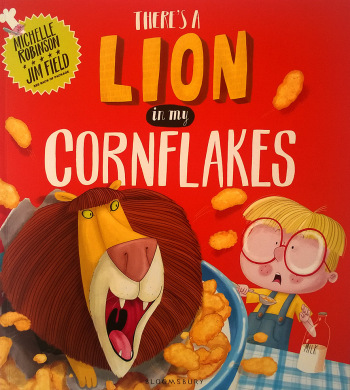
There’s a Lion in My Cornflakes

Written by Michelle Robinson | Illustrated by Jim Field


Who could resist clipping cereal box coupons to receive a free lion? Nobody, that’s who! I mean, it would be so cool, right? A lion to take on walks, ride to school, and open tin cans—awesome! So a boy and his brother, Dan, take a year’s worth of their allowance, make “a million” trips to the grocery store, and start cutting.

But all those boxes of cereal squeeze out the other food on the pantry shelves, so Mom says the boys have to eat cornflakes for breakfast, lunch, and dinner until it’s gone—and, oh yeah, they don’t get an allowance until then either. It’s all worth it, though, because they’re going to get a real live lion.

There’s just one hitch—every other kid in town has the same idea, and while the brothers wait for their lion to arrive, everyone else is out playing with their new pet. Finally, the delivery truck pulls up in front of the house, and out walks…a grizzly bear?! That’s not right, and it’s even delivered to the wrong house. Well, the bear’s not too crazy about the situation either, and shows it. The kids and the bear have to clean up the neighbor’s yard and apologize.

A letter of complaint to the cereal company brings resolution in the form of…a crocodile?! The crocodile spends all its time in the bathroom, and the grizzly bear is still causing havoc. Dad calls the cereal company and to make up their mistake they send…a gorilla?! The gorilla stomps on Dad’s car and rips the door off. Well Dad’s had enough!  The whole crew piles into the car so Dad can “give those cereal people a piece of my mind.”

The cereal people sure are sorry for the mix-up. They make amends by letting the family keep the grizzly bear, the crocodile, and the gorilla, AND the company gives them…a lifetime’s supply of cornflakes! But really, what good are all those boxes? The boys can’t walk them or ride them or even open cans with them.

You know what, though? Mom’s discovered the crocodile has some pretty sharp, can-opening chompers. The grizzly bear can walk forever and even wear a fanny pack. And the gorilla makes a very cool chauffeur. Why bother having a lion when everyone else has one?

Besides, what are the cereal people offering now—a free tiger?! Hmmm….

Michelle Robinson has taken the lure of free stuff to its ridiculous best. There’s a Lion in My Cornflakes serves up the benefits of individuality and drawbacks of consumerism in a silly, over-the-top scenario that will have kids laughing at every page and escalation of the brother’s problem.

Jim Field’s bold, vibrant illustrations are the perfect accompaniment to this boisterous tale. As the boxes of cornflakes and clipped coupons pile higher and higher and the free animals cause more mayhem, the boys’ expressions go from excited to nonplussed to shocked and finally  to acceptance as day after day brings new and unexpected results of their actions. Kids will love the funny details on every page that highlight the story.

Ages 3 – 7

Bloomsbury Children’s, 2015 | ISBN 978-0802738363

National Cereal Day Activity

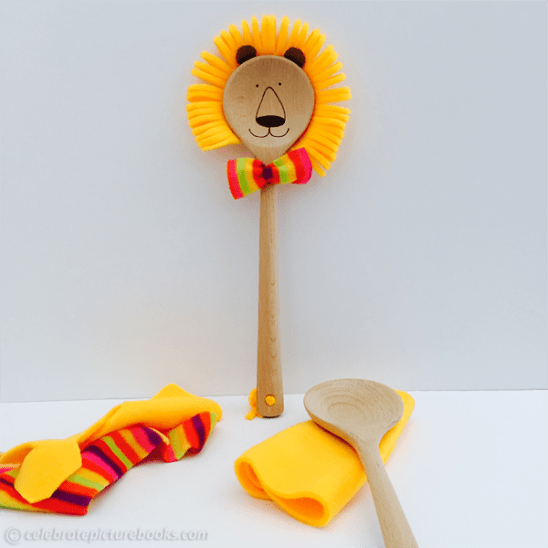
CPB - Spoon Lion

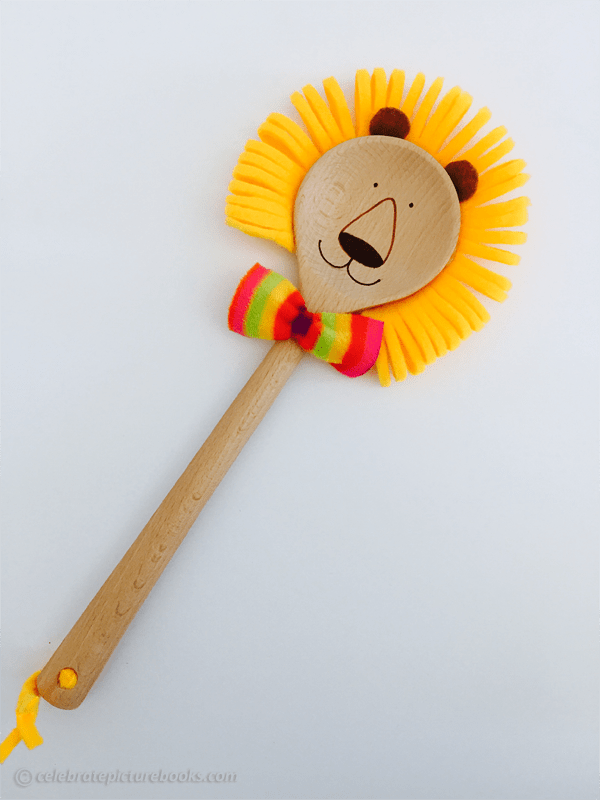
Spoon Lion Puppet


Spoons are just the thing for eating cereal! But with this craft you can make a ROARingly cute lion puppet!

Supplies

  • Wooden mixing spoon
  • Yellow Fleece
  • Brown felt
  • Colorful Fleece or felt
  • Fabric glue
  • Light brown marker
  • Dark brown marker
  • Hot glue gun or super glue
  • Scissors

CPB - Spoon Lion with stuff

Directions

To make the lion’s face

  1. Draw a nose, mouth, and eyes on the front/bowl of the spoon

To make the mane

  1. Measure the rim of the spoon from one side of the handle to the other
  2. Cut a strip of yellow fleece as long as rim measurement and 4 inches wide
  3. Fold the piece of fleece in half long-ways
  4. Glue the open edges of the fleece together
  5. Along the folded side cut a fringe, leaving the loops intact

To make the ears

  1. Cut round ears from the brown felt

To make the bow

  1. Cut a 3-inch x 1 ½-inch piece of colorful fleece or felt
  2. Cut a long thin strip of fleece or felt
  3. Pinch the bow in the middle and tie with the longer piece of cloth. Trim as necessary

To make the tail

  1. Cut three thin 4-inch-long strips of yellow fleece
  2. With fabric glue, glue the tops of the strips together
  3. Braid the strips
  4. At the bottom, glue the strips together, leaving the ends free

To assemble the lion

  1. Glue the ears to the back of the spoon
  2. Glue the mane to the back of the spoon
  3. Glue the bow to the handle
  4. Fold the top of the tail and push it into the hole in the handle of the spoon

February 25 – National Chili Day

Armadilly Chili picture book review

About the Holiday

What could be more satisfying on a mid-winter day than a spicy bowl of chili?  Whether made with meat or veggies, combined with macaroni, or served in potato skins, the simmered flavors make for a scrumptious meal. Although the origins of chili are lost to history, it’s believed that the dish is a southwestern, specifically Texan, concoction. It began to attract attention in the early 1800s, and by the 1880s”Chili Queens” were selling “bowls o’red” at chili stands throughout San Antonio. In 1893 the San Antonio Chili Stand made an appearance at the Chicago World’s Fair. It’s popularity took off across Texas and throughout the west by the 1920s. When the Great Depression hit, chili became one of the only affordable meals for the hungry population.

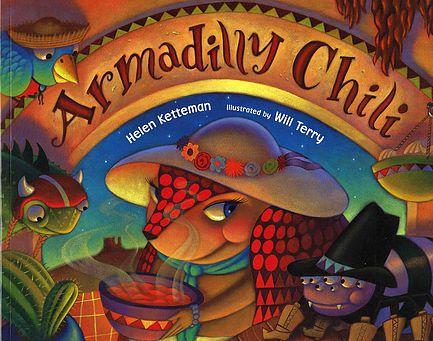
Armadilly Chili

Written by Helen Ketteman | Illustrated by Will Terry


What a hoot! The knee-slappin’, root-a-tootin’ phrasing in Hellen Ketteman’s Armadilly Chili is shor ‘nuf gonna make this a favorite on any child’s bookshelf. While the plot may be familiar, the southwest setting and Miss Billie Armadilly put a fresh, funny twist on it.

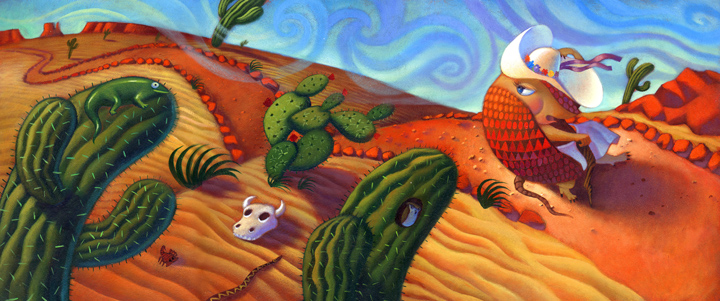
celebrate-picture-books-picture-book-review-armadilly-chili-gathering-ingredients

Image copyright Will Terry, courtesy of willterry.com

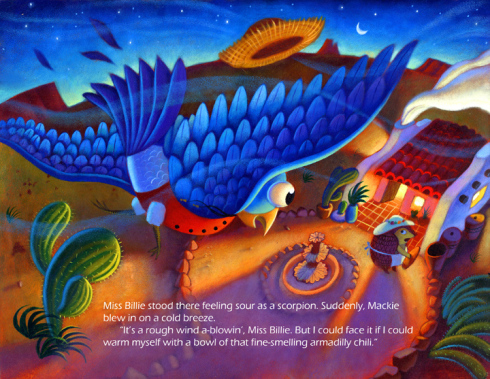
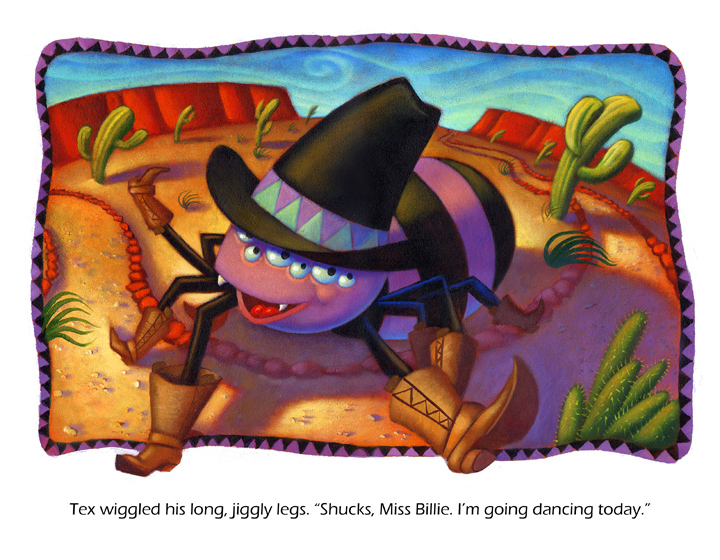
Miss Billie Armadilly is gathering ingredients for her hot armadilly chili as a blue norther blows in. She’s gathering beetles when her friend Tex, a many eyed tarantula tip taps by. When Billie asks him to help her collect beetles, he tells her he can’t because he’s going dancing. Miss Billie harrumphs and does it herself. Next Miss Billie is picking peppers, and when Mackie the bluebird flies in she thinks she has some help. Once again, though, she’s left on her own since Mackie is going to the movies. Her friend Taffy, the horned toad, begs off from chopping prickly pear, saying he’s got plans to go skating.

celebrate-picture-books-picture-book-review-armadilly-chili-Mackie-flies

Image copyright Will Terry, text copyright Helen Ketteman, courtesy of willterry.com

At home, Miss Billie stirs her chili to a scrumptious bubble. The aroma entices first Tex, then Mackie, and finally Taffy to come a’knockin’ at her door looking for a bowlful. Billie has something to say about that—specifically, “no workin’ with Billie, no sharin’ the chili!”

Billie’s friends hurry away, and Billie sits down to her feast. But after all that work, the chili tastes as “flat as a Texas prairie.” What’s wrong? She realizes what the missing ingredient is just as the doorbell rings. She opens the door to find her friends standing there with bags in their hands. What’s in those sacks? Apologies! And hot apple cider, jalapeno biscuits, and homemade chocolate fudge. Now that the friends are all together, the chili tastes just right, and they laugh and talk and eat throughout the blustery night.

celebrate-picture-books-picture-book-review-armadilly-chili-tex

Image copyright Will Terry, text copyright Helen Ketteman, courtesy of willterry.com

Helen Ketteman’s fast-paced Armadilly Chili is a welcome take on what it means to be a good friend. Her Western setting, lively language, and fast pacing will keep kids laughing and rooting for Billie and her pals. Will Terry’s bright illustrations washed with a palette of deep reds, oranges, greens, and yellows firmly sets the story in the Southwest. Billie’s facial expressions as each of her friends abandon her to her chores are priceless, and their final camaraderie is highly satisfying.

Ages 4 – 8

Albert Whitman & Company, 2008 | ISBN 978-0807504581

Discover more about Helen Ketteman and her books on her website!

View a gallery of illustration work, drawings, and picture books by Will Terry on his website!

National Chili Day Activity

CPB - Chili Pepper Game

Hot, Hot, Hot! Chili Pepper Chili Game


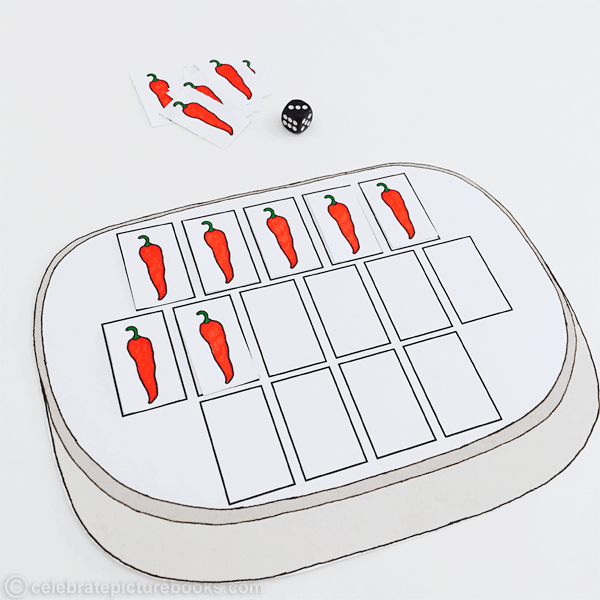
Chili just isn’t chili without a little heat! But can you take 15 chili peppers in your bowl? If you want to win the Hot, Hot, Hot! Chili Pepper Chili Game you’ll have to!

Object of the Game

The object of the game is to collect 15 chili peppers in your bowl before any other player.

Supplies

Rules

  1. Any number of players can play at one time. Print 1 Chili Bowl game board and 1 set of 15 Chili Pepper cards for each player
  2. Give 1 Chili Bowl Game Board to each player
  3. Place the Chili Pepper Cards in a pile or in a bowl
  4. Roll the die to see who goes first. The person with the highest roll goes first
  5. To begin play, the first player must roll a 1, 2, or 3. They should roll until they get one of these numbers.
  6. Players roll the die and collect or lose chili pepper cards by the number of dots on the die. If you roll a:
  • 1 – Pick up 1 chili pepper card and place it on your chili bowl game board
  • 2 – Pick up 2 chili pepper cards and place them on your chili bowl game board
  • 3 – Pick up 3 chili pepper cards and place them on your chili bowl game board
  • 4 – Get a chili pepper card from the player on your left
  • 5 – Give a chili pepper card to the player on your left
  • 6 – Lose a turn

     7. If a player does not have chili pepper cards to give to another player or if the player on           their left has no cards to give, the player rolls again.

    8. Continue play until one player has filled their Chili Bowl with chili peppers!

February 24 – National Tortilla Chip Day

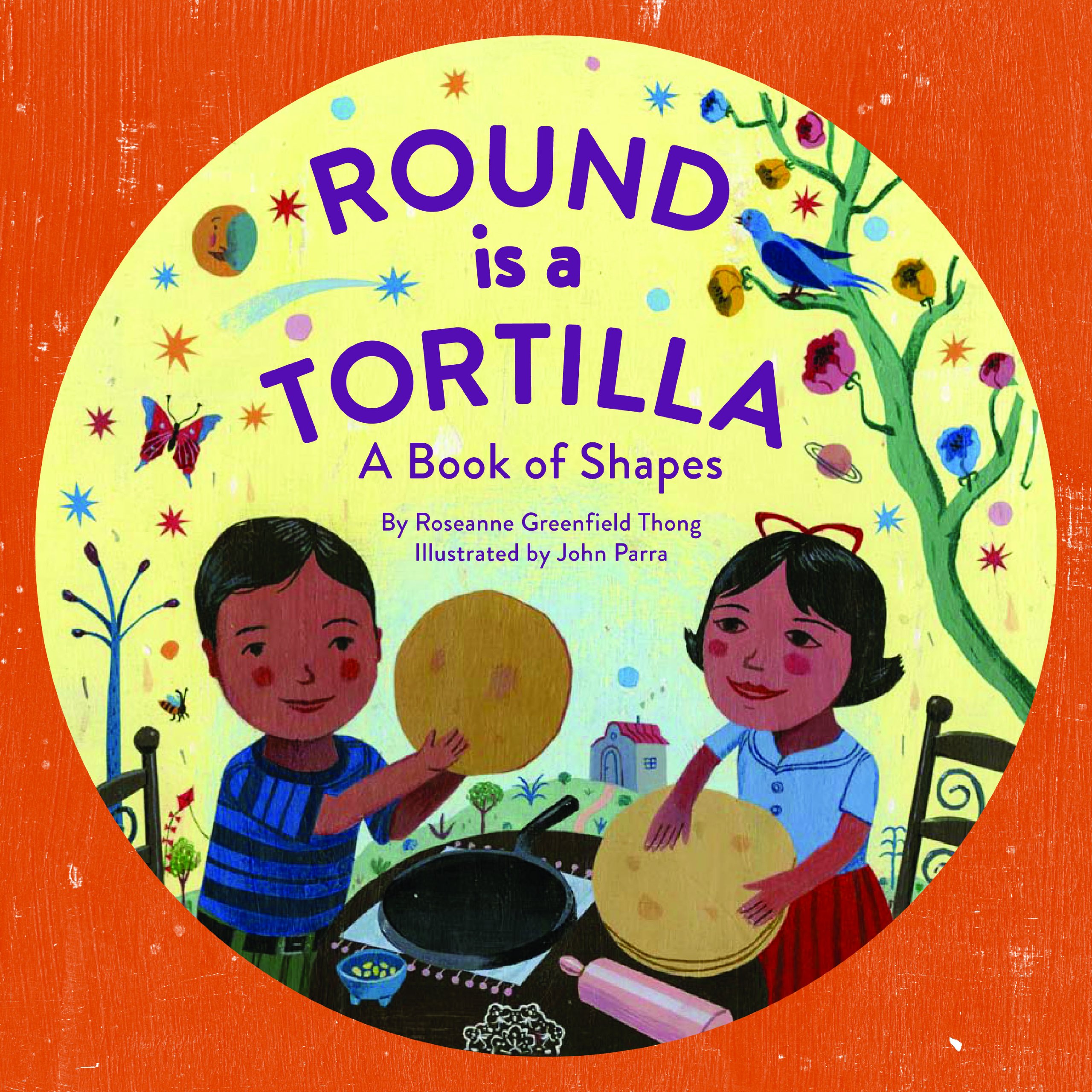
celebrate-picture-books-picture-book-review-round-is-a-tortilla-a-book-of-shapes-cover-2

About the Holiday

If the tortilla-making machine had produced perfect rounds every time back in the 1950s, the world may never have known the crunchy deliciousness of tortilla chips. Back in the day, Rebecca Webb Carranza and her husband owned the El Zarape Tortilla Factory in Los Angeles, California and were one of the first to automate tortilla production.

Instead of wasting the odd-shaped ones, Carranza cut them into triangles, fried them, and sold them in bags.They were a hit! People all over began enjoying them dipped in salsa and guacamole and smothering them in cheese. In 1994 Carranza was honored with the Golden Tortilla Award for her contributions to the Mexican food industry, and in 2003 Texas named the tortilla chip the official state snack!

Round is a Tortilla: A Book of Shapes

Written by Roseanne Thong | Illustrated by John Parra


“Round are sombreros. / Round is the moon. / Round are the trumpets that blare out a tune. Round are tortillas and tacos too. / Round is a pot of abuela’s stew. / I can name more round things can you?” With wonderful, lyrical verses, Roseanne Thong introduces children to the shapes—circles, squares, triangles, rectangles, ovals, stars, and more—that make up their multicultural world.

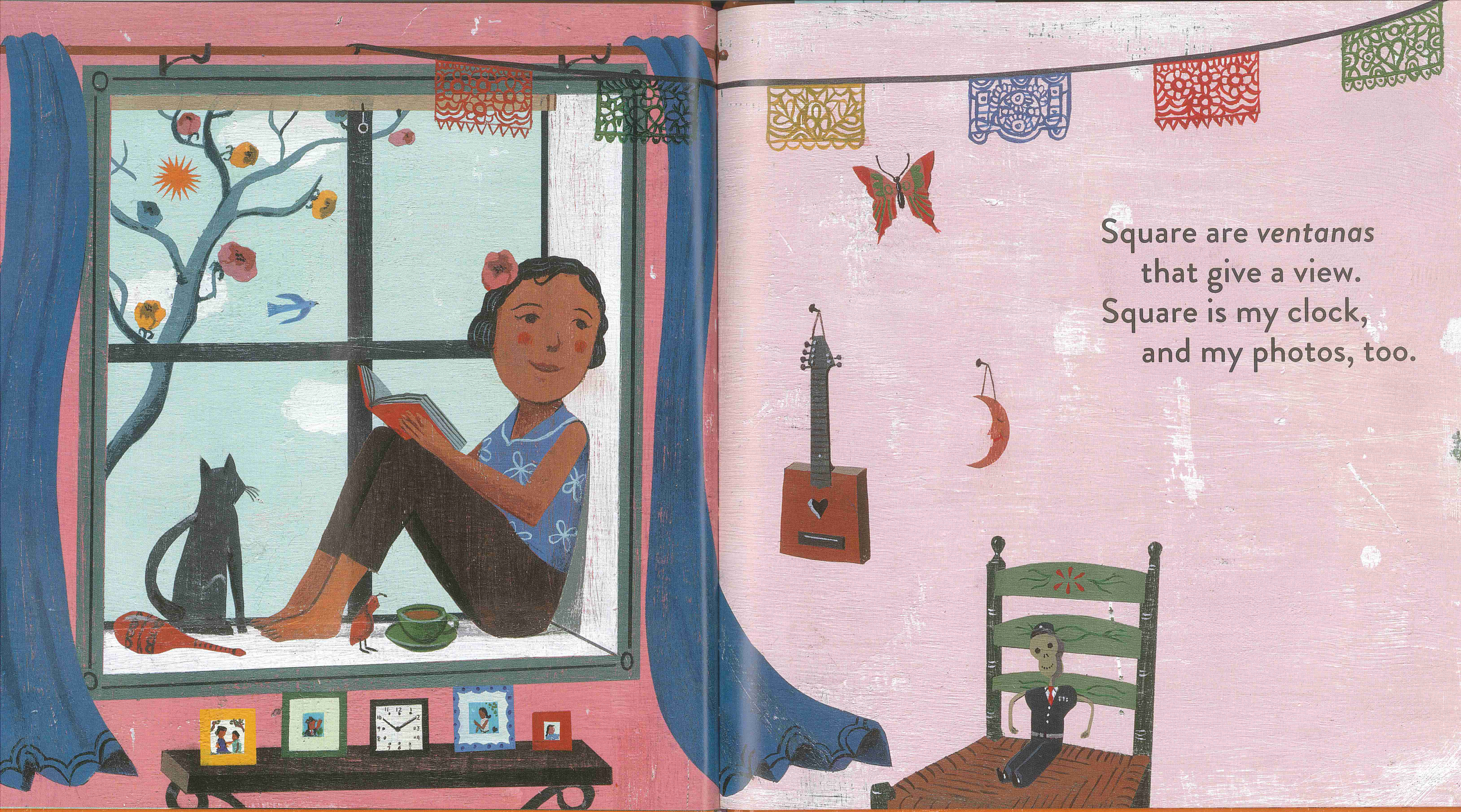
celebrate-picture-books-picture-book-review-round-is-a-tortilla-squares

Image copyright John Parra, 2013, text copyright Roseanne Thong, 2013. Courtesy of Chronicle Books.

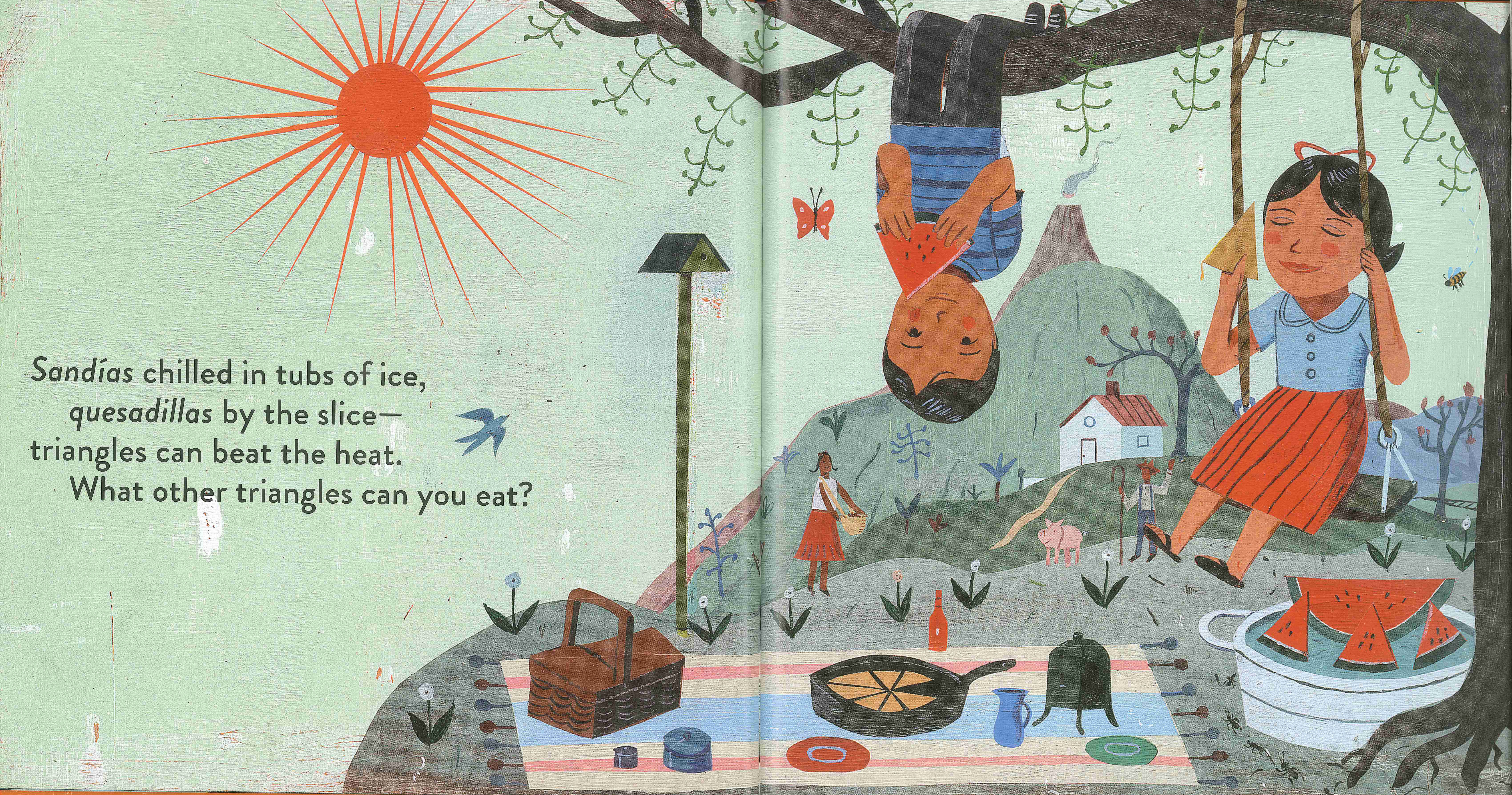
Here are round chiming campanas and nests full of swallows, square ventanas for peering through and clocks for telling time. Rectangles are cold paletas to eat on a hot summer day and the ice-cream carts that deliver them, and triangles make tasty quesadillas and gliding sailboats. Each verse ends with an invitation for kids to find more shapes around them—an invitation that’s hard to resist!

celebrate-picture-books-picture-book-review-round-is-a-tortilla-triangles

Image copyright John Parra, 2013, text copyright Roseanne Thong, 2013. Courtesy of Chronicle Books.

Rebecca Thong’s bright, fun-to-read verses shine with evocative words that elevate this concept book to a celebration of the sights, sounds, and sensations that make up readers’ lives. Spanish words sprinkled throughout the story enhance the theme of the book and are defined following the text. 

celebrate-picture-books-picture-book-review-round-is-a-tortilla-star

Image copyright John Parra, 2013, text copyright Roseanne Thong, 2013. Courtesy of Chronicle Books.

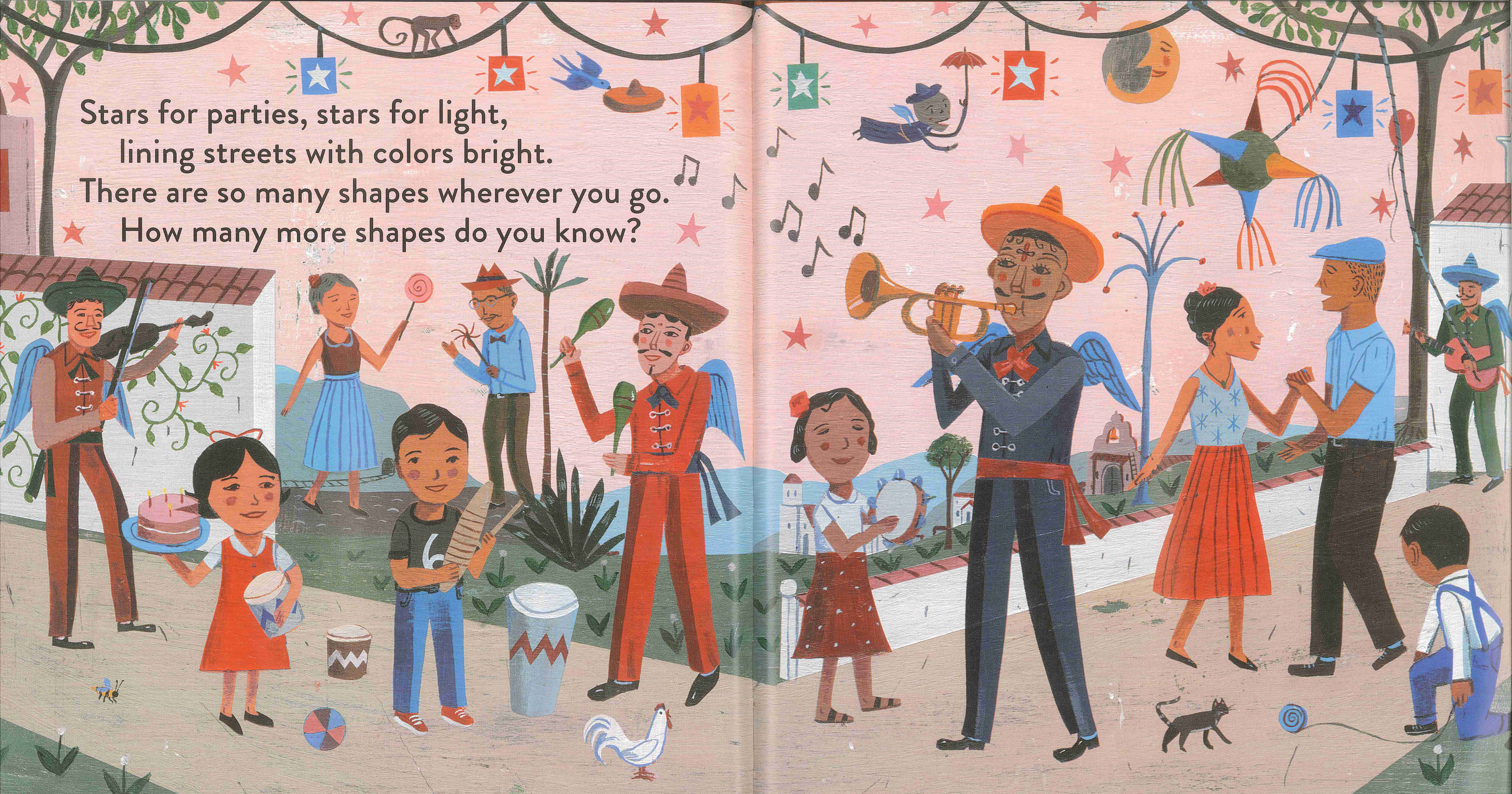
John Parra’s beautiful folk-art illustrations, which are sure to put a smile on kids’ faces, immerse readers in the daily life of a Latino town. People dance, cook, play games, walk in the park, attend a festival, and more—all while surrounded by colorful shapes. Kids will love lingering over the pages to find all of the intricate details and may well want to learn more about what they see.

Round is a Tortilla is not only a book of shapes, it makes shapes exciting! The book is a wonderful stepping stone to discussions about the places, celebrations, symbols, and decorations found on the pages for students or individuals and would be a welcome addition to any classroom or child’s bookshelf

Ages 3 – 6

Chronicle Books, San Francisco, 2013 | ISBN 978-1452106168 (Hardcover) | ISBN 978-1452145686 (Paperback)

Learn more about Roseanne Thong and her books for children and adults on her website!

View a gallery of books and artwork by John Parra on his website!

National Tortilla Chip Day Activity

CPB - Tortilla chips (2)

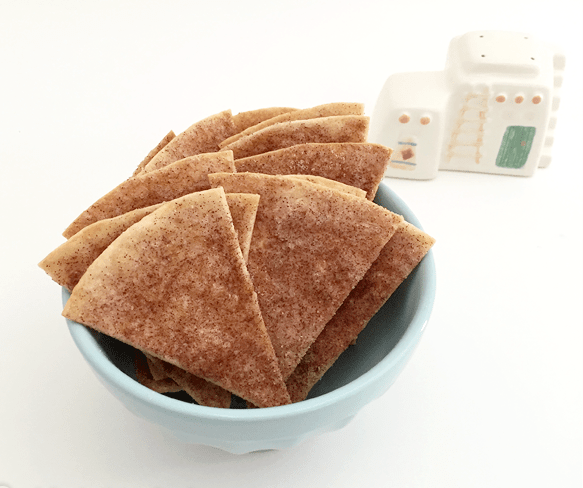
Homemade Baked Tortilla Cinnamon Chips

Ingredients

  • 2 10-inch flour tortillas
  • ¾ Teaspoon Cinnamon
  • 2 ½ Tablespoons Sugar
  • Butter

Directions

  1. Preheat oven to 350 degrees
  2. Combine the cinnamon and the sugar in a bowl
  3. Butter the tortillas
  4. Sprinkle the tortillas with the cinnamon sugar mixture
  5. Cut the tortillas into 8 pieces
  6. Place pieces on a baking sheet
  7. Bake in 350-degree oven for 12 – 15 minutes
  8. Chips will become crispier as they cool.

Makes 16 chips

celebrate-picture-books-picture-book-review-round-is-a-tortilla-a-book-of-shapes-cover-2

You can find Round is a Tortilla: A Book of Shapes at these booksellers

Amazon | Barnes & Noble | Books-a-Million | IndieBound


February 20 – National Cherry Pie Day

How to Make a Cherry Pie and See the U.S.A. picture book review

About the Holiday

Today we celebrate a most delicious day! It’s hard not to love pie with its flaky crust and sweet filling. Pies have been served since ancient days, originating with the Romans who, like our own English and American ancestors, discarded the crust before eating it (didn’t they know what they were missing?).

Here are a few rather surprising facts about pie

  • Early pies were mostly made of meat, poultry in particular. The legs of the bird were often left to hang over the side of the dish and used as handles (is this what’s called “getting a leg up”?).
  • Fruit pies probably originated in England in the 1500s.
  • We have the bakers for Queen Elizabeth I to thanks for the first cherry pie.
  • Pie was introduced to America by the first English settlers. It was baked in long narrow pans that the settlers called “coffyns” after pie crusts in their native country.
  • During the American Revolution the term coffyn was changed to “crust” (“Those pesky Redcoats! We don’t want our words to be like theirs!”)

To celebrate today’s holiday, enjoy a slice of cherry pie, read this book, and have fun with the puzzle!

How to Make a Cherry Pie and See the U.S.A.

By Marjorie Priceman


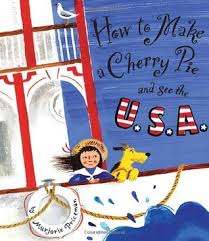
In this clever recipe/travelogue combination, Marjorie Priceman takes children on a tour of the United States as they gather the materials to make the tools needed to bake a cherry pie. Sure, it’s easy to buy the bowls, spoons, pie pan, baking sheet, pot holders, and other items required, but where do these things really come from?

With each page kids will vicariously travel across the country with the young baker as she visits Pennsylvania and Ohio for coal to make baking sheets, Mississippi for the cotton needed to sew pot holders, New Mexico for potting clay, and Washington, Hawaii, New Hampshire, Texas, and other states in her pursuit of materials. Along the way, they will learn fun facts about the states and what makes each one special.

The girl joins people playing and working at all kinds of job as she journeys by boat, plane, car, and bus in Priceman’s vibrant and engaging illustrations. Each state is depicted with its unique characteristics, and Priceman has included so many details that kids will love lingering over each page. Curious kids may want to explore more about the subjects they discover in this creative picture book.

Ages 5 – 8

Dragonfly Books, 2013 | ISBN 978-0385752930

Cherry Pie Day Activity

CPB - Cherry Pie Match

Mixed Up Cherry Pies Matching Game

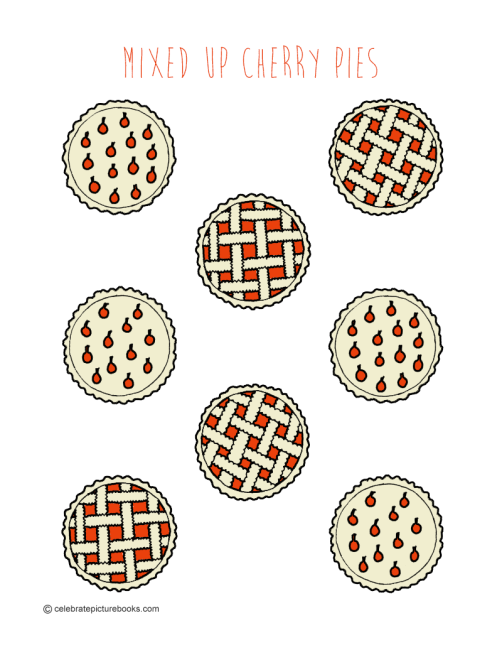
You baked 8 cherry pies for the Cherry Pie Day Festival – 2 of each crust pattern. But they got mixed up! Can you connect the matching cherry pies? Print the Mixed Up Cherry Pies Matching Game Template and draw a line between the matching pies. 

February 9 – Pizza Day

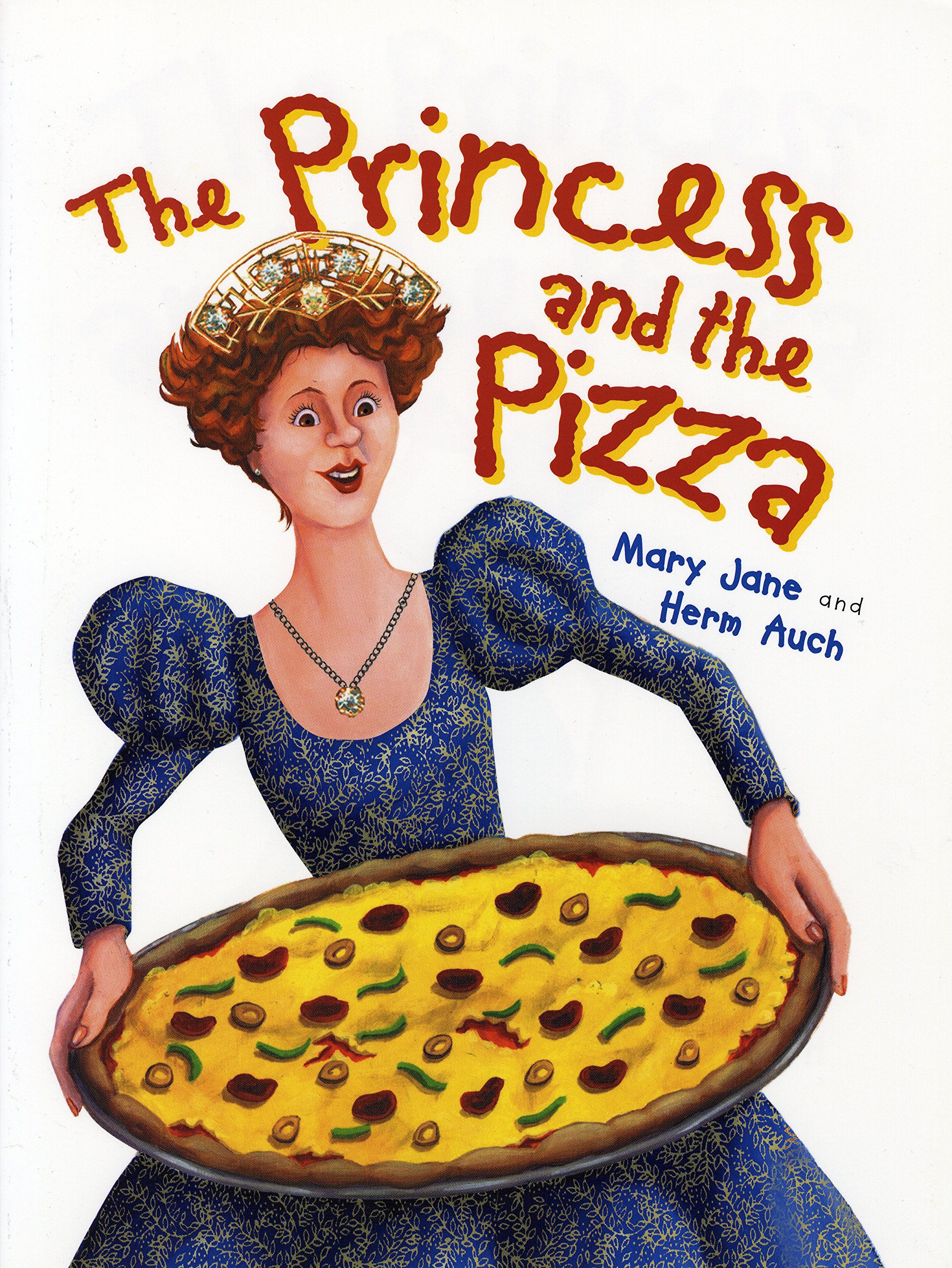
celebrate-picture-books-picture-book-review-the-princess-and-the-pizza-cover

About the Holiday

Every day could be pizza day, but today’s holiday gives us a special reason to enjoy one of the world’s favorite foods! Since ancient times, people have been making pizzas of all kinds from flatbread to deep dish, but they all have one thing in common—they’re delicious! Here are just a few interesting facts about this most delectable of foods:

  • The very first pizzeria opened in Italy in 1738
  • The first pizzeria in America was opened in New York in 1895
  • Pepperoni is the most popular topping
  • Over 3 billion freshly made pizzas and 1 billion frozen pizzas are sold in the U.S. every year

The Princess and the Pizza

 By Mary Jane and Herm Auch


Paulina loves being a princess. But when her father, the king, gives up his throne, Paulina needs a job! Things don’t go so smoothly, however, so when she hears that Queen Zelda is looking for a bride for her son, Drupert, she springs into action. Armed with her best ball gown, a tiara, garlic for good luck, and herbs to mask the garlic smell, Paulina is off to Blom to win a prince and her old life back.

Twelve women show up to woo Prince Drupert, and Queen Zelda has plans to find him the perfect wife. She pits the women against each other in three competitions—the pea-under-the-mattress test, the glass slipper fitting, and a feast-preparation contest. Paulina easily passes the first two but is thwarted in the third by the shenanigans of the remaining contestants.

By the time Paulina reaches the table that holds the ingredients for the feasts, the only items left are tomatoes, cheese, and the makings of a dough. Paulina throws them together then decides to take a nap (after first removing the sleep-depriving pea from the bed). Rudely awakened from slumber and given a threat she can’t ignore, Paulina tosses her creation on the fire and sprinkles it with her garlic for good luck and the herbs to mask the smell.

The time for tasting arrives and Paulina presents her tray, hoping for the best. Although the concoction may look a mess, it smells scrumptious and with one taste Prince Drupert proclaims it the winner. And so in one fell swoop our intrepid heroine has invented pizza and won the heart of Prince Drupert. But the whole experience has given Paulina a better idea. She dumps Drupert and opens a Pizza Palace. And while she may not actually be royalty anymore, the townspeople are so thrilled they treat her like a queen. Life again is good, but could her father be falling for Queen Zelda?

Paulina is an appealing modern princess—she’s loaded with self-confidence, never gives up, and knows how to play the game. Kids will love recognizing the references to other favorite fairy tales, and the humorous illustrations of the unflappable Paulina will have them giggling with every page.

Ages: 4 and up

Holiday House, New York 2003 / ISBN 978-0823417988

Pizza Day Activity

CPB - Pizza Day Toppings

Create Your Pizza Game

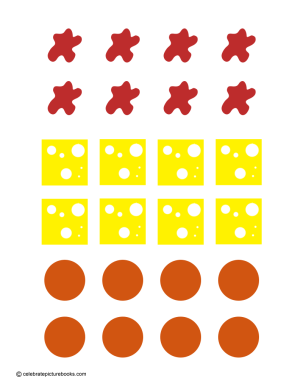
Play this fun game to build your pizza ingredient by ingredient before the others!          For 2 – 8 players.

Supplies

Directions