April 3 – Find a Rainbow Day

About the Holiday

As the old proverb goes, “April showers bring May flowers,” but all that rain brings something else—rainbows! The science behind rainbows was first discovered in 1693, when scientists realized that this phenomenon is caused by light from the sun being refracted through raindrops and causing a dazzling show. Today, I wish you a rainy day and happy rainbow hunting! A perfect place to find rainbows every day and in amazing places beyond the sky is in today’s book!

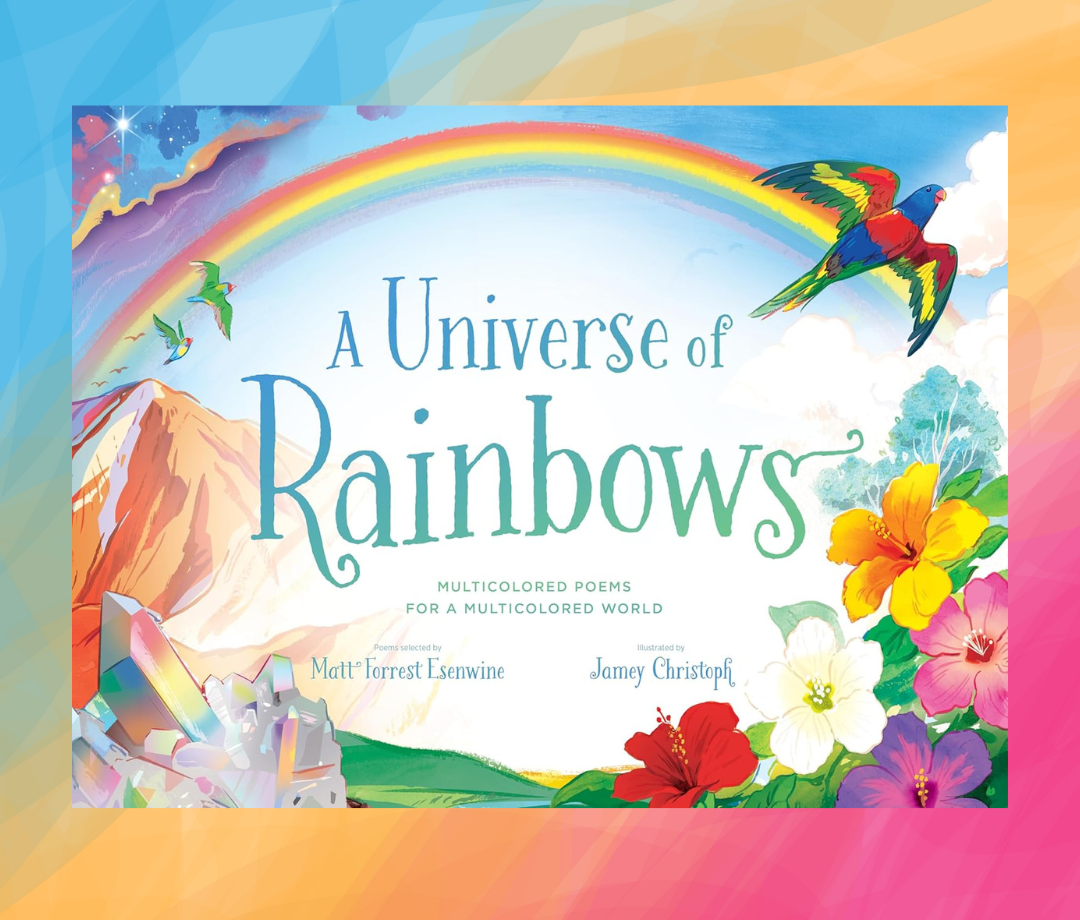
A Universe of Rainbows: Multicolored Poems for a Multicolored World


By Matt Forrest Esenwine | Illustrated by Jamey Christoph


Rainbows are a universally loved natural phenomenon. The excitement of seeing a rainbow arcing across the sky never goes away no matter how old you get. And a double rainbow? For some people, seeing one of those can be like glimpsing a celebrity. In the 22 poems that make up A Universe of Rainbows, Matt Forrest Esenwine and 19 other poets reveal that you don’t always have to wait for rain to be awed by the brilliance of this spectrum of colors as they abound in nature: on land, in waters, on plants and animals, and even in the depths of space.
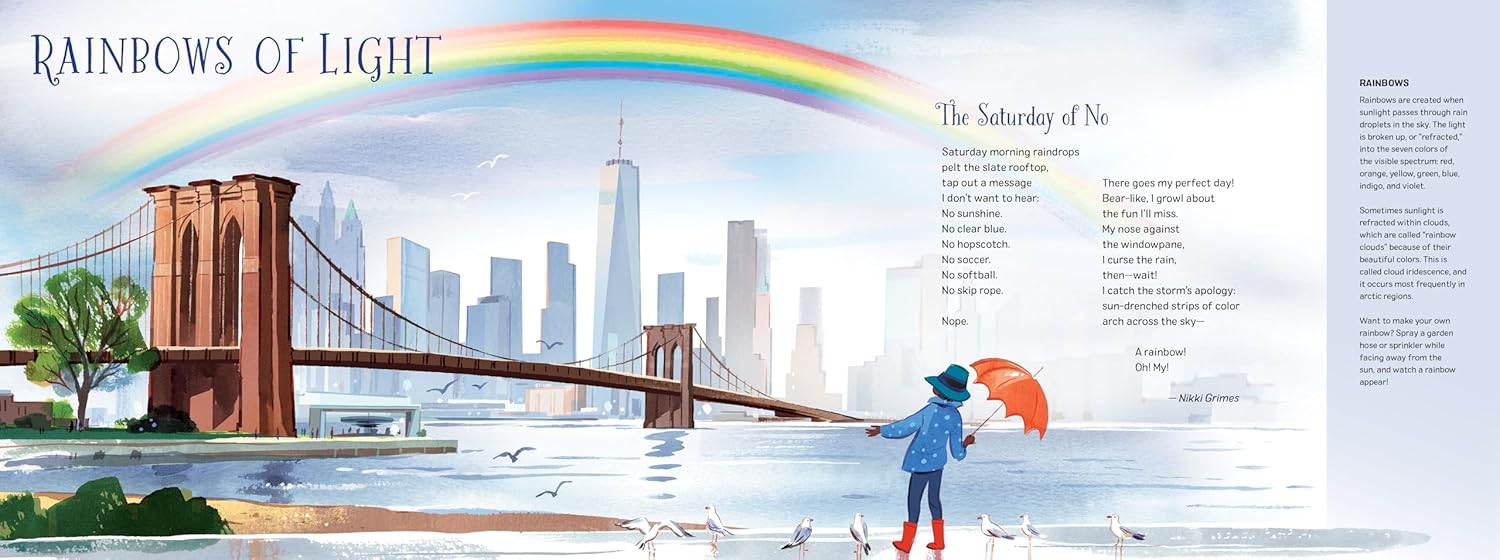
Illustration © 2025 by Jamey Christoph, text © 2025 by NIkki Grimes. Courtesy of Eerdmans Books for Young Readers.

Nikki Grimes leads off this lyrical odyssey that invites readers to travel around the world and beyond to discover rainbows in many forms. In Grimes’ “Rainbows of Light,” she channels the disappointment of a child facing a rainy day with “. . . No hopscotch. / No soccer. / No softball / no skip rope. . . .” The child “. . . curse[s] the rain” until they “catch the storm’s apology: / sun-drenched strips of color / arch across the sky— / A rainbow! / Oh! My!” 

You might think that rainbows occur in nature only during the day, but Joyce Sidman, reveals otherwise in her intricate and arresting pantoum “Along the Zambezi.” Sidman animates a moonbow, entreating readers to take a moment to look as “This dancer will not leap for long / over the span of Victoria Falls,” where “. . . a full moon crowns the darkened hill” while “. . . Mist swirls up in silver shawls, / bending moonlight’s slanting spill.” 
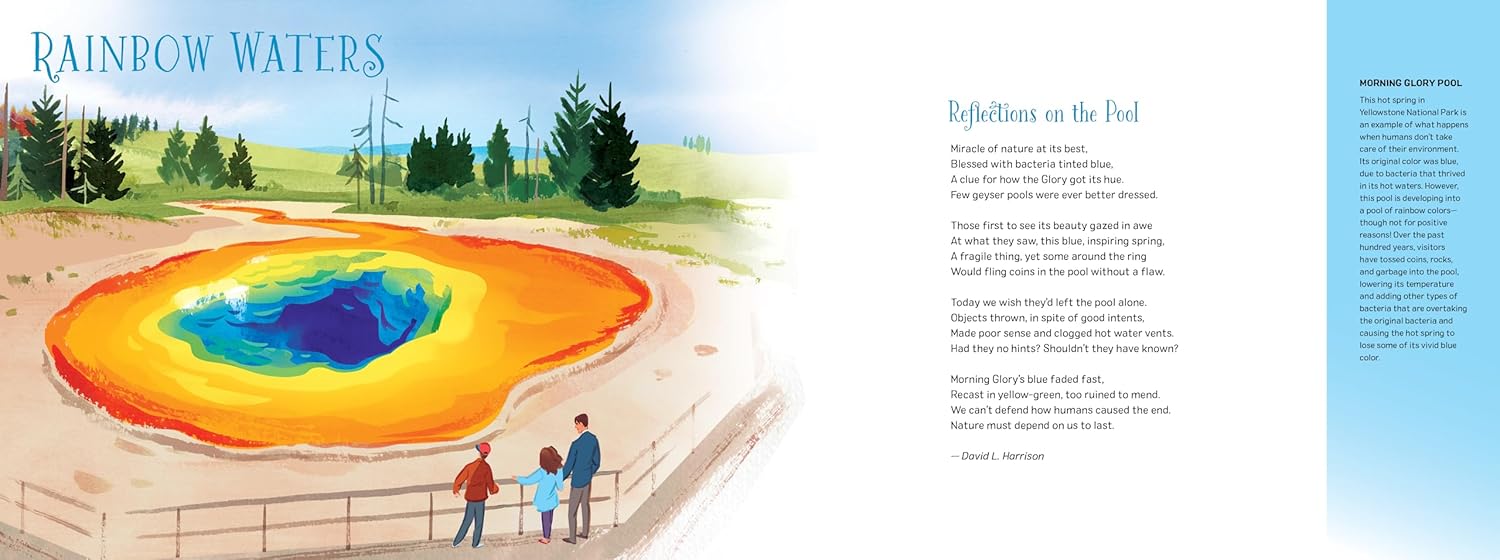
Illustration © 2025 by Jamey Christoph, text © 2025 by David L. Harrison. Courtesy of Eerdmans Books for Young Readers.

Rainbow seekers do not always need to look toward the sky to find the glorious hues of rainbows. In his rhythmic “Reflections on the Pool,” David L. Harrison nimbly combines assonance and consonance to introduce kids to the surprising Morning Glory Pool in Yellowstone National Park. Harrison describes how this hot spring—a “miracle of nature . . . / Blessed with bacteria tinted blue”—once appeared as vividly blue, but now, because of human interference, is developing a “rainbow of colors” as other types of bacteria take over. Together the poem and sidebar provide a concrete example of the value of conservation and a gripping entry into further study or research. 
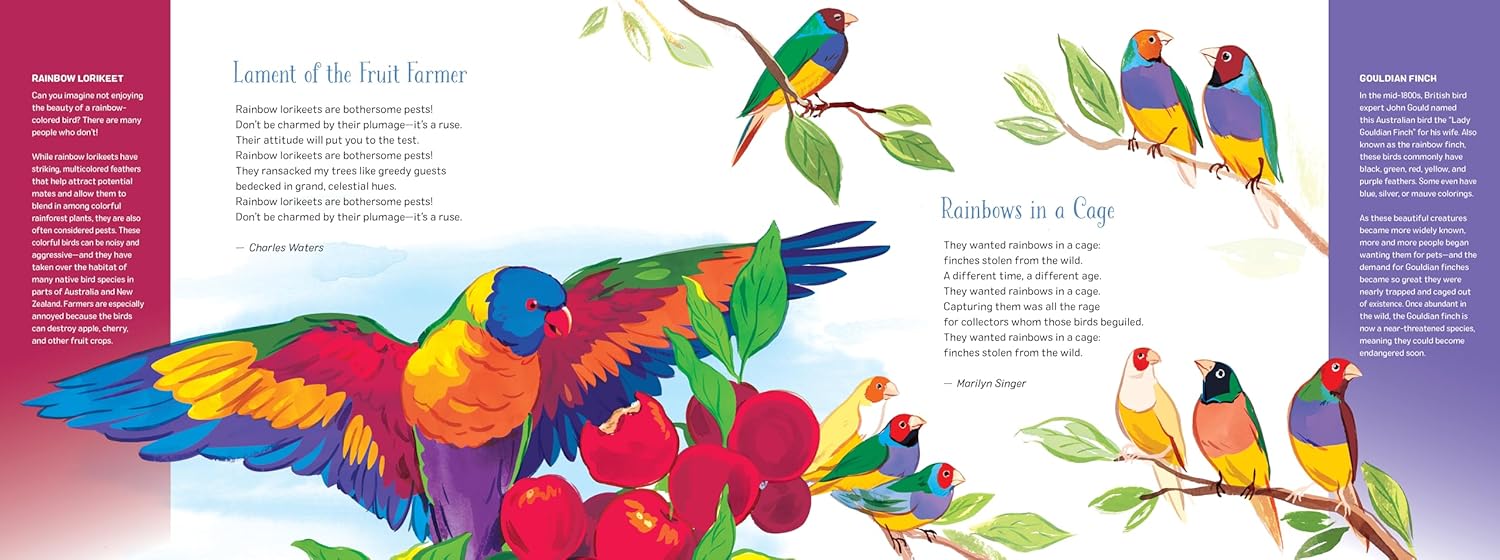
Readers also learn about a uniquely dressed tree, Rebecca Kai Dotlich’s “skirted pinwheel” of a flower, two varieties of birds, and incredible creatures of the sea and land that shimmer and glimmer with the colors of a rainbow. In “Elegant Danger,” Matt Forrest Esenwine exposes the “captivating beauty / with radiant appeal” of the peacock mantis shrimp that has “An appetite of titans. / Attitude of steel.”  into space to float within the Rainbow Nebula with poet Georgia Heard. 

Each poem is accompanied by a short and fascinating side bar offering more information about the natural phenomena that inspired the work.

Back matter includes a list of recommended books and websites where readers can find more information about the rainbows described in each poem as well as a glossary.
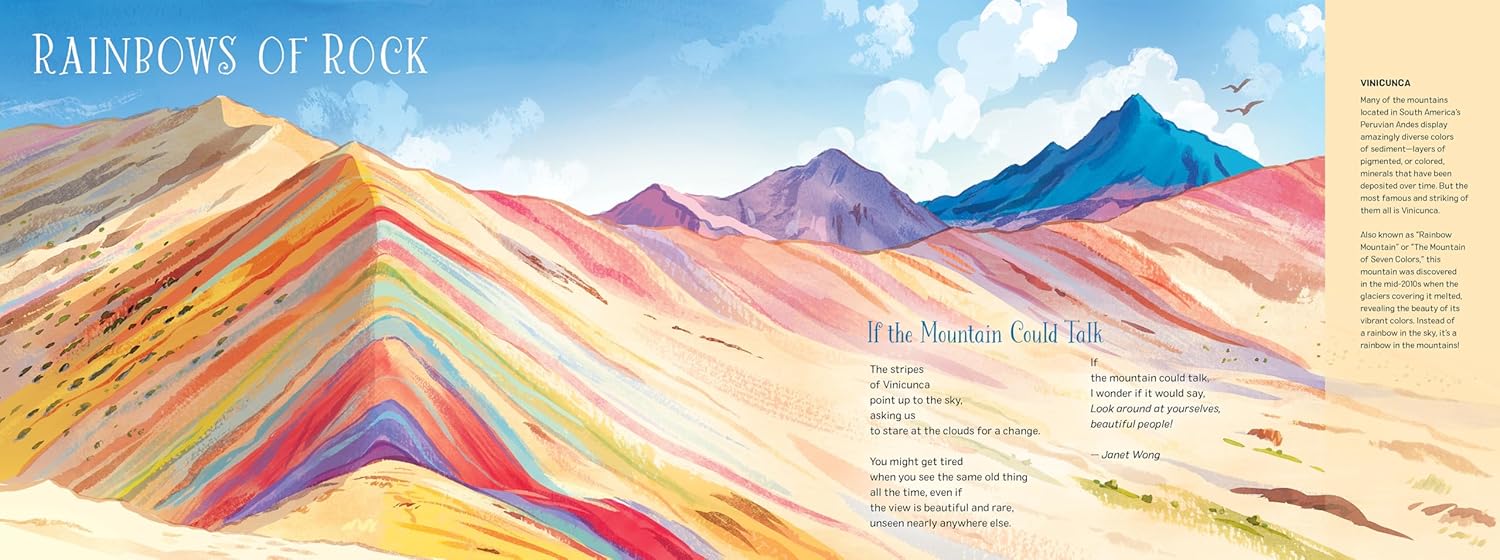
Illustration © 2025 by Jamey Christoph, text © 2025 by Janet Wong. Courtesy of Eerdmans Books for Young Readers.

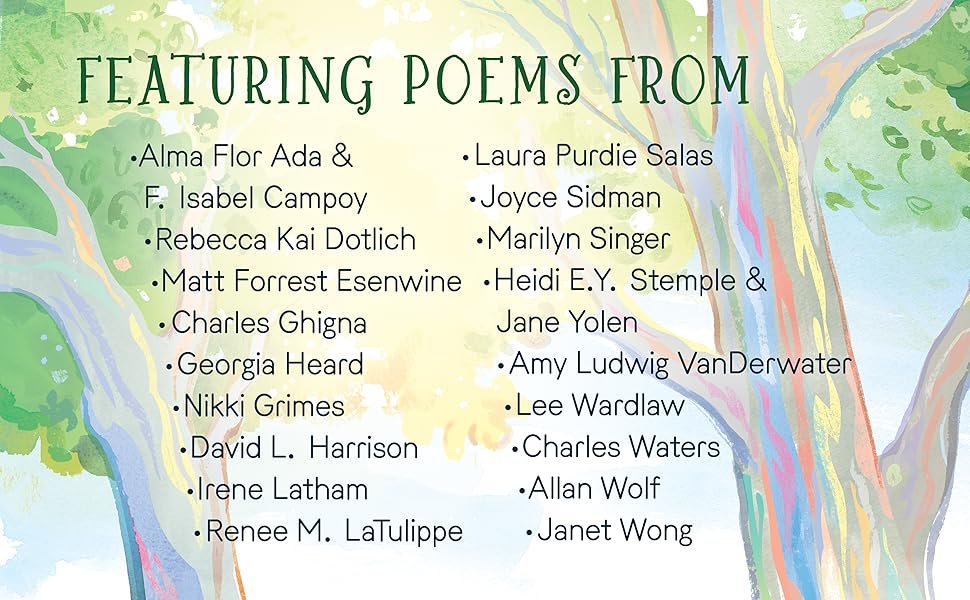
For the twenty award-winning writers who’ve contributed to Matt Forrest Esenwine’s debut poetry anthology, unique rainbows occurring in nature have inspired a wide range of contemplation and poetic form. Some are awe-struck, others hold a touch of humor, and still others are conversational. One thing they all have in common is an ability to transport readers to another place or just the right moment to witness one of life’s most astonishing sights. Through each poem, readers learn facts but they also discover how to observe with curiosity, appreciate the miraculous, and commit to preserving our natural wonders. 
Jamey Christoph’s multi-media illustrations mesmerize with brilliant color that tantalizes like a magic spell, slipping through ice crystals, hiding in plain sight, turning pools of water and majestic trees into artists’ palettes, and clothing creatures of the air, sea, and land. You might be tempted to think that these natural phenomenon can’t possibly be so vivid in real life, but take a look (these poems encourage further research) and you’ll find that Christoph’s full-spread images mirror their inspirations. Beautiful and stirring, each page welcomes you to linger awhile.

Encompassing riveting writing by award-winning poets, spellbinding illustrations of natural phenomena, and nearly endless applications for science, writing, and art study and discovery, A Universe of Rainbows: Multicolored Poems for a Multicolored World is a must for school and public library collections as well as for any reader who loves inspired writing and nature.  

Ages 6 – 10

Eerdmans Books for Young Readers, 2025 | ISBN 978-0802855718

About the Author

Matt Forrest Esenwine is a children’s author and poet whose books include The Thing to Remember about Stargazing (Tilbury House), Once Upon Another Time (Beaming), and A Beginner’s Guide to Being Human (Beaming). His work has been nominated for a Pushcart Prize and featured in numerous anthologies. Also a voiceover actor and commercial copywriter, Matt lives in Warner, New Hampshire, with his family. Visit his website at mattforrest.com.

About the Illustrator

Jamey Christoph has illustrated over twenty books, including The Great Lakes (Knopf), Stonewall (Random House), and Outside My Window (Eerdmans). His books have been named to many best-of-the-year list, including from the CBC and NYPL. Jamey lives in New Hampshire with his husband and their crazy dogs. Visit Jamey’s website at jameychristoph.com and follow him on Instagram @jameychristoph.

National Find a Rainbow Day Activity
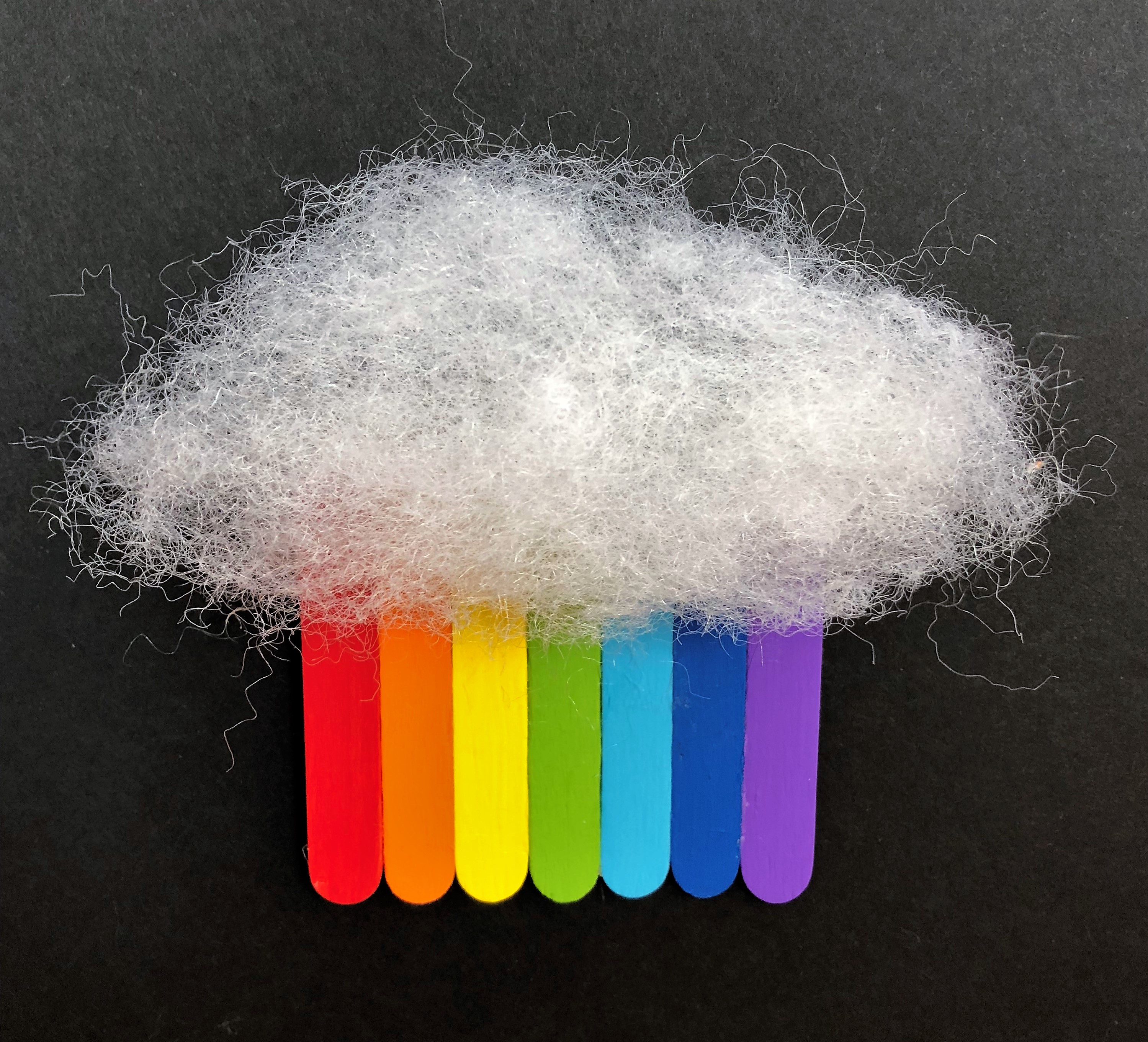
celebrate-picture-books-picture-book-review-rainbow-magnet-craft

Mini Rainbow Magnet


If you’re stuck on rainbows, you can make this mini rainbow to stick on your fridge or locker!

Supplies

  • 7 mini popsicle sticks (or cut regular popsicle sticks in half)
  • Paint in red, orange, yellow, green, blue, Indigo, violet (ROYGBIV)
  • Adhesive magnet
  • A little bit of polyfill
  • Paint brush
  • Glue or hot glue gun

Directions

  1. Paint one popsicle stick in each color, let dry
  2. Glue the popsicle sticks together side by side in the ROYGBIV order, let dry
  3. Roll a bit of polyfill into a cloud shape and glue to the top of the row of popsicle sticks
  4. Attach the magnet to the back of the rainbow
You can purchase A Universe of Rainbows from these booksellers

Amazon | Barnes & Noble | Bookshop (discounted books and support for your local independent bookstore)

Picture Book Review 

July 21 – It’s National Culinary Arts Month

celebrate-picture-books-picture-book-review-chow-mein-and-potstickers-cover

About the Holiday

During the month of July we honor those professional chefs who provide us with tantalizing dishes at our favorite restaurants. In addition to cooking old favorites, chefs also stay up on trends and create new recipes to make life deliciously fresh and surprising. To celebrate, visit your local restaurants and try something new! If you like to cook at home, gather some different ingredients and see what you can create! This month is also a great time to explore foods and cuisine from other countries!

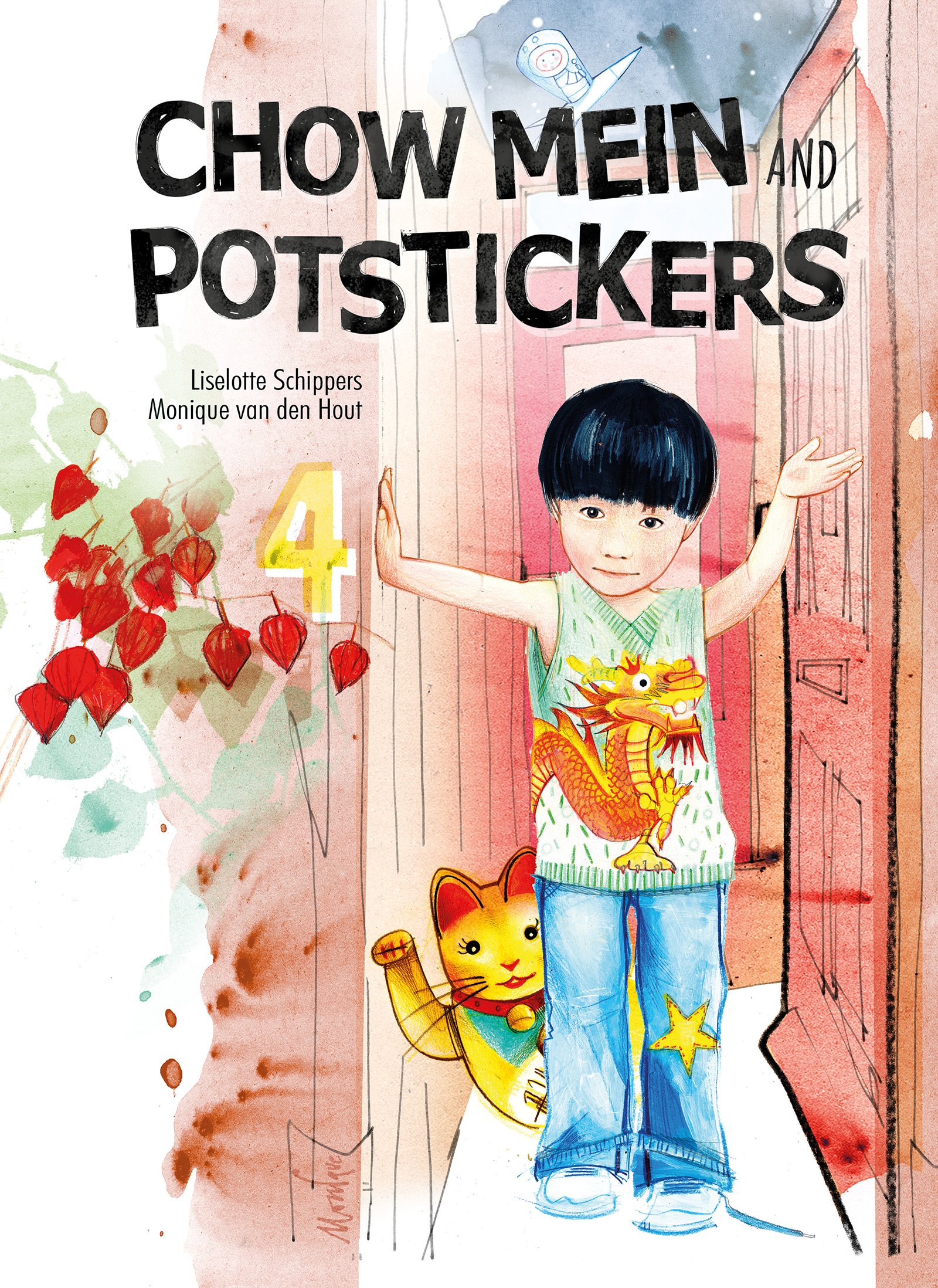
Chow Mein and Potstickers

Written by Liselotte Schippers | Illustrated by Monique van den Hout


A little boy named Chan has just moved here from China and is hoping to make new friends. He tells a little about himself: “I moved to this country with my father, / my mother and my sister. / My mother is starting a new job here. / She’s an astronaut and someday she’ll go to the moon!” He reveals that his favorite food is potstickers and chow mein. He’s just about to go door-to-door to meet his neighbors. He wonders if kids here like to play and how “things work around here.”

Next door at Number 6, Chan meets Mila, who is from Bosnia. Chan thinks “she looks like a princess from a country far away.” Chan and Mila play soccer until they “get tired and hungry!” Then they eat Mila’s “favorite dish / Bosnian ćevapĉići—rolls of ground / meat.” At the end of the day, they say goodbye: “‘Zàijiàn!’” and “‘Doviđenja!’”

The next day Chan meets Rani, who was born in Indonesia. Even though Rani is younger, Chan says that “you can tell he is very wise. / Rani’s father is a famous musician. / He has to travel a lot, touring with his band. / His mother works at the hospital and helps people who are sick.” Rani shows Chan how to play marbles. Afterward, they enjoy Rani’s “favorite foods: satay and kroepoek. / That’s meat on a stick and shrimp crackers.” Later, they wave good-bye and say: “‘Zàijiàn!’” and “‘Sampai jumpa!’”

Across the street lives a little girl named Jamila, who is originally from Afghanistan. “‘Salaam!’” she greets Chan. Jamila plays the guitar, and the two sing and dance along. Chan says: “After a while we get tired and hungry. / Jamila and I eat Afghan qabuli—rice and lamb. / That brings us to the end of our day. / As we wave good-bye, we say: “‘Zàijiàn!’” and “‘Khodahafez!’”

Twins Kim and Coen live at Number 10. They are from Belgium. “Their father is a master chocolatier. That means he / makes fancy chocolates. When he is working, the house / smells wonderful. / Their mother sells the chocolates in a  / special shop. We get to try some. I’ve never tasted / anything so delicious!” After roller skating, they eat frietjes, which are like French fries served with mayonnaise. “‘Zàijiàn!’” and “‘Tot ziens!’”

In the tall yellow house next to the church on Chan’s street, Chan meets Basu, who came here from South Africa. His mother is a minister and his father is a fireman. Chan thinks that maybe he’d like to be a fireman too when he grows up. “Basu loves to paint and draw.” He and Chan “get busy with brushes, paints and pens.” When their “masterpiece is finished,” Chan says, “We have paint splatters on our clothes and in our hair!” All that creating has made them “tired and hungry.” They “eat South African bobotie… / a dish made with seasoned ground meat.” Before Chan goes home, the boys say:  “‘Zàijiàn!’” and “‘Totsiens!’”

Chan is excited to discover that his street is full of other children to play with. In other homes live Ania from Poland, Nuray from Turkey, Clifton from Suriname, Gracy from England, and Nino from Italy. On one special day, Chan invites all of his new friends to go to the playground with him, and Chan’s father brings chow mein and potstickers for everyone to enjoy. At the end of the day, the air rings with each child’s special way of saying “good-bye.”

Liselotte Schippers free verse poetry opens the door to a world of children for young readers. Each poem gives children the kind of information they want to know about kids from around the world. What do they like to do? What are their families like? What do they eat? Every poem includes the words “hello” and “good-bye” in the native language of the child as well as a favorite dish from each country. Little Chan makes a delightful and enthusiastic tour guide to his multicultural neighborhood, and shows young readers that even though people may come from different countries, their dreams, desires, games, and even jobs are the same. The country that Chan has moved to is never named, making “here” everywhere.

Monique van den Hout’s beautiful illustrations combine the ethereal with realistic portrayals of the happy, bright-eyed children that Chan meets in his neighborhood. Each poem is presented on a two-page spread in which Chan and his new friend are surrounded by colorful images of symbols from that child’s native country. Following each poem, a short dictionary defines and gives a pronunciation guide to the greetings and food introduced.

Chow Mein and Potstickers is an enticing introduction to the global community for children. Each poem could be used to spark more discovery about the countries presented and their children. The book’s inclusion of languages and foods makes it a perfect addition to school, classroom, and homeschool libraries for social studies units as well as a fun book for personal bookshelves.

Ages 4 and up

Clavis, 2017 | ISBN 978-1605373287

National Culinary Arts Month Activity

celebrate-pictureb-books-picture-book-review-Kids-Baking-Cake-in-Cooking-Show-Bakery-Coloring-Pages

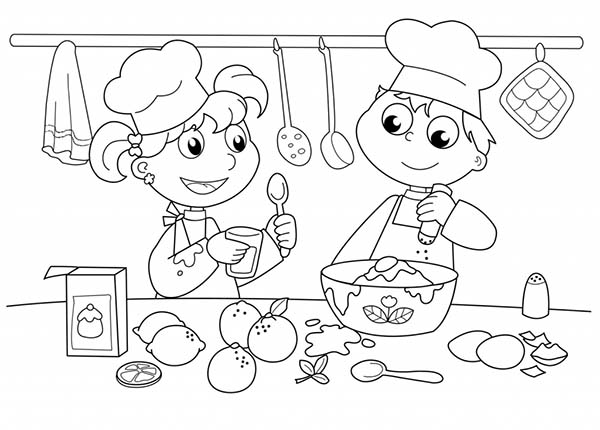
Let’s Bake Together Coloring Page


It’s fun for friends to create new recipes or just cook up some favorite treats! Have fun with this printable Let’s Bake Together Coloring Page!

Picture Book Review
September 7 – Buy a Book Day

celebrate-picture-books-picture-book-review-a-child-of-books-cover

About the Holiday

Established in 2012 Buy a Book Day promotes an appreciation for physical paperback and hardbound books. Whether you’re cracking open a brand new release or gently turning the pages in a well-worn volume, holding an actual book in your hands is an unforgettable connection between you, the author, and another world—real or imaginary. Today, drop into your local bookstore and peruse the shelves—you’ll be sure to find a fascinating book to buy.

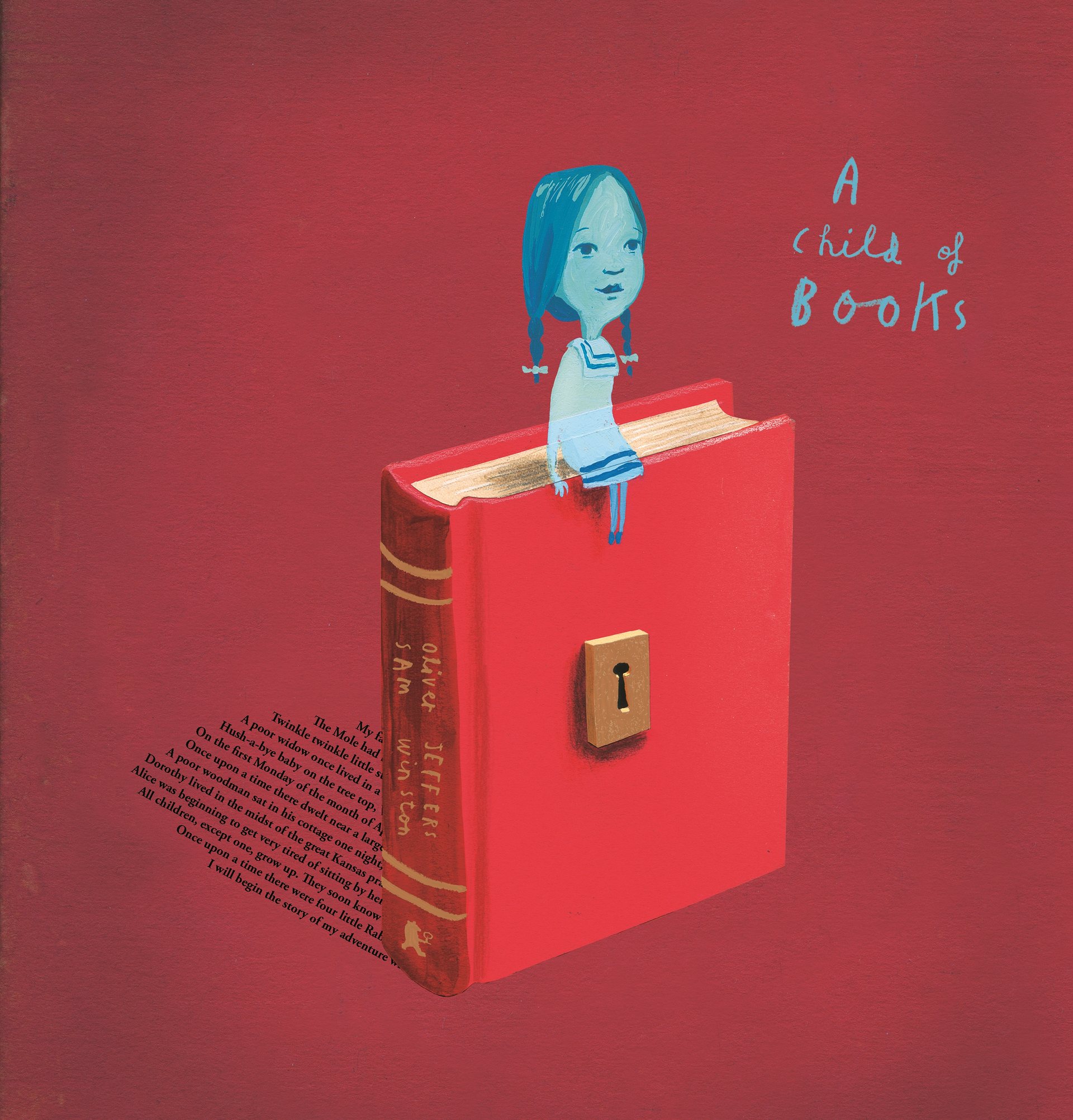
A Child of Books

By Oliver Jeffers and Sam Winston


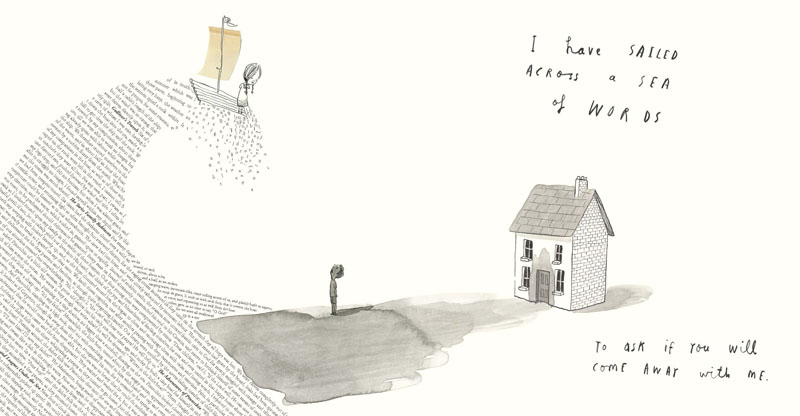
A little girl sits on a log raft with a parchment sail, dangling her feet into the water that swirls around her legs in an eddy made of words that read: “Once upon a time there was a child who loved to read…,” while the rest of the words disperse and float away. In fact, the girl is reading now—a book with a keyhole in the middle. “I am a child of books,” she reveals. “I come from a world of stories.” The wind catches the sail of her raft and the girl is off on an adventure, rising and dipping with the cresting letters that make up waves coming from the deeper sea of straight lines of excerpted text from classics including The Voyages of Doctor Doolittle, Robinson Crusoe, The Swiss Family Robinson, and Kidnapped.

celebrate-picture-books-picture-book-review-a-child-of-books-wave

Image copyrights Oliver Jeffers and Sam Winston, courtesy of oliverjeffers.com

The waves bring her to shore, where riding atop one she towers over a small boy. The girl asks if he will sail away with her. He peers into the window of his house where his father sits reading the newspaper. Headlines announce “Serious Stuff,” “Facts,” “Important Things,” and “Business.” And indeed just a glance at the articles will inform readers that “A group of serious people passed on concerns about a serious document that has been lost by a serious organization….”; that “Scientists have discovered a new fact. In one test, nearly half the subjects proved the fact, it was revealed….”; and that “an important company is to stop producing some important stuff by later this year. It said no one wanted this particular bit of important stuff.” The father’s glasses glint with numbers that rim the frames like tears.

The girl says that “some people have forgotten” where she lives, but that she can lead him on the way. The two follow a path of words from Alice in Wonderland, and the boy watches worriedly as the girl confidently climbs down a hole in the lines. There is more climbing to be done, however, and the girl, in her blue and white sailor dress, holds the boys hand as they traverse mountains made of Peter Pan that reach into the sky. By the time the friends row their dinghy into a dark cave created from the story of Treasure Island and discover a wooden chest, the boy is eager and excited for the journey.

celebrate-picture-books-picture-book-review-a-child-of-books-colorful-book-forest

Image copyrights Oliver Jeffers and Sam Winston, courtesy of oliverjeffers.com

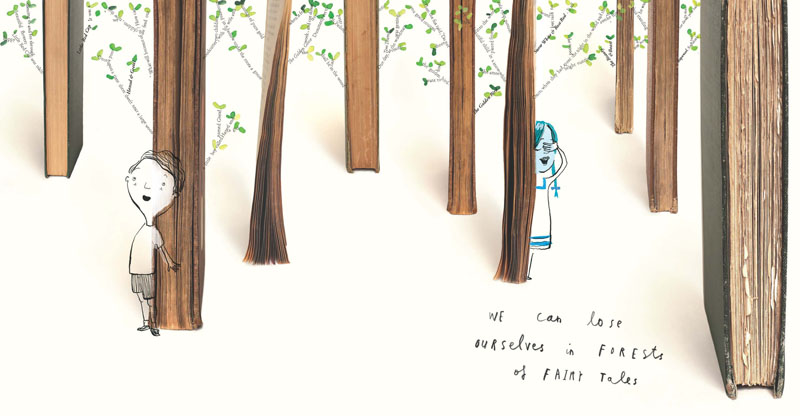
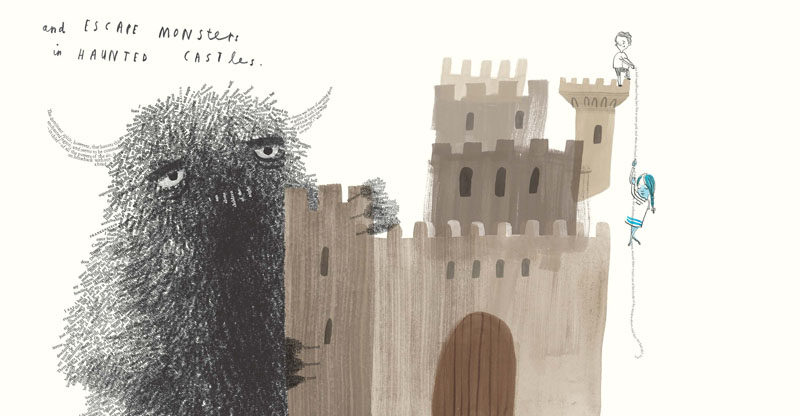
The girl and boy play hide-and-seek among tall trees made of books, where titles and lines of Hansel and Gretel, Little Red-Cap, The Golden Goose, Tom Thumb, and more jut out as leaf-covered branches. They leave the woods and come to a haunted castle that is being attacked by a monster made dark and hairy with the words of Frankenstein and Dracula. This time the boy holds a line of Rapunzel as the girl deftly shimmies to the top of a turret.

Tuckered out, the pair of friends ascend ladders to clouds of lullabies and drift into dreamland where they stand on the moon so they can “shout as loud as we like in space.” But perhaps it is not the moon but, instead, their own imaginary world made of color and characters, palaces and possibilities where stories may end but creativity lives on because “we’re made from stories…” and “our house is a home of invention.”

celebrate-picture-books-picture-book-review-a-child-of-books-colorful-monster

Image copyrights Oliver Jeffers and Sam Winston, courtesy of oliverjeffers.com

If any book invites readers to linger over the intricacies of its pages, A Child of Books is it. A perfect combination of Oliver Jeffers’ homage to the power of storytelling and Sam Winston’s artistry with typography, A Child of Books summons readers of all ages to leave the weariness of the “serious” world and enter the realm of the imagination.

The lilting lines of Oliver Jeffers’ prose poem flow with the stream of consciousness that allows thinkers to journey to nooks and crannies, participate in majestic vistas, and create the unknown of their own fancies. In Sam Winston’s hands sentences and paragraphs describing classic sea voyages swell into waves; lines from other classics crowd in upon each other, solidifying into a hidden inlet or forming a horned creature; and soft yellowed pages return to replicate the trees they once were. In the end a rainbow of characters spin out from a revolving globe, depicting our full color world.

Maps laid out by the storytellers of the past may show us routes to take but as A Child of Books reveals, there is so much white space yet to be discovered. For bibliophiles young and old, A Child of Books makes a beautiful gift and will be a welcome addition to personal library shelves.

Ages 4 and up

Candlewick Press, 2016 | ISBN 978-0763690779

Visit Oliver Jeffers’ website to view his wide-ranging work in picture books, paintings, film, and more. You can follow a paper airplane to fun games based on his picture books in Oliver Jeffers’ World.

To see the unique perspective of Sam Winston, view his books, projects, and archives on his website!

Watch the Child of Books book trailer!


Buy a Book Day Activity

celebrate-picture-books-picture-book-review-i've-got-the-reading-bug-books-to-read-list

I’ve Got the Reading Bug! Books to Buy List


Do you love to read? Do you have a wish list of books you want to read next? Me too! Use this printable I’ve Got the Reading Bug! Books to Buy sheet to keep track of those great book ideas.

August 31 – It’s Happiness Happens Month

celebrate-picture-books-picture-book-review-Double Happiness by Nancy Tupper Ling Picture Book Review

About the Holiday

Summer is coming to a close and school is starting again. It’s a great time to reflect on the fun you’ve had in the warmer weather and all the memories that are about to be made as another year of activities, education, new friendships, and excitement unfolds. Happiness really does happen if you let it!

Double Happiness

Written by Nancy Tupper Ling | Illustrated by Alina Chau


This quiet, thoughtful picture book tells the story of a family’s move from China to America in a series of unrhymed verses that reveal the experience honestly from alternating viewpoints of a brother, Jake, and his sister, Gracie. Each page is dedicated to one sibling or the other with the Jake’s poems written in blue and Gracie’s in purple. In several poems the children interact with each other, the blue and purple lines acting as dialog tags.

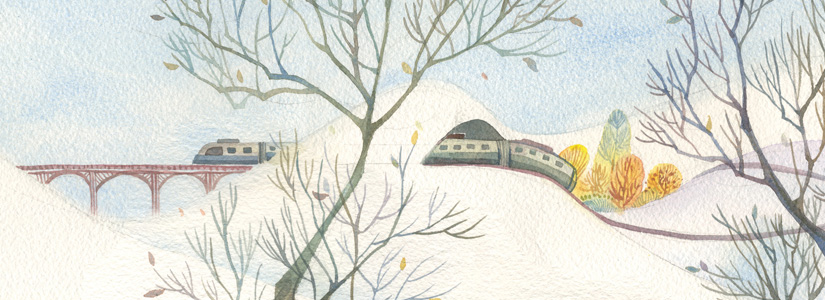
In the first poem, The Move, Gracie stands on her doorstep surrounded by boxes and suitcases and thinks, “I won’t go! / I won’t move / away / from our city house / by the trolley tracks….” But Jake is more adventurous and in the second poem, Train, is already imagining his new room. After considering different décor, he decides what he really wants is something familiar, something outside—“just one long train / that rocks and wobbles / my bed each night. / I can’t fall asleep until the train passes by.”

celebrate-picture-books-picture-book-review-double-happiness-train

Image copyright Alina Chau, 2015, courtesy of Chronicle Books

In Grandmother, the siblings are each given a happiness box by their Nai Nai, who wisely challenges her grandchildren to “Find four treasures each, / leading from this home / to your new.” Gracie takes this to heart, and readers see in Panda that even before leaving Nai Nai’s Gracie has added a favorite keepsake to her box: “Nai Nai’s panda sits / by the window / like always. / “I’ll miss you,” I say. / Nai Nai leans over me. / She places Panda / inside my box. / “He has a new home / now.”

Too soon moving day comes, and in Goodbye Gracie and Jake give hugs and kisses to beloved relatives. The search for items to fill Nai Nai’s boxes is taken up in the next three poems. In Treasure, Jake becomes a dragon keeping his “dragon eyes / wide open for stuff / along the way.” He is rewarded in Lucky, in which he discovers an old penny on the bus ride to the airport. In Leaf Gracie receives a surprising gift for her happiness box: “One stray leaf / flutters down / onto my box— / Eucalyptus! / If I had a koala I’d feed / her this minty meal all / day long— / the perfect treasure / to remind me of home.” 

In keeping with the long hours of travel from China to the United States, the next six poems chronicle the brother and sister’s experiences in the airport, waiting for their plane, and during the flight. Airport sees the children running, hopping, waiting, and navigating their way through the crowds of people to their gate. Dad is already tuckered out in Quiet, but Jake is wrangling to look for treasure: “’Huff puff. Puff huff.’” / Dragon blows fire. / Dragon stomps his feet. / “’Ssshhh, you’ll wake Daddy. / I giggle. / Gracie giggles. / “’Daddy can sleep / anywhere.’” Jake finally discovers gum in his backpack and creates a treasure. “I stretch it / and roll it / and ooze it / into one slinky snake / Sssssee, his penny pillow. / Sssssee, he’s kai xin— / so happy—in his brown box. / I’m tied with Gracie now— / two treasures each.”

celebrate-picture-books-picture-book-review-double-happiness-discovering-the-woods

Image copyright Alina Chau, 2015, courtesy of Chronicle Books

Adventures at the airport continue in Cat and Wings, and as the plane takes off Gracie draws pictures of the day’s events in Picture. In Here the children wake up to see their new city far below them and wonder, “can I find our house / from the sky?” Marble and Sadness juxtapose Jake’s happiness at finding another treasure for his box with the apprehension of Gracie as the plane lands and the family makes its way into their new country.

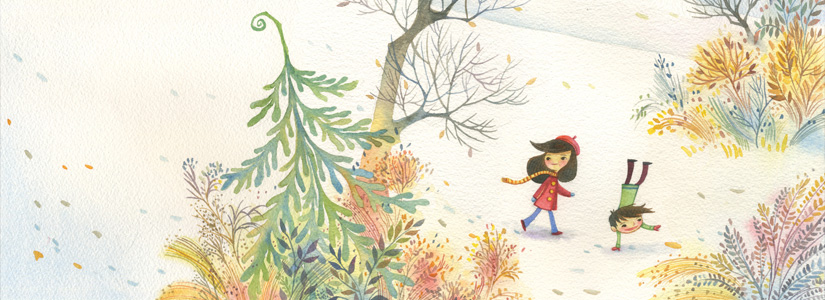
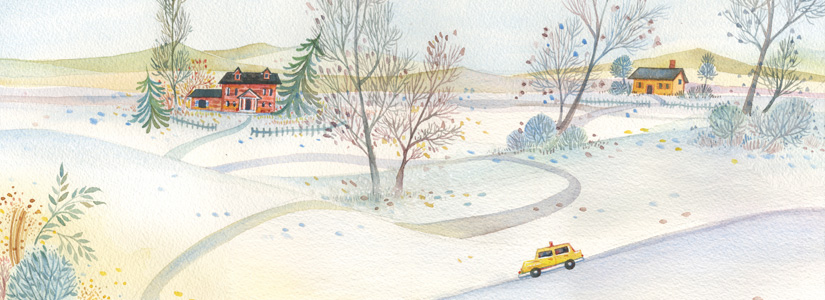
At last in Home the family reaches their new house by taxi. Gracie seems only to see the “piles of snow,” but Jake likes the “windy roads, lots of trees, and the curvy driveway.” In Explore Gracie and Jake walk around the countryside, and while Gracie still determines that she won’t like it, Jake hears a train and is happy. My Room and Dinner see the kids settling in, with a photograph of the family they’ve left behind accompanying them on the table while they eat. In A Surprise, Gracie finds that her grandmother is still with her through a special scarf, and in Paints Jake and Gracie accept the move as they paint their happiness boxes: Jake decorates his with a dragon and a train, while Gracie depicts herself and her brother walking in the snow and “they look very, / very / happy.”

celebrate-picture-books-picture-book-review-double-happiness-coming-to-new-house

Image copyright Alina Chau, 2015, courtesy of Chronicle Books

While Double Happiness tells the story of a family’s distant move, Nancy Tupper Ling’s gentle verses are appropriate for any situation involving change or uncertainty. She reminds children that happiness can be found wherever they are and all around them if they look for it. The poems flow as freely as thoughts, fears, and unguarded moments. As Gracie and Jake resolve their feeling, readers or listeners will also see that feelings of apprehension are common, and that happiness is waiting for them.

Alina Chau’s soft, lovely watercolor illustrations are beautiful representations of Gracie and Jake’s move from the familiar surroundings of their home in China to a new home in a snowy countryside.  The children’s emotions resonate as they alternate between sadness and happiness and between the concrete places of Nai Nai’s house, the airport, and their new city and their own imaginations of dragons, drawings, and dreams.

Ages 5 – 8

Chronicle Books, 2015 | ISBN 978-1452129181

Discover more books for children and adults by Nancy Tupper Ling on her website!

View a gallery of artwork by Alina Chau and more on her website!

Happiness Happens Activity

CPB - Happiness typography

Happiness Is…Game


Happiness is all around you! Grab one or more friends to play a game that reveals what things make you happy. Here are two ways to play:

  1. Like the “Geography” game: the first player names something that makes them happy, the next player must think of something that starts with the last letter of the word the previous player said. The game continues with each player continuing the pattern. Players drop out as they cannot think of a word. The last player left is the winner.
  2. Using a time limit (depending on age): players must think of something that makes them happy. Players drop out if they cannot think of a word within the time limit. The last player left is the winner.

Picture Book Review

August 21 – Poet’s Day

celebrate-picture-books-picture-book-review-a-great-big-cuddle-poems-for-the-Very-Young-cover

About the Holiday

Today celebrates the poet—that special person who looks at the world and transforms it into lines of rhyme, rhythm, metaphor, and meaning that make readers experience life and sometimes even the most common occurrence in a whole new way. Some poetry is poignant, some evocative, and some silly, but it all provides different perspectives and enriches our lives—even the youngest among us!

A Great Big Cuddle: Poems for the Very Young

Written by Michael Rosen | Illustrated by Chris Riddell


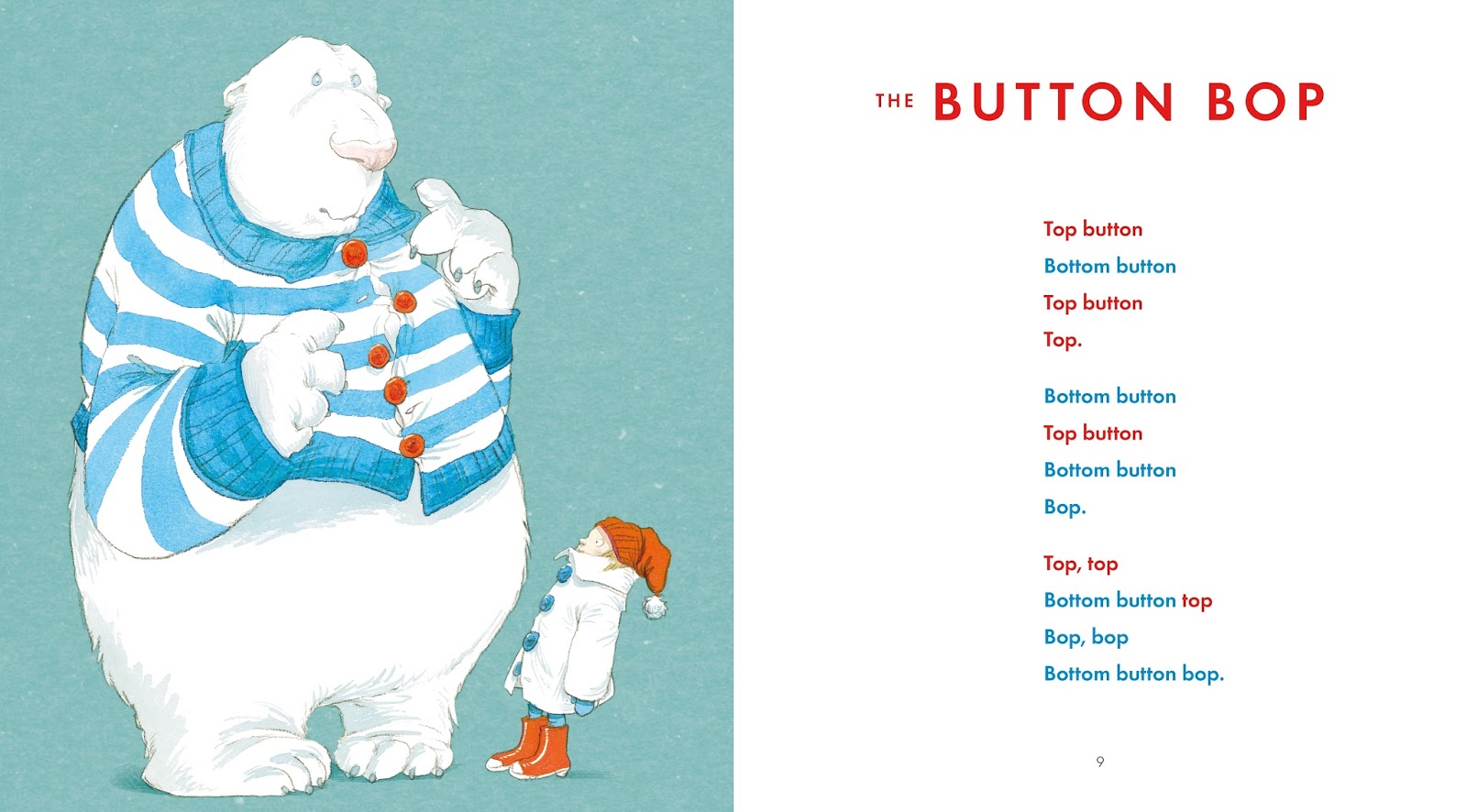
Before children learn to speak and in order for them to become literate and proficient readers, they discover the sounds of language. The poems in A Great Big Cuddle: Poems for the Very Young are all about those snappy, rhyming, musical syllables that make up speech and text. The collection’s 35 poems replicate the progression of language learning from the first offering—Tippy-Tappy, with its staccato repetition of “ippy, appy, eppy, oppy, uppy sounds—to Gruff and Dave and The Slow Train that provide longer, more detailed storytelling.

celebrate-picture-books-picture-book-review-a-great-big-cuddle-poems-for-the-Very-Young-button-bop

Image copyright Chris Riddell, courtesy of Candlewick Press

The subjects are familiar to even tiny children whose worlds include the buttons, parties, pets, music, and other topics treated with innovation in this collection. The juxtaposition of words, concepts, questions, and nonsense, will keep kids laughing even as they are (probably) unconsciously soaking in the rich learning.

I Went is an example in which multiple concepts combine to create a funny travelogue with double meaning twists:

“I went to Lapland / I saw a reindeer on the loose. / I went to Canada / I saw a chocolate mousse.  I went to the river / I saw a big green frog. / I went to New York / I saw a hot dog.”

Bendy Man describes a rather unique fellow with special talents that kids would love to get to know. It starts like this:

“Bendy Man, Bendy Man / He’s a long leggy man. / Bendy Man, Bendy Man / In a baked-bean can. Bendy Man, Bendy Man / Wraps round trees / Bendy Man, Bendy Man / Can’t find his knees.”

Along the way there are also poems to validate kids’ emotions, which come in shades of happiness, bounciness, anger, satisfaction, and frustration among others, as well as to comfort them when they get hurt or scared as in the poem Mo: “Mo’s in a muddle / She slipped in a puddle / Mommy gives Mo / A great big cuddle.”

celebrate-picture-books-picture-book-review-a-great-big-cuddle-poems-for-the-Very-Young-reading-lesson

Image copyright Chris Riddell, courtesy of Candlewick Press

Let Me Do It is an exuberant tribute to a child’s eagerness to help: “Let me do it, let me do it / Let me blow up the balloon / Let me do it, let me do it / Let me go to the moon.                 Let me cook the beans / Let me lick the jar / Let me kick the ball / Let me drive the car.” But as often happens with inexperience, the tasks become a bit confused later in the poem: “Let me drive the beans / Let me kick the jar / Let me lick the ball / Let me cook the car.”

Michael Rosen’s love of language and quirky, kid-like personality are on full display in A Great Big Cuddle, much to the benefit of his young fans. Rosen is able to tap into and capture those fleeting ideas and “wouldn’t it be cool if…” moments that fuel kids’ imaginations and actions. Life is much too long and much too short not to spend some of it in absurd hilarity, and Rosen provides a book full of that respite here.

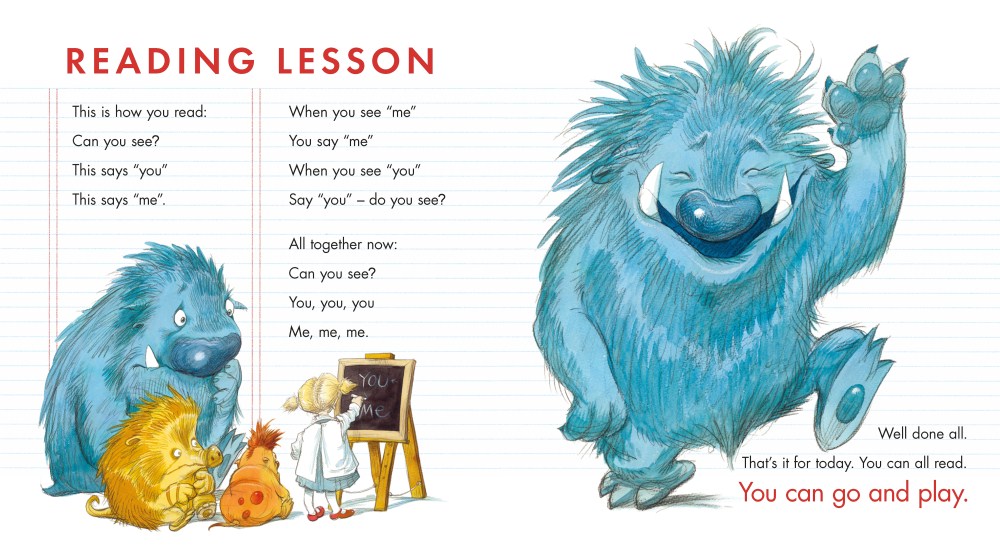
Chris Riddell infuses each of the poems with the personalities of enthusiastic children, adorable monsters, familiar animals, and high-spirited action. The large, full-bleed pages allow for full-size fun and a variety of typography. The bold colors will attract even the smallest reader and keep them riveted to the sounds and sights of this excellent poetry collection for young children.

celebrate-picture-books-picture-book-review-a-great-big-cuddle-poems-for-the-Very-Young-i-am-hungry

Image copyright Chris Riddell, courtesy of Candlewick Press

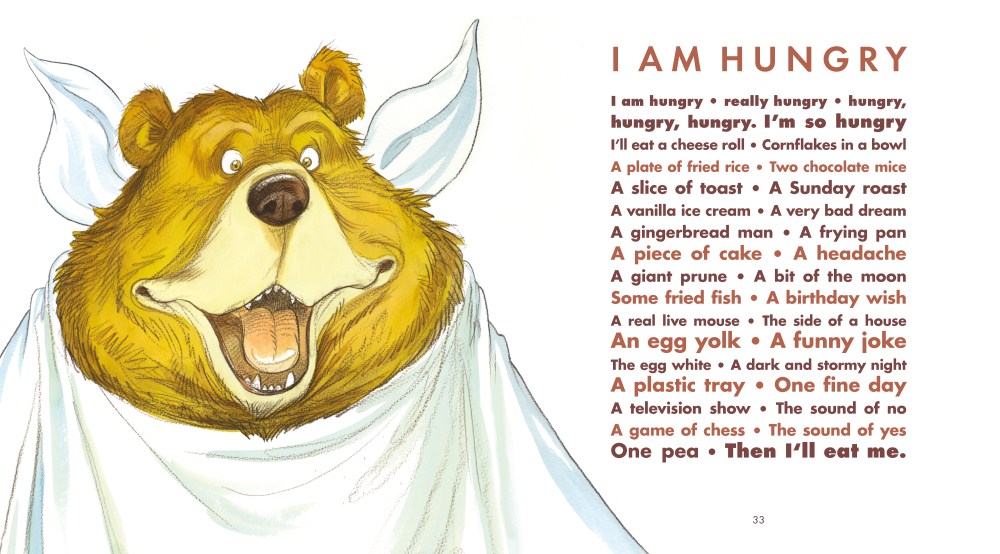
Older kids will also find much to enjoy in the humorous spirals taken by the lines in A Great Big Cuddle. Some poems, such as  I Am Hungry, in which a bear in a bib states everything he will eat, would make a great teaching tool about what can and cannot logically be consumed.

Because A Great Big Cuddle: Poems for the Very Young is perfect for dipping into again and again, you’ll be happy to have it close it hand on your shelves.

Ages Birth – 6

Candlewick, 2015 | ISBN 978-0763681166

Visit Michael Rosen’s website to see his amazing range of books, poems, events, TV and radio programs and more!

Follow the Cycling Fish through a tour of Chris Riddell’s artwork!

Poet’s Day Activity

celebrate-picture-books-picture-book-review-bear-in-clothes-dot-to-dot

A Pair of Bears (Pear of Bears? Pair of Bairs?) Coloring Pages and Poem Prompts


The two bears in these coloring pages are having different days—one is grumpy while the other is happy. Color the printable A Pair of Bears Coloring Pages and then write one or two poems about them!

Bear 1

Bear 2

Picture Book Review
August 2 – It’s Water Quality Month

celebrate-picture-books-picture-book-review-water-can-be-cover

About the Holiday

Water Quality is a crucial world-wide issue. In fact, 2015 closed out a decade-long United Nations initiative “Water for Life” to promote awareness of the importance of water quality as it relates to sanitation, geography, human rights, urbanization, and sustainability. The Audobon Society emphasizes the interconnectedness of all water systems and urges people to be mindful of the dangers that can lurk in runoff from construction, forestry, factories, agriculture, and personal yards as it combines in rivers, lakes, or the ocean. To observe this month be conscious of what is in your water. Limit the use of anti-bacterial soaps that contain a certain pesticide harmful to marine life, don’t flush unused medications, choose nontoxic household cleaners, avoid using fertilizers and pesticides, and clean up leaks from cars and other machinery. Protecting our water sources protects us.

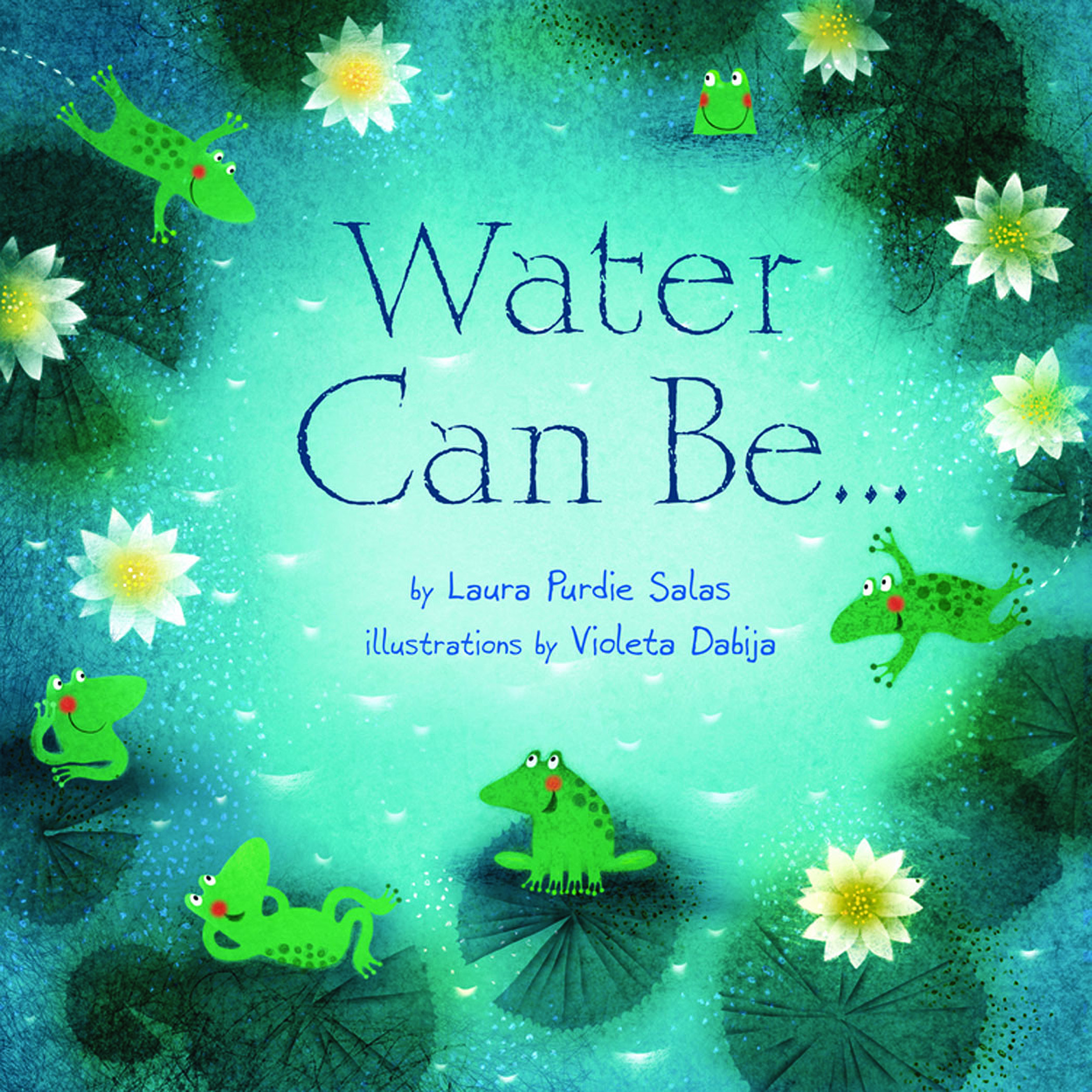
Water Can Be…

Written by Laura Purdie Salas | Illustrated by Violeta Dabija


“Water is water— / it’s puddle, pond, sea. / When springtime comes splashing, / the water flows free.” So begins an inventive journey through the ways that water enriches our lives. With four-word rhyming couplets Laura Purdie Salas illuminates specific moments or circumstances to reveal water’s important role from season to season. From filling ponds, lakes, oceans, and even puddles to roaring down hillsides to floating in misty fogs and forming snowflakes, water sustains us and makes the world a more beautiful place.

During spring and summer when ponds nurture new life and rain puddles reflect, “Water can be…a tadpole hatcher / Picture catcher.” In hot weather water refreshes as a “Thirst quencher / Kid drencher.” And the seas, at times calm and at others roiling, can be both “Home maker / Ship breaker.”

As the air cools in autumn, water can be found in alternate forms. It squirts from fountains for the “school drink-er” and hardens to ice for a “Bruise shrinker.” A river’s winding trail becomes a “Salmon highway / Eagle flyway.” Winter brings water in a more solid form. Whipped by wind snow swirls as a “Storm creator” or gently sticks to surfaces as a “Decorator.” Outside, both animals and people enjoy the frozen precipitation. Snow serves as a “Woodchuck warmer / Snowman former.”

On the final pages as ice sculptors carve castles and dragons, moon beams and rabbits, Laura Purdie Salas encourages readers: “Water is water— / it’s ice, snow, and sea. / Now go and discover / what else it can be.”

Fascinating facts concerning the subject of each rhyme, a glossary, and a bibliography for further reading follow the text. Laura Purdie Salas donates a portion of the royalties from Water Can Be… to WaterAid, an international non-profit organization that transforms lives by improving and providing access to safe water, hygiene, and sanitation.

Laura Purdie Salas always surprises with her selection of examples and clever rhymes leading readers to more fully appreciate the world around them. Water doesn’t just flow, it feeds, speeds, cloaks and soaks, it decorates and bejewels, fluffs and snuffs. After reading Sala’s poetic tribute, readers will never experience water the same way and will be on the lookout for how they can interpret water’s gifts.

Violeta Dabija has created gorgeous, ethereal interpretations of each two-word rhyme. The nourishing blues and aquas of the sea, gauzy whites of fog and clouds, and brilliant whites of snow and ice are subtly crosshatched giving each illustration depth and movement. While the words on each page are short, kids will want to spend a long time taking in the beauty of Dabija’s paintings.

Ages 3 – 8

Millbrook Press, Lerner Books, 2014 | ISBN 978-1467705912

Check out the book trailer for Water Can Be…. It really makes a splash!

There’s so much to see and do on Laura Purdie Salas’s website!

View more beautiful art by Violeta Dabija on her website!

Water Quality Month Activity

celebrate-picture-books-picture-book-review-angel-fish-coloring-page

Angel Fish Coloring Page


Clean water is important for all fish to survive! You can make the ocean sparkling clear by adding a bit of glitter to your printable Angel Fish Coloring Page!

July 22 – National Hammock Day

celebrate-picture-books-picture-book-review-firefly-july-cover

About the Holiday

Holidays don’t get more leisurely than this one! Perhaps invented by the Ancient Greeks, perhaps created by people in South America according to Christopher Columbus’s journals, hammocks are the epitome of relaxation. What better time is there to kick back and lounge than during the hot, hazy days of July? So enjoy—and read a book, like today’s collection of poetry!

Firefly July: A Year of Very Short Poems

Selected by Paul B. Janeczko | Illustrated by Melissa Sweet


Firefly July is perfect for lazy summer days when light, but still meaningful reading enjoyed in a hammock or under a shady tree is relaxation at its best. Paul B. Janeczko has collected 36 short (none are over eight lines long) poems from some of the best poets of today and yesterday. Haiku, free form, and rhyming verses illuminate the seasons of the year and encapsulate unforgettable sights, sounds, and feelings.

A girl’s spring’s respite spent gazing into the bay from shore is depicted in Lillian Morrison’s The Island:

“Wrinkled stone / like an elephant’s skin / on which young birches are treading.”

celebrate-picture-books-picture-book-review-firefly-july-interior-art

Image copyright Melissa Sweet, courtesy of amazon.com

A nighttime train trip provides mystery and ongoing changes in Carl Sandburg’s Window:

“Night from a railroad car window / Is a great, dark, soft thing / Broken across with slashes of light.”

Joyce Sidman’s A Happy Meeting likens a summer rain to romance and life:

“Rain meets dust: / soft, cinnamon kisses. / Quick noisy courtship, / then marriage: mud.”

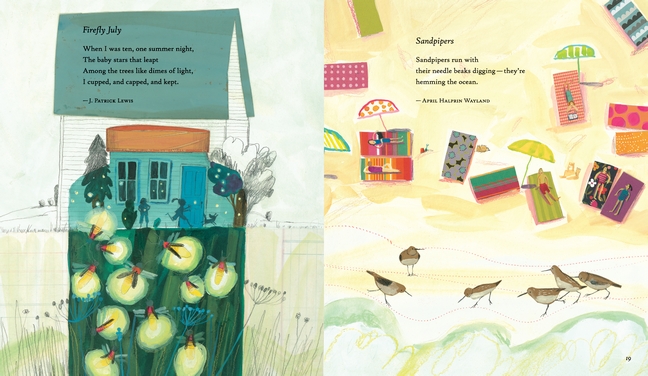
At the seashore, beach birds are industrious in April Halprin Wayland’s Sandpipers:

“Sandpipers run with / their needle beaks digging—they’re / hemming the ocean.”

celebrate-picture-books-picture-book-review-firefly-july-interior-art

Image copyright Melissa Sweet, courtesy of amazon.com

Jim Harrison and Ted Kooser ask such a beguiling question for autumn:

“What is it the wind has lost / that she keeps looking for / under each leaf?”

And the rising giants of city life inspired Susan Nichols Pulsifer in Tall City:

“Here houses rise so straight and tall / That I am not surprised at all / To see them simply walk away / Into the clouds—this misty day.”

Along the way readers will encounter a pickup truck loaded with old rotary fans and another rusting in a field; fog that decorates and creeps; animals and insects that share our space; our past, our present, and our future. And when it’s time to close the book, Jim Harrison and Ted Kooser reveal:

“A welcome mat of moonlight / on the floor. Wipe your feet / before getting into bed.”

celebrate-picture-books-picture-book-review-firefly-july-interior-art

image copyright Melissa Sweet, courtesy of melissasweet.net

I can only wish I’d been able to visit Melissa Sweet’s studio while she created the illustrations for this book! Each painting is as unique in style, beauty, and emotional effect as the poems they interpret. Her renditions of each poem help readers—especially children unfamiliar with metaphor and abstract imaging—to fully understand and appreciate each poem while also leaving room for personal reflection.

The first thing that strikes a reader when opening Firefly July is the gorgeous juxtaposition and mixture of vibrant color. Her illustrations take readers on a journey from an aqua farm house with a patchwork garden to a serene elephantine rock island to the deep turquoise ocean traversed by ships while the full moon beams down upon them. Readers ride crowded subways, gaze out moving train windows, and visit cities bright in daylight and glowing at night. They frolic through fields of delicate grasses and vibrant flowers, quietly walk snowy paths, and take their place among the stars.

Firefly July is as stunning as any coffee table book and is a must for a young reader’s—or any poetry lover’s—library.

Ages 4 and up

Candlewick Press, 2014 | ISBN 978-0763648428

Take a look at more books and artwork by Melissa Sweet on her website!

National Hammock Day Activity

celebrate-picture-books-picture-book-review-hammock-coloring-page

Lazy Days Coloring Page


Coloring can be so relaxing—perfect for a day dedicated to kicking back! Color this printable Lazy Days Coloring Page and dream of lounging beside the lake, with the gentle breeze gently rocking the hammock, while you drift off to sleee….zzzz…..