May 29 – It’s Gifts from the Garden Month

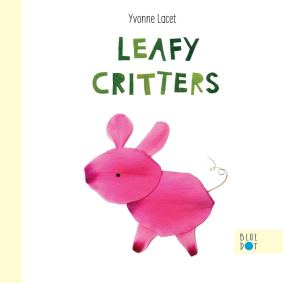
celebrate-picture-books-picture-book-review-leafy-critters-cover

About the Holiday

Many of us – and perhaps even more this year – spend the summer digging, planting, and tending our garden and yard. We look forward to all of the delicious vegetables and fruit our gardens provide and the hours of fun we have playing or lounging in the yard. But if you look closely, these areas offer up other gifts too. That profusion of dandelions may seem like bothersome weeds, but their sunny flowers and puffball seeds also create beauty and unforgettable childhood moments. Watching industrious insects reminds us of the wonder of nature below our feet or pollinating our crops. And – as today’s book shows – with some imagination and creativity that garden or yard can be transformed into a work of art. So, get outside and see what your gifts are sprouting in your backyard.

I received a copy of Leafy Critters from Blue Dot Press for review consideration. All opinions are my own. 

By Jakki Licare

Leafy Critters

By Yvonne Lacet

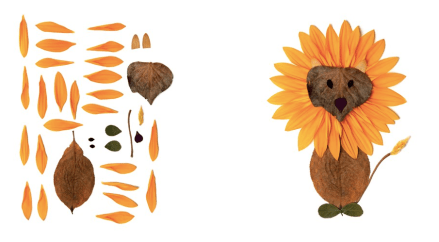
This creative and imaginative earth art book by Yvonne Lacet an artist and photographer, whose work incorporates urban environments, landscapes, and nature play, will inspire children to look at nature in a whole new light. Yvonne Lacet uses petals, twigs, stems, and leaves to create “Leafy Critters.” Simple items from nature are arranged together to become different animals: foxes, polar bears, butterflies, mice, and more.

Not only is the artwork stunning but on many pages Lacet shows readers the before and after photos which makes it simple for kids to duplicate her animals. My kids enjoyed pointing out the different items in the before photos and discovering how Lacet used them in her completed artwork. A leaf, for example, transforms into a head or a wing.

celebrate-picture-books-picture-book-review-leafy-lion

Copyright Yvonne Lacet, 2020, courtesy of Blue Dot Kids Press.

One of the extraordinary things about this book is not only that any child can find the natural materials needed in their backyard or local park, but the artistic eye Lacet uses to create the eighteen creatures presented. The piglet (pictured on the front cover) is simply six pink petals arranged together. Yvonne takes it a step further, though, and uses the portions of the petals that are near the pistil and have a darker pigment to add shading and detail that  transform into the pig’s hooves and snout.

The image of the polar bear also shows how contrasting colors can create a whole new scene. With the black paper background and white petals sprinkled over the page, we are suddenly transported into an arctic snowstorm at night! The great thing about Leafy Critters is that it makes young readers think outside the box. If you don’t have white petals on hand, then rice could make a great substitution. 

celebrate-picture-books-picture-book-review-leafy-critters-turtle

Copyright Yvonne Lacet, 2020, courtesy of Blue Dot Kids Press.

My boys are often frustrated with art projects because they cannot create “realistic art.” Earth art, however, is an easy way for kids to explore colors and composition without the frustration of being limited by their skills. It only requires a little nature and a creative eye. So take Leafy Critters outside! You’ll be surprised to discover what creatures creep, crawl, swim, and lurk in your own backyard. 

A DIY page at the back gives kids tips on how to search for materials, gather them, and look at the colors, shapes, and sizes of leaves, petals, seeds, and more to spark their imaginations. Younger children will enjoy the creativity in each design on the pages while older children and even teens and adults will be inspired to create their own works of art.

Whether you are looking for a fun home art project or inspiration for your elementary art students, Leafy Critters will make a creative addition to your library.

Ages 3 and up

Blue Dot Kids Press, 2020 | ISBN 978-1733121224

Discover more about Yvonne Lacet and her work on her website.

Gifts from the Garden Month Activity

celebrate-picture-books-picture-book-review-nature-art-craft

Natural Art Note Card

Send a special note to a loved one with your own leafy critter. This idea could be a great card for Father’s Day too! Just write in Dad after otter!

Supplies

  • Natural Materials (I used brown leaves, bark, clover flowers, and stems)
  • Scissors
  • Glue
  • Marker
  • Paper

Directions

  1. Gather your natural materials outside

  2. Arrange your pieces together to make an otter shape

  3. Cut any pieces that need to be shaped or trimmed

  4. Glue your otter down

  5. Write “There’s no OTTER like you!”

celebrate-picture-books-picture-book-review-leafy-critters-cover

You can find Leafy Critters at these booksellers

Amazon | Barnes & Noble | Books-a-Million 

To support your local independent bookstore, order from 

Bookshop | IndieBound

Picture Book Review


May 27 – It’s National Pet Month

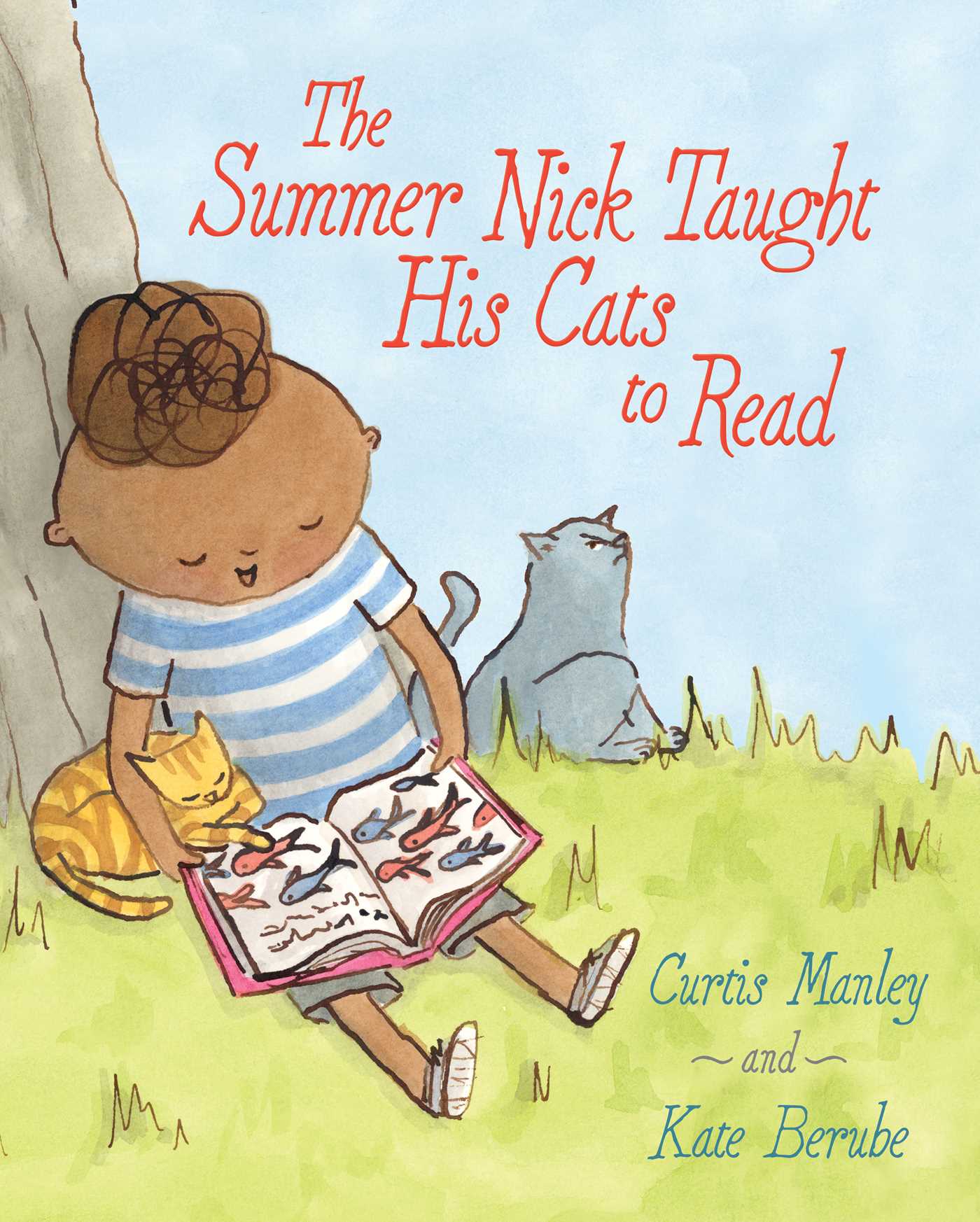
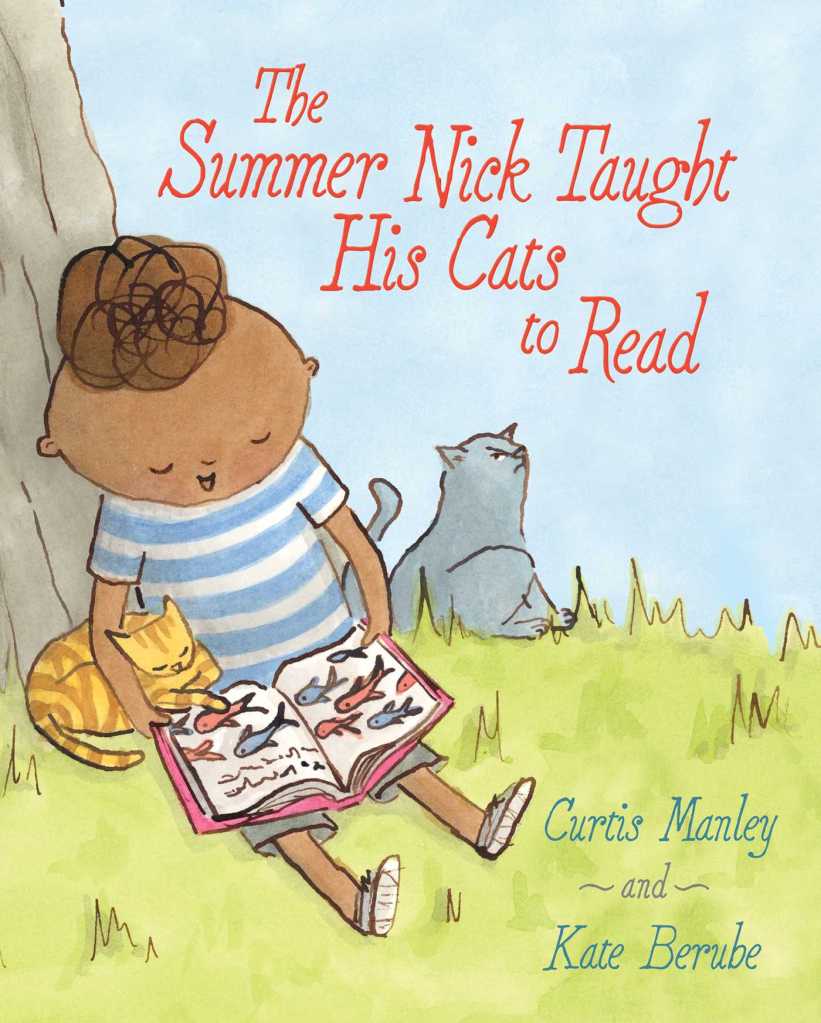
celebrate-picture-books-picture-book-review-the-summer-nick-taught-his-cats-to-read-cover

About the Holiday

Pets give us unconditional love, provide companionship, and add entertainment and fun to our lives. This month is set aside to focus on our pets. To celebrate spend extra time with your furry friend, make sure they have everything they need to stay healthy, and give them a little extra treat. If you don’t have a pet, consider adopting a dog, cat, bird, or small animal from your local animal shelter. You’ll both benefit!

The Summer Nick Taught His Cats to Read

Written by Curtis Manley | Illustrated by Kate Berube


One summer Nick, Verne, and Stevenson did everything together. Nick is a little boy and Verne and Stevenson are two very different cats. Nick and Verne loved to spend time near the water—Stevenson tolerated it. Nick and Verne slept happily in a tent under the stars—Stevenson barely shut his eyes. While Nick rode his bike Verne eagerly sat in the front basket—Stevenson hunkered down in a box on the back. But when Nick sat down to read, both cats had similar ideas of fun—like lying on top of the book—and Nick could hardly read a sentence.

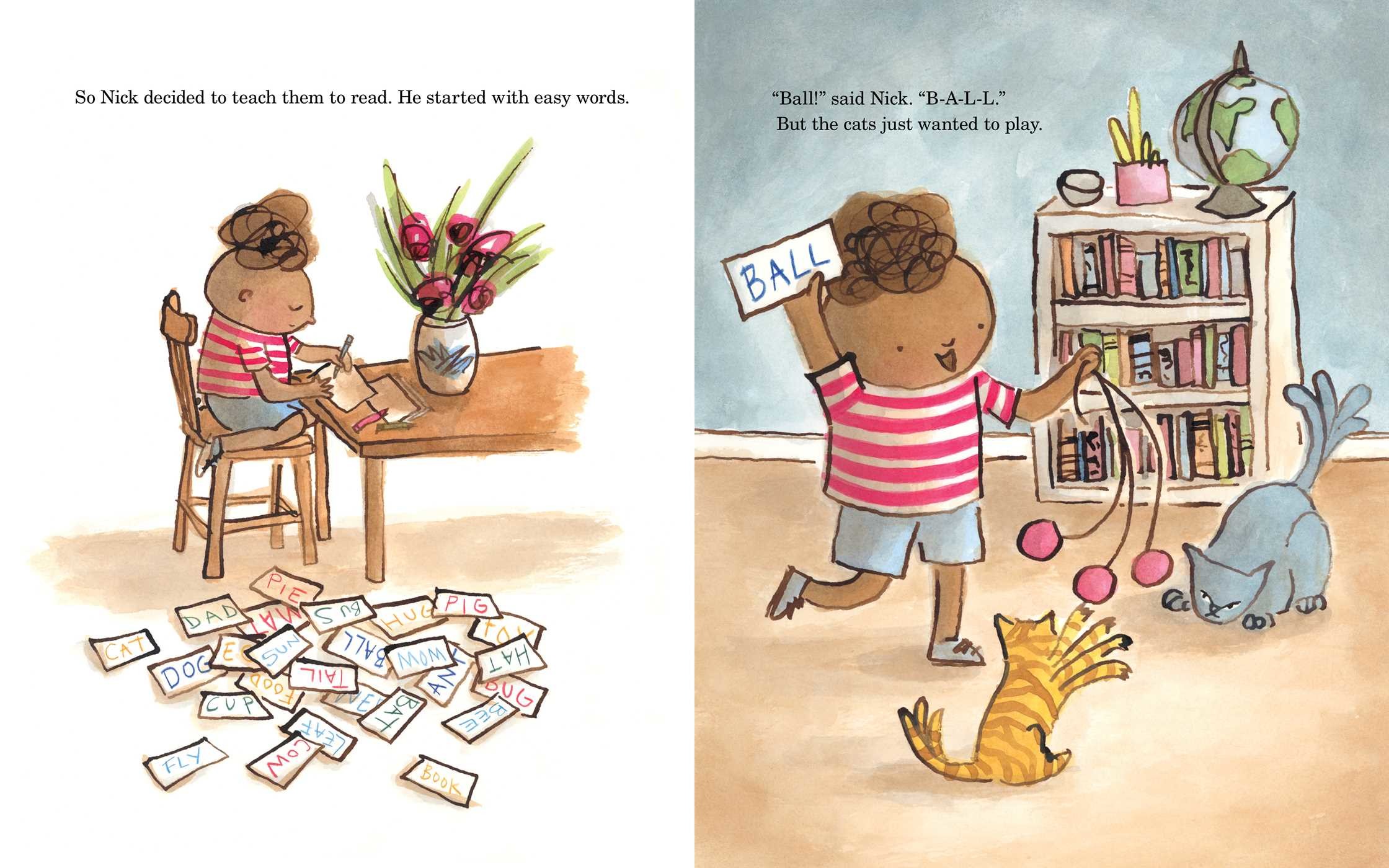
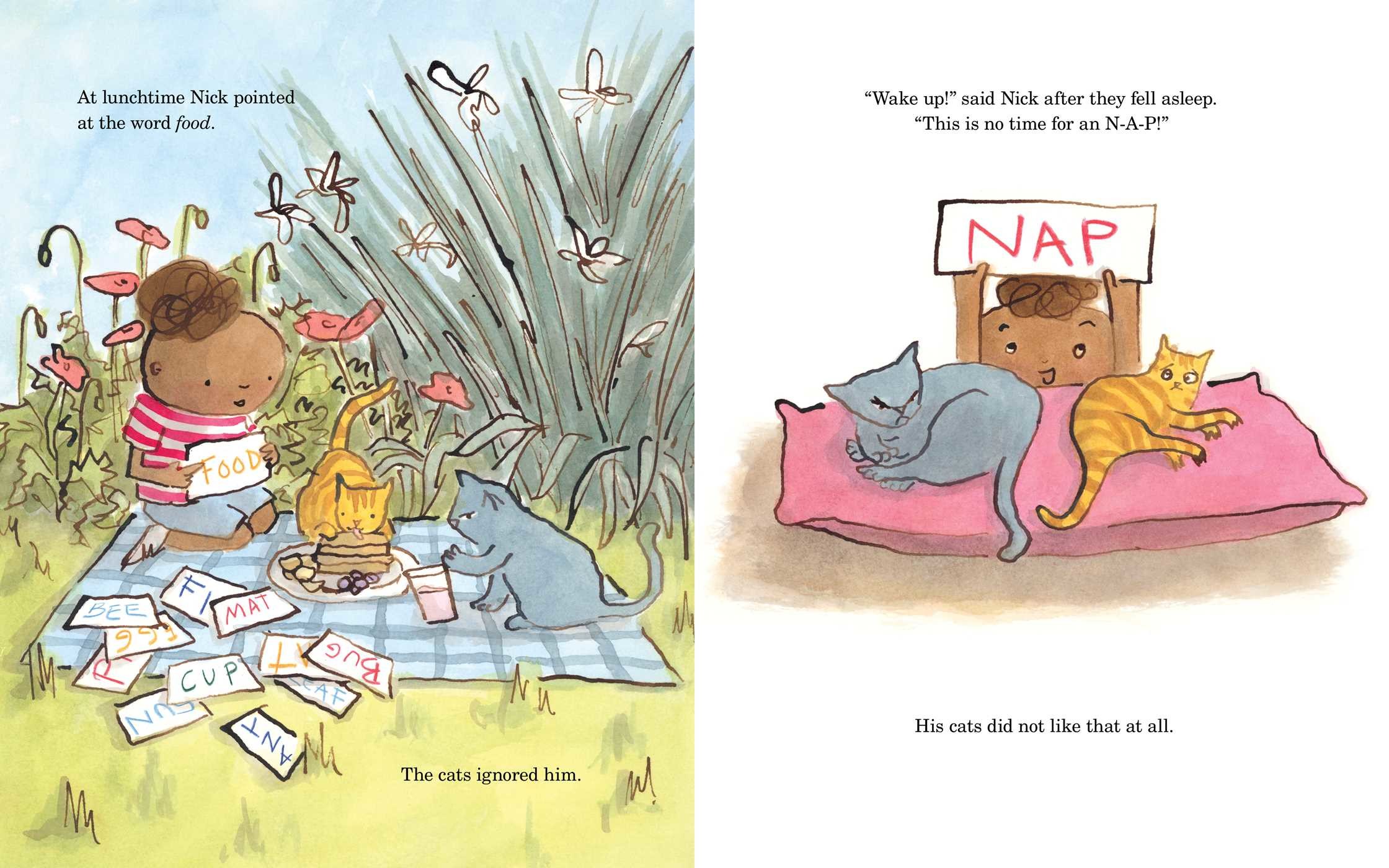
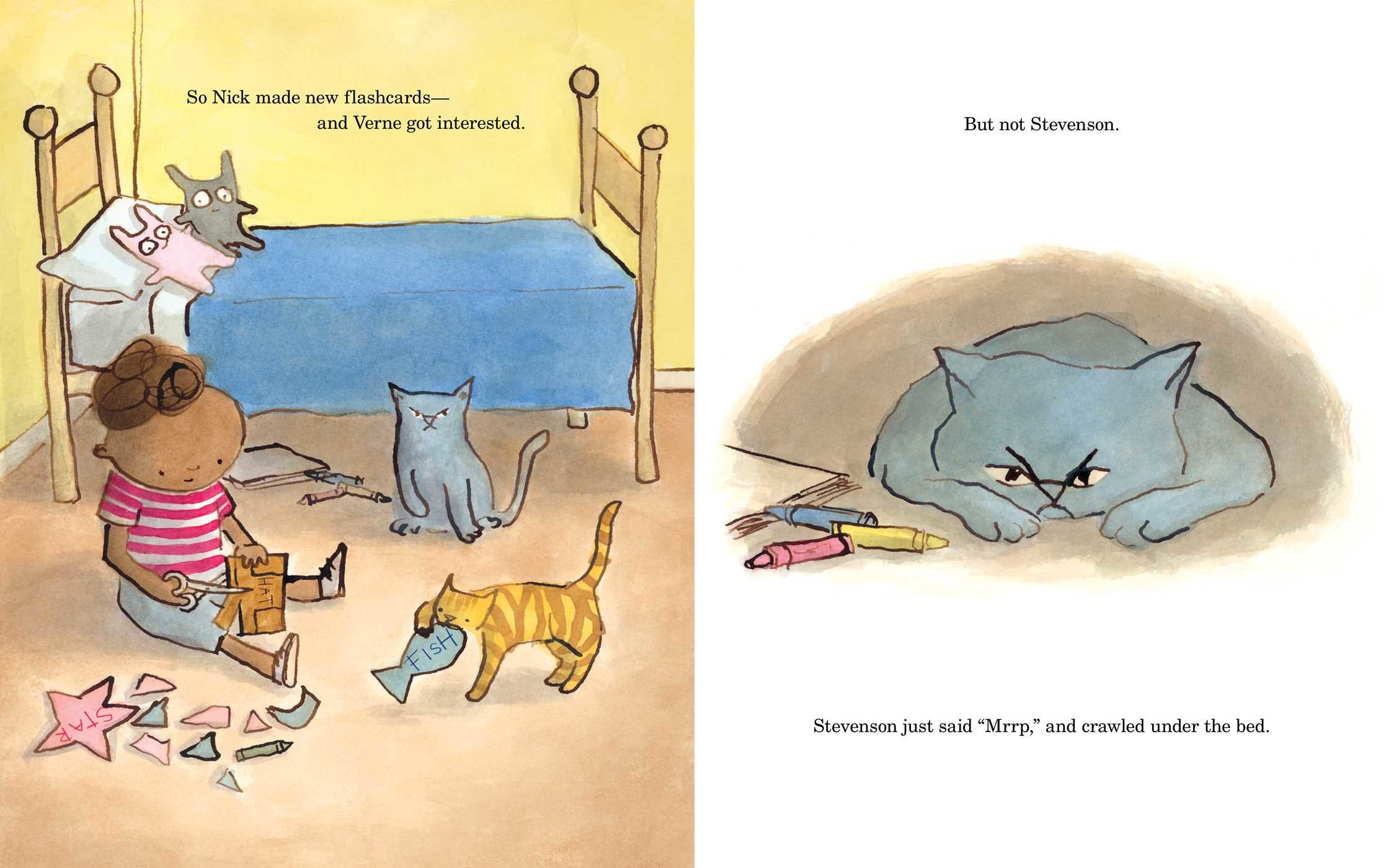
“So Nick decided to teach them how to read. He made flash cards and started with easy words” like “ball,” but Verne and Stevenson just wanted to play with the ball. While the three had a picnic on the lawn, Nick brought out his flashcards and “pointed to the word food. The cats ignored him.” When the cats snoozed Nick woke them with a sign. “‘This is no time for an N-A-P!’” he said. Neither cat responded well, so Nick tried a new tactic. He made word-shaped flash cards. Verne took a nibble of “F-I-S-H,” but Stevenson hid under the bed.

celebrate-picture-books-picture-book-review-the-summer-nick-taught-his-cats-to-read-food-flash-cards
Image copyright Kate Berube, 2016, text copyright Curtis Manley, 2016. Courtesy of Simon & Schuster.

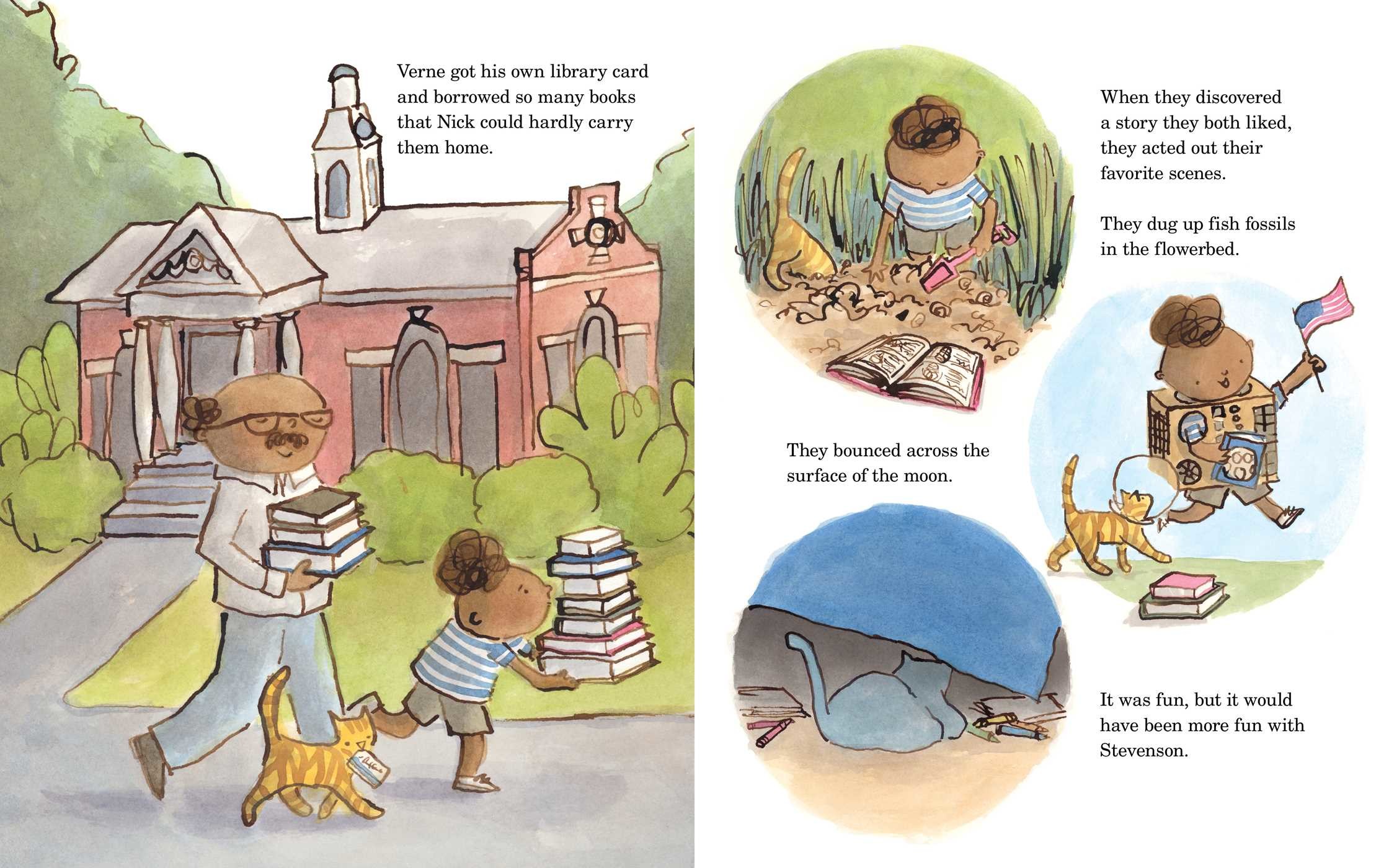
Nick began to see that Verne liked stories about cats and fish. “Verne loved fish. He followed along as Nick read, learning the sounds of the letters.” He even read by himself, discovering new stories, especially 2,000 Leagues Under the Sea. But Stevenson? When Nick spelled words for him, he merely ran under the porch, hissing. By this time Verne was reading so many books that he got his own library card and Nick needed help carrying all of his books home. Nick and Verne had fun acting out their favorite stories, but they missed Stevenson.

One day “Verne discovered a treasure under the bed—a great stack of Stevenson’s pirate drawings. “‘Wow!’” Nick whispered. “‘Stevenson drew a story.’” Nick and Verne put the pages together and began to write words to go with them. When the story was finished, Nick, Verne, and Stevenson “squeezed under the porch, gave Stevenson an eye patch, and read The Tale of One-Eyed Stevenson and the Pirate Gold. Stevenson listened and followed along. He didn’t run away. Or hiss. Not even once.”

celebrate-picture-books-picture-book-review-the-summer-nick-taught-his-cats-to-read-library
Image copyright Kate Berube, 2016, text copyright Curtis Manley, 2016. Courtesy of Simon & Schuster.

Suddenly, Stevenson couldn’t get enough of books.  Even before Nick woke up, Stevenson could be found with his nose in Treasure Island or another adventure book, and whenever Nick and Verne played pirates, Stevenson joined in. He helped bring down “scurvy mutineers” and found buried treasure. Now the three readers do everything together. They “hunt for dinosaurs in the lost world behind the garden…race around the yard in eighty seconds…and journey to the center of the basement.” And while they all like to read on their own, they also like it when someone reads to them. “Hmmm…,” Nick thinks, maybe next he could teach his cats to talk. “‘Meow,’ says Stevenson.”

celebrate-picture-books-picture-book-review-the-summer-nick-taught-his-cats-to-read-grumpy-stevenson
Image copyright Kate Berube, 2016, text copyright Curtis Manley, 2016. Courtesy of Simon & Schuster.

Curtis Manley’s adorable tribute to reading and learning to read, using cats with very different personalities, is inspired. Just as some people respond more to the words while others are attracted by the pictures, Verne and Stevenson have their own relationships with books. The names of the cats and their preferred reading material are also reminders that books are personal, and disinterest in one type of story does not reflect disinterest in all stories. Manley’s text makes for a joyful read-aloud as his language and phrasing is evocative, lyrical, and imaginative.

In perfect accompaniment, Kate Berube brings this creative story to life, illustrating the tender relationship between Nick and his pets as well as emphasizing the humor and distinct personalities inherent in orange-striped Verne and smoky-gray Stevenson that influence their journeys to literacy. Depictions of the various books Verne and Stevenson are drawn to highlight the literary references in the trio’s further play. Readers will want to stop and peruse the page of library shelves, where such books as “Harry Picaroon and the Swashbuckler’s Stone”, “Harold and the Purple Canon”, “Millions of Rats”, and “Where the Wild Pirates Are” wait to be checked out in the Pirates section.

Kids will eagerly want to adopt The Summer Nick Taught His Cats to Read, and it will snuggle in nicely on children’s bookshelves.

Ages 4 – 8

Simon & Schuster Books for Young Readers, 2016 | ISBN 978-1481435697

Discover “the facts, fictions, poems, and numbers” of Curtis Manley on his website!

View a gallery of Kate Berube‘s art on her website!

National Pet Month Activity

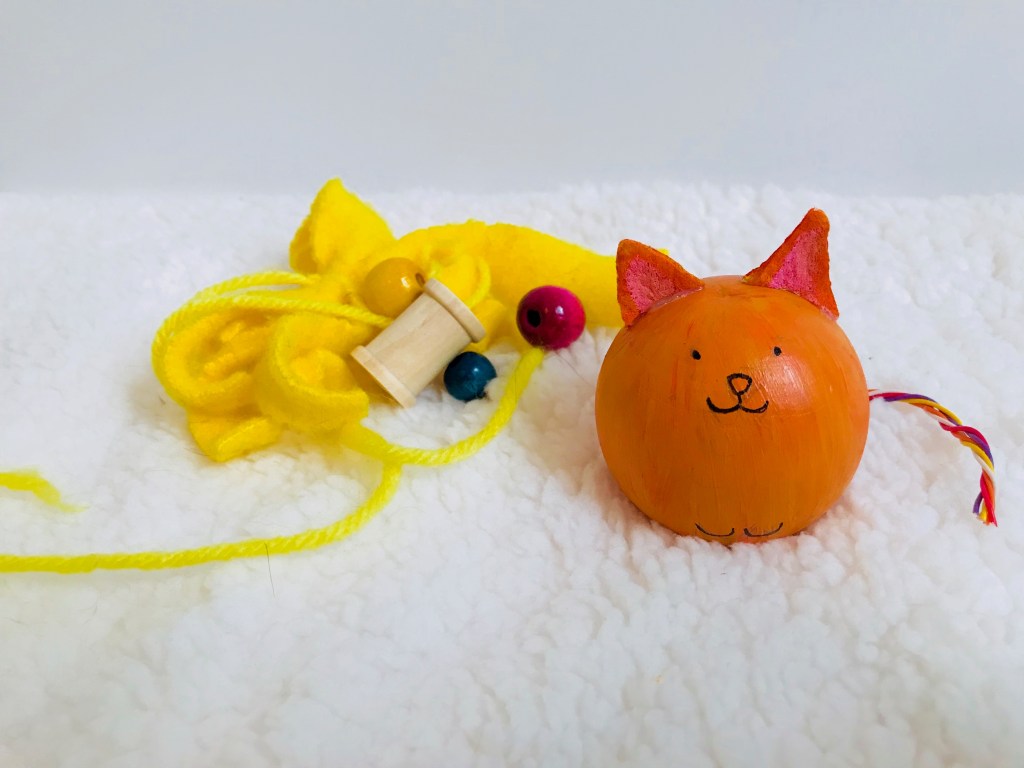
A Little Ball of Kitten


This sweet little kitten is easy to make and can keep you company on your desk or shelf! Since every kitten is different, you can make yours to look just the way you want. Here’s how I made mine:

Supplies

  • Wooden ball with a flat bottom, available in craft stores and in different sizes
  • Craft paint in any color kitten you’d like (I used red and yellow and mixed it to make a mottled orange)
  • Craft paint in pink or white for the inner ear
  • Scrap of fleece for the ears. Fleece is easily shaped to the rounded ball and when painted is stiff enough to stand up on its own.
  • Thin, colored wire in several colors for the tail (string or twine, wrapped wire, fleece, stiff paper, and other materials could also be used)
  • Paint brush
  • Permanent marker for making the face
  • Hot glue gun or strong glue

Directions

  1. Paint the wooden ball and let dry
  2. Paint the scrap of fleece to match the wooden ball, let dry
  3. Cut out small triangular shapes for the ears. Round the bottom of the ears slightly so they fit the shape of the ball
  4. If making a tail from several colors of thin wire, twist them together, leaving one end untwisted
  5. With the glue gun or strong glue attach the ears to the top of the head
  6. With the glue gun attach the tail to the back of the wooden ball in the center near the base
  7. With the marker, draw eyes, nose, and mouth for the face and semicircles near the bottom for the paws

You can find The Summer Nick Taught His Cats to Read at these booksellers

Amazon | Barnes & Noble | Books-a-Million

To support your local independent bookstore, order from

Bookshop | IndieBound

May 22 – It’s National Family Month

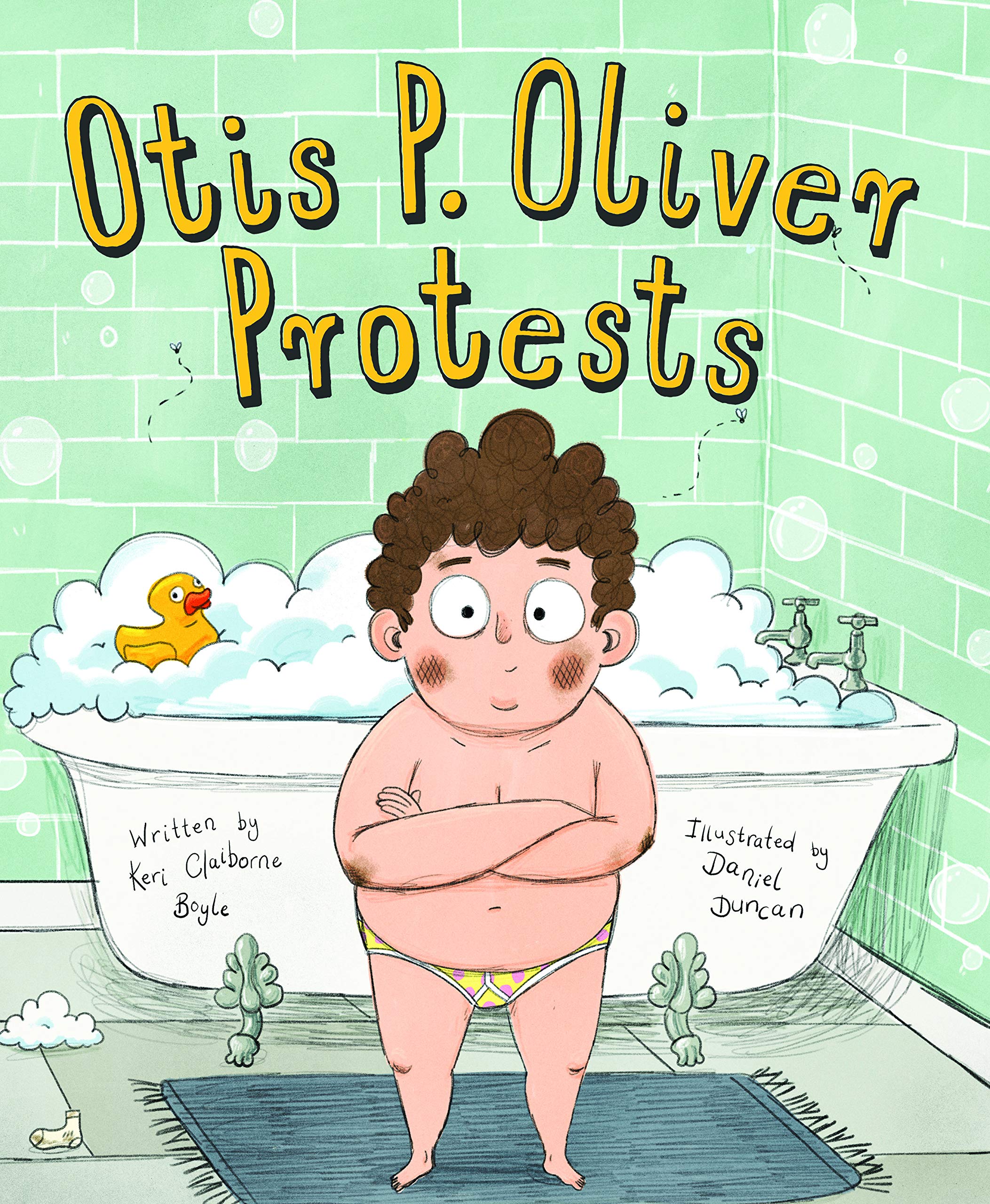
celebrate-picture-books-picture-book-review-otis-p-oliver-protests-cover

About the Holiday

In the weeks between Mother’s Day and Father’s Day we celebrate National Family Month. The holiday was established by KidsPeace to encourage families to spend more time together. It also gives us the opportunity to honor everything that makes a group of people a family. Common experiences, shared memories, and unconditional love create that unique feeling in the heart that defines family. This year, the bonds of family have taken on a whole new meaning. To celebrate, gather your family together, talk about some things you’ve learned about each other, what you love about each family member, and, of course, have some fun!

I received a copy of Otis P. Oliver Protests for review consideration. All opinions about the book are my own.

Otis P. Oliver Protests

by Keri Claiborne Boyle and Illustrated by Daniel Duncan

By Jakki Licare

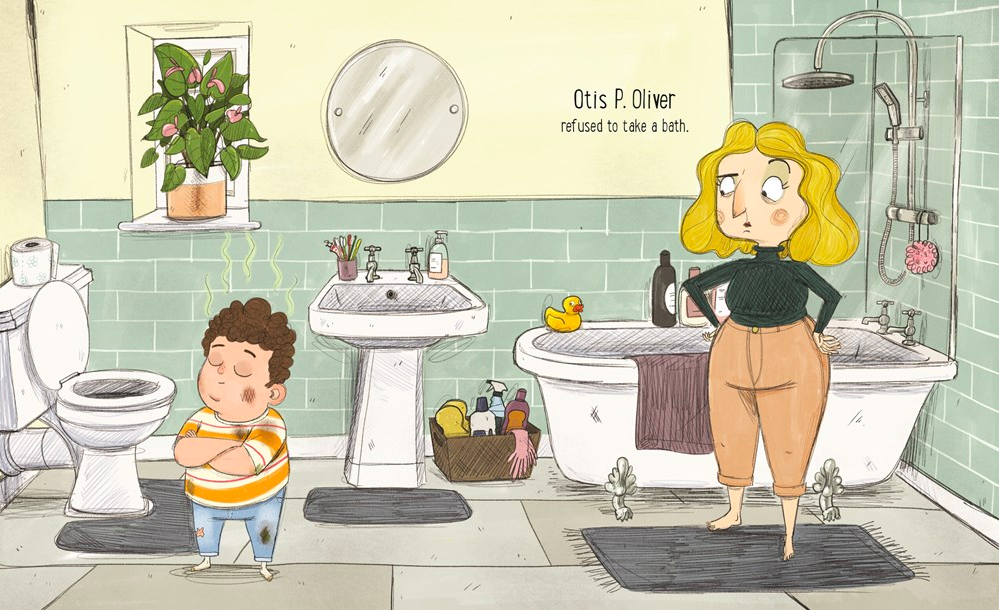
Otis has no interest in taking a bath now or anytime in the future. In fact, he believes no one should have to take a bath, but with three big sisters no one really listens to him. Otis has to take four baths every single week,  “…especially when he’s excessively grubby. And since worm farms aren’t going to build themselves, Otis is usually excessively grubby.”

celebrate-picture-books-picture-book-review-otis-p-oliver-protests-refuses

Image copyright Daniel Duncan, 2020, text copyright Keri Claiborne Boyle, 2020. Courtesy of Sleeping Bear Press.

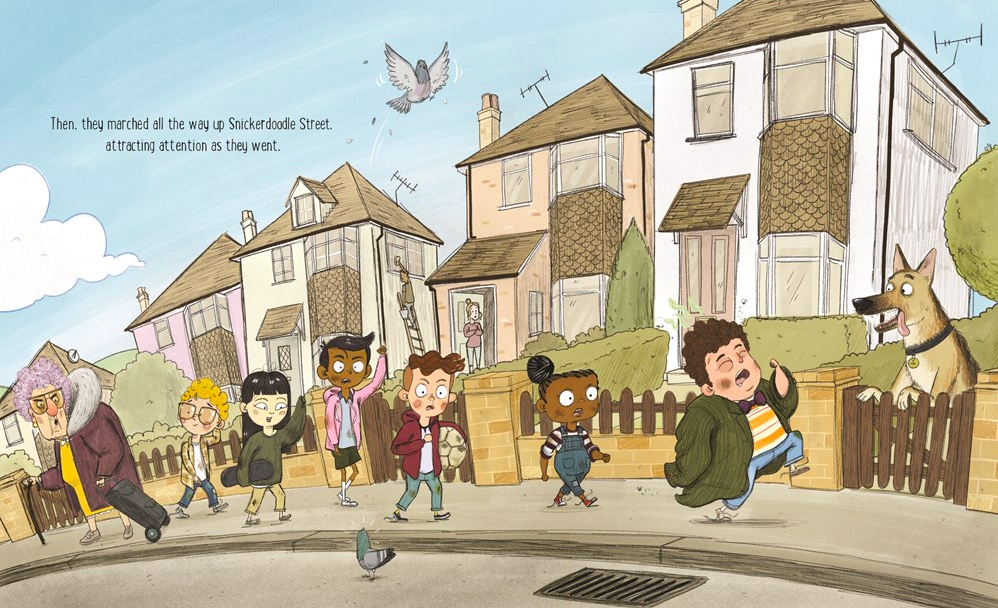
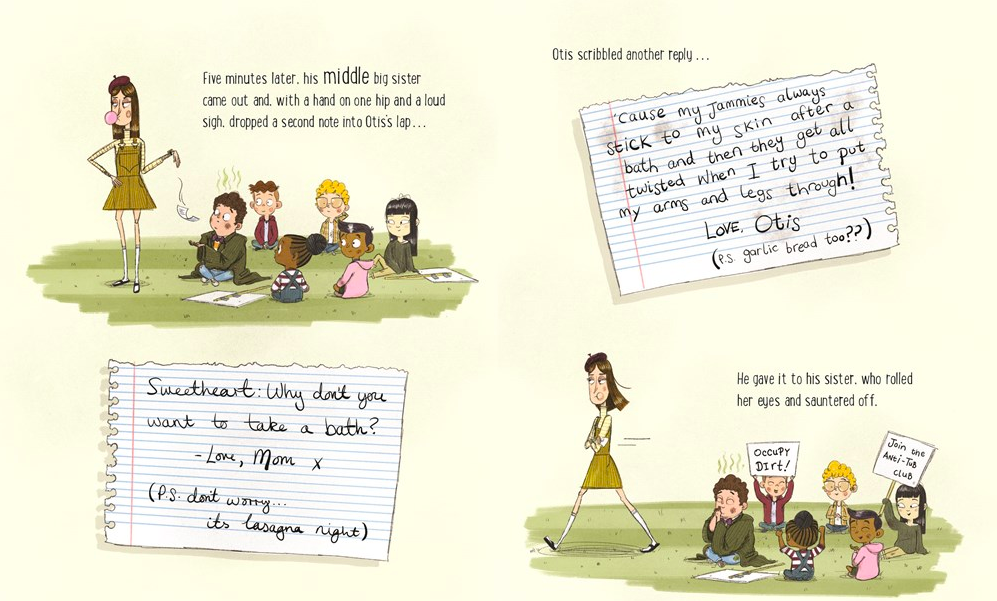
Otis’s family insists he should take a bath. So Otis decides that if he wants people to listen to him, he needs the right look and the right speech. At the playground Otis calls out to his friends that they must unite together for “bath-time rights.” Together they march through the streets until they all plop down on Otis’s front lawn. They will not move until they have been heard. 

Otis’s oldest sister passes him a note from their mom who is wondering what is going on. Otis responds: “No More Baths! Love Otis (P.S. What’s for dinner? I don’t like mystery meatloaf.)” Otis’s middle older sister brings out another note from their mom who doesn’t understand why he doesn’t want to take a bath. She also reassures him that it is lasagna night. Otis explains that he hates how his pajamas cling to him after his bath. Otis’s youngest older sister delivers a new note. Their mother tells him he doesn’t have to wear pajamas if he doesn’t want to. After consulting his group he finally agrees to his mother’s terms.

celebrate-picture-books-picture-book-review-otis-p-oliver-protests-kids

Image copyright Daniel Duncan, 2020, text copyright Keri Claiborne Boyle, 2020. Courtesy of Sleeping Bear Press.

After Otis’s friends head home, the family dog brings Otis another note. “My lil grub worm, So glad we reached a compromise. Now get in the tub before you’re grounded for life! Hugs and kisses, Mom. (P.S. No dessert on school nights.)” Otis hurries in to take his bath, but before he jumps in he writes his mom one last note. He tells her that he is all set to take his bath, but he won’t be using soap. But if he was allowed to have dessert tonight, then he would be happy to negotiate.

celebrate-picture-books-picture-book-review-otis-p-oliver-protests-notes

Image copyright Daniel Duncan, 2020, text copyright Keri Claiborne Boyle, 2020. Courtesy of Sleeping Bear Press.

Otis P. Oliver is a smart, charismatic little boy who will walk right off the page and demand admission into your heart. Children will sympathize with his problem of not wanting to take a bath and will cheer him on as he takes on the parental establishment. The notes passed between mother and son through Otis’s sisters add to the hilarity. Each note has a post script discussing what’s for dinner which will make young readers giggle.

Keri Claiborne Boyle’s detailed attention to her characters makes each page a pleasure to read. Each sister’s distinct personality comes through as she stomps or rolls her eyes or pirouettes off the page. Boyle uses the rule of three to trick the readers into thinking that the negotiations are over after the third sister delivers her note. However, Boyle then sends a fourth note out with the dog, proving that Otis’s mom is a master negotiator. Otis still has one trick up his sleeve, though, as he points out the loophole that he never agreed to use soap.

Daniel Duncan’s colorful pencil-lined characters are amplified by his detailed attention to each character’s personality. Otis P. is charming as he wears his father’s oversized coat with dirt patches on his cheeks and knees and wavy stink lines steaming off of him. The illustrated details of fishnet stockings for the oldest sister, bubble gum blowing for the middle older sister, and ipod-carrying and tutu-wearing youngest sister perfectly compliment Boyle’s text and make each sister’s personality pop. Children and adults will giggle at the  hilarious signs that Duncan adds to Otis’s sit in: “I feel bath wrath” & “Occupy Dirt.”  The entire family dynamic is perfectly illustrated through a simple picture of the family’s stairway. The three sisters each have their pictures hung perfectly in descending order while Otis’s picture is propped on the second step at the same level as the family dog.

Ages  6 – 9 years old

Sleeping Bear Press, 2020 | ISBN 978-1534110434

Discover more about Keri Claiborne Boyle and her books on her website

To learn more about Daniel Duncan, his books, and his art, visit him on The Drawn Chorus Collective website.

Budding politicians, bath-averse children, and everyone in between should have this book on their shelves. Otis P. Oliver Protests is the perfect book for kids and adults to share giggles and talks about compromises either at home or in the classroom. A top pick for public libraries too.

National Family Month Activity 

celebrate-picture-books-picture-book-review-bathtub-catapult-craft

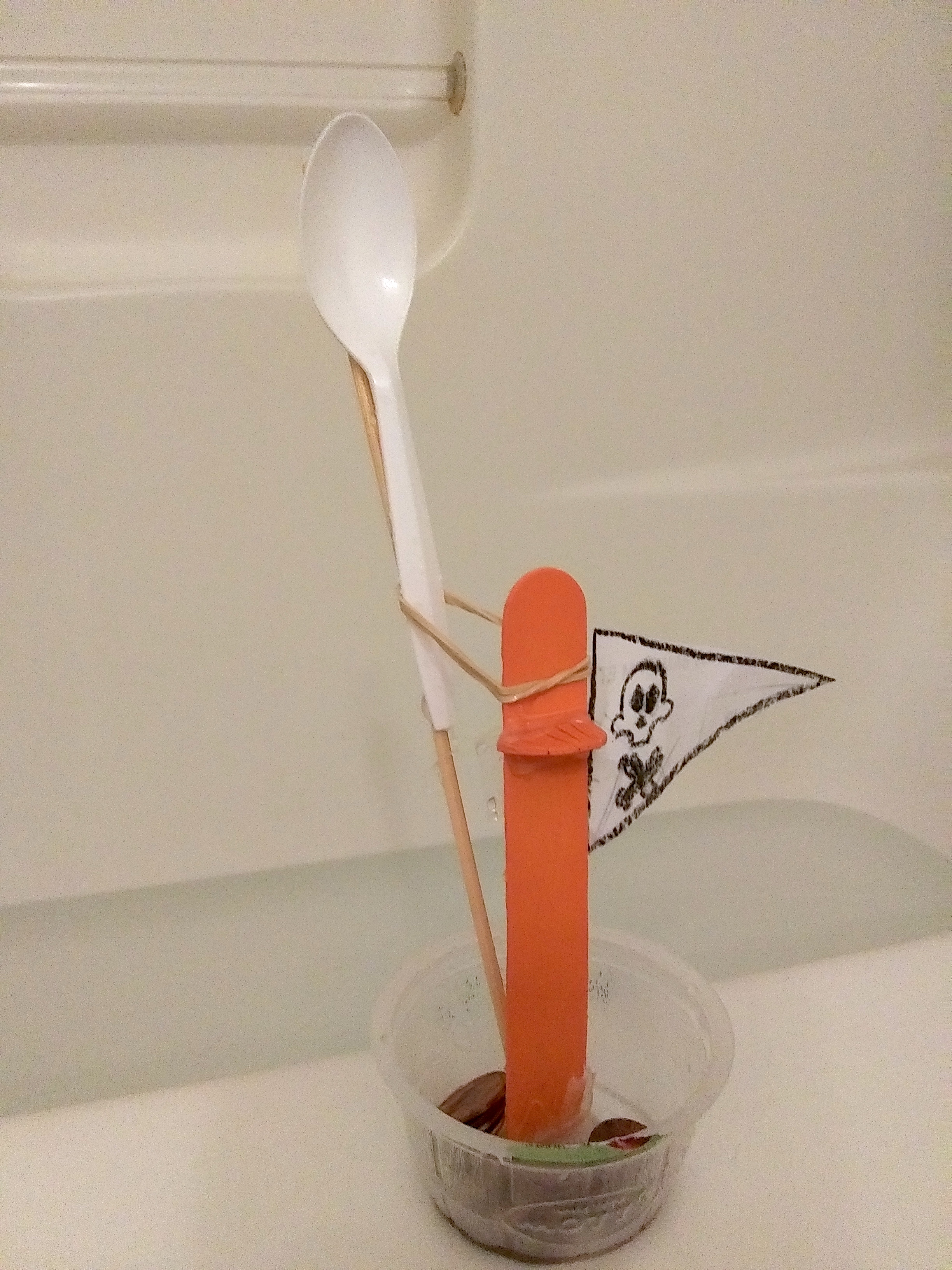
Recycled  Bathtub Catapult Battleship 

If your kiddo isn’t interested in taking a bath like Otis P. Oliver then you should give this craft a try! Blast the bubbles away as you sail your battleship in the tub.

Supplies

  • Applesauce or yogurt cup
  • Skewer
  • Plastic spoon
  • Popsicle stick
  • 10-15 pennies
  • Rubber band
  • Hot glue gun
  • Scissors
  • Paper
  • Crayons (are best since they are waterproof)
  • Tape

These supplies are just suggestions. Play around with different recycled materials and see what works!

Directions

To Make the Mast

  1. Cut the bottom of the popsicle stick off so the end is flat
  2. Take the cut-off part of the popsicle stick and hot glue the flat side to the popsicle stick, one inch down from the top. This will help hold the rubber band in place
  3. Hot glue the popsicle stick to the center of your yogurt or applesauce cup.

To Make the Catapult

  1. Cut off the pointy ends of skewer
  2. Hot glue the handle of the plastic spoon to the skewer
  3. Hold the catapult at an angle and hot glue the skewer next to the popsicle stick

To Make the Flag

  1. On paper draw a triangle and color in.
  2. Cut out triangle and tape to popsicle stick as a flag

To Finish

  1. Place pennies in front of popsicle stick to balance it out for floating (mine needed 12 pennies to keep it from tipping over backwards)
  2. Attach rubber band around popsicle stick and skewer
  3. Float in bathtub and attack those bubbles!

celebrate-picture-books-picture-book-review-otis-p-oliver-protests-cover

You can find Otis P. Oliver Protests at these bookstores

Amazon | Barnes & Noble | Books-a-Million 

To support your local independent bookstore, order from

Bookshop | IndieBound

Picture Book Review

Picture Book Review

May 16 – National Love a Tree Day

celebrate-picture-books-picture-book-review-kate-who-tamed-the-wind-cover

About the Holiday


In the middle of Gifts from the Garden and Garden for Wildlife Month, we celebrate Love a Tree Day. Trees provide so much––for us and for the earth. Trees release oxygen into the atmosphere, give much-needed shade from the sun’s heat, and beautify the land. And their impact doesn’t end there. Trees also inspire art and literature and ingenious solutions, which all come together in today’s book.

Kate, Who Tamed the Wind

Written by Liz Garton Scanlon | Illustrated by Lee White


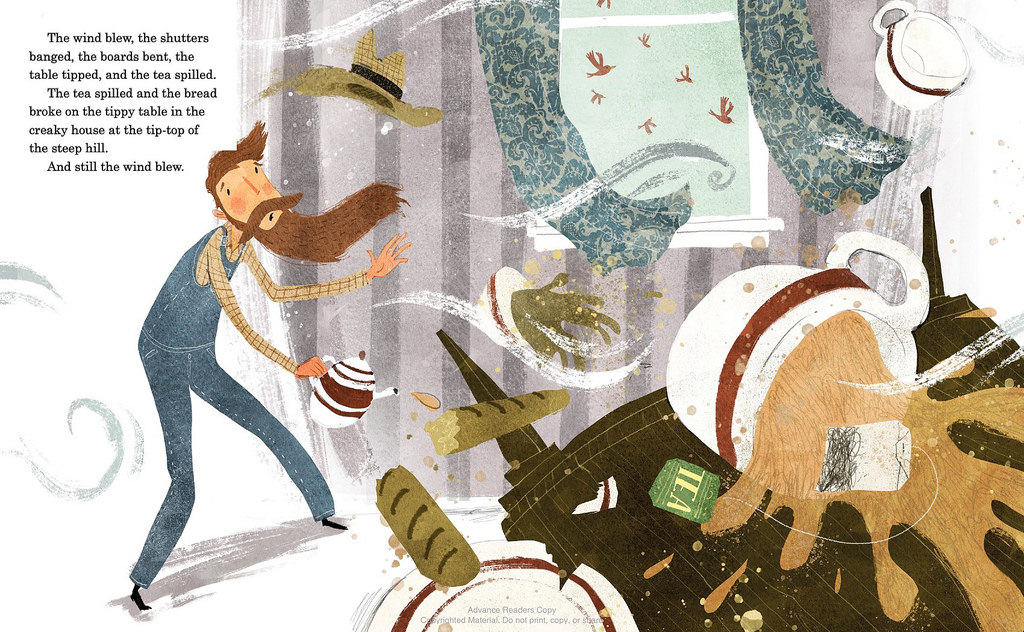
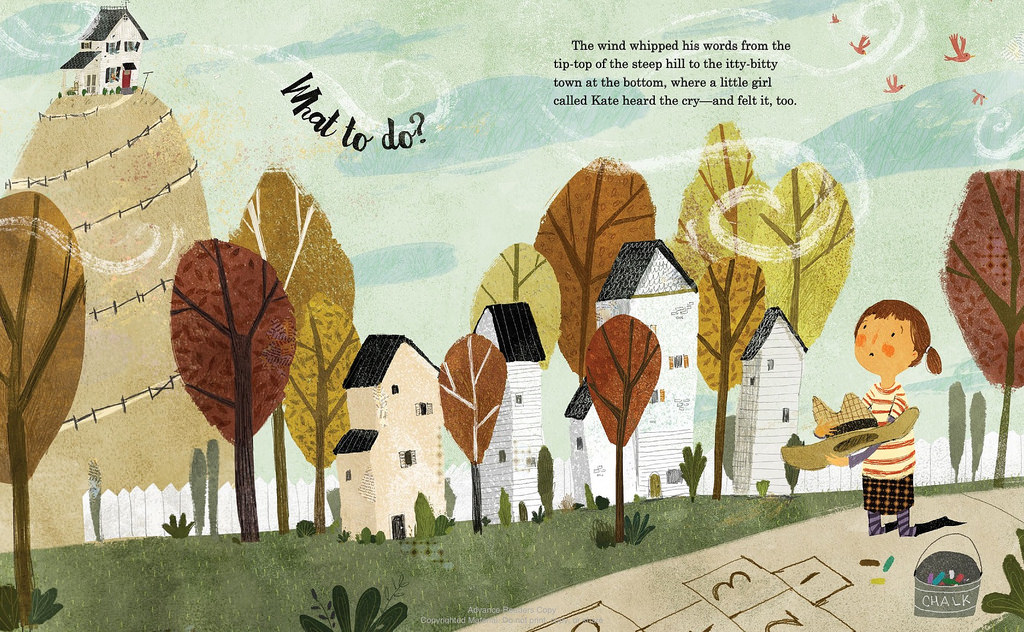
There once was a man who lived in a house on top of very tall, dusty hill. Being so high up, the man’s house captured breezes that set his curtains fluttering and his wind chimes tinkling. Sometimes the wind blew, rattling the shutters, sending the laundry flying from the line, and tearing boards from the house. Inside, the wind whipped, the “table tipped, and the tea spilled.” The man’s hat flew off and out the window, joining the birds who were leaving too.

celebrate-picture-books-picture-book-review-kate-who-tamed-the-wind-spilled-tea

Image copyright Lee White, 2018. text copyright Liz Garton Scanlon, 2018. Courtesy of Schwartz & Wade.

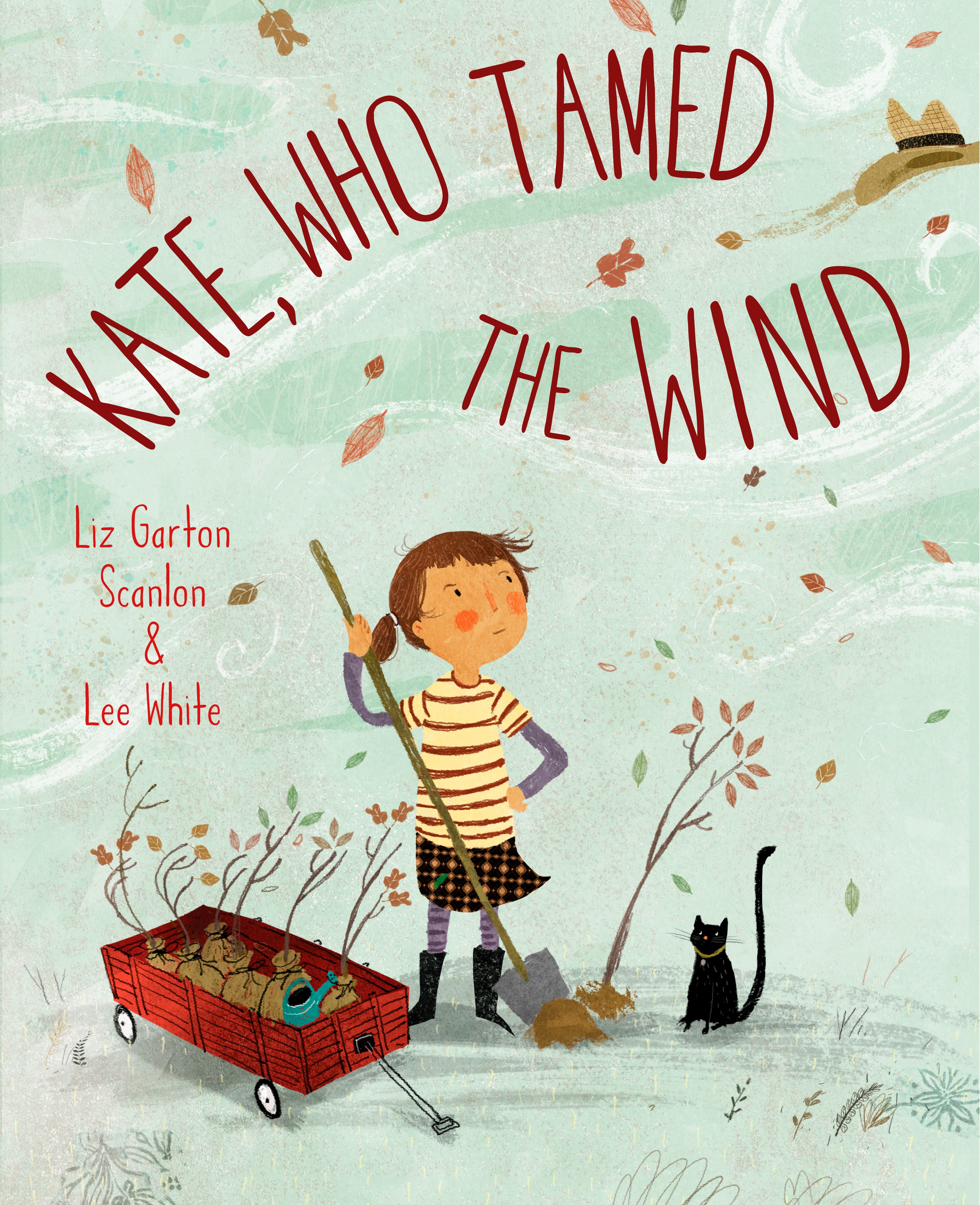
The man cried, “What to do?” Down on the sidewalk below, a little girl named Kate caught the man’s hat and the man’s cry too. Kate wanted to help. She “couldn’t stop the wind,” but she knew of something that could slow it down. When she returned the man’s hat, she also brought a wagon full of saplings. Kate and the man planted the trees, and they tended them as they grew—even while the wind blew.

celebrate-picture-books-picture-book-review-kate-who-tamed-the-wind-kate-catches-hat

Image copyright Lee White, 2018. text copyright Liz Garton Scanlon, 2018. Courtesy of Schwartz & Wade.

“The trees grew, the wind blew, and the time flew. The time flew as the trees grew…and grew…and Kate did too.” As the trees got bigger, taller, and stronger, the “leaves fluttered,” but the shutters quieted and the board stayed still. Inside, the tea brewed, the dust settled down, and the man’s hat stayed put. Even the birds came back. With the house ringed in trees, Kate and the man enjoyed a picnic in the yard, cooled just enough by the gentle breeze.

celebrate-picture-books-picture-book-review-kate-who-tamed-the-wind-planting-trees

Image copyright Lee White, 2018. text copyright Liz Garton Scanlon, 2018. Courtesy of Schwartz & Wade.

Readers will love getting carried away by Liz Garton Scanlon’s breezy lines that through alliteration and rhyme replicate a windy day as things bang, flap, whip, and go flying. As the trees that Kate and the man plant grow and begin to shelter the house from the wind, the rhythm of Scanlon’s text becomes more staccato and rooted. Little Kate is a terrific role model for young readers for her environmental know-how and her stick-to-itiveness as the trees grow from saplings to maturity. The long friendship between the man and Kate is also endearing.

Lee White’s softly hued pages swirl with swipes and swishes that whip curtains, steal laundry, and upend the table and tea. The man’s bewilderment serves as a foil to Kate’s determination and problem-solving, and the difference she makes in the man’s quality of life is evident as the trees grow, their friendship develops, and the wind is finally tamed. Kids will identify with this kind and intelligent child who grows up to be a caring adult.

Beautifully conceived and with lovely details, Kate, Who Tamed the Wind is an environmentally conscious story that will inspire young readers at home and in the classroom.

Ages 4 – 8

Schwartz & Wade, 2018 | ISBN 978-1101934791

Discover more about Liz Garton Scanlon and her books on her website

To learn more about Lee White, her books, and his art, visit his website.

National Love a Tree Day Activity

celebrate-picture-books-picture-book-review-paper-plate-tree-craft-2

Paper Plate Tree


With this easy craft, children can make a tree to decorate their room or to use as a centerpiece for play. 

Supplies

  • Two paper plates 
  • Paper towel tube
  • Brown craft paint
  • Green craft paint (using a variety of green and yellow paints adds interest. Use orange, red, and yellow to make a fall tree.)
  • Paintbrush, cork, or cut carrot can be used to apply paint
  • Glue or hot glue gun or stapler

Directions

  1. Paint the paper towel tube brown, let dry
  2. Paint the bottoms of the two paper plates with the green (or other color) paints, let dry
  3. Flatten about 4 inches of the paper towel tube 
  4. Glue or tape the flat part of the paper towel tube to the unpainted side of one paper plate
  5. Glue the edges of the two paper plates together, let dry.
  6. Straighten the tree so that it can stand up, or hang your tree on a wall, bulletin board, in a window

celebrate-picture-books-picture-book-review-kate-who-tamed-the-wind-cover

You can find Kate, Who Tamed the Wind at these booksellers

Amazon | Barnes & Noble | Books-a-Million

To support your local independent bookstore, order from 

Bookshop | IndieBound

Picture Book Review


May 14 – National Dance Like a Chicken Day

celebrate-picture-books-picture-book-review-a-little-chicken-cover

About the Holiday

You know what this holiday is all about! You can hear the tune taking over your brain, can’t you? And your elbows – they’re bending and bouncing just a little bit, aren’t they? Then jump up, gather the kids, and… Na na na na na na na. / Na na na na na na na. / Na na na na an na NA. / clap, clap, clap, clap….

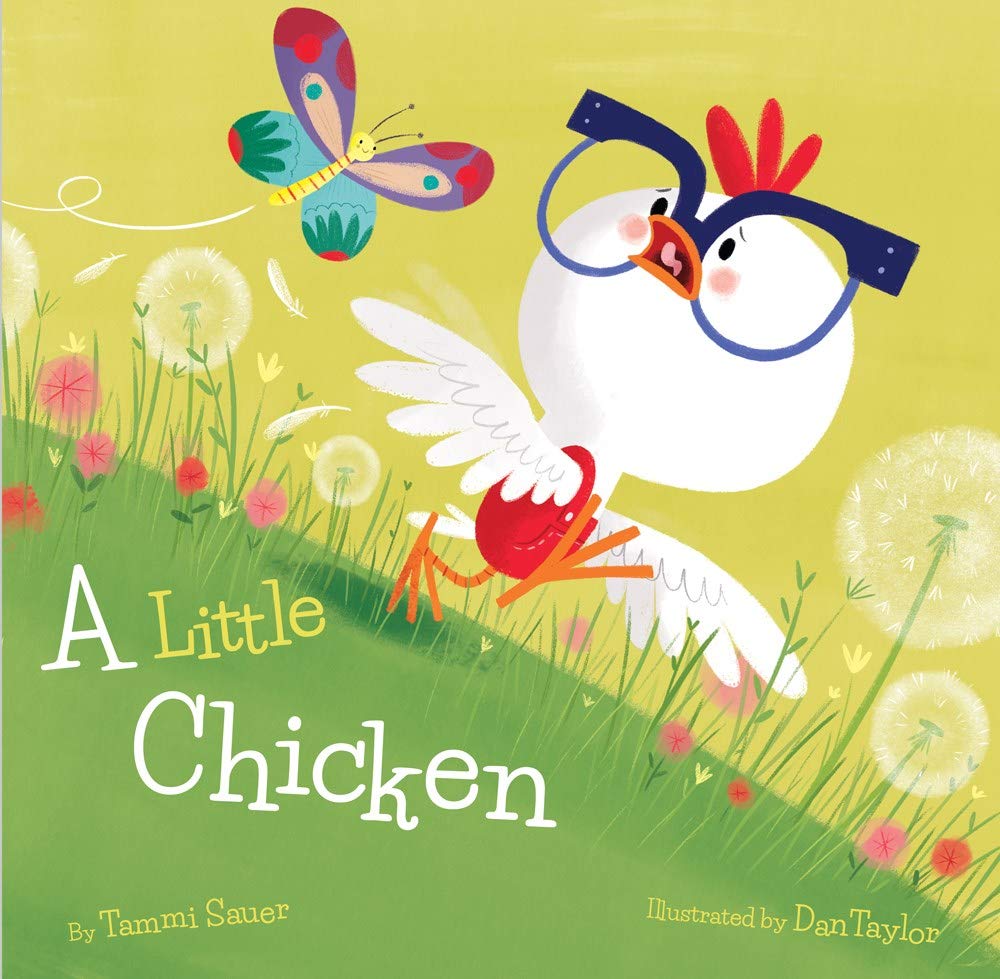
A Little Chicken

Written by Tammi Sauer | Illustrated by Dan Taylor


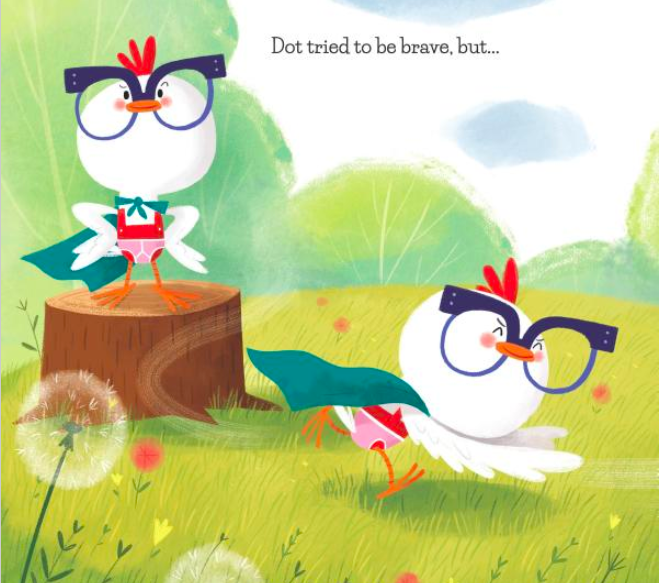
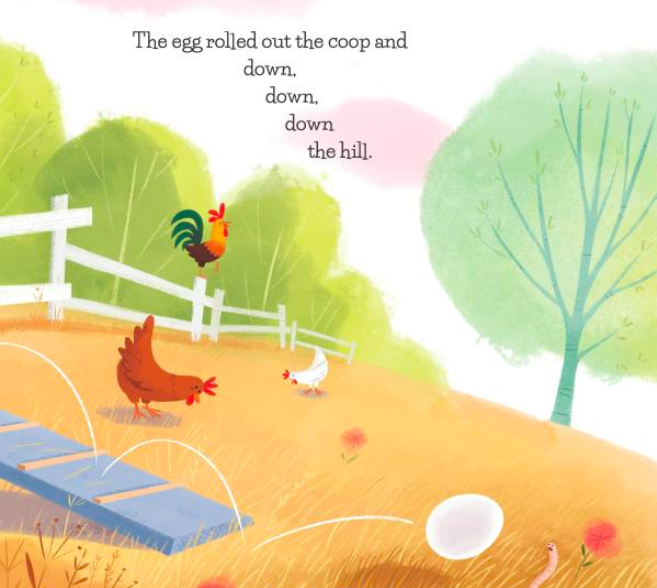
“Dot was a little chicken…who, let’s face it, was a little chicken.” There weren’t many things Dot wasn’t afraid of, including garden gnomes. Even though “Dot tried to be brave,” even the simplest things and the gentlest creatures frightened her. One day, though, while she was adding making their coop more secure, Dot knocked one of her siblings off the nest. All she could do was watch it roll away.

celebrate-picture-books-picture-book-review-a-little-chicken-Dot

Image copyright Dan Taylor, 2019, text copyright Tammi Sauer, 2019. Courtesy of Sterling Children’s Books.

Or was there something else she could do? She plucked up her courage and ran after it. The egg was just within reach when it bounced away and took two hops across lily pads into the middle of the pond. Dot swung over the egg on a tall strand of grass and was just about to grab it when it was catapulted into a tall tree.

Dot climbed the tree and inched out onto a long branch. “She was this close when…” the branch broke and the egg broke away too—”into the deep…dark…woods.” She took one look and…decided “this was no time to be a little chicken.” She ran down the path in pursuit of her little brother or sister and finally caught that egg just as it began to crack. These days, while Dot is still afraid of many things, her little sister and the other chickens think she’s a hero—just “a big hero” who’s “just a little chicken.”

celebrate-picture-books-picture-book-review-a-little-chicken-egg

Image copyright Dan Taylor, 2019, text copyright Tammi Sauer, 2019. Courtesy of Sterling Children’s Books.

Tammi Sauer’s upbeat story of a timid chicken who overcomes her fears in order to save her sibling is suspenseful, fast-paced, and sprinkled with humor. The story will have even the most cautious little ones cheering Dot on her quest and finding their own brave along the way. Dot’s sense of responsibility sparks the action and serves as a second gentle lesson in this well-conceived story. The ending, which embraces Dot’s wary nature while also revealing her heroic accomplishment, is a welcome message for hesitant children who are courageous in their own way.

Dan Taylor’s sweet Dot, with her oversized glasses and bright red overalls, will charm children looking for a hero who’s just their size. As Dot sets in motion her unhatched sibling and the story while installing a huge security camera and monitor in the coop, kids will alternately gasp and giggle at the suspenseful and humorous details on each page. The other chickens are delightfully supportive of Dot, which lends a sense of inclusiveness as they all rush out to cheer her heroic catch. Dot scrambles over a green meadow, hangs perilously over a lily pad covered pond, scurries up a tall tree, and flaps her way through a dark forest populated with a wolf, bears, and—most frightening of all—three garden gnomes.

A story of finding one’s courage at eggs-actly the right moment, A Little Chicken would be a heartening addition to home, classroom, and public libraries.

Ages 3 – 7

Sterling Children’s Books, 2019 | ISBN 978-1454929000

Discover more about Tammi Sauer and her books on her website.

To learn more about Dan Taylor, his books, and his art, visit his website.

National Chicken Dance Day Activity

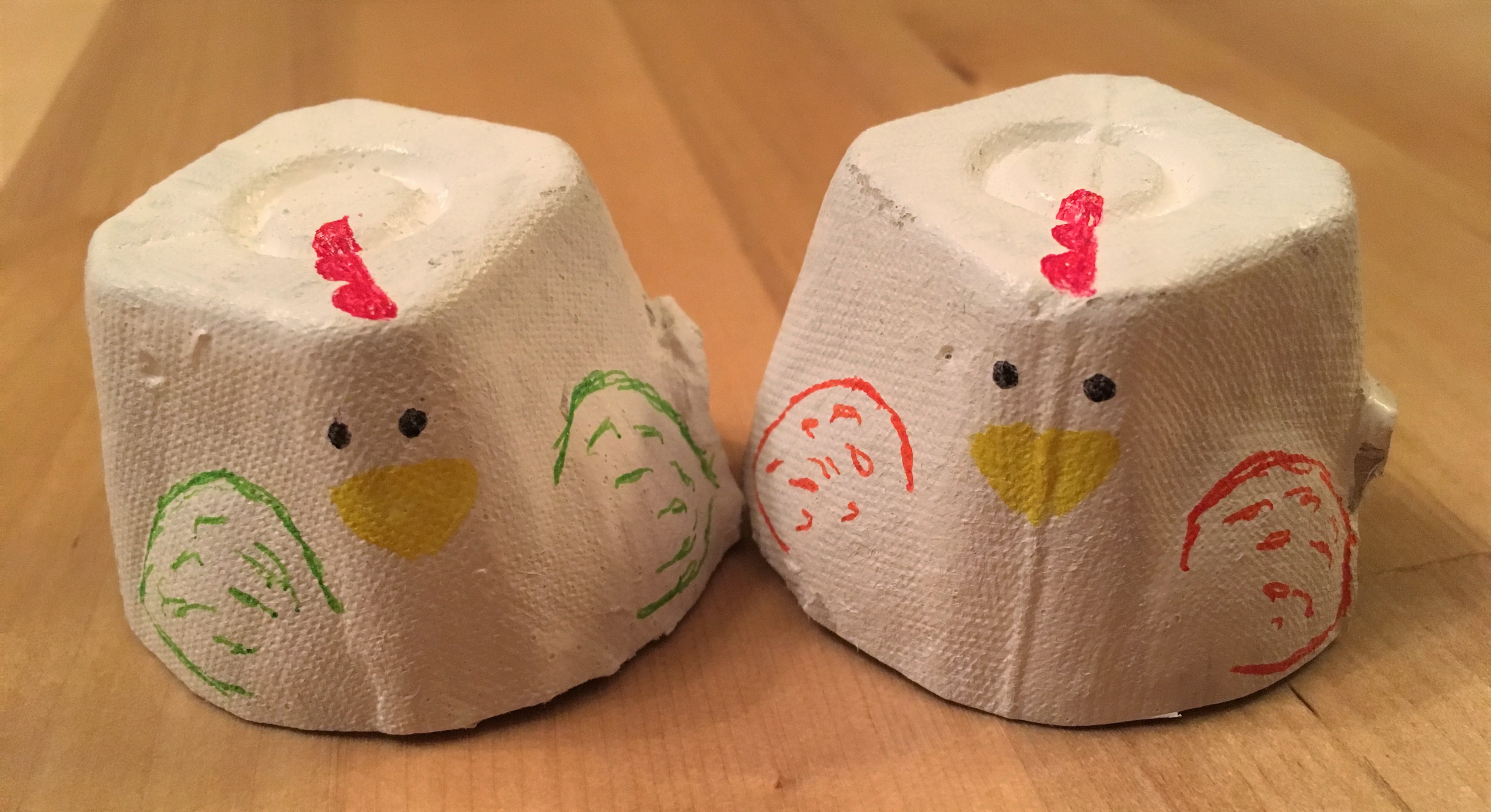
celebrate-picture-books-picture-book-review-egg-carton-chicken-double-chickens

Egg Carton Chickens and a Basket Full of Games


With twelve little chickens you can come up with lots of games to play! This fun craft and game activity is eggs-actly what you need to start hatching some real fun!

Supplies

  • Cardboard egg carton
  • White craft paint
  • Markers: red, yellow, black for the face; any colors you’d like for wings and eggs
  • Paint brush
  • Scissors
  • Glue
  • Construction or craft paper in white and a color of your choice

Directions

  1. Cut the notched flap off the egg carton and set aside
  2. Cut the top off the egg carton
  3. Cut apart all the egg cups and trim slightly so they sit flat
  4. Paint the egg cups with the white paint, let dry
  5. Add the face, comb and wings to the chicken with the markers. Make six chickens with one color wings and six chickens with another color wings.
  6. From the egg carton flap cut thirteen small egg-shaped playing pieces
  7. With the markers, decorate twelve of the eggs in pairs—each egg in the pair with the same design
  8. Color one egg yellow and add a beak, eyes, and wings to make it a chick

Games to Play

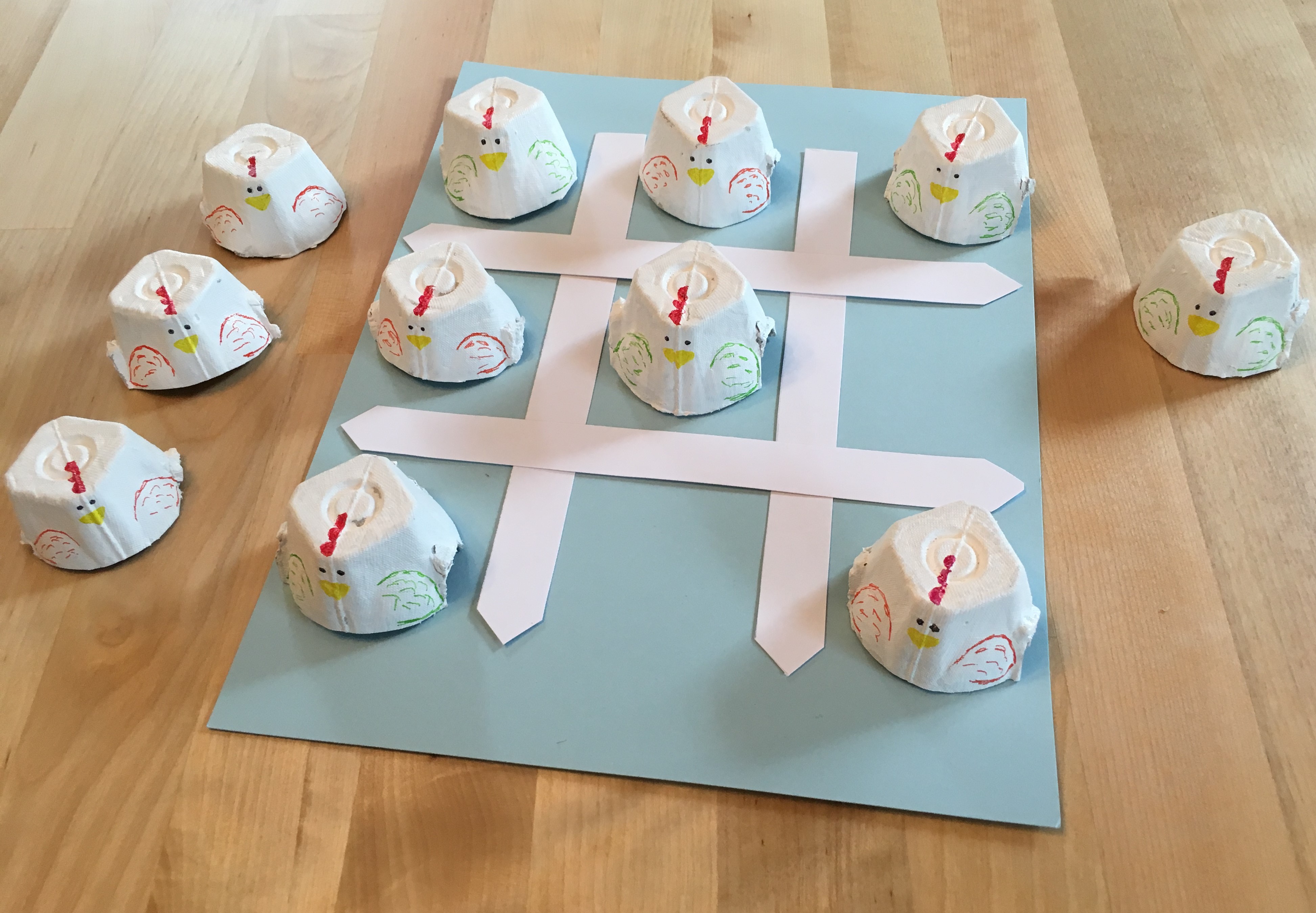
Tic-Tac-Toe (2 players)

  1. On a 8 ½” x 11” piece of paper draw a regular tic-tac-toe board or make it fancy – like the picket fence-inspired board in the picture
  2. To make the fence-inspired board on a colored background, cut 2 9-inch-long x 3/4-inch wide strips of white paper, cutting a pointed tip at one or both ends. Cut 2 white  8-inch x 3/4-inch strips of paper with a pointed tip at one or both ends. Glue the strips to the background.
  3. Each player chooses a set of chickens with the same colored wings
  4. Play the game as you usually do

celebrate-picture-books-picture-book-review-egg-carton-chicken-tic-tac-toe

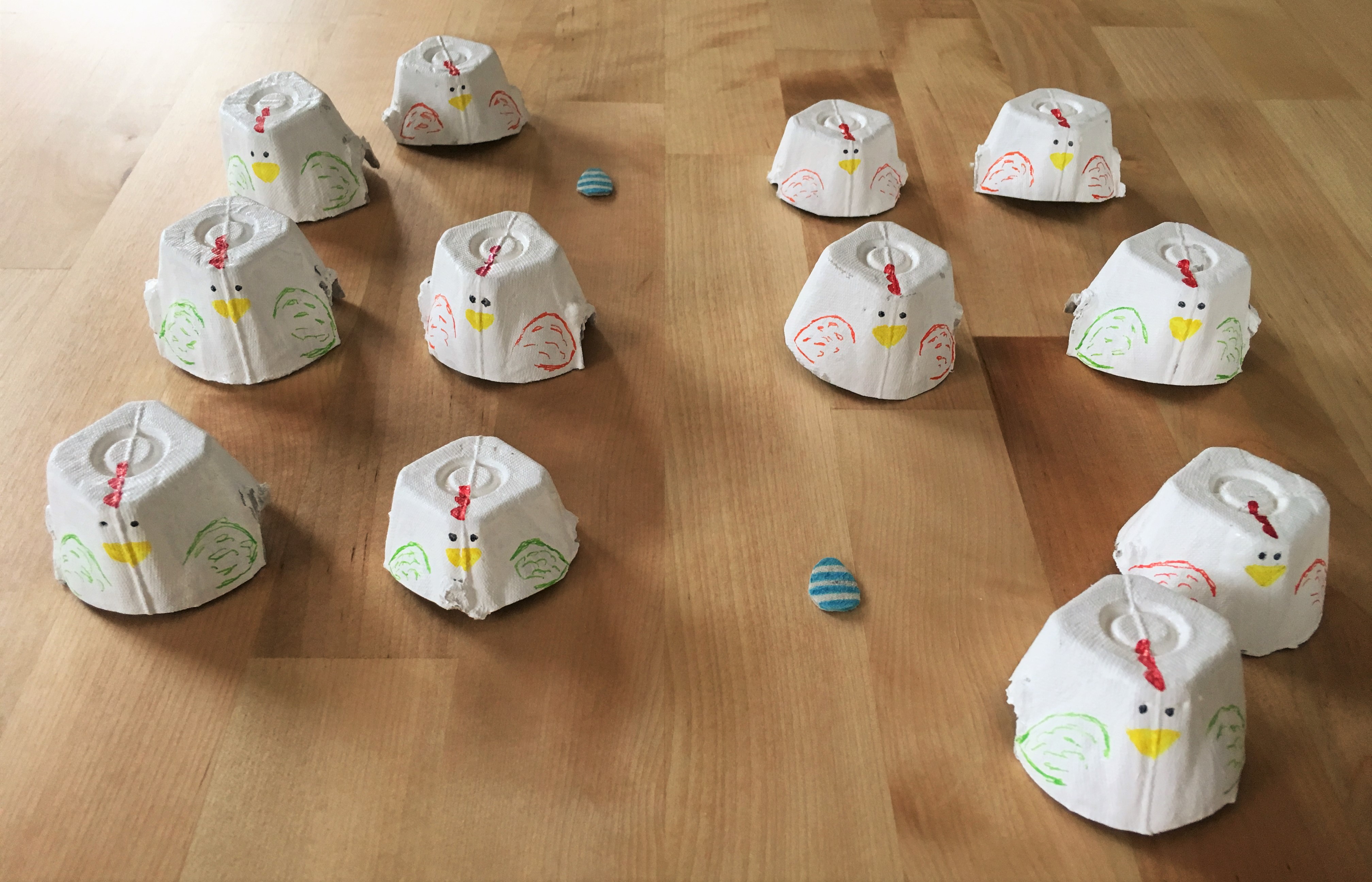
Find the Matching Eggs (2 or more players)

  1. Have one player hide one egg under each chicken
  2. Shuffle the eggs around and form them into three lines of 4 chickens each
  3. Another player lifts one chicken at a time to find matching eggs. If the eggs don’t match, put both chickens back and start again

celebrate-picture-books-picture-book-review-egg-carton-chicken-matching

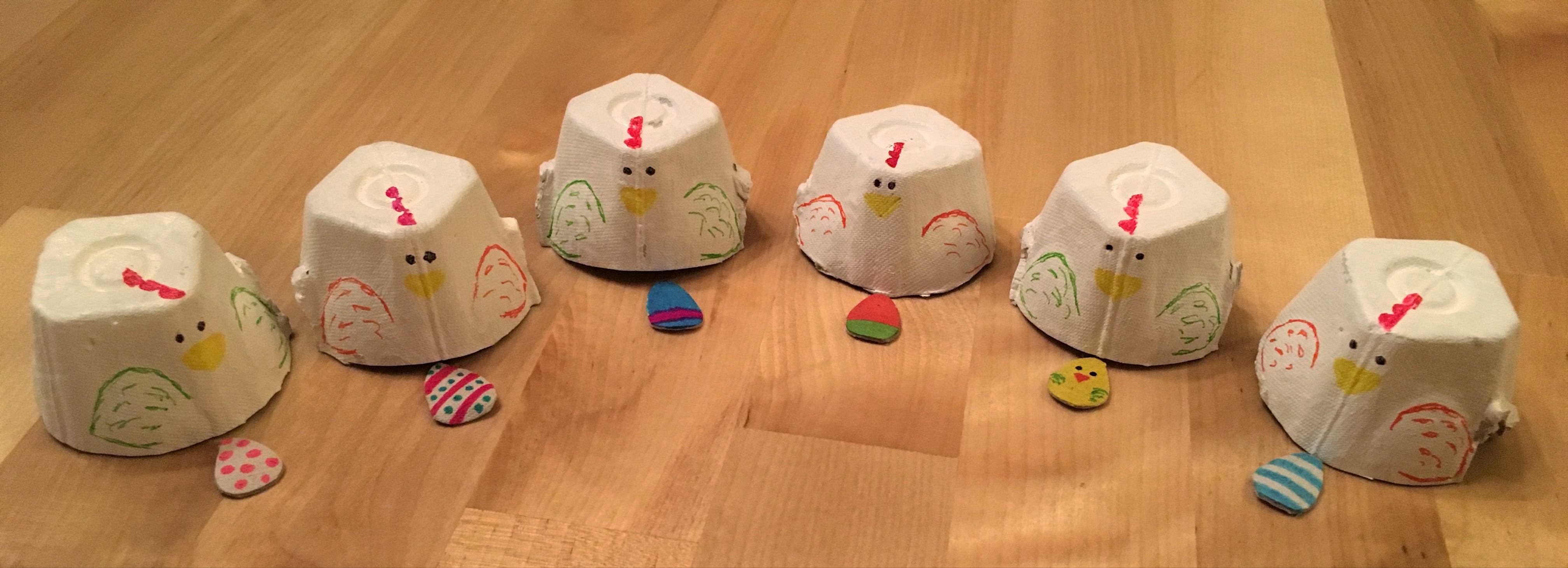
Where’s the Chick?

  1. Use as many chickens and eggs as you want (fewer for younger children, more for older)
  2. One player hides the chick under one of the chickens and eggs under the others.
  3. Another player has three chances to find the chick

celebrate-picture-books-picture-book-review-egg-carton-chicken-where's-the-chick

I’m sure you can also design your own games for your adorable chickens to play! With more chickens you can even make a checkers set or replicate another of your favorite board games!

celebrate-picture-books-picture-book-review-a-little-chicken-cover

You can find A Little Chicken at these booksellers

Amazon | Barnes & Noble | Books-a-Million

You can support your local independent bookstore, by ordering from 

Bookshop | IndieBound

Picture Book Review

April 24 – Arbor Day

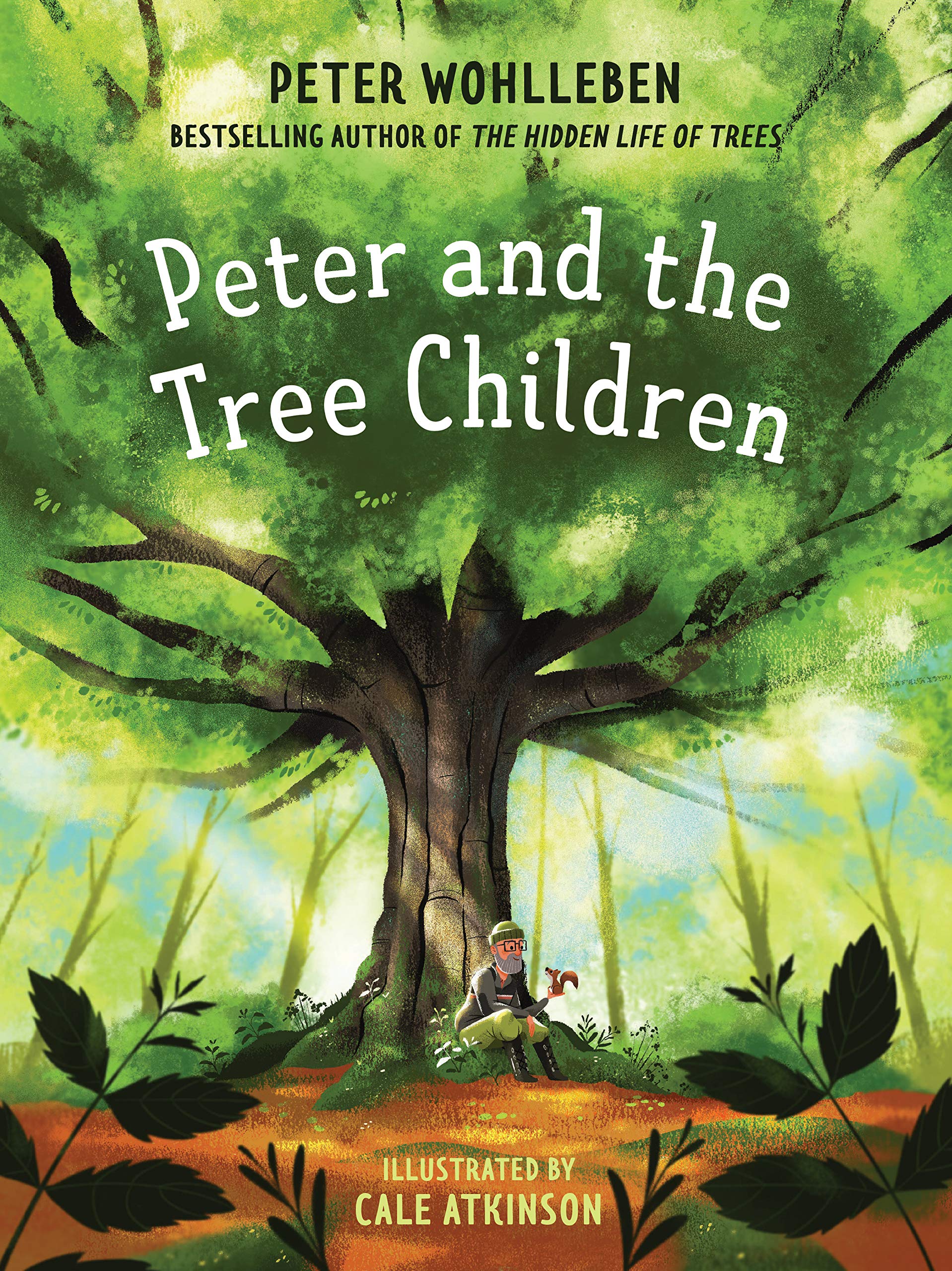
celebrate-picture-books-picture-book-review-peter-and-the-tree-children-cover

About the Holiday

Today is Arbor Day, a national celebration of trees that began as a campaign by J. Morton Sterling and his wife after they moved from Michigan to Nebraska in 1854. Morton advocated for the planting of trees not only for their beauty but as windbreaks for crops on the state’s flat farmland, to keep soil from washing away, as building materials, and for shade. In 1872, Morton proposed a tree-planting day to take place on April 10. On that day nearly one million trees were planted in Nebraska. The idea was made official in 1874, and soon, other states joined in. In 1882 schools began taking part. Today, most states celebrate Arbor Day either today or on a day more suited for their growing season. To learn about events in your area, find activities to download, and more, visit the Arbor Day Foundation website.

Peter and the Tree Children

Written by Peter Wohlleben | Illustrated by Cale Atkinson


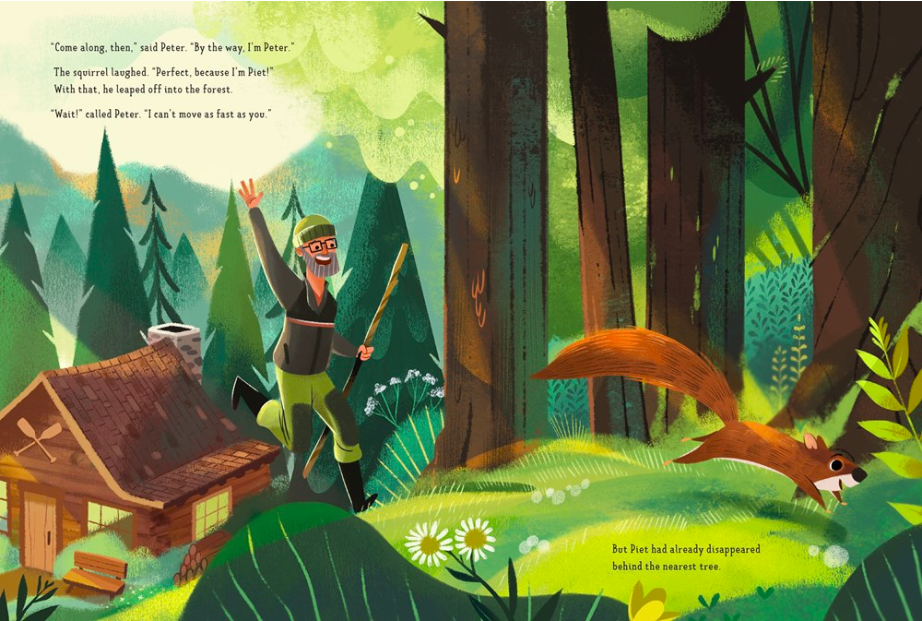
One day while Peter enjoyed his morning coffee on his porch while listening to the birds singing, “a squirrel scampered up and sat down next to him as though they were old friends.” With tears in his eyes, the squirrel told Peter that he was all alone with no family. Peter was empathetic—his children didn’t live with him anymore—but, he said, “‘I still have the trees.’” He then told the squirrel how tree families live in the forest and asked if he would like to go look for some. This cheered the squirrel, and they headed out into the woods. On the way, Peter introduced himself, and the squirrel said his name was Piet.
celebrate-picture-books-picture-book-review-peter-and-the-tree-children-piet

Image copyright Cale Atkinson, 2020, text copyright Peter Wahlleben. Courtesy of Greystone Kids.

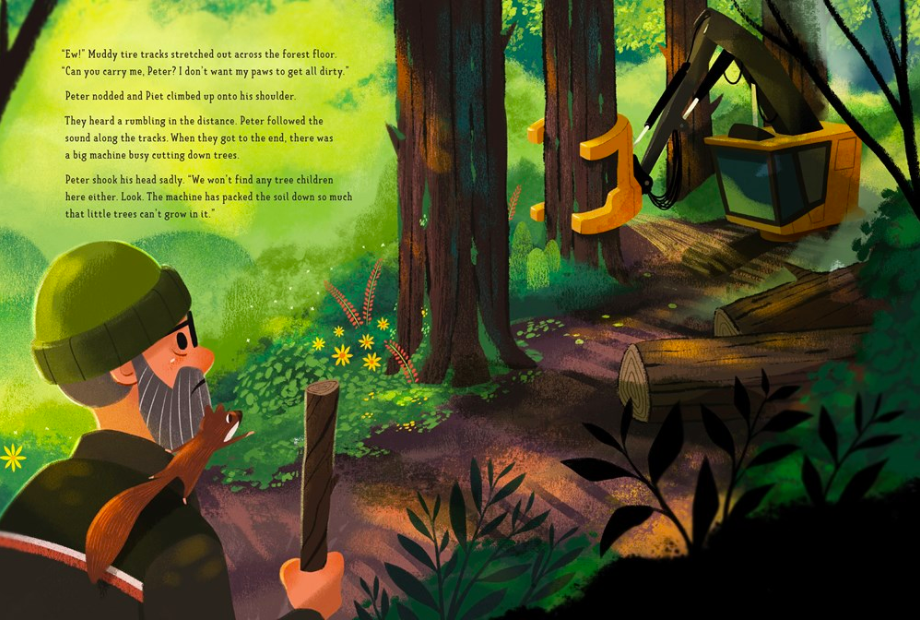
When they reached a sunny clearing, Piet wondered where the tree children were. Peter told him it was too hot there and led the way deeper into the woods. The way was muddy, so Piet climbed on Peter’s shoulders. In the distance, they could hear a loud rumbling. As they grew nearer, they saw a “big machine busy cutting down trees.” Peter told Piet that they wouldn’t find tree children here either because the heavy machine had “‘packed the soil down so much that the little trees can’t grow in it.’”
celebrate-picture-books-picture-book-review-peter-and-the-tree-children-machine

Image copyright Cale Atkinson, 2020, text copyright Peter Wahlleben. Courtesy of Greystone Kids.

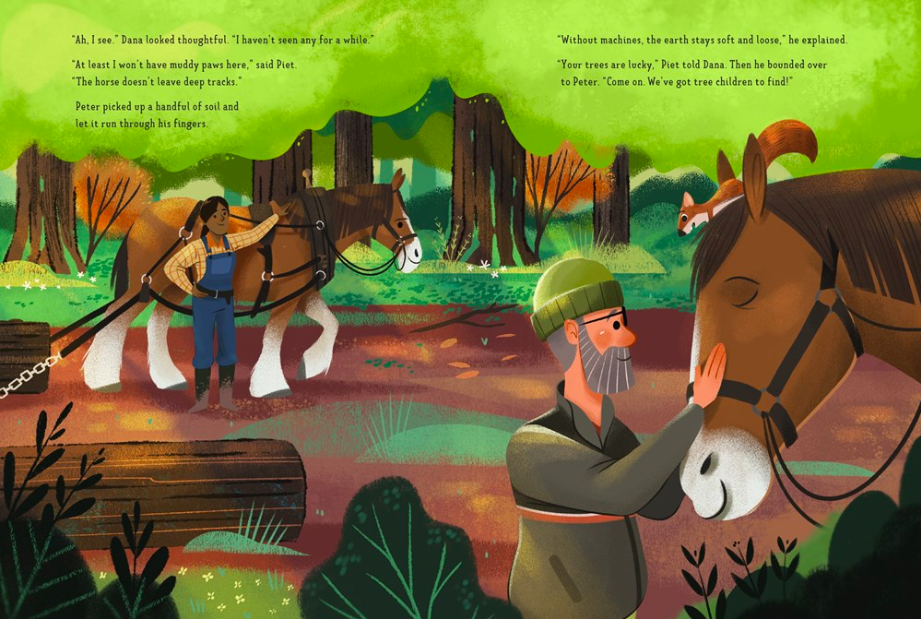
They walked on sadly until they heard another noise. It was Peter’s friend Dana and her horse dragging a tree trunk. Piet introduced himself and told Dana of their mission to find tree children. She said she hadn’t seen any for a long time while Peter explained to Piet that Dana’s horse left the soil soft and loose unlike the big machine. After a close call with a hawk, Piet rode in Peter’s jacket.
celebrate-picture-books-picture-book-review-peter-and-the-tree-children-Dana

Image copyright Cale Atkinson, 2020, text copyright Peter Wahlleben. Courtesy of Greystone Kids.

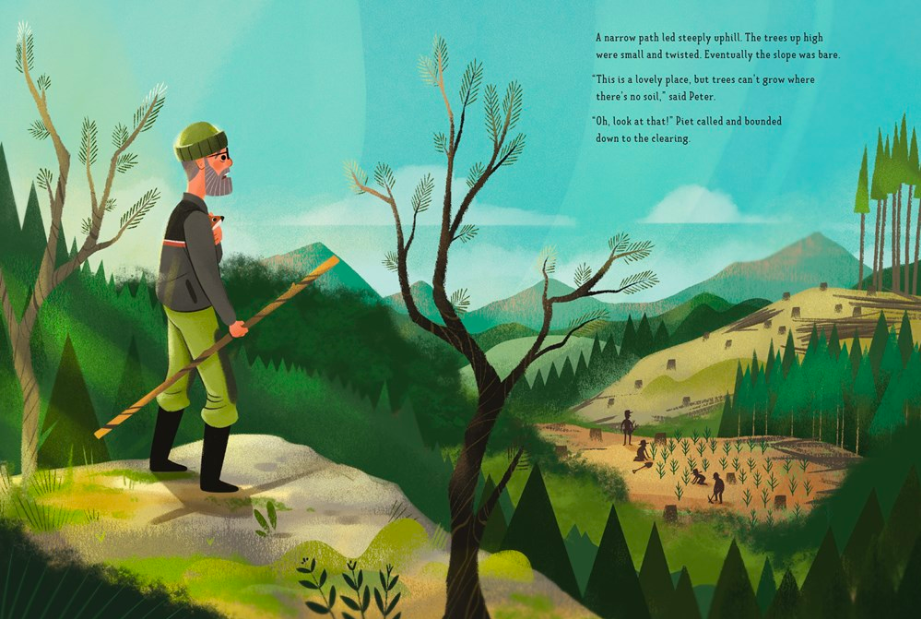
They came to a rocky overlook where they watched a crew planting small trees in a clearing below. Peter looked at all of the big trees that had been cut down, and his face turned red with anger. Piet sniffed one of the little trees, wondering if they’d found tree children at last. He liked the orangey scent the seedling gave off. But Peter told him the trees were sad. “‘This smell is how trees talk to each other, and it means that the trees don’t feel so well. They miss being shaded and protected by their families.’” He wanted to show Piet some happy trees.
celebrate-picture-books-picture-book-review-peter-and-the-tree-children-overlook

Image copyright Cale Atkinson, 2020, text copyright Peter Wahlleben. Courtesy of Greystone Kids.

At last they came to a dark, cool beech forest, where “the silvery-gray trees formed a roof of leaves way up high.” On the ground Piet noticed “‘butterflies everywhere.’” Peter chuckled and told him that those green fluttering wings weren’t butterflies but “‘freshly sprouted beech children.’” Now it was Piet’s turn to laugh. He told Peter how he had hidden beechnuts in this spot in the fall and then forgotten where he’d buried them. They both thought that this forest where beech trees and their children grew together was the most beautiful they’d ever seen.

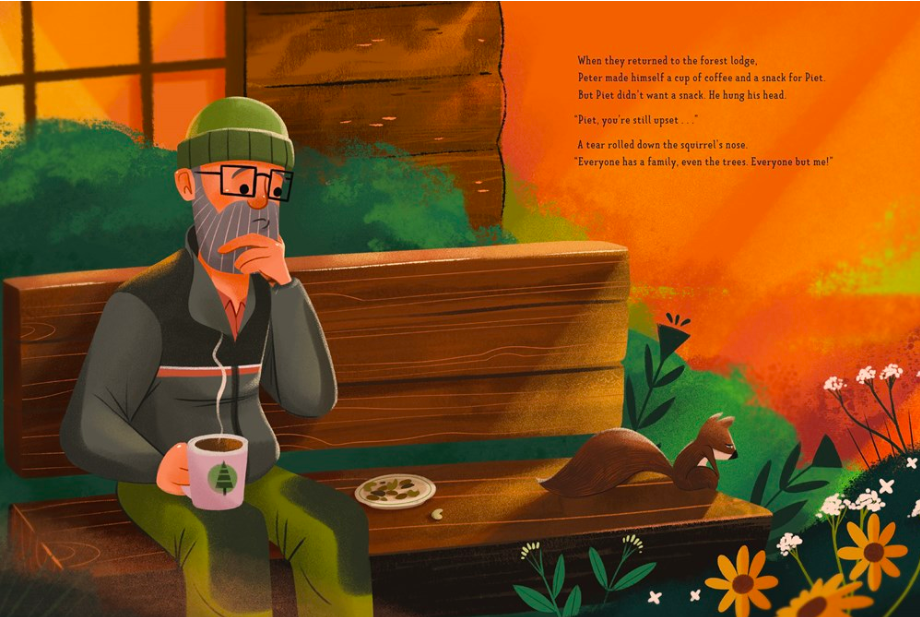
The sun was beginning to set, so they started the long walk home. Back on Peter’s porch, Piet looked sad again. He didn’t eat the snack Peter brought him and a tear rolled down his cheek. Everyone had a family except him, he said. Peter picked Piet up and told him that he liked him very much. Then he invited him to stay. “Piet’s eyes grew wide. ‘Does that mean we’re family now?’” Peter replied “‘Of course.’” Piet smiled, and then they made plans to visit the tree children again tomorrow.

Back matter reveals five more fascinating facts about how trees grow.
celebrate-picture-books-picture-book-review-peter-and-the-tree-children-lodge

Image copyright Cale Atkinson, 2020, text copyright Peter Wahlleben. Courtesy of Greystone Kids.

Peter Wohlleben’s engaging guides, Peter and Piet, educate children about the conditions necessary for trees to grow from seed to adult in his follow up to The Hidden Life of Trees for adults and Can You Hear the Trees Talking? For older children. In an attempt to cheer up Piet, Peter takes him into the forest in search of tree families and their little ones. Along the way, readers learn about the harmful effects of heavy logging machinery and the benefits of sustainable forestry. They also discover the fascinating fact that trees talk to each other through scent, which will inspire them to learn more. Adverse conditions and natural dangers draw Peter and Piet closer together, building a bond that culminates in Peter’s adopting Piet as a new family member. This turn of events, as well as Piet’s part in helping to foster the tree children they find, will cheer young readers.

Little ones will immediately empathize with Cale Atkinson’s cute squirrel, Piet, as he shares his sadness at not having a family with Peter. As Peter and Piet head into the forest, Atkinson’s sun-dappled pages invites readers to point out the butterflies, caterpillars, and flowers along their route. Kids may be surprised to see Dana and her horse and want to learn more about this type of forestry. Images of the impressive beech tree and thriving tree children will spur readers to look for young seedlings and saplings among stands of trees in their own area.

Ages 4 – 8

Greystone Kids, 2020 | ISBN 978-1771644570

Discover more about Peter Wohlleben, his books, and his work on his website.

To learn more about Cale Atkinson, his books, and his art, visit his website.

You can find Peter and the Tree Children at these booksellers

Amazon | Barnes & Noble | Books-a-Million | IndieBound
celebrate-picture-books-picture-book-review-can-you-hear-the-trees-talking-cover

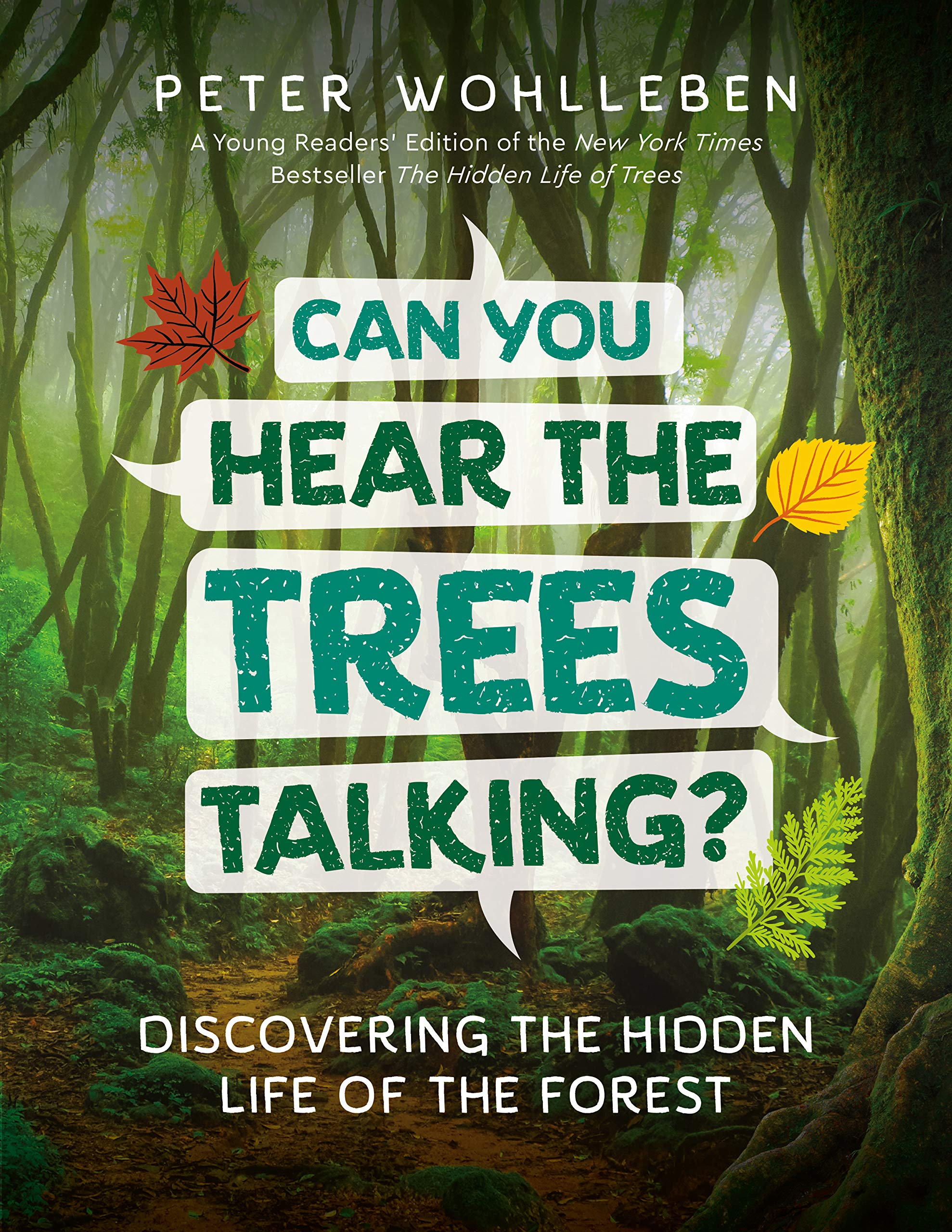
Can You Hear the Trees Talking? Discovering the Hidden Life of the Forest

By Peter Wohlleben


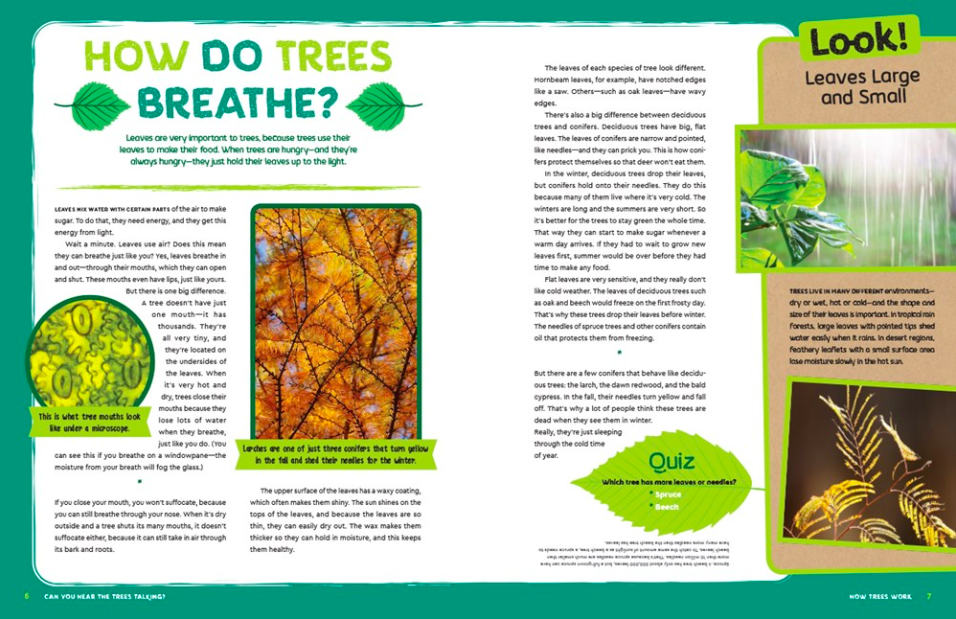
For older children, Peter Wohlleben’s endlessly astonishing Can You Hear the Trees Talking? Reveals the depth of senses, awareness, and long-lasting family bonds that trees possess. In seven chapters, Wohlleben discusses in a conversational tone how trees work, what it’s like for them growing up in a forest, trees’ friends and enemies, how types of trees are different, forest animals, the impact of trees, and a tree’s transformations over a year. Each chapter is broken into short sections of discussions on one topic, illustrated with stunning photographs that clearly depict the concept.

Here are just a few highlights:

From Do Trees Have Grandparents?: Trees can recognize members of their own family. How? Through their roots! “If a tree’s roots meet those of a neighboring tree, the can check whether they belong to the same species.” If they are related, “now their roots will grow together. The trees send messages and exchange the sugar they have made through this connection. It’s as if they’ve invited each other to dinner.” And what about old stumps? Looking at the condition of the stump can tell you a lot. “If the bark is falling off and the stump is rotten, the tree is out of touch with its neighbors” and is no longer alive. “If the edge of an old stump is very hard and still has solid bark, the stump is still alive… [and] getting food from its family through its roots.”
Screen Shot 2020-04-23 at 4.23.16 PMcelebrate-picture-books-picture-book-review-can-you-hear-the-trees-talking-breathe

Copyright Peter Wohlleben, 2019, courtesy of Greystone Kids.

In What Do Tree Children Learn at School? kids discover that mother trees don’t leave their children alone and on their own. Mother trees search out their children with their roots, and when they’ve found them, these caring mothers connect with their babies and nurse them with sugar water. They need this nourishment because “in an old-growth forest, it’s very dark at ground level. With so little light, the tree children can’t produce their own sugar with their leaves, so they have to rely on their parents.

Can Trees Talk? Reveals that “a single tree notices when something bites it. After the initial shock, the tree will taste who is nibbling on it. Yes, you read that right: trees can taste. Because whenever an animal bites into the bark, a leaf, or a branch, it injects a bit of saliva into the wound. And every animal’s spit tastes different.” The tree then pumps a foul-tasting or even poisonous liquid into the site that wards off the predator. For example, to defeat bark beetles, trees “release a sticky, bitter substance called pitch” that trap beetles. The tree then alerts other trees to the danger by releasing a scent that causes nearby trees to begin generating pitch for themselves.
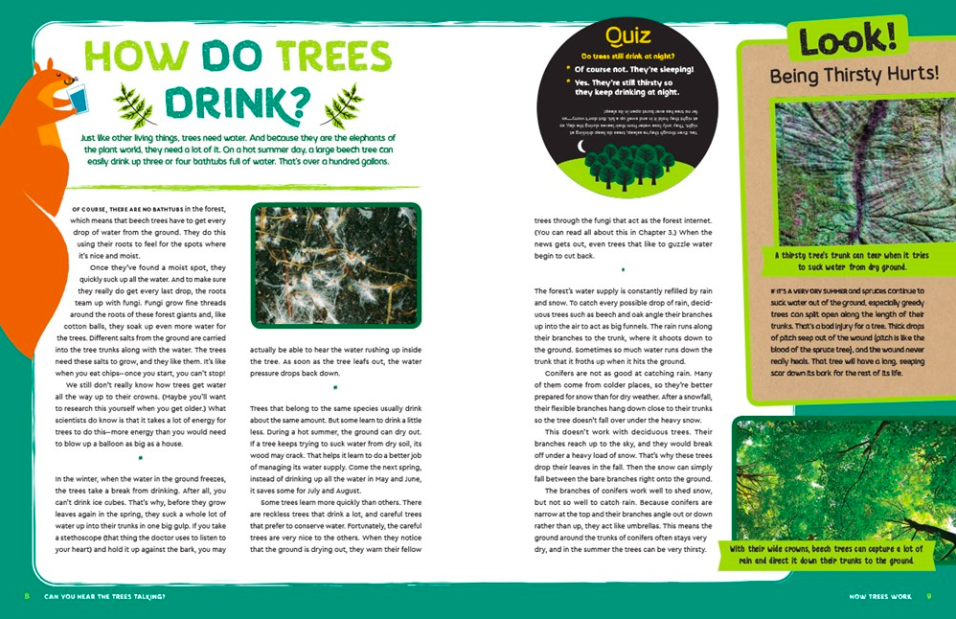
celebrate-picture-books-picture-book-review-can-you-hear-the-trees-talking-drink

Copyright Peter Wohlleben, 2019, courtesy of Greystone Kids.

We all know that animals, such as squirrels, hide food for the winter, but did you know that jays are masters of this autumn task? In Who’s the Best Forest Detective? Kids learn that when jays bury nuts and worms there are certain considerations. “Acorns and beechnuts remain fresh for more than six months, while dead earthworms only last a few days. The bird knows it has to eat the worms first so they don’t spoil.” And with the ability to “remember up to ten thousand hiding places,” quickly finding his stash is easy. “Usually, two thousand acorns and beechnuts are enough to see it through the winter. But because the jay can’t be sure that will be enough, it prefers to bury a few thousand more just in case.”
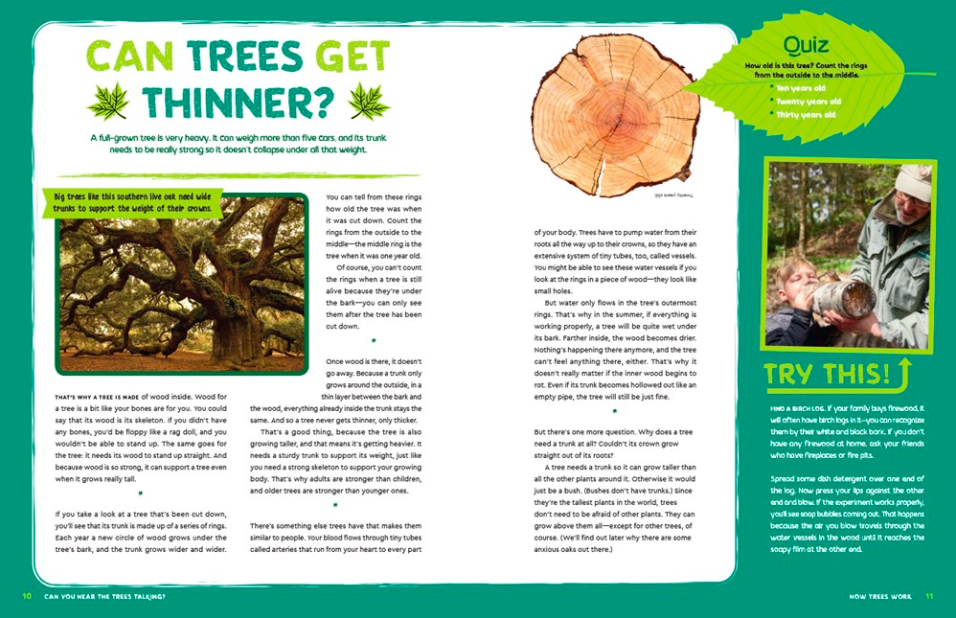
celebrate-picture-books-picture-book-review-can-you-hear-the-trees-talking-thinner

Copyright Peter Wohlleben, 2019, courtesy of Greystone Kids.

With quizzes, prompts for observation, and interesting experiments to try, Can You Hear the Trees Talking? will keep young readers riveted to the pages and eager to get out into nature to explore the trees in a forest, a park, in their neighborhood, and close to home. This book would make a superb and often-referred-to addition to home, school, and public library collections.

Ages 8 – 12 and up

Greystone Kids, 2019 | ISBN 978-1771644341

You’ll find a Can You Hear the Trees Talking? Companion Guide for parents and teachers to download on the Greystone Books website.

Discover more about Peter Wohlleben, his books, and his work on his website.

You can find Can You Hear the Trees Talking? at these booksellers

Amazon | Barnes & Noble | Books-a-Million | IndieBound

Arbor Day Activity

celebrate-picture-books-picture-book-review-paper-plate-tree-craft-2

Paper Plate Tree


On Arbor Day children love planting trees in their yard or as part of a community project. With this easy craft, they can also make a tree for the table or to hang on their wall or bulletin board.

Supplies

  • Two paper plates 
  • Paper towel tube
  • Brown craft paint
  • Green craft paint (using a variety of green paints adds interest)
  • Paintbrush, cork, or cut carrot can be used to apply paint
  • Glue or hot glue gun or stapler

Directions

  1. Paint the paper towel tube brown, let dry
  2. Paint the bottoms of the two paper plates with the green (or other color) paints, let dry
  3. Flatten about 4 inches of the paper towel tube 
  4. Glue or tape the flat part of the paper towel tube to the unpainted side of one paper plate
  5. Glue the edges of the two paper plates together, let dry.
  6. Pull out the bottom of the tube so the tree can stand up, or hang your tree on a wall or bulletin board or in a window

celebrate-picture-books-picture-book-review-peter-and-the-tree-children-cover

You can find Peter and the Tree Children at these booksellers

Amazon | Barnes & Noble | Books-a-Million | IndieBound

Picture Book Review

April 23 – National Frog Month

celebrate-picture-books-picture-book-review-pokko-and-the-drum-cover

About the Holiday

As the weather gets warmer, rain falls, and swampy areas and wetlands swell with water, the peeps and throaty croaks of frogs begins to fill the nighttime air. April is the perfect time to learn more about frogs and their importance to the ecosystem. Frogs are vital to the food system, and they eat insects that are harmful to crops and carry disease. Because they don’t drink water but absorb it through their skin, frogs are particularly susceptible to pollution. This, in addition to habitat destruction, climate change, and an increase in invasive species, threaten the frog population, making the conservation of their environment of utmost importance. This month, visit an aquarium, nature preserve, or zoo where you can learn more about these fascinating creatures.

By Jakki Licare

Pokko and the Drum

By Matthew Forsythe
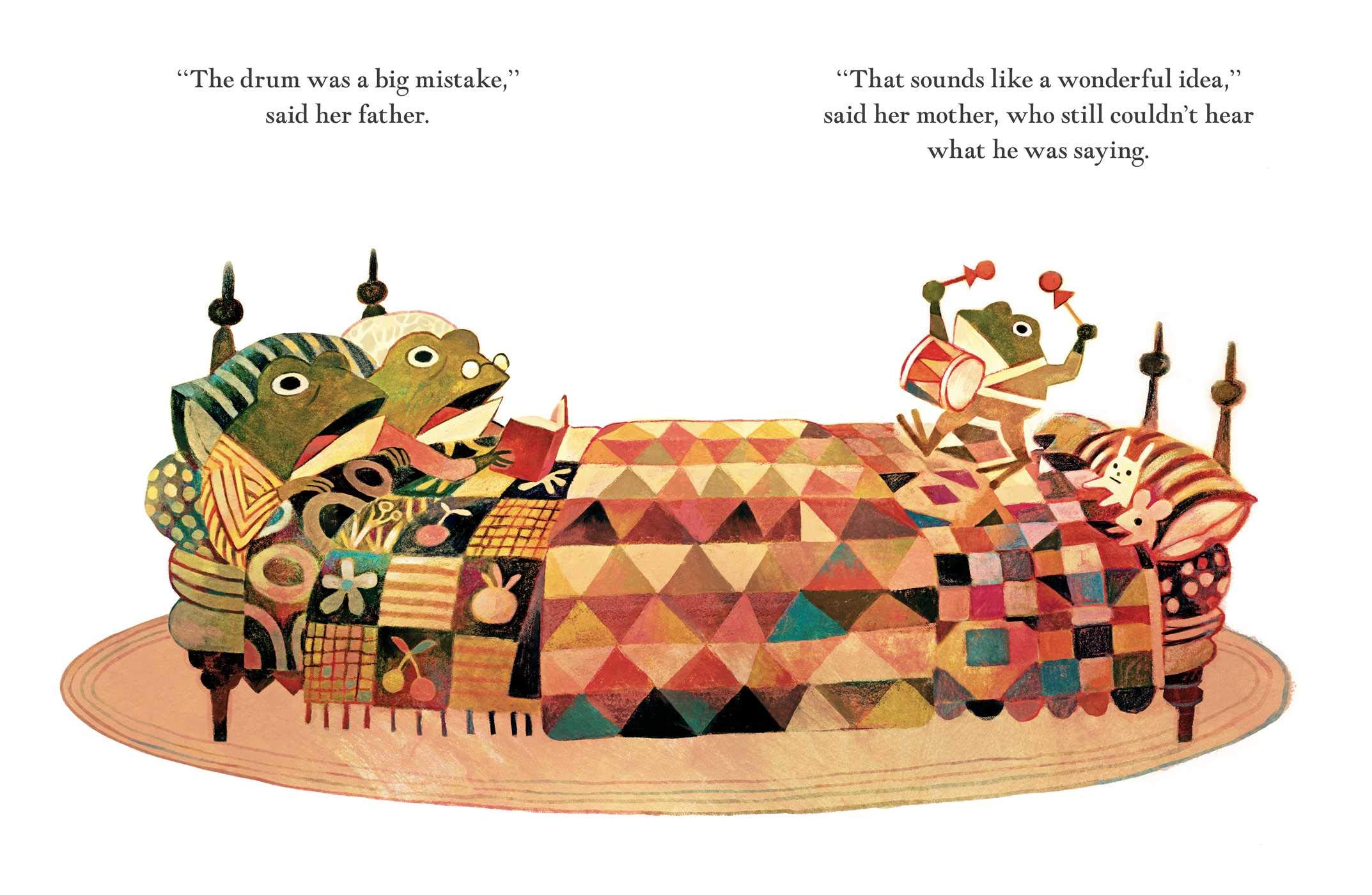
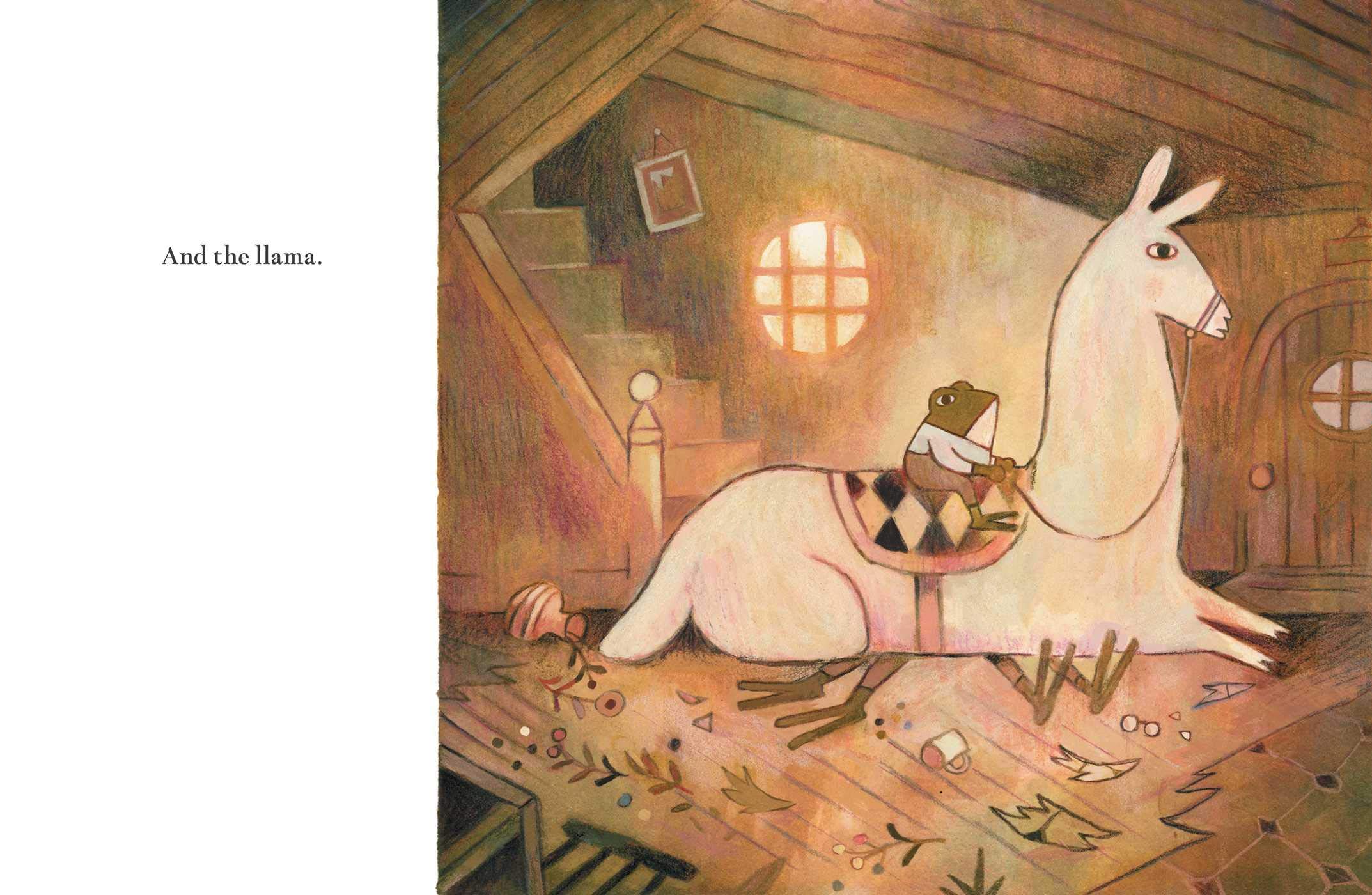
Pokko’s parents believe that giving Pokko a drum was the biggest mistake they have ever made. There had been other questionable gifts: Once, Pokko had tried to launch herself with the slingshot they had given her. The llama had been another poor choice since it liked to sit on Pokko’s parents. When Pokko’s parents had given her a balloon, it had carried Pokko away. “But the drum was the biggest mistake.” 

celebrate-picture-books-picture-book-review-pokko-and-the-drum-llama

Copyright Matthew Forsythe, 2019, courtesy of Paula Wiseman Books/Simon & Schuster.
Pokko’s father tries to complain to his wife about giving Pokko the drum, but she shouts back that she can’t hear him over the noise. In bed that night, Pokko continues to beat her drum. Her father continues to complain, but still no one can hear him. The next day, Pokko’s father suggests that Pokko take the drum outside. She can’t be too loud though, he explains, because they are a quiet family who likes to keep to themselves. Pokko agrees and takes the drum outside.

celebrate-picture-books-picture-book-review-pokko-and-the-drum-bed

Copyright Matthew Forsythe, 2019, courtesy of Paula Wiseman Books/Simon & Schuster.

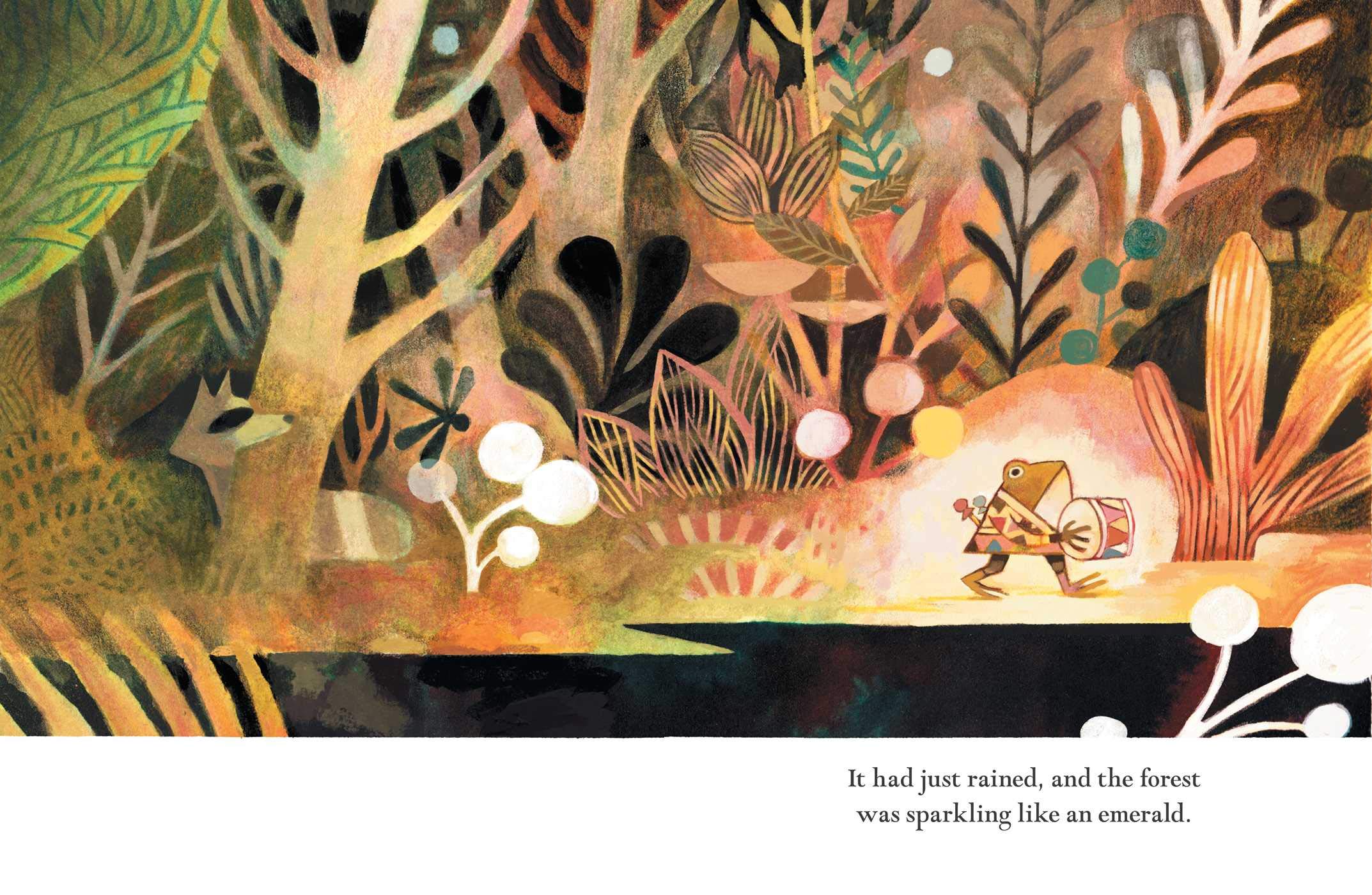
“It had just rained, and the forest was sparkling like an emerald.” Pokko thinks the forest is a little too quiet. She narrows her eyes and decides it is definitely too quiet. She starts to gently hit her drum. Behind her something moves. A raccoon playing a banjo emerges from the forest and joins Pokko. Pokko plays her drum proudly. Then a rabbit playing a trumpet tags along while Pokko continues to tap her drum. Next, a wolf appears and happily joins the parade. Pokko leads the group, continuing to beat her drum.

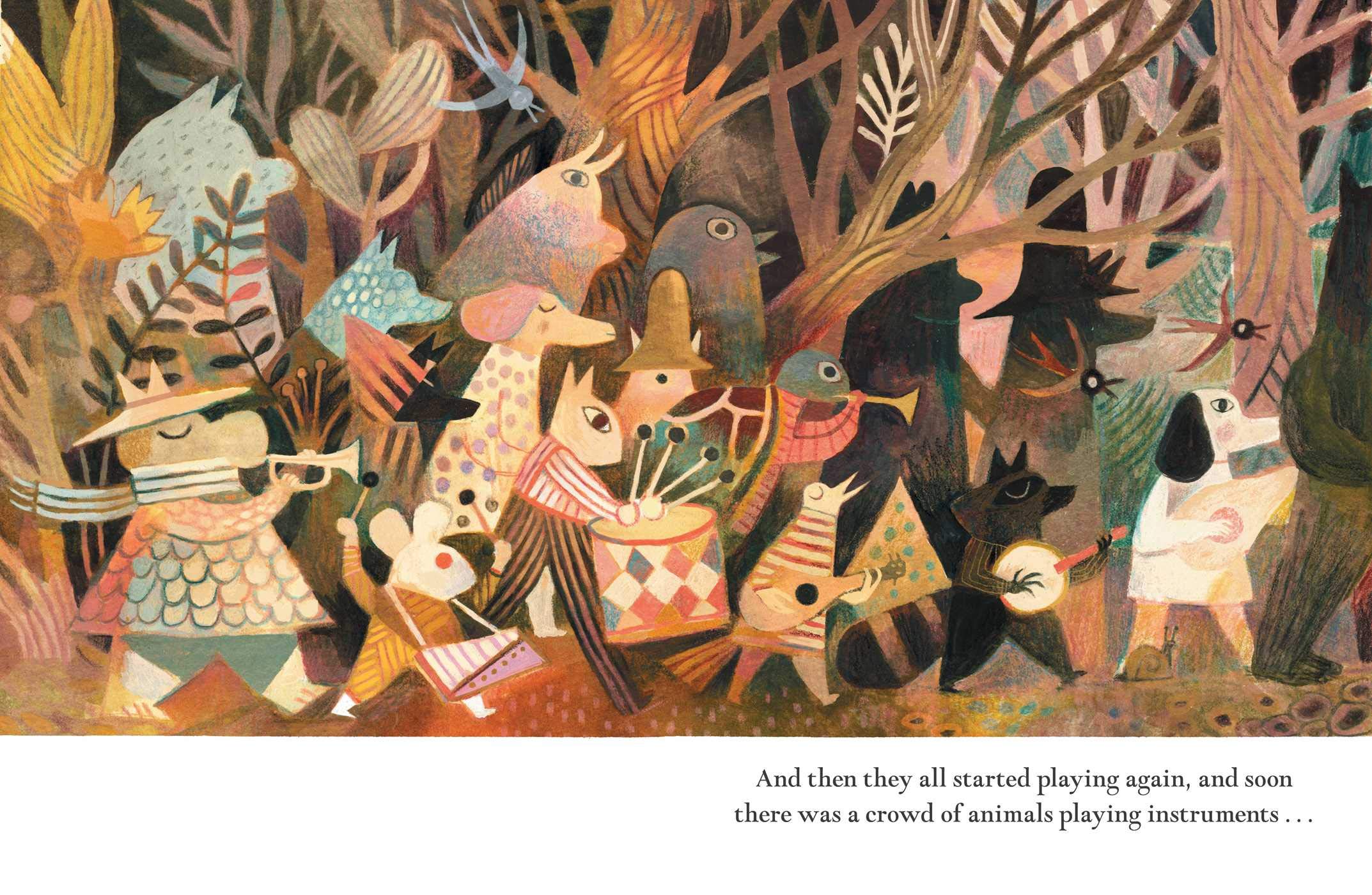
Suddenly, the wolf eats the rabbit and they all stop. Pokko turns to the wolf and tells him he can’t be in the band if he eats band members. The wolf apologizes. They continue on and play their instruments. A huge crowd gathers with instruments and joins them. More animals emerge from the forest. “And they were all following Pokko.”

celebrate-picture-books-picture-book-review-pokko-and-the-drum-raccoon

Copyright Matthew Forsythe, 2019, courtesy of Paula Wiseman Books/Simon & Schuster.

Pokko’s father shouts to her that dinner is ready, but Pokko doesn’t respond. Far away her father can hear music playing. He stands in the kitchen and can hear the music getting louder… and louder. The animal crowd spills into the house, sweeps up Pokko’s parents, and carries them off into the forest. Her father notices that Pokko is leading all the animals and listens thoughtfully. He admits to Pokko’s mother that Pokko is a great drummer. The music is too loud and no one can hear him speaking, but if they had…. “they all would have agreed.”

celebrate-picture-books-picture-book-review-pokko-and-the-drum-crowd

Copyright Matthew Forsythe, 2019, courtesy of Paula Wiseman Books/Simon & Schuster.

“The biggest mistake Pokko’s parents ever made was giving her a drum.” This beautiful beginning sentence sets the readers up for the witty adventures of Pokko. This book has the perfect combination of spirited characters, playful text, and illustrative humor. Pokko is a strong froglet who isn’t afraid of her individuality like her frog family is. She is warned not to attract attention to herself, but she can’t stand how quiet the forest is. She makes her beautiful music unashamed of the attention, and the forest animals can’t help but to follow her. 

Forsythe’s visual humor delivers  punchline after punchline, making young readers giggle throughout this book. He illustrates a balloon carrying Pokko away, the parent’s legs sticking out from under the llama’s body, and Pokko launching herself with a slingshot. But through all this humor there is a sweet message of female empowerment. Pokko is the leader of the band and she bravely admonishes the wolf for eating the rabbit. Forsythe also paints the father making dinner and wearing an apron through the whole story.  

Forsythe’s glowing watercolor and colored-pencil illustrations make for a magical world of cozy toadstool homes in the colorful forest. Forsythe uses close ups of his characters to show emotions and to add humor. The first close up  is when Pokko decides the forest is too quiet. Her narrow-eyed determination builds the reader’s anticipation for her to start drumming. The second zoom-in comes when Pokko’s father hears the music getting louder and closer. The father is wide-eyed and, once again, the reader cannot wait to see what will happen next. 

A fun read aloud that could be accompanied by a variety of instruments and/or hand clapping, Pokko and the Drum is a multi-award-winning book that will quickly become a favorite for home, school, and public library collections. 

Ages  4 – 8 years

Simon & Schuster/Paula Wiseman Books, 2019 | ISBN: 978-1481480390

To learn more about Matthew Forsythe, his books, and his art, visit his website.

National Frog Month Activity

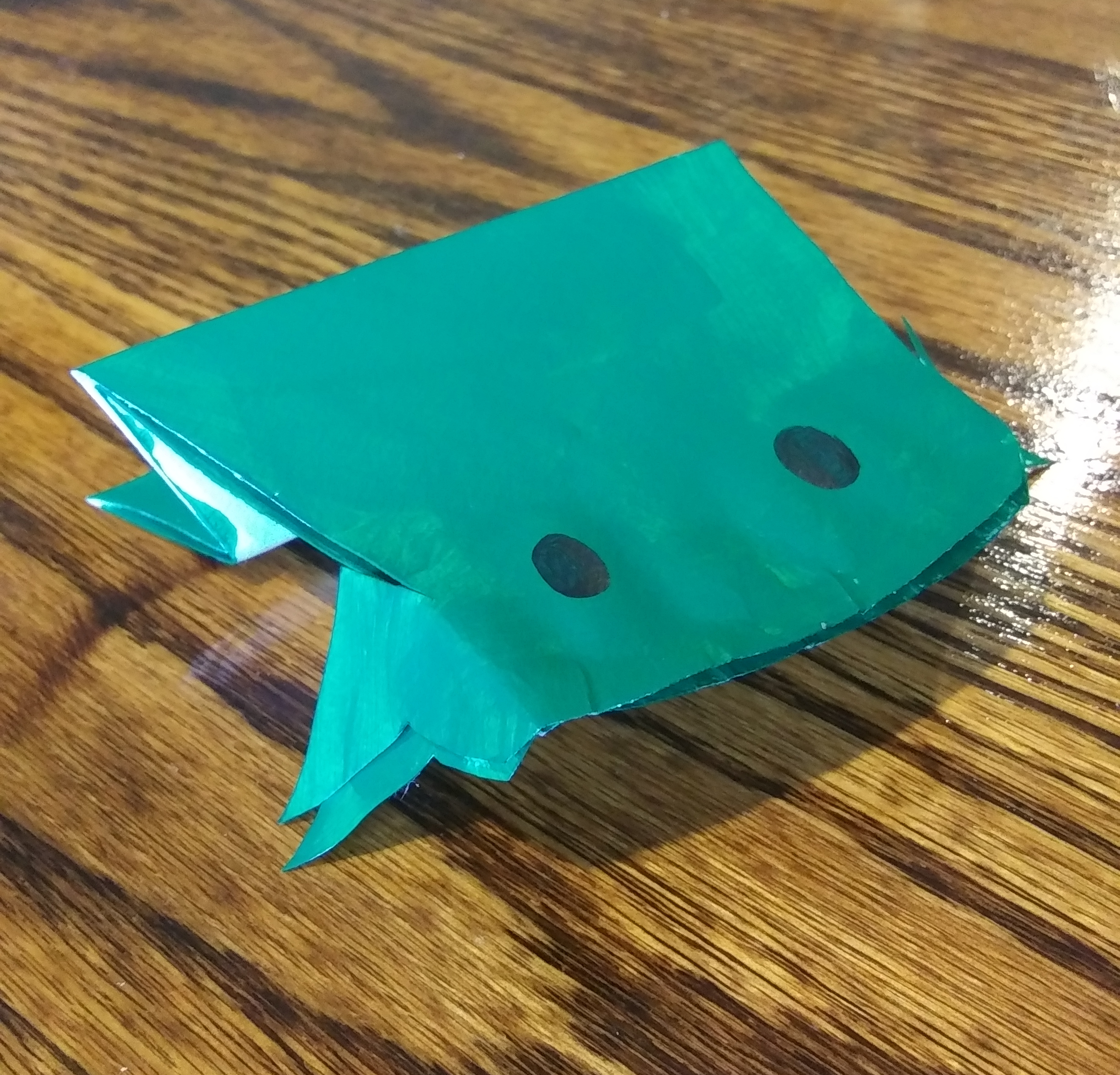
celebrate-picture-books-picture-book-review-hopping-frog-craft

Hopping Frog

Ready to hop to the beat of your own drum? Follow the instructions below to make your own hopping frog.

Supplies

  • Paper Plate
  • Scissors
  • Pencil
  • Ruler
  • Crayons, colored pencils, or paint

celebrate-picture-books-picture-book-review-hopping-frog-craft

Directions

  1. Fold plate in half

  2. Fold the bottom of the plate (folded side) 2 inches up.

  3. Now fold the same part back down a one inch. This creates a zig zag fold and will make the spring for the frog to hop.

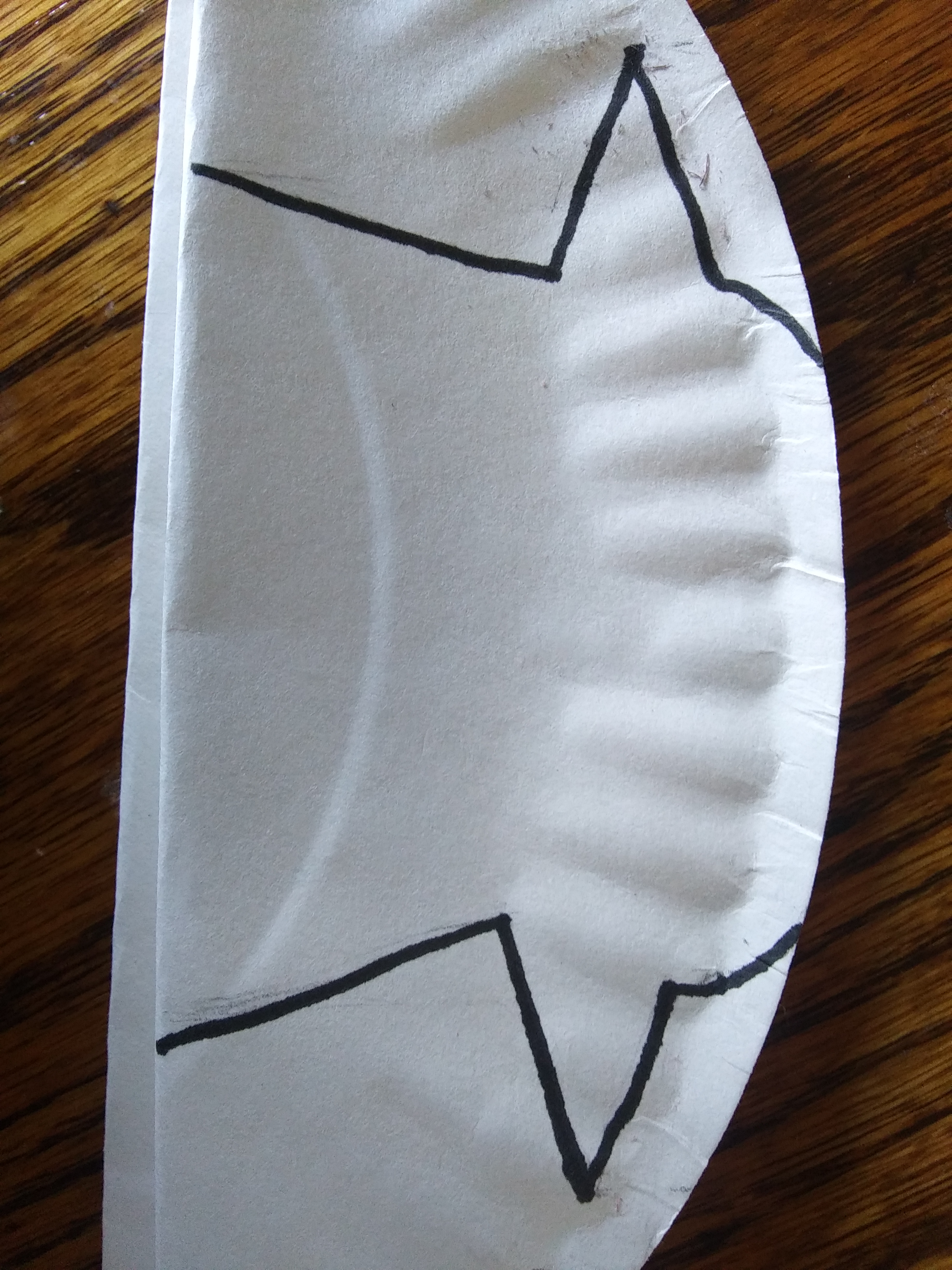
  4. Copy the shape in this picture onto your plate. You can make your frog bigger or smaller just be sure the triangles are the same height.

  5. Cut out your frog

  6. Fold triangles down to make front legs

  7. Color your plate green and add color in eyes

celebrate-picture-books-picture-book-review-pokko-and-the-drum-cover

You can find Pokko and the Drum at these booksellers

Amazon | Barnes & Noble | Books-a-Million |IndieBound

Picture Book Review