We’ve hit mid-summer, and maybe you’re looking for something to do. This month’s holiday encourages people to get out and enjoy some exercise and fun in parks, at home, at the gym, in the pool, on tennis courts, or wherever you like to play. Biking is another wonderful activity that adults and kids can share, whether you live in a small town or the city.
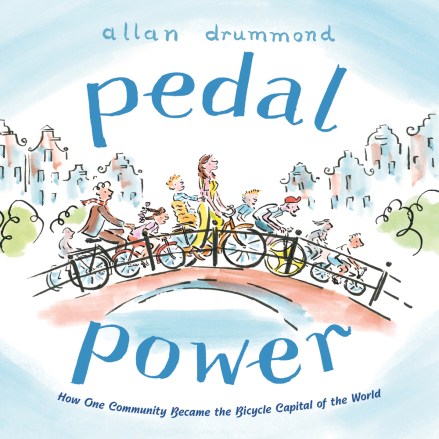
Pedal Power: How One Community Became the Bicycle Capital of the World
By Allan Drummond
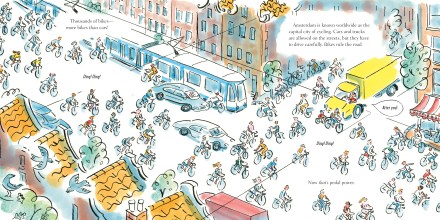
If you were to visit the city of Amsterdam in the Netherlands, you’d be amazed at the number of bicyclists sharing the roads with cars and trucks. In fact, if you could count all of the bicycles going here, there, and everywhere, you’d see that “bikes rule the road.” It wasn’t always like this. Back in the 1970s cars were still king, making the roads unsafe for cyclists.
Copyright Allan Drummond, 2017, courtesy of us.macmillan.com
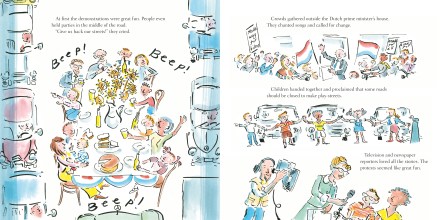
But then “young moms like Maartje Rutten and her friends—and their children” decided to make a change. They called their friends, who called their friends, and word started to get around that roads should be shared by all. People in Amsterdam and all over the Netherlands started protesting. “At first the demonstrations were great fun. People even held parties in the middle of the road.” People sang songs, made human chains across streets, and talked to the media.
Then a tragedy made people look at the issue more seriously. A little girl riding her bike to school was killed by a car. Her father was a newspaper reporter, and he wrote a story revealing that just in that year alone five hundred children had been killed on the roads and “many of them were riding bikes.” This situation made people angry. More and more citizens joined the protests.
Copyright Allan Drummond, 2017, courtesy of us.macmillan.com
At the same time, gas prices were rising and fuel was becoming scarce. The government even banned cars from the roads on Sundays. “That gave Maartje an incredible idea.” She gathered her friends and told them her plan: they would ride their bikes through the new tunnel that was strictly for cars. Many people were wary but they came anyway, and on a quiet Sunday they pedaled through the darkness.
As they neared the mouth of the tunnel, they could see the police waiting for them. Some of the riders wanted to turn around and go back, but Maartje pushed on and they followed. When they reached the end, the cops told them they had broken the law. The cyclists were taken to the police station. There, they were given lemonade and cookies. Maartje even “noticed that the policemen were smiling just a little bit. Maybe all of this protesting is working, she thought.”
Copyright Allan Drummond, 2017, courtesy of us.macmillan.com
She was right! After that Maartje and her friends thought of other ways cars and bikes could share the roads. “They proposed special bike lanes on busy routes, traffic bumps and curves in the roads to slow down vehicles, and new laws giving bikes the right-of-way over cars.” Finally, it all came together. Now Amsterdam is known as the bike capitol of the world. Their ideas, including bike lanes, bike sharing, and new laws, are used in countries all over the globe.
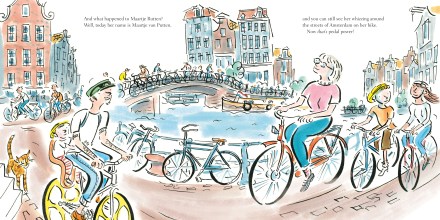
Biking offers so much more than just less-crowded streets. It provides exercise, a quiet form of transportation, and a pollution-free way to get around. And, of course, bikes don’t require fuel to go. If you visit Amsterdam, you might even see Maartje riding around town on her bike. “Now that’s pedal power!”
An Author’s Note about how Pedal Power came to be and about the past and future of city biking follows the text.
Copyright Allan Drummond, 2017, courtesy of us.macmillan.com
Allan Drummond’s city bike-ography is an interesting look at the revolution and evolution of bike-friendly roads in Amsterdam and other large cities. By following the story of Maartje Rutten and how she transformed the mindset of both local drivers and government officials, Drummond allows young readers to see how one person can make lasting changes that benefit all.
Drummond’s colorful and clearly depicted illustrations take children into the heart of Amsterdam—and Amsterdam traffic—to understand the problem and join in the protests. As Maartje and her friends ride through the dark tunnel to face the police, readers will wait in suspense to learn how this peaceful demonstration played out.
Pedal Power would be a great addition to Social Studies units and an engaging read for kids interested in biking, history, and environmental issues.
Ages 4 – 8
Farrar, Straus and Giroux, 2017 | ISBN 978-0374305277
Discover more about Allan Drummond, his books, and his art on his website!
Park and Recreation Month Activity
Everything on a Bicycle Coloring Page
Riding a bicycle is a fast, fun way to exercise, do shopping, and spend time with friends. This printable Everything on a Bicycle Coloring Page combines them all and then some! Grab your colored pencils, crayons, or markers and give it a go!
Today’s holiday envisions a day when there is no dishonesty or deception of any kind and encourages people to clear the air if there are hard feelings or to tell truths, even if they’re hard. If there is an honest statement you need to say, today may be the perfect opportunity to discuss it.
Kate Warne: Pinkerton Detective
Written by Marissa Moss | Illustrated by April Chu
As Kate read the newspaper advertisement from the Pinkerton Agency for the third time, she knew that this was the job for her. It said: “Wanted: Detective. Must be observant, determined, fearless, and willing to travel.” But in 1856 no one would hire a single woman, so Kate decided to present herself as a widow.
Kate had been raised by her father, a printer. Books had always been her companions, and she knew how to make up a story—even the story of her life. “So Kate Carter became Kate Warne…exactly the kind of person you’d want to hire as a detective.” As soon as she walked through the door, Allan Pinkerton began writing down his impressions of Kate. He thought she was a client seeking help. From her manner and appearance, he knew he would take her case—whatever it was.
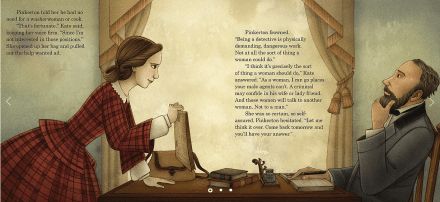
But when Kate told him she was applying for a job, he told her he “had no need for a washerwoman or cook.” Kate told him she was there to apply for the detective position. Pinkerton had reservations. The dangerous work was “not at all the sort of thing a woman could do,” he said. But Kate disagreed. She told him that she would be able to go into places his male detectives could not and could be the confidant of women witnesses. Pinkerton told her he would think it over.
Image copyright April Chu, text copyright Marissa Moss. Courtesy of Creston Books.
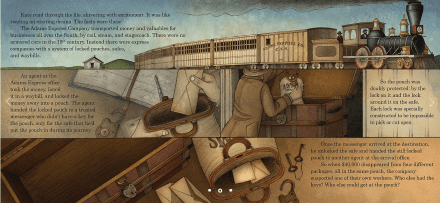
The next day Kate was at the office as soon as it opened. “Today, you’ve made some history,” Pinkerton told her, “You’re now the first woman detective in the country.” He handed her a file marked The Adams Express Case. As she read the case, Kate felt a thrill of excitement. “The Adams Express Company transported money and valuables for businesses all over the South, by rail, steamboat, and stagecoach.” Valuables were well protected by locks that couldn’t be picked.
But $40,000 had disappeared. One suspect stood out from the rest—Nathan Maroney, the manager of the Montgomery office where the packages had come from. He had been the last person to lock up the carrying pouch before the messenger, Mr. Chase, transported it to Atlanta, where it was found to be empty. Maroney was arrested, but there was little hard evidence—only a slit in the pouch that had not been there before Maroney was accused.
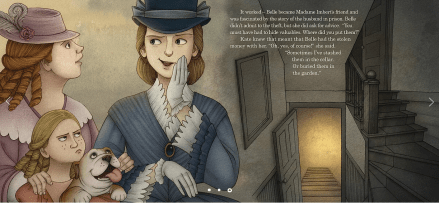
Kate considered the problem then remembered the sleight of hand tricks huskers used to fool people. She figured out how Maroney had stolen the money, but they needed more evidence and a confession. While a male agent pretended to be a fellow thief named “John White” in the same jail cell as Maroney, Kate befriended Maroney’s wife, Belle, pretending to be Madame Imbert. While Belle didn’t confess to the theft, she did ask her new friend for advice on where to hide valuables. Kate told her she hid her valuables in the basement or buried them in the garden.
Image copyright April Chu, text copyright Marissa Moss. Courtesy of Creston Books.
When Belle left town to visit her husband in jail, Kate took the opportunity to do some snooping at her house. Just as Kate found a freshly dug mound behind crates and barrels in the basement, she heard Belle returning home. She hurriedly put everything back in place and rushed upstairs. Belle was suspicious of the dust on Kate’s dress, and Kate knew she and the other agents had to act fast. She alerted another agent who crawled through the basement window while Belle slept. He tidied up the basement, and the next morning when Belle checked her hiding place, everything was in order. She could still trust her friend she thought.
The Pinkerton Agency plan was going like clockwork. Inside the jail cell, Maroney put his faith—and his money—in the detective’s hands. Maroney wrote to Belle, telling her that John White was going to help them. He instructed her to give John White all the money he had stolen. White was going to plant some of it on Mr. Chase, use some of it to bribe a judge to find Maroney not guilty at trial, and keep the rest for Maroney to collect later. At first, Belle didn’t trust John White, but one sentence from her friend “Madame Imbert” eased her mind and she went along with her husband’s plan.
As the ingenious plan was hatched and carried out, Kate made sure that all the money was secure. The money made its way to the Pinkerton agent “Mr. White” with Belle and Maroney none the wiser. As Maroney’s trial proceeded, and he heard Mr. White called as the first witness, Maroney suddenly changed his plea from “not guilty” to “guilty.” “The reputation of the Pinkerton agency was made. So was Kate Warne’s.”
Kate became one of the agency’s most valuable detectives. She was even put in charge of a women’s division and hired many more women who became “some of Pinkerton’s strongest agents.” But Kate Warne, the first woman detective in America, would always be considered the best.
Image copyright April Chu, text copyright Marissa Moss. Courtesy of Creston Books.
An Author’s Note explaining more about the Pinkerton Detective Agency and the first woman detective follow the text.
Children who love mysteries will be enthralled with this true tale of the first woman detective in America and her explosive first assignment. Marissa Moss’s suspenseful, compelling storytelling and excellent pacing reveal the facts of the case, Kate’s insightful reasoning, and the clever ruses the agents used in outsmarting and capturing the thief. Moss infuses the story with the feeling of the time period and a sense of pride in this little-known piece of women’s history.
April Chu’s detailed period drawings take kids to the mid-1800s to follow Kate Warne as she solves her first case. Depictions of Kate’s father’s printing press, the dirt roads traversed by horse-drawn wagons and carriages, the Adams Express locked pouches and secure rail car will excite history and mystery buffs. The full cast of characters are clearly portrayed, allowing young readers to become detectives themselves as they see the action through Kate’s eyes. The dramatic finale to the case will have children on the edge of their seats whether they are hearing the story aloud or reading it themselves.
Kate Warne: Pinkerton Detective is a thrilling picture book introduction to both biographies and mysteries for children. It offers a unique look at the contributions of strong women in history and is an excellent selection for school, public, and home libraries.
Ages 5 – 13
Creston Books, 2017 | ISBN 978-1939547330
Visit with Marissa Moss on her website to discover more about her, her books, and loads of fun activities!
View a gallery of artwork by April Chu on her website!
Plastic bags are everywhere! Used by supermarkets, department stores, discount stores, and just about anywhere goods are sold, plastic bags are a take-home-then-throw-away item that never quite goes away. These bags may seem lightweight, but they do heavy damage to the environment, taking hundreds of years to fully decompose. Many shops encourage patrons to bring their own bags and offer cloth and paper bags as well. These are great alternatives that benefit the earth. Today’s holiday was established to promote awareness around the world to the dangers of plastic bags and spur people to use reusable containers.
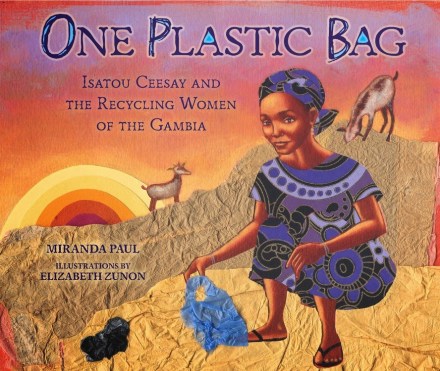
One Plastic Bag: Isatou Ceesay and the Recycling Women of the Gambia
Written by Miranda Paul | Illustrated by Elizabeth Zunon
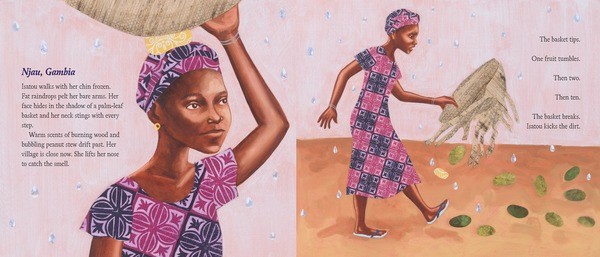
In Njau, Gambia Isatou walks home carrying a basket of fruit on her head. As raindrops begin to fall, the basket shields her, but suddenly the basket tips and falls. The fruit inside tumble to the ground. The basket is in shreds; how will Isatou carry her load? “Something silky dances past her eyes, softening her anger. It moves like a flag, flapping in the wind, and settles under a tamarind tree.” Isatou picks it up and finds that it can hold things. She gathers her fruit and puts them in the bag. She leaves her basket behind, “knowing it will crumble and mix back in with the dirt.”
Image copyright Elizabeth Zunon , text copyright Miranda Paul. Courtesy of Millbrook Press.
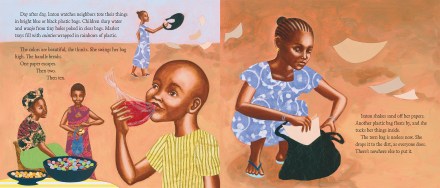
At home Grandmother Mbombeh has a dinner of spicy rice and fish ready. When Isatou tells her about the broken basket and shows her the bag, Grandmother frowns. She has seen more in the city. Now, Isatou notices plastic bags everywhere. They are as colorful as a rainbow. As Isatou swings her bag full of papers, the handle breaks, sending the papers inside flying. She finds another plastic bag lying nearby and transfers her papers. She leaves the torn bag in the dirt as everyone else does.
Image copyright Elizabeth Zunon, text copyright Miranda Paul. Courtesy of Millbrook Press.
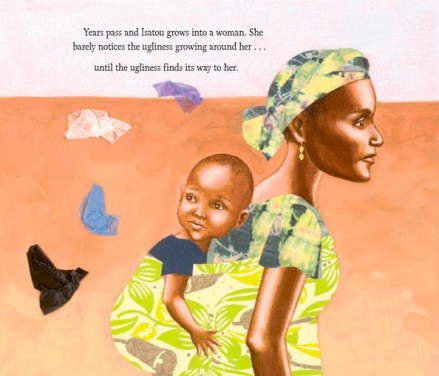
As she passes the spot day after day, she spies her old black bag. It has been joined by others, and the pile grows bigger and bigger. Isatou chooses another path to take and forgets about the bags. “Years pass and Isatou grows into a woman. She barely notices the ugliness growing around her…until the ugliness finds its way to her. One day when coming to Grandmother’s house, she hears one of her goats crying. It’s tied up and there is no sign of her Grandmother’s other goats.
Image copyright Elizabeth Zunon, text copyright Miranda Paul. Courtesy of Millbrook Press.
Inside, the butcher is talking to Grandmother Mbombeh. He says that the goats have eaten the plastic bags they find lying around. The bags get twisted around their insides, killing the goats. Three of Grandmother’s goats and many more in the village have died. Something must be done. Isatou goes to the road piled with bags. Insects, rotting food, and dirty water mingle with the bags. Goats “forage through the trash for food.”
Isatou retrieves bag after bag from the pile. She and other women wash the bags. While they dry Isatou asks her sister to teach her how to crochet. Isatou has an idea. From a broomstick she carves crochet needles. Then she and her friends cut the bags into strips of thread. The women teach themselves how to crochet with the plastic thread. The work is slow, and some villagers laugh at them. Long into the nights the women continue crocheting by candlelight.
Image copyright Elizabeth Zunon , text copyright Miranda Paul. Courtesy of Millbrook Press.
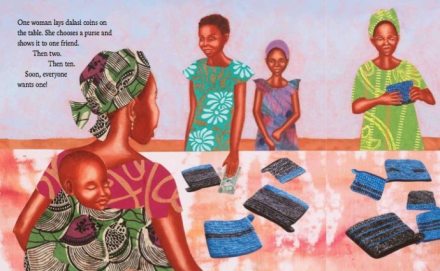
At last a day comes when the women can show what they have been working on. “Fingers sore and blistered, Isatou hauls the recycled purses to the city.” People laugh at her until “one woman lays dalasi coins on the table. She chooses a purse and shows it to one friend. The two. Then ten. Soon everyone wants one!” Later that day Isatou puts the money she has made into her own zippered purse. She can’t wait to show Grandmother that she has earned enough to buy a goat. The trash pile is smaller now. Isatou is determined that one day it will be gone. “And one day…it was.”
An Author’s Note provides more details about this true story as well as a Wolof language glossary and pronunciation guide.
Miranda Paul tells this true story of ingenuity and hope with honesty and evocative language. Young readers will learn how one woman’s concern for her community and courage in the face of opposition changed the lives of the people in her village. Paul’s descriptive text interspersed with native Wolof words allows children to discover details about the customs and daily lives of the citizens of Gambia. Paul’s use of the present tense, makes this a universal story that shows the continuing need for answers to ongoing environmental problems. Isatou’s creative solution to a world-wide problem may spur young readers to develop helpful ideas of their own.
Through her collage illustrations, Elizabeth Zunon brings the vibrant colors and patterns of Africa to readers. The textured papers she uses add depth and details to the women’s clothing, homes, foliage, and the plastic bags that Isotau and her friends transform. Children sit in on the candlelit nighttime crocheting sessions and view the beautiful, finished purses—each one unique.
Ages 6 – 9
Millbrook Press, 2015 | ISBN 978-1467716086
Discover more about Miranda Paul and her books and find resources, videos, photos, and more on her website!
Learn more about Elizabeth Zunon and her books and view a portfolio of her artwork on her website!
International Plastic Bag Free Day Activity
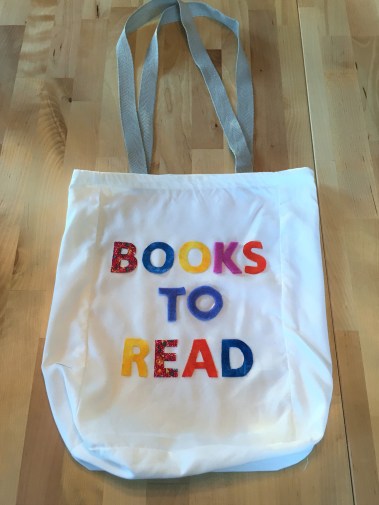
Books to Love, Books to Read Reusable Book Bag
True booklovers can’t go anywhere without a book (or two or three) to read along the way. With this easy craft you can turn a cloth bag into a kid-size book bag!
Small cloth bag, available from craft or sewing stores—Recyclable Idea: I used the bag that sheet sets now come in
Cloth trim or strong ribbon, available from craft or sewing stores—Recyclable Idea: I used the cloth handles from shopping bags provided from some clothing stores
Scraps of different colored and patterned cloth. Or use quilting squares, available at craft and sewing stores
Pen or pencil for tracing letters onto cloth
Scissors
Small sharp scissors (or cuticle scissors) for cutting out the center of the letters
Fabric glue
Thread (optional)
Needle (optional)
Directions
Print the sayings and cut out the letters
Trace letters onto different kinds of cloth
Cut out cloth letters
Iron cloth bag if necessary
Attach words “Books to Read” to one side of bag with fabric glue
Attach words “Books to Love” to other side of bag with fabric glue
Cut cloth trim or ribbon to desired length to create handles
Today’s holiday was established in 2009 when the students of Bold Park Community School in Wembley, Western Australia teamed with the boys of the Nepalese Panchkhal Orphanage to “celebrate the visceral and primal connection we all share with Earth and the outdoors.” Since that day, schools, families, and early childhood education centers have worked to remind us that we all need to take time to play in the mud sometimes and reconnect with what makes us human. In 2015, the day was expanded to include the entire month of June to allow us to decompress from the high-tech, high-pressure world we live in and to connect with others.
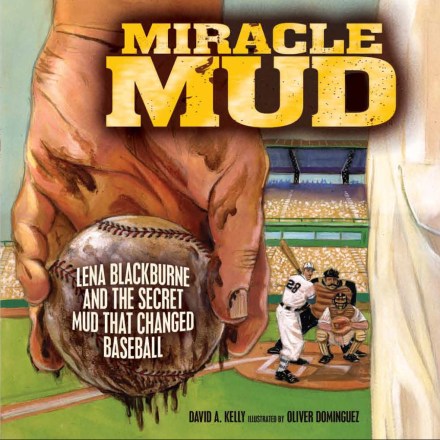
Miracle Mud: Lena Blackburne and the Secret Mud that Changed Baseball
Written by David A. Kelly | Illustrated by Oliver Dominguez
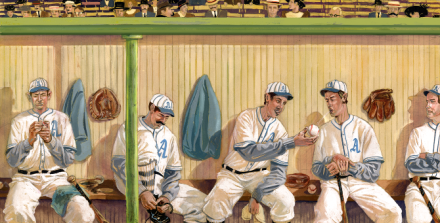
“Lena Blackburne wanted to be a famous baseball player.” Unfortunately, he wasn’t one of the greats. In fact starting in 1910, Lena moved around from team to team, playing a variety of positions. He made appearances at every base and played shortstop; he even had a go as pitcher. But he wasn’t a star at any of these positions. He was never going to make it to the Hall of Fame.
Image copyright Oliver Dominguez, coiurtesy of oliver-dominguez.com
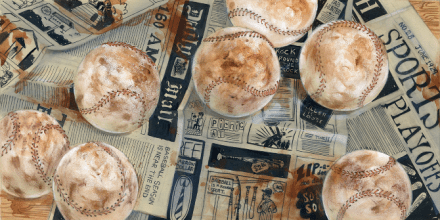
After he retired from playing, Lena became a coach. One day the umpire came to him with a complaint about the soggy baseballs. They were too hard to throw and too hard to see. Besides that, when they were hit, they didn’t soar very far. The problem was that new baseballs had a slick sheen to them, “so players soaked them in dirty water. It got rid of the shine. But it also made the balls soggy and soft.”
Image copyright Oliver Dominguez, coiurtesy of oliver-dominguez.com
Players tried other methods to get rid of the shine, but they had drawbacks too. Shoe polish just turned the balls black, and “spit and tobacco juice…made the balls stink.” Lena Blackburne sat down and considered the problem. The answer came to him in a most unusual place—an old fishing hole where Lena liked to go when he was off the road and home.
Image copyright Oliver Dominguez, coiurtesy of oliver-dominguez.com
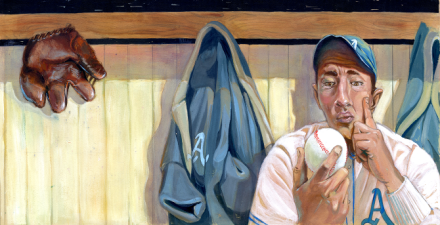
While fishing one day, he happened to step into some dark brown mud. It sucked at his boot, and as Lena pulled his foot out he had an idea. The mud was “smooth and creamy like chocolate pudding. But it felt gritty.” At the ballpark, Lena rubbed the mud on the balls. When the mud dried, it was easy to wipe off. The mud left the balls with a good finish—not soggy, black, or smelly. At the next game, “the pitcher threw muddy fastballs, curveballs, changeups, and sinkers. The batters hit muddy singles, doubles, triples, and home runs.”
Image copyright Oliver Dominguez, coiurtesy of oliver-dominguez.com
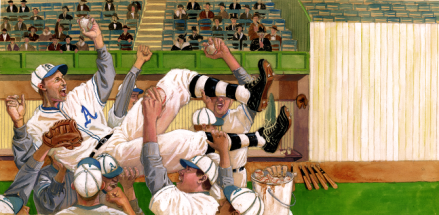
Lena returned to the fishing hole and dug up more mud. He put it into containers and began selling it. Teams all over the league bought Lena Blackburne’s Baseball Rubbing Mud. Lena’s famous mud is still used today and is officially the “only thing that’s allowed on major-league balls.” Lena Blackburne always dreamed of being in the Baseball Hall of Fame. While he didn’t make it there as a player, he is remembered for his contributions to the game he loved in a special exhibit for Lena Blackburne’s Baseball Rubbing Mud.
Image copyright Oliver Dominguez, coiurtesy of oliver-dominguez.com
An Author’s Note including more about Lena Blackburne, his baseball statistics, and his special mud follow the text.
Kids who love baseball will be intrigued by David A. Kelly’s unique take on the game. By exploring a small detail that had large effects on the quality of play, Kelly presents a picture book mystery with a surprise ending for younger readers. Kelly’s inclusion of Blackburne’s disappointments shows children that each person’s unique contributions are often found in expected ways.
Image copyright Oliver Dominguez, coiurtesy of oliver-dominguez.com
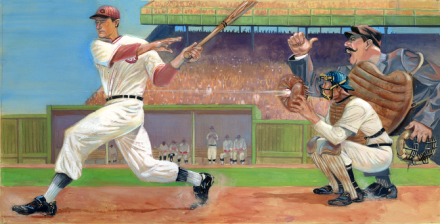
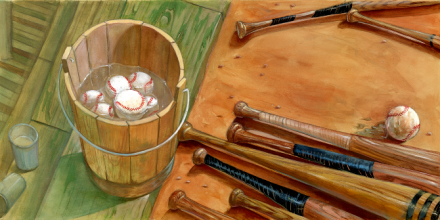
Kids get a front row seat at the baseball stadium in Oliver Dominguez’s stunning illustrations. As Lena swings and misses, readers can almost hear the smack of the ball in the catcher’s glove and the ump yelling, “Steee-rrriike!” When Lena Blackburne becomes a coach and ponders the problem of the soggy baseballs, kids will enjoy seeing baseballs bobbing in a wooden bucket of water, laugh to see a player spitting on a new baseball, and wonder what idea has Lena so wide-eyed at the fishing hole. Baseball lovers will want to linger over the up-close views of players preparing for a game and celebrating their win.
Ages 6 – 10
Millbrook Press, 2013 | ISBN 978-0761380924
Find out more about David A. Kelly, his ballpark mysteries, and his other books on his website!
View a gallery of artwork and videos by Oliver Dominguez on his website!
International Mud Day Activity
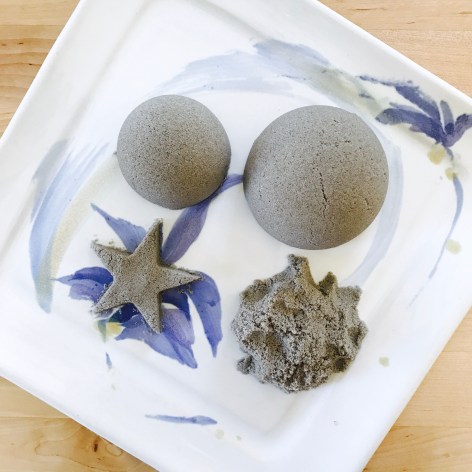
Make Your Own Sensory Sand
While this sensory sand may not be exactly mud, it’s sure as much fun to play with!
Supplies
1 cup sand
½ tablespoon cornstarch
1 teaspoon dish soap
Water as needed – about ¾ cup
Bin or bowl for mixing dry ingredients
Bowl for mixing dish soap and water
Directions
In the bin combine the sand and cornstarch and mix well
In the bowl combine the dish soap and water until the water is bubbly
Slowly add the water mixture to the dry ingredients, mixing and adding water little-by-little until the desired consistency is reached. The grain of the sand will determine how much water is needed.
The sand can be formed with cookie cutters, molds, hands, etc. and is strong enough to stack.
Olympic Day is celebrated by millions of people in more than 160 countries to commemorate the birth of the modern Olympic Games in 1894. The mission of Olympic Day is to promote fitness, well-being, culture and education, while promoting the Olympic values of excellence, friendship and respect. The Olympic Day pillars – move, learn and discover – are promoted in every corner of the globe. To have Olympic-size fun today, why not get together with friends or family and host your own mini-Olympic games? For more ideas and to learn more about today’s observance visitteamusa.org!
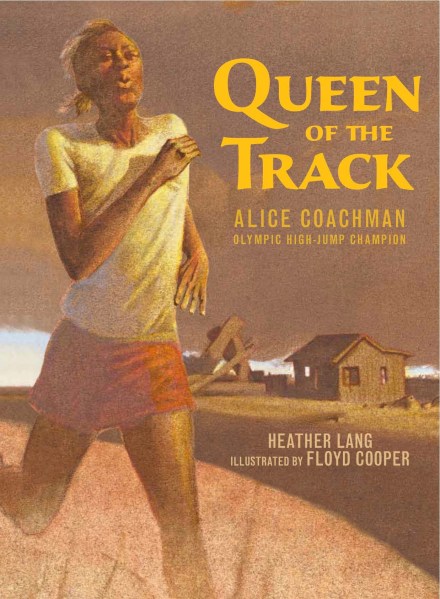
Queen of the Track: Alice Coachman, Olympic High-Jump Champion
Written by Heather Lang | Illustrated by Floyd Cooper
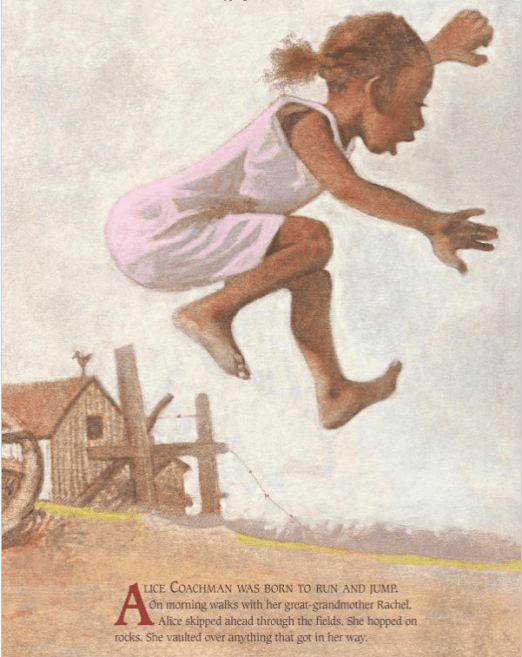
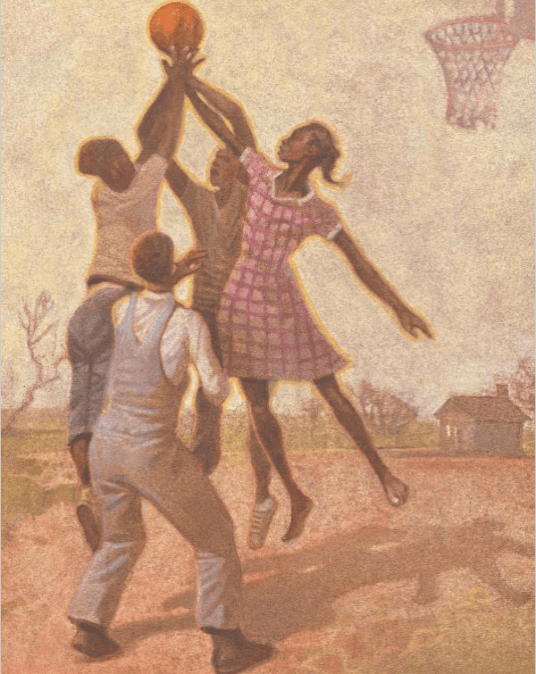
Alice Coachman was a born runner and jumper—skipping, hopping, and vaulting over every obstacle that came her way. As Alice grew older, however, the joy of running and jumping had to come a distant second to chores like cooking, laundry, picking cotton and peaches, and taking care of her younger siblings. Besides, her papa told her, “running and jumping weren’t considered ladylike.” Still, that was all Alice could think about, so after her chores were finished, she went out to play sports with the boys.
Image copyright Floyd Cooper, text copyright Heather Lang. Courtesy of Boyds Mills Press, 2012.
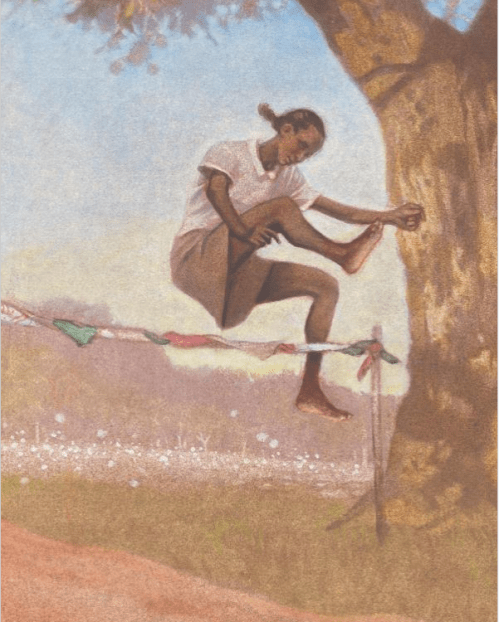
Living in the segregated South, Alice didn’t have the same rights as white people. She had nowhere to practice, but that didn’t stop her. Alice “ran barefoot on dirt roads. She collected sticks and tied rags together to make her own high jumps. Alice jumped so high, she soared like a bird above the cotton fields.” In seventh grade, Alice caught the attention of the high-school track coach. He arranged for her to join the track team at the Tuskegee Relays in Alabama, where the best black athletes from around the country competed. Alice had never worn track shoes or jumped over a real high-jump bar, she “won first place anyway, beating high-school and college girls.
Alice’s speed did more than win races. Once when a tornado ripped through Albany, she volunteered to deliver food to those in need. She ran so fast that the food stayed hot! Her talent won her a scholarship to finish high school at the Tuskegee Institute. Alice missed her family, and they didn’t have the money to really stay in touch. “One time she went home for a surprise visit, and her family had moved to a different house.”
Image copyright Floyd Cooper, courtesy of Boyds Mills Press, 2012
Alice competed on both the track-and-field and basketball teams. She won every event— the high jump, the 50-meter, the 100-meter, and the 400-meter relay—and led the basketball team to three straight championships. Alice was ready to compete in the Olympics. It was 1944, however, and the Olympic Games were canceled as the world was at war.
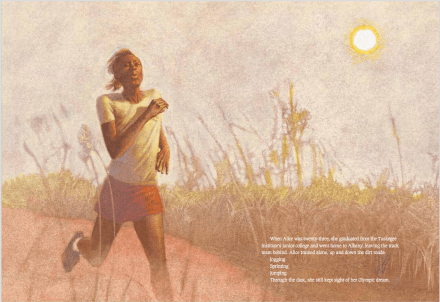
After graduating college from the Tuskegee Institute, Alice went home to continue practicing. Here, she trained alone on dirt roads. In 1948 with the war at an end, Alice qualified to compete in the London Olympics high jump. Even though years of hard training had weakened her back and made jumping painful, Alice pursued her dream. In London, the ravages of war were still visible, and “England faced serious food shortages. Alice and the other athletes were often hungry and thirsty.” The cold weather “pricked her like pins,” but here Alice and the other athletes—black and white—lived together, and Alice could sit anywhere she wanted on the buses as she toured the city.
Image copyright Floyd Cooper, text copyright Heather Lang. Courtesy of Boyds Mills Press, 2012.
As the Olympic Games opened with spectacular ceremonies, Alice marched into “Wembley Stadium to the applause of eighty-five thousand spectators.” Alice watched for eight days as her teammates lost event after event. Finally, it was Alice’s turn to compete. Her toughest opponent was Dorothy Tyler of Great Britain. “Inch by inch they battled it out—5 feet 3 2/5 inches, 5 feet 4 ½ inches. The sand in the landing pit was thinning out and the landings were tough on Alice’s back. 5 feet 5 1/3 inches.” The day was waning, and even though all of the other events were over, “the king and queen of England and thousands of spectators stayed to watch.”
The bar was placed at 5 feet 6 1/8 inches—as tall as Alice herself. She had never jumped so high before. “She sprinted, pumping her arms. She pushed off and flew…up…soaring…over the bar. Her leap set a new Olympic record!” But it was short lived. Dorothy also cleared the bar on her second attempt. The bar was placed at 5 feet 7 inches. Alice and Dorothy both jumped and missed. What would the judges decide? There are no ties allowed in the high jump.
Suddenly, Alice saw her name appear on the board! The judges awarded the medal to her because she “had made the record-breaking jump on her first try.” On that day—August 7, 1948—Alice Coachman stepped to the top of the podium and “became the first African American woman to win an Olympic gold medal.”
Image copyright Floyd Cooper, courtesy of Boyds Mills Press, 2012
Author’s Notes containing more information about Alice Coachman and the 1948 Olympics as well as lists of resources follow the text.
Heather Lang brings an athlete’s appreciation for the in-born talent and hard practicing that creates a world-class Olympian. Her story reveals not only the details of Alice’s physical training but also the social and economic hurdles she overcame in her quest to compete in the Olympics. Lang’s graceful and evocative prose carries readers down dirt roads and over obstacles, to the halls of the Tuskegee Institute, and into Wembley Stadium as they learn about the singular focus Alice Coachman dedicated to her sport. Children will feel as if they are sitting in the stands watching with suspense as the bar is raised again and again, pushing Coachman to a world record.
Floyd Cooper sets readers in the hot, dusty, sun-burned South, where Alice Coachman—as a little girl and then a teenager—runs barefoot on dirt roads, jumps over homemade bars, leaps to tip the basketball from her brothers’ hands, and delivers food to tornado victims. The golden-brown-hued illustrations catch Dorothy Taylor and Alice Coachman as they soar over the high bar in their fierce competition and capture Coachman’s hopes, dreams, and anticipation as she waits—hands clasped—to hear the judges’ final decision in the 1948 Olympic Games. Readers will cheer to see Coachman standing on the first-place podium, ready to receive her well-deserved gold medal.
A compelling and inspiring biography for children pursuing any talent, Queen of the Track: Alice Coachman, Olympic High Jump Champion would be a welcome addition to home, school, and public libraries.
Ages 5 and up
Boyds Mills Press, 2012 | ISBN 978-1590788509
Discover more about Heather Lang and her books plus videos, pictures, and fun activities that accompany each book on her website!
Learn more about Floyd Cooper, his books, and his artwork on his website!
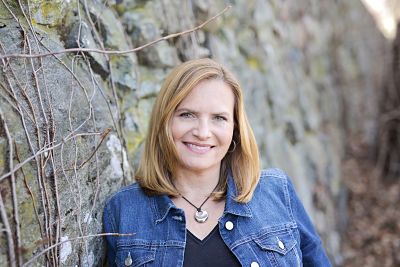
Today, I’m excited to talk with Heather Lang about her inspirations, her books, brave women, and writing and research lets her be a little like childhood heroine Nancy Drew!
How did you become a children’s writer?
As a child, I loved books and stories and creating things, but I struggled with writing. I was much better at math. I never thought I could become an author, because I wasn’t naturally good at writing. As an adult, with kids of my own, I rediscovered my love for picture books, and I kept thinking how fun it would be to create a picture book! By then I’d realized that the seemingly impossible could be possible with hard work and dedication. So I began writing. It took many years and many rejections, but with support from other writers and my critique group I’ve learned to embrace the process.
Why do you like to write books about brave women?
The women I write about inspire me every day to be brave and step outside of my comfort zone. It’s amazing the things you discover about life and yourself when you dream big, keep an open mind, and push yourself. My hope is that my books will do the same for kids.
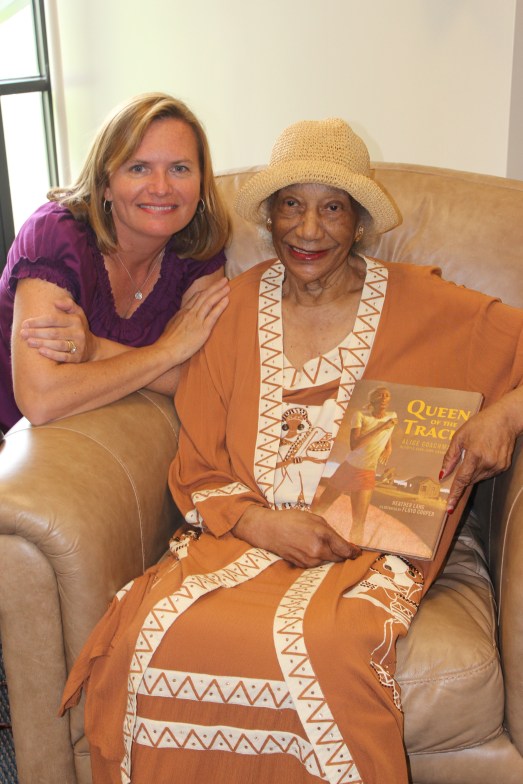
Heather meets Alice Coachman, the first African-American woman to win a gold medal at the Olympic Games.
What inspired you to write Queen of the Track?
After seven years of rejections on my fiction, I needed a little spark in my writing life to keep me going, so I decided to research and write a true story about an inspiring woman. Since I love sports, I looked for an athlete, and who better than the first black woman to win an Olympic gold medal? If Alice Coachman could overcome poverty and segregation and discrimination, surely I could overcome a few rejections. I kept one of Alice’s quotes on my desk: “When the going gets tough and you feel like throwing your hands in the air, listen to that voice that tells you, ‘Keep going. Hang in there.’ Guts and determination will pull you through.”
You seem to dig very deep when researching a book. What would you say is the biggest surprise you’ve discovered during your research?
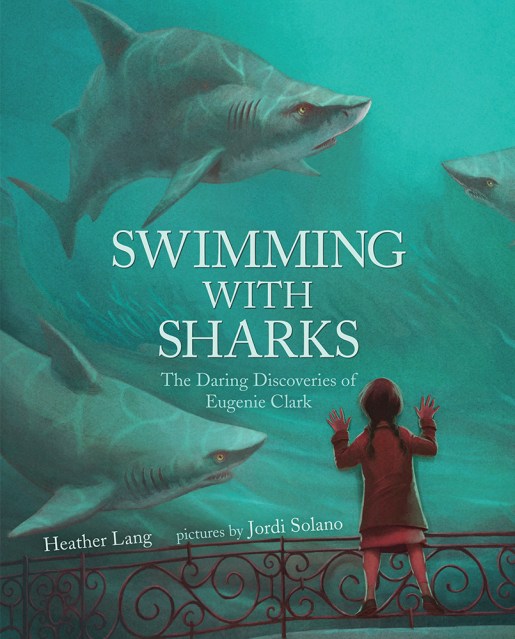
Every book is a treasure hunt, full of surprises and discoveries! My biggest surprise probably came with my most recent book Swimming with Sharks: The Daring Discoveries of Eugenie Clark. When I began my research journey, I was afraid of sharks and swimming in the ocean—terrified actually. As a child, I watched the movie Jaws and believed that sharks were swimming around looking for people to eat. That fear is what drew me to Eugenie Clark, an open-minded young scientist who never judged sharks based on rumors or appearance. I discovered that sharks are intelligent and important and that humans are NOT on the shark menu! I learned to scuba and snorkel, so I could experience Genie’s underwater world and swim with sharks myself. Writing that book transformed my fear of sharks into a passion for them!
Heather learned to scuba dive while writing Swimming With Sharks: The Daring Discoveries of Eugenie Clark.
With the titles “Diving into Nonfiction and the World of Sharks,” “Got Grit?” and “Girls with Grit: Researching and Writing about Brave Girls,” your interactive presentations sound fascinating. Do you have any anecdotes from your speaking engagements you’d like to share?
I have so much fun visiting with kids and am always amazed at some of their questions. “How big are great white sharks?” “How big are their teeth?” “How big are their pups?” “How do they have pups?” I LOVE their raw curiosity! It inspires me and helps me develop my school visit programs. In reaction to the endless questions kids were asking me about sharks, I designed a program that includes hands-on activities that teach kids about shark anatomy and behavior, as well as the food chain and why sharks are important for a healthy ocean. And in the process, I’ve learned even more cool facts about sharks!
You’ve mentioned that you were inspired by Nancy Drew and once wanted to become a spy, which you compare to researching and writing children’s books. What was your favorite Nancy Drew book and why?
I remember two favorites that I owned: The Mystery at Lilac Inn and The Hidden Staircase. For several summers it was my mission to read every Nancy Drew book in the library. If I couldn’t get there, I’d reread the two that I owned. I never tired of them. I worshipped Nancy’s courage, resourcefulness, and willingness to push boundaries. More than anything I wanted to be a spy, just like her. And in a way, that dream has come true. I do lots of spy work for my books. Ideas and stories are all around us if we look, listen, and investigate. I think solid sleuthing is the backbone of an authentic story.
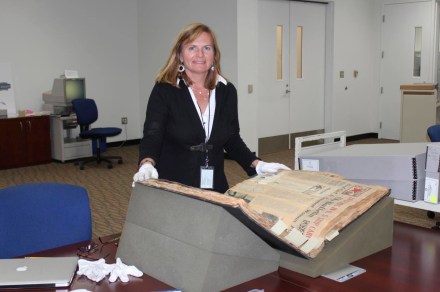
Heather researches Ruth Law’s Scrapbook while writing Fearless Flyer: Ruth Law and Her Flying Machine
If you have a particular place that you write, would you mind describing it a little?
I enjoy mixing it up, depending on what I am working on. When I was writing The Original Cowgirl: The Wild Adventures of Lucille Mulhall, I enjoyed writing on a picnic table at a local barn, surrounded by fields and horses. Sometimes I write in my office, but if the weather’s nice I head out to the screened porch. In the winter, my favorite place to write is by a roaring fire with my dog curled up next to me. And often ideas come to me when I’m in the car or on a walk or out to dinner—not the most convenient places to write. But when an idea strikes, I write it down and do a quick free write if possible, or poof the idea can vanish!
What’s the best thing about being a children’s writer?
My favorite part of being a writer is opening kids’ minds and hearts! I grow tremendously with every book I write, and nothing makes me happier than when my books do the same for kids. Whether a book inspires a child to dream big and be brave or it sparks a new interest in sharks or aviation, those moments are powerful.
What’s up next for you?
My next picture book biography, Anybody’s Game: The Story of the First Girl to Play Little League Baseball, comes out in March 2018. I am also working on a new book about sharks. And I’m so excited for an upcoming research trip to the Amazon for a book I’m writing about the rain forest!
What is your favorite holiday and why?
Christmas in our house is a creative holiday. My daughters and I try to make most of our gifts—anything from soap and candles to knitted hats, woven coasters, and jewelry. And we love to make handmade notecards and ornaments, especially when they involve GLITTER!
Do you have an anecdote from any holiday that you’d like to share?
Every year on Mother’s Day I get to choose exactly what I want to do! No—It’s not going to a spa or a fancy lunch. I choose to get my hands dirty with my husband and kids. It’s the day when we plan our garden, make a trip to the garden center, and plant our seeds and seedlings.
Thanks so much for chatting with me today, Heather! I wish you the best with all of your books!
You can find Queen of the Track and Heather’s other Books at these booksellers:
Make Music Day first rang out in 1982 in France as the Fête de la Musique. Celebrated by young and old, professional musicians and amateurs, the day invites all to make and share their music. People in more than 750 cities and towns in over 120 countries participate in this creative holiday.
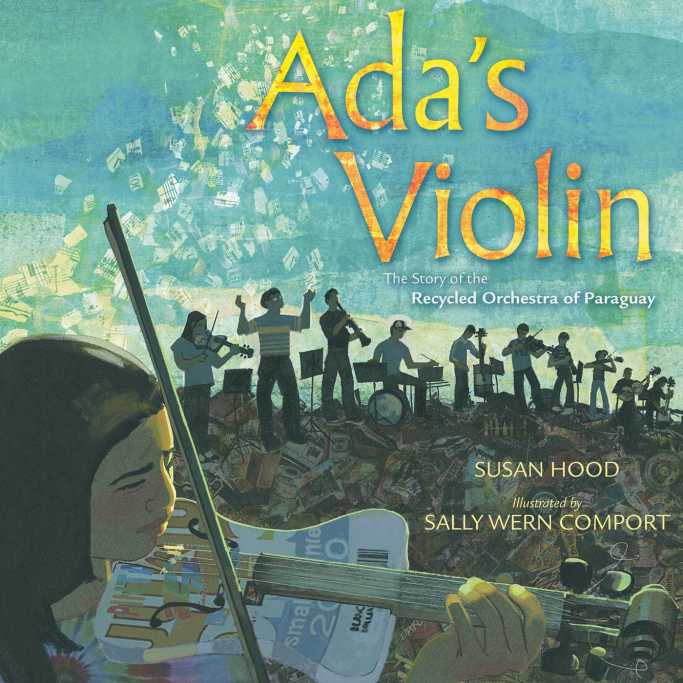
Ada’s Violin: The Story of the Recycled Orchestra of Paraguay
Written by Susan Hood | Illustrated by Sally Wern Comport
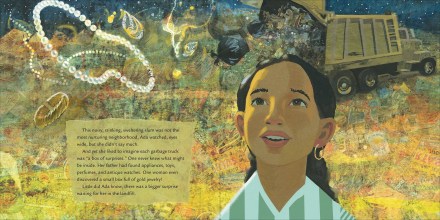
Ada Ríos is growing up in Cateura, a town built of trash as the main garbage dump for the capital city of Paraguay. Every morning the refuse trucks rumble into town to deposit their loads—1,500 tons of trash every day. The citizens of Cateura—gancheros or recyclers—go to work sifting through the mounds and tearing into bags looking for anything valuable enough to recycle or sell. Cardboard is worth 5 cents a pound, plastic 10 cents a pound.
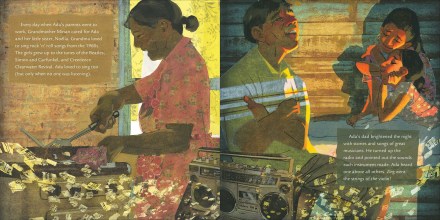
Ada knows the landfill can hold surprises—“Her father, a ganchero, had found appliances, toys, perfumes, and antique watches.”—but she can never imagine what it holds for her. When Ada and her sister were little, their grandmother watched them while their parents worked. They loved to listen to music, to sing, and to learn stories of musicians and the sounds of different instruments. Ada fell in love with the violin.
Image copyright Sally Wern Comport, text copyright Susan Hood. Courtesy of simonandschuster.com
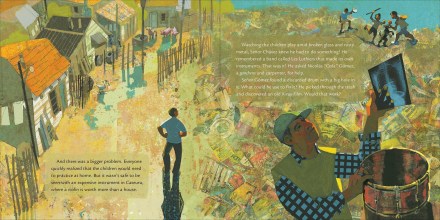
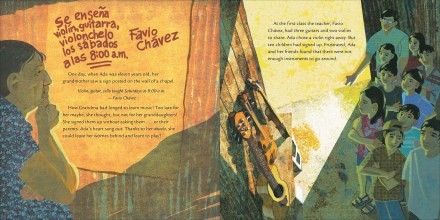
As the girls grow older and go to school, they venture farther into town, but there is little to fill their time. Many kids join gangs or get into fights. When Ada is 11 her grandmother signs her and her sister up for music lessons being offered by a new man in town named Favio Chávez. “Ada’s heart sang out” when she hears the news. On the first day ten children show up to play the five instruments available. But a bigger problem looms: the three guitars and two violins cannot be taken home for practicing as they are magnets for thieves. In Cateura a violin is worth more than a house.
But Favio Chávez has an idea. With help from Nicolás Gómez, a ganchero and carpenter, they pull bits and pieces from the landfill. An old broken drum and an X-ray film become a workable drum, water pipes become flutes, packing crates become guitars and violins, and oil drums become cellos. “Ada chose a violin made from an old paint can, an aluminum baking tray, a fork, and pieces of wooden crates. Worthless to thieves, it was invaluable to her. It was a violin of her very own.”
Image copyright Sally Wern Comport, text copyright Susan Hood. Courtesy of simonandschuster.com
The children practice tirelessly outside in 100-degree heat until the initial “screeches, twangs, and tweets hit all the right notes. Their class became ‘a small island’ where Chávez taught them to respect themselves and one another.” They become known as The Recycled Orchestra. Music now fills the air, adding a soundtrack of beauty to the grueling work. The orchestra is soon invited to play concerts in Cateura and the capital city of Asunción. When word spreads of their talent, the children receive offers to play from other cities and even other countries.
When Ada is 16 The Recycled Orchestra is invited to tour with a world-famous rock band. As Ada takes the stage in front of 35,000 people in Bogotá, Colombia, she is afraid, but the audience cheers for them and sings along as they play. On that night the children discover a new life. “Buried in the trash was music. And buried in themselves was something to be proud of.”
Image copyright Sally Wern Comport, text copyright Susan Hood. Courtesy of simonandschuster.com
An extensive author’s note plus a photograph of The Recycled Orchestra, lists of websites, videos and sources follow the text.
Ada’s Violin is also available in a Spanish edition—El violín de Ada: La Historia de la Orquesta de Instrumentos Reciclados del Paraguay.
Susan Hood has brought to light an incredible story of perseverance, hope, and the ability of music and other arts to provide opportunities and self-confidence that change lives. Told with unstinting honesty and sensitivity, Hood’s biography of Ada Ríos, Favio Chávez, and The Recycled Orchestra will inspire all who read it. The well-paced text offers revealing details on every page and flows with a lyrical quality that enhances the effect of the story and its impact. From the first sentence to the last, both children and adults will be riveted to The Recycled Orchestra.
Image copyright Sally Wern Comport, text copyright Susan Hood. Courtesy of simonandschuster.com
Sally Wern Comport’s paintings beautifully capture the human spirit that shines through and drives people to astonishing achievements even in the most adverse conditions. With intricately created collages of rich hues, Comport depicts the town of Cateura and the mountains of trash the citizens work and play on. Warm lighting illuminates faces full of dreams and love. Readers will linger over depictions of the instruments workshop and cheer along with the concert audience as the children receive recognition. The full-bleed, two-page spreads echo the expanded world music gave to the children in the orchestra and the adults who heard them as music score confetti flutters throughout.
Both school classrooms and home libraries will benefit from the stirring message of Ada’s Violin.
Ages 4 and up
Simon & Schuster Books for Young Readers, 2016 | ISBN 978-1481430951 (English edition); 978-1481466578 (Spanish edition)
Discover more aboutSusan Hoodand her books, plus fun activities for kids and information for teachers and parents on her website!
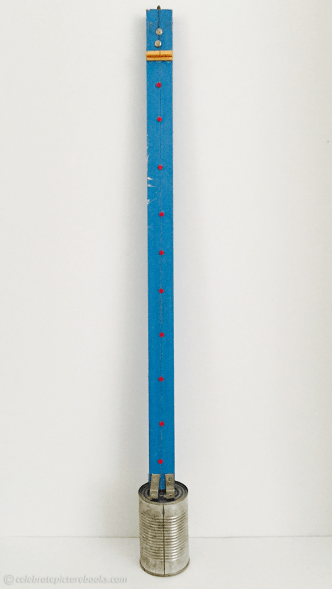
Inspiration for sound can come from almost any object! Look around your house or classroom and discover the music in boxes, cans, blocks of wood, plastic egg cartons or deli containers, and more. Add string or wire for plucking, sticks for drumming, or beans for shaking. With a little glue, tape, or hardware and some creativity, you’ll be making your own rhythms in no time!
Supplies for the stringed instrument shown in the picture above
Tin can
Two small L brackets
Piece of wooden molding, 2 1/2 feet by 1 1/2 inches by 3/4 inches
Five small strips of wood to raise the wire off the neck of the instrument. I used long wooden fireplace matches cut into 1 1/2″ sections
Thin wire
Small circular hook screw or regular screw
Two tacks
A nail, screw, or piece of wood that will fit horizontally in the mouth of the can
a small nail to make a hole in the can
Hammer
Strong Glue
Paint
Foam decorative dots
Directions
Paint the wood and let dry
Paint the small strips of wood and let dry
Decorate the can with paint, sticker, duct tape, or paper
With the hammer and small nail, make a hole in the center of the bottom of the can
Wrap one end of the wire around the nail and glue so it is firmly in place
Feed the other end of the wire through the hole in the bottom of the can
Screw or glue two L brackets to one end of the wood molding so that the bottom of the L is flush with the bottom of the wood molding and there is space between the brackets. This makes the neck of the instrument
Screw the circular or regular screw into the top, center of the wooden molding
When the wooden match strips are dry, glue three match strips side-by-side 3 inches from the top of the molding. Glue two more match strips, one on top of the other on the center strip.
When the L brackets are dry, glue them (and the neck of the instrument) to the can, making sure the brackets are on either side of the hole in the can. Make sure the wire is out of the hole.
When the brackets are firmly attached to the can, pull the wire to the top of the neck. Settle it in the center of the small pieces of wood, so that the wire is not touching the neck.
Wrap the wire around the screw at the top of the molding until it is firmly in place and the wire is taut.
As we say goodbye to Get Caught Reading Month, let’s remember all of the great stories we’ve read and eagerly anticipate those that still await us in the days and months ahead! The long, relaxing hours of summer vacation are nearing, giving readers even more time to enjoy their favorite pursuit. So why not make a list of titles you’d like to explore this summer, and lead it off with today’s book that tells the true story of a very original teenager!
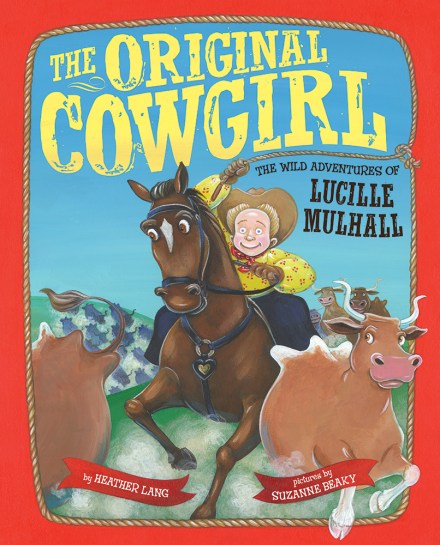
The Original Cowgirl: The Wild Adventures of Lucille Mulhall
Written by Heather Lang | Illustrated by Suzanne Beaky
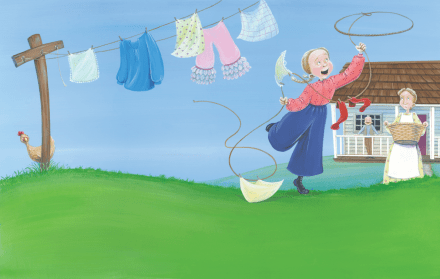
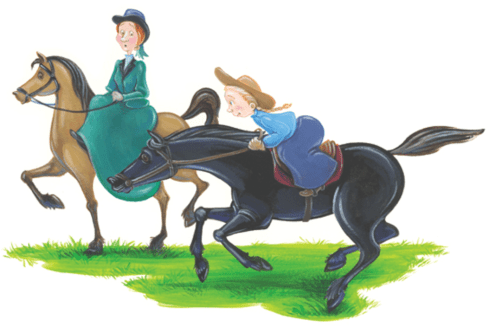
Unlike most girls in the 1890s, Lucille didn’t skip rope “with her mama’s clothesline, she twirled it like a lasso. Whoosh…whoosh…snap!” While Lucille’s papa thought his daughter would be a great help around the ranch, her mother considered riding horses and roping steers unladylike. Lucille wasn’t interested in the regular pursuits of becoming a lady, however. Sewing and cooking were boring, and “riding sidesaddle was slower than a snail climbing a greased log.”
Image copyright Suzanne Beaky, courtesy of suzannebeaky.com
By the age of ten, Lucille was well versed in “mending fences, training racehorses, and herding cattle.” When she asked her father for her own herd of cattle, he told her that she could have one when she was old enough to rope and brand her own—something she could already do. Lucille’s mother worried about her when she patrolled the pastures where her cows grazed. They were threatened by “longhorns, wolves, and coyotes so mean they could turn the strongest cowboy into buzzard food,” but Lucille could snatch those varmints with her lasso in no time flat. The only thing Lucille was afraid of was not being allowed to work on the ranch, so she hid her bumps and bruises.
When Lucille was thirteen, her papa took her along on some rough-riding and roping competitions he had organized. When people saw how talented she was, word got around. Newspapers called her a “daring young girl who ‘held the audience in a breathless spell’” and said she was “‘the envy of half the men.’” But now that she was a teenager, Lucille’s mama sent her to a boarding school where she was to learn how to be a lady.
Image copyright Suzanne Beaky, text copyright Heather Lang. Courtesy of albertwhitman.com
When she returned home at the end of the year, her papa presented her with a gift—a “beautiful sixteen-hand chestnut horse named Governor. Right off, Lucille could see that he would make a perfect trick horse. That summer Lucille, her papa, and the other cowboys were invited to perform for Vice Presidential candidate Teddy Roosevelt. At first Lucille’s mother said no, but she later relented, with the stipulation that “it would be Lucille’s last appearance.”
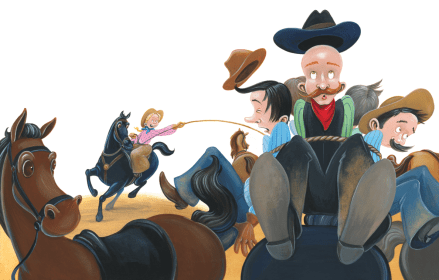
Lucille was a star, demonstrating her riding and roping skills for 25,000 people. Teddy Roosevelt was so impressed, he suggested Lucille have her own show. Soon, Lucille was traveling around the country, thrilling audiences by breaking broncos, lassoing and branding steers, and performing tricks like roping “five galloping cowboys all at once.”
Lucille entered her first professional steer-roping competition when she was just fifteen. She was the first women ever to compete in this kind of event. Some cowboys laughed at her, but she didn’t care. When the steer was released from the pen, Lucille took off after him. Her first throw of the lasso landed but broke. Quickly she tossed another and “flipped him up like a flapjack.” She jumped off her horse and in 29 ½ seconds tied the steer’s feet. Her time was “faster than all the men!”
Image copyright Suzanne Beaky, courtesy of suzannebeaky.com
Lucille went on to break the world record for steer roping. Plenty of people still thought Lucille belonged in the home instead of on horseback. “But her home was always on a horse with the sun on her cheeks a lariat coiled in her hand, and the boundless Oklahoma prairie rolling out in front of her.”
More information on and a timeline of Lucille Mulhall’s life follow the text.
With her folksy storytelling, Heather Lang transports readers to the prairies of the Wild West, where a girl with phenomenal riding skills captured the attention and hearts of Americans. Young readers will be fascinated by Lucille Mulhall’s development from a 10-year-old prodigy to the star of her own stage show in only a few short years. Lang’s expressive period-perfect vocabulary allows all kids to ride the range while they learn about this young woman who broke stereotypes, championed the cause of women, and still serves as a role model for all who wish to live life on their own terms.
Image copyright Suzanne Beaky, courtesy of suzannebeaky.com
With her downhome, action-packed illustrations, Suzanne Beaky lets kids watch as Lucille lassos a wolf, ropes a steer, preforms tricks, and celebrates her record-breaking performance. Lucille is a wide-eyed force of nature in her split skirt and braids as she twirls her rope for serious ranch business and for entertaining the crowds, whose stunned expressions reveal just how original Lucille was. Clothing, hair, and mustache styles, as well as depictions of horses, steers, and the vast green prairie make The Original Cowgirl as fun as it is informative.
For kids interested in the Wild West, early American history, biographies, or a story about true individuality, The Original Cowgirl: the Wild Adventures of Lucille Mulhall is a great addition to home bookshelves and public and school libraries.
Ages 4 – 8
Albert Whitman, 2015 | ISBN 978-0807529317
Discover more about Heather Lang and her books on her website!
To find out more about Lucille Mulhall through videos, photographs, and fun activities, click here!
Learn more about Suzanne Beaky and view a gallery of her artwork on her website!
Get Caught Reading Month Activity
Yee-haw! Word Search
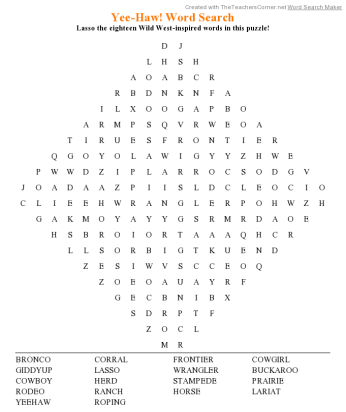
Can you lasso the eighteen Wild West-inspired words in this printable Yee-haw! Word Search? Here’s the Solution!