May 30 – Loomis Day

celebrate-picture-books-picture-book-review-jackrabbit-mccabe-&-the-electric-telegraph-cover

About the Holiday

On Loomis Day we remember Mahlon Loomis, a Washington DC dentist working in the mid-1800s who had a very inventive mind. Not only did he invent artificial teeth, he also had some revolutionary ideas on communication. He understood about the electrical properties of the atmosphere and experimented with sending signals long distances using kites flown many miles apart but at the same height. In July of 1872 he received a U. S. patent for “An Improvement in Telegraphing” on wireless telegraphy. Further research revealed that while his wireless telegraphic system worked, it did not work the way Loomis thought. His experiments, however, advanced the science at the time, leading to one of the world’s most transformative discoveries and an ongoing quest for better and faster communications.

Jackrabbit McCabe & the Electric Telegraph

Written by Lucy Margaret Rozier | Illustrated by Leo Espinosa


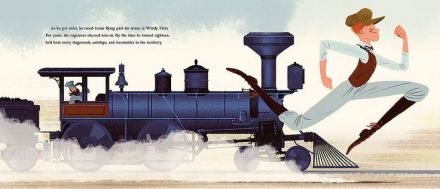
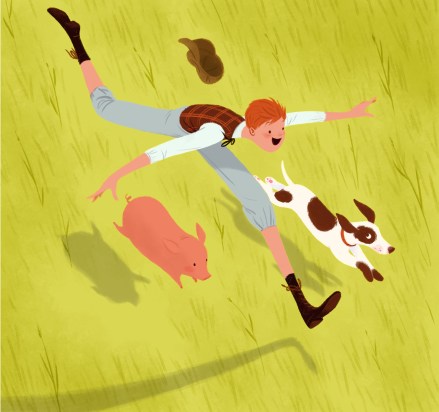
Anyone who looked at the baby with legs “so long they looped like a pretzel” and required a stroller with “an extra axle” knew that he’d been born to run. In fact, his legs grew so fast that if his mother dressed him in long pants in the morning, they were shorts by that evening. Little Jack McCabe used those legs to chase “whatever would run: hogs, dogs, even his own shadow” and “as he got older, he raced trains flying past his house in Windy Flats. By the time he turned eighteen, he’d beat every stagecoach, antelope, and locomotive in the territory.”
celebrate-picture-books-picture-book-review-jackrabbit-mccabe-&-the-electric-telegraph-racing-a-train

Image copyright Leo Espinosa, text copyright Lucy Margaret Rozier. Courtesy of Schwartz & Wade

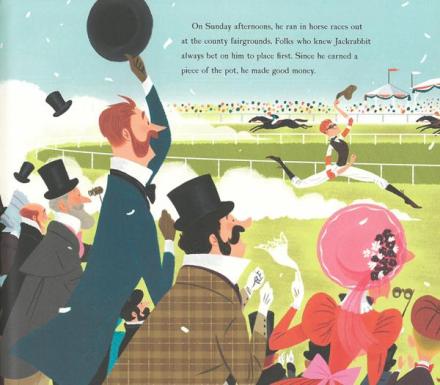
The people of Windy Flats called him Jackrabbit and relied on him to deliver messages that were urgent. On Sundays he joined the horses on the track, making money when people bet on him to come in first. One day, though, the electric telegraph came to Windy Flats. The poles and wires already crossed the eastern part of the country. Each connected city had “a telegraph and an operator who sent and received messages in Morse code, an alphabet of dots and dashes.”

The people of Windy Flats didn’t think this newfangled contraption could carry messages faster than Jackrabbit, so the telegraph man suggested, “‘How ‘bout a race between your fella and this here electric telegraph? Sandy Bluff’s just got themselves an operator, That’s pert near twenty-five miles, as the crow flies.’” Jackrabbit was all for it.
celebrate-picture-books-picture-book-review-jackrabbit-mccabe-&-the-electric-telegraph-racing-a-horse

Image copyright Leo Espinosa, text copyright Lucy Margaret Rozier. Courtesy of Schwartz & Wade

On the day of the race, the whole town of Windy Flats came out with flags, banners, and even a brass band. “The mayor carefully wrote down the same message on two slips of paper. He handed one to the telegraph man and the other to Jackrabbit.”  On the shout of “GO!” the telegraph man plunked his finger on the key sending the pulses through the wire while Jackrabbit took off down the road toward Sandy Bluff “like a tornado.”

The townspeople watched as in only a few moments “a reply came clattering back as that telegraph key jumped and smacked all on its own.” The telegraph man read the code and yelled, “‘Message received. Stop. Sandy Bluff Operator.’” But where was Jackrabbit McCabe? Although he made it to Sandy Bluff in only 9 ½ minutes, it was still too long to beat the telegraph. When he stopped short at the door of the depot, he was met by a telegram tacked to the door. Jackrabbit read it and then pulled the paper that contained the mayor’s message out of his pocket. The two were the same.

celebrate-picture-books-picture-book-review-jackrabbit-mccabe-&-the-electric-telegraph-racing-at-the-starting-line

Image copyright Leo Espinosa, text copyright Lucy Margaret Rozier. Courtesy of Schwartz & Wade

Riding home in a stagecoach, “Jackrabbit felt lower than a snake’s navel.” The mayor also felt pretty low, thinking of Jackrabbit, until he realized that if Jackrabbit’s fingers were as fast as his legs, he’d make an excellent telegraph operator. When Jackrabbit stepped out of the stagecoach and heard the mayor’s offer, he whooped with joy. It didn’t take long for Jackrabbit to learn the new code, and soon “his fingers flew like a banjo player’s strumming that telegraph key.” Every day he sent and received messages. He even “teamed up with the local typesetter, who printed the news that came over that wire, linking Windy Flats to the whole entire country,” and whenever a telegram or the newspaper needed to be delivered, Jackrabbit was there in a flash!

An Author’s Note outlining the pivotal event that sparked Samuel F. B. Morse’s interest in a quicker communication method and the history of the telegraph as well as a Morse code key and a riddle to translate follow the text.
celebrate-picture-books-picture-book-review-jackrabbit-mccabe-&-the-electric-telegraph-racing-hogs-and-dogs

Image copyright Leo Espinosa, courtesy of Schwartz & Wade

Lucy Margaret Rozier has written a funny and fact-based addition to the fine American tradition of tall tales with Jackrabbit McCabe & the Electric Telegraph. From her folksy delivery to her humorously exaggerated details, Rozier presents an engaging history of the telegraph through the story of one man affected by this new technology. Kids will love the fast-paced story full of crackling dialog and gripping suspense.

Leo Espinosa infuses his brightly colored, vintage-style illustrations with the charm and innocence of the mid-1800s while highlighting the humor of Rozier’s yarn. Jackrabbit’s looong legs take up a whole page—sometimes two—as he runs with dogs and hogs, sprints past steam trains, speeds off at the starting line, and wedges himself into the stagecoach, with one foot hanging out the window. The small town of Windy Flats and the townspeople are decked out in period details, and the enthusiasm of the time is infectious.

Jackrabbit McCabe & the Electric Telegraph will become a favorite read lightening quick. The book would make a fun addition to children’s bookshelves.

Ages 4 – 8

Schwartz & Wade Books, 2015 | ISBN 978-0385378437

Discover more about Lucy Margaret Rozier plus book-related resources on her website!

View a gallery of illustration work by Leo Espinosa on his website!

Loomis Day Activity

celebrate-picture-books-picture-book-review-morse-code-image

Morse Code Decoder


Sending secret messages in code is cool! Use this printable Morse Code Decoder to learn how to write your name and those notes you don’t want anyone else to read in this early method of communication.

Picture Book Review

May 21 – “I Need A Patch for That” Day

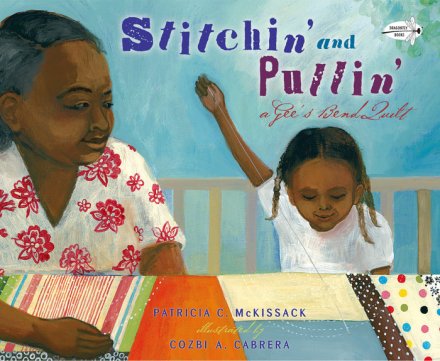
celebrate-picture-books-picture-book-review-stitchin'-and-pullin'-a-gee's-bend-quilt-cover

About the Holiday

Celebrated annually on May 21, “I Need a Patch for That” Day gives a little love to patches of all kinds. Have you been out working in your garden patch? Fabulous! Did you just finish all the requirements for a scouting patch? Good job! Waiting on a fix for the latest software kerfuffle? Who isn’t? Are you a pirate keeping one eye ready for the dark? Argghh! Do you need to patch up a misunderstanding? Good luck! Or maybe you’re a quilter like the amazing women in today’s book who create a patch to remember each of life’s important, inspirational, and formative events. 

Stitchin’ and Pullin’: A Gee’s Bend Quilt

Written by Patricia C. McKissack | Illustrated by Cozbi A. Cabrera


In this story told through poems, a little girl begins telling readers about her life, starting with a recitation on Gee’s Bend Women: “Gee’s Bend women are / Mothers and Grandmothers / Wives / Sisters and Daughters / Widows.” They are every kind of woman you know, doing every type of work and activity. “Gee’s Bend women are / Talented and Creative / Capable / Makers of artful quilts / Unmatched. / Gee’s Bend women are / Relatives / Neighbors / Friends— / Same as me.”

In Who Would Have Thought, the girl muses on how perceptions change. “For as long as anyone can remember,” she says, the women of Gee’s Bend, Alabama have created quilts that were slept under, sat on, and wrapped around the sick or cold. But now those same quilts are “…hanging on museum walls, / their makers famous….”

When she was just a tot “Baby Girl” reveals in Beneath the Quilting Frame, she played under the quilting frame, listening to her “mama, grandma, and great-gran / as they sewed, talked, sang, and laughed / above my tented playground.” She remembers the “steady fingers  /[that] pieced together colorful scraps of familiar cloth / into something / more lovely / than anything they had been before” as her mother sang her a lullaby.

celebrate-picture-books-picture-book-review-stitchin'-and-pullin'-a-gee's-bend-quilt-puzzling-the-pieces

Image copyright Cozbi A. Cabrera, courtesy of Random House Books for Young Readers

In Something Else, “Baby Girl” is growing too big to play underneath the frame. Her legs are becoming longer and her mind is full of “recipes for eleven kinds of jelly…how to get rid of mold…and the words to a hundred hymns and gospel songs” while she waits for her turn at the frame. At last, her time does come, and in Where to Start?, the girl asks her mama how to begin. Her mother answers, “‘Look for the heart. / When you find the heart, / your work will leap to life… / strong, beautiful, and… / independent.’”

In Remembering, the girl thinks about how her mama has told her that “cloth has a memory.” As she chooses the cloth that will become her quilt she recounts the life and the history in each. 

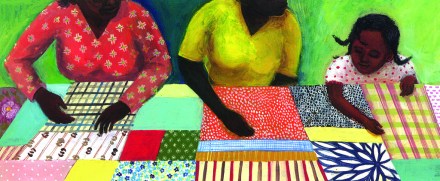
Nothing Wasted sees Grandma pulling apart a red-and-white gingham dress stitch by stitch. Suddenly, the girl knows that this cloth will become the patch that “will be the heart of my quilt.” In Puzzling the Pieces the girl and her grandma stand over the quilting frame fitting the squares together in the perfect way to tell the girl’s story. Her quilt comes together piece by piece to tell the history of Gee’s Bend in The River Island. The brown strips along three sides mirror the muddy waters surrounding her town. The fourth side is a green strip—“a symbol of the fields where my ancestors / worked cotton from can to can’t— / can see in the morning until / can’t see at night.” Lined up next to the green strip are six squares representing the small communities “where families with / the same name / are not kin by blood / but by plantation.”

Being Discovered is portrayed with “a large smoke-gray square”—the color of the Great Depression and the 15 minutes of fame Gee’s Bend garnered when discovered “by sociologists, historians, / educators, and journalists” who came and went, leaving Gee’s Bend “the way it had been / before being discovered.”

celebrate-picture-books-picture-book-review-stitchin'-and-pullin'-a-gee's-bend-quilt-understanding-comes-later

Image copyright Cozbi A. Cabrera, courtesy of Random House Books for Young Readers

In Colors, the girl’s grandma explains the meanings and feelings behind each colored cloth. “Blue cools. / Red is loud and hard to control, / like fire and a gossiping tongue.” Green, orange, yellow, white, pink, and all the others have their own personalities. “Grandma says, / ‘Colors show how you / feel deep down inside.’”

In Dr. King Brings Hope, the little girl adds “a spotless white patch for the hope Dr. Martin Luther King / brought to the Bend” and goes on to tell how her grandma saw Dr. King at Pleasant Grove Baptist Church and what it meant to her. By and By follows the girl as she adds “golden thank-yous, for James Reeb,” a “bright blue piece of velvet for Viola Liuzzo,” and a “big plaid people circle of white, black, brown, yellow, and red for Reverend Dr. King, all “killed for believing in justice.”

In the 1960s, The Sewing Bee tells, Gee’s Bend quilters were once again discovered. Joining the Bee provided buyers for the handmade quilts, but there were stipulations on the types of quilts that could be made and sold. The girl asks her grandma if she was part of the Bee, to which she replies, “‘more money. Less freedom. I chose to stay free.’”

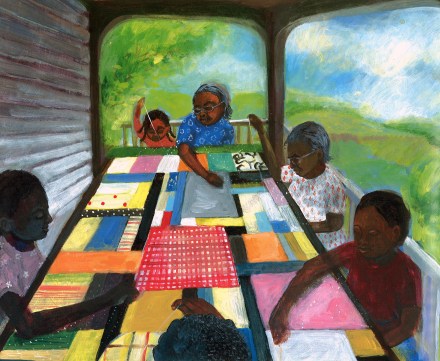
At last all of the patches are laid out and the time comes to stitch the girl’s quilt. Five women stand at the frame “all stitchin’ and pullin.’” They work “in a slow and steady rhythm” relaxing and enjoying being together until the quilt is finished. In Finished, the last stitch is sewn, and the thread bitten and knotted. The girl has hundreds of ideas for future quilts. “Quilts that are about me, / the place where I live, / and the people / who have been here for generations.”

Further poems unite the history of “Baby Girl,” her family, and neighbors, and an Author’s Note about quilting and the women of Gee’s Bend follow the text.

Patricia McKessack’s free verse poems capture the close relationships and camaraderie of the generations of women who join around the quilting frame to share and pass down their art and their heart. McKessack’s conversational verses, connected page after page like the patches of a quilt, reveal the complexity of this handmade art form in the way intimate talks between friends unveil a life. Readers learn not only about the little girl and her own thoughts, but the history and influence of her immediate family, world events, inspirational figures, and deeply held beliefs that make her who she is and ties her to the other Gee’s Bend women.

Cozbi A. Cabrera’s stunning acrylic paintings take readers inside the heart of the Gee’s Bend women, depicting the girl’s home, the table-sized quilting frame where the women collectively work, the plantations, the protests, and the changes that came but did not unravel the convictions, values, and love of the little girl’s family. Readers can almost hear the talking and singing of the Gee’s Bend women as they stitch their quilts, and the comforting, embracing environment is evident on every page. Cabrera’s portraits of the little girl, her mama, and her grandma are particularly moving. For What Changed, Cabrera depicts a yellow school bus appearing on the dirt road from the right hand corner of the page. In the  driver’s side mirror, a dot of a house is reflected, reminding readers that no matter how far these women are from home, Gee’s Bend is always with them.

Children—and adults—will find Stitchin’ and Pullin’: A Gee’s Bend Quilt inspirational and uplifting. This volume of poetry can be read at one sitting or delved into again and again, making it a wonderful choice for home libraries and a must for school and public libraries.

Ages 5 – 12

Dragonfly Books, Random House, 2016 (paperback edition) | ISBN 978-0399549502

View a gallery  of fashion designs, dolls, and other handmade art work by Cozbi A. Cabrera on her website!

“I Need a Patch for That” Day Activity

celebrate-picture-books-picture-book-review-stars-quilt-coloring-page

Design a Quilt Coloring Pages


Quilts are so much more than pieces of material sewn together—they’re life stories! Here are two quilt coloring pages for you to design and color. What does each piece mean to you? As you color each section, write a sentence about an event or thought that is important to you.

Quilt Template 1 | Quilt Template 2

Picture Book Review

May 11 – It’s National Photography Month

celebrate-picture-books-picture-book-review-jazz-day-cover

About the Holiday

We all know what joy photography brings. Whether you’re looking at professional fine art photos in a gallery or your own vacation pics, those film and digital images can make you see the world in a different way or just as you remember it. The oldest surviving photograph of nature dates back to 1827, when it took days for film to develop properly. Of course, today’s smart phones have changed forever the way we take photos, but the fun of capturing a moment in time will never go out of style.

Jazz Day: The Making of a Famous Photograph

Written by Roxane Orgill | Illustrated by Francis Vallejo

In a marvelously conceived and unique book, Jazz Day: The Making of a Famous Photograph tells the story of how the iconic photograph Harlem, 1958 came together. Through a series of poems, Roxane Orgill reveals the action when fifty-seven jazz musicians posed for Art Kane on an August afternoon in front of an ‘absolutely typical brownstone.’ Over the space of a day, Kane borrowed a camera, blocked off the street, and worked with the musicians who answered the call that went out to the local musicians’ union, recording studios, composers, nightclub owners, and others inviting “all jazz musicians: a photo shoot, no instruments required.”

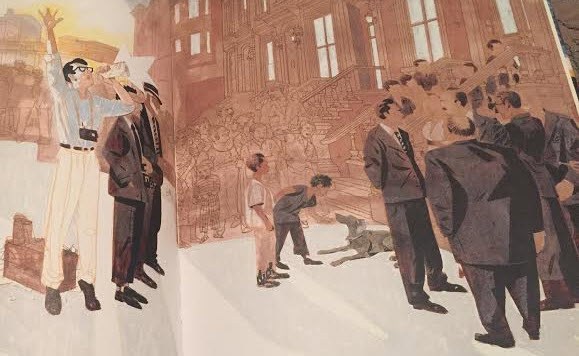
The day’s beginning is captured in Early: Art Kane, photographer. Art Kane stands in the middle of the deserted street, wondering if his idea to capture The Golden Age of Jazz will become reality: “nobody here yet / it’s only nine / look right / where they come from the train / look left / where they exit a taxi…what if only four come / or five / ‘The Golden Age of Jazz’ / with five guys… / a crazy request / what if nobody shows… / a group from the train / Lester Young cigarette dangling / that funny squashed hat / man with an umbrella rolled tight… / guy in a striped tie / it’s happening.”

celebrate-picture-books-picture-book-review-jazz-day-some-kind-of-formation

Image copyright Francis Vallejo, text copyright Roxanne Orgill. Courtesy of Candlewick Press.

As the musicians begin to arrive, they talk and laugh among themselves, not listening to Art Kane as he tries to organize them into Some Kind of Formation. But Kane isn’t the only one with a camera today. In So Glad: Milt “Fump” Hinton, bassist and amateur photographer, Hinton is awed by the talent around him and “Glad I brought my Leica / And the Canon 35 / My little Keystone eight-millimeter too / Gave it to Mona, my wife / ‘Honey, just aim and press the button’” There’s “Chubby, Oscar, Wilbur…” then “Here come the big dogs / Coleman Monk Dizzy Roy / And the beauteous Marian McP… / They’re all here / For some magazine / Me I’m snapping pictures / Lots and lots of pictures / To remember / Later / Forever / So glad”

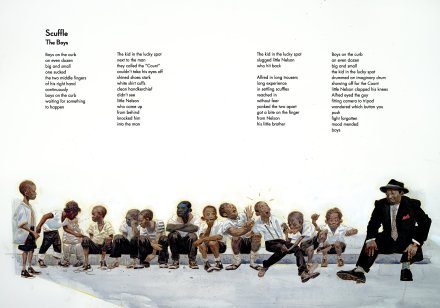
There are boys, too, sitting on the curb, getting into mischief as Hat: Alfred, a boy reveals: “Nice wool felt / Two-inch snap / Brim / Count’s too beat / to give chase / When / Nelson nabs / His bonnet / I’m / On it quick / Down the block / ‘Hand it over, Nelson, before I—’ / Buff the felt / Set the snap / Brim / ‘Your hat, Count Basie.’”

celebrate-picture-books-picture-book-review-jazz-day-scuffle

Image copyright Francis Vallejo, text copyright Roxanne Orgill. Courtesy of Candlewick Press.

Even though The Invitation Said No Instruments, Rex Stewart, cornetist couldn’t help but bring his silver cornet. And once he saw it, Leroy couldn’t help but run up in his short pants and untied shoes to ask “‘Can I try?’ / Lips to mouthpiece / Nothing.” But Rex shows him how it’s done and all heads turn his way. “Leroy again / ‘Can I try?’ / Rex passed the cornet / ‘Make like you’re going to kiss a girl’ / Lips to mouthpiece / Squeak / (Leroy’s too young for girls) / Rex tucked his horn under his arm / The invitation said no instruments.”

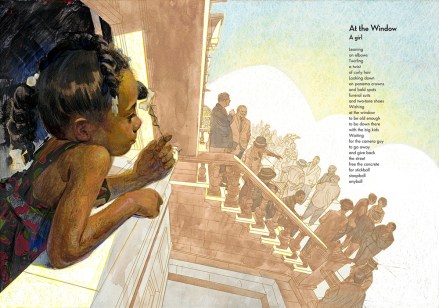
Excitement mounts as everyone realizes She’s Here! Maxine Sullivan, singer who “snagged Your Hit Parade at twenty-six / ‘Loch Lomond’ put her on the high road… / got in with a good band / warbling on the radio / chantoosing in the clubs / all that was years ago” before she became a nurse and married and had a daughter. “but she’s here! / come to hang with the cats / reminding all us bass players / and pianists who kept time / on all her records, tours… / reminding us all / how much we miss her.”

celebrate-picture-books-picture-book-review-jazz-day-at-the-window

Image copyright Francis Vallejo, text copyright Roxanne Orgill. Courtesy of Candlewick Press.

People look out their windows at all the commotion as Eddie Locke strolls up and Thelonious Monk (late as usual) arrives in a taxi. Dizzy Gillespie, Roy Eldridge, J. C. Heard and Gerry Mulligan make an unlikely quartet, and Willie “the Lion” Smith sits on the stoop holding onto his elephant-head cane. Finally, Art Kane calls out Some Kind of Formation, Please! “A plea so desperate / it’s melodic / shuffle / climb the stoop / fan   out   on   the   sidewalk / talk-laugh-roar / smoke-slap-turn / little by little / fifty-seven musicians form an upside-down T / underlined / by twelve boys / just happen to be sitting on the curb… / click / it has to be perfect / for Esquire / Dizzy sticks out his tongue.”

At last the copy of Esquire lands on newsstands, and Alfred pays for a copy with money he’s saved by missing “a month of matinees.” He thinks it was worth it, though, because “…jeez / I’m in a magazine.”

celebrate-picture-books-picture-book-review-jazz-day-names

Image copyright Francis Vallejo, text copyright Roxanne Orgill. Courtesy of Candlewick Press.

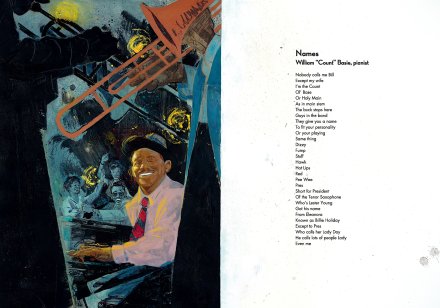
A fold-out page of the original photograph lets children and adults see the final product of the photo shoot. Children and adults will also have fun matching the portraits that accompany the poems to their real counterparts. Short biographies of each person in the photograph as well as an Author’s Note, an introduction, and further resources for study add to the comprehensive and loving treatment of its subject that Jazz Day: The Making of a Famous Photograph provides for readers.

Roxane Orgill recreates the syncopation of jazz and the exhilaration of the photo shoot in twenty poems that capture the sights, sounds, conversations, horseplay, and vibe of that special day that forever commemorated the Golden Age of Jazz. The smooth, cool lines of Orgill’s free verse poetry are a joy to read aloud. Full of personality, captivating details, history, and nostalgia, the poems reawaken the past for a new generation.

Working from the actual black-and-white photograph, Francis Vallejo vividly reimagines the scene on 126th Street as well-known and lesser-known jazz musicians came together to represent themselves and their art for Esquire magazine. Vallejo’s acrylic and pastel illustrations bring to life the surprise, camaraderie, and expressions of the men, women, and boys as they mingle, rest, and pass the time until the pose and lighting is right for the shot. As the book opens, readers get a bird’s-eye view of the street and quiet neighborhood, but as the musicians begin arriving the illustrations move in, allowing readers to rub shoulders with the greats of jazz.

For children (and adults) who love photography, jazz, biographies, history, and/or poetry, Jazz Day: The Making of a Famous Photograph is a marvelous choice for home libraries and is highly recommended for school and public libraries.

Ages 8 – 12 and up

Candlewick, 2016 | ISBN 978-1536205633

Learn more about Roxane Orgill and her books on her website!

National Photography Month Activity

celebrate-picture-books-picture-book-review-threads-of-friendship-photo-holder

Spool Photo Holder

With this easy craft you can make a personalized photo holder for your favorite pictures of friends and family!

Supplies

  • Wooden spool with hole through the middle, top to bottom. (A spool without a hole also works if you make a hole in the top with a hammer and nail), 1 ½ -inch or larger, available at craft stores
  • Colorful twine or light-gauge yarn, 3 to 4 yards
  • Alternatively: you can buy a wooden spool of colorful twine at some discount stores
  • 3 pieces of light-gauge wire 12 to 15-inches long
  • Clay or play dough
  • Needle-nose pliers
  • Glue

Directions

  1. Fill hole in spool with clay or play dough, pushing it well in to provide a base for the wire
  2. Wrap the twine or yarn around the spool to desired thickness
  3. Glue down the end of the twine to keep it from unraveling
  4. With the needle-nose pliers, roll down one end of the wire to create a small coil
  5. Repeat with two other lengths of wire
  6. Cut the three wires to different lengths to provide room for all three photographs
  7. Fit the three wires into the center hole on the top of the spool
  8. Push the wires into the clay until they are held securely
  9. Clip photographs into the coils
  10. Display your pictures!

Picture Book Review

April 9 – National Inventor’s Month

celebrate-picture-books-picture-book-review-whoosh!-lonnie-johnson's-super-soaking-stream-of-inventions-cover

About the Holiday

Today’s holiday was established by the United Inventors Association of the USA, the Academy of Applied Science, and Inventor’s Digest Magazine to promote awareness of and celebrate the achievements of those creative individuals who make our lives better—or, in some cases, at least interesting. Every day there are kids and adults, professionals and amateurs pondering solutions to problems and just “what ifs?” Would you like to join them? You can celebrate this month by acting on one of your great ideas and by learning more about inventors like the subject of today’s book!

WHOOSH! Lonnie Johnson’s Super-Soaking Stream of Inventions

Written by Chris Barton | Illustrated by Don Tate


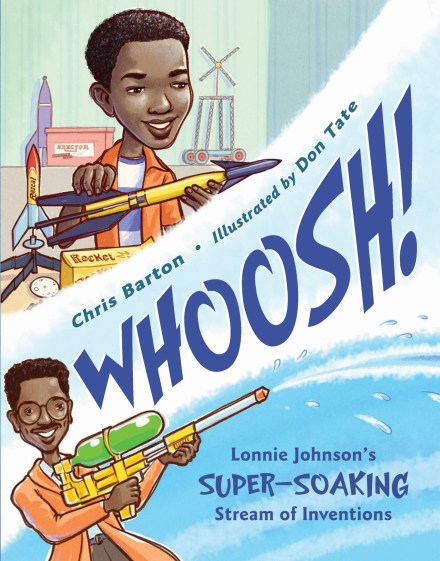
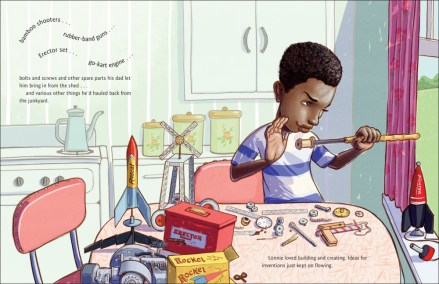
Lonnie Johnson had a way with stuff. In his hands bolts and screws, gears and springs, spools, clothespins, “spare parts his dad let him bring in from the shed, and various other things he’d hauled back from the junkyard” fueled Lonnie’s ideas for inventions and rocket ships. The kids at school loved to watch him launch the rockets he’d devised on the playground. Lonnie wanted to have a career as an engineer. Getting there took a lot of determination and courage. Once, the results of a standardized test said that he would not make a good engineer. Lonnie felt discouraged, but he knew that the person who had graded his test didn’t know him—or Linex.

celebrate-picture-books-picture-book-review-whoosh!-lonnie-johnson's-super-soaking-stream-of-inventions-young-lonnie-inventing

Image copyright Don Tate, courtesy of charlesbridge.com

Linex was the robot Lonnie had built from scrap metal. “Compressed–air cylinders and valves allowed Linex’s body to turn and its arms to move. The switches came from an old, broken jukebox. Lonnie used a tape recorder to program Linex, and as a bonus the reels looked like eyes.” Lonnie’s goal was to enter Linex in a science fair, but first he wanted to be able to program it. It took several years before he discovered how. Using his little sister’s walkie-talkie, Lonnie solved the problem and took Linex to the “1968 science fair at the University of Alabama—where only five years earlier, African American students hadn’t even been allowed.” Lonnie’s team won first place.

Lonnie went to college at Tuskegee Institute, where he realized his dream of becoming an engineer. His career “took him beyond Alabama—way beyond.”  He went to work for NASA. Before the orbiter Galileo could be sent to Jupiter, Lonnie developed a system that would ensure the craft would have a constant supply of power for its computer memory in case the main power was lost. Some fellow scientists doubted his idea would work, but it did. “As it photographed Jupiter and its moons, Galileo was supported by the power package that Lonnie designed.”

celebrate-picture-books-picture-book-review-whoosh!-lonnie-johnson's-super-soaking-stream-of-inventions-linex

Image copyright Don Tate, courtesy of charlesbridge.com

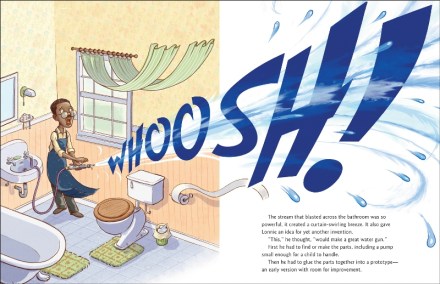
Even though Lonnie worked for NASA, he continued tinkering with his own ideas—in his own workshop. One problem he was trying to solve involved the need for the world’s refrigerators and air conditioners to have a cooling system that didn’t use the damaging chemical R-12. “He had an idea for using water and air pressure instead.” He built a prototype and experimented with it in his bathroom sink. When he turned his pump and nozzle on, though, he got a surprise as a stream of water blasted across the room.

Suddenly, Lonnie saw another use for his invention—as a water gun. He created a design small enough for children’s hands, and tested it at a picnic, where it was a hit. Lonnie took his idea to a toy company…and another…and another. Finally one company agreed to make his water gun. Spurred on by this success, Lonnie found investors to help him build other original inventions: “a water-propelled toy airplane, two kinds of engines, and his cooling system” that had led to the water gun. He even quit his day job to devote his time to inventing.

But things don’t always work out. Each project fell through—even the water gun. It was a scary time as he and his family had to move out of their house and into an apartment. But Lonnie believed in himself. He took his water gun to another toy company. In 1989 he found a toy company willing to take a look. Lonnie made the trip to Philadelphia and wowed the executives with his invention.

celebrate-picture-books-picture-book-review-whoosh!-lonnie-johnson's-super-soaking-stream-of-inventions-water-powered-nozzle

Image copyright Don Tate, courtesy of charlesbridge.com

Now kids everywhere enjoy the fun of the Super Soaker. Today, Lonnie can be found in his workshop doing what he loves: “facing challenges, solving problems and building things” because “his ideas just keep on flowing.”

Chris Barton’s biography of Lonnie Johnson is a fascinating look at a man who succeeds in turning “No” into “Yes” by the power of his intelligence, ideas, and determination. Kids will love hearing about how one of their favorite toys came to be and will be inspired to chase their own dreams despite challenges and setbacks. Barton’s detailed narration provides a full picture of Lonnie Johnson and his times, specifics that attract and inform like-minded kids. Including the results of Lonnie’s exam should encourage kids who think differently. The story is enhanced by the conversational tone that makes it accessible to kids of all ages.

Don Tate illuminates Lonnie Johnson’s life story with his bold, full-bleed paintings that follow Lonnie from his being a child with big ideas to becoming a man who has seen these ideas through to success. With an eyebrow raised in concentration, young Lonnie demonstrates confidence and skill as he works on an invention, and kids will love seeing the tools of his trade laid out on the kitchen table. With his eyes narrowed in frustration and disappointment, Lonnie reads the results of his childhood exam. As Lonnie grows older and designs systems for NASA, the illustrations depict the schematics of the Galileo power package and Lonnie’s surprise at the strength of the water stream in his prototype cooling design. As all kids know, the spurt of a Super Soaker is awesome, and this fact is demonstrated in a “Wowing” fold-out page.

WHOOSH! Lonnie Johnson’s Super-Soaking Stream of Inventions is a welcome biography of the man who designs systems for the greater world but has never lost his youthful enthusiasm to invent.

Ages 5 – 10

Charlesbridge, 2016 | ISBN 978-1580892971

Check out more fiction and nonfiction books by Chris Barton on his website!

Discover more books written and illustrated by Don Tate as well as a portfolio of his work and book-related activity guides on his website!

National Inventor’s Month Activity

celebrate-picture-books-picture-book-review-movie-computer-dot-to-dot

Invention Dot-to-Dot Puzzles


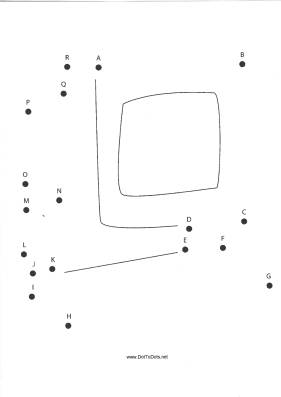
Many inventions have changed the world and continue to be used long after they were first created. Connect the dots on these printable puzzles to discover three remarkable inventions!

Invention Dot-to-Dot 1 | Invention Dot-to-Dot 2 | Invention Dot-to-Dot 3

Picture Book Review

April 5 – National Read a Road Map Day

celebrate-picture-books-picture-book-review-the-50-states-fun-facts-cover

About the Holiday

Today’s holiday is all about those paper maps that have guided travelers along the trails, roads, highways, and biways as they search for adventure or just need to get from here to there. While the little window of GPS may be more prominent now, there’s nothing like opening the wide vista of a paper map and letting your mind wander to far-off places. Old maps are fascinating too, as they reveal the changes in road systems and population over time. Today, rediscover your local area or take an armchair trip to a new locale through a paper map.

The 50 States: Fun Facts

Written by Gabrielle Balkan | Illustrated by Sol Linero

America is one vast country made up of 50 states that are each unique and fascinating in their own way. The history, people, topography, and even weather of each region has resulted in an incredible diversity of animal life, cuisine, transportation, leisure activities, and celebrations across the nation. The 50 States: Fun Facts offers up a patchwork of engaging and enlightening information about each state that will entice kids to learn more about their own home as well as other areas.

celebrate-picture-books-picture-book-review-the-50-states-fun-facts-things-that-go

Image copyright Sol Linero, text copyright Gabrielle Balkan. Courtesy of Eyes Wide Editions, Aurum Press.

The large-format board book is divided into five two-page spreads, each dedicated to a particular topic. In 50 Animals readers discover that the first Seeing Eye dogs were trained in Nashville, Tennessee; that “the colors of Maryland’s state cat—the Calico Cat—match the state flag”; and that there are so many moose in Wyoming that there’s even a town named Moose! From state to state kids will also learn about the Chinook Dog of New Hampshire, meet white buffalo that roam North Dakota, and view the state insect of Connecticut—the praying mantis, which can turn its head 360 degrees—among many, many more.

Each state is also known for its own, particular mode of transportation. In Alaska the Tlingit Nation builds beautiful canoes, which the people believe are inhabited by their own spirit. If you’re interested in scanning the skies for alien lifeforms, you may want to head to the San Luis Valley of Colorado, which is considered to be prime UFO-spotting territory! If boats are more your thing, you might want to take a houseboat vacation in the lakes around Jamestown, Kentucky, or see a Navy Destroyer at the shipyard in Bath, Maine. Carousel lovers will want to take the road to Rhode Island, where they can catch the gold ring on the Flying Horse Carousel that has been going round and round for nearly 150 years! There are so many more Things That Go on these pages, including trains, trucks, trolleys, and a 16-story electric shovel!

celebrate-picture-books-picture-book-review-the-50-states-fun-facts-things-to-eat

Image copyright Sol Linero, text copyright Gabrielle Balkan. Courtesy of Eyes Wide Editions, Aurum Press.

After all that activity, readers may be a bit hungry. All they need to do is flip the page to find 50 Things to Eat—specialties from around the nation. Whether you call them blackberries or brambleberries, these sweet nuggets—Kentucky’s state fruit—are great alone or in special treats. If you love pretzels, then the pretzel festival in Germantown, Ohio is for you! Spicy foods more your style? Then you’ll want to check out Hatch, New Mexico—the chili capital of the world! After having Delaware’s chicken specialty, catfish from Mississippi, or potatoes from Idaho, you may just want to try a banana split—first served in Latrobe Pennsylvania in 1904—or even nosh on a few roasted Joshua Tree flower buds that are said to taste like candy.

Ready to work off that meal? The next page provides 50 Ways to Get Moving, including archery in California, rafting in West Virginia, base jumping in Utah, snowshoeing in Minnesota, and snorkeling in Hawaii. 

celebrate-picture-books-picture-book-review-the-50-states-fun-facs-celebrations

Image copyright Sol Linero, text copyright Gabrielle Balkan. Courtesy of Eyes Wide Editions, Aurum Press.

Celebrations have been part of America since the first Thanksgiving, and each state has a entertaining—often quirky—spectacular to highlight their history or specialty. In Nebraska the old Pony Express mail system is reenacted every June; The Heart of the Ozarks Bluegrass Festival brings musicians and fans to West Plains, Missouri each year; and Honobia, Oklahoma’s Bigfoot Festival makes believers of us all—well, almost.

In Florida, you can learn how to wrestle an alligator with the Miccosukee tribe on American Indian Day; you can test your mettle on 98 flights of stairs during Washington’s Space Needle Base 2 Space Race for charity; and “you can cheer on bronc riders at the ‘Daddy of All Rodeos’” during Cheyenne Frontier Days in Wyoming. Perhaps  the oddest celebration is Mike the Headless Chicken Festival held every May in Fruita, Colorado that commemorates “a rooster that lived for 18 months…with no head!”

celebrate-picture-books-picture-book-review-the-50-states-fun-facts-puzzle

Image copyright Sol Linero, text copyright Gabrielle Balkan. Courtesy of Eyes Wide Editions, Aurum Press.

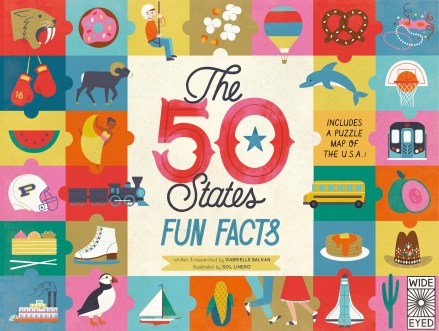
Each spread also offers a sidebar scavenger hunt of sorts as it asks readers to see if they can find four different categories of items among the rest. After kids have soaked up all the facts about the 50 states, they can test their knowledge of American geography by completing the included jigsaw puzzle map.

Gabrielle Balkan has collected tons of engaging facts about the United States that are sure to delight and amaze children. Each category would be a wonderful starting point for learning about any or all of the states and gives kids an idea of the variety found across America. Sol Linero’s striking category “quilts,” composed of colorful patches decorated with clear, engaging illustrations, draw readers in to discover the fascinating facts presented about each state.

Ages 4 – 10

Wide Eyes Editions, Aurum Press, 2016 | ISBN 978-1847808691

Discover more about Gabrielle Balkan and her books on her website!

View a gallery of illustration work by Sol Linero on her website!

National Read a Road Map Day Activity

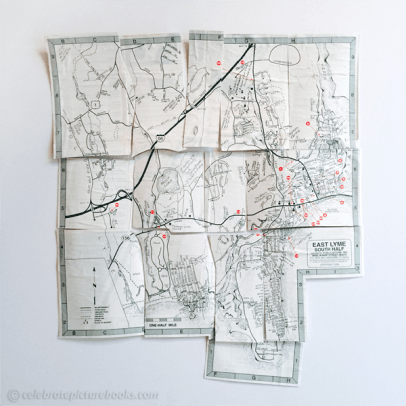
celebrate-picture-books-picture-book-review-road-map-puzzle

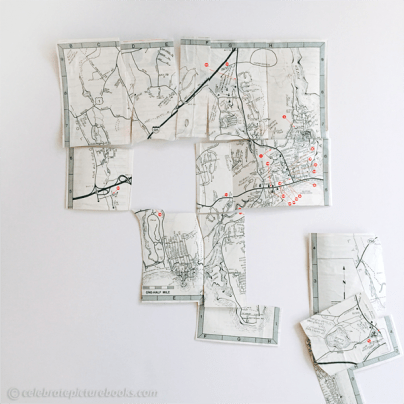
Make a Road Map Jigsaw Puzzle

It’s fun and easy to make your own jigsaw puzzle from a map of your local town or a place you’d like to visit!

Supplies

  • A paper map
  • Poster board
  • Glue or spray glue
  • Scissors

celebrate-picture-books-picture-book-review-road-map-puzzle

Directions

  1. Smooth out the paper map
  2. Glue the map to the poster board
  3. Cut the poster board into interlocking or adjoining pieces (the number of pieces can depend on the child’s age)

Picture Book Review

March 29 – Niagara Falls Runs Dry Day

celebrate-picture-books-picture-book-review-queen-of-the-falls-cover

About the Holiday

March 29, 1848 was a cold day. How cold? It was so frigid that rivers feeding Niagara Falls turned to ice and reduced the flow of water to such an extent that Niagara Falls’ 3,160 tons of water per second came to a halt. Today, locals—and weather aficionados—remember this auspicious natural phenomenon.

Queen of the Falls

By Chris Van Allsburg


Niagara Falls, spanning the border of Canada and New York state, has always attracted crowds of visitors who come to marvel over the roaring avalanche of water as it “drops from a height that is as tall as a seventeen-story building” and sends “up an endless cloud of mist at it crashes onto the rocks and water below.” But on October 24, 1901 the crowd was there for a very different reason. What was it? Well, that story begins back in Bay City, Michigan, where Annie Edson Taylor, “a short, plump, and fussy sixty-two-year-old widow” had just closed her charm school and was worried about how she’d pay the bills.

celebrate-picture-books-picture-book-review-queen-of-the-falls-annie-thinks-what-to-do

Image and text copyright Chris Van Allsburg, courtesy of Houghton Mifflin Harcourt

She mulled and pondered, pondered and mulled her situation. Then she saw a newspaper article about Niagara Falls, and “like a cork popping from a champagne bottle” she had the idea to make her fame and fortune by going over the falls in a barrel. No one had ever tried a stunt like this before, but Annie seemed to know just how to do it. She designed a special barrel, but when she asked the barrel maker to build it, he refused. He told her that “if she wanted to kill herself, she’d have to do it on her own.”

When Annie went back three days later, though, she was able to convince him to build her barrel, and so construction began. The finished barrel was “four and a half feet high, with wire bands wrapped around it, and weighed more than one hundred and sixty pounds.” Inside there were handles and pillows and a leather belt that would strap her in tightly.

celebrate-picture-books-picture-book-review-queen-of-the-falls-niagara-falls

Image and text copyright Chris Van Allsburg, courtesy of Houghton Mifflin Harcourt

Annie had the mind of an engineer and also the genius of a public relations guru. She hired Frank Russell to be her manager and visit Niagara Falls ahead of her to whip up enthusiasm for her daredevil exploit. To sweeten the pot, she told him that she was 42, believing people would be more interested in a younger adventurer. Frank Russell saw money in his—and Annie’s—future. He went to Niagara falls to arrange for newspaper reporters and hired Fred Truesdale to put the barrel into the river that would take her over the falls.

When Annie stepped off the train, she did not look the way reporters had expected. Many “wondered if the promised trip over the falls was just some kind of hoax: the barrel might go over, but would it really carry Annie Taylor inside?” As Annie answered questions, however, the reporters began to think she really might “go where no man or woman had gone before.”

Annie’s plunge was set for 10 days later. This gave them time to stir up excitement among the locals and anyone else who wished to come and witness her daring feat. Her barrel was put on display in the hotel lobby, and articles appeared in the newspaper touting the intentions of “the fearless Mrs. Taylor.” On the established day, Annie arrived at the cottage of Fred Truesdale. Her barrel was waiting and a small crowd had gathered to see her off.

celebrate-picture-books-picture-book-review-queen-of-the-falls-barrel-in-falls

Image and text copyright Chris Van Allsburg, courtesy of Houghton Mifflin Harcourt

Fred and his assistant, Billy, rowed Annie and the barrel to a small island near the falls. There Annie took off her hat and jacket and crawled backwards into the barrel. She strapped herself in and packed the pillows around. Then Fred sealed the lid as Annie called, “‘So long, boys.’” Fred and Billy rolled the barrel into the river and secured it to the boat with a rope. The men rowed the boat near a spot in the river known as the “‘Point of No Return’” where the current was so strong that it would carry any boat over the falls. Fred “tapped on the barrel with his oar and told Annie he was going to cut the rope.” She answered back, “‘All righty.’” With a slice Annie’s barrel bobbed and spun in the raging river, “slamming against rocks and waves, sometimes disappearing entirely from sight, sucked beneath the surface.”

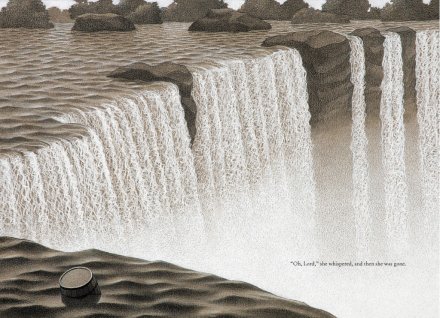
Annie held on for dear life. At the edge of the falls, Fred had told her, there would be a moment of calm. Suddenly, Annie felt this while at the same time hearing the roaring water. “‘Oh, Lord,’” she whispered, and then she was gone.” Some spectators screamed, some cheered, but most just stood still hunting for the barrel at the bottom of the falls.

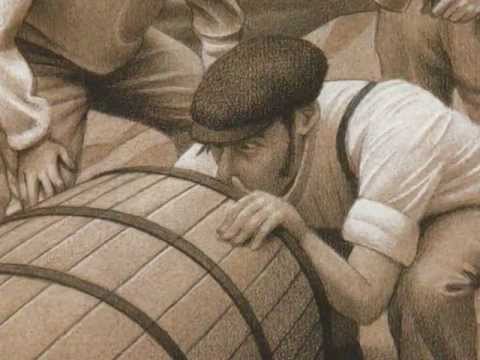
“Suddenly, the barrel bobbed to the surface.” Still, everyone held their breath, wondering what had happened to Annie. When the barrel neared shore, men jumped in and dragged it onto the rocks. They removed the lid, and called her name. A weak “‘Where am I?’” answered back. Annie had survived the fall, although she was dizzy, bruised, and battered. Annie soon recovered from her injuries, and began traveling across the country to meet the hundreds of people who lined up for tickets in every city to see the ‘Queen of the Falls.’

celebrate-picture-books-picture-book-review-queen-of-the-falls-man-looks-in-barrel

Image and text copyright Chris Van Allsburg, courtesy of Houghton Mifflin Harcourt

When the people saw that Annie was an elderly widow instead of a dashing young adventurer, however, they lost interest. Fewer and fewer people came out to see her. When Fred Russell realized he would not be getting rich, he left Annie, taking her barrel with him. But Annie was not to be counted out. She recovered her barrel and hired a new manager named Billy Banks. Eventually, Billy also abandoned Annie and took her barrel for good.

Annie was down, but not out. She had a new barrel made and placed it in a park near Niagara Falls. She sat at a table nearby with postcards and a pamphlet about her amazing feat and invited passersby to buy them and meet the Queen of the Falls. Annie never did get rich and famous, but ten years after her wild ride she told a reporter that despite her disappointment on that point, she was proud to be able to say that she had done “the greatest feat ever performed.”

With his superb storytelling skills, Chris Van Allsburg reveals all the excitement and quirkiness of Annie Taylor’s wild idea and even wilder ride to readers. This true story of a bygone era and the utter audacity of a woman who tested her mettle against one of nature’s most formidable challenges will astound kids—and Annie’s nonchalance will make them (and adults) laugh. Perhaps more important than the facts of Annie’s stunt are the facts about Annie herself. Behind the etiquette teacher lay a smart, enterprising, and even scientific, woman who had the grit and self-confidence to attempt the “impossible.” Readers will also see that even when things don’t work out exactly as planned, they can be proud of their personal achievements. Van Allsburg’s sepia-toned photographic-style illustrations set readers in the early 1900s, catch Annie in the moment of her big idea and inside her barrel, and unveil the beauty of Niagara Falls.

Fascinating from beginning to end, Queen of the Falls is a wonderful book for kids interested in history, daredevils, and creative ideas.

Ages 6 – 9

Houghton Mifflin Harcourt, 2011 | ISBN 978-0547315812

Learn more about Chris Van Allsburg and his books as well as discover a gallery of illustrations, videos, and even a TED Talk on Queen of the Falls on his website!

Niagara Falls Runs Dry Day Activity

Eggs-citing Ride Experiment


Even though Annie Taylor’s barrel was strong on the outside, she knew that she needed to protect herself inside. She used pillows, a handle, and a leather strap to keep herself from getting hurt.

In this experiment I invite you to design a container that will protect a raw egg from breaking when it is dropped from different heights. I’ll let you ponder what materials you will use—because that’s the fun part!

So get your creative thinking caps on—and get cracking…Umm…I mean…get going!

Supplies

  • Raw egg
  • Some kind of small container
  • Materials to protect the egg

Directions

  1. Using a variety of materials and your scientific knowledge, create a container that will protect a raw egg from breaking
  2. Place the raw egg inside the container and seal it shut
  3. Drop the container from as high as you can, for example, from the top of the stairs or a treehouse.
  4. Be sure to ask for an adult’s help or permission when choosing where to drop your egg.

Picture Book Review

March 28 – It’s Women’s History Month

celebrate-picture-books-picture-book-review-fearless-flyer-cover

About the Holiday

Women have been inventing, discovering, questioning, challenging, and changing the world in the same ways and for just as long as men have—but often without recognition, the ability to take jobs in their fields of expertise, or equal (or even any) pay. This month’s observance serves to educate people on the amazing women who have blazed trails in the past and those who are continuing that tradition today.

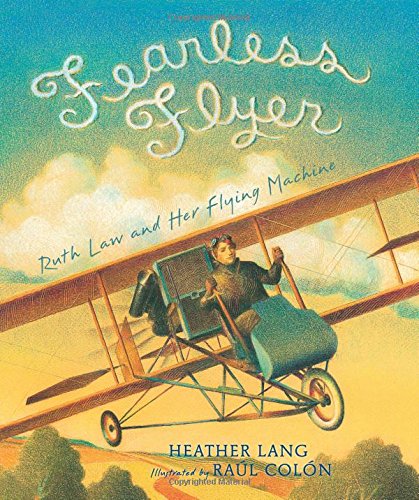
Fearless Flyer: Ruth Law and Her Flying Machine

Written by Heather Lang | Illustrated by Raúl Colón


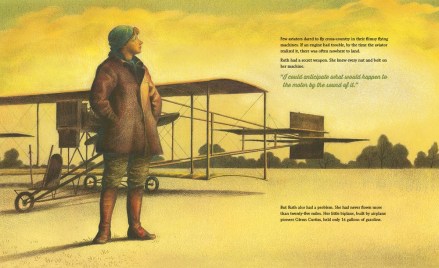
Entertained crowds knew Ruth Law for the loops, the spiral dives, and even the dip of death that she performed in her airshow. But for Ruth these stunts were like standing still. She “longed to fly to get somewhere…somewhere far away.” She decided to fly from Chicago to New York City. There weren’t too many aviators brave enough to attempt such a long flight in the type of biplane Ruth flew. They feared that if something went wrong with the engine, they’d never realize it in time to land. But Ruth knew her plane inside and out and figured she “could anticipate what would happen to the motor by the sound of it.”

A trip like the one Ruth envisioned posed another problem, though. Her small biplane held only 16 gallons of gasoline—not enough to make the journey. She asked Glenn Curtis, who built her plane, if she could buy his latest model. This much bigger plane held 205 gallons of gas and had already proven itself. But Curtis refused. He didn’t believe Ruth could handle the “powerful machine on such a long flight.”

celebrate-picture-books-picture-book-review-fearless-flyer-ruth's-plane

Image copyright Raúl Colón, text copyright Heather Lang. Courtesy of Calkins Creek.

Ruth was not to be deterred. She added three more gas tanks so the plane could hold 53 gallons of gas, installed a cover to protect her legs, and created a scrolling map of the route. Aviation experts said she would fail, but Ruth disagreed. “‘What those men can do a woman can do. I can do,’” she said. On a windy November 19, 1916, Ruth took to the cockpit to begin her nonstop flight. Although she was a little scared of what lay ahead, she took off, believing that “the scare is part of the thrill” of any experience.

Ruth had counted on the strong wind to help push her farther faster, but just as quickly as it had blown up, it stopped. She wondered if she would have enough gasoline after all. As she flew over one landmark after another, Ruth felt exhilarated. As she passed over Cleveland, Ohio, though, “the oil gauge registered zero pressure. Something was wrong!” The sounds of her plane’s motors told Ruth a different story. She kept flying.

Soon she was passing over Erie, Pennsylvania—the site of the record-breaking flight by Victor Carlstrom. Even the icy stings of the frigid air couldn’t dispel her excitement. In a moment she was east of Erie and had broken Carlstrom’s record. The thrill of her achievement was tempered, however, by the sputtering of her engine. While there was still a little gas in the plane, it was “too low to feed into the engine.” Ruth tipped the plane forward to give it more gas. Two miles from Hornell, New York, the nearest landing spot, “the engine grumbled its last roar, leaving her with nothing but the silence of the wind.”

celebrate-picture-books-picture-book-review-fearless-flyer-arial-view
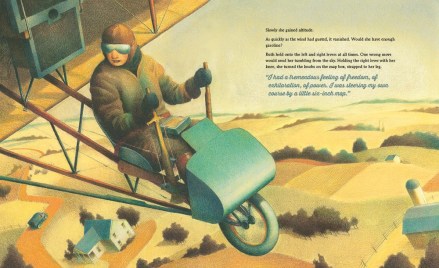
Image copyright Raúl Colón, text copyright Heather Lang. Courtesy of Calkins Creek.

Ruth steered the plane as it glided into Hornell—512 miles from Chicago. She was the new American nonstop flight record holder. Ruth’s original plan had been to fly to New York City, so after refueling and grabbing a bite to eat, she took off once again. Weighed down by the full gas tank, the plane barely made it over the hill and tall trees in her path. This was as close to crashing as Ruth ever was—or ever wanted to be.

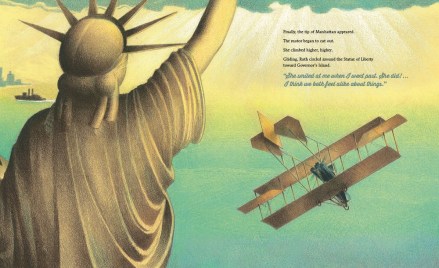
People had already heard about Ruth Law, and they came out to watch and wave. With darkness closing in, Ruth decided that she would have to land short of New York City. She touched down in Binghamton, NY and took up the rest of the flight the next morning. A thick blanket of fog obscured her view. She flew lower and lower to get her bearings and finally spied the tip of Manhattan. As she glided in, “Ruth circled around the Statue of Liberty toward Governor’s Island.” Of Lady Liberty, Ruth said, “‘She smiled at me when I went past. She did!…I think we both feel alike about things.’”

celebrate-picture-books-picture-book-review-fearless-flyer-statue-of-liberty

Image copyright Raúl Colón, text copyright Heather Lang. Courtesy of Calkins Creek.

Cheered by a crowd and a brass band, Ruth landed on the welcoming earth. Despite being numb with cold and the icicles that hung from her hair, Ruth smiled and waved. She realized then that not only had she broken an aviation record, she had made a point for all women. She later put her thoughts into words: “The sky was my limit and the horizon my sphere. It’s any woman’s sphere if she has nerve and courage and faith in herself.”

An Author’s Note about Ruth Law and her life, complete with photographs, follows the text.

Heather Lang’s thrilling account of Ruth Law’s record-breaking flight from Chicago to New York will have young aviators on the edge of their seat. Law’s flight was filled with suspense from its inception as an idea in a young woman’s mind to its final touchdown, and Lang deftly incorporates the facts as well as Law’s feelings into her well-rounded story. Along the way, readers learn about Ruth and also about early aviation. Ruth Law’s own words, included throughout the story, will inspire children as they see that even though she lived long ago, her thoughts and ideas still ring true today.

Young readers will be fascinated by Raúl Colón’s glowing illustrations of Ruth Law and her flying machine. His detailed drawings of Law’s biplane give children an excellent view of the open-air craft, fostering a true understanding of the courage it took for her to undertake such a flight. Images from Law’s viewpoint in the cockpit allow readers to vicariously travel her path to a record-breaking flight and also to self-realization.
Ages 5 – 8

Calkins Creek, 2016 | ISBN 978-1620916506

Check out Heather Lang’s website for more about her and her books. You’ll also find links to a video and photos about Ruth Law, a map of her route, and information about her plane as well as a Teacher’s Guide.

Fly along with Ruth in this Fearless Flyer book trailer!

Women’s History Month Activity

celebrate-picture-books-picture-book-review-biplane-craft

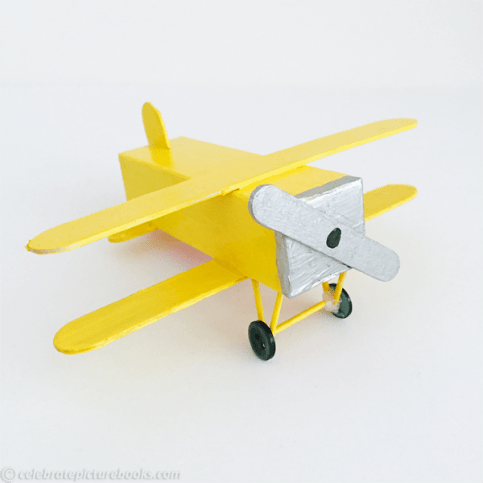
Head in the Clouds Biplane


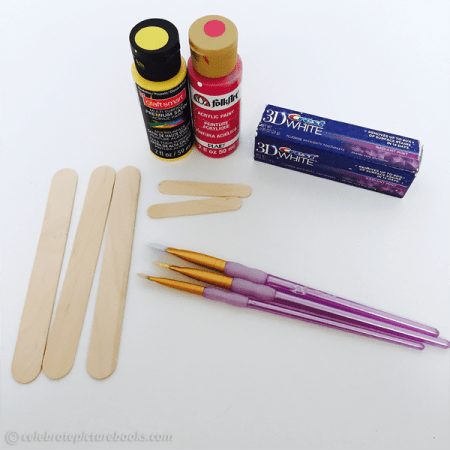
If you love airplanes and flying, you’ll have fun making your own plane from recycled materials! Use your creativity to decorate your plane while you imagine yourself flying through the clouds on a beautiful day. Younger children will have fun sharing this activity with an adult or older sibling too!

Supplies

  • Travel-size toothpaste box
  • 3 6-inch x 1/2-inch craft sticks
  • 2  2 1/2-inch x 7/8-inch mini craft sticks
  • 5 Round toothpicks, with points cut off
  • Paint in whatever colors you like for your design
  • 4 small buttons
  • 2 mini buttons
  • Paint brushes
  • Strong glue or glue gun

Directions

  1. Empty toothpaste box
  2. Paint toothpaste box and decorate it
  3. Paint the craft sticks and 5 toothpicks
  4. Paint one small craft stick to be the propeller
  5. Let all objects dry

To assemble the biplane

  1. For the Bottom Wing – Glue one 6-inch-long craft stick to the bottom of the plane about 1 inch from the end of the box that is the front of the plane
  2. For the Top Wing – Glue the other 6-inch-long craft stick to the top of the plane about 1 inch from the front of the plane
  3. For the Tail – Glue one mini craft stick to the bottom of the box about ¾ inches from the end that is the back of the plane
  4. For the Vertical Rudder – Cut the end from one of the painted 6-inch-long craft sticks, glue this to the back of the box, placing it perpendicular against the edge and half-way between each side

To assemble the front wheels

  1. Cut 4 painted toothpicks to a length of ¾-inches long
  2. Cut one painted toothpick to a length of 1-inch long
  3. Glue 2 of the 3/4-inch toothpicks to the back of 1 button, the ends of the toothpicks on the button should be touching and the other end apart so the toothpicks form a V
  4. Repeat the above step for the other wheel
  5. Let the glue dry
  6. Glue the 1-inch long toothpick between the wheels at the center of each wheel to keep them together and give them stability. Let dry

To make the back wheel

  1. Cut two ¼-inch lengths of painted toothpick and glue them together. Let dry
  2. Glue two mini buttons together to form the back wheel. Let dry
  3. Glue the ¼-inch toothpicks to the mini buttons. Let dry
  4. Glue these to the bottom of the plane in the center of the box directly in front of and touching the tail

Display your biplane!

Picture Book Review