March 24 – Cover Reveal for ARLO

ARLO

Written by Sophia Gholz | Illustrated by MacKenzie Haley


ARLO works on the assembly line like the rest of the robots. But unlike the others, ARLO longs for something different. Then one day, a surprise changes everything. Follow this exciting adventure as ARLO discovers the unknown, learns home is where the metal heart is, and that “something different” can be created in many ways.

Meet Sophia Gholz

Sophia Gholz is an award-winning children’s book author, poet, magic seeker, and avid reader. Sophia enjoys writing fiction with humor and heart. When writing nonfiction, she pulls on her love of science and her strong family background in ecology. Since 2017, Sophia has helped oversee the Henry L. Gholz SEEDS National Field Trip Endowment for The Ecological Society of America, funding ecological field experiences for students. Sophia is the author of The Boy Who Grew a Forest: The True Story of Jadav PayengThis is Your World: The Story of Bob Ross, Bug on the RugA History of Toilet Paper (And Other Potty Tools), Bear at the Fair, and more. When she’s not writing from her home base in Florida, you can find Sophia reading, visiting schools, or exploring the great outdoors with her family. For more, visit Sophia at: www.sophiagholz.com.

Hi Sophia, I’m so excited to be sharing the cover for your adorable book! Just look at that face! ARLO melts your heart! I’m also happy to be talking to you about how ARLO came to be and so much more. I can’t wait to get started!

Robots are both timeless and timely—and, of course, always kid-favorites!  What was the inspiration behind ARLO?

ARLO actually began as a writing exercise a decade ago, in May of 2014. At the time, the buzzword in the picture book world was “character,” and agents and editors were hungry for “character-driven pictures books.”

Now, I know authors aren’t supposed to write for the market. Instead, you write the story that suits you and hope it fits into the market. However, at that time I was still fresh to the world of picture book writing. I wasn’t agented or published. I was still learning how to craft a story and hadn’t studied much on character building. So, I took the buzzword of the day and decided I wanted to explore that idea. In doing so, I created a metal bot that longed to swim, but couldn’t because—as the line when in my original manuscript said—“His boots sink like bricks, his gears rust, and oil and water don’t mix.”

Similar to the ARLO of today, this original bot worked on a factory assembly line and longed for something different. But unlike ARLO, that original bot had eight arms (like an octopus) and because he loved water, I called him Robotopus. It took me over a decade, 60+ drafts, and so many different variations to finally find ARLO at the heart of this story. And that is exactly why you don’t write for the market and instead write for yourself. It wasn’t until I let go of what I thought this story needed to be and allowed it to become what it was naturally that it clicked.

Growing up, did you have a favorite robot character in books, TV, or movies? What was it about that robot that you liked best?

I’ve always been a huge techy/sci-fi and fantasy fan! One of my favorite childhood movies was called Flight of the Navigator. I loved that film as a kid and it definitely sparked my interest in out-of-this-world robots at a young age. Flash forward, my daughter was on a competitive robotics team in school and that continued to fuel my love. But I’d be remiss if I didn’t shout out Disney’s WALL-E here. That little bot stole my heart from the get-go! In fact, I pitched ARLO’s story as “WALL-E meets The Wizard of Oz.”

Can you talk a little about the journey of this book from idea to publication?

Some books pour out in final form within a matter of hours. Other books take years. ARLO was one of the latter. The first draft was written in May of 2014. I’m one of those writers who likes to save all of their drafts as I revise in case I need to pull something from or revert back to a previous version of a story. So, it’s pretty easy for me to look back now and see exactly how this story changed and shifted over the years.

From the first draft, I fell in love with my little robot. I knew from the start he worked in an industrial factory, but needed nature and longed for something different. In those first drafts, my robot wanted to swim and he used his factory skills for building a suit to help him achieve that goal. That original story actually won an SCBWI Rising Kite Award in 2017. Still, I knew it was missing something. Like my little bot, the story longed for something more. I just couldn’t figure out what that was.

I eventually shelved this manuscript as I focused on other projects. But my bot lived on in my mind. Over the course of ten years, while I was in between other projects, I’d pull this manuscript out of the drawer and completely rework it again and again. Robotopus became Robbie, then Robotika, who morphed into Zigbee, then Ozzy, and ARO, who finally led me to ARLO.

It wasn’t until I let go of the idea of swimming (which I held onto for SOOOO long) and allowed ARLO to tell me what he wanted instead of me telling him, that his story finally poured out in late 2019. But in 2019, two things happened simultaneously: 1) my first book (a nonfiction book titled The Boy Who Grew a Forest) was released and 2) the pandemic struck. As a result, ARLO was shelved again, and it would be another two years before his story would be sent to editors for consideration.

When Sarah Rockett at Sleeping Bear Press made an offer, I jumped on it. I didn’t want the manuscript going anywhere else. Sleeping Bear makes such beautiful books and I knew Sarah really understood this character and the heart of ARLO’s journey.

Tell me about the first time you saw MacKenzie’s cover for ARLO.

I have loved MacKenzie’s art since I first saw it in The Scariest Kitten in the World. I was ecstatic when my editor, suggested MacKenzie as the artist to bring ARLO’s story to life. As soon as her name was floated, I couldn’t think of a better artist for this book.

When I first saw her cover sketch, I squealed in delight. I had no idea what to expect and Mackenzie completely nailed it. I mean, she really knew how to bring ARLO’s personality out and how to capture our little bot’s heart. I cannot wait for readers to immerse themselves in MacKezie’s art and ARLO’s world!

Since your first book The Boy Who Grew a Forest: The True Story of Jadev Payeng was published in 2019, you’ve written about a beloved artist, a famous paleontologist, a bug in a rug, a hangry bear, and even the evolution of toilet paper. These books have been recognized with multiple state and national awards. What do these honors mean to you?

When I began writing, I set out to complete one book. That was my only goal. I was a hopeful writer who wanted to know if I was even capable of crafting or sharing a story I loved. The fact that some of those stories actually became books that have been received in the way they have, is far beyond my wildest dreams. To say I am incredibly grateful, would be a vast understatement.

To this day, each time I sit at my desk, I question again if I’m capable. As an artist, you hope other people will love your art the way you do but that is far from guaranteed. I completely panic every time I release a new book. No matter how much time passes from that first story, I’m still just that girl, sitting behind a keyboard, hoping to complete a manuscript and praying someone out there might like it.

The last time we chatted, you were just getting started as a published author. Your career has really taken off since then. What do like best about being a children’s author? What have you found to be the most surprising?

I’m thankful you’ve been on this journey with me since the start! It feels so good to be back on the blog with you now.

As an author, there is nothing more gratifying than having a reader connect with your story or your character in some way. I absolutely love hearing from readers or seeing the spark in their eyes when I visit them in schools or events. Honestly, there’s nothing better than that.

The most surprising has been navigating book bans and political controversy. When I heard A History of Toilet Paper had been banned in some circles or when I got word from PEN America that Bug on the Rug had been flagged in Florida a while back, I was floored. I’m over here just trying to share stories I love. Call me naïve, but I had no idea how much people might pick them apart in search of negativity.

From the pictures of school, bookstores, and workshop appearances on your website, it’s clear you and the kids have a blast when you visit. Can you talk a little about what you do during a school visit? 

I love visiting schools and hosting author events. This past year, unfortunately, I had to cancel most of my appearances as my daughter went through some very scary health issues. Thankfully, we are on the other side of that now and I’m looking forward to reconnecting with everyone!

I’m not an educator by nature (shout out to all the amazing teachers out there!!!) and don’t know much about school curriculums. So, for me, I love to talk with people about the art of storytelling and finding inspiration in everyday life. One of my favorite things to do is work with an audience to create a story in real time during a visit.

What are you hoping kids will take away from this book?

ARLO is ultimately about finding yourself, learning to embrace differences, and stepping outside of your comfort zone. I hope readers of all ages will find inspiration in ARLO’s adventure.

When can readers look forward to seeing ARLO on bookstore shelves? Do you have tour or other plans you’d like to share?

 ARLO will be released August 1st, 2025 and is available now for preorder anywhere books are sold! Keep an eye out on my website for upcoming events and signings: sophiagholz.com.

Thanks, Sophia, for sharing so much about your journey with ARLO and your inspirations! It’s obvious that ARLO is very well loved!

Meet MacKenzie Haley
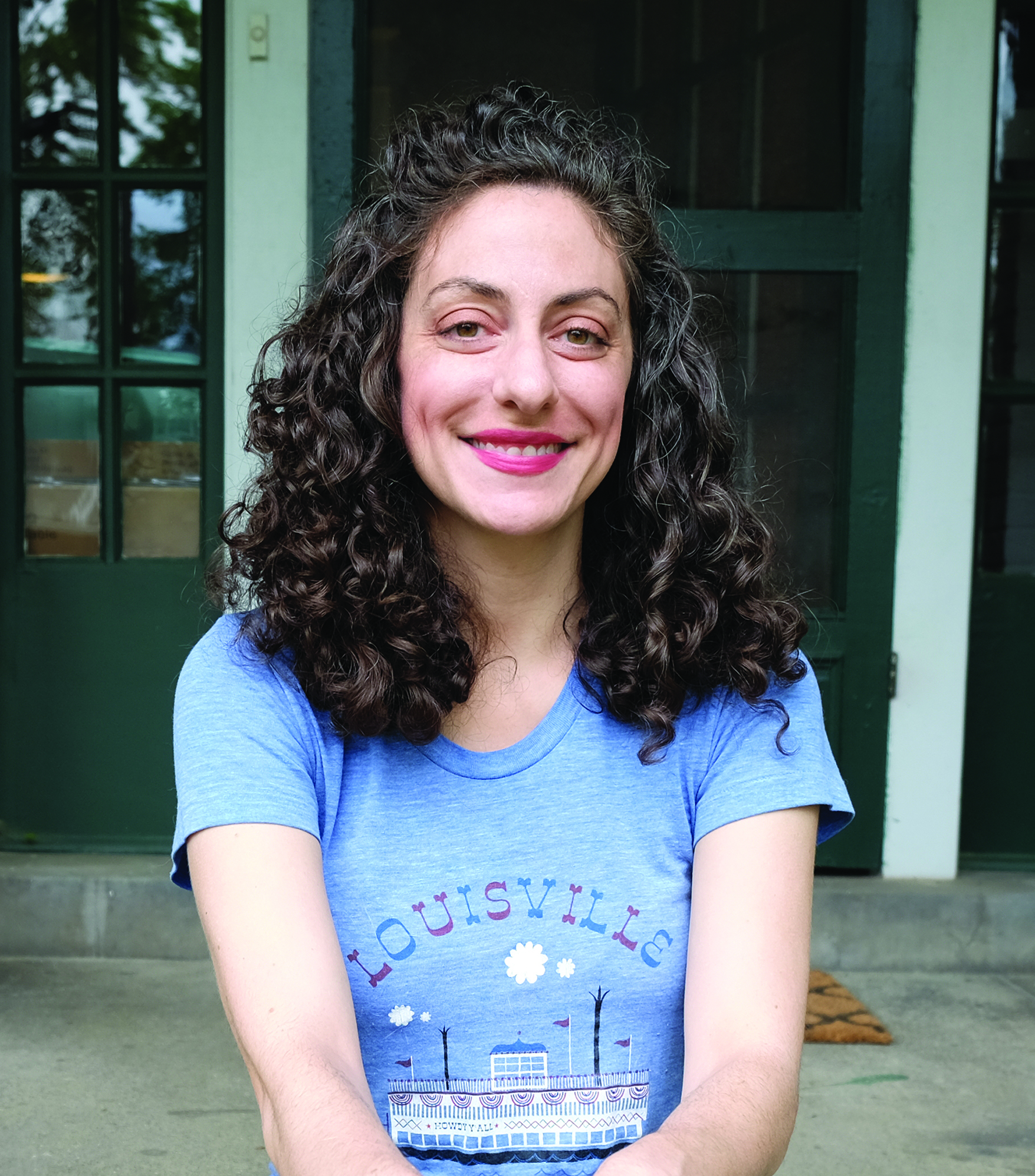
MacKenzie Haley is an award-winning illustrator born, raised, and living in Louisville, Kentucky with her two cats, Booger and Abby. She is the illustrator of Dolly Parton’s Billy the Kid series, as well as A Book for Bear, and The Scariest Kitten in the World. When she’s not drawing or playing with her cats, she can be found spending time with her friends and family, and learning what’s currently “cool” from her twelve-year-old niece, and eight-year-old nephew. To learn more about MacKenzie and view adorable “bits and bobs,” comics, and more, visit her at mackenziehaley.com

Hi Haley! I just fell in love with ARLO the moment I saw him, so I’m thrilled to get to talk to you about how you brought ARLO to life and all the considerations that go into creating illustrations for a picture book. I’ve also gotta know about the kitties you’ve fostered, but let’s start with ARLO.

What drew you to this project?

When I first got the ARLO manuscript, I immediately appreciated the idea of this little robot having the very human experience of daily mundanity. No matter how much we love our day job, our family, our friends, sometimes the day-to-day gets hard and we lose ourselves in that daily grind. The fact that ARLO is literally swept away into a whole new world, specifically into nature, was a reminder that as humans we can get stuck in our day-to-day existence, and begin to take things for granted, to let ourselves get run down. It reminded me that we need to go outside and appreciate the natural world around us. Take time to breathe and experience nature. When we do that, we bring some of that back into our daily lives, and it can change our daily experiences for the better, just like it does for ARLO.

Can you describe your process in creating and choosing this endearing cover image?

To start with, I’ve had good and not-so-good experiences in the past creating covers. I guess every illustrator has! In my earlier years I had publishers shut down my ideas for the cover and want me to just create their vision. When that would happen, the end result was usually not something I was happy with, or that I felt served the book very well. In more recent years I’ve been fortunate enough to work with some wonderful publishers and art directors who value my input and let me explore ideas and take the lead.

Creating the cover for ARLO was a really great example of the collaboration between myself and the publisher/art director/editor. Looking back, I can see I started the cover a bit more guarded than I realized. I can get too attached to my ideas, and sometimes feel like I’m losing my voice in how an image turns out when someone asks me to make certain changes that I’m not sure about at first.

Working with Sleeping Bear Press taught me that there is a good balance to be struck between having an idea you really like, and leaving room for creative feedback and space for positive changes. Not to be so precious with my ideas or images, so that when suggestions are made with a good team, I can step back and really hear what they are saying and work that into the cover vision. For example, I initially kept making ARLO too small in the cover sketches I was creating. So Jennifer took the time to talk with me on the phone and explain what they were looking for, and we were able to come up with an image that really showcases the main character, while hinting at the world he discovers in the story. I learned a lot throughout this process, and I’m really grateful for their endless patience with me.

Did you always want to be a children’s illustrator? How did your career begin?

Growing up, money was really tight. There was a time when my mom and dad didn’t buy themselves any new clothes for two years, but they made sure that I always had a full bookcase and a constantly growing little library of my own. I treasured those books and carry that love of books with me today. Each book was a little world I could explore and get lost in.

That being said, growing up I never realized you could make a living creating art. There was no one in my family’s sphere who did that, and I just didn’t know it was a possibility. I kept making art as I grew up though, and learned that there were jobs as artists. I got my BFA with an emphasis in illustration from The University of Dayton in 2002. While I always loved children’s books, I had no idea how to get into that field, so I cast my net wide and tried to get any and all illustration freelance jobs I could. I had a day job this whole time because my freelance income wasn’t paying my bills.

Around 2005 or 2006 I realized I needed to focus on one aspect of illustration. I had no idea how difficult the children’s book market was to break into, so I naively chose that, haha! I’ve heard it said that you don’t know what you can’t do if no one ever tells you. So I worked on my portfolio, submitted to agents, got rejected, worked on my portfolio some more, submitted again, and got rejected. I kept doing this, improving each round, until I finally got an agent in 2017. I was able to quit my day job in 2018 and have been illustrating children’s books full time ever since then!

What have you found to be the most rewarding aspect of being a children’s illustrator?

Seeing a book completed at the very end is such an incredible feeling and makes all the hard work worth every minute. To know that the author and I created this brand new thing where nothing existed before is an amazing feeling. The other most rewarding thing is hearing from parents or kids themselves about how much a book means to them, how much they like a book or what kind of impact it’s had on them. I remember being little and how important books were to me, how much I cherished them. I feel honored that I am able to be a part of children’s lives like that.

When you are given a manuscript for a picture book, what are your first considerations and how do you go about creating a detailed world for the story?

When I first get a manuscript, I read through it a number of times without trying to make any decisions, to just absorb the story. When I first started illustrating books, I didn’t really know what I was doing or have any kind of plan. That’s changed throughout the years, learning what works best for me and seeing what helps me create the best books I can.

For ARLO, I took a more holistic approach, considering characters, color palettes, emotional tones and shifts. The first thing a publisher usually wants are sketches for the main characters. This was the case with ARLO, but for this story I took it further. I listed all of the characters, distilled the main message of the story, and noted what the characters were feeling and when, along with the major emotional shifts in the book. The robots are characters in this story, but I also considered the two worlds or environments as characters as well—the factory and nature. I wanted a color shift to occur throughout the book. The factory was created using almost exclusively neutral colors, with a pop of bright blue here and there, hinting at the natural world ARLO would explore later (the bird he follows in the story is bright blue).

Illustration © 2025 by MacKenzie Haley, text © 2025 by Sophia Gholz. Courtesy of Sleeping Bear Press.

The shift from neutrals in the factory to an explosion of bright, bold colors in nature was really important. The neutrals portray the mundanity of ARLO’s daily life in the beginning of the story, and at the end when he has learned from his adventure, he brings the brightness from nature into the factory, and we see neutrals and bright colors together, indicating in a visual way how ARLO’s and the robots’ daily lives are more fulfilling and happy now. Colors carry such emotional weight, and my hope is that the reader feels this as they progress through the story.
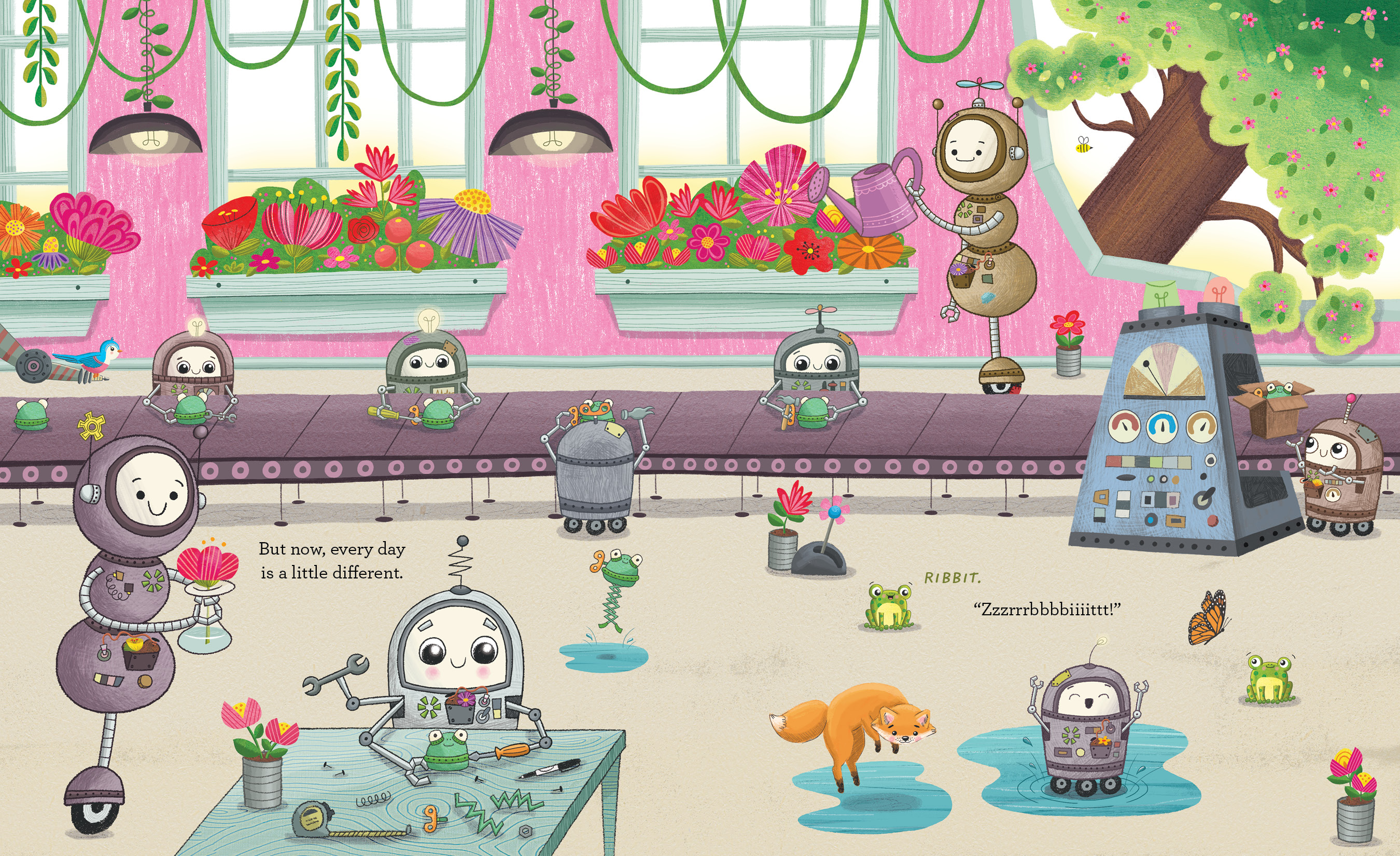
Illustration © 2025 by MacKenzie Haley, text © 2025 by Sophia Gholz. Courtesy of Sleeping Bear Press.

What was your favorite part of creating ARLO’s world?

My favorite part was creating ARLO himself. I had so much fun playing with basic shapes and forms and fun little details, such as the little compartments he has and what tools would pop out of them. But I also loved creating the outside world almost as much as ARLO. To make the flowers, I scanned in hand-painted swatches of watercolor, collaged shapes from them digitally in photoshop, and then drew on top of those shapes. I got to explore a lot and try several different things to see what worked best and what I was happiest with. It was a really fun process! I think the watercolor texture is a good contrast to the sleek metallics of the factory world.

Your bio on your website reveals that you’ve fostered around twelve cats and are a cat mom to two. How did you begin fostering cats? Your illustrations of cats are so adorable and true to cats’ goofy and sweet personalities. Do you use your own cats as inspiration? Will readers be meeting any kitties in ARLO?

I fostered my first kitties 13 or 14 years ago. At the time Louisville Metro’s animal shelter system had a really high kill rate. I didn’t have much money to donate, and they said the next best thing was to foster. They have food banks to cover that cost, and local vets who spay/neuter the cats for free, and take care of deworming, fleas, etc. I walked into the shelter that first day, having one cat at home, thinking to myself “okay, you get to foster one cat.” I ended up walking out of there with a huge crate holding a mom cat and her five one-day-old kittens. I obviously didn’t stick to my plan! I had asked them what their most immediate or urgent case was, expecting maybe a difficult or older cat. When they introduced me to mom cat and her kittens though, I couldn’t say no. I’m a sucker for kitties!

I definitely use my own cats for inspiration. The kitten in The Scariest Kitten in the World is basically my white cat, Booger. She’s so goofy and playful. She was one of the kittens in that first foster group I had, so I’ve known her since she was one day old. She would crawl up on my lap while I was working on an illustration and fall asleep, while the other kittens were playing with each other. I fell in love immediately. I think the situation is more that I’m her human, rather than that she is my cat. I adore her. There aren’t any kitties in ARLO. I should have tried to sneak one in! But there are some woodland creatures the readers will see along the way!

What would you like readers to take with them from your illustrations for ARLO?

I think I would like them to take away the idea of what an amazing wonder nature is, what a gift we have right in front of us, and what it can add to all of our lives. Just being outside for even five minutes a day, breathing in fresh air, feeling the sun on your skin, it all makes such a huge difference. I think it’s something humans crave and need to be whole and happy.

Thank you so much, MacKenzie, for this wonderful, in-depth look at your career in illustration and your process in creating ARLO’s world! I’m so looking forward to August 1, when readers everywhere will be able to bring ARLO home with them.

If you’re as eager to read ARLO as I am, you can preorder the book at these booksellers and from Sleeping Bear Press. ARLO will be released on August 1.

Sleeping Bear Press | Amazon | Barnes & Noble | Bookshop (to support your local independent bookstore)

Picture Book Review

February 21 – It’s National Nest Box Week

About the Holiday

National Nest Box Week was established in the United Kingdom in 1997 to highlight how birds are often displaced from their natural nesting places with the destruction of the woodlands and fields birds call home. The holiday encourages people to pay attention to their local nesting birds and put up nest boxes to support the conservation of breeding birds. No matter where you live, birds’ ecosystems are fragile. You can make a big difference in the survival of your local bird population by building and maintaining nesting boxes for the spring and summer months. To learn how more about the holiday and how you can help, visit nestboxweek.com.

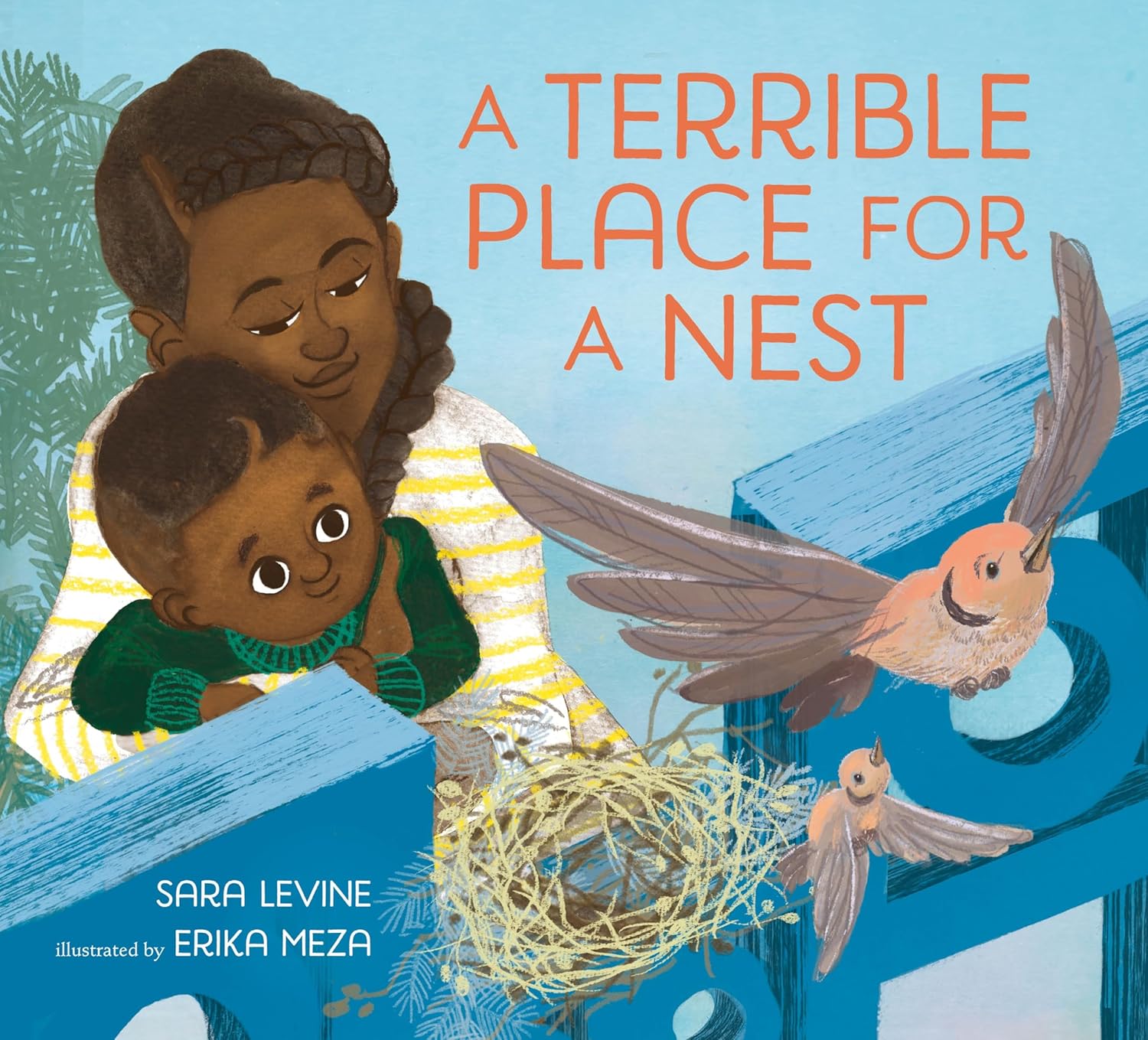
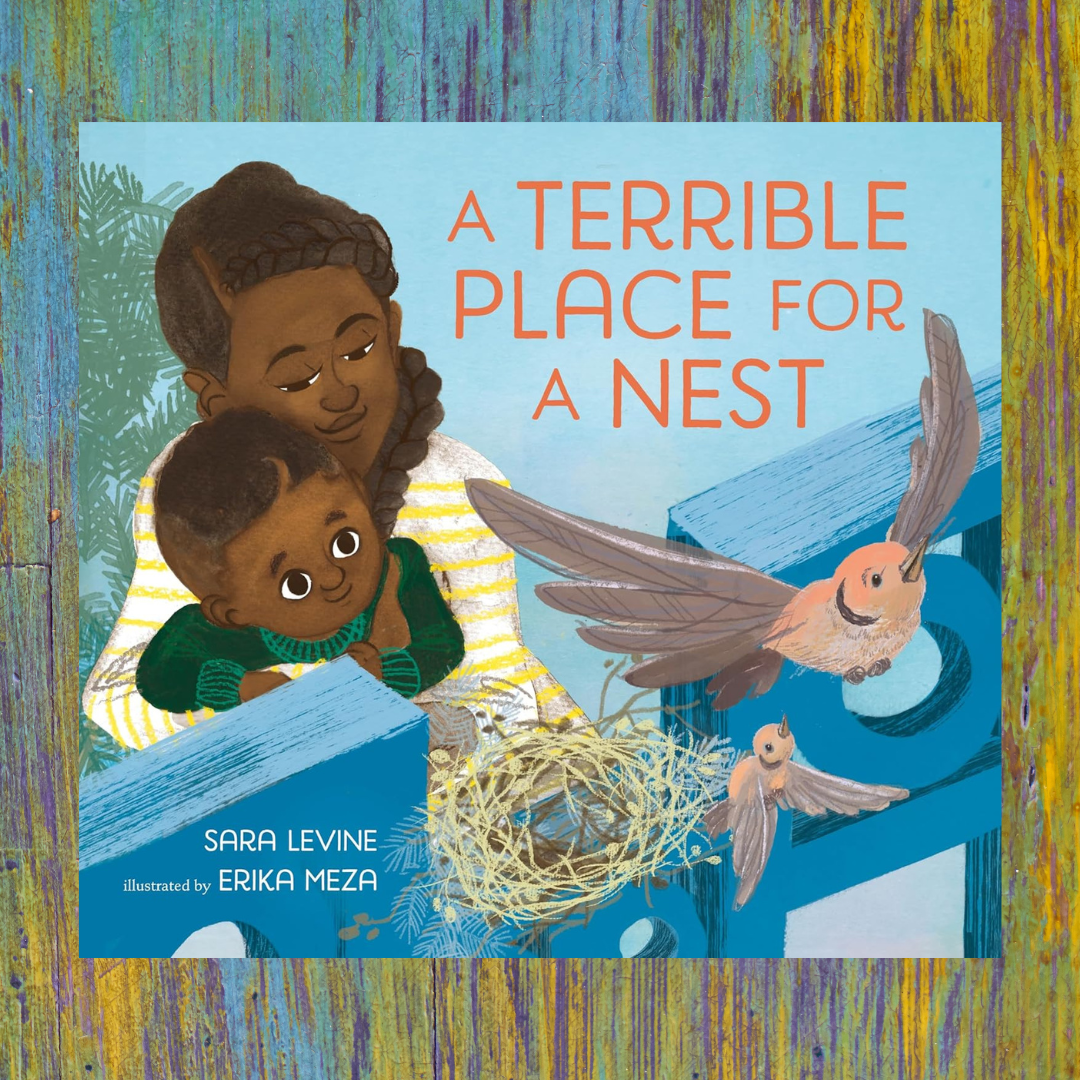
A Terrible Place for a Nest

Written by Sara Levine | Illustrated by Erika Meza


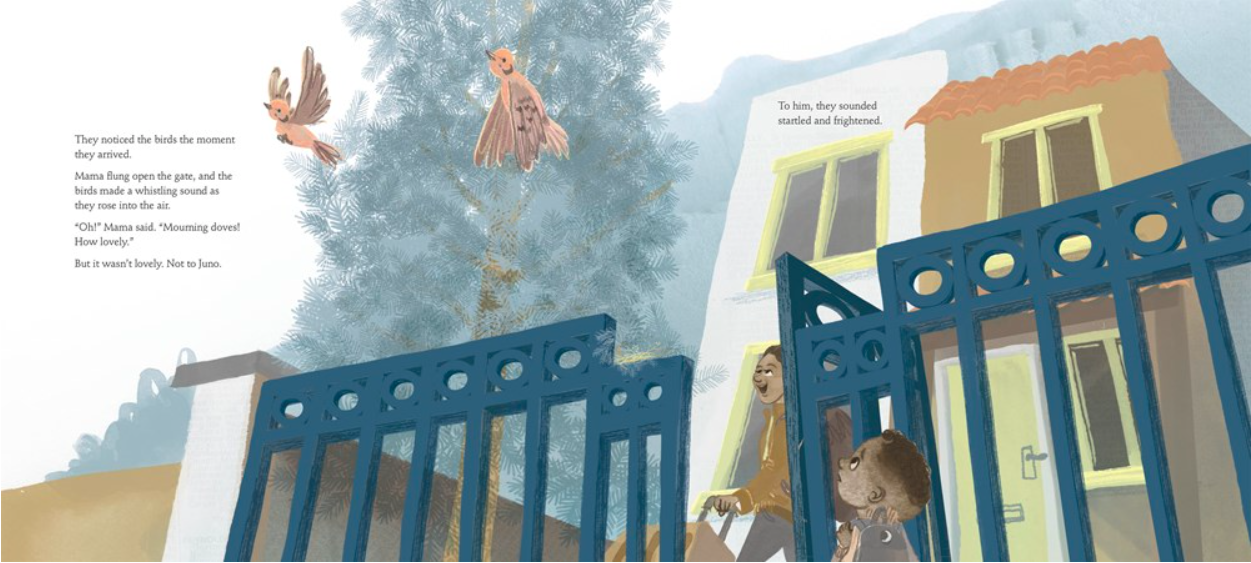
Displaced from their home, a mother and her son, Juno, move to a new place in a new neighborhood. Juno’s mother takes solace in the mourning doves that greet them, but Juno hears sadness and fear in their whistling coos. Nothing about the move feels right to Juno. He can’t get his favorite cereal at the grocery store, and he tells his mama that he’s “‘never going to fall asleep'” in his new room. 

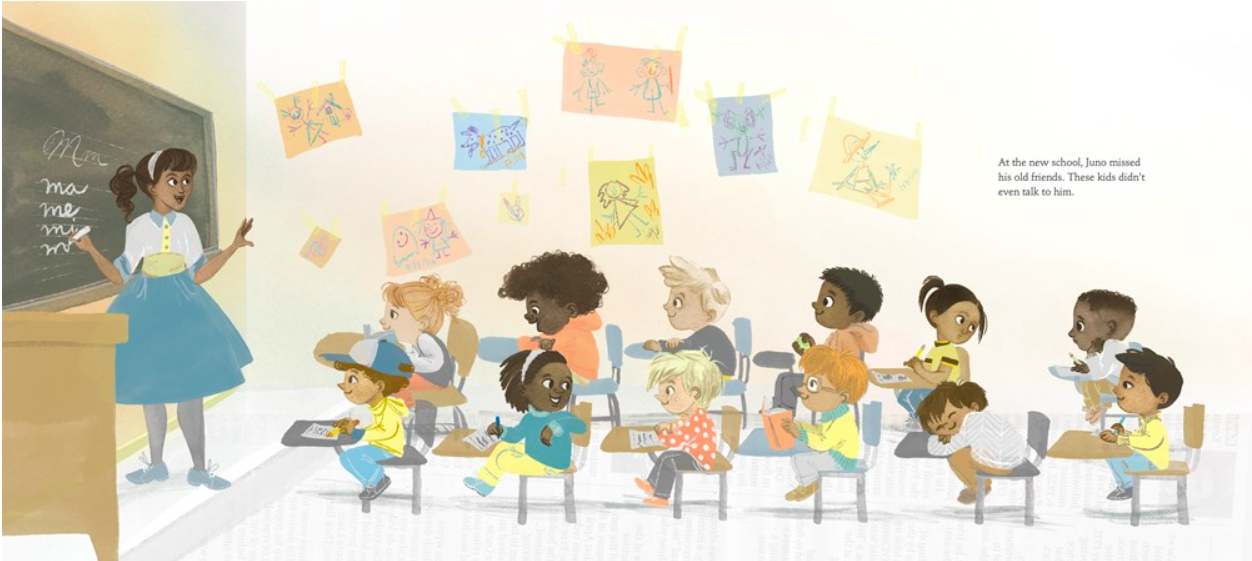
At school he sits alone with no one to talk to. When he gets home he yells, “‘This is a terrible place!,'” frightening the mourning doves from their nest on the gate. The next day, when the movers come, they knock the nest from its perch, breaking the eggs and confirming to Juno his feelings about their new home.

Illustration © 2024, Erika Meza; text © 2024 Sara Levine. Courtesy of Roaring Brook Press.

Later, Juno tries to rebuild the nest, and he and his mom buy millet seed to feed them. They’re happy to see the birds return to the yard—although the nest sits empty for days and weeks. Meanwhile, at school, Juno makes a friend of the girl who sits in front of him, talking and drawing and making paper birds together.

Still, no birds occupy the nest. At night in his unfamiliar room, where unpacked boxes of books and art supplies stand stacked against the wall, Juno thinks “maybe it didn’t feel safe to them.” But then one day, Juno notices with excitement that, just as he and his mom are settling into their new home, a dove is snugged into the nest. “Mama said this meant there were eggs.”

Illustration © 2024, Erika Meza; text © 2024 Sara Levine. Courtesy of Roaring Brook Press.

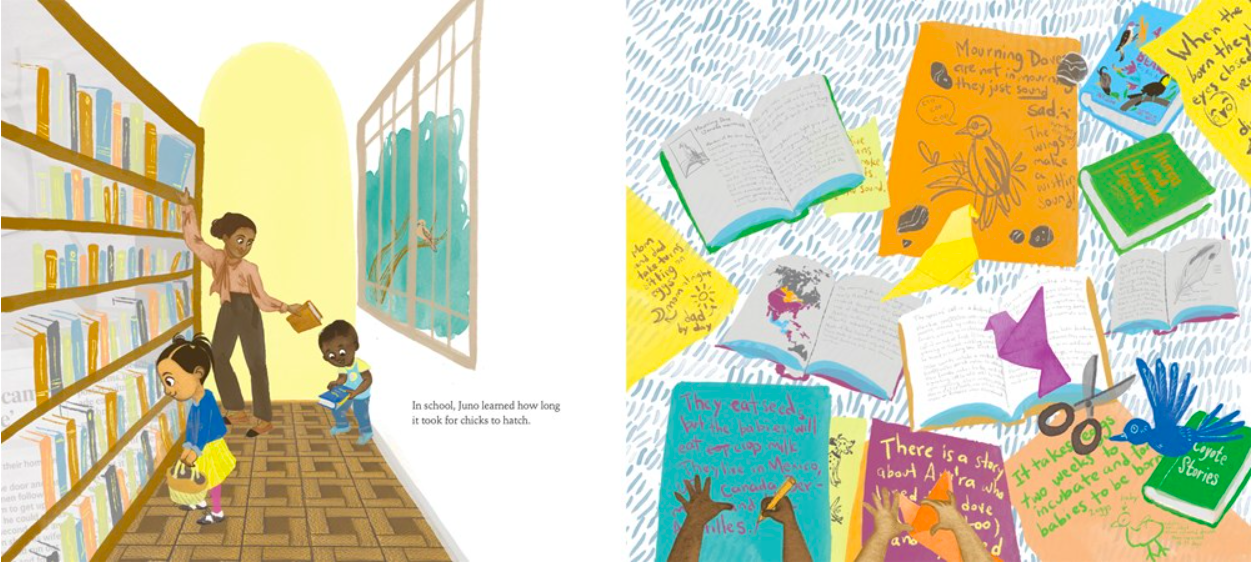
Juno and his new friend go to the school library to learn everything they can about mourning doves. On colored paper they write facts and draw pictures of adult and baby birds. And most importantly they make signs for the fence and gate, alerting people to the fragile nest and baby doves.

Then one bright, sunny morning, Juno looks out his window and sees babies! In their protected nest, the small mourning doves grow until one afternoon as Juno, his friend, and his mom enjoy a picnic in the yard, he watches as the fledglings fly from their nest. “‘I told them it wasn’t a great place for a nest,'” Juno says, but later that night, happily cuddled up with his mom, they agree, “But we made it work.”

Illustration © 2024, Erika Meza; text © 2024 Sara Levine. Courtesy of Roaring Brook Press.

In her honest and poignant story, Sara Levine allows her young protagonist to give vent to his true feelings. While he first reproaches the mourning doves for their poor choice of nesting place, his own deep disappointment, sorrow, and loneliness spill out when the eggs break. As weeks pass, however, Levine shows that just as Juno repairs the nest and makes his yard inviting for the doves again, he also makes a new friend, assimilates into school, and finds comfort in books and creating once more. Levine’s child-centered story is all the stronger for the quiet support Juno’s mother gives him, allowing him the space, time, and freedom to feel his emotions and work them out in his own way. Her final line, “‘But we made it work,'” offers optimism, camaraderie, and confidence in the face of change—the type of powerful spirit that can sustain us all.

In her affecting illustrations, Erika Meza uses color, facial expressions, and visual metaphors to compellingly show readers Juno’s transition as he navigates his way to acceptance of his new home. As the story begins, Meza uses darker and muted colors on the house and gate. As the doves accept Juno’s help, the colors brighten. Likewise, in the beginning, Juno and his mother appear sad and at a loss. Meza portrays Juno’s brown-painted room from above, as if readers are peering into a cardboard moving box. But as Juno makes friends, regains his love of learning, and the doves return, Meza’s color palette turns vivid, smiles return to Juno’s and Mama’s faces, and even the dark of night is dispelled by the dazzling light of the bedroom lamp as Juno and his mom snuggle together.

A candid story about moving away from home that is also applicable for other types of unexpected changes, A Terrible Place for a Nest validates the emotions children can experience when adjusting to new surroundings. For children struggling with change, especially, the story’s focus on taking time to adapt offers comfort and reassurance.

A Terrible Place for a Nest is highly recommended for families with a child or children who have difficulty with change and a must for school and public library collections.

Ages 4 – 8

Roaring Brook Press, 2024 | ISBN 978-1250861221

About the Author

Sara Levine is an award-winning picture book author, veterinarian and science educator. Her books, which include Bone by BoneTooth by ToothFlower TalkSensitive, and The Animals Would Not Sleep!, have received the AAAS/Subaru SB&F Prize, Bank Street College Best Book of the Year, Beehive Book Award, Cook Prize and the Mathical Book Prize. She loves doing school and library programs. Visit Sara at saralevinebooks.com.

About the Illustrator

Erika Meza grew up in Mexico and moved houses more often than she had birthdays. Having studied illustration in Paris, she now lives in London―her thirty-sixth address―where she paints, writes her own stories, and practices her uncanny ability to pack efficiently. Erika loves exploring, learning about many different places and cultures, and finding joy in the people who allow you to be yourself. Visit Erica at ericameza.com.

National Nest Box Week Activity

Watch a pair of mourning doves raise their nestlings from hatching to leaving the nest in this sweet video from Gary’s Backyard.

You can purchase A Terrible Place for a Nest at these booksellers

Amazon | Barnes & Noble | Bookshop (to support your local independent bookstore)

February 17 – Random Acts of Kindness Day

About the Holiday

It’s Random Acts of Kindness Day! Coming mid-way through Random Acts of Kindness Week, today’s holiday offers the perfect time to begin or reconfirm your commitment to doing nice things for those around you. Simple gestures of kindness—like sharing a smile, giving a compliment, or helping out when you see someone struggling—make anyone feel better and create a bond that brings a community closer. To keep the good feelings flowing throughout the year, look for opportunities to help out and share books that encourage kindness, such as today’s book!

Thank you to Orchard Books/Scholastic for sharing a copy of Hop Helps Out with me!

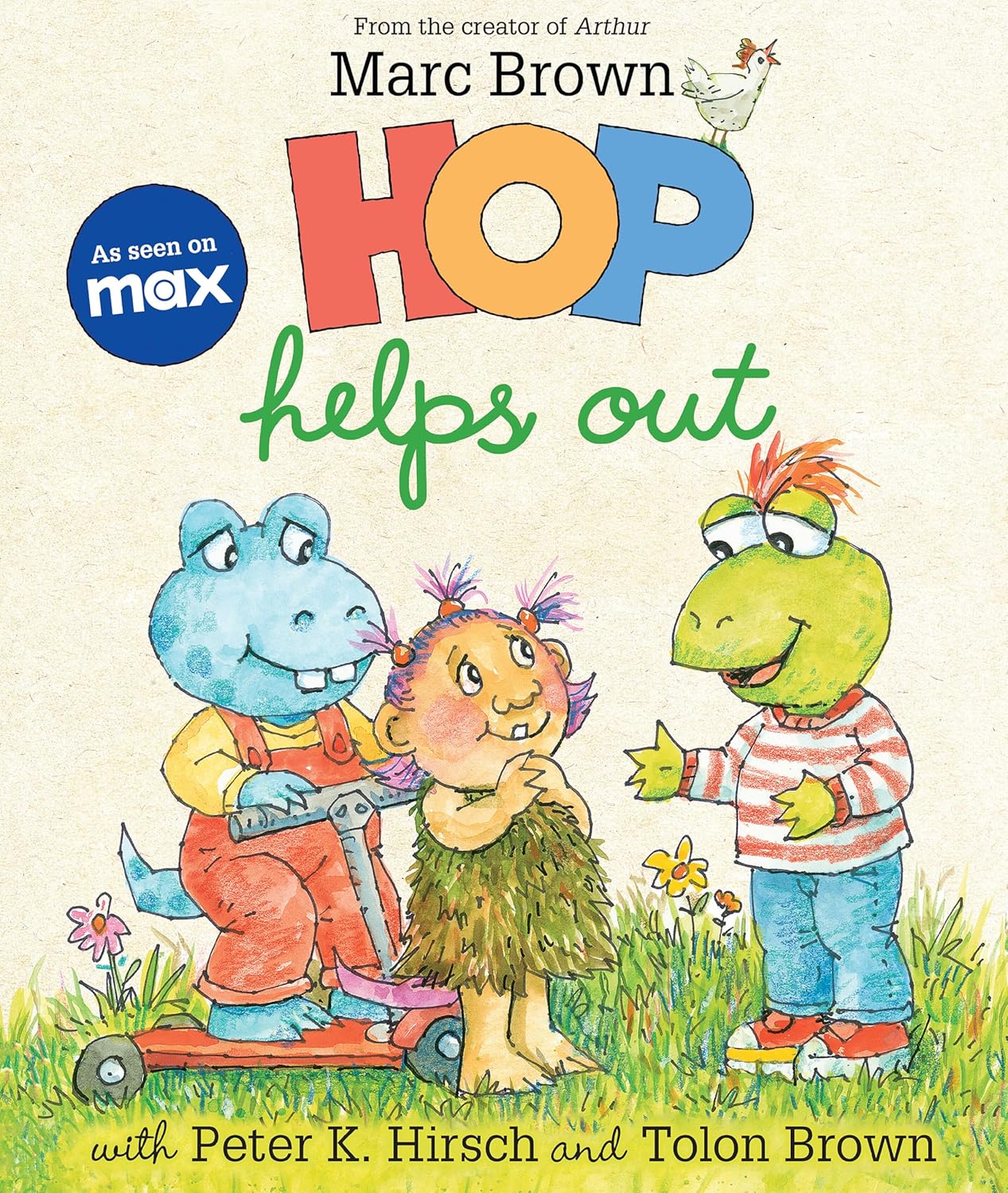
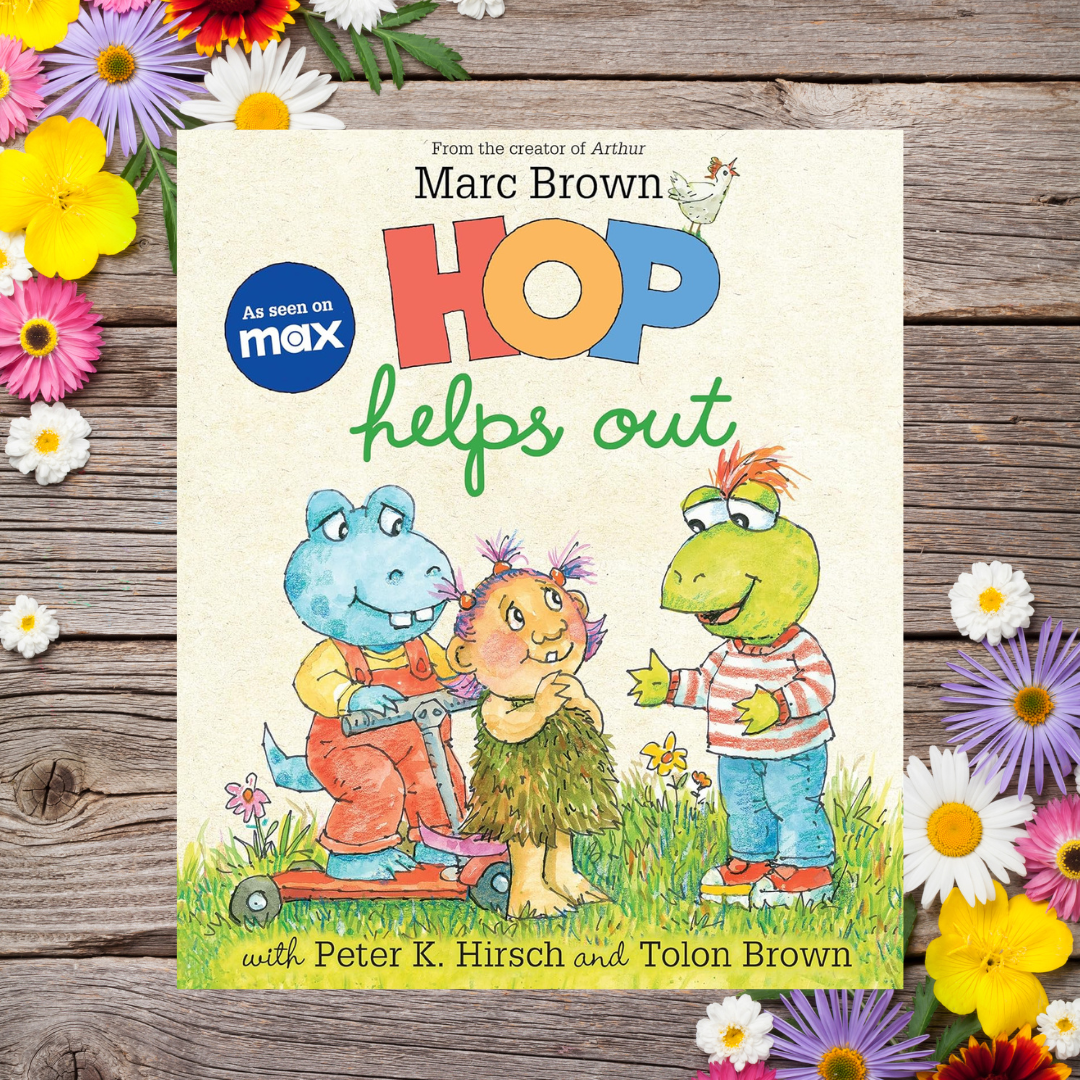
Hop Helps Out

By Marc Brown, Tolon Brown and Peter Hirsch


One morning as Hop and Benny are out exploring their town of Fair Village, they come across a troll named Helga, who’s crying because she’s too afraid to venture out into the world on her own. Hop immediately takes her by the hand and invites her to come adventuring with him and Benny. Hop and Benny are eager to show their new friend Helga some of their favorite places.

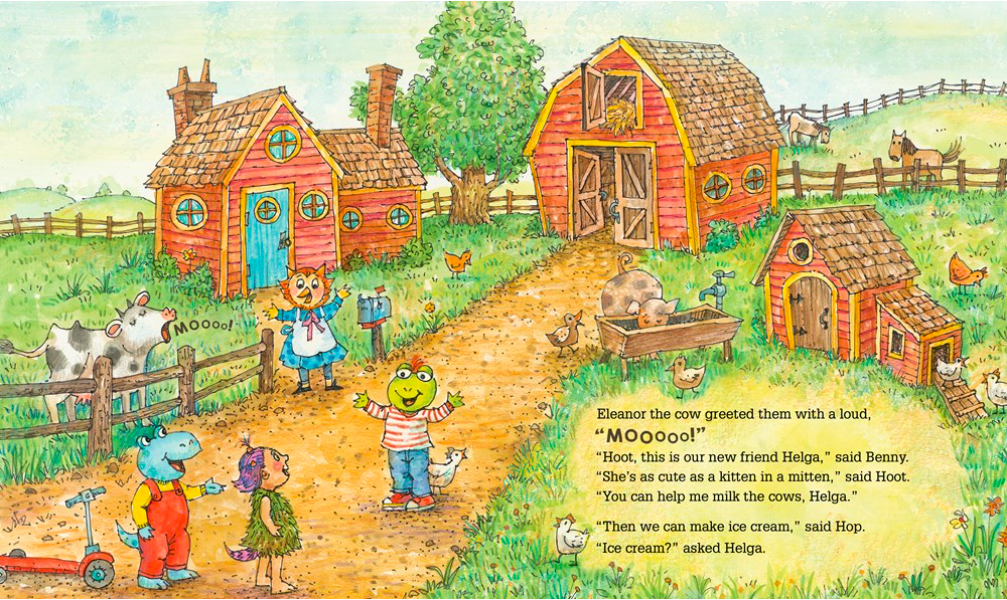
First, they visit a meadow, lush with clover, daisies, lupines, daffodils, and wildflowers in a rainbow of colors. Then Benny wants to show Helga the small mobile home he lives in. His yard, strewn with toys and games and sporting a garden, delights Helga, and when they go inside she is treated to a mug of hot chocolate and a story. Next, they take Helga to their friend Hoot’s farm. ‘”She’s as cute as a kitten in a mitten,'” Hoot declares. “‘You can help me milk the cows, Helga,'” Hoot says. Afterward, they’re all treated to homemade ice cream, dress up play, and a ride in Hoot’s talking car, Jinx.

Illustration © 2025, Marc Brown; text © 2025, Marc Brown, Tolon Brown, Peter Hirsch. Courtesy of Orchard Books/Scholastic.

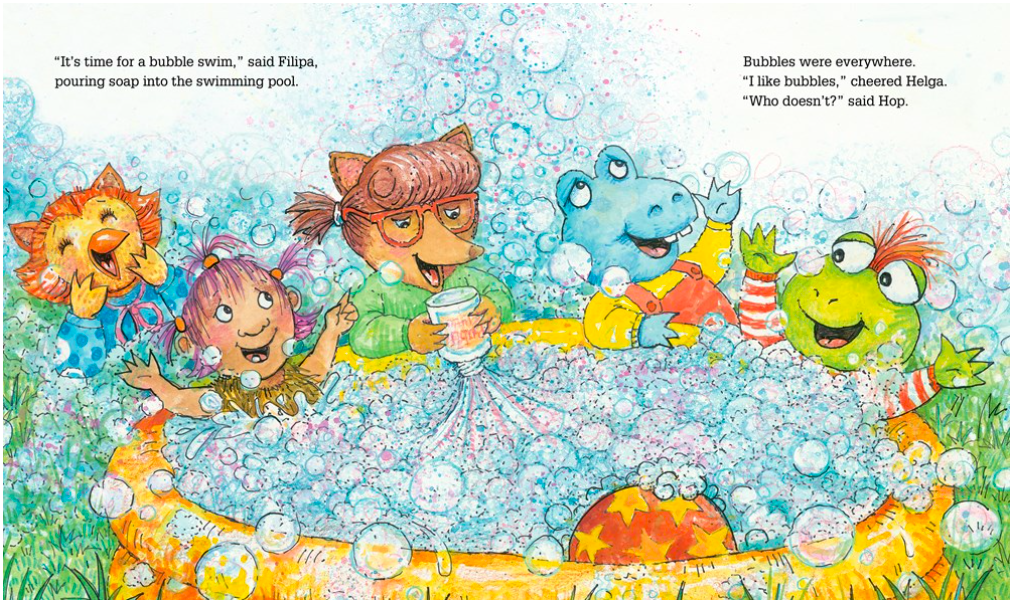
Jinx takes the merry group to see another friend, Filipa. Filipa is just filling the swimming pool underneath her treehouse when they arrive. Helga can’t believe her eyes. There are so many fun things to do here; even a swing! Even though Benny warns Helga not to swing too high, she falls off. But when Hop hurries over, Helga giggles and reveals that trolls “‘can bounce.'” In Filipa’s art studio, Helga gets to try out being creative—with herself as the canvas. Not to worry, though! Filipa fills her pool with bubbles for an impromptu (and colorful) bubble bath. “‘I like bubbles,’ cheered Helga.” “‘Who doesn’t?'” Hop agrees.

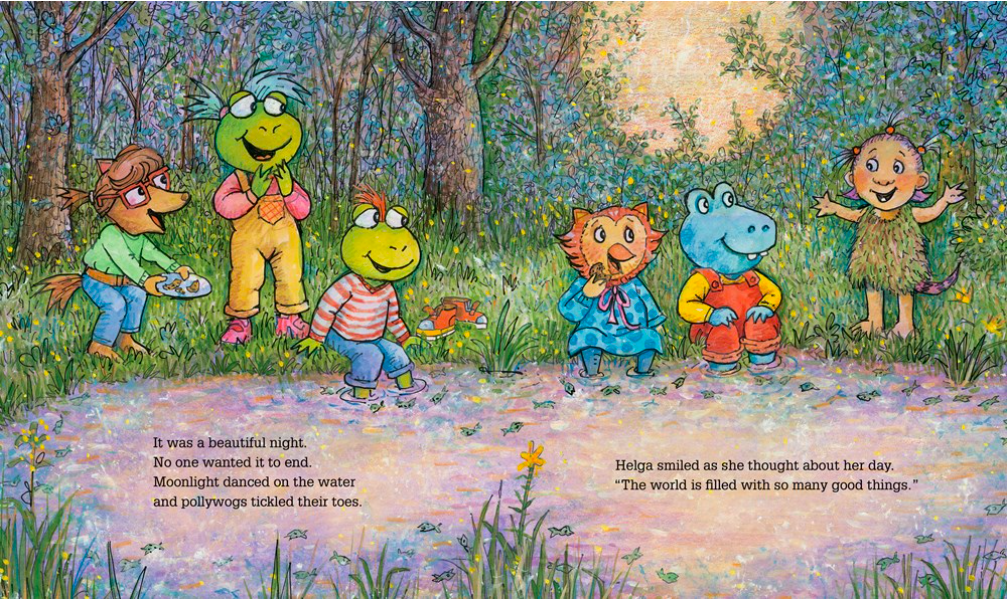
Next on the tour is Hop’s Lily Pad Diner, where Hop’s sister, Penny, plays the piano while the others dance. All this activity and excitement is making Helga tired and ready to go home. When they arrive, Helga treats her new friends to a Moon Snack of sassafras twigs and fungus chips. No one wants this fun day to end. Especially Helga, who is happy to be part of the group and to have discovered so much. “‘The world is filled with so many good things.'” she exclaims.

Illustration © 2025, Marc Brown; text © 2025, Marc Brown, Tolon Brown, Peter Hirsch. Courtesy of Orchard Books/Scholastic.

The story is followed by a detailed map of Fair Village with many homes, restaurants, farms, parks, and other landmarks for kids to explore. In an afterword, Marc Brown explains how the world of Hop—a new animated series streaming on MAX—started out as a doodle of a frog with one leg shorter than the other then joined by a host of other characters. Brown, with the help of his son Tolon (a producer on the Arthur series) and Peter Hirsch (the head writer for Arthur), expanded on this inclusive universe for a younger audience.

Brown shares, “It was important to me that Hop’s world introduced characters that were reflective of our communities and friends and inclusive of children who had been underrepresented in the media. In Fair Village, disabilities never define who you are or what you can achieve. Our goal is to create a safe, inviting world that challenges kids to appreciate others who are not like them and to act with understanding and kindness.”

Illustration © 2025, Marc Brown; text © 2025, Marc Brown, Tolon Brown, Peter Hirsch. Courtesy of Orchard Books/Scholastic.

Enthusiasm, kindness, and acceptance radiate from the pages, as Hop and Benny take charge of showing Helga around Fair Village—a name that reflects both the beauty of the town as well as how its residents treat each other—and introducing her to things she’s never seen before. Young readers will find pleasure in sharing so many of these favorites too, such as hot chocolate, bubble baths, ice cream, and playing dress up, with this crew of fast friends. Gentle humor is sprinkled throughout, and the simply stated, heartfelt ending invites readers to look around at their own family, friends, home, and community and find the “many good things” there.

Marc Brown’s illustrations are infused with color and offer children a multitude of familiar things to see and identify. The full-bleed spreads immerse readers in the community of Fair Village and the individual homes of the characters. Detail-oriented children will love lingering over the map to find each of the character’s homes as well as fun additions, such as the crooked house, the haunted castle, and the appropriately shaped Pie Shop, Pizza Palace, and Pet Hospital. As this book and the series are inclusive of children underrepresented in media, Brown depicts Hop’s anisomelia (having one leg shorter than the other) in his two different shoes—one of which has an extra, yellow layer to its sole. Helga is coded as having agoraphobia.

A tie-in to the new MAX series HOP, Hop Helps Out introduces children to some of the characters and the vast Fair Village community in a joyful and empathetic way. The story can stand alone as well, encouraging discussions about meeting new people, being open to new experiences, visiting unfamiliar places, and showing kindness to others. 

Ages 4 – 8

Orchard Books/Scholastic, 2025 | ISBN 978-1339035680

About the Creators

Marc Brown is the beloved creator of the bestselling Arthur Adventure book series and creative producer of PBS’s Peabody and Emmy award-winning television series Arthur, now the longest-running children’s animated show in history. He also has illustrated many other books for children, including the New York Times bestseller Wild About Books, as well as The Little Shop of Monsters and Mary McScary, both written by R.L. Stine. For more information, visit marcbrownstudios.com.

Peter Hirsch is the co-creator and head writer of the MAX series, HOP. Before then he was the head writer of the PBS series Arthur for over 20 years. He has won 7 Emmys and a Peabody award, and lives in New York City with his wife, playwright Cusi Cram, and their two overweight cats.

Tolon Brown is an Emmy award-wining producer of culturally significant shows such as Arthur on PBS, and co-creator of the animated series HOP on MAX. Long ago he discovered a fondness for complaining about “good coffee” and people who can’t change a flat tire, which inspired him to split his time between Brooklyn and Baldwin County, Alabama in order to pursue both. Somehow he managed to raise two amazing daughters, yet remains open to the possibility that was purely accidental.

You can purchase Hop Helps Out at these booksellers

Amazon | Barnes & Noble | Bookshop (to support your local independent bookstore)

Picture Book Review

February 11 – National Inventors’ Day

About the Holiday

Today’s holiday was established in 1983 and is celebrated on February 11 to honor the birthday of Thomas Edison. The day recognizes the spirit of inventors who look at life a little differently, let their imagination fly, and create a new . . . something! While we often think of inventions that change the world on a day like today, simple ideas implemented at home also make a big impact—or just lead to lots of fun. If you and/or your kids enjoy being creative, today’s the day to tinker around with your ideas. 

Thanks to Eerdman’s Books for Young Readers for sharing a digital copy of The Quiet One with me!

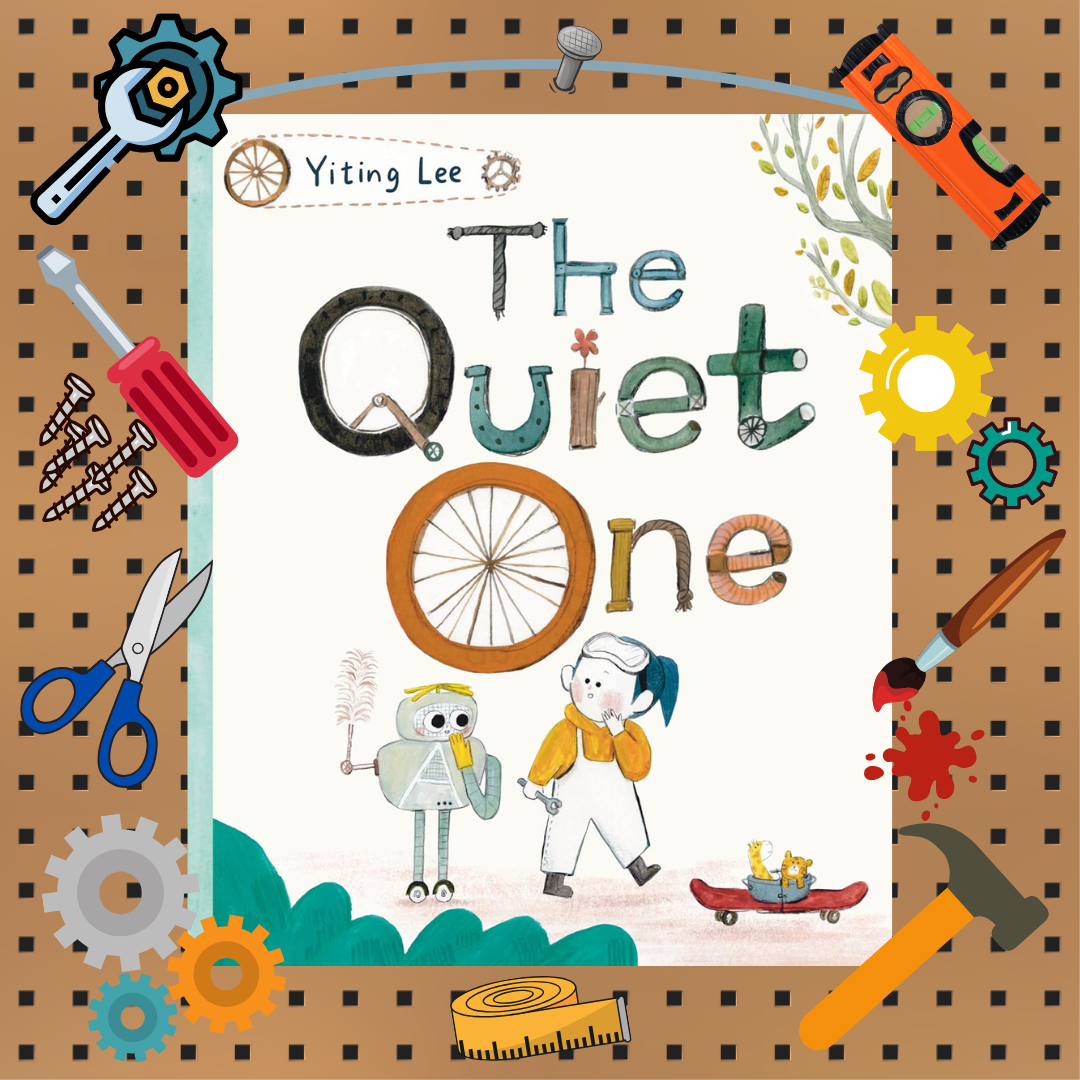
The Quiet One

By Yiting Lee


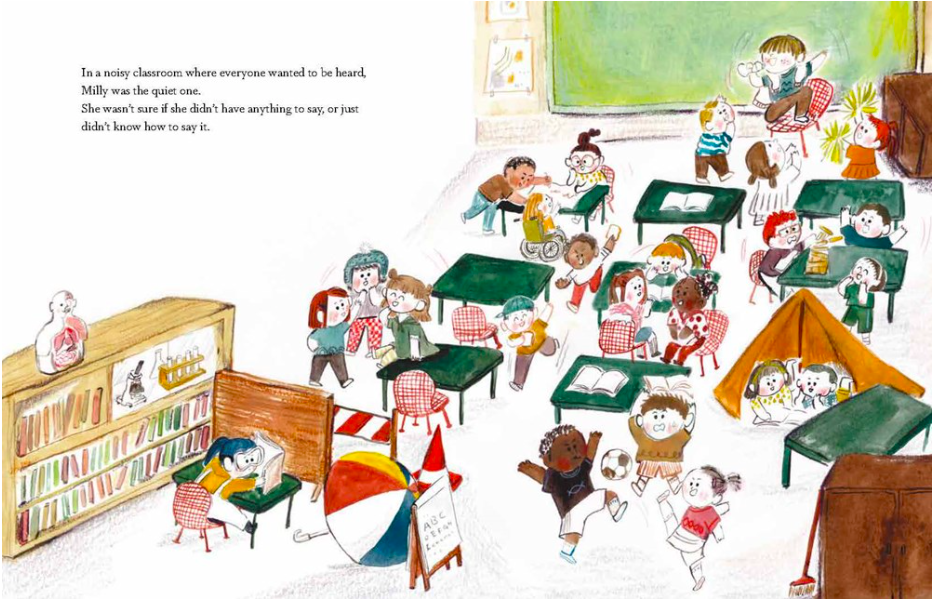
In her noisy classroom, Milly was the quiet one. She wasn’t exactly sure why she didn’t join in with her talkative classmates or why she especially dreaded Show and Tell, which was coming up on Friday. She most liked hanging out in her “secret place”—a shed filled with all sorts of things people didn’t need anymore or had forgotten. Milly was happy in her own company and liked to entertain herself by transforming other people’s old junk into amazing inventions like a running wheel for the shed’s mice and a working train from unused roller skates.

Copyright Yiting Lee, 2025. Courtesy of Eerdmans Books for Young Readers.

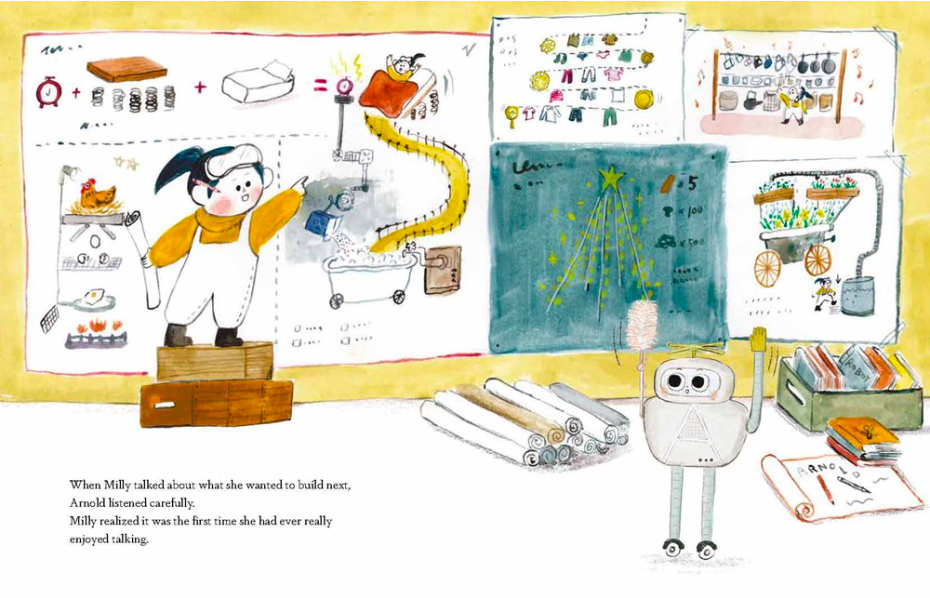
Then Milly found a broken cleaning robot. Getting out her toolbox, two caster wheels, and other supplies, Milly went to work. When she was finished and rebooted the robot, she was astonished to discover that it could talk—”Hi, I’m Arnold,” it said. Milly told Arnold her name. All afternoon Milly and Arnold worked to turn Milly’s secret place into a playground. Then as Milly explained what she wanted to build next, she “realized it was the first time she ever really enjoyed talking.”

Copyright Yiting Lee, 2025. Courtesy of Eerdmans Books for Young Readers.

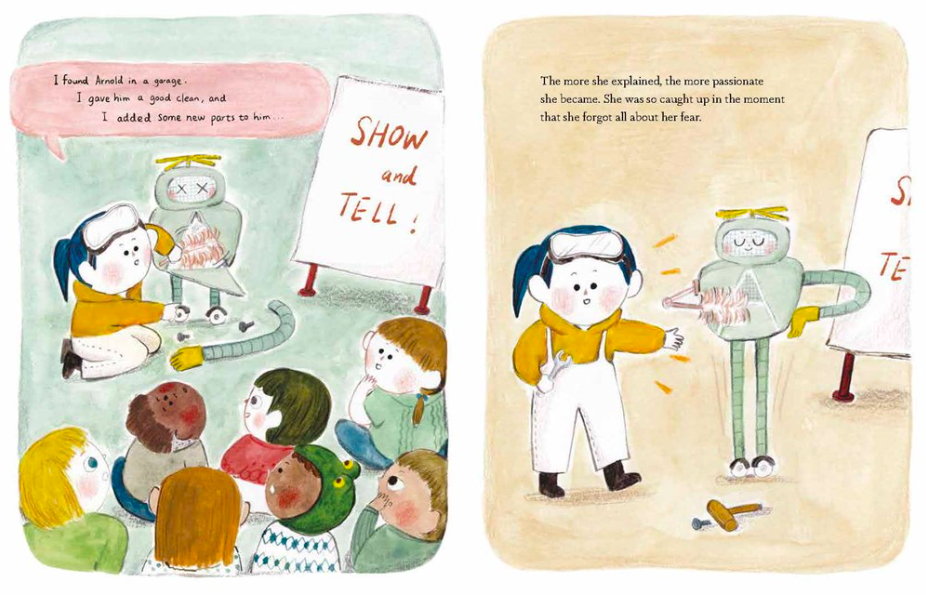
Milly was still nervous about Show and Tell, but Arnold told her he would go with her and she could talk about him. On Friday, under the gaze of her classmates who seemed to loom above her, Milly froze. Arnold came to the rescue. He introduced himself and began: “Milly made me out of . . . of . . .”. He stopped, not knowing what came next. But Milly found her voice and finished the story, becoming more passionate about her subject as she went along. In fact, “she was so caught up in the moment that she forgot all about her fear.” Her classmates thought Milly was amazing, and Milly, later playing with her new friends on the playground she and Arnold had built, “was happy that she had been heard.”

Copyright Yiting Lee, 2025. Courtesy of Eerdmans Books for Young Readers.

Yiting Lee’s story offers reassurance to quiet, introspective children as well as to those who feel anxious when talking in or to a group. Through Milly’s experience, such children may feel encouraged to talk about a special skill, experience, or talent or to share the “stage” with a supportive friend who can help them overcome their fear. Lee also reminds readers that—as a favorite teacher of mine liked to say—”still waters run deep”, and that beneath a quiet exterior often bubbles unique perspectives, creativity, and loyal friendship.

Lee’s charming, cartoon illustrations contrast how Milly shrinks in her raucous classroom with how she comes alive in the junk shed—for her, a lab full of exploration, inspiration, and energy. Readers will enjoy stopping to look over all the images of Milly’s inventions and be inspired to create a few themselves.

A fast-paced, multilayered and inspiring story to spark confidence, foster understanding, and build connections among kids of all talents, The Quiet One offers a valuable resource for classrooms and school libraries and is a heartening choice for home and library collections.

Ages 4 – 8

Eerdman’s Books for Young Readers, 2025 | ISBN 978-0802856418

About the Author/illustrator

Yiting Lee was once the quiet one in class, much like Milly. She followed her love of art to earn her MA in children’s book illustration at the University of Cambridge. Originally from Taiwan, Yiting currently lives in Surrey, England, where she has illustrated books like What’s the Rush? (Princeton Architectural) and Little Dinosaurs, Big Feelings (Magic Cat). Follow her on Instagram @yitinglee_art and visit her website at yitinglee.com.

National Inventors’ Day Activity

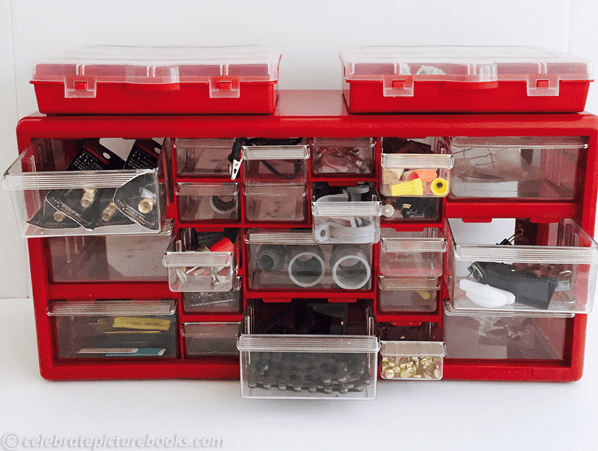
celebrate-picture-books-picture-book-review-inventor's-box

Inventor’s Box


For young inventors or tinkerers, having bits and pieces of this and that as well as some tools to work with all stored in one place encourages creative thinking. Filling the drawers of a tool case, a tool box, or a tackle box with items like springs, brads, wheels, hinges, plastic piping, pieces of wood, glue, tape, and simple tools can spark a child’s imagination. Take your child along to the craft or hardware store and choose items together!

You can purchase The Quiet One at these booksellers

Amazon | Barnes & Noble | Bookshop (to support your local independent bookstore)

Picture Book Review
November 21 – Get Ready for Hanukkah

celebrate-picture-books-picture-book-review-little-dreidel-learns-to-spin-cover

About the Holiday

To get into the spin of this eight-day celebration of light and remembrance, we have a book perfect for young ones getting ready to learn a new skill and a bit more about this Jewish holiday. Little Dreidel Learns to Spin takes the stage with a rhythmic, twirling tale packed with Yiddish words and glossary in the back to learn more.

Thank you to Rebecca Gardyn Levington and Cartwheel Books for sharing a digital copy of Little Dreidel Learns to Spin with me for review consideration. All opinions on the book are my own.

Review by Dorothy Levine

Little Dreidel Learns to Spin

Written by Rebecca Gardyn Levington | Illustrated by Taryn Johnson


Little Dreidel’s clay body is all dry, so she is ready to start twirling and spinning just like her older cousins. But, when she tries, “she flails and fumble-tumbles. ‘I’m such a klutz! I stink at this’ she mopes and mumble tumbles.” Dreidel’s grandmother, her Bubbie, tries to console her, but to no avail. As the rest of the family gets ready for Hanukkah—cooking up some latkes, setting up the menorah—Little Dreidel collects herself.

celebrate-picture-books-picture-book-review-little-dreidel-learns-to-spin-ready-for-party

Image copyright Taryn Johnson, 2024, text copyright Rebecca Gardyn Levington, 2024. Courtesy of Cartwheel Books.

After some careful observation of her cousins’ techniques, she learns about momentum and gains some more of her own. She’s ready to try again. At first too slow, then too fast, Little Dreidel “plotzes on the ground” again and again. But when day turns to night, and Hanukkah is about to begin, a miracle occurs: “dizzy-dazed” Little Dreidel competently joins the rest of the cousin crew spinning into celebration!

celebrate-picture-books-picture-book-review-little-dreidel-learns-to-spin-unsteady

Image copyright Taryn Johnson, 2024, text copyright Rebecca Gardyn Levington, 2024. Courtesy of Cartwheel Books.

The story of Little Dreidel Learns to Spin subtly mirrors the Hanukkah story—a narrative that centers on a miracle of oil lasting to light a lamp for eight days rather than just one and success against all odds. Gardyn Levington takes a simple tale of determination and weaves in Hanukkah charm, rhymes, Yiddish vocabulary and witty puns—like when Little Dreidel spins awry and almost breaks her shin, the Hebrew letter painted on one side of the top and denoting the worst luck of the four facings.

Johnson’s illustrations add layers of humor and context to the story. For example, Little Dreidel’s face is painted on the less lucky shin side, whereas Bubbie’s face is painted on gimel— the luckiest letter of the four dreidel faces. The first page depicts Little Dreidel blow-drying his top half with a hair dryer, as the story shares that Little Dreidel’s clay has just dried. Johnson depicts emotion cleverly and adorably through the expressions and body language of the Dreidel family. The pages are lush with color, with an emphasis on Hanukkah’s classic blues and yellows.

A sweet introduction to the traditions of Hanukkah and a natural way to teach children some common Yiddish words, Little Dreidel Learns to Spin would be the perfect addition to home collections and libraries.

Ages 3 – 5

Cartwheel Books, 2024 | ISBN 978-1338864625

About the Author

Rebecca Gardyn Levington is a children’s book author and poet with a penchant for penning playful picture books and poems. She lives in Summit, New Jersey. You can visit Rebecca at rebeccagardynlevington.com.

About the Illustrator

Taryn Johnson is an illustrator, animator, and designer who loves to bring a playful appreciation of nature to her work with bright colors, patterns, and a little imagination. Visit Taryn at tarynjohnson.com.

Get Ready for Hanukkah Activities

Clay Dreidel Craft from Crayola

Photo courtesy of Crayola

 Homemade Hanukkah Crafts


You can teach your very own homemade clay dreidel to spin or make a paper dreidel with these instructions from Crayola! 

To find more Hanukkah themed activities—from making LEGO dreidels to tissue paper stained glass decorations to a creative shamash candle holder and more—visit PJ Library’s Hanukkah activities page!

celebrate-picture-books-picture-book-review-little-dreidel-learns-to-spin-cover

You can purchase Little Dreidel Learns to Spin from these booksellers

Amazon | Barnes & Noble | Bookshop (to support your local independent bookstore)

Picture Book Review
November 14 – Human-Animal Relationship Week

celebrate-picture-books-picture-book-review-the-cat-way-cover

About the Holiday

Established in 2016 by the Animals & Society Institute, a scholarly non-profit organization which works to increase knowledge about the relationships between people and animals, Human-Animal Relationship Awareness Week, aims to raise an appreciation for the ways in which humans and animals live and work together while sharing the resources of our planet. During the week and throughout the year, we are asked to strive to improve the lives of animals at home and across the globe while “building communities that are more humane and compassionate.”

Thank you to Eerdmans Books for Young Readers for sharing a copy of The Cat Way with me for review consideration. All opinions on the book are my own.

The Cat Way

By Sara Lundberg | Translated by B. J. Woodstein


Part 1 of Sara Lundberg’s story begins with a black-and-white cat and her human taking their usual walk down the sidewalk in their neighborhood. “‘I’m the one in charge,'” the cat’s owner declares. The young person ducks behind a tree to play their typical game of hide and seek, but today the cat is distracted by a white cat sitting nearby. She approaches, and the two cats begin to frolic while the narrator can only sit and watch. The narrator is ready to leave, to put a stop to their play, and while their cat comes, so does the white cat side-by-side, their tails linking the two. The young pet owner hears the cats “giggling and giggling” at them and, jealous, isn’t having it: “‘Stop it,” I say. I stamp my foot. Then the other one runs off.'”

celebrate-picture-books-picture-book-review-the-cat-way-belly-scratch

Image and text copyright Sara Lundberg, 2024, translation copyright B. J. Woodstein, 2024. Courtesy of Eerdman’s Books for Young Readers.

The cat and her human “glare at one another” until the cat says, “‘Why are you always in charge?'” Just then an older couple approaches, and the cat demonstrates her independence by immediately rolling over to offer her belly for a scratch—something “she never does.” Despite the narrator’s calling her to come, the cat lies there, soaking up the attention, extending her rebellion. Her owner decides on a subtle power play and walks away, continually turning back, however, to see if their cat is coming. She isn’t.

The young person, full of doubt, stops in the middle of the neighborhood, out of sight of the cat and the couple, wondering if the cat is “theirs now” and taking stock: the couple will surely be more lenient, but they don’t know her name, her quirks, her favorite food, or that she likes “sleeping next to me at night.” 

celebrate-picture-books-picture-book-review-the-cat-way-neighborhood

Image and text copyright Sara Lundberg, 2024, translation copyright B. J. Woodstein, 2024. Courtesy of Eerdman’s Books for Young Readers.

Here, Sara Lundberg does something astounding, metaphorically reflecting how time elongates and an icy fear grips those searching for a lost pet. The beautiful summer day turns dark and rainy. The narrator, rooted in place, gets soaked while shouting for the cat and getting no response. They think, “If I go home, she might disappear forever.” On the next page, autumn has come, and yellow leaves fall to the ground—the foreboding of something ending. Turn the page, and it’s now snowing. Inches have accumulated, covering the narrator’s hat and crossed arms. They trudge home, a freezing distress and self-recriminations lodged in their heart.

At home, the narrator can’t thaw out but then discovers with joy their cat curled up in their favorite chair. During tomorrow’s walk, the narrator promises, the cat will lead.

celebrate-picture-books-picture-book-review-the-cat-way-cat-comes-home

Image and text copyright Sara Lundberg, 2024, translation copyright B. J. Woodstein, 2024. Courtesy of Eerdman’s Books for Young Readers.

Part 2 takes up the story the next day as the narrator and the cat head out. Just a step outside the door, readers are treated to the cat’s eye view of the neighborhood. Whereas during Part 1, the landscape presents buildings, the sidewalk, cars, signs, benches, trash cans, and other cityscape objects, Part 2 lands readers in nature, like one of the dandelion seeds the cat dislodges while roaming the woods. Flowers, a snail, a butterfly, and pill bugs attract the cat’s eagle eye, while her owner stands on the barren sidewalk across the street, tapping her foot, glancing left and right.

As the cat ventures further, the narrator follows reluctantly. Without a path to follow, the narrator feels lost, unsure of the way home. Farther and farther into the woods the cat creeps, finding squirrel and communicating eye-to-eye the way only animals can. It’s getting dark and the narrator blindly tumbles down a small cliff. “‘Stupid cat!'” the narrator says from a prone position on the ground. Perched on a thin branch, the cat, in silhouette, seems to ask, “what are you doing down there?”

celebrate-picture-books-picture-book-review-the-cat-way-snail

Image and text copyright Sara Lundberg, 2024, translation copyright B. J. Woodstein, 2024. Courtesy of Eerdman’s Books for Young Readers.

Tears stream down the cat owner’s face, and the cat comes over to comfort her human. It’s then, drying their tears and looking up, that the narrator realizes…. The glorious star-filled night sky stretches out in front of them. The narrator, holding the cat in their arms, stands gazing at this silent spectacle. For readers, the page opens with a majestic gatefold that will elicit appreciative “Oohs!” They stay until dawn edges the horizon and the cat gets hungry. This time, the narrator follows as the cat expertly leads them out of the woods and back home. Still, the narrator isn’t completely ready to relinquish control, seeking assurance that tomorrow they will return to their regular routine. With a look the cat quells that thought, and her human offers a more equitable every-other-day solution. The cat blinks and continues leading her human home.

celebrate-picture-books-picture-book-review-the-cat-way-night-sky

mage and text copyright Sara Lundberg, 2024, translation copyright B. J. Woodstein, 2024. Courtesy of Eerdman’s Books for Young Readers.

Originally written in Swedish by Sara Lundberg and beautifully translated by B. J. Woodstein, The Cat Way is a multi-layered story for relationships of all kinds—between parents and children; friendships (between children, between adults, and between family members); between educators and students; and, more literally, between pets and their humans.

Through her self-assured narrator and inquisitive cat, Lundberg explores how we can get stuck in ruts and routines, ignoring or not recognizing opportunities to grow, learn, play, and see aspects of the world (both small and large) in fresh ways. As the narrator stolidly walks the same, well-worn paths and reacts critically when their cat welcomes something or someone new, Lundberg shows not only how easy it can be to quash another’s curiosity and creativity but also what a lonely and dull life this can lead to. 

When, in Part 2, the cat gets to lead and heads for the woods, Lundberg acknowledges how unfamiliar paths can feel scary and difficult to navigate at first as well as how discovery can feel overwhelming with impediments, stumbles, and even blind faith. But the cat is engaged, sure-footed, and aware of each snail, butterfly, squirrel, and way forward. She instinctively understands encouragement and that the journey is worth it all. And in the poignant ending, she reassures her human that home is where her heart is.

In her lush,  illustrations, Sara Lundberg uses a variety of perspectives (many charmingly surreal) throughout the story to enhance her message. A few standout illustrations include a spread early on when the narrator’s cat and the white cat tumble playfully, creating a yin and yang image that mirrors an underlying theme of balance in a relationship. The couple who scratch the cat’s tummy tower over the cat and the narrator, a reflection, perhaps, of how outsized the narrator feels their influence on their pet. A two-page spread showing interactions among people in the neighborhood as the narrator stands paralyzed by the idea they’ve lost their cat provides an opportunity for readers to stop and imagine the relationships and what is happening. 

Thoughtful, resonant, and visually arresting, The Cat Way is a story of exploration—of one’s immediate surrounding, the world, their relationships, and their own essence—that rewards multiple readings and is a must for home, public library, and school library collections.

Ages 5 – 9+

Eerdman’s Books for Young Readers, 2024 | ISBN 978-0802856333

About the Author

Sara Lundberg is a Stockholm-based illustrator and author who has created over thirty books, including two recipients of Sweden’s August Prize for the best children’s book of the year. In the United States, The Summer of Diving (Triangle Square) was named a New York Times Best Children’s Book, and The Bird in Me Flies (Groundwood) was named a Bank Street College Best Children’s Book. The Cat Way was inspired by Sara’s memories and photos of her cat Sassa, who often joined her family on walks. Follow Sara on Instagram at saralundbergart

About the Translator

B.J. Woodstein is a writer, editor, and Swedish-to-English translator. Her translations for children include The Book that Did Not Want to Be Read (Simon & Schuster) as well as the previous Sara Lundberg books The Bird in Me Flies (Groundwood) and The Summer of Diving (Triangle Square). A native of Chicago, B.J. currently lives in Norwich, England, where she is a lecturer at the University of East Anglia. Visit her website at bjwoodstein.com.

Human-Animal Relationship Month Activity

celebrate-picture-books-picture-book-review-wooden-bead-cat-craft

A Little Ball of Kitten Love

There’s nothing quite like the relationship between a cat and their human! If you have a cat or just love kitties, this sweet ball of fun is easy to make and can keep you company on your desk or shelf! Since every kitten is different, make your feline friend look just the way you want.

Supplies

  • Wooden ball with a flat bottom, available in craft stores and in different sizes
  • Craft paint in any color kitten you’d like (I used red and yellow and mixed it to make a mottled orange)
  • Craft paint in pink or white for the inner ear
  • Scrap of fleece for the ears. Fleece is easily shaped to the rounded ball and when painted is stiff enough to stand up on its own.
  • Thin, colored wire in several colors for the tail (string or twine, wrapped wire, fleece, stiff paper, and other materials could also be used)
  • Paint brush
  • Permanent marker for making the face
  • Hot glue gun or strong glue

Directions

  1. Paint the wooden ball and let dry
  2. Paint the scrap of fleece to match the wooden ball, let dry
  3. Cut out small triangular shapes for the ears. Round the bottom of the ears slightly so they fit the shape of the ball
  4. If making a tail from several colors of thin wire, twist them together, leaving one end untwisted
  5. With the glue gun or strong glue attach the ears to the top of the head
  6. With the glue gun attach the tail to the back of the wooden ball in the center near the base
  7. With the marker, draw eyes, nose, and mouth for the face and semicircles near the bottom for the paws

celebrate-picture-books-picture-book-review-the-cat-way-cover

You can purchase The Cat Way at these booksellers

Amazon | Barnes & Noble | Bookshop (to support your local independent bookstore)


Picture Book Review
November 13 – World Kindness Day

celebrate-picture-books-picture-book-review-touch-the-sky-cover

About the Holiday

World Kindness Day began with a conference in 1997 in which organizations from across the globe met in Japan for the purpose of uplifting and recognizing kindness on a global scale. From this meeting they created a “Declaration of Kindness” and, later, a nonprofit called the World Kindness Movement was formed to support and honor community-scale kindness initiatives. Kindness on any scale, on any day, is important to celebrate. To recognize today’s holiday, we follow a story that shows how just a touch of kindness from another person and a will to persist can help one child reach for the stars and, just maybe, end up touching the clouds. 

Thank you to Carolrhoda Books, an imprint of Lerner Publishing Group, for sharing a copy of Touch the Sky with me for review consideration. All opinions on the book are my own.

Review by Dorothy Levine
Touch the Sky

Written by Stephanie V.W. Lucianovic | Illustrated by Chris Park

When Vern visits the playground, he yearns to be able to swing like the other children do, “to be one of the kids who swooped until their toes touched the sky.” The only problem is Vern does not (yet) know how to pump. And as much as he tries, yanking his body this way and that, ordering his legs with a scream, nothing seems to work. While Vern tries, other children on nearby swings laugh and swoop by him. 

celebrate-picture-books-picture-book-review-touch-the-sky-Vern-attempts-pumping

Image copyright Chris Park, 2024, text copyright Staphanie V.W. Lucianovic. Courtesy of Carolrhoda Books.

Vern is just about ready to give up, when Gretchen comes along. Even though Gretchen and Vern have never played together, Gretchen confidently snags the swing next to Vern and asks, “Do you want to learn how?”

Through many attempts of running, pushing, swooping and trying again, Gretchen coaches and encourages Vern. When her verbal instructions land Vern in the wood chips a few too many times, she switches strategies, standing next to his swing and doing the motions with her own body upright.
celebrate-picture-books-picture-book-review-touch-the-sky-Gretchen-meets-Vern

Image copyright Chris Park, 2024, text copyright Staphanie V.W. Lucianovic. Courtesy of Carolrhoda Books.

Just as Vern starts to make progress, Gretchen must leave. Vern is left with a tough choice: to keep trying on his own or give up. When he decides to continue, the motions Gretchen taught tiptoe down the page along with Vern “Run / Hop / Lean / Stretch / Sweep / Pull / Tuck / Swing” until finally, wonderfully “He [takes] flight with the birds.”

The story then ends with this reminder of the cyclical nature of kindness: After a moment of basking in the meditative motion of pumping, Vern notices another kid in Gretchen’s swing watching him enviously. He repeats what Gretchen said when he felt stuck: “‘It feels hard until you get it, and then it’s not…Do you want to learn how?’”

celebrate-picture-books-picture-book-review-touch-the-sky-Gretchen-teaching

Image copyright Chris Park, 2024, text copyright Staphanie V.W. Lucianovic. Courtesy of Carolrhoda Books.

Touch the Sky brings to light a hurdle (learning to swing) that is common for many young folks but not often discussed in day-to-day life or in a picture book. While some new skills come with lessons (swimming, learning to ride a bike, reading) learning to swing is a challenge that children are often left to master on their own. Lucianovic creatively and accurately captures the process of learning to pump; her verbal instructions are catchy, succinct, and clear to follow. The composition of the words on the page mirrors the learning to pump process—sometimes twisting around like chains of a swing and other times flying colorfully across whole spreads. The story is centered in realistic dialogue, with age-appropriate humorous moments for readers (like when Gretchen’s mother admonishes her for petting a cat with cheese). The story is both literal and lyrical. Sweeping imagery of swinging for the first time adds a thrilling aspect to the tale.
Park’s illustrations add to the magical feeling of first coasting through a new skill. The illustrations are largely in crayon which gives the images a textured, child-like feel, adding a sense of wonder to the scenes. The pages of instructions include zoomed-in panels for readers to watch each step separately. These panels begin jumbled but then sort out into organized squares as Gretchen’s steps to pumping become clearer to Vern. Park’s use of rainbows and tiny stars when Vern’s situation metaphorically and literally begins to look up immerses readers in the journey he takes to “touch the sky.” 

A heartfelt tale of perseverance and kindness that can be appreciated by all who have struggled and received support from unlikely places, Touch the Sky invites readers to keep trying and to offer helping hands to others when they can. The book would be an excellent addition to home, public, and school libraries.

Ages 5 – 9

Carolrhoda Books, 2024 | ISBN 978-1728460451

About the Author

Stephanie V.W. Lucianovic writes books in the San Francisco Bay Area surrounded by a few kids, a few cats, and one husband. Her work includes The End of Something Wonderful, Hello Starand The League of Picky Eaters. Visit her at stephanielucianovic.com.

About the Illustrator

Chris Park has been a professional illustrator for over twelve years. Some of his previous clients include TBS, Team Coco, Rolling Stone, American Greetings Co., Cloudco Entertainment, Pro Publica, Sleeping Bear Press, Usborne Publishing and Lightspeed Magazine. He co-authored and illustrated his the picture books Little Sock and Little Sock Makes a Friend with his wife Kia. Chris lives in Minnesota with his wife and two sons. Visit him at chrispark.com.

World Kindness Day and World Kindness Week Activities

celebrate-picture-books-picture-book-review-school-of-kindness-bingo-card

Courtesy of the School of Kindness.

Kindness Bingo

Invite your child or class to spend World Kindness Day, World Kindness Week, or any day playing Kindness Bingo from the School of Kindness at 52 Lives with this game that includes 30 bingo cards, each containing 16 acts of kindness. Visit the School of Kindness website to learn more about their teaching resources.

Also available for free download is the World Kindness Day Pack, which also includes activities that connect to Anti-bullying week, which this year coincides nicely with kindness week.

celebrate-picture-books-picture-book-review-touch-the-sky-cover

You can purchase Touch the Sky from these booksellers

Amazon | Barnes & Noble | Bookshop (to support your local independent bookstore)

Picture Book Review