September 9 – It’s National Honey Month

celebrate-picture-books-picture-book-review-h-is-for-honey-bee-cover

About the Holiday

Established by the National Honey Board in conjunction with the US Department of Agriculture in 1989, National Honey Month celebrates beekeepers, bees, and of course honey. September was chosen for this honor because here in the US, it’s the time when bees begin to secure their hive and prepare for winter and well as the month when the majority of honey is harvested. To celebrate this month, explore a variety of honey flavors, try a few new recipes that incorporate honey, and learn all the buzz about bees, honey, and beekeeping with today’s book!

I’d like to thank Sleeping Bear Press for sharing H is for Honey Bee: A Beekeeping Alphabet with me for review consideration. All opinions are my own.

H is for Honey Bee: A Beekeeping Alphabet

Written by Robbyn Smith van Frankenhuyzen | Illustrated by Eileen Ryan Ewen


If your garden or yard is anything like mine, the bees are humming around late-summer blooms and tracing their circuitous route to nearby or far-flung hives. The mystery and marvel of how honey bees convert powdery pollen into sweet honey never fails to awe and delight. In H is for Honey Bee, readers of all ages discover fascinating facts and stories about Bees from Apis mellifera (“Apis is the clue that we’re talking about a bee. / And mellifera means it’s all about honey”) to Z “for Zen and BUZZZZ.”

celebrate-picture-books-picture-book-review-h-is-for-honey-bee-A-and-B

Image copyright Eileen Ryan Ewen, 2020, text copyright Robbyn Smith van Frankenhuyzen, 2020. Courtesy of Sleeping Bear Press.

In between children learn all about a bee hive, its resident bees (from Drones to Guards to the Queen), how bees communicate, and at E how organized beekeeping dates back to 2400 BC and how important it was to Egyptian culture. “Found on hieroglyphs in the sun temple of Pharaoh Ne-user-re near Cairo, Egypt, an Egyptian peasant is depicted smoking stacked hives while other workers are storing and sealing honey in jars.”

celebrate-picture-books-picture-book-review-h-is-for-honey-bee-N-and-O

Image copyright Eileen Ryan Ewen, 2020, text copyright Robbyn Smith van Frankenhuyzen, 2020. Courtesy of Sleeping Bear Press.

At L kids learn about Lorenzo Langstroth, “the father of humane, practical beekeeping.” After discovering that natural hives had small passages that allowed bees to move freely though them, he invented a hive with removable frames that didn’t upset the other bees or damage the combs. Langstroth’s hive paved the way for other innovations, such as the Observation Hive at O, that gives people a clear view of bees at work. “You can watch the queen lay eggs, workers fan moisture from the nectar, and observe the bees dancing on the comb” and other marvels of a bee’s day.

celebrate-picture-books-picture-book-review-h-is-for-honey-bee-T-and-U

Image copyright Eileen Ryan Ewen, 2020, text copyright Robbyn Smith van Frankenhuyzen, 2020. Courtesy of Sleeping Bear Press.

Humans aren’t the only innovative ones, and readers will be fascinated to learn about Propolis at P, which bees make from their own saliva and other natural ingredients to protect their hive. V is for Venom—the bee’s defense that is more fun to learn about than experience. If you’re interested in where Beeswax comes from, just flip to W, and if you want to know how to tell if a hive is happy, Z is where you’ll find it.

Back matter includes resources on how you can create a safe and productive atmosphere for bees in your own yard, tips for becoming a beekeeper, and fun facts about busy bees.

celebrate-picture-books-picture-book-review-h-is-for-honey-bee-Z

Image copyright Eileen Ryan Ewen, 2020, text copyright Robbyn Smith van Frankenhuyzen, 2020. Courtesy of Sleeping Bear Press.

Through charming and informative four-line rhymes and a column of detailed facts for each letter of the alphabet, Robbyn Smith van Frankenhuyzen presents a full and exhilarating look at bees, honey, and the job of beekeeping. She describes the behavior of bees—from how they communicate to how they survive winter temperatures to how the queen rules the hive and more—as well as the dangers bees face, from inside the hive and out, in vivid language that will captivate kids. Discussions on the healthy properties of honey as well as the joys of amateur beekeeping are here as well.

Accompanying the text are Eileen Ryan Ewen’s vibrant illustrations that give readers an up-close view of honey bees developing from egg to adult, gathering nectar, and working in their hive. Kids also meet Lorenzo Langstroth, see beekeepers working at their hives in yards and on rooftops, and travel down the Nile River with ancient beekeepers who moved their hives to continually provide them with the nectar and pollen they needed. Each page invites lingering to see and discuss all the details.

A well-rounded and comprehensive resource for those interested in bees and insects, gardeners of any age, and kids who love nature as well as for elementary and middle-grade science classes, H is for Honey Bee: A Beekeeping Alphabet is highly recommended for home, school, and public libraries.

Ages 7 – 10 and up

Sleeping Bear Press, 2020 | ISBN 978-1534110700

Discover more about Robbyn Smith van Frankenhuyzen and her books on her website.

To learn more about Eileen Ryan Ewen, her books, and her art, visit her website.

National Honey Month Activity

CPB---Busy-Buzzy-Bee-Maze

Busy Buzzy Bee Maze


Can you help the little bee find her way to the flower and her friend in this printable maze?

Busy Buzzy Bee Maze PuzzleBusy Buzzy Bee Maze Solution

celebrate-picture-books-picture-book-review-h-is-for-honey-bee-cover

You can find H is for Honey Bee: A Beekeeping Alphabet at these bookseller

Amazon | Barnes & Noble | Books-a-Million

To support your local independent bookstore, order from

Bookshop | IndieBound

Picture Book Review

September 4 – National Wildlife Day

celebrate-picture-books-picture-book-review-Lights-Out-cover

About the Holiday

National Wildlife Day was established in 2005 by author and pet lifestyle expert Colleen Paige to promote awareness of the importance of conservation of animals, habitats, and the environment worldwide as well as to acknowledge the education and conservation work of zoos and animal sanctuaries. To honor the memory and birthday of Steve Irwin, National Wildlife Day is also celebrated on February 2. To celebrate today’s holiday, take time to learn about what you can do to help protect the environment. One action might be as easy as turning off a light – as today’s book shows.

Lights Out

Written by Marsha Diane Arnold | Illustrated by Susan Reagan


A little fox peeks out of her den. It’s night, but her surroundings are lit up as if it were noon. A Beetle hovers nearby taking in all the “House lights / Car lights / Truck lights / Street lights… / Blinking lights / Flashing lights / Blazing lights / Flickering lights.” There are lights in every color and on every structure. Fox and Beetle wonder where Darkness is—the dark of Night that invites coyotes to sing, owls to hunt, foxes to hunt, and beetles to become “more than beetles.” Perhaps, they think, Night is lost.

celebrate-picture-books-picture-book-review-Lights-Out-city

Image copyright Susan Reagan, 2020, text copyright Marsha Diane Arnold, 2020. Courtesy of Creative Editions.

Fox and Beetle set out to find Night. They pass a wetlands, where Frog waits in vain for darkness to lend his voice to the nighttime chorus. “Across the wide, wide world, / they search… / for the Dark of Night. / But everywhere – Lights!” Up on the mountain, Bear is waiting for the signal to hibernate, but the brightness keeps him awake. Frog and Bear join in the search for Night.

celebrate-picture-books-picture-book-review-Lights-Out-wandering

Image copyright Susan Reagan, 2020, text copyright Marsha Diane Arnold, 2020. Courtesy of Creative Editions.

Fox and Beetle travel through forests and fields, over deserts and dunes, and across wide prairies, but don’t find Night. When they come to the seashore, they witness baby turtles hatching. Instead of scuttling toward the ocean, they’re running toward the lights of the boardwalk shops. Frog stops the little turtles then Bear, Fox, and Frog wade out into the waves and shows them the way.

celebrate-picture-books-picture-book-review-Lights-Out-turtles

Image copyright Susan Reagan, 2020, text copyright Marsha Diane Arnold, 2020. Courtesy of Creative Editions.

The three friends swim “away from shore and lights” while Beetle and Songbird fly above. Out here, where the sky is dark, Beetle at last sparks and glows. At last the friends reach a far-away island that’s cloaked in darkness. Here “they can see…Everything…. / Mushrooms glowing / Fireflies / Moonlit garden / Shining eyes / Nighttime weavers / Webs of stars / Constellations / Venus, Mars….” Here, they find Night.

An Author’s Note discussing light pollution and its effect on animals and humans and including a resource where readers can learn more about light pollution and what we can do to help precedes the story.

celebrate-picture-books-picture-book-review-Lights-Out-moon

Image copyright Susan Reagan, 2020, text copyright Marsha Diane Arnold, 2020. Courtesy of Creative Editions.

Marsha Diane Arnold’s affecting story about how light pollution changes animal behavior and confuses the natural order of life is a poignant appeal to today’s young environmentally conscious kids, sparking an awareness of the extent of the problem while inviting them to consider ways to restore the darkness of night so important to the health of our planet. Through non-rhyming, yet lyrical language, Arnold takes readers on a journey to find Night. As the friends search place after place, children come to understand that light pollution is a worldwide issue.

Arnold’s capitalization of Night and Darkness makes them characters in the story as well, imbued with living traits and purpose that are just as crucial to wildlife as food and shelter. In one powerful combination of text and illustration, a list of light sources streams from corner to corner in a beam of white light. The number of examples builds to create a glaring realization of all the types of lights that keep the world turned on twenty-four hours a day. After reading Lights Out, children and adults will find themselves paying attention to the lights around them and even in and near their own home.

celebrate-picture-books-picture-book-review-Lights-Out-lights-on

Image copyright Susan Reagan, 2020, text copyright Marsha Diane Arnold, 2020. Courtesy of Creative Editions.

Susan Reagan’s stunning illustrations of cities, waterways, and even out-of-the-way places bathed in a permanent twilight by street lamps, headlights, lighted windows, neon signs, and more are compelling reminders of just how pervasive light pollution is. As the animals wander from place to place looking for Night, their weary and distressed expressions reflect the loss of their natural nocturnal activities. When Beetle and Fox and their friends reach the distant island, Reagan’s gorgeous spreads of a star-and-moonlit sky and vegetation, in which nocturnal animals hunt, luminescent flowers glow, and spider webs glint will have readers taking a nighttime jaunt to discover what they can see in their surroundings.

A unique and important book that raises awareness not only about light pollution but about natural cycles of sleep and wakefulness, Lights Out would be an excellent addition to lessons in science and the environment and is highly recommended for home, school, and public library collections.

Ages 6 – 8

Creative Editions, 2020 | ISBN 978-1568463407

Discover more about Marsha Diane Arnold and her books on her website.

To learn more about Susan Reagan, her books, and her art, visit her website.

National Wildlife Day Activity

celebrate-picture-books-picture-book-review-Lights-Out-activity

Image copyright Susan Reagan, 2020, text copyright Marsha Diane Arnold, 2020. Courtesy of Creative Editions.

Lights Out Activity Kit


This extensive Activity Kit gives teachers, homeschoolers, and parents many ways to engage with Lights Out in the disciplines of science, language arts, art, and social action. Through the various activities, children will learn about light pollution and its effects as well as about the ways in which darkness benefits wildlife. You can download the kit from Marsha Diane Arnold’s website:

Lights Out Activity Kit

celebrate-picture-books-picture-book-review-Lights-Out-cover

You can find Lights Out at these booksellers

Amazon | Barnes & Noble | Books-a-Million

To support your local independent bookstore, order from

Bookshop | IndieBound

Picture Book Review
August 25 – National Park Service Founders Day

celebrate-picture-books-picture-book-review-if-I-were-a-park-ranger-cover

About the Holidays

On August 25, 1916, President Woodrow Willson signed what is now called the Organic Act, establishing the National Park Service. In the 104 years since that historic signing, 400 areas in each of the 50 states, U.S. territories, and the District of Columbia, totaling 84 million acres, have been designated as national parks. Today we honor the park rangers who conserve and preserve these natural wonders and educate visitors. To discover national parks near you and their stories as well as to learn more about the week and how to help out all year round, visit the National Park Foundation website and the National Park Service website.

Thanks to Albert Whitman for sending me a copy of If I Were a Park Ranger for review consideration. All opinions about the book are my own. 

If I Were a Park Ranger

Written by Catherine Stier | Illustrated by Patrick Corrigan

If you love trees, animals, and all the beauty of nature, you may think about being a park ranger in one of the United States national parks. How would you get there? By studying “wildlife biology, conservation, or education” in college. Historian William Stegner called national parks “America’s ‘best idea.’” Being a park ranger means you’d be part of a proud history of people who have cared for the “country’s most beautiful, historic, and unique areas.”

celebrate-picture-books-picture-book-review-if-I-were-a-park-ranger-redwood-national-park

Image copyright Patrick Corrigan, 2019, text copyright Catherine Stier, 2019. Courtesy of Albert Whitman & Company.

Who are some of these people? Stephen Mather and Horace Albright were the first directors of the National Park Service, Captain Charles Young was “the first African American superintendent of a national park,” and Gerard Baker “brought Native American heritage and perspectives to the parks.” There are also writers, like Marjory Stoneman Douglas ,and artists, like John Muir and Ansel Adams, who shared the grandeur of the parks.

Park rangers work in some of the most exciting places in the country—in caves, deserts, and mountains and near volcanos or the sea shore. And that’s just the beginning! Ships, homes, battlefields, and monuments are also part of the National Park System. As a park ranger, you would protect the animals, plants, and buildings, you might work with scientists, or archaeologists, and you would help visitors gain new perspectives. How would you do that?

You’d “be a great storyteller.” As part of your job, you’d “learn about the natural history, the human history, and the legends” of you park so you “could share those tales…” and maybe “a few spooky campfire stories too.” You’d also learn all about the animals and landmarks of your park so you could provide interesting tours.

celebrate-picture-books-picture-book-review-if-I-were-a-park-ranger-redwood-national-mesa-verde

Image copyright Patrick Corrigan, 2019, text copyright Catherine Stier, 2019. Courtesy of Albert Whitman & Company.

Rangers are always on the lookout for fires, bad weather, or visitors who require help and alert emergency services when they’re needed. But rangers don’t spend all of their time outdoors. Sometimes they spend time inside using “computers to design exhibits, make maps, write articles, and keep track of endangered animal populations” or keep the park’s website updated. Park rangers are also invited to talk to students in schools and for organizations.

If you were a park ranger, you would make a big impact. Your park would be “cleaner and safer,” the “animals living there would be stronger and healthier,” and visitors might “experience something astonishing…a moment that could happen nowhere else in the world. A moment they’d remember forever” all because of you!

An Author’s Note reveals other riches of the National Park System, including STEM research, creative programs, artifacts and primary source materials, and more as well as a discussion on the education and various roles of rangers and a link where kids can find out about becoming a junior ranger at many parks.

celebrate-picture-books-picture-book-review-if-I-were-a-park-ranger-redwood-national-cave

Image copyright Patrick Corrigan, 2019, text copyright Catherine Stier, 2019. Courtesy of Albert Whitman & Company.

Catherine Stier’s inspiring look at the role of a ranger in the National Park Service takes readers from shore to shore and shows them the exciting and diverse jobs that are part of a ranger’s day. Stier’s use of the first-person point of view empowers readers to see themselves as a ranger protecting the treasures of the park and sharing them with visitors. Her straightforward storytelling is full of details readers will love about the duties of a park ranger and the parks themselves. Her stirring ending swells the heart. It’s certain to plant the seed of interest in jobs within the National Park Service as well as in planning a vacation trip to one of these beautiful areas.

celebrate-picture-books-picture-book-review-if-i-were-a-park-ranger-portraits

Image copyright Patrick Corrigan, 2019, text copyright Catherine Stier, 2019. Courtesy of Albert Whitman & Company.

Through vibrant snapshots and two-page spreads, Patrick Corrigan transports readers to twenty-five national parks, including Redwood National Park, California; Hawai’i Volcanoes National Park; Petroglyph National Monument, New Mexico; Acadia National Park, Maine; and Great Smoky Mountains National Park. To immerse young readers in the story, the rangers are depicted as diverse children helping visitors, giving talks, protecting animals, translating petroglyphs, giving tours, calling firefighters, and even brushing dirt from an unearthed animal skull. In one image a ranger gives a flashlight tour of Mammoth Cave National Park to a girl who uses a wheelchair, and in another a ranger uses sign language to describe the beauty of her park. Children will want to linger over the pages to take in all the details and will be moved to learn more about each park.

Sure to spark expressions of “ooh,” “ahh,” and “I’d like to do that!,” If I Were a Park Ranger makes an inspiring addition to classroom geography and nature lessons and would be a terrific addition to home libraries for kids who love nature and travel and would like to explore future possibilities.

Ages 5 – 9

Albert Whitman and Company, 2019 | ISBN 978-0807535455

Discover more about Catherine Stier and her books on her website.

To learn more about Patrick Corrigan, his books, and his art, visit his website.

National Park Week Activity

celebrate-picture-books-picture-book-review-if-I-were-a-park-ranger-mesa-verde-coloring-page

Majestic Parks Coloring Pages

You may not be able to visit all of these parks, but you can still enjoy their beauty with these printable coloring pages!

Mesa Verde National Park | Gates of the Arctic National Park | Hawaii Volcanoes National Park | Biscayne National Park

celebrate-picture-books-picture-book-review-if-I-were-a-park-ranger-cover

You can find If I Were a Park Ranger at these booksellers

Amazon | Barnes & Noble | Books-a-Million

To support your local independent bookstore, order from

Bookshop | IndieBound

July 28 – It’s Wild about Wildlife Month

celebrate-picture-books-picture-book-review-queenie-quail-can't-keep-up-cover

About the Holiday

We may be winding down Wild about Wildlife Month, but that doesn’t mean we can’t enjoy all that nature has to offer the rest of the summer and all year long. Exploring parks, woodlands, grassy fields, or the shores of lakes, rivers, or the ocean is a fun and educational family activity that is different each time you head out the door. Whether you and your kids like plants, animals, insects, or the rocks that hold everything together, a nature walk provides something for everyone. The best way to enjoy the outdoors is with a relaxed pace that lets you decompress, take it all in, and say “Ahhh!” The little quail in today’s book definitely has the right idea!

Thanks to Pajama Press for sending me a copy of Queenie Quail Can’t Keep Up for review consideration. All opinions on the book are my own. 

Queenie Quail Can’t Keep Up

Written by Jane Whittingham | Illustrated by Emma Pedersen


Twice every day Mama Quail led her ten chicks through the meadow, and while nine hurried and scurried along after Mama, Queenie, the smallest, always lagged behind. Mama and the other chicks chirped and cheeped for Queenie to “hurry hurry hurry,” but it was just so hard when there was so much to see. Queenie loved stopping to look at the “pink blossoms and green grass, shiny stones and fuzzy caterpillars, buzzy bumblebees and wiggly worms.”

celebrate-picture-books-picture-book-review-queenie-quail-can't-keep-up-bee

Image copyright Emma Pedersen, 2019, text copyright Jane Whittingham, 2019. Courtesy of Pajama Press.

Her papa admonished her to learn to hurry—“It is what we quails do!” he told her. And Queenie promised to try. She really did try too, but she just couldn’t pass by all her favorite things without stopping to enjoy them. One day, in addition to the blossoms, grass, stones, caterpillars, bees, and worms, Queenie spied a feather. And when she stopped to admire it, she saw “an unusual flash of orange.”

As Queenie watched, the “the furry orange slid softly, smoothly, silently through the green grass.” Queenie followed at a careful distance. Suddenly, Queenie saw that she was following a cat—a cat that was stalking her mama and brothers and sisters. Queenie knew just what she had to do. She raced down the path “hurry, hurry, hurrying,” chirping, cheeping, and warning her family.

celebrate-picture-books-picture-book-review-queenie-quail-can't-keep-up-hurry

Image copyright Emma Pedersen, 2019, text copyright Jane Whittingham, 2019. Courtesy of Pajama Press.

In the nick of time, Papa heard her and swooped down on the cat. Mama came running too. With a hiss, the cat jumped into the grass and fled. “‘You’ve saved us, Queenie Quail!’ Mama Quail chirped.” And Papa and her little siblings praised her too. Now, when the family heads out along the meadow trail and Queenie can’t keep up, they all ask, “‘What have you found, what have you found, what have you found?’” And they stop and hurry hurry hurry over to take a look too.

celebrate-picture-books-picture-book-review-queenie-quail-can't-keep-up-nuzzling

Image copyright Emma Pedersen, 2019, text copyright Jane Whittingham, 2019. Courtesy of Pajama Press.

Jane Whittingham’s story of an adorable quail who stops to smell all the roses is a charming, charming, charming read-aloud that adults will love sharing and kids will enthusiastically chime in on during the fun repeated phrases. Whittingham’s agile storytelling shines with lyrical rhythms and alliteration that bounce along like the little stars of her book. The gentle suspense will keep young listeners riveted to the story, and afterward they’re sure to join Queenie and her brothers and sisters in slowing down to enjoy the world around them.

Readers will immediately fall in love with Queenie and her siblings as Emma Pedersen’s cute-as-can-be, tufted quail babies race and bob along the trail to keep up with Mama. With expressive eyes and tiny beaks that form a perpetual smile, they nestle next to Mama and pile on top of Papa. As they watch out for Queenie, one or two often peer out at readers, inviting them along on their excursions. As the heroine of the story, Queenie is a sweetie, fascinated by everything she sees. Pedersen’s lovely gauche paintings are as fresh as a spring meadow and will entice kids and adults to take a nice slow walk together.

A unique and tender story that will have children entranced from the first page, Queenie Quail Can’t Keep Up will be a favorite on home, school, and public library shelves.

Ages 3 – 7

Pajama Press, 2019 | ISBN 978-1772780673

You’ll discover more about Jane Whittingham and her books as well as blog posts, interviews, and lots more on her website.

To learn more about Emma Pedersen, her books, and her art, visit her website.

Meet Jane Whittingham

celebrate-picture-books-picture-book-review-Jane-Whittingham-Interview-headshot

Today, I’m excited to be talking with Jane Whittingham an author and librarian from British Columbia, Canada, about the inspiration for her adorable quails, what she loves about being a librarian, and how nature features in her life and books.

I believe Queenie Quail Can’t Keep Up was inspired by your dad and a true story. Can you talk about that a little?

My parents moved to a small town on Vancouver Island when they retired, and their backyard is home to all sorts of wildlife, including families of quails that hurry and scurry here and there. My dad  always liked watching them, and he mentioned to me once that quails would make perfect picture book stars with their round little bodies and their amusing personalities and antics. Well, I was inspired! I’d never really thought much about quails, since we don’t have them where I live, so every time I visited my parents I would spend a bit of time watching the quails for inspiration.

Queenie, the little quail who is just too easily distracted to keep up with her siblings, is definitely inspired by me, and the fact that I’m always falling behind because I have to stop and look at everything! The book is a bit bittersweet to me because my father passed away before it was published, but I know he would’ve gotten a real kick out of it, and he would have probably introduced himself to everyone as my muse!  

Have you always liked to write? Can you talk a little about your process? Do you have a favorite place to write?

I’ve always been a writer, and even before I could physically write I was a storyteller. I was an only child and spent a lot of time using my toys to tell epic stories, which I would then recount breathlessly to my parents in an endless stream of words.

I don’t really have a process – like many people I fit writing around my full-time job (I’m a librarian) and into my busy life, so I snatch moments here and there whenever I can. I write on my phone, I write on scraps of paper, I write on my computer. I write on my commute, at coffee shops, and in grocery store lineups. You never know when inspiration will strike!

Besides Queenie Quail Can’t Keep Up,  you have two more very well-received books out from Pajama Press—Wild One and A Good Day for Ducks. The outdoors features in all of your books in some way. Are you inspired by the outdoors? What is your favorite outside activity or a memorable experience you’ve had?

I am absolutely inspired by the outdoors – even though my childhood wasn’t that long ago in the grand scheme of things, I do feel like I had a very different childhood than many kids experience today. I spent a lot of my free time outdoors, wandering or biking around the neighborhood with a band of kids, making (and falling out of) tree forts, playing kickball on the street, and turning local playgrounds into the settings for all sorts of imaginary worlds. My parents often had no idea where I was, but that was totally normal for the time—I never left the neighborhood, and they knew I would come home when it started to get dark.

Sometimes it feels like I grew up in a whole other era! Through my books I really want to encourage families to get outside, to explore, to learn through doing and through experiencing. Nature is such an incredible source of inspiration, of knowledge, of enjoyment, and even of healing, and we really miss out on so much by cooping ourselves up in front of our screens all day long!

In doing a little research for this interview, I raided your wonderful website and discovered that you made a few resolutions this year. One is to read outside your comfort zone, which includes murder mysteries, historical fiction, and narrative nonfiction. How is that going? Can you give me one mystery title in your comfort zone and one “departure” book you’ve dipped your toes (eyes?) into?

Oh dearie me, you’re holding me accountable! I recently finished a YA novel, which is very, very unusual for me—I never read young adult fiction even when I was a young adult, so this was a major departure for me! It’s called The Love and Lies of Rukhsana Ali, and tells the story of a young Muslim lesbian whose family discovers her secret girlfriend and sends her off to Bangladesh to straighten her out, as it were. It’s definitely an eye-opening look into a culture and experience very different from my own, and I really enjoyed it.

As for my taste in mysteries, I tend to favour the classic British who-dunnit style, with authors like Dorothy L. Sayers and Ngaio Marsh being particular favorites. I also really enjoy mysteries with historical settings, which allow me to check off two favorite genres at once!

Queenie is an adorable little quail! What was your reaction to seeing Emma Pedersen’s illustrations for the first time? In your blog post “Queenie Quail and the Road to Publication,” you talk about needing to cut your original manuscript. Can you describe one place where the illustration reflects the text that is no longer there? Can you describe a place where Emma included something that surprised or particularly delighted you?

I was absolutely floored when I first saw Emma’s illustrations, they’re beyond wonderful, and even more adorable than I ever could have imagined! It’s a funny thing, being a picture book author, because you craft these characters and this environment, and then you hand the whole thing over to a stranger to make real—it can be a bit nerve-wracking, not knowing what your little characters will end up looking like! I was immensely relieved when I saw Queenie and her siblings, and I think Emma’s classic artistic style perfectly complements my old-fashioned writing style.

One of the aspects of the text that was really shortened related to all the things that distracted Queenie on her daily walks with her family. I described the worms and the bees and the flowers in great detail, which turned out to be entirely unnecessary, since everything appeared so beautifully in Emma’s illustrations!

And as for an illustration that particularly delighted me, there’s a spread where Mama and Papa quail nuzzle Queenie as they thank her for saving the day, and the loving expressions on everyone’s faces really just melted my heart, I loved them so much!

What drew you to becoming a librarian? What is a favorite part of your day?

I am a children’s librarian for an urban library system here in British Columbia, Canada, and I’m responsible for developing and facilitating programming for children and families in an older residential neighborhood. I get to do a lot of fun things in my job—I lead story times for caregivers and their babies, facilitate writing and book clubs for tweens, and get to host and visit local preschools, daycares and elementary schools. I think my favourite part of the entire year is Summer Reading Club, which runs from June – August every year. We spend the entire year planning all sorts of exciting programs to get kids reading all summer long, and it’s so much fun! Sometimes I can’t quite believe I get to do this as my job. I also manage the physical collections in the library, organizing and weeding the books to make sure the collection is in tip- top shape and helps meet the reading needs of my community.

I was raised in a family of voracious readers and I love working with people, so librarianship always seemed like a natural fit, but it took me quite a while to get here. I worked in various jobs for about six years following my initial graduation from university, before finally feeling confident enough to take the plunge and go back to school to do my masters in librarianship. It was a real leap of faith, quitting a well-paying, stable but unfulfilling job to take a chance on a career that everyone around me said was dying out, but it’s certainly paid out for me, so far at least! I can’t stress enough that simply loving books is not enough of a reason to become a librarian, especially not a public librarian – you really do need to love working with people more than anything, because it’s definitely not for the faint of heart sometimes!

On your website you have a gallery of pictures from libraries you’ve visited. How many libraries have you been to? Which library is the farthest from home? Which was your favorite and why?

I love visiting libraries at home and abroad, I find so much inspiration from looking at how other libraries organize their collections, decorate their spaces, and plan their events. I’m not even sure at this point how many libraries I’ve visited. I need to update my website to include the ones I visited on my most recent trip to Nova Scotia, Prince Edward Island, and New Brunswick!

celebrate-picture-books-picture-book-review-Library-in-Nikko-Japan-Jane-Whittingham-Interview

Jane visits one of her favorite libraries – the Nikko Library – in Japan

celebrate-picture-books-picture-book-review-Bridge-in-Nikko-Japan-Jane-Whittingham-Interview

A view of a bridge and beyond in Nikko, Japan

Some of the furthest libraries I’ve visited have been in New Zealand and Japan (which I’ve visited on three separate occasions so far), though I’ve visited libraries in different US states and Canadian provinces, too. I don’t know that I have a single favorite library, but I do particularly enjoy visiting rural libraries – they can be so creative with their often-limited resources, and really do serve as the hearts and souls of their communities. 

What’s the best part about being a children’s author? Can you share an anecdote from an author’s event you’ve held or been part of?

I love everything about writing for kids! I really am a big kid at heart, which is why I’m a children’s librarian, too! I’ve had wonderful experiences reading my books to kids at different author events, and it’s so much fun to get everyone involved.

celebrate-picture-books-picture-book-review-author-visit-Japan-Jane-Whittingham-Interview

Jane and kids act out animals during an exciting author visit.

With Wild One I like to get kids to guess which animal they think the protagonist is pretending to be, and then we act out the animals together, which is heaps of fun, and with A Good Day for Ducks we act out all sorts of fun raining day actions, then talk together about all the things you can do, inside and outside, on a rainy day. I live in a very rainy place, so it’s important to find the joy in even the gloomiest of days! One of the most meaningful events I’ve done was a visit to a local children’s hospice, where I was able to connect with a small group of really amazing children who have been through so much in their short lives. To be able to share my stories with them, and listen to their stories, was an incredibly inspiring and moving experience.

What’s up next for you?

I’m not quite sure! I’ve got a couple of manuscripts that I’m still working on, and some that I’m waiting to hear back about from editors, so I don’t really know yet what’s coming down the pipeline. But I’ll always keep on telling stories, no matter what. 🙂

What is your favorite holiday and why?

My favourite holiday is definitely Christmas. I love Christmas. I love the music, the baking, the food, the decorating, the music, the family get-togethers, I love it all! I don’t actually do any of the decorating or baking or cooking myself, I mostly just listen to Christmas carols for a month straight and watch hours of Christmas movies on TV, but I love it all the same!

Thanks, so much, Jane! I’ve thoroughly enjoyed getting to know more about you and am sure readers have too! I wish you all the best with Queenie Quail Can’t Keep Up and all of your books!

You can connect with Jane Whittingham on:

Her website | Instagram

Wild about Wildlife Month Activity

celebrate-picture-books-picture-book-review-wonderful-wildlife-board-game

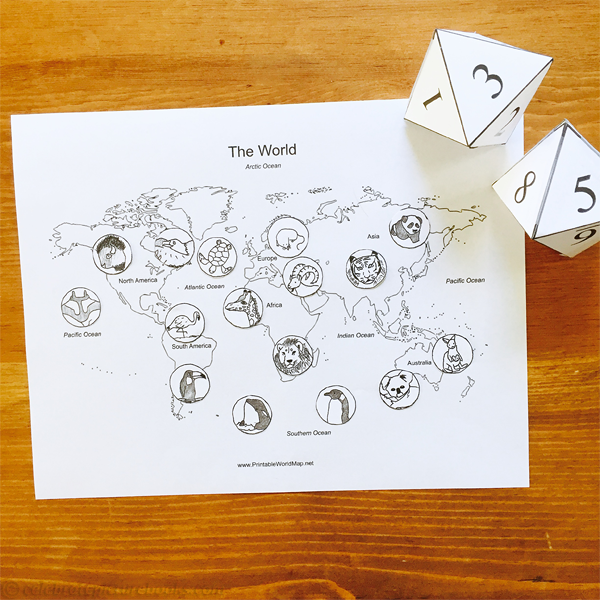
Fascinating animals are found in every part of the world. Play this fun printable Wonderful Wildlife Board Game to match each animal to the area where it lives.

Supplies

Directions

  1. Print a World Map for each player
  2. Print one set of 16 Wildlife Tokens for each player
  3. Print two copies of the 8-sided die, fold, and tape together
  4. If you would like, color the map and tokens
  5. Choose a player to go first
  6. Each player rolls both dice and places an animal on their map according to these corresponding sums of the dice below
  7. The first player to fill their map is the winner!
  • 1 = Flamingo – South America
  • 2 = Emperor Penguin – Antarctica (Southern Ocean)
  • 3 = Giraffe – Africa
  • 4 = Bald Eagle – North America
  • 5 = Ibex – Europe
  • 6 = Kangaroo – Australia
  • 7 = Panda – Asia
  • 8 = Orca – Antarctica (Southern Ocean)
  • 9 = Toucan – South America
  • 10 = Buffalo – North America
  • 11 = Koala – Australia
  • 12 = Lion – Africa
  • 13 = Etruscan Shrew – Europe
  • 14 = Manta Ray – Pacific Ocean
  • 15 = Sea Turtle – Atlantic Ocean
  • 16 = Tiger – Asia

celebrate-picture-books-picture-book-review-queenie-quail-can't-keep-up-cover

You can find Queenie Quail Can’t Keep Up at these booksellers

Amazon | Barnes & Noble | Books-a-Million

To support your local independent bookstore, order from

Bookshop | IndieBound

Picture Book Review

July 5 – Build a Scarecrow Day

celebrate-picture-books-picture-book-review-the-scarecrow-cover

About the Holiday

With so many crops – from corn to berries to peppers to squash – ripening in fields across the country, it’s time for farmers on small and large farms to put up a scarecrow to watch over all that bounty. To celebrate, gather some old clothes, a bale of straw or other filling, and a pole and put your imagination to work. This is a fun activity for the whole family – even if you don’t have a farm! 

The Scarecrow

Written by Beth Ferry | Illustrated by The Fan Brothers


Golden autumn has quieted the fields. The hay is rolled and the scarecrow waits for spring. The animals and the crows stand at a distance, afraid of this figure that does his job so well. “He never rests. / He never bends. / He’s never had a single friend, / for all the woodland creatures know / not to mess with old Scarecrow.”

celebrate-picture-books-picture-book-review-the-scarecrow-autumn

Image copyright The Fan Brothers, 2019, text copyright Beth Ferry, 2019. Courtesy of HarperCollins.

Winter comes with gentle snow, and Scarecrow dreams of “spring…of buds and blooms and things that sing.” When spring dawns with warm sun and green grass, a tiny crow—with a “broken wing?”—“drops from midair” and attracts Scarecrow’s attention. Then Scarecrow does a most surprising thing: “He snaps his pole, / bends down low, / saves the tiny baby crow.” He tucks the baby in the straw near his heart, and as he sleeps and settles in, Scarecrow “sings the sweetest lullaby.”

celebrate-picture-books-picture-book-review-the-scarecrow-winter

Image copyright The Fan Brothers, 2019, text copyright Beth Ferry, 2019. Courtesy of HarperCollins.

The baby heals and the two become the best of friends. As the little crow grows, he and Scarecrow “will laugh and wish on stars, forgetting who they really are…” Spring turns to summer, and Scarecrow proudly watches as Crow learns to fly, but with the return of autumn, he knows that Crow must leave. Through late autumn and the frigid winter, Scarecrow slumps on his pole, alone—“Broken heart. Broken pole. Nothing fills the empty hole.” Then with the spring rains, the crow returns with wings wide open and Scarecrow welcomes him with a hug. The crow mends Scarecrow’s broken pole and refreshes his hay and then he says, “‘I’m here to say.’”

celebrate-picture-books-picture-book-review-the-scarecrow-flying

Image copyright The Fan Brothers, 2019, text copyright Beth Ferry, 2019. Courtesy of HarperCollins.

Crow and his mate build a nest in the spot where he grew up. Soon, “five small eggs are tucked unseen,” and Scarecrow watches over them for he knows that soon they will hatch baby crows. “And they will love him from the start, and they will grow up in his heart.” Throughout the year, these friends and more keep Scarecrow company and love him so.

celebrate-picture-books-picture-book-review-the-scarecrow-little-crows

Image copyright The Fan Brothers, 2019, text copyright Beth Ferry, 2019. Courtesy of HarperCollins.

In her story of a scarecrow and a baby crow who form a family, Beth Ferry’s gorgeous, lyrical language sweeps readers into Scarecrow’s world and lets them stand with him through the changing seasons and the progression of his transformation from a lonely existence as bleak as winter to a life as bountiful as summer. Ferry’s alternating short, staccato lines and longer, flowing rhythms create an emotional bond between the reader and Scarecrow. With a single sentence, in which Scarecrow and Crow forget “who they really are,” and through her periodic use of future tense, Ferry sparks hope and welcome reassurance for the future—not only for these two characters, but for us all. Crow’s return to raise his own family where he learned love and security and to help the aging Scarecrow is a moving portrayal of home, and the reciprocal devotion between Scarecrow and the crows will bring a tear to readers’ eyes.

Through their softly hued and textured mixed-media illustrations, The Fan Brothers create a tapestry of rural life, with its sometimes generous, sometimes harsh conditions.  As autumn turns to winter, Scarecrow is seen from a distance as animals look on, showing the divide in this natural landscape and the fear that rules it. But when a baby crow drops into the scarecrow’s life, he changes the dynamic, as children often do. With this life-changing event, The Fan Brother’s images become brighter, and the gauziness of the first spreads—so effective in depicting the barrier between Scarecrow and the rest of the world—clears. In turns Scarecrow is tender and proud, wistful and overjoyed—images that will tug at adults’ hearts. As Scarecrow once again stands tall and is surrounded by his crow family and the other animals on a sunny fall day, The Fan Brothers bring readers full circle in this story where the seasons of bounty and hardship mirror so well the cycles of life.

A thoughtful and beautifully conceived masterpiece, The Scarecrow is a must for home, classroom, and public libraries.

Ages 4 – 8

HarperCollins, 2019 | ISBN 978-0062475763

Discover more about Beth Ferry and her books on her website.

To learn more about The Fan Brothers, their books, and their art, visit their website.

Build a Scarecrow Day Activity

celebrate-picture-books-picture-book-review-scareccrow-coloring-page

Silly Scarecrow Coloring Page


Building a scarecrow with old clothes, some twine, and just the right amount of stuffing is creative fun! If you’d like a simpler way to make a scarecrow, enjoy this printable Silly Scarecrow Coloring Page!

celebrate-picture-books-picture-book-review-the-scarecrow-cover

You can find The Scarecrow at these booksellers

Amazon | Barnes & Noble | Books-a-Million

To support your local independent bookstore, order from

Bookshop | IndieBound

Picture Book Review


June 29 – It’s National Oceans Month

celebrate-picture-books-picture-book-review-down-under-the-pier-cover

About the Holiday

During National Oceans Month, we celebrate the wondrous diversity of sea life. A majority of the earth’s surface is covered in water and yet we know only a fraction of what the oceans have to show us. With new technology scientists are diving deeper and deeper and discovering some of the most unique creatures in the world. The holiday also gives us an opportunity to pledge our help to preserving the fragile ecosystems that exist in and near the world’s oceans from climate change, pollution, and habitat destruction. To join in on this month’s holiday, visit a beach or aquarium, learn more about the animals and resources of the sea, and consider donating to or volunteering with an organization dedicated to protecting the world’s oceans. To learn more about the world’s oceans, including information on ocean health, life, science, and trivia; find education resources, podcasts, videos, and more, visit the National Ocean Service website.

Down Under the Pier

Written by Nell Cross Beckerman | Illustrated by Rachell Sumpter


A group of kids are having fun on the pier. They ride the Ferris wheel and the roller coaster and “gobble clouds of cotton candy” as they walk in the sunshine. On the carousel they vie for the one goat to sit on. “Up on the pier,” they tell readers, “we feed the machines, roll Skee-Balls, whack moles, and trade our tickets for toys.” When their money runs out, “is the fun all done?” Not at all. For these kids, it’s just begun.

celebrate-picture-books-picture-book-review-down-under-the-pier-downstairs

Image copyright Rachell Sumpter, 2020, text copyright Nell Cross Beckerman, 2020. Courtesy of Cameron Books.

They pad downstairs and kick off their flip-flops. “Down under the pier, it’s dark and cool. We inhale sea spray and squish slimy sand through toes.” They listen to the waves crash and when the water recedes, they “find creatures clinging. Mussels, barnacles, sea stars, and anemones festoon a forest of pilings.” Gently they touch these creatures, let crabs tickle their palms.

celebrate-picture-books-picture-book-review-down-under-the-pier-seaweed

Image copyright Rachell Sumpter, 2020, text copyright Nell Cross Beckerman, 2020. Courtesy of Cameron Books.

“Sanderlings scamper, their stick legs a blur” as they lead the children in a race down the beach. Here they find long strands of kelp, strong enough for a game of tug-of-war, wild enough to make a seaweed monster costume. Down under the pier they “collect seashell souvenirs” and watch the changing rainbow colors of the setting sun in the quiet twilight away from the blinking lights, clanging bells, and ringing voices on the pier. “Fun is free,” they know, “and the world is ours.”

Through an Author’s Note at the beginning of the book, readers learn that a portion of the proceeds from Under the Pier are donated to Heal the Bay Aquarium, an educational nonprofit located under the Santa Monica Pier, where visitors can see and touch one hundred local sea creatures. An illustrated guide to seven sea creatures found in an intertidal community follows the story.

celebrate-picture-books-picture-book-review-down-under-the-pier-shells

Image copyright Rachell Sumpter, 2020, text copyright Nell Cross Beckerman, 2020. Courtesy of Cameron Books.

Lyrical, entrancing, and full of the wonder of childhood, Nell Cross Beckerman’s story will transport readers to a languid summer day where a group of friends spend the afternoon reveling in the rides, games, and treats of the pier and then continue their fun under the pier, where nature provides as many delights as the carnival above. Through her detailed and evocative language, readers can hear the thrill of the crowds, taste the cotton candy, and run with the kids to be the first to claim the goat on the carousel.

But it is when the kids “slip down the stairs” to the sand below that Beckerman’s descriptions truly shine with the deep and lasting impressions of new discovery. The children’s mindful awe of the sea creatures they find when the tide goes out and their creative games played out with relished spontaneity reflect this one trip to the beach but also all moments of free play that this group of friends—and readers—will experience and remember as they grow up.

Rachell Sumpter’s glorious artwork blends realism and that feeling of magic that expands a child’s world. Her gorgeous soft pinks, yellows, greens, and blues, embroidered with lacy white accents, swirl with the kids on the carousel and beckon them downstairs. Here, with the page turn, the colors burst into vibrancy as the sea tickles their toes and sea creatures climb the pilings and blanket the rocks and sand. Frothy waves and pearled outlines create a dazzling backdrop to the children’s fun. As they wrap themselves in nature-made costumes and art, the fiery sun sets on a perfect day.

A mesmerizing escapade children will want to join in on, Down Under the Pier is highly recommended for home bookshelves and is a must for school and public library collections. The book would pair well with lessons on marine science and United States geography, giving it cross-curricular appeal.

Ages 4 – 8

Cameron Books, 2020 | ISBN 978-1944903862

Discover more about Nell Cross Beckerman and her books on her website.

To learn more about Rachell Sumpter, her books, and her art, visit her website.

National Oceans Month Activity

celebrate-picture-books-picture-book-review-kinetic-sand-craft

Kinetic Sand


Sand is so much fun to play with at the beach that you just wish you could bring it home. Now you can! With this easy recipe you can create your own kinetic sand to form or let run through your fingers. It makes a great anti-stress reliever too!

Supplies

  • 1 cup sand
  • ½ tablespoon cornstarch
  • 1 teaspoon dish soap
  • Water as needed – about ¾ cup
  • Bin or bowl for mixing dry ingredients
  • Bowl for mixing dish soap and water

Directions

  1. In the bin combine the sand and cornstarch and mix well
  2. In the bowl combine the dish soap and water until the water is bubbly
  3. Slowly add the water mixture to the dry ingredients, mixing and adding water little-by-little until the desired consistency is reached. The grain of the sand will determine how much water is needed.
  4. The sand can be formed with cookie cutters, molds, hands, etc. and is strong enough to stack. Or just let it drip and ooze through your fingers.

celebrate-picture-books-picture-book-review-down-under-the-pier-cover

You can find Under the Pier at these booksellers

Amazon | Barnes & Noble | Books-a-Million

To support your local independent bookstore, order from

Bookshop | IndieBound

Picture Book Review


June 25 – National Rivers Month

celebrate-picture-books-picture-book-review-river-cover

About the Holiday

Rivers are beautiful, provide recreation, and are crucial to our water supply. Did you know that in the United States 65% of our drinking water comes from rivers and streams? This month environmentalists and others promote awareness of the importance of keeping the nation’s rivers pollution free to protect the fish and animals that call them home and increase enjoyment for all. To help the cause, find out how you can help an environmental organization in your area. This year might be the perfect time to get to know your local river system better and then plan a trip to fish, swim, boat, or just have a picnic on the bank.

River

By Elisha Cooper


As a woman begins her solitary trip on a mountain lake, she turns and waves to her family. The familiar shore recedes, and she dips her oar into the blue water under gray skies and in the shadow of the tall mountains. “Three hundred miles stretch in front of her. A faraway destination, a wild plan. And the question: Can she do this?” As she enters the Hudson River, she plucks a pebble from the shallow water and places it beside her gear. Here, she must navigate the scattered rocks—and one that is not a rock at all, but a moose taking a dip.

celebrate-picture-books-picture-book-review-river-alone

Copyright Elisha Cooper, 2019, courtesy of Orchard Books, Scholastic, Inc.

Ahead, she rides rapids that steal her hat and threaten to flip her. But she hangs on and makes it out on the other side. Now it’s time to set up camp for the night. Huddled in her tent, “she is alone, but not. The river stays beside her, mumbling to her and to itself all through the night.” With the dawn, she is on the river again, along with “otters, ducks, dragonflies, a kingfisher.” When she stops to pick blackberries, a bear cub ambles by to watch. The woman backs away slowly and continues down the river.

When she comes to a dam, she must carry her canoe. She trips, falls, and bloodies her knee, but on the other side of the dam, she returns to her paddling. When she comes to a waterfall, she gets in line for her turn to go through the lock. Once on her way again, she moves on to “farms with faded barns, to villages with white clapboard houses, to chimneyed factories on the outskirts of a town. Here, she pulls her canoe onto a levee where two boys are fishing. They ask her where she’s going, and she tells them. “It feels funny to talk.” As she walks into town, her legs also feel funny beneath her. She buys supplies and replaces her hat. That night is spent on a small island.

celebrate-picture-books-picture-book-review-river-rapids

Copyright Elisha Cooper, 2019, courtesy of Orchard Books, Scholastic, Inc.

When she wakes, the white fog has blanketed everything. She can’t see the river, but she watches an eagle high in a tree eating its breakfast. She takes out her sketchbook and draws. The fog lifts and she continues her journey. The days and nights are marked by her hardening callouses and darkening suntan, shortening pencils and waning sketchbook pages. She paddles past “craggy hills” and “around bell-ringing buoys, next to railway tracks and a clattering freight train.”

She dodges a tugboat oblivious to her presence and makes it to another village, where she mails postcards and buys a cookie. A rain drop falls just as she climbs back into her canoe. The raindrop turns into a drizzle and then “a single sheet blowing sideways. A squall.” Her canoe capsizes, “dumping her into the raging water.” When she is able, she drags her canoe and herself onto a rocky shore. “Shivering, she takes stock. Tent, gone, Clothes, soaked. Sketchbook, safe.”

celebrate-picture-books-picture-book-review-river-city

Copyright Elisha Cooper, 2019, courtesy of Orchard Books, Scholastic, Inc.

In the morning she starts again. As she rounds a bluff, the city spreads out in front of her. Far above her a gull watches as she makes her way past skyscrapers and boats large and small to the harbor and on to the boatyard, where “a bearded man in overalls—the builder of her canoe”—eagerly waits to hear about her trip and the sturdiness of her craft. After a cup of coffee, she launches her canoe for the last leg of her journey.

She is now in the open ocean with its wild waves. The horizon beckons, “but closer in she sees the lighthouse, and she knows it is time for her to be home.” She paddles harder and faster. “She can’t wait to be with them again. Can’t wait to tell them about moose and eagles, rapids and storms…to turn her sketches into paintings and her words into a story.” Her family is on shore waving, her dog running into the surf to greet her. She scuds into the shallows “…and brings the canoe to shore.”

An Author’s Note about the creation of River as well as a Note on the Hudson River and a list of sources and reading resources follows the text.

celebrate-picture-books-picture-book-review-river-home

Copyright Elisha Cooper, 2019, courtesy of Orchard Books, Scholastic, Inc.

Elisha Cooper’s loving and lyrical tribute to nature, courage, and self-reliance is nothing short of spectacular. His fluid storytelling plays out with the rhythm of an oar cutting and pushing a canoe along while transporting readers smoothly through this most evocative journey. With exquisite descriptions and compelling obstacles that will leave children wide-eyed and holding their breath, River is an expansive adventure story of one woman pitting herself against the power of the Hudson River and her own tenacity. The story is also one of love—respect for the environment, awe for community, and devotion to family and the support found there.

Cooper’s soft and sprawling watercolors envelop readers in the river setting, where the woman appears tiny against the rocky coastline, towering mountains, waterfalls, dams, and cityscapes. Double-page spreads swell the heart and invite wanderlust in even the most ardent homebodies. And there may be no better way to share this personal and universal journey than by gathering together and reading River in one sitting or—for younger children—breaking away at one of the many cliffhangers that will have everyone yearning to dip into the story again.

A must for school and public library collections, River is highly recommended for all home bookshelves as well for its inspiration for personal goals, it’s reflections on nature, and its encouragement that anything is possible.

Ages 4 – 8 and up

Orchard Books, 2019 | ISBN 978-1338312263

To learn more about Elisha Cooper, his books, and his art, visit his website.

National Rivers Month Activity

celebrate-picture-books-picture-book-review-rivers-word-search

World Rivers Word Search Puzzle


The world’s rivers provide homes for fish, animals, and birds; offer opportunities for recreation; and supply drinking water for millions. Can you find the names of twenty rivers of the world in this printable puzzle? Then learn where each river runs!

World Rivers Word Search | World Rivers Word Search Solution

celebrate-picture-books-picture-book-review-river-cover

You can find River at these booksellers

Amazon | Barnes & Noble | Books-a-Million

To support your local independent bookstore, order from

Bookshop | IndieBound