March 12 – Get Ready for Passover

About the Holiday

Passover, or Pesach in Hebrew, is one of the most sacred Jewish holidays and celebrates the Jews’ liberation from slavery in Egypt and their freedom as a nation under Moses. The holiday begins on the fourteenth day of the Hebrew month Nisan and continues for seven days in Israel or eight days outside of Israell. The holiday begins with a seder meal, for which family and friends gather to remember their history, have symbolic dishes, and celebrate the joy of freedom. Games for children, a reading of the Exodus story, and other meaningful traditions also mark the holiday.

Thank you to Random House Books for Children and Barbara Fisch at Blue Slip Media for gifting me a copy of Next Year in the White House for review.

Next Year in the White House: Barack Obama’s First Presidential Seder

By Richard Michelson | Illustrated by E.B. Lewis


Review by Dorothy Levine


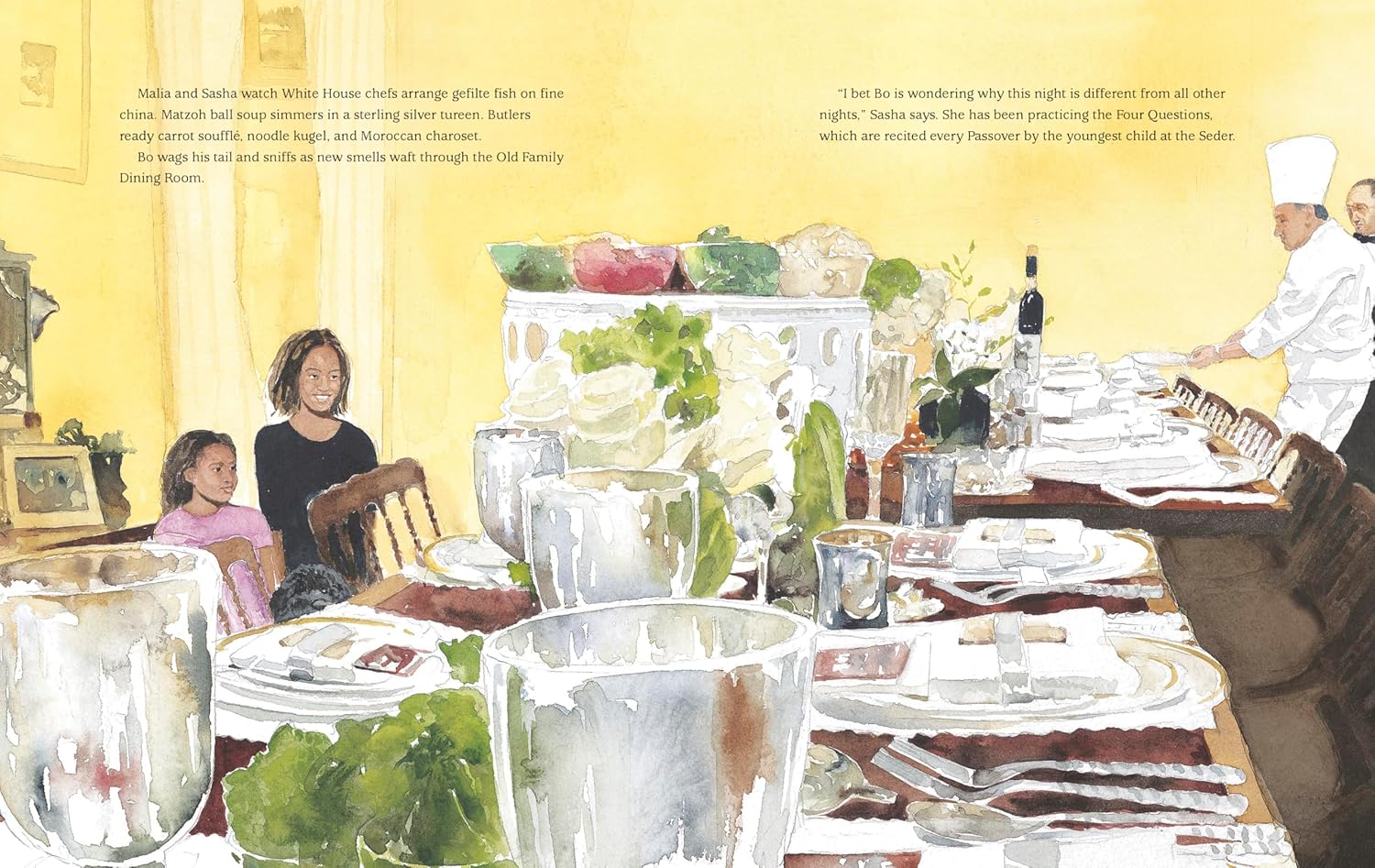
“Malia and Sasha watch White House chefs arrange gefilte fish on fine china. Matzoh ball soup simmers in a sterling silver tureen…Bo wags his tail and sniffs as new smells waft through the Old Family Dining Room.”

Michelson’s story begins right in the action, with everyone preparing for the White House Seder. Barack Obama’s daughter Sasha says, “I bet Bo is wondering why this night is different from all other nights.” She is jokingly referencing the four questions recited by the youngest child in a Passover seder. And why is this night different, you may be wondering? Read on to find out! 

Illustration © 2025 by E.B. Lewis, text © 2025 by Richard Michelson. Courtesy of Random House Children’s Books.

When Eric, Arun, and Herbie set out on the campaign trail with Senator Obama as he ran for president in 2008, they did not expect to find themselves seated in the White House celebrating Passover for the next eight years. These young men joined the campaign trail in hopes that “they could help [Obama] make America a place where all people—regardless of their race, gender or religion—would have an equal opportunity to succeed.” But, “helping others doesn’t mean you don’t get homesick, or hungry, or tired.”

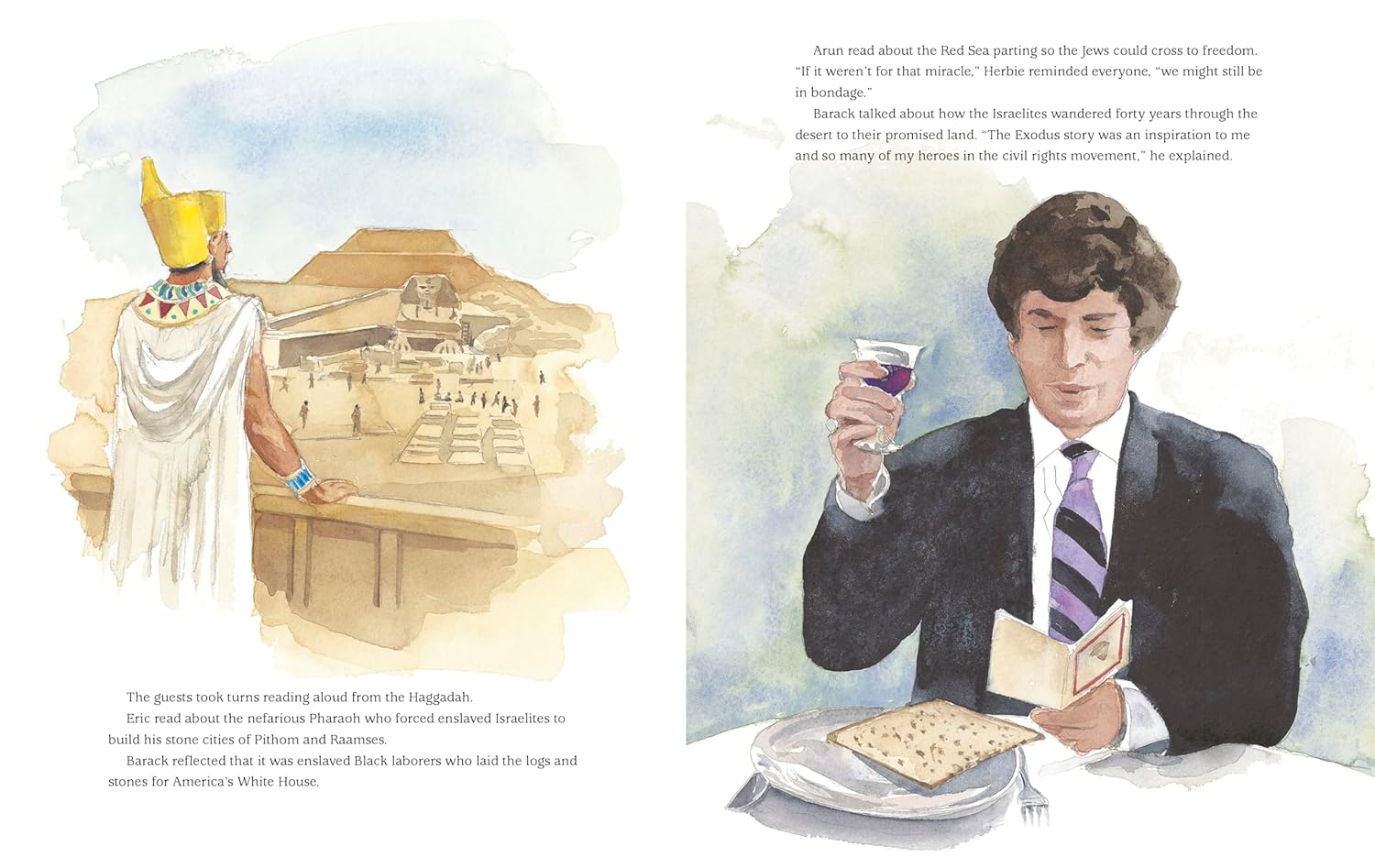
Holidays are especially a time when homesickness can hit for folks far from home. And this was the case for Eric, Arun, and Herbie. When Passover came around, they decided to have their own Passover ceremony, or Seder, in the basement of the hotel where they were staying. The trio managed to snag some matzoh, macaroons and Manishewitz wine along with Haggadahs (booklets of the prayers, songs and story of Passover) to tell the story of Passover—the exodus of enslaved Jews in Egypt who escaped through a parting sea to freedom, one of many miracles that ensured their eventual getaway. “Tonight, they would celebrate the sweet taste of freedom and pledge not to rest until all people are free.”

Illustration © 2025 by E.B. Lewis, text © 2025 by Richard Michelson. Courtesy of Random House Children’s Books.

When the three young men rose for the tradition of letting the prophet, Elijah, in through the door they were surprised to find Barack Obama on the other side, requesting to join the gathering. Obama brought to the table connections between the Passover freedom tale and the civil rights movement—how activists throughout time have drawn from the Passover pilgrimage in their protests and speeches. He told of how enslaved Black laborers were the ones who carried the first building blocks for the White House, like how the ancient Pharaoh had made the enslaved Israelites build his stone cities. When Eric called out a traditional Passover expression “Next year in Jerusalem,” a phrase that has come to signify hope for a better tomorrow, Barack replied, “Next year in the White House!”

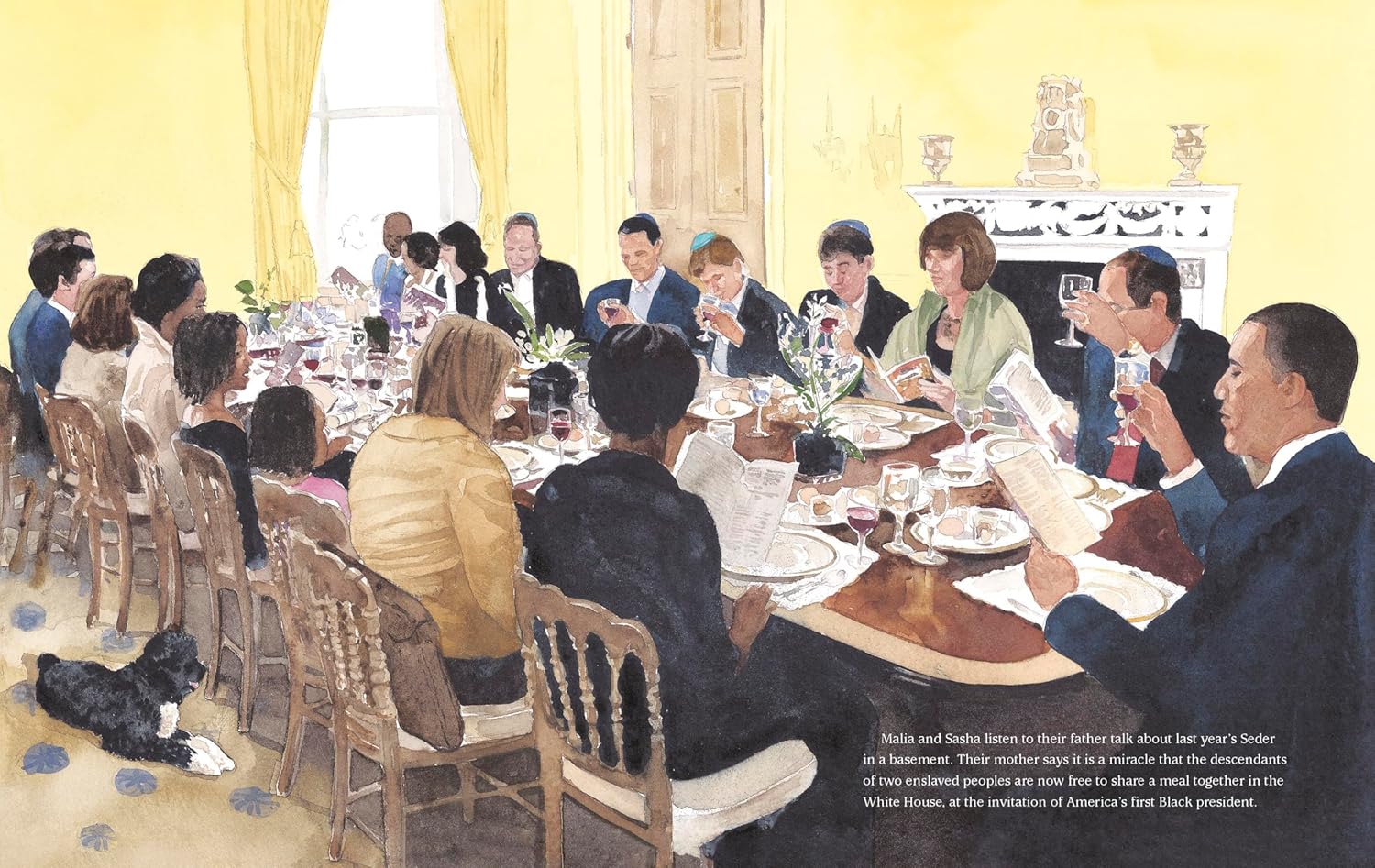
In the following pages, we return to the prologue scene of the book—a description of the first White House Seder, performed in 2009, hundreds of years after both the first White House Christmas and Easter ceremonies. We read of two previously enslaved peoples joining together in resistance and solidarity, to celebrate in the historic White House, where neither group would have been invited years ago. We learn about the traditional Passover foods and games for children—such as piping hot matzoh ball soup and the race to find the afikomen, a hidden piece of matzoh wrapped in a special cloth. And we’re invited in as dozens of people gather to celebrate and cherish the holiday’s call of freedom. When the prize for finding the hidden afikomen is a dog toy for Bo, Sasha remarks, “Now Bo definitely knows why this night is different from all other nights.”

Illustration © 2025 by E.B. Lewis, text © 2025 by Richard Michelson. Courtesy of Random House Children’s Books.

Richard Michelson’s writing is thought provoking, lively and packed with themes of hope and resilience interspersed with knowledge of the Passover traditions. The story contains many references to Passover phrases and themes, such as the call for the homesick, tired, and hungry to come eat and the four questions, which are both part of Passover prayers and motifs shared in Michelson’s story.

Michelson adds a prologue scene to draw readers in, as well as extensive back matter including: a note from Herbie Ziskend, Eric Lesser, and Arum Chaudhary; an annotated page of the Haggadah used at the first White House Seder; more information about the attendees and connections between Black History and Passover; a detailed explanation of Passover traditions; and a special Passover dessert recipe from Arun. His writing instills a sense of social justice, with undertones of the importance of intersectional empowerment and unity.

E.B. Lewis’s signature watercolor spreads bring the book to life with distinctly recognizable characters displaying detailed facial expressions and richly colored backgrounds. Readers will feel immersed in the comradery of the dinner table scenes and the crowds at protests and campaign speeches. The illustrative masterpiece depicting the parting of the sea in the background when Eric, Arun, and Herbie retell the Passover story will inspire awe and mystery. Close-ups of each of the characters also intersperse text and larger detailed scenes. When Arun, Herbie, and Eric are introduced, they each receive their own small illustrative snapshot, as these three unlikely characters become center stage for a Passover miracle story.

Next Year in the White House brings a unique and important historical moment to light and a new story to the table to re-read time and time again, as is tradition with the Passover tale. 

Ages 4 – 8+

Crown Books for Young Readers, 2025 | ISBN 978-0593711583

About the Author

Richard Michelson is a poet, children’s book author, and art dealer whose children’s books have been listed among the 10 Best Books of the Year by The New York Times, Publishers Weekly, and The New Yorker; and among the 12 Best Books of the Decade by Amazon.com. He has been a finalist for the Massachusetts Book Award, the Harlem Book Fest Wheatley Award, and the National Jewish Book Award, as well as receiving two Skipping Stones Multicultural Book Awards, a National Parenting Publication Gold Medal and an International Reading Association Teacher’s Choice Award. In 2009 Michelson received both a Sydney Taylor Gold and Silver Medal from the Association of Jewish Librarians, the only author so honored in AJL’s 50 year history. Michelson received his 2nd Silver Medal in 2017 and his 2nd Gold Medal in 2018. Additionally, Michelson won the 2017 National Jewish Book Award. Michelson is the owner of R. Michelson Galleries, the host of Northampton Poetry Radio, and the current Poet Laureate of Northampton. Massachusetts. You can learn more by visiting him at richardmichelson.com and on Facebook.

About the Illustrator

E.B. Lewis has illustrated over seventy books for children, including the New York Times Best Illustrated Book Award, Kirkus Best Illustrated Book Award, and the Golden Kite Honor Award winner Jabari Asim’s Preaching to the Chickens as well as the Caldecott Honor Award Winner, Jacqueline Woodson’s Coming on Home SoonHe is also a five-time Coretta Scott King winner.
Presently, Lewis teaches at the Pennsylvania Academy of Fine Arts. He is also a member of The Society of Illustrators in New York City, and an artist member of Salamagundi Art Club of New York. Learn more about E.B. Lewis and his work at eblewis.com.

Get Ready for Passover Activity

8 Days of Activity Plans from 18 Doors


Celebrate Passover with your family and these Activity Plan Ideas from 18 Doors! For each of the 8 Days you’ll find a song or video, a craft, and a recipe to help you have a fun Passover!

You can purchase Next Year at the White House from these booksellers

Amazon | Barnes & Noble | Bookshop (to support your local independent bookstore)

Picture Book Review
March 6 – It’s Read Across America Week

About the Holiday

Today’s holiday, established by the National Education Association in 1997, encourages children across the country to celebrate reading and all of its joys and benefits. A love of reading is one of life’s greatest pleasures and begun early can be a powerful force for future success. Celebrate today by reading with a child or on your own. There are fabulous worlds and stories waiting to be discovered!

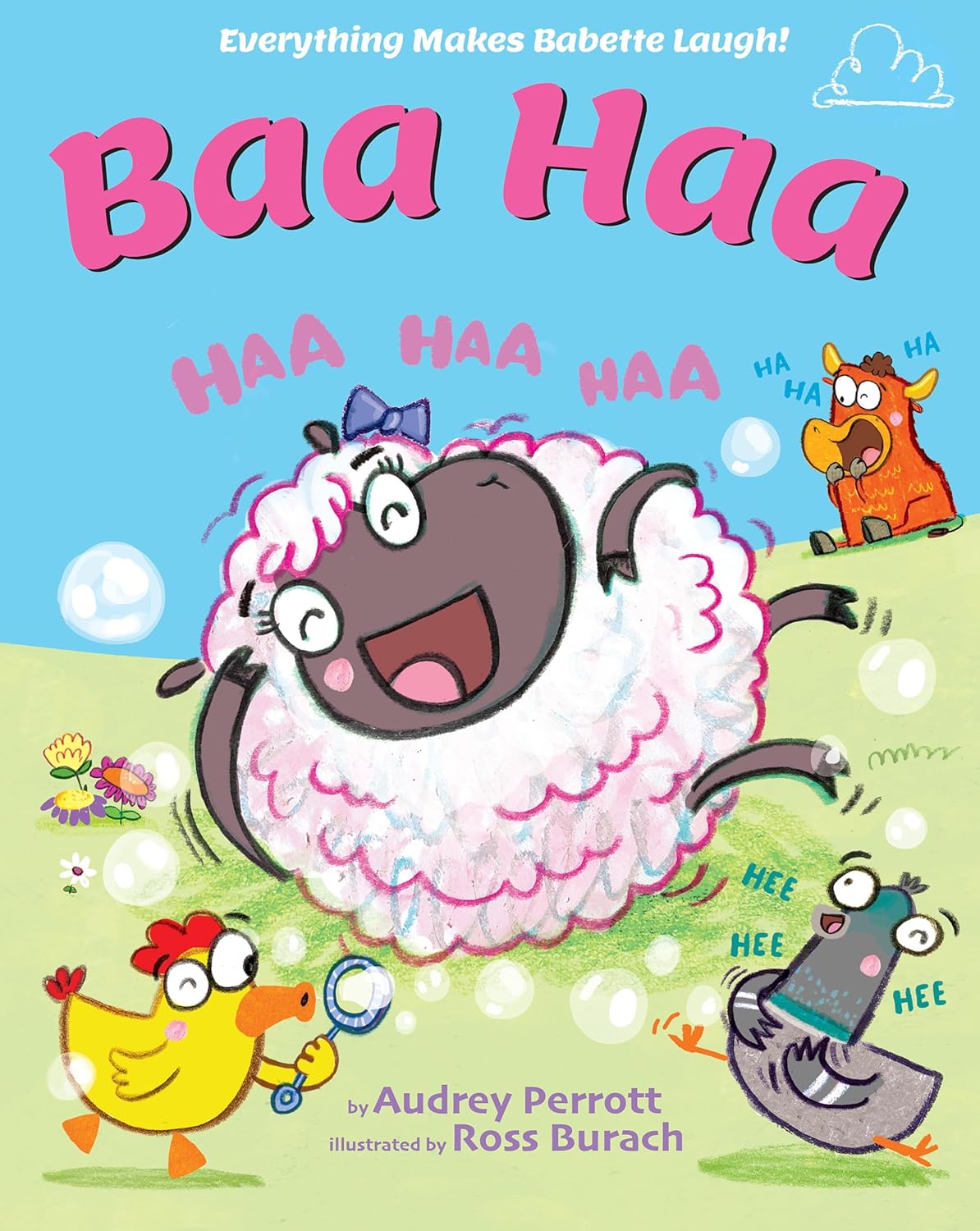
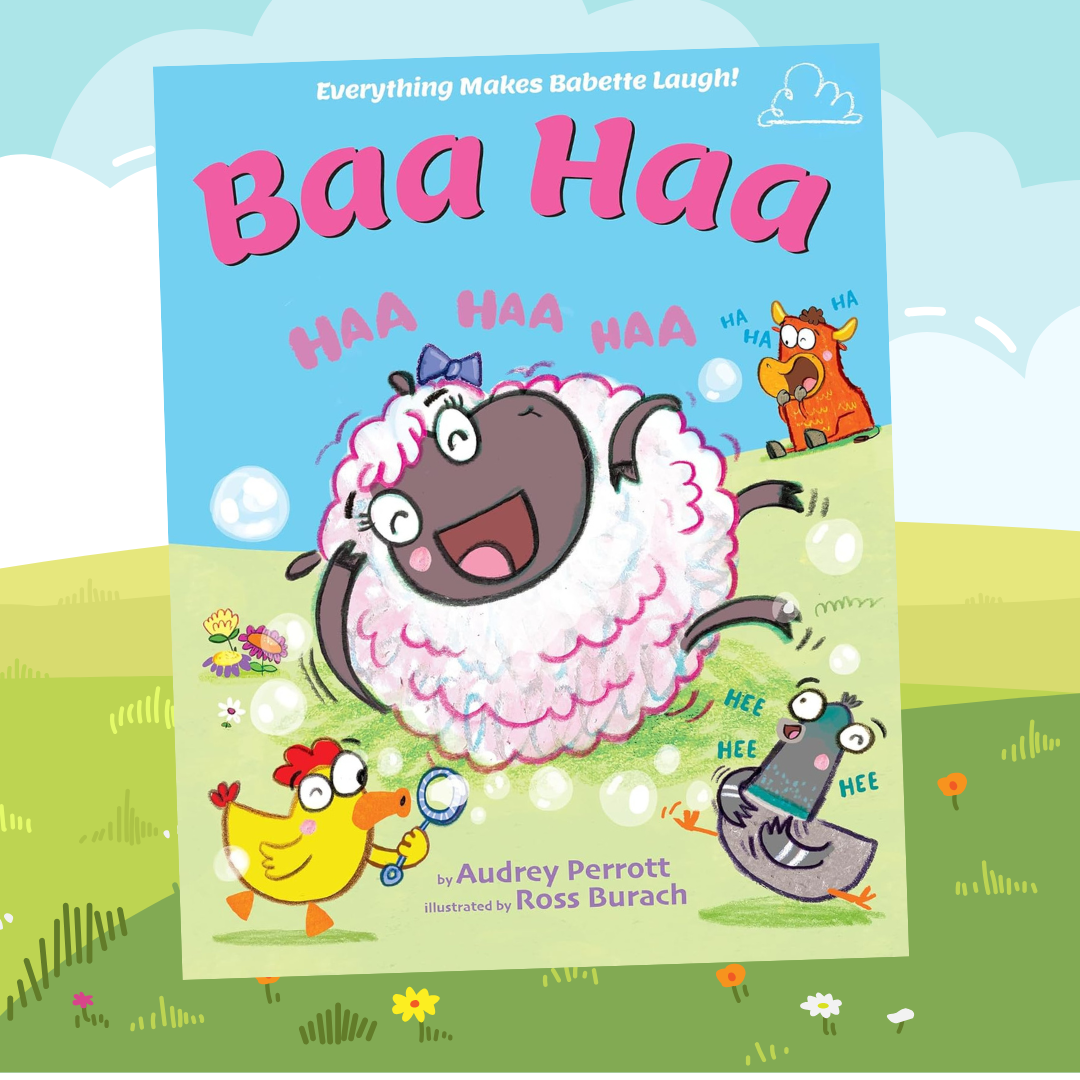
Baa Haa

Written by Audrey Perrott | Illustrated by Ross Burach

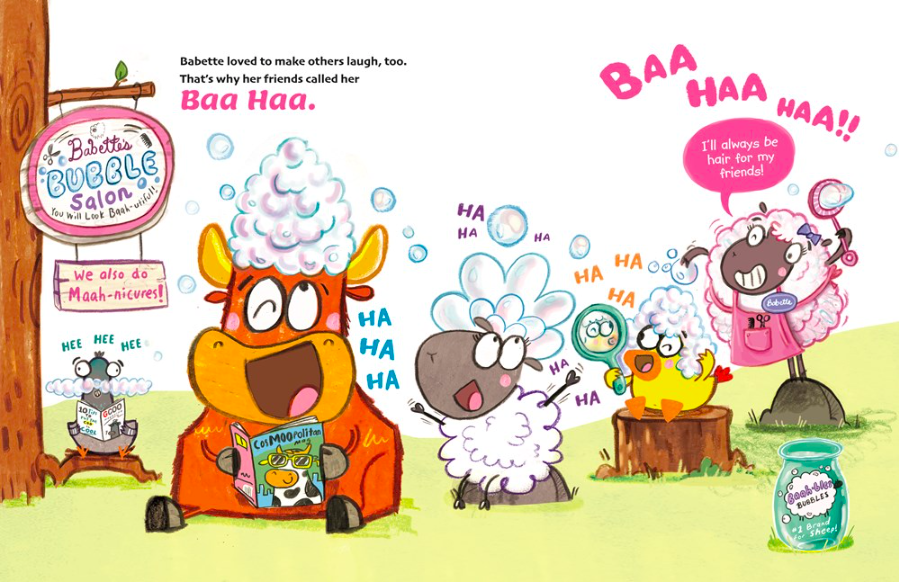
Babette was a happy sheep. Anyone on the farm and beyond could tell you, since “her laughter could be heard across the pasture for miles.” In fact, Babette’s friends all called her “Baa Haa” because she made them hee hee and ha ha, and even guffaw with all of her jokes and antics.

Yes, Babette loved to laugh, and her bubbly personality burst out no matter what she was doing or feeling. When she was surprised, she laughed. When she was “glaaaaad,” she laughed. She even laughed when things didn’t quite go her way. Wait a minute . . . really?

Illustration © 2025 Ross Burach, text © 2025 Audrey Perrott. Courtesy of Scholastic Press.

Really. Babette didn’t like feeling nervous or scared or disappointed, so whenever she felt “baaaaad,” the giggles let her escape. But all this laughter and hiding her real feelings was “tangling her insides into a knot,” and the problem was getting worse. Nothing she tried helped her to feel better. Then one day she couldn’t keep her tears from welling up and spilling out. She tried putting “on a big fake smile” for her friends, but she couldn’t keep the tears from falling.

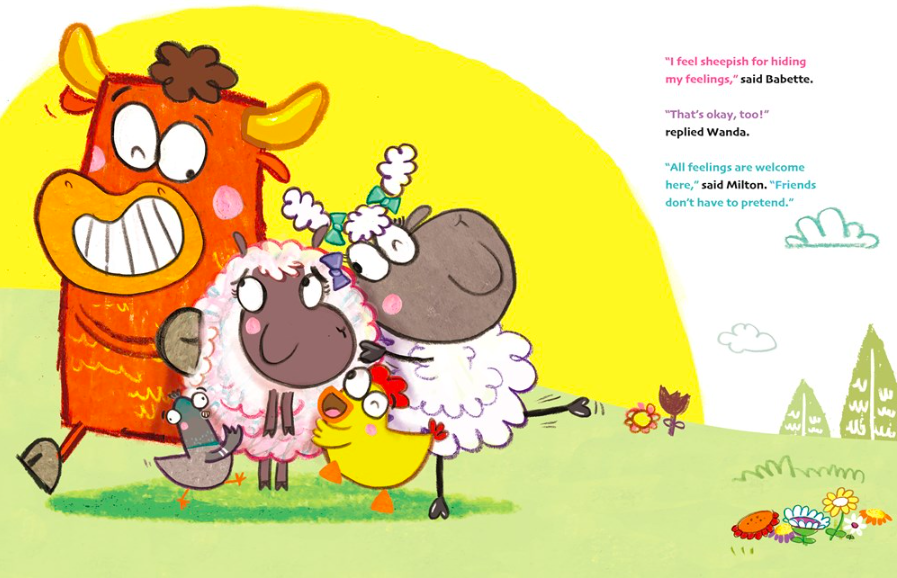
The other animals assured her that “It’s okay if you’re not okay,” and that she should feel free to show her real feelings. “‘We love ewe for ewe,'” her friend Wanda said. Babette began to feel better and was even able to acknowledge that sometimes she did feel sad or mad or nervous. From then on, Babette “let all her feelings show” and shared them with her friends. “Because that’s what true friends do.”

Illustration © 2025 Ross Burach, text © 2025 Audrey Perrott. Courtesy of Scholastic Press.

Audrey Perrott’s follow up to Moo Hoo gently and with plenty of humor reassures children that they don’t have to be happy all the time, and that expressing their true emotions is better than bottling them up. Filled with puns, jokes, and word play, Perrott’s story will have kids giggling as they embrace her message that everyone shares the same feelings and that showing them can bring support, understanding, and quicker recovery.  

Kids will love Ross Burach’s goofy and kind-hearted farmyard animals. His animated illustrations effectively demonstrate the disconnect between Babette’s mirthful reactions and disappointing or nerve-wracking events. As Babette’s true emotions begin to emerge, Burach’s characters clearly show their empathy and understanding. Throughout the story, readers will have fun finding all of the visual puns Burach has added to his illustrations.

An engaging read aloud with an essential, heartening message, Baa Haa is highly recommended for home and library collections.

Ages 4 – 8

Scholastic Press, 2025 | ISBN 978-1546134039

About the Author

Audrey Perrott is the author of Moo Hoo, her debut picture book, as well as nine nonfiction and board book projects with Tangerine Press/Scholastic, including her most recent, Five Buzzy Bees, and A Hat for House with Putnam. An SCBWI Rising Kite Honorable Mention recipient, she lives with her family in North Carolina. You can visit her online at audreyperrott.com.

About the Illustrator

Ross Burach is the creator of the riotously funny Very Impatient Caterpillar series that includes The Very Impatient Caterpillar; The Little Butterfly That Could; Goodnight, Butterfly; and Make Way for Butterfly. All the books combine humor with curriculum-friendly science topics and relatable social-emotional themes. Ross’s other acclaimed books include the picture book Truck Full of Ducksthe board books I Love My Tutu Too!, Potty All-Star, Hi-Five Farm!, and Hi-Five Animals!—named the best board book of the year by Parents Magazine—and the Acorn early reader series Bumble and Bee. He also illustrated Audrey Perrott’s Moo Hoo and Baa Haa. Ross lives with his family in Brooklyn, New York. You can visit him online at rossburach.com.

Read Across America Week Activity

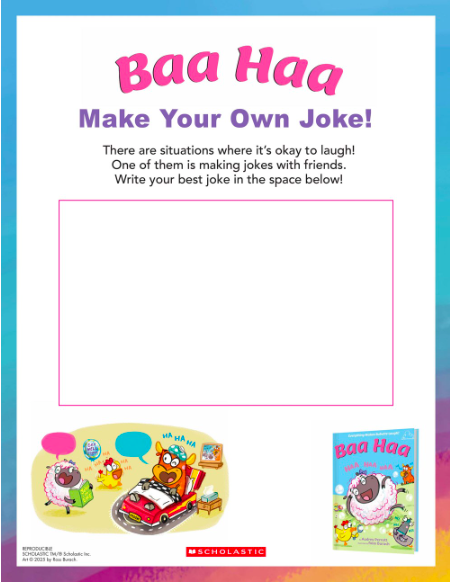
Baa Haa Fun Sheets

Kids will have fun giggling through these Baa Haa Make a Joke and Word Search Activity Sheets!

You can purchase Baa Haa at these booksellers

Amazon | Barnes & Noble | Bookshop (to support your local independent bookseller)

Picture Book Review

February 19 – Random Acts of Kindness Week

About the Holiday

Random Acts of Kindness Week may be ending, but that only means it’s time to extend the spirit of the holiday day after day until it rolls around again next February! Today, I’m celebrating with one of my favorite stories about a little girl who sees someone in need of help or kindness and generously offers the comforts of tea and treats with a smile. Children are particularly good at offering such caring gestures that can have far-reaching effects. Adults can foster a child’s natural kindness by supporting their ideas and actions for helping their community.

Thanks to Sleeping Bear Press for sharing a copy of The Princess and the Café on the Moat with me!

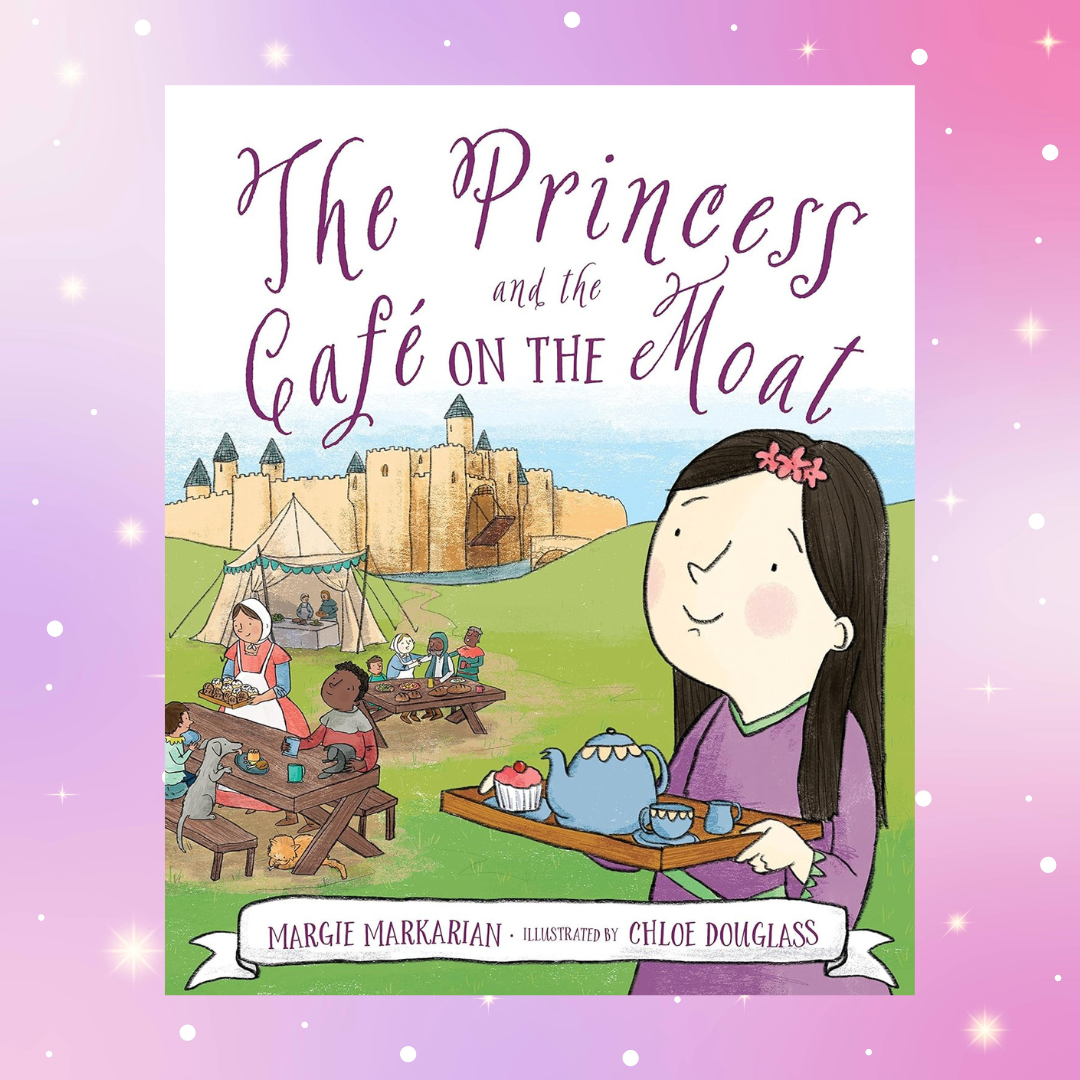
The Princess and the Café on the Moat

Written by Margie Markarian | Illustrated by Chloe Douglass


There once was a little princess who lived in a very busy castle. Every morning knights brought news of “enemies defeated, dragons seized, and citizens rescued.” Upstairs, ladies-in-waiting were given their duties for “silks to sew, invitations to ink, and chandeliers to shine.” The princess wanted a special job too, but her voice was never heard above the din, so she went in search of something to occupy her time.

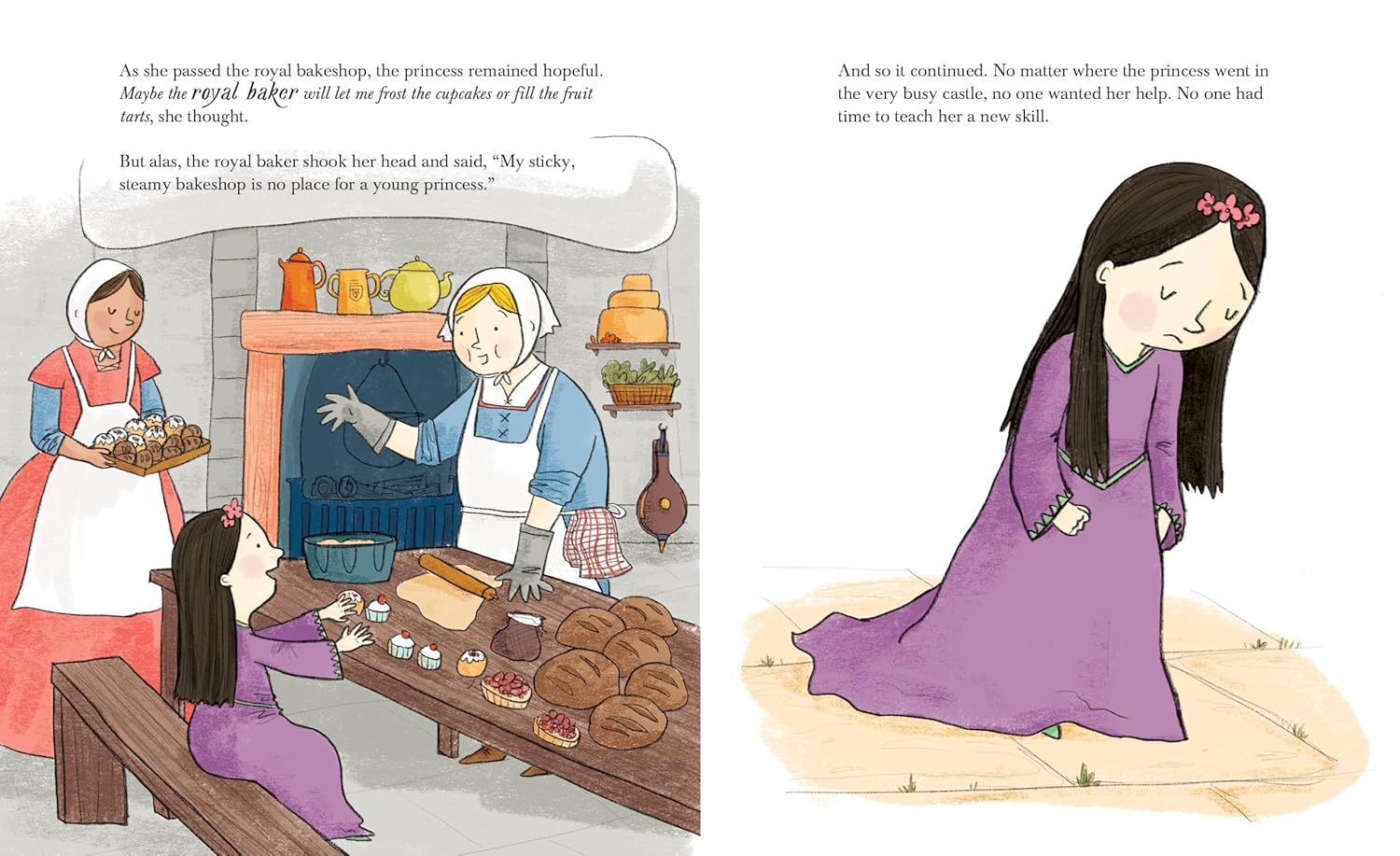
The court jester was too busy to teach her how to juggle. The wandering minstrel said her fingers were too delicate to pluck the wiry strings of a mandolin, and the wizard banished her from the tower, saying his potions were too dangerous. Even the royal baker thought her kitchen was no place for a princess. “The princess’s kind heart and eager spirit were not easily discouraged.” She wondered if there were people beyond the castle who could use her help. Just then the drawbridge descended, and the princess crept by the guard and ran outside.

Illustration © 2018, Chloe Douglass; text © 2018 Margie Markarian. Courtesy of Sleeping Bear Press.

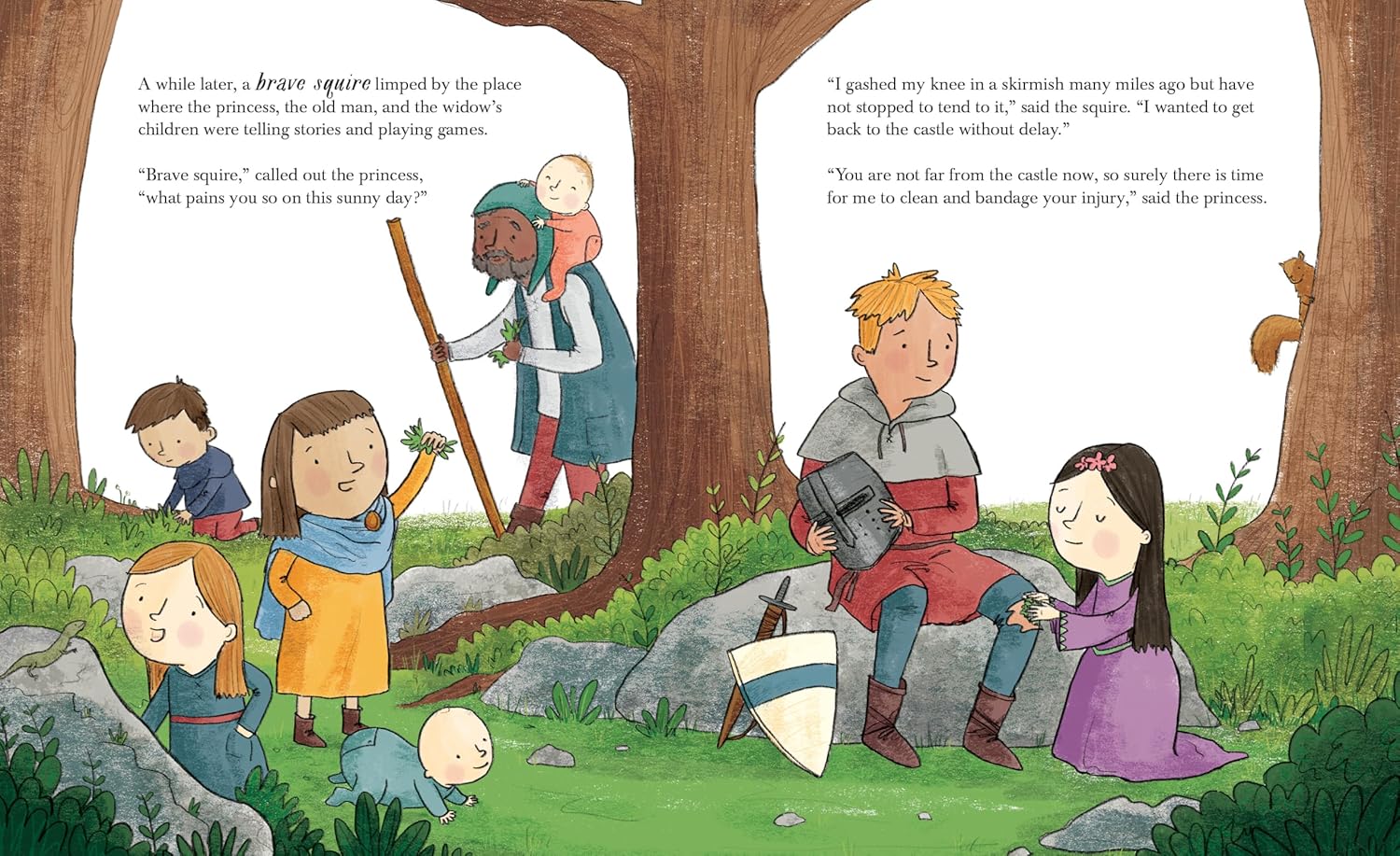
Right outside the castle, she met a sad old man who had gotten a letter from his far-away son, but because of his weak eyesight couldn’t read it. “‘I have time to read your letter and sit awhile,’ said the princess, happy to have found a task so quickly.” Next, she met a worried widow who had no one to watch her children as she traveled to the village market. The princess happily offered to watch them. And when a brave squire came limping by with an injured knee, she quickly bandaged.

Back at the castle, though, everything was in an uproar as everyone was hunting everywhere for the princess. When the king suddenly heard laughter and singing and saw through the window that it was the princess, everyone paraded out through the drawbridge to join her and her new friends.

Illustration © 2018, Chloe Douglass; text © 2018 Margie Markarian. Courtesy of Sleeping Bear Press.

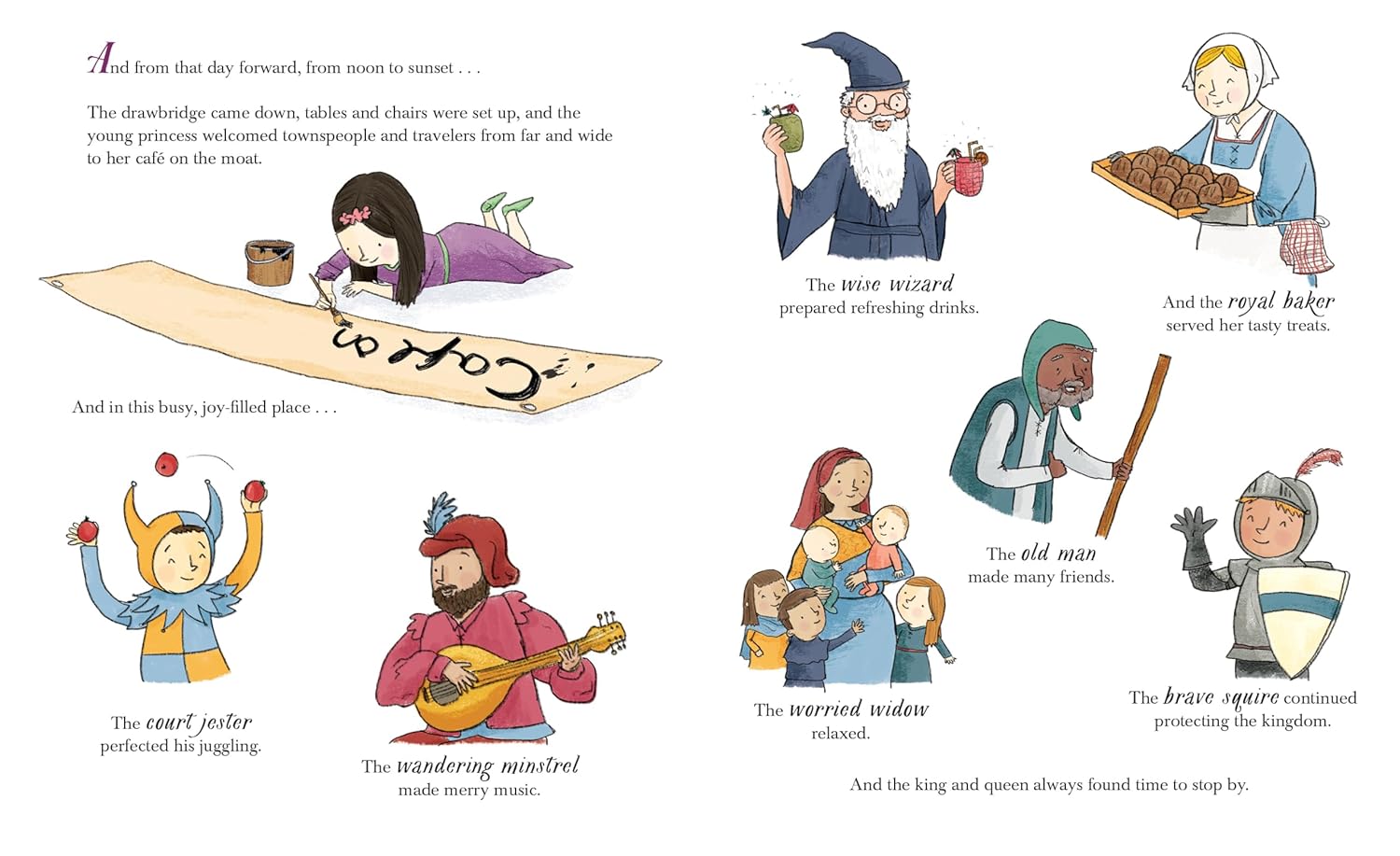
The princess ran to her mother and father and told them about all the things she had done for the old man, the widow, and the squire. The king and queen “were proud to have such a kindhearted daughter.” The king suggested that they “all celebrate together with treats and refreshments.” From that day on in the afternoon, the drawbridge was dropped and tables and chairs set up. Then the “princess welcomed townspeople and travelers from far and wide to her café on the moat.” The café welcomed everyone, and “indeed, they all lived happily and busily ever after.”

An Afterword about fairy tales and a kindness activity for children follow the story.

Illustration © 2018, Chloe Douglass; text © 2018 Margie Markarian. Courtesy of Sleeping Bear Press.

Margie Markarian’s sweet story is an enchanting fairy tale for today’s socially conscious and active kids. Instead of needing rescue, this princess looks for opportunities to help others. When she’s turned away from helping inside the castle, she leaves the comfort of home and reaches out to her community, an idea that children will embrace. Through her cheerful storytelling, Markarian also shows readers that in their talents and kind hearts they already have what it takes to make a difference to others. As the princess opens her café on the moat, both children and adult readers will be inspired to find ways to support each other in planned—or random—acts of kindness. Markarian’s language is charmingly “medieval,” making the story a fun read aloud. The story would also lend itself well to dramatic play for classrooms, child-centered organizations, or enterprising groups of friends and families.

Chloe Douglass’s adorable princess is a terrific role model for young readers. Her eagerness to help and positive spirit are evident in her smiles and persistent requests for a job to do. When she ventures out of the castle, she displays obvious empathy for the people she meets, and children will recognize her joy at being able to brighten the townspeople’s day. Despite their busy days, the king and queen are happy and supportive of their daughter. Children will love the bright and detailed images of the castle and town, where the crest of love rules.

The Princess and the Café on the Moat is a charming flip on the traditional fairy tale—one that children will want to hear again and again. It would make an inspiring spring gift and an enriching addition to home, classroom, and library collections.

Ages 5 – 8

Sleeping Bear Press, 2018 | ISBN 978-1585363971

To discover more about Margie Markarian and her picture book and to find fun activities, visit her website. 

Learn more about Chloe Douglass, her books, and her art on her website.

Random Acts of Kindness Week Activity

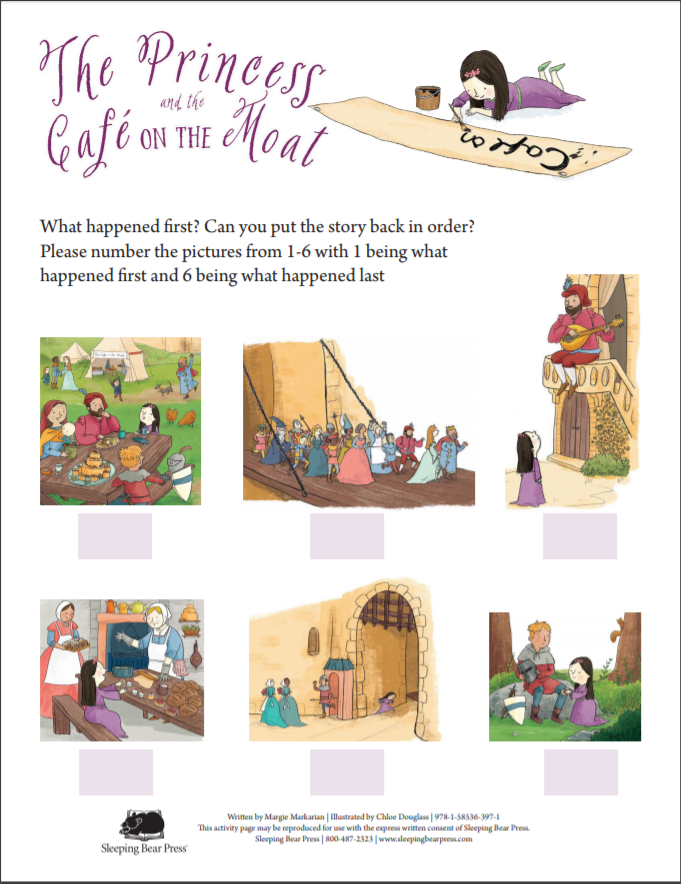
celebrate-picture-books-picture-book-review-the-princess-and-the-cafe-on-the-moat-number sequence-page

The Princess and the Café on the Moat Activities


The Princess likes to help people relax and have fun together! You can help her too with these four The Princess and the Café Activity Pages!

You can purchase The Princess and the Café on the Moat at these booksellers

Amazon | Barnes & Noble | Bookshop (to support your local independent bookstore)

Picture Book Review
February 17 – Random Acts of Kindness Day

About the Holiday

It’s Random Acts of Kindness Day! Coming mid-way through Random Acts of Kindness Week, today’s holiday offers the perfect time to begin or reconfirm your commitment to doing nice things for those around you. Simple gestures of kindness—like sharing a smile, giving a compliment, or helping out when you see someone struggling—make anyone feel better and create a bond that brings a community closer. To keep the good feelings flowing throughout the year, look for opportunities to help out and share books that encourage kindness, such as today’s book!

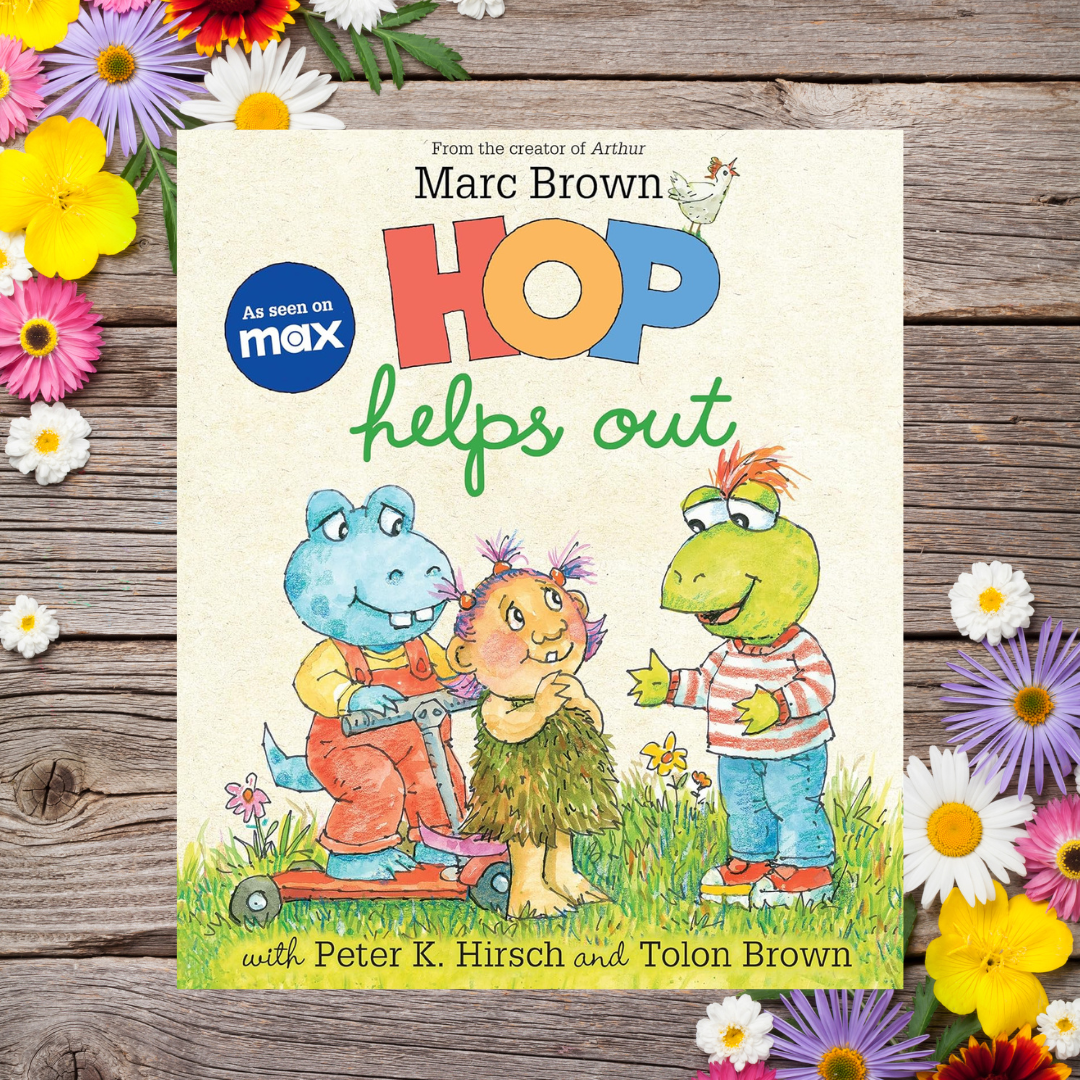
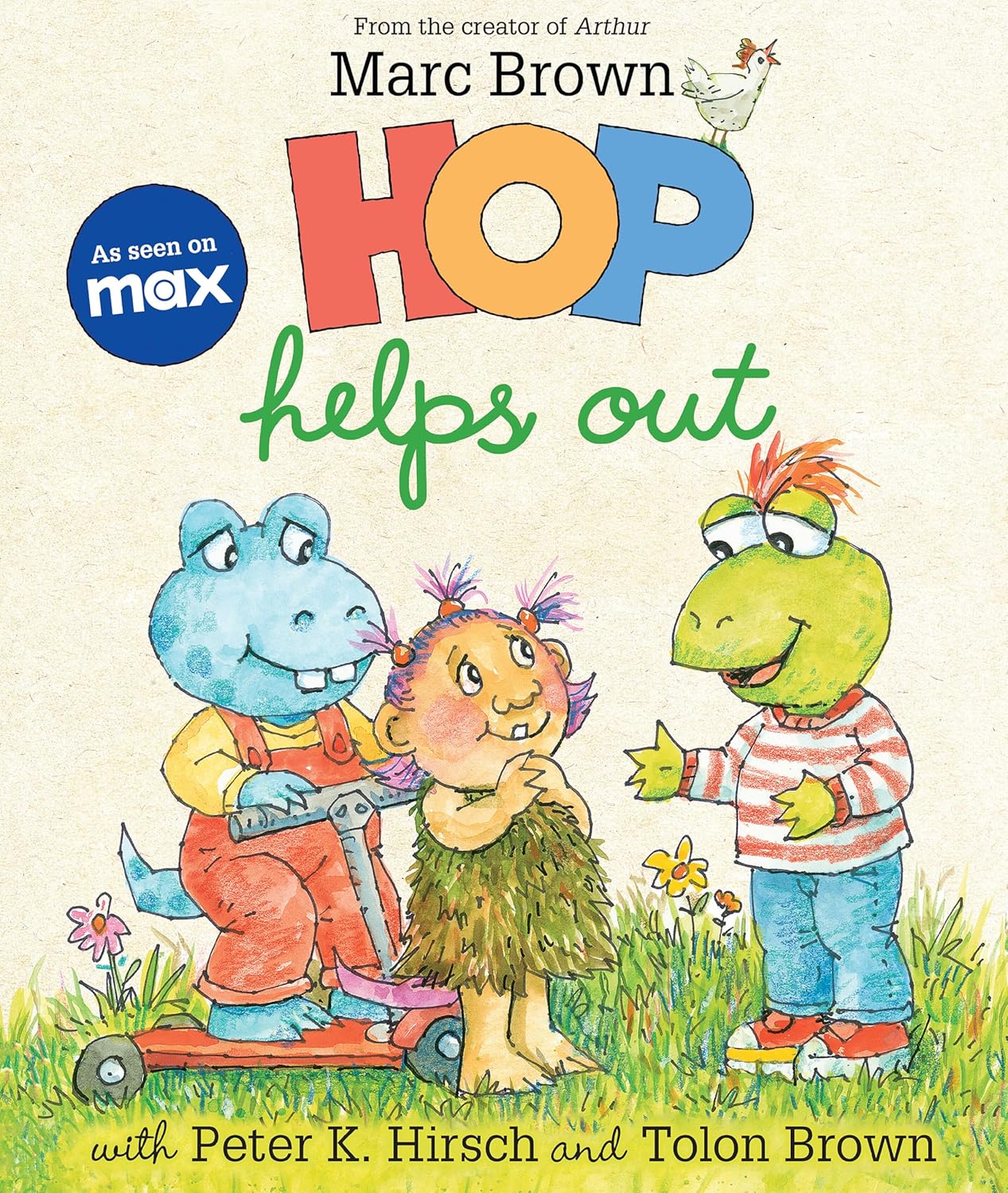
Thank you to Orchard Books/Scholastic for sharing a copy of Hop Helps Out with me!

Hop Helps Out

By Marc Brown, Tolon Brown and Peter Hirsch


One morning as Hop and Benny are out exploring their town of Fair Village, they come across a troll named Helga, who’s crying because she’s too afraid to venture out into the world on her own. Hop immediately takes her by the hand and invites her to come adventuring with him and Benny. Hop and Benny are eager to show their new friend Helga some of their favorite places.

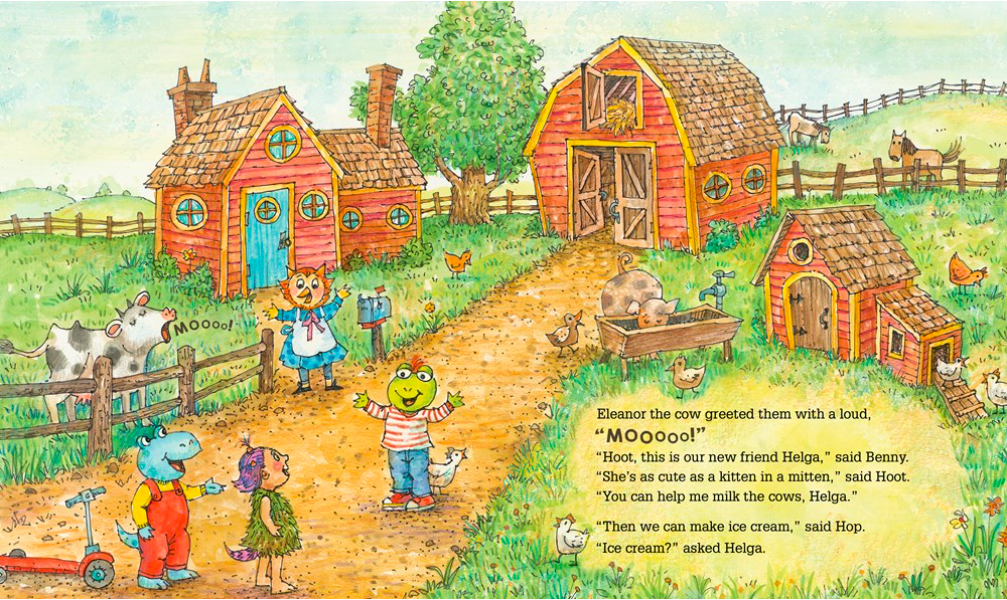
First, they visit a meadow, lush with clover, daisies, lupines, daffodils, and wildflowers in a rainbow of colors. Then Benny wants to show Helga the small mobile home he lives in. His yard, strewn with toys and games and sporting a garden, delights Helga, and when they go inside she is treated to a mug of hot chocolate and a story. Next, they take Helga to their friend Hoot’s farm. ‘”She’s as cute as a kitten in a mitten,'” Hoot declares. “‘You can help me milk the cows, Helga,'” Hoot says. Afterward, they’re all treated to homemade ice cream, dress up play, and a ride in Hoot’s talking car, Jinx.

Illustration © 2025, Marc Brown; text © 2025, Marc Brown, Tolon Brown, Peter Hirsch. Courtesy of Orchard Books/Scholastic.

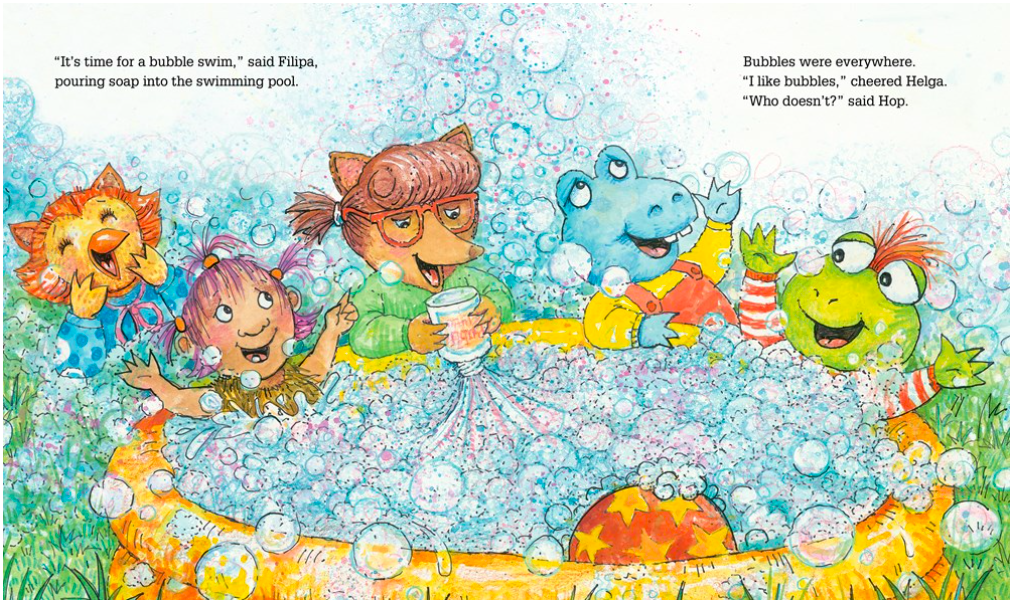
Jinx takes the merry group to see another friend, Filipa. Filipa is just filling the swimming pool underneath her treehouse when they arrive. Helga can’t believe her eyes. There are so many fun things to do here; even a swing! Even though Benny warns Helga not to swing too high, she falls off. But when Hop hurries over, Helga giggles and reveals that trolls “‘can bounce.'” In Filipa’s art studio, Helga gets to try out being creative—with herself as the canvas. Not to worry, though! Filipa fills her pool with bubbles for an impromptu (and colorful) bubble bath. “‘I like bubbles,’ cheered Helga.” “‘Who doesn’t?'” Hop agrees.

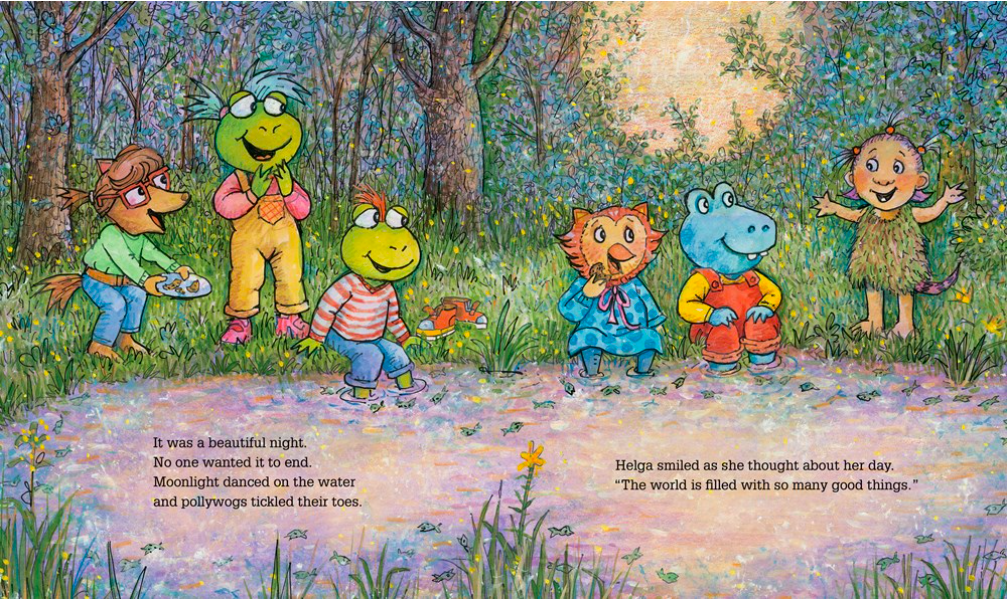
Next on the tour is Hop’s Lily Pad Diner, where Hop’s sister, Penny, plays the piano while the others dance. All this activity and excitement is making Helga tired and ready to go home. When they arrive, Helga treats her new friends to a Moon Snack of sassafras twigs and fungus chips. No one wants this fun day to end. Especially Helga, who is happy to be part of the group and to have discovered so much. “‘The world is filled with so many good things.'” she exclaims.

Illustration © 2025, Marc Brown; text © 2025, Marc Brown, Tolon Brown, Peter Hirsch. Courtesy of Orchard Books/Scholastic.

The story is followed by a detailed map of Fair Village with many homes, restaurants, farms, parks, and other landmarks for kids to explore. In an afterword, Marc Brown explains how the world of Hop—a new animated series streaming on MAX—started out as a doodle of a frog with one leg shorter than the other then joined by a host of other characters. Brown, with the help of his son Tolon (a producer on the Arthur series) and Peter Hirsch (the head writer for Arthur), expanded on this inclusive universe for a younger audience.

Brown shares, “It was important to me that Hop’s world introduced characters that were reflective of our communities and friends and inclusive of children who had been underrepresented in the media. In Fair Village, disabilities never define who you are or what you can achieve. Our goal is to create a safe, inviting world that challenges kids to appreciate others who are not like them and to act with understanding and kindness.”

Illustration © 2025, Marc Brown; text © 2025, Marc Brown, Tolon Brown, Peter Hirsch. Courtesy of Orchard Books/Scholastic.

Enthusiasm, kindness, and acceptance radiate from the pages, as Hop and Benny take charge of showing Helga around Fair Village—a name that reflects both the beauty of the town as well as how its residents treat each other—and introducing her to things she’s never seen before. Young readers will find pleasure in sharing so many of these favorites too, such as hot chocolate, bubble baths, ice cream, and playing dress up, with this crew of fast friends. Gentle humor is sprinkled throughout, and the simply stated, heartfelt ending invites readers to look around at their own family, friends, home, and community and find the “many good things” there.

Marc Brown’s illustrations are infused with color and offer children a multitude of familiar things to see and identify. The full-bleed spreads immerse readers in the community of Fair Village and the individual homes of the characters. Detail-oriented children will love lingering over the map to find each of the character’s homes as well as fun additions, such as the crooked house, the haunted castle, and the appropriately shaped Pie Shop, Pizza Palace, and Pet Hospital. As this book and the series are inclusive of children underrepresented in media, Brown depicts Hop’s anisomelia (having one leg shorter than the other) in his two different shoes—one of which has an extra, yellow layer to its sole. Helga is coded as having agoraphobia.

A tie-in to the new MAX series HOP, Hop Helps Out introduces children to some of the characters and the vast Fair Village community in a joyful and empathetic way. The story can stand alone as well, encouraging discussions about meeting new people, being open to new experiences, visiting unfamiliar places, and showing kindness to others. 

Ages 4 – 8

Orchard Books/Scholastic, 2025 | ISBN 978-1339035680

About the Creators

Marc Brown is the beloved creator of the bestselling Arthur Adventure book series and creative producer of PBS’s Peabody and Emmy award-winning television series Arthur, now the longest-running children’s animated show in history. He also has illustrated many other books for children, including the New York Times bestseller Wild About Books, as well as The Little Shop of Monsters and Mary McScary, both written by R.L. Stine. For more information, visit marcbrownstudios.com.

Peter Hirsch is the co-creator and head writer of the MAX series, HOP. Before then he was the head writer of the PBS series Arthur for over 20 years. He has won 7 Emmys and a Peabody award, and lives in New York City with his wife, playwright Cusi Cram, and their two overweight cats.

Tolon Brown is an Emmy award-wining producer of culturally significant shows such as Arthur on PBS, and co-creator of the animated series HOP on MAX. Long ago he discovered a fondness for complaining about “good coffee” and people who can’t change a flat tire, which inspired him to split his time between Brooklyn and Baldwin County, Alabama in order to pursue both. Somehow he managed to raise two amazing daughters, yet remains open to the possibility that was purely accidental.

You can purchase Hop Helps Out at these booksellers

Amazon | Barnes & Noble | Bookshop (to support your local independent bookstore)

Picture Book Review
February 6 – Children’s Mental Health Week

About the Holiday


February 3rd-9th marks the United Kingdom’s 11th National Children’s Mental Health week, sponsored by the children’s mental health charity Place2Be. While the US has its own Children’s Mental Health Awareness week in May, it’s always good to share resources and support around mental health for children. This February’s theme is Know Yourself Grow Yourself, with an emphasis on building resilience and coping skills through self-understanding. To honor Children’s Mental Health week, adults and kids alike can engage in mood journaling, verbal processing of emotions, and reading books that explore just what to do to get through hard times.

Review by Dorothy Levine

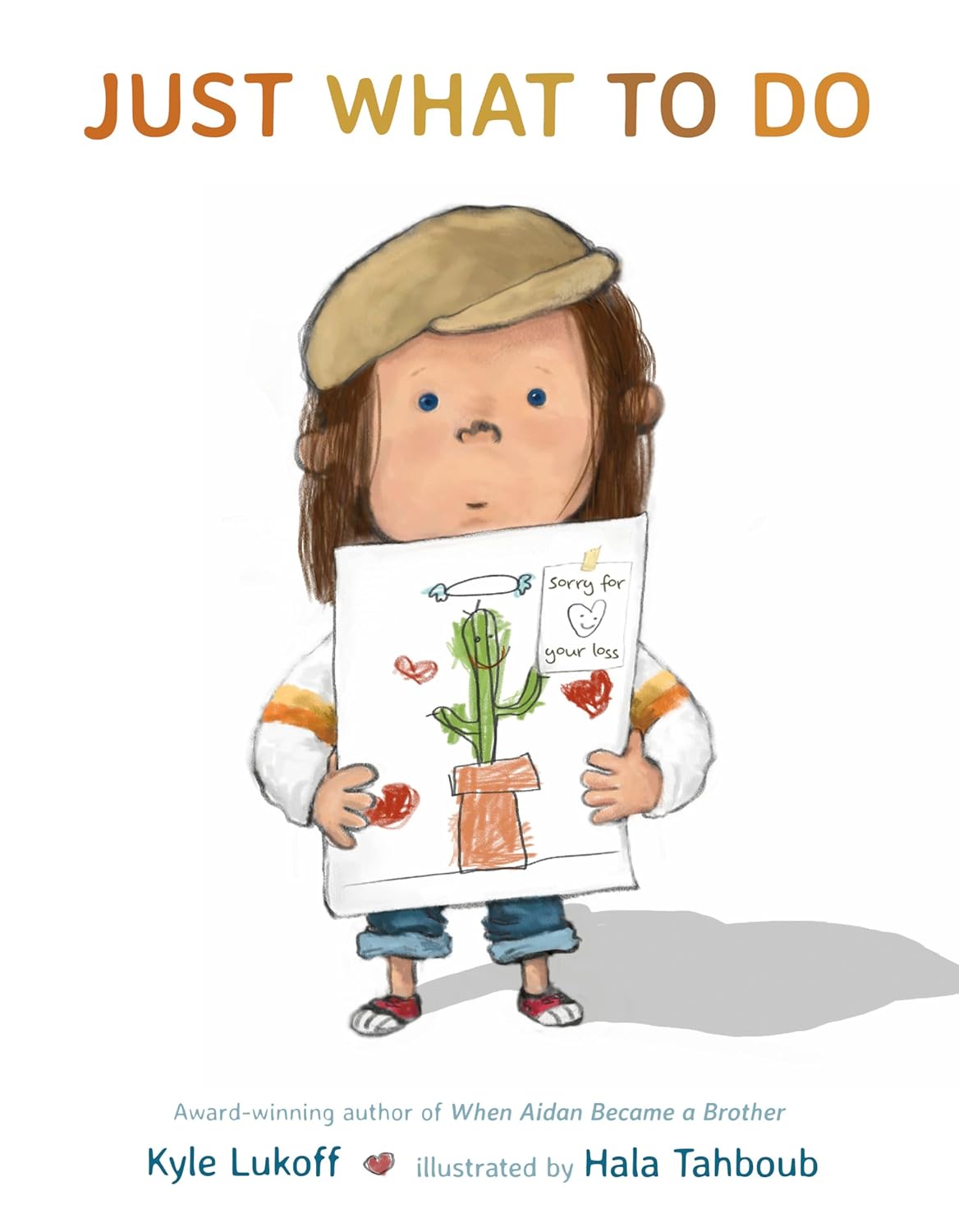
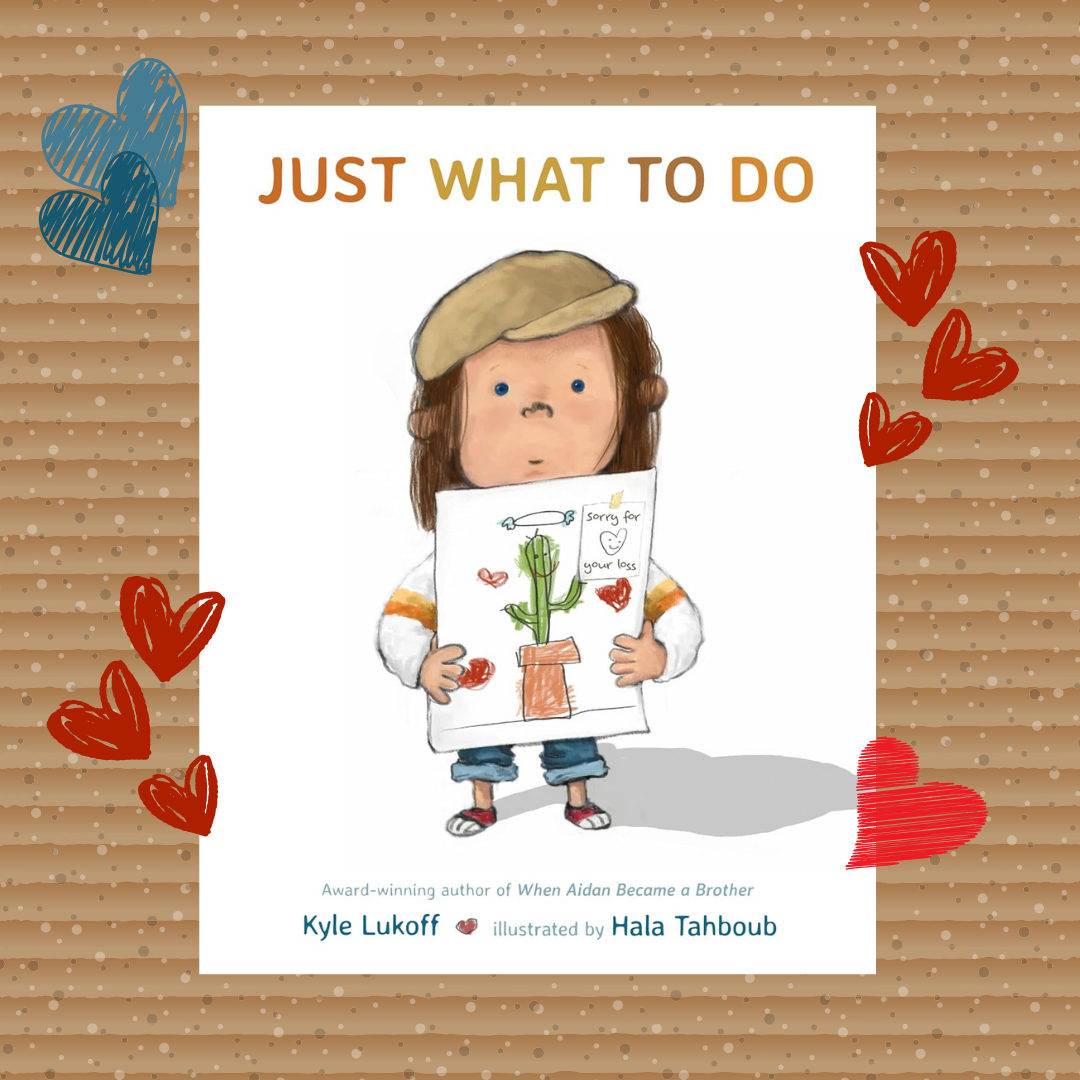
Just What to Do

By Kyle Lukoff | Illustrated by Hala Tahboub


When a loved one is experiencing a loss, it can be hard to know how best to help. Just What to Do is a gentle story that walks readers through exactly that—just what to do. The key? Figuring out how each person best likes to be comforted.

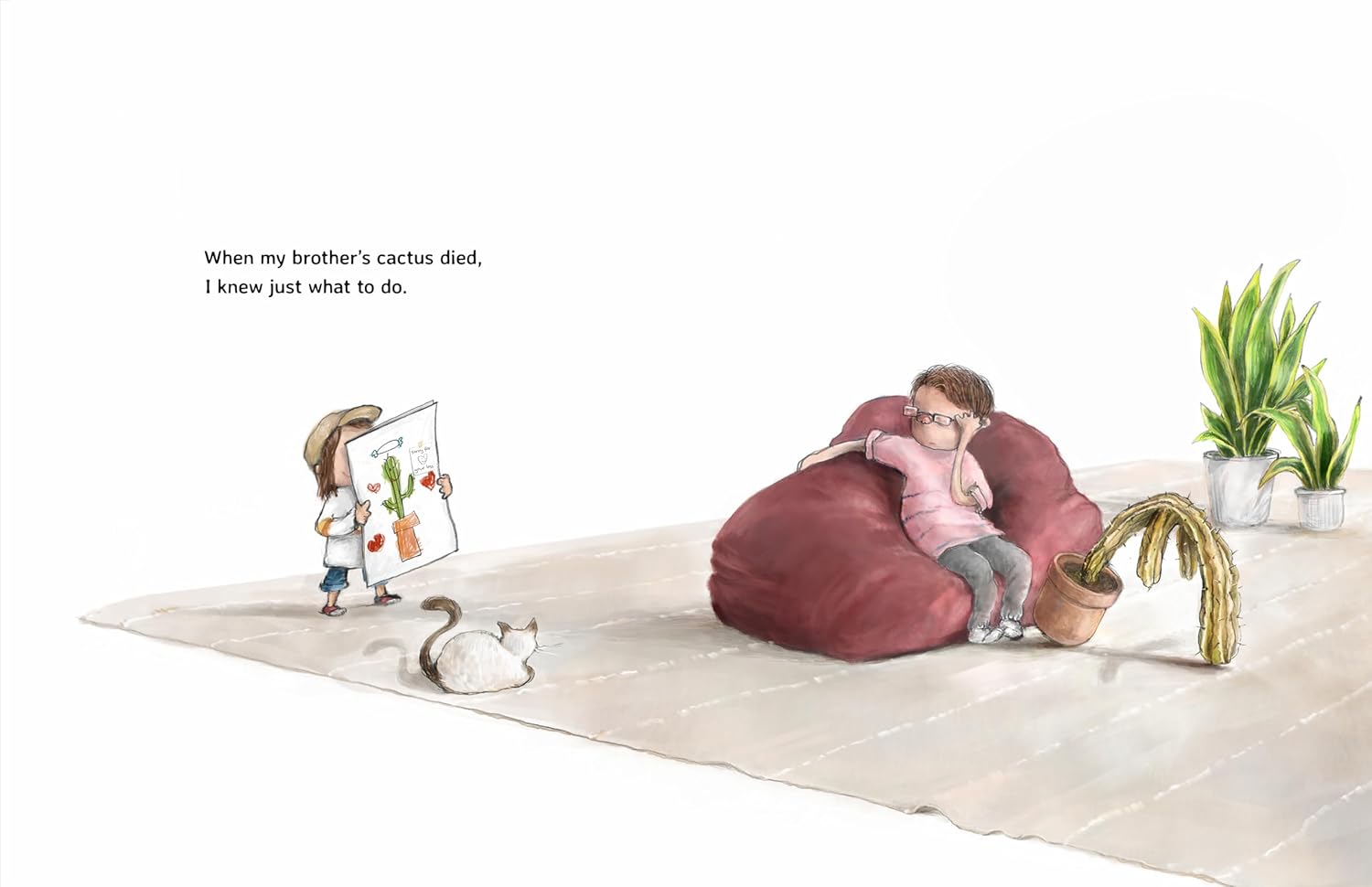
The book begins with a narrator confidently clutching a handmade condolence card with a smiling cactus angel featured on the front. “When my brother’s cactus died,” they say, “I knew just what to do.” As the narrator discovers, however, a card is not how the brother would like to receive support. “Could you tell me a joke instead? I really want to laugh.” he says.

Image copyright Hala Tahboub, 2024, text copyright Kyle Lukoff, 2024. Courtesy of Dial Books.

So, naturally, when the protagonist’s cousin’s goldfish dies, they know exactly what to do; at the library they nab a book of jokes in preparation for a visit. But instead, the cousin asks for a hug.

The pattern continues with the narrator learning a new method of supporting a loved one with each instance of grief. And learning that the same technique does not feel good to the next person in need of their comfort.

Image copyright Hala Tahboub, 2024, text copyright Kyle Lukoff, 2024. Courtesy of Dial Books.

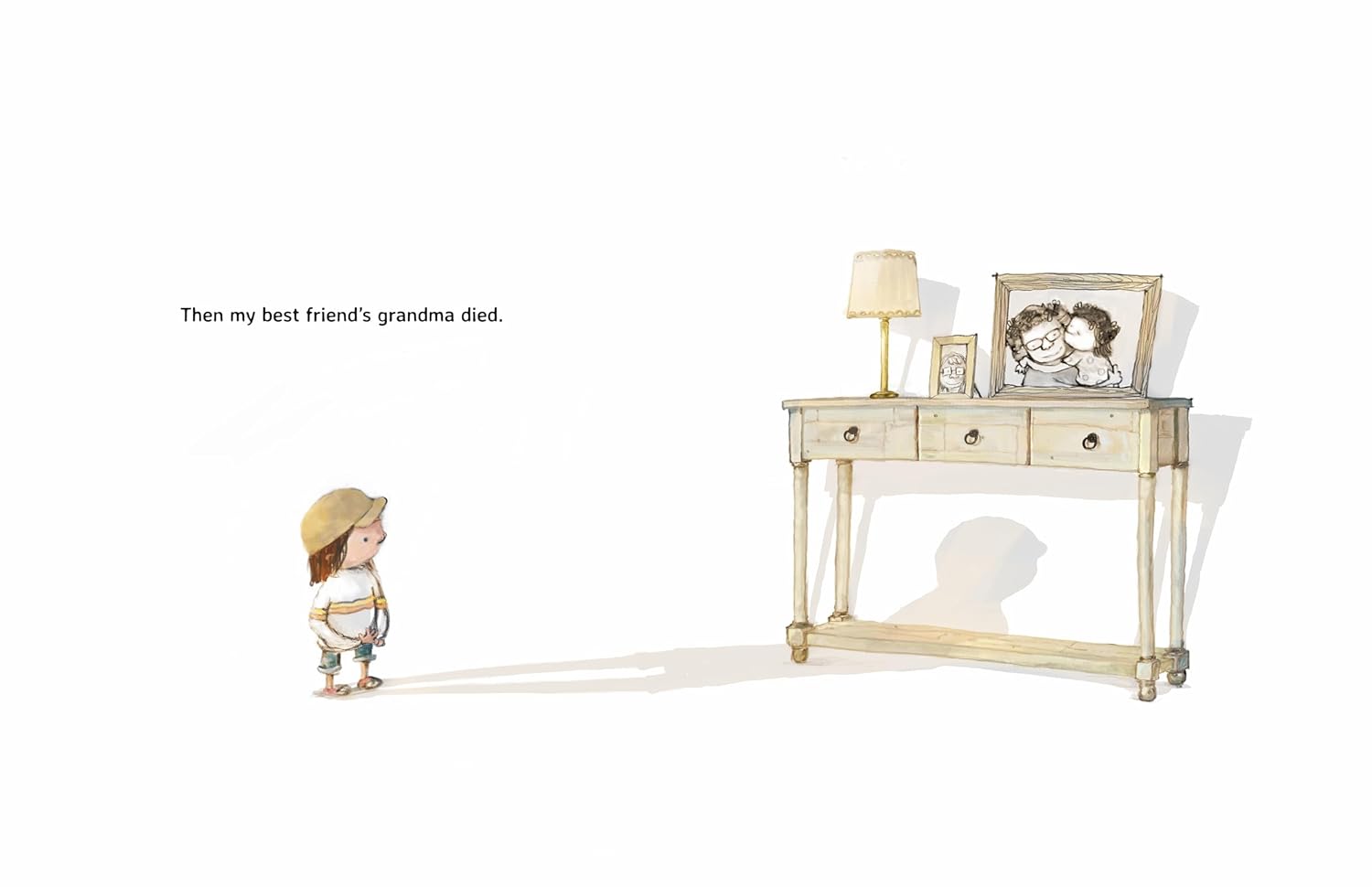
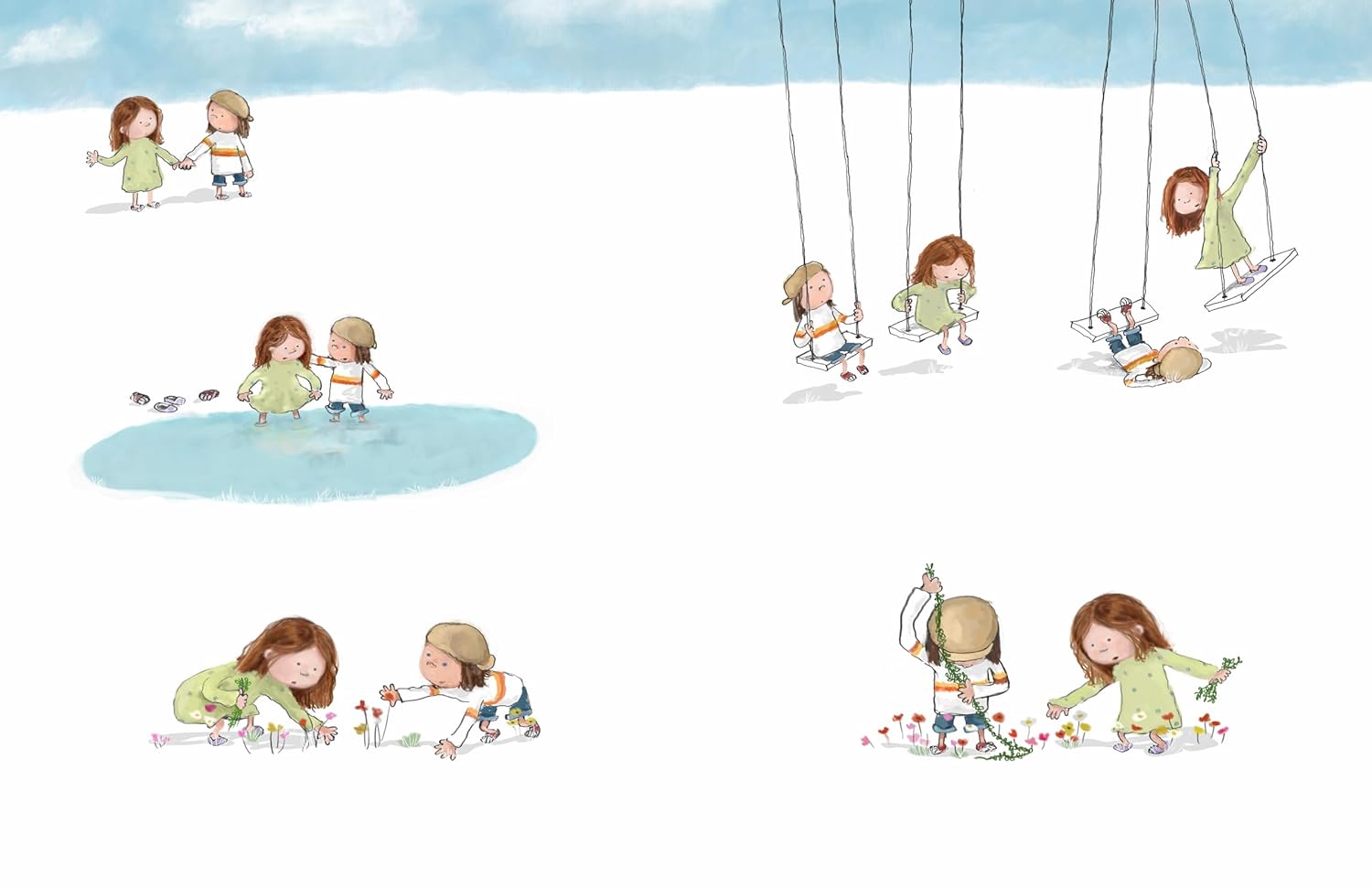
When the narrator’s best friend’s grandmother dies, they are unsure what to do. Would she want a card, a snack, a hug? How could they know? Finally, they decide the best way to find out is simply to ask: “Can you tell me what to do? I don’t know how to help.” While the friend is at first unsure how to answer this question, the narrator and friend find ways to seek out comfort and connection by spending time together. The story ends with a wordless spread of them swinging, talking, picking flowers and a spread with the word “together” in which they share a flower crown.

Image copyright Hala Tahboub, 2024, text copyright Kyle Lukoff, 2024. Courtesy of Dial Books.

Just What to Do tackles a tough but topical topic for children, what to do with grief and how to support others through it, something that even adults struggle with. Oftentimes, people make the mistake of thinking there is a cookie cutter “one size fits all” fix for working through grief, but, as Lukoff poignantly shows, this simply is not the case. Readers will learn and grow with the protagonist as they explore new ways of helping and providing care for a diverse cast of family and friends.

Hala Tahboub creates simple sketches featuring an androgynous-appearing elementary-school-aged narrator. Wordless spreads of characters connecting are interspersed in the story and are contrasted with more bare pages focused solely on the narrator when they reach emotionally salient moments. There is a clarity in the images and an intricacy in the facial expressions that allows the audience to focus on the main character’s internal struggles. The words of the story are expanded on in the images, with different characters expressing their grief in unique ways (a babysitter commemorating her dog with dog toys, the cousin holding her goldfish’s tank under a large shady tree with a bouquet of flowers, etc.)

Just What to Do is an essential addition to library and home collections, as well as counseling centers. The book lovingly guides readers through a difficult subject with an appropriate amount of levity and learning to make for a perfect read aloud.

Ages 3 – 7

Dial Books for Young Readers, 2024 | ISBN 978-0593462942

About the Author

Kyle Lukoff is the author of many books for young readers. His debut middle-grade novel, Too Bright To See, received a Newbery honor, the Stonewall award, and was a National Book Award finalist. His picture book When Aidan Became A Brother also won the Stonewall. He has forthcoming books about mermaids, babies, apologies, and lots of other topics. While becoming a writer he worked as a bookseller for ten years, and then nine more years as a school librarian. Visit him at kylelukoff.com.

About the Illustrator

Hala Tahboub is a children’s book writer and illustrator. She started her creative journey as an architect and interior designer. She won the SCBWI Canada East chapter’s Storyteller Award for Illustration in 2019, and she was the SCBWI’s December Featured Illustrator in 2020. Hala believes in kindness, coffee, chocolate, and in the immense power of stories. She lives in Montreal. Visit her at halatahboub.com.

National Children’s Mental Health Week Activities

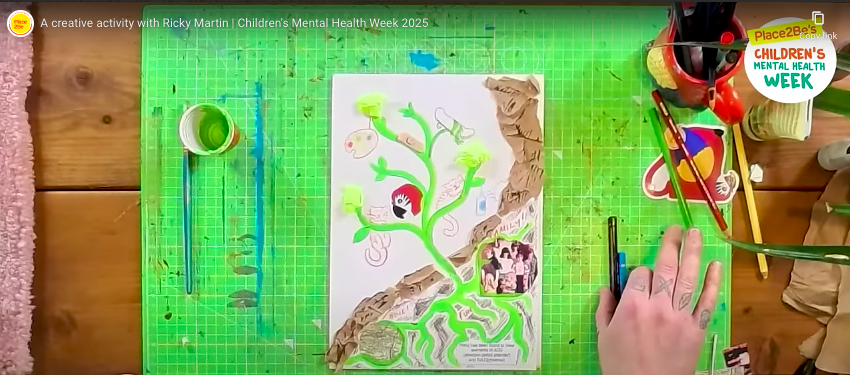
Place2be Activity with Ricky Martin


Art Room Activity

Watch the Art Room’s video on this self-awareness art activity and create your own identity plant.

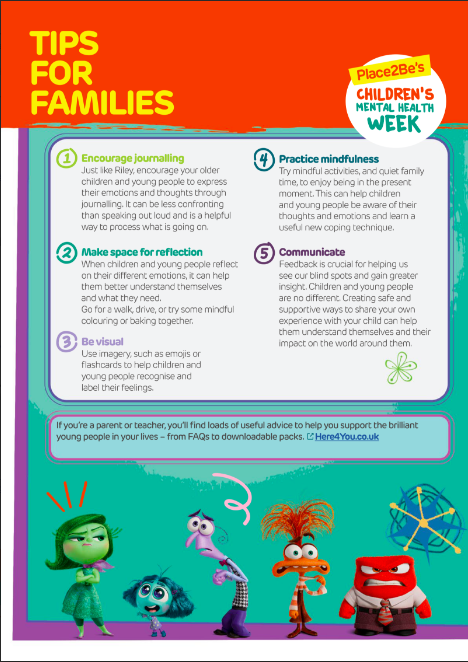
Exploring Emotions Tip Sheet for Families

Download this Exploring Emotions Tip Sheet for families on how to encourage children to explore and express their emotions.

You can purchase Just What to Do at these booksellers

Amazon | Barnes & Noble | Bookshop (to support your local independent bookstore)

Picture Book Review
January 15 – It’s International Creativity Month


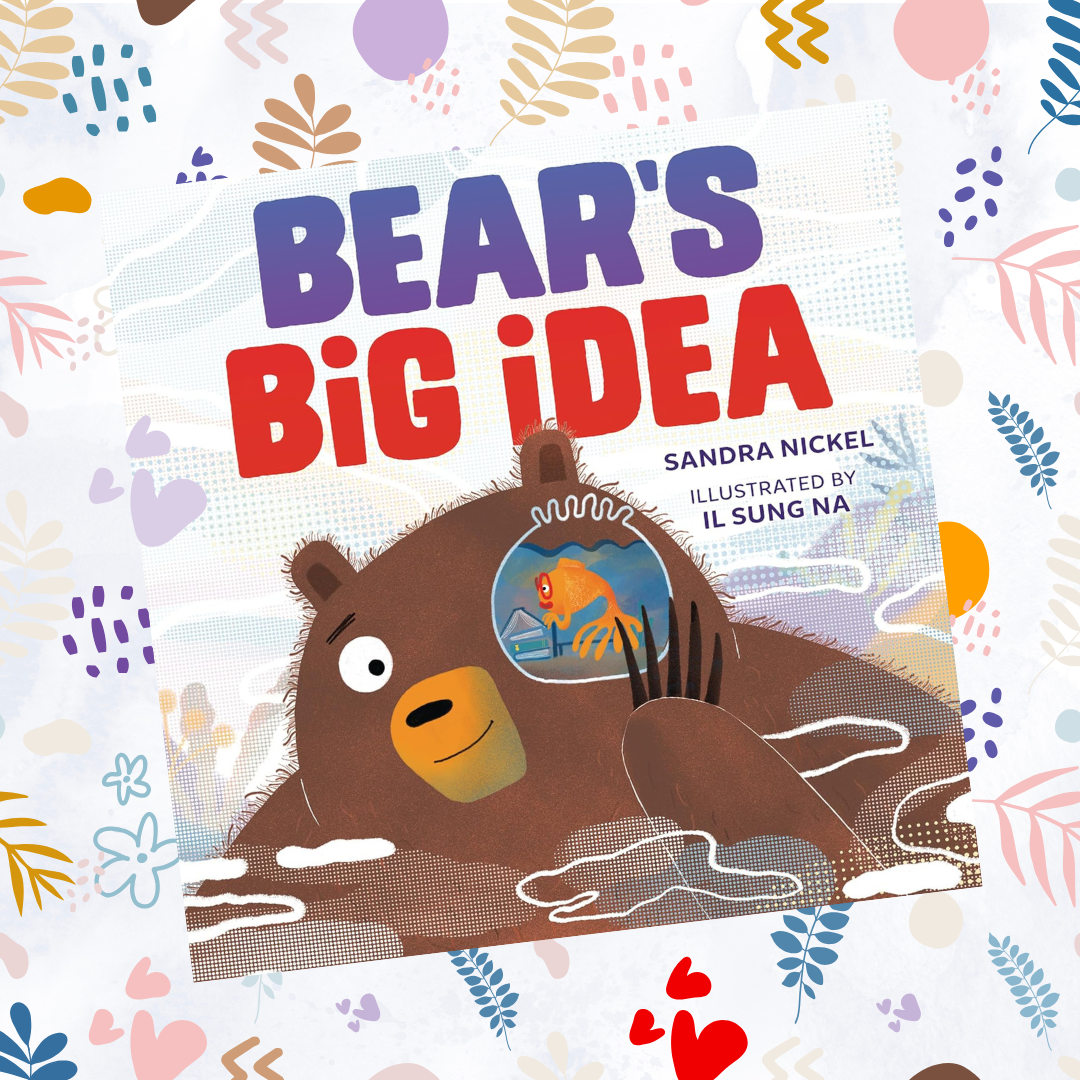
celebrate-picture-books-picture-book-review-bear's-big-idea-cover

About the Holiday

Are you an artist, a writer, a decorator, a chef? How about a floral arranger, a woodworker, a fashion designer, or a gardener? Inside almost every heart lies a desire to create. Whether you use your ingenuity in your job or as an escape from the routine, this month celebrates all that is innovative. Sometimes this comes not in something you can see or touch but in a new thought or novel way of solving a problem—as seen in today’s book!

Thanks to Carolrhoda Books and Barb Fisch at Blue Slip Media for sharing a copy of Bear’s Big Idea with me! All opinions on the book are my own.

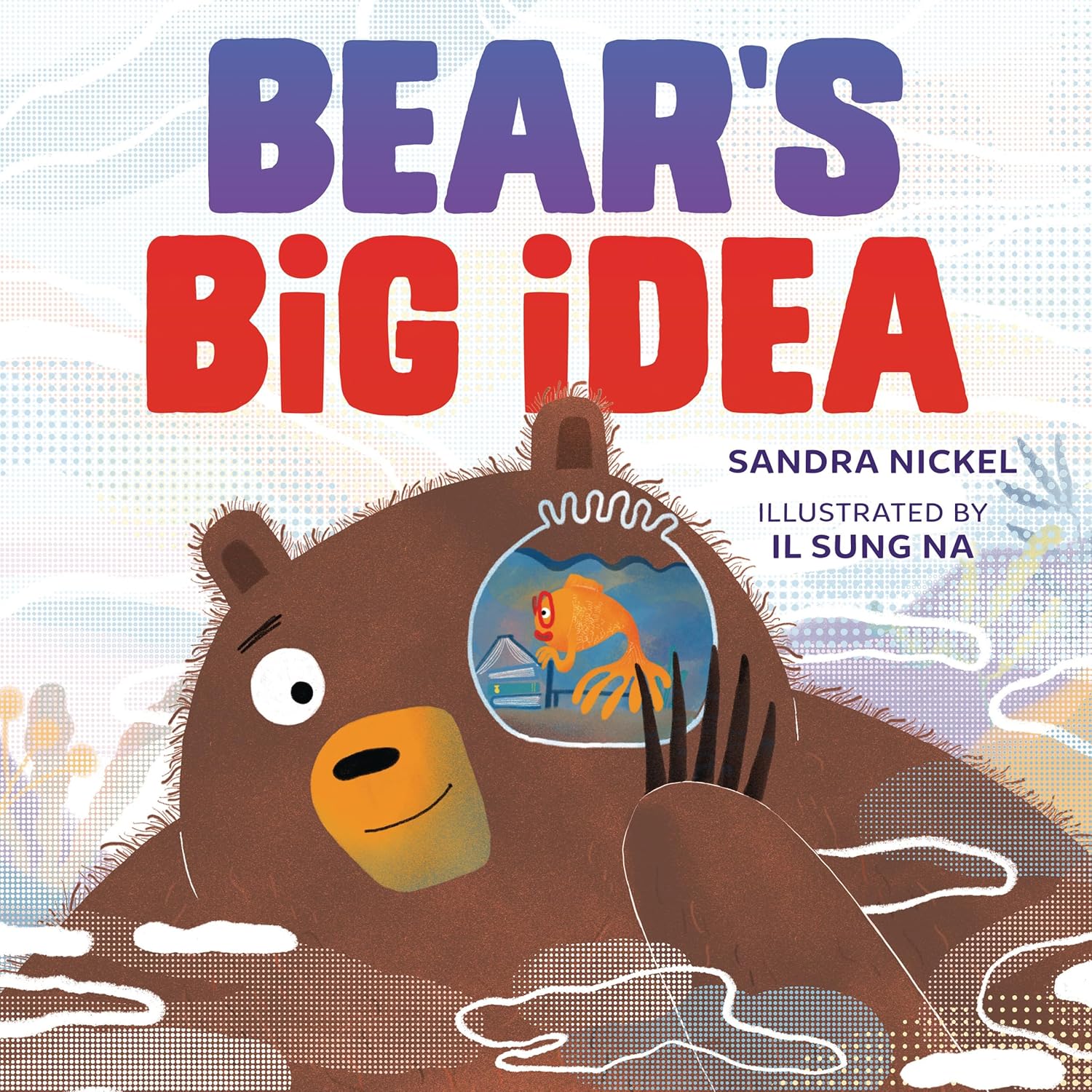
Bear’s Big Idea

Written by Sandra Nickel | Illustrated by Il Sung Na


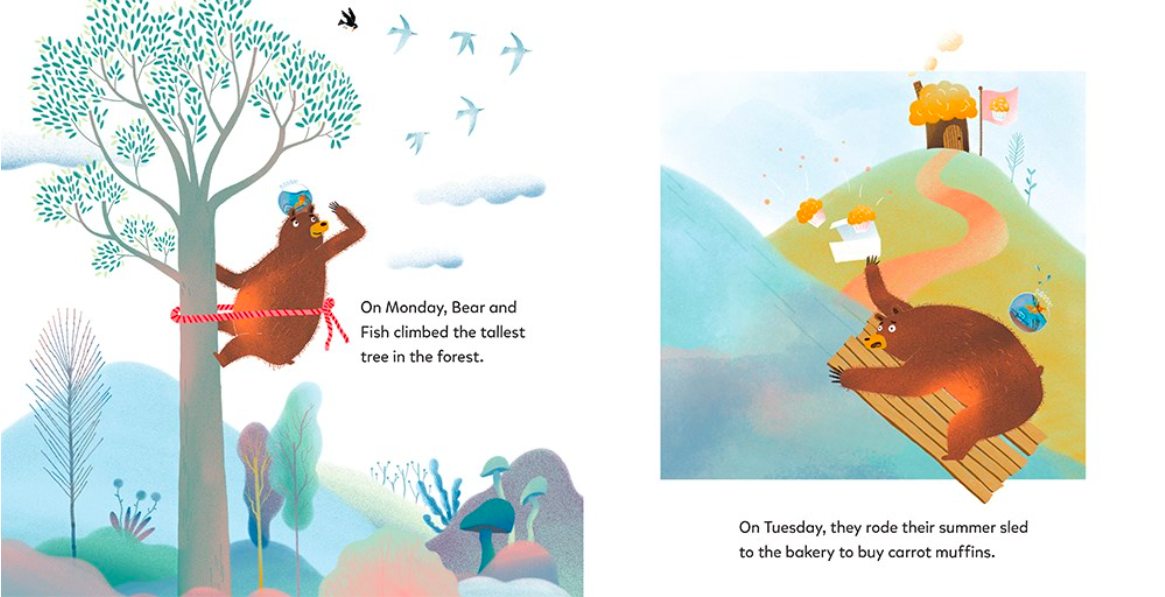
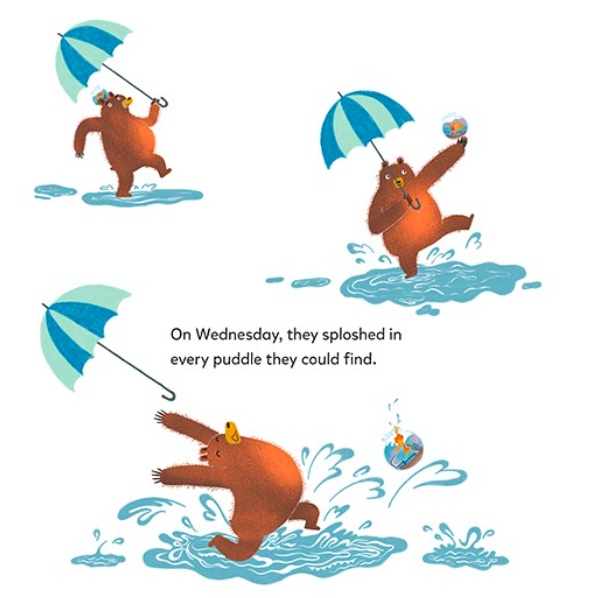
Fish and Bear were best friends. They did everything together, and usually—well, always—Fish was the one with the ideas. “Every morning, Fish would wake up, put on her glasses, and just like that, she would know the perfect thing to do.” Every day of the week, Fish found something—a rope, a sled, an umbrella, and a blanket—and dreamed up an innovative way to have fun with it.

celebrate-picture-books-picture-book-review-bear's-big-idea-Monday

Image copyright Il Sung Na, 2024, text copyright Sandra Nickel, 2024. Courtesy of Carolrhoda Books.

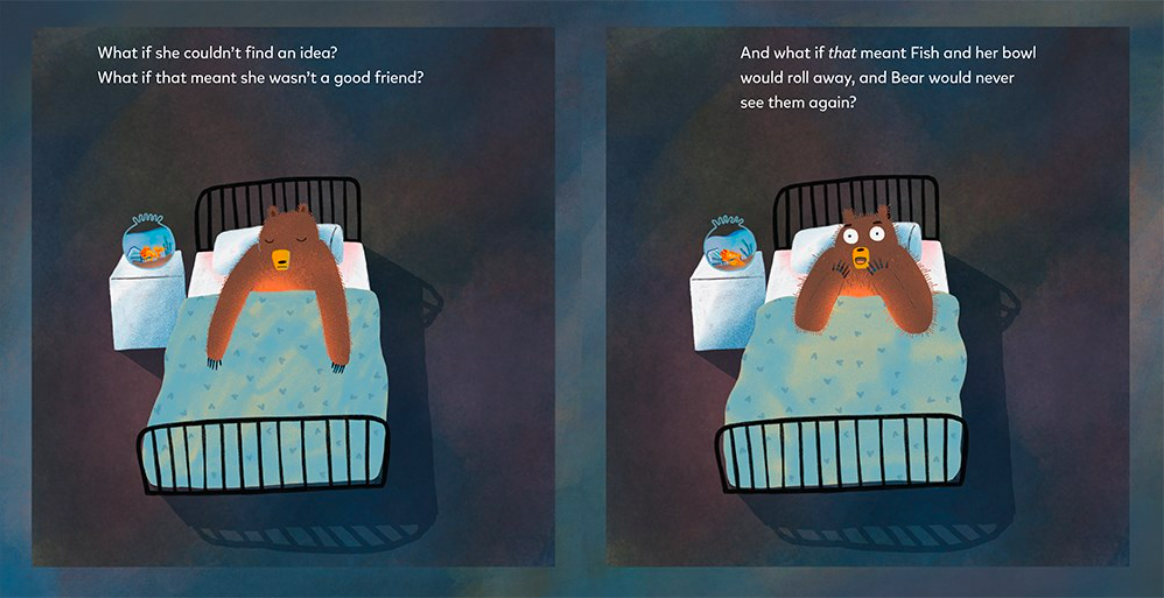
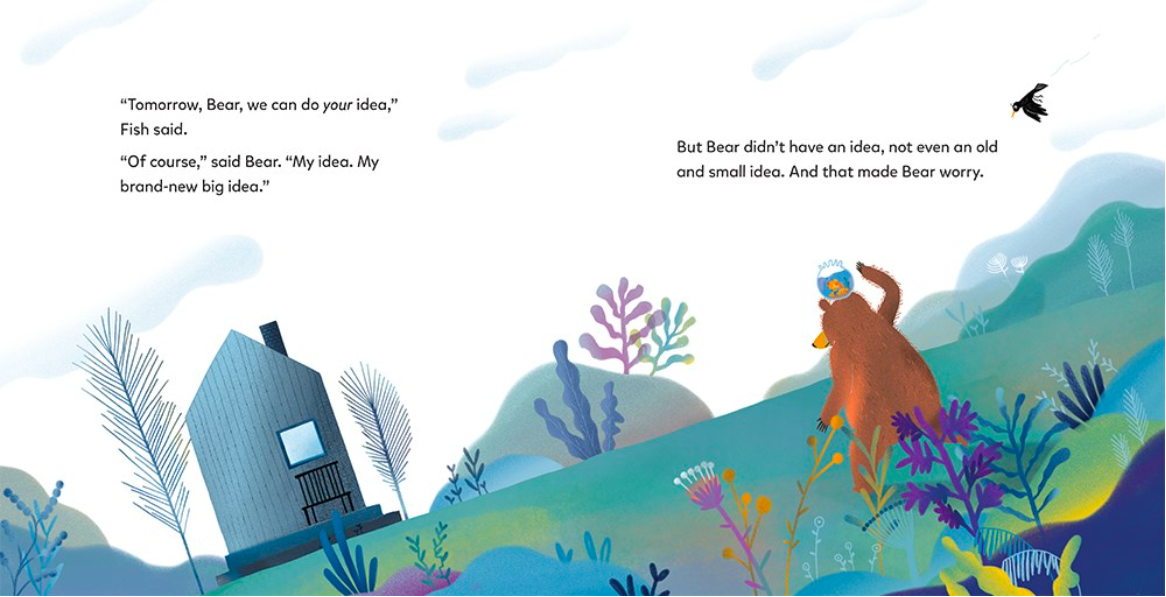
But Fish didn’t want Bear to feel left out, so on Thursday she said that the next day they could do Bear’s idea, “‘Of course, said Bear. ‘My brand-new big idea.'” But Bear was worried. She “didn’t have an idea, not even an old and small idea.” Bear tried to sleep that night, but she was afraid that not having an idea meant she wasn’t a good friend. Would Fish take her bowl and leave? Anxiety muddled Bear’s brain, and all she could think of were now-old ideas.

celebrate-picture-books-picture-book-review-bear's-big-idea-Wednesday

Image copyright Il Sung Na, 2024, text copyright Sandra Nickel, 2024. Courtesy of Carolrhoda Books.

The next morning it was the same. Bear looked everywhere for a brand-new big idea but found nothing. She kept checking in with Fish, asking if she was still there. “‘Always and forever,’ said Fish” with added reassurance. At last, Bear confessed that she couldn’t see an idea anywhere. “‘Don’t worry,’ Fish said. ‘Just because you can’t see something, doesn’t mean it’s not there.'”

celebrate-picture-books-picture-book-review-bear's-big-idea-no-idea

Image copyright Il Sung Na, 2024, text copyright Sandra Nickel, 2024. Courtesy of Carolrhoda Books.

So Bear thought some more, she listened, and she felt the wind whipping up. Suddenly, the air was filled with all of the old things from the past week. As Bear watched the things flying by, she saw it! Her brand-new big idea! She quickly gathered the items together and grabbed Fish’s bowl then rode the sled down to the beach, where she turned those individual items into an ingenious brand-new big idea that even impressed Fish! As pleased as Bear was with her idea, though, she was even happier to discover that good friends were “always and forever there.”

celebrate-picture-books-picture-book-review-bear's-big-idea-sleepless-night

Image copyright Il Sung Na, 2024, text copyright Sandra Nickel, 2024. Courtesy of Carolrhoda Books.

The second book in Sandra Nickel’s Bear and Fish series is a charming story that gently addresses children’s common fears about performance and pressure as well as the nature of friendship itself. Throughout the story, Nickel presents Bear’s conundrum realistically as she first alludes to having a big idea and then worries through the night and part of the next day that she will let down and maybe even lose her bestie because she has no idea at all.

Nickel—through Fish’s encouraging comments and confidence in Bear’s abilities—is always right there, though, with reassurance that children will find comforting in their own life. Nickel’s excellent pacing as well as her metaphorical dark and fog that stymies Bear until her approaching idea clears it away adds depth to the story and shows kids that things such as ideas, learning, self-confidence, and growth come to each person in their own time.

Children will be happy to see Il Sung Na’s fast friends back again in a new adventure. Il Sung’s soft-hued illustrations place Bear and Fish in a whimsically surreal mashup of vegetation from Bear’s forest and Fish’s underwater worlds. Bespectacled, ever-faithful Fish regales Bear with reassuring philosophy from her bowl, but also enjoys a madcap experience of her own thanks to Bear’s big idea. Through Il Sung’s clear depictions of Bear’s emotions, children can empathize with and cheer on Bear while gaining their own sense of self-confidence.

An uplifting, reassuring, and confidence boosting story, Bear’s Big Idea is sure to prompt requests for multiple readings and can spark discussions about feelings of fear, external and internal pressure, true friendship, and using one’s imagination. Bear’s Big Idea would make a valuable addition to home, library, and classroom collections.

Ages 4 – 8

Carolrhoda Books, 2024 | ISBN 979-8765610176

About the Author

Sandra Nickel is a writer of nonfiction picture books for children. Her work includes The Stuff Between Stars, Nacho’s Nachos, and Breaking Through the Clouds. She is the winner of a Christopher Award and holds an MFA in Writing for Children and Young Adults from Vermont College of Fine Arts. When at home in Switzerland, Sandra loves ambling and rambling and eating carrot muffins just as much as Bear and Fish do.

About the Illustrator

Il Sung Na was born in Seoul, South Korea. In 2001, he moved to London to pursue a BFA in Illustration and Animation at Kingston University, where he discovered a passion for children’s books. He completed his MFA Illustration Practice at MICA (Maryland Institute College of Art) in 2015. Il Sung has illustrated several books including Wild Peace, My Tree, and ZZZZ: A Book of Sleep. Currently based in Kansas City, Il Sung teaches illustration courses at KCAI (Kansas City Art Institute) and works on new books.

International Creativity Month Activity

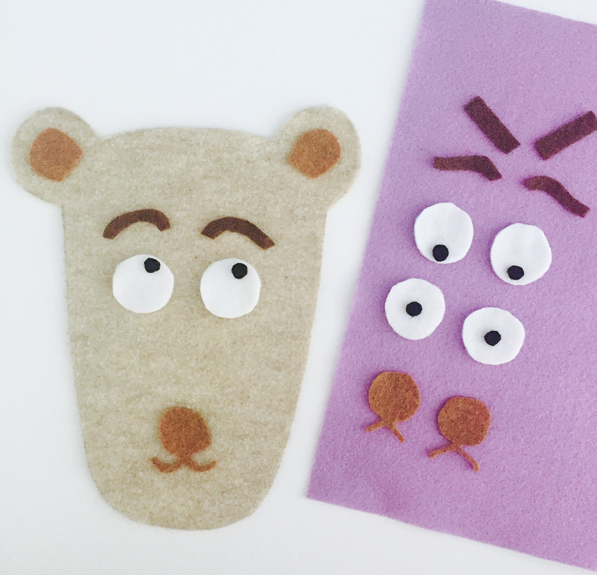
celebrate-picture-books-picture-book-review-bear-craft

Expressive Bear


You can talk about different emotions and feelings or make up your own stories with this Expressive Bear Craft! Use the templates and/or make your own expressive eyes, eyebrows, and nose and mouths. You can also play a game in which the first person to collect all the parts of the bear’s face is the winner.

Supplies

  • Printable Bear Head Template
  • Printable Eyes and Noses Template
  • Printable Eyebrows  and Ears Template
  • Light brown felt or fleece (or color of your choice), 8 ½ x 11 inch piece
  • Dark brown felt or fleece(or color of your choice), 8 ½ x 11 inch piece
  • White felt or fleece, 8 ½ x 11 inch piece
  • Black felt or fleece, for pupils
  • Scissors
  • Glue
  • 1 playing die (optional)

Directions

  1. Print templates
  2. Cut bear head from light felt or fleece
  3. Cut eyes from white felt or fleece
  4. Cut nose and inner ears from dark brown felt or fleece
  5. Cut pupils from black felt or fleece
  6. Glue pupils onto white eyes

Alternatively: Color and play with the paper set

For a Fun Story Time

Give the bear different faces and make up stories of why he looks that way!

To Play a Game

Supplies

  • 1 plastic playing die. Or print this playing die template and draw one of the six facial features on each side.
  • Pencil, pen, or markers (if using printed die template)
  • Cut out, fold, and tape the die together

Directions

  1. Roll the die and follow the instructions below to collect parts of the bear’s face.
  2. The first player to create a full face is the winner.
  • Die dots correspond to:
  • 1—one eyebrow
  • 2—second eyebrow
  • 3—one eye
  • 4—second eye
  • 5—nose
  • 6—inner ears

celebrate-picture-books-picture-book-review-bear's-big-idea-cover

You can purchase Bear’s Big Idea from these booksellers

Amazon | Barnes & Noble | Bookshop (to support your local independent bookstore)

Picture Book Review
January 8 – National JoyGerm Day

celebrate-picture-books-picture-book-review-how-to-cheer-up-a-friend-cover

About the Holiday

Believing that joy can spread from person to person on the strength of simple smiles and greetings, acts of kindness, upbeat moods, and general positivity, Joan E. White of Syracuse, New York, founded JoyGerm Day in 1981. The day officially became a national holiday in 1985, and is now celebrated around the world. The holiday inspires people to find ways today and every day to positively impact the lives around us at home, work, school, or even while shopping or going about one’s daily business.

To honor the day and the idea, find ways to start each morning with a positive attitude for the day to come. Need ideas for how to get started? Say “Hello” to those you meet, listen to and encourage others, happily help out where needed, share a special moment with your kids at home, or send a surprise letter, card, or text to a friend or family member far away. And, of course, don’t forget to treat yourself too! When you feel good, those around you will respond in kind. Happiness really is contagious!  

Thanks so much to Beach Lane Books for sharing a copy of How to Cheer Up a Friend with me for review consideration!

How to Cheer Up a Friend

Written by Stephanie Calmenson | Illustrated by Shannon McNeill


Little ones have big feelings and even bigger hearts. When they see a friend or family member feeling down, they want to help. But “What do you do / when your friend feels blue?” In her sweet book in which the protagonist attempts to cheer up their elephant friend, Stephanie Calmenson offers refreshingly practical advice on how a child (or an adult) can really approach someone experiencing sadness or anger and help them find happiness again. 

Screen Shot 2024-12-31 at 4.50.06 PM

Image copyright Shannon McNeill, 2024, text copyright Stephanie Calmenson, 2024. Courtesy of Beach Lane Books.

Writing in rhyming couplets, Calmenson starts out by suggesting a few ideas that will get readers giggling and invested in the story, such as “Do you tickle his trunk / to get him out of his funk?” and “Do something silly to make him laugh? / Give him a scented bubble bath?” Soon, the child opens his arms wide, offering a hug—but ready to happily accept either a “yes” or “no” answer.
Quieter ideas follow, including taking a walk or simply listening if he wants to “talk . . . and talk . . . and talk.” Then—only after all his feelings have been vented does the protagonist offer treats—or that hug, which now feels juuust right.
Screen Shot 2024-12-31 at 4.51.18 PM

Image copyright Shannon McNeill, 2024, text copyright Stephanie Calmenson, 2024. Courtesy of Beach Lane Books.

Stephanie Calmenson’s thoughtful look at the underpinnings of sadness or other strong emotions and how friends or family members can best help a loved one shines for its brevity and straightforward take on the issue. This approach will appeal to kids while giving them concrete examples of what to do and say (or not say) to elicit healing time or talk from friends, siblings, or others.

How to Cheer Up a Friend would be equally effective for adults looking for a book to help their own child through periods of sadness or anger as the story validates these emotions and provides a constructive solution for expressing them. The length of the story and its bookended format makes the book a perfect choice for parents, teachers, or other adults to reach for during those times when emotions may be running high or attention spans are short.

Screen Shot 2024-12-31 at 4.51.51 PM

Image copyright Shannon McNeill, 2024, text copyright Stephanie Calmenson, 2024. Courtesy of Beach Lane Books.

Shannon McNeill’s adorable elephant and empathetic child immediately win over readers’ hearts with their connection that is clearly based on mutual love and trust. In her soft-hued gouache, pencil, and cut paper illustrations, McNeill’s droopy, sad-eyed elephant is the picture of sadness, stubbornness, and even laugh-inducing perseverance as his friend tries various silly solutions to restore happiness. The image of the elephant hunkered down in its wash tub as it hides from a hug is an effective portrayal for children who prefer body autonomy or for the barrier some people present when experiencing strong emotions.

As the elephant begins to talk, his words and feelings fill the page as colorful shapes, and he begins to gesticulate, He cries, stomps, and flops down in a tirade to demonstrate those emotions he may not have words for. But as the storm abates, he feels better and can happily accept that big hug in a two-page spread that will delight young readers.

An endearing story that provides satisfying help with an emotion we all experience, How to Cheer Up a Friend is a valuable book for families and teachers to have on hand for those times when feelings are strong. The book is highly recommended for home, library, and classroom collections.

Ages 4 – 8

Beach Lane Books, 2024 | ISBN 978-1665910248

About the Author

Stephanie Calmenson is the acclaimed author of many popular books for young readers including Dinner at the Panda Palace; May I Pet Your Dog?; and the Ready, Set, Dogs! and Allie and Amy series written with Magic School Bus author Joanna Cole. A former early childhood teacher and children’s book editor, Stephanie feels fortunate to be able to teach, entertain, and encourage kids through her books. To read more, please visit StephanieCalmenson.com.

About the Illustrator

Shannon McNeill is a Canadian-born, San Diego-based illustrator whose books include Are We There Yet? by Dandi Daley Mackall, Wild & Wooly by Mary Jessie Parker, How to Cheer Up a Friend by Stephanie Calmenson, and her own Wheels, No Wheels. Her work is influenced by local nature, loitering in coffee shops, old books, child art, and long walks around the block. Learn more at LittleDrawings.com.

National JoyGerm Day Activity

celebrate-picture-books-picture-book-review-you're-groovy-happiness-card

Spread Happiness Cards

Kids can spread happiness to their friends, family, teachers, and other people in their lives with these cute Happiness Cards! Just print, cut, and give!

Spread Happiness Cards

celebrate-picture-books-picture-book-review-how-to-cheer-up-a-friend-cover

You can purchase How to Cheer Up a Friend at these booksellers

Amazon | Barnes & Noble | Bookshop

Picture Book Review