May 10 – National Train Day

About the Holiday

You just have to love the train. With its storied past and iconic whistle, train travel is imprinted in our minds as a fun, efficient way to get from here to there and back again. Today’s holiday was established in 2008 to commemorate all the mystery and romance of train travel while also remembering the history of the railroad, especially the the May, 1869 completion of the transcontinental railroad, and its importance to the development of the United States. Suddenly, distances didn’t seem as far, and those seeking a new life out West or wanting to visit family back East had a safe, quick way of spanning the miles.

Thank you to Marsha Diane Arnold and Sleeping Bear Press for sharing a digital copy of today’s book with me!

Big Boy 4014 and the Steam Team: The World’s Largest Steam Engine Roars Back to Life!

Written by Marsha Diane Arnold | Illustrated by Adam Gustavson


In 2013, Big Boy 4014, the largest steam train in the world, sat stranded in an outdoor museum in Pomona, California, her work carrying heavy freight across the Wasatch Mountains and her indispensable role in transporting American soldiers and military equipment across the western prairies only a memory (Arnold makes note that trains were referred to as “she” by engineers and crew). She had thrilled museum visitors for more than fifty years, but “cold ashes lay in her firebox / Cobwebs wove through her wheels. / Rust crept into her cab.”

Then one day men came to visit her. As they inspected her, most decided that restoring her would be too expensive, too crazy, impossible. But one voice disagreed, saying “All we need is a great steam team. It can be done.” Nine men signed onto the Steam Team, with the aim to restore Big Boy for the Golden Spike Celebration in 2019 that would commemorate the finishing of the transcontinental railroad—the first railroad to stretch all across the America from East to West.
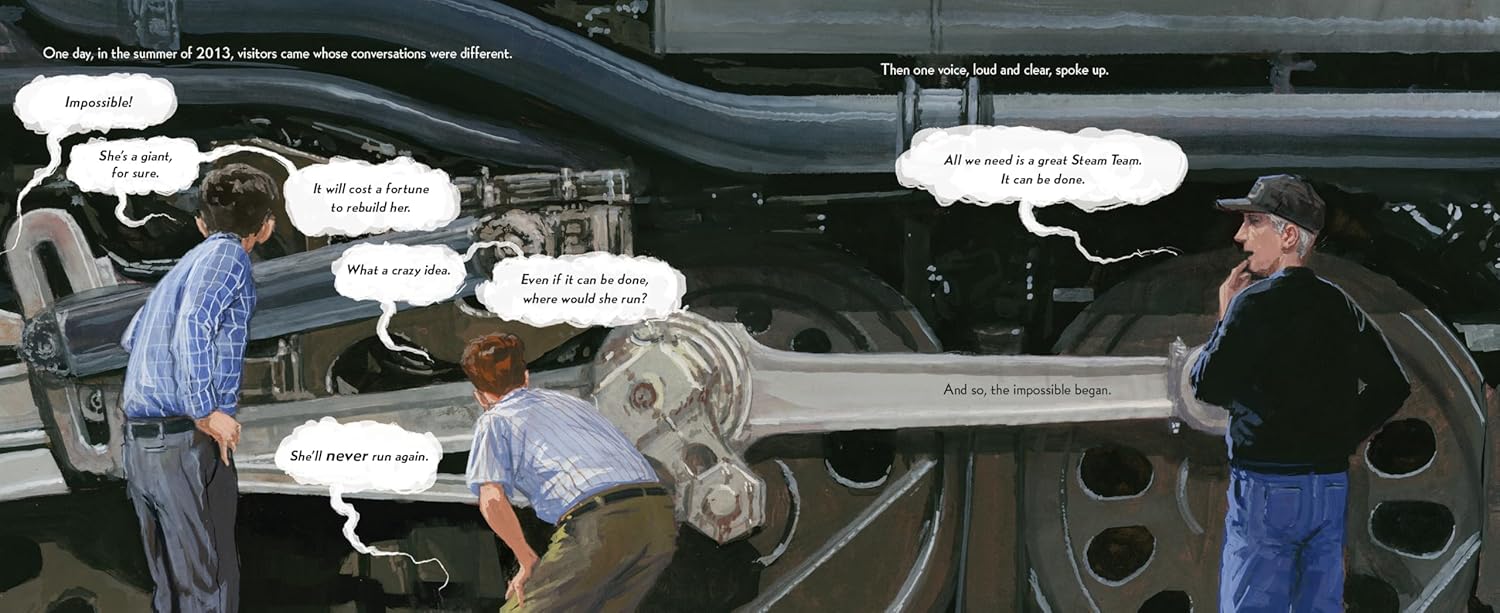
illustration © 2025 by Adam Gustavson, text © 2025 by Marsha Diane Arnold. Courtesy of Sleeping Bear Books.

To move Big Boy from the museum to the tracks a mile away, temporary tracks were laid and a bulldozer slowly pulled her along inch by inch. She was then pulled and pushed 1,300 miles to Wyoming, where the work on her would be done. There, Big Boy underwent intensive scrutiny, getting new parts, being made to look like new. Years went by, the Golden Spike Celebration was months away, then days away. It was “time to test her out.” 

“Double-headed with the ‘Living Legend,’ locomotive 884,” Big Boy, pulling train cars behind her, chugged “to Ogden, Utah, for the celebration.” All along the route, people came out to watch, “to feel the rumble under their feet as Big Boy passed, to see the steam cloud billowing above her, to hear her whistle, loud and clear.” At the ceremony, Big Boy 4014 and Locomotive 884 faced each other, just as two steam engines had 150 years before, when a set of tracks moving east-to-west and another running west-to-east were united with a golden spike.
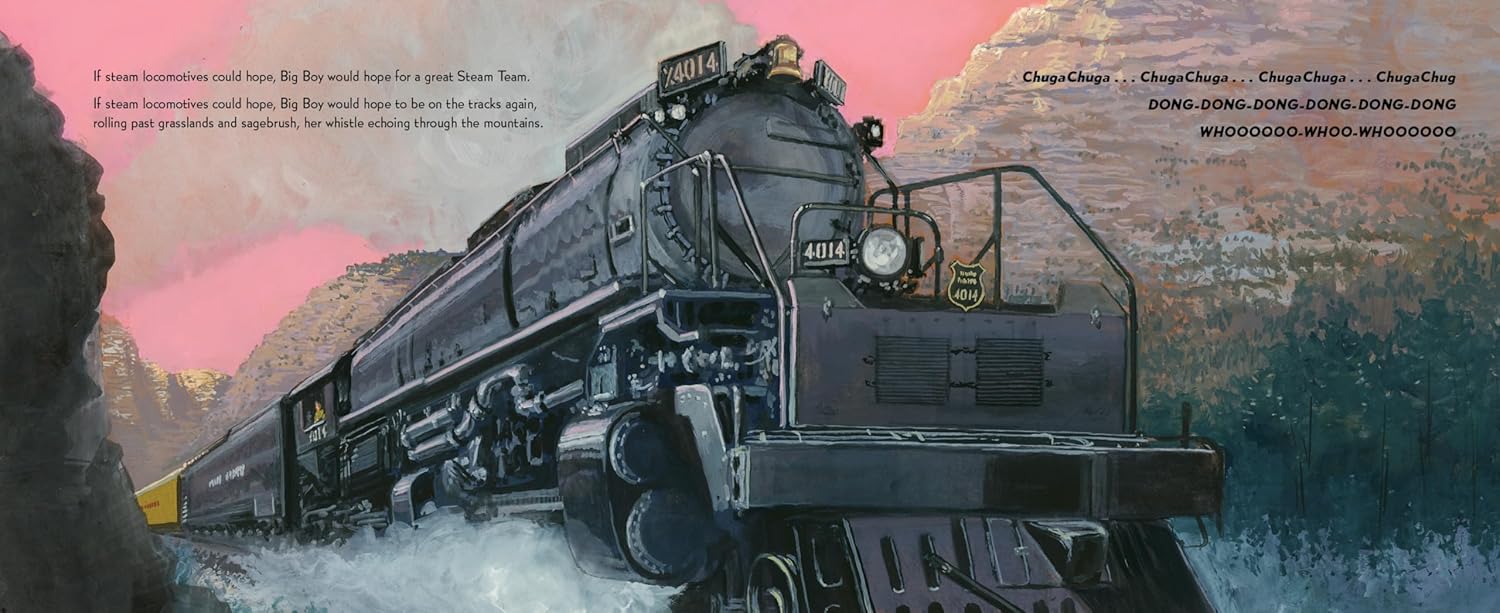
illustration © 2025 by Adam Gustavson, text © 2025 by Marsha Diane Arnold. Courtesy of Sleeping Bear Books.

Following the Golden Spike Celebration, Big Boy 4014 took another trip, a tour of more than 8,000 miles “past grasslands and sagebrush. / Past farmlands and rivers. / Past fields and cities and towns.” Whether it was raining or snowing or blisteringly hot, people came out to cheer Big Boy on and feel that awesome rumble as she passed by. No longer is her time only a memory from long ago. With more tours planned, “if steam locomotives could talk, Big Boy would say . . . “I’m ringing my bell and sounding my whistle.” DONG-DONG-DONG-DONG-DONG-DONG WHOOOOOO-WHOO-WHOOOOOO / “I’m chugging up the Wasatch Mountains at top speed, feeling the warmth of the oil in my firebox, as powerful as 7,000 horses.”

An in-depth discussion about the origins of the twenty-five Big Boy steam locomotives; the incredible engineering feat of designing and building them; how a steam engine works, How Big Boy 4014 was chosen for restoration; short profiles of the men instrumental in Big Boy’s restoration; a brief history of the building of the transcontinental railroad; and the research involved in making tours of Big Boy 4014 possible.

illustration © 2025 by Adam Gustavson, text © 2025 by Marsha Diane Arnold. Courtesy of Sleeping Bear Books.

Combining imaginative lyrical text with compelling nonfiction storytelling, Marsha Diane Arnold weaves an immersive tale of the restoration and triumphant comeback of the steam locomotive Big Boy 4014. Where once 25 of these behemoth machines conquered mountains and rough terrain to move freight and people across the country and contributed to our success in World War II, they have been relegated to history as diesel and electric trains took prominence.

Arnold recalls the importance of these storied locomotives for young readers and train enthusiasts of all ages, bookending her story with wistful “If steam locomotives could dream/talk” re-imaginings of Big Boy 4014’s glory days of leaving a station, sounding her bell and whistle, and “chugging up mountains” with the “power of 7,000 horses.” Readers will be wowed by the dedicated and painstaking work that went into moving and restoring Big Boy 4014, a recounting Arnold accomplishes with a deft hand for details that don’t overwhelm. She leaves readers with a new appreciation for steam locomotives and a hope that they too will be able to witness a tour of this earth-rumbling beauty.

Adam Gustavson’s stunning realistic paintings depict Big Boy 4014 from various perspectives, giving readers a sense of her scale compared to the adults and children, the mountainous landscapes she traversed, and the crowds who came out to celebrate her. Up-close renderings allow train lovers to get a glimpse into the steam-powered mechanics that propelled her while also seeing how run-down she had become over her nearly 60 years of disuse. Each page spread is a showstopper to linger and marvel over as readers gain insight and admiration for these trains and those who created them.

For train enthusiasts, history buffs, and those who simply love a story masterfully told, Big Boy 4014 and the Steam Team: the World’s Largest Steam Engine Roars Back to Life! is a book you won’t want to miss. The book is an exciting must-addition for all school and public library collections.

Ages 6 – 9+

Sleeping Bear Press, 2025 | ISBN 978-1534113145

About the Author

Marsha Diane Arnold is a multiple-award–winning author whose books have sold over one million copies. Called a “born storyteller” by the media, Marsha’s works include Badger’s Perfect Garden (Florida Book Awards Bronze Medal), the bilingual Galápagos Girl/Galapagueña (Bank Street Best Book and Campoy-Ada honor book), and Lights Out (Golden Kite finalist). Among her many pastimes, Marsha especially enjoys reading to her grandchildren and visiting schools to talk about writing and books. Born in rural Kansas, Marsha now lives with her husband and dog Sailor in Alva, Florida. Visit her at marshadianearnold.com.

About the Illustrator

Adam Gustavson’s illustrations have appeared in over thirty books for children. He is a teaching professor of art at Rowan University, and lives in a quirky little house in New Jersey with his lovely wife, their two sons, and two rather small dogs.

National Train Day Activity

Steam Engine Coloring Page


Steam locomotives once carried passengers and freight. Enjoy this coloring page of a steam train from days gone by from Monday Mandala!

You can purchase Big Boy 4014 and the Steam Team: the World’s Largest Steam Engine Roars Back to Life! from these booksellers

Amazon | Barnes & Noble | Bookshop

Picture Book Review

March 12 – Get Ready for Passover

About the Holiday

Passover, or Pesach in Hebrew, is one of the most sacred Jewish holidays and celebrates the Jews’ liberation from slavery in Egypt and their freedom as a nation under Moses. The holiday begins on the fourteenth day of the Hebrew month Nisan and continues for seven days in Israel or eight days outside of Israell. The holiday begins with a seder meal, for which family and friends gather to remember their history, have symbolic dishes, and celebrate the joy of freedom. Games for children, a reading of the Exodus story, and other meaningful traditions also mark the holiday.

Thank you to Random House Books for Children and Barbara Fisch at Blue Slip Media for gifting me a copy of Next Year in the White House for review.

Next Year in the White House: Barack Obama’s First Presidential Seder

By Richard Michelson | Illustrated by E.B. Lewis


Review by Dorothy Levine


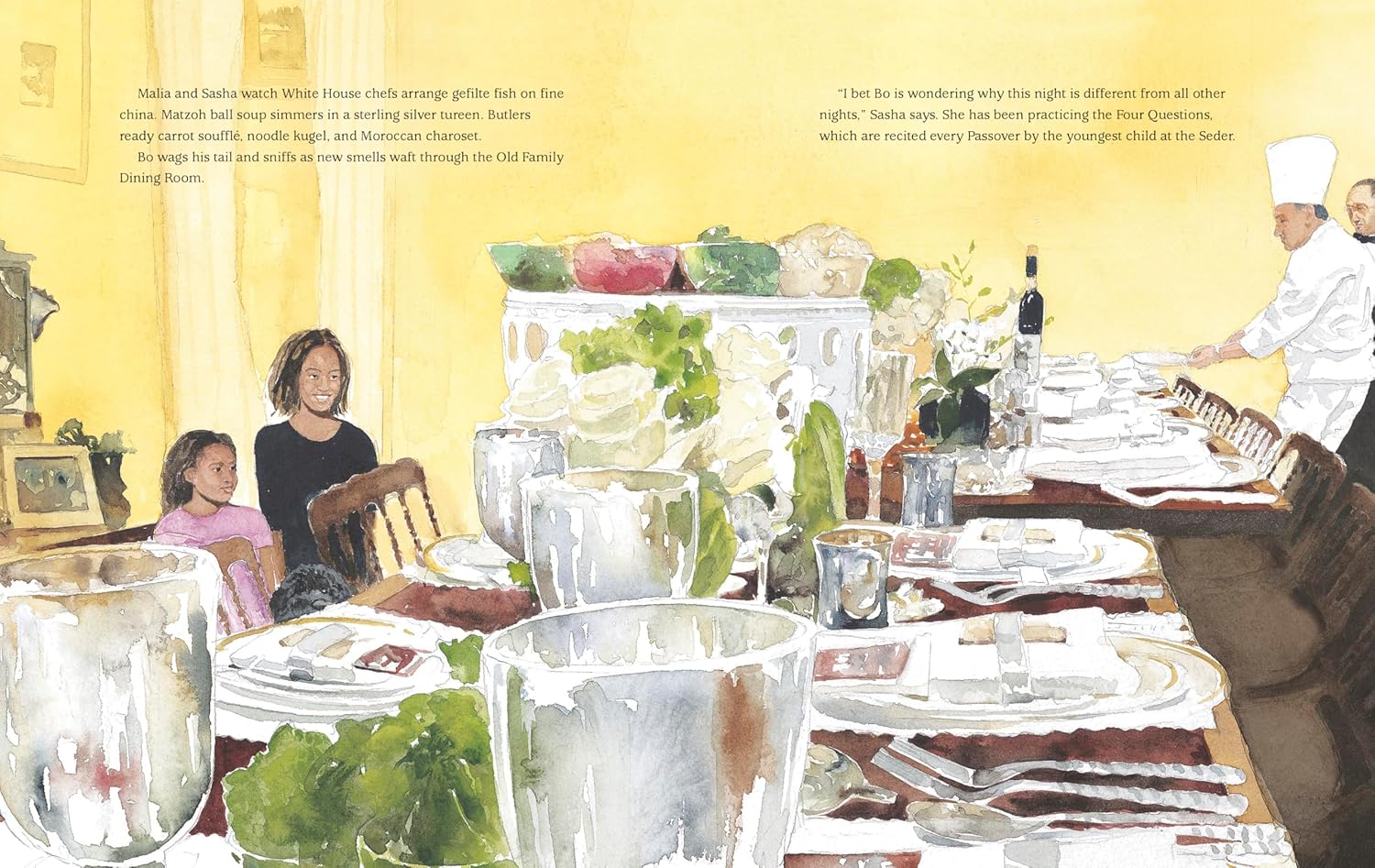
“Malia and Sasha watch White House chefs arrange gefilte fish on fine china. Matzoh ball soup simmers in a sterling silver tureen…Bo wags his tail and sniffs as new smells waft through the Old Family Dining Room.”

Michelson’s story begins right in the action, with everyone preparing for the White House Seder. Barack Obama’s daughter Sasha says, “I bet Bo is wondering why this night is different from all other nights.” She is jokingly referencing the four questions recited by the youngest child in a Passover seder. And why is this night different, you may be wondering? Read on to find out! 

Illustration © 2025 by E.B. Lewis, text © 2025 by Richard Michelson. Courtesy of Random House Children’s Books.

When Eric, Arun, and Herbie set out on the campaign trail with Senator Obama as he ran for president in 2008, they did not expect to find themselves seated in the White House celebrating Passover for the next eight years. These young men joined the campaign trail in hopes that “they could help [Obama] make America a place where all people—regardless of their race, gender or religion—would have an equal opportunity to succeed.” But, “helping others doesn’t mean you don’t get homesick, or hungry, or tired.”

Holidays are especially a time when homesickness can hit for folks far from home. And this was the case for Eric, Arun, and Herbie. When Passover came around, they decided to have their own Passover ceremony, or Seder, in the basement of the hotel where they were staying. The trio managed to snag some matzoh, macaroons and Manishewitz wine along with Haggadahs (booklets of the prayers, songs and story of Passover) to tell the story of Passover—the exodus of enslaved Jews in Egypt who escaped through a parting sea to freedom, one of many miracles that ensured their eventual getaway. “Tonight, they would celebrate the sweet taste of freedom and pledge not to rest until all people are free.”

Illustration © 2025 by E.B. Lewis, text © 2025 by Richard Michelson. Courtesy of Random House Children’s Books.

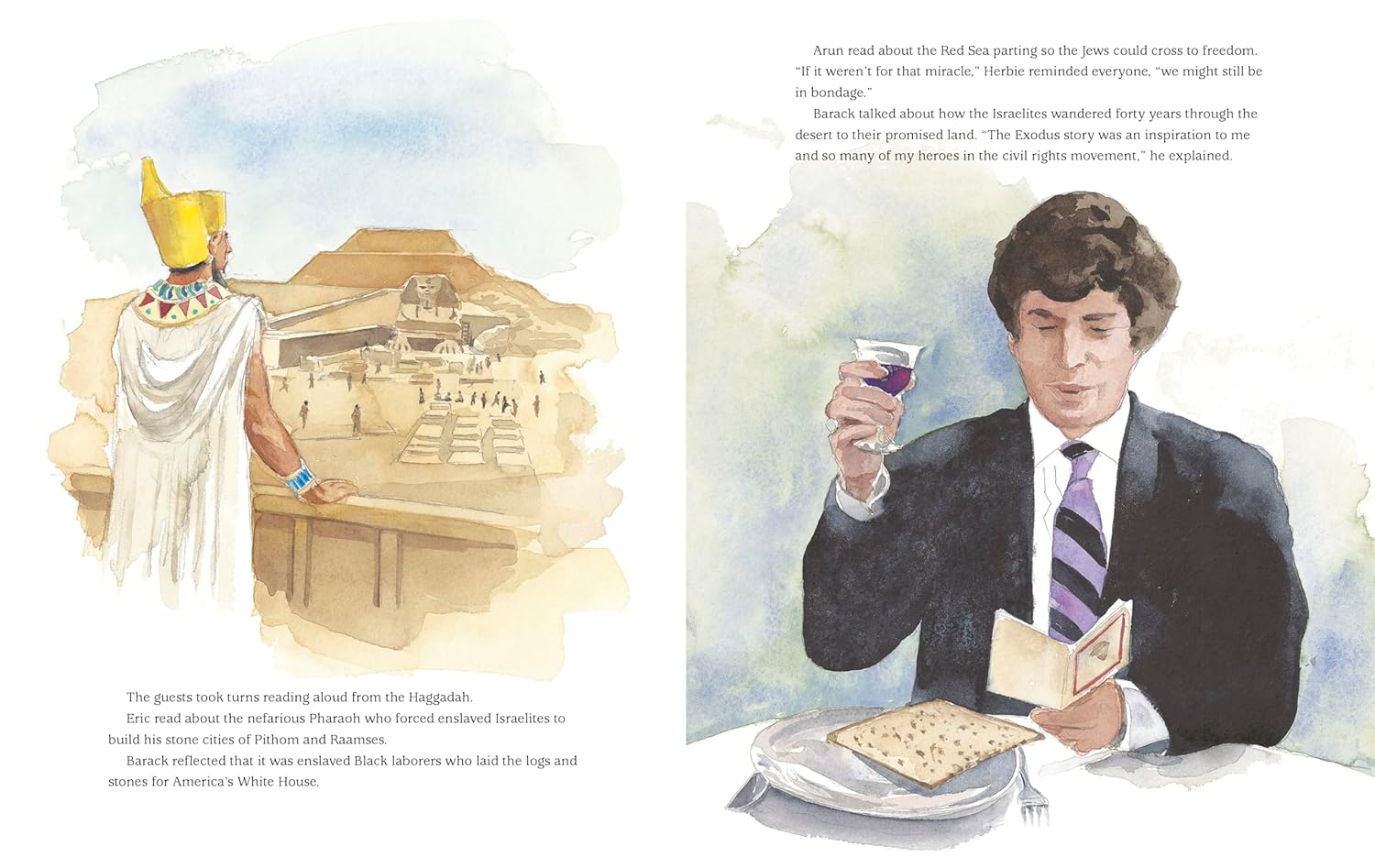
When the three young men rose for the tradition of letting the prophet, Elijah, in through the door they were surprised to find Barack Obama on the other side, requesting to join the gathering. Obama brought to the table connections between the Passover freedom tale and the civil rights movement—how activists throughout time have drawn from the Passover pilgrimage in their protests and speeches. He told of how enslaved Black laborers were the ones who carried the first building blocks for the White House, like how the ancient Pharaoh had made the enslaved Israelites build his stone cities. When Eric called out a traditional Passover expression “Next year in Jerusalem,” a phrase that has come to signify hope for a better tomorrow, Barack replied, “Next year in the White House!”

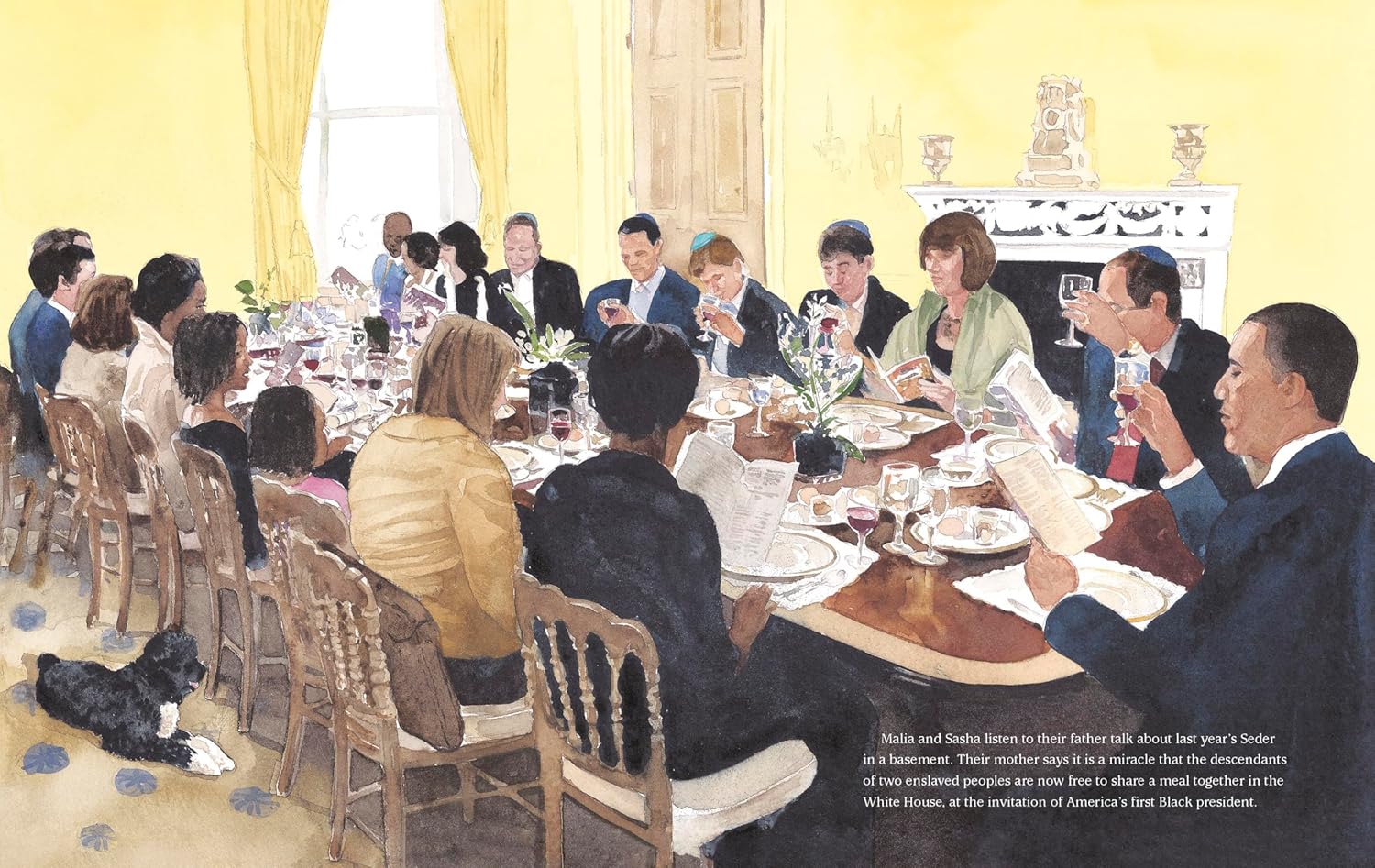
In the following pages, we return to the prologue scene of the book—a description of the first White House Seder, performed in 2009, hundreds of years after both the first White House Christmas and Easter ceremonies. We read of two previously enslaved peoples joining together in resistance and solidarity, to celebrate in the historic White House, where neither group would have been invited years ago. We learn about the traditional Passover foods and games for children—such as piping hot matzoh ball soup and the race to find the afikomen, a hidden piece of matzoh wrapped in a special cloth. And we’re invited in as dozens of people gather to celebrate and cherish the holiday’s call of freedom. When the prize for finding the hidden afikomen is a dog toy for Bo, Sasha remarks, “Now Bo definitely knows why this night is different from all other nights.”

Illustration © 2025 by E.B. Lewis, text © 2025 by Richard Michelson. Courtesy of Random House Children’s Books.

Richard Michelson’s writing is thought provoking, lively and packed with themes of hope and resilience interspersed with knowledge of the Passover traditions. The story contains many references to Passover phrases and themes, such as the call for the homesick, tired, and hungry to come eat and the four questions, which are both part of Passover prayers and motifs shared in Michelson’s story.

Michelson adds a prologue scene to draw readers in, as well as extensive back matter including: a note from Herbie Ziskend, Eric Lesser, and Arum Chaudhary; an annotated page of the Haggadah used at the first White House Seder; more information about the attendees and connections between Black History and Passover; a detailed explanation of Passover traditions; and a special Passover dessert recipe from Arun. His writing instills a sense of social justice, with undertones of the importance of intersectional empowerment and unity.

E.B. Lewis’s signature watercolor spreads bring the book to life with distinctly recognizable characters displaying detailed facial expressions and richly colored backgrounds. Readers will feel immersed in the comradery of the dinner table scenes and the crowds at protests and campaign speeches. The illustrative masterpiece depicting the parting of the sea in the background when Eric, Arun, and Herbie retell the Passover story will inspire awe and mystery. Close-ups of each of the characters also intersperse text and larger detailed scenes. When Arun, Herbie, and Eric are introduced, they each receive their own small illustrative snapshot, as these three unlikely characters become center stage for a Passover miracle story.

Next Year in the White House brings a unique and important historical moment to light and a new story to the table to re-read time and time again, as is tradition with the Passover tale. 

Ages 4 – 8+

Crown Books for Young Readers, 2025 | ISBN 978-0593711583

About the Author

Richard Michelson is a poet, children’s book author, and art dealer whose children’s books have been listed among the 10 Best Books of the Year by The New York Times, Publishers Weekly, and The New Yorker; and among the 12 Best Books of the Decade by Amazon.com. He has been a finalist for the Massachusetts Book Award, the Harlem Book Fest Wheatley Award, and the National Jewish Book Award, as well as receiving two Skipping Stones Multicultural Book Awards, a National Parenting Publication Gold Medal and an International Reading Association Teacher’s Choice Award. In 2009 Michelson received both a Sydney Taylor Gold and Silver Medal from the Association of Jewish Librarians, the only author so honored in AJL’s 50 year history. Michelson received his 2nd Silver Medal in 2017 and his 2nd Gold Medal in 2018. Additionally, Michelson won the 2017 National Jewish Book Award. Michelson is the owner of R. Michelson Galleries, the host of Northampton Poetry Radio, and the current Poet Laureate of Northampton. Massachusetts. You can learn more by visiting him at richardmichelson.com and on Facebook.

About the Illustrator

E.B. Lewis has illustrated over seventy books for children, including the New York Times Best Illustrated Book Award, Kirkus Best Illustrated Book Award, and the Golden Kite Honor Award winner Jabari Asim’s Preaching to the Chickens as well as the Caldecott Honor Award Winner, Jacqueline Woodson’s Coming on Home SoonHe is also a five-time Coretta Scott King winner.
Presently, Lewis teaches at the Pennsylvania Academy of Fine Arts. He is also a member of The Society of Illustrators in New York City, and an artist member of Salamagundi Art Club of New York. Learn more about E.B. Lewis and his work at eblewis.com.

Get Ready for Passover Activity

8 Days of Activity Plans from 18 Doors


Celebrate Passover with your family and these Activity Plan Ideas from 18 Doors! For each of the 8 Days you’ll find a song or video, a craft, and a recipe to help you have a fun Passover!

You can purchase Next Year at the White House from these booksellers

Amazon | Barnes & Noble | Bookshop (to support your local independent bookstore)

Picture Book Review

February 17 – It’s Black History Month

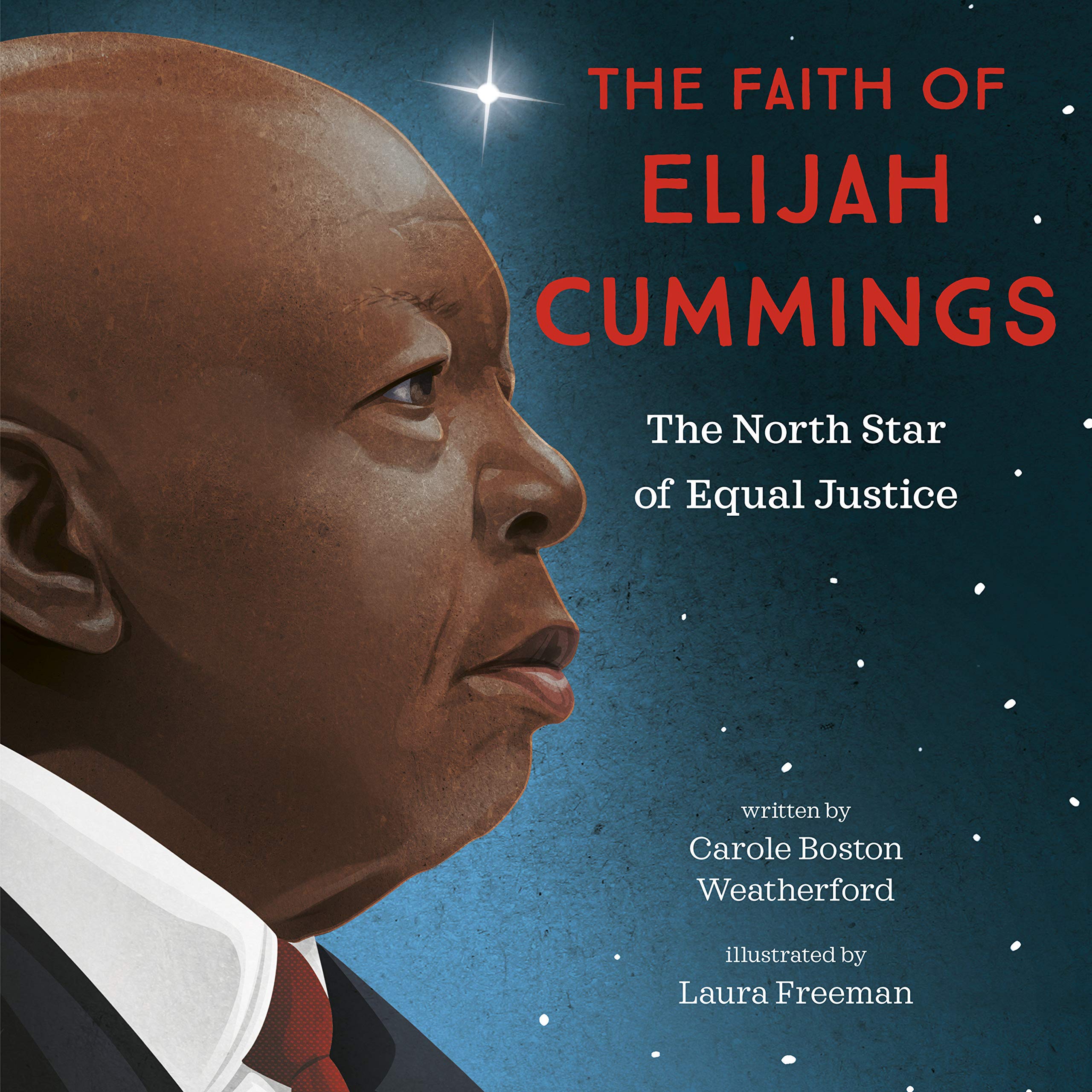
celebrate-picture-books-picture-book-review-the-faith-of-elijah-cummings-cover

About the Holiday

Black History Month celebrates the achievements and contributions of African Americans in United States History. Originally a week-long observance initiated by writer and educator Dr. Carter G. Woodson in1926 and occurring during the second week in February to commemorate the birthdays of Frederick Douglass and Abraham Lincoln, Black History Month was officially established in 1976 by then president Gerald Ford. The holiday is now celebrated across the country with special events in schools, churches, and community centers.

The theme for 2022 is “Black Health and Wellness” and focuses on the legacy of not only Black scholars and medical practitioners in Western medicine, but also on alternate ways of practicing medicine throughout the African Diaspora. The 2022 theme considers activities, rituals, and initiatives that Black communities engage in to live healthy lives.

To learn more about Black History Month, find information on this year’s events, access resources for more research, and find content for teachers, visit the BlackHistoryMonth.gov

The Faith of Elijah Cummings: The North Star of Equal Justice

Written by Carole Boston Weatherford | Illustrated by Laura Freeman

During the summer of 1962, when Elijah Cummings was eleven years old, he and other African American children marched for the integration of a Baltimore city pool. They were met with a white mob who shouted at them to “‘Go back where you came from!'” and threw rocks and bottles at them. This protest, organized by civil rights lawyer Juanita Jackson Mitchell, inspired Elijah to consider becoming a lawyer also.

Elijah’s parents had moved to Maryland from South Carolina in the 1940s, where they had worked the land where their parents had once been enslaved and where “Blacks were beaten for seeking voting rights. Elijah, his parents, and his six siblings lived in a four-room row house, where his mother and father – having only a fourth-grade education – stressed the importance of schooling. But for inquisitive Elijah, the nuts and bolts of reading and writing were elusive. Because of the cramped conditions at home, Elijah took to studying at the library, where the librarians tutored him after their shifts and made it possible for Elijah to succeed.

celebrate-picture-books-picture-book-review-the-faith-of-elijah-cummings-march

Image copyright Laura Freeman, 2022, text copyright Carole Boston Weatherford, 2022. Courtesy of Random House Studio.

Through hard work, scrimping, and saving, Elijah’s parents were able to buy a house with more room and a yard. Here, Elijah’s mother became a preacher and grew her small group of women who met in their home’s basement into a small church, the Victory Prayer Chapel. In addition to leading services, Elijah’s mother lived what she believed by helping those in need. Elijah’s father inspired him to become all that he could be. 

Even as a young boy, Elijah worked hard and, on Sundays after church, he listened to Rev. Martin Luther King’s speeches by transistor radio. He watched as African American boys were put into reform school, and he vowed to become a lawyer, but his high school guidance counselor tried to dissuade him. With the help of his parents and the pharmacist at the drug store where he worked, Elijah attended Howard University, where he was a standout student and leader. He became a lawyer and in 1983 was elected to the Maryland House of Delegates.

celebrate-picture-books-picture-book-review-the-faith-of-elijah-cummings-college

Image copyright Laura Freeman, 2022, text copyright Carole Boston Weatherford, 2022. Courtesy of Random House Studio.

“In 1996, Elijah Cummings was elected to the U.S. House of Representatives,” and later became the chair of the Congressional Black Caucus. “He spoke out to ensure that everyone was treated fairly and equally.” Even though he was a leader in Washington DC, Elijah continued to live in his inner-city Baltimore neighborhood, and during the protests against police brutality in 2015, he appealed for calm as he walked “with residents singing an African American spiritual: ‘This little light of mine, I’m gonna let it shine.'” Before his death in 2019, Elijah Cummings was named chair of the House Committee on Oversight and Reform, where, as he had for his entire career, he advocated for change now and for the future our children will inherit.

Quotes by Elijah Cummings on his inspirations, work, and beliefs included throughout the story allow readers to hear in Cummings’ own words his passion and dedication to creating a more equitable and caring America for all. 

A Foreword reprints remarks given by Speaker of the House of Representatives Nancy Pelosi at Elijah Cummings’ funeral on October 25, 2019. Back matter includes an excerpt of the statement from the Congressional Black Caucus upon Cummings’ death on October 17, a Timeline of his life and work, a Bibliography, and Source Notes for the Cummings’ quotes found throughout the story.

celebrate-picture-books-picture-book-review-the-faith-of-elijah-cummings-house-of-representatives

Image copyright Laura Freeman, 2022, text copyright Carole Boston Weatherford, 2022. Courtesy of Random House Studio.

Carole Boston Weatherford’s moving biography of Elijah Cummings highlights the strong and supportive family unit that inspired and sustained Elijah as he grew from a thoughtful and hardworking boy into an empathetic and influential leader. Her focus on formative events in Cummings’ life depict how early experiences often shape the person children become while continuing to inform their opinions, beliefs, and occupations. Through his own words, Weatherford reveals Cummings’ commitment to the children who will read this biography as well as to all young people who will benefit from and carry on his work.

In her rich and expressive illustrations, Laura Freeman recreates pivotal events, touching examples of the Cummings’ family solidarity, and community-based actions inspired by the family’s religious faith to paint a portrait of Elijah’s youth and young adulthood. As he rises to the highest levels within the US Congress, while never losing touch with the neighborhood and people he loved, Freeman’s striking images will entice readers to learn more about Elijah Cummings’ legislative legacy and the workings of Congress and to, perhaps, become involved in their own community.

A masterful biography of Elijah Cummings that deftly interweaves the internal and external influences of his youth with their lifelong effects on his principles, his work, and his lasting influence, The Faith of Elijah Cummings is highly recommended for home bookshelves and a must for school and public library collections.

Ages 6 – 9 

Random House Studio, 2022 | ISBN 978-0593306505

Discover more about Carole Boston Weatherford and her books on her website.

To learn more about Laura Freeman, her books, and her art, visit her website.

celebrate-picture-books-picture-book-review-the-faith-of-elijah-cummings-cover

You can find The Faith of Elijah Cummings at these booksellers

Amazon | Barnes & Noble | Books-a-Million

To support your local independent bookstore, order from 

Bookshop | IndieBound

Picture Book Review

February 11 – International Women and Girls in Science Day

celebrate-picture-books-picture-book-review-code-breaker-spy-hunter-cover

About the Holiday

Gender equality around the world has always been a core issue for the United Nations. As such, on December 22, 2015 the United Nations General Assembly established an International Day to recognize the critical role women and girls play in science and technology. This year’s theme is “Equity, Diversity, and Inclusion: Water Unites Us.” As described in UN reports, by 2030 “billions of people around the world will be unable to access safely managed household drinking water, sanitation, and hygiene services unless access progress rates quadruple. Rising demand, poor management, and failure to conserve water resources, compounded by climate change, represent key challenges, urgently requiring a new sustainable holistic approach to support aligning strategies on water.”

Today’s celebration will bring together women in science and experts from around the world and government officials as well as representatives of international organizations and the private sector to discuss the importance of water in achieving the three pillars of sustainable development – economic prosperity, social justice, and environmental integrity. The program will also feature, for the first time, a unique Ebru Water Art Performance to celebrate the 7th Anniversary of the #February11 Global Movement. To access the virtual assembly, visit womeninscienceday.org. To learn more about today’s initiative as well as videos about past observances, visit the UN website

Thanks to Abrams Books for Young Readers and Blue Slip Media for sending me a copy of Code Breaker, Spy Hunter for review consideration. All opinions of the book are my own. I’m excited to be teaming with them for a giveaway of the book. See details below.

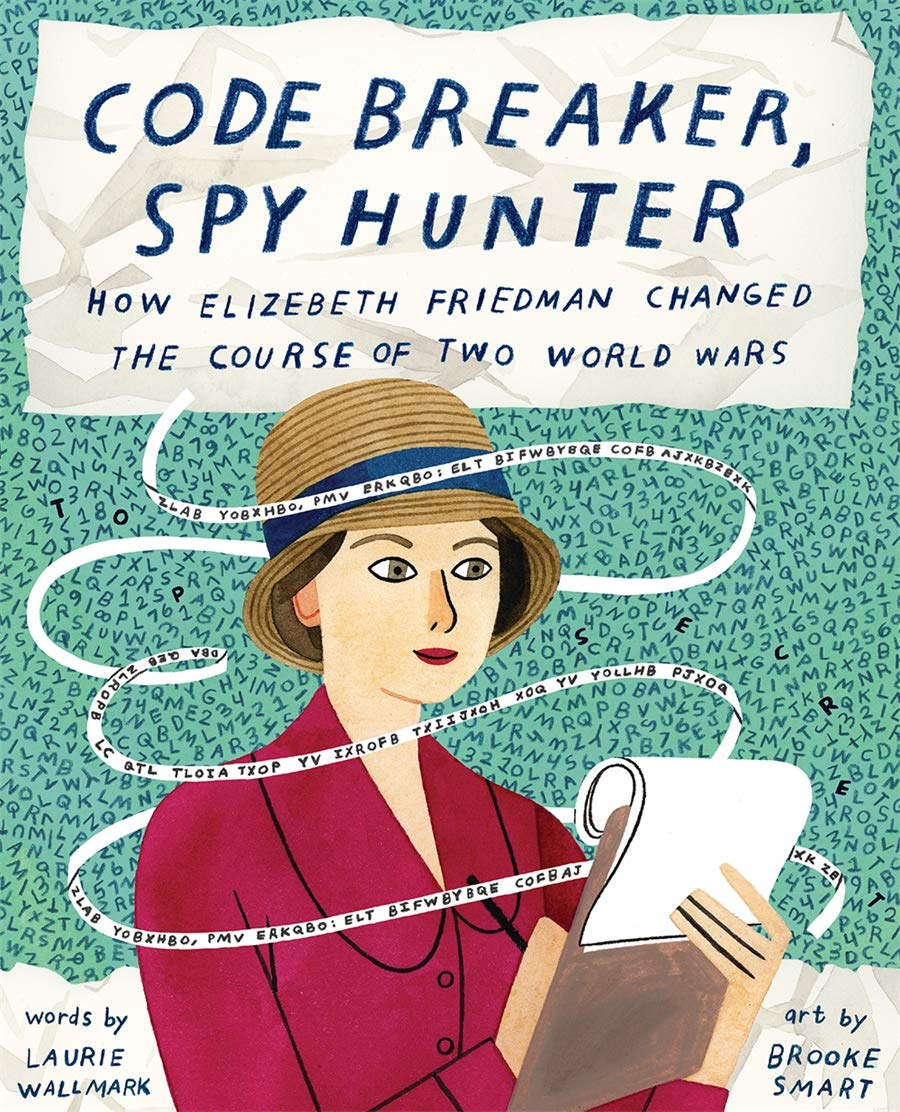
Code Breaker, Spy Hunter: How Elizebeth Friedman Changed the Course of Two World Wars

Written by Laurie Wallmark | Illustrated by Brooke Smart


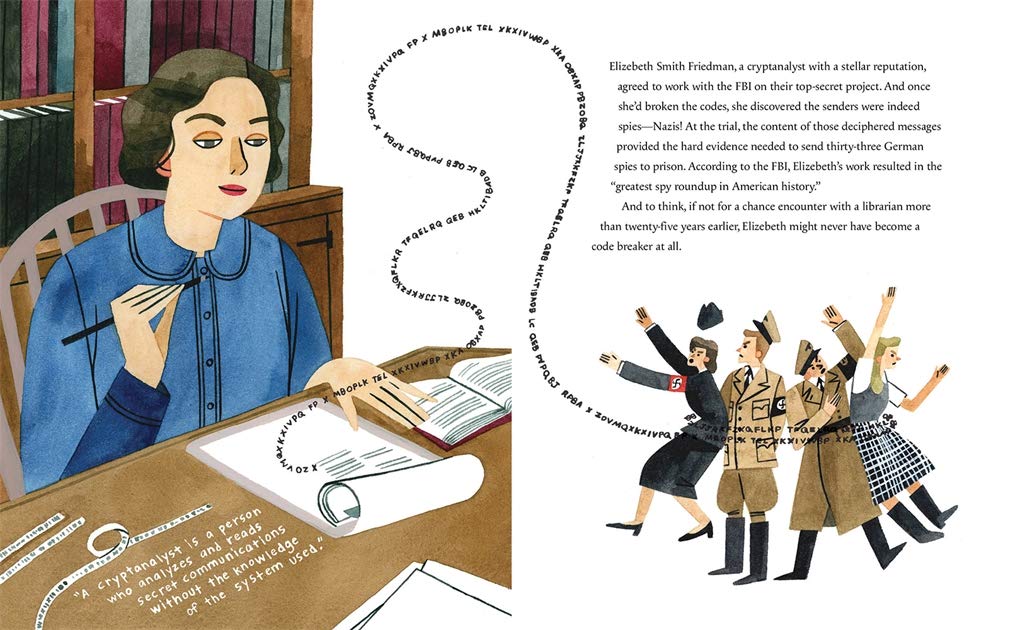
In Code Breaker, Spy Hunter, readers open the cover to an intriguing question: “Could it be? Had enemy spies sneaked into the United States?” World War II was raging, but the United States had not yet joined the effort. And yet the “FBI had intercepted hundreds of coded messages from a secret base in New York.” The problem was no one could read them. Who did the FBI turn to? Elizebeth Smith Friedman, who broke the codes, discovered a cadre of Nazi spies, and provided the evidence “to send thirty-three German spies to prison.” Who was Elizebeth Friedman? Children are about to find out!

celebrate-picture-books-picture-book-review-code-breaker-spy-hunter-cryptanalyst

Image copyright Brooke Smart, 2021, text copyright Laurie Wallmark, 2021. Courtesy of Abrams Books for Young Readers.

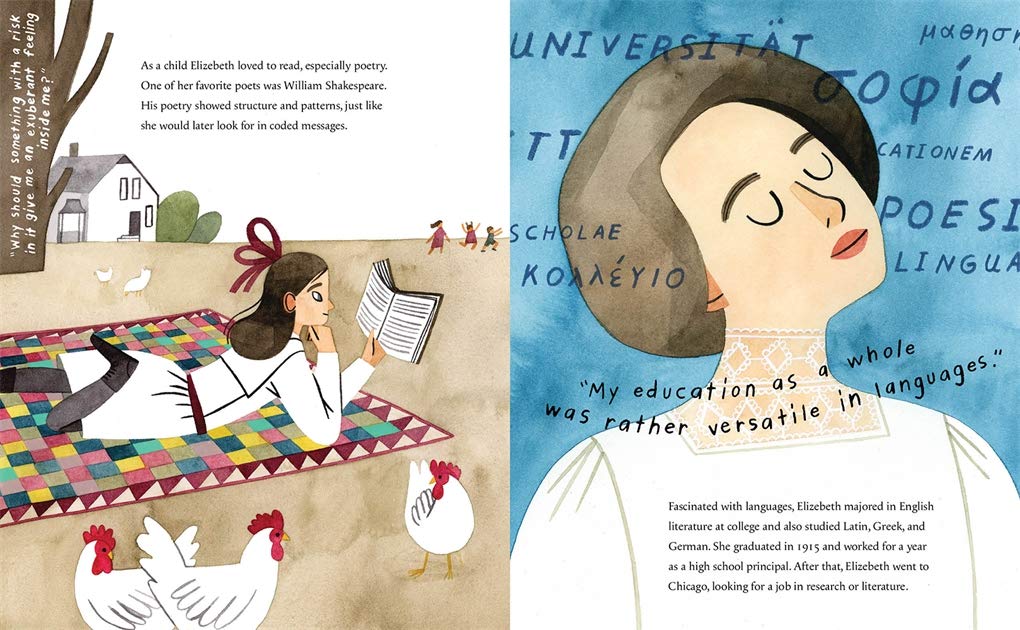
As a child, Elizebeth loved poetry and especially the work of William Shakespeare, with its structure and patterns. In college, she studied English literature, Latin, Greek, and German. While looking for a job in Chicago in 1916, she met the eccentric George Fabyan, who was trying to prove that Francis Bacon was the true writer of Shakespeare’s plays. He hired Elizebeth to “find secret messages Bacon had supposedly hidden in the plays. But the more she explored the plays, the more convinced she became that there were no hidden messages.”

Elizebeth shared her thoughts with a friend, William Friedman, who also loved puzzles and secret codes. Over a year’s time, their discussions resulted in a stronger friendship and finally marriage. In 1917, the US entered World War I and Fabyan asked Elizebeth and William to establish “the country’s first code-breaking unit, the Riverbank Department of Cyphers…. Their methods are now considered the basis for the modern science of cryptology, the study of secret codes.”

celebrate-picture-books-picture-book-review-code-breaker-spy-hunter-childhood

Image copyright Brooke Smart, 2021, text copyright Laurie Wallmark, 2021. Courtesy of Abrams Books for Young Readers.

In 1921, Elizebeth and William moved to Washington D.C., where they worked as code breakers for the Army. At the time, the Army used a large, cumbersome machine to convert messages into code, which precluded soldiers in the field from sending intelligence back. Elizebeth and William invented a complex code that used “only pencil and paper.” After the war, Elizebeth settled down to write books and raise a family, but still the entreaties came to decode messages for court cases sometimes thousands of miles away.

In 1925 with Prohibition the law of the land, smugglers were running rampant. The Coast Guard summoned her, and within three months Elizebeth had cracked “two years of backlogged messages.” Her work and court testimony that helped to convict smugglers made Elizebeth a recognized expert in the new field of cryptology, and when the work became overwhelming for just two people, she created the Coast Guard’s first code-breaking unit.

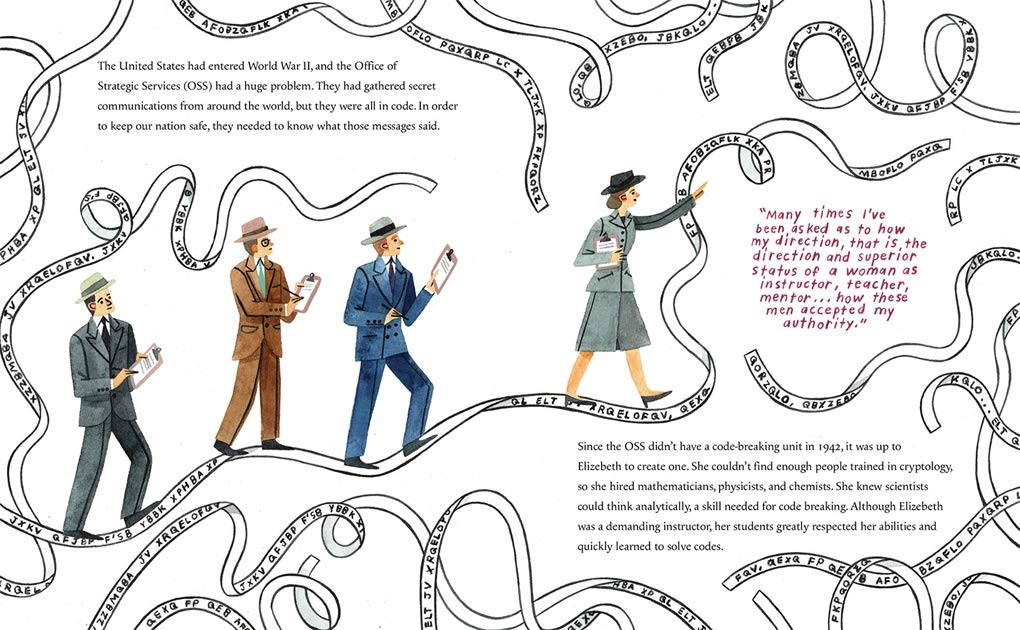
With the entry of the US in World War II, Elizebeth’s expertise was once again needed. Again, she needed to create a code-breaking unit, and in 1942 she hired and taught “mathematicians, physicists, and chemists” the skills of cryptology. Now, Elizebeth’s team was learning important war information about the Nazi’s movements and plans. When the FBI director wanted to nab the spies, Elizebeth recommended waiting “until the military could learn more of the enemy’s secrets.” But he disagreed and raided their hiding place. The spies that escaped quickly changed their codes, making their communications harder to decipher. The FBI director took all the credit for breaking the codes and catching the spies.

celebrate-picture-books-picture-book-review-code-breaker-spy-hunter-world-war-II

Image copyright Brooke Smart, 2021, text copyright Laurie Wallmark, 2021. Courtesy of Abrams Books for Young Readers.

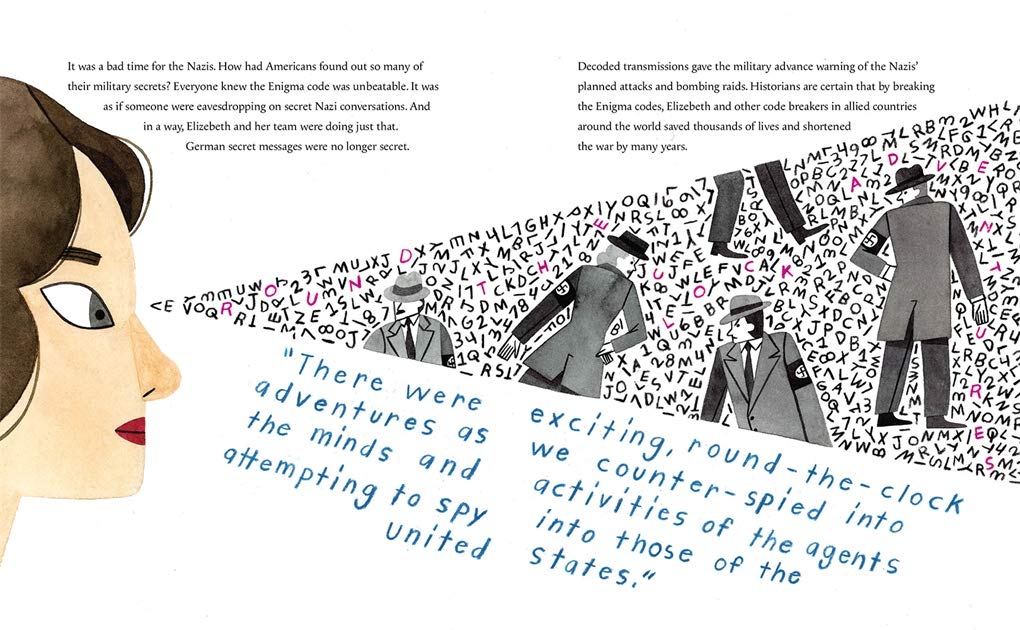
As the war progressed, Elizebeth helped capture an American spy working for the Japanese, and when the Germans developed Enigma, a powerful code-making machine that could “create billions of different cipher alphabets, it was Elizebeth’s team that broke the code for the United States. In Allied countries around the world, other cryptologists were also decrypting Enigma messages. The Nazis were now at a disadvantage, their planned attacks thwarted. Historians believe the work of these code breakers “saved thousands of lives and shortened the war by many years.”

Throughout her life Elizebeth could not speak a word about her work, even to her family. It was classified as Top Secret Ultra by the government and kept locked in the National Archives. At last, in 2015, Elizebeth’s work was declassified. “She is now considered one of the most gifted and influential code breakers of all time.”

celebrate-picture-books-picture-book-review-code-breaker-spy-hunter-counter-spied

Image copyright Brooke Smart, 2021, text copyright Laurie Wallmark, 2021. Courtesy of Abrams Books for Young Readers.

Compelling and wonderfully detailed, Laurie Wallmark’s biography of Elizebeth Friedman immerses children in the world of war-time spies, where cracking codes equaled saved lives and battles won. Wallmark’s storytelling of Elizabeth’s trajectory from Shakespeare scholar to ultra-secret code cracker reads like a thriller and is sprinkled throughout with quotes from Elizebeth that give kids a sense of her personality and the demands of her career. By including several cases Elizebeth was instrumental in solving, Wallmark provides readers with historical context on the broad range of nefarious activity that relied on secret codes to inform their knowledge of today’s uses of encryption as well as international spy networks. Each page is a celebration of Elizebeth’s talent, intelligence, and accomplishments, and her incredible story will enthrall readers.

Brooke Smart’s watercolor and gouache illustrations offer enticing glimpses into the past while following Elizebeth as she meets George Fabyon who shows her around his museum-like house while carrying a small monkey on his shoulder, establishes the United States’ first code-breaking unit, testifies in court, and thwarts the Nazis’ war plans. Interspersed with Smart’s realistic depictions of Elizebeth’s life are images in which lines of coded messages snake across the page, giving readers a look at the kinds of unreadable text Elizebeth and her teams cracked. In addition to presenting a visual representation of the tangled communications that eventually nabbed our enemies, two of these clever illustrations contain messages of their own.

A superlative biography that would enhance any history, social studies, language arts, or STEM curriculum as well as captivate kids who love spy, military, and detective stories, Code Breaker, Spy Hunter: How Elizebeth Friedman Changed the Course of Two World Wars is highly recommended for home bookshelves and is a must for school and library collections.

Ages 7 – 11

Abrams Books for Young Readers, 2021 | ISBN 978-1419739637

Discover more about Laurie Wallmark and her books on her website.

To learn more about Brooke Smart, her books, and her art, visit her website.

International Women and Girls in Science Day Activity

celebrate-picture-books-picture-book-review-pig-pen-cipher

Send a Secret Message


Would you like to be a code breaker – or a spy? Get started with this Pigpen Cipher that makes sending secret messages to friends, siblings, and other family easy and fun. This ancient code is called the Pigpen Cipher because each letter is in its own “pen.” Use it as originally developed then try mixing the letters and pens to create new codes. 

Pigpen Cipher Key

celebrate-picture-books-picture-book-review-code-breaker-spy-hunter-cover

You can find Code Breaker, Spy Hunter at these booksellers

Amazon | Barnes & Noble | Books-a-Million

To support your local independent bookstore, order from 

Bookshop | IndieBound

Picture Book Review
November 1 – National Author’s Day

celebrate-picture-books-picture-book-review-The-ABCs-of-Black-History-cover

About the Holiday

There may be no better month to celebrate Author’s Day than in November. Not only is it Picture Book Month, but thousands of people set aside their usual routine to take part in NaNoWriMo or National Novel Writing Month, when writers try to complete at least a first draft of a novel in one month. The holiday was instituted in 1928 by Nellie Verne Burt McPherson, president of the Bement, Illinois Women’s Club. An avid reader, she established Author’s Day to thank writer Irving Bacheller who sent her an autographed story in response to her fan letter. The day was officially recognized in 1949 by the United States Department of Commerce. McPherson’s granddaughter, Sue Cole, promoted the holiday after Nellie’s death in 1968. To celebrate, people are encouraged to write a note of appreciation to their favorite author.

Thanks go to Workman Publishing and Big Honcho Media for sharing a copy of The ABCs of Black History with me for review consideration. All opinions on the book are my own.

The ABCs of Black History

Written by Rio Cortez | Illustrated by Lauren Semmer


This stunning compendium of lyrical verses defies easy categorization as it bridges the genres of alphabet books, encyclopedias, history books, biographies, and more for young readers. The book opens with words from James Baldwin, in which he says “History is not the past. It is the present. We carry our history with us. We are our history,” and within its pages children discover not only specific events and well-known people, but the emotions, philosophies, and traits that have carried and sustained African Americans.

celebrate-picture-books-picture-book-review-The-ABCs-of-Black-History-banner

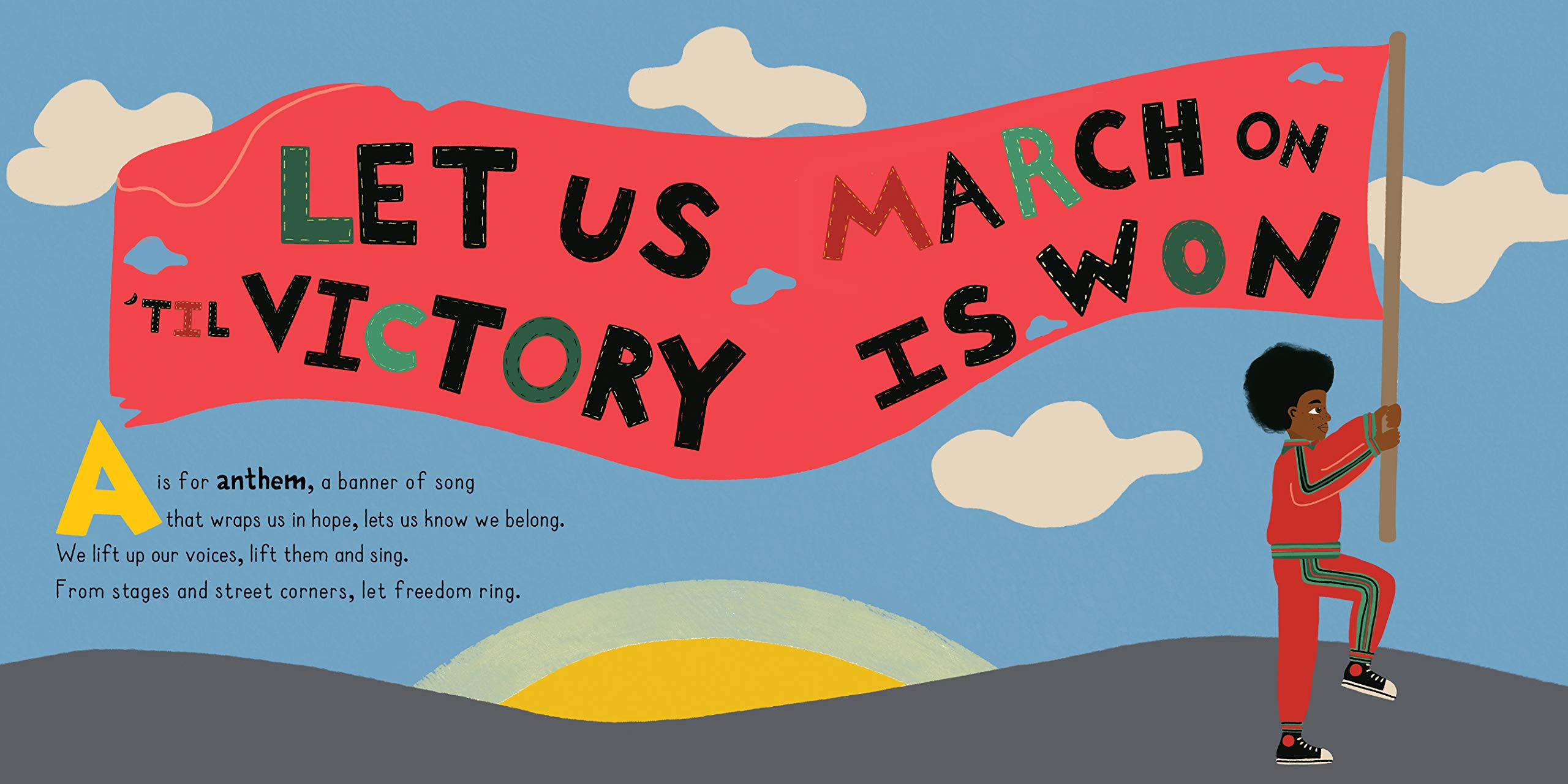
Image copyright Lauren Semmer, 2020, text copyright Rio Cortez, 2020. Courtesy of Workman Publishing Company.

This inspiring alphabetic journey begins with “A is for anthem, a banner of song / that wraps us in hope, lets us know we belong. / We lift up our voices, lift them and sing. / From stages and street corners, let freedom ring.” From there kids come to B, which is for “beautiful…brave…bright…and bold.” It also describes “brotherhood” and “believing in grace.” At E children meet Explorers Matthew Henson and Mae Jemison as well as some of those who fought to make Education open to all, such as Ruby Bridges, Linda Brown, and the Little Rock Nine.

celebrate-picture-books-picture-book-review-The-ABCs-of-Black-History-Explore

Image copyright Lauren Semmer, 2020, text copyright Rio Cortez, 2020. Courtesy of Workman Publishing Company.

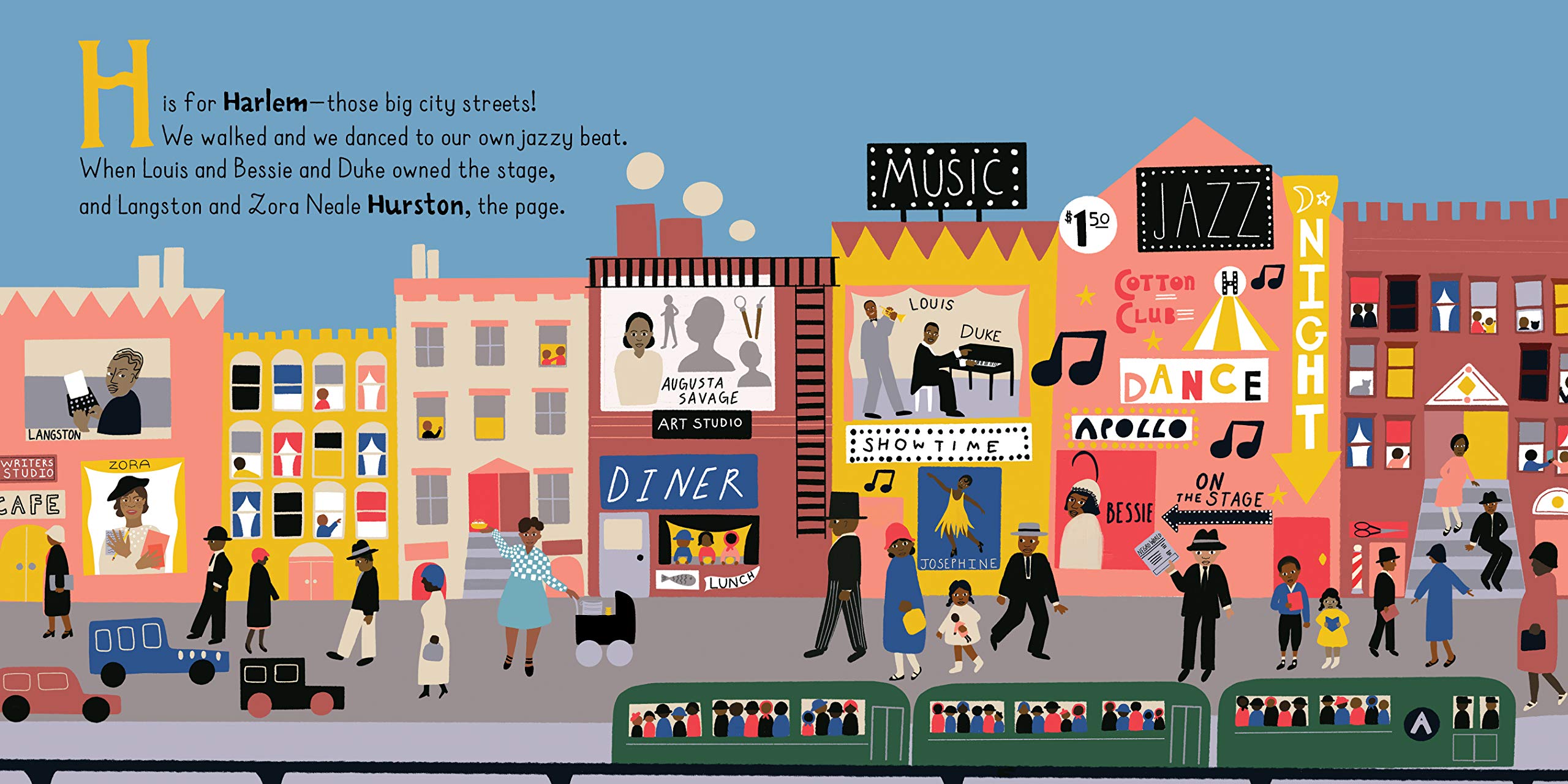
G and the Great Migration follow Black Americans from farmland to cities to “Harlem – those big city streets! / We walked and we danced to our own jazzy beat.” “Imagine, invent, innovative” define letter I, where readers find Alvin Ailey, Jean-Michel Basquiat, Gwendolyn Brooks, Madam C. J. Walker, George Washington Carver, and DJ Kool Herc.

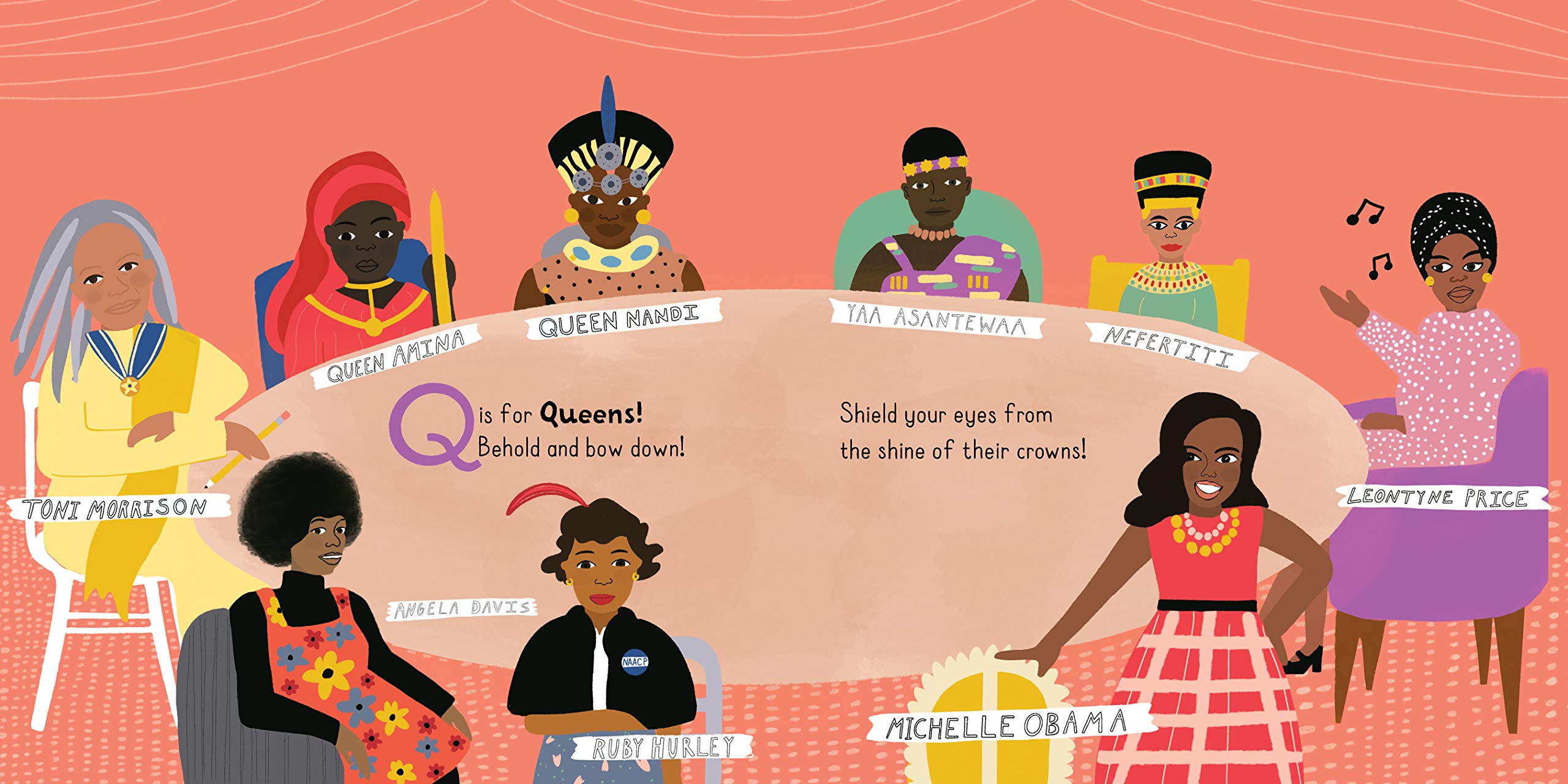
The drive to move forward, to aspire, and succeed is eloquently traced from the past: “M is for march, for lifting our feet, / taking the movement, the cause to the street” to today: “Black lives matter. Every breath, every dream – / Every thought, each idea, each impossible scheme.” From sit-ins to their organizers, from African queens to today’s women leaders, from award-winning athletes to scientists to singers of soul, Black achievement is highlighted across the alphabet.

celebrate-picture-books-picture-book-review-The-ABCs-of-Black-History-Harlem

Image copyright Lauren Semmer, 2020, text copyright Rio Cortez, 2020. Courtesy of Workman Publishing Company.

At U children and adults arrive at poignant verses that should prompt deeper discussions: “U is for United States – this story is tough. / The birth of a nation was deadly for us. / We the people? In the land of the free? / No one who was enslaved would agree.” A second and third verse take in the Civil War and the “unbroken, unshaken, unbound, / like Harriet Tubman, who went underground,” and the battle for freedom and rights that continued after the war’s end. But the pages end on a note of hope, revealing that U is also “for unfinished, this American tale. / With courage and strength, we will prevail!” 

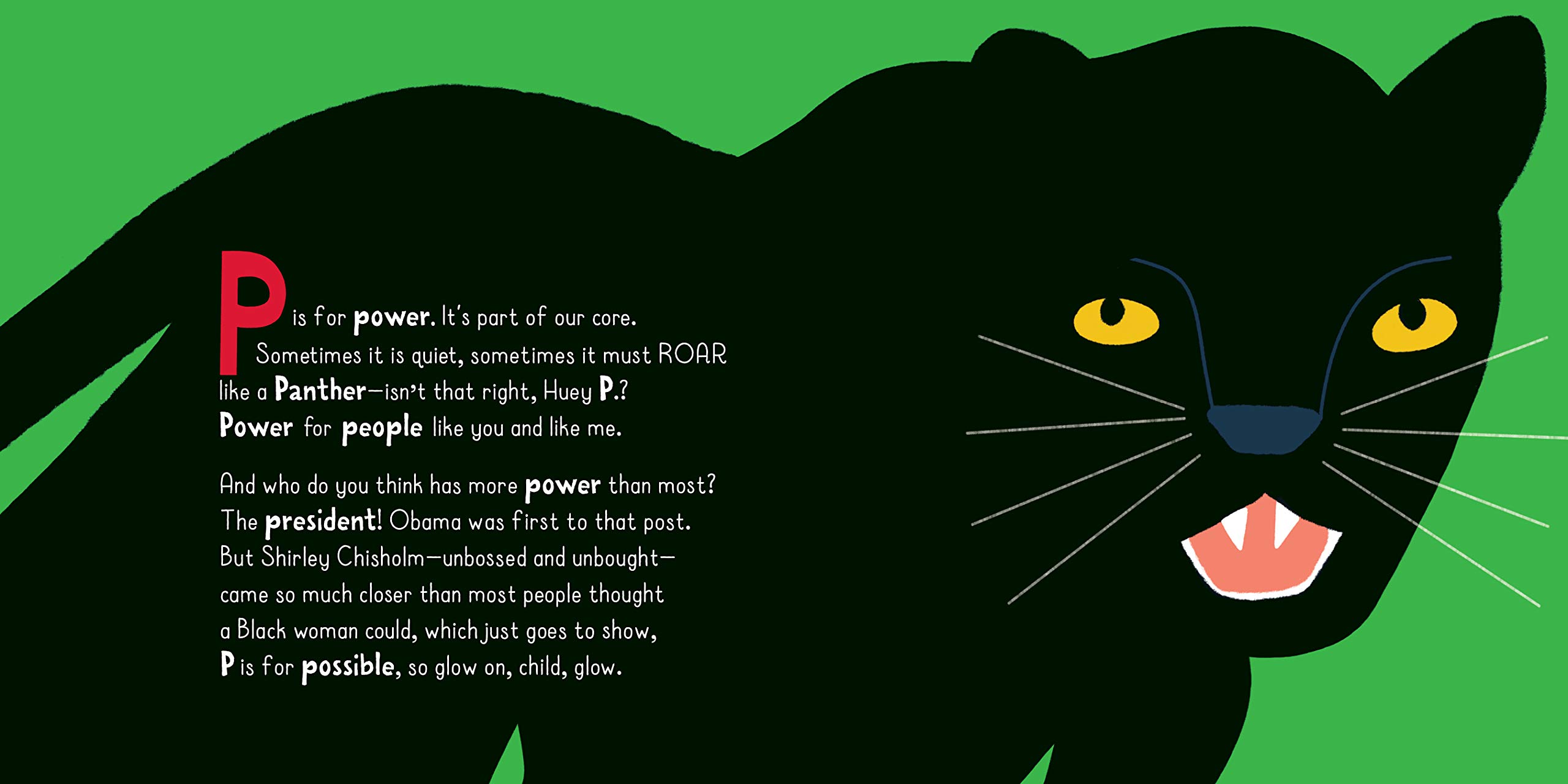
celebrate-picture-books-picture-book-review-The-ABCs-of-Black-History-panther

Image copyright Lauren Semmer, 2020, text copyright Rio Cortez, 2020. Courtesy of Workman Publishing Company.

As this is National Author’s Day, I must mention that “W is for writers whose wisdom and words / bring to life worlds where our voices are heard. / Rappers adn poets and songwriters, too, / all those who spin from our point of view.” And how does this collection of events, holidays, personalities, hopes, and dreams end? At Z for zenith – “The top of that mountain King said we would reach” to which “we march on, / rising, rising, like the sun with the dawn.”

Back matter includes further elucidation of each letter of the alphabet and it’s accompanying concept. These are detailed entries that also lend themselves to further study. Resources also include websites to organizations and museums and suggestions for books and poetry to read.

celebrate-picture-books-picture-book-review-The-ABCs-of-Black-History-queens

Image copyright Lauren Semmer, 2020, text copyright Rio Cortez, 2020. Courtesy of Workman Publishing Company.

Rio Cortez’s poetry soars on optimism, achievement, hope, and a palpable pride in Black history and the future. Musical and conversational, the verses flow off the tongue, creating an exciting and meaningful read-aloud experience for adults and children. The breadth of information that Cortez imparts is stirring, adding up to an impactful look at history and a rousing celebration of Black culture. Every page offers many, many opportunities for further learning, listening, viewing, and research.

Lauren Semmer’s vivid illustrations – opening with an uplifting group shot of young, happy, and hopeful black and brown faces that welcome their young peers – will enthrall readers with their action, energy, and colors. Portraits of famous figures and unsung heroes will inspire children to get involved in their communities and causes they believe in, while reaching for their dreams.

The ABCs of Black History is an exhilarating picture book for family reading times, a superb cross-curricular resource for homeschoolers and classrooms from elementary school to high school, and a must for all school and public library collections.

Ages 5 and up

Workman Publishing Company, 2020 | ISBN 978-1523507498

Discover more about Rio Cortez and her books on her website.

To learn more about Lauren Semmer, her books, and her art, visit her website.

National Author’s Day Activity

celebrate-picture-books-picture-book-review-Black-History-Month-Coloring-Pages-Maya-Angelou

Black Leaders Coloring Pages


Whether you’re interested in law and politics, science, sports, or the arts, you can find a role model in the people in the printable coloring pages below. You’ll find more coloring pages of Black leaders to print at Scribble Fun.

  Maya Angelou  | Louis Armstrong | Dr. Mae Jemison | Garrett Morgan | Barack H. Obama |  Rosa Parks | Jackie Robinson 

celebrate-picture-books-picture-book-review-The-ABCs-of-Black-History-cover

You can find The ABCs of Black History at these booksellers

Amazon | Barnes & Noble | Books-a-Million

To support your local independent bookstore, order from

Bookshop | IndieBound

Picture Book Review

August 19 – World Photography Day

celebrate-picture-books-picture-book-review-dorothea's-eyes-cover

About the Holiday

Photography is all about providing information and emotion through images. A picture really can be worth a thousand words in capturing a moment of surprise, joy, danger, or sadness. Well-placed photographers, videographers, and cinematographers have given voice to some of society’s pivotal moments, allowing the whole world to witness change, often as it is happening. Today we celebrate the “art, craft, science, and history of photography,” as well as those photographers who often put themselves in danger to get the story and those who bring us much-needed lighter moments. To learn more visit the World Photography Day website.

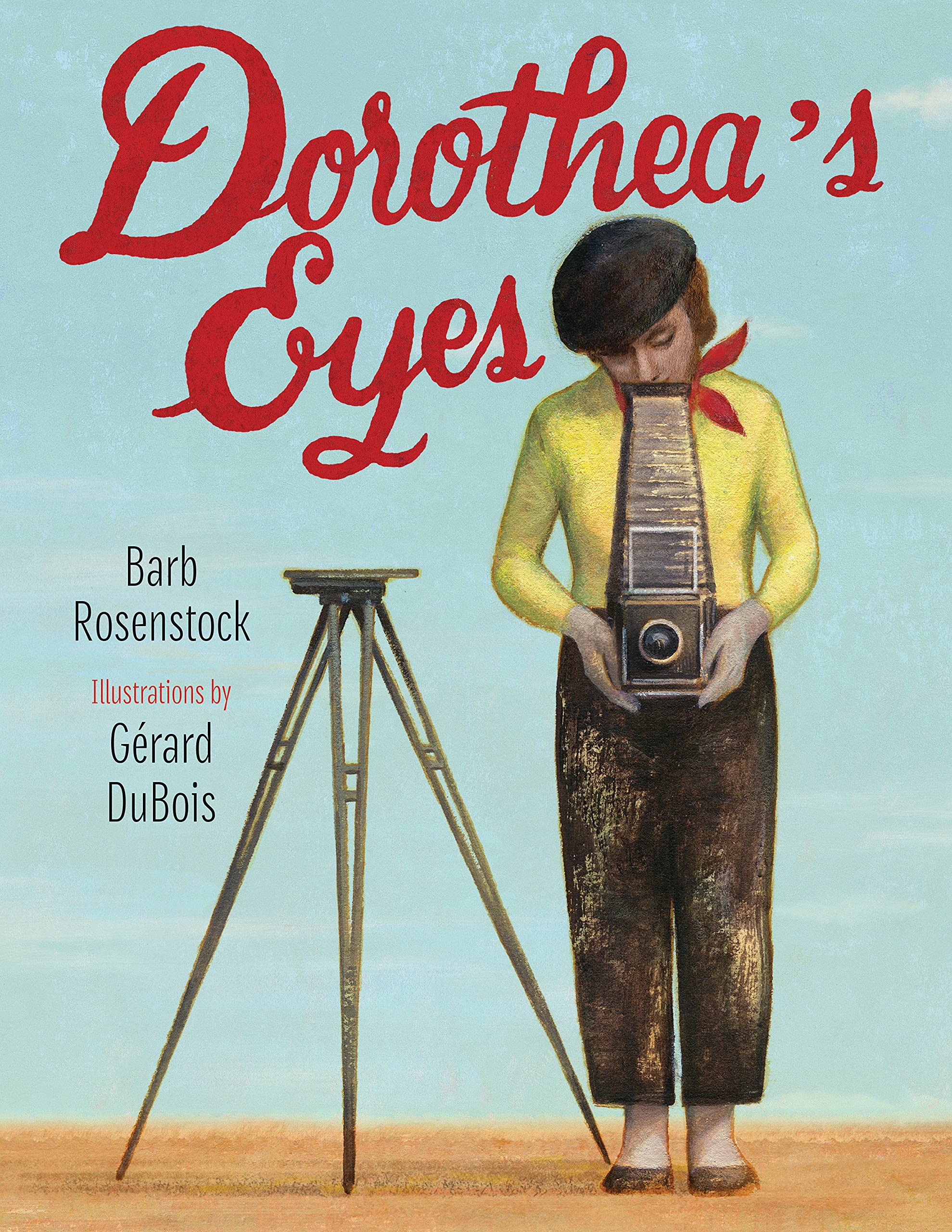
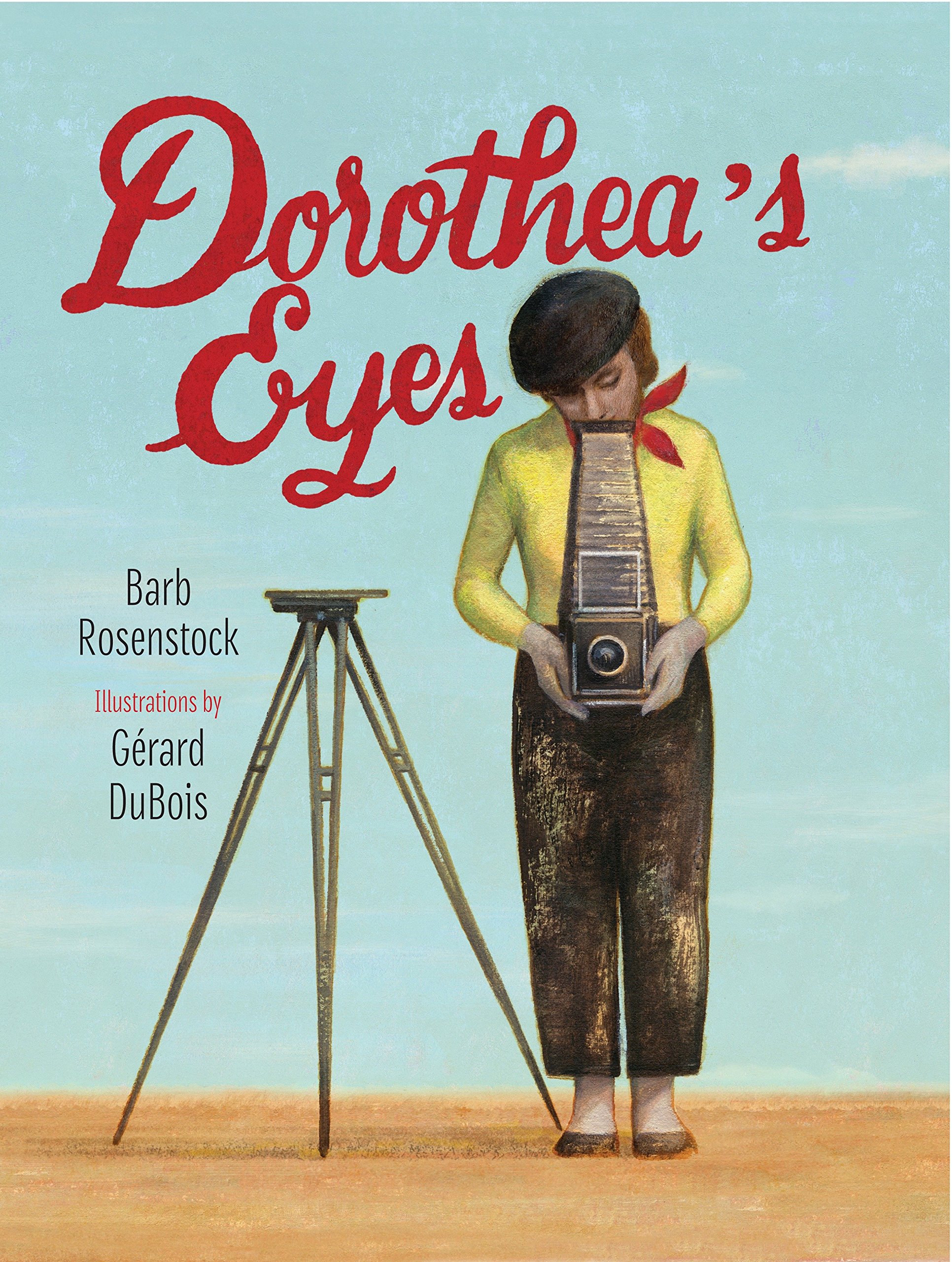
Dorothea’s Eyes: Dorothea Lange Photographs the Truth

Written by Barb Rosenstock | Illustrated by Gérard DuBois


When Dorothea Lange opens her green eyes, she sees things others miss. In the shadows, in patterns within the grain of wooden tables, in the repeated shapes of windows on a wall, and most especially in people’s faces. “Dorothea loves faces! When Dorothea looks at faces, it’s like she’s hugging the world.”

At seven years old Dorothea contracts polio, which withered her right leg and left her with a permanent limp. Other kids tease her and make her want to hide, and although her mother encourages her Dorothea pretends to be invisible. When her father leaves his family, her mother gets a job in New York and Dorothea goes to a new school. Because she is different, she feels lonely.

celebrate-picture-books-picture-book-review-dorothea's-eyes-great-market

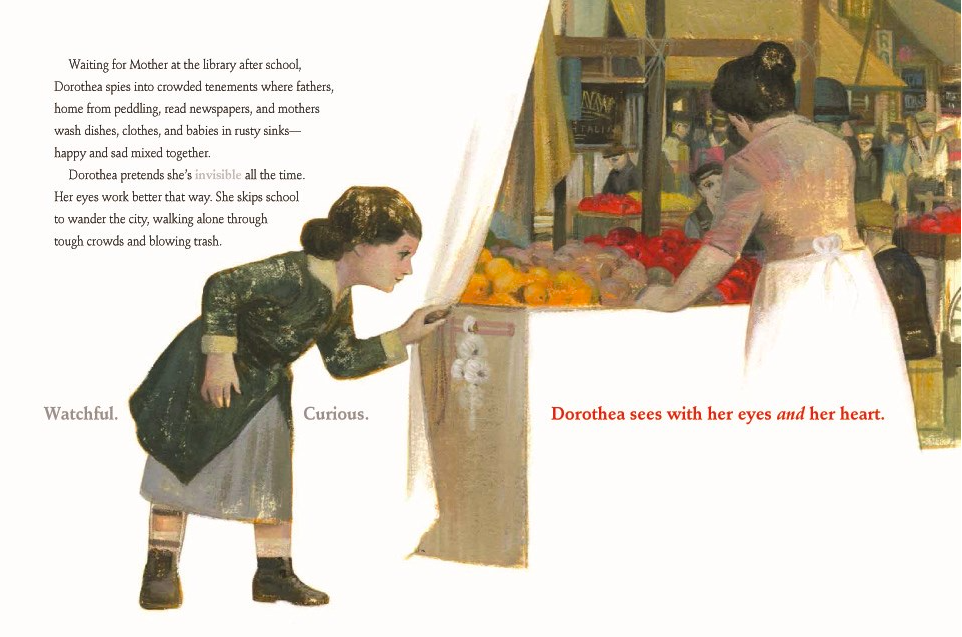
Image copyright Gérard DuBois, 2016, text copyright Barb Rosenstock, 2016. Courtesy of Calkins Creek.

As Dorothea waits for her mother to finish work, she looks around her, spying “into crowded tenements where fathers, home from peddling, read newspapers, and mothers wash dishes, clothes, and babies in rusty sinks—happy and sad mixed together.” She begins to skip school to wander the city, gazing at it with her curious eyes and heart.

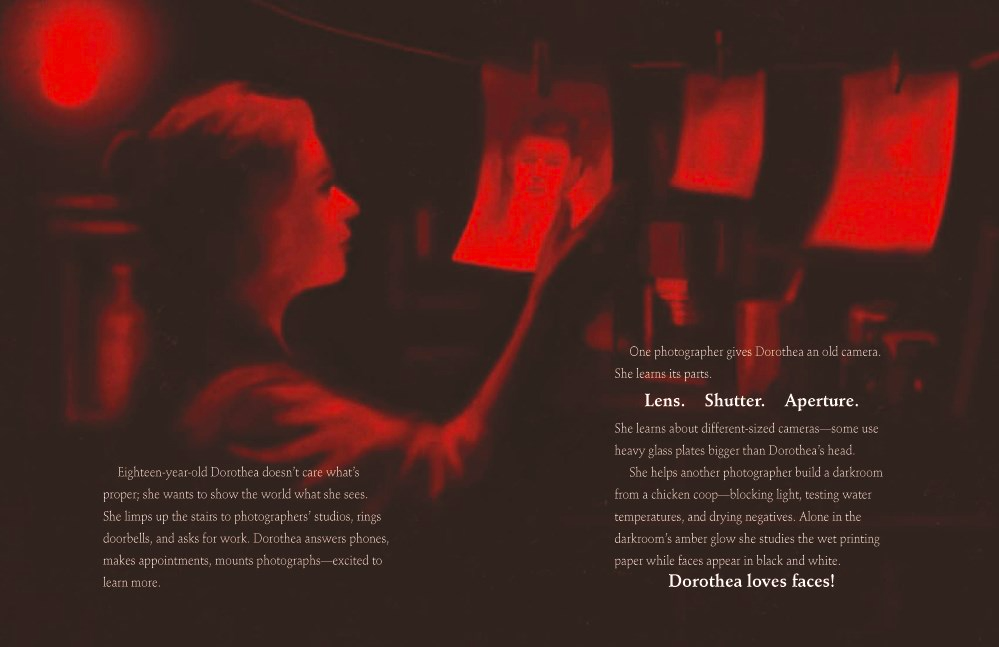
When Dorothea grows up she decides to become a photographer. Her family is surprised because it’s not a ladylike profession. She’s determined, thought, and works any job she can find in the photography industry, learning about cameras, darkrooms, negatives, and the printing process. “Alone in the darkroom’s amber glow, she studies the wet printing paper while faces appear in black and white. Dorothea loves faces!”

celebrate-picture-books-picture-book-review-dorothea's-eyes-great-dark-room

Image copyright Gérard DuBois, 2016, text copyright Barb Rosenstock, 2016. Courtesy of Calkins Creek.

As a young woman Dorothea travels west to San Francisco. There, her money is stolen, so she stays, gets a job, and starts her own portrait studio. Her work makes her famous and the richest families in California seek her out to take their photos. She makes money, gains friends, gets married, and starts a family of her own. But she always wonders, “Am I using my eyes and my heart?”

celebrate-picture-books-picture-book-review-dorothea's-eyes-great-depression

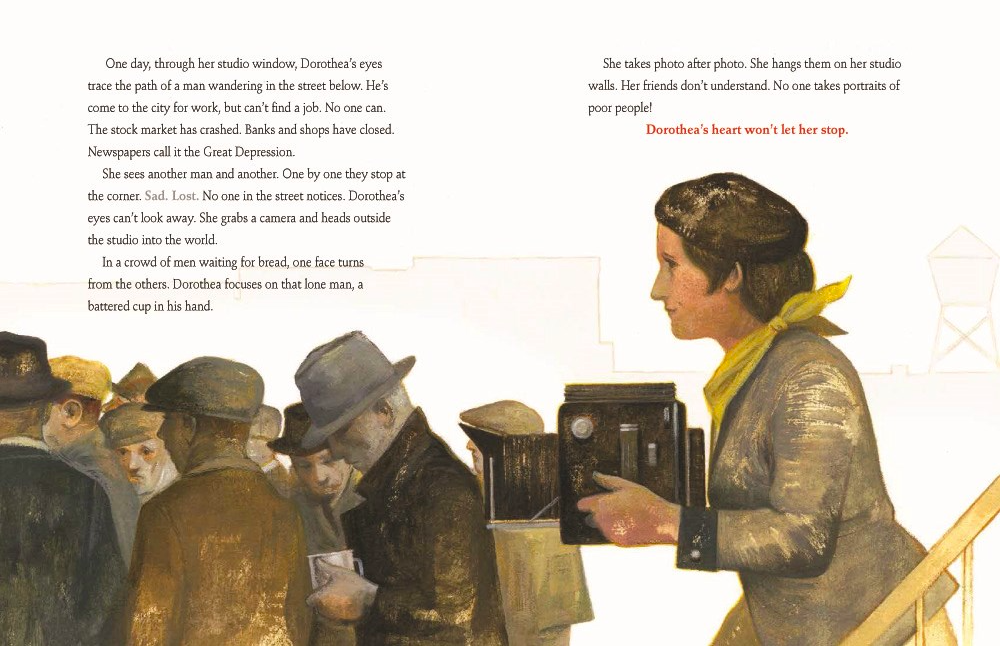
Image copyright Gérard DuBois, 2016, text copyright Barb Rosenstock, 2016. Courtesy of Calkins Creek.

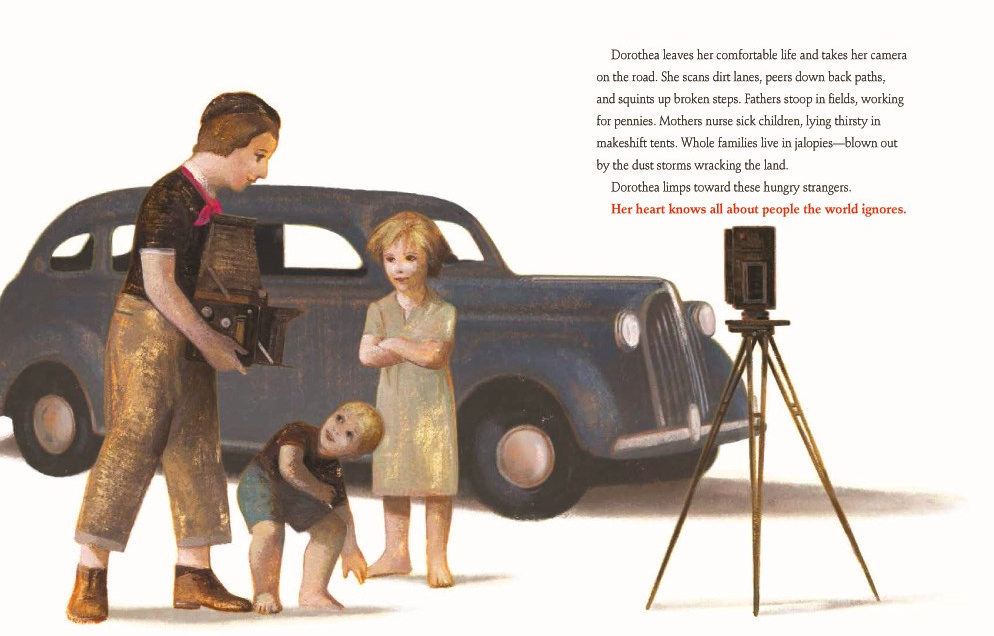
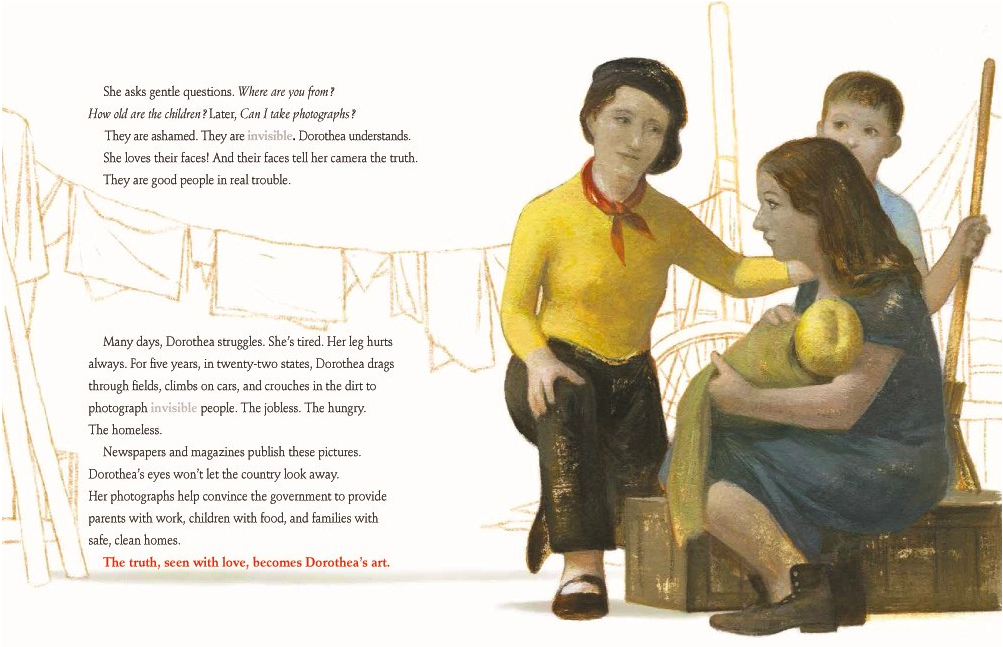
When the stock market crashes and the Great Depression sweeps the country, Dorothea focuses her camera on the desperate and the downtrodden. Her friends don’t understand, but Dorothea sees into these poor people’s hearts. She “knows all about people the world ignores.” For five years she goes out into the fields, peers into tents, documents families living in their cars, crouches in the dirt to reveal the stories of the people struggling with the devastation wrought by the Dust Bowl.

celebrate-picture-books-picture-book-review-dorothea's-eyes-kids

Image copyright Gérard DuBois, 2016, text copyright Barb Rosenstock, 2016. Courtesy of Calkins Creek.

Newspapers and magazines publish her pictures. “Her photographs help convince the government to provide parents with work, children with food, and families with safe, clean homes. “The truth, seen with love, becomes Dorothea’s art.” Dorothea’s photographs are still known today. Their subjects continue to help us see others with our hearts.

Backmatter includes six of Dorothea Lange’s most famous and recognizable photographs—ones that are still as riveting today as they were in the 1930s. Further information on her life and work is provided as well as sources where her photographs can be viewed, resources for further study, and a timeline of her life.

celebrate-picture-books-picture-book-review-dorothea's-eyes-san-francisco

Image copyright Gérard DuBois, 2016, text copyright Barb Rosenstock, 2016. Courtesy of Calkins Creek.

Barb Rosenstock brings Dorothea Lange’s vision to the page with love, honesty, and understanding in this excellent biography of a woman whose photographs defined the Great Depression and Dust Bowl era. Lange’s life-long connection to the poor and often overlooked people of the world is beautifully described and explained in a gentle, compassionate way that will resonate with children. Rosenstock’s language is lyrical with staccato sentences that echo the clicks of Lange’s shutter capturing life’s reality with her eyes and her heart.

Gérard DuBois’s illustrations are arresting and set Dorothea Lange’s story firmly in its historical and emotional landscape. Rendered in acrylic and digital imagery, they feature the muted colors and style of book illustrations from long ago. By placing the images of Dorothea, her family, and her photography subjects against white backgrounds, DuBois emphasizes Lange’s focus on the people she met and faces that inspired her. Distressed textures accentuate the troubled times and the anguish of both Dorothea and her subjects.

Ages 7 – 12

Calkins Creek, 2016 | ISBN 978-1629792088 (Hardcover, 2018) | ISBN 978-1635925630 (Paperback, 2022)

Paperback edition will be released on February 1, 2022. The book is available for preorder now.

Discover all the amazing books by Barb Rosenstock on her website!

View a portfolio of art and book illustration by Gérard DuBois on his website!

Enjoy a snapshot of Dorothea’s Eyes!

World Photography Day Activity

CPB - New Professionals Picture

News Professionals Clothespin Figures


Make one of these clothespin figures that honors the men and women photographers and writers who work to keep the world informed.

Supplies

Directions

  1. Draw a face and hair on the clothespin
  2. Cut out the clothes you want your journalist or photographer to wear
  3. Wrap the clothes around the clothespin. The slit in the clothespin should be on the side.
  4. Tape the clothes together
  5. Cut out the camera
  6. Tape one end of a short length of thread to the right top corner of the camera and the other end of the thread to the left corner. Now you can hang the camera around the figure’s neck.

Idea for displaying the figures

  • Attach a wire or string to the wall and pin the figure to it
  • Pin it to your bulletin board or on the rim of a desk organizer

celebrate-picture-books-picture-book-review-dorothea's-eyes-cover

You can find Dorothea’s Eyes: Dorothea Lange Photographs the Truth at these booksellers

Amazon | Barnes & Noble | Books-a-Million

To support your local independent bookstore, order from

Bookshop | IndieBound

Picture Book Review
July 20 – Celebrating Park and Recreation Month with Chana Stiefel

celebrate-picture-books-picture-book-review-one-question-interview-chana-stiefel-in-front-of-statue-of-liberty

Chana Stiefel is the author of more than 25 books for children, both fiction and nonfiction. Her most recent picture book is LET LIBERTY RISE (illustrated by Chuck Groenink, Scholastic, 2021), the true story of how children helped build the Statue of Liberty. Her next nonfiction picture book, THE TOWER OF LIFE, is the biography of Yaffa Eliach, a Jewish historian and survivor of the Holocaust who rebuilt her village in stories and photos to create the Tower of Faces in the U.S. Holocaust Memorial Museum in Washington, DC (illustrations by Susan Gal, Scholastic, 2022). Other picture books by Chana include MY NAME IS WAKAWAKALOCH!, illustrated by Mary Sullivan (HMH, 2019) and DADDY DEPOT, illustrated by Andy Snair (Feiwel & Friends, 2017).

You can connect with Chana Stiefel on Her website | Facebook | Instagram | Twitter

Welcome, Chana! I’m really glad to have you joining me for a one-question interview this summer! As the Statue of Liberty National Monument is part of the National Park System, Let Liberty Rise! is a perfect book for celebrating Park and Recreation month, which encourages people to get out and enjoy America’s beautiful national parks and all they have to offer. 
I know how much you love to connect with your readers. Can you talk about a poignant thing that happened during one of your visits this year?

My newest picture book Let Liberty Rise! How America’s Schoolchildren Helped Save the Statue of Liberty (illustrated by Chuck Groenink) launched from Scholastic on March 2nd. Soon afterward, I received a phone call from the youth director at a local synagogue asking if I’d be interested in doing an in-person reading to children on a Circle Line Cruise to the Statue of Liberty.

I nearly dropped the phone. 

“It will be socially distanced and everyone will be masked,” she said. “The event will be on Passover [the holiday of freedom]. Maybe you can talk to the kids about the meaning of liberty?”

“So let me get this straight,” I replied. “You’re asking if I would like to read my book about the history of the Statue of Liberty to children in front of the statue herself?” Having received my second vaccine, my answer was an emphatic, “YES! OMG, YES!” 

celebrate-picture-books-picture-book-review-one-question-interview-chana-stiefel-in-front-on-ferry

On April 1st, anchors away! My family and I joined over 100 people on the Circle Line’s maiden cruise in the wake of the Coronavirus, including Jim Morgan, owner of the Curious Reader bookshop, who helped me with a book signing. For the first time since the pandemic began, I shared with children (real, live children!) the story of how, in 1885, school children contributed their hard-earned pennies to build the pedestal of America’s most beloved statue. 

And then, there we were! Floating on a boat at the base of the Statue of Liberty. It was magical.

celebrate-picture-books-picture-book-review-one-question-interview-chana-stiefel-giving-talk

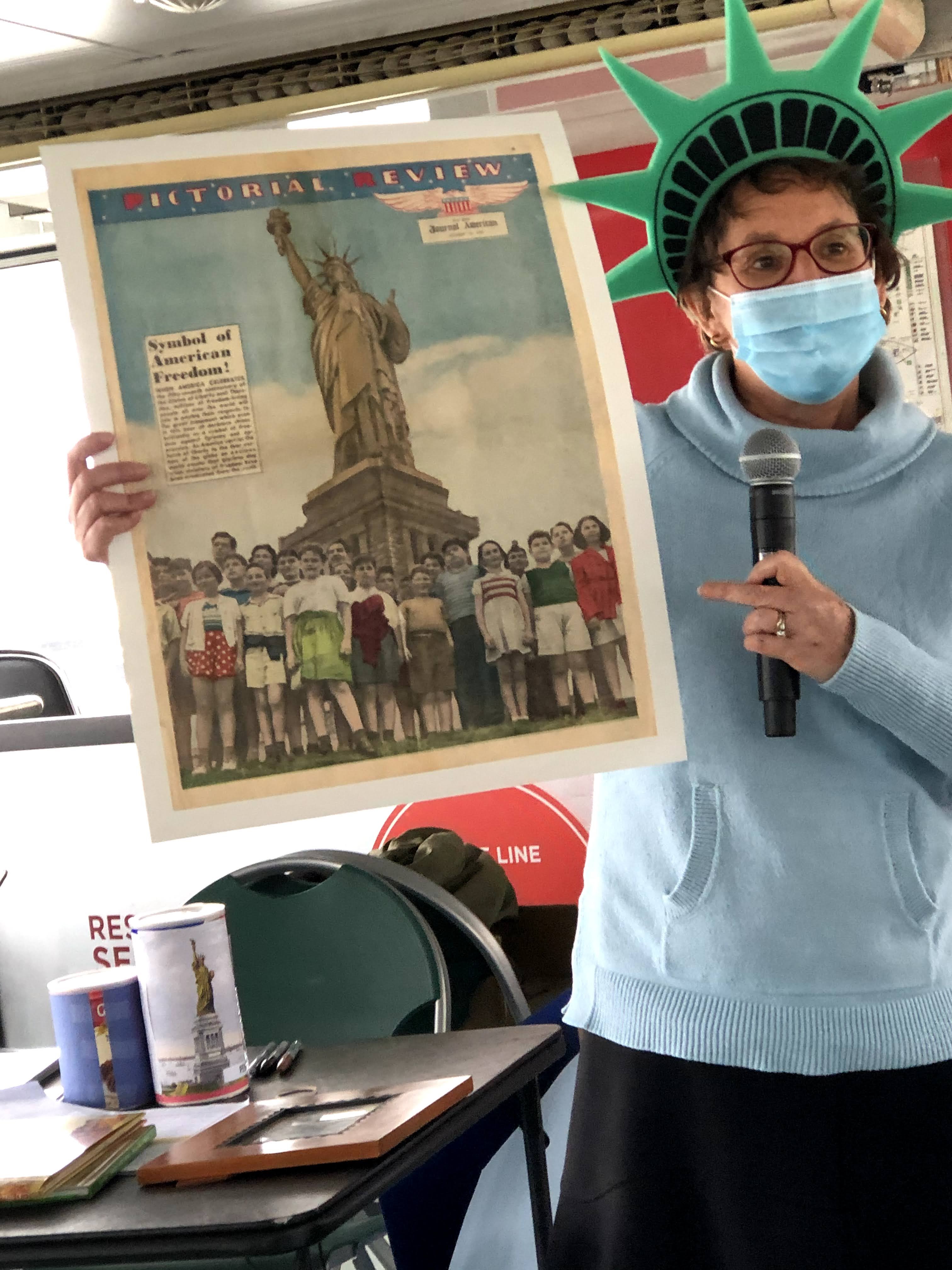
On our return to dock, I shared with the children the story of my late mother-in-law, Hannelore Guthof Stiefel, who escaped Nazi Germany as a young child. She arrived with her parents in New York City in 1941. One of our family’s most cherished possessions is a full page of the Journal American newspaper from October 24, 1943. It shows 11-year-old Hannelore in a red and white striped dress as a new immigrant standing with her classmates in front of the Statue of Liberty! Hannelore grew up and married my father-in-law Arnold Stiefel, also a German Jewish immigrant, who then returned to Germany as an American soldier. They moved to Bergenfield, NJ, where they became the 18th family to join Congregation Bnai Yeshurun (CBY)—the very same synagogue that invited me on the boat cruise. CBY, by the way, now has over 600 families! 

So there you have it: At the tail end of this terrible pandemic, a live reading to children at the base of the Statue of Liberty with my family’s immigration story.

Talk about liberty!

What a fabulous, unforgettable experience – for you and the kids! Thanks so much for sharing it and your wonderful pictures! 

celebrate-picture-books-picture-book-review-let-liberty-rise-cover

Let Liberty Rise! How America’s Schoolchildren Helped Save the Statue of Liberty

Written by Chana Stiefel | Illustrated by Chuck Groenink


When Lady Liberty arrived in New York after a long voyage from France, her unassembled parts sat in crates instead of standing tall over the harbor. Why? No one wanted to pay for the pedestal needed to give her a strong foundation. Upset about people’s disinterest, Joseph Pulitzer announced that he would publish the names of every person who donated to the cause – no matter how much or how little they gave. Children answered the call, and their pennies, nickels, and dimes rolled in, eventually adding up to the $100,000 needed to build the pedestal.

Now everyone could see America’s monument to “freedom and hope,” and the Statue of Liberty welcomed the immigrants who sailed to our shores in steamships from around the world. Today, Lady Liberty still stands “thanks to the contributions of people all across America — and children just like you.” 

celebrate-picture-books-picture-book-review-let-liberty-rise-face

Image copyright Chuck Groenink, 2021, text copyright Chana Stiefel, 2021. Courtesy of Scholastic.

Chana Stiefel raises children’s empowerment, excitement, and pride in what they can achieve in her uplifting true story of how children were instrumental in building the foundation for the Statue of Liberty. Her straightforward, conversational storytelling shines and the inclusion of quotes from children’s letters at the time will impress and charm today’s kids. 

Chuck Groenink’s delightful mixed-media illustrations inform readers on every page about the time period surrounding, the personalities involved in, and the scale of the project to build the pedestal for the Statue of Liberty. Images of kids donating their hard-earned change, knitting socks to sell, sacrificing candy and trips to the circus, and creating special clubs to raise money will remind today’s charitable readers that they are carrying on a proud tradition to make a difference to their community and their country. 

Ages 6 – 9

Scholastic Press, 2021 | ISBN 978-1338225884

Discover more about Chana Steifel and her books on her website.

You can learn more about Chuck Groenink, his books, and his art on his website.

Check out these other picture books and middle grade books by Chana!

celebrate-picture-books-picture-book-review-my-name-is-wakawakaloch-cover celebrate-picture-books-picture-book-review-daddy-depot-cover

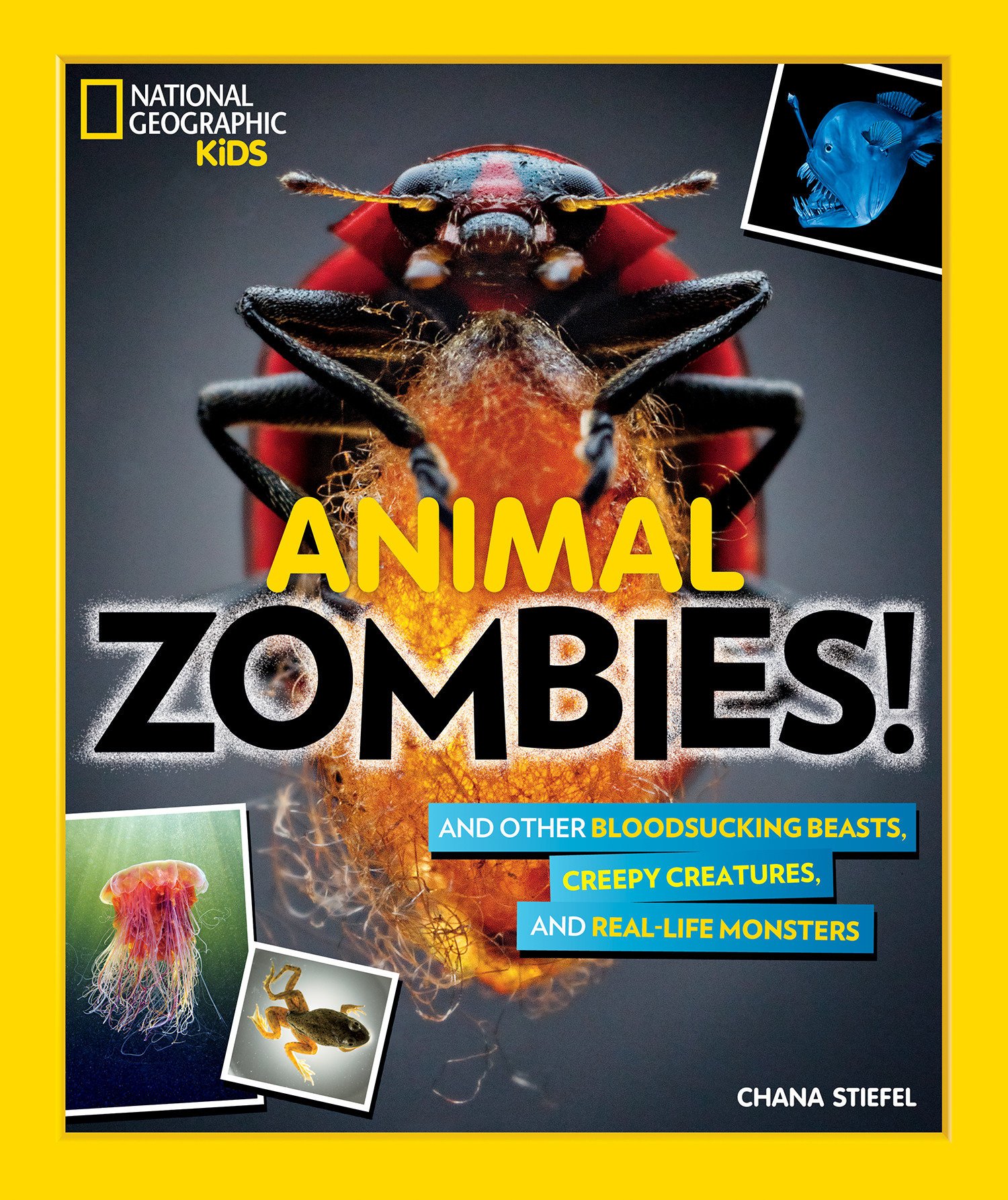
celebrate-picture-books-picture-book-review-animal-zombies-cover celebrate-picture-books-picture-book-review-tsunamis-cover

celebrate-picture-books-picture-book-review-let-liberty-rise-cover

You can find Let Liberty Rise! at these booksellers

Amazon | Barnes & Noble | Books-a-Million

To support your local independent bookstore, order from

Bookshop | IndieBound

Picture Book Review