March 12 – It’s Spiritual Wellness Month

celebrate-picture-books-picture-book-review-the-berenstain-bears-and-the-easter-story-cover

About the Holiday

The definition of spiritual wellness is unique to each person. When you think deep down about what gives your life purpose, meaning, and happiness, what do you find? This month encourages people to discover if their beliefs, activities, work, family relationships and friendships are all in harmony. It’s also important to take care of you, by taking time to reflect each day and to plan fun and relaxing activities. Springtime and Easter are opportunities for renewal, making March a great time to consider your spiritual wellness.

Zonderkidz sent me a copy of today’s book to check out. All opinions are my own. 

The Berenstain Bears and the Easter Story

Written by Jan and Mike Berenstain


On the way to Sunday school one spring morning, the warm sun was shining, daffodils were blooming, and birds were feeding their babies, but all Brother, Sister, and Honey Bear could think about was Easter candy. As they entered their classroom, Brother said his favorite Easter candy was chocolate bunnies, Sister said hers was marshmallow chicks, and Honey Bear cried “‘Jelly beans!’” Then Missus Ursula revealed that her favorite was black jelly beans, but also that Easter is about more than candy.

Brother and Sister said they knew that. Easter was about “‘stuff in the Bible,’” Brother told Missus Ursula. “‘Yeah,’ agreed Sister. ‘Bible stuff.’” And Honey Bear added, “‘Stuff!’” Missus Ursula thought the cubs’ understanding could use a little more rounding out, so she took them into the next classroom, where the older bear cubs were putting on a play.

celebrate-picture-books-picture-book-review-the-berenstain-bears-and-the-easter-story-candy

Copyright Jan and Mike Berenstain, 2012, courtesy of Zondervan.

The stage was set with props of palm trees, rocks, and buildings from the Holy Land, and cubs were dressed in costumes. One of the performers began telling the Easter story. “‘Long ago, in the Holy Land, there was a man named Jesus. He traveled the countryside teaching about God and what God wanted for his people.’” The narrator went on to tell about Jesus’s miracles and how “‘he could do these wonderful things because he was the Son of God.’”

Because many people listened to Jesus and followed him, government officials and others were angry. They didn’t believe he was the Son of God and were afraid that Jesus wanted to become the king. One day Jesus rode into the city of Jerusalem on a donkey and crowds greeted him with shouts of “‘Hosanna!’” The leaders of Jerusalem believed Jesus was becoming too powerful.

One night while Jesus was praying in a garden, “‘soldiers were sent to arrest him. They took him away to prison.’” Later, he was questioned by a “‘wicked judge…who wanted to show everyone that Jesus was not a king.’” Then “‘he ordered for Jesus to be put to death by hanging on a wooden cross.’” On the day Jesus died, the skies became black and the wind howled. Everyone was afraid.

After Jesus died, he was taken by his friends and put in a tomb. A huge stone was rolled in front of the entrance. For two days Jesus lay in the tomb. “‘On the morning of the third day after Jesus died, some women who knew Jesus came to weep at his tomb.’” When they got there, they saw that the stone had been rolled away. Jesus was no longer in the tomb. “‘An angel told the women not to be afraid. He told them that Jesus was alive once more.’”

celebrate-picture-books-picture-book-review-the-berenstain-bears-and-the-easter-story-missus-ursula

Copyright Jan and Mike Berenstain, 2012, courtesy of Zondervan.

In the days and weeks after Jesus rose, he visited his friends. “‘They were amazed and fell down and worshiped him. Jesus told them they should spread the good news about what had happened.’” After visiting with his friends, “‘Jesus rose up to heaven to be with God, his Father.’” Following the play, the cubs understood that Easter is about more than candy. But “‘does this mean we shouldn’t eat any Easter candy?’” Brother asked.

“‘Certainly not!’ laughed Missus Ursula’” and confessed that she’d miss her jelly beans too. But she reminded the cubs that after they got their Easter baskets, they go to church to celebrate the real meaning of Easter. “‘Hooray!’ the cubs said. ‘And Hosanna!’ added Missus Ursula. ‘He is risen!’”

A page of colorful stickers depicting images from the story are included, and discussion questions and fun activities related to the book follow the text and may inspire kids to put on a play of their own.

Since the early 1960s, the Berenstain Bears have been delighting readers with their shenanigans, wit, and always-close family relationships. In The Berenstain Bears and the Easter Story, part of the Living Lights series, these beloved characters talk about and reveal to children the deeper meaning of Easter, with a focus on Jesus’s resurrection. The straightforward telling of the Easter story through a Sunday school play is welcome for parents, caregivers, and other adults who are looking for a book to share and a way to talk about both the religious and the fun aspects of this holiday with children. The dialogue-rich structure also lends a personal touch to any reading, letting the adult sound as if they are telling the story themselves.

The illustrations of Bear Country are bathed in the warm glow of spring as the sun rises over the Bear’s tidy treehouse home. Brother’s, Sister’s, and Honey Bear’s dreams of candy will enchant little ones as will the familiar scene of walking into church on Easter morning. Depictions of the play are vibrant and detailed but with a homey and childlike feeling to the props and acting.

For adults looking for a traditional, Bible-centered telling of the Easter story with engaging  characters that children will respond to, The Berenstain Bears and the Easter Story is a superb choice for home and church libraries.

Ages 4 – 7

Zonderkidz, 2012 | ISBN 978-0310720874

To learn more about Bear Country and all of The Berenstain Bears books as well as to find fun activities visit the Berenstain Bears’ website.

You can follow the Berenstain Bears on:

Facebook | Instagram | Twitter

Spiritual Wellness Month Activity

celebrate-picture-books-picture-book-review-sweet-bunny-candy-jar

Sweet Bunny Candy Jar


A little bit of candy makes Easter or any spring day sweeter! With this Sweet Bunny Candy Jar, you can give a child, a friend, or even yourself a special treat that will make you hoppy!

Supplies

  • Printable Hat Rim and Bunny Ears Template
  • Baby food jar (I used a Beech-Nut Naturals jar)
  • White fleece, 8 ½ inches by 11 inches
  • 1 piece of purple foam (Or any color you’d like to make the hat)
  • Small piece of pink foam or felt for nose
  • Googly eyes (I used oval)
  • Medium pom-pom
  • Multi-surface paint, purple (or whatever color you’d like to make the hat)
  • Fabric glue (I used Fabric-Tac)
  • Black ultra-fine or fine tip permanent marker
  • Large nail or ice pick
  • Hammer
  • Scissors

IMG-2614

Directions

  1. Remove label from baby food jar
  2. Clean and dry jar and lid
  3. Trace the hat rim template onto the purple foam
  4. Cut out the rim of the hat and remove the center
  5. Trace the ears template onto the white fleece and cut out

To Make the Body and Face

  1. Cut a 2-inch wide by 7-inch long strip of white fleece
  2. Glue the strip of fleece to the jar under the lip and leaving about ½ inch of glass showing at the bottom
  3. Glue on the googly eyes
  4. Cut a little nose from the pink foam and glue to the face
  5. Make the mouth with the permanent marker on a little piece of fleece, cut out and glue under the nose

To Make the Hat

  1. Paint the lid with the purple paint. Let dry.
  2. With the nail or ice pick and hammer, make a hole on either side of the lid to insert the ears. You can make the hole a little bigger with a phillips head screwdriver
  3. Flip the lid over and hammer the edges of the hole flat
  4. Trace the hat rim template onto the purple foam

To Insert the Ears

  1. Pinch the end of one ear together and push it through one hole in the lid.
  2. Pull it through the hole a bit to form the ear
  3. Repeat with the other ear

Finish the Bunny

  1. Add the foam rim to the lid
  2. Glue the pom-pom to the back of the jar for the tail
  3. Add M&Ms, jelly beans, or other small candy

Picture Book Review


March 11 – Worship of Tools Day

celebrate-picture-books-picture-book-review-whose-tools-cover

About the Holiday

What would we do without tools? Handheld and big machinery devices help us create buildings, artwork, crafts, and furniture; cook delectable meals; tend the garden; and keep our vehicles and homes in tip-top shape. Even animals use sticks, rocks, and their own paws as tools to get food and build homes. To celebrate today’s holiday make sure your tools are all in order and working, or if you’ve had your eye on a new tool, treat yourself!

Whose Tools?

Written by Toni Buzzeo | Illustrated by Jim Datz


There’s a lot of building going on! Where to start? Well, that depends…. “To build a house, start down low” and use these tools: the chalk line, the chisel, the jointer, and the float. “Whose tools are those? The mason’s!” What does he use them for? He’ll tell you himself: “I smooth the cement until it’s flat.” Where do windows go? Way up high! Here are the hammer, the level, the square, and the saw. Can you guess who uses those tools? They belong to the carpenter! He’s cutting the frame where the windows will go.

celebrate-picture-books-picture-book-review-whose-tools-foundation

Image copyright Jim Datz, 2015, text copyright Toni Buzzeo, 2015. Courtesy of Harry N. Abrams Books for Young Readers.

It’s important that a house stays dry in rain and snow. What tools help with that? The utility knife, the snips, the nail gun, and the ladder. “Whose tools are those? Do you know?” They’re the roofer’s! What does she do with them? She climbs to the top of the house and nails “the shingles in straight rows.” A house can’t be dark, so the workers will “add some lights that softly glow.” They’ll use a screwdriver, a drill, a linesman pliers, and a wire stripper. Who are they? They’re the electricians! One electrician is busy stringing “the wire from switches to lights.”

celebrate-picture-books-picture-book-review-whose-tools-mason

Image copyright Jim Datz, 2015, text copyright Toni Buzzeo, 2015. Courtesy of Harry N. Abrams Books for Young Readers.

A house needs water too! What kinds of tools are used for that? An adjustable wrench, a pipe cutter, pipe tape, and a pipe wrench. And who uses these tools? The plumber! He turns “the pipe elbows until they’re tight” so there are no leaks! The house is almost finished, and now “on all four walls bright colors flow.” What tools are used to make such a pretty house? A brush, a roller, a roller tray, and masking tape. And who uses them? The painter! Right now she’s putting another coat of green paint on the wall. “The house is still not finished, though. Who’s come to build?” Surprise! “It’s you!”

celebrate-picture-books-picture-book-review-whose-tools-roof

Image copyright Jim Datz, 2015, text copyright Toni Buzzeo, 2015. Courtesy of Harry N. Abrams Books for Young Readers.

Children are naturally curious about the tools, utensils, and machinery they see adults using. Toni Buzzeo’s delightful board book introduction to twenty-four tools for the youngest readers will capture their interest and imagination with fun prompts and a house-construction project in process. Buzzeo’s enthusiastic language and guess-who format invites multiple readings during which little ones are sure to memorize the names of all the tools and recognize them in the “real world” when they see them.

celebrate-picture-books-picture-book-review-whose-tools-roof-fold-out

Image copyright Jim Datz, 2015, text copyright Toni Buzzeo, 2015. Courtesy of Harry N. Abrams Books for Young Readers.

Through Jim Datz’s cheery illustrations, kids watch as a cozy house comes together from foundation to finished as they learn the shape of each tool and see some being used. Questions are introduced on the left-hand page while the particular tools, drawn with sweet, smiling faces, are named on the right. This page opens to a double spread in which both men and women workers are busily and happily plying their trade. The final image will bring a giggle from kids as they discover that the house being built is actually a house of blocks being carefully constructed by a little girl and boy.

Whose Tools? would make a welcome baby gift and a fun addition to home and preschool libraries for little tool lovers.

Ages 2 – 4

Harry N. Abrams, 2015 | ISBN 978-1419714313

Discover more about Toni Buzzeo and her books on her website.

To view a portfolio of artwork by Jim Datz, visit his website

Worship of Tools Day Activity

Tool-Box-Coloring-Page-[www.getcoloringpages.com]

Terrific Tools! Coloring Pages


Tools are terrific when you need to fix something old or build something new! Have fun coloring these tools and their toolbox!

Saw | Wrench | Toolbox

Picture Book Review
March 10 – It’s National Women’s History Month

celebrate-picture-books-picture-book-review-maya-lin-artist-architect-of-light-and-lines-cover

 About the Holiday

This month we celebrate the accomplishments of women in the past who have broken barriers and forged paths for today’s women and who still inspire the leaders of tomorrow. To honor women this month, learn more about the influential woman in your own field or in areas you enjoy as hobbies and teach your children about the women who made incredible contributions to the world long ago and those who are changing the way we live today.

Maya Lin: Artist-Architect of Light and Lines

Written by Jeanne Walker Harvey | Illustrated by Dow Phumiruk


As a child, Maya Lin loved playing and interacting with nature near her home. She and her brother liked to run over what Maya had named “the Lizard’s Back”—a hill behind her house—and into the woods. Sometimes Maya went into the woods alone and “sat as still as a statue, hoping to tame rabbits, raccoons, chipmunks, and squirrels.” She liked to play chess with her brother and build towns from scraps of paper, boxes, books, and other things she found around the house.

celebrate-picture-books-picture-book-review-maya-lin-artist-architect-of-light-and-lines-in-forest

Image copyright Dow Phumiruk, 2017, text copyright Jeanne Walker Harvey, 2017. Courtesy of us.macmillan.com.

Maya’s “parents had fled China at a time when people were told what to be and how to think.” They did not want the same for their children and always encouraged Maya to be and think what she wanted. Maya grew up surrounded by art. Her father worked with clay, and her mother was a poet. Maya also liked to make things with her hands. The beautiful library where she went to college inspired Maya to become an architect.

To learn about different buildings, Maya traveled all over the world. When she was only a senior in college, “Maya entered a contest to design a memorial to honor soldiers who died during the Vietnam War.” The contest stated two rules: the memorial had to fit in with a park-like setting, and it had to include the 58,000 names of the soldiers who had died in the war. These rules resonated with Maya. She “believed that a name brings back all the memories of a person, more than a photo of a moment in time.”

celebrate-picture-books-picture-book-review-maya-lin-artist-architect-of-light-and-lines-as-young-girl

Image copyright Dow Phumiruk, 2017, text copyright Jeanne Walker Harvey, 2017. Courtesy of us.macmillan.com.

Maya visited the site where the memorial would be built. As she looked at the gently rolling hill, she envisioned a simple cut in the earth that would support a polished wall covered in names. Not only would the wall reflect those who died, but also those who came to visit and the surrounding nature. At school, Maya worked with mashed potatoes and then with clay to help her create the perfect monument. When she had finished her drawings and plans, she wrote an essay to accompany them. She wrote that her monument would be “a place to be experienced by walking down, then up past names that seemed to go on forever.”

celebrate-picture-books-picture-book-review-maya-lin-artist-architect-of-light-and-lines-with-parents

Image copyright Dow Phumiruk, 2017, text copyright Jeanne Walker Harvey, 2017. Courtesy of us.macmillan.com.

More than 1,400 artists and architects—many of them famous—entered the contest. The designs were hung in an airplane hangar anonymously for judging. Finally, the day came for the announcement of the winner. When the judges called out Maya Lin’s name and she came forward, they were surprised to find that she was so young. Maya was excited to have won, but then some people began to object to her design. Some said her “design looked like a bat, a boomerang, a black gash of shame.”

celebrate-picture-books-picture-book-review-maya-lin-artist-architect-of-light-and-lines-library

Image copyright Dow Phumiruk, 2017, text copyright Jeanne Walker Harvey, 2017. Courtesy of us.macmillan.com.

Maya was hurt by these comments, but she defended her design and, finally, it was approved. Maya worked with the architects and engineers who excavated the land and built the wall. As each granite panel was polished, engraved with the soldiers’ names, and set in place, Maya looked on. The memorial opened on Veterans Day in 1982. Thousands of people came to see it and to find the names of loved ones they had lost. As Maya approached the wall, “she searched for the name of the father of a friend. When she touched the name, she cried, just as she knew others would.” Every day since then visitors come to the wall to remember.

Maya Lin has gone on to design many more works of art and architecture that can be seen inside and outside. Each piece has a name and a particular vision. Maya wants people to interact with her art—to touch it; read, walk, or sit near it; or think about it. After each piece is finished, Maya thinks about her next work and how she can inspire the people who will see it.

celebrate-picture-books-picture-book-review-maya-lin-artist-architect-of-light-and-lines-Vietnam-War-Memorial

Image copyright Dow Phumiruk, 2017, text copyright Jeanne Walker Harvey, 2017. Courtesy of us.macmillan.com.

An Author’s Note about Maya Lin and the Vietnam War Memorial follows the text.

Jeanne Walker Harvey has written an inspiring biography of Maya Lin that reveals not only her creativity but the importance of creative freedom for children. Lin’s confidence that led her to enter the contest and then defend her winning design will encourage readers to pursue their dreams. Harvey’s lyrical storytelling reflects Maya Lin’s quiet, introspective nature, the influences that nurtured her creative spirit, and her dedication to inviting others to be part of her art.

Dow Phumiruk’s graceful, soft-hued illustrations allow children to follow Maya Lin as she grows from a girl discovering nature, constructing cardboard cities, and learning the arts from her parents to a young woman who draws inspiration from the world’s buildings and relies on her own sensitivity to guide her. Back-to-back pages of the landscape of Vietnam and the site of the memorial connect the two places for children’s better understanding. Phumiruk’s depictions of the Vietnam War Memorial also give children an excellent view of this moving monument. Her images of Lin’s other architectural work will entice young readers to learn more about her and to explore where each of these pieces can be found.

Ages 4 – 8

Henry Holt & Company Books for Young Readers, 2017 | ISBN 978-1250112491

Discover more about Jeanne Walker Harvey and her books on her website!

Learn more about Dow Phumiruk, her art, and her books on her website!

National Women’s History Month Activity

 celebrate-picture-books-picture-book-review-maya-lin-coloring-page

Maya Lin Coloring Page

Maya Lin’s accomplishments are inspirational for all children! Here’s a printable coloring page that you can personalize and hang in your room or locker to remind you that you can reach your goals too!

Maya Lin Coloring Page

Picture Book Review
March 9 – It’s National Reading Month

celebrate-picture-books-picture-book-review-somewhere-else-cover

About the Holiday

Hosting Read across America Day, March is the perfect month to celebrate reading! Reading is one of life’s great joys! Reading with children every day is one of the best ways to develop language and literacy skills that promote future success in school and beyond. Even if your child isn’t talking yet, they’re listening and learning about their language as you read to them. You can get kids enthusiastic about reading by setting up a bookcase specially for them and letting them choose the books they want to read. To celebrate this month, why not go on a book hunt and bring home some new books to enjoy together?

Somewhere Else

By Gus Gordon


There are birds that fly north and those that fly south. There are birds that take the bus and those that don’t care how they travel just so long as they go somewhere. And then there’s George Laurent. “George never went anywhere.” He told himself that he liked his home and his garden and, especially, the pastries he baked in his oven better than anything or anywhere else.

It wasn’t like he never saw anyone. His “friends were always dropping by on their way to somewhere else” to enjoy his delicious treats. And they often invited George to fly away with them. When Penelope Thornwhistle was reminded of the Andes while eating one of his éclairs, she asked George to go with there with her. But George had potentially award-winning brownies in the oven. When Walter Greenburg tasted George’s apple strudel and thought about Paris, he was ready to take George to see the city of lights, but George had ironing to do. And a trip to the Alaskan tundra with a flock of other ducks had to be postponed because of yoga class.

celebrate-picture-books-picture-book-review-somewhere-else-map

Copyright Gus Gordon, 2017, courtesy of us.macmillan.com.

As time went on, everyone stopped asking George to share their adventures. They knew he was too busy anyway. When winter came, “George found himself alone.” At least until Pascal Lombard, came knocking, looking for a place to spend the snowy months. When the bear wondered why George wasn’t sunning himself on some Caribbean beach, George said he was learning Flamenco songs on his guitar, catching up on the TV series Lost in Space, and typing out his memoirs.

But Pascal reminded George that he didn’t have a guitar or a television and that he hadn’t yet done anything worthy of a memoir. It was then that George made his confession: he didn’t know how to fly. When all the other ducks had learned to fly, he said, he had been too busy with something else. “He had been making excuses not to fly, ever since.”

celebrate-picture-books-picture-book-review-somewhere-else-andes

Copyright Gus Gordon, 2017, courtesy of us.macmillan.com.

Well, Pascal was ready to remedy the situation. Fortunately, he had an “uncanny knack for solving tricky problems.” They tried reading books, taking wing on a kite, and using a crane. But nothing worked. “It turned out Pascal Lombard didn’t have much of a knack for solving tricky problems after all.” Both George and Pascal felt disappointed as they read by the fire, until George happened to peek at Pascal’s newspaper and see an announcement for a hot air balloon ride in Paris.

celebrate-picture-books-picture-book-review-somewhere-else-making-balloon

Copyright Gus Gordon, 2017, courtesy of us.macmillan.com.

George was intrigued. And Pascal said, “‘I am remarkably good with my hands! We can build it!’” So they set to work, but it was harder than they thought, and “it took all winter (it turned out Pascal Lombard wasn’t actually very good with his hands).” Finally, though, they were flying! They flew their red patchwork balloon for months, seeing the Eiffel Tower, floating over the Arctic Circle, soaring through Madagascar, and experiencing places that were “more exciting than they had ever imagined.” But still, they missed George’s homemade pie. So they flew home, enjoyed tea and pie, and planned next year’s “anywhere somewhere else” adventure.

celebrate-picture-books-picture-book-review-somewhere-else-flying-in-balloon

Copyright Gus Gordon, 2017, courtesy of us.macmillan.com.

Gus Gordon’s tenderhearted and funny story about missed opportunities that can lead to more missed opportunities, excuses, and sometimes isolation tackles a common predicament not often seen in children’s books. George’s amusing tales of loads of laundry, Flamenco lessons, and yoga classes as well as his real talent for baking will endear George to readers, making his admission a moment for true empathy and encouragement. More silliness ensues as Pascal tries to help out, and kids will cheer when the two finally get off the ground.

Gordon’s reassurance that there’s no shame in making mistakes or not knowing something is also found in Pascal’s bravado and subsequent asides to the contrary. As George and Pascal work together to teach George to fly, kids see that help can be as close as a good friend—and as fun. A welcome undertone to the story is the idea that it’s also okay to be yourself: the first page abounds with very unique birds flying here and there; for Penelope an éclair reminds her of the Andes and for Walter, strudel reminds him of Paris—and who’s to say they’re wrong?; and when George and Pascal miss home and homemade goodies, they return to their favorite place.

celebrate-picture-books-picture-book-review-somewhere-else-george-in-kitchen

Copyright Gus Gordon, 2017, courtesy of us.macmillan.com.

Gordon’s illustrations are a treat too. Full of visual humor and word play, the mixed-media, collage-style images bring together snippets of old advertising, photography, and traditional mediums and invite readers to linger to catch all the humor included. The page on which George finally makes his confession is worthy of special note. Here, in contrast to the other pages, the background is white, a saddened George is simply sketched with a blue outline, and the stack of firewood he was carrying lies haphazardly at his feet. The image gives children and adults an opportunity to talk about feelings of embarrassment, doubt, or uncertainty.

Somewhere Else is an original story with heart, humor, and an uplifting lesson that would make a sweet and meaningful addition to classroom and home libraries.

Age 4 – 8

Roaring Brook Press, 2017 | ISBN 978-1626723498

Discover more about Gus Gordon and his books on his website.

National Reading Month Activity

celebrate-picture-books-picture-book-review-reading-is-super-maze

Reading is Super! Maze


A boy wants to bring books to his friends so they can all read together. Can you help him get through this printable Reading is Super Maze to reach his friends?

Picture Book Review
 

March 8 – International Women’s Day

celebrate-picture-books-picture-book-review-hidden-figures-the-true-story-of-four-black-women-and-the-space-race-cover

About the Holiday

Today’s holiday is celebrated around the world and focuses on the social, economic, cultural, and political accomplishments of women. Spurred on by recent events and increased activism, this year’s theme is “Press for Progress: a Push for Gender Parity worldwide.” Rallies, performances, and discussions as well as special events and lessons in schools are just some of the ways that International Women’s Day is commemorated.

Hidden Figures: The True Story of Four Black Women and the Space Race

Written by Margot Lee Shetterly | Illustrated by Laura Freeman


“Dorothy Vaughan, Mary Jackson, Katherine Johnson, and Christine Darden were good at math…really good.” The United States was involved in World War II, and Dorothy wanted to help the war effort by working for the National Advisory Committee for Aeronautics to make planes faster, stronger, and safer. Developing new airplanes required lots of tests at the Langley Laboratory in Virginia. Today, we use computers to do the kinds of math needed, “but in the 1940s computers were actual people like Dorothy, Mary, Katherine, and Christine.”

celebrate-picture-books-picture-book-review-hidden-figures-the-true-story-of-four-black-women-and-the-space-race-dorothy

Copyright Laura Freeman, 2018, courtesy of lfreemanart.com.

Even though Dorothy was a woman and an African-American in the segregated South, Dorothy did not think her dream of getting a job was impossible. After all, she was really good at math. She applied and was hired as a computer. At Langley, whites and blacks worked in different buildings and had separate facilities. After the United States won the war, Dorothy stayed on to create better aircraft.

Now America and Russia were in competition to build the best airplanes. This required more math, more tests, and more computers. Mary Jackson was hired at Langley to test model airplanes in wind tunnels. Mary had her sights set on becoming an engineer, but most of the engineers were men. To prepare, Mary needed to take advanced math classes, “but she was not allowed into the white high school where the classes were taught.” Mary didn’t take no for an answer. She got special permission to take classes, got good grades, and “became the first African-American female engineer at the laboratory.”

celebrate-picture-books-picture-book-review-hidden-figures-the-true-story-of-four-black-women-and-the-space-race-katherine

Copyright Laura Freeman, 2018, courtesy of HarperCollins.

In 1953 Katherine Jackson was hired for a team who tested airplanes while they were in the air. Her work was to analyze turbulence to make planes safer in dangerous gusts of wind. She wanted to go to her team’s meetings, but she was told by her boss again and again that it was impossible; women were not allowed to attend meetings. At last her persistence paid off, and she became the first woman to sign one of the group’s reports.

When machine computers were installed at Langley in the 1950s, they were faster than the human computers but made many mistakes. “Dorothy learned how to program the computers so they got the right answers and taught the other women in her group how to program too.”

In 1957 Russia launched a satellite into space, ramping up the competition with the United States. Now “the United States started building satellites to explore space too,” and the name of the agency was changed to the National Aeronautics and Space Agency or NASA. Then President John F, Kennedy set a goal of sending a man to the moon. First, however, there would need to be many experiments, new space craft, and tests to send astronauts into orbit. This meant more people who were good at math would be needed.

celebrate-picture-books-picture-book-review-hidden-figures-the-true-story-of-four-black-women-and-the-space-race-separate-offices

Copyright Laura Freeman, 2018, courtesy of lfreemanart.com.

When the first manned space flight was planned, Katherine calculated the trajectory that would take John Glenn into space and bring him home again. In 1967 Dorothy Darden came to work at Langley. She loved electronic computers and wanted to become an engineer. “Her first job was to help with NASA’s mission to the moon.”

When Neal Armstrong stepped onto the moon’s surface for the first time on July 20, 1969, he said it was a giant leap for mankind. “It was also a giant leap for Dorothy, Mary, Katherine, Christine, and all of the other computers and engineers who had worked at the lab over the years.” The moon landing was just the beginning. NASA engineers were already dreaming of trips to other planets and super-fast spacecraft. And although it would be hard and require a lot of numbers, “Dorothy, Mary, Katherine, Christine knew one thing: with hard work, perseverance, and a love of math, anything was possible.”

celebrate-picture-books-picture-book-review-hidden-figures-the-true-story-of-four-black-women-and-the-space-race-four-women

Copyright Laura Freeman, 2018, courtesy of HarperCollins.

Margot Lee Shetterly brings her compelling story Hidden Figures to children in this exceptional picture book that skillfully reveals the talents and dreams of Dorothy, Mary, Katherine, Christine as well as the work atmosphere and social injustices of the time period. While acknowledging the struggles and obstacles the four women faced, Shetterly keeps her focus on the incredible achievements of these brilliant women and the positive changes and opportunities for others they created. Brief-yet-detailed descriptions and explanations of math, science, and computer terms flow smoothly in the text, allowing all readers to understand and appreciate the women’s work.

As Dorothy, Mary, Katherine, Christine each begin their work at Langley as young women, Laura Freeman establishes their dreams and their particular field of expertise through richly colorful illustrations that highlight the schematics, tools, equipment, and models they used. In one particularly affecting spread, Dorothy, Mary, Katherine, and Christine go off to their offices on the left-hand side, and their white counterparts head out to theirs on the right-hand side while the blueprint of their building lies under their feet. Dorothy, Mary, Katherine, and Christine’s clothing is also mirrored in color by the women on the other side of the fold. Period dress and electronics show progression through the years, and kids may marvel at the size of early computers. The final image of Dorothy, Mary, Katherine, and Christine as older women is moving and inspirational.

Hidden Figures: The True Story of Four Black Women and the Space Race is an outstanding biography of four women who contributed their gifts for math as well as their self-confidence not only to science but to dreamers in their own and future generations. The book would be a stirring choice for classroom and home libraries.

Ages 4 – 8

HarperCollins, 2018 | ISBN 978-0062742469

Discover more about Margot Lee Shetterly and her books on her website.

To learn more about Laura Freeman, her books, and her art, visit her website.

International Women’s Day Activity

celebrate-picture-books-picture-book-review-women-in-stem-coloring-book

Women in STEM Coloring Book


Discover five women who broke barriers  and made important contributions to the science, technology, engineering, and math fields in this printable  Women in STEM Coloring Book created by the United States Department of Energy.


Picture Book Review
March 7 – It’s International Mirth Month

celebrate-picture-books-picture-book-review-the-little-red-cat-who-ran-away-and-learned-his-abc's-the-hard-way-cover

About the Holiday

Invented by Allen Klein, aka Mr. Jollytologist, International Mirth Month encourages us to find humor during stressful situations. And while there are plenty of those, there are also lots of way to laugh and relieve the strain that’s often part of everyday life. Laughter makes us feel better and is even recognized as a healing tool. So celebrate this month by getting together with friends and family for some fun watching funny movies or TV shows, and reading funny books. After all, running away from your problems doesn’t help…or does it? Find out in today’s book!

The Little Red Cat Who Ran Away and Learned His ABC’s (the Hard Way)

By Patrick McDonnell


Little red cat opens one eye from his nap and is astonished to see the door hanging open. Quickly, he scurries out and down the walkway, very pleased with himself. Until he meets an Alligator—an alligator who has his enormous jaws open. Ahhh!. The cat runs past him, and the alligator gives chase. They don’t see the Bear—half way up a tree. But the bear sees them and joins the chase.

celebrate-picture-books-picture-book-review-the-little-red-cat-who-ran-away-and-learned-his-abc's-the-hard-way-b-c

Copyright Patrick McDonnell, 2017, courtesy of Little, Brown Books for Young Readers.

Soon, they find themselves hurtling past chicken’s coop, from which Chicken scrambles out clucking loudly. They all run on until…Yikes! Danger! Is that a Dragon napping there? Eeek! It is! The dragon is up—which is so alarming that there’s now an Egg! Wait! Fire! Run from the flames! Do you have your sun Glasses?

celebrate-picture-books-picture-book-review-the-little-red-cat-who-ran-away-and-learned-his-abc's-the-hard-way-j

Copyright Patrick McDonnell, 2017, courtesy of Little, Brown Books for Young Readers.

The crew keeps running while cat thinks of Home, slip on the Icy pond, swing through the Jungle, and trespass on castle grounds where the King and princess see them from a turret window. The princess points and shows her dad Lost cat poster on the castle wall. But by now the cat, the alligator, the bear, the chicken, the dragon, and the egg are traversing Mountain peaks until the dragon shouts, Nnnnnnnn Oooooooo! as everyone else goes Over a cliff. Thankfully they all packed their Parachute.

celebrate-picture-books-picture-book-review-the-little-red-cat-who-ran-away-and-learned-his-abc's-the-hard-way-n-o

Copyright Patrick McDonnell, 2017, courtesy of Little, Brown Books for Young Readers.

Dropped into unknown territory this ragtag group has lots of Questions, and, of course, by now they need to use the Restroom. At last, the Sun is setting, and everyone is very Tired. But what is that shining in the darkness? It’s the king and princess to the rescue on a Unicorn! Unbelievable! And they have Valentines for each of them! This leads to lots of hugging to show what valued friends they’ve all become.

It’s time for everyone to head for home, so they Wave goodbye, and the king gives little red cat a scroll. When red cat unrolls the paper, he finds a map with a spot marked with an X. Now he knows just where to go to Yawn—and catch some Zzzzzzzzzzzs.

celebrate-picture-books-picture-book-review-the-little-red-cat-who-ran-away-and-learned-his-abc's-the-hard-way-cover-v

Copyright Patrick McDonnell, 2017, courtesy of Little, Brown Books for Young Readers.

A key in the back of the book provides the words for each letter.

Readers will laugh all the way through Patrick McDonnell’s wordless alphabet book as little red cat skedaddles when the door is open and has himself a letter-perfect adventure.  McDonnell offers a fully developed tale with clear clues to the words that define each letter while also leaving plenty of opportunities for kids to find other words that also apply. McDonnell’s cartoon animals are fierce only in their expressive cuteness and the adorable princess and her kindly dad provide just the magical ending this buoyant escapade deserves.

A marvelous way for children to interact with the alphabet and language, The Little Red Cat Who Ran Away and Learned His ABC’s (the Hard Way) will grow with kids as they increase their vocabulary and develop their sense of humor, making it a must for classroom and home libraries.

Ages 4 – 7 and up

Little, Brown Books for Young Readers, 2017 | ISBN 978-0316502467

Discover more about Patrick McDonnell, his books, and his comic strip MUTTS on his website.

Run on over to watch this The Little Red Cat Who Ran Away book trailer!

International Mirth Month Activity

celebrate-picture-books-picture-book-review-made-you-laugh-word-search

Made You Laugh! Word Search Puzzle


No matter whether you chuckle, guffaw, or giggle, laughter really is the best medicine! Find all of the synonyms for laugh in this printable Made You Laugh! Word Search Puzzle!

Made You Laugh! Word Search PuzzleMade You Laugh! Word Search Solution

Picture Book Review
March 6 – It’s Irish-American Heritage Month

celebrate-picture-books-picture-book-review-fionas-lace-cover

About the Holiday

First celebrated in 1991, Irish-American Heritage Month commemorates the many contributions of Irish immigrants in America’s early days and the continuing influence Irish-Americans have on the arts, politics, sports, business, education, and all areas of American culture. The month of March was chosen to coincide with St. Patrick’s Day, one of the most enthusiastically honored holidays, with parades, parties, and ceremonies held in cities and town all across the country.

Fiona’s Lace

By Patricia Polacco


In Fiona’s Lace author-illustrator Patricia Polacco weaves a tale of family love and America’s early immigrant heritage that is as intricate and lovely as the lace the family makes. The story begins in Ireland, where Fiona and her sister Ailish live with their muther and da. They live happily in Glen Kerry, where their father works in the textile mill and their mother teaches Fiona her art of lace making.

celebrate-picture-books-picture-book-review-fiona's-lace-ma-teaches-lacemaking

Copyright Patricia Polacco, 2014, courtesy of simonandschuster.com

In the evenings the girls are entertained by family stories, especially their favorite about how, when their parents first met, their mother left a trail of lace from the factory to her house for her young suitor to follow.

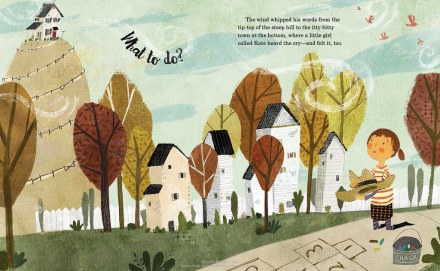
When the textile mill closes, Fiona’s family signs a contract indenturing themselves to a family in Chicago. The voyage to America is long and arduous, but when they arrive in Chicago they marvel at the grand houses and elegant clothes, imagining that this awaits them too in their new home. The reality, however, is much different. Their two-room apartment is ramshackle, and only by working two jobs can their parents make enough money to live on.
celebrate-picture-books-picture-book-review-fiona's-lace-fiona-gets-job

Copyright Patricia Polacco, 2014, courtesy of simonandschuster.com

Fiona wants to help and soon finds that dressmakers will pay handsomely for the lace she makes. The family’s money tin begins to fill up and they are prospering. One night while Muther and Da are away working, a fire rages through Chicago. Fiona and Ailish escape with only the money tin and Fiona’s lace. They run far from home, but worry—how will their parents find them?
Remembering their favorite story, Fiona cuts her lace into strips and ties bits of it along their route to their hiding place. The girls cower in fear until they hear the familiar voices of their parents. Happily reunited, the family lets go of what they have lost, but Ailish cries over the now sooty, torn lace. Ma reassures her and brings comfort, revealing that far from being ruined, this scorched lace is the most valuable and cherished of all because it saved the family.

celebrate-picture-books-picture-book-review-fiona's-lace-trail-of-lace-story

Copyright Patricia Polacco, 2014, courtesy of simonandschuster.com

Patricia Polacco’s heartwarming and harrowing story of an Irish immigrant family is a beautiful reminder of the unique talents and strong bonds that built America and continue to help her prosper today. Readers will be enthralled by Polacco’s realistic dialogue and detailed storytelling in this compelling and suspenseful tale and will cheer as Fiona cleverly uses her ma and pa’s trick and her own skills to save her family.

Polacco’s gorgeous illustrations bring the time period alive for young readers, portraying the intricate art of lacemaking and the clothing styles that made use of this delicate trimming. Her depictions of tenement living are realistic, yet reveal the love and close family ties within through a warm color palette and the inclusion of cozy comforts brought from Ireland.

Fiona’s Lace is a heartfelt and thoughtful family and immigration story and would be a wonderful addition to classroom and home libraries.

Ages: 4 – 8

Simon & Schuster Books for Young People, 2014 | ISBN 978-1442487246

Discover more about Patricia Polacco and her many, many books on her website!

Irish-American Heritage Month Activity

 celebrate-picture-books-picture-book-review-lace

Follow the Lace Game


While Fiona and her sister used a lace trail to lead their parents to their hiding place, you can have fun making a hide-and-seek game for your friends. This game can be played inside or outside

Supplies

  • 1 or 2 yards of lace, cut into sections about 6-inches each. You can use lace to celebrate Lace Day or use string, ribbon, or other kinds of material
  • Choose something to hide – this can be a toy, a secret letter, a snack, or anything

Directions

  1. Hide the item you choose in a secret place
  2. Determine the starting place for your hide-and-seek game
  3. Along the route from the starting point to the hidden item, tie the sections of lace onto things like lamps, furniture, stair banisters, door knobs, etc. if  you’re playing inside. If you are playing outside, tie it onto trees, bushes, bird feeders, swing sets, etc.
  4. For very young children the trail of lace can be straightforward; for older children the trail can be longer and more difficult