April 30 – Arbor Day

celebrate-picture-books-picture-book-review-up-in-the-leaves-cover

About the Holiday

Today is Arbor Day, a national celebration of trees that began as a campaign by J. Morton Sterling and his wife after they moved from Michigan to Nebraska in 1854. Morton advocated for the planting of trees not only for their beauty but as windbreaks for crops on the state’s flat farmland, to keep soil from washing away, as building materials, and for shade. In 1872, Morton proposed a tree-planting day to take place on April 10. On that day nearly one million trees were planted in Nebraska. The idea was made official in 1874, and soon, other states joined in. In 1882 schools began taking part. Today, most states celebrate Arbor Day either today or on a day more suited for their growing season. To learn about events in your area, find activities to download, and more, visit the Arbor Day Foundation website.

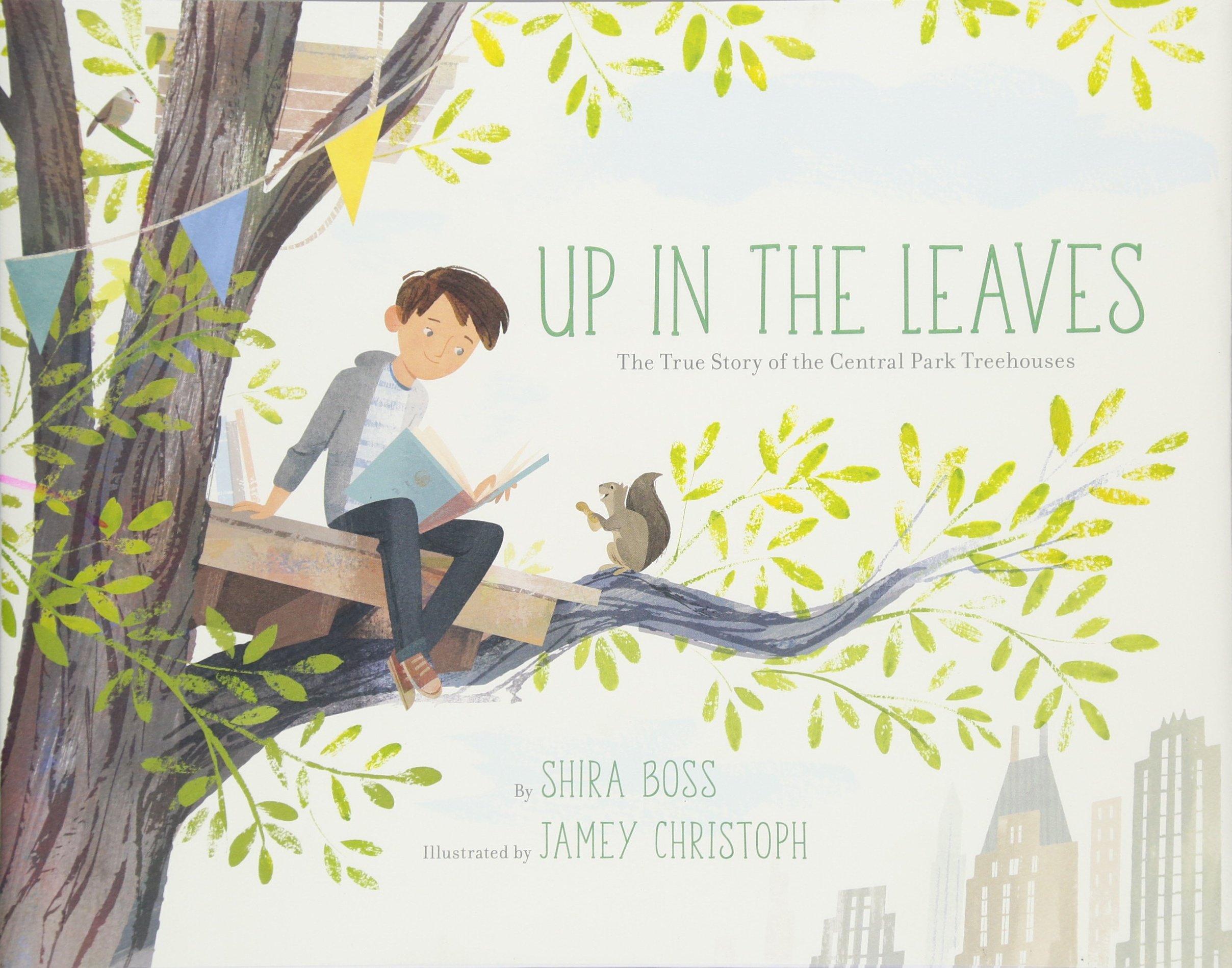
Up in the Leaves: The True Story of the Central Park Treehouses

Written by Shira Boss | Illustrated by Jamey Christoph


Bob lived in New York, a city crowded with buildings, people, and vehicles. Walking along on the sidewalk, “Bob didn’t like all that rushing around, the eyes of so many people, all those feet on the ground.” He climbed whatever he could find—onto lampposts, up to his apartment building’s roof, even the wall of the castle in Central Park. At school, Bob felt hemmed in by the desks, small classrooms, and packed hallways.

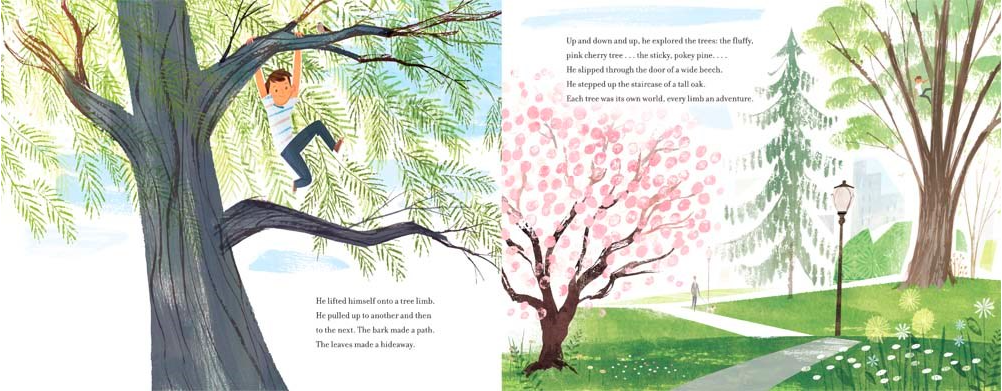
Every day as soon as school let out, Bob ran to Central Park, where it was cool, calm, and uncrowded. People moved slowly there or relaxed on the green grass. The “trees waved their branches in the air, inviting him to come up.” And so he did. Bob scampered up the path made by the bark and climbed higher and higher using the ladder the trees’ limbs provided. He explored cherry trees, pine trees, beech trees, and oak trees. “Each tree was its own world, every limb an adventure.”

celebrate-picture-books-picture-book-review-up-in-the-leaves-central-park

Image copyright Jamey Christoph, 2018, text copyright Shira Boss, 2018. Courtesy of Sterling Children’s Books.

Through the leaves that hid him, Bob could look out over the city. It was quieter and everything looked so small. Bob decided to build himself a treehouse. With scavenged wood and rope, he built a small platform and after school he climbed up to where he could read, think, and listen to the sounds of nature. He even brought peanuts for the squirrels. But one day when he came to the park, his treehouse was gone.

So Bob built another one. This one was bigger, better hidden in the leaves, and had shelter. When rain and wind came, “Bob’s treehouse rocked and swayed—he was a sailor on a ship at sea.” But when the leaves fell in the fall, Bob’s treehouse was discovered and taken down again. In the spring, Bob constructed another treehouse. This one had a long platform and a sturdy house with walls and a roof. Bob devised a rope-and-pulley “elevator” to bring up supplies like “milk crates for tables and chairs” books, snacks, and even his friends.

When the sun went down, Bob stayed and looked at the stars and planets with a telescope he’d set up on the platform. “He became an astronaut, navigating the cosmos.” Seasons came and went and Bob grew older. Each time a treehouse was taken down, he built a bigger and better one.

celebrate-picture-books-picture-book-review-up-in-the-leaves-stargazing

Image copyright Jamey Christoph, 2018, text copyright Shira Boss, 2018. Courtesy of Sterling Children’s Books.

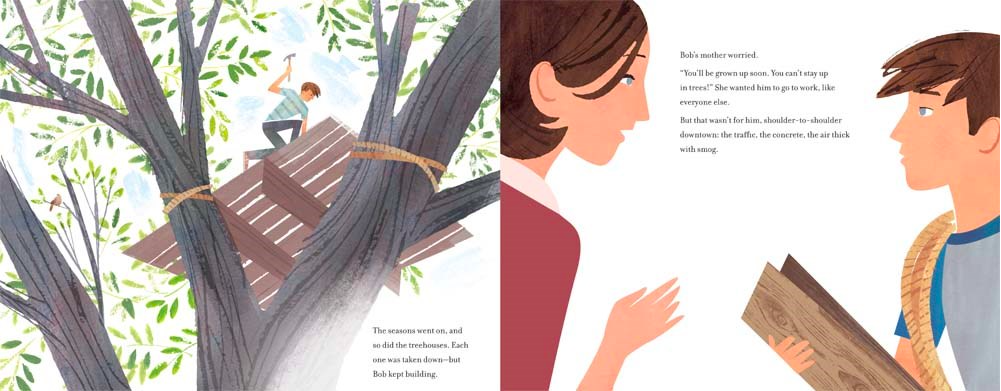
Bob’s mom worried that he was spending too much time up in the trees. She wanted him to get a job like everyone else. But he didn’t want to spend his time commuting on a crowded train and moving along crowded sidewalks to work in a crowded office. He didn’t want to deal with the noise and smog-filled air. “Instead, he built the biggest treehouse of all. Five levels and a bridge! Bob was very proud.” He even slept there.

One morning he awoke to voices calling up to him. The park rangers were ordering him to come down. Sadly, he descended. But the man in charge wasn’t angry. He offered Bob a job taking care of the trees. Bob enthusiastically said, “‘I would love to work here!’” Even though he couldn’t build any more treehouses, he still spent his days in the canopy of the trees, climbing up, up, up with special ropes and saddle to trim branches and make sure the trees were healthy. Sometimes at night, though, Bob still found his way to a high, leafy perch to gaze at the stars.

An Epilogue, including a picture of Bob Redman sitting on a branch of one of his beloved trees, tells more about Bob Redman, his treehouses, and what he’s doing now.

celebrate-picture-books-picture-book-review-up-in-the-leaves-mom

Image copyright Jamey Christoph, 2018, text copyright Shira Boss, 2018. Courtesy of Sterling Children’s Books.

Shira Boss’s captivating true story of a boy who felt more at home in nature than in the city and grew up to care for the trees he loves is a unique story for all kids who love the adventure of their own treehouse or fort and spending time outdoors. With short staccato sentences Boss recreates the cramped in feeling Bob Redman experienced indoors and while moving through the crowded New York streets. As Bob climbs the trees, Boss’s longer, lyrical sentences echo the freedom of the peace, quiet, and slower pace of life Bob craved. His perseverance in building and rebuilding his treehouses, finally to be recognized for his special gifts will encourage kids who also forge their own path.

Jamey Christoph’s charming soft-hued illustrations take kids quickly from the tall skyscrapers and crowded sidewalks of New York City to the lovely green expanse of Central Park to watch Bob swing from the branches as he climbs higher and higher into the parks varied trees. Readers will envy his agility and view of the city. Readers can almost feel the cooler air and the warm sunshine filtered through the leaves as they turn from page to page. Christoph’s recreations of Bob’s platforms and increasingly complex treehouses will impress kids and adults alike. The final images of Bob working a job he was born to do while still enjoying the trees and the city in his own way will inspire children to stay true to what they love.

A lovely and inspiring book with a unique story that will appeal to all readers and especially those who prefer a life of quiet, thoughtful observation and creativity, Up in the Leaves is highly recommended for home, school, and public libraries.

Ages 5 – 8

Sterling Children’s Books, 2018 | ISBN 978-1454920717

Discover more about Shira Boss and her book, plus a discussion guide with activities on her website

To learn more about Jamey Christoph, his books, and his art, visit his website.

Arbor Day Activity

celebrate-picture-books-picture-book-review-Climb-a-Tree-Word-Search-Puzzle II

Climb a Tree! Word Search


There are so many kinds of trees that make our world beautiful. Can you find the names of twenty threes in this printable puzzle?

Climb a Tree! Word Search Puzzle | Climb a Tree! Word Search Solution

celebrate-picture-books-picture-book-review-up-in-the-leaves-cover

You can find Up In the Leaves: The True Story of the Central Park Treehouses at these booksellers

Amazon | Barnes & Noble | Books-a-Million

To support your local independent bookstore, order from

Bookshop | IndieBound

Picture Book Review

 

April 14 – It’s Global Astronomy Month

celebrate-picture-books-picture-book-review-the-stuff-between-the-stars-cover

About the Holiday

Instituted by Astronomers Without Borders, a group who sees in our shared sky an opportunity to create “a global community that appreciates, studies, and shares the wonders of the universe, to broaden perspective, transcend borders, and improve lives,” Global Astronomy Month brings people together with arts events, parties, and special events. To find resources, such as April sky maps in English and Spanish, and more information on how you can participate, visit the Astronomers Without Borders website.

Thanks to Abrams Books and Blue Slip Media for sending me a copy of The Stuff Between the Stars for review consideration. All opinions on the book are my own. I’m excited to be hosting a giveaway of the book. See details below.

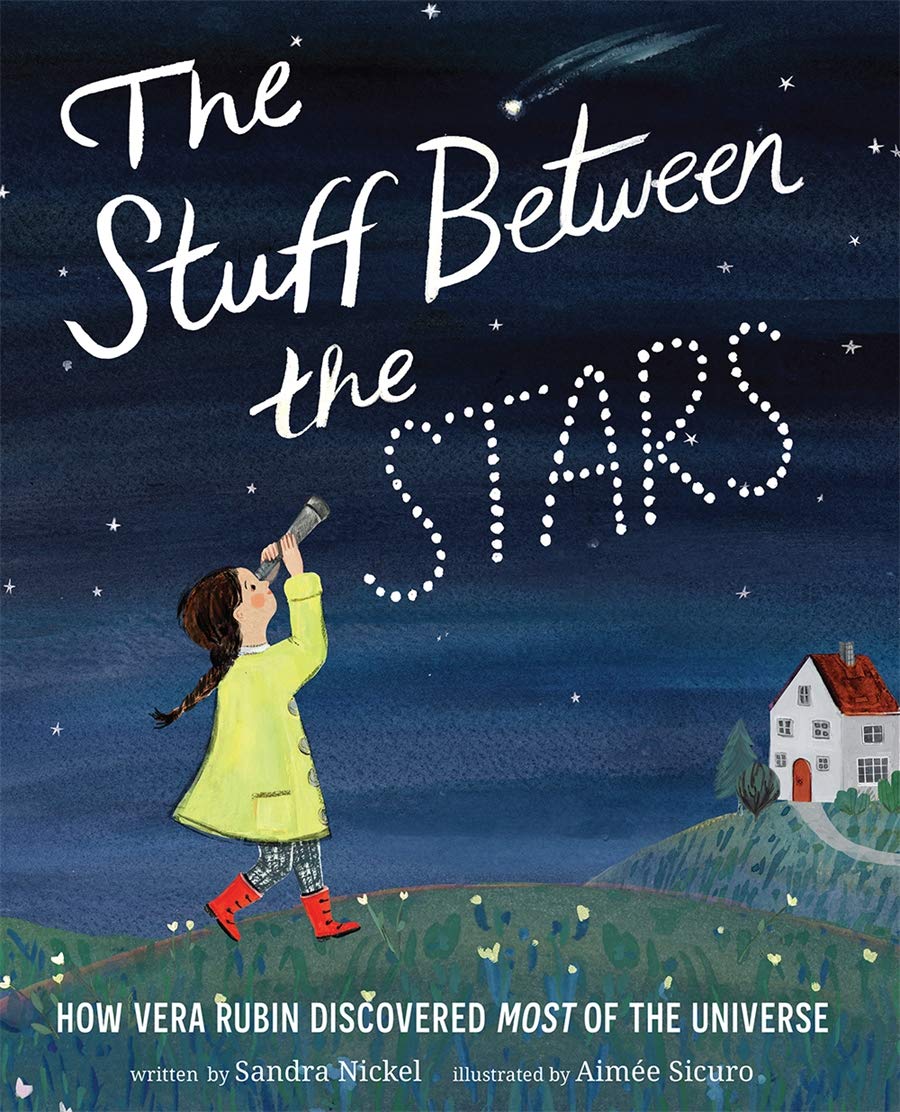
The Stuff Between the Stars: How Vera Rubin Discovered Most of the Universe

Written by Sandra Nickel | Illustrated by Aimée Sicuro


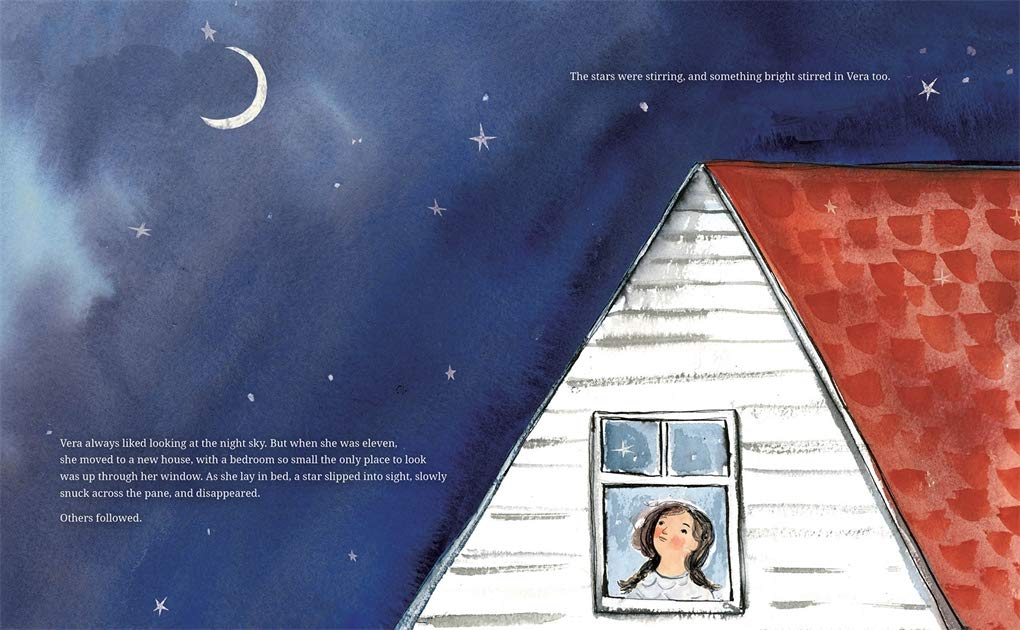
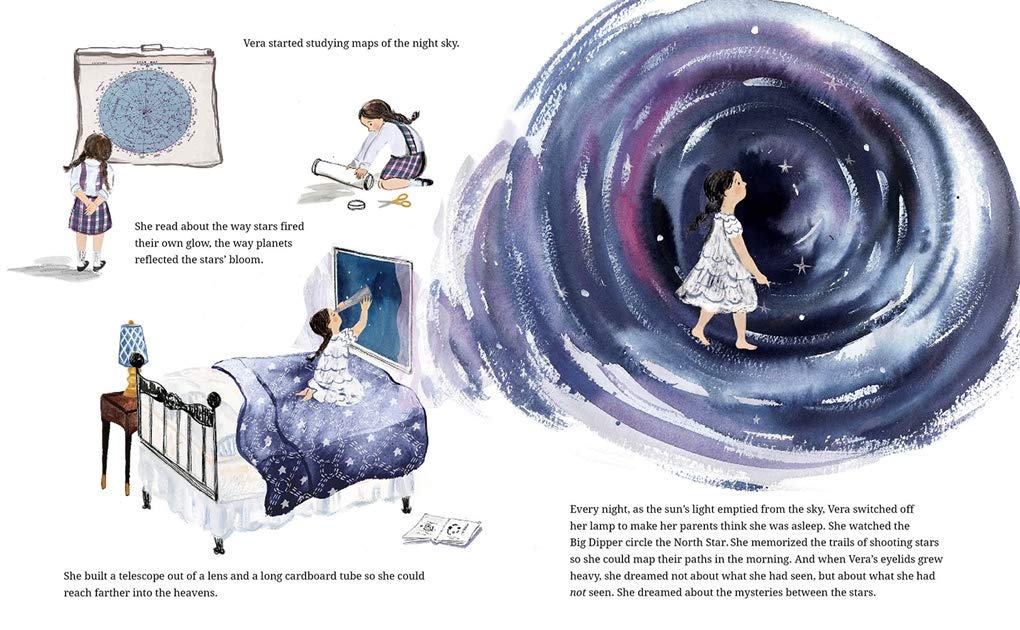
Vera had always been fascinated with the night sky. As she gazed up through her bedroom window, she saw when “the stars were stirring, and something bright stirred in Vera too.” She began studying everything she could about the stars, planets, and how they interacted in the night sky. She even made her own telescope from a cardboard tube and a lens. At seventeen Vera began attending Vassar College as the only astronomy major in her class. Here, she could use the school’s telescope whenever she wanted.

celebrate-picture-books-picture-book-review-the-stuff-between-the-stars-window

Image copyright Aimée Sicuro, text copyright Sandra Nickel. Courtesy of Abrams Books for Young Readers.

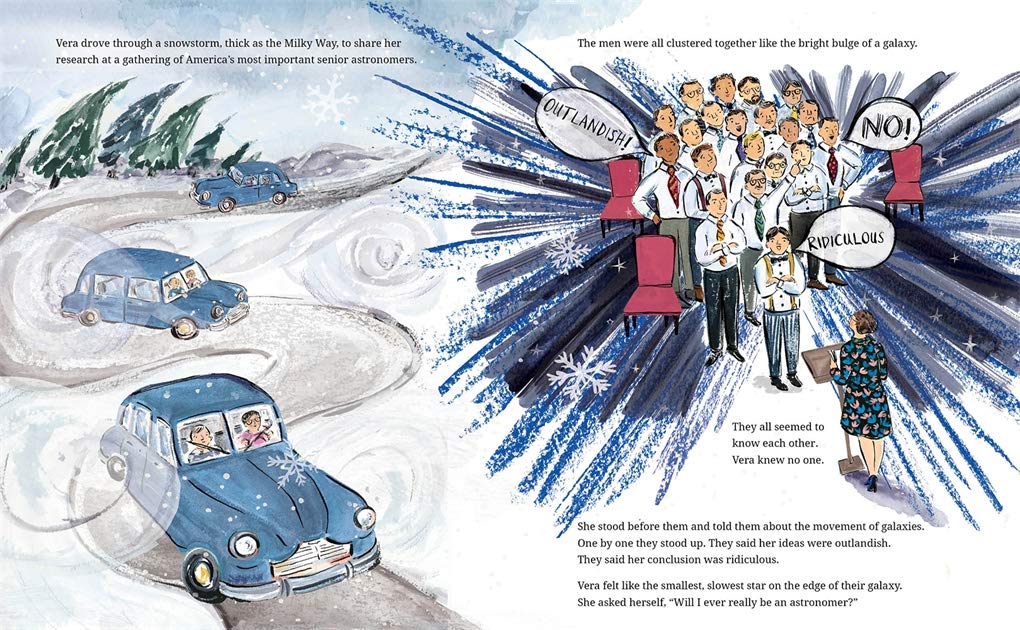
While at Vassar, she fell in love with Robert Rubin, a mathematician. They married and soon Vera was going to have a baby. During her pregnancy, she explored an idea she had: “was it possible that galaxies rotated around a center in the universe like the Big Dipper circled the North Star?” By the time her son was born, Vera decided she was right. Vera presented her conclusions at a meeting of America’s top astronomers. They thought her ideas were “outlandish” and “ridiculous” and told her so. “Vera felt like the smallest, slowest star on the edge of their galaxy” and wondered if she’d “ever really be an astronomer.”

celebrate-picture-books-picture-book-review-the-stuff-between-the-stars-young

Image copyright Aimée Sicuro, text copyright Sandra Nickel. Courtesy of Abrams Books for Young Readers.

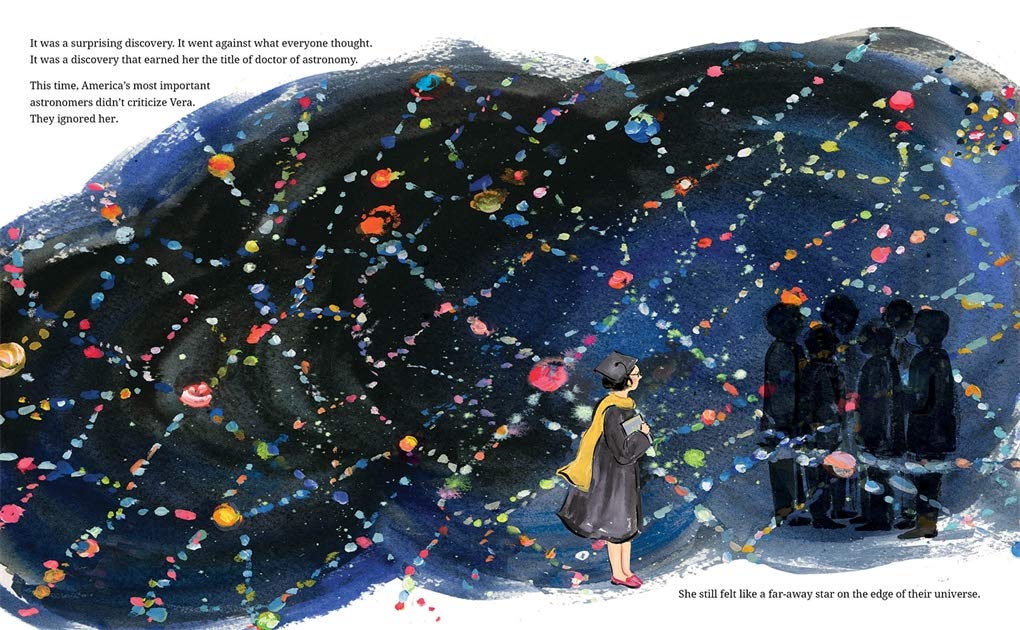
After Vera had a baby girl, she decided to concentrate on a new question that she thought would be fun. She wondered if galaxies were scattered haphazardly or whether there was “a pattern to where they spun.” After many months of staying up late into the night doing calculations, Vera determined that galaxies were “clumped together like dew drops on a spider’s web.” This was a major discovery; one that earned her a doctorate in astronomy. Instead of criticizing her, America’s top astronomers ignored her.

celebrate-picture-books-picture-book-review-the-stuff-between-the-stars-outlandish

Image copyright Aimée Sicuro, text copyright Sandra Nickel. Courtesy of Abrams Books for Young Readers.

Vera had two more children, and as her family grew she dreamed of observing galaxies from a mountaintop like the senior astronomers and watch gravity work within galaxies. She began teaching astronomy at colleges in Washington D.C., and other astronomers began hearing about her and wanting to know more about her ideas that had been dismissed in the past. More than ever Vera wanted to view the sky from an observatory in the mountains—one like the Carnegie Institution had in the California mountains.

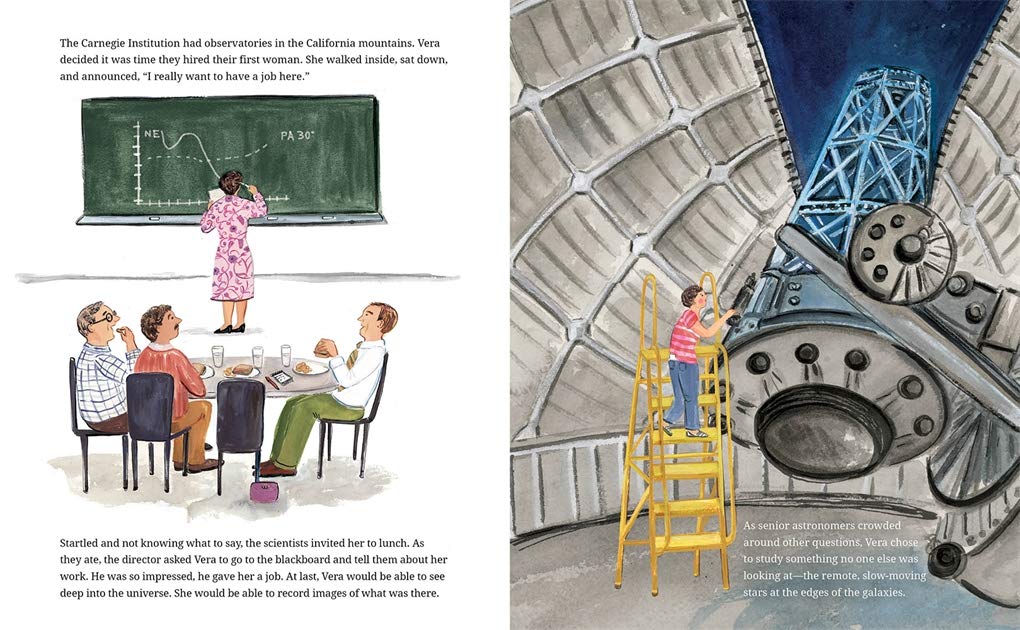
One day she went to the Carnegie Institution and announced that she would like a job there. When the director and other scientists learned about her work and theories, they were so impressed that she landed a job. While the other senior astronomers worked on other questions, Vera studied the “slow-moving stars at the edges of the galaxies.”

celebrate-picture-books-picture-book-review-the-stuff-between-the-stars-galaxies

Image copyright Aimée Sicuro, text copyright Sandra Nickel. Courtesy of Abrams Books for Young Readers.

In Arizona Vera studied the Andromeda Galaxy and the stars on its outside spiral. What Vera found was astounding. Instead of moving slower at the edges of the galaxy because of waning gravity from the center, these stars moved at the same speed. She remembered that earlier astronomers had theorized about a mysterious, unseen “dark matter” with its own gravity that “might be at work in the universe.”

Vera believed dark matter “could fill the space between the stars.” In fact, she was sure it was there by the way the stars moved. Once again, when Vera revealed her findings, most astronomers didn’t want to believe it. They didn’t want to believe that all this time they’d only been studying a small fraction of the universe. After Vera studied two hundred more galaxies, the astronomers had to agree that she was correct. At last “Vera was no longer at the edge of astronomy, she was at it’s very center.”

Backmatter includes an Author’s Note detailing more about Vera Rubin’s work, a timeline of Rubin’s life, resources on quotes found in the text, and a selected bibliography.

celebrate-picture-books-picture-book-review-the-stuff-between-the-stars-observatory

Image copyright Aimée Sicuro, text copyright Sandra Nickel. Courtesy of Abrams Books for Young Readers.

Sandra Nickel’s straightforward and comprehensive storytelling gives kids a well-rounded view of Vera Rubin’s life as she doggedly pursued a career in astronomy despite all the naysayers and snubs along the way and made an astounding discovery that still baffles scientists today. Rubin’s inspirational example will resonate with young readers and give them a pathway to accomplishing their own goals. Nickel does an excellent job of explaining the complex ideas Rubin studied, theorized on, and wrote about, allowing readers to fully understand her impact on the field of astronomy and our understanding of the universe. Nickel’s lyrical prose is also sprinkled with metaphors that link Rubin’s feeling and life changes to the night sky she loved to observe.

Through Aimée Sicuro’s mixed-media illustrations, readers follow Vera Rubin as she matures from a curious child who loves watching the night sky to a college student to a mother to an astronomer making discoveries that changed the way scientists understood the universe. Her detailed images give kids visual representations of Rubin’s work and ideas, including a complex mathematical calculation she works on while her family sleeps and her idea that galaxies were clumped together. Depictions of the Palomar Observatory will thrill space buffs and show readers why Rubin so wanted to study the sky from a mountain top. The final image of a group of children gazing up at the night sky as a shooting star flashes by offers an inspirational quote from Vera Rubin.

A superb biography that will inspire and nurture young minds, The Stuff Between the Stars is highly recommended for home, school, and public library collections.

Ages 6 – 9

Abrams Books for Young Readers, 2021 | ISBN 978-1419736261

Discover more about Sandra Nickel and her books on her website. You can also find curriculum guides and activity sheets to download on her site.

You can connect with Aimée Sicuro on Instagram.

Watch the book trailer for The Stuff Between the Stars!

Global Astronomy Month Activity

celebrate-picture-books-picture-book-review-astronomy-coloring-page-telescope    celebrate-picture-books-picture-book-review-astronomy-coloring-page-kids

Explore the Galaxies Coloring Pages


Indulge your love of star stuff with these printable coloring pages!

Looking through the Telescope | Studying the Stars | Milky Way Dot-to-Dot

celebrate-picture-books-picture-book-review-the-stuff-between-the-stars-cover

You can find The Stuff Between the Stars at these booksellers

Amazon | Barnes & Noble | Books-a-Million

To support your local independent bookstore, order from

Bookshop | IndieBound

Picture Book Review
 

March 30 – It’s Women’s History Month

celebrate-picture-books-picture-book-review-a-most-clever-girl-cover

About the Holiday

National Women’s History Month is all about celebrating women who broke barriers with their intelligence, creativity, courage, persistence, and unwavering confidence in their abilities. In every discipline, women have brought and continue to bring new perspectives, experiences, and talents to make contributions toward a better world. Today’s book celebrates a writer who broadened readers’ understanding of women and their lives through her complex and compelling novels. 

A Most Clever Girl: How Jane Austen Discovered Her Voice

Written by Jasmine A. Stirling | Illustrated by Vesper Stamper


While Jane loved stories, there were some she couldn’t abide. These were stories about women who fainted at the slightest thing, stories about orphans with dark secrets, and stories about couples who fell in love at first sight. To Jane these books were boring, unbelievable, and predictable. But they were all the rage. Instead, Jane like the ridiculous, and she made up her own stories that “poked fun” at the popular literature of the day. When she read her “stories to her family,… they couldn’t stop laughing.”

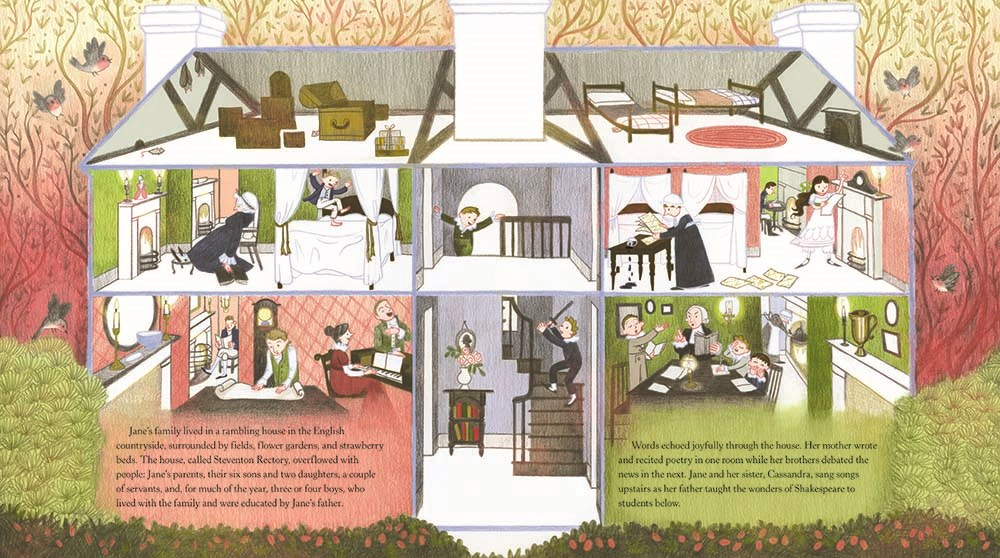
Jane lived in a large house in the English countryside. It was always full of people, fun, and learning. Jane’s father was the village rector of Steventon in Hampshire, England, and her mother wrote poetry. Sometimes Jane’s family (mother, father, six sons, and two daughters) staged plays in the barn. They made their own sets and costumes and played all the roles. When there was quiet time, Jane wrote and wrote in the study her father had created just for her and her sister.

celebrate-picture-books-picture-book-review-a-most-clever-girl-rectory

Image copyright Vesper Stamper, 2021, text copyright Jasmine A. Stirling, 2021. Courtesy of Bloomsbury Children’s Books.

Jane loved the satires she wrote, but “she stared to dream about writing stories that mattered to her. They would come from her own voice—a style that was uniquely hers.” She began to pay attention to tiny personal details, particular conversations, and the way her family, friends, and neighbors interacted. She found it all fascinating. Jane’s father encouraged her writing, saving up to buy her the best pens, blank books, and even a “portable mahogany writing desk.”

Jane had an idea about a story involving “three or four families in a country village,” and soon the characters came to life in her imagination, even when she wasn’t writing. She “wrote three novels before she turned twenty-four. Jane’s voice was clever and real… But something was still missing.”

Over the years as Jane’s brothers left home, the big house grew quiet. When her father stopped teaching, money grew short and Jane’s parents decided to move to a small house in another town, Bath. They sold their possessions, even the books in her father’s library, and left the neighbors and friends they’d known so well. Jane wondered if she would feel at home anywhere else. When they moved into their new home, Jane put away her writing things. Time passed, but “Jane persisted in a very determined, though very silent, disinclination for Bath.” Years passed and Jane spent her time in “busy nothings.”

celebrate-picture-books-picture-book-review-a-most-clever-girl-characters

Image copyright Vesper Stamper, 2021, text copyright Jasmine A. Stirling, 2021. Courtesy of Bloomsbury Children’s Books.

When her father died, Jane, her sister, and their mother had to move into a cheap apartment, and then when they could no longer afford that, they moved in with her brother Frank in a rough-and-tumble town. “The weight of Jane’s losses threatened to drown her,” and she still couldn’t write. Four years later, her brother Edward gave her, her sister, and their mother a small cottage near their childhood home. Here she found her way to happiness.

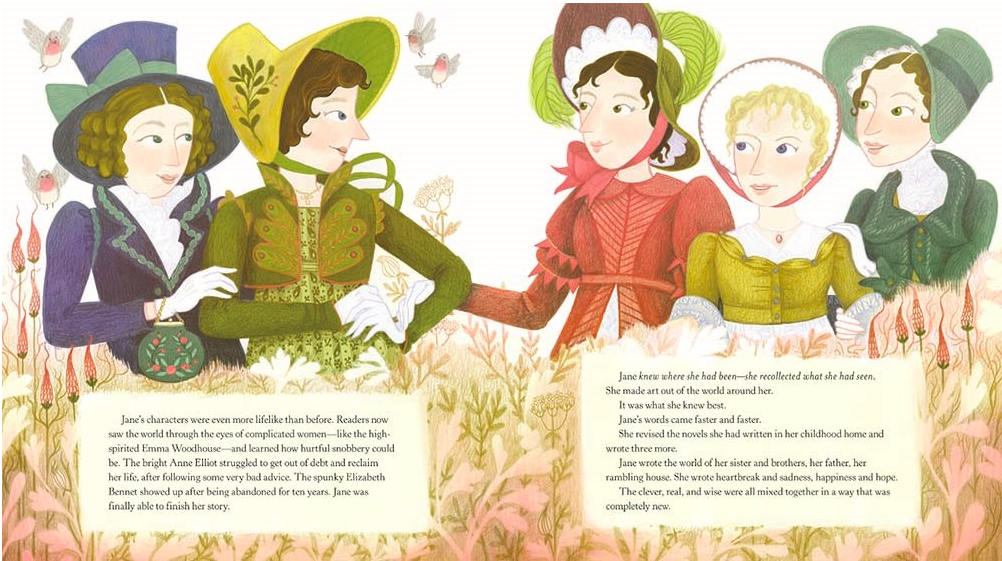
At last she brought out her pens, paper, and writing desk and began to write. Her voice was still clever and “filled with real people, but grief and loss had added something new. Jane’s voice was wise.” Her characters were even more realistic and complicated. She wrote about happiness and wealth, but also about heartbreak and sadness “mixed together in a way that was completely new.”

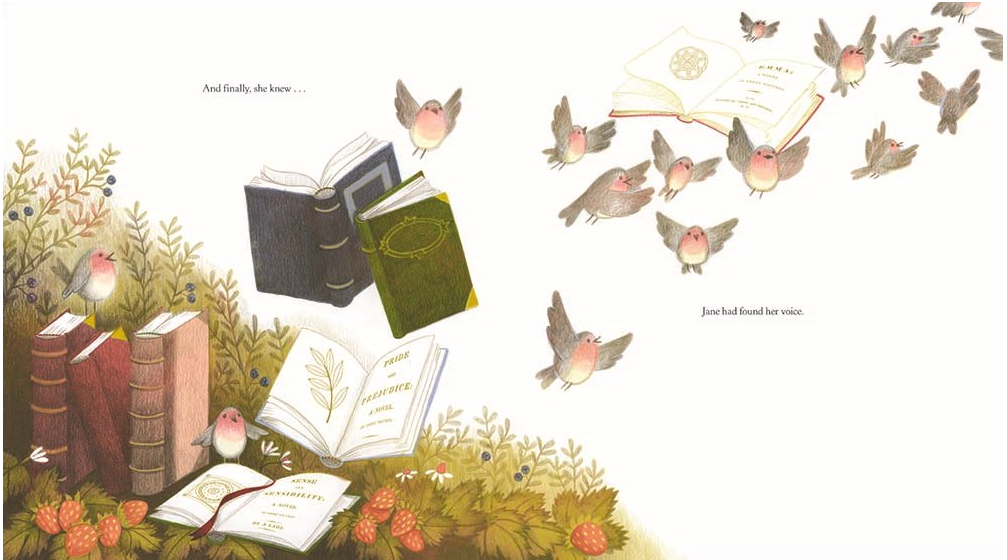
Jane’s novels were a hit—even with the future king of England. George IV loved them so much that his librarian wrote to Jane and asked her to write one of those “love-at-first-sight” stories she hated. Jane wrote back and told him that she could not unless her life depended on it, that she must remain true to her own style. At long last, “Jane had found her voice.”

Extensive backmatter includes a list of quotes from Jane Austen’s novels that are used in the story, more about Jane Austen’s life, Notes from the Author and Illustrator, a list of Austen’s novels, further resources for young readers, and a bibliography.

celebrate-picture-books-picture-book-review-a-most-clever-girl-novels

Image copyright Vesper Stamper, 2021, text copyright Jasmine A. Stirling, 2021. Courtesy of Bloomsbury Children’s Books.

Jasmine A. Stirling’s in-depth biography of Jane Austen shines with specific details about her and her family’s life, their happy times and tribulations that informed her writing and made it so distinctive for its time and beloved even now. Stirling’s engaging and lively storytelling invites children to share the joys and heartaches that molded Jane Austen’s personality and writing. Quotations from Austen’s novels sprinkled throughout the story give young readers a taste of Jane’s writing and the truths and understanding her novels embody.

Dazzlingly lovely, Vesper Stamper’s expressive illustrations draw readers into Jane Austen’s world and give them a glimpse into her childhood and adult experiences as well as the society of the time. Cleverly designed images allow kids to understand how much Jane loved to read, to laugh along with her as she reads the sentimental and gothic stories she satirized, and to see at a glance all the shenanigans, work, and entertaining that went on in her beloved home. The elegance of these surroundings and the dinner parties that enlightened Jane’s writing are realistically reproduced and her characters come to life on the page. A moving metaphorical image shows Jane riding away from the home she loved while pages of her novels fly out of the writing desk strapped to the back of the carriage. Jane’s sadness is depicted on pages sketched in gray, but her vibrancy returns with her brother’s generosity and the novels that finally take wing.

A superb biography of a beloved and influential writer that will spark enthusiasm for Jane Austen’s novels as well as literature and writing in general, A Most Clever Girl: How Jane Austen Discovered Her Voice is a must for students of all ages as well as for those who simply love reading and writing stories. The book would make an exceptional addition to lesson plans for readers from elementary school to high school and is highly recommended for home, school, and public library collections.

Ages 5 – 12 and up

Bloomsbury Children’s Books, 2021 | ISBN 978-1547601103

Discover more about Jasmine A. Stirling and her books on her website.

To learn more about Vesper Stamper, her books, and her art, visit her website.

Women’s History Month Activity

celebrate-picture-books-picture-book-review-jane-austen-coloring-page

Jane Austen Coloring Page


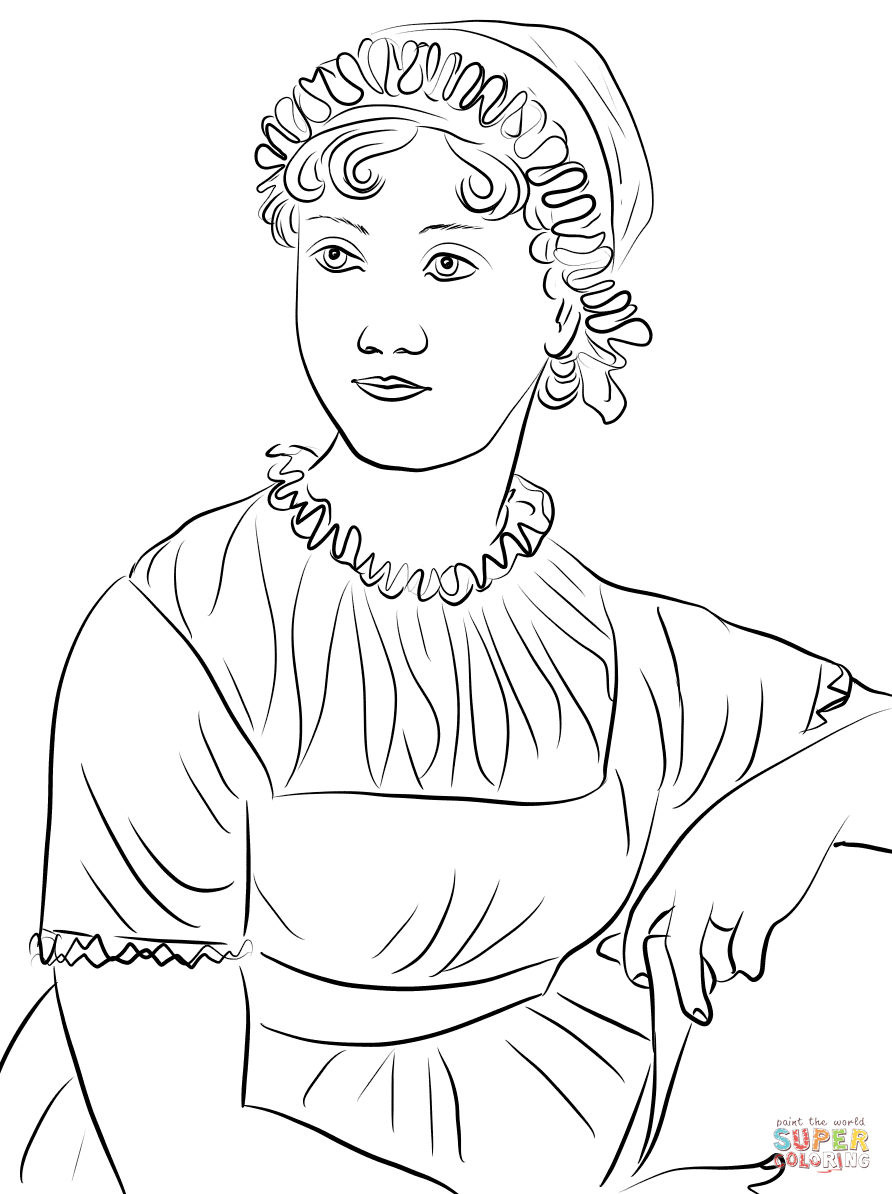
Enjoy this printable coloring page of Jane Austen as you learn more about this clever writer.

Jane Austen Coloring Page

celebrate-picture-books-picture-book-review-a-most-clever-girl-cover

You can find A Most Clever Girl: How Jane Austen Discovered Her Voice at these booksellers

Amazon | Barnes & Noble | Books-a-Million

To support your local independent bookstore, order from

Bookshop | IndieBound

Picture Book Review

March 29 – It’s International Ideas Month

celebrate-picture-books-picture-book-review-smelly-kelly-cover

About the Holiday

The onset of spring with its  wide-open sunny days seems to beckon to us to open our minds to all sorts of new possibilities. International Ideas Month also invites would-be inventors and clever folk alike to think differently and pay attention to your brainstorms. You never know – there may be a book, a work of art, a new invention, or a solution to a need inside you just waiting to be let out! 

“Smelly” Kelly and His Super Senses: How James Kelly’s Nose Saved the New York City Subway

Written by Beth Anderson | Illustrated by Jenn Harney


James Kelly had a super sensitive nose. It seemed that there was nothing he couldn’t smell: “rats in the shed. Circus elephants a mile away. Tomorrow’s rain.” While this was interesting, James wished he had a different “super power,” one that would get him noticed. When James was older, he moved to New York and set out to find a job. But lots of jobs—like working at the fish market, the butcher shop, or the sanitation department—were just too stinky.

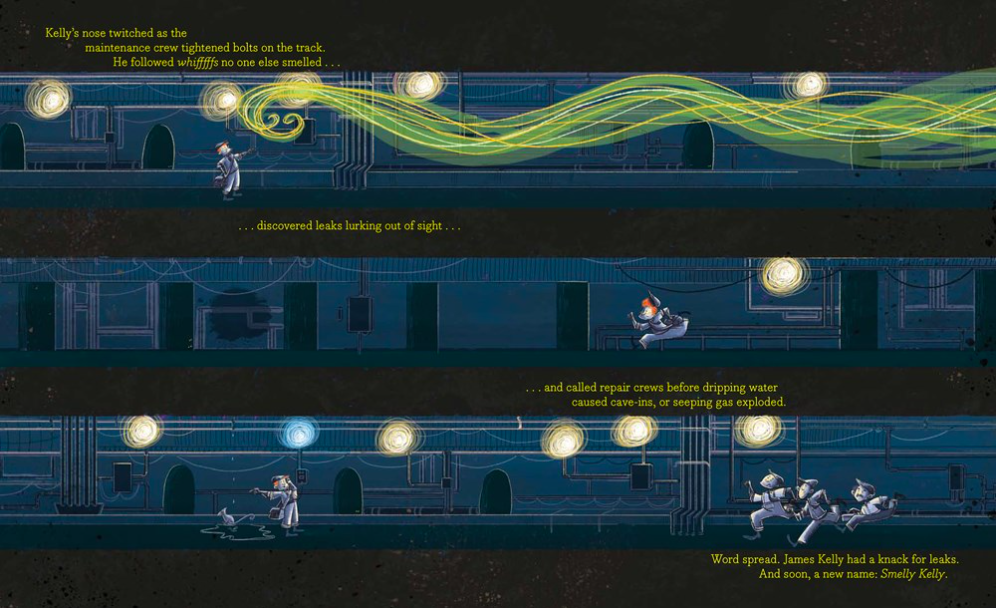
Then James “heard a rumble below the sidewalk and peered through the grate. The damp air bristled with mystery.” James descended below the street and discovered the subway. Here “a nick, a crack, a break, a spark could wreak havoc.” Down here, James Kelly sniffed out water and gas leaks and other problems then led repair crews to the spots. People were so impressed that soon he had “a new name: Smelly Kelly. James began studying about new equipment that could help him.

celebrate-picture-books-picture-book-review-smelly-kelly-underground

Image copyright Jenn Harney, 2020, text copyright Beth Anderson, 2020. Courtesy of Calkins Creek.

The subway wasn’t the only place having trouble with bad odors. At the Hotel New Yorker, a mysterious leak was causing guests to flee and the staff to hold their noses. Everyone blamed the subway, so the hotel manager called for Smelly Kelly. James could smell the leak, but he couldn’t pinpoint where it was coming from. Using a bit of his new equipment, though, the break in the pipes exposed itself. James had found his calling.

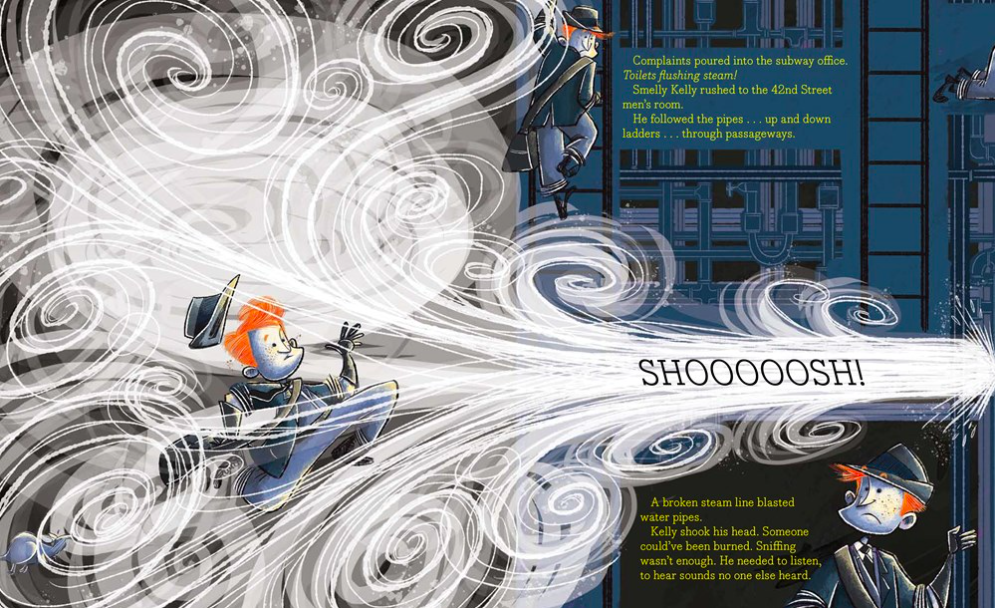
Next, people began complaining about “toilets flushing steam” at the 42nd Street men’s room. He followed the pipes and finally found the cause, but Smelly Kelly realized that “sniffing wasn’t enough.” He needed to be able to hear problems too. But that would require a different kind of equipment—something “like a telephone or stethoscope.” James Kelly tinkered and experimented until he had created just what he needed. Every day, Smelly Kelly rid the city of leaks, toxic spills, and clogs—most unassociated with the subway at all. But one danger did lurk among the tracks: the electricity of the third rail.

celebrate-picture-books-picture-book-review-smelly-kelly-steam

Image copyright Jenn Harney, 2020, text copyright Beth Anderson, 2020. Courtesy of Calkins Creek.

One night his phone rang. It was an emergency—a “tar-like smell” was coming from underground. Smelly Kelly took one whiff and proclaimed, “‘Gasoline. One spark from the third rail and we’re all history,’” he warned. The station was evacuated and the trains slowed. Then Kelly went to work until he found the leaking storage tank. It took ten hours to make the city safe, and when it was Smelly Kelly was hailed as a “superhero.”

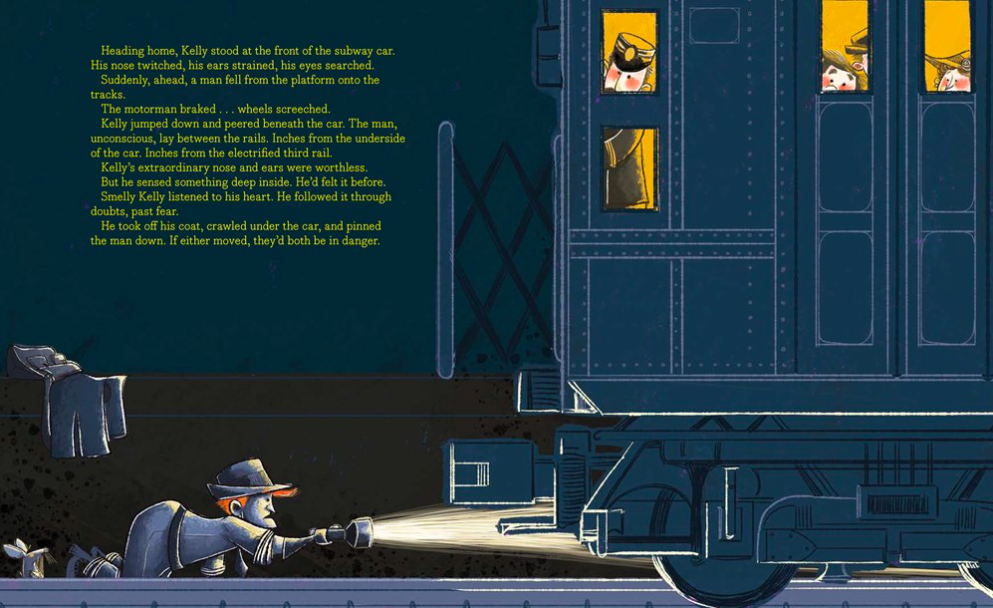
Smelly Kelly’s days were always different and often surprising. Once, he unearthed long-buried elephant manure, but his most dramatic save happened the day a man fell from the platform onto the tracks just as a train rolled into the station. That time Kelly’s sense of smell couldn’t help him, but his courage could. James Kelly crawled under the train car and pinned the unconscious man down and away from the electrified rail. Slowly, the train backed up over them, and when it was clear, James and the man got up. Everyone cheered. That day James Kelly discovered his real superpower: “the force that pushed him…to study, invent, and risk his life. His special power was inside.”

Backmatter includes two Author’s Notes, one revealing more about James Kelly, and the second explaining more about the research that went into writing the story. There is also a section on the tools Kelly used and some fascinating facts about what lies beneath New York City’s streets. Children will also find books and websites for further reading and a bibliography.

celebrate-picture-books-picture-book-review-smelly-kelly-train

Image copyright Jenn Harney, 2020, text copyright Beth Anderson, 2020. Courtesy of Calkins Creek.

Kids will marvel at Beth Anderson’s biography of James Kelly, his super-sensitive nose, and the New York City subway. As readers learn about James Kelly’s unique abilities, they also discover facts about the ever-growing city of the early to mid-1900s. Anderson’s suspense-filled storytelling will keep kids riveted to the action and keep them guessing at where the smells come from. Kelly’s ingenious inventions and uses of new equipment will impress future engineers and other creative kids. Anderson’s unifying theme reminds readers that everyone has the power to use their particular talents to make a difference.

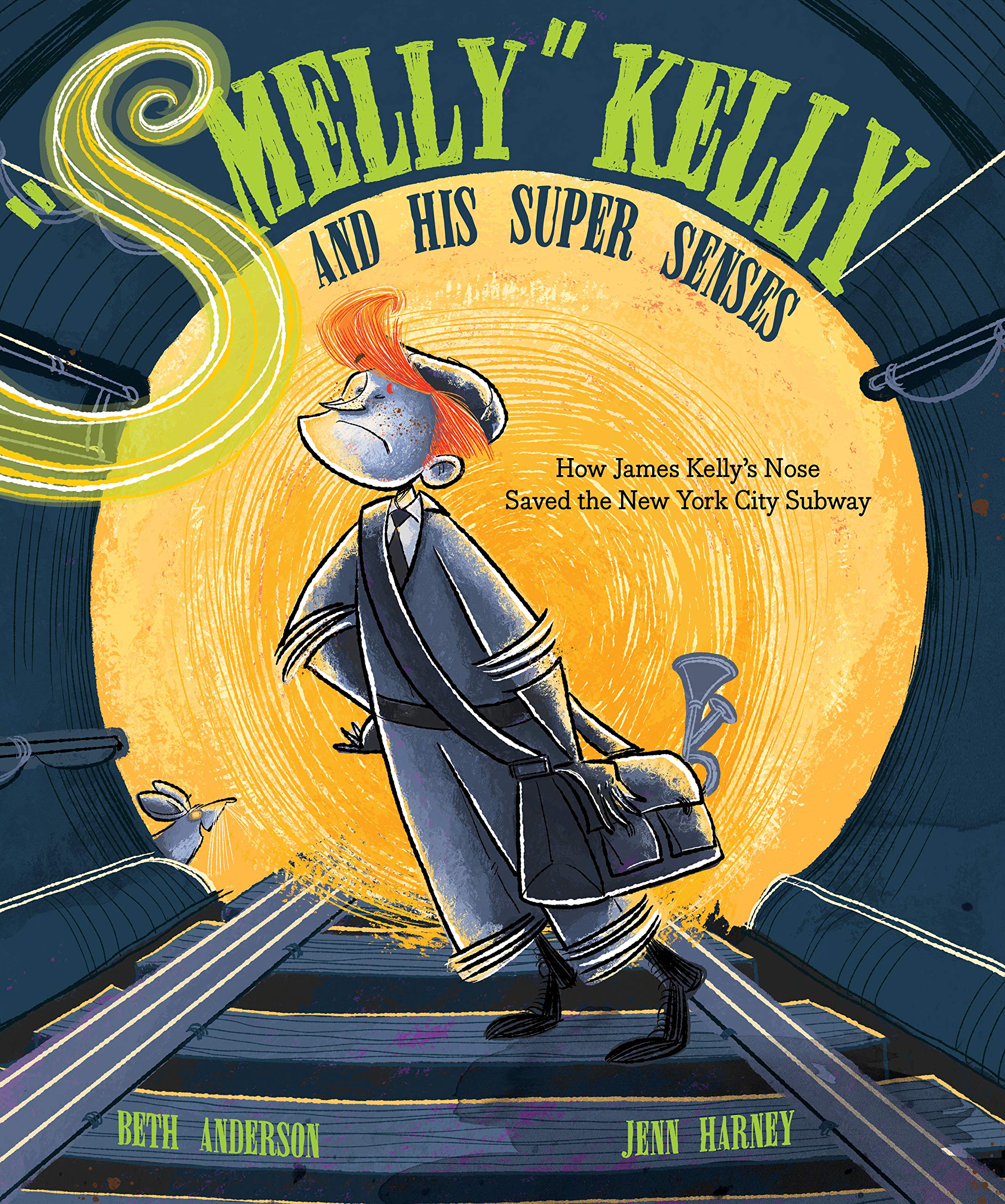
Jenn Harney’s engaging illustrations capture the details and personalities of this quirky biography while also giving kids an underground tour of New York City. Kids will be fascinated to see the dark tunnels of the subway system, crowded with a maze of pipes and wiring over which James Kelly kept constant vigil. The foul aromas that lead Kelly to leaks, dangerous conditions, and other problems waft through the tunnels in ghostly green swirls. With his prominent nose, black jacket, and fedora perched on his red shock of hair, James Kelly looks like the detective he was, and his facial expressions reveal not only the strength of the odors he discovered but also the pride he took in his work.

A unique and intriguing addition to history, science, and STEM lessons for classrooms and homeschoolers as well as a captivating read for home story times, “Smelly” Kelly and his Super Senses is highly recommended for home, school, and pubic library bookshelves

Ages 7 – 10

Calkins Creek, 2020 | ISBN 978-1684373994

International Ideas Month Activity

CPB - Nose Smelling Clipart


It makes sense to learn about your senses! Follow your nose to fun and discovery with these two activities!

  1. Can you guess each smell in this scent-sational experiment from KidsHealth?
  2. Paint your next picture with kool-smelling watercolors with this Scratch-and-Sniff activity from Learn Create Love!

celebrate-picture-books-picture-book-review-smelly-kelly-cover

You can find “Smelly” Kelly and His Super Senses at these booksellers

Amazon | Barnes & Noble | Books-a-Million

To support your local independent bookstore, order from

Bookshop | IndieBound

Picture Book Review
March 24 – It’s Women’s History Month

celebrate-picture-books-picture-book-review-june-almeida-virus-detective-cover

About the Holiday

From its beginning as a single-day observance in 1911 in Sonoma, California, the celebration of women’s achievements and contributions throughout history grew to a week-long event in 1980 and finally to encompass the entire month of March in 1987. During this month we remember the trail-blazing women of yesteryear who used their creativity, intelligence, and perseverance to promote rights for women while contributing their own innovations to science, art, social reform, medicine, and other disciplines as well as today’s pioneers who carry on their legacy and make our world a better place. Today, we feature a book about a woman who revolutionized virology and medical research, connecting the past and the present. To learn more about the holiday, visit the National Women’s History Museum website and check out their resource toolkit.

June Almeida, Virus Detective! The Woman Who Discovered the First Human Coronavirus

Written by Suzanne Slade | Illustrated by Elisa Paganelli

Growing up in Glasgow, Scotland, June Almeida loved school. After class she couldn’t wait to share what she’d learned—especially science subjects—with her mother, father, and little brother, Henry. When June was ten, however, her life changed when Henry became sick and passed away. Throughout elementary school and into high school, June loved studying science, especially biology in which she learned about the cells in the body and their functions. “June was so enthusiastic about science, she won the top science prize at school.”

celebrate-picture-books-picture-book-review-june-almeida-virus-detective-childhood

Image copyright Elisa Paganelli, 2021, text copyright Suzanne Slade, 2021. Courtesy of Sleeping Bear Press.

But science wasn’t the only thing June loved. She had lots of friends, was an avid reader, and became an excellent photographer. Whenever she was out with her camera, “she noticed small details, and her keen eye helped her create stunning photos.” June dreamed of attending college, but the jobs her father and mother held did not pay enough, and when June was sixteen, she dropped out of school to get a job to help pay the bills. June wanted to make a difference, “so she applied to work at the nearby hospital” and was hired as a lab worker. Here she learned how to examine cells with a microscope. “Her findings helped doctors treat patients.”

When June was twenty-two, she and her family moved to London. She got a job in a hospital lab and also met and married an artist named Henry. June and Henry moved to Canada, where she quickly found a job at a “new research lab in Toronto.” In this lab, June worked with an electron microscope that could magnify things 25,000 times and produced detailed pictures of the samples being studied. These photos “were helpful. But it was hard to tell which tiny blobs were viruses and which were cells.” June thought she could improve on the photos.

celebrate-picture-books-picture-book-review-june-almeida-virus-detective-photographer

Image copyright Elisa Paganelli, 2021, text copyright Suzanne Slade, 2021. Courtesy of Sleeping Bear Press.

June knew that in the body antibodies would surround viruses as they worked to fight it. June wondered if by introducing antibodies to her samples, scientists would be able to determine the virus from the cells. June’s idea worked. The scientists were astonished. Because of June’s innovation, they now had clear pictures that would help them study and combat viruses.

After June took time away from work to have a baby in 1960, she returned to her research and often lectured about her work. She was recruited to work at a hospital lab in London, so she and her family moved once again. At the time, a researcher named David Tyrrell had been trying to identify a virus that had affected a young boy. Could it be a new virus? He was hoping that June could help.

celebrate-picture-books-picture-book-review-june-almeida-virus-detective-hospital

Image copyright Elisa Paganelli, 2021, text copyright Suzanne Slade, 2021. Courtesy of Sleeping Bear Press.

When June received the sample, she knew that “since it was an unknown virus, there were no antibodies to help find it.” But she was an expert at using another method that might work. Carefully, June implemented the intricate steps. Then she put the sample under the microscope and scanned the picture. “June was stunned.” Each virus blob was encircled by tiny dots “like a crown. ” She had seen this twice before when looking at viruses from sick animals. She had written a paper on it, but it had been rejected by other researchers because they thought her pictures were just blurry and not those of a new virus.

June presented her findings to doctors who agreed with her discovery. They decided to name the new virus coronavirus, after the Latin word for crown, corona. June and David then published a paper telling other doctors and researchers about the new virus. Following this discovery, June continued to study viruses, such as hepatitis B and HIV. Her pictures of these viruses helped researchers develop medications that could “block them from making people sick.” Even after she retired, June never lost her love of learning, teaching herself to play the flute, about antiques, and how to use a digital camera to continue creating incredible photos.

Backmatter includes more about June Almeida and her life’s work, an illustrated timeline of her life, and a selected bibliography.

celebrate-picture-books-picture-book-review-june-almeida-virus-detective-London

Image copyright Elisa Paganelli, 2021, text copyright Suzanne Slade, 2021. Courtesy of Sleeping Bear Press.

Suzanne Slade’s compelling biography of June Almeida gives context for and insight into the research and discovery of the coronavirus and informs present-day events and breakthroughs. Slade’s fluid storytelling clearly reveals Almeida’s intelligence and passion for science as well as her determination to use her skills to the betterment of society. Kids will be astounded that June was able to begin her career at the age of sixteen, and that her beloved hobby of photography became a career that changed medical research. Slade’s sprinkling of personal details about Almeida’s life creates a well-rounded understanding of this influential woman.

Through Elisa Paganelli’s realistic and detailed illustrations, children have the opportunity to see a researcher at work in world-class laboratories. Readers will be especially impressed by images of the electron microscope and how Almeida improved the photographs these powerful machines produced. Children familiar with the shape of the coronavirus will be interested in seeing the faithfully reproduced photographs and how the virus got its name. Kids will also enjoy seeing illustrations of Almeida’s family life, including her daughter Joyce, who is herself a doctor.

An inspirational and fascinating biography of a woman with a very innovative mind, June Almeida, Virus Detective! will thrill children interested in science, medicine, and the arts. The book would be an impactful addition to STEM and STEAM lessons. It is highly recommended for home libraries and is a must for school and public library collections.

Ages 6 – 9 

Sleeping Bear Press, 2021 | ISBN 978-1534111325

Discover more about Suzanne Slade and her books on her website.

To learn more about Elisa Paganelli, her books, and her art, visit her website.

Women’s History Month Activity

celebrate-picture-books-picture-book-review-microscope-coloring-page          celebrate-picture-books-picture-book-review-microscope-wordsearch-puzzle

Take a Closer Look Coloring Page and Word Search 

You can examine the parts of a microscope with this printable word search puzzle and coloring page.

Take a Closer Look Word Search Puzzle | Take a Closer Look Word Search Solution | Coloring Page

celebrate-picture-books-picture-book-review-june-almeida-virus-detective-cover

You can find June Almeida, Virus Detective! at these booksellers

Amazon | Barnes & Noble | Books-a-Million

To support your local independent bookstore, order from

Bookshop | IndieBound

Picture Book Review
March 13 – It’s Women’s History Month

celebrate-picture-books-picture-book-review-shaking-things-up-cover

About the Holiday

National Woman’s History Month was established by the United States Congress in 1987 to recognize and celebrate the achievements of American women in the past and today. This year’s theme is “Nevertheless She Persisted: Honoring Women Who Fight All Forms of Discrimination against Women” which provides an opportunity to recognize the tireless efforts of women in all walks of life who fight against discrimination to be heard and to achieve their goals. There’s no better time than now to get involved to ensure that all women have equal rights and standing in all areas of their lives.

Shaking Things Up: 14 Young Women Who Changed the World

Written by Susan Hood 


Illustrated by Shadra Strickland, Hadley Hooper, Lisa Brown, Emily Winfield Martin, Sara Palacios, Erin K. Robinson, Sophie Blackall, Melissa Sweet, Oge Mora, Isabel Roxas, Julie Morstad, LeUyen Pham, and Selina Alko


This superb collection of biographies in verse highlights not only well-known pioneers but some delightfully fresh names and a few who are influencing the arts, science, and cause of human rights today. Each of the women profiled show the qualities of  bravery, persistence, intelligence, and ability over a vast spectrum of fields. Their success led the way for today’s women and will inspire tomorrow’s.

celebrate-picture-books-picture-book-review-shaking-things-up-Molly-Williams

Image copyright Shadra Strickland, 2018, text copyright Susan Hood, 2018. Courtesy of HarperCollins.

Organized on a timeline from the early 1780s to 2014, Shaking Things Up begins with Taking the Heat and Molly Williams, who was the first known female firefighter in America. When the flu knocked out all the members of the Oceanus Fire Department and a fire raged, Molly, the servant of James Aymar, a volunteer fireman, “… knew the drill; / she’d seen what must be done. / she hauled the pumper truck by hand, / adept as anyone.” For her work she was named Volunteer 11 and made part of the crew. It took about two-hundred years before another woman—Brenda Berkman—was added to the New York Fire Department.

celebrate-picture-books-picture-book-review-shaking-things-up-Mary-Anning

Copyright Hadley Hooper, 2018, courtesy of HarperCollins.

Young paleontologists-in-the-making will be amazed by the story of Mary Anning, who, while searching the British coast for fossils to sell to support her family, uncovered the skeleton of an ichthyosaur in 1812. In Buried Treasure, children learn how she went on to discover “the first two complete plesiosaurs and a pterosaur, laying the foundation for Charles Darwin’s theory of evolution.”

Children who love spies, news reporting, and uncovering the truth will want to know about Nellie Bly, who as an investigative journalist took on disguises to infiltrate institutions and write about “corruption and cruelty.” She was also widely admired for her around-the-world trip that beat Jules Verne’s “80 days” by eight days. As told in Woman of the World: “Bly hopped a ship and told her tale / of all she saw on Earth. / She wrote of camels, temples, jewels / with gutsy wit and mirth.” Nellie was only twenty-five when she undertook her travels in “a record-breaking race. / No soul on Earth had ever sped / the globe at such a pace!”

celebrate-picture-books-picture-book-review-shaking-things-up-Mary-Anning-poem

Image copyright Hadley Hooper, 2018, text copyright Susan Hood, 2018. Courtesy of HarperCollins.

If it weren’t for Annette Kellerman, women may never have made such a splash in swimming. Kellerman was a champion swimmer who began the sport to strengthen her legs after having rickets. Turning the Tide reveals that when she took to the water “without pantaloons—her swimsuit was deemed obscene!” After she was arrested she calmly stated, “who can swim fifty laps / wearing corsets and caps? / Her statement could not be contested,” and she went on to create the modern one-piece swimsuit, changing swimming for women forever.

In The Storyteller, a full alphabet of attributes describes Pura Belpré, a children’s librarian and the New York Public Library’s first Latina librarian. By offering—and often writing—Spanish books and creating programs for the Spanish-speaking community, Belpré revolutionized her library and touched many lives. 

celebrate-picture-books-picture-book-review-shaking-things-up-nellie-bly

Copyright Lisa Brown, 2018, courtesy of HarperCollins.

Children who reach for the stars will be transported by Lift-Off and the inspiration of Mae Jemison, the first female African-American astronaut. When young Mae gazes into the dark night sky, the “glittering stars, swirling galaxies / fill her, thrill her.” It doesn’t matter if she is afraid of the dark and afraid of heights, Mae looks and goes where she wants, where she needs to to learn and understand. And when she’s ready? “Ignition. / All systems are go. / Three / Two / One / Blast off!”

celebrate-picture-books-picture-book-review-shaking-things-up-secret-agents

Image copyright Sophie Blackall, 2018, text copyright Susan Hood, 2018. Courtesy of HarperCollins.

Break It Down reveals the way Angela Zhang attacks the questions she has about the way the world works, questions that lead her to answers and incredible achievements. From creating magic solutions with a Harry Potter potion kit at five years old to discovering answers to questions like why rainbows follow storms at seven years old to using a Stanford University lab at fifteen, Zhang has chipped away “at the ‘black boxes of life,’” including the “biggest black box of all– / a cure for cancer.” For Zhang science is “… both stone and chisel, / and I, your willing apprentice, / yearn to care away life’s mysteries / as a sculptor chisels marble / to find beauty inside.”

celebrate-picture-books-picture-book-review-shaking-things-up-Malala-Yousefzai

Image copyright Selina Alko, 2018, text copyright Susan Hood, 2018. Courtesy of HarperCollins.

Also included are poems about artist Frida Kahlo, World War II secret agents Jacqueline and Eileen Nearne, anti-hunger activist Frances Moore Lappé, civil rights pioneer Ruby Bridges, architect Maya Lin, and Noble Peace Prize winner Malala Yousafzai.

An illustrated timeline precedes the text, and suggested resources for further study on each woman follows the text.

Susan Hood has created fourteen poems that are as unique as the woman they describe. Some rhyming and some free verse, the poems include facts, quotes, intriguing details and the rhythms, sounds, and dreams of these young women. A paragraph following each poem reveals more about the woman and her work. Readers will be awe-struck by the enticing stories that inform each lyrical biography and will long to learn more about the women and their lives.

The theme of individuality is carried through in the illustrations, which are each created by a different illustrator. Colorful, whimsical, and realistic, the illustrations let children see the faces of the women presented, surrounded by their work and set within their time period. Readers will want to linger over the images and discuss the details included. A quotation from each woman accompanies her illustration.

Shaking Things Up offers an inviting way to introduce children to these amazing women and is an excellent reminder that they too can dream of what could be and make it happen. A must for classroom and school libraries, the book would be an inspirational addition to home bookshelves as well.

Ages 4 – 10

HarperCollins, 2018 | ISBN 978-0062699459

Discover more about Susan Hood and her books on her website.

You can learn more about these illustrators on their websites:

Shadra Strickland | Hadley Hooper | Lisa Brown | Emily Winfield Martin | Sara Palacios | Erin K. Robinson | Sophie Blackall | Melissa Sweet | Oge Mora | Isabel Roxas | Julie Morstad | LeUyen Pham | Selina Alko

Check out the Shaking Things Up book trailer!

Women’s History Month Activity

celebrate-picture-books-picture-book-review-freda-kahlo-coloring-page

Amazing Women Coloring Pages


There are so many incredible women to learn about during this month. Today, enjoy these coloring pages of inspiring women.

Mary Anning | Mae Jemison | Freda Kahlo 

celebrate-picture-books-picture-book-review-shaking-things-up-cover

You can find Shaking Things Up: 15 Young Women Who Changed the World at these booksellers

Amazon | Barnes & Noble | Books-a-Million

To support your local independent bookstore, order from

Bookshop | IndieBound

Picture Book Review

March 12 – It’s International Ideas Month

celebrate-picture-books-picture-book-review-the-floating-field-cover

About the Holiday

This month we celebrate something that you can’t see or hold but which is real all the same. What is it? An idea! Ideas are amazing things. Sometimes seemingly conjured up out of thin air; sometimes borne out of necessity as in today’s book; and sometimes the “Eureka!” result of long, hard work, ideas fuel our arts, sciences, education, and home life. So today, write down those ideas you have while driving or commuting to work, while in the shower, when you’re daydreaming, or just as you turn off the light to go to sleep. You never know what they might become!

The Floating Field: How a Group of Thai Boys Built Their Own Soccer Field

Written by Scott Riley | Illustrated by Nguyen Quang and Kim Lien


Like all of the villagers living on the small island of Koh Panyee, Prasit Hemmin’s home was built on stilts. His father was a fisherman, and every morning Prasit helped him load his boat before school. Today was an exciting day, and Prasit hurried to meet his friends at Uncle’s coffee shop. They had big decisions to make: “Who will carry the poles? Who’s on which team? Who gets to kick off first?” The full moon had come and later the tide would go out.

celebrate-picture-books-picture-book-review-the-floating-field-koh-panyee

Image copyright Nguyen Quang and Kim Lien, 2021, text copyright Scott Riley, 2021. Courtesy of Millbrook Press.

By the time school was over, the sandbar with its glittering sand was ready, beckoning to the boys to come play. They set up their goal and dropped the ball then “they dug in their toes and chased it across the hard-packed ripple of sand. They weaved in between other players to get open. And when they got close, they took a shot. GOAL!” The boys played until the sun went down and the fisherman’s longboats returned home. Then they “could only dream about playing until the tides were low enough once more.”

Fortunately, the World Cup was being held this month, and the boys watched the games on the small TV at Uncle’s coffee shop—“the only one on the island.” The boys decided that they needed a team of their own. But where would they play? Prasit looked around at their floating village and had an idea. They could build their own field. The next day, they collected materials and got to work. With planks and barrels, they built a platform. When it was ready, they tethered it in place, painted the lines, and put up goals.

celebrate-picture-books-picture-book-review-the-floating-field-coffee-shop

Image copyright Nguyen Quang and Kim Lien, 2021, text copyright Scott Riley, 2021. Courtesy of Millbrook Press.

Every day, Prasit and his friends played on their floating field, learning some fancy footwork to avoid rough spots on the boards. The villagers who once thought they were crazy for building the field now stopped to watch. One day the boys heard about a tournament being held on the mainland, and they signed up. On the morning of the tournament, just before they left for the mainland, the villagers surprised them with new uniforms and “the Panyee Football Club was born.”
The boys stood nervously on the field before their first game began, but once the ball was in play, they knew just what to do. “They passed it down the field. They weaved in between other players to get open. And when they got close, the took a shot. GOAL!” The Panyee Football Club won several games, but by the afternoon, the weather had turned and rain pelted the field. While their opponents knew how to play on the soggy field, the Panyee boys didn’t. At halftime they were down 2 – 0. Prasit had an idea.
celebrate-picture-books-picture-book-review-the-floating-field-beach

Image copyright Nguyen Quang and Kim Lien, 2021, text copyright Scott Riley, 2021. Courtesy of Millbrook Press.

Back on the field, the boys ran barefoot, just as they did at home. They were quicker and more agile, and they were able to tie the score. But with only minutes left in the game, the other team scored—and won. “But that day, in their very first tournament, the Panyee Football Club came in third place.” On the boat ride home, the boys celebrated, eager to get back on their floating field “where they could play the game they loved, whenever they wanted.”

Extensive backmatter includes an Author’s Note, complete with photographs, reveals some unusual places soccer is played and more about how this story came to be; a note from Prasit Hemmin about his childhood experiences and the future success of the football club he and his friends started; and a glossary of soccer vocabulary in English and Thai with pronunciation tips. There is also a list of resources for further reading.

celebrate-picture-books-picture-book-review-the-floating-field-sandbar

Image copyright Nguyen Quang and Kim Lien, 2021, text copyright Scott Riley, 2021. Courtesy of Millbrook Press.

Soccer fans and sports lovers of all kinds will find the story of Prasit Hemmin and the soccer field he and his friends designed enthralling. The idea that these boys could only play their favorite game twice a month will be eye-opening for kids used to daily or weekly practice, and their ingenious solution will inspire them to greater problem-solving. Through Scott Riley’s detailed storytelling, readers gain knowledge about life on the small island of Panyee as well as how the boys built their floating field. Riley also showcases the camaraderie between the boys and the pride of the villagers, making this a beautiful story of community.

Through various perspectives, Nguyen Quang and Kim Lien’s gorgeous and vibrant illustrations introduce readers to the island of Panyee with its dense collection of homes and businesses that left no room for a soccer field. The blue ocean water shimmers under the sun and ripples where longboats skim over the surface. Immersive images take kids into the Hemmin home and Uncle’s coffee shop, where Prasit’s mother makes breakfast while Prasit and his father ready the fishing boat for the day. Depictions of the boys playing soccer on the sandbar and later on the floating field they built are exciting and full of action. Soccer players may be fascinated by the proportions of the floating field and its goals and appreciate the precision with which Prasit and his friends scored. The contrast between the island and the mainland soccer field will also give readers an appreciation for the Panyee Football Club’s accomplishment in winning third place in their first tournament.

A stellar addition to any child’s library as well as to classroom and homeschool geography, STEM, and multicultural lessons, The Floating Field: How a Group of Thai Boys Built Their Own Soccer Field is highly recommended for home, school, and public library bookshelves.

Ages 7 – 11

Millbrook Press, 2021 | ISBN 978-1541579156

Discover more about Scott Riley and his book on his website.

To learn more about Nguyen Quang and Kim Lien, their books, and their art, visit their website, Kaa Illustration.

International Ideas Month Activities

celebrate-picture-books-picture-book-review-soccer-maze

Kick It In!


Use some fancy footwork to move the soccer ball down the field and score in this printable puzzle!

Kick It In Maze Puzzle | Kick It In Maze Solution

Visit Koh Panyee

Learn more about this unique village with this video about Koh Panyee!

https://www.youtube.com/watch?v=J5_bKc2O-is

celebrate-picture-books-picture-book-review-the-floating-field-cover

You can find The Floating Field: How a Group of Thai Boys Built Their Own Soccer Field at these booksellers

Amazon | Barnes & Noble | Books-a-Million

To support your local independent bookstore, order from

Bookshop | IndieBound

Picture Book Review