December 13 – National Day of the Horse

celebrate-picture

About the Holiday

Established in 2004, today’s observance encourages people to remember the importance of horses to American history, culture, and character. Both wild and domesticated horses need our care and compassion. To celebrate consider volunteering at a facility that cares for horses, for an organization that uses horses in therapy programs for children or adults, or donating to the protection of wild horses.

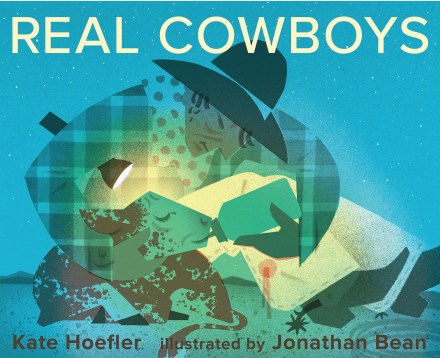
Real Cowboys

Written by Kate Hoefler | Illustrated by Jonathan Bean


Real cowboys wake with the dawn’s light and are careful not to make too much noise for the people still sleeping in the “little houses in the hollow, and up the mountains, and at the edge of fields in the distance.” It is natural for the cowboys to think of others. Their job is to care for the herd; to help a stranded calf and their dog who is trying to lure it to safety; to soothe the herd when thunder rumbles overhead.
celebrate-picture-books-picture-book-review-real-cowboys-dawn

Image copyright Jonathan Bean, courtesy of Houghton Mifflin Harcourt

Real cowboys sing soft, slow songs to their cows to encourage them to continue moving when the path is narrow and dangerous and to sleep when coyotes howl in the night. Cowboys are good listeners—heeding the advice and warnings of the trail boss and other cowhands. “Sometimes they listen for trucks, and wolves, and rushing water. And sometimes they just listen to the big wide world and its grass song.” Along the way cowboys keep themselves safe with their wide-brimmed hats and leather chaps.
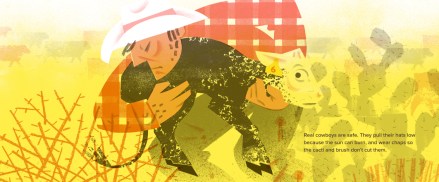
celebrate-picture-books-picture-book-review-real-cowboys-saving-calf

Image copyright Jonathan Bean, text copyright Kate Hoefler. Courtesy of Houghton Mifflin Harcourt

Because the cattle drive is long—lasting “for hours, or days, or weeks”—cowboys learn to be patient. “Even on a fast horse, they have to move with the slow rhythm of a herd….” When they need help, real cowboys don’t hesitate to ask, using hand and hat signals to alert other cowhands. “Real cowboys want peace. They don’t want stampedes, where all the cattle spook, and thunder over the earth, and scatter in dust storms.” Sometimes, however, this happens, and sometimes a few cattle and dogs are lost. Thinking of them when times are quiet, “real cowboys cry.”
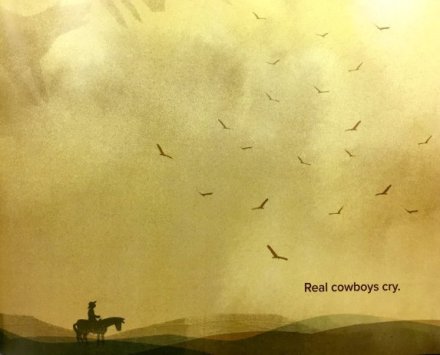
celebrate-picture-books-picture-book-review-real-cowboys-cowboys-cry

Image copyright Jonathan Bean, text copyright Kate Hoefler. Courtesy of Houghton Mifflin Harcourt

At night cowboys take turns eating and sleeping so there is always someone to watch over the herd. When they pack up camp and move on, real cowboys are mindful of the earth, and when they are far from home, inside themselves they can feel homesick, even if they look tough on the outside. “Real cowboys are as many different colors as the earth. Real cowboys are girls too.” In their hearts “real cowboys are artists,” creating stories that are bigger than the wide open prairie. “They wonder what’s past the horizon. And one day, when their work is done, real cowboys find out.”

Kate Hoefler’s moving tribute to cowboys and cowgirls demonstrates the qualities of kindness, thoughtfulness, and mindfulness that we want to share with our children. With lyrical language she follows cowboys on a cattle drive, where they experience the joys and sorrows that life entails for all. Hoefler’s pacing echoes the day-to-day movement of the herd as well as readers’ daily life. Delving into the responsibilities and characteristics of these men and women is a unique way to open the world to children and promote discussions about the traits of caring individuals.
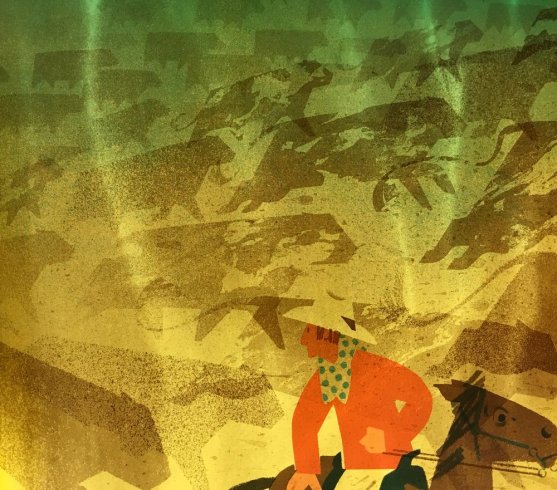
celebrate-picture-books-picture-book-review-real-cowboys-stampede

Image copyright Jonathan Bean, courtesy of Houghton Mifflin Harcourt

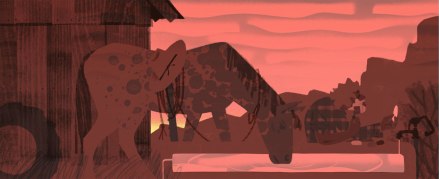
Jonathan Bean’s hand-stenciled illustrations printed in four Pantone colors are particularly effective in portraying the life of the cowboys and cowgirls entrusted with herds of cattle. Early morning dawns to rose skies that color even the horses and reflect in the drinking trough. Cattle, obscured by dust raised on the trail, form the backdrop to a cowboy worriedly watching his dog coax a calf from a cliff, and afternoon turns to night in a two-page spread where a cow nuzzles her calf as it sleeps. Depictions of the enormity of the herd traveling from one place to another amid sweltering days, rain storms, and blizzards are beautifully rendered, and the emotions of the cowboys are clearly discernable and touching.

Real Cowboys is stunning in both language and illustrations. For quiet story times, bedtime, or times for reflection and inspiration, this book would make an excellent addition to children’s bookshelves.

Ages 4 – 7

Houghton Mifflin Harcourt, 2016 | ISBN 978-0544148925

To view a gallery of illustration by Jonathan Bean, visit his website!

National Day of the Horse Activity

celebrate-picture-books-picture-book-review-galloping-horse-coloring-page


Galloping Horse Coloring Page


A horse running at top speed is a beautiful sight! Enjoy this printable Galloping Horse Coloring Page—would you be riding?

Picture Book Review

November 22 – It’s Picture Book Month

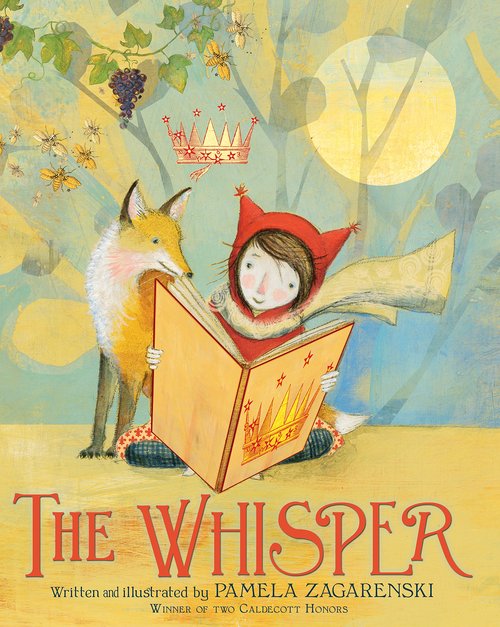
celebrate-picture-books-picture-book-review-the-whisper

About the Holiday

Picture Book Month is an international literacy inititive put together by a group of authors and illustrators to raise awareness of the importance of print picture books. Througout the world libraries, schools, booksellers, authors, illustrators, and those who love picture books celebrate the wonder of this art form enjoyed by children and adults. The complexity of picture books is astounding. They contain some of the most beautiful art and compelling stories being created today. To learn more about the importance of the picture book visit Picture Book Month: A Celebration! to find daily posts by authors, illustrators, and experts in the field as well as fun activities!

The Whisper

By Pamela Zagarenski


A little girl loves stories and the magical realms they can take her to. One day while waiting for school to be dismissed, she spies a book on a shelf. Her teacher allows her to take it home with her, and the little girl happily runs off with it when the clock strikes 3:00. On the way home, she doesn’t notice that all the letters are escaping from the book or that a wily fox is catching them in a net.

At home she secludes herself in her room, excited to read the mysterious book. She turns the pages, awed by the beautiful pictures. But by the time she has finished, she has tears in her eyes. “Where were the words? Where were the stories?” The girl flips through the book again, but this time she hears a small whisper: “Dear little girl, don’t be disappointed. You can imagine the words. You can imagine the stories.”

celebrate-picture-books-picture-book-review-words-escape-the-book

Copyright Pamela Zagarenski, courtesy of Houghton Mifflin Harcourt

The whisper seems so knowing that the girl does at it suggests. She turns to the first page where a blue bear followed by a beekeeper walks under a honeycomb sun toward a brown bear. The girl stares at the picture and thinks of a title: Blue Bear’s Visit. Her story begins: “Blue Bear arrived on the first day of spring. He promised…”

Warming to the idea of creating stories, the girl examines the second picture. She notices the same white rabbit that was in the first picture. In the foreground a “magnificent ox” is listening to a man whispering into its large, soft ear. The Secret, the little girl titles this story, which starts: “Mr. Ox, you must please promise not to tell anyone, but we need your help. Last week…”

celebrate-picture-books-picture-book-review-no-words-in-book

Copyright Pamela Zagarenski, courtesy of Houghton Mifflin Harcourt

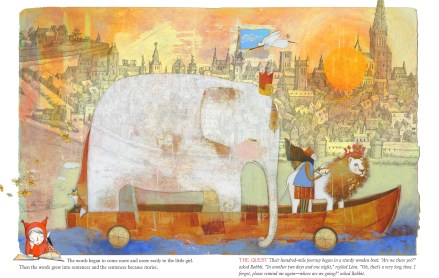
With the third picture the words tumble out more easily, forming sentences that give life to the massive white elephant, regal lion, and that rabbit again who are traveling the sea in a long, open boat. The Quest, she calls it. In Tigers Prayer, preparations are being made: tea is brewing, a clown with a pointed hat plays his accordion, a windhorse jumps through hoops, and the rabbit rides a golden ring as a lion hears what Tiger has to say. A Birthday Party comes next, and it seems Pan has planned a very secret party. An owl perches in the crook of a tree asking for the password with a “Hoo, Who?” which is answered quickly because the vanilla cake with raspberry filling and vanilla cream frosting holding 6 candles must be delivered.

celebrate-picture-books-picture-book-review-the-whisper-elephant

Copyright Pamela Zagarenski, courtesy of Houghton Mifflin Harcourt

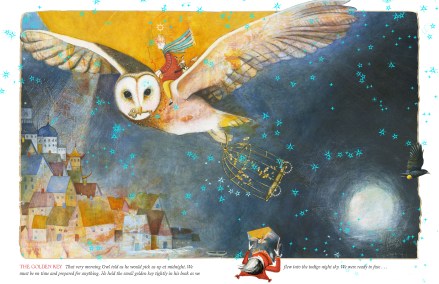
The Magical Cloak sees the little girl’s imagination truly take flight as she decides the man in the “elaborate coat” is a wizard or magician whose bubbles come to life once released from the blower. Enormous whales now fill the harbor. They are beautiful, but something must be done….Next, hurry to meet the owl! He is picking up passengers at midnight. But what does the golden key in his beak open? Only the story The Golden Key locked in the little girl’s mind will tell.

Hours go by as the little girl creates tales for each picture in the book. As the night grows late, she sleeps, carried into slumber on dreams woven from the pictures and stories she imagined. When she wakes up, the girl wishes to spend more time with her new friends, but it’s time for school so she gathers up the book and hurries away.

On the path to school she meets a fox who is carrying a bag. “Excuse me, little girl,” says the fox. “I believe I have the words to your book.” The fox then explains how he caught the words as they spilled from the pages the day before. The fox gives her his parcel, but asks for a favor. The girl is happy to oblige and lets the fox stand on her shoulders to reach a bunch of grapes dangling from a nearby vine.

celebrate-picture-books-picture-book-review-the-whisper-owl

Copyright Pamela Zagarenski, courtesy of Houghton Mifflin Harcourt

The girl rushes into school and apologizes for being late. She relates the story of the fox and the words and the magical night she has spent making up tales for the pictures in the book. “I have so many stories to tell you,” says the girl to her teacher. “‘I can’t want to hear,’” the teacher replies with a smile.”

Opening a book by Pamela Zagarenski is to fall into an alternate realm of such beauty and imagination that you forget the real world exists.  Her paintings are composed of rich, regal hues swirling with images and designs that overlap and float to create the kind of experience only the deepest, most complex dreams allow. The characters and details follow page to page uniting the pictures and, subtly, the stories the little girl discovers in them: The teapot, once introduced, waits under a tree on the next page and rides the waves of the whale-filled sea in the next. The bees and the rabbit are constant companions on each spread, and the animals will fill the reader with awe.

The little girl’s imagined stories are tantalizing with just the right mix of the mysterious and the tangible to entice readers to add more. The frame of the Aesop Fable The Fox and the Grapes is inspired and could lead to a conversation about how “life is what you make it.”

The Whisper is a book readers will want to linger over and dip into again and again, and would be especially fun on those days when there’s “nothing” to do. It makes a beautiful gift for any occasion and would be a welcome addition to any home library.

Ages 4 – 9 (this book would also appeal to adults)

Houghton Mifflin Harcourt, 2015 | ISBN 978-0544416864

Picture Book Month Activity

celebrate-picture-books-picture-book-review-I-have-the-reading-bug-bookplate

I Have the Reading Bug Book Plate


Do you want to let everyone know which books are yours? Or just declare your love of books? Then display this printable I Have the Reading Bug Book Plate in your books. on your wall, or in your locker!

Picture Book Review
November 16 – It’s Global Entrepreneurship Week

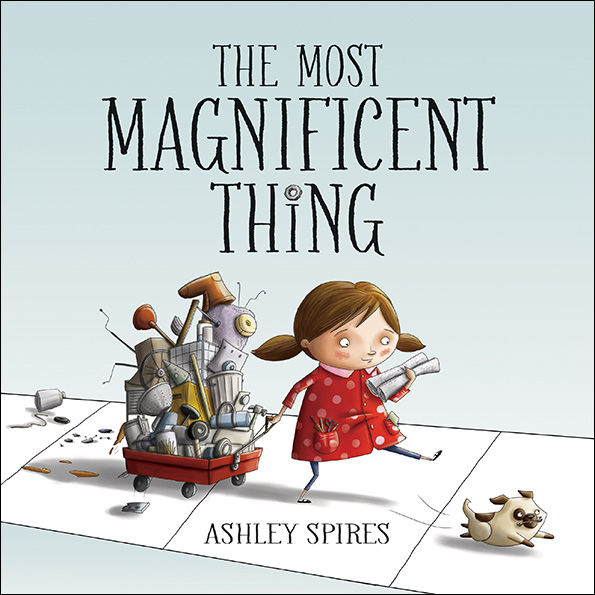
The Most Magnificent Thing by Ashley Spires picture book review

About the Holiday

Do you have a great idea to make the world a better place, a job easier, or life just a little more fun? Then this week is for you! All over the world inventors, thinkers, mentors, universities, and investors collaborate at events, conferences, and competitions to discover new products, creative ideas, and alternate ways of doing things. World leaders from 160 countries and more than 150,000 global organizations work together during this week to improve the lives of all.

The Most Magnificent Thing

By Ashley Spires


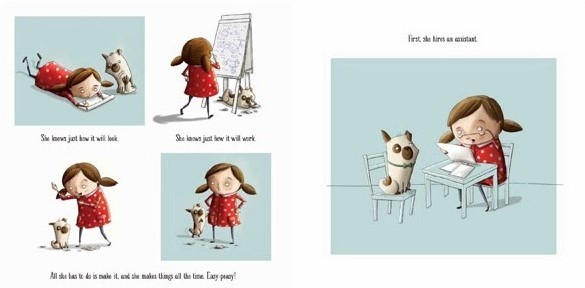
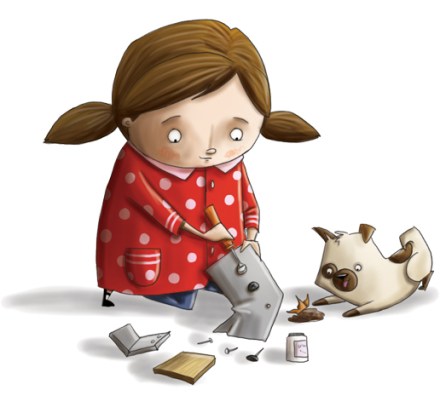
A little pony-tailed girl and her puppy do everything together. They race, eat, explore, and relax. When she makes things, her best friend unmakes them. One day the girl has a brilliant idea—she is going to make “the most MAGNIFICENT thing!” In her mind it’s going to be “easy-peasy.” She knows exactly how it will look and how it will work. With her faithful assistant following at her heels, the girl gathers materials and goes to work on the sidewalk outside her home.

celebrate-picture-books-picture-book-review-the-most-magnificent-thing-easy-peasy

Image and text copyright Ashley Spires, courtesy of Kids Can Press

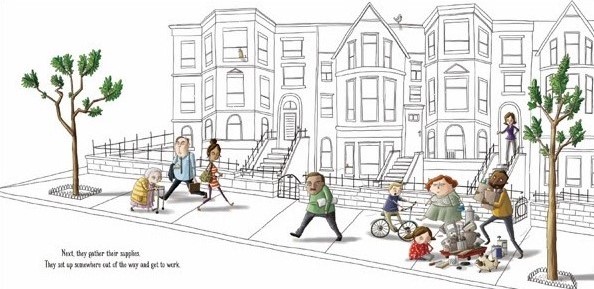
The girl “tinkers and hammers and measures” while her assistant “pounces and growls and chews.” When the little invention is finished, they stand back to examine it. Hmmm…it doesn’t look quite right. It doesn’t feel quite right either. In fact it is all wrong! The girl tries again. She “smooths and wrenches and fiddles” while her assistant “circles and tugs and wags.” It still turns out wrong. Determined to make her vision reality, she gives it another go…and another…and another. She makes her invention different shapes, gives it various textures, measures out assorted sizes. One attempt even smells like stinky cheese! But none of these creations are MAGNIFICENT.

celebrate-picture-books-picture-book-review-the-most-magnificent-thing-neighbors-come-by

Image and text copyright Ashley Spires, courtesy of Kids Can Press

People stop by and offer encouraging—even admiring—remarks, but the little girl just gets mad. Can’t they see how wrong her invention is? In her anger the little girl works at a fevered pitch, shoving parts together, her brain fogged by “all the not-right things.” In her haste she hurts her finger. This is the last straw. She explodes and declares that she QUITS!

celebrate=picture-books-picture-book-review-magnificent-thing-not-magnificent

Image and text copyright Ashley Spires, courtesy of Kids Can Press

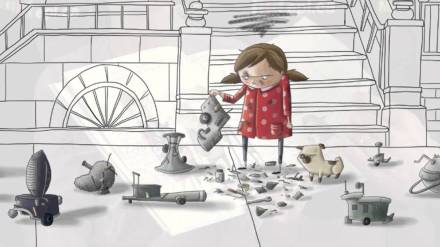
The ever-watchful assistant suggests a bit of fresh air. The girl takes her puppy for a walk and at first her feelings of defeat stay with her. Little by little, though, she pays attention to the world around her and her mind clears. Coming home, she encounters all the wrong things she has made lined up on the sidewalk. Her disappointment threatens to return, but then she notices something surprising—there are parts of each iteration that she likes!

celebrate-picture-books-picture-book-review-the-most-magnificent-thing-tinkering

Image and text copyright Ashley Spires, courtesy of Kids Can Press

After studying each earlier attempt, she knows just what to do! Slowly and carefully she once more begins to tinker. At the end of the day she and her assistant stand back to look. The machine may lean a bit, and be a little heavy, and it may need a coat of paint…but as the girl and her puppy climb aboard, they both agree that “it really is THE MOST MAGNIFICENT THING!”

You are never too young or too old for Ashley Spires’ inspiring and inspired story. The journey from idea to realization—so often fraught with disaster (or apparent disaster)—is depicted here honestly and with humor as the on-going process it is. Step-by-step the little girl thinks, gathers materials, tinkers, discovers, tinkers some more, and triumphs. It is this last step that is so “magnificently” presented—it’s only by not giving up that success can be achieved.

celebrate-picture-books-picture-book-review-the-most-magnificent-thing-the-girl-and-her-dog

Image and text copyright Ashley Spires, courtesy of Kids Can Press

Spires’ tale is a delight of language—the girl “smooths, wrenches, fiddles, twists, tweaks, and fastens, pummels, jams, and smashes.” Likewise, her illustrations wonderfully depict the changing emotions of this thoughtful, steely-eyed, shocked, and ultimately thrilled young inventor. Her faithful puppy is a charming companion and foil, and kids will love examining the early inventions that lead up to the final product.

The Most Magnificent Thing is a fabulous book to keep on any child’s or adult’s bookshelf for those times when inspiration hits but achievement seems elusive.

Ages 3 – 7 and up 

Kids Can Press, 2014 | ISBN 978-155453704

Discover more books by Ashley Spires on her website!

Global Entrepreneurship Week Activity

CPB - Inventor's Tool Kit II (2)

Entrepreneur’s Tool Kit


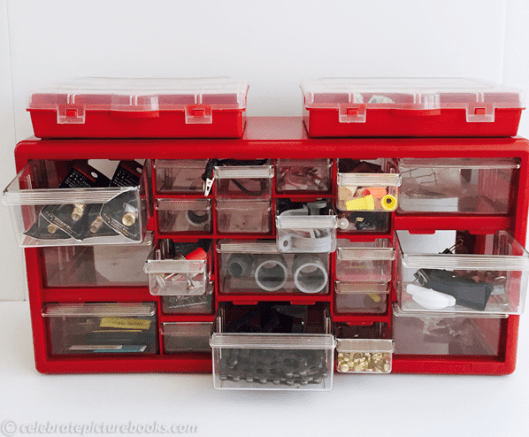
Every idea begins as a jumble of seemingly unrelated parts. Gathering whatever types of material inspires you and keeping it in a box ready to go when inspiration hits is a great way to support innovation and spark experimentation.

Supplies

  • Small parts organizer with drawers or compartments, available at hardware stores and craft stores
  • A variety of parts or craft materials that can be combined, built with, or built on
  • Some hardware ideas—pulleys, wheels, small to medium pieces of wood, wire, nuts, bolts, screws, hooks, knobs, hinges, recyclable materials
  • Some craft ideas—clay, beads, wooden pieces, sticks, paints, pipe cleaners, string, spools, buttons, glitter, scraps of material, recyclable materials

Directions

  1. Fill the organizer with the materials of your choice
  2. Let your imagination go to work! Build something cool, crazy, silly, useful—Amazing!

Picture Book Review
November 12 – Fancy Rat and Mouse Day

celebrate-picture-books-picture-book-review-the-mouse-and-the moon

About the Holiday

Today gives us a chance to take another look at rats and mice. I’m not talking about the kind of mouse I’ve seen scurrying around in my garage or the kind of rat that…well, honestly, I hope is nowhere near my garage. The guys  we’re celebrating today are fancy, which means they are bred to make good pets. Despite their bad rap, mice and rats are smart, loyal, and clean. They don’t require as much care as a dog or cat, and they can be fun to play with. The American Fancy Rat and Mouse Association holds events around the country to introduce people to these alternative pets. Today, you may want to check one out.

The Mouse and the Moon

By Gabriel Alborozo


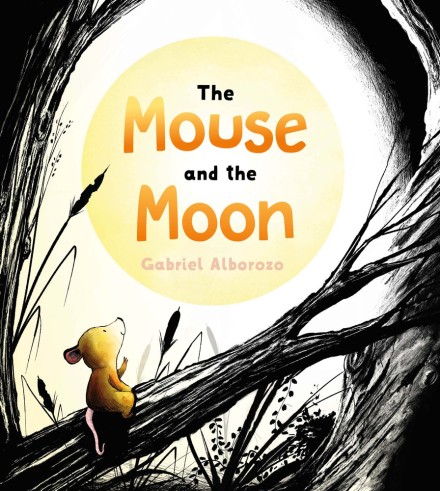
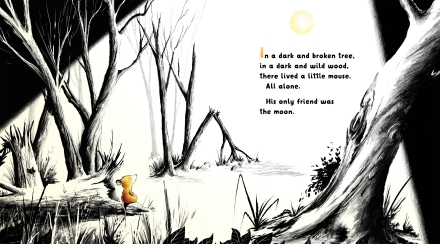
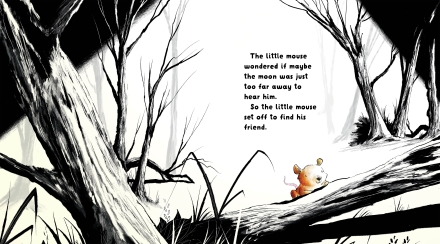
“In a dark and broken tree, in a dark and wild wood, there lived a little mouse. All alone. His only friend was the moon.” The little mouse waited each night for the moon to appear so that he could talk about his day and his hopes, dreams, and fears. The moon always listened silently. The little mouse began to think that the moon was just too far away to hear him, so he went in search of his friend.

celebrate-picture-books-picture-book-review-the-mouse-and-the moon-mouse-lives-alone

Image and text copyright Gabriel Alborozo, courtesy us.macmillan.com

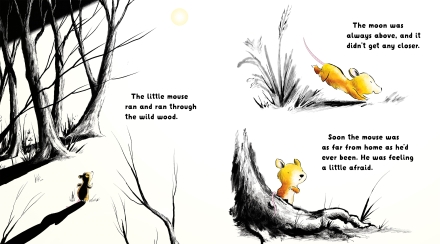
The mouse scampered through the woods, but no matter how far he went, the moon never seemed any closer. Pretty soon the mouse was far from home and “was feeling a little afraid.” When he stopped to rest, the mouse looked into the night sky, but could no longer see the moon. Suddenly, he heard a whispered “‘Hello?’” The mouse cautiously looked around and replied, “‘Hello?’” “And there, floating in a small, still pool, was the moon.” The mouse was excited to have found his friend at last.

celebrate-picture-books-picture-book-review-the-mouse-and-the moon-mouse-goes-to-find-moon

Image and text copyright Gabriel Alborozo, courtesy us.macmillan.com

But what he didn’t see was the tiny fish “hidden from sight, beneath the moon’s reflection.” The little fish was equally glad to finally hear from his friend the moon. “‘I’ve been waiting so long to talk to you!’ bubbled the tiny fish.” The two spent the night telling each other everything. As the sun rose, the moon began to fade. The mouse and the fish both pleaded for the moon to stay. The mouse crept as close to the edge of the pool as he could, and the fish swam close to the surface of the water.

When the moon’s reflection finally vanished in full daylight, “the two new friends saw each other for the first time….Both together and both happy.”

celebrate-picture-books-picture-book-review-the-mouse-and-the moon-mouse-runs-through-woods

Image and text copyright Gabriel Alborozo, courtesy us.macmillan.com

Gabriel Alborozo’s sweet, gentle story of friendship found is a beautiful tribute to perseverance, bravery, and discovery. After spending time telling the moon all about their lives with no response, the fish and the mouse, instead of giving up, go in search of their friend. For the mouse this means leaving his comfort zone and facing on his own some of the fears that he has shared with the moon. The fish, meanwhile, continues calling out until he receives an answer back. While both believe they are talking to their long-held confidant, when the moon disappears, the fish and the mouse happily embrace each other as new friends. Alborozo’s lines are simple and tranquil, with alliteration that flows as smoothly as the ripples on a pond.

Alborozo’s striking black-and-white illustrations, punctuated in the early pages only by the adorable golden-haired mouse, well represent the mouse’s loneliness of the heart. Similarly, the golden-scaled fish lives in a black-and-white world until he and the mouse see each other. As the moon vanishes, the pool and pond grasses are transformed by yellow, green, violet, blue, and orange hues into a sunny, happy landscape echoed in the smiles of the new best friends.

The Mouse and the Moon is a lovely quiet story time or bedtime book, and its comforting charm will make it a favorite with many children. This book would be a nice addition to home bookshelves.

Ages 2 – 7

Henry Holt, 2016 | ISBN 978-1627792240

To discover more picture books as well as a gallery of “bits not in books” by Gabriel Alborozo, visit his website!

Fancy Rat and Mouse Day Activity

celebrate-picture-books-picture-book-review-mouse-coloring-page

Cute Mice Coloring Pages


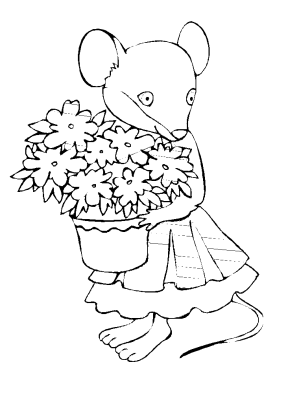
Here are a couple of fancy mice – one just hanging out and one all dressed up in her finest clothes – for you to color. After you’ve colored these pages, why not write a short story about them!

Cute Mouse Coloring Page | Dressed-up Mouse Coloring Page

Picture Book Review

November 6 – Marooned without a Compass Day

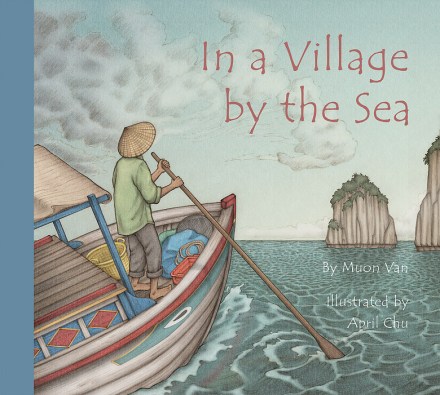
celebrate-picture-books-picture-book-review-in-a-village-by-the-sea-cover

About the Holiday

It may seem appropriate that the origins of this holiday are lost to history, like someone left to languish on a deserted island. But it’s true that—at some time or another—most of us feel marooned without a compass, flailing with decisions about what to do, who to confide in, even who we are. Today is an opportunity to reflect on the direction you are going in life and, if you find you are off course, to steer once more down the right path. It’s comforting to know that someone will be waiting for you when you reach home—wherever that may be.

In a Village by the Sea

Written by Muon Van | Illustrated by April Chu


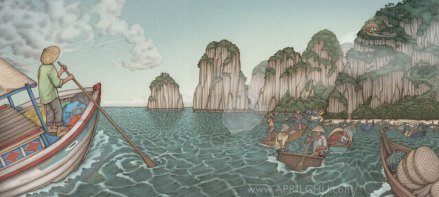
High on a cliff a small house looks out over the sea, where fishermen are poling their craft and setting their nets. “In that house, high above the waves, is a kitchen.” In the kitchen a warm fire blazes under “a pot of steaming noodle soup.” A woman, preparing ingredients for dinner, watches, mixes, and stirs while the pot simmers.

celebrate-picture-books-picture-book-review-in-a-village-by-the-sea-small-house-on-the-cliff

Image copyright April Chu, courtesy of aprilchu.com

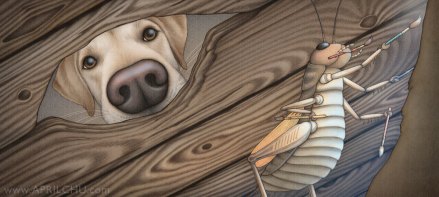
“By that woman is a sleepy child, yawning and turning. By that child, tucked in the shadows, is a dusty hole.” If you peer into that hole, you will see something astounding—a brown cricket is “humming and painting.” The cricket, brushes in four hands is surrounded by paints contained in seashells. It is painting a “sudden storm, roaring and flashing.”

celebrate-picture-books-picture-book-review-in-a-village-by-the-sea-small-house-dog-finds-cricket

Image copyright April Chu, courtesy of aprilchu.com

A white boat rides this roiling sea, rising and dipping with the crashing waves as lightning flashes ahead. Under the cover of the boat’s canvas roof a fisherman eyes the threatening sky and waits for the storm to end. In his hand he opens a precious box. Inside are two pictures: one of a small house high on a hill; the other of a smiling woman holding a little child while their dog looks on. Next to these sits a special cricket.

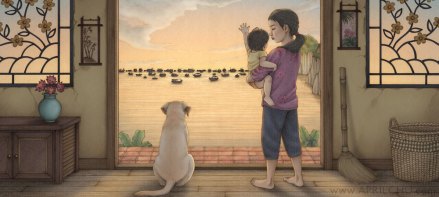
In the painting there is also a small house, and “in that house is a family waiting for [the fisherman] to come home.”

celebrate-picture-books-picture-book-review-in-a-village-by-the-sea-looking-out-the-door

Image copyright April Chu, courtesy of aprilchu.com

Muon Van’s lyrical tale expands and contracts through the eyes of family members to reveal not only the actions and emotions of one afternoon but those that eternally exist in each character’s heart. In the opening page readers view the small house from afar as the husband and father fisherman casts off on his journey. Children are then invited into the kitchen and finally into a small crevice.

Through the cricket’s tiny painting, readers once again see the wider world with its storms and worries. Narrowing the perspective to the fisherman’s view as he looks at his photo box, however, they understand that comfort and reassurance are always close at hand. As the next page zooms out, children are again invited into the little home to join the woman, baby, and vigilant dog as they gaze out into the bay, watching and waiting for one particular boat.

Van’s quiet and simple story holds much universal feeling as it traverses both homey and unpredictable landscapes. As each page depends on the previous one, a gentle suspense builds, enticing readers to follow wherever the story takes them. The inclusion of the “dusty hole,” where a cricket—a symbol of good luck—paints the rest of the story, is irresistible and lends the tale a mystical quality.

celebrate-picture-books-picture-book-review-in-a-village-by-the-sea-on the shore

Image copyright April Chu, courtesy of aprilchu.com

April Chu’s gorgeous paintings transport readers to a Vietnamese fishing village with their delicate and colorful details. The small home glows with the light of paper lanterns and the fire in the stove. As the perspective of the text changes, so does the perspective of Chu’s paintings. When readers peer into the soup pot, bubbling with delicious vegetables, the family’s Labrador gazes up at them, almost begging to know what smells so good. Another bird’s eye view lets kids watch as the dog discovers the hole under the rug, a beautiful device to increase their enjoyment of and wonderment at the story.

Kids will marvel at the cricket’s artistic talent, as the stormy sea churns with whitecaps and lightning flashes from the tip of the small creator’s paintbrush. But it is Chu’s mastery that makes each page so meaningful.

Ages 3 – 10

Creston Books, 2015 | ISBN 978-1939547156

View a porfolio of picture books and other artwork by April Chu on her website!

Marooned without a Compass Day Activity

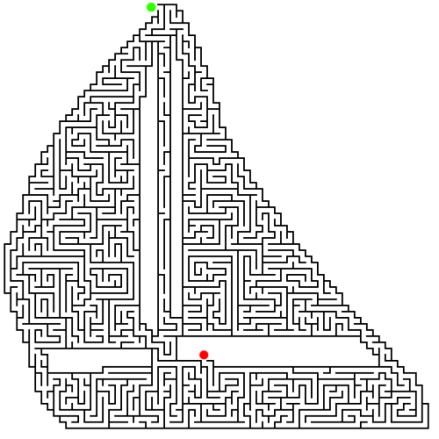
celebrate-picture-books-picture-book-review-sail-boat-maze

Sailboat Maze


Sometimes getting through a maze is as smooth as sailing on a calm sea—and sometimes the path is a little choppy. Get your pencil ready and chart a path through this printable Sailboat Maze!

Picture Book Review
October 25 – International Artist Day

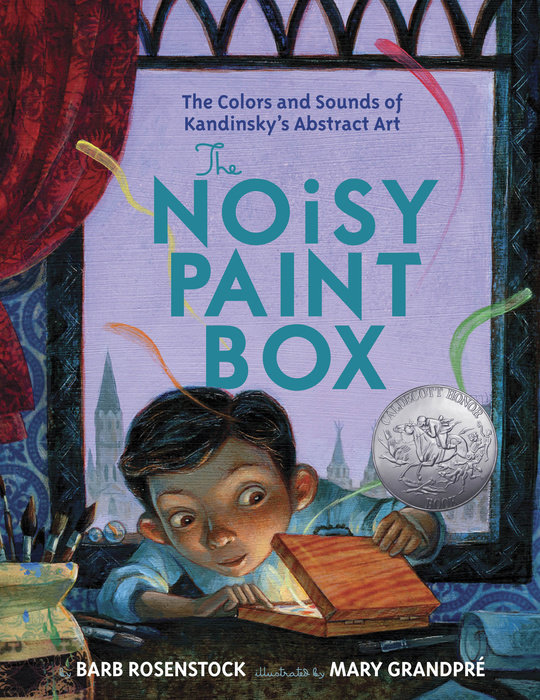
celebrate-picture-books-picture-book-review-the-noisy-paint-box

About the Holiday

Instituted in 2004 by Chris MacClure, a Canadian artist who specializes in Romantic Realism, National Artist Day celebrates the various forms of art, the artist, and the unique vision each one brings to their work and the world. Whether you like classic or abstract styles, watercolors or oils, sculpture or installations, why not take some time today to visit an art museum or gallery—or page through a collection of prints or a biography like today’s book!

The Noisy Paint Box: The Colors and Sounds of Kandinsky’s Abstract Art

Written by Barb Rosenstock | Illustrated by Mary GrandPré


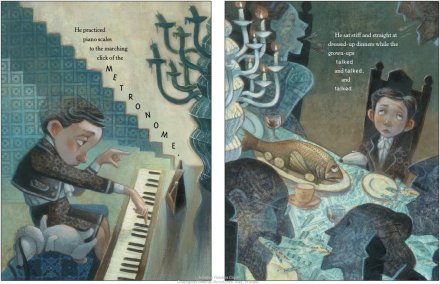
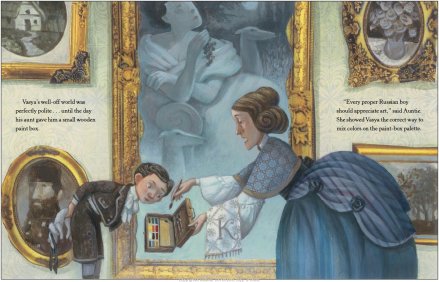
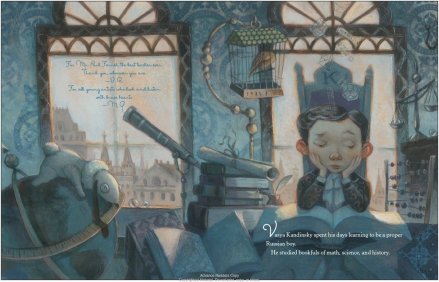
As a Russian child Vasya Kandinsky spends his days absorbed in learning math, science, and history. He takes piano lessons and attends formal dinners where the adults drone on and on. His life is polite, stiff, and colorless until the day his aunt gives him a small wooden paint box. “Every proper Russian boy should appreciate art,” Vasya’s aunt tells him while explaining how to mix colors.

celebrate-picture-books-picture-book-review-the-noisy-paintbox-piano-lessons

Image copyright Mary Grandpré, text copyright Barb Rosenstock. Courtesy of randomhouse.com

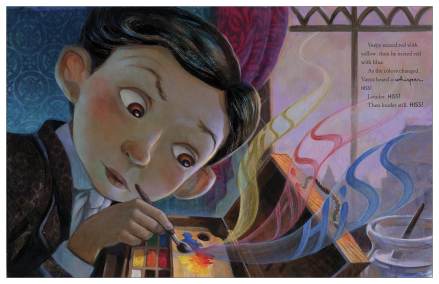
Vasya takes up the brush and combines red with yellow then red with blue. As the colors change to orange and purple, Vasya hears a whisper that grows into a noisy hiss. “‘What is that sound?’” he asks, but no one else hears anything. “The swirling colors trilled like an orchestra tuning up for a magical symphony,” and “Vasya painted the sound of the colors.” A lemon yellow “clinked like the highest notes on the keyboard; a navy blue “vibrated deeply like the lowest cello strings.” Crimsons “blared” and greens “burbled.”

celebrate-picture-books-picture-book-review-the-noisy-paintbox-colors-kandinsky-gets-his-first-paints

Image copyright Mary Grandpré, text copyright Barb Rosenstock. Courtesy of randomhouse.com

Vasya runs downstairs to show his family what he has created. His mother, father, and Auntie look at the canvas with its swoops, shapes, and angles. “What is it supposed to be?” they ask, and send him off to art school to learn how “to draw houses and flowers—just like everyone else.” Vasya finishes school and becomes a lawyer. He leaves his paint box untouched and lives the way he is expected, but the sounds of the colors are always with him.

One evening as he listens to an opera, the music surrounds him with color—“stomping lines of vermilion and coral; caroling triangles in pistachio and garnet; thundering arches of aqua and ebony…” Vasya can hear the colors and see the music. He knows then what he must do. He quits his job teaching law and moves to Germany to be a painter. He surrounds himself with artists and takes classes with famous teachers, and yet people still look at his canvases and asked, “What is it supposed to be?”

celebrate-picture-books-picture-book-review-the-noisy-paintbox-colors-have-sounds

Image copyright Mary Grandpré, text copyright Barb Rosenstock. Courtesy of randomhouse.com

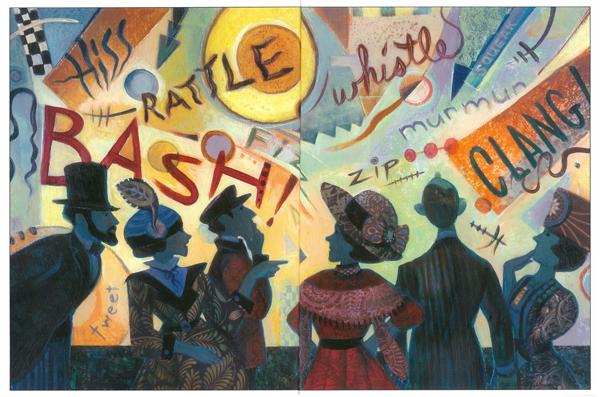
Once again he paints what is expected. His teachers love his houses and flowers, but Vasya does not. His friends understand. They too want to expand the meaning of art. They agree with Vasya when he says, “‘Art should make you feel.’” In his studio Vasya continues to paint the sounds he hears, to give music color and color sound. Bravely, he invites the public to view his paintings, which are named after musical terms—Composition, Accompaniment, Fugue, and more.

This is a new kind of art—abstract art—and it takes a long time before people understand. They look and still ask, “What is it supposed to be?” “It is my art,” Kandinsky replies “How does it make you feel?” 

celebrate-picture-books-picture-book-review-the-noisy-paintbox-colors-kandinsky-at-a-concert

Image copyright Mary Grandpré, courtesy of randomhouse.com

An author’s note telling more about Kandinsky’s life and synesthesia, a genetic condition in which one sense triggers another, follows the story.

In the spirit of full disclosure, Kandinsky is one of my favorite artists, so I was excited to read this biography—I was not disappointed! With so many great artists, their work speaks for itself, but viewers wonder: How did it come about? What influenced the artist? Barb Rosenstock, with lyrical language and beautifully chosen descriptions, reveals the emotions and passion that fueled Kandinsky’s art from his earliest ages: as he walks through Moscow he can’t ignore “the canary-colored mailbox whistling as he rode to work. The scarlet sunset haze ringing above the ancient Kremlin walls.” Rosenstock’s inclusion of the conflicts and opposition Kandinsky faced and overcame will inspire children to listen to their inner voice and makes readers and lovers of his abstract art glad he never gave up.

Mary GrandPré’s unique style brilliantly depicts Kandinsky’s singular vision, allowing readers to experience the way he wielded his paint brush like a conductor’s baton. Vasya’s early life is painted in muted blues and grays, and the boredom on his face as he studies his schoolwork is obvious. Kids will appreciate his one-finger plinking at the piano and the rolled-eyed drowsiness of the formal dinner. Once Vasya is introduced to the paint box, however, GrandPré’s illustrations become vibrant, with swirling colors overlaid with the musical notes that Kandinsky associated with them. His uninhibited painting is gloriously shown as the young boy’s shirt comes untucked and the colors burst from the canvas upon his first painting.

celebrate-picture-books-picture-book-review-kandinsky-studying

Image copyright Mary Grandpré, text copyright Barb Rosenstock. Courtesy of randomhouse.com

As the adults look at his work, the room is again swathed in somber colors. The text revealing that Vasya attended regular art classes to learn to draw houses and flowers is set above a single wilting flower in a vase. The personal tug-of-war Kandinsky experienced even into adulthood is wonderfully rendered: Colors flow into his ears at the opera; he studies his own landscape and still life paintings with misgiving in a hazy studio, and the joy and freedom of his abstract art is demonstrated with wild abandon while a dove escapes its cage. The final image of a child sitting in front of a Kandinsky painting reinforces the idea that his art lives for all and for all time.

Ages 4 – 9

Alfred Knopf, Random House Children’s Books, 2014 | ISBN 978-0307978486

International Artists Day Activity

celebrate-picture-books-picture-book-review-i-love-art-word-search

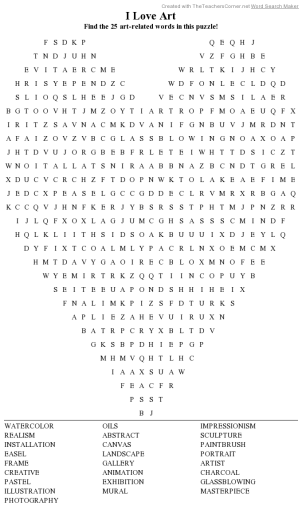
I Love Art! Word Search 


There are twenty-five art-related words for everyone to love in this printable I Love Art! word search puzzle! Here’s the Solution!

Picture Book Review
October 24 – United Nations Day

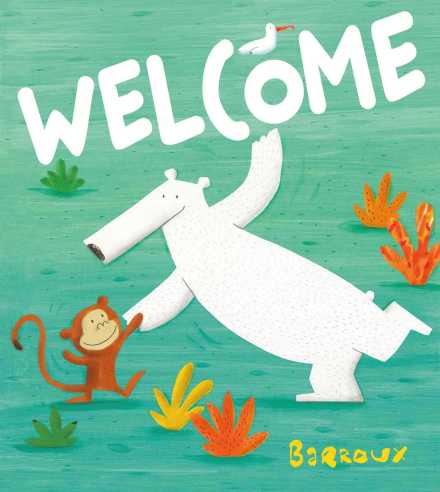
celebrate-picture-books-picture-book-review-welcome-barroux-cover

About the Holiday

Founded in the aftermath of World War II to promote cooperation among all nations and prevent another devastating conflict, the United Nations is an intergovernmental organization whose purpose has grown to include encouraging social and economic development, protecting human rights, and providing aid in times of natural disasters, famine, and war. Today’s holiday commemorates the establishment of the UN and advocates the remembrance and implementation of its principles for this and future generations.

Welcome

By Barroux


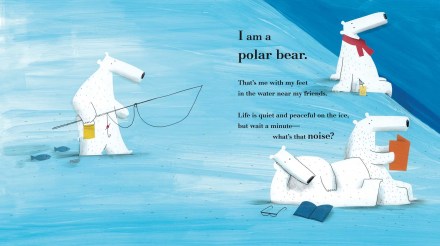
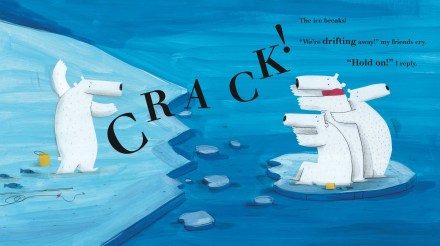
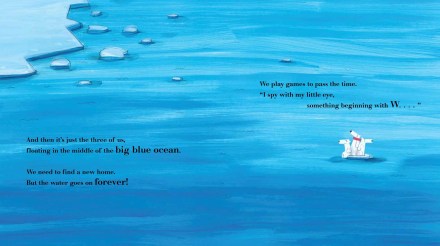
A polar bear sits on the edge of an ice floe enjoying some relaxing time with his friends when he hears an ominous noise. “CRACK! The ice breaks! ‘We’re drifting away!’” his friends cry. In no time at all the three polar bears are adrift in the middle of the sea in need of a new home. They float and float, but “the water goes on forever!” To pass the time the friends play games: “‘I spy with my little eye, something beginning with W…’”

celebrate-picture-books-picture-book-review-welcome-barroux-polar-bears-relaxing

Copyright Barroux, courtesy of little bee books and simonandschuster.com

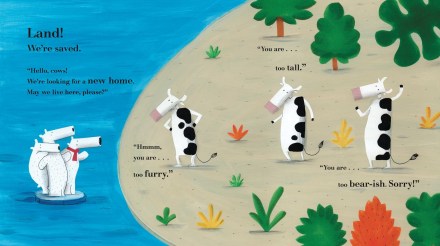
Perhaps days go by. The bears ride out a storm with dark skies and huge waves that threaten to sink them. It’s scary and the trio wants “to find a new home right now!” At last their ice floe—smaller now—approaches a sandy shore. “Land! We’re saved,” cheer the polar bears. They ask the cows on the beach if they can live there, but the cows take exception. The bears are “too furry…too tall…and too bear-ish.” And with a “Sorry!” the cows turn the weary travelers away.

celebrate-picture-books-picture-book-review-welcome-barroux-ice-breaks-away

Copyright Barroux, courtesy of little bee books and simonandschuster.com

Once again on their own, the bears have no choice but to let the current steer them. With standing room for only one their icy raft, they near another beach where a single panda relaxes on pillows in the midst of expansive land. “Yes! This could be our new home,” the polar bears shout. The panda ponders the situation for only a moment before stating, “‘…you are too many. Look around, there’s just not enough room! You can’t live here.’”

celebrate-picture-books-picture-book-review-welcome-barroux-polar-bears-meet-cows

Copyright Barroux, courtesy of little bee books and simonandschuster.com

As the polar bears continue on their journey, their “little ice boat has almost melted” and they are running out of time. They bob next to a tall sea wall. “‘Help us!’” they plead. Behind the wall two giraffes lounge on the beach, too lazy to investigate the noise they hear. The ice floe has melted to a thin disk, with room for only one. The bears are hanging on and about to give up hope when they find an empty island. They jump to shore just in the nick of time and begin enjoying their new home.

celebrate-picture-books-picture-book-review-welcome-barroux-polar-bears-adrift

Copyright Barroux, courtesy of little bee books and simonandschuster.com

It’s not long before a dinghy floats into view with three monkeys on board. “‘Excuse me, we’re looking for a new home. Can you help us please?’” The polar bears stop their game of badminton and step forward. “‘Hmmm,’” they think. “‘You are…

Welcome!’”

With vibrant blue, full-bleed pages as wide open as the sea itself and three endearing long-nosed polar bears, Barroux has crafted a poignant tale with depth and far-reaching applications for readers of all ages. Inspired by the Syrian refugee crisis, Welcome stands on its own as an uplifting story of friendship and inclusiveness, but also offers an excellent means for beginning a discussion on the world events that children see and have questions about. Employing a bear’s first person point of view and incorporating a child-centric perspective on travel—from the humor of the I Spy game to the perseverance of the bears—Barroux sets just the right tone for his audience.

With sparse text and repetition of the bears’ simple request, the subject matter is handled with sensitivity, not fright, which allows children to understand that the theme of the story is relevant on many levels. Whether the “traveler” comes from near or far, is a classmate, teammate or neighbor, or is even the reader or someone else feeling adrift in a certain situation, children will see that all deserve welcome.

Ages 4 – 8

little bee books, 2916 | ISBN 978-1499804447

United Nations Day Activity

celebrate-picture-books-picture-book-review-UN-day-puzzle

Give Me Your Hand! Puzzle


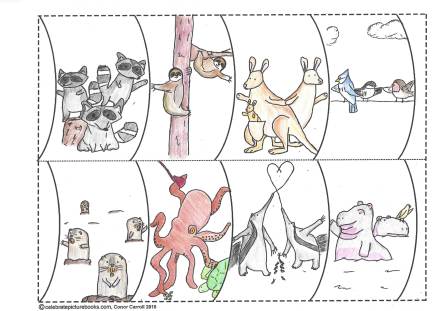
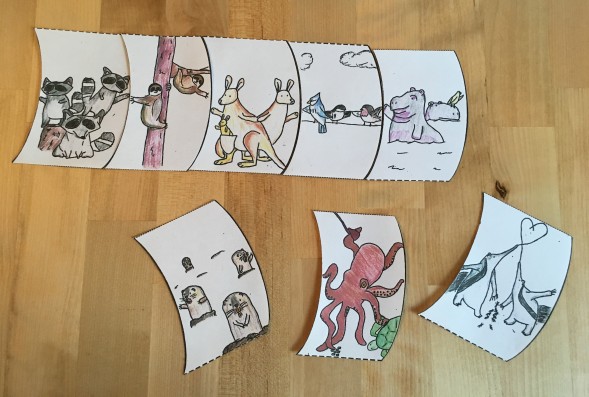
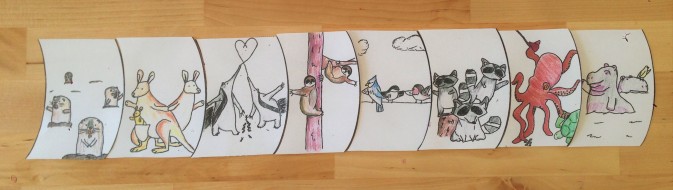
In this printable Give Me Your Hand! Puzzle, everyone is welcomed with a handshake. Offering friendship to all, the interchangeable pieces can be mixed and matched as the animals become buddies with one another.

Supplies

celebrate-picture-books-picture-book-review-UN-day-puzzle

Copyright Conor Carroll, courtesy of celebratepicturebooks.com

Directions

  1. Print the puzzle: to make the puzzle sturdier: Print on heavy stock paper or glue the page to poster board
  2. Color the pictures with colored pencils or crayons
  3. Cut the pieces apart
  4. Switch the pieces around to make many alternate pictures
celebrate-picture-books-picture-book-review-UN-day-puzzle

Copyright Conor Carroll, courtesy of celebratepicturebooks.com

Picture Book Review
Picture Book Review