July 25 – Culinarians Day

celebrate-picture-books-picture-book-review-the-ugly-dumpling-cover

About the Holiday

The world can’t celebrate Culinary Arts Month without having a special day to recognize and thank the many chefs, cooks, bakers, and other creators of delicious treats. Today is that day! With their special talents for taste, presentation, and innovation, culinarians make life better for everyone!

The Ugly Dumpling

Written by Stephani Campisi | Illustrated by Shahar Kober


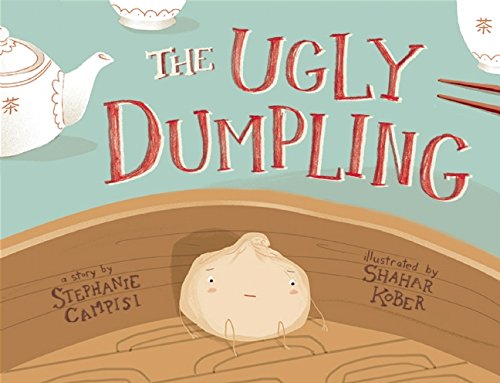
“Once upon a time, perhaps last week, or even last night, at your local dim sum restaurant…there was an ugly dumpling.” Sure, you might think all dumplings are ugly, but we’re talking about one particular ugly dumpling. It tried all sorts of tricks to make itself more attractive, but it still remained lonely and uneaten. It sat dejected until a cockroach traversing the kitchen caught sight of it and immediately fell in love.
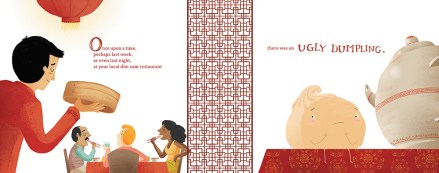
celebrate-picture-books-picture-book-review-the-ugly-dumpling-interior-art-dim-sum-restaurant

Image copyright Shahar Kober

The cockroach “reached out an arm. (Or a leg.)” toward the dumpling and offered to show it the beauty of the world. Together they traveled to cities near and far, experiencing them through culinary lenses—stacked plate skyscrapers, piled dishes skylines, chopstick bridges that took them over flour mountains and folded napkin peaks. Then, in a certain restaurant, the dumpling saw something astonishing! Not only one, but two, three, four, and more dumplings just like itself!

Suddenly the ugly dumpling realized that it was not a dumpling at all, but a “steamed bun—a golden-hearted, smooth-skinned steamed bun, exactly like all the other steamed buns in the world.” The ugly dumpling puffed with meaning, importance, and…yeast! The restaurant patrons and staff and even the other steamed buns took notice. The cockroach by the ugly dumpling’s side cheered to see its friend receiving so much attention.
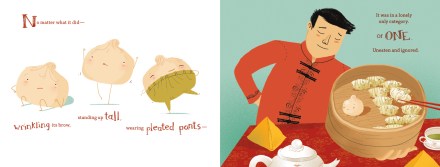
celebrate-picture-books-picture-book-review-the-ugly-dumpling-interior-art-restaurant

image copyright Shahar Kober

The wide eyes and astonished expressions were not for the dumpling, however. Instead, they registered horror at the insect in their midst. The ugly dumpling was familiar with that look and did “something quite beautiful. It reached out an arm. (Or a leg.) And it led the cockroach out into the world, The beautiful, beautiful world.” And in that moment the ugly dumpling realized that it “was not like all the other steamed buns after all” and that “perhaps that was a good thing.”

Stephani Campisi’s The Ugly Dumpling is a fresh and delectable dish-up of the classic Ugly Duckling story for a new audience. Stuffed with charm and off-beat humor, this tale of friendship and diversity embraces all who feel at odds with their environment—with or without the recognition of why. Its sweet and insightful ending emphasizes the idea that finding your niche does not always mean finding your true self and that having the courage to strike out on your own path leads to beautiful relationships and happiness.
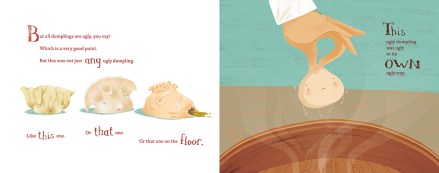
celebrate-picture-books-picture-book-review-the-ugly-dumpling-interior-art-three-ugly-dumplings

Image copyright Shahar Kober

Shahar Kober’s dumpling is anything but “ugly.” His adorable puffed dough, lonely and ignored for not adhering to the mold, will melt readers’ hearts as he tries anything and everything—including green pleated pants—to fit in. Kobar’s stylish drawings are the perfect underscore to Stephani Campisi’s quick, dry wit—as in his rendition of three uglier-than-the-next dumplings—and if cockroaches were really as cute as Kober’s, we’d all set out a different kind of Roach Motel. A clever bit of typography transforms steam coming from a wok into the word HISS, and the restaurant scenes will make readers hungry for their favorite Asian eatery.

As readers turn to the last pages and watch the steamed bun and the cockroach leave the restaurant hand in hand (foot in foot?) under the shade of a paper umbrella, they will want to turn back to the beginning and start over again. The Ugly Dumpling is a must read and a must addition to children’s bookshelves.

Ages 2 – 9

Mighty Media, 2016 | ISBN 978-1938063671

Get to know more about Stephanie Campisi and her work on her website!

To view a gallery of art by Shahar Kober for books, magazines, animation, and more, visit his website!

Check out the Mighty Media Press website for more about The Ugly Dumpling and a-dough-able coloring pages!

Take a look at the trailer for The Ugly Dumpling!

Culinarians Day Activity
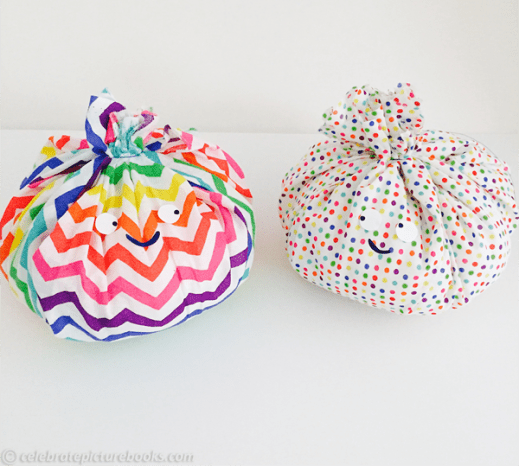
celebrate-picture-books-picture-book-review-dumpling plush craft

Embrace Your Inner Dumpling Plush


We are all beautiful “dumplings” in one way or another! With this easy craft you can create a huggable friend and show others what you’re made of!

Supplies

  • Square piece of cloth in any fabric and color. Size of plush depends on size of cloth (the plushes shown are made from 18”-square cotton fabric)
  • Poly fill (the plushes shown use about 1 1/8 ounces of fill)
  • White cloth for eyes and mouth
  • Twine or string
  • Fabric glue

Directions

  1. Cut the corners from the square cloth to make a circular piece of cloth
  2. Fill the middle with poly fill
  3. Pull the edges of the cloth up and around the fill
  4. Tie the top closed with the twine or string
  5. To make the face, cut small circles and a mouth from the white cloth
  6. Smooth out a section of the dumpling body
  7. Glue the face to the body with fabric glue

May 20 – Bike to Work Day

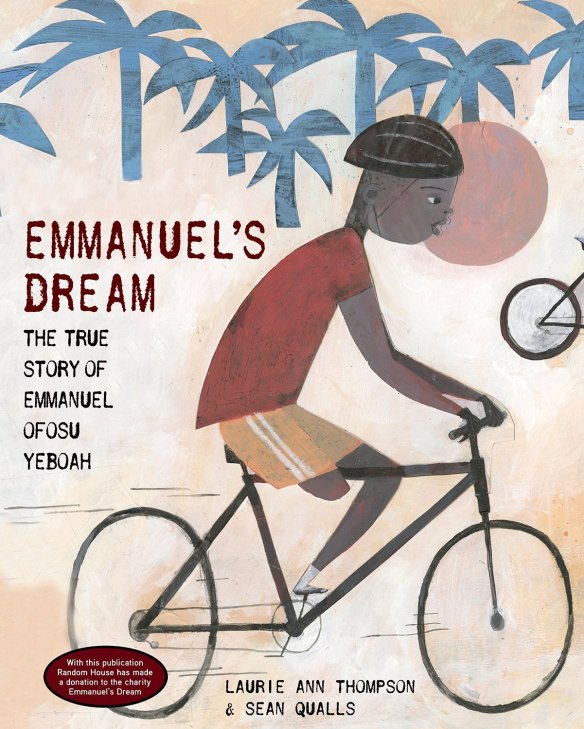
celebrate-picture-books-picture-book-review-emmanuel's-dream

About the Holiday

May is National Bike Month and today is set aside for riders to replace their usual method of commuting with pedaling instead!  Established in 1956 by the League of American Bicyclists and celebrated in communities from coast to coast, National Bike Month is a chance to showcase the many health-related and fun benefits of bicycling — and to encourage more folks to giving biking a try. Now that the weather is nice bring out your bikes, pump up the tires, and take to a street or trail near you!

Emmanuel’s Dream: The True Story of Emmanuel Ofosu Yeboah

Written by Laurie Ann Thompson | Illustrated by Sean Qualls


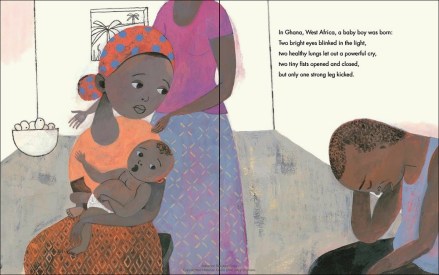
A baby is born in Ghana, West Africa with bright eyes, healthy lungs, and tiny, clasping fingers—but with only one strong leg. Most people think the baby will grow up to be a burden or worse—a curse. His father leaves the family, but his mother keeps the faith. Her name is Comfort and she names her child Emmanuel, which means “God is with us.”

celebrate-picture-books-picture-book-review-emmanuel's-dream-baby

Image copyright Sean Qualls, text copyright Laurie Ann Thompson. Courtesy of Schwartz & Wade

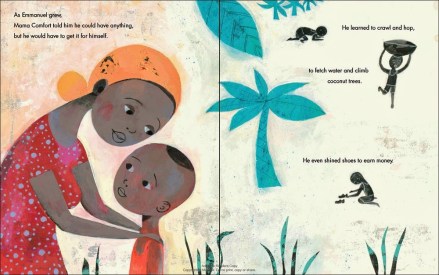
As Emmanuel grows, his mother encourages his independence. He learns how to crawl and hop to complete his daily work all with one leg. Most kids with disabilities don’t go to school, but Comfort carries her son back and forth until he becomes too heavy. From then on Emmanuel hops the two miles each way all by himself. At first the other kids won’t play with him, but Emmanuel is clever. He buys a soccer ball with the money he earns shining shoes and when he offers to share it, the kids include him. On crutches he is a fierce competitor and earns his classmates’ respect. Riding bikes is another favorite activity. Can Emmanuel pump those pedals with only one leg? He practices and falls, practices and falls some more until he masters the technique.

celebrate-picture-books-picture-book-review-emmanuel's-dream-going-to-school

Image copyright Sean Qualls, text copyright Laurie Ann Thompson. Courtesy of Schwartz & Wade

When Emmanuel is 13 years old, his mother becomes ill. As the only family member capable of working, Emmanuel takes a train to a city 150 miles away to find a job. He doesn’t see his family again for two years. Because of his disability it is hard for him to find work. Finally, a food stand owner hires him and gives him a place to live. Over time Comfort grows sicker. When Emmanuel goes to be with her, she tells him to never beg and never give up. He takes these words to heart.

Emmanuel has an idea to show the world that “disabled does not mean unable”—all he needs is a bike. When the Challenged Athletes Foundation learns of his plan to bike around Ghana, they give him a bike, a helmet, and clothing. He trains and receives a blessing from the king of his region. Then accompanied by people who will document his trip, he takes off. “He pedaled through rain forests, over rolling hills, and across wide, muddy rivers….He pedaled as trucks roared past on the narrow highways and wild animals stalked his thoughts….He rode up, down, across, and around his country, proudly wearing the colors of its flag on a shirt printed with the words “The Pozo” or “the disabled person.”

celebrate-picture-books-picture-book-review-emmanuel's-dream-growing-up

Image copyright Sean Qualls, text copyright Laurie Ann Thompson. Courtesy of Schwartz & Wade

Emmanuel talks to others with physical challenges and to those without. He meets farmers, landowners, government officials, and reporters. He wants everyone to learn of his message. People begin to pay attention—they ride and run alongside him; people with disabilities come out of their houses to see him (some for the first time ever). Emmanuel is becoming a national hero!

Emmanuel completes his journey—nearly 400 miles—in only 10 days. In that short amount of time he proves that anyone can do great things and that one person is enough to change the world.

An author’s note expanding on Emmanuel Yeboah’s life since his bike ride follows the text.

Laurie Ann Thompson tells this story of courage and achievement in straightforward language that highlights the difficulties and prejudices Emmanuel overcame to live the full life his mother envisioned for him. The details Thompson reveals—both within the school setting and in the world beyond—will inspire anyone who reads this special and moving true story.

Sean Qualls renders the story of Emmanuel Yeboah in the vibrant colors and patterns of his native West Africa, giving energy and spirit to the fire that burned inside the young boy who rose above his disability and the expectations of his community. His relationship with his strong, supportive mother is drawn with obvious love and compassion. The use of a folk-art style combined with scenes of African markets, landscapes, and traditional tableaus, effectively sets the story for children. One particularly touching illustration shows a tiny Emmanuel hopping off to school as his mother, shown larger in the foreground, watches.

Ages 4 – 9

Schwartz & Wade, Random House, 2015 | ISBN 978-0449817445

Bike to Work Day Activity

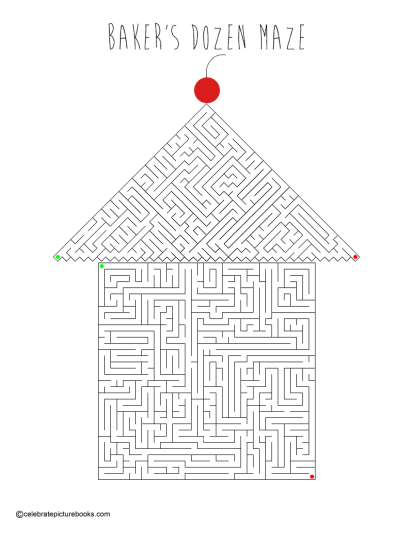
celebrate-picture-books-picture-book-review-baker's-dozen-maze

Baker’s Dozen Maze


After a long bike ride, don’t you just feel like a treat to reward yourself? This maze is a little of both—a twisting, turning puzzle that looks like a cupcake! Start at the green dot and finish at the red dot in both the “frosting” and the “cake.” Print your Baker’s Dozen Maze here. 

May 16 -National Biographer’s Day

celebrate-picture-books-picture-book-review-the-noisy-paint-box

About the Holiday

On this day in 1763 James Boswell walked into a London bookshop and met Samuel Johnson—poet, critic, journalist, and writer of the first dictionary. They became friends, and 30 years later Boswell wrote a spirited biography of his companion that fully described Johnson’s feelings, quirks, opinions, and details of his life in a warm, conversational, unstinting way. The Life of Samuel Johnson changed forever the way biographies were written and is still popularly read today. Why not spend some time today with that fascinating biography or one on a favorite personality—or start writing the story of your own life!

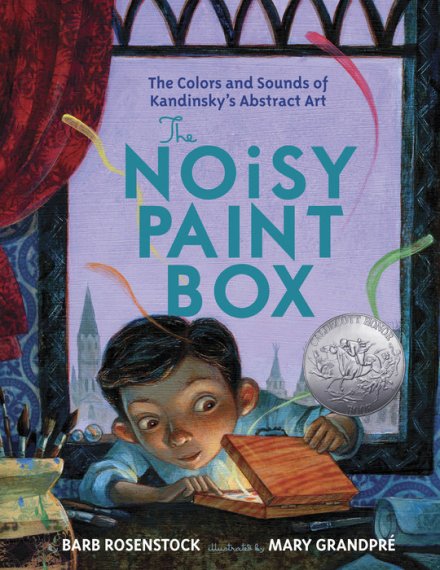
The Noisy Paint Box: The Colors and Sounds of Kandinsky’s Abstract Art

Written by Barb Rosenstock | Illustrated by Mary Grandpré


As a Russian child Vasya Kandinsky spends his days absorbed in learning math, science, and history. He takes piano lessons and attends formal dinners where the adults drone on and on. His life is polite, stiff, and colorless until the day his aunt gives him a small wooden paint box. “Every proper Russian boy should appreciate art,” Vasya’s aunt tells him while explaining how to mix colors.

Vasya takes up the brush and combines red with yellow then red with blue. As the colors change to orange and purple, Vasya hears a whisper that grows into a noisy hiss. “‘What is that sound?’” he asks, but no one else hears anything. “The swirling colors trilled like an orchestra tuning up for a magical symphony,” and “Vasya painted the sound of the colors.” A lemon yellow “clinked like the highest notes on the keyboard; a navy blue “vibrated deeply like the lowest cello strings.” Crimsons “blared” and greens “burbled.”

Vasya runs downstairs to show his family what he has created. His mother, father, and Auntie look at the canvas with its swoops, shapes, and angles. “What is it supposed to be?” they ask, and send him off to art school to learn how “to draw houses and flowers—just like everyone else.” Vasya finishes school and becomes a lawyer. He leaves his paint box untouched and lives the way he is expected, but the sounds of the colors are always with him.

One evening as he listens to an opera, the music surrounds him with color—“stomping lines of vermilion and coral; caroling triangles in pistachio and garnet; thundering arches of aqua and ebony…” Vasya can hear the colors and see the music. He knows then what he must do. He quits his job teaching law and moves to Germany to be a painter. He surrounds himself with artists and takes classes with famous teachers, and yet people still look at his canvases and asked, “What is it supposed to be?”

Once again he paints what is expected. His teachers love his houses and flowers, but Vasya does not. His friends understand. They too want to expand the meaning of art. They agree with Vasya when he says, “‘Art should make you feel.’” In his studio Vasya continues to paint the sounds he hears, to give music color and color sound. Bravely, he invites the public to view his paintings, which are named after musical terms—Composition, Accompaniment, Fugue, and more.

This is a new kind of art—abstract art—and it takes a long time before people understand. They look and still ask, “What is it supposed to be?” “It is my art,” Kandinsky replies “How does it make you feel?” 

An author’s note telling more about Kandinsky’s life and synesthesia, a genetic condition in which one sense triggers another, follows the story.

In the spirit of full disclosure, Kandinsky is one of my favorite artists, so I was excited to read this biography—I was not disappointed! With so many great artists, their work speaks for itself, but viewers wonder, “How did it come about?” “What influenced the artist?” Barb Rosenstock, with lyrical language and beautifully chosen descriptions, reveals the emotions and passion that fueled Kandinsky’s art from his earliest ages: as he walks through Moscow he can’t ignore “the canary-colored mailbox whistling as he rode to work. The scarlet sunset haze ringing above the ancient Kremlin walls.” Rosenstock’s inclusion of the conflicts and opposition Kandinsky faced and overcame will inspire children to listen to their inner voice and makes readers and lovers of his abstract art glad he never gave up.

Mary Grandpré’s unique style brilliantly depicts Kandinsky’s singular vision, allowing readers to experience the way he wielded his paint brush like a conductor’s baton. Vasya’s early life is painted in muted blues and grays, and the boredom on his face as he studies his schoolwork is obvious. Kids will appreciate his one-finger plinking at the piano and the rolled-eyed drowsiness of the formal dinner. Once Vasya is introduced to the paint box, however, Grandpré’s illustrations become vibrant, with swirling colors overlaid with the musical notes that Kandinsky associated with them. His uninhibited painting is gloriously shown as the young boy’s shirt comes untucked and the colors burst from the canvas upon his first painting.

As the adults look at his work, the room is again swathed in somber colors. The text revealing that Vasya attended regular art classes to learn to draw houses and flowers is set above a single wilting flower in a vase. The personal tug-of-war Kandinsky experienced even into adulthood is wonderfully rendered: Colors flow into his ears at the opera; he studies his own landscape and still life paintings with misgiving in a hazy studio, and the joy and freedom of his abstract art is demonstrated with wild abandon while a dove escapes its cage. The final image of a child sitting in front of a Kandinsky painting reinforces the idea that his art lives for all and for all time.

Ages 4 – 9

Alfred Knopf, Random House Children’s Books, 2014 | ISBN 978-0307978486

National Biographer’s Day Activity

celebrate-picture-books-picture-book-review-recipe-box-label

Recipe Box Label and Recipe Cards


People’s stories are written in all different ways: in the objects they surround themselves with, their activities, and the talents they exhibit. Today’s activity will help you tell your stories in the foods you bake! Or try this Recipe Card Writing Idea: Create a very short story and write it on one of the recipe cards! Read it to your family or teacher.

Supplies

celebrate-picture-books-picture-book-review-recipe-cards

Directions

  1. Glue the My Family’s Recipes label to the box you made
  2. Print out the recipe cards. Use them for your favorite dish and prepare for tomorrow’s treat to bake!

Picture Book Review

May 15 – International Day of Families

celebrate-picture-books-picture-book-review-families-families-families

About the Holiday

This United Nations sponsored observance was initiated in 1993 to reflect the importance of families worldwide. The day provides an opportunity to promote issues affecting families, including social, economic, educational and demographic topics. This year’s theme is Families, Healthy Lives and Sustainable Futures and focuses on ending poverty, promoting shared economic prosperity, social development, and health while protecting the environment. The holiday is marked with workshops, educational opportunities, publications, and special community events.

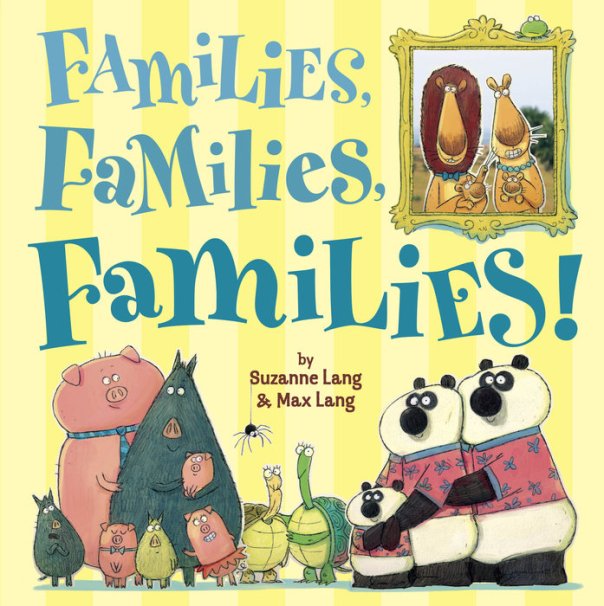
Families, Families, Families

Written by Suzanne Lang | Illustrated by Max Lang


Families—haven’t they always come in all shapes and sizes? With all different customs and traditions? Families, Families, Families delves into this most enduring—and endearing—structure of life in a way that makes sense to kids in a funny and honest way. “Some children have lots of siblings. Some children have none” the book starts. “Some children have two dads. Some have one mom. Some children live with their grandparents…and some live with an aunt.”

Lang does an excellent job of presenting all types of familial arrangements within the pages of the book. Nearly every child will happily find themselves here. Interspersed among the varieties of households, humorous comparisons and rhymes (“some children have many pets…and some just have a plant!”) elevate this book to a tribute to understanding, acceptance, and inclusion. After all…“if you love each other, then you are a family.”

Max Lang hit on an inspired way—during this era of selfies, snapchat, and the like—to illustrate the concepts of family. More than 17 animal families pose for portraits in which comic drawings of smiling moms, dads, kids, and relatives are superimposed onto photographed backgrounds. The portraits are framed with another touch of humor: A chicken family photo sits in a frame made of hay, an octopus and her four children smile from a frame made of seashells, and the Tigers are displayed in a frame of bones. The photos hang on wallpapered, barn, and underwater cave walls; sit on fireplace mantels; are pinned to bulletin boards; and fill scrapbook pages.

Families, Families, Families brilliantly demonstrates how every child takes pride in his or her family—just as the readers take pride in theirs.

Ages 3 – 7

Random House Books for Young Readers, 2015 | ISBN 978-0553499384

International Day of Families Activity

celebrate-picture-books-picture-book-review-recipe-box

Make Your Own Recipe Box


One of the best ways to spend time together is to bake up a favorite recipe and enjoy the results! World Baking Day is celebrated this week, so for the next few days, I’ll be offering baking-related activities for you to have fun with! With a small box you can make your own recipe organizer to keep tasty recipes close at hand!

Supplies

  • A small box with a hinged lid or separate lid, at least 5 inches by 3 1/3 inches (fits a small index card). A Twinings Tea Box works well as does a small wooden box available from craft stores
  • Washi tape or paint
  • Paint brush

Directions

  1. Cover your box with washi tape or paint your box
  2. Decorate your box with your unique style

Picture Book Reviews

May 1 – Mother Goose Day / Children’s Book Week

celebrate-picture-books-picture-book-review-mother-bruce-cover

About the Holiday

Incredibly, the term “Mother Goose” goes back to the 1650s to describe rhymes such as Baa Baa Black Sheep, Here We Go Round the Mulberry Bush, Jack and Jill Went up a Hill, and The Old Woman Who Lived in a Shoe. Fairy tales such as Cinderella and Little Red Riding Hood also came under Mother Goose’s wing. While all of the rhymes are not as familiar to today’s children, many are still popular and their influence can be seen in current books, movies, and TV shows. Mother Goose Day was established in 1987 to highlight these stories and keep them alive for today’s kids. To celebrate, read some Mother Goose tales—either as originally written or in fractured form.

This first week of May also celebrates Children’s Book Week, which was established in 1919 to promote literacy awareness and the joy of reading. As the longest-running national literacy movement in the country, Children’s Book Week holds, sponsors, and encourages events in schools, libraries, bookstores, homes, and wherever young readers and books connect!

Mother Bruce

By Ryan T. Higgins


It’s a good thing Bruce lives by himself. He’s a grumpy grizzly who likes nothing. If it’s sunny he’s grumpy. If it’s raining he’s grumpy. And don’t even get started on how he feels about cute fuzzy animals. There is one thing he likes, though, and that’s eggs! Yummy eggs prepared many ways from recipes Bruce finds on the Internet.

celebrate-picture-books-picture-book-review-mother-bruce-goslings

Copyright Ryan T. Higgins, 2015, courtesy of Disney-Hyperion.

One day a most mouth-watering recipe pops up on the screen—hard-boiled goose eggs drizzled with honey-salmon sauce. Bruce heads out with his own personal shopping cart to collect the ingredients. He ingeniously catches some salmon and raids a local beehive (this carnivore’s a locavore, you see). Next he pays a visit to Mrs. Goose. He takes her eggs after determining that they are free-range organic.

At home Bruce puts the eggs in his special pot and starts a fire in the stove. But the fire fizzles, forcing Bruce to make a visit to the wood shed. When he comes back, his lovely breakfast has hatched! And what’s worse, the little goslings think Bruce is their mother! Bruce stares into those sweet eyes gazing back at him and decides…to have buttered goslings on toast. But those little peepers just won’t cooperate, and for some reason Bruce has lost his appetite.

He gathers up the goslings in his shopping cart and wheels them back to their nest only to find that their mother has already flown south for the winter. Bruce leaves them in the nest anyway and heads for home. But it’s too late—the baby geese have already imprinted on Bruce, and they tag along happily after him. Bruce is stern with them. He roars. He tries to hide out in a tree. But it’s no use; he’s stuck with them.

celebrate-picture-books-picture-book-review-mother-bruce-painting

Copyright Ryan T. Higgins, 2015, courtesy of Disney-Hyperion.

Bruce rises to the challenge, though. He gives up his space in the pool, teaches them how to paint, feeds them, and transports them in a specially-made baby carrier. As spring turns to summer and then fall, Bruce watches his geese grow from “annoying baby geese” to “stubborn teenage geese” to “boring adult geese.”

Finally, one day Bruce spies other goose families flying south and knows his time has come! He can get rid of those geese and take a long, well-deserved nap. Bruce explains migration to his geese, but they don’t quite get it, coming to him dressed in winter coats and hats. Hmmm…some creativity is needed. Bruce tries slinging them northward and sending them flying in remote-controlled planes, but the geese just hug him tighter.

Resigned to his fate, Bruce packs his bag and four smaller ones for his charges and boards a bus for Miami. “Now every winter Bruce and his geese head south together.” They wear floral shirts, and as his “kids” play in the sand, Bruce “dreams of new recipes—recipes that don’t hatch.”

celebrate-picture-books-picture-book-review-mother-bruce-slingshot

Copyright Ryan T. Higgins, 2015, courtesy of Disney-Hyperion.

Ryan T. Higgins’ Mother Bruce is an endearing story of dislike at first sight. Of course no one—not even a grumpy, loner bear like Bruce—can resist the sweet, loving faces of youngsters forever. Fortunately for readers, Bruce holds out longer than most, his transition providing giggle-inducing scenarios on every page.

Higgins’ illustrations are loaded with visual jokes, cultural references kids will love, and four of the cutest clueless geese around. Depictions of Bruce masterfully mix his gruff, bothered exterior with the big softie that lies underneath. Bruce’s solutions to his plight are clever and funny. There may be no better Mother Goose than Bruce!

Ages 4 – 8

Disney-Hyperion, 2015 | ISBN 978-1484730881

Mother Goose Day Activity

Screen Shot 2020-05-01 at 2.28.23 PM

Mother Goose Coloring Page


Mother Goose Rhymes are fun to learn and share! Here’s a picture of Mother Goose and her goose for you to color!

Mother Goose Coloring Page

Picture Book Review


April 16 – Record Store Day

The Bear and the Piano by David Litchfield picture book review

About the Holiday

Vinyl has made a resurgence—and why not?! Records have so much to offer music lovers, from the awesome album art to extras like posters, lyrics, photos and more. Those special packages are all about the relationship between the artists and their fans. All over the world Record Store Day celebrates this art form and the shops—both large and small—where you can find albums by your favorite musicians. Entering a record store is an adventure in itself. Flipping through the bins you might discover a new artist, an old album you don’t have, or an intriguing concept you just have to experience for yourself. Today, visit a record store near you and see how what once seemed old is new again!

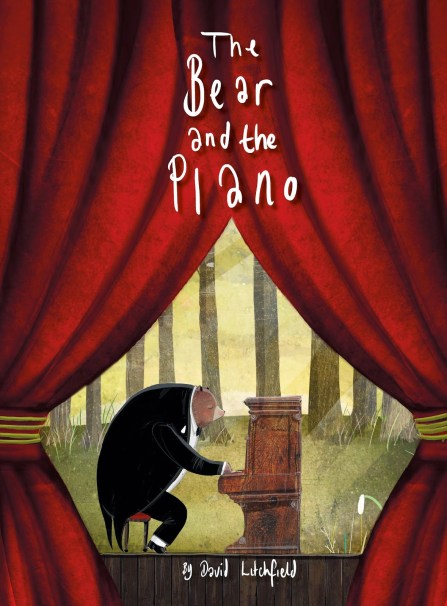
The Bear and the Piano

By David Litchfield


One day a bear cub happens upon a piano in a clearing in the middle of the forest. Wondering what it could be, he approaches and lays his paw on the keys. The strange thing goes PLONK!—such an awful sound. The bear cub leaves, but is drawn back again and again for days, months, and years. Over time the bear grows up and learns to play the piano. The music is beautiful and transports him to strange and wonderful places.

Other bears soon gather in the clearing to hear the “magical melodies” the bear plays. The bear is happy entertaining his friends. One night a girl and her father hiking in the forest come to the clearing. They listen and then tell the bear what his strange instrument is. They invite him to move to the city with them, where he will be able to play grand pianos for hundreds of people. The music he will play and hear “will make your fur stand on end,” they tell him.

The bear is conflicted. One on paw he knows that leaving the forest will make the other bears sad; on the other he longs to explore the world, to play the piano better, and master more intricate music. He decides to go with the girl and her father.

In the city the bear is a sensation! He quickly becomes a celebrity with his name on marquees and playing to sold-out crowds. The bear records albums that go platinum, he appears on the covers of magazines, and wins awards. His experience is everything he could ever wish for. But deep in his heart there is another longing. He misses the forest and his friends there.

He decides to leave the city and rows a boat across the expanse of water to his old home. Excitedly he runs to the clearing, but when he arrives everything has changed. His piano is gone and there are no friends to greet him. The bear worries that everyone is angry at him for leaving, or worse—that they have forgotten him.

Suddenly an old friend peeks around the trunk of a tree. The bear hails him with a hearty “Hello!”, but the other bear remains silent then turns and runs into the trees. The bear follows plunging deeper and deeper into the forest. Suddenly he stops. In front of him is a sight that makes his fur stand on end.

There, protected in the shade of a tree and surrounded by the albums, magazines, t-shirts, and other mementos of the bear’s success sits the old piano. The bear’s friends have not forgotten him and they are not angry. They are proud and welcoming. The bear tells them all about his adventures, and then he sits down to play again—for the most important audience of all.

David Litchfield’s very original and moving story is such a wonderfully conceived microcosm of the changes life brings. Stumbling upon a talent, cause, or inspiration; opening up to other influences; and acting on hard decisions are all part of growing up. These concepts are honestly and sensitively presented, and the reassuring ending brings comfort as well as a tear to the eye.

Litchfield’s touching illustrations—rendered in gorgeous hues of browns, greens, yellows, and blues—brim with yearning and mystery. The piano sits in a misty glow, silent and draped with vines, when the cub discovers it. While the bear grows and learns to play, the air clears and the colors become brighter. As the bear moves to the city, the pages glint and swirl with his enormous achievements. But as the bear sits on a rooftop one night looking out toward his old home, the lights around him are the elements of normal life—lamps, stars, the moon glimmering on the water. His nostalgia to be home will resonate with both kids and adults. The Bear and the Piano makes a wonderful gift for any age—especially as a graduation or new-job gift—and is a must-have for anyone’s personal library.

Clarion Books, Houghton Mifflin Harcourt, 2016 | ISBN 978-0544674547

Record Store Day Activity

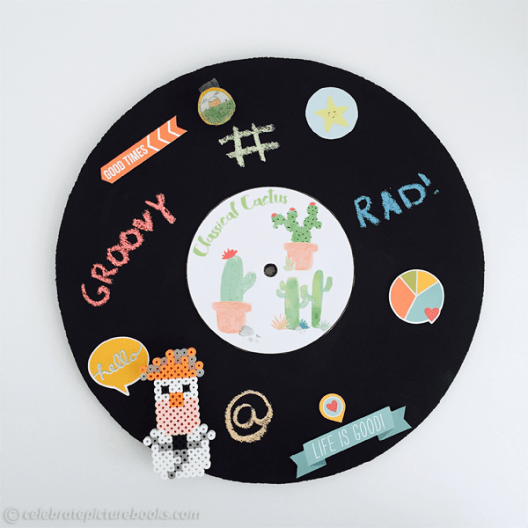
CPB - Record Bulletin Board

Make a Record Chalkboard Bulletin Board


Would you love to make a record some day? Why wait? In this fun craft you can create your own record bulletin board—and even create your own label art! While this record may not spin on turntables around the world, it will drop in a more important place—your very own room!

Supplies

  • Printable Record Label for you to design
  • Foam board, or a corkboard at least 12-inches x 12-inches square
  • Adhesive cork
  • A 12-inch round plate, record, or other round object to trace OR a compass
  • Chalkboard paint, black
  • X-acto knife
  • Paint brush or foam paint brush
  • Mounting squares

Directions

  1. Cut a section from the adhesive cork a little larger than 12 inches by 12 inches
  2. Affix the cork to the foam board
  3. Trace the 12-inch round object onto the cork/foam board OR use the compass to make a 12-inch circle
  4. With the x-acto knife, carefully cut out the circle (adult help needed for children)
  5. Cut out a ¼ -inch circle in the center of the record bulletin board
  6. Paint the cork, sides and inside the spindle hole with the black chalkboard paint. Let dry
  7. Print the label template and design your own record label
  8. When the paint is dry, glue your label to the center of the bulletin board
  9. Hang your bulletin board with the mounting squares
  10. Decorate!

April 14 – Look up at the Sky Day

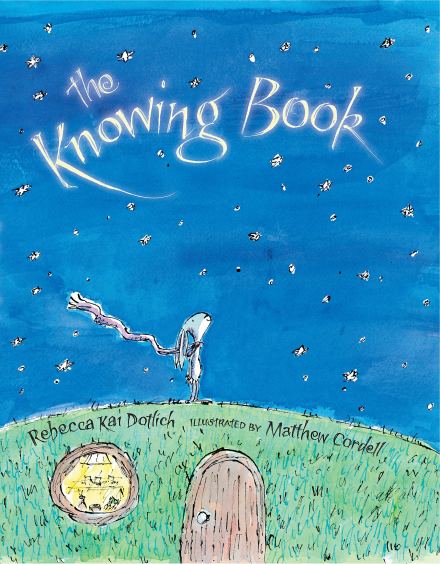
celebrate-picture-books-picture-book-review-the-knowing-book-cover

About the Holiday

Some holidays require rushing around, shopping, and lots of preparation. Today’s celebration is just the opposite! Today is dedicated to slowing down, looking up, and appreciating the beauty above you. Whether the day is sunny, cloudy, rainy, or downright stormy, the sky is always intriguing. Today take some time to scan the skies; make shapes of the clouds, appreciate how tall some trees really are, watch birds flit overhead, or just take in the depth of color. Be inspired – and Relax!

The Knowing Book

Written by Rebecca Kai Dotlich | Illustrated by Matthew Cordell


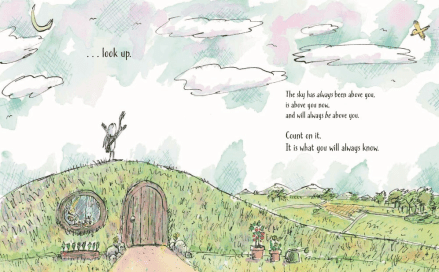
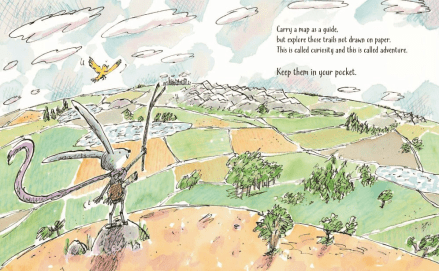
A little bunny opens the door to a wide world. But before starting on life’s adventure, the bunny receives some gentile advice and reassurance: As you start on your journey, it’s good to begin with something you know. If you wonder what that is, look up at the sky. You know it has always been above you and will remain that way forever. Taking your first steps, carry that assurance with you as you choose which door, path, or trail you will take. You may get lost, but embrace the hum or cry that comes from inside because they will help.

celebrate-picture-books-picture-book-review-the-knowing-book-look-up

Image copyright Matthew Cordell, 2016, text copyright Rebecca Kai Dotlich. Courtesy of Boyds Mills Press.

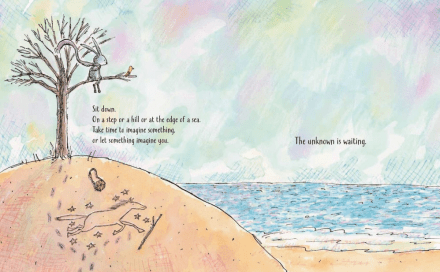
You can be sure that magic is all around you. But you must look because sometimes it’s found in the most unexpected places. Take quiet time to imagine what’s out there and for others to get to know you then step into the unknown. Carry a map, curiosity, and adventure and trust yourself. You will know when to run toward something and when to run away.

celebrate-picture-books-picture-book-review-the-knowing-book-beach

Image copyright Matthew Cordell, 2016, text copyright Rebecca Kai Dotlich. Courtesy of Boyds Mills Press.

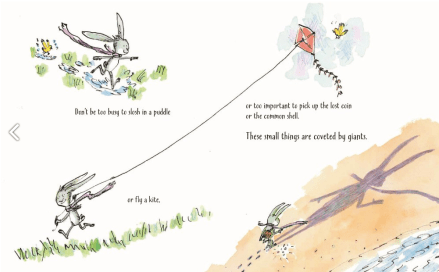
Pretending leads to knowledge, so play at who you are and who you aren’t; what you want and what you don’t want, and let your imagination fly. Don’t lose sight of the small things, the fun things, the childhood things because these are invaluable. Always listen to yourself, for you know the song in your heart.

celebrate-picture-books-picture-book-review-the-knowing-book-fields

Image copyright Matthew Cordell, 2016, text copyright Rebecca Kai Dotlich. Courtesy of Boyds Mills Press.

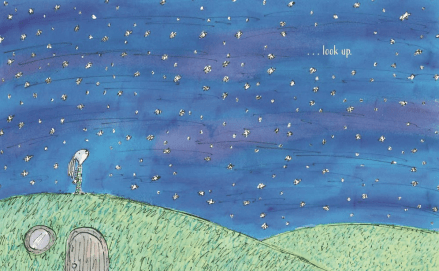
As the sky darkens, look again. “It holds a wing, a hoot, a chill. Allow the breeze of each to slip through the cracks of your window and into your sleep.” And when you look up into the night sky never forget that the stars have always been above you and always will be, and that “all the paths you take will join to lead you home.”

celebrate-picture-books-picture-book-review-the-knowing-book-kite

Image copyright Matthew Cordell, 2016, text copyright Rebecca Kai Dotlich. Courtesy of Boyds Mills Press.

Rebecca Kai Dotlich’s The Knowing Book is a lyrical tribute to the inner voice that guides each person on their life’s journey. The assurance that every action, song, imagining, and path combine to create the person you are meant to be resonates, whether the reader is a child just starting off to kindergarten, a young person graduating from college, or an adult navigating life’s changes. The value of play, reflection, and experimentation as well as the importance of understanding who you are and who you are not is beautifully expressed in this charming and wise picture book.

celebrate-picture-books-picture-book-review-the-knowing-book-stars

Image copyright Matthew Cordell, 2016, text copyright Rebecca Kai Dotlich. Courtesy of Boyds Mills Press.

Venturing out into the world Matthew Cordell’s sweet rabbit embraces the sky with the kind of beaming smile seen on excited children. The rabbit picks up a friend and together they explore the world. Cordell’s softly illuminated images in blues, yellows, pinks, and greens are appropriately uncluttered, leaving the particular experiences open to each individual reader. The buuny and bird travel to the vast seaside, over undeveloped fields, and through dreamy landscapes of imagination. They look up into the endless blue sky of day and the deep mystery of night. It’s only when the rabbit returns home that details are sketched in.

The Knowing Book is a beautiful reminder of the whims of life and a gentile reassurance of one’s ability to flourish. As it invites multiple readings for so many occasions, The Knowing Book would make a wonderful addition to anyone’s bookshelf.

Ages 5 and up

Boyds Mills Press, 2016 | ISBN 978-1590789261

Look Up In the Sky Day Activity

CPB - Cloud craft

Fluffy Clouds Craft


It’s fun looking up at the clouds and imagining what shapes you see. Bring those fluffy, white clouds into your room with this craft!

Supplies

  • White girls’ dress bobby socks in various sizes
  • Fiber fill, 20-ounce bag
  • Fishing line, different lengths
  • Needle
  • Clear adhesive mountable hooks or clips

Directions

  1. Stuff the socks with fiber fill, pushing it far into the sock and adding more here and there to make various lumps and give it a rounded, cloud-like shape
  2. When the sock is full, tuck the end of the sock in to close it
  3. Cut lengths of fishing line. The lengths will depend on how and where you will hang the clouds
  4. With the needle or by hand, feed one end of the fishing line into the top of the sock and out to attach the line for hanging.
  5. Knot the fishing line
  6. Attach the mountable hooks or clips to the ceiling
  7. Hang your clouds!