August 4 – Assistance Dog Day

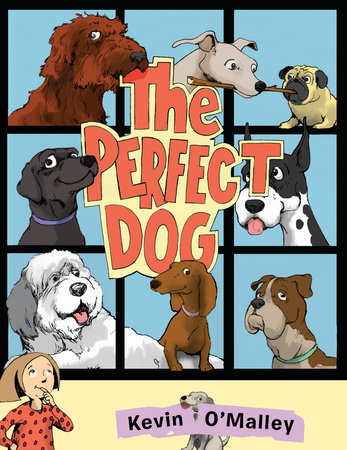
celebrate-picture-books-picture-book-review-the-perfect-dog-cover

About the Holiday

Today’s holiday comes during International Assistance Dog Week, a time to recognize the work and benefits of canine helpers of all types. Assistance dogs offer comfort, independence, and reassurance to people who have them as members of the family. Not only do dogs of various breeds help the vision and hearing challenged, but they are also trained to recognize the signs of medical emergencies, such as heart attacks, seizures, and epilepsy. Owners of these friends and helpers know that they have the perfect dog, just like the little girl in today’s book!

The Perfect Dog

By Keven O’Malley


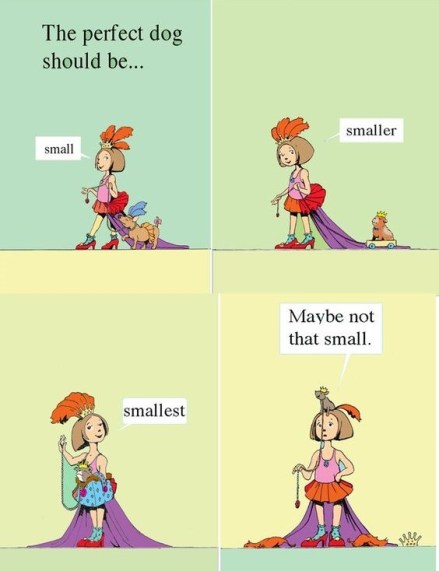
Getting a dog is a major decision. Paramount, perhaps, is what type of dog is best, and with so many breeds, how do you break it down? When the little girl in The Perfect Dog receives permission to get a dog, she begins her list for just the right pet. “The perfect dog should be big” she says as she imagines holding a Chow Chow. Or maybe “bigger” like a German Shephard, or even “biggest” like a Saint Bernard that stands taller than she is. But a Great Dane? Maybe not that big.

celebrate-picture-books-picture-book-review-the-perfect-dog-smaller

Image copyright Kevin O’Malley, courtesy of pinterest.com/booksbyomalley/kevin-omalley


On the other hand maybe “the perfect dog should be small”—standing around knee height—or “smaller”—mid shin height—or “smallest”—able to fit in a purse. But small enough to sit on her head? Maybe not that small. Next she considers the length of the dog’s hair. “The perfect dog should have long hair,” she believes, already assembling her grooming supplies to plump a poodle’s coif. Or the “longer” hair of a Sheep Dog might be fun to comb and cut, and the “longest” hair of an Afghan Hound would be a dream to brush. But the locks of a Komondor? Maybe not that long.

The girl knows the dog should not be too loud or too slobbery, but it should definitely be “fancy.” Speed is also a consideration. “Fast” as a Beagle? Maybe “faster,” like a Dalmatian. But “fastest,” like a Greyhound, could make walking the dog a challenge. Snuggly is nice for quiet times, but a dog so snuggly it takes over the whole chair is not what the girl has in mind. The little girl does not want a pet that is too slow or too messy either.

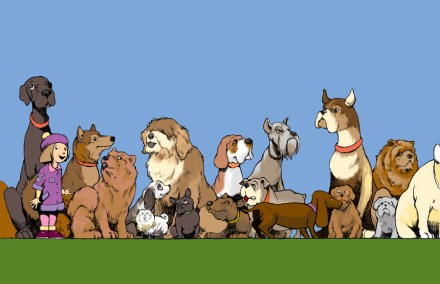
celebrate-picture-books-picture-book-review-the-perfect-dog-choosing-a-dog

Image copyright Kevin O’Malley, courtesy of pinterest.com/booksbyomalley/kevin-omalley

The day finally arrives for the girl and her family to pick out their new pet. There are so many to choose from! Looking into each face and taking each dog’s traits and qualities into consideration, the family decides that “the perfect dog should be happy…happier…happiest!” But there’s still one surprise waiting. Instead of the girl choosing the perfect dog, she reveals that “the perfect dog found me!” And it was a very happy ending!

Part concept book, part tribute to people’s “best friend,” Kevin O’Malley’s The Perfect Dog is a fun romp through different breeds and their unique qualities. If you’ve ever attended a dog show or watched one on TV, you know that there are as many types of canines as there are people. O’Malley applies the language concept of superlatives to describe big, bigger, biggest; long, longer, longest; and other shapes, sizes, and traits in a way that attracts kids’ attention and fosters understanding.

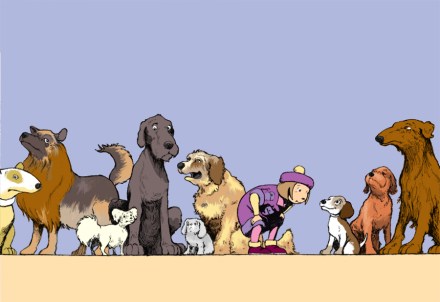
celebrate-picture-books-picture-book-review-the-perfect-dog-happy-dog

Image copyright Kevin O’Malley, courtesy of pinterest.com/booksbyomalley/kevin-omalley

As the little girl “tries out” various dogs, O’Malley’s bold, full-bleed illustrations proceed from funny to funnier to funniest, often to the little girl’s dismay. She gets knocked down by the biggest of biggest dogs, finds herself hidden in the longest of longest hair, and flies straight out from the end of the leash attached to the fastest of fastest dogs.

O’Malley knows, too, the real secret about choosing a new pet—one that kids will delight in, just as they do in this book. For any pet lover The Perfect Dog is…perfect!

Ages 3 – 8

Crown Books for Young Readers, Penguin, 2016 | ISBN 978-1101934418

Be sure to visit Kevin O’Malley’s website! You can learn more about his books, watch a video of one of his school visits, and even download free books!

Assistance Dog Day Activity

celebrate-picture-books-picture-book-review-dog-breeds-word-search

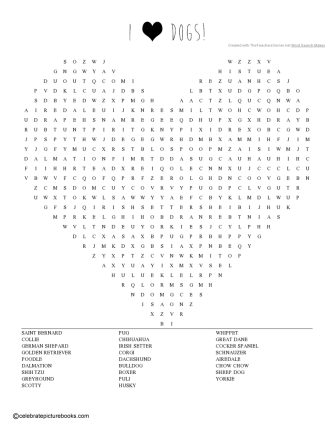
I (Heart) Dogs! Word Search


Assistance dogs come in all shapes, sizes, and breeds. Find the names of more than 25 types of dogs in this printable I (Heart) Dogs! Word Search

Picture Book Review

August 3 – Watermelon Day

celebrate-picture-books-picture-book-review-the-watermelon-seed-cover

About the Holiday

On a steamy summer afternoon nothing refreshes like watermelon! The sweet, juicy treat is a favorite with kids and adults and makes a perfect snack, complement to any picnic, or colorful addition to fruit salad. Watermelon comes in all shapes and sizes, from the iconic large dark green barrel to small playground-ball-sized orbs to compact squares perfect for fitting on a refrigerator shelf. Whether you dig the seeds out or spit them, cut slices or use a melon baller, enjoy some watermelon today!

The Watermelon Seed

By Greg Pizzoli


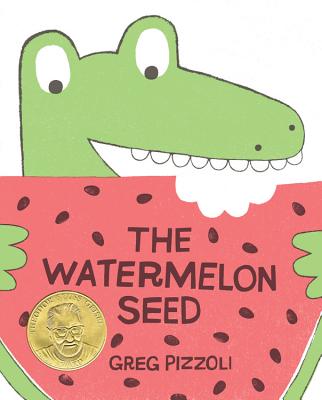
“I love watermelon!” the little crocodile exclaims. It’s easy to see why. After all they have so much in common—same barrel body shape, same color, and while one has lots of teeth the other needs lots of teeth to be enjoyed! “Chomp! Chomp! Chomp!” Ever since the croc was a baby, watermelon has been its favorite treat.

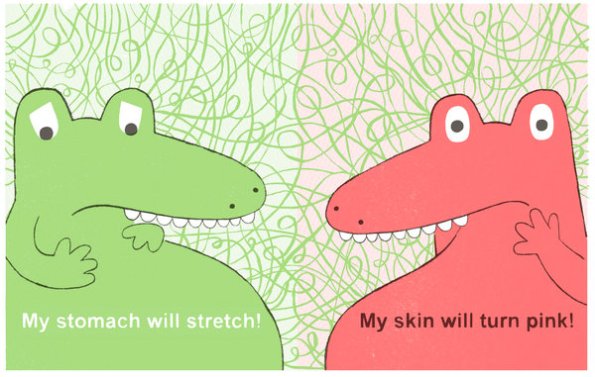
“I like it for breakfast. I like it for lunch. I like a big salty slab for dinner…and I LOVE it for dessert!” Is there anything the crocodile doesn’t like about watermelon? Well…yes. And the croc has just swallowed it. Panic sets in! “I SWALLOWED A SEED!” And horrible scenarios swirl in his brain: “It’s growing in my guts! Soon vines will come out my ears!” Poor Croc even worries that he’ll end up in a fruit salad.

celebrate-picture-books-picture-book-review-the-watermelon-seed-stomach-stretching

Image courtesy of Greg Pizzoli

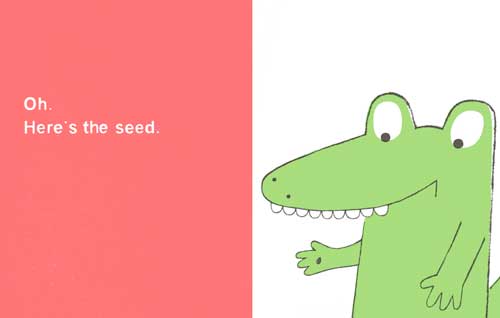
Croc starts to cry and then the worst happens! The seed starts growing! It’s expanding and something funny (peculiar not Ha Ha) is happening! Here it comes….”Buuuuuurrrrrrppp!” “Oh. Here’s the seed.” Well, even if the seed was dislodged, Crocodile thinks the whole experience was way too close and resolves to never eat watermelon again.

“Well, maybe just a teeny, tiny bite.”

celebrate-picture-books-picture-book-review-the-watermelon-seed-dislodged seed

Image copyright Greg Pizzoli

Greg Pizzoli’s watermelon-colored book sprouts laughs on every page. The cute crocodile with a watermelon obsession echoes the way kids latch onto a favorite food and need it for breakfast, lunch, and dinner. The added danger that lurks in every bite of watermelon increases the suspense and humor as the crocodile worries and frets. Kids will know that the promise to never eat watermelon again won’t last long and that “just a teeny, tiny bite” can’t hurt anything. Can it?

Pizzoli’s simple block-color illustrations of the watermelon-loving crocodile are the perfect complement to the story. Focusing on the croc’s facial expressions, from eager anticipation of that first bite to wide-eyed horror at swallowing a seed to googly eyed and wavy mouthed dread, each page gives kids lots to laugh at. And the two-page spread depicting the croc’s colossal burp that dislodges the seed invites repeated readings. In fact, The Watermelon Seed makes a delicious addition to children’s book shelves for fun story times.

Ages 3 – 7

Disney-Hyperion Books, 2013 | ISBN 978-1423171010

Enjoy a slice of The Watermelon Seed in this trailer!

Find more books and fun on Greg Pizzoli’s website!

Watermelon Day Activity

celebrate-picture-books-picture-book-review-watermelon-matching-puzzle

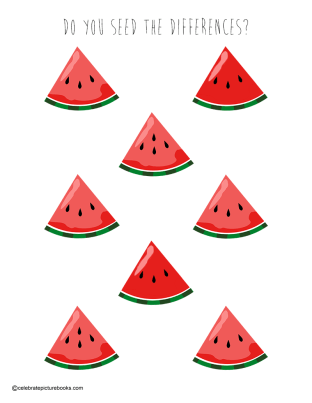
Do You Seed the Differences? Matching Game


The identical slices of watermelon were separated in the picnic basket! Draw a line between the matching pieces in this printable Do You Seed the Differences? puzzle to create correct servings.

August 1 – Respect for Parents Day

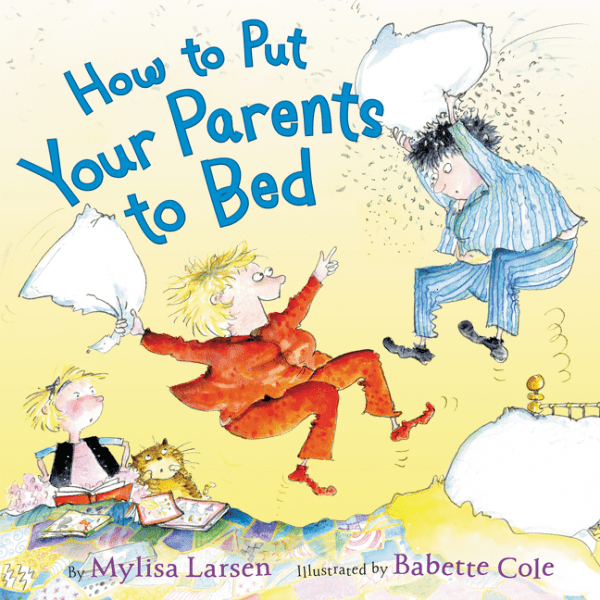
celebrate-picture-books-picture-book-review-how-to-put-your-parents-to-bed-cover

About the Holiday

Marilyn Dalrymple of Lancaster, California created Respect for Parents day to, as she said, “make our families become united and strong by recognizing the leadership roles parents have, and to reinstate the respect for parents that was evident in the past.” Former President Bill Clinton recognized Respect for Parents Day as a national observance in 1994. To celebrate thank your parents for what they have done for you, spend time with them, and tell them you love them.

How to Put Your Parents to Bed

Written by Mylisa Larsen | Illustrated by Babette Cole


So here you are—night time. Bedtime, really, but you’re not tired. You still have enough energy to “scale a tall tower,” “sail savage seas,” or “paint a masterpiece,” but think about your poor parents. Look at them! They really need to go to bed! You know parents, though—“Parents are not good at going to bed. “‘I have to put in a load of laundry,’” they say. ‘I need to do the dishes.’ ‘Just one more email.’”

Someone needs to take charge, and the family feline—who has been a keen observer of the bedtime dynamics—thinks its pint-sized owner is just that “someone.” So the little girl, living in the midst of a chaotic night with her overscheduled, overworked parents, follows the cat’s pointed paw directions. She takes food out of her parents’ hands, closes the computer, and tells them “‘It’s time for bed.’” The first task is getting them to brush their teeth. The girl squeezes the toothpaste onto the brush and even helps her dad reach his molars.

celebrate-picture-books-picture-book-review-how-to-put-your-parents-to-bed-interior-art-sleeping

Image copyright Babette Cole, courtesy of babette-cole.com

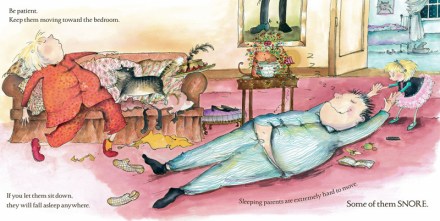
Next is making sure her parents dress in their pajamas. But Dad’s on the phone and Mom’s still watching TV. Ugh! First Mom and Dad won’t go to bed and now they’re falling asleep on the couch and floor! Their daughter keeps them moving in the right direction, though. Once they hit the bedroom, however, they get a second wind and become “unruly when faced with actually getting in bed. Tiny things upset them. They can work themselves into a state.” What to do? The girl remains calm and does not negotiate. Once Mom and Dad are tucked in, it’s story time. A tricky bit—do they only want their favorite story? How many?

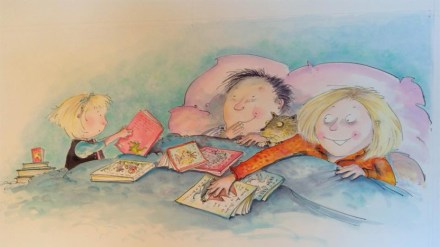
At this point, the girl thinks she’s almost finished. But suddenly something unexpected comes up. Mom is missing her favorite pillow. Dad’s socks itch. And they both want to check on the dog. Oh brother! While the girl is handling these crises, her parents are starting a pillow fight! Phew! She gets them all tucked in, gives them each a kiss good night, and takes away their cell phones.

celebrate-picture-books-picture-book-review-how-to-put-your-parents-to-bed-interior-art-stories

Image copyright Babette Cole, courtesy of babette-cole.com

Finally, they are off to dream land, and the girl has some time for herself! But wait a minute. The cat suggests she’s not exactly looking her best. In fact, she looks exhausted. Maybe, the frisky feline thinks, she needs to go to bed.

Mylisa Larsen’s funny role-reversal primer will have kids giggling and adults nodding appreciatively from Page 1 until The End. Speaking directly at readers, How to Put Your Parents to Bed offers sly winks at the many bedtime distractions of today’s families. The witty conspiratorial tone to the cat’s instructions gives kids a secret feeling of clout even while they may recognize their own behavior. And parents will wish they could still act this way.

Rebecca Cole’s dynamic illustrations of the recalcitrant parents doing last-minute chores, stubbornly refusing to brush their teeth, jumping on the bed, and fooling with delaying tactics ramps up the hilarity of this bedtime how-to. Kids will want to linger over the pages to catch all the humorous details.

Ages 4 – 8

Katherine Tegen Books, HarperCollins Publishers, 2016 | ISBN 978-0062320643

Visit Mylisa Larsen’s website to learn more about How to Put Your Parents to Bed and read her blog!

Enter the world of Babette Cole—her books, artwork, and more—by visiting her website!

Get ready to laugh with the How to Put Your Parents to Bed book trailer!

Respect for Parents Day Activity

celebrate-picture-books-picture-book-review-home-shaped-maze

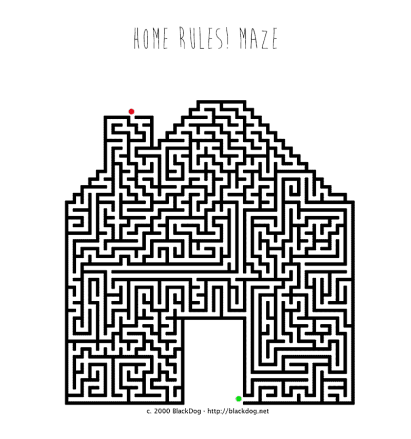
Home Rules! Maze


Look around your house and find something to thank your parents for. Then run through this printable Home Rules! Maze and have fun! 

Picture Book Review

July 30 – International Day of Friendship

celebrate-picture-books-picture-book-review-hector-and-hummingbird-cover

About the Holiday

First established in 2011 by the United Nations General Assembly, the International Day of Friendship asserts the idea that friendship between peoples, countries, cultures, and individuals can inspire peace efforts and build bridges between communities. The UN resolution places particular emphasis on involving young people in community activities that include different cultures and promote respect for individual diversity. On this day UN Secretary General Ban Ki-moon urges everyone, especially young people who will be our future leaders, “to resolve to cherish and cultivate as many warm relationships as possible, enriching our own lives and enhancing the future.”

The day is celebrated with special initiatives, events, and activities that promote dialogue, education, understanding, and cooperation.

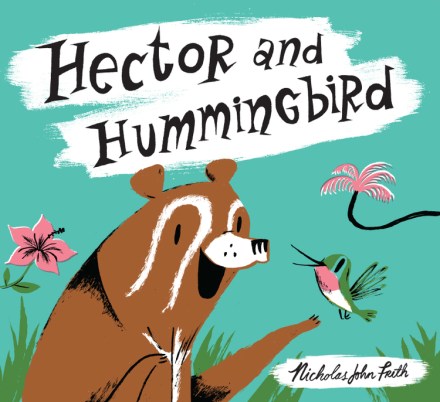
Hector and Hummingbird

By Nicholas John Frith


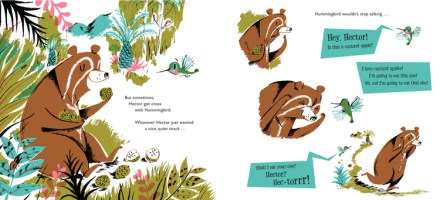
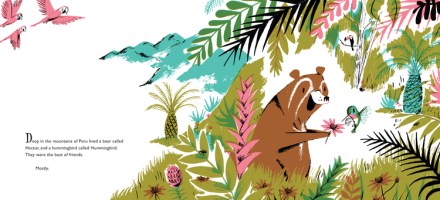
Deep in the mountains of Peru Hector and Hummingbird have forged an unbreakable friendship. “Mostly.” Hummingbird has lots of energy and loves to hover around his best bear pal. Which is ok, except sometimes Hector would just like a little quiet time, and Hummingbird won’t stop talking: “Hey, Hector! Is that a custard apple? I love custard apples! I’m going to eat this one! Oh, no! I’m going to eat that one! Shall I eat your one! Hector? Hec-torrr!” Sometimes a simple alone-time scratch would be just perfect, but Hummingbird copies him on a tree nearby: “Hey, Hector! Are you scratching? I’m going to scratch too!…” And nap time? Forget it! Hummingbird always keeps Hector awake with some story. It’s enough to make Hector cross with Hummingbird!

One day Hector can’t take it anymore—“‘Arrgh!!’” he roars. “‘Leave me alone!’”—and he takes off into the forest to find some peace. Hector’s outburst comes as a surprise to Hummingbird. He needs to find out what’s wrong, so he follows Hector into the woods, his constant hum filling the air. “‘Stop following me!’” Hector says. And Hummingbird complies—mostly. From behind leaves and tree trunks Hummingbird spies on his friend.

celebrate-picture-books-picture-book-review-hector-and-hummingbird-interior-art-bear-cross

Image copyright Nicholas John Frith, courtesy of zoetucker.co.uk

As Hector delves deeper and deeper into the woods, he feels an unfamiliar excitement and also a bit of trepidation. Perhaps he’s just hungry, Hector thinks. He picks a custard apple to quell the gnawing in his stomach. The fruit tastes delicious, but Hector also feels funny eating alone. He imagines how much Hummingbird would enjoy the apple too.

The scratchiest tree Hector has ever seen beckons to him, and he settles in for a nice, quiet scratch. But again he experiences that twinge of loneliness. As the forest becomes dark, Hector finds a branch to snooze on. The night air is full of strange noises, and Hector is a little scared. “‘I wish Hummingbird were here,’” sniffs Hector. “‘He could tell me a story.’”

That’s all Hummingbird needs to hear. “A story? Yay! You should have said! I love telling stories! Once upon a time…” This time Hector doesn’t roar or run away. He exclaims, “‘Hummingbird! You’re here! I missed you!’” Hummingbird admits that he missed Hector too, and that he was there all the time. “Here all along?” says a surprised Hector. “I thought I told you not to follow me!”

celebrate-picture-books-picture-book-review-hector-and-hummingbird-interior-art-best-friends

Image copyright Nicholas John Frith, courtesy of zoetucker.co.uk

“But why?” Hummingbird asks. This time Hector doesn’t keep his thoughts inside. “‘Because you never stop talking!’” he answers. “‘And you’re always copying me!” Hummingbird has ready reasons. He’s only being friendly, he explains. And he loves Hector’s ideas. “‘Oh,’” says Hector. “‘Really?’” Then Hector has a brain storm. He asks Hummingbird if he can copy his being really, really quiet. “Absolutely!” Hummingbird says. And he does—in his Hummingbird sort of way, which sounds like this: “Hey, Hector? This is fun, isn’t it? We’re being really, really quiet, aren’t we? I love being quiet, don’t you? Hector? Hec-torrr?”

Nicholas John Frith humorously exposes the niggling burrs of true friendship with his endearing and inspired pairing of a quiet bear and an energetic hummingbird. While best friends love to spend time together, have lots in common, and share a history, they also share moments of frustration, misunderstanding, and vexation. Through Hector and Hummingbird, Frith reveals what happens when communication breaks down and resentments build up. Readers will see that true friendship consists of both honest dialogue and accepting people for who they are.

Frith’s jungle environment, rendered in a palate of vintage aqua, pink, green, brown, and black on a white background gives the story a fresh, bold appeal while highlighting the emotional responses of the characters to maximum effect. As day turns to night, Hector—having gone off in a huff—realizes that he misses his friend and moreover misses the very things that annoyed him about Hummingbird. His expressions of sadness and loneliness, delight at seeing Hummingbird again, and then confusion as to why Hummingbird is there in the first place can lead kids into an understanding that even the best of friends have differences.

Hector and Hummingbird offers kids both amusing and teachable moments with two funny, charming characters to escort them on the journey. An animated storyteller will have kids asking for this book again and again. It’s a great addition to the family library.

Ages 4 – 8

Arthur A. Levine Books, Scholastic, 2015 | ISBN 978-0545857017

Have fun perusing Nicholas John Frith’s online portfolio of illustrations, projects, and products!

International Day of Friendship Activity

celebrate-picture-books-picture-book-review-friendship-coloring-page

Best Friends Coloring Pages


Friends like to play together and color together! Here are two printable pages for you to have fun with. Why not text a friend and color them together?

Coloring Page 1

Coloring Page 2

July 29 – International Tiger Day

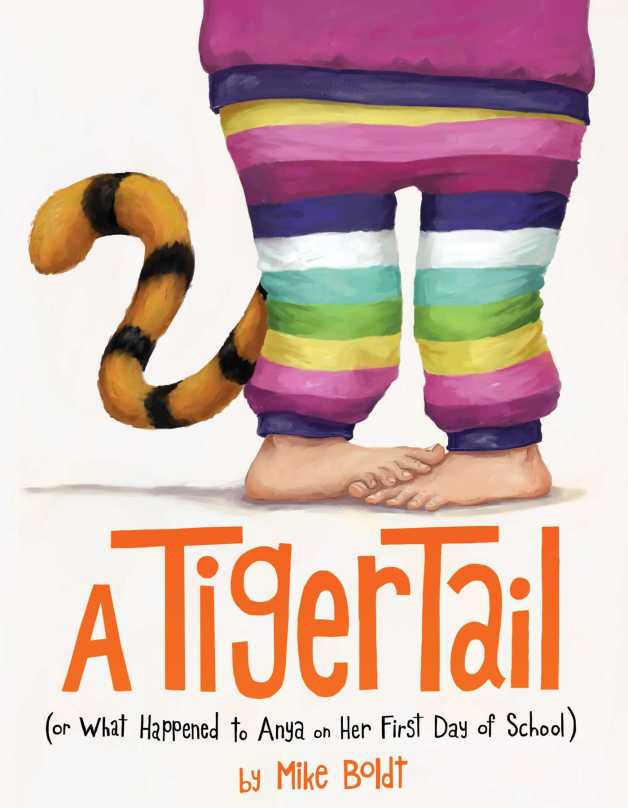
celebrate-picture-books-picture-book-review-a-tiger-tail-cover

About the Holiday

First observed in 2010 in response to the severely declining wild tiger population, International Tiger Day promotes awareness of these beautiful, distinctive animals. In the last century 97% of wild tigers have disappeared, with only 3,000 still in existence. Many factors have led to this devastating loss, including habitat destruction, climate change, and poaching. Environmental and other groups, such as the World Wildlife Federation, the International Fund for Animal Welfare, and the Smithsonian Institution, have come together to protect and preserve wild tigers.

A Tiger Tail (Or What Happened to Anya on Her First Day of School)

By Mike Boldt


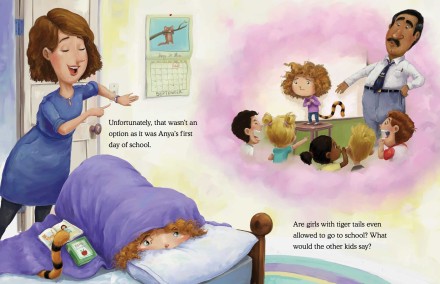
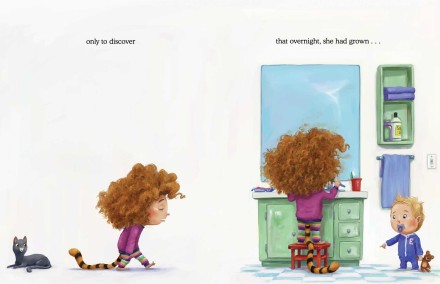
Even before the story properly begins, Anya discovers something incredible and incredibly disturbing. Overnight she has grown a tiger tail—not a pony tail or pigtails, but an honest-to-goodness black-and-orange-striped tiger tail! All she wants is to stay in bed, but unfortunately that’s not possible because it’s Anya’s first day of school.

celebrate-picture-books-picture-book-review-a-tiger-tail-interior-imagining-school

Image copyright Mike Boldt, courtesy of simonandschuster.com

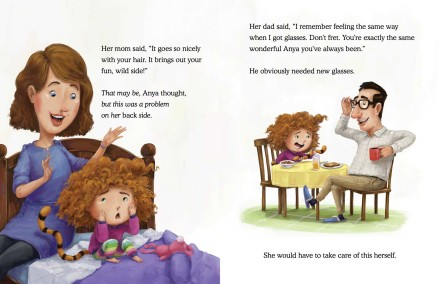
Anya wonders if “girls with tiger tails are even allowed to go to school” and what the other kids will say. Her mom thinks it’s wonderful. The tail goes so nicely with Anya’s red hair and brings out her “fun, wild side.” But Anya’s only worried about her back side! Her dad likens her predicament to when he got glasses and tells her she’s still “exactly the same wonderful Anya you’ve always been.”

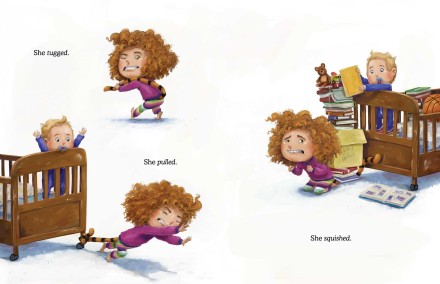
Anya figures she’s on her own with her problem. She tries tugging on her tail, pulling on it, and squishing it, but it remains firmly attached. Perhaps the right outfit from her closet—or all of them together—could hide her tail, but that solution had its own problems. There was just one last thing to do—panic! “‘Calm down,’” says her mom. “‘You’ll make yourself sick.’” Ah-ha! There’s a good idea! Anya thinks as she goes back to bed with tissues and feeling for a fever.

celebrate-picture-books-picture-book-review-a-tiger-tail-interior-parents

Image copyright Mike Boldt, courtesy of simonandschuster.com

Anya’s mom thinks her antics are so funny and that the kids will love her sense of humor, then she shoos her off so she doesn’t miss the bus. Ah-ha! There’s another good idea! Anya hides in the bushes, but her dad discovers her and considers it a “special treat” to drive her to school.

Walking up the sidewalk to the school’s front door, Anya realizes that she has only one option—running away to join the circus. How bad could that be? But as Anya daydreams about eating popcorn for dinner and swinging from a trapeze, she misses her chance to escape. The school bus pulls up to the door and all the kids pile out. “Anya was doomed.” But she watches all the kids race past her without a glance and doesn’t see the boy headed straight for her who also doesn’t see her. CRASH! Their impact sends them tumbling to the ground amid fluttering papers and flying books, shoes, and backpacks. Even the boy’s baseball cap pops off! Anya stares and then smiles. Standing straight up from the boy’s head are two long rabbit ears.

celebrate-picture-books-picture-book-review-a-tiger-tail-interior-art-grown-tail

Image copyright Mike Boldt, courtesy of simonandschuster.com

“‘Hi, my name is Ben,’” the boy says as he holds out Anya’s shoe. “‘I’m Anya,’” Anya replies. Joe takes his hat from Anya and bounds up the steps. “‘Come on, Anya! We don’t want to be late on the first day.’” Anya follows, and when she sees her class she knows she’ll fit right in.

Mike Boldt whimsically captures the first-day jitters—of school or any new experience—that can result in an explosion of self-consciousness, doubt, and fear. Boldt’s little girl with a wild cloud of red hair is a loveable, plucky heroine as she takes matters into her own hands when the adults around her seem oblivious to her plight. Boldt’s vivacious illustrations burst with energy and emotion that kids will recognize and respond to. Boldt depicts children so honestly, from their crinkled nose abhorrence to their enthusiastic smiles, and the adults, with their clueless dialogue and quirky expressions, are rendered through a child’s eyes.

celebrate-picture-books-picture-book-review-a-tiger-tail-interior-art-grown-tail

Image copyright Mike Boldt, courtesy of simonandschuster.com

Readers will laugh at Anya’s panicked face and her multi-layered getup designed to hide the tail that is still obvious through its ribbon wrapping. The crash meeting between Anya and Ben provides delightful surprise and insight, and the final spread of the classroom is inspired. Not only do most of the kids have unique traits, but the teacher also displays rabbit teeth as everyone poses for a class picture.

A Tiger Tail (Or What Happened to Anya on Her First Day of School) offers comfort and understanding as it reminds readers that everyone is an individual, and that one of humankind’s strongest and most common bonds is our diversity. A Tiger Tail should be embraced by every classroom and will make an often-asked-for addition to any child’s library.

Ages 4 – 8

Simon & Schuster Books for Young Readers, 2016 | ISBN 978-1481448857

Learn more about Mike Boldt and his books and view a portfolio of his artwork on his website!

Pounce on this awesome book trailer for A Tiger Tail!

International Tiger Day Activity

celebrate-picture-books-picture-book-review-tiger-find-the-differences

Tricky Tigers Find the Differences and Coloring Page


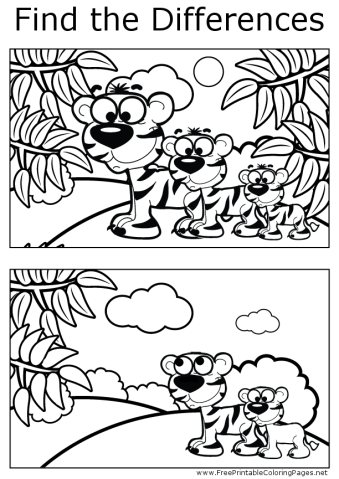
These two picture of tigers in the jungle have some differences—just like Anya and her classmates. Can you find all eleven changes? Have fun searching and coloring this printable Tricky Tigers Page!

July 27 – Dog Days of Summer Q & A with Ged Adamson

celebrate-picture-books-picture-book-review-ged-adamson-photo

About the Author

Ged Adamson is a writer and illustrator living in London with his partner Helen and their son Rex. His most recent book Douglas, You Need Glasses! was published by Random House and released this past May. Two previous books—Elsie Clarke and the Vampire Hairdresser (2013) and Meet the McKaws (2015)—were published by Sky Pony Press. Ged has two books hitting shelves in the summer and fall of 2017—Shark Dog from HarperCollins and I Want to Grow from Boyds Mills Press. Ged’s cartoons have appeared in magazines, such as Punch and Prospect, as well as in books and on film. He has worked as a storyboard artist and a caricaturist and also works as a composer for TV and film.

About the Holiday

Here we are in the Dog Days of Summer—that time from July 3 to late August—when the air is still, the sun is bright, and the beach beckons. Although the phrase “dog days” conjures up images of Fido panting and lethargic, the term actually refers to the dog star Sirius—the brightest star and, in Greek mythology, the hunter Orion’s dog. To the ancient Greeks and Romans, the “dog days” occurred when Sirius rose and set with the sun, lending its warmth to the day.

Q & A with Ged Adamson

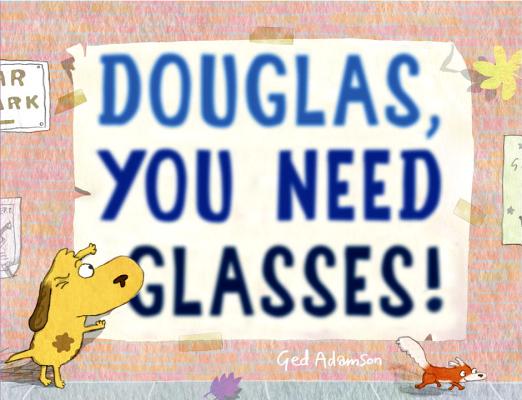
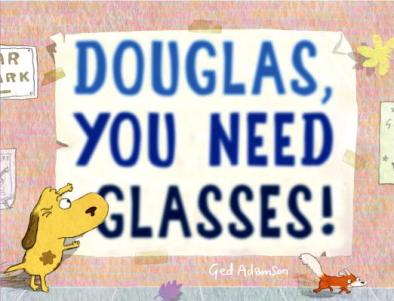
Today, Celebrate Picture Books is featuring another rising star—Ged Adamson. Ged took some time to talk about his work, his inspirations, and that stellar, spectacles-wearing canine Douglas of:
celebrate-picture-books-picture-book-review-douglas-you-need-glasses-cover

What books did you enjoy most as a child?


I wasn’t a great reader of chapter books as a child and I don’t remember us having picture books in the house but we did Roald Dahl stories at school. James and the Giant Peach and Charlie and the Chocolate Factory were favourites.

My mum and dad were avid readers. My dad had some great books. As well as novels, he had a lot of factual books about artists and history. One that I loved was about The Illustrated London News and it was full of beautiful Victorian etchings of everyday life in London. There were always books of cartoons by people like Giles and Frank Dickens. And we had loads of Charles Schultz Peanuts paperbacks.

celebrate-picture-books-picture-book-review-ged-adamson-interview-a-kestrel-for-a-knave-cover

My grandad was Scottish and we used to get a Scottish newspaper every weekend called The Sunday Post. There was a comic section for kids. The two main strips in it were The Broons and Oor Wullie. The characters inhabited a kind of 1950s world which I loved. We would get The Broons and Oor Wullie annuals every Christmas.

The first proper books I read of my own accord were collections of short horror stories that I borrowed from my older brothers. Reading them, I would be scared to death but I couldn’t stop. We did some great books in school that I really enjoyed like Animal Farm by George Orwell, A Kestral For A Knave by Barry Hines and Lord of the Flies by William Golding. And in the school library they had some decent novels for older kids and they had Tintin and Asterix the Gaul in French.

What influenced you to write Douglas, You Need Glasses!?


It was a little drawing I did of a dog in glasses smoking a pipe. Like most doodles, it was done without really thinking. But I was trying to come up with ideas for stories at the time so I wondered if I could do something with this character.
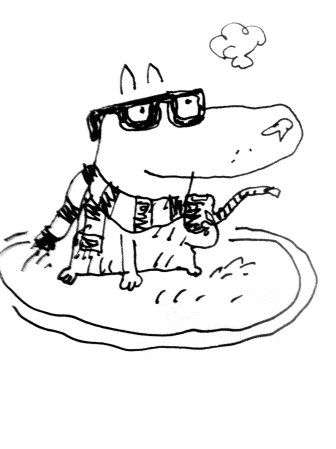
celebrate-picture-books-picture-book-review-ged-adamson-douglas-doodle

Image copyright Ged Adamson

I wear glasses myself so I thought I could use some of my own experiences with short sightedness to develop Douglas’s story. It went through many stages though. In one early idea, Douglas’s newly perfect vision causes him to be too honest about people’s appearances. Another had him befriending a group of insects.

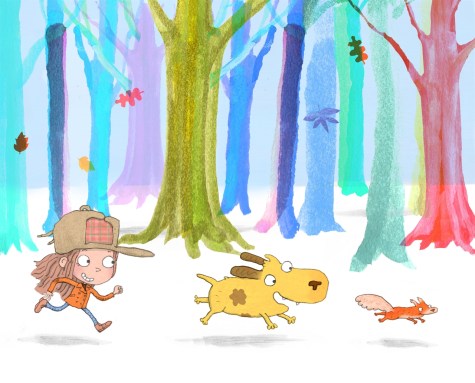
I’d just started to take my illustration style in a different direction, and I wanted to do something that would be visually strong. So from the way Nancy is dressed, the coloured see-through trees, the skate park, the eye chart, through to the big glasses at the end. I was trying to create images that the reader would remember. And most importantly I wanted the story to be funny!
celebrate-picture-books-picture-book-review-ged-adamson-interview-douglas-you-need-glasses

Image copyright Ged Adamson, coiurtesy of gedadamson.com

Can you describe your process when writing and illustrating a picture book?


It will start with an idea. Sometimes, as with Douglas, that will come from a doodle. The next stage is sketches and thinking a lot about the shape of the story. Who are the characters? How will the art look? What is the story saying—what’s its message? I’ll talk to people whose opinions I respect and see what they think—my Agent Isy being one.

The next step is putting together three or four spreads so you get a feel for the tone of the story and how it will look. All the time I’m throwing in bits of text but this changes constantly. I never have a manuscript separate from the images for this reason. To me, the words and pictures can’t exist apart from each other. That’s why I’m always uneasy supplying a manuscript with submissions!

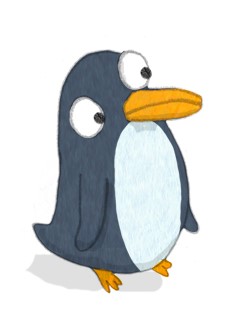
All through this process of me working on a story—and then if I’m lucky, with the publisher—I’ll be chopping things out and adding stuff to solve problems. In my next book, Shark Dog, I’d put a cute little penguin in the final spread. I really liked that penguin! But he had to go because the scene changed from an Arctic sea to a tropical one. And that is a pretty minor change in the grand scheme of things. You have to be prepared for the editor asking to make major overhauls to your book before it goes to the printers.
celebrate-picture-books-picture-book-review-ged-adamson-penguin-doodle

Image copyright Ged Adamson

Can you describe your work space a little?


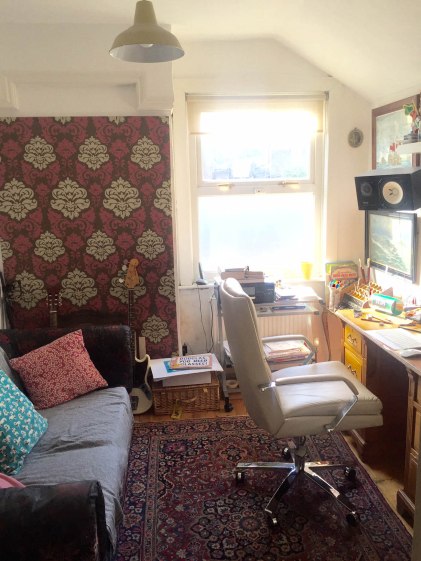
It’s a small room, but it’s mine! I think, no matter how tiny it is, how you arrange the space where you work is important. I like to feel it’s my world and part of my personality. The centre of it is occupied by an old desk with an iMac on it. I replaced my chair recently and I love the new one. It’s like something from an ‘80s quiz show and super comfy. I sometimes record music in there so there are instruments as well as art stuff. There are things I’ve picked up from junk shops and our local market. There’s an old sofa against one wall which is so great when I want to have a break.
celebrate-picture-books-picture-book-review-ged-adamson-interview-ged's-writing-space

Most furniture in our house is second hand. I have bits of paper stuck to the wall with lists of things I need to get done and new book ideas. I’ve got a few pictures up too. There’s one which is just a scene of a rough sea, nothing else—it’s an old framed print. There’s something weirdly relaxing about it. I like that I can look out the window and see the backs of the tall Georgian houses on the other side of the railway tracks. It’s a very London view. I’d like to have a bigger space to work in but I do love my little room.

What is the favorite object on your desk and why?


I want to say something like “Ah, that would be the skull of my great grandfather. He spent his life studying the speech patterns of elk”. But I think it has to be my computer. Though it keeps dropping out of connection which is driving me mad. What the hell, Apple? 

What is the best part about writing picture books?


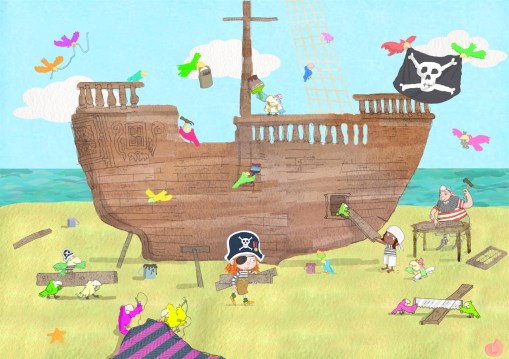
I remember working on the art for my second picture book Meet The McKaws. I could see the snow coming down outside the window of my little room. I suddenly thought, “I’m really happy doing this”! I hadn’t had that same feeling doing anything else.

Actually, the best part of writing picture books is what I’m experiencing right now with Douglas. People are getting in touch and saying they love the book and the characters. The response from readers is what you look forward to and when you get so much positive feedback for something you spent a long time working on, it’s such a great thing.

But there are other aspects that I love too. Working with talented editors and art directors is a lot of fun and you learn valuable stuff from them too.

It’s also thrilling to see your book on the shelves in a book shop!

What are you working on next?


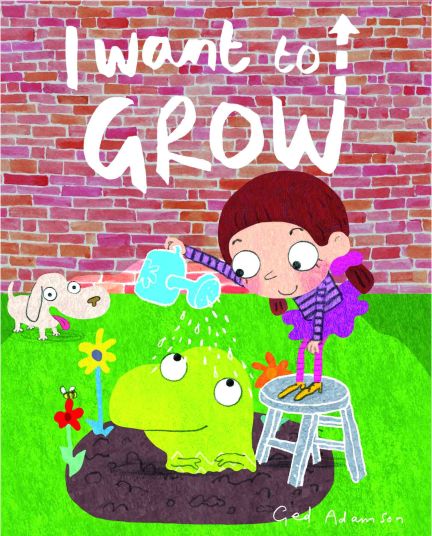
I’m just finishing work on two books that will be out next year. The first is Shark Dog. It’s about a strange but very friendly animal that stows away on an explorer’s boat. HarperCollins is doing that one. The second is called I Want To Grow, and it’s about a little dinosaur called Herb who gets frustrated that his human friend Muriel is getting taller and he’s not. This one’s with Boyds Mill Press.
celebrate-picture-books-picture-book-review-ged-adamson-i-want-to-grow-cover

image copyright Ged Adamson

I’m also working on two new ideas. One of those is about a rainbow and it’s almost ready for submission, so I’m excited to see what publishers think.

I can’t properly call this a holiday themed blog without asking you a couple of questions about special dates, so here goes:

What is your favorite holiday?


Because I’ve always done stuff that doesn’t involve a nine to five working week, I feel slightly guilty that I don’t appreciate holidays. Even weekends. On Twitter and Instagram there’ll be loads of people going, “IT’S THE WEEKEND! HURRAY!!” and I’ll be like, “oh yes, yay!”

I do like Christmas though. My son is still quite little so it’s lovely to experience that kid version of Christmas again through him. I’m not the least bit religious, but I really like when people come to our road and sing carols. The TV’s good and there’s lots of drinking and eating. I mean, what’s not to like about that? 

Do you have an anecdote from any holiday you’d like to share?


I remember a school Summer trip where we all stayed for a week in an old country house in the middle of woodland. Rumours began circulating that the place was haunted. Everybody started to get nervous. This wasn’t helped by a drunken teacher one night on his way to bed telling everyone “Don’t worry, the ghosts won’t harm you”. We were now all terrified and a kind of hysteria took over. We started counting the minutes until we could be reunited with our families. Somebody said they saw a ‘misty figure’ as they made their way back from the disco hut. Panic ensued. Even on the coach home there was a sense of looming disaster. Back at school in September, it wasn’t talked about much. I think everyone was embarrassed that we’d allowed ourselves to get into such a state.

Has a holiday ever influenced your work?


In Shark Dog, the explorers and their new pet set off to the seaside in their Morris Minor. For me that is a very English holiday scene but obviously you don’t see many of those cars any more. My mum and dad didn’t drive so our holidays would involve hours on a coach to somewhere like Wales or Devon. In the new story I’m working on, there is a spread with a multitude of people getting off those kind of coaches. It definitely took me back to being a kid!

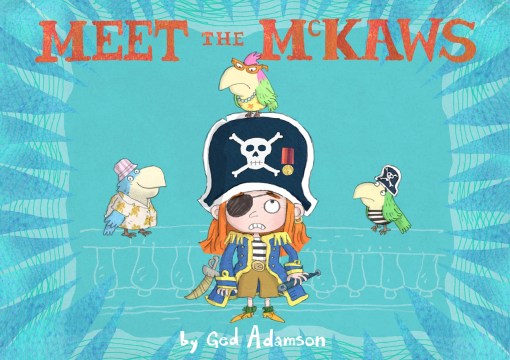
In Meet The McKaws, the story centres on a pirate’s parrot’s family members visiting for a few days. This is an aspect of holiday periods that is fraught with danger!
celebrate-picture-books-picture-book-review-ged-adamson-interview-meet-the-mckaws-cover

celebrate-picture-books-picture-book-review-ged-adamson-interview-meet-the-mckaws-rebuilding-the-ship

Image copyright and courtesy of Ged Adamson

I’d like to thank Ged for his insightful and engaging answers to my questions that prove that the Dog Days of Summer are definitely the best (especially when that dog is Douglas)! 
 

celebrate-picture-books-picture-book-review-douglas-you-need-glasses-cover

Ged is giving away a copy of Douglas, You Need Glasses! plus other goodies! Just click to enter the Rafflecopter Giveaway


You Can Connect with Ged Adamson on

Twitter | Instagram | Ged’s Website

You Can Find Ged Adamson’s Books at

Book Depository | Amazon UK | Amazon US | Barnes and Noble | IndieBound

Ged Adamson’s blog tour continues! Don’t miss it!
celebrate-picture-books-picture-book-review-ged-adamson-blog-tour-banner

Review of Douglas, You Need Glasses!

By Ged Adamson


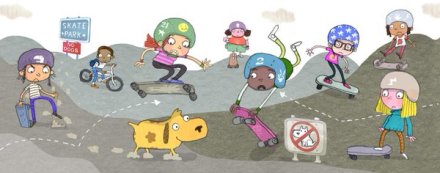
Something may be amiss with Douglas. When Nancy and her playful pooch went out to chase squirrels recently, Douglas ran after a falling leaf while the squirrel escaped up a tree. It’s not the first time something like this has happened. You see, Douglas is a bit nearsighted. Sometimes he mistakes the stair post for Nancy, and his difficulty gets in the way of things (well, mostly Douglas gets in the way of things). He misses important signs—like the one that would have prevented him from tracking wet cement all over the skate park, where there are NO DOGS allowed—and he’s always causing something of a ruckus. Sometimes he even enters the wrong house! But when a game of fetch buzzzzzed toward disaster, Nancy decided something had to be done.
celebrate-picture-books-picture-book-review-douglas-you-need-glasses-skate-park-art

Image copyright Ged Adamson, courtesy gedadamson.com

She took Douglas to the eye doctor where he tried to read a most dog-friendly eye chart. His test revealed that he needed glasses. He found the shelves of Dog Glasses, which offered many options, and had fun trying some on. Each one made him feel different. In one pair he was a rock star; in another a scholar; and in yet another a hippy. He wore them all until he discovered the perfect pair!

On the way home he saw the world in a way he never had before. “‘Wow! Everything looks amazing!’” Douglas said. And it was!

celebrate-picture-books-picture-book-review-douglas-you-need-glasses-interior-art

Image copyright Ged Adamson, courtesy gedadamson.com

Ged Adamson’s funny look at a nearsighted dog will make kids laugh from the first page to the last. Earnest Douglas, going about his doggy days under a bit of a skewed perspective, is so endearing that readers cannot help but love him even as they giggle at his exploits. Adamson’s vibrant multi-hued trees, colorfully clothed kids, and vivid backgrounds with stylish sketched-in details gives the book a fresh, jaunty appeal for a lively, fun story time. Kids facing the prospect of wearing glasses will find lots to give them reassurance and confidence in this book.

Douglas, You Need Glasses is a great addition to any child’s bookshelf!

Ages 3 – 8

Schwartz & Wade, Random House Kids, 2016 | ISBN 978-0553522433

Dog Days of Summer Activity
 

celebrate-picture-books-picture-book-review-spool-puppy-craft

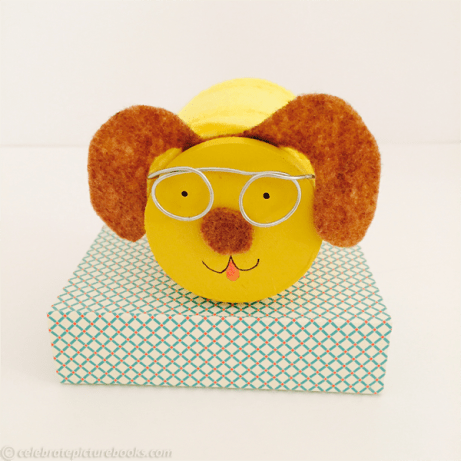
Make a Stellar Spool Puppy


No matter where you go and whether you have a real dog or not, you can take this little guy along with you. And just as you would pick out your favorite from an animal shelter, you can make this puppy look any way you’d like!

Supplies

  • Printable ears and nose template
  • 2-inch round wooden spool, available at craft stores
  • 1 skein of yarn in the color you choose. Yardage needed will depend on the thickness of the yarn.
  • Felt
  • Craft paint
  • Paint brush
  • Fabric or strong glue
  • Thin gauge wire
  • Dowel or pencil to wrap wire around to make glasses

celebrate-picture-books-picture-book-review-spool-puppy-craft

Directions

  1. Paint the dowel the color you want your dog to be, let dry
  2. Trace the ears on the felt and cut out (or draw your own ears)
  3. Trace the nose on the felt and cut out
  4. When the spool is dry glue the ears to the body of the spool, allowing the ears to stick up from the top of the spool
  5. Wind the yarn around the spool back and forth until the dog’s body is the size you’d like
  6. Glue the yarn in place with fabric or strong glue

To make the face

  1. Glue the nose over the hole on one end of the spool
  2. Draw the mouth and tongue under the nose with a marker
  3. You will draw the eyes on after the glasses are in place

To make the glasses

  1. Wind the wire around a ½-inch dowel, thick pencil, or rounded handle to make two circles.
  2. Leave about two inches on either side of the circles for the ear pieces of the glasses.
  3. Adjust the size of the circles to fit the spool as glasses.
  4. Put the glasses on the face of the spool, tucking the ear pieces into the yarn on each side
  5. Draw eyes in the center of the glasses

To make the tail

  1. Cut a small square of felt and stuff the edges into the hole on the other end of the spool
  2. You can make the tail as long as you like

Picture Book Review

July 25 – Culinarians Day

celebrate-picture-books-picture-book-review-the-ugly-dumpling-cover

About the Holiday

The world can’t celebrate Culinary Arts Month without having a special day to recognize and thank the many chefs, cooks, bakers, and other creators of delicious treats. Today is that day! With their special talents for taste, presentation, and innovation, culinarians make life better for everyone!

The Ugly Dumpling

Written by Stephani Campisi | Illustrated by Shahar Kober


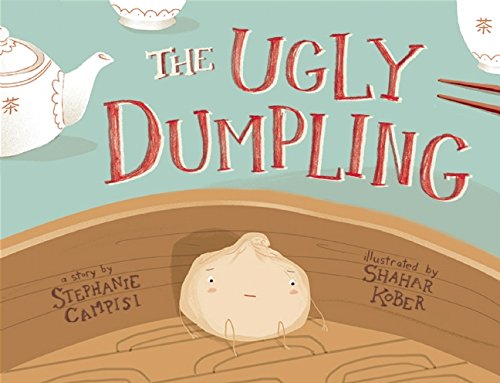
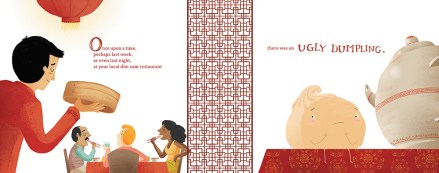
“Once upon a time, perhaps last week, or even last night, at your local dim sum restaurant…there was an ugly dumpling.” Sure, you might think all dumplings are ugly, but we’re talking about one particular ugly dumpling. It tried all sorts of tricks to make itself more attractive, but it still remained lonely and uneaten. It sat dejected until a cockroach traversing the kitchen caught sight of it and immediately fell in love.

celebrate-picture-books-picture-book-review-the-ugly-dumpling-interior-art-dim-sum-restaurant

Image copyright Shahar Kober

The cockroach “reached out an arm. (Or a leg.)” toward the dumpling and offered to show it the beauty of the world. Together they traveled to cities near and far, experiencing them through culinary lenses—stacked plate skyscrapers, piled dishes skylines, chopstick bridges that took them over flour mountains and folded napkin peaks. Then, in a certain restaurant, the dumpling saw something astonishing! Not only one, but two, three, four, and more dumplings just like itself!

Suddenly the ugly dumpling realized that it was not a dumpling at all, but a “steamed bun—a golden-hearted, smooth-skinned steamed bun, exactly like all the other steamed buns in the world.” The ugly dumpling puffed with meaning, importance, and…yeast! The restaurant patrons and staff and even the other steamed buns took notice. The cockroach by the ugly dumpling’s side cheered to see its friend receiving so much attention.

celebrate-picture-books-picture-book-review-the-ugly-dumpling-interior-art-restaurant

image copyright Shahar Kober

The wide eyes and astonished expressions were not for the dumpling, however. Instead, they registered horror at the insect in their midst. The ugly dumpling was familiar with that look and did “something quite beautiful. It reached out an arm. (Or a leg.) And it led the cockroach out into the world, The beautiful, beautiful world.” And in that moment the ugly dumpling realized that it “was not like all the other steamed buns after all” and that “perhaps that was a good thing.”

Stephani Campisi’s The Ugly Dumpling is a fresh and delectable dish-up of the classic Ugly Duckling story for a new audience. Stuffed with charm and off-beat humor, this tale of friendship and diversity embraces all who feel at odds with their environment—with or without the recognition of why. Its sweet and insightful ending emphasizes the idea that finding your niche does not always mean finding your true self and that having the courage to strike out on your own path leads to beautiful relationships and happiness.

celebrate-picture-books-picture-book-review-the-ugly-dumpling-interior-art-three-ugly-dumplings

Image copyright Shahar Kober

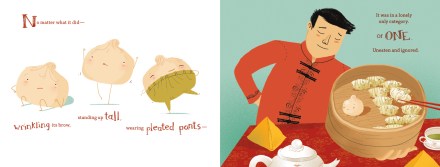
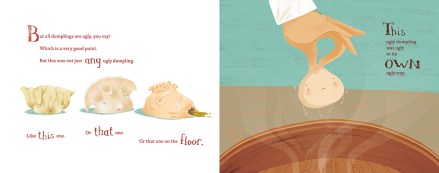
Shahar Kober’s dumpling is anything but “ugly.” His adorable puffed dough, lonely and ignored for not adhering to the mold, will melt readers’ hearts as he tries anything and everything—including green pleated pants—to fit in. Kobar’s stylish drawings are the perfect underscore to Stephani Campisi’s quick, dry wit—as in his rendition of three uglier-than-the-next dumplings—and if cockroaches were really as cute as Kober’s, we’d all set out a different kind of Roach Motel. A clever bit of typography transforms steam coming from a wok into the word HISS, and the restaurant scenes will make readers hungry for their favorite Asian eatery.

As readers turn to the last pages and watch the steamed bun and the cockroach leave the restaurant hand in hand (foot in foot?) under the shade of a paper umbrella, they will want to turn back to the beginning and start over again. The Ugly Dumpling is a must read and a must addition to children’s bookshelves.

Ages 2 – 9

Mighty Media, 2016 | ISBN 978-1938063671

Get to know more about Stephanie Campisi and her work on her website!

To view a gallery of art by Shahar Kober for books, magazines, animation, and more, visit his website!

Check out the Mighty Media Press website for more about The Ugly Dumpling and a-dough-able coloring pages!

Take a look at the trailer for The Ugly Dumpling!

Culinarians Day Activity

celebrate-picture-books-picture-book-review-dumpling plush craft

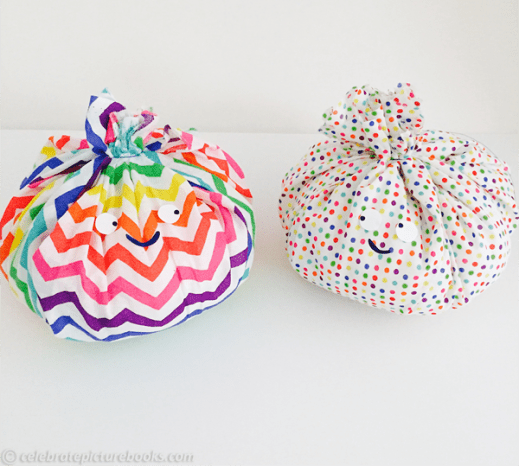
Embrace Your Inner Dumpling Plush


We are all beautiful “dumplings” in one way or another! With this easy craft you can create a huggable friend and show others what you’re made of!

Supplies

  • Square piece of cloth in any fabric and color. Size of plush depends on size of cloth (the plushes shown are made from 18”-square cotton fabric)
  • Poly fill (the plushes shown use about 1 1/8 ounces of fill)
  • White cloth for eyes and mouth
  • Twine or string
  • Fabric glue

Directions

  1. Cut the corners from the square cloth to make a circular piece of cloth
  2. Fill the middle with poly fill
  3. Pull the edges of the cloth up and around the fill
  4. Tie the top closed with the twine or string
  5. To make the face, cut small circles and a mouth from the white cloth
  6. Smooth out a section of the dumpling body
  7. Glue the face to the body with fabric glue