February 17 – Random Acts of Kindness Day

celebrate-picture-books-picture-book-review-ordinary-mary's-extraordinary-deed-covers

About the Holiday

Random Acts of Kindness Day originated in New Zealand, where the holiday is celebrated nation wide every September 1st. In the U.S. the popularity of this day continues to grow, as people discover the pleasure of doing nice things for friends and strangers alike. Connecting with others and paying forward kind deeds can be infectious, making the world a better place for all!

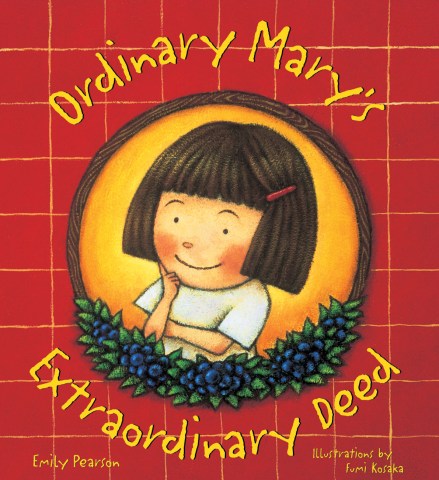
Ordinary Mary’s Extraordinary Deed

Written by Emily Pearson | Illustrated by Fumi Kosaka

One day an ordinary girl named Mary begins her ordinary day. On her way home she spies ordinary blueberries in a field and picks them. She knows Mrs. Bishop would like them, so Mary leaves them in an ordinary bowl on her porch. Mrs. Bishop is so happy with the berries that she uses them to make blueberry muffins. But who gave her the blueberries? Mrs. Bishop can think of five people who might have, and she divides the muffins between them.
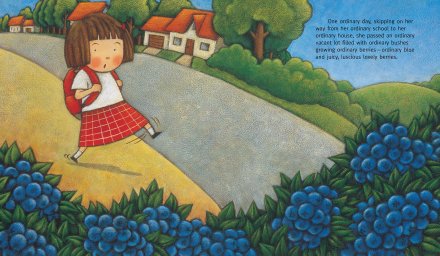
celebrate-picture-books-picture-book-review-Ordinary-Mary's-Extraordinary-Day-blueberries

Image copyright Fumi Kosaka, 2002, text copyright Emily Pearson, 2002. Courtesy of Gibbs Smith.

One of the five is Mrs. Bishop’s paperboy. He is so delighted with the muffins that he kindly hand delivers the newspapers to the next five people on his route. One of these is Mr. Stevens, who is so happy he spends the next 10 hours smiling on an airplane and helps five people lift heavy bags.
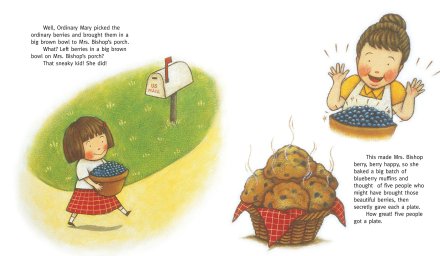
celebrate-picture-books-picture-book-review-Ordinary-Mary's-Extraordinary-Day-mrs-bishop

Image copyright Fumi Kosaka, 2002, text copyright Emily Pearson, 2002. Courtesy of Gibbs Smith.

One of these is Maria, who later does nice things for five other people. One of these cheers up the next five people she sees, who in turn brightens the day of five people. By now these random acts of kindness have spread through town and farther. People everywhere are watching out for others, being generous, smiling, becoming friends, and more! And in a surprising happenchance, ordinary Mary’s original act of kindness comes back to her!

celebrate-picture-books-picture-book-review-Ordinary-Mary's-Extraordinary-Day-joseph

Image copyright Fumi Kosaka, 2002, text copyright Emily Pearson, 2002. Courtesy of Gibbs Smith.

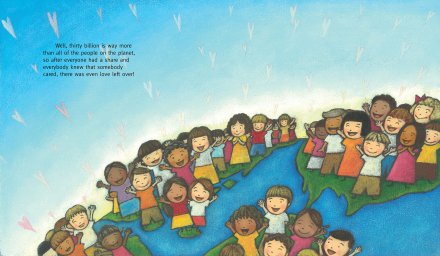
What Mary doesn’t know, though, is that her extraordinary deed actually changes the whole world for the better—because each person touched by kindness shares it with five others, who share it with five more until the one act of leaving blueberries on Mrs. Bishop’s porch multiplies to 6 billion other people!
celebrate-picture-books-picture-book-review-Ordinary-Mary's-Extraordinary-Day-world

Image copyright Fumi Kosaka, 2002, text copyright Emily Pearson, 2002. Courtesy of Gibbs Smith.

Emily Pearson’s story is a delightful tale of how one person can make a positive difference in the lives of others. The thread of simple deeds shared from one character to the next demonstrates to young and old alike how just a smile, a compliment, or an unexpected act can transform another person’s day and even the way they view themselves and the world. This is a perfect book for spurring random acts of kindness, and its straightforward treatment of the way random acts build on each other makes it a great reminder for all ages.

Fumi Kosaka has populated Mary’s world and beyond with people whose wide smiles and twinkling eyes make you want to share the excitement of giving right along with them. Her simple, colorful drawings focus on the people affected and highlight the simple acts that bring them so much pleasure.

Ages 4 and up

Gibbs Smith Publishers, Reprint edition, 2017 | ISBN 978-1423648871 Paperback

Random Acts of Kindness Day Activity
CPB - Random Acts of Kindness cards

Random Acts of Kindness Cards to Share

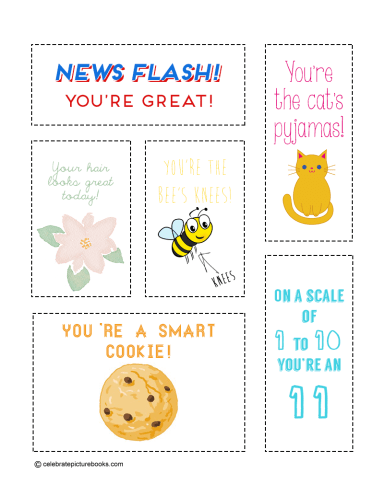
It’s fun to surprise someone with an unexpected gift or compliment! It makes the other person and you feel happier! Here are some printable Random Acts of Kindness Cards that you can give to anyone you meet today—or any day. If you’d like to write your own, here is a set of Blank Cards. You can give one to your teacher, librarian, favorite store clerk, your postal worker, your neighbors and friends, the person next to you on the bus or train. Or why not brighten someone’s day by leaving a note where they might find it—in a book at the library or bookstore, in a friend’s lunchbox, in your mailbox, on a store shelf, or anywhere you go!

Picture Book Review

February 16 – Innovation Day

CPB - Girls Think of Everything Innovation Day

About the Holiday

Today we celebrate all those people who look at a problem and design a solution, or who just ask, “What if…?” and search for answers. So put on your thinking cap, look around you, and do something new, novel, and completely unexpected. Who knows…you may be the next great inventor!

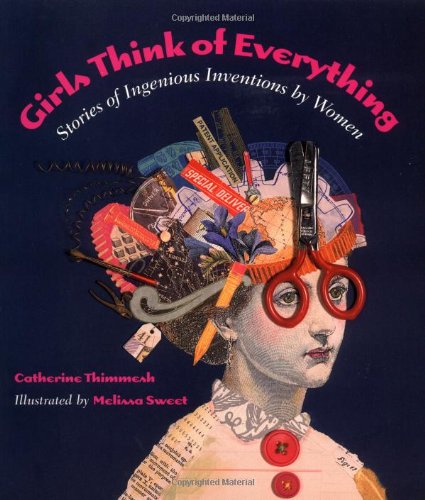
Girls Think of Everything: Stories of Ingenious Inventions by Women

Written by Catherine Thimmesh | Illustrated by Melissa Sweet


Throughout history women have invented new and clever ways of doing things—necessity is the Mother of invention, after all. In her fascinating picture book, Catherine Thimmesh highlights ten women and two girls whose creativity has changed the world.

Here, you’ll learn the intriguing stories behind each invention, the struggles for recognition, and the ultimate victory of innovation. Did you know that the original recipe for chocolate chip cookies was just a time-saver? Or that people once thought windshield wipers weren’t necessary? You’ll also discover how liquid paper, flat-bottomed paper bags, and the Glo-sheet came to be. Women in science have contributed Kevlar, Scotchgard, the COBOL computer language, and the space shields that protect the International Space Station, satellites, and more.

Catherine Thimmesh is an excellent storyteller, drawing you into the actions and minds of these women innovators and the situations or environments that fostered their talents. Melissa Sweet accompanies each profile with portraits of the inventor and colorful collage illustrations that build on the text and tell stories of their own.

Ages 7 – 12

Houghton Mifflin Company, Boston, 2000 | ISBN 978-0618195633

Innovation Day Activity

CPB - Invention Word Scramble

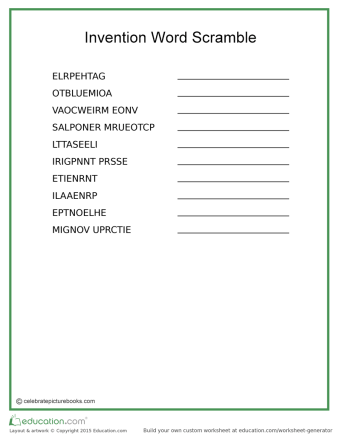
Invention Word Scramble


Every invention started out as a jumble of ideas in someone’s head. In this Invention Word Scramble you can unscramble the letters of some of the world’s greatest creations. Solutionincluded. Odog cklu!


February 15 – Susan B. Anthony Day

celebrate=picture-books-picture-book-review-heart-on-fire-cover

About the Holiday

On February 15, 1820 in Adams, Massachusetts a girl was born who would grow up to set the world afire with her belief in women’s rights. Her name was Susan Brownell Anthony. An early feminist, her father believed it was as important for his five daughters to receive an education as for his two sons. After graduating from school, Susan Anthony became a teacher—at the age of 14—making $2.50 a week compared to the $10.00-per-week salary of the male teachers. Anthony later became active in the abolition and temperance movements. She recognized that the inability to vote limited women’s influence in these causes and began promoting women’s rights. She worked tirelessly to change the voting laws until her death on March 13, 1906 without seeing her greatest wish fulfilled. It was not until 1920, with the ratification of the 19th Amendment, that women were allowed to vote.

Susan B. Anthony has been honored for her dedication with commemorative stamps, and her portrait appears on the dollar coin. We also remember her work on behalf of all women on her birthday with memorial services at her gravesite in Rochester, NY and in Washington DC. Susan B. Anthony Day is a legal holiday in Florida, West Virginia, Wisconsin, New York and California.

Heart on Fire: Susan B. Anthony Votes for President

Written by Ann Malaspina | Illustrated by Steve James


It’s November 1, 1872 and only four days until the presidential election. Everywhere people are being urged to register to vote. Knowing how important voting is, Susan B. Anthony races to the registration office with her sister and a friend in tow. The men in the office stare at her in confusion.

They know that women can’t vote—only men! What is Susan B. Anthony trying to do? But Anthony argues that the new 14thAmendment, which says “all persons born in the United States have the same rights as citizens,” gives women the right to vote. Some inspectors think she is right, some disagree. Finally they allow Anthony to sign the registration card.

celebrate=picture-books-picture-book-review-heart-on-fire-susan-goes-to-vote

Image copyright Steve James, courtesy of Albert Whitman & Company

On November 5, Voting Day, Anthony and 15 other women cast their ballots. Thirteen days later, however, a deputy federal marshal shows up at Anthony’s door with a warrant for her arrest. The charges? Voting illegally! The other women and the men who had allowed them to register and vote are also arrested.

In January word comes that unless Anthony pays a $1,000 fine, she will have to spend the time until her trial in prison. Anthony is adamant about not paying, but her lawyer sends the money. People in the country are split over whether she is right or not, but Anthony knows she’s right. Without being able to vote, women will have no voice in government.

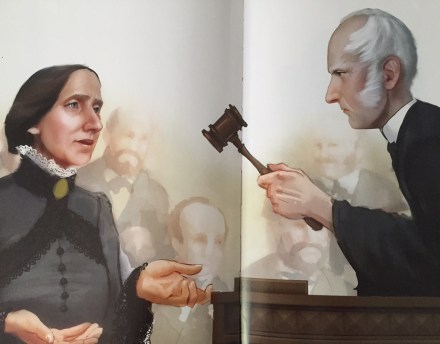
She gives speeches, trying to rally people to her cause, and when her trial begins on June 17, 1873 the courtroom is packed. After Anthony’s lawyer and the prosecutor speak, the judge decides that Anthony has broken the law. He proclaims her guilty. When the judge asks if she has anything to say, Anthony answers, “You have trampled under foot every vital principle of our government. My natural rights, civil rights, political rights….” The judge stops her and does not allow her to continue speaking. He fines her $100, plus court costs. Susan B. Anthony refuses to pay, and she never did.

celebrate=picture-books-picture-book-review-heart-on-fire-susan-pleads-case

Image copyright Steve James, courtesy of Albert Whitman & Company

Through action, dialogue, and the metaphorical theme of fire, Ann Malaspina has written an exciting biography of Susan B. Anthony. Readers will understand and, more importantly, feel the opinions and determination that fueled Anthony’s crusade for women’s rights. The final pages follow the history of the women’s suffrage movement until the ratification of the 19th Amendment in 1920 and provide photographs from the time. The text of the 14th and 19th Amendments is also included.

Opening the pages of Heart on Fire is like walking into a city of the 1800s. The lush colors and intricate details of Steve James’ illustrations immediately immerse readers in the time and place of Susan B. Anthony’s world, depicting the reality of her struggles. This is a perfect book to share with children, especially in this election year when they can see how far women have come—from being denied the vote to running for president.

Ages 5 – 9

Albert Whitman & Company, Chicago, 2012 | ISBN 978-0807531884

Learn more about Ann Malaspina and her books on her website!

View a gallery of illustration by Steve James on his website!

Susan B. Anthony Day Activity

CPB - Vote For Me round (2)

Vote For Me! Campaign Poster and Frame


If you were running for President, what would be important to you? Here’s a Vote For Me! Poster and Picture Frame to get your campaign started!

Supplies

Directions

  1. Print Vote For Me! Poster and Picture Frame templates
  2. Take a selfie or use your school picture
  3. Cut out the Picture Frame and the circle or rectangle in the middle
  4. Tape or glue your picture in the circle or rectangle
  5. If you are using a clear magnetic frame, slip the template inside and hang on your refrigerator or any metal object.
  6. If you are using a magnetic sheet, peel the paper off the adhesive side. Stick the Vote For Me! Picture Frame template with your picture attached to the adhesive. Cut around the edges. Hang!
  7. On the Vote For Me! Poster, list the things you would do if you were President. Talk to your family and see if you might be able to do some of them now! Hang your poster in your room or in the house where others can see it.

February 14 – Frederick Douglass Day

CPB - Words Set Me Free

About the Holiday

Although the exact date is not known, history records Frederick Douglass’ birthday as around Valentine’s Day in 1818, so February 14 was chosen to honor this most unique and influential man. Born into slavery, Frederick Bailey (he later changed his last name to Douglass) learned how to read and write when still a child. As a young man he used his intellect and courage to secure his freedom. He became a compelling speaker, writer, leader of the abolition movement, and statesman. His writings, especially his autobiography Narrative of the Life of Frederick Douglass, an American Slave, are among the most powerful accounts of the slave experience and are still widely read today.

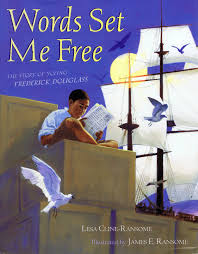
Words Set Me Free

Written by Lesa Cline-Ransome | Illustrated by James E. Ransome


Born into slavery and separated from his mother in infancy, Frederick Bailey is raised by his Grandmama while his mother works on a separate plantation. When she is able Harriet Bailey walks the 12 miles between plantations to spend a few short hours with her son, watching him sleep, before making the long journey back. While Frederick is still a very young child, his mother falls ill and dies. Douglass recalls never seeing his mother’s face in daylight.

At the age of six, Frederick is moved from his Grandmama’s cabin to the plantation house. At eight, he is sent to the master’s brother in Baltimore, Maryland. Here, the master’s wife, Sophia Auld, treats Frederick more like a paid servant then as a slave. When Frederick says he wants to learn how to read and write, she immediately begins teaching him the alphabet. Frederick is always mindful, however, that he may be punished for these lessons, and he has only memorized the letters and a few words before his master puts an end to his education. Angrily, the master explains to his wife, “If you teach him how to read…it would forever unfit him to be a slave.”

These words are perhaps Frederick’s greatest lesson. He never forgets them, and they fuel his resolve to pursue an education. He makes clever use of the few resources he has and slowly learns to read and write. From the newspapers he discovers that the North offers freedom, and Frederick decides to escape. It’s many long years, however, before he can fulfill his dreams. At last, he sees an opportunity to leave the South behind, and using his talent for writing makes his escape a reality.

Lesa Cline-Ransome has written a compelling biography of Frederick Douglass for children in Words Set Me Free. In straightforward language and through first-person point of view, Cline-Ransome reveals the brutal truth of Douglass’s life as a slave and his fight against injustice. As the title suggests, the book focuses on Frederick’s desire to become educated and the obstacles he overcame to succeed. This universally important message continues the work Douglass engaged in long ago.

James Ransome’s stirring paintings highlight pivotal scenes of Frederick’s story. Readers witness the tender moments with his mother, the cruel contrast of slavery and his blossoming intellect, and Frederick’s growing resolve to educate himself and escape.

Ages 5 and up                                                                                                            

Simon & Schuster, New York, 2012 | ISBN 978-1416959038

Frederick Douglass Day Activity

CPB - Words Set Me Free word search

Words Set Me Free word search


Words were so important to Frederick Douglass that he risked everything to learn how to read and write. In this printable Words Set Me Free Word Search Puzzle you will find words about the man we honor today. Solution

February 13 – World Radio Day

CPB - Radio Man

About the Holiday

The radio has provided entertainment, news, comfort, and information and has united people both near and far ever since Guglielmo Marconi invented  it in 1895. Today, radio continues to be an important part of people’s lives around the world. February 13 was established as World Radio Day “to celebrate radio as a medium, improve international cooperation among broadcasters, and to encourage both major networks and community radio to promote access to information, freedom of expression and gender equality across the airwaves.” This year’s UNESCO theme is “Radio in times of emergency and disaster” and highlights the crucial role of radio and its journalists in times of crisis.

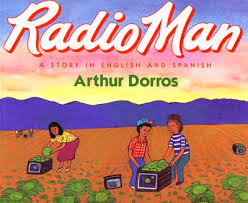
Radio Man

By Arthur Dorros | Translated by Sandra Marulanda Dorros


“Radio man” is Diego, a boy in a family of migrant workers who pick fruit and vegetables from the Southwest to as far north as Washington state. Although his family moves frequently, Diego has close relationships with his parents, sister, grandparents, cousins, and especially a friend named David.

Throughout the story, as his family moves from town to town searching for work, Diego listens to the radio. Stations broadcasting in both English and Spanish keep the family company, and Diego measures the distance of upcoming towns along their route by the clarity of the DJs’ voices. The radio also provides entertainment for end-of-picking season parties among the workers and serves as a catalyst for the grandfather’s stories of growing up in Mexico.

While Diego’s family is close-knit, their nomadic lifestyle separates Diego from his best friend, David, who is also the son of migrant workers. As the story begins Diego and David are leaving Texas and know they won’t see each other for a while. As Diego travels to different towns, going to school during the day and picking crops in the afternoon, he meets up with his cousins and other friends, but he never finds David. Finally, in Sunnyside, Washington Station KMPO allows people to send messages to others. Diego calls in and sends a message: “Hello, David! This is Diego. Are you here?”

And David, listening to his own radio, is there! Seeing David’s smile, children will identify with the pleasure that communicating with friends brings.

Each page of Radio Man is presented in English and Spanish, translated by Sandra Marulanda Dorros. The landscape and farms of the American southwest, the festive celebrations, the reality of driving from town to town, and the tight relationships among family members are all vividly illustrated by Arthur Dorros, giving children a glimpse into the life of migrant workers as well as the heart of friendship.

Ages 4 – 8

Trophy Picture Books, 1997 | ISBN 978-0064434829

World Radio Day Activity

CPB - Radio Man box radios from side

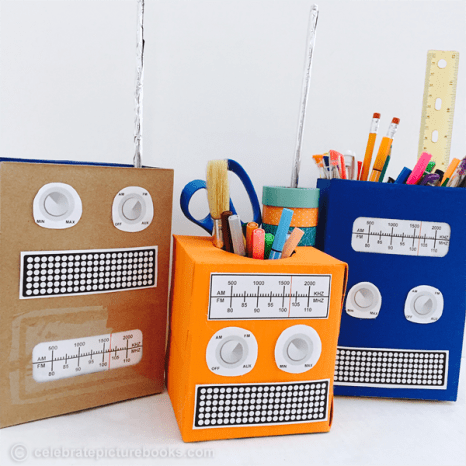
Box Radio Desk Organizer

With a recycled box and the provided printable templates  you can make a desk organizer that looks like a radio with this fun craft!

Supplies

  • Cardboard box – Use an empty cube-shaped tissue box, pasta box, or any small box
  • Wooden chopstick
  • Printable Radio Face Template
  • Aluminum foil
  • Glue – a hot-glue gun works well on the cardboard; regular glue for the buttons and tape for the station tuner window
  • Paint – any color you like
  • Paint brush
  • Scissors

Directions

1. Prepare the box:

  • Choose a box to be your radio. In the pictures I used a cube-shaped tissue box and a penne pasta box with a cellophane window in it.
  • If you are using a box without an opening in the top, cut the top or bottom flaps off of one end of the box, depending on where you want the station tuner window to go.

2. Paint the box:

  • You can paint the printed front, back and sides of the box.
  • OR if you want a plain box to use “as-is” or to paint: take the recycled box apart at the seams and turn it “inside out.”
  • If you are using a pasta box with a window in it, tape the stations tuner template to the cellophane window before gluing the seams
  • Glue the original seam and flaps (a hot-glue gun works well). Let the glue dry. Then paint.

3. Let the box dry

4. Cut out the radio dials, speaker, and stations tuner window

5. Glue the parts of the radio to the box 

6. To make the antenna, wrap the wooden chopstick in a strip of aluminum foil: lay the stick on the foil and fold a foil flap (about 1 inch long) over each end of the stick. Roll the foil around the stick and press gently to close seam.

7. Attach the antenna to your box:

  • For pasta boxes tape the antenna to the inside corner of the box
  • For cube tissue boxes, make a hole in the right hand corner and push antenna in

8. Use your Radio Desk Organizer to hold pencils, rulers, bookmarks, anything!

February 12 – Abraham Lincoln’s Birthday

CPB - I am Abraham Lincoln

About the Holiday

Today we celebrate Abraham Lincoln’s birthday! Abe Lincoln was born in a one-room log cabin in Kentucky and later worked as a riverboat worker, a shopkeeper, and a postmaster in Illinois before becoming the 16th President of the United States. With compassion, bravery, and strength, Lincoln shepherded the country through the Civil War and signed the 13th Amendment to the Constitution outlawing slavery in the United States. Lincoln’s birthday is commemorated with wreath-laying ceremonies at his birthplace and at the Lincoln Memorial in Washington D.C.

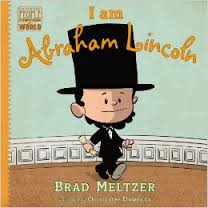
I am Abraham Lincoln

Written by Brad Meltzer / Illustrated by Christopher Eliopoulos


In his I am… series of biographies, Brad Meltzer writes about famous people as they grow from childhood into the influential adults they became. In I am Abraham Lincoln, Meltzer illuminates various experiences of Lincoln’s life that formed his beliefs of equality and inclusiveness. At a time when most children liked to hunt, fish, and tend the farm, young Abe spent his time reading, and he was one of the few people in town who could write. Even at the age of 10, his compassion showed when he stopped a group of his peers from treating a turtle roughly. Later, as a young man and newcomer to Illinois, he faced a group of bullies and dispersed them without throwing a punch.

It was when he witnessed the indignities of a slave boat, however, that his most deeply held beliefs took hold. As President, Lincoln acted on those beliefs, helping the country through the Civil War, gave speeches, and signing laws that ensured all people would be treated equally.

By relating stories from Abraham Lincoln’s childhood, Meltzer not only teaches children about his life, but demonstrates that his young readers can also make a difference by speaking up and helping others whenever they see injustice.

Christopher Eliopoulos’s cartoon-like illustrations are particularly effective in showing the earnestness of Abraham Lincoln’s personality from early childhood on. Speech bubbles display dialogue, modeling the simple words that can so often create great change. Part of the book’s charm is that even as a child Lincoln sports his iconic beard and top hat, making him instantly recognizable as the hero children are familiar with and emphasizing the “man in the child” theme.

Ages 4 – 8

Dial Books for Young Readers, Penguin Group, New York, 2014 | ISBN 978-0803740839

Abraham Lincoln’s Birthday Activities

CPB - Abe Lincoln's Top Hat chalkboard (2)

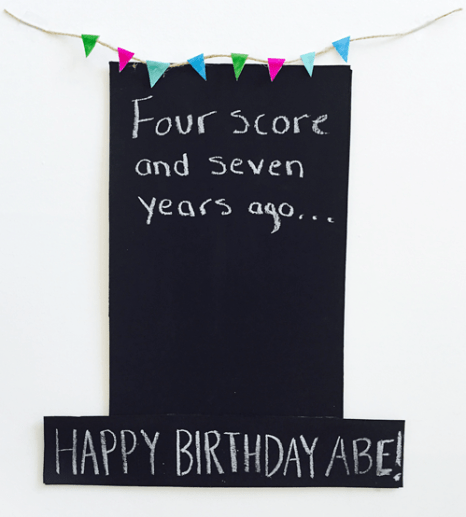
Abe Lincoln’s Top Hat Chalkboard

Abraham Lincoln was known for the black top hat he wore – and for his inspiring words In this activity you can learn how to make a top hat chalkboard to use for your own drawings or inspiring words!

Supplies

  • Cereal Box (I used a large sized cereal box), cardboard or poster board
  • Chalkboard Paint (black)
  • Paint brush
  • Hot Glue Gun or extra-strength glue
  • Removable mounting squares
  • Chalk

Directions

  1. If you are using cardboard or poster board: cut a rectangle at least 8 inches wide by 12 inches long for the hat and 12 inches long by 2 inches wide for the brim (but your top hat can be any size you’d like!)
  2. If you are using a Cereal Box: open the seams of the Cereal Box
  3. Cut the panels of the cereal box apart
  4. Take one face panel and one side panel
  5. With the chalkboard paint, paint both panels
  6. Let the panels dry
  7. Attach the side panel to the bottom of the face panel to create the shape of Lincoln’s top hat
  8. Hang Abe Lincoln’s Top Hat Chalkboard 

Donate to a Food Bank

Today can be a day to remember the hardships that many people still endure. Many still live with hunger every day. Today, gather a bag of non-perishable foods and donate them to your local food bank. This activity can also be done by a group—a classroom, scout troop, youth group, or group of friends. Even a little bit helps a lot!


February 11 – Make a Friend Day

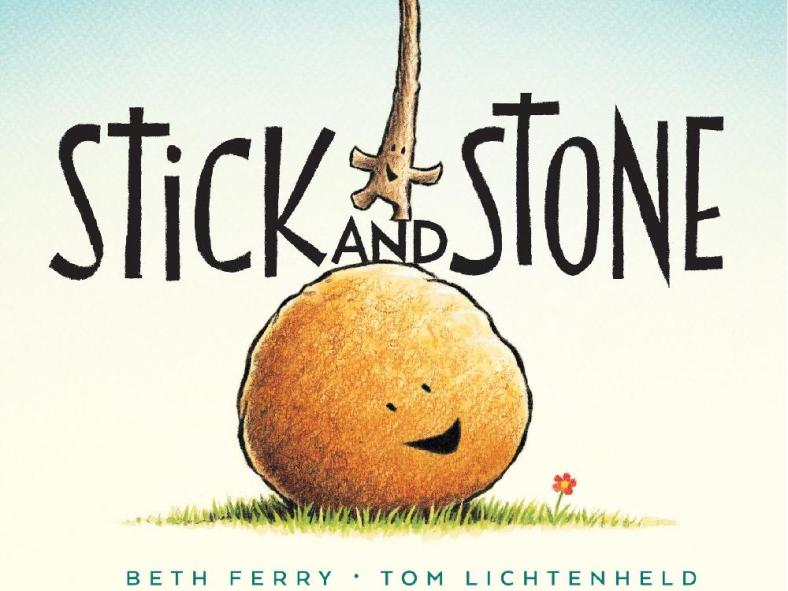
celebrate-picture-books-picture-book-review-stick-and-stone-cover

About the Holiday

Whether you spend today with an old friend or make a new one, it’s a perfect time to remember those people who know our secrets, make us laugh, lend an ear, do silly things with us, and generally make life better! Today give an old friend a hug, a thank-you, or tell them how much they mean to you. Look around and see if there’s someone new you’d like to meet. They may be wanting to meet you too! Walk up and say “hi”—it may be the beginning of a new friendship!

Stick and Stone

Written by Beth Ferry | Illustrated by Tom Lichtenheld


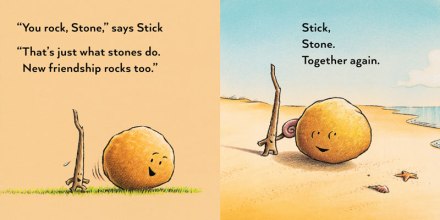
A stick and a stone live lonely lives until one day when they meet at the playground. As they playing on the swings together, a prickly pinecone comes along and makes fun of Stone for falling off the swing. Stone’s new friend “sticks” up for him, and Pinecone leaves them alone. Stick’s and Stone’s friendship grows as they explore new places, help each other complete fun activities, and relax together.

celebrate-picture-books-picture-book-review-stick-and-stone-at-the-beach

Image copyright Tom Lichtenheld, text copyright Beth Ferry, Courtesy of tomlichtenheld.com

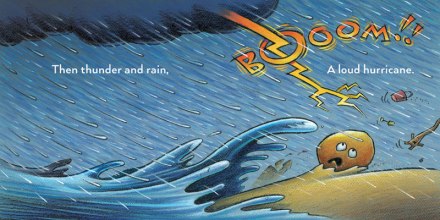
When a windstorm strikes, Stick and Pinecone are blown away, leaving Stone alone again. Stone searches everywhere and finally finds Stick upside down in a puddle. With ingenious creativity, Stone rescues Stick, proving that together they are a perfect 10.

celebrate-picture-books-picture-book-review-stick-and-stone-hurricane

Image copyright Tom Lichtenheld, text copyright Beth Ferry, Courtesy of tomlichtenheld.com

Using rhyme, puns, and perfect pacing, Beth Ferry infuses her spare text with just the right emotional tone for her young readers. A little conflict, a little suspense, and a little cleverness, add up to a big-hearted story.  

Tom Lichtenheld’s Stick and Stone are simply adorable. Kids will immediately identify with this whimsical duo and wish they could join them on their adventures. Clever pairings of text and illustrations enhance the meaningful relationship of these new friends.

Ages 3 – 7

Houghton Mifflin Harcourt, New York, 2015 | ISBN 978-0544032569

Discover more about Beth Ferry and her books – plus extra goodies – on her website!

You’ll love exploring the gallery of illustration and books on Tom Lichtenheld‘s website!

Stick around and watch this Stick and Stone book trailer!

Bake for Family Fun Month Activity

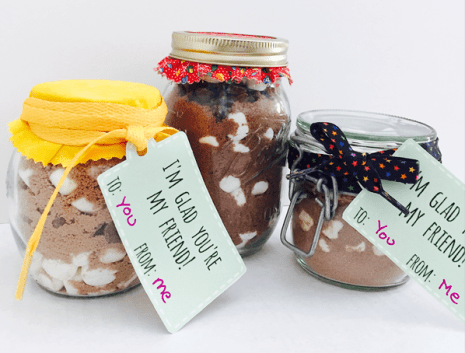
CPB - Hot Chocolate trio (2)

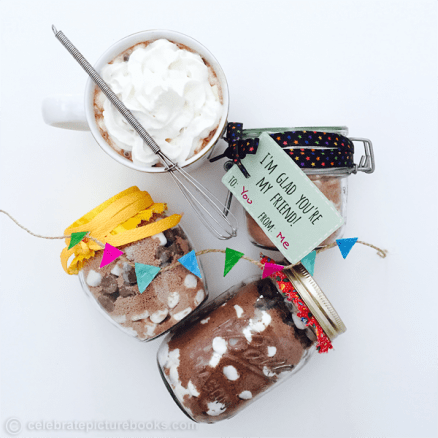
Special Friendship Hot Chocolate Jar 


There’s nothing better than sipping hot chocolate with a friend – either old or new! Snitching a couple of marshmallows when you load up your mug and wearing that stylish foamy mustache are all sure to make you and your friend giggle! And the rich chocolate flavor is guaranteed to make you happy!

Here’s an easy way to make a special gift to give to an old friend or to introduce you to a new one!

CPB - Hot Chocolate from above with whisk

Supplies

  • Mason jar, canning jar, or any recycled jar from home
  • Canister of your favorite hot chocolate mix
  • Bag of mini marshmallows
  • Bag of chocolate chips
  • Measuring cup
  • Spoon
  • Piece of cloth
  • Shoelace, string, elastic, or ribbon
  • Paper or card stock to make a Friendship Tag
  • Hole punch
  • Scissor

Directions for Filling the Jar

  1. Wash and completely dry the jar
  2. Drop a handful of mini marshmallows into the bottom of the jar. With the spoon push some of the marshmallows tight against the glass so they will show up when you add the hot chocolate mix.
  3. Measure 1/3 cup of hot chocolate mix and sprinkle it on top of the marshmallows. With the spoon gently spread the mix over the marshmallows.
  4. If you wish, add a layer of chocolate chips.
  5. Continue layering marshmallows and hot chocolate mix until you get to the top of the jar.
  6. At the top add another layer of chocolate chips and marshmallows.
  7. Put the lid on the jar and secure it tightly.

Directions for Decorating the Lid and Adding the Tag

  1. Cut a 6-inch circle from the cloth. To make the edges decorative, use a pinking sheers or other specialty scissor.
  2. Cover the lid of the jar with the cloth and secure with an elastic or rubber band.
  3. Tie the string, shoelace, or other tie around the rim of the lid.
  4. If using a Mason jar, place the cloth between the disk and the screw top
  5. Create a Friendship Tag and add your name and the name of your friend.
  6. Use a hole punch to make a hole in the Friendship Tag, slide it onto the tie, and knot it.

Directions for Making the Hot Chocolate

  1. With a spoon measure 1/2 cup of the hot chocolate, marshmallow, chocolate chip mix into a mug
  2. Fill the mug with boiling water, hot milk, or a combination of both
  3. Enjoy!

Picture Book Review