Squirrels elicit emotions on both sides of the spectrum. On one hand you can’t help but say “Awww!” when you see their tiny little paws and crafty antics. On the other hand their voracious appetites at bird feeders and penchant for darting into traffic is more likely to make you say “Arrgghhh!” This month is set aside, however, for enjoying the squirrels in your yard, park, or city. And really, don’t they make life just a little more fun?
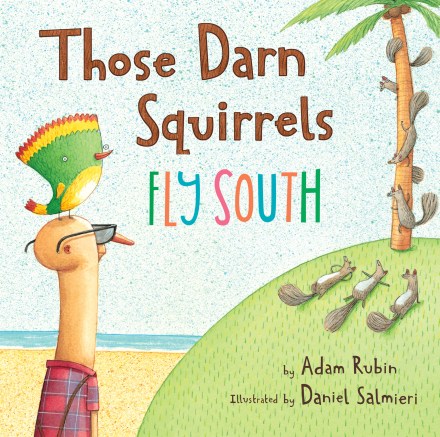
Those Darn Squirrels Fly South
Written by Adam Rubin | Illustrated by Daniel Salmieri
Everyone knows Mr. Fookwire is a grump whose grumpiness knows no bounds. “He scolded fireflies for being too bright…yelled at clouds for being too fluffy…and pinched his nose with a clothespin” so he doesn’t have to smell the lilacs. Despite these annoyances, though, he had a wonderful summer painting pictures of the birds in his yard even though “those darn squirrels” had set up an easel of their own nearby.
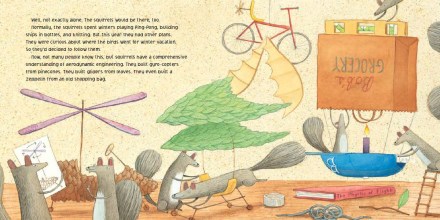
But now fall was here and that meant that all of Mr. Fookwire’s beloved birds would soon be flying south leaving him with only the squirrels for company. While the squirrels usually spent the winter months “playing ping pong, building ships in bottles, and knitting, this winter they had decided to follow the birds to warmer climes. With their expert knowledge in aerodynamic engineering, the squirrels had “built gyro-copters from pinecones…gliders from leaves…and even a zeppelin from an old shopping bag.”
Image copyright Daniel Salmieri, text copyright Adam Rubin. Courtesy of hmhbookscom
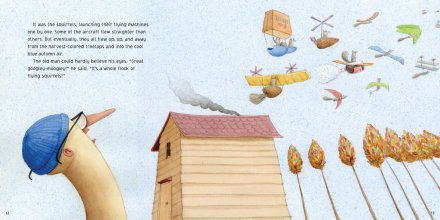
When the day came for the birds to take wing, Mr. Fookwire sadly waved goodbye. Just as he was about to return to the house, he heard a strange rustling, then a whir, and finally a buzz. It was the squirrels soaring away in their homemade aircraft. “‘Great googley-moogley’” Mr. Fookwire exclaimed.
The squirrels followed the birds for days until they landed on a beach. To celebrate the end of their journey and the welcome warmth, the squirrels held a fiesta, complete with mangoes, the marimba, and the merengue. Winter was wonderful here where there were new foods to eat and new birds to discover. One with a long neck, rings around its eyes, and red and blue feathers even looked a little familiar and left the squirrels feeling homesick. They decided to make a long-distance phone call, and chattered away to Mr. Fookwire.
Although he wouldn’t admit it, Mr. Fookwire was happy to receive the call. He decided to pack up his easels, paints, brushes, and cottage cheese with pepper and hit the road in his beautiful vintage car. Driving 12 miles an hour, Mr. Fookwire at last reached the beach, where the squirrels swarmed him in a big hug. “Maybe it was the nice weather. Maybe it was the beautiful scenery, Maybe it was the squirrels dancing in his pants. But for the first time in a very long time, the old man laughed.”
Image copyright Daniel Salmieri, text copyright Adam Rubin. Courtesy of hmhbookscom
Mr. Fookwire was delighted with the local birds and immediately began to paint them. “‘The birds here are even more amazing than the birds back home!’ he exclaimed. ‘Harrumph!’ muttered the floogle bird.” The hot sun took its toll on Mr. Fookwire, however, and he collapsed right into the middle of his painting. The squirrels dragged him into the shade and revived him. Maybe spending the winter at home was better. Mr. Fookwire decided to head back, and the squirrels accompanied him. They didn’t want to miss “the annual snow-fort building competition.”
They all jumped into the car and sped off. Really! After all, Mr. Fookwire was in no condition to drive.
Adam Rubin’s Those Darn Squirrels Fly South contains all the charm and squirrely shenanigans that make the other two books in the series such a hit with kids (and adults). Rubin’s snappy descriptions, silly scenarios, and loveably cantankerous protagonist make for a hilarious story time read that will delight his fans and captivate new readers.
Daniel Salmieri knows how to make kids giggle and laugh out loud with colorful illustrations that perfectly depict Mr. Fookwire’s world—both at home and away. Mr. Fookwire’s noodly arms, giraffe-long neck, and carrot-shaped nose coalesce into a character that is at once funny and endearing. Getting more beak time in this third outing, the familiar birds are joined by a crew of even more brilliant and exotic beach mates. The squirrels are up to their usual contraption-making tricks as they build flying machines from soda bottles, flashlights, baseball caps, and more around-the-house items. The squirrels know how to live wherever they are, and Salmieri’s depictions of them holding a fiesta, hugging Mr. Fookwire, and roaring down the highway is absurdity for the younger set at its best.
Ages 4 – 7
Houghton Mifflin Harcourt, 2012 | ISBN 978-0544555457
You can find out more about Adam Rubin, his books, and his dry sense of humor on his website!
View a gallery of illustration work and more books by Daniel Salmieri on his website!
Go nuts watching this Those Darn Squirrels Fly South book trailer!
Squirrel Awareness Month Activity
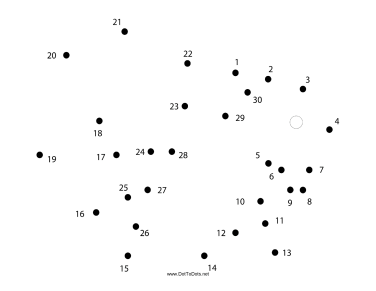
Celebrate Squirrels! Dot-to-Dot
Enjoy following the dots to finish this printable Celebrate Squirrels! activity sheet and then color it in!
We love animals, but do we take care of them the way we should? Today’s holiday was established in 1931 to promote global awareness of animals and the issues surrounding their welfare. From pets to domesticated animals to wild creatures, humans must protect and advocate for their companions and fellow travelers on this earth. Issues such as pollution, habitat destruction, and poaching threaten the world’s wide variety of species, while closer to home spaying and neutering controls the population of feral animals that often suffer from a lack of resources.
The wildlife kingdom is majestic and awe-inspiring. Today celebrate the world’s animals by taking a trip to a zoo, aquarium, or animal preserve, consider adopting a shelter animal, or donating your time or talents to your favorite animal cause.
Pink is for Blob Fish: Discovering the World’s Perfectly Pink Animals
Written by Jess Keating | Illustrated by David DeGrand
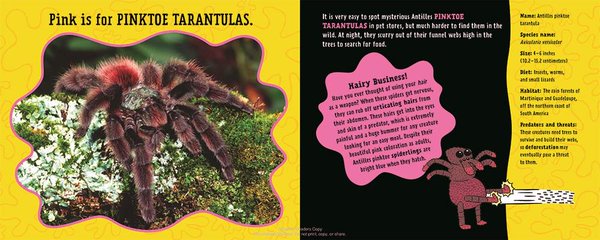
Pink is sweet like cotton candy, right? Pink is pretty like a rose, isn’t it? Pink is quiet like twightlight, don’t cha think? Well…yes, and…maybe not so much. You’d be pardoned for squirming in the presence of a pinktoe tarantula which is found in the rain forests of Matinique and Guadeloupe and can defeat predators with their spiky hairs, and if you can’t make heads or tails of the Pink Fairy Armadillo, which looks like a cross between a lobster tail and a shag rug, no one will blame you.
Text copyright Jess Keating, illustration copyright David DeGrand, courtesy of Penguin Random House
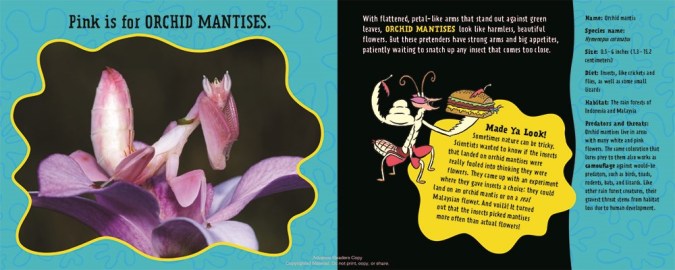
But the world is full of pink, and for each of these grimace-inducing bubble-gum-hued creatures there are plenty who simply take your breath away with their beauty. Imagine watching a duo-toned light-and-dark-pink Roseate Spoonbill take off and soar over marshland along America’s Gulf Coast or a river in South America or the West Indies like a valentine on the wind. You will likewise marvel when you see the delicate form of the Orchid Mantis. This variety of praying mantis found in the rain forests of Indonesia and Malaysia is so identical to real orchids that other insects can’t tell the difference and often land in the grasp of their tricky predator.
Text copyright Jess Keating, illustration copyright David DeGrand, courtesy of Penguin Random House
Seas and rivers also teem with pink wildlife. Pygmy Seahorses swimming in the waters of the South Pacific blend in to their coral surroundings like a spiky ball among hedgehogs. With white-and-pinkish bodies dotted with strawberry-colored knobs, these seahorses are perfectly camouflaged against predators. The rose-colored Amazon River Dolphin hunts for piranhas, crustaceans and bottom dwelling fish with its long snout in the freshwater rivers of South America. The rivers, lakes, and swamps of sub-Sahara Africa are home to Hippopotamuses, which “ooze thick pink oil all over their skin. This pink ‘sweat’ acts like an antibiotic sunscreen, so hippos can stay out in the sun all day without getting burned.” Imagine if you could do that!
Of course, there is also the Blobfish, recently voted as the world’s ugliest animal. But isn’t this little glob of gelatinous goo really so ugly it’s cute? Found in deep waters off the coasts of Australia and New Zealand, this fish survives where others cannot by simply opening its mouth and gobbling down whatever floats by.
With many more examples of pink wildlife in this captivating book, it’s guaranteed that after flipping through the pages of Pink is for Blobfish you will never look at pink the same way again!
Text copyright Jess Keating, illustration copyright David DeGrand, courtesy of Penguin Random House
Jess Keating highlights a host of fascinating pink animals in this volume that is sure to delight kids and get them excited about the world less seen. The first in the World of Weird Animals series, Pink is for Blobfish is loaded with scientific facts, remarkable trivia, and humorous asides to pique the interest of readers’ inner zoologist. Each two-page spread provides a spectacular up-close photograph of the animal, insect, or fish described as well as its common name, species name, size, diet, habitat, and predators or threats. Keating also taps into her audience’s love of the unique and even the bizarre with conversational paragraphs that reveal unusual habits, traits, survival mechanisms, and more for each creature featured.
David DeGrand lends his unique illustration style to the pages with funny cartoon portrayals of the creatures and one of their signature traits. These humorous depictions will not only make kids and adults laugh but will promote better understanding of each unique animal.
Pink is for Blobfish is a perfect addition to personal libraries for budding environmental scientists or anyone interested in the wider, wilder animal world and is an exciting title for school libraries and classrooms, where it could inspire scientific study.
Ages 5 – 10
Knopf Books for Young Readers, Penguin/Random House, 2016 | ISBN 978-0553512274
You’ll discover books, videos, creature features, resources, and lots more on Jess Keating’s website!
You will find the world of David DeGrand‘s art and comics on his website!
Pink is for book trailers—at least this one!
World Animal Day Activity
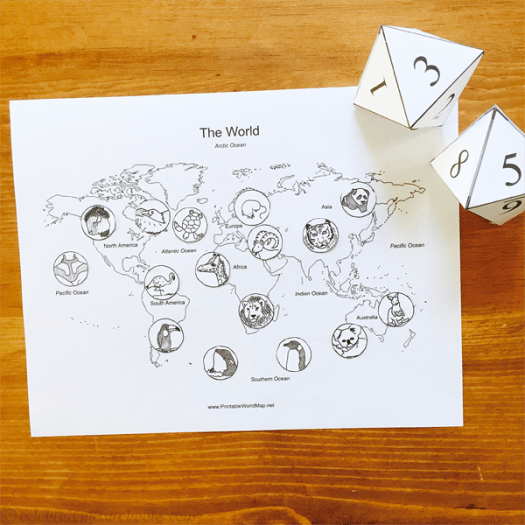
Play the Wonderful Wildlife Board Game! Animal tokens images copyright Conor Carroll
Wonderful Wildlife Board Game
Fascinating animals are found in every part of the world. Play this fun printable Wonderful Wildlife Board Game to match each animal to the area where it lives.
Print one set of 16 Wildlife Tokens for each player
Print two copies of the 8-sided die, fold, and tape together
If you would like, color the map and tokens
Choose a player to go first
Each player rolls both dice and places an animal on their map according to these corresponding sums of the dice below
The first player to fill their map is the winner!
1 = Flamingo – South America
2 = Emperor Penguin – Antarctica (Southern Ocean)
3 = Giraffe – Africa
4 = Bald Eagle – North America
5 = Ibex – Europe
6 = Kangaroo – Australia
7 = Panda – Asia
8 = Orca – Antarctica (Southern Ocean)
9 = Toucan – South America
10 = Buffalo – North America
11 = Koala – Australia
12 = Lion – Africa
13 = Etruscan Shrew – Europe
14 = Manta Ray – Pacific Ocean
15 = Sea Turtle – Atlantic Ocean
16 = Tiger – Asia
Q&A with Author Jess Keating
Today I’m tickled pink to talk to Jess Keating about her work as a zoologist and an author, her favorite animals, and a very cool holiday tradition.
In your work, your books, and your online presence, you bring kids and adults closer to the animal kingdom. What in your early years inspired you to become a zoologist?
I wish there was one poignant answer to this question! The truth is, all my life I’ve been enamored with animals. A physicist I admire once said this: The world is beautiful to look at, but it’s even more beautiful to understand. To me, that sums it all up perfectly.
As a kid, animals sparked my curiosity, my imagination, and even my creativity. The diversity they represent is so amazing to me—they all live their lives so differently, with different senses, abilities, and environments, yet it works perfectly for them. I instantly felt a kinship with them, and as a kid, I wanted to know everything about them.
As I got older and was able to really get into zoology, my goal shifted. The world of animals is so endlessly fascinating, and I now I want to take every opportunity to share it with others, especially young readers.
All animals are amazing, but do you have a soft spot for one particular animal or species? If so, why?
Now this is such a hard question! My favorite animal has always been the wolf. I was lucky enough to see one in the wild once, and it’s pretty hard to come away from that experience without believing in magic!
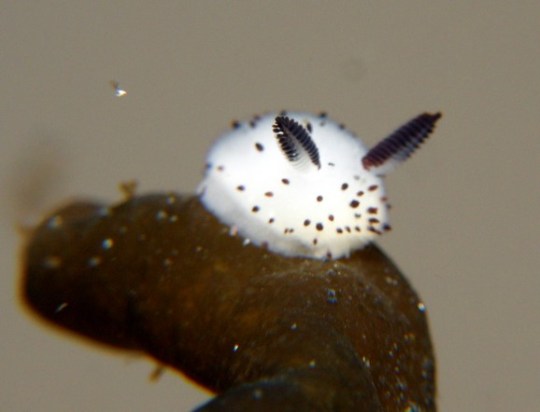
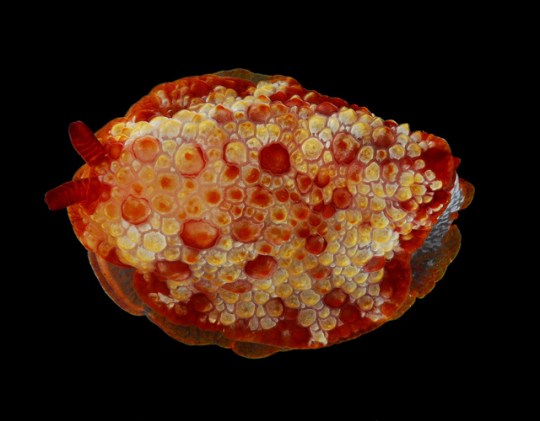
Lately, I also have a soft spot for nudibranchs! I included one (the Hopkins’ rose nudibranch) in my last book, but there are so many other species that we know so little about! As I mentioned above, it’s the diversity that takes my breath away. Some of them look like bunnies:
Image courtesy of crawl_ray on flickr.com
Some even look like pizzas!
Image courtesy of Arthur Anker on flickr.com
You do such a great job of reaching out to kids through videos, KeatingCreature on Twitter, your YouTube Channel: Animals for Smart People, personal appearances, and Skype visits. Can you describe a funny or favorite anecdote from one of your events?
Thank you for the Youtube shout out! I really hope teachers find my videos useful! As for a favorite event, when you mix animals and kids, the results are often hilarious. Usually, my visits involve a lot of dead things. I bring a collection of skulls, animal bones, and animal track castings with me. Every so often, we get lucky with some live specimens.
One of my favorite events was a library visit that involved a 10+ foot python. I had her resting on my shoulders (as you do), and I remember laughing because almost all of the adults in the room were skittish, backing off toward the door.
When I asked who else wanted to hold this lovely python, every adult shook their head. There was no way they were going near it! But then, a tiny six year old girl rushed up to the front, with a massive smile on her face. She wasn’t afraid at all as she held that snake—and I’m pretty sure that her big moment meant as much to me as it did to her!
What inspired you to write Pink is for Blobfish?
Pink is for Blobfish is a book so close to my heart! I know that sounds strange, because it’s essentially a book filled with weirdos!
As you can probably guess, I’ve been reading animal books my whole life. I loved them all, but what I really wanted was to write something that says as much about us as it does about the wild animals on each page. A book that not only shares amazing animals with kids, but also gets them thinking critically about how they view the world, especially regarding their assumptions and judgments. Pink is for Blobfish is my way of getting readers to look at gender expectations, while (hopefully) instilling them with a little wonder about the natural world.
There’s so much humor in your writing and videos. How does your love of comedy help you connect to readers?
The short answer is, I’m just a big ham and love making people laugh. There’s also the added bonus with nonfiction: we’re much more likely to remember something if we connect with it emotionally. My way of accomplishing that is to be funny and get kids laughing. Fiction or nonfiction, one of the easiest ways for me to reach readers is through a well-timed joke.
But, you can also get a little deeper with it. I once heard that Jim Carrey doesn’t think of his job as “making people laugh.” Instead, he views it as “freeing people from concern.” The minute I heard that, it resonated with me. For those few moments, when you’ve got a reader laughing, they’re free from any concern in their lives. It’s a reprieve, a bright moment. It’s true for us as adults too—it’s pretty much impossible to be stressed out when you’re reading about a pigeon that wants to drive a bus!
Now, when I approach my writing, I look for those moments. If I can make myself laugh, that’s half the battle.
What’s the best part about writing books for kids?
For both fiction and nonfiction, my favorite part is seeing the look on a kid’s face when you open a door for them into a whole new world. Sometimes, it’s the ridiculously colorful world of nudibranchs. And sometimes, it’s helping them to the realization that they aren’t alone, no matter how weird they feel.
What’s up next for you?
I’m so glad you asked! I just received F&Gs of the second book in the World of Weird Animals series! I can’t give away the title just yet, but I can say we are going to look at MONSTERS. This isn’t just going to be a book of creepy creatures. We’re going to dig into why we see certain animals as monsters, and how those judgments and assumptions affect how we think of them. I was blown away with the discussions that Pink is for Blobfish prompted with kids, and I can’t wait to see how they respond to this book!
I also have my first picture book biography, SHARK LADY, coming out next year! I’ve always been a fan of sharks, and I was thrilled to tell the story of Eugenie Clark, one of the world’s first female shark scientists. Eugenie is one of those incredible women that changed the world just by being her fearless self, and I am so eager to share this book with everyone. Look for it around June!
I can’t let you get away without asking you a few holiday-themed questions, so…
You told me that World Animal Day is one of your favorite holidays. Can you talk a little about that?
What could be better than a day devoted to animals!? World Animal Day is a day to chat about animals all over the world, and how we can best protect them and their futures. A funny thing happens when you start talking about animals in the global sense—you can’t help them without also helping us. Education and awareness can accomplish so much!
Do you have an anecdote from any holiday that you’d like to share?
I have one that ties in really well here! When I was a teen, I had a really cool Christmas tradition that I highly recommend to parents of animal lovers. On Christmas morning (or any special holiday morning for you!) I would go to my local humane society, bring treats, and walk the dogs. Usually, these centers have lots of volunteers, but busy holidays are often pretty slow for them and there’s not a lot of help. I guarantee the dogs will love the company, and you’ll get to spend an hour surrounded by wagging tails! You can’t lose.
Has a holiday ever influenced your work?
Yes! A very savvy bookstore (DDG Books!) organized a “Valentine for Blobfish” event when Pink is for Blobfish came out. So many young readers felt bad that the blobfish was voted the world’s “Ugliest Animal” (true story!) and they wanted to send him valentine cards to make him feel better!
Thank you, Jess! It’s been so much fun! I wish you all the best with all of your books and your other ventures!
Learn more about Jess Keating!
As a zoologist turned middle grade and picture book author, Jess Keating has been sprayed by skunks, bitten by crocodiles, and been a victim to the dreaded paper cut. Her MY LIFE IS A ZOO series earned two Kirkus stars, a Red Maple nomination, a Rocky Mountain Book Award nomination, and a spot on the LA Times Summer Book Pick List.
Her quirky nonfiction picture book series kicked off with PINK IS FOR BLOBFISH, with a sequel to follow in 2017. Her first picture book biography, SHARK LADY, will also be published in 2017.
Jess is also the creator, writer and host of Animals for Smart People, a Youtube series about animals, science, and nature. Subscribe today and bring Jess into your classroom!
Connect with Jess Keating:
You can find Jess on Twitter @Jess_Keating and on Facebook @JessKeatingBooks!
Pink is for Blobfish can be found at these booksellers
Founded in 2005 National Wildlife Day was established to celebrate the diversity of nature and promote the awareness of endangered species worldwide. To celebrate visit an animal sanctuary, zoo, or aquarium—or think about donating your time to a worthy animal cause.
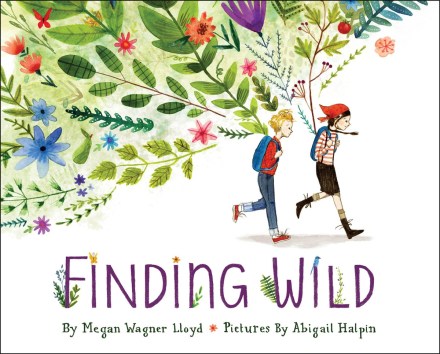
Finding Wild
Written by Megan Wagner Lloyd | Illustrated by Abigail Halpin
A girl and a boy stand with their backs to the stairs leading to the subway contemplating the jungle of growth in front of them. A single floating leaf seems to lead the way. They follow along the path, leaving the city behind and enter the wild. Here “Wild is tiny and fragile and sweet-baby new. It pushes through cracks and crannies and steals back forgotten places.” Wild comes in many guises—some obvious, some not.
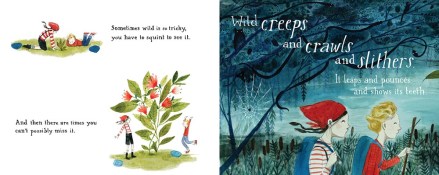
Wild also moves in various ways. As the boy and girl continue on the path passing a spider’s web and shadowy shapes with glowing eyes, wild “creeps and crawls and slithers. It leaps and pounces and shows its teeth.” Everywhere the pair ventures, wild has a distinct smell—fresh or musty, sharp or sweet, tangy or arid. They discover wild can be as hot as a forest fire or as cold as an icicle. Running through a field of flowers and climbing a rocky cliff the two find that wild is “as smooth as the petals of poppies, and as rough as the fierce face of a mountain.” They also find that wild can hurt in so many ways.
Image copyright Abigail Halpin, courtesy of Alfred A. Knopf
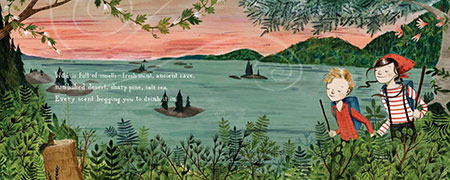
Plunging deeper into the wild the boy and girl uncover more secrets—delicious and quenching. The sounds of wild chill and soothe them. Suddenly, though, the girl and the boy find themselves outside of the wild, back in front of a subway entrance. The wild, now seems far away, invisible and unknown, as if “the whole world is clean and paved, ordered and tidy.” As the pair gaze upward the tall buildings and skyscrapers block the sky. But the girl points to a leaf swirling through the air. They follow it through an open door that leads to a most surprising discovery.
Image copyright Abigail Halpin, courtesy of Alfred A. Knopf
Megan Wagner Lloyd entreats readers to rediscover the wild no matter where they live. Her lyrical descriptions of the splendor of nature in all its incarnations—from gentle to intense, quiet to loud, mysterious to open—delightfully capture the way children interact with the environment. Lloyd reminds readers that tasting a single juicy blackberry, thrilling to a coyote’s howl on a dark night, even feeling the prick of a cactus needle connect them to the greater world and that searching for and finding the wild—especially in the midst of an “ordered and tidy” world—brings peace and happiness.
Abigail Halpin’s lush illustrations of the wild environment gorgeously depict the vibrant colors, sometimes chilling shadows, and refreshing water the two children discover in the middle of their city. The thick vegetation rendered in a palette of greens is a riot of ferns, pines, flowering trees, and vines that hide small birds and animals. As the children huddle in a tent, the indigo night crackles with lightning and the songs of coyotes. A two-page scrapbook-type spread displays various plants and insects that sting, burn, or cause itching. When the boy and girl reenter the city, buildings—old and new—billboards, and traffic meet their eyes, but they keep their gaze on the leaf leading them on. That leaf invites readers, also, to get outside and explore the wild.
Ages 3 – 8
Alfred A. Knopf, Random House Books for Young Readers, 2016 | ISBN 978-1101932810
Discover more about Megan Wagner Lloyd, the world of Finding Wild, and news on her upcoming book on her website!
View a gallery of artwork by Abigail Halpin on her website!
Wildlife Day Activity
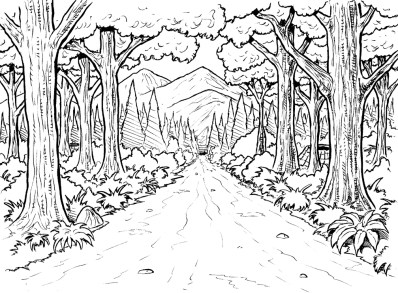
Explore the Forest Coloring Page
Take the path on this printable Forest Coloring Page to explore all nature has to offer. Add your own animals or birds to the picture—and maybe even yourself!
With their bald pink heads and dusty brown feathers vultures and turkey vultures may not be the peacocks of the bird kingdom, but they play a crucial role in the environmental cycle. These scavengers live on carrion, clearing away and “recycling” the carcasses of dead animals. Because of the vulture’s appearance and stereotypical depictions, their plight as an endangered species goes largely unnoticed. Environmental groups in South Africa and England established today’s holiday (also known as International Turkey Vulture Day) to promote awareness f the declining number of vultures, a cause that has been picked up by zoos and other conservation groups around the world.
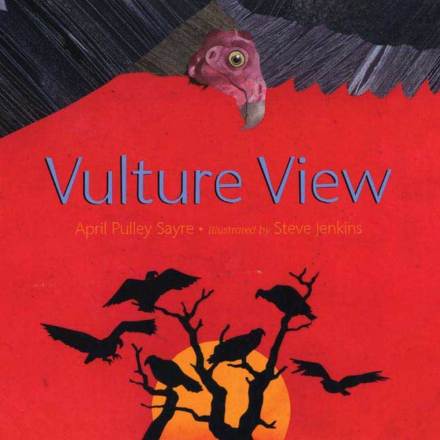
Vulture View
Written by April Pulley Sayre | Illustrated by Steve Jenkins
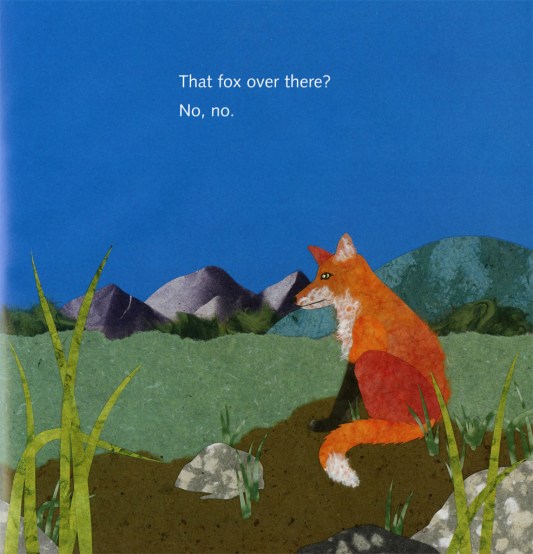
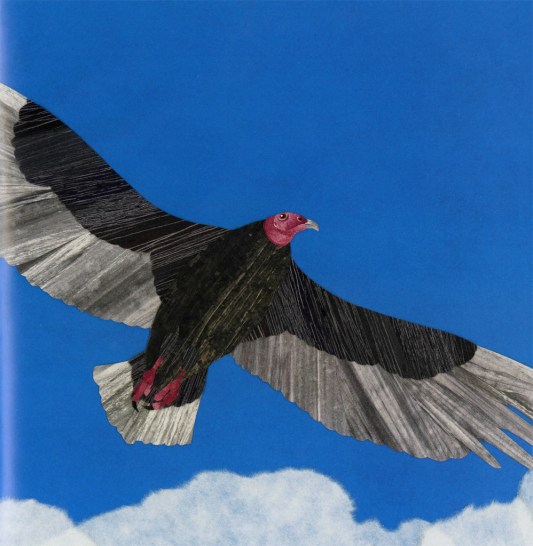
In the clear blue morning sky the vultures soar. “Wings stretch wide / to catch a ride / on warming air / Going where?” One turkey vulture scans the ground, dipping and tilting as it searches for its breakfast. A snake rattles and hisses in the rocks. The vulture passes it by. A golden fox gazes silently into the distance, but the vulture flies away. A bear half-way up a tree would be easy prey, but the vulture lets him continue his climb.
Image copyright Steve Jenkins, courtesy of us.macmillan.com
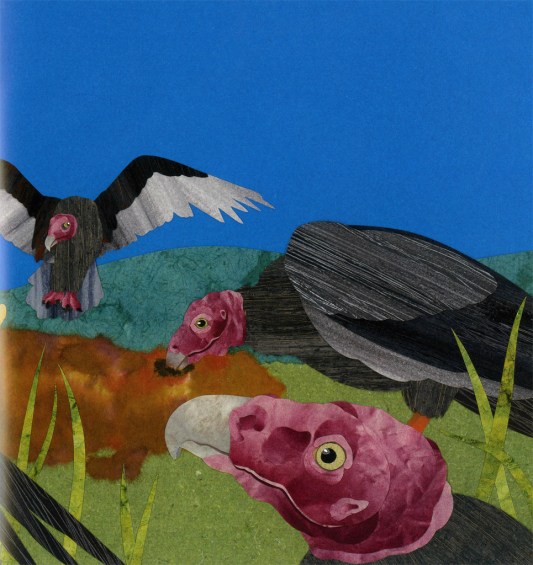
The turkey vultures are searching for a particular meal. They “smell the air. / They sniff, search, seek / for foods that… / REEK! The aromas of the landscape rise to the vultures. Are they attracted by the “fragrant flowers? / No, no.” “That spicy smoke? No, no.” Maybe “that stinky dead deer? Yes, yes!”
The vultures descend to dine on their “rotten” meal. Afterward they clean themselves in the nearby water and preen their feathers. Still hungry, “they hop, flap, soar / to look for more.” As the sun sets the vultures’ “wings glide, wings ride / through cooling air.” They come from all over to vulture trees—beautiful, bare silhouettes on the sky—to “settle and sleep, like families.”
Image copyright Steve Jenkins, courtesy of us.macmillan.com
With the rising sun and the warmer air, the vultures take to the sky again in search of their singular meal.
Intriguing facts about how vultures fly, the seven species of vultures, why and how vultures feed on carrion, nesting behaviors, and vulture festivals around the United States follow the text.
In this Theodor Seuss Geisel Honor Book, April Pulley Sayre brings a poet’s sensibility to the misunderstood vulture. In her lyrical lines the sights and smells of the vulture’s terrain and the vulture’s flight patterns are elevated to educate young readers of the actual beauty of this distinctive species. The benefits vultures provide to the environment as well as their familial attachments make these birds some of the most fascinating animals in the wild kingdom. Who among us doesn’t look up at the circling majesty of birds of prey? Sayre’s text gives readers the bird’s eye Vulture View.
Image copyright Steve Jenkins, courtesy of us.macmillan.com
With his signature cut-paper collage illustrations, Steve Jenkins gives shape to the vulture’s world. The mottled dark body and the wings and tail fringed with white meet layers of pink that form the vulture’s wrinkled head. The rattlesnake is a smooth combination of greens and browns while the fox is brilliantly orange and soft. Hills and mountains jut from the bottom of pages, and a bony carcass lays amid tall grass, decaying and attracting a vulture. As the birds streak through wispy fiber clouds to descend upon the vulture tree in the shadowy evening, readers will come to appreciate the life and role of the vulture.
Ages 4 – 8
Henry Holt and Company, 2007 | ISBN 978-0805075571
Wow! You will find a wealth of information on April Pulley Sayre‘s website which includes her many books, educators’ resources, and much more information on natural history topics.
Even just hovering over the icon links on Steve Jenkins‘ website is fun—and there’s so much more to discover once you click on them!
International Vulture Awareness Day Activity
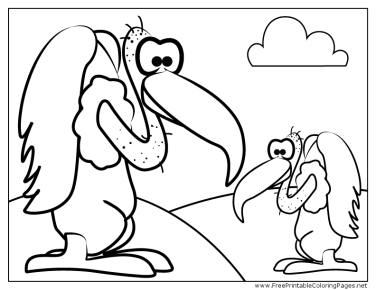
Valuable Vultures Coloring Page
Vultures are a valuable part of our ecosystem. Here’s a printable Valuable Vultures Coloring Page for you to enjoy. Why not try your hand at using cut or torn paper like Steve Jenkins does in Vulture View to fill in the design?
In 2009 beekeepers in the United States petitioned the United States Department of Agriculture to establish an official day to commemorate honey bees and beekeeping. Since then the holiday has expanded world wide, and the plight of the bee population has become a global concern. Bees are a crucial component in sustainable farming, and even home gardeners know their harvest will be successful when they see bees hovering nearby. Bee enthusiasts commemorate the day by planting flowers that will attract these tiny dynamos, such as lavender, marjoram, and borage. To celebrate, why not try some local honey—you might fall in love with the taste, like Fred in today’s book!
The Honeybee Man
Written by Lela Nargi | Illustrated by Kyrsten Brooker
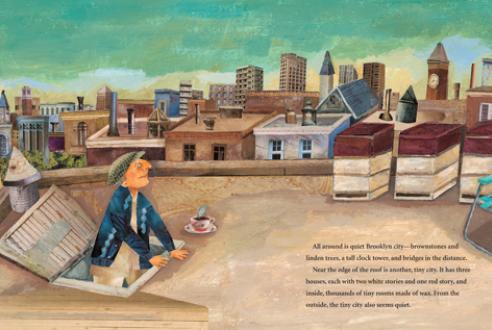
At dawn on a July morning, Fred awakes to begin his day with his “enormous” family. His morning routine consists of a cup of tea and a climb back upstairs and through a hatch in the ceiling that takes him to the roof. “All around is quiet Brooklyn city—brownstones and linden trees, a tall clock tower, and bridges in the distance.” But nearby is another, tiny city. It consists of only three houses, but inside are “thousands of tiny rooms made of wax.”
The summer morning smells of “maple leave and gasoline and the river and dust. He turns to the tiny city and inhales its smaller, sweeter smell—a little like caramel, a little like ripe peaches.” He bends down to the three houses to wake their residents. “‘Good morning, Queen Mab. Good morning, Queen Nefertiti. Good morning, Queen Boadicea,’” he calls before greeting the rest of his family: “‘Good morning, my bees, my darlings!’”
Inside the houses the bees are busy. The queens are laying eggs while the workers build wax rooms, nurse bees feed the babies, and others are getting ready to find fields of flowers for nectar. Fred dreams of the marvelous flowers the bees may find to flavor their honey. He imagines the bees flying low over the flowers moving among them and wishes he could soar with them too.
Image copyright Kyrsten Brooker, courtesy of Schwartz & Wade
Fred watches the young bees uncertainly leave the hive and swirl off into the air. The older bees “zip out of the hives and throw themselves at the air, embracing it with their wings.” When a few land on Fred’s arm, he gently flicks them on their way. He spies on them from his rooftop as they disperse into his backyard garden, other neighborhood gardens, and perhaps, if Fred is lucky, to “blueberry bushes somewhere across town.” He sees the bees “dive into sweet pea and squash flowers. If he were closer, he could see them using their tubelike tongues to drink in flower nectar, which they store in honey sacs inside their bellies.”
The bees fly slowly home weighted down with their treasure. Fred knows that inside the hive the bees will go to work, some will do the waggle dance that tells other bees where the flowers are, some will take the nectar and store it in the wax rooms, and others will fan “their wings to evaporate the water from the nectar so it will turn to honey.”
At the end of August Fred knows it’s time to collect the honey. He carefully enters the tiny houses, removing the honeycomb from the top. In his own home he cuts the wax caps of the comb and the honey begins to flow. A special spinning machine squeezes every drop from the honeycomb. He pours the honey into jars and labels them “Fred’s Brooklyn Honey, Made by Tireless Brooklyn Bees.” In the evening Fred sits on his stoop chatting with the neighbors. He gives each a jar of golden honey.
As night falls Fred opens a jar of honey as the bees huddle “back in their own city, waiting for the rays of tomorrow’s sun to call them up and away over Brooklyn.” Fred dips a finger into the honey and tastes. “It is sweet, like linden flowers. It is sharp, like rosemary. It is ever-so-slightly sour. “‘Ah,’ says Fred, absorbing these happy flavors. ‘Blueberries!’”
Image copyright Kyrsten Brooker, courtesy of Schwartz & Wade
Lela Nargi’s lovely city-based nature book brilliantly likens the tightly packed, exhilarating environs of Brooklyn to the stirring realm of the beehive. Through Fred’s love of his bee family, Nargi lyrically and with marvelous metaphors and verbs reveals the fascinating world of bees as well as the rich and satisfying life of one particular beekeeper. Readers organically learn fascinating facts about the ways bees collect nectar and transform it into delicious honey as well as why honey can have so many flavors.
In her gorgeous illustrations, Kyrsten Brooker uses the golden hues of honey to paint not only the beehive but Brooklyn as well, giving the two “cities” a sense of cohesiveness and equality. Fred, older, with his cup of tea and blue slippers is shown gently and lovingly taking care of his bees, even as he still has their spirit of adventure. Brooker’s combination of oils and collage fuse the dreamy quality of the text with the concreteness of its facts to create a unique book that would be perfect for quiet story times, rainy afternoons, or bedtime.
If there is such a thing as a child’s nature cozy, The Honeybee Man is it, and it would make a wonderful gift and a delightful addition to anyone’s library.
The endpapers provide detailed diagrams of the various types of bees, beehives, flowers, the waggle dance, and even a bee’s stinger. Nature lovers will relish the two pages of “amazing facts about honey, honeybees, and beekeepers” that follow the story.
Ages 5 – 10
Schwartz & Wade, Penguin Random House | ISBN 978-0375849800
You can find books for children, articles for adults, and so much more on Lela Nargi’s website!
World Honey Bee Day Activity
Bees and Hive Coloring Page
The world of the honeybee is mysterious and marvelous! Here’s a printable Bees and Hive Coloring Page for you to enjoy!
Water Quality is a crucial world-wide issue. In fact, 2015 closed out a decade-long United Nations initiative “Water for Life” to promote awareness of the importance of water quality as it relates to sanitation, geography, human rights, urbanization, and sustainability. The Audobon Society emphasizes the interconnectedness of all water systems and urges people to be mindful of the dangers that can lurk in runoff from construction, forestry, factories, agriculture, and personal yards as it combines in rivers, lakes, or the ocean. To observe this month be conscious of what is in your water. Limit the use of anti-bacterial soaps that contain a certain pesticide harmful to marine life, don’t flush unused medications, choose nontoxic household cleaners, avoid using fertilizers and pesticides, and clean up leaks from cars and other machinery. Protecting our water sources protects us.
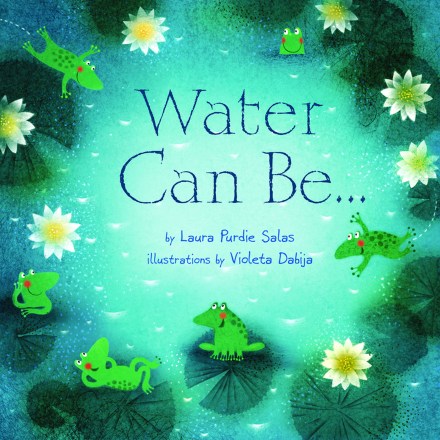
Water Can Be…
Written by Laura Purdie Salas | Illustrated by Violeta Dabija
“Water is water— / it’s puddle, pond, sea. / When springtime comes splashing, / the water flows free.” So begins an inventive journey through the ways that water enriches our lives. With four-word rhyming couplets Laura Purdie Salas illuminates specific moments or circumstances to reveal water’s important role from season to season. From filling ponds, lakes, oceans, and even puddles to roaring down hillsides to floating in misty fogs and forming snowflakes, water sustains us and makes the world a more beautiful place.
During spring and summer when ponds nurture new life and rain puddles reflect, “Water can be…a tadpole hatcher / Picture catcher.” In hot weather water refreshes as a “Thirst quencher / Kid drencher.” And the seas, at times calm and at others roiling, can be both “Home maker / Ship breaker.”
As the air cools in autumn, water can be found in alternate forms. It squirts from fountains for the “school drink-er” and hardens to ice for a “Bruise shrinker.” A river’s winding trail becomes a “Salmon highway / Eagle flyway.” Winter brings water in a more solid form. Whipped by wind snow swirls as a “Storm creator” or gently sticks to surfaces as a “Decorator.” Outside, both animals and people enjoy the frozen precipitation. Snow serves as a “Woodchuck warmer / Snowman former.”
On the final pages as ice sculptors carve castles and dragons, moon beams and rabbits, Laura Purdie Salas encourages readers: “Water is water— / it’s ice, snow, and sea. / Now go and discover / what else it can be.”
Fascinating facts concerning the subject of each rhyme, a glossary, and a bibliography for further reading follow the text. Laura Purdie Salas donates a portion of the royalties from Water Can Be… to WaterAid, an international non-profit organization that transforms lives by improving and providing access to safe water, hygiene, and sanitation.
Laura Purdie Salas always surprises with her selection of examples and clever rhymes leading readers to more fully appreciate the world around them. Water doesn’t just flow, it feeds, speeds, cloaks and soaks, it decorates and bejewels, fluffs and snuffs. After reading Sala’s poetic tribute, readers will never experience water the same way and will be on the lookout for how they can interpret water’s gifts.
Violeta Dabija has created gorgeous, ethereal interpretations of each two-word rhyme. The nourishing blues and aquas of the sea, gauzy whites of fog and clouds, and brilliant whites of snow and ice are subtly crosshatched giving each illustration depth and movement. While the words on each page are short, kids will want to spend a long time taking in the beauty of Dabija’s paintings.
Ages 3 – 8
Millbrook Press, Lerner Books, 2014 | ISBN 978-1467705912
Check out the book trailer for Water Can Be…. It really makes a splash!
View more beautiful art by Violeta Dabija on her website!
Water Quality Month Activity
Angel Fish Coloring Page
Clean water is important for all fish to survive! You can make the ocean sparkling clear by adding a bit of glitter to your printable Angel Fish Coloring Page!
Every year more than 180 million people visit zoos and aquariums in the United States. Caring for the animals that live in these zoological parks, maintaining the facilities, and educating guests about the scientific facts and personal stories of the animals under their care is more than just a profession for zoo keepers—it’s a passion! Today’s holiday raises awareness of the day-to-day work of zoo keepers who protect and preserve the world’s species.
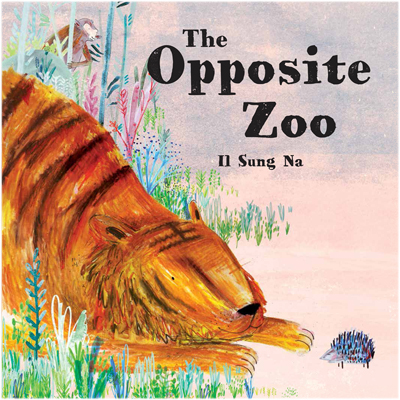
The Opposite Zoo
By Il Sung Na
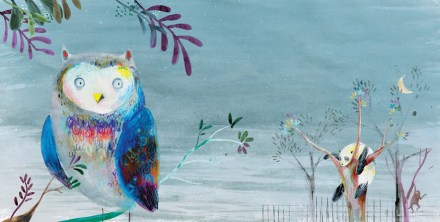
The Dark of twilight has descended on the Opposite Zoo and all the visitors are gone. But the clever monkey finds his door Open! He creeps out to explore the zoo by night. Two animals sit amid the tree tops. The owl is Awake, while the panda hangs suspended in the branches, Asleep. The lion, having a final stretch before snoozing, is Hairy, but the hippo taking a late dip is Bald.
Image copyright Il Sung Na, courtesy of ilsungna.com
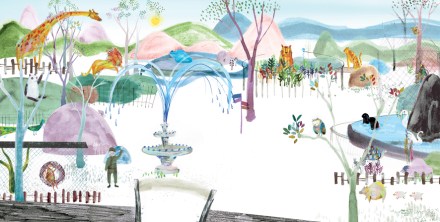
The Tall giraffe, munching leaves, towers over the trees as well as the Short pig who is feeding her piglets. The monkey plays peek-a-boo with a Shy iguana as it climbs a rock to watch the Bold peacock fan his beautiful tail feathers.
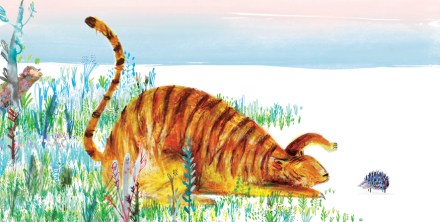
The tiger, with his Soft fur, is intrigued by the Prickly hedgehog, and the Black seals frolic in the pond while the White swans float majestically above. The monkey then hitches a ride on the tail of a Fast cheetah, leaving the Slow sloth to meander on its way. Oh those Noisy monkeys! Are they bothering the Quiet turtle?
Image copyright Il Sung Na, courtesy of ilsungna.com
The prowling monkey has had a long night of fun, but now the sun is Bright. He hurries back to his tree just in time for his door to Close—because now the Opposite Zoo is Open!
The Opposite Zoo combines several concepts—opposites, animals, and a search-and-find element—into a fun romp for young readers. The story is appropriately simple and serves as the frame for Il Sung Na’s stunning paintings: The fiery lion, tiger, and cheetah crackle with orange energy. The owl is a midnight blue tapestry, and the peacock’s tail is as graceful and intricate as a fine Asian fan. Na’s vibrant colors are set against delicate, softly hued backgrounds. Readers will love following the silly monkey through each picture and pointing out his shenanigans.
The Opposite Zoo is a wonderful choice as a new baby gift or for youngest children’s libraries.
Ages birth – 5
Image copyright Il Sung Na, courtesy of ilsungna.com
Knopf Books for Young Readers, 2016 | ISBN 978-0553511277
View more artwork and books by Il Sung Na on his website!
National Zoo Keepers Week Activity
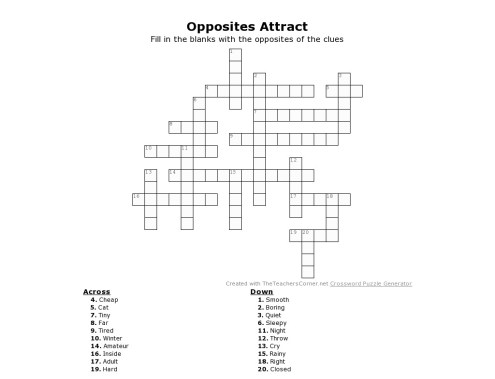
Opposites Attract Crossword Puzzle
Some words go hand in hand even though they’re different. Find the words that make pairs fill in the blanks of this printable Opposites Attract Crossword Puzzle.














 celebratepicturebooks.com